Chapter XXX · (continued 2)
Reading edition
All thoughts of surrender, of course, were abandoned; the disappointed bishop was dismissed to his equally disappointed master; and the English forces, consisting of 6,000 archers, and a body of heavy-armed cavalry, under Sir Walter Manny, a Flemish knight, one of the greatest captains of the age, in Edward's service, landing, drove the besiegers back, and entered the town amid the joyful acclamations of the inhabitants. The delighted countess received her deliverers with every courtesy. She admitted the knights and captains into her own castle, decorated with her finest tapestry, and dined herself at table with them. The next day, after dinner, Sir Walter Manny proposed to make a sally, and break down the battering rams of the French. The challenge was enthusiastically answered by all the knights and warriors present. They united and rushed forth with 300 archers, charged the French furiously, took and broke to pieces the engines of the siege, drove back the besiegers, and, following up their advantage, fell on the camp, and set fire to it, killing many of the enemy. The countess was so overjoyed at this signal triumph that, on the return of Sir Walter to the city, she hastened to receive him, and, says Froissart, kissed him and his companions twice or thrice, "like a valiant lady."
The siege was raised, and the French removed the war to Lower Brittany. Don Louis of Spain went along the coast attended by a strong force of Spaniards and Genoese, and indulged his disposition for cruelty by burning Guérande, and sacking the whole country as far as Quimperlé. Sir Walter, informed of this, pursued Don Louis with all speed, taking ship with 3,000 archers, and a sufficient proportion of men-at-arms. He came up with him at Quimperlé, seized his fleet and all his booty in the harbour, fell upon Don Louis's force, killed his brother Don Alphonso, severely wounded Don Louis himself, who hurriedly escaped in a skiff, and totally destroyed or dispersed his followers.
Brilliant as these actions were, the forces sent to support the countess were far too inadequate to this object. Don Louis, smarting under this defeat, had again joined Charles of Blois, and together they returned to invest Hennebont, against which they reared sixteen engines of the largest size, with which they dreadfully battered and shook the walls. The undaunted countess, however, defended the ramparts with woolsacks, and jeered the assailants by asking them why they did not bring up their army from Quimperlé. Don Louis, against whom this was aimed, burned for revenge, and endeavoured to obtain it in a most dastardly and unknightly manner. Amongst the prisoners of Charles of Blois were two gallant Englishmen, Sir John Butler and Sir Matthew Trelawny. These brave men, out of spite to the English, who had so signally defeated him, Don Louis demanded to be delivered up to him, that he might put them to death in sight of the whole army and city. Charles, who revolted at so dishonourable a proposal, refused; but on Don Louis declaring that he would renounce the cause of Charles for ever, they were given up Don Louis had them bound ready, and declared that after dinner he would strike off their heads under the city walls. No persuasions of his knights could divert him from his savage purpose. But Sir Walter Manny hearing of it, made a sally, in which Sir Aimery of Clisson, a Breton knight, attacking the French in front, and Sir Walter, issuing from a private postern, and falling on the camp, found the two condemned knights, and rescued them. The French were soon after compelled to raise the siege, and concluded a truce with the countess till the following May, 1343.
This interval the Countess of Montfort employed in a voyage to England, soliciting fresh forces, which were despatched in forty-six vessels, under Robert of Artois. The countess sailed with them; and off Guernsey they encountered a French fleet of thirty-two ships, much larger and better than the English ones, commanded by the redoubtable Don Louis of Spain, and manned by 1,000 men-at-arms, and 3,000 Genoese crossbowmen. The engagement was very fierce, the countess in full armour taking the deck, and fighting sword in hand. The battle was interrupted by night, accompanied by a terrible tempest. The English fleet, however, escaped into Hennebont. Soon after landing they took Vannes by surprise, and then they divided their forces; Sir Walter Manny and the countess defending Hennebont, and the Earls of Salisbury and Pembroke attacked Rennes, leaving Robert of Artois in Vannes. Here he was suddenly surrounded by 12,000 French troops under Oliver de Clisson and De Beaumanoir, who took the city by storm. Robert of Artois narrowly escaped, but so severely wounded that he took shipping for England, where he soon died. So perished a man who more than any other had caused this bloody war. Edward III. was so affected by his loss, for he was greatly attached to him, that he vowed to avenge his death; and accordingly he crossed the sea to Morbihan, near Vannes, with an army of 12,000 men, in October of that year.
Edward marched to Rennes and Nantes, destroying the country as he went, and laying siege to Vannes, Rennes, and Nantes all at once. By dividing his forces he failed in all his attempts, for Charles of Blois had obtained an army from the King of France of 40,000 men under the Duke of Normandy. His eldest son Edward, on the approach of this formidable force, entrenched himself before Vannes, and the Duke of Normandy sat down at a short distance from him, and entrenched himself likewise in his camp. Here the two forces lay for some weeks, neither venturing to strike the first blow; and the Pope now stepped in by his legates, and persuaded them to sign a truce for three years and eight months. Edward having secured honourable terms for himself and allies, returned home.
But the truce was by no means observed by either side. The different parties were become so exasperated against each other that they went on fighting as though there were no truce at all. Philip of France was bound by one of its conditions to liberate John de Montfort; but he still kept him in prison, notwithstanding the remonstrances of the Pope, and persevered in his attacks on Brittany, which the countess defended with her accustomed spirit. Several knights of distinction were in treaty to pass over to the side of De Montfort, and Philip making the discovery, lured them to a grand tournament, and had their heads struck off in the centre of the Halles, or market-place at Pons. Amongst these were the brave knight Oliver de Clisson, already mentioned, John de Montauban and many others there and in Normandy were as ruthlessly dealt with. This perfidious and sanguinary conduct produced a feeling of horror everywhere, and such of the Breton knights as had fought for Charles of Blois went over to the Countess de Montfort. Foremost amongst the malcontents thus created was Jane de Belville, the widow of the murdered Oliver de Clisson, who became a determined enemy, and who, carrying her son to the Countess de Montfort to be brought up with hers, became indefatigable in her pursuit of vengeance on the French. It was a remarkable circumstance that these wars produced three women, all named Jane, the wives of Charles of Blois, of De Montfort, and of De Clisson, who displayed the most extraordinary spirit, each rivalling the other in their heroic actions.
This contempt of the truce roused the English nation to support the king in the continuance of the war. The Parliament granted him liberal supplies, and he sent over his near kinsman, the Earl of Derby, son of the Earl of Lancaster, with an army to protect Guienne, and give assistance to the Countess de Montfort. The Earl of Derby was a nobleman of great ability and integrity of character, distinguished both for humanity and bravery. He very soon placed Guienne in a posture of strong defence, and then made a bold advance into the enemy's country. He attacked and defeated the Count de l'Isle at Bergerac, reduced a great part of Périgord, and took the strong castle of Auberoche in Gascony. This castle was again attempted by De l'Isle, being left only with a weak garrison; but a spy whom Derby had in the French camp apprised the earl of its situation. He advanced into the neighbourhood with 1,000 cavalry, and found the castle invested by 10,000 or 12,000 men. The earl had sent to the Earl of Pembroke at Bergerac to meet him with a large force, but he had not come up. To ordinary men the idea of attacking the French army of 10,000 or more with his 1,000 would have appeared insane; but the earl had with him the able commanders, Sir Walter Manny, Lord Ferrars, Sir Richard Hastings, and others, and, taking advantage of a wood, they came suddenly on the French camp as the soldiers were cooking their suppers. Darting amongst them with loud shouts of "A Derby! a Derby!" the sudden apparition of the enemy threw the whole French host into such confusion that a total rout took place, and the Count de l'Isle, with nine earls and viscounts, and nearly all the barons, knights, and squires of the army were taken.
This terminated the campaign of Lord Derby for 1345; and the next year, when he became Earl of Lancaster through the death of his father, he pursued his victories, and took strong towns and fortresses. His successes were favoured by the state of France at that time, where the exhausted finances led Philip to debase the coin and lay a heavy impost on salt, both of which circumstances excited great disaffection and disorder in the kingdom. At length the Duke of Normandy, Philip's eldest son, attended by the Duke of Burgundy and other powerful nobles, led a large army to the frontiers of Guienne, and compelled Lancaster to stand on the defensive, his forces being much inferior in number.
While these events were taking place, Edward III. was earnestly at work at home, endeavouring to organise an efficient scheme for achieving something more than the defence of Guienne or the aid of Brittany: namely, his grand dream of the total conquest of France. His first attempt was to secure the co-operation of his old friend Jacob van Artevelde, the brewer of Ghent. He had the daring to propose that his son, the Black Prince, should be offered to the people of Flanders in lieu of their old Count, who had gone over to the French interest. But this scheme cost the stout old Artevelde his life. No sooner was the overture made than the burgesses took alarm at it, and lost their faith in Van Artevelde as a patriot. Bruges and Ypres were brought over by the promised advantages of trade with England, but his own town of Ghent broke out into open insurrection. When he rode into the city, attended by a body of Welsh, whom Edward had sent, he was received with the most hostile looks and expressions. He hastened to his house, and endeavoured by a speech from an upper window to appease the incensed people; but it was in vain. They broke into his house, and murdered him on the spot (July 9th, 1345). The man who had reigned like a king, on the strength of his reputed patriotism, now fell by the hand of a saddler, and amid the execrations of the mob, as a traitor. Hope of assistance was gone for Edward in that quarter.
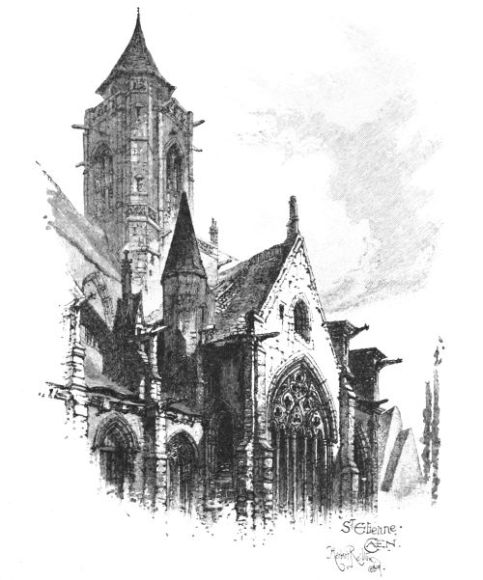
THE CHURCH OF ST. ETIENNE: CAEN.
[See larger version]
He was equally unfortunate in Hainault. His brother-in-law, the young Count of Hainault, was killed also in a revolt of the Frieslanders; and his uncle, the well-known John of Hainault, so long allied with England, went over to the French on the plea that Edward had not duly estimated or rewarded his services. About the same time, too, John de Montfort, so long a captive in Paris, was liberated, but died of a fever before Quimperlé. All hope appeared closed on the side of the Netherlands and of Brittany; but a new light sprang up in an unexpected quarter, giving an entirely new turn to his enterprise.
Sir Godfrey de Harcourt, Lord of Saint Sauveur, and brother of John, Count of Harcourt, long in the service of England, had stood high in the favour of Philip of France; but having offended him by resisting one of his arbitrary acts, he had a narrow escape of sharing the fate of Oliver de Clisson. He fled to England, and, like his predecessor, Robert of Artois, he exerted all his talent to persuade the king to invade France on the side of Normandy, Sir Godfrey's own country, and where, of course, lay his forfeited estates. He represented to Edward that it was one of the most fertile and beautiful provinces of France—abounded with wealth, for it had not been the scene of war for two centuries; that the numerous and opulent towns had scarcely any fortifications, and were now deserted by the nobility and their vassals, who were with the Duke of Normandy in Gascony. He reminded Edward that it was an ancient possession of England, lay near the English coast, might be secured almost without a blow, and would strike the French king dumb with consternation, for it would bring his capital within easy reach of attack.
It is surprising that these facts had not presented themselves to Edward before; but, once offered to his mind, he embraced them with avidity. He assembled a fine army of 30,000 men, consisting of 4,000 men-at-arms, 10,000 archers, 10,000 Welsh infantry, and 6,000 Irish. Circumstances, rather than his own wishes, had brought him to depend no longer on mercenary and treacherous allies, but upon his own subjects; and from this moment he began to perform those prodigies of arms which raised the name of Englishmen above all others for steady and transcendent valour. He set sail from Southampton in a fleet of near 1,000 sail of all dimensions, carrying with him the principal nobility of the realm, and his son, the Black Prince, now fifteen years of age. He landed his army at La Hogue, on the coast of Normandy, and there divided it into three bodies, one of which he placed under the command of the Earl of Warwick, another under Sir Godfrey de Harcourt, whom he created marshal, and the third under the Earl of Arundel, whom he made constable; he himself was generalissimo, and before setting out on his march he knighted the Prince of Wales and a number of the young nobility. He next caused the French ships in La Hogue, Harfleur, and Cherbourg to be destroyed. This work was committed to the English fleet, and the plunder of these seaports was given up to those who manned it. Advancing into the country, Edward found it almost wholly defenceless, as Harcourt had represented. Montebourg, Carentan, St. Lo, Valognes, and other places in the Cotentin, were taken and pillaged.
One of the king's objects was to create an alarm, and thus draw off the French forces from Guienne; and in this he succeeded. The King of France, startled by this unexpected invasion, hastened to assemble troops from all quarters. He was soon at the head of a numerous army, which, from the sounding titles of many of the allies and generals, appeared extremely formidable. Amongst them were the Kings of Bohemia and Majorca, the Emperor elect of Germany, the Duke of Lorraine, John of Hainault, and the Count of Flanders. He despatched the Count of Eu, Constable of France, and the Count of Tankerville to defend the populous and commercial city of Caen; but they were speedily overthrown by Edward, who took the two counts prisoners, and, entering the city, massacred the inhabitants without distinction of age, sex, or rank. The scenes perpetrated in Caen are frightful to record, and present a revolting picture of the savage spirit of the age. The wretched people, driven to desperation, barricaded their doors against the ruffianly invaders. They, in turn, set fire to the houses, till Edward, at the earnest entreaty of Sir Godfrey Harcourt, put a stop to the burning, but gave up the town to three days' pillage, reserving for his own share the jewels, plate, silks, fine cloths, and linen. These he shipped for England, with 300 of the richest citizens, for whom he meant to demand heavy ransoms. Two cardinal legates, who had come with the benevolent hope of negotiating a peace, beheld instead this fearful butchery. The Church at this period was the only power which endeavoured to bring to men's remembrance the benign influence of Christianity, and, in exerting itself to check the spirit of military carnage and devastation, certainly discharged its sublime duty well. As for these martial monarchs, they seemed to forget in the fury of war all compassion; and both Edward and his youthful son displayed a hard and sanguinary disposition in their campaigns, in melancholy contrast with the high professions of chivalrous courtesy.
Edward, having inflicted this terrible chastisement on Caen, then advanced towards Rouen, intending to treat it the same; but on arriving opposite to that city, he found the bridge of boats was taken away, and Philip of Valois occupying the right bank of the Seine, with an army far superior to his own. Edward then continued his march up the left bank of the river towards Paris, destroying all the towns and country as he went along. The French king marched along the right bank, breaking down all the bridges, and taking every means to prevent his crossing. After sacking Vernon and Mantes, the English king arrived at Poissy, within nine miles of Paris. Here finding the bridge only partially destroyed, he resorted to this stratagem in order to cross the Seine:—He still ascended the river, as if intending to march on Paris; while his advanced lines scoured the country up to its very gates, burning St. Germain, St. Cloud, Bourg-la-Reine, Nanterre, and Neuilly. Having thus drawn the French king to Paris, he suddenly made a reverse march, reached Poissy, hastily repaired the bridge, and passed his troops over. Once across the Seine, he proceeded by hasty marches towards the river Somme. His vanguard, commanded by Harcourt, met with reinforcements proceeding from Amiens to the king's camp, and defeated them with great slaughter. Reaching Beauvais, he burnt its suburbs, and plundered Pois. As he drew near the Somme, he found himself in the same difficulties as at the Seine. All the bridges were destroyed, and he endeavoured, but unsuccessfully, to pass at Pont St. Remi, Long, and Pequiny. He was now fast being enclosed by the enemy. The Somme was a deep, and, so far as they could find, impassable river; on its right bank showed a strong force under Godemar de Faye, a powerful baron of Normandy, supported by the gentlemen of Artois and Picardy. Approaching the sea, near Oisement, he was thus cooped up between it and the Somme, with Philip and an army of 100,000 men pressing on his rear. In this urgent extremity, the marshals of the army were sent out to see whether they could not possibly discover a ford, but in vain. Edward now appeared to be placed in a very serious dilemma; but, assembling all the prisoners belonging to that part of the country, he offered to any one who would point out a ford his own liberty, and that of thirty of his companions.
On this, a peasant said, "Know, sir, that during the ebb-tide the Somme is so low at a place which I can show you, that it may be passed either by horse or foot with ease. The bottom is plain to see, for it is of chalk, quite white, and so is called Blanchetaque, that is, white water."
On hearing this agreeable news, Edward ordered the trumpets to sound at midnight, and set out from Oisement for the ford. There he arrived some hours before the ebb, and was compelled to wait, seeing Godemar de Faye ready with 12,000 men on the other side prepared to oppose his passage, and every minute expecting the arrival of Philip. As soon as the ford was passable he ordered the marshals to dash into the river, and to drive back the enemy in the name of God and St. George! So great was his impatience that he himself led the way, crying, "Let those who love me follow me." The French forces met them half way, and valiantly disputed the passage; but they were driven back. The English, however, found the main body strongly posted on the right bank at a narrow pass, through which they were compelled to force their way by hard fighting. The Genoese crossbowmen here galled them severely with their arrows; but the English archers replied so vigorously that they drove the enemy from the ground and landed in safety. The passage was effected just in time, for Philip came galloping up before the rear-guard had reached the other side, and did some damage amongst them. But the tide was now too high to permit him to follow; he therefore took his way up the river to Abbeville, and crossed at the bridge there.
Meantime, Edward, having made this admirable passage, resolved to march no farther. He had hoped to receive reinforcements promised him by the repentant Flemings, but they did not appear, and he considered it hazardous to attempt to cross the open plains of Picardy in the presence of so preponderating a force, especially of French cavalry. He resolved to make a stand. He selected a strong position in the forest of Cressy, or Creçy, and near a village of that name. "Here," said he, "I am on the rightful heritage of my lady-mother, upon the lands of Ponthieu, given to her as her marriage dower. I now challenge them as my own; and may God defend the right!" He took his station on a gentle ascent, having in his rear a wood, where he placed all his baggage, and defended it with an entrenchment. He also threw up entrenchments on his flanks to secure them, and divided his army into three divisions. The first he put under the command of Edward, the Prince of Wales, now in his sixteenth year, to fight his first battle. Under him were the Earls of Warwick and Oxford, Sir Godfrey Harcourt, the Lord Holland, and Sir John Chandos; but the king confided the especial care of the prince to Sir John and to the Earl of Warwick, who were to assist him by their counsel, and defend him in difficulty. The second line was commanded by the Lords Willoughby, Bassett, and others. The king himself took charge of the third, to hold it in readiness to support either of the other two, or secure their retreat, as circumstances might decide. The number of the English army has been variously stated at from 10,000 to 30,000; but the most authentic accounts state it to be about one-fourth of the French, who were estimated at 120,000. The King of England, having made his arrangements, ordered the troops to take up their ground on the spot where they were to fight, and to await the next morning with confidence of victory. The soldiers set about vigorously polishing their arms, and repairing and burnishing their armour. They were well fed, and refreshed by abundant wine and provisions, which had been seized in the port of Crotoy. The king gave a supper to his barons in his tent, where he made good cheer. When it was concluded he entered into the tent set apart as an oratory, and, falling on his knees, prayed God to bring him "out of the morrow with honour."
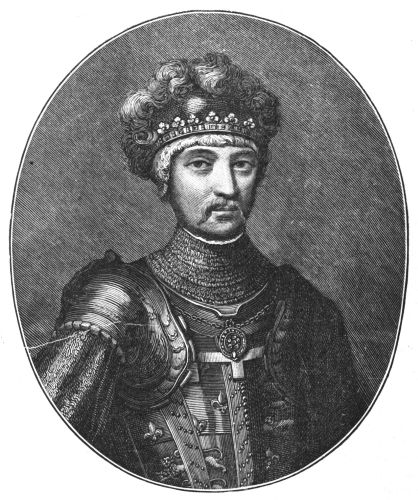
EDWARD THE BLACK PRINCE.
The night was warm; and the soldiers, having well supped, slept on the grass in their arms. With the early dawn the king and prince were up and amongst their forces.
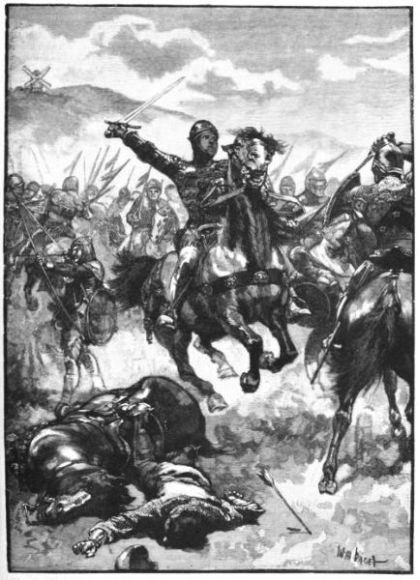
THE BLACK PRINCE AT THE BATTLE OF CRECY. (See p. 419.)
[See larger version]
Edward, mounted on a white palfrey, and attended on each hand by a marshal, rode through the ranks, spoke to the different officers, and exhorted the men to remember that they had that day to fight against superior numbers, and must therefore do their best for the honour of their country. He reminded them of the decided advantage which they had hitherto shown over the enemy; and he had such an air of confidence and cheerfulness that every one augured nothing but victory. Thus they sat, each in his place, with his helm and bow before him, and so awaited the foe. When they had thus continued till three in the afternoon, and no enemy was yet come up, the king ordered that every man should eat and take a little wine, which they did in great satisfaction.
Meantime, the King of France, having passed the night at Abbeville, set out, reinforced by 1,000 lancers under Amadeus, Count of Savoy. He deemed that he had nothing to do but to overtake the English army in order to annihilate it. For weeks it seemed to have been flying before him, and by hastily crossing the Seine and the Somme it had borne every appearance of wishing, at all costs, to avoid a conflict. He therefore pushed on hastily, and in great confusion. By the time that his advanced guard came in sight of the English lines his forces were tired, and his rear-guard far behind. A veteran Bohemian officer, being sent forward to reconnoitre the English army, rode back to Philip, and strongly recommended him to put off the battle till the next day. He assured him that the English were fresh and well posted, and would undoubtedly make a desperate defence. The French, depressed and exhausted by the haste of their march from Abbeville, must fight at vast disadvantage.
The king commanded a halt; but the ill-disciplined troops still pressed on, the van brandishing their swords, and crying, in their over-confidence, "Attack, take, slay!" and those behind, hurrying forward, declaring they would not stop till they were as forward as the foremost. So they rushed on pell-mell. Froissart says no one, except he had been present, could form any idea of the confusion of the scene. Philip had divided his army into three divisions: the first commanded by the King of Bohemia, supported by his son, Charles of Luxembourg, Emperor-elect of Germany, and Charles, Duke of Alençon, the brother of King Philip, a brave but haughty and rash youth. In this division were 15,000 Genoese crossbowmen, headed by Anthony Doria and Carolo Grimaldi. These bowmen were looked upon as the great strength of the army—an overmatch for the English archers, whom they were quickly to drive from the field. They were backed by 20,000 infantry. The second division was led by Philip himself, consisting of 6,000 men-at-arms and 40,000 foot. The broad banner of France was displayed before the king, and at his side rode the titular King of Majorca. The rear division followed, conducted by the Count of Savoy, with 5,000 lances and 20,000 foot. The last was most formidable in numbers; but all superiority was lost in the disorder of the march. The kings and dukes and great lords were hurried along, without power to exert any command, and Philip himself, in striving to enforce a halt, was borne onward as by a torrent. Finding himself face to face with the enemy, he cried, "Bring up the Genoese; begin the battle, in the name of God and St. Denis!"
But these Italians, who were brave and famous men, very reasonably complained of thus being hurried into battle, worn out as they were with carrying their heavy crossbows in the hasty march of six leagues, and said they had more need of rest than to fight that day. On hearing this, the Duke of Alençon cried out, "See! that is the help we get by employing these fellows, who thus fail us at the pinch." The sensitive Italians heard these words with deep anger, and moved on to battle. At this moment the heavens seemed to announce that a great and terrible conflict was about to take place. A thunderstorm, making it almost as dark as night, burst over the opposing hosts, and before it went a flight of crows and ravens, sweeping over the armies. When the sun broke out again it flashed in the faces of the Genoese, and the strings of their crossbows had become relaxed with the wet. On the other hand, the sun was on the backs of the English, and they had kept their longbows dry in their cases. They were drawn up by the king in ranks, crossed in the manner of a herse, or harrow, so that the discharges of the different ranks might support each other, like the discharges of combined squares of musketry in these times. No sooner, therefore, did the Genoese crossbowmen, after giving three leaps and three loud shouts to intimidate the English, let fly a shower of arrows, than the English archers stepped each of them one pace forward, and shot their arrows so thickly that, as the chronicler describes it, it seemed to snow. The Genoese, confounded by the perpetual hail of the English arrows, which pierced their armour, fell back on the men-at-arms, and the confusion then became fearful. The Genoese cut their bowstrings or threw away their bows, and endeavoured to make their escape amongst the horses of the cavalry. The King of France, seeing this, cried out, "Slay me these cowards, for they stop our way, without doing any good!" The men-at-arms advanced at full gallop right over the wretched Genoese, cutting them down right and left, and numbers were trodden under foot; while the cavalry itself was thrown into disorder by thus riding over their own bowmen to come at the enemy.
All this time the English archers kept pouring in their deadly shafts, dropping the knights and soldiers of Alençon's fine cavalry rapidly from their saddles; while the Cornish men and Welsh, armed with large knives, stole amongst the ranks and despatched those knights as they lay.
Edward had given strict orders to take no prisoners, because the enemy was so much more numerous, that it would encumber his fighting men, and keep them from the battle in looking after their captives.
In spite of the confusion, the Duke of Alençon and the Count of Flanders broke at length through it, and, charging past the line of English archers, took the cavalry of the Prince of Wales in flank. Both sides now fought desperately; but the English men-at-arms handled the French cavalry so roughly that the greater part of them were slain. Notwithstanding, three other squadrons of French and Germans, rushing forward impetuously, broke through the archers, and pushed their way into the very place where the young prince was performing prodigies of valour. The second division, under the Earls of Arundel and Northampton, advanced to support the prince, and the contest became furious. Alençon displayed the most fiery courage, and, amid a crowd of French, Germans, Savoyards, and Bohemians, pressed upon the prince with a vigour which threatened to carry all before it. The French king, eager to support Alençon, charged nobly on the archers, but could not penetrate their line, or the event might have been doubtful. The Earl of Warwick, alarmed by the dangerous position of the prince, despatched Sir Thomas Norwich to Edward, entreating him to send aid to his son.
Edward, who was watching the progress of the battle from a windmill on the hill-top, demanded of the messenger whether the prince were dead, wounded, or felled to the ground. "Not so, thank God," answered the messenger; "but he needs assistance." "Nay, then," said the king, "he has no aid from me. Tell him from me that I know he will bear him like a man, and show himself worthy of the knighthood I have so lately conferred on him. In this battle he must win his own spurs."
This being reported to the prince, gave new courage and strength to both him and his attendants. The force thrown in by Arundel and Northampton bore down the enemy slew the gallant Alençon, and dispersed his battalions; the Welsh, with their long knives, destroying all left alive on the ground.
The King of France, still struggling to come up to the rescue of his brother, arrived only to find him killed and his forces scattered. The flying cavalry communicated their panic to the king's own followers; but the king himself scorned to fly, and fought most bravely. His horse was killed under him; he mounted another, and still fought on till only about sixty of his bravest attendants remained around him. Repeatedly wounded, he would probably have lost his life; but John of Hainault, having in vain urged him to quit the field, forcibly seized the bridle of his horse, and led him away. The whole French army was in flight, the English pursuing, and putting to the sword without mercy all whom they could reach.
The King of France rode away till he came to the castle of Broye, where, summoning the warder to open the gates, that officer demanded who was there, for it was a dark night. "It is the fortune of France," said the king, probably in bitter recollection of the flatteries which had styled him "the Fortunate." On entering, the king had only five of his barons with him. They refreshed themselves with wine, and then continued their flight, with the help of guides, to Amiens.
Such was the memorable battle of Creçy, one of the greatest and most surprising victories which ever was gained by any king. It was fought on Saturday, the 26th of August, 1346. On that fatal field lay slain two kings, eleven great princes, eighty bannerets, 1,200 knights, and 30,000 men. It began after three o'clock in the afternoon, and continued till darkness ended the conflict.
Amongst the chief men killed, besides the Duke of Alençon, were the Dukes of Lorraine and Bourbon, the Counts of Blois, Vaudemont, Aumale, and Philip's old ally, the Earl of Flanders. Of the two slain Kings of Majorca and Bohemia, the death of John of Bohemia was very remarkable. He was old, and nearly blind. When all seemed lost, inquiring after his son, and hearing that he was wounded and compelled to fly, and that the Black Prince showed himself irresistible, he said, "Sirs, ye are my knights and good liegemen; will ye conduct me so far into the battle that I may strike one good stroke with my sword?" His faithful knights regarding these as the words of sad despair, four of them agreed to sacrifice their lives with him, and tying his bridle rein on each side to their own, they thus charged into the thickest of the fight, and were found the next day lying dead together, the reins of their horses still unsevered.
The rejoicing on the part of the English may be imagined. The soldiers lit up huge fires and torches to disperse the darkness, and by that light King Edward descended from his eminence, and, taking his valiant son in his arms before the whole army, he kissed him, and, according to Froissart, said, "Sweet son, God gave you good perseverance. You are my true son, for valiantly have you acquitted yourself to-day, and shown yourself worthy of a crown." The prince bowed lowly, and declared that the victory was owing to the king.
The next day it proved foggy, and the king sending out a detachment of 500 lancers and 2,000 archers to scour the fields and discover whether any bodies of French were yet keeping their ground, they met with two numerous detachments hastening to the assistance of the King of France, one of them headed by the Archbishop of Rouen and Grand Prior of France. They were coming from Beauvais and Rouen, and made a vigorous resistance; but were all cut to pieces, in accordance with the barbarous policy of Edward on that occasion. Some historians have asserted that the English raised a number of French standards, which they took, on an eminence; which thus attracting stragglers of the French army, they were butchered as they arrived. These are blots on the glory of that famous victory which it is painful to record.
The king sent out the Lords Cobham and Suffolk, with attendant heralds, to recognise the arms, and secretaries to write down the names of the fallen, and they returned an account of the numbers we have given; but of the English only three knights, one esquire, and a few of inferior rank.
Edward having attended mass on Sunday, and returned solemn thanks to Heaven for this great victory, on the Monday morning ordered the bodies of the kings, nobles, and knights to be borne to the monastery of Montenay for burial, and proclaimed three days' truce, that the people of the country might come in and bury their dead. Having discharged this duty, he marched north, taking the way by the coast, through Montreuil-sur-mer, towards Calais, which he had resolved to take possession of, as a secure and necessary entrance into the kingdom of France for the prosecution of his grand design on it.