Chapter XXXV
Reading edition
THE REIGN OF HENRY V.
Character of the King—Oldcastle's Rebellion—Attempts to Reform the Church—Henry's Reasons for the French War—Distracted Condition of France—Henry's Claims on the French Throne—Conspiracy of Cambridge—Fall of Harfleur—The March to Calais—The Battle-field of Agincourt—Events of the Battle—Visit of Sigismund to England—French Attack on Harfleur—Anarchy in France—Alliance between the Queen and the Burgundians—Henry's Second Invasion—Final Rebellion and Death of Oldcastle—Reduction of Lower Normandy—Siege and Capture of Rouen—Negotiations for Peace—Henry Advances on Paris—Murder of Burgundy—His Son Joins Henry—Treaty of Troyes—Defeat of the English at Beaugé—Henry in Paris—His Death.
The short reign of Henry V. is like a chapter of romance. It is the history of the life of a prince who was especially a hero. Young, handsome, accomplished not only in arms but in learning, skilled in and fond of music, valorous, chivalrous, generous, and successful to the very height of human glory in arms, he lived beloved and died young, the pride of his native country, whose martial fame he raised above that of all others, and made it the wonder of the world.
The fears which Prince Henry's wildness had created in the mind of his father, who seemed to anticipate in his son another Richard II., do not appear to have been at all participated in by the people. They saw in the prince too many proofs of a clear, strong, and generous spirit to doubt of his ultimate conduct. The cold and ungenerous nature of his father, his continual demands on their purses, to put down the enemies which his criminal ambition had raised around him; his murder of Richard II., and his many executions of his opponents, members of the noblest families of the realm, had completely alienated their affections, and they looked with the most lenient eyes on the jollities and practical jokes of his more warm-hearted son. The manner in which Henry justified these expectations immediately on the death of his father must have been particularly flattering to the sagacious foresight of the public. The base and obsequious found to their astonishment that they had lost instead of won his favour. Those who apprehended his wrath by the fulfilment of stern duties, were cheered to find themselves appreciated and advanced. The upright Chief Justice Gascoigne stood first and foremost in the full sunshine of his favour.
The removal of the body of Richard II. from Langley to Westminster, where it was buried with royal pomp, has been attributed to policy rather than generosity in Henry, as trusting to convince the public by it that Richard was actually dead; but the whole of Henry's character shows that he was far above any such miserable policy; that he was as open and straightforward in following his honest convictions as he was intrepid in despising mere state tricks; and the very next fact that we have to record proves this strikingly. Henry could afford to pay respect to a dead monarch, but a living claimant to the throne was a more formidable thing. The Earl of March, the true heir to the throne, was not only living, but still a young man, and had been brought up much in Henry's society. So far, however, from entertaining any jealous fear of him, like his father, he at once received him with the utmost courtesy and kindness, gave him the most unlimited freedom, and full enjoyment of all his honours and estates. He displayed the same generous disposition in reversing the attainder of the Percies, and in recalling the young Lord Percy from Scotland to the full restoration of all his titles and demesnes. Still further; all those who during his father's time had sought to recommend themselves by a ruthless zeal for the Lancastrian interests, he removed from their offices, and supplied their places by men of more honourable and independent minds, without regard to party. No conduct could have been more just and noble, and, therefore, more wise, than that of the young king; and the consequence was, that he won all hearts to him, and fixed himself as firmly on the throne as if he had been descended in the strictest course from its true kings. Amongst the very first to support him in his royal position was the Earl of March himself, who continued to the last his most faithful subject and attached friend.
But no character is without its defective side, and that in Henry showed itself in regard to ecclesiastical reform. The followers of Wycliffe had now increased into a numerous body, under the name of Lollards. They consisted chiefly of the commonalty, and included few of the upper ranks. But amongst them was Sir John Oldcastle, a bold and able man, Sir Thomas Talbot, Sir Roger Acton, and others. Sir John Oldcastle was more commonly known as Lord Cobham, having married the heiress of that nobleman, and being called to the House of Lords in right of his wife. Lord Cobham, it appears, had, while the companion of Henry, as Prince of Wales, been so distinguished for his gaiety and humouring of all the prince's whims that his enemies called him "the ruffian knight, commonly brought in by the commediants on their stage." For a century after his time he is represented as walking the boards of the theatre in the character which Shakespeare has now transferred to Sir John Falstaff. But as the prince had reformed, so it appears had Lord Cobham also. He had embraced the principles of the Lollards, and the ability and high character of the man inspired the Church with alarm.
The Church, startled at the new phenomenon of the laity assuming the office of self-inquiry and self-decision, and still more by the obstinacy with which the people maintained this novel function, began to punish and coerce. The prelates persecuted the reformers, and the reformers, raised to a sublime sense of their own right by a nearer approach to Christian truth, rebelled as vigorously. The war of opinion assumed its bitterest aspect. The Church, too far removed from the experience of the primitive ages, had again to learn the power of persecution to produce that which it would destroy.
In a fatal hour, Arundel, Archbishop of Canterbury, obtained the statute De heretico comburendo, by which William Sawtrey had been burnt, and now again sought to apply the same deceptive remedy. With this intent he applied to Henry for permission to indict Lord Cobham, as the head and great encourager of the sect, for heresy, and by his public execution to strike terror into the whole body of reformers. Henry, however, was by nature too averse from persecution, and too mindful of his old friendship for this nobleman, to accede at once to so violent a measure. He undertook to have some conversation with Lord Cobham on the subject, observing very truly to the primate that gentleness and persuasion were the best means of conversion. He therefore called Cobham into his closet at Windsor, and exerted the knowledge which he had acquired of school divinity at Oxford, to convince his friend. Words probably of severity arose between the king and Lord Cobham, for the latter suddenly left Windsor and withdrew to his own house of Cowling in Kent.
Henry now seems to have lost his tenderness towards his old friend in the awakened feeling of a determination to subdue where he failed to convince, and to have given Arundel permission to take his own way with the offender; for, immediately on Lord Cobham's withdrawal, there appeared proclamations ordering all magistrates to apprehend every itinerant preacher, and directing the archbishop to proceed against Cobham according to law; that is, the recent law against heresy. This alarming measure brought back Lord Cobham to Windsor, having drawn up a confession of faith, probably in conjunction with his most eminent friends. This confession still exists, subscribed by Cobham himself, and on looking it over at this time of day, one is at a loss to discover in it what any true Catholic could object to.
But Henry would not even receive Cobham's confession. His blood was evidently up, and in that mood he was firm as a rock. He declared that he had nothing to do with confessions of faith; they belonged to bishops: forgetting that he had just before undertaken to expound his own faith in order to convert his heretical friend. Cobham then offered, in the spirit of the times, for he was a brave and experienced soldier, to purge himself from the charge of heresy by doing battle with any adversary, Christian or infidel, who dared to accept his challenge. But Henry simply asked him whether he would submit to the decision of the bishops, which he refused; but still, like a good Catholic, offered to appeal to the Pope. Henry's only answer was to leave him to the tender mercies of Arundel, who summoned him before him, and, in conjunction with his three suffragans, the Bishops of London, Winchester, and St. David's, condemned him to be burnt. But Henry still was not prepared to acquiesce in so desperate a doom on one who had spent with him so many mirthful days. He granted the reformer a respite of fifty days; and before that time had expired, Lord Cobham had managed to escape from his prison, probably by the connivance of his lenient sovereign.
But once more at large, and in communication with his friends and confederates, Cobham became all the more active in his plans for the maintenance of the great cause. The Church had now manifested its intentions; it had shown that it was not conversion, but destruction of the whole body of the reformers that it was resolved upon; and the question, therefore, with the persecuted sect naturally was, by what means it was to prevent the fate which menaced it. If we are to believe the chroniclers of the times, the Lollards resolved to anticipate their enemies, to take up arms, and to repel force by force. Seeing clearly that war to the death was determined against them by the Church, and that the king had yielded at least a tacit consent to this iniquitous policy, they came to the conclusion to kill not only the bishops, but the king and all his kin.
So atrocious a conspiracy is not readily to be credited against men who contended for a greater purity of gospel truth, nor against men of the practical and military knowledge of Lord Cobham. But over the whole of these transactions there hangs a veil of impenetrable mystery, and we can only say that the Lollards are charged with endeavouring to surprise the king and his brother at Eltham, as they were keeping their Christmas festivities there, and that this attempt failed through the court receiving intimation of the design, and suddenly removing to Westminster. Disappointed in this scheme, the Lollards were next summoned from all quarters to march towards London, there to secure and kill all the principal clergy. They were, according to these accounts, to meet in St. Giles's Fields, on the night of the 6th of January.
The king, it is stated, being warned of this movement, gave due notice to the city, and on the day previous to the proposed meeting, the Mayor of London made various arrests of suspected persons, amongst others of a squire of Lord Cobham's, at the sign of the "Ark," in Bishopsgate Without. The aldermen were ordered to keep strict watch each in his own ward, and at midnight Henry himself issued forth with a strong force. He is represented as being greatly alarmed for the public safety, from the popular insurrections which had lately been raging in Paris, and to which we shall presently have to draw attention. He ordered all the city gates to be closed, to keep the Lollards who were within the walls separate from those without, hastening then to the place of rendezvous.
Here again the narratives of this unaccountable affair contradict each other. One declares that all the roads were covered with the adherents of Lord Cobham, hastening to the appointed spot in St. Giles's Fields; that on asking the first overtaken whom they were for, they replied by the preconcerted watchword—"For Sir John Oldcastle;" and that these being seized, the rest took the alarm and fled. By other accounts there were expected to be 25,000 men collected in the same fields, but only fourscore were found there. Cobham made his escape, but about forty of the captives were drawn and hanged as traitors, and then burnt; amongst them Sir Roger Acton, whose body, instead of being burnt, was buried under the gallows.
Nevertheless Parliament was eager for Church reform. We find in Hall, folio 35, that on the king demanding supplies, they renewed the offer which they had made to his father to seize all the ecclesiastical revenues, and convert them to the use of the Crown. The clergy were greatly alarmed by this demonstration from their own coadjutors, and feeling that the age was ripe for compelling them to disgorge a good portion of their enormous wealth, they agreed to confer upon Henry all the alien priories which depended on capital abbeys in Normandy, and had been bequeathed to those abbeys when that province continued united to England. It was now that the new Archbishop Chicheley, endeavoured to turn the attention of the king by recommending him to carry war into France.
Henry was himself already meditating that very step. It was the dying advice of his father not to permit his subjects to remain long in inaction, which, in an age which possessed few resources but hunting or war to sufficiently occupy the minds of the great barons, was sure to breed domestic factions, while successful war kept them about the person of their prince, and attached them to him by every motive of honour and advantage. The state of France at that epoch was such as rendered a fresh attempt to conquer it most alluring, and even to suggest the idea to a monarch like Henry, chivalrous and ambitious of glory, that he was, in a manner, called by God to the salutary work of rescuing a great nation from its own suicidal frenzy, and punishing the iniquity of its people—which was actually monstrous—as the Israelites were led up to punish the corrupt inhabitants of Canaan. Having, therefore, consented to the desires of the Church, and of Parliament, that all judges and magistrates should arrest any persons suspected even of Lollardism, and deliver them over to the tender mercies of the ecclesiastical courts, and that these unfortunate schismatics should, on conviction, forfeit all their lands, goods, and chattels, as in cases of felony—he addressed himself to his great enterprise, the conquest of France.
That unfortunate country was in the most deplorable condition. The dissension, the unbounded dissoluteness, and the mutual murder of the princes, seemed to have utterly debauched and demoralised the people. From head to foot, the whole body, political and social, was diseased. Every principle of honour and of rectitude, every feeling of conscience or of pity appeared extinct. Cruelty, rapacity, crime, and lawlessness were become the grand features of the nation. It was high time that some power should interpose to scourge that debased generation and restore some sense of patriotism and virtue through a better régime, if possible; and this was, in truth, the only title which Henry had to interfere. Bad as had been the claims set up by the Edwards, his was far worse; for he was the son of the usurper even in his own country, and if any just right to the crown of France could be established by the English Plantagenets, it resided in the Earl of March, and not at all in him. But, while Henry, in an amusingly confident manner, still talked of his hereditary title to the French throne, he did not omit to add what really was more obvious, that he was the appointed instrument of Providence to chastise the flagrant iniquity of the rulers of France.
That reconciliation of the Duke of Orleans to Burgundy, the murderer of his father, which we have recorded, did not last three months. After the retirement of the Duke of Clarence to Guienne, this feud broke out with fresh fury. The Count of Armagnac, the father-in-law of Orleans, one of the most clear-sighted men amongst them, indeed, never laid down his arms. Burgundy continued in Paris, and there he got up a popular faction which gradually drew the whole city into scenes and outrages which remind us of the Parisian revolutions of our own times. He made a league with the butchers, who came out with ferocious alacrity, glad of such a sanction to play a conspicuous part on that great theatre of national confusion. They adopted a white hood as their badge; and, being in alliance with the Duke of Burgundy, they also opened a communication with his revolutionary subjects in Flanders. The judges, the barristers, the members of Parliament, the noblesse, the professors and students of the university, the clergy, the monks, every class of the community, in short, were obliged to wear the white hood, as the only livery of patriotism. A reign of terror now commenced; the whole of the populace were ranged under the white hood, and had acquired the name of Cabochiens from one of their most ferocious leaders. They had reduced the upper classes of all descriptions to an ostensible submission to their despotism, and they now began to perpetrate every species of disorder.
To make confusion worse confounded, the dissolute and heartless Louis, the dauphin, quarrelled with the Duke of Burgundy, and fomented intrigues and parties against him. Chief was arrayed against chief, and mob against mob. The respectable portion of the citizens, long made dumb with terror, took heart as the host of their plebeian tyrants began to direct their terrible energies against each other, and sent secretly to the Armagnacs. From being stout Burgundians thousands now declared openly for Orleans and his father-in-law; and when the Duke of Berri endeavoured to force on the city a heavy tax, to carry on the war against the Armagnacs, they rebelled resolutely. In vain were the master butchers employed to levy the hateful impost; their rude compulsion only drove the burghers more rapidly into the arms of the opposite faction. The butchers mustered in formidable force in the Place de Grève, so memorable for its horrors on a more recent day; but, after a vigorous fight, they were vanquished, and were eventually driven out of Paris. The Duke of Burgundy was soon compelled to follow his butcher faction, and in August, after making an abortive attempt to carry off the king, he retired to Flanders. The Duke of Orleans entered the city with the Armagnacs. Everything, except disorder, was changed. The ministers and magistrates were removed, and replaced by others of the party in the ascendant. Those who had imprisoned and persecuted, now had the same, or a severer measure meted out to themselves. The faction of the dauphin was there struggling with that of the Armagnacs, and that of the queen against her own son, Louis, who had been amongst the first to call in the Armagnacs, now as earnestly implored the return of the Duke of Burgundy.
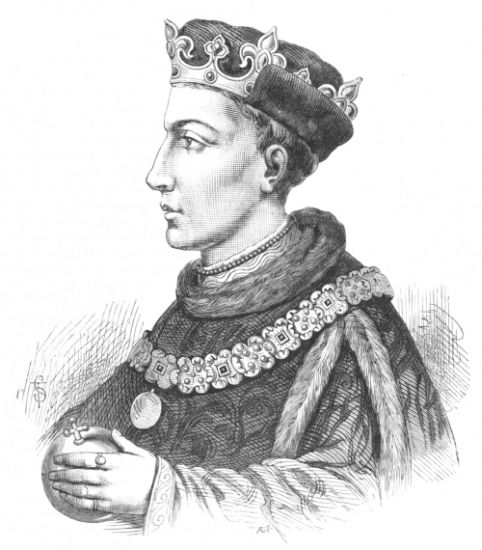
HENRY V.
Early in 1414 Burgundy accordingly marched to Paris with a large army, expecting to find the gates opened to him by the dauphin; but, on the contrary, it was stoutly defended by Orleans and the Count of Armagnac, who threatened to hang up any one on the spot who showed the least disposition to favour Burgundy. The duke was compelled to retreat again into Flanders, and leave the Armagnacs in complete superiority. They had the king in their hands, and they compelled him to sign anything they pleased. The Duke of Burgundy was declared by royal proclamation guilty of "the damnable murder of the late Duke of Orleans," as well as of sundry other high crimes and treasons, and condemned to the forfeiture of all his territories.
The Armagnacs, having issued this proclamation, marched out of Paris, seized the duke's city of Compiègne and laid siege to Soissons. This town was defended by the brave Count de Bournonville, and at this siege the archers of England were found fighting against their fellow subjects, the archers of Guienne. But the English very soon opened the gates to their countrymen from Bordeaux; the Armagnacs rushed in, and perpetrated one of the most frightful massacres in history. From the butchery of Soissons this fanatic army marched to Arras, into which Burgundy had managed to retire; but they were there successfully resisted. While meditating to raise the siege, the alarming news arrived of the King of England's preparations for the invasion of France. A hollow truce was patched up between the contending parties; but, before the Armagnacs withdrew from the city, the house in which the king lodged was found to be on fire (probably from design by some of the desperadoes of one or other faction), and he escaped with difficulty.
Once more Paris became the rendezvous of the various chiefs of these revolting factions; where, in the autumn, the infamous dauphin originated a conspiracy to drive both Burgundians and Armagnacs from the capital, to secure the person of the king, and to make himself dictator. The scheme failed; and Louis was himself obliged to flee to Bourges. The Armagnacs once more rose on his retreat, fell on the Burgundians with fury, and expelled their wives and children from the city.
Again in April of the following year, 1415, the dauphin regained possession of Paris by a base stratagem. He invited his mother, Queen Isabella, the Dukes of Orleans and Berri, with the other princes of the blood, to meet at Mélun, in order to settle all differences and unite with one accord against the English invader. The queen and princes fell into the snare. They set out for Mélun, and the dauphin simultaneously hastened into the capital, closed the gates against them, and ordered them, with the exception of Berri, severally to retire to their estates. Never was a country so torn by faction and desolated and degraded by crime; and it was at this moment that Henry of England prepared to descend on the devoted land.
In little more than twelve months after mounting the throne, Henry forwarded to France, in July, 1414, his demand of the crown of that country. No answer was returned. He then reduced his requisition from the whole realm to the following modest one—namely, the provinces of Normandy, Maine, and Anjou; the territories which formerly composed the duchy of Aquitaine; and the several towns and counties included in the treaty of Brétigny. He further required that Charles VI. should put him in possession of half of Provence, the inheritance of Eleanor and Sanchia—the queens of Henry III., and of his brother Richard, and two of the four daughters of Berenger, once sovereign of that country; that he should pay up the arrears of King John's ransom, 1,600,000 crowns, and give Henry his daughter Catherine, with 2,000,000 crowns more.
To this astounding demand the French Government replied that the king was willing to give the hand of his daughter, with 600,000 crowns, a higher sum than had ever been paid with any princess of France, and all the territories anciently included in the duchy of Aquitaine.
To this Henry refused to consent, but summoned a Parliament, the Speaker of which was Thomas Chaucer, the son of the great poet, and received from it the unwontedly liberal supply of two-tenths and two-fifteenths. To give an air of moderation to his demands, however, Henry still pretended to negotiate. He sent over to Paris a splendid embassy, consisting of 600 horsemen, headed by the Earl of Dorset and the Bishops of Durham and Norwich. They entered the capital with so much parade and magnificence, that the French vanity was surprised and mortified by it. The ambassadors first proposed a continuation of the truce for four months. They repeated the terms of the former embassy as to peace and the matrimonial alliance of the two countries, but consented to accept the princess with half the original sum. On the other side, the French raised the amount proffered from 600,000 to 800,000 crowns. Here the matter ended, and the embassy returned.
This was, no doubt, precisely what Henry expected; and now he made preparations for an immediate invasion. On the 16th of April he summoned at Westminster a council of fifteen spiritual and twenty-eight temporal peers, when he announced his resolve "to recover his inheritance by arms." His speech was received with the utmost applause and enthusiasm. The great barons, and knights eager to obtain military fame, engaged to furnish their quotas of troops to the utmost of their ability; Parliament granted two-tenths and fifteenths, and dissolved and made over to the king no less than a hundred alien priories, not conventual. Henry himself exerted every means of increasing his resources. He raised loans by pawning his crown jewels, the magnificent crown itself of Henry IV., and by other means, and altogether amassed the sum of 500,000 nobles in ready money. He rifled the cupboards and buffets of the royal palaces, and gave them as pledges of the ultimate payment of their prices to great creditors.
The Duke of Bedford, Henry's brother, was appointed regent of the kingdom during the royal absence; and the youthful monarch, full of aspirations of glory and conquest, set forward towards Southampton, the port of embarkation.
But in the midst of Henry's active occupation of embarking his troops, danger was near him. A conspiracy to assassinate him was discovered at the very moment that it was intended to carry it into execution; and what is singular, the discovery came from the very person for whose special benefit the movement was intended.
The young Earl of March, as we have already had occasion to state, was not only the true heir to the throne, but had been brought up with Henry, and was really attached to him. The sister of the young earl was married to Richard, Earl of Cambridge, and brother to the Duke of York. Cambridge, by his alliance with the true prince, appears to have been infected with the ambitious desire of seeing himself not merely brother to a legitimate prince who was contented in his station, which, though that of a subject, was honourable and happy, but brother to a king. From the little light thrown by cotemporary historians on the progress of the plot, we can only perceive that Cambridge had sought the co-operation of several persons who were known to have acted or suffered in the opposition to the late king. These were Sir Thomas Grey of Heton, in Northumberland, and Lord Scrope of Masham, both of whom had been involved in the Percy insurrections themselves, or by their near relatives. Scrope was at this time high in the favour of his sovereign. He was his trusted chamberlain, and one of the most confidential of his privy council. In the chase and in his social hours, he was the chosen companion of Henry. Yet he appears to have given in to this base conspiracy, and Henry was to be assassinated before embarking, after which, the conspirators were to escape to Wales with the Earl of March, and there raise the banner of revolt in his behalf.
It would seem that the conspiracy was as ill-constructed as it was wicked. The conspirators do not appear to have obtained the decided sanction of the principal person concerned. Probably Cambridge might have speculated on private conversations with his brother-in-law, the Earl of March, and have persuaded himself that he would fall in with such a scheme when it appeared to him feasible. But when, at the moment of action, March was apprised of the intended blow, he refused, by the earnest advice of his man Lacy, to swear to keep the secret, but required an hour in which to consider of the proposal. However the persuasions of Cambridge or his own secret feelings might have inclined him at any previous moment, now, when his friend and noble patron Henry was menaced with instant death, March at once decided, and hastened to apprise the king of his danger. That March had listened to the voice of the tempter is plain from his first requesting a pardon from Henry for his giving ear "to rebels and traitors sufficiently to understand their schemes."
This pardon Henry at once accorded, but he seized the conspirators, and brought them immediately before a council, where their fate was to be decided by twelve jurors of the county. Grey pleaded guilty to the charge of having conspired to kill the king, "to proclaim the Earl of March, in case Richard II. was really dead," to having by their emissaries solicited the said Richard—or, as he was by the indictment declared to be, Thomas of Trumpington, who personated that monarch—to invade the king's dominions with a body of Scottish forces and Scottish lords.
Cambridge and Scrope demanded to be tried by their peers, whereupon all the lords of the army were summoned; the Duke of Clarence was appointed to preside in place of the king, and the Duke of York, that he might not sit in judgment on his own brother, nominated the Earl of Dorset his proxy.
Cambridge made an earnest appeal to the king for mercy, and Scrope pleaded, like March, that he had only listened in order to ascertain the objects of the conspirators, so that he might effectually defeat them. The plea did not avail him any more than the cowardly prayer of Cambridge. They were all three condemned, were led out to the north gate of the town, and had their heads struck off, just as the royal fleet, with a favourable wind, hoisted sail, and bore out of the harbour of Southampton on the 13th of August, 1415.
This memorable expedition, thus painfully inaugurated by the blood of treason in the very near kindred of the king, consisted of 6,000 men-at-arms, and 24,000 archers, which so many occasions had now demonstrated to be the real power of England. These troops were carried in a fleet of 1,500 sail; and, with an auspicious wind, entered the mouth of the Seine on the second day, August 15th. Three days were consumed in landing the troops and stores, and it does not appear that there was any opposition from the enemy.
Henry at once laid siege to the strong fortress of Harfleur, situated on the left bank of the river, and defended by a numerous garrison, under the command of the Sire D'Estouteville. The French knights of the garrison displayed the utmost bravery, and made repeated assaults on the troops of Henry while throwing up their entrenchments, but they were received in such a manner by the archers that they were soon very glad to keep within the shelter of their walls. These walls themselves were in bad repair; the succours which had been promised by the Government did not arrive; the English cannon was fast demolishing the outworks, and sappers were undermining the towers. A worse enemy than the English was also amongst them—the dysentery, owing to the dampness of the place, and the unhealthy quality of the provisions; and the garrison surrendered on the 22nd of September, after a defence of thirty-six days.
The success, however, was dearly purchased. The weather was extremely hot, and the place, lying low on the banks of the Seine, was at that season extremely unhealthy. A dysentery, partly from those causes, and partly from the incautious eating of unripe fruit, and the putrid exhalations from the offal of animals killed for the camp, broke out, and raged amongst the soldiers far more mortally than the awkward artillery of that age. About 2,000 of the troops had perished, besides great numbers who were disabled by sickness. Several officers of rank died, and when Henry had shipped off his sick for England, including the Duke of Clarence, the Earls of March, Arundel, and many other great officers, his army was reduced to about one-half of its original number.
A council of war, which Henry had called before shipping off his invalids, had come to the decision of returning wholly to England, and making preparations for the next year; but to this Henry would not listen for a moment. To embark altogether, he said, would look like fear, and convert their conquest into a flight. He was resolved, he added, to march to Calais, and dare every peril, rather than the French should say he was afraid of them. France was his own, he contended, and he would see a little more of it before quitting it. He trusted in God that they should take their way without harm or danger, but if compelled to fight, glory and victory would be theirs, as it always had been that of his ancestors in that country. He declared his route to be Normandy, Picardy, and Artois to Calais.
Having taken this resolution, nothing could turn him from it, though he had only 900 lances and 5,000 archers, barely 6,000 men in all; while a French army of 100,000 men was already on foot to intercept his march. Before setting out he repaired the fortifications of Harfleur, and placed it under the command of his uncle, the Earl of Dorset, as governor, and Sir John Fastolf as lieutenant-governor, with a garrison of 2,000 men, who were independent of the 6,000 men he intended to take with him. He invited over many English families to settle in Harfleur, and make it a second Calais, granting them the houses and premises of the former inhabitants.
Having made these arrangements, on the 8th of October he set forward on his most daring march. He disposed his little host in three divisions, attended by two detachments, which served as van and rear guards on the march, ready to be converted in the field into wings for protecting his flanks. Never was a more daring enterprise undertaken. It might, according to all ordinary principles, be termed fool-hardy. But all the victorious expeditions of the first and third Edwards had been of the same character, and, had they failed, would have been recorded in history as unexampled instances of rashness and folly: so much depends on the result, rather than the antecedents, of an action.
At every step the little army of England was watched by overwhelming forces. The Constable of France, Count D'Albret, lay directly in their way in Picardy with 14,000 men-at-arms, and 40,000 foot, and laid waste the whole country before them. At Rouen the king and dauphin lay with another large army, and fresh troops were hastening from all quarters towards his line of march. The French host mustered in his track already upwards of 100,000; some writers say 140,000 men. Henry had to traverse a long tract of country infested with these exasperated enemies. His troops were in want of provisions, lodgings, guides, which their enemy took care to deprive them of. They had, in fact, to march through a desert, defended by strong towns, intersected by deep rivers, and were exposed every moment to have their scouts, foragers, and stragglers cut off, while the foe took care to avoid a general engagement.
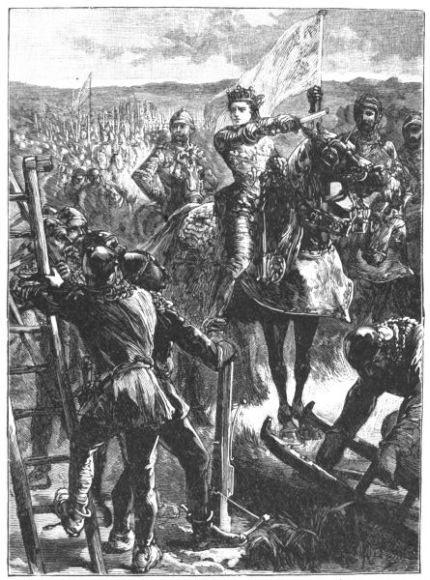
THE ENGLISH BEFORE HARFLEUR. (See p. 552.)
[See larger version]
The army was sometimes whole days without food. The wretched people were themselves starving, from the devastations purposely made by their own countrymen, and sickness began to decimate the British troops from their excessive fatigues and want of necessary food. At the passage of the river Bresle, the garrison of Eu made a furious sortie, and fell upon the rear of the army with loud shouts and amazing impetuosity, but, spite of the exhausted condition of the soldiers, they received the attack with coolness, slew the French commander, and drove back the garrison to its fortress.
In four days, that is, on the 12th of October, Henry had arrived at the ford of Blanchetaque, where his grandfather, Edward III. had passed the Somme. He had intended to do the same, but the French, taught by their former failure, had taken care to make this ford impassable by driving strong stakes into the bottom, and D'Albret appeared on the right bank with a numerous force. Disappointed in this expectation he retreated to the little town of Airennes, where Edward III. had slept two nights before the battle of Creçy. He then advanced up the river, searching for a ford or bridge, as Edward had sought down it. He avoided Abbeville, where D'Albret lay with his main army, and marched to Bailleul, where he slept on the 13th.
Still advancing upwards, he found every bridge broken, every ford secured, and D'Albret and his forces marching along the right bank in exact time with him, ready to repel any attempt at crossing the river.
Seeing this, many of his soldiers, already enervated with fatigue and sickness, began to lose heart.
The next day Henry attempted to force a passage at Pont St. Rémy, but without success, as Edward III. had done before him. On the 15th, the following day, he made another endeavour to cross at Ponteau de Mer, but was again foiled. Still going on, he tried other passages on the 16th and 17th, but without avail. Everywhere appeared the most hopeless obstacles. Taking advantage of the winding of the river, Henry now dashed across the country from the neighbourhood of Corbie to Boves, and thence marched on Nesle. On the way he made a halt in a valley, and ordered his archers to provide themselves each with a stake of six feet long, and to sharpen it at both ends. He then pushed forward again to out-march the constable, who was obliged to follow a more circuitous route by Péronne. He had sent, however, strict orders to guard all the fords of the river, but not being present to see this enforced, Henry at Nesle received information that the passage was still open between Voyenne and Béthancourt. On the 19th, he came up to this place, and made a dash across it. Four bannerets led the way successfully; the rest of the army and the baggage followed rapidly in their track; and in twelve hours the English had arrived safely on the right bank. Henry marched on to Monchy-la-Gauche; while the constable, instead of daring to attack him, fell back on Bapaume, and thence on St. Pol.
While D'Albret had been guarding the passages of the Somme, the French princes, instead of attacking Henry, had held a council of war at Rouen in presence of the king. Here they had resolved to give battle to the English by a majority of thirty-five to five, and they fixed the 25th as the important day of action. They sent three heralds to announce this resolve to the King of England.
Henry was at Monchy when the heralds arrived. They delivered their message on their knees, which was that the King of France and his nobles were prepared to meet him in the field on the following Friday. Henry replied, with apparent indifference, "The will of God be done." The heralds then inquired by what way he meant to march, so that they might meet with him. He replied, "By that which leads straight to Calais: and if my enemies attempt to intercept me it will be at their peril. I shall not seek them, and I will not move a step quicker or slower to avoid them. I could, however, have wished that they had adopted other counsels, instead of attempting to shed the blood of Christians."
The Constable had placed himself in advance directly in Henry's route to Calais; but he followed leisurely on his track, as if no enemy were either before or behind him. Yet all this time fresh forces had been flocking in to the standard of the Constable; and his army was now so overwhelming, that it began to be impatient to fall on the English, confident that they could surround and destroy them. But the experienced D'Albret remembered the days of Creçy and Poitiers, when the like confidence had produced the most complete destruction to the French armies from a mere handful of these iron Englishmen. He fell back from St. Pol to the villages of Ruisseauville and Agincourt before he consented to stand and await the English king. It was evident that the eve of a decisive battle had arrived. It was equally impossible for Henry to advance towards Calais or retreat towards Harfleur. In fact, to attempt in the slightest degree to retreat would be synonymous with destruction; for that would utterly dishearten his own men and bring the immense swarms of the enemy like a flock of hungry wolves upon them. Even if they could beat back such a host under such circumstances, they must soon perish by the way, for the whole region was a wilderness, destitute of food or shelter. The hour of action had come.
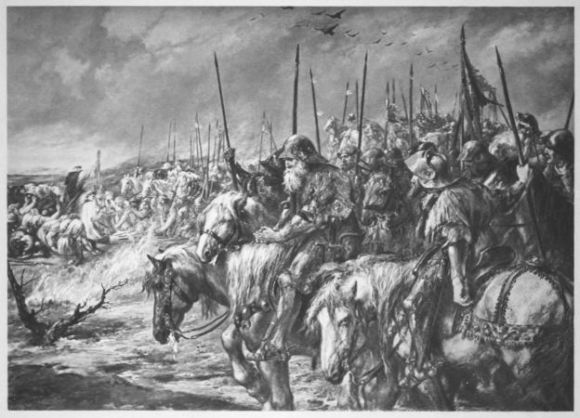
THE MORNING OF AGINCOURT.
From the Picture by Sir John Gilbert, R.A., P.R.W.S., In the Guildhall Art Gallery, by permission of the Corporation of the City of London.
[See larger version]
Once more the French generals made the profound blunder of selecting a confined plain where their huge army had no room to move. The Constable planted his banner on the Calais road, a little in advance of the village of Ruisseauville, and the Dukes of Orleans and Bourbon, of Berri, Alençon, and Brabant, and all the great lords planted theirs round it with loud acclamations and rejoicings that the hour was come which was to give up to them their enemy and all his spoil. But the joy was soon damped, for the night set in dark and rainy. The ground was a clay which soon swam with water, and became so slippery that the horses slid and stumbled about in disorder. The pages and valets rode to and fro seeking straw to lay on the muddy ground for their officers and themselves. There were great bustling and moving to and fro; people shouting to one another and making much noise, but obtaining very little comfort; and it was at length observed that their horses stood silent and did not neigh, which was looked upon on the eve of battle as a very bad omen. When they would have cheered themselves with music, very few instruments could be found. At length, however, they succeeded in lighting fires along their lines, and bursts of laughter and merriment were repeatedly heard by the English, while their enemies were, no doubt, calculating the value of their horses and the arms on their backs.
The English, on their part, passed a night of serious reflection. They had made a long march under great difficulties and privations. Many of them were wasted by sickness, worn down by fatigue and scanty and unwholesome fare. They were in the presence of an immense force. But they were descendants of the heroes of Creçy, which lay not far off, and they had the utmost confidence in the bravery of their leader. They spent the early part of the night in making their wills, and in devotion. The king visited every quarter of his little camp, and sent out, as soon as the moon gave light enough, officers to arrange the plan of the battle on the next day, and ordered bands of music to play through the whole night.
At break of day Henry summoned the men to attend matins and mass, and then leading them into the field, arranged them in his usual manner, in three divisions and two wings; but in such close array that the whole appeared but as one body. The archers, who were his grand strength, he posted in advance of the men-at-arms, four in file, in the form of a wedge. Besides their bows and arrows, the archers were now armed each with a battle-axe and a sword. The fatal field of Bannockburn, where the archers were rendered useless by their want of side arms, when Bruce rode his cavalry amongst them, seems to have taught the English this precaution. Every man, too, bore on his shoulder the stout stake, which Henry had ordered them to provide themselves with, pointed at each end, and tipped with iron. These they planted obliquely before them, as chevaux de frise, and thus presented a formidable rampart to the French cavalry.
The French had drawn up their host in a manner similar to that of Henry, but instead of their files being four, they were thirty-nine deep. The Constable himself commanded the first division; the Dukes of Bar and Alençon the second. But in their eagerness to come at the English, they had crowded their troops into a narrow field between two woods, where they had no room to deploy, or even to use their weapons freely, and the ground was so slippery with the rain, that their horses could with difficulty keep on their legs; while the English archers, who were immediately opposed to them, were not only on foot, but many of them barefooted, and, disencumbered of their clothes, were ready to make their way alertly over the soft ground.
Both the French and English commanders had ordered their men to seat themselves on the ground with their weapons before them, and thus they continued to face each other without action for some time. The Constable, most probably to gain time for the arrival of the expected reinforcements, still lay quiet, and Henry took the opportunity to distribute refreshments of food and wine through his ranks. He also seized the opportunity to send off secretly two detachments, one to lie in ambush in a woody meadow at Tramecourt, on their left flank, and the other to set fire to some houses in their rear as soon as they were engaged, to throw them into alarm.
Scarcely had the king executed this manœuvre, when he was surprised by a deputation of three French knights from D'Albret, the commander. They came to offer him a free passage to Calais, if he would agree to surrender Harfleur, and renounce his pretensions to the throne of France. Henry disdained to enter into any negotiations except on the very same terms that he had dictated before he left England; and, penetrating the real object of these overtures, that of gaining time, he impatiently dismissed the matter. But the envoys were not to be so readily despatched. One of them, the Sire de Helly, who had been a prisoner in England, and was accused of breaking his parole, introduced that matter, and offered to meet in single combat, between the two armies, any man who should dare to asperse his honour.
"Sir Knight," said Henry, curtly, "this is no time for single combats. Go, tell your countrymen to prepare for battle, and doubt not that, for the violation of your word, you shall a second time forfeit your liberty if not your life."
"Sir," replied De Helly, insolently, determined to prolong the parley, "I will receive no orders from you. Charles is our sovereign. Him we will obey, and for him we will fight against you whenever we think proper."
"Away, then," said Henry, "and take care that we are not before you." And instantly stepping forward he cried, "Banners, advance!"
With that Sir Thomas Erpingham, a brave old warrior, threw his warder into the air, exclaiming, "Now strike!" and the English moved on in gallant style till they came within bowshot of the French lines. Then every man kneeling down kissed the ground, a custom which they had learned from the Flemish, who at the great battle of Courtray, where they defeated the French cavalry with such brilliancy, had thus each taken up a particle of earth in his mouth, while the priest in front elevated the Host. It was a sign of consecration to the great duty of the day; and having done this homage to the God of battles, they rose up with a tremendous shout, struck each man his pointed stake into the ground before him, and stepping in front of these stakes, sent a flight of arrows at their foes, and again retired behind them.
The Constable, who well knew the terrible effect of the English archers on the French troops, had prepared a scheme similar to that of Bruce at Bannockburn to break their line, and throw them into confusion. He had few or no archers, for the French at that period adhered to the feudal notion that knights and gentlemen only must handle arms. The dreadful defeats of Creçy and Poitiers had not cured them of the foolish idea that arms must not be trusted to plebeian hands. He therefore had trained a body of 1,200 men-at-arms under Messire Clignet, of Brabant, who were to make a desperate charge on the archers, and break up their ranks. They came on with fierce cries of "Mountjoye! St. Denis!" but the slipperiness of the ground, and the fierce flight of arrows which struck through their visors and their armour, threw them at once into confusion. Their horses reeled and stumbled against each other in the muddy clay, and to avoid the iron hail of arrows they turned their heads aside, and thus knew not how to guide their steeds. Of the whole 1,200 not more than seven score ever reached the spiked barricade of the archers, from which the few remaining horses recoiled; and the whole troop in a few minutes lay dead or wounded on the ground. Only three horses are said to have penetrated within the line of stakes, and there they fell perforated with wounds. Meantime, hundreds of wounded steeds were dashing to and fro, and continually returning upon the French lines, stung to madness by their pain. All became confusion and disorder in the first division. The men-at-arms were so wedged together that they could not extricate themselves from the throng to advance or retreat. While the bravest strove to rush on the enemy, the timid endeavoured to fall back on the next division, and the most awful chaos arose.
Still the English archers poured in their arrows, dropping multitudes at each discharge; and when their arrows failed they seized their battle-axes, and, leaving their stakes, rushed on with fierce cries. At this signal the men in ambush replied with similar shouts, and, falling on the flank of the French army, added immensely to the terror and disorder. While they showered their arrows in that direction, the archers in front hewed their way with their hatchets through all opposition. They dashed amid the steel-clad horsemen, burst through the whole array of horses and armour, slew the commander-in-chief and many of his most illustrious officers, and in a very short time, without any aid whatever from the men-at-arms, dispersed the whole of the first division.
The second division opened to receive the fugitives, which occasioned fresh disorder; and at this crisis, the Duke of Brabant, who had hastened on before his expected reinforcements, galloped up with a fresh body of horse, and charged the advancing archers. Those indomitable men, however, speedily cut him down, destroyed his detachment, and kept on their way, laying prostrate all before them. They soon arrived at the second division, who, though wallowing up to their horses' girths in the middle of a ploughed field, the men on foot being sunk by the weight of their armour almost up to their knees, yet kept their ground. At this moment Henry advanced with his men-at-arms; but, seeing the nature of the ground, he rallied his brave bowmen, who, having no weight to carry, could do active battle, even on that rotten ground. At his call they speedily reformed, and under his command made a fresh charge.
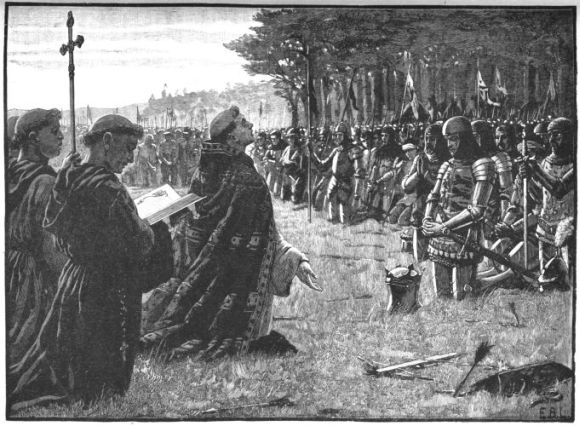
THE THANKSGIVING SERVICE ON THE FIELD OF AGINCOURT. (See p. 558.)
[See larger version]
It was now that the real battle took place. The Duke of Alençon, who with the Duke of Bar headed this division, had made a vow to kill or take captive the King of England, or to perish in the attempt. He led on his troops with desperate valour, and a mortal struggle of two long hours took place. The English archers still wielded their massive axes in the front, and the French men-at-arms fought with undaunted bravery. Henry combated in the midst of his archers, who still plied their weapons with loud hurrahs, and, animated by battling under the eye of the king, seemed still as active and fresh as if they were just come into the strife. Henry's life, however, was repeatedly in danger. His brother, the Duke of Clarence, was thrown down near him, wounded, and in danger of being killed, when Henry rushed to his assistance, strode across the body, and beat off the assailants till the prince could be removed. But no sooner was Clarence in safety than a band of eighteen knights, headed by the Lord of Croy, confronted the king. They had sworn to each other to take or kill him.
One of these knights struck Henry with his battle-axe, and brought him to his knees; but his brave followers closed round him instantly, and slew every one of the assailants. The Duke of Alençon then fought his way to the royal standard. With one stroke of his battle-axe he beat the Duke of York to the ground, and killed him; with the next he cleft the crown on Henry's helmet. At that sight every arm was raised—every weapon was directed at him. He saw his imminent peril, and cried out to Henry, "I yield to you; I am Alençon!" Henry held out his hand, but it was already too late; the gallant duke lay dead.
Here the battle may be said to have ended; for though the third division, which was the most numerous of all, was still unbroken, at the sight of the Duke of Alençon's troops flying in all directions, they too fell back and began to waver. Another moment and they would have been in full flight, but in the rear of Henry's army, where the priests and baggage were posted, there rose a loud tumult, and messengers came galloping to say they were attacked by a large force. Henry immediately believed that this force was that expected hourly under the Duke of Brittany; and fearful of being surrounded, he immediately gave orders to kill all the prisoners, lest they should turn against them.
As they had taken their captives, who, after the death of Alençon, yielded in crowds, they removed their helmets, that, should any occasion arise, they might readily despatch them. The slaughter now made of these helpless men was terrible. Many fell without a chance of resistance, many others struggled and wrestled with their destroyers, but in vain. The scene was terrible, and the French third division, also becoming aware of the attack in the rear, took fresh courage, and prepared to make battle still. But a short time discovered the real cause of the alarm, which the fears of the English had converted into a formidable assault. It was merely a body of peasants, who thought they would profit by the battle, and, while the combatants were in the heat of the action, drive off the English horses, which were all left with the baggage. They little dreamed that their scheme would prove so disastrous to their countrymen, many a noble French knight falling a victim to this stratagem, the authors of which were afterwards severely punished by their feudal lord, the Duke of Burgundy.
The mistake being discovered, Henry gave instant orders to stop the slaughter of the prisoners, and the third division of the French army also coming at the truth, galloped off the field at full speed.
Henry's little army was too much exhausted and too much encumbered with prisoners to be able to pursue the flying legions. He gave orders to see to the wounded, and then summoning the heralds, he traversed the fields, accompanied by his chief barons, and saw the coats of arms of the fallen princes and knights examined, and their names registered. While this was being done, and others were stripping the dead, he called to him the French king-at-arms, Mountjoye, who came attended by the other heralds, French and English, and he said, "We have not made this slaughter, but the Almighty, as we believe, for the sins of France." Then turning to Mountjoye, he asked, "To whom does the victory belong?" "To the King of England," replied Mountjoye, "and not to the King of France." "And what castle is that which I see at a distance?" continued Henry. "It is called the castle of Agincourt," replied the herald. "Then," said Henry, "since all battles ought to be named after the nearest castle, let this henceforth and lastingly bear the name of the battle of Agincourt."
Having named the field, and "lastingly," according to his own phrase, for it is a name which will stand for ever amongst the most wonderfully fought fields in all the annals of nations, Henry—as if impressed with what appeared to be his sincere idea that it was the work of Heaven, and that he was its instrument—called together the clergy, and ordered them to perform a service of thanksgiving on the field before the whole army. In allusion to their escape from the enemy and the terrible destruction of their assailants, they chanted the 114th Psalm:—"When Israel went forth out of Egypt:" and at the first verse of the 115th Psalm, "Not unto us, O Lord, not unto us, but to Thy name give the glory," every man knelt on the ground. They then sang the Te Deum, and so closed the renowned battle of Agincourt.
Of all the battles ever fought by France up to that time none was ever so fatal as that of Agincourt. "Never did so many and so noble men fall in one battle," says their own chronicler, Monstrelet. It was a wholesale slaughter of its princes and nobles. Seven princes of the blood had fallen; the Constable D'Albret; the Dukes of Brabant, of Bar, and Alençon; the Count of Nevers, the brother of the Dukes of Burgundy and Brabant, the Counts of Marle and another brother, John, brothers of the Duke of Bar; the Count of Vaudemont, brother to the Duke of Lorraine, the Archbishop of Sens, the Count of Dampierre, the Lords Helly—who fell as Henry had promised him—of Rambure, Verchin, and Messire Guichard of Dauphiné, another of the deputies who were sent to Henry before the battle. On the whole there fell that day 10,000 men, amongst whom there was one marshal, thirteen earls, ninety-two barons, 1,500 knights, and 8,000 gentlemen.
There were 14,000 prisoners left in the hands of the English, amongst whom were the Dukes of Orleans and Bourbon, the Marshal Boucicault, the Counts of Eu, Vendôme, Richemont, Craon, and Harcourt, and 7,000 barons, knights, and gentlemen. No wonder that the news of so direful an overthrow, so unexampled a slaughter and capture of the aristocracy of the country, should spread consternation throughout France.
The highest estimate of the English loss puts it at 1,600, while Elmham contends that it was only 100, and other contemporary writers that it was only forty. Taking the highest estimate, it was a wonderful disparity between the loss of the conquerors and the conquered. The only persons of note who fell on the English side were the Earl of Suffolk and the Duke of York, a man whose whole life had been stained with treachery and meanness, and of which it might be said that its only honourable incident was its termination. Henry returned in triumph to England.
In the spring of the following year, 1416, Henry had the honour of a visit from Sigismund, King of the Romans, and Emperor Elect of Germany. The object of Sigismund was to secure Henry's aid in accomplishing his great scheme of putting an end to the division in the popedom, which was still raging. There were no less than three Popes all claiming to have been lawfully elected. Sigismund had visited France, and was flattered by cordial promises of co-operation by Charles and his ministers. Henry, who at this time was by far the most famous sovereign in Europe, was determined to receive Sigismund in a manner which should convince him that the wealth of his kingdom and the splendour of the English crown were in full correspondence with his fame. He summoned all the knights and esquires of the realm to attend him in London. A fleet of 300 sail waited at Calais to bring over this unusual guest with all his retinue, amounting to 1,000 horsemen; and officers were appointed to escort him from Dover to the capital, discharging all the expenses by the way.
Yet amidst his magnificent arrangements for the reception of his distinguished guest, Henry was cautious not to endanger in the slightest degree his national rights. Sigismund, while in Paris, had attended a cause which was pleaded before Parliament, and was in courtesy invited to occupy the throne, and while sitting there, had been so incautious as to knight an esquire who was in danger of suffering wrong because of his inferior rank. To prevent any such mistake, a precaution was taken which, for a moment, had an aspect anything but hospitable. No sooner did the Emperor's ship cast anchor, than Sigismund saw the Duke of Gloucester and several noblemen ride into the water with drawn swords, and demand to know whether in coming thus, he designed to exercise or claim any authority in England. On Sigismund replying in the negative, this hostile reception immediately gave way to one of courtesy and honour. Besides his main object, the settlement of the papal schism, Sigismund was also anxious to effect a peace between the kings of England and France; and accordingly he was accompanied by ambassadors from Charles, whose propositions were zealously seconded by William, Duke of Bavaria and Count of Hainault, who was become a warm admirer of Henry. It is said that Henry went to such a length of concession as to waive his claims on the crown, and content himself with the provisions of the treaty of Brétigny, concluded by Edward III. But even this would have dismembered France of its most valuable provinces; and, though Charles is stated to have given a full assent to the proposal, there were others who were more averse from such terms with England.
In the very midst of this apparently amicable negotiation, amid the frightful anarchy of France, the Count of Armagnac had now succeeded to the authority of the Dauphin Louis, recently dead, and being also Constable in the place of D'Albret, slain at Agincourt, he determined, if possible, to win popularity by wresting from England its recent conquest of Harfleur. He marched there with a large army, drew lines around the town, while a fleet of French ships, aided by a number of Genoese galleys, which he had hired, blockaded the harbour. It was in vain he was reminded of the negotiations pending at London; he determinedly rejected all proposals of truce or peace, and pressed on with all his characteristic ardour the siege of the place.
Henry, alarmed and indignant at the news of this investment at this moment, proposed, in his impetuous promptness, to rush across the Channel and fall on Armagnac in person; but Sigismund, his royal guest, suggested to him that it was not a cause of sufficient importance to demand his own presence. He sent the Duke of Bedford, his brother, with a fleet to the relief of Harfleur. The duke mustered at Rye such ships as he could procure in haste, and on the 14th of August, 1416, reached the mouth of the Seine. He found the blockade of a formidable character. The galleys of the Genoese were so tall that the loftiest of the duke's ships could not reach to their upper decks by more than a spear's length. Besides these, there were also Spanish ships of great size, and all were posted with great judgment. Nothing daunted, the duke resolved on attacking them in the morning. At sunset he summoned on board of his ship all the captains of his fleet to concert the plan of the battle, and during the night he kept his squadron together by displaying a light at his masthead.
The next morning, the 15th of August, 1416, Bedford was agreeably surprised to see the French quit their secure moorings, and, in their rash confidence, leave behind their powerful allies of Genoa and Spain, and come out into the open sea to attack him. He very soon captured two of their ships, and, after a long and desperate conflict, most of the rest were taken or destroyed; a few escaping up the river. Bedford lost no time in bearing down on the Genoese galleys, which, notwithstanding their height, his sailors clambered up like squirrels, and boarded in gallant style. The garrison within the town now joined their countrymen in an attack on the land forces, which speedily raised the siege and fled. The duke remained to see the town put into a complete state of defence; and during this time, which was three weeks, the vast number of bodies which had been plunged into the Seine during the fight, rose and covered the whole of the waters all round the ships, much to the horror of the sailors. The duke led his men away as soon as possible, and returned to England, having most successfully completed his mission.
In the following month of September, Henry proceeded to Calais—accompanied by his Imperial guest Sigismund, who had concluded an alliance with him, and been enrolled a Knight of the Garter, and by the Duke of Bavaria—to meet John Sanspeur, Duke of Burgundy. Burgundy, during the late campaign, had professed to remain neutral. Though summoned by Charles to assist in expelling the English, he neither went himself nor permitted his vassals to do so. His county of Flanders not only maintained an avowed neutrality with England, but carried on their usual lucrative trade with it without any regard to French interests. Yet Burgundy had been cautious not to enter into direct engagements with Henry, or to lend any assistance to his invading army. Nay, after the battle of Agincourt, where his brothers the Duke of Brabant and the Count of Nevers fell, he had expressed great resentment, and even defied Henry to mortal combat. But now circumstances had occurred in France which stung him to the quick, and made him ready to forget even the destruction of his brothers.
In spite of the national disaster of Agincourt, civil war continued to exist between the French factions. Burgundy was expelled and worsted by Armagnac, and he sought the aid of England.
There had been through the year continual correspondence between the courts of Burgundy and England, which purported to concern treaties of trade; and now the congress opened on the 3rd of October, 1416, for the ostensible purpose of healing the schism in the Church. The Armagnacs were struck with consternation at this conference. They would not give credit to the object being either trade or the peace of the Church; but they believed, and asserted, that Burgundy had sold himself to Henry, had formally acknowledged the latter's title to the throne of France, and done homage to him for his provinces of Burgundy and Alost, in order to avenge himself of his Armagnac opponents. That such a treaty was agitated at the congress is certain, for the protocol is preserved in Rymer, and by it Burgundy was not only to acknowledge Henry's claim, but to assist him in establishing it. There is, however, no proof that he actually signed it.
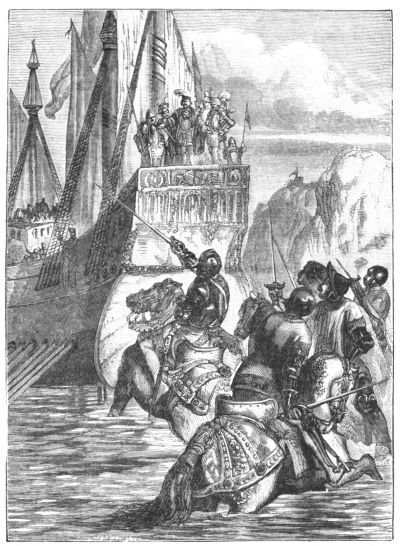
RECEPTION OF THE EMPEROR SIGISMUND. (See p. 559.)
[See larger version]
Whatever was determined upon remains unknown, any further than it can be surmised from what followed. Henry returned to England to make immediate and extensive preparations for the invasion of France, on the conclusion of the existing armistice. Sigismund went on to Constance in prosecution of his plans for the Church, and Burgundy retired to Valenciennes, as if also about to co-operate with Henry by the muster of his Flemish forces. But here a new and unexpected turn of affairs appears to have taken place. John, the new Dauphin, had thrown off the Armagnac party, and made overtures to Burgundy. The duke caught at the opportunity of having the Dauphin in his hands and, by such an alliance, regaining his ascendency in the state without incurring the odium of supporting a foreign invader against the rightful sovereign.
The two princes swore eternal friendship to each other. The Dauphin pledged himself to assist the duke in driving from power the Armagnacs, and the duke engaged to aid the Dauphin in expelling the English from France. The Armagnacs, confounded at this new coalition, issued a summons in the king's name to the Dauphin to return to Paris, with which the prince offered to comply on condition that he brought the Duke of Burgundy and his followers with him. Finding that they could not induce the prince to quit his new ally, there is every reason to believe that they despatched him with poison, for on the 14th of April, 1417, he was taken suddenly ill, and died in agonies with all the symptoms of death by poison. No one doubted that it was the work of the Armagnacs, and it was generally believed that the abandoned Queen Isabella was an active accomplice in the destruction of both this and her preceding son, whom she hated for their opposition and exposure of her flagitious life.
But if Isabella was guilty of these revolting crimes, she was speedily punished. Her youngest son, Charles, who now became Dauphin, though but sixteen, was extremely artful, and by no means disposed to yield to the domination of his mother, whom he as heartily despised as his elder brothers had done. Isabella herself was arrested and sent into close confinement at Tours. The Count of Armagnac is said to have the more willingly executed this severity on Isabella because she had violently complained of his seizure of her treasures both at Paris and Mélun, a measure to which the public necessities had driven him.
Enraged to frenzy by the loss of her favourite, of her power, and of her money, Isabella now meditated deep revenge. She had hated the Duke of Burgundy with a mortal hatred ever since he assassinated her beloved Duke of Orleans; and he had now added to his offences by implicating her in a manner in the murder of her own son, the Dauphin John. Yet the very next thing which the public heard was that Isabella had escaped from her prison at Tours, and thrown herself into the arms of the Duke of Burgundy, her old and most detested enemy. Such are the terrible extremes of a bad woman's vengeance. She now burned, at any cost, to revenge herself on Armagnac, and not less so on her own son Charles, whose destruction she sought as earnestly as she had done that of his brothers. This most unnatural woman had bribed her keepers to allow her to attend early mass at the church of Marmontier, in the suburbs of Tours. They accompanied her, but suddenly found themselves surprised by the Duke of Burgundy, who had secreted himself for the purpose in a neighbouring forest, with 800 men-at-arms. The moment Isabella was in the guardianship of this prince, she proclaimed herself regent of the kingdom during the continuance of the king's malady, and the Duke of Burgundy her lieutenant.
Such was the position of affairs in France at the moment that Henry V. of England landed at Honfleur, on the coast of Normandy, on the 14th of August, 1417, with 16,000 men-at-arms, an equal number of archers, and a long train of artillery, and other military engines, attended by an efficient body of sappers, miners, carpenters, and other artificers, and a fleet of 1,500 ships. Two years had elapsed since the fatal battle of Agincourt; yet the infatuated princes of France, though they knew that Henry never had his eyes off their country, but was constantly employed in planning its subjugation, had taken no measures whatever for its defence. On the contrary, they had spent the time in mutual destruction, and in doing all in their power to exhaust its strength, and demoralise the people. They appeared given up by an indignant Providence to the destroying force of their own base passions, a nation of suicidal monsters rather than of men; and while Henry of England was landing on their coasts with his invading army, the Duke of Burgundy was in full march on Paris, accompanied by the queen, breathing vengeance on the Armagnacs.
Burgundy, after the sudden death of the Dauphin, had besieged that city with an army of 60,000 cavalry. He promised to restore peace and abolish all oppressive taxes. The people in the country were ready to look upon him as a deliverer; and many cities, including Amiens, Abbeville, Dourlens, Montreuil, and other towns in Picardy opened their gates to him. Paris, in the hands of the Armagnacs, made a steadfast resistance. He, however, became master of Châlons, Troyes, Auxerre, and on being joined by Isabella, most of the towns, except those taken by the King of England, declared for Burgundy and the queen. Isabella had a great seal engraved, and appointed her officers of state. She declared that the Armagnacs held the king and Dauphin prisoners in Paris, and were, therefore, traitors. She made Burgundy governor-general of the whole kingdom, appointed the Duke of Lorraine constable, and the Prince of Orange governor of Languedoc. There was a great flocking of princes and nobility to the queen's court, and thus there were established two royal parties and two courts, the one with the king and Dauphin in Paris, the other with the queen at Chartres. The people, elated by the promises of Burgundy, rose in many places and killed the tax-gatherers, crying, "Long live Burgundy, and no taxes!" They regarded every rich man as an Armagnac, for that was a good plea on which to plunder him; and thus passed the winter of 1417.
Meantime, Henry of England advanced into the heart of Normandy, having, on setting out, issued to his army orders in consonance with those enlightened principles of humanity and policy which he had adopted in such noble contrast to the practice of the Edwards. He forbade, on pain of the severest punishment, all breaches of discipline, all injury to the lives and property of the peaceable inhabitants, and especially all insult to clergymen, or outrage to the wives, widows, and maidens of the country. Yet the Normans, neglected by their own rulers, who were engaged like wolves in tearing each others' throats instead of defending their common soil, still retained their allegiance, and regarding Henry, not as the descendant of their ancient dukes, but as a foreign invader, rejected him with great bravery. Probably the atrocities committed on them by the Edwards had thoroughly alienated their hearts from the English. But they were unable to contend with the superior forces and martial skill of Henry; Caen resisted, but was taken by assault; Bayeux submitted voluntarily; and l'Aigle, Lisieux, Alençon, and Falaise, after some stout resistance. Henry then went into comfortable winter quarters, intending to proceed, on the return of spring, with his proposed task of reducing every fortress in Normandy.
While Henry was thus successfully prosecuting his campaign in Normandy, there had occurred a slight disturbance at home. The Scots, thinking that, the king being absent with the flower of the army, the kingdom must be left greatly unprotected, made a descent upon England. The Duke of Albany and Earl Douglas crossed the borders each with an army, and while Albany laid siege to the castle of Berwick, Douglas invested that of Roxburgh. But the Dukes of Exeter and Bedford, the regent, made a rapid march northward with such forces that the Scottish leaders suddenly abandoned their enterprise, and disbanded their armies.
Simultaneously with this inroad once more appeared Sir John Oldcastle, Lord Cobham, on the scene. He had been concealed in Wales, but the absence of the king afforded him also the expectation of taking vengeance on his enemies. It had been surmised that the Scots and Sir John had mutually concerted this attack. Be this, however, as it may, there can be no doubt that both Sir John and the Lollards in general were greatly embittered by the cruelties practised on them by the bishops. These dignitaries had set them the example of bloodshed, and had certainly taken the initiative in the attempt to put down difference of theological opinion by destroying their opponents, and during the three years that Lord Cobham had eluded them, they had pursued and burnt the Lollards with increasing severity. Such lessons are readily taught, and nothing could be more natural than that the injured party should seek retaliation in kind. Sir John, too, was probably deeply incensed by his old companion, the king, giving him over so forcibly to the tender mercies of the clergy; and, though they could not in this case assert that he sought his life, he probably felt little compunction in disturbing his Government in the endeavour to come at the official persecutors.
The hasty retreat of the Scots defeated the intentions of the Lollards, and Lord Cobham, hastening from his rendezvous near St. Albans, endeavoured to regain the Welsh mountains, but he was intercepted near Broniart, in Montgomeryshire, by the retainers of Sir Edward Charlton, Earl of Powis. When brought before the House of Peers, his former indictment was read, and he was asked by the Duke of Bedford what he had to say in his defence. He had begun a bold and able speech in reply, but being stopped and desired to give a direct answer, he refused to plead, declaring that there was no authority in that court so long as Richard II. was alive in Scotland; for, like many others, he was of opinion that the Scottish Richard was genuine. He was at once condemned, and was hanged as a traitor in St. Giles's Fields, and burnt as a heretic, December, 1417.
In the spring of 1418 Henry resumed his operations in Normandy with vigour. He had received a reinforcement of 15,000 men, so that he could divide his troops, and conduct several operations at the same time. The Dukes of Gloucester and Clarence, the king's brothers, took the command of different bodies of men, and proceeded to reduce the strongest towns in Lower Normandy. Gloucester compelled Cherbourg to surrender, after a long and obstinate defence, on the 29th of September; but before this most of the towns of Lower Normandy had opened their gates. Henry advanced along the Seine and made himself master of the whole country from Louviers to the sea; finding, in this part of his campaign, infinite advantage from his conquest of Harfleur. Pont de l'Arche completed the possession of all Lower Normandy, with the exception of Cherbourg, which Gloucester was blockading. By July, making certain of the ultimate fall of this city, Henry regarded Lower Normandy as his own. Before proceeding to the siege of Rouen, he organised a Government for Lower Normandy, appointed a chancellor and treasurer, and left that part of France, though under foreign rule, far quieter and more habitable than any other district of the realm.
The siege of Rouen was the grand operation which was not only to lay all Normandy at the feet of the conqueror, but open the highway to Paris. The city was strongly fortified. On all sides it was enclosed by massive ramparts, towers, and batteries. Fifteen thousand trained men, and a garrison of 4,000 men-at-arms were collected within it. Many of these were gentlemen of Lower Normandy, who, having vainly endeavoured to check the progress of the enemy in their own neighbourhood, had retired hither to assist in making one last determined stand against the power which had driven them from hearth and home. The governor had made every preparation for the most obstinate resistance. Not only had he laid waste the environs and annihilated the suburbs, but he had commanded every man and every family to quit the city who had not provisions for ten months, and the magistrates had enforced the order.
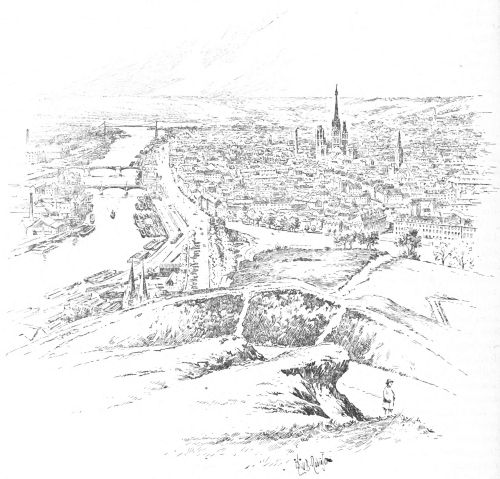
VIEW OF ROUEN, FROM ST. CATHERINE'S HILL.
[Photo: Neurdein Frères, Paris.]
[See larger version]
On the 30th of July Henry appeared before the town. He had 200 sail of small vessels on the Seine, so that he could convey his troops to any portion of the environs. He found the brave and patriotic Bouteillier ready to encounter him. Instead of lying concealed behind his strong walls, this leader met him in the open field, and attacked him with the utmost impetuosity. The battle was desperate and bloody, and though ultimately compelled, by the numbers and the tried valour of the English, to retire, he never ceased to renew the attack, and interrupt the commencement of Henry's works for the investment of the place. He continually made fierce sorties, destroyed his embankments, beat up the quarters of the soldiers now here, now there, and greatly obstructed the operations of the besiegers.
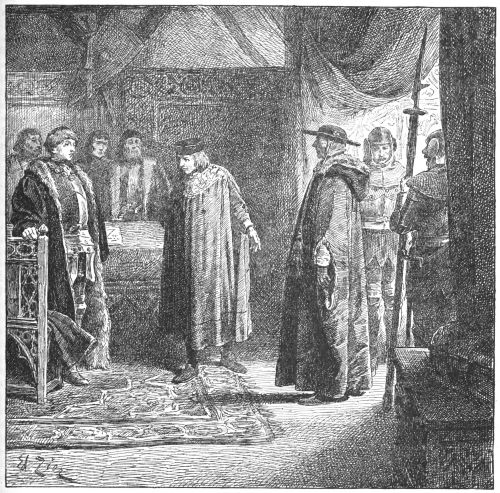
CARDINAL ORSINI'S VISIT TO HENRY. (See p. 566.)
[See larger version]
At length Henry succeeded in encamping his army in six divisions before the six gates of the city. He protected these by lofty embankments from the shot from the city, and connected them with each other by deep trenches, so that the men could pass from one to the other without danger from the arrows of the enemy. Then, finally, the whole town on the land sides was enclosed in strong military lines, which he strengthened with thick hedges of thorns and on the most commanding situations without the camp he placed towers of wood, batteries of cannon, and engines for the projection of arrows and stones.
These stringent measures soon began to tell. Before two instead of ten months had expired, famine had shown its hideous face. Though the governor had reduced the population greatly before the siege had commenced, he now expelled from the city 12,000 more useless mouths, as they were termed in the iron language of war. Henry forbade them to be admitted within the lines, for the tender mercies of sieges are cruel under the most humane of commanders. To permit at will the expulsion of the people was to prolong the siege, and, therefore, as at Calais, under Edward I., notwithstanding some of these wretched outcasts were fed by the humanity of the troops, the greater number perished through want of food and shelter.
But within the city famine stalked on, and the misery was terrible. During the third month the besieged killed and subsisted on their horses. After that, for two months, they killed the dogs and cats; and the necessity growing more and more desperate, they descended to rats, mice, and any species of vermin they could clutch in their famine-sharpened fingers. It is said that, in the whole siege—from famine, from the wretched, unwholesome food eaten, by the sword, and other means—no less than 50,000 of the inhabitants perished.
All this time the unhappy people cried vehemently to the Duke of Burgundy, whom the citizens had admitted to Paris and who had established his power there by a series of fearful massacres. Their messengers returned with flattering but fallacious promises, and no relief was ever sent. On one occasion the heartless minister even fixed the precise day on which he would arrive in force and compel the English to raise the siege. At this news a wild joy ran like lightning through the famishing city. The bells were rung with mad exultation; people ran to and fro spreading the glad tidings and uttering mutual congratulations. The troops were ordered to be every man in readiness to rush forth at the right moment, and second the assault of their friends without. The day came and went; no deliverer appeared, and a deadly despair sank down on the devoted city.
It was in the midst of these horrors that the Cardinal Orsini, who had in vain exerted himself to reconcile the insensate factions, now turned to Henry, and entreated him to moderate his pretensions, and incline to peace. But Henry was too sagacious a politician to renounce the advantages which the folly and crimes of his enemies opened up to him. He was willing to make overtures of peace, and he did so to both parties, but it was still on his fixed terms of the sovereignty of France. He repeated his clear persuasion that his work was the work of an avenging Providence. "Do you not perceive," he said to Orsini, "that it is God who has led me hither by the hand? France has no sovereign. There is nothing here but confusion; there is no law, no order. No one thinks of resisting me. Can I, therefore, have a more convincing proof that the Being who disposes of empires, has determined to put the crown of France upon my head?"
Winter was now setting in, and the famished citizens saw its approach with horror. They had long been reduced to the severest condition of starvation, and still the determined Bouteillier held out. They had consumed every green and every living thing but themselves and their children. Gaunt Famine, the sternest of all conquerors, now subdued the iron hardihood of the governor, and he offered on the 3rd of January to capitulate; but Henry insisted on unconditional surrender. Bouteillier, indignant and in despair, assembled the garrison, and proposed to them to set fire to the city, to throw down a portion of the wall, which was already undermined by the English, and burst headlong into the camp of the enemy, where, if they could not cut their way through, they should at least perish as became soldiers. This stoical design, as terribly sublime as any project of antiquity, reaching the ears of Henry, he lowered his demands. It was impossible not to be struck with such heroism in men wasted by months of utter want, and he had no wish to see Rouen a heap of smoking ruins. He offered the soldiers their lives and liberties on condition that they did not serve against him for twelve months; and he guaranteed to the citizens their property and their franchises on the payment of 300,000 crowns. On the 13th of January, 1419, the terms of surrender were signed, and on the 19th Henry entered the city in triumph. To his honour he strictly observed the treaty, suffering no infringement of the citizens' rights, nor displaying any signs of vengeance. The only person exempted from this clemency was a priest who had, during the siege, excommunicated him, and pronounced the direst curses upon him. Him he imprisoned for life; and a captain of the city militia was executed, a few days after the entrance of the city, for treasonable designs.
The surrender of Rouen was a shock to the whole kingdom of France, sufficient, one would have thought, to bring the contending factions to a pause, and unite them for the protection of their common country; but for a time it appeared to produce little effect on the rival parties themselves. The people at large were struck with consternation, and loudly complained that they were made the victims of the vices and jealousies of their rulers. The people of Paris saw with indignation the Duke of Burgundy and the queen flee out of the city, carrying the king with them, and establish their headquarters at Lagny. They looked upon themselves as basely betrayed, and declared that the capital had been left exposed to the arms of the victor, who, it was well known, was preparing to march along the Seine and invest the city with all his forces. They said that the people of the provincial towns had been left to fight their own battles; and now Paris was abandoned to its fate in the same scandalous manner. The most vehement representations were made to the heads of the hostile factions to settle their quarrels and combine to repulse the invader. This wise counsel was wholly thrown away. Neither party showed any disposition to reconciliation, but each hastened to open negotiations with Henry of England, in order, by his means, to be able to crush the other.
The Duke of Burgundy, who always courted popularity, endeavoured to pacify the Parisians by issuing a proclamation, assuring them that he was doing all in his power to remove the impediments to peace and the settlement of the country. All, however, that was visible, was that he sent an embassy to Henry at Rouen, proposing to attempt terms of agreement betwixt him and France. The Dauphin, on his part, went further, and offered to meet Henry, and endeavour personally to accommodate matters. Henry listened courteously to both parties, accepting their proposals with the utmost frankness, at the same time that he promised nothing. The Dauphin, however, himself of a treacherous disposition, hesitated to put himself into the power of Henry, and failed to keep his appointment. Burgundy was no sooner informed of this, than availing himself of it, as a favourable opportunity on his side, he sent a fresh deputation to Rouen; armed, as he believed, with peculiar temptations. These were a beautiful portrait of the Princess Catherine, accompanied by a message from the queen, her mother, significantly asking whether so charming a princess really needed so great a dowry as he demanded with her. The ambassadors reported on their return that they found the young conqueror at Rouen "as proud as a lion;" that he took the portrait of Catherine, gazed long and earnestly upon it, acknowledged that it certainly was beautiful; but refused to abate a jot of his demands. What was still more decisive was the news that he had left Rouen, recrossed the Seine, and had advanced along its banks already as far as Mantes, within fifty miles of Paris.
It was arranged that the Kings of England and France, accompanied by Burgundy, Isabella, and Catherine, on the part of France, and the Dukes of Clarence and Gloucester on that of England, should meet on the banks of the Seine, near Melun. The meeting was, however, productive of no result, owing to the magnitude of Henry's demands. These were, first and foremost, the hand of the princess; then the full possession of Normandy, with all his other conquests, in addition to the territories ceded by the Peace of Brétigny; the whole to be held in absolute independence of the crown of France.
The queen and Burgundy demanded four days to deliberate on these sweeping requisitions. When they met again they made no decided objection to them, but they brought forward a string of counter-claims, eight in number, regarding the relinquishment of these territories, the amount of dowry, and the payment of debts. Henry began to flatter himself that the necessities of the French court were in reality about to compel them to concede his extraordinary terms. He set himself earnestly to work to meet these objections, to modify, and even to contract, in some degree, his demands. But he was not long in perceiving that no progress was made. Difficulties were started at each conference, which were seized upon to seek further consultation, further explanations; and he perceived at the end of a month that only seven meetings had been held, between each of which the intervals were growing longer and longer. The princess, in spite of his inquiries, was not permitted to appear, and the indignant monarch at length broke out in wrathful language to Burgundy, the only person now sent to the conference, saying—"I tell you, fair cousin, that we will have the daughter of your king to wife, and will have her on our own terms, or we will drive both him and you out of this kingdom." The astute Burgundy replied, "Sire, you are pleased to say so; but I make no doubt that, before you have succeeded in driving us out, you will be heartily tired."
All this denoted that a new game was being played behind the scenes. The fact was, that the Dauphin and the Armagnacs had become greatly alarmed at the apparent progress towards an alliance between the royal party and Henry of England. If it succeeded they were to be crushed. Every engine was instantly put in motion to defeat this object. Overtures for reconciliation were made to Burgundy and the queen; means had been found to purchase the interest of an artful and abandoned woman, a Madame de Giac, the mistress of Burgundy, who, attended by several of the leaders of the Armagnac party, had been going to and fro between the Dauphin's retreat and Pontoise. It was represented that it was far better for the French princes to arrange their own differences than to admit the great enemy of the nation, who would only cajole one party in order to destroy both. Accordingly, when Henry—determined to dally no longer—insisted on a final meeting, he went to the tent of conference at the day and hour appointed, and found—nobody. The queen, Burgundy, and the Dauphin had patched up a reconciliation, and dropped the mask unceremoniously at the feet of the insulted King of England. The reconciled princes met on the road at Pouilli-le-Fort, and there, with all outward signs of affection, embraced and vowed eternal amity for the good of France.
The indignation and chagrin of Henry may be imagined. Independently of the promised bride and sovereignty over a vast portion of France being thus rudely snatched from him, his position was by no means encouraging. He had only about 25,000 men to enable him to hold his conquests and to pursue them to completion. Whilst Burgundy and the Dauphin were uniting all the power of France to oppose him, his own subjects at home were beginning to grumble at the expenditure of the war, and, as they saw it likely to succeed in reducing France, to look with dismay on such a result as likely to remove the seat of government to Paris, and make a province of England. The Scots, he found, were at the same time entering into treaty with the Dauphin against him, and the Kings of Castile and Aragon had already fitted out a great armament, with which they scoured the coasts of Guienne and menaced Bayonne.
The French were in ecstasies of delight at the turn which affairs had taken; in every quarter of the kingdom vigorous efforts were made to take advantage of it, and the army of Henry was proportionably depressed.
But Henry—though, in addition to this insolent display of perfidy, his treasury was very low—never for a moment suffered an air of doubt or despondency to shade his countenance, much less an expression of it to escape him. He immediately ordered his army to advance on Paris, crossed the Seine, fell on the town of Pontoise, and took it. The leaders of the Burgundian party, after accomplishing their agreement with the Dauphin, had quitted it, and Burgundy himself was at St. Denis; but even there he did not deem himself safe, and hastily retreated to Troyes, carrying the poor King of France with him.