Chapter XXXIV · (continued 2)
Reading edition
The nine years which Henry had now been on the throne had been years of constant insurrections, bloodshed in battle, and bloodshed on the block. He had put down all his internal enemies, and, save some occasional struggles with the remaining power of Glendower in the marshes of Wales, the kingdom was at peace with itself, and continued so during the few remaining years of this reign.
At sea there were still attacks from the French, though that Government disclaimed them, and pretended to maintain the truce between the two countries. That truce, however, had been badly preserved in regard to the English provinces in France. In 1406 the Constable of France and the Count of Armagnac had made extensive inroads on Guienne and Saintonge. According to the complaint of Sir John Tivetot, the Speaker of the House of Commons, they had taken ninety-six towns and castles there. Nothing, indeed, but the miserable and distracted condition of France could have prevented them from taking the whole and driving the English totally out of that kingdom; for Henry, perpetually occupied in battling with his own insurgent subjects, had neither money, men, nor time to devote to his French provinces. The most pitiable entreaties were sent over from time to time for aid, but in vain; Henry was engaged in a life or death struggle at home.
In 1406 there were great efforts made on the part of the French court to seize the tempting opportunity to gain possession of all Henry's Continental territories. The two most powerful nobles of the realm were commissioned to execute this vast enterprise. The Duke of Orleans, the king's brother, was to lead the forces against Guienne, whilst the Duke of Burgundy, called "John Sanspeur," or the Fearless, was to expel the English from Calais. He cut down a whole forest to construct machines which should batter down the walls, and burst in the gates of that strongly-fortified town, and reduce the houses to heaps of ruins by flinging in entire rocks. He was provided with two hundred pieces of cannon, and the most complete success was anticipated from his efforts. They resulted in nothing, and, like the Duke of Orleans, he returned to Paris, complaining of not having been supplied with sufficient funds, and demanding not only the cost of his useless machinery, but immense sums which he asserted had been due to his father. These he was not very likely to obtain, for France, Paris, and the court were in the most wretched condition of anarchy and exhaustion. The malady of the king—recurring fits of insanity—had left the Government in the hands of the contending princes, especially of Orleans and Burgundy. The queen and Orleans, united in a guilty alliance, managed to keep the main power in their hands. The king was a cipher and the country a ruin. At this time the royal household had not even food, except such as it took by force from the bakers, butchers, and dealers, in which they were imitated by the great nobles.
To this unhappy condition of things were now added the fierce disputes and recriminations of the rival dukes; but Orleans, supported by the queen's interest, maintained his stand, and Burgundy, in high dudgeon and disgust, retired to his own dominions, vowing vengeance against his chief opponent.
The Duke of Berri, uncle to both the contending princes, exerted himself to effect a reconciliation between them, and prevent the menaced civil strife, in addition to the already crushing calamities of France. In this he at length appeared successful; but the success was only apparent, the result was really tragical. Burgundy returned to Paris, visited the Duke of Orleans, who was somewhat indisposed, and there appeared the most cordial reconciliation. The Duke of Berri, enchanted with the happy effect of his good offices, on the 20th of November, 1407, accompanied his two nephews to the Church of the Augustines to hear mass, and there these seemingly amicable relatives took the sacrament together in token of their perfectly reconciled minds. In three days after, Orleans was murdered in the Rue Barbette, by eighteen assassins in the pay of his dear friend, the newly reconciled and forgiving Burgundy. What was worse, it came out that both these thoroughly depraved princes had entertained the same design of dispatching his rival, and that Burgundy had only got the start with his assassins. Burgundy absented himself from Paris for a short time, when he returned again, and boldly justified his deed. The king, who was at the moment in one of his more lucid intervals, wept over the fate of his brother, and vowed to avenge it; but the power of Burgundy was beyond that of the feeble monarch.
The Orleans family, finding that no justice was to be obtained from the feeble and corrupt government, but, on the contrary, that the people of Paris hailed John of Burgundy as a second Brutus, who had freed his country of a tyrant aiming at the crown, and that the very lawyers and clergy justified the murder on the same pleas, declaring that Orleans had produced the king's insanity through sorcery and drugs, determined to take arms and enforce it for themselves.
Burgundy, to strengthen himself with the Parisians, promised to reduce the monstrous weight of taxation under which they groaned, and they applauded him as their saviour. Revolt amongst Burgundy's subjects in Flanders withdrew him for a time from Paris, during which the queen, in the name of her son, the dauphin, declared Burgundy an enemy of the state, and threw all her energies into the interests of the Orleanists. But Burgundy returned victorious from his contest with his subjects, and in November entered Paris at the head of 6,000 men.
Once more, in the following March, the farce of a reconciliation took place between Burgundy and the young Duke of Orleans, at Chartres, where the children of Orleans embraced their father's murderer. But this base unnatural union was as hollow as the former one; the old animosity burst forth anew; and the young Duke of Orleans, who had married a daughter of the Count of Armagnac, was supported by that able and energetic nobleman in his opposition to Burgundy. From this day the whole of France was divided into the great hostile factions—the Orleanists and the Armagnacs—so called from the Count of Armagnac assuming the lead in his son-in-law's quarrel by his superior vigour and experience. The Dukes of Berri and Brittany, and the Count d'Alençon, embraced the cause of Orleans, and Burgundy was compelled to retire from Paris.
Henry IV., relieved from his own domestic foes, had watched this contest from the commencement with the deepest interest. His calculating soul saw that now the time was coming for him to take vengeance on France for its insults and injuries during the whole period of his struggles with his rebellious nobles. He foresaw that the first failing combatant would turn to him for aid, and he determined that it should be granted, because it would damage France. What he knew must come came now; and it was the more agreeable, because it enabled him to pay to the son of Orleans the debt of hate which he owed to the father for his haughty defiance and his taunts of murder.
Burgundy solicited his aid, and it was immediately granted in the shape of 1,000 archers and 800 men-at-arms. Burgundy, with this force, formidable though small—for the fame of the English bowmen in France was not forgotten—drove the Orleanists from Paris and took their place in October of 1411, amid the acclamations of the people. Burgundy had now secured the persons of the king and the dauphin, and with this semblance of being the royal party he marched against the Orleanists, and besieged them in Bourges. In their retreat from Paris they had plundered the Abbey of St. Denis, and carried off a treasure of the queen deposited there, which naturally alienated the mind of that lady.
In their distress the Orleanists now in their turn sought aid from Henry of England, and it was granted with equal alacrity. Henry had satisfied his resentment against the Orleans family by punishing and humbling them; and he was rendered placable by still more powerful motives. The Orleanists offered very tempting terms. They offered to acknowledge him as the rightful Duke of Aquitaine, and to assist him to recover all the ancient rights and lands of that duchy. They agreed to hold of him, as their feudal lord, whatever they possessed there; to restore to him twenty towns which had been severed from it; and to give security that, on the deaths of the present lords, the counties of Angoulême and Ponthieu should revert to him and his successors. Henry, on his part, agreed to assist them as his faithful vassals in all their just quarrels; to enter into no treaty with the Duke of Burgundy or his family without their consent; and to send at once to their assistance 3,000 archers and 1,000 men-at-arms, to serve for three months at the proper wages, which are stated to be, men-at-arms one shilling and sixpence, and archers ninepence per day.
The news of this convention altered greatly the position of the contending parties. The Armagnacs received the Duke of Burgundy with an unusual display of spirit. The Duke of Berri threw himself, with 800 men-at-arms into Bourges, and threatened to defend it while a man was left. But there was a large party in France who beheld with alarm and sorrow their common country thus torn by her own children, and the English, who had aforetime perpetrated such horrors there, thus introduced by them. Their utmost exertions were used to reconcile the hostile factions; and happily they succeeded. Burgundy met his uncle, the Duke of Berri, at an appointed place outside the walls of Bourges, where an accommodation was agreed upon; and as a means of making the peace permanent, the Duke of Burgundy agreed to give one of his daughters to a younger brother of Orleans. The two leaders took a very extraordinary mode of convincing the people of the sincerity of their alliance. They rode into the city both mounted on one horse; and the spectators, transported with joy at the sight, shouted with all their might, and sang Gloria in excelsis.
In the midst of this exultation, the news arrived that Thomas Duke of Clarence, the second son of King Henry, had landed in Normandy, with 4,000 men, and was joined by the Counts of Alençon and Richemont. A deputation was immediately dispatched to inform the English leader of the peace, and to beg him to retire, as his aid was no longer needed. But Clarence naturally demanded the payment of the expenses of the expedition; and as they were not forthcoming, he advanced through Normandy into Maine, laying waste the country as he proceeded; while another body of English from Calais occupied great part of Artois. Six hundred men-at-arms hastened to the standard of the duke, who overran and plundered Maine and Anjou. Attempts were made, by promises of payment, to gain time for the assembling of troops; but Clarence was deaf to any such decoys. He had a very simple course laid down for him by his deeply calculating father: to do all the mischief he could in repayment of the various descents of the French on the English coasts, and their destruction of the English merchant ships; and by this very mischief to compel the Government to liberal terms for his withdrawal.
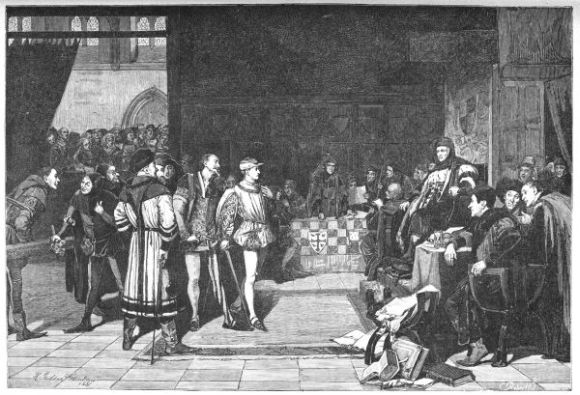
PRINCE HENRY BEFORE JUDGE GASCOIGNE. (See p. 543.)
(After the Picture by H. G. Glindoni.)
[See larger version]
As there was no money in the national exchequer, there was a loud cry to arms, but it was feebly responded to. In the meantime, Clarence having overrun Maine and Anjou, prepared to invade the duchy of Orleans; this had the effect of bringing the young duke to the English camp with all the money he could muster, and having arranged with the invader for the payment of the whole cost of the expedition—209,000 crowns—he left his brother, the Duke of Angoulême, as hostage in Clarence's hands for its payment.
On this, the Duke of Clarence did not quit the country, as was hoped, but marched on into Guienne, forbidding his troops to commit further devastations by the way, but allowing them to inform the inhabitants as they went along that they should not be long before they came again in the name of their own King Henry to carry on the war; words which were afterwards fulfilled to a terrible extent.
This was the last great operation of the reign of Henry IV. By a singular combination of tact, cool calculation, vigilant watchings of every movement around him, and a purpose which was delayed through no conscientious scruples, nor weakened by a single tender feeling, he had put down all his foes. He was at peace at home and abroad. Not a man was left alive who dared to tell him that he was a usurper, except the undaunted Glendower, who was too far off amid his mountains to be heard. He was the most sagacious and successful monarch in Europe, and perhaps its most miserable man.
Though by nature not peculiarly sanguinary or ferocious, the ambition of mounting a throne had led him into the deepest crimes and through torrents of blood. Had his title been good and his throne unassailed, he might have won the character of a mild and even excellent monarch, though it is not probable that he could under any circumstances have won the character of a generous or magnanimous one. But stung by the taunts and nerved by the determined hostility of his enemies, he defended himself with the vigour of a giant, and punished his fallen opponents with the deadly cruelty of the tiger. While youth remained, and rapid and incessant action engrossed him, he seemed to soar above all the feelings and fears of an ordinary man. He boldly replied to those who upbraided him with his criminal seizure of his cousin's crown and realm, that the successful issue announced the approbation of the Almighty. But his health decayed prematurely. His body had been overworked, his mind had been overtasked, his conscience had been overburdened. As his strength gave way, his stoicism gave way with it. In his youth he has been described as gay and agreeable, and in his most active years, even when overwhelmed with business and menaced by the greatest dangers, he was cheerful, affable, ready to converse with the people whom he came amongst. As disease and debility announced a not distant end, he grew gloomy, retiring, ascetic in his devotions, and suspicious even of his own son.
His false position had forced on him every species of false conduct, and deeds which brought their certain punishment. There is every reason to believe that he sacrificed his sincere conviction of the truth of the Wycliffite doctrines, in order to purchase the powerful sanction of the Church for his unrighteous title; for before his usurpation he went along with his father in the protection of Wycliffe and the Lollards. To please the hierarchy he persecuted the Lollards, and was the first to give his sanction to the death of religious dissentients by the terrible means of fire. Yet, as if Providence would punish his apostasy by a striking antithesis, he was compelled, by the rebellion of an archbishop, to be the first in England to visit with capital punishment a prelate of the Established Church.
It is curious that soon after his execution of the Archbishop of York, he was attacked by the most loathsome eruptions on the face, or, as it appears to have been, an inveterate leprosy. This the people naturally believed to be a judgment from Heaven upon him for that sacrilegious act, and probably some such conviction might haunt his own mind. Though in stature somewhat below the middle size, he was vigorously and finely formed. His features were regularly beautiful in his youth, and in some of his penitential communications he confessed to having been greatly proud of them. But, by the ravages of this repulsive complaint, they became so hideous that he was compelled at length to avoid appearing in public. To this disease were added attacks of epilepsy, which became more and more violent, so that he would lie in death-like trances for hours.
As Henry declined in health, he seems to have grown increasingly jealous of the popularity of his son, the Prince of Wales. The young prince had acquired great glory by his conduct at the battle of Shrewsbury, and in his warfare against Owen Glendower. He was free, jocund, fond of pleasure, and of mixing with all classes of the people. Shakespeare has made his life and character the most living and familiar of things. He has surrounded him by a set of jolly companions, the fat and witty Sir John Falstaff, Bardolph, "mine ancient Pistol," and the whole band of roysterers who haunted the "Boar's Head," Eastcheap. He has drawn his inimitable portraiture of the merry Prince Hal from the chroniclers of the time, who describe him as the idol of the people. He was as dissipated as an heir-apparent generally is, but with his follies he displayed what his father never possessed—a generous temperament. No sooner was he on the throne than he offered terms of pacification to his most persevering enemy, Owen Glendower. The anecdote of his conduct before Judge Gascoigne, has been represented as doubtful by some of our modern historians, and does not rest on contemporary authority; we give it, however, as it is so familiar.
One of the prince's associates had been arraigned for felony before Chief Justice Gascoigne, the upright magistrate whom we have seen refusing to execute his father's illegal acts at York. The prince appeared before the magistrate, and peremptorily demanded the release of his boon companion. The Chief Justice refused, when Henry drew his sword upon him, and swore that he would have the man liberated. The judge calmly ordered the prince to be committed to prison himself as a greater offender, since he was, by his position, bound expressly to be a maintainer of the laws. Henry at once, in the innate nobility of his nature, felt and admired the lofty virtue of the magistrate. He submitted to his order, and it is related that when the fact was mentioned to his father, he said, "Happy is the monarch who possesses a judge so resolute in the discharge of his duty, and a son so willing to yield to the authority of the law."
Henry passed the last Christmas of his life at his favourite palace of Eltham. So complete was his seclusion, owing both to his illness and the awful disfigurement of his person, that he scarcely saw any one but the queen; lying frequently for hours without any sign of life. After Candlemas, he was so much better as to be able to keep his birthday, and he then returned to his palace at Westminster. He was at his devotions in the abbey, at the shrine of St. Edward, when his last fatal fit seized him. The well-known story of his last moments is also very doubtful. According to it, the king was removed into the apartments of the abbot, and laid in the celebrated Jerusalem Chamber. The fit lasted so long that Prince Henry, who was present, knowing the plunder which often takes place at the death-beds of kings, and which was remarkably the case at that of Edward III., ordered the crown to be removed to another and securer apartment.
On coming to himself Henry asked where he was, and being told in the Jerusalem Chamber, he regarded his last hour as come, for it had been predicted to him that he should finish his days in Jerusalem; and he had vowed, in expiation of his crimes, to make a pilgrimage thither. The days of the Crusades were over, but a remarkable visit made to him soon after he ascended the throne, by Manuel Palæologus, the Emperor of Constantinople, when seeking aid against the Saracens, probably impressed his mind with this idea. He then requested that the Miserere should be read to him, which contains an especial prayer for forgiveness of "blood-guiltiness." Then looking round he missed the crown from its place, and demanded to know where it was. The scenes which followed have been faithfully and beautifully copied by Shakespeare.
"Ah! fair son," said the dying king; "what right have you to the crown, when you know that your father had none?"
"My liege," answered young Henry; "with the sword you won it, and with the sword I will keep it."
"Well," replied the king, faintly, "do as you think best. I leave the issue to God, and may He have mercy on my soul." And then followed that beautiful address so finely rendered in Shakespeare—
"Come hither, Harry; sit thou by my bed," etc.
Henry IV. was in the forty-seventh year of his age, and the fourteenth year of his reign, when he died. It is curious that as he usurped the throne of Richard II., he also usurped, as far as in him lay, his tomb. The body of Richard he sent to be buried at Langley, instead of permitting it to rest with the ashes of his father, the Black Prince; but there his own body was ordered to be conveyed, for he had expressed a superstitious desire that he might lie near the shrine of Thomas Becket.
Henry IV. was twice married. His first wife was Mary de Bohun, daughter and co-heir of the Earl of Hereford. By her he had four sons and two daughters. Henry was his successor to the throne; Thomas was Duke of Clarence; John, Duke of Bedford; and Humphrey, Duke of Gloucester. His eldest daughter, Blanche, was married to the Duke of Bavaria, and the second to the King of Denmark.
Conscious of the defect of his title, Henry was careful to avoid, on ascending the throne, asking for any act of settlement. He contented himself with receiving the oath of allegiance from Parliament to himself, and after himself to his eldest son or heir-apparent. But after the battle of Shrewsbury he introduced a bill resting the succession on his four sons, but excluding his daughters. But on being reminded that to exclude his daughters annihilated all his claim to the throne of France, he reluctantly consented to the passing of an act admitting the general issue of his sons, but still passing over that of his daughters, as if fearful to bring in some foreign aspirant.
By his second wife, Joanna of Navarre, daughter of Charles the Bad, he had no children. Joanna made a much better queen than might have been expected from her parentage. Her worst faults appear to have been great fondness for money, and for a numerous train of French attendants, which obliged Parliament frequently to interfere, as did that of Charles I., and insist on their being sent home. She was handsome in person, but had the reputation of being addicted to the arts of necromancy, no doubt arising from the evil reputation of her father. We shall hear of her again in the next reign.
The defect of Henry's title was a circumstance favourable to the progress of the constitution, though prolific of much controversy and bloodshed. Compelled to court the goodwill of the people, and to come to them often for money, the House of Commons availed themselves of this circumstance to increase their demands of privilege and liberty. In his very first year they passed a law depriving the Crown of the power of protecting an unjust judge. In the second, they insisted on the removal of obnoxious persons from his household, and prevailed; in the sixth, they appointed treasurers to superintend the expenditure of the supplies; in the eighth, they enacted thirty articles for the regulation of the royal household, and compelled the judges, the council, and all the officers of the household to swear to the observance of them. The practice of the Crown corrupting Parliament had shown itself in the reign of Richard II., and was now rife, through means of the sheriffs. The Commons obtained an act to compel them to make just returns. They even went so far, when pressed by the king for money, as to recommend him to seize the surplus temporalities of the Church, which they represented as containing 18,400 ploughs of land, producing 485,000 marks a year, equal to £4,750,745 of our present money.
Here, however, the king stood firm against the recommendation of the Commons; and even, to oblige the Church, he consented to the passing of the first law for the burning of heretics (De heretico comburendo), that is, of persons who dared to differ in opinion from the religion of the State; and in accordance with this barbarous act, William Sawtrey, rector of Lynn in Norfolk, and afterwards curate of St. Osith's in London, the first English martyr, was burnt at the stake on the 10th of March, 1401.
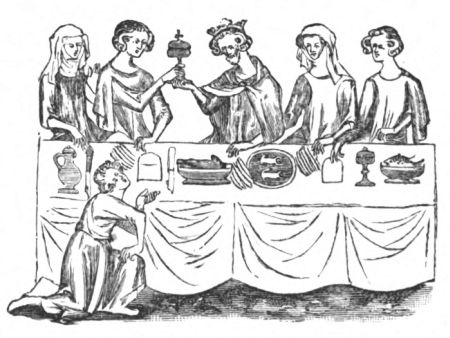
KING AT TABLE (FOURTEENTH CENTURY).
[From Royal MS., 2 B7, fol. 57.]
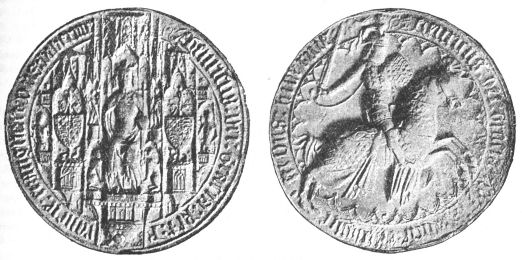
GREAT SEAL OF HENRY V.