Chapter XXXVI · (continued 2)
Reading edition
Three days after the signing of the treaty of Arras, died also Isabella of Bavaria, one of the most infamous women who ever figured in history. The deed which united her old ally Burgundy with her own son whom she hated with a most unnatural hatred was to her the crowning point of her deserved misfortunes. She left a memory equally abhorred by French and English.
The affairs of England in France demanded the utmost promptitude and address, but this important moment was wasted through the violence of the factions of Gloucester and Beaufort. The cardinal endeavoured to secure the appointment of his nephew Edmund Beaufort, afterwards Duke of Somerset, as regent of France; but the Duke of Gloucester insisted on the choice of Richard, Duke of York, who was finally adopted; but not till six months of invaluable time had been wasted. Before his arrival the French had profited by the delay to recover Melun, Pontoise, and other places on the Seine. Richemont had been active in Normandy, exciting the people to revolt, and Dieppe was surprised. The Duke of Burgundy—though his subjects, who had much commerce with England, were averse from a war with this country, and the people of Picardy, who had been made over to him, were in rebellion—still was actively preparing for an attack on Calais. Paris had thrown off the English yoke. The Parisians had always been attached to the Duke of Burgundy, and equally ready to renew their allegiance to Charles. In the night they opened the gates to Lisle Adam and the Count Dunois; threw chains across the streets to prevent the entrance of the English; and the Lord Willoughby, first retreating with his garrison to the Bastille, then made terms to evacuate the city.
The turn which was given to affairs immediately on the arrival of the Duke of York showed what might have been done by a more prompt occupation of his post. The Duke landed in Normandy with 8,000 men. He soon reduced the towns which had revolted or surrendered to the enemy. Talbot defeated an army near Rouen; he re-took Pontoise in the midst of a fall of snow by dressing a body of men in white, and concealing them in a ditch. He then advanced to Paris, and carried desolation to its very walls, but failed to take it.
Meanwhile, the Duke of Burgundy had invested Calais. The Duke of Gloucester, with a fleet of 500 sail, and carrying 15,000 men, set out to raise the siege, and landed at Calais on the 2nd of August, 1436. Philip did not wait for this army; he hastily abandoned the siege, or rather his troops—a wretched rabble of militia from Ghent, Bruges, Ypres, and other Flemish towns—abandoned him. They had fought too much with the English to venture to fight against them, and, at the first approach of Gloucester, they ran in a wild panic. The contagion became general, and the whole army, men-at-arms, archers, everything, 30,000 in number, decamped with such precipitation as to leave behind them all their artillery, ammunition, and baggage. The Count of Richemont, the Constable of France, who had come to witness the recovery of Calais from the English, was borne away in the rueful flight, to his infinite chagrin. Gloucester, who arrived four days after this disgraceful retreat, made instant pursuit, sending messengers to Philip to beg him to stop as he had promised, and measure lances with him; but the humbled duke made no halt. The English now rushed furiously into Flanders, plundering town and country, the soldiers making a rich booty, and Gloucester paying the duke off the old scores incurred by his conduct to Gloucester's first wife, Jacqueline of Hainault.
On the 3rd of January, 1438, died Queen Catherine, the widow of Henry V. Soon after the death of Catherine's illustrious husband she retired to an obscurity which was scarcely broken during the remaining fifteen years of her life. She had fixed her affections on a handsome yeoman of the guard, Owen Tudor, a Welshman. His father had been one of the followers of Owen Glendower, and he himself was at Agincourt with Henry V., where, for his bravery in repelling the fiery charge of the Duke of Alençon, Henry made him one of the squires of his body. It was in this post, keeping guard at Windsor when Catherine retired there with the infant Henry VI., that he attracted the queen's attention. Despite his humble condition—for he could not then be worth forty pounds a year, or he must have taken up his knighthood—Catherine, the proud daughter of the kings of France, did not disdain to bestow upon him her favour, and eventually her hand. This marriage was, of course, concealed with all possible care. So completely was this the case, that no proof of it whatever exists, or has been discovered; not even the research of Henry VII., her grandson, with all his boast of royal descent, could obtain it. Yet no doubt whatever seems to have existed of the reality of the marriage. Gloucester, the protector, was highly incensed at this act of Catherine, regarding it as a disgrace to the royal family. It appears clearly that, though he was aware that the husband of Catherine was a plebeian, he was not aware of his identity, for Tudor continued to reside with the queen till about six months before her death.
Tudor and Catherine had four children—a daughter, who died in infancy, and three sons. These sons were torn from her at the instigation of Gloucester; and the queen was forced to seek refuge in the abbey of Bermondsey. After the queen's death, which occurred when she was only thirty-six, and in consequence, it is supposed, of the persecutions and troubles which her marriage brought upon her, Tudor was seized and imprisoned in Newgate, but escaped into Wales; he was again dishonourably seized by Gloucester, notwithstanding a safe conduct from the king, and thrown into the dungeon of Wallingford Castle. Thence he was remanded again to Newgate, whence he once more escaped. He was admitted to some small favour by Henry VI., and made keeper of his parks in Denbigh, Wales; and was finally taken, fighting against him, by Edward IV., and beheaded in the market-place of Hereford in 1461. Such is the history of the rise of the royal line of Tudor, corrupted from Theodore, the original family name.
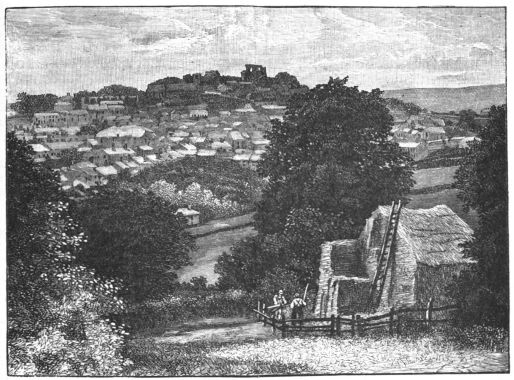
DENBIGH.
(From a Photograph by Catherall & Pritchard.)
[See larger version]
The three sons of Owen Tudor and Catherine were acknowledged and ennobled by Henry VI. The eldest, Edmond, was made Earl of Richmond, married to Margaret Beaufort, the heiress of the house of Somerset, and took precedence of all peers. He died at the early age of twenty, yet left one infant son, afterwards Henry VII. The second son of Catherine, Jasper Tudor, was created Earl of Pembroke. The third son became a monk of Westminster.
In France the English still continued to wage a various war, but not sufficiently brilliant to give interest to a detailed account of it. In 1437 Philip of Burgundy again ventured abroad, and laid siege to Crotoy, at the mouth of the Somme. Talbot marched from Normandy with a small army of 4,000 men. Reaching St. Valery over night, the next morning they plunged into the ford of Blanchetaque—so well known since Edward III. crossed it at Creçy—and attacked its besiegers, who hastily drew off to Abbeville. Talbot ravaged the country round, and returned into Normandy laden with spoil.
In May of this year the Duke of York was recalled, and was succeeded by Beauchamp, Earl of Warwick, who achieved nothing remarkable, and died at Rouen in less than two years. During his government both England and France were exempt from war, but ravaged by famine and pestilence.
In 1439 the Count of Richemont, the Constable of France, recovered the city of Meaux from Talbot; and Talbot, on his part, accompanied by the Earl of Somerset, besieged Harfleur, and took it after a difficult siege. Talbot was, in fact, at this time, the brave supporter of the English power in France. Two years after this time he raised the siege of Pontoise, which was invested by an army of 12,000 men; but all his valour could not preserve it. In 1442 and 1443 there were some advantages gained by the French in Guienne, and these were counterpoised by greater successes of the English in Maine, Picardy, and Anjou. Both parties were weary of the war, yet neither would recede from its high claims. The Pope from time to time urged the combatants, as Christians, to lay aside their animosities, and make peace; and to this desirable object Isabella, Duchess of Burgundy, a descendant of John of Gaunt, lent her persuasions, and succeeded, by the co-operation of Cardinal Beaufort, in obtaining a cessation of hostilities for an indefinite period. The Duke of Orleans, after a captivity of twenty-five years, was now liberated on condition of paying a ransom of 200,000 crowns by fixed instalments. Returning to France, he added his endeavours to those of the advocates for peace, and a truce was at length signed on the 28th of May, 1444, for two years, and by subsequent treaties it was prolonged till April, 1450. It was high time that some respite was given to the wretched people of France, who for so many years had borne the brunt of these deadly contests. Cardinal Beaufort said that more perished in these wars than there were now in the two kingdoms. The late famine and plague had depopulated France still further; and the wasted country was infested by bands of thieves, vagabonds, cut-throats of every description, chiefly deserted soldiers, who committed the most horrible crimes.
Henry of England was now in his twenty-fourth year. His character was that of a mild, kind-hearted, and pious youth, but weak; and, like all weak princes, prone to surround himself with favourites. From the accounts that have reached us it is clear that, as a private man, he would have been good and happy; as a king, he was destined to become the dupe of some stronger mind, and the victim of faction. During the whole of his minority, his two powerful kinsmen, the Duke of Gloucester and Cardinal Beaufort, had kept up round the throne a fierce contest for preeminence. Gloucester was warm-tempered but generous, and greatly beloved by the people, who called him the "good Duke Humphrey." He is said to have been better educated than most princes of his time, to have been fond of men of talent, and to have founded one of the first public libraries in England. The cardinal was a man of a more calculating and politic temperament. He was well known to be cherishing the hope of grasping the pontifical tiara. Each of these nobles was in daily strife for the possession of the king's person, and, through it, for the chief power in the realm. The duke was a great advocate for the vigorous prosecution of the war, and pleased the people by advocating an ascendency over the French. Beaufort was as earnest for peace, and thence his popularity with the Church on the Continent. This feud was brought to a climax in 1439 by the debate on the question of the release of the Duke of Orleans. Gloucester opposed it on the ground that his brother, Henry V., had left it as a solemn command that none of the captives of Agincourt should ever be ransomed. Beaufort advocated it on the plea that Orleans would use his influence in France for peace. Beaufort prevailed, and Gloucester, in chagrin, delivered to the king a list of political charges against the cardinal.
Things were at this pass when an accusation of sorcery and high treason was got up against the Duchess of Gloucester. The Duke had married Eleanor Cobham, the daughter of Lord Reginald Cobham, who had been his mistress. Though he had thus made her his wife, her enemies never forgot the circumstances of the duchess's prior situation. It was kept alive as a source of mortification to the duke. Instead of her legitimate title, they persisted in calling her Dame Eleanor Cobham. She is represented as a bold, ambitious, dissolute, and avaricious woman. The duchess was examined in St. Stephen's Chapel, Westminster, by the Archbishop of Canterbury, and charged with having obtained love-philters to secure the affection of her husband. But a much more horrible and absurd charge was that she had procured a wax figure, which was so moulded by art, that when placed before the fire, as it melted away, the flesh of the king would melt away also, his marrow dry up, and his health fade. Eight-and-twenty such charges were preferred against Dame Eleanor and her companions, some of which she is said to have admitted, but the majority and the worst to have denied; and on such ridiculous pleas she was condemned on three days of the week to walk bareheaded, and bearing a lighted taper in her hand, through the streets of London, and afterwards to be confined for life in the Isle of Man, in the custody of Sir John Stanley.
At this crisis the marriage of the king was resolved upon. Each party put forth all its energy to secure such a partner as should be likely to incline to its interests, for if the queen should be a woman of ability, she would, with the king's peculiar character, be certain to establish a permanent influence over him; and this circumstance would decide for ever the long contest between them. Gloucester recommended a daughter of the Count of Armagnac, on the ground that Armagnac was the enemy of Charles VII., and, in alliance with England, would add greatly to the strength of the province of Guienne. But no sooner did the proposal reach the ears of Charles, than to prevent so disastrous an occurrence, he invaded the territory of the count, and made him and his family prisoners. The Beaufort party now pressed on their advantage, and strongly represented the benefits to be hoped from the choice of Margaret of Anjou, the daughter of Réné, titular King of Sicily and Jerusalem, and Duke of Anjou, Maine, and Bar. Margaret had a great reputation for beauty and talent. She was said to be one of the most superior women of the age, and besides this, she was cousin to the Queen of France, greatly admired by Charles himself, and generally resident at his court.
The people from the first marked their dislike of the alliance. They were not fond of French princesses, and Gloucester, who always represented the popular idea, opposed it with all his eloquence. But the Beaufort party carried it against him. The prime mover of the scheme was William de la Pole, the Earl of Suffolk. He was a sworn partisan of Beaufort, with Somerset and Buckingham. He had been residing at the French court, was in high favour there, and there were not wanting rumours of a too familiar intimacy betwixt himself and the proposed queen. Strongly seconded by the Beaufort party in opposition to Gloucester, he was commissioned to negotiate this marriage; and—to give him absolute and irresponsible power in the matter—a most singular and unusual guarantee was granted by the king, and approved by Parliament, against any future penalties for his proceedings in the matter. Armed with this dangerous and suspicious document, Suffolk hastened to France, met the Duke of Orleans at Tours, and concluded a truce, during which the question of the marriage might be discussed, and which, if the issue were successful, might terminate in a peace.
The conduct of Suffolk throughout the negotiation was such as made it obvious that he had not secured a previous indemnity for nothing. The father of Margaret, though titular King of Sicily and Jerusalem, was in reality a pauper. He did not possess a single foot of land in the countries over which his royal title extended. Maine and Anjou, his hereditary dukedoms, were in the hands of the English. Under these circumstances, the most that could be expected was that England should be willing to receive the princess without a dower. But Suffolk not only waived any claim of dower, but resigned, as a condition of the marriage, the duchies of Maine and Anjou to Margaret's father. This was a direct act of high treason. These duchies were the very keys of Normandy, and their cession highly endangered all the English possessions in France. Nothing but the most consummate folly, or, what was more probable, the blinding influence which the daughter of King Réné already exerted over Suffolk, could have induced him to perpetrate such a deed. This condition was kept in the background as long as possible. Whether Beaufort had been a party to this infamous measure, or whether he was duped himself by Suffolk, does not appear. He was now an old man of seventy-eight, and since his signal vengeance on Gloucester, by the disgrace and punishment of his wife, had retired to his diocese, apprehensive lest there might come a repayment of the injury from Gloucester or his staunch admirers, the people.
Suffolk for his success in this negotiation was created a marquis; he married Margaret as proxy for Henry at Nancy on the 28th of October, 1444. Jousts and tournaments were celebrated by the French court in its joy over this event, from which it expected no ordinary advantages. Suffolk does not appear to have been in any haste to return to England with the fair bride; for, though contracted in October, they remained in France all the winter, and landed at Porchester only on the 8th of April, 1445. Great ceremony had been made by the French court on Margaret's departure. The king himself, with a splendid retinue, accompanied her some miles on her way from the city, and separated from her in tears. Her father continued with her to Bar-le-Duc.
On the 22nd of April she was married in Titchfield Abbey to Henry, and on the 30th of May she was crowned with much splendour at Westminster, and very soon showed that she was prepared to exercise to the full her royal authority. The king, charmed with her beauty and address, resigned himself a willing creature into her hands. She formed an immediate and close intimacy with the Beaufort party; her constant counsellors were Somerset, Buckingham, and Suffolk. Suffolk appeared to the people much more the husband of Margaret than Henry. One of the first acts of the queen's party was to procure a repeal of the Act of Henry V., that no peace should be made with France without the consent of the three estates of the Parliament. They obtained ample supplies, and from both Houses the most profuse thanks to Suffolk for his services in accomplishing this happy union.
All things now concurred to favour a blow which should gratify the malice of Suffolk. By some means he contrived to infuse into the mind of Henry a suspicion of the loyalty of his uncle Gloucester. Perhaps the repeated instances in which Gloucester had brought forward the Duke of York, in opposition to Suffolk's party, might be alleged as the cause of their vengeance. The Duke of York was the claimant of the throne in right of the Earl of March, a right superior to the usurped claim of the present line, and which he afterwards asserted. Whatever the cause, or combination of causes, the destruction of Gloucester was determined. Henry summoned a Parliament to meet, not, as usual, at Westminster, but at Bury St. Edmunds, in Suffolk, where the conspirators would be in the midst of the favourite's retainers. The measures which were adopted were ominous. The knights of the shire were ordered to come in arms. The king was conveyed to the town under strong escort, and the men of Suffolk were placed in numerous bodies round the royal lodgings. All the avenues to the town were guarded during the night by pickets of soldiers.
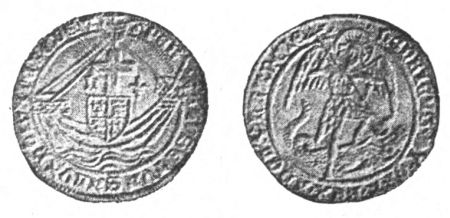
ANGEL OF HENRY VI.
The Duke of Gloucester, clearly suspecting no harm, went from his castle of Devizes to the opening of the Parliament, where everything was conducted with the usual form, and nothing took place at all calculated to excite suspicion. But the next day, the 11th of February, 1447, the Lord Beaumont, Constable of England, attended by the Duke of Buckingham, and several of the peers of Suffolk's party, arrested Gloucester, seizing, at the same time, all his attendants, and consigning them to different prisons. The Suffolk party now openly avowed that Gloucester had formed a scheme to kill the king, to usurp the throne, liberate his duchess, and make her queen. The story was too improbable to receive credence; it was therefore dropped, and Gloucester remained seventeen days in prison, awaiting his trial.
When summoned, at length, to attend the council, he was found dead in his bed, to the great horror of the king, who was obviously unprepared for such a catastrophe. The body was exposed to the view of the Parliament and the people, to convince them that there had been no violence used. There were no marks of violence, indeed, upon it, but this had no weight with the people, who recollected that such had been the case in the mysteriously sudden deaths of Edward II., Richard II., and of the former unfortunate Duke of Gloucester, who had, under precisely similar circumstances, perished in the prison of Calais in Richard II.'s time. One historian only of the time, Whethamstede, Abbot of St. Albans, has avowed his belief that the duke died from natural causes, and great weight has been given to his opinion, because he was attached to the duke, and loud in his abuse of his enemies. It is, however, but one opinion against a host; and all the circumstances tend to support the popular belief that Gloucester was murdered, though with great cunning and skill. It is improbable, however, that Margaret or the Cardinal had any hand in the deed.
Cardinal Beaufort survived his great rival only six weeks. Every reader recalls the celebrated death-scene of this prelate as described by Shakespeare, King Henry at his bedside, exclaiming—
"Lord cardinal, if thou think'st on heaven's bliss, Hold up thy hand, make signal of thy hope.— He dies, and makes no sign. O God, forgive him."
The situation and invocation are undoubtedly those of the poet; but they are founded on the widespread belief at the time that Beaufort had the blood of Gloucester on his soul. Nevertheless, as he had retired entirely from public life, it is extremely improbable that this belief had any foundation. Beaufort may have been ambitious, but his character on the whole was very elevated. The disposition of his wealth was noble, being chiefly devoted to public and charitable purposes. He left £4,000—equal to £40,000 now—for the relief of poor prisoners in London. He gave £2,000 to two colleges founded by the king at Eton and Cambridge; and the rest founded the hospital of St. Cross at Winchester, now of immense value. He was buried in the cathedral of Winchester, in the beautiful chantry which still elicits so much admiration from the beholder.
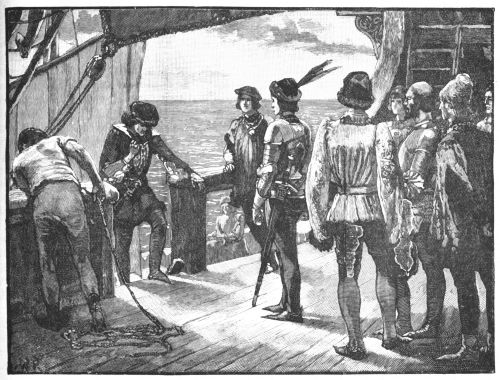
ARREST OF THE DUKE OF SUFFOLK. (See p. 608.)
[See larger version]
The article in the marriage treaty of the queen, which stipulated for the cession of Anjou and Maine, had been kept as secret as possible during the life of the cardinal; but circumstances now rendered it impossible to hide it any longer. The court of France insisted on the surrender of the provinces. When these demands could be no longer resisted—for Charles prepared to invade the provinces—an order under the hand of the king was sent to Sir Francis Surienne, the Governor of Le Mans, commanding him to surrender the place to Charles of Anjou. Surienne refused to retire, and the Count Dunois invested the city. Surienne was then compelled to surrender, and the Bishop of Chichester was despatched from England to give up the whole province, with the exception of Fresnoy. It was stated, however, that the King of England did not cede his right to the sovereignty of these states, but merely their enjoyment by the father and uncle of his wife for their natural lives; and it was promised that the grantees of the English crown should receive from France a sum of money equal to ten years' value of the lands they had lost.
The consequences were very speedily seen. Maine was filled with French troops, and the Duke of Somerset, the regent, announced to the council that the three estates of Normandy, encouraged by this change, had refused all supplies, and that unless immediate and effectual assistance were afforded from England these provinces would be lost. To make matters worse, Surienne, who had reluctantly surrendered Le Mans, and was refused by Somerset admittance into Normandy, as a dangerous and insubordinate officer, marched into Brittany, seized the town of Fougères, repaired the fortifications of Pontorson and St. Jacques de Beuvron, and levied subsistence on the whole province at will. The Duke of Brittany complained to Charles; Charles demanded prompt damages to the amount of 1,600,000 crowns, and instead of truce the whole war was opened again.
These transactions occasioned a violent outbreak at home. The Earl of Suffolk was vehemently denounced by the people as a traitor, for the wanton surrender of Maine and Anjou to the French. Suffolk was compelled to demand to be brought face to face with his accusers before the king and council. The demand was granted. Both parties were heard, and, as might have been expected, Suffolk, the favourite of both king and queen, was acquitted of all blame, and pronounced to have done effectual service to the state.
The English exchequer was empty, and Charles of France, aware not only of that, but of the miserable feebleness of the Government, put forth all his energies to profit by the opportunity. A striking change seemed to have come over him with the advance of years. He attacked the corruption of the courts and magistracy; he rigorously reformed the discipline of the army; he set himself to restore order and vigour into the finances; and he took every means of reviving the arts and protecting and encouraging agriculture. It was with astonishment that those who had seen France a few years before now beheld the prosperity which was springing up, and the strength which was becoming visible.
The Duke of Somerset found himself destitute of money, for the Government at home was poor, and the people discontented; and Charles, putting himself at the head of his troops, fell upon Normandy, while the Duke of Brittany, the Duke of Alençon, and the Count Dunois, marched upon it simultaneously from different points. Wherever the French commanders appeared, the people threw open their gates, showing on which side their hearts lay. The Duke of Somerset, so far from possessing an army capable of taking the field, had not even enough to man the garrisons, or provisions to support them.
The duke threw himself into Rouen, his sole trust there being in timely relief from England. He quickly found himself surrounded by an army 50,000 strong, led by the king himself. The spirit of revolt was not less active there than in other towns. A number of the citizens, pretending to be desirous to aid in the defence, were permitted to mount guard on the walls, which they at once betrayed into the hands of the French. The valour of Lord Talbot rescued them from that danger, but it was only to delay for awhile the surrender. Somerset capitulated on the 4th of November, 1449, consenting to pay 56,000 francs, and to give up Arques, Tancarville, Caudebec, Honfleur, and other places in High Normandy, and deliver Talbot as one of the hostages, thus depriving the English of the only general capable of rescuing them from their present dilemma. Harfleur made a stouter defence under Sir Thomas Curson, the governor, but was eventually compelled to yield to Dunois.
The indignation of the people in England at these alarming reverses compelled Suffolk to send some forces to Normandy, but in no proportion to the need. Sir Thomas Kyriel landed at Cherbourg with about 3,000 men, and collecting about as many more, advanced towards Caen, to which the regent Somerset had retreated. But he was met on the way, near Formigny, by the Count of Clermont. He gave battle with the ancient confidence in the superior valour of his countrymen, but after a severe contest of three hours, he was attacked by a second army, under Richemont, the Constable, which took him in flank and rear. The numbers were now utterly overwhelming, independent of the freshness of the new troops, and the surprise. Some of his ranks broke and fled, and others remained fighting hardily till they were cut down or made prisoners. Avranches, Bayeux, and Valognes opened their gates; the regent was besieged in Caen, and compelled to surrender. Cherbourg alone remained, but was soon after taken, and within twelve months the whole of the beautiful country of Normandy, which had been won by the valour of Henry V., with its seven bishoprics and hundred fortified towns, was lost to England for ever.
The campaign of 1452 was opened with some show of spirit. The people of Guienne, groaning under the load of taxation which Charles—consulting his necessity rather than his word, had laid upon them—had despatched a deputation to London, entreating that an army might be sent to their relief, and offering to renew their allegiance. The brave Talbot, Earl of Shrewsbury, who had so long fought in France, was sent over with 4,000 men, and his son, Lord Lisle, followed with as many more. Talbot was now eighty years of age, but full of a spirit and activity which seemed to know no decay. He very soon recovered Bordelais and Châtillon. In the spring of 1453, he opened the campaign by the capture of Fronsac, where the French army advanced against him, and Count Penthièvre invested Châtillon. Hastening to relieve that town, Talbot fell upon the French lines very early in the morning, and created such confusion, that he ordered a general assault on the camp, the entrenchments of which were lined with 300 pieces of cannon. While dashing forward on this formidable battery, his troops were attacked in the rear by another body of French which came up. Talbot had his horse killed under him. His leg was broken in the fall, and he was despatched with a spear as he lay on the ground. His son fell in the vain endeavour to rescue his father; and the army, on learning the death of its commander, dispersed in every direction. A thousand men, who had already penetrated into the camp, were made prisoners.
Charles, who now arrived, took the command of his victorious army, and led it to the gates of Bordeaux. That city, with Fronsac and Bayonne, still held out; but famine at length compelled them to surrender. Bayonne was the last to yield, but the Count Gaston de Foix besieging it with a large army of Basques and Béarnese, it was compelled to open its gates. And thus, in the autumn of 1453, closed the English dreams of empire in France, and the possession of all the territories which came to us with the Norman conquest, except Calais, and a strip of marshy land around it.
It is not to be supposed that this disgraceful termination of our French dominion, this melancholy antithesis to the glories of Creçy and Agincourt, was borne with indifference by the people of England. With Bedford and Talbot the military genius of the nation seemed to have disappeared. Somerset, who was ambitious of ruling at home, had shown in his character of Regent of France only a faculty for sitting still in fortified towns, so long as the enemy was not very urgent to drive him out. At the head of the Government now stood Suffolk and the queen; and, while their administration afforded no support to our commanders abroad, their folly and despotism at home incensed the whole nation. As loss after loss was proclaimed, the public exasperation had increased. The cession of Maine and Anjou had excited the deepest indignation; but when month after month had brought only news of the invasion of Normandy and the loss of town after town, the whole population appeared stung to madness. Suffolk was denounced as the queen's minion, as a man who was so besotted by the charms of a foreign woman as to sacrifice for his pleasure our fairest inheritance. On his head they heaped, not only his fair share of those transactions, but the full odium of the release of the Duke of Orleans, contrary to the injunction of the sagacious Henry V.; the murder of the duke of Gloucester; the emptiness of the State coffers, and all the consequent defeats and disasters.
To calm the public mind and to take measures for the defence of Normandy, a Parliament was summoned, but scarcely did it meet when the news of the fall of Rouen arrived, adding fresh fury to the popular wrath, and confusion to the counsels of the Government. Stormy debates and altercations continued in Parliament for six weeks, whilst succour should have been despatched to our army in Normandy.
Soon after, the Bishop of Chichester, keeper of the privy seal, who had been employed to complete the surrender of Maine to the French, was sent to Portsmouth to pay the soldiers and sailors about to embark for Guienne their then stipulated amount. No sooner did the people hear his name than—crying, "That is the traitor who delivered Maine to the French!"—they rose en masse, and seized him. In appealing to them to spare his life, he was reported to have bade the populace reflect that it was not he, but Suffolk, who had sold that province to France; that he himself was but the humble instrument employed to deliver what he had no power to keep; that it was Suffolk who was the traitor, and that he had boasted that he was as powerful in the French as in the English Government.
This explanation did not save the prelate's life, but it raised the fury of the people to the culminating point against Suffolk. He was not only represented as insolent and rapacious, as being the open paramour of the queen, and thus keeping the king as a mere puppet in his hands; as having not only murdered Gloucester and seized his possessions; but as having obtained exorbitant grants from the Crown, embezzled the public money, perverted justice, screened notorious offenders, supported iniquitous causes, and filled the offices of State with his vilest creatures. The powerful party which prosecuted the revenge of Gloucester's injuries, and now allied itself to the ambitious Duke of York, were the more numerously backed by the nobility, in that they regarded Suffolk with envy as a man who being but the grandson of a merchant, had risen over their heads, and made himself all but monarch.
This universal clamour against him compelled him to rise in his place immediately on the opening of Parliament, and endeavour to defend himself. He alluded to the report, industriously circulated, that he intended to marry his son to a daughter of Somerset, and through that alliance to aspire to the crown. He treated the rumour as most ridiculous, as no doubt it was, reminding the House of the deaths of his father and three brothers in the service of the country, at Agincourt, Jargeau, &c., and of his own long and severe service there. But his appeal had no other result than to induce the Commons to demand that, as on his own showing he lay under suspicions of treason, he should be impeached and committed to the Tower, in order to his trial. They asserted that he had invited the King of France to come over and make himself master of this country, and had furnished the castle of Wallingford with stores and provisions for the purpose of aiding him.
In the course of the trial the Commons appear to have grown sensible of the futility of the bulk of these charges against Suffolk, and a month after its commencement they concentrated the force of their complaints on the waste and embezzlement of the public revenue, and the odious means to which he had resorted for its replenishment. This was an accusation which would be echoed by every class and person almost in the nation. It was a very sore subject indeed. During the minority of the king, the rapacity of the courtiers had been, as usual in such cases, unbounded. The king's uncles had been utterly helpless to restrain it. It had crippled the resources for the war with France, and consequently led to its opprobrious termination. The royal demesnes were dissipated, and there was a debt against the king of £372,000, equal to nearly £4,000,000 of present money. This the Parliament protested that it neither could nor would pay.
When Suffolk was called on for his defence, he fell on his knees before the king, and solemnly asserted his innocence. He declared that, as to the surrender of Maine and Anjou, it was not simply his act, but that of the whole council. He spread the majority of the charges in this manner over the whole ministry; the rest he denied, and appealed to the peers around him for their knowledge of the fact that, so far from marrying his son to a daughter of Somerset, he was affianced to a daughter of Warwick.
Whatever was the amount of Suffolk's guilt, the people were resolved to listen to one penalty alone, that of his death; but to prevent him from falling under the judgment of Parliament, the king, or rather the queen, acting in his name, adopted a bold and startling expedient. He announced to him, through the lord chancellor, that, as he had not claimed to be tried by his peers, the king would exercise his prerogative, and holding him neither guilty nor innocent of the treasons with which he had been charged, would and did banish him from the kingdom for five years, on the second impeachment, for waste of the revenues. The House of Lords, astonished at this invasion of their prerogative to try those of their own body, immediately protested that this act of the king should form no precedent in bar of their privileges hereafter. With this the peers contented themselves in their corporate capacity, as some historians have suggested, from a secret compromise between the two parties.
But the ferment out of doors was terrible. The people looked upon the whole as a trick of the Court to screen the favourite, and defraud them of the satisfaction of witnessing his just punishment. There was a buzz of indignation from one end of the kingdom to the other. The most inflammatory placards were stuck on the doors of the churches, and the death of the duke was openly sworn. Two thousand people were assembled in St. Giles's to seize him on his discharge; but the intended victim escaped, for that time, the vengeance of the mob falling on his retainers. He got down to his estates in Suffolk, and after assembling the knights and squires of his neighbourhood, and before them swearing on the sacrament that he was innocent of the crimes laid to his charge, and writing a letter to his son which it is difficult to read without being convinced of his truthfulness, he embarked at Ipswich in a small vessel for Calais.
But his enemies had resolved that he should not thus escape them. The Nicholas of the Tower, one of the largest ships of the navy, bore down upon him on his passage, and ordered him to come on board. He was received by the captain as he stepped on deck with the ominous salutation, "Welcome, traitor!" Two nights he was kept on board this vessel, while his capture was announced on shore, and further instructions were awaited. It was clear, from a ship of the navy being used, that persons of no common influence were arrayed against him; and after a mock trial by the sailors, he was conducted to near Dover, where a small boat came alongside with a block, a rusty sword, and an executioner. The duke was lowered into the boat, and there beheaded in a barbarous manner (1450). His remains were laid on the sands near Dover, and guarded by the sheriff of Kent, till the king commanded them to be delivered to his widow who was no other than the granddaughter of Chaucer, the poet. She deposited the body in the collegiate church of Wingfield, in Suffolk.