THE 'LIVES'
Reading edition
George Abbot (1562-1633).
[76]Archbishop Abbot was borne in the howse of old Flemish building, timber and brick, now an alehouse, the signe 'Three Mariners,' by the river's side by the bridge on the north side of the street in St. Nicholas parish on the right hand as you goe out of the towne northwards.
[77]Old Nightingale was his servant, and weepes when he talkes of him. Every one that knew, loved him. He was sometimes cholerique.
He was borne the first howse over the bridge on the right hand in St. Nicholas parish <Guildford>. He was the sonne of a sherman[78]. His mother, with child of him, longed for a jack, and dream't that if shee could eate a jack, her son should be a great man. The next morning, goeing to the river, which runs by the howse (which is by the bridge), with her payle, to take up some water, a good jack came into her payle. Which shee eat up, all, her selfe. This is generally recieved for a trueth.
His godfather and godmothers sent him to the University, his father not being able.
Sir Robert Aiton (1570-1638).
[A] Sir Robert Aiton[79], knight;—he lies buried in the south aisle of the choire of Westminster abbey, where there is erected to his memory an elegant marble and copper monument and inscription—viz.
This long inscription is in copper:—
M. S.
Clarissimi, omnigenaque virtute et eruditione (presertim poesi) ornatissimi equitis, Domini Roberti Aitoni, ex antiqua et illustri gente Aitona ad Castrum Kinnadinum apud Scotos oriundi: qui a serenissimo rege Jacobo in cubicula interiora admissus; in Germaniam ad imperatorem imperiique principes, cum libello regio regiae authoritatis vindice, legatus; ac primum Annae, demum Mariae, serenissimis Britanniarum reginis, ab epistolis, consiliis, et libellis supplicibus; necnon Xenodochio S'ae Catharinae praefectus; anima Creatori reddita, hic, depositis mortalibus exuviis, secundum redemptoris adventum expectat.
Carolum linquens, repetit Parentem; Et valedicens Mariae, revisit Annam; et Aulaei decus alto Olympi Mutat honore.
Obiit coelebs in Regiâ Albaulâ, non sine maximo bonorum omnium luctu et moerore:
Aetat. suae LXVIII, Salut. humanae MDCXXXVIII.
Hoc devoti gratique animi testimonium optimo patruo, Jo. Aitonus, M.L.P.
In white marble at the bottome of the monument:—
Musarum decus hîc, patriaeque, aulaeque, domique Et foris exemplar, sed non imitabile, honesti.
His bust is of copper, curiously cast, with a laurell held over it by two figures of white marble.
That Sir Robert was one of the best poets of his time—Mr. John Dreyden sayes he has seen verses of his, some of the best of that age, printed with some other verses—quaere.
He was acquainted with all the witts of his time in England. He was a great acquaintance of Mr. Thomas Hobbes of Malmesbury, whom Mr. Hobbes told me he made use of (together with Ben Johnson) for an Aristarchus, when he made his Epistle Dedicatory to his translation of Thucydides. I have been told (I think by Sir John himself) that he was eldest brother to Sir John Ayton, Master of the Black Rod, who was also an excellent scholar.
Note.
Aldsworth.
[80]... Aldsworth, mathematical boyes.
[81]Memorandum:—the patent for the mathematicall blew-coate boyes at Christ Church in London was dated '19th August in the 25th yeare of the reigne of king Charles the second' <1673>.
Thomas Allen (1542-1632).
[82]Thomas Allen, Trin. Coll. Oxon.—Elias Ashmole, esqr., <has> the MSS. of Thomas Allen's commentary on the second and third bookes of Ptolomey's Quadripartite[83].
[84]Thomas Allen—vide Anthony Wood's <Hist. et> Antiq. <Univ.> Oxon.
Mr. Thomas Allen[B] was borne in Staffordshire.
Mr. Theodore Haak, a German, Regiae Societatis Socius, was of Glocester Hall, 1626, and knew this learned worthy old gentleman, whom he takes to have been about ninety-six yeares old when he dyed, which was about 1630 (vide).
The learned <Edmund> Reynolds, who was turned Catholique[IV.] by his brother the learned Dr. <John> Reynolds, President of Corpus Xti Colledge, was of Glocester Hall then too. They were both neer of an age, and they dyed both within 12 monethes one of th'other[C]. He was at both their funeralls. Mr. Allen came into the hall to commons, but Mr. Reynolds had his brought to his chamber.
He sayes that Mr. Allen was a very cheerfull, facetious man, and that every body loved his company, and every howse on their Gaudie-dayes were wont to invite him.
His picture was drawne at the request of Dr. Ralph Kettle, and hangs in the dining roome of the President of Trin. Coll. Oxon. (of which house he first was, and had his education there) by which it appeares that he was a handsome sanguine man, and of an excellent habit of bodie.
There is mention of him in Leicester's Commonwealth[85] that the great Dudley, earle of Leicester, made use of him for casting nativities, for he was the best astrologer of his time. He hath written a large and learned commentary, in folio, on the Quadripartite of Ptolemie, which Elias Ashmole hath in MS. fairly written, and I hope will one day be printed.
In those darke times astrologer, mathematician, and conjurer, were accounted the same things; and the vulgar did verily beleeve him to be a conjurer. He had a great many mathematicall instruments and glasses in his chamber, which did also confirme the ignorant in their opinion, and his servitor (to impose on freshmen and simple people) would tell them that sometimes he should meet the spirits comeing up his staires like bees. One[V.] of our parish[VI.] was of Glocester Hall about 70 yeares and more since, and told me this from his servitor. Now there is to some men a great lechery in lying, and imposing on the understandings of beleeving people, and he thought it for his credit to serve such a master.
He was generally acquainted, and every long vacation, he rode into the countrey to visitt his old acquaintance and patrones, to whom his great learning, mixt with much sweetnes of humour, rendred him very welcome. One time being at Hom Lacy[86] in Herefordshire, at Mr. John Scudamore's (grandfather to the lord Scudamor), he happened to leave[87] his watch in the chamber windowe—(watches were then rarities)—The maydes came in to make the bed, and hearing a thing in a case cry Tick, Tick, Tick, presently concluded that that was his Devill, and tooke it by the string with the tongues[88], and threw it out of the windowe into the mote (to[89] drowne the Devill.) It so happened that the string hung on a sprig of an elder that grew out of the mote, and this confirmed them that 'twas the Devill. So the good old gentleman gott his watch again.
Sir Kenelm Digby loved him much (vide Sir K. Digby's Life <p.> 69[90]), and bought his excellent library of him, which he gave to the University. I have a Stifelius' Arithmetique that was his, which I find he had much perused, and no doubt mastered. He was interred in Trinity College Chapell, (quaere where: as I take it, the outer Chapell.) George Bathurst[E] B.D. made his funerall oration in Latin, which was printed. 'Tis pitty there had not been his name on a[91] stone over him.
Queen Elizabeth sent for him to have his advice about the new star that appeared in the Swan or Cassiopeia (but I think the Swan), to which he gave his judgment very learnedly.
He was great-uncle to Mr. <Henry> Dudley, the minister of Broadhinton in Wilts <1665>.
Notes.
Charles Alleyn (obiit 1640?).
[94]Charles Alleyn, who wrote the Battailes of Agencourt, Poitiers, and Crescy, was usher to Mr. Thomas Farnaby.
Lancelot Andrewes (1555-1626).
[95]Lancelot Andrewes[F], lord bishop of Winton, was borne in London; went to schoole at Merchant Taylors schoole. Mr. Mulcaster[G] was his schoolemaster, whose picture he hung in his studie (as Mr. Thomas Fuller, Holy State).
Old Mr. Sutton, a very learned man of those dayes, of Blandford St. Maries, Dorset, was his school fellowe, and sayd that Lancelot Andrewes was a great long boy of 18 yeares old at least before he went to the university.
He was a fellowe[96] of Pembroke-hall, in Cambridge (called Collegium Episcoporum, for that, at one time, in those dayes, there were of that house ... bishops).
The Puritan faction did begin to increase in those dayes, and especially at Emanuel College. That party had a great mind to drawe in this learned young man, whom if they could make theirs, they knew would be a great honour to them. They carried themselves outwardly with great sanctity and strictnesse, so that 'twas very hard matter to——as to their lives. They preached up very strict keeping and observing the Lord's day; made, upon the matter, damnation to breake it, and that 'twas lesse sin to kill a man then.... Yet these hypocrites did bowle in a private green at their colledge every Sunday after sermon; and one of the colledge (a loving friend to Mr. L. Andrewes) to satisfie him one time lent him the key of a private back dore to the bowling green, on a Sunday evening, which he opening, discovered these zealous preachers, with their gownes off, earnest at play. But they were strangely surprized to see the entrey of one that was not of the brotherhood.
There was then at Cambridge a good fatt alderman that was wont to sleep at church, which the alderman endeavoured to prevent but could not. Well! this was preached against as a signe of reprobation. The good man was exceedingly troubled at it, and went to Andrewes his chamber to be satisfied in point of conscience. Mr. Andrewes told him that <it> was an ill habit of body not of mind, and that it was against his will; advised him on Sundays to make a more sparing meale and to mend it at supper. The alderman did so, but sleepe comes upon <him> again for all that, and was preached at. <He> comes againe to be resolved, with tears in his eies; Andrewes then told him he would have him make a good heartie meale as he was wont to doe, and presently take out his full sleep. He did so[97]; came to St. Marie's[98], where the preacher was prepared with a sermon to damne all who slept at sermon, a certaine signe of reprobation. The good alderman having taken his full nap before, lookes on the preacher all sermon time, and spoyled the designe.—But I should have sayd that Andrewes was most extremely spoken against and preached against for offering to assoile or excuse a sleeper in sermon time. But he had learning and witt enough to[99] defend himselfe.
His great learning quickly made him known in the university, and also to King James, who much valued him for it, and advanced him, and at last[100] made him bishop of Winchester, which bishoprick he ordered with great prudence as to government of the parsons, preferring of ingeniose persons that were staked to poore livings and did delitescere. He made it his enquiry to find out such men. Amongst severall others (whose names have escaped my memorie) Nicholas Fuller (he wrote Critica Sacra), minister of Allington neer Amesbury in Wilts, was one. The bishop sent for him, and the poor man was afrayd and knew not what hurt he had donne. <He> makes him sitt downe to dinner; and, after the desert, was brought in in a dish his institution and induction, or the donation, of a prebend: which was his way. He chose out alwayes able men to his chaplaines, whom he advanced. Among others, <Christopher> Wren, of St. John's in Oxon, was his chaplaine, a good generall scholar and good orator, afterwards deane of Winsore, from whom (by his son in lawe, Dr. William Holder) I have taken this exact account of that excellent prelate.
His Life is before his Sermons, and also his epitaph, which see. He dyed at Winchester house, in Southwark, and lies buried in a chapell at St. Mary Overies, where his executors ... Salmon M. D. and Mr. John Saintlowe, merchant of London, have erected (but I beleeve according to his lordship's will, els they would not have layed out 1000 li.) a sumptuose monument for him.
He had not that smooth way of oratory as now. It was a shrewd and severe animadversion of a Scotish lord, who, when king James asked him how he liked bp. A.'s sermon, sayd that he was learned, but he did play with his text, as a Jack-an-apes does, who takes up a thing and tosses and playes with it, and then he takes up another, and playes a little with it. Here's a pretty thing, and there's a pretty thing!
[101]Bishop Andrews: vide the inscription before his Sermons.
Notes.
Francis Anthony (1550-1623).
[102]Dr. [Francis[103]] Anthony, the chymist, Londinensis, natus 16 Aprilis, 1550, 1h. P.M., Virgo 0° 3´ ascend.
Quaere A<nthony> W<ood> if of Oxon or Cambridge[104].
Scripsit 2 libros, viz.:—Aurum potabile, and his Defense against Dr. <Matthew> Gwyn (who wrote a booke called Aurum non Aurum). This is all that Mr. Littlebury, bookeseller, remembers.
He lived in St. Bartholomew's close, London, where he dyed, and is, I suppose, buried there, about 30 yeares since[H], scil. 1652.
Vide his nativity in Catalogue[I].
He had a sonne who wrote something, I thinke (quaere Mr. Littlebury); and a daughter maried to ... Montague, a bookeseller in Duck-lane, who in Oliver's time was a soldier in Scotland.
Notes.
Thomas Archer (1554-1630?).
[105]Mr. Archer, rector of Houghton Conquest, was a good scholar in King James's (the 1st) dayes, and one <of> his majestie's chaplains.
He had two thick 4to MSS. of his own collection; one, joci and tales etc., and discourses at dinners; the other, of the weather. I have desired parson Poynter[106], his successor, to enquire after them, but I find him slow in it. No doubt there are delicate things to be found there.
John Ashindon (obiit 13—?).
[107]Johannes Escuidus[108], Merton College:—Elias Ashmole, esq., hath the corrected booke by the originall MSS. of Merton College library, now lost, which is mentioned in Mr. William Lilly's almanack 1674, a folio.
Amongst many other rarities he haz a thin folio MS. of Alkindus in Latin.
[109]Johannes Escuidus:—Summa astrologiae judicialis, in folio, Venetiis, 1489.—It is miserably printed, he sayes there; and that he was a student of Merton College Oxford.—Mr. Elias Ashmole has the booke.
Elias Ashmole (1617-1692).
[110]Memorandum—the lives of John Dee, Dr. <Richard> Nepier, Sir William Dugdale, William Lilly, Elias Ashmole[111], esq.,—Mr. Ashmole haz and will doe those himselfe: as[112] he told me formerly but nowe he seemes to faile.
Deborah Aubrey (1609/10-1685/6).
[113]Mris. Deborah Aubrey, my honoured mother, was borne at Yatton-Kaynes, vulgo West-Yatton, in the parish of Yatton-Keynel in com. Wilts., January 29th 1609[114], mane.
In a letter from my mother, dated Febru. 3d, 1679/80, she tells me she was seaventie yeares old the last Thursday [29 Januarii]—quod N. B.
Her accidents.
My mother was maried at 15 yeares old.
She fell sick of a burning feaver at Langford, Somerset.
She was taken on the 6th June 1675; feaver there againe in July 1675.
She was borne Jan. 29th, morning, scil. the day before the anniversary-day of the king's decollation. She was 15 yeares old and as much as from January to June when she was maried.
She fell from her horse and brake her ... arme the last day of Aprill (1649 or 50) when I was a suitor to Mris Jane Codrington.
Lettre, Aug. 8, 1681:—she was lately ill three weekes and now her eies are a little sore.
Memorandum: 6 Januarie 1682/3, my mother writes to me that she is 73 yeares of age.
Note.
She died at Chalk in Jan. 1685/6, and was buried at Kingston S. Michael; so in a letter by Aubrey to Anthony Wood, May 11, 1686, in MS. Ballard 14, fol. 139.
John Aubrey (1626-1697).
<These autobiographical jottings are found in MS. Aubr. 7, fol. 3-5. They have been printed, with a few slips and slight omissions, in John Britton's Memoir of J. Aubrey, London, 1845, pp. 12-17. Aubrey (fol. 3) directs that the paper is 'to be interposed as a sheet of wast paper only in the binding of a booke'; and appends to this direction the motto:—
'I presse not to the choire[115] ... Thus devout penitents of old were wont, Some without dore, and some beneath the font.
Mr. Thomas Carew.'
Aubrey gives (fol. 3) an (incomplete) drawing of his own horoscope, on the scheme:—
' natus 1625/6, March 11th, 17h 14´ 44˝ P.M. ...[116] (tempus verum), sub latitudine 51° 30´.'

In MS. Aubr. 21, fol. 110, is Charles Snell's calculation of Aubrey's nativity, on the scheme
'Sunday, 12 Martii 1626, 5h 13´ 40˝ A.M., natus Johannes Aubreius, armiger, sub polo 51° 06´. The astrologers of the time used sometimes the English, and sometimes the Italian, enumeration of the hours.>
His life[119] is more remarqueable in an astrologicall respect[J] then for any advancement of learning[K], having[120] from his birth (till of late yeares) been labouring under a crowd of ill directions: for his escapes of many dangers[L], in journeys both by land and water, 40 yeares.
He was borne (longaevous, healthy kindred[M]) at Easton Pierse[N], a hamlet in the parish of Kington Saint Michael in the hundred of Malmesbury in the countie of Wilts, his mother's[O] (daughter and heir of Mr. Isaac Lyte) inheritance, March the 12 (St. Gregorie's day[P]), A.D. 1625[121], about sun-riseing, being very weake and like to dye that he was christned before morning prayer.
I gott not strength till I was 11 or 12 yeares old; but had sicknesse[122] of vomiting[Q], for 12 houres every fortnight for ... yeares, then about monethly, then quarterly, and at last once in halfe a yeare. About 12 it ceased.
When a boy, bred at Eston, an[123] eremiticall solitude. Was[124] very curious; his greatest delight to be continually with the artificers that came there (e.g. joyners, carpenters, coupers, masons), and understood their trades.
1634[125], was entred in his Latin grammar by Mr. R<obert> Latimer[R], rector of Leigh de-la-mere, a mile's fine walke, who had an easie way of teaching: and every time we askt leave to goe forth, we had a Latin word from him which at our returne we were[126] to tell him again—which in a little while amounted to a good number of words. 'Twas my unhappinesse in half a yeare to loose this good enformer by his death, and afterwards was under severall dull ignorant rest[127]-in127[127]-house teachers[S] till 1638 (12[128]), at which time I was sent to Blandford schole in Dorset (William Sutton[129], B.D., who was ill-natured).
Here I recovered my health, and gott my Latin and Greeke, best of any of my contemporaries. The[130] usher[131] had (by chance) a Cowper's Dictionary, which I had never seen before. I was then in Terence. Percieving his method, I read all in the booke where Terence was, and then Cicero—which was the way[132] by which I gott my Latin. 'Twas a wonderfull helpe to my phansie, my reading of Ovid's Metamorphy in English by Sandys, which made me understand the Latin the better. Also, I mett accidentally a booke of my mother's, Lord Bacon's Essaies, which first opened my understanding as to moralls (for Tullie's Offices was too crabbed for my young yeares) and the excellence[133] of the style, or hints and transitions.
I[134] was alwayes enquiring[T] of my grandfather[135] of the old time, the rood-loft, etc., ceremonies, of the priory, etc. At 8, I was a kind of engineer; and I fell then to drawing, beginning first with plaine outlines, e.g. in draughts of curtaines. Then at 9 (crossed herein by father and schoolmaster), to colours, having no body to instruct me[136]; copied pictures in the parlour in a table booke——like[U].
Blandfordiae, horis vacuis, I drew and painted Bates's ... (quaere nomen libri[V]).
I was wont (I remember) much to lament with my selfe that I lived not in a city, e.g. Bristoll, where I might have accesse to watchmakers, locksmiths, etc. <I did> not very much care for grammar. <I had> apprehension enough, but my memorie not tenacious. So that then[137] was a promising morne enough of an inventive and philosophicall head. <I had a> musicall head, inventive, <wrote> blanke verse, <had> a strong and early impulse to antiquitie (strong impulse to ♄[138]). <My> witt was alwaies working, but not adroict for verse. <I was> ex<ceeding[139]> mild of spirit; migh<tily> susceptible of fascination.[140] My idea very cleer[141]; phansie like[142] a mirrour, pure chrystal water which the least wind does disorder and unsmooth—so noise or etc. would[143].
[144]My uncle Anthony Browne's bay nag threw me dangerously the Monday after Easter[145], 1639. Just before it I had an impulse of the briar under which I rode, which tickled him, at the gap at the upper end of Berylane. Deo gratias!
Peace[147].
Lookt through Logique and some Ethiques.
1642, Religio Medici printed, which first opened my understanding, which I carryed to Eston, with Sir K. D.[148]
But now[149] Bellona thundered, and as a cleare skie is sometimes suddenly overstretch<ed> with a dismall[150] cloud and thunder, so was this serene peace[151] by the civill warres through the factions of those times; vide Homer's Odyssey.
In August[152] following my father sent for me home, for feare.
In February ... following, with much adoe[153] I gott my father to lett me to beloved Oxon againe, then a garrison pro rege.
I gott Mr. Hesketh, Mr. Dobson's man, a priest, to drawe the ruines of Osney 2 or 3 wayes before 'twas pulld downe[X]. Now the very foundation is digged-up.
In Aprill I fell sick of the small pox at Trinity College; and when I recovered, after Trinity weeke[154], my father sent for me into the country again: where I conversed[155] with none but servants and rustiques and soldiers quartred, to my great griefe (Odi prophanum vulgus et arceo), for in those dayes fathers were not acquainted with their children. It was a most sad life to me, then in the prime of my youth, not to have the benefitt of an ingeniose conversation and scarce any good bookes—almost a consumption. This sad life I did lead in the country till 1646, at which time I gott (with much adoe) leave of my father to lett me goe to the Middle Temple, April the 6th 1646; admitted....
24 June following, Oxon was surrendred, and then came to London many of the king's party, with whom I[156] grew acquainted (many of them I knew before). I loved not debauches[157], but their martiall conversation was not so fitt for the muses.
Novemb. 6, I returned to Trinity College in Oxon again to my great joy; was much made of by the fellowes; had their learned conversation, lookt on bookes, musique. Here and at Middle Temple (off and on) I (for the most part) enjoyd the greatest felicity of my life (ingeniose youths, as[158] rosebudds, imbibe the morning dew[159]) till Dec. 1648 (Christmas Eve's eve) I was sent for from Oxon home again to my sick father, who never recovered. Where I was engaged to looke after his country businesse and solicite a lawe-suite.
Anno 165-, Octob. ..., my father dyed, leaving me debts 1800 li. and bro<thers'> portions 1000 li.
Quid digni feci, hîc process. viam? Truly nothing; only umbrages, sc. Osney abbey ruines, etc., antiquities. Cos, a wheatstone, exors ipse secandi, e.g. <my> universall character[160] <: that> which was neglected and quite forgott and had sunk had not I engaged[161] in the worke, to carry on the worke—name them[162].
He began to enter into pocket memorandum bookes philosophicall and antiquarian remarques, Anno Domini 1654, at Llantrithid.
Anno 16—I began my lawe-suite on the entaile in Brecon[Y], which lasted till ..., and it cost me 1200 li.
Anno —— I was to have maried Mris K. Ryves, who died when to be maried, 2000 li. +[163], besides counting care of her brother, 1000 li. per annum.
Anno —— I made my will[Z] and settled my estate on trustees, intending to have seen the antiquities of Rome and Italy for ... <years>, and then to have returned and maried, but—
Diis aliter visum est superis,
my mother, to my inexpressible griefe and ruine, hindred this[164] designe, which was[165] my ruine.
[166]My estate (was of) value 100 li. fere + Brecon.
Then debts and lawe-suites, opus et usus, borrowing of money and perpetuall riding. To my prayse, <I had> wonderfull credit in the countrey for money. Anno ... sold manor of Bushelton in Herefordshire to Dr. T<homas> Willis. Anno ... sold the manor of Stratford in the same county to Herbert <Croft> lord bishop of Hereford.
Then anno 1664, June 11, went into France. Oct. ... returned. Then Joan Sumner.
[167]Memorandum. J. Aubrey in the yeare 1666, wayting then upon Joane Sumner to her brother at Seen in Wilts, there made a discovery of a chalybiate waters and those more impregnated than any waters yet heard of in England. I sent some bottles to the Royal Society in June 1667, which were tryed with galles before a great assembly there. It turnes so black that you may write legibly with it, and did there, after so long a carriage, turne as deepe as a deepe claret. The physitians were wonderfully surprized at it, and spake to me to recommend it to the doctors of the Bath (from whence it is but about 10 miles) for that in some cases 'tis best to begin with such waters and end with the Bath, and in some vice versâ. I wrote severall times, but to no purpose, for at last I found that, though they were satisfied of the excellency of the waters and what the London doctors sayd was true, they did not care to have company goe from the Bath. So I inserted it last yeare in Mr. Lilly's almanac, and towards the later end of summer there came so much company that the village could not containe them, and they are now preparing for building of houses against the next summer. Jo<hn> Sumner sayth (whose well is the best) that it will be worth to him 200 li. per annum. Dr. <Nehemiah> Grew in his History of the Repository of the Royal Society mentions this discovery, as also of the iron oare there not taken notice of before——'tis in part iii, cap. 2, pag. 331.
[168]Then lawe-suite with her[169]. Then sold Easton-Peirse[AA], and the farme at Broad Chalke. Lost 500 li. (Fr. H.) + 200 li. + goods + timber. Absconded as a banishd man.
Then
In monte Dei videbitur[170].
I was in as much affliction as a mortall could bee, and never quiet till all was gone, <and I> wholly[171] cast myselfe on God's providence.
Monastery[172].
I wished monastrys had not been putt downe, that the reformers would have been more moderate as to that point. Nay, the Turkes have monasteries. Why should our reformers be so severe? Convenience of religious houses—Sir Christopher Wren—fitt there should be receptacles and provision for contemplative men; if of 500, but one or two[173]. 'Tis compensated[174]. What a pleasure 'twould have been to have travelled from monastery to monastery. The reformers in the Lutheran countrys were more prudent then to destroy them (e.g. in Holsatia, etc.); <they> only altered the religion.
But notwithstanding all these embarasments I did pian piano (as they occur'd) take[175] notes of antiquity; and having a quick draught, have drawne landskips on horseback symbolically, e.g. <on my> journey to Ireland in July, Anno Domini 166-.
<The> earl of Thanet[176] <gave me> otium at Hethefield.
<I[177] had> never quiett, nor anything of happinesse till[178] divested of all, 1670, 1671[AB]: at what time providence raysed me (unexpectedly) good friends—the right honourable Nicholas, earl of Thanet, with whom I was delitescent at Hethfield in Kent[AC] neer a yeare, and then was invited ...; anno ..., Sarney; Sir Christopher Wren; Mr. Ogilby; then Edmund Wyld, esq., R<egiae> S<ocietatis> S<ocius>, of Glasely-hall, Salop (sed in margine), tooke me into his armes, with whom I most commonly take my diet and sweet otium's.
Anno 1671, having sold all and disappointed as aforesaid of moneys I received, I had so strong[179] an impulse[180] to (in good part) finish my[181] Description of Wilts, two volumes in folio, that I could not be quiet till I had donne it, and that with danger enough, tanquam canis e Nilo, for feare of the crocodiles, i.e. catchpolls.——And indeed all that I have donne and that little that I have studied have been just after that fashion, so that had I not lived long my want of leisure would have afforded but a slender harvest of....
A man's spirit rises and falls with his[182] ⦻: makes me lethargique.
[183]<My> stomach <was> so tender that I could not drinke claret without sugar, nor white wine, but would disgorge. <It was> not well ordered till 1670.
☞ A strange fate that I have laboured under never[184] in my life to enjoy one entire monethe[VII.] or 6 weekes otium for contemplation.
My studies (geometry) were on horse back[VIII.], and <in> the house of office: (my father discouraged me). My head was alwaies working; never idle, and even travelling (which from 1649 till 1670 was never off my horsback) did gleane som observations, of which I have a collection in folio of 2 quiers of paper + a dust basket, some wherof are to be valued.
His[187] chiefe vertue, gratitude.
Tacit. lib. IV § xx:—Cneus Lentulus[188], outre l' honneur du consulat et le triumphes de Getules, avoit la gloire d'avoir vescu sans reproche dans sa pauverté, et sans orgueil dans son opulence où il estoit parvenu de puis par de voyes legitimes.
<I was> never riotous or prodigall; but (as Sir E. Leech said) sloath and carelesnesse[189] <are> equivalent to all other vices.
My fancy lay most to geometrie. If ever I had been good for anything, 'twould have been a painter, I could fancy a thing so strongly and had so cleare an idaea of it.
When a boy, he did ever love to converse with old men, as living histories. He cared not for play, but on play-dayes[190] he gave himselfe to drawing and painting. At 9, a pourtraiter[191]; and soon was....
Reall character, <things[192] that> lay dead, I caused to revive by engaging 6 or 7 ... fungor vice cotis, etc.
Wheras very sickly in youth; Deo gratias, healthy from 16.
Amici.
A<nthony> Ettrick, Trin. Coll.
M. T.[193]—John Lydall.
Sir J<ohn> Hoskyns, baronet.
Ed<mund> Wyld, esq. of Glasley Hall, quem summae gratitudinis ergo nomino.
Mr. Robert Hooke, Gresham College.
Mr. <Thomas> Hobbes, 165-.
A<nthony> Wood, 1665.
☞ Sir William Petty, my singular friend.
Sir James Long, baronet, of Draycot, χρονογραφία etc.
Mr. Ch<arles> Seymour, father[196] of the d<uke> of S<omerset>.
Sir Jo<hn> Stawell, M. T.[197]
Bishop of Sarum <Seth Ward>.
Dr. W<illiam> Holder.
Scripsit[198].
'The[199] Naturall History of Wiltshire.'
These 'Lives' (pro AW[200], 1679/80).
'Idea[201] of education of the noblesse,' in Mr. Ashmole's hands.
item, 'Remaynders of Gentilisme,' being observations on Ovid's Fastorum.
memorandum, 'Villare Anglicanum interpreted.'
item, Faber Fortunae (for his own private use).
I. A. lived most at Broad-chalke in com. Wilts; sometimes at Easton Piers; at London every terme. Much of his time spent in journeying to South Wales (entaile[202]) and Hereff<ordshire>. I now indulge my genius with my friends and pray for the young angels. Rest at Mris More's neer Gresham College (Mrs More's in Hammond Alley in Bishopgate Street farthest house[203]☍ old Jairer (?) taverne).
<I> expect preferment <through> Sir Ll. Jenkins[204].
[205]It was I. A. that did putt Mr. Hobbes upon writing his treatise De Legibus, which is bound up with his Rhetorique that one cannot find it but by chance; no mention of it in the first title.
[206]I have writt 'an Idea of the education of the Noblesse from the age of 10 (or 11) till 18': left with Elias Ashmole, esquire.
[207]1673[208], die Jovis[209], 5to Martii, 9h 15´ + P.M. J. A. arrested <by> ... Gardiner, serjeant, a lusty faire-haired solar fellow, prowd, insolent, et omnia id genus.
[210]March 25, 1675, my nose bled at the left nostrill about 4h. P.M. I doe not remember any event[AD].
[211]July 31, 1677, I sold my bokes to Mr. Littlebury, scilicet when my impostume in my heade did breake.
About 50 annos <aetatis> <I had> impostume in capite.
[212]Captain ... Poyntz (for service that I did him to the earle of Pembroke and the earl of Abingdon[AE]) did very kindly make me a grant of a thousand acres of land in the island of Tobago, anno Domini 1685/6, Febr. 2d. He advised me to send over people to plant[AF] and to gett subscribers to come in for a share of these 1000 acres, for 200 acres he sayes would be enough for me. In this delicate island is lac lunae (the mother of silver).
William Penn, Lord Proprietor of Pennsylvania, did, ex mero motu et ex gratia speciali, give me, (16—) a graunt, under his seale, of six hundred acres in Pennsylvania[AG], without my seeking or dreaming of it. He adviseth me to plant it with French protestants for seaven yeares gratis and afterwards <they are> to pay such a rent. Also he tells me, for 200 acres ten pounds per annum rent for ever, after three yeares.
January 5th, 1693/4, an apoplectick fitt, circiter 4h. P.M.
Borne at Easton-Piers, March 12, 1625/6, about sun-rising: very weake and like to dye, and therfore Christned that morning before Prayer. I thinke I have heard my mother say I had an ague shortly after I was borne.
1629: about 3 or 4 yeares old, I had a grievous ague.
I can remember it. I gott not health till 11, or 12: but had sicknesse of vomiting for 12 howres every fortnight for ... yeares; then, it came monethly for ...; then, quarterly; and then, halfe-yearly; the last was in June 1642. This sicknesse nipt my strength in the bud.
1633: 8 yeares old, I had an issue (naturall) in the coronall suture of my head, which continued running till 21.
1634: October[215]: I had a violent fever that was like to have carried me off. 'Twas the most dangerous sicknesse that ever I had.
About 1639 (or 1640) I had the measills, but that was nothing: I was hardly sick.
1639: Monday after Easter weeke my uncle's nag ranne away with me, and gave a very dangerous fall.
1642: May 3, entred at Trinity College, Oxon.
1643: April and May, the small-pox at Oxon; and shortly after, left that ingeniouse place; and for three yeares led a sad life in the countrey.
1646: April ——, admitted of the Middle Temple. But my father's sicknesse, and businesse, never permitted me to make any settlement to my studie.
1651: about the 16 or 18 of April, I sawe that incomparable good conditioned gentlewoman, Mris M. Wiseman, with whom at first sight I was in love—haeret lateri[216].
1652: October 21: my father died.
1655: (I thinke) June 14, I had a fall at Epsam, and brake one of my ribbes and was afrayd it might cause an apostumation.
1656: September 1655, or rather (I thinke) 1656, I began my chargeable and taedious lawe-suite about the entaile in Brecknockshire and Monmouthshire.
This yeare, and the last, was a strange year to me, and[217] of contradictions;—scilicet love M. W.[218] and lawe-suites.
1656: December: Veneris morbus.
[219]1657: Novemb. 27, obiit domina Katherina Ryves, with whom I was to marry; to my great losse.
1658: ...[220]
1659: March or Aprill, like to breake my neck in Ely minster, and the next day, riding a gallop there, my horse tumbled over and over, and yet (I thanke God) no hurt.
1660: July, August, I accompanied A. Ettrick into Ireland for a moneth; and returning were like to be ship-wrackt at Holy-head, but no hurt donne.
1661, 1662, 1663: about these yeares I sold my estate in Herefordshire.
...[221]: Janu., had the honour to be elected fellow of the Royal Society.
1664: June 11, landed at Calais. In August following, had a terrible fit of the spleen, and piles, at Orleans. I returned in October.
1664, or 1665: Munday after Christmas, was in danger to be spoiled by my horse, and the same day received laesio in testiculo which was like to have been fatall. Quaere R. Wiseman quando—I beleeve 1664.
1665: November 1; I made my first addresse (in an ill howre) to Joane Sumner.
1666: this yeare all my businesses and affaires ran kim kam. Nothing tooke effect, as if I had been under an ill tongue. Treacheries and enmities in abundance against me.
1667: December —: arrested in Chancery lane, at Mrs. Sumner's suite.
<1667/8>: Febr. 24, A.M. about 8 or 9, triall with her at Sarum. Victory and 600 li. dammage, though divelish opposition against me.
1668: July 6, was arrested by Peter Gale's malicious contrivance, the day before I was to goe to Winton for my second triall, but it did not retain me above two howres; but did not then goe to triall.
1669[222]: March 5, was my triall at Winton, from 8 to 9, the judge being exceedingly made against me, by my lady Hungerford. But 4 of the Venue (?) appearing, and with much adoe, gott the moëity of Sarum, verdict viz. 300 li.
1669 and 1670: I sold all my estate in Wilts.
From 1670, to this very day (I thanke God), I have enjoyed a happy delitescency.
1671: danger of arrests.
1677: later end of June, an imposthume brake in my head.
Laus Deo.
[223]Memorandum:—St. John's night, 1673, in danger of being run through with a sword by a young ...[224] at Mr. Burges' chamber in the Middle Temple.
Quaere the yeare[225] that I lay at Mris Neve's; for that time I was in great danger of being killed by a drunkard in the street opposite Grayes-Inne gate—a gentleman whom I never sawe before, but (Deo gratias) one of his companions hindred his thrust. (Memorandum: horoscope....[226])
Danger of being killed by William, earl of Pembroke, then lord Herbert, at the election of Sir William Salkeld for New Sarum.
I see Mars in ...226[226] threatnes danger to me from falls.
I have been twice in danger of drowning.
Notes.
William Aubrey (1529-1595).
[238]William Aubrey[AJ], Doctor of Lawes:—extracted from a MS.[AK] of funeralls, and other good notes, in the hands of Sir Henry St. George, ...[239], marked thus ♡. I guesse it to be the hand-writing of Sir Daniel Dun, knight, LL. Dr., who maried Joane, third daughter of Dr. William Aubrey:—
William Aubrey (the second son of Thomas Aubrey, the 4th son of Hopkin Aubrey, of Abercunvrig in the countie of Brecon, esqre) in the 66th yeare of his age or thereabouts, and on the 25th of June, in the yeare of our Lord 1595, departed this life, and was buried in the Cathedrall-church of St. Paul in London, on the north side of the chancell, over against the tombe of Sir John Mason, knight, at the base or foot of a great pillar standing upon the highest step of certain degrees or staires rising into the quire eastward from the same pillar towards the tombe of the right honble the lord William, earle of Pembroke, and his funeralls were performed the 23d of July, 1595. This gentleman in his tender yeares learned the first grounds of grammar in the College of Brecon, in Brecknock towne, and from thence about his age of fourteen yeares he was sent by his parents to the University of Oxford, where, under the tuition and instruction of one Mr. Morgan, a great learned man, in a few yeares he so much profited in humanity and other recommendable knowledge, especially in Rhetorique and Histories, as that he was found to be fitt for the studie of the Civill Law, and thereupon was also elected into the fellowship[240] of All-soules Colledge in Oxford (where the same Lawe[241] hath alwayes much flourished). In which Colledge he ernestly studied and diligently applied himselfe to the lectures and exercise of the house, as that he there attained the degree of a Doctor of the Law Civill at his age of 25 yeares, and immediately after, he had bestowed on him the Queen's Publique Lecture of Law in the university, the which he read with so great a commendation as that his fame for learning and knowledge was spred far abroad and he also esteemed worthy to be called to action in the commonwealth. Wherefor, shortly after, he was made Judge Marshall of the Queen's armies at St. Quintins in France. Which warrs finished, he returned into England, and determining with himselfe, in more peaceable manner and according to his former education, to passe on the course of his life in the exercise of law, he became an advocate of the Arches, and so rested many yeares, but with such fame and credit as well for his rare skill and science in the[242] law, as also for his sound judgment and good experience therein, as that, of men of best judgment, he was generally accounted peerlesse in that facultie.
Wherupon, as occasion fell out for imployment of a civilian, his service was often used as well within the realme as in forrein countries. In which imployments, he alwaies used such care and diligence and good circumspection, as that his valour and vertues dayly more appearing ministred means to his further advancement. In soe much that he was preferred to be one of the Councell of the Marches of Wales, and shortly after placed Master of the Chancery, and the appointed Judge of the Audience, and constituted Vicar Generall to the Lord Archbishop of <Canterbury> through the whole province, and last, by the especiall grace of the queene's most excellent majestie, queen Elizabeth, he was taken to her highnesse nearer service and made one of the Masters of Request in ordinarie. All which titles and offices (the Mastership of Chancery, which seemed not competible with the office of Master of Requestes, only excepted) he by her princely favour possessed and enjoyed untill the time of his death. Besides the great learning and wisdome that this gentleman was plentifully endowed withall, Nature had also framed him so courteous of disposition and affable of speech, so sweet of conversation and amiable behaviour, that there was never any in his place better beloved all his life, nor he himselfe more especially favoured of her majestie and the greatest personages in the realme in any part of his life then he was when he drew nearest his death. He was of stature not taull, nor yet over-low, not grosse in bodie, and yet of good habit; somewhat inclining to fatnesse of visage in his youth; round, well favoured, well coloured and lovely; and albeit in his latter yeares sicknesse had much[243] impaired his strength and the freshnesse of his hew, yet there remained there still to the last in his countenance such comely and decent gravity, as that the change rather added unto them then ought diminished his former dignitie. He left behind him when he died, by a vertuouse gentlewoman Wilgiford his wife (the first daughter of Mr. John Williams of Tainton in the countie of Oxford, whom he maried very young a maiden, and enjoyed to his death, that both having lived together in great love and kindnesse by the space of 40 yeares) three sons and six daughters, all of them maried, and having issue, as followeth[IX.].
His eldest son Edward, maried unto Joane, daughter and one of the heires of William Havard, in the countie of Brecon, esqre.
His second son Thomas maried Mary the daughter and heire of Anthony Maunsell of Llantrithed, in the com. of Glamorgan, esqre.
His 3d son John,[X.] being then of the age of 18 yeares (or much thereabouts), was maried to Rachel, one of the daughters of Richard Danvers of Tockenham, in com. Wilts, esqre.
His eldest daughter Elizabeth, maried to Thomas Norton of Norwood in the countie of Kent, esqre.
His 2d daughter Mary maried William Herbert of Krickhowell, in the countie of Brecknock, esqre.
His 3d daughter Joane maried with Sir Daniel Dun, knight, and Doctor of the Civill Lawe.
His 4th daughter Wilgiford maried to Rise Kemis of Llanvay, in the county of Monmouth, esqre.
His 5th daughter Lucie maried to Hugh Powell, gent.
His 6th and youngest daughter Anne, maried to John Partridge, of Wishanger, in the countie of Glocester, esqre.
Of every of the which since his death there hath proceeded a plentifull issue.
Additions by Aubrey.
Memorandum:—he was one of the delegates (together with Dr. Dale, &c.) for the tryall of Mary, queen of Scots, and was a great stickler for the saving of her life, which kindnesse was remembred by King James att his comeing-in to England, who asked after[244] him, and probably[245] would have made him Lord Keeper, but he dyed, as appeares, a little[246] before that good opportunity happened. His majestie sent for his sonnes[247], and knighted the two eldest, and invited them to court, which they modestly and perhaps prudently, declined. They preferred a country life.
You may find him mentioned in the History of Mary, queen of Scotts, 8vo, written, I thinke, by <John> Hayward; as also in Thuanus's Annales, which be pleased to see[AL] and insert his words here in honour to the Doctor's Manes. Dr. ... Zouch mentions him with respect in his De Jure Faeciali, pag....; and as I remember, he is quoted by Sir Edward Coke, Lord Chief Justice of the King's Bench, in his Reports, about the legitimacy of the earle of Hertford.[XI.] Quaere if it was Edward the father[AM], or els his son William, about the mariage with the ladie Arbella Stuart?
[248][Johannes[249] David Rhesus M.D. makes an honourable mention of him in his Welsh grammar in folio, pag....; as also in his preface.]
[250][Linguae Cymraecae institutiones accuratae, J. David Rhoesus, folio, London, 1592, pag. 182 (quaere if he is not mentioned in the Welsh preface):—
Caeterum nunc et propter eorum authoritatem et quod huic loco inter alia maxime quadrent, non pigebit antiquissima Taliessini[AN] Cambrobrytannica carmina subjungere, furtim (quae mea est audacia) et eo nesciente, a me surrepta, et clanculum calamo commissa, ex ore, vesperi fortuitò juxta proprium ignem pro solito in sua cathedra considentis, et haec una cum aliis carminibus memoriter, et non sine delectatione quadam decora, proferentis, ornatissimi et doctissimi viri domini Gulielmi Aubraei, Cambrobrytanni ab illustrissima Aubraeorum familia oriundi, linguae Cambrobrytannicae peritissimi eximiique patriae suae decoris et ornamenti, Juris utriusque Doctoris celeberrimi, ac regiae majestati à Supplicum Libellis constituti Domini, et amici optimi perpetuoque colendi, nobisque amicis jam strenuas et auxiliatrices manus porrigentis, qua citius et magis prospere elucubrationes hae ad nostratium et aliorum utilitatem proelo committebantur.
Carmina vero sunt hujusmodi.]
[251]Memorandum:—old Judge Atkins[252] (the father) told me that the Portugall ambassador was tryed for his life for killing Mr. Greenway in the New Exchange (Oliver's time), upon the precedent of the bishop of Rosse (Scotch) by Dr. W. Aubrey's advice. Memorandum:—Dr. Cruzo[253] of Doctors Commons hath the MSS. of this bishop's tryall.
[254]De legati deliquentis judice competente dissertatio, autore Richardo Zoucheo, Juris Civilis professore Oxoniae, Oxon 1657, 12mo, pag. 89:—
Quarto, quod cum episcopus Rossensis, legatus reginae Scotorum, multa turbulenter in Anglia fecisset ad rebellionem excitandam et ad Anglos in Belgio profugos ad Angliam invadendam inducendos, Davidi Lewiso, Valentino Dalo, Gulielmo Drurio, Gulielmo Awbreio, et Henrico Jones, Juris Caesarei consultissimis, quaestio proposita fuit An legatus, qui rebellionem contra principem ad quem legatus est concitat, legati privilegiis gaudeat et An, ut hostis, poenae subjaceat, eidem responderunt, ejusmodi legatum, jure gentium et civili Romanorum, omnibus legati privilegiis excidisse et poenae subjiciendum.
[255]He was a good statesman; and queen Elizabeth loved him and was wont to call him 'her little Doctor.' Sir Joseph Williamson, Principall Secretary of Estate (first, under-Secretary), haz told me that in the Letter-office are a great many letters of his to the queen and councell[256].
He sate many times as Lord Keeper, durante bene placito, and made[257] many decrees, which Mr. Shuter, etc., told me they had seen.
Vide Anthony Wood's Hist. et Antiq.: he was principal of New Inne.
Memorandum:—the Penkenol, i.e. chiefe of the family, is my cosen Aubrey of Llannelly in Brecknockshire, of about 60 or 80 li. per annum inheritance; and the Doctor should have given a distinction; for want of which in a badge on one of his servants' blew-coates, his cosen William Aubrey[258], also LL. Dr., who was the chiefe, plucked it off.
The learned John Dee was his great friend and kinsman, as I find by letters between them in the custody of Elias Ashmole, esqre, viz., John Dee wrote a booke The Soveraignty of the Sea, dedicated to queen Elizabeth, which was printed, in folio. Mr. Ashmole hath it, and also the originall copie of John Dee's hand writing, and annexed to it is a lettre of his cosen Dr. William Aubrey[259], whose advise he desired in his writing on that subject.
He purchased Abercunvrig (the ancient seate of the family) of his cosen Aubrey. He built the great house at Brecknock, his studie lookes on the river Uske. He could ride nine miles together in his owne land in Breconshire. In Wales and England he left 2500 li. per annum wherof there is now none left in the family. He made one Hugh George (his chiefe clark) his executor, who ran away into Ireland and cosened all the legatees, and among others my grandfather (his youngest son) for the addition of whose estate he had contracted with.... for Pembridge castle in the com. of Hereford, which appeares by his will, and for which his executor was to have payed. He made a deed of entaile (36 Eliz., 15<94>) which is also mentioned in his will, wherby he entailes the Brecon estate on the issue male of his eldest son, and in defailer, to skip the 2d son (for whom he had well provided, and had maried a great fortune) and to come to the third. Edward the eldest had seaven sonnes; and his eldest son, Sir William, had also seaven sonnes; and so I am heire, being the 18th man in remainder, which putts me in mind of Dr. Donne,
For what doeth it availe To be the twentieth man in an entaile?
Old Judge Sir <Edward> Atkins remembred Dr. A. when he was a boy; he lay at his father's house in Glocestershire: he kept his coach, which was rare in those dayes. The Judge told me they then (vulgarly) called it a Quitch. I have his originall picture. He had a delicate, quick, lively and piercing black eie, fresh complexion, and a severe eie browe. The figure in his monument at St. Paules is not like him, it is too big.
Heroum filii noxae: he engrossed all the witt of the family, so that none descended from him can pretend to any. 'Twas pitty that Dr. Fuller had not mentioned him amongst his Worthys in that countie.
When he lay dyeing, he desired them to send for a goodman; they thought he meant Dr. Goodman, deane of St. Paules, but he meant a priest, as I have heard my cosen John Madock say. Capt. Pugh was wont to say that civilians (as most learned an<d> gent.) naturally incline to the church of Rome; and the common lawyers, as more ignorant and clownish, to the church of Geneva.
Wilgiford, his relict, maried ... Browne, of Willey, in com. Surrey.
The inscription on his monument in St. Paul's church:—
Gulielmo Aubreo clara familia in Breconia orto, LL. in Oxonia Doctori, ac Regio Professori, Archiepiscopi Cantuariensis causarum Auditori et Vicario in spiritualibus Generali, Exercitus Regii ad St. Quentin Supremo Juridico, in Limitaneum Walliae Consilium adscito, Cancellariae Magistro, et Reginae Elizabethae à supplicum libellis: Viro exquisita eruditione, singulari prudentia, et moribus suavissimis qui (tribus filiis, et sex filiabus e Wilgiforda uxore susceptis), aeternam in Christo vitam expectans, animam Deo xxiii Julii 1595, aetatis suae 66, placidè reddidit;
Optimo patri Edvardus et Thomas, milites, ac Johannes, armiger, filii moestissimi, posuerunt.
[260]This Dr. W. Aubrey was related to the first William, earl of Pembroke, two wayes (as appeares by comparing the old pedegre at Wilton with that of the Aubreys); by Melin and Philip ap Elider (the Welsh men are all kinne); and it is exceeding probable that the earle was instrumentall in his rise. When the earl of Pembroke was generall at St. Quintins in France, Dr. Aubrey was his judge advocat. In the Doctor's will is mention of a great piece of silver plate, the bequest of the right honble the earle of Pembroke.
... Stephens, the clarke of St. Benets, Paules Wharfe, tells me that Dr. W. Aubrey gave xxs. per annum for ever to that parish.
[261]Vide the register of St. Benet's, Paule's Wharfe—quaere. Stephens, the clark, sayeth that he gave xxs. per annum to the parish of St. Benet's, Paule's wharfe, for ever: quaere.
[262]Sir Andrew Joyner of Bigods in Much Dunmow parish in Essex hath two folios, stitcht, of manuscript letters of state, wherin are two letters of Dr. William Aubrey's to secretary Walsingham, and also lettres of queen Elizabeth's owne handwriting to Cecill; also Liber Stae Mariae de Reding, a MS.; and other MSS.,—a long shelfe of them—one of them writt tempore Henr. IV. This I had from Mr. Andrew Paschal, rector of Chedzoy, Somerset.
<Letter by Dr. W. Aubrey: supra, p. 59.>
[263]My good coosen,
I have sente unto you again my yonge coosen[264] inclosede in a bagge, as my wyffe cariethe yet one of myne; trustinge in God, that shortly both, in theyr severall kyndes, shall come to lyght and live long, and your's having genium, for ever. I knowe not, for lack of sufficiencie of witte and learninge, how to judge of it at all. But in that shadowe of judgemente that I have, truste me beinge vearie farre from meanynge to yelde any thyng, to your owne eares, of yourselfe. The matter dothe so strive with the manner of the handlinge that I am in dowpte whyther I shall preferre the matter for the substance, weyght, and pythines of the multitude of argumentes and reasones, or the manner for the methode, order, perspicuitie, and elocution, in that height and loftynesse that I did nott beleve our tonge (I meane the Englyshe) to be capable of. Marie, our Brittishe, for the riches of the tonge, in my affectionate opinion, is more copious and more advawntageable to utter any thinge by a skillfull artificer. This navie which you aptlie, accordinge to the nature and meaninge of your platt, call pettie, is so sette furthe by you, thos principall and royall navies of the Grecianes and Trojanes described by Homer and Vergill are no more bownde to them, then it is to you.
You argue or rather thoondre so thicke and so strong for the necessitie and commoditie of your navie, that you leade or rather drawe me obtorto collo to be of opinion with you, the benefitte therofe to be suche as it wilbe a brydle and restreynte for conspiracies of foreyne nationes, and of owre owne a salfegarde to merchants from infestationes of pyrates; a readie meane to breed and augmente noombers of skillfull marryners and sowldiers for the sea, a mayntynawnce in proces of tyme for multitudes of woorthie men that otherwise wolde be ydle. Who can denie, as you handle the matter, and as it is in trothe, but that it will be a terror to all princes for attemptinge of any soodeyne invasions,[265] and hable readilie to withstande any attempte foreyne or domesticall by sea? And where this noble realme hath ben long defamede for suffringe of pyrates disturbers of the common traffyke upon these seas, yt will, as you trulye prove, utterlie extingwishe the incorrigible, and occupie the reformed in that honourable service.
The indignitie that this realme hath long borne in the fyshinge rownde aboute yt, with the intolerable injuries that owre nation hath indurede and doe still, at strangers handes, besides the greatnes of the commoditie that they take owte of our mowthes, hath ben, and is suche, that the same almoste alone were cause sufficiente to furnishe your navie if it may have that successe and consideration that it deserveth, it will be a better wache for the securitie of the state than all the intelligencers or becones that may be devisede: and a stronger wall and bulwarke than either Calleys was, or a brase of such townes placed in the most convenient parte of any continente of France, or the Lowe-countrey. As her majestie of right is totius orbis Britannici domina, et lex maris, whiche is given in the reste of the worlde by Labro in our learning to Antoninus the Emperor, so she showlde have the execution and effect therof in our worlde, yf your navie were as well setled as you have plottede it. But what doe I by this bare recitall deface your reasones so eloquentlie garnishede by you with the furniture of so much and so sundrie lernynge? I will of purpose omitt howe fully and howe substantially you confute the stronge objectiones and argumentes that you inforce and presse againste your selfe. I wolde God all men wolde as willinglie beare the light burdynes that you lay upon them for the supportation of the chardges as you have wiselie and reasonablie devisede the same. And so the dearthe and scarsitie that curiouse or covetouse men may pretende to[266] feare, you so sowndlie satisfie, that it is harde with any probabilitie to replie. As for the sincere handlinge and govermente it is not to be disperede yf the charge shall be with good ordinawnces and instructiones placede carefullie in chosen persones of good credite and integritie. See howe boldlie upon one soodeyne readinge I powre my opinion to your bosome of this your notable and strange discowrse. And yet I will make bold to censure it also as he dyd in the poore slipper when he was nott able to fynd any faulte in any one parte of the workemanship of the noble picture of that goddes. I pray you, Sir, seyinge you meane that your navie shall contynewe in time of peace furnishede with your noombre of men, what provision or ordre make you, howe they shall occupie and exercise themselves all the while? Assure your selfe those whelpes of yours neyther can nor will be ydle, and excepte it may please you to prescribe unto them some good occupation and exercise, they will occupie themselves in occupationes of their owne choice, wherof few shall be to your lykinge or meanynge. Peradventure you meane of purpose to reserve that to the consideration of the state. And where you in vearie good proportion, lawierlike, share goodes taken by pyrates amonge sundrie persones of your navie, and some portion to itselfe, reservinge the moytie to the prince, you are to remembre that the same are challenged holly to belong to her highnesse by prerogative. Let me be also bold to offer to your consideration whether it be expedient for you so freely to deale with the carryinge of ordinawnces out of the realme beinge a matter lately pecuted[267] by the knowledge et convenientia of, etc. You doe, to veary great purpose inserte the two orationes of Georgius Gemistus Plethon, the one to Emanuel by fragments, and the other to his sonne Theodore ad verbum, for the worthynes and varietye of many wise and sownd advises given by him to those princes in a hard tyme, when they were in feare of that Turkish conquest, that did after followe to the ruine of that empire of Constantinople. However well doeth he handle the differences and rates of customes and tributes, the moderate and sober use of apparell in ipsis principibus! How wisely doethe[268] he condemne the takeinge up of all the newe attires and apparell of strange nations, as though he had written to us at this tyme, who doe offende as deepely therein as the Greekes then dyd! How franke is he to his prince in useinge the comparisone between the Eagle that hath no varietie of colours of feathers, and yet of a princelie nature and estimation, and the Peocock, a bird of no regall propertie nor credit yet glisteringe angelically with varietie of feathers of all lively colours. There is one sentence in the later oration which I have thought to note because in apparence it dothe oppugne in a maner your treatise. The wordes are these, Prestat longè terrestribus copiis ac militum et ducum virtute, quàm nautarum et similium hominum vilium arte, fiduciam ponere.
Good coosen, pardon my boldnes. I doe this bicause you may understande that I have roone over it. And yet was I abrode all the fowle day yesterday. I pray you pardon me agayne for nott sendinge of it to you accordinge to promisse. And for that your man is come, and for that I have spente all my paper, I will no longer trowble you at this tyme, savinge with my right heartie commendations to your selfe and to my coosen your good mother from me and from my woman. From Kewe this Soonday in the morninge, the 28 of July.
Yours assuredlie at commawndement, W. Aubrey. To his verie lovinge coosen and assured freende Mr. John Dee, at Mortelake.
Notes.
Francis Bacon (1561-1626).
<His coat of arms.>
[270]Quarterly, on the 1 and 4, gules on a chief argent two mullets sable [Bacon], on the 2 and 3, barry of six or and azure, over all a bend gules [ ...], a crescent on the fesse point for difference; impaling, sable, a cross engrailed between 4 crescents argent, a crescent sable on the fesse point [Barnham].
<Miscellaneous Notes.>
[271]Chancellor Bacon:—The learned and great cardinal Richelieu was a great admirer of the lord Bacon.
So was Monsieur Balzac: e.g. les Oeuvres diverses, dissertation sur un tragedie, à Monsieur Huygens de Zuylichen, p. 158—'Croyons, pour l'amour du chancilier Bacon, que toutes les folies des anciens sont sages et tous leur songes mysteries.'
Quaere if I have inserted[272] his irrigation in the spring showres.
Vide Court of King James by Sir Anthony Welden, where is an account of his being viceroy here when the king was in Scotland, and gave audience to ambassadors in the banquetting-house.
[273]Lord Chancellor Bacon:—Memorandum, this Oct. 1681, it rang over all St. Albans that Sir Harbottle Grimston, Master of the Rolles, had removed the coffin of this most renowned Lord Chancellour to make roome for his owne to lye-in in the vault there at St. Michael's church.
[274]Sir Francis Bacon, knight, baron of Verulam and viscount of St. Albans, and Lord High Chancellor of England:—vide his life writt by Dr. William Rawley before Baconi Resuscitatio, in folio.
<His admirers and acquaintances.>
It appeares by this following inscription that Mr. Jeremiah Betenham of Graye's Inne was his lordship's intimate and dearely beloved friend. This inscription is on the freeze of the summer house on the mount in the upper garden of Grayes Inne, built by the Lord Chancellor Bacon. The north side of the inscription is now perished[275]. The fane was a Cupid drawing his bowe.
Franciscus Bacon, Regis Solicitator Generalis, executor testamenti Jeremie Betenham nuper lectoris hujus hospitii, viri innocentis et abstinentis et contemplativi, hanc sedem in memoriam ejusdem Jeremie extruxit, anno Domini, 1609.
In his lordship's prosperity Sir Fulke Grevil, lord Brookes, was his great friend and acquaintance; but when he was in disgrace and want, he was so unworthy as to forbid his butler to let him have any more small beer, which he had often sent for, his stomach being nice, and the small beere of Grayes Inne not liking his pallet. This has donne his memorie more dishonour then Sir Philip Sydney's friendship engraven on his monument hath donne him honour. Vide ... History, and (I thinke) Sir Anthony Weldon.
... Faucet, of Marybon in the county of Middlesex, esqr., was his friend and acquaintance, as appeares by this letter which I copied from his owne handwriting (an elegant Roman hand). 'Tis in the hands of Walter Charlton, M.D., who begged it not long since of Mr. Faucet's grandsonne.
[277]Richard[278], earle of Dorset, was a great admirer and friend of the lord chancellor Bacon, and was wont to have Sir Thomas Billingsley[279] along with him to remember and to putt-down in writing my lord's sayings at table.
Edward, lord Herbert of Cherbery.
John Dun[280], dean of Paul's.
George Herbert.
Mr. Ben: Johnson was one of his friends and acquaintance, as doeth appeare by his excellent verses on his lordship's birth-day in his second volume, and in his Underwoods, where he gives him a character and concludes that 'about his time, and within his view were borne all the witts that could honour a nation or help studie.'
[281]Lord Bacon's birth-day: Underwoods, p. 222.
Haile, happy genius of this ancient pile, How comes it all things so about thee smile? The fire, the wine, the men! and in the midst Thou stand'st as if some mysterie thou didst! Pardon, I read it in thy face, the day, For whose returnes, and many, all these pray: And so doe I. This is the sixtieth yeare Since Bacon, and my lord, was borne, and here, Sonne to the grave wise Keeper of the Seale, Fame and foundation of the English weale. What then his father was, that since is he, Now with a title more to the degree, England's High Chancellour, the destin'd heir In his soft cradle of his father's chaire, Whose even thred the Fates spinne round and full Out of their choysest and their whitest wooll. 'Tis a brave cause of joy; let it be knowne, For 'twere a narrow gladnesse, kept thine owne. Give me a deep-crown'd bowle, that I may sing In raysing him the wisdome of my king.
Discoveries, p. 101.
Yet there happened in my time one noble speaker[XII.] who was full of gravity in his speaking. His language (where he could spare or passe-by a jest) was nobly censorious. No man ever[282] spake more neatly, more pres<ent>ly, more weightily, or suffered lesse emptinesse, lesse idlenesse, in what he utter'd. No member of his speech but consisted of the owne graces: his hearers could not cough, or looke aside from him, without losse. He commanded where he spoke; and had his judges angry, and pleased, at his devotion. No man had their affections more in his power. The feare of every man that heard him was lest he should make an end.
Cicero is sayd to be the only wit that the people of Rome had, equall'd to their empire, ingenium par imperio. We had many, and in their severall ages (to take in but the former seculum) Sir Thomas Moore, the elder Wiat, Henry, earle of Surrey, Chaloner, Smith, Eliot, bishop Gardiner, were for their times admirable; Sir Nicholas Bacon was singular and almost alone in the beginning of queen Elizabeth's times; Sir Philip Sydney and Mr. Hooker (in different matter) grew great masters of wit and language and in whom all vigour of invention and strength of judgment met; the earle of Essex, noble and high; and Sir Walter Rawleigh, not to be contemn'd either for judgement or stile; Sir Henry Savile, grave and truly letter'd; Sir Edwin Sandys, excellent in both; lord Egerton, the Chancellour, a grave and great orator, and best when he was provoked; but his learned and able (though unfortunate) successor is he who hath fill'd up all numbers, and performed that in our tongue which may be compar'd or preferr'd either to insolent Greece or haughty Rome. In short, within his view, and about his times, were all the wits borne that could honour a language or helpe study. Now things dayly fall, wits grow downeward and eloquence growes backward, so that he may be nam'd and stand as the marke and ἀκμή of our language.
I have ever observ'd it to have been the office of a wise patriot among the greatest affaires of the state to take care of the commonwealth of learning[283], for schooles they are the seminaries of state and nothing is worthier the study of a statesman then that part of the republick which wee call the advancement of letters. Witnesse the care of Julius Caesar, who in the heate of the civill warre writ his bookes of analogie and dedicated them to Tully. This made the lord St. Albans entitle his worke Novum Organum, which though by the most of superficiall men who cannot gett beyond the title of nominalls, it is not penetrated nor understood, it really openeth all defects of learning whatsoever, and is a booke
Qui longum noto scriptori porriget aevum[284].
My conceit of his person was never increased towards him by his place or honour, but I have and doe reverence him for the greatnesse that was only proper to himselfe in that he seem'd to me ever by his worke one of the greatest men and most worthy of admiration that have been in many ages. In his adversity I ever prayed that God would give him strength; for greatnes he could not want. Neither could I condole in a word or syllable for him, as knowing no accident could doe harme to vertue but rather helpe to make it manifest.
[285]He came often to Sir John Danvers at Chelsey. Sir John told me that when his lordship had wrote the History of Henry 7, he sent the manuscript copie to him to desire his opinion of it before 'twas printed. Qd. Sir John 'Your lordship knowes that I am no scholar.' ''Tis no matter,' said my lord, 'I know what a schollar can say; I would know what you can[286] say.' Sir John read it, and gave his opinion what he misliked which Tacitus did not omitt (which I am sorry I have forgott) which my lord acknowledged to be true, and mended it: 'Why,' said he, 'a scholar would never have told me this.'
Mr. Thomas Hobbes (Malmesburiensis) was beloved by his lordship, who was wont to have him walke with him in his delicate groves where he did meditate: and when a notion darted into his mind, Mr. Hobbs was presently to write it downe, and his lordship was wont to say that he did it better then any one els about him; for that many times, when he read their notes he scarce understood what they writt, because they understood it not clearly themselves.
In short, all that were great and good loved and honoured him.
Sir Edward Coke, Lord Chiefe Justice, alwayes envyed him, and would be undervalueing his lawe, as you may find in my lord's lettres, and I knew old lawyers that remembred it.
<Personal characteristics.>
He was Lord Protector during King James's progresse into Scotland, and gave audience in great state to ambassadors in the banquetting-house at Whitehall.
His lordship would many times have musique in the next roome where he meditated.
The aviary at Yorke-house was built by his lordship; it did cost 300li.
At every meale, according to the season of the yeare, he had his table strewed with sweet herbes and flowers, which he sayd did refresh his spirits and memorie.
When his lordship was at his country house at Gorhambery, St. Albans seemed as if the court were[287] there, so nobly did he live. His servants had liveries with his crest (a boare ...); his watermen were more imployed by gentlemen then any other, even the king's.
King James sent a buck to him, and he gave the keeper fifty pounds.
He was wont to say to his servant Hunt, (who was a notable thrifty man, and loved this world, and the only servant he had that he could never gett to become bound for him) 'The world was made for man, Hunt; and not man for the world.' Hunt left an estate of 1000li. per annum in Somerset.
None of his servants durst appeare before him without Spanish leather bootes: for he would smell the neates-leather, which offended him.
The East India merchants presented his lordship with a cabinet of jewells, which his page, Mr. Cockaine, recieved, and decieved his lord.
Three of his lordship's servants[XIII.] kept their coaches, and some kept race-horses—vide Sir Anthony Welden's Court of King James.
[288]He was[289] a παιδεραστής. His Ganimeds and favourites tooke bribes; but his lordship alwayes gave judgement secundum aequum et bonum. His decrees in Chancery stand firme, i.e. there are fewer of his decrees reverst then of any other Chancellor.
His dowager[290] maried her gentleman-usher, Sir (Thomas, I thinke) Underhill, whom she made deafe and blind with too much of Venus. ☞ She was living since the beheading of the late King.—Quaere where and when she died.
He had a delicate[291], lively hazel eie; Dr. Harvey told me it was like the eie of a viper.
I have now forgott what Mr. Bushell sayd, whether his lordship enjoyed his Muse best at night, or in the morning.
<His poems.>
His lordship was a good poet, but conceal'd, as appeares by his letters. See excellent verses of his lordship's which Mr. Farnaby translated into Greeke, and printed both[292] in his Ἀνθολογία, scil.
The world's a bubble, and the life of man Less then a span, etc.
[293]Ἀνθολογία: Florilegium epigrammatum selectorum; Thomas Farnaby, London, 1629, pag. 8.—'Huc elegantem viri clarissimi domini Verulamii *παρῳδίαν adjicere adlubuit'—opposit to it on the other page—'quam παρῳδίαν e nostrati bona nos Graecam qualemcunque sic fecimus, et rhythmice.'
The world's a bubble, and the life of man Lesse then a span; In his conception wretched, from the wombe So to the tombe; Curst from his cradle, and brought up to yeares With cares and feares. Who then to fraile mortality shall trust But limmes in water or but writes in dust. Yet since with sorrow here we live opprest, What life is best? Courts are but onely superficiall scholes To dandle fooles; The rurall parts are turn'd into a den Of savage men; And wher's a city from all vice so free, But may be term'd the worst of all the three? Domestick cares afflict the husband's bed Or paines his hed; Those that live single take it for a curse, Or doe things[294] worse; Some would have children; those that have them mone, Or wish them gone. What is it then to have, or have no wife, But single thraldome or a double strife? Our owne affections still at home to please Is a disease; To crosse the sea to any foreine soyle, Perills and toyle; Warres with their noise affright us; when they cease W'are worse in peace. What then remaines? but that we still should cry Not to be borne, or, being borne, to dye.
<His writings.>
[295]His reading of Treason.
His reading of Usurie.
Decrees in Chancery.
Cogitata et Visa: printed in Holland by Sir William Boswell, Resident there: who also there printed Dr. Gilbert's Magnetique Philosophie.
Speech in Parliament of naturalization of the Scottish nation: printed 1641.
His apothegmes, 8vo.
{ . . . . . Essaies { . . . . . { . . . . .
Advancement of learning.
History of King Henry the 7th.
Novum Organon.—At the end of his Novum Organon Hugh Holland wrote these verses:—
Hic liber est qualis potuit non scribere Stultus, Nec voluit Sapiens: sic cogitavit Hugo.
Naturall Historie.
Of ambassadors: published by Francis Thynne out of Sir Robert Cotton's library, 1650.
Speech touching duells, in the Starre-chamber: in the Bodleian library at Oxford. Reprint it.
All the rest of his lordship's workes you will find in Dr. William Rawley's Resuscitatio.
A piece of philosophy halfe as thick as the grammar set forth by Dr. Rawley, 1660.
. . . . .
. . . . , 167—.
[296]Apothegmata.
His lordship being in Yorke-house garden lookeing on fishers as they were throwing their nett, asked them what they would take for their draught; they answered so much: his lordship would offer them no more but so much. They drew-up their nett, and <in> it were only 2 or 3 little fishes: his lordship then told them it had been better for them to have taken his offer. They replied, they hoped to have had a better draught; 'but,' sayd his lordship, 'Hope is a good breakfast, but an ill supper.'
When his lordship was in dis-favour, his neighbours hearing how much he was indebted, came to him with a motion to buy Oake-wood of him. His lordship told them, 'He would not sell his feathers.'
The earle of Manchester being removed from his place of Lord Chiefe Justice of the Common Pleas[297] to be Lord President of the Councell, told my lord (upon his fall) that he was sorry to see him made such an example. Lord Bacon replied 'It did not trouble him since he was made a President.'
The bishop of London did cutt-downe a noble clowd of trees at Fulham. The Lord Chancellor told him that he was a good expounder of darke places.
Upon his being in dis-favour his servants suddenly went away; he compared them to the flying of the vermin when the howse was falling.
One told his Lordship it was now time to looke about him. He replyed, 'I doe not looke about me, I looke above me.'
Sir Julius Cæsar (Master of the Rolles) sent to his lordship in his necessity a hundred pounds for a present[XIV.]; quaere + de hoc of Michael Malet.
His Lordship would often drinke a good draught of strong beer (March beer) to-bedwards, to lay his working fancy asleep: which otherwise would keepe him from sleeping great part of the night.
I remember Sir John Danvers told me, that his lordship much delighted in his curious[298] garden at Chelsey, and as he was walking there one time, he fell downe in a dead-sowne. My lady Danvers rubbed his face, temples, etc. and gave him cordiall water: as soon as he came to himselfe, sayd he, 'Madam, I am no good footman.'
<His death and burial.>
[299]Mr. Hobbs told me that the cause of his lordship's death was trying an experiment: viz., as he was taking the aire in a coach with Dr. Witherborne (a Scotchman, Physitian to the King) towards High-gate, snow lay on the ground, and it came into my lord's thoughts, why flesh might not be preserved in snow, as in salt. They were resolved they would try the experiment presently. They[300] alighted out of the coach, and went into a poore woman's howse at the bottome of Highgate hill, and bought a hen, and made the woman exenterate it, and then stuffed the bodie with snow, and my lord did help to doe it himselfe. The snow so chilled him, that he immediately fell so extremely ill, that he could not returne to his lodgings (I suppose then at Graye's Inne), but went to the earle of Arundell's house at High-gate, where they putt him into a good bed warmed with a panne, but it was a damp bed that had not been layn-in in about a yeare before, which gave him such a cold that in 2 or 3 dayes, as I remember he[301] told me, he dyed of suffocation.
Mr. George Herbert, Orator of the University of Cambridge, haz made excellent verses on this great man. So haz Mr. Abraham Cowley in his Pindariques. Mr. Thomas Randolph of Trin. Coll. in Cambr. haz in his poems verses on him.
[302]In the north side of the chancell of St. Michael's church (which, as I remember, is within the walles of Verulam) is the Lord Chancellor Bacon's monument in white marble in a niech, as big as the life, sitting in his chaire in his gowne and hatt cock't, leaning his head on his right hand. Underneath is this inscription which they say was made by his friend Sir Henry Wotton.
Franciscus Bacon, Baro de Verulam, Sti Albani Vicecomes, seu, notioribus titulis, Scientiarum Lumen, Facundiae Lex, sic sedebat. Qui postquam omnia Naturalis sapientiae et Civilis arcana evolvisset, Naturae decretum explevit 'Composita solvantur,' Anno Domini MDCXXVI aetatis LXVI. Tanti viri mem. Thomas Meautys[XV.] superstitis cultor, defuncti admirator, H. P.
<His relatives.>
[303]He had a uterine[XVI.] brother Anthony Bacon, who was a very great statesman and much beyond his brother Francis for the politiques, a lame man, he was a pensioner to, and lived with ... earle of Essex. And to him he dedicates the first edition of his Essayes, a little booke no bigger then a primer, which I have seen in the Bodlyan Library.
His sisters were ingeniose and well-bred; they well understood the use of the globes, as you may find in the preface of Mr. Blundevill of the Sphaere: see if it is not dedicated to them. One of them was maried to Sir John Cunstable of Yorkshire. To this brother in lawe he dedicates his second edition of his Essayes, in 8vo; his last, in 4to, to the duke of Bucks.
[304]Blundevill's Exercises, preface:—'I began this arithmetique more then seven yeares since for that vertuous gentlewoman Mris Elizabeth Bacon, the daughter of Sir Nicholas Bacon, knight (a man of most excellent witt and of a most deep judgement and sometimes Lord Keeper of the great seale of England), and lately the loving and faithfull wife of my worshipfull friend Mr. Justice Windham, who for his integrity of life and for his wisdome and justice dayly shewed in government and also for his good hospitalitie deserved great commendation; and though at her request I had made this arithmetique so plaine and easie as was possible (as to my seeming) yet her continuall sicknesse would not suffer her to exercise herself therin.'
<His residences.>
[305]I will write something of Verulam, and his house at Gorhambery.
At Verulam is to be seen, in some few places, some remaines of the wall of this citie[XVII.]; which was in compass about ... miles. This magnanimous Lord Chancellor had a great mind to have made it a citie again: and he had designed it, to be built with great uniformity: but Fortune denyed it him, though she proved kinder <to> the great Cardinal Richelieu, who lived both to designe and finish that specious towne of Richelieu, where he was borne; before, an obscure and small vilage. (The ichnographie, etc., of this towne and palais is nobly engraved).
Within the bounds of the walls of this old citie of Verulam (his lordship's Baronry) was Verulam howse, about ½ a mile from St. Albans; which his Lordship built, the most ingeniosely contrived little pile[XVIII.], that ever I sawe. No question but his lordship was the chiefest architect; but he had for his assistant a favourite of his (a St. Albans man) Mr. ... Dobson (who was his lordship's right hand) a very ingeniose person (Master of the Alienation Office); but he spending his estate upon woemen[306], necessity forced his son William Dobson to be the most excellent painter that England hath yet bred, qui obiit Oct. 1648; sepult. S. Martin's in the fields[307].
[308]The view of this howse from the entrance into the gate by the high-way is thus. The parallel[309] sides answer one another. I doe not well remember if on the east side were bay windowes, which his lordship much affected, as may be seen in his essay Of Building. Quaere whether the number of windowes on the east side were 5 or 7: to my best remembrance but 5. This model I drew by memorie, 1656.
Verulam Howse[310].
This howse did cost nine or ten thousand the building, and was sold about 1665 or 1666 by Sir Harbottle Grimston, baronet, (now Master of the Rolles) to two carpenters for fower hundred poundes; of which they made eight hundred poundes. Memorandum:—there were good chimney-pieces; the roomes very loftie, and all were very well wainscotted. Memorandum:—there were two bathing-roomes or stuffes, whither his Lordship retired afternoons as he sawe cause. All the tunnells of the chimneys were carried into the middle of the howse, as in this draught; and round about them were seates. The top of the howse was well leaded. From the leads was a lovely prospect to the ponds, which were opposite to the east side of the howse, and were on the other side of the stately walke of trees that leades to Gorhambery-howse: and also over that long walke of trees, whose topps afford a most pleasant[311] variegated verdure, resembling the workes in Irish-stitch. The kitchin, larder, cellars, &c., are under ground. In the middle of this howse was a delicate staire-case of wood, which was curiously carved, and on the posts of every interstice was some prettie figure, as of a grave divine with his booke and spectacles, a mendicant friar, &c.—(not one thing twice). Memorandum:—on the dores of the upper storie on the outside (which were painted darke umber) were the figures of the gods of the Gentiles (viz. on the south dore, 2d storie, was Apollo; on another, Jupiter with his thunderbolt, etc.) bigger then the life, and donne by an excellent hand; the heightnings were of hatchings of gold, which when the sun shone on them made a most glorious shew.
Memorandum:—the upper part of the uppermost dore, on the east side, had inserted into it a large looking-glasse, with which the stranger was very gratefully decieved, for (after he had been entertained a pretty while, with the prospects of the ponds, walks, and countrey, which this dore faced) when you were about to returne into the roome[312], one would have sworn primo intuitu, that he had beheld another prospect through the howse: for, as soon as the stranger was landed on the balconie, the conserge[313] that shewed the howse would shutt the dore to putt this fallacy on him with the looking-glasse. This was his lordship's summer-howse: for he sayes (in his essay) one should have seates for summer and winter as well as cloathes.
From hence to Gorhambery is about a little mile, the way easily ascending, hardly so acclive as a deske.
From hence to Gorambury in a straite line leade three parallell walkes: in the middlemost three coaches may passe abreast: in the wing-walkes two may. They consist of severall stately trees of the like groweth and heighth, viz. elme, chesnut, beach, hornebeame, Spanish-ash, cervice-tree, &c., whose topps (as aforesaid) doe afford from the walke on the howse the finest shew that I have seen, and I sawe it about Michaelmas, at which time of the yeare the colour of leaves are most varied. The manner of the walke is thus:—
u u u u
t t t t
s s s s
r r r r
o o o o
n n n n
m m m m
x x x x
u u u u
t t t t
s s s s
r r r r
o o o o
n n n n
m m m m
x x x x
u u u u
t t t t
s s s s
r r r r
o o o o
n n n n
m m m m
[314]The figures of the ponds were thus: they were pitched at the bottomes with pebbles of severall colours, which were work't in to severall figures, as of fishes, &c. which in his lordship's time were plainly to be seen through the cleare water, now over-grown with flagges and rushe.
If a poor bodie had brought his lordship halfe a dozen pebbles of a curious colour, he would give them a shilling, so curious was he in perfecting his fish-ponds, which I guesse doe containe four acres. In the middle of the middlemost pond, in the island, is a curious banquetting-house of Roman architecture, paved with black and white marble; covered with Cornish slatt, and neatly wainscotted.
(a) = cutt hedge about the island.
(b) = walke between the hedge and banquetting-howse.
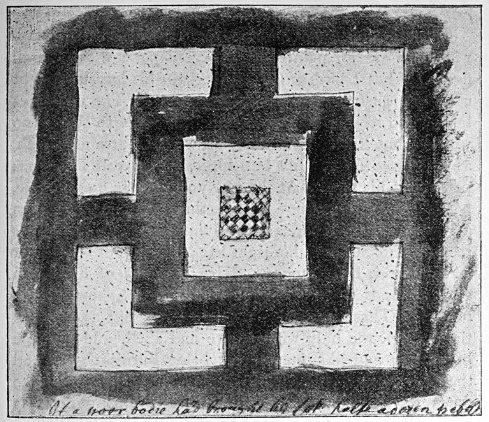
Memorandum:—about the mid-way from Verolam-house to Gorambery, on the right hand, on the side of a hill which faces the passer-by, are sett in artificiall manner the afore-named trees, whose diversity of greens on the side of the hill are exceeding pleasant. These delicate walkes and prospects entertaine the eie to Gorambery-howse, which is a large, well-built Gothique howse, built (I thinke) by Sir Nicholas Bacon, Lord Keeper, father to this Lord Chancellor, to whom it descended by the death of Anthony Bacon, his middle brother, who died sans issue.[315]The Lord Chancellor made an addition of a noble portico, which fronts the garden to the south: opposite to every arch of this portico, and as big as the arch, are drawen, by an excellent hand (but the mischief of it is, in water-colours), curious pictures, all emblematicall, with mottos under each: for example, one I remember is a ship tossed in a storme, the motto, Alter erit tum Tiphys. Enquire for the rest.
Over this portico is a stately gallerie, whose glasse-windowes are all painted; and every pane with severall figures of beast, bird, or flower: perhaps his lordship might use them as topiques for locall memory. The windowes looke into the garden, the side opposite to them no window, but that side is hung all with pictures at length, as of King James, his lordship, and severall illustrious persons of his time. At the end you enter is no windowe, but there is a very large picture, thus:—in the middle on a rock in the sea stands King James in armour, with his regall ornaments; on his right hand stands (but whither or no on a rock I have forgott), King Henry 4 of France, in armour; and on his left hand, the King of Spaine, in like manner. These figures are (at least) as big as the life, they are donne only with umbre and shell gold: all the heightning and illuminated part being burnisht gold, and the shadowed umbre, as in the pictures of the gods on the dores of Verolam-house. The roofe of this gallerie is semi-cylindrique, and painted by the same hand and same manner, with heads and busts of Greek and Roman emperours and heroes.
In the hall (which is of the auncient building) is a large storie very well painted of the feastes of the gods, where Mars is caught in a nett by Vulcan. On the wall, over the chimney, is painted an oake with akornes falling from it; the word, Nisi quid potius. And on the wall, over the table, is painted Ceres teaching the soweing of corne; the word, Moniti meliora.
The garden is large, which was (no doubt) rarely planted and kept in his lordship's time: vide vitam Peireskii de domino Bacon. Here is a handsome dore, which opens into Oake-wood; over this dore in golden letters on blew are these six verses[316].
[317]The oakes of this wood are very great and shadie. His lordship much delighted himselfe here: under every tree he planted some fine flower, or flowers, some wherof are there still (1656), viz. paeonies, tulips,....
From this wood a dore opens into ..., a place as big as an ordinary parke, the west part wherof is coppice-wood, where are walkes cutt-out as straight as a line, and broade enoug for a coach, a quarter of a mile long or better.—Here his lordship much[318] meditated, his servant Mr. Bushell attending him with his pen and inke horne to sett downe his present notions.—Mr. Thomas Hobbes told me, that his lordship would employ him often in this service whilest he was there, and was better pleased with his minutes, or notes sett downe by him, then by others who did not well understand his lordship. He told me that he was employed in translating part of the Essayes, viz. three of them, one wherof was that of the Greatnesse of Cities, the other two I have now forgott.
The east of this parquet (which extends to Veralam-howse) was heretofore, in his lordship's prosperitie, a paradise; now is a large ploughed field. This eastern division consisted of severall parts; some thicketts of plumme-trees with delicate walkes; some of rasberies. Here was all manner of fruit-trees that would grow in England; and a great number of choice forest-trees; as the whitti-tree, sorbe-, cervice-, etc., eugh[319]. The walke<s>, both in the coppices and other boscages, were most ingeniosely designed: at severall good viewes[320], were erected elegant sommer-howses well built of Roman architecture, well wainscotted and cieled; yet standing, but defaced, so that one would have thought the Barbarians had made a conquest here. This place in his lordship's time was a sanctuary for phesants, partridges, etc. birds of severall kinds and countries, as white, speckled etc., partridges. In April, and the springtime, his lordship would, when it rayned, take his coach (open) to recieve the benefit of irrigation, which he was wont to say was very wholsome because of the nitre in the aire and the universall spirit of the world.
His lordship was wont to say, I will lay my mannor of Gorambery on't, to which Judge ... made a spightfull reply, saying he would not hold a wager against that, but against any other mannour of his lordship's he would. Now this illustrious Lord Chancellor had only this mannor of Gorambery.
Roger Bacon (1214-1294).
[321]Roger Bacon, friar ordinis <S. Francisci>:—Memorandum, in Mr. Selden's learned verses before Hopton's Concordance of yeares, he speakes of friar Bacon, and sayes that he was a Dorsetshire gentleman. There are yet of that name in that countie, and some of pretty good estate. I find by ... (which booke I have) that he understood the making of optique glasses; where he also gives a perfect account of the making of gunpowder, vide pag ... ejusdem libri.
[322]Friar Roger Bacon:—Dr. Gerard Langbain had a Catalogue[AO] of all his workes, which Catalogue Dr. <Thomas> Gale, schoolmaster of Paule's, haz now.
Note.
Thomas Badd (1607-1683).
[323]The ... happinesse a shoemaker haz in drawing on a fair lady's shoe.... I know one that it was the hight of his ambition to be prentice to his mris<'s> shoemaker upon that condicion.
Sir Thomas Bad's[324] father, a shoemaker, married the brewer's widow of Portsmouth, worth 20,000 li.
Edward Bagshaw (1629-1671).
[325]Edward Bagshaw was borne at Broughton in Northamptonshire; 42 when he dyed—from his widowe[AP].
[326]My old acquaintance, Mr. Edward Bagshawe, B.D., 3rd son of Edward Bagshawe, esq., a bencher of the Middle Temple, was borne (the day nor moneth certaine to be knowne) November or December at Broughton in Northamptonshire, where Mr. Boldon[327], quondam Coll. Aeneinas., was parson.
He was a king's scholar at Westminster schole, then student of Christ Church. Scripsit severall treatises.
Obiit on St. Innocents day, 28 Dec., 1671, in Tuttle street, Westminster, a prisoner to Newgate 22 weekes for running into a praemunire for refusing to take the oath of allegiance (he boggled at the word 'willingly' in the oath): aetatis 42. Sepult., Newyeares day, in the fanatique burying-place by the Artillery-ground in Moorfields, where his sorrowfull widdowe will place his epitaph.
1500 or 2000 people were at his funerall.
[328]'Here[329] lyes interred | the body of | Mr. Edward Bagshaw | minister of the Gospell | who recieved from God | faith to embrace it | courage to defend it | and patience to suffer for it | when by most despised and by many persecuted | esteeming the advantages of birth, education, and learning | as things of worth to be accounted losse for the knowledge | of Christ. | From the reproaches of pretended friends | and persecutions of professed adversaries | he | took sanctuary | by the will of God | in eternall rest.'