THE 'LIVES' (continued 4)
Reading edition
He dyed at his house at Gillingham aforesaid, where he and his predecessor, Dr. <John> Jessop, had been vicars one hundred and ... yeares, and lyes buryed in the chancell there. Obiit March 9th, 1679/80, and was buried the 31 of the same month.
He was heire to his uncle, John Davenant, bishop of Sarum. Memorandum:—when bishop Coldwell[DK] came to this bishoprick, he did lett long leases, which were but newly expired when bishop Davenant came to this sea; so that there tumbled into his coffers vast summes. His predecessor, Dr. Tounson, maried his sister, continued in the see but a little while, and left severall children unprovided for, so the king or rather duke of Bucks gave bishop Davenant the bishoprick out of pure charity[DL]. Sir Anthony Weldon sayes (in his Court of King James), 'twas the only bishoprick that he disposed of without symony, all others being made merchandise of for the advancement of his kindred. Bishop Davenant being invested, maried all his nieces to clergie-men, so he was at no expence for their preferment. He granted to his nephew (this Dr.) the lease of the great mannour of Poterne, worth about 1000 li. per annum; made him threasurer of the church of Sarum, of which the corps is the parsonage of Calne, which was esteemed to be of the like value. He made severall purchases, all which he left him; insomuch as the churchmen of Sarum say, that he gained more by this church then ever any man did by the church since the Reformation, and take it very unkindly that, at his death, he left nothing (or but 50 li.) to that church which was the source of his estate. How it happened I know not, or how he might be workt-on in his old age, but I have heard severall yeares since, he had sett downe 500 li. in will for the Cathedral Church of Sarum.
He had 6 sonnes and 4 daughters. There was a good schoole at Gillingham: at winter nights he taught his sonnes Arithmetic and Geometric; his 2 eldest daughters, especially Mris Ettrick, was a notable Algebrist.
☞ Memoria. He had an excellent way of improving his children's memories, which was thus: he would make one of them read a chapter or &c., and then they were (sur le champ) to repeate what they remembred, which did exceedingly profitt them; and so for sermons, he did not let them write notes (which jaded their memorie), but gave an account vivâ voce. When his eldest son, John, came to Winton-schoole (where the boyes were enjoyned to write sermon notes) he had not wrote; the master askt him for his notes—he had none, but sayd, 'If I doe not give you as good an account of it as they that doe, I am much mistaken.'
[758]Edward Davenant, D.D., obiit 12 of March 1679/80, and is seated in the north side of the east end of the chancell at Gillingham, Dorset.—From Anthony Ettrick, esq.
[759]By Dr. Edward Davenant, S.T.P., Versus mnemonici ad computationes cossicas. Memorandum:—Dr. Davenant hath excellent explanations of these verses, which transcribe: his son James[DM], at Oriel College Oxon, hath them.
Notes.
John Davenant (1576-1641).
He bought the advowson of Newton-tony, Wilts, which he gave to Queene's College[762], Cambridge—quaere if not others.
He hung the choire of Sarum with purple velvet, which was plundered in the sacrilegious times.
Sir William Davenant (1605/6-1668).
[763]Sir William Davenant[DN], knight, Poet Laureate, was borne [about[764] the end of February—vide A. Wood's Antiq. Oxon.—baptized 3 of March A.D. 1605/6], in ... street in the city of Oxford at the Crowne taverne.
His father was John Davenant, a vintner there, a very grave and discreet citizen: his mother was a very beautifull woman, and of a very good witt, and of conversation extremely agreable. They had three sons, viz. 1, Robert[LII.], 2, William[765]; and 3, Nicholas (an attorney): and two handsome daughters, one married to Gabriel Bridges (B.D., fellow of C. C. Coll., beneficed in the Vale of White Horse), another to Dr. <William> Sherburne (minister of Pembridge in Hereford, and a canon of that church).
Mr. William Shakespeare was wont to goe into Warwickshire once a yeare, and did commonly in his journey lye at this house in Oxon. where he was exceedingly respected. [I[767] have heard parson Robert <Davenant> say that Mr. W. Shakespeare haz given him a hundred kisses.] Now Sir William would sometimes, when he was pleasant over a glasse of wine with his most intimate friends—e.g. Sam. Butler (author of Hudibras), &c.—say, that it seemed to him that he writt with the very spirit that Shakespeare, and seemd[768] contented[769] enough to be thought his son. [He[770] would tell them the story as above, in which way his mother had a very light report[771].]
He went to schoole at Oxon to Mr. Sylvester (Charles Whear, filius Degorii W., was his schoolefellowe), but I feare he was drawne from schoole before he was ripe enough.
He was preferred to the first dutches of Richmond to wayte on her as a page. I remember he told me, she sent him to a famous apothecary for some Unicornes-horne, which he was resolved to try with a spider which he incircled[772] in it, but without the expected successe; the spider would goe over, and thorough and thorough, unconcerned.
He was next a servant (as I remember, a page also) to Sir Fulke Grevil[773] lord Brookes, with whom he lived to his death, which was that a servant of his (that had long wayted on him and his lordship had often told him that he would doe something for him, but did not but still putt him off with delayes) as he was trussing up his lord's pointes comeinge from stoole (for then their breeches were fastned to the doubletts with points—then came in hookes and eies—which not to have fastened was in my boy-hood a great crime) stabbed him. This was at the same time that the duke of Buckingham was stabbed by Felton, and the great noise and report of the duke's, Sir William told me, quite drowned this of his lord's, that 'twas scarce taken notice of. This Sir Fulke G. was a good witt, and had been a good poet[774] in his youth. He wrote a poeme in folio which he printed not till he was old, and then, (as Sir W. said) with too much judgment and refining, spoyld it, which was at first a delicate thing.
He writt a play or playes, and verses, which he did with so much sweetnesse and grace, that by it he got the love and friendship of his two Mecaenasses, Mr. Endymion Porter, and Mr. Henry Jermyn (since earl of St. Albans), to whom he has dedicated his poem called Madegascar. Sir John Suckling also was his great and intimate friend.
After the death of Ben Johnson he was made in his place Poet Laureat.
He gott a terrible clap of a black handsome wench that lay in Axe-yard, Westminster, whom he thought on when he speakes of Dalga in Gondibert, which cost him his nose, with which unlucky mischance many witts were to<o> cruelly bold: e.g. Sir John Menis, Sir John Denham, &c.
[775]In 1641, when the troubles began, he was faine to fly into France, and at Canterbury he was seised on by the mayor—vide Sir John Menis' verses—
'For Will had in his face the flawes And markes recieved in countrey's cause: They flew on him like lyons passant, And tore his nose as much as was on't, And call'd him superstitious groome, And Popish Dog, and Cur of Rome. . . . . . 'Twas surely the first time That Will's religion was a crime.'
In the civill warres in England he was in the army of William, marquess of Newcastle (since duke), where he was generall of the ordinance. I have heard his brother Robert say, for that service there was owing to him by King Charles the First 10000 li. During that warre, 'twas his hap to have two aldermen of Yorke his prisoners, who were something stubborne, and would not give the ransome ordered by the councell of warr. Sir William used them civilly, and treated them in his tent, and sate them at the upper end of his table à la mode de France, and having donne so a good while to his chardge, told them (privately and friendly) that he was not able to keepe so chargeable guests, and bad them take an opportunity to escape, which they did; but having been gon a little way they considered with themselves that in gratitude they ought to goe back and give Sir William their thankes; which they did, but it was like to have been to their great danger of being taken by the soldiers; but they happened to gett safe to Yorke.
The King's party being overcome, Sir William Davenant (who received the honour of knighthood from the duke of Newcastle by commision) went into France; resided chiefly in Paris where the Prince of Wales then was. He then began to write his romance in verse, called Gondibert, and had not writt above the first booke, but being very fond of it, prints it (before a quarter finished), with an epistle of his to Mr. Thomas Hobbes and Mr. Hobbes' excellent epistle to him printed before it. The courtiers with the Prince of Wales could never be at quiet about this piece, which was the occasion of a very witty but satericall little booke of verses in 8vo. about 4 sheetes, writt by George, duke of Buckes, Sir John Denham, etc.—
'That thou forsak'st thy sleepe, thy diet, And which is more then that, our quiet.'
This last word Mr. Hobs told me was the occasion of their writing.
Here he layd an ingeniose designe to carry a considerable number of artificers (chiefly weavers) from hence to Virginia; and by Mary the queen-mother's meanes, he got favour from the king of France to goe into the prisons and pick and choose. So when the poor dammed wretches understood what the designe was, the<y> cryed uno ore—'Tout tisseran!' i.e. We are all weavers! Will. <took> 36, as I remember, if not[776]more, and shipped them; and[777] as he was in his voyage towards Virginia, he and his tisseran were all taken by the shippes then belonging to the Parliament of England. The slaves I suppose they sold, but Sir William was brought prisoner to England. Whither he was first a prisoner at Caresbroke-castle in the Isle of Wight, or at the Tower of London, I have forgott: he was a prisoner at both. His Gondibert, 4to, was finished at Caresbroke-castle. He expected no mercy from the Parliament, and had no hopes of escaping <with> his life. It pleased God that the two aldermen of Yorke aforesayd hearing that he was taken and brought to London to be tryed for his life, which they understood was in extreme danger, they were touch<ed> with so much generosity and goodnes, as, upon their owne accounts and meer motion, to try what they could to save Sir William's life who had been so civill to them and a meanes to save theirs, to come to London: and acquainting the Parliament with it, upon their petition, etc., Sir William's life was saved[LIII.].
Being freed from imprisonment, (because playes, scil. Tragedies and Comoedies, were in those Presbyterian times scandalous) he contrives to set-up an Opera stylo recitativo, wherein serjeant Maynard and severall citizens were engagers. It began at Rutland-house, in Charter-house-yard; next, (scil. anno ...) at the Cock-pitt in Drury-lane, where were acted very well stylo recitativo, Sir Francis Drake's ..., and the Siege of Rhodes (1st and 2d part). It did affect the eie and eare extremely. This first brought scenes in fashion in England; before, at playes, was only a hanging.
Anno Domini 1660 was the happy restauration of his majestie Charles II. Then was Sir Wm. made ...; and the Tennis court in Little Lincolnes-Inne fielde was turn'd into a play-house for the duke of Yorke's players, where Sir William had lodgeings, and where he dyed, April the <7th> 166<8>[LIV.].
I was at his funerall. He had a coffin of walnutt-tree; Sir[779] John Denham sayd 'twas the finest coffin that ever he sawe.[780]His body was carried in a herse from the play-house to Westminster-Abbey, where, at the great west dore, he was recieved by the sing<ing> men and choristers, who sang the service of the church ('I am the Resurrection, &c.') to his[LV.] grave, which is in the south crosse aisle, on which, on a paving stone of marble, is writt, in imitation of that on Ben Johnson, 'O rare Sir Will. Davenant.'
His first lady was Dr. ...'s daughter, physitian, ... by whom he had a very beautifull and ingeniose son that dyed above 20 yeares since. His 2d lady was the daughter of ... by whom he had severall children: I sawe some very young ones at the funerall. His eldest is Charles Davenant, LL.Dr., who inherits his father's beauty and phancy[781]. He practises at Doctors Commons. He writt a play called Circe, which haz taken very well.
Sir William hath writt about 25 (quaere) playes; the romance called Gondibert; and a little poeme called Madagascar.
His private opinion was that Religion at last,—e.g. a hundred yeares hence,—would come to settlement, and that in a kind of ingeniose Quakerisme.
[782]That sweet swan of Isis, Sir William Davenant, dyed the seaventh day of April last, and lyes buried amongst the poets in Westminster abbey[783], by his antagonist, Mr. Thomas May, whose inscription of whose marble was taken away by order since the king came in.
Sir William was Poet Laureat; and Mr. John Dryden hath his place. But me thought it had been proper that a laurell should have been sett on his coffin—which was not donne.
He hath writt above 20 playes; besides his Gondibert and Madagascar.
Note.
John Davenport (1597-1669/70).
[784]Sir John Dugdale told me that he would enquire about Mr. John Davenport, and send to you.—This was halfe a yeare since, at least.
[785]Sir John Dugdale saith that John Davenport was a nonconformist; and he hath enquired of his relations, who know nothing of him, if dead or alive, but they believe he is dead. He went over sea—he thinkes to the Barbadoes, or some of these plantations[786], or to Holland.
John Davys (1550-1605).
[787]Memorandum:—Mr. Browne, the mathematicall instrument maker of the Minories, told me that the sea-quadrant was invented by Captaine Davy ... yeares since,—he that found out the streights called Davys's Streights.
Arthur Dee (1579-1651).
[788]'Arthur Dee,' (sonne of John Dee), a physitian at Norwych, 'was born 13 Julii 1579, manè, horâ 4. 30´ fere (vel potius, 25 min.) in ipso ortu solis, ut existimo'—Thus I find it in his father's Ephemerides.
Obiit Norwychi about 1650.
[789]<Arthur Dee told Dr. Bathurst and Dr. Wharton> 'that (being but a boy) he used[LVI.] to play at quoits with the plates of gold made by projection in the garret of Dr. Dee's lodgings in Prague.... When he was 9 yeares of age and at Trebona in Germany with his father, he was design'd to succede Kelly as his father's speculator.'
[790]<Arthur Dee> 'has often told Mr. Whitefoot, of Norwich, who buried him, that he had more than once seen the philosopher's stone, and he thinks that he has written some peice on that subject. He was a man of a very pleasant conversation and had good practice in Norwich: a great acquaintance of Dr. <Thomas> Browne's.'
John Dee (1527-1608).
[791]John Dee:—Mr. Ashmole hath his nativitie. Resp.—'tis in his Theatrum Chemicum. Hee had a very faire cleare rosie complexion: so had the earl of Rochester, exceeding.
[792]'Johannes Dee, natus Londini, 1527, Julii 13, 4h 2´ P.M.'—this nativity[DO] I copied out of the learned John Dee's papers in the hands of Elias Ashmole, esq.
[793]From Elias Ashmole—the father of this John Dee was a vintner in ... London.
[794]John Dee—from Meredith Lloyd:—Talbot, marying an inheritresse of the prince of South Wales (who was descended from Howel Da, i.e. Howelus bonus: the same family from whom John Dee was descended).—Dr. Troutbec hath Raymund Lully's ... (a chymical tract) with John Dee's marginall notes.
Memorandum:—Mr. Meredith Lloyd tells me that his father was Roland Dee[DQ], a Radnorshire gentleman[LVII.], and that he hath his pedegree, which he hath promised to lend to me. He was descended from Rees, prince of South Wales.
My great-grandfather, William Aubrey (LL.Dr.), and he were cosins, and intimate acquaintance. Mr. Ashmole hath letters between them, under their owne hands, viz. one of Dr. W. A. to him[796] (ingeniosely and learnedly written) touching the Sovraignty of the Sea, of which J. D. writt a booke which he dedicated to queen Elizabeth and desired my great grandfather's advice upon it. Dr. A.'s countrey-house was at Kew, and J. Dee lived at Mortlack, not a mile distant. I have heard my grandmother say they were often together.
Arthur Dee, M.D., his son, lived and practised at Norwich, an intimate friend of Sir Thomas Browne, M.D., who told me that Sir William Boswell, the Dutch ambassador, had all John Dee's MSS.: quaere his executors for his papers. He[797] lived then somewhere in Kent.
Memorandum:—Sir William Boswell's widowe lives at Bradburne, neer Swynoke, in Kent. Memorandum:—Mr. Hake, of the Physitians' Colledge, hath a MS. of Mr. John Dee's, which see or gett.
Quaere A. Wood for the MSS. in the Bodlean library of Doctor Gwyn, wherein[798] are severall letters between him and John Dee, and Doctor Davies, of chymistrey and of magicall secrets, which my worthy friend Mr. Meredith Lloyd hath seen and read: and he tells me that he haz been told that Dr. Barlowe gave it to the Prince of Tuscany[799].
Meredith Lloyd sayes that John Dee's printed booke of Spirits, is not above the third part of what was writt, which were in Sir Robert Cotton's library; many whereof were much perished by being buryed, and Sir Robert Cotton bought the field to digge after it.
Memorandum:—he told me of John Dee, etc., conjuring at a poole[LVIII.] in Brecknockshire, and that they found a wedge of gold; and that they were troubled and indicted as conjurers at the assizes; that a mighty storme and tempest was raysed in harvest time, the countrey people had not knowen the like.
His picture in a wooden cutt is at the end of Billingsley's Euclid, but Mr. Elias Ashmole hath a very good painted copie of him from his sonne Arthur. He had a very fair, clear[800] complexione (as Sir Henry Savile); a long beard as white as milke. A very handsome man.
Investigatio cinerum △
Old goodwife Faldo[DR] (a natif of Mortlak in Surrey), 80+ aetatis (1672[801]), did know Dr. Dee, and told me he dyed at his howse in Mortlack, next to the howse where the tapistry hangings are made, viz. west of that howse; and that he dyed about 60+, 8 or 9 yeares since (January, 1672), and lies buried in the chancell, and had a stone (marble) upon him. Her mother tended him in his sicknesse. She told me that he did entertain the Polonian ambassador at his howse in Mortlak, and dyed not long after; and that he shewed the eclipse with a darke roome to the said ambassador[LIX.]. She beleeves that he was eightie years old when he dyed. She sayd, he kept a great many stilles goeing. That he layd the storme Sir Everard Digby. That the children dreaded him because he was accounted a conjurer. He recovered the basket of cloathes stollen, when she and his daughter (both girles) were negligent: she knew this.
He is buried (upon the matter) in the middest of the chancell, a little towards the south side. She sayd, he lies buried in the chancell between Mr. Holt and Mr. Miles, both servants to queen Elizabeth, and both have brasse inscriptions on their marble, and that there was on him a marble, but without any inscription, which marble is removed; on which old marble is signe of two or three brasse pinnes. A daughter of his (I thinke, Sarah) maried to a flax-dresser, in Southwarke: quaere nomen.
He dyed within a yeare, if not shortly, after the king of Denmark was here: vide Sir Richard Baker's Chronicle and Capt. Wharton's Almanac.
[802]He built the gallery in the church at Mortlak. Goody Faldo's father was the carpenter that work't it.
A stone was on his grave, which is since removed. At the upper end of the chancell then were steppes, which in Oliver's dayes were layd plaine by the minister, and then 'twas removed. The children when they played in the church would runne to Dr. Dee's grave-stone. She told me that he forewarned Q. Elizabeth of Dr. Lopez attempt against her (the Dr. bewrayed, —— himselfe).
He used to distill egge-shells, and 'twas from hence that Ben Johnson had his hint of the alkimist, whom he meant.
He was a great peace-maker; if any of the neighbours fell out, he would never lett them alone till he had made them friends.
He was tall and slender. He wore a gowne like an artist's gowne, with hanging sleeves, and a slitt.
A mighty good man he was.
He was sent ambassador for Queen Elizabeth (shee thinkes) into Poland.
Memorandum:—his regayning of the plate for ...'s butler, who comeing from London by water with a basket of plate, mistooke another basket that was like his. Mr. J. Dee bid them goe by water such a day, and looke about, and he should see the man that had his basket, and he did so; but he would not gett the lost horses, though he was offered severall angells. He told a woman (his neighbour) that she laboured under the evill tongue of an ill neighbour (another woman), which came to her howse, who he sayd was a witch.
In J. David Rhesus' British Grammar, p. 60:—'Juxta Crucis amnem (Nant y groes), in agro Maessyuetiano, apud Cambro-brytannos, erat olim illustris quaedam Nigrorum familia, unde Joan Du, id est, Johannes ille cognomento Niger, Londinensis, sui generis ortum traxit: vir certe ornatissimus et doctissimus, et omnium hac nostra aetate tum Philosophorum tum Mathematicorum facile princeps: monadis illius Hieroglyphicae et Propaedeumatum aphoristicorum de praestantioribus quibusdam Naturae virtutibus, aliorumque non paucorum operum insignium autor eximius. Vir praeterea ob tam multam experientiam frequenti sua in tot transmarinas regiones peregrinatione comparatam, rerum quamplurimarum et abditarum peritissimus.'
Notes.
Thomas Deere (1639/40-16..).
[803]Thomas Deere, natus March 15º, 1639, 15h 7´ P.M., at New Sarum—John Gadbury's advice, 1 April, 1676.
[804]Thomas Deare's letter:—
'From Stackton in parochia de Fordingbridge, die Jovis[805], 9 Martii, 1675/6, 2h 30´ P.M.
The Accydents of the native, etc.
In November 1655, aged 15 yeare 8 moneths, went to London, to a master, a clerke in the Kinge's Bench.
In November followinge, aged 16 yeare 8 moneths, had the small pox.
In February and March 1658, an ague and feavor.
At the same tyme an uncle (the mother's brother) dyed, which gave the native a good legacy.
In 1661, purchased an estate.
In August 1662, hee marryed, which was one of the worst acts that etc.
In July 1663, hee had a sonn born, etc.
In June 1667, another sone.
In the same yeare in September, his father dyed etc., aged 70 etc.
In 1666, a very great feavor; in <16>67, another; in '68, a surfeite which caused another <fever>, etc.
In May '71, another sunn which lived but a fortnight, etc.
Many other accidents there are and remarkeable, but I suppose 3 or 4 or but 2 of these may doe well enough[806] etc. Yet as to preferrment, etc.—In Aug. 1667, I was courted by the old earle of Pembrook[807] to be his chiefe steward; but, hee always vexed with false informations against me, I left his ymployment.'
[808]Memorandum:—Mr. Th. Deer is now (Jan. 1677/8) in prison at Fisherton-Anger.
Gideon de Laune (1565?-1659).
[809]... De Laune:—he was apothecary to Mary the queen mother: came into England....
He was a very wise man, and as a signe[810] of it left an estate of 80,000 li.
Sir William Davenant was his great acquaintance and told me of him, and that after his returne into England he went to visit him, being then octogenary, and very decrepit with the gowt, but had his sight and understanding. He had a place made for him in the kitchen chimney; and, non obstante he was master of such an estate, Sir William sawe him slighted not only by his daughter-in-lawe, but by the cooke-mayd, which much affected him—misery of old age.
He wrote a booke of prudentiall advice, in quadrans, 8vo, in English verse, which I have seen, and there are good things in it.
Sir John Denham (1615-1668/9).
[811]Sir John Denham was unpolished with the small-pox: otherwise a fine complexion.
[812]From Anthony Wood:—in the Matriculation booke he finds it thus written—'Johannes Denham, Essex, filius Johannis Denham de Horseley parva in com. praed., militis, aetat. 16, 1631.'
Quaere Dr. Buzby if he was a Westminster schollar—I have forgot. Anno ... he was admitted of Trinity Colledge in Oxford, where he stayed.... His tutor there was.... I have heard Mr. Josias Howe say that he was the dreamingst young fellow; he never expected such things from him as he haz left the world. When he was there he would game extremely; when he had played away all his money he would play away his father's wrought rich gold cappes.
His father was Sir John Denham, one of the Barons of the Exchequer. He had been one of the Lords Justices in Ireland: he maried Ellenor[LX.], one of the daughters of Sir Garret Moore, knight, lord baron of Mellifont, in the kingdome of Ireland, whom he maried during his service in Ireland in the place of Chief Justice there.
From Trinity Colledge he went to Lincolnes-Inne, where (as judge Wadham Windham[814], who was his contemporary, told me) he was as good a student as any in the house. Was not suspected to be a witt.
At last, viz. 1640, his play of The Sophy came out, which did take extremely: Mr. Edmund Waller sayd then of him, that he broke-out like the Irish Rebellion[LXI.]—threescore thousand strong, before any body was aware[815].
He was much rooked by gamesters, and fell acquainted with that unsanctified crew, to his ruine. His father had some suspition of it, and chid him severely, wherupon his son John (only child) wrot a little essay in 8vo, printed ..., Against[LXII.] gameing and to shew the vanities and inconveniences of it, which he presented to his father to let him know his detestation of it[DT]. But shortly after his father's death[LXIII.] (who left 2,000 or 1,500 li. in ready money, 2 houses well furnished, and much plate) the money was played away first, and next the plate was sold. I remember about 1646 he lost 200 li. one night at New-cutt. Anno ... (I ghesse 1642) he was high-sheriff of the countie of Surrey.
At the beginning of the civill warre he was made governor of Farnham-castle for the king, but he was but a young soldier, and did not keepe it. In 1642/3, after Edghill fight, his poeme called Cowper's Hill was printed at Oxford, in a sort of browne paper, for then they could gett no better.
1646/7 (quaere) he conveyed, or stole away, the two dukes of Yorke and Glocester from St. James's (from the tuition of the earle of Northumberland), and conveyed them into France to the Prince of Wales and Queen-mother. King Charles II sent him and the lord Culpepper envoyes to the king of Poland,....
Anno 1652, he returned into England, and being in some straights was kindly entertayned by the earle of Pembroke at Wilton, where I had the honour to contract an acquaintance with him. Here he translated the ... booke of Vergil's Æneis, and also burlesqu't it[LXIV.]: quaere Mr. Christopher Wase who was then there, tutor to William[819], lord Herbert. He was, as I remember, a yeare with my lord of Pembroke at Wilton and London; he had then sold all the lands his father had left him.
His first wife was the daughter and heire of ... Cotton, of ... in Glocestershire, by whom he had 500 li. per annum, one son and two daughters.[820]His son did not patrem sapere. He was of Wadham College[821] in Dr. Wilkins's time: he dyed sine prole, I thinke, there.—One of his daughters is maried to ... Morley, of Sussex, esq.; the other....
He was much beloved by King Charles the First, who much valued him for his ingenuity. He graunted him the reversion of the surveyor of his majestie's buildings, after the decease of Mr. Inigo Jones; which place, after the restauration of King Charles II he enjoyed to his death, and gott seaven thousand pounds, as Sir Christopher Wren told me of, to his owne knowledge. Sir Christopher Wren was his deputie.
Anno Domini 166.. he maried his 2d wife, <Margaret> Brookes, a very beautifull young lady; Sir John was ancient and limping. The duke of Yorke fell deepely in love with her, though (I have been morally assured) he never had carnall knowledge of her. This occasioned Sir John's distemper of madnesse in 166.., which first appeared when he went from London to see the famous free-stone quarries at Portland in Dorset, and when he came within a mile of it, turned back to London again, and did[822] not see it. He went to Hownslowe, and demanded rents of lands he had sold many yeares before; went to the king, and told him he was the Holy Ghost. But it pleased God that he was cured of this distemper, and writt excellent verses (particularly on the death of Mr. Abraham Cowley) afterwards. His 2d lady had no child; was poysoned by the hands of Co. of Roc.[823] with chocolatte.
At the coronation of King Charles II he was made Knight of the Bath.
He dyed (vide A. Wood's Antiq. Oxon.) at the house of his office (which he built, as also the brick-buildings next the street in Scotland-yard), and was buried, anno Domini 1668/9, March the 23, in the south crosse aisle of Westminster Abbey, neer Sir Jeffrey Chaucer's monument, but hitherto (1680) without any memoriall for him.
Memorandum:—the parsonage-house at Egham (vulgarly called The Place) was built by baron Denham; a house very convenient, not great, but pretty, and pleasantly scituated, and in which his son, Sir John, (though he had better seates), did take most delight in. He sold it to John Thynne, esq. In this parish is a place called Cammomill-hill, from the cammomill that growes there naturally; as also west of it is Prune-well-hill (formerly part of Sir John's possessions), where was a fine tuft of trees, a clear spring, and a pleasant prospect to the east, over the levell of Middlesex and Surrey. Sir John tooke great delight in this place, and was wont to say (before the troubles) that he would build there a retiring-place to entertaine his muses; but the warres forced him to sell that as well as the rest. He sold it to Mr. ... Anstey. In this parish W. and by N. (above Runney Meade) is Cowper's Hill, from whence is a noble prospect, which is incomparably well described by that sweet swan, Sir John Denham; printed first at Oxon shortly after Edghill fight, 1642/3.
Memorandum:—he delighted much in bowles, and did bowle very well.
He was of the tallest, but a little incurvetting at his shoulders, not very robust. His haire was but thin and flaxen, with a moist curle. His gate was slow, and was rather a stalking (he had long legges), which was wont to putt me in mind of Horace, De Arte Poetica:—
'Hic, dum sublimes versus ructatur, et errat Si veluti merulis intentus decidit auceps In puteum foveamve:'——
His eie was a kind of light goose-gray, not big; but it had a strange piercingness, not as to shining and glory, but (like a Momus) when he conversed with you he look't into your very thoughts.
He was generally temperate as to drinking; but one time when he was a student of Lincolne's-Inne, having been merry at the taverne with his camerades, late at night, a frolick came into his head, to gett a playsterer's brush and a pott of inke, and blott out all the signes between Temple-barre and Charing-crosse, which made a strange confusion the next day, and 'twas in Terme time. But it happened that they were discovered, and it cost him and them some moneys. This I had from R. Estcott[824], esq., that carried the inke-pott.
In the time of the civill warres, George Withers, the poet, begged Sir John Denham's estate at Egham of the Parliament, in whose cause he was a captaine of horse. It <happened> that G. W. was taken prisoner, and was in danger of his life, having written severely against the king, &c. Sir John Denham went to the king, and desired his majestie not to hang him, for that whilest G. W. lived he should not be the worst poet in England.
Scripsit the Sophy: Cowper's Hill: Essay against Gameing: Poems, 8vo, printed anno Domini ...; Cato Major sive De Senectute, translated into English verse, London, printed by H. Heringman, in the New Exchange, 1669.
Memorandum:—in the verses against Gondibert, most of them are Sir John's. He was satyricall when he had a mind to it.
Notes.
René Descartes (1596-1650/1).
[825]Monsieur Renatus Des Cartes,
'nobilis Gallus, Perroni dominus, summus mathematicus et philosophus; natus Hagae Turonum pridie Calendas Apriles, 1596; denatus Holmiae Calendis Februarii, 1650'—this inscription I find under his picture graved by C. V. Dalen.
How he spent his time in his youth, and by what method he became so knowing, he tells the world in his treatise entituled Of Method. The Societie of Jesus glorie in that theyr order had the educating of him. He lived severall yeares at Egmont (neer the Hague), from whence he dated severall of his bookes. He was too wise a man to encomber himselfe with a wife; but as he was a man, he had the desires and appetites of a man; he therefore kept a good conditioned hansome woman that he liked, and by whom he had some children (I thinke 2 or 3). 'Tis pity but comeing from the braine[826] of such a father, they should be well cultivated. He was so eminently learned that all learned men made visits to him, and many of them would desire him to shew them his ... of instruments (in those dayes mathematicall learning lay much in the knowledge of instruments, and, as Sir H. S.[827] sayd, in doeing of tricks), he would drawe out a little drawer under his table, and shew them a paire of compasses with one of the legges broken; and then, for his ruler, he used a sheet of paper folded double. This from Alexander Cowper (brother of Samuel), limner to Christina, queen of Sweden, who was familiarly acquainted there with Des Cartes.
[828]Mr. Hobbes was wont to say that had Des Cartes kept himselfe wholy to geometrie that he had been the best geometer in the world. He did very much admire him, but sayd that he could not pardon him for writing in the defence of transubstantiation which he knew to bee absolutely against his judgment[829]—quod N. B.
Robert Devereux, earl of Essex (1567-1600/1).
[830]Ex registro capellae Turris London, scil. 1600[831], 'Robert, earle of Essex, beheaded, Febr. 6th.'
From my lady Elizabeth, viscountesse Purbec, repeated by her:—
1. There is none, oh none but you, Who from me estrange your sight, Whom mine eyes affect to view And chained eares heare with delight. 2. Others' beauties others move, In you I all graces find: Such are the effects of love To make them happy that are kind. 3. Woemen in fraile beauty trust, Only seeme you kind to me, Still be truly kind and just For that can't dissembled bee. 4. Deare, afford me then your sight, That surveighing all your lookes Endlesse volumnes I may write And fill the world with envyed bookes. 5. Which when after ages view All shall wonder and despayre, Women, to find a man so true, And men, a woeman halfe so faire—
made by Robert, earl of Essex, that was beheaded.
[832]The tradition is that the bell of Lincoln's-Inne was brought from Cales (Cadiz), tempore reginae Elizabethae, plundered in the expedition[833] under <Robert Devereux>, earl of Essex.
Sir Everard Digby (1578-1605/6).
[834]Sir Everard Digby (father of Sir Kenelme) scripsit libellum Latinè cui titulus:—
Everardi Dygbei de duplici methodo—
in 8vo, in dialogues.
I have heard Mr. John Digby say (his grandsonne) that he was the handsomest man (accounted) in England.
[835]Sir Everard Digby was a most gallant gentleman and one of the handsomest men of his time. He writt something in Latin de methodo, which I did light upon 23 yeares ago at a country man's howse in Herefordshire; and Mr. Francis Potter told me he writt de arte natandi.
'Twas his ill fate to suffer in the powder-plott. When his heart was pluct out by the executioner (who, secundum formam, cryed 'Here is the heart of a traytor!'), it is credibly reported, he replied, 'Thou liest!' This my lord Bacon speakes of, but not mentioning his name, in his Historia vitae et mortis.
Sir Kenelm Digby (1603-1665).
[836]Sir Kenelm Digby[DU], knight: he was borne at <Gotehurst, Bucks> on the eleventh of June[DV]: see Ben: Johnson, 2d volumne:—
'Witnesse thy actions done at Scanderoon Upon thy birthday, the eleaventh of June.'
[Memorandum:—in the first impression in 8vo it is thus; but in the folio 'tis my, instead of thy.]
Mr. Elias Ashmole assures me, from two or three nativities by Dr. <Richard> Nepier, that Ben: Johnson was mistaken and did it for the ryme-sake.—In Dr. Napier's papers of nativities, with Mr. Ashmole, I find:—'Sir Kenelme Digby natus July 11, 5h 40´ A.M. 1603, 14 Leo ascending,' and another scheme gives it at '4h A.M., 26 Cancer ascending'; and there are two others of Cancer and Leo.
He was the eldest son of Sir Everard Digby, who was accounted the handsomest gentleman in England. Sir Everard sufferd as a traytor in the gunpowder-treason; but king James restored his estate to his son and heire. Mr. Francis Potter told me that Sir Everard wrote a booke De Arte Natandi. I have a Latin booke of his writing in 8vo:—Everardi[837] Dygbei De duplici methodo libri duo, in dialogues 'inter Aristotelicum et Ramistam,' in 8vo: the title page is torne out.—His second son was Sir John Digby, as valiant a gentleman and as good a swordman as was in England, who dyed (or was killed[LXV.]) in the king's cause at Bridgewater, about 1644.
It happened in 1647 that a grave was opened next to Sir John Digby's (who was buried in summer time, it seemes), and the flowers on his coffin were found fresh, as I heard Mr. Harcourt (that was executed) attest that very yeare. Sir John died a batchelour.
Sir Kenelme Digby was held to be the most accomplished cavalier of his time. He went to Glocester hall in Oxon, anno <1618> (vide A. Wood's Antiq. Oxon.). The learned Mr. Thomas Allen (then of that house) was wont to say that he was the Mirandula of his age. He did not weare a gowne there[839], as I have heard my cosen Whitney say.
There was a great friendship between him and Mr. Thomas Allen; whether he was his scholar I know not. Mr. Allen was one of the learnedest men of this nation in his time, and a great collector of good bookes, which collection Sir Kenelme bought (Mr. Allen enjoyeing the use of them for his life) to give to the Bodlean Library, after Mr. Allen's decease, where they[840] now are.
He was a great traveller, and understood 10 or 12 languages. He was not only master of a good and gracefull judicious stile, but he also wrote a delicate hand, both fast-hand and Roman. I have seen lettres of his writing to the father[841] of this earle of Pembroke, who much respected[842] him.
He was such a goodly handsome person, gigantique and great voice, and had so gracefull elocution and noble addresse, etc., that had he been drop't out of the clowdes[843] in any part of the world, he would have made himselfe respected. But the Jesuites spake spitefully, and sayd 'twas true, but then he must not stay there above six weekes. He was envoyé from Henrietta Maria (then Queen-mother) to Pope <Innocent X> where at first he was mightily admired; but after some time he grew high, and hectored with his holinesse, and gave him the lye. The pope sayd he was mad.
He was well versed in all kinds of learning. And he had also this vertue[844], that no man knew better how to abound, and to be abased, and either was indifferent to him. No man became grandeur better[845]; sometimes again he would live only with a lackey, and horse with a foote-cloath.
He was very generous, and liberall to deserving persons. When Abraham Cowley was but 13 yeares old, he dedicated to him a comedy[846], called Love's Riddle, and concludes in his epistle[847]—'The Birch that whip't him then would prove a Bay.' Sir K. was very kind to him.
When he was at Rome one time, (I thinke he was envoyé from Mary the Queen-mother to Pope <Innocent X>) he contrasted[848] with his holinesse.
Anno ... (quaere the countesse of Thanet) much against his mother's, etc., consent, he maried that celebrated beautie and courtezane, Mrs. Venetia Stanley, whom Richard earle of Dorset kept as his concubine, had children by her, and setled on her an annuity of 500 li. per annum; which after Sir K. D. maried was unpayd by the earle; and for which annuity Sir Kenelme sued the earle, after mariage, and recovered it. He would say that a handsome lusty man that was discreet might make a vertuose wife out of a brothell-house. This lady carried herselfe blamelessly, yet (they say) he was jealous of her[LXVI.]. She dyed suddenly, and hard-hearted woemen[849] would censure him severely.
After her death, to avoyd envy and scandall, he retired in to Gresham Colledge at London, where he diverted himselfe with his chymistry, and the professors' good conversation. He wore there a long mourning cloake, a high crowned hatt, his beard unshorne, look't like a hermite, as signes of sorrowe for his beloved wife, to whose memory he erected a sumptuouse monument, now quite destroyed by the great conflagration. He stayed at the colledge[850] two or 3 yeares.
The faire howses in Holbourne, between King's street and Southampton street, (which brake-off the continuance of them) were, about 1633, built by Sir Kenelme; where he lived before the civill warres. Since the restauration of Charles II he lived in the last faire house westward in the north portico of Convent garden, where my lord Denzill Hollis lived since. He had a laboratory there. I thinke he dyed in this house—sed quaere.
He was, 164.., prisoner for the king (Charles I) at Winchester-house, where he practised chymistry[851], and wrote his booke of[852] Bodies and Soule, which he dedicated to his eldest son, Kenelme, who was slaine (as I take it) in the earle of Holland's riseing[853].
Anno 163 ... tempore Caroli Imi he received the sacrament in the chapell at Whitehall, and professed the Protestant religion, which gave great scandal to the Roman Catholiques; but afterwards he looked back.
He was a person of very extraordinary strength. I remember one at[854]Shirburne (relating to the earl of Bristoll) protested to us, that as he, being a midling man, being sett in <a> chaire, Sir Kenelme tooke up him, chaire and all, with one arme.
He was of an undaunted courage, yet not apt in the least to give offence. His conversation was both ingeniose and innocent.
Mr. Thomas White, who wrote de Mundo, 1641[855], and Mr. ... Hall of Leige, e societate Jesu, were two of his great friends.
As for that great action of his at Scanderoon, see the Turkish Historie. Sir <Edward> Stradling, of Glamorganshire, was then his vice-admirall, at whose house is an excellent picture of his, as he was at that time: by him is drawen an armillary sphaere broken, and undernethe is writt IMPAVIDUM FERIENT (Horace). See excellent verses of Ben: Johnson (to whome he was a great patrone) in his 2d volumne.
There is in print in French, and also in English (translated by Mr. James Howell), a speech that he made at a philosophicall assembly at Montpelier, 165.. Of the sympathetique powder—see it[856]. He made a speech at the beginning of the meeting of the Royall Society Of the vegetation of plants.
He was borne to three thousand pounds per annum. His ancient seat (I thinke) is Gote-herst in Buckinghamshire. He had a fair estate also in Rutlandshire. What by reason of the civil warres, and his generous mind, he contracted great debts, and I know not how (there being a great falling out between him and his then only son, John[LXVII.]) he settled his estate upon ... Cornwalleys, a subtile sollicitor[857], and also a member of the House of Commons, who did putt Mr. John Digby to much charge in lawe: quaere what became of it?
Mr. J. D. had a good estate of his owne, and lived handsomely then at what time I went to him two or 3 times in order to your Oxon. Antiqu.; and he then brought me a great book, as big as the biggest Church Bible that ever I sawe, and the richliest bound, bossed with silver, engraven with scutchions and crest (an ostrich); it was a curious velame[858]. It was the history of the family of the Digbyes, which Sir Kenelme either did, or ordered to be donne. There was inserted all that was to be found any where relating to them, out of records of the Tower, rolles, &c. All ancient church monuments were most exquisitely limmed by some rare artist. He told me that the compileing of it did cost his father a thousand pound. Sir Jo. Fortescue sayd he did beleeve 'twas more. When Mr. John Digby did me the favour to shew me this rare MS., 'This booke,' sayd he, 'is all that I have left me of all the estate that was my father's!' He was almost as tall and as big as his father: he had something[859] of the sweetnesse of his mother's face. He was bred by the Jesuites, and was a good scholar. He dyed at....
Vide in ... Lives when Sir Kenelme dyed.
Sir John Hoskyns enformes me that Sir Kenelme Digby did translate Petronius Arbiter into English.
Notes.
Venetia Digby (1600-1633).
She was a most beautifull desireable creature; and being matura viro was left by her father to live with a tenant and servants at Enston-abbey[LXVIII.] (his land, or the earl of Derby's) in Oxfordshire; but as private as that place was, it seemes her beautie could not lye hid. The young eagles had espied her, and she was sanguine and tractable, and of much suavity (which to abuse was greate pittie).
In those dayes Richard, earle of Dorset (eldest son[861] and heire to the Lord Treasurer, vide pedegree) lived in the greatest splendor of any nobleman of England. Among other pleasures that he enjoyed, Venus was not the least. [LXIX.]This pretty creature's fame quickly came to his Lordship's eares, who made no delay to catch at such an opportunity.
I have now forgott who first brought her to towne, but I have heard my uncle Danvers[862] say (who was her contemporary) that she was so commonly courted, and that by grandees, that 'twas written over her lodging one night in literis uncialibus,
PRAY COME NOT NEER, FOR DAME VENETIA STANLEY LODGETH HERE.
The earle of Dorset, aforesayd, was her greatest gallant, who was extremely enamoured of her, and had[863] one if not more children by her. He setled on her an annuity of 500 li. per annum.
Among other young sparkes of that time, Sir Kenelme Digby grew acquainted with her, and fell so much in love with her that he married her, much against the good will of his mother; but he would say that 'a wise man, and lusty, could make an honest woman out of a brothell-house.' Sir Edmund Wyld had her picture[LXX.] (and you may imagine was very familiar with her), which picture is now (vide) at Droitwytch, in Worcestershire, at an inne, where now the towne keepe their meetings. Also at Mr. Rose's, a jeweller in Henrietta-street in Convent garden, is an excellent piece of hers, drawne after she was newly dead.
She had a most lovely and sweet-turn'd face, delicate darke-browne haire. She had a perfect healthy constitution; strong; good skin; well proportioned; much enclining to a Bona Roba (near altogether). Her face, a short ovall; darke-browne eie-browe, about which much sweetness, as also in the opening of her eie-lidds. The colour of her cheekes was just that of the damaske rose, which is neither too hott nor too pale. She was of a just[864] stature, not very tall.
Sir Kenelme had severall pictures of her by Vandyke, &c.[LXXI.] He had her hands cast in playster, and her feet, and her face. See Ben: Johnson's 2d volumne, where he hath made her live in poetrey, in his drawing of her both body and mind:—
'Sitting, and ready to be drawne, What makes these tiffany, silkes, and lawne, Embroideries, feathers, fringes, lace, When every limbe takes like a face!'—&c.
[865]When these verses were made she had three children by Sir Kenelme, who are there mentioned, viz. Kenelme, George, and John.
She dyed in her bed suddenly. Some suspected that she was poysoned. When her head[866] was opened there was found but little braine, which her husband imputed to her drinking of viper-wine; but spitefull woemen would say 'twas a viper-husband who was jealous of her that she would steale a leape. I have heard some say,—e.g. my cosen Elizabeth Falkner,—that after her mariage she redeemed her honour by her strick't living. Once a yeare the earle of Dorset invited her and Sir Kenelme to dinner, where the earle would behold her with much passion, and only kisse her hand.
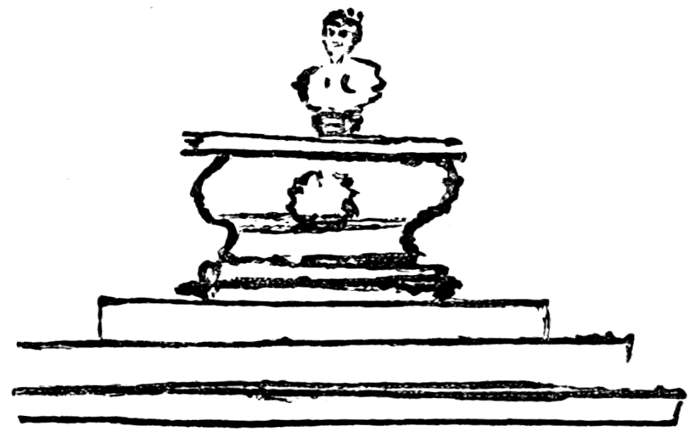
Sir Kenelme erected to her memorie a sumptuouse and stately monument[867] at ... Fryars[868] (neer Newgate-street) in the east end of the south aisle, where her bodie lyes in a vault of brick-worke, over which are three steps[869] of black marble, on which was a stately altar of black marble with 4 inscriptions in copper gilt affixed to it: upon this altar her bust of copper gilt, all which (unlesse the vault, which was onely opened a little by the fall) is utterly destroyed by the great conflagration. Among the monuments in the booke mentioned in Sir Kenelm Digby's life, is to be seen a curious draught of this monument, with copies of the severall inscriptions.
About 1676 or 5, as I was walking through Newgate-street, I sawe Dame Venetia's bust standing at a stall at the Golden Crosse, a brasier's shop. I perfectly remembred it, but the fire had gott-off the guilding: but taking notice of it to one that was with me, I could never see it afterwards exposed to the street. They melted it downe. How these curiosities would be quite forgott, did not such idle fellowes as I am putt them downe!
Memorandum:—at Goathurst, in Bucks[870], is a rare originall picture of Sir Kenelme Digby and his lady Venetia, in one piece, by the hand of Sir Anthony van Dyke. In Ben. Johnson's 2d volumne is a poeme called 'Eupheme[DY], left to posteritie, of the noble lady, the ladie Venetia Digby, late wife of Sir Kenelme Digby, knight, a gentleman absolute in all numbers: consisting of these ten pieces, viz. Dedication of her Cradle; Song of her Descent; Picture of her Bodie; Picture of her Mind; Her being chose a Muse; Her faire Offices; Her happy Match; Her hopefull Issue; Her ἈΠΟΘΕΩΣΙΣ, or Relation to the Saints; Her Inscription, or Crowne.'
Her picture drawn by Sir Anthony Vandyke hangs in the queene's draweing-roome, at Windsor-castle, over the chimney.
Venetia Stanley was (first) a miss to Sir Edmund Wyld; who had her picture, which after his death, serjeant Wyld (his executor) had; and since the serjeant's death hangs now in an entertayning-roome at Droitwich in Worcestershire. The serjeant lived at Droitwich.
Notes.
Leonard Digges (15..-1571?).
[871]Jacobus Digges[DZ], m. Philippa, filia Johannis Engeham de Berham, armig. | de Chart, uxor 2da. | Leonard Diggs, m. Sara, filia <Thomae> Wilford, de de Wotton. | Hartridge in parochia de Cranbroke. | +-------------+---------------+---------------+-------------+ | | | | Maria, Thomas Digges, m. Anna, filia Anna, uxor Sara, uxor uxor ... filius et haeres | Warhami Willelmi ... Martyn. Barber. Leonardi. | St. Leger, Digges de | militis. Newington. +---------------+-------+---------+ | | | Jacobus[872] Leonardus Dudlius Digges, de m. Maria, minima Digges, de Digges, Chilham, miles: modo | filia et cohaeres Bech, Armiger. filius (1619) superstes, | Thomae Kemp de secundus. legatus ad | Olney, militis. Imperatorem Russiae. | +-----------------------+-------------+------+---------+----------+ | | | | | Thomas Diggs, primus Johannes, Dudlius, filius Anna. Elizabetha. filius, armiger. filius 2dus. 3tius.
They[875] were, for severall generations, of Barham in Kent. John, the sonne of Roger Digges of Mildenhall (which Roger is the first in this genealogie), vixit tempore Henrici III; and writt then Dig.—Memorandum here are 14 generations or descents to the last line: quod N. B.
Mr. Leonard Digges translated Claudian de raptu Proserpinae into English, 4to, 1617 and 1628.
[876]Leonard Digges, esquire, of Wotton[EA] in Kent—he wrote a thin folio called Pantometria, printed 15.. At the end he discourses of regular solids, and I have heard the learned Dr. John Pell say it is donne admirably well. In the preface he speakes of cutting glasses in such a particular manner that he could discerne pieces of money a mile off; and this he saies he setts downe the rather because severall are yet living that have seen him doe it.
... Prognostication[EB] everlasting, 4to, <Lond.> 15<64>.
(A 4to) 'Tectonicon, briefly shewing the exact measuring and speedy reckoning all manner of land, squares, timber, stone, steeples, pillars, globes, etc., for declaring the perfect making and large use of the carpenter's ruler, containing a quadrant geometricall, comprehending also the rare use of the square, and in the end a little treatise opening the composition and appliancie of an instrument called The Profitable Staffe, with other things pleasant and necessarie, most condusible for surveyors, landmeaters, joyners, carpenters, and masons: published by Leonard Digges, gentleman, 1556.'
'L. D. to the Reader—Although many have put forth sufficient and certain rules to measure all manner of superficies, etc., yet in that the art of numbring hath been required, yea, chiefly those rules hid and as it were locked up in strange tongues, they doe profit or have furthered very little, for the most part, yea, nothing at all, the landmeater, carpenter, mason, wanting the aforesayd. For their sakes I am here provoked not to hide but to open the talent I have recieved, yea, to publish in this our tongue very shortly if God give life a volumne containing the flowers of the sciences mathematicall largely applied to our outward practise profitably pleasant to all manner men. Here mine advice shall be to those artificers, that will profit in this or any of my bookes ☞ now published, or that hereafter shall be, first confusedly to read them through, then with more judgement, read at the third reading wittily to practise. So, few things shall be unknowne. Note, oft diligent reading joyned with ingenious practise causeth profitable labour. Thus most hartely farewell, loving reader, to whom I wish myselfe present to further thy desire and practise in these.'
The method that carpenters etc. used before this booke was published was very erronious, as he declares.
[877]☞ See in the beginning of <Thomas> Digges' Stratio<ti>cos, and also towards the later end, concerning him and his father. I remember the sonne sayes there that he was muster-master to the States of Holland: and see more concerning his father (who was an esquire of Chilham Castle in Kent) in the preface to his Pantometria.—It is an ancient family in Kent. Vide his Ala seu scala Mathematices etc.
[878]A prognostication everlasting, once again published by Leonard Digges, gentleman, in the yeare of our Lord 1564;—
in 4to, dedicated to Sir Edward Fines, knight of the garter, lord Clinton and Saye, etc. His first impression was in 1553—'not onely your lordship's tasck move<d> of a prognostication seemed then to make that argument fittest, but also the manifest imperfections and manifold errors yearly committed did crave the ayd of some that were both willing and able to performe the truthe in like matters.'
Notes.
Thomas Digges (15..-1595).
[879]Mr. Thomas Digges:—he wrote a booke in 4to, entituled—
'Stratioticos, compendiously teaching the science of nombres as well in fractions as integers, and so much of the rules and aequations algebraicall and art of nombers cossicall as are requisite for the profession of a soldier; together with the modern militarie discipline, offices, lawes and orders in every well-governed camp and armie inviolably to be observed.'
First published by him, 1579, and dedicated 'unto the right honourable Robert, earle of Leicester.' The second edition, 1590.
He was muster-master generall of all her majestie's forces in the Low Countries, as appeares in page 237.
At the end of this booke (the last paragraph) speaking of 'engins and inventions not usual to be thought on and had in readinesse.'—
'Of these and many mo important mattars militare, I shall have occasion at large to dilate in my treatise of great artillerie and pyrotechnie, ☞ whose publication I have for divers due respects hitherto differred.'
He was the onely sonne of the learned Leonard Digges, esqr, of whom he speakes in the preface to his Stratioticos.
Pliny, Nat. Hist. lib. vii. cap. 51;—'Una familia Curionum in qua tres continua serie Oratores extiterunt.' In this family have been four learned men in an uninterrupted descent—scilicet, two eminent mathematicians (Leonard and Thomas), Sir Dudley Digges, Master of the Rolles, and his sonne Dudley, fellow of Allsoules College, Oxon.
[880]Alae seu scalae mathematicae, quibus visibilium remotissima coelorum theatra conscendi et planetarum omnium itinera novis et inauditis methodis explorari, tum hujus portentosi syderis (in Cassiopea) in mundi boreali plaga insolito fulgore coruscantis distantia et magnitudo immensa situsque protinus tremendus indagari Deique stupendum ostentum terricolis expositum cognosci liquidissime possit.
Thoma Diggesio, Cantiensi, stemmatis generosi, autore, Lond. 1573.
Dedicated
'Ad Guliel. Cecilium, praeclariss. ordinis equitem auratum, baronem Burghleium, summumque Angliae Thesaurarium,' etc.
—luce clarius deprehendi longè supra lunam ipsam esse. Tum demum antiquorum et recentiorum omnium astronomorum modos cometarum et corporum coelestium distantias et magnitudines metiendi quos unquam legeram in animum sevocare coeperam, nec quenquam reperire poteram qui viam huic subtilissimae parallaxi examinandae convenientem demonstravit. Solus igitur, omnium astronomorum antiquorum et recentiorum ope orbatus, (in fluctuanti dubitationum plurimarum pelago jactatus) ad meipsum redii: brevissimoque spatio (foelicibus mathematicis spirantibus auris) portum optatum assequendi varios cursus expeditissimos hactenus a nemine exploratos atque ab omni erroris scopulo tutissimos inveni. Quos in exigui libelli formam redactos honori tuo exhibere decrevi, mei officii testimonium (nisi me fallit Philautia) haud vulgari genio conscriptum, neque brevi temporum curriculo periturum—
[881]Praefatio Authoris.
Sed plura de hujus stellae historia scribere non decrevi quia eximius vir Johannes Dee (quum in reliqua philosophia admirandus, tum harum scientiarum peritissimus, quem tanquam mihi parentem alterum mathematicum veneror, quippe qui in tenerrimâ meâ aetate plurima harum suavissimarum scientiarum semina menti meae inseruerit, alia a patre meo prius sata amicissime fidelissimeque nutriverit atque auxerit) hanc sibi tractandam assumpserit materiam quam.... Conatus igitur sum et assequutus variis problematibus demonstrative et practice exactissime parallaxin hujus phaenomeni et cujusvis etiam alterius concludere, licet Saturni Jovis et Martis parallaxeis adeo sint exiguae ut sensuum imbecillitate vix discerni possint. Si tamen ulla arte vere animadverti queant (hoc ausim dicere) aut his nostris sequentibus problematibus aut nullis penitus praeceptis geometricis inveniri posse—Si aequi bonique consuleris, majora (annuenti potentissimo) in posterum promitto, quibus (non probabilibus solummodo argumentis sed firmissimis apodixibus) demonstrabitur verissimam esse Copernici hactenus explosum de terrae motu paradoxum—1573.
To these Alae seu Scalae Mr. Digges hath annexed
Parallaticae commentationis praxeos nucleus quidam, Jo. Day—
writ by John Dee, a small treatise, Lond. 1573; and hath writ thus
Lectori Benevolo.
—Me autem isti meo opusculo annectere et in lucem simul emittere variae impulere causae—Ima ne charissimus mihi illius author debita suae inventionis privaretur laude: cum nonnulli fortassis si postea ederetur suspicari possint a meis methodis derivatum fuisse. Fateor equidem adeo late mea sese extendere fundamina ut tum istiusmodi tum plurimi etiam alii nuclei inde excerpi possint, etc.
[882]Pantometria, containing longimetria, planimetria, stereometria—was writ by Leonard Digges, esq., but published by his sonne Thomas Digges esqr. and dedicated to Sir Nicholas Bacon, knight, Lord Keeper, lately reviewed and augmented by the author, printed at London, 1591.
In the preface, thus:—
'But to leave things doone of antiquity long ago, my father, by his continuall painfull practises, assisted with demonstrations mathematicall, was able, and sundry times hath, by proportionall glasses duely situate in convenient angles, not onely discovered things farre off, read letters, numbred peeces of money with the very coyne and superscription thereof cast by some of his freends on purpose upon downes in open fields but also seven miles off declared what hath been doone at that instant in private places; he hath also at sundry times by the sunne fired powder and discharged ordinance halfe a mile and more distant—which things I am the bolder to report for that there are yet living diverse of these his doeings oculati testes, and many other matters far more strange and rare which I omit as impertinent to this place. But for invention of these conclusions I have heard him say nothing ever helped him so much as the exquisite knowledge he had, by continuall practise, attained in geometricall mensurations.'
Michael Drayton (1563-1631).
[883]Michael Drayton, esq., natus in Warwickshire at Atherston upon Stower (quaere Thomas Mariett).
He was a butcher's sonne. Was a squire; viz. one of the esquires to Sir Walter Aston, Knight of the Bath, to whom he dedicated his Poeme. Sir J. Brawne of ... was a great patron of his.
He lived at the bay-windowe house next the east end of St. Dunstan's Church in Fleet-street. Sepult. in north + of Westminster Abbey. The countesse of Dorset[884] (Clifford) gave his monument: this Mr. Marshall (the stone-cutter), who made it, told me so.
Sir Edward Bissh, Clarencieux, told me he asked Mr. Selden once (jestingly) whether he wrote the commentary to his 'Polyolbion' and 'Epistles,' or Mr. Drayton made those verses to his notes.
Vide his inscription given by the countess of Dorset.
In Westminster Abbey, neer Spencer.
Michael Drayton, Esquier,
A MERCURIE'S CAP IN THE SUN[885].
A PEGASUS885[885].
A memorable Poet of this age, exchanged his Laurel for a Crowne of Glorie, Anno 1631. Doe, pious marble, let thy readers knowe What they, and what their children owe To Drayton's name, whose sacred dust We recommend unto thy trust. Protecte his mem'ry, and preserve his storie, Remaine a lasting monument of his glorye. And when thy ruines shall disclame To be the treas'rer of his name, His name, that cannot fade, shall bee An everlasting monument to thee.
Here is his bust in alablaster. The inscription is on black marble.
Mr. Marshall, the stone-cutter, of Fetter-lane, also told me, that these verses were made by Mr. Francis Quarles, who was his great friend, and whose head he wrought curiously in playster, and valued for his sake. 'Tis pitty it should be lost. Mr. Quarles was a very good man.
Sir Erasmus Dryden (1553-1632).
[886]Sir Erasmus Dryden, of <Canons Ashby> in Northamptonshire:—John Dreyden, esq., Poet Laureat, tells me that there was a great friendship between his great grandfather's father[887] and Erasmus Roterodamus, and Erasmus was god-father to one of his sonnes, and the Christian name of Erasmus hath been kept in the family ever since. The poet's second sonne is Erasmus.
And at ..., the seate of the family, is a chamber called 'Erasmus's chamber.'
I ghesse that this coate[888]—'azure, a lion rampant and in chief a sphere between 2 estoiles or'—was graunted in Henry 8th's time by the odnesse of the charge.
John Dryden (1631-1700).
[891]John Dryden, poeta, <born> 19 Aug. 1631, 5h 33´ 16˝ P.M.
[892]'Natus insignis poeta 1631 Aug. 9°, 5h 53´ P.M. Latit. 52° North.'
This is the nativity of Mr. John Dreyden, poet laureat, by Mr. John Gadbury, from whom I had it.
Sir William Dugdale (1605-1685/6).
[893]Sir William Dugdale, Garter, <born> 12 Sept. 1605, 3h 15´ P.M.
[894]'Sir[EC] William Dugdale avow'd to mee <that> at the time of his birth (10 September, as I thinke, which was the birth day of Francis the first) a swarme of bees came and settled under the window where hee was borne, September 18. Johan. Gybbon.'
Memorandum that Sir William Dugdale did not tell his son or Mr. Gibbons de Edward the Confessor and he laught at it—quod N. B.
'Sir[ED] William Dugdale was borne September 12, 1605'—from Mr. Gibbons, Blewmantle. That afternoon a swarme of bees pitch't under his mother's chamber window, as it were an omen of his laborious collections.
Notes.
Sir John Dunstable.
[895]Sir John Dunstable:—the cellar he calls his library.—Parliament men prepare themselves for the businesse of the nation with ale in the morning. Some justices doe sleepe on the bench every assizes.
[896]At Chippenham the Deputye Lieutenants mett to see the order of the militia, but quales D: Lieutenants tales officiarii. After a taedious setting (at dinner, and drinking after dinner) the drummes beate and the soldiers to march before the windowe to be seen by the Deputy Lieutenants. Justice Wagstaffe[EE] (colonell) had not marcht before 'em many yardes but downe a falls all along in the dirt. His myrmidons, multâ vi, heav'd him up, and then a cryd out 'Some drinke, ho!' and so there was an end of that businesse.
Note.
Saint Dunstan (925-988).
[897]I find in Mr. Selden's verses before Hopton's 'Concordance of Yeares,' that he was a Somersetshire gentleman. He was a great chymist.
The storie of his pulling the devill by the nose with his tongues as he was in his laboratorie[898], was[899] famous in church-windowes. Vide ... Gazaei Pia Hilaria, <where it is> delicately described.
He was a Benedictine monke at Glastonbury, where he was afterwards abbot, and after that was made archbishop of Canterbury. He preached the coronation sermon at Kingston, and crowned king <Edwy>. In his sermon he prophesyed, which the Chronicle mentions.
Mr. Meredith Lloyd tells me that there is a booke in print of his de lapide philosophorum; quaere nomen.
Edwardus Generosus gives a good account of him in a manuscript which Mr. Ashmole haz.
Meredith Lloyd had, about the beginning of the civill warres, a MS. of this Saint's concerning chymistrey, and sayes that there are severall MSS. of his up and downe in England: quaere Mr. Ashmole.
Edwardus Generosus mentions that he could make a fire out of gold, with which he could sett any combustible matter on fire at a great distance. Memorandum:—in Westminster library is an old printed booke, in folio, of the lives of the old English Saints: vide.
Meredith Lloyd tells me that, three or 400 yeares ago, chymistry was in a greater perfection, much, then now; their proces was then more seraphique and universall: now they looke only after medicines.
Severall churches are dedicated to him: two at London: quaere if one at Glastonbury.
Sir Edward Dyer (15..-1607).
[900]Sir Edward Dyer, of Somersetshire (Sharpham Parke, etc.), was a great witt, poet, and acquaintance of Mary, countesse of Pembroke, and Sir Philip Sydney. He is mentioned in the preface of the 'Arcadia.' He had four thousand pounds per annum, and was left fourscore thousand pounds in money; he wasted it almost all. This I had from captaine Dyer, his great grandsonne, or brother's great grandson. I thought he had been the sonne of the Lord Chiefe Justice Dyer, as I have inserted in one of these papers, but that was a mistake. The judge was of the same family, the captain tells me.
St. Edmund (1170?-1240).
[901]Seth, lord bishop of Sarum, tells me that he finds Saint Edmund was borne at Abington. He was archbishop of Canterbury. He built the college at Sarum, by St. Edmund's Church: it is now Judge Wyndham's sonne's howse. He resigned his archbishoprick, and came and retired hither. In St. Edmund's church here[902], were windowes of great value. Gundamore[903] offered a good summe for them; I have forgott <what>. In one of them was the picture of God the Father, like an old man (as the fashion was), which much offended Mr. Shervill, the recorder, who in zeale (but without knowledge) clambered up on the pewes[904] to breake the windowe, and fell downe and brake his legg (about 1629); but that did not excuse him for being question'd in the Starre-chamber for it. Mr. Attorney Noy was his great friend, and shewed his friendship there. But what Mr. Shervill left undonne, the soldiers since have gonne through with, that there is not a piece of glass-painting left.
'Edmundus, Cant.[905] A.B., primus legit Elementa Euclidis, Oxoniæ, 1290[906]; Mr. Hugo perlegit librum Aristotelis Analytic. Oxon.; Rogerus Bacon vixit A.D. 1292.'—This out of an old booke in the library of University College, Oxon.
Thomas Egerton, lord Ellesmere (1540-1616/7).
[907]Sir Thomas Egerton[EF], Lord Chancellor, was the naturall sonne of Sir Richard Egerton of <Ridley> in Cheshire.—This information I had 30 yeares since from Sir John Egerton of Egerton in Cheshire, baronet, the chiefe of that family.
He was of Lincoln's-Inne, and I have heard Sir John Danvers say that he was so hard a student, that in three or 4 yeares time he was not out of the howse. He had good parts, and early came into good practise.
My old father, Colonel Sharington Talbot[LXXII.], told me that (Gilbert, I thinke), earle of Shrewesbury, desired him to buy that noble mannour of Ellesmer for him, and delivered him the money. Egerton liked the bargain and the seate so well, that truly he e'en kept it for himselfe, and afterwards made it his baronry, but the money he restored to the earl of Shrewsbury again[908].
Dyed ..., and was buried....
He was a great patron to Ben Johnson, as appeares by severall epistles to him.
His son and heire, since earle of Bridgewater, was an indefatigable ringer—vide the ballad.
[909]Chancellor Egerton haz a monument in the south wall of St. Martin's-in-the-fields chancell; but the upper part (greatest) is covered with a pue or gallerie.
Tuta[910] frequensque via est, per amici fallere nomen; Tuta frequensque licet sit via, crimen habet.
Ovid <Ars Amat. i. 585>.
Translated by Theophilus Wodinoth:—
A safe and common way it is by friendship to decieve, But safe and common though it be, 'tis knavery, by your leave.
Note.
George Ent (16..-1679).
[911]G. Ent[912] obiit Septemb. 2, 1679. Buried in the north of the rotundo at the Temple Church. Motto of his ring:—
Quam totus homuncio nil est[913].
Note.
In August, 1674, this George Ent came to Oxford, to live there. He brought with him a letter of introduction from Aubrey to Anthony Wood, which is now in MS. Ballard 14. Wood and he did not get on, and Aubrey several times makes excuses for his friend; e.g. Aug. 26, 1674 (MS. Ballard 14, fol. 110), 'he is a very honest gentleman and his rhodomontades you will easily pardon.' The quarrels, however, became fiercer. Aubrey to Wood, March 9, 1674/5, (MS. Ballard 14, fol. 115):—'I am exceeding sorry for Mr. Ent's strangenesse to you; but 'tis confess't his friends must beare with him. I did not shew him your letter; but, expostulating with him, and he being cholerique, etc., I read only that paragraph where he "introduced into your company two boy-bachelors and upbrayded you with dotage"—.'
Desiderius Erasmus (1467-1536).
[914]'Nascitur Erasmus Roterodamus anno 1467, Octob. die 27, horâ 16, 30´: poli elevatio 54° 0´'—<from> David Origanus, p. 603.
'Mercurius, Venus, Luna et Leo conjuncti, praesertim in ascendente, faciunt oratores doctissimos. Talis ex parte fuit constitutio Erasmi Roterodami, cujus judicium gravissimum, ingenium acutissimum, et oratio copiosissima, ex scriptis editis eruditissimis, omnibus nota est. Habuit enim Mercurium cum Venere in horoscopo, in signo aereo Libram, et Jovem trigono radio Mercurium et Venerem intuentem'—<from ibid.> pag. 601.
Obiit anno Domini MDXXXVI, mense Julii—vide praefationem de obitu Erasmi ante Epistolas, impressas Antverpiae MDXLV.
[915]Erasmus Roterodamus was like to have been a bishop—vide Epistolas.
[916]Desiderius Erasmus, Roterodamus:—
His name was 'Gerard Gerard,' which he translated into 'Desiderius Erasmus.'
He was begot (as they say) behind dores—vide an Italian booke in 8vo. de famosi Bastardi: vide Anton. Possevini Apparatus. His father (as he says in his life, writt by himselfe) was the tenth and youngest son of his grandfather: who was therfore designed to be dedicated to God.—'Pater Gerardus cum Margareta (medici cujusdam Petri filia), spe conjugii (et sunt qui intercessisse verba dicunt), vixit.'
His father tooke great care to send him to an excellent schoole, which was at Dusseldorf, in Cleveland. He was a tender chitt, and his mother would not entruste him at board[917], but tooke a house there, and made him cordialls, etc.—from John Pell, D.D.
He loved not fish, though borne in a fish towne—from Sir George Ent, M.D.
<From> Dr. John Pell:—he was of the order of ..., whose habit was the same that the pest-house master at ... (I thinke, Pisa: quaere Dr. John Pell) in Italie wore; and walking in that towne, people beckoned him to goe out of the way, taking him to be the master of the pest-house; and he not understanding the meaning, and keeping on his way, was there by one well basted. He made his complaint when he came to Rome, and had a dispensation for his habit.
He studied sometime in Queens Colledge in Cambridge: his chamber was over the water. Quaere Mr. Paschal more particularly; and if a fellowe: he[918] had his study when a young scholar here.
'The staires which rise up to his studie at Queens Colledge in Cambridge doe bring first into two of the fairest chambers in the ancient building; in one of them, which lookes into the hall and chiefe court, the Vice-President kept in my time; in that adjoyning, it was my fortune to be, when fellow. The chambers over are good lodgeing roomes; and to one of them is a square turret adjoyning, in the upper part of which is that study of Erasmus; and over it leades. To that belongs the best prospect about the colledge, viz. upon the river, into the corne-fields, and countrey adjoyning, etc.; ☞ so that it might very well consist with the civility of the House to that great man (who was no fellow, and I think stayed not long there) to let him have that study. His keeping roome might be either the Vice-President's, or, to be neer to him, the next; the room for his servitor that above, over it, and through it he might goe to that studie, which for the height, and neatnesse, and prospect, might easily take his phancy.' This from Mr. Andrew Paschal, Rector of Chedzoy in Somerset, June 15, 1680.
He mentions his being there in one of his Epistles, and blames the beere there. One, long since, wrote, in the margent of the booke in <the> College library in which that is sayd, 'Sicut erat in principio, etc.'; and all Mr. Paschall's time they found fault with the brewer.
He had the parsonage (quaere value) of Aldington in Kent, which is about 3 degrees perhaps a healthier place then Dr. Pell's parsonage in Essex. I wonder they could not find for him[919] better preferment; but I see that the Sun and Aries being in the second house[920], he was not borne to be a rich man.
He built a schoole at Roterdam, and endowed it, and ordered the institution[921]. Sir George Ent was educated there. A statue in brasse is erected to his memory on the bridge in Roterdam.
'The last five bookes of Livy nowe extant, found by Symon Grinaeus in the library of a monastery over against the citie of Wormbs, are dedicated by Erasmus Roterodamus unto Charles the son of William lord Montjoy in the reigne of Henry the eight of famous memory, king of England, etc.'—Philemon Holland's translation.
Sir Charles Blount, of Maple-Durham, in com. Oxon. (neer Reding), was his scholar (in his Epistles there are some to him), and desired Erasmus to doe him the favour[922] to sitt for his picture, and he did so, and it is an excellent piece: which picture my cosen John Danvers, of Baynton (Wilts), haz: his wive's grandmother was Sir Charles Blount's daughter or grand-daughter. 'Twas pitty such a rarity should have been aliend from the family, but the issue male is lately extinct. I will sometime or other endeavour to gett it for Oxford Library.
They were wont to say that Erasmus was interpendent between Heaven and Hell, till, about the year 1655 (quaere Dr. Pell), the Conclave at Rome damned him for a heretique, after he had been dead ... yeares.
Vita Erasmi, Erasmo autore, is before his Colloquia, printed at Amstelodam. MDCXLIV. But there is a good account of his life, and also of his death, scil. at Basil, and where buried, before his Colloquies printed at London.
His deepest divinity is where a man would least expect it: viz. in his Colloquies in a Dialogue between a Butcher and a Fishmonger, Ἰχθυοφαγία.
Scripsit.
Colloquia: dedicated 'optimae spei puero Johanni Erasmio Frobenio.'
Liber utilissimus de conscribendis epistolis: dedicated 'ad Nicolaum Beraldum.'
Liber Adagiorum.
Verborum Copia.
Epistolae.
Exhortatio ad pacem ecclesiasticam.
Paraphrasis in quatuor Evangelistas.
Matth.—dedicated Carolo, Imperatori.
Joan.—dedicated Ferdinando, Catholico.
Lucas—to Henr. 8, Rex Angl.
Marcus—to Francisc. I, Gall. Rex.
Novum Testamentum transtulit: memorandum—Henry Standish, bishop of St. Asaph, wrote a booke against his Translation on the New Testament; vide Sir Richard Baker's Chronicle (Henry VIII).
If my memorie failes me not, I have read in the first edition of Sir Richard Baker's Chronicle (quaere) that the Syntaxis in our English Grammar was writt by Erasmus.
Memorandum:—Julius Scaliger contested with Erasmus, but gott nothing by it, for, as Fuller sayth, he was like a badger, that never bitt but he made his teeth meet. He was the Πρόδρομος of our knowledge, and the man that made the rough and untrodden wayes smooth and passable[923].
Anthony Ettrick (1622-1703).
[924]Anthony Ettrick, esq., borne at Berford in the parish of Wimburne-Minster com. Dorset, November the 15th (viz. the same day that Queen Katherine), A.D. 1622—quaere horam—on a Sunday. His mother would say he was a Sundaye's bird.
His eldest son, Mr. William Ettrick, was borne also on the 15 of November, A.D. 1651.
Maried Aug. 1651.
Reader at the Middle Temple 167-.
John Evelyn (1620-1706).
[925]John Evelyn, esq., Regiae Societatis Socius, drew his first breath at Wotton in the county of Surrey[EG], A.D. 1620, 31 October, 1ma hora mane.
Note.
Thomas Fairfax, 3rd baron (1611-1671).
[926]Thomas, lord Fairfax of Cameron, Lord Generall of the Parliament armie:—Memorandum, when Oxford was surrendred[927] (24º Junii 1646), the first thing generall Fairfax did was to sett a good guard of soldiers to preserve the Bodleian Library. 'Tis said there was more hurt donne by the cavaliers (during their garrison) by way of embezilling and cutting-off chaines of bookes, then there was since. He was a lover of learning, and had he not taken this speciall care, that noble library had been utterly destroyed—quod N. B.; for there were ignorant senators enough who would have been contented to have had it so. This I doe assure you from an ocular witnesse, E. W. esq.[928]
He haz a copie of verses before ... in folio.
George Feriby (1573-16..).
[929]In tempore Jacobi one Mr. George Ferraby was parson of Bishops Cannings in Wilts: an excellent musitian, and no ill poet. When queen Anne came to Bathe, her way lay to traverse the famous Wensdyke, which runnes through his parish. He made severall of his neighbours good musitians, to play with him in consort, and to sing. Against her majestie's comeing, he made a pleasant pastorall, and gave her an entertaynment with his fellow songsters in shepherds' weeds and bagpipes, he himself like an old bard. After that wind musique was over, they sang their pastorall eglogues (which I have, to insert in to liber B.).
He was one of the king's chaplaines. 'Twas he caused the 8 bells to be cast there, being a very good ringer.
He hath only one sermon in print that I know of, at the funerall of Mr. <John> Drew of the Devises, called Life's Farwell.
He was demy, if not fellow, of Magdalen College, Oxon.
[930]Thomas[931] Ferraby, formerly a demy or fellow of Magdalen College, Oxon, minister of Bishops Cannings, Wilts, was an ingeniose man and a good musitian and composer.
He treated queen Anne at Wednsdytch in his parish with a pastorall of his owne writing and composing and sung by his neighbours clad in shepherds' weeds, whom he brought-up to musique.
He gave another entertayment in Cote-field to king James, with carters singing, with whipps in their hands; and afterwards, a footeball play.
This parish would have challenged all England for musique, ringing, and footeball play.
He was one of his Majestie's chaplaines. One sermon is among my grandfather Lyte's old bookes in the country, at the funerall of <John> Drew, esquire, called Life's farewell, printed....
Nicholas Fiske (15..-166..).
[932]Dr. ... Fisk[933], a physitian, practised physick and astrologie, and had good practise in both, in Convent Garden, London. Mr. Gadbury acknowledges in print to have had his greatest helpes in astrologicall knowledge from him, and sayes that he was an able artist.
He wrote[934] and printed a treatise of the conjunction of Saturne and Jupiter.
Obiit about 20 yeares since and buryed in Convent Garden.
Thomas Flatman (16..-1688).
[935]Mr. Thomas Flatman, quondam Novi Collegii socius, then a barrister of the Inner Temple, an excellent painter and poet. The next terme his poems will be in print.
[936]Mr. Thomas Flatman[EH] died at his house in Fleet street on Thursday December <6th>, buried the 9th of that moneth, at St. Bride's, neer the railes of the communion table, in the grave with his sonne, on whom he layd a fair marble gravestone with an inscription and verses. His father is living yet, at least 80, a clarke of the Chancery.
[937]Thomas Flatman, filius, natus 1673, Oct. 4, hora 18 P.M. This native dyed of the small pox about Christmas (December) 1682.
Note.
Sir William Fleetwood (1535-1594).
[938]Sir Miles[939] Fleetwood, Recorder of London, was of the Middle Temple; was Recorder of London, when King James came into England; made his harangue to the City of London (ἀντανάκλασις), 'When I consider your wealth I doe admire your wisdome, and when I consider your wisdome I doe admire your wealth.' It was a two-handed rhetorication, but the citizens tooke <it> in the best sense.
He was a very severe[940] hanger of highwaymen, so that the fraternity were resolved to make an example of him[941]: which they executed in this manner: They lay in wayte for him not far from Tyburne, as he was to come from his house at ... in Bucks; had a halter in readinesse; brought him under the gallowes, fastned the rope about his neck and on the tree, his hands tied behind him (and servants bound), and then left him to the mercy of his horse, which he called Ball. So he cryed 'Ho, Ball! Ho, Ball!' and it pleased God that his horse stood still, till somebody came along, which was halfe a quarter of an hour or +. He ordered that this horse should be kept as long as he would live, and it was so—he lived till 1646:—from Mr. Thomas Bigge, of Wicham[942].
One day goeing on foote to Yield-hall, with his clarke behind him, he was surprised in Cheapside with a sudden and violent looseness neer the Standard. He[943] ... bade his man hide his face943[943]....
His seate was at Missenden in the county of Bucks, where his descendents still remaine.
He is buried at ... in com. Bucks.
John Fletcher (1579-1625).
[944]John Fletcher, invited to goe with a knight into Norfolke or Suffolke in the plague-time 1625, stayd but to make himselfe a suite of cloathes; fell sick of the plague, and dyed.
[945]Mr. John Fletcher, poet: in the great plague, 1625, a knight of Norfolk (or Suffolke) invited him into the countrey. He stayed but to make himselfe a suite of cloathes, and while it was makeing, fell sick of the plague and dyed[946]. This I had (1668) from his tayler, who is now a very old man, and clarke of St. Mary Overy's.
John Florio (1545?-1625).
[947]John Florio was borne in London in the beginning of king Edward VI, his father and mother flying from the Valtolin ('tis about Piedmont or Savoy) to London for religion: Waldenses.——The family is originally of Siena, where the name is to this day.
King Edward dying, upon the persecution of queen Mary, they fled back again into their owne countrey, where he was educated.
Afterwards he came into England, and was by king James made 'informator' to prince Henry for the Italian and French tongues, and clarke to the closet to queen Anne.
Scripsit:—
First and second fruits, being two books of the instruction to learne the Italian tongue:
Dictionary;
and translated Montagne's Essayes.
He dyed of the great plague at Fulham anno 1625.
Sir Edward Ford (1605-1670).
'A designe for bringing a river from Rickmansworth in Hartfordshire to St. Gyles in the fields, the benefits of it declared and the objections against it answered, by Edward Ford of Harting in Sussex, esq., London, printed for John Clarke, 1641.' Memorandum that now (1681/2) London is growne so populous and big that the new river of Middleton can serve the pipes to private houses but twice a weeke, quod N. B.
I beleeve this was afterwards Sir Edward Ford, quondam a gentleman commoner of Trinity College, Oxon: de quo vide in prima parte A. W.
Vide in my trunke of papers a printed sheet of his of....
['Twas[950] he built the high water-house over against Somerset howse, pulled downe since the restauration because a nusance.]
[951]'Experimental proposalls how the king may have money to pay and maintaine his fleetes with ease to the people, London may be re-built and all proprietors satisfied, money be lent at 6 li. per cent on pawnes, and the fishing trade sett-up; and all without strayning or thwarting any of our lawes or customes,' by Sir Edward Forde, London, printed by W. Godbid, 1666—a 4to pamphlet.
[952]Sir Edward Ford's body was brought over into England, and buried at Harting Church in Sussex with his ancestors—obiit Sept. 3.
His brother tells me that this August he is 65 years old and that Sir Edward was borne in Aprill and one yeare and a half older then he.
Sir Edward Ford first proposed his invention, the way of farthings for this nation, and was opposed. He could not gett a patent here: prince Rupert would have it, if he could. So then he went into Ireland and dyed fortnight before he had effected the getting of his patent.
[953]Sir Edward Ford writt no books, but two or three pamphletts of a sheet or so, which I have some where, and have informed you of. One was an ingeniose proposall of a publique banke, as I remember, for the easy raysing of money and to avoyd the griping usurers and to promote trade.
Samuel Foster (15..-1652).
[954]From Mr. Bayes, the watchmaker, his nephew:—Mr. Samuel Foster was borne at Coventry (as I take it); he was sometime usher of the schoole there. Was professor of ... at Gresham Colledge, London, ... yeares; where, in his lodgeing, on the wall in his chamber, is, of his owne hand draweing, the best diall I doe verily beleeve in the whole world. Inter etc. it shewes you what a clock 'tis at Jerusalem, Gran Cairo, etc. It is drawen very artificially. He dyed ... July 1652, buryed at St. Peter's the Poor, in Broad-street, London. A neighbour of Mr. Paschall's, neer Bridgewater, in Somerset, hath all his MSS.: which I have seen, I thinke ½ foot thick in 4to.
John Foxe (1517-1587).
Christo S. S.
Johanni Foxo, ecclesiae Anglicanae martyrologo fidelissimo, antiquitatis historicae indagatori sagacissimo, Evangelicae veritatis propugnatori acerrimo, thaumaturgo admirabili qui martyres Marianos tanquam Phoenices ex cineribus redivivos praestitit, patri suo omni pietatis officio in primis colendo, Samuel Foxus, illius primogenitus, hoc monumentum posuit, non sine lachrymis.
Obiit die xviii mensis April. Anno Salutis 1587, jam Septuagenarius. Vita vitae mortalis est spes vitae immortalis.
Nicholas Fuller (1557-1623/4).
[958]The 13th of February, 1623, Mr. Nicholas Fuller[959], rector of Allington, was buried—ex registro.
Thomas Fuller (1608-1661).
[960]Thomas Fuller, D.D., borne at Orwincle[LXXIII.] in Northamptonshire. His father was minister there, and maried ..., one of the sisters of John Davenant, bishop of Sarum.—From Dr. Edward Davenant.
He was a boy of a pregnant witt, and when the bishop and his father were discoursing, he would be by and hearken, and now and then putt in, and sometimes beyond expectation, or his yeares.
He was of a middle stature; strong sett[961]; curled haire; a very working head, in so much that, walking and meditating before dinner, he would eate-up a penny loafe, not knowing that he did it. His naturall memorie was very great, to which he had added the art of memorie: he would repeate to you forwards and backwards all the signes from Ludgate to Charing-crosse.
He was fellow of Sydney College in Cambridge, where he wrote his Divine Poemes. He was first minister of Broad Windsor in Dorset, and prebendary of the church of Sarum. He was sequestred, being a royalist, and was afterwards minister of Waltham Abbey, and preacher of the Savoy, where he died, and is buryed.
He was a pleasant facetious person, and a bonus socius.
Scripsit 'Holy Warre'; 'Holy State'; 'Pisgah Sight'; 'England's Worthies'; severall Sermons, among others, a funerall sermon on Henry Danvers, esq., the eldest son of Sir John Danvers, (and only <son> by his second wife Dantesey), brother to Henry earl of Danby, preached at Lavington in Wilts 1654: obiit 19º Novembr.
He was minister of Waltham Crosse in Essex, and also of the Savoy in the Strand, where he dyed (and lies buryed) not long after the restauracion of his majestie.
Simon Furbisher (1585-16..).
[962]Symon Furbisher, the famous jugler, natus 30 May, 1585, 9h 30´ A.M.
John Gadbury (1627-1704).
[963]Mr. Gadbury the astrologer's father, a taylor, takes the measure of a young lady for a gowne and clappes up a match.
Note.
Anthony Wood in the Ath. Oxon. gives a more correct version of this story. William Gadbury, a farmer, of Wheatley, co. Oxon, made a stolen marriage with a daughter of Sir John Curson of Waterperry. Their son, John Gadbury, was apprentice to an Oxford tailor, before he set up as an astrologer.
The correspondence between Aubrey and Wood in MS. Wood F. 51, shows that the publication of this story in Wood's Athenae was, very naturally, resented by Gadbury. Aubrey to Wood, Aug. 20, 1692, Gadbury is 'extremely incens't against you: ... he sayes that you have printed lyes concerning him.' Aubrey to Wood, Oct. 21, 1693, 'I shewed your letter to Mr. Gadbury, wherin you tell him that what he desires should be amended as to himselfe shall be donne in the Appendix,' i.e. the third volume of the Athenae, on which Wood was then at work, 'to be printed: but he huft and pish't, saying that your copies are flown abroad and the scandalls are irrevocable and that he will have a fling at you in print to vindicate himselfe.' Wood was blind to the indiscretion he had committed: Wood to Aubrey, Nov. 1692, MS. Ballard 14, fol. 153:—'I wonder at nothing more then that Mr. Gadbury should take it amiss of those things that I say of him: for whereas the generality of scholars did formerly take him to have been bred an academian, because he was borne at Oxon, and so, consequently, not to be much admird, now their eyes being opend and knowing that his education hath been mechanical they esteem him a prodigie of parts and therfore are much desirous that his picture may hang in the public gallery at the schooles.'
Thomas Gale (1636-1702).
<MS. Aubr. 6, foll. 3, 4. This catalogue is not in Aubrey's hand: perhaps it is Gale's autograph, sent to Aubrey in answer to a request for a list of his books.>
Libri editi curâ et operâ Tho. Gale.
Psalterium juxta exemplar Alexandrinum bibliothecae regiae: Graecè, 8vo.
Scriptores mythologici; Palaephatus, Cornutus, etc.: Graecè, 8vo.
Historiae poeticae scriptores; Apollodorus, Eratosthenes, etc.; Graecè, 8vo.
Rhetores antiqui; Demetrius, Phalereus, Tiberius, etc.: Graecè, 8vo.
Iamblichus Chalcidensis de mysteriis Aegyptiorum, etc.: Graecè, folio.
Johannes Eriugenan, cum notis: Lat., fol.
S. Maximi expositiones in S. Gregorium Nazianzenum: Graecè, fol.
Historiae Britannicae, Anglo-Saxonicae, Anglo-Danicae, etc., scriptores XX nunquam prius editi, 2bus voluminibus, ffol.
Libri Graeci et Latini praelo parati.
Pentateuchus juxta exemplar Alexandrinum bibliothecae regiae, cum notis, etc.: Graecè, fol.
Liber prophetae Isaiae juxta exemplar Alexandrinum: Graecè, cum commentario, folio.
Basilii, Chrysostomi, Andreae Cretensis, aliorumque Graecorum patrum Homiliae, nondum editae magno numero, Graecè, fol.
Iamblichus de vita Pythagorae et ejusdem ad philosophiam protreptici, ex codicibus MSS. emendatus et nova versione donatus: 8vo.
Iamblichus de mathematica secundum Pythagoricos nunc primum ex MSS. Codd. editus, cum versione Latina: 8vo.
Leonis imperatoris et Basilii cubicularii de re navali Graecorum opuscula, nunc primum ex codd. Graecis eruta cum versione Latina: accedit his Appendix eorum omnium locorum quae apud Graecos et Latinos scriptores extant de re navali: 8vo.
Tertium et ultimum volumen Historicorum gentis Angliae ab Henrico IIIº usque ad Henricum VIIum nunquam hactenus editorum: fol.
Antonini Itinerarium per Britanniam, cum commentario in quo multa ad chorographiam Britanniae explicandam adducuntur: 8vo.
Venerabilis Bedae Historia ecclesiastica, ad antiquissimos codices emaculata et multis locis restituta: fol.
Matthaei Paris Historia, ad codices antiquos emendata et multis repurgata erroribus, una cum copiosis notis et monumentis coaevis: fol.
Codex legum antiquarum gentis Anglicanae ab Ethelberto rege Cantii ad Edvardum primum: in hac collectione continentur quam plurimae leges Saxonicae et aliae nondum editae praeter eas quas Lambertus edidit: fol.
The History of Edward the 2d and of the troubles which happen'd in his reigne, extracted out of the rolls of the Tower, together with those rolls and other authentick evidences at large: ffol.
The Baronage of England in III parts: 1st, of its original; 2d, of its continuance and alteration; 3d, of its rights and privilidges.
William Gascoigne (1612?-1644).
[964]There was a most gallant gentleman and excellent mathematician that dyed[965] in the late warres, one Mr. Gascoigne, of good estate in Yorkshire; to whom Sir Jonas Moore acknowledged to have received most of his knowledge. He was bred up by the Jesuites. I thought to have taken memoires of him; but deferring it, death took away Sir Jonas. But I will sett downe what I remember.