PART III. FAMILY STUDIES IN HEREDITY OF BUILD. (continued 3)
Reading edition
8. Female, at 57 years, 125/64 inches; build 2.2 (31).
9. Female, at 53 years, 115/64 inches; build 2.0 (28).
10. Female, at 39 years, had the formula 200/65 inches; build 3.3 (47); adjusted to 55 years, 206/65 inches; build 3.4 (49).
Comment.—This pedigree has a special interest because the original data gave the Father’s build as 26 and the Mother’s as 28. This led to correspondence which yielded the revised results according to which this fraternity is the progeny of parents who grew fleshy in their later years, stout instead of slender parents. Of the 10 children, 2 are slender, 1 medium, 3 stout, and 4 very stout (S: Hod-A).
Mor Family. (Fig. 24.)
III 13 ♂, short, in middle life weighed 90 kg. (200 pounds); very fleshy. In later life he has grown slenderer. His mother was fleshy, like himself, but his father was slender; consequently he is heterozygous.
III 14 ♀, wife of above, is less than 153 cm. (60 inches) tall and weighs about 63 kg. (140 pounds); build 2.7 (39); fleshy. At the time of her marriage she weighed 43 kg. (96 pounds); build 1.9 (27); slender. Nevertheless, III 14 apparently contains some non-fleshy genes, as indicated by her 6 children:
(1) IV 10 ♀, was stout as a child; when married at 24 years she weighed 75 kg. (164 pounds); build 2.7 (39); fleshy. Now, at 41 years, she is 161 cm. (63.5 inches) tall, and weighs, net, 93 kg. (206 pounds); build 3.6 (52); very fleshy. For the past 7 years her weight has been invariable. Her net relative chest-girth is 108/161 = 68 per cent. She married a man of build 3.7 (53), very fleshy, of relative chest-girth of 69 per cent. He is one of a fraternity of 7, of whom 5 are fleshy, 1 medium, and 1 slender. Their 2 children are (a) ♂, who weighed 7.5 kg. (16.5 pounds) at birth, instead of the average of about 3 kg., and died at the age of 2 days, requiring a casket large enough for a year-old child; (b) ♀, at 13 years is 152 cm. (60 inches) tall, and weighs 63 kg. (139 pounds); build 2.7 (39); fleshy; relative chest-girth 97/152, or 64 per cent. She weighed 5.6 kg. at birth, grew slenderer to 5 years, and since then stouter. This seems like a pure line for fleshiness.
(2) IV 12 ♂, is of about the build 2.6 (37) or slightly fleshy.
(3) IV 15 ♀, at 47 years is 153 cm. (60 inches) tall, and weighs 75 kg. (165 pounds); build 3.2 (46); very fleshy. Like her mother, she was slender until 39 years of age.
(4) IV 17 ♀, at 44 years is slightly fleshy.
(5) IV 19 ♀, is tall and “very slender”; by a very slender husband she has 3 children, all slender.
(6) IV 20 ♀, at 38 years is slender.
Comment.—Thus, of the 6 children, 1 is very slender, 1 is slender, 2 fleshy, and 2 very fleshy—an exceedingly variable progeny. Evidently some of the gametes from both parents are responsible for the result (73:690).
REMARKS.
The mating of two heterozygous parents produces, in general, an exceptionally variable progeny. This is one of the strongest evidences of the presence of genetical factors in build. The result can not, so far as I can see, be adequately explained on any other than the genetical basis. As an illustration of such variability in full sibs, plate 9, figure 4, is striking. Such differences are frequently found in the offspring of heterozygous parents.
Mating 2. Other Medium × Medium Matings (Table X).
This mating is important for deciding between the hypotheses (a) that medium build is the heterozygous condition between slender and fleshy; (b) that “medium” represents an hereditary type (biotype) as truly as slender does; (c) that the “medium” group is a combination of cases of the heterozygous condition and a distinct biotype.
First, it appears that the mating is the commonest one in our records, except medium × fleshy. But this is to be expected, inasmuch as the medium grade of build is the commonest grade.
Second, the variability of the progeny is small, 4.05 ± 0.11. The only mating that has a less variable progeny is S × S, 2.41 ± 0.17. This result, shown in table 12, indicates that the persons of medium build are, for the most part, not heterozygous, but belong to a distinct biotype. On the other hand, M × M matings from table X, selected mostly on account of dissimilar build of parents, give progeny distributed nearly in a 1:2:1 ratio, such as is got in the second generation of a monohybrid. It seems probable, accordingly, that hypothesis (c) is correct, but that the cases of medium that belong to a distinct biotype are much more numerous than the cases of medium parents who are heterozygous.
Summary and Discussion.
The matings selected because most obviously adapted to give an F₂ progeny produced an offspring about one-third more variable than the F₁ progeny. The wide range of variability of the F₂ progeny is more in accordance with the hypothesis of 6 zygotic factors for build than that of 4 zygotic factors.
The mating of two “medium-build” parents gives a progeny that is not very variable in build; not more variable than the progeny of the S × F mating. The result is like that obtained in studies in heredity of stature, where the progeny of the M × M was not extremely variable. This result, in the case of build, that the medium build is relatively invariable, suggests that some persons of medium build really belong to a biotype in which fleshy build is due to 4-zygotic factors, and that such parents are zygotically of the AAbb type, and produce offspring of whom 100 per cent are again of that type. Examples would seem to be found in the following families with 4 or more children: Bat-2, Bea-7, Kel-4a, Old-2, Rig-1, War-3. There is, of course, genetical justification for the assumption that the same character may in certain strains be due to 3 gametic factors, in others to only 2. This is especially well shown in susceptibility to tumor-growth of mice.
Class V. The “Back-Cross.”
The mating of heterozygous individuals with the “pure” recessives of the parental stock, as well as with “pure” dominants, is an important procedure in genetics, in order to determine the number of factors involved in the trait. This mating is of especial importance in detecting “crossing over,” but our data are insufficient to permit use for this purpose. Though the total of our data is considerable, yet the nature of traits due to multiple factors is such that the table has to be broken up into a large number of small ones, of which the “constants” are subject to large probable errors. It seems best to distinguish two kinds of matings: (1) heterozygous medium or fleshy × slender, and (2) heterozygous fleshy × fleshy (or very fleshy) of fleshy stock.
Mating 1. Heterozygous Medium or Fleshy × Slender.
The data for this analysis are in table 32, which contains the apparently most significant matings from Appendix tables III, IV, and VIII.
The totals of table 32, b + c, give the following proportions: 3 VS, 26 S, 36 M, 20 F, 4 VF.
The matings of 4-factor and 2-factor parents respectively give a distribution of two types. Uniting these (on the assumption that they are equally numerous), we get proportions as follows: 3 VS, 25 S, 44 M, 25 F, 3 VF.
This theoretical series is of the same general type as that given by the data, and the agreement (considering all of the unknown factors) is fairly close. The details of the family histories included in table 32 are given below.
Table 32.—Matings of a heterozygous parent, of either medium or fleshy build, and a slender parent, together with the progeny of this back-cross.
(a) From Table III, VS × M (S).
Ref. Parentage. Offspring.
FF FM F Father’s sibs. MF MM M Mother’s sibs. VS S M F VF
Ach 2 32 33 32 32 27 25 1 2
Bic 1 29 35 34 M S 25 4t 1 2
Gru 1 M M 31 1t M S 24 1 1
Ise 2 26 31 31 31 27 23 2 5
Mil A 39 28 36 1S 1M 3F 35 30 22 1 3 3
Wit 2 26 M 33 M t 22 2t 2 1
Total 1 7 14 3
(b) From Table IV, VS × F (S).
Hol A 39 23 1 2 4 1 1
Law A 34 43 35 24 1S 1M 2F 2 1 1
Wat 5 37 1F S 25 4S 1 3 1
(c) In part from Table VIII, S × F (S).
Gui 3 27 34 30 39 1 3 3
Hok 1 36 S 37 31 35 27 2
Hot 1 M S 30 S S 40 1
Hul 2 34 25 30 35 27 37 2 4 1
Kie S F 2 2
Leo (a) S S S 4S F S 51 3S 3F 1
Leo (b) S 51 2 1 3
Lyn 2 S F 37 S M 29 1
Mer B 47 27 40 37 36 25 1 3 1
Mor (a) 50 S 10 3
Mor (b) S F F F 2S 2F 4
Mor (c) F M F 1S 1M 4F S 1S 2
Pad 1 31 35 28 33 23 37 1
Rid 1 F(?) M(?) 42 3F S S S 2
Rom 1 S F 38 3t F M 28 6 1
Van 42 1S 1F S 1M 2 3
Wat S F 27 26 45 40 1 1 1
Total 3 26 36 20 4
Ach-2 Family.
A family of English and probable Scotch stock. The family residence is now located in Oregon, in which State the 3 children of the third generation were born. The Father, a mechanic, inclined to rheumatism and nervousness, has at 50 years the formula 150/69 inches; build 2.3 (32). His sibs are all tall (and presumably slender). His father, a farmer, died when 78 years old, having at 40 years the formula 150/69 inches; build 2.2 (32). His mother, after having borne 6 sons and 5 daughters, died of cancer at 70 years. At that time she had the formula 125/62 inches; build 2.3 (33). Thus, the Father’s fraternity, though their parents were of medium build, apparently carries a slender tendency.
The Mother suffers from “rheumatism”; she is “always busy” and is living at 51 years, with the formula 93/61 inches; build 1.8 (25). Her father, a farmer, died at 82 with the formula 150/69 inches; build 2.2 (32). Her mother, having had 5 sons and 4 daughters, died of “heart trouble” at 42 years. She had the formula 100/61 inches; build 1.9 (27). Thus this side of the house inclines toward slenderness. The 3 children are:
1. Female, a bookkeeper and “nervous,” at 26 has the formula 95/65 inches; build 1.6 (23); adjusted to 50 years, 112/65 inches; build 1.8 (27).
2. Female, a bookkeeper, and “energetic” and “nervous,” at 22 has the formula 120/67 inches; build 1.9 (27); adjusted to 50 years, 139/67 inches; build 2.2 (31).
3. Female, a bookkeeper and “energetic, impulsive, and agile,” has at 23 the formula 112/63 inches; build 1.9 (28); adjusted to 50 years, 129/63 inches; build 2.3 (33).
Comment.—A medium Father of medium and slender stock marries a slender, nervous woman who has a slender mother. One of the children is exceptionally slender and two are slender according to the unadjusted index. It is very doubtful if the most slender child would ever acquire the adjusted index of 27, though children Nos. 2 and 3, energetic and agile at 23 and 22 years respectively, with builds 1.9 (28) and 2.0 (27), may well acquire a medium build by maturity if they become less active (R: Ach-2).
Bic-1 Family.
A family of English and French extraction living mostly in Kentucky and Indiana. The Father, a newspaper publisher, suffered in youth from typhoid fever. He is living at 52 years, having at 45 years the formula 175/72 inches; build 2.4 (34). His father, a justice of the peace, died at 39 years from pulmonary tuberculosis contracted during the Civil War. At 26 years he had the formula 140/70 inches; build 20 (29). His mother, who had 4 children, suffered in middle age from cancer. She is living at 76 years. At 40 years her formula was 160/68 inches; build 2.4 (35). Thus the father is of mixed ancestry; he is probably heterozygous in respect to build.
The Mother has been subject to tuberculosis of throat and lungs. She is living at 51 years, having at 45 years the formula 102/64 inches; build 1.7 (24). Four of her sibs died from tuberculosis of throat and lungs. Her father, a revenue collector, suffered in youth from rheumatism and in middle age from “very bad throat trouble.” He died at 85 years from old age. At 45 years he was of medium build. Her mother, who had 9 children, always well, died at 85 years from malignant tumor. At 45 years she was slender. This side of the house is very slender, largely on account of tuberculosis. The grandfather is of medium build; the grandmother was nervously active and slender. The 3 children:
1. Female, a social worker, who in youth suffered from diphtheria, tonsillitis, and adenoids, has at 23 years the formula 105/64 inches; build 1.8 (26); adjusted to 45 years, 2.1 (29). (R: Bic-1.)
2. Female, a college graduate, who in youth suffered from tonsillitis, scarlet fever, and appendicitis and had a tendency to consumption, has at 22 years the formula 126/66 inches; build 2.0 (29); adjusted to 45 years, 142/66 inches; build 2.3 (33).
3. Female, a student, who has a “nervous temperament,” has at 18 years the formula 124/67 inches; build 2.0 (28); adjusted to 45 years, 143/67 inches; build 2.3 (32).
Comment.—The tuberculous tendency of the Mother’s fraternity and of the Father’s father reappears in at least one of the children. None is as slender as the Mother, and all approach the medium grade (R: Bic-1).
Gru-1 Family.
A family of English and German extraction living mostly in Pennsylvania and New Jersey. The Father, a school-teacher and principal, is living at 52 years, having had at 45 years the formula 134/66 inches; build 2.2 (31). One of his brothers died of “consumption” and was apparently slender. His father, a farmer, often mentally depressed, is living at 75 years, and has a “medium” build. His mother, who had 10 children, and who suffered in middle age from rheumatism, is living at 73 years, and is of “medium” build. Thus the paternal inheritance is toward medium build; the father possibly heterozygous.
The Mother suffered in middle age from inflammatory rheumatism; she has at 40 years the formula 106/66 inches; build 1.7 (24). Her father, a farmer, of medium build, died at 77 years from pneumonia. Her mother, who had 6 children, died at 77 years from arterio-sclerosis; she was slender. Thus the maternal build is prevailingly slender, though the grandfather is of medium build. The 3 children:
1. Female, a teacher, who in youth suffered from diphtheria, has at 20 years the formula 110/65 inches; build 1.8 (26); adjusted to 42 years, 125/65 inches; build 2.1 (30).
2. Female, a student, who in youth suffered from infantile paralysis, has at 18 years the formula 120/64 inches; build 2.1 (29); adjusted to 42 years, 136/64 inches; build 2.3 (33).
3. Female, at 13 years, has already the build of her next older sister.
Comment.—All the children have a heavier build than the slenderer parent and approach a medium build (R: Gru-1).
Ise-2 Family.
A family of Swiss and French origin living in Kansas. The Father, who is of Swiss parentage, a farmer, is living at 86 years, having the formula 150/68 inches; build 2.3 (32). His father, a farmer, died of consumption, having the formula 120/68 inches; build 1.8 (26). His mother, who had 8 children, died at 82 years from pneumonia, having the formula 130/65 inches; build 2.2 (31). This side of the house is of mixed slender-medium build.
The Mother, who has had 11 children, is of French-Swiss stock and has been a farmer’s wife in Kansas. She has been operated upon for glaucoma, is living at 72 years, and has the formula 88/62 inches; build 1.6 (23). Her father, a farmer, died from neuralgia of heart, having the formula 130/65 inches; build 2.2 (31). Her mother, who had 3 children, died at 46 years, suddenly, perhaps from appendicitis, having the formula 115/65 inches; build 1.9 (27). The maternal side of the house has thus a build ranging from very slender to slender-medium. The 8 children about whom information is given are:
1. Male, a college professor, died at 42 years after an operation for appendicitis, having the formula 125/68 inches; build 1.9 (27); adjusted to 55+ years, 129/68 inches; build 2.0 (28).
2. Female, a librarian, who in youth suffered from pneumonia, in middle age from a nervous breakdown, has at 47 years the formula 112/60 inches; build 2.2 (31).
3. Female, a stenographer, who in middle age suffered from fever (in Africa), has at 45 years the formula 117/63 inches; build 2.1 (30).
4. Male, a college professor, always well, has at 41 years the formula 170/70 inches; build 2.4 (35); adjusted to 55+ years, 175/70 inches; build 2.5 (36).
5. Male, a merchant, has at 39 years the formula 160/70 inches; build 2.3 (33); adjusted to 55+ years, 166/70 inches; build 2.4 (34).
6. Male, a merchant, who in youth suffered from acute rheumatism and leakage of heart, has at 36 years the formula 165/72 inches; build 2.2 (32); adjusted to 55+ years, 172/72 inches; build 2.3 (33).
7. Male, an editor, who in middle age has suffered from pleurisy and pneumonia, has at 33 years the formula 150/71 inches; build 2.1 (30); adjusted to 55+ years, 159/71 inches; build 2.2 (32).
8. Male, a newspaper reporter, of unknown build.
Comment.—All children, except the first, who was of a nervous, active type and died prematurely, are of medium build, mostly slightly fleshier than the stockier parent (R: Ise-2).
Mil-A Family.
A family probably of old American (English) stock, living in Los Angeles, California. The Father, at 70 years, had the formula 170/68.5 inches; build 2.5 (36). Of his sibs, 1 is slender, 1 medium, and 4 are fleshy. His father, at 70 years, had the formula 180/68 inches; build 2.7 (39). His mother, at 70 years, had the formula 120/66 inches; build 1.9 (28). Thus the Father is of mixed fleshy and slender origin.
The Mother, at 85 years, had the formula 100/67 inches; build 1.6 (22). Her father, at 70 years, 175/70 inches; build 2.5 (35). Her mother, at 70 years, 135/67 inches; build 2.1 (30). Thus, the maternal parent is very slender with slender to medium grandparents. The 6 children are:
1. Male, at 56 years, has the formula 224/72 inches; build 3.1 (43).
2. Male, at 53 years, 190/72 inches; build 2.6 (37).
3. Female, at 27 years, 130/67 inches; build 2.0 (29); adjusted to 55 years, 148/67 inches; build 2.3 (33).
4. Female, at 64 years, 100/68 inches; build 1.5 (22).
5. Female, at 50 years, 140/67 inches; build 2.2 (31).
6. Female, at 59 years, 190/67 inches; build 3.0 (42).
Comment.—The children vary from slender to fleshy; thus two have a heavier build than any ancestor described (S:Mil-A).
Wit-2 Family.
A family of English and Irish extraction; paternal grandparents living in the Middle States and California. The Father, a merchant, suffered in middle age from pneumonia. He is living at 75 years. At 70 years his formula was 155/69 inches; build 2.3 (33). His father, a farmer, died at 86 years from dropsy. At 70 years his formula was 140/73 inches; build 1.8 (26). His mother, who had 8 children, died from consumption. At 50 years she was of medium build. Thus this side of the house is prevailingly of medium build, but the Father’s father was slender, consequently the Father is probably heterozygous for build.
The Mother suffered in middle age from insanity and consumption, having the formula 100/68 inches; build 1.5 (22). Two of her 4 sibs who reached maturity died from consumption. Their father, a farmer, died at 74 years from bladder trouble. At 50 years he was of medium build. Their mother, who had 4 children, died from consumption. In this family the very slender stature is probably controlled by lung tuberculosis. The 3 children are:
1. Male, a machinist, who was accidentally killed at 19 years, 145/69 inches; build 2.1 (30); adjusted to 55 years, 168/71 inches; build 2.4 (34).
2. Male, retired, who in youth suffered from dysentery and pneumonia; in middle age from indigestion, internal catarrh, tuberculosis, appendicitis, and malaria, has at 44 years the formula 140/69.5 inches; build 2.0 (29).
3. Female, who was “very healthy” in youth, but in middle age had mental “nervous troubles,” has at 40 years the formula 100/64 inches; build 1.7 (24); adjusted to 55 years, 106/64 inches; build 1.8 (26).
Comment.—The children of this mating are mixed slender to medium; one of the children is feeble-minded and is very slender; one who is slender has had active tuberculosis and much other illness; the third, who died at 19, had an average build. The record is complicated by disease (R: Wit-2).
Hol-A Family.
A family from Illinois. The Father at 55 years has the formula: 180/68 inches; build 2.7 (39).
The Mother, at 50 years, has the formula: 100/66 inches; build 1.6 (23). The 9 children are:
(1) Female, at 30 years, has the formula 180/65 inches; build 3.0 (43); adjusted to 55 years, 194/65 inches; build 3.2 (46).
(2) Male, at 30 years, 130/66 inches; build 2.1 (30); adjusted to 55 years, 139/66 inches; build 2.3 (32).
(3) Male, at 27 years, 170/68 inches; build 2.6 (37); adjusted to 55 years, 183/68 inches; build 2.8 (40).
(4) Male, at 25 years, 165/74 inches; build 2.1 (30); adjusted to 55 years, 184/74 inches; build 2.4 (34).
(5) Male, at 29 years, 140/68 inches; build 2.1 (30); adjusted to 55 years, 151/68 inches; build 2.3 (33).
(6) Male, at 26 years, 125/72 inches; build 1.7 (24).
(7) Female, at 24 years, 140/69 inches; build 2.1 (29); adjusted to 55 years, 161/69 inches; build 2.4 (34).
(8) Female, at 22 years, 110/72 inches; build 1.5 (21); adjusted to 55 years, 130/72 inches; build 1.8 (25).
(9) Female, at 20 years, has the formula 100/64 inches; build 1.7 (24); adjusted to 55 years, 119/64 inches; build 2.0 (29).
Comment.—The children vary greatly from very slender to stout or even, adjusted, to very stout. One of them is much stouter than either parent. Probably the Father is heterozygous (S:Hol-A).
Law-A Family.
A family from Georgia. The Father, at 30 years, had the formula 200/68 inches; build 3.0 (43). His brothers were “all stout.” His father, at 30 years, had the formula 160/69 inches; build 2.4 (34). The fleshy father carries factors for at least medium build.
The Mother, at 30 years, had the formula 100/65 inches; build 1.7 (24). Her brothers were all of “medium” build. Her sisters are: 1 slender, 1 medium, and 2 fleshy. Their father, at 30 years, had the formula 170/70 inches; build 2.4 (35). The 4 children:
1. Male, at 30 years, had the formula 190/68 inches; build 2.9 (41).
2. Female, at 30 years, 110/61 inches; build 2.1 (30).
3. Female, at 30 years, 100/60 inches; build 2.0 (28).
4. Female, at 30 years, 130/61 inches; build 2.5 (35).
Comment.—A fleshy man of medium stock has by a very slender woman of mixed stock in respect to build, 4 children—2 slender, 1 medium, and 1 fleshy (S:Law-A).
Wat-5 Family.
A family of English extraction; grandparents living in Massachusetts, Michigan, England, Utah, and Montana; parents and children living in Utah and Montana. The Father, a miner, suffered in middle age from pneumonia and died at 64 years from chronic bronchitis. At 60 years his formula was 190/72 inches; build 2.6 (37). His father, a farmer, died at 37 years. The Father had a fleshy sister, at least 3 of whose children were fleshy. His mother died at 38 years. Apparently, a fleshy strain on the Father’s father’s side; Father’s mother’s side unknown.
The Mother, who had 7 children, suffered in youth from scarlet fever and lung fever, is living at 60 years, having the formula 107/65.5 inches; build 1.8 (25). Her 4 sibs are “thin.” Their father, a lawyer, suffered at 23 years from scarlet fever, died from an accident at 42. Two of his sibs were “very large” and tall. Her mother, who had 9 children, died at 76 years from pneumonia; she was slender and so was her sister. Thus the slender Mother has both slender and fleshy close relations. The 5 children who grew up are:
1. Female, married, who in youth suffered from scarlet fever, has at 37 years the formula 109/67 inches; build 1.7 (24); adjusted to 55 years, 119/67 inches; build 1.9 (27).
2. Male, a miner, who in youth suffered from scarlet fever, tonsillitis, and throat trouble, has at 34 years the formula 185/71 inches; build 2.6 (37); adjusted to 55 years, 193/71 inches; build 2.7 (38).
3. Female, married, who in youth suffered from scarlet fever, has, at 31 years, the formula 128/66 inches; build 2.0 (29); adjusted to 55 years, 143/66 inches; build 2.3 (33).
4. Female, married, who in youth suffered from throat trouble, underwent a tonsillectomy and appendectomy, has at 25 years the formula 120/65.5 inches; build 2.0 (28); adjusted to 55 years, 138/65.5 inches; build 2.3 (32).
5. Female, married, has at 21 years, the formula 120/65.5 inches; build 2.0 (28); adjusted to 55 years, 140/65.5 inches; build 2.3 (33).
Comment.—The adjusted build of the children show 1 slender (unadjusted, very slender), 3 medium, and 1 fleshy, suggesting a heterozygous parentage. This family has been placed in this category, despite absence of information about the Father’s parents, because of the great variability of the children (R: Wat-5).
Gui-3 Family.
A family of Scandinavian extraction, living mostly in Kansas. The Father, a farmer, who suffered in middle age from asthma, has at 74 years the formula 125/68 inches; build 1.9 (27).
The Mother has at 60 years the formula 150/62 inches; build 2.7 (39). Her father, a farmer, died at 83 years from senile dementia. At 75 years his formula was 150/S inches; build, say, 2.4 (34). Her mother, who had 6 children, died at 84 years, “probably senility.” At 75 years her formula was 120/M inches; build, say, 2.1 (30). The 8 children:
1. Female, married, suffered in youth and middle age from heart trouble, following rheumatism. At 40 years she has the formula 110/62 inches; build 2.0 (29); adjusted to 55 years, 116/62 inches; build 2.1 (30).
2. Male, a farmer, who in youth suffered from rheumatism, has at 33 years the formula 135/67 inches; build 2.1 (30); adjusted to 55 years, 144/67 inches; build 2.3 (33).
3. Male, who died at 16 years from operation for rectal tumor.
4. Male, a real-estate dealer, who in youth suffered from asthma, has at 33 years the formula 135/67 inches; build 2.1 (30); adjusted to 55+ years, 144/67 inches; build 2.3 (33).
5. Female, a nurse, who in youth suffered from anterior poliomyelitis (complete recovery), has at 31 years the formula 150/64 inches; build 2.6 (37); adjusted to 55 years, 162/64 inches; build 2.7 (39).
6. Male, a farmer, has at 29 years the formula 153/70 inches; build 2.2 (31); adjusted to 55 years, 166/70 inches; build 2.4 (34).
7. Female, has at 27 years the formula 150/65 inches; build 2.5 (36); adjusted to 55 years, 166/65 inches; build 2.7 (39).
8. Male, a farmer, has at 24 years the formula 150/67 inches; build 2.3 (33); adjusted to 55+ years, 164/67 inches; build 2.6 (37).
Comment.—One-half of the children may be expected to exceed the mean build of the parents, and 2 to equal or exceed the fleshy build of the Mother (R: Gui-3).
Hok-1 Family.
A family of German and English extraction, living in Illinois, Colorado, and Iowa. The Father, who is a carpenter, always well, is living at 63 years, having the formula 180/70 inches; build 2.6 (37). His father, who was a manufacturer, always well, died at 72 years from a fistula. At 72 years his formula 175/70 inches; build 2.5 (36). The father’s mother died at about 48 years; was of slender build.
The Mother, always well, has at 62 years the formula 105/62 inches; build 1.9 (27). Her father, who was a coal-mine owner, died at 46 years from exposure during Civil War. At 45 years his formula 140/67 inches; build 2.2 (31). Her mother, always well, died at 87 years from old age. Formula, 145/64 inches; build 2.5 (35). Two grown children:
1. Male, a surveyor, who in youth suffered from typhoid, has at 34 years the formula 160/70 inches; build 2.3 (33); adjusted to 55+ years, 168/70 inches; build 2.4 (34).
2. Male, always well, has at 26 years the formula 165/72 inches; build 2.2 (32); adjusted to 55 years, 181/72 inches; build 2.5 (35).
Comment.—Both children are of medium build, fairly close to that of the fleshier parent (R: Hok-1).
Hot-1 Family.
A family of English extraction, living mostly in New York State. The Father, who is a carpenter, suffered in middle age from pneumonia. He is living at 51 years, having the formula 150/71 inches; build 2.1 (30). His father, who was a farmer, died at 69 years from apoplexy; was of medium build. His mother, who had 6 children, at 50 years was slender.
The Mother is living at 50 years, having the formula 150/61 inches; build 2.8 (40). Her father, who was a grocer, suffered in youth from rheumatism; in middle age from typhoid fever. He died at 61 years from Bright’s disease. At 61 years he was slender. Her mother, who had 3 children, was always well. She died at 79 years from cerebral hemorrhage; she was said to be slender.
One son, a teacher, always well, has at 25 years the formula 140/67 inches; build 2.2 (31); adjusted to 50 years, 151/67 inches; build 2.3 (33).
Comment.—The son is intermediate in build between the parents (R: Hot-1).
Hul-2 Family.
A rural New York family of prevailingly English origin. The Father, a business man, always well, had, at 50 years, the formula 140/68 inches; build 2.1 (30). His father, who died of “rheumatism of the stomach” at 80 years, had the formula 160/69 inches; build 2.4 (34). His mother, who died at 82 years of old age, with dropsical tendencies, had the formula 95/62 inches; build 1.7 (25). This family has a build at or below the average.
The Mother, who suffered much from sick headache and “rheumatism,” and in later years from diabetes mellitus, had, at 50 years, the formula 150/64 inches; build 2.6 (37). Her father, who suffered from migraine, had the formula 155/67 inches; build 2.4 (35). Her mother, always well, died at 78 years of gradual decay; her formula, at 50 years, 115/65 inches; build 1.9 (27). The Mother is doubtless heterozygous. There are 7 children:
1. Female, who has had pneumonia and suffers from migraine, has, at 38, the formula 100/62.5 inches; build 1.8 (26).
2. Female, a teacher, married, at 37 years, 115/65 inches; build 1.9 (27).
3. Female, married, and died at 35 years of Addison’s disease, 105/65 inches; build 1.8 (25).
4. Female, who has been operated on for tubercular neck glands, at 34 years, 115/62 inches; build 2.1 (30).
5. Female, who suffered in youth from tachycardia, at 28 years, 100/65.5 inches; build 1.6 (23).
6. Female, who has suffered from migraine and rheumatism and had an attack of pneumonia, at 27 years, 115/64 inches; build 2.0 (28); adjusted to 50 years, 119/64 inches; build 2.0 (29).
7. Male, well, at 20 years, 140/67 inches; build 2.2 (31); adjusted to 50 years, 158/68 inches; build 2.4 (34).
Comment.—On the whole the children are below the average build, like the slender parent (R: Hul-2).
Kie Family. (Fig. 43.)
II 1 ♂, a slender German. His wife, II 2 ♀, fleshy. Their 4 children of whose build something is known: III 1 ♂, fleshy; III 2 ♂, slender, over 6 feet tall, married to a fleshy woman, has 6 tall, slender daughters. III 4 ♀, died of “heart disease”; slender. III 7 ♂, died at 56 of cancer of the lungs, weight in health 82 kg. (180 pounds); stature 178 cm. (70 inches); build 2.6 (37), fleshy. Thus 2 are fleshy and 2 slender.
Comment.—From the variability of the offspring we infer that the fleshy Mother was heterozygous in build (73-670).
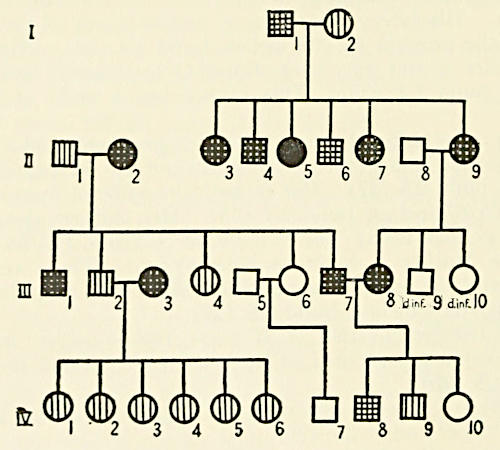
Fig. 43.—Pedigree chart showing distribution of build in the Kie family.
Leo Family, A. (Fig. 23.)
II 7 ♂, slender with 4 slender sibs. Their parents both slender. His wife, II 8 ♀, at 36 years, has a stature of 152 cm. (60 inches); weight 84 kg. (184 pounds); build 3.6 (51); very fleshy; relative chest-girth 112/52, or 74 per cent. She has 3 fleshy and 2 slender sibs. Of their parents one was fleshy and one slender. Thus II 8 is heterozygous.
III 4, the only child, at 9 years, has a relative chest-girth of 57 per cent; fleshy.
Leo Family, B.
I 5 ♂, slender, and I 6 ♀, whose build is about 3.6 (51), or very fleshy, have 6 children of whom something is known, as follows: II 8 ♀, build 3.6 (51), very fleshy; II 11 ♀, fleshy; II 15 ♀, slender; II 16 ♀, slender, married to a slender man and has 3 slender children; II 12 ♂, of medium stature and 95 kg. (210 pounds) weight; build, say, 3.2 (45); very fleshy; II 13 ♀, of tall stature and 91 kg. (200 pounds) weight; build, say, 3.2 (46); very fleshy. Thus there are 3 very fleshy, 1 fleshy, and 2 slender children. The Mother’s heterozygosity is inferred from the variability of the progeny in build.
II 14 ♂, fleshy, and II 15 ♀, slender, have 2 sons, both slender (73:676).
Lyn-2 Family.
A family of prevailingly English stock, living in Illinois and Nebraska. The Father, who was a farmer and school-teacher, died at 65 years from cancer of stomach. Formula, 150/64 inches; build 2.6 (37). His father, who was a farmer, died at 76 years from pneumonia; he was slender. His mother, who had 10 children, is living and is corpulent. Thus the Father is heterozygous.
The Mother, who has 1 child, has at 49 years the formula 120/64 inches; build 2.1 (29). Her father, who is a carpenter, always well, is at 70 years slender. Her mother, who had 4 children, died at 36 years from pneumonia; she was of medium build. One child, female, a kindergarten teacher, has at 19 years the formula 110/63 inches; build 2.0 (28); adjusted to 55+ years, 130/63 inches; build 2.3 (33).
Comment.—The child is now like the slender parent and will probably increase somewhat in build (R: Lyn-2).
Mer-B Family.
A family of English extraction from Rochester, New York. The Father, at 21 years, had the formula 200/71 inches; build 2.8 (40). His father had the formula 250/73 inches; build 3.3 (47). His mother had the formula 130/70 inches; build 1.9 (27).
The Mother, at 21 years, had the formula 96/61 inches; build 1.8 (25). Her father had the formula 170/68 inches; build 2.6 (37). Her mother had the formula 150/65 inches; build 2.5 (36). Five children:
1. Male, at 21 years, had the formula 175/68 inches; build 2.7 (38).
2. Male, at 21 years, 170/72 inches; build 2.3 (33).
3. Female, 140/64 inches; build 2.4 (34).
4. Female, 130/65 inches; build 2.2 (31).
5. Female, 130/67 inches; build 2.0 (29).
Comment.—All 5 children are intermediate between the parents; 1 is fleshy, 1 slender (S:Mer-B).
Mor Family. (Fig. 24.)
(a) II 1 ♂, stature 181 cm. (71 inches); weight 13 kg. (200 pounds); build 3.5 (50); very fleshy. Married II 2, a slender woman. They had 7 sons, 2 fleshy, 5 medium, and 6 daughters, 1 fleshy and 5 medium. Thus 3 fleshy and 10 of medium build. To save space only 5 are represented in figure 24.
(b) IV 16 ♂, slender, married IV 17 ♀, fleshy, who has 2 fleshy and 2 slender sibs; and both parents fleshy. They have 4 living children, all slender.
(c) IV 5 ♂, fleshy with 4 fleshy, 1 medium, and 1 slender sibs and a fleshy and medium parent; married IV 6, slender, with a slender sister. They had 2 sons, both slender (73:690).
Pad-1 Family.
A family of English extraction, living in the middle West. The Father, a horticulturist, subject in middle life to catarrh, is living at 55 years, having had at 50 years the formula 145/72 inches; build 2.0 (28). His father, a farmer, who in youth suffered from measles and bronchitis, and in middle age from liver trouble, died at 59 years from complication of stomach and liver diseases. At 55 years his formula 145/68 inches; build 2.2 (31). His mother is living at 80 years, having the formula 160/68 inches; build 2.4 (35).
The Mother, at 49 years, had the formula 145/63 inches; build 2.6 (37). Her father, a merchant and farmer, suffered in youth from typhoid fever and congestion of the brain. He died at 86 years from old age, having had at 70 years the formula 170/72 inches; build 2.3 (33). Her mother died at 83 years of old age, having the formula 95/64 inches; build 1.6 (23). The only grown child is a male, a student, who in youth suffered from measles and catarrh, has at 21 years the formula 155/67 inches; build 2.4 (35); adjusted to 50 years, 171/67.5 inches; build 2.6 (37).
Comment.—The only grown child is like his stouter parent in build (R: Pad-1).
Rom-1 Family.
A family of prevailing English stock, living in Ohio, Indiana, Illinois, and Kansas. The Father, who is a lawyer, has at 72 years the formula 170/67 inches; build 2.7 (38). Three of his brothers died at 26 years, 41 years, and 22 years respectively, from tuberculosis; all were of medium height. Their father, who was a “farmer and blacksmith,” died at 76 years from Bright’s disease; was slender. Their mother, who had 5 children, died at 55 years from “tuberculosis of the liver”; was corpulent. The Father is doubtless heterozygous in build.
The Mother has at 67 years the formula 119/65 inches; build 2.0 (28). One of her sisters, who was tall, died from “quick consumption”; another from diabetes; another from dropsy. Two of her brothers, tall, died from hardening of the arteries, another from “leakage of the heart,” and another from dropsy. Their father, who was a miller, died at 76 years—“a complication of diseases (asthma).” He was corpulent. Their mother, who had 10 children, died at 72 years from pneumonia; was of medium build. The 7 children are:
1. Female, married, who in middle age suffered from rheumatism, has at 44 years the formula 155/64 inches; build 2.7 (38); adjusted to 55 years, 158/64 inches; build 2.7 (39).
2. Male, a farmer, who in youth suffered from malarial fever, has at 41 years the formula 150/68 inches; build 2.3 (32); adjusted to 55 years, 155/68 inches; build 2.4 (34).
3. Male, a farmer, has at 38 years the formula 155/68 inches; build 2.4 (34); adjusted to 55 years, 161/68 inches; build 2.5 (35).
4. Male, who died at 18 years from diphtheria, having the formula 145/72 inches; build 2.0 (28); adjusted to 55 years, 171/72 inches; build 2.3 (33).
5. Female, married, has at 31 years the formula 115/65 inches; build 1.9 (27); adjusted to 55 years, 132/65 inches; build 2.2 (31).
6. Male, a farmer, has at 28 years the formula 160/71 inches; build 2.2 (32); adjusted to 55 years, 174/71 inches; build 2.4 (35).
7. Female, a student, who in youth suffered from tonsillitis, scarlet fever, and other “children’s” diseases, has at 22 years the formula 118/64 inches; build 2.0 (29); adjusted to 55 years, 136/64 inches; build 2.3 (33).
Comment.—All except one on the adjusted weights equal or exceed the mid-parent index. One of the 7 children is as fleshy as the fleshier parent (R: Rom-1).
Rid Family. (Fig. 48.)
III 9 ♂, at 59 years, stature 157 cm. (62 inches); weight 73 kg. (160 pounds); build 2.9 (42); fleshy; “as fat as butter when a child.” He has 3 fleshy sibs and his parents are dissimilar in build; hence he is heterozygous; married to III 10 ♀, slender, of two slender parents.
Of their 2 children, IV 3 ♀, at 30 years is slender; IV 4 ♂, at 16 years, slender (73:727).
Van Family. (Fig. 44.)
I 3 ♂, died at 51 years of heart disease, stature 170 cm. (67 inches); weight 86 kg. (190 pounds); build 3.0 (42); fleshy. He was one of a fraternity of 8 of whom something is known of the following: I 1 ♂, slender; I 2 ♂, stature 183 (72 inches); weight 90 kg. (200 pounds); build 2.7 (38.5); fleshy; slender as a child. I 3, married I 4, who died at 32, was tall, slender, angular. A brother is of medium build.
They have 5 children: II 1 ♂, died at 53 years of indigestion; stature 189 cm. (74 inches); weight 90 kg. (200 pounds); build 2.6 (37); fleshy. II 2 ♀, always slender. II 3 ♀, slender. II 4 ♂, at 54, stature 175 cm. (69 inches); weight 88 kg. (194 pounds); build 2.9 (41); fleshy. Relative chest-girth 108 ÷ 175, or 62 per cent. He first began to increase in build at 22 years and at 30 years had his present build; loses weight after vigorous exercise. He married a woman (II 5) who, like himself, was slender in youth, but began to grow fleshy at 39, and now has a build of 2.9 (41). She has 2 slender, 2 fleshy, and 2 very fleshy sibs, and her parents were both very fleshy. The foregoing couple (II 4, 5) have 2 children who grew up. III 1 ♀ at 28 years, keeps slender by constant dieting. III 2 ♂ (one of twins) at 25 years, very slender, nervous, and irritable. The children have not yet reached the age when their mother became fleshy.
Finally, II 7 ♀, at 50 years, is 170 cm. (67 inches) tall and weighs 88 kg. (195 pounds); build 3.1 (43); fleshy. She was slender up to 27 years of age. She is married to a somewhat fleshy man and their daughter at 27 is of medium build, but beginning to grow fleshy.
Comment.—The mating of a man of build 3.0, of a fraternity that is variable in build, and a woman of slender build yields grown children with following builds: 2.6, “slender,” “slender,” 2.9 (slender in youth), and 3.1 (slender in youth). Three of the five become fleshy, but probably only late in life—the heterozygous reaction (73:745).
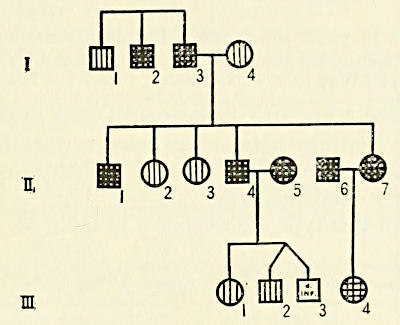
Fig. 44.—Pedigree chart showing distribution of build in Van family.
Wat Family.
A family of English extraction living in Wyoming. The Father, who has tuberculosis, has the formula 125/68 inches; build 1.9 (27). His father was slender and of average height. His mother was fleshy and of average height.
The Mother had at 50 the formula 165/64 inches; build 2.8 (40), but averaged usually from 120 to 128 pounds. She had stomach trouble. Her father, an invalid and sufferer from tuberculosis, rheumatism, neuralgia, heart trouble, and dropsy, had the formula 120/68 inches; build 1.8 (26). His weight varied from 102 to 120 pounds; very slender. Her mother, who had a goiter of which she was cured, and quinsy, had the formula 140/56 inches; build 3.1 (45). The mother’s father’s father had the formula 180/73.5 inches; build 2.3 (33). His weight varied from 180 to 200 pounds. He was muscular, not fat. The Mother’s father’s mother was always thin and had the formula 115/65 inches; build 1.9 (27). She had liver trouble and cancer of the face. The Mother’s mother’s father had cancer of the face and underwent an operation for it. His formula was 125/65 inches; build 2.1 (30). The Mother’s mother’s mother had at 70 years the formula 160/67 inches; build 2.5 (36). She grew heavier in middle age. The children are:
1. Male, liable to tuberculosis, has at 24 years the formula 134/67.5 inches; build 2.1 (30).
2. Male, has weak lungs; has at 22 years the formula 170/67.5 inches; build 2.6 (37).
3. Male, has at 18 years the formula 126/68 inches; build 1.9 (27).
Comment.—The children show the usual variability that arises from this type of mating (D:Wat.).
Mating 2. Fleshy × Heterozygous Fleshy Parents.
This includes matings between a heterozygous parent of fleshy build and a very fleshy (or fleshy) parent of fleshy stock; a back-cross to the more nearly dominant type.
The matings of this type are as shown in table 33.
Table 33.—Matings between a probably homozygous fleshy and a heterozygous fleshy parent, together with the progeny of this back-cross.
Ref. Parentage. Offspring.
FF FM F Father’s sibs. MF MM M Mother’s sibs. VS S M F VF
Hud 28 46 45 38 35 40 1 1 2
Jon 11c 29 49 39 1VF 3F 5M 37 42 39 2F 4M 1 8 1
Pal F M 43 1S 3F 1VF 40 2 1
Rec (a) S 40 2F 100 2F 1S 1 2 3
Rec (b) F S 40F F VF 57 2VF 2F 1M 1
Rid F 56 S 49± 4F 2M 1 3 3
Smi VF VF M 48 1F 1 3 3
The 1 30 31 F 1F 4S 33 33 34 2S 1M 3 4 3
Wen 46 M 46 M M 37 2F 6 2
Total 2 14 21 19
Proportions 3.6 25.0 37.5 33.9
These 9 matings yielded 56 children, with the following percentage distribution: 4 S, 25 M, 37 F, 34 VF. The 6-zygotic-factor mating 5 × 3 (both possibilities) gives a percentage distribution of 3 S, 25 M, 43 F, 28 VF, which approximates that found.
Attention is called to the distribution of offspring in the Pal, Rid, Smi, and Wen families. In these families the children are of two extreme types; intermediates are absent. The result may be due merely to small numbers, but it suggests the presence of two sorts of gametes in the heterozygous parent and hence a tendency to segregation in the offspring.
Hud Family. (Fig. 45.)
The Father’s (II 7) build is 3.2 (45); very fleshy; his father’s (I 1) was 2.0 (28) and his mother’s 3.2 (46). Thus the Father is heterozygous. The Mother’s (II 8) build is 2.8 (40). Her father’s build was 2.7 (38), fleshy; and her mother’s 2.5 (35); medium fleshy. The Mother’s 7 sibs have builds ranging between 2.5 (35) and 3.2 (46); principally fleshy to very fleshy. So this may be regarded as a back-cross of a heterozygous parent with a fleshy one of fleshy stock. Of the 4 children, 1 is medium-fleshy (III 11) with a build of 2.5 (36), 1 is fleshy (III 10) 2.7 (38), and two very fleshy; build 3.2 (45); thus the build of the offspring is varied, but prevailing very fleshy.

Fig. 45.—Pedigree chart showing distribution of build in the Hud family.
Jon-11c Family. (Fig. 46.)
A family of Welsh extraction living chiefly in New York State and Ohio. The Father (II 10), a farmer, suffered in middle age from “rupture,” and died at 88 years from “old age,” having the formula 150/62 inches; build 2.7 (39). Of his 9 sibs:
1. Brother, died at 70 years from “dissipation,” having the formula 175/68.5 inches; build 2.6 (36).
2. Brother, who died at 53 years from “inflammation of kidneys and dyspepsia,” had the formula 125/63 inches; build 2.2 (31).
3. Sister, who died at 68 years from Bright’s disease, 140/57 inches; build 3.0 (43).
4. Sister, who died at 74 years from “flux,” 150/58 inches; build 3.1 (44).
5. Sister, who died at 75 years from Bright’s disease, 120/59 inches; build 2.4 (34).
6. Sister, who died at 60 years from Bright’s disease, 118/59.5 inches; build 2.3 (33).
7. Sister, who died at 73 years, 135/64 inches; build 2.3 (33).
8. Brother, who died from typhoid fever at 44 years, 175/68 inches; build 2.7 (38).
9. Brother, 150/62 inches; build 2.7 (39).
Their father, a farmer, suffered in middle age from “hernia”; died of heart trouble at 65 years, having the formula 120/64.5 inches; build 2.0 (29). Their mother died at 77 years from pneumonia, having the formula 160/57 inches; build 3.5 (49).
The Mother suffered from “nervousness” before marriage, then not troubled with it again till menopause. She died of “heart trouble, dropsy, paralysis, and nervousness” at 80 years, having the formula 150/62 inches; build 2.7 (39). Of her 8 sibs:
1. Brother, who died from “congestive chill,” was 67 inches in height.
2. Brother, who died at 56 years from “old age,” 180/71 inches; build 2.5 (36).
3. Brother, who died at 81 years from “poor circulation” and stomach trouble, had the formula 170/71 inches; build 2.4 (34).
4. Brother, who died from pneumonia at 45 years, 180/70 inches; build 2.6 (37).
5. Brother, who died from “kidney trouble” at 40 years, 170/70 inches; build 2.4 (35).
6. Brother, who died at 57 years from “abscess on liver,” 160/69 inches; build 2.4 (34).
7. Sister, who died at 25 years from “child-birth.”
8. Sister, who died at 72 years from “overdose of medicine,” 165/67 inches; build 2.6 (37).
Their father, a farmer and cabinet-maker all his life, died at 83 years from paralysis, having the formula 200/74 inches; build 2.6 (37). Their mother, who in middle age suffered from dropsy and palsy, died at 83 years from “old age.” Her formula was 160/62 inches; build 2.9 (42).
The 10 children:
1. Male, a farmer, recorded as always well, has at 66 years the formula 165/67 inches; build 2.6 (37).
2. Female, who in youth suffered from “ague, flux, erysipelas, cholera morbus,” has at 65 years the formula 130/59 inches; build 2.6 (37).
3. Female, who in youth suffered from asthma, has at 63 years the formula 150/61 inches; build 2.8 (40).
4. Male, a lawyer, who in youth suffered from scarlet fever, and middle age from “acquired neurasthenia,” has at 59 years the formula 190/70 inches; build 2.7 (39).
5. Female, a school-teacher, who died at 20 years from typhoid fever, had the formula 120/61 inches; build 2.3 (32); adjusted to 55 years, 139/61 inches; build 2.6 (37).
6. Female, who suffered in youth from scarlet fever and in middle age from typhoid and kidney trouble, has always been “nervous,” has at 55 years the formula 150/61 inches; build 2.8 (40).
7. Male, a farmer and “shopman,” who in youth suffered from Bright’s disease, has at 53 years the formula 170/67.5 inches; build 2.6 (37).
8. Female, who at 17 years had fever, lost her mind, has not been well since—“gradual mental deterioration.” At 51 years she has the formula 170/62 inches; build 3.1 (44).
9. Female, who in youth suffered from “thrush,” and in middle life from malarial fever and gradual mental deterioration, has at 51 years the formula 116/57.5 inches; build 2.4 (35).
10. Female, who at 48 years has the formula 165/63 inches; build 2.9 (42).
Comment.—This is an extraordinarily valuable pedigree furnished by a member of the family who has taken great pains with the record. Both parents are of middle-fleshy build (39). The Father’s fraternity shows sibs: 5 medium, 4 fleshy, and 1 very fleshy. This is associated with semi-dwarfishness, one of the sisters being only 57 inches in stature and one of the brothers only 63 inches. One of their parents is slender; one obese. The Mother’s fraternity comprises 4 persons of medium build and 3 stout. Their parents are both fleshy. The “children” are remarkably uniform. Since they all, except one, reached the parental age, no “adjustment” is necessary; they can be compared directly. One is of medium build, 8 are stout like their parents (including the adjusted age of the girl who died at 20), and 1 is just over the line of being very stout (44), like her paternal aunt and a little less than her Father’s mother. Here the obesity has skipped a generation in the direct line, possibly because the Father was phenotypically reduced in build, perhaps because of his advanced age (88). This circumstance offers, however, no theoretical difficulty. The uniformity of the progeny favors the hypothesis that in this family there are only two independent factors for fleshy build (R: Jon-11c).
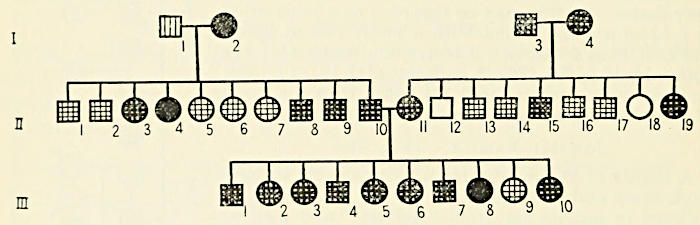
Fig. 46.—Pedigree chart showing distribution of build in the Jon-11c family.
Pal Family. (Fig. 25.)
A family living in a small town in good circumstances. III 9 ♂, a farmer, who at 67 years is 173 cm. (68 inches) tall, weighs around 90 kg. or 200 pounds; build 3.0 (43); fleshy; net relative chest-girth 120/173, or 71 per cent. This near-obese man was slender as a boy and began to grow fleshy at 30 years of age. There are 5 others in his fraternity: (1) III 7 ♂, a physician, at 71 years is 178 cm. (70 inches) tall, weighs over 90 kg. (200 pounds); build 2.9 (41); fleshy; relative chest-girth 119/178, or 67 per cent. He is doubtless heterozygous for build, since, by a slender wife, he has 2 fleshy and 2 slender children. (2) III 8 ♀, married, at 69 years has stature 157 cm. (62 inches); weight 75 kg. (155 pounds); build 2.8 (40); fleshy; relative chest-girth 107/157, or 68 per cent. By a man of medium build she has 1 fleshy, 1 medium, and 3 slender children.[10] (3) III 11 ♂, at 65 years has a stature of 175 cm. (69 inches); weight 61 kg. (135 pounds); build 2.0 (28); slender. (4) III 5 ♂, at 62 years, stature 178 cm. (70 inches); weight 95 kg. (210 pounds); build 3.0 (43); fleshy. His relative chest-girth 117/178, or 66 per cent. As a boy he was of medium build; at about 30 years, like III 7, he began to grow fleshy, and is now dieting for diabetes (?). By a fleshy wife, whose sibs vary in build, he has 2 fleshy children and 1 of medium build. (5) III 12, at 59 years has a stature of 168 cm. (66 inches) and weight of 102 kg. (224 pounds); build 3.6 (52); very fleshy. By a husband of medium build she has 1 slender and 1 medium child.[10]
The father (II 5) of this fraternity, who died at 87 years of cancer of the face, was fleshy. He had 5 brothers, all of whom lived to be over 80 years of age and who all, save 1, weighed over 90 kg. (200 pounds). The mother (II 6) of the man’s fraternity died at 64 of pneumonia; she was of medium build, and her 4 sibs were of medium build. Thus all her children were probably somewhat heterozygous, including III 9, the father of 3.
III 10, the wife of III 9, is 178 cm. tall and weighs over 90 kg.; build 2.8 (40+); fleshy.
Of the 3 children: (1) IV 7 ♂ at 44 is of medium build. By a slender wife he had a daughter who at 22 years has a build 2.4 (34); medium build. (2) IV 10 ♀, at 42 years, has a stature of 163 cm. (64 inches) and weight of over 115 kg. (250+ pounds); build 4.3 (61+); obese. She married a slender man, and 1 of their 9 children, at 19 years, weighs over 90 kg. (200 pounds). (3) IV 11 ♂ is a medium weight; he married a slender woman and has 4 children who are of medium build.
Comment.—A fleshy Father, who is heterozygous for build, and his fleshy wife (of unknown gametic composition) have 1 obese child and 2 children of medium build (73:704).
Rec Family, A. (Fig. 47.)
II 5 ♂ died at 84 years of “heart disease.” His stature was 188 cm. (74 inches) and weight 100 kg. (220 pounds); build 2.8 (40); fleshy. He had a fleshy brother and sister. Their father was a slender man, but nothing is known about their mother. II 5 married II 6, who died at 58 years of bronchial pneumonia. Her formula, 360/60 inches; build of 7.0 (100); very obese. She has 1 very fleshy and 1 fleshy sister and a slender brother.
This fleshy pair had 6 offspring, as follows: (1) III 2 ♀ (plate 9, fig. 2), build 4.0 (57), relative chest-girth, 90 per cent. She is the obese mother (by a fleshy, 2.8 (40), consort) of a slightly less obese daughter, of build 3.7 (53) (plate 9, fig. 3). (2) III 3 ♂, 170 cm. (67 inches) tall, and weighing 91 kg. (200 pounds); build 3.1 (45); very fleshy. He is now at a State institution and weighs some 20 or 30 pounds less. (3) III 4 ♂, build about 2.4 (34); medium. (4) III 5 ♂, very fleshy. (5) III 6 ♂, about 183 cm. (72 inches) tall, weighs over 90 kg. (200 pounds); has very large shoulders and abdomen; build, say, 2.8 (40). (6) III 8 ♀, at 36 years has a stature of 168 cm. (66 inches) and weight of 71 kg. (157 pounds); build 2.7 (38); fleshy. Her relative chest-girth is 52 per cent. She married a man of build 3.4 (48) and has 3 sons—2 slender and 1 fleshy.
Comment.—The parents II 5 and II 6 were probably heterozygous, so that they produced 1 in 6 of medium build. Also, their children are mostly heterozygous. Of 8 grandchildren, 2 are slender, 2 are stout (73:714).
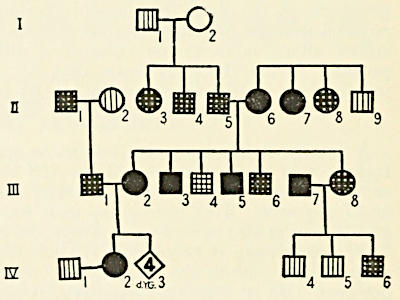
Fig. 47.—Pedigree chart showing distribution of build in Rec family.
Rec Family, B. (Fig. 47.)
III 1 ♂, fleshy, with a fleshy father and slender mother, married to III 2 ♀ (plate 9, fig. 2), who at 53 years has a stature of 150 cm. (59 inches) and weight of much over 90 kg. (200 pounds); build 4.0 (57); obese. Her relative chest-girth is 135/150, or 90 per cent; extraordinarily obese. At 16, when married, she weighed 110 pounds; build 2.2 (32); medium. 4 of her 4 sibs and both parents are exceedingly obese (her mother weighs 163 kg. [360 pounds] and has a build of 7.0 [100]).
The foregoing pair had 5 children, 4 of whom died young. The other, IV 2 ♀, at 36 years has a stature of 168 cm. (66 inches) and weight of 104 kg. (229 pounds); build 3.7 (53); very fleshy. Her relative chest-girth is 130/168, or 77 per cent. She had at her marriage, when 23 years old (to a slender man), a build of 2.3 (33), medium grade. After marriage she increased rapidly in weight, menstruation became scant, she lost the sex-instinct, and is barren (plate 7, fig. 3).
Comment.—A tendency to extreme obesity runs in four generations. This is apparently of the adiposo-genitalis type, with sterility in the latest generation. Obvious dominant factors are at work here (73:714).
Rid Family. (Fig. 48.)
II 2 ♂ died at 54 years; short and weighed 110 kg. (240 pounds); build, say, 3.9 (56); very fleshy. A brother who died at 52 of apoplexy was fleshy, married a fleshy woman, and had a fleshy son. The mother of this fraternity was fleshy; about her consort’s build nothing is known, but he had a fleshy sister (I 1).
II 3 ♀, wife of II 2, died of senility at 89; she weighed over 90 kg. (200 pounds). She had 7 sibs: (1) II 4 ♀ died of epilepsy, was of medium weight, married, and had 5 children, 4 of medium weight and 1 fleshy. (2) II 5 ♀ of unknown build. II 6 ♀ of medium weight, her children slender. II 7 ♂ weighed over 90 kg. (200 pounds); build, say, 2.9 (41), or fleshy. II 8 ♂ weighed over 90 kg.; fleshy. II 9 ♂ also fleshy, like his two brothers. II 10 unknown. Thus of this fraternity of 6 known persons, 4 are fleshy, 2 medium. Their father was slender; their mother “short and plump.”
There are 7 offspring from this mating between II 2 and 3: (1) III 1 ♀, at 66 years, is bedridden from a broken hip; tall, weight 77 kg. (170 pounds); chest-girth 108 cm. (42 inches); build, say, 2.8 (40); fleshy; she was fleshy as a child of 10 years. (2) III 2 ♂, died at 60 of paralysis, was always slender. (3) III 3 ♂, at 62 years, is tall (say, 71 inches) and weighs 97.5 kg. (235 pounds); build 3.3 (47); very fleshy. (4) III 4 ♀, at 56 years has the formula 91 kg. (200 pounds); 161 cm. (63.5 inches); build 3.4 (49); very fleshy; relative chest-girth 74 per cent. She was fleshy from the age of 16 years. (5) III 5 ♀, at 51 years, is very fleshy; was a slender child. (6) III 6 ♀ is fleshy. (7) III 8 ♀, at 35 years weighed 86 kg. (190 pounds), but now at 50 she is a helpless invalid and has grown slender; she was somewhat slender as a girl. Thus the offspring are 3 very fleshy, 2 fleshy, 1 always slender, and 1 formerly fleshy but reduced by illness (73:727).
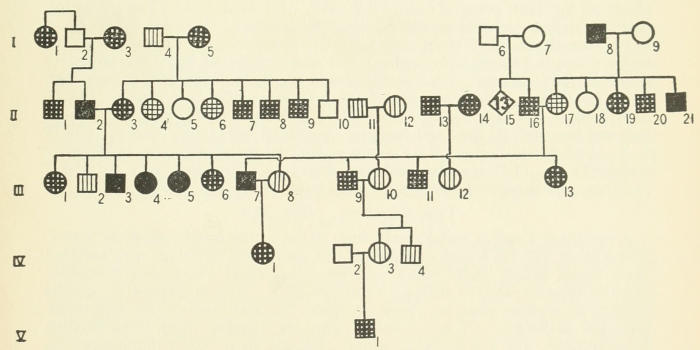
Fig. 48.—Pedigree chart showing distribution of build in the Rid family.
Smi Family. (Fig. 26.)
I 1 ♂ died at 72 years of acute indigestion; said to have been very fleshy, like his father. His wife, I 2 ♀, died at 68 years of paralysis. She was less than 155 cm. (61 inches) tall and weighed 82 kg. (180 pounds); build 3.4 (48); very fleshy. She had 3 sibs, of whom it is known that 1 was fleshy; the other 2 unknown. Her father was of medium build and had 3 children by an earlier marriage, and of these 2 were slender and 1 fleshy. There were 7 children from I 1 and 2. (1) II 1, a man who died at 69 of pneumonia and diabetes and whose stature is 173 cm. (68 inches) and weight about 95 kg. (210 pounds); build 3.2 (45). (2) II 3 ♀ at 75 years is 155 cm. (61 inches) tall and weighs 82 kg. (180 pounds); build 3.4 (48). By a stout consort she has 2 stout and 4 slender children. (3) II 9 ♀, married, at 74 years is 163 cm. (64 inches) tall and weighs 49 kg. (107 pounds); build 1.8 (26); slender. By a slender husband she had one slender daughter, build 1.9 (27), a slender son, and 2 other children who died young. (4) II 5 ♀, fleshy. (5) II 6 ♀, fleshy. (6) II 7 ♀ said to be 157 cm. (62 inches) tall and to weigh 82 kg. (180 pounds); build 3.3 (47); very fleshy. (7) II 4 ♂, at 55 years, fleshy. By a medium wife he had a son who at 26 years weighs 77 kg. (170 pounds) and was fleshy as a growing boy. Of the 7 children, 1 is slender, 3 are fleshy, and 3 very fleshy (73:736).
Thr-1 Family. (Fig. 33.)
A family of English and French stock living in the middle western States. The Father (II 8), whose occupation has been very shifting, who suffered from “weak lungs” at 35 years, and who died at 81 years, had in middle life the formula 140/72 inches; build 1.9 (27). But in answer to special inquiry it appears that he “took on flesh” in later years. He has to be recorded as fleshy. Of his 3 sisters, two are slender (both with cardiac hypertrophy), and 1 is of fleshy build. The fat sister had 2 daughters who weighed over 225 pounds each. His 2 brothers are slender. His father (I 1), a blacksmith, died at 90 years, having the formula 150/71 inches; build 2.1 (30). His mother, always well, died at 68 years, having the formula 130/65 inches; build 2.2 (31); medium. This side of the house carries both fleshy and slender strains, some of the slender individuals being so, probably, through disease. Apparently the Father is heterozygous for fleshiness, perhaps one reason why he became fleshy late in life.
The Mother (II 9) suffered from arthritis deformans and died at 79 years. Her formula was 135/63 inches; build 2.4 (34). Two of her sibs are slender and one of medium build. Her father (I 3), who suffered from arthritis deformans, was confined to his chair from rheumatism the last 15 years, and died at 72 years, having the formula 160/70 inches, build 2.3 (33). Her mother, who died at 50 years, had the formula 140/65 inches; build 2.3 (33). She had a sister (I 5) who weighed about 250 pounds, “an enormous woman.” This side of the house is of prevailingly medium build but with a tendency to obesity in one line. The children are 10 in number:
1. Male (III 3), a clerk, has at 66 years the formula 150/69 inches; build 2.2 (32).
2. Male (III 4), a physician, who has always had a rheumatic tendency and is liable to sciatic neuritis, at 25 years had the formula 180/68.75 inches; build 2.7 (38). He is the Father of Thr-2 family, page 79.
3. Male (III 6), a preacher, has at 69 years the formula 170/68 inches; build 2.6 (37). He has a daughter with a build of about 3.2 (45).
4. Male (III 7), a physician, who in middle life suffered from inflammatory rheumatism, has at 59 years the formula 170/68 inches; build 2.6 (37).
5. Female (III 8), who died at 34 years from appendicitis, has the formula 225/67 inches; build 3.5 (50). She was “a big overgrown woman in her teens.”
6. Female (III 9), married, who has a rheumatic tendency, has at 55 years the formula 190/64 inches; build 3.3 (46).
7. Female (III 11), married, who has 9 children, suffered in middle age from rheumatism. At 53 years her formula was 225/67 inches; build 3.3 (46).
8. Male, a merchant, well, has at 51 years the formula 155/67 inches; build 2.4 (35).
9. Male, a merchant, well, has at 49 years the formula 165/68.5 inches; build 2.5 (35).
10. Male (III 14), a doctor and dentist, has at 47 years formula 180/68 inches; build 2.7 (39). One of his daughters has a build of about 3.2 (45).
Child No. 2, a physician, writes: “Many of my relatives, both on Father’s and Mother’s side, were afflicted with so-called muscular rheumatism (cousins, uncles, and aunts), pains in the limbs and muscles (not in the joints); especially those of robust and fleshy build, who possessed extraordinary good appetites and digestion, who liked good things to eat and much of it; the women being good cooks and the men generally marrying good cooks, they always had plenty to eat (rich food) and to spare. None of them are users of alcohol, simply being extra-hearty eaters” (R: Thr-1).
Wen Family. (Fig. 49.)
IV 10 is the Father; his formula is 260/74 inches; build 3.2 (46); very fleshy. His father (III 10) had the formula 245/73 inches; build 3.2 (46); very fleshy. This father had a brother of just his build (who eventually died of tuberculosis) and a brother of formula 250/74, build 3.0 (43); fleshy. The Father’s father’s father (II 5) had the formula 200/70, build 2.9 (41); fleshy; one of his brothers was fleshy (38), and one very fleshy, build 3.2 (45). The latter had a very fleshy son. The Father’s father’s father’s father had a build of 2.9 (41) and a brother of the same build. These brothers of Gen. I were products of a first-cousin marriage. The Father’s father’s mother was a woman whose formula was 200/68.5 inches; build 3.0 (43); fleshy. Hence the Father’s father and his brother, both of build 3.2 (46), got the fleshy tendency from both sides of the house. The Father’s mother was a second cousin of the Father’s father and her line also contained many fleshy representatives, but she herself was of medium build. Thus the Father belongs to a fleshy strain, but he probably carries some non-fleshy gametes.
IV 11 is the Mother; her formula is 160/65.5 inches; build 2.6 (37); fleshy; she has 2 sibs, both fleshy; her parents are of medium build; they have some slender grandchildren.
There are 8 children, V 3 to 12, whose sex and indices of build are as follows: ♂ 3.6 (51), ♀ 3.1 (44), 2 ♂ ♂ 2.5 (35), 3 ♀ ♀ 2.3 (32), ♀ 2.2 (31). Thus 2 are very fleshy and 6 are of medium build. The interval between the two groups is a wide one, indicating a clear genetic difference between them. The very fleshy brother, who weighs 265 pounds, was able to reduce about 60 pounds to be accepted for army service, but since being discharged from the army he has rebounded to his former weight. (A:032-25.)
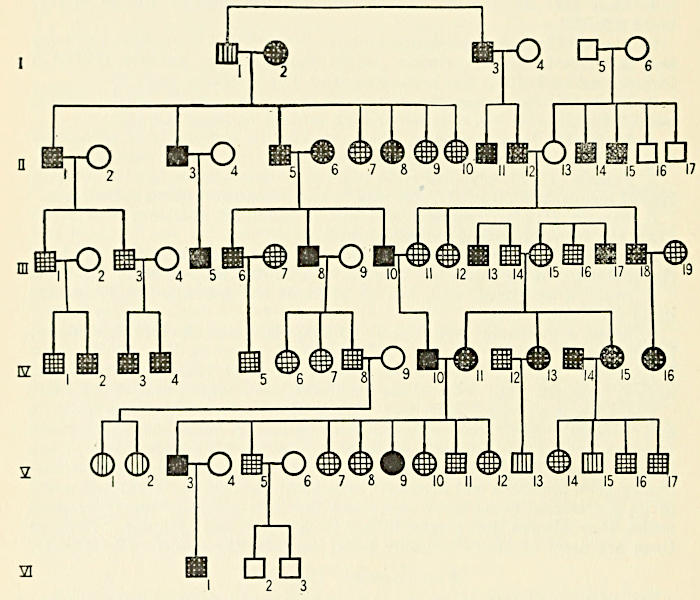
Fig. 49.—Pedigree chart showing distribution of build in the Wen family. (Gen I 1 should be square ruled, indicating fleshiness).
Summary and Discussion.
In a simple monohybrid with complete dominance the back-cross upon the recessive gives 50 per cent of the heterozygous dominant and 50 per cent of the recessive allelomorph. In a monohybrid with imperfect dominance the back-cross upon the recessive gives 50 per cent of the intermediate and 50 per cent of the recessive. Where 2 or 3 multiple factors are present and the heterozygote is nearly intermediate but shows a slight tendency toward imperfect dominance, we may expect an approximation to a symmetrical distribution of grades about the intermediate condition, with a skewness toward the recessive condition. That is what is got in both parts of table 32. This result supports the conclusion that there is segregation in the gametes of the heterozygous parent, so that the progeny tend prevailingly to fall again into the slender and medium-fleshy grandparental types. The results of table 33 similarly support the conclusion of segregation in the gametes of the heterozygous fleshy parent.
C. GENERAL DISCUSSION.
Heredity and Environment in Build.
That a tendency to slenderness or fleshiness of build “runs in families” and characterizes different races is a matter of common observation. But this fact is far from satisfying the clinician that heredity plays any part in this result. Thus, von Noorden, who occupies a leading position among Teutonic investigators of metabolism in general and obesity in particular, denies the importance of an hereditary anomaly of metabolism in different families and races. Rejecting “anomaly of metabolism” or “peculiarity of protoplasmic metabolism,” he stresses “inheritance” of habits of life that favor obesity, the quantity and quality of food, and the ideals of bodily activity. For example, the Eskimo are fat because they eat blubber and huddle in narrow spaces, undergoing little movement throughout the long, dark winters. It is true that von Noorden speaks somewhat guardedly; he recognizes exceptions; suggests a possible hereditary hypofunction of the thyroid. But clearly constitutional peculiarities are, for him, exceptional as causes of overweight, and here is where he fails to recognize sufficiently the fact that usually only particular individuals of a fraternity are fleshy; the others may be slender.
But besides anomalies of protoplasm and family traditions of feeding, there are obviously other possibilities. It is well known that different varieties of cattle differ greatly in their capacity for fattening. Armsby and Fries (1911) have inquired into the influence of type upon the fattening of cattle. They used a pure-bred Aberdeen-Angus steer and a “scrub,” part Jersey, steer for comparison. As is well known, the former belongs to the easily fattening beef type; the Jersey to the difficultly fattening milk type. During over 2½ years, beginning at under 1 year of age, these steers were under nearly continuous observations. They were fed on ordinary growing rations, the same for each steer. The digestibility of the total ration was determined at intervals; four tests were made of each animal in the respiration calorimeter to determine the percentage availability of the energy of the feeds consumed by each. The results were as follows: Analysis of feces and urine failed to show any difference in percentage digestibility of the food by the two animals, and calorimeter tests failed to show any difference in the proportion of the food-energy which was being metabolized. But the two animals did not metabolize in the same way. Thus, in the scrub, a larger proportion of the gain made was of protein than in the case of the beef steer; and, conversely, the gain of the beef steer was more largely fat than in the case of the scrub. Reduced to common weight, the energy requirement for maintenance of the scrub steer was nearly 19 per cent greater than for the beef steer. Since the beef steer would eat more than the scrub and tended to store fat rather than protein, the greater tendency of the beef steer to fatten received a biochemical explanation. The results seem to show a difference between the two varieties in the working over of the assimilated materials.
Indeed, it is easily appreciated that steers of the beef and dairy types of cattle should metabolize differently when we consider the marked difference in the milk production of the cows of these two types. The cow of the highest dairy type is capable of manufacturing 20 kilograms of milk containing 1.2 kilograms of butter fat in one day, or 6 per cent (Bailey, Encl. Am. Agric., III, 365). The cow of the meat type, of larger size, produces up to 30 kilograms of milk, and this contains, perhaps, 1.3 kilograms of butter fat per day, or only 4.3 per cent (Sinclair, 1904, p. 740-42). There is here, obviously, a difference in the metabolic processes in the cows and this is reflected in the steers also.[11] There is an internal biochemical difference as well as a difference in the feeding instinct. The latter is not merely a matter of family tradition, of the family economics or mores; it is a physiological phenomenon as much as internal metabolism.
Indeed, even von Noorden (1907, III, p. 700) seems to be forced to this conclusion by cases of failure to reduce weight at a diet far below that which appears to be essential to maintenance. Thus a man of 39 years, who exercised freely in the open air, had a weight of 102 kg. For 3 months his diet never exceeded 1,720 calories (estimated at 1,000 calories short of normal requirements) and at the end of this period he weighed 101 kg.
That a relation between ingested food and activity is not the entire explanation of obesity is recognized by medical men of experience. Heckel (1920, p. 371), referring to recurrent obesity, remarks on its frequency and says: To constitute an obesity there must be organic and hereditary tendencies: “Ne devient pas obèse qui veut.” “Aussi la guérison accidentelle ou thérapeutique d’une obésité n’indique-t-elle pas la disparition définitive des tendances personelles ou congénitale.”
Gulick (1922) has lately undertaken experiments to throw light on the question why some persons fatten easily and some with difficulty. He had noted that he himself belongs to a non-fattening strain and that his inclination toward a very copious diet of predominantly starchy nature did not lead him to put on weight, even though his round of activity was moderate. So he undertook biochemical, nutritional studies on himself. His observation covered nearly 21 months. During part of this time his caloric intake was low, 1,875 to 2,780; during another part high, 3,400 to 4,100. He found that he fattened somewhat during the period of heaviest feeding. There was, however, always an excess of intake over predictable need, and this excess increased absolutely and probably even relatively as the intake increased. The fecal nitrogen was 2½ to 3½ times greater during over-feeding than under-feeding. The basal metabolism during maximum feeding was normal. Gulick concludes that a person belonging to the difficultly fattening type shows a wasteful rate of oxidation, whether under or over fed, but especially at the latter time. “It seems clear,” concludes Gulick, “that throughout the entire experimental series there was some factor at work which caused fuel food to be burned more freely than in the average individual. This factor was not an over-active thyroid, as attested by the entirely normal basal metabolism.” Gulick concludes that it was “some factor in the chemistry of nutrition” which caused extravagance. This he thinks may very possibly be comparable to the “secondary effect” of protein enrichment, which, according to Rubner, can raise the specific dynamic action of the food without raising the basal rate. It is also possible, he says, that the spare type may be accounted for by any factor that produces a high “cost of digestion,” just as the obese may be supposed to suffer from an abnormally low “cost of digestion” (von Noorden).
Whatever the fundamental cause may be, the fact remains that in certain families there is a widespread inclination to the production of slender individuals, while in other fraternities certain proportions (though usually not all) of any fraternity are fleshy or even obese. Perhaps, as in the case of the Jersey as contrasted with the beef steer, the two kinds of individuals do not metabolize their food in the same way; some are spare and muscular, others lay on fat. In any case we can not disregard the constitutional factors in build.
Looking at the matter broadly, we can see that no other theory than that constitutional differences as well as nutritional differences determine build is sufficient to meet all the facts. In other species of animals we have precisely the same kind of differences between hereditary strains of slender and stout build that we have among humans. Thus, among dogs, the slender greyhound or Dachshund and the robust “Chow”; among horses the Thoroughbred and the stocky Percheron; among swine the “razor-back” and the Berkshire; among poultry the slender Leghorn and the stocky Cochin. Slender and stocky as racial traits appear quite as white and black do and they doubtless have similarly a genetic basis.
A careful study of the families described in this paper must convince anyone, it seems to me, of the importance of the genetic factors. The Fun. family is of a wholly different type from the Thr-1 family. Even if the latter eat more, it is because of a constitutional urge like the constitutional urge that leads the Aberdeen-Angus steer to eat more than the Jersey steer. Very probably the Fun. family metabolizes in a different way from the Thr-1 family, building more protein and less fat.
In other cases it is not the whole fraternity that is fleshy or slender. This is well illustrated by the Wen. family, where 2 of 8 of the main fraternity are very fleshy and all the others of medium build. We have here to do not merely with a family habit of eating, but a differential constitution that provides one-quarter of the children with a large appetite that leads them to eat heavily and manufacture fat and provides three-quarters of them with a small appetite that leads them to eat lightly and to manufacture protein instead of fat. Constitutional differences in the appetite and method of metabolism are the essential factors; and these are the things that are inherited. Only on such an hypothesis can we account for the clear evidence presented of constitutional factors in build—not always one only, but sometimes three or more acting together to produce the end result of obesity.
A scientific man, interested in nutrition, who has a build of 3.6 (51) himself and one of whose sisters has a build of 3.1 (44), whereas his 4 other sibs have builds of 2.5 to 2.1 (35 to 30), writes that his brother (of medium build, but about 75 inches tall) consumes daily about 2,700 calories; he himself and his fleshy sister about 2,500, and the others of his fraternity, who are of medium build, 2,000 to 1,800. He is a professional man, who does a good deal of office or laboratory work. He drinks about 3 to 4 quarts of water per day. His son, who is nearly 11 years of age, weighs just over 120 pounds, is 63 inches tall, and fairly fleshy. Though he is active, “never still a minute,” yet he has to be urged to eat, willingly misses a meal, and uniformly declines a second helping; “he eats much less than his 6-year-old cousins, who are actually under size for their age; he has never been a heavy eater from the time he was weaned.” This boy, the son of a very fleshy man, seems to afford an example of the easily fattening type in whom the slight excess of calories produces a striking result in build.
Endocrine Glands as Links between Chromosomes and Somatic Qualities.
When it is concluded that there are constitutional, genetic factors for build, the validity of this conclusion is not weakened by the known rôle of endocrine glands on metabolism and build. Thus the experiments of recent years have emphasized the importance of the rôle that the thyroid gland plays in growth and development. As Uhlenhuth (1922, p. 182) says: “The ontogenetic development of the individual is controlled by the thyroid hormone.” Since in cretins the thyroid functions imperfectly or not at all, the differences between the development of a normal child and that of a cretin are supposed to indicate the scope of the control by the thyroid hormone. In the cretin, growth is slowed up almost to cessation. In the long bones the centers of ossification develop slowly. “The epiphyses may be absent many years after they are due to appear and their union with the shafts of the long bones indefinitely delayed. Periosteal as well as endochondral bone formation may be greatly reduced and delayed. The cranial bones are thin, poorly ossified, and osteoporotic: mottling is sometimes evident ontogenologically.”... Incomplete closure of the fontanelles is very common (Janney, 1922, pp. 391, 392). The genito-urinary system is undeveloped; the external genitalia remain infantile. The brain shows defective convolutions and all parts of the central nervous system show deficient development. Owing to the fact that the long bones of the leg develop imperfectly, while the chest may continue to enlarge, the build of the cretin is usually large for his age. Thus, in general, the specific metabolic changes are retarded. When the thyroid functions imperfectly after maturity the victim puts on fat. The fat is usually distributed nearly uniformly under all parts of the skin. One of Janney’s cases weighed 212 pounds at 12 years. Some degree of hypothyroidism is doubtless responsible for many of the “very fleshy” persons referred to in the preceding pages. The frequent recurrence of obesity in a family is in accordance with the tendency for hypothyroidism to recur in different members of a family; a tendency shown remarkably in Barrett’s (1919) family.
The hypophysis, especially its anterior lobe, is believed to exercise an important control over differential metabolism and the resulting form. The results of hyperfunctioning of the gland are very different from those of hyperfunctioning of the thyroid. An extraordinary enlargement of certain parts of the skeleton, especially of the base of the skull, the hands, the feet, and the ribs, occurs. There is, indeed, in growing persons a tendency to the production of giants. In the underfunctioning of the hypophysis before puberty an extraordinary obesity is apt to appear, known as dystrophic adiposo-genitalis; because, the more the fat increases in amount the more the external genitalia appear under-developed—infantile. The obesity frequently affects the region of the pelvis only or chiefly, though the thighs also may be involved. Disfunctioning of the pituitary in later years is believed, likewise, to induce obesity. Of this disfunctioning there are, doubtless, all degrees corresponding to the variety of grades of obesity. Thus a second factor of obesity must be recognized; and this also “runs in families”—is hereditary.
The other endocrine factors in obesity are less precisely known. It is believed that the interstitial cells of the gonads secrete hormones that regulate, especially inhibit, the production of fat. This is inferred by the frequent tendency of women after the menopause to grow fat and of eunuchs (of one type, at any rate) to become fleshy. Also, the secretions of the islands of Langerhans of the pancreas are known to influence carbohydrate metabolism, so that when they do not function properly sugar is eliminated unchanged in the urine, and “diabetes,” usually accompanied by fleshiness in its early stages, ensues. Of course, it can not be stated that pancreatic insufficiency is responsible for the prediabetic obesity; but the relation of the two phenomena is undeniably close.
Thus there come clearly to view two links in the chain of causes connecting chromosomal factors (such as are present in “Mendelian” heredity), on the one hand, and build, on the other. First, two or more of the endocrine glands play a great rôle in metabolism and when disturbed usually result in an abnormal build; and, secondly, just the condition of endocrine disfunctioning is an hereditary one and seems to depend on the condition of the enzymes or catalyzers that must be in the chromosomes.
That other constitutional conditions than those of the larger endocrine glands may play an important rôle in metabolism can not be denied; probably the quality of the protoplasm of every active cell influences the bodily metabolism; but the endocrine glands proper seem, as it were, to be told off for this specific purpose, and thus peculiarities in their functioning lead to striking results.
Evidence of Segregation in the Heredity of Build.
The best single criterion of Mendelism in any hereditary distribution is segregation. If there is sufficient evidence of segregation in our study of build, then we are justified in concluding that build is inherited in “Mendelian fashion.” There have been several occasions to refer to evidence of segregation in this work; some of this evidence may be brought together here and other added.
1. The difference in variability of the progeny of different matings. The offspring of slender parents are least variable, of fleshy parents most. This is evidence that the fleshy parents carry gametes for slenderness and thus that condition reappears in the offspring; but slender parents rarely carry gametes for fleshiness (p. 56).
2. As a corollary of the above, regression takes place in the progeny of fleshy parents to a markedly greater degree than in the progeny of slender parents (p. 39).
3. The progeny of heterozygous parents are significantly more variable than the progeny of parents belonging respectively to slender and to fleshy stock. This is evidence that the heterozygous parents carry a greater variety of gametes than those of “purer stock.”
4. In different matings of the same type the variability of the progeny differs; apparently, because some parents belong to a special biotype and others simulate the biotype merely through heterozygosity. Thus, if the M × M mating be considered (table X), one finds some families characterized by slight variability of the offspring. The indices of build (English) in such families are given in table 34.
Table 34.—Indices of build of the progeny of M × M matings, in which the parents belong to the M biotype.
Reference. Indices of build of children. Mid range. Total range.
Bat 2 32, 33, 33, 35 33.5 3
Bea 7 31, 32, 32, 34 32.5 3
Dic 4 29, 31, 32, 33 32 4
Kel 4a 31, 32, M, M, M, 34 32.5 3
Old 2 33, 33, 33, 35 34 2
Rig 1 30, 32, 32, 34 32 4
War 3 30, 30, 30, 31, 32, 32, 32, 33, 33, 36 33 6
The slight fluctuation in build of progeny of table 34 is obvious. The modal index of the progeny is close to 33. On the other hand, there are matings of this type which show a much greater variability. These are listed in table 35.
Table 35.—Indices of build of the progeny of M × M matings in which the parents are probably heterozygous.
Reference. Indices of build of children. Mid range. Total range.
Cas 4 32, 34, 34, 37, 41, 43 37.5 11
Coo 5 31, 33, 35, 36, 36, 36, 37, 37, 38, 38, 41 36 10
Eat A 33, 34, 35, 36, 36, 38, 38, 42 37.5 9
Fis 2 33, 35, 37, 37, 37, 39, 40 36.5 7
Ill 1 33, 34, 35, 35, 37, 37, 38, 39 36 6
Mar 22 31, 32, 33, 36, 36, 40 35.5 9
Mer 8 33, 36, 37, 40, 41 37 8
Nes 1 32, 33, 33, 37, 41, 51 41.5 19
Tet A 30, 30, 36, 41, 43, 49, 49 39.5 1
Rup 1 30, 30, 31, 31, 33, 36, 38, 40 35 10
Smi 33 31, 31, 32, 36, 36, 36, 36, 37 34 6
Sto 13 33, 34, 36, 38, 38, 38 35.5 5
A 01:29 29, 39, 41 35 12
These series of progeny fluctuate in build around 36. It seems probable that the variable progeny are the offspring of heterozygous parents, but this can rarely be proved, since the build of the grandparents is not often available in the present series.
That there are really at least two kinds of matings of the M × M type is shown more conclusively by figure 50, in which two modes, at 33 and 36, respectively, are clearly seen. The conclusion seems to be justified that the mode at 33 is that of progeny derived from the M biotype and the mode at 36 is that of the progeny of heterozygous M parents. The existence of these two modes in figure 50 is thus evidence of segregation.
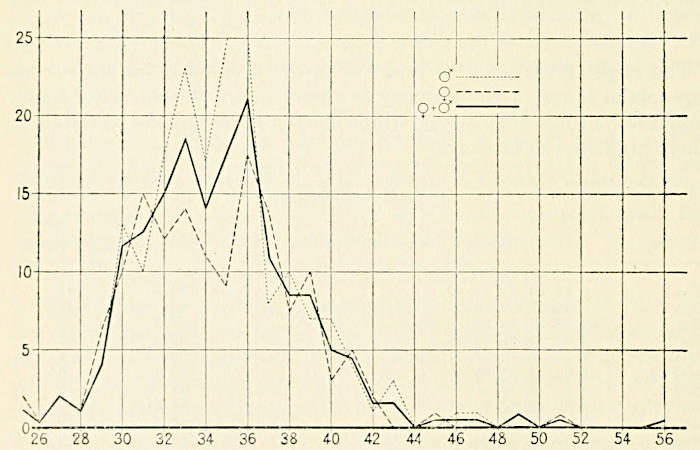
Fig. 50.—Polygon of distribution of offspring of M × M matings (from Appendix table X) for males, females, and sexes combined. Abscissæ: index of build, English system. Ordinates: absolute frequencies for males and females and their half sum for the sexes combined.
Additional evidence is found in other matings, likewise. Thus the M × F mating shows two modes, at 33 and at 36 (fig. 51). There is also one other, possibly significant, mode, namely, at 38, in the fleshy group. Since F parents are sometimes homozygous, mating with M would tend to produce medium-fleshy progeny (i. e., 36). The F parents are, however, frequently heterozygous, containing both slender, medium, fleshy, and even very fleshy gametes; and, accordingly, we should expect somatic segregations at about the points 30, 33, 36, and 38 as centers, just where we find them.
Again, the S × M mating yields (fig. 52) modes at 32 and 35 respectively, a shade lower than those of the M × M or M × F matings; but the male offspring (taken alone) gives modes at 33 and 35. Where the mode is at 33 it is probable that an S and an M gamete have met; and this condition is relatively common just because M gametes are common. The mode at 35 may arise from an F gamete carried in a heterozygous M uniting with an S gamete. The S gamete carried in heterozygous M may be responsible for a probable mode which is hidden in the form of a hump at 28 in figure 52.
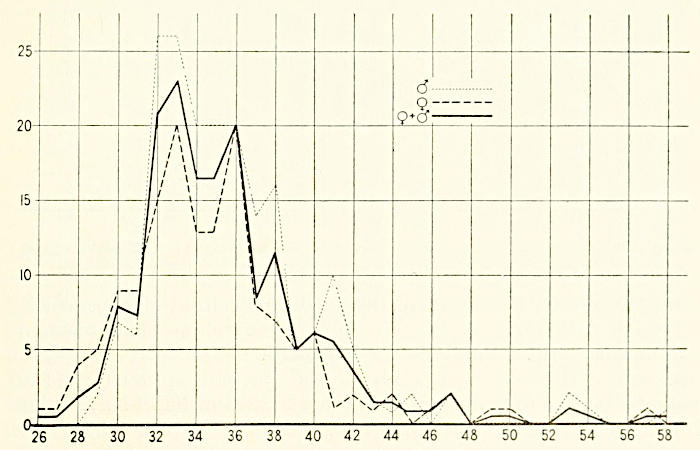
Fig. 51.—Polygon of distribution of offspring of M × F matings (from Appendix table XI), sexes separate and combined. See also legend of fig. 50.
Attention is called to the probable influence of these modes on the two modes shown in figure 7, at 33 and 35 respectively. These two modes are strong evidence for a segregation in the factors for build. Thus the very irregularity of the polygon of figure 7 is evidence of the presence of segregating factors for build. Moreover, these two modes appear at every age from birth to maturity, as is clearly shown in figure 53. This bimodality is easily accounted for on genetical grounds, but is inexplicable upon the bare nutritional hypothesis of build.
On the Number of Factors Involved in Fleshy Build.
It is by no means an easy matter to determine the number of independent factors which are active in the case of a trait that is due to multiple factors. This matter is still less easy if there is only very imperfect dominance approaching intermediacy of the trait in the progeny of the F₁ mating. Yet that is the situation that has to be met in the study of heredity of build.
An attempt has been made in this paper to test the relative probability that there are only two, on the one hand, or three or more independent factors, on the other, involved. We have seen, in each of the various matings, that the result is, on the whole, more closely in accord with the 3-factor hypothesis than that of 2 factors. But this is not to insist that never more than 3 independent factors are involved in build, or never less than 3.
An attempt was made to apply Dr. Sewall Wright’s formula (Castle, 1922, p. 22). Using the data of tables 12, 27, and 31, the value for n (the number of factors) was calculated by the formula
N = D² / 8(σ₂²-σ₁²)
where D is the difference between the means of parental pure races, σ₁ is the standard deviation of F₁ and σ₂ is standard deviation of F₂.
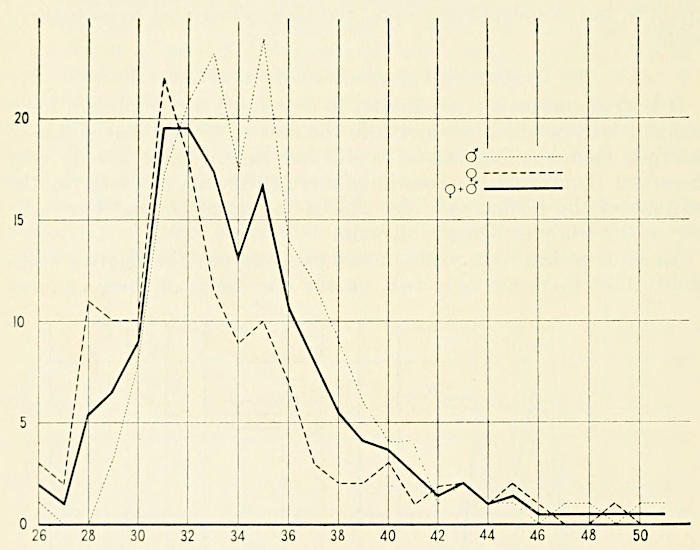
Fig. 52.—Polygon of distribution of frequencies of build of offspring of S × M matings (from Appendix table VII), sexes separate and combined. See also legend to fig. 50.
Substitution for the letters of their values given n = (39.20-28.50)² ÷8[(6.78)²-(5.02)²] = 0.69. We can only conclude that, owing to small numbers, this formula is not applicable here.
Returning, then, to our conclusion that the assumption of at least 3 gametic factors for some, probably most, cases of build accords best with the results of the various matings, we may inquire what is the nature of these factors. It seems probable that two of them may correspond to dystrophies of the pituitary and thyroid glands respectively and the other or others to other regulatory mechanisms of metabolism in the organism. It may well be that one of our factors is the same as that which causes hypothyroidism; another as that which causes hypopituitarism, and the third that which inhibits the normal development of the genitalia, such as we see functioning in dystrophia adiposo-genitalis. This is, indeed, speculation. However, the speculation is an attempt to give a concrete form to the ideas of multiple factors in build.
Fig. 53.—Solid figure (model) giving distribution of relative chest-girth for various ages from birth to 20 years, reading from left to right. The mean index of build at each age is centered on the curve of development of relative chest-girth. The relative chest girth is indicated in percentages passing from the bottom to the top of the figure. The solid figure is illuminated from the upper part of the page.
If we assume three independent factors for build, it does not follow that these are present in all families. Just as it has been demonstrated that in different strains of mice there are in some cases 3, in others only 2 factors for susceptibility to cancer, so, apparently, it is with build. In certain families the distribution of build in the progeny is best accounted for on the hypothesis that, in such families, there are only two gametic factors for build. In other families there appears to be only one gametic factor for build.