Part 3 — LITERATURE CITED.
Reading edition
Armsby, H. P., and J. A. Fries. 1911. The influence of type and of age upon the utilization of feed by cattle. U. S. Dept. Agriculture, Bureau of Animal Industry, Bulletin 128, 245 pp., Oct.
Baldwin, B. T. 1921. The physical growth of children from birth to maturity. Univ. Iowa Studies in Child Welfare, I (No. 1), 411 pp., June.
Bardeen, C. R. 1920. The height-weight index of build in relation to linear and volumetric proportions, etc. Carnegie Inst. Wash. Pub. No. 272.
Barker, L. F. 1922. Endocrinology and Metabolism. 5 vols.
Beck, H. G. 1922. “Dystrophia adiposo-genitalis” in Barker’s Endrocrinology and Metabolism, Vol. I, pp. 860-924.
Barrett, A. M. 1919. Hereditary occurrence of hypothyroidism with dystrophies of the nails and hair. Arch. Neurology and Psychiatry, II, pp. 628-637.
Benedict, F. G., and F. B. Talbot. 1915. The physiology of the new-born infant. Carnegie Inst. Wash. Pub. No. 233, 126 pp.
——, and F. B. Talbot. 1920. Metabolism and growth from birth to puberty. Carnegie Inst. Wash. Pub. No. 302, 213 pp.
Castle, W. E. 1922. Genetic studies of rabbits and rats. Carnegie Inst. Wash. Pub. No. 320, 55 pp., 2 pls.
Chambers, Thomas King. 1850. Corpulence, or excess of fat in the human body. Also published in Lancet, I, 1850, pp. 523, 557, 581, 651, 687, 747 (page 652, table showing some inherited cases).
Crum, F. S. 1915. Anthropometric table: Male and female children from 6 to 48 months old. Newark: Prudential Ins. Co., 2 pp.
Cushing, Harvey. 1912. The pituitary body and its disorders. Philadelphia, 348 pp.
Daffner, F. 1902. Das Wachstum des Menschen: Anthropologische Studien. Leipzig: Englemann, 475 pp.
Davenport, C. B. 1915. The feebly inhibited: Inheritance of temperament. Carnegie Inst. Wash. Pub. No. 236.
——, 1917. Inheritance of stature. Genetics, II, pp. 313-389, July. (Eugenics Record Office Bull. No. 18.)
——, and A. G. Love. 1921. Army anthropology. Medical Dept. U. S. Army in World War, Vol. XV. Statistics, Part I, Gov’t Printing Office, 635 pp.
Godin, P. 1903. Recherches anthropométric sur la croissance des diverses parties du corps. Paris: Maloine, 212 pp.
Grover, J. I. 1915. Some measurements of normal children, especially of the arm and leg. Arch. Pediat., XXXII, pp. 473-486.
Gulick, A. 1922. A study of weight regulation in adult human body during over-nutrition. Amer. Journal of Physiology, LX, 371-395.
Heckel, F. 1920. Grandes et petites obésités; cure radicale. Masson. 537 pp.
Hitchcock, E., H. H. Seeley, and P. C. Phillips. 1900. The anthropometric manual of Amherst College. Amherst, 40 pp.
Hoffman, F. L. 1918. Army anthropometry and medical rejection statistics. Newark (N. J.): Prudential Press, 114 pp.
Howard, ——. 1908. Abnormal development in a girl. Report for Soc. Diseases of Children, VIII, pp. 54-56.
Janney, N. W. 1922. Hypothyroidism, in Barker’s Endocrinology and Metabolism. I, pp. 379-440.
Johnson, Harry. 1906. Liberia. 2 vols. London.
Lyon, I. P. 1910. Adiposis and lipomatosis. Arch. of Inter. Med. 6, 28-120.
Maranon, G., and E. Bonilla. 1920. Histoire clinique et autopsie d’un cas d’obésité mortelle. Rev. neurolog. 27, pp. 909-914.
Martin, R. 1914. Lehrbuch der Anthropologie. xvi + 1181 pp.
Medico-actuarial Mortality Investigations. Vol. I. Compiled and published by the Association of Life Insurance Medical Doctors and the Actuarial Society of America. New York. 1912, 131 pp. (Build of men, p. 38. Build of women, p. 67.)
Meeh, K. 1895. Volummessungen des menschlichen Körpers und siener einzelnen Theile in den verschiedenen Alterstufen. Ztsch. f. Biol. 31, pp. 125-147.
Mies, J. 1889. Über die Masse, den Rauminhalt und die Dichte des Menschen. Virchow’s Arch. f. path. Anat. u. Physiol., 157, 90 pp.
Niceforo, A. 1910. Anthropologie der nichtbesitzenden Klassen. Leipzig: Maas u. Van Suchtelen, 512 pp.
Noorden, Carl von. 1907. “Obesity” in Noorden’s Metabolism and Practical Medicine, edited by W. Hall. Vol. III, pp. 693-715. London: Heinemann.
Price, G. E. 1909. Adiposis dolorosa. Amer. Jour. Med. Sci., 137, pp. 705-715.
Quetelet, A. 1870. Anthropométrie ou mesure des différentes facultés de l’homme. Bruxelles.
Reitz, E. 1904. Das Wachstum der Berliner Schulkinder während den Schuljahre. Arch. f. Anthropol., No. 5.I, pp. 30-42.
Rose, F. 1907. Obésité familiale. L’Encephale, II, pp. 299-303, 1 pl.
Schmid-Monnard, R. 1892. Über den Einfluss des Millitärdienstes der Väter auf die körperliche Entwicklung ihrer Nachkommenschaft. Jahrb. Kinderheilkunde XXXIII, pp. 327-350.
Sinclair, James. 1907. History of Shorthorn Cattle. London: Vinton, 895 pp.
Stratz, C. H. 1922. Der Körper des Kindes und seine Pflege. Stuttgart: Enke., 366 pp.
Town, Clara H. 1922. Analytic study of a group of five- and six-year-old children. Univ. Iowa Studies: Studies in Child Welfare, I (No. 4), 87 pp.
Uhlenhuth, E. 1922. Hormone factors in growth and development, in Barker’s Endrocrinology and Metabolism I, pp. 181-203.
Weissenburg, S. 1911. Das Wachstum des Menschen. Stuttgart: Strecher u. Schröder, 220 pp.
Worthington, L. S. 1875. De l’obésité, étiologie, thérapeutique, et hygiène. Paris: Martinet, 188 pp.
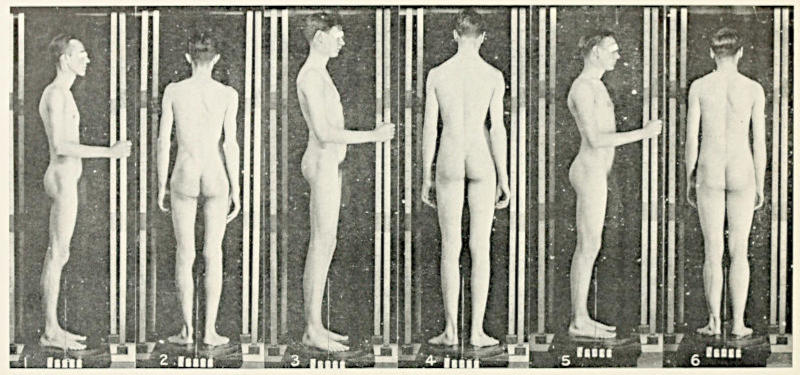
PLATE 1
Figs. 1 and 2. Aspects of a man 19 yr. 2 mo., below average of very slender group, weight 53 kg., stature 1,835 mm., chest-girth in repose 762 mm., relative chest-girth 41.5; build 1.6 (22.5).
Figs. 3 and 4. Aspects of a man 18 yr. 3 mo., of average very slender build, of Scotch stock, weight 60.2 kg., stature 1,907 mm., chest-girth in repose 789 mm., relative chest-girth 41.4; build 1.65 (23.5).
Figs. 5 and 6. Aspects of a man 23 yr. 10 mo., of slender build. Weight 62.7 kg., stature 1,787 mm., chest-girth in repose 847 mm., relative chest-girth 47.4; build 1.98 (28).
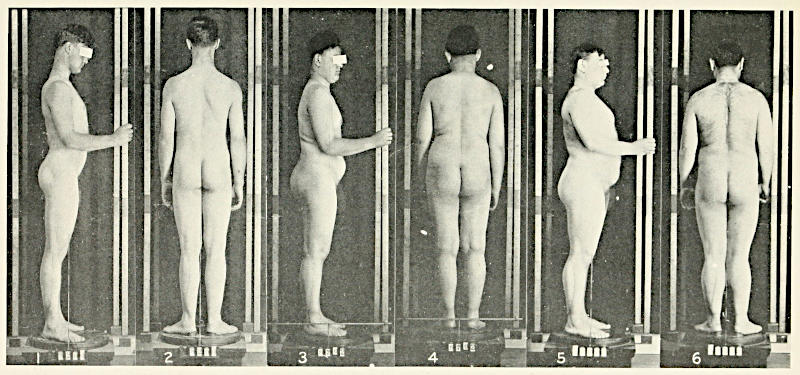
PLATE 2
Figs. 1 and 2. Aspects of an American-born man of 19.6 yr., of medium build. Weight 67.8 kg., stature 1,715 mm., chest-girth in repose 880 mm., relative chest-girth 51.3; build 2.3 (33).
Figs. 3 and 4. Aspects of a man of 17 yr. 9 mo., of fleshy build. Weight 74.3 kg., stature 1,640 mm., chest-girth in repose 920 mm., relative chest-girth 56.1; build 2.7. (39).
Figs. 5 and 6. Aspects of a man 19 yr. 5 mo. 15 dy., of very fleshy build. Weight 90.7 kg., stature 1,617 mm., chest-girth in repose 1,013 mm., relative chest-girth 62.6; build 3.5 (49.5).
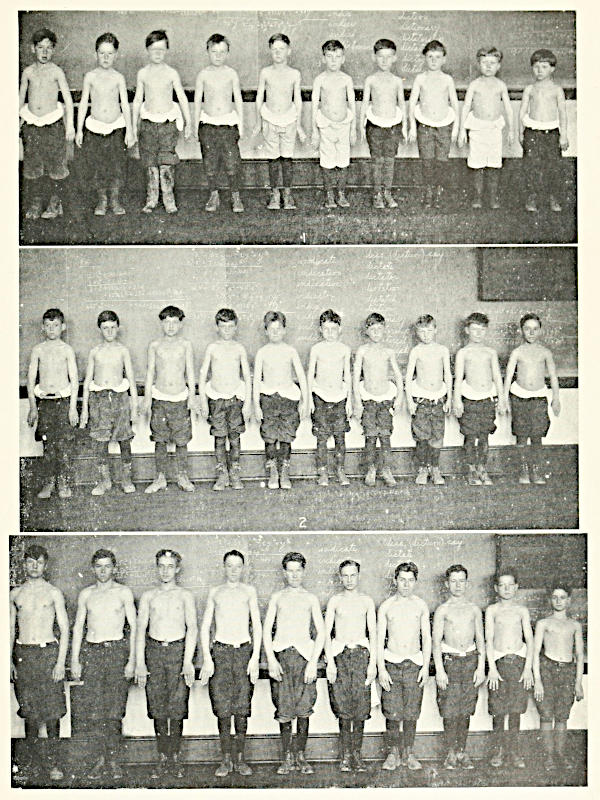
PLATE 3
1. Boys of ages 6 to 7. 2. Boys of 9 to 10. 3. Boys of 15 to 16, of Baltimore schools.
Whereas the distance from umbilicus to vertex increases only slightly in passing from the youngest to the eldest group, the distance of the umbilicus above the floor increases greatly—the increase of stature is mainly increase in length of leg. Again, boys of 9 to 10 years have shoulders (and chests) very little broader than those of 6 to 7 years; but boys of 15 and 16 years (whose relative chest-girth is much above the minimum 12 years) have much broader shoulders and chests than those of 9 to 10 years.
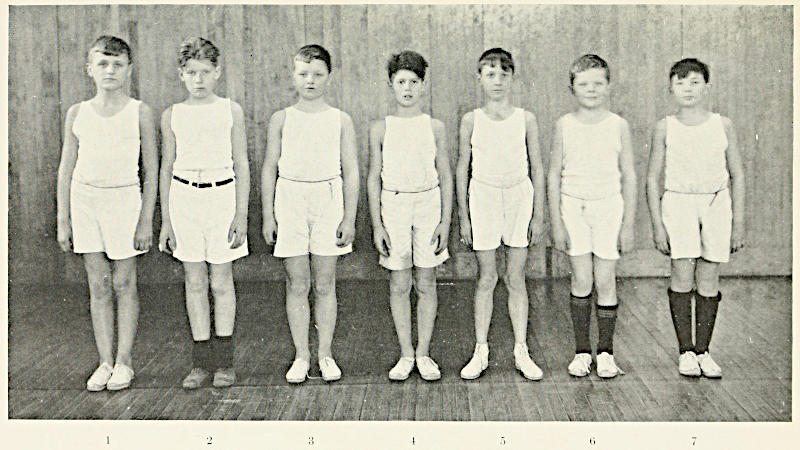
PLATE 4
School boys, Brooklyn, N. Y., illustrating change in proportion with age.
Fig. 1. 9 yr. 11 mo. 6 dy.
Fig. 2. 10 yr. 6 mo.
Fig. 3. 10 yr. 9 mo.
Fig. 4. 9 yr. 1 mo.
Fig. 5. 11 yr. 2 mo. 26 dy.
Fig. 6. 9 yr. 1 mo. 10 dy.
Fig. 7. 10 yr. 8 mo. 7 dy.
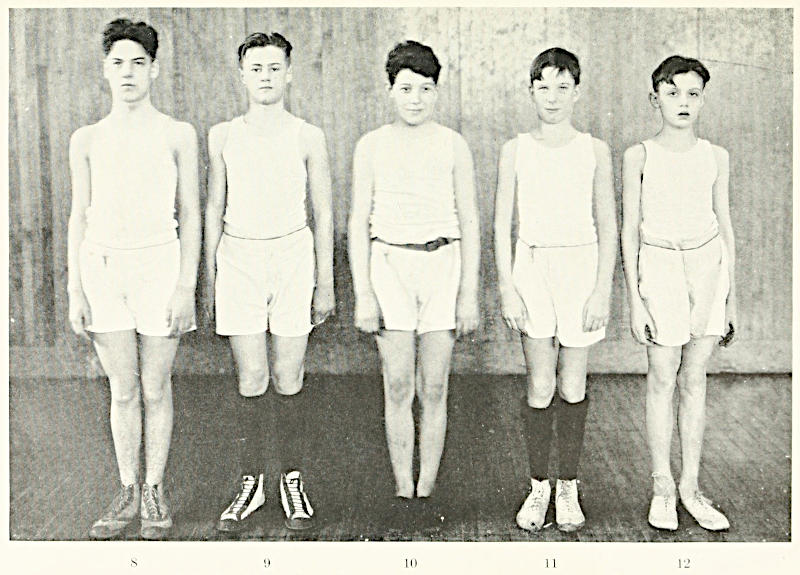
PLATE 5
School boys, Brooklyn, N. Y., illustrating change in proportion with age.
Fig. 8. 13 yr. 6 mo. 13 dy.
Fig. 9. 13 yr. 8 mo. 6 dy.
Fig. 10. 13 yr. 9 mo. 6 dy.
Fig. 11. 13 yr. 7 mo. 15 dy.
Fig. 12. 11 yr. 9 mo. 23 dy.
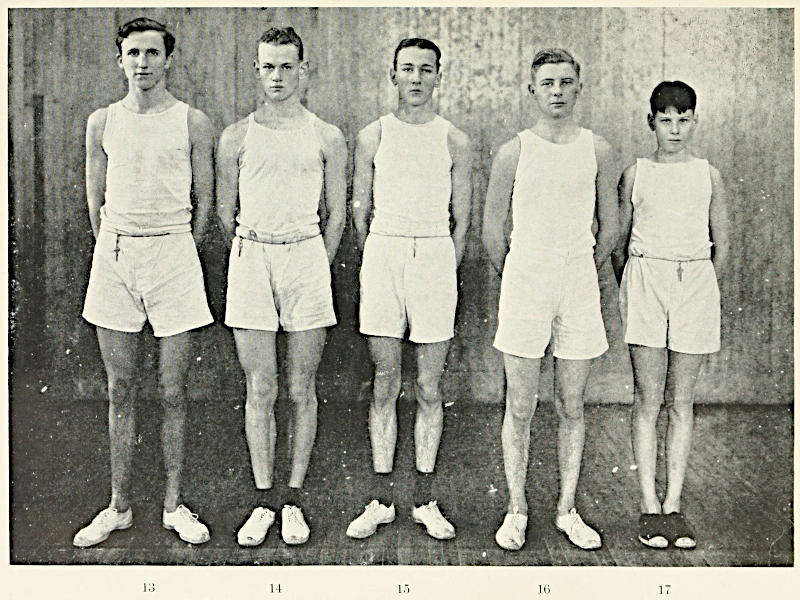
PLATE 6
School boys, Brooklyn, N. Y., illustrating change in proportion with age.
Fig. 13. 16 yr. 3 mo. 22 dy.
Fig. 14. 16 yr. 0 mo. 7 dy.
Fig. 15. 17 yr. 1 mo. 19 dy.
Fig. 16. 17 yr. 9 mo. 16 dy.
Fig. 17. 16 yr. 1 mo. 3 dy.
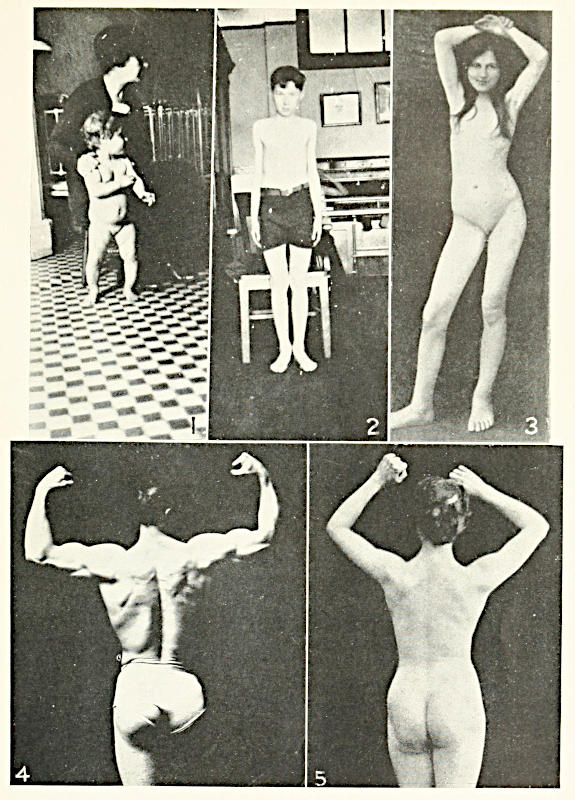
PLATE 7
Fig. 1. Girl 12 months of age, at Sunnyside Day Nursery.
Fig. 2. Boy 13 years old, at a Hebrew home. Compare relative length of leg with figure 1.
Fig. 3. Girl 12 years, the age of maximum relative leg-length—rather exceptional in disproportion between leg and trunk length. From C. H. Stratz, 1922.
Fig. 4. Torso of a mature young man from comparison with that of a young woman (Fig. 5). Note the difference in breadth of shoulders and transverse diameter of chest. Fig. 4 is a French photograph. Fig. 5 is copied from Kossman und Weiss, “Mann und Weib,” I, p. 51.
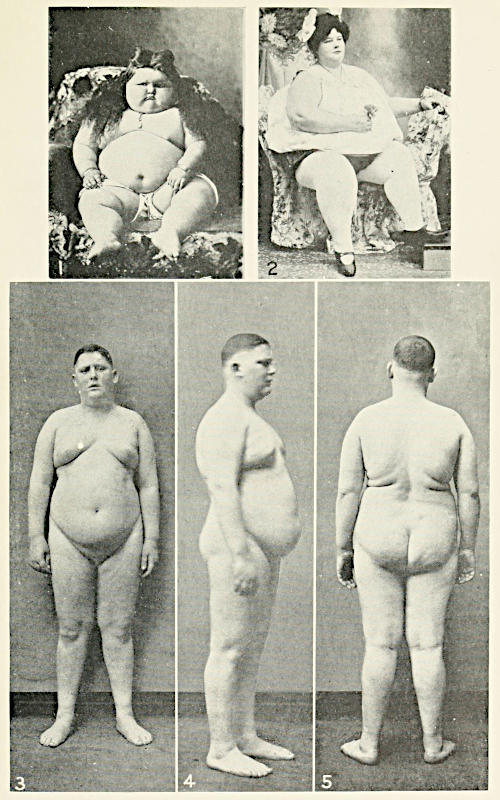
PLATE 8
Figs. 1 and 2. “Miss Allen” at the ages of 4 and 23 years respectively, as evidence of persistence of an early juvenile condition of build.
Figs. 3, 4, 5. Views of a case of obesity of the kind called dystrophia adiposo-genitalis typus feminus, age 16 years. This case is characterized by obesity, knock-knee, large breasts and mons, and rudimentary genitalia (from Ebaugh and Hoskins in Barker: Endocrines and Metabolism I: 881).
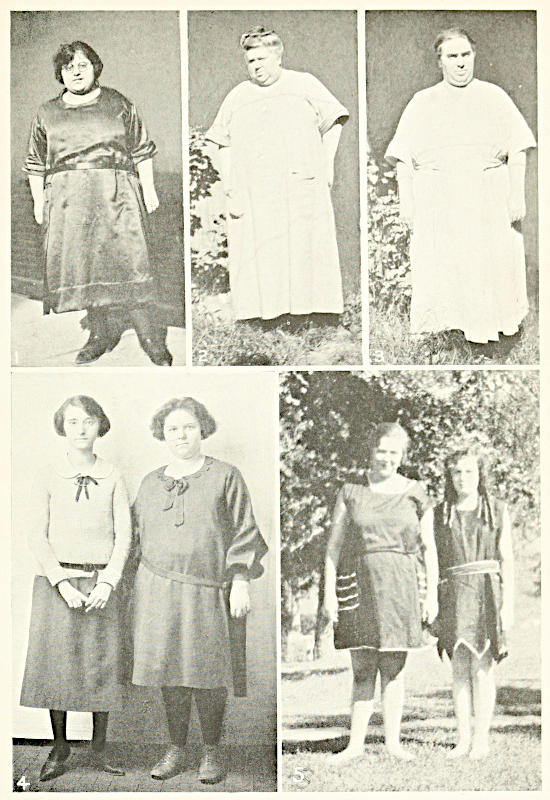
PLATE 9
Fig. 1. Rose O, the individual indicated in fig. 35 at III 15; 15 years of age, stature of 145 cm., weight of 85 kg.; build 4.0 (54), relative chest-girth 0.78, very fleshy.
Fig. 2. III 2 in Rec. family (p. 139); build 4.2 (57); relative chest-girth 0.90.
Fig. 3. Daughter of foregoing; build 3.7 (52).
Fig. 4. G. sisters, of Luray, Va., showing contrast of build in two full sisters of a heterozygous mating.
Fig. 5. The girl at the left is the daughter in the Smi. family pedigree (p. 110). The other is an unrelated friend. This daughter has the formula at 14 years: 79 kg./170 cm.; build 2.7 (3); relative chest-girth, 60, fleshy.