TILDY BINFORD’S ADVERTISEMENT.
Reading edition
By Holland Wright.
The advertising agent had done his worst. He had subsidized the county paper, crowding out valuable editorials to make room for pictures of the yawning hippopotamus and the unconventional summer girl. Every barn within five miles was decorated with big red pictures and big black letters, all telling of the wonders exhibited by the Grand Combination of Railroad Circuses.
Hodges was but an advertising agent—a ruthless purveyor of publicity. Callous to æsthetic emotions, blind to the beauties of nature, his conscience was dead to the vandalism of highway advertising. Having bedaubed the smiling face of nature in the vicinity of Johnsonville, he was ready to advance on Jonesboro.
“Hello!” he said, stepping briskly into Elrod’s livery stable, “have you got a team that can snatch me into Jonesboro in four hours?”
“That’s just what we have,” said old Bill Elrod—“Truthful Bill,” the boys called him.
“Well, I mean exactly what I say,” said Hodges. “Exactly four hours. I know it’s a hard drive, and I’m willing to pay a dollar or two extra if you can do it.”
“That’s all right, stranger,” said Truthful. “You’ve come to the right place. I’ve got a pair of plugs that can put you there to the minute.”
“Well, hitch ’em up,” said Hodges. “I’ve got no time to spare.”
Old Elrod called to a stable boy to harness the grays, while he went out to get old Eli Wetherford to drive. He took Eli off into a corner of the blacksmith shop, to give him his instructions.
“See here, Eli, that lunatic of a bill-poster wants to be took to Jonesboro in four hours.”
“Well,” said Eli, “it’ll take ever’ minute of six hours to make the trip, but if he’s dead set on doin’ it in four, you’d better give him all kinds of encouragement. If he goes over to see Hopkins & Brown, they’ll agree to put him through in twenty minutes.”
“I’ll ’tend to that,” said Truthful. “I want you to drive him. If I send a boy, that feller will hustle him along fast enough to kill my horses, in spite of all I can do. Now I want you to take him and dash away with him like you was goin’ for a doctor. When you git to the first toll-gate, you can be talkin’ so fast he won’t think about the time o’ day no more till he hears the town clock strike in Jonesboro.”
“Jerusalem!” said Eli: “I ain’t no funnygraph, to be talkin’ a man blind for six hours on a stretch.”
“Oh, you’ll make it easy enough,” said Truthful. “I’ll put a pint of good liquor under the seat.”
“Well, now,” said Eli, persuasively, “if you could just make it a quart, so the stranger can take a nip now and then, it would encourage him powerful.”
“All right,” said Elrod. “I’ll put in a full quart of the best in town. And say, Eli, try to make up some yarn about advertisin’. The hotel clerk says this looney ain’t interested in nothin’ else.”
Thus it happened that when they passed the tollgate, old Eli, who is a bachelor, was telling Hodges of an imaginary wife, who kept him poor by reading advertisements and buying patent medicines.
“I do believe,” he said, “my old woman would have a fit any day if she should happen to read a double-column advertisement of a real good fit medicine.”
“What kind of advertisement does she seem to like best?” asked Hodges.
“Well, you see,” said Eli, “they ain’t a blessed thing the matter with her, so she likes advertisements that calls for ever’-day symptoms—You know some advertisements says if it makes you dizzy to stan’ on your head fifteen minutes, and if you feel warm in the summer time and cold in winter, you’ve got the very ailment that their bitters’ll cure. Ever’ time she sees a advertisement of that kind it costs old Eli a dollar,” and the indulgent husband of the extravagant hypochondriac solaced himself with a dose of his own favorite prescription.
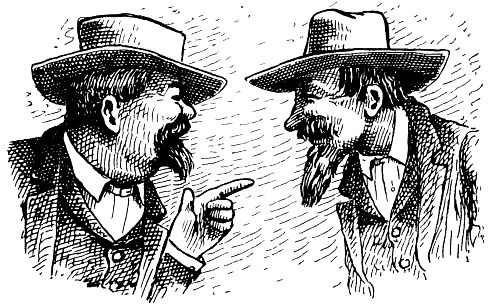
“Try to make up some yarn about advertisin’.”
When they were half way to Jonesboro, they met Hank Binford, and Eli thought it would add some personal interest to a romance he had in mind to make Hank its hero. True, the hero must have a wife and a comfortable fortune, while Hank had neither, but that was immaterial, as the listener was a stranger in a strange land.
“Notice that feller we jest passed? That’s Hank Binford. He’s one of our leadin’ citizens. Owns half the houses in town, and a fine four-hundred-acre farm in the river bottom. Well, sir, when he married, five years ago, he didn’t own two shirts, and he was drunk half of the time. It’s a strange thing, but one little four dollar advertisement changed him into a prosperous citizen, with money in the bank.”
“Must have been a pretty good ad. Tell me about it,” said Hodges, moistening his lips with a half pint of whiskey, and settling down comfortably to listen.
Eli took a long pull at the bottle, and began his story. Even with the bottle of inspiration at his elbow, he could not expect to invent his story quite as fast as he could talk, so he told it with due deliberation and great impressiveness.
“When Tildy Maclin married Hank Binford, her folks all said if she didn’t have no more sense than to tie to such a drinkin’, gamblin’ cuss, she would deserve all she got, and mighty apt to git all she deserved. Tildy said Hank would settle down and do all right, and the other Maclins all predicted, mighty confident, that he’d do all wrong. Well, sir, I never did perfess to be no prophet, so naturally of course I couldn’t foresee in advance just what Tildy would make out of Hank. It appeared to me he might turn out as well as Tildy expected, or full as bad as her folks hoped, and neither way, it needn’t surprise nobody that knows what a powerful sight of human nature there is in a average man.
“Well, Tildy she managed to keep Hank tolerable straight for about a year. He’d go for months without so much as takin’ a dram, and when he did start in for a spree she always managed to git him straight before he could manage to git plum heedless drunk, and it begun to look like she had him safe, and would finally land him in old Rehoboth church.
“But, as I was sayin’, you can’t most always tell for certain just what a man critter is goin’ to do, so I wasn’t overly surprised to hear, one day, that Hank had took advantage of Tildy’s visit to her Wilson County kin, and had filled up with red liquor, and was down to Ike Denman’s grocery playin’ poker with Eb Wetherford and Eli Scoggins and Devil Bill Anderson. That is to say, Hank thought he was playin’, though in reality he was only bein’ played; him bein’ plum drunk and the other boys tolerable sober. One or two of Hank’s friends had dropped in, kinder incidentally, and tried to steer him outside, but of course they didn’t have no luck. ’Long about sundown, next day, I saw Tildy drive up to her gate and ’light, and in about a pair of minutes Miss Sallie Kate Slemmons followed her in, lookin’ powerful pleased, and I didn’t feel no sort of uneasiness but what Tildy would hear the news.
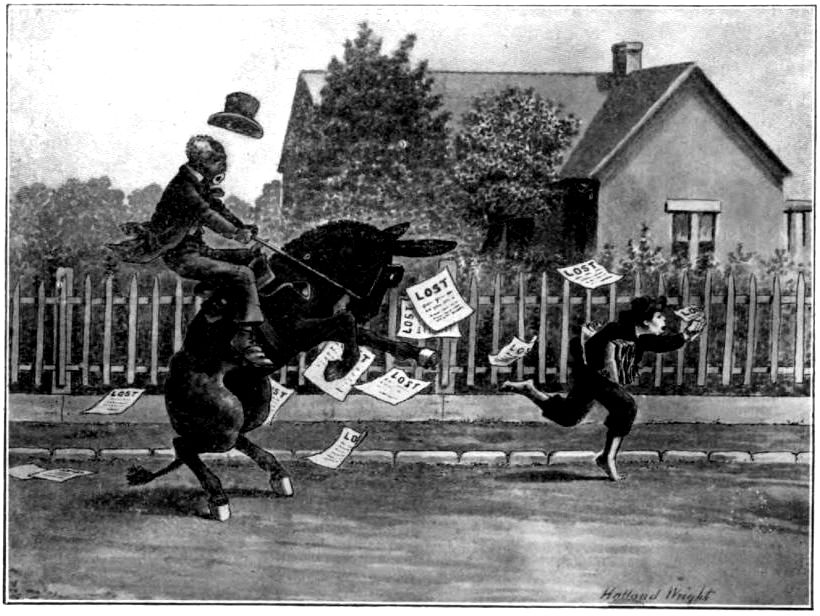
Bill just went sailin’ down the road with a armful of ’em, a-strowin’ ’em to the wind.
“Well, early Saturday mornin’ I happened to be goin’ right by the grocery, and I thought I’d jest step in and pass the time o’ day with Ike, seein’ as I wasn’t in no particular rush. I found Ike all alone by hisself, and he invited me to have somethin’, and I excused myself at first, as men will, and after a while I inquired if the game was still on, and what was the prospects for Hank to lose out, and go home and see Tildy, and hear all about his Wilson County kin folks. Ike said he hadn’t kept the run of the game and didn’t know how Hank stood, but he seemed to imagine that Hank wasn’t in no swivet to swap news with Tildy.
“Ike said Bunk Wetherford had come in early Friday night and took Eb home, and for a while it looked like the game was broke up; but Eli had bantered one of the Edwards boys to take Eb’s place, and he went up and took a hand, and the game broke out in a fresh place, and at last accounts, looked like it might last till all the spots was wore off the cards. I told Ike I’d go up and advise Hank that Tildy had come home.
“‘All right,’ says he, ‘walk right up. I don’t git no takeout from the game, and I’m more’n willin’ to see it broke up any time. I don’t like to interfere myself, jest because it would look like the boys wasn’t welcome here, so I jest lets ’em do mostly as they like, so long as they pays for what they gits, and don’t break nothin’.’
“So I went up and looked on a while, and tried to ketch Hank’s eye, but I could see ’twas no use. He was feelin’ his licker, and talkin’ powerful smart, and losin’ good hard-earned money just as cheerful as if money growed on trees and he owned all the timber land. After a while Denman come up to the head of the stairs, a-grinnin’ all over his face, and motioned me to come to the door. I went over and he handed me a printed poster, about two foot square, and containin’ the followin’ advertisement in big, black type:
‘LOST, STRAYED OR STOLEN:
ONE YOUNG MAN!
About 28 years old, 5 ft. 10 in. High, Weighs about 140 lbs., Tow Headed, Sandy Complected, Weak-eyed, and When Sober answers to the name of
HANK BINFORD!
$4 reward will be paid for his return in good order, Securely Tied.
Signed: Tildy Binford.’
“‘Gee Whilikins!’ says I; ‘where did you find it?’
“‘Didn’t find it,’ says he. ‘Jest picked it up. Old man Weekly Clarion Johnson’s little boy, Bill, jest went sailin’ down the road with a armful of ’em, a-strowin’ ’em to the wind. The whole settlement’s full of ’em. They’re all over the floor downstairs, and all over the road, fur as you can see in both directions.’
“The boys at the table was so set on the game that they didn’t take no notice of me and Ike, till I steps over, while Hank was tryin’ to shuffle the cards, and lays the paper down right plum in the middle of the table.
“‘Take the blame thing away,’ says Hank, without readin’ a word.
“‘Read it,’ says I.
“‘Read nothin!’ says he. ‘This is no literary society. Take the blasted thing out of the way so I can deal the kyards.’
“‘I see your name on it,’ says I, ‘and I thought it might interest you.’
“Hank laid down the cards and glanced over the paper. * * First he looked kinder dazed. Then he picked the thing up and looked at it a long time. His face got mighty white, and I thought he was goin’ to faint, but he didn’t. He looked around at the boys; all of ’em a-grinnin’ and lookin’ tickled to death. I begins to have my suspicions about the meanin’ of that white look on his face, and I steps back and takes a stand nigh the door. It was mighty plain to me that Hank had misery to spare, and he meant to pass it around promiscuous. He come up with his chair, and before them grinnin’ idiots had time to back off from the table and climb out of their chairs, Hank had raised a knot on every head, and started ’round the circuit to repeat the dose. They closed in on him and mauled him and gouged him till you couldn’t tell who he was, only by the familiar cut of his clothes and the complexion of his hair and moustache. The only way we could know for certain it was Hank, was by takin’ a sort of inventory of them that could be identified. As none of the whole men was Hank, it stood to reason that this remnant must be him. It was also observed that the critter had a voice some like Hank’s, and used his favorite cuss words quite familiar like.
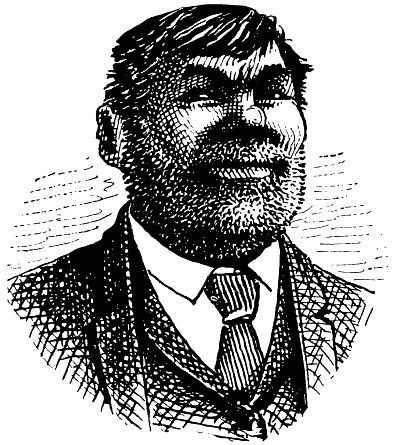
There ain’t nobody in the settlement that will go out of his way to have a difficulty with Ike.
“Now, endurin’ of the row, Devil Bill Anderson had received a tremenjous big lump on his head, which he could not recall that he had done any overt act or said any word to justify any human man to hit him that vengeful lick, and he was by no means satisfied. The more he thought over the details and narrated the circumstances, the more rebellious he felt and the louder he talked; insomuch that it finally became necessary for Denman to assert hisself and preserve order in his own grocery; which he finally said, quite emphatic, that if anybody wanted to hurt anybody, they might try their hand on Ike Denman. Now there ain’t nobody in the settlement that will go out of the way to have a difficulty with Ike; so Devil Bill kinder cooled off, the best way he could, and everything got quiet, and Denman poured a big sluice of raw whiskey into Hank, and put him to sleep under the big tree at the back of the grocery.
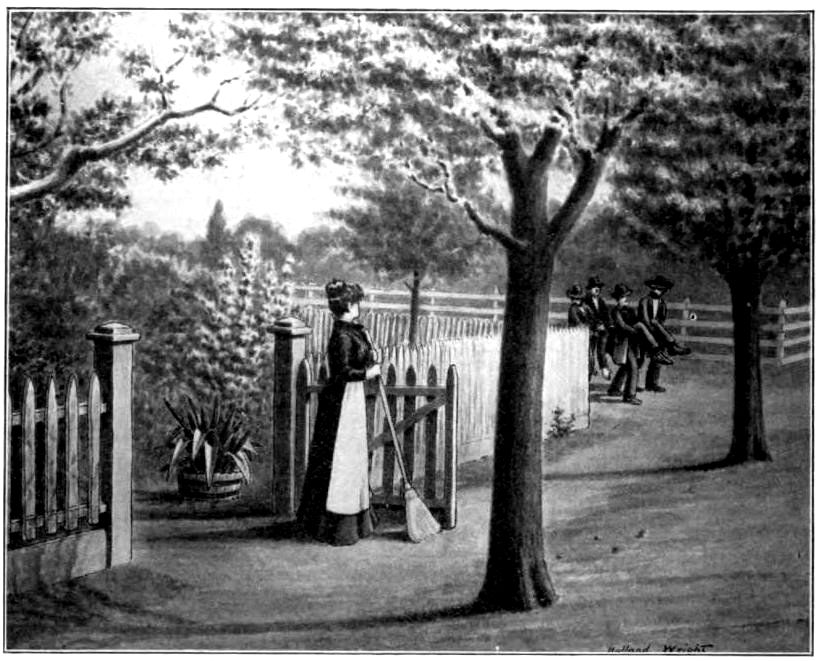
Tildy came out to the gate, looking a little pale, but holding her head up.
“I went to dinner, and when I got back Bud Runnels had just come up and was readin’ Tildy’s advertisement. Bud always did love to joke, and this one seemed to tickle him all over. After inquirin’ all about the particulars, he asked where Hank was at.
“‘He’s back there under the big ellum,’ says Denman, ‘sleepin’ sound as a baby.’
“‘What about the four dollars reward?’ says Bud.
“‘Why, I guess that’s jest a part of the joke,’ says Ike.
“‘Well, I don’t see it that away,’ says Bud. ‘The lady has lost her husband, and she wants him found and fetched home. Now, I’m goin’ to take him home, and if she don’t want him, I can easy fetch him back.’
“Ike grinned, and looked ‘round at the boys, and they grinned.
“‘I don’t hear no objection,’ says Ike. ‘You’ll find him back there under the tree.’
“‘Well,’ says Bud, ‘I can easy load him into my wagon and haul him home and unload him in his own yard, but it might be better for you boys that beat him up to jest take holt and come along with me; all a-totin’ of him home in a friendly way. Then if Tildy wants to know how come his face all broke up, you can jest show her the knots on your own heads and it’ll sorter help to explain matters.’
“Nobody didn’t answer right away, and before anybody could think of any objection, Bud added in his insinuatin’ way: ‘It might save trouble to keep Tildy pacified, so she’ll explain to Hank that he was to blame for all that’s been done to him. Now, ever’ body come on and take holt, and I’ll set ’em up to the crowd soon’s we get back.’
“Bud always seems to state a proposition so fair an’ reasonable that you jest can’t turn him down, so the boys jest got up without wastin’ any words, and followed him around to where Hank was. They gathered him up, one at each corner, and Bud holdin’ up his head. They ketched the step, ‘hayfoot-strawfoot,’ and marched up to Hank’s front gate.
“Tildy was sweepin’ off the front porch, and when she saw the crowd she come out to the gate, lookin’ a little pale, but holdin’ her head up, and a stiff upper lip.
“‘What is it?’ says she.
“‘It’s Hank,’ says Bud.
“‘Is he hurt?’ says she.
“‘Oh, no,’ says Bud. ‘That is to say, they ain’t any bones broke. He’s been a-fightin’ ‘round promiscuous, but he’s got no hurts to call for anybody to fetch him home. Fact is I saw a advertisement offerin’ a reward for Hank, and I just discovered him, and rescued him, and fetched him home.’
“‘Didn’t the advertisement say to return him in good order?’ says Tildy.
“‘I b’leeve it did,’ says Bud, ‘but I couldn’t p’form no miracle for four dollars, so I jest fetched him as I found him.’
“‘And didn’t it say bring him securely tied?’ says Tildy.
“Bud was set back considerable at that. ‘That’s a fact,’ says he, ‘and I jest plum overlooked it. It didn’t appear to me to be of no consequence, nohow.’
“‘Well, it’s mighty important to me,’ says Tildy. ‘If he wakes up in a tantrum, and untied, he might be troublesome.’
“‘That’s so,’ says Devil Bill, thinking of the lump on his own head.
“‘So it is,’ says Eli Scoggins, solemnly.
“‘I believe you,’ says Buck Edwards.
“‘Well,’ says Bud Runnels, ‘it ain’t none too late to tie him, but if I was you, Mizzes Binford, I b’leeve I’d jest sew him up, good and snug, in cotton baggin’ or heavy canvas or somethin’ good and stout like that, and leave nothin’ stickin’ out but jest his head.’
“‘Oh,’ says she, ‘I’ve got the very thing!’ and she went ‘round to the shed, and come back with the stoutest, heaviest, widest piece of cotton duckin’ that I ever see.
“‘I bought it at the auction,’ says she, ‘because it was cheap, and Hank said I never would have no use for it but you see he was mistaken.’
“Well, we sewed him up good and tight, and put him on the bed in the spare room and cut a big peachtree limb for Tildy to keep the flies off of him, and she paid Bud the four dollars.
“When Hank waked up, Sunday mornin’, he could hear Tildy fryin’ meat in the kitchen, and he knowed she was cookin’ breakfast. He didn’t seem to want any breakfast, but he thought a cup of strong coffee might be good for his head. He tried to git up, but the sheet seemed to be rolled ‘round him so he couldn’t rise. Then he tried to roll over, so he could git untangled, but he couldn’t even turn over. Then he got mad, and tried to bust the sheet, but he strained at it till he was black in the face, and couldn’t break a stitch. Then he called Tildy. She come in and walked ’round in front of him.
“‘Tildy,’ says he, ‘what’s the matter with this sheet?’
“‘I don’t see nothin’ wrong with it,’ says she.
“‘Well, then,’ says Hank, ‘what in the nation is the matter with me?’
“‘Oh!’ says Tildy; ‘that’s different. If I undertake to stan’ here and tell all that’s wrong with you, my breakfast’ll be burnt to a cinder before I’m half through.’ And with that, she turned ‘round and marched away to the kitchen.
“Well, of course Hank was fightin’ mad, but he wasn’t in no shape to do nothin’ but jest lay still and think, and not in no great shape for thinkin’, so he jest went to sleep again.
“Next time he opened his eyes, Tildy was standin’ over him with a dish of meat and bread, and a cup of hot coffee.
“‘Good mornin’,’ says she, mighty polite. ‘Would you like to have some breakfast?’
“Hank grinned, kinder sheepish, and she propped up his head, and begun to feed him with a spoon. When he tried to speak, she would pour a spoonful of coffee in his mouth, right quick, and he’d have to stop to swaller, and time he’d git that down, she’d have another one ready for him. He was tryin’ to talk all the time, but she didn’t give him a chance to say a word. Finally, she got so tickled, seein’ him swaller so fast, that she spilt a lot of hot coffee down his neck.
“‘Jerusalem!’ he yelled. ‘Woman, do you want to scald me to death?’ And with that he begun to cuss, and bluster about what he would do when he got loose. Tildy set the dishes on the table without sayin’ a word. Then she went to the front door, and called to little Johnnie Martin, in the next yard.
“‘Johnnie,’ she says, ‘is Brother Collins at home?’
“‘Yessum,’ says Johnnie.
“‘All right,’ says Tildy, and she went in and put on her bonnet and started out the front door.
“‘Where you goin’, Tildy?’ Hank asked.
“‘I’m goin’ after Brother Collins.’
“‘What for?’
“‘I want him to talk to you.’
“‘Me?’ says Hank. ‘I don’t want to talk to no preacher!’
“‘I don’t want you to talk to him,’ says Tildy. ‘I want him to talk to you,’ and she walked out the door. When Hank heard her slam the gate behind her, he hollered like the house was afire.
“‘Oh, Tildy!’ She come back to the door and looked in.
“‘Why, Tildy,’ says Hank, pitiful as a baby, ‘you don’t aim to make me the laughin’-stock of the settlement, do you?’
“‘I don’t see why you need to bother about that,’ says Tildy. ‘If it’s no disgrace to git drunk, and gamble, and fight, in a corner grocery, it’s no disgrace to talk to a minister of the gospel.’ She started out again, but Hank called her back.
“‘Hold on, Tildy; I’ll agree to anything you say, if you won’t call in the preacher.’
“‘What you goin’ to do about them circulars I got printed?’ she asked.
“‘Why, I’m goin’ down there and maul the life out of old Goatwhiskers for printin’ them things,’ says Hank. Tildy started out again, and he yelled after her to come back. Promised he wouldn’t say a word to him.
“‘What are you goin’ to say to the boys you had the fight with?’
“‘Fight!’ says Hank. ‘It wasn’t no fight. The whole crowd lit into me and mauled me most to death, and I hadn’t said a word.’
“‘I understand you knocked ’em all down with a cheer, if that’s any satisfaction to you,’ says Tildy.
“‘All right, then,’ says Hank, ‘I’m willin’ to call it square, if they are.’
“‘Not goin’ to say a word to nobody about nothin’?’ she asked.
“‘Not a word,’ says he.
“‘Not goin’ to drink any more?’
“‘Not a drop, Tildy. Now, come on and cut this devilish thing off. I feel like I’ll die if it stays on me another minute.’ Tildy couldn’t think of nothin’ more he could promise, so finally she cut the bastin’ threads and let him loose. Well, sir, he didn’t say a word out of the way to them boys that beat ’em up, and he wouldn’t even take a few drinks to taper off, and it’s my opinion,” said old Eli, solemnly, “that he wouldn’t drink a drop of liquor, right now, if he was bit by a snake.”
They were driving into Jonesboro when the old man finished his story, and the big town clock struck four.
“Great guns!” cried Hodges in amazement, “it’s four o’clock!”
“Egzackly,” said Eli, with an air of innocent triumph. “I’ve drove over this road so often, I can time the trip to a minute. You said you wanted to be here egzackly at four o’clock—”
“Four devils!” Hodges yelled. “I said four hours! I’m two hours late. I’ll have to stay in this jay town a whole day!”
“My, my!” exclaimed old Eli. “Somebody’s made a terrible mistake. I do hope I wasn’t in no way to blame for it. Now, if you’d just mentioned that you was behind time, I could easy have put them grays through two hours earlier.”
“Oh, it’s my fault, I guess,” said Hodges, when his wrath had subsided. “I told old Elrod, but I ought to have told you, too. Then I rode along for four mortal hours sucking that bottle of foolkiller, and didn’t have sense enough to look at my watch once. Well, well! I’ll just charge it up to Hodges, and see it don’t happen again.”
Though Eli was not to blame, he was inconsolable, till Hodges gave him a dollar at parting. Tears of gratitude stood in the old man’s eyes.
“Good-bye, Stranger,” he said. “I do hope old man Elrod won’t find out about you bein’ late. He’d be powerful pestered to know you’d been disappointed. Good-bye.” And as he drove away, he muttered to himself: “Darn the feller! I think he might have offered to fill my bottle.”
The modern lecturer is the alarm clock of civilization wound up to go off with a whiz and a bang at any hour in the evening, according to the whims of his audience. A Northern audience wants to be aroused at 8 P.M. sharp, a Southern audience anywhere between 8.30 P.M. and daylight, A.M. But some time in the night he is sure to wake the natives, for he is a traveling gesture tied to a bell clapper and
When his hands begin to swing
And his bell begins to ring
His waking listeners laugh and weep
And then, alas! go back to sleep.
But still he screams and fights the air
And stamps his foot and pulls his hair
And growls and roars upon the stage
Like some fierce lion in a rage,
Until at last his clock runs down
And he winds it up for another town.
Selah!
—Robert L. Taylor.
54