THE FIDDLE AND THE BOW.
Reading edition
By Robert L. Taylor.
We dream of a heaven beyond the stars, but there are heavens all around us with beautiful gates ajar to those who have eyes to see and ears to hear. I have seen heavens of delight where the meadows flashed with dew and the crows were on the wing. I have seen heavens of music where the linnet swept her lute and the thrush rang his silver bells in the dusky chambers of the forest.
I once sat on the grassy brink of a southern stream in the gathering twilight of evening and listened to a concert of Nature’s musicians who sang as God hath taught them to sing. The katydid led off with a trombone solo; the cricket chimed in with his E flat cornet; the bumble-bee played on his violincello, and the jaybird laughed with his piccolo. The music rose to grandeur with the deep bass horn of the big black beetle; the mocking-bird’s flute brought me to tears of rapture, and the screech-owl’s fife made me want to fight; the tree-frog blew his alto horn; the jar-fly clashed his tinkling cymbals; the woodpecker rattled his kettledrum and the locust jingled his tambourine. The music rolled along like a sparkling river in sweet accompaniment with the oriole’s leading violin; but it suddenly hushed when I heard a ripple of laughter among the hollyhocks before the door of a happy country home. I saw a youth standing there in the shadows holding his sweetheart’s hand in his. There were a few whispers, tender and low—the lassie vanished in the cottage—the lad vanished over the hill, and as he vanished he swung his hat in the shadows and sang back to her his happy love song:
“My thoughts will fly to thee, my own,
Swift as a dove,
To cheer thee when alone,
My own true love.”
And the birds inclined their heads to listen to his song as it died away on the drowsy evening air.
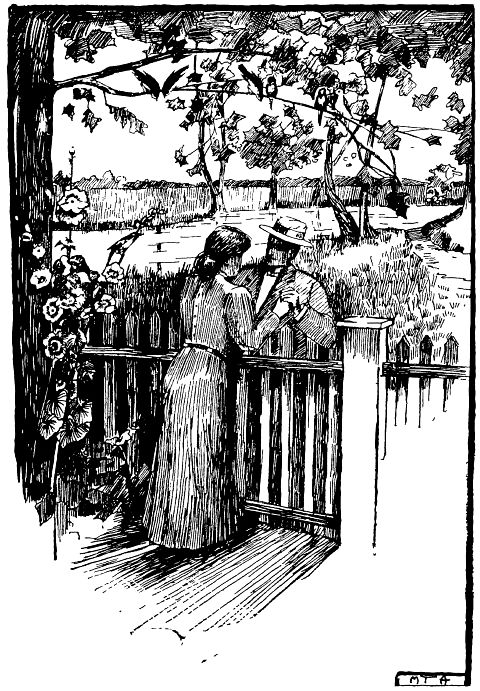
I saw a youth holding his sweetheart’s hand.
That night I slept in a mansion
“I closed my eyes on garnished rooms
To dream of meadows and clover blooms,”
but while I dreamed, I was serenaded by a band of mosquitoes and this is the song they sang above my pillow:
“Buz-z-z! buz-z-z! no bars around this bed,
Buz-z-z! buz-z-z! no hair upon this head, mosquitoes,
Buz-z-z! buz-z-z! we’ll paint old baldy red,
There’ll be a hot time in the old town to-night!”
There are heavens all around us with beautiful gates ajar. I have seen a June morning unbar a gate of roses and come forth from her palace in the sky bearing in her girdle of light the keys to a thousand heavens. I have seen her kindle a sun in every dewdrop and touch the waking hills with glory. I caught the odor of honeysuckles and the note of a lark as it rose exultant from the meadow. There were the glimmer of painted wings among the clover blossoms and the hum of teeming bees rich with the spoils of plundered beauty. There were the green trail of a winding river and the low music of its joyous waters dashing among the rocks of distant rapids. I heard the shouts and splashes of noisy boys down at the old swimming hole under the spreading elms. An old time darky went shambling by, with his cup of bait and his fishing pole. The wine of June was in his veins and he tangled his song with the honey song of the bees:
“O, my Hannah, lady,
I do a-love-a you!
They ain’t no baby
So good and true!
In Louisiana I could die,
If you wuz only nigh!
O, tell me, Hannah, lady,
Whose black-a-baby is a-you?”
And he cut the pigeon wing in the clover and then sat down on a bumble-bee. It invited him to rise, and he rose; and it was difficult for the old man to tell which was the warmer—the June in his heart or the June in the bumble-bee.
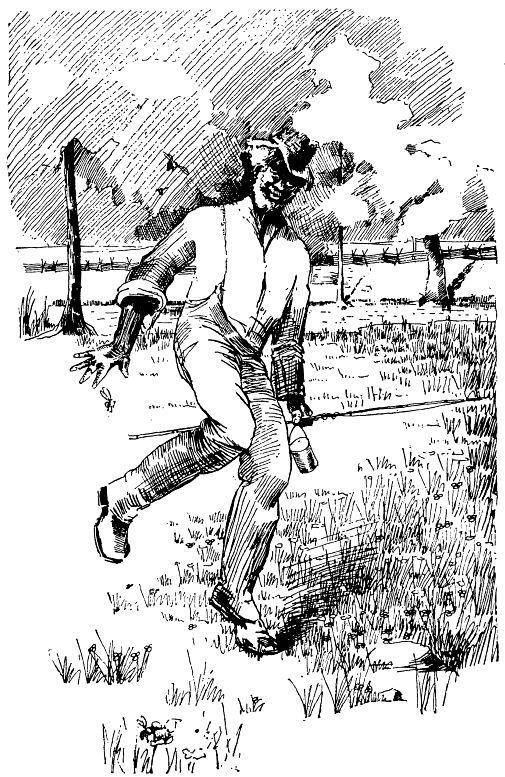
He cut the pigeon wing in the clover.
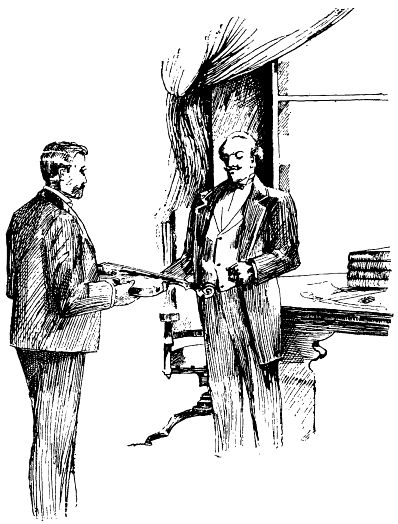
The convict’s plea for pardon.
A lovesick lad met his sweetheart down in the shady lane and poured out his soul to her under the locust bloom. I saw him push his boat from the shore and dip his oars in the clear heaven of the crystal waters. She was his only companion. And as the painted keel darted away like a bird beneath the bending boughs and went skimming round the bend of the river I heard their voices blending up among the cliffs and shadows singing a sweet love song. To him, she was a full blow’n rose of beauty; to her, he was a daisy. To him her ribbons were streaks of light; to her his fuzzy upper lip was a poem. They floated and fished and fished and floated away the golden hours; and while they fished and floated, he wooed her—he wooed and he wooed and he wooed—until, at length, he won her; and, as they floated homeward in the evening, dreaming of wedding bells and orange blossoms,
He held her soft little hand in his,
Smoothing her hair so brown;
The boat struck a rock and they both fell in,
Just as the sun went down!
I looked upon these scenes of light and love and I walked in the heaven of the beautiful, the somnambulist of a rapturous dream.
O, matchless dream maker, voluptuous June! Enchantress of the sun, Eden builder of the world! There is a magic in thy touch which melts the icicles in the veins of age and makes the tropic blood of youth run roses.
There are heavens all around us with beautiful gates ajar: I have seen October open a gate of opal and I walked in the heaven of autumnal glory. I have seen her splash the forest with the tints of a thousand shattered rainbows, and then draw the misty veil of Indian summer—that mysterious phantom of the air that conjures the sunlight into yellow amber and turns the world into a dream.
I joined the farmers in the jubilee of the county fair, and walked through streets of pumpkins, purple avenues of turnips, and fragrant boulevards of onions, enough to bring the world to tears.
There was the sound of the hunter’s horn at the break of day. I mounted my gallant steed and galloped away to the rendezvous, and every breath of the cool, crisp October air was like a draught of exhilarating wine. The hunters assembled at the appointed place, the eager hounds were unleashed and they scurried away like ghosts in the gloomy woods. They coursed and circled like flying shadows—now and then giving tongue as they took up the scent of some cold and doubtful trail. Faster and faster they circled, until they jumped the fox from his covert and opened in full cry, and it was like a sudden burst of music from a band. Away they bounded, bellowing their deep-mouthed serenade to the wily knight of the red plume, who showed them a clean pair of heels. They pushed him up the rocky steeps and pressed him down the dusky hollows, they swung him through the highland gaps and whirled him round the ridges. Over the hills and round the knob Sir Reynard led the band until the waking echoes caught up the flying melody and sent it pulsing from cliff to cliff and from crag to crag! On fled the fox with tireless leap! on followed the hounds with smoking mouths! On and on, over hill and dale, through forest and field until finally the music died away like the chime of distant bells!
How sweet are the lips of morning that kiss the waking world; how sweet is the bosom of night that pillows the world to rest; but sweeter than the lips of morning and sweeter than the bosom of night is the voice of music that wakes a world of joys and soothes a world of sorrows. It is like some unseen ethereal ocean whose silver surf forever breaks in song. All nature is full of music. There is a melody in every sunbeam, a sunbeam in every melody. There is a love song in every flower, a sonnet in every gurgling fountain, a hymn in every rolling billow. Music is the twin angel of light, the first born of heaven, and mortal ear and mortal eye have caught only the echo and the shadow of their celestial glories.
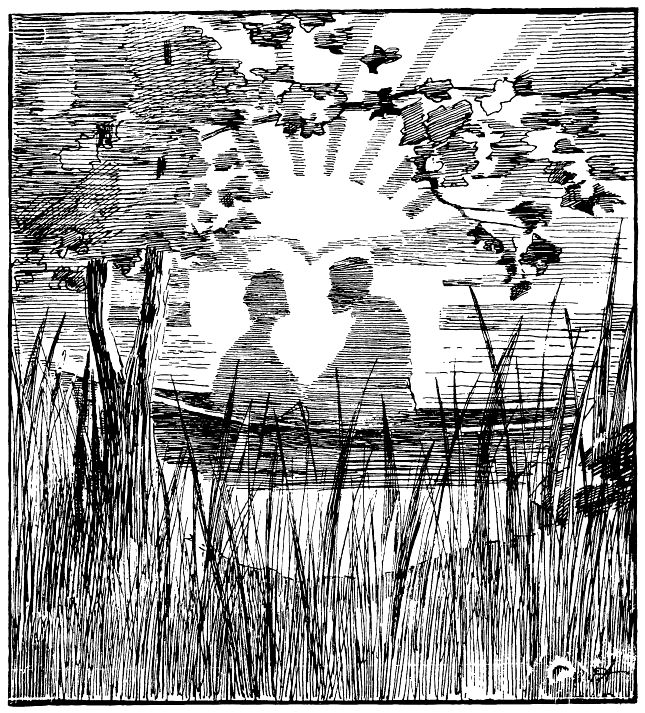
He wooed and he wooed and he wooed.
The violin is the poet laureate of music—violin of the virtuoso and master, fiddle of the untutored in the ideal art. It is the aristocrat of the palace and the hall; it is the democrat of the unpretentious home and humble cabin. As violin, it weaves its garlands of roses and camellias; as fiddle it scatters its modest violets. It is admired by the cultured for its magnificent powers and wonderful creations. It is loved by the millions for its simple melodies.
One bright morning just before Christmas Day, an official stood in the executive chamber in my presence as governor of Tennessee, and said:
“Governor, I have been implored by a poor, miserable wretch in the penitentiary to bring you this rude fiddle. It was made by his own hands with a penknife during the hours allotted to him for rest. It is entirely without value, as you can see, but it is his petition to you for mercy. He begged me to say that he has neither influential friends nor attorneys to plead for him; and all that he asks is that, when the governor shall sit at his own happy fireside on Christmas eve with his own happy children around him, he will play one tune to them on this rough fiddle and think of a cabin far away in the mountains whose hearthstone is cold and desolate and surrounded by a family of poor little helpless ragged children, crying for bread and waiting and listening for the footsteps of their father.”
Who would not have been touched by such an appeal? The record was examined. Christmas eve came. The governor sat that night at his own happy fireside, with his own happy children around him and he played one tune to them on that rough fiddle. The fireside of the cabin in the mountains was bright and warm. A pardoned prisoner sat with his baby on his knee, surrounded by his happy children and in the presence of his rejoicing wife. And, although there was naught but rags and squalid poverty around him his heart sang,
“Be it ever so humble,
There’s no place like home.”
When I used to play the role of governor of the old Volunteer State, I often felt the stings of criticism for the liberal use of the pardoning power. But I saw old mothers with their white locks and wrinkled brows swoon at the governor’s feet every day. I saw old fathers with broken hearts and tear-stained faces and heard them plead by the hour for their wayward boys. I saw a wife and seven children clad in tatters and rags and barefooted in midwinter fall down upon their knees around him who held the pardoning power. I saw a little girl climb upon the governor’s knee and put her little arms around his neck and I heard her ask him if he had little girls; and then I saw her sob upon his bosom as though her little heart would break and heard her plead for mercy for her poor, miserable, wretched convict father. I saw want and woe and agony and anguish unutterable pass before the gubernatorial door. And I said: “Let this heartless world condemn! let the critics frown and rail, but he who hath power and doth not temper justice with mercy will cry in vain himself for mercy on that great day when God shall judge the merciful and the unmerciful!”
107