THE ISLES OF SCILLY.
Reading edition
By James Henry Stevenson.
Do not visit The Scillies. Go to Penzance—a charming spot that has not received the attention from the tourist that it deserves—and see the hopeful passengers take ship in the morning for the “blessed isles;” inspect them again on their return in the evening; if you are still curious go to Land’s End—a drive of eight or ten miles—and look across the sea that lies between you and The Scillies; buy a guide book and a few pictures when you come home, and bless your stars that you did not tempt the deep.
This is the advice which I vowed I would give, when, one day last summer, for three awful hours I “hove” with the heaving deep. I am not usually a poor sailor. Indeed I have generally crossed the Atlantic without making my offering to the gods of the Abyss. Anything in reason I am prepared to do, but the demands of the little steamer that plies between the Islands and Penzance are altogether unreasonable.
It was a beautiful morning and Mount’s Bay, on which Penzance is so picturesquely situated, was as placid as a swimming tank, but I noticed that the wind was blowing fresh from the southeast, and I mentally observed that there was likely to be trouble when we rounded Land’s End. I am proud of that prophecy now, though trouble came sooner than I had anticipated.
Long before we had lost the shelter of the rocky and fascinating coast that girts the shores of Cornwall towards Land’s End, many a swain, who had started off that morning with a light heart and “Arriet,” sadly admitted that “all was vanity.”
When we reached Land’s End I lost interest in the scenery and gave up—among other things—the unequal struggle. The “Lyonesse” was crowded and there was no place to lie down. Indeed one was fortunate to find a seat. I secured a camp stool and a vacant place in the gang-way, and as I watched, or rather was conscious of, the movements of our vessel, she seemed like a fabled sea monster sporting in the deep. Poised for a moment jauntily on the wave’s crest, or plunging her nose beneath a huge billow, she was equally happy. I called to mind the legend of the Lyonesse, the continent that once stretched between Cornwall and the Isles of Scilly, and which in the days of “good king Arthur” sunk below the deep at the command of Merlin, engulfing Mordred and his host as they thundered hard after the remnant of the slain Arthur’s army. I thought of this and then I knew that our ship was trying to justify her high sounding title. Just at this moment she made a plunge towards the sunken continent and a huge wave swept in over the bow, most thoroughly drenching a party of ambitious sightseers who were tempting Providence on the ship’s nose. The wave rolled on towards me but I was too busy just at that moment to successfully evade it.
As we passed close by Land’s End I roused up for a moment to look at the celebrated point and again as we came in sight of Woolf lighthouse, a solitary sentinel in the waste of waters, midway between the mainland and the islands, and an eloquent witness for the Lyonesse legend.
As for the rest, I can say I was conscious of existence, but not taking much interest in life, when a sudden cessation of the turmoil within and without re-awakened somewhat my torpid senses, and as we made fast to the dock, I dragged myself ashore and followed the haggard and bedraggled passengers through a narrow street into the town. A short walk brought me beyond the city to a grassy hillside, where, with my camera for a pillow, having cast aside all literary and artistic aspirations as worthless, I was soon blissfully unconscious of the beauty and romance I had come so far and braved so much to see. In the course of an hour or so, I was awakened by a grazing horse on the alert for something green, and, recollecting my mission, started forth to make the tour of the island.
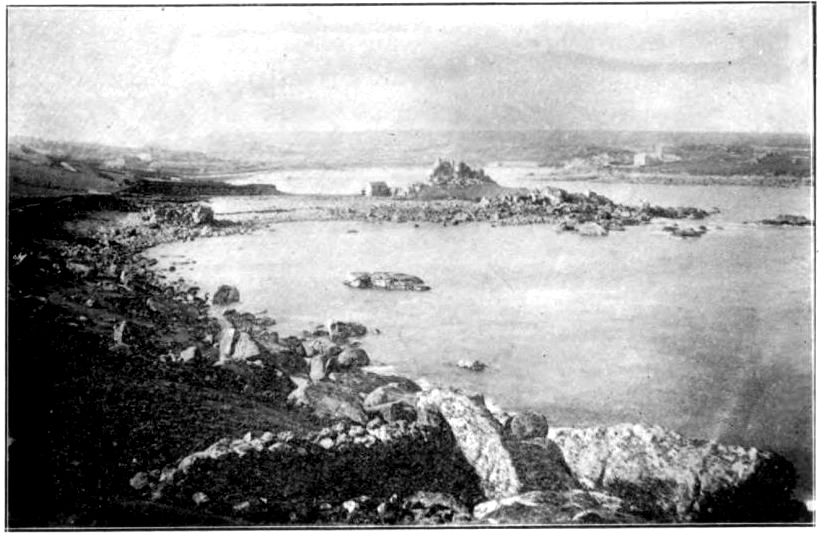
ST. MARY’S AND OLD TOWN.
We landed, as a matter of course, at Hugh Town, St. Mary’s, the largest and most important island of the group, with Star Fort situated on its eastern promontory, and Hugh Town on a narrow isthmus connecting this promontory with the main body of the island.
As I have already intimated, the first thing of interest to me, on coming ashore, was a vacant bit of real estate wherein to lie down and forget my past. So, after shaking myself awake, I walked up a hill and came in sight of the historic little church which is situated at the head of the bay of Old Town, formerly the chief town of the island. The church, a very quaint old structure, stands in an enclosure which rises in successive terraces on the hillside and is filled with a striking mixture of English and tropical vegetation.
Among the many interesting monuments in the churchyard, I noticed a granite obelisk, erected by Mr. Holtzmaister of New York, to the memory of his wife, who perished in the wreck of the ill-fated S. S. Schiller, May 7, 1875. The inscription reads: “In memory of Louise Holtzmaister, born at New York, May 15th, 1851, who lost her life in the wreck of the S. S. Schiller off the Scilly Isles, May the 7th, 1875. Her body rests in the deep. This monument has been erected to her memory as a mark of affection by her surviving husband.”
The memory fain would linger round some spot where the beloved take their last long sleep. Tennyson’s beautiful lines awaken a heartfelt response in every human breast:
“Oh to us
The fools of habit, sweeter seems
To rest beneath the clover sod,
That takes the sunshine and the rains,
Or where the kneeling hamlet drains
The chalice of the grapes of God,
Than if with thee the roaring wells
Should gulf him deep in fathom brine;
And hands so often clasped in mine
Should toss with tangle and with shells.”
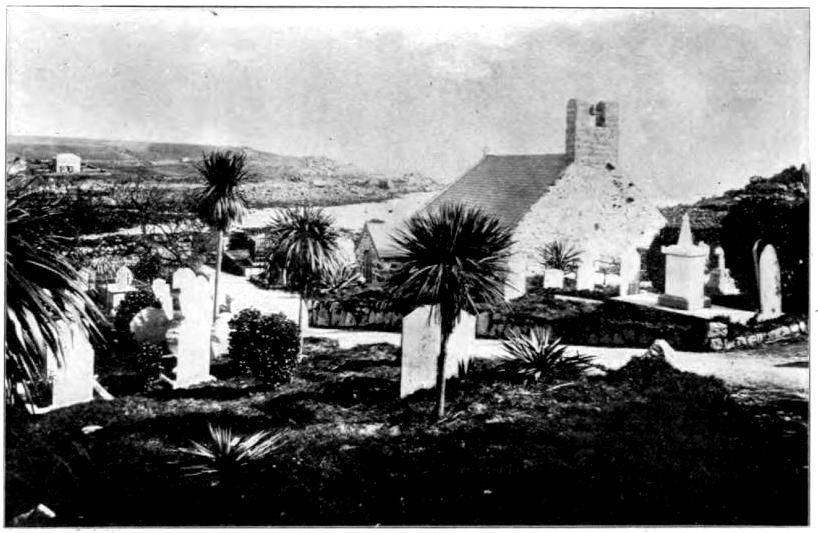
THE CHURCH AND THE TOMBS.
The people of these islands have witnessed many a tragedy of the sea in their day, but perhaps none more awful than that which this monument recalls. The Schiller, a staunch boat, built on the Clyde in 1873, was in command of Captain Thomas, an Englishman by birth, but then a naturalized German. She left New York on the 27th of April with fifty-nine saloon, seventy-five second, and one hundred and twenty steerage passengers. She was due at Plymouth on the 8th of May, but for three days previous to the disaster no observations were obtained on account of the weather. Early on Friday, the 7th, a heavy fog came down. Captain Thompson, thinking he was near the islands, ordered the engines at half speed, but about 10 P.M. she ran on the Retarrier Ledges, near the Island of St. Agnes. Few were in bed at the time of the accident; the boats were quickly launched, the sailors behaved splendidly, but the sea was running high, and as the women and children crowded together into the pavilion a heavy sea swept over it and carried all away. About forty-five out of three hundred and forty-five were saved. Mrs. Jones was the only lady survivor. By Saturday evening seventy-eight bodies, nearly all with life-preservers on, had drifted ashore.
The old church, which is now restored and used only as a mortuary chapel, was originally built in the form of a cross. In 1662 it was enlarged. On each side of the communion table ran a long seat, the one for the members of the Council and the other for their wives or the widows of dead councilmen. In 1732 it was decreed that if a councilman died, his wife was entitled to a seat among the wives of living councilmen during her widowhood, but if she married she was deprived of that privilege, unless she married a councilman. This high esteem in which they held their women, and the fact that they used the church as a council chamber, throw an instructive sidelight on the character of these old representatives of the right of the people to govern themselves.
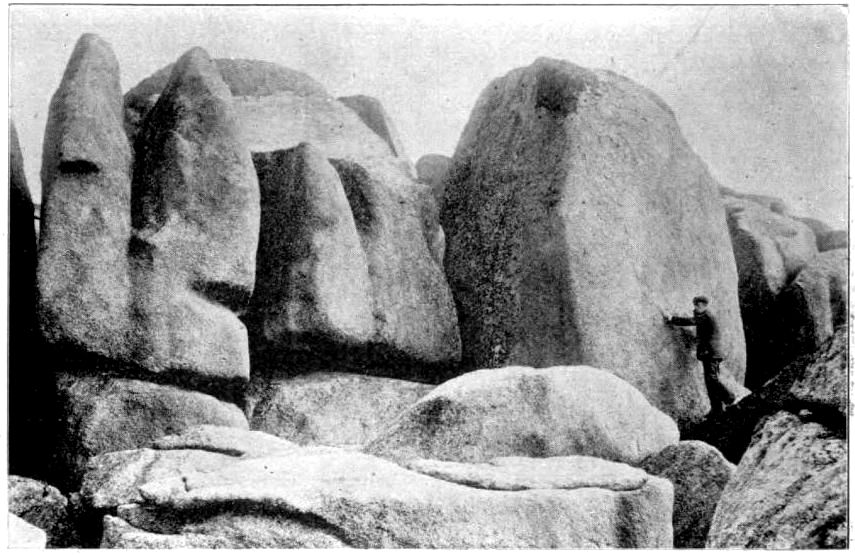
THE LOGAN ROCK.
We leave the quiet churchyard and its tragic story to continue our walk around the island. A tramp on the promontory Peninnis, which stretches out southward into the sea, brings to view many fantastic rock formations. Great boulders are left curiously poised upon each other by the action of wind and wave in ages past. Pulpit Rock, composed of huge flat blocks of stone resting on each other and leaning out to sea, is perhaps the most famous, though why it should be called “Pulpit Rock” is more than one can well guess. It looks more like an hundred other things than it does like a pulpit. Most of all it resembles a great gun mounted on the rock to command the sea at this point. We next encounter the Logan Rock (pronounce loggan). Everyone who has read Baedaker’s “Great Britain” knows of the existence of Logan Rock in Cornwall, a rock of sixty-five tons weight so delicately poised that it can be set in motion quite easily. I was not aware before that the phenomenon had repeated itself, but I learned last summer that there was quite a number of these “loggan,” or rolling rocks to be found at different places.
The Logan Rock at St. Mary’s is quite famous and was discovered somewhat recently by accident. A resident of the town, overtaken by the storm, took shelter beneath a huge rock. The wind was blowing fiercely and to his great surprise, if not terror, he discovered that the rock was moving gently to and fro. He could scarcely believe his senses at first, but on further examination, he found it was so poised that it readily responded to his efforts and could be made to sway back and forth. Its estimated weight is three hundred and sixty tons, and while it requires some energetic effort to put it in motion it rocks with ease afterwards.
Hugh Town, the port and principal town of the island of St. Mary’s, and indeed of the entire group of islands, enjoys a very unique situation. On the southwest a promontory juts out into the sea. This is the site of Star Fort, and one can make its circuit in about half an hour. It is joined to the mainland by a narrow isthmus of sand which separates St. Mary’s Pool, the harbor on the north, from Porth Cressa Bay, on the south. On this narrow strip of land, across which a boy can cast a stone, and over which the high tide threatens to leap, Hugh Town is built. There is no pretension to architecture, no striking buildings, none even that have the interest of antiquity to recommend them. The town is practically contained on the narrowest part of the isthmus, though westward, where the strip of land widens, the houses scatter somewhat. Save for its audacious situation, daring, as it does, the rage of the sea from both sides, it is commonplace and uninteresting.
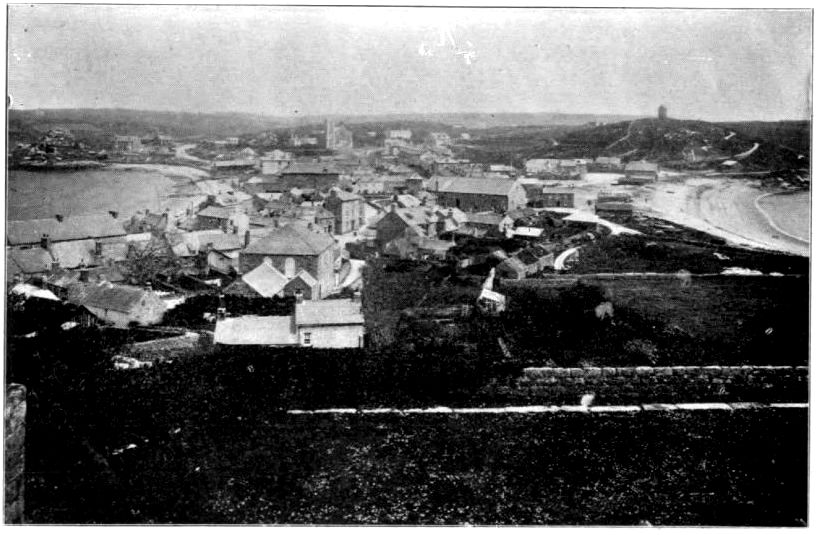
HUGH TOWN.
Too much cannot be said in favor of the islands as a health resort. They are so small in area, and lie so low, that living on them is practically living at sea. One may here take a protracted cruise with no reeling deck beneath him, and no nightmare of mal-de-mer to threaten his dreaming hours.
There are no manufactures of any kind on the island, nor is anything present to vitiate the air. Sea breezes, from the illimitable reaches of the ocean, sweep at will across these tiny bits of land, from every point of the compass, in quick succession. In winter the mean temperature is 45 and in summer it is 58. The rain fall is very moderate and, with fine consideration for the tourist, the rain generally comes at night, a phenomenon noticeable in Cornwall also.
Here is a fine resting place for men and women, physically or mentally weary. The rush of modern business life is wholly unknown; there are no street cars nor elevated trains to catch; there is no congestion of traffic in the streets; no roar of vehicles nor hum of business to disturb the absolute rest that the place suggests or to chide one who is disposed to take life easy. One lies down at night with the murmur of distant waters echoing through his dreams and wakens in the morning to the song of the surf.
The islands are said to be a “haven of refuge for sufferers from chronic bronchitis, phthisis and consumption in all its terrible forms, insomnia, and the strain of overwork; and for children one vast playground with free and open beaches and sands difficult to surpass.”
Certainly it would be hard to find a more ideal place for overworked humanity seeking rest and recuperation. The climate is all that could be desired, living is cheap, the whole atmosphere breathes rest, and there are ever present the constant sunshine and the eternal sea.
On St. Mary’s Sir Walter Besant lived while engaged on his celebrated romance, “Armorel of Lyonesse,” the home of whose beautiful Armorel Sir Walter located on the now uninhabited island of Samson. Half a century ago Samson had a population of fifty souls, with ten houses, among which “Armorel’s cottage” may still be seen. In 1885, only one family was left, and now nothing remains save the wreck of the houses and the traces of former cultivation, rapidly disappearing. The inhabitants were moved to other islands to insure the better education of their children, and, incidentally, to curtail a little private and untaxed trade which they carried on with their French neighbors.
To trace the history of these fragments of a lost continent through former generations would be most interesting, but it must be here foregone. They have, however, bulked considerably in English history and figured frequently in her relations with her continental neighbors. They remained true to the royal cause after Charles I had been put to death, having been held by Sir John Grenville for Charles II. The garrison was reduced to submission by Ascue and Blake in 1651. Prince Charles was sheltered in Star Castle for a short while after his flight from Cornwall.
The islands were notorious as the scenes of smuggling operations during the eighteenth century, but this was so vigorously dealt with that it proved as unprofitable as the various honest efforts to earn a livelihood that have been successively experimented with in this little world.
It is said that Hamilco of Carthage, a colony of Phœnicia, discovered the islands in 3000 B.C.; at any rate, they have been identified with the Cassiterides or Hesperides of the Greeks, and the Sillinæ Insulæ of the Romans. The Phœnicians traded with them for tin, which was most probably brought from Cornwall, as there is no evidence that tin was ever found on the islands. An allusion in Diodorus Siculus throws light on this custom. He says: The tin “was first refined and then carried to an adjacent island for shipment to Gaul.” The Romans reduced the islands during their occupation of Great Britain and made them a place of banishment, a use to which they were put by Great Britain also during the seventeenth century.
The Danish sea-kings found them a convenient rallying point for raids upon places in the Bristol Channel, but Athelstan drove the Danes out in 927. Subsequently an order of monks settled there, retaining an independent government till Henry I subordinated them to the Abbot of Tavistock. Scilly remained under the jurisdiction of the monks till the dissolution of the monasteries in the reign of Henry VIII. The ruins of an old abbey are still visible on the island of Tresco.
During the reign of Elizabeth, Sir Francis Godolphin built a number of forts and Star Castle near Hugh Town. The latter remains to the present, on the left of the harbor, at Star Fort.
We have noted that the islands were used by both Romans and Britons as a place of punishment, and we learn that in 1637 John Bastwick, M.D., after having been banished there for writing libelous books against church and government, was sentenced to pay a fine of £1,000, to stand in the pillory, to have his ears cut off, and finally to be confined in St. Mary’s castle. After such a generous assignment the story of the “ducking chair” sounds like comedy. The offender guilty of some trifling misdemeanor was tied in the chair at the head of the dock and thrown into the water. One cannot help feeling that this would be fine treatment for the American “hobo,” especially if the salt water was available and it was not necessary to haul him out too soon.
The inhabitants have had a hard fight for existence and have been on the verge of starvation more than once. Farming proved a failure. So likewise did smuggling, shipbuilding, fishing, and other experiments, that for a time seemed to promise success.
Now, however, they are more prosperous than they have ever been. Early potatoes, asparagus, and other vegetables are raised in large quantities for the English market. In this respect Scilly is to London what Bermuda is to New York. Besides the vegetables, flowers are cultivated for the London market, and grow in such luxuriant profusion as to guarantee a handsome return to the gardener. Anyone who has seen an acre or two of lilies abloom in Bermuda knows what a glorious sight a field of flowers is. We cannot judge from a florist’s window how splendid is a flower farm.
During Christmas week wallflowers, marguerites, daisies, narcissi, roses, pinks, marigolds, fuchsias, geraniums and chrysanthemums are found in bloom.
The fields are divided off into little squares of about a quarter of an acre, by high hedges. Here the flowers are protected from the winds and cuddled up to the gracious sun. Under this nurture aloes attain a height of five or six feet, and in blossoming throw up a bloom-spike as high as eighteen or twenty feet.
As London is distant from the islands only about eleven hours it follows that if the inhabitants are prepared to supply the metropolis with its flowers and vegetables they may rest easy about “the wolf at the door.”
The islands number about forty, and are situated some twenty-seven miles west of Land’s End. Five of them are inhabited, and the total population, which increased during the decade by one hundred and four, is some two thousand.
As we steamed out of the harbor a fleet of British war ships, twenty-two in number, was lying at anchor in the bay. When one reflects that these fighting machines are similarly in evidence in almost every harbor round the world, he is convinced that Great Britain’s arm upon the sea is a significant factor to be reckoned with in questions relating to the world’s peace.
I met the captain of our ship as I stepped aboard and besought him, though unbelief was regnant, to assure us of a smooth passage home. I explained to him that I had contributed everything I possessed on the way hither and that since then I had been too busy sleeping and seeing the island to replenish my larder. He replied with cordial good humor that the return voyage would be pleasant. Of course I was sceptical, but to my great surprise, when we rounded the point where Star Fort is situated, I saw at once that the ocean’s wrath was greatly appeased.
Time heals most wounds, and, while she banishes to a merciful oblivion what is sad and unpleasant, she graciously leaves with us the undimmed vision of our happy days. Thus it is that I have forgotten the raging of the sea and the tossing of the ship, and treasure the picture which that August morning brought me, “a small sweet world of wave-encompassed wonder.”
39