SOCIETY OF THE FOREST. (A STORY FOR CHILDREN.)
Reading edition
By M. W. Connolly.
At Mrs. Frog’s House.
On the bank of a clear lake that lay near the edge of a great forest lived a family in a house all its own. This family consisted of Mr. Frog and Mrs. Frog and a number of Baby Frogs. They lived very happily. The books say that frogs are tadpoles at first, and the books are right; but this is another family of frogs, as you shall see.
In the rear of their house stretched a marsh in the shallow waters of which grew reeds, rushes, willows and water lilies. Here and there a bulging gnarled and knotty cypress knee raised its head above the water. Here and there rotted an old log, moss-covered and sodden. Here and there lay a block of wood left behind by the hewers, a tuft of grass or a mound of earth.
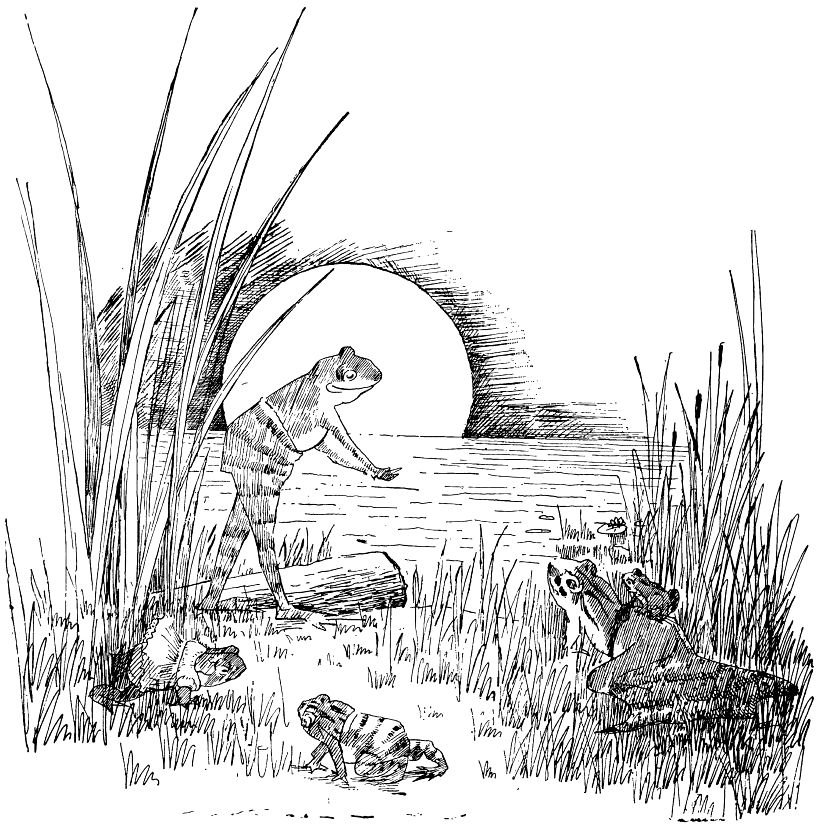
Mr. Frog and Mrs. Frog and all the Baby Frogs visited this marsh.
Mr. Frog and Mrs. Frog and all the Baby Frogs visited this marsh every night. They were fond of music and they gave nightly concerts. When the sun slipped down behind the distant pines and tamarisks, and when the stars came out to glisten in the heavens, the entire family left their home and sought the marsh.
Mr. Frog always swam out to a cypress knee that rose a few inches above the water. It was broad and flat and he seemed to like to lie on it.
Mrs. Frog used to sit on a log near by and all the Baby Frogs crowded around her and tried to cuddle up to her. There was not room for all, but the tiniest Baby Frog used to hop up on her back and lie there until it was time to go home.
One of the Baby Frogs never mingled with the rest but hid himself away in a tuft of grass. They said he was “odd.” Why he preferred the grass I cannot say. He was morose and taciturn and probably wanted to be by himself.
On dark nights the concert did not begin early. Mr. and Mrs. Frog and all the Baby Frogs remained quiet and watched Will-o’-the-Wisp flash his lamp about; or they listened to the cry of the witch-dog far out in the marsh.
But my story deals with the moonlight nights, and on moonlight nights the singing began early and lasted until midnight. Some people will tell you that frogs sing all night and they sometimes do; but only sometimes. These same people tell you that frogs croak, but I say they sing and you can understand and enjoy their music quite as much as some of the grand operas.
Mr. Frog usually began. He had a deep bass voice of which he was very proud and when he flung out a rich tremolo, every one else hushed. You could hear him ever so far up the lakeside, and Mr. Peckerwood said he heard him on the other side of the lake.
Mrs. Frog once had a well-trained contralto voice of which she was a trifle proud; but of late years she had so many babies to croon for that she got out of practice and could not sing as she once could. She knew how to sing and she knew she couldn’t sing. And this night she sang worse than usual—she seemed out of sorts.
The “odd” Frog who went away to himself sang whenever he wanted to and in the funniest way. He did not try to make music but just rattled like an alarm clock. They let him alone because he was “odd.”
Another little Frog tried to sing, but he couldn’t. You would have laughed, I am sure, to have heard him try. His voice sounded like a piccolo into which someone was blowing who did not know how to play.
Another Baby Frog had a splendid tenor voice, but he was always trying to sing as his papa sang. The result was that he injured his tenor voice without ever learning to sing bass. People very often harm themselves by trying to do what they cannot do and by leaving undone that which they can do.
The other singer was a Baby Frog with a beautiful soprano voice. And she sang, and sang her very best, whenever she was called on. Her singing was the talk of the whole neighborhood and, at night, when all the Baby Frogs were asleep, Mr. and Mrs. Frog used to talk of putting by something with which to send her abroad and have her voice cultivated. Whether they ever did so or not I cannot say.
The night of which I am telling you, Mr. Frog jumped into the water with a plunk and swam ashore, the rest following him. They returned home and Mrs. Frog soon had all the little Frogs tucked away in bed. Mrs. Frog was restless and nervous, for some reason. She would pick something off the dresser and lay it down again, mechanically. She would move a chair there, and in a moment set it elsewhere. She would fold her hands and sit down only to jump up in a few minutes and go hurriedly to do something quite unimportant.
Meantime Mr. Frog, who had been out, came stumbling in quite angry and demanded to know why the children had not brought in the kindling for the morning’s fire, saying that he should not be left everything to do. He did not notice the pained expression on Mrs. Frog’s face—people fail to see these things, sometimes—and he busied himself in closing up the house and fastening the doors and windows, after Mrs. Frog had shown him the kindling wood in the shadow of the ingle. Mrs. Frog retired, but Mr. Frog lay with his head in the doorway until daylight, and some say that he slept with one eye open. How any one found out I cannot tell, because Mr. Frog’s house was dark as pitch and only Mr. Owl could have seen; and Mr. Owl is too wise to tell anyone if he did. The reason Mr. Frog guarded the door is because Mr. Garter-snake lived in the neighborhood and Mr. Garter-snake is a prowler and likes to feast on Baby Frogs whenever he can find them. Mr. Garter-snake goes home at daylight and never ventures out unless it is going to rain, when he crosses the road in front of people to warn them to seek shelter. At daylight Mr. Frog turned in and slept until high noon. A bright fire was blazing on the hearth and Mrs. Frog was fixing breakfast, and the way she handled the skillets and spiders and sauce-pans, and at the same time urged the little Frogs to get ready for breakfast, was a caution.
Breakfast over and the things cleared up, Mrs. Frog was still restless. Sit still she could not. The Baby Frogs irritated her. She would go out and look about her in front of the door a moment, only to hurry back again for nothing. Her face was pale and her eyes shone unusually. Once she thought if she could scream it would do her great good. She was looking and acting strangely, but Mr. Frog did not notice anything. She announced her intention of going to visit Mrs. Rabbit who lived in the briar patch across the lake. Mr. Frog was a little surprised but made no objection, only observing that he hoped she would be home before sunset as he could do nothing with the Baby Frogs when they got sleepy; and that Mr. Moccasin-snake would be on the lookout for his supper as soon as it was dark.
Mrs. Frog put on her things and powdered her face. She looked at herself in the mirror a moment and then feverishly rushed to the bank and plunged in with a ker-plunk that could be heard a long distance. She kept deep under the water and would first swim this way and then that way; now to the right and then to the left, and she came to the surface a good distance from where she entered the water so that Mr. Moccasin-snake, if he had been on a log in the sun waiting for her, could not locate her. She looked back and saw Mrs. Turtle and Mr. Turtle asleep on a half-floating cottonwood stump, and then she struck out across the lake.
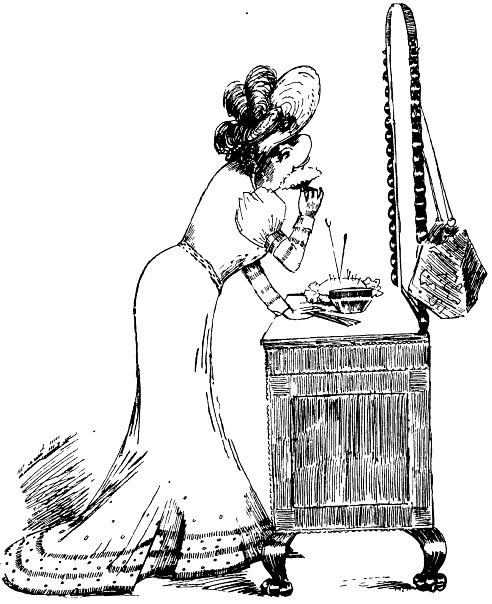
—put on her things and powdered her face.
She had not gone far when she began to feel better. Her nervousness and fever left her. She enjoyed a sense of freedom and liberty, and the cool, clear waters were as a health-giving and soothing anodyne to her. The sense of smothering and confinement which she found so oppressive at home had left her, and her spirit expanded and reveled in its new-found independence and she only regretted that Mr. Frog and the Baby Frogs were not with her to enjoy her raptures.
At Mrs. Rabbit’s House.
Arriving at the opposite bank, which she clambered up in no time, Mrs. Frog was feeling refreshed; she came to a road that fringed the lake, and, crossing this, she came to the briar patch. She went up and down the road, now entering one opening in the briar patch and then another, only to find that they were “blind” and that they led nowhere. One after another she entered these openings and had to come out again. She was about to give up the task and return home and she was soothing her disappointed feelings with the reflection that while she had not found Mrs. Rabbit and returned her call, she had enjoyed the outing immensely and had been benefited by the trip, when she saw a small opening nearly covered by hanging leaves. After some hesitation she entered this and found, to her great joy, that it was an arched pathway, well beaten by travel, which led to the home of Mrs. Rabbit. She followed this until she neared the house and saw Mrs. Rabbit standing in her front yard. Mrs. Frog saluted her cheerily but Mrs. Rabbit pretended that she was frightened and rushed in her house and hid in a heap in the darkest corner. Mrs. Frog followed her in, exclaiming: “La! Mrs. Rabbit, you need not hide. It is only Mrs. Frog that has come to see you and she is not going to hurt you.”
Mrs. Rabbit came out and said: “Why, Mrs. Frog, I am so glad to see you. I have been thinking of you and wondering if you never would come or if you had quite forgotten me. You are looking so well. I really believe, Mrs. Frog, that you are getting younger every day. I am sure you are getting better looking. How is Mr. Frog and the children—the dear things, how I would like to see them—how are they all?”
“The children,” replied Mrs. Frog, “are just as dear and sweet as they can live; and growing? You never saw the like! Why, they are perfect Jonah’s gourds, one would think, to see how they grow. And they are just as bad! Not mean, you know, but just mischievous and into everything. They run me wild, at times. But with all the trouble they give us, what would life be without them? Dear me! This would be a sad place without children. I needn’t ask how you are,” continued Mrs. Frog, “because your looks speak for themselves and tell the story of your good health and happiness. How are the dear children and Mr. Rabbit? I suppose he is like my old man, grumbledy and fussy, but just as good as he can be. I hope he will come in before I leave because I want to see him.”
There was an undertone of sadness in the forced mirth of Mrs. Rabbit’s voice as she replied: “The children are all well. Now and then one of them gets sick but it is only for a little while and it amounts to nothing. Mr. Rabbit has gone to mill with a turn of corn so that I may have flour to make bread for Sunday dinner. We usually have a good deal of company on Sunday.”
Mrs. Rabbit said this with the faintest suggestion of vanity, and then continued: “I am sure you must be famished after your long trip across the lake. Dear me, how I wish I could swim.” (Mrs. Rabbit was only too sincere in this.)
“Spread this mullein leaf over your dress to protect it. What a pretty dress you have and it is so becoming to you. I always did like green. Your appetite must provide the relish for what I have to set before you, as I have only scraps to offer and it would keep you too long waiting to cook something fresh. Somebody once said something in praise of a dinner of herbs; but for my part, I would prefer something else.”
Mrs. Frog spread the mullein leaf over her lap and fell to with much energy, but her thoughts were on her dress, of which she was very proud. “I am glad you like my dress,” she said. “I like it very much. I got it at a bargain, too, because I bought the goods by the quantity and made dresses of the same material for all children and had quite a lot left for mending. Children are so hard on clothes. This dress like all the rest does not fit me. I suppose I must have an awful figure”—Mrs. Frog said this, but did not mean a word of it; she was really proud of her fine figure—“and the dressmakers never fit me. It is all right around the neck but, you see, it is much too tight and binding across the bust and it is not full enough about the hips; while the waist is baggy—it is so loose, and,—dear me! if I wore corsets it would look like a meal sack on a hoe handle, on me.”
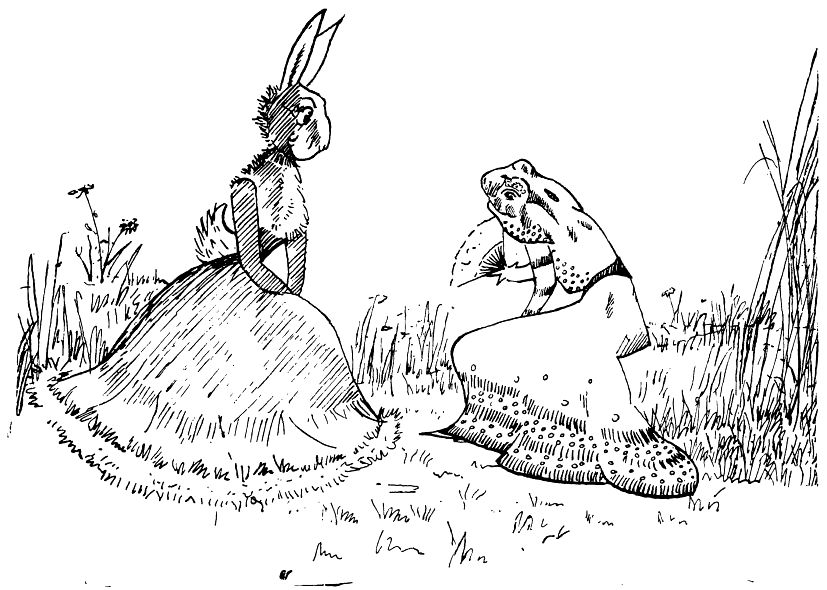
Mrs. Frog asked: “What is the news over this way?”
Mrs. Rabbit could not see the defects mentioned and concluded they were imaginary. People frequently differ in opinion.
The conversation turned to general topics and Mrs. Frog asked: “What is the news over this way?”
Said Mrs. Rabbit: “We never hear anything in this out-of-the-way place. It is so quiet. The overflow has caused some suffering and one of Mr. Fox’s sons, who had been stealing a farmer’s chickens in the clearing, was killed the other night and his skin is going to be worn by the farmer’s daughter next winter to keep her neck and shoulders warm. Mr. Bear’s brother, who had been killing and eating the farmer’s calves in the canebrake, was caught in a trap and shot dead. His skin is stretched on the door of the farmer’s barn and his body is hung up in the smokehouse near by. Mr. Woodpecker brought this news to us and warned us to be on our guard because there are so many hungry animals abroad. I am afraid to let the children out of my sight.”
“Well, well!” exclaimed Mrs. Frog. “That is too bad! But you know,” continued Mrs. Frog, glancing furtively at her reflection in the mirror and comparing her appearance with the appearance of Mrs. Rabbit, the result of which seemed to please her, “you know the way of the transgressor is hard. But really I must go as it is getting late.”
Mrs. Frog jumped up and made ready to take her departure, taking at the same time a mental inventory of everything in the house.
Mrs. Rabbit begged her to stay longer, assured her it was quite early and that she had plenty of time to reach home, and reproached her for hurrying off. Mrs. Rabbit accompanied Mrs. Frog to the end of the path through the briar patch and out into the opening on the bank of the lake.
“You must come and see me again, soon,” said Mrs. Rabbit. “Come early and spend the day and bring the children and I will keep mine home from school and we will have a nice time.”
“I am coming right soon. You cannot keep me away because I enjoy these visits hugely. I am sorry I did not see Mr. Rabbit and the dear children. Now, I will not take no. You must come to see me soon; you must.” Mrs. Frog was very emphatic.
“I’m coming before long,” said Mrs. Rabbit. “I’m coming, sure. I would have been over before this but I cannot take a short cut across the lake, like you, but must go around. And, since his son was killed, Mr. Fox lives up at this end of the lake, which makes me go the long way, around the lower end. And getting through the switch-cane is a job, I tell you. When I brought home the coffee I borrowed from you it took me until evening to make the trip. Mr. Bear has plenty of paths through the switch-cane, but they run all which ways and you are coming home half the time when you think you are going; but there is no way out of it unless you could fly over it as Mr. Jaybird does when he goes over to the deadening to tote down fire-wood for the devil on Friday mornings, and the Cotton-tail family cannot fly nor even jump like the Jackrabbit family. But I’ll manage to get there soon.”
They shook hands and kissed and Mrs. Frog plunged into the lake with a ker-plunk and swimming gaily out a distance turned around and said:
“You must come soon.”
“I will, and you must come soon.”
Mrs. Rabbit watched her guest depart and when out of hearing almost hissed: “Horrid thing! I don’t see what brings her here. I wish Mr. Moccasin-snake or Mr. Hawk would come along and catch her. She just came here to show that green dress because she knew neither myself nor my children have a stitch to wear but these old grey gowns trimmed with fur, and here it is the middle of summer.”
Mrs. Rabbit returned home just as Mr. Rabbit, who had been to mill with a turn of corn to have ground into flour to make bread for Sunday dinner, turned the corner.
Mrs. Frog Returns Home.
Mrs. Frog swam rapidly over the glassy surface and she noticed that a golden pathway led from where she was to the sun that hung low in the west at the other end of the lake. This narrow pathway she could not cross, which alarmed her, as she fancied she was held fast by it, and could make no headway. The ripples caused by her efforts broke this golden mirror into many sparkling fragments; but, farther away, it lay undisturbed and placid. On looking at the trees the other side of her she saw that she was making excellent progress and that, instead of the sun’s pathway detaining her, it was following her. Her alarm gave way to gladness at being accompanied by such a splendid convoy—people sometimes fret over the slow progress which they think they are making, when, in reality, they are traveling very fast. She eluded Mr. Hawk and Mr. Moccasin-snake by diving when near the shore and then hurrying up the bank to the door of her house. On looking back she discovered that the sun’s bright pathway did not follow her but remained below on the lake—there are places into which things that we prize will not accompany us.
On entering she found confusion and disorder. The dishes on which the cold midday meal had been served lay spread on the table. The Baby Frogs were unkempt and disheveled and some of them were crying. The youngest one had cried itself to sleep. Mr. Frog was a sight to behold. He was almost frantic and went about tripping over bits of furniture and clothing that were strewn on the floor. His face was inflamed and he greeted Mrs. Frog hoarsely with: “What on earth kept you so late? I thought you would never come! These children have set me almost crazy with their mischief and carrying-on. I wouldn’t put in another day like this for anything. You shouldn’t inflict on me such misery when I told you to be back before night.”
Mrs. Frog’s cheeriness, gained from her outing, was something abated; but she set about to right matters and put things in order. She reminded Mr. Frog that the sun had not yet set; but he did not hear, or feigned not to hear her. He went out and hopped down the way to Mr. Toad’s house, where he supped and talked about the coming election of a new king of the forest, which was growing smaller every year. Mr. Lion and Mr. Tiger and Mr. Wolf had gone away and it was reported that Mr. Bear intended moving farther West because his only brother was dead. Mr. Wildcat would be a candidate and so would Mr. Fox, but neither was admired.
Meantime Mrs. Frog busied herself about the house. The Baby Frogs came out from their hiding places where they had been driven, in terror, by their angry father. She dried their tears and dressed them for supper which she prepared. Deftly she put everything in place and restored order and soon smiles and laughter returned to her little ones. She waited supper until late and then told the Baby Frogs to eat and be ready to go to the concert in the marsh when Mr. Frog came. She ate nothing. After supper she waited until far into the night and one by one the Baby Frogs fell asleep and were put to bed. When all was still and the fire burned low she sat holding her Baby Frog that was considered “odd” on her knee. She wondered if it were very wrong in her to go away and enjoy herself as she had done when so much unhappiness resulted. The thought came to her that Mr. Frog did not love her else he would have reflected that the crosses and trials borne by him so impatiently for one day were her usual portion and that she had to bear them every day in the year and meet him pleasantly and with smiles in the evening or be charged with ill-temper and making home unpleasant. She hugged her Baby Frog that was considered “odd” closer to her. It had taken cold, because left to sleep without covering while she was away. Then she blamed herself and resolved never to go away again and fell to crying and upbraiding herself.
Very late at night or early in the morning Mr. Frog came home in great spirits. His countenance was beaming. He had tarried late at Mrs. Toad’s house and halted on the way home to hear the songs of Mr. Whippoorwill and Mr. Mocking-bird, and to see the fine display given by Mr. Fire-fly. When he found Mrs. Frog crying he scowled at her and said gruffly: “What’s the matter now? If gadding about has this effect on you, you had better stay at home and not tire yourself out traipsing around seeing people who care nothing for you.” Then he flung himself down to sleep.
Mrs. Frog, with her Baby Frog that was considered “odd” held close in her arms, also went to bed where her tears flowed in secret. She did not know the meaning of those tears; they came unbidden. She fancied she had done something very wrong and she fell asleep only when exhaustion came.
It is most unfortunate that those who make sacrifices for others are never noticed or given credit for them and that they are cruelly reproached when those sacrifices halt, temporarily, or wholly cease. It is most unfortunate that we inflict pain on those we love, in our thoughtlessness, and that they suffer this pain without always knowing its source.
Everybody Who is Anybody.
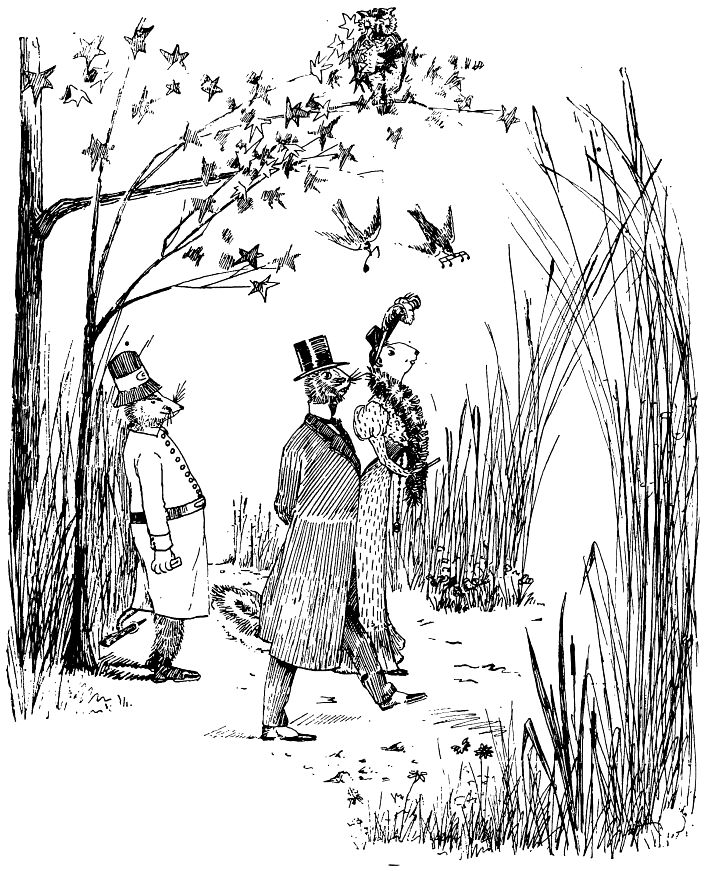
Mr. Squirrel and Mrs. Squirrel were invited and were glad to accept.
Mr. Peckerwood had been abroad early. Mrs. Rabbit was going to give a dining and had commissioned him to invite her friends. Mrs. Rabbit had baked up the entire turn of corn that Mr. Rabbit had taken to mill to provide for Sunday’s dinner. Mr. Squirrel and Mrs. Squirrel were invited and were glad to accept and promised to attend. Mr. and Mrs. Toad were invited but were compelled to decline. In discussing the matter among themselves Mrs. Toad observed: “We have lived long here in our own simple way and have never gone in society. It was a hard struggle for a time and no one thought of us or cared for us. We have always lived at peace with our neighbors and we now have their good will; but, because we have prospered, we have not changed our habits of life. We are old-fashioned and we would be out of place in grand society if it is as those who have been there picture it. Of course those present would be very kind to us and do what they could to make us feel at home; but their efforts would only make us sense the more keenly how unfitted we are for such company. We are unused to gaiety and fine things and we would be at a loss to know what to do and always fearful of making mistakes. We had better remain as we are and where we are. Here we know what to do and how to extract simple pleasure from our surroundings. There, everything would be new and strange and untoward.”
Mrs. Toad said these things not without an effort. In spite of her, she had a curiosity to see the fine sights in the upper and polite world.
Mr. Toad agreed with her and added: “They used to say every Toad, however ugly, had a precious jewel in its head. Of late years this has been disputed by the wise who call themselves scientists. You, my dear, at least, vindicate the truth of the older claim. You have in your head the precious jewel of sound sense and wise discretion.”
Mrs. Toad smiled and her desire to go vanished. The commendation of those we love is always conciliating and soothing.
Mr. and Mrs. Frog were invited and Mrs. Frog accepted for the entire family. She wanted Mr. Frog and the Baby Frogs to have a pleasant outing and she was flattered by the thought that green dresses and white stomachers would look uncommonly well. Frogs could not fly, but they could swim and dive, and that is something the birds of the air cannot do, she mused. She began at once preparing for the event.
Mr. Jaybird and Mrs. Jaybird were invited by mistake and they accepted instantly and Mrs. Jaybird flew over to Mrs. Magpie’s home and told her all about it and how she hated to go to the stupid function and be bored, as she knew she would be; but, as Everybody who is Anybody is to be there, she presumed she would have to attend. Mrs. Magpie received no invitation; neither did Mr. Magpie, but Mrs. Magpie flew about and told Everybody who is Nobody that she would not attend such a meeting or mix in with such company, and Everybody who is Nobody commended her discrimination and solemnly declared that she would not attend such a meeting or mix in such company.
Mr. Beaver and Mrs. Beaver were invited, and Mrs. Beaver said that she would attend to the R. S. V. P. later on. As soon as Mr. Peckerwood was out of sight she came out of her house and slapped the water with her flat tail, producing a sharp sound that could be heard a long distance. Mr. Beaver, who was cutting into convenient lengths a tree he had felled the day previous, so that he could roll it down the bank and use it in strengthening the dam in front of his house, plunged into the water and dived down to the door of his stronghold in alarm, thinking serious danger impended and that the noise was the usual warning given by the sentinels. He was met by Mrs. Beaver, whose face was lit up and smiling, and who exclaimed: “What do you think! We have been invited to a dining at Mrs. Rabbit’s and we are sure to have a good time. Everybody who is Anybody will be there, and I don’t think we will have to take a back seat for any of them. It is rather warm for furs, but it is late in the season, and—furs are always furs.”
Mrs. Beaver was radiant and enthusiastic and she looked proudly at her sleek coat, from which the water had almost disappeared.
Mr. Beaver looked at her for a while before he spoke, loth to lessen the pleasure she found in anticipating so great an event, and then he kindly but firmly said: “I do not like to differ from you. I dislike to. Nevertheless, I do not think it is wise in us to attend Mr. Rabbit’s dining. It is flattering to be invited to the tables of the great, but it is unwise to accept attentions that cannot be returned. To return such a compliment we are in no way prepared. To accept it would put us under an obligation that we could not discharge, and we would be carrying the burden of a debt we could not pay. Mr. Rabbit is wealthy. He has a broad briar patch in which he is safe, and into which not even Mr. Rattlesnake can enter. He has an abundance of clover and sweet grasses and tender buds at his door and his home is spacious. But these he neither created, produced nor builded. They were given him, and he has no other interest in them save possession. With us, what we have we produced by our own efforts. We cut down and hauled trees and fashioned houses and dams. We are our own architect and builder. Unlike some animals who claim to be much wiser than we and who design and build houses for other people, while going homeless themselves, we provided for ourselves and what we have is our own. So long as we guard it and continue our custom of healthy, hard work, we will be happy. As soon as we leave our narrow sphere we will meet trouble. Our bodies are covered with rich fur that is seasonable enough, but our tails are covered with scales, and strange company would not know how to take us. They could not make flesh of one and fish of the other.” As he said this Mr. Beaver felt much pleased with his own fluent rhetoric.
Mrs. Beaver, who had listened glumly, was silenced but not convinced. She puffed up and said nothing. Her heart was set on going to the dining, and no argument could change her. And the misery of it all was her silence. Had she said something or done something; had she talked back, or thrown a billet of wood at Mr. Beaver, it would have been a relief to him. But she merely looked and said nothing, and this was killing.
Mr. Beaver returned moodily to his work, feeling that his philosophy was weak and useless, and that there are times when it is better to be unwisely happy than to be unhappily wise.
Mr. Chipmunk and Mrs. Chipmunk were invited. Mr. Swamp Rabbit and Mrs. Swamp Rabbit were invited. Mr. Otter and Mrs. Otter were invited. Mr. Mink and Mrs. Mink were invited. Mr. Groundhog and Mrs. Groundhog were invited; but Mr. Groundhog excused himself, saying that he was afraid of losing his shadow and becoming like the unfortunate Peter Schlemihl in the story. Mr. and Mrs. Kildee, Mr. and Mrs. Redbird, Mr. and Mrs. Sparrow, Mr. and Mrs. Dove, Mr. and Mrs. Quail were invited and Mr. and Mrs. Humming-bird promised to look in on the company. Mr. and Mrs. Thrush were invited, but announced that they could not sing, as they were under contract, unless paid for it, or unless their manager, Mr. Wildcat, was bidden as a guest, which, of course, could not be thought of. All members of the Mocking-bird family were invited, and Mr. Mocking-bird promised to bring his music, providing Mr. and Mrs. Linnet were not of the party. Mr. Parrot and Mrs. Parrot and Mr. Goose and Mrs. Goose were on the list to be invited; but they were later removed for fear the one would repeat everything that was said and the other would talk and gabble so much that nothing could be said. Mr. Rabbit suggested inviting Mr. Stork and Mrs. Stork, old friends of the family, but Mrs. Rabbit said that while they would be welcome as far as she was concerned, she knew that many of her friends who go much in society would object.
On the day appointed all the guests attended and it was a goodly company.
Everybody Who Is Nobody.
As the invited guests arrived, some coming by water, some by land, and some through the air—Mr. Squirrel and Mrs. Squirrel came through the tops of the trees, sometimes jumping long distances from the limbs of one to the limbs of another—Everybody who is Nobody crowded around the entrance to the briar patch. Everybody who is Nobody had no tickets of admission, but they surrounded the guests, and would have crowded in, uninvited, were it not that Mr. ’Possum, with a large detachment of his kinsmen, acted as policemen and drove them back. In spite of this and in spite of the harsh means used to keep the crowd back, some of the guests were jostled, crushed and injured.
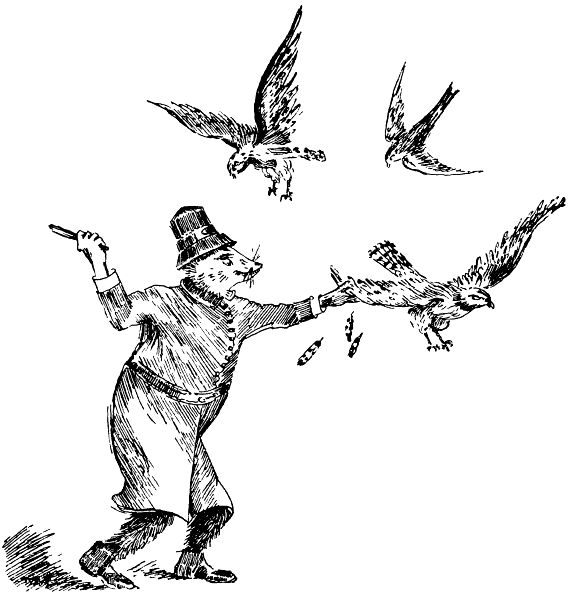
Mr. ’Possum acted as policeman and drove them back.
Everybody who is Nobody retired a short distance to a little knoll that had been flung up by the uprooting of a great tree that had long since rotted away. Everybody who is Nobody was anxious to appear on the ground by mere accident; but Mr. Owl, who was looking on from a high tree, knew they were all impelled by the same motive.
Mr. Muskrat and Mrs. Muskrat concluded early in the day that they had opened more mussel shells than was really necessary, and that they might as well take a walk and enjoy a holiday. They were the first to climb to the top of the knoll, to dry their clothing, they said. Mr. Polecat and Mrs. Polecat, Mr. Porcupine and Mrs. Porcupine, Mr. Turtle and Mrs. Turtle, Mr. Weasel and Mrs. Weasel, Mr. Hawk and Mrs. Hawk, Mr. Gopher and Mrs. Gopher, and, in fact, Everybody who is Nobody was there. Mr. Buzzard and Mrs. Buzzard started on the way, but they were attracted by the odor arising from a carrion that lay rotting far out on the festering marsh. Mr. Rattlesnake and Mrs. Rattlesnake remained a short distance away—there are exclusive folk in society where Everybody is Nobody—and Mr. Rattlesnake made the buttons on his tail sound like a fire of musketry when things did not suit him. Mr. Magpie and Mrs. Magpie were dressed early and ready to go, but Mrs. Magpie began gossiping with Mr. Crane, who had just swallowed Mr. Garter-snake and prevented him from going, and she forgot all about it until too late. Mr. Fox approached very cautiously to where he could hear and to where he could not be seen. Mr. Tarantula blundered in, but, discovering his mistake, retired at once.
When all were assembled, Mrs. Muskrat observed that she was glad that she was not in the briar patch at the dining. She knew she could have been invited if she had put herself in the way of it as some other folks have done; but she had no use for Mrs. Rabbit. Mrs. Rabbit put on a great many airs. She considered herself better than other people. She shouldn’t forget that she married Mr. Rabbit, who is old enough to be her father, for his property, and that, when she married him, she had nothing but the clothes on her back. And since her marriage she has been given but one new dress a year in spite of all her wealth. Mrs. Muskrat averred that she believed in taking people for what they are and not for what their ancestors were, and for which they should be in no way held accountable; still, it was commonly known that Mrs. Rabbit’s grandmother hired out.
Mrs. Porcupine ventured to say that it might be well enough to be an old man’s darling, if he had money enough; but she did not believe in becoming the slave of a house full of little ones, and the way Mrs. Rabbit was surrounding herself with olive branches was positively scandalous, and the talk of the entire forest.
Mr. Porcupine had been listening to the talk, and knowing that he had to agree with his wife, laughed immoderately and applauded loudly. Other animals have found it wise and expedient to do the same thing. In doing this his quills penetrated the fur coat of Mrs. Polecat, who indignantly exclaimed:
“Sir! I would have you remember in whose presence you find yourself. You should select a more willing target for your murderous weapons.”
“Ah, Mrs. Polecat,” said Mr. Porcupine, not knowing the injury he had done—some people never know the injury they do—“You possess a weapon and wield it so effectively that it is much more cruel and painful than is my poor quill. Mine is a sword stab, but there are torments and sufferings greater than sword stabs.”
As he said this, Mr. Porcupine thought it an uncommonly fine speech with an obvious meaning.
Mrs. Polecat was placated. Her anger was turned to pleasure. She, too, thought it an uncommonly fine speech, and fancied that it meant that her beauty was such as to inspire love and destroy the heart and peace of mind of those who saw her. There are people in this world who are always ready to take a veiled censure of a fault which they possess as a compliment to an assumed virtue which they do not possess.
Mrs. Porcupine frowned and scowled. She knew what Mr. Porcupine meant, but she frowned and scowled because Mrs. Polecat had misunderstood it and had taken it as a compliment.
Mrs. Turtle, who had been waiting for a chance to speak, said she didn’t see how any one could go about without reasonable protection. For her part, she was not afraid of Mr. Porcupine’s quills, and she invited him to come as close to her as he desired.
Mrs. Porcupine frowned and scowled again, and no doubt a pitched battle would have ensued, had not Mr. Rattlesnake sounded an alarm, and slipped away under a huge rock.
Just then two hunters, with their dogs, rode up, and—bang! bang!—Mr. Porcupine and Mrs. Muskrat fell over dead. The younger hunter took out after Mr. Polecat and Mrs. Polecat, but he was warned back by the elder, who said that, like some people, the Polecats had methods of assault against which there is no defense excepting distance, and that the part of wisdom is to keep well away from them.
Mr. Turtle and Mrs. Turtle, in spite of their strong armor, were captured and hung by whang leather thongs to the horns of the hunters’ saddles. Their heads were battered, but of course they did not die until put in the soup-pot the next day. Mr. Hawk and Mrs. Hawk flew away and the rest of the animals escaped with more or less injury, one way and another, with the exception of Mr. Weasel, who was killed and his skin converted into a purse.
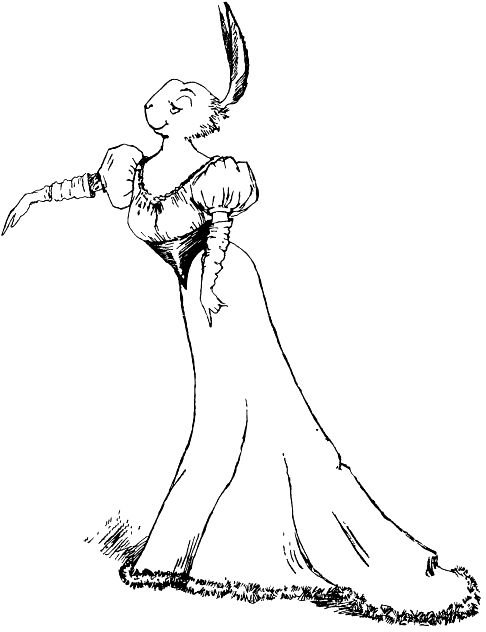
Mrs. Rabbit put on a great many airs.
It was many and many a long day before Everybody who is Nobody met again to criticise their neighbors. It sometimes requires a great catastrophe to teach a valuable lesson; but, once learned, this lesson is not soon forgotten.
Mrs. Rabbit’s Dining.
Mrs. Rabbit’s home was a delight to see when the guests arrived. Mrs. Rabbit was a trifle tired and apprehensive. It was her first formal function and she did not know how many “regrets” were in store for her. (Some she knew would come, but others whom she desired to lionize gave her concern. Their absence would mean disappointment and humiliation. If some benign power would remove all the empty chairs from around the table of a hostess who has made elaborate preparations for the entertainment of guests who do not come, and who is not wholly certain of her approaches, some of the bitterest sorrows would be removed from earth and many a heart-break would be escaped. Such a spectacle, presented to a hostess, not only stuns and stings, but corrodes.)
Mrs. Rabbit was not long in suspense. Her guests came, every one of them, came in a crowd, and each one had something to tell about the escape from Everybody who is Nobody at the entrance to the briar patch, all of which pleased Mrs. Rabbit greatly.
Mr. Toad and Mrs. Toad were not expected. Mr. Beaver and Mrs. Beaver were not missed. They were working people, and working people are seldom much sought after until they cease working and become representatives of working people.
Mr. Peckerwood was seen coming from far away across the lake. He would soar high up in the air, remain poised an instant, and then plunge headlong downward until near the earth, when he would gracefully glide upward again. He moved as a light vessel moves across high billows between which there are great troughs or valleys, now on the crest of the wave, now in the deep chasm. He came on with a freedom and a swing, describing a series of parabolas that were beautiful to behold.
On arriving he informed the party that an important engagement, he was sorry to say, prevented him from remaining; but he would beat the drum on a hollow tree from time to time to let them know where he was in the forest.
Every one was sorry, and Mr. Otter remarked that he always noticed that those who take the most active part in movements for good, and who do most to bring these movements to a splendid result, seldom enjoy the benefits and pleasures of their efforts. They sow and others garner. They build and others occupy. They provide and others enjoy.
After a short silence Mr. Mink said that he had observed the same thing, and, according to his way of thinking, it is small compensation to see that those who take the most active part in movements for evil, and who do the most to bring these movements to a climax, always escape before the explosion comes and leave their followers and dupes to suffer the penalties.
This is all that Mr. Mink and Mr. Otter said until time to bid their hosts good-bye, and it is a great deal for either Mr. Mink or Mr. Otter to say at any time, and especially on this subject, which, perhaps, had better not be discussed on so joyous an occasion.
The evening was a pleasant one. Everyone present was delighted. Mr. Mocking-bird sang his sweetest. He had no rival and few capable critics, and he had the musical program all to himself. Mr. Frog thought and felt secretly that he could furnish a pleasing variation with one of his favorite bass solos, and Mrs. Frog was sure that if her Baby Frog of the soprano voice were given musical advantages she would take the shine out of any singer in the forest; but they were both too well bred to say anything. Mr. Frog, indeed, chimed in with his bass once or twice, with an stave or two, on the last line of the stanza, which he fancied helped matters along famously; but, as he led the applause by crying out “Bravo,” he excited no comment.
The dinner was bountiful and of such variety as to furnish each guest that which he or she most desired—from great fish for Mr. Otter and Mrs. Otter to blooming hollyhocks for Mr. Humming-bird and Mrs. Humming-bird. Curious delicacies were served in tiny buttercups and in pale-tinted morning-glories that had been kept in the dark and had not closed their eyes. Corn was provided for Mr. Jaybird and Mrs. Jaybird from “volunteer” stalks that grew in the farmer’s cotton patch near by. Assorted nuts of excellent flavor were furnished Mr. Squirrel and Mrs. Squirrel, and those who liked this kind of food.
Mrs. Rabbit laid great store by her bread, of which she was very proud. It was not sliced and laid within reach of her guests, as is usually done. Mrs. Rabbit put her left arm around a huge loaf, which she pressed firmly against her breast and, with a knife in the other hand moved about from guest to guest, cutting and serving each in turn with a generous piece. As each guest politely praised her cooking and housewifery her face beamed with pleasure, and she forgot all about her old grey gown with its fur trimmings. The pleasure she felt she communicated to those around her, and all were supremely happy until a becoming hour for departure.
The guests went their several ways after many good-byes and promises to meet again, and each was in the best of spirits. The day was long remembered in the forest.
When the guests had gone and the little ones had cuddled down in bed Mrs. Rabbit confessed that while she was tired, she had never enjoyed herself as much in her life and, she added, “I never thought our neighbors were such charming people. They all seemed delighted and happy.”
Mr. Rabbit had eaten bountifully and was somewhat drowsy and his philosophy may not have been wholly sound. Nevertheless, he said with much gravity and deliberation: “Happiness is what the learned ones call a personal equation. It rests largely with ourselves. Those who selfishly seek it never find it. Those who give it to others find their own store increasing in exact proportion to the amount they dispense. Happiness is like the purse of Fortunatus that could never be emptied. You were proud of your bread and with reason. It proved that you could do one thing well and whoso does one thing well is master of many things. When you sought to make others happy you found no trouble. In making others happy lies concealed the secret of our own happiness. Your neighbors have not changed only as you have changed them. The change is in yourself. Whenever you feel morose, despondent and unhappy, set about to do some one some good and joy will return; because doing good to others is life’s chief luxury, and it never palls.”
By this time Mrs. Rabbit was nodding, but Mr. Rabbit did not notice it, so interested was he in his own wisdom and so charmed by his own eloquence. After a slight pause they both retired to enjoy a sweet and refreshing sleep.
80
