Front matter (continued 6)
Reading edition
To tell of "Mr. and Mrs. Robin" is well enough, for the titles merely mean the male and female. To represent them as talking is well enough, for they certainly communicate with each other and their young, and putting their communications into human speech is merely translating them. But to represent them as uttering highly moral speeches is all wrong, for these are beyond the power of the birds. The moment that the story humanizes them in any such way it becomes of no value, because it is false to nature.
The humanizing process is lavishly applied to all sorts of creatures, even to plants.
For instance, in a very popular book occurs the following:—"And so the witch-hazel, knowing that neither boy nor girl, nor bird nor beast nor wind, will come to the rescue of its little ones, is obliged to take matters into its own hands, and this is what it does." This is an extreme case of humanizing. The writer states that this brainless plant knows that its seeds will not be scattered by children, animals or wind. This implies that the plant is conscious of its seeds; that it realizes the importance of their distribution; that it knows what boys, girls, birds, animals and wind are: that it knows how the seeds of other plants are distributed; and that it plans a method of scattering its own seed! This is certainly more mental power than we are warranted in ascribing to a plant. But children are much interested in the story, and think the witch-hazel very clever to plan so ingenious a way of distributing its seeds. That it is not true does not trouble them, because they do not know it, and I can learn of very few teachers using this book, who have thought enough about the subjects treated to realize that they are so humanized as to be untrue to their own natures. I quote this as an instance of the lengths to which humanizing may be carried without discovery by the average reader.
Humanizing the creatures takes them out of their own place in Nature, by endowing them with powers higher than they can really possess. It sets aside all the laws of evolution, and is not only untrue to the nature of the individual, but to the principles which underlie all Nature. Young children are not ready for these general laws and principles, but it cannot be good pedagogics to give them ideas in direct contradiction to all those laws which must be taught them a little later, and which will at once prove the falseness of this earlier teaching.
"Interest" is not everything in teaching children. Truth counts for more in the long run, and, especially in Nature study, may be made quite as interesting as "humanization."
'On the Ethics of Caging Birds'
To the Editor of 'Bird-Lore:'
I thank you for offering me an opportunity to be heard in my own defense. But controversy is—if possible—more distasteful to me than injustice. Therefore, while it is painful to be misrepresented, I will answer my critics only by saying that they have entirely—I do not say wilfully—misunderstood me, and that no one who knows me could for an instant believe me guilty of "favoring" or "encouraging," the caging, the wearing, or the eating of our little brothers, the birds.
Olive Thorne Miller.

THE BIRDS' CHRISTMAS TREE From the painting of A. Tideman, published in 'Norwegian Pictures,' London, 1885.
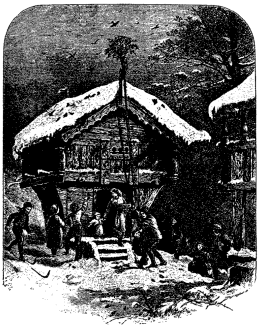
The Birds' Christmas Tree
How many of the younger readers of Bird-Lore know that in Norway, birds, as well as children, have Christmas trees? Indeed, it is said that the children do not enjoy their own gifts until they know the birds have been provided for.
Concerning this beautiful custom of putting out a yule sheaf for the birds, Dr. Leonhard Stejneger, the eminent Norwegian ornithologist, writes us that the sheaves are usually of barley or oats, and are placed on high poles standing either in the yard or nailed to the gable end of one of the houses, preferably the storehouse or "stabbur," or on the stable, but always where they can be seen from the dwelling house. Dr. Stejneger adds that the origin of the custom is shrouded in the mystery of the mythological ages.
Here, then, is a country where, as far as anyone knows, the birds have always had a Christmas tree, while in America most birds, I imagine, consider themselves lucky if they chance to find a stray crumb on Christmas morning. So let us all be good Norwegians this coming Christmas and see that the birds are well supplied, if not with sheaves—at least with crumbs, seed, and grain for the Juncos and Sparrows, suet, ham-bones, and bacon rinds for the Woodpeckers, Chickadees, and Nuthatches. And then let us improve on the Norwegian usage by making every winter day Christmas for the birds, so that no matter how deep the snow, they may always be sure of a meal. Then, next March, write and tell Bird-Lore of your winter guests, who they were, and what you have learned of their habits. To the boy or girl of fourteen years, or under, who sends us the best account of his or her experience in feeding the birds this winter, we will give a copy of Mrs. Wright's 'Citizen Bird' or 'Wabeno.'—Ed.
The Little Brown Creeper
BY GARRETT NEWKIRK
BROWN CREEPER Photographed from a mounted specimen
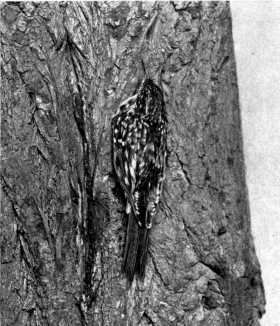
"Although I'm a bird, I give you my word That seldom you'll know me to fly; For I have a notion about locomotion, The little Brown Creeper am I, Dear little Brown Creeper am I. "Beginning below, I search as I go The trunk and the limbs of a tree, For a fly or a slug, a beetle or bug; They're better than candy for me, Far better than candy for me. "When people are nigh I'm apt to be shy, And say to myself, 'I will hide,' Continue my creeping, but carefully keeping Away on the opposite side, Well around on the opposite side. "Yet sometimes I peek while I play hide and seek, If you're nice I shall wish to see you: I'll make a faint sound and come quite around, And creep like a mouse in full view, Very much like a mouse to your view."

An Interesting Phœbe's Nest
NEST OF PHŒBE Photographed from nature
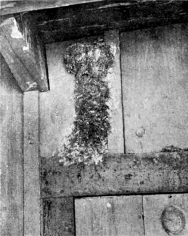
The accompanying illustration shows an interesting Phœbe's nest. It is well-known that this bird prefers to build close to some overhead protection, but I have never seen, and have heard of only one other similar structure, showing such evidence of forethought by the builder; for this bird has constructed a pedestal by means of which her nest was raised to the desired height.
The location chosen was three feet or so back under the piazza roof of a lonely, unused summer cottage by the shore of Webster lake, in Franklin, N. H.
The foundations were begun on a door-cap to the left of, although almost in touch with, an upright cleat. Soon the builder made a turn to the right, that the pedestal might rest firmly against this cleat. From this point the work continued perpendicularly full twelve inches, with the breadth of about three inches and a thickness of one and one-half inches. Upon this the enlargement was made for the nest proper, which was destined to safely cradle her brood of four.—Ellen E. Webster, Franklin Falls, N. H.
[Two years ago John Burroughs showed us a nest similar to the one here described, built beneath the eaves, on a slight projection in the rough hewn rock of the railway station at West Park, N. Y.—Ed.]
A Useful Nest-Holder
After the leaves fall many deserted birds' nests will be exposed to view. The larger number will still be found serviceable for study, and in collecting them a note of the site, height from the ground, if in a tree or bush, etc., should be made to aid in their identification.
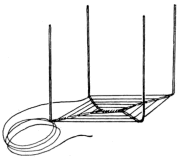
The accompanying cut shows a very useful holder for such specimens. It was designed by Mr. George B. Sennett, and is made of annealed wire, about the bottom of which is tied hair wire, as shown. At this stage, the nest is placed in the holder, the four uprights are cut off to the required height, and bent in or out, in order to bring them closely to the sides of the nest; the wrapping with hair wire is then continued until the nest is firmly bound. In this way such loosely built nests as those of the Mourning Dove or Cuckoo may be held in shape without in the least concealing their structure.—Ed.
A Singing Blue Jay
Not long ago, when the snow covered the ground several inches deep, I heard as sweet a little song as one could expect to hear from a Warbler in May, come from a clump of small plum trees in the back yard. Creeping softly in the direction of the sound, I could see nothing but a stately Blue Jay perched upon one of the upper limbs. I waited patiently, and soon the song came again, sweet and mellow as before; this time I could plainly see the Jay's open bill and the muscular movements of his throat. I could hardly believe my eyes, as I had been accustomed to hear only harsh sounds from a Jay's throat. I raised to a standing posture, the Blue Jay flew away. I looked carefully all about, and no other birds were in sight. This Blue Jay remained in the neighborhood all winter, and several times I had the pleasure of hearing his sweet little song.—Frank E. Horack, Iowa City, Iowa.
To Hunt Southern Birds
Rockville Centre, L. I., November 9.—O. H. Tuthill and Robert T. Willmarth, of this village, Benjamin Molitor, of East Rockaway, and Coles Powell, of Seaford, started yesterday on a bird skinning and stuffing expedition to the Florida coast. The men went aboard of Mr. Molitor's little 28-foot sloop, Inner Beach, which is fitted with both sails and gas engine.
They take the inside route through bays, rivers and canals to Beaufort, N. C. From there on to their destination they will have to take their chances outside on the ocean. The men go to shoot all kinds of water birds, for which there is an unprecedented demand this season by millinery manufacturers. After being killed, most of the birds will be skinned and stuffed roughly with cotton, and every week shipments will be made to New York.
Mr. Tuthill is an old hand in the business. The last time there was a large demand for birds by the makers of women's headgear, about twelve years ago, he took an outfit to Florida and during the winter shipped 140,000 bird skins to New York.—Brooklyn Eagle.
[We met Mr. Tuthill in Key West in February, 1892, and heard him state that during a preceding winter his party had killed 130,000 birds for millinery purposes, and the information contained in the above clipping is doubtless, therefore, accurate.—Ed.]
American Ornithologists' Union
The seventeenth annual congress of the American Ornithologists' Union convened at the Academy of Natural Sciences, in Philadelphia, on November 13, 1899. At the business meeting held on the night of that day the following officers were elected for the ensuing year: President, Robert Ridgway; vice presidents, C. Hart Merriam and C. B. Cory; secretary, John H. Sage; treasurer, William Dutcher; councilors, C. F. Batchelder, F. M. Chapman, Ruthven Deane, J. Dwight, Jr., A. K. Fisher, T. S. Roberts, Witmer Stone. Two corresponding and eighty-two associate members were elected.
The program for the three days' public sessions, on November 14-16, included the following papers:
Notes on the Flammulated Screech Owls, Harry C. Oberholser; Three Years' Migration data on City Hall Tower, Philadelphia, Wm. L. Bailey; A Quantitative Study of Variation in the Smaller American Shrikes, Reuben M. Strong; The Habits and Structure of Harris' Cormorant, R. E. Snodgrass and F. A. Lucas; Bering Sea Arctic Snowflake (Passerina hyperborea) on its breeding grounds, C. Hart Merriam; On the Plumages of Certain Boreal Birds, Frank M. Chapman; On the Perfected Plumage of Somateria spectabilis, Arthur H. Norton; The Summer Molting Plumage of Eider Ducks, Witmer Stone; An Oregon Fish Hawk Colony, Vernon Bailey; Exhibition of a series of field sketches made from absolutely fresh birds, showing the true life colors of the soft parts, mostly in the breeding season, Louis Agassiz Fuertes; The Sequence of Plumages and Molts in Certain Families of North American Birds, Jonathan Dwight, Jr.; The Ranges of Hylocichla fuscescens and Hylocichla f. salicicola, Reginald Heber Howe, Jr.; On the occurrence of the Egyptian Goose (Chenalopex ægyptiaca) in North America, Frank C. Kirkwood; Notes on the Habits of the Great Mexican Swift (Hemiprocne zonaris), Sam'l N. Rhoads; Further remarks on the Relationships of the Grackles of the Sub-genus Quiscalus, Frank M. Chapman; Audubon's Letters to Baird—compiled from Copies of the originals kindly furnished by Miss Lucy H. Baird, Witmer Stone; A Peculiar Sparrow Hawk, William Palmer; The Requirements of a Faunal List, W. E. Clyde Todd; Report of the A. O. U. Committee on Protection of N. A. Birds, Witmer Stone; An account of the Nesting of Franklin's Gull (Larus franklinii) in Southern Minnesota, illustrated by lantern slides, Thos. S. Roberts; Bird Studies with a Camera, illustrated by lantern slides, Frank M. Chapman; Home Life of some Birds, illustrated by lantern slides, Wm. Dutcher; Slides—series of Kingfisher, Gulls, etc., Wm. L. Baily; The Effects of Wear upon Feathers, illustrated by lantern slides, Jonathan Dwight, Jr.; Exhibition of lantern slides of Birds, Birds' Nests and Nesting Haunts, from Nature, members; Language of the Birds, Nelson R. Wood; A New Wren from Alaska, Harry C. Oberholser; The Molt of the Flight feathers in various Orders of Birds, Witmer Stone; Some Cuban Birds, Jno. W. Daniels, Jr.; On the Orientation of Birds, Capt. Gabriel Reynaud, French army; On the Habits of the Hoatzin (Opisthocomus cristatus), George K. Cherrie.

A Dictionary of Birds. By Alfred Newton, assisted by Hans Gadow, and others. Cheap issue, unabridged. London, Adam and Charles Black, 1893-96. [New York, The Macmillan Co.] 8vo, pp. xii+1,088, numerous line cuts. Price, $5.
Bird students should be grateful to the publishers of this invaluable work for issuing it in an edition which places it within the reach of all.
It is not necessary for us to add our meed of praise to what is universally conceded to be "the best book ever written about birds." To those of Bird-Lore's readers who have not had the fortune to examine this or the preceding edition, we may say that the work is based on Professor Newton's article 'Birds' in the Encyclopædia Britanica which, with the coöperation of eminent specialists, has been enlarged and augmented to make an ornithological dictionary of over 1,000 pages; an indispensable work of reference to every student of ornithology who will find in its pages an immense amount of information not elsewhere obtainable.—F. M. C.
Wabeno, The Magician. The Sequel to Tommy-Anne and the Three Hearts, by Mabel Osgood Wright. Illustrated by Joseph M. Gleeson. New York, The Macmillan Company, 1899. Price, $1.50.
This pretty green and gold covered book, with its mystical sign of three interlaced hearts, will be a treasure to the army of little folks who have so enjoyed its predecessor 'Tommy-Anne.' Not only will they meet in its pages the delightful Tommy-Anne herself, but several other old friends: Obi, the almost too-human Waddles, the unfortunate Horned Owl, and others. In this volume Anne—having dropped the Tommy from her name, pushes her "whys" into the several kingdoms of earth and air. She interviews the "Man in the Moon," learns the story of the red man from a talkative Indian arrow head, and the secrets of the hive from a friendly honey-bee. Through her magic spectacles life at the bottom of the sea becomes visible, and the past history of the earth comes to light. It may readily be seen that the author has not forgotten her own childish "wonderments," and is therefore eminently fitted to satisfy those of children to-day, and although the imagination has full play in the manner of conveying it—the "how"—the information given is trustworthy. The book, with all its charm of fantasy may be put into the hands of children with the assurance that it will let them into the secrets of many interesting things in Nature, and leave no sting of false statements to be corrected as the years pass on.
The book, as usual with the publications of the house of Macmillan, is fully illustrated, beautifully printed and altogether a pleasure to look at and handle.—Olive Thorne Miller.
The Birds of Eastern North America. Key to the Families and Species. By Charles B. Cory. Part I, Water Birds, pp. i-ix, 1-130; Part II, Land Birds, pp. i-ix, 131-387. 4to. Numerous illustrations. Special edition printed for the Field Columbian Museum, Chicago, Ill., 1899.
Mr. Cory has spared neither pains nor expense to lighten the labors of young ornithologists in the matter of identification. Arbitrary 'Keys' arranged on apparently the simplest plans, a careful use of distinguishing type, and numberless illustrations characterize this work, which will doubtless rank as its talented author's most valuable and important contribution to the literature of ornithology.
The present volumes contain only the analytical keys to families and species, and apparently are to be followed by others giving detailed descriptions of plumage and biographical matter. A list of the birds of Eastern North America, with the ranges of the species, is appended to the second volume.—F. M. C.
Dickey Downy; the Autobiography of a Bird. By Virginia Sharpe Patterson. Introduction by Hon. John F. Lacey, M.C. Drawings by Elizabeth M. Hallowell. Philadelphia, A. J. Rowland, 1899. 16mo, pp. 192, full-page coloro-types, 4.
In this little volume the Bobolink recounts the history of his life with particular reference to his experiences with man. Due regard has been paid to the known habits of the bird, and the book seems well designed to arouse the interest and enlist the sympathy of children in bird-life. The colored illustration of the Scarlet Tanager facing page 64 is wrongly labeled "Summer Tanager," but beyond this slip we notice no errors.
Congressman Lacey's introduction shows that its writer has an adequate conception of both the economic and æsthetic value of birds, of the evils of wantonly destroying them, and of the need for their protection.—F. M. C.
Book News
In the October number of 'The Osprey,' the announcement is made that Dr. Gill, the editor-in-chief, will hereafter be assisted by the following associate editors: Robert Ridgway, Leonhard Stejneger, Frederic A. Lucas, Charles W. Richmond, Paul Bartsch, William Palmer, Harry C. Oberholser, and Witmer Stone. Surely here is "a multitude of counsellors" whose coöperation is an assurance that 'The Osprey' will not only return to its former high plane, but will doubtless reach a level of excellence before unknown. We note with pleasure that the somewhat too appropriate yellow cover, used during the preceding editorial administration, has been changed for one of Bird-Lore's hue.
From the announcement of the Massachusetts Audubon Society of the Audubon Calendar, issued by them for 1900, we quote the following: "The calendar consists of twelve large plates of exquisite drawings of birds, one for each month, reproduced in colors with all the spirit and fidelity of the original water-color paintings. Descriptive text of the birds on each plate. Frank M. Chapman, Olive Thorne Miller, Florence A. Merriam, Abbott Thayer, Mabel Osgood Wright, Wm. T. Davis, William Brewster, Ralph Hoffmann, Bradford Torrey, M. A. Wilcox, Harriet E. Richards, H. E. Parkhurst, have contributed original paragraphs. Size 91/2 by 121/2 inches. In paper box. Price 75 cents. Address orders to Taber-Prang Art Company, Springfield, Mass."
That the editors of St. Nicholas realize the importance of developing children's interest in nature studies, is evidenced by the establishment in their magazine for 1900, of a department of 'Nature and Science.' It will be in charge of Mr. E. F. Bigelow, formerly editor of 'The Observer,' and now of 'Popular Science.'
Lists of the birds of the Middle Gulf States are so few in number that bird students will welcome a fully annotated catalogue of the birds of Louisiana, by Prof. Geo. E. Beyer, of Tulane University, shortly to be published by the Society of Louisiana Naturalists.

A Bi-monthly Magazine
Devoted to the Study and Protection of Birds
OFFICIAL ORGAN OF THE AUDUBON SOCIETIES
Edited by FRANK M. CHAPMAN
Published by THE MACMILLAN COMPANY
A Bi-monthly Magazine Devoted to the Study and Protection of Birds
OFFICIAL ORGAN OF THE AUDUBON SOCIETIES
Edited by FRANK M. CHAPMAN
Published by THE MACMILLAN COMPANY

Vol. 1 December, 1899 No. 6
SUBSCRIPTION RATES.
Price in the United States, Canada, and Mexico, twenty cents a number, one dollar a year, postage paid.
Subscriptions may be sent to the Publishers, at Englewood, New Jersey, or 66 Fifth avenue, New York City.
Price in all countries in the International Postal Union, twenty-five cents a number, one dollar and a quarter a year, postage paid. Foreign agents, Macmillan and Company, Ltd., London.
Manuscripts for publication, books, etc., for review, should be sent to the Editor at Englewood, New Jersey.
Advertisements should be sent to the Publishers at Englewood, New Jersey, or 66 Fifth avenue, New York City.
COPYRIGHTED, 1899, BY FRANK M. CHAPMAN.
Bird-Lore's Motto:
A Bird in the Bush is Worth Two in the Hand.
We have thus far avoided all mention of the financial side of the conducting of Bird-Lore, nor do we now propose to adopt the course which circumstances, alas! have so often forced upon popular natural history journals, of turning the editorial page into a plea for subscriptions.
We trust, however, that in this concluding number of our first volume we may be permitted to make several statements in which we hope our subscribers will have a mutual interest.
In the first place, replying to the inquiry as to whether Bird-Lore will not soon be issued at monthly instead of bi-monthly intervals, let us say that the management of Bird-Lore is with us an avocation to which we can devote only the margin of time left from fully occupied days. To publish it each month would involve greatly increased labor, which, under the circumstances, we cannot assume, and we have attempted to bridge this difficulty by printing as much matter in each number as is ordinarily contained in two numbers of any popular ornithological journal.
In the end, therefore, the subscriber receives quite as much for his money, and in support of this statement we may be pardoned for calling attention to the fact that the present volume of Bird-Lore contains some 200 pages of text with over 70 illustrations, more, we believe, than is offered by any other bird magazine for the sum of one dollar.
To continue with this unpleasant subject: being perfectly familiar with the sad fate which has befallen so many of our predecessors—and of which when this journal was in contemplation our friends rarely failed to remind us!—we did not establish Bird-Lore as a money making enterprise, but as a means of popularizing a study, the advancement of which is foremost in our desires, and as an aid to the cause of the Audubon Societies.
We believe, therefore, we may venture to say, that our relations with our subscribers are of a wholly different and more intimate nature than those which exist between the publishers and purchasers of magazines which yield an adequate money return for labor expended.
We have common interests to the furtherance of which we, for our part, are willing to devote no little time and thought, as we trust is shown by our announcements for 1900. To properly carry out our plans, however, it will be necessary to increase the size of Bird-Lore, a step not as yet warranted by our subscription list. We would, therefore, ask the coöperation of every reader who has at heart the interests of bird study and bird protection. This coöperation may be shown in one or both of two ways: First, you may aid in increasing Bird-Lore's circulation by securing new subscribers, by presenting a year's subscription as a Christmas gift to some friend who is interested, or whom you want to interest in birds, or by suggesting this course to others. Second, you may assist us by promptly renewing your subscription when it expires, or in the event of your not caring to re-subscribe, we ask, as a means of regulating our edition, that you kindly send us a postal to that effect.
Bird-Lore for 1900
Bird-Lore for 1900 will, we think, reach a standard of excellence not before attained by a journal of popular ornithology. No effort has been spared to secure authoritative articles of interest to the general reader, as well as those of practical value to the teacher and student.
There will be papers by John Burroughs, recording the rarer birds he has observed about his home; by Bradford Torrey, describing his methods of attracting winter birds; by Robert Ridgway, on song birds in Europe and America; by Otto Widmann, on a visit to Audubon's birthplace; and also contributions from William Brewster, E. A. Mearns, C. Hart Merriam, T. S. Roberts, and other well-known ornithologists.
A valuable contribution to the study of bird migration will be a paper by Captain Reynaud, in charge of the Homing Pigeon Service of the French Army, who will write of his experiments in this branch of the service.
Attention will be paid to the bird-life of countries made prominent by recent events: L. M. McCormick, who has lately returned from the Philippines, writing of the birds of Luzon; H. W. Henshaw, of the birds of Hawaii, where he has long been a resident; Tappan Adney, who passed a year in the Klondike, of the birds of that region; and F. M. Chapman, of the birds of Cuba.
A. J. Campbell, the authority on Australian birds, will also contribute a paper on foreign birds, describing the remarkable habits of the Bower Birds, with photographs of their bowers from nature.
For teachers there will be a series of suggestive articles on methods of teaching ornithology, by Olive Thorne Miller; Florence A. Merriam; Marion C. Hubbard, of Wellesley; Lynds Jones, of Oberlin, and others, who have made a specialty of instruction in this branch of nature study.
Students will be glad to avail themselves of the assistance offered by Bird-Lore's Advisory Council, a new idea in self-educational work, the details of which are announced on another page. Among papers designed more especially for students will be Ernest Seton-Thompson's 'How to Know the Hawks and Owls,' illustrated by the author, F. A. Lucas' 'Tongues of Birds,' also illustrated by the author, and Professor Pinchot's 'A Method of Recording Observations.'
A paper of unusual value to those who study birds with the aid of a camera will be by John Rowley, of the American Museum of Natural History, who will describe a recently invented camera which opens new fields in bird photography.
For 'Young Observers' there will be articles by other young observers, and poems and jingles all designed to arouse and stimulate the child's interest in birds.
The illustrations will, if possible, be of even higher quality than those for which already Bird-Lore has become distinguished.
The Audubon Department, under Mrs. Wright's care, will, as heretofore, print reports of the great work which is being done in the interests of bird study and bird protection, and the series of helpful articles by its Editor will be continued.
This outline of the leading features of Bird-Lore for the coming year will, we trust, be deemed sufficient warrant for the belief expressed in our opening sentence. It will be seen that our difficulty is not lack of material, but lack of space, and this difficulty we hope our subscribers will help us to overcome by seconding our efforts in their behalf.

"You cannot with a scalpel find the poet's soul, Nor yet the wild bird's song."
Edited by Mrs. Mabel Osgood Wright (President of the Audubon Society of the State of Connecticut), Fairfield, Conn., to whom all communications relating to the work of the Audubon and other Bird Protective Societies should be addressed. Reports, etc., designed for this department should be sent at least one month prior to the date of publication.
DIRECTORY OF STATE AUDUBON SOCIETIES
With names and addresses of their Secretaries.
New Hampshire Mrs. F. W. Batchelder, Manchester.
Massachusetts Miss Harriet E. Richards, care Boston Society of Natural History, Boston.
Rhode Island Mrs. H. T. Grant, Jr., 187 Bowen street, Providence.
Connecticut Mrs. William Brown Glover, Fairfield.
New York Miss Emma H. Lockwood, 243 West Seventy-fifth street, New York City.
New Jersey Miss Anna Haviland, 53 Sandford Ave., Plainfield, N. J.
Pennsylvania Mrs. Edward Robins, 114 South Twenty-first street, Philadelphia.
District of Columbia Mrs. John Dewhurst Patten, 3033 P street, Washington.
Wheeling, W. Va. (branch of Pa. Society) Elizabeth I. Cummins, 1314 Chapline street, Wheeling.
Ohio Miss Clara Russell, 903 Paradrome street, Cincinnati.
Indiana Amos W. Butler, State House, Indianapolis.
Illinois Miss Mary Drummond, Wheaton.
Iowa Miss Nellie S. Board, Keokuk.
Wisconsin Mrs. George W. Peckham, 646 Marshall street, Milwaukee.
Minnesota Mrs. J. P. Elmer, 314 West Third street, St. Paul.
Tennessee Mrs. C. C. Conner, Ripley,
Texas Miss Cecile Seixas, 2008 Thirty-ninth street, Galveston.
California Mrs. George S. Gay, Redlands.
The Law and the Bird
During the past ten months Bird-Lore has printed interesting statistics concerning the organization of the various State Audubon Societies, as well as significant reports of the progress of their work. So far so good. There are, of course, slight differences in the platforms of these societies regarding by-laws, methods, fees versus no fees, etc. Upon one point, however, they all agree—that while they deplore the use of the feathers of wild birds in millinery, the great point is the education of children to have the proper regard for bird life.
It is, however, necessary to go a step behind even this. A priori the bird must be given a legal status before it can be protected with any general success, even by those most willing so to do. In appealing to the average child of the public school, it should be remembered of how many races this average child is compounded,—races with instincts concerning what are called the lower animals, quite beyond the moral comprehension of the animal-loving Anglo-Saxon. To make this average school child respect the rights of the bird, the bird must be given a legal status to command, and not to beg respect. This child may be appealed to in other ways and may readily assent to all that you say, while your personal influence is with him, but he goes away and forgets; he does not feel the weight of a merely moral penalty.
Game birds have this legal status, in a greater or less degree, in all states, with perhaps the single exception of Mississippi, and sportsmen are always on the alert for infringement of the game laws.
It would seem to me wise for Audubonites to turn more attention to the legal status of the class of birds that they specially seek to protect.
Legislation in this respect is, of course, difficult to obtain, because many sportsmen are afraid of weakening the game laws by stirring up discussion regarding song birds, etc.; but much more can be made of the existing laws. That these are by no means adequately enforced, is evident to anyone who notices the hordes of men and boys prowling, these autumn days, about woods and meadows, where legitimate game birds are unknown, and Robins, Flickers, and even the smaller migrants are the only game. It makes one feel that the song bird protectionists must often "pass by on the other side," not having the honesty of their convictions in as militant a degree as the sportsmen, even when they have the law to back the bird.
It will doubtless be interesting to open these 'pages,' during the coming year, to a presentation and discussion of this legal status. We should like to receive the condensed bird laws of every state possessing such, as well as opinions as to what birds should be excluded from protection in the best interests of the Commonwealth, to the end that there may be a federation of Audubon Societies regarding the best method of obtaining legislation for the protection of desirable birds not covered by the game laws.
Be the roads many—illustrated lectures to arouse public sentiment, birdless bonnets, leaflets, thousands of pledge cards signed by ready sympathizers—the goal must be conservative, well thought out legislation, free from any taint of emotional insanity. If we are to keep the bird it must be by the aid of the law, the only voice that must be listened to, speaking the only language understood by all the races that go to make up the people of the United States.—M. O. W.
Reports from Societies
RHODE ISLAND SOCIETY
An exhibition of birdless hats—'Audubonnets' as they have been facetiously styled—was held in the parlors of the Narragansett Hotel, in Providence, on the 9th of October. The response to the invitations, which were sent by the society to the leading milliners, was very gratifying, nearly all of them entering cordially into the scheme. About one hundred and fifty hats were exhibited, and it is safe to say that such a beautiful and artistic display of millinery was never before seen in Providence. Most of the hats were especially designed for the occasion, and an endless variety of styles and trimmings was shown. The result proved conclusively that the plumage of wild birds can be easily discarded without violating the laws of fashion.
The exhibition had been well advertised and, in spite of unpleasant weather, the parlors were thronged with visitors throughout the day. Many sales were made, the proceeds going to the exhibitors.
Four ribbon prizes were awarded, but it is the opinion of the committee in charge that prizes, even of that nature, were a disadvantage.
The 'Providence News' thus comments upon the exhibition: "It was only the other day that the 'News' was moved to remark from the evidence of the fashion plates, that bird plumage was to be more than ever the fashion this season. But there is evidence that the protest against it is a mighty one, and if the birds in other communities have supporters of the number and character that they find here in Rhode Island, the milliners who oppose the sentiment of the Audubons will at no early day be compelled to reform or to go out of business."
Annie M. Grant, Sec'y.
PENNSYLVANIA SOCIETY
During the year that has followed the issuing of our second annual report the Society has spread to nearly every county in the State. The membership has grown from 3,300 to 5,000, and a steady increase of interest is shown in the letters received by the secretary.
Bird-Day was most successfully observed in a large number of schools, and both teachers and pupils seemed well pleased with the results. We owe thanks to many of our local secretaries for their good work among children, and for the classes for bird study which they formed during the summer. This is a movement of the utmost importance, as with increasing membership it becomes more and more difficult for the secretary to conduct individual correspondence, and everyone who will band together local members and act as local secretary, will further the interests of the Society more than can be done in any other way.
We would like to call the attention of our members to the following:
1. When this Society was organized the quills used in millinery were all taken from large domestic birds. Lately the Brown Pelican, Eagles, Owls, and Turkey Vulture have been made to pay tribute to the fashions; and we wish most earnestly to protest against the use of these quills. A good illustration of the feathers to be avoided will be found in the October number of Bird-Lore.
2. We would also call attention to the fact that this magazine is the official organ of the Audubon Societies, and is essential to anyone desiring to keep up with what is being done for the protection of birds.
3. As heretofore, we are dependent almost entirely upon voluntary subscriptions for carrying on the objects of the organization, and we therefore appeal again for assistance from those interested in furthering the cause of the protection of birds. Increased funds will, of course, enable us to reach a larger number of persons, and to issue a larger amount of literature, for which there is a constant demand. Donations should be forwarded to the treasurer, Mr. William L. Baily, 421 Chestnut street, Philadelphia.
For the coming year we have in view the usual course of lectures, by Mr. Stone, and also the furthering of bird study in the schools, to which end we hope to issue some educational circulars.
Julia Stockton Robins, Sec'y.
THE WISCONSIN SOCIETY
Our busy season is in the spring of the year. At about Easter time our State Superintendent of Schools issued his 'Arbor and Bird-Day Annual,' which contained an invitation to teachers and children to join the Audubon Society. This invitation brought an almost overwhelming response, every day for several weeks bringing me ten or fifteen letters from would-be branches, and our school membership mounted rapidly to over 10,000. A prize offered to these children for the best personal observation on a Bird Family was won by a little country girl, who wrote a very good composition on the Ground Sparrow. We have tried, with varying degrees of success, in different places, to institute the work of the 'Bird Restorers' among these children.
We shall soon have a little library of bird books circulating among the schools, and we are trying to raise money for a set of lantern slides to accompany a lecture—lecture and slides to be sent from place to place.
I believe that the Audubon work has already made a deep impression in Wisconsin. The milliners' windows abound in Gulls and Birds of Paradise, but they are not finding a ready sale. As to wings, perhaps it is too much to expect that women will not believe their milliners when told that "These wings are all right, because they are made."
E. G. Peckham, Sec'y.
The Passing of the Tern
The surprising results which may follow Fashion's demand for a certain kind of bird have never been more clearly shown than in the case of the Terns or Sea Swallows of our Atlantic coasts.
Useless for food, the birds had escaped the demands of the hunter, and thousands nested in security along our beaches. The exquisite purity of their plumage and their unsurpassed gracefulness on the wing made them a particularly grateful element of the coast scenery to every lover of the beautiful, while to the prosaic fisherman they often gave welcome evidence of the direction of the land, as with unerring flight they returned through the densest fogs, bearing food to their young.
Suddenly, as a result of causes too mysterious for the mind of man to comprehend, Fashion claimed the Terns for her own.
Up and down the coast word went forth, that Sea Swallows, or 'Summer Gulls,' were worth ten cents each, and the milliner's agent was there to confirm the report.
It was in June when the baymen were idle and, unrestrained by law, they hastened to the beaches in keen competition to destroy the birds which were nesting there.
Photographed from nature by F. M. Chapman WILSON'S TERN ON NEST
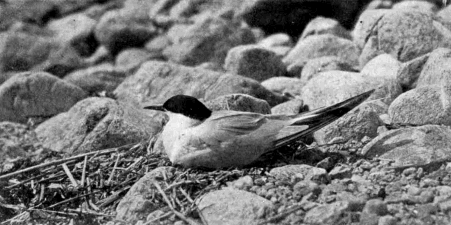
Never, in this country, at least, has there been such a slaughter of birds. A Cobb's Island, Virginia, bayman, whose conscience, even at this late date, urged him to a confession of shame for his part in the proceedings, told me recently that in a single day of that memorable season, 1,400 Terns were killed on Cobb's Island alone, and 40,000 are said to have been there shot during the summer. The destruction at other favorable places was proportionately great.
Two seasons of this work were sufficient to sweep the Terns from all their more accessible resorts, the only survivors being residents of a few uninhabited islands. Even here they would have succumbed had not bird-lovers raised a sum to pay keepers to protect them.
Then Fashion, as if content with the destruction she had wrought, found fresh victims, and the Terns, for a time, escaped persecution. Now, however, the demand for them has been revived, and again the milliners' agent is abroad placing a price on the comparatively few birds remaining. Before me is a circular issued by a New York feather dealer, asking for "large quantities" of "Sea Gulls, Wilson's Turns (sic), Laughing Gulls, Royal Gulls," etc., and this is only one instance among hundreds. In fact, the feather merchants themselves state that the demand for Terns and Gulls exceeds the supply.[J]
What will be the result? Is there no appeal from Fashion's decree? Woman alone can answer these questions, and the case is so clear she cannot shirk the responsibility of replying.
Aigrettes are decorative, quills difficult to identify, neither bespeak death, and ignorance may lead the most humane woman into wearing either. But with the Tern no such excuse exists, and the woman who places its always disgustingly mutilated body on her bonnet, does so in deliberate defiance of the laws of humanity and good taste.
Frank M. Chapman.
"The greatest and best book ever written about birds."
—Elliott Coues
A DICTIONARY OF BIRDS
By Alfred Newton
Professor of Zoölogy and Comparative Anatomy, University of Cambridge
Assisted by HANS F. GADOW, Ph.D., F.R.S.
WITH CONTRIBUTIONS FROM
RICHARD LYDEKKER Author (with Sir W. H. FLOWER) of "An Introduction to the Study of Mammals," etc. CHARLES S. ROY Professor in the University of Cambridge
ROBERT W. SHUFELDT Late U. S. Army. Author of "The Myology of the Raven," etc.
COMPLETE IN ONE VOLUME. Med. 8vo, PRICE $10 NET
~~~~~~~~~~~~~~~~~
"It is far and away the best book ever written about birds … the best 'all-round' book we have ever seen; the one that best answers the purposes of all readers; the one which conveys the most information per thousand ems; the one which is freest from misstatements of any sort; the one which is most cautious and conservative in expression of opinions where opinions may reasonably differ; the one which is the most keenly critical, yet most eminently just in rendering adverse decisions…."
—From an extended review in The Auk.
"A very useful and concise volume, in which is to be found a vast amount of varied information."
—O. S. in Nature.
"It is a better introduction to ornithology and to ornithologists than has ever been written before … indeed it is one to lie upon the desk of every worker in this branch of natural history as an almost inexhaustible storehouse of facts he needs to know."
—The Nation.
"The most valuable and most interesting contribution ever made to the subject of which it treats."
—Science.
PUBLISHED BY
THE MACMILLAN COMPANY, New York


"Attractive, interesting and helpful, and should be in the library of every lover of birds."—Science
A Field Book of Two Hundred Song, Game and Water Birds …
BY Mabel Osgood Wright Author of "Tommy-Anne and the Three Hearts." "Citizen Bird." "Four-footed Americans and their Kin." THIRD EDITION With Eighty Plates by LOUIS AGASSIZ FUERTES SMALL 4to, $2.50
ENTICINGLY WRITTEN
"It is more than an accurate and comprehensive description of all the birds one is likely to find in an extended search. It is also an introduction to them and their haunts, so enticingly written that the reader at once falls in love with them, and becomes an enthusiast in their pursuit. * * * The scientific part of the work is equally well done."
—Evening Bulletin, Philadelphia
THOROUGHLY ATTRACTIVE
"The book is as thoroughly attractive in its text as it is in its pictures, for while it gives a wonderfully clear account of the birds, their peculiar characteristics and how they are to be known, its style is perfectly charming."
—The Home Journal, Boston
BRIGHT AND CLEAR
"Of very great interest and value to the lover of birds and the student of their ways. * * * Her descriptions are bright, clear and simple. * * * Crisp and well-written."
—The Daily Eagle, Brooklyn
"As valuable as it is beautiful."
—The Inter Ocean, Chicago
PUBLISHED BY
THE MACMILLAN CO., New York
HEART OF NATURE SERIES

CITIZEN BIRD
SCENES FROM BIRD-LIFE IN PLAIN ENGLISH FOR BEGINNERS…. BY Mabel O. Wright and Dr. Elliott Coues Profusely Illustrated by Louis Agassiz Fuertes CLOTH, CROWN 8vo. $1.50 NET

"Entertaining as well as valuable."—Evening Telegraph, Philadelphia.
"A volume which cannot be too widely circulated."—Daily Advertiser, Boston.
"A delightful and at the same time a most instructive book."—The Herald, New York.
"One of the most charming as well as the most useful of books on birds ever printed."—Forest and Stream.
"There is no other book in existence so well fitted for arousing and directing the interest that all children feel toward the birds."—Tribune, Chicago.
"An extremely praiseworthy attempt to teach children about our domestic birds, by encouraging them to observe the living creatures rather than the inanimate 'specimen.' More than a hundred accurate and spirited illustrations add greatly to the attractiveness of the volume."—The Nation.
"By far the best bird book for boys and girls yet published in America."
—C. H. M. in Science.
OTHER BOOKS BY THE AUTHOR OF "BIRDCRAFT," "CITIZEN BIRD," ETC.
THE FRIENDSHIP
OF NATURE A New England Chronicle of Birds and Flowers
By MABEL OSGOOD WRIGHT CLOTH, 18mo, 75 CENTS "The birds have seldom found a truer friend, and the flowers have never had a more loving interpreter. This tiny volume ought to find many friends. —The Herald, Boston.
~~~~~~~~~~~~~~~~~
Tommy-Anne and the Three Hearts "Probably the most charming nature-book for children published."—The Dial.
By MABEL OSGOOD WRIGHT Author of "Citizen Bird," "Four-footed Americans," Etc. CLOTH, 12mo, $1.50 "It has had a remarkable success, and it has well deserved it."—Evening Transcript, Boston.
~~~~~~~~~~~~~~~~~
Four-footed Americans and their kin HEART OF NATURE SERIES By MABEL OSGOOD WRIGHT Edited by FRANK M. CHAPMAN Illustrated by ERNEST SETON THOMPSON CLOTH, $1.50 NET
"Mrs. Mabel Osgood Wright combines in an unusual degree minute knowledge of natural life and the power of conveying that knowledge in an interesting fashion…. The illustrative work deserves special attention, so accurate and spirited is it and so well done in point of workmanship."—The Outlook.
"The illustrations call for almost unqualified praise…. It is, perhaps, not too much to say that these are the best small illustrations of our mammals ever brought together in a single volume."—The Nation.
PUBLISHED BY
THE MACMILLAN COMPANY, New York
Our Book-Store is in Every Post Office of the United States
IN THE CITIES IT'S AT EVERY DOOR
We do not describe these books, but we will send you any of them, postpaid, "on approval." After examining them at your leisure you can either send us the price, if you wish to retain the volumes, or return them to us, if for any reason they are not satisfactory.
Photographing Birds and Butterflies in Colors Color photography has surely come to stay. We have published three volumes illustrated in this manner, and the pictures will probably surprise you unless you have kept up with such matters very closely. They are photographed direct from the birds and butterflies, and only three colors are used in printing; yet the results are generally absolutely accurate renderings of the original hues. Their price is about one-twentieth of what such books could have been bought for a few years ago. "The Butterfly Book," by Dr. W. J. Holland (already in its second edition), has, besides hundreds of text illustrations, 48 colored plates, which show over a thousand species of American butterflies, with all their native beauty and brilliance of coloring. It tells everything about butterflies, and tells it in a way anybody can understand. The price is $3 net. Neltje Blanchan's "Birds that Hunt and are Hunted" (10th thousand) gives the life-histories of 173 of our game and water birds and birds of prey. You can actually see the iridescent sheen on the neck of the wild pigeon that serves as a frontispiece, and the other 47 plates are equally remarkable. Quite as remarkable also is the price: $2. "Bird Neighbors," by the same author, has 52 colored plates, and describes 150 of the song birds and other more common feathered neighbors. With the aid of these life-like plates there can be not the least doubt as to the identification of a bird. It is almost a sufficient commentary on the volume that we have had to print 20,000 copies in the year since it appeared. It costs $2. Any or all of these books sent, postpaid, "on approval." After examining them at your leisure, you can send us either the price or the books. SECOND EDITION. The Life of Henry Drummond. By George Adam Smith. With photogravure portrait … Net $3 00 61st THOUSAND. The Day's Work. By Rudyard Kipling. Illustrated … 1 50 35th THOUSAND. Cyrano de Bergerac. By Edmond Rostand. Translated by Gertrude Hall … Net 50 Also an illustrated Edition de Luxe on large paper … 1 00 15th THOUSAND. The People of Our Neighborhood. By Mary E. Wilkins. Illustrated. Cloth … 50 7th THOUSAND. Bob, Son of Battle. A Novel. By Alfred Ollivant … 1 25 SECOND EDITION. The Nameless Castle. By Maurus Jokai. With portrait … 1 25 7th THOUSAND. A Gunner Aboard the "Yankee." Introduction by Rear-Admiral Sampson. Illustrated … 1 50 SECOND EDITION. Songs of Action. By A. Conan Doyle … 1 25 SECOND EDITION. What Shall Our Boys Do for a Living? By Charles F. Wingate. 1 00 76th THOUSAND. Little Masterpieces. Edited by Bliss Perry. 9 volumes, cloth, $2.70; full leather … 5 40 44th THOUSAND Tales from McClure's. Illustrated, cloth, 25 cts. each; 5 vols. in a box. Cloth, $1.25; full leather … 2 50 13th THOUSAND. The Spirit of Sweetwater. By Hamlin Garland. With 4 photogravures Cloth, 50c.; full leather. 1 00
Doubleday & McClure Co., 141-155 East 25th Street, New York.
STANDARD POPULAR BIRD BOOKS
A New Bird Book by PROF. DANIEL GIRAUD ELLIOT Completing His Series of Popular Ornithologies.
The Wild Fowl of the United States and British Possessions
By Prof. Daniel Giraud Elliot. The Swan, Geese, Ducks and Mergansers of North America. Portrait and 63 illustrations of every species described. Post 8vo, ornamental cloth, $2.50. Limited edition 100 copies on hand-made paper, 4to, white cloth, $10 net.
The third and last volume of Prof. Elliot's valuable popular Works, and completes the Game Bird Series. Published uniform with "Shore Birds" and "Game Birds."
North American Shore Birds
The Snipe, Sandpiper, Plover, and their Allies. By Prof. D. G. Elliot. Profusely illustrated by full-page drawings by Edwin Sheppard. Post 8vo, cloth. Second edition, $2.50.
Game Birds of North America
The Partridge, Grouse, Ptarmigan, Wild Turkey, etc. By Prof. D. G. Elliot. Profusely illustrated by 46 full-page drawings by Edwin Sheppard. Post 8vo. Second edition, $2.50.
FRANCIS P. HARPER, 17 East 16th St., New York
Our Animal Friends
AN ILLUSTRATED MONTHLY MAGAZINE
THE ORGAN OF
The American Society for the Prevention of Cruelty to Animals
Containing original and instructive articles of interest to all animal owners, including serial and short stories, and interesting miscellany by well-known writers.
SUBSCRIPTION, ONE DOLLAR PER YEAR Published at the Headquarters of the Society
MADISON AVENUE AND 26TH STREET NEW YORK
OPINIONS OF THE PRESS
The articles and illustrations are excellent and forcible in their teachings.—Journal of Education, Boston.
Our Animal Friends equals in beauty of exterior and valuable contents the most widely circulated periodicals of the times.—The North American, Philadelphia.
The magazine is admirably edited and illustrated, and contains matter of great general interest.—Forest and Stream, New York.
Should be read by every boy and girl in the land, and there are many children of larger growth that would derive benefit from its pages.—Spirit of the Times.
As entertaining as it is instructive.—Philadelphia Inquirer.
No publication in this country so admirably combines exact scientific information with racy and refined literary matter.—Yorkshire (England) Weekly Post.
Lovers of our wild and domestic animals, young people especially, will find in it much that is readable and instructive.—Review of Reviews.
It is well printed and illustrated, and original in matter.—Sunday-School Times, Philadelphia.
A good magazine for every home where there are children, and its truths are just as good for those of mature life.—Chicago Inter Ocean.
HOUGH'S "AMERICAN WOODS"
A publication on the trees of the United States, illustrated by actual specimens of the woods
"A work where plant life does the writing and which no one can read without thinking."—G. A. Parker, Esq., Hartford, Conn.
"I know of nothing so well calculated to make young people fall in love with trees."—Prin. E. H. Russell, Worcester, Mass.
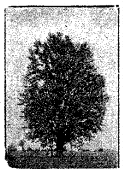
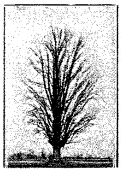
PREPARATIONS OF WOODS FOR STEREOPTICON AND MICROSCOPE, AND WOODEN CARDS FOR FANCY AND BUSINESS PURPOSES
Send for circulars, and enclose 10 cents for sample specimens from American Woods.
Address ROMEYN B. HOUGH, Lowville, N. Y.
FRANK M. CHAPMAN'S BOOKS
BIRD-LIFE
A Guide to the Study of our Common Birds. By Frank M. Chapman, Assistant Curator of Vertebrate Zoölogy, American Museum of Natural History; author of "Handbook of Birds of Eastern North America."
TEACHERS' EDITION—Containing an Appendix with new matter designed for the use of teachers, and including lists of birds for each month of the year; and with additional annotated lists of birds found at Washington (D. C.), Philadelphia (Pa.), Portland (Conn.), Cambridge (Mass.), St. Louis (Mo.), Oberlin (O.) and Milwaukee (Wis.). With 75 full-page uncolored plates and 25 drawings in the text, by Ernest Seton Thompson. 12mo, cloth, $2.
LIBRARY EDITION—Same as above, but without the Teachers' Appendix. 12mo, cloth, $1.75.
ALSO, EDITION IN COLORS. 8vo, CLOTH, $5.
"His chronicles are full of the enthusiasm of the born naturalist. He gossips about the affairs of birds in a delightful strain, making 'Bird-Life' an irresistible invitation to a fuller study of ornithology. It is not dry details he offers, but pretty stories, biographical sketches of interesting families—all sorts of bird-lore that proves the most enchanting reading."—Chicago Evening Post.
TEACHERS' MANUAL
To accompany Portfolios of COLORED PLATES. Contains the same text as the "Teachers' Edition of Bird-Life," but is without the 75 uncolored plates. Sold only with the Portfolios of the colored plates, as follows:
Portfolio No. I.—Permanent Residents and Winter Visitants. 32 plates.
Portfolio No. II.—March and April Migrants. 34 plates.
Portfolio No. III.—May Migrants, Types of Birds' Eggs, and Nine Half-tone Plates showing Types of Birds' Nests from Photographs from Nature. 34 plates.
Price of Portfolios, each, $1.25; with the Manual, $2; the three Portfolios with the Manual, $4.
HANDBOOK OF BIRDS OF EASTERN NORTH AMERICA
With Keys to the Species; Descriptions of their Plumages, Nests, etc.; their Distribution and Migrations. By Frank M. Chapman. With nearly 200 Illustrations. 12mo. Library Edition, cloth, $3; Pocket Edition, flexible morocco, $3.50.
"A book so free from technicalities as to be intelligible to a fourteen-year-old boy, and so convenient and full of original information as to be indispensable to the working ornithologist…. As a handbook of the birds of eastern North America it is bound to supersede all other works."—Science.
INSECT LIFE
By John Henry Comstock, Professor of Entomology in Cornell University. With Illustrations by Anna Botsford Comstock, member of the Society of American Wood Engravers. 12mo. Library Edition, cloth, $2.50; Teachers' and Students' Edition, $1.50.
FAMILIAR LIFE IN FIELD AND FOREST
By F. Schuyler Mathews. With many illustrations. 12mo. Cloth, $1.75.
Other Books by Mr. Mathews
Each 12mo. Cloth, $1.75
Familiar Features of the Roadside
The Flowers, Shrubs, Birds and Insects. With 130 illustrations by the author.
Familiar Trees and Their Leaves
Illustrated with over 200 drawings from nature by the author, and giving the botanical names and habitat of each tree, and recording the precise character and coloring of its leafage.
Familiar Flowers of Field And Garden
Illustrated with 200 drawings by the author.
These books are for sale by all booksellers; or they will be sent by mail, on receipt of price, by the publishers,
D. APPLETON & CO., 72 Fifth Avenue, New York
The American Ornithologists' Union
Check-list of North American Birds
SECOND EDITION (1895), THOROUGHLY REVISED
The preface of this work defines its scope and object, and includes selections from the A. O. U. Code of Nomenclature, of special importance in the present connection. The table of contents consists of a systematic list of the orders, sub-orders and families of North American birds. The check-list proper gives the scientific and common name, number in previous list, and geographical distribution of the 1,068 species and sub-species, constituting the North American Avifauna. This is followed by a list of birds of doubtful status, and a list of the fossil birds of North America.
This new edition has been carefully revised; the recent changes in nomenclature, and species and sub-species described since the publication of the first edition in 1886, are included, while the portion relating to geographical distribution has been much amplified.
CLOTH, 8vo, 372 PAGES, PRICE $2
~~~~~~~~~~~~~~~~~
J. A. Allen Editor ..THE AUK.. F. M. Chapman Assoc. Editor
A Quarterly Journal of Ornithology OFFICIAL ORGAN OF THE AMERICAN ORNITHOLOGISTS' UNION.
As the official organ of the Union, 'The Auk' is the leading ornithological publication of this country. Each number contains about 100 pages of text, a handsomely colored plate, and other illustrations. The principal articles are by recognized authorities, and are of both a scientific and popular nature. The department of 'General Notes' gives brief records of new and interesting facts concerning birds, contributed by observers from throughout the United States and Canada. Recent ornithological literature is reviewed at length, and news items are commented upon by the editors. 'The Auk' is thus indispensable to those who would be kept informed of the advance made in the study of birds, either in the museum or in the field.
PRICE OF CURRENT VOLUME, $3. SINGLE NUMBERS, 75 CTS.
Address L. S. FOSTER
33 PINE STREET
Publisher of 'The Auk,' and agent of The American Ornithologists' Union for the Sale of its Publications
NEW YORK CITY
Delightful Bird Books
Florence A. Merriam Birds of Village and Field. A Bird Book for Beginners. Fully illustrated. 12mo, $2. A-Birding on a Bronco. Illustrated. 16mo, $1.25. My Summer in a Mormon Village. 16mo, $1. Birds Through an Opera-glass. Illustrated. 16mo, 75 cents. Olive Thorne Miller Bird-Ways. 16mo, $1.25. In Nesting-Time. 16mo, $1.25. Little Brothers of the Air. 16mo, $1.25. A Bird-lover in the West. 16mo, $1.25. Among the many agreeable studies of bird life and bird character, none have been more charming than those from the pen of Olive Thorne Miller. —Christian Union (New York). Bradford Torrey A World of Green Hills. (Birds and Nature in the Mountain Regions of Virginia and North Carolina.) 16mo, $1.25. Spring Notes from Tennessee. 16mo, $1.25. A Rambler's Lease. 16mo, $1.25. Birds in the Bush. 16mo, $1.25. The Foot-path Way. 16mo, gilt top, $1.25. A Florida Sketch-book. 16mo, $1.25. He is not merely a philosopher and a sayer of happy things. He observes Nature keenly, as well as sympathetically.—The Auk. John Burroughs Birds and Poets. $1.25. [All of Mr. Burroughs' books, 10 volumes, abound in glimpses and echoes of birds.] Frank Bolles Three books of delightful bird papers ($1.25 each), and a book of Poems ($1).
Sold by all Booksellers. Sent, postpaid, by
HOUGHTON, MIFFLIN & CO., Boston
11 East 17th Street, New York
NEW BOOKS ON BIRDS
THE STRUCTURE AND CLASSIFICATION OF BIRDS
By Prof. Frank E. Beddard, Prosector and Vice-Secretary of the Zoölogical Society of London. With 251 illustrations. 8vo, 568 pages, $6.00 net.
BIRDS IN LONDON
By W. H. Hudson, F.Z.S., etc. With 17 plates and 15 illustrations in the Text by Bryan Hook, A. D. McCormick, and by photographs from nature by R. B. Lodge. 8vo, $3.50.
BRITISH BIRDS
By W. H. Hudson, C.M.Z.S. With a chapter on Structure and Classification, by Frank E. Beddard, F.R.S. With 8 colored plates, and over 100 illustrations from original drawings. Large crown, 8vo, gilt top, $2.50.
⁂ Great care has been taken with the illustrations in this book, all of the individual birds being drawn to scale, as indicated in the descriptions. The colored plates are reproduced in the highest style of chromo-lithography from Mr. Thorburn's elaborate drawings. There is a classified table of contents and a full index of the scientific and familiar names of the two hundred and odd species described in the volume.
FUR, FEATHER AND FIN SERIES
Edited by A. E. T. Watson. Each volume profusely illustrated.
Each volume, cloth, $1.75; bound in half-leather, gilt top, $2.50.
THE PARTRIDGE. Natural History, Shooting, Cookery. THE GROUSE. Natural History, Shooting, Cookery. THE PHEASANT. Natural History, Shooting, Cookery. THE HARE. Natural History, Shooting, Coursing, Hunting, Cookery. THE RED DEER. Natural History, Deer-stalking, Stag-hunting, Cookery. THE SALMON. Fishing, Cookery. THE TROUT. By the Marquess of Granby. Cookery, by Alexander Innes Shand. THE RABBIT. By James Edmund Harting. With a chapter on Cookery, by Alexander Innes Shand.
LONGMANS, GREEN & CO., 91-93 Fifth Ave., New York
J. Horace McFarland Co., Printers, Harrisburg, Pa.
Montauk Cameras
Always Strictly High Grade
NEW DESIGNS FOR 1899
SNAP-SHOT MONTAUK 31/4 × 41/4, Fixed Focus $5 00 4 × 5, with Focusing Device 7 00 STYLE II A R. R. Lens and Unicum Shutter 4 × 5 $22 50 5 × 7 $30 00
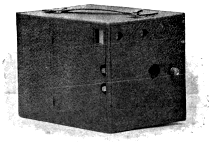
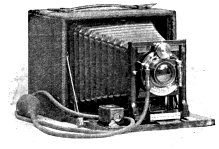
STYLE II A CYCLE 4 × 5 $22 50 5 × 7 $30 00 Including Plush-lined, Sole-leather Cycle Case STYLE I The Leading American Hand Camera 4 × 5 $30 00 5 × 7 $40 00
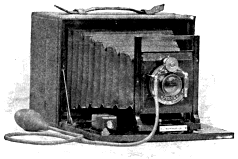
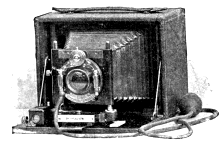
Send for Complete Catalogue (free) of all our many styles at from $5 to $250.
G. GENNERT, New York
13th Street and 5th Avenue
OUTDOOR BOOKS
BIRD-LIFE
A Guide to the Study of our Common Birds. By Frank M. Chapman, Assistant Curator of Mammalogy and Ornithology, American Museum of Natural History; author of "Handbook of Birds of Eastern North America." With 75 full-page Plates and numerous Text Drawings by Ernest Seton Thompson. 12mo. Cloth, $1.75. The same, with Lithographic Plates in colors. 8vo. Cloth, $5.
Teachers' Edition
Containing an Appendix with new matter designed for the use of teachers, and including lists of birds for each month in the year; and with additional annotated lists of birds found at Washington, D. C.; Philadelphia, Pa.; Portland, Conn.; Cambridge, Mass.; St. Louis, Mo.; Oberlin, Ohio, and Milwaukee, Wis. With 75 full-page Uncolored Plates and 25 Drawings in the text, by Ernest Seton Thompson. 12mo. Cloth, $2.
Teachers' Manual
To accompany Portfolios of Colored Plates. Contains the same text as the "Teachers' Edition of Bird-Life," but is without the 75 Uncolored Plates. Sold only with the Portfolios of the Colored Plates as follows:
Portfolio No. I.—Permanent Residents and Winter Visitants. 32 Plates.
Portfolio No. II.—March and April Migrants. 34 Plates.
Portfolio No. III.—May Migrants, Types of Birds' Eggs, and 9 Half-tone Plates showing Types of Birds from Photographs from Nature. 34 Plates.
Price of Portfolios, each, $1.25; with the Manual, $2; the three Portfolios, with the Manual, $4.
"His chronicles are full of the enthusiasm of the born naturalist. He gossips about the affairs of birds in a delightful strain, making 'Bird-Life' an irresistible invitation to a fuller study of ornithology. It is not dry details he offers, but pretty stories, biographical sketches of interesting families—all sorts of bird-lore that proves most enchanting reading."—Chicago Evening Post.
Handbook of Birds of Eastern North America
With Keys to the Species; Descriptions of their Plumages, Nests, etc.; their Distribution and Migrations. By Frank M. Chapman. With nearly 200 Illustrations. 12mo. Library Edition, cloth. $3; Pocket Edition, flexible morocco, $3.50.
"A book so free from technicalities as to be intelligible to a fourteen-year-old boy, and so convenient and full of original information as to be indispensable to the working ornithologist…. As a handbook of the birds of eastern North America it is bound to supersede all other works."—Science.
The Art of Taxidermy
By John Rowley, Chief of the Department of Taxidermy in the American Museum of Natural History. Illustrated. 12mo. Cloth, $2.
"The style of this book is a model for works of its kind. Every process of the difficult art of the taxidermist is here made plain with an ease that speaks eloquently of the author's skill in his field. Illustrations add to the clarity of the text, the whole affording a very valuable working knowledge of the stuffing and mounting of little and big game."—San Francisco Call.
Insect Life
By John Henry Comstock, Professor of Entomology in Cornell University. With illustrations by Anna Botsford Comstock, member of the Society of American Wood Engravers. 12mo. Library Edition, cloth, $2.50; Teachers' and Students' Edition, $1.50.
"Any one who will go through the work with fidelity will be rewarded by a knowledge of insect life which will be of pleasure and benefit to him at all seasons, and will give an increased charm to the days or weeks spent each summer outside of the great cities. It is the best book of its class which has yet appeared."—New York Mail and Express.
News from the Birds
By Leander S. Keyser. Appletons' Home-Reading Books. 12mo. Cloth, 60 cents net.
"Pleasantly combines instruction and entertainment."—Philadelphia Public Ledger.
The Story of the Birds
By James Newton Baskett, M.A., Associate Member of the American Ornithologists' Union. Appletons' Home-Reading Books. 12mo. Cloth, illustrated, 65 cents.
"An admirable little book, as philosophic as it is entertaining. In a brief but satisfactory manner it gives a vast amount of most valuable information."—Boston Saturday Evening Gazette.
Books by F. Schuyler Mathews
Familiar Life in Field and Forest
Uniform with "Familiar Flowers," "Familiar Trees," and "Familiar Features of the Roadside." With many Illustrations. 12mo. Cloth, $1.75.
"This book is a charming companion to take on a summer vacation…. It is written in the simplest of language, and would prove a valuable aid to any teacher of natural history."—Washington Times.
Familiar Features of the Roadside
With 130 Illustrations, by the Author. 12mo. Cloth, $1.75.
"A faithful guide-book for our roadsides…. Can be unhesitatingly commended for summer strolls."—New York Evening Post.
Familiar Trees and their Leaves
Illustrated with over 200 Drawings from Nature by the Author, and giving the botanical names and habitat of each tree, and recording the precise character and coloring of its leafage. 12mo. Cloth, $1.75.
"It is not often that we find a book which deserves such unreserved commendation. It is commendable for several reasons: it is a book that has been needed for a long time, it is written in a popular and attractive style, it is accurately and profusely illustrated, and it is by an authority on the subject of which it treats."—Public Opinion.
Familiar Flowers of Field and Garden
Illustrated with 200 Drawings by the Author. 12mo. Library Edition, cloth, $1.75; Pocket Edition, flexible morocco, $2.25.
"A book of much value and interest, admirably arranged for the student and the lover of flowers…. The text is full of compact information, well selected and interestingly presented…. It seems to us to be a most attractive handbook of its kind."—New York Sun.
(Send for a copy—free—of Appletons' Bulletin of Spring Announcements)
For sale by all Booksellers; or they will be sent postpaid, on receipt of price, by the Publishers.
D. Appleton & Company, 72 Fifth Avenue, New York
"The greatest and best book ever written about birds."
—Elliott Coues
A DICTIONARY OF BIRDS
By Alfred Newton
Professor of Zoölogy and Comparative Anatomy, University of Cambridge
Assisted by HANS F. GADOW, Ph.D., F.R.S.
WITH CONTRIBUTIONS FROM
RICHARD LYDEKKER Author (with Sir W. H. FLOWER) of "An Introduction to the Study of Mammals," etc. CHARLES S. ROY Professor in the University of Cambridge
ROBERT W. SHUFELDT Late U. S. Army. Author of "The Myology of the Raven," etc.
COMPLETE IN ONE VOLUME. Med. 8vo, PRICE $10 NET
~~~~~~~~~~~~~~~~~
"It is far and away the best book ever written about birds … the best 'all-round' book we have ever seen; the one that best answers the purposes of all readers; the one which conveys the most information per thousand ems; the one which is freest from misstatements of any sort; the one which is most cautious and conservative in expression of opinions where opinions may reasonably differ; the one which is the most keenly critical, yet most eminently just in rendering adverse decisions…."
—From an extended review in The Auk.
"A very useful and concise volume, in which is to be found a vast amount of varied information."
—O. S. in Nature.
"It is a better introduction to ornithology and to ornithologists than has ever been written before … indeed it is one to lie upon the desk of every worker in this branch of natural history as an almost inexhaustible storehouse of facts he needs to know."
—The Nation.
"The most valuable and most interesting contribution ever made to the subject of which it treats."
—Science.
PUBLISHED BY
THE MACMILLAN COMPANY, New York
···BIRDS···
BY
A. H. Evans, M. A.
Clare College, Cambridge
CLOTH, 8vo., $3.50 NET
Being Volume IX of the Cambridge Natural History
EDITED BY S. F. HARMER, Sc.D., F.R.S. Fellow of King's College, Cambridge Superintendent of the University Museum of Zoölogy AND A. E. SHIPLEY, M. A. Fellow of Christ's College, Cambridge University Lecturer on the Morphology of Invertebrates
Ashort description of the majority of the forms in many of the Families, and of the most typical or important of the innumerable species included in the large Passerine Order. Prefixed to each group is a brief summary of the Structure and Habits; a few further particulars of the same nature being subsequently added where necessary, with a statement of the main Fossil forms as yet recorded.
Avery different volume from the exhaustive "Dictionary of Birds," by Professor Alfred Newton, which ranks as "the most valuable and interesting contribution ever made to the subject" of Ornithology, but one which may well hold its own place beside that work on the student's table or precede it on its shelves. It is rarely complete, more so than any book of its class published, and the descriptions, though brief, are clear and, whenever necessary, illustrated by drawings made specially for this work. The Scheme of Classification is of great value to the Student.
With about 150 Illustrations, Charts, Index, etc., and an outline showing the Scheme of Classification adopted
PUBLISHED BY
THE MACMILLAN COMPANY, New York
"Attractive, interesting and helpful, and should be in the library of every lover of birds."—Science
A Field Book of Two Hundred Song, Game and Water Birds …
BY Mabel Osgood Wright Author of "Tommy-Anne and the Three Hearts." "Citizen Bird." "Four-footed Americans and their Kin." With Eighty Plates by LOUIS AGASSIZ FUERTES
Third edition. Small 4to, $2.50
ENTICINGLY WRITTEN
"It is more than an accurate and comprehensive description of all the birds one is likely to find in an extended search. It is also an introduction to them and their haunts, so enticingly written that the reader at once falls in love with them, and becomes an enthusiast in their pursuit. * * * The scientific part of the work is equally well done."
—Evening Bulletin, Philadelphia

SCENES FROM BIRD-LIFE IN PLAIN ENGLISH FOR BEGINNERS…
BY
Mabel O. Wright and Dr. Elliott Coues
Profusely Illustrated by Louis Agassiz Fuertes
Heart of Nature Series. Cloth, Crown 8vo, $1.50 Net
"An extremely praiseworthy attempt to teach children about our domestic birds, by encouraging them to observe the living creatures rather than the inanimate 'specimen.' More than a hundred accurate and spirited illustrations add greatly to the attractiveness of the volume."
—The Nation
"By far the best bird book for boys and girls yet published in America."
—C. H. M. in Science
PUBLISHED BY
THE MACMILLAN COMPANY, New York
AN ILLUSTRATED MONTHLY MAGAZINE
THE ORGAN OF
The American Society for the Prevention of Cruelty to Animals
Containing original and instructive articles of interest to all animal owners, including serial and short stories, and interesting miscellany by well-known writers.
SUBSCRIPTION, ONE DOLLAR PER YEAR Published at the Headquarters of the Society
MADISON AVENUE AND 26TH STREET NEW YORK
OPINIONS OF THE PRESS
The articles and illustrations are excellent and forcible in their teachings.—Journal of Education, Boston.
Our Animal Friends equals in beauty of exterior and valuable contents the most widely circulated periodicals of the times.—The North American, Philadelphia.
The magazine is admirably edited and illustrated, and contains matter of great general interest.—Forest and Stream, New York.
Should be read by every boy and girl in the land, and there are many children of larger growth that would derive benefit from its pages.—Spirit of the Times.
As entertaining as it is instructive.—Philadelphia Inquirer.
No publication in this country so admirably combines exact scientific information with racy and refined literary matter.—Yorkshire (England) Weekly Post.
Lovers of our wild and domestic animals, young people especially, will find in it much that is readable and instructive.—Review of Reviews.
It is well printed and illustrated, and original in matter.—Sunday-School Times, Philadelphia.
A good magazine for every home where there are children, and its truths are just as good for those of mature life.—Chicago Inter Ocean.
~~~~~~~~~~~~~~~~~
J. A. Allen Editor ..THE AUK.. F. M. Chapman Assoc. Editor
A Quarterly Journal of Ornithology OFFICIAL ORGAN OF THE AMERICAN ORNITHOLOGISTS' UNION.
As the official organ of the Union, 'The Auk' is the leading ornithological publication of this country. Each number contains about 100 pages of text, a handsomely colored plate, and other illustrations. The principal articles are by recognized authorities, and are of both a scientific and popular nature. The department of 'General Notes' gives brief records of new and interesting facts concerning birds, contributed by observers from throughout the United States and Canada. Recent ornithological literature is reviewed at length, and news items are commented upon by the editors. 'The Auk' is thus indispensable to those who would be kept informed of the advance made in the study of birds, either in the museum or in the field.
PRICE OF CURRENT VOLUME, $3. SINGLE NUMBERS, 75 CTS.
Address L. S. FOSTER
33 PINE STREET
Publisher of 'The Auk,' and agent of The American Ornithologists' Union for the Sale of its Publications
NEW YORK CITY
J. Horace McFarland Co., Printers, Harrisburg, Pa.
NEW WORK BY MR. R. KEARTON, F.Z.S.
Wild Life at Home: How to Study and Photograph it.
By Richard Kearton, F.Z.S. With Rembrandt Frontispiece and 100 Illustrations from Photographs taken direct from Nature, by CHERRY KEARTON. Buckram, Gilt. Price, $1.50.
In this new book Mr. Kearton displays further signs of striking originality and ingenuity in the study and portrayal of wild birds, beasts, and insects. He and his brother have gone to great expense, labor and pains in order to excel even themselves and still further illustrate what may be accomplished with the camera by skill and perseverance.
"No book of the season is more sure of a warm welcome than this delightful volume of Messrs. Richard and Cherry Kearton. We can safely prophesy for it a widespread popularity, for it is written on simple and practical lines, and is illustrated by the finest collection of nature-photographs we have ever seen. Mr. R. Kearton writes in a very lively way, and his brother's photographs are full of suggestion and charm."—Bookman.
With Nature and a Camera: Being the Adventures and Observations of a Field Naturalist and an Animal Photographer.
By Richard Kearton, F.Z.S.
Illustrated by a Special Frontispiece, and 180 Pictures of Wild Birds, Animals and Insects at work and play, from Photographs taken direct from Nature, by CHERRY KEARTON.
Handsomely Bound in Buckram, Gilt. Price, $5.
"'With Nature and a Camera' surpasses the sensations of the most romantic of novels, and is lavishly embellished with photographic reproductions of exquisite softness and delicacy."—The Times.
"No such collection of pictures of British bird-life has ever been produced, and the text is worthy of the pictures."—Standard.
"Author and photographer alike are to be congratulated on the result of their labors so sumptuously produced, and the naturalist who does not procure the work will miss a genuine pleasure. The book ought to be in every public library."—Feathered World.
British Birds' Nests: How, Where, and When to Find and Identify Them.
By Richard Kearton, F.Z.S. With Introduction by DR. BOWDLER SHARPE Containing 130 Illustrations of Nests, Eggs, Young, etc., in their natural situations and surroundings, from Photographs by CHERRY KEARTON. Buckram, Gilt. Price, $5.
"A book with a wealth of beauty and truth of illustration hitherto altogether unrivalled."—Sketch.
"The reproductions are admirable. Mr. Kearton writes well, and has obviously the genuine enthusiasm for Nature, and the two brothers between them have produced a volume that all bird-lovers will admire."—Daily Telegraph.
"The illustrations show things as they are, and not as they are imagined to be, and this, for a true aid to the study of ornithology, as of any other department of natural history, is of course what is wanted. The book is altogether most interesting and attractive."—Westminister Gazette.
Revised and Enlarged Edition
Birds' Nests, Eggs, and Egg-Collecting.
By RICHARD KEARTON, F.Z.S.
Illus. with 22 Colored Plates of Eggs. Price, $1.75.
"This well-written, daintily gotten-up, and beautifully illustrated volume is altogether exceedingly attractive, and will serve as an excellent and tasteful gift-book."—Public Opinion.
The Illustrated Book of
Canaries and Cage Birds.
By W. A. BLAKSTON, W. SWAYSLAND and AUGUST F. WIENER, F.Z.S.
With 56 Facsimile Colored Plates, and many other Illustrations. 448 pp., demy 4to, cloth, beveled boards, full gilt sides and edges. Price, $15.
For sale by all booksellers; or they will be sent by mail, on receipt of price, by the publishers,
CASSELL & COMPANY, Limited.
London … Paris … Melbourne 7 & 9 West 18th Street, NEW YORK
OUTDOOR BOOKS
BIRD-LIFE
A Guide to the Study of our Common Birds. By Frank M. Chapman, Assistant Curator of Mammalogy and Ornithology, American Museum of Natural History; author of "Handbook of Birds of Eastern North America." With 75 full-page Plates and numerous Text Drawings by Ernest Seton Thompson. 12mo. Cloth, $1.75. The same, with Lithographic Plates in colors. 8vo. Cloth, $5.
Teachers' Edition
Containing an Appendix with new matter designed for the use of teachers, and including lists of birds for each month in the year; and with additional annotated lists of birds found at Washington, D. C., Philadelphia, Pa.; Portland, Conn.; Cambridge, Mass.; St. Louis, Mo.; Oberlin, Ohio, and Milwaukee, Wis. With 75 full-page Uncolored Plates and 25 Drawings in the text, by Ernest Seton Thompson. 12mo. Cloth, $2.
Teachers' Manual
To accompany Portfolios of Colored Plates. Contains the same text as the "Teachers' Edition of Bird-Life," but is without the 75 Uncolored Plates. Sold only with the Portfolios of the Colored Plates as follows:
Portfolio No. I.—Permanent Residents and Winter Visitants. 32 Plates.
Portfolio No. II.—March and April Migrants. 34 Plates.
Portfolio No. III.—May Migrants, Types of Birds' Eggs, and 9 Half-tone Plates showing Types of Birds from Photographs from Nature. 34 Plates.
Price of Portfolios, each, $1.25; with the Manual, $2; the three Portfolios, with the Manual, $4.
"His chronicles are full of the enthusiasm of the born naturalist. He gossips about the affairs of birds in a delightful strain, making 'Bird-Life' an irresistible invitation to a fuller study of ornithology. It is not dry details he offers, but pretty stories, biographical sketches of interesting families—all sorts of bird-lore that proves most enchanting reading."—Chicago Evening Post.
Handbook of Birds of Eastern North America
With Keys to the Species; Descriptions of their Plumages, Nests, etc.; their Distribution and Migrations. By Frank M. Chapman. With nearly 200 Illustrations. 12mo. Library Edition, cloth. $3; Pocket Edition, flexible morocco, $3.50.
"A book so free from technicalities as to be intelligible to a fourteen-year-old boy, and so convenient and full of original information as to be indispensable to the working ornithologist…. As a handbook of the birds of eastern North America it is bound to supersede all other works."—Science.
The Art of Taxidermy
By John Rowley, Chief of the Department of Taxidermy in the American Museum of Natural History. Illustrated. 12mo. Cloth, $2.
"The style of this book is a model for works of its kind. Every process of the difficult art of the taxidermist is here made plain with an ease that speaks eloquently of the author's skill in his field. Illustrations add to the clarity of the text, the whole affording a very valuable working knowledge of the stuffing and mounting of little and big game."—San Francisco Call.
Insect Life
By John Henry Comstock, Professor of Entomology in Cornell University. With illustrations by Anna Botsford Comstock, member of the Society of American Wood Engravers. 12mo. Library Edition, cloth, $2.50; Teachers' and Students' Edition, $1.50.
"Any one who will go through the work with fidelity will be rewarded by a knowledge of insect life which will be of pleasure and benefit to him at all seasons, and will give an increased charm to the days or weeks spent each summer outside of the great cities. It is the best book of its class which has yet appeared."—New York Mail and Express.
News from the Birds
By Leander S. Keyser. Appletons' Home-Reading Books. 12mo. Cloth, 60 cents net.
"Pleasantly combines instruction and entertainment."—Philadelphia Public Ledger.
The Story of the Birds
By James Newton Baskett, M.A., Associate Member of the American Ornithologists' Union. Appletons' Home-Reading Books. 12mo. Cloth, illustrated, 65 cents.
"An admirable little book, as philosophic as it is entertaining. In a brief but satisfactory manner it gives a vast amount of most valuable information."—Boston Saturday Evening Gazette.
Books by F. Schuyler Mathews
Familiar Life in Field and Forest
Uniform with "Familiar Flowers," "Familiar Trees," and "Familiar Features of the Roadside." With many Illustrations. 12mo. Cloth, $1.75.
"This book is a charming companion to take on a summer vacation…. It is written in the simplest of language, and would prove a valuable aid to any teacher of natural history."—Washington Times.
Familiar Features of the Roadside
With 130 Illustrations, by the Author. 12mo. Cloth, $1.75.
"A faithful guide-book for our roadsides…. Can be unhesitatingly commended for summer strolls."—New York Evening Post.
Familiar Trees and their Leaves
Illustrated with over 200 Drawings from Nature by the Author, and giving the botanical names and habitat of each tree, and recording the precise character and coloring of its leafage. 12mo. Cloth, $1.75.
"It is not often that we find a book which deserves such unreserved commendation. It is commendable for several reasons: it is a book that has been needed for a long time, it is written in a popular and attractive style, it is accurately and profusely illustrated, and it is by an authority on the subject of which it treats."—Public Opinion.
Familiar Flowers of Field and Garden
Illustrated with 200 Drawings by the Author. 12mo. Library Edition, cloth, $1.75; Pocket Edition, flexible morocco, $2.25.
"A book of much value and interest, admirably arranged for the student and the lover of flowers…. The text is full of compact information, well selected and interestingly presented…. It seems to us to be a most attractive handbook of its kind."—New York Sun.
(Send for a copy—free—of Appletons' Bulletin of Spring Announcements)
For sale by all Booksellers; or they will be sent postpaid, on receipt of price, by the Publishers.
D. Appleton & Company, 72 Fifth Avenue, New York
"The greatest and best book ever written about birds."
—Elliott Coues
A DICTIONARY OF BIRDS
By Alfred Newton
Professor of Zoölogy and Comparative Anatomy, University of Cambridge
Assisted by HANS F. GADOW, Ph.D., F.R.S.
WITH CONTRIBUTIONS FROM
RICHARD LYDEKKER Author (with Sir W. H. FLOWER) of "An Introduction to the Study of Mammals," etc. CHARLES S. ROY Professor in the University of Cambridge
ROBERT W. SHUFELDT Late U. S. Army. Author of "The Myology of the Raven," etc.
COMPLETE IN ONE VOLUME. Med. 8vo, PRICE $10 NET
~~~~~~~~~~~~~~~~~
"It is far and away the best book ever written about birds … the best 'all-round' book we have ever seen; the one that best answers the purposes of all readers; the one which conveys the most information per thousand ems; the one which is freest from misstatements of any sort; the one which is most cautious and conservative in expression of opinions where opinions may reasonably differ; the one which is the most keenly critical, yet most eminently just in rendering adverse decisions...."
—From an extended review in The Auk.
"A very useful and concise volume, in which is to be found a vast amount of varied information."
—O. S. in Nature.
"It is a better introduction to ornithology and to ornithologists than has ever been written before ... indeed it is one to lie upon the desk of every worker in this branch of natural history as an almost inexhaustible storehouse of facts he needs to know."
—The Nation.
"The most valuable and most interesting contribution ever made to the subject of which it treats."
—Science.
PUBLISHED BY
THE MACMILLAN COMPANY, New York
···BIRDS···
BY
A. H. Evans, M. A.
Clare College, Cambridge
CLOTH, 8vo., $3.50 NET
Being Volume IX of the Cambridge Natural History
EDITED BY S. F. HARMER, Sc.D., F.R.S. Fellow of King's College, Cambridge Superintendent of the University Museum of Zoölogy AND A. E. SHIPLEY, M. A. Fellow of Christ's College, Cambridge University Lecturer on the Morphology of Invertebrates
Avery different volume from the exhaustive "Dictionary of Birds," by Professor Alfred Newton, which ranks as "the most valuable and interesting contribution ever made to the subject" of Ornithology, but one which may well hold its own place beside that work on the student's table or precede it on its shelves. It is rarely complete, more so than any book of its class published, and the descriptions, though brief, are clear, and, whenever necessary, illustrated by drawings made specially for this work. Prefixed to each group described is a brief summary of the Structure and Habits, a few further particulars of the same nature being subsequently added where necessary, with a statement of the main Fossil forms as yet recorded. The Scheme of Classification is of great value to the Student.
With about 150 Illustrations, Charts, Index, etc., and an outline showing the Scheme of Classification adopted
PUBLISHED BY
THE MACMILLAN COMPANY, New York
"Attractive, interesting and helpful, and should be in the library of every lover of birds."—Science
A Field Book of Two Hundred Song, Game and Water Birds …
BY Mabel Osgood Wright Author of "Tommy-Anne and the Three Hearts." "Citizen Bird." "Four-footed Americans and their Kin." With Eighty Plates by LOUIS AGASSIZ FUERTES
Third edition. Small 4to, $2.50
ENTICINGLY WRITTEN
"It is more than an accurate and comprehensive description of all the birds one is likely to find in an extended search. It is also an introduction to them and their haunts, so enticingly written that the reader at once falls in love with them, and becomes an enthusiast in their pursuit. * * * The scientific part of the work is equally well done."
—Evening Bulletin, Philadelphia
SCENES FROM BIRD-LIFE IN PLAIN ENGLISH FOR BEGINNERS…
BY
Mabel O. Wright and Dr. Elliott Coues
Profusely Illustrated by Louis Agassiz Fuertes
Heart of Nature Series. Cloth, Crown 8vo, $1.50 Net
"An extremely praiseworthy attempt to teach children about our domestic birds, by encouraging them to observe the living creatures rather than the inanimate 'specimen.' More than a hundred accurate and spirited illustrations add greatly to the attractiveness of the volume."
—The Nation
"By far the best bird book for boys and girls yet published in America."
—C. H. M. in Science
PUBLISHED BY
THE MACMILLAN COMPANY, New York
"One of the most fascinating studies of wild life ever given to the world."—London Daily News.
WILD ANIMALS I HAVE KNOWN
By ERNEST SETON THOMPSON.
Being the Personal Histories of Lobo, the Wolf, Silverspot, the Crow, Raggylug, the Rabbit, Bingo, my Dog, The Springfield Fox, The Pacing Mustang, Wully, the Yaller Dog, and Redruff, the Partridge.
With nearly 200 Illustrations from Drawings by the Author.
Seventh Thousand. Square 12mo. $2.00.
"There is nothing in modern story telling which equals the tale of the capture of the pacing mustang…. In depicting animal life and character, Mr. Thompson has probably no peer in this country, and this delightful volume shows us that his pen is as mighty as his marvelous brush."
—New York Mail and Express.
"The originality and freshness of these stories is irresistible…. In everything he does, Mr. Thompson has a way peculiarly his own. Even if naked and unadorned, the facts he tells us would be very interesting; but when we have the facts and the factors fairly dancing before us, clothed in all the quaint quips and droll persiflage of an accomplished humorist and born story-teller, they are—as I have said—irresistible."
—Mr. W. T. Hornaday, in Recreation.
"Mr. Thompson holds our unflagging interest in his stories. He knows his animals as individual characters, and sets forth their lives vividly, making us feel for and with them, through all their vicissitudes to the appointed death by violence. The book is thoroughly good, both in purpose and execution; it should find a wide circle of interested readers, to whose sympathies it appeals so strongly and so humanly."
—The Nation.
CHARLES SCRIBNER'S SONS, 153-157 Fifth Avenue New York
BULLETIN OF THE Michigan Ornithological Club Published Quarterly at 50 cts. per year. Single copies, 15 cts. Back numbers can be furnished as follows: Vol. I, No. 1, January, 1897, 50c. No. 2, April, 50c. No. 3-4, July-Dec., 30c. Vol. II, No. 1, January, '98, 15c. No. 2, April, 15c. No. 3-4, July-Dec., 30c. Four Complete Files for sale. A sample copy of the January, 1899, issue will be sent on receipt of four cents in stamps. MULLIKEN & DURFEE, Managers, 179 Central Ave., Grand Rapids, Mich. The Bulletin of the Cooper Ornithological Club of California A 16 to 24 page bi-monthly, illustrated, invites the support of those who are interested in the ornithology of the Great West. One hundred field workers in California alone write for it, and to those who would keep apace with the new discoveries being constantly made in this interesting region, it is a necessity. Edited by CHESTER BARLOW associated with HENRY REED TAYLOR HOWARD ROBERTSON The Auk says: "The Bulletin thus early takes a prominent place in the ornithological literature of North America." It will contain many charming bird photographs during 1899, together with an array of articles from versatile Californian ornithologists. Terms, $1 a year. Sample copy, 20c. Address order for sample to C. BARLOW, Editor, Santa Clara, Cal., and subscriptions to DONALD A. COHEN, Alameda, Cal.
J. Horace McFarland Co., Printers. Harrisburg, Pa.
Successful Bird Photography
Requires the use of the very BEST CAMERA and LENS
The Long Focus, Reversible Back, Solograph
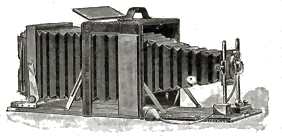
Is constructed for special work of this kind, and the Lens and Shutter (the patented Bausch & Lomb "Unicum"), is particularly adapted for quick and accurate work.
The Solograph is the highest grade Camera at present on the market.
It is used by the Editor of this Magazine, and many other experts, including Scientific Investigators in various directions, Army and Navy Officers, and the most Experienced and Discriminating Amateurs.
Our illustrated manual of instruction, entitled "Photographic Advice" (which will be sent, postpaid, to any address on receipt of 10 cents in postage stamps), contains full particulars, prices and descriptions of this and other Fine Photographic Apparatus.
A sample number of The Photographic Times, containing about fifty handsome illustrations, will be mailed, postpaid, on receipt of 35 cents.
The Scovill & Adams Company OF NEW YORK
60 and 62 East Eleventh Street
HEADQUARTERS FOR EVERYTHING PHOTOGRAPHIC
WANTED TO BUY—Negatives of Birds, their Nests and Eggs, from Nature. Address, enclosing prints, FRANK M. CHAPMAN, American Museum of Natural History, New York City.

OUTDOOR BOOKS
BIRD-LIFE
A Guide to the Study of our Common Birds. By Frank M. Chapman, Assistant Curator of Mammalogy and Ornithology, American Museum of Natural History; author of "Handbook of Birds of Eastern North America." With 75 full-page Plates and numerous Text Drawings by Ernest Seton Thompson. 12mo. Cloth, $1.75. The same, with Lithographic Plates in colors. 8vo. Cloth, $5.
Teachers' Edition
Containing an Appendix with new matter designed for the use of teachers, and including lists of birds for each month in the year; and with additional annotated lists of birds found at Washington, D. C., Philadelphia, Pa.; Portland, Conn.; Cambridge, Mass.; St. Louis, Mo.; Oberlin, Ohio, and Milwaukee, Wis. With 75 full-page Uncolored Plates and 25 Drawings in the text, by Ernest Seton Thompson. 12mo. Cloth, $2.
Teachers' Manual
To accompany Portfolios of Colored Plates. Contains the same text as the "Teachers' Edition of Bird-Life," but is without the 75 Uncolored Plates. Sold only with the Portfolios of the Colored Plates as follows:
Portfolio No. I.—Permanent Residents and Winter Visitants. 32 Plates.
Portfolio No. II.—March and April Migrants. 34 Plates.
Portfolio No. III.—May Migrants, Types of Birds' Eggs, and 9 Half-tone Plates showing Types of Birds from Photographs from Nature. 34 Plates.
Price of Portfolios, each, $1.25; with the Manual, $2; the three Portfolios, with the Manual, $4.
"His chronicles are full of the enthusiasm of the born naturalist. He gossips about the affairs of birds in a delightful strain, making 'Bird-Life' an irresistible invitation to a fuller study of ornithology. It is not dry details he offers, but pretty stories, biographical sketches of interesting families—all sorts of bird-lore that proves most enchanting reading."—Chicago Evening Post.
Handbook of Birds of Eastern North America
With Keys to the Species; Descriptions of their Plumages, Nests, etc.; their Distribution and Migrations. By Frank M. Chapman. With nearly 200 Illustrations. 12mo. Library Edition, cloth. $3; Pocket Edition, flexible morocco, $3.50.
"A book so free from technicalities as to be intelligible to a fourteen-year-old boy, and so convenient and full of original information as to be indispensable to the working ornithologist…. As a handbook of the birds of eastern North America it is bound to supersede all other works."—Science.
The Art of Taxidermy
By John Rowley, Chief of the Department of Taxidermy in the American Museum of Natural History. Illustrated. 12mo. Cloth, $2.
"The style of this book is a model for works of its kind. Every process of the difficult art of the taxidermist is here made plain with an ease that speaks eloquently of the author's skill in his field. Illustrations add to the clarity of the text, the whole affording a very valuable working knowledge of the stuffing and mounting of little and big game."—San Francisco Call.
Insect Life
By John Henry Comstock, Professor of Entomology in Cornell University. With illustrations by Anna Botsford Comstock, member of the Society of American Wood Engravers. 12mo. Library Edition, cloth, $2.50; Teachers' and Students' Edition, $1.50.
"Any one who will go through the work with fidelity will be rewarded by a knowledge of insect life which will be of pleasure and benefit to him at all seasons, and will give an increased charm to the days or weeks spent each summer outside of the great cities. It is the best book of its class which has yet appeared."—New York Mail and Express.
News from the Birds
By Leander S. Keyser. Appletons' Home-Reading Books. 12mo. Cloth, 60 cents net.
"Pleasantly combines instruction and entertainment."—Philadelphia Public Ledger.
The Story of the Birds
By James Newton Baskett, M.A., Associate Member of the American Ornithologists' Union. Appletons' Home-Reading Books. 12mo. Cloth, illustrated, 65 cents.