Front matter (continued 3)
Reading edition
The question is, do these birds—and others which hoard—really use their stores? The testimony of all who are in the field in winter is needed to clear up the matter. The first point to be determined is whether the individual birds winter where they store. The Nutcrackers, Mr. Langille informed me, do remain at the high altitudes all the year. As he said, it is stormy indeed when they cannot be seen sailing across the cañons or perched on the topmost branches of the trees, screaming and calling in their harsh way, always restless and seeming to resent any intrusion of man, beast, or fowl. On the other hand, he said that the Jays seldom remain at the high altitudes during the winter months, usually descending to lower elevations, where they flit about in flocks of from six to twenty, sounding their plaintive varied notes and whistles at all times.
CLARK'S CROW Photographed from nature by Walter K. Fisher
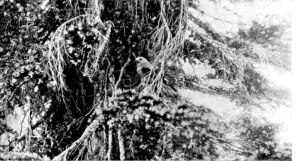
Nevertheless, the storing of the Crows at this altitude was certainly much less systematic than that of the Jays. The Jays' movements were easy to follow, for they were concerted and regular. The Inn was on a ridge between two cañons, and commanded the birds' pathway. A band would come up from under the cliff at the top of the western cañon, cross over the ridge, and drop down into the eastern cañon, where they would fly over the tops of the firs till they disappeared from sight. They would be gone some little time, and then return empty-handed to repeat the performance.
The Jays talked a good deal in going back and forth, and their notes were pleasantly varied. One call was remarkably like the chirp of a Robin. Another of the commonest was a weak and rather complaining cry, repeated several times; and a sharply contrasting one was a pure, clear whistle of one note followed by a three-syllabled call, something like ka-wé-ah. The regular rallying cry was still different, a loud and striking two-syllabled ka-wheé. The notes of Clark's Crow often suggested the rattling of the Red-headed Woodpecker. The bird had a variety of kerring, throaty notes, and when disturbed, as at the unexpected sight of me at its dining-room, gave a loud, warning quarr. Besides these Woodpecker-like calls, it had a squawking cry similar to that of Steller's Jay.
The voices of the birds were often heard from the house as they got water from the hydrant in front of the Inn, the Jays frequently stopping on the way back from their cañon storehouse. Sometimes three Jays would suddenly appear overhead, drop noiselessly to the pool under the hydrant, and squatting close together fill their bills and then raise their heads to swallow. Though the Jays usually went to the pool for water, they would sometimes light on the hydrant and, leaning over, drink from the faucet, which Mrs. Langille always left dripping for their benefit. The Clark's Crows, so far as I noticed, always drank right from the faucet.
CLARK'S CROW Photographed from nature by Walter K. Fisher
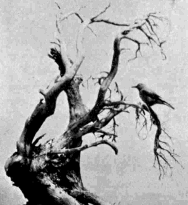
It was hard to get photographs of the birds at the hydrant, as they stopped only in passing, but as it was impossible to take them under the cliff on account of the poor light, I determined to bait them. Finding a number of the Nutcrackers in front of the kitchen window, I asked the Chinaman for some meat for them, holding up my Kodak to explain that I wanted to take the birds' pictures. To my surprise, the man promptly and decidedly shook his head! I didn't know what to make of such apparent rudeness at first, but it finally dawned on me that he could not understand English and, not being an ornithologist, from past experience with tourist cameras concluded that I wanted his picture! Accordingly, nothing daunted, I appealed to Mrs. Langille, and when she gave me a plate of suet, returned to take the Crows. They flew at my approach, but quickly settled back and fairly fell on the meat I put in the road for them. I got a snap of one with a big mouthful. After taking all the Nutcrackers I wanted, I went back to the hydrant to wait for the Jays, but the Crows followed and one fellow fairly gorged himself on the fat. He gulped it down so fast I had to drive him off in order to have either meat or films left for the Jays. It was hard to persuade him that I wanted him to leave. He had had no experience of such inhospitality. Mild shooing did no good. I actually had to throw small stones at him before he would take the hint! When he finally started to go, I got his picture as he turned and looked regretfully over his shoulder at the Jay he was leaving in possession of the field.
The Jays were even more fearless than the Crows. Several of them would often be on the ground at once, but they ate so fast and flew back and forth so rapidly that it was hard to focus on them quickly enough to get their most interesting poses. I put a brown paper behind or under the pan for a lighter background, and at first the birds hopped nervously when it moved, but they soon got used to it, and ate on it and on the pan, as it happened. And how they did stuff! They were so absorbed that, although I sat within four feet of the pan, they sometimes came too near for me to focus. They paid so little heed to my presence I have no doubt they would have eaten from my hand had I not been engaged in keeping them at a proper distance. When the raw meat was gone Mrs. Langille gave me a supply of cooked fat, and it was astonishing to see how much of the greasy stuff they could swallow. I caught one just as he was about to fly off with a billful of it. The fat seemed to make them thirsty; they had to go to the hydrant to wash it down with cold water.
CLARK'S CROW Photographed from nature by Walter K. Fisher
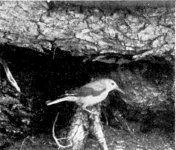
Meat Hawk, the name the mountaineers have for them, is certainly appropriate. They are on the lookout for meat wherever it is to be found, be it kitchen door or forest. Their appetite for game is truly remarkable. Mr. Langille told me he might go through the woods all day without seeing a single Jay, but if he killed a deer and the smell of blood filled the air, in a few moments the birds would be about, calling and whistling; and, emboldened by the prospect of a feast, they would fly down and perch upon the carcass within reach of his hand, sometimes before the deer was entirely skinned.
On Mount Shasta, although the Nutcrackers came about camp, they showed no desire for camp food, and on Hood Mr. Langille informed me that the Crows tamed this year were the first they had ever succeeded in coaxing about. After I left the mountain they became still more familiar, and, I am told, would gather in the trees at daybreak and call until the family went out to feed them.
The Masquerading Chickadee[E]
BY EDITH M. THOMAS
I came to the woods in the dead of the year, I saw the wing'd sprite thro' the green-brier peeping: "Darling of Winter, you've nothing to fear, Though the branches are bare and the cold earth is sleeping!" With a dee, dee, dee! the sprite seemed to say, "I'm friends with the Maytime as well as December, And I'll meet you here on a fair-weather day; Here, in the green-brier thicket,—remember!"
I came to the woods in the spring of the year, And I followed a voice that was most entreating: Phebe! Phebe! (and yet more near), Phebe! Phebe! it kept repeating! I gave up the search, when, not far away, I saw the wing'd sprite thro' the green-brier peeping, With a Phebe! Phebe! that seemed to say, "I told you so! and my promise I'm keeping." "You'll know me again, when you meet me here, Whether you come in December or Maytime: I've a dee, dee, dee! for the Winter's ear, And a Phebe! Phebe! for Spring and Playtime!"
Matins
BY ROSA MEYERS MUMMA
As sable night fades into soft rose tint, Through leafy aisles slow filters daylight's glint; From green tree arch is faintly heard the call Which summons quickly feathered choir all To Nature's vast cathedral, where in song Unite the worshippers, a feathered throng. What harmonies pour forth from each bird throat! A morning prayer ascends with each clear note.
Home-Life in a Chimney
BY MARY F. DAY
Near Boonton, N. J., it was my good fortune last summer to have the exceptional opportunity of watching closely the rearing of a family of Chimney Swifts. The nest was built opposite and slightly above an opening in the chimney designed for the insertion of a stovepipe. The opening was about two feet from the floor of a second-story room in the house where I spent the summer.
When discovered, the nest was only partially completed, so it was necessary to exercise care, lest the birds become alarmed and choose a more secluded spot. To guard against disturbance to them, a black cloth was hung over the opening in such a way that it could be carefully and noiselessly lifted during periods of observation. Although the room was used as a bedchamber throughout the summer, the Swifts never seemed to be annoyed by the close proximity of their human neighbors. They were of a trustful disposition, and soon became accustomed to being watched. Occasionally, when I looked in upon them at the beginning of our acquaintance, they would spread their long, beautifully formed wings and lift them gracefully above the back, as if intending to fly, but usually, upon second consideration, would conclude it was unnecessary.
It was the 21st of May when I first peeped in upon the little bracket against the chimney wall that became the stage for the enactment of scenes filled with absorbing interest to me in the weeks that followed. It was not placed in an angle, but against the north side of the flue, beneath a slight projection formed by an accumulation of soot.
In a week one egg was apparent, but there may have been others, for the little builders had been adding one twig after another to the front edge of the nest, so that it had become impossible to see the bottom. Two more days passed, after which it could be seen that there were at least two eggs, and yet the structure continued to be enlarged.
June 5 marked the beginning of incubation. In mid-afternoon of this day I saw the sitting bird had flown, and, going out-of-doors to study birds, my attention was attracted to a Swift flying among the branches of the locust trees near by. This was an unusual sight to me, and, recalling that I had read that Swifts never alight in trees, I watched eagerly to see what it might mean. Soon I saw that the bird was snatching at little dry twigs. She flew round and round, and presently was gone. Suspecting that it was my little friend, I ran quickly upstairs, and sure enough, there sat my bird upon the nest, with a twig in her mouth, panting as if tired by extra exertion. Resting a moment, she proceeded to apply the salivary glue and adjust the twig, and then settled again to the task of sitting.
After a few days there came a cold storm, and it was believed that the little brooder proved unfaithful to her duties, for late one evening and early the following morning she was seen huddled with others of her kind beneath the nest. Great were my fears that no birds would ever come from these chilled eggs, but time made it clear that the tiny creature knew what she was doing. This was the sole act of parental neglect that was apparent during all the weeks required to rear the family. Under date of June 17, I noted that the eggs were constantly protected. At whatever time of day I looked I saw a sitting bird.
June 24 dawned fair and warm. As was my custom, I called to say "good morning" into the chimney before going down to breakfast, when I found that there was excitement in the little home. A faint peep reached my ear, which caused the mother anxious restlessness each time it was repeated. From half-past eight until ten o'clock that morning I sat at my post of observation, during which time it appeared that two or three more young were hatched, for there was much peeping on the part of the little ones and much fidgeting about by the adults. Two shells, or parts of shells, were tossed from the nest. Occasionally the parents exchanged places, one brooding the infants while the other went out into the air. Even at the tender age that must be reckoned by minutes, these young birds were fed, seemingly, by regurgitation.
During the progress of my study I found that one of the pair, which from manners and appearance I judged to be the female, had lost a tail feather, and this one I affectionately dubbed "Swiftie." She appeared worn out with anxiety added to the confinement of a long period of incubation, and embraced every opportunity to rest, but seasons of sleep were of short duration, for it seemed that the body of the brooding bird was lifted each time a movement was felt beneath. The mate, with his sleek coat, bright eyes and calm demeanor, formed a decided contrast to the ragged, unkempt appearance of the female.
Even four days showed perceptible growth in the swiftlings. They were not allowed to remain uncovered, a wise precaution, for their bodies were perfectly naked. At this age the instinct of cleanliness began to assert itself. The weak, awkward little creatures would struggle backward from beneath the brooder, up to the edge of the nest and deposit over it that which, remaining within, would have made their home uninhabitable.
From this time forth a third Swift was seen to enter into the care of the nestlings, taking its turn at brooding and feeding. Was this a nurse-maid employed to relieve the overburdened mother, or a kind and helpful friend or neighbor, or the younger and less care-taking of two wives? Who can tell?
It was not until the sixth day after hatching that I knew to a certainty how many young birds there were. Then, to my surprise, I found there were five. They had grown to be very clamorous for food. Two, at most three (later but one), were served at one feeding, and the process was after this manner: "Swiftie" would drop into the chimney and alight below the nest, her throat bulging with the fullness of captured insects. The little ones that were hungry were alert, for all had learned that a rumbling noise in the chimney, followed by a sound of "chitter, chitter, chitter," meant something to eat. After resting a moment, the mother would scramble up over the nest, and, with closed eyes, feel about until she came in contact with an open mouth, whereupon she would place her beak far down the throat, deposit a portion of food, then seek another yawning cavity. No system appeared to be observed in the matter of feeding. The hungriest youngsters made the greatest effort to reach the source of supply.
July 1 feathers began to appear. They grew rapidly, especially those of wings and tail, and in a week the bodies were about covered. With feathers came employment, for they must often be dressed, though from a habit of yawning frequently, common to the family, one might be led to believe that time hung heavily on their claws.
The nestlings were two weeks old before the eyes began to open, and nearly three before they were much used. But when they were fully open, and the feathers had grown out and were fast becoming sooty instead of black, how winning these young birds appeared!
The time had now come to take up exercises preparatory to flying. The young aspirants would stand in the nest and for a time vibrate the wings rapidly, so rapidly that the identity of wing was lost. Two first ventured from home when nineteen days old, clinging to the wall for a short time a few inches from the nest.
One afternoon about this time there came a severe and prolonged shower. The rain beat into the chimney, reaching down to the nest. What, now did I see? Besides the five grown-up swiftlings, the three adults, packed in and upon the nest, the rain dripping from those which were exposed. I mention this incident to give an idea of the adhesiveness of the glue used in the construction of Swifts' nests.
July 20 I made the following note: "Swiftlings no longer make use of the nest, but dispose themselves in various parts of the chimney, sometimes in a cluster, sometimes in twos or threes, and sometimes separately. They take flying exercises up and down the chimney, but I believe have not yet left it." The next morning I was forced to conclude that three had taken flight into the great outside world, for upon looking the chimney over thoroughly with the aid of a small mirror, I could find but two birds.
The chimney was much used by this interesting family until the 24th of August. Early in the morning of that day a large number of Swifts were seen gathering in a flock at a short distance from the house. Ten o'clock that night I searched the chimney with a lighted candle, but found no sign of life, and I believe that the Swifts did not again enter within its walls.
Three Cobb's Island Pictures
BY WILLIAM L. BAILY
BLACK SKIMMER
R
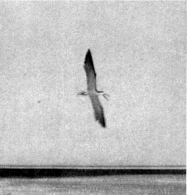
ight out on the sandy beach, just above high tide, the Black Skimmer risks her set of eggs, and, while apparently unprotected, they are so much the color of the sand and the surrounding shells and seaweed that they would not be noticed unless you were especially looking for them.
The Skimmers are gull-like in form, with long, slender body and long wings, spreading almost three feet. They have a glossy black back, white breast, orange feet, and a most curiously shaped orange bill, which is almost as thin as a knife, the thin edges closing vertically together. This peculiarity has given the bird the name of 'Razor Bill.'
Their graceful and regular flight can hardly be mistaken for that of any other bird. They skim just over the surface of the water, following the contour of the waves, while the lower mandible of their bill, which is longer than the upper, projects below the surface of the water, and when it comes in contact with a small fish, the latter simply slide up the narrow, inclined plane into the Skimmer's mouth.
NEST AND EGGS OF BLACK SKIMMER
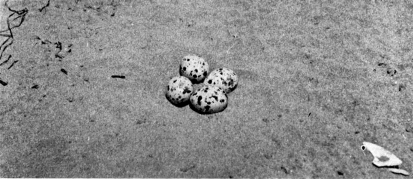
Formerly they bred in great numbers along the eastern coast of our Middle and Southern Atlantic states, and only a few years ago were abundant on the New Jersey coast. They have been crowded out, however, by encroaching civilization, and hunted down by the milliners' agents and the egg-collectors. In June, 1898, I found them on Cobb's Island, Virginia, to the number of about two hundred pairs, where, not long ago, they bred in thousands.
As the eggs are entirely exposed, the parents are relieved to some extent from the duty of incubation by the heat of the sun, and as soon as the young hatch they run about like chickens.
GULL-BILLED TERN
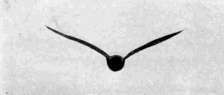
After getting two good pictures of the Skimmer and her eggs, I turned my attention to a Gull-billed Tern, and while standing over her nest, which contained two eggs and one fuzzy young, just hatched, I obtained a rather remarkable picture of the parent bird flying straight at the camera, nicely illustrating what a small sectional area a bird occupies while flying.
The Cardinal at the Hub
BY ELLA GILBERT IVES
With Photographs from nature by Blanche Kendall
His range being southern, Cardinal Grosbeak seldom travels through New England; and, to my knowledge, has never established a home and reared a family north of Connecticut until in the instance here recorded. Kentuckians claim him, and with some show of right, since James Lane Allen built his monument in imperishable prose. But, soon or late, all notables come to Boston, and among them may now be registered the "Kentucky Cardinal."
Shy by nature, conspicuous in plumage, he shuns publicity; and, avoiding the main lines of travel, he put up at a quiet country house in a Boston suburb—Brookline.
Here, one October day in 1897, among the migrants stopping at this half-way house, appeared a distinguished guest, clad in red, with a black mask, a light red bill, and a striking crest; with him a bird so like him that they might have been called the two Dromios. After a few days, the double passed on and left our hero the only red-coat in the field. A White-throated Sparrow now arrived from the mountains, and a Damon and Pythias friendship sprang up between the birds. Having decided to winter at the North, they took lodgings in a spruce tree, and came regularly to the table d'hote on the porch. My lord Cardinal, being the more distinguished guest, met with particular favor, and soon became welcome at the homes of the neighborhood. With truly catholic taste, he refused creature comforts from none, but showed preference for his first abode.
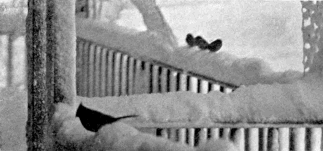
It was March 5, 1898, when we kept our first appointment with the Cardinal. A light snow had fallen during the night, and the air was keen, without premonition of spring. It was a day for home-keeping birds, the earth larder being closed. The most delicate tact was required in presenting strangers. A loud, clear summons,—the Cardinal's own whistle echoed by human lips—soon brought a response. Into the syringa bush near the porch flew, with a whir and a sharp tsip, a bird. How gorgeous he looked in the snow-laden shrub! For an instant the syringa blossoms loaded the air with fragrance as a dream of summer floated by. Then a call to the porch was met by several sallies and quick retreats, while the wary bird studied the newcomers. Reassuring tones from his gentle hostess, accompanied by the rattle of nuts and seeds, at last prevailed, and the Cardinal flew to the railing and looked us over with keen, inquiring eye. Convinced that no hostilities were intended, he gave a long, trustful look into the face of his benefactress and flew to her feet.
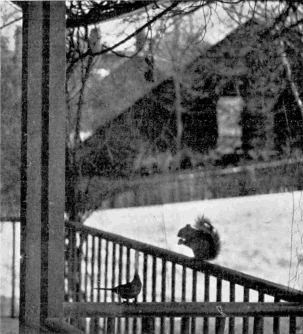
A gray squirrel frisking by stopped at the lunch-counter and seized an 'Educator' cracker.
CARDINAL AND GRAY SQUIRREL
The novel sensation of an uncaged bird within touch, where one might note the lovely shading of his plumage as one notes a flower, was memorable; but a sweeter surprise was in store. As we left the house, having made obeisance to his eminence the Cardinal, the bird flew into a spruce tree and saluted us with a melodious "Mizpah." Then, as if reading the longing of our hearts, he opened his bright bill, and a song came forth such as never before enraptured the air of a New England March,—a song so copious, so free, so full of heavenly hope, that it seemed as if forever obliterated were the "tragic memories of his race."
As March advanced, several changes in the Cardinal were noted by his ever-watchful friends. He made longer trips abroad, returning tired and hungry. The restlessness of the unsatisfied heart was plainly his. His long, sweet, interpolating whistle, variously rendering "Peace … peace … peace!" "Three cheers, three cheers," etc., to these sympathetic northern ears became "Louise, Louise, Louise!" Thenceforth he was Louis, the Cardinal, calling for his mate.
On March 26, a kind friend took pity on the lonely bachelor, and a caged bird, "Louise," was introduced to him. In the lovely dove-colored bird, with faint washings of red and the family mask and crest, the Cardinal at once recognized his kind. His joy was unbounded; and the acquaintance progressed rapidly, a mutual understanding being plainly reached during the seventeen days of cage courtship. Louis brought food to Louise, and they had all things in common except liberty.
CARDINAL AND HOUSE SPARROWS
April 12, in the early morning, the cage was taken out-of-doors and Louise was set free. She was quick to embrace her chance, and flew into the neighboring shrubbery. For six days she reveled in her new-found freedom; Louis, meanwhile, coming and going as of old, and often carrying away seeds from the house to share with his mate.
April 16, he lured her into the house, and after that they came often for food, flying fearlessly in at the window, and delighting their friends with their songs and charming ways. Louis invariably gave the choicest morsels to his mate, and the course of true love seemed to cross the adage; but alas! Death was already adjusting an arrow for that shining mark.
April 25, Louise stayed in the house all day, going out at nightfall. Again the following day she remained indoors, Louis feeding her; but her excellent appetite disarmed suspicion, and it was thought that she had taken refuge from the cold and rain, especially as she spent the night within. The third morning, April 27, she died. An examination of her body revealed three dreadful wounds.
Louis came twittering to the window, but was not let in until a day or two after, when a new bird, "Louisa," had been put in the cage. When he saw the familiar form, he evidently thought his lost love restored, for he burst into glorious song; but, soon discovering his mistake, he stopped short in his hallelujahs, and walked around the cage inspecting the occupant.
CARDINAL
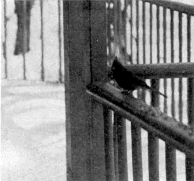
Louisa's admiration for the Cardinal was marked; but for some days he took little notice of her, and his friends began to fear that their second attempt at matchmaking would prove a failure. April 30, however, some responsive interest was shown, and the next day Louis brought to the cage a brown bug half an inch long, and gave Louisa his first meat-offering.
The second wooing progressed rapidly, and May 7, when Louisa was set free, the pair flew away together with unrestrained delight. After three days of liberty, Louisa flew back to the house with her mate, and thenceforth was a frequent visitor.
May 21, Louisa was seen carrying straws, and on June 6 her nest was discovered low down in a dense evergreen thorn (Cratægus pyracantha). Four speckled eggs lay in the nest. These were hatched June 9, the parent birds, meantime and afterward, going regularly to market and keeping up social relations with their friends.
In nine days after their exit from the shell, the little Cardinals left the nest and faced life's sterner realities. A black cat was their worst foe, and more than once during their youth Louis flew to his devoted commissary and made known his anxiety. Each time, on following him to the nest, she found the black prowler, or one of his kind, watching for prey. On June 28, the black cat outwitted the allied forces, Señor Cardinal and his friends, and a little one was slain. The other three grew up and enjoyed all the privileges of their parents, flying in at the window and frequenting the bountiful porch.
July 25, Louisa disappeared from the scene, presumably on a southern trip, leaving the Cardinal sole protector, provider and peace-maker for their lively and quarrelsome triplet. A fight is apparently as needful for the development of a young Cardinal as of an English schoolboy, possibly due in both cases to a meat diet.
Over-feeding was but temporary with our birds. On the 8th of August the migratory instinct prevailed over ease, indulgence, friendship, and the Cardinal with his brood left the house where he had been so well entertained, to return no more. No more? Who shall say of any novel that it can have no sequel? Massachusetts may yet become the permanent home of the Kentucky Cardinal, the descendant to the third and fourth generation of Louis and his mate.
A Catbird Study
BY DR. THOS. S. ROBERTS
Director Department of Birds, Natural History Survey of Minnesota. With Photographs from nature by the Author.
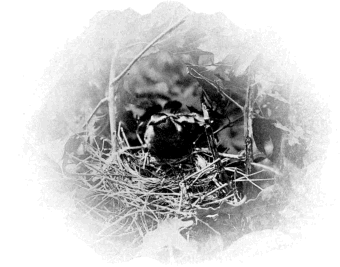
CATBIRD AND NEST
T
he subjects of this sketch had located their bark- and root-lined nest of coarse sticks, four feet from the ground, in a little oak bush surrounded by brakes, sunflowers, and hazel. Instead of being, as usual, in the midst of a dense, and, therefore, dark thicket, this nest was quite in the open, shaded by only a few overhanging, leafy branches of small size. Its exceptionally favorable location and the apparent tameness of the birds suggested an attempt at avian photography, and the undertaking was entered upon at once, a very considerable fund of interest and enthusiasm having to take the place of any special previous experience in this line of work. After clearing away a little of the overhanging and intervening vegetation, the camera was placed with the lens not more than two feet from the nest, this being necessary in order to secure an image of the desired size with the short focus lens at hand (a B. and L. Zeiss Anastigmat, Series II A, 61/2 × 41/4, focal length 53/8 inches). Fifty feet of rubber tubing, a large bulb, and a field-glass made it possible to watch developments and carry on operations from a safe distance. But, although the camera was nearly concealed with ferns and leaves, this day's proceedings were not rewarded with much success. The birds proved exasperatingly timid, and returned only after prolonged waits, to disappear instanter on the click of the shutter (a B. and L. iris diaphragm shutter). So we left the field, not disheartened but bent upon improving our paraphernalia. A day or two later found the camera again in position, but this time with tripod green-painted and the whole unsightly top enveloped in a green hood with only a small aperture for the lens. This ruse succeeded fairly well, and during the three or four hours that the light was good on this day, and during a like period on a subsequent day, a number of exposures were made that resulted in an interesting series of negatives, giving good prints and still better lantern slides.
CATBIRD ON NEST
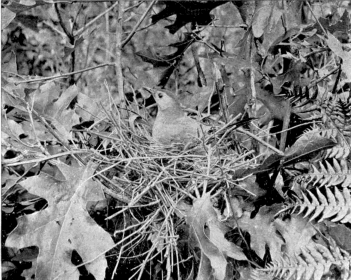
Only one of several time-exposures turned out perfect. It is here presented, not only as the prize picture of some three hundred negatives made during the summer of 1898, but as the sole and only entirely satisfactory outcome of some twelve or fourteen hours' work.

On the Ethics of Caging Birds
BY OLIVE THORNE MILLER
B
efore saying a few words on this subject, I should like to define my position. With all my heart do I disapprove of caging wild birds. I never had, and never shall have, the liberty of one bird interfered with for my pleasure or study, and if I had the power to prevent it, not one should ever be caged. Especially do I regard it as cruel in the extreme to confine an adult bird, accustomed to freedom and able to take care of himself.
The question of "rights" we will not enter upon here, further than to say that our moral right to capture wild creatures for our own use or pleasure is the same in the case of birds as of other animals—horses, for example.
But birds are caged, and we must deal with circumstances as we find them. If a bird-lover should worry and fret himself to death, he could not put an end to their captivity. So it would appear to be the part of wisdom to see if there are not mitigating circumstances, which may comfort, and perhaps, in a slight degree, even reconcile one to their imprisonment.
The case of Canaries is different from that of all others. Hatched in cages, descended from caged ancestry, and accustomed to be cared for by people, they know no other life, and are utterly unfitted for freedom. So far from being a kindness to set one of these birds free, it is absolute cruelty. It is like turning a child, accustomed to a luxurious life, into the streets, to pick up a living for himself.
But a young bird, taken from the nest before he has learned the use of his wings, I believe, can be made perfectly contented and happy in a house—if he is properly cared for!
It is unfortunately true that not one in a thousand is properly cared for, but we are not considering the shortcomings of people. At this moment we are considering the possibility of making a bird's life happy.
For several years I kept birds in captivity, and closely studied their ways and their characters, and I say, without hesitation, that most birds can be made so contented and happy that they will prefer their captivity, with its several advantages, to freedom without them. The advantages of captivity to a bird are three; viz., abundant food supply, protection from enemies, ease of life—without labor or concern about weather.
The conditions, therefore, necessary to his happiness are: Never-failing care as to his physical comforts—such as a proper situation of the cage,—neither in the hot sunshine nor in a draught; fresh and perfect food, with variety; plenty of fresh water; suitable and regular bath, etc. And secondly—though perhaps it should be first, as it is most important—treatment as if he were a sentient being, instead of a piece of furniture; talking to him, taking notice of him, making a companion and friend of him. And thirdly, the freedom of a room, at least part of every day.
Under these conditions, as I know from close and sympathetic observation, our little brothers can be made so happy, that, as I said, many of them will not accept their liberty. They choose between freedom, with hard labor and many anxieties, and comfortable captivity, with ease and security, and many decide—as do many of the human family—for the former.
There is another reason why I have become partially tolerant of the caging of birds. What first influenced me was the fact that every individual rescued from the discomforts of a bird store, where they are seldom well cared for and never cherished, is greatly benefitted, and I felt that to be a work of charity.
But there is one strong argument in favor of the custom. That is, their great value as a means of educating children. Nothing is more important than the training of our youth in humanity and respect for the rights of others. And in no way can this be so well accomplished as by giving to them the care of pets. By investigation of prisons and reform schools, it has been amply proved that nothing so surely keeps a boy from falling into a criminal life as the care of and kindness to the lower orders. The daily care of a pet bird is a daily lesson in altruism which never fails to bear fruit.
In those precious first years of the child's life, when the mother has the power of instilling lessons that will be a part of him,—the most indelible he will ever receive,—if she takes a little pains to do so she can implant, with the love of creatures dependent upon him, qualities that will go far to make him a true, manly man.
While these considerations do not, perhaps, make it right to deprive a fellow creature of his liberty, they do furnish a little consolation to those who love humanity as well as birds. At the same time I must admit, that of all pitiful sights on earth, that of a neglected captive is one of the most heartrending.
A May Morning
BY FRED. H. KENNARD
There is a bird pasture, as I call it, about a half hour's ride from Boston, and thither I went on May 30, 1898, to see if I could find the nest of a White-eyed Vireo that I had often hunted for in years gone by, but never yet succeeded in finding.
This bird pasture, on one side of which runs the road, consists of eight or ten acres of old, wet pasture land on a hillside surrounded on two other sides by fields and an orchard, and immediately above a marsh in which the sedges and grasses grow luxuriantly, and which is bordered by alders, birches and other swamp-loving trees. The pasture itself is very wet in one portion, and has been overgrown with birch, alders, oak and tangles of grapevines, wait-a-bits, poison ivy, etc. In another part it is more open, and is more sparsely covered with red cedars and white pines, while the ground is dotted with wild roses and hard-hack, interspersed with clumps of alders. This combination of hill and marsh, field and orchard, cover and open, as well as evergreen and deciduous growth, makes it an ideal place for birds and their breeding; and one that is hard to duplicate in any locality, combining also woods and civilization as it does, for there are houses and barns in the immediate vicinity. You probably cannot duplicate this pasture, but those of you who love birds, and who can find any spot approximating this in conditions, would do well to appropriate it, metaphorically speaking, as I have this.
But to return to the birds—I thought I would carefully note all those I saw or heard in the course of a short hour I had to spare, and with the following results: As I took down the bars in order to take my bicycle into the pasture, a Baltimore Oriole was singing on top of an elm close by, and I have no doubt that its mate was sitting on the nest that hung pendent from the next tree. A Catbird slunk off into the bushes to the right of me, from a thicket in which she last year raised a brood; and, while chaining my wheel, I heard the glorious notes of a Brown Thrasher singing, a little way off, on the top of a tall white oak. Several Red-eyed Vireos were there too, their steady, rippling song forming a soft accompaniment to the more conspicuous notes of the other feathered songsters. Next, I flushed a Quail, and, while watching its flight, I almost stepped on two more, which got up from the under-brush at my feet.
I started in now on my hunt for the White-eye's nest, and for some time was so absorbed in that, and in listening for its expected song, that there was no time to make notes of the other birds heard, except that of a Wood Thrush, whose nest contained four eggs, and was saddled on the crotch of a grape-vine, where it crossed through the crotch of an alder.
To make a long story short, I did not find the Vireos, or even hear them, though for several years they had lived here throughout the summer. I finally went out into an open space, lighted a pipe as a mosquito preventive, and, seating myself on the soft side of a boulder, put down the names of the birds whose notes I could hear.
Below me, in the swamp, the most prominent notes were the 'concarees' of the Red-winged Blackbirds, while between them could be heard the songs of several Swamp Sparrows. Close beside me were a Chestnut-sided and a Golden-winged Warbler, both seemingly much disturbed by my presence, while just as near was a Maryland Yellow-throat, an old friend of mine, who did not seem to care whether I was there or not. This same friend is rather a curiosity, for, although his species usually build in or about the marshes or swamps, he always prefers the hillside, and I last year found his nest within forty feet of where I sat, and several hundred feet away from and above the swamp.
A few Cedar Birds were whispering from the tops of a couple of red cedars about fifty yards away, and I could hear a Yellow Warbler on the other side of the open space, where he sang, apparently for the benefit of a near-by barberry bush.
A Wood Pewee was uttering his plaintive note from the orchard immediately back of me; while just back of that, in the field by the top of the hill, could be heard the rollicking notes of a Bobolink and the occasional call of a Meadow Lark. While writing my notes, some kind of a large Hawk, which flew so fast that identification was impossible, but which I guessed to be a Cooper's Hawk, went off rapidly across the marsh, pursued by a pair of vociferous Kingbirds; and, as I watched them, I could see numbers of Chimney Swifts, from the neighboring chimneys, and Barn Swallows, from a barn close by, coursing about above the marsh after the insects that there abound, the Swallows low down and the Swifts above. While watching the Swallows, two Crows came out of the wood on the opposite side of the marsh, and flew, cawing, across and off into the distance; and a little Green Heron, who, like all fishermen, prefers quiet, flew off in another direction.
Down towards the edge of the swamp, in the outlying thicket, a Song Sparrow was singing, while, close by, a magnificent Rose-breasted Grosbeak, which every year builds in the birches which grow in these thickets, was warbling his incomparable song. At first he had been giving vent to his very unmusical call of alarm, but, becoming used to my presence, and concluding that I meant no harm, he joined in the concert.
Off to one side, among the more scrubby deciduous growth, I could hear, and sometimes see, a Redstart, while the tse-tse-tse-ing of the Black-poll Warblers, which were migrating northwards, could be heard intermittently. Two Quails were now calling loudly for Bob-White, or Rob-ert-White, as their fancy dictated, and in the confusing medley I could make out the modest notes of a Black and White Warbler, which had for years nested somewhere in this pasture. Behind me, at the top of the hill, I could also hear the clear, cheery notes of a Field Sparrow, which always builds there.
Being limited as to time, and having already heard twenty-eight kinds of birds in the short space of about twenty minutes, and from one place, I started to depart, but even as I did so I heard the notes of another bird coming across the marsh, that of the Black-billed Cuckoo, and just as I was again taking down the bars to get out into the street, what should I hear, loud, clear and distinct, but the song of that plaguey little White-eyed Vireo, a song seemingly of thanksgiving that I was really going and that he had eluded me so well. I then reluctantly mounted my bicycle, but was forced to get off, to add two more birds to my increasing list; viz., a Cowbird, which was sitting on the fence opposite, and a pair of Yellow-throated Vireos, the female of which had evidently but just left her nest for a lunch, while the male followed twittering and whispering close by, stopping his song until she should have resumed her duties of incubation.
I had now seen thirty-two different species of birds in the short space of about twenty-five minutes' actual time spent in observation, after deducting the time spent in hunting the Vireo's nest, and departed for home well content, even though I knew I had seen only about three-fifths of the varieties of birds that are often to be found in the immediate vicinity.
On a previous occasion, when I had been lucky enough to be able to spend a whole morning in this pasture, I had seen forty-four different species, nineteen of which I had not seen to-day, and which, added to the thirty-two noted above, make a total of fifty-one species. Of these, there were only five that were merely occasional visitors. Of the remainder, I have found direct evidence of the breeding of thirty-two species, while on various accounts I feel sure that fourteen others breed there, although I have never actually found their nests.

A February Walk (Prize Essay)
By Mildred A. Robinson
(Aged 14 years)
We had planned to walk over to the pond to see if the recent thaw had spoiled the skating. As we passed the foot of the hill, the little brook splashed and tumbled down from its icy framework, eddying around the brown goldenrod stalks, and then rushed on at topmost speed across the opposite meadow.
We were standing on the little bridge, watching the ever fascinating current, when an odd bird-note called our attention to a little gray-backed, white-breasted bird who was running up and down a neighboring tree.
All thoughts of skating instantly vanished from our minds; we climbed the fence, and in a moment more were noiselessly following our obstinate little bird, who would keep so high up in the tree-tops that it was almost impossible to see anything but his breast.
Finally, he descended, head downward, along one of the lower branches of the tree, and we saw that it was a White-breasted Nuthatch. Evidently he thought he had stayed quite long enough for examination, so, after a few parting pecks at the rough bark, trying to secure one more hidden insect, he flew off.
We were slowly following the course of the little stream, when suddenly a great rustle of the dead leaves near the water's edge caused us to pause and listen. All was silent, with the exception of a few distant Chickadees, then, with a whir and a clatter, we saw a bushy tail disappear into the thicket; a moment more and out came a beautiful gray squirrel. Like a flash he was up the tree, jumping from limb to limb, frisking about in the sunshine, then down onto the ground again, and away. His visit was even shorter than that of the Nuthatch, but not less enjoyable.
And now, where were those noisy little Chickadees who had been calling to us from the alder bushes for the last half-hour? It was easy enough to find these confiding little creatures; they were feeding on the ground, and seemed quite unconcerned at our presence, although we approached very near to them. One little fellow seemed to be asleep; he sat all puffed up on one of the alder branches, but as I came nearer to him I could see that his bright little eye was on me, and at the next step he flew away.
It was now late in the afternoon, and, as we looked toward the west, the last rays of the sun were just tinting the distant hills with a mellow, golden hue; the birds had flown away, leaving the woods silent, so we reluctantly turned our footsteps towards home.
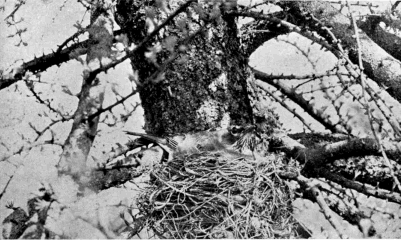
ROBIN ON NEST Photographed from nature by T. S. Hankinson
Robin Rejoice
BY GARRETT NEWKIRK
Among the first of the spring, The notes of the Robin ring; With flute-like voice, He calls "Rejoice, For I am coming to sing!" To any one gloomy or sad, He says, "Be glad! be glad! Look on the bright side, 'Tis aye the right side; The world is good, not bad." At daybreak in June we hear His melody, strong and clear: "Cheer up, be merry, I've found a cherry; 'Tis a glorious time of the year!"

Inquisitive Magpies
I was collecting specimens of natural history in the northern part of the state of Washington, a few miles from the Canadian border. At the time the incident which I am about to relate occurred I was stopping at a ranch at the southern end of Okanagan lake.
The owner of the building was cramped for room, so, as it was during the heat of the summer, I spent the nights rolled up in my blankets under a haystack. One morning, as the sun was rising, I was awakened by shadows crossing my face, and opening my eyes saw a flock, possibly a family, of Magpies perched on the stack and ends of poles that had been thrown over it to keep the hay from blowing away. I watched them as they peered inquisitively at me from their perches, until finally one flew to the ground, then another and another, until at last several were gathered about me, but a few feet away. I lay on my side, with my arms under the blankets, and watched their actions. At last one jumped on the blankets at my feet. I could feel him hopping slowly upward. I did not move for fear of frightening him. Finally he reached my shoulder, and, after perching there a few seconds, flew to my cheek. I closed my eyes slowly, fearing he might peck them. After testing my cheek lightly with his bill, he began to get in some uncomfortably heavy blows, so I thought it time to stop him. Without opening my eyes, or moving, I said in a low tone. "Here! Here! That will do!" He hesitated, as if to make sure his ears had not deceived him, and then flew to the stack. Another took his place, after working up in the same manner; he was quietly asked to move on. When the next one hopped on the blankets, I slowly raised my hand under them, making a tempting elevation, of which he was not slow to take advantage. He lighted squarely in the palm of my hand, which I closed at once, and held him prisoner. With the other hand I caught him by the legs from the outside, whereupon he flopped his wings, cried out with anger, and pecked at my wrist savagely. The remainder of the flock, which, in the meantime, had flown to the haystack, scolded and jabbered away at a great rate.
Evidently they had taken me for a corpse, but I think it was the liveliest one they ever saw.—J. Alden Loring, Owego, N. Y.
Songs of Birds
The songs of birds have attracted a good deal of attention in recent years, and observation seems to confirm the theory that each generation of birds learns the song characteristics of its species by association with its own kind.
This fact was brought quite clearly to my mind several years ago, when in a western town I was taken to a neighbor's to see his birds. Four cages swung in the shelter of a commodious porch. One contained a Red-winged Blackbird, that had been taken from its nest when very young, and brought up by hand. His associates were a Canary, a Blue Jay and an Oriole. The Canary had been purchased at a bird store, and had there learned its song. The Blue Jay and Oriole had been taken from neighboring nests, and had, no doubt, picked up the characteristic notes of their species from the many other members of their kind that inhabited the vicinity, but it was many miles to the nearest swamp or low land where one might find a Red-winged Blackbird. This Red-wing had learned perfectly the notes of his caged companions, and had picked up some notes of other birds in the neighborhood, but not one note of the Red-winged Blackbird did he know.—Frank E. Horack, Iowa City, Ia.

Birds. By A. H. Evans, M.A. The Cambridge Natural History, Vol. IX. London: Macmillan and Co., Limited. New York: The Macmillan Company. 1899. 8vo, pages xvi + 635. Numerous woodcuts in text. Price, $3.50.
The author of this compact volume has essayed what he himself recognizes as the "difficult and apparently unattempted task of including in some six hundred pages a short description of the majority of the forms in many of the families, and of the most typical or important of the innumerable species included in the large Passerine order."
The book opens with a "Scheme of the Classification Adopted," based on the system proposed by Gadow, in which the Archæopteryx stands at the bottom of the list, followed by the Ostriches, Rheas, and other struthious birds, while the Finches are placed at the top. An introduction of twenty-two pages treats of feathers, color, the molt, the skeleton, digestive organs, etc., classification, terminology, geographical variations, and migration, the handling of the last two subjects being far from satisfactory.
The remainder of the book is devoted to a consideration of the birds of the world. The matter is selected with excellent judgment and is admirably put together, the text having an originality and freshness not often found in compilations. The author, however, is handicapped by lack of space, and, except in monotypic families, is, as a rule, obliged to generalize to such an extent that the seeker for information concerning certain species will usually find only the characteristic habits of its family given. But if the author has not achieved entire success, he has, perhaps, more nearly approached it than any of his predecessors, and in his work we have for the first time an authoritative handbook of the birds of the world, which is sold at a low enough price to be within the reach of every student.
The illustrations, with the exception of a comparatively few, which were taken from duly credited sources, are by Mr. G. E. Lodge, who, at his best, is, in our opinion, one of the foremost of bird artists.—F. M. C.
The Feeding Habit of the Chipping Sparrow, and the Winter Food of the Chickadee. By Clarence M. Weed, New Hampshire College, Agricultural Experiment Station.
In the first of these interesting papers, Dr. Weed has introduced us directly into the domestic life of a family of Chippies. We have a view, for one day, of all their affairs, both personal and domestic; and to many it must be a wonderful revelation. It is fortunate for the birds that their period of infancy is so short, as otherwise their parents must utterly break down with the task of filling their ever-open mouths. Beginning at about 3:57 in the morning, these devoted parents worked almost without cessation till 7:50 in the evening, bringing food to their four young on an average of twelve times an hour; or once every five minutes.
What would human parents think of such work? The question arises: When do the old birds eat? In the case of a nest of this species watched by the writer on July 11, 1898, feeding of the young ceased at 7:25 in the evening, when both parents flew away. In twenty-five minutes, that is, at 7:50, the female parent (presumably) returned and settled on the nest for the night. At that time it was so dark that all other birds had disappeared. It seems probable that in this last twenty-five minutes the parent birds filled their own stomachs for the night.
The second of these papers is of a more prosaic character, but not the less interesting or useful. We have here a record in detail of the winter food of the Chickadee, showing how largely it consists of those minute insects, or their still more minute eggs, that injure the trees and baffle the efforts of man for their extermination.
In both papers we are shown the unpoetical but useful side of bird-life. These two confiding little birds have endeared themselves to their human neighbors by their gentle ways and familiar habits; but in these papers Dr. Weed has shown us that they should be no less dear to us when viewed entirely from an economic standpoint. We hope he will give us more of this kind of literature.—F. E. L. Beal.
Check List of British Columbia Birds. By John Fannin, Curator of the Provincial Museum, Victoria, B. C.
This list forms a part—pages 13-55—of the 'Preliminary Catalogue of the Collections of Natural History and Ethnology in the Provincial Museum.' It enumerates 339 species and sub-species, with notes on their distribution, and will prove exceedingly useful to students of the bird-life of this interesting region, for a knowledge of the fauna of which we are so greatly indebted to Mr. Fannin.—F. M. C.
A Preliminary List of the Birds of Belknap and Merrimack Counties, New Hampshire, with Notes. By Ned Dearborn, Biological Laboratories, New Hampshire College, Durham.
The author here presents the more important results of ten years' observation, including also such information as he has gathered from other naturalists concerning the 187 species recorded from the region of which he writes. Mr. Dearborn's notes, we are glad to say, are not restricted solely to statements concerning the rarity or abundance and manner of occurrence of a given species, but often contain valuable remarks on habits which show him to be a discriminating student of the living bird.—F. M. C.
Book News
The origin of the present widespread interest in ornithology is so largely due to the influence of Dr. Coues' classic 'Key to North American Birds,' that we are sure bird students throughout the world will welcome the news that its author is engaged in a thorough revision of his epoch-making work. The new edition, which will be expanded to fill two volumes, will be richly illustrated by Mr. Fuertes, and while the advance made in the science of ornithology in the fifteen years which have elapsed since the publication of the second edition naturally leads us to expect some improvement in this forthcoming edition, our credibility in the powers of human achievement is severely taxed when Dr. Coues asks us to believe that the new 'Key' will be as far ahead of the second as the second was beyond the first.
The Wisconsin 'Arbor and Bird Day Annual' for 1899, issued by L. D. Harvey, State Superintendent of Public Instruction (Madison, Wis.), is a most attractive and useful pamphlet of forty-five pages, containing original and selected contributions well suited to interest and instruct children in both the value and beauty of trees and birds. It may well stand as a model for publications of this nature.
D. C. Heath & Co. have in preparation an elementary bird book by Fannie Hardy Eckstorm. The book is designed for use as a supplementary science reader, and it is the author's object to teach children what to see and how to see it; and, at the same time, to provide them with something to do.
The May issue of 'Primary Education' (Educational Publishing Co.) is a 'Bird Day Number,' and contains numerous contributions of value to teachers and students of birds.
'Our Dumb Animals,' the vigorously edited organ of the Massachusetts Society for the Prevention of Cruelty to Animals, says of Bird-Lore: "We recommend this publication to ex-Presidents Cleveland and Harrison. It would have much interested President Lincoln."
'By the Way-Side' is the name of a bright little four-page bi-weekly issued by Helen M. Boynton, 118 Michigan Street, Milwaukee, Wisconsin, at one cent a copy. It is devoted to "birds, butterflies, trees, flowers, insects and fishes, and deserves the support of everyone interested in popularizing the study of these subjects."

A Bi-monthly Magazine
Devoted to the Study and Protection of Birds
OFFICIAL ORGAN OF THE AUDUBON SOCIETIES
Edited by FRANK M. CHAPMAN
Published by THE MACMILLAN COMPANY

Vol. 1 June, 1899 No. 3
SUBSCRIPTION RATES.
Price in the United States, Canada, and Mexico, twenty cents a number, one dollar a year, postage paid.
Subscriptions may be sent to the Publishers, at Englewood, New Jersey, or 66 Fifth avenue, New York City.
Price in all countries in the International Postal Union, twenty-five cents a number, one dollar and a quarter a year, postage paid. Foreign agents, Macmillan and Company, Ltd., London.
Manuscripts for publication, books, etc., for review, should be sent to the Editor at Englewood, New Jersey.
Advertisements should be sent to the Publishers at Englewood, New Jersey, or 66 Fifth avenue, New York City.
COPYRIGHTED, 1899, BY FRANK M. CHAPMAN.
Bird-Lore's Motto:
A Bird in the Bush is Worth Two in the Hand.
It has recently been remarked that the field ornithologists of to-day are of two kinds: first, those who collect; second, those who observe. The status of these two types of ornithologists, and the parts they play in the advancement of the science of ornithology, is a subject of the utmost importance to every one interested in the study of birds.
A consideration of it leads us to review briefly the progress which has been made in our knowledge of North American birds during the past twenty-five years. At the beginning of this period the Smithsonian Institution contained the only large collection of North American birds in the world, and our data concerning the exact distribution and relationships of even our commonest species was of the most meager character. Since that date the publication of Baird, Brewer and Ridgway's 'History of North American Birds', of Coues' 'Key' and Ridgway's 'Manual'; the organization of the American Ornithologists' Union and of the Biological Survey of the Department of Agriculture, and the establishment of several natural history museums, have given a wonderful impetus to the collecting of birds. Naturalists have explored every corner of the eastern United States, and, with almost equal thoroughness, the western states, and the fruits of their labors are shown in the large series of birds now possessed by our leading museums. In fact, we have now reached a point where only a thoroughly trained ornithologist or his personally directed assistants can make collections which will be of real scientific value. Indiscriminate collecting, therefore, particularly in the eastern United States, in ninety-nine cases out of a hundred will only result in the duplication of material already existing.
Not only has there been a great advance in the requirements of collecting, but in the study of the specimens collected, and the systematic ornithologist who would hope to add anything to our knowledge of the distribution and relationships of any group of North American birds, must possess advantages which can be afforded only by well-equipped museums.
Turning, now, to the other class of ornithologists, the collectors of facts, we find that they have been far less active than collectors of skins. Thus, while we rarely or never refer to Wilson or Audubon or Nuttall for information concerning the systematic position of a species, these early writers are still authorities on facts connected with the life histories of many of our birds.
This subject has been brought very forcibly to our mind by two papers published in this number of Bird-Lore, and, without going into details, we wish collectors of birds and their eggs would read carefully the articles entitled 'The Cardinal at the Hub' and 'Home-Life in a Chimney,' and then tell us frankly whether they do not think that the facts therein set forth constitute a more valuable contribution to the science of ornithology than a Cardinal's skin and five white egg-shells. If they are both discriminating and sincere, we believe they will admit the truth of Bird-Lore's motto.

"You cannot with a scalpel find the poet's soul, Nor yet the wild bird's song."
Edited by Mrs. Mabel Osgood Wright (President of the Audubon Society of the State of Connecticut), Fairfield, Conn., to whom all communications relating to the work of the Audubon and other Bird Protective Societies should be addressed.
DIRECTORY OF STATE AUDUBON SOCIETIES
With names and addresses of their Secretaries.
New Hampshire Mrs. F. W. Batchelder, Manchester.
Massachusetts Miss Harriet E. Richards, care Boston Society of Natural History, Boston.
Rhode Island Mrs. H. T. Grant, Jr., 187 Bowen street, Providence.
Connecticut Mrs. William Brown Glover, Fairfield.
New York Miss Emma H. Lockwood, 243 West Seventy-fifth street, New York City.
New Jersey Miss Anna Haviland, 53 Sandford Ave., Plainfield, N. J.
Pennsylvania Mrs. Edward Robins, 114 South Twenty-first street, Philadelphia.
District of Columbia Mrs. John Dewhurst Patten, 3033 P street, Washington.
Wheeling, W. Va. (branch of Pa. Society) Elizabeth I. Cummins, 1314 Chapline street, Wheeling.
Ohio Miss Clara Russell, 903 Paradrome street, Cincinnati.
Indiana Amos W. Butler, State House, Indianapolis.
Illinois Miss Mary Drummond, Wheaton.
Iowa Miss Nellie S. Board, Keokuk.
Wisconsin Mrs. George W. Peckham, 646 Marshall street, Milwaukee.
Minnesota Mrs. J. P. Elmer, 314 West Third street, St. Paul.
Tennessee Mrs. C. C. Conner, Ripley,
Texas Miss Cecile Seixas, 2008 Thirty-ninth street, Galveston.
California Mrs. George S. Gay, Redlands.
A Bird Class for Children
One of the most frequent questions asked by those seeking to win children to an appreciation of birds is, "How, when we have awakened the interest, can we keep it alive?"
The only way to accomplish this, to my thinking, is to take the children out-of-doors and introduce them to the 'bird in the bush,' to the bird as a citizen of a social world as real in all its duties and requirements as our own.
There is a group of people with ultra-theoretical tendencies, who insist upon considering the bird merely as a feathered vertebrate that must not be in any way humanized, or taken from its perch in the evolutionary scheme, to be brought to the plane of our daily lives. In teaching children, I believe in striving to humanize the bird as far as is consistent with absolute truth, that the child may, through its own love of home, parents, and its various desires, be able to appreciate the corresponding traits in the bird. How can this best be done? By reading to children? That is one way; and good, accurate, and interesting bird books are happily plentiful. But when the out-door season comes, little heads grow tired of books, and anything that seems like a lesson is repugnant.
Then comes the chance to form a bird class, or a bird party, if the word class seems too formidable. A dozen children are quite enough to be easily handled. The ages may range from six to twelve. Arrange to have them meet outdoors once a week, in the morning, during June and July. A pleasant garden or a vineclad piazza will do for a beginning; it is inadvisable to tire children by taking them far afield until they have learned to identify a few very common birds in their natural surroundings.
Children who are familiar with even the very best pictures of birds must at first be puzzled by seeing the real bird at a distance, and perhaps partly screened by foliage. The value of the out-door bird class is, that to be successful it must teach rapid and accurate personal observation.
"Very true," you say, "but the birds will not stay still while the children are learning to observe." Yes; yet this difficulty may be met in two ways. If you are so situated that you can borrow say twenty-five mounted birds from a museum or the collection of a friend, you will have a very practical outfit.
Choose four or five birds, not more for one day, take them outdoors, and place them in positions that shall resemble their natural haunts as much as possible. For example, place the Song Sparrow in a little bush, the Bluebird on a post, and the Chippy on a path. Let the children look at them near by and then at a distance, so that a sense of proportion and color value will be developed unconsciously.
After this, the written description of the habits of the birds, which you must read or tell the children, will have a different meaning. This method may be varied by looking up live specimens of the birds thus closely observed.
"True," you say again, "but I cannot beg or borrow any mounted birds."
Then take the alternative. Buy from the Massachusetts Audubon Society, 234 Berkeley St., Boston, for a dollar, one of its Audubon Bird Charts. This chart is printed in bright colors and is accompanied by a little pamphlet describing the twenty-six common birds that are figured. These are the (1) Downy Woodpecker, (2) Flicker, (3) Chimney Swift, (4) Ruby-throated Hummingbird, (5) Kingbird, (6) Bluejay, (7) Bobolink, (8) Red-winged Blackbird, (9) Baltimore Oriole, (10) Purple Finch, (11) American Goldfinch, (12) Chipping Sparrow, (13) Song Sparrow, (14) Scarlet Tanager, (15) Barn Swallow, (16) Cedar Bird, (17) Red-eyed Vireo, (18) Black and White Warbler, (19) Yellow Warbler, (20) Catbird, (21) House Wren, (22) Chickadee, (23) Golden-crowned Kinglet, (24) Wood Thrush, (25) American Robin, (26) Bluebird. Cut the birds carefully from the chart, back them with cardboard, and either mount them on little wooden blocks, like paper dolls, or arrange them with wires, so that they can be fastened to twigs or bushes.
You will be surprised to find how this scheme will interest the children, who may be allowed sometimes to place the birds themselves.
For those too old for the cut-out pictures, the teachers' edition of 'Bird-Life', with the colored plates in portfolios, will be found invaluable. The separate pictures may be taken outdoors and placed in turn on an easel behind a leaf-covered frame, with excellent effects—a few natural touches and the transition from indoors out often changing one's entire point of view.
One thing bearing on the question of bird study. If children ask you questions that you cannot answer as they surely will, do not hesitate to say "I don't know." Never fill their minds with fables guised as science, that they must unlearn.
Now a material point. When you have entertained your class for an hour, never more, lend the affair a picnic ending and give them a trifling lunch before they go; something very simple will do—cookies and milk, or even animal crackers!
The young animal of the human species, as well as many others, is a complexity of stomach and brain, and it is well to administer food to each in just proportion.
M. O. W.
Reports of Societies
WISCONSIN SOCIETY
Mrs. Elizabeth W. Peckham, secretary of the Wisconsin Society, sends to Mr. Stone the first annual report of that body, from which we extract the following:
"This society was organized April 20, 1897. The first efforts of the executive board were in the direction of securing the coöperation of the press in this city and throughout the state. The response was most generous, and it is probable that more effective work has been done through this agency than in any other way.
"The next appeal was to clergymen of all denominations, who were asked to preach upon the fashion of wearing wild bird feathers. Here, again, they received valuable aid and encouragement.
"In May, 100 circulars were sent to Milwaukee milliners, asking their assistance in the work of reform, and announcing that there would be held, in the fall, an Audubon millinery opening. This opening, which took place in October, was well attended, and served its purpose in calling attention to the existence and meaning of the society.
"The coöperation of the State Superintendent of Public Instruction, and also of the Board of School Directors of this city, has been secured. The response of the Milwaukee School Board was especially cordial and encouraging. Talks upon the subject of bird protection have already been given in several of the city schools, and it is intended that the main work of the society for the coming year shall be done among the teachers and school children of the state.
"The society is much to be congratulated in that, before it came into existence, Bird Day had been established in Wisconsin. We can only appreciate our good fortune in this respect by noting the difficulties that are thrown in the way of the Audubon societies of other states when they attempt to win the consent of their legislatures to this step. We owe this great advantage to Mr. J. E. Morgan, of Sauk county.
"Although our Audubon Society is one of the largest in the United States, we are working under great disadvantages, since we have, so far as we can discover, the smallest income of them all. In order that no one may be excluded, we have made our life membership fee exceedingly small, so that it brings in an amount quite insufficient to meet the expenses of printing, buying and distributing literature. We therefore make an earnest appeal to intelligent men and women to become members of the society, or to send us contributions of money. We are especially anxious to increase the number of our associate members, who pay one dollar a year, and thus provide us with a steady income."
Mrs. Peckham reports a total membership of 5,141, and writes that since the publication of the report from which we have just quoted, "through the coöperation of our State Superintendent of Public Instruction, our society has formed 175 branches among the school children. These branch societies include over four thousand members, including teachers and children."
NEW HAMPSHIRE SOCIETY
On the 6th day of April, 1897, at the call of Mrs. Arthur E. Clarke, a meeting was held at her residence in Manchester, for the purpose of organizing the New Hampshire Audubon Society, which was duly accomplished.
The work of the society throughout the state is carried on by means of branch societies, the presidents of which act as vice-presidents of the state society; or, when this is not practicable, local secretaries are appointed to carry on the work, and such secretaries have already been appointed in more than twenty places.
Special pains has been taken to influence the children in the public schools. A junior Audubon society was early formed, and a very interesting meeting was held in June, 1897, at which about three hundred school children were present. A similar meeting was held in June, 1898, and it is proposed to hold others from time to time.
With the same end in view, an 'Outline of Bird Study' was prepared for use in the schools.
At the suggestion of the society, extracts from the game laws of the state, relating to penalties for the destruction of song birds and their eggs, have been posted in conspicuous places, thanks to the prompt and energetic action of the street and park commissioners. Similar action has been taken in various other cities and towns.
Lectures were given by Mrs. Orinda Hornbrooke, Mrs. Alice Freeman Palmer, on 'The Educational Side of Bird Protection,' and by Mrs. Harriet E. Richards, secretary of the Massachusetts society, on the general work of the Audubon societies.
The society has distributed nearly 7,000 leaflets and circulars, several of them having been procured of the United States government, through the kindness of our members of Congress.
An additional circular has recently been issued in which prizes are offered to the school children of New Hampshire on the following conditions: Two prizes, one of ten dollars and one of five dollars to children over twelve and under seventeen years of age; and two more, one of five dollars and one of three dollars to children under twelve years of age. These prizes are to be awarded for the best compositions on 'Birds,' the compositions to be written as the result of personal observation, the contest to close January 1, 1900.
The society has adopted the bird chart lately published by the Massachusetts Society, and is introducing it as rapidly as possible into the schools of the state.
Annie V. Batchelder, Sec'y.
A Message from Madame Lehmann
At the second annual meeting of the New York State Audubon Society, Madame Lilli Lehmann, whose love of animals is perhaps even greater than her love of music, made an eloquent appeal to women to cease from feather-wearing, which she characterized as a form of barbarism, and to aid the Audubon Societies in their efforts to protect the birds.
Through the editor of Bird-Lore, she sends to the Audubon Societies the following message, the tenor of which, it will be noticed, is in close accord with the views of the editor of this Department, as expressed in the last issue of this Journal.—F. M. C.
Madame Lehmann writes: "Tell the Societies that I take the greatest interest in their work, that I do everything I can, and every minute, if the occasion offers, to protect the birds.
"Tell them, also, that it is the duty of everyone to speak and to do something every day for the cause; that it is not sufficient to give a dollar or two—that alone will never help us. It is the living word, the reasons given, the good example and the teaching to everyone that can bring us further in civilization."
Two New Audubon Societies
We announce with pleasure the formation of Audubon Societies in Texas and in California. The Texas Society was organized on March 4, at Galveston, with Miss Cecile Seixas as secretary. The organization of the California Society was lately completed at Redland, with Mrs. Geo. S. Gay as secretary. The addresses of the secretaries of these societies are given in our 'Directory,' and we trust that they will receive the coöperation of all bird-lovers in their respective states.
American Society of Bird Restorers
A report of the work of the American Society of Bird Restorers, prepared by Mr. Fletcher Osgood, its organizer and manager, will appear in Bird-Lore for August.
Birds and Farmers
It is pleasing to know that some farmers are awakening to the fact that birds are an important factor in agriculture. At the last monthly meeting of the Farmers' Club of the American Institute of New York, the subject for discussion was "Birds and Their Relation to Agriculture." The subject was introduced by Mr. N. Hallock, who presented a well prepared paper giving much valuable information regarding birds as insect destroyers. These statistics were from publications of the U. S. Dept. of Agriculture and from his own observations. He strongly urged the protection of all birds from the farmer's standpoint. The paper was then discussed by the members present. Mr. William Dutcher, of the Executive Committee of the New York Audubon Society, who was present, addressed the Club, elaborating some of the statements in the paper under discussion and emphasizing the fact that every bird an agriculturist permitted to be killed on his farm was a direct loss to him in money value.
… JUST READY. PRICE, $1 NET …
Nature Study For Grammar Grades
A Manual for the Guidance of Pupils below the High School in the Study of Nature
BY
WILBUR S. JACKMAN, A.B.
Dep't of Natural Science, Chicago Normal School
Author of "Nature Study for the Common Schools," "Nature Study and Related Subjects," "Nature Study Record," "Field Work in Nature Study," etc.
REVISED EDITION
In preparing this Manual, it has been the author's aim to propose, within the comprehension of grammar school pupils, a few of the problems which arise in a thoughtful study of nature, and to offer suggestions designed to lead to their solution.
That pupils need some rational and definite directions in nature study, all are generally agreed. But to prepare the outlines and suggestive directions necessary, and to place these within the reach of each pupil, is more than any ordinary teacher has time to do, even granting that she is fully prepared for such work. The utter futility of depending upon oral suggestions during the class hour, when the pupils are supposed to be doing individual work, is easily apparent on a moment's reflection. With a manual of directions in hand, each pupil may be made strictly responsible for a certain amount of work, either in the field or in the laboratory. This removes all occasion for that interruption in his work, which is, otherwise, due to the pupil's attempt to think and at the same time hear what the teacher says.
Recent Publications on Nature Study
Bailey's Lessons with Plants. $1.10 Suggestions for Seeing and Interpreting some of the Common Forms of Vegetation. Bailey's First Lessons With Plants. $.40 net "Extremely original and unusually practical." Ingersoll's Wild Neighbors. $1.50 "Instructive as well as delightful."—Popular Science Monthly. Lange's Hand-Book of Nature Study. $1 "The style of the book is fresh and inspiring." Murché's Science Readers. Vol. I. 25 cents. Vol. II. 25 cents. Vol. III. 40 cents. Vol. IV. 40 cents net. Vol. V. 50 cents net. Vol. VI. 50 cents net. Weed's Life Histories of American Insects. $1.50 "An unusually attractive book."—Dial. Wilson's Nature Study in Elementary Schools. First Nature Reader 35 cents Second Nature Reader 35 cents Teacher's Manual 90 cents Wright's Citizen Bird. $1.50 An interesting story, giving to the children much accurate information about American birds. "Most delightful book on the subject yet printed in the United States. I wish every boy and girl could read it."—J. M. Greenwood, Sup't Kansas City, Mo. Wright's Four-Footed Americans. $1.50 Four-Footed American Mammals treated in story form in the manner of Citizen Bird. Wright's Birdcraft. $2.50 net
PUBLISHED BY
THE MACMILLAN COMPANY, New York
VOL. 1 No. 4 August, 1899 20 c. a Copy $1 a Year
COPYRIGHT, 1899, BY FRANK M. CHAPMAN
August, 1899
CONTENTS
Frontispiece—Nesting Site of Cliff or Eave Swallows H. W. Menke 106
Photographing Shy Wild Birds and Beasts at Home. Illustrated. R. Kearton, F.Z.S. 107
Two Nova Scotia Photographs. Illustrated. C. Will Beebe 113
In the Spartina with the Swallows. Illustrated. O. Widmann 115
Watching the Bittern 'Pump'. Bradford Torrey 123
FOR TEACHERS AND STUDENTS
Hints to Young Bird Students. Witmer Stone, J. A. Allen, Robert Ridgway, C Hart Merriam, William Brewster, and others 125
Fall Migration at Portland, Conn. John H. Sage 128
FOR YOUNG OBSERVERS
Mr. Flicker Writes a Letter. Verse. Illus. by Ernest W. Smith. Garrett Newkirk 129
Zip and Phoebe. Illustrated. Florence A. Van Sant 130
NOTES FROM FIELD AND STUDY 132
Birds through a Telescope, Frank M. Chapman; The Cardinal in Maine, Ella Gilbert Ives; A Useful Bird.
BOOK NEWS AND REVIEWS 133
Kearton's 'Wild Life at Home'; Mrs. Grant's Economic Value of Birds; Nash's Birds of Ontario; Howe's 'On the Birds' Highway'; Palmer's 'Danger of Introducing Noxious Animals and Birds'; Judd's 'Birds as Weed Destroyers'; Beal's 'Economic Relation of Birds'; Book News.
EDITORIALS 135
AUDUBON DEPARTMENT 136
Editorial; American Society of Bird Restorers; Massachusetts Society; Connecticut Society; Tennessee Society.
⁂ Bird-Lore is published at Englewood, New Jersey, on the first of the month, where all notices of change of address, manuscripts intended for publication, books, etc., for review, and exchanges should be sent.
PUBLISHERS' ANNOUNCEMENT
The most important paper in Bird-Lore for October will be an illustrated article on the American Ornithologists' Union, by its first president, J. A. Allen, which will be of especial interest to all bird students.
NESTING SITE OF CLIFF OR EAVE SWALLOWS, LITTLE MEDICINE RIVER, CARBON COUNTY, WYO. Photographed from nature by H. W. Menke, July 4, 1898
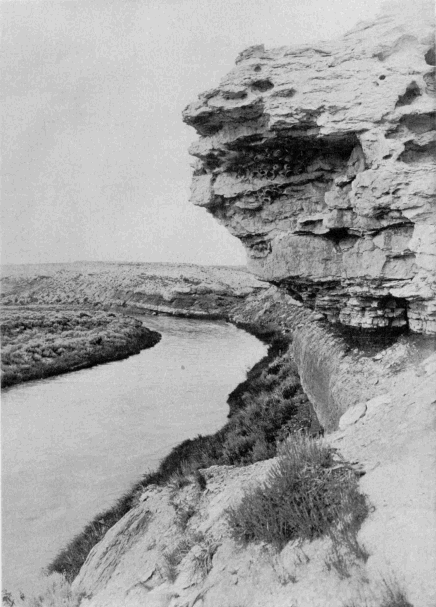

A BI-MONTHLY MAGAZINE DEVOTED TO THE STUDY AND PROTECTION OF BIRDS
Official Organ of the Audubon Societies

Vol. 1 August, 1899 No. 4
Photographing Shy Wild Birds and Beasts at Home
BY R. KEARTON, F. Z. S.
Author of "Wild Life at Home: How to Study and Photograph It;" "With Nature and a Camera," etc.
M
y brother and I were both delighted to see the first number of Bird-Lore, and take the opportunity of congratulating our naturalist and photographic chums across the Atlantic upon having such a practical and highly interesting magazine to help them in their enchanting pursuits. Such a publication would have been a veritable godsend to us when we started our natural history photography.
As we have had a good deal of experience in circumventing the cunning and timidity of the majority of wild creatures living in the British Isles, and the same characteristics in this respect are common to wild animals all the world over, I propose to tell by what means we have secured some of our rarest pictures.
First of all, I ought to explain that we never use anything but a strongly built, half-plate stand camera, fitted with a Dallmeyer stigmatic lens, and an adjustable miniature on the top, which is used as a sort of view-finder when making studies of flying birds and mammals in motion. When fixed in position, and its focus has been set exactly like its working companion beneath it, both are racked out in the same ratio by the screw dominating the larger apparatus which, when charged with a dark slide and stopped down according to the requirements of light and speed of exposure, needs no further attention. When the combination is in use, the photographer focuses with his right hand, and, holding the air ball or reservoir of his pneumatic tube in his left, squeezes it quickly and firmly directly he has achieved a sufficiently clear and strong definition of his object upon the ground glass of the miniature camera. This enables the operator to focus up to the last instant, and to select the best attitude of his "sitter."
We have a silent time-shutter built in behind the lens, and for very rapid work, such as flying bird studies, use a Thornton & Pickard focal plane shutter working up to the thousandth part of a second.
Good apparatus, that will work under almost any conditions with precision and certainty, must be possessed for the achievement of successful natural history work. We use the quickest plates made in the old country for the greater part of our work, although, of course, for still objects full of color, we cannot beat Ilford chromatic plates.
We soon discovered that it was absolutely impossible to figure many timid birds at close quarters without some natural contrivance in which the camera and its operator could be effectually hidden. For the study of wood birds at home, we built an artificial tree trunk of sufficient internal capacity to contain either of two broad-shouldered Yorkshiremen. This is how we made it. Purchasing three pieces of stout bamboo, each 7 feet in length, I split them down the center and lashed each piece to three children's bowling hoops, the topmost and center ones being 24 inches in diameter, and the bottom one 27, so as to represent the base of a tree and give the legs of our camera a greater stride. We then covered the whole with galvanized wire and a coat of green American cloth, which my wife painted to resemble the bark of a tree. After this we stuck bits of lichen and moss on to it, and then passed a number of bits of strong grey thread from the inside to the out. With these we tied on several pieces of ivy stripped from adjoining tree trunks, so as to make our contrivance look as natural as possible. How far we succeeded in deceiving the feathered folks of Britain may be judged, when I state that one day a Chaffinch alighted on the broken top of our artificial forest monster and began to rattle off its song just over the unseen photographer's head.
IN THE TREE-TOPS From Kearton's 'Wild Life at Home,' copyrighted by Cassell & Co., Ltd.
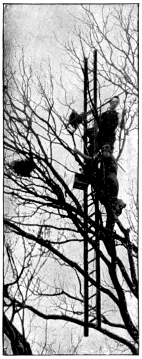
We should much like to hear of this device being tried by someone on American wood birds. Whoever makes and gets laced up inside an artificial tree trunk will discover that a peculiarly dizzying sensation attends the first attempt or two to stand for any length of time so encased.
For some birds we fix up a mock camera near their nests or feeding haunts a few days before we attempt to make a picture. This can be easily done with a small wooden box and tin canister with its lid or bottom blackened to represent a lens.
For photographing ground builders, such as Larks, Plovers, and so on, we built an artificial rubbish heap, such as farmers rake up off their grass land before laying it down to grow for hay time, and cart off to form rick bottoms.
This we made from an old umbrella, to the ribs of which we lashed pieces of bamboo four feet in length. The whole was then covered with brown holland. To the outside we tied innumerable wisps of straw and rubbish, and as some sort of testimony to its efficacy, I need only mention that we have succeeded in photographing a Lark at her nest bang in the middle of a bare field, and one of our very shyest British Plovers, quite recently, sitting on its nest within a few feet of the lens.
We next come to a consideration of how to photograph the eyries, eggs and young of such birds of prey as Eagles, Falcons and Ravens, that breed, at any rate so far as Britain is concerned, in the most inaccessible cliffs.
The first business is to secure a couple of climbing ropes. We had ours specially manufactured for us, from the best manila hemp, by a London rope-maker of good repute. They are each two hundred feet in length. The guide rope is an inch and a half in circumference, and the descending rope, which has three loops at one end for the photographer to sit in, is two inches in circumference. It will thus be seen that both ropes are pretty stout, some folks might say unnecessarily stout, but it is better to be on the safe side, as a break and a fall of three or four hundred feet onto jagged crags or into the sea would be likely to send the photographer into perpetual retirement.
It is a curious thing, but nevertheless true, that fictionists have fixed one idea in the mind of the public in regard to the danger attending a man hanging over a precipice on the end of a rope; viz., that all his danger comes from a probability of one or two of the strands of his rope getting chafed in two over some sharp rock. I am frequently asked, after my lectures, the question: "Has your brother ever had a narrow escape from the rope nearly getting chafed in twain?" They seem genuinely disappointed because he has not been hauled up on the last faithful strand of a rope, with his hair standing on end, his face o'erspread with an unspeakable horror, and then fainted dead away on reaching terra firma.
DESCENDING AN OVERHANGING CLIFF From Kearton's 'Wild Life at Home,' copyrighted by Cassell & Co., Ltd.
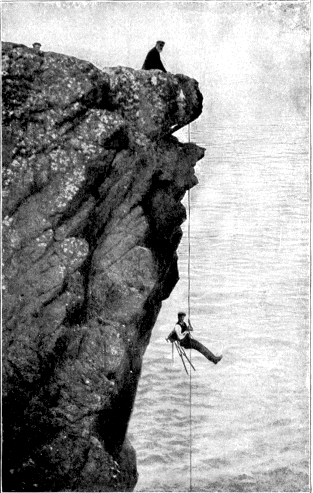
I have heard a lot of terrible tales about chafing ropes, but as a matter of fact, there are dangers a thousand times greater if less picturesque; such, for instance, as a prosaic little stone, no bigger than an orange, being dragged out of its bed by one of the ropes when the photographer is being hauled up a cliff, and, after dropping a hundred feet or so, alighting plump on the head of the unsuspecting camera man. My brother has had one or two narrow escapes of this kind, though never the shadow of one from a chafing rope.
PHOTOGRAPHING A CORMORANT From Kearton's 'Wild Life at Home,' copyrighted by Cassell & Co., Ltd.
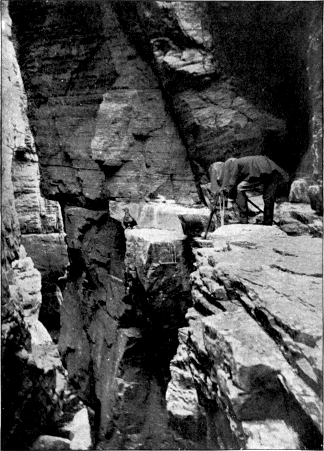
Upon setting forth to photograph the eyries of cliff-breeding birds, we equip ourselves with (1) our ropes; (2) a stout crowbar; (3) a good, strong, level-headed assistant (nervous or careless assistants should be studiously avoided, as the one kind of man is as dangerous as the other), that can be relied upon; (4) a revolver; (5) a camera; (6) a photographer who, in addition to being a good athlete and gymnast, possesses no nerves at all, and can, in consequence, stand on the very lip of a cliff a thousand feet sheer, as he would do on the gutter edge of a sidewalk, and look straight below him.
I would advise all who do not possess the above qualities, more or less, to leave cliff photography severely alone, as walking backwards into a yawning abyss, even on the end of a good, stout rope, feels uncommonly like stepping into eternity, and I would not like to have the blood of any American cousin on my head.
Upon reaching the edge of any precipice wherein we suspect, say an Eagle, to be breeding, we step as close to the lip of the crag as possible. I hold the revolver over my head, fire, and watch to see where a bird flies out. Should one do so we mark the spot, drive our crowbar into the ground above it, tie one end of the guide rope securely to it and fling the rest down into the chasm below. The photographer lashes his camera to his back, dons the three loops at the end of the descending rope round his hips, the rope is then passed once round the crowbar, and the assistant pays it out from behind, whilst the photographer, steadying himself by means of the guide-rope, literally walks backwards down the cliff. Before going down, however, he takes good care to clear away all the loose stones and rubble, for if he did not do so they would be sure to be dislodged by the rope when he comes up.
Upon reaching an eyrie, if it is situated on a ledge wide enough to set the tripod of the camera on, he does so and makes his studies, taking good care not to let go his ropes.
If the nest should be on a ledge too narrow to set the apparatus upon, my brother passes two of the legs of his tripod through a belt round his waist and the third into any convenient crevice he can find, and with his body practically at right angles to the face of the crag and his camera almost resting on his chest, focuses and takes his picture.
I feel that I have barely touched the fringe of my subject in this short article, but I have no doubt that to the man equipped with a decent camera and a genuine love of nature, the hints I have given will be sufficient to set him to work natural history picture-making, and, as an old farmer, I know enough of American ingenuity in tool-making to convince me that there is no bird or beast living in the western world that cannot be photographed, living, loving, and laboring in its free, open-air home. Any way, every reader of Bird-Lore has the best wishes of the brothers Kearton.
Two Nova Scotia Photographs
BY C. WILL BEEBE
With photographs from nature by the author.
The slate-colored Junco or Snowbird breeds very abundantly in the fields of Digby county, Nova Scotia, and its neat nests are often so artistically placed that they are a continual temptation to the naturalist photographer. One nest, in particular, with four eggs, was especially beautiful, seen through the ground glass of the camera, the contrast between the eggs and the waxy green leaves and scarlet fruit of the bunch-berries near it making one long for color photography. This nest was in a field, five feet from a road, and partly protected by a tiny bank of turf.
NEST AND EGGS OF JUNCO
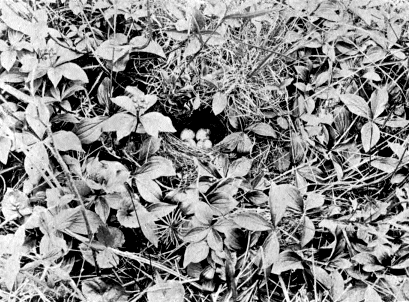
Five days after the photograph was taken the eggs hatched, and four balls of long, jet-black fuzz appeared. Daily twelve-hour meals of green measuring-worms, provided by the parents, wrought marvels in the appearance of the young birds, and in a surprisingly short time a second suit of streaked black and brown was assumed. In this, perhaps, the facsimile of their ancestors' plumage, they left the nest, and apparently lost individuality among the large flocks of their species.