Front matter (continued 2)
Reading edition
Reports from the New Hampshire, Pennsylvania, Indiana, Illinois, Iowa, Wisconsin, and Minnesota Societies, will appear in the April number.

VOL. 1 No. 2 April, 1899 20 c. a Copy $1 a Year
COPYRIGHT, 1899, BY FRANK M. CHAPMAN

April, 1899
CONTENTS
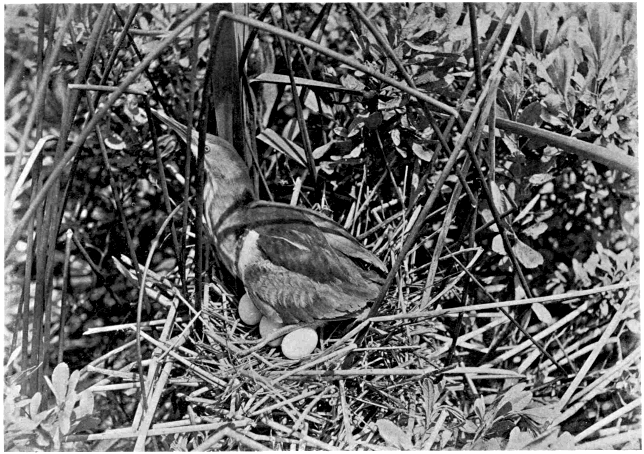
Frontispiece—Least Bittern, Nest and Eggs. From a Photograph by E. G. Tabor.
The Camera as an Aid in the Study of Birds. Illustrated. Concluded from February Number Dr. Thomas S. Roberts 35
A Least Bittern Portrait. Illustrated E. G> Tabor 39
Loons at Home. Illustrated. William Dutcher 40
Photographing a Bluebird. Illustrated. Robert W. Hegner 43
A Tragic St. Valentine's Day. Annie Trumbull Slosson 45
Clark's Crows and Oregon Jays on Mount Hood. Illustrated. Florence A. Merriam 46
FOR TEACHERS AND STUDENTS
Suggestions for Bird-Day Programs in the Schools. C. A. Babcock 49
Summer Boarders for Boys and Girls. 51
A Bird-Day Program. Elizabeth V. Brown 54
Migration Tables for April and May. Dr. A. K. Fisher 52
FOR YOUNG OBSERVERS
The Legend of the Salt. Illustrated. Frank M. Chapman 55
The February Walk Contest. 57
A February Walk in Central Park. Floyd C. Noble 57
The Myth of the Song Sparrow. Illustrated. Ernest Seton Thompson 59
NOTES FROM FIELD AND STUDY 60
Sparrow-Proof Houses. Illustrated. D. R. Geery; A Musical Woodpecker, D. L. Burnett; An Ornithologist at San Juan.
BOOK NEWS AND REVIEWS 61
Sharpe's 'Sketch Book of British Birds'; Stone's Report on Bird Protection; 'Journal of the Maine Ornithological Society'; 'Bulletin of the Cooper Ornithological Club'; Maynard's 'Nature Study in Schools'; A new book by Mrs. Miller; Ernest Seton Thompson's 'Wild Animals I Have Known'; Clark's 'Bird Tablets'; A book by the originator of Bird-Day.
EDITORIALS 63
AUDUBON DEPARTMENT 64
Editorial; A Letter from Governor Roosevelt; Reports from the Pennsylvania, Indiana, Illinois, Iowa and Minnesota Societies.
⁂ Bird-Lore is published at Englewood, New Jersey, where all manuscripts intended for publications, books, etc., for review, and exchanges should be mailed in care of the Editor, Frank M. Chapman.
PUBLISHERS' ANNOUNCEMENT
The unexpectedly large demand for the first number of Bird-Lore has so nearly exhausted the edition it has been deemed advisable to reserve the few remaining copies for subscribers to the volume.
Bird-Lore for June will contain an article by Olive Thorne Miller entitled, 'The Ethics of Caging Birds'; a poem by Edith M. Thomas; the conclusion of Miss Merriam's article; an account of a visit to Audubon's birthplace, by Otto Widmann; unusually interesting papers on the Cardinal and Chimney Swift, and some remarkable bird pictures, including one by Dr. Roberts.
LEAST BITTERN ON NEST Photographed From Nature by E. G. Tabor. (See page 39)

A BI-MONTHLY MAGAZINE DEVOTED TO THE STUDY AND PROTECTION OF BIRDS
Official Organ of the Audubon Societies

Vol. 1 March, 1899 No. 2
The Camera as an Aid in the Study of Birds
BY DR. THOS. S. ROBERTS
Director Department of Birds, Natural History Survey of Minnesota With photographs from Nature by the Author
(Concluded from page 13)
T
Turning reluctantly from the attractive little Chickadee family, described in the preceding number of this magazine, we will next seek the acquaintance of a bird of entirely different feather, and, what is of more moment to the bird photographer, of entirely different disposition.
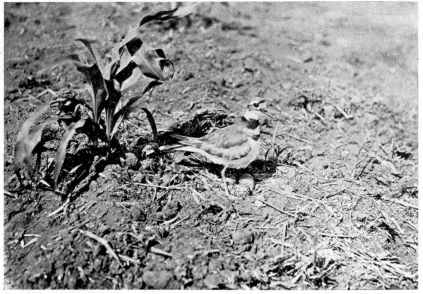
The Killdeer Plover, perhaps from his close kinship to the fraternity of game birds, has come to regard man and all human devices with deep suspicion, and to get on terms of close fellowship with him is no easy matter. While not himself an usual object of the sportsman's effort, owing to his lean body and indifferent savor, he is the immediate relative of those much sought-after birds, the Golden and the Black-bellied Plover. Unlike these more aristocratic members of the Plover group, the Killdeer does not retire to semi-arctic fastnesses to rear its brood, but nests wherever found throughout the eastern United States. Its ever-restless nature and loud alarm, "killdee, killdee," as it moves from place to place, or circles round and round, always at a safe distance, together with its common occurrence throughout populated as well as wild regions, makes this plebeian well-known to every country lad and the bane of every would-be stealthy Nimrod. So noisily persistent is its outcry that it has been dubbed by ornithologists vocifera—Ægialitis vocifera—and a most appropriate appellation it is.
KILLDEER ON NEST
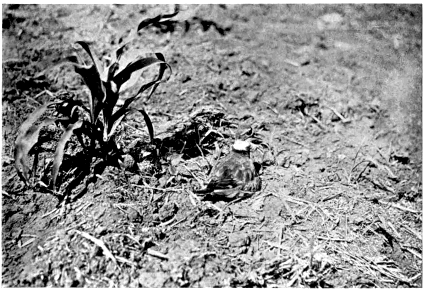
Like many loquacious people, Mr. and Mrs. Killdeer have a rather lazy vein in their make-up, and spend but little time or effort nest building. A little depression lined with a few bits of stick or straw, a few pebbles or other handy materials satisfies their ambition. In the bare, exposed situation usually chosen, such a nest, with its four spotted eggs, is much less conspicuous than would be a well made one. The first of our pictures showed one of these nests located in a corn-field, which is a not very uncommon site, although bare pasture knolls and gravelly banks are more usually selected. The photograph of the nest and eggs was, of course, easily secured, and is chiefly of interest because it shows so well how an open nest with its eggs may be protected by blending perfectly with the general color of the immediate surrounding—protective coloration, as it is called. To secure the portrait of the wary old Killdeer, who left the nest the instant anyone but entered the large field, seemed a hopeless task. But the novice is ever ambitious, and the attempt was made in the following fashion, with what success the accompanying pictures will show. Placing the camera on the sharply tilted tripod, so that the distance from lens to nest was about four feet, the dreadful looking object was left in position for some time on the evening preceding the day on which the photographs were taken. The next day proved light and clear, and with the sun well up in the heavens we began operations, my companion and assistant on this occasion being Rev. H. W. Gleason, a bird enthusiast undaunted by any obstacle and fertile in devices. Arranging the camera as already described, omitting the green hood in this instance, as it would have been worse than useless, we retired entirely from the field, which fortunately lay on a gently sloping hillside. From our distant retreat we watched, with field-glass in hand, the maneuvers of the mother bird. The experience of the preceding evening had evidently helped to prepare the way, for after only brief delay the anxious bird began running in a great spiral steadily converging to the central point. Every clod of earth or little mound in the path was mounted and, with much craning of neck and turning of head, the dreadful engine glistening in the sunshine was closely scrutinized from all sides, but as it was motionless, it probably was regarded as some new-fangled contrivance for cultivating corn, of finer build than the hoes, rakes, and other implements left by the men in the field. Once satisfied, she made a last quick run directly between the legs of the tripod, and stood erect over her treasures. A long trolling-line, procured at a neighboring farm-house, had been attached to the lever arm releasing the shutter, as our seventy-five feet of tubing was not half long enough. Creeping to the end of the line, a quick pull made the exposure,—1/25 of a second, with wide open stop and rapid plate. Pulling up the slack of the line seemed to startle the bird more than the click of the shutter, and after repeating this procedure several times we were altogether uncertain as to whether the bird had been caught at all; and as it was impossible, there in the field, to follow the advice of an interested farmer spectator, who insisted that we "ought to look at them there plates and see what we had before going further," we cast about for some surer method. Carefully looking over the ground, I found that some seventy-five feet from the nest there was a shallow depression just deep enough to entirely conceal a man lying prone on the soft, ploughed ground. So the rubber tube was substituted for the line and the bulb end carried up the slope to the little hollow. As it would be impossible from this position to see the bird, and as we had discovered that a low whistle or noise caused her to leave the nest at once, some method of signaling had to be arranged. The trolling line suggested a way, as we found that it would reach readily from the bulb in the hollow to the edge of the field. So, attaching one end of it to my wrist, I took my position flat on the ground in the middle of the field, with a hot noon sun pouring down overhead, and awaited the signal,—a vigorous jerk on the trolling line, to be given by Mr. Gleason, who from a distance was watching with a glass the movements of our unwilling sitter. The signal soon came, and these complicated and rather juvenile tactics proved so successful that very soon Mrs. Plover did not so much as change position at the click of the shutter, and when driven away to rearrange the camera between exposures, came quickly back again. In a short time we had exposed all the plates that seemed necessary, and retired from the field conquerors, though leaving the foe in peaceful possession. Returning to the house for supplies for a new expedition, a lady member of the party, who, from a shady hammock, had been watching for several hours these rather boyish antics, saluted us with the withering remark, "About four years of age, I should think, instead of forty." But we hoped that the end would justify the means, and were anxious to inspect the developed results. This part of the work was accomplished a day or two later, and the pictures here presented show, I think, that our efforts were not entirely in vain. Several others were not so good. In one, the female sits quietly on her nest, back to the camera, and in coloration blends admirably with the surroundings. In another, she is crouching in a half uncertain attitude, while in still another she stands erect, revealing the four eggs directly beneath her, and with ruffled plumage seems a little resentful of the intrusion. In all, it will be noticed that the bill is partly open, either because it was a very warm day, because the poor bird was startled and ill at ease, or, it may be, because it was no easy matter for this always loquacious bird to keep its mouth shut even when posing for its picture.
KILLDEER, NEST, AND EGGS
A Least Bittern Portrait
BY E. G. TABOR
(See Frontispiece)
On the morning of May 27, 1897, equipped with an extra supply of patience and a 5 × 7 'Premo B' camera fitted with rapid rectilinear lens, my plate-holders filled with unexposed plates, and accompanied by my wife, who has been a partner in all of my successful trips, I started for Otter Lake, Cayuga County, N. Y.
It was a beautiful morning, with not a breath of air stirring (by the way, this is the hardest of all things to control, and is an absolute necessity if you are to make fine, clear-cut negatives of birds and their natural surroundings), and the lake looked like a mirror. It took but a minute to get the large, flat-bottomed row-boat ready for the start, and we were soon gliding along, an oar's-length from shore, scanning every tree, bush, and bunch of rushes, in search of nests, those of the Red-winged Blackbird being very plenty and placed both in bushes or rushes in about equal numbers. A pair of Kingbirds had selected as the place for their summer home, a large, low willow limb which projected over the water; a peep into the nest revealed three eggs, common, yet so beautiful in their bed of wool and feathers.
Our next finds were several nests of a pair of Long-billed Marsh Wrens, which looked more like mouse-nests than anything else I have in mind. As we could return to these later, if unable to find anything better, we had not yet exposed a single plate, reserving them for a rare or unusual find.
We were in search of nests of the Least Bittern, and as we were passing that part of the shore where they always nested, we soon located a nest, but as it only contained one egg, another nest must be found. A male Least Bittern flew up a short distance ahead of us and 'dropped in' back of the bushes. We rowed down to the place from which he flushed, and standing up in the boat looked around, and not more than a boat's-length ahead, we espied a female sitting on a nest. I pushed the boat very carefully to within a couple of feet of the nest, and prepared to make an exposure. The camera was set to focus on an object 34 inches from cap of lens, and I moved it back and forth until the focus was perfect, the diaphragm was closed to f 16, and an instantaneous exposure with speed at 1/25" was made.
As most of my operations, preparatory to making the exposure, were of necessity carried on within three feet of the bird on the nest, she at several times started to leave it; but when the bird moved I kept still, and when she kept still I worked; in this way I finally completed my preparations. The peep I got of the eggs as she partly raised off from them, just as I finished, made me squeeze the bulb before I intended to; but the result I obtained fully satisfied me, for in no other way could I describe the results of this trip, and what I saw and learned of the habits and home-life of the Least Bittern.
Loons at Home
BY WILLIAM DUTCHER
I should like to say a few words to the readers of Bird-Lore on the subject of making good photographs of birds. Don't conclude at once, when you see pictures of nests, or birds in their wild state, that it is an easy matter to get them. A year ago, when I saw the fine exhibition of slides presented by Mr. Brewster and Mr. Chapman at the American Ornithologists' meeting, I at once concluded that it would be an easy thing for me to get similar results. So I forthwith invested much good money in purchasing a camera, and all the accompanying outfit; but not until I had worried all my photographic friends for advice of all kinds. With all the confidence of an expert I started on this unknown sea, and I must confess to you, patient reader, that my efforts were a brilliant string of failures, for from the more than one hundred and twenty-five plates that I exposed, I succeeded in getting only two good negatives. But I had lots of fun and plenty of experience, and am just as proud of my two good negatives as the celebrated old hen that had but one chick. If you want to learn to be patient and persevering, try photographing in the fields and woods. If you wish to learn more of the habits of birds than you can in any other possible way, try for hours to get them familiar enough with you and your camera to go on with their nest-building, or feeding their nestlings. Besides all this, in later days, whenever you see the photograph, it will recall to you every pleasant moment that you spent in getting the negative.
That you may share with me some of the pleasures that I experienced in getting a negative of a nest of eggs, from which the accompanying picture was made, let me tell you the following story about the Great Northern Diver, more commonly known as the Loon, and among the scientists as Gavia imber.
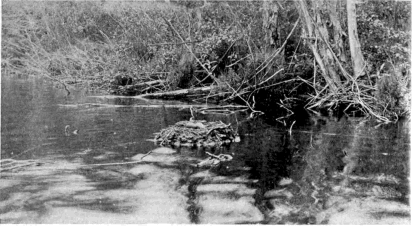
Those of you who are familiar with the Adirondack or Canada lakes can easily picture the surroundings of this nest, which I found in Higley Lake, Canada. This is a small body of water, hardly more than a very large pond. This section of Canada maybe called a lake region, and is very beautiful. Most of the lakes are surrounded with forests, in which the contrasting colors of the evergreens and white birches add greatly to the natural beauty of the scenery. This nest was built in very shallow water, about eight feet from the shore. It was, at its base, about twenty inches in diameter, and at its apex about fifteen inches wide. It was about nine inches above the water at its greatest height, and composed entirely of mud, so far as I could determine, of a very dark color. The water where it was placed was not over six or eight inches deep, but it was really a very hard matter to determine exactly where the water ended and the mud commenced. This I ascertained to my sorrow and discomfiture when I undertook to set up my tripod. Standing in a very round-bottomed boat and trying to plant a tripod in silt of seemingly unfathomable depth is no easy job, as I found out. Finally, however, I succeeded in getting what I now have the pleasure of showing you; but I dare not tell you of the beautiful failures I made before this picture was obtained. When I first discovered the nest, the Loon was upon it, but as soon as she saw me she slid off into the lake and made every effort to dive. It is true that her head was under the water, but her back was not until she had gone some feet from the nest out into the lake, where the water was deep enough to entirely cover her. She did not then appear until she was well across the pond, where she was joined by her mate. The nest contained only one egg when I first saw it; but in the water, on the lake side of the nest, I found another egg, which the mother bird had evidently rolled out of the nest, perhaps in her fright and hasty departure when she first saw me. This egg I replaced in the nest by lifting it with the broad end of the boat oar, thinking, perhaps, that handling it might cause the Loon to desert the nest. The egg that was in the water was many shades lighter in color than the one found in the nest, which leads me to believe that the eggs of birds that habitually breed in damp mud nests acquire a darker color from stains.
In another pond of about the same size, and within half a mile of Higley Lake, I subsequently saw a pair of Loons that had but one young, so far as I could ascertain. If there was another it was kept well hidden. I was very much interested in watching the methods by which the old birds kept the little fellow out of danger. When I first saw the family group, both parents and the little one were together; but immediately on the appearance of my boat the whole group disappeared under the surface. The young bird soon came to the surface again in about the same spot, but the parents were some distance off on the other side of the boat, so that I was between them. Both parents were perfectly quiet until I undertook to row toward their offspring, when one of the parents uttered what was to me a very new and peculiar cry, on hearing which the little one immediately dove; the cry was entirely different from the usual loud, maniacal cry of the Loons. As soon as the young one appeared I again started toward him, when the old bird repeated the same cry, and down went the little fellow. It was very evident that he knew whenever he heard that warning cry he must disappear at once. I had so much sympathy for the lonely little chap that I left him, after I had tried the experiment a number of times. As soon as I drew away to another part of the pond the old birds uttered the usual well known cry of the species, but the little one then remained on the surface and was soon joined by the parent birds.
NEST AND EGGS OF LOON Photographed from Nature, by William Dutcher
A few weeks later the same group acted in an entirely different manner; then they remained together, and as the boat approached, the old bird with its bill seemed to push the young one under the water before it dove itself.
If this bit of the domestic life of these two Loon families has interested you as much as it did me, I shall feel amply repaid for the thirty-two miles I had to drive each time I visited them.
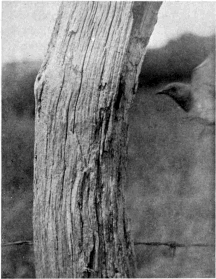
BLUEBIRD FLYING TO NEST
Photographing a Bluebird
BY ROBERT W. HEGNER
With Photographs from Nature by the Author.
D
uring the severe cold of January and February, 1895, most of the Bluebirds were thought to have perished. So it is with the spirit of a genuine Audubon that we hail their return in ever increasing numbers each succeeding spring. How sadly we should miss these little friends may be judged by the great commotion among ornithologists caused by their supposed extinction. In order to have more than a mere remembrance of their habits, I set out one day in the summer of 1898, at Decorah, Iowa, to obtain photographs of them in their haunts, and secured two interesting negatives of the female, as shown in the accompanying illustrations. The history of the case is as follows: A pair of Bluebirds, after several previous attempts at housekeeping, and subsequent removals by 'small boys,' at last selected an old, deserted, Woodpecker's hole in a fence-post, and built, as usual, a nest of dry grass with a softer lining of horse-hair. The birds had already begun incubating the three pale blue eggs, which formed the set, when I disturbed them. I crept within five feet of the post before the female left the nest and joined her mate, who had been keeping guard in a neighboring plum tree.
BLUEBIRD AT NEST
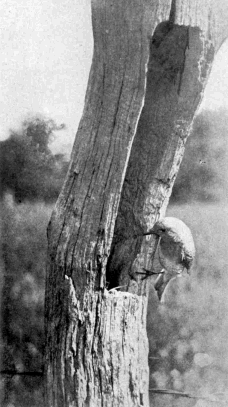
After focusing my camera to within three feet of the post, and arranging a string attachment, I concealed myself in some bushes about seventy-five feet away. I waited patiently for ten minutes before the female left the tree and flew down to the fence. The male followed close after, and they hopped about the post and wires, getting nearer and nearer the nest, until the female flew straight into the hole. A snap-shot, just before she reached the entrance, was only partially successful, but shows very clearly the pose of the bird's head and neck while it was in the air. It was made in a twenty-fifth of a second with the lens stopped down to sixteen. I disturbed the female several times before she gained the desired position at the nest-opening; but, finally, the snap of the shutter helped bring to life one of my best bird-pictures.
A knowledge of the bird's nesting habits is a prime requisite in avian photography. Much patience is needed, as failures are very numerous. A camera which may be focused to within two or three feet is an absolute necessity in order to make the picture large enough. Most of my failures have been caused by the lack of bright sunlight, under-exposure, or movement of the bird the instant the picture was taken; but one good photograph is sufficient reward for many trials.
A Tragic St. Valentine's Day
BY ANNIE TRUMBULL SLOSSON
The cold wave reached us at Miami, on Biscayne Bay, Florida, in the night of February 12, 1899. It was preceded by severe thunder storms in the evening. On the 13th, Monday, it was very cold all over the state, with snow and sleet as far south as Ormond and Titusville. Our thermometers at Miami ranged from 36° to 40° during the day. As I sat in my room at the hotel, about four in the afternoon, I saw a bird outside my window, then another and another, and soon the air seemed full of wings.
Opening my window to see what the visitors could be, I found they were Tree Swallows (Tachycineta bicolor). Several flew into my room, others clustered on the window ledge, huddling closely together for warmth. There were hundreds of them about the house seeking shelter and warmth. They crept in behind the window blinds, came into open windows, huddled together by dozens on cornices and sills. They were quite fearless; once I held my hand outside and two of them lighted on its palm and sat there quietly. As it grew dark and colder their numbers increased. They flew about the halls and perched in corners, and the whole house was alive with them. Few of the guests in the hotel knew what they were; some even called them 'bats,' and were afraid they might fly into their faces or become entangled in their hair. One man informed those about him that they were Humming Birds, 'the large kind, you know,' but all were full of sympathy for the beautiful little creatures, out in the cold and darkness. A few were taken indoors and sheltered through the night, but 'what were these among so many?'
The next morning the sun shone brightly though the weather was still very cold—the mercury had fallen below 30° during the night. But as I raised the shade of one of my eastern windows I saw a half-dozen of the Swallows sitting upon the ledge in the sunshine, while the air seemed again filled with flashing wings. I was so relieved and glad. Surely the tiny creatures, with their tints of steely blue or shining green contrasting with the pure white of the under parts, were more hardy than I had feared. But alas! it was but a remnant that escaped. Hundreds were found dead. Men were sent out with baskets to gather the limp little bodies from piazzas, window ledges, and copings. It was a pitiful sight for St. Valentine Day, when, as the old song has it,
"The birds are all choosing their mates."
Clark's Crows and Oregon Jays on Mount Hood[D]
BY FLORENCE A. MERRIAM
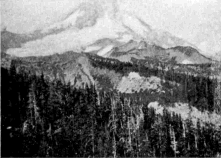
C
loud Cap Inn, the loghouse hotel fastened down with cables high on the north side of Mount Hood, is too near timber-line to claim a great variety of feathered guests, but Oregon Jays and Clark's Crows or Nutcrackers are regular pensioners of the house. The usual shooting by tourists does not menace them, for the nature-loving mountaineers, who keep the Inn and act as guides to the summit, guard most loyally both birds and beasts. They like to tell of a noble Eagle which used to fly up the cañon and circle over the glacier every day, and they recall with pleasure the snowy morning when an old Blue Grouse brought her brood to the Inn, and the birds ate the wheat that was thrown them with the confidence of chickens. The Grouse were, apparently, regular neighbors of the Inn, and while there I had the pleasure of seeing a grown family. They fed on the slope close above me with the unconcern of domestic fowls, conversing in turkey-like monosyllables as they moved about, and two of them came within a few feet and looked up at me—that not forty rods from the Inn! The pleasure of the sight was doubled by the reflection that such things could be so near a hotel, even on a remote mountain.
CLOUD CAP INN
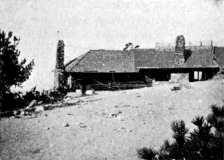
It was delightful to see how familiarly birds gathered about the house. You could sit in the front doorway and when not absorbed in looking off on the three wonderful snow peaks—St. Helens, Rainier, and Adams—rising above the Cascade range, could watch Oregon Juncos, Steller's Jays, Oregon Jays, and Nutcrackers coming down to drink at the hydrant twenty feet away; while the Ruby Kinglet and White-crowned Sparrow, together with Townsend's Solitaire and other interesting westerners, moved about in the branches of the low timber-line pines; and Lewis' Woodpeckers, with their long, powerful flights, crossed over the forested cañons below. Crossbills had stayed around the house sociably for three weeks together, Mrs. Langille, the noble old mother of the mountaineers, told me. She said they would fly against the logs of the house and call till she went out to feed them. They left with the first heavy storms, though usually, she said: "That's the time when we have birds come around the house—when there are storms." And a friendly hospice the feathered wayfarers find it so long as the Inn is open!
CLARK'S CROW
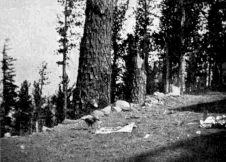
The Oregon Jays and Clark's Crows are, as I said, the regular pensioners of the house. The Jays look very much like their relatives the Canada Jays, but are darker, and when you are close to them the feathers of their backs show distinct whitish shaft-streaks. The Crows have the general form and bearing of Crows, but are black only on wings and tail, their general appearance being gray. Speaking of the birds, Mrs. Langille said: "If I was in the kitchen myself I'd have them come right to the porch outside; when I'm in the kitchen I'm always throwing out crumbs for the birds and squirrels, and I've had the Jays come and sit right down on the block where I was cutting meat and take the fat right out of my hands." Clark's Crows, she said, would not eat from her hand, but would sit on the back porch and call for their breakfast.
When I was at the Inn, the Chinese cook used to throw scraps from the table over a lava cliff, and both Crows and Jays spent most of their time carrying it off. As the foot of the cliff was one of the best places to watch them, I spent part of every day there, and when the smell of coffee grounds got too strong, consoled myself by looking through the trees up at the grand white peak of Hood.
It was interesting to see the difference in the ways of the two birds. The Nutcracker would fly down to the rocks with rattling wings, and, when not too hungry to be critical, would proceed to investigate the breakfast with the air of a judge on the bench, for he is a dignified character. To touch the hem of his robe to the food would have been defilement, so he went about pressing his wings tight to his sides, sometimes giving them a little nervous shake. To smile at this sober-minded person seems most disrespectful, but the solemnity of his gambols was surely provocative of mirth. Not content with turning his long-billed head judicially from side to side as he advanced through the scraps, if the biscuit on his left was not to his mind, with one great ungainly leap he would box half the compass and plant his big feet before a potato on his right. This he would proceed to probe with a grave air of interrogation, and if he decided the case in the negative would withdraw his beak and pass to the next case on the docket. Once when the potato was half a waffle, he pried it up tentatively with his long bill, and at last, deciding in its favor, proceeded to fly off with it, his long legs dangling ludicrously behind him.
OREGON JAY
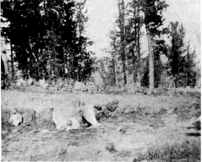
The Oregon Jays were quite unlike their Crow cousins. They would come flying in, talking together in sociable fashion, and drop down so noiselessly you could but be struck by the difference between fluffy owl-like feathers and stiff quills. Sometimes one of the Jays would touch the side of a tree a moment before dropping lightly to the ground. All their motions were quick and easy, if not actually graceful, and they worked rapidly, with none of the profound deliberation shown at times by the Nutcracker. The smaller pieces of food they ate; the larger ones they carried off, usually in their bills, occasionally in their claws. In eating, the Jay would sometimes adopt the Blue Jay style and put his food under his foot, where he could pull it apart, throwing up his head to swallow. When the food was soft and too large to swallow at one gulp, both Crows and Jays would carry it to an evergreen, lay it down on a twig before them, and there eat comfortably, as from a plate. Both birds often flew to the ledges of the cliff for food that had lodged there in falling, and it made a busy scene when eight or ten of the big fellows were flying about the place at once.
(To be concluded.)

Suggestions for Bird-Day Programs in the Schools
BY C. A. BABCOCK
(Originator of Bird-Day)
A
Bird-Day exercise, in order to have much value educationally, should be largely the result of the pupils' previous work, and should not be the mere repetition of a prepared program, taken verbatim from some leaflet or paper. The program should be prepared by the pupils, under the direction of the teacher, and should contain as many original compositions or statements about birds, derived from personal observation, as possible.
Bird-Day should be announced some weeks beforehand, in order to give the children time to prepare for it. In the meantime, direct them to observe the birds, and allow from five to ten minutes each morning to receive the reports. Direct that crumbs be scattered in the back yards, and cups containing seeds be put up in the trees, or on the fences, and that bones from the table be fastened where they can be seen from the windows. Then, with an opera glass, if one can be obtained, results are to be looked for.
For directing the young observer, write upon the board a scheme like this:
ENGLISH SPARROW
Length from tip of beak to end of tail?
What is the shape, color, and size of beak?
What is the color of legs and feet?
How many toes? Which way do they point?
Gait upon the ground,—does it walk, hop or run?
Color of head and throat? Color of under parts?
Color and marking of back?
Difference in markings of male and female?
Describe actions which indicate its character.
Is it pugnacious? Is it brave? Is it selfish?
Does it trouble other birds?
Describe its voice or song. Does it utter notes indicating diverse feelings, as joy, anger? What syllables best recall some of its notes?
For the younger pupils a few of these questions, perhaps two or three, will be sufficient for one exercise. Children will vary, and often contradict one another in answering the same questions. Dwell upon each question till it is answered correctly, and all agree upon the answer.
A similar plan may be followed for studying the Robin, Bluebird, Catbird, Oriole, or other birds as they arrive, or as they become accessible to certain of the pupils. In April, two years ago, one little girl had observed, and described accurately, seventeen different species of birds which she had seen in the little yard of her home. They had been attracted by the food she had put out for them.
The nest-building of birds is also a good subject for observation, the Robin being, perhaps, the best species for a first study.
QUESTIONS ON NEST-BUILDING AND NESTING HABITS
Which bird does most building, the male, or the female?
Do both carry material?
Does the male ever seem to be acting as escort or guard to his mate?
What materials are used? What is the appearance of the nest? Its situation—sheltered or not?
After the nest is completed, watch it till the young are hatched. Which bird sits upon the eggs? Does the male ever relieve his mate at this task? Does he bring food to her? Does he spend some time singing to her, as if he were trying to keep her cheerful? Does he protect her from attack by birds or other enemies?
SOME QUESTIONS TO BE ANSWERED ABOUT ROBINS
Learn to distinguish the voices and call notes of the male and female. Which bird wakes first in the morning and calls the other? You may also notice, sometimes, in the night, that one bird wakes and calls the other. Which one generally wakes first at these times?
Do Robins raise more than one brood in a season? If so, do they use the same nest twice? If they raise two broods, what becomes of the first, while the mother is sitting upon the eggs for the second?
Watch for a Robin leading out a family of chicks. Notice the feeding after the birds are old enough to run and fly fairly well. The young birds are placed apart by the parent, who visits each one in turn, and rebukes any who tries to be piggish, sometimes nipping it with its bill when it runs up out of turn. Notice this parent teaching the young to sing,—it is a very interesting sight.
The teacher will need some good manual to aid in identifying some of the species, though much of the work the first season would better be upon common, well-known birds. The following are recommended:
'Handbook of Birds of Eastern North America,' by Frank M. Chapman, published by D. Appleton & Co.; 'Bird-Craft,' by Mabel Osgood Wright, published by The Macmillan Company.
FOR BIRD-DAY PROGRAMS
For the first Bird-Day in every school it would be well to have some one read Senator Hoar's petition of the birds to the Legislature of Massachusetts. This remarkable paper deserves reading by all friends of birds at least once a year.
Compositions.—Have also original compositions, describing some bird studied, or describing some of its habits, especially its habit of feeding, and the actions showing its disposition.
Personations.—Special interest will be awakened by having 'personations' of birds. These are descriptions of birds told in the first person, as if the bird itself were telling its own story. An accurate account of the bird's appearance, habits, feelings, and life from the bird's view-point, is given, but without telling the bird's name. At the close of the reading, the hearers vote upon the name of the bird 'personated.'
Audubon Society Literature.—The teacher should also obtain circulars from the secretaries of the New York, Massachusetts, Pennsylvania and other Audubon Societies. These will give information concerning the rapid destruction of birds. Extracts may be read from them.
Poems.—Extracts from the poets naturally form an interesting feature of Bird-Day. Poets are generally bird-lovers and bird-seers. Among the poems peculiarly adapted are the following:
'Robert O'Lincoln,' Bryant; 'The Mocking Bird,' Sidney Lanier; 'The Sky Lark,' Shelly; 'The O'Lincoln Family,' Wilson Flagg; 'The Rain Song of the Robin,' Kate Upson Clark; 'The Titmouse,' R. W. Emerson; 'The Eagle,' Tennyson; 'To The Skylark,' William Wordsworth.
Personal Experiences.—Another pleasant part of the program will be the short statements of facts about birds, by the pupils, obtained from their own observation. Birds of the Bible may also be given in short extracts.
Prose Selections.—John Burroughs' 'Birds and Poets,' and 'Wake Robin;' Bradford Torrey's 'Birds in the Bush;' Olive Thorne Miller's 'Bird Ways,' and many other books, abound in suitable passages for Bird-Day.
The pupils will enjoy preparing a Bird-Day program much more than learning little set speeches from one already prepared. The preliminary observation of birds will arouse an enthusiasm that will be of great value in all educational work.
Summer Boarders for Girls and Boys
T
he Bureau of Nature Study of Cornell University offers to assist all boys and girls who want to take bird boarders this season. By addressing this Bureau, at Ithaca, N. Y., one may receive a copy of an admirable leaflet entitled 'The Birds and I,' containing numerous designs for houses which may be constructed for the occupation of the expected 'boarders.'
A Bird-Day Program
BY ELIZABETH V. BROWN
Washington Normal School
B
irthdays, red letter days, memorial days, arbor days and bird days!
The two hundred days of the school calendar are hardly sufficient to meet the special demands made upon them in the interests of history, literature, and philanthropy. After all, is not this call for specialization something of a reproach to both home and school? If the child is symmetrically developed, harmoniously educated, will not all these influences find their proper place and expression in his life in the regular course of events?
But in the meantime since 'days' are ordained, it is highly important that they shall be celebrated in a manner to make lasting impressions on the minds and hearts of children. The mental hysteria resulting from the spasmodic, sentimental fervor worked up for this cause to-day, and for that to-morrow, is to be strongly condemned.
As in every other subject, an interest in birds should be based upon the knowledge gained by the child primarily through his own observations and experiences, supplemented and enriched later by what he reads or has told him. The interest thus aroused leads to sympathy and love as enduring as life itself.
Hence the Bird-Day program should mark the culminating rather than the initial point of bird study for the year.
The children should be led to anticipate it, and should be prepared for it in as many ways and for as long a time as possible. All that nature lovers have written or poets sung will have deeper significance after the child's contact with the birds of his neighborhood, as seen in parks, woods, or fields. To see their pictures is not enough. Field work alone can give the stimulus which leads to fellowship, sympathy, love, and protection.
For young children especially, interest is most readily aroused through the study of the activities which ally bird and child. The character and the adaptation of birds' clothing, foods and homes to their peculiar needs and environment; glimpses of nest-life; characteristic traits; disposition; the cleverness of the parent birds in outwitting enemies and protecting the young; the skillful uses of tools—bills and claws—are all readily appreciated by the children. Add to these, studies in protective coloration, migration, the relation of birds to insects injurious to vegetation, and kindred subjects, which form a never-failing source of delight. Through such work, the child learns almost unwittingly much of bird structure, classification, and description which would otherwise prove dry and barren of interest.
The boy who thus comes into fellowship with birds will not delight in beanshooters or find his chief joy in robbing birds' nests and violating game laws; while his sister will try to find something more ornamental for her hat than slaughtered birds.
THE PROGRAM
While programs must vary according to the needs and ability of the children, a few suggestions may be helpful to all.
DECORATION
'Sharp Eyes,' and 'I Spy,' by William Hamilton Gibson, 'Nature's Hallelujah,' and 'The Message of the Bluebird,' by Irene Jerome, are full of delightfully suggestive and artistic bits of bird-life for black-board pictures.
A pretty corner may be made by a small bush or the branch of a large tree in which the nests collected by the children are appropriately placed.
Pictures of bird-lovers and writers should be in evidence. Audubon, Wilson, John Burroughs, Bradford Torrey, Olive Thorne Miller, and others. Many of these may be found in recent magazines.
Anecdotes and short sketches from their books may be told or read.
COMPOSITIONS
Compositions prepared in advance, on various phases of bird-life, may be read by their young authors. These may be the result of work previously done in class along the lines before mentioned, or of new observations and experiences gathered for Bird-Day. The greater the variety of topics, the better.
Descriptions of individual birds, comparisons of birds, individually or by classes, as to:
Food.—Character; where, when, and how obtained.
Home.—Location; materials; construction; appearance.
Young.—Number; appearance; care and education.
Songs and Calls.—Emotions expressed; character, short or sustained, high or low, sweet or harsh, etc.
Relations.—Names of other birds of same class.
Bird Craftsmen.—Masons, miners, weavers, tailors, etc.
Tree-top Neighbors.—Spring, summer, fall and winter.
How Birds Travel.
How Birds Help the Farmers.
Invitations to the Birds.—Boxes put up for them; seed-cups, bits of suet nailed to posts or trees.
CHALK TALKS
Stories may be told by teachers or pupils with accompanying illustrations hastily sketched on the black-board as the story progresses. The following lend themselves readily to this work:
'The Ugly Duckling,' ' The Daisy and the Lark,' Hans Christian Anderson; 'The White Heron,' Sarah Orne Jewett; 'The White Blackbird,' Guy de Maupassant; 'The Crane Express,' Child World; 'The Crow and the Pitcher,' 'The Fox and the Crane,' 'The Crane and the Crows,' Æsop's Fables.
FOR READING OR RECITATION
'Nest Egg,' Robert Louis Stevenson; 'Anxiety,' George Macdonald; 'The Song Sparrow,' 'The Veery,' Dr. van Dyke; 'The One in the Middle,' Margaret Eytinge; 'The Bluebird,' Emily Huntington Miller; 'The Peter Bird,' Henry Thompson Stanton; 'The Robin,' Celia Thaxter; 'Brother Robin,' Mrs. Anderson; 'The Birds' Orchestra,' Celia Thaxter; 'The Sandpiper,' 'Little Birdies,' Tennyson; 'The Brown Thrush,' Lucy Larcom; 'The Titmouse,' Emerson; 'The Stormy Petrel,' Barry Cornwall; 'The Sorrowful Sea Gull,' Child World; 'Robert of Lincoln,' 'The Return of the Birds,' Bryant; 'The Blackbird,' Alice Cary; 'The Crow's Children,' 'The Chicken's Mistake,' Phœbe Cary; 'What the Birds Said,' Whittier.
Migration Tables for April and May
At our request, Dr. A. K. Fisher has furnished the following notes on the spring migration. They are based on fifteen years' observation and will therefore prove valuable as a guide, and interesting for comparison, to other observers. A list of Mississippi Valley migrants, which we expected to receive, unfortunately arrived too late for publication, while a list from Philadelphia, by Mr. Witmer Stone, is necessarily omitted for lack of space.—Ed.
AVERAGE DATES OF ARRIVAL OF THE COMMONER BIRDS AT SING SING, N. Y., DURING APRIL AND MAY
BY DR. A. K. FISHER
April 1 to 10
Pied-billed Grebe, Wilson's Snipe, Sparrow Hawk, Osprey, Kingfisher, Fish Crow, Cowbird, Savanna Sparrow, Vesper Sparrow, Swamp Sparrow, White-throated Sparrow, Tree Swallow.
April 10 to 20
Green Heron, Black-crowned Night Heron, American Bittern, Pigeon Hawk, Yellow-bellied Sapsucker, Purple Finch, Chipping Sparrow, Field Sparrow, Myrtle Warbler, Yellow Palm Warbler, Large-billed Water Thrush, Ruby-crowned Kinglet, Hermit Thrush.
April 20 to 30
Chimney Swift, Least Flycatcher, Towhee, Purple Martin, Barn Swallow, Bank Swallow, Blue-headed Vireo, Black and White Warbler, Catbird, Brown Thrasher, House Wren, Wood Thrush.
May 1 to 5
Spotted Sandpiper, Hummingbird, Kingbird, Bobolink, Baltimore Oriole, Red-eyed Vireo, Yellow-throated Vireo, White-eyed Vireo, Parula Warbler, Yellow Warbler, Black-throated Green Warbler, Black-throated Blue Warbler, Ovenbird, Maryland Yellow-throat, Yellow-breasted Chat, Redstart, Wilson's Thrush, Olive-backed Thrush.
May 5 to 10
Solitary Sandpiper, Yellow-billed Cuckoo, Black-billed Cuckoo, Whip-poor-will, Nighthawk, Crested Flycatcher, Orchard Oriole, Yellow-winged Sparrow, Rose-breasted Grosbeak, Scarlet Tanager, Cliff Swallow, Rough-winged Swallow, Warbling Vireo, Blue-winged Warbler, Golden-winged Warbler, Magnolia Warbler, Long-billed Marsh Wren.
May 10 to 15
Least Sandpiper, Wood Pewee, Green-crested (Acadian) Flycatcher, White-crowned Sparrow, Indigo Bunting, Nashville Warbler, Worm-eating Warbler, Chestnut-sided Warbler, Kentucky Warbler, Wilson's Warbler.
May 15 to 20
Olive-sided Flycatcher, Yellow-bellied Flycatcher, Bay-breasted Warbler, Black-poll Warbler, Blackburnian Warbler, Small-billed Water Thrush, Canadian Warbler, Gray-cheeked Thrush.
May 20 to 25
Alder Flycatcher, Tennessee Warbler, Mourning Warbler.

Boys and girls who study birds are invited to send short accounts of their observations to this Department.
The Legend of the Salt
BY FRANK M. CHAPMAN
A great many years ago a little boy, whom I knew very well, accepted the advice of an elder, and went out with a salt-cellar to make friends with the birds. But they would not have him, even with a 'grain of salt,' and it was not until he was considerably older that he learned he had begun his study of birds at the wrong end. That is, you know, the wrong end of the bird, for it is not a bird's tail, but his bill, you must attend to if you would win his confidence and friendship.
So, instead of salt, use bread-crumbs, seeds, and other food, and some day you may have an experience which will surprise those people who would think it a very good joke indeed to send you out with a salt-cellar after birds. I have recently had an experience of this kind. It happened in the heart of a great city, surely the last place in the world where one would expect to find any birds, except House Sparrows. But Central Park, New York City, the place I refer to, contains several retired nooks where birds are often abundant. A place known as the 'Ramble' is a particularly good one for birds, and during the past winter, when it was not too cold, I have often gone from my study in the near-by Museum of Natural History to eat my luncheon with the birds in the Ramble. Many other bird-lovers have also visited the Park to study and feed the birds, and, as always happens when birds learn that they will not be harmed, they have become remarkably tame.
A BIRD IN THE HAND Photographed from nature, by F. M. Chapman.
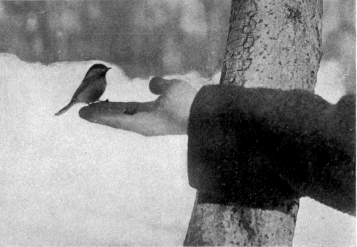
This is especially true of the Chickadees, who, under any circumstances, seem to have less fear of man than most birds. When I entered the Ramble they soon responded to an imitation of their plaintive call of two high, clearly whistled notes. And in a short time we became such good friends that I had only to hold out my hand with a nut in it to have one of them at once perch on a finger, look at me for a moment with an inquiring expression in his bright little eyes, then take the nut and fly off to a neighboring limb, where, holding it beneath his toes, he would hammer away at it with his bill, Blue Jay fashion.
One day I induced one of them to pose before my camera, and, as a result, I now have the pleasure of presenting you with his portrait, as an actual proof that nuts are much more effective than salt, in catching birds. So, after this, we won't go out with salt-cellars, but with a supply of food; nor should we forget to take a "pocketful of patience," which, Mrs. Wright says, is the salt of the bird-catching legend.
The February Walk Contest
W
e have been delighted with the interest aroused by our request for descriptions of February walks, and in imagination have enjoyed outings throughout a large part of the United States with our little correspondents.
We have found ourselves obliged to give two prizes, one of which goes to Mildred A. Robinson, of Waltham, Massachusetts, whose essay will appear in our next number; the other to Floyd C. Noble, of New York City, whose description of a walk in Central Park appears in this issue of Bird-Lore.
Much to his surprise, the Editor found that he was competing for the prize he himself had offered! He had written an account of some Central Park birds for this department before Master Noble's article was received, and is obliged to confess that Master Noble mentions several species which he had not observed. He, therefore, presents only that part of his manuscript relating to the Chickadee, and leaves Master Noble to tell of the other birds in the Park.
The selection of the winning essays was made with much difficulty, and, in addition to the two chosen, we would especially commend those written by the following named boys and girls:
Philip Baker, Indianapolis, Ind.; Harriet J. Benton, New Bedford, Mass.; Zelda Brown, Yuma, Ariz.; Donald Bruce, East Hampton, Mass.; Walter S. Chansler, Bicknell, Ind.; Marion Flagg, 90 Washington St., Hartford, Conn.; Charles B. Floyd, Brookline, Mass.; Kathryn Gibbs, Kalamazoo, Mich.; Albert Linton, Moorestown, N. J.; Clara T. Magee, Moorestown, N. J.; George S. Mac Nider, Chapel Hill, N. C.; Barnard Powers, Melrose, Mass.; Elden Smith, Milville, Mass.; Lydia Sharpless, Haverford, Pa.—Ed.
A February Walk in Central Park, New York
BY FLOYD C. NOBLE
(Aged 14 years)
On February 18, 1899, my friend and I started out 'bird-hunting,' as usual, in the 'Ramble,' Central Park. It was during the comparatively warm spell after the blizzard of the 12th, and the preceding zero weather. On the way we saw a Starling, perched high on a building, trying to sing. On entering the Park we saw a White-throated Sparrow. I have seen this species more times than any other this month—of course, excepting the common Sparrow.
On nearing our 'hunting-grounds,' we heard the familiar 'cree-e' of a Brown Creeper, and soon discovered the little fellow hard at work, as usual. A little later we came upon the beautiful Cardinal, with his two wives. It is a fact that there are one male and two females, though probably only one is his real mate. He does not, however, appear to be partial to either.
Further on we found what we were chiefly looking for—a flock of lively little Chickadees. I found that I had only a very small supply of hazelnuts with me, but I made the best of them. There was a good deal of snow on the ground, which made the Chickadees unusually tame—being hungry. They would light on our hands, inspect the pieces of crushed nut there, knock off the ones that did not suit them, and finally fly off with one—usually the largest. We soon began to recognize separate birds, and gave them names: such as 'Buffy,' 'Pretty,' etc. Then our attention was attracted by the queer noise made by the Nuthatch, and this trunk-crawling friend of ours appeared. We think that continued close inspection of tree-trunks has made him near-sighted, because when you throw him a piece of nut he generally just gazes at it, grunts a little, and then looks at you again. My cousin suggested that when he did find what you threw him, it was by the sense of hearing rather than that of sight, as he can generally find a big piece that makes a noise in falling. When he succeeds in getting 'something good,' he wedges it into the bark somewhere and hits it with his bill.
But, between the Nuthatch, the Chickadees, and the hungry squirrels—that would sit up with their paws on their breasts, and their heads on one side, imploring for food, it is needless to say successfully,—our small supply of nuts was soon gone. So we went home as fast as we could, procured more nuts, and in twenty minutes were again in the 'hunting grounds.' But we found, to our dismay, that others had monopolized our flock of chickadees! However, what partly compensated for this, was a good close view of a Downy Woodpecker. There is a pair of these birds around here, which you are almost sure to see,—either together or singly.
But it was soon time to go home, and on the way we heard the lively song of the European Goldfinches, and soon found four of them high up in a tree. They are shy birds, and flew as we approached. They feed on pine cones, and a flock of them will take possession of a pine tree, hide themselves in the dark tufts of pine needles, and eat the seeds at their leisure. The only way you can have knowledge of their presence is by the frequent cracking of the seeds heard. For a long time we thought they were Crossbills, but one day a flock of noisy Sparrows came into the tree and drove the quiet Goldfinches out of their tufts—much to my surprise, for I did not suppose that Goldfinches, which I had been accustomed to find singing loudly, could keep so quiet. We also saw a Song Sparrow quietly picking away at some bird-seed scattered there.
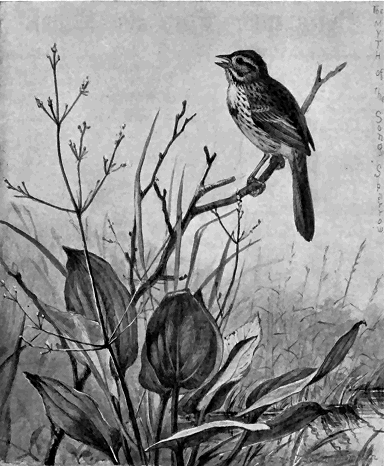
The Myth of the Song Sparrow
BY ERNEST SETON THOMPSON
His mother was the Brook, his sisters were the Reeds, And they every one applauded when he sang about his deeds. His vest was white, his mantle brown, as clear as they could be, And his songs were fairly bubbling o'er with melody and glee. But an envious Neighbor splashed with mud our Brownie's coat and vest, And then a final handful threw that stuck upon his breast. The Brook-bird's mother did her best to wash the stains away, But there they stuck, and, as it seems, are very like to stay. And so he wears the splashes and the mud blotch as you see, But his songs are bubbling over still with melody and glee.

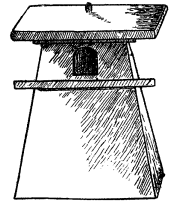
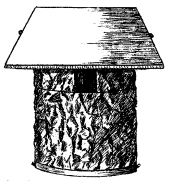
Sparrow Proof Houses
Mr. D. R. Geery, of Greenwich, Conn., sends us descriptions of the two bird-houses here figured. When designed for Bluebirds, they should be suspended from a limb ten or twelve feet from the ground, in such a manner as to allow them to swing slightly. Mr. Geery writes: "It may happen that the Sparrows will go to these houses and even commence to build, but, as soon as they find that they swing and are not firm, they will abandon them entirely. Wren boxes should be stationary, with an opening not much larger than a twenty-five-cent piece, and placed so as to be well shaded most of the day."
Made of rough boards. Size, 6 inches high, 51/2 inches square at the bottom, 31/2 inches square at the top.
Made from a bark-covered log, 8 inches long and 8 inches in diameter, a hole 5 inches in diameter being bored from end to end, leaving an outer wall 11/2 inches thick.
A Musical Woodpecker
In the pursuit of my profession I had occasion for some time to travel over a certain road, along which is a telephone line, the glass insulators of which are placed on short pieces of hard wood which are nailed directly to the post.
Probably half a dozen times, when on this road, I saw a male Downy Woodpecker perched directly beneath the hard wood block, pecking at it in a manner to make the wire ring, then pausing and evidently listening to the music it had produced.
When the vibration ceased the performance was repeated and continued at intervals until I was obliged to drive by and frighten the bird away.—Dr. D. L. Burnett, South Royalton, Vt.
An Ornithologist at San Juan
An English newspaper correspondent, who called at the American Museum of Natural History to identify certain birds which he had seen in Cuba, gave an interesting illustration of how, under the most adverse circumstances, an enthusiastic naturalist may exercise his powers of observation. He said, "I noticed at San Juan a bird which seemed to be much alarmed by the firing. He hopped from the bushes to the lower branches of trees, and then, limb by limb, reached the tree tops," and continued with a readily identifiable description of the singular Cuban Cuckoo, locally known as Arriero (Saurothera merlini).
There is one bird in Cuba, the Turkey Buzzard or Vulture, of which many of our soldiers probably retain a too vivid recollection, but how many of the men who were at San Juan can recall any other bird observed during the day of battle?

Sketch Book of British Birds. by R. Bowdler Sharpe, L. L. D., F. L. S. With Colored Illustrations by A. F. and C. Lydon, London: Society for Promoting Christian Knowledge, New York, E. & J. B. Young & Co. 4to. Pages xx + 255. Numerous colored illustrations. Price, $6.
Although more books have been written about British birds than on the birds of any other region, and although Dr. Sharpe has written more bird books than any other living ornithologist, this we believe is the first treatise he has produced on the birds of his native land. He explains that the text is only a "running commentary" on the pictures, but claims that his "Systematic Index" is "the most complete record of the birds in the 'British List' yet published." It enumerates 445 species of birds which, according to Dr. Sharpe, have been recorded from Great Britain. In his 'Introduction' he classifies these according to the manner of their occurrence, as follows: Species which have probably escaped from confinement, 14; Indigenous species, 138; Visitors from the South—regular, 70, occasional or accidental, 69; Visitors from the East—regular, 5, accidental or occasional, 38; Visitors from the North—regular, 35, occasional or accidental, 29; Visitors from the West—regular 1, occasional, 43. The latter are all American species, and the number recorded indicates how much more frequently our birds are found on the other side of the Atlantic than European birds are observed here.
The illustrations consist of colored vignettes in the text of nearly every species. They are not above criticism, but, on the whole, are excellent and form a far more certain and convenient aid to identification than the most detailed description or elaborate key. In many cases even American species of accidental occurrence are figured, and, in this connection, we are tempted to ask why British authors cannot use for our birds the names by which they are known in this country? Who would recognize the Rusty Blackbird under the name of the "Rusty Black Hang-Nest," a misnomer in every sense of the word, or our Robin as the "American Thrush," to cite two among numerous examples.
F. M. C.
Book News.
It is exceedingly gratifying to find the American Ornithologists' Union, as represented by Mr. Witmer Stone, the Chairman of its Committee on Bird Protection, taking so strong a stand on the question of egg-collecting. In his annual report to the Union (The Auk, XVI, January, 1899, p. 61), Mr. Stone says, "Egg-collecting has become a fad which is encouraged and fostered by the dealers until it is one of the most potent causes of the decrease in our birds. The vast majority of egg-collectors contribute nothing to the science of ornithology, and the issuing of licenses promiscuously to this class makes any law for bird protection practically useless.
"Too often boys regard the formation of a large collection of eggs or birds as necessarily the first step towards becoming an ornithologist of note; but if those who have already won their spurs will take the trouble to point out to the beginners the lines of work which yield results of real benefit to science, they will be led to see exactly how much collecting and what sort of specimens are really needed for scientific research, and not needlessly duplicate what has already been procured. Further, they will in all probability become known as original contributors to ornithological science, while as mere collectors they would bid fair to remain in obscurity."
Mr. Stone's report is of the utmost interest to all workers for the better protection of our birds. We have not space to notice it further here, but it may be obtained by addressing him at the Academy of Natural Science, Philadelphia, Pa., and enclosing six cents in stamps.
Two ornithological organizations established, in January, magazines for the publications of their proceedings and papers relating to the avifauna of their respective states. The first, the 'Journal of the Maine Ornithological Society,' an octavo quarterly, is edited by C. H. Morrill, at Pittsfield, Maine; the publisher and business manager being O. W. Knight, of Bangor, Maine. The second, the 'Bulletin of the Cooper Ornithological Club,' is edited by Chester Barlow, of Santa Clara, California, with the assistance of Henry Reed Taylor and Howard Robertson. The business managers are Donald Cohen, of Alameda, and A. I. McCormick, of Los Angeles, California. Both journals are the outgrowth of a demand on the part of the societies they represent for an official organ, and they will undoubtedly exert a stimulating influence on the study of birds in the states in which they are published.
We have also to acknowledge the receipt of the initial number of a third new periodical, 'Nature Study in Schools,' conducted by the well-known naturalist, C. J. Maynard, at West Newton, Mass. It is an illustrated monthly of 26 pages, containing papers interesting alike to teachers and students, and should prove very helpful in its chosen field.
Houghton, Mifflin & Company have in press a bird-book for children by Mrs. Olive Thorne Miller, to be entitled 'The First Book of Birds.' As its name indicates, it will aim to introduce its readers to the study of birds by taking them from the nest through all the ordinary phases of a bird's existence, and including chapters on structure, economics, directions for study, etc. The book will be illustrated, and its author's experience as a student and teacher of birds is an assurance that it will be a valuable addition to ornithological literature.
Few nature books not designed to assist in identification of species have met with the sale that has been accorded Ernest Seton Thompson's 'Wild Animals I Have Known' (Charles Scribner's Sons). Published late in October, it went rapidly through several editions, and by January 1, or little more than two months after its appearance, 7,000 copies had been disposed of.
The reason for this phenomenal success is not hard to find; it appears on every page of the book, the text, illustrations, and make-up of which are equally pleasing.
Mr. Thompson goes a step further than most students of animals in nature. He does not present us with the biography of the species, but with its personal history, and his minute knowledge of and close sympathy with his subjects leads to his writing a singular charm.
Josephine A. Clark, of 1322 Twelfth street, N. W., Washington, D. C., publishes a useful 'Bird Tablet for Field Use.' It is abridged from the 'Outline for Field Observations' in Miss Merriam's 'Birds of Village and Field,' and may be obtained from the publisher for the sum of twenty-five cents.
Mr. C. A. Babcock, well-known as the originator of Bird-Day, has in manuscript a book entitled 'Bird-Day and How to Prepare for It,' which will undoubtedly be of much assistance to teachers, and add greatly to the value of Bird-Day observances.
The following books and papers relating to birds have been received and will be reviewed in future numbers: The Cambridge Natural History, Vol. IX, Birds, by A. H. Evans (The Macmillan Co.); The Birds of Ontario in Relation to Agriculture, by Charles W. Nash; The Winter Food of the Chickadee, The Feeding Habits of the Chipping Sparrow, by Clarence M. Weed; A Preliminary List of the Birds of Belknap and Merrimack counties, New Hampshire, with notes, by Ned Dearborn; Check List of British Columbia Birds, by John Fannin.
A Bi-monthly Magazine Devoted to the Study and Protection of Birds
OFFICIAL ORGAN OF THE AUDUBON SOCIETIES
Edited by FRANK M. CHAPMAN
Published by THE MACMILLAN COMPANY

Vol. 1 April, 1899 No. 2
SUBSCRIPTION RATES.
Price in the United States, Canada, and Mexico, twenty cents a number, one dollar a year, postage paid.
Subscriptions may be sent to the Publishers, at 66 Fifth avenue, New York City, or to the Editor, at Englewood, New Jersey.
Price in all countries in the International Postal Union, twenty-five cents a number, one dollar and a quarter a year, postage paid. Foreign agents, Macmillan and Company, Ltd., London.
Manuscripts for publication, books, etc., for review, should be sent to the Editor at Englewood, New Jersey.
Advertisements should be sent to the Publishers at 66 Fifth avenue, New York City.
COPYRIGHTED, 1899, BY FRANK M. CHAPMAN.
The establishment of Bird-Lore has brought its editor in touch with many previously unknown friends, who, with the utmost kindness, have expressed their approval of the new publication and predicted for it a successful career. To thank all our correspondents individually has been out of the question, and we take this means, therefore, to assure them of our appreciation of their good wishes.
Doubtless they will be interested to know that within two weeks after the publication of Bird-Lore, the publishers had disposed of more copies than it was supposed they would sell in two months, while the demand for specimen copies was so large, that at the end of the same period our edition of 6,000 was nearly exhausted and we were obliged to issue a notice to the effect that the remaining copies would be delivered only to subscribers.
The Lacey-Hoar Bird Bill has met with a greatly to be regretted fate. With earnest advocates of bird protection in both the House and Senate, and with sufficient support to ensure the passage of any desirable measure, the prospects of securing needed legislation seemed to be excellent. Doubtless both Congressman Lacey's and Senator Hoar's bills would have passed if they had been presented separately, but making the latter an amendment to the former, created a series of contradictions that apparently could not be adjusted in conference, and, as a result, measures the intent of which the majority of both houses evidently favored, failed to become laws.
However, the terms of neither Mr. Hoar nor Mr. Lacey have expired, and it is to be hoped that before the next Congress convenes they will have prepared a bill in which their interests in birds will be harmoniously presented.
One of the most dangerous enemies threatening our birds to-day is the man who, under the mask of 'science,' collects birds and their eggs in wholly unwarranted numbers. He is dangerous not alone because of the actual destruction of life he causes, but because his excesses have brought into disrepute the work of the collector who, animated by the spirit of true science, and appreciating the value of life, takes only those specimens which he needs to assist him in his studies.
For this reason we feel it to be our duty to publicly protest against such wholly inexcusable nest-robbing as Mr. L. W. Brownell, of Nyack, N. Y. confesses himself to be guilty of in the January issue of 'The Osprey.' In describing a visit to Pelican Island, Florida, he states that in "about an hour he had collected all the eggs he could conveniently handle, about 125 sets."
This is an outrageous piece of bird-slaughter. It is especially to be deplored because Brown Pelican quills and back feathers are fast becoming fashionable, and, unless the species is protected, Florida will speedily lose one of its most characteristic and interesting birds. But how can we expect women, unfamiliar with the bird in nature, to aid in its protection, when people who have seen it in its haunts, and know how much it adds to Florida's coast scenery, ruthlessly destroy it.

"You cannot with a scalpel find the poet's soul, Nor yet the wild bird's song."
Edited by Mrs. Mabel Osgood Wright (President of the Audubon Society of the State of Connecticut), Fairfield, Conn., to whom all communications relating to the work of the Audubon and other Bird Protective Societies should be addressed.
DIRECTORY OF STATE AUDUBON SOCIETIES
With names and addresses of their Secretaries.
New Hampshire Mrs. F. W. Batchelder, Manchester.
Massachusetts Miss Harriet E. Richards, care Boston Society of Natural History, Boston.
Rhode Island Mrs. H. T. Grant, Jr., 187 Bowen street, Providence.
Connecticut Mrs. William Brown Glover, Fairfield.
New York Miss Emma H. Lockwood, 243 West Seventy-fifth street, New York City.
New Jersey Miss Mary A. Mellick,Plainfield.
Pennsylvania Mrs. Edward Robins, 114 South Twenty-first street, Philadelphia.
District of Columbia Mrs. John Dewhurst Patten, 3033 P street, Washington.
Wheeling, W. Va. (branch of Pa. Society) Elizabeth I. Cummins, 1314 Chapline street, Wheeling.
Ohio Miss Clara Russell, 903 Paradrome street, Cincinnati.
Indiana Amos W. Butler, State House, Indianapolis.
Illinois Miss Mary Drummond, Wheaton.
Iowa Miss Nellie S. Board, Keokuk.
Wisconsin Mrs. George W. Peckham, 646 Marshall street, Milwaukee.
Minnesota Mrs. J. P. Elmer, 314 West Third street, St. Paul.
The Conducting of Audubon Societies
It is one thing to organize a society or club and quite another to set it upon a permanent footing and keep it in step with the constant requirements of progression. At a time when a great majority look askance at the startling array of societies that they are asked to 'join,' it behooves all Bird Protective bodies to conduct themselves with extreme conservatism, that they may not bear the stigma of being called emotional 'fads,' but really appeal to those whom they seek to interest.
Many men (and women also) have many minds, and a form of appeal that will attract one will repel another. It is upon the tactful management of these appeals and the bringing of the subject vitally home to different classes and ages, that the life of the Audubon Societies depends.
Leaflets have their influence with those who already care enough to take the trouble to read them. Special exercises in schools have a potent influence for good. But the best method of spreading the gospel of humanity, is that by which it was first spread 1900 centuries ago, by personal contact and the power of the human voice. A few spoken words are worth a score of printed ones. A compelling personality is worth a well of ink in this Bird Crusade of 1899. Let the heads of societies come in contact with the members as much as possible, and gather them in local circles. Let those who are able to speak about birds do so, and let those who lack the gift of words read aloud from the works of others.
Whenever possible, urge local secretaries to hold bird classes during spring and summer in their respective towns. If no one person knows enough to teach the others let them club together, buy a few books, and, going out of doors, work out the problems of identification as best they may, until every little village has a nature study class working its way, Chautauqua-Circle fashion. Remember one point, please. No society can succeed that is content to count the quantity rather than quality of its members. One hundred intelligent members who know how to spread the why and how of the crusade are worth 10,000 who have merely 'joined' because someone they were proud of knowing asked them to and it was easier to say 'yes' than 'no,' especially as the saying was all it cost. Also, no society succeeds that bores people into joining it. Remember that no matter how near one's own heart a project may be, we have no right to force it upon others. We have no right to take people by the throat, so to speak, to make them pause and listen, but setting a high standard, holding out a helping hand and making the way attractive to those who wish to reach it is a different thing, and is the only sane policy under which Audubon Societies can be conducted. One word to you who wish to see the societies flourish, who love birds, but are shy and retiring, and do not care to commit yourselves to joining anything. You may safely join the cause in spirit by sending a nice little check to the treasurer of your local state society. Piers Plowman discovered long ago that he couldn't "spede" far without money, neither can the Audubon Societies.—M. O. W.
A Letter from Governor Roosevelt
At the annual meeting of the New York State Audubon Society, held in the American Museum of Natural History on March 23, 1899, a letter was read from Governor Roosevelt, which is of such interest and importance that we print it in advance of a report of the meeting, which will appear in a future issue.
Governor Roosevelt regretted his inability to be present, and addressed the following letter to Mr. Frank M. Chapman, Chairman of the Executive Committee:
My dear Mr. Chapman:—
I need hardly say how heartily I sympathize with the purposes of the Audubon Society. I would like to see all harmless wild things, but especially all birds, protected in every way. I do not understand how any man or woman who really loves nature can fail to try to exert all influence in support of such objects as those of the Audubon Society.
Spring would not be spring without bird songs, any more than it would be spring without buds and flowers, and I only wish that besides protecting the songsters, the birds of the grove, the orchard, the garden and the meadow, we could also protect the birds of the sea shore and of the wilderness.
The Loon ought to be, and, under wise legislation, could be a feature of every Adirondack lake; Ospreys, as every one knows, can be made the tamest of the tame, and Terns should be as plentiful along our shores as Swallows around our barns.
A Tanager or a Cardinal makes a point of glowing beauty in the green woods, and the Cardinal among the white snows.
When the Bluebirds were so nearly destroyed by the severe winter a few seasons ago, the loss was like the loss of an old friend, or at least like the burning down of a familiar and dearly loved house. How immensely it would add to our forests if only the great Logcock were still found among them!
The destruction of the Wild Pigeon and the Carolina Paroquet has meant a loss as severe as if the Catskills or the Palisades were taken away. When I hear of the destruction of a species I feel just as if all the works of some great writer had perished; as if we had lost all instead of only part of Polybius or Livy.
Very truly yours,
Theodore Roosevelt.
Reports of Societies
PENNSYLVANIA SOCIETY
The Audubon Society of Pennsylvania was organized in October, 1896, and was the first society to follow the admirable example set by Massachusetts. During the first year 2,200 members were enrolled and nearly 30,000 circulars distributed. The first annual report was sent out in November, 1897, and it mentions a 'Hat Show,' and a course of lectures to be given in Philadelphia during the spring. Both of these were carried out with marked success, the 'Hat Show' attracting much attention to the work of the society, and the lectures adding materially to its income, as there are no dues of any kind connected with membership. The second annual report appeared in November, 1898, and announces an increase of 1,100 members during the year. It referred to the fact that as a direct result of the 'Hat Show' several of the best milliners had established special Audubon departments. Lectures were given in many parts of the state with most satisfactory results, and finally, the coöperation of school teachers was solicited to observe May 5, 1899, as Bird-Day. A course of five lectures, by Mr. Stone, will be given this year at the Acorn Club, Philadelphia, beginning March 16. A number of new slides have been bought by the society to illustrate these lectures, and the course promises to be more interesting than ever. Since the second report was issued seven new local secretaries have been secured, making 42 in all. It is hoped that this number will be doubled during the coming year, for as the membership, which is now nearly 3,800, continues to increase, the need of workers throughout the state becomes more important every day.
Julia Stockton Robins, Sec'y.
INDIANA SOCIETY.
In 1889 the Indiana Academy of Science appointed a committee, of which I was chairman, to secure the passage of a satisfactory law for bird protection. The committee accomplished nothing. It was continued, and in 1891 secured the enactment of the enclosed law. The Academy of Science has, through its efforts in the way of advancing science work in the public schools of the state, encouraged and taught bird protection. In this it has had, since 1890, the coöperation of the Indiana Horticultural Society.
In 1897 at different times several bodies were interested in the movement in favor of bird protection. These appointed committees united in a call for a meeting to be held at Indianapolis. A programme was prepared, and the meeting held in the State House April 26, 1898. I send you a copy of the call and programme; also of the constitution of the Indiana Audubon Society. The Governor, and Superintendent of Public Instruction have both been much interested, and as a consequence Bird Day and Arbor Day were celebrated October 28, 1898. The "Outline of Township Institute Work" has gone into the hands of every teacher and school officer in the state…. You will see that the work we are doing is practical, even though it is not so much as some States are accomplishing. I have not the enrollment or statement of publications issued, but counting the issue of the State Department of Public Instruction, 20,000 copies of different articles, at least, have been distributed.
Amos W. Butler, Sec'y.
ILLINOIS SOCIETY.
The past year has shown a very marked improvement as the results of bird protection and the general work of our Illinois Audubon Society. While the fashion for decorating hats with feathers still continues, yet there is a very noticeable decrease in the display of aigrettes and the feathers of wild birds. I have visited the establishments of several of our Chicago wholesale milliners and find that the larger portion of their stock, this fall, is made up of the feathers of the domestic fowl and game birds. Our Audubon Society has had two public meetings this year, which were well attended, and the interest in its work has rather increased than abated. Our membership has increased to 3,426. We have liberally distributed leaflets, including 500 of our circulars, stating the purpose of the society, to the editors of local newspapers in the state, with request that they aid the society by publishing same and calling attention to it editorially.
On February 7, 1898, an Interstate Convention was held in Chicago, represented by the game and fish wardens, and delegates appointed by the legislatures of the six states which responded to the call. At the request of Mr. Witmer Stone, I presented at this convention the text of a new law for the protection of birds and their nests and eggs, as drafted by our committee on Bird Protection. The convention agreed to submit the proposed law to each of their respective legislatures.
Great credit is due to the efficient work which has been done in our state by Warden H. W. Loveday and his deputies. Since the first of the year over one hundred prosecutions and convictions have been made, for the wanton killing and trapping of song and insectivorous birds by men and boys largely Italians and Bohemians. In 1897 there were 580 convictions in the state for the illegal killing and transportation of game birds. This year the game has been so carefully watched and such prompt action taken of reported cases of violation, that the poachers and market hunters have been less bold, and the number of arrests and seizures of game have been reduced over one-half.
On April 9, 1898, as a result of the efforts of County Superintendent of Schools Mr. Orville T. Bright, a meeting was held in Chicago in the interest of the school teachers of Cook county. Over three hundred were present, and the meeting was devoted exclusively to birds, and addresses given by several members of the Audubon Society. A "Finding List" of sixty species of birds, compiled by Mr. Frank E. Sanford, Superintendent of the La Grange, Ill., Schools, was distributed. This is a most effective method to inspire the teachers and in turn impart their love for birds to the scholars.
Ruthven Deane, President.
IOWA SOCIETY.
Under the auspices of the Keokuk Woman's Club, the Audubon Society of Iowa was organized April 5, 1898.
The first work taken up was the establishment of Bird Day in the public schools.
The second meeting was held in Rand Park. Short talks were made by Hazen I. Sanger, John Huiskamp, Rabbi Faber, Doctor Ehinger, and a paper was read by Miss Read.
We have bought and distributed through the schools, from kindergarten up, bird pictures and bird literature.
One of our men milliners asked to become a member.
On August 6 the officers of the society met and adopted articles of incorporation, this being the first Audubon Society to be incorporated under the laws of Iowa. The laws of Iowa give fair protection to the birds; our work is in creating the right sentiment.
Nellie S. Board, Sec'y.
MINNESOTA SOCIETY
Mr. John W. Taylor, President of the Minnesota Audubon Society, reports the passage of a law establishing Arbor and Bird Day in Minnesota, and writes: "It is, as you can well imagine, a source of great gratification to the lover of birds in the state, and especially to the Audubon Societies. Through this law we can do more towards bird protection than we could accomplish in many years' labor without it. It brings the subject before the teachers and children, and as you educate the child so you mould the man. We have now in this state 58 branch societies, besides many school organizations and children's bird clubs. The number of members I am not able to give, as I have not all the reports in. We have sent out considerable literature, and used the press largely to interest our people. We feel that we are doing wonders for the first active year we have had, and congratulate ourselves that the hardest work is done. We hope by April 1st to have a branch in every county in Minnesota."
Reports from the New Hampshire and Wisconsin Societies and a notice of the American Society of Bird Restorers are necessarily postponed until June.
… READY THIS MONTH …
Nature Study For Grammar Grades
A Manual for the Guidance of Pupils below the High School in the Study of Nature
BY
WILBUR S. JACKMAN, A.B.
Dep't of Natural Science, Chicago Normal School
Author of "Nature Study for the Common Schools," "Nature Study and Related Subjects," "Nature Study Record," "Field Work in Nature Study," etc.
REVISED EDITION
In preparing this Manual, it has been the author's aim to propose, within the comprehension of grammar school pupils, a few of the problems which arise in a thoughtful study of nature, and to offer suggestions designed to lead to their solution.
That pupils need some rational and definite directions in nature study, all are generally agreed. But to prepare the outlines and suggestive directions necessary, and to place these within the reach of each pupil, is more than any ordinary teacher has time to do, even granting that she is fully prepared for such work. The utter futility of depending upon oral suggestions during the class hour, when the pupils are supposed to be doing individual work, is easily apparent on a moment's reflection. With a manual of directions in hand, each pupil may be made strictly responsible for a certain amount of work, either in the field or in the laboratory. This removes all occasion for that interruption in his work, which is, otherwise, due to the pupil's attempt to think and at the same time hear, what the teacher says.
Recent Publications on Nature Study
Bailey's First Lessons With Plants. $.40 net "Extremely original and unusually practical." Ingersoll's Wild Neighbors. $1.50 "Instructive as well as delightful."—Popular Science Monthly. Lange's Hand-Book of Nature Study. $1 "The style of the book is fresh and inspiring." Murché's Science Readers. Vol. I. 25 cents. Vol. II. 25 cents. Vol. III. 40 cents. Vol. IV. 40 cents net. Vol. V. 50 cents net. Vol. VI. 50 cents net. Weed's Life Histories of American Insects. $1.50 "An unusually attractive book."—Dial. Wilson's Nature Study in Elementary Schools. First Nature Reader 35 cents Second Nature Reader 35 cents Teacher's Manual 90 cents Wright's Citizen Bird. $1.50 An interesting story, giving to the children much accurate information about American birds. "Most delightful book on the subject yet printed in the United States. I wish every boy and girl could read it."—J. M. Greenwood, Sup't Kansas City, Mo. Wright's Four-Footed Americans. $1.50 Four-Footed American Mammals treated in story form in the manner of Citizen Bird. Wright's Birdcraft. $2.50 net
PUBLISHED BY
THE MACMILLAN COMPANY, New York
VOL. 1 No. 3 June, 1899 20 c. a Copy $1 a Year
COPYRIGHT, 1899, BY FRANK M. CHAPMAN
June, 1899
CONTENTS
Gannets on Bonaventure. Illustrated Frank M. Chapman 71
Clark's Crows and Oregon Jays on Mount Hood. Illustrated Florence A. Merriam 72
The Masquerading Chickadee. Verse Edith M. Thomas 77
Matins. Verse Rosa Meyers Mumma 77
Home-Life in a Chimney. Mary F. Day 78
Three Cobb's Island Pictures. Illustrated William L. Baily 81
The Cardinal at the Hub. Illustrated Ella Gilbert Ives 83
A Catbird Study. Illustrated Dr. Thos. S. Roberts 87
FOR TEACHERS AND STUDENTS
On the Ethics of Caging Birds Olive Thorne Miller 89
A May Morning Fred H. Kennard 91
FOR YOUNG OBSERVERS
A February Walk. Mildred A. Robinson 94
Illustration—Robin on Nest. T. S. Hankinson 95
Robin Rejoice. Verse Garrett Newkirk 95
NOTES FROM FIELD AND STUDY 96
Inquisitive Magpies, J. Alden Loring; Songs of Birds, Frank E. Horack
BOOK NEWS AND REVIEWS 97
Evans' Birds; Weed on the Feeding Habits of the Chipping Sparrow, and Food of the Chickadee; Fannin's Check-list of British Columbian Birds; Dearborn's List of Birds of Belknap and Merrimack Counties, N. H.; Book News.
EDITORIAL 99
AUDUBON DEPARTMENT 100
Editorial; Reports from Wisconsin and New Hampshire Societies; A Message From Madame Lehmann; Two New Audubon Societies; Birds and Farmers.
⁂ Bird-Lore is published at Englewood, New Jersey, where all manuscripts intended for publication, books, etc., for review, and exchanges should be sent.
PUBLISHERS' ANNOUNCEMENT
Bird-Lore for August will contain an article by Bradford Torrey; A paper on How to Photograph Wild Birds, by Richard Kearton, the most successful of bird photographers; A poem by Garrett Newkirk; An account of a Mississippi Swallow Roost, by Otto Widmann (whose paper on a visit to the birthplace of Audubon is necessarily postponed); a report of the American Society of Bird Restorers, by the organizer, Fletcher Osgood, and other interesting articles.
GANNETS ON BONAVENTURE ISLAND Photographed from nature by Frank M. Chapman
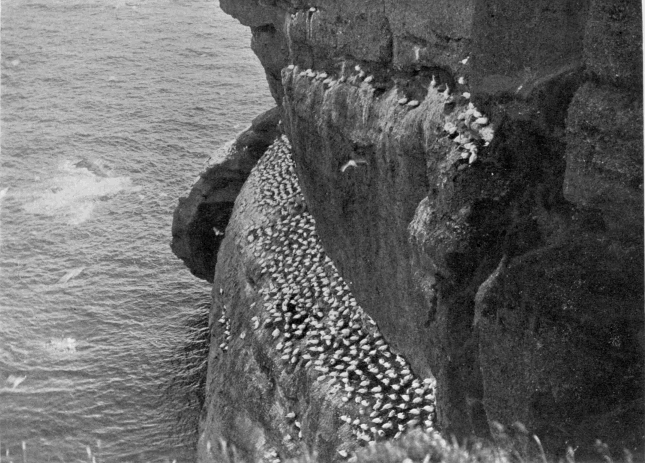
A BI-MONTHLY MAGAZINE DEVOTED TO THE STUDY AND PROTECTION OF BIRDS
Official Organ of the Audubon Societies
Vol. 1 June, 1899 No. 3
Gannets on Bonaventure
BY FRANK M. CHAPMAN
(See Frontispiece)
GANNETS (Sula bassana) are known to nest in only three places in North America—Perroquet Island, the Bird Rocks, and Bonaventure Island, all in the Gulf of St. Lawrence. By far the largest colony is found on the last named island, where, on the ledges of the red sandstone cliffs, some three hundred feet in height, they are practically secure from molestation. Bonaventure Island itself, however, is the most accessible of the three localities mentioned, and may be easily reached in a small fishing boat from the neighboring village of Percé, where the famous Percé Rock, with its colony of Herring Gulls and Double-crested Cormorants, makes the region particularly interesting to the ornithologist.
The Gannet cliffs are on the east side of Bonaventure, and are exposed to the full force of the sea. To visit them satisfactorily, therefore, one should select a calm day, when one may closely approach the cliffs, and view with both safety and comfort the long, white rows, containing thousands of birds nesting on the shelves and ledges on the face of the cliff; a remarkable spectacle!
The unusually turbulent sea which prevailed during my visit to these cliffs, on July 11, 1898, prevented me from securing satisfactory pictures from a boat, but, landing on the west side of Bonaventure, I crossed the island (here about one and a half miles in width), and reached a position on the crest of the cliffs, from which the accompanying picture was made. About four hundred Gannets are shown nesting on this single ledge—one of many quite as densely populated. Preparations were made to secure a picture of these birds on the wing, but my best efforts to startle them into flight did not succeed in making a single bird leave its nest!
Clark's Crows and Oregon Jays on Mount Hood
BY FLORENCE A. MERRIAM
(Concluded from page 48)
CLARK'S CROW AND OREGON JAY Photographed from nature by Florence A. Merriam
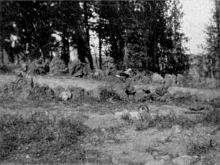
A
lthough the Nutcrackers and Jays were masters of the feast, they did not altogether monopolize it. Ground squirrels with golden brown heads and striped backs would look out at me from the rocks, and pretty little striped-nosed chipmunks would pick up choice morsels and climb nimbly back along the cliff with them. Juncos often dropped in, pecked indifferently at the crumbs, slipped off the tin cans they tried to perch on, and flew off. Two Lewis' Woodpeckers stopped one day and, flying down, clung awkwardly to the side of the cliff, as if vaguely wanting to join in the proceedings, but not knowing how, finally left. A single Steller's Jay hung around the outskirts in the same way, the first day I was there. He hopped about, looked this way and that, and pecked at the food perfunctorily, as if it was new to his palate and not quite to his mind, acting altogether as if he realized that something was going on he ought to be enjoying, though he really didn't see just where the fun came in. Unlike the Woodpeckers, however, he was determined to improve his opportunities, and cultivated his appetite so successfully that on the last day when I visited the dining-room he and a comrade were working away, apparently enjoying the viands as much as their neighbors.
But the Crows and Oregon Jays were the regular habitues of the place. When resting from his labors a solitary Crow would often perch on the tip of a bare spar on the crest of the cliff, apparently quite satisfied with his own society, but I never saw a Jay there, and one whom I did see separated from his band for a moment fairly made the welkin ring with shouts for his clan. Several Clark's Crows were often at the table with the Jays, but while I never saw a Crow disturb a Jay, a Crow would often fly with animation at a newcoming fellow Crow. This was a surprise to me, for on Mt. Shasta I had seen the Nutcrackers hunting in bands quite as the Jays did here. But on the wide lava slopes of Shasta there were, doubtless, grasshoppers enough for all the world, while here the feast was restricted to the foot of one cliff on the mountain—quite a different matter. When I spoke to Mrs. Langille about this difference in disposition, she acquiesced as if it were an old story to her, unhesitatingly denominating the Jays 'generous fellows,' and the Crows 'greedy' ones.
OREGON JAYS Photographed from nature by Florence A. Merriam
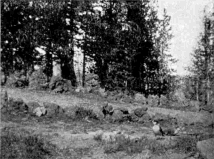
One Crow made a special exhibition of egoistic tendencies. He was engaged in hurriedly carrying off future breakfasts for himself when a party of brother Crows appeared. He had been working with absorption, flying back and forth to the table with eager haste, being gone less than half a minute at a time, but on the arrival of his friends dropped his work and devoted himself to driving them from the field. Not content with keeping them from the table, he flew at them with a strange note of ominous warning when they sat quietly in the tree-tops. It seemed as if he were nervous lest they discover what he had been storing among the branches. When he had fairly routed the enemy he apparently acted on his fear of discovery, for, instead of placing his supplies near at hand as before, he flew out of sight with them. As before, he worked with nervous haste. As I looked down on the tree-tops from above it was impossible to see where he put all the food, but several times when he flew up in sight he seemed to be sticking small bits between the needles of the pines. As the bunches of needles are compact and stiff in this white-barked pine (Pinus albicaulis), this might be a safe temporary cache, but the winter gales that make it necessary to hold down the Inn with huge cables would presumably leave little biscuit between the needles of a pine.