Front matter (continued 5)
Reading edition
BY C. F. HODGE
Clark University, Worcester, Mass.
IN the Nature Study course of the Summer School, a little time was devoted to the honey bee, life of the hive, care and management, and especially the work of bees in cross-pollination of flowers and fruits. The closing "laboratory exercise" in the subject consisted in a honey spread, the honey being removed from the glass hive in the window of the laboratory, in the presence of the class, and distributed with hot biscuits and butter, cream and fresh milk. The spread was pronounced the most enjoyable "laboratory work" ever done by members of the class, but to crown the event in the most exquisite way possible, a Hummingbird flew into an open window, and darting, unafraid, in and out among the noisy groups of fifty or more busy people, it rifled the various flowers with which the laboratory was decorated. In closing the windows for the night it was accidentally imprisoned, and on visiting the room next morning (Sunday), I found it still humming about the flowers. Thinking that it might be a female, with nestlings awaiting its return, I gently placed an insect net over it with the intention of passing it out of the window. It proved, however, on closer inspection, to be a young male, so I thought it could do no harm to keep it a day or two for acquaintance sake. No sooner was my finger, with a drop of honey on it, brought within reach, than it thrust its bill and long tongue out through the net and licked up the honey with evident delight. Releasing it from the net, I dropped honey into a number of the flowers, sprinkling water over them at the same time, and it immediately began feasting and drinking. As it flew about it taught me its bright little chirp, evidently a note of delight and satisfaction. When I visited the laboratory again at noon, I took in my hand a few heads of red clover and a nasturtium with its horn filled with honey. On giving the chirp a few times, it flew straight to the flowers in my hand, probed each clover tube, drank its fill from the nasturtium, and, perching contentedly on my finger, wiped its bill, preened its feathers, spread out its tail, scratched its head, and for the space of a minute or two looked me over and made himself the most delightful of tiny friends. The next time I entered the room, about two hours later, he flew to the door to meet me, and this time I took him home, the better to care for him during the afternoon and evening. In the course of the afternoon about a dozen friends called. Each one was provided with a nasturtium into which a drop of honey had been placed, and nearly the whole time the little bird was flying from one to the other, perching on fingers or sipping from the flowers held in the hand or buttonhole, to the delight of everybody, none of the company having ever seen a live Hummingbird so close by.
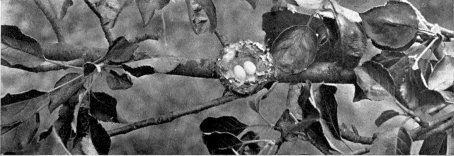
NEST AND EGGS OF HUMMINGBIRD SEEN FROM ABOVE Situated in an apple tree 8 feet from the ground Photographed from nature by E. G. Tabor, Meridian, N. Y., June 16, 1897
In the evening he went to roost high up on a chandelier, and in trying to catch him with the net to put him in a safe cage for the night, he fell like a dead bird to the carpet. I held him warm in my hand, thinking that he was about to breathe his last, but anxious to save the precious little life if possible, I very gently opened the bill and inserted a pellet of crushed spiders' eggs as large as a good-sized sweet pea, following it with a drop of water. He had been feigning, probably, as they are known to do; at any rate, in a minute he was as bright and lively as ever. His room for the night was a large insect cage of wire screen filled with convenient twigs and a large bowl of flowers. At five in the morning I fed him honey and young spiders, and again at six. At eight I had a lecture, the subject of which happened to be the taming of wild birds and attracting them about our homes. Removing all flowers from his cage to let his appetite sharpen for the two intervening hours, I set the cage on a table by my side on the lecture platform. I had taken pains to have two fresh nasturtiums in my buttonhole, one well loaded with honey, the other filled with the juices of crushed spiders and spiders' eggs. On reaching the topic of approaching birds in the right way, appealing to them along the lines of their tastes and appetites, appealing to the "right end" of a bird, I had only to open the door, give the familiar chirp, and the little charmer was probing the flowers. Then, as if anxious to show off, he again perched on my hand and went through his post prandial toilet, thus giving the class an idea of bird-taming which no amount of books or anything I might have said could have possibly equaled. Many expressed themselves as never having seen so successful a "demonstration." Some said that I must be in league with higher powers, and it all must have been "providential." This may be true, for anything I know to the contrary. But it may have been simply improving the opportunities of a happy accident; and 'accidents,' we know, "never happen among the Hottentots." If flowers and honey can do it, at any rate, such accidents shall be more frequent about my home in the future.
A Peculiarity of a Caged Skylark
BY H. M. COLLINS
Do birds reverse the usual order of things, and from a serious and stolid youth develop mature playfulness? I have been led to ask myself this question by observing the extraordinary playfulness exhibited by a pet Skylark in extreme old age. Upon hearing the owner of the bird declare, "Dickie has reached his dotage, and, is now in a state of second childhood," it occurred to me that birds have no season of youthful frivolity such as Mother Nature accords to her other children. We are accustomed to associate the idea of youth with playfulness: we picture to ourselves the lamb frisking in the meadows, the frolicsome kitten playing upon the hearth, and we groan inwardly when we meditate upon the destructive propensities of our pet puppies, but we think of our young feathered friends as lying inert in their nests, gaping wide open their yellow-edged beaks incessantly for food, and apparently interested in nothing else.
A caged Skylark is a deplorable object generally, but the Lark of which I am about to write was a bird 'with a history,' and one, whose cage was not a prison but a home. While his native meadow (in Ireland) was being mowed, one of his wings was struck by the mowing-machine and the last joint terribly mutilated. One of the workmen picked up the poor little sufferer and gave him to a little boy whose father was something of a naturalist and a great lover of birds. Examination of the shattered wing revealed the fact that amputation of the last joint would be necessary if the bird's life was to be preserved. The operation was performed, and the little patient was placed in a very large cage carpeted with fresh, green sods. He was well supplied with food and water; the injured wing healed rapidly; he became surprisingly tame, and soon appeared to enjoy life thoroughly. Occasionally, he was permitted to enjoy his freedom in a large room, but after running about awhile, always seemed glad to return to his cage, the door of which was left open, so that he might go home when he pleased.
He was a beautiful singer, and used to stand in the long grasses and fresh clover of his sod, quiver the poor pinions that could never again soar skyward, and burst into the glorious carol with which he had been wont to salute the sunrise, when, high up among the fleecy clouds, he had appeared an almost invisible speck of personified melody to the enchanted listeners below.
As the years sped by, this much-indulged bird craved petting and attention to an abnormal degree, could be coaxed at any hour into singing, and formed the strange habit of trilling a low, sweet carol at ten o'clock every night, which his mistress called his "good-night song." When he had been caged for twelve or thirteen years he become as playful as a kitten, and was particularly fond of going through what his mistress called the "jungle tiger act," which consisted of crouching down out of sight in the grasses of his sod, and then springing suddenly forward to bite in a gentle way a finger poked between the wires of his cage. He never wearied of this game so long as he could induce a child or grown person to engage in it with him, and before he died, a year or so later, he developed a degree of playfulness that almost amounted to imbecility.

'On the Ethics of Caging Birds.'
[As stated in our last issue, Mrs. Miller's paper on 'The Ethics of Caging Birds,' in Bird-Lore for June, brought us numerous letters, from which we have selected two, representing both sides of the question, for publication. As a further contribution to this discussion we publish in this number of Bird-Lore several papers describing experiences with caged birds.—Ed.]
To the Editor of Bird-Lore.
Dear Sir:—I have always been such an admirer of Mrs. Miller's writings that I confess to a feeling of great disappointment in her article concerning caged birds, which appeared in your June number of Bird-Lore. Will you allow me to comment on it briefly?
Mrs. Miller starts out with the position that while she disapproves with "all her heart" of caging wild birds, yet since "birds are caged we must deal with circumstances as we find them."
Undoubtedly Mrs. Miller is right in sounding a note of warning for those who keep birds as pets, by impressing upon them the care that should be given these utterly helpless little creatures. She says, "Not one bird in a thousand is properly cared for," and she might add to that the fact that thousands die every year of hunger, thirst, lack of care,—forlorn prisoners, utterly unable to help themselves. These facts being true, the inconsistency of her position is that she gives the slightest encouragement to the bird traffic which results in so much cruel suffering. She says that the discomfort they suffer in the bird stores is so great that she feels it to be "a work of charity to purchase them," yet she does not seem to see that every purchaser is in a measure accountable for this suffering. If no one would buy the birds, the traffic would soon cease.
But Mrs. Miller appears to be utterly hopeless as to the cure of this evil, for she says: "If a bird-lover should worry and fret himself to death he could not put an end to their captivity." It is exceedingly fortunate that there have been, and still are, and probably always will be, a few men and women in the world who believe with Emerson that "Nothing is impossible to the man who can will," and who, in spite of the perplexing outlook, go forward, and bring about the world's great reforms.
The first step in repressing any wrong is for some individual to take a firm stand, even in the face of the greatest discouragement. Another will follow, and then another, and by and by, when we have hardly begun to believe anything has been done, a wave sweeps over the country, and the wrong is righted. This, however, can never be brought about unless by individual action and the abiding faith that every one counts.
Mrs. Miller advances as her "strong argument" the great value of caged birds as pets in the education of the child, and upsets her own argument by saying: "Nothing is more important than the training of our youth in humanity, and respect for the rights of others." "Respect for the rights of others" means justice to all the dumb or helpless creation. Even a child can reason out for himself that a bird was created for freedom in the upper air, not for confinement in a cage, and that, even if it is bred in a cage, it is no more just or right to put it to such purposes than it would be to keep a dog chained all day, or a horse tied in a stable all his life, or a man confined within the narrow limits of prison walls.
Children have ample opportunity to be taught kindness, and, what is even better than kindness, justice to the animal creation by having the care of cats or dogs, yet how few mothers or teachers take pains to teach the right care of these common animals, which are to be found everywhere, and are dependent on man for their happiness. A child will not discriminate between the bird bred in a cage and the bird taken from the mother's nest for the purpose of being brought up in a cage, and while birds are given as pets to children, not only the traffic in canaries is encouraged, but the snaring, or the capturing by other means, of our own song birds will continue. It seems to me there is but one lesson to teach children in relation to birds,—that they were made to be free, and to have space to use the wings that surely cannot have proper exercise even in the confined space of a house.
Let those who already have birds take good care of them, by all means; give them the right food and plenty of fresh water, and as much freedom as possible in the limits of the house; but let those who are true bird-lovers discourage the traffic in birds in every way possible, no matter how hopeless it may seem just now to endeavor to put a stop to it, for the influence of every individual counts.
Anna Harris Smith.
To the Editor of Bird-Lore.
Dear Sir:—In the main Mrs. Miller's statement of the case is the one that I have come to adopt. In fact, my prejudices against the practice of caging birds were entirely banished and the whole subject revealed in a new light by reading Mrs. Miller's 'Bird Ways.' Such wonderful possibilities of bird happiness, child culture and education, and bird study were opened up by this little book that, from being opposed to caged birds, I was converted to believe that the cage might be made one of the most important factors in the great new field of bird study, and, I hope, actual bird culture, which seems to be dawning before us.
The subject has a number of ethical bearings which Mrs. Miller does not touch upon, two of which I may point out.
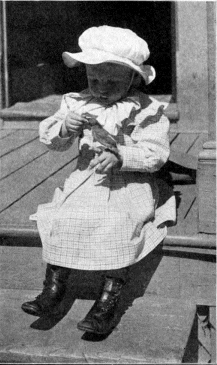
FEEDING A PET CEDAR WAXWING Which lives out of doors, all over the house, and in his cage Photographed from nature by C. F. Hodge
First: We may not only have a "right" to confine a bird, but it may become a duty which we owe not only to the bird itself, but to the community as well. The moment before beginning to write this a young Robin was sitting warmly in my hand gulping down earthworms and blackberries. He is now sleeping quietly in a cage by my side. I picked him up this noon on the ground under the nest, unable to fly, and I love to think of him safe and cosy instead of fluttering in the jaws of some miscreant cat. Some days ago a boy came and told me that a neighbor's wife had taken a young Robin away from her cat "and put it on top of the shed" (to fall down into the cat's mouth again). At my request he brought the bird, but it was so lacerated that it died that night. Of two nests of Robins I have known this season, in spite of me, the cats got seven of the young, and the eighth would have gone the same way were it not sleeping safely in another of my cages. In all, I have three young Robins, all picked up from the ground, unable to fly, all, without the shadow of a doubt, saved from the cats. None have died in my hands, the one killed by the neighbor's cat not counted, and they seem to be fairly happy little birds, though it is to be hoped that they will grow happier as they grow wiser. My point is simply that in the present exigency of our rapidly decreasing bird life, every child should learn how to care for fledglings of different species and have suitable cages where they may be kept until, at least, they are able to fly. This may often be done by hanging the cage near the nest, where the parents will feed it. Our children owe this work to the community, to themselves and to the birds. I am aware some will say that this will lead to the death of more fledglings than now go to feed the cats. And under present conditions, I regret to say, there is a good deal of truth in it. In trying to get children interested in this work, I have been surprised to find so many who say, "Oh yes, I would like to have some tame Robins so much; but you can't keep them alive. I have tried it, and they all died." "What did you feed them?" "Oh, bread crumbs;" now and then one will say "worms and berries." "Did they eat?" "No, I never saw them eat anything." "Did you give them any water to drink?" "No, I didn't think of that." "How often do you feed them? Do you know that birds are flying appetites? Did you feed them regularly about every hour?" "No, I put in some stuff generally about once a day." And so it goes. But shall we be content with this state of things when any bright child can be given the necessary instruction in an hour by which he can succeed in keeping alive and taming practically all the fledglings that fall in his way?
Second: We owe it as a duty to both the birds and ourselves to learn the facts of bird life. We do not adequately know the life story of a single one of our most common species. Every fact that can be discovered as to the good or the harm that birds do ought to be found out. Every fact so discovered will act as just so much more motive force to bring about proper relations with our birds. A few birds have been killed, and the stomach contents analyzed, to obtain facts about bird foods which have changed our sentiments and even legislation. Somebody owed this as a duty to both birds and community. But this method is not well adapted for use in elementary schools, and its results might be infinitely extended and the subject of bird foods made a matter of practical public education, by having classes in nature study throughout our schools make feeding tests with tame birds of different species. Cages will have to play at least a temporary role in work of this kind. More than this, a knowledge of bird ways, habits, methods of feeding and caring for their nests and young, their songs and calls, "their manners for the heart's delight," are great æsthetic and educational values. These might all be developed and enhanced by a proper use of caged birds. Instead of collections of stuffed birds, the ethics and educational value of which I wish might be discussed in BIRD-LORE, each city might have, possibly maintained by some ornithological society, a fine collection of pairs of a few of our most valuable species. These could make the rounds of the schools each year. This, too, need only be a temporary expedient, useful until sufficient general interest and knowledge is developed so that we may have, properly appreciated and protected, an abundance of our native birds tamed sufficiently to come close about our homes.
The above are but two points among many, and I bring them forward to bespeak a little intelligent favor for the proper use of the cage. We owe the birds duties of protection and acquaintance, and the cage may help us in the performance of both.
C. F. Hodge, Clark University.

Oliver Twist, Catbird
BY ISABELLA McC. LEMMON
O
n July 9, 1898, we caught a young Catbird. He had left the nest the day before, and had then eluded all our efforts, but by morning a pouring rain had removed his objections to captivity, and a very wet, bedraggled little Catbird was established in the big cage. He soon stopped trying to get out, and seemed quite contented—except occasionally when the old birds heard him calling for food and came to the rescue. But that was carefully guarded against, and as his voice lost its baby tone they left him in peace.
A name was quickly given, the frequency and great size of his meals promptly gaining for him the title of 'Oliver Twist.' Worms, currants, goose-, rasp-, black-, and huckleberries, bits of bread soaked in milk, all went down, but the fruit seemed somewhat more acceptable. On July 16, the amount of food was greatest: 43 earthworms and 81 berries between 7 a. m. and 6.50 p. m.
As the different berries ripened he gave up the early kinds and accepted the new ones most eagerly, elderberries especially. These last he ate by the bunch—indeed one need only walk past a patch of the bushes when the fruit is ripe, to appreciate a Catbird's fondness for them.
By the 16th Oliver had taken his first bath, and for the first time I saw him drink. Four days later, when he must have been about four weeks old, we heard him trying to sing—queer little chirps and gurgles in the lowest of tones, but evidently intended for a song. He stopped as soon as he saw me, raising his wings and begging for food, and for some time we were obliged to enjoy his musical efforts by stealth.
By August 1, he was pretty well feathered; the tail was almost full length, and even the little feathers over the nostrils had started to grow. He was also able to feed himself then, but greatly preferred being fed; often, when I offered him more than he wanted, giving a low 'chuck' very like the old birds' call.
As August progressed worms were refused, and though bread and milk and all sorts of berries were eaten, the bird evidently missed something. He was molting a little—if the loss of so few feathers could be called a molt—but became more and more droopy, refusing or indifferently eating the various things we tried, till some one gave him a fly! Then all went well; he ate all the flies we could catch, sometimes twenty at a meal, and also wasps and bees. When he saw somebody bringing one of the latter dainties he would jump about in great excitement; then, snatching the insect, kill it with a few quick pinches and swallow it, poison and all. He also learned the motion made in catching a fly, and was on the alert as soon as he saw me snatch for one.
Towards the end of the month I let him out of doors—though he had often been out in the house—and after that he had exercise nearly every day, flying about a little, coming readily to me when I whistled, and generally returning to the cage quickly enough for a few flies. He evidently regarded the cage as home, for let any large bird pass at what he considered too close quarters and in he went like a flash, there to remain till the danger was past. On one occasion, when he was hopping among the plants in the house, I saw him carefully watching a Crow that was fighting his way against a heavy wind. Suddenly the Crow gave way, making a swoop almost to the window, and in far less time than it can be told the Catbird was in the cage and up on a perch, so terrified that it was some minutes before he was himself again.
About the middle of September Oliver Twist caught the migration fever, and when no one was in sight was very uneasy in his cage, not only during the day but at night as well. In the evening the bird was always moved to a dark back hall, where he usually settled down at once; now he was most restless, chucking and mewing sometimes for nearly an hour, and not until late in October did he finally become quiet. Cool days, also, made him more uneasy.
During the fall months Oliver ate every sort of berry I could find, from dogwood to Boston ivy, with two exceptions: those of the wild rose and the catbriar. The seeds of the ivy berries he always ejected, perfectly clean and free from pulp, beginning about half an hour after swallowing them; he would work the bill a little, as if the seed were in his mouth, a moment later pushing it out with the tongue. At first they appeared quite rapidly—two or three or even more in a minute—then more slowly, and continued for at least three-quarters of an hour.
As the house flies disappeared, the big blue and green species, that during the summer were simply scorned, grew quite tempting; but even these gave out, and it became very difficult to find proper food for the little fellow. Figs for a time supplied the place of berries, but he tired of them at last, and bits of meat never passed for flies or for the worms that even in the greenhouse went down beyond reach of the trowel.
The cage now stood among the plants in a sunny window of the dining-room, and the conversation at meal times generally started Oliver singing; yet it was always a low version of the usual Catbird song, for he invariably sang with the bill nearly closed. Often in the dark December mornings he was scarcely awake when breakfast began, but in a few minutes we would hear his cheerful little song—the first thing in his day—before he even left his night's perch. Then, as the sun touched him there came a great arranging of feathers and a good shake to put each one in place again, and then breakfast.
The bath was almost never omitted from the time the bird was about a month old, and often he bathed twice a day if the first were given him early in the morning; and how he enjoyed it! shuffling up the water with his wings, ducking his head, and spattering in every direction till he was soaked through, then going to the perch and flicking wings and tail and ruffling the feathers until dry.
To some extent Oliver showed affection by coming most readily to me, who generally fed him, and by an odd little greeting he usually gave when I offered him my finger, gently pinching it or giving a slight peck, too mild ever to be mistaken for anger. Unfortunately this was broken up by the teasing of another member of the family, and the pecks became too severe to be altogether agreeable.
He was growing more wild and more unwilling to return to his cage, and I intended to let him go when spring came, but long before that time he got sickly and sluggish, eager for the berries and insects that were not to be found, and in spite of everything I tried in their stead, he died late in December.
But though Oliver Twist lived so short a time he taught me many interesting lessons, one of which, in particular, I shall long remember: never try to keep a fruit- and insect-eating bird through the winter, for no amount of willingness and care can supply him with proper food. Take nature's word for it—she knows quite well what she is about when she sends them all off to the south.

Birds and Caterpillars
Last year, at Brandon, Vermont, the tent-caterpillars were so abundant as to be a serious injury and annoyance. They lay in close rows, making wide bands on the tree trunks. They spun down from the upper branches and fell upon the unfortunate passers-by. They crawled through the grass in such numbers that it seemed to move in a mass as one looked down upon it. Under these circumstances, birds might be expected to do strange things,—and they did.
The pair of Downy Woodpeckers which lived near us were frequently seen on the ground picking up the crawling tent-caterpillars. They seemed to prefer taking them from the ground to taking them from the trees, though there were more on the tree-trunks than on the ground even. And the Woodpeckers seemed to have no difficulty in moving on the ground, though they moved more slowly than when dodging around a tree.
Two mountain-ash trees on the place were infested by borers, though only slightly and only near the ground, and at the foot of one of these trees the Downy Woodpeckers made many a stand, while they probed the borer-holes with their bills.
The Cuckoos came boldly into the village and fed and fed, flying about quite openly. The Nuthatches flew to a band of caterpillars on a tree-trunk, and were so busy and absorbed in devouring the crawlers that I could put my hand on them before they started to fly, and then they merely flew to another tree close by, and attacked another mass of caterpillars.
Blackbirds waddled over the grass by the sides of the streets picking up the crawlers, and even a Woodcock spent several hours in the garden and on the lawn, apparently feasting on tent-caterpillars, but I could not get near enough to be sure.
The Vireos—White-eyed, Red-eyed, and Warbling—the Cat-birds, Cedar-birds, and Rose-breasted Grosbeaks did good service to the trees and human beings, but the most evident destruction was done by the Chipping Sparrows when the moths emerged late in the summer. The moths were very abundant after four o'clock in the afternoon, flying about the trees to lay their eggs, and then the Chippies became fly-catchers for the time, and flew straight, turned, twisted, dodged, and tumbled 'head over heels and heels over head' in the air, just as the course of the hunted moth made necessary. A quick snap of the beak, and four brownish wings would float down like snowflakes, and their numbers on the walks, roads and grass showed how many thousands of moths were slain. In spite of the unwonted exercise the Chippies waxed fat, but not as aldermanic as the Robins, which, earlier, gorged themselves on the caterpillars until, as one observer said, "their little red fronts actually trailed on the ground."—Caroline G. Soule, Brookline, Mass.
An Odd Nesting Site
I have never seen an account of a House Wren taking up his abode in another bird's nest. It seemed, therefore, at first incredible when, early this summer, we saw a Wren frequenting a deserted Baltimore Oriole's nest and apparently start housekeeping in it. This nest was in one of the outermost branches of a large sugar maple about twenty feet from the ground and the same distance from the farm-house, and was completely filled with twigs by its tenants. The little Wren's choice was the more remarkable, in that a number of bird houses had been placed about the grounds for their special accommodation. I believe none of these were occupied, and this pair deliberately preferred the Oriole's nest.—L. H. Schwab, Sharon, Conn.

The First Book of Birds. By Olive Thorne Miller. With 8 colored and 12 plain plates and 20 figures in the text. Boston and New York, Houghton, Mifflin & Co. 1899. 12mo, pp. viii + 149.
Text-books based on successful experiences in teaching generally prove to be of value, and the present volume is no exception to the rule. It contains what its author has found to be the most adequate definition of the bird in her talks on this little-known creature to boys and girls. It is well-named a 'First Book of Birds,' Mrs. Miller's aim being to arouse an intelligent interest in bird-life before confronting the inquirer with 'keys' and discouraging identification puzzles. She, therefore, begins with the nest, and outlines the development of the bird, following this section by chapters on the bird's language, food, migration, intelligence, etc., and concluding with sections on 'How He is Made,' and 'His Relations with Us.' The matter is well chosen, and so admirably arranged that no attentive reader can fail to receive a clear and logical conception of the chief events in a bird's life.—F. M. C.
Field Key to the Land Birds. By Edward Knobel. Boston, Bradlee Whidden. 1899. 16mo, pp. 55, numerous cuts in the text and 10 colored plates.
This is an attempt to make plain the way of the field student, to whom every aid is welcome. One hundred and fifty-five land birds are divided into four groups, according to their size, and are arranged on nine colored plates, in the preparation of which the publishers have evidently struggled with the evils of cheap lithography, or some inexpensive color process. Experience in this direction makes us a lenient critic, and our standard has been reduced from the level of perfection to that of recognizability; that is, if a plate is sufficiently good to unmistakably represent a certain species, even crudely, we view it solely from a practical standpoint, and admit that it doubtless serves its purpose. Applying this test to the plates under consideration, we are forced to state that, although fairly familiar with the species figured, we are in many cases unable to name the figures.
The text is condensed and to the point, and the pen and ink illustrations liberally scattered through it will be found useful by beginners, to whom the book may be commended.—F. M. C.
Our Common Birds. Suggestions for the Study of Their Life and Work. By C. F. Hodge, Ph.D., Clark University, Worcester, Mass. Food-chart and Drawings by Miss Helen A. Ball. 8vo, pp. 34, 3 half-tones, 8 line cuts in text. 10 cts. per copy, $6 per 100 copies.
This is a contribution to the pedagogics of ornithology which cannot fail to interest every one desirous of seeing bird studies introduced in our schools. It opens with a chapter on the 'Biology of Our Common Birds,' which shows the importance of becoming acquainted with them, giving, in fact, the reasons which have actuated Professor Hodge in his work in the schools of Worcester.
The nature of this work and the success which has attended it are set forth in the succeeding pages, whose contents are indicated by the sub-titles 'The Bird Census,' 'The Food Chart' (A very useful compilation by Miss Helen A. Ball, showing graphically the food of our commoner birds), 'Bird Study in the Schoolroom,' 'Taming Our Wild Birds and Attracting Them to Our Houses,' and a 'Life Chart of Our Common Birds.' Lack of space prohibits a description of the methods of bird-study given under these headings. Some of the results of their practical application, however, are to be found in the concluding chapter on the 'Ten-to-One Clubs' formed in the Worcester schools, which were joined by "not less than 5,000 children," who signed the club constitution, which opens by stating that "the object of the club shall be to use every means possible to increase the number of our native wild birds by providing them, when necessary, with food, water, shelter and nesting places."
The pamphlet gives other and equally striking proofs of the enthusiasm with which the children welcomed the opportunity of becoming familiar with birds, and indeed is the most convincing proof of the educational value of bird study which has come to our attention.—F. M. C.
Book News
With its August issue 'Our Animal Friends,' the organ of the American Society for the Prevention of Cruelty to Animals, concludes its twenty-sixth volume. This magazine is edited with a breadth of view which must result in winning many supporters for the cause it represents. In its columns we find no senseless tirades against the inhumanity of partly civilized man, but sane, logical discussions of the rights of animals and the manner in which they may best be secured; of the habits of animals, including many interesting papers on birds,—of animals and their value to man, all of which are calculated to arouse sympathy or interest in them and respect for the journal which so ably champions their welfare.
'Wilson Bulletin,' No. 26, issued May 30, 1899, has an extremely interesting paper by its editor, Lynds Jones, recording the number of species observed by him on May 8, in Lorain county, Ohio. Work was begun about Oberlin at 3.30 a. m., and continued at 11 a. m. at Lorain on the shore of Lake Erie, resulting, finally, in a record of 112 species identified with the aid of an "Eight Power Bausch & Lomb" field-glass during one day. This number speaks volumes for the observer's activity and the richness of his field; we doubt if it has ever been exceeded in the same period of time in North America.
Mr. C. Barlow publishes in the May-June issue of the Bulletin of the Cooper Ornithological Club, of which he is editor-in-chief, an eloquent appeal to ornithologists to take only such birds as they may require for their own use, and not to collect birds at all during the nesting season. Particularly does he condemn collecting for profit, saying with equal force and truth, "Every naturalist owes it to science to protect the natural beauties with which the Creator has blessed the earth, and how can the collector, with never a twinge of conscience, quiet the sweet voices of the woodland in a fashion little less than barbarous, for pecuniary gain."
We congratulate Mr. Barlow on the stand he has taken, and we congratulate all bird-lovers on the fact that his declaration of principles adds another journal to the list of those in which the egg-thief cannot boast of his exploits.
The Chautauqua Literary and Scientific Circle, appreciating the significance of the widespread and constantly increasing interest in birds, has decided to introduce a volume on ornithology into its course of 'Required Reading,' Miss Merriams' 'Birds Through an Opera-glass,' one of the first, as it is one of the best text-books for beginners, having been selected for this purpose. Implying, as it does, the formation of a class of several thousand bird students, this may be considered a step in educational ornithology of unusual importance.
'The American' for August 26, commenting on the 'Hints to Young Bird Students,' published in Bird-Lore for August, says: "This paper deserves the most serious consideration from all. It is well meant, it is timely, it is sensible; the friendly advice it tenders should be accepted and observed."
A Writer on the slaughter of birds for millinery purposes, in 'The New Illustrated Magazine' for September, whose zeal for the cause of bird protection exceeds his knowledge of ornithology, makes, among others, the remarkable statement that "Florida is now the only country in which Hummingbirds are found, except as rarities." He also gives a unique bit of information in regard to the Toucan, which is said to use its "big beak" to trim its "primary tail-feathers"!

A Bi-monthly Magazine
Devoted to the Study and Protection of Birds
OFFICIAL ORGAN OF THE AUDUBON SOCIETIES
Edited by FRANK M. CHAPMAN
Published by THE MACMILLAN COMPANY
A Bi-monthly Magazine Devoted to the Study and Protection of Birds
OFFICIAL ORGAN OF THE AUDUBON SOCIETIES
Edited by FRANK M. CHAPMAN
Published by THE MACMILLAN COMPANY

Vol. 1 October, 1899 No. 5
SUBSCRIPTION RATES.
Price in the United States, Canada, and Mexico, twenty cents a number, one dollar a year, postage paid.
Subscriptions may be sent to the Publishers, at Englewood, New Jersey, or 66 Fifth avenue, New York City.
Price in all countries in the International Postal Union, twenty-five cents a number, one dollar and a quarter a year, postage paid. Foreign agents, Macmillan and Company, Ltd., London.
Manuscripts for publication, books, etc., for review, should be sent to the Editor at Englewood, New Jersey.
Advertisements should be sent to the Publishers at Englewood, New Jersey, or 66 Fifth avenue, New York City.
COPYRIGHTED, 1899, BY FRANK M. CHAPMAN.
Bird-Lore's Motto:
A Bird in the Bush is Worth Two in the Hand.
At first thought there seemed to be little connection between the 'closet' ornithologist, minutely examining his series of specimens and describing differences which, to the untrained eye, do not exist, and the bird-lover in the fields and woods with heart atune to nature's songsters. But one has only to read Dr. Allen's article on the American Ornithologists' Union in order to appreciate the close relationship existing between scientific and popular ornithology. The organization of the Union brought isolated bird students throughout the country in touch with the leaders in ornithology and, perhaps, for the first time, made them aware that there were successors to Wilson and Audubon.
This result was due largely to the work of the Union's Committee on Migration, which, under the direction of its chairman, Dr. C. Hart Merriam, sent out thousands of circulars calling for observers to supply it with data on migration. Circumstances have thus far permitted the publication of only a small portion of the vast amount of information secured by this committee, but even if not another word is set in type, it can be said to have created a new era in the history of American ornithology. It asked for assistance, but it gave far more than it received. Its chairman and his superintendents of districts became, as it were, instructors in ornithology, with pupils in nearly every state in the Union and throughout Canada. The value of the advice they gave to students who had been plodding in the dark, prompted only by an innate love of birds, cannot be overestimated, but we believe it to be a demonstrable fact that the popularity of bird-study in this country to-day is due more to the aid and encouragement given students by the members of the American Ornithologists' Union's Committee on Migration than to any other influence.
In connection with the publication of a plate of 'Quills to Avoid,' we would add to Mrs. Wright's plea for the Eagle an appeal for the preservation of the Brown Pelican. The feathers of this bird are now worn so commonly—hundreds may be seen in New York City daily—that every one knowing of the ease with which the bird may be killed and its comparatively restricted range, must feel that at the present rate of destruction its early extinction, at least in the United States, is assured.
From Texas reports come to us of the slaughter of Brown Pelicans in large numbers, and we have also heard rumors that they are being killed for their feathers in Florida. If the residents of the last-named state could be made to realize how infinitely more valuable to them a live Pelican is than a dead one, we do not for a moment doubt that its destroyers would speedily receive their deserts.
This apparently ungainly, but in reality singularly graceful bird is the most picturesque element in the life of Florida's coasts, where its size and familiarity render it conspicuous to the least observing. To the tourist it is as much an object of interest as the alligators or cabbage palms. It is distinctly strange and foreign, and its presence lends a character to the view given by no other bird in Florida. Its loss would, therefore, be irreparable, and we appeal to every lover of Florida to aid in its protection.

"You cannot with a scalpel find the poet's soul, Nor yet the wild bird's song."
Edited by Mrs. Mabel Osgood Wright (President of the Audubon Society of the State of Connecticut), Fairfield, Conn., to whom all communications relating to the work of the Audubon and other Bird Protective Societies should be addressed. Reports, etc., designed for this department should be sent at least one month prior to the date of publication.
DIRECTORY OF STATE AUDUBON SOCIETIES
With names and addresses of their Secretaries.
New Hampshire Mrs. F. W. Batchelder, Manchester.
Massachusetts Miss Harriet E. Richards, care Boston Society of Natural History, Boston.
Rhode Island Mrs. H. T. Grant, Jr., 187 Bowen street, Providence.
Connecticut Mrs. William Brown Glover, Fairfield.
New York Miss Emma H. Lockwood, 243 West Seventy-fifth street, New York City.
New Jersey Miss Anna Haviland, 53 Sandford Ave., Plainfield, N. J.
Pennsylvania Mrs. Edward Robins, 114 South Twenty-first street, Philadelphia.
District of Columbia Mrs. John Dewhurst Patten, 3033 P street, Washington.
Wheeling, W. Va. (branch of Pa. Society) Elizabeth I. Cummins, 1314 Chapline street, Wheeling.
Ohio Miss Clara Russell, 903 Paradrome street, Cincinnati.
Indiana Amos W. Butler, State House, Indianapolis.
Illinois Miss Mary Drummond, Wheaton.
Iowa Miss Nellie S. Board, Keokuk.
Wisconsin Mrs. George W. Peckham, 646 Marshall street, Milwaukee.
Minnesota Mrs. J. P. Elmer, 314 West Third street, St. Paul.
Tennessee Mrs. C. C. Conner, Ripley,
Texas Miss Cecile Seixas, 2008 Thirty-ninth street, Galveston.
California Mrs. George S. Gay, Redlands.
Consistency.
Audubonites may be divided into two classes as regards their attitude toward the wearing of feathers,—the moderates and the total abstainers.
The moderates hold that they violate none of the interests of bird protection in its fullest sense by wearing the plumes of game or food birds, or those of the Ostrich, which is as legitimately raised for its feathers as a sheep for its wool. In short, they see the necessity of keeping feather-wearing within conservative bounds, and elect to take the individual responsibility of so doing.
The total abstainers say: "Let us break ourselves altogether of the feather wearing habit. We shall be more conspicuously consistent as bird protectionists, and we shall not be called upon to settle fine points and follow difficult boundaries. We need not know anything about plumage, and never have to decide whether the wings used by milliners are really those of food birds, or the pinions of song birds disguised with dye. Or if the fearfully manufactured confections are the heads of real Owls and Parrots twisted out of all semblance to nature, or merely compounds of Chicken feathers and celluloid." Both of these attitudes are equally useful to the cause if they are maintained consistently, but inevitably the way of the total abstainers is the easier of the two. The total abstainers need not, to quote Hamlet, "know a hawk from a handsaw." While, in order to be consistent, the moderates must be bird students of no mean intelligence if they would keep safely on the exceedingly narrow pathway that divides the feathers that may be, from those that must not be worn, not alone by Audubonites, but by any woman who has either sense or sensibility. A pathway? A slack wire is the better simile, so treacherous is the footing.
What is it that causes the downfall of many of the moderates, who know the common birds fairly well, and could not be hoodwinked into buying Egret's plumes or dyed swallow wings?
QUILLS TO AVOID
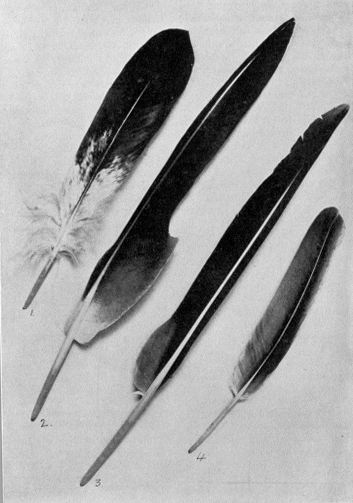
1. Inner wing quill of Bald Eagle; length, 10-13 inches; brownish black, more or less white at the base.
2. Outer wing quill of Bald Eagle; length, 15-24 inches; black, often whitish or brownish at the base, the broader web of the five outer quills notched, this notch being absent from the remaining quills.
3. Outer wing quill of Brown Pelican; length, 15-17 inches; black, the quill, or midrib, white for about two-thirds its length.
4. Inner wing quill of Brown Pelican; length, about 10 inches; blackish brown, the outer margins, particularly of the narrower web, frosted with silver-gray.
You can guess easily, for you have seen the tempter protruding above and behind the up-to-date outing hat the entire season, and unless you are unusually lucky it has poked you reproachfully in the eye, as if calling your attention to its plight.
"The Quill of course!"
Yes, the Quill is the mischief-maker. At its introduction many years ago, the Quill was at first the harmless feather of a Crow, or a Goose quill sedate enough to make a pen for a judge. After awhile it took on dabs of color and even spangles, but all this time it was a good safe outing and rainy day ornament.
Then a change came, the Quill grew suddenly longer with a curl to its tip that made one wonder, if natural, how its original wearer had lived with it. This Quill, however, did not stay well in curl, and less than a year ago it was displaced by the reigning favorite, a Quill as aggressively impertinent as any that decks the cap of the operatic Mephisto, but not half as becoming to the wearer.
Now comes the inconsistency of the moderates. They wear these Quills blindly, because they have not studied birds thoroughly enough to distinguish between plumages except when aided by decided color. The sentence, "It is only a Quill," covers deadly sins of omission. I have cornered several women who are what might be called aggressive Audubonites: "Do you know that the notched Quill in your hat is a pinion of the American Eagle?" "Oh no, you must be mistaken, it surely is only a Goose, or perhaps a Turkey feather, and besides,"—drawing herself up with superior wisdom, "Eagles are very rare birds, that fly so high it is very difficult to shoot them, and I know at least fifty people who are wearing these Quills."
Rare? yes, pinion of peerless flight! But what bird can fly so high or find so eery a resting place as to escape the 'desire of the eye' of fashion? Pause a moment, well-meaning sisters of 'little knowledge.' Hold a Quill class and lay your outing hats on the dissecting table! Study out the things you have been wearing, and you will be wiser, and I hope sadder also, resolving either to join the total abstainers, or to devote enough time to bird study to be consistent in your actions.
"But," you may say, "We are consistent even now. The Eagle is neither a song bird, an insect eater, nor a game bird, and from an economic standpoint it can only be considered as a bird of prey and an eater of wastage."
Yes, this is all true, and yet, in the higher view of life, the poetic value of things must take rank with the practical. And what bird expresses wild grandeur and poetry of motion in so great a degree as the Eagle? What has Burroughs recently said of it?—"The days on which I see him are not quite the same as the other days. I think my thoughts soar a little higher all the rest of the morning; I have had a visit from a messenger of Jove. The lift or range of those great wings has passed into my thought."
Pegasus harnessed to a plow or 'Cæsar dead and turned to clay,' stopping a hole 'to keep the wind away,' would not be a greater misuse than thus plucking the pinions of our national Bird of Freedom to act as rudders to women's hats.
M. O. W.

Audubon's Seal
(From a granddaughter of Audubon)
Audubon's seal was made from a pen-and-ink sketch of the Wild Turkey, being the portrait of a bird weighing forty pounds. The painting from which the seal was reduced measured about thirty-six by twenty-eight inches. A lady friend in Liverpool having seen the painting, was talking, with others, to Audubon about it, and said to him, "Now you ought to have this Turkey for your coat-of-arms." Audubon said that he was too much of an American to use a crest, or coat-of-arms, but that the picture could be easily reduced to the size of a fob seal, then all the fashion for gentlemen's watch chains. Some surprise was expressed by the company present at this statement, particularly by the "Lady Rathbone," as Audubon was want to call her. No more was said then, but in due time a tiny pen-and-ink sketch, perfect in every detail, with the motto, "America my Country," was sent to Mme. Rathbone, with Audubon's signature and compliments. Not long after, Audubon received, to his amazement, a beautiful fob seal, cut in topaz, which he wore on his watch chain as long as he lived. It is now a valued possession held by his family. The accompanying cut is made from a die of this seal, and exactly reproduces it in size, etc.—D. T. A. Tyler.
Report of the Audubon Society of the District of Columbia
For the District of Columbia the Secretary has a most encouraging report.
On Saturday, March 25, a very successful exhibit of spring millinery was given at the Hotel Corcoran, the ladies' parlors being kindly loaned for the occasion. About 300 women attended the exhibit in spite of a pouring rain, lasting the whole afternoon. Quite a number of bonnets and hats were sold, and every person attending left well supplied with Audubon literature.
In April, a free lecture by Mr. Henry Olds, entitled "Some Familiar Birds," was given at the First Baptist church, which was also kindly loaned for this most interesting talk. The lecture was fully illustrated by colored lantern slides, and was made doubly entertaining by Mr. Olds' clever imitations of the notes of the various birds explained. About 400 persons attended this lecture.
The Rev. Mr. Leasitt explained the aim and objects of the Audubon Society, Dr. C. Hart Merriam introducing the lecturer in the unavoidable absence of the President of the Society, Surgeon General George M. Sternberg. Audubon literature was again distributed, and some copies of Mrs. L. W. Maynard's valuable book 'Birds of Washington and Vicinity,' were sold.
The Audubon Society has started an Audubon collection of books in the new Free Library. This collection is designed primarily to be books of reference, large and expensive works, more especially for the use of teachers.
For the work in the public schools, Dr. T. S. Palmer and Miss Elizabeth V. Brown have been untiring and most successful. In the spring of 1898, two classes were arranged, one for teachers in the Normal School, in charge of Dr. Palmer, and one for teachers in the Second and Fourth grades, in the hands of Mr. H. C. Oberholser. The classes were limited to 12 members each, and work extended over ten weeks in 1898-9. Specimens were kindly loaned by the Biological Survey, and the classes were enabled to handle, compare, and identify skins of 175 species of the 290 birds recorded for the vicinity of Washington. These specimens included nearly all the land birds from this vicinity. Hints were given concerning the classification of birds, the characters of the principal groups, and the use of keys.
Short talks were also given on especially interesting topics, such as the 'Relation of Birds to other Vertebrates,' 'Feathers and Feather Structure,' 'Flight,' 'Migration,' 'Food,' and 'Nesting Habits.'
The Society this spring purchased 1,000 Audubon buttons from the Society of the State of Wisconsin, Miss Elizabeth V. Brown taking charge of their sale. A large number were sold to children in and outside the schools, and while not strictly members of the Society, they became more interested in the birds through the wearing of this attractive button.
Miss Florence A. Merriam has given several valuable talks this past spring, notably one at the Washington Club, before an audience of about 200 women, which created great enthusiasm and brought the Society an increase in membership. The Secretary has been untiringly busy in trying to get societies organized in the South and in some western states.
Jeanie Maury Patten, Sec'y.
ANNOUNCEMENT
The Child Life Readers
BY
ETTA AUSTIN BLAISDELL
Assistant Superintendent of Schools, Brockton, Mass.
I. CHILD LIFE—
A First Reader Price, 25 cts.
II. CHILD LIFE IN TALE AND FABLE—
A Second Reader Price, 35 cts.
III. CHILD LIFE IN MANY LANDS—
A Third Reader In preparation
IV. CHILD LIFE IN LITERATURE—
A Fourth Reader In preparation
The central idea of these books is to hold the child's interest by giving him reading matter (profusely illustrated) that he can understand and enjoy. The lessons, therefore, relate exclusively to child life.
The First and Second Readers have easier reading-matter and more of it than do most of the other readers now available for first and second year. They have been graded with the utmost care.
These books, beginning with the Second Reader, have been planned as an introduction to literature. The subject-matter, therefore, is confined to material of recognized literary value.
The aim of the publishers has been to produce an artistic set of Readers that shall be mechanically as nearly perfect as possible.
As a unique feature in binding, they would call attention to the covers, which are water-proof, and can be cleansed, when soiled by constant handling, without injury to the book.
Recent Publications on Nature Study
BAILEY'S Lessons with Plants. $1.10
Suggestions for Seeing and Interpreting some of the Common Forms of Vegetation.
BAILEY'S First Lessons with Plants. 40 cts. net
"Extremely original and unusually practical."
HARDING'S The Liquefaction of Gases. Its Rise and Development. $1.50
Complete and scientific, in a popular style.
INGERSOLL'S Wild Neighbors. $1.50
"Instructive as well as delightful."—Popular Science Monthly.
JACKMAN'S Nature Study for Grammar Grades. $1 net
Proposes a few of the problems within the comprehension of grammar school pupils, which arise in a thoughtful study of nature, with suggestions for their solution.
LANGE'S Hand-Book of Nature Study. $1 net
"The style of the book is fresh and inspiring."
LANGE'S Our Native Birds. How to Protect Them and Attract Them to Our Homes. Just ready.
MURCHE'S Science Readers.
Vol. I. 25 cents. Vol. II. 25 cents. Vol. III. 40 cents. Vol. IV. 40 cents net. Vol. V. 50 cents net. Vol. VI. 50 cents net.
WEED'S Life Histories of American Insects. $1.50
"An unusually attractive book."—Dial.
WILSON'S Nature Study in Elementary Schools.
First Nature Reader 35 cents
Second Nature Reader 35 cents
Teacher's Manual 90 cents
See, also, the new book by Mrs. Wright, described on another page
PUBLISHED BY
THE MACMILLAN COMPANY, New York
VOL. 1 No. 6 December, 1899 20 c. a Copy $1 a Year
COPYRIGHT, 1899, BY FRANK M. CHAPMAN
December, 1899
CONTENTS
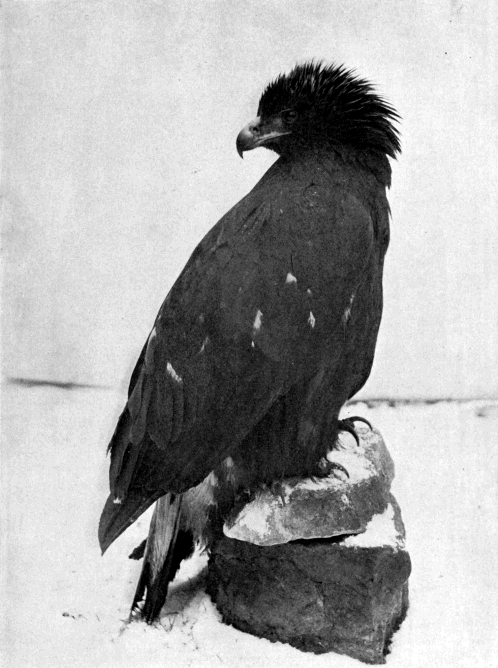
Frontispiece—Golden Eagle Photographed from life by H. W. Nash. 176
A Search for the Reedy Island Crow Roost. Illustrated by W. Gordon Smith. Witmer Stone 177
Winter Bird Notes from Southern New Hampshire. Illustrated by the author. William Everett Cram 180
How the Central Park Chickadees Were Tamed. A. A Crolius 185
The Surprising Contents of a Birch Stub. Illustrated by the author. Frank M. Chapman 187
Richardson's Owl. Illustrated by the author. P. R. Peabody 190
FOR TEACHERS AND STUDENTS
An 'Advisory Council'. 192
"Humanizing" the Birds. Caroline G. Soule 193
'On the Ethics of Caging Birds.' Olive Thorne Miller 194
FOR YOUNG OBSERVERS
The Birds' Christmas Tree. Illustrated. 195
The Little Brown Creeper. Verse. Illustrated. 196
NOTES FROM FIELD AND STUDY 197
An Interesting Phœbe's Nest, illustrated, Ellen E. Webster; A Singing Blue Jay, Frank E. Horack; A Useful Nest-Holder, illustrated; To Hunt Southern Birds; Seventeenth Congress of the American Ornithologists' Union.
BOOK NEWS AND REVIEWS 199
Newton's 'Dictionary;' Mrs Wright's 'Wabeno;' Cory's 'Birds of Eastern North America;' Book News.
EDITORIALS 201
BIRD-LORE FOR 1900 202
AUDUBON DEPARTMENT
Editorial: Reports from Rhode Island, Pennsylvania, and Wisconsin Societies; The Passing of the Tern, illustrated.
⁂ Bird-Lore is published on the first of the month, at Englewood, New Jersey, where all notices of change of address, manuscripts intended for publication, books, etc., for review, and exchanges should be sent.
IMPORTANT NOTICE TO SUBSCRIBERS
All subscriptions beginning with the first (February) number of Bird-Lore expire with this issue. A blank is enclosed for the purpose of renewal, which it is requested be made at our Englewood, N. J., office, ten cents for exchange charges being added to checks on other than New York City banks. In this connection we would call attention to the editorial and announcements on pages 201 and 202 of this number.
PUBLISHERS' ANNOUNCEMENT
Bird-Lore for February, 1900, beginning Volume II, will contain the details of the students' 'Advisory Council,' and, among other interesting contributions, an important and fully illustrated paper on 'The Tongues of Birds,' by F. A. Lucas, Curator of Comparative Anatomy in the U. S. National Museum; 'A Method of Recording Observations,' by Professor Pinchot, of Trinity College; 'Egret Farming,' by F. M. Chapman; and there will be some remarkable bird photographs.
GOLDEN EAGLE Photographed from life by H. W. Nash, Pueblo, Colorado

A BI-MONTHLY MAGAZINE DEVOTED TO THE STUDY AND PROTECTION OF BIRDS
Official Organ of the Audubon Societies

Vol. 1 December, 1899 No. 6
A Search for the Reedy Island Crow Roost
BY WITMER STONE
Curator of Birds, Academy of Natural Sciences, Philadelphia.
AMERICAN CROW Photographed from life by W. Gordon Smith
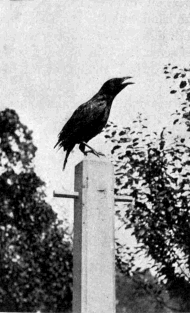
In the Delaware river, just where it begins to widen out into the bay, and midway between the shores of Delaware and New Jersey, lie two long, low islands, known as 'The Pea-patch' and 'Reedy Island.'
Early in the century the former of these was selected by the government as the site of Fort Delaware, and its importance advanced proportionately in the popular mind. Later on, the lower island, which already boasted of a light-house, became further dignified by the establishment of a quarantine station on its banks.
Although of little importance before the government claimed them, these islands were by no means uninhabited, but were, in fact, well-known as a winter resort. The early inhabitants, though much less imposing than the soldiers and health officers who have superseded them, did not fail to attract attention—even newspaper notoriety; not from their individualities, but from their countless numbers. In fact they were nothing more than ordinary, despised black Crows, but Crows in such countless numbers that they could not fail to be noticed.
Every evening they came at dusk by thousands and tens of thousands, winging their way in long lines from all points of the compass, and settling down on the reed-covered islands in a solid black phalanx. This winter roosting habit of the Crows is well-known, and many roosts have been located, but the habit seems still to lack a satisfactory explanation. Why should these birds fly back and forth every day over miles and miles of country to roost in some definite spot which, so far as we can judge, is no better suited for roosting purposes than hundreds of other places which they pass by? And why should they gather together every night in such numbers as to attract general attention and invite slaughter by thoughtless gunners, when, by roosting in small numbers wherever they happen to be feeding, they would escape notice? These are questions I shall not attempt to solve.
Estimates placed the number of Crows in these two island roosts at half a million, and they held possession of the islands undisturbed until about the time of the establishment of Fort Delaware. They did not relish this intrusion, and determined to desert the ancestral Pea-patch roost; being also influenced, no doubt, by a storm which flooded the island at night and drowned thousands of the unfortunate birds.
The Reedy Island roost continued in use until the establishment of the Quarantine Station, at a much later day; then it, too, was deserted, and the famous island roosts were no more.
I have long been interested in the winter gatherings of the Crows, and made inquiry of the light-keeper at Reedy Island to ascertain whether any Crows at all remained there at the present time. I was informed that they came across from Delaware as of old in long flights from the west, northwest and southwest, but all passed over the island into New Jersey, where he judged they had established new winter quarters.
The location of this new roost at once became a matter of interest. By further inquiry I learned that Crows at Salem, N. J., nearly opposite the Pea-patch, flew southwards at evening, and by plotting this flight line with those given by the light-house keeper, on a map, I found that they joined some four or five miles below Salem, and here I felt sure the roost was to be found.
I had little trouble in impressing an ornithological friend, who resided at Salem, with the importance of locating this roost, and one cold afternoon in January found us driving off in the direction taken by the Salem Crow flight.
When we neared the point at which we thought the roost ought to be, we noticed a scattered line of Crows coming up from the south, evidently from feeding grounds on the shores of the bay. They came along in twos and threes, and alighted in a corn-field on our left, from which the farmer had neglected to haul in all of the ears. Here was a rare feast, and about a thousand birds were already assembled, to whose numbers constant additions were being made. This, we thought, must be the beginning of the evening assemblage, but, strange to say, no Crows were coming in from the west; these were all southern Crows, and, furthermore, they showed no signs of settling for the night, but were simply intent on the grain.
Driving further on, we inquired of a man where the Crows roosted, and were assured that they made use of a long strip of woods lying between us and the river. Investigation, however, showed not a Crow in the wood, and we were inclined to believe that we had been purposely misled. Passing through the trees, we had an unobstructed view of the river. The sun was just setting, a round, red ball of fire in the west, and in the yellow light we could see the lines of Delaware Crows crossing towards us, while in the fields before us were hundreds of Crows lazily flapping about much as the others were in the corn-field to the east.
Here, again, we were directed back to the same wood and assured that the birds would repair there when ready. It was just dusk as we hitched our horse and entered the woods; there was still no sign of Crows, but as we emerged on the farther side we found that an immense flight was just beginning to pass overhead from the westward; evidently the river Crows had concluded that bedtime had come. They did not, however, alight in the trees, but passed over and dropped noiselessly into the low fields just before us, seeming to select a black, burnt area on the far side. To our amazement this "burnt" patch proved to be a solid mass of Crows sitting close together, and in the gathering gloom it was difficult to see how far it extended. Four immense flights of the birds were now pouring into the fields, in one of which we estimated that 500 Crows passed overhead per minute, during the height of the flight.
It was now quite dark, and we began to think that the birds had no intention of retiring to the woods, so determined to vary the monotony of the scene and at the same time warm our chilled bodies. We, therefore, ran rapidly toward the nearest birds and shouted together just as they first took wing. The effect was marvellous; with a roar of wings the whole surface of the ground seemed to rise. The birds hovered about a minute, and then entered the woods; we soon saw that but a small portion of the assemblage had taken wing. Those farther off had not seen us in the darkness, and doubtless thought that this was merely the beginning of the regular nightly retirement into the trees. The movement, once started, became contagious, and the Crows arose steadily section by section. The bare branches of the trees which stood out clearly against the western sky but a minute before seemed to be clothed in thick foliage as the multitude of birds settled down.
After all had apparently entered the roost, we shouted again and the roar of wings was simply deafening; another shout brought the same result in undiminished force, and even then, probably not half the birds took wing.
They soon settled down again, and we were glad to leave them in peace. So far as we could learn they are but little molested, and let us hope that this may continue. Many of the large roosts farther north in Pennsylvania and New Jersey, seem to be rapidly decreasing in size, owing to thoughtless persecution, and eventually the poor birds may be driven to roost in scattered detachments, as would, indeed, seem best for their preservation; but if this comes to pass, one of the most impressive phenomena of our bird-life will have disappeared.
Winter Bird Notes from Southern New Hampshire
BY WILLIAM EVERETT CRAM
Illustrated by the author
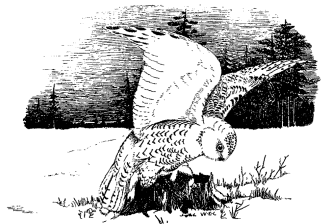
January 1, 1898. Northern birds have, as a rule, been decidedly rare this winter. In November, Goshawks were quite abundant, and a few Snowy Owls were also to be seen at that time. As I was returning from a tramp just at dusk one evening, one of the great white fellows came sailing by only a few yards from the ground. His manner of sailing and something in the set of his wings reminded me strongly of an Eagle flying before the wind; there were evident the same power and swiftness without visible effort. He came from the northeast on the wind of a rising storm, and had evidently but just arrived, being in much more perfect plumage than is usual in November, appearing, at the distance of only a few yards, absolutely white, with his big yellow eyes burning among his snowy feathers.
Snow Buntings were also common in November, and Horned Larks during the first part of the month. I noticed a large flock of the latter one morning feeding in the stubble and, observing that they were moving towards me, crouched motionless until they came up and surrounded me, gathering seeds in the earnest, industrious manner of domestic Pigeons, and exhibiting but little more alarm at my presence. On the 27th a Shrike alighted in the top of the elm near the house, and, after reconnoitering for a few moments, started down into the orchard, but apparently missed whatever it struck at and, turning upward, alighted in a smaller elm by the road, when it at once began tearing to pieces an old bird's nest, behaving exactly as if in anger at its disappointment.
For some time I was unable to discover what it had at first been after, but finally caught sight of a Downy Woodpecker clinging motionless to the underside of a small branch in an apple tree, with every feather drawn down close to its body, just as an owl does when trying to escape notice.
SNOWY OWL
After a while it began turning its head from side to side, as if to make sure its enemy had disappeared. When I attempted to make it fly, it merely crept mouse-like about the branches until perfectly certain that the Shrike had gone, when it took wing and flew to another tree, where it presently went to work as if nothing had happened.
Throughout December the only birds to be found were Crows, Blue Jays, Downy Woodpeckers, Black-capped Chickadees, Nuthatches, Golden-crowned Kinglets, Brown Creepers, and Partridges, with an occasional Bald Eagle or Rough-legged Hawk and a very few Flickers. A large flock of Wild Geese passed over on the 7th, and I saw a few Tree Sparrows and a Winter Wren about the last of the month. The Sparrows lingered about until the first week in January, when a large flock of Snow Buntings made their appearance. A few days later, however, neither Sparrows nor Buntings were to be found anywhere.
January 6. Going through the woods I heard the small birds making quite a fuss in the young growth, and on looking for the cause, discovered a Saw-whet Owl in a little hemlock. When I first caught sight of him he was sitting on one of the smaller branches ten feet from the ground, apparently asleep, with his back to the trunk and his head tipped back. On being closely approached, he seemed to awake suddenly with a start, at once turning his great round eyes in my direction, and after that, never removed them from me for an instant, though I walked around his tree several times. He had a partly eaten white-footed mouse slung across the branch beside him, probably the remains of his breakfast.
Most of the small birds contented themselves with chirping at him from the surrounding trees, occasionally approaching to inspect him more closely and then flying off again, but one Red-breasted Nuthatch remained from the first on a twig close to the Owl's head, and kept up a continual harsh rasping cry, as if having some especial cause of complaint against him. A Flicker and some Blue Jays alighted in the neighboring trees, but not seeing anything of importance, soon flew away again.
When I shook the tree the Owl merely fluttered a few yards, and lit on a maple sapling just out of my reach. The next time he tried to hide by alighting on the further side of the stem of a pine several inches in diameter, but finding this of no avail, at last took a longer flight off through the woods, where I was unable to follow him.
RED-TAILED HAWK
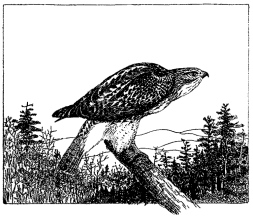
January 28. Heard what I at first took to be the song of a Ruby-crowned Kinglet to-day, but it proved to be a Black-capped Chickadee, uttering what was to me an entirely new note; like the Kinglet's, only fainter and shorter, with just a little of the ring of the Canary's song in it. He was sitting all alone under the dark evergreens, singing to himself in a manner wholly out of keeping with the general disposition and taste of the Chickadee. When I at last disturbed him, he flew to another tree and began searching for insects, uttering the familiar note of his species.
February 3. There is a little Junco hopping about the path to-day, in spite of the fact that the mercury has been very near zero most of the time for the last fortnight, and that the snow is drifted eight or ten feet deep in places. He appears to spend a considerable portion of his time in the woodshed, poking about among the chips, etc., and I fancy sleeps somewhere about the building.
There are also a few Flickers and at least one Meadowlark in this vicinity, and since the last heavy snowfall they have become unusually tame and familiar, coming close about the house for food. Goldfinches and Tree Sparrows are still quite abundant, and there is a flock of fifty or sixty Pine Grosbeaks, mostly in young plumage, in the woods about a mile to the west of us, the first I have seen this winter.
February 6. About five o'clock this evening a large Goshawk in rather dark plumage came flying across the field only a few yards above the snow. As he neared a tall elm he rose in the air and alighted near the top of the tree, and after sitting there for a few moments, turning his head in all directions, he opened his wings and tumbled from his perch, falling several yards down among the branches before regaining his balance, when he flew rapidly off toward the west and disappeared among the pines. Just a week ago I noticed where a Goshawk, judging from the tracks in the snow, had killed a rabbit, so that it would seem that they have not been entirely absent at any time this winter.
February 7. Have just seen a Goshawk, apparently in young plumage, flying west at a height of perhaps sixty or seventy yards from the ground.
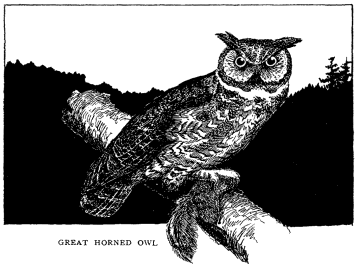
February 13. The Great Horned Owls began hooting nearly an hour before sunset this evening. It is remarkable how loud their cry sounds at a distance of half a mile or even a mile. I am convinced that they can be heard distinctly two miles away, for I have often heard them in the day time from a direction in which the nearest woods were at least as far as that. There are always several pairs dwelling in a certain dark hemlock swamp about a mile and a half away, and sometimes in the evening, or by moonlight, they come hunting across the meadows and pastures, hooting at intervals as they come. When they get within one hundred yards or so their cry is loud enough to arouse everyone in the house.
February 18. Followed the track of a Hawk, apparently a Goshawk, twenty or thirty rods through the birch woods west of the cove. From the appearance of the tracks the bird must have walked much after the manner of a Crow, though dragging its claws more. Occasionally it hopped for a few feet. There was no sign of its having killed any game near there and having eaten so much as to be unable to fly at once, as is sometimes the case. At times it followed in the tracks of rabbits for some distance. I have often known them to do this, and am inclined to think that they occasionally hunt rabbits in this manner where the under-brush is too dense to allow them to fly through it easily. I have sometimes followed their tracks through the brush until I came upon the remains of freshly killed rabbits which they had been eating. On coming out into an opening, I saw a beautiful male Goshawk in full blue plumage perched on the top of a dead maple in a swamp. When I tried to approach, he took wing and flew off toward the north.
How the Central Park Chickadees Were Tamed
BY A. A. CROLIUS[I]

IN the early part of the winter of 1898-9 Chickadees were unusually abundant in Central Park, New York City, and a friend and myself saw them come down and get some of the nuts we were feeding to White-throated Sparrows. We were, of course, much interested, and determined to see if we could tame them. They would take the nuts to a limb, eat all they wished, and hide the rest in crevices in trees or bushes, where, I think, they seldom found them again, for the impudent and ever wide-awake English Sparrow watched and got the pieces almost as soon as they were deposited. After feeding them in this way for some time, we tried to get them to eat from our hands, and finally succeeded by first placing our hands on the ground with a nut about a foot from our fingers, then a little nearer, then on the ends of our fingers, and lastly in the palms of our hands. There was a great shout when they hopped on our hands the first time, our delight being indescribable.
Finding that kneeling or bending over on the ground was rather hard work, we tried holding out our hands when standing, or while sitting on the benches, and they very soon came, no matter where we were or in what attitude. The little creatures never seemed to get tired if we remained hours at a time, and it was indeed difficult to tear oneself away. Just as I would make up my mind to be off one would fly over my head calling chick-a-dee-dee in such a bewitching way as to make it impossible to leave. I would say to myself, "Just one piece more," then throw a lot of nuts on the ground and make a 'bee line' for home, never looking back for fear the temptation would be too great, and I should find myself retracing my steps. After a time they would come to me and follow me anywhere in the park, whenever I called them, and getting better acquainted I found the birds possessed of so many different traits of character that I named each one accordingly. One I called the 'Scatterer,' because he stood on my hand and deliberately threw piece after piece of nut on the ground, looking down as they fell with the most mischievous twinkle in his eyes, as much as to say, "see what I've done," then take a piece and fly away. This he did dozens of times in succession. I thought at first he would rather pick them up from the ground, but he came directly back and waited for me to do it. Another I called 'Little Ruffled Breast,' on account of the feathers on the breast being rough and much darker than the rest. He was the most affectionate, had a sweet disposition, and, like human beings of the same character, was often imposed upon, many times being driven off by the others when he was just about taking a nut. He was very tame, and had perfect confidence in anyone who would feed him. The third I named the 'Boss,' because he took the lead and carried the day. He was a beauty, spick and span in his dress, not a feather out of place, and plump and perfect in form. The fourth, dubbed 'Little Greedy,' was very fascinating, and I must confess to loving him more than the rest, having had a most novel experience with him, and one never to be forgotten. He came to me one morning, and, lighting on my hand, sang chick-a-dee-dee two or three times, helped himself to a nut, and, perching on my forefinger, put the nut under his foot, as I have seen them do many a time on the trees, remaining there until he had eaten it. I was thrilled through and through with the sensation and the perfect trustfulness of the little creature, and was sorry when he had finished. But why was he called Greedy? Because he usually took two pieces instead of one, and, strange to say, knew that he must have both the same size or one would fall out. It was very funny to see him with a good sized piece, his bill stretched to its utmost capacity, trying to fit in another. He turned his bill first on one side then on the other, thinking he could wedge it in by forcing it against my hand, and he succeeded in this wonderful feat by his perseverance and indomitable will.
The Surprising Contents of a Birch Stub
BY FRANK M. CHAPMAN
After seeing Dr. Roberts' interesting Chickadee photographs, published in the first number of Bird-Lore, my ambition was aroused to discover a nest of this species so situated as to afford an opportunity to secure equally charming pictures of Chickadee life. Late in May the desire was gratified by the discovery, at Englewood, N. J., of a Chickadee's nest in a white birch stub, about four feet from the ground, a height admirably suited to the needs of bird photography.
I will not here present the results of my study of the parent birds during their period of incubation, but will pass at once to that part of my experience which relates to their progeny.
Returning to the nest on June 12th, nothing was to be seen of either parent, and I feared that they or their offspring had fallen victims to the countless dangers which beset nesting birds and their young. Looking about for some clue to their fate, I found on the ground, near the nest-stub, the worn tail-feathers of the female bird. The molting season had not yet arrived, nor would she have shed all these feathers at the same moment. There could, therefore, be only one interpretation of their presence. Some foe, probably a Sharp-shinned or Cooper's Hawk, since the predaceous mammals for the most part hunt at night when the Chickadee would be snugly sleeping in her nest, had made a dash and grasped her by the tail, which she had sacrificed in escaping. A moment later the theory was supported by the appearance of a subdued looking Chickadee, sans tail, and I congratulated her on her fortunate exchange of life for a member which of late had not been very decorative and of which, in any event, nature would have soon deprived her.
The young proved to be nearly ready to fly, and carefully removing the front of their log-cabin, a sight was disclosed such as mortal probably never beheld before, and Chickadee but rarely.
Six black and white heads were raised and six yellow-lined mouths opened in expressive appeal for food. But this was not all; there was another layer of Chickadees below, how many it was impossible to say without disentangling a compact wad of birds in which the outlines of no one bird could be distinguished. So I built a piazza, as it were, at the Chickadee threshold, in the shape of a perch of proper size, and beneath, as a life-net, spread a piece of mosquito-bar. Then I proceeded to individualize the ball of feathers; one, two, three, to seven were counted without undue surprise, but when an eighth and ninth were added, I marvelled at the energy which had supplied so many mouths with food, and at the same time wondered how many caterpillars had been devoured by this one family of birds.
Not less remarkable than the number of young—and no book I have consulted records so large a brood—was their condition. Not only did they all appear lusty, but they seemed to be about equally developed, the slight difference in strength and size which existed being easily attributable to a difference in age, some interval, doubtless, having elapsed between the hatching of the first and last egg.
This fact would have been of interest had the birds inhabited an open nest, or a nest large enough for them all to have had an equal opportunity to receive food, but where only two-thirds of their number could be seen from above at once it seems remarkable, that, one or more failing to receive his share of food—and a very little neglect would have resulted fatally—had not been weakened in consequence and crushed to death by more fortunate members of the brood. Nor was their physical condition the only surprising thing about the members of this Chickadee family; each individual was as clean as though he had been reared in a nest alone, and an examination of the nest showed that it would have been passed as perfect by the most scrupulous sanitary inspector. It was composed of firmly padded rabbit's fur, and except for the sheaths worn off the growing feathers of the young birds, was absolutely clean. Later I observed that the excreta of the young were enclosed in membranous sacs, which enabled the parents to readily remove them from the nest.
The last bird having been placed in the net, I attempted to pose them in a row on the perch before their door. The task reminded me of almost forgotten efforts at building card houses which, when nearly completed, would be brought to ruin by an ill-placed card. How many times each Chickadee tumbled or fluttered from his perch I cannot say. The soft, elastic net spread beneath them preserved them from injury, and bird after bird was returned to his place so little worse for his fall that he was quite ready to try it again. On several occasions eight birds were induced to take the positions assigned them, then in assisting the ninth to his allotted place the balance of the birds on either side would be disturbed and down into the net they would go.
These difficulties, however, could be overcome, but not so the failure of the light at the critical time, making it necessary to expose with a wide open lens at the loss of a depth of focus.
The picture presented, therefore, does not do the subject justice. Nor can it tell of the pleasure with which each fledgling for the first time stretched its wings and legs to their full extent and preened its plumage with before unknown freedom.
At the same time, they uttered a satisfied little dee-dee-dee, in quaint imitation of their elders. When I whistled their well-known phe-be note they were at once on the alert, and evidently expected to be fed.
A CHICKADEE FAMILY Photographed from nature by F. M. Chapman
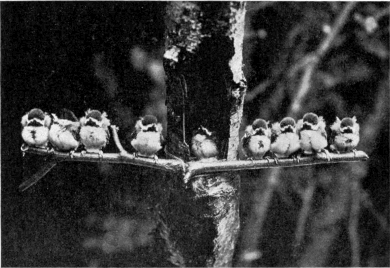
The birds were within two or three days of leaving the nest, and the sitting over, came the problem of returning the flock to a cavity barely two inches in diameter, the bottom of which was almost filled by one bird.
I at once confess a failure to restore anything like the condition in which they were found, and when the front of their dwelling was replaced Chickadees were overflowing at the door. If their healthfulness had not belied the thought, I should have supposed it impossible for them to exist in such close quarters.
A few days later I found their home deserted, and as no other pair of Chickadees was known to nest in the vicinity, I imagine them to compose a troop of birds I sometimes meet in the neighborhood.
Richardson's Owl
BY P. B. PEABODY
With photographs from nature by the author
RICHARDSON'S OWL
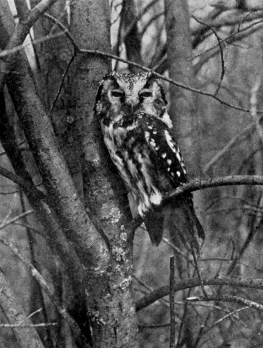

ON the thirteenth of April last, at Hallock, Minn., while afield in the morning after Migration Report data, I stumbled suddenly upon a Richardson's Owl, in a willow bush, four feet up, on a brush-land side-hill, two hundred yards above the river. A strong wind was blowing, and kept the willow stems a-swaying and the feathers fluttering, while the dullness of an overcast sky made quick exposures impossible. Nevertheless, I hurried home, a mile away, and returned with camera and plates,—'Crown' and 'Stanley.' The bird was still in situ, and leaning, as before, against the upright stem nearest him, as a brace against the wind. With stop 16, or a little larger, and time 1/5 to 1/2 second, both according to the conditions of wind and sky, eight exposures were made, beginning at five feet distance, and with waits for lulls in the wind. The bird seemed fearless, but I dared not try to put him on the alert, nor cause him to open his eyes. The eighth exposure was made at about two feet, the camera leisurely dismounted, and the bird then quietly caught about the back, with the left hand, while his attention was distracted with the right.
RICHARDSON'S OWL
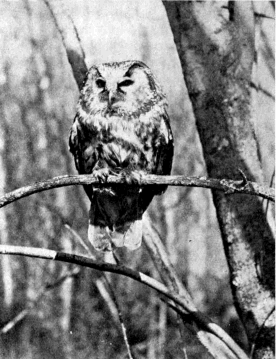
The little captive showed no fight nor did he try to escape so long as I held him by the feet, in an upright position. But when his body was clasped he would struggle vigorously. With all the handling I gave him in taking weights and measures, the only wounding he caused my hands was made in his attempts to secure a better grasp of my holding hand. While not actually tame, from the first he showed ecstatic delight in my stroking of the feathers on the back of his head,—chirping delightedly during the process, with much the manner and voice of a chicken when tucked under the maternal wing.
While spending his first night of captivity in my study, pending careful examination, he dropped upon my book-cases several casts, which are still awaiting analysis. At noon of the second day he was placed in the garret, where he had a measure of darkness and plenty of wing room. Here he ate readily the heads of food that was left convenient, varying this occupation with the tearing to pieces of an old Cooper's Hawk skin. So far as I could judge, he ate only on alternate days.
During the eight days of his sojourn with me, no increase of tameness was shown; and he would fly when I came near, seeking the darkest cranny of the garret, scolding me often with the characteristic anger-note of all the smaller Hawks and Owls. Soon my captive found a permanent home in the family of the foster-father of Minnesota ornithology, where, I was soon informed, he became quickly domesticated,—eating bits of steak from a chop-stick, beheading English Sparrows with neat despatch, and drinking from a teaspoon.
An 'Advisory Council'
IT gives us unusual pleasure to announce a plan, the fulfilment of which, already assured, will, we believe, be of great assistance to bird students and exert an important influence on the increase in our knowledge of North American birds.
Realizing from a most fortunate experience how greatly the past-master in ornithology may aid the beginner, we have felt that it would be an admirable scheme to form an 'Advisory Council,' composed of leading ornithologists throughout the United States and Canada, who would consent to assist students by responding to their requests for information or advice, the student being thus brought into direct communication with an authority on the birds of his own region.
The response to our appeal has been most gratifying. Without exception the ornithologists whom we have addressed have cordially endorsed the proposed plan, and signified their willingness to coöperate with us in this effort to reach the isolated worker. Nearly every state in the Union and province in Canada has been heard from, and we expect in our next number to publish the names and addresses of the more than fifty prominent ornithologists who will form Bird-Lore's 'Advisory Council.'—Ed.
"Humanizing" the Birds
CAROLINE G. SOULE
IN the first number of Bird-Lore the author of 'Bird Studies for Children' says: "Most bird stories will interest them [children], especially if the birds are humanized for them by the teller of the tale." Humanizing, in this connection, means endowing with human characteristics, and is a process much in vogue just now among writers of nature-study books and papers for the use of children and teachers. Let us see if it is worth doing—or even is justifiable.
Birds possess some characteristics or qualities which are also possessed by human beings, and by other animals. These qualities are not merely "human" then, but are common to many species of creatures. Since birds already have these qualities, there is no need of endowing them with them. To "humanize" the birds by ascribing to them human qualities which they do not and cannot possess, is only to misrepresent them, and stories which so humanize them are of no more value, as nature-study or bird-study, than so many fairy-tales. More than this—they are positively harmful because they give, as facts, statements about existing creatures which are not true. This is not bird-study; it is only telling stories which interest the children, and which have no value except in keeping them quiet. The children are not interested in the real birds, for they are not told about them. They are interested in the stories, invented for this end, about creatures which the story-teller calls birds but which are only human characteristics draped on bird forms. Very slight changes would be needed to make the same stories fit any humanized animal. The real nature of the bird is left out of these humanized bird stories and the loss is very great, as always when truth is left out.