Front matter (continued 4)
Reading edition
Another abundant summer bird of this part of Nova Scotia is the Night-hawk, the name being almost a misnomer, as they are visible in numbers, flying all day. But all do not depart from their usual custom of sleeping during the day, as is shown in the accompanying photograph, taken about 11 A. M. one August day, 1898. While walking along a railroad track, I noticed this bird resting in a fallen trunk about four feet from the track. I focused my camera and made the exposure without disturbing the bird in the least. A train had passed not long before, so it could hardly have been asleep more than an hour. The characteristic longitudinal position assumed by this bird in perching is well shown, and its protective coloring makes it appear a mere excrescence on the bark.
NIGHT-HAWK ASLEEP
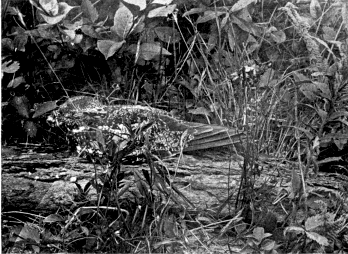
When it awoke what a dream it might relate to its companions of being approached by a horrible one-eyed, three-legged creature, which at a glance made it immortal!
The photograph of the Junco's nest and eggs was made with a 128 opening and a 4-second exposure, while that of the Night-hawk was stopped at 64, with an exposure of two seconds.
In the Spartina with the Swallows
BY O. WIDMANN
Maple Lake, in St. Charles county, Mo., is one of a series of lakes situated between the bluffs and the Mississippi River. The bluffs are four to five miles from the river bank, thus leaving a wide stretch of alluvial land, lowest toward the bluffs, forming an extended, nearly level marsh, mostly too wet and poor for cultivation, and covered with square miles of cord-grass (Spartina cynosuroides). In dry summers or on higher levels it reaches only a height of three or four feet, but in wet summers, as for instance in 1898, it attains the stately height of six to eight feet, with such a dense growth of rigid leaves that it is hard work to walk or even drive through. As a commercial article it is worth very little, though it will make good paper. When young it is liked by horses and cattle, and when two feet high it makes pretty good hay, which is sometimes baled and sold as prairie hay.
But while man does not yet know how to make good use of it, birds do, especially some species of the families Hirundinidæ and Icteridæ—the Swallow and Blackbird families—who find in the spartina the material for a good and safe dormitory. Hundreds of acres of this grass cover the region about Maple Lake, and as they are within the confines of one of the best managed club grounds, where neither plow nor cattle, neither drainage nor fire are allowed, they serve many kinds of birds for a roosting place at all seasons of the year, but especially in fall migration.
Of Swallows, the most numerous frequenters are the Eaves, the Tree or White-breasts, and the Roughwings, and they show their appreciation of this rare place of security and peace by coming early in the season and staying late. When the Eaves have become strangers at their breeding stations for a long time, the marsh is the place to find them in plenty. Here is the place to look for the first White-breast of the year as early as the second week of March, and for the last, in the third week of October. For two months, from the middle of August to the middle of October, a cloud of Swallows may be seen every evening, just before dark, hovering over the most remote and inaccessible part of the immense spartina waste, and wherever you are in the marsh in the late afternoon, you cannot fail to notice innumerable Swallows skimming the grassy ocean and the adjacent lakes. If toward sunset you watch them closely, you will find that, though they may linger long on some favorite hunting ground, the general trend is toward one particular region, and if you will wait long enough, you will find that they have all disappeared in that direction and that, when almost dark, belated parties passing by go in a straight line direct for the same unknown destination. Certainly a most interesting sight for the naturalist to see so many of these lovely, lively, likely creatures passing over, about and around you, all governed by one idea, all driven by one common impulse, all eager to reach the same aim, the common roost! Where is the roost? Where do all these birds spend the night? How do they retire in the evening, and what is their conduct when they leave their night-quarters in the morning?
TREE OR WHITE-BREASTED SWALLOWS Photographed from nature by Edward Van Altena, Alpine, N. J., September, 1898
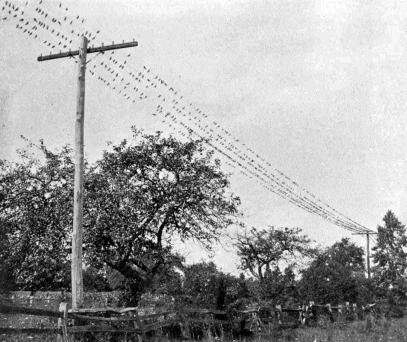
In spite of their large numbers and generally unconcealed activity, the answer to these questions is not quite easy. Otherwise confiding creatures, Swallows are careful to keep the exact location of their roost as much as possible a secret from the outer world. Neither the persons who live in the neighborhood of the marsh, nor the hunters who desecrate its sanctity, could tell you where the Swallows roost. It requires the persistent efforts and full attention of the naturalist to show you where and how his favorite bird goes to rest and how it sets out and enters upon the duties and pleasures of another day. You have to be after nightfall, alone with the mosquitos and other pests, in the wide, wet and pathless marsh, and again before the faintest glimmer announces the approach of day.
But select a day in the latter part of August or the first half of September, and follow me. We are up early, to be on the grounds before 5 A. M.; the stars are vanishing, one after the other, and the first dawn appears on the eastern horizon; the air is cool and misty, the grass loaded with heavy dew, but we have to plow our way through as best we can. By previous observation we have located the whereabouts of our birds, and we are now fast approaching their sanctum, all alive and alert for the expected disclosures.
Before this, only the hooting of the Barred Owl in the distant woods had broken the silence, but now comes from the depth of his private retreat, the sleepy 'seewick' of the Henslow's Sparrow, and at the same time the weak but lively 'chip chip churr' of the Short-billed Marsh Wren. 'Pink, pink, pink' exclaims the Bobolink, whom we have startled from his slumber of repose, and, as we advance, up go some Swallows, one by one, to the right, to the left, in front of us, not in masses or bunches, but singly, every few yards one or two flying up, silent, and on wings heavy with dew.
Dawn has been making fast progress the last few minutes, and we can see quite a little distance through the misty air. Now is the time when the Swallows begin of their own accord to leave their perch down in the depths of the spartina and fly with heavy wing through the cool and foggy layer below into the clearer atmosphere above, where the sun's first rays will soon dispel the chilly dampness of their plumage.
While we are still absorbed in the astounding spectacle, daylight is stealing quietly into the novel scene, and discloses the presence of greater and greater numbers of Swallows as far as the eye can reach. Many have gained enormous heights, and are soaring majestically in the sun-kissed zenith. Not so voiceless as the Swallows do the Bobolinks leave the roost. Their pink is continually in the air, and numerous parties are seen passing over, drifting into all directions of the compass. Some alight again, all in their yellow traveling suits, with the exception of one who has a little song for us and wears a somewhat mottled garb with whitish rump. Long-stretched flocks of Redwings pass in one direction, troops of Frackles in another; but, on the whole they do not present anything like the grand spectacle they will later in the year, when migration sends millions of them to this marsh.
The sun is up now, and a little wind is stirring and dispels the clammy dampness of the air. Short-bills sing on all sides, and a few Marylands and Henslows are also heard to sing. Great Blue Herons are on the move, and the Marsh Hawk is at work. A Bittern wings its way across the marsh, attended by a committee of inquisitive young Eaves. There is a peculiar movement now among the Swallows. They seem to concentrate their forces. Let us follow them, and be treated to an unexpected sight.
Fifty thousand Eave Swallows are seated on the protruding tops of sunflowers, which grow here among the spartina in restricted areas, covering a few acres in the middle of the marsh! They sit, several on one plant, as close together as the branches and their weight allow. We draw nearer, until we are within twenty yards of the assembly. The birds must see us, but do not mind, and we have excellent opportunity to watch them. Their numbers are still swelling. The long, narrow, ridge-like stretch of sunflowers is filling up more and more. From the north comes a steady flow of Eaves, all bound for the convention.
It is now 6 A. M.; the influx of arrivals from the north has ceased, and all seem ready for the opening of the session; but they do not look as if they were going to transact important business. Some fly up from time to time, draw a few circles and sit down again. Most of them look tired, as if they had already performed a most fatiguing task. The majority are young fellows, all Eaves, in pale attire, some so small as if not fully grown; but there are also many adults in high dress among them. All are enjoying their rest, some are preening their feathers, others half close their eyes and puff up their plumage, as if going to sleep. There are still some high up in the ether enjoying their enviable wing power; others are hunting low over the marsh, in company with Whitebreasts.
Although the two species hunt, fly and roost together, they do not hold their meetings together. The Whitebreasts' assemblages are held over water. They betake themselves to a pond or lake, and find a perch on the pods, stalks and projecting leaves of the lotus (Nelumbo lutea), with which some of these shallow waters of the marsh are literally covered. There is a small pond only a quarter of a mile from the sunflower patch, and this is now just full of Whitebreasts. Now and then a little cloud of them rises from the pond, and after a few evolutions settles down again. There are only a few hundred; the height of their autumnal wandering is several weeks behind that of the Eaves. These are most numerous in late August and early September; but, as their number decreases, that of the Whitebreasts increases, reaching the height at the time the Eaves depart.
In summer the roost belongs almost entirely to the Eaves, who flock here from the surrounding country. So do the Roughwings, a few hundred only, and some Barn Swallows and Whitebreasts, which two species are not numerous breeders in this region.
TREE OR WHITE-BREASTED SWALLOWS Immature birds on the ground gathering nesting material, which they drop after carrying a short distance, thus apparently giving a premature exhibition of the nest-building instinct Photographed from nature by Frank M. Chapman, Leonia, N. J., August, 1897
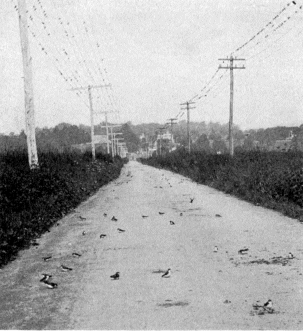
As soon as migration begins, about the middle of August, the Eaves are greatly reinforced, and for the next four weeks enormous numbers are present, but it is probable that they are not always the same individuals, as their numbers vary from day to day. It seems they perform their migrations by stages, from roost to roost, employing mainly the first hour of the morning for their flights, spending the day resting and feeding in the region surrounding the roost. The substitution of arriving Whitebreasts for departing Eaves is in the beginning almost imperceptible, but at last we see that the one has taken the place of the other entirely. The Roughwings become more numerous in early September, and many remain, with a few Barn Swallows, into October, but the latter are never conspicuous at this roost. Martins and Bank Swallows are only accidental visitors to this roost. The Whitebreasts remain numerous to the middle of October, and small detachments linger even a week longer.
Most of the Eaves that have been gathering on the sunflowers before 6 A. M. are still there at 8 A. M., and the Whitebreasts are also on the lotus yet; but an hour later, when the sun has heated the marsh and started the winged insects on their aërial mission, the time for activity has arrived, and the meetings are adjourned, the birds dispersed. We, too, will adjourn, with the promise to be back for another meeting in the evening. When migration is well under way, the collecting of the Eaves and Whitebreasts begins early in the evening; in fact, large droves are met at all hours of the day, playfully gyrating in the blue heavens above, or describing endless curves upon the glittering marsh beneath. The Roughwings are seldom seen in the marsh in daytime. As soon as they leave the roost at early dawn, they hurry away to their accustomed haunts along the water courses in the timber, where they collect on the branches of a dead tree on the bank, if possible over water. There they sit, soon after daybreak, fifty to one hundred together, silent and lost in meditation, patiently awaiting the dissipation of the vapory dimness, the signal for activity. They are greatly attached to these meeting-places, and resort to them often in daytime as well as in the evening. Indeed, these gatherings of Roughwings on certain dead trees along our woodland lakes and streams are quite a feature of the landscape from July till October. Often their ranks are considerably swelled by an admixture of other Swallows—oftenest the Bank Swallows, who join them on their entomologizing excursions, and find it congenial to spend some time on the same perch with their gentle cousins.
In fall migration, the different kinds of Swallows like to mix, hunt and rest together, and it is nothing rare to find four or five species sitting side by side. To be sure of a full view of the whole performance, we are in the marsh as early as 5 P. M., and take a stand west of the roost to have a good light, and also to be in a position where we can overlook part of Maple Lake, over which a large number of Swallows take their way. Indeed, we find them already plentiful, and watch their actions. A few dozens are sitting on the plant stalks projecting from the water, mostly Whitebreasts. From the west comes a pretty steady stream of Eaves. When they reach the spot where the Whitebreasts are gathering now, they pause a moment, and, hovering, take a drink, several at once, after which they continue their course. Is it not strange that they seem to think that this is the only place for Eaves to drink, though the lake is half a mile long?
'BIRD NOTES'—TREE SWALLOWS Photographed from nature by Frank M. Chapman
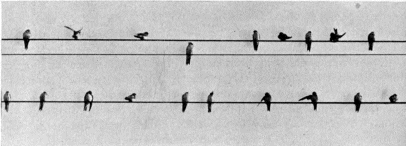
Bobolinks also arrive in the marsh; small parties pass over, and their pink is often in the air. It is now 5.30 P. M. More Eaves come, drink, and move on. We move, too, following them through the high spartina until we see in the distance an oasis of black dots in the yellow sea of grasses. While we are still advancing, a Pigeon Hawk darts over our heads, going straight for the oasis. In less than no time the black dots take wing and up goes the whole congregation of Eaves, up, up, scattering to all winds, and disappearing for several minutes. But the disturber is gone, and the frightened birds find courage to return and sit down again on their favorite weeds, from which they can overlook the marsh for miles around.
The Bobolinks, for whose special benefit the Hawk's visit was this time meant, are still hovering in the air, but new troops arrive, and after some aimless drifting all settle down to roost amongst the grasses.
The sun is down now, and perfect streams of Swallows are flowing from all sides toward the oasis in the center. This is the moment when the Whitebreasts, who for the last hour have been congregating on the lotus of the neighboring lakes, mingle with the passing Eaves and accompany them to the common roost. The Roughwings, too, have left their haunts and are appearing in the marsh.
The light of day is waning fast, and the smoky air gets dim and misty. The assembled Eaves are now seen to rise in clouds from their oasis, mix their forces with the invading army, and the grandest spectacle ensues. At first it looks as if confusion reigned, but soon the hosts of fleet-winged birds no longer whirl aimlessly through space. All mass and muster, and perform strange evolutions with amazing swiftness and precision. Now we see them scattering and spreading over the whole area on which they intend to roost, apparently to make sure that no danger lurks beneath the grasses. Here they come, skimming, almost touching, the spartina, pass by, and speed onward until lost to sight for a few moments, when all at once a great cloud of moving specks is visible in the distant sky. The specks are Swallows, and the cloud has life; it moves, it rolls, it swells, it comes, it breaks and, like a torrent of wing-borne arrows, darts upon us, scattering and spreading out, as it descends for another wild dash low over the spartina.
The same wonderful maneuvers repeat themselves as long as the evening twilight lasts, and, though with each descent the cloud does shrink in size, it does not cease to rise again until black night has fully settled down, and even after dark small droves of bewildered birds rush madly by our side. Being well within the range of the now settled birds, we cannot go away without disturbing some in their repose; although they are dispersed over a large area, every now and then one will be seen to scamper out and vanish in the darkness.
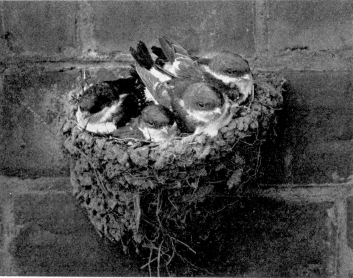
YOUNG EUROPEAN MARTINS AND NEST Photographed from nature by "C. R."
Watching the Bittern 'Pump'
BY BRADFORD TORREY

Since I printed, in 'The Auk' (Vol. vi, p. 1), a description of the Bittern's vocal performances, I have witnessed a repetition of them on three occasions; and the story of my successes, such as they are, may be encouraging to the younger readers of Bird-Lore.
The remarkable sounds, sometimes likened to those of an old-fashioned wooden pump, sometimes to those made by a man driving a stake in wet soil (and the likeness is unmistakable, not to say perfect, in both cases), must have attracted attention, we may suppose, ever since the settlement of the country. The dullest person could not hear them, it would seem, without wondering how and by what they were produced. But up to the time of my 'Auk' article, there was only one authentic record, so far as I am aware, that the bird had ever been seen in the act of uttering them. For my own part, having never lived near a meadow adapted to the Bittern's purposes, I had never so much as heard his famous 'boom,' though references to it here and there, in the writings of Thoreau especially, had given me a lively desire to do so. It was a strange accident, surely, that the first Bittern I had ever heard should show himself so openly and for so long a time. Beginners' luck, we may call it, and be thankful that such providential encouragements are not so very uncommon. As the Scripture says, "The last shall be first."
On the 2d of May, 1889, a year after the observations recorded in 'The Auk' article, I was lying upon a cliff on the edge of a cat-tail swamp, listening for Rail notes or a Least Bittern's coo, when a Bittern, very much to my surprise, pumped almost at my feet. By good luck a small wooded peninsula jutted into the swamp just at that point (the swamp, I regret to say, has since been converted into a town reservoir), and, keeping in the shelter of rocks and trees, I stole out to its very tip unobserved. Two or three times the notes were repeated, but I could get no sight of the performer. Then, all in a flash, he stood before me—as no doubt he had been doing all the while—in full view, just across a narrow space of open water against a patch of cat-tails. He had taken no alarm, and pumped six or eight times while I stood, opera-glass in hand, watching his slightest motion. Then he stalked away into the reeds, pumped twice,—behind the scenes, as it were,—and fell silent.
Two days later I went to the Wayland meadows, where I had seen my bird of the year previous, and there, seated upon the railroad embankment, as before, I watched a Bittern pump at short intervals for more than an hour. Most of the time he was more or less hidden by the low grass, through which he was slowly traveling down the meadow; but once, coming near the remains of a last year's haycock, he went a little out of his way, mounted it, and boomed in full sight. The Bittern is a wader and a recluse, but once in a while, it appears, he has no objection to a clear platform and dry feet.
I felt myself highly favored. Twice within three days I had been admitted to "assist" at mysteries of which Thoreau, who spent his life in the best of Bittern country, had never obtained so much as a glimpse.
Exactly a year afterward (May 4, 1890) I was strolling along a road near home, when from a meadow beside it came the now familiar pumping notes. I made toward the spot, and by the help of a clump of alder bushes approached within a very short distance of the bird, who stood in short grass, quite unconcealed. A migratory visitor only, he must have been, for I am certain that no Bittern ever summered in that place during my years of residence near it. I watched him at his work till I was tired. Then, bethinking myself of a friend and neighbor who knew nothing about birds, but had once expressed to me a curiosity about the 'Stake-driver,' I walked to the village, rang his doorbell, and invited him to go back with me to see the show. The showman was still rehearsing, and we stole upon him without difficulty, and saw as much as we wished of his doings. Though it was Sunday morning, and the bird was as serious as any parson, we took the liberty of laughing a little at his absurd contortions.
Since then I have heard the Bittern's music on sundry occasions, but never have found it possible to come within sight of him in the act of making it. Once, I remember, I was sitting upon a roadside fence, reading, when a carriage stopped and an unrecognized feminine voice said: "Do you see that Heron behind you, Mr. Torrey?" The "Heron" was Botaurus lentiginosus, in a bit of low ground close by a house. I shut my book and gave him my attention, which he presently rewarded by catching and swallowing a snake. This was in autumn, when Bitterns, like lesser birds, are liable to turn up in unexpected quarters. The reader may take the incident, if he will, as a warning against the reading of print out of doors. As a general thing, we may safely say, Nature's page is better than a book.
One season a friend and myself became much interested in the question as to the relative 'carrying power' of the three notes or syllables of which the Bittern's music is composed. The discussion began by our hearing a single far-away note, repeated at the proper intervals, at a time when we could not well follow it up. Later investigation, to our no small surprise, compelled us to settle down upon the conclusion that the first note was the one last to be lost as we traveled away from the bird. We were surprised, I say, for the second note is the one which bears, or seems to bear, the accent. Plum-pud-d'n, the creature appears to say, with an emphasis fairly to be called violent upon the middle note. Why, then, should not the middle note be heard farthest? What is emphasis, anyhow, if not, as the dictionary says, a "special force of voice." Could there be something peculiar, we asked ourselves, in the quality of the first syllable, which made it carry beyond the others? We discussed the matter eagerly, trudging to and fro to make certain of the fact itself, and agreed, if I remember rightly, upon a plausible explanation. As I review the case, however, I am so much in doubt as to the correctness of our theory that it seems quite as well not to state it, but to leave the question to any Bird-Lore reader who may some day have nothing better to do than to investigate it for himself.

Hints to Young Bird Students[F]
It has always been our experience that young bird students who have just crossed the threshold of ornithology are glad to turn for a word of advice and assistance to their older brethren, who have already made some progress in the science; and it has always been a pleasure for us to give such aid. In view of these facts, we take this opportunity of offering a few words of counsel for the benefit of those who are beginning the study of birds.
Doubtless every beginner looks upon the formation of a collection as necessarily the first step on the ornithological ladder; and probably a collection of eggs is preferred to a collection of birds, because the specimens can be prepared much more readily.
Soon you meet complaints from well meaning persons who object to robbing birds' nests, and you reply that you are collecting for scientific purposes. Very good; science has need of you all, but do you know what scientific ornithology—real ornithology—is?
Are you not influenced, to some extent, at least, by "oölogical" magazines and dealers' price-lists of eggs, from which you learn that it is important to secure series of sets,—which means hundreds and thousands of eggs,—and wherein you also learn the market price of this or that egg, and value your specimens accordingly,—just as you do your postage stamps? This is not science, and the men who advocate this sort of collecting, and who have the largest collections of eggs, rarely contribute anything to our knowledge of birds, and are not advancing the science of ornithology.
If you must have a collection, a few sets of eggs (often a single set) of each species of bird will answer all your purposes. There is nothing to be gained by the collecting of a series, except the extermination of the birds, which is surely not your object.
On the other hand, there is a vast amount of bird work that you can do to help the science of ornithology and gain a reputation for yourself.
There are hundreds of facts regarding the distribution of birds, their habits, etc., which are still unknown, and you should make it your aim to become an authority on the birds of your region, and keep records of all your observations as to migration, habits, abundance, etc. You will find ample opportunity for work, as every year will bring to light new facts, and the more you contribute to our knowledge of the birds the more you will see what an insignificant matter the formation of an egg collection is in comparison with real ornithology.
In the case of birds, it is justifiable to shoot specimens which are new to you for purposes of identification, but you should make the best use of the bird before you kill it, so that it will not be necessary to shoot more of the same kind in order to tell what they are. Your aim should be to learn to recognize birds at sight and by their notes, and you will find you will learn more of value by a study of the living bird than by collecting skins.
The exact knowledge that we now possess of the coloration, etc., of North American birds, and the large collections available for study in the museums, render it entirely unnecessary for every bird student to form a collection. Those who undertake any special line of study will soon learn what specimens are required and collect accordingly, instead of amassing a large number of specimens with no particular object in view.
These suggestions are not made with a faultfinding or sentimental feeling, but in a friendly spirit, for the purpose of counteracting the effect of the advice of egg dealers and traders, who seem bent upon developing our budding students into "egg hogs" instead of ornithologists.
We have all killed birds and collected eggs, but not to a useless excess, and have always, we believe, made real use of our collections in adding to the knowledge of birds and advancing the science of ornithology.
As active members of the American Ornithologists' Union, we are only too glad to encourage the study of birds and aid the beginner, but unless some steps be taken against this useless egg collecting, the extermination of some at least of our birds will soon be effected.
We ask your earnest consideration of these points, and trust you will aid us by your influence and example in advancing true ornithology, and in discouraging the waste of bird-life occasioned by this "fad" of egg collecting.
WITMER STONE, Conservator Ornithological Section, Acad. Nat. Sci., Philadelphia. J. A. ALLEN, Curator Dept. Vertebrate Zool., Amer. Mus. Nat. Hist., New York City. FRANK M. CHAPMAN, Ass't Curator Dept. Vertebrate Zool., Amer. Mus. Nat. Hist., New York City. ROBERT RIDGWAY, President American Ornithologists' Union. Curator Dept. of Birds, U. S. Nat. Mus., Washington, D. C. CHARLES W. RICHMOND, Ass't Curator Dept. of Birds, U. S. Nat. Mus., Washington, D. C. C. HART MERRIAM, Chief U. S. Biol. Survey, Dept. of Agriculture, Washington, D. C. T. S. PALMER, Ass't Biol. Survey, Dept. of Agriculture, Washington, D. C. A. K. FISHER, Ass't Biol. Survey, Dept. of Agriculture, Washington, D. C. WILLIAM BREWSTER, Curator Dept. of Birds, Museum Comp. Zool., Cambridge, Mass. WILLIAM DUTCHER, Treasurer American Ornithologists' Union, New York City. JOHN H. SAGE, Secretary American Ornithologists' Union, Portland, Conn.
Fall Migration at Portland, Conn.
BY JOHN H. SAGE
I. AVERAGE DATES OF DEPARTURE OF THE COMMONER SUMMER RESIDENT BIRDS
September 1 to 10
Least Bittern, Black-billed Cuckoo, Least Flycatcher, Baltimore Oriole, Veery.
September 10 to 20
Kingbird, Cliff Swallow, Purple Martin, Warbling Vireo, White-eyed Vireo, Prairie Warbler, Wood Thrush.
September 20 to 30
Spotted Sandpiper, Whip-poor-will, Hummingbird, Rose-breasted Grosbeak, Bank Swallow, Yellow-throated Vireo, Nashville Warbler, Yellow Warbler, Redstart, Ovenbird, House Wren.
October 1 to 10
Green Heron, Nighthawk, Chimney Swift, Wood Pewee, Scarlet Tanager, Red-eyed Vireo, Black and White Warbler, Parula Warbler.
October 10 to 20
Virginia Rail, Black-crowned Night Heron, Cooper's Hawk, Yellow-billed Cuckoo, Phœbe, Bobolink, Indigo Bunting, Barn Swallow, Catbird, Brown Thrasher, Short-billed Marsh Wren.
October 20 to 31
American Bittern, Sharp-shinned Hawk, Red-winged Blackbird, Meadow Lark, Field Sparrow, Vesper, Savanna and Chipping Sparrows, Towhee, Tree Swallow, Black-throated Green Warbler, Maryland Yellow-throat, Long-billed Marsh Wren.
November 1 to 30
Woodcock, Mourning Dove, Marsh Hawk, Kingfisher, Flicker, Bronzed Grackle, Cowbird, Song Sparrow, Swamp Sparrow, Robin.
II. DATES OF ARRIVAL OF MIGRANTS FROM THE NORTH
August 15 to 31
Great Blue Heron, Small-billed Water Thrush.
September 1 to 10
Yellow Rail, Least Sandpiper, Solitary Sandpiper, Osprey, Blackburnian Warbler, Yellow Palm Warbler, Canadian Warbler[A].
September 10 to 20
Pied-billed Grebe, Blue-winged Teal, Wilson's Snipe, Pigeon Hawk, Yellow-bellied Sapsucker, Rusty Blackbird, White-throated Sparrow, Philadelphia Vireo, Bay-breasted Warbler, Black-poll Warbler, Connecticut Warbler, Red-breasted Nuthatch, Grey-cheeked Thrush.
September 20 to 30
Loon, Black Duck, American Coot, Pectoral Sandpiper, Semi-palmated Sandpiper, Greater Yellow-legs, Nelson's Sparrow, Junco, Lincoln's Sparrow, Black-throated Blue Warbler[G], Myrtle Warbler, Magnolia Warbler[G], Pine Warbler, Wilson's Warbler[G], American Pipit, Winter Wren, Ruby-crowned Kinglet, Olive-backed Thrush.
October 1 to 10
Green-winged Teal, Pintail, American Scoter, White-winged Scoter, Short-eared Owl, White-crowned Sparrow, Blue-headed Vireo, Brown Creeper, Golden-crowned Kinglet, Hermit Thrush.
October 10 to 20
Red-throated Loon, American Scaup Duck, Old-squaw, Surf Scoter, Ruddy Duck, Canada Goose, American Golden Plover, American Goshawk, Fox Sparrow.
October 20 to 31
Hooded Merganser, Baldpate, Lesser Scaup Duck, Ring-necked Duck, Buffle-head, Snowflake, Tree Sparrow, Northern Shrike.
November 1 to 20
Red-breasted Merganser, Mallard, Snowy Owl, Pine Siskin.

Mr. Flicker Writes a Letter
BY GARRETT NEWKIRK
People: Tell me where you scare up Names for me like 'Flicker,' 'Yarup,' 'High-hole,' 'Yucker,' 'Yellow-hammer'— None of these are in my grammar— 'Piquebois jaune,' (Woodpick yellow), So the Creoles name a fellow. Others call me 'Golden-wings,' 'Clape,' and twenty other things That I never half remember, Any summer till September.
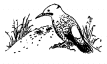
Many names and frequent mention Show that I receive attention, And the honor that is due me; But if you would interview me Call me any name you please, I'm 'at home' among the trees. Yet I never cease my labors To receive my nearest neighbors, And 'twill be your best enjoyment Just to view me at employment.
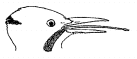
I'm the friend of every sower, Useful to the orchard grower, Helping many a plant and tree From its enemies to free,— They are always food for me. And I like dessert in reason, Just a bit of fruit in season, But my delicacy is ants, Stump or hill inhabitants; Thrusting in my sticky tongue, So I take them, old and young.
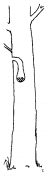
Surely we have found the best Place wherein to make our nest— Tunnel bored within a tree, Smooth and clean as it can be, Smallest at the open door, Curving wider toward the floor. Every year we make a new one, Freshly bore another true one; Other birds, you understand, Use our old ones, second-hand,— Occupying free of rent, They are very well content. To my wife I quite defer, I am most polite to her, Bowing while I say, 'kee-cher.' Eggs we number five to nine, Pearly white with finish fine. On our nest we sit by turns, So each one a living earns; Though I think I sit the better, When she wishes to, I let 'er!
—Flicker.
Zip and Phoebe (A Cat-Bird Story)
BY FLORENCE A. VAN SANT
E
arly each spring I watch for the return of a Phœbe bird, which usually gladdens my heart by his appearance about sundown of some bright day. He is alone, because, according to most authorities, he travels in advance of his mate; and when I ask with wonder, "Well Peter, where is Phœbe?" with a quick dip of his tail and an expressive twitter, he seems to say, "She will arrive on the next train."
For several years they have returned to the same nest beneath the roof of my veranda, each spring re-lining the inside and brightening the outside with green moss. They always raise two broods. They are very tame, and from year to year do not seem to forget their confidence of the previous summer, and will perch on the cedar tree close to the porch, or light on the rope of the hammock only a few feet away from me.
'ZIP'
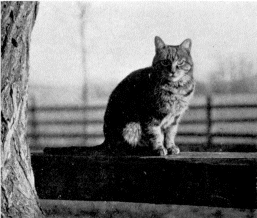
I have so trained my cat, Zip, that she thinks it is as wicked to look at a bird as she does to climb on the table, and never does either. Peter and Phœbe seemed to know that they had nothing to fear from her; and, when sitting on the little white eggs, their bright eyes would peep over the nest at Zip, sitting or napping in the easy chair below. When the young birds arrived, the parents would fly back and forth feeding them, without showing any more fear of the cat than they did of me.
While busy in the house one day, my attention was attracted by a loud tapping at the window, and on looking up I saw Phœbe apparently in great distress. She would fly at the window, striking the glass with her bill, circle round, fly back again, and tap, as though trying to attract my attention. Upon my appearance at the door, she flew toward the nest and, pausing on the wing, as a Kingfisher will poise over the water when seeing a fish, uttered sharp cries, fluttering her wings all the while, and telling me in bird language of her trouble. There sat a cat on the chair just below the nest, but it was not Zip. She had taken no other cat into her confidence, hence her alarm. When I drove the strange cat away, she quieted down and administered to the wants of her family as usual.
This little incident seems to show that birds become so accustomed to their environments that they know each member of the family, even to the dog and cat, and that they possess a certain degree of reasoning power.
One day later in the season, when they were raising the second family, my attention was again attracted by the same cries. A pair of my tame Pigeons, looking for a place to build, had lighted on the cornice over the door not far from the nest, and both Peter and Phœbe were trying to drive them away. They would dart almost up to them, all the while snapping their bills vigorously, as though catching a succession of insects, but before the Pigeons could strike with their wings, would dart away, and like a flash be back again. They did not seem to be calling on me for assistance, but were themselves fighting for what they considered their rights, and evidently did not think Pigeons "as harmless as Doves." The warfare continued at intervals for several days, until the Pigeons decided it was an unpleasant locality for a future home, and retired to the barn.

Birds Through a Telescope
The season is approaching when the migration of birds may be studied to advantage through a telescope. A 2-inch hand glass may be used, though a higher power is preferable. It should be focused on the moon, across the surface of which the bird is seen passing.
September 3, 1887, at Tenafly, N. J., Mr. John Tatlock, Jr., and myself, using a 61/2-inch equatorial, saw 262 birds cross the moon's disc between the hours of eight and eleven (The Auk, V, p. 37), and we have since repeated the observation.
Studies of this nature should throw much light on the question of 'highways of migration,' and at the same time furnish an idea of the number of birds passing through a given space during a given time; and, more particularly, they should tell us the height at which birds perform their nocturnal journeys.
Mr. Tatlock and myself solved this latter problem by a hypothetical assumption of the inferior and superior distances at which a bird would be visible. In this way we arrived at the conclusion that the birds seen were between one and three miles above the earth.
Until recently this theory has lacked confirmation, but I now learn from Dr. William R. Brooks, Director of Smith Observatory, at Geneva, N. Y., that during the evening of May 23, 1899, while observing the moon through his 101/8-inch refracting telescope, using a power of 100 diameters, he saw some forty birds cross the field of vision. Dr. Brooks states that from the distinctness of the image and the fact that from three to five seconds were required by each bird to cross the segment of the moon in the field of the telescope, he estimates the birds to have been distant about seven and a half miles, and further calculation, based on this estimate, places them about two miles above the earth.—Frank M. Chapman.
The Cardinal in Maine
This incident is vouched for by Mrs. L. M. N. Stevens, National President of the W C. T. U.
Several years ago, after the first snowfall at Stroudwater, Maine, Mr. Stevens hurried into the house one morning to ask his wife to come and see a handsome, but cold and hungry-looking, red bird, in a shrub near the door. Mrs. Stevens saw that it was a Cardinal Grosbeak, and, placing some food in a large cage, she set it near the bush. The Cardinal soon hopped inside, and was safely convoyed indoors under cover of a blanket. A happy season began. He was given the freedom of the room, and became very tame and companionable.
In the spring, as soon as the red bird grew restless and the weather mild, he was let loose, and flew away.
In the fall, with the first cold snap, came the Cardinal, to spend his second winter in the old home.
Again in the spring, when the restlessness re-appeared, Mrs. Stevens wanted to let the bird fly, but yielded to the judgment of her husband, who advised delay, lest cold and hunger overtake the little wayfarer. Nature, however, avenged the violation of instinct; in a few days the Cardinal drooped, refused to avail himself of liberty, and died.—Ella Gilbert Ives, Dorchester, Mass.
A Useful Bird
In speaking of the economic value of certain of our birds, a lecturer, quoting Professor Beal, said that in Iowa the Tree Sparrow was estimated to destroy 875 tons of the seeds of noxious weeds annually.
As reported in a local paper, this statement read: "The Tree or Chipping Sparrow destroyed, as discovered by scientific observation, 640,000 tons of the eggs and young of harmful insects."

Wild Life at Home: How To Study and Photograph It. By Richard Kearton, F. Z. S. Fully Illustrated by Photographs taken Direct from Nature by C. Kearton. Cassell & Company, Ltd., London, Paris, New York, and Melbourne, 1898. 12mo, pp. xiv + 188. Numerous half-tones. Price, $1.50.
In this book, Mr. Kearton and his brother show that their patience and ingenuity, as well as their field of work, are inexhaustible. It differs from 'With Nature and a Camera' chiefly in being addressed more especially to photographers, the opening chapters being devoted to a description of the outfit required, with practical suggestions as to its use. These are followed by chapters on 'Birds,' 'Mammals', 'Insects,' and the life of 'Pond, River and Seashores.' The illustrations are fully up to the standard of previous work by the same authors, which we have before had occasion to praise so highly, and continued experience with a camera leads us to appreciate more fully than ever the truly marvellous pictures they have secured. Mr. Kearton's paper in this number of Bird-Lore admirably illustrates the practicability of his advice to naturalist-photographers, who, in 'Wild Life at Home' will find both instruction and encouragement. The book should be in every naturalist's library, whether or not he uses a camera.
F. M. C.
Birds. By Annie M. Grant. Report of the R. I. Board of Agriculture, 1899.
The Birds of Ontario, in Relation to Agriculture. By Chas. W. Nash, Ontario Department of Agriculture, Toronto.
In Mrs. Grant's paper we have an epitome of a great amount of useful information. The horticultural and agricultural societies are doing a good work in publishing such papers in their reports, thus ensuring to them a wide circulation among the class who most need this kind of literature.
In that portion of her paper devoted to the 'Decrease in Bird-life,' Mrs. Grant puts her finger on some very sore spots. There can be no doubt that much harm has been done through egg-collecting by pseudo-naturalists, who make no use of their collections except to boast of their size and rarity, and who gather thousands of extra sets for purposes of exchange. Another element of bird destruction is seen in the South, where our common singing birds are so generally offered for sale in the market as food. A campaign of education is needed here. The time wasted in shooting these useful creatures would, if properly applied, produce more and better meat in the shape of domestic poultry, or other equally palatable food. We hope Mrs. Grant will continue her good work.
In Mr. Nash's paper we have another concise statement of the facts with regard to the usefulness of birds from an agricultural point of view. The case of the birds of prey is very clearly and forcibly presented. When these birds do harm—as when they pick up a stray chicken—the evil is open and apparent to everybody; but the good work they are constantly doing is only appreciated after the most careful and systematic observation. The depredations of the vast hordes of small mammals is a constant menace to the interests of husbandry, and more especially to horticulture. Without question, the Hawks and Owls are the most efficient checks upon the increase of these creatures, and it cannot be too often or too forcibly impressed upon the farmers that these birds should be rigorously protected.
With regard to the other birds, the case is equally well put, and illustrated by many interesting and valuable observations and experiments. There can be no question that this is a valuable paper, and that it deserves a wide circulation among agricultural people.
As to the merits of the illustrations with which it is embellished, there may be differences of opinion.—F. E. L. Beal.
On the Birds' Highway. By Reginald Heber Howe, Jr. With Photographic Illustrations by the Author, and a Frontispiece in color from a Painting by Louis Agassiz Fuertes.
This is a contribution to the class of literature which John Burroughs and Bradford Torrey have made so deservedly popular. It cannot, however, be said that the author has reached the standard of his prototypes. His observations were made in the Atlantic states from Virginia to Maine, and his descriptions bear evidence of sympathy with his subject. The illustrations include an admirable frontispiece of Chickadees by Louis Fuertes, thirteen full-page half-tones, for the most part illustrating the localities described, and numerous half-tone 'thumb-nail pictures' in the text, largely taken from mounted birds. Some of the latter are effective; others are too small or too indistinct to be of value to those who would need them.
An appendix gives nominal lists of the birds observed at Bristol, R. I.; Washington, D. C.; Chevy Chase, Md.; Hubbardstown, Mass., and Chateaugay Lake, N. Y.—F. M. C.
The Danger of Introducing Noxious Animals and Birds. By T. S. Palmer. Yearbook of the Department of Agriculture for 1898, pp., 87-110; 1 half-tone plate and 6 cuts in the text.
Birds as Weed Destroyers. By Sylvester D. Judd. Yearbook of the Department of Agriculture for 1898, pp., 221-232; 1 half-tone plate and 7 cuts in the text.
Economic Relations of Birds and Their Food. By F. E. L. Beal. Reprinted from the Proceedings of the Twenty-fourth Annual Meeting of the New Jersey State Horticultural Society, January 4 and 5, 1899.
As long as man's attitude toward nature is the standpoint of dollars and cents, bird-lovers will welcome every fact which places them in possession of a fresh argument to be used where appeals to sentiment are of no avail. It is, therefore, with great satisfaction that we receive these sound, convincing papers on economic zoölogy.
Dr. Palmer's paper has long been needed and, fortunately or unfortunately, so unanswerable are the facts which he presents, that one would imagine universal knowledge of them would be all that was necessary to avert further danger from the introduction of exotic species. The subject, however, should receive the prompt attention of legislators, in order that it may be duly placed under the control of the proper authorities—obviously the officials of the Biologic Survey of the United States Department of Agriculture.
In giving us the results of his studies of the food of certain seed-eating birds, Dr. Judd at the same time places their economic importance so far beyond dispute that we trust every agriculturist in the land may become familiar with his facts and figures. None of the many valuable papers issued by the Biological Survey has had a more obvious value than this one.
In his lecture before the New Jersey Horticultural Society, Professor Beal discusses unprejudicedly birds' power for good or evil. He shows that while insects, especially certain noxious species, have greatly increased since the settlement of this country, birds have decreased, and that in order to restore the balance disturbed by man, an increase in the number of our birds is greatly to be desired.—F. M. C.
Book News
Every lover of animals must rejoice in the phenomenal success achieved by Ernest Seton Thompson's 'Wild Animals I have Known.' Although published only last October, over 14,000 copies have been sold, and the book's popularity increases as its charm becomes more widely known. Mr. Thompson has done more to bridge the gap between human life and animal life than any writer we have known. One has only to read his work to become convinced of one's kinship with the lower forms of life.

A Bi-monthly Magazine Devoted to the Study and Protection of Birds
OFFICIAL ORGAN OF THE AUDUBON SOCIETIES
Edited by FRANK M. CHAPMAN
Published by THE MACMILLAN COMPANY

Vol. 1 August, 1899 No. 4
SUBSCRIPTION RATES.
Price in the United States, Canada, and Mexico, twenty cents a number, one dollar a year, postage paid.
Subscriptions may be sent to the Publishers, at Englewood, New Jersey, or 66 Fifth avenue, New York City.
Price in all countries in the International Postal Union, twenty-five cents a number, one dollar and a quarter a year, postage paid. Foreign agents, Macmillan and Company, Ltd., London.
Manuscripts for publication, books, etc., for review, should be sent to the Editor at Englewood, New Jersey.
Advertisements should be sent to the Publishers at Englewood, New Jersey, or 66 Fifth avenue, New York City.
COPYRIGHTED, 1899, BY FRANK M. CHAPMAN.
Bird-Lore's Motto:
A Bird in the Bush is Worth Two in the Hand.
The advice of a prominent ornithologist to beginners to collect all the birds of a species they can get, has so long misrepresented the necessities of the case and, at the same time, brought legitimate collecting into disrepute, that every one having the interests of the science of ornithology at heart will read with great satisfaction the circular entitled 'Hints to Young Bird Students' which we reprint on another page. Signed by a majority of the professional ornithologists of this country, representing the institutions where ornithology is most actively studied, it may be accepted beyond thought of dispute as representing the true attitude of scientific ornithologists toward the question of collecting. And in place of the advice to kill all the birds "you can get," what do we find? Virtually a plea to abstain from all egg-collecting, to take birds only for purposes of identification, and a statement that the student "will learn more of value by a study of the living bird than by collecting skins."
To our mind, the importance of this circular cannot be over-rated. It marks an epoch in the history of North American ornithology. The future ornithologist is not to be a mere hoarder of birds' skins, but a student of bird-life whose researches, we predict, will prove an invaluable aid in the solution of that most difficult and most important of all biologic problems, the relation of animals to their environment.
The paper by Mrs. Olive Thorne Miller on 'The Ethics of Caging Birds,' published in the last number of Bird-Lore, has been both commended and condemned. Some correspondents have considered it a most rational and unprejudiced treatment of the subject, others have written that as its general tenor might encourage the caging of birds, it was not to be endorsed. Particularly do they deplore what Mrs. Miller feels to be "a work of charity,"—the rescuing of birds "from the discomforts of a bird-store" for, they say, that the dealer replaces the sold bird with another, and the final result is to encourage the trade in birds. Of this there can be no doubt, and the question, therefore, becomes one for debate, as to whether the pleasure to be derived from the companionship of a caged bird, the humanizing influence which may be exerted by association with a creature dependent on us, and the knowledge we may acquire of its habits, justify us in depriving it of its liberty—assuming, of course, that it receives proper care. We shall be glad to receive the opinions of our readers on this subject.
'The Century' for July has an illustrated article on Bird Rock, in the Gulf of St. Lawrence, by the Editor of this journal, which, it should be said, would have appeared in Bird-Lore had it not been disposed of before this magazine was established. This statement will also apply to an article on Pelican Island, Florida, which will appear in 'St. Nicholas' for September.
Dr. Coues having retired from the Editorship of 'The Osprey,' Dr. Gill, who had withdrawn his name from recent numbers, assumes control.

"You cannot with a scalpel find the poet's soul, Nor yet the wild bird's song."
Edited by Mrs. Mabel Osgood Wright (President of the Audubon Society of the State of Connecticut), Fairfield, Conn., to whom all communications relating to the work of the Audubon and other Bird Protective Societies should be addressed.
DIRECTORY OF STATE AUDUBON SOCIETIES
With names and addresses of their Secretaries.
New Hampshire Mrs. F. W. Batchelder, Manchester.
Massachusetts Miss Harriet E. Richards, care Boston Society of Natural History, Boston.
Rhode Island Mrs. H. T. Grant, Jr., 187 Bowen street, Providence.
Connecticut Mrs. William Brown Glover, Fairfield.
New York Miss Emma H. Lockwood, 243 West Seventy-fifth street, New York City.
New Jersey Miss Anna Haviland, 53 Sandford Ave., Plainfield, N. J.
Pennsylvania Mrs. Edward Robins, 114 South Twenty-first street, Philadelphia.
District of Columbia Mrs. John Dewhurst Patten, 3033 P street, Washington.
Wheeling, W. Va. (branch of Pa. Society) Elizabeth I. Cummins, 1314 Chapline street, Wheeling.
Ohio Miss Clara Russell, 903 Paradrome street, Cincinnati.
Indiana Amos W. Butler, State House, Indianapolis.
Illinois Miss Mary Drummond, Wheaton.
Iowa Miss Nellie S. Board, Keokuk.
Wisconsin Mrs. George W. Peckham, 646 Marshall street, Milwaukee.
Minnesota Mrs. J. P. Elmer, 314 West Third street, St. Paul.
Tennessee Mrs. C. C. Conner, Ripley,
Texas Miss Cecile Seixas, 2008 Thirty-ninth street, Galveston.
California Mrs. George S. Gay, Redlands.
The Responsibility of the Audubon Society
Now that the Audubon Society is recognized as a factor in the higher civilization of the day, it may be well to ask how far it realizes its responsibility as a public educator.
"For the Protection of Birds," is a most reasonable and tangible declaration of motive, but what next?
The male and female public is straightway asked to give up certain habits that it has regarded as inherent rights,—in the cause of humanity and agricultural economy.
So far so good; but should not these would-be teachers of good will to animals, themselves be educated in consistent humanity, in order to keep their doctrines above the ridicule level?
Upon the discrimination of its humanity depends the future of the Audubon Society. A discrimination that shall render its workings logical, and make it able to see that it must at least give as much as it takes. A breadth of knowledge to realize that if the Society restricts the hat trimmings of women, the egg-collecting habits of boys, and the "just to see if I can hit it" proclivities of both boys and men, it is bound to give them something beside "the consciousness of rectitude" in return. The very least it can do is to help them to become as intimately acquainted with "the bird in the bush" as they were with the egg in the pocket and the feather on the hat.
It is here that the educational responsibility of the Audubon Society lies. Instead of issuing tracts simply to decry feather-wearing, and to say that something should be done, I would have each Society send out one or more illustrated bird lectures to the remoter corners of its range, where people do not have the privilege of hearing professional ornithologists. Also to the groups of remote country schools whose scholars have no "key to the fields" that lie so close at hand. I would have the Societies send small circulating libraries of bird books in the same way. To introduce people to the bird in the bush is the way to create a public sentiment to keep it there, and to make it possible to obtain legislative authority for the enactment and keeping of good bird laws, which are the backbone of protection.
Again, there should be no sort of conflict between ultra bird protectionists and legitimate scientific ornithology. That many of the best known ornithologists occupying public positions in the United States favor the restriction of egg-collecting, etc., is amply proved by a leaflet issued in May, by Witmer Stone,[H] called "Hints to Young Bird Students," and signed by such men as J. A. Allen, Robert Ridgway, C. Hart Merriam, A. K. Fisher, Wm. Brewster, F. M. Chapman, John H. Sage, C. W. Richmond, T. S. Palmer, and Wm. Dutcher.
The Audubon Societies are responsible for meeting these liberal-minded and progressive scientists half way. There must be anatomists and embryologists to study the human body, why not then, also, of the feathered brotherhood, only it is not necessary for mankind in general to keep skeletons of either birds or people in their closets for this purpose, and the random collecting of either should be regarded as equally reprehensible.
I would see humanity and science allied in this matter. If the Audubon Societies confess that this is impossible, they are taking the responsibility of harnessing humanity with ignorance,—a horse that will drag any companion into the ditch.
Let "For the Protection of Birds" be the banner motto under which the Audubon Society shall go out, as it is bound, to teach (not to preach) the 'bird in the bush,' but the teaching need be none the less humane, and will be far more effectual if, instead of 'dicky-bird' platitudes of uncertain sex and species, it deals out good, sound, popular ornithology.
M. O. W.
The So-called Sparrow War in Boston
In the month of March, 1898, a committee organized by the American Society of Bird Restorers presented to the Mayor of Boston in person the following petition, signed by a host of representative Bostonians:
"To Hon. Josiah Quincy, Mayor of Boston.
"The undersigned petitioners hereby respectfully represent that the presence in Boston of hosts of the noxious imported Finch, known as the English Sparrow, has come to be a public nuisance, general expense and serious esthetic injury, imperatively calling for prompt municipal abatement.
"Your petitioners would, therefore, most earnestly request that, as the Chief Executive Officer of the city, you direct the immediate reduction and suppression of this pest in such places (instancing the Common and, conditionally, the cemeteries of Boston) as may now be under, or may with this purpose in view be brought under, municipal control."
Under the law of 1890, the Mayor proceeded at once to take such measures as seemed advisable for clearing the Common, Public Garden, and city squares, of the Sparrow pest.
The work was done under the general oversight of the Committee on the English Sparrow, of which Mr. Fletcher Osgood, manager and organizer of the Bird Restorers, was and is the chairman. Five men, with Foreman Kennedy, proceeded to clear English Sparrow nests from the Common, by removing them from orifices in the trees, from openings in the Sanitary Building, and from electric hoods. The nest-boxes, put up years ago by misguided persons to accommodate the English Sparrow were all removed, and the Sanitary Building on the Public Garden was cleared.
In the progress of this work, thousands of small orifices in the trees of the Common (all known to exist) were cleared out and effectively closed with wooden stoppers, and much dead wood, inviting the breeding of the Sparrow, was removed. As a whole, great good in the way of arresting decay and generally improving the trees of the Common was done by Foreman Kennedy and his force, even if we leave out of account the checking of the breeding of the Sparrow. The work began on March 15, and ended April 5. During that period about 5,000 nests and 1,000 eggs were destroyed. No young birds were found. The protest against the work, based mainly on sentimental grounds, which Mr. Angell, of the S. P. C. A., put forth, resulted in two picturesque hearings at the City Hall. An account of these hearings, with some of their informal adjuncts, would certainly entertain and instruct the readers of Bird-Lore were it possible to embody it here.
Let it suffice to say, that the weight of common sense, of real humanity, and of economics, as well as of science in overwhelming measure, was, in the judgment of the best informed, wholly with those who would reduce the Sparrow. The Mayor, however, decided to suspend the work, assigning as a reason the difficulty and expense of continuing it. The committee sent to the Mayor a letter expressing its regret that the work should thus be brought to an untimely close, and fully outlining plans for its continuance. At the present writing, no definite prospect is in sight of the resumption of the work. The committee proposed, after the closure of the nesting orifices, to pull down by means of hooked poles such nests as were built by the Sparrows in the branches of the trees on the Common and Garden, timing visits so as to destroy nests and eggs only, thus preventing the hatching of young. With the onset of cold weather it was proposed to trap and destroy the Sparrow by devices which were already proved at once efficient and merciful. These two methods, aided, perhaps, by others, carefully planned to avoid cruelty, were the ones much relied on by the committee to do the needed work of clearance.
After the stoppage of the work the Mayor wrote to Chairman Osgood, asking his opinion as to the advisability of putting up bird-houses on the Common, so built, without perches, as to keep out the Sparrow and admit the White-bellied Swallow, Bluebird and House Wren. Mr. Osgood replied in effect that perchless bird-houses, judging from recent evidence, would probably invite and shelter the breeding of the Sparrow, and, with the Common still uncleared, would hardly aid in restoring any native bird. He was willing, under certain strict conditions, that the experiment should be tried purely as an experiment, provided that every box should be instantly removed upon proof that these perchless devices sheltered the Sparrow. He, however, expressed little hope that any good would come of such a measure beyond the absolute demonstration, once for all, and publicly, that perchless boxes were not Sparrow-proof. The "Sparrow committee" could not advise the putting up of bird-boxes under existing circumstances, and if any are erected the responsibility for the trial will not rest in any way with this committee. At this writing, the Sparrows shut out from the tree orifices are building to some extent in the branches of the trees upon the Common. To note how extensively this breeding is carried on this season, and to attain general information as to the presence of any native birds upon the Common and Garden, a patrol of the Boston Branch of the American Society of Bird Restorers has been assigned to observation work through the spring and summer.
Results will be officially reported to the National Biological Survey (U. S. Department of Agriculture) at Washington, D. C.
Fletcher Osgood, Organizer and Manager of the American Society of Bird Restorers.
Reports of Societies
MASSACHUSETTS SOCIETY
In February and March, Mr. Ralph Hoffmann gave a course of eight lectures on birds, under the auspices of the Society. These were well attended, and not only increased the interest in bird study, but informed the public more fully of the work of the Society, and also added materially to the treasury.
March 22nd, the Society held a 'Hat Show' at the Vendome, which was a success. Many of the best milliners exhibited, and it served the purpose of interesting both milliners and public in the work of bird protection. In spite of bad weather, the room was crowded all day, and many hats were sold. The newspapers reported it with illustrations; the milliners were pleased; and the Audubon Society was talked about with renewed interest.
The Society has purchased the publisher's stock of the Audubon Calendar colored plates, without the Calendar numbers, and are offering them for sale at 25 cents for the set of twelve.
The large sale of the chart is very satisfactory, about 1,200 having been sold since Christmas. Appreciative letters are daily received, and the school teachers especially commend it.
New circulars have been purchased for distribution, from the University of Nebraska and Cornell University; also "A Letter to the Clergy," republished by the Wisconsin Society.
Harriet E. Richards, Sec'y.
CONNECTICUT SOCIETY
The second annual meeting of the society took place on June 1, in the United Church Chapel, New Haven Conn., and was largely attended. It being part of the policy of the Society to hold its public meetings each year in different parts of the state.
The president made a short address, outlining the work for the coming season, which will include: (1) the consideration of a practical method for destroying the English Sparrow, as a bird distinctly injurious to song birds and others having agricultural value; (2) an effort to obtain legislation to stop the spring shooting of shore and water birds; (3) the addition to the societies' equipment of several small libraries of bird books, to be circulated free throughout the state where there are no public libraries, after the manner of the lecture outfits; (4) the addition of an illustrated lecture suitable for small children.
The report of the corresponding secretary-treasurer showed a membership in the various classes of 814; also, receipts of over $500 during the year, no debts, and a balance in the treasury.
The chairman of the committee on free lectures reported the great success of the undertaking. The two lectures, "Birds about Home," by Mrs. Wright, and "Some Facts about Birds that Concern the Farmer," by Willard G. Van Name, having been out over fifty times since early spring. These lectures, accompanied by sets of colored slides and oil-lanterns, are loaned free to any responsible person within state limits, and the Granges have lately taken them up with results most gratifying to the Society.
A few changes were made in the management as the election of officers. Mrs. H. S. Glover, the first corresponding secretary and treasurer, having resigned, received a hearty vote of thanks for her work, and Mrs. Wm. Brown Glover was elected as general secretary in her stead, Mrs. Howard H. Knapp being elected treasurer.
The event of the meeting was the lecture by Mr. F. M. Chapman, upon Photography as an Aid to Bird Study, all the beautifully colored slides used as illustrations having been photographed from life.
The detailed annual report of the Society's work will be mailed upon application.
Helen W. Glover, Sec'y.
TENNESSEE SOCIETY
It is with great satisfaction that we report the organization in the court house at Ripley on May 26, of the Audubon Society of the State of Tennessee. Without the assistance of the southern states, the work of the northern section of the country must necessarily be hampered by the inability to protect the birds in their winter haunts and during the migrations.
It is also gratifying to note the common sense basis upon which the society is founded, the president, having stated in his initial address, that "the society had for its leading object the creation of a public opinion that would secure legislation in the interest of bird protection, that would spare our birds from threatened extinction."
… JUST READY. PRICE, $1 NET … ··
Nature Study For Grammar Grades
A Manual for the Guidance of Pupils below the High School in the Study of Nature
BY
WILBUR S. JACKMAN, A.B.
Dep't of Natural Science, Chicago Normal School
Author of "Nature Study for the Common Schools," "Nature Study and Related Subjects," "Nature Study Record," "Field Work in Nature Study," etc.
REVISED EDITION
In preparing this Manual, it has been the author's aim to propose, within the comprehension of grammar school pupils, a few of the problems which arise in a thoughtful study of nature, and to offer suggestions designed to lead to their solution.
That pupils need some rational and definite directions in nature study, all are generally agreed. But to prepare the outlines and suggestive directions necessary, and to place these within the reach of each pupil, is more than any ordinary teacher has time to do, even granting that she is fully prepared for such work. The utter futility of depending upon oral suggestions during the class hour, when the pupils are supposed to be doing individual work, is easily apparent on a moment's reflection. With a manual of directions in hand, each pupil may be made strictly responsible for a certain amount of work, either in the field or in the laboratory. This removes all occasion for that interruption in his work, which is, otherwise, due to the pupil's attempt to think and at the same time hear what the teacher says.
"Practical, complete, and, all in all, is the best manual we know to fit the student to do really effective science work in the high school…. Altogether both teacher and pupils who use this book are to be congratulated, for we are sure that through its use the whole field of nature study will assume new definiteness, practicality and interest."
—Southern Educational Journal.
"It is decidedly practical, and will be welcomed by many teachers who wish to respond in an intelligent way to the demand for nature study."
—Inland Educator.
PUBLISHED BY
THE MACMILLAN COMPANY, New York.
VOL. 1 No. 5 October, 1899 20 c. a Copy $1 a Year
COPYRIGHT, 1899, BY FRANK M. CHAPMAN
October, 1899
CONTENTS
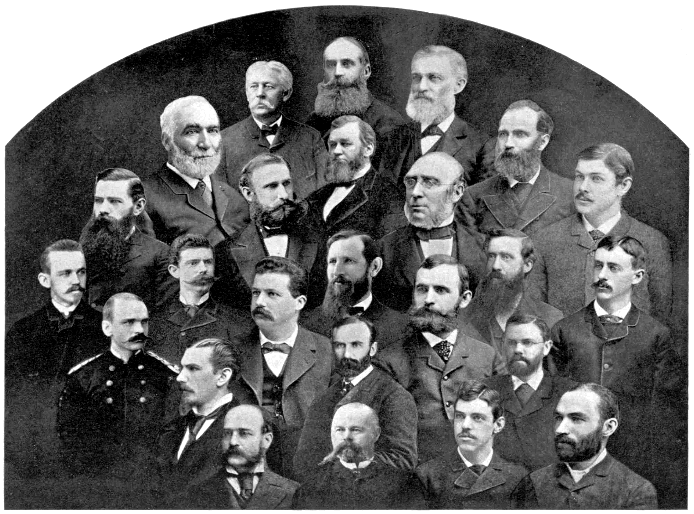
Frontispiece—Founders of the American Ornithologists' Union 142
The American Ornithologists' Union. Illustrated. J. A. Allen 143
American Bitterns. Photographed from nature by E. J. Tabor and F. M. Chapman 149
The Angler's Reveille. Illustrated by E. W. Smith. Henry van Dyke 150
The Prairie Horned Lark. Illustrated. Robert W. Hegner 152
Screech Owl. Photographed from life. A. L. Princehorn 154
A Pleasant Acquaintance with a Hummingbird. Illustrated. C. F. Hodge 155
A Peculiarity of a Caged Skylark. H. M. Collins 157
FOR TEACHERS AND STUDENTS
On the Ethics of Caging Birds—Letters to the Editor. Anna Harris Smith C. F. Hodge 158 160
FOR YOUNG OBSERVERS
Oliver Twist—Catbird. Isabella McC. Lemmon 163
NOTES FROM FIELD AND STUDY 166
Birds and Caterpillars, Caroline G. Soule; An Odd Nesting Site, L. H. Schwab.
BOOK NEWS AND REVIEWS 167
Mrs. Miller's 'The First Book of Birds;' Knoble's 'Field Key to the Land Birds;' Hodge's 'Suggestions for the Study of Our Common Birds;' Book News.
EDITORIALS 169
AUDUBON DEPARTMENT 170
Editorial: Illustration, Quills to Avoid; Audubon's Seal, illustrated; Report of the Society of the District of Columbia.
⁂ Bird-Lore is published on the first of the month, at Englewood, New Jersey, where all notices of change of address, manuscripts intended for publication, books, etc., for review, and exchanges should be sent.
PUBLISHERS' ANNOUNCEMENT
Bird-Lore for December will contain, among other interesting articles, 'The Story of a Pet Sea Parrot,' by E. W. Nelson; 'A Search for the Reedy Island Crow Roost,' by Witmer Stone; 'A Large Family,' by Frank M. Chapman, all illustrated. An account of How the Central Park Chickadees were Tamed by Anne A. Crolius, one of Garrett Newkirk's admirable bird poems for children, etc., and a detailed Statement of the Plans of the Magazine for 1900, including an announcement of special interest to all bird students.
FOUNDERS OF THE AMERICAN ORNITHOLOGISTS' UNION, 1883. T. McIlwraith. J. B. Holder. D. G. Elliot. Chas. Aldrich. J. M. Wheaton. E. A. Mearns. H. W. Henshaw. S. F. Baird. Geo. N. Lawrence. A. K. Fisher. Nathan C. Brown. Robert Ridgway, Vice Pres. J. A. Allen, Pres. William Brewster. Elliott Coues, Vice Pres. C. F. Batchelder. R. W. Shufeldt. C. B. Cory. C. Hart Merriam, Sec'y. M. Chamberlain. D. W. Prentiss. H. A. Purdie. C. E. Bendire. E. P. Bicknell. H. B. Bailey.

A BI-MONTHLY MAGAZINE DEVOTED TO THE STUDY AND PROTECTION OF BIRDS
Official Organ of the Audubon Societies

Vol. 1 October, 1899 No. 5
The American Ornithologists' Union
BY J. A. ALLEN
(First President of the Union)
During the sixteen years that have passed since the founding of the American Ornithologists' Union, in August, 1883, the study of North American birds has advanced with constantly accelerated strides. That this progress has been due largely to the founding of the Union is beyond denial, as will become evident from the following brief history of its work and the causes that led to its formation.
In all lines of human endeavor, the union of kindred interests and individual effort toward a common end is the key to success. Before the founding of the American Ornithologists' Union, its nucleus existed in a local organization of bird students in Cambridge, known as the Nuttall Ornithological Club. At first its meetings were informal, and its membership was limited to a few individuals living in the immediate vicinity of Cambridge. Later it became regularly organized as a club, with both resident and corresponding members, the latter embracing most of the leading ornithologists of this country. The papers presented at its meetings were often of permanent value, and were later published in scientific journals. In 1876 these had become sufficiently numerous and important to warrant the club in establishing its own medium of publication, the first number bearing date April, 1876, with the title 'Bulletin of the Nuttall Ornithological Club.' As years passed it served not only as the official organ of the club, but as a medium of communication between American ornithologists at large.
This led to the consideration of the desirability of organizing a national society of ornithologists as a means of bringing the workers in this field into more intimate association and more thoroughly consolidating their interests. The advantages of such consolidation seemed so evident that a call was issued August 1, 1883, dated Cambridge and Washington, for "a convention of American Ornithologists, to be held in New York city, beginning September 26, 1883." The call was signed by the editor of the 'Nuttall Bulletin' (J. A. Allen), associate editor of the 'Nuttall Bulletin' (Elliott Coues), and the president of the Nuttall Club (William Brewster). The response to the call, sent to forty-eight of the more prominent ornithologists of the United States and Canada, was most cordial; twenty-five expressed their intention to attend the convention, and twenty-one were actually present, including several who came a thousand miles or more to attend the convention. Not only were by-laws adopted and officers duly elected, but, as will be noticed later, important lines of work were laid out and assigned to committees, the principle of coöperation being applied in a broad sense.
The Nuttall Ornithological Club is still an active and widely known organization, although upon the founding of the Union, it generously voted to discontinue its 'Bulletin' and to place its subscription list and good will at the service of the Union, which was already considering the desirability of establishing an official medium of publication. As a result, the 'Nuttall Bulletin' became 'The Auk,' which, in recognition of the generous action of the Nuttall Club, was officially designated as the second series of the 'Nuttall Bulletin.'
Between isolated workers in any field, jealousies and misunderstandings arise which personal contact tends to obliterate. Such was the case with our ornithologists for some years prior to the founding of the Union. There were two rival check-lists of North American birds, each perhaps equally authoritative though differing in important details, which led to confusion, and a tendency to array our ornithologists into two somewhat hostile camps. This being recognized as a threatening evil of considerable gravity, one of the first acts of the Union was to appoint a committee on the Classification and Nomenclature of North American Birds, so constituted as to include the most competent authorities on the subject and at the same time safeguard all conflicting interests. The work of this committee long since became a matter of history. It was conducted with the utmost conscientiousness and care; personal interests and personal bias were generously waived, differences of opinion were settled by appeal to facts and the evidence, with a result that agreement was established in respect to all points of nomenclature and other technicalities, and a new impetus given to systematic investigation. Thus, through the work of this committee alone one of the primary objects in view in founding the Union was most happily accomplished. Not only a new check-list of North American birds was substituted for all previous check-lists, but a new 'Code of Nomenclature' was devised and adopted as the basis for determining the names to be used in the check-list. After more than two years of work by the committee the check-list, with its code of nomenclature, was given to the world in 1886, and became at once the accepted standard of authority with all American writers on North American birds; the 'Code' included important innovations in respect to certain principles of nomenclature, which have since become very generally accepted the world over. It is, therefore, to be regretted that a small faction has recently arisen in the ranks of the Union, that, objecting to certain rules of the 'Code,' is seeking to foment a break in the good feeling and harmony that have marked the last ten or twelve years of the history of American ornithology.
A second purpose of the Union was, as already intimated, to bring into coöperation and into personal acquaintanceship as many as possible of the workers in ornithology. In effecting this, the appointment at the first congress of the Union of a Committee on the Migration of North American Birds proved a most efficient means. This committee, with Dr. C. Hart Merriam at its head, began at once to issue circulars of instruction and schedules for the return of data to all bird observers known to the committee, whether members of the Union or not. Thousands of circulars were thus issued annually, reaching hundreds of earnest bird students who had before been working alone and without contact with the leaders in the science, who were thus not only stimulated and encouraged to fresh endeavor, but were placed in communication with a central bureau ever ready to aid their efforts. In a short time the work of this committee outgrew the financial resources of the Union, and led to the founding of a distinct division of the United States Department of Agriculture, designated the Division of Economic Ornithology and Mammalogy, of which the chairman of this committee was invited to become the official head, and which has since become the United States Biological Survey. The data on the migration and geographical distribution of North American birds gathered by this committee was turned over to this new Division of the Department of Agriculture for collation and publication, and the work of collecting further data was continued on an increased scale by the Chief of the Division of Economic Ornithology and Mammalogy. This has resulted in the accumulation of an immense amount of valuable material, but little of which has as yet been published. In 1888 a preliminary report on 'Bird Migration in the Mississippi Valley,' prepared by Prof. W. W. Cooke and Mr. Otto Widmann, under the direction of the chief of the division, was published, forming one of the most important contributions to the subject of bird migration that has yet appeared. A second report on 'The Land Birds of the Pacific District,' by Mr. Lyman Belding, was published in 1890, and, though issued by the California Academy of Sciences, was the outcome of the work of this committee. Eventually all of the vast accumulation of data inaugurated by the Union, and later carried on under the auspices of the United States Department of Agriculture, relating not only to the migratory movements of birds but to their distribution, will doubtless be published, with proper map and other graphic illustrations.
To another important committee appointed at the first congress of the Union was delegated the investigation of 'The Status of the European House Sparrow in America.' This committee issued circulars of inquiry, and made an elaborate preliminary report to the Union, which report was later, as in the case of the data accumulated by the Migration Committee, turned over to the Division of Economic Ornithology and Mammalogy of the United States Department of Agriculture. Under Dr. Merriam, the investigation was prosecuted with renewed activity, and a final and authoritative report was issued by the Department of Agriculture in 1889. It is needless to say that this impartially conducted report was strongly condemnatory of this burdensome pest.
At the second congress of the Union it appointed a Committee on Protection of North American Birds, which has been continued to the present time, and has been the guiding influence in this great economic and humanitarian work. It has done much to arouse and enlighten public opinion respecting the enormity of the destruction of birds for millinery purposes, and to guide legislation for the better protection of our birds. It early published two important 'bulletins' on the destruction of birds, and was the origin of the original Audubon Society, whose president, Dr. George Bird Grinnell, was long one of the most active members of this committee; through this society, with chapters throughout the country, the cause of bird protection was for several years immensely aided. Of late it has become practically the advisory committee of the existing Audubon Societies which have recently multiplied so gratifyingly throughout the country, and it publishes in 'The Auk' an annual report summarizing the work of bird protection for the year.
In extending a helping hand to casual and isolated observers, the Union has had a marked influence upon the recent progress of ornithology in America, as shown by the increase in the number of observers who have become contributors to 'The Auk,' and the constantly increasing number who have allied themselves to the Union by membership therein. The constitution of the Union provides for four classes of members; namely, (1) Active Members, limited to fifty, and to include only those who have distinguished themselves as original investigators in ornithology, and who reside in the United States or Canada; (2) Honorary Members, limited to twenty-five, and consisting of the most eminent of foreign ornithologists; (3) Corresponding Members, limited to one hundred, and consisting mainly also of eminent foreign ornithologists; (4) Associate Members, unrestricted as to number, but limited to residence in the United States or Canada. This class includes not only a large number of experienced field workers, but many college professors, educators, and persons eminent in other scientific fields, but who are not expert ornithologists. It is open to all reputable persons whose interest in ornithology is sufficient to prompt them to seek such a congenial alliance.
At the first congress forty-seven ornithologists were elected to active membership—presumably all of the satisfactory candidates available. Of these forty-seven original members, twenty-four were either present or took a prominent part in the organization of the Union, and are thus termed 'Founders.' (The accompanying photograph is a picture of these founders, made up from separate photographs, it being impracticable for the members to assemble to be photographed as a group.) This has remained about the average number, but, as years have passed, the choice for the few coveted places has become harder and harder each year to fill, through the rapid increase of not only available but desirable candidates; so that attainments that would in the earlier days of the Union have proved ample credentials for admission have now less weight, in the effort to select the best from a large otherwise desirable candidacy. The honor of the position has thus become enhanced through competition of merit. The two foreign classes have remained practically unchanged as regards numbers. But the class of Associate Members has increased from about one hundred in 1886 to nearly six hundred in 1898.
The revenue of the Union is derived entirely from the annual dues from members ($5 for active members and $3 for associate members) and subscriptions to 'The Auk.' As the ordinary running expenses of the Union are but a trifle, all of the proceeds from these sources of revenue are devoted to the publications of the Union. These include, besides 'The Auk,' now in its sixteenth volume, the original Code and Check-List of North American Birds (1886), an Abridged Check-List (1889), a separate reprint of the Code alone (1892), the second edition of the Check-List (1895), and nine Supplements to the Check-List (1889-1899), varying in size from about 8 to 36 pages.
'The Auk,' issued quarterly, consists on the average of about 420 pages per year, with at least four fine colored plates, and a greater or less number of text figures, including of late numerous half-tone illustrations of birds in life. As practically all of the funds of the Union are devoted to its publications, and mainly to 'The Auk,' its prosperity as regards its size, the frequency and character of its illustrations, and its influence in promoting the study of ornithology, is limited only by the proceeds from memberships and subscriptions. As it aims to meet the interests and the necessities of both the scientific and the non-scientific reader and contributor, the general articles, comprising more than half of each number, are about equally divided between popular and technical papers, while its department of General Notes (embracing some 15 pages in each number), is about equally acceptable to both classes, as with more or less technical matter for the benefit of the expert are blended notes on the habits and distribution of the lesser known species of our fauna, often of a highly popular character. The department of Recent Literature gives more or less extended notices of the current literature of ornithology, including general works, popular and technical, and of all the principal writings relating to American birds, whether faunal, economic, popular, or technical.
The meetings of the Union occur in November of each year, and heretofore have been held alternately in New York, Washington, and Cambridge or Boston. The present year the meeting, which will be the seventeenth congress of the Union, will be held in Philadelphia, Nov. 13-17, 1899. As usual, the public sessions, beginning on the 14th, will be open to the general public, to which all who are interested in birds are cordially invited.
AMERICAN BITTERNS Two of a brood of four birds about one week old, at which age they showed no fear of man Photographed from nature by E. H. Tabor, Meridian, N. Y., May 31, 1898
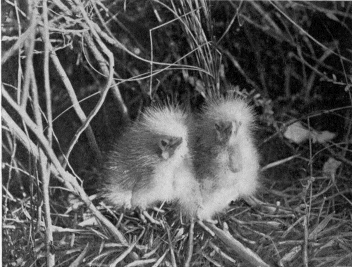
AMERICAN BITTERNS The four members of the brood, of which two are shown above, about two weeks old, when they showed marked fear of man Photographed from nature by F. M. Chapman, Meridian, N. Y., June 8, 1898
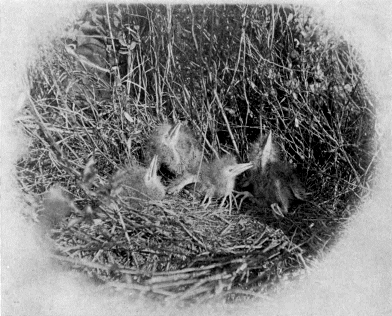
The Angler's Reveille
BY HENRY VAN DYKE
What time the rose of dawn is laid across the lips of night, And all the drowsy little stars have fallen asleep in light; 'Tis then a wandering wind awakes, and runs from tree to tree, And borrows words from all the birds to sound the reveille.
This is the carol the Robin throws Over the edge of the valley; Listen how boldly it flows, Sally on sally: Tirra-lirra, down the river, Laughing water all a-quiver. Day is near, clear, clear. Fish are breaking, Time for waking. Tup, tup, tup! Do you hear? All clear. Wake up! The phantom flood of dreams has ebbed and vanished with the dark, And like a dove the heart forsakes the prison of the ark; Now forth she fares through friendly woods and diamond-fields of dew, While every voice cries out "Rejoice!" as if the world were new.
This is the ballad the Bluebird sings, Unto his mate replying, Shaking the tune from his wings While he is flying: Surely, surely, surely, Life is dear Even here. Blue above, You to love, Purely, purely, purely. There's wild azalea on the hill, and roses down the dell, And just a spray of lilac still abloom beside the well; The columbine adorns the rocks, the laurel buds grow pink, Along the stream white arums gleam, and violets bend to drink.
This is the song of the Yellow-throat, Fluttering gaily beside you; Hear how each voluble note Offers to guide you: Which way, sir? I say, sir, Let me teach you, I beseech you! Are you wishing Jolly fishing? This way, sir! Let me teach you. Oh come, forget your foes and fears, and leave your cares behind, And wander forth to try your luck, with cheerful, quiet mind; For be your fortune great or small, you'll take what God may give, And all the day your heart will say, "'Tis luck enough to live."
This is the song the Brown Thrush flings Out of his thicket of roses; Hark how it warbles and rings, Mark how it closes: Luck, luck, What luck? Good enough for me! I'm alive, you see. Sun shining, no repining; Never borrow idle sorrow; Drop it! Cover it up! Hold your cup! Joy will fill it, Don't spill it! Steady, be ready, Love your luck!
The Prairie Horned Lark
BY ROBERT W. HEGNER
With photographs from nature by the author
At intervals throughout the winter, but more often after the first of February, flocks of hardy little brown birds may be seen about Decorah, Ia., wandering from place to place in search of food. They are the Prairie Horned Larks, harbingers of approaching spring. Some weeks later, when the snow has melted, they seek their favorite haunts in the pasture lands, select a slight elevation from the surrounding surface, and proceed to build their nests. They first dig a hole three inches wide and three inches deep in the softened ground, and then line it on the bottom and sides to the depth of an inch with dry grasses, making a warm nest, level with the surface. I accidentally discovered the first one this season on April 9. It was nicely lined with vegetable down in addition to the usual lining of dry grasses, and was finished ready for the eggs. I returned in a week, but, as the mother bird was not at home, had to content myself with a photograph of the three finely spotted eggs which it then contained. Some children who observed my movements may be held responsible for the destruction of the nest, as two days later I could find nothing but the hole from which it had been torn. After a short search another Lark flushed from a nest of three eggs almost identical with the first and about 300 yards from it. Unless incubation is far advanced they seldom flush from directly under foot, nor do they run along the ground first, after the manner of a great many of the ground builders, but keep a good look out, and fly straight from the nest when anyone comes within fifty feet of them. It is needless to say that it takes sharp eyes to discover their exact position.
NEST AND EGGS OF HORNED LARK
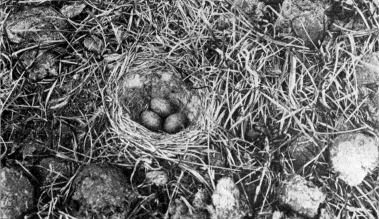
HORNED LARK AT NEST
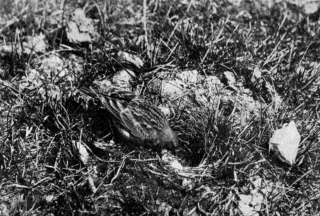
At my arrival on the bright, sunny morning of April 24, the Lark was at home, and I had another opportunity of trying to photograph her. I focused the camera three feet from the nest and retired to the end of my 60-foot rubber tube. The gophers seemed to be less afraid of me than the Lark, and several of them played together some ten feet away. One little striped rascal began gnawing at the rubber tube, and I was forced to frighten him away. This tube greatly puzzled the Lark, for in running around the camera she always came to a halt upon reaching it, and it was only after repeated trials and much excitement that she screwed up courage enough to hop over. Twenty minutes seemed to be sufficient time to reassure her, and with head lowered she hastened to the nest, looked in, and settled down upon the eggs. An exposure of one twenty-fifth of a second with stop 16 shows her as she was looking into the nest. While I reset my shutter and put in a new plate the Lark left the nest, but this time it took her only two minutes to return. A photograph of a young bird was taken on May 7. The pair of birds that were feeding this young one had already built a second nest, thinner and more loosely put together than the first, and were incubating four eggs.
The enemies of the Prairie Horned Lark seem to be very numerous. The nest and four eggs mentioned above were plowed under to facilitate corn planting, while innumerable nests are destroyed earlier in the season, when the farmers 'break sod.' The first nests in March and April are often subject to great changes of temperature. Although they may be built in warm, sunny weather, a sudden cold wave often covers them with snow and imbeds them in ice.
While waiting for the Lark to become accustomed to the camera, I had an excellent opportunity of observing its song flight. Lying there on my back, I enjoyed a splendid exhibition of one of this bird's peculiar traits. From a point a hundred yards from where I lay a happy songster suddenly arose, flying upward at an angle of 45 degrees, not continuously, but in short stretches. When at a great elevation he began to sing, taking short, quick wing strokes, and singing while he sailed. In this way a circle 300 yards in diameter was crossed and recrossed until fully five minutes had passed, when, suddenly closing his wings, he shot downward like a bullet, slowly catching himself on nearing the ground and curving outward to his starting point. Several similar exhibitions were carried on in exactly the same manner, the time not varying by half a minute. Though the song lacks many of the fine qualities of other birds, it clearly expresses the joy and happiness of the singer. With thrills of pleasure we hear it echo over the hills, and bless the little creature, hoping that in the 'struggle for existence' he may thrive and wax exceeding strong.
SCREECH OWL Photographed from life by A. L. Princehorn
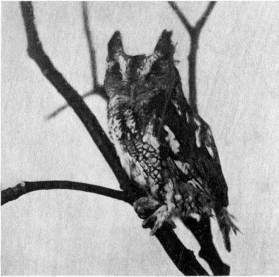
A Pleasant Acquaintance with a Hummingbird