Order VIII.—HEMIPTERA. Bugs, Frog-hoppers, Scale Insects, &c.
Reading edition
The structure of the mouth is the distinctive character of the insects of this great Order. Instead of the biting jaws (or sucking mouth) of many other insects previously described it is produced into a slender pointed tube of complicated structure, which usually lies along the under-surface of the head and thorax. This beak, called the rostrum, consists of a jointed sheath (labium) enclosing hair-like setae (mandibles and maxillae). When the insect feeds the sharp tip is pressed into its food, and the sap or juice sucked up, not by the proboscis-like sheath, but by the delicate enclosed setae. Kirkaldy doubts if the sheath “ever even penetrates the tissues, either vegetable or animal, unless these be already lacerated by the setae”; and it is often used only as a fulcrum to steady their operations.
In the outward appearance (often a deceptive character in classification) the members of this group are very dissimilar; probably no two insects could be more unlike than the typical plant bug and the ordinary scale insect.
They all undergo an incomplete metamorphosis, often changing their colours and even shape in the various moults before they are fully developed. The eggs of those living upon plants are generally deposited in clusters, and these are often very beautiful crystal spheres with stellate caps upon the summits. In other groups the eggs are buried in the tissue of the food plant or covered with woolly or sticky secretions.
They take the name Hemiptera from the structure of the fore wing, one half of which is, in the typical bugs, horny and the rest semitransparent.
The families of the plant and water bugs are much more closely related to each other than to the frog-hoppers, cicades and scale insects; and the whole Order has been separated into groups or sub-orders, viz., Heteroptera; Homoptera; Anoplura; Mallophaga.
Sub-order I. HETEROPTERA. Bugs.
This sub-division contains all the plant, carnivorous, and water bugs, which vary in size and shape from the tiny little leaf-infesting forms to the great “fish-killer,” Belostoma indicum, found in our water-holes.
They are usually furnished with two pairs of wings. The basal portion of the front pair is horny and opaque, and the apical half more or less transparent; this pair covers the larger hind pair, which, well adapted for flight, are folded up beneath when at rest. The members of some groups however are apterous.
Many are furnished with glands on the body secreting an offensive, buggy-smelling fluid, which they discharge when handled or disturbed.
Some species are serious pests to plant life, and swarm in countless thousands over vegetation, sucking up the sap and causing it to wither and die in consequence, as in the case of the Chinch Bug of North America upon wheat, and the Rutherglen Bug in Australia among field crops. Others are predaceous and very useful, destroying great numbers of leaf-eating grubs and caterpillars.
These insects are well represented in Australia, and many of the larger and more showy ones were collected and described at a very early date, and their descriptions are scattered through the pages of many scientific journals. Numbers of our species have been described by Westwood (Hope Catal. 1837); Dallas (List Hemip. 1851); Walker (Catal. Heter. Brit. Museum 1867); Distant (Trans. Ent. Soc. London, 1886, etc.); Kirkaldy (The Entomologist); and others in English journals; while among the Continental writers Messrs. Stal, Bergroth, Montandon, Horvath, and Reuter have been the chief workers.
In 1893 Messrs. Lethierry and Severin commenced a “Catalogue of the Described Heteroptera of the World”; three parts were published, but, probably owing to the death of Lethierry, it was never completed, part three closing with the Anthocoridae, and most of the aquatic groups are not listed. Dr. Mayr has in his “Monograph of the Belostomidae 1871” noted our species.
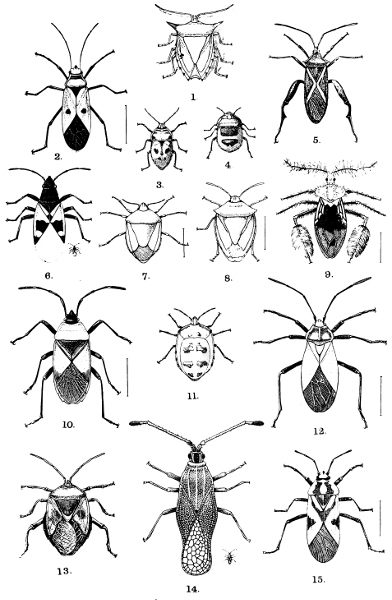
Plate XXXI.—HEMIPTERA.
Family Pentatomidae.
1. Biprorulas bibax (Bredden).
3. Peltophora pedicellata (Kirby).
4. Chaerocorus paganus (Fabr.).
7. Plautia affinis (Dallas).
8. Cuspicona simplex (Walk.).
10. Dindymus versicolor (Herr. Sch.).
11. Tectocoris lineola (Fabr.).
13. Oncoscelis sulciventris (Stal.).
Family Pyrrhocoridae.
2. Dysdercus sidae (Montrz.).
Family Coreidae.
5. Mictis profana (Fabr.).
Family Lygaeidae.
6. Oxycarenus luctuosus (Mont.).
12. Oncopeltus quadriguttatus (Fabr.).
15. Lygaeus hospes (Fabr.).
Family Reduviidae.
9. Ptilocnemus femoralis (Horvath).
Family Tingidae.
14. Froggattia olivina (Horvath).
Plate XXXI.—HEMIPTERA.
The Heteroptera have been divided into about twenty families, chiefly defined by the structure of the head and wings; these families are again subdivided into a great number of sub-families, many of the more important being represented in Australia.
Family 1. Shield Bugs. PENTATOMIDAE.
This group comprises many of our largest and most brilliantly marked tropical plant bugs, distinguished from all those of other families by the remarkable size of the scutellum which frequently covers the two pairs of wings and dorsal surface of the abdomen. The majority of these insects fly well. The head is usually furnished with 5-jointed antennae (though some are restricted to four joints), and two ocelli. It is one of the largest groups, and has been divided into fourteen sub-families. There are over 4,000 species in the family, and it is well represented in Australia. This family is sometimes known under the name Scutelleridae.
The Cherry Bug, Peltophora pedicillata, is a bright metallic green bug mottled with black spots on the back; the greater part of the under surface, edges of the thorax, and two blotches at the base of the scutellum are bright coral red: it measures ½ an inch in length and is broad in proportion. It has a range from New South Wales (where it is often found on strong-scented flowering shrubs and has been recorded as a cherry pest) to N. Queensland, where it is very abundant on the wild fig trees. Tectocoris lineola is so variable in size and colouration that it has been described under eight varietal names and has an extended range from the north of N.S. Wales through Queensland to New Caledonia and China. It has a broad, elongate, convex body of a bright orange colour edged on the margins of the body with metallic green; the dorsal surface is covered with curious green or blue patches reminding one of Chinese letters; sometimes these markings are almost absent, in others so confluent that it is more blue than red. Donovan named our variety T. banksi, after Sir Joseph Banks, who first obtained specimens from Australia. Chaerocoris paganus is under ½ an inch in length, and of an oval, beetle-like form; its general colour is red with dull metallic green forming blotches on the back, head, and sides of the thorax. It is very common at times crawling about on the rocks and ground about Sydney. C. similis is a smaller darker form, only taken about Gunnedah, N.S.W., but it probably has a wider range.
Philia basalis is one of the common fruit bugs of N. Queensland. It is slightly over ½ an inch in length, with elongate convex scutellum, and a uniform rich metallic green tint, with a bright coral-red spot behind the head and two similar ones at the base of the scutellum; the sides of the abdomen are bright red on the under surface. P. senator is a smaller, more variable form, with the coral-red markings not so distinct. Philia regia, about the same size as the last species, is of a rich coppery-red tint, with the hind portion of the back bright yellow, and the ventral surface and legs bright green and yellow. Both these species and P. senator are found along the Queensland coast.
The Genus Calliphara contains a number of large bugs, elongate but broadly rounded in front, with the scutellum forming a complete convex shield over the back; 26 species are described ranging from China through the Malay Peninsula to Queensland. Calliphara imperialis measures over ¾ of an inch in length, and has the whole of the dorsal surface, except the tip of the abdomen, bright shining red; the under surface, legs, and tip of abdomen are dark metallic green. C. billiardierei, about the same size, has the back and the under surface of the abdomen (except the tip) red; the head, thorax, legs and tip of abdomen deep metallic green with dull purple tints. C. cruenta is a much smaller species, the thorax and basal half of the back red, shading into purple toward the tip. C. nobilis has the head and thorax dark, with the dull red back spotted with black. All our species of this genus are found in the tropical scrubs of N. Queensland.
Cantao parentum measures over an inch in length, and is more elongate in form; it is of a uniform dull red tint, with the whole of the dorsal surface marked with small irregular black dots; the legs and under surface are black. It ranges along the Queensland coast. It has been reported to have attacked cherries in Southern Queensland. The Genus Testrica contains several little brown bugs, short and broad, with the front of the thorax more or less produced into a spine, and the extremity of the abdomen broadly rounded. Testrica bubala is not more than ⅙ of an inch in length, with the shoulders sharply spined; it is found upon the foliage of small gum trees.
The sub-family Cydinae contains a number of curious little black shining bugs that live on the ground and are often found hiding under stones. They are quick and active in their habits, and might easily be mistaken for small black beetles. Geobia australis, under ¼ of an inch in length, is of a uniform pitch-black colour, with the exposed tips of the elytra greyish-brown; it has spiny legs; the head is clothed with scattered hairs forming a fringe. Adrissa atra is a much larger black bug; it has pitch-coloured elytra with brown tips. This common species is found about Sydney under stones and rubbish.
In the Pentatominae we have a large number of species. They are broadest across the base of the thorax, which is sometimes slightly angulate; the scutellum is large and angular, occupying the centre of the back but not covering the whole of the wing covers. Notius depressus measures over ½ an inch in length, and is broad in proportion; the general colour is deep blue to purple, the sides of the head and thorax and ventral surface marked with yellow. It ranges from Tasmania to N.S. Wales.
Eumecopus australasiae has a wide range, and is often found in wattle scrub resting on tree-trunks. It measures about an inch in length, is a very active insect, and flies readily when disturbed. Its colour is dull brown, mottled with small dull yellow spots; these form several short parallel rows on the pointed head, and there is a distinct yellow spot at the apex of the scutellum.
The Genus Poecilometis contains 14 species peculiar to Australia. They are of the same general form as the last group, are found in similar localities, and are all of a more or less reddish-brown tint. Poecilometis histricus, about ¾ of an inch in length, is of a light brown colour with ochreous markings. P. gravis, found upon wattle scrub, is smaller than the last species and is of a more reddish-brown tint. P. strigatus, about ½ an inch in length, is of a similar brownish colour.
Dictyotus plebejus is one of our commonest little dull brown bugs; is about ¼ of an inch in length and nearly as broad as long. It has a wide range over Eastern Australia, and is found, often in numbers, under stones, dry cowdung, or dead logs. The genus is peculiar to Australia, and contains 18 described species.
Commius elegans is common on the foliage of the native cherry about Mittagong, N.S.W.; it is just under ½ an inch in length; is of a general blue black colour with the thorax and under surface yellow blotched with black; the sides and apex of the scutellum are edged with yellow; and a narrower transverse band of dull white crosses the back just below the tip of the scutellum. It has a wide range over Australia, and was described by Donovan in 1805. Plautia nigripennis is a much smaller plant bug, with the upper surface green, and the sides and tips of the elytra reddish brown; it ranges up the Queensland coast from the Tweed River, N.S. Wales. P. affinis is a pretty little green insect which feeds on rice and other plants in the northern district of N.S.W. It measures about ⅓ of an inch in length.
The members of the Genus Cuspicona range from India to Australia and New Caledonia; eight species are described from Australia. Cuspicona simplex is a finely rugose and green coloured bug about ⅓ of an inch in length, with the sides of the thorax produced into blunt spines, and the elytra broadly rounded to the tip. It infests many field crops and has been reported as doing serious damage to growing potatoes. C. thoracica is a small green species, with the thorax produced into a stout spine on each side. The head and a broad band across the thorax are reddish brown; the margins of the thorax and the centre of the scutellum are marked with bright yellow. It is common in the eastern coastal districts, and has been found feeding on ground crops about Gosford, N.S.W. C. forticornis is a larger green species with the thoracic spines red, and the dorsal surface thickly and finely punctured. It is common in the northern scrubs of N.S. Wales.
The Asopinae contains two well known species of Australian bugs: Cermatulus nasalis is common on the Richmond and Tweed Rivers, N.S.W. It measures slightly over ½ an inch in length, and has a somewhat rounded form, with a small projecting head. Specimens vary from an olive brown to almost black colour, and are mottled with deep red; the upper surface is deeply and closely punctured, and the tips of the elytra are metallic bronze. The Vine-moth Bug, Oechalia schellembergi, is one of our most interesting species from an economic point of view because it preys upon the caterpillar of the vine moth (Phalaenides glycine), several species of cut-worm, and the larvae of the fig-leaf beetle (Galeruca semipullata). They lay their rounded glassy eggs in patches of about a dozen upon the foliage, and the freshly emerged bug is dark brown, and flattened in form. The adult bug varies very much in size; the largest is about ½ an inch in length; it is very finely punctured, and is of a general light reddish brown colour mottled with yellow; the sides of the thorax are stoutly spined, and the abdomen is rather tapering toward the tip. It has a wide range over Australia, and is recorded from New Zealand.
The Spined Orange Bug, Biprorulus bibax, is a well known orange pest about Moree and the Tweed and Richmond Rivers, N.S.W. It is a handsome bright green bug when alive, but after death usually changes to dull yellow; it measures nearly an inch in length and ¾ of an inch across from tip to tip of the large thoracic spines; the front of the thorax between these stout spines is somewhat depressed; the abdomen is broad and rounded, and the dorsal surface finely punctured.
The Tessaratominae are usually large insects found upon plants, and among them are several destructive species. Among a number of hemiptera submitted to D’Horvath for identification were two species, viz., Rhoecocoris (Oncoscelis) sulciventris and Stilida indecora, which both in the larval and perfect state swarm over the orange orchards in the north of N.S. Wales and, by sucking up the sap of the stalks, cause the unripe oranges to fall. Their habits and life history being identical, Rhoecocoris (Oncoscelis) sulciventris, which was identified by Olliff in the Agricultural Gazette N.S.W. 1892, I at first confused with Stilida indecora (Ag. Gazette, N.S.W., 1901). S. indecora is of a more reddish brown tint than R. sulciventris, with the dorsal surface of the thorax not punctured, and the apical areas of elytra more bell shaped, while the venation is much finer; while the thorax of R. sulciventris is distinctly punctured and the anterior edge of the apical area of the elytra is broadly rounded. Oncomeris flavicornis is our largest Australian plant bug, over 1½ inches in length, of a broad shield shape, over ¾ of an inch across the rounded thorax, and of a general dark reddish brown almost black colour on the dorsal surface; each elytron is richly marked on the basal half with bright yellow, and the apical portion is rich metallic purple. It comes from the tropical scrubs of N. Queensland.
In the Sub-family Dinidorinae we have Megymenum insulare, a typical form very common on the foliage of the low scrub of the semi-tropical forests of N.S. Wales and Queensland. It is of a general chocolate brown tint, with the inner apical markings of the elytra dull white; it measures just under ½ an inch; the sides of the head and the front of thorax are furnished with short angular spines, which are also present round the outer edge of the abdominal segments; and the whole of the dorsal surface is rugose. The immature larvae are brown, flattened, and fringed right round with bract-like processes.
Family 2. Gum-tree Bugs. COREIDAE.
This group contains bugs in which the scutellum does not extend as far back as the middle of the body; the head is generally furnished with four-jointed antennae inserted above on the sides of the head; there are two ocelli; and the sheath of the proboscis consists of four segments. Many species have the femora of the hind legs dilated or armed with blunt spines. The majority are dull coloured insects that have no distinctive common name in Australia, so for want of better, I propose to define them as “Gum-tree bugs,” as many typical forms feed upon the young shoots of our gum trees (Eucalyptus). In America they are sometimes called “Squash Bugs” from their fondness for pumpkin plants. Over 1,500 species have been described and placed in 29 sub-families; and they are well represented in Australia.
The Mictinae are represented by one of our best known species, which I called the “Crusader Bug,” Mictis profana. It is a somewhat variable elongate insect just under an inch in length, of a uniform dull drab-brown, with the inner edge of each elytron marked with a dull yellow stripe, which, intersecting each other in the centre, produce a distinct cross on the back. The hind legs are thickened and the apex of the tibia forms a blunt spine. It has a wide range over Australia, and of late years has been found infesting the citrus orchards, where it punctures the young shoots and causes them to die back.
The Genus Amorbus contains 15 described species peculiar to this country, most of which feed upon the foliage of young gum trees and give out a very strong odour when touched; the young larval forms are often brightly coloured, but in the adult state all these bugs are dull brown. Amorbus angustior, under ¾ of an inch in length, has the dorsal surface flattened; the abdomen swells out on the sides beyond the edge of the folded elytra, and the whole surface is granulated or roughened. It is of a uniform chocolate colour with the antennae and abdomen rusty red. A. robustus is a much larger species, stout in proportion, with the same elongate form, but the edges of the abdomen not projecting beyond the wings.
Mutusca brevicornis is a very slender brown bug, about ½ an inch in length, usually found resting among the grass. The head and thorax are elongate, with the former produced in front of the antennae into two slender lobes; the elytra are long and slender, and the wings well adapted for flight. Riptortus robustus is also an elongate bug, but shorter and stouter, with the head short and angular; the thorax is short, rounded in front, and produced into a ridge behind, with a stout spine on either side. The body is long, constricted in the centre, and rounded at the tip: the thighs of the hind legs long, thickened and armed with a row of spines along the inner edge. The general colour is reddish brown.
The Genus Leptoglossus contains some handsome species which are remarkable for having the tibiae of the hind legs dilated into leaf-like processes. Leptoglossus membranaceus is an elongate, flattened, black bug banded with a slender red line across the thorax; the head is small, projecting in front of the triangular thorax; and the shield shaped body comes to a rounded tip. The fore legs are slender, but the hind pair are slightly thickened on the thighs and roughened on the inner edges; and the tibiae have leaf-like projections on either side, giving it a very remarkable appearance. It is common in North Queensland and ranges over Africa, India, Ceylon, and the Philippines.
Family 3. Chinch Bugs. LYGAEIDAE.
This is a family containing about 1,400 described species divided into thirteen sub-families, but many of the latter are very restricted in their numbers, the majority coming under the typical sub-family Lygaeinae. Their general characters are similar to those of the Coreidae except that the antennae are inserted below the eyes, and the head is not so flattened and more angular in front. They are smaller bugs of more delicate structure, and their prevailing colours are brown or black variegated with red and yellow; some of them, such as the Chinch Bug of North America, are very destructive pests. As they have no distinctive group name I have adopted Professor Comstock’s name of “Chinch Bugs.”
The Lygaeinae contain most of the bright coloured species, often marked with red; the wing covers are usually of a somewhat delicate texture.
Astacops laticeps, about ⅓ of an inch in length, is a slender black bug with the head and sides of the elytra bright red. Scopiastes vitticeps, about the same size, has the head, thorax, and sides of the body red. Both these insects are common on the grass and field crops on the Northern Rivers of N.S. Wales. Lygaeus hospes measures ½ an inch in length, is of the typical elongate form, and is black marked with bright red forming a broad indistinct cross on the basal portions of the elytra. It has a wide range from China and India to Australia and New Caledonia. L. mactans is a much smaller insect, with the head, base of thorax, and the greater part of each elytron bright red. It has a wide range over Australia, and is also recorded from Fiji. L. decoratus, about ½ an inch in length, has the whole of the head, thorax, and sides of the elytra banded with red and black; it comes from Queensland.
The Cotton Bug, Oncopeltus quadriguttatus, figured in my notes in the Agricultural Gazette 1901, should be according to Horvath O. sordidus, Dallas, though the latter name is given as a synonym of the first in L. and S.’s Catalogue. It measures ½ an inch in length, is of a general black colour, with the head and two depressions in the centre of the thorax dull red, and the scutellum and basal half of each elytron deep orange red; the abdomen is dull red and clothed with short down. They lay their eggs to form a ring round a twig, sometimes as many as a hundred in a cluster; the larvae are flat and almost circular in form, of a general red colour mottled with metallic blue spots, and the legs and antennae are dark coloured. This bug is common on the cultivated cotton plants about the Richmond River, and ranges from Sydney into Queensland.
The Rutherglen Bug, Nysius vinitor, is one of the most destructive plant bugs in Australia; breeding in grass lands, during the summer it swarms over all kinds of field crops and fruit trees in countless millions, sucking up the sap of both the foliage and fruit. It has a very wide range, and takes its popular name from the town in Victoria, in which it was first recorded damaging grapes. It is a tiny creature, under ⅙ of an inch in length, is dull brown to grey in colour with silvery grey wings; it is very active and flies well. It is so common that under favourable conditions it might become here as serious a pest as the Chinch Bug of North America. The Genus is a very extensive one, containing 69 species distributed from Greenland to S. America, thus almost world wide in its range.
The Coon Bug, Oxycarenus luctuosus, is a tiny black and white bug about the same size, originally described from New Caledonia. It is very common, chiefly in the inland districts, swarming over the ground in millions. When in the larval state, before the wings are developed, its general colour is bright red, and it is then much more noticeable, giving the fences on which it rests in the day time a curious blood-red tint. So far it has never been recorded as a plant pest, but that is probably only because it is chiefly a western species, where little fruit is grown.
Family 4. Fruit Bugs. PYRRHOCORIDAE.
These bugs differ from the last family only in the fact that they are not provided with ocelli. It is a small family containing under 400 described species, placed in two sub-families.
The Larginae contains a number of red coloured bugs, the majority of which are confined to South America. The members of the Genus Physopelta however belong to the Indian and Malay region; and P. famelica ranges from Ceram to Woodlark Island, and down the Queensland coast to the Tweed River. It measures under ¾ of an inch in length, is of the typical form, and of a general dull red tint, with the head, centre of the thorax, and legs dark brown; the centre of the scutellum and four spots on the sides of the elytra are black.
The Pyrrhocorinae comprise the bulk of this family, which are chiefly found in Africa and Asia. The “Harlequin Fruit-bug,” Dindymus versicolor, was originally described from Tasmania, but has a wide range over Australia. They shelter and breed in the crevices on tree trunks, and often damage ripe fruit. It measures slightly over ½ an inch in length; the under surface is yellowish, with the head and thorax blood red, the latter barred with white. The upper surface and legs are black, with the greater part of the thorax and basal half of the side of each elytron bright red. Dindymus circumcinctus is a slightly smaller, much darker species, the red only showing on the outer margins of the thorax and elytra. I have specimens collected near Sydney.
Dysdercus sidae belongs to a genus world wide in its distribution, and containing over 50 described species. This species is common on the Richmond River N.S.W., frequenting the cultivated cotton plants, where it can be seen running over the opening cotton bolls, and discolouring them with its excrement in the same manner as the “American Cotton Stainer,” Dysdercus suturellus, is reported to do in the United States. Our species measures about ½ an inch in length; it is red, with the scutellum and a distinct rounded spot in the centre of each elytron black. The antennae, eyes, and apical areas of the elytra are also black; the front and sides of the thorax marked with dull white.
Family 5. Lace Bugs. TINGIDAE.
These are all small plant bugs without ocelli; the terminal joint of the antennae is swollen or clubbed; the pronotum is large, covering the scutellum; the neuration of the elytra is very distinct, forming intricate, lace-like patterns; the feet consist of two joints. They are true plant-feeding bugs, generally sucking up the sap from the under-side of the leaf, and when numerous often become pests. Between four and five hundred species of Tingidae have been described, and are placed in two sub-families. Few species have been recorded from Australia, but this is probably not owing to their absence, but because collectors are apt to overlook these small creatures.
Serenthia pectipennis is a tiny dark brown bug, hardly ½ of an inch in length; the oval body is convex, and broadly rounded to the apex, with a curious lighter brown pattern on the elytra. It comes from Glen Innes, N.S.W.
The Olive-tree Bug, Froggattia olivina, was described from specimens sent to Horvath; its native food plant is the wild olive (Notalaea longifolia); the larvae infest the under surface of the leaves, and cause them to wither and drop off. It has now transferred its attention to the cultivated olive, and when numerous will almost defoliate the trees; it has a wide range over N.S. Wales, but I know no record of it from the other States. It is a slender, handsome little dark brown bug, about ⅙ of an inch in length, and has typical clubbed antennae. The elytra are swollen out toward the base, arcuate on the sides, and rounded at the extremities, with lace-like reticulations on the apical areas; the thorax is rounded and convex.
Oncophysa vesiculata is another curious little elongate bug, about the same length; of a uniform dark brown tint; the upper surface is marked with distinct ridges and fine punctures, and a pair of large bulbous processes stand up prominently at the base of the elytra. It is common about Sydney, where it feeds upon the little native cotton bush.
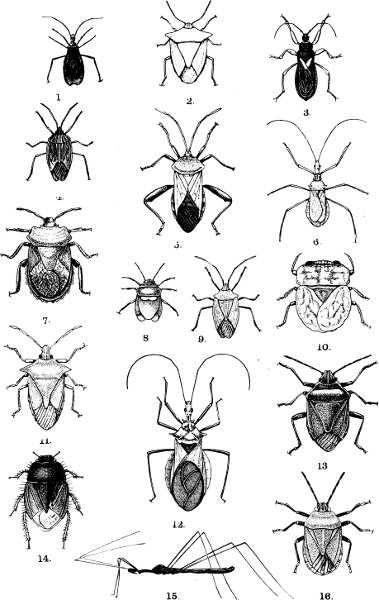
Plate XXXII.—HEMIPTERA.
Family Reduviidae.
1. Opistoplatys australasiae (Westw.).
3. Pirates ephippiger (White).
6. Pristhesancus papuensis (Stal).
12. Gminatus nigroscutellatus (Bredden).
15. Gardena australis (Horvath).
Family Pentatomidae.
2. Cuspicona forticornis (Bredden).
4. Poecilometis strigatus (Westw.).
7. Megymenum insulare (Westw.).
8. Philia basalis (Grey).
9. Poecilometis histricus (Stal).
13. Cermatulus nasalis (Westw.).
14. Geobia australis (Erich.).
16. Notius depressus (Dall.).
Family Coreidae.
5. Amorbus robustus (Mayr).
Family Galgulidae.
10. Mononyx annulipes (Horvath).
Family Pentatomidae.
11. Oechalia schellembergi (Guérin).
Plate XXXII.—HEMIPTERA.
Family 6. Fungus Bugs. ARADIDAE.
These are dull coloured black or brown bugs of moderate size, with the dorsal surface very rugose, and the whole insect thin and flattened, admirably adapted to the life it leads hidden under the dead bark on tree trunks, their chief food being fungous growths found upon the damp bark. Howard calls them “Flat Bark Bugs,” and remarks that they look as if they had been stepped upon.
They have the tip of the abdomen exposed, as the elytra are shorter than the body, which is also exposed on the sides when the wings are folded. Like the Lace-bugs (Tingidae) they have no ocelli, but, unlike them, they have the scutellum exposed. This family contains about 300 described species, divided into four sub-divisions. Erichson has described several from Tasmania (Arch. 1842); Bergroth (Verh. Z. b. Ges. Wien 1886) and Walker (Cat. Heter. 1874) others from Australia.
There are a number of undetermined species in our Museum collections, most of which are to be found upon fallen timber where the bark is rotting and peeling off the trunk.
Family 7. Water Striders. HYDROMETRIDAE.
These are aquatic insects, living upon the surface of the water, and some are even found on the open ocean, hundreds of miles away from land. They, like most other water-dwellers, are covered with a velvet-like pubescence; the head is ornamented with large projecting eyes; the antennae are four-jointed. They may be wingless; when present, the elytra are of a uniform texture. Most of the species are furnished with very long legs. The tarsi are two-jointed. About 160 species are described under four sub-families; only three or four are described from Australia; but more from the open waters of the Pacific Ocean.
In the genus Gerris, Skuse (Records of the Australian Museum, 1893) described a species from the waters of Sydney Harbour under the name of Gerris australis. It varies from dark shining olive to black on the dorsal surface; the ventral surface is yellow with grey tints. It is covered with a fine silvery pubescence, and measures ⅓ of an inch in length. Hydrometra strigosa, described by Skuse from specimens from the swamps about Botany, N.S.W., is a larger insect, of a uniform brownish yellow tint; and it has a more slender shape.
Halobates whiteleggi is a small ochreous water-bug about ⅙ of an inch in length, and was obtained by Skuse in swarms in the sheltered nooks of Sydney Harbour. Another species discovered in Torres Straits has been named Hermatabates haddeni, after its discoverer, Professor Hadden.
The closely allied small family Henicocephalidae consists of a single genus, the members of which are widely distributed. We have one described from Tasmania by Westwood under the name of Henicocephalus tasmanicus. They fly in swarms, dancing in the air together like midges. It is noticed they give off a musk-like smell.
Family 8. Assassin Bugs. REDUVIIDAE.
This is a large division of the Hemiptera, and its members are carnivorous, destroying different kinds of insects, which they impale with their beaks, and from which they suck the blood; many can give a painful stab with the stout beak if handled carelessly. The head is long, narrowed behind, and freely movable; the rostrum or beak is short, stout, and is curved under the head, not extending far under the thorax; the antennae are long, slender towards the tips; the legs are long, slender, and often hairy; the elytron consists of three divisions. Some species are wingless. They exhibit much variety in size and colouration, and their shape is often adapted to their habits. The large immature forms of one undetermined species, found plentifully about Maitland, N.S.W., hides in the sand under the shelter of a log or stone; each covers its back with bits of sand or dirt, and, thus disguised, it lies in wait for its prey. Over 2,000 species are described from all parts of the world, and they are grouped into 14 sub-families.
The Emesinae contain a very curious group of slender grey bugs with long legs. They might at first sight be mistaken for “daddy longlegs” or “crane-flies”; and are found, too, in similar situations, viz., resting on tree trunks or under the cover of logs and bark; and they probably live chiefly on these long-legged flies. Gardena australis is of a uniform brown tint, mottled on the legs and elytra with grey. It is of the usual slender form, with elongate hairy legs. It and several similar but undetermined species are common about Sydney.
Opistoplatys australasiae, representing the small sub-family Tribelocephalidae, was described and figured by Westwood in 1859; it is not uncommon on tree trunks about the Richmond River, N.S.W. It measures over ½ an inch in length, and is flattened on the dorsal surface; the abdomen is elongate, and rounded at the apex; its general colour is dull chocolate brown, with the centre of the back slightly pubescent.
In the group Holoptilinae are some species with feather-like hind legs, the tibiae being densely clothed with long dark hairs. They are usually found on the trunks of dead trees, under the shelter of the drying detached bark, where they are found in all stages of development; they probably feed upon the small insects that come there for shelter. Horvath has identified those I have sent him as Ptilocnemus femoralis, a new species, though there are four other species described from Australia. This new species measures over ⅓ of an inch, and has the head, thorax, and joints of the legs dull yellow; the under surface and apical areas of the elytra are marbled with black and brown; the antennae, head, thorax and legs are fringed with long black hairs, which on the hind tibiae are so thick as to give the appearance of a feather or brush. Aradellus cygnalis, figured and described by Westwood (Thesaurus Ent. 1874), is also found hiding under dead bark on tree trunks. Some specimens were taken at Gunnedah, N.S.W., but I also have a closely allied, if not a new species, from Bathurst, N.S.W. It measures slightly over ⅙ of an inch in length, is of a general blackish brown colour, with yellowish legs, and the elytra are black, mottled with blotches of white; the curious thickened antennae and legs are fringed with short stout, bristle-like hairs.
The Acanthaspinae are larger slender-legged bugs, well represented in Australia. The genus Sphedanocores contains several distinct species with a wide range. S. distinctus measures over ¼ of an inch in length, and is mottled and barred with dark orange and black; the head is turned downwards and the rostrum is stout; the thorax is very rugose. Reduvius personatus is a cosmopolitan species that takes up its quarters in the house, covering itself with bits of dirt and feeding upon the common bed bug. It is recorded both from Australia and Tasmania. The larval form of an allied bug has the broad back concave, and covers itself with particles of sand; it rests under the shelter of logs and stones where it lurks during the day. Reduvius rivulosus is a large bug measuring ¾ of an inch in length; it is of a general dull brown colour with the elytra mottled with dull yellow, while the whole insect is clothed with fine woolly hairs, denser upon the legs. It comes from the Shoalhaven district, N.S.W.
The Piratinae comprise some of the so-called “Assassin bugs”; in colour most of them are dark brown or black, marked with dull yellow; they hide under stones in the daytime, and often in summer come flying to the lights in the house at night, when, if carelessly handled they can inflict a very severe stab with the beak. Pirates ephippiger is one of our largest species, measuring over ¾ of an inch in length. It is of a uniform dull black, with the stout legs reddish brown in colour, and there is a heart-shaped patch of bright yellow behind the scutellum. The prothorax is narrow, smooth and rounded, with a constriction separating it distinctly from the broader mesothorax which is also smooth and rounded. P. flavopictus is a very much smaller species, black in colour, with the yellow blotch behind the scutellum. The whole insect is clothed with fine hairs. It is a common species in New South Wales, and has a wide range over the southern part of the continent. Twelve other species of this large genus are described from Australia and Tasmania.
The Harpactorinae is the largest division of this family, and comprises both the large spiny “assassin bugs” that crawl about among the foliage or hunt over the tree trunks, and some typical forms, most plentiful in tropical countries.
Havinthus depressus is a small, flat, dark brown species, under ½ an inch in length, with the outer margins of the body mottled with dull red. H. rufovarius is a larger bug of a general black colour, with the head, front of thorax, legs, bases of the elytra, and under surface of the abdomen marked with deep red. The body is rugose and clothed with short stiff hairs. It has a wide range over Australia; and a very large variety, with blood red markings, from Kalgoorlie (W.A.), measures over an inch in length.
The members of the Genus Gminatus are peculiar to Australia, and are found hunting over tree trunks and flowers. The body is somewhat constricted behind the thorax, broadening towards the rounded apex. Gminatus nigroscutellatus, over ½ an inch in length, is of a general bright red colour, with the legs and scutellum black, and the apical areas of the elytra rich metallic bronze. The dorsal surfaces of the head and thorax are ornamented with a number of tubercles or spines. G. australis, slightly smaller and more slender than the previous one, differs in having the head black; the prothorax black and furnished with two pairs of black spines, and the shorter spines in the rest of the thorax tipped with black. The Bee Killer, Pristhesancus papuensis, is a large brown bug, nearly 1¼ inches in length, and thickly clothed with short buff hairs. The outer edge of the thorax is produced into erect blunt tubercles, seven in number, forming an angle on the outer margins. The dorsal surface of the abdomen is very concave; the folded elytra lie sunk well below the sides of abdomen, which are flanged and raised.
It has been observed sitting on the tassels of maize cobs, catching and sucking the blood out of hive bees as they come for the pollen. It is common on the Tweed River, N.S.W., and in Queensland.
The members of the Genus Helonotus are similar large carnivorous bugs. Specimens are recorded from Cape York (Queensland), and the tropical scrubs of New Guinea.
Family 9. Bed Bugs. CIMICIDAE.
The family to which the common bed bug of unsavoury reputation belongs, is a very small one, comprising only a few genera and about a dozen species. They have no ocelli; the wing cases are short and do not reach to the tip of the abdomen; the head is short, with the rostrum when at rest fitting into a groove beneath it.
Cimex lectularius, the common house bug, is supposed to have come originally from Asia into Europe, and thence transported over the world. Several other species are found in Europe and America, another in India, and indigenous species both in Chili and the Isle of Bourbon. A fossil bug has been found in the Lower Tertiary beds in Scotland which is said to be very similar if not identical with the present household pest. Kirkaldy has recently created the Genus Klinophilos to contain our common bed bug, though it has always been considered to be Linne’s type of the Genus Cimex.
Family 10. Leaf Bugs. CAPSIDAE.
These are all small plant-eating bugs of somewhat delicate structure, and form a family of considerable size; over 2,000 species having been recorded from all parts of the world. Several species are well known pests in India and Ceylon, and a few in America are said to prey on small insects. Very little attention has been paid to the collection of these small bugs in this country, but Mr. Kirkaldy informs me that 35 species have been described from Australia, chiefly by Walker, Reuter, Distant and himself.
They have no ocelli; the antenna is four jointed, with the second joint usually very long; the scutellum is triangular and very small; the elytra and wings are large, the former remarkable for having only two cells in each apical area; the female is furnished with a well-defined ovipositor. In his “Memoir upon the Rhynchotal family Capsidae” (Trans. Ent. Soc. London 1902), Kirkaldy lists 6 described species, and also defines 5 new species which were collected at Alexandria, Victoria. Eurybrochis zanna is a mottled reddish brown insect, darkest towards the extremity, measuring under ¼ of an inch in length, and of the usual form. Austomiris viridissimus is a longer, more slender bug of a general greenish tint. Zanessa rubrovariegata is again a little longer, of a uniform brown tint marked with red on the elytra.
Stal (Eugenie’s Resa Novara 1859) described 3 Australian species.
Family 11. Water Bugs. CRYPTOCERATA.
The several families included in this group comprise a number of aquatic or semi-aquatic bugs.
The Galgulidae, known as “Sand-bugs,” are curious little creatures distinguished from the others in having ocelli. They are very short and broad in form, with projecting eyes, and in general appearance each suggests a miniature crab. They have short four jointed antennae situated below the eyes, and are furnished with legs well adapted for running on the ground. They are found on the edges of swamps or creeks, and feed upon different kinds of small insects. In colour they are usually of a uniform dull brown to black; the upper surface is generally much roughened. Never moving unless touched, they trust to their sordid colours to escape detection, for as they match the ground so well, they are difficult to find.
Mononyx annulipes, one of our commonest species, is about ¼ of an inch in length; is of a uniform dirty brown tint, with the legs and under surface dull yellow; the body is very rugose and fringed on the outer edges with fine bristles. Montandon has described several other Australian species (Bulletin, Societé des Sciences, Roumania, 1899).
The Nepidae are popularly known as “water scorpions” on account of the curious tail appendages projecting from the tip of the abdomen. They live in ponds, and feed upon different water insects, attaching their eggs to the leaves of the plants. They have the wing covers folded closely over the back protecting the wings from the water, and fly rapidly from pool to pool when the water dries up. There are many species found in Australia, most of which have a wide range. Rantara varipes, under 1 inch in length, has a tail about as long again as the body, and is of a light yellowish brown colour. It might be likened to a mantis, with its slender form and fore pair of legs furnished with spines on the inner edges to hold its prey. The other legs are long and slender with curved claws at the extremities.
In the Genus Nepa the insects have the head and body flattened; the elytra cover the wings; the abdomen is broadly rounded at the extremity, terminating in a pair of long slender bristles. The beak curved under the head is large and stout; the eyes are large, the fore legs are spined, and the other legs furnished with a pair of slender curved claws.
Nepa tristis, measuring about 1 inch to the tip of the body, is of the usual form and dull brown colour, with the upper surface of the abdomen showing bright red when the wings are expanded. It is found in the bottom of ponds crawling about among the weeds.
Family 12. Fish-killers. BELOSTOMIDAE.
In the typical genus of this family we have some of the largest known Hemiptera, measuring up to 3 inches in length and broad in proportion. They are aquatic, generally living in still waters, feeding on small fish which they capture with their stout spined legs; they play havoc with the small fry in a pond, and are popularly known in consequence as “Fish-killers.”
The body is broad, but flattened on the dorsal surface, coming to a rounded point at the apex; the well developed wings are folded beneath the horny elytra; the whole shape being well adapted to the life they lead. In summer time they often leave their ponds, and, attracted by the light, come flying to the windows.
Belostoma indicum has a wide range from Southern India to Australia; it measures slightly under 3 inches in length, and is of a uniform dark brown colour. The large curved beak bent under the head, projecting eyes, and great spined fore legs show its carnivorous propensities; the middle and hind legs are fringed with delicate swimming hairs, and terminate in a pair of fine claws. Unlike most of the other aquatic hemiptera, the abdomen terminates in an oval tip without any anal appendages.
Sharp speaking of this family (Insects Pt. II. p. 567) says: “In the waters of the warm regions of the continents of both the Old and New Worlds they are common insects, but as yet they have not been found in Australia.” However, Mayr records it from Australia, “Die Belostomiden 1871” (Verh. Z. C. Gesell, Wien); and I have a specimen from Port Darwin, Northern Territory, and also a number of specimens from Southern Queensland.
Sphaeroderma equis is a curious oval-shaped water-bug that crawls about among the mud and water weeds in water-holes and creeks; it has a very wide range, probably all over Australia; the female has the curious habit of carrying her eggs stuck upon her back in a regular sheet covering the whole of the elytra. It is of a uniform shining brown colour, and measures ¾ of an inch in length; the head is smaller than that of B. indicum, with the eyes not so prominent and angular.
Family 13. Back-Swimmers. NOTONECTIDAE.
These water-bugs have oval convex bodies and always swim with the belly upwards; their eyes are very large, situated on the sides of the head, the latter inserted into the prothorax, which overlaps it. The front legs are shortest, the fore tarsi not flattened but furnished with two claws. Their bodies are provided with long hairs which enable them to carry an air supply about with them. They are very active insects, and can be often observed in our water-holes and ponds swimming beneath the water, or coming to the surface and raising the tip of the body to obtain a fresh supply of air, when they can be easily captured with a hand net.
They insert their eggs in the stems of water plants, which the female pierces with her sharp ovipositor; and some European species are known to hibernate in the mud at the bottom of the pools and water-holes.
Several species are common in our ponds and creeks, and are savage little creatures destroying many other aquatic insects, and even small fish.
Enithares bergrothi is our common species with a very wide range over Australia. In their larval state they are silvery white in appearance, but as the elytra develop and cover the back they change to dark brown, mottled, shining creatures, with the body measuring about ⅓ of an inch in length.
Family 14. Water-Boatmen. CORIXIDAE.
The members of the family Corixidae differ from the “Back-swimmers,” though both are often called “Water-Boatmen,” in having the fore tarsi flattened, fringed with hairs on the edges, but without any claws, while the head overlaps the thorax. They swim the opposite way (with the back upwards), and are flattened on the ventral surface. One or more species may be often captured with a net in the same situations as the members of the former group.
Corixa eurynome, described by Kirkaldy, is our common species found in creeks and water-holes all over Australia. It measures over ⅓ of an inch in length, with the scythe-shaped hind legs projecting behind; it is of a uniform chocolate brown colour on the dorsal surface, except the space between the eyes, which with the legs and ventral surface are dull yellow. The large flattened lead-coloured eyes are almost triangular.
Sub-Order II.—HOMOPTERA.
This sub-division was formed to include some families of haustellate insects which, though closely related to the true plant bugs, have well-defined characteristics that bring them into a natural Sub-Order of their own. They all have the typical suctorial mouth, but the front of the head is much inflexed so as to be in contact with the coxae. The front pair of wings are not true elytra, being generally membranous, and are usually referred to as tegmina. Some, like the aphids, have both pairs of wings delicate and transparent; while in the scale insects, the females are always wingless, and the male is provided with a single, imperfectly veined pair only. When at rest, the wings in the typical homoptera are folded over the back like a roof, forming a ridge. All the families are well represented in Australia, except the Aphidae, of which no indigenous species have been recorded, the Psyllidae with similar habits taking their place, at any rate in our western scrubs. Like true hemiptera, they each undergo an incomplete metamorphosis, some moulting many times before the final ecdysis; and all feed in the immature and perfect state on the sap of plants.
Kirkaldy has recently described about 200 new species of the families Fulgoridae, Membracidae, Cercopidae, and Jassidae (Leaf Hoppers and their Natural Enemies Bulletin I. pt. IX., Hawaii 1905), collected by Messrs. Koebele and Perkins chiefly in Queensland. In his classification based on Hanson’s (Ent. Tedssker xi. 1890) he divides them into 8 families and creates 76 new genera.
Family 1. Cicadas. CICADIDAE.
The most familiar sound in the summer months in Australia, particularly along the coastal districts is the harsh, incessant screech of the cicadas; the hotter the day the shriller the tone, and from the first week in November to the end of January it is more or less constant. They are too well known to need much description, but it might be remarked that it is very unfortunate that they are commonly called “locusts” for, strictly speaking, the term “locust” should only be applied to the short-horned grasshoppers belonging to a different order, Family Acridiidae.
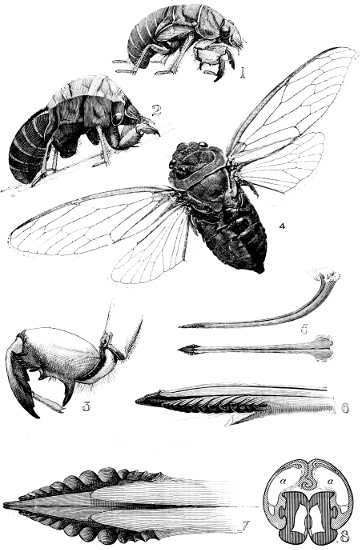
Plate XXXIII.—HOMOPTERA.
Family Cicadidae.
4. Cyclochila australasiae (Donovan).
1. Pupa on emergence from the ground.
2. Pupa casting its skin.
3. Fore-leg of pupa.
5. Ovipositor and sheath separated.
6. Side view of ovipositor.
7. Ovipositor viewed from above.
8. Cross section of ovipositor, showing cutting saws and egg passages.
Plate XXXIII.—HOMOPTERA.
The head is broad, more or less truncate in front, with prominent eyes on the sides, and small gem-like ocelli arranged triangularly on the summit; each antenna consists of one stout basal joint surmounted with several (usually four) segments forming a bristle. The tegmina or fore wings, larger and stouter than the hind pair, are furnished with thickened veins, and are frequently mottled with brown, usually forming bands or spots on the cross nervures. The swollen fore legs are spined; the thorax is well developed; and while the large hollow abdomen of the male is pointed at the extremity, that of the female (usually the larger insect) is furnished with a horny retractile ovipositor, which is adapted for cutting the bark of the twig, wherein she deposits her eggs.
The complicated musical apparatus of the male is situated between the thorax and base of the abdomen, and consists of a large plate on either side attached to, but extending over the basal portion of the abdomen (these plates are often called the drums or opercula); beneath in the abdomen is a cavity formed into two cells within which are two thin glass-like plates called mirrors; above these mirrors are bundles of muscles which lead to two membranes formed like kettle-drums; each membrane has a concave and a convex surface, the latter folded and full of ridges.
Haswell (Pro. Linn. Soc. N.S.W. 1886) describes it thus: “The loud shrill note emitted by the insect is the result of a quick succession of crackling sounds produced by the movement of the stiff membrane with its horny ribs, through the agency of the muscle. Under ordinary circumstances, the sounds follow one another with sufficient quickness to produce a continuous note, and this is effected not by the contraction of the muscle as a whole, but by the successive contraction of individual fasciculi (different filaments forming the whole), all of which act on the horny plate, and thus the movements of the muscle on the tendon during the production of the note resemble those of the hammer-board of a piano when a number of keys are being struck in quick succession.”
The life history of cicadas has attracted much attention; on first emerging from the eggs they might easily be taken for minute shrimps, apparently all heads and claws. They cast themselves off the branch and, falling to the ground, burrow into the soil and follow down the roots, where they feed upon the sap and undergo a series of moults. We do not know the length of time that they take to develop underground, but the adults of several of our large species, though each year more or less in evidence, appear in greater numbers every third year, so that it is probable that three years is about the cycle of their subterranean existence. The grotesque pupa burrowing upward when fully developed, bores a vertical shaft often several feet long before it comes to the surface, when it crawls out and climbs up the nearest tree trunk or fence, where it clings till the skin splits down the back, and the perfect cicada emerges. The dry brown pupal shells firmly attached by the sharp claws remain long after the inmates have departed.
Cicadas are well represented in our insect fauna, a number of large handsome species being found along the coastal forest country, and many smaller ones in the interior. The large ones attracted the attention of collectors at a very early date: Donovan, Leach, and Guérin described several, and Walker (British Museum Catalogue, Homoptera 1850) added a number of new species from material in the Museum collections, but his localities and descriptions are very vague and unsatisfactory. Since then Distant between 1882 and the present date has greatly increased our list of described species. In 1904 Dr. Goding and I monographed the Australian Cicadas (Pro. Linn. Soc. N.S.W.), describing a number of new forms, and bringing the number up to 120 species in 18 genera. Last year (1906), the Trustees of the British Museum issued a “Synonymic Catalogue of Homoptera, Part I., Cicadidae,” compiled by Distant; in this a number of alterations in the earlier classification are made, as indicated in his recent contributions on this family in “The Annals and Magazine of Natural History” 1900–1906. He places them in three distinct sub-families which are subdivided into seventeen smaller divisions. Many of our species are now placed in other genera.
The sub-family Cicadinae contains many of our largest and most striking species. Its members have the front edge of the basal abdominal segment on each side produced forward in a leaf-like expansion, which more or less covers the sound organs.
The genus Thopha contains two very fine species: Thopha saccata, “The Double Drummer,” takes its popular name from the great size of the opercula projecting on the sides of the thorax. It is a reddish brown cicada, its wings marked with brown and black, and it measures 5 inches across the outspread wings; it lives in open forest country; has a loud, distinct note; and ranges from South Australia to Brisbane. Thopha sessiliba is a somewhat smaller but brighter-coloured species ranging northward along the Queensland coast from Townsville, and is found in Central Australia at Tennant’s Creek.
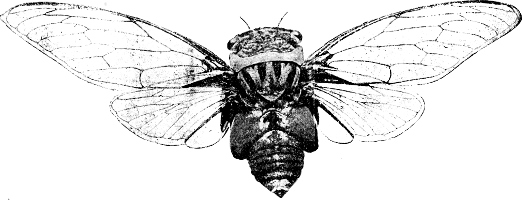
Fig. 154.—Thopha saccata (Fabr.).
The large Cicada called by the children “The Double Drummer.”
(“Agricultural Gazette,” N.S.W.)
The Genus Arunta was formed by Distant to contain two Australian species, of which Cicada perulata described by Guérin is the type. It is a handsome insect, 4 inches across the wings; is of a reddish brown tint mottled with lighter colours; the wings are unspotted; and the male can be easily recognised by the large white frosted opercula. It is not a very common species; it is taken sometimes about Sydney.
The next division contains three genera typical of Australian species. The Genus Cyclochila until lately contained a single species, but Distant has lately described a second from N. Queensland. Cyclochila australasiae is our common large green cicada, called by the children the “Green Monday.” The whole insect is rich green, the colour extending into the nervures of the tegmina; there is a yellow variety not so common, called in consequence the “Yellow Monday”: I have counted as many as 40 of these fine insects resting on the trunk of a small oak-tree in my garden in the early morning.
The Genus Psaltoda contains 7 species peculiar to Australia. Psaltoda moerens, our common black cicada, is called the “Red Eye” by the Sydney boys on account of the bright colour of the ocelli. It measures over 4 inches across the wings, which are mottled with black on the tegmina, and marked with the same colour on the wings. It frequents the smooth white-stemmed gum trees, and ranges from Brisbane, Queensland to Adelaide, South Australia, and is also found in Tasmania. P. harrisi is a smaller and somewhat variable form both in size and colour; it varies from black to brown and even dull green; the wings are very slightly mottled, and it can be easily distinguished from the “Red Eye” by the more distinct silvery patch on the sides of the body.
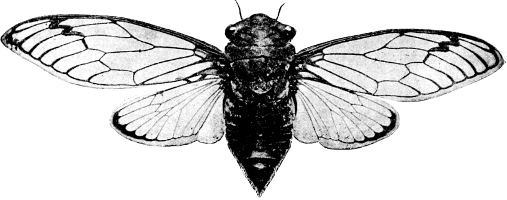
Fig. 155.—Psaltoda (cicada) moerens (Germer).
The Common Black Cicada or “Red Eye.”
The members of the Genus Henicopsaltria, four in number, are also peculiar to this country. Henicopsaltria eydouxi, one of our commonest species, frequents the trunks of the rough-barked gum trees; I have counted over 300 on a single tree on the coast near Gosford, N.S.W. It measures nearly 5 inches across the wings; is of a general mottled light brown and chestnut colour, with the wings infuscated with three zig-zag bands of brown; the opercula are orange red. H. fullo, peculiar to W. Australia, is a very distinctive blackish coloured species measuring about 3 inches across the wings; it can be easily identified by its banded wings and the dorsal surface of the abdomen ornamented with a transverse white band about the centre of the body. The Genus Macrotristria now contains 7 species; most of these were originally described in the Genus Cicada, and have representatives in all parts of Australia, two coming from W. Australia, and two richly-coloured green species from the tropical forests of N. Queensland, while Macrotristria angularis, our common, large, dark brown species, variegated with light yellowish spots on the head and thorax and with deeply infuscated wings, ranges from Adelaide, S.A., to Queensland.
The Sub-family Gaeninae contains a number of South American and Asiatic cicadas, among them some with very brightly coloured wings. Two members of the Genus Tettigia are found in North Queensland and North Australia, both of which were once placed in the genus Tibicen; while Tettigia tristigma is the type of the Genus Tamasa. The handsome black and yellow mottled Gaeana maculata, common in India and China, has been recorded by White from Australia, and Goding and I had specimens from the Northern Territory of S. Australia, but Distant does not notice this record.
The Sub-family Tibicininae have the front edge of the basal abdominal segment straight, not produced forward; and the sound organs are entirely uncovered. Venustria superba is a curious ferruginous insect with rich coppery tints upon the tegmina and wings, which comes from North Queensland. Dodd usually collected it in the neighbourhood of termite nests.
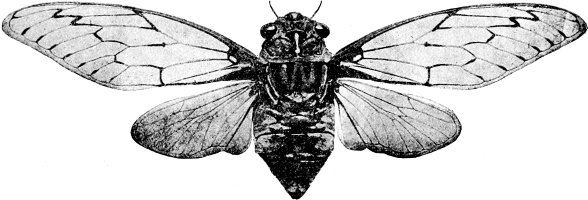
Fig. 156.—Henicopsaltria eydouxi (Guérin).
The Mottled Grey Cicada.
(“Agricultural Gazette,” N.S.W.)
The Genus Abricta now includes most of our species previously placed in the Genus Tibicen; thirteen are listed from Australia. Abricta curvicosta, one of the largest, measures about 4 inches across the wings; is reddish brown with a pale stripe down the centre of the prothorax, and three black spots on each of the tegmina. It is one of the common species about Sydney, N.S.W., in midsummer, and is called the “Floury Miller” on account of the silvery pubescence covering the body which makes it look as if it had been dusted with flour. A. aurata ranges from Tasmania and Victoria into the southern districts of N.S. Wales, and is usually found upon the fern trees; it is a smaller darker coloured cicada with a large, sometimes double, black spot on each tegmina.
Distant (Pro. Zool. Soc. 1882) described a number of new species chiefly obtained from North Queensland; and, finding it difficult to give them distinctive specific names that would define their peculiarities, he got over the difficulty by naming them after Australian explorers. A. willsi is a small species measuring about two inches across the wings, which are marked with two small spots, and it can be easily distinguished from all the others by the curious rugose yellowish patch on the sides of the prothorax. It has a very wide range over N.S. Wales, Queensland, North, and probably W. Australia, both along the coast and in the interior.
Parnkella muelleri is only about 1½ inches across the wings which have two spots on each tegmina, and is of a pale yellow tint. It is restricted in its range to North Queensland. The tiny little yellowish green cicada found upon the grassy plains of Southern Victoria and S. Australia, described as Tibicen infans, is now placed in the South African Genus Quintilia.
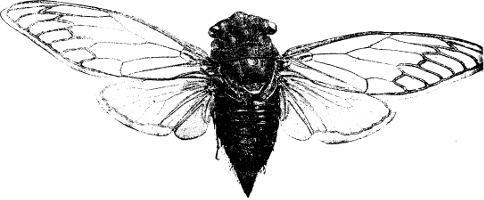
Fig. 157.—Macrotristria (cicada) angularis (Germer).
The “Fiddler.”
(“Agricultural Gazette,” N.S.W.)
The Genus Chlorocysta contains two curious pale green insects with vitreous tegmina and wings, the former much more closely reticulated than the ordinary cicada, with many cross and parallel nervures. The head is small, and the body of the male is swollen and cylindrical. Chlorocysta vitripennis was described by Westwood (Ann. Nat. Hist. 1851); the larger male measures slightly over 2 inches across the wings. The female is greenish or reddish, the abdomen conical but not inflated. They frequent low scrub; the southern forms found about the Tweed River, N.S.W., are green or yellowish; those from North Queensland quite brown. Glaucopsaltria viridis, described by Goding and me from S. Queensland, is placed by Distant in this genus.
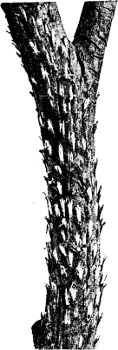
Fig. 158.—Section of stem of eucalyptus, in which the Black Cicada (Psaltoda moerens) has laid her eggs.
The Genus Melampsalta contains a great number of our small black or dark brown cicadas often marked with orange red or dull yellow. The members of the genus are found over Asia, Africa and Europe, over 40 are described from Australia, and 7 from New Zealand. Some species are very numerous in early summer, and are known as “Squeakers” on account of their musical notes. Melampsalta torrida, originally described by Erichson from Tasmania, has a wide range round from Queensland to W. Australia. It is almost black, with several light marks in the centre of the thorax, and two irregular rounded confluent black spots at the tips of the tegmina. It measures about two inches across the wings, but is variable both in size and in the wing markings. M. abdominalis, about the same size, is black, with two lines of reddish yellow on the apical portion of the dorsal surface of the abdomen, and the under surface red; when the tegmina are closed there is a distinctive opaline mark on either side. It is common in S. Australia and N.S.W. M. eyrei is a much smaller species, with the head and thorax black, lined with yellow, and the whole of the abdomen except the black tip, bright yellow; it is common in N. Queensland.
The members of the Genus Pauropsalta are easily distinguished from those of the previous group by having five apical areas in the wings, while the former have six. Sixteen species are described from Australia. Pauropsalta encaustica is our commonest species with a very wide range over Australia; it is of a uniform black tint, with faint pale brown marks on the head and prothorax, and an infuscated patch on the hind margins of the wings; the abdominal segments are finely ringed with white to reddish brown. P. annulata is a synonym of this cicada. P. nodicosta is a small brown species from Kalgoorlie, W.A., with a curious node in the centre of the costal nervure of the tegmina. P. mneme, larger, and broader than P. encaustica, has the abdominal segments richly edged with red. It is common on the Blue Mountains, N.S.W.
The Genus Cystosoma was created by Westwood (1842) to contain the great green “Bladder Cicada” which he called Cystosoma saundersi, that at one time was common in the orange orchards around Newcastle, N.S.W. Mrs. Ross says it is now common about Armidale, N.S.W., on the sweet brier, and I have also had it on willows from Glen Innes N.S.W. A second much smaller species, with similar opaque green tegmina, C. schmeltzi, ranges up the coast of North Queensland.
The two curious hairy brown cicadas belonging to the Genus Tettigarcta are restricted in their range. Tettigarcta tomentosa, the darkest in tint, has each side of the thorax produced into a distinct spine; it is only found in Tasmania. T. crinita comes from similar country in the Gippsland forests, Victoria; it is not quite so hairy, and has the thorax rounded on the outer margin without any spines.
Family 2. Frog-Hoppers. CERCOPIDAE.
The members of this family are not very numerous though world-wide in their distribution. They are stout, wedge-shaped, elongate insects of moderate size; the head is furnished with large flattened eyes on the sides; with a few exceptions two ocelli are present on the vertex between the eyes; the small, short antennae, composed of two bead-shaped joints surmounted with a bristle, are placed in front of and between the eyes. The pronotum is large with the triangular scutellum occupying the centre of the back; the tegmina, longer than the body, are coriaceous, reticulate, with two long discoidal and five or more apical cells. The coxae and femora are short; the posterior tibiae are hardly longer than the others, rounded at the base, spatulate at the apex, armed on the outer margins with two stout spurs, the second twice the length of the first; the tibiae and basal joints of the tarsi are terminated with rows of spines.
Most of our known species were described by the French naturalists, Amyot & Serville (Annals Soc. Entom. de France 1845); and Walker (Brit. Museum Cat. Homoptera 1851); and but little attention has been paid to them since. Our most characteristic species belong to the Genus Eurymela. Seventeen species are listed by Walker from all parts of Australia. They are large, thickset frog-hoppers, with the head broad and truncate in front with the face much inflexed; their general tint is blue-black with the head and elytra marked with red or white bands or spots. They lay their eggs under the bark of young gum trees, slitting it in regular rings with their stout ovipositors and leaving a white papery substance along the punctures. The young cling to the twigs in clusters after they emerge, and they may often be seen in different stages of growth upon the same bush. They are very active little creatures, creeping round the twig when disturbed, and jumping as soon as they are touched. Many of them are much sought after by ants which come to them for the honey dew they secrete.
Eurymela bicincta measures ½ an inch in length, and is broad in proportion; it is of a uniform dark shining blue tint, with the head, thorax, and base of the elytra bright red. It has a wide range and may often be found in colonies of 30 or 40 clustering together on a gum sapling. E. rubrovittata is about the same size; it is black, with the under surface, face, and three narrow transverse bands round the thorax and elytra bright red. It has a range from Western Australia to Queensland. E. speculum is a common species, recorded from Tasmania to Queensland; it is of a uniform dark blue-black tint with a white patch on either side of the face, and two irregular oval white spots on each wing cover. E. pulchra is smaller, with the head and thorax marked with red, and two irregular broken bands of white on the side of each wing cover.
Five species of the Genus Aphrophora are described by Walker from Tasmania and Australia. The members of this genus are known as “Cuckoo-spittle Insects” from the remarkable habit the larvae have of enveloping themselves in a mass of frothy liquid, which is supposed to be formed to protect their soft bodies from insects that might prey upon them; it, however, really makes them very conspicuous objects on a twig, and several species of wasps are known in America to drag them out of this covering and use them to provision their nests.
Our common “Cuckoo-spittle Insect,” found upon the she-oak (Casuarina), ti-tree (Leptospermum), and Melaleuca, is Chalepus teliferus; the larvae are pale-brown soft oval creatures, which jump when removed from the frothy liquid, and in this liquid they remain enveloped until they are ready to emerge. The perfect insect measures under ½ an inch in length, is of an elongate boat-shaped form; the head is produced in front as a slender process, curved upwards; the tips of the elytra come to a compressed point; the general colour is dull reddish brown, with the horn on the head ferruginous, and the wing covers mottled on the sides with black. A second species, Chalepus pugionatus, has been described by Stal from Australia.
Family 3. Tree-Hoppers. MEMBRACIDAE.
This is a group of homopterous insects chiefly confined to the tropical parts of the world. They are well represented in Australia, though we have nothing like the remarkable creatures covered with horns and spines found in South America and popularly known in consequence as “little devils.” They are remarkable for the wonderful development of the prothorax which, projecting in front, often forms a hood above the head, so that the latter is much hidden when viewed from above; the eyes are globular and project on the sides of the head, and there is a pair of ocelli in a line between them; while the short bristle-like antennae are well below the eyes on either side of the base of the stout rostrum (beak), which at rest is turned down between the legs. The abdomen is covered with the wings and parchment-like tegmina, the extremities of which come together to form a sharp point. The legs are short and stout, without the numerous spines common on the “frog-hoppers”; and the tarsi consist of three joints, the first longest. They can both fly and jump very well, but trust to the latter method to escape from their enemies. They and the members of allied families can be easily collected by shaking or beating low scrub over an open umbrella; or can be bred from larval forms on the food plant.
Very little attention had been paid to our tree-hoppers until a few years ago when Goding published his “Check List of the Membracidae described from Tasmania and Australia” (Pro. Linn. Soc. N.S.W. 1898); in this he gives many notes and lists 22 species, chiefly described by Walker (Brit. Museum Cat. Homoptera 1851), Fairmaire, in his Review of the family in 1846, and Stal in 1869. In 1903 Goding, in the same Journal, published a “Monograph of the Australian Membracidae.” In this he re-describes all the known, and adds a number of new species to our fauna, bringing the list up to a total of 32 described species, comprised in 14 genera, grouped in 6 sub-families, based chiefly upon the shape and structure of the prothorax.
The Genus Sextius contains five species, in which the prothorax is ridged in the centre and produced on either side into a rather short acute horn standing out on either side, and with the apical portion produced into a keeled spine extending to the tip of the abdomen. Sextius virescens, our commonest species, is of a delicate green colour, and feeds upon the sap of the black wattle and other species of Acacia. In early summer it may be found among the foliage in all stages of development; the trees they frequent are frequently infested with ants which come to obtain the honey dew. The female slits the bark with her ovipositor, and lays the eggs in rows. S. depressus, about the same size, slightly over ¼ of an inch in length, ranges from Western Australia to Queensland: at Kempsey, N.S.W., I obtained specimens on a slender leafed Acacia. It is of similar green colour to S. virescens, with the front of the thorax of a lighter tint, but the projecting horns are shorter and depressed, and the venation of the elytra is much finer. S. australis is about the same size, and of a uniform black tint with a patch of bright silvery pubescence on the sides of the thorax, which is rounded in front and has very short blunt horns. It lives upon the branchlets of a prickly Hakea growing about Sydney.
Lubra spinicornis is a slightly smaller insect, of a general dull brown tint: it has the prothorax produced into two almost erect clubbed horns. Specimens have been obtained from Brisbane, Queensland, and the northern rivers of New South Wales. Daunus tasmaniae is of the same chocolate brown colour; is more robust in proportion. The prothorax forms a regular hood swelling out on either side at the base of the tegmina, and the projecting horns are curved and deeply ridged, and are chisel-shaped at the tips. It is one of the commonest species in Tasmania, and is recorded over a wide area of the eastern mainland as far North as Brisbane.
Eufroggattia tuberculata is a rare insect usually found resting on a twig of a eucalyptus sapling, and is shaped very much like some of the small plant bugs belonging to the Genus Testrica; it is short and broad in form, with the head exposed; the thorax has short blunt horns; and the abdomen is broadly rounded at the apex.
Family 4. Lantern-flies. FULGORIDAE.
This is a very difficult family to satisfactorily define, as their members are very diverse in general shape and structure, with points of resemblance that bring some of the genera very close to the Cercopidae (from which however they differ in the shape of the head), while they somewhat resemble the Jassidae in the structure of the legs.
The typical forms have the front of the head either produced into a lance-shaped structure, or the face and vertex either rounded in front or forming an acute angle. The eyes are large and stand out on the sides of the head; the ocelli, usually two in number, are situated below or near the eyes and are placed in the cavities on the cheeks; in a few species there are three ocelli, while in others they are wanting. The antennae, situated beneath the eyes, and often very peculiar in structure, consist of two short joints surmounted with a bristle.
Many are large handsome insects with bright coloured tegmina and wings; others are of delicate green and grey tints, quite moth-like in form, but can be easily distinguished by the way they rest with their stiff roof-like wings, and by their active jumping habits. The legs are often long, and the hind pair are furnished with a few stout spines on the tibae, but never thickly spined as in the Jassidae. Many of our larger species are found both in the larval and perfect state, on tree trunks. A few species are well-known pests and have an extended range beyond Australia.
Donovan described and figured several species (Insects of New Holland, 1815); Westwood figured and described two in his “Monograph of the Genus Fulgora” (Trans. Linn. Soc. 1837): but the majority of our species are described by Walker (Brit. Mus. Cat. Homoptera, 1851), and he also named others in “Insecta Saundersiana, Homoptera,” 1858, which describes the insects in W. W. Saunders’ great collection.
Siphanta acuta, better known under the name of Cromna acuta, is one of our commonest fulgorids, moth-like in appearance, of a pale green colour, with broad square-cut fore wings and a short pointed head. It measures about an inch across the outspread wings. It has a wide range in Australia; and its pale green fluffy larvae feed upon the sap of many plants, and readily jump when touched. It is also well known in Hawaii, Sandwich Islands, where it is called the “torpedo-bug” from the way it jumps; and it is said to be a pest on the coffee plants (Smith Annual Report, Hawaii 1904). A number of species of these moth-like forms are described by Walker from Australia and Tasmania, and placed in the Genus Bythoscopus, which genus, when further studied, will probably be much subdivided.
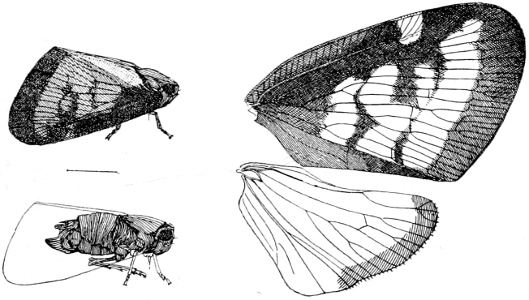
Fig. 159.—Scolypopa (Pochazia) australis.
The Common Passion-vine Hopper.
Pochazia australis measures about ¾ of an inch across the short broad fore wings, which are margined and irregularly barred with chocolate brown; the head is short and rounded in front. Melichar, in his “Monographie der Ricaniiden, Wien,” 1898, places P. australis in the Genus Scolypopa. The larva is a green wedge-shaped little creature clothed at the tip of the abdomen with a bunch of white filaments. It is a very common insect with a wide range. Sometimes it is a pest on passion vines; the eggs are laid in the slender tendrils, and the larvae suck up the sap of the stalks. Another species is common among the foliage of the silky oak (Grevillia robusta) in Southern Queensland.
Achilus flammeus has the body and wings of a bright red colour, with the small head showing prominently in front: the broadly rounded opaque elytra and wings cover the short body. It measures about an inch across the outspread wings. Nothing is known about its habits or life history, but in the summer evenings it sometimes comes flying towards the light, and can be found on the windows.
The Genus Poeciloptera contains a number of small, short broad-winged forms. Donovan figures Poeciloptera modesta, which has pink fore wings, each marked with two small red spots, and the hind wings have a pale bluish tint.
Prolepta dilatata is a typical, dull reddish-brown fulgorid, measuring nearly an inch from the tip of the long slender head to the extremities of the folded tegmina which are broadest across the tips: and the slender prolonged forehead is over two lines in length. This insect was described from W. Australia, but it has a wide range and can be collected about Sydney. P. obscurata is about the same size, more rugose in structure, and with markings of dark brown; the markings on the somewhat opaque wings are more distinct, striated and irregular than in P. dilatata: it can also be easily recognised by the shorter and thicker process on the forehead. It has a wide range over Australia.
The Genus Eurybrachys contains a number of short, dark brown insects with broad rounded heads; they run about on the trunks of trees, jumping at the least alarm. Eurybrachys leucostigma is a very stout, broad, dull brown insect, about ¾ of an inch across the outspread wings. Some 16 species are described from all parts of Australia. The members of the Genera Ledra and Stenocotis are broad elongate insects with the front of the head spade-shaped, and the convex body tapers to a sharp point. Their larvae are almost as flat as a bit of paper. Stenocotis australis is about ¾ of an inch in length, and of a dull brown tint.
Family 5. Leaf-Hoppers. JASSIDAE.
These insects are minute froghopper-like forms with the head rounded in front, and with the body tapering towards the tips of the tegmina. The head is large, with the oval or rounded eyes projecting on the sides, and with a pair of ocelli situated on the front margin. The antennae, bristle-like, of considerable length, are each composed of two short cylindrical basal joints with a thread-like terminal portion, and are placed in front and below the eyes. The legs are long, well adapted for jumping (their chief means of progression); and the tibiae of the hind pair are thickly clothed with stout spines.
Though these insects are very small, many species appear upon crops and herbage in such immense numbers that they often do a great deal of damage, and are very interesting from an economic standpoint. In Japan, for instance, there are several species very serious pests in the rice fields; while in North America Erythroneura vitis is a well-known pest upon the foliage of vines.
They are abundant on the low scrub and grass lands in this country in favourable localities, and may be easily collected with a sweeping net, or by shaking the bushes over an open umbrella; yet, probably on account of their small size and retiring habits, few specimens are to be found even in our Museum collections.
The sugar-cane hopper, Perkinsiella saccharicida, a native of Queensland, is a dull brownish yellow hopper with a dark parallel stripe down the centre of the basal portions of the tegmina; it measures a ¼ of an inch in length. Kirkaldy described it from Hawaii, where it has been introduced, and is a serious pest to the sugar-cane.
A very pretty little unidentified species, bright red and yellow, with the fore wings marked with dark brown, is common upon the broad soft leaves of Eucalyptus robusta, where the curious little larvae rest in families of three or four; each is enveloped in white filaments which proceed from round the tip of the abdomen. The larvae of another species have been observed to form large colonies on the surface of the leaves of low eucalyptus bushes on the hills near Capertee N.S.W. They suck up the sap, discolouring the centre of the leaves; each exudes a globule of liquid from the tip of the abdomen, which they drag out into thin threads with their hind legs, to form a spider-web-like covering over their bodies, and this web dries soon after the leaves are gathered.
Family 6. Lerp Insects. PSYLLIDAE.
These are small homoptera, in appearance suggesting miniature cicadas. The head is generally broader than long, sometimes deflected and with large eyes; the ocelli are three in number, the lateral ones situated on the summit of the head close to the hind margins of the eyes, and the central one at the apex of the median suture. The antennae are each composed of ten joints, the first two shorter and thicker than the following ones, and the terminal joint surmounted with two short bristles. The thorax is broad, with well developed tegmina and wings, and like the aphids both pairs might properly be called wings. The venation is simple, constant, and useful in the work of classification. They are formed for jumping, with a spine-like process on the coxa of each hind leg, and the apex of the tibiae of the hind legs furnished with a row of short fine spines. The tarsi are two jointed, terminating in a pair of large claws.
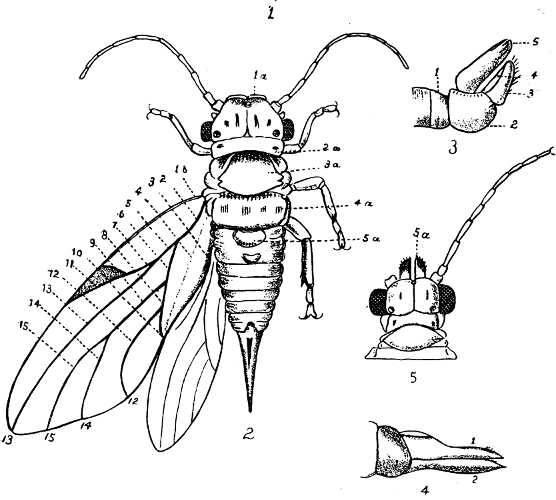
Fig. 160.—Diagram of Psylla (Thea opaca) ♀.
Showing the structure and venation of the wings.
1a, Face lobes; 2a, prothorax; 3a, mesanotum; 4a, dorsulum; 5a, scutellum, tegmina; 1b, costal nervure; 2b, primary stalk; 3b, clavus; 4b, clavical suture; 5b, stalk of sub-costa; 6a, stalk of cubitus; 7b, sub-costa; 8b, lower branch of cubitus; 9b, upper branch of cubitus; 10b, lower fork of lower cubitus; 11b, stigma; 12b, upper fork of the lower branch of cubitus; 13b, radius; 14b, lower fork of upper cubitus; 15b, upper fork of upper cubitus.
3, Genitalia ♂; 4, Genitalia ♀; 5, Head of Spondyliaspis eucalypti, showing face lobes.
(Pro. Linn. Soc. N.S.W.)
The female lays her eggs in clusters on the twigs or foliage, from which the curious, little, large-headed larvae emerge, and, after undergoing a series of moults during which they develop large wing-pads on the shoulders and more joints in the antennae, they finally come forth, perfect four-winged insects. They take their family name from Psylla, a flea, given them by Linnaeus in reference to their jumping powers, and their popular name of “Lerp Insects,” from the habit of the larvae of many species of forming “lerp scales,” shell-like protective coverings formed from exudations from the insects. Other species cover themselves with flocculent matter after the manner of mealy bugs; and yet another group form regular oval or rounded galls on the foliage. They are found in most of the warmer parts of the world, and are very numerous in Australia, where they seem to take the place of the Aphidae to a certain extent; they are readily collected in all stages of growth upon their food plant, and can be easily bred.
The Sugar lerp, Psylla eucalypti, whose larvae cover the leaves of several species of gum trees with their white woolly shells, was described by Dobson from Tasmania (Pro. Royal Soc. Van Diemen’s Land, 1851). It is a slender little green creature with very long face lobes, and, when crawling about, turns the tip of its body upwards, so that it looks as if it were walking on its head. It is now placed in the Genus Spondyliaspis.
In the same year (1851) Walker published his Homoptera (Cat. Brit. Museum) in which he recorded 5 species, all from Tasmania; and it was not until 1898 that they were again noticed when Maskell described 3 species from Australia (Trans. N. Zealand Inst.); and Schwarz defined another (Pro. Ent. Soc. Washington) in 1897. Between the years 1900 and 1903 I contributed three papers (Pro. Linn. Soc. N.S.W.) monographing our species, in which 64 new species are added to our fauna. I followed Low in the classification of the sub-families, adding Scott’s fifth division for those with small heads and no face lobes.
In the Liviinae, the front of the head is not produced into face lobes; the stalk of the cubitus is either shorter, as long as, or longer than the lower branch of the cubitus. Crewiis longipennis is of a general bright red tint, and is ¼ of an inch in length; it ranges from Tasmania to the North of New South Wales. The larva forms a rounded pale yellow lerp covered with fine woolly filaments upon the leaves of gum trees. Lasiopsylla rotundipennis forms a large, flattened, irregularly rounded white scale on the foliage of Eucalyptus melliodora, under which the flattened, pale green larva hides.
The Sub-family Aphalarinae contains a number of small species, and the head is produced in front into face lobes, with the stalk of the cubitus as long as or longer than the stalk of the sub-costa. They usually form lerp scales; but some are naked, or clothed with soft white woolly filaments.
Several species of the Genus Spondyliaspis belong to this group; all of them form “sugar lerp scales,” often encrusting all the foliage of the young gum trees, and are so abundant that in the Mallee scrub country in Victoria and S. Australia the blacks used to collect and eat it in quantities, and had a regular “manna harvest.” Cardiaspis artifex is a short, reddish yellow insect, the larvae of which form beautiful barred shell-like lerps, marked with red and yellow to look like delicate fretwork, upon the leaves of Eucalyptus robusta. C. tetrix is a pretty pink and grey species found in the Adelong district, N.S.W. The larva constructs a most remarkable cage of fine red bars, not unlike a lady’s hair net, beneath which the larva crawls about freely like a bird in a cage. Rhinocola corniculata often covers the leaves of different eucalypts with its elongate, opaque, horny, yellow lerps. The test is not unlike that of a large Mytilaspis scale, but is open at the broad end through which the little larva can creep in and out. It ranges from New South Wales to Western Australia. R. eucalypti is a very tiny, little, dark brown psylla, the larvae of which cluster at the tips of the foliage of young blue gums (Eucalyptus globulus), and cover themselves with threads of white flocculent matter. It was described by Maskell from New Zealand, but is common both in Tasmania and Australia: it has also been introduced into Africa on the same eucalypt.
The larvae of the Genus Thea are curious, broad, flattened creatures, with hard integument. They hide under the dead bark on the trunks of the white stemmed gums, spreading their white woolly secretion around them; the ants look after them, and probably protect them from many enemies in return for the “honey dew,” of which secretion the ants are very fond. Thea opaca is of a general reddish pink colour mottled with brown and black; the wings are transparent, with a dark stigma on the fore wing.
The members of the Sub-family Psyllinae have the same well-defined conical face lobes, but the stalk of the cubitus is shorter than the stalk of the sub-costa. The larvae may be quite naked, but most of them produce woolly filaments more or less covering them, and form no true lerp scales or galls. The typical Genus Psylla comprises a number of usually small and somewhat stouter insects, many of which cluster in swarms like aphids upon the foliage of wattles and other trees. The eggs, larvae, pupae, and perfect insects may be found on the same twigs. Psylla acaciae-decurrentis is a slender, dark-winged insect remarkable for the length of its slender antennae; it is common upon the black wattle in early summer. P. acaciae-baileyanae is a much smaller yellow species with mottled wings that often swarms over the cultivated “Cootamundra wattle,” and is reported to have destroyed all the flower-buds of this wattle in the neighbourhood of Melbourne in 1905. P. capparis is a mottled winged species that frequents the foliage of Capparis mitchelli in the western scrubs: P. schizoneurodes infests the twigs of the allied “Warrior Bush”; the larvae are covered with flocculent matter and have a globule of liquid substance at the tip of the abdomen; when massed together they look much like “woolly blight” on the apple trees. P. sterculiae is a small brownish species, found upon the twigs of the Kurrajong, and has a wide range over New South Wales.
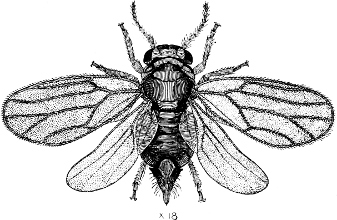
Fig. 161.—Psylla sterculiae (Froggatt).
The Kurrajong Twig Psylla.
(“Agricultural Gazette,” N.S.W.)
Two very curious species are found upon the thick fleshy leaves of our native figs, and one, Mycopsylla fici, lays her eggs upon the foliage, the squat grey larvae burying their beaks in the leaf cause a flow of milky sap, under which they hide in small colonies, and when ready to emerge crawl from beneath the viscid mass. Where numerous, they cover the foliage with these sticky patches, and cause the leaves to fall. The perfect psylla is a handsome, dark-coloured insect with long antennae and ample transparent wings.
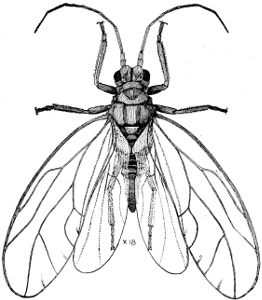
Fig. 162.—Tyora sterculiae (Froggatt).
The Star-psylla found on the surface of the leaves of the Kurrajong.
(“Agricultural Gazette,” N.S.W.)
Sub-family Triozinae. The cubitus of the wing has no stalk, the veins forking directly from its junction with the sub-costa. All our species, with one exception, come into the typical Genus Trioza: many of them are gall makers in the larval state, others are naked and cling to the under surface of twigs and leaves. The larvae of the gall-makers are broad, oval, flattened creatures, covered with a mealy secretion, the outer margin of the dorsal shield in each case being fringed with fine regular ciliae. Most of the perfect insects are thickset; they range from chestnut brown to reddish yellow; and have clear transparent wings. Trioza carnosa makes a large, oval, fleshy, brightly tinted gall with an irregular opening at the summit, often covering and aborting the foliage of eucalypts about Sydney. The larva of T. eucalypti forms a rounded, hard, woody gall upon the leaves, without any opening on either side until the gall contracts and splits open, when the full grown pupa emerges. T. casuarinae is a very pretty little psylla with dark-barred wings, and its curious naked fish-like larva clings to the slender foliage of the she-oak (Casuarina). T. banksiae has a tiny, naked, yellow larva covered with silvery down; it is a rare insect found on the under surface of the honeysuckle leaves. Nearly all these species have been collected within a day’s journey from Sydney, but have a wide range on the eastern coast.
The Sub-family Prionocneminae was formed by Scott for Walker’s Genus Tyora, in which I have placed two species. Tyora sterculiae is a pale green, aphid-like psylla, with long antennae and large transparent wings. The larvae cluster together on the leaves of the Kurrajong, forming white patches over the foliage, and each larva throws out slender white threads, fringing the tip of the abdomen and radiating about the body. T. hibisci is a delicate pale green insect which has been taken on the foliage of Hisbiscus tiliaceus, about Brisbane, Queensland, and also on a creeper on the Tweed River, New South Wales.
Family 7. Aphids or Plant Lice. APHIDAE.
These destructive little creatures are well known to gardeners under different names, such as “smother or green-fly,” “plant lice,” or “blight.” This family contains one of the most destructive and widespread pests that ever attacked cultivated plants, namely the vine louse (Phylloxera vastatrix), which has destroyed millions of pounds’ worth of vines, and has followed its host all over the world. Aphids are all small soft-bodied creatures, green, black, or yellow in colour; and at least ten introduced species are to be commonly found in our gardens and fields; but as far as I know, no indigenous aphid is recorded in Australia.