Order IV.—HYMENOPTERA. Bees, Ants and Wasps.
Reading edition
This division contains an immense number of very interesting insects which, though generally known as bees, ants, and wasps, comprise many other just as important families; some are unfortunately popularly called flies, such as saw-flies, gall-flies, and ichneumon-flies, but all true flies have only one pair of wings. Hymenoptera are, with a few exceptions, furnished with two pairs of semitransparent membranous wings, sometimes shaded with black or yellow tints, devoid of hairs or scales, but traversed by stout nervures forming irregular cells; the hind pair are the smaller, and are furnished with a row of spines along the front margin capable of hooking into the hind edge of the fore pair, thus adding to their powers of flight.
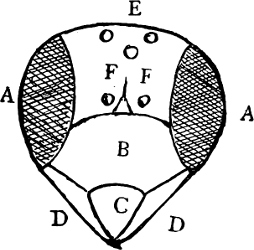
Fig. 41.—Diagram of the Head of a Wasp.
a, eyes; b, clypeus; c, labrum; d, mandibles; e, ocelli; f, insertion of the antennae.
(Redrawn from Cresson’s “Hymenoptera of North America.”)
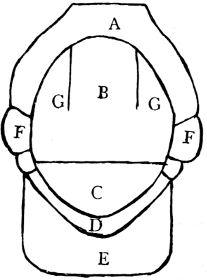
Fig. 42.—Diagram of the Thorax of a Wasp.
a, prothorax; b, mesothorax; c, scutellum; d, postscutellum; e, metathorax; f, tegulae; g, parapsidal grooves.
(Cresson’s “Hymenoptera of N. America.”)
In a few anomalous groups we find the females wingless, such as Thynnidae, Mutillidae and others; in some like the fig insects Blastophaginae, the males are wingless and blind; in the ants, while the males and females are winged, the bulk of the community consists of wingless workers forming a third sex or caste.
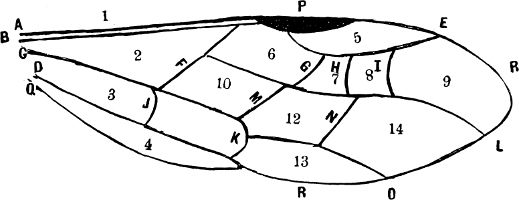
Fig. 43.—Diagram of Fore-wing of a Bee (Mellinus).
1, Costal cell; 2, median or externo-medial cell; 3, sub-median cell; 4, anal cell; 5, marginal or radial cell; 6, first sub-marginal or cubital cell; 7, second s.-m. or cubital cell; 8, third s.-m. or cubital cell; 9, fourth s.-m. or cubital cell; 10, first discoidal cell; 11, second d. cell; 12, third d. cell; 13, first apical cell; 14, second a. cell. a, Costal nervure; b, sub-costal nervure; c, externo-medial nervure; d, anal nervure; e, marginal or radial nervure; f, basal nervure; g, first transverso-cubital nervure; h, second t.-c. nervure; i, third t.-c. nervure; j, transverso-medial nervure; k, discoidal nervure; l, cubital nervure; m, first recurrent nervure; n, second r. nervure; o, sub-discoidal nervure; p, stigma; q, posterior margin; r, apical margin.
(Cresson, “Hym. N. America.”)
These insects are furnished with well developed antennae; large compound eyes, in some groups composed of an immense number of facets; usually 3 simple eyes or ocelli, but these are sometimes wanting; a more or less tubular mouth adapted for sucking up food (commonly called the proboscis), though mandibles are always present. The thorax is stout and broad; the three primary portions, prothorax, mesothorax and metathorax, are distinct on the upper surface with well defined lateral or ventral plates. The legs are generally large, with spined tibiae, and slender tarsi terminating in a double claw or hook, but varying much in size and shape in the different families. The abdomen takes all kinds of remarkable forms, from the thickened sessile body of the sawfly to the slender stalked abdomen of the sand-wasp, and the female is furnished with an ovipositor, sting, or saw at the extremity.
The Hymenoptera are considered by naturalists to be one of the most highly developed or specialised orders of insects, on account of the social habits of some of the chief families, and the care they display in providing for the safety and food supplies of their larvae.
They undergo a complete metamorphosis: from the egg is hatched out a soft, generally legless larva which when full grown, if in a protected cell, is simply enveloped in a thin skin, but otherwise forms a stout silken or parchment-like cocoon; the larva usually takes a considerable time to change into the pupa; the change is not rapid as that of a butterfly.
Australia is very rich in hymenoptera; most of the typical families are well represented, and we also have a few very distinct groups peculiar to this country.
There have been many schemes of classification and sub-divisions of these insects proposed by various authors, and the present idea among specialists seems to tend to a still closer definition of the families, as exemplified in Ashmead’s recent Classification running through the pages of the Canadian Entomologist; but in a book of this kind, I can only deal with the most important divisions and refer my readers to the work of such specialists.
Westwood divided the first section, Terebranti, in which the females are provided with a more or less projecting instrument for depositing their eggs, into two sub-sections, Phytiphaga, in which the abdomen is sessile, and Entomophaga, in which the body is stalked. Some of the French entomologists had previously suggested dividing them up into five large families defined by the peculiarities of the ovipositor or borer. Kirby used the same terms as Westwood, but I have followed Sharp, who uses the names Sessiliventres instead of the first, and Petioliventres for the second, for they certainly express more clearly the form of the body of the groups under observation. The first group contains four families.
Family 1. Stem-Sawflies. CEPHIDAE.
The first group comprises what Sharp terms “Stem-Sawflies,” which are not represented in Australia. They are slender little insects with long antennae; the larvae feed in the stems of plants; one damages wheat stems in Europe, another infests willows in America, a third is recorded from Japan; but they are unknown in Australia.
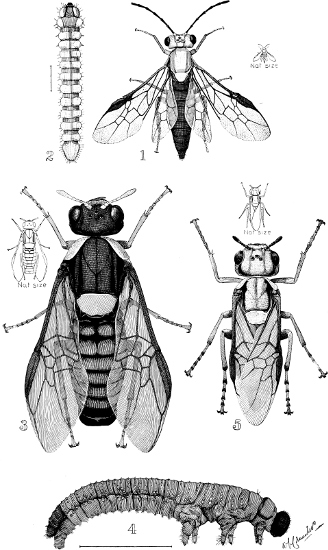
Plate X.—HYMENOPTERA.
Family Tenthredinidae.
1. Phylacteophaga eucalypti (Froggatt).
2. Phylacteophaga eucalypti (Froggatt), Larva.
3. Perga dorsalis (Leach).
4. Perga dorsalis (Leach), Larva.
5. Perga lewisii (Westwood).
Plate X.—HYMENOPTERA.
Family 2. ORYSSIDAE.
This family consists of the single Genus Oryssus, of which only 20 species are known. They are remarkable for the curious situation of the antennae on the under-surface of the head, the cylindrical rounded abdomen, and the exposed needle-like ovipositor. Turner has described one from Mackay, Queensland, in the Proceedings of the Linnean Society N.S.W. under the name of Oryssus queenslandicus. It is a small black insect measuring ½ an inch in length; with mottled brown wings, and typical shape of the genus.
Family 3. SIRICIDAE.
These handsome Sawflies are common in Europe and America, the larvae living in timber; the members of the typical Genus Sirex have long cylindrical bodies rounded to the apex; the borer of the female extends beyond the tip of the abdomen. One species, Sirex australis, has been described from Australia by Kirby (List of Hymenoptera 1882). I have never heard of another specimen being found, and believe the type is unique.
Family 4. Sawflies. TENTHREDINIDAE.
These are the typical stoutly built Sawflies, with the pronotum narrow, and the thorax generally broader than the head; the abdomen sessile, and provided in the female with a beautiful saw-like instrument on the under-surface of the tip of the abdomen, with which she slits the leaves to deposit her eggs in the tissue. The larvae are caterpillar-like creatures usually furnished with three pairs of legs; they feed upon the foliage of many plants.
Our species all belong to genera peculiar to Australia: Klug described several in the Berlin Magazin in 1814; Leach figured and described others in his “Zoological Miscellanies 1817”; Westwood described and figured a number in an important paper in the Proceedings of the Zoological Society 1880, others in his “Arcana Entomologica 1841”; and Kirby added to them in his List of Hymenoptera, B.M. Catalogue 1882.
The Genus Perga contains about 50 of our largest Sawflies, broad thickset insects, with reddish or light brown opaque wings, and short antennae forming an elongate club at the extremity. The larva is black or brown clothed with short scattered shining bristles, black head, three pairs of short stout legs, broad thorax, and abdomen tapering to a rounded tip. They feed gregariously upon the foliage of eucalypts, often stripping off all the leaves of the young bushes; they rest in the day time clustered together in a bunch of 50 or more round a branch, holding on with the legs; when disturbed they raise and rap the tip of the abdomen against the leaves, at the same time discharging a sticky yellow fluid from the mouth smelling strongly of eucalyptus extract. They are very subject to the attacks of dipterous and hymenopterous parasites, which these means of defence may keep away. When full grown they bury themselves in the soil, and form elongate, oval, parchment-like cocoons clustered together.
The Steel Blue Sawfly, Perga dorsalis, is slightly over 1 inch in length; is of a deep metallic blue, marked on face and thorax with bright yellow, and has stout reddish brown wings; the smaller male has the upper surface of the abdominal segments clothed with silvery pubescence. Perga kirbyi is dark reddish brown, similar in form and size to the last species; Perga lewisii, a much smaller yellowish brown insect, flattened on the dorsal surface, is common about Sydney upon the foliage of the “blood-wood” (Eucalyptus corymbosa), where she lays her eggs in the leaf in a double row, and stands over them until the tiny larvae hatch out and are able to move away; while thus occupied you can pick her up, but she will not move away, but raise her wings and fight like a hen over her chickens. Though this is our commonest species, and I have taken hundreds of females, I have never seen a male. Perga cameronii is like the last species, but larger, with more distinct markings on the back; it is found on the Blue Mountains.
In the Genus Pterygophorus about 10 species are described; they are much smaller insects, with bright metallic blue colours marked with reddish yellow; the male has the antennae produced into a comb or feathery structure, those of the female are formed of short rounded joints. The larva is a dull olive green creature covered with small warty tubercules; the head is broad, and the abdomen tapers off into a slender pointed tail; it has seven pairs of abdominal legs. It feeds upon the foliage of Leptospermum, wild dock and other plants, and when full grown bores into dead wood, pupating in a rounded oval cell.
The Ringed Sawfly, Pterygophorus cinctus, ½ an inch in length, is dark blue marked with deep reddish orange on the thorax, with a ring round the centre and tip of the abdomen of a similar colour; the wings are marked and clouded with black.
Plate XI.—HYMENOPTERA.
Family Tenthredinidae.
1. Pterygophorus cinctus (Klug).
2. Pterygophorus cinctus (Klug), Antenna ♀.
3. Pterygophorus cinctus (Klug), Larva.
4. Philomastix glaber (Froggatt).
5. Philomastix glaber (Froggatt), Antenna.
6. Philomastix glaber (Froggatt), Larva.
Plate XI.—HYMENOPTERA.
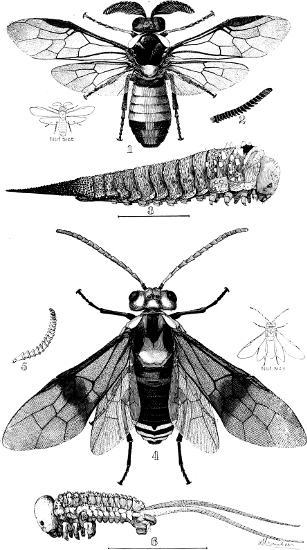
The Pale Coloured Sawfly, P. interruptus, slightly larger, has the thorax marked with orange yellow, and the abdomen deeply blotched with the same colour, forming interrupted bands on the sides; both these species are taken upon flowers in the summer months.
Philomastix glaber has very curious larvae that feed upon the wild bramble on the northern rivers of N.S. Wales; they have large heads, no abdominal legs, and two slender rat-like tails on the tip of the body. The sawfly measures 1 inch in length; the general colour is shining yellow, mottled with dull metallic blue on the thorax and abdomen; the semiopaque wings are barred with dark brown; the male has shorter antennae composed of short funnel shaped segments. There are a number of small species, belonging to the Genera Eurys, Euryopsis and Polyclonus, found chiefly upon flowers; Polyclonus atratus, sole representative of the Genus, has 18 jointed antennae, each joint furnished with a hairy finger turning inward at the tips. The Blister-leaf Sawfly, Phylacteophaga eucalypti, punctures the leaves of small gum trees; the larva feeds in the tissue, and when full grown pupates in a chamber in the centre, forming a distinct blister in the leaf: in the pupal state it has power to bend the body and rap against the side of the chamber. The sawfly measures ¼ of an inch in length; the male is black with a red head; the slightly larger female has the head and thorax reddish brown; the antennae have eight joints, long and slender. They have long stout legs, and are very active when they first emerge from the leaves, making a loud buzzing sound as they run about and try to escape.
Family 5. Gall-flies. CYNIPIDAE.
This is the first group of the Petiolata, which are often known from their small size as Micro-hymenoptera. They are all small creatures, differing from the succeeding families in that they are broadly speaking plant eating, usually forming galls in which they live and pupate. However, there are some that live upon the gall-making forms; others live only upon the tissue of their cousins’ galls without disturbing their host; and again some that are known as inqualines (visitors that dwell in the cavity with the true gall-maker); so that their life histories are somewhat complicated.
The typical gall-fly deposits her eggs in the tissues of the selected plant by means of her ovipositor, which is beautifully adapted for the purpose; she injects in some cases a fluid that keeps the wound from closing up at once and so destroying the delicate egg. Most of the Cynips galls are rounded woody excrescences. The Gall Wasps have wings with few cells and no stigma; the front portion of the thorax is joined to the second; the ovipositor is concealed; the antennae straight, containing from 13 to 15 joints. I described three hymenopterons forming galls on wattles (Proc. Linn. Soc. N.S.W. 1892), but these insects submitted to Dr. Mayr some years afterwards proved to belong to another family. The only species described from Australia are 3 named by Ashmead (Pro. Linn. Soc. N.S.W. 1900), which were collected by Koebele without any exact locality being given; and Hypodiranchis aphidis described by me as a parasite of the common peach aphis in the Agricultural Gazette N.S.W. 1904.
Family 6. Parasitic Wasps. CHALCIDIDAE.
This is a very extensive family, the members of which differ from the other small wasps in having the antennae elbowed, the first segment often as long as all the others combined; the antennae may be simple, but are often clubbed at the tips, and in the males of some groups with the segments or joints feathered or furnished with slender branching fingers. The delicate gauze-like wings are traversed by very few veins, and the abdomen is produced into all sorts of curious shapes, ornamented sometimes with remarkable anal appendages; and the ovipositor of the female, though often short, is sometimes much longer than the whole insect, and is usually prominent. These tiny little creatures deposit their eggs in the eggs, larvae, and pupae of other insects, wood galls, and excrescences produced by other insects, though a few groups are plant feeders and even produce galls.
Most of them are very minute, and can only be collected by keeping infested galls, leaves, eggs and cocoons in jars and breeding them out, so that the majority of them escape the eye of the ordinary collector, though among the most beautiful of all insects in rich colours and delicate structure.
Walker described a number of Australian species in the British Museum Catalogue, Hymenoptera 1846, others in his Monograph of the family 1839, and the Proceedings of other Journals (1863, &c.); but his usual locality is simply “New Holland,” and without access to the types one would have some difficulty in determining any species. Westwood obtained and figured some of our largest; and Haliday others in the “Entomologist” 1842; while the few others described are those obtained by the zoologists on the various scientific expeditions visiting this country. Ashmead has contributed the only modern paper (Pro. Linn. Society N.S.W. 1900) on these and other parasitic hymenoptera collected by Mr. Koebele and myself. The species in the Genus Leucaspis are large thickset chalcids, with the ovipositor curving round and fitting into grooves in the dorsal surface of the abdomen. Leucaspis darlingi was obtained by Westwood from the Darling Downs Queensland (I have specimens from Mackay Q.): it is black mottled with yellow, and has brownish wings; the hind legs are swollen: the antennae thickened; and it measures ½ an inch. L. australis was obtained by Walker from S. Australia. Nothing is known about their habits, but Leucaspis gigas in Europe lays its eggs in the nests of mud-dauber wasps, piercing the clay walls with its stout ovipositor. Trichoxenia cineraria, a slightly smaller black insect, is deeply punctured all over the dorsal surface of the head and thorax; the wings are clouded at the apex; and the upper surface of the body is thickly clothed with dense yellow down, thickest toward the apex. Specimens in my collection were taken about Sydney.
The typical Genus Chalcis contains a number of short stout insects, generally black, sometimes marked with yellow and brown; they are easily distinguished by the globular form of the thighs of the hind legs, which are sometimes nearly as large as the abdomen. These insects are chiefly parasitic upon the larvae of small leaf-rolling moths: Chalcis vicaria is black, with the base of the tibiae and tarsi yellow; it is common about Mackay Queensland. I have bred numbers of Chalcis phya, a small black species with white mottled hind legs, from the chrysalids of the lucerne moth (Tortrix glaphyriana). Another undetermined yellow legged species has been bred from the codlin moth pupa. Eurytoma binotata, a tiny black insect clothed with a white pubescence, has the pronotum spotted with yellow, and the antennae and legs marked with reddish brown; it can be bred from the galls on the twigs of the turpentine gum. E. eucalypti, a smaller black species, slightly over ⅛ of an inch, comes out of eucalyptus galls collected at Uralla N.S.W. The members of the extensive Genus Megastigmus are all obtained from galls; they are more elongate in form, with broad globular heads, the males with short cylindrical bodies, but the larger females furnished with bristle-like ovipositors turning upward often longer than the whole insect. Megastigmus brachyscelides measures ¹⁄₁₂ of an inch, and is black to dark brown marked with yellow; it is bred from the large galls of Brachyscelis crispa. M. iamenus, originally described from Tasmania, I have bred from another gall coccid (B. pileata); also a larger light yellow species bred from dipterous galls on the Snow-bush (Aster ramulosus) has been named by Ashmead M. asteri; M. brachychitoni, ⅙ of an inch, reddish brown and yellow, is common in the large fleshy galls on the Kurrajong tree.
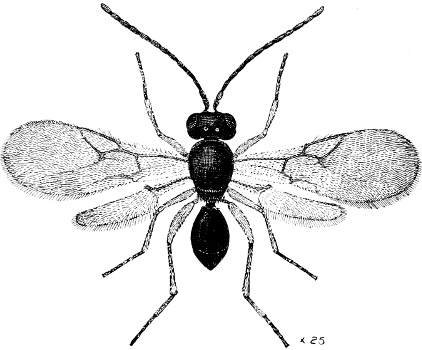
Fig. 44.—Hypodiranchis aphidis (Froggatt). A cynips parasitic upon the peach aphis.
(“Agricultural Gazette,” N.S.W.)
Stilbula peduncularis is a remarkable looking insect, with broad, rich metallic coppery red head and thorax; the basal portion of the abdomen forms a slender stalk with the apical tip produced into a small oval club. I have had a closely allied form out of the pupal cocoon of the red bull-dog ant.
The Perilampinae comprise some of the largest and most remarkable chalcids: Thaumasura terebrator has been described and figured by Westwood; my specimens came from S. Australia, and were sent by Mr. Blackburn. It is a slender, rich metallic purple insect, about ¼ of an inch in length to the apex of the flask-shaped body, which is continued in a long jointed tail three times the length of the whole insect. T. femor-rubra is a smaller insect with a tail not so long as the body, and of a general black colour with transparent wings and reddish legs. Dinoura auriventris is a very curious, metallic tinted species ¼ of an inch in length, with the apical portion of the attenuated abdomen produced into four flanges. I have bred a number of these wasps out of the large wood galls of coccids (Brachyscelinae), chiefly B. pileata. Pteromalus puparum is an introduced parasite of butterfly pupae, and is common about Sydney, where it infests that of the orange feeding butterfly (Papilio erectheus). Another tiny little metallic tinted chalcid, Eupelmus antipoda, infests the eggs of our common mantis.
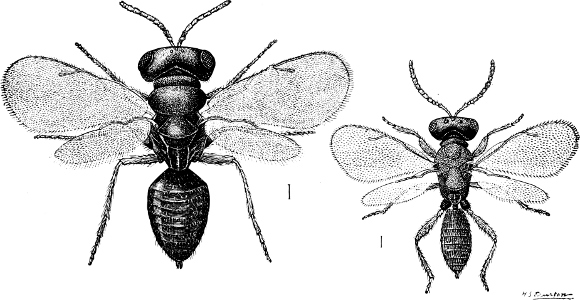
Fig. 45.—Pteromalus puparum (Linn.). ♂ and ♀.
Parasitic Chalcids that destroy the pupae of many species of butterflies.
(“Agricultural Gazette,” N.S.W.)
About twenty species of the cosmopolitan Genus Tetrasticus are described by Walker, chiefly from Tasmania. The allied Tetrastichodes froggatti is a very tiny creature, described by Ashmead from shot-like galls on the leaves of eucalypts. Euryischia lestophoni, a larger black insect with mottled wings, is interesting to economic entomologists, as it is a secondary parasite of the Cottony Cushion Scale (Icerya purchasi), feeding on the fly parasite.
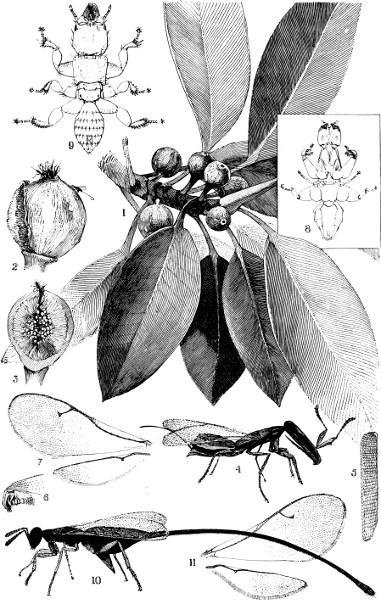
The Blastophaginae are remarkable little creatures, for there is a very great difference in the sexes of the same species; the males, yellow or brown, wingless, and blind, are more like white ants in general appearance than chalcids. They breed in the interior of figs, and are numerous in Australia. Saunders (Trans. Ent. Soc. 1883) described our common species (Pleistodontes imperialis), found in the fruit of the Moreton Bay fig about March. The tiny male, ¹⁄₁₂ of an inch in length, is of the typical form and colour; the elongate, shining black female (which is figured) is so different a looking creature that it would never be taken for the opposite sex of the insect. Their life history and remarkable habits have been described in the Agricultural Gazette (June 1900). Idarnis australis, described in the same paper, is a slender, bright, metallic green wasp, with a long tubular ovipositor nearly twice the length of the whole insect, which she also uses by pressing it down against the fig to jump like an acrobat, as well as for puncturing the skin of the fruit. The insect I described as the supplementary male of P. imperialis, is, Dr. Mayr tells me, the wingless male of this species. Mayr in “Neue Feigen-Insekten 1906” states that he finds that my identification is wrong and this is not the one named by Saunders but a new species which he calls Pleistodontes froggatti, and places my Idarnis in his Genus Sycoryctes.
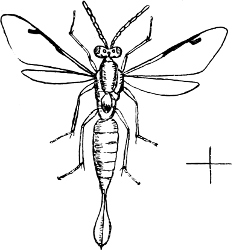
Fig. 46.—Dinoura auriventris (Ashmead).
A parasitic Chalcid that destroys the gall-making coccids (Brachyscelinae) by devouring the females and pupating in the cavity.
(Original, W.W.F.)
Plate XII.—HYMENOPTERA.
Family Chalcididae.
1. Branch of Moreton Bay Fig (Ficus macrophylla).
2. Immature fig attacked by Pleistodontes froggatti (Mayr), which are cutting their way into the fig. A female Idarnis australis on the right-hand side of the fig.
3. Section of fig, showing insects in the centre.
4. Pleistodontes froggatti (Mayr). ♀.
5. Cutting plate (mandibular appendage) used by the insect to cut into the fig.
6. Point of head, showing beak-like extremity, and the base of the mandibular appendage where attached to the head.
7. Wings of Pleistodontes froggatti (Mayr).
8. Pleistodontes froggatti (Mayr). ♂.
9. Idarnes australis (Froggatt). ♂.
10. Idarnes australis (Froggatt). ♀.
11. Idarnes australis (Froggatt), Wings.
Plate XII.—HYMENOPTERA.
Additional species of Chalcididae have been added to our fauna by the researches of Messrs. Perkins and Koebele (Bulletins 1, pts. 6 & 8 Hawaii 1905). In the Encryritinae he describes 12 new species, most of them bred from the pupae of the Dryinids collected in Queensland, but a few from more southern regions. Chalcerinys eximia is only ¹⁄₂₅ of an inch in length; is of a rich metallic green tint marked with black and brassy-yellowish tints, and is furnished with long antennae. It ranges from Bundaberg to Sydney. In the Eupelminae he describes one new species parasitic upon the parasite fly, Pipunculus cinerascens, under the name of Anastatus pipunculi. It is a bright metallic green and purple little creature about ¹⁄₁₂ of an inch in length. One species of the Tetrastichinae, which he calls Ootetrastichus beatus, has been bred from the eggs of leaf-hoppers from both Queensland and Fiji, while another parasite on the eggs of a Jassid embedded in the branchlets of a Eucalyptus was bred in Southern Queensland. Perkins describes it under the name of Pterygogramma acuminata, a tiny creature not ¹⁄₂₅ of an inch in length, of general brown and yellowish tints.
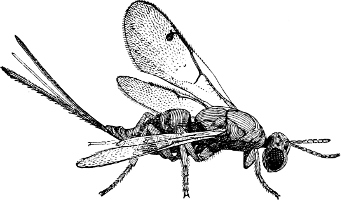
Fig. 47.—Megastigmus brachychitoni (Froggatt) ♀. A yellow and brown Chalcid, bred from the large fleshy galls on the kurrajong trees.
(“Agricultural Gazette,” N.S.W.)
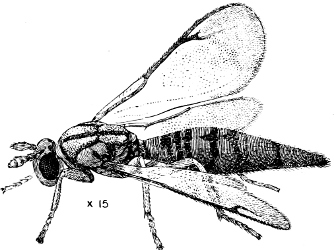
Fig. 48.—Coelocyba viridilineata (Froggatt). A pale yellow and green Chalcid infesting the large fleshy galls on the kurrajong trees.
(“Agricultural Gazette,” N.S.W.)
Five species of the parasitic wasps belonging to the Mymaridae are described from Queensland. They are all tiny little creatures with slender feathered wings and long legs. They deposit their eggs in the eggs of different species of leaf-hoppers, and some species are very abundant. Four species of the more robust parasites belonging to the Genus Aphanomerus are also described as egg parasites from Queensland. After studying the galls and insects from the wattles which I described in the Proceedings of the Linnean Society 1892, as belonging to the Cynipidae, Dr. Mayr finds that the insects will not fit into any known genera, so he has formed the Genus Trichilogaster to contain T. maideni, which forms galls on the branchlets of Acacia longifolia, and T. a-longifoliae, which aborts the flower buds of the same wattle into oval or rounded red and yellow galls as big as marbles. He describes a third species I sent him, T. pendulae, forming rounded galls on Acacia pendula, and has made the remarkable discovery that the tiny wasp deposits a female egg, which forms the central cavity on the gall with a second male egg in a small cavity on the side of the same gall, so that a male and female wasp is always produced from each gall, and he thinks this will be the case with our two common species when they are examined.
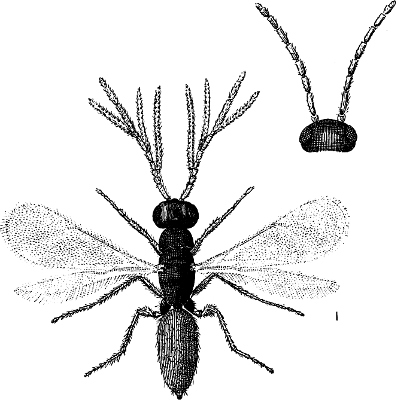
Fig. 49.—Ceraphron niger (Curtis) ♂. A tiny black parasitic Chalcid that infests the pupae of the leaf-mining fly (Phytomyza affinis). 49a.—Head of Female.
(“Agricultural Gazette,” N.S.W.)
Family 7. Micro-hymenoptera. PROCTOTRYPIDAE.
In general appearance these tiny creatures, some of the smallest in the insect world, would seem to be almost identical with those of the previous family; but Ashmead says: “If the anomalous group Mymarinae are removed there will be no difficulty in distinguishing at a glance a Proctotrypid from a Chalcid,” and defines them thus: “In all true Proctotrypidae the pronotum extends back to the tegulae, and the ovipositor issues from the tip of the abdomen, the sheaths in a few abnormal cases being conjoined and forming a more or less cylindrical tube or scabbard for the reception of the two spiculae and the ovipositor proper.”
Sharp on the other hand considers that this is one of the most difficult groups of the Hymenoptera to define; to a specialist of course they can be easily separated, but anyone who first takes up the study of these Micro-hymenoptera (and bear in mind that we are talking about insects, so small that when a collector breeds them out in jars he has to liberate them upon a window pane that he may see them against the light), he will I think endorse Dr. Sharp’s decision. Besides the peculiarities of the abdomen previously noted, the antennae, sometimes twice the length of the whole insect, are composed of from 7 to 15 joints, and in the typical groups, though the first joint may be long, it is not elbowed as in the Chalcids, and is seldom branched. The wings are delicate, without any nervures, except in a few small groups where the veins are somewhat like those of small ichneumon wasps. The hind legs are generally longer than the others, and though some have the thighs swollen as in the Chalcids, they are as a rule much more slender, and the abdomen is usually pointed.
They can be bred from galls, particularly those of small Gall-flies (Cecidomyia), the eggs of all kinds of insects, and the larvae of small beetles, moths, and other wasps.
In Ashmead’s “Monograph of the Proctotrypidae of North America” nearly 600 species are described, and a number have been added since these were recorded in 1893. The Australian species are probably numerous, judging from my own observations when studying gall-making insects; but very few have been described. Westwood described four in his “Thesaurus Entomologicus, Oxford 1874,” belonging to the Bethyllides, the peculiarities of which he defines, and figures with coloured plates. Ashmead describes another (Pro. Linn. Soc. N.S.W. 1900) under the name of Ateleopterus longiceps, obtained by me in a hollow twig of a wattle tree; a shining black ant-like creature about ⅙ of an inch in length, rusty red legs, and transparent wings clouded at the base, probably parasitic on the larva of some wood boring beetle. Sierola antipoda was bred from the curious bract-like gall of Cecidomyia frauenfeldi on the twigs of Melaleuca bushes. A second species of this genus was collected by Webster, and forwarded to Ashmead, who named it after the sender.
In 1890 Riley described “An Australian Hymenopterous parasite of the fluted scale” in “Insect Life” which he named Ophelosia crawfordi; it is a tiny reddish brown wasp with a shining black body, and the wings obscurely barred with smoky brown; it is easily bred from this mealy bug, which it greatly keeps in check. Goniozus antipodum, described by Westwood from S. Australia, is a little shining black ant-like wasp which has been lately discovered destroying the grubs of codlin moth both in S. Australia and N.S. Wales. The larvae feed upon the outside of the grub, burying their heads in the tissue, and when full grown spin a loose silken cocoon.
Perkins has recently added a number of new species to this family belonging to the Dryinidae. In his Bulletins Hawaii 1905, Nos. 1 & 10, “Leaf Hoppers and their Natural Enemies,” he describes 45 new species, chiefly collected by Koebele in Queensland, but some from the neighbourhood of Sydney. These curious little proctotrypids are parasitic upon the larvae and pupae of the small homopterous insects commonly known as Leaf or Frog-hoppers (Families Jassidae and Fulgoridae). The adult wasp captures the insect, holding it with its curious clawed feet while it deposits its egg in its body; when full grown the larva spins a white silken cocoon, from which the active winged insect emerges in about 18 days.
Gonotopus australis is a tiny wingless ant-like creature about ¹⁄₁₂ of an inch in length, which attacks jassids and fulgorids feeding upon grass and low herbage. This species comes from Bundaberg Queensland; but Koebele has bred a second species about ⅛ of an inch in length, of a general brownish colour, from a Jassid collected near Parramatta. The curious little sacs or larval bags of these parasites can be readily noticed projecting from the sides of the thoracic segments. Most of these insects have well developed wings, but, according to Koebele’s observations, they stalk their prey when looking for the host for their egg.
Family 8. Larger Parasitic Wasps. ICHNEUMONIDAE.
These are commonly known as Ichneumon Flies, and the family is a very extensive one. They play an important part in the economy of Nature in destroying thousands of the moth and other larvae that would otherwise strip our fields and forests of their grass and foliage, and they are therefore useful allies to the agriculturist; though they also often destroy other beneficial insects as well as pests, and thus discount their usefulness. Ichneumon Flies are moderately sized insects furnished with long slender antennae composed of from 16 to upward of 60 joints, with the basal one often thickened, but never elbowed. The wings are well developed, with a distinct stigma and numerous nervures forming regular cells; a few species are wingless in both sexes, but these exceptional ones have not been recorded from this country. The legs are long, generally slender, and well adapted for running about; the abdomen is usually long, rounded or cylindrical, joined to the thorax on the under side, and more or less stalked, while the ovipositor of the female is characteristic of the group and adapted or modified for laying the eggs in or upon the different hosts they prefer to adopt for their offspring; when they infest wood boring caterpillars that are somewhat out of reach, the ovipositor is correspondingly long and the sheath and “tails” produced so as to guide the eggs to their resting place on the grub, out of the sight of the parent ichneumon. When the species lays its eggs on the back of leaf-eating insects with no protective covering, the ovipositor is generally short and stout, the tip sometimes so stiff and sharp, that several species are credited with stinging people when handled. The little wasp-grub, hatching from the egg either deposited on the back or placed beneath the skin, feeds upon the substance of the body of its victim without touching the vital organs, so that in most instances where the caterpillar of a moth is infested, it yet has the power to form its cocoon and pupate before the wasp-grub has finished growing; the latter thus finishes its final transformation in the destroyed moth pupa, and cuts its way out through the side of the cocoon when ready to emerge. Usually, if it is a large species, the ichneumon deposits only one egg in its victim, but in some of the smaller ones half a dozen can be bred from a single cocoon. Over 6,000 species of these insects have been described from all parts of the world, and in many countries, such as this, the native species are still hardly known, and much confusion exists in their classification on account of their parasitic habits and the number of different hosts that the same species may infest; but now that so many economic entomologists are at work all over the world, it will probably not be long before they will have many admirers, and a rich field awaits the entomologist who takes up the study of Australian ichneumons.
Cresson in his “Synopsis of the North American Hymenoptera” lists over 1,100 described species, while in Australia up to the time when Brullé published his “Histoire Naturelle des Insectes, Hymenopteres,” in 1846, only one or two had been described, to which he added eighteen species; Kirby, Smith, Cameron and several foreign entomologists have added a few more; and in Ashmead’s recent paper ten more Australian species are described, which makes a very meagre list.
The Spotted Black Ichneumon, Pimpla intricatoria, is one of our largest common species, having a wide distribution over Australia, and it breeds in a number of different moths. It measures nearly 1 inch in length to the tip of the short ovipositor, and is of a uniform black colour with red legs and antennae; the thorax and abdomen are ornamented with pale yellow spots, those on the latter oval, forming a row on either side.
The Dark-winged Ichneumon, Rhyssa semipunctata, is a more slender species of about the same length; is of a uniform dull red colour except the basal half of the abdomen, which is black with white markings on the sides; the wings are clouded with brown, darkest on the inner portion. These wasps always follow up the cut worms and caterpillar plagues, and destroy immense numbers in the pupal stage.
The Spotted Ichneumon, Mesotenus albopictus, is somewhat smaller, with slender stalked abdomen and the slender ovipositor turned downward: the general colour is black, with the antennae marked with yellow toward the apical portion; the head, thorax and abdomen are richly marked with light yellow; light brown wings and red legs mottled with black and yellow. This ichneumon breeds in a great number of different cocoons, and frequently emerges from the oval cup-like ones of the “Stinging Caterpillars” (Doratifera and Limacodes).
The Ophioninae comprises a number of genera, of which the typical species are reddish brown insects, with clear wings and curiously curved, laterally flattened bodies, broadest at the extremity. They are frequently noticed in numbers among the low scrub in the day time, and in the summer evenings often fly into the house round the lighted lamp. Six species of the typical Genus Ophion are described from Australia; but none of the Genus Anomalon have been recorded.
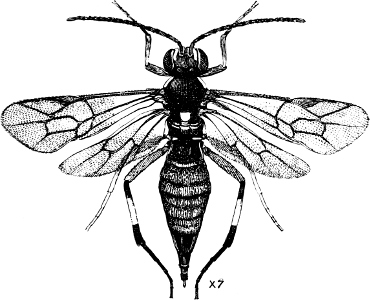
Fig. 50.—Bassus laetatorius (Fabr.). An Ichneumon wasp that destroys the pupae of Syrphid flies.
(“Agricultural Gazette,” N.S.W.)
Bassus laetatorius is a well known Ichneumon which has a very wide range over the globe, and is not a useful species, for it lays its eggs in the larvae of Syrphid flies, which feed upon different kinds of plant lice (Aphis) and are very useful insects to the gardener. It measures about ¼ of an inch in length, with the head, thorax, tip and base of the abdomen black, the rest reddish brown with yellow markings on the head. The tibiae of the hind legs are very distinctly banded with white, black, and reddish brown, giving it quite a distinctive character.
Family 9. Small Ichneumons. BRACONIDAE.
These are insects with very similar habits but easily separated from the large ichneumon wasps by the structure of the fore wings, as they have the outer cross veins wanting, thus showing two long outer cells, which in the former are divided into two cells. The antennae are always composed of more than fifteen joints, and the segments of the abdomen are more soldered together. Many of them, like the Microgasters, are very small, others are as large as many of the smaller true ichneumons. This country is probably very rich in indigenous species, while we have a considerable number that have been introduced with their host insect; but hardly anything has been done in describing our species. As far back as 1775 Fabricius named 4 species of the typical Genus Bracon, to which only three other species have been added, though over 500 species are listed in Dalla Torre’s Catalogue in the cosmopolitan Genus Bracon from other parts of the globe.
The typical Braconid is usually very small; many of them are no larger than some of the Chalcids. Wherever the cabbage aphis or other plant infesting insects such as caterpillars are to be found, these little wasps can be observed hovering round, waiting for an opportunity to deposit their eggs. They differ from the large ichneumons, in that while the latter only deposit a single, or at most a dozen eggs upon a victim, these often place hundreds in a large caterpillar, which, emerging when full grown, form little white oval silken cocoons on the top of the remains of their hosts, that are sometimes surrounded with a mass of white fibre exactly like cotton wool. After a plague of cut worms has passed over a paddock it is quite common to find clusters of these little cocoons attached to the grass stalks; these have been often sent to me from the country with the information that they were the eggs of the plague caterpillars or cut worms.
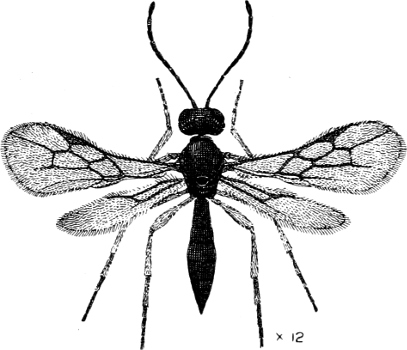
Fig. 51.—Ephedrus persicae (Froggatt). A Braconid wasp that lays its eggs on the bodies of aphids.
(“Agricultural Gazette,” N.S.W.)
Bracon limbatus, one of our larger typical species, is found in Tasmania, and has a wide range over Australia. It measures about ½ an inch from the front of the head to the tip of the abdomen, and is of a general black colour on the upper surface, with dusky almost black wings, and a red head. The under-surface is marked with brown, with the thorax, thighs, and tibiae of the front and middle legs black; the three slender curled hair-like tails forming the ovipositor being longer than the whole insect. Eight other species of Bracon are described, several of which are also recorded from New Guinea and New Zealand. Among the introduced species is Lepolexis rapae of Curtis, which is parasitic upon the cabbage aphis in Europe; it can be collected in gardens about Sydney. Aphids containing these parasites are always swollen, round, and apparently dead skins through which each braconid eats its way.
Five species of the Genus Agathes are described; they are remarkable for their showy particoloured wings, and large size in comparison with other members of this family. Ashmead has described a tiny black species marked with yellow bred by me from the larva of a Noctuid Moth, an undetermined species of Agrotis, under the name of Apanteles antipoda; and a second larger one as Apanteles australasiae. In his Genus Microbracon he has described a dainty little black and yellow creature that infests the larvae of our scale-eating moth (Thalpochares coccophaga) under the name of Microbracon thalpocaris.
Family 10. Ruby Wasps. CHRYSIDIDAE.
The popular and scientific names of these insects refer to the brilliant metallic blue, green, golden or copper coloured tints of their armour-plated bodies, which are also covered with coarse punctures, finest upon the abdomen. They are stout thickset wasps with short curled antennae and large eyes; the thorax is broad and closely attached to the abdomen, the latter composed of from three to five segments, the first generally much shorter than the second, with the last toothed along the hind margin, and characteristic of the different species; the under-surface of these plates is concave, with the tip of the abdomen produced into a tubular process, so that when alarmed the wasp can curl her body round into a ball, protected on all sides by the armour-like integument; and as she lays her eggs in the nests of other wasps and bees, and is sometimes caught in the act, this habit is probably a wise provision of Nature which enables her to resist the sting of the lawful nest maker.
Some of the earlier observers called them “Cuckoo Wasps,” under the impression that their larvae, when hatched out in the nests of hunting wasps or bees that filled the cells with insects or bee bread, fed upon the stored food supplies, but later researches show that, though the egg of both the lawful occupant and the intruder may be deposited in the cell, the latter does not hatch until the former has devoured all the food placed there by his mother and is ready to pupate; then the ruby wasp baby comes out, attaches itself to the full fed larva beside it, and sucks him dry, pupating in his skin.
Most of our species that I have bred out are parasitic in the clay nests of the smaller Mason Wasps, Odynerus and Alastor, though in Europe many species live in the nests of bees. The perfect insects are generally found crawling over or flying round old fences or stumps and dead trees in the hottest part of the day. Our species were described by F. Smith in 1874 in his revision of the family, in the Transactions of the Entomological Society of London; a few others have since been added to the list by Mocsáry, who monographed the Chrysididae in 1889; and Gribodo in the Annals of the Mus. Geneva, 1879.
No member of the typical Genus Cleptes common in Europe and America is recorded from Australia; but two well defined species of the beautiful ruby wasps of the Genus Stilbum that has a world wide range are described, Stilbum splendidum confined to Australia and New Caledonia, and Stilbum amethystinium, found also in Asia, Africa and America. The great Genus Chrysis, which contains over 600 described species, is represented here by about 27 species.
Family 11. Hatchet-bodied Wasps. EVANIIDAE.
Under the recent classification of this family it now comprises three very well defined genera, which have moderately thick antennae, not elbowed, consisting of thirteen or fourteen joints; the nervures of the wings not so well defined as those of the Ichneumons; and the stalked abdomen attached to the upper part of the metathorax. They are well represented in this country, and have been chiefly described by Westwood and Schletterer.
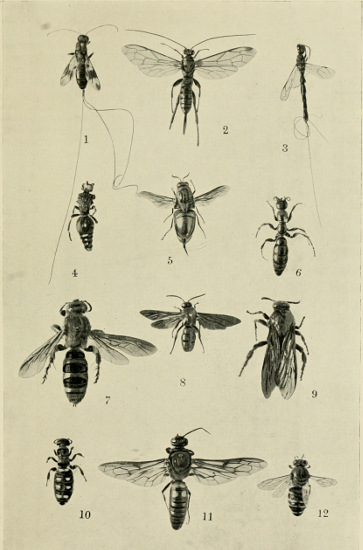
Plate XIII.—HYMENOPTERA.
Family Megalyridae.
1. Megalyra fasciipennis (Westwood). ♀.
Family Ichneumonidae.
2. Pimpla intricatoria (Fabr.). ♀.
Family Evaniidae.
3. Gasteruption sp.
Family Mutillidae.
4. Mutilla formicaria (Westwood). ♀.
Family Chrysididae.
5. Stilbum splendidum (Fabr.).
Family Thynnidae.
6. Diamma bicolor (Westwood).
10. Thynnus variabilis (Kirby). ♀.
11. Thynnus variabilis (Kirby). ♂.
Family Scoliidae.
7. Trielus zonata (Smith). ♀.
8. Discolia verticalis (Fabr.). ♂.
9. Discolia soror (Smith). ♀.
Family Sphegidae.
12. Bembex tridentifera (Smith).
(Original photo. Burton.)
Plate XIII.—HYMENOPTERA.
The members of the typical Genus Evania are generally shining black insects, sometimes variegated with dull red markings; the head and thorax are short and broad; the abdomen has the first segment produced into a slender stalk, and the remaining ones forming a vertically compressed hatchet-like body. They are parasitic upon the egg cases of cockroaches; some with a very wide range have been introduced in all probability with their cosmopolitan hosts, while they are often found in the house flying on the window panes, evidently introduced in the same manner. In the bush the perfect insects are commonly found on flowering shrubs in the summer time. About 20 species are described from Australia and Tasmania. Evania princeps is of a uniform black colour with dusky wings, and is recorded from most parts of Australia, Woodlark Island and New Guinea. It is one of our largest species, measuring ½ an inch in length, broad in proportion, and furnished with very long spined legs.
The Genus Gasteruption, which takes the place of the Genus Foenus in the earlier catalogues, contains 36 described species from Australia; as they are rare insects, there are probably many more to be discovered. Nothing is known about their habits for certain, but they are supposed to be parasitic upon the larvae of wood boring insects; I have generally found them flying round the trunk of a dead or burnt tree. They differ from the former genus in having the head almost globular, with antennae standing out straight in front, and large oval eyes on the sides; the thorax is more elongate, rounded in front, so that the insect appears to have a slight neck. The abdomen springs from a rounded node on the thorax, with the basal segments slender, swelling out gradually, and broadest at the tip; the females bear a very long hair-like ovipositor. The legs are slender, the hind pair longest, with both the thighs and apical half of the tibiae thickened in a very distinctive manner. Ten species are described from Sydney; and one, Gasteruption pedunculatum, is also common to New Zealand.
The Genus Aulacus contains ten described species of smaller insects. Aulacus apicalis is parasitic upon the larvae of a longicorn beetle (Piesarthrius marginellus). I have found as many as fifty, each enclosed in a thin parchment cocoon, all matted together in a single cavity. This little wasp has a long extended ovipositor, and measures about ½ an inch in length; the head and greater portion of the abdomen is black, the rest reddish brown, with a blotch of yellow on the upper surface of the base of the abdomen; the hyaline wings are tipped with black.
Family 12. Long-tailed Wasps. MEGALYRIDAE.
These remarkable parasitic wasps, peculiar to Australia, are comprised in a single genus containing 16 species, none of which are very common. They are all shining black insects; the head short, broad and almost rounded, the thorax broad and stout, both very rugose and clothed with fine silvery hairs on the sides; the eyes large, circular, and very prominent; ocelli small; the antennae composed of irregular wiry joints; the wings semitransparent, generally banded with black, and the transverse nervures wanting in the apical half; legs long, with the thighs thickened. The abdomen is closely attached to the thorax, cylindrical, tapering to the extremity, and in the females furnished with an ovipositor often more than three times the whole length of the insect, looking exactly like three black horse-hairs. These elongated ovipositors are used for depositing their eggs in the wood-boring larvae of longicorn beetles belonging to the Genus Phoracantha, and probably others of like habits, which feed under the bark in the sap wood of different eucalypts. The perfect insects are generally found about flowers on low shrubs in summer.
Megalyra shuchardi is of the usual black colour with silvery pubescence; the wings are pitch black and opaque: the whole insect measures slightly under 1 inch in length, with the ovipositor over three inches. It is found in Victoria and New South Wales, and also recorded from Melville Island on the North Coast. Megalyra fasciipennis was described by Westwood when he founded the genus, in the Transactions of the Entomological Society 1841; and it is again figured in Griffith’s Animal Kingdom, Insects, Vol. II. It is much smaller than the previous one, of similar form, the legs and ovipositor reddish brown, the wings hyaline, barred across the centre and clouded at the extremities with blackish brown. The male is much smaller than the female, with similar wings, but the body is more slender and comes to a point at the tip, furnished with a curious bifid anal appendage. This is the species we have found breeding from the longicorn larvae.
Six other species have been described, some by Schletterer (Berliner Entom. Zeitschrift 1889); one, Megalyra melanoptera, closely allied to Westwood’s dark winged species. In 1902 Szepligeti (Termes Z. Fuzetek, xxv.) monographed the family and added one more; and Bradley last year, describing the last new form (Trans. Ent. Society of London 1905) appends a translation of the former’s tabulation of all the known species, seven in number. I have (Pro. Linn. Soc. N.S.W. 1906) since added 8 new species to the list.
Family 13. Ants. FORMICIDAE.
The ants are among the first insects that attract one’s notice in a new country; civilization seems to agree with many species which form their nests in the lawns or gardens, and even take up their quarters in the house. Within the last decade a small introduced species has appeared in the heart of London, and the small red ant, Monomorium pharaonis, is a world wide pest in houses from Europe to Australia.
Ants live in communities forming nests in the ground, under logs or stones, or in dead trees, and sometimes among the foliage of plants. These communities consist of winged males and females, and wingless aborted females known as workers, the bulk of the family consisting of the latter; in some groups there are several varieties of workers, that are often called soldiers on account of their great size and swollen heads. In those species that are furnished with a sting both the workers and winged females should be handled with care.
They are divided into five sub-families, based on the difference in the structure of the segments of the body, absence or presence of a sting, and a few other minor characters. The leading specialists differ somewhat in the sequence of these groups; I follow Forel in placing the Ponerinae at the head of the family; and for a good classification and definition of the genera would refer my readers to Emery’s paper in the “Annales de la Societe Entomologique de Belgique,” Vol. xl., 1896. All our species described before 1858 are listed in Smith’s British Museum “Catalogue of the Formicidae,” where he described a number of new species: Lowne described a number of new species collected in the neighbourhood of Sydney in the Entomologist, Vol. ii., 1865: Mayr in several papers, chief of which are “Myrmecologische Studien,” “Neue Formiciden,” and “Die Australischen Formiciden” added many up to 1876. Emery, Forel, and others have since added to the list; and in Dalla Torre’s great “Catalogue of the Hymenoptera,” published in 1893, all species described up to that date are recorded. I have lately (1905) published a list of Australian species (Miscellaneous Publications No. 889, Dep. Agr. N.S.W.), including all Forel and others have added to our fauna, in which nearly 400 species are recorded, without counting the large number of races and varieties into which some of them are divided. From my own researches I think a great many more will be found when they are systematically collected in the tropical scrubs and the dry districts in the interior, which as yet have hardly been touched.
The sub-family Ponerinae includes many large or medium sized ants with elongated bodies furnished with only one constricted segment or node at the base of the abdomen, and the latter terminating in a powerful sting. The larvae are enclosed in stout silken cocoons. The Genus Myrmecia contains most of our largest typical species peculiar to Australia, popularly known as “bull-dog ants,” “inchmen,” or “jumpers”; about 34 species have been described, some of which have a very wide range. The “Jumper,” Myrmecia albo-cincta, forms its nest under the shelter of a low bush; it is a low mound with an opening on the summit, and another on the side level with the ground; when disturbed these ants come rushing out like a pack of dogs with a series of short jumps, and attack everything they meet. It is one of the smaller species, about ½ an inch in length, of a uniform black colour, with only the front and hind portion of the thorax brownish red to yellow. Myrmecia forficata is our large red and black “bull-dog ant,” with a very extended range like the previous one from Victoria to Queensland. They measure up to 1 inch in length, and are of a uniform dull red, except the eyes and abdomen, which are black. They live in rather large colonies up to 200 in number, digging deep circular shafts or irregular chambers under logs; when away from the latter, they form regular domed mounds over the nests, which in summer contain the large, elongated, oval, brown sacks enclosing the pupae, and often a number of winged males and females; the former with small heads and jaws, the latter with jaws as large or larger than those of the workers. Myrmecia gulosa is of a lighter red colour, with the tip of the abdomen black. M. tarsata is our common black bull-dog ant, with yellow jaws, and antennae and tips of the legs reddish brown; it has a great habit of hunting up and down the larger tree trunks, and drops to the ground at the least alarm; when disturbed in the nest, if the first two or three are captured, the others will usually retreat down their burrows, and not show fight like the other species. Sharp notes the bull-dog as forming large mounds (Cambridge Natural History); but I think he was misinformed, as the nests of the Mound Ant, Iridomyrmex detectus, are often confounded with these ants. The Genus Odontomachus contains a number of curious slender black ants with large heads and long projecting jaws; they are more tropical in their range, but O. ruficeps and its varieties are found from the Darling River N.S. Wales through Queensland to North Australia.
The “Green-head,” Ectatomma metallicum, is a common ant of medium size that lives in small communities under stones or logs, and often makes nests in the dry banks of lawns in our gardens. Though somewhat sluggish, they sting sharply if they crawl on one when resting on the grass. About 28 species and many varieties of this genus occur in Australia; one in New Zealand; and 3 in New Caledonia. The members of the Genus Ponera are remarkable for their extended range; we have several species or varieties in Queensland closely allied to species from South America, Borneo, Europe, and Africa, while three are recorded from New Zealand; Euponera lutea, a slender pale yellow ant with the abdominal segment constricted, lives in small communities under stones or roots. It ranges from Sydney to Fremantle, round to N. Queensland. Pachycondyla piliventris is a large, hairy black ant with large head and rounded body, roughened, and clothed with fine rusty down. They are generally found under stones in communities of a dozen or so, and when exposed or disturbed pretend to be dead, with their legs folded up under the body; they are common about Sydney.
Six species of the Genus Sphinctomyrmex are found chiefly in the North. They are somewhat rare ants; I have found two species, both small, slender, dull brownish yellow insects living under stones; S. froggatti in a vineyard near Sydney; and the second, S. hednigae, in the New England district under large stones.
The second sub-family, Dorylinae, comprises ants with the antennae placed close together in the front of the head, the abdomen elongated, with the first segment forming an irregular node. This group contains some very remarkable ants in Africa and America, but is only represented in Australia by two species belonging to the Genus Ænictus, both of which are described from specimens collected by Turner at Mackay, Queensland.
The third sub-family, Myrmicinae, is well represented here; they are all small or medium sized ants, with the base of the abdomen formed into two small nodes, and the sting rudimentary; the pupa naked and not enclosed in a cocoon. Many of them live in very large communities.
The members of the Genus Meranoplus are tiny little brown ants with rounded heads and bodies, resembling some of the small wingless female Mutillid in shape and habits, for though they form irregular galleries under stones or in dry banks, they are generally found running up and down tree trunks; when touched they curl up the body and sham death. Meranoplus oceanicus, reddish brown, is common in N.S. Wales; M. pubescens has a very wide range right round Australia.
Monomorium pharaonis is our tiny red house-ant introduced from Europe, now world wide in its range; and when once it becomes established in a house is a difficult pest to destroy. M. rubriceps, a much larger species but under ¼ of an inch in length, is bright reddish brown, with the nodes very small and the apical portion of the abdomen black, and broadly rounded. It is found crawling upon the trunks of trees, and has a wide range from Sydney to Cape York. The typical tree-trunk ants included in the Genus Podomyrma are much larger ants, sluggish in their habits, forming their nests in tree stems and always found crawling about the trunks. They are broad-headed ants with short stout jaws toothed at the tips; the thorax is widest in front, tapering to the narrow pedicle of the broadly rounded abdomen; the thighs of the legs are thickened in the centre. Podomyrma gratiosa, under ½ an inch in length, is bright reddish brown, rugose and spined on the front margin of the thorax, with the abdomen black, smooth, and shining; it is widely distributed over Australia from Adelaide to Cape York. P. adelaidae is a smaller species with black legs, and a distinct oval brown blotch on either side of the black abdomen; it is common in South Australia and Victoria. P. bimaculata is still smaller, with the blotches on the abdomen smaller and more oval; I have had it from Kalgoorlie W.A., and Wagga N.S. Wales.
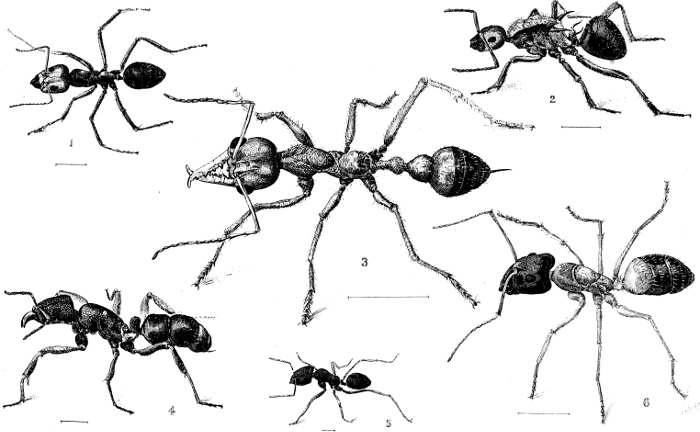
Plate XIV.—HYMENOPTERA.
Family Formicidae.
1. Iridomyrmex detectus (Smith).
2. Polyrhachis semi-aurata (Mayr).
3. Myrmecia gulosa (Fabr.).
4. Ectatomma metallicum (Smith).
5. Iridomyrmex rufoniger (Lowne).
6. Camponotus nigriceps (Smith).
Plate XIV.—HYMENOPTERA.
The Genus Pheidole is well represented in Australia by 22 species and many varieties found in all parts of the country, forming irregular chambers and galleries under stones and logs; they are tiny reddish brown ants, with a very large headed form of soldiers often four or five times the size of the ordinary workers. The winged forms are also very large in proportion. Pheidole bos is dark reddish brown, the soldiers furnished with very large swollen heads; it ranges from Western Australia to Victoria. P. anthracina is a darker coloured form, ranging from the northern portion of N.S. Wales into Queensland. The members of the Genus Cremastogaster are very small black, brown, or dull yellow coloured ants with longer legs, and heart-shaped bodies; they live in large communities in nests under logs and stones. C. fusca is black with reddish tarsi, and a reddish tint on the thorax; it comes from Queensland. C. pallipes and C. ruficeps are lighter coloured, found under stones about Sydney.
Sima laeviceps is a very curious elongated shining black ant with reddish brown antennae and tarsi, which ranges up the Queensland coast to N.W. Australia, and is found crawling about on tree trunks, when touched curling its body up like a wasp and shamming death.
The sub-family Dolichoderinae comprises a number of small or medium sized ants living often in very large communities and having naked pupae. The base of the abdomen consists of a single small node with no constriction between the two following segments; sting practically wanting (rudimentary). The typical Genus Dolichoderus is represented here by five species widely distributed. D. doriae is common about Sydney living in large communities under logs, often clustered over each other like a swarm of bees; they collect on the leaves of eucalypts, upon which the sugar lerp psylla, (Spondylaspis eucalypti) constructs its larval scales, and suck or lick up the sugary exudation. This ant measures ¼ of an inch in length; the head and thorax are black and roughened; the legs reddish brown, and the flattened heart-shaped abdomen clothed with a silvery pubescence. Leptomyrmex erythrocephalus might well be called the “Silly Ant” from the aimless manner in which it rushes about with its head stuck up in the air, and its abdomen curled over its back. They live in underground nests sometimes deep down, but others live under stones; they are slender-bodied, long-legged black ants under ½ an inch in length, with an oval red head, rounded behind with long slender antennae, and the front of the thorax produced into a slender neck. In some varieties the whole of the thorax, legs, and head are yellowish brown.
The typical Genus Iridomyrmex contains 18 distinct species, some of which have been subdivided into three or four varieties or races; most of them are small, except our “Mound Ant,” sometimes known as the “Meat Ant,” Iridomyrmex detectus, which is the commonest and most widely distributed ant in Australia. They construct large mounds a couple of feet above the surface of the ground, and two or three yards in diameter; they are formed of the soil excavated from beneath when forming their network of irregular open galleries; the upper surface is pierced with numbers of rounded vertical shafts, up which they swarm in countless thousands and attack any intruder, biting savagely with their stout sharp jaws and making things generally unpleasant for the stranger. When a mound is situated in open grassed country, one can trace regular bare roads leading off from the nest, worn smooth by the regular stream of ants passing backward and forward day after day. It is too well known to need description, but measures about ⅓ of an inch in length, and is of a general brownish purple tint, with the head light reddish brown. Smith described the worker under the name of Formica purpurea, and the male as F. detectus, so in most Museum collections it will be found under the former specific name. Forel has made a new variety, which he calls Var sanguineus, of the coastal form found in North Queensland, with the head and thorax light reddish brown.
Most of the other species are small black ants: Iridomyrmex rufoniger is very common in the bush and in the gardens; a variety which Forel has called domesticus is the common black ant that comes into the house in Sydney, and is a regular pest in the summer in many districts. Tapinoma minutum is about as large as the “Mound Ant”; black; the head and thorax deeply pitted and corrugated; the abdomen slightly constricted in the centre, smooth and shining. It comes from Townsville, N.Q.: a second species, T. melanocephalum, taken in Cairns, is also found in Samoa and the Tonga Islands.
The last sub-family, Camponotinae, is a large division well represented in Australia; they live in more or less large communities, and with a few exceptions have the pupae enclosed in cocoons. The base of the abdomen forms a single node, and there is no constriction between the second and third abdominal segments; the sting is wanting, and the anal orifice is fringed with hairs. In the works of early entomologists a number of our ants were described under the Genus Formica, but they have been gradually identified and placed in their proper genera, until we only have about half a dozen still remaining in this genus, probably more on account of the difficulty of identifying them than because they really belong here.
The Genus Acantholepis is represented by four species all described by Forel from specimens I have collected and sent him from N.S. Wales, so that their range seems to be restricted. They are all small, reddish brown, smooth, shining ants; A. bosii was found under stones at Cooma, N.S.W.
The Green Tree-ant, Oecophylla smaragdina, found in tropical Africa, India, and New Guinea, is common in the tropical scrubs on the coast of North Queensland. They live in large communities among the foliage of the trees, in nests formed by webbing the leaves together into an irregular mass varying in size from a cricket ball to a man’s head. The material with which they make these nests is obtained by the workers, by squeezing the pupae and using the secretion they discharge. The winged female measures nearly ¾ of an inch in length, has a broad thorax and large oval body; the worker is only about ¼ of an inch, and slender in proportion, but for his size is the most pugnacious creature in the insect world; if one damages a nest pushing through the scrub, down tumble a swarm of green tree ants on one’s head and neck, and wherever they drop they stick their jaws in and hang on, and each one has to be picked off in detail. In these forests they destroy an immense number of insects, catching the little bees as they come out of their nests in the tree trunks, and dragging the small beetles off the twigs by main force. I have often seen half a dozen hanging on to the legs of a stout weevil, apparently trying to wear him out, for they would remain for hours in the same position, and probably succeeded in the end.
The great Genus Camponotus contains about 400 described species from all parts of the world, of which about 60 are recorded from Australia. Most of them are found in open forest country, forming their nests in the ground, under logs or stones, or near the butts of trees. Several of our common species are known as “sugar ants,” as they come about at night and invade the pantry and store room in search of sweets; but they are omnivorous in their tastes, and will often come round the camp fire at night, prowling about for the small moths that flutter round, often rushing right into the edge of the ashes to capture a moth when it falls with singed wings. Camponotus intrepidus is one of our largest species, varying from black to reddish brown in tint, and is thickly clothed with short hair. They form nests in the open sandstone country about Sydney, sometimes raising a little mound or producing a fragile funnel-shaped structure above the opening leading into the nest. The Sugar Ant, Camponotus nigriceps, is the commonest house species; it forms large chambers under stones or logs in which they all cluster together. The general colour is black, with all the abdomen except the base dull yellow, but the variations of the yellow and black are common; it measures to ¾ of an inch in length.
Camponotus inflatus is the curious “honey ant” of Central Australia figured and described by Lubbock in his “Bees, Ants, and Wasps.” The naturalists on the Horn Exploring Expedition obtained a number of this and other species, described by me in the Zoology of this Expedition. The ordinary members of the “honey pot ants” are of the usual normal form, but certain individuals of each nest of these species are crammed with a honey secretion (probably obtained by the workers from aphids or psyllids), until the abdomen swells out of all proportion to the rest of the ant; the honey pot ants remain hanging about in the bottom of the nests like a number of bottles of honey, incapable of leaving the nest; the supply is probably used as food for the larvae. Spencer says that the blacks dig up these nests and look upon the “honey pots” as great luxuries. The honey is sweet with an acrid taste like the honey of our native bees. They are apparently common in Central Australia; Miss Ormerod sent me some from England which she had received from a correspondent at Kalgoorlie; and recently Mr. Field of Tennant’s Creek sent me a fine red species from the far north.
Camponotus claripes, a smaller pale coloured species, generally makes its galleries at the base of a tree trunk, and has a very wide range from Victoria to North Queensland. I found the cocoons of this species in a nest at Howlong infested with full grown red velvet mites (Trombidiidae), which occupied the whole space.
The Genus Polyrhachis contains a number of black ants of fair size, most of which build their nests in dead logs, and live in rather large communities, but others form small nests by matting the foliage of trees together; the latter are confined to Queensland, and are generally smaller shining black forms. The true “wood ants” are more or less covered with bright metallic pubescence and fine hairs, and with the hind portion of the thorax and the node of the abdomen ornamented with a pair of slender spines.
Polyrhachis ornata is black, with the thorax and base of the spines richly tinted with gold; it comes from Queensland. P. ammon, ranging from Victoria to Queensland, is clothed with pale golden pubescence lightest on the head and thickest on the abdomen. P. semi-aurata has both the head and thorax golden, with the abdomen smooth, black and shining. P. laevior is one of the smaller tree nesting forms, and is smooth and shining without any metallic tints, and the thoracic and abdominal spines are very small. P. turneri, also a northern form, has the head golden, and large well developed spines.
Family 14. Solitary Ants. MUTILLIDAE.
Though these interesting little creatures were once placed in the Formicidae, and are still popularly known as “Solitary Ants” in Europe and “Cow Ants” in America, they are now classified as the first family of the fossorial wasps. Unlike the true ants, they are solitary in their habits and probably all parasitic in other insects’ nests. Until quite recently they were all placed in the Genus Mutilla, in which about 1,000 species have been described from all parts of the world, and about 130 from Australia; the earlier ones by Messrs. Westwood and Smith, the later ones by Andre, who has had the great advantage of obtaining a great many specimens from Mr. Gilbert Turner, who was able to sex the species, add valuable notes about their habits, and give the exact locality of the specimens collected. Turner, who was a most careful observer, after some years of collecting was not positive where they passed the earlier stages of their existence, but told me that he believed that some of them were parasitic in the nests of ants. Several of the European Mutillidae are known to be parasitic in the nests of bees: I have on several occasions dug the females of the smaller species out of moss at the foot of tree trunks, and our two largest species are generally found under stones in open chambers, while on hot summer days both sexes of Mutilla cordata and several other species are found running up and down the tree trunks.
The males are furnished with two pairs of dark or semiopaque wings. The head is rounded; the antennae curving round; with large eyes and ocelli; the thorax broad, but showing the segmental divisions, and the abdomen rather short and rounded, without any pedicle; the legs stout, and spined on the middle pair. The whole insect is rugose and deeply punctured or roughened, and more or less clothed with pubescence and longer hairs. The females are wingless, with shorter curled antennae, very different in size, sculpture, and even colouration to the males of the same species; with the body more elongated and terminating in a long powerful sting. Andre remarks upon the brilliant metallic colouration of many of the Australian species, which is much more pronounced than in those from other parts of the world. He also says that they resemble the American species in the fact that they can be divided into two groups by the configuration of the eyes.
Within the last few years specialists have subdivided the Genus Mutilla into a number of new genera; and Andre places nearly all the Australian species in the Genus Ephutermorpha, but for simplicity I retain the old name.
Mutilla rugicollis, described by Westwood many years ago, is our largest species, measuring in the larger female over ¾ of an inch in length. She is black, very deeply punctured, thickly clothed with black and silvery white hairs, the latter forming white patches on the hind portion of the head, sides and under-surface of the abdomen, and has a dorsal row of five distinct spots down the back. The male is much smaller, with somewhat similar but not so distinct white markings, and is furnished with dark brown wings, which are hyaline, close to the sides of the thorax.
Mutilla quadrisignata has about the same measurements as the female of the last species; with blackish hairy covering, except on the under surface of the abdomen, and four dark, reddish brown, oval spots forming a square on the dorsal surface. Both these species have a wide range over Australia. Mutilla ferruginata is a smaller species with a similar deeply punctured surface; is of a uniform dull rusty red colour, thickly clothed with darker brown hairs; the legs and antennae deeper coloured than the body. Mutilla cordata is typical of the smaller active forms that frequent tree trunks; the male is black with dark wings and slender abdomen, and measures about ⅓ of an inch in length; in this case much larger than the female, which has a rounded body with the centre of the dorsal surface occupied with a large rounded golden blotch. I have found the best time to collect these insects is in the hottest part of the day, when they are running up and down the larger tree trunks; but they are very active, and drop at the least alarm, so that it takes some practice to capture them.
Family 15. Flower Wasps. THYNNIDAE.
These handsome flower wasps are closely allied to the members of the previous family, as they have similar wingless females of such peculiar shapes that, if examined alone, they would never be taken for the consorts of the large wasp-like Thynnus, with its long stout antennae, well developed legs, and large powerful wings. The males fly about the flowers of leptospermum and eucalypts, and when captured bite and pretend to sting by turning up the tip of the abdomen, which ends in a horny, harmless process. Fortunately, when hunted for in the summer, most of our commoner species can be taken in copula with the smaller female, with which he flies about quite easily; when caught the female immediately detaches herself and falls to the ground, where she crawls out of sight, so that care must be taken by the collector to keep each pair captured in a box by themselves, or else when once mixed up it is impossible to determine unknown species. Australia is the headquarters of this group, for of about 400 described species, 300 are peculiar to this country; the others are chiefly confined to Brazil and Chili in South America, with a few from Asia and the Islands. Smith has described a great number in the British Museum Catalogues; Westwood others; and Guerin those collected during the Voyage de Coquille in 1830; but as many of these were determined from single specimens of one sex, it is certain that when a collection of sexed specimens can be compared with the types, the number of species will suffer considerable reduction.
Nothing definite is known about the earlier stages of their development; I have however obtained cocoons composed of a stout silken case enveloped in a thin outer second papery covering, oval in form, with a nipple-like projection at the extremity, from which I have bred one of our large species. These cocoons are buried several inches in the ground like those of the Scolias, so that the females, which are furnished with short, stout, spiny legs well adapted for digging, probably lay their eggs in lamellicorn larvae living in the loose soil.
A number of our common species are plentiful on the flowering Leptospermum and Melaleuca bushes, and many of the smaller ones may be found feeding upon the honey dew covering the foliage of small eucalypts that are infested with scale insects. Thynnus variabilis, our commonest species, is a very handsome wasp measuring over ¾ of an inch in length, and nearly 1¾ across the outspread wings; the general colour is brown; the front of the head, hind margin of thorax, and broad bands or double dots across the abdominal segments bright yellow; the semiopaque wings reddish brown. The female, very broad in proportion, is shorter than the male; she is reddish brown; the abdominal segments are rugose and blotched with yellow, forming transverse bars of rounded dots on the hind portion. The antennae are short and curled; the head broad, with a stout thorax; and she has short hairy legs. Thynnus leachellus, slightly smaller, is found in the vicinity of Sydney. The abdomen is broader and shorter in proportion; the general tint is black, richly marked on the head and thorax with bright yellow, and each of the abdominal segments carries a narrow transverse band of the same colour, broken by a dorsal stripe of black. The female is much smaller, short and thickset; is of a general reddish brown colour; the abdomen is marked with yellow blotches and bands, only the last one divided as in the male. Thynnus flavilabris, somewhat larger, is quite black, with only the face marked with deep yellow; the wings are dark, smoke-coloured; and the hind margin of the thorax is thickly covered with white hairs.
Thynnus brenchleyi is a type of the North Australian forms; it is nearly as large as T. variabilis, but has the whole upper surface smooth and shining, the hind margin of the thorax and the base of the abdomen truncate and fitting close against each other. The head and prothorax are bright yellow, the rest black. This handsome insect was described by Smith in the Zoology of the Voyage of the Curaçoa, and it was said to come from the northern coast of Western Australia; my specimens were taken near Charters Towers, North Queensland. A female, sent with this species as its mate, is black, marked on the head, sides of thorax, and abdomen with yellow, and is furnished with a curious fringe of pale buff hairs on the hind margin of the thorax, and along the front of the first abdominal segment.
In the Genus Rhagigaster the males are more slender in form; the abdomen, elongated and deeply constricted or corrugated at the junction of the segments, is usually black, with more or less dark coloured wings: the females are very small in proportion.
Among the most remarkable is the “Blue Ant,” Diamma bicolor. In this case the female is most common; about Sydney I have caught scores of females, but so far have never taken a male. She measures 1 inch in length, and is of a rich metallic blue to purple colour, smooth and shining, the antennae and legs reddish brown. She is furnished with a fine pair of jaws and a powerful sting, more formidable than that of any ant, and when disturbed turns over on her back and shows fight with both jaws and sting. The male, much smaller in size, is black, with red legs and black tarsi; the wings are semitransparent with black nervures. The whole upper surface of head and thorax is rugose, and the insect very ant-like in general appearance.
Mr. Roland Turner is at present engaged in working up the Australian Thynnidae at the British Museum, having his own and my collection of specimens to identify; probably this combined collection is the largest in existence, and contains an immense number of sexed specimens collected in the field, as we have both spent a great deal of time over these typical Australian insects.
Family 16. Hairy Flower Wasps. SCOLIIDAE
These insects are easily distinguished from the Thynnidae in being thickset hairy wasps; both sexes are furnished with wings in which the neuration is distinct at the base, but the nervures fade out before they reach the tips; the thorax is broad, rounded in front, with a very short pedicle attaching it to the stout abdomen. The legs are stout, compressed, very hairy, and spiny, with one stout spur on the tibiae of the middle pair of legs well adapted for burrowing. The males are easily distinguished from the females in being more slender in form, with longer straight antennae (in the latter sex short, thickened, and curling round the sides of the head); and the legs are slender, with fewer spines. Several species are plentiful about the Sydney gardens and bush, where they can be easily captured on the flowers. In observations made by earlier entomologists, their life history seems to have been confused with those of the long legged sand wasps, which burrow in the ground and form regular nests provisioned with other insects and spiders; but the Scoliidae form no true nest; the female burrows into the ground or under logs, where she finds the larvae or white grubs of the larger lamellicorn beetles, on which she deposits a single egg, first carefully stinging the beetle grub (according to Fabre, the French naturalist, who studied the habits of several European species). The young wasp hatching out attaches itself to the helpless grub in such a manner that it does not injure the vital organs, and by the time it has devoured its host it is ready to pupate, spinning a brown silken cocoon which fits into the cavity first occupied by the unfortunate beetle grub; when fully developed it digs its way up to the surface.
About 50 species have been described from Australia; Smith listed and described a number of new species (British Museum Catalogue Hymenoptera 1855): Saussure described several in the same year (Memoires de la Societe de Physique, &c., Geneve), and later on others in the Annals of the Entomological Society of France 1858. In 1864 he and Sichel monographed the family: Smith described 8 more four years after: and Kirby going through the British Museum Collections in 1889 revised the Genera and added another to our list.
Discolia soror is our commonest shining black species; the female measures over 1 inch in length, and is easily identified by its beautiful, iridescent, opaque, dark blue wings. It may be often seen in our gardens on the flowers or hovering in numbers over a dead stump, looking for beetle larvae in which to deposit its eggs. Scolia fulva is our largest species; the female measures up to 1½ inches in length, and is broad in proportion; it is black and reddish yellow, but so thickly clothed with coarse reddish hairs that it is more the latter tint; and the semiopaque wings are reddish brown. This species is figured and described by Gray in Griffith’s Animal Kingdom 1832.
Scolia radula is a smaller black species, under 1 inch in length; the head, apex of thorax, base of abdomen and most of the under-surface are clothed with grey hairs, but the hind margin of the head and dorsal surface of abdomen are clothed with reddish brown; the latter is orange yellow above, but marked with black at the base and tip.
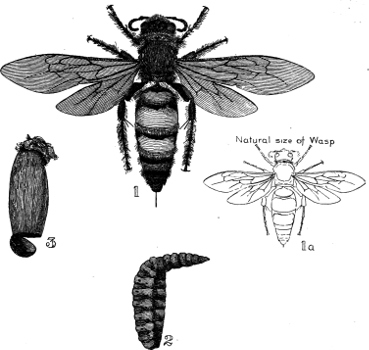
Fig. 52.—Life History of a Flower Wasp.
1. Dielis formosa (Guérin). ♀. (1a.—Life size.)
2. „ „ Larva.
3. Pupal Cocoon, showing opening whence the wasp has emerged.
(“Agricultural Gazette,” N.S.W.)
Dielis 7-cincta, one of our commonest species, often clustering in numbers on flowering shrubs in the gardens, was described by Fabricius, and is the male of Dielis (Scolia) formosa which was not described till 1846 by Guérin. The male, ⅔ of an inch in length, is very slender in form, of a general black colour, clothed with fine grey hairs, and marked with light yellow on the head and thorax, with five broad bands of the same colour on the body. The female, under 1 inch in length, is black, with the abdomen marked on the upper surface with reddish yellow somewhat variable in its distribution, and clothed with reddish brown hairs, thickest on the head and thorax. This insect has been found in Queensland destroying the underground grub of the Sugar-cane Beetle (Lepidoderma albo-hirtum).
Family 17. Sand Wasps. POMPILIDAE.
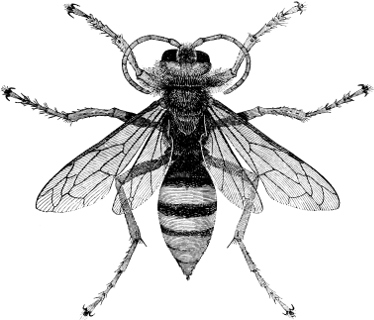
Fig. 53.—Salius (Priocnemus) bicolor (Fabr.).
Large sand-burrowing wasp, that attacks cicadas.
(“Agricultural Gazette,” N.S.W.)
This group is well represented in Australia, and widely distributed over the country; about 60 species have been described: several collected by Sir Joseph Banks in 1775 were described by Fabricius; Smith, in the Catalogue previously noticed, in a series of papers between 1862–69 in the Transactions of the Entomological Society, other Journals, and a British Museum publication (New Species of Hymenoptera 1879) published after his death, has described most of our species; Saussure in the Hymenoptera of the Reise Novara; and later Kohl has enriched our list.
The typical genera Pompilus and Salius comprise a number of large yellow and black wasps with coloured wings tipped with black. They have long legs well adapted for running over the ground, and may be seen any warm sunny morning hunting about for spiders, with their antennae and wings constantly on the move as they rush about. They will attack the largest spider whether on the ground or hidden in a tree trunk; one large black undetermined species even ventures down the nests of the Trap-door Spiders and drags them forth. Sometimes one of the larger ground spiders shows fight, and it becomes a duel to the death, the wasp now and then being captured by its intended victim. They often place the spider in any suitable cavity with their eggs, but others form extensive burrows in the soil. Salius (Priocnemus) bicolor is one of our largest yellow and black species, often measuring 2 inches across the wings, but variable both in colouration and size. She forms a burrow as large as a mouse hole, several feet in length, with quite a large mound of excavated soil outside the entrance; when emerging from the chamber she looks a most formidable creature, but unless captured never attempts to attack anyone. She sometimes stores her nest with cicadas many times larger than herself, which she rides down to their tomb before they are quite dead. The young larva is usually attached to the cicada’s breast when hatched out; but I have never been able to keep any alive after being dug out of the nest. This wasp has a curious habit of flying round and dragging a cicada off a branch when it is sucking up the sap; taking its place, she calmly stands over the spot and drinks up the sap that exudes from the puncture the dispossessed cicada had made in the bark. The members of the Genus Pepsis are large black wasps with a beautiful metallic lustre on the wings; they are chiefly confined to the tropics, but Saussure has described one species, P. australis, from this country.
Family 18. Smaller Sand Wasps. SPHEGIDAE.
Westwood placed these wasps and the Pompilidae in a single family, but Kohl, while separating the latter, has grouped a number that were once ranked as families, under the Sphegidae, calling them simply sub-families, thus making this a much more extensive division, the Sphegidae proper forming only a part of the whole.
Dalla Torre in his Catalogue treats them as a sub-division of the Crabronidae; but Sharp takes Kohl’s classification, which I follow.
The Sphegides are easily distinguished by the peculiar structure of the abdomen; the basal portion is produced into a slender rod-like stalk or pedicle, with the apical part forming a rounded or oval tip; they are very active creatures with the habits of the larger sand wasps.
The world-wide Genus Ammophila is represented in Australia by four described species; they make their nests in sandy ground, digging out a straight burrow with an enlarged chamber at the end, which they store with different kinds of caterpillars they capture on the plants while hunting; these they sting but do not kill, but though paralysed and incapable of motion, remain alive long enough to furnish the baby wasps with a supply of fresh food.
Ammophila suspiciosa is a slender black insect under 1 inch in length; the thickened tip of the abdomen is dull red. This is our common species found all over the western country. A. instabilis is a larger black species with semiopaque wings and reddish legs; the tubular portion of the body and base of the thickened part are reddish brown: this one is a northern form found in Queensland.
Pelopaeus laetus is a very handsome black and yellow wasp with a somewhat similar shaped body tipped with black; it is very variable in size, the largest measuring about 1 inch in length. It has a wide range over Australia, and differs from the former insects in being a regular “mud dauber,” forming a regular clay nest consisting of a number of different cells, each of which is filled with paralysed spiders. It is a very friendly insect, often flying into the room on a summer day; and will build its nest on the edge of a roof or wall.
The typical Genus Sphex contains a number of fine black wasps more or less clothed with silver or golden pubescence on the head and thorax, with the slender pedicle at the base of the thorax very well defined, and the hind portion of the abdomen almost round or oval. They form underground burrows branching out into a chamber at the end, in which they store all kinds of different insects, each species seeming to have a preference for its particular choice. Sphex vestita, one of our largest species, has the face thickly clothed with silvery pubescence; it is often common in sandy patches in gardens, where it hunts for small orthopterous insects, and is particularly fond of a species of small brown cricket which lives in the long grass. S. opulenta is a smaller species about ¾ of an inch in length, with the face and back of the thorax bright silver, and the dorsal surface of the latter coppery. About 30 species are described from Australia, some of which have a very wide range over the interior.
The Larrides are medium sized black wasps with the abdomen not stalked, but coming to a point at the junction with the thorax, and often ornamented with golden or silvery pubescence forming bands on the body.
Shuckard described a number of our species belonging to the Genus Pison (Trans. Ent. Society 1837–40), where he gives some account of the group. Smith in the same Transactions, 1869, catalogued those previously described, and added a number of new species; and also added the Genus Parapison, containing species from India, Ceylon and Australia. The European Tachytes, which Westwood says are captured in sand banks, are represented here by three species, all shining black insects about ½ an inch in length. Saussure (1855), and Kohl later have described others.
Pison spinolae and P. decipiens are both black wasps with silvery bands upon the sides of the abdomen; the latter are the smaller. They are both common about Sydney, and have a very wide range over the country; they are very fearless insects, flying into the house, and wherever they come upon a convenient hole in the rung of a chair, or even a key hole, will set to work and line it with clay, forming an irregular chamber, which they store with small spiders, deposit the egg, and after closing it up fly away quite satisfied. Sometimes they form a row of round clay cells on a coat or other garment hanging on a wall.
The Nyssonides comprise a smaller group of closely allied forms, differing chiefly in the venation of the wings. Smith has described most of our species. The members of the Genus Gorytes are represented by five described species; all small, active, bee-like insects with coppery fasciae upon the abdomen; several of these are known in the bush as “policemen flies” from their habit of coming round and catching flies upon one’s clothes and even snapping one off the back of one’s hand; these flies are killed with their stout jaws and deposited in their nests constructed in the ground.
The curious, large, reddish brown wasp, Stizus pectoralis, from Queensland, at first sight might be taken for a Thynnus, but the distinct form of the body, and the antennae thickened toward the tips, show that it could not belong to the flower wasps. It is now placed in the allied Genus Sphecius.
The Philanthides are easily distinguished from the other groups by the curious rugose or punctured integument which makes them look as though coated with armour plate, and the curious constrictions or rings between the abdominal segments, becoming smallest toward the tip. They are generally black or reddish brown, marked with pale yellow spots and bands. With the exception of one species of the Genus Philanthus all ours have been placed in the world-wide Genus Cerceris. I have generally captured them about flowers, or flying round bushes infested with scale insects that were throwing off honey dew, which sweet secretion has a great attraction for small hymenoptera of many different families. Eight species are described by Smith and Saussure; there are probably many new species to be recorded. Nothing is known about their habits in this country, but the European species form nests in the ground, which they provision with small beetles; and each species is said to confine its attention to a different group of beetles; one uses only small weevils; another carries off chrysomalids, and so on with each species.
The Crabronides are another small group, and under the present classification all our species have been placed by Smith in the world-wide Genus Crabro. They are medium sized black wasps with broad stout heads and unstalked bodies, generally banded with orange, red, or yellow; they form burrows in the stems of plants, which they store with captured flies. Five species have been described from Australia and Tasmania.
The Bembecides are very handsome, smooth, shining wasps of fair size, with broad bodies, rounded and broadly pointed at the extremity. They are generally met with along sandy pathways and roads, flitting along in front of one, settling on the ground and rising again, so that they are easily captured with a net. They make shallow burrows on the roadside in which they place flies, which they capture with their powerful jaws.
Nearly all our species have been described by Smith in the British Museum Catalogue Hymenoptera 1856, and the Annals and Magazine of Natural History 1873. Under 20 species are recorded from Australia. Bembex tridentifera was described by Smith from Moreton Bay, Queensland, but it has a wide range southwards to Victoria. It measures just under ¾ of an inch in length; is of a general black colour; the face yellow with a black trident-like mark above and two black spots below the antennae; the legs yellow lightly marked with black; the upper surface of the thorax spotted and barred with yellow, and the abdomen beautifully banded with irregular white bands on the 2nd to 4th segments, with the first and last only marked on the sides. B. vespiformis ranges from West Australia to S. Australia, is somewhat smaller than the last, and viewed from above is black, with very faint markings on the thorax, and a broad white band on either side of the first segment of the abdomen almost meeting on the back.