Order VI.—LEPIDOPTERA. Butterflies and Moths.
Reading edition
Butterflies and moths are scale winged insects, and are among the giants of the insect world; they can be defined as insects with two pairs of membranous wings well adapted for extended flight, clothed with scales overlapping each other like the slates on the roof of a house, flattened and rounded on the surface of the wings, but more or less hair-like upon the body. The head is usually provided with a tubular proboscis or mouth, that can be curled up like a watch spring when at rest, and is admirably adapted for sucking up the honey from flowers when expanded.
The caterpillars may be smooth and naked, or thickly clothed with spines or hair; with few exceptions they feed upon the foliage or wood of plants: after undergoing a series of moults they either spin a cocoon, bury themselves in the ground, or (if wood borers) close themselves up in the burrow where they undergo a complete metamorphosis. If the larva of a butterfly, the caterpillar attaches itself to a twig by the tip of its tail and casts the larval skin, which slips off, leaving the naked transformed pupa simply enclosed in a stout, close-fitting pupal jacket. Some species of moths appear in such numbers at times that they do a great deal of damage to plant life, and are very serious pests.
Lepidoptera on account of their beauty and size have always been very popular with entomologists, and large numbers have been collected from all parts of the world, so that this is one of the best known orders. Sharp estimates that 50,000 species are described, and every year adds to this long list.
They are divided into two great groups, somewhat artificial, but definable as Rhopalocera, butterflies; and Heterocera, moths.
RHOPALOCERA. Butterflies.
The typical butterflies are usually slender-bodied insects, with filiform and more or less clubbed antennae, delicate legs, and large richly tinted wings; they fly about in the bright sunlight, visiting flowers and feasting upon the nectar that they find in the blooms. They have large compound eyes so that they can see very well; and the slender tubular mouth is very highly developed in all butterflies. The eggs are laid upon the food plant: the caterpillars are generally more or less elongated, and naked or covered with scattered tubercles rather than hairy; when full grown they attach themselves to the under side of a twig or leaf by the tip of the abdomen. Some groups are furnished with a silken girdle round the middle attached at each end to the leaf or twig; and another section roll themselves up in leaves. They do not form a cocoon, but as the larval skin slips off, it reveals the regular pupal form fitted with a skin-like jacket through which the indistinct lines of the rudimentary wings, legs and antennae can be traced. The pupa may remain in this quiescent state for several months before the butterfly splits the skin and emerges, a perfect, fully developed insect.
As many of our butterflies have an extended range, some of them were originally described from other countries, and when captured here were named as new species; so that a good deal of confusion has existed in the proper identification of some of our common species as to whether they were Australian or only varieties of foreign species. In 1805 Donovan figured some of our commonest species in his “Insects of New Holland.” After Kirby’s “Catalogue of Rhopalocera” was published in 1871, Masters compiled and issued a list of our Australian species. In 1878 Semper published his list of Australian species; and in 1891 Miskin produced his “Catalogue of the Australian Butterflies,” in which he included and described some new species (No. 1, Annals of the Queensland Museum); this remained our working list until Waterhouse published his “Catalogue of the Rhopalocera of Australia” as No. 1 Memoir of the New South Wales Naturalists’ Club 1903. In Waterhouse’s list a great many changes have been made in the genera and species; a number of our well-known names have vanished, with very little explanation; for example, Pieris teutonia, our common white, appears under the name of Belenois java; this is unavoidable to a certain extent in bringing Catalogues up to date, but is very confusing to beginners in the work of classification.
For a list of the writers upon, and references to our butterflies, the student is referred to Waterhouse’s Catalogue.
I am indebted to Messrs. Anderson and Spry for notes on the life histories of some of the southern species described in their “Victorian Butterflies” (Melbourne 1893).
Family 1. Brush-footed Butterflies. NYMPHALIDAE.
This group comprises a number of large or medium sized butterflies that are known as “Fritillaries,” “Emperors,” “Admirals,” and many other popular names in England, and are generally brightly coloured; many have a very wide range over the world. The fore-legs of both sexes are imperfect, the male with one or two, the female with four or five tarsal joints. The larvae are usually spiny, or clothed with hairy warts; and the pupae are suspended by the tail. Sharp places them in eight sub-families, four of which are well represented in Australia.
The Danainae are brightly coloured butterflies of a general reddish brown tint with blackish markings; the larvae are smooth cylindrical caterpillars with the tips of the body ornamented with a fleshy tail. The Genus Danais contains six species, of which the best known in Eastern Australia is the “Monarch” or “Brown Gypsy,” originally a North American insect but now almost world wide in its range; it is known under at least four names, and though usually figured as Danais archippus, its correct name is Danais menippe. The handsome banded black and cream coloured larva feeds upon the introduced “bladder-weed” (Gomphocarpus fruticosus), and turns into a beautiful pale green pupa with metallic markings. This large, deep reddish brown and black lined butterfly is too well known to require description.
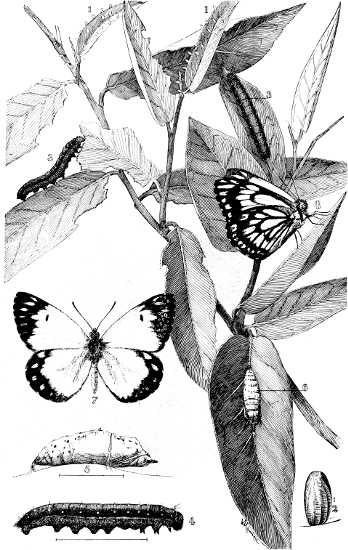
Plate XIX.—LEPIDOPTERA.
Family Pieridae.
1. Pieris teutonia (Fabr.). Eggs on foliage.
2. Pieris teutonia (Fabr.). Eggs enlarged.
3. Pieris teutonia (Fabr.). Caterpillar.
4. Pieris teutonia (Fabr.). Caterpillar (enlarged).
5. Pieris teutonia (Fabr.). Pupa (enlarged).
6. Pieris teutonia (Fabr.). Pupa on leaf.
7. Pieris teutonia (Fabr.). Showing upper surface.
8. Pieris teutonia (Fabr.). Showing under surface.
This butterfly is now known under the name of Belenois java (Sparrman).]
Plate XIX.—LEPIDOPTERA.
D. petilia, a much smaller butterfly, has broader white markings on the tip of the fore wings and none round the edges of the hind pair. It has a wide range over Australia, across Asia to Europe. The caterpillar is of a lavender colour and feeds upon the cotton grass; it transforms into a beautiful green chrysalis marked with scattered golden spots and a band of the same colour round the abdomen. D. hamata, a fine pearly blue and black species, is recorded by Olliff from Cape York to as far south as Shoalhaven, N.S.W., but is a rare insect in the south.
Fourteen species of the Genus Euploea are described, of which E. corinna is a mottled black and white species, very abundant in sheltered gullies in N. Queensland, also ranging southward to Sydney. The larva feeds on a creeper (Mandevillia); it is a slender, dull-coloured caterpillar with four pairs of fleshy tentacles on the back. The pupa is suspended to a leaf, and is a rich, bright metallic silver.
The Acraeinae contains a single species, belonging to the typical Genus Acraea, which is found from North Queensland to Sydney. A. andromacha measures 2¾ inches across the wings; is blackish brown; the fore wings are transparent with dull brown markings; the hind pair are opaque, creamy white, edged with brown; it always looks as though badly rubbed. It has a range from New Guinea, Fiji, and Samoa into Australia. The yellowish brown caterpillar clothed with branched fleshy spines, feeds upon the passion vine, and is not uncommon in Sydney gardens.
The Nymphalinae comprise a number of handsome butterflies, which differ from the previous ones in having the cells of both pairs of wings open or imperfectly closed. The larvae are very variable, some being slender hairy caterpillars or armed with spines and tubercles; others are short and cylindrical, furnished with horns upon the head.
The fine East Indian Genus Cethosia is represented by three species: the Crimson-winged Butterfly, C. cydippe, is not an uncommon insect in North Queensland frequenting the clearings on the edge of the scrub; it measures 3½ inches across the large rounded wings, the hind margin of the second pair being deeply scalloped; the central portion of both surrounding the body is bright red, the outer deep purple, with white markings toward the tips of the front pair; and the under surface of both is barred and spotted. Cynthia ada, ranging from Brisbane to Thursday Island, is a large light ochreous yellow butterfly, with a dark line diagonally crossing both wings from the middle of the fore pair to the level of the tip of the body; a double band of crenulated markings encircle the wings; and there are a pair of eye spots on the hind ones. Cupha prosope is the representative of another northern genus ranging from the Richmond River N.S.W. to Thursday Island. It is a medium sized butterfly with dark orange coloured wings, the front pair tipped and edged with black; all the under-surface is pale orange yellow, mottled and barred, with a row of eye spots round the edge of the wings. The Australian Fritillary, Argynnis inconstans, measures about 3 inches across the wings; it is of a uniform dull yellow colour with a double row of black spots along the edge of the wings, with the inner portion covered with an irregular pattern of spots and dashes. It is common along the cleared tracks in the Queensland jungle, and has been recorded from as far south as Hunter River, N.S. Wales. Pyrameis kershawi, figured and described by McCoy from Victoria, is found throughout Australia, and is so closely related to the “Painted Lady,” P. cardui, of Europe, that it was until lately only considered a variety. It measures under 2 inches across the wings; its general colour is dull brown mottled and barred with black and white. The larvae feed upon “everlastings” (Heliochrysum) and the introduced cape weed; they are slender brown creatures covered with black spines, and the chrysalis suspended by the tail is marked with shining golden spots. P. itea, slightly larger than the previous species, has the edges of both pairs of wings scalloped; the fore wings are black, each with three small yellow spots at the tip, and a large elongated patch crossing through the centre, with the inner portions of both pairs bright ferruginous brown, and a row of four small black eyes on the hind wings. The slender spiny caterpillars feed upon the foliage of nettles. The angulated chrysalis is often marked with golden spots. The Genus Junonia contains two common butterflies, one J. villida found all over Australia; it measures about 2 inches across the wings and is of a general brown tint edged with delicate white and grey markings, and ornamented with a pair of eyes on each wing ringed with yellow. It has a curious habit of flying along the track in front of one, settling on the ground, then flitting ahead again. The cylindrical somewhat stout larva is blackish brown, spined behind the head and clothed with fine hairs; it feeds upon rib grass (plantains). The short stout chrysalis is light brown marked with darker spots. J. albi-cincta does not come south of Brisbane; it is about the same size, with the eyes upon the wings smaller, and the hind wings mauve, giving out a bright metallic sheen. The Brown Leaf-winged Butterfly, Doleschallia australis, is nearly 3 inches across the wings, which are elongated and oval in form, with the tip of the hind pair produced into a tail; the upper surface is dull reddish brown with yellow in the centre, while the under surface is greyish brown mottled with wavy lines, with a central larger bar crossing the centre and running out into the tail. It flits about in the undergrowth, a conspicuous insect when on the wing, but the moment it settles and folds its wings over its back, it is lost to sight, for its leaf-like wings, when closed with the tail forming a stalk, so closely resemble the foliage, that while it remains at rest it is very difficult to detect. It ranges from the Richmond River to North Queensland. The Blue-eyed Butterfly, Hypolimnas bolina, ranges from Cape York to Sydney, but is a rare insect about the latter place. It differs in the sexes both in size and markings; the male is rich velvety black; has both wings deeply scalloped, a double white spot towards the tip of each, with a blotch of opaline white in the centre encircled with iridescent violet blue. The play of colour in this beautiful butterfly flashing about in the bright sunlight with its ever changing tints of blue and black, makes it one of our most striking species. The female is somewhat larger; has the central markings on the fore wings more elongated and lighter coloured, with a blotch of fulvous red below it; the hind wings are much whiter in the centre and are only slightly clouded with blue. Neptis shepherdi, ranging from Brisbane to Cape York, has the typical delicate black wings spotted and striped with white. The Tailed Emperor, Charaxes sempronius, is our sole representative of the genus, the home of which is Africa and the East Indies; it is nearly 4 inches across the wings, the inner portions of which are creamy white, the outer edges, tips and margins black, and with a row of creamy spots along the edges and two spots behind. The marginal black edging on the hind wings is broad, shaded on either side with pale blue, which covers the broad scallops in the wings; there are two stout wedge-shaped tails on each hind wing, and a bright reddish-yellow blotch on each inner edge. The larva is a very curious, short, stout, pale green caterpillar, with a slightly forked tail, and four short stout horns on the top of the head; it feeds upon the foliage of the black wattle. This species ranges from Sydney to Derby, N.W. Australia, where I took a specimen upon a baobab tree which is now in the Macleay Museum; Waterhouse gives Cairns, Q., as its northern limit, but this gives it a much extended range.
The Satyrinae are chiefly small butterflies, black, brown, or sometimes white, generally marked with eye spots, and the wings are rounded. The larvae feed upon different grasses, and are smooth or clothed with fine short hair: the head is round; and the body tapers to each extremity, and ends in a forked tail.
The Genus Mycalesis contains five species; they are all reddish-brown butterflies of small size, that flit about in open forest country, of which Mycalesis terminus is a very good type: it measures 1½ inches across its dull, rusty red wings, which are indistinctly marbled, and darkest at the tips; the edges of the hind pair are marked with fine black lines. On each wing are a pair of small eyes, the hind one on each wing being largest; these also show on the under surface, and those on the hind wings are encircled with silvery lines. It is a northern species found along the coast of North Queensland. Tisiphone abeona is a common species in Victoria and on the eastern coast of N.S. Wales, usually found flitting along damp gullies, never flying high or in open country. It measures about 2½ inches across the wings, and is of a uniform dark brown tint: the front wings are ornamented with two eyes, the first smallest; a broad irregular band of yellow bisects the wings about the middle, crossing behind the eyes; the hind wings are plain, with a small eye on the inner margin, and are slightly scalloped round the edges. The delicate green caterpillar has a small rounded head; it is broadest in the centre, tapering to the head and forked anal extremity. It feeds upon the sedges. The chrysalis is of a delicate emerald green tint, with the edges of the wings outlined in yellow. Ypthima arctous ranges from Sydney to Cape York; it is a small, dull brown insect with a very large eye on the tips of the fore wings, and a very small one on the hind pair.
The Genus Heteronympha contains seven species, all of which have a wide range along the coast; the Yellow Wood Nymph, H. merope, being one of the commonest in all open forest country from Tasmania to Brisbane; it is remarkable from the fact that the sexes differ both in size and markings. The male measures 2½ inches across the wings, which are of a general dull tawny yellow colour mottled with black and brown, the fore pair in a scroll-like pattern, the hind ones only barred along the edges and slightly touched with black. The female, ½ an inch broader, has the greater part of the fore wings black, enclosing two yellow patches fading into tawny yellow toward the basal portion, and with a large yellow angular blotch standing out on the posterior sides; each wing in both sexes has a small eye towards the tip. The dull brown larvae feed upon various grasses, and hide close to the roots. The chrysalis is not attached to the food plant, but rests in a frail network on the ground. H. mirifica, found between Sydney and Brisbane, is about the same size as the female of the last species; it also haunts sheltered country. It is of a uniform, blackish brown tint with small eye spots and a broad irregular white stripe across the middle of the fore wings.
The Genus Xenica is peculiar to Australia; it contains nine species, four of which are confined to Tasmania, several being found only on the higher portion of the mountain ranges. They are all small, tawny yellow or reddish brown butterflies of small size, spotted and mottled with brown, and have small eyes upon the tips of the wings. Xenica achanta, one of the largest, measures about 2 inches across the wings, and is of a uniform dark orange yellow, with the apical portion of the fore wings marbled with dark brown; the hind pair are regularly mottled all over; and the margins of both are edged with two fine black lines; it ranges from S. Australia to Queensland. Several smaller species have been described from the Australian Alps. X. correae, described by Olliff from Mt. Kosciusko, feeds upon the native fuschia: X. fulva, also described by Olliff, is the male of this species.
Family 2. Horned Butterflies. LIBYTHEIDAE.
This family contains only a single genus, representatives of which are found scattered over all the warmer parts of the world, but the largest and most brightly coloured forms are found in New Guinea. They are remarkable for the formation of the palpi, which, standing out in front like a beak, are four times the length of the head; the wings are angulated, and the pupa hangs by the tip of the abdomen. One species, Libythea nicevillei, ranging from Port Moresby across to Cape York, represents the family in Australia.
This group appears to form a connecting link between the Nymphalidae on the one hand, and the Lycaenidae on the other.
Family 3. The Blues. LYCAENIDAE.
The “blues,” “coppers,” or “hair-streaks” are so named on account of their rich colourations or wavy markings on the under side of the wings. Though often passed over by the ordinary collector because of their small size, they are much sought after by lepidopterists for their beauty and bright metallic tints. Their bodies are slender, and the wings somewhat fragile; though they can fly well, they usually prefer to flit about the bushes and sheltered gullies, and when they settle have the habit of folding their wings in an erect position above the body, so that unless disturbed they are not very noticeable. The prevailing colours are metallic blue, or coppery red, with eyes upon the wings in some groups, while others are ornamented with dainty feathery tails, or lobes upon the hind wings. The colours and markings of the sexes often differ in the same species on the upper surface, but always correspond on the under-side. The legs are more developed than in the Nymphalidae, the tarsi of the male somewhat aborted, but that of the female complete. The larvae are curious, short, slug-like, greasy grubs, dull brown or green; some of them are gregarious, clinging to the twigs by day and feeding at night. The pupae are attached to the twig by the tip of the abdomen and girthed with a silken thread round the middle.
In Miskin’s Catalogue 110 species were given under 18 genera; in Waterhouse’s list 114 species are recorded, divided into 31 genera. Waterhouse has monographed this family, where descriptions of all the known Australian species will be found (Pro. Linn. Soc. N.S.W. 1902–1903). A number are rare and restricted in their range, and many are confined to the rich tropical scrubs of North Queensland. The Genus Danis contains six species, most of which are confined to North Queensland; Danis taygetus is a very distinctive little butterfly, common in the Queensland scrubs, and extending as far south as the Richmond River, N.S.W. The male has the fore wings pale violet blue, with the centre of the hind ones white, the edges of both pairs black; in the female both pairs are marked with white with a faint shade of blue; on the under surface the centres of the wings are white edged with black, with a broad band of bright metallic blue occupying the lower half of the hind pair encircling a row of black spots. The Genus Miletus contains fifteen species: M. delicia has the upper surface brownish black, with the base of the fore and centre of hind wings pale metallic blue; the under side is dull yellowish brown, variegated with angulated blotches or spots forming bands round the wings and a parallel stripe across the front of the fore pair. This butterfly ranges from Victoria to Queensland. M. ignita has a very wide range over the southern parts of Australia into Queensland; it was figured and described by Leach in 1817. Candalides absimilis is a medium sized insect; the male has the upper surface dull blue with the edges fringed with white; the female is dark brown with an oval patch of white in the centre of both wings and metallic tints round the body; the under surface is pale bluish white marked with fine wavy lines round the wings. It is found from Victoria well into Northern Queensland. Polyommatus boeticus has had many names, for not only has it a very wide distribution over Australia, but it extends over Asia, Africa, and Europe. It is of a uniform brown tint; has the centre of both wings shaded with pale metallic blue; the hind one terminates in a fine slender tail, with two eye spots at the base; the under side is creamy white with slate grey lines and eye spots touched with blue.
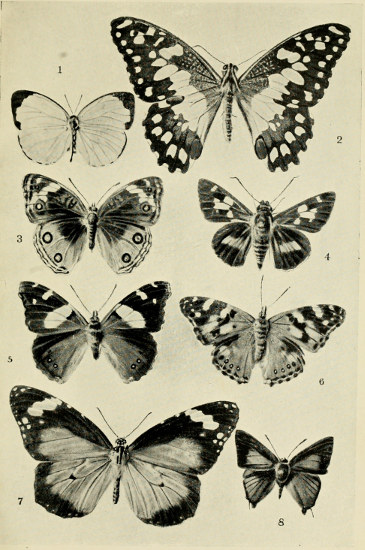
Plate XX.—LEPIDOPTERA.
Family Pieridae.
1. Terias hecabe (Fabr.).
Family Papilionidae.
2. Papilio sthenelus (Macl.).
Family Nymphalidae.
3. Junonia albi-cincta (Butler).
5. Pyrameis itea (Fabr.).
6. Pyrameis cardui (Linn.).
7. Danais petilia (Stoll.).
Family Hesperidae.
4. Trepezites symmomous (Hubn.).
Family Lycaenidae.
8. Chrysophanus aenea (Miskin).
Plate XX.—LEPIDOPTERA.
Lucia lucanus, one of the smaller forms, has all the upper surface of a dull ochreous tint, with the centres of the fore wings pale yellow. A fine fringe of hair-like scales of alternate tufts of black and white gives it a delicate pencilled appearance; the under surface is mottled and brownish, the white of the fore wings showing through. It has a wide range from South Australia to Mackay, Queensland, and is common about Sydney. L. pyrodiscus has the upper surface black, with the centre of the fore wings and the greater part of the hind ones dull red. The whole of the under surface is purplish and finely marbled with a very fine tail on the outer edge of the hind pair. It ranges from Victoria to N. Queensland.
The Genus Ogyris contains eleven species, most of which are recorded from the southern portion of Australia. Ogyris abrota has the upper surface dark brown with a patch of pale metallic green in the centre of each fore wing; the hind pair are all brown and scalloped along the edges; the under side is pale creamy white mottled with wavy lines. The larva feeds upon the foliage of Loranthus; it measures about an inch in length; is of a uniform dark yellowish brown, with the upper surface rough, clothed with fine bristles; they feed at night, and pupate in the usual manner of all members of this family.
The Genus Ialmenus contains eight species, among them several of our best known “Blues”: Ialmenus evagorus ranges from South Australia into Southern Queensland, and was figured by Donovan in his “Insects of New Holland” in 1805. It is described by Olliff under the name of the “Imperial Blue,” but I would suggest that the “Black-wattle Blue” would be a much more distinctive name, for all along the coast the short, dull green, slug-like grubs may be met with, congregated in little groups clinging to the twigs of this wattle. Hundreds of ants are always swarming over them attracted by the secretion they discharge from glands on the back.
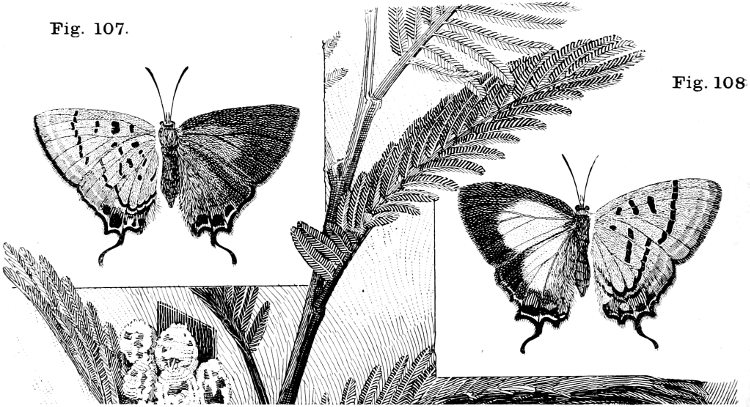
Figs. 107 and 108.—Wattle Butterflies.
107. Ialmenus ictinus (Hewitson).
The Inland Wattle Butterfly.
108. Ialmenus evagorus (Donovan).
The Coastal Wattle Butterfly.
The presence of ants is probably of great value to the larvae, for they keep parasitic insects and birds from molesting them. When full grown they sling themselves to the twigs to pupate, and are often so numerous that the branches are covered with pupae hanging like bunches of grapes. The butterfly measures nearly 2 inches across the wings, which on the upper surface are black on the margin, with the rest pale metallic blue shading into white in the centre; the hind pair are scalloped and produced into fine feathery tails with spots of dark orange yellow at the base; the under side is pearly grey, banded and spotted with black. I. ictinus, with identical habits, about the same size, takes the place of this species in the inland districts. Pseudalmenus myrsilus is a handsome little butterfly with the centres of the wings deep orange divided with dark nervures, and the hind pair with long black tails; it is found from Tasmania to the southern districts of N.S. Wales. The last species of this family, Liphyra brassolis, is only found in North Queensland; its larvae live and pupate in the arboreal nests of the “Green Tree-ants.” An interesting account of the life history of this butterfly is given by Dodd in the “Entomologist” 1902.
Family 4. The Whites and Yellows. PIERIDAE.
The members of this family are popularly known as “Whites” and “Yellows” on account of their prevailing colours. Both sexes have six perfect legs, and are butterflies of moderate size, with the hind wings rarely crenulated or produced into tails. Their larvae are slender, hairy caterpillars with small heads, and are often gregarious in their habits; the pupae are sharply angulated to each extremity, attached both by the tail, and a silken girdle round the body of their food plant.
In Miskin’s Catalogue 34 species are listed, contained in 7 genera; Waterhouse reduces them to 31 species, and discards several well-known genera.
The Genus Terias contains all the small “Yellows,” which are low flitting, dainty, little butterflies found in the tropical jungle, but equally at home in the far western scrubs and open forest land. Terias smilax, our smallest species, is common about Sydney, and has a wide range both north and south from Adelaide to Rockhampton. It is bright yellow, with the black markings in the fore wings extending to the tips of the hind pair. The Mottled Yellow, T. hecabe, is much larger than the last; is of a bright yellow colour with the black markings coming round to the edge of the hind wing and swelling out into a rounded patch; the hind wings are lightly edged with black, and on the under side are thickly mottled with yellowish brown spots. It extends from Sydney to Queensland, and has a wide range out northward and eastward among the islands.
The Genus Elodina contains several small, pearly white butterflies, with wings edged with black. The small white, Elodina angulipennis, is found about Sydney, ranging as far north as Mackay, Queensland. Our common white butterfly known under the name of Pieris teutonia, and the sole representative of that well defined genus, has been recently identified as Belenois java, and as Sparrman described it some few years before Fabricius, this well-known name will unfortunately have to give way. This butterfly has a wide range over Australia, especially in the interior, where several native shrubs belonging to the Capparidae are plentiful; upon these the slender brown and yellow caterpillars feed. This is the species that sometimes comes flying over the eastern coast in immense swarms. It measures 2½ inches across the wings, and is black and white on the upper surface, with the under portion more mottled with black and canary yellow. It ranges from Australia to Fiji, Tonga, and the Malay Archipelago. The smaller Whites, which have the under side of the hind wings of a more uniform yellow tint, are represented by Appias (Tachyris) ega, first described by Boisduval in 1836; it has an extended range from Victoria to Cape York, Queensland.
The typical Genus Delias is represented in Australia by 8 species, three of which can be collected from Sydney to Cape York, and two others from South Australia northward. The Painted Delias, D. harpalyce, first figured by Donovan in 1805, measures 3 inches across the wings, which on the upper surface are creamy white, broadly margined on the apical half with black, the fore pair banded with a row of white spots; on the under surface the white markings above are much broader, and the hind wings are blotched with a bright red band surrounded with black but lined with white. The larvae feed upon the native mistletoe (Loranthus) which grows upon the she-oaks, and are slender, dark coloured caterpillars covered with fine hairs. They are gregarious in their habits, often 20 to 30 in a family, and not only do they keep together when feeding, but they spin a curious web over the denuded twigs of their food plant to which they attach themselves when pupating. The pupa is dark brown, slightly over 1 inch in length, armed with short black spines along the sides of the body, and the front of the head is furnished with a curious two-pronged fork.
The Tinted Delias, D. argenthona, is a Queensland species, with the outer half of the hind wings on the under surface black, enclosing a number of bright red blotches; while on the hind wings of the Striped Delias, D. mysis, the red forms a continuous broad curved band round the tips. In the Yellow-tinted Delias, D. aganippe, the wings of the male on the upper surface are creamy white, while those of the female are tinged with yellow, and the black extends further into the wing; on the under surface both sexes have the wings blackish, mottled with large white blotches, and yellow markings; a patch of bright red on the shoulders; and with a row of rounded spots of the same colour running round the hind wings. The larvae feed upon the foliage of Loranthus. The Dusky Delias, D. nigrina, generally flies high, and is not so easily caught; it has an extended range from Sydney to North Queensland; the upper surface is of the usual colour, but the whole of the under surface of the wings is dull black washed with grey; there is a band of yellow on the fore pair, and the hind pair is marked with the same colour and a horse-shoe band of red. The larvae when full grown are almost black spotted with yellow, and with fine white hairs; they are gregarious and also feed upon the Loranthus.
Catopsilia (Callidyras) pomona is a large light butterfly, with the upper surface creamy white tinged with yellow, and with dusky spots toward the tips of the wings; all the under surface is dull yellow, with a few white spots, and with pale purple markings, forming a darker patch in the centre of each wing. It is found from Sydney northward through the Malay Peninsula, and into Ceylon.
Family 5. Swallow Tails. PAPILIONIDAE.
The members of this group of butterflies are popularly known as “Swallow Tails” from the peculiar structure of the hind wings of the typical species, which are produced at the tips into spatulate lobes or tails; though in a large number these tails are wanting. They are all furnished with well developed legs; antennae distinctly clubbed; and the pupae are attached both by the tip of the body and a silken girdle. In this family many of the largest and most beautiful insects in the world are congregated.
The Bird-winged Butterflies (Ornithoptera) are represented by three more or less distinct species from the mainland, and a fourth from Darnley Island. O. richmondia, typical of the group, is the southern form, ranging from the Richmond River, N.S.W., into Southern Queensland. The smaller male measures about 6 inches across the wings, which are rich velvety black, with a bright green stripe along the front of the fore wings; the whole of the body is golden; and the hind wings except the black margins and four black spots are of a slightly brighter tint. The large female is of a uniform dark blackish brown with white markings on the wings. O. (cassandra) euphorion, found from Mackay to Cairns, N.Q., is somewhat larger, with a second stripe of green on the fore wings, and a row of golden spots on the hind pair. The large black caterpillars have short black fleshy spines along the sides of the body, with the front ones bright red.
Rippon has recently monographed the Ornithoptera, and places our species in the Genus Troides, but I prefer to retain the original name, under which our species are so well known. The Genus Papilio contains 18 species in Miskin’s Catalogue, reduced to 15 in Waterhouse’s list, many of them with a very wide range. Papilio sarpedon is common in Sydney gardens, and extends away up the coast to India and Ceylon. Olliff called it the “Wanderer” from its rapid restless flight. It is of a general black colour, with sharp angular fore wings, and rounded crenulated hind wings coming to a blunt finger-like tail at the tips. The centre of both pairs of wings is pale green forming a broad elongate stripe, widest in the centre, and with a row of fine crescent-shaped spots down the sides of the hind pair. The larvae are short, green, slug-like creatures with a patch of yellow on the back; they feed upon the foliage of the camphor laurel.
The Black Orchard Butterfly, Papilio erectheus (now known as P. aegeus), is a larger black insect with an irregular band of white crossing the tips of the fore wings; the centre of each hind one is occupied by a rounded mauve patch; the edges are crenulated, tipped with white, and have a red eye-like spot on the inner margin. The female is much larger; has the inner portion of the fore wings black, but the outer portions dusky white; the hind wings are black at the base, banded with white shaded with black, and have a row of red spots round the margins. The mottled orange green larva is furnished with a broad head, from which shoot out a pair of retractile fleshy horns when touched, at the same time giving off a musky scent. They feed upon the foliage of orange trees, and when numerous are a nuisance in the plant nurseries. The larvae of Macleay’s butterfly (Papilio macleayanus) feed upon the foliage of the Sassafras in the Illawarra district, and range from Tasmania to Cairns N.Q. The butterfly is somewhat after the same slender shape as P. sarpedon, but has the hind wings produced into slender swallow tails. The portion of the wings surrounding the body is pale green, the outer parts black, with three small green patches toward the front of the fore pair, and a row of small spots along the lower edges of the hind pair.
The Imperial Swallow Tail, Papilio ulysses, measures 5 inches across the wings, which are rich metallic blue margined with deep velvety black, and are produced into long swallow tails behind. It is found in the tropical scrubs of North Queensland ranging up into the Malay Archipelago, and for shape and colour is one of the most beautiful butterflies in the world, but should be seen in its native haunts to fully admire its beauty as it goes floating through the tropical brushes.
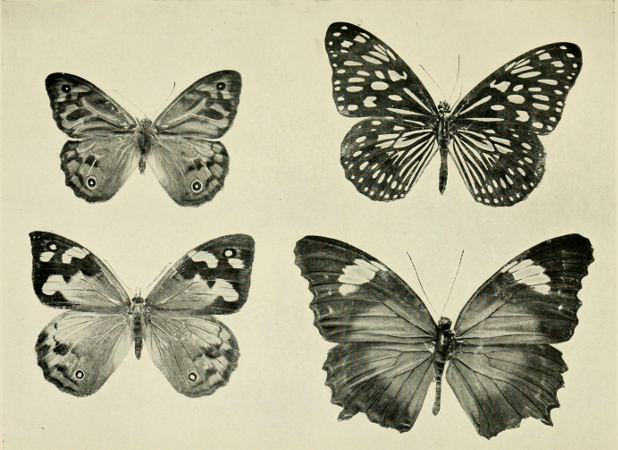
Plate XXI.—LEPIDOPTERA.
Family Nymphalidae.
1. Heteronympha merope (Fabr.). ♂.
2. Heteronympha merope (Fabr.). ♀.
3. Danais hamata (Macl.).
4. Cethosia cydippe (Linn.).
(Original photo. Burton.)]
Plate XXI.—LEPIDOPTERA.
The last of this genus I shall notice is the very distinct yellow and black butterfly, Papilio sthenelus, which has a wide range from South Australia to Queensland, and is one of the very few large butterflies found far inland. The Painted Gauzewing, Eurycus cressida, is a rare species in N.S. Wales, though recorded from as far south as Sydney, but is abundant in the tropical northern scrubs. The male has the fore wings denuded of scales and semitransparent, with the shoulders and two spots in the front black; the hind ones are black mottled with white and red, the latter colour also on the sides of the thorax and tip of the abdomen. The female is smaller, of a dull brown colour, with semitransparent wings, looking very much like a small rubbed specimen of the male; the amateur collector generally discards them under that impression.
Family 6. Skippers. HESPERIDAE.
These butterflies are popularly known as “Skippers” on account of the peculiar way they fly, so different from all the other groups. They have broad, short, thickset heads and bodies; and the antennae, wide apart at the base, are produced at the tip into an irregular club or pointed hooked process. The legs are perfect in both sexes and often spined; most of them are brown or reddish yellow, more or less variegated. The larvae are long, cylindrical, naked caterpillars, with the head hard and horny; the prothorax narrow, forming a regular neck. When full grown they attach themselves by the tail to the leaf, which they roll round themselves into a primitive kind of cocoon.
Messrs. Meyrick and Lower have lately revised this group (Trans. Roy. Soc. S.A. 1902), and list 79 species that they identify, and note a number of others that are so badly described that they cannot be determined.
Netrocoryne repanda, one of our largest species, of a uniform light brown tint, has the tips of the wings darkest, the centres of the fore pair marked with large translucent blotches of a pale yellow tint, and a single spot in each hind one. It has an extended range from Sydney to N. Queensland.
The Genus Hesperilla contains 31 species, some of which are very local, while others have a very wide range: H. picta is about 2 inches across the wings; its general colour is dark brown with a dull greenish tint on the body, ornamented with five yellow spots on the fore wing; the centres of the hind ones and the hind margins of the same yellow colour, and with the markings on the under surface more numerous. H. ornata is a smaller species, of a general dark brown; the fore wings carry a number of spots and four angular golden yellow blotches; the hind pair are reddish orange mottled on the under surface of the body, the tips of the fore and the whole of the hind wings with pale yellow. It has an extended range from Victoria up to Cooktown N.Q. Trapezites iacchus, one of our commonest species, described by Fabricius in 1775, measures 1¾ inches in length, and is of a uniform, dull brown colour shaded with yellow; the fore wings are blotched with small irregular marks; those on the hind pair are parallel and confluent. The under surface is dull yellow; the fore wings are mottled and the hind ones marked with four to five small purple spots ringed with black. It has a wide range from Tasmania over Australia. T. symmomus is a darker, larger species very similar in the markings, only the yellow spots are more defined. It does not range further north than Brisbane.
Figs. 109 and 110.—Earlier stages of the Palm Skipper, Pamphila augiades (Fielder).
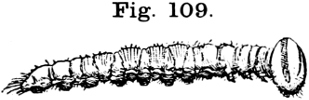
109. Larva.
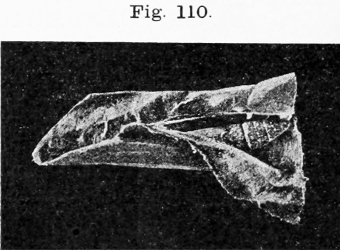
110. Pupa.
Apaustus lascivia is one of the small dull brown skippers washed with yellow, with pale slender transverse bars crossing the centre of the wings; the body is marked with white; the under surface is dull yellow, with the tips of the fore wings darkest. The larvae of Pamphila augiades, another common species in the Sydney gardens, and found as far north as Bowen, Queensland, feeds upon the foliage of young palms; that of Erynnis sperthias is found on the same plant.
Badamia exclamationis is a light brown species with the fore wings narrowed to the extremities, and the hind pair arcuate on the edges. It measures 2 inches across the wings, and ranges from Sydney to Cape York. In the Genus Hasora we have several large skippers, all northern species, with the upper surface dark; the under surface richly marked with purple and pale golden yellow in H. discolor; and with simple silvery stripes on the under surface in H. hurama.
HETEROCERA. Moths.
Moths differ from butterflies in having the abdomen stout and thickset, and not pinched or constricted in front at the junction with the thorax; and the antennae, instead of being clubbed or thickened at the tips, are either slender filiform appendages or are uniformly thickened, pectinate, or feathered; when of the latter form they are much more pronounced in the males.
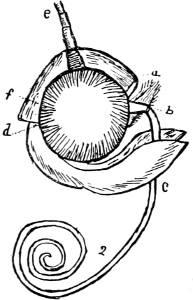
Fig. 111.—Head of Hawk Moth.
a, upper lip; b, mandibles; c, proboscis; d, lower lip; e, antennae; f, eyes.
(Redrawn from Duncan’s “Transformations of Insects.”)
Most moths are nocturnal in their habits; in the day time they are usually found hiding among the foliage or resting in dark corners, and many can be obtained by shaking the bushes over a net. The larger species may be killed at once in the cyanide bottle, but must be transferred to a box as soon as they are dead, for they rub very easily; the smaller forms can be placed alive in glass-topped or chip boxes, and afterwards killed, and then mounted before they are stiff. The members of a few groups fly about in the daylight; for instance Agarista glycine, our vine moth, but they are exceptions. The beautiful hawk moths only flit about at twilight, and are known as “crepuscular” moths.
This great group contains some giants of the insect world, such as some of the Atlas Moths of India, and Wood Moths of Australia, which are as big as small bats; while among the Micro-lepidoptera we come to many tiny creatures which require to be examined with a lens before their identity can be established.
The typical moth caterpillar constructs a stout silken bag or cocoon, within the shelter of which it casts its skin and becomes a well defined pupa; but there are many which bury themselves in the ground, or pupate in cavities in timber that form no true cocoon but simply undergo their transformations in such secure hiding places.
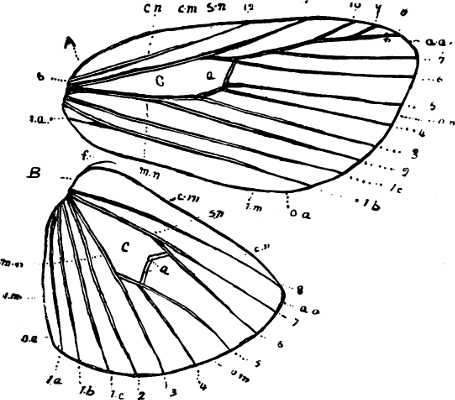
Fig. 112.—Wings of Moth.
A, Fore wing: c.m, costal margin; o.m, outer margin or termin; i.m, inner margin; a.a, apex; o.a, outer angle or tornus; c, discoidal cell; d, discocellulurs.
B, Hind wing: c.n, costal nervure; vein 12 fore wing, 8 of hind wing; s.n, sub-costal nervure; m.n, median nervure; 1a, b, c, three branches of internal nervure; 2, 3, two branches of median nervure; 4, 5, 6, three branches of radial nervure; 7, 8, 9, 10, 11, five sub-costal branches of fore wing; 7 sub-costal nervure of hind wing.
Moths are well represented in all parts of Australia, but are most numerous in well wooded country: a considerable amount of work has been done in this group by Messrs. Lewin, Scott, Walker, Meyrick, Lower, Turner, and others in Australia, and Messrs. Guérin, Boisduval, and many other foreign writers. I have in the arrangement of the families followed Lower’s Catalogue of Victorian Heterocera (Victorian Naturalist Vol. x. 1893—Vol. xiv. 1898).
Family 1. Connecting-link Moths. CASTNIIDAE.
The members of this group comprise a few insects that form an intermediate state of development between butterflies and moths; for while there is no doubt that they are moths, they have hooked or thickened antennae like the “Skippers,” somewhat similar habits, and even the general colouration. They are chiefly confined to South America and Australia. Euschemon rafflesiae is one of the largest hesperid-like forms; is black, blotched with white, and is found in the northern parts of Australia.
The Genus Synemon contains a number of small reddish brown moths which flit about over the grass, just like small butterflies: Synemon sophia is about 1½ inches across the wings, which are brown, slightly marbled in front, and the hind pair blotched with dull yellowish brown; it is common on the grassy flats along the eastern coast. S. hesperoides is common in Victoria in similar localities; is about the same size, but of a darker brown colour; the fore wings marbled with fine wavy grey lines, and the hind ones with a rusty red tint.
Family 2. Butterfly Moths. URANIIDAE.
These are large usually day-flying moths with slender antennae; broad wings, the hind pair crenulated and produced into tails; the abdomen like that of a stout butterfly, and never extending beyond the hind wings.
The typical species (Genus Urania) are found in America, others in Madagascar; but our beautiful forms belong to the Genus Nyctalemon, one species of which, Nyctalemon orontes, is very common in North Queensland. In the neighbourhood of Cairns a score of this species can often be taken in the early morning resting on the low scrub, and small swarms of them can often be seen flying across the rivers in the middle of the day. This species is a very handsome large velvety black moth marked with broad dull green bands, and having short creamy swallow tails. Several very beautiful species are also found in Southern New Guinea.
Family 3. Day Moths. AGARISTIDAE.
This family has been lately revised by Hampson (Catalogue of the Lepidoptera Phalaenae Vol. I. British Museum 1898); he divides them into 55 Genera containing 225 species, of which some typical forms are peculiar to Australia; they are conspicuously coloured and further noticeable from their habit of flying in the daytime. The members of this family are chiefly confined to the tropical parts of the Old World and the Australian region; in America a few only are found in Mexico and Brazil.
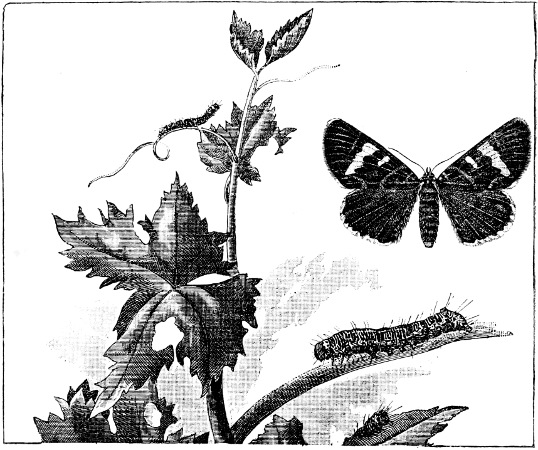
Fig. 113.—Phalaenoides glycinae (Lewin).
The Caterpillar and Adult of the Vine Moth.
(“Agricultural Gazette,” N.S.W.)
The Vine Moth, Phalaenoides (Agarista) glycinae, better known under the old generic name of Agarista, is one of our regular vine pests in the caterpillar state, devouring the foliage and young grapes. The moth lays her eggs upon the vine canes; the grubs when full grown measure up to 2 inches; are of a general deep greenish yellow tint, with the whole of the upper surface covered with small tubercles each bearing a single hair; and they have a band of bright red blotches round the dorsal surface of the anal segment. They bury themselves in the ground, forming a dark reddish brown chrysalid enclosed in a primitive cocoon or covering of particles of earth. The moth measures 2¼ inches across the wings, and is of a uniform black colour marbled on the head, thorax, and sides of the wings with white; the fore wings are tipped with white, and an irregular transverse bar of pale yellow is followed by a smaller blotch through the centre; in the hind pair the outer margins are irregularly edged with white. Phalaenoides tristifica, formerly known under the name of Agarista lewinii, is slightly smaller; the fore wings are more mottled, and the hind pair have an irregular white spot in the centre by which it can be easily identified. Cruria donovani, also smaller than the Vine Moth, has the fore wings mottled with a number of small white blotches, and a broad irregular patch in the centre of the hind ones. Eutrichopidia latina comes closer still to the Vine Moth in size and colour, but can also be easily recognised by having a single broader, irregular, dull yellow band across the outer half of the fore wings. The Painted Day Moth, Agarista agricola, attracted the attention of our earliest entomologists by its brilliant colouration, and was described and figured in colours by Donovan in his “Insects of New Holland” 1805, and again by Dr. Leach in his “Zoological Miscellanies” published in 1815. It has a wide range from Sydney northward, and the several sub-species placed under this name extend its range to New Guinea and Timor. This is now the sole type of the Genus Agarista, in which so many of our species were formerly placed; it is a handsome black moth; measures up to 3 inches across the wings, the fore-pair of which are richly blotched with pale yellow, deep orange, and blue; in the hind pair the centre is bright red and blue, and the margin is white. The head and thorax are pale yellow above; the legs and under surface red; the tip of the abdomen dark orange. The larva is a handsome dark coloured caterpillar clothed with scattered and curious long clubbed hairs.
Plate XXII.—LEPIDOPTERA.
Family Notodontidae.
1. Danima banksiae (Lewin).
Family Agaristidae.
2. Hecatesia fenestrata (Boisd.).
6. Agarista agricola (Donov.).
Family Hypsidae.
3. Nyctemera amica (White).
Family Sphingidae.
4. Cizara ardenia (Lewin).
8. Hemaris hylas (Lewin).
Family Liparidae.
5. Darala ocellata (Walker).
Family Syntomidae.
7. Syntomis annulata (Fabr.).
Family Castniidae.
9. Synemon hesperoides (Feld).
Family Pyralidae.
10. Zenckenia recurvalis (Fabr.).
(Original photo. Burton.)]
Plate XXII.—LEPIDOPTERA.
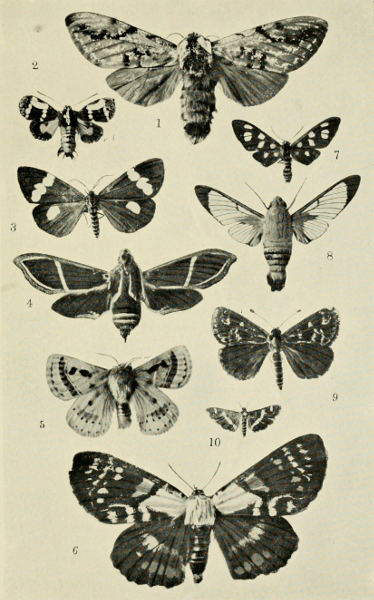
The Genus Hecatesia contains our curious “whistling moths,” which fly about just at dusk, making sharp continued notes like the calls of some of our small cicadas. The sound is said to be produced by the male rubbing his curiously clubbed antennae against a pellucid ridged area in the front of the fore wings. Hampson doubts this, and says it is probably caused by rubbing the tarsal spines against the ribbed space. Hecatesia fenestrata is a pretty little moth, about 1 inch across the wings; is of a general dark brown tint; the outer margins of the fore wings are provided with a broad semi-lunate ribbed band (the musical apparatus) in front, and two white lines behind; the centre of the hind pair and abdomen richly blotched with reddish yellow; the head, antennae, centre of thorax, and outer margins of the wings marked with white.
Three species of this Genus are recorded from Australia, two of which were described from the west coast, while Hecatesia fenestrata has a range from South Australia into N.S. Wales.
Family 4. Ringed Moths. SYNTOMIDAE.
The typical Genus Syntomis, in which Hampson places all our species that were previously described under the Genus Hydrusa, comprises about 138 species, chiefly confined to Africa, Asia, the Malay Archipelago and Australia; 12 species are recorded from this country. They are all rather small moths of a general black or brown tint mottled with orange yellow or lighter brown.
Syntomis annulata, about 1 inch across the outspread wings, has a very wide range from the Philippines through New Guinea and Australia, and naturally varies much in different localities; our variety is of a blackish tint, with six orange spots in the fore wings, and two more angular blotches on the hind ones; the abdomen is regularly banded with orange and black. S. aperta measures 2 inches across the wings, which are of a brownish tint with large blotches of orange yellow occupying the greater portion of the surface, divided from each other by slender lines. It ranges from New Guinea and Queensland round to S. Australia, and has been captured out west about Bathurst, N.S.W.
Euchromia creusa is a very handsome form about 2 inches across the narrow fore wings, which are black with two large transparent divided spots forming a double row across them, and another very small one at the base: the hind pair have two similar blotches. The head, thorax, and basal portion of the abdomen are black, shot with metallic blue; the basal abdominal segments are crimson, finely barred with black. This beautiful moth has a wide range over the Malay Archipelago and the Pacific Islands, coming down to Thursday Island and North Queensland.
Many of the foreign species in the larval state feed upon lichens or grass.
Family 5. Burnet Moths. ZYGAENIDAE.
These moths form an extensive family represented in most parts of the world; they are also day-flying moths, and some are very brilliant in colour. In England some of them are known as “Burnet Moths” and “Green Foresters.” They have long narrow wings, and the antennae thickened toward the middle.
Most of our species belong to the Genus Procris, which are also very abundant in Southern Europe. They are small creatures measuring under 1 inch across the wings, and are of a general dark brown tint with greenish markings. Hestiochora bicolor is a curious little moth remarkable for its bright colouration, which has a wonderful resemblance to one of our small parasitic wasps (Braconidae). The wings are clouded with black; the head and front of the thorax are red, the hind margin of the latter black; the abdomen black and white.
Family 6. Hawk Moths. SPHINGIDAE.
The hawk moths have a stout rounded abdomen tapering to a point; thickened antennae; stout narrow pointed wings; the proboscis or sucking mouth-tube very long, curled up under the head when at rest, but capable of being uncurled in front of the head to suck up the nectar from the deepest tubular flower while the moth is hovering over it. They hide during the day, and are most active just at twilight, when they dart about, over, and around the flowering shrubs. Their caterpillars are very handsome thick cylindrical grubs marked with brilliant eye spots and stripes of various striking colours, and are easily distinguished by a curious curved fleshy horn on the dorsal surface of the tail segment.
They take their scientific name from the fanciful resemblance of their stiff horny pupae (which are naked and generally buried in the sand beneath their food plant) to the Egyptian Sphinx, and their popular names of “hawk” and “humming-bird moth” from their powers of flight.
Our species have been divided into five sub-families, and in Miskin’s “Catalogue of the Australian Sphingidae” (Proc. Roy. Soc. Queensland) 42 species are listed under 13 genera; to which list a few species have since been added.
The first group contains what are popularly called the “Clear-winged Hawk-moths,” from the large bare scaleless areas in the wings; they fly about in the daytime with a loud humming noise, very much resembling some of the Carpenter-bees when hovering over the flowers. Hemaris kingi is marked with black and yellow, and has a thick tuft of stiff hairs on either side of the abdomen; it is not uncommon in Southern Queensland. H. hylas is a similar stout moth with unspotted wings which has an extended range across Queensland to Japan, Asia, and Africa; while a third species, H. janus, ranges from Brisbane to Rockhampton. In the Genus Macroglossa 4 species are recorded from Queensland, some of which extend into our north coast scrubs.
In the second group we have a very distinctive little banded hawk moth, Cizara ardenia, which ranges from New South Wales into Southern Queensland; most of my specimens come from the Illawarra scrubs, N.S.W., where the larva feeds upon the wild vine. Its ground colour is dark brown with narrow grey bands running round and crossing the middle of the wings, with a curious eye spot on the shoulders. The Genus Chaerocampa contains a number of large handsome hawk moths, some of which are introduced species world wide in their range; about 17 are recorded from Australia. The Silver Stripe, Chaerocampa celerio, is a common European species, that is well known here. French describes the caterpillar as a vine pest in Victoria; it is a cylindrical greenish to purple tinted grub with eye spots on the hind segments. The moth measures 3 inches across the wings; its ground colour is greyish fawn, with four slender lines of silvery white forming a stripe down the centre of the fore wings, and the body marked with silver spots; the hind wings are bright pink. C. oldenlandi, which comes close to this species, feeds upon vines in N.S. Wales. It differs in having no short oblique silvery stripes on the front of the fore wings, hardly any red on the hind ones, and has an unbroken silvery dorsal stripe down the abdomen. C. erotus, about the same size, has dark reddish brown fore wings, slightly marbled, and the hind pair yellow, darkened on the hind margins; its larvae sometimes feed upon sweet-potatoes. C. scrofa is a much smaller species of a lighter brown colour, with the hind wings dull brick red, darkest along the hind margin. This is one of our commonest species with a wide range over Australia; the brown small-headed larvae feed upon grass and low herbage. Among our most striking forms are the two species of the Genus Coequosa, both about the same size, sometimes measuring up to 7 inches across the wings. Coequosa triangularis is of a reddish brown and grey tint, mottled on the hind wings with bright yellow, the darker brown forming a large angular patch in the centre of the fore wings; C. australasiae is of a light buff or fawn colour, more marbled, with the wedge-shaped blotch merging into the colouration of the tip of the wing; and the hind pair yellow, only edged with brown on the hind margin. The caterpillar of C. triangularis, our commoner form, is dull green, with a rough granulated skin and a small elongate head; the tip of the abdomen is furnished with a pair of stout plates used as claspers to cling to its food plant; above this on either side is a black shining bead-like eye, which is only an ornamental process, but this often leads people to think that this is the head end, and in some places it is known as the double-headed caterpillar. It feeds upon the foliage of Persoonia and Acacia, and when touched has a habit of swinging its body round, as if trying to strike; when full grown it is enclosed in a black shining pupa-case hidden among the rubbish beneath the trees. The Genus Macrosila contains 4 species, two of which are not uncommon in N.S. Wales. The She-oak Hawk-moth, M. casuarina, measures up to 5 inches across the wings, and is of a general greyish mottled brown colour, with a darker blotch in the centre of the fore wings, which are slightly mottled with black toward the tip; and the hind wings are often very dark brown.
The Convolvulus Hawk-moth, Protoparce convolvuli, ranges all over the world, the caterpillars feeding upon the convolvulus; and it is also sometimes quite a pest upon sweet-potatoes. The moth measures 3½ inches across the wings, and is of a general dark grey colour thickly mottled with dark brown; the abdomen has a broad brown stripe down the centre with short transverse white, pink, and black bars on either side.
The Privet Hawk-moth, Sphinx ligustri, has light brown fore wings, the abdomen and hind wings being marked with pink and black. It, like the vine hawkmoth, has a world wide range, and the caterpillars, with their delicate green tint beautifully striped with white, are very common in our gardens toward the end of summer on privet and other garden shrubs. In spite of their large size, they are very difficult to detect until the damaged foliage calls attention to their presence.
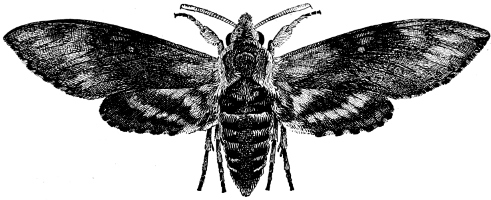
Fig. 114.—Protoparce convolvuli (Linn.).
The Hawk-moth of the sweet potato and convolvulus.
(“Agricultural Gazette,” N.S.W.)
Family 7. Wood Moths. HEPIALIDAE.
This is a very distinct group, the members of which usually have long deflexed wings rounded at the extremities, and the neuration of both pairs of wings alike; the tongue is generally obsolete; ocelli absent; the tibiae without spurs; while the abdomen is very long and cylindrical in the typical forms. They lay their eggs upon the bark of different forest trees; the little caterpillars, after feeding for a short time on the surface, tunnel into the tree trunk, becoming fleshy naked grubs which bore cylindrical chambers of various forms in the timber, in which they sometimes remain for years, finally pupating in the burrows. The moth develops and escapes in the summer from the pupal case, which is frequently found projecting from the hole in the trunk or root after it has emerged. The moths are generally found clinging to the tree trunks, where they are easily captured. They frequently come to the light at night, but are difficult things to kill and mount, on account of their size and the ease with which the scales rub off. The females of some species lay many thousands of eggs. If these eggs are not removed from captured specimens and the bodies stuffed before setting, they generally become greasy and spoil in a very short time.
On account of their large size and beautiful colouration the wood moths have attracted a great deal of attention; Scott figured and described a number in his “Australian Lepidoptera,” part of which has been published by the trustees of the Australian Museum N.S.W. Meyrick published a revision of the family (Proc. Linn. Soc. N.S.W. 1889), which is much more satisfactory, and has been followed in these notes. The moths, which Meyrick considers to be the ancestral forms of the Bombycina, have a world wide distribution, and are well represented in Australia.
Donovan in his “Insects of New Holland” described one under the name of Hepialus australasiae, which is now known as Perissectis australasiae. With outspread wings it measures up to 3½ inches across; the body and fore wings are of a general dark yellowish colour, marbled and mottled with dark brown, and the hind wings have a reddish tint. The Genus Porina contains 8 described species from this country; others are recorded from New Zealand and Africa; they are smaller moths of a general brown, yellow, or grey tint.
The Genus Hepialus comprises a number of very beautiful moths with all kinds of delicate green, yellow, pink, and silvery shades of colour. The moth lays her eggs upon a tree stem; the newly hatched larva eating off the surface of the bark forms a matted web under which it bores into the centre of the branch, and then makes a vertical shaft downward, varying in length from a few inches to several feet, in which it feeds and pupates. The best method to obtain specimens of these moths is to collect the infested branches or stems, cutting them off a foot or more on either side of the silken webs (which often form a regular ring round the stem), and placing them in several inches of damp sand in a box, with a sheet of glass over the top. The wood thus dries slowly and does not damage the delicate pupae or larvae from which, if collected at the proper time, the perfect moths of several species will readily breed out. The males and females of the same species differ from each other in size, colour and markings.
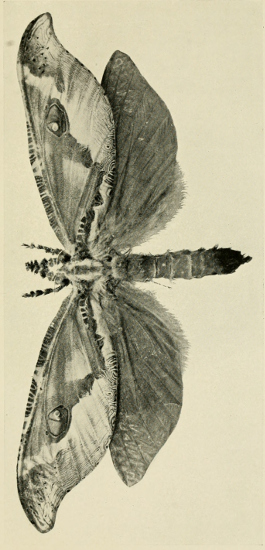
Plate XXIII.—LEPIDOPTERA.
Family Hepialidae.
Leto staceyi (Scott).
(Original photo. Burton.)]
Plate XXIII.—LEPIDOPTERA.
Lewin’s wood-moth, Hepialus lewini, is one in which the sexes are very different. The larger female measures 2½ inches across the wings; the fore pair, head, and thorax are dull claret red, mottled on the centre and tips of the wings with green; the hind pair dull yellow, with a pinkish tint. In the male, the head, thorax, and fore wings are pale green, the latter banded with opaline white; the hind pair of a paler green with white tints. This is one of our common species, and feeds in the stems of the Casuarina.
The larva of H. exima feeds on the stems of the “Lilly-pilly” and Water-gums, forming quite a felted bag round the branch, and is said to remain in the larval state for several years; like the great wood-moth, before it pupates it eats the web off in front of its chamber and replaces it with a wad to protect the opening; this it can easily push out with its horny pupal head when ready to emerge. This is a much larger green form, with the edges of the fore wings marked with brownish yellow and two eye spots of the same colour in the centre; the small male has the green fore wings marked with opaline white. H. ramseyi is easily recognised by its greater size and the green fore wings richly mottled with large silvery white spots forming irregular transverse bands.
The Bent-wing, Leto staceyi, is one of our most remarkable moths both for size and colour: it was originally described by Scott under the generic name Zelotypia, but Meyrick placed it in the Genus Leto, in which another species has been described from S. Africa. Both of these species are peculiar in having the hind wings tufted with stout shaggy hairs. This moth, chiefly obtained in the forest country about Newcastle, has been largely bred from the infested timber by miners in the district, who had a ready sale for them, and who at this work naturally learnt a good deal about their habits. When the young larva enters the tree trunk it covers the opening so carefully with web and particles of bark, that it requires an observant eye to detect the injury. According to some of the collectors the larva lives and grows in its shaft, about a foot in depth, for a period of six years (but this needs verifying); it generally pupates early in December after blocking the opening with a felted wad; but soon after its transformation it pushes this wad out. The chrysalid fits close to its vertical shaft, and aided by rows of fine spines round the apex of each abdominal segment can move up and down; when reaching maturity it has a favourite habit of resting in the shaft with the top of its head level with the transverse burrow, and dropping downward if disturbed. Thornton, who bred or captured nearly 100 in the Newcastle district, generally obtained them in the month of March, and found that those under observation invariably came out about 3 o’clock in the afternoon. The larger female measures up to 8 inches across the wings, of which the front pair are long, slender, and arcuate on the hind margins; these are of a general greyish fawn brown, wonderfully marbled with black and brown, and with a large eye-spot in the centre toward the tip: the hind wings and body are reddish yellow. Meyrick suggests, in his paper previously quoted, that the curious eye-spots on the wings, together with the general outline of the moth resting upon the tree trunk, might be a case of protective mimicry, resembling a snake’s head; this appears to me however to be very far fetched. Skuse reproduced a drawing of the moth and a monitor lizard’s head in the “Records of the Australian Museum,” to show this fancied resemblance, but if the correct colouration had been added the resemblance would have been very much less marked.
The Genus Pielus contains some large brownish moths with very hairy legs, two of which have been described from Australia: Pielus hyalinatus, slightly under 4 inches across the wings, is of a general chocolate brown tint with an irregular silvery white stripe and dark lines running through the centre of the fore wings; the hind pair are brown. The larvae feed in the roots of several species of wattles, and are frequently attacked by Cordiceps, the curious fungus that turns them into what are known as “vegetable caterpillars.” This species has a range from the southern parts of W. Australia through Victoria to North Queensland. Messrs. Olliff and Prince figured and described (Proc. Linn. Soc. N.S.W. 1887) a handsome variety of this moth under the name of Pielus imperialis. The marbled wood-moth, Trictena labyrinthica, is a large dark brown moth, measuring up to 6 inches across the wings, which are covered with a scroll-work pattern of lighter colour. The larvae of these also feed upon the roots of trees.
In the Cossidae we have a typical goat-moth, Culama caliginosa, resembling the English species in form and habits. The larva is a short, dull, red, naked grub that feeds in the stem of the apple-gum, tunnelling round under the bark until nearly full grown, when it bores into the wood and pupates in a cocoon at the end. The moth is of a uniform delicate slate-grey, finely marbled with black lines all over the broad rounded wings, which are folded downward when at rest.
The Zeuzeridae comprise some of our giant wood-boring moths; some are as large as small birds, with great rounded bodies, and grey wings thickly mottled with black, brown and fawn: Zeuzera eucalypti has received an unfortunate specific name, for it feeds in the larval state in the stems and branches of several different species of wattles, and kills a great number of these trees by perforating them with great circular burrows; when ready to pupate, it forms a silken bag close to the outer skin of the bark, which has been gnawed away so that it can easily push its way out when ready to emerge. The moths have the usual brown tint mottled with irregular blotches of grey. The rust-coloured wood moth is a much larger species, and is commonly known under the name of Z. liturata, but is probably identical with Z. cinerens. It measures up to 4¼ inches across the wings, and is of a delicate mottled grey and brown tint, with the hind wings and central portion of the dorsal surface of the abdomen bright chocolate brown. The larvae of this and the following species live in the centre of the stems of large forest gums, and are said to take a number of years to come to maturity.
Macleay’s wood moth, Zeuzera macleayi, said to be identical with Herrick-Schafer’s Eudoxula boisduvalli, has a large cylindrical body, and is the giant of the family, measuring up to 10 inches across the wings. They are brown thickly mottled with grey scales; when taken they are generally found clinging to the tree trunks, upon which each female deposits many thousands of small shot-like eggs.
Olliff has given a detailed description of Leto staceyi, and an account of a variety (Pro. Linn. Soc. N.S.W. 1887). In a general account of these wood-moths (Pro. Linn. Soc. N.S.W. 1894) I recorded a number of Thornton’s observations.
Family 8. Bag Moths. PSYCHIDAE.
The members of this group are more remarkable in the caterpillar than in the moth stage, for as soon as they emerge the larvae construct protective caps of silken threads and bits of their food-plant, which as they increase in size become regular silken sacks open at the neck, through which the head and fore-legs protrude as they crawl about, but retract at the least alarm. They take their popular name of “Bag” or “Case Moths” from this peculiar habit, and the different species construct different forms of bags and ornament them with sticks or leaves. In Germany they are called “Sacktragers”; in America are known as “Basket Worms”; and the family is fairly represented all over the world.
This country is rich in large species, some of which were noticed as curiosities at a very early date, and Westwood described and figured most of our bag moths (Proc. Zool. Soc. 1854) under the Genus Oiketicus: McCoy in his “Podromus of Natural History of Victoria” Decade iv. gave additional notes on the habits of two of our common species; and an interesting paper on how they construct their portable homes will be found in the “Victorian Naturalist” by Hill (1898). The caterpillars themselves are short, naked, dull green creatures with stout horny heads, and are apparently so well protected from their many enemies that one would hardly expect to find them suffer from the attacks of parasites. But they must have some weak point in their armour for a very large percentage, even when collected and kept in breeding cages, produce only wasp and fly parasites. When full grown the caterpillar closes up the neck of its bag and fastens it by a stout silken band to a twig before changing into the chrysalid state; but while the male turns round and pupates head downward, the female remains head up as before, and when she casts her pupal skin is an aborted wingless creature, with small head and legs; the body simply develops into a great swollen sack of eggs, which hatch out in her body, or in the shelter of the cocoon; and the larvae make their way out at the open tip of the bag, each attached to a silken thread, a squirming mass of hundreds of little black creatures, leaving her only a shrivelled skin in the cocoon. The male moth, which is rare, is a very active creature, which dashes about as soon as he emerges from the pupal case, and damages his wings (even when bred in captivity) before he can be caught. He has curious toothed antennae; the head and body are thickly clothed with fine hairs; the body has telescopic segments, capable of being protracted to double their ordinary length when impregnating the female enclosed in her cocoon. The wings are narrow, very lightly covered with scales, and without any very distinctive pattern.
Plate XXIV.—LEPIDOPTERA.
Family Liparidae.
1. Teara contraria (Walker). ♀.
2. Teara contraria (Walker). Caterpillar.
3. Teara contraria (Walker). ♂.
4. Teara contraria (Walker). Bag shelter among the foliage of Eucalyptus albens.
Plate XXIV.—LEPIDOPTERA.
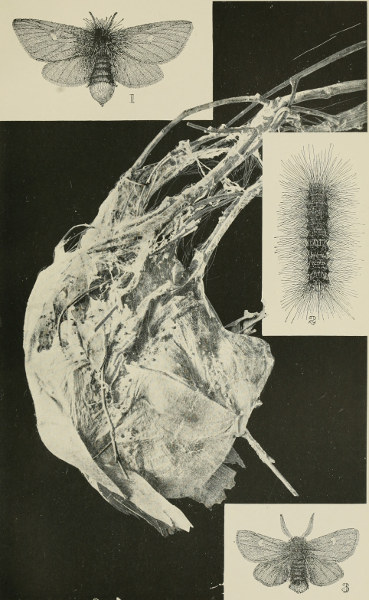
About 13 species of these moths are described from Australia, of which several are very common at times in the bush. Saunders’ Case Moth, Metura elongata, is our largest species; the larva constructs an elongate silken sack often up to 4 or 5 inches in length, broadest in the centre and tapering to both extremities; the outside is covered with short lengths of sticks nibbled from the food plant, or picked up during its wanderings. On an average these sticks are about as long as wooden matches, and are securely attached at irregular distances, the lower ones often extending beyond the silken tip. The caterpillar, of which only the head, thorax, and fore-legs can be seen, is a stout, naked, dull brown grub barred with black and reddish orange, measuring about 2 inches in length. The female moth differs so little from the caterpillar that it is hardly worth noticing, but the active winged male, with a wing expanse of about 2 inches, has the head and thorax thickly clothed with bright reddish orange down, and the dusky wings are lightly clothed with fine scales. Though the moth is a somewhat rare insect, the bag cocoon can be often found on a twig or attached to a fence, for in spite of the large house they carry they are great travellers. The Faggot Case-moth, Entometa ignoblis, forms a very different kind of portable home; the silken sack is covered with a coat of stout sticks which are generally cut from the gum trees and laid parallel to each other, and closely fastened to the silken surface, so that it reminds one of a bundle of faggots. They vary much in size and length; the larger measures up to 3 inches; one stick will be often found projecting an inch or more beyond the others; this is said to be a resting place for the male moth when seeking the enclosed female. She is of the usual obese form; of a general brown tint, the head and thorax creamy white spotted with black. The male moth with a wing expanse of 1¼ inches is of a uniform brown colour. The Leaf Case-moth, Thyridopteryx hubneri, forms a shorter oval silken sack averaging about 2½ inches in length and broad in proportion, covered with different kinds of leaves, for they feed on many shrubs and trees; but the commonest are clothed with bits of gum leaves attached only on the upper edge, and might be likened to a rag mat. When they infest pine trees in the garden, they are uniformly clothed with short lengths of pine needles and have a much neater appearance. The caterpillar is a stout black grub with the head and thorax dull white, mottled with brown. The male moth is a pretty little creature, with reddish brown antennae, the body thickly clothed with black down; the wings have very few scales, and are almost transparent, with a slight blotch in the centre of the hind pair.
The Ribbed Case-moth, Thyridopteryx herrichii, differs from the others in constructing a smooth white silken bag, oval in form, angled on the sides, and with a slender tail at the base; and the long attenuated neck forms a regular stalk when attached to the twig; it measures about 2 inches, and is never covered with sticks or leaves. The caterpillar is blackish brown with the head and first thoracic segment lighter coloured. The moth is about 1 inch across the wings, thickly clothed with black hairs, and a reddish orange spot behind the thorax; the wings are semitransparent, with very few scales.
Family 9. Cup or Slug Moths. LIMACODIDAE.
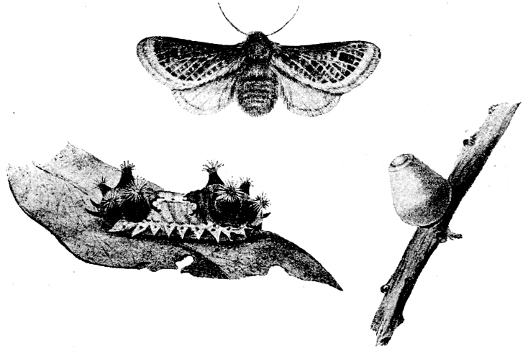
Fig. 115.—Doratifera vulnerans (Lewin).
The “Cup or Slug Moth,” with larva and cup-shaped cocoon.
(“Agricultural Gazette,” N.S.W.)
These are moderate sized moths with plump bodies thickly clothed with shaggy hairs, retracted heads, and toothed antennae. The caterpillars are curious short stout slug-like creatures feeding on the surface of the foliage; their feet are almost obsolete, while the under surface is quite flat, soft and fleshy; the whole body rests on the leaf when crawling along like that of a snail. The upper surface is saddle-shaped, with the two extremities raised and ornamented with fleshy spiny tubercles, with little bunches of sharp retractile spines like rosettes, which can be withdrawn into the tubercle or erected at will; the spines are sharp and appear to be hollow, and give a smart sting if they touch the body; in some of the American species, the stinging sensation is so severe as to cause serious swellings. When full grown they spin curious egg-shaped, brown, parchment-like cocoons attached at the base to the twig, with the apex rounded and forming a circular cap or lid, which, closely cemented on, is loosened and pushed off by the enclosed moth when she emerges. They do not pupate as soon as the cocoon is finished, but remain for a long time in a semi-caterpillar state before the chrysalis is formed.
The Painted Cup Moth, Limacodes longerans, is one of our commonest species. The female is about 1¾ inches across the wings; has a very large abdomen; is of a general dull brownish tint; the head and thorax are slightly coloured with red, and the under surface dark brown, the wings chocolate brown, with the outer margins light brown. The much smaller male has semitransparent wings, with the head and thorax marked with bright red. The larvae feed on eucalypts and are of a delicate green colour and of the typical form; about 1 inch in length; with four large tubercles at each end carrying a rosette of retractile red spines; the centre is marked with red and blue, and the outer margins are fringed with short tubercles. They form regular oval cocoons generally attached on their sides to the twig or bark. The Mottled Cup Moth, Doratifera vulnerans, is another common species, the larvae of which sometimes attack the foliage of apricot trees. It is a larger slug caterpillar than the last, with a patch of bright yellow in the middle of the back. The cocoons are pear-shaped with the apex somewhat contracted, showing the lid more distinctly. They sometimes swarm over the bush about Sydney N.S. Wales. The moths are of a general reddish brown tint with the fore wings marbled in the centre with a redder shade; the hind wings are lighter brown; they are somewhat smaller than the last species.
Doratifera quadriguttata is of a dull reddish tint; the fore wings are crossed with a row of 3 darker raised spots, the hind wings being much lighter: the female measures about 1¼ inches, the male somewhat smaller. The larvae, when young, cluster together up to a dozen in number, and feed on the under-side of the leaf, but when full grown they scatter about, destroying much of the foliage of the gum trees. Numbers were collected near Gosford N.S.W. about the end of February. They are short and broad, black, with a pair of dull yellow fleshy horns in front, and 4 tubercles surmounted with bunches of yellow spines tipped with black at each extremity; the centre of the flattened back has rows of short yellow spines with a fringe of similar ones round the outer margins. When full grown they form the usual egg-shaped brown cocoon.
D. acasta is a very similar moth, with a row of 6 or more similar spots crossing the fore wings. The larvae feed in the same manner, and are very plentiful toward the end of summer in the Bathurst district, N.S.W. Rainbow has figured the larvae of this species in the “Records of the Australian Museum” 1904.
The curious warty, pale green, oval, slug-like caterpillar with a yellow stripe down the centre of the back that is figured by Scott as Apoda xylomeli feeds upon the under surface of the leaves of the waratah; and when at rest along the midrib of the leaf, with the yellow dorsal stripe in line, in spite of its size it is very hard to detect, and is a wonderful instance of protective colouration.
Family 10. Tiger Moths. ARCTIIDAE.
This family, including the Lithosiidae, known to collectors as “Footmen,” is now one of the largest divisions of the moths that were once all grouped among the true silkworms. The larvae of most of the species are short hairy grubs popularly known as “woolly bears,” feeding on all kinds of low plants, and common in our gardens. In this country they comprise a number of delicate and often very handsome moths of medium size, with moderately long pectinate antennae, the body often large, and the wings brightly coloured. The “Footmen” differ from the “Tiger” moths in having the fore wings longer, more slender, and folded over the shorter, more elongate body; they take their popular name from the livery-like pattern of their markings, as the latter take theirs from the tiger-like stripes and spots; while others again are known as “Ermine” moths from their soft silken wings.
The Genus Tigriodes contains a number of small moths hiding under or among foliage and therefore not often noticed. Tigriodes alterna is of a uniform yellowish brown tint, with darker brown markings upon the thorax and wings, forming zig-zag lines across the fore pair, and clouding the hind ones. It measures about 1 inch across the wings and ranges from Victoria into New South Wales. T. furcifera is slightly smaller, of a bright yellow on the fore wings, with three slender parallel stripes separating into finer lines at the extremities; the hind pair paler with traces of black lines toward the edges; there is a wedge-shaped patch of the same colour on the thorax. Another species common about Sydney N.S.W. is T. heminephes, pale orange yellow with the apical edges of the wings and thorax blotched with blackish brown.
Among the “Footmen” we have in the Genus Spilosoma a number of fine white to greyish brown moths, mottled with blackish spots and dashes. The Light Ermine, Spilosoma obliqua, is common in Victoria and N.S. Wales; it has a wing measurement of 2 inches; is of a uniform dull white, lightly mottled over the wings with dark brown spots, some of them forming a slender irregular transverse band across; the abdomen is red with a dorsal stripe of black dots. Spilosoma fulvohirta is about the same size, but much more darkly and thickly marked with brown, also forming dark stripes on the thorax. Spilosoma fuscinula is a much smaller moth, slightly over 1 inch across the wings; it has a general rich pink tint, very variably spotted and blotched with black; the latter is sometimes quite the predominating colour, in others only marking the tips; the hind wings are spotted in the centre and on the hind margins only. The larvae are short, flattish, hairy grubs of a reddish colour, and feed upon the foliage of young gum trees.
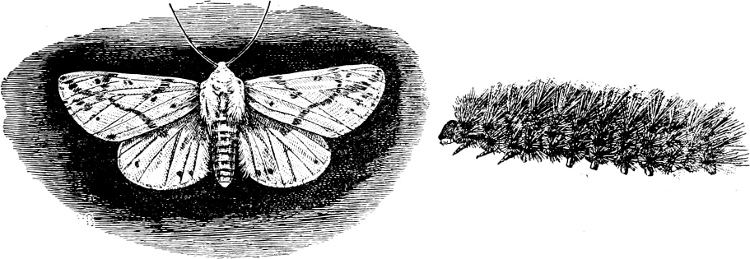
Figs. 116 and 117.—Spilosoma obliqua (Walker).
116. The Light Ermine Moth.
117. Larva, known as a “Woolly bear.”
(“Agricultural Gazette,” N.S.W.)
The Genus Termissa contains a number of smaller pretty little moths flying low and hiding among the foliage; about 10 species are well known. Termissa shepherdi, slightly over 1 inch across the wings, has the fore pair broad at the tips, is blackish brown, with 3 irregular yellow transverse bars; the hind pair yellow, with two rounded marks on the outer margin. T. nivosa is a smaller moth of a delicate creamy white, with the front and outer margins of the fore wings delicately edged with dark yellow and black, and with two indistinct spots on the front margin; there is a small dot on each hind wing. Anderson says about Melbourne the larvae are to be found under the bark of gum trees in August. Clauca rubricosta measures 1 inch across the wings; is of a general blackish tint with the palpi and collar behind the head dull red, a slender costal stripe of reddish yellow along the fore wings, and a yellow spot on the centre of the inner margin forming a distinctive mark when the wings are folded; the hind pair are pale yellow with dark edges. The Genus Mosoda contains several moths whose larvae feed upon moss and lichens on the surface of the rocks about Sydney. Mosoda anartoides, under 1 inch across the wings, has the fore pair dark brown, delicately mottled; the hind pair dull orange yellow irregularly edged with brown. M. consolatrix, a smaller moth, has the fore wings greyish mottled brown; the hind pair pale buff. M. jocularis is slightly smaller, pale buff yellow; the fore wings tipped and speckled with black and the outer tips of the hind pair clouded with brown. The Genus Comarchis contains 8 described species, all small moths; C. aspectatella is under 1 inch across the wings, the fore pair grey barred with yellow, and the hind pair pale ochreous; it is common in January on Mt. Kosciusko; Eutane terminalis and Asura lydia are two little black moths thickly mottled with dark orange yellow forming bars and spots on the fore wings; the hind wings of the former are yellow in the centre, thickly margined with black; in A. lydia the yellow of the hind wings is divided in the centre by a black band. The larvae feed upon moss. The larvae of the Speckled Footman (Deiopeia pulchella) feed upon the forget-me-not; it is of a bright leaden colour, with a white stripe down the back and red spots on the sides of the segments. The moth has a very wide range over the world, and has probably spread from Europe. I have generally taken these moths on the grassy flats close to the sea shore; it is a slender winged creamy white moth, the fore wings mottled with black and red spots, and the hind pair irregularly edged with black. Nola metallopa is a silvery grey moth with the fore wings marked with darker coppery tints. The curious hairy larva feeds upon the foliage of young gum trees; when it moults the skin of the head remains attached to the hairs above the head, forming a regular crest.
The members of the small family Hypsidae, chiefly found in the tropics, are represented in this country by 4 genera containing about 18 species. They differ from the last in the venation of the hind wings, and are medium sized brown or yellow moths.
Nyctemera amica is one of our commonest species with a wide range from Victoria to Queensland; it may be found flying about or resting on flowers at all times of the year. The larvae, marked with black and red and furnished with tufts projecting on either side of the head, feed upon the “native ivy” (Senecio scandens). The moth is of a general blackish brown tint; the fore-wings are mottled with two irregular pale yellow blotches forming a transverse bar toward the tips; each of the hind pair has a more regular blotch in the centre.
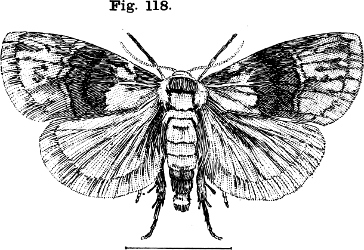
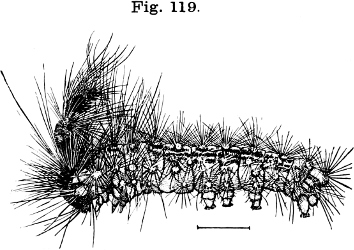
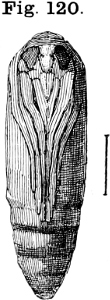
Figs. 118, 119 and 120.—Life history of Nola metallopa (Walker).
The Seedling-gum Moth.
118. Moth. 119. Larva. 120. Pupa.
Family 11. Brown Tails. LIPARIDAE.
These are the “Tussock” moths of America, and the “Vapourers,” “Brown-tails,” and “Black-arches” of English collectors; some of ours are known as “Bag-shelter moths” from the curious silken bags the gregarious larvae spin, in which they shelter during the day and come out at night to feed upon the foliage. The typical “Brown-tails” are stout, thickset moths with rather long hairy fore-legs generally stretched out in front when resting; the antennae are pectinate in both sexes, and the abdomen is tipped with tufts of downy hairs; in some species the females are wingless. They lay their eggs in clusters on the under-side of the leaves, covering them over with a felted mass of the hairs from the tip of the abdomen.
The famous “Gypsy Moth,” common in Europe, belongs to this group; it was introduced into the State of Massachusetts, where it has multiplied so enormously that it has become a regular plague, and though hundreds of thousands of dollars have been spent in fighting it, it is still a serious pest. Porthesia obsoleta, one of our typical species, measures about 1½ inches across the wings, and is pure white with a black body tipped with golden brown hairs. It was described by Donovan in 1815 in his “Insects of New Holland,” and is more common in Victoria than New South Wales. Trichetra marginalis is a moth with a wingless female; the male is a little larger than the last species; is of a uniform greyish brown colour, with the outer edges of the fore wings white, and the hind pair pale brown. The larva feeds upon the foliage of gum trees.
Plate XXV.—LEPIDOPTERA.
Family Psychidae.
1. Entometa ignoblis (Walker). Cocoon of Faggot Case-moth.
2. Entometa ignoblis (Walker). Cocoon made with Cherry stalks.
3. Thyridopteryx herrichii (Westwood).
4. Metura elongata (Saunders).
5. Thyridopteryx hubneri (Westwood). Cocoon made of gum leaves.
6. Thyridopteryx hubneri (Westwood). Cocoon made of pine needles.
Plate XXV.—LEPIDOPTERA.
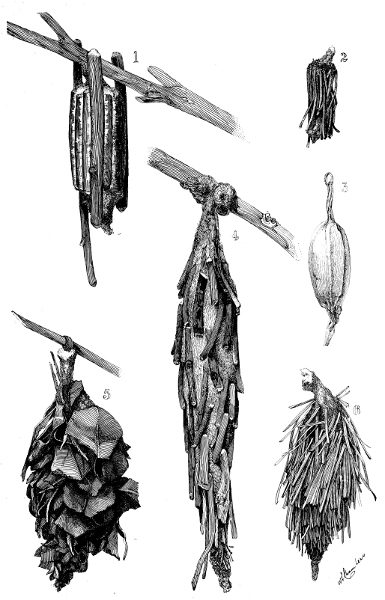
The Genus Teara contains over 20 named species of the “Bag-shelter Moths,” with gregarious larvae. Teara contraria, one of the largest species, measures up to 2½ inches across the wings; it is of a general dark brown tint with a small white spot in the centre of each wing; the thorax thickly clothed with long lance-shaped plumes yellow at the tips; and the abdomen rich orange yellow barred with black. The caterpillars are thickly clothed with long hairs, and when they take up a position on the branch of their food tree (generally a eucalypt or wattle) they spin a silken bag, drawing the leaves and twigs together, but not acting like the “Leaf-rollers,” for the silk forms a regular felted brown covering which soon becomes full of their excrement and cast skins, among which they rest during the day. They trail out at night in a regular procession and often strip all the foliage of the tree. When full grown they crawl down the trunk and pupate in loose open cocoons (formed from their body hairs) buried in the ground, and the large liver-coloured silken bag remains long after they have deserted it. This species in some districts makes its home upon wattles, but in other localities attacks the eucalypts in a similar manner. Teara tristis is not more than 1¼ inches across the wings, and varies from blackish brown to silvery grey; the fore wings are marbled with white and yellow and a light circular spot in front; the hind ones are nearly black with a minute white spot in the centre; the head and thorax are grey; the abdomen black, barred and tipped with orange; it is common in Victoria and N.S. Wales, generally clinging to some low bush, and slow and sluggish in its movements. Teara melanostica is larger than the last; silvery grey, spotted, with the front edge and transverse bar black; hind wings yellow edged with brown; head and thorax silvery white, hind portion dark brown; abdomen barred, and tipped with yellow. The larvae feed upon the leptospermum bushes, and form soft loose cocoons. Ptilomacra senex is a large handsome moth about 3 inches across the straight, square-cut fore wings; is of a general dark brown colour with wavy irregular dark lines and scattered grey scales giving it a greyish tint. It is remarkable for its large feathery antennae.
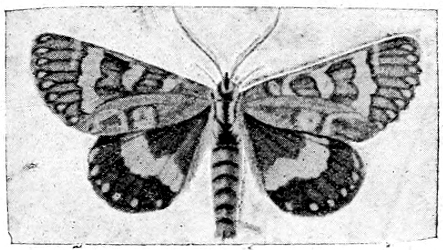
Fig. 121.—Apina callisto (Doubleday).
The day-flying cut-worm moth.
Apina callisto is a brightly mottled yellow and brown moth that flies about in the daylight. Its curious hairy larvae feed upon the open grass lands, and are often very numerous. It has a wide range over Australia.
Chelepteryx collesi is one of our largest bat-like moths, measuring to 6 inches across the wings; it is of a uniform dark brown colour with an irregular marbled pattern upon the wings; but it varies much in size and pattern in the sexes. Where common they may be often seen fluttering round the street lamps in the suburbs of Sydney, N.S.W. This handsome moth was first taken to England by a Mr. Colles, after whom Grey described it (Trans. Ent. Soc. 1835). The caterpillars are great, reddish brown creatures, thickly clothed with stout spiny bristles, feeding on the small white stemmed eucalypts, and often found crawling over the rocks and fences. They spin long silken cocoons, and as they pupate force all the body spines through the silk, making the cocoon a very awkward thing to handle, for the fine spines are easily detached, and sticking into the fingers cause a very unpleasant itching.
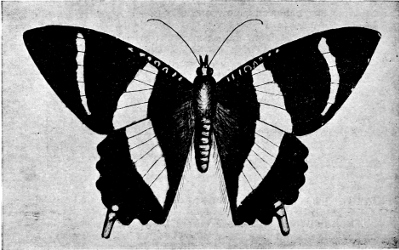
Fig. 122.—Nyctolemon orontes (Linn.).
The great day moth of the Queensland scrubs.
(Original drawing, W.W.F.)
The Genus Darala is peculiar to Australia; about 30 species have been described; their larvae are short, thick, black, hairy caterpillars often found crawling about in the gardens, and constructing soft fluffy or white silken cocoons attached to the foliage. Darala ocellata, one of our commonest species, measures 1½ inches across the wings, and is of a uniform brownish fawn colour, with two black spots in the middle of the fore wings and a pattern of spots or parallel black lines in the central portion. Darala acuta is slightly larger, with very variable markings upon a general greyish fawn to dull yellow ground; the fore wings are broad with an acute point at the extremity. The Wattle-moth, Teia anartoides, which in the larval state often appears in the orchards and destroys the apple-tree foliage, is sometimes very abundant. The larvae are short brown hairy grubs with a tuft of hairs standing out in front on either side of the head, and several stiff brushes of grey hairs upon the centre of the back. The males are much smaller than the females, and in the pupal state when hanging up in their loose flimsy cocoons can be easily distinguished. The adult female is wingless, simply crawling on to the top of her cocoon to lay her eggs and die. The male is a handsome little moth about 1 inch across the wings; the fore pair are dark brown marbled with slender lines and black spots, the hind pair bright yellow surrounded with black, and the outer edges yellow; the antennae are large and feather-like.