Order VI.—LEPIDOPTERA. Butterflies and Moths. (continued 2)
Reading edition
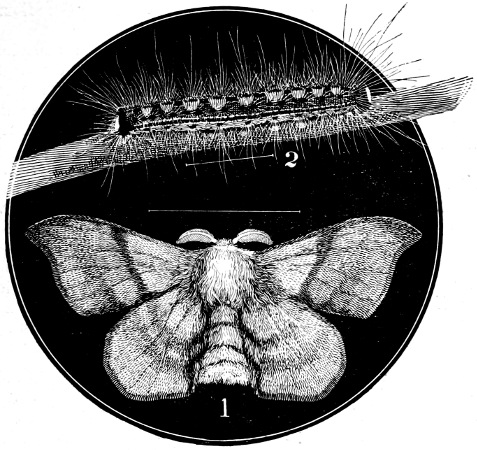
Fig. 123.—Ocinara lewinae (Lewin) and Caterpillar.
Ocinara lewinae is a handsome light reddish brown moth with darker lines running round the wings. It was described by Lewin in 1803, who figured it in colours and called it the “Hook Tip.” The larva is a slender caterpillar covered with fine hairs. They are gregarious, and web the leaves of the eucalypts together with a loose, open, silken strand.
Family 12. Silkworm Moths. BOMBYCIDAE.
In this group I include several families that may be broadly placed together as typical silkworm moths. Some writers divide them into three families; Packard on the other hand adds a number of other well defined groups, such as the Psychidae, Arctiidae, and others, to the Bombycidae.
Typical silkworm moths have thick heavy bodies, with small heads furnished with pectinate antennae and an imperfect mouth; the wings are large and often falcate. The larvae are usually fleshy thickset caterpillars covered with scattered tubercles, and are of somewhat sluggish habits; but all form stout silken cocoons. Our silkworm moths are more closely related to the Atlas moths of India, Saturnidae, than to the silkworm moth of domestic fame, Bombyx mori, which, originally a native of China, is now bred and cultivated in many parts of the world for commercial silk.
Bombyx trimacula measures 1¾ inches across the wings; it is a dark brown moth, mottled and marbled with white on the head, thorax, and tip of the abdomen, and forming a delicate wavy pattern across the fore wings interspersed with some blackish markings; it is found in Victoria. Odonestis australasiae has been known under many different names: Lewin called it Bombyx nasuta, and his specific name was much more appropriate than the former, as it has the head produced into a regular point in front. The larger female measures about 2 inches across the wings, which are of a uniform dull reddish brown colour with faint markings on the fore wings; the hind ones are of a lighter tint. The short hairy caterpillars have a tuft of hairs standing out on either side of the head; in their natural state they feed upon the foliage of the black wattle, forming white silken cocoons, attached to the plant. It is sometimes called the “Long-nosed Wattle Moth,” and in Victoria is said to turn its attention to the apple-tree foliage. Pinara despecta is a large, handsome, reddish fawn moth, with fore wings ornamented with several zig-zag bands across the centre. It is a thickset moth, often measuring over 3 inches across the wings. The larva feeds upon the foliage of the eucalyptus, and is a very slender caterpillar of a general greyish brown tint, with the sides of the body fringed with fine downy hairs, and when it is resting the fringes lie along the twig so closely that it is very hard to detect. It spins a large silken cocoon tinted with pink, attached to the leaves of the gum trees. Cosmotriche exposita is a pretty little thickset moth of a uniform greyish brown tint, covered with fine soft downy hairs round the body and hind wings; the fore pair are thickly mottled with dark brown; the larger female measures about 1½ inches across the wings; the smaller male is a much darker brown insect with fine mottled fore wings. The caterpillar feeds upon the foliage of the “she-oak” (Casuarina), and is a slender greyish creature lightly clothed with grey hairs, marked with yellow and carmine on the sides of each segment, and black marks on the back. It forms an elongate oval cocoon attached to the twigs.
The second group, Notodontidae, are known as “Prominents” to English collectors from the curious angular form of the caterpillars, though this is not noticeable in our typical forms. The Banksia Moth, Danima banksiae, was named by Lewin after its food plant, though it feeds equally upon the Hakea bushes. It is a very handsome moth, nearly 3 inches across the wings, which are of a general slate brown tint; the thorax and tip of abdomen are thickly blotched with white, which is also sprinkled over the body and fore wings in the form of little white scales; the central portion of the abdomen is orange yellow. The caterpillar is a rather slender, cylindrical, ochreous brown creature with the tip of the body lead colour, and the whole surface irregularly blotched with white spots encircled with black, forming irregular bands round each segment. They are generally found feeding in groups of three or four, and when disturbed turn both the head and tip of the abdomen over the back, and protrude two red fleshy filaments from the under-surface of the first segment.
The Saturnidae are our most important group for size and colour, and an immense fellow, Coxinocera hercules, is found in Cape York. Another very beautiful Chinese species, Attacus cynthia, which feeds on the foliage of Ailanthus glandulosa, has been accidentally introduced into Australia, and is sometimes taken about the Sydney gardens.
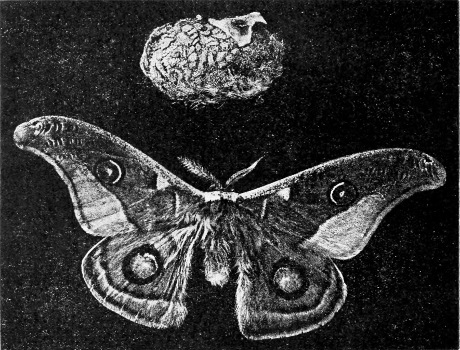
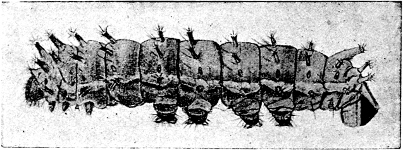
Figs. 124 and 125.—Life history of the Australian Silkworm Moth.
124. Antheraea eucalypti (Scott). Moth and Cocoon.
125. Caterpillar.
The Genus Antheraea contains some of our finest moths; others are found in Japan and India that yield a strong brown silk. Our commonest species, Antheraea eucalypti, is variable both in colour and size, ranging from delicate fawn to dull brick red, and is from 4 to 5½ inches across the wings, which in the male are smaller and narrower behind; each wing is ornamented with a circular eye-spot in the centre, those on the hind pair being larger and ringed with black, with narrow irregular dark bands running round or across the hind margin. The tip of the fore wings in the smaller males is rounded, corrugated, and touched with pink. The large green caterpillar, covered with scattered tubercles tipped with clusters of retractile red and blue spines, feeds upon the foliage of eucalypts, but has acquired a taste for the foliage of the cultivated pepper tree (Schinus mollis). It constructs a stout, hard, dark brown cocoon in which it pupates, and is furnished with a curious spine at the base of the fore wings, which enables the moth to cut her way out through the tough cocoon when ready to emerge. A. helena, very similar in general appearance to the former, is slightly larger, with broader wings of a more uniform reddish brown colour, without a white mark on the fore wings; the inner bands are more irregular and rounded, with the parallel bar not continued into the hind wings. A. simplex is a smaller species varying in colour from pale yellow to reddish brown, with smaller eye-spots, those upon the hind wings somewhat oval, broadly marked along the costal nervure; the parallel bar and band on each hind wing are very narrow, and both pairs are wrinkled at the tips. The black and yellow caterpillars are very common at times in the Richmond and Clarence River scrubs, N.S. Wales, and more gregarious in their habits, often covering the bushes with their light coloured rather flimsy cocoons, which are very subject to the attacks of ichneumons. A. janetta is about the same size as A. eucalypti, but with flatter broader wings of a much duller reddish brown tint without any eye-spots, and only a simple white spot in the centre of each of the fore pair; two fine irregular lines run round the outer half of both pairs with an extra row of small spots along the hind wings. The larva forms a hard shell-like cocoon on the trunks of the she-oaks. A. loranthiae, described by Lucas from North Queensland, is a large handsome reddish moth, the larvae of which when pupating form their cocoons in a mass on the top of a stump or branch.
Family 13. Loopers. GEOMETRIDAE.
In this family there are a number of handsome delicate moths with slender bodies, large flattened wings often toothed round the edges, which when the insects are at rest (usually upon the under surface of leaves) are pressed flat and spread out like a fan against the surface. The caterpillars are slender cylindrical creatures, green or brown in tint and so imitative of the twigs or foliage among which they feed, that it is possible to pick off a branch upon which a caterpillar is resting without observing the creature until it moves; they are furnished with the usual six legs on the thoracic segments close behind the head, and two pairs of abdominal legs near the anal claspers, so that they have legs at each end, and when moving along they draw the hind portion of the body up to the head before the front legs are moved: thus at every step forward the body is arched up into a semicircle, from which habit they are popularly known as “Loopers.” The best method of collecting the moths and their caterpillars is by beating or shaking the low scrub in the early morning; and the latter are very easily bred in captivity if supplied with material from their food plants. These moths are well represented in Australia; most of the earlier species have been described by Walker and Guérin (Proc. Linn. Soc. N.S.W.). Meyrick has classified and described a great number of species of this family in a series of papers entitled “A Revision of Australian Lepidoptera,” which the student will find in the volumes dating from 1886 to 1891.
The Genus Euchloris contains a number of beautiful moths with delicate pale green wings frequently marbled with white lace-like tracery. Meyrick (Proc. Linn. Soc. N.S.W. 1887) lists 43 species; and Lower, in his “Catalogue of Victorian Heterocera,” published in the “Victorian Naturalist,” lists 15 as Victorian species; but some of these have a wide range.
Euchloris submissaria measures about 1½ inches across the outspread wings; its general colour is rich deep green, with the antennae, front margin of each fore wing, outer edges of both pairs of wings, a central stripe on the thorax and body, and the legs creamy buff white. The caterpillar is of the usual cylindrical form, varying from dull buff to light brown, and it feeds upon the foliage of the black wattle.
Crypsiphona occultaria measures nearly 2 inches across the wings, and is of a uniform light greyish brown on the upper surface, very finely banded in irregular circles; but the under surface is pearly white, spotted on the fore wings with black, crimson and brown; the hind ones are banded with brown and crimson. It has a very wide range, and has a habit of resting against weather-worn posts and walls, its outspread wings matching the colour of its surroundings. The larva feeds upon the foliage of the gum trees, and is of a uniform dull green tint, striped down the sides, the head pointed in front; the whole caterpillar looks wonderfully like a eucalyptus twig.
The Genus Selidosema contains a large number of cosmopolitan species; Meyrick lists 29 species as Australian; they are usually grey or brown with darker lines and blotches. Selidosema lyciaria is one of our largest species, measuring about 2 inches across the wings; is of a uniform brownish grey, with both pairs of wings marbled in a regular pattern with black and chocolate brown, and crenulated round the edges. The larvae feed upon the black wattle, and vary much in colour, from grey to dark brown; the head is curiously notched, and there are two little projections upon the back by which they can be easily identified. S. excursaria has a range from S. Australia to N.S. Wales, and is one of our commonest species; it measures 1½ inches across the wings, and is of a uniform dull greyish tint, very finely pencilled with darker transverse markings, but is somewhat variable in colour. The caterpillars are of a general light brown colour, with the sides pencilled with fine parallel white lines running down the whole length of the body; they are said to feed upon a number of different plants, but are common on the wattles. S. canescaria, slightly larger than the last, has a dull grey tint, thickly mottled with dark brown wavy lines; it ranges from S. Australia to Queensland. Another species, S. acaciaria, is a little larger, of somewhat similar colour, with whitish markings; it is common in this country, and is also found in India, Ceylon, and S. Africa.
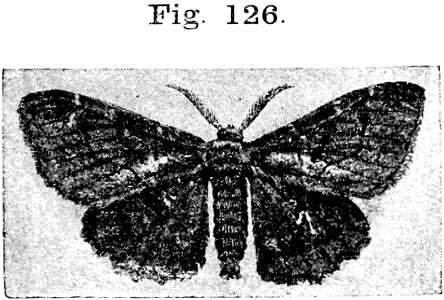
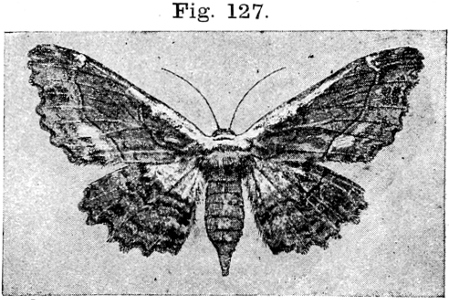
Figs. 126 and 127.—The Marbled Looper.
126. Lophodes sinistraria (Guérin) ♂.
127. Lophodes sinistraria ♀.
Lophodes sinistraria is slightly over 2 inches in the large females; the sexes vary much in size and colour. They are of a general dark chocolate brown tint blotched with grey along the front of the fore wings, with a distinct row of short grey stripes round the hind wings in a line with the dentate crenulations. It has a wide range over Victoria and Eastern Australia. The larvae feed upon the foliage of the black wattle, but I have also recorded them damaging the foliage of young apricot trees. They are reddish brown caterpillars, covered with transverse bands of darker coloured spots, and they measure about 1½ inches in length.
The Genus Thalaina contains 5 described species, all of which are very handsome moths easily separated from the other loopers. T. clara measures 1½ inches across the wings; it is of a uniform pearly white, with the fore wings marked with regular transverse bands of reddish brown forming the letter W when viewed from the side; the hind pair have only a blackish blotch on the outer edge. It has a wide range, and in the larval state feeds upon wattles. T. inscripta is about the same size, with a similar ground colour of white, but the markings on the fore-wings form a less perfect W, and there is a row of short bars of the same colour round the edges; the hind pair are more deeply blotched. It has a wide range from Tasmania over the south and eastern portion of Australia. Gastrophora henricaria is a large handsome moth, in which the sexes differ both in size and colouration; the smaller brown male has bright orange hind wings, and very fine feathered antennae; the female has the fore wings mottled but not striped. The slender dark brown striped larva, according to Anderson (Victorian Naturalist 1902) feeds upon the foliage of eucalyptus.
Family 14. Cutworm Moths. NOCTUIDAE.
This from an economic point of view is a very important family, for the cut-worms do an immense amount of damage to pasturage and gardens. These moths are of medium size with stout bodies; their fore wings generally speaking are narrow, stiff, and triangular, with the broader rounded hind ones folded beneath; the antennae are only slightly toothed in the males of a few species, and the mouth is produced into a tubular proboscis with which they can suck the nectar out of the flowers. In colouration they vary from bright brown to black, a few being marked with white or metallic tints; they are nocturnal in their habits, resting under bark, rocks or other sheltered places, and at night often flying into the lighted lamps. The larvae, which are known as “cut-worms,” “plague caterpillars,” and “army worms,” are usually elongate, dull brown, or greenish, naked caterpillars of a uniform thickness with 8 pairs of legs. When full grown they pupate underground, forming no regular cocoon, though a few groups form a flimsy silken one attached to their food plant.
The world wide Genus Agrotis contains a number of variable forms whose larvae are typical “cut-worms,” hiding in the ground or under rubbish during the day, and coming out at night to feed. The short stout moths have the head scaly; the fore wings black to grey, the hind pair always lighter coloured; the antennae of the males are slightly pectinate.
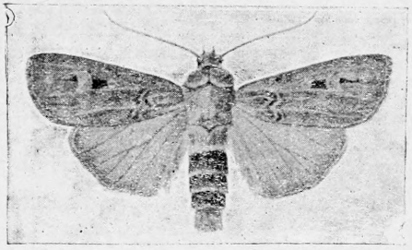
Fig. 128.—The Bugong Moth, or Plague-Cutworm.
Agrotis infusa (Boisd.).
The “Bugong Moth,” Agrotis infusa, has gone under many different specific names, and is quite an historical insect. It is a dark brown moth, the fore wings marked with two parallel black lines, two dull grey spots in the centre and wavy lines at the extremities; the hind pair are light brown. These moths frequently appear in immense swarms, and take their popular name from the Bugong Mountains among the rocks of which they used to congregate in millions; they formed an important food supply to the natives who used to sweep them off into their bags, and after denuding them of their wings and scales over a small fire, pound the bodies (at this time distended with eggs) into a dough or paste. Dr. Bennett has given an interesting account of this in his “Naturalist in Australia.” A rather curious error regarding this Bugong Moth has crept into popular natural history books. In the Rev. J. G. Wood’s “Insects Abroad,” he figures and describes a butterfly, Euploea hamata, as the Bugong Moth; Aflalo in his “Natural History of Australia” makes the same statement, and in a recent magazine article on “Insects as Food” Theodore Wood repeats the same error.
Scott (Trans. Ent. Soc. N.S.W. 1867) gives an account of an appearance of Bugong Moths in Sydney, when they were so numerous one Sunday morning at North Shore that the service at St. Thomas’ Church could not be held, and some observant persons counted 80,000 moths on the windows. They have appeared at irregular intervals about Sydney and the coastal districts in similar swarms, the last time being in 1905.
Agrotis breviuscula is a smaller variable species ranging from reddish brown to grey; the antennae are long; the fore wings have a dark spot of irregular form in the centre, a few fine dots along the edge, and a fine line round the tips; the hind wings are light brown. Agrotis ypsilon is not unlike the “Bugong Moth” and by some writers is considered only a large variety, but it has a distinct mark like the Greek letter e in the centre of the fore wings, the tips finely marbled with wavy lines; and the light brown hind wings give a metallic sheen.
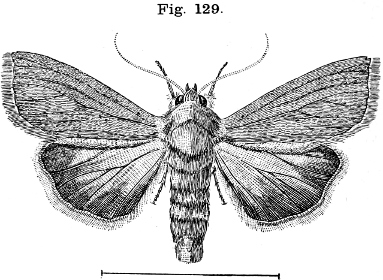
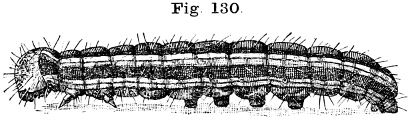
Figs. 129 and 130.—The Climbing-Cutworm or American Army-worm.
129. Leucania unipuncta (Horvath).
130. Leucania unipuncta, Larva.
Leucania unipuncta is one of the most destructive caterpillars found in North America, where it is known as the “Army worm,” devouring crops, grass, and garden stuff. Though the moth has been known for many years in Australia it was not until 1903–4 that it was observed as a plague caterpillar, attacking crops and grass nearly all over Eastern Australia. The caterpillars, 1¼ inches long, are dull olive green with light stripes down the back and sides. The moth measures 1½ inches across the wings, which are of a uniform reddish fawn colour finely speckled with little black scales.
The “Boll Worm,” or “Maize Moth,” Heliothis armigera, is another cosmopolitan cut-worm which does a great deal of damage to cotton bolls and maize; is common in the pea crops, and also damages tomatoes. The moth measures about 1 inch across the wings; the fore pair are greyish yellow with purplish-brown tints, but are very variable in colouration; the hind wings are silvery grey with the apical portions dark brown; the latter pair are constant in their markings.
The handsome little moths belonging to the Genus Thalpochares are remarkable for their curious plump naked larvae, which feed upon different kinds of scale insects, at the same time covering themselves with a portable cocoon composed of fragments of the coccids matted together with silken strands. Thalpochares coccophaga is a pretty creamy winged moth with the basal portion shaded with brown and reddish tints, and measures about ¾ of an inch across the wings. The larvae feed upon a number of different insects native to the bush, and have lately been of some economic value in destroying olive scale (Lecanium oleae) in the orchards. Several other species have been described with identical habits. Earias fabia is a pest of the cotton plant; I have bred numbers obtained in the cotton bolls growing at the Hawkesbury College, N.S.W.; the larva is a slender dull green grub, which when full grown forms a stout, oval, light brown, felted cocoon attached to the dead foliage. The moth is slightly over one inch across the wings, which are of a uniform pale yellow colour, each with a greenish bar in the centre; the hind pair are lighter. In forming such a well-made cocoon this moth seems out of place in the Noctuids; and Lower says in his Catalogue, “that some writers refer this moth to the Bombycina.” Westwood and Swinhoe place it in the Tortricidae.
The Genus Hadena contains a number of Australian species rather more abundant in Tasmania than the mainland; it is another cosmopolitan group, found in Europe and America. Hadena expulsa, slightly over 1 inch across the wings, has the fore pair of a general grey tint, mottled with brown; the hind pair are darkest towards the apex and are fringed on the margin with fine white down.
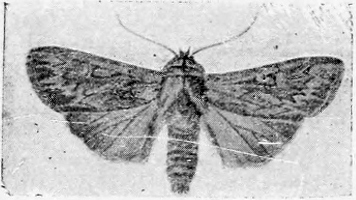
Fig. 131.—The Grey-Cutworm Moth.
Mamestra ewingii (Westw.).
Mamestra ewingii is typical of another large world wide genus. Its larvae are among our most destructive cut-worms to crops and grass: it is a pale slate-coloured moth, marked with short parallel lines of a darker tint on the tips of the wings. Spodoptera exempta was figured in the Agricultural Gazette 1898 under the name of Phlegetona carbo. It is one of our climbing cut-worms, and in that year the caterpillars swarmed all over the Camden and South Coast districts of N.S. Wales. They are very active grubs, olive green to almost black in colour, striped on the sides with fine yellow lines; and when full grown measure 1½ inches in length. The moth is under 1½ inches across the wings; is of a general dark brown tint, indistinctly mottled all over the fore wings with yellowish or sometimes silvery grey scales; the hind wings are silvery and semitransparent.
Prodenia littoralis is a handsome moth of about the same dimensions as the last; the fore wings are dark brown finely striped and pencilled with grey lines; the hind pair pearly white. The moth often lays her eggs upon the foliage of apple and other trees; the young on hatching out feed upon the foliage but afterwards make their way to the ground. Plusia verticillata is a species that feeds upon the foliage of peas, beans, and potatoes; the slender pale green grub differs from the typical “cut-worm” in moving about like a “looper,” and when full grown pupates in a flimsy silken cocoon it spins upon the under surface of the leaf. The moth, measuring 1½ inches across the wings, has the fore pair brown tinted with mauve, marbled with a coppery tint, and with two elongate oval spots of silvery white scales in the centre of each, and fine lines behind; the hind wings are dark brown fringed with grey down. Plusia argentifera is a smaller form with a silvery mark in the centre of each fore wing. The handsome dark brown caterpillar of Calogramma festiva, which was figured by Donovan in his “Insects of New Holland,” feeds upon the foliage of the Crinea lilies; they are sometimes plentiful in the Botanic Gardens. This moth measures 1½ inches across the wings, and is of a uniform pale creamy-yellow colour, thickly mottled on the base of the wings with red and black.
We now come to a curious allied group, the Ophiderinae, the members of which are known as the “Orange-piercing moths”; they are large handsome insects with the head and thorax thickly clothed with scales forming a regular crest, and furnished with a proboscis which, pointed and barbed at the tip, enables them to thrust it through the rind of oranges and other ripe fruit and suck up the juice. Tryon has figured and written an interesting account of these moths in the Queensland Agricultural Journal Vol. ii. 1898.
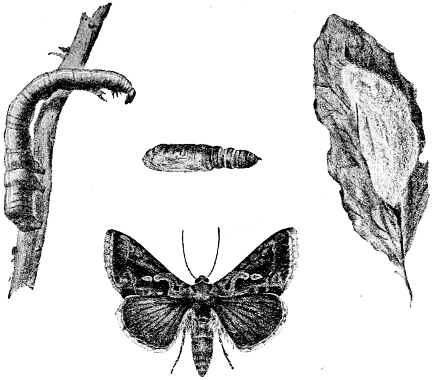
Fig. 132.—Life History of the Bean Moth, Plusia verticillata (Guérin).
Showing the half looper form of the caterpillar, and the loose silken cocoon of the pupa.
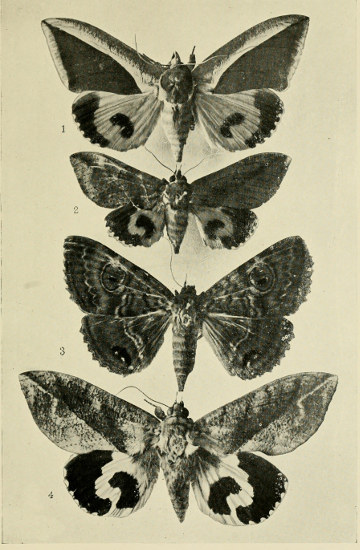
Maenas salaminia measures 3½ inches across the wings; the fore pair are bright olive green, with a broad stripe of creamy white along the anterior margins; the hind wings are an orange yellow colour, and each with the margin and centre black. The thorax is bright olive green, and the abdomen of an orange yellow colour. It ranges from the northern parts of New South Wales to North Queensland, and at Cairns I used to capture them at night with a net and bull’s-eye lantern, as they hovered round bunches of ripe bananas hanging under the house. Othreis fullonica, slightly larger than the last, has the fore wings mottled with grey and brown among the olive green; the body and hind wings are of the same rich orange colour as the former species, with smaller black markings on the hind margins. This species ranges from Queensland to Africa, India, Ceylon, and the New Hebrides. Argadesa materna is about the same size, but has lighter coloured fore wings, and further distinguished by a much smaller black spot in the centre of each hind wing. The caterpillars of these moths are large handsome cylindrical creatures with the body humped up at the eleventh segment, and two large spots like eyes on either side of the body. They feed upon several different creepers in the scrub.
The Erebidae contains a number of large dark brown moths often curiously mottled with zig-zag lines running round the wings, and a dull coloured eye-spot in the centre of each fore wing. Several species are common in Australia; they often come into the house at night and will be found resting on the ceiling in the morning. One of the largest moths known, the great owl moth of Brazil, measuring a foot across the wings, belongs to this family. Dasypodia selenophora measures 3 inches across the wings, and is of a uniform pale chocolate brown tint; the outer margins of the wings are finely crenulated and spotted with white; the centre of each fore wing has a large irregular eye-spot of black, mauve and orange tints. It ranges from Australia to Tasmania and New Zealand. D. cymatoides, about the same size, is of a much darker brown colour, with less distinct eye-spots, a black transverse band behind each white one, and the whole of the inner surface thickly covered with zig-zag wavy lines. This species ranges from Sydney to North Queensland.
Sericea spectans is a slightly larger moth not unlike the last, but a little darker, with the transverse band thicker and more blurred, and with an eye-spot on each hind as well as each fore wing.
Plate XXVI.—LEPIDOPTERA.
Family Ophiderinae.
1. Moenas (Ophideres) salaminia (Fabr.).
2. Othreis fullonica (Linn.). ♂.
4. Othreis fullonica (Linn.). ♀.
Family Noctuina.
3. Sericea spectans (Guérin).
(Original photo. Burton.)]
Plate XXVI.—LEPIDOPTERA.
Family 15. Leaf Rollers. PYRALIDAE.
These moths are a very interesting division of the smaller lepidoptera on account of the habits of their larvae, which live upon the foliage of different plants in small communities, matting and drawing the leaves together with silken strands and feeding under the shelter thus constructed; when ready to pupate they usually curl the remains of one of the half-devoured leaves into a flimsy cocoon with a little silk, from which the moth emerges later on in the season.
The majority of these moths are small and unattractive; at the same time we have some brightly green and yellow tinted species of medium size. The caterpillars are slender naked larvae, often green marked with black spots and a few scattered hairs; they are very active and drop to the ground whenever disturbed.
These moths are easily separated by specialists from the preceding groups by the structure of the nervures of the hind wings. Several specialists have undertaken their classification: Meyrick (Trans. Ent. Soc. London 1890) placed them as a group containing 8 families: Ragonet (Ann. Ent. Soc. France 1890), while restricting them to 2 families, made 17 smaller divisions which he called tribes: Lower, who partly follows Meyrick, gives 13 families in his “Catalogue”; I simply deal with them here as a group, describing a number of typical forms with their life histories.
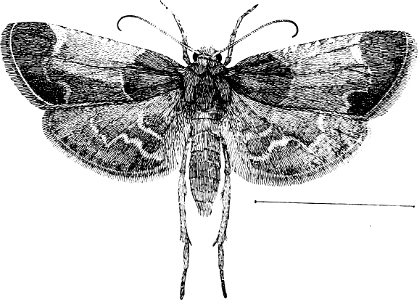
Fig. 133.—The Common Flour Moth.
Asopia farinalis (Linn.).
Margarodes vertonalis is a handsome bright green moth, with the margins of the outer edges of both pairs of wings marked with dark reddish brown; it measures about 1½ inches across the wings. The caterpillars, about an inch in length, are bright green mottled with black; the head shining reddish brown. My specimens were collected in the Botanical Gardens, Sydney, at the end of January; they were matting the tips of the branches of one of the ornamental shrubs (Ochrosia moorei) into irregular rounded masses. They pupated a week later and emerged before the end of the month.
Sceliodes cordalis, measuring slightly over 1 inch across the wings, is of a uniform creamy tint; the whole of the fore wings are mottled with light brown, the tips blotched with the same colour; and the hind pair more spotted; my specimens were bred from the foliage of the egg plant.
Asopia farinalis is the well known “meal moth” common, in most parts of the world; the caterpillars feed upon all kinds of corn, bran, pollard, and flour; it mats its food particles together with a silken web into a tube in which it hides. The moth is often found upon the walls of feed houses, mills, &c., and sometimes comes into the light at night. It measures 1 inch across the wings, and has a ground colour of yellow buff to dull greyish yellow, blotched with a darker tint at the base and tip, the latter marbled with grey; the hind wings are silvery. Zinckenia recurvalis is a common little moth about Sydney; it is under 1 inch across the wings, which are of a dark brown tint, with a white bar traversing the centre of each wing, and with a second white spot on each fore wing towards the tip. The caterpillars are sometimes found destructive to salt-bush hedges about Sydney by stripping off the foliage and causing the bushes to die back.
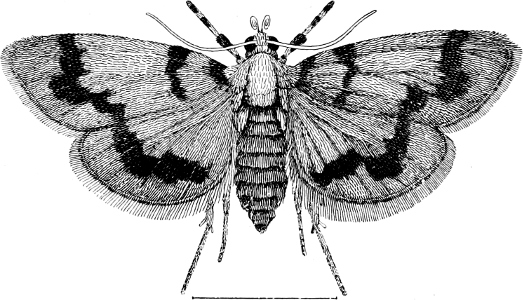
Fig. 134.—Notarcha clytalis (Walker).
The Kurrajong Leaf Roller.
Notarcha clytalis is a bright yellow moth with an irregular wavy line of black crossing the outer portions of the wings, and another shorter band near the base of each fore wing. The gregarious larvae are green spotted with black; they roll the leaves on the terminal branches of the Kurrajong into regular slender masses up to a foot or more in length, in which they finally pupate. It has a wide range over the country, rendering these handsome trees very unsightly when numerous. The larvae of Godara comalis is a greenish yellow caterpillar barred with lighter yellow at the back of each segment, and lightly clothed with long brown hairs; it feeds upon the leaves of the horse radish and turnip. The moth measures 1 inch across the wings; the fore pair are buff irregularly mottled with dark brown; the hind wings of a uniform silvery white with a brown patch at the apical margin.
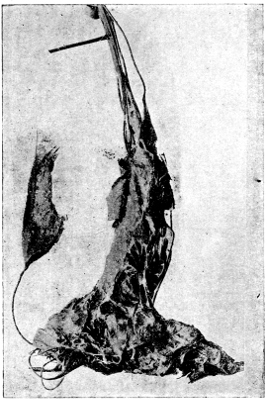
Fig. 135.—Nest of Notarcha clytalis (Walker).
Showing how the caterpillars roll up the foliage.
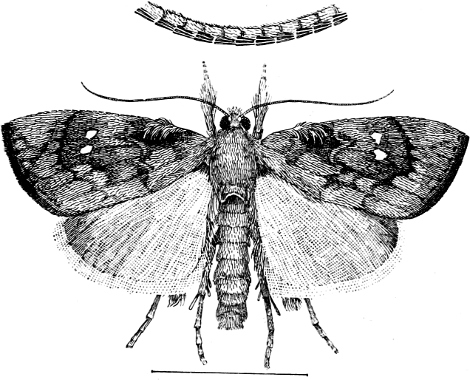
Fig. 136.—Godara comalis (Guérin).
The caterpillar of which webs the leaves of the horseradish.
(“Agricultural Gazette,” N.S.W.)
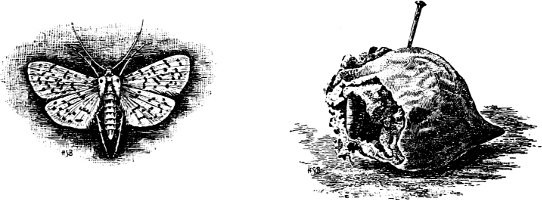
Fig. 137.—Cognogethes punctiferalis (Guérin).
The Northern Peach Moth, with damaged peach.
Mecyna polygonalis defoliates the tree lucerne (Citysus prolifera); I have also bred it from broom bushes in gardens at Armidale, N.S.W., and on a native bush (Templetonia) in the western plains, so that it has a wide range: Mr. Lyell tells me it is very destructive to the foliage of willows in some parts of Victoria. The caterpillars are slender light green creatures spotted with black and white shaded with yellow on the sides; when full grown they spin a loose silken cocoon. The moth is slightly under 1½ inches across the wings; the fore pair are light brown, and the hind pair each blackish brown round the outer portion and bright yellow in the centre. The two introduced bee moths, Achraea grisella and Galleria melonella, belong to a division of this family: the moths lay their eggs about the hive, the grubs crawl in and feed upon the wax which they mat together with silken web, and if overlooked they destroy the whole of the hive; in the days of the old-fashioned hives they were a great source of trouble to bee-keepers, but now with well constructed bar-hives they are easily checked. The first named is of a uniform brown colour with the fore wings rounded; the second has the wings arcuate behind and irregularly mottled.
Aphomia latro measures about 1½ inches across its slender somewhat pointed fore wings; is of a general buff colour shot with fine black spots, and divided down the centre of the fore wings with a broad dull white parallel stripe; the hind wings silvery grey. The larvae live in small communities feeding upon and matting together the scape of the flower stalk of the grass trees, in which they pupate within an elongate white silken cocoon.
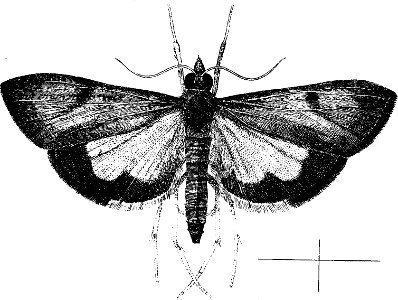
Fig. 138.—Mecyna polygonalis (Hubner).
The Native Broom Bush Moth.
The Peach Moth, Conogethes punctiferalis, is a bright yellow moth thickly mottled with black spots. The larvae attack peaches when ripening, eating and webbing the surface and pupating on the side of the stone. It is common in the northern districts of N.S.W.
The “Mediterranean Flour Moth,” Ephestia kuhniella, though not an Australian moth, is worthy of note, for it is widely distributed over the country, and causes a lot of annoyance by the bad habits of its larvae of webbing the flour into masses with its silken strands. Another cosmopolitan moth, Plodia interpunctella, is known in America as the “Indian Meal Moth,” though it feeds upon all kinds of dried foods; it is a much smaller moth of a general brown tint, the apical portion of the wings much darker than the basal part. This moth also is very common in Australia.
Family 16. Bell Moths. TORTRICIDAE.
These moths have slender bodies; short generally broad fore wings, truncate at the extremities; the hind pair also broad; and when they are at rest during the day time their wings are folded flat down. The costal margins of the fore wings are much rounded when the wings are folded, giving a general bell shaped form; from which these moths take their popular name. They are sometimes called “leaf twisters” or “leaf rollers,” but differ from the true gregarious leaf roller caterpillars in seldom matting a number of the leaves together. The caterpillars also feed upon seeds.
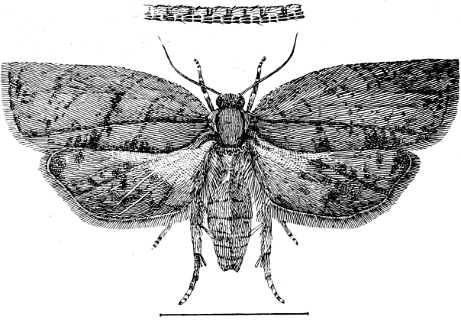
Fig. 139.—Cacaecia postvittana (Walker).
The light-brown Apple Moth.
The members of the Genus Cacaecia are interesting insects because several have been found attacking fruit in orchards: C. postvittana, was recorded by Olliff gnawing in apples like a codlin moth. It measures ¾ of an inch across the wings; is of a general dull yellow marked with brown, but its colour and markings are very variable. It has a wide range over Tasmania and the eastern coast of the mainland into Queensland; and about Sydney the caterpillars feed upon half a dozen different common native shrubs. French in his Handbook of the Destructive Insects of Victoria Pt. I. 1891 has named and figured one, C. responsana, the “Light Brown Apple Moth,” as an apple pest in Victoria; this is probably C. postvittana. C. Australasiae is a larger species of a dark brown colour; the fore wings are lightly mottled or marbled. C. lythrodana is a smaller, similar coloured moth, but the colouration is finer. Paramorpha aquilina is a tiny, creamy-grey moth not quite ½ an inch across the wings: in its native state it frequents damp or marshy ground, flying low among the herbage. The larva is a short, pale green grub that, in several of the orange growing districts, attacks the ripening oranges; boring through the skin, it feeds upon the pith between the rind and flesh, where it finally pupates and causes the orange to turn yellow and drop off.
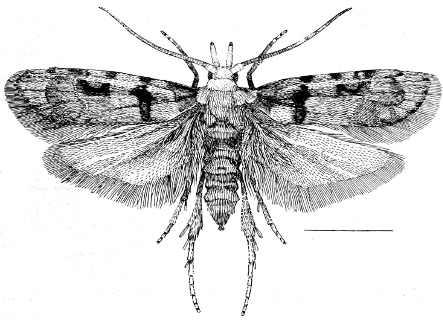
Fig. 140.-Paramorpha aquilina (Meyrick).
The Orange-skin Borer.
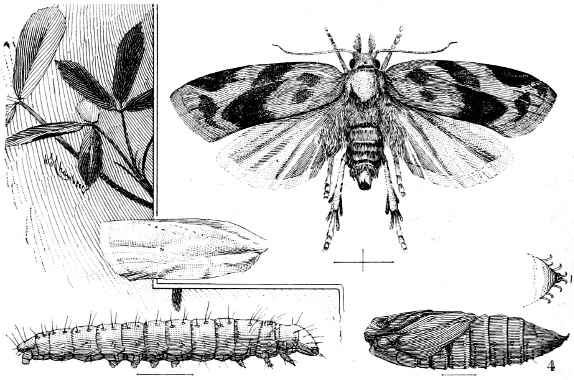
Fig. 141.—Life history of the Lucerne Leaf Roller, Tortrix glaphyriana (Meyrick).
The Lucerne Moth, Tortrix glaphyriana, is a small, dark yellow moth about ½ an inch across the wings; the fore pair are light buff with a silvery tint, blotched with irregular patches of dark brown. The caterpillars are dark green with scattered white hairs on the segments; they are a regular pest in lucerne paddocks in the Hunter River district, N.S. Wales, feeding upon the lucerne tops and drawing them together with silken threads. Arotrophora ombrodelta is a handsome little moth which I bred out of the seed pods of Acacia farnesiana growing near Lismore, N.S.W.; the yellowish brown caterpillar has a pink stripe down the back, and each segment is spotted with green; they devour the seeds and then pupate inside the pod close to the hole, through which the pupa works its head just before the moth is ready to emerge; the anal segments being ringed with fine spines enable it to screw right out of the hard pod, so that the moth is not damaged. The moth, under 1 inch across the wings, has the fore pair chocolate brown, mottled and darkest at the tips; the hind pair are brown. Meyrick says that the larva of another species feeds enclosed in a short, stiff, silken tube among the leaves of Lomantia silarfolia; and a third feeds in the flower cone of our common honeysuckle (Banksia serrata). The Codlin Moth, Carpocapsa pomonella, the world-wide pest to apple growers, is found in most parts of Australia; but though the reddish tinted caterpillar is universally known, there are a great many orchardists who do not know the moth, though it is easily recognised from all other species by the copper coloured blotch on the apical portion of the fore-wings.
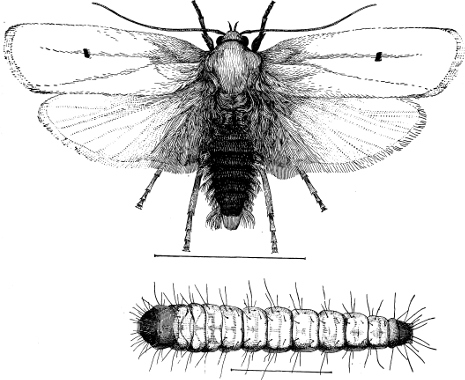
Fig. 142.—Cryptophaga unipunctata (Donovan).
The Cherry-stem Borer, showing the larva.
We now come to an anomalous group, whose exact place in the classification of Lepidoptera has puzzled entomologists, but which is usually placed at the end of this family. These are the Cryptophaginae, whose larvae, naked, slender caterpillars, live in shallow chambers or short tunnels in the branches of the smaller forest trees. They cover the entrance to their burrow with a screen of loose silken web covered with gnawed bark and droppings. Resting during the day, they come out at night and, biting off some of the leaves, drag them down into the burrow (the ends often sticking out through the web) to feed on at their leisure. When full grown they pupate within the burrow. C. unipunctata is a very handsome satiny white moth about 1½ inches across the wings; the fore pair each have a single black dot in the centre; the abdomen is black fringed with yellow hairs forming a tuft at the extremity. In its native state the caterpillars feed upon the branches of our common honeysuckle (Banksia serrata), but have a very great liking for the branches of cherry trees in the orchards; where neglected, they often kill large branches by their attacks. C. irrorata is a larger moth, measuring up to 2 inches across the wings, the fore pair being very broad and square at the extremities; they are of a uniform greyish brown, slightly mottled with a darker pattern round the outer margins; the hind pair are silvery brown fringed round the edges. The larva feeds on the stems of Casuarina. C. rubriginosa is nearly as large as the last; the fore wings are reddish brown. There is a salmon tint on the thorax extending on to the base of the fore wings; the hind wings are brownish yellow. The larvae feed in the stems and branches of several species of Acacia.
Family 17. Grain and Clothes Moths. MICRO-LEPIDOPTERA.
In concluding the Lepidoptera I place these families, often grouped together under the comprehensive term Micro-lepidoptera, in the above division. Most of these moths are small, but the group is very important in that it contains some of the most destructive pests of grain, cloth, &c., and they are world-wide in their range. Meyrick has made a special study of these moths, and has classified and described an immense number in a series of papers in the Proc. Linn. Soc. N.S.W. 1878–1904.
The larvae of the different groups are usually slender naked grubs with a few scattered hairs, and are sometimes legless; but others again have from 14 to 18 pairs of legs. They feed upon all kinds of material, sometimes forming tubular cells out of their food, while others move about quite freely. The moths may be obtained by beating or shaking bushes, or breeding them from the material among which they feed.
The Family Oecophoridae is the most extensive in Australia; in his first paper on the group in 1883, Meyrick estimated that over 2,000 species would be discovered, and later in 1889 he had actually described 756 species, most of them new. The Genus Philobota contains 105 described species, many of them handsome brightly marked little moths. P. arabella, slightly over ¾ of an inch across the wings, is of a general greyish brown tint, with the central portions of the fore pair pale yellow edged with brown forming wedge-shaped patches. P. catascia, slightly larger, has the fore-wings silvery white, slightly clouded; the hind ones dull yellow in the centre fringed with light brown. P. productella a little smaller, is all silvery white, with yellowish tints in the hind pair; and P. agnesella is a larger silvery one with a narrow irregular dark stripe along the centre of each fore wing from the base to the apex. P. gascialis, a very different larger winged form, has the fore pair dark orange yellow, each with a broad brown blotch through the centre, and tip dark brown; the hind pair dull brown fringed with fine plumes. Macrobatha platychroa is under ½ an inch across the wings; the fore pair are marked with alternate bars of white and black, and the hind pair greyish brown. Heliocausta hemitelis, about twice the size, has the fore wings yellow, tipped and blotched with purplish brown, the blotch on each hind margin angular; the hind wings brown. Zonopetala decisiana, under ½ an inch across the wings, has the fore pair white, each with a large brown blotch across the centre, and others at the tip, and with a band of the same colour across the thorax; the hind wings light buff and fringed with hairs. The caterpillar of Ocystola hemicalypta constructs a protective covering about as thick and long as a large wax match out of a section of a gum twig, in which it lives and feeds after hollowing it out like a tube; these curious cocoons are not uncommon in the bush on the leaves of eucalypts.
The Gelechiadae is another large family recently revised by Meyrick (Pro. Linn. Soc. N.S.W. 1904); he says that these moths are not so numerous as in Europe, but as they are such small, inconspicuous insects there are probably a great number still to be discovered. He describes 274 species, of which 207 are new, and 85 of which belong to the Genus Protolechia. Several species that infest grain belong to this group: Gelechia simplicella, a tiny little brown moth, has pointed slender wings, the fore pair nearly black, with a very distinctive irregular white bar across each apical half. Meyrick has placed it in the Genus Anacampsis; it has a wide range over Tasmania and Australia: I have bred it from the foliage of Soy beans, which the larvae matted together and seriously damaged. Sitotroga cerealella is a tiny yellowish brown moth with pointed wings. It has a wide range round the Australian coast, and has been introduced from Europe or America with corn upon which the larvae feed. It is known as the “Angoumois Grain Moth” from the province of that name in France, where in 1760 it swarmed over the country and nearly caused a famine. I have bred it from wheat at Bingara N.S.W.
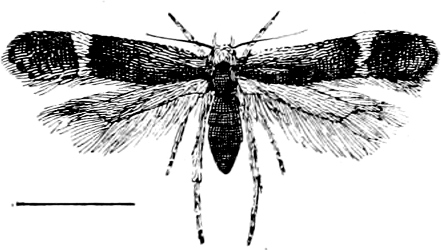
Fig. 143.—Gelechia simplicella (Walker).
The Soy-bean Moth.
The Elachistidae were described and revised by Meyrick (Pro. Linn. Soc. N.S.W. 1897), who lists 254 species, most of which were new. He says: “The species of this family are almost all small and therefore often neglected by collectors. Larva with 10 prolegs seldom almost apodal, usually mining in leaves, or amongst seeds or in stems, sometimes case-bearing, rarely amongst spun leaves.”
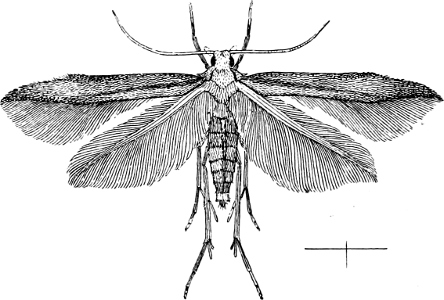
Fig. 144.—Batrachedra sparsella (Walker).
The larva of which constructs a web amongst, and feeds on, scale insects.
The larvae of the members of the Genus Batrachedra, according to Meyrick, feed usually upon seeds. B. arenosella, a small dull pale yellow moth with spotted fore wings and grey hind ones, is common over Australia, Tasmania, and New Zealand. The larvae web the seeds and stalks of sedges together, and form a cocoon among the seeds. I have bred a species of Batrachedra, B. sparsella, Walk., but can find no record of this species in Meyrick’s list. The larva of this moth spins a web on the trunks of trees that are infested with scale insects which they devour, finally forming an elongate cocoon attached to the bark; in the orchard they destroy white louse on oranges, and San Jose scale on peach trees. Strathmopoda melanochra, a little brown moth, has the fore wings dull white with metallic reflections and darker markings; the wings are very finely fringed on the hind margins.
The Family Plutellidae contains one very destructive little pest in the Diamond-backed Cabbage Moth, Plutella cruciferarum; the slender green larvae gnaw holes in the leaves and pupate in net-like cocoons on the foliage. It has a world-wide range and is very common in Australia.
The Family Tineidae, containing the clothes moths, is defined by Meyrick (Proc. Linn. Soc. N.S.W. 1892) as the rough-headed Tineina, with the palpi strongly developed in front of the head, and the hind wings usually as broad as the fore wings, sometimes narrower but seldom broader. Larva with 16 legs, or legs wanting.
The Genus Xystmatodoma contains 29 species, of which X. guildingi is a typical form described by Scott in his “Australian Lepidoptera”; it is a slender-winged dull brown moth, the larva of which crawls about in a stout silken sack like that of an immature case moth, and feeds upon low scrub. Scardia australasialla is a handsome little moth, which is figured in Donovan’s “Insects of New Holland”; it measures about 1¼ inches across the wings; the fore pair are dull brown but so thickly covered with shining white to pale yellow spots that it looks very brilliant; the hind pair are brown fringed with long plumes. Blabophanes ethelella is about ¾ of an inch across the wings; the fore pair are dark brown finely spotted with white and some have a comparatively large white dot in the centre of each wing, the hind margin also edged with white; the hind pair light brown. The Genus Tinea is represented by a number of both native and introduced species. The common clothes moth, Tinea pellionella, is too well known to need description; it is world-wide in its range, and lays its eggs upon clothes on which the larvae feed and finally use particles to construct their cocoons. T. tapetzella feeds among furs and skins. Tineola biselliella is a third cosmopolitan species of clothes moth. Tinea fuscipunctella feeds upon dried animal matter, refuse and such like; it also is world wide in its range. Among our native species, T. nectaria is under ½ an inch across the wings; the fore pair have the basal two thirds silvery yellow with the tips black; the hind pair dull yellow darkest at the tips. Meyrick says that these larvae make cases out of eucalyptus leaves, but my specimens were bred out of blister-like excrescences or galls upon the leaves of a shrub in the Botanic Gardens Sydney. Thudaca obliquella, about 1 inch across the wings, is a beautiful little silvery white moth, with the fore wings deep yellow thickly marked with parallel and transverse bars of silvery white; the hind pair broad, silvery, lightly clouded, and fringed behind with long plumes.
The Epipyropidae comprise a small group of moths that have been raised to the rank of a family by Perkins (Bulletin I. part 2, “Leaf Hoppers and their Natural Enemies,” Hawaii 1905), though it would probably be more correct to place them as a sub-family of the Tineidae. Sharp (Cambridge Natural History: Insects part II.) places them in the Limacodidae. They are small black, grey or brown moths, with small eyes; no ocelli; the palpi wanting or very minute, and the mouth parts little developed. They have remarkable parasitic habits in the caterpillar state living upon the backs of different leaf hoppers (Homoptera) and feeding upon the waxy or sugary secretions discharged by their hosts. Perkins describes 7 new Australian species, which are placed in three genera, based on the neuration of the wings. Three species come from Cairns, N. Queensland, and four from the neighbourhood of Sydney. Heteropsyche melanochroma measures under ½ an inch across the outspread wings and is of a general black or fuscous colour with purple tints on the fore wings. Koebele records it as common about Sydney, parasitic upon a number of different Fulgorids and Jassids.
Rothschild (Novitates Zoologicae 1906) has named another species, Epipyrops doddi, after the well known collector, P. F. Dodd, who had worked out its life history in North Queensland.
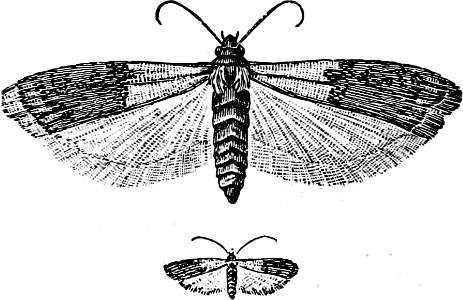
Fig. 145.—Plodia interpunctella (Hubner).