ZODIACAL SYMBOLS OF SOLAR WORSHIP.
Reading edition
Having shown that the founders of the ancient astrolatry accorded homage to God Sol as Lord of Evil, under the symbol of the serpent, and marked the beginning of his reign, as such, by the constellation "Serpens" placed in conjunction with the Autumnal Equinox; we will now
After long observation, aided by the telescope, of which they were undoubtedly the original inventors, the ancient Astrologers discovered that the Sun, in making his apparent annual revolution, did not return to the same point in the heavens, but fell behind that of the preceding year, at the rate of 50¼ seconds of a degree annually. At this rate of precession, which modern, calculation has confirmed, it requires 71 2-3 years for the Cardinal points to pass through one degree on the Ecliptic, and 2150 years through thirty degrees, or one sign of the Zodiac. The knowledge of this process affording an exact chronology, we are enabled, not only to determine the origin of these symbols, but to approximate, very nearly, to the respective dates of their adoption.
The Sphinx.
From the teachings of Astronomy we learn that the Summer Solstice is now occupying the point between the
The Dragon.
When the Summer Solstice was between the signs of Leo and Virgo, the Winter Solstice was between those of Aquarius and Pisces, and the figure composed of the body of a man with the tail of a fish became the mid-winter symbol of solar worship. Such was the form of this symbol to which the ancient Phoenicians paid homage to the Lord under the name of Dagon.
The Bull.
At the same time the Summer Solstice entered the sign of Leo, the Vernal Equinox entered that of Taurus, and the bull becoming the spring symbol of solar worship—the Lord was designated in the ancient allegories as the bull of God which taketh away the sin of the world; which, shorn of its allegorical sense, signifies the sun in Taurus, or sun of spring, which taketh away the evil of Winter. Such is the purport of hieroglyphical inscriptions upon papyrus rolls found in Egypt, and engraved upon obelisks erected in the Nile valley, one of which has been recently brought to the City of New York and set up in Central Park. In the East Indies this symbol was represented by the figure of a bull with the solar disk between his horns; and the Egyptians, who were of Hindoo origin, perpetuating it in their "Apis," it was reproduced in the golden calf of the ancient Israelites. The Assyrians represented this symbol by the figure of a winged bull with the face and beard of a man; the Phoenicians, in their "Baal," by the figure of a man with a bull's head and horns; and the small silver bull's heads with golden horns, recently discovered by Dr. Schliemann in the ruins of Mycenae, were jewels worn by the women of that ancient city, when the Vernal Equinox was in the sign of Taurus.
The Ram.
By deducting 2,150 years from 6,450, we determine that about 4,300 years; ago the Vernal Equinox entered the sign of Aries, and the spring symbol of solar worship, changing from the bull to the ram, was represented by ram-headed figures, two of which, found in Egypt, are on exhibition in the British Museum. Then the text which read the bull of God, was changed to the Ram of God which taketh away the sins of the world.
The Lamb.
The Fish.
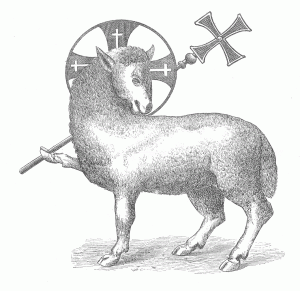
By deducting 2,150 years from 4,300 we determine that about 2,150 years ago the Vernal Equinox entered the sign of Pisces; and although the original version of the New Testament was founded upon the symbol of the lamb, it is a historical fact that for centuries after the beginning of our era, the Christians paid homage to the Lord under the symbol of the fish; but ultimately going into desuetude, the lamb was retained as the distinguishing symbol of the Christian religion until the year 680, at which date another was substituted, as will be shown under our next heading.