FREEMASONRY AND DRUIDISM.
Reading edition
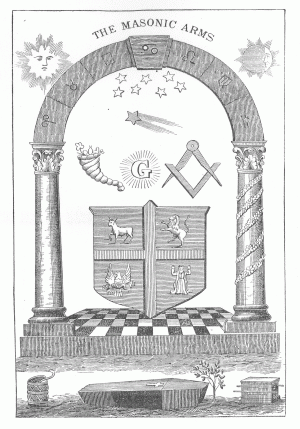
After, the promulgation, in the fifth century, of the edict by one of the Emperors of Rome, decreeing the death penalty against all persons discovered practicing any of the rites and ceremonies of the ancient religion, a body of its cultured adherents, determining to observe
Becoming cognizant of the true object of Freemasonry, the Hierarchy of the Church of Rome resolved to suppress the order, and to that end maintained such a strict espionage upon its members that, no longer able to assemble in their lodges, they determined to defend themselves by an appeal to arms, and gathering together in strongholds, for a long time successfully resisted the armies of the church; but ultimately, being almost exterminated, the residue disbanded, and we hear no more of Freemasonry, as a secret order, until the conclusion of the Dark Ages, when the Reformation, making it possible, a form of the order, recognizing Christianity, was revived among the Protestants; but the Church of Rome, true to her traditions, has never ceased to hurl anathemas against it and all other secret societies outside of her own body. Thus, having made it apparent that Freemasonry, as primarily instituted, was but a perpetuation of the temple form of Astral worship, we can readily see that, while some of its symbols are as old as the ancient Egyptian religion, it did not, as a secret order, take its rise until Christian persecution made it necessary. Hence it cannot justly lay claim to a greater antiquity than the fifth century of the Christian era.
According to Masonic annals a Grand Lodge was organized at York, England, early in the tenth century, but,
From church history we learn that in the year 596 of our era Pope Gregory I. dispatched Augustin, and forty other monks of the order of St. Andrew, from Rome to Britain, to convert the natives to Christianity; but, while the Anglo-Saxons embraced the new faith, the Britons rejected it, and, being persecuted by the Christians, retired to the fastnesses of the country known as Wales, where, for a long period, they maintained the observance of the Druidical form of worship; and although that country has long since become Christianized, the society of the Ancient Order of Druids has existed with an uninterrupted succession at Pout-y-prid, where the Arch-Druid resides, and from, whence emanated the charter of the Grand Lodge of the order in this country. In reference to the Druidism on the continent, history records