PERSONIFICATIONS OF THE DIVISIONS OF TIME.
Reading edition
In the ancient solar fables the several divisions of time were personified and made to pay homage to the Triune Deity, supposed to be enthroned above the firmament.
The Hours.
The genii of the hours were designated as Elders, and we find them described in the 4th chapter of Revelation as sitting round about the throne upon four and twenty seats, clothed in white raiment, and crowns of gold upon their heads.
The Days.
Each day of the year was appropriately personified, and these genii of the days constitute the saints of the Christian calendar. Of these we will refer to but one.
The Months.
The fable of the twelve labors having been superseded by others, in which the genii of the twelve signs of the Zodiac, corresponding to the months, were designated as angels, and made to minister to God Sol while making his apparent annual revolution; but, when constituted the attendants of the incarnate saviours during their imaginary earth life, they were personified as men and called Disciples. Of these genii of the months we will refer only to the first and the last. The first month, dedicated to the genius known in the mythology as Janus, and from which was derived the name January, was portrayed with two faces, the one of an old man looking mournfully backward over the old year, and the other of a young man looking joyfully forward to the new year. This personification,
In reference to the last month, we find that the authors of the ancient solar fables, ever doubting whether God Sol, after inaugurating Winter by his supposed retreat from the earth, would return to revivify nature with his life-giving rays, gave to the genius of the twelfth month the title of the Doubter. In the Christian calendar this personification is known as Thomas, and a more specific dedication of the shortest day of the year having been made to him, the 21st day of December is called St. Thomas day.
The Seasons.
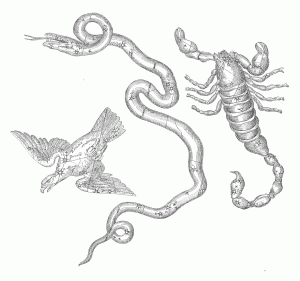
When the cardinal points were in the constellations Leo, Taurus, Aquarius and Scorpio, the astrologers, objecting to the signification of the latter, substituted the constellation in conjunction therewith, which is known as Aquila (Ak-we-la) or Flying Eagle. In the allegorical astronomy of that remote period these genii of the seasons were designated as beasts, and as such we find them referred to in Revelation iv. 7, which reads as follows: "And the first beast was like a lion (Leo), and the second beast like a calf (Taurus, the bull calf), and the third beast had a face as a man, (Aquarius, the waterman) and the fourth beast was like a flying eagle (Aquila)." In the first chapter of Ezekiel, the prophet, the genii of the seasons are referred to in the same manner.
Half Year of Increasing Days.
In the ancient astrolatry, the half year of increasing days, extending from the Winter to the Summer Solstice, was personified by the composite figure representing the constellations of Taurus and Aquarius, which, constituted of the winged body of a bull and the head and beard of a man, was called the Cherubim. This personification we find portrayed upon the Assyrian marbles on exhibition in the British Museum.
Half Year of Decreasing Days.
The half year of decreasing days, extending from the Summer to the Winter Solstice, was personified by the figure, which, representing the constellations of Leo and Aquila, and composed of the winged body and limbs of a lion, with the head of an eagle, was called the Seraphim.
Last Quarter of the Year.
The last quarter of the year was personified in the ancient allegories as a decrepit old man, who, stung by a Scorpion (Scorpio), and fatally wounded by an arrow from the quiver of an archer (Saggitarius) dies at the Winter Solstice; and, after lying in the grave for the space of three days, is brought to life again. Such was the personification referred to in the Christian Gospel-story as having been raised from the grave by the mandate, "Come forth, Lazarus." Thus have we shown that the elders and the saints; the angels, and the Archangels; the Cherubim and Seraphim; and also poor old Lazarus, are but personifications of the several divisions of time.