Volume 1 — ARGENTINE ORNITHOLOGY.
Reading edition
Order I. PASSERES.
Suborder I. OSCINES.
Fam. I. TURDIDÆ, or THRUSHES.
Eight species of the almost cosmopolitan Thrush-family are known to occur in the Argentine Republic. Of these, five belong to the widely-spread genus Turdus, and are closely similar in structure to our European Thrushes. The remaining three are Mock-birds (Miminæ)—a group restricted to the New World, and sometimes considered more nearly allied to the Wrens. They are remarkable as splendid songsters. Burmeister includes in his list a fourth species of Mimus (M. thenca), as found in the Mendoza district; but there may be some error in this, as M. thenca is only known to us from Chili west of the Andes.
1. TURDUS LEUCOMELAS, Vieill.
(DUSKY THRUSH.)
Turdus leucomelas, Scl. et Salv. Nomencl. p. 1; Hudson, P. Z. S. 1870, p. 798 (Buenos Ayres); Durnford, Ibis, 1877, p. 166 (Buenos Ayres); White, P. Z. S. 1882, p. 592 (Misiones and Corrientes); Barrows, Bull. Nutt. Orn. Cl. viii. p. 85 (Concepcion); Seebohm, Cat. Birds, v. p. 213. Turdus crotopezus, Burm. La-Plata Reise, ii. p. 474 (Mendoza).
Description.—Above olive-grey, tinged with brown on the head and neck; beneath pale grey, throat white, more or less striped with brown; middle of belly and crissum white; under wing-coverts and inner margins of wing-feathers fulvous; bill yellow; feet hazel: total length 9·0 inches, wing 4·5, tail 3·7. Female similar.
Hab. Eastern South America, from Cayenne to Buenos Ayres.
The Dusky Thrush is widely distributed in South America, and ranges as far south as Buenos Ayres, where it is quite common in the woods along the Plata river. It is a shy forest-bird; a fruit- and insect-eater; abrupt in its motions; runs rapidly on the ground with beak elevated, and at intervals pauses and shakes its tail; pugnacious in temper; strong on the wing, its flight not being over the trees, but masked by their shadows. It can always be easily distinguished, even at a distance, from other species by its peculiar short, metallic chirp—a melodious sound indicating alarm or curiosity, and uttered before flight—in contrast to the harsh screams and chuckling notes of other Thrushes in this district.
Whether it is a fine singer or not within the tropics I am unable to say, its vocal powers having received no attention from the naturalists who have observed it. With us in the temperate climate of Buenos Ayres, where it commences to sing in September, it has the finest song of any bird I know, excepting only Mimus triurus. Like the English Song-Thrush, but unlike its near neighbours the Red-bellied Thrush and the Magellanic Thrush, it perches on the summit of a tree to sing. Its song is, however, utterly unlike that of the English bird, which is so fragmentary, and, as Mr. Barrows describes it, made up of “vocal attitudes and poses.” The two birds differ also in voice as much as in manner. The strains of the Dusky Thrush are poured forth in a continuous stream, with all the hurry and freedom of the Sky-Lark’s song; but though so rapidly uttered, every note is distinct and clear, and the voice singularly sweet and far-reaching. At intervals in the song there recurs a two-syllabled note twice repeated, unlike in sound any other bird-music I have heard, for it is purely metallic, and its joyous bell-like “te-ling te-ling” always comes like a delightful surprise to the listener, being in strange contrast with the prevailing tone.
The song is altogether a very fine one, its peculiar charm being that it seems to combine two opposite qualities of bird-music, plaintiveness and joyousness, in some indefinable manner.
I have never heard this species sing in a cage or anywhere near a human habitation; and it is probably owing to its recluse habits that its excellent song has not been hitherto noticed. Azara perhaps mistook the song of this species for that of Turdus rufiventris, a very inferior vocalist.
The nest is made in the centre of a thick bush or tree six or eight feet above the ground, and is a deep elaborate structure, plastered inside with mud, and lined with soft dry grass. The eggs are four in number, oblong; the ground-colour light blue, abundantly marked with reddish-brown spots.
This Thrush has, I believe, a partial migration in Buenos Ayres. In the autumn and winter I have frequently observed it in localities where it is never seen in summer.
2. TURDUS RUFIVENTRIS, Vieill.
(RED-BELLIED THRUSH.)
Turdus rufiventris, Scl. et Salv. Nomencl. p. 2; Burm. La-Plata Reise, ii. p. 474; Hudson, P. Z. S. 1870, p. 89 (Buenos Ayres); Durnford, Ibis, 1877, p. 167, 1880, p. 417 (Buenos Ayres); White, P. Z. S. 1882, p. 592 (Salta); Barrows, Bull. Nutt. Orn. Cl. viii. p. 85 (Concepcion). Turdus rufiventer, Seebohm, Cat. B. v. p. 222.
Description.—Entire upper parts olive-grey; throat white, striped with dark brown, the striped portion extending to the chest; rest of under surface, also under wing-coverts, rufous-red, deepest on the belly; bill brownish yellow; feet brown: total length 9·0 inches, wing 4·6, tail 3·6. Female similar.
Hab. S.E. Brazil, Paraguay, Uruguay, and La Plata.
The Red-bellied Thrush, distinguished from the species just described by its larger size and the bright rufous colour of its under plumage, is common everywhere in the Plata region, and does not appear to be migratory. It is a noisy, strong-winged, quarrelsome bird, closely resembling the Dusky Thrush in its manners. It inhabits forests, runs on the ground in search of food, and when approached darts away with loud chuckling notes, flying close to the ground. These birds are also often seen pursuing each other through the trees with loud harsh screams.
The song has a faint resemblance to that of the English Song-Thrush, being composed of a variety of notes uttered in the same disconnected manner, with frequent pauses; but it is, both in sweetness and strength, inferior to that of the English bird. As a rule this Thrush sings concealed in a thick bush or tree.
The nest is deep, well made, plastered inside with mud, and concealed in the centre of a large bush or low tree. The eggs are four, pale blue in colour, and thickly spotted with brown.
3. TURDUS MAGELLANICUS, King.
(MAGELLANIC THRUSH.)
Turdus magellanicus, Seebohm, Cat. B. v. p. 223, pl. xiv. Turdus falklandicus, Scl. et Salv. Nomencl. p. 2; Hudson, P. Z. S. 1872, p. 548 (Rio Negro); Döring, Exp. al Rio Negro, Zool. p. 36 (R. Colorado and R. Negro).
Description.—Head, wings, and tail brownish black; the remaining portions of upper surface brownish olive; under surface pale rufous, obscure on the breast; throat white, striped with black; bill and feet dull yellow: total length 10·5 inches, wing 7·5, tail 4·0. Female similar.
Hab. Patagonia and Chili.
This Thrush, which I met with on the Rio Negro of Patagonia, so closely approximates to T. rufiventris in colour, language, and habits, that the casual observer finds it difficult to distinguish one from the other. Its nest and eggs are also precisely like those of its northern representative. The song is, however, much poorer, and reminds one of the first attempts of a young bird. That a member of so melodious a family should have so inferior a song I attribute to the fact that Thrushes (unlike the songsters of other genera) sing only in the warm season and when the air is calm. In the southern portion of the South-American continent violent winds prevail in summer, so that this southern Thrush sings perhaps less frequently than any other song-bird, and appears to be losing the faculty of song altogether.
4. TURDUS FUSCATER, d’Orb. et Lafr.
(ARGENTINE BLACKBIRD.)
Turdus fuscater, Scl. et Salv. Nomencl. p. 2; White, P. Z. S. 1882, p. 593 (Catamarca); Burm. La-Plata Reise, ii. p. 474 (Mendoza, Cordova, and Tucuman). Merula fuscatra, Seebohm, Cat. B. v. p. 243.
Description.—Uniform brownish black; bill and feet yellow: total length 11·5 inches, wing 5·3, tail 4·5. Female similar.
Hab. Bolivia and Northern La Plata.
“I have noticed this bird in the provinces of Mendoza, San Juan, San Luis, Cordova, and Catamarca, where it is much esteemed as a cage-bird on account of its beautiful whistle. In Mendoza it goes by the name of ‘Zorsal,’ in Catamarca and Cordova by that of ‘Merlo,’ and in Andalgala (Catamarca province) ‘Chocoyno.’”—White, l. s. c.
“Very common at Mendoza, Cordova, and Tucuman, and met with among the shady trees of the promenades: has a better song than our Blackbird, which is heard at a distance, especially in the evening. Called ‘Crispin’ in Tucuman.”—Burm. l. s. c.
5. TURDUS NIGRICEPS, Cab.
(BLACK-HEADED THRUSH.)
Turdus nigriceps, Cab. J. f. O. 1878, p. 195.
Description.—Above slaty grey, head black; below paler, chin white, striped with black; middle of belly and crissum white; bill and feet pale yellow: total length 7·6 inches, wing 4·4, tail 3·5. Female olive-brown, paler below, chin pale ochraceous; middle of belly and crissum white; bill brown, feet yellowish.
Hab. Peru, Bolivia, and Northern La Plata.
Met with by Dr. A. Döring and Herr Schulz on the Sierra of Cordova.
6. MIMUS MODULATOR, Gould.
(CALANDRIA MOCKING-BIRD.)
Mimus modulator, Sharpe, Cat. B. vi. p. 347. Mimus calandria, Burm. La-Plata Reise, ii. p. 475; Scl. et Salv. Nomencl. p. 3; Hudson, P. Z. S. 1870, p. 89 (Buenos Ayres); Durnford, Ibis, 1877, p. 167 (Buenos Ayres); White, P. Z. S. 1883, p. 37 (Cordova); Barrows, Bull. Nutt. Orn. Cl. viii. p. 85 (Concepcion).
Description.—Above dark grey, faintly mottled with pale grey; rump tinged with brown; wings nearly black, the feathers edged with brownish white; tail black, the feathers, except the two middle ones, broadly tipped with white; under surface dirty white; bill and legs black; eye olive-green: total length 11·0 inches, wing 4·5, tail 4·9. Female similar.
Hab. Paraguay, Uruguay, and Argentine Republic.
Azara has not failed to remark that it would be well to find a more appropriate name for this species, which was absurdly called “Calandria” (i. e. Sky-Lark) by the early colonists of the Plata. Use is, however, too strong to be easily set aside, and the name is now familiar to everyone in the Argentine Province. Moreover, by a curious irony of fate, the Spanish naturalist himself, by employing this unsuitable name in his ‘Apuntamientos,’ even while protesting against it, has been the cause of its introduction into scientific nomenclature.
It would be impossible to improve on the account Azara gives of the bird’s appearance and manners. The prevailing colour of the plumage is grey, the irides are deep green, the beak black, slender, and curved. The tail is long, jerked and elevated when the bird is at rest, spread open and depressed in flight. The Calandria’s movements are measured and dignified, its flight low and never extends far, the bird usually passing from one tree to another in a long graceful curve. It goes alone or with its mate only; feeds chiefly on the ground; does not penetrate into deep forests, nor is it seen on the treeless plains. It frequents the borders of woods and open grounds abounding in isolated shrubs and trees; is fond of coming about houses, and invariably perches itself on the most conspicuous places. It sings chiefly in spring, and its really wonderful vocal powers have made it one of our best-known and most-admired songsters. To sing it usually places itself on the summit of a bush or tree, and occasionally, as if carried away by excitement, it darts upwards three or four yards into the air, and then drops back on to its perch. So varied are its notes, and so frequently suggestive of the language of other species, that the listener finds himself continually asking whether the Calandria is really an original singer or merely a cunning plagiarist, able to steal scraps of fifty different melodies and to blend them in some sort into one complete composition. As a whole the song is in character utterly unlike that of any other bird (birds of the Mimus genus, of course, excepted), for the same notes are never repeated twice in the same order; and though the Calandria has many favourite notes, he is able to vary every one of them a hundred ways. Sometimes the whole song seems to be made up of imitations of other singers, with slight variations—and not of singers only, for now there will be clear flute-like notes, only to be succeeded by others reedy and querulous as the hunger-calls of a young Finch; then there will be pretty flourishes or Thrush-like phrases, and afterwards screams, as of a frightened Swallow hurrying through the sky to announce the approach of a Falcon; or perhaps piteous outcries, as of a chicken in the clutches of a Kite.
Nevertheless Azara says truly that the Calandria does not mock or mimic the songs of other birds; for though the style and intonation of a score of different singers, chatterers, and screamers are reproduced by him, one can never catch a song, or even a portion of a song, of which he is able to say that it is absolutely like that of any other species. This much, however, can be said of the Calandria: he has a passion for endless variety in singing, a capacity for varying his tones to almost any extent, and a facility for catching the notes of other birds, which, in the Virginian Mocking-bird of North, and in the White-banded Mocking-bird of South America, has been developed into that marvellous faculty these two species possess of faithfully imitating the songs of all other birds. The two species I have just named, while mockers of the songs of other birds, also retain their own original music—their “natural song,” as an American ornithologist calls it.
The Calandria makes its nest in the middle of a large bush or low thorn-tree standing by itself; it is deep, like the nest of a Thrush in form, built of sticks, thorns, and grass, and lined with thistle-down or some other soft material. The eggs are four or five, pale blue, and thickly marked with reddish-brown spots.
When the nest is approached the parent birds demonstrate their anxiety by uttering loud harsh angry notes.
It is generally believed that the Calandria will not live in captivity. I have, however, seen a few individuals in cages, but they never sang.
7. MIMUS PATACHONICUS (d’Orb. et Lafr.).
(PATAGONIAN MOCKING-BIRD.)
Mimus patachonicus, Scl. et Salv. Nomencl. p. 3; Hudson, P. Z. S. 1872, p. 538 (Rio Negro); Durnford, Ibis, 1877, p. 31 (Chupat); Döring, Exp. al Rio Negro, Zool. p. 36 (R. Colorado); Sharpe, Cat. B. vi. p. 352. Mimus thenca, Burm. La-Plata Reise, ii. p. 475 (Mendoza)?
Description.—Above and beneath grey, paler on the under surface, and tinged with rufous on the belly; throat and mark over the eye white; wings black, the outer webs of the feathers edged with white and grey; tail black, tipped with white; bill and feet black; eye olive-green: total length 9·2 inches, wing 4·2, tail 4·0. Female similar, but smaller in size and lighter in colour.
Hab. Northern Patagonia.
The Patagonian Mocking-bird, which I met with during my sojourn on the Rio Negro of Patagonia in 1871, closely resembles the species just described, but is smaller, the plumage is of a darker grey, and the irides are also of a darker green. It is a common bird, resident, lives alone or with its mate, feeds on insects and berries, and in its manner of flight and habits is like Mimus modulator. The nest is made in the centre of a bush of thorns and sticks, and lined with dry grass, cow-hair, or other soft material; and the eggs are four in number, bluntly pointed, and thickly marked with dark flesh-coloured spots. When the nest is approached the parent birds come close to the intruder, often perching within a yard of his head, but without uttering any sound, differing in this respect from M. modulator.
The song of the Patagonian bird is in character like that of the northern species, the variety of its notes being apparently infinite; there are, however, some differences worth mentioning. The singing of the Patagonian species is perhaps inferior, his voice being less powerful, while his mellow and clear notes are constantly mingled with shrill ones, resembling the cries of some of the Dendrocolaptine birds. While incapable of notes so loud or so harsh as those of the northern bird, or of changes so wild and sudden, he possesses even a greater variety of soft notes. Day after day for many months I have heard them singing, yet never once listened to them for any length of time without hearing some note or phrase I had never heard before. The remarks I have made concerning the Calandria’s mocking-faculties also apply to this bird: but though he does not actually repeat the notes and songs of other species, he certainly does mock the notes of individuals of his own species; for it must be borne in mind that no two individuals sing quite alike, and that the same bird constantly introduces new notes into his song, and never repeats his notes in the same order. I have often observed that when a bird, while singing, emits a few of these new notes, he seems surprised and delighted with them; for, after a silent pause, he repeats them again and again a vast number of times, as if to impress them on his memory. When he once more resumes his varied singing, for hours, and sometimes for days, the expression he has discovered is still a favourite one, and recurs with the greatest frequency. But this is not all. If the new note or phrase happens to be a very striking one, it immediately takes the fancy of all the other birds within hearing, and often in a small thicket there will be a dozen or twenty birds near together, each sitting perched on the summit of his own bush. After the new wonderful note has been sounded they all become silent and attentive, reminding one in their manner of a caged Parrot listening to a sound it is trying to learn. Presently they learn it, and are as pleased with its acquisition as if they had discovered it themselves, repeating it incessantly. I noticed this curious habit of the bird many times, and on one occasion I found that for three entire days all the birds in a small thicket I used to visit every day did nothing but repeat incessantly two or three singular notes which they had borrowed from one of their number. The constant repetition of this one sound had a strongly irritating effect on me; but a day or two later they had apparently got tired of it themselves, and had resumed their usual varied singing.
This bird usually sits still upon the summit of a bush when singing, and its music is heard in all seasons and in all weathers from dawn till after dark: as a rule it sings in a leisurely unexcited manner, remaining silent for some time after every five or six or a dozen notes, and apparently listening to his brother-performers. These snatches of melody often seem like a prelude or promise of something better coming; there is often in them such exquisite sweetness and so much variety that the hearer is ever wishing for a fuller measure, and still the bird opens his bill to delight and disappoint him, as if not yet ready to display his whole power.
8. MIMUS TRIURUS (Vieill.).
(WHITE-BANDED MOCKING-BIRD.)
[Plate I.]
MIMUS TRIURUS.
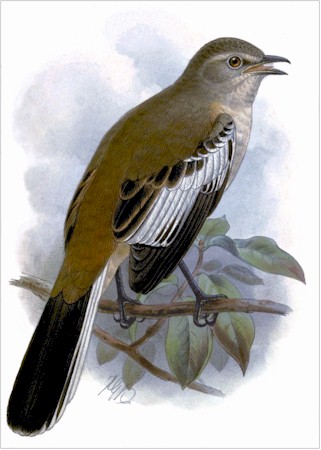
Mimus triurus, Scl. et Salv. Nomencl. p. 3; Hudson, P. Z. S. 1872, p. 539 (Rio Negro); White, P. Z. S. 1882, p. 593 (Buenos Ayres); Burm. La-Plata Reise, ii. p. 475 (Mendoza, Cordova, and Tucuman); Sharpe, Cat. B. vi. p. 342.
Description.—Above grey, brown on the rump; beneath light grey, white on the belly; wing black, crossed with a broad white band; tail white, except the two middle feathers, which are black; bill and feet black; eye orange-yellow: total length 9·5 inches, wing 4·8, tail 4·2. Female similar.
Hab. Paraguay, Argentine Republic, and Bolivia.
Azara first met with this king of the Mocking-birds in Paraguay a century ago; he named it “Calandria de las tres colas,” and described the plumage accurately, but was, I think, mistaken about the colour of the eye, which is orange-red and not olive-green. He says that it is a rare species, possessing no melodious notes, which proves at once that he never heard it sing. D’Orbigny obtained it in Bolivia, Bridges in Mendoza, and more recently it his been found by collectors in various parts of the Argentine country, even in Buenos Ayres, where, however, it is probably only an occasional visitor. But they have told us nothing of its song and of its miraculous mocking-powers. For my part I can think of no other way to describe the surpassing excellence of its melody, which delights the soul beyond all other bird-music, than by saying that this bird is among song-birds like the diamond among stones, which in its many-coloured splendour represents and exceeds the special beauty of every other gem.
I met with this species on the Rio Negro in Patagonia: it was there called Calandria blanca, a name not strictly accurate, since the bird is not all white, but certainly better than Azara’s strange invention of “Lark with three tails.”
The bird was not common in Patagonia, and its only language was a very loud harsh startled note, resembling that of the Mimus calandria; but it was past the love-season when I first met with it, and the natives all assured me that it possessed a very wonderful song, surpassing the songs of all other birds; also that it had the faculty of imitating other species. In manners and appearance it struck me as being utterly unlike a Mimus; in its flight and in the conspicuous white and black of the wings and tail, it looked like a Tyrant of the Tænioptera group. It was extremely shy, had a swift, easy, powerful flight, and, when approached, would rise up high in the air and soar away to a great distance. In February it disappeared from the Rio Negro and did not return till the following October, after the arrival of all the other migrants. It was then that I had the rare good fortune to hear it sing, and I shall never forget the sensation I experienced when listening to its matchless melody.
While walking through a chañar-wood one bright morning, my attention was suddenly arrested by notes issuing from a thicket close by, and to which I listened in delighted astonishment, so vastly superior in melody, strength, and variety did they seem to all other bird-music. That it was the song of a Mimus did not occur to me; for while the music came in a continuous stream, until I marvelled that the throat of any bird could sustain so powerful and varied a song for so long a time, it was never once degraded by the harsh cries, fantastical flights, and squealing buffooneries so frequently introduced by the Calandria, but every note was in harmony and uttered with a rapidity and joyous abandon no other bird is capable of, except, perhaps, the Sky-Lark; while the purity of the sounds gave to the whole performance something of the ethereal rapturous character of the Lark’s song when it comes to the listener from a great height in the air.
Presently this flow of exquisite unfamiliar music ceased, while I still remained standing amongst the trees, not daring to move for fear of scaring away the strange vocalist. After a short interval of silence I had a fresh surprise. From the very spot whence that torrent of melody had issued, burst out the shrill, confused, impetuous song of the small yellow-and-grey Patagonian Flycatcher (Stigmatura flavo-cinerea). It irritated me to hear this familiar and trivial song after the other, and I began to fear that my entertainer had flown away unobserved. But in another moment, from the same spot, came the mellow matin-song of the Diuca Finch, and this was quickly succeeded by the silvery bell-like trilling song of the Churinche, or little Scarlet Tyrant-bird. Then followed many other familiar notes and songs—the flute-like evening-call of the Crested Tinamou, the gay hurried twittering of the Black-headed Goldfinch, and the leisurely-uttered, delicious strains of the Yellow Cardinal, all repeated with miraculous fidelity. How much was my wonder and admiration increased by the discovery that my one sweet singer had produced all these diverse strains! The discovery was only made when he began to repeat songs of species that never visit Patagonia. I knew then that I was at last listening to the famed White Mocking-bird, just returned from his winter travels, and repeating in this southern region the notes he had acquired in subtropical forests a thousand miles away.
These imitations at length ceased, after which the sweet vocalist resumed his own matchless song once more. I ventured then to creep a little nearer, and at length caught sight of him not fifteen yards away. I then found that the pleasure of listening to its melody was greatly enhanced when I could at the same time see the bird, so carried away with rapture does he seem while singing, so many and so beautiful are the gestures and motions with which his notes are accompanied. He passes incessantly from bush to bush, scarcely alighting on their summits, and at times dropping down beneath the foliage; then, at intervals, soaring to a height of a hundred feet above the thicket, with a flight slow as that of a Heron, or mounting suddenly upwards with a wild, hurried, zigzag motion; then slowly circling downwards, to sit with tail outspread and the broad glistening white wings expanded, or languidly waved up and down like the wings of some great butterfly—an object beautiful to see.
When I first heard this bird sing I felt convinced that no other feathered songster on the globe could compare with it; for besides the faculty of reproducing the songs of other species, which it possesses in common with the Virginian Mocking-bird, it has a song of its own, which I believed matchless; and in this belief I was confirmed when, shortly after hearing it, I visited England, and found of how much less account than this Patagonian bird, which no poet has ever praised, were the sweetest of the famed melodists of the Old World.
Fam. II. CINCLIDÆ, or DIPPERS.
The Dippers, constituting the genus Cinclus and the family Cinclidæ, are sparingly distributed, principally in the Alpine Regions which contain clear and perennial streams, throughout the Palæarctic and Nearctic Regions. In the Neotropical Region they are represented by three species, one of which is found in the northern provinces of the Argentine Republic.
9. CINCLUS SCHULZI, Cab.
(SCHULZ'S DIPPER.)
[Plate II.]
CINCLUS SCHULZI.
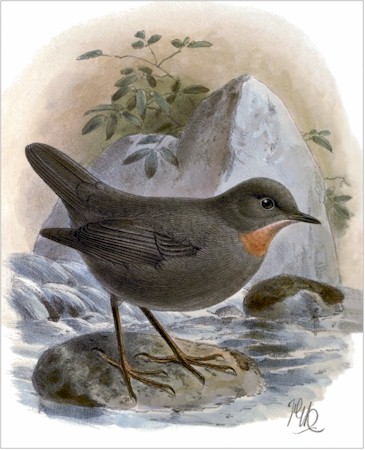
Cinclus schulzi, Cab. J. f. O. 1883, p. 102, t. ii. fig. 3.
Description.—Dark grey; throat pale rufous; a broad bar on the inner webs of the wing-feathers white: total length 5·5 inches, wing 3·0, tail 1·6.
Hab. Northern Argentina.
A recent discovery of Herr Fritsch Schulz, who obtained specimens of it on the Cerro Vayo of Tucuman, where this species, like others of the genus, frequents the mountain-streams.
Fam. III. MUSCICAPIDÆ, or FLYCATCHERS.
The peculiar genus Polioptila, which contains some twelve or thirteen species of small-sized American birds, ranging from the United States to the Argentine Republic, has been variously arranged by naturalists, but seems to be more nearly related to the African genus Stenostira than to any other known form. I therefore now place it with the Muscicapidæ, or Flycatchers, of which it is the only genus found in the New World.
10. POLIOPTILA DUMICOLA (Vieill.).
(BRUSH-LOVING FLY-SNAPPER.)
Polioptila dumicola, Scl. et Salv. Nomencl. p. 4; Durnford, Ibis, 1876, p. 157, 1877, p. 167 (Buenos Ayres); Salv. Ibis, 1880, p. 352 (Tucuman); White, P. Z. S. 1882, p. 593 (Buenos Ayres); Barrows, Bull. Nutt. Orn. Cl. viii. p. 86 (Concepcion); Sharpe, Cat. B. x. p. 444. Culicivora dumicola, Burm. La-Plata Reise, ii. p. 473 (Paraná). Culicivora boliviana, Scl. P. Z. S. 1852, p. 34, pl. xlvii.
Description.—Above clear greyish blue; wing-coverts, bastard-wing, and primary-coverts dusky brown, with greyish-blue edges; quills dusky; upper tail-coverts and tail-feathers black, the third outer tail-feather white at the tip, the outer tail-feather nearly entirely white; from the base of the forehead a black line extends backwards over the eye; under surface delicate ashy grey, white on the abdomen and under tail-coverts; bill and feet bluish-black: total length 4·5 inches, wing 2·1, tail 2·0. Female similar, but without the black eye-streak.
Hab. Paraguay and Northern Argentina.
This little bird strongly resembles some species of that division of the Tyrannidæ which includes the genera Stigmatura, Serpophaga, and Anæretes; but the likeness, strange to say, is even more marked in habits and voice than in coloration and general appearance.
It is found in open thorny woods and thickets; and in Buenos Ayres seems to have a partial migration, as it is much more common in summer than in winter. At all times male and female are found together, and probably pair for life, like several of the species in the groups just mentioned. They are seen continually hopping about among the twigs in a leisurely deliberate manner, all the time emitting a variety of low short notes, as if conversing together; and at intervals they unite their voices in a burst of congratulatory notes, like those uttered by the small Tyrant-birds they resemble. They have no song. I have not found the nest, but Dr. Burmeister says that it is made in bushes, and that the eggs are white.
Fam. IV. TROGLODYTIDÆ, or WRENS.
The Troglodytidæ, or Wren family, are of wide distribution, and are found alike under the tropics and in temperate latitudes. In South America nearly 100 species altogether are known to occur. Of these two are familiar inhabitants of the whole Argentine Republic, and a third, belonging to the water-loving genus Donacobius, is met with in the eastern provinces on the Paraná. A fourth species has been lately described from Tucuman.
11. DONACOBIUS ATRICAPILLUS (Linn.).
(BLACK-HEADED REED-WREN.)
Donacobius atricapillus, Scl. Cat. A. B. p. 16; Scl. et Salv. Nomencl. p. 5; Sharpe, Cat. B. vi. p. 364; Burm. La-Plata Reise, ii. p. 475. Donacobius brasiliensis, d’Orb. Voy., Ois. p. 213 (Corrientes).
Description.—Above dark chocolate-brown; cap black; wings black, with a large white patch on the inner primaries; tail black; lateral rectrices broadly ended with white; beneath ochreous buff; sides of breast and flanks with cross lines of dusky brown: total length 7·5 inches, wing 2·9, tail 3·7. Female similar.
Hab. Guiana, Amazonia, Brazil, Paraguay, and Northern Argentina.
The genus Donacobius contains two species somewhat intermediate between the Mock-birds and the large Wrens of the genus Campylorhynchus. The well-known Brazilian D. atricapillus extends through Paraguay, where Azara found it abundant, into Corrientes and the adjoining provinces of La Plata. It is met with among the reeds on lakes and streams.
12. TROGLODYTES FURVUS (Gm.).
(BROWN HOUSE-WREN.)
Troglodytes furvus, Scl. et Salv. P. Z. S. 1869, p. 158 (Conchitas); iid. Nomencl. p. 7; Durnford, Ibis, 1876, p. 157, 1877, p. 32 (Chupat), p. 167 (Buenos Ayres), 1878, p. 392 (Central Patagonia); White, P. Z. S. 1882, p. 593 (Buenos Ayres); Döring, Exp. al Rio Negro, Zool. p. 36 (Azul, R. Colorado, R. Negro). Troglodytes platensis, Burm. La-Plata Reise, ii. p. 476; Barrows, Bull. Nutt. Orn. Cl. viii. p. 86 (Concepcion). Troglodytes musculus, Sharpe, Cat. B. vi. p. 255.
Description.—Above brown; the tail-feathers and outer webs of wing-feathers pencilled with dark wavy lines; beneath very pale brown; bill and feet horn-colour; eye brown: total length 4·8 inches, wing 2·0, tail 1·7. Female similar.
Hab. South America.
The common Argentine Wren is to all English residents the “House-Wren,” and is considered to be identical with the species familiar to them in their own country. It is a sprightly little bird, of a uniform brown colour and a cheerful melodious voice; a tireless hunter after small spiders and caterpillars in hedges, gardens, and outhouses, where it explores every dark hole and cranny, hopping briskly about with tail erect, and dropping frequent little curtsies; always prompt to scold an intruder with great emphasis; a great hater of cats.
It was my belief at one time that the Wren was one of the little birds a cat never could catch; but later on I discovered that this was a mistake. At my home on the pampas we once had a large yellow tom cat exceedingly dexterous in catching small birds; he did not, however, eat them himself, but used to bring them into the house for the other cats. Two or three times a day he would appear with a bird, which he would drop at the door, then utter a loud mew very well understood by the other cats, for they would all fly to the spot in great haste, and the first to arrive would get the bird. At one time I noticed that he brought in a Wren almost every day, and, curious to know how he managed to capture so clever a bird, I watched him. His method was to go out into the grounds frequented by Wrens, and seat himself conspicuously amongst the weeds or bushes; and then, after the first burst of alarm had subsided amongst the small birds, one or two Wrens would always take on themselves the task of dislodging him, or, at all events, of making his position a very uncomfortable one. The cat would sit perfectly motionless, apparently not noticing them at all, and by-and-by this stolid demeanour would have its effect, and one of the Wrens, growing bolder, would extend his dashing little incursions to within a few inches of pussy’s demure face; then at last, swift as lightning, would come the stroke of a paw, and the little brown body would drop down with the merry brave little spirit gone from it.
The House-Wren is widely distributed in South America, from the tropical forests to the cold uplands of Patagonia, and, possessing a greater adaptiveness than most species, it inhabits every kind of country, moist or dry, and is as much at home on lofty mountains and stony places as in the everglades of the Plata, where it frequents the reed-beds and damp forests. About houses they are always to be found; and though the traveller on the desert pampas might easily imagine that there are no Wrens in the giant grasses, if he makes himself a lodge in this lonely region, a Wren will immediately appear to make its nest in his thatch and cheer him with its song.
Even in large towns they are common, and I always remember one flying into a church in Buenos Ayres one Sunday, and, during the whole sermon-time, pouring out its bright lyric strains from its perch high up somewhere in the ornamental wood-work of the roof.
The Wren sings all summer, and also on bright days in winter. The song is not unlike that of the English House-Wren, having the same gushing character, the notes being strong and clear, and uttered with rapidity and precision; but the Argentine bird has greater sweetness and more power.
In spring the male courts his mate with notes high and piercing as the squeals of a young mouse; these he repeats with great rapidity, fluttering his wings all the time like a moth, and at intervals breaking out into song.
The nest is made in a dark hole in a wall or tree, sometimes in the forsaken domed nest of some other bird; and where such sites are not to be found, in a dense thistle or thorn-bush, or in a large tussock of grass. I have also found nests in dry skulls of cows and horses, in an old boot, in the sleeve of an old coat left hanging on a fence, in a large-necked bottle, and in various other curious situations. The nest is built of sticks and lined with horse-hair or feathers, and the eggs are usually nine in number, of a pinkish ground-colour, thickly spotted with pale red.
13. TROGLODYTES AURICULARIS, Cab.
(EARED WREN.)
Troglodytes (Uropsila) auricularis, Cab. Journ. f. Orn. 1883, p. 105, t. ii. fig. 1.
Description.—In habit and size near the European Wren, T. parvulus, but peculiar for the blackish-brown hinder half of the ear-coverts and its broad white superciliaries. Upper surface and flanks brown; throat and middle of belly whitish, tinged with brownish yellow; wings and tail with fine black cross bands; crissum with broader black and white cross bands. (Cabanis.)
Hab. Tucuman.
This is a recent discovery of Herr Schulz in the Sierra of Tucuman. We have not yet met with specimens of it.
14. CISTOTHORUS PLATENSIS (Lath.).
(PLATAN MARSH-WREN.)
Cistothorus platensis, Scl. et Salv. P. Z. S. 1869, p. 158; iid. Nomencl. p. 7; Durnford, Ibis, 1877, p. 168 (Buenos Ayres); Döring, Exp. al Rio Negro, Zool. p. 37 (R. Sauce, R. Colorado, R. Negro); Barrows, Bull. Nutt. Orn. Cl. viii. p. 87 (Carhué); Sharpe, Cat. B. vi. p. 244. Cistothorus fasciolatus, Burm. La-Plata Reise, ii, p. 476 (Mendoza).
Description.—Above pale sandy brown, variegated with black streaks; head darker brown, streaked with black; the hind neck paler brown, with narrow black streaks; wing-coverts brown; tail-feathers dark sandy brown, barred with blackish brown; under surface pale sandy buff: total length 4·3 inches, wing 1·85, tail 1·6. Female similar.
Hab. Argentina, Patagonia, and Falkland Islands.
This small Wren is rarely seen, being nowhere common, although widely distributed. It prefers open grounds covered with dense reeds and grasses, where it easily escapes observation. I have met with it near Buenos Ayres city; also on the desert pampas, in the tall pampas-grass. It is likewise met with along the Paraná river, and in Chili, Patagonia, and the Falkland Islands. In the last-named locality Darwin found it common, and says that it has there an extremely feeble flight, so that it may easily be run down and taken.
The Marsh-Wren has a sweet and delicate song, resembling that of the House-Wren (Troglodytes furvus), but much less powerful. It does not migrate; and on the pampas I have heard it singing with great animation when the pampas-grass, where it sat perched, was white with frozen dew. Probably its song, like that of Troglodytes furvus, varies in different districts; at all events, the pampas bird does not possess so fine a song as Azara ascribes to his “Todo Voz” in Paraguay, which is undoubtedly the same species.
Fam. V. MOTACILLIDÆ, or WAGTAILS.
The Wagtails and Pipits are closely-allied forms, and are usually referred to the same family of Oscines. The Wagtails are restricted to the Old World, although it has been recently ascertained that some of them occasionally occur as stragglers in the northern latitudes of America. Of the almost cosmopolitan Pipits about eight or nine species are sparingly distributed over the prairies and pampas of the New World. One of these is a common resident in the pampas of Argentina, and another (perhaps somewhat doubtful species) is occasionally met with.
15. ANTHUS CORRENDERA, Vieill.
(CACHILA PIPIT.)
Anthus correndera, Scl. et Salv. Nomencl. p. 8; Hudson, P. Z. S. 1873, p. 771 (Buenos Ayres); Durnford, Ibis, 1877, p. 32 (Chupat), p. 168 (Buenos Ayres), 1878, p. 392 (Central Patagonia); Sclater, Ibis, 1878, p. 362; White, P. Z. S. 1882, p. 594 (Buenos Ayres); Döring, Exp. al Rio Negro, Zool. p. 37 (Azul); Barrows, Bull. Nutt. Orn. Cl. viii. p. 87 (Concepcion, Entrerios); Sharpe, Cat. B. x. p. 610. Anthus rufus, Burm. La-Plata Reise, ii. p. 474 (Mendoza, Paraná); Durnford, Ibis, 1876, p. 158.
Description.—Above pale sandy buff, mottled with black centres to the feathers; wing- and tail-feathers dark brown, edged with buff, the penultimate tail-feather with a white tip, the outer tail-feather almost entirely white; neck and breast sandy buff, with large triangular black spots; flanks buff, streaked with black; abdomen and under tail-coverts isabelline; bill dusky grey; feet pink: total length 6·0 inches, wing 2·9, tail 2·3. Female similar.
Hab. Paraguay, Argentina, Patagonia, and Chili.
Azara’s only reason for calling this bird La Correndera was because he thought it resembled a Tit-Lark known by that name in his own country, but of which he merely had a confused recollection. It is therefore to be regretted, I think, that correndera has been adopted as a specific name by naturalists instead of “Cachila,” the vernacular name of the bird, familiar to every one in the Argentine country. Azara’s Spanish bird was probably Anthus pratensis, which closely resembles A. correndera in general appearance, and has, moreover, as wide a range in the northern as the last-named species has in the southern hemisphere. In the volume on Birds in the ‘Voyage of the Beagle,’ it is said that a species of Anthus ranges further south than any other land-bird, being the only land-bird found on Georgia and South Orkney (lat. 61° S.).
In colour and language, possibly also in size, the Cachila is variable. It is a very common bird, widely and plentifully distributed over the pampas, found alike on marshy and dry grounds, but rare in the region of giant grasses. While abundant, it is also very evenly dispersed, each bird spending its life on a very circumscribed plot of earth. Those frequenting marshy or moist grounds are of a yellowish-cream colour, thickly mottled and striped with fuscous and black, and have two narrow parallel pure white marks on the back, very conspicuous when the bird is on the ground. The individuals frequenting high and dry grounds are much paler in hue, appearing almost grey, and do not show the white marks on the back. They also look larger than the birds on marshy lands; but this appearance is probably due to a looser plumage. The most strongly-marked pale and dark-plumaged variations may be found living within a few hundred yards of each other, showing how strictly each bird keeps to its own little “beat”; for this difference in coloration is, no doubt, due entirely to the amount of moisture in the ground they live on.
The Cachilas are resident, living in couples all the year round, the sexes being faithful. Several pairs frequent a small area, and sometimes they unite in a desultory flock; but these gatherings are not frequent. In the evening, at all seasons, immediately after the sun has set, the Cachilas all rise to a considerable height in the air and fly wildly about, chirping for a few minutes, after which they retire to roost.
When approached they frequently rise up several feet from the ground and flutter in the air, chirping sharply, with breast towards the intruder. This is a habit also found in Synallaxine species inhabiting the grassy plains. But, as a rule, the Cachilas are the tamest of feathered creatures, and usually creep reluctantly away on their little pink feet when approached. If the pedestrian is a stranger to their habits they easily delude him into attempting their capture with his hat, so little is their fear of man.
To sing, the Cachila mounts upwards almost vertically, making at intervals a fluttering pause, accompanied with a few hurried notes. When he has thus risen to a great height (but never beyond sight as Azara says) he begins the descent slowly, the wings inclining upwards; and, descending, he pours forth long impressive strains, each ending with a falling inflection or with two or three short throat-notes as the bird pauses fluttering in mid-air, and then renewed successively until, when the singer is within 3 or 4 feet of the earth, without alighting he reascends as before to continue the performance. It is a very charming melody, and heard always on the treeless plains when there is no other bird-music, with the exception of the trilling and grasshopper-like notes of a few Synallaxine species. But in character it is utterly unlike the song of the Sky-Lark with its boundless energy, hurry, and abandon; and yet it is impossible not to think of the Sky-Lark when describing the Cachila, which, in its manners, appearance, and in its habit of soaring to a great height when singing, seems so like a small copy of that bird.
The Cachila rears two broods in the year; the first is hatched about the middle of August, that is, one to three months before the laying-season of other Passerine species. By anticipating the breeding-season their early nests escape the evil of parasitical eggs; but, on the other hand, frosty nights and heavy rains are probably as fatal to as many early broods as the instinct of the Molothrus bonariensis, or Cow-bird, is to others at a later period.
The second brood is reared in December, the hottest month, and in that season a large proportion of their nests contain parasitical eggs.
The nest is placed in a slight hollow in the ground, under a tussock of grass, and is sometimes elaborately made and lined with horsehair and fine grass, and sometimes with a few materials loosely put together. During the solstitial heats I have frequently found nests with frail shades, built of sticks and grass, over them, the short withered grass affording an insufficient protection from the meridian sun. The eggs are four, elongated, with a dirty white and sometimes a dull bluish ground, thickly spotted with dusky brown and drab. In some eggs the spots are confluent, the whole shell being of a dull brownish-drab colour.
The manners of this species, where I have observed it, are always the same; it lives on the ground on open plains, where the herbage and grass is short, and never perches on trees. The song varies considerably in different districts.
16. ANTHUS FURCATUS, d’Orb. et Lafr.
(FORKED-TAIL PIPIT.)
Anthus furcatus, d’Orb. Voy. p. 227 (Patagonia); Darwin, Zool. Voy. ‘Beagle’, iii. p. 85 (La Plata); Sclater, Ibis, 1878, p. 364; Döring, Exp. al Rio Negro, Zool. p. 37 (Azul, Carhué-pampas); Sharpe, Cat. B. x. p. 605.
Description.—Similar to A. correndera, but with a smaller bill, shorter and more curved hind claw, less spotted under surface, and different marking of the second outer rectrix, which has a clear and distinct white line along the inner side of the shaft: total length 6·0 inches, wing 3·2, tail 2·4.
Hab. Peru, Bolivia, and Argentina.
One of the Pipits procured at Conchitas belongs to this species, if distinct from the former. I think I recollect it as a resident on the pampas, closely resembling the Cachila in flight and language, but much shyer, and usually found concealed under Tulu grass on dry grounds.
Fam. VI. MNIOTILTIDÆ, or WOOD-SINGERS.
The Mniotiltidæ, or Wood-singers, are a well-known and very characteristic family of the New World, where they occupy the position of our Sylviidæ. They number some 130 or 140 species, distributed all over America down to La Plata, but most abundant in the southern portions of North America, where the favourite and beautiful genus Dendrœca, with about 100 species, plays an important part. In Argentina only four species have as yet been met with.
17. PARULA PITIAYUMI (Vieill.).
(PITIAYUMI WOOD-SINGER.)
Parula pitiayumi, Scl. et Salv. Nomencl. p. 8; Durnford, Ibis, 1876, p. 158, 1877, p. 168 (Buenos Ayres); Salv. Ibis, 1880, p. 352 (Tucuman); White, P. Z. S. 1882, p. 594 (Catamarca, Misiones); Barrows, Bull. Nutt. Orn. Cl. viii. p. 87 (Concepcion, Entrerios); Sharpe, Cat. B. x. p. 259, pl. xi. fig. 1. Sylvicola venusta, Burm. La-Plata Reise, ii. p. 473 (Paraná, Tucuman).
Description.—Above clear blue; mantle and upper back olive-yellow; central tail-feathers blue, all the others, also the quills, blackish; cheeks and under surface of body bright yellow; lower abdomen and under tail-coverts white; upper mandible black, lower yellow; eye brown: total length 4·0 inches, wing 2·05, tail 1·55. Female similar, but much paler in colour.
Hab. South America.
This is a southern representative of a small group of Wood-warblers, which is extensively diffused in the New World.
The upper plumage of this small bird is mostly cerulean-blue, the breast and belly yellow. Its Guarani name, according to Azara, is “Pitiayume,” which means little yellow-breast. I have never heard it sing or utter any note beyond a very feeble chirp as it hops about through the foliage in quest of small caterpillars. Its migration extends south to Buenos Ayres, where it is seen in woods and thickets in pairs or singly; but it is a rare bird, and I have been unable to find out anything about its nesting-habits.
18. GEOTHLYPIS VELATA (Vieill.).
(VEILED WOOD-SINGER.)
Geothlypis velata, Scl. et Salv. Nomencl. p. 9; White, P. Z. S. 1882, p. 594 (Salta); Barrows, Bull. Nutt. Orn. Cl. viii. p. 87 (Concepcion, Entrerios); Sharpe, Cat. B. x. p. 363, pl. ix. fig. 5.
Description.—Above yellowish green; the wing-coverts like the back; wing-feathers dusky brown, edged with olive-yellow; tail-feathers olive-green; crown of head to the occiput blue-grey; from the forehead a black mark extends to the eye and downward to the cheek; throat and under surface bright yellow; bill black; feet pale brown; eye brown: total length 5·6 inches, wing 2·4, tail 2·4. Female similar, but without the black on the face.
Hab. Brazil, Paraguay, and Northern Argentina.
This is again the only species of a North- and Central-American genus which ranges so far south as Buenos Ayres. It visits us in summer, and is found singly or in pairs in woods and large plantations. It feeds both on the ground and in trees, and, while gleaning amongst the leaves, frequently pauses to utter its loud cheerful song, composed of seven or eight clear notes uttered with rapidity and emphasis.
19. BASILEUTERUS AURICAPILLUS, Sw.
(GOLDEN-CROWNED WOOD-SINGER.)
Basileuterus auricapillus, Sharpe, Cat. B. x. p. 393. Basileuterus vermivorus, Scl. P. Z. S. 1865, p. 283; Scl. et Salv. Nomencl. p. 10; White, P. Z. S. 1882, p. 594 (Misiones).
Description.—Above olive-yellow, lightest on the rump and upper tail-coverts; tail-feathers ashy brown, with yellowish margins; quills dusky; crown of head light orange-chestnut; nape and hind neck pale ashy grey; on each side of the crown a broad black stripe extending from the bill to the hind neck, also a streak of ashy white above the eye; under surface bright yellow; axillaries and under wing-coverts white; bill and feet brownish: total length 4·5 inches, wing 2·2, tail 2·05. Female similar.
Hab. South America.
This species, which is widely spread over the northern portion of South America, was found in Paraguay by Azara, and in the province of Misiones by White.
20. SETOPHAGA BRUNNEICEPS, d’Orb. et Lafr.
(BROWN-CAPPED WOOD-SINGER.)
Setophaga brunneiceps, Burm. La-Plata Reise, ii. p. 473 (Tucuman); Scl. et Salv. Nomencl. p. 11; White, P. Z. S. 1882, p. 595 (Catamarca); Sharpe, Cat. B. x. p. 428.
Description.—General colour dull olive-yellowish; wing-coverts dark slaty grey; quills blackish; upper tail-coverts slaty grey, washed with olive; tail-feathers blackish—the outer pair white, the next pair white edged with black on the outer web, the third pair with a large white mark at the end; crown of head deep chestnut; neck slaty grey; under surface of body bright yellow; under tail- and wing-coverts white: total length 5·0 inches, wing 2·45, tail 2·4. Female similar.
Hab. Bolivia and Northern Argentina.
White obtained a pair of these birds on the Sierra of Totoral, Catamarca, in July 1880. He describes them as quick in their movements and difficult to shoot. The species was originally discovered by d’Orbigny in Bolivia.
Fam. VII. VIREONIDÆ, or GREENLETS.
Three of the groups of the peculiar American family of Greenlets, allied to our Shrikes, have representatives within the Argentine Republic. The genera Vireo and Hylophilus both extend, each in the shape of one of its South-Brazilian members, into the woodlands of the Paraná; while Cyclorhis, another genus also widely spread over South and Central America, has two representatives within our area. One of these latter is well known in the neighbourhood of Buenos Ayres; the other is only found in the extreme north of the Republic.
21. VIREOSYLVIA CHIVI (Vieill.).
(CHIVI GREENLET.)
Contramaestre gaviero, Azara, Apunt. ii. p. 34. Sylvia chivi, Vieill. N. D. xi. p. 174. Vireosylvia chivi, Baird, Rev. A. B. p. 337; Scl. et Salv. P. Z. S. 1869, p. 160 (Buenos Ayres); Berl. et Jher. Zeitschr. ges. Orn. 1885, p. 115. Vireo chivi, Gadow, Cat. B. viii. p. 295.
Hab. South America, from Colombia down to Buenos Ayres.
A single specimen of this Greenlet was found in a collection made by Mr. Haslehurst near Buenos Ayres. As the species occurs in Rio Grande do Sul (Berlepsch) and Paraguay (Azara), its occasional appearance in Eastern Argentina is quite probable. Whether the bird is really distinct from the widespread Vireo olivaceus seems to be a question which is not yet finally settled.
Azara, describing this species, says it is one of the commonest in deep woods, where it moves about among the terminal twigs, without ever rising to the tops of the trees or flying down to the brush or the ground. It is active, and extremely restless in manner; and in searching after and taking the small insects and spiders on which it lives it climbs about the twigs, assuming every position, and frequently suspending itself, head downwards, by its feet. It has a full pleasing voice of considerable power, heard incessantly in the woods, particularly in the love-season. The nest is a slender beautiful structure, even surpassing that of the Humming-birds, constructed of thin dry leaves outside, smoothly attached to the rest with spiders’ webs, while the inside is formed of fine fibres and cotton.
22. HYLOPHILUS PŒCILOTIS, Max.
(BROWN-HEADED WOOD-BIRD.)
Hylophilus pœcilotis, Scl. et Salv. Nomencl. p. 12; Scl. Ibis, 1881, p. 300; White, P. Z. S. 1882, p. 595 (Misiones); Gadow, Cat. B. viii. p. 308.
Description.—Crown of head and nape rich rufous-brown; all the rest of the upper parts, including the entire tail and wing-coverts and the outer webs of the remiges, rich olive-green; cheeks and upper throat whitish; ear-coverts blackish, with white central streaks; under wing-coverts, axillaries, inner margin of remiges, and under tail-coverts lemon-yellow; rest of underparts dull yellow, washed with olive on the breast and flanks, and inclining to pale ochreous on the abdomen; bill dark flesh-colour; feet hazel: total length 4·5 inches, wing 2·2, tail 2·2. Female similar.
Hab. Southern Brazil, Paraguay, and Northern Argentina.
This South-Brazilian species was met with by White near San Javier, in the province of Misiones, in June 1881.
23. CYCLORHIS OCHROCEPHALA.
(OCHRE-HEADED GREENLET-SHRIKE.)
[Plate III. Fig. 1.]
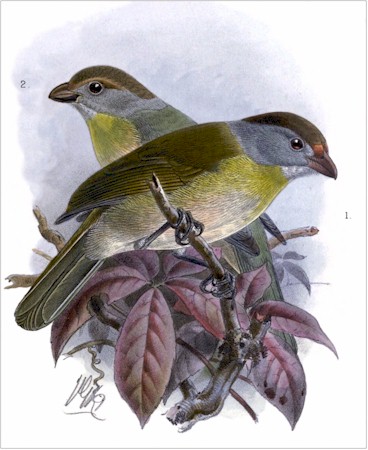
Fig. 1. CYCLORHIS OCHROCEPHALA.
" 2. " ALTIROSTRIS.
Cyclorhis viridis, Burm. La-Plata Reise, ii. p. 472; Scl. et Salv. Nomencl. p. 13; Durnford, Ibis, 1878, p. 58 (Punta Lara); White, P. Z. S. 1882, p. 595 (Buenos Ayres); Gadow, Cat. B. viii. p. 318. Cyclorhis ochrocephala, Tsch. Arch. f. Nat. 1845, pt. i. p. 362; Berl. et Jher. Zeitschr. ges. Orn. 1885, p. 116.
Description.—Above olive-green; cap brownish ochraceous, more or less rufescent; front and superciliaries chestnut-red; sides of head clear grey, beneath pale buff; breast and flanks yellow; throat greyish white; bill reddish grey, feet grey; eye reddish: total length 7·0 inches, wing 3·4, tail 2·8. Female similar.
Hab. Middle districts of Argentina.
This species is not uncommon in the woods along the shores of the Plata, and may be easily known to any person penetrating them by its loud “cheerful soliloquy,” for that phrase of Mr. Barrows, the North-American writer on birds, well describes the artless, light-hearted song which it utters at intervals while it roams about in the deep foliage, and which reminds one of the careless whistling of a boy, whistling merely to express his gaiety, but without having any particular tune in his mind. It is migratory, and extends its range south of Buenos Ayres.
24. CYCLORHIS ALTIROSTRIS, Salvin.
(DEEP-BILLED GREENLET-SHRIKE.)
[Plate III. Fig. 2.]
Cyclorhis altirostris, Salv. Ibis, 1880, p. 352; Gadow, Cat. B. viii. p. 319. Cyclorhis viridis, Barrows, Bull. Nutt. Orn. Cl. viii. p. 88 (Concepcion, Entrerios); Berl. et Jher. Zeitschr. ges. Orn. 1885, p. 116.
Description.—Above olive-green; head more or less rufescent; front and superciliaries chestnut-red; sides of head grey, beneath pale ochraceous; breast and sides yellow; throat greyish; bill short and thick, pale reddish, with a black blotch at the base of the lower mandible; feet reddish: total length 6·5 inches, wing 3·3, tail 3·0. Female similar.
Hab. Paraguay and Northern Argentina.
This species was met with by Durnford near Salta in June 1878. He describes the iris as “light rufous; upper mandible dark slate, under mandible, legs, and feet pale slate.”
Mr. Salvin founded his C. altirostris upon Durnford’s specimens, but Graf v. Berlepsch is of opinion that this species is the “Habia verde” of Azara, and should consequently bear the name “viridis” of Vieillot. This is perhaps correct, but at the same time it would only make fresh confusion to transfer to this species the name hitherto usually applied to the preceding bird. We prefer, consequently, to let it stand under Mr. Salvin’s name “altirostris.”
Fam. VIII. HIRUNDINIDÆ, or SWALLOWS.
The cosmopolitan family of Swallows, of which about eighty species are known, is well developed in the New World, where some thirty representatives occur in various parts. In Argentina the occurrence of eight Swallows has been recorded. Three of them belong to the group of Purple Martins (Progne), which is restricted to the New World, and of the remainder four are members of genera entirely restricted to the Neotropical Region. The genus Petrochelidon, of which one species is met with in La Plata, has alone representatives in the Eastern Hemisphere.
25. PROGNE FURCATA, Baird.3
(PURPLE MARTIN.)
Progne purpurea, Hudson, P. Z. S. 1872, p. 548 (Patagonia); Scl. P. Z. S. 1872, p. 605; Scl. et Salv. Nomencl. p. 14; Durnford, Ibis, 1877, p. 32 (Chupat), 1878, p. 392 (Central Patagonia); White, P. Z. S. 1882, p. 595 (Buenos Ayres). Progne elegans, Barrows, Bull. Nutt. Orn. Cl. viii. p. 89 (Bahia Blanca). Progne furcata, Baird, Rev. A. B. p. 278; Sharpe, Cat. A. B. x. p. 175.
Description.—Uniform deep purple-blue; on each side of the back a small concealed tuft of white feathers; tail-feathers black, washed with blue: total length 7·7 inches, wing 5·55, tail 3·3. Female: upper parts dull purple; head, neck, and lower parts blackish brown.
Hab. Argentina and Patagonia.
The Purple Martin is occasionally seen in the eastern provinces of La Plata when migrating, but has not been found nesting anywhere so far north as Buenos Ayres. I met with it breeding at Bahia Blanca on the Atlantic coast, and on the Rio Negro, where it is very common. It arrives in Patagonia late in September, and leaves before the middle of February. On the 14th of that month I saw one flock flying north, but it was the last. It breeds in holes under the caves of houses or in walls, and its nest is like that of P. chalybea; but many also breed in holes in the steep banks of the Rio Negro. They do not, however, excavate holes for themselves, but take possession of natural crevices and old forsaken burrows of the Burrowing Parrot (Conurus patachonicus). In size, flight, manners, and appearance the Purple Martin closely resembles the following species, the only difference being in the dark plumage of the under surface. The language of the two birds is also identical; the loud excited scream when the nest is approached, the various other notes when the birds sweep about in the air, and the agreeably modulated and leisurely-uttered song are all possessed by the two species without the slightest difference in strength or intonation. This circumstance appears very remarkable to me, because, though two species do sometimes possess a few notes alike, the greater part of their language is generally different; also because birds of the same species in different localities vary more in language than in any other particular. This last observation, however, applies more to resident than to migratory species.
26. PROGNE CHALYBEA (Gm.).
(DOMESTIC MARTIN.)
Progne chalybea, Scl. P. Z. S. 1872, p. 606 (Buenos Ayres); Scl. et Salv. Nomencl. p. 14; White, P. Z. S. 1882, p. 595 (Buenos Ayres); Barrows, Bull. Nutt. Orn. Cl. viii. p. 88 (Concepcion); Sharpe, Cat. B. x. p. 178. Progne domestica, Burm. La-Plata Reise, ii. p. 477; Sharpe, Cat. B. x. p. 177.
Description.—Entire upper parts deep purple-blue; lesser and median wing-coverts the same; wing- and tail-feathers black, glossed with steel-blue; throat, fore neck, and chest ash colour; breast, abdomen, and under tail-coverts pure white; bill and feet black: total length 8 inches, wing 5·7, tail 3·2. Female similar.
Hab. Central and South America.
This species, distinguished from the Purple Martin by its white underparts, ranges from Mexico to Buenos Ayres, the extreme limit of its range being about 250 miles south of that city. It was well called Golondrina domestica by Azara, being preeminently domestic in its habits. It never breeds in banks as the Purple Martin often does, or in the domed nests of other birds in trees, a situation always resorted to by the Tree-Martin, and occasionally by the Common Swallow; but is so accustomed to the companionship of man as to make its home in populous towns as well as in country-houses. It arrives in Buenos Ayres about the middle of September, and apparently resorts to the same breeding-place every year. A hole under the eaves is usually selected, and the nest is roughly built of dry grass, hair, feathers, and other materials. When the entrance to its breeding-hole is too large, it partially closes it up with mud mixed with straw; if there be two entrances it stops up one altogether. The bird does not often require to use mud in building; it is the only one of our Swallows that uses such a material at all. The eggs are white, long, pointed, and five in number.
In the season of courtship this Martin is a noisy pugnacious bird, and always, when quitting its nest, utters an exceedingly loud startling cry several times repeated. It also has a song, uttered both when resting and on the wing, composed of several agreeably modulated notes, and in that thick rolling intonation peculiar to our Swallows. This song does not sound loud when near, yet it can be distinctly heard when the bird appears but a speck in the distance. I may here remark that, with the exception of the Petrochelidon pyrrhonota, which possesses a sharp squeaky voice, like the Swallows of Europe, all our Hirundines have soft voices: their usual twittering when they are circling about resembles somewhat the chirping of the English House-Sparrow in tone, but besides these notes they possess a song more pleasing to the ear.
Before leaving in February these birds congregate in parties of from twenty to four or five hundred, usually on the broad leafy top of an old ombú tree.
27. PROGNE TAPERA (Linn.).
(TREE-MARTIN.)
Progne tapera, Scl. P. Z. S. 1872, p. 606 (Buenos Ayres); Scl. et Salv. Nomencl. p. 14; Durnford, Ibis, 1877, p. 168 (Buenos Ayres); White, P. Z. S. 1882, p. 595 (Catamarca); Barrows, Bull. Nutt. Orn. Cl. viii. p. 89 (Concepcion); Sharpe, Cat. B. x. p. 180. Cotyle tapera, Burm. La-Plata Reise, ii. p. 477.
Description.—Entire upper parts dull brown; tail-feathers blackish brown; throat ashy white; fore neck and chest ashy brown in the centre and dark brown on the sides, as are also the flanks; abdomen white; bill and feet horn-colour: total length 7 inches, wing 5·5, tail 2·6. Female similar.
Hab. Brazil, Paraguay, Argentina.
The Tree-Martin is more slender and has a greater extent of wing than the Purple Martins; and, instead of the beautiful dark purple (their prevailing colour), its entire upper plumage is dusky brown, the under surface white. But if these differences of structure and hue merely serve to show that it is not a very near relative of the other species, those exhibited in its habits remove it very far indeed from them.
The Tree-Martin is a very garrulous bird, and no sooner arrives early in September, than we are apprised of the circumstance by the notes which the male and female incessantly sing in concert, fluttering and waving their wings the while, and seeming quite beside themselves with joy at their safe arrival; for invariably they arrive already mated. Their language is more varied, the intonation bolder and freer than that of our other Swallows. The length of the notes can be varied at pleasure; some are almost harsh, others silvery or liquid, as of trickling drops of water; they all have a glad sound; and many have that peculiar character of some bird-notes of shaping themselves into words.
This Martin is never seen to alight on the ground or on the roofs of houses, but solely on trees; and when engaged in collecting materials for its nest, it sweeps down and snatches up a feather or straw without touching the surface. It breeds only in the clay-ovens of the Oven-bird (Furnarius rufus). I, at least, have never seen them breed in any other situation after observing them for a great many summers. An extraordinary habit! for, many as are the species that possess the parasitical tendency of breeding in other birds’ nests, none of them confine themselves to the nest of a single species excepting the bird I am describing. It must, however, be understood that my knowledge of this bird has been acquired in Buenos Ayres, where I have observed it; and as this Martin possesses a wider range in South America than the Oven-birds, it is more than probable that in other districts it builds in different situations.
On arriving in spring each pair takes up its position on some tree, and usually on a particular branch; a dead branch extending beyond the foliage is a favourite perch. Here they spend much of their time, never appearing to remain long absent from it, and often, when singing their notes together, fluttering about it with a tremulous uncertain flight, like that of a hovering butterfly. About three weeks after first arriving they begin to make advances towards the Oven-bird’s nest that stands on the nearest post or tree; and if it be still occupied by the rightful owners, after much time has been spent in sporting about and reconnoitring it, a feud begins which is often exceedingly violent and protracted for many days.
In seasons favourable to them the Oven-birds build in autumn and winter, and breed early in spring; so that their broods are out of their clay-houses by the end of October or earlier; when this happens, the Swallow that breeds in November quietly takes possession of the forsaken fortress. But accidents will happen, even to the wonderful fabric of the Oven-bird. It is sometimes destroyed and must be rebuilt; or its completion has perhaps been retarded for months by drought, or by the poor condition of the birds in severe weather; or the first brood has perhaps perished, destroyed by an opossum or other enemy. November, and even December, may thus arrive before some pairs have hatched their eggs; and it is these unfortunate late breeders that suffer from the violence of the marauding Swallows. I have often witnessed the wars of these birds with the deepest interest; and in many ovens that I have opened I have found the eggs of the Oven-birds buried under the nests of the Swallows. After the Swallows have taken up a position near the coveted oven, they occasionally fly towards and hover about it, returning again to their stand. By-and-by, instead of returning as at first, they take to alighting at the entrance of the coveted home; this is a sort of declaration of war, and marks the beginning of hostilities. The Oven-birds, full of alarm and anger, rush upon and repel them as often as they approach; they retire before this furious onset, but not discomfited, and only warbling out their gay seemingly derisive notes in answer to the outrageous indignant screams of their enemies. Soon they return; the scene is repeated; and this desultory skirmishing is often continued for many days.
But at length the lawless invaders, grown bolder, and familiar with his strength and resources, will no longer fly from the master of the house; desperate struggles now frequently take place at the entrance, the birds again and again dropping to the ground clutched fiercely together, and again hurrying up only to resume the combat. Victory at last declares itself for the aggressors, and they busy themselves carrying in materials for their nest, screaming their jubilant notes all the time as if in token of triumph. The brave and industrious Oven-birds, dispossessed of their home, retire to spend their childless summer together, for the male and female never separate; and when the autumn rains have supplied them with wet clay, and the sense of defeat is worn off, they cheerfully begin their building-operations afresh.
This is not, however, the invariable result of the conflict. To the superior swiftness of the Martin the Oven-bird opposes greater strength, and, it might be added, a greater degree of zeal and fury than can animate its adversary. The contest is thus nearly an equal one; and the Oven-bird, particularly when its young are already hatched, is often able to maintain its own. But the Martins never suffer defeat; for, when unable to take the citadel by storm, they fall back on their dribbling system of warfare, which they keep up till the young birds leave the nest, when they take possession before it has grown cold.
The Martin makes its own nest chiefly of large feathers, and lays four eggs, long, pointed, and pure white.
It will be remarked that in all its habits above mentioned this bird differs widely from the two preceding species. It also differs greatly from them in its manner of flight. The Purple Martins move with surprising grace and celerity, the wings extended to their utmost; they also love to sail in circles high up in the air, or about the summits of tall trees, and particularly during a high wind. At such times several individuals are usually seen together, and all seem striving to outvie each other in the beauty of their evolutions.
The Tree-Martin is never seen to soar about in circles; and though when hawking after flies and moths it sweeps the surface of the grass with amazing swiftness, at other times it has a flight strangely slow and of a fashion peculiar to itself: the long wings are depressed as much as those of a Wild Duck when dropping on to the water, and are constantly agitated with tremulous flutterings, short and rapid as those of a butterfly.
Neither is this bird gregarious like all its congeners, though occasionally an individual associates for a while with Swallows of another species; but this only when they are resting on fences or trees, for as soon as they take flight it leaves them. Once or twice, when for some mysterious cause the autumnal migration has been delayed long past its usual time, I have seen them unite in small flocks; but this is very rare. As a rule they have no meetings preparatory to migration, but skim about the fields and open plains in un-Swallow-like solitude, and suddenly disappear without having warned us of their intended departure.
28. PETROCHELIDON PYRRHONOTA (Vieill.).
(RED-BACKED ROCK-MARTIN.)
Petrochelidon pyrrhonota, Scl. et Salv. Nomencl. p. 14; Durnford, Ibis, 1877, p. 169; White, P. Z. S. 1882, p. 595 (Buenos Ayres); Sharpe, Cat. B. x. p. 193. Cotyle pyrrhonota, Burm. La-Plata Reise, ii. p. 477 (Tucuman).
Description.—Above glossy dark steel-blue; lower back and rump cinnamon-rufous; the upper tail-coverts brown, with grey margins; wings black; tail black, with greenish gloss; crown steel-blue; forehead sandy buff; cheeks and sides of face chestnut, spreading to the sides of the hind neck; chin chestnut; the lower throat steel-blue; fore neck, chest, and sides of body and flanks light ashy brown; centre of breast and abdomen white, tinged with brown; under tail-coverts, also under wing-coverts and axillaries, ashy brown: total length 5·3 inches, wing 4·35, tail 2·05. Female similar.
Hab. South America.
This species does not breed in Buenos Ayres, and is only seen there in spring, flying south or south-west, and again in much larger numbers on its return journey in autumn. On the Rio Negro, in Patagonia, I did not meet with it, and suppose its summer resort must be south of that locality; and, judging from the immense numbers visible in some seasons, I should think that they must, in their breeding-place in Patagonia, occupy a very extensive area. They do not seem to be as regular in their movements as other Swallows here; some years I have observed them passing singly or in small parties during the entire hot season: usually they begin to appear, flying north, in February; but in some years not until after the middle of March. They are not seen passing with a rapid flight in close flocks, but straggle about, hawking after flies: first one bird passing, then two or three, and a minute or two later half a dozen, and so on for a greater part of the day. So long as the weather continues warm they journey in this leisurely manner; but I have known them to continue passing till April, after all the summer migrants had left us, and these late birds flew by with great speed in small close flocks, directly north, as if their flight had been guided by the magnetic needle.
While flying this species continually utters sharp twitterings and grinding and squealing notes of various lengths.
29. TACHYCINETA LEUCORRHOA (Vieill.).
(WHITE-RUMPED SWALLOW.)
Hirundo leucorrhoa, Hudson, P. Z. S. 1872, pp. 606, 845 (Buenos Ayres); Scl. et Salv. Nomencl. p. 14; Durnford, Ibis, 1877, p. 32 (Chupat), 1878, p. 392 (Central Patagonia); White, P. Z. S. 1882, p. 596 (Corrientes); Barrows, Bull. Nutt. Orn. Cl. viii. p. 89 (Concepcion). Cotyle leucorrhoea, Burm. La-Plata Reise, ii. p. 478 (Paraná). Tachycineta leucorrhous, Sharpe, Cat. B. x. p. 114.
Description.—Above glossy dark green; rump white; quills black, washed with green; upper tail-coverts dark green; tail-feathers black with greenish gloss; base of forehead white, extending a little backward over the lores; cheeks and whole under surface white; flanks and sides washed with smoky brown; axillaries and under tail-coverts pale smoky brown; bill and feet black: total length 5·5 inches, wing 4·45, tail 2·0. Female similar.
Hab. Brazil, Paraguay, and Argentina.
This is the most abundant and best known of our Swallows; a pretty bird in its glossy coat of deep green, and rump and under surface snowy white; exceedingly restless in its disposition, quick and graceful in its motions; social, quarrelsome, garrulous, with a not unmusical song, beginning with long, soft, tremulous notes, followed by others shorter and more hurried, and sinking to a murmur. They are the last of all our migrants to leave us in autumn, and invariably reappear in small numbers about the houses on every warm day in winter. Probably many individuals in Buenos Ayres remain through the winter in sheltered situations, to scatter over the surrounding country whenever there comes a warm bright day. I once saw three together, skimming over the plains, on one of the coldest days I ever experienced on the pampas, the thermometer having stood at 29° Fahr. that morning.
Further south their migration is more strict; and on the Rio Negro, in Patagonia, from March to August I did not meet with a single individual. In Buenos Ayres the autumnal migration of the Hirundines begins about the middle of February, and from that date vast numbers of this Swallow are seen travelling north, and, in some seasons, they continue passing for over a month. One autumn, in April, several days after the Swallows had all disappeared, flocks of the Common Swallow began again to appear flying north, and for ten days afterwards they continued to pass in large numbers. They would stoop to dip themselves in a pool where I observed them, and then alight on the reeds and bushes to rest, and appeared quite tired with their journey, rising reluctantly when approached, and some allowing me to stand almost within arm’s length of them without stirring. I had never before observed any later or supplementary migration like this; for, as a rule, the causes which in some years delay the departure of birds seems to affect them all alike. Possibly these late birds come from some remote district, where exceptionally cold weather had retarded breeding-operations.
The White-rumped Swallow sometimes lays in a tree, in the large nest, previously abandoned, of the Leñatero (Anumbius acuticaudatus). Its favourite site is, however, a hole in a wall, sheltered by the overhanging tiles or thatch; for though it does not go much into towns, as Azara has remarked, it is very domestic, and there is not a house on the pampas, however humble it be, but some of these birds are about it, sportively skimming above the roof, or curiously peering under the eaves, and incessantly uttering their gurgling happy notes.
For a period of a month to six weeks before building begins they seem to be holding an incessant dispute, reminding one in their scolding tones of a colony of contentious English House-Sparrows, only the Swallow has a softer, more varied voice, and frequently, even when hotly quarrelling, he pauses to warble out his pretty little song, with its sound like running water. However many eligible chinks and holes there may be, the contention is always just as great amongst them, and is doubtless referable to opposing claims to the best places. The excited twittering, the incessant striving of two birds to alight on the same square inch of wall, the perpetual chases they lead each other round and round the house, always ending exactly where they began, tell of clashing interests and of great unreasonableness on the part of some amongst them. By-and-by the quarrel assumes a more serious aspect; friends and neighbours have apparently intervened in vain; all the arguments of which Swallows are capable have been exhausted, and, a compromise of claims being more impossible than ever, fighting begins. Most vindictively do the little things clutch each other and fall to the earth twenty times an hour, where they often remain struggling for a long time, heedless of the screams of alarm their fellows set up above them; for often, while they thus lie on the ground punishing each other, they fall an easy prey to some wily pussy who has made herself acquainted with their habits.
When these feuds are finally settled, they address themselves diligently to the great work and build a rather big nest. They are not neat or skilful workers, but merely stuff a great quantity of straw and other light materials into the breeding-hole, and line the nest with feathers and horsehair. On this soft but disorderly bed the female lays from five to seven pure white eggs.
All those species that are liable at any time to become the victims of raptorial birds are very much beholden to this Swallow, as he is the most vigilant sentinel they possess. When the hurrying Falcon is still far off, and the other birds unsuspicious of his approach, the Swallows suddenly rush up into the sky with a wild rapid flight to announce the evil tidings with distracted screams. The alarm spreads swift as light through the feathered tribes, which, on all sides, are in terrified commotion, crouching in the grass, plunging into thickets, or mounting upwards to escape by flight. I have often wondered at this, since this swift-winged and quick-doubling little bird is the least likely to fall a prey himself.
They possess another habit very grateful to the mind of every early riser. At the first indication of dawn, and before any other wild bird has broken the profound silence of night, multitudes of this Swallow, as if at the signal of a leader, begin their singing and twittering, at the same time mounting upwards into the quiet dusky sky. Their notes at this hour differ from the hurried twittering uttered during the day, being softer and more prolonged, and, sounding far up in the sky from so many throats, the concert has a very charming effect, and seems in harmony with the shadowy morning twilight.
30. ATTICORA CYANOLEUCA (Vieill.).
(BANK-SWALLOW.)
Atticora cyanoleuca, Burm. La-Plata Reise, ii. p. 479; Scl. et Salv. Nomencl. p. 14; Hudson, P. Z. S. 1872, p. 844 (Buenos Ayres); Durnford, Ibis, 1876, p. 158 (Buenos Ayres), 1877, p. 32 (Chupat), p. 170 (Buenos Ayres), 1878, p. 392 (Central Patagonia); White, P. Z. S. 1882, p. 596 (Catamarca); Barrows, Bull. Nutt. Orn. Cl. viii. p. 90 (Concepcion, Bahia Blanca); Sharpe, Cat. B. x. p. 186.
Description.—Above dark glossy blue; quills and tail-feathers black; cheeks and under surface of body pure white, the sides of the neck blue, descending in a half-crescent on the sides of the chest; sides of body and flanks brown; under tail-coverts black; bill and feet black: total length 4·7 inches, wing 4·05, tail 2·2. Female similar.
Hab. Central and South America.
This diminutive dark-plumaged species is the smallest of our Hirundines. In Buenos Ayres they appear early in September, arriving before the Martins, but preceded by the Common Swallow. They are bank-birds, breeding in forsaken holes and burrows, for they never bore into the earth themselves, and are consequently not much seen about the habitations of man. They sometimes find their breeding-holes in the banks of streams, or, in cultivated districts, in the sides of ditches, and even down in wells. But if in such sites alone fit receptacles for their eggs were met with, the species, instead of one of the commonest, would be rare indeed with us; for on the level pampas most of the water-courses have marshy borders, or at most but low and gently sloping banks. But the burrowing habits of two other animals—the Vizcacha (Lagostomus trichodactylus), the common large rodent of the pampas, and the curious little bird called Minera (Geositta cunicularia)—have everywhere afforded the Swallows abundance of breeding-places on the plains, even where there are no streams or other irregularities in the smooth surface of the earth.
The Minera bores its hole in the sides of the Vizcacha’s great burrow, and in this burrow within a burrow the Swallow lays its eggs and rears its young, and is the guest of the Vizcacha, and as much dependent on it as the House-Wren and the Domestic Swallow on man; so that in spring, when this species returns to the plains, it is in the villages of the Vizcachas that we see them. There they live and spend the day, sporting about the burrows, just as the Common Swallow does about our houses; and to a stranger on the pampas one of these villages, with its incongruous bird and mammalian inhabitants, must seem a very curious sight in the evening. Before sunset the old male Vizcachas come forth to sit gravely at the mouths of their great burrows. One or two couples of Mineras, their little brown bird-tenants, are always seen running about on the bare ground round the holes, resting at intervals with their tails slowly moving up and down, and occasionally trilling-out their shrill laughter-like cry. Often a pair of Burrowing-Owls also live in the village, occupying one of the lesser disused burrows; and round them all flit half a dozen little Swallows, like twilight-moths with long black wings. It is never quite a happy family, however, for the Owls always hiss and snap at a Vizcacha if he comes too near; while the little Swallows never become reconciled to the Owls, but perpetually flutter about them, protesting against their presence with long complaining notes.
The nest, made of dry grass lined with feathers, is placed at the extremity of the long, straight, cylindrical burrow, and contains five or six white pointed eggs. I have never seen these Swallows fighting with the Minera to obtain possession of the burrows, for this industrious little bird makes itself a fresh one every spring, so that there are always houses enough for the Swallows. After the young have flown, they sit huddled together on a weed or thistle-top, and the parents continue to feed them for many days.
As in size and brightness of plumage, so in language is the Bank-Swallow inferior to other species, its only song being a single, weak, trilling note, much prolonged, which the bird repeats with great frequency when on the wing. Its voice has ever a mournful, monotonous sound, and even when it is greatly excited and alarmed, as at the approach of a fox or hawk, its notes are neither loud nor shrill. When flying they glide along close to the earth, and frequently alight on the ground to rest, which is contrary to the custom of other Swallows. Like other species of this family, they possess the habit of gliding to and fro before a traveller’s horse, to catch the small twilight-moths driven up from the grass. A person riding on the pampas usually has a number of Swallows flying round him, and I have often thought that more than a hundred were before my horse at one time; but, from the rapidity of their motions, it is impossible to count them. I have frequently noticed individuals of the four most common species following me together; but after sunset, and when the other species have long forsaken the open grassy plain for the shelter of trees and houses, the diminutive Bank-Swallow continues to keep the traveller company. At such a time, as they glide about in the dusk of evening, conversing together in low tremulous tones, they have a peculiarly sorrowful appearance, seeming like homeless little wanderers over the great level plains.
When the season of migration approaches they begin to congregate in parties not very large, though sometimes as many as one or two hundred individuals are seen together; these companies spend much of their time perched close together on weeds, low trees, fences, or other slightly elevated situations, and pay little heed to a person approaching, but seem preoccupied or preyed upon by some trouble that has no visible cause.
The time immediately preceding the departure of the Swallows is indeed a season of very deep interest to the observer of nature. The birds in many cases seem to forget the attachment of the sexes and their songs and aerial recreations; they already begin to feel the premonitions of that marvellous instinct that urges them hence: not yet an irresistible impulse, it is a vague sense of disquiet; but its influence is manifest in their language and gestures, their wild manner of flight, and their listless intervals.
The little Bank-Swallow disappears immediately after the Martins. Many stragglers continue to be seen after the departure of the main body; but before the middle of March not one remains, the migration of this species being very regular.
31. ATTICORA FUCATA (Temm.).
(BROWN MARTIN.)
Cotyle fucata, Burm. La-Plata Reise, ii. p. 478 (Mendoza); Scl. et Salv. Nomencl. p. 14; White, P. Z. S. 1882, p. 596 (Corrientes), 1883, p. 37 (Cordova). Atticora fucata, Sharpe, Cat. B. x. p. 188.
Description.—Above brown; primary-coverts and quills blackish brown; tail-feathers dark brown; crown of head deep rufous, becoming clearer on the nape; cheeks, throat, and breast pale tawny; sides of body brown, tinged with rufous; centre of breast, abdomen, and under tail-coverts white; thighs, under wing-coverts, and axillaries brown: total length 4·6 inches, wing 4·15, tail 2·0. Female similar.
Hab. Guiana, Brazil, and Northern Argentina.
This Swallow is common near Mendoza, according to Prof. Burmeister. White obtained it in May 1881 at Santo Tomé, Corrientes, and in 1882 at Cosquin near Cordova. At Cosquin the first individual was seen on July 20th, but towards the end of August large numbers were observed, mostly skimming over the river.
32. STELGIDOPTERYX RUFICOLLIS (Vieill.).
(RED-NECKED SWALLOW.)
Stelgidopteryx ruficollis, Sharpe, Cat. B. x. p. 208. Cotile ruficollis, Barrows, Bull. Nutt. Orn. Cl. viii. p. 90.
Description.—Above brown, head darker, rump paler; wings and tail blackish brown, coverts edged with pale brown, external secondaries margined with whitish; beneath pale ashy brown; throat rufous; middle of belly pale yellowish; crissum white, tipped with black: total length 5·0 inches, wing 4·3, tail 2·0. Female similar.
Hab. South America.
Mr. Barrows tells us that this species is abundant in Entrerios throughout the summer, arriving from the north early in August, and is said to nest in holes in banks.
Fam. IX. TANAGRIDÆ, or TANAGERS.
The brilliant family of Tanagers, one of the most characteristic groups of the American avifauna, contains altogether nearly 400 species, of which the greater number are restricted to the forest-clad districts of Central and South America between the tropics. South of the Tropic of Cancer the number of species met with falls off very considerably, so that in the Argentine Republic only fourteen members of the family have as yet been recognized. This number will, however, be probably increased when the less-known wooded districts of northern and eastern Argentina have been more fully explored.
The fourteen species of Argentine Tanagers belong to ten different genera, mostly of wide distribution. But to this rule one genus (Stephanophorus) is an exception, being only found in Southern Brazil, Paraguay, Uruguay, and Northern La Plata.
33. EUPHONIA NIGRICOLLIS (Vieill.).
(BLACK-NECKED TANAGER.)
Euphonia nigricollis, Scl. Cat. B. xi. p. 61. Lindo azul y oro cabeza celeste, Azara, Apunt. i. p. 390. Euphonia aureata, d’Orb. Voy., Ois. p. 267 (Corrientes).
Description.—Above glossy purplish black; rump yellow; cap and nape blue; front black; below orange-yellow, throat and sides of the head black; axillaries pale yellow; under wing-coverts whitish, inner margins of wing-feathers pale cinereous; bill black; feet pale brown: whole length 4·5 inches, wing 2·7, tail 1·5. Female above olive-green, rather lighter on the rump; cap blue; front chestnut, with a narrow dark margin between it and the blue cap; below yellowish olive-green, brighter on the belly.
Hab. South America from Colombia to Northern Argentina.
This Tanager was obtained by d’Orbigny in Southern Corrientes.
34. EUPHONIA CHLOROTICA (Linn.).
(PURPLE-AND-YELLOW TANAGER.)
Euphonia chlorotica, Scl. et Salv. Nomencl. p. 17; White, P. Z. S. 1882, p. 596 (Misiones, Catamarca); Scl. Cat. B. xi. p. 64.
Description.—Above dark purple-black; front half of the cap yellow; below yellow, throat purple-black; tail beneath black, with a large white patch on the inner webs of the two exterior tail-feathers; under surface of wings black, with a large white patch on the inner webs of the remiges; bill and feet black: whole length 3·3 inches, wing 2·1, tail 1·2. Female above greyish olive-green, with a yellowish tinge on the front and rump; below rather more yellowish, with the centre of the breast and belly pale ashy, flanks and crissum pale yellow; under wing-coverts and inner margins of wing-feathers whitish.
Hab. Guiana, Brazil, Paraguay, and Northern Argentina.
White obtained examples of this species at Concepcion and Catamarca. At the former place it was noticed feeding on the fruit of a giant cactus.
35. PIPRIDEA MELANONOTA (Vieill.).
(DARK-BACKED TANAGER.)
Pipridea melanonota, Scl. Cat. B. xi. p. 92. Pica de punza azul y canela, Azara, Apunt. i. p. 413.
Description.—Above violaceous blue; while interscapular region darker, blackish; wings and tail black, edged with blue; narrow front, lores, and sides of the head deep velvety black, well defined; body beneath and under wing-coverts clear ochraceous; under surfaces of wings and tail blackish; bill black; feet brown: whole length 5·8 inches, wing 3·1, tail 2·2. Female above dark brown, tinged with blue on the head and rump; below like the male.
Hab. South America from Venezuela to Paraguay and Northern Argentina.
This Tanager, which was found by Azara in Paraguay, occurs in Tucuman. An adult male obtained by Herr Schulz in this province is in the collection of Hans, Graf von Berlepsch.
36. STEPHANOPHORUS LEUCOCEPHALUS (Vieill.).
(WHITE-CAPPED TANAGER.)
[Plate IV.]
STEPHANOPHORUS LEUCOCEPHALUS.
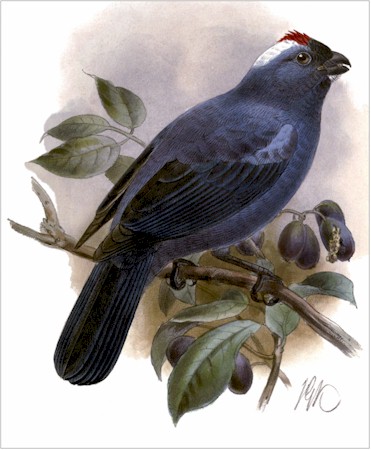
Stephanophorus leucocephalus, Scl. et Salv. Nomencl. p. 20; Durnford, Ibis, 1877, p. 170 (Buenos Ayres); White, P. Z. S. 1882, p. 597 (Misiones); Barrows, Bull. Nutt. Orn. Cl. viii. p. 90 (Concepcion); Scl. Cat. B. xi. p. 143. Stephanophorus cœruleus, Burm. La-Plata Reise, ii. p. 480 (Paraná).
Description.—Uniform deep blue; cap silky white, with a small crimson crest; bill brownish black, feet brown: whole length 7 inches, wing 4, tail 3·3. Female similar, but not quite so bright in colour.
Hab. Southern Brazil, Paraguay, and Northern Argentina.
Azara gave the generic name Lindo (beautiful) to the Tanagers, and this species he named the “Blue White-headed Beautiful,” the entire plumage being of a very lovely deep corn-flower blue, except a cap of silvery-white feathers on the head, with a crimson spot on the forehead, looking like a drop of blood.
It is a summer bird in Buenos Ayres, where it makes its appearance in spring in the woods bordering on the Plata river, and is usually seen singly or in pairs. The nest is built in a tree ten or twelve feet from the ground, and is somewhat shallow and lined with soft dry grass. The female lays four eggs, white and spotted with deep red. During incubation the male sits concealed in the thick foliage close by, amusing itself by the hour with singing, its performance consisting of chattering disconnected notes uttered in so low a tone as to make one fancy that the bird is merely trying to recall some melody it has forgotten, or endeavouring to construct a new one by jerking out a variety of sounds at random. The bird never gets beyond this unsatisfactory stage, however, and must be admired for its exquisite beauty alone.
37. TANAGRA SAYACA, Linn.
(BLUE TANAGER.)
Tanagra cyanoptera, Durnford, Ibis, 1878, p. 59 (Buenos Ayres); Barrows, Bull. Nutt. Orn. Cl. viii. p. 91 (Concepcion); Scl. Cat. B. xi. p. 157 (part.). Tanagra sayaca, Burm. La-Plata Reise, ii. p. 479 (Paraná); Berl. Zeitschr. ges. Orn. 1885, p. 119, Scl. Cat. B. xi. p. 158.
Description.—Bluish grey, paler below; wings and tail blackish, edged with greenish blue; lesser wing-coverts dull greenish blue, like the edgings of the wings; bill plumbeous, feet brown: whole length 6·0 inches, wing 3·6, tail 2·7. Female similar.
Hab. S.E. Brazil and Argentina.
In the ‘Catalogue of Birds’ I referred the Argentine Blue Tanager to T. cyanoptera, though expressing a doubt upon the subject. I am now disposed to adopt Graf. v. Berlepsch’s view that the Argentine species rather belongs to T. sayaca.—P. L. S.
This species migrates as far south as Buenos Ayres, and appears in spring, in small flocks or parties of three or four birds, in the woods on the shores of the Plata. The male utters a series of peculiar squealing notes by way of song.
38. TANAGRA BONARIENSIS (Gm.).
(BLUE-AND-YELLOW TANAGER.)
Tanagra bonariensis, Berl. Zeitschr. ges. Orn. 1885, p. 119; Scl. Cat. B. xi. p. 164. Tanagra striata, Burm. La-Plata Reise, ii. p. 480 (Buenos Ayres, Mendoza, Cordova); Scl. et Salv. Nomencl. p. 21; Durnford, Ibis, 1877, p. 170 (Buenos Ayres); White, P. Z. S. 1882, p. 596 (Catamarca); Barrows, Bull. Nutt. Orn. Cl. viii. p. 91 (Concepcion).
Description.—Lores, region round the eyes, and back black; rump orange; head all round and edging of wings and tail blue; abdomen yellow, passing into orange on the breast; bill horn-colour; feet brown: whole length 7 inches, wing 3·6, tail 2·8. Female greyish brown; beneath paler, tinged with yellowish olive on the rump and throat.
Hab. South Brazil, Uruguay, Paraguay, Argentine Republic, and Bolivia.
The plumage of the male of this fine Tanager is rich blue above and yellow beneath; the upper plumage of the female is a uniform dull olive-green, the breast and belly buff-colour.
It is a migratory species, which appears in Buenos Ayres in small flocks in summer. Both sexes have a long, sharp, reedy call-note; the male also possesses a song composed of notes with a peculiar bleating sound.