Volume 1 — ARGENTINE ORNITHOLOGY. (continued 6)
Reading edition
Hab. Argentina.
This species interested me greatly during my observations of the Argentine birds, but, owing to its rarity and to its recluse habits, my knowledge of it is very scanty. It is found in the north and north-western parts of the Argentine territory; in the province of Buenos Ayres its presence is confined to the narrow strip of subtropical wood fringing the low shores of the Plata river.
When surprised, its white eye, blue dagger-like beak, and raised crest give it a strikingly bold and angry appearance, the effect of which is heightened by the harsh rasping scream it utters when disturbed. This resentful look is deceptive, however, for the bird is the shiest creature imaginable. Its language has the shrill excited character common to this most loquacious family; and at intervals throughout the day two birds, male and female, meet together and make the woods echo with their screaming concert. For many weeks after I had become familiar with these loud-sounding notes, while collecting in the littoral forest where it is found, the bird was still to me only a “wandering voice”; but I did not give up the pursuit till I had seen it several times and had also secured two or three specimens. I found one nest, though without eggs, a rough-looking domed structure, made with material enough to fill a barrow. I also discovered that the bird feeds exclusively on the ground, close to the boles of low-branching trees, where there is usually an accumulation of fallen bark, dead leaves, and other rubbish. Here the bird digs with its sharp beak for the small insects it preys on. When approached it does not fly away, but runs swiftly to the nearest tree, behind the trunk of which it hides, then scuttles on to the next tree, and so escapes without showing itself.
Mr. Barrows, who observed the Cachalote at Concepcion, says that it is a bird which cannot be overlooked, with an outrageous disposition and voice, and a nest the size of a barrel. He gives the following account of its nidification:—“His nest is built entirely of sticks, and many of them of goodly size, frequently as large round as your little finger and two feet or more long. These are disposed in such a way as to form a structure three or four feet in length by about two in breadth in the widest part, the whole very much resembling a gigantic powder-flask lying on its side among the lower branches of a spreading tree. It is quite loosely built and the nest-cavity is rather indefinite, being any portion of the floor of the nest which the bird selects for the reception of the eggs. These are usually three or four in number, pure white, and are laid from October until January. They can usually be counted through the loose floor of the nest, though sometimes its thickness prevents this.”
213. HOMORUS GUTTURALIS (d’Orb. et Lafr.).
(WHITE-THROATED CACHALOTE.)
Anabates gutturalis, Burm. La-Plata Reise, ii. p. 467 (Mendoza). Homorus gutturalis, Scl. et Salv. Nomencl. p. 65; Hudson, P. Z. S. 1872, p. 545 (Rio Negro); id. Ibis, 1885, p. 284; Durnford, Ibis, 1877, p. 36, et 1878, p. 396 (Chupat, Central Patagonia).
Description.—Nearly uniform earthy grey, faintly tinged with olivaceous brown above, and much paler beneath; lores and upper part of throat pure white, lower part of throat black, or white and black mixed; under wing-coverts white, faintly tinged with pale cinnamon; beak and feet bluish grey: whole length 9·4 inches, wing 4·0, tail 3·2. Female similar.
Hab. Patagonia.
I found this bird quite common on the dry open plains in the neighbourhood of the Rio Negro in Patagonia. In size, form, and crest it is like the northern Cachalote, but has a white throat, while the rest of the plumage is of a pale earthy brown instead of rufous. Like the Brown Cachalote it is also shy in disposition, and, being so dull in colour and without the bright beak and eye tints, has not the bold, striking appearance of that species; still I do not think any ornithologist can meet with it and fail to be strongly impressed with its personality, if such a word can be applied to a bird.
Dendrocolaptine birds are, as a rule, builders of big nests and very noisy; H. gutturalis is, I believe, the loudest screamer and greatest builder of the family. Male and female live together in the same locality all the year; the young, when able to fly, remain with their parents till the breeding-season, so that the birds are found occasionally in pairs, but more frequently in families of five or six individuals. When feeding they scatter about, each bird attaching itself to a large bush, scraping and prodding for insects about the roots; and at intervals one of the old birds, ascending a bush, summons the others with loud shrill cries, on which they all hurry to the place of meeting, and from the summits of the bushes burst forth in a piercing chorus, which sounds at a distance like screams of hysterical laughter. At one place, where I spent some months, there were some bushes over a mile and a quarter from the house I lived in, where these birds used to hold frequent meetings, and in that still atmosphere I could distinctly hear their extravagant cries at this distance. After each performance they pursue each other, passing from bush to bush with a wild jerky flight, and uttering harsh angry notes.
They select a low, strong, wide-spreading bush to build in; the nest, which is made of stout sticks, is perfectly spherical and four to five feet deep, the chamber inside being very large. The opening is at the side near the top, and is approached by a narrow arched gallery, neatly made of slender sticks resting along a horizontal branch, and about fourteen inches long. This peculiar entrance, no doubt, prevents the intrusion of snakes and small mammals. So strongly made is the nest that I have stood on the dome of one and stamped on it with my foot without injuring it in the least, and to demolish one I had to force my gun-barrel into it, then prize it up by portions. I examined about a dozen of these enormous structures, but they were all met with before or after the laying season, so that I did not see the eggs.
214. ANABAZENOPS OLEAGINEUS, Scl.
(OILY-GREEN ANABAZENOPS.)
Anabazenops rufo-superciliatus, White, P. Z. S. 1882, p. 613 (Catamarca). Anabazenops oleagineus, Scl. P. Z. S. 1883, p. 654.
Description.—Above and beneath dark olive-green; lores, superciliaries, and spots on the sides of the head yellowish white; wings blackish, the outer webs of the feathers olive-brown; tail bright chestnut; throat whitish yellow, on the lower part the yellow feathers tipped with olive; breast and belly spotted with same colour as the throat; bend of wing, under wing-coverts, and margins of inner webs of secondaries fulvous yellow; bill and feet blackish: whole length 6·2 inches, wing 3·2, tail 3·0. Female similar.
Hab. South Brazil and Argentina.
White obtained examples of this species on the Sierra of Totoral. He says it is a very wild bird and exceedingly scarce.
215. SITTOSOMUS ERITHACUS (Licht.).
(ROBIN-LIKE WOOD-HEWER.)
Sittosomus olivaceus, White, P. Z. S. 1882, p. 613 (Salta). Sittasomus erithacus, Scl. et Salv. Nomencl. p. 66.
Description.—Above olive-green, tinged with chestnut on the back, rump, and upper wing-coverts; wings black, the basal part of the inner webs of the secondaries fulvous yellow, forming a well-marked transverse bar; outer webs and broad tips of inner secondaries and whole of outer secondaries chestnut; tail and upper tail-coverts chestnut; beneath yellowish olive, brighter on the throat and breast; under wing-coverts fulvous yellow; under tail-coverts pale chestnut; bill and feet black: whole length 6·2 inches, wing 3·0, tail 3·0. Female similar.
Hab. South America from Colombia to Northern Argentina.
This is a straggler from the north, a specimen of which was obtained by White near Oran in 1880.
216. GLYPHORHYNCHUS CUNEATUS (Licht.).
(WEDGE-BILLED WOOD-HEWER.)
Glyphorhynchus cuneatus, Scl. et Salv. Nomencl. p. 67; White, P. Z. S. 1882, p. 613 (Misiones).
Description.—Above olive-brown, superciliaries and small spots on the side of the head yellowish white, rump and upper tail-coverts chestnut; wings blackish, outer webs of wing-feathers olive-brown, basal part of inner webs of secondaries yellowish white, forming a transverse bar; tail chestnut; beneath earthy olive-brown, whitish yellow on the throat, and with spots of the same colour on the upper part of the breast; under wing-coverts white; bill and feet horn-colour: whole length 5·1 inches, wing 2·5, tail 2·4. Female similar.
Hab. South America from Colombia to Northern Argentina.
This is another northern form of which White obtained specimens in Misiones. He says it is not uncommon there in the thick woods, also in the orange-groves about the Jesuit ruins of St. Javier.
217. DENDROCOLAPTES PICUMNUS (Licht.).
(FLAT-BILLED WOOD-HEWER.)
Dendrocolaptes picumnus, Scl. et Salv. Nomencl. p. 67; White, P. Z. S. 1882, p. 613 (Misiones).
Description.—Above olivaceous brown; head blackish, thickly covered with yellowish-buff elongated shaft-spots; rump and upper tail-coverts tinged with chestnut; wing-feathers chestnut, tinged with olivaceous; tail chestnut; beneath pale earthy olive-brown, paler on the throat, the shafts of the feathers of the breast buffy white, forming long lines, the feathers of the belly and under tail-coverts transversely barred with blackish; under wing-coverts yellowish white, spotted with blackish; bill and feet black: whole length 10·5 inches, wing 4·7, tail 4·6. Female similar.
Hab. Brazil and Northern Argentina.
White obtained specimens of this species at Concepcion, “in the thickest parts of the woods, near the river, climbing up the trees, around which it turned in corkscrew fashion.”
218. DRYMORNIS BRIDGESI, Eyton.
(BRIDGES’S WOOD-HEWER.)
[Plate X.]
DRYMORNIS BRIDGESI.
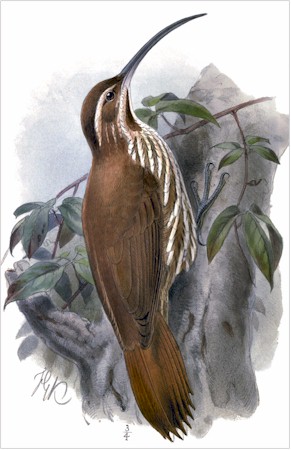
Drymornis bridgesi, Scl. et Salv. Nomencl. p. 67; White, P. Z. S. 1882, p. 613 (Catamarca); Barrows, Auk, 1884, p. 20 (Entrerios). Nasica gracilirostris, Burm. La-Plata Reise, ii. p. 466 (Rio Quinto).
Description.—Above and below brown, brightest on the rump, and palest beneath; long superciliaries extending down the neck, and a mystacal stripe formed of white spots with faint black edgings; wing-feathers blackish; tail chestnut; on the throat a broad white band extending to the breast; breast and belly marked with large oblong white spots, which are margined with narrow black edgings; under wing-coverts and inner margins of secondaries bright cinnamon; bill and feet horn-colour: whole length 12·10 inches, wing 5·6, tail 4·6. Female similar.
Hab. North and West Argentina.
Eyton, when he described this species from Bridges’s specimens, gave its habitat as Bolivia. It may inhabit the southern part of that Republic, but it is more probable that Bridges’s examples were obtained in Northern Argentina, which he likewise visited. Bridges’s Wood-hewer is the only member of its genus, and is one of the largest of the whole family Dendrocolaptidæ, measuring some 13 or 14 inches in length, inclusive of the great curved beak. Although found throughout the northern portion of the Argentine Republic, its habits are as yet imperfectly known, but the following extracts show that they must be very interesting, and that the bird is remarkably versatile. Mr. Barrows writes:—“These birds are somewhat gregarious, being oftenest seen in small parties of six to ten. They sometimes cling against the bark of a tree in the manner of Woodpeckers, but also spend much of their time on the ground. I think they use their curved bill much oftener for probing in the ground than for searching the bark of trees, as many of those shot had the base of the bill and the frontal feathers plastered with mud. In the stomach of the first one killed I found the silken sac, three fourths of an inch in diameter, or the eggs of a large spider, which makes holes ten or twelve inches deep in the hard soil everywhere.”
White obtained examples of this species at Catamarca, and also notices its strangely contrasted habits. He writes:—“The cry of this bird is much the same as that of a Woodpecker, and it clings to the algarroba trees in a similar way; but in the afternoon it is seen scattered about on the sandy ground in the pursuit of insects.”
219. XIPHOCOLAPTES ALBICOLLIS (Vieill.).
(WHITE-THROATED WOOD-HEWER.)
Xiphocolaptes albicollis, Scl. et Salv. Nomencl. p. 68; White, P. Z. S. 1882, p. 613 (Misiones).
Description.—Above, head black, with clear whitish-yellow shaft-spots; lores and long superciliaries white; neck, back, and upper wing-coverts olive-brown; rump and upper tail-coverts washed with bright chestnut; wing-feathers dark chestnut, the outer webs glossed with olivaceous; tail chestnut; beneath pale olive-brown, buffy white on the throat and with similar shaft-spots on the breast; feathers of the belly and under tail-coverts transversely barred with black; under wing-coverts cinnamomeous yellow barred with black; bill and feet black: whole length 12·0 inches, wing 5·4, tail 4·8. Female similar.
Hab. Brazil and N. Argentina.
White obtained examples of this large Wood-hewer in Misiones.
220. XIPHOCOLAPTES MAJOR (Vieill.).
(CHESTNUT WOOD-HEWER.)
Xiphocolaptes major, Scl. et Salv. Nomencl. p. 68; White, P. Z. S. 1882, p. 613 (Salta); Durnford, Ibis, 1880, p. 359 (Tucuman).
Description.—Above and below nearly uniform chestnut, tinged with olivaceous on the crown and throat; narrow shaft-spots on the breast-feathers whitish, forming faint lines; beak pale horn-colour; feet bluish grey: whole length 11·10 inches, wing 5·5, tail 4·0. Female similar.
Hab. North Argentina, Paraguay, and Bolivia.
This large and powerful Wood-hewer is confined to the hottest portion of the Argentine Republic, and also inhabits Paraguay and Bolivia. White met with it at Oran, in the province of Salta, and writes concerning its habits:—“Common here in the dense forest, where their continued hard pecking at the lofty tree-trunks is very accentuated. Two or three at a time maintain a continued race up a magnificent clear stem as far as the branches, when they fly to the bottom of the next and do likewise.”
This species is nearly a foot in length, the beak being about two inches long, curved and very powerful. The tail is stiff, being used as a support in climbing, and the claws are strong and sharply hooked. The colour of the whole plumage is nearly uniformly bright rufous.
221. PICOLAPTES ANGUSTIROSTRIS (Vieill.).
(NARROW-BILLED WOOD-HEWER.)
Picolaptes angustirostris, Scl. et Salv. Nomencl. p. 69; White, P. Z. S. 1883, p. 433 (Cordova). Lepidocolaptes atripes, Barrows, Auk, 1884, p. 21 (Entrerios).
Description.—Above, head and neck blackish, with oblong whitish shaft-spots on the crown and neck; broad superciliaries white, extending nearly to the back and broken at their lower ends into shaft-spots; rest of upper surface dull brown, brighter on the rump; wing-feathers pale obscure chestnut; outer webs and broad tips of primaries blackish; tail chestnut; beneath white, clearer on the throat; sides of breast and belly thickly marked with faint blackish stripes; under wing-coverts cinnamon; bill pale horn-colour; feet grey: whole length 8·2 inches, wing 3·8, tail 2·5. Female similar.
Hab. Paraguay and Argentina.
This is the only member of the genus Picolaptes as yet met with within the limits of the Argentine Republic. Azara found it abundant in Paraguay, and on this account named it the Common Climber, “Trepador comun.” In Buenos Ayres it is a summer visitant, appearing at the end of September. It is a solitary bird, never seen away from the woods, and invariably utters a loud melancholy cry when passing from one tree to another. It always alights on the trunk close to the ground, clinging to the bark in a vertical position, supported by the tail, and with head thrown far back in order to give free play to the extremely long beak. Having thus alighted, it progresses upwards by short hops, exploring the crevices in the wood for small insects, until it reaches the branches, when it flies off to the next tree.
Fam. XVIII. FORMICARIIDÆ, or ANT-BIRDS.
The Formicariidæ, or Ant-birds, are another very important constituent of the Neotropical Avifauna, but are less generally diffused than the Dendrocolaptidæ, the greater number of the forms being restricted to the hot forests of South and Central America. In the Argentine Republic we meet with only four species of the widely-spread genus Thamnophilus, and of them only one appears to extend as far south as Buenos Ayres.
222. THAMNOPHILUS LEACHI (Such).
(LEACH’S BUSH-BIRD.)
Thamnophilus leachi, Scl. et Salv. Nomencl. p. 69; White, P. Z. S. 1882, p. 614 (Misiones).
Description.—Black, thickly and conspicuously spotted above with white or pale yellowish; on the wings the spots occur on the outer webs of the feathers; upper tail-coverts faintly edged with grey; tail black, unspotted; feathers on the lower breast and belly slightly edged with grey; bill and feet black: whole length 10·5 inches, wing 3·4, tail 5·0. Female: spots larger and yellow, on the crown lengthening to stripes and tinged with rufous; inner webs of the wing-feathers also spotted on their margins; whole under surface thickly spotted with pale yellow.
Hab. Brazil and N. Argentina.
White met with a single individual of this fine Bush-bird at Concepcion, Misiones. It was observed on the ground feeding on a swarm of black ants.
223. THAMNOPHILUS MAJOR, Vieill.
(LARGER BUSH-BIRD.)
Thamnophilus major, Scl. et Salv. Nomencl. p. 69; White, P. Z. S. 1882, p. 614 (Salta); Salvin, Ibis. 1880, p. 359 (Salta). Thamnophilus stagurus, Burm. La-Plata Reise, ii. p. 471 (Paraná, Tucuman).
Description.—Above black, upper wing-coverts crossed by a row of white spots; the outer rectrix on each side tipped and barred with white, the other rectrices, excepting the middle pair, spotted with white on their inner webs; beneath pure white; bill black, feet grey: whole length 8·0 inches, wing 3·6, tail 2·8. Female above rufous, beneath white, lower flanks and under tail-coverts tinged with ochraceous; tail wholly rufous.
Hab. Paraguay and N. Argentina.
White found this species common in the gardens round the town of Oran. He noted the iris as “crimson.”
Azara’s account of this species is prefaced by the following remarks on the birds of this genus known to him in Paraguay:—“These birds inhabit only the dense and tangled thickets, and never show themselves outside of their hiding-places, except for a few moments in the early morning and in the evening; but at no time do they perch high on the trees, but keep always within a few feet of the earth. They live in pairs; feed solely on insects caught in the bushes which they frequent, or on the ground, on which, however, the bird alights only to pick up its prey, and then returns to the twig to devour it. They are stationary, and fly only from one thicket to another. Many of the species have a similar voice or song, which is singular, powerful, and heard only in the love-season. The call is a trill of a single note rapidly reiterated, and loud enough to be heard half a mile away; the cry being accompanied by vibratory motions of the wings.”
224. THAMNOPHILUS CÆRULESCENS, Vieill.
(SLATY-BLUE BUSH-BIRD.)
Thamnophilus cærulescens, Burm. La-Plata Reise, ii. p. 472 (Paraná, Mendoza, Tucuman); Scl. et Salv. Nomencl. p. 70; White, P. Z. S. 1882, p. 614 (Corrientes, Misiones); Barrows, Auk, 1884, p. 21 (Entrerios); Salvin, Ibis, 1880, p. 361 (Salta).
Description.—Above grey, black on the crown, and a patch of white and black feathers on the middle of the back; wings black, the coverts thickly spotted and the inner webs of the remiges edged with white; tail black, all the feathers, except the middle pair, tipped with white, the outer rectrix on each side has also a long white spot in the middle part of the outer web; beneath cinereous, white on the belly; bill and feet black: whole length 5·6 inches, wing 2·7, tail 2·3. Female: above earthy olive-green, yellowish on the crown; wing-coverts and tail as in the male; wing-feathers olive-brown; beneath yellowish olive-grey, brightening into ochraceous on the belly and flanks.
Hab. Paraguay and Argentina.
Mr. Barrows says concerning this species that it is “frequently seen, especially during the winter” (on the Lower Uruguay). A nest, taken November 24th, “was almost precisely like that of our Red-eyed Vireo (V. olivaceus), being pensile in the fork of a horizontal spray, only four feet from the ground. It contained three fresh eggs, white, with spots and dashes of light brown.”
White says that these birds frequent the banks of streams, and have a deep bass call-note, rather mournful and slow.
225. THAMNOPHILUS RUFICAPILLUS, Vieill.
(RED-CAPPED BUSH-BIRD.)
Thamnophilus argentinus, Burm. La-Plata Reise, ii. p. 472 (Paraná, Tucuman); Scl. et Salv. Nomencl. p. 70; Durnford, Ibis, 1877, p. 183 (Buenos Ayres); Barrows, Auk, 1884, p. 21 (Entrerios). Thamnophilus ruficapillus, Pelz. Orn. Bras. p. 79; Berl. et Jher. Zeitschr. ges. O. 1885, p. 49.
Description.—Above olivaceous brown, tinged with rufous, brighter on the crown; lores yellowish white, superciliaries and sides of head whitish grey; wing-feathers dark olive-brown, the inner webs edged with ochraceous; tail black, all the rectrices, except the middle pair, slightly tipped and broadly spotted on the inner webs with white; beneath greyish white, the feathers from the lower throat to the belly transversely barred with black; bill and feet black: whole length 6·2 inches, wing 2·7, tail 2·6. Female: above the same as the male, except the tail, which is rufous brown; beneath whitish, tinged with ochraceous, and with scarcely perceptible greyish mottlings.
Hab. Paraguay and Argentina.
This species is very common in the eastern provinces of Argentina, and extends south to Buenos Ayres. It is a shy, solitary bird, found in woods and thickets along the shores of La Plata; and utters occasionally a singular low rasping note, its only language. The nest is a slight shallow structure placed in a low tree; the eggs are white, thinly spotted with reddish brown. Probably this species is to some extent migratory, as I have only observed it in the summer season.
Fam. XIX. PTEROPTOCHIDÆ, or TAPACOLAS.
The Pteroptochidæ form a small but very peculiar family of Tracheophonine Passeres, mostly restricted to Chili and the south-western extremity of the South-American Continent, but also represented in the Andes of Ecuador and Colombia and in the high plateau of Central Brazil. They are ground-birds, remarkable for their large and robust feet with long claws, their strangely formed bills, and the elevated position in which the tail is carried in the living bird.
In the Argentine Republic four species of Pteroptochidæ are known to occur, only one of which, however, is a well-known bird. Two of the remaining three are recent discoveries, and the fourth a Chilian species, which extends over the Andes into the western borders of Argentina.
226. SCYTALOPUS SUPERCILIARIS, Cab.
(WHITE-EYEBROWED SCYTALOPUS.)
Scytalopus superciliaris, Cab. Journ. f. Orn. 1883, p. 105, t. ii. fig. 3 (Tucuman).
Description.—Nearest to S. indigoticus of Brazil, but without the white colour on the breast and belly, only the throat being clear white; superciliaries striped white; front and sides of the head and neck, breast and belly grey; rest of the upper surface, together with the flanks and crissum, light brown, with fine blackish cross-markings; bill blackish, feet light-coloured.
Hab. Sierra of Tucuman.
This species is one of Schulz’s recent discoveries in the Sierra of Tucuman, where he found it west of Sauciyaca, frequenting the deep ravines.
227. RHINOCRYPTA LANCEOLATA, Geoffr. et d’Orb.
(GALLITO.)
Rhinocrypta lanceolata, Burm. La-Plata Reise, ii, p. 471 (Mendoza, San Juan, Catamarca); Scl. et Salv. Nomencl. p. 70; Hudson, P. Z. S. 1872, p. 543 (Rio Negro); White, P. Z. S. 1882, p. 614 (Catamarca).
Description.—Above, head and upper neck reddish brown with a fine white shaft-stripe on each feather, the stripes being most conspicuous on the crest-feathers; lower neck, back, rump, and wings greyish olive; tail blackish; beneath, throat and upper part of breast, grey, becoming pure white on the middle of the belly; sides of belly and flanks bright chestnut; lower part of belly and flanks and under tail-coverts like the back; bill horn-colour, feet black: whole length 8·2 inches, wing 3·3, tail 3·0. Female similar.
Hab. Western and Southern Argentina and Patagonia.
The vernacular name Gallito, or “Little Cock,” by which this species is familiarly known in Patagonia, cannot fail to strike every one who sees the bird as very appropriate, for it struts and runs on the ground with tail erect, looking wonderfully like a small domestic fowl. In the neighbourhood of Carmen, on the Rio Negro, it is very abundant, and when I went there its loud deep chirrup, heard from every side in the thicket, quickly arrested my attention, just as the perpetual chirping of the Sparrows did when I first landed in England. In the interior of the country it is not nearly so abundant, so that man’s presence has probably in some way affected it favourably. Its habits amuse and baffle a person anxious to make its acquaintance; for it scarcely possesses the faculty of flight, and cannot be driven up, but it is so easily alarmed, so swift of foot, and so fond of concealment, that it is most difficult to catch a sight of it. At the same time it is extremely inquisitive, and no sooner does it spy an intruder in the bush than the warning note is sounded, whereupon every bird within hearing hops up into a thick thorn-bush, where it utters every three or four seconds a loud hollow chirrup, and at intervals a violent scolding cry, several times repeated. When approached they all scuttle away, masked by the bushes, with amazing swiftness, to take refuge at a distance, where the loud protest is again resumed; but when the pursuer gives up the pursuit in disgust and turns away, they immediately follow him, so that he is perpetually encircled with the same ring of angry sound, moving with him, coming no nearer and never allowing its cause to be seen.
On three or four occasions I have seen one rise from the ground and fly several yards with a feeble fluttering flight; but when closely pursued in an open place they seem incapable of rising. They generally fly down from the top of a bush, but always ascend it by hopping from twig to twig.
The nest is made in the centre of a thorny bush two or three feet from the ground; and is round and domed, with a small aperture at the side, and built entirely of fine dry grass. The eggs are four in number and of a pure white.
The Little Cock is nine inches long, has long stout legs, and short, curved beak. The colour of the head and neck is deep reddish brown, lined with white, the feathers of the crown forming a crest. The upper surface and wings olive-brown; tail dark; throat and breast grey; middle of the belly white, with a broad ruddy rufous patch on each side reaching to the belly.
228. RHINOCRYPTA FUSCA, Scl. et Salv.
(BROWN GALLITO.)
Rhinocrypta fusca, Scl. et Salv. Nomencl. pp. 76, 161.
Description.—Above uniform pale cinnamomeous brown; superciliaries whitish; tail blackish, except the middle pair of rectrices, which are the same as the back; beneath white, faintly tinged with cinnamomeous; bill horn-colour, feet black: whole length 6·5 inches, wing 2·5, tail 2·4.
Hab. Mendoza.
The original examples of this species were obtained by the German collector, Weisshaupt, near Mendoza. It appears to have been mistaken for the young of the preceding species, but is decidedly different.
229. PTEROPTOCHUS ALBICOLLIS, Kittl.
(WHITE-NECKED TAPACOLA.)
Pteroptochus albicollis, Burm. La-Plata Reise, ii. p. 471 (Mendoza); Scl. et Salv. Nomencl. p. 76.
Description.—Above chestnut-brown, obscure or slightly olivaceous on the neck and upper part of back; inner webs of wing-feathers blackish; lores, superciliaries, and under surface white, the breast sparsely, and the belly and flanks thickly marked with transverse spots of blackish brown; lower flanks and under tail-coverts chestnut-brown, obscurely spotted with black; bill and feet black: whole length 8·5 inches, wing 3·1, tail 2·9. Female similar.
Hab. Chili and Western Argentina.
Dr. Burmeister tells us that he met with this Chilian species in the water-courses near Mendoza, where it was seen running about on the stones like a Dipper.
Darwin has given us some interesting notes on this bird:—“This species is called by the Chilenos ‘Tapacola,’ or ‘cover your posteriors.’ The name is well applied, as the Tapacola generally carries its short tail more than erect, that is, inclined backward and toward the head. It is extremely common in Central Chile. The Tapacola frequents hedge-rows and the bushes which are scattered at a considerable elevation over the sterile hills, where scarcely another bird can exist; hence it plays a conspicuous part in the ornithology of Chile. The Tapacola is very crafty; when frightened by any person, it will remain motionless at the bottom of a bush, and will then, after a little while, try with much address to crawl away on the opposite side. It is also an active bird, and continually making a noise; these noises are various and strangely odd; one is like the cooing of doves, another like the bubbling of water, and many defy all similes. The country-people say it changes its cry five times in the year, which is according, I suppose, to some change of season. I was told that the Tapacola builds its nest at the bottom of a deep burrow.” (Darwin, in Zool. Voy. ‘Beagle,’ iii. p. 72.)
INDEX.
Acahé, i. 110.
Acanthylis collaris, ii. 11.
Actiturus bartramius, ii. 189.
Actodromas bairdi, ii. 184.
—— fuscicollis, ii. 185.
—— maculata, ii. 183.
Æchmophorus major, ii. 202.
Ægialitis cantiana, ii. 174.
—— collaris, ii. 173.
—— falklandica, ii. 172.
Afeytado, ii. 114.
Agachona, ii. 181.
Agelæus flavus, i. 98.
—— ruficapillus, i. 99.
—— thilius, i. 97.
Agriornis leucurus, i. 112.
—— maritima, i. 112.
—— striata, i. 111.
Aiaiai, ii. 106.
Ajaja rosea, ii. 114, 115, 116.
Alas-amarillas, ii. 163.
Alectrurus psalurus, i. 123.
—— risorius, i. 123.
—— tricolor, i. 122.
Allied Saltator, i. 41.
—— Woodpecker, ii. 20.
Alma do gato, ii. 37.
Alonzito, i. 167.
Alonzo Garsia, i. 167.
Aluco flammeus, ii. 48.
Amazon, Blue-fronted, ii. 47.
——, Vinaceous, ii. 46.
Amazonian Kingfisher, ii. 27.
Amblycercus solitarius, i. 72.
Amblypterus anomalus, ii. 16.
Amblyrhamphus holosericeus, i. 101.
—— ruber, i. 101.
American Dabchick, ii. 205.
—— Golden Plover, ii. 170.
—— Oyster-catcher, ii. 176.
—— Waterhen, ii. 156.
Anabates gutturalis, i. 197.
—— unirufus, i. 195.
Anabazenops, Oily-green, i. 198.
—— oleagineus, i. 198.
—— rufo-superciliatus, i. 198.
Anæretes flavirostris, i. 142.
—— parulus, i. 141.
Anas bahamensis, ii. 135.
—— brasiliensis, ii. 133.
—— chiloënsis, ii. 135.
—— cyanoptera, ii. 130.
—— flavirostris, ii. 131.
—— maculirostris, ii. 131.
—— melanocephala, ii. 130.
—— oxyura, ii. 134.
—— peposaca, ii. 137.
—— platalea, ii. 136.
—— spinicauda, ii. 134.
Andean Flamingo, ii. 119.
—— Goose, ii. 122.
Angela Humming-bird, ii. 5.
Angelito de las Animas, i. 118.
Ani, Black, ii. 31.
Antarctic Rail, ii. 148.
Antenor unicinctus, ii. 63.
Anthus correndera, i. 17, 19, 54, 80.
—— furcatus, i. 19.
—— pratensis, i. 17.
—— rufus, i. 17.
Antrostomus longirostris, ii. 14.
—— parvulus, ii. 14.
Anumbé roxo, i. 195.
Añumbi, i. 189, 190, 191.
Anumbius acuticaudatus, i. 31, 67, 88, 96, 133, 187, 189.
—— striaticollis, i. 194.
Aphobus chopi, i. 108.
Aptenodytes demersa, ii. 206.
Aramides gigas, ii. 150.
—— nigricans, ii. 150.
—— rhytirhynchus, ii. 149.
—— ypecaha, ii. 150.
Aramus scolopaceus, ii. 159.
Ardea cærulea, ii. 99.
—— candidissima, ii. 98, 99.
—— cocoi, ii. 93, 94.
—— egretta, ii. 98, 99, 105.
—— gardeni, ii. 105.
—— leuce, ii. 98.
—— marmorata, ii. 104.
—— nivea, ii. 99.
—— sibilatrix, ii. 100.
Ardetta involucris, ii. 93, 101, 227.
Argentine Blackbird, i. 4.
—— Cow-bird, i. 72.
—— Flamingo, ii. 117.
Arremon orbignii, i. 41.
Arundinicola flaviventris, i. 137.
—— leucocephala, i. 122.
Ashy Tyrant, i. 121.
Ashy-black Tyrant, i. 126.
Ashy-headed Goose, ii. 124.
Asio accipitrinus, ii. 49.
—— brachyotus, ii. 49.
Asturina pucherani, ii. 58.
—— rutilans, ii. 63.
—— unicincta, ii. 63.
Athene cunicularia, ii. 52.
Atticora cyanoleuca, i. 33, 166.
—— fucata, i. 35.
Aulanax latirostris, i. 121.
Avestruz petizo, ii. 219.
Aymara Dove, ii. 142.
—— Parrakeet, ii. 46.
Azara’s Sand-Plover, ii. 173.
—— Tanager, i. 40.
—— Trogon, ii. 29.
Azure Jay, i. 110.
Bahama Duck, ii. 135.
—— Pintail, ii. 135.
Bailarin, ii. 71.
Baird’s Sandpiper, ii. 184, 185.
Banduria, ii. 112.
Bank Parrot, ii. 41.
—— Swallow, i. 33.
Barn-Owl, Common, ii. 48.
Barred Upland Goose, ii. 123.
Bartramia longicauda, ii. 189.
Bartram’s Sandpiper, ii. 189.
Basileuterus auricapillus, i. 21.
—— vermivorus, i. 21.
Batitú, ii. 189.
Bay-winged Cow-bird, i. 95.
Bécard, White-winged, i. 162.
Bernicla antarctica, ii. 123.
—— dispar, ii. 123.
—— magellanica, ii. 123.
—— melanoptera, ii. 122.
—— poliocephala, ii. 124.
Bienteveo Tyrant, i. 147.
Bittern, Marbled Tiger-, ii. 104.
Black Ani, ii. 31.
—— Duck, ii. 137.
—— Rail, ii. 149.
—— Vulture, ii. 89.
Black-and-chestnut Warbling Finch, i. 49.
Black-and-yellow Thickbill, i. 43.
Black-and-yellow-crested Tyrant, i. 157.
Black-billed Cuckoo, ii. 38.
Blackbird, Argentine, i. 4.
Black-crowned Tyrant, i. 115.
Black-faced Ibis, ii. 110.
Black-headed Duck, ii. 130.
—— Finch, i. 45.
—— Reed-Wren, i. 13.
—— Siskin, i. 64.
—— Thrush, i. 4.
—— Tyrant, i. 157.
Black-necked Tanager, i. 37.
Black-tailed Skimmer, ii. 193.
Black-winged Dove, ii. 142.
Blackish Finch, i. 54.
—— Tyrant, i. 141.
Blue Heron, ii. 99.
—— ——, Little, ii. 101.
—— Tanager, i. 39.
Blue-and-yellow Tanager, i. 39.
Blue-billed Tyrant, i. 127.
Blue-fronted Amazon, ii. 47.
Blue-winged Teal, ii. 130.
Boat-tail, Chopi, i. 108.
Boie’s Woodpecker, ii. 17.
Bolborhynchus aymara, ii. 46.
—— monachus, ii. 43.
Bolborhynchus rubrirostris, ii. 46.
Bonaparte’s Sandpiper, ii. 185.
Boyero, i. 101, 116.
Brazilian Cormorant, ii. 91.
—— Lochmias, i. 174.
—— Stilt, ii. 179.
—— Teal, ii. 133.
Bridges’s Wood-hewer, i. 199.
Bright-cheeked Grebe, ii. 204.
Broad-billed Tyrant, i. 136.
Brown Buzzard, ii. 63.
—— Cinclodes, i. 172.
—— Cuckoo, ii. 35.
—— Gallito, i. 207.
—— House-Wren, i. 13.
—— Martin, i. 35.
—— Pintail, ii. 134.
—— Tinamou, ii. 207.
Brown-capped Wood-singer, i. 21.
Brown-crested Spine-tail, i. 177.
Brown-fronted Spine-tail, i. 178.
Brown-headed Wood-bird, i. 23.
Brush-loving Fly-snapper, i. 12.
Buarremon citrinellus, i. 41.
—— (Atlapetes) citrinellus, ii. 223.
Bubo crassirostris, ii. 50.
—— magellanicus, ii. 50, 51.
—— virginianus, ii. 50.
Bucco chacuru, ii. 30.
—— maculatus, ii. 30.
—— striatipectus, ii. 30.
Buff-breasted Sandpiper, ii. 190.
Burmeister’s Cariama, ii. 162.
—— Humming-bird, ii. 2.
Burrito, ii. 150.
Burrowing Owl, ii. 52.
—— Parrot, ii. 41.
Bush-bird, Larger, i. 203.
——, Leach’s, i. 202.
——, Red-capped, i. 204.
——, Slaty-blue, i. 204.
Buteo albicaudatus, ii. 59, 61, 62.
—— erythronotus, ii. 62.
—— fuliginosus, ii. 60.
—— macropterus, ii. 58.
—— melanoleucus, ii. 64.
—— obsoletus, ii. 59.
—— oxypterus, ii. 59.
—— pterocles, ii. 61.
—— swainsoni, ii. 59, 60.
—— tricolor, ii. 62.
—— unicolor, ii. 60.
Butorides cyanurus, ii. 101.
—— striata, ii. 101.
Buzzard, Brown, ii. 63.
——, One-banded, ii. 63.
——, Red-backed, ii. 62.
——, Swainson’s, ii. 59.
——, White-tailed, ii. 61.
Cabanis’s Tyrant, i. 128.
Cabeza amarilla, i. 98.
Caburé, ii. 52.
Cachalote, i. 195.
——, White-throated, i. 197.
Cuchila, i. 18.
—— Pipit, i. 17.
Cactus Woodpecker, ii. 19.
Cairina moschata, ii. 129.
Calandria, i. 5.
—— blanca, i. 9.
—— de las tres colas, i. 9.
—— Mocking-bird, i. 5.
Calidris arenaria, ii. 186.
Calliperidia angelæ, ii. 5.
—— furcifera, ii. 1, 5, 8.
Calodromas elegans, ii. 209, 214.
Caminante, i. 166.
Campephilus boiæi, ii. 17, 18.
—— pileatus, ii. 18.
—— schulzi, ii. 18.
Campestre, ii. 24.
Campias frontalis, ii. 20.
Campylopterus inornatus, ii. 5, 6.
Capito maculatus, ii. 30.
Caprimulgus europæus, ii. 14.
—— parvulus, ii. 14.
Caracara, ii. 82.
Carancho, ii. 74, 82.
—— Carrion-Hawk, ii. 81.
Carau, ii. 160, 161.
Cardinal Finch, i. 47.
—— ——, Lesser, i. 48.
——, Yellow, i. 55.
Carduelis atrata, i. 65.
Cariama burmeisteri, ii. 162.
——, Burmeister’s, ii. 162.
——, Crested, ii. 161.
—— cristata, ii. 161.
Carpintero, ii. 24.
Carrion-Hawk, Carancho, ii. 81.
——, Chimango, ii. 74.
Casera, i. 167.
Caserita, i. 166.
Casiornis rubra, i. 163.
Cassicus solitarius, i. 72.
Cassin’s Tern, ii. 196.
Cassique, Solitary, i. 72.
Catamenia analis, i. 57.
—— inornata, i. 57.
Catharista atrata, ii. 89.
Cathartes atratus, ii. 89.
—— aura, ii. 89.
—— fœtans, ii. 89.
Catita, ii. 44.
—— de las sierras, ii. 46.
Cayenne Lapwing, ii. 165, 166.
Centrites niger, i. 134.
Cerchneis cinnamomina, ii. 70.
Ceryle amazona, ii. 26, 27, 28.
—— americana, ii. 27.
—— stellata, ii. 26.
—— torquata, ii. 26, 27.
Chacuru, ii. 30.
Chætocercus bombus, ii. 2.
—— burmeisteri, ii. 2.
Chajá, ii. 120.
Chamæpelia talpacoti, ii. 144.
Charadrius azaræ, ii. 173.
—— collaris, ii. 173.
—— dominicus, ii. 170.
—— falklandicus, ii. 172.
—— fulvus americanus, ii. 170.
—— modestus, ii. 171.
—— totanirostris, ii. 174.
—— virginianus, ii. 170.
—— virginicus, ii. 170.
Chat-like Tyrant, i. 120.
Chauna chavaria, ii. 119.
—— derbiana, ii. 119.
Cheese-bird, Rufous, i. 163.
Chestnut Cuckoo, ii. 36.
—— Wood-hewer, i. 201.
Chestnut-shouldered Hang-nest, i. 107.
Chicli, i. 179.
Chilian Eagle, ii. 64.
Chiloe Wigeon, ii. 135.
Chimango, ii. 74.
—— Carrion-Hawk, ii. 74.
Chingolo, i. 58.
—— grande, i. 164.
—— Song-Sparrow, i. 58.
Chin-spotted Tyrant, i. 133.
Chipiu pardo y canela, i. 45.
Chiriví, ii. 136.
Chiroxiphia caudata, i. 161.
Chisel-bill, i. 101.
Chivi Greenlet, i. 22.
Chloephaga dispar, ii. 123.
—— magellanica, ii. 123.
—— melanoptera, ii. 122.
—— poliocephala, ii. 124.
Chloroceryle amazona, ii. 27.
—— americana, ii. 27.
Chloronerpes affinis, ii. 20.
—— aurulentus, ii. 21.
—— frontalis, ii. 20.
—— maculifrons, ii. 20.
—— rubiginosus, ii. 21.
—— tucumanus, ii. 21, 223.
—— (Campias) frontalis, ii. 223.
Chlorostilbon aureiventris, ii. 9.
—— phaethon, ii. 9, 229.
—— splendidus, ii. 1, 6, 9.
Chochi, ii. 35.
Chocolate Dove, ii. 144.
—— Tyrant, i. 112.
Chocoyno, i. 4.
Choliba, ii. 51.
—— Owl, ii. 51.
Chopi, i. 108.
—— Boat-tail, i. 108.
Chordeiles virginianus, ii. 13.
Chorlito de invierno, ii. 172.
Chorlo, i. 113; ii. 170.
—— canela, ii. 174.
—— solo, ii. 189.
Chrysomitris atrata, i. 65.
—— barbata, i. 64.
—— icterica, i. 64.
—— magellanica, i. 64.
Chrysomus frontalis, i. 99.
Chrysoptilus chlorozostus, ii. 21.
—— cristatus, ii. 21, 228.
—— melanochlorus, ii. 21.
Chrysotis æstiva, ii. 47.
—— amazonica, ii. 47.
—— vinacea, ii. 46.
Chrysuronia chrysura, ii. 8.
—— ruficollis, ii. 8.
Chueké, ii. 216.
Chunga burmeisteri, ii. 162.
Chuñia, ii. 162.
Churinche, i. 152.
Ciconia maguari, ii. 99, 106.
Cinclodes bifasciatus, i. 173.
——, Brown, i. 172.
—— fuscus, i. 172.
—— vulgaris, i. 172.
——, White-winged, i. 173.
Cinclus schulzi, i. 11, ii. 223.
Cinereous Cuckoo, ii. 38.
—— Harrier, ii. 57.
—— Plover, ii. 173.
—— Tinamou, ii. 210.
—— Tyrant, i. 128.
Cinnamomeous Kestrel, ii. 69.
Circus cinereus, ii. 57.
—— macropterus, ii. 58.
—— maculosus, ii. 58.
—— megaspilus, ii. 58.
Cistothorus fasciolatus, i. 16.
—— platensis, i. 15.
Cnipolegus anthracinus, i. 126, 127.
—— aterrimus, i. 126.
—— cabanisi, i. 128; ii. 229.
—— cinereus, i. 128; ii. 229.
—— cyanirostris, i. 127.
—— hudsoni, i. 126, 131.
Coccoborus glaucocæruleus, i. 44.
Coccyzus americanus, ii. 37.
—— cinereus, ii. 38.
—— melanocoryphus, i. 81; ii. 38.
—— pumilus, ii. 39.
—— seniculus, ii. 38.
Cock, Little, i. 206.
Cock-tailed Tyrant, i. 122.
Cocoi Heron, ii. 93.
Cola estraña, i. 123.
Colaptes agricola, ii. 22, 24.
—— australis, ii. 24.
—— campestris, i. 82; ii. 24.
—— leucofrenatus, ii. 21, 228.
—— longirostris, ii. 23, 223.
—— pitius, ii. 24.
—— pura, ii. 24.
—— rupicola, ii. 23.
Colegial, i. 131.
Columba livia, i. 83.
—— maculosa, ii. 140.
—— picazuro, ii. 139, 140.
Columbina aurisquamata, ii. 142, 228.
Columbula picui, ii. 39, 143.
Come-palo, ii. 19.
Cometes sparganurus, ii. 3.
Common Barn-Owl, ii. 48.
—— Jacana, ii. 163.
—— Miner, i. 165.
—— Rhea, ii. 216.
—— Seed-Snipe, ii. 176.
Condor, Great, ii. 90.
Contopus brachyrhynohus, i. 155; ii. 223.
—— brachytarsus, i. 156.
Contramaestre gaviero, i. 22.
—— pardo verdoso, corona amarilla, i. 146.
Conurus acuticaudatus, ii. 42, 228.
—— aymara, ii. 46.
—— brunniceps, ii. 46.
—— fugax, ii. 42.
—— glaucifrons, ii. 42, 228.
—— hilaris, ii. 43, 222.
—— mitratus, ii. 43.
—— molinæ, ii. 43.
—— murinus, ii. 43.
—— patachonicus, i. 25; ii. 41.
—— patagonus, ii. 41.
—— rubrirostris, ii. 46.
Coot, Red-fronted, ii. 157.
——, Red-gartered, ii. 157.
——, Yellow-billed, ii. 158.
Corethrura leucopyrrha, ii. 154.
Cormorant, Brazilian, ii. 91.
Correndera, La, i. 17.
Coryphistera alaudina, i. 188; ii. 229.
——, Lark-like, i. 188.
Coryphospingus cristatus, i. 48.
—— pusillus, i. 48.
Coscoroba Candida, ii. 126.
—— Swan, ii. 126.
Cotile ruficollis, i. 36.
Cotorra, ii. 44.
Coturniculus manimbe, i. 60.
—— peruanus, i. 60.
Cotyle fucata, i. 35.
—— leucorrhoa, i. 31.
—— pyrrhonota, i. 30.
—— tapera, i. 26.
Coucou, ii. 38.
Courlan, Southern, ii. 159.
Cow-bird, Argentine, i. 72.
——, Bay-winged, i. 95.
——, Screaming, i. 86.
Crake, Marked, ii. 155.
——, Red-and-white, ii. 154.
——, Spot-winged, ii. 155.
Crane-Hawk, Grey, ii. 67.
Crax alector, ii. 145, 146.
—— sclateri, ii. 145.
Creeper, Patagonian Earth-, i. 170.
——, Red-tailed Earth-, i. 171.
——, Warbling Earth-, i. 171.
Creole Duck, ii. 129.
Crested Cariama, ii. 161.
—— Duck, ii. 128.
—— Oven-bird, i. 170.
—— Screamer, ii. 119.
Crispin, i. 4; ii. 35.
Crotophaga ani, ii. 31, 34.
Crowned Harpy, ii. 66.
Crypturus cinereus, ii. 207, 208.
Crypturus obsoletus, ii. 207, 208.
—— tataupa, ii. 208.
Cuckoo, Black-billed, ii. 38.
——, Brown, ii. 35.
——, Chestnut, ii. 36.
——, Cinereous, ii. 38.
——, Dwarf, ii. 39.
——, Guira, ii. 32.
——, Yellow-billed, ii. 37.
Cuervo, ii. 90.
Culicivora boliviana, i. 12.
—— dumicola, i. 12.
—— stenura, i. 139.
Curahí-remimbí, ii. 100.
Curassow, Sclater’s, ii. 145.
Curved-bill Rush-bird, i. 191.
Cyanocorax azureus, i. 110.
—— cæruleus, i. 110.
—— chrysops, i. 110.
—— pileatus, i. 110.
—— tucumanus, i. 110; ii. 223.
Cyanotis azaræ, i. 142, 144, 175.
Cybernetes yetapa, i. 124.
Cyclorhis altirostris, i. 24.
—— ochrocephala, i. 23.
—— viridis, i. 23, 24.
Cygnus coscoroba, ii. 120.
—— nigricollis, ii. 124, 126.
Dabchick, American, ii. 205.
Dafila bahamensis, ii. 135.
—— spinicauda, ii. 134.
Dark-backed Tanager, i. 37.
Dark-crested Finch, i. 48.
Dark Guan, ii. 146.
—— Night-Heron, ii. 105.
Dark-tailed Henicornis, i. 173.
Darwin’s Rhea, ii. 219.
—— Tinamou, ii. 213.
Deep-billed Greenlet-Shrike, i. 24.
De Filippi’s Marsh-Starling, i. 105.
Degollado, i. 106.
Dendrobates cactorum, ii. 19.
Dendrocolaptes picumnus, i. 199.
Dendrocygna fulva, ii. 126, 128.
—— major, ii. 127.
—— viduata, ii. 128.
Dicholophus burmeisteri, ii. 162.
—— cristatus, ii. 161.
Diplopterus galeritus, ii. 35.
—— nævius, ii. 35.
Dipper, Schulz’s, i. 11.
Diuca Finch, i. 55.
—— ——, Lesser, i. 56.
—— grisea, i. 55.
—— minor, i. 56.
—— vera, i. 55.
Domestic Martin, i. 25.
Dominican Gull, ii. 197.
—— Tyrant, i. 117.
Donacobius atricapillus, i. 13.
—— brasiliensis, i. 13.
Donacospiza albifrons, i. 49.
D’Orbigny’s Seed-Snipe, ii. 178.
—— Spine-tail, i. 183.
—— Tanager, i. 41.
Dormilon, ii. 12, 183.
Dove, Aymara, ii. 142.
——, Black-winged, ii. 142.
——, Chocolate, ii. 144.
——, Little Turtle-, ii. 143.
——, Picui, ii. 143.
——, Spotted, ii. 141.
——, Talpacoti, ii. 144.
Drymornis bridgesi, i. 199.
Dryocopus atriventris, ii. 18.
—— erythrops, ii. 18.
—— lineatus, ii. 18.
Duck, Bahama, ii. 135.
——, Black, ii. 137.
——, Black-headed, ii. 130.
——, Creole, ii. 129.
——, Crested, ii. 128.
——, Fulvous Tree-, ii. 126.
——, Muscovy, ii. 129.
——, Red, ii. 137.
——, Rosy-billed, ii. 137.
——, Rusty Lake, ii. 138.
——, White-faced Tree-, ii. 128.
——, White-winged Lake-, ii. 138.
——, Whistling, ii. 127.
Duerme-duerme, ii. 12.
Dusky Thrush, i. 1.
Dwarf Cuckoo, ii. 39.
Eagle, Chilian, ii. 64.
——, Grey, ii. 64.
Eared Wren, i. 15.
Earth-creeper, Patagonian, i. 170.
——, Red-tailed, i. 171.
——, Warbling, i. 171.
Egret, Snowy, ii. 99.
——, White, ii. 98.
Elainea albiceps, i. 145.
—— grata, i. 146; ii. 223.
—— modesta, i. 145.
—— strepera, i. 145; ii. 223.
—— viridicata, i. 146.
Elanus leucurus, ii. 71, 72.
El Campestre, ii. 24.
—— Chocolate, i. 113.
—— Mitu, ii. 145.
—— Yacúhú, ii. 146.
Emberiza hypochondria, i. 60.
—— luctuosa, i. 54.
Emberizoides macrurus, i. 63.
—— sphenurus, i. 63.
Embernagra macrura, i. 63.
—— olivascens, i. 63.
—— platensis, i. 62, 63; ii. 50.
Empidagra suiriri, i. 146.
Empidochanes argentinus, i. 155.
Empidonax bimaculatus, i. 155.
—— brunneus, i. 155.
Empidonomus aurantio-atrocristatus, i. 157.
Engyptila chalcauchenia, ii. 144.
Erismatura dominica, ii. 138.
—— ferruginea, ii. 138.
Erythrocnema unicincta, ii. 63.
Espatula, ii. 137.
Espinero, i. 189.
Esquimo Whimbrel, ii. 192.
Eudromia elegans, ii. 214.
Eudromias modesta, ii. 171.
Euphonia aureata, i. 37.
—— chlorotica, i. 37.
—— nigricollis, i. 37.
Euscarthmus gularis, i. 136.
—— margaritaceiventris, i. 136.
Euxenura maguari, ii. 106, 107.
Eyebrowed Spine-tail, i. 178.
—— Tern, ii. 197.
Falcinellus guarauna, ii. 109.
—— igneus, ii. 109.
Falco circumcinctus, ii. 73.
—— communis, ii. 67,
—— femoralis, ii. 69.
—— fusco-cærulescens, ii. 69, 70.
—— peregrinus, ii. 67.
—— punctipennis, ii. 73.
—— sparverius, ii. 99.
Falcon, Peregrine, ii. 67.
——, Spot-winged, ii. 73.
Fierce Tyrant, i. 156.
Finch, Black-and-Chestnut Warbling, i. 49.
——, Black-headed, i. 45.
——, Blackish, i. 54.
——, Cardinal, i. 47.
——, Dark-crested, i. 48,
——, Diuca, i. 55.
——, Gay’s, i. 52.
——, Glaucous, i. 44.
——, Grey-headed, i. 53.
——, Indigo, i. 43.
——, Lesser Cardinal, i. 48.
——, —— Diuca, i. 56.
——, Long-tailed Reed-, i. 49.
——, Many-coloured Ground-, i. 61.
——, Marsh-, i. 45.
——, Meadow Seed-, i. 71.
——, Misto Seed-, i. 69.
——, Mourning, i. 54.
——, Olive Ground-, i. 63.
——, Plain-coloured, i. 57.
——, Pretty Warbling, i. 51.
——, Prince Max’s, i. 44.
——, Red-backed, i. 53.
——, Red-billed Ground-, i. 62.
——, Red-browed Warbling, i. 50.
——, Red-crested, i. 48.
——, Red-flanked Warbling, i. 51.
——, Red-stained, i. 57.
——, Ringed Warbling, i. 51.
——, Screaming, i. 46.
——, Slaty, i. 53.
——, Wedge-tailed Ground-, i. 63.
——, White-and-grey Warbling, i. 52.
——, White’s Ground-, i. 64.
——, White’s Warbling, i. 50.
——, Yellow Seed-, i. 69.
Firewood Gatherer, i. 189.
Flamingo, Andean, ii. 119.
——, Argentine, ii. 117.
Flat-billed Wood-hewer, i. 199.
Flauta del Sol, ii. 100.
Florida cærulea, ii. 99.
Fluvicola albiventris, i. 121.
Fly-snapper, Brush-loving, i. 12.
Forked-tail Pipit, i. 19.
Fork-tailed Goatsucker, ii. 15.
Four-coloured Tanager, i. 40.
Fulica armillata, ii. 157.
—— leucoptera, ii. 158.
—— leucopyga, ii. 157.
Fulvous Tree-Duck, ii. 126.
Furnarius figulus, i. 170.
—— rufus, i. 27, 119, 167; ii. 80.
—— tricolor, i. 170; ii. 223.
Gallina ciega, ii. 12.
Gallinago paraguaiæ, ii. 178.
Gallinazo, ii. 90.
Gallineta, ii. 151.
Gallinula galeata, ii. 156.
Gallito, i. 206.
——, Brown, i. 207.
Gambetta flavipes, ii. 187.
—— melanoleuca, ii. 186.
Ganso, ii. 126.
Garza jaspeada, ii. 104.
Garzetta candidissima, ii. 99.
Gaviota, ii. 199.
Gay’s Finch, i. 52.
Geobamon rufipennis, ii. 166, 226.
Geositta cunicularia, i. 33, 68, 165, 171.
—— tenuirostris, i. 165.
Geothlypis velata, i. 20.
Geranoaëtus melanoleucus, ii. 64.
Geranospiza cærulescens, ii. 67.
Geranospizias cærulescens, ii. 67.
Geronticus melanopis, ii. 110.
Giant Humming-bird, ii. 4.
Glaucidium nanum, ii. 56.
Glaucous Finch, i. 44.
Glittering Humming-bird, ii. 9.
Glyphorhynchus cuneatus, i. 199.
Goatsucker, Fork-tailed, ii. 15.
——, Little, ii. 14.
——, Nacunda, ii. 12.
——, Short-winged, ii. 16.
——, White-banded, ii. 14.
Godwit, Hudsonian, ii. 191.
Gold-backed Woodpecker, ii. 21.
Golden-crowned Wood-singer, i. 21.
Golden Plover, American, ii. 170.
Golden-tailed Humming-bird, ii. 8.
Golondrina domestica, i. 26.
Goose, Andean, ii. 122.
——, Ashy-headed, ii. 124.
——, Barred Upland, ii. 123.
Great Condor, ii. 90.
—— Grebe, ii. 202.
—— Tern, ii. 195.
—— Tinamou, ii. 209.
Great-billed Tern, ii. 194.
Greater Yellowshank, ii. 186.
Grebe, Bright-cheeked, ii. 204.
——, Great, ii. 202.
——, Rolland’s, ii. 204.
——, Thick-billed, ii. 206.
Green Parrakeet, ii. 43.
Greenish Tyrant, i. 146.
Greenlet, Chivi, i. 22.
Greenlet-Shrike, Deep-billed, i. 24.
Greenlet, Ochre-headed, i. 23.
Grey-capped Gull, ii. 201.
Grey Crane-Hawk, ii. 67.
—— Eagle, ii. 64.
—— Teal, ii. 131.
Grey-eyed Tyrant, i. 147.
Grey-headed Finch, i. 53.
Greyish Saltator, i. 42.
Ground-Finch, Many-coloured, i. 61.
——, Olive, i. 63.
——, Red-billed, i. 62.
——, Wedge-tailed, i. 63.
——, White’s, i. 64.
Guan, Dark, ii. 146.
——, Hoary-necked, ii. 147.
——, White-headed, ii. 146.
Gubernatrix cristatella, i. 55.
Guira Cuckoo, ii. 32.
—— piririgua, ii. 32.
Guira-pitá, i. 153.
Guira-yetapá, i. 123.
Guiraca cyanea, i. 43.
—— —— argentina, i. 43.
—— glaucocærulea, i. 44.
Gull, Dominican, ii. 197.
——, Grey-capped, ii. 201.
——, Spot-winged, ii. 198.
Habia de bañado, i. 62.
—— verde, i. 24.
Habrura minima, i. 138.
—— pectoralis, i. 138.
Hæmatopus ater, ii. 176.
—— palliatus, ii. 176.
Hæmophila whitii, i. 64.
Half-black Siskin, i. 65.
Haliaëtus melanoleucus, ii. 64.
Haliæus brasilianus, ii. 91.
Hang-nest, Chestnut-shouldered, i. 107.
Hapalocercus flaviventris, i. 80, 137.
Harpiprion cærulescens, ii. 112.
Harpy, Crowned, ii. 66.
Harpyhaliaëtus coronatus, ii. 66.
Harrier, Cinereous, ii. 57.
——, Long-winged, ii. 58.
Hawk, Carancho Carrion-, ii. 81.
——, Chimango Carrion-, ii. 74.
——, Grey Crane-, ii. 67.
——, Pucheran’s, ii. 58.
——, Sociable Marsh-, ii. 72.
Heleothreptus anomalus, ii. 16.
Heliomaster angelæ, ii. 5, 229.
—— furcifer, ii. 5.
Hemiiërax circumcinctus, ii. 73.
Hemiprocne zonaris, ii. 11.
Henicornis, Dark-tailed, i. 173.
—— phœnicurus, i. 173.
Herodias egretta, ii. 98.
Heron, Blue, ii. 99.
——, Cocoi, ii. 93.
——, Dark Night-, ii. 105.
——, Little Blue, ii. 101.
——, Variegated, ii. 101.
——, Whistling, ii. 100.
Heteronetta melanocephala, ii. 130.
Heterospizias meridionalis, ii. 63.
Himantopus brasiliensis, ii. 178, 179.
—— nigricollis, ii. 179.
Hirundinea bellicosa, i. 151.
Hirundo leucorrhoa, i. 30.
Hoary-necked Guan, ii. 147.
Hobby, Orange-chested, ii. 69.
Homorus gutturalis, i. 197.
—— lophotes, i. 195.
—— unirufus, i. 195.
Hornero, i. 167.
House-Sparrow, Yellow, i. 66.
House-Wren, Brown, i. 13.
Hudsonian Godwit, ii. 191.
Hudson’s Black Tyrant, i. 126.
—— Spine-tail, i. 186.
Humming-bird, Angela, ii. 5.
——, Burmeister’s, ii. 2.
——, Giant, ii. 4.
——, Glittering, ii. 9.
——, Golden-tailed, ii. 8.
——, Red-throated, ii. 8.
——, Sappho, ii. 3.
——, Violet-eared, ii. 3.
——, White-breasted, ii. 7.
——, White-sided, ii. 1.
——, White-throated, ii. 7.
Hydropsalis furcifera, ii. 15.
—— psalurus, ii. 15.
—— torquata, ii. 15.
Hylocharis bicolor, ii. 9.
—— sapphirina, ii. 1, 6, 8.
Hylophilus pœcilotis, i. 23.
Hypotriorchis femoralis, ii. 69.
Ibis albicollis, ii. 110.
——, Black-faced, ii. 110.
—— cærulescens, ii. 112.
—— chalcoptera, ii. 109.
—— falcinellus, ii. 109.
—— infuscata, ii. 113.
—— plumbea, ii. 112.
——, Plumbeous, ii. 112.
——, Whispering, ii. 113.
——, White-faced, ii. 109.
——, Wood-, ii. 108.
Ibycter chimango, ii. 74.
Icterus-pyrrhopterus, i. 73, 107.
Indigo Finch, i. 43.
Jabiru, ii. 106.
Jacana, Common, ii. 163.
Jackass Penguin, ii. 206.
Jassana, ii. 163.
Jay, Azure, i. 110.
——, Urraca, i. 110.
Keanché, ii. 82.
Kestrel, Cinnamomeous, ii. 69.
Kingfisher, Amazonian, ii. 27.
——, Little, ii. 27.
——, Ringed, ii. 26.
Kite, White-tailed, ii. 71.
Lake-Duck, Rusty, ii. 138.
——, White-winged, ii. 138.
Lanius ludovicianus excubitoroides, ii. 60.
Lapwing, Cayenne, ii. 165, 166.
Larger Bush-bird, i. 203.
Lark-like Coryphistera, i. 188.
Larus cirrhocephalus, ii. 198, 201.
—— dominicanus, ii. 197.
—— glaucodes, ii. 198.
—— maculipennis, ii. 198, 201, 202.
—— serranus, ii. 198.
—— vociferus, ii. 197.
La Saria, ii. 161.
Leach’s Bush-bird, i. 202.
Leaf-scraper, Spiny, i. 174.
Lechuzon, ii. 49.
Leistes anticus, i. 102.
—— superciliaris, i. 100.
Leñatero, i. 31, 189.
Lepidocolaptes atripes, i. 201.
Leptasthenura ægithaloides, i. 177; ii. 19.
—— fuliginiceps, i. 177.
Leptopogon tristis, i. 144.
Leptoptila chalcauchenia, ii. 144.
—— megalura, ii. 144.
Lesser Cardinal Finch, i. 48.
—— Diuca Finch, i. 56.
—— Yellowshank, ii. 187.
Leucippus chionogaster, ii. 7.
Leucochloris albicollis, ii. 7.
Leuconerpes candidus, ii. 23.
Lichenops erythropterus, i. 129.
—— perspicillatus, i. 124, 126, 127, 129.
Limnornis curvirostris, i. 185, 191.
Limosa hæmastica, ii. 191.
—— hudsonica, ii. 191.
—— lapponica, ii. 191.
Lindo, i. 38.
—— azul y oro cabeza celeste, i. 37.
Little Blue Heron, ii. 101.
—— Brown Tyrant, i. 151.
—— Cock, i. 206.
—— Goatsucker, ii. 14.
—— Kingfisher, ii. 27.
—— Turtle-Dove, ii. 143.
—— Waterhen, ii. 156.
Lochmias, Brazilian, i. 174.
—— nematura, i. 174.
Long-billed Woodpecker, ii. 23.
Long-tailed Manikin, i. 161.
—— Reed-Finch, i. 49.
—— Tyrant, i. 139.
Long-winged Harrier, ii. 58.
Lophospingus pusillus, i. 48.
Lophospiza pusilla, i. 48.
Macás cornudo, ii. 203.
Macasíto, ii. 205.
Machetornis rixosa, i. 84, 85, 131.
Magellanic Thrush, i. 3.
Maguari Stork, ii. 106.
Manduria, ii. 112.
Mandurria ó curucáu, ii. 111.
Manea-cola, i. 166.
Manikin, Long-tailed, i. 161.
Many-coloured Ground-Finch, i. 61.
—— Tyrant, i. 142.
Marbled Tiger-Bittern, ii. 104.
Mareca chiloensis, ii. 135.
—— sibilatrix, ii. 135.
Marked Crake, ii. 155.
Marsh-bird, Red-breasted, i. 100.
——, Red-headed, i. 99.
——, Scarlet-headed, i. 101.
——, Yellow-breasted, i. 102.
——, Yellow-headed, i. 98.
——, Yellow-shouldered, i. 97.
Marsh-Finch, i. 45.
Marsh-Hawk, Sociable, ii. 72.
Marsh-Starling, De Filippi’s, i. 105.
——, Patagonian, i. 104.
Marsh-Wren, Platan, i. 15.
Martin, Brown, i. 35.
——, Domestic, i. 25.
——, Purple, i. 24.
——, Red-backed Rock-, i. 30.
——, Tree-, i. 26.
Martineta Tinamou, ii. 214.
Maximilian’s Parrot, Prince, ii. 47.
Max’s Finch, Prince, i. 44.
Meadow Seed-Finch, i. 71.
Megaceryle torquata, ii. 26.
Melancholy Tyrant, i. 158.
Merlo, i. 4.
Merula fuscatra, i. 4.
Metopiana peposaca, ii. 137.
Metriopelia aymara, ii. 142, 228.
—— melanoptera, ii. 142.
Milvago chimango, i. 81; ii. 57, 74, 82.
—— pezoporus, ii. 74.
Milvulus tyrannus, i. 160; ii. 77.
—— violentus, i. 75.
Mimus calandria, i. 5, 9.
—— modulator, i. 5, 7.
—— patagonicus, i. 7, 79.
—— thenca, i. 1, 7.
—— triurus, i. 2, 8.
Miner, Common, i. 165.
——, Red-winged, i. 166.
Minera, i. 33, 166.
Minto Seed-Finch, i. 69.
Mitu, El, ii. 145.
Mocking-bird, Calandria, i. 5.
——, Patagonian, i. 7.
——, White-banded, i. 8.
Modest Spine-tail, i. 183.
Molina’s Parrot, ii. 43.
Molothrus badius, i. 84, 86, 87, 88, 91, 92, 93, 95, 104.
—— bonariensis, i. 18, 72, 74, 75, 78, 79, 81, 82, 83, 84, 85, 86, 88, 91, 92, 93, 154.
—— pecoris, i. 72, 74, 86.
—— rufoaxillaris, i. 86, 91, 92, 93, 95, 104.
—— sericeus, i. 72.
Molú Chueké, ii. 219.
Molybdophanes cærulescens, ii. 112.
Mourning Finch, i. 54.
Mouse-brown Tyrant, i. 119.
Muscicapara viridicata, i. 146.
Muscisaxicola macloviana, i. 133.
—— maculirostris, i. 134.
—— mentalis, i. 133, 134.
—— rufivertex, i. 134.
Muscovy Duck, ii. 129.
Mycteria americana, ii. 106.
Myiarchus atriceps, i. 157; ii. 223.
—— erythrocercus, i. 156.
—— fasciatus, i. 126; ii. 227.
—— ferocior, i. 156; ii. 223.
—— ferox, i. 156, 157.
—— tyrannulus, i. 156, 157.
Myiobius nævius, i. 151.
Myiodynastes solitarius, i. 150.
Myiotheretes rufiventris, i. 82, 112, 114, 117; ii. 76.
Ñacundá, ii. 12.
—— Goatsucker, ii. 12.
Ñacurutú, ii. 51.
Nandú, ii. 216.
Narrow-billed Wood-hewer, i. 201.
Narrow-tailed Tyrant, i. 139.
Nasica gracilirostris, i. 199.
Night-Heron, Dark, ii. 105.
Noctua cunicularia, ii. 52.
Noisy Tyrant, i. 145.
Nomonyx dominicus, ii. 138.
Nothoprocta cinerascens, ii. 210.
—— doeringi, ii. 210, 223.
—— pentlandi, ii. 210, 211.
Nothura cinerascens, ii. 210.
—— darwini, ii. 213.
—— maculosa, ii. 211, 213, 214.
—— major, ii. 211.
—— minor, ii. 213.
—— perdicaria, ii. 213.
Numenius borealis, ii. 192.
Nycticorax gardeni, ii. 105.
—— obscurus, ii. 98, 99, 105.
Ochetorhynchus dumetorius, i. 170.
—— luscinia, i. 171.
—— ruficauda, i. 171.
Ochre-headed Greenlet-Shrike, i. 23.
Ochthœca leucophrys, i. 121.
Œnops aura, ii. 89.
Oily-green Anabazenops, i. 198.
Olive Ground-Finch, i. 63.
One-banded Buzzard, ii. 63.
Orange-chested Hobby, ii. 69.
Oreophilus ruficollis, ii. 174.
—— totanirostris, ii. 174.
Oreotrochilus leucopleurus, ii. 1.
Ornismya angelæ, ii. 5.
—— aureoventris, ii. 9.
Orospina pratensis, i. 71; ii. 223.
Ortalida canicollis, ii. 147.
—— guttata, ii. 147.
Ortalis canicollis, ii. 147.
Ortygometra melanops, ii. 156.
Oryzoborus maximiliani, i. 44.
Ostrich, ii. 216.
Otus brachyotus, ii. 49.
—— palustris, ii. 49.
Oven-bird, Crested, i. 170.
——, Red, i. 167.
Owl, Burrowing, ii. 52.
——, Choliba, ii. 51.
——, Common Barn-, ii. 48.
——, Pygmy, ii. 56.
——, Short-eared, ii. 49.
——, Virginian, ii. 50.
Oyster-catcher, American, ii. 176.
Pachyrhamphus albescens, i. 146.
—— albinucha, ii. 222.
—— minimus, i. 138.
—— polychropterus, i. 162.
Painted Snipe, ii. 182.
Pajaro ardilla, ii. 37.
—— Negro, i. 72.
—— Niño, ii. 207.
Palamedea chavaria, ii. 119.
Pampas Woodpecker, ii. 24.
Paraguay Snipe, ii. 181.
Paroaria capitata, i. 48.
—— cucullata, i. 47.
Parra jacana, ii. 163.
Parrakeet, Aymara, ii. 46.
——, Green, ii. 43.
——, Red-billed, ii. 46.
Parrot, Bank, ii. 41.
——, Burrowing, ii. 41.
——, Molina’s, ii. 43.
——, Patagonian, ii. 41.
——, Prince Maximilian’s, ii. 47.
——, Red-headed, ii. 43.
——, Sharp-tailed, ii. 42.
Parula pitiayumi, i. 20.
Patagiœnas maculosa, ii. 139.
Patagona gigas, ii. 1, 4, 5.
Patagonian Earth-Creeper, i. 170.
—— Marsh-Starling, i. 104.
—— Mocking-bird, i. 7.
—— Parrot, ii. 41.
—— Sand-Plover, ii. 172.
—— Song-Sparrow, i. 59.
—— Spine-tail, i. 186.
Pato ceja blanca, ii. 132.
—— collar negro, ii. 132.
—— creollo, ii. 129.
—— overo, ii. 136.
—— picaso, ii. 136.
—— Portugues, ii. 133.
—— real, ii. 129.
—— silvon, ii. 127.
Pavo del Monte, ii. 146.
Pearly-bellied Tyrant, i. 136.
Pecho-amarillo, i. 102.
—— colorado, i. 106.
Pectoral Sandpiper, ii. 183, 184.
Penelope boliviana, ii. 146.
—— canicollis, ii. 147.
—— obscura, ii. 146.
—— pileata, ii. 146.
—— pipile, ii. 146.
Penguin, Jackass, ii. 206.
Pentland’s Tinamou, ii. 210.
Pepoazá, i. 114.
—— Tyrant, i. 114.
Perdiz chico, ii. 214.
—— comun, ii. 211.
—— grande, ii. 209.
Peregrine Falcon, ii. 67.
Peristera frontalis, ii. 144.
Petasophora crispa, ii. 3.
—— serrirostris, ii. 3, 8.
Petrochelidon pyrrhonota, i. 26, 30.
Phacellodomus frontalis, i. 192.
—— maculipectus, i. 194; ii. 223.
—— ruber, i. 184, 194, 195.
—— sibilatrix, i. 192, 195.
—— sincipitalis, i. 192, 193; ii. 223.
—— striaticollis, i. 194.
Phaëthusa magnirostris, ii. 194.
Phalacrocorax albiventris, ii. 92.
—— brasilianus, ii. 91.
—— imperialis, ii. 92.
Phalarope, Wilson’s, ii. 180, 181.
Phalaropus wilsoni, ii. 180.
Pheucticus aureiventris, i. 43.
Philomachus cayanus, ii. 165.
Phimosus infuscatus, ii. 113.
Phlœocryptes melanops, i. 174.
Phloeotomus schulzi, ii. 18, 223.
Phœnicopterus andinus, ii. 117, 119, 222.
—— ignipalliatus, ii. 117, 119, 222.
—— jamesi, ii. 117.
Pholeoptynx cunicularia, ii. 48, 52, 227.
Phrygilus caniceps, i. 53.
—— carbonarius, i. 54.
—— dorsalis, i. 53; ii. 223.
—— fruticeti, i. 54, 55; ii. 142.
—— gayi, i. 52.
—— ornatus, i. 51; ii. 227.
—— rusticus, i. 53.
—— unicolor, i. 53.
Phylloscartes flavo-cinereus, i. 139.
—— ventralis, i. 137.
Phytotoma rutila, i. 164.
Piaya cayana, ii. 36.
Pica de punza azul y canela, i. 37.
Picaflor cola de topacio, ii. 8.
Picazuro Pigeon, ii. 139.
Pico de Plata, i. 129.
Picolaptes angustirostris, i. 201.
Picui Dove, ii. 143.
Picus cactorum, ii. 19, 20.
—— mixtus, ii. 19.
Pigeon, Picazuro, ii. 139.
——, Solitary, ii. 144.
——, Spot-winged, ii. 140.
Pintail, Bahama, ii. 135.
——, Brown, ii. 134.
Pionus maximiliani, ii. 47.
Pipile cumanensis, ii. 146.
Pipit, Cachila, i. 17.
——, Forked-tail, i. 19,
Pipridea melanonota, i. 37.
Piririgua, ii. 32.
Pitangus bellicosus, i. 82, 147, 154.
—— bolivianus, i. 147.
Pitiayume, i. 20.
Pitiayumi Wood-singer, i. 20.
Piuquen, ii. 123.
Plain-coloured Finch, i. 57.
Plant-cutter, Red-breasted, i. 164.
Platalea ajaja, ii. 114, 115, 117.
Platan Marsh-Wren, i. 15.
Platyrhynchus mystaceus, i. 136.
Plegadis falcinellus, ii. 109.
—— guarauna, ii. 109.
Plover, American Golden, ii. 170.
——, Azara’s Sand-, ii. 173.
——, Cinereous, ii. 173.
——, Patagonian Sand-, ii. 172.
——, Slender-billed, ii. 174, 175.
——, Winter, ii. 171, 172.
Plumbeous Ibis, ii. 112.
—— Rail, ii. 150.
Podager nacunda; ii. 12.
Podiceps bicornis, ii. 202.
—— caliparæus, ii. 204.
—— chilensis, ii. 203.
—— dominicus, ii. 205.
—— major, ii. 203, 205.
—— rollandi, ii. 204, 205.
Podilymbus antarcticus, ii. 206.
—— podiceps, ii. 206.
Polioptila dumicola, i. 12.
Polyborus brasiliensis, ii. 81.
—— tharus, ii. 65, 74, 81.
—— vulgaris, ii. 81.
Poospiza albifrons, i. 49.
—— assimilis, i. 51.
—— erythrophrys, i. 50; ii. 229.
—— lateralis, i. 51.
—— melanoleuca, i. 52.
—— nigrorufa, i. 49.
—— ornata, i. 51.
—— thoracica, i. 51.
—— torquata, i. 51.
—— whitii, i. 50.
Porphyriops melanops, ii. 156.
Porzana leucopyrrha, ii. 154.
—— notata, ii. 155.
—— salinasi, ii. 155.
—— spilonota, ii. 155.
—— spiloptera, ii. 155, 225.
Pretty-throated Spine-tail, i. 181.
—— Warbling Finch, i. 51.
Prince Maximilian’s Parrot, ii. 47.
—— Max’s Finch, i. 44.
Progne chalybea, i. 25.
—— domestica, i. 25.
—— furcata, i. 24, 25.
—— purpurea, i. 24.
—— tapera, i. 26, 85.
Psarocolius unicolor, i. 108.
Pseudoleistes virescens, i. 76, 97, 102.
Psittacus amazonicus, ii. 47.
Pterocnemis darwini, ii. 219.
Pterocyanea cyanoptera, ii. 130.
Pteroptochus albicollis, i. 207.
Ptiloleptis guira, ii. 32.
Ptyonura maculirostris, i. 134.
Pucheran’s Hawk, ii. 58.
Puff-bird, Spotted, ii. 30.
Purple Martin, i. 24.
Purple-and-Yellow Tanager, i. 37.
Purple-breasted Trogon, ii. 29.
Pygmy Owl, ii. 56.
Pyranga azaræ, i. 40.
—— coccinea, i. 40.
—— saira, i. 40.
Pyrocephalus parvirostris, i. 152.
—— rubescens, i. 138.
—— rubineus, i. 111, 152; ii. 227.
Quarhi-rahi, i. 153.
Queltregue, ii. 166.
Querquedula brasiliensis, ii. 45, 133.
—— cyanoptera, ii. 130.
—— flavirostris, ii. 131.
—— maculirostris, ii. 131.
—— torquata, ii. 132.
—— versicolor, ii. 131.
Rail, Antarctic, ii. 148.
——, Black, ii. 149.
——, Plumbeous, ii. 150.
——, Spotted, ii. 148.
——, Ypecaha, ii. 150.
Rallus antarcticus, ii. 148.
—— maculatus, ii. 148.
—— nigricans, ii. 149, 150.
—— rhytirhynchus, ii. 149, 150.
—— salinasi, ii. 155.
Red Duck, ii. 137.
—— Oven-bird, i. 167.
—— Shoveller, ii. 136.
—— Thorn-bird, i. 194.
Red-and-White Crake, ii. 154.
Red-backed Buzzard, ii. 62.
—— Finch, i. 53.
—— Rock-Martin, i. 30.
—— Tyrant, i. 134.
Red-bellied Thrush, i. 3.
Red-billed Ground-Finch, i. 62.
—— Parrakeet, ii. 46.
Red-breasted Marsh-bird, i. 100.
—— Plant-cutter, i. 164.
Red-browed Warbling Finch, i. 50.
Red-capped Bush-bird, i. 204.
—— Tanager, i. 40.
Red-crested Finch, i. 48.
—— Woodpecker, ii. 21.
Red-faced Woodpecker, ii. 18.
Red-flanked Song-Sparrow, i. 60.
—— Warbling Finch, i. 51.
Red-fronted Coot, ii. 157.
—— Thorn-bird, i. 192.
—— Woodpecker, ii. 20.
Red-gartered Coot, ii. 157.
Red-headed Marsh-bird, i. 99.
—— Parrot, ii. 43.
Red-necked Swallow, i. 36.
Red-stained Finch, i. 57.
Red-tailed Earth-Creeper, i. 171.
Red-throated Humming-bird, ii. 8.
—— Tyrant, i. 136.
Red-topped Tyrant, i. 134.
Red-winged Miner, i. 166.
Red-winged Thorn-bird, i. 194.
Reed-Finch, Long-tailed, i. 49.
Reed-Tyrant, i. 137.
Reed-Wren, Black-headed, i. 13.
Rey de los Pajaros, ii. 73.
Rhamphastos toco, ii. 40.
Rhea americana, ii. 216, 220.
——, Common, ii. 216.
—— darwini, ii. 219.
——, Darwin’s, ii. 219.
Rhinocrypta fusca, i. 207.
—— lanceolata, i. 206.
Rhinogryphus aura, ii. 89.
Rhyacophilus solitarius, ii. 188.
Rhynchæa hilarii, ii. 182.
—— semicollaris, ii. 179, 182.
Rhynchocyclus sulphurescens, i. 147.
Rhynchops melanura, ii. 193.
—— nigra, ii. 193.
Rhynchotus pentlandii, ii. 210.
—— punctulatus, ii. 210.
—— rufescens, ii. 50, 209, 214.
Ringed Kingfisher, ii. 11.
—— Spine-tailed Swift, ii. 11.
—— Warbling Finch, i. 51.
Ring-necked Teal, ii. 132.
Robin-like Wood-hewer, i. 198.
Rock-Martin, Red-backed, i. 30.
Rolland’s Grebe, ii. 204.
Roseate Spoonbill, ii. 114.
Rostrhamus hamatus, ii. 72.
—— leucopygus, ii. 72.
—— sociabilis, ii. 72.
Rosy-billed Duck, ii. 137.
Rufous Cheese-bird, i. 163.
Ruisiñor luscinia, i. 172.
Rush-bird, Curved-bill, i. 191.
Rush-loving Spine-tail, i. 174.
Rusty Lake-Duck, ii. 138.
Rusty-tailed Tyrant, i. 156.
Saltator, Allied, i. 41.
—— aurantiirostris, i. 42.
—— cærulescens, i. 42.
——, Greyish, i. 42.
—— similis, i. 41.
—— superciliaris, i. 41.
——, Yellow-billed, i. 42.
Saltatricula multicolor, i. 61.
Sanderling, ii. 186.
Sandpiper, Baird’s, ii. 184, 185.
——, Bartram’s, ii. 189.
——, Bonaparte’s, ii. 185.
——, Buff-breasted, ii. 190.
——, Pectoral, ii. 183, 184.
——, Solitary, ii. 188.
Sand-Plover, Azara’s, ii. 173.
——, Patagonian, ii. 172.
Sangre de Toro, i. 152.
—— Pura, i. 152.
Sappho Humming-bird, ii. 3.
—— sparganura, ii. 3.
Sarcidiornis carunculata, ii. 128.
—— regia, ii. 128.
Sarcorhamphus gryphus, ii. 90.
Saria, La, ii. 161.
Saurophagus sulphuratus, i. 147.
Sayornis cineracea, i. 121.
Scarlet Tyrant, i. 152.
Scarlet-headed Marsh-bird, i. 101.
Schulz’s Dipper, i. 11.
—— Woodpecker, ii. 18.
Scissor-bill, ii. 193.
Scissor-tail Tyrant, i. 160.
Sclater’s Curassow, ii. 145.
Sclerurus caudacutus, i. 174.
—— umbretta, i. 174.
Scolopax frenata, ii. 181.
—— —— magellanica, ii. 181.
Scops brasilianus, ii. 51.
Screamer, Crested, ii. 119.
Screaming Cow-bird, i. 86.
—— Finch, i. 46.
Scytalopus indigoticus, i. 205.
—— superciliaris, i. 205; ii. 223.
——, White-eyebrowed, i. 205.
Seed-Finch, Meadow, i. 71.
——, Misto, i. 69.
——, Yellow, i. 69.
Seed-Snipe, Common, ii. 176.
——, D’Orbigny’s, ii. 178.
Seriema, ii. 161.
Serpophaga nigricans, i. 141.
—— subcristata, i. 140, 141, 142.
Setophaga brunneiceps, i. 21.
Sharp-tailed Parrot, ii. 42.
Short-billed Tyrant, i. 155.
Short-eared Owl, ii. 49.
Short-footed Tyrant, i. 156.
Short-winged Goatsucker, ii. 16.
—— Tyrant, i. 131.
Shoveller, Red, ii. 136.
Shrike, Deep-billed Greenlet-, i. 24.
——, Ochre-headed Greenlet-, i. 23.
Silver-bill Tyrant, i. 129.
Siskin, Black-headed, i. 64.
——, Half-black, i. 65.
Sisopygis icterophrys, i. 76, 125.
Sittosomus erithacus, i. 198.
—— olivaceus, i. 198.
Skimmer, Black-tailed, ii. 193.
Slaty Finch, i. 53.
Slaty-blue Bush-bird, i. 204.
Slender-billed Plover, ii. 174, 175.
Small-crested Tyrant, i. 140.
Snipe, Common Seed-, ii. 176.
——, D’Orbigny’s Seed-, ii. 178.
——, Painted, ii. 182.
——, Paraguay, ii. 181.
Snowy Egret, ii. 99.
Sociable Marsh-Hawk, ii. 72.
Solitary Cassique, i. 72.
—— Pigeon, ii. 144.
—— Sandpiper, ii. 188.
—— Tyrant, i. 150.
Song-Sparrow, Chingolo, i. 58.
——, Patagonian, i. 59.
——, Red-flanked, i. 60.
——, Stripe-headed, i. 60.
——, Yellow-shouldered, i. 60.
Sordid Spine-tail, i. 184.
Sorry Tyrant, i. 144.
Southern Courlan, ii. 159.
Sparganura sappho, ii. 3.
Sparrow, Common Song-, i. 58.
——, Patagonian Song-, i. 59.
——, Red-flanked Song-, i. 60.
——, Stripe-headed Song-, i. 60.
——, Yellow House-, i. 66.
——, Yellow-shouldered Song-, i. 60.
Spatula platalea, ii. 136.
Speotyto cunicularia, ii. 52.
Spermophila analis, i. 57.
—— cærulescens, i. 46, 79.
—— inornata, i. 57.
—— melanocephala, i. 45.
—— palustris, i. 45.
—— rufirostris, i. 57.
Spheniscus magellanicus, ii. 206, 207.
Spine-tail, Brown-crested, i. 177.
——, Brown-fronted, i. 178.
——, D’Orbigny’s, i. 183.
——, Eyebrowed, i. 178.
——, Hudson’s, i. 186.
——, Modest, i. 183.
——, Patagonian, i. 186.
——, Pretty-throated, i. 181.
——, Rush-loving, i. 174.
——, Sordid, i. 184.
——, Spix’s, i. 179.
——, Striped, i. 182.
——, Tit-like, i. 177.
——, White’s, i. 181.
——, White-throated, i. 179.
——, Wren-like, i. 188.
——, Yellow-marked, i. 185.
Spine-tailed Swift, Ringed, ii. 11.
Spiny Leaf-scraper, i. 174.
Spix’s Spine-tail, i. 179.
Spiziapteryx circumcinctus, ii. 73.
Spoonbill, Roseate, ii. 114.
Sporophila ornata, i. 46.
—— rufirostris, ii. 227.
Spot-billed Tyrant, i. 134.
Spot-winged Crake, ii. 155.
—— Falcon, ii. 73.
—— Gull, ii. 198.
—— Pigeon, ii. 140.
Spotted Dove, ii. 141.
—— Puff-bird, ii. 30.
—— Rail, ii. 148.
—— Tinamou, ii. 211.
Starling, De Filippi’s, i. 105.
——, Patagonian Marsh-, i. 104.
Steganopus wilsoni, ii. 180.
Stelgidopteryx ruficollis, i. 36.
Stenopsis bifasciata, ii. 14.
Stephanophorus cæruleus, i. 38.
—— leucocephalus, i. 38.
Sterna argentea, ii. 197.
—— cassini, ii. 196.
—— frobeenii, ii. 195.
—— hirundinacea, ii. 196.
—— magnirostris, ii. 194.
—— maxima, ii. 195.
—— minuta, ii. 197.
—— superciliaris, ii. 197.
—— trudeauii, ii. 195.
Stigmatura budytoides, i. 139.
—— flavo-cinerea, i. 10, 139.
Stilt, Brazilian, ii. 179.
Stork, Maguari, ii. 106.
Strange-tailed Tyrant, i. 123.
Stripe-headed Song-Sparrow, i. 60.
Striped Spine-tail, i. 182.
—— Tyrant, i. 111.
Strix flammea, ii. 48.
—— perlata, ii. 48.
Sturnella defilippii, i. 105.
—— militaris, i. 104.
Sublegatus griseocularis, i. 147.
Suiriri chorreado, i. 129.
Suiriri pardo y roxo, i. 156.
—— roxo, i. 163.
—— Tyrant, i. 146.
Sulphury Tyrant, i. 147.
Surucuá, ii. 29.
Swainson’s Buzzard, ii. 59.
Swallow, Bank, i. 33.
——, Red-necked, i. 36.
——, White-rumped, i. 30.
Swan, Coscoroba, ii. 126.
Swift, Ringed Spine-tailed, ii. 11.
Sycalis chloropis, i. 69.
—— lutea, i. 69.
—— luteiventris, i. 69.
—— luteola, i. 69.
—— pelzelni, i. 66, 85.
—— uropygialis, i. 69.
Sylbeocyclus dominicus, ii. 205.
Sylvia chivi, i. 22.
—— viridicata, i. 146.
Sylvicola venusta, i. 20.
Synallaxis ægitholoides, i. 84, 177.
—— albescens, i. 179, 180, 182, 192.
—— crassirostris, i. 183; ii. 227.
—— flavigularis, i. 183.
—— frontalis, i. 178.
—— fuliginiceps, i. 177.
—— hudsoni, i. 81, 186; ii. 79.
—— humicola, i. 183, 187.
—— maluroides, i. 188.
—— melanops, i. 174.
—— modesta, i. 183, 184.
—— orbignii, i. 183.
—— patagonica, i. 186.
—— phryganophila, i. 181.
—— ruficapilla, i. 178, 179, 186.
—— sclateri, i. 186; ii. 223.
—— scutata, i. 181.
—— sordida, i. 177, 184.
—— spixi, i. 79, 179, 180, 192.
—— striaticeps, i. 182.
—— sulphurifera, i. 185; ii. 222.
—— superciliosa, i. 178; ii. 223.
—— whitii, i. 181; ii. 229, 231.
Sysopygis icterophrys, i. 125.
Tachybaptes dominicus, ii. 205.
Tachycineta leucorrhoa, i. 30, 32.
Tachyeres cinereus, ii. 137.
Tachytriorchis albicaudatus, ii. 61.
Tænioptera coronata, i. 115, 118, 119.
—— dominicana, i. 117, 119.
—— icterophrys, i. 125.
—— irupero, i. 115, 118.
—— mœsta, i. 118.
—— murina, i. 119.
—— nengeta, i. 114.
—— rubetra, i. 114, 120.
—— suiriri, i. 146.
—— variegata, i. 113.
Talpacoti Dove, ii. 144.
Tanager, Azara’s, i. 40.
——, Black-necked, i. 37.
——, Blue, i. 39.
——, Blue-and-Yellow, i. 39.
——, Dark-backed, i. 37.
——, D’Orbigny’s, i. 41.
——, Four-coloured, i. 40.
——, Purple-and-Yellow, i. 37.
——, Red-capped, i. 40.
——, White-capped, i. 38.
——, Yellow-striped, i. 41.
Tanagra bonariensis, i. 39.
—— cyanoptera, i. 39.
—— sayaca, i. 39.
—— striata, i. 39.
Tantalus loculator, ii. 108.
Tapacola, White-necked, i. 207.
Tataupa Tinamou, ii. 208.
Teal, Blue-winged, ii. 130.
——, Brazilian, ii. 133.
——, Grey, ii. 131.
——, Ring-necked, ii. 132.
——, Yellow-billed, ii. 131.
Tern, Cassin’s, ii. 196.
——, Eyebrowed, ii. 197.
——, Great, ii. 195.
——, Great-billed, ii. 194.
——, Trudeau’s, ii. 195.
Tero-tero, ii. 195.
Téru-real, ii. 179.
Téru-réru, ii. 80.
—— del campo, ii. 79.
Téru-téru, ii. 166.
Thamnophilus argentinus, i. 204.
—— cærulescens, i. 204.
—— leachi, i. 202.
—— major, i. 203.
—— ruficapillus, i. 204.
—— stagurus, i. 203.
Thaumatias albicollis, ii. 7.
Theristicus caudatus, ii. 110.
—— melanops, ii. 110.
Thickbill, Black-and-Yellow, i. 43.
Thick-billed Grebe, ii. 206.
Thinocorus orbignyanus, ii. 178.
Thinocorus rumicivorus, ii. 176.
Thin-tailed Tyrant, i. 138.
Thlypopsis ruficeps, i. 40.
Thorn-bird, Red, i. 194.
——, Red-fronted, i. 192.
——, Red-winged, i. 194.
——, Whistling, i. 192.
Thrush, Black-headed, i. 4.
——, Dusky, i. 1.
——, Magellanic, i. 3.
——, Red-bellied i. 3.
Tiger-Bittern, Marbled, ii. 104.
Tigrisoma brasiliense, ii. 104, 105.
—— fasciatum, ii. 104, 105.
—— marmoratum, ii. 104.
Tijereta, i. 160.
Tinamou, Brown, ii. 207.
——, Cinereous, ii. 210.
——, Darwin’s, ii. 213.
——, Great, ii. 209.
——, Martineta, ii. 214.
——, Pentland’s, ii. 210.
——, Spotted, ii. 211.
——, Tataupa, ii. 208.
Tinnunculus cinnamominus, ii. 69, 70, 77.
—— sparverius, ii. 69.
Tiru-riru, i. 189.
—— del campo, i. 187.
Tit-like Spine-tail, i. 177.
—— Tyrant, i. 141.
Tit-Tyrant, Yellow-billed, i. 142.
Toco Toucan, ii. 40.
Todirostrum margaritaceiventor, i. 136.
Torcasa, ii. 141.
Tordo, i. 72.
—— Comun, i. 72.
—— negro cabeza roxa, i. 101.
—— pardo roxiso, i. 96.
Tortola, ii. 141.
Tortolita, ii. 143.
Totanus bartramia, ii. 189.
—— chilensis, ii. 186.
—— flavipes, ii. 187.
—— melanoleucus, ii. 25, 186, 187.
—— solitarius, ii. 188.
Toucan, Toco, ii. 40.
Trarú, ii. 82.
Tree-Duck, Fulvous, ii. 126.
——, White-faced, ii. 128.
Tree-Martin, i. 26.
Trepador comun, i. 202.
Triceus margaritiventro, i. 136.
Trichothraupis quadricolor, i. 40.
Tringa acuminata pectoralis, ii. 183.
—— arenaria, ii. 186.
—— bairdi, ii. 184.
—— bonapartii, ii. 185.
—— dorsalis, ii. 184.
—— fuscicollis, ii. 185.
—— maculata, ii. 183.
—— rufescens, ii. 190.
—— rufus, i. 82.
Trochilus colubris, ii. 6.
Troglodytes auricularis, i. 15.
—— fasciolatus, ii. 226.
—— furvus, i. 13, 16, 85.
—— musculus, i. 13.
—— platensis, i. 13.
—— (Uropsila) auricularis, i. 15; ii. 223.
Trogon, Azara’s, ii. 29.
——, Purple-breasted, ii. 29.
—— surucura, ii. 29.
—— variegatus, ii. 29.
Trudeau’s Tern, ii. 195.
Trupialis defilippii, i. 105.
—— guianensis, i. 100.
—— loyca, i. 104.
—— militaris, i. 104, 105.
Tryngites rufescens, ii. 190.
Tucuman Woodpecker, ii. 21.
Turdus crotopezus, i. 1.
—— falklandicus, i. 3.
—— fuscater, i. 4.
—— leucomelas, i. 1.
—— magellanicus, i. 3.
—— nigriceps, i. 4.
—— rufiventer, i. 3.
—— rufiventris, i. 2, 3, 4.
Turkey-Vulture, ii. 89.
Turtle-Dove, Little, ii. 143.
Tyrannus aurantio-atrocristatus, i. 157.
—— melancholicus, i. 111, 158.
—— verticalis, ii. 60.
—— violentus, i. 160.
Tyrant, Ashy, i. 121.
——, Ashy-black, i. 126.
——, Bienteveo, i. 147.
——, Black-and-yellow-crested, i. 157.
——, Black-crowned, i. 115.
——, Black-headed, i. 157.
——, Blackish, i. 141.
——, Blue-billed, i. 127.
——, Broad-billed, i. 136.
——, Cabanis’s, i. 128.
——, Chat-like, i. 120.
——, Chin-spotted, i. 133.
——, Chocolate, i. 112.
——, Cinereous, i. 128.
——, Cock-tailed, i. 122.
——, Dominican, i. 117.
——, Fierce, i. 156.
——, Greenish, i. 146.
——, Grey-eyed, i. 147.
——, Hudson’s Black, i. 126.
——, Little Brown, i. 151.
——, Long-tailed, i. 139.
——, Many-coloured, i. 142.
——, Melancholy, i. 158.
——, Mouse-brown, i. 119.
——, Narrow-tailed, i. 139.
——, Noisy, i. 145.
——, Pearly-bellied, i. 136.
——, Pepoaza, i. 114.
——, Red-backed, i. 134.
——, Red-throated, i. 136.
——, Red-topped, i. 134.
——, Reed, i. 137.
——, Rusty-tailed, i. 156.
——, Scarlet, i. 152.
——, Scissor-tail, i. 160.
——, Short-billed, i. 155.
——, Short-footed, i. 156.
——, Short-winged, i. 131.
——, Silver-bill, i. 129.
——, Small-crested, i. 140.
——, Solitary, i. 150.
——, Sorry, i. 144.
——, Spot-billed, i. 134.
——, Strange-tailed, i. 123.
——, Striped, i. 111.
——, Suiriri, i. 146.
——, Sulphury, i. 147.
——, Thin-tailed, i. 138.
——, Tit-like, i. 141.
——, Wagtail, i. 139.
——, Warlike, i. 151.
——, White-bellied, i. 121.
——, White-browed, i. 121.
——, White-crested, i. 145.
——, White-headed, i. 122.
——, White-tailed, i. 112.
——, Widow, i. 118.
——, Wing-banded, i. 155.
——, Yellow-bellied, i. 137.
——, Yellow-billed Tit-, i. 142.
——, Yellow-browed, i. 125.
——, Yetapa, i. 124.
Upland Goose, Barred, ii. 123.
Upucerthia dumetoria, i. 170.
—— luscinia, i. 171.
—— ruficauda, i. 171.
Urraca, ii. 32.
—— Jay, i. 110.
Urubitinga meridionalis, ii. 63.
—— unicincta, ii. 63.
Vanduria aplomado, ii. 112.
—— barroso, ii. 112.
—— de Invierno, ii. 111.
—— de las lagunas, ii. 112.
Vanellus cayennensis, ii. 165, 195, 200.
—— modestus, ii. 171.
Varied Woodpecker, ii. 19.
Variegated Heron, ii. 101.
Veiled Wood-singer, i. 20.
Viguá, ii. 92.
Vinaceous Amazon, ii. 46.
Violet-eared Humming-bird, ii. 3.
Vireo chivi, i. 22.
—— olivaceus, i. 22, 204.
Vireosylvia chivi, i. 22.
Virginian Owl, ii. 50.
Viudita, i. 118.
Vulture, Black, ii. 89.
—— Turkey, ii. 89.
Wagtail Tyrant, i. 139.
Warbling Earth-Creeper, i. 171.
Warbling Finch, Black-and-Chestnut, i. 49.
——, Pretty, i. 51.
——, Red-browed, i. 50.
——, Red-flanked, i. 51.
——, Ringed, i. 51.
——, White-and-Grey, i. 52.
——, White’s, i. 50.
Warlike Tyrant, i. 151.
Waterhen, American, ii. 156.
——, Little, ii. 156.
Wedge-billed Wood-hewer, i. 199.
Wedge-tailed Ground Finch, i. 63.
Whimbrel, Esquimo, ii. 192.
Whip-poor-Will, ii. 13.
Whispering Ibis, ii. 113.
Whistling Duck, ii. 127.
—— Heron, ii. 100.
—— Thorn-bird, i. 192.
White Egret, ii. 98.
White-and-Grey Warbling Finch, i. 52.
White-banded Goatsucker, ii. 14.
—— Mocking-bird, i. 8.
White-bellied Tyrant, i. 121.
—— Woodpecker, ii. 23.
White-breasted Humming-bird, ii. 7.
White-browed Tyrant, i. 121.
White-capped Tanager, i. 38.
White-crested Tyrant, i. 145.
White-eyebrowed Scytalopus, i. 205.
White-faced Ibis, ii. 109.
—— Tree-Duck, ii. 128.
White-headed Guan, ii. 146.
—— Tyrant, i. 122.
White-necked Tapacola, i. 207.
White-rumped Swallow, i. 30.
White-sided Humming-bird, ii. 1.
White-tailed Buzzard, ii. 61.
—— Kite, ii. 71.
—— Tyrant, i. 112.
White-throated Cachalote, i. 197.
—— Humming-bird, ii. 7.
—— Spine-tail, i. 179.
—— Wood-hewer, i. 200.
White-winged Bécard, i. 162.
—— Cinclodes, i. 173.
—— Lake-Duck, ii. 138.
White’s Ground-Finch, i. 64.
—— Spine-tail, i. 181.
—— Warbling Finch, i. 50.
Widow Tyrant, i. 118.
Wigeon, Chiloe, ii. 135.
Wilson’s Phalarope, ii. 180, 181.
Wing-banded Tyrant, i. 155.
Winter Plover, ii. 171, 172.
Wood-bird, Brown-headed, i. 23.
Wood-hewer, Bridge’s, i. 199.
——, Chestnut, i. 201.
——, Flat-billed, i. 199.
——, Narrow-billed, i. 201.
——, Robin-like, i. 198.
——, Wedge-billed, i. 199.
——, White-throated, i. 200.
Wood-Ibis, ii. 108.
Woodpecker, Allied, ii. 20.
——, Boie’s, ii. 17.
——, Cactus, ii. 19.
——, Gold-backed, ii. 21.
——, Pampas, ii. 24.
——, Red-crested, ii. 21.
——, Red-faced, ii. 18.
——, Red-fronted, ii. 20.
——, Schulz’s, ii. 18.
——, Tucuman, ii. 21.
——, Varied, ii. 19.
——, White-bellied, ii. 23.
Wood-singer, Brown-capped, i. 21.
——, Golden-crowned, i. 21.
——, Pitiayumi, i. 20.
——, Veiled, i. 20.
Wren, Black-headed Reed-, i. 13.
——, Brown House-, i. 13.
——, Eared, i. 15.
——, Platan Marsh-, i. 15.
Wren-like Spine-tail, i. 188.
Xanthornus pyrrhopterus, i. 107.
Xanthosomus flavus, i. 98.
—— ruficapillus, i. 99.
Xiphocolaptes albicollis, i. 200.
—— major, i. 201.
Xolmis variegata, i. 116.
Yabirú, ii. 106.
Yacú caraguata, ii. 147.
Yacúhú, El, ii. 146.
Yellow Cardinal, i. 55.
—— House-Sparrow, i. 66.
—— Seed-Finch, i. 69.
Yellow-bellied Tyrant, i. 137.
Yellow-billed Coot, ii. 158.
—— Cuckoo, ii. 37.
—— Saltator, i. 42.
—— Teal, ii. 131.
—— Tit-Tyrant, i. 142.
Yellow-breasted Marsh-bird, i. 102.
Yellow-browed Tyrant, i. 125.
Yellow-headed Marsh-bird, i. 98.
Yellow-marked Spine-tail, i. 185.
Yellow-shouldered Marsh-bird, i. 97.
—— Song-Sparrow, i. 60.
Yellow-striped Tanager, i. 41.
Yellowshank, Greater, ii. 106.
——, Lesser, ii. 187.
Yetapa Tyrant, i. 124.
Ynambū azulado, ii. 207.
—— tatāupā, ii. 208.
Ypecaha Rail, ii. 150.
Zancudo, ii. 179.
Zapornia notata, ii. 155.
Zenaida maculata, ii. 141.
Zonotrichia canicapilla, i. 55, 59.
—— hypochondria, i. 60.
—— matutina, i. 58.
—— pileata, i. 58, 59.
—— strigiceps, i. 60, 64.
Zorsal, i. 4.
Transcriber’s Note: The following amendments were made to the text:
Page Original Word Amendment
TOC #218 Bridge's Bridges's
10 Churrinche Churinche
25 daries diaries
56 Nigro Negro
61 Andagala Andalgala
64 ochaceous ochraceous
66 Uspellata Uspallata
72 Carhue Carhué
86 Beunos Buenos
106 In It
122 Alectorurus Alectrurus
136 {missing name} (PEARLY-BELLIED TYRANT.)
142 subscristata subcristata
157 Haslehust Haslehurst
158 Cowbird's Cow-bird's
202 appers appears
Index entries:
American Oystercatcher Oyster-catcher
Chorlo 170 ii. 170
Cock-tailed Tyrant Cck-tailed Cock-tailed
Eyebrowed Spine-tail Eye-browed Eyebrowed
Heron, Whistling i. 100 ii. 100