Volume 1 — ARGENTINE ORNITHOLOGY. (continued 4)
Reading edition
Azara found this species breeding in a hole in a bank; and Mr. Dalgleish has described a nest, taken from a tree in Uruguay, as a somewhat slight structure, four inches in diameter, formed of sticks and fibres, lined with fine grass and a few feathers. It contained three eggs, pear-shaped, white, with large well-defined spots of reddish brown.
113. TÆNIOPTERA CORONATA (Vieill.).
(BLACK-CROWNED TYRANT.)
Tænioptera coronata, Burm. La-Plata Reise, ii. p. 459; Scl. et Salv. Nomencl. p. 42; Durnford, Ibis, 1877, p. 176 (Buenos Ayres); White, P. Z. S. 1882, p. 603 (Buenos Ayres); Döring, Exp. al Rio Negro, Zool. p. 42 (R. Colorado); Barrows, Bull. Nutt. Orn. Cl. vol. viii. p. 138 (Entrerios). Xolmis variegata, Darw. Zool. Voy. Beagle, iii. p. 54 (Santa Fé).
Description.—Above cinereous; rounded summit of head black, broad front and band encircling the black of the head white; wings blackish, upper coverts cinereous, edgings of middle and greater coverts and of outer secondaries whitish; tail blackish, margins of outer webs of external tail-feathers white; beneath white; under wing-coverts and a large portion of the inner webs of the remiges, except of the two outer primaries, white; bill and feet black; whole length 7·8 inches, wing 4·6, tail 3·1. Female similar.
Hab. Argentine Republic, Uruguay, and Paraguay.
In this species the sexes are alike. The crown is black and composed of loose feathers; the forehead, and a broad line over the eye which extends nearly round the head, also all the under plumage, pure white; neck and back clear grey; quills black.
This Tyrant is a solitary bird, though often many individuals are found within call of each other, and they sometimes even unite in a loose flock. It is found throughout the Argentine country, ranging south to the Rio Negro, in Patagonia, but abounds most on the Buenos-Ayrean pampas, where it performs a partial migration. Most of the Tæniopteræ seek their food by preference on the bare level ground, or where the vegetation is most scanty. This species varies somewhat in habits, and seldom runs on the ground, and chiefly inhabits the desert plains, where the large grasses flourish. On one occasion when I was with an expedition on the pampas for several weeks, every day a number of these birds would gather and follow us; perched here and there on the tall grasses with their bosoms toward us, they often looked at a distance like large white flowers. Old gauchos have told me that fifty years ago they were abundant all over the pampas, but have disappeared wherever the giant grasses have been eaten down, and have given place to a different vegetation.
Their note is a long, low whistle, the usual language of the Tæniopteræ; but in this species it is very like a human whistle, on account of which the bird is named Boyero (ox-driver) on the pampas. One severe winter great numbers of them appeared in the neighbourhood of Buenos Ayres, and it was amusing to see the dogs thrown into a great state of excitement by the low whistling notes heard perpetually from all sides. Every few moments they would start up and stare about them to ascertain where the deceptive call came from, and in spite of many disappointments they would occasionally all rush away, loudly barking, into the plantation, convinced that some person there was whistling to call them.
The Black-Crown makes a somewhat shallow nest in a bush or large clump of grass, and lays four white eggs, with large dark red spots, chiefly at the big end.
I cannot refrain from quoting a passage from Mr. Barrows’s paper, descriptive of the lively temper and habits of this bird:—
“This species frequently persecutes smaller birds in a way which seems to imply pure love of mischief. One afternoon in July, when the river had fallen some feet after an unusual rise, I was walking along the lines of drift left by the falling water, and watching the different birds which were picking up insects or other food from the wind-rows. A score or two of the little chestnut-backed Centrites were running about, and here and there a Tænioptera was looking quietly on. Suddenly I heard a chirp of distress, and looking up saw one of these small birds apparently making every effort to escape from a Tænioptera, which was following in full chase. The two birds were hardly a length apart and both going at full speed, doubling and dodging in a way that would have done credit to a bat. The chase lasted perhaps for half a minute, when the smaller bird alighted, and at once the other also alighted and began running about unconcernedly and picking up food. But the instant the smaller one made a start his enemy was at his heels (or more properly his tail) again, and he was forced to alight. This was repeated so often that I was on the point of shooting the pursuer, when, without any notice, he flew quietly off, and resumed his usual demeanour. It looked like a case of simple spite, for even if there were twenty other birds about, one seemed to be followed without regard to the rest.”
I have often watched Tæniopteræ of different species, also Myiotheretes rufiventris behaving in a similar way, and agree with Mr. Barrows that it is “an amusement in which the larger bird indulges simply for the pleasure derived from the exercise of his power.”
114. TÆNIOPTERA DOMINICANA (Vieill.).
(DOMINICAN TYRANT.)
Tænioptera dominicana, Burm. La-Plata Reise, ii. p. 460 (Entrerios); Scl. et Salv. Nomencl. p. 42; Durnford, Ibis, 1877, p. 176 (Buenos Ayres); White, P. Z. S. 1883, p. 38 (Buenos Ayres); Döring, Exp. al Rio Negro, Zool. p. 42 (Azul, Currumalan); Barrows, Bull. Nutt. Orn. Cl. vol. viii. p. 139 (Entrerios, Pigué, Pampas).
Description.—Above pure white; wings black, with a broad whitish subapical band across the first six primaries, beyond which the tips are blackish; tail black; beneath pure white: whole length 8·0 inches, wing 4·6, tail 4·2. Female similar, but head above and back cinereous.
Hab. S.E. Brazil, Paraguay, Uruguay, and Argentine Republic.
This bird ranges from South Brazil and Paraguay to the southernmost pampas of Buenos Ayres. Its total length is eight inches. The wings and tail are black, the former barred with white; all the rest of the plumage in the male is pure white; in the female the upper parts are grey.
It is to some extent migratory, and usually goes in flocks of a dozen or twenty birds, and frequents open situations where there are bushes and trees, also plains covered with giant grasses. They are more social in their habits than T. coronata, but in other respects closely resemble it, and are exceedingly active lively birds, and when the flock is on the wing continually pursue each other in a playful manner.
Mr. Barrows observed them in autumn on the Pigué (southern pampas) preparing for their migration. “Late in March,” he says, “we found them in large scattered flocks, which collected in one place toward evening, and went through a series of aerial evolutions accompanied with vocal exercises of a varied and entertaining kind, lasting half an hour or more.
“I presume this was in preparation for their northward (or westward?) migration, as we did not see them again after leaving this spot.”
115. TÆNIOPTERA IRUPERO (Vieill.).
(WIDOW TYRANT.)
Tænioptera irupero, Scl. et Salv. P. Z. S. 1868, p. 141 (Buenos Ayres); iid. Nomencl. p. 42; White, P. Z. S. 1882, p. 603 (Catamarca, Misiones); Döring, Exp. al Rio Negro, Zool. p. 42 (R. Colorado); Barrows, Bull. Nutt. Orn. Cl. vol. viii. p. 139 (Entrerios). Tænioptera mœsta, Burm. La-Plata Reise, ii. p. 460.
Description.—Above and beneath pure white; wings with the primaries black except the innermost, which are white at their bases and tipped with black, and secondaries which have narrow black shafts; broad end of the tail black; bill and feet black; two outer primaries acuminated: whole length 7·0 inches, wing 4·3, tail 3·2. Female similar.
Hab. Paraguay, Uruguay, Argentine Republic, and Bolivia.
This pretty species is found throughout the Argentine country, and is well known to the natives, and usually called Viudita (Little Widow), on account of its mourning colours. It is also sometimes curiously named Anjelito de las Animas, from a superstitious notion due to the intense whiteness of its plumage and to its supposed habit of frequenting graveyards. In both sexes the entire plumage is snowy white, except the primaries and the tip of the tail, which are black. In habits it is more sedentary than other Tæniopteræ, and obtains its food chiefly by patiently watching the surface of the ground for its insect prey. Its marvellously white plumage, and the habit of sitting motionless on the summit of a bush or tree, make it a most conspicuous object, so that it is strange to find such a bird existing in districts which abound in raptorial species; for Hawks, I have frequently noticed, will always single out a white or conspicuously coloured bird for pursuit, and though the Little Widow, like the other members of its genus, is swift and strong of wing, the feeble and the young must often fall victims to their shining white plumage.
The Little Widow is a solitary bird, and not nearly so lively and playful in manner as T. coronata and T. dominicana, its surpassing whiteness being its most interesting feature. Its nesting-habits are unlike those of other Tæniopteræ, for it breeds only in holes, usually in the bole or branch of a tree; but sometimes it takes possession of the oven of Furnarius rufus to lay in. The nest is composed chiefly of feathers and contains four eggs, creamy white, with a few very minute red spots, irregularly distributed. Mr. Dalgleish says, “Some eggs have only two or three spots, none have more than eight or ten.”
Mr. Barrows says:—“The adults have several of the primaries remarkably attenuated. Young birds appear to acquire these attenuate primaries only after a complete moult. But I took one specimen which showed one or more primaries with tips of ordinary shape but with a line apparently worn into the vane of the inner web, so as to mark out distinctly the attenuate tip, and it seemed as if a little more wearing would cut out a piece which would leave the primary as in the old bird.”
116. TÆNIOPTERA MURINA (d’Orb. et Lafr.).
(MOUSE-BROWN TYRANT.)
Tænioptera murina, Hudson, P. Z. S. 1872, p. 541 (Rio Negro); Scl. et Salv. Nomencl. p. 42; White, P. Z. S. 1883, p. 38 (Cordova). Pyrope murina, Cab. Journ. f. Orn. 1878, p. 196 (Cordova).
Description.—Above sandy cinereous, whitish round the eyes; wings and tail blackish with whitish edgings; below much paler, throat whitish with slight black striations; belly and crissum tinged with ochraceous; under wing-coverts and flanks pale ochraceous; bill horn-colour; feet black; two outer primaries acuminated: whole length 7·0 inches, wing 4·0, tail 2·9. Female similar, but outer primaries normal.
Hab. Western Argentina and North Patagonia.
This species inhabits the Mendoza district, and migrates south in spring. I met with it on the Rio Negro, in Patagonia, where it made its appearance in October. The sexes are alike. The entire upper plumage is dull grey with a pale rufous tinge; throat, breast, and belly pale buff tinged with grey. It is a solitary bird, restless in manner, has a swift flight, and sits on a stalk or other slight elevation, from which it darts down to seize any insect it spies on the ground. Its only language is a very low whistling note.
117. TÆNIOPTERA RUBETRA (Burm.).
(CHAT-LIKE TYRANT.)
[Plate VII.]
TÆNIOPTERA RUBETRA.
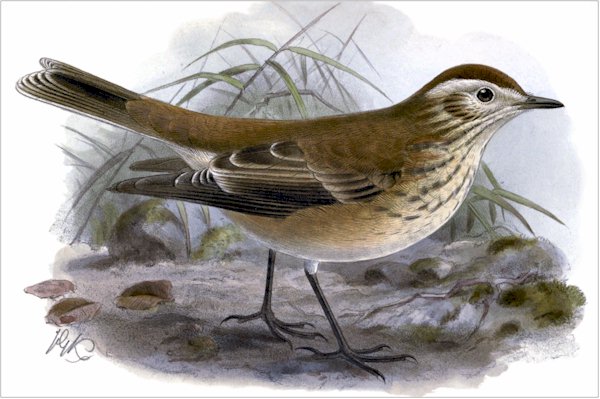
Tænioptera rubetra, Burm. La-Plata Reise, ii. p. 461 (Mendoza); Hudson, P. Z. S. 1872, p. 541 (Rio Negro); Scl. et Salv. Nomencl. p. 42; Durnford, Ibis, 1877, p. 34, et 1878, p. 394 (Patagonia).
Description.—Above sandy brown, lores and superciliaries white; wings black, greater coverts and outer secondaries edged with whitish, lesser coverts like the back; tail black, outer web of the outer tail-feathers and tips of others white; below white, with black striations on the sides of the throat and on the breast; flanks, under wing-coverts, and inner webs of the primaries deep rufous; two outer primaries acuminated: whole length 7·5 inches, wing 4·7, tail 3·2. Female rather paler, throat and breast washed with ochraceous, and outer primaries not acuminated.
Hab. Interior of Argentine Republic and Patagonia.
I have met with this bird at all seasons of the year in Patagonia on the Rio Negro, and think it probable that it has no migration. It is seen in flocks of twenty or thirty individuals, and in its lively actions when on the wing, and in its habit of perching on a bush or elevation of some kind, from which it pounces down on an insect seen on the ground, it resembles other Tæniopteræ; but it runs about on the ground a great deal, and in this respect is more like a Myiotheretes or Muscisaxicola. In its colour it also diverges widely from the typical Tæniopteras in their black and white Dominican plumage. The whole upper parts are light chestnut, with a white mark on the side of the head; wings and tail dark, tipped with pale rufous; throat, breast, and belly whitish rufous, with dark lines on throat and bosom. The chestnut hue in the female is paler and mixed with grey.
118. OCHTHŒCA LEUCOPHRYS (d’Orb. et Lafr.).
(WHITE-BROWED TYRANT.)
Ochthœca leucophrys, Scl. et Salv. Nomencl. p. 42; White, P. Z. S. 1882, p. 603 (Catamarca).
Description.—Above dark cinereous, rump rufescent; wings black, cross-bands on wing-coverts and edges of outer secondaries rufous; tail blackish, outer web of external rectrix white; beneath pale cinereous; lower belly, crissum, and under wing-coverts white; bill and feet black: whole length 5·2 inches, wing 3·0, tail 2·7.
Hab. Bolivia and Northern Argentina.
A single specimen of this bird was obtained by White at Fuerte de Andalgala, Catamarca, in September 1880, during a snow-storm.
119. SAYORNIS CINERACEA (Lafr.).
(ASHY TYRANT.)
Sayornis cineracea, Scl. et Salv. Nomencl. p. 43. Aulanax latirostris, Cab. J. f. O. 1879, p. 335 (Tucuman).
Description.—Above dark cinereous; head sooty black; wings and tail blackish, outer margins of the wing-coverts and secondaries and outer web of the external tail-feather white; below sooty black, middle of belly and under wing-coverts white, flanks and crissum dark cinereous; bill and feet black: whole length 9·5 inches, wing 3·4, tail 3·1. Female similar.
Hab. Colombia, Venezuela, Ecuador, Peru, Bolivia, and N. Argentina.
Examples of this wide-ranging species, obtained by Döring in Tucuman, are referred by Dr. Cabanis to his subspecies “latirostris,” which seems to us hardly distinct from S. cineracea.
120. FLUVICOLA ALBIVENTRIS (Spix).
(WHITE-BELLIED TYRANT.)
Fluvicola albiventris, Scl. et Salv. Nomencl. p. 43; Durnford, Ibis, 1878, p. 59 (Buenos Ayres).
Description.—Above black; front half of head, narrow band across the rump, and slight edgings to wing-coverts and outer secondaries white; below white; bill and feet black: whole length 5·5 inches, wing 2·8, tail 2·2. Female similar.
Hab. Amazonia, Bolivia, and Argentine Republic.
The small black-and-white Tyrant is not uncommon in the marshes and on the river-margins in the Plata district, its spring migration extending south to Buenos Ayres. Like the Kingfisher, it haunts the water-side and is found nowhere else. It has a shy, retiring disposition, concealing itself in the close thickets overhanging a stream, so that one does not often see it, notwithstanding its conspicuous white plumage. When disturbed it emits a series of low ticking notes, or darts swiftly out from the thicket, showing itself for a moment over the water before disappearing once more into its hiding-place.
D’Orbigny says it makes a purse-shaped nest, of slender twigs, moss, and feathers neatly interlaced, and lays four white eggs, spotted at the large end with brown.
121. ARUNDINICOLA LEUCOCEPHALA (Linn.).
(WHITE-HEADED TYRANT.)
Arundinicola leucocephala, d’Orb. Voy., Ois. p. 334 (Corrientes).
Description.—Black; whole head and neck and a patch on the flanks white; bill horn-colour, base of lower mandible white; feet black: whole length 5·0 inches, wing 2·5, tail 1·8. Female above cinereous; front and sides of head whitish; tail black; beneath white, flanks and under wing-coverts cinerascent.
Hab. Colombia and southwards to Argentina.
This species, which is of wide distribution, was met with in Corrientes by d’Orbigny.
122. ALECTRURUS TRICOLOR, Vieill.
(COCK-TAILED TYRANT.)
Alectrurus tricolor, Scl. et Salv. Nomencl. p. 43.
Description.—Above black, rump greyish; sides of the head, scapularies, lesser wing-coverts, and outer margins of secondaries white; tail black, outer rectrix on each side produced, expanded, fan-shaped; below white, patch on each side of the breast (forming an incomplete collar) black; bill horn-colour; feet black: whole length 7·2 inches, wing 2·8; tail, outer rectr. 2·5, middle rectr. 1·5. Female: above brown, rump and lesser wing-coverts pale; beneath dirty white, sides of breast brown.
Hab. S. Brazil, Paraguay, Uruguay, and Argentine Republic.
This species generally resembles the one next described, and has, like it, a black, white, and grey plumage. But the tail, although strange, is constructed on a different pattern. The total length of the bird is five and a half inches, the tail being only two and a half. The two outer tail-feathers have remarkably stout shafts, with broad coarse webs, and look like stumps of two large feathers originally intended for a bigger bird, and finally cut off near their base and given to a very small one. In the male these two feathers are carried vertically and at right angles to the plane of the body, giving the bird a resemblance to a diminutive cock; hence the vernacular name ‘Gallito,’ or Little Cock, by which it is known.
I have not observed this species myself, but Azara has the following paragraph about its habits:—“The male sometimes rises slowly and almost vertically, with tail raised, and rapidly beating its wings, and looking while ascending in this way more like a butterfly than a bird; and when it has reached a height of ten or twelve yards, it drops obliquely to the earth and perches on a stalk.” He adds that the males are solitary, but several females are sometimes seen near together, and that the females are greatly in excess of the males.
123. ALECTRURUS RISORIUS (Vieill.).
(STRANGE-TAILED TYRANT.)
Alectrurus guira-yetapa, Scl. et Salv. Nomencl. p. 43; Durnford, Ibis, 1878, p. 60 (Buenos Ayres). Alectrurus risorius, Barrows, Bull. Nutt. Orn. Cl. viii. p. 140 (Entrerios). Alectrurus psalurus, Burm. La-Plata Reise, ii. p. 457 (S. Luis).
Description.—Above black, rump grey; front varied with white; wings black, scapularies, outer margins of wing-feathers and coverts white; tail black, two outer rectrices much elongated, denuded at the base, with a broad inner and no outer vane; below white, broad band across the breast black; throat in the breeding-season bare of feathers and of a bright orange; bill yellowish; feet black: whole length 11·0 inches, wings 3·0; tail, outer rectrices 8·0, middle 2·0. Female: above brown, wings varied with white; beneath white; breast-band pale brown; tail with the two outer rectrices slightly elongated and denuded, terminated with spatulations on the inner vane.
Hab. S. Brazil, Paraguay, Uruguay, and Argentine Republic.
Azara named this species Cola estraña (Strange-tail), but mentions incidentally that its Guarani name is ‘guira-yetapá’ (Scissor-tail), a term which the Indians apply indiscriminately to several species having the same sort of tail.
The Guira-yetapá is a very curious little bird, with a black, white, and grey plumage and the beak of a true Tyrant; but it differs from all its congeners in having the skin of the chin, throat, and sides of the head bare of feathers, and these parts in the breeding-season are a bright orange colour. It is a feeble flier, its wings being very short, while the two outer tail-feathers are abnormally long and peculiar in form. Mr. Barrows says:—“The remarkable condition of the outer pair of tail-feathers is interesting. In the male these two feathers reach a length of nearly ten inches, the rest of the tail being about three inches in length. The vane on the inner side of each is wanting for the first two inches, and then suddenly develops to a width of nearly two inches, which it maintains almost to the tip, when it gradually narrows. The vane on the outer side of the shaft is only about one-quarter of an inch wide, and is folded so tightly against the shaft that it is quite inconspicuous. In the only two males of this species which I have seen flying, these long feathers seemed to be carried folded together beneath the rest of the tail, and stretching out behind like a rudder or steering-oar, their vanes at right angles to the plane of the rest of the tail.”
Mr. Gibson gives a different account, and says the flight is singularly feeble, resembling the fluttering passage of a butterfly through the air, while the tail streams out behind.
It inhabits Paraguay, Uruguay, and the eastern portion of the Argentine Republic, ranging as far south as the pampas in the neighbourhood of Patagonia. It is usually seen singly or in pairs; Azara says he saw a flock of thirty individuals, but as they were all females, it may be that in this species, as in Lichenops perspicillata, the females are sometimes gregarious, and the males always solitary. It frequents open places, such as the borders of marshes, or plains covered with tall grasses, and perches in a conspicuous place, from which it darts at passing insects like a Flycatcher.
Mr. Gibson found its nest on the ground amongst herbage, and describes it as a neat structure of dried grass, containing three white eggs with a faint cream-coloured tinge.
124. CYBERNETES YETAPA (Vieill.).
(YETAPA TYRANT.)
Cybernetes yetapa, Scl. et Salv. Nomencl. p. 43; White, P. Z. S. 1882, p. 604 (Itapua, Misiones).
Description.—Above hoary grey, with lineiform blackish shaft-stripes; wings black, with large chestnut-brown patch occupying the outer webs of the inner primaries; tail of twelve much graduated feathers, black; outer web of external rectrices white; beneath same as above, but rather paler; throat and crissum white; patch on each side of the neck, and collar across the neck dark chestnut-brown; under wing-coverts and inner webs of wing-feathers white; bill pale brown; feet black: whole length 16·0 inches, wing 5·0; tail, extreme rectrix 12·5, middle 2·6. Female similar, but less bright.
Hab. S.E. Brazil, Paraguay, Bolivia, and Northern Argentina.
Azara found this singular species not uncommon in Paraguay, and since his brief notice of it in the ‘Apuntamientos’ nothing concerning its habits has been recorded. It has a somewhat laboured flight, he says; lives in pairs or families, frequenting low or marshy grounds, where it perches on the summit of the reeds or bushes, and flies down to the ground to capture insects. It also occasionally dashes after passing insects, taking them on the wing. It has a loud whistle, which it utters frequently without any variation.
125. SISOPYGIS ICTEROPHRYS (Vieill.).
(YELLOW-BROWED TYRANT.)
Sisopygis icterophrys, Hudson, P. Z. S. 1868, p. 141; Scl. et Salv. Nomencl. p. 43; Durnford, Ibis, 1877, p. 176 (Buenos Ayres); Gibson, Ibis, 1880, p. 29 (Buenos Ayres): White, P. Z. S. 1882, p. 604 (Buenos Ayres); Barrows, Bull. Nutt. Orn. Cl. viii. p. 141 (Entrerios). Tænioptera icterophrys, Burm. La-Plata Reise, ii. p. 460 (Paraná).
Description.—Above bright olive-green, head rather greyish, lores and superciliary stripes yellow; wings blackish, broad ends of coverts and outer edges of secondaries dirty white; tail blackish; beneath bright yellow, sides of breast and flanks olivaceous; under wing-coverts whitish; bill dark horn-colour; feet black: whole length 6·1 inches, wing 3·5, tail 2·7. Female similar, but less bright.
Hab. S.E. Brazil, Paraguay, Uruguay, Northern La Plata, and highlands of Bolivia and Peru.
This small and pretty Tyrant-bird is quite common in the woods along the Plata, and is also seen a great deal in orchards and groves in the cultivated districts. In Buenos Ayres it is a summer visitor, appearing there in October, and is a shy, solitary bird, which catches insects on the wing, and rarely visits the ground.
The nest is placed in a tree, ill-concealed, and very shallow: it is built of fine sticks, and lined with fine grass, horse-hair, and feathers. The eggs are four, pointed, pale cream-colour, with large dark red spots, chiefly at the larger end.
The only language of this species is a very low plaintive whistle, uttered as a faint protest when the nest is approached.
The upper plumage is olive-green; the entire under surface and a stripe on the side of the head pure yellow; wing and tail-quills dark. Total length 6¼ inches.
126. CNIPOLEGUS ANTHRACINUS, Heine.
(ASHY-BLACK TYRANT.)
Cnipolegus anthracinus, Scl. et Salv. Nomencl. p. 43; Salv. Ibis, 1880, p. 356 (Salta); Döring, Exp. al Rio Negro, Zool. p. 24 (Patagonia). Cnipolegus aterrimus, White, P. Z. S. 1882, p. 604 (Misiones). Cnipolegus hudsoni, White, P. Z. S. 1883, p. 39 (Cordova)? Myiarchus fasciatus, Leybold, J. f. O. 1865, p. 402 (Mendoza), ♀.
Description.—Above dull black, a broad bar across the vanes of the inner webs of the wing-feathers white; bill plumbeous; feet black: whole length 6·3 inches, wing 3·5, tail 3·0. Female ashy brown; rump, upper tail-coverts, and basal portions of tail bright rufous; wings blackish, with two white transverse stripes; beneath pale fulvous, white on the belly; bill and feet black.
Hab. Northern Argentina.
Unfortunately very little is yet known about the habits of these interesting little Tyrant-birds, for which I should like to suggest the common name “Spectacular,” for reasons I shall say more about when I come to describe the Lichenops perspicillatus, a species which undoubtedly belongs to this peculiar well-defined group. The plumage of the male is, in most cases, intensely black, and there is a pure white bar on the remiges, hidden when the bird is perched, and when it flies made doubly conspicuous by the peculiar motion of the wings. In all the known species the female has a dull brown plumage, lined or mottled with dusky tints, and with some portion of the wing-quills marked with rufous or chestnut colour.
The Ashy-black Tyrant inhabits the Mendoza district, and is also a summer visitor in Patagonia, where it was obtained by Dr. Döring. Speaking of its habits, he says the male is solitary, perches on the summit of a bush or dry twig, emits at intervals a song or call composed of two syllables, plaintive and flute-like in character, and uttered while the bird rises up a few feet into the air. During this performance the white bands on the wings are displayed conspicuously and a humming sound is produced.
127. CNIPOLEGUS HUDSONI, Scl.
(HUDSON’S BLACK TYRANT.)
Cnipolegus hudsoni, Scl. P. Z. S. 1872, p. 541, pl. xxxi. (Rio Negro).
Description.—Uniform dull black; a broad bar across the bases of the inner webs of the wing-feathers white; two outer primaries much pointed at their extremities; bill plumbeous, feet black: whole length 6·0 inches, wing 2·8, tail 2·6.
This species is at once distinguishable from the preceding (C. anthracinus) by its smaller size and the peculiar narrowed outer remiges.
Hab. Northern Patagonia.
This species is found in the western provinces of the Argentine Republic, and, like C. anthracinus, which it closely resembles, is a summer visitor in Patagonia, where it makes its appearance in October. The plumage is intense black, with the inner webs of the remiges at their base white, but the wing-band, which is over an inch in breadth, shows only when the bird flies. There is also a small white spot on the flank, scarcely visible, and excepting for this speck the bird at rest appears entirely black. When it flies the white band appears suddenly, producing a curious effect, for the wings are opened and shut successively and with great rapidity, making the white band appear like a succession of flashes. All the movements of the bird are eccentric to a degree. It selects a dead twig on the summit of a bush, and this perch it occupies during many hours every day. Occasionally it darts after a passing insect, but I believe it feeds principally on the ground, like Lichenops perspicillatus. At intervals it quits its perch very suddenly and revolves round it with the rapidity of a moth whirling round the flame of a candle, the wings producing a loud humming sound, and the bird uttering a series of sharp clicking notes. During this performance the white wing-band appears like a pale mist surrounding the bird. This fantastical dance over, it resumes its perch, and, until moved to a second display, sits as motionless as a bird carved out of jet.
128. CNIPOLEGUS CYANIROSTRIS (Vieill.).
(BLUE-BILLED TYRANT.)
Cnipolegus cyanirostris, Burm. La-Plata Reise, ii. p. 457 (Mendoza): Scl. et Salv. Nomencl. p. 43; Barrows, Bull. Nutt. Orn. Cl. vol. viii. p. 141 (Entrerios).
Description.—Uniform dull black; inner webs of the wing-feathers margined with dull white; bill plumbeous, feet dark brown: whole length 5·7 inches, wing 3·0, tail 5·6. Female dark cinnamomeous brown, brighter on the head and rump; wings blackish, wing-coverts and secondaries edged with pale rufous; tail blackish brown, outer margins of outer rectrices and inner webs of all the rectrices, except the two middle, bright rufous; below pale fulvous, densely striated with blackish; bill and feet brown.
Hab. S. Brazil, Paraguay, Uruguay, and La Plata.
In size this species of Black Tyrant is but slightly smaller than the one described, and the colour is also of an intense black, but the white wing-band is less conspicuous, the borders only of the inner webs of the quills being white. It also differs in having a bright blue beak and red eyes. Azara discovered it in Paraguay, and described the brown-plumaged female as a distinct species. He merely says that it sits on the summit of a bush and darts after passing insects, but it will, no doubt, be found to possess some curious performing habits like the other species of the genus.
Mr. Barrows met with this species on the Lower Uruguay, in the month of September, and Burmeister obtained it near Mendoza.
129. CNIPOLEGUS CABANISI, Schulz.
(CABANIS’S TYRANT.)
Cnipolegus cabanisi, Schulz, Journ. f. Orn. 1882, p. 462.
Description.—Nearly uniform olivaceous slate-colour; below rather paler; wings and tail black: whole length 6·0 inches, wing 3·4, tail 3·1. Female brownish olive, below paler; wings blackish, slightly edged with rufous; tail black, with broad rufous margins to the inner webs, and narrow similar margins to the outer webs; bill and feet brown.
Hab. Tucuman.
This is one of Herr Schulz’s discoveries in Tucuman. He met with it, in the month of January, in the mountainous districts of that province.
130. CNIPOLEGUS CINEREUS, Scl.
(CINEREOUS TYRANT.)
Cnipolegus cinereus, Scl. et Salv. Nomencl. p. 43; Döring, Journ. f. Orn. 1878, p. 197 (Cordova); Salvin, Ibis, 1880, p. 357, pl. x. (Tucuman, Salta).
Description.—Dark cinereous, paler and more olivaceous on the back and wings; edges of wing-coverts and secondaries rather lighter; below paler, throat and breast blackish, like the head; inner margins of wing-feathers whitish; outer primaries acuminated; bill plumbeous, feet black: whole length 4·6 inches, wing 2·2, tail 2·3. Female brownish cinereous; cap and rump rufous; wings blackish, tips of coverts and edges of outer secondaries whitish; tail blackish, inner webs of all the lateral rectrices, except the tips, rufous; beneath whitish.
Hab. Northern Argentina.
131. LICHENOPS PERSPICILLATUS (Gm.).
(SILVER-BILL TYRANT.)
Lichenops perspicillatus, Burm. La-Plata Reise, ii. p. 457 (La Plata to Mendoza); Scl. et Salv. P. Z. S. 1868, p. 141 (Buenos Ayres); iid. Nomencl. p. 43; Hudson, P. Z. S. 1869, p. 432 (Buenos Ayres); Gibson, Ibis, 1880, p. 21 (Buenos Ayres); White, P. Z. S. 1882, p. 604 (Buenos Ayres); Barrows, Bull. Nutt. Orn. Cl. vol. viii. p. 141 (Entrerios, Azul).
Description.—Uniform black; primaries pure white, with black tips and bases; fleshy ring around the eye and bill yellow, feet black: whole length 5·6 inches, wings 3·5, tail 2·4. Female above dark brown, with light brown edgings to the feathers; remiges chestnut, with dark-brown tips; wing-coverts dark brown with fulvous tips; beneath fulvous white, breast with dark striations; under wing-coverts fulvous; bill yellowish, feet black.
Hab. Southern Bolivia, S.E. Brazil, Paraguay, Uruguay, La Plata, Chili, and Patagonia.
Naturalists have said a great deal about the well-known Silver-bill (the most important member of my “Spectacular” group), the question as to whether the black and red birds are sexes or two distinct species having long remained unsettled. Azara, writing in the last century, under the heading Pico de Plata, rightly described the red bird as the female of the black; but, unfortunately, in another part of his work he described the female again as a different species, naming it Suiriri chorreado. Darwin also separated the sexes, and gave the name of Lichenops erythropterus to the red-plumaged bird. The following extract gives only a portion of his argument, and is interesting to read, even now, when the question has been finally set at rest, as it shows how much the two birds differ:—“The tail of L. erythropterus is squarer and contains only ten feathers instead of twelve: the wing is 4⁄10 of an inch shorter; and the secondaries relative to the primaries are also shorter. The red colour on the primaries represents but does not correspond with the white on the black feathers of L. perspicillatus; and the secondaries in the two birds are quite differently marked. In L. erythropterus the third, fourth, and fifth primaries are the longest, and are equal to each other; the second is only a little shorter than the third. In L. perspicillatus the third is rather shorter than the fourth and fifth; and the second is proportionately shorter relative to the third, so that the outer part of the wing in this species is more pointed than in L. erythropterus. The outer claw in the latter species is only in a small degree straighter than in the former; and this, considering that L. perspicillatus is generally perched, and when on the ground can only hop, and that L. erythropterus feeds there entirely, and walks, is very remarkable.”
When one considers the habits of the two birds, even where they are most abundant and seen continually, it is indeed difficult to believe that they are of the same species. They are never seen associating together, even in the love-season, and when I have watched a pair actually engaged in constructing their nest, they appeared to keep as far apart as possible. More than that, the male, while unfriendly towards all other species, appears to cherish a special antipathy against the red bird; and when one comes near him never fails to pursue it with the greatest virulence from the neighbourhood. He is also strictly solitary, but the red birds frequently unite in small parties, especially in autumn, when I have often seen as many as a dozen together.
Altogether the Silver-bill has been a puzzle in the past, and it would now appear, from some recent observations made by Mr. Barrows, that we have not yet got to the end of all the curious points in its habits. Without doubt it is migratory. Its range extends from Paraguay to Patagonia, where it is not common. In Paraguay and the hotter parts of the Argentine country it is probably stationary; in Buenos Ayres, where it is most abundant, many individuals remain all the year in sheltered places, and the migration appears to become more definite the further south we get. Mr. Barrows travelled south across the pampas in the autumn, and says:—“The species was met with at all points visited, but south of the Azul not a single male in the black plumage was seen, though the brown birds (presumably females or young) were met with almost every day for nine weeks, and frequently in large numbers. Of course I began to suspect that the males must moult into a brown suit after nesting, as do our Bobolinks and many other birds, but I shot specimens at various times, and all proved to be either females or young males, and as I was confident that at Concepcion black males were to be found through the year, I was at a loss for an explanation, and am so still.”
The male Silver-bill is entirely black, there is nothing in nature blacker than its plumage; and, to enhance the effect, the beak is of a very delicate primrose-yellow, which at a little distance appears white, hence the vernacular name. The eye, and broad free skin surrounding it, which is ruffed like an Elizabethan collar, are of the same faint primrose hue. The secondary wing-quills are pure white, but the white is only displayed when the bird flies. The female has the naked skin encircling the eye, but its colour, as also that of the beak, is much darker than in the male. Entire upper plumage dark brown; secondaries chestnut; lower parts fawn-colour, marked with brown. The young males are at first like the females in colour, and do not acquire the black plumage until the end of the summer.
The bird ranges over the whole of the Argentine Republic, and, according to Gay, is also common throughout Chili, where it is known as the Colegial (Collegian or learned person), on account of its stiff grave manner, black dress, and spectacled appearance.
The male is a solitary bird, and feeds chiefly on the ground, running rapidly about in open places like a Muscisaxicola. It is also frequently seen perched conspicuously on the summit of a tall stalk or bush, and occasionally making a dart into the air after passing insects, showing in this habit his relationship with the Tyrant-birds. But he perches on an elevation less to watch for insects than for the purpose of his curious spectacular performance. This highly eccentric habit is strikingly like that of Cnipolegus hudsoni; and I have no doubt that all the Cnipolegi possess similar habits. Both birds perch on a conspicuous place, upright, motionless, and looking more like grotesque little automata than living things; they both also leave the perch suddenly, as if shot from it by means of a steel spring. This singularly sudden movement, and the motion of the wings, rapid as in the Humming-bird, or shut and opened alternately and exhibiting the white wing-colour in a series of flashes, seems related to the conspicuous white mark. In both species, also, the wings make a humming sound during flight. The motions of the Silver-bill are, however, in some respects different from those of the Cnipolegus. Springing from its perch at intervals, it darts vertically to a height of about fifteen yards, then turns a summersault, uttering at the same moment a shrill-sounding little cry, after which it drops down again and alights on its perch suddenly, as if jerked back to it, and there remains stiff, erect, and motionless as before.
The nest is made of dry grass in a thistle-bush or clump of reeds, and is rather deep and cup-shaped. The eggs are four in number, white, and spotted at the larger end with dark red.
132. MACHETORNIS RIXOSA (Vieill.).
(SHORT-WINGED TYRANT.)
Machetornis rixosa, Burm. La-Plata Reise, ii. p. 458 (Paraná); Scl. et Salv. P. Z. S. 1868, p. 142; iid. Nomencl. p. 44; Hudson, P. Z. S. 1874, p. 173 (Buenos Ayres); Durnford, Ibis, 1877, p. 177 (Buenos Ayres); Salvin, Ibis, 1880, p. 357 (Salta); Barrows, Bull. Nutt. Orn. Cl. viii. p. 142 (Entrerios).
Description.—Above brownish olive; wings and tail brown, the latter terminated by a yellowish band; middle of cap occupied by a scarlet crest; beneath bright yellow, paler on the throat; bill and feet black: whole length 7·2 inches, wing 3·9, tail 3·5. Female similar, but rather duller. Young without the scarlet crest.
Hab. S.E. Brazil, Bolivia, Paraguay, Uruguay, and La Plata.
This species, found in the open districts throughout South America, from Venezuela to Buenos Ayres, where it is quite common, has very interesting habits. It is seven inches and a half long, has a plump body, short wings, and long legs. The upper plumage is light brown, the throat, breast, and belly yellow, and the male has a concealed crest of a bright orange-red colour.
It resembles the true Tyrants in disposition, in its shrill piercing language, and in the habit of perching and breeding in trees. On the other hand, like the long-legged Myiotheretes, that lives on the open plains, it feeds exclusively on the ground, over which it runs with a speed possessed by few perching species. The general impression one forms is that in manners and appearance the Short-winged Tyrant is quite unlike any other species, though all its habits are to be found in one or other of the various groups comprising the Tyrannidæ.
These birds have no migration, but pair for life, and always remain on the same spot, and will continue to breed in the same hole for many years, even where they are frequently deprived of their eggs. Azara saw them sometimes uniting in small flocks in Paraguay; in Buenos Ayres they are always seen in pairs, or, after the young have left the nest, in families. They prefer to live near a human habitation, where there are trees: even one tree, in which they can breed and find shelter at night, will be sufficient to attach them to a dwelling, so great is their partiality for the clean-trodden ground where they can freely run about and catch insects. They haunt the cattle-pens, and become extremely familiar with the cows, horses, and sheep, following them to the pasture-grounds, where they are often seen perched on the back of a horse or other domestic animal, or stationed close to its nose on the ground, watching for insects. On the bare ground they run about with wonderful swiftness, and are able to overtake and capture flying insects without rising. The male and female invariably hunt together, and at intervals fly to some favourite perch to indulge in a duet composed of loud, rapid, shrill notes, somewhat metallic in sound. Though able to fly swiftly when in pursuit of a passing hawk or other bird, at other times their flight is strangely slow; the round body, short blunt wings and tail giving the bird a somewhat curious appearance as it progresses laboriously through the air. I have frequently seen them make the most unprovoked assaults on birds of an inoffensive kind; possibly they are in these attacks moved by a playful rather than by a vindictive spirit. I once saw one drop like a stone from a height of fifty yards on to a Pigeon perched on a leafless tree. The Pigeon fell as if shot to the earth; the Tyrant-bird then released his hold; the Pigeon rushed away terrified through the trees, while its persecutor rose high up in the air and resumed its journey.
I have elsewhere spoken of the wars waged by this bird against other species, all seeking to gain possession of the large nest of Anumbius acuticaudatus. A hole in the trunk of a tree is also a favourite breeding-place. The nest is neatly built of slender twigs and leaves, and lined with horse-hair. The eggs are slightly oval, and densely marked with dark brown spots or stripes on a white or brownish-white ground.
133. MUSCISAXICOLA MACLOVIANA (Garn.).
(CHIN-SPOTTED TYRANT.)
Muscisaxicola mentalis, Hudson, P. Z. S. 1872, p. 541 (Rio Negro); Scl. et Salv. Nomencl. p. 44.
Description.—Above cinereous, lores blackish, cap brown; tail-coverts and tail black, outer margins of outer tail-feather white; below pale cinereous, passing into white on lower belly, crissum, and under wing-coverts; chin-spot brown: bill and feet black: whole length 6·1 inches, wing 4·1, tail 2·6. Female similar, but chin-spot not so well marked.
Hab. Peru, Bolivia, Chili, Patagonia, and Falkland Islands.
This South-Patagonian species is one of a Chilian group of Tyrant-birds which resemble in their habits the Saxicolæ of Europe. The plumage is generally grey, with more or less rufous colour on the crown; they have long legs, and run swiftly on the ground, frequent open sterile situations, and perch only occasionally on trees.
The present bird is about seven inches long; the upper parts are dull grey, except the crown, which is dark chestnut; under surface light grey, and tail nearly black. In the month of June I met with these birds on the Rio Negro, on their arrival there from the south. They went in flocks of a dozen or twenty birds; they had a swift easy flight, were shy and restless in their manner, and uttered low plaintive whistling notes. When a flock alights on the ground the birds all instantly scatter, running rapidly about in all directions over the bare ground. Occasionally one was seen to perch on some slight elevation, and dart like a Flycatcher after passing insects.
Darwin saw this bird as far north on the Atlantic coast as Bahia Blanca. He also found it at Tierra del Fuego, where it lives entirely on the sea-beaches; and in the sterile upper valleys of the Chilian Andes, at a height of ten thousand feet, where the last traces of vegetation occur and where no other bird lives.
134. MUSCISAXICOLA RUFIVERTEX, d’Orb. et Lafr.
(RED-TOPPED TYRANT.)
Ptyonura rufivertex, Burm. La-Plata Reise, ii. p. 461 (Mendoza).
Description.—Above clear cinereous; lores and short superciliaries whitish; well-defined nape-patch bright rufous; wings brownish; upper tail-coverts and tail black, outer margin of outer rectrix white: below clear cinereous white, brighter on lower belly, crissum, and under wing-coverts; bill and feet black: whole length 6·5 inches, wing 4·0, tail 2·8. Female similar.
Hab. Peru, Bolivia, Chili, and Western Argentina.
135. MUSCISAXICOLA MACULIROSTRIS, d’Orb. et Lafr.
(SPOT-BILLED TYRANT.)
Muscisaxicola maculirostris, Scl. et Salv. Nomencl. p. 44; Durnford, Ibis, 1878, p. 395 (Centr. Patagonia). Ptyonura maculirostris, Burm. La-Plata Reise, ii. p. 462 (Mendoza).
Description.—Above greyish brown, lores and slight superciliaries whitish; tail-coverts and tail black, the outer web of the outer rectrix white; below pale greyish white, whiter on the belly and crissum; bill black, with the base of the lower mandible yellowish; feet black: whole length 5·5 inches, wing 3·4, tail 2·4. Female similar.
Hab. Chili, Patagonia, Bolivia, Peru, and Western Ecuador.
Prof. Burmeister met with this species near Mendoza, in the mouths of the large torrents above the city. Durnford found it near the river Sengalen in Central Patagonia in December 1877.
136. CENTRITES NIGER (Bodd.).
(RED-BACKED TYRANT.)
Centrites niger, Burm. La-Plata Reise, ii. p. 458; Scl. et Salv. Nomencl. p. 44; Durnford, Ibis, 1878, p. 395 (Chupat); White, P. Z. S. 1882, p. 604 (Buenos Ayres); Döring, Exp. al Rio Negro, Zool. p. 42 (R. Colorado); Barrows, Bull. Nutt. Orn. Cl. viii. p. 142 (Entrerios, Pampas).
Description.—Above and below deep black: whole of back except the rump and scapularies chestnut; bill and feet black; under wing-coverts and wings below black: whole length 5·0 inches, wing 2·8, tail 1·9. Female above brown, back fulvous red; tail black; below ashy brown.
Hab. Patagonia, Chili, and Argentina.
The little Red-backed Tyrant comes nearest to Muscisaxicola mentalis in habits, but does not perch on bushes and trees, and is less gregarious than that bird. It is the smallest of all those varied members of the Tyrannine family which have abandoned forests and marshes and the pursuit of insects on the wing, to live on the wintry uplands of Patagonia, and on the sterile plains bordering on the Andes.
The male is only five and a quarter inches long. The entire plumage of the male is intensely black, except the back, which is bright chestnut. The inside of the mouth and tongue are vivid orange-yellow. The chestnut colour on the female is pale, the rest of the plumage grey, except the quills, which are dark.
Its summer home is in the southern portion of Patagonia, but its nesting-habits are not known. In March it migrates north, and is very common everywhere on the pampas throughout the winter. They arrive in small parties of three or four, or in little loose flocks of about a dozen individuals, travelling with a swift low flight. Males, females, and young, grey like the last, arrive together; shortly after arriving the young males become mottled with black, and before leaving acquire the adult plumage. They appear to leave in spring all together, but from a note by Durnford it would appear that the males travel in advance of the females. He says:—“Males of this species were common at Chupat throughout September and during the first few days of October. On the 5th of the latter month I observed the first females, which gradually increased in number.”
The Little Red-backs inhabit open unsheltered plains, and have so great a predilection for bare ground on which they can run freely about, that on their arrival on the pampas, where the earth is thickly carpeted with grass, they are seen attaching themselves to roads, sheep-pens, borders of streams, vizcacha villages, and similar places. They are exceedingly restless, running swiftly over the ground, occasionally darting into the air in pursuit of small flies, and all the flock so scattered that there will be a dozen yards between every two birds. Mr. Barrows describes their lively habits very well:—“I think this is one of the most restless birds I ever saw. You cannot depend upon him to be in the same place two consecutive half-seconds. He runs like a Sanderling, and whenever he keeps his feet still by accident, his wings are flirted in a way that shows his anxiety to be off. Several are usually found together, and sometimes a loose flock of a hundred or more is seen. They are very strong on the wing, sometimes mounting rapidly for several hundred feet, if suddenly startled, and after a few moments spent in circling like a Snipe, they drop again almost as suddenly as a shot, and as if from the very clouds.”
137. PLATYRHYNCHUS MYSTACEUS (Vieill.).
(BROAD-BILLED TYRANT.)
Platyrhynchus mystaceus, Scl. et Salv. Nomencl. p. 44; White, P. Z. S. 1882, p. 605 (Misiones).
Description.—Above olive, darker on the head; coronal patch bright yellow; lores, eye-region, and ear-coverts pale yellowish; mystacal stripe blackish; wings and tail blackish edged with olive-brown; below clear fulvous, much whiter on the throat; upper mandible blackish, lower whitish; feet pale yellowish: whole length 3·3 inches, wing 2·1, tail 1·1. Female similar, but no coronal patch.
Hab. Guiana, Brazil, Paraguay, and Northern La Plata.
A single example of this species was obtained by White in the forest near San Javier, Misiones.
138. EUSCARTHMUS MARGARITACEIVENTRIS (d’Orb. et Lafr.).
(PEARLY-BELLIED TYRANT.)
Todirostrum margaritaceiventer, d’Orb. Voy., Ois. p. 316 (Corrientes). Euscarthmus margaritaceiventris, Scl. et Salv. Nomencl. p. 45; Salvin, Ibis, 1880, p. 357 (Tucuman). Triccus margaritiventris, Burm. La-Plata Reise, ii. p. 456 (Paraná).
Description.—Above olive-green, wings and tail blackish edged with olive-green; whole head above, including sides and back of neck, dark cinereous; beneath pearly white, passing into pale cinereous on the sides; under wing-coverts pale yellowish, flanks tinged with olivaceous; bill hazel; feet red: whole length 4·5 inches, wing 2·1, tail 1·9.
Hab. Paraguay, Northern La Plata, Bolivia, S. Peru, and S.E. Brazil.
This species, discovered by d’Orbigny in Corrientes, was also met with near Paraná by Prof. Burmeister, and by Durnford in Tucuman.
139. EUSCARTHMUS GULARIS (Temm.).
(RED-THROATED TYRANT.)
Euscarthmus gularis, Scl. et Salv. Nomencl. p. 45; White, P. Z. S. 1882, p. 605 (Corrientes and Oran).
Description.—Olive-brown; wings blackish, wing-coverts tipped and outer secondaries edged with yellowish white, forming two distinct bands; remiges and rectrices narrowly margined with olive; head above dark cinereous; lores and sides of the head surrounding the dark ear-coverts rufous; beneath white, sides of the breast greyish; chin and sides of throat rufous, like the lores; flanks and under wing-coverts tinged with yellowish: whole length 3·5 inches, wing 1·8, tail 1·4. Female similar.
Hab. S.E. Brazil, Bolivia, and Northern La Plata.
This bird was observed by White near Oran, and also in Misiones.
140. PHYLLOSCARTES VENTRALIS (Temm.).
(YELLOW-BELLIED TYRANT.)
Phylloscartes ventralis, Scl. et Salv. Nomencl. p. 46; Barrows, Bull. Nutt. Orn. Cl. viii. p. 198 (Entrerios).
Description.—Above uniform olive; ill-defined superciliaries whitish; ear-coverts dark; wings and tail blackish with olive margins; well-defined spots on the tips of the two rows of wing-coverts and outer webs of secondaries yellowish; below yellow, rather white on the throat and olivaceous on the sides; under wing-coverts pale yellow; bill and feet blackish: whole length 4·5 inches, wing 2·1, tail 2·3.
Hab. S.E. Brazil and Northern La Plata.
This species is stated to have been met with by Mr. Barrows among the low bushes bordering the streams of Entrerios. Graf v. Berlepsch has recorded its presence in Rio Grande do Sul (Zeitschr. ges. Orn. 1885, p. 131), so that this occurrence is not improbable.
141. HAPALOCERCUS FLAVIVENTRIS (d’Orb. et Lafr.).
(REED-TYRANT.)
Arundinicola flaviventris, d’Orb. Voy., Ois. p. 335, pl. xxxi. fig. 1. Hapalocercus flaviventris, Burm. La-Plata Reise, ii. p. 456 (Mendoza); Scl. et Salv. Nomencl. p. 46; Durnford, Ibis, 1877, p. 177 (Buenos Ayres), et 1878, p. 395 (Centr. Patagonia); White, P. Z. S. 1882, p. 605 (Buenos Ayres); Barrows, Bull. Nutt. Orn. Cl. viii. p. 199 (Entrerios).
Description.—Above mouse-brown; wings and tail rather darker, with edgings like the back; vertex more or less tinged with rufous; beneath yellow; under wing-coverts pale yellow; bill and feet black: whole length 4·0 inches, wing 2·0, tail 2·0. Female similar.
Hab. S. Brazil, Paraguay, Uruguay, La Plata, and Chili.
This little bird is rarely met with in the desert pampas, but throughout the settled portion of the Buenos-Ayrean province it is one of the most common species of the Tyrannidæ. It arrives from the north in September, and is very regular in its migrations, although apparently a very feeble flier. It frequents open grounds abounding in thistles, tall weeds, or bushes, and is consequently most abundant about houses. It is extremely active, and occasionally darts after a passing insect and captures it on the wing, especially soft insects, like moths and butterflies, to which it is most partial. It subsists principally, however, on small caterpillars and spiders, for which it searches diligently among the leaves, after the manner of the Wren. Although belonging to the songless division of the Passeres, this small Tyrant-bird possesses a formal song, which the male utters with great frequency, the only other member of the Tyrant-family that I am acquainted with which really sings being the Scarlet Tyrant (Pyrocephalus rubescens). The music of the Reed-Tyrant is weak but curious; it is composed of five brief percussive notes, distinctly metallic in sound, which may be imitated by gently and slowly striking fa la mi sol fa on the highest keys of the piano. To utter this quaint little song the bird perches itself on the summit of a weed or bush, where it solicits attention with a little chipping prelude, and then jerks its head vigorously with each note, delivering its few drops of sound with all the assurance of a master in the art of melody.
In October it builds a deep elaborate nest of fine dry grass, thistle-down, webs, feathers, and other soft materials, usually in the fork of a weed or thistle three or four feet from the ground. It lays four cream-coloured eggs, the colour deepening to grey at the larger end.
142. HABRURA PECTORALIS (Vieill.).
(THIN-TAILED TYRANT.)
Pachyrhamphus minimus, Gould, Zool. Voy. Beagle, iii. p. 61, pl. xv. (Monte Video). Habrura minima, Scl. et Salv. Nomencl. p. 40; Cab. Journ. f. Orn. 1878, p. 197 (Cordova); Scl. P. Z. S. 1879, p. 460 (Cordova).
Description.—Above sandy brown, with a dark-greyish tinge on the head, which is subcrested and has the vertical feathers white at their bases; lores and eye-region whitish; wings and tail blackish, edged with sandy brown, which forms in some specimens well-marked wing-bands; beneath pale sandy ochraceous, more rufous on the flanks; throat more or less freckled with black; bill and feet dark brown: whole length 4·0 inches, wing 1·9, tail 1·7. Female similar, but without the black markings on the throat.
Hab. Northern La Plata, Uruguay, Paraguay, Brazil, and British Guiana.
Examples of this species were obtained by Dr. Döring near Cordova.
143. CULICIVORA STENURA (Temm.).
(NARROW-TAILED TYRANT.)
Culicivora stenura, White, P. Z. S. 1882, p. 605 (Misiones).
Description.—Above sandy brown, striated with black; head nearly black; lores and superciliaries white; wings and tail blackish with slight brownish edgings; below pale sandy buff, more brownish on the sides of the neck and flanks; bill and feet black: whole length 3·7 inches, wing 1·7; tail, ext. rectr. 1·3, med. 1·9.
Hab. S.E. Brazil.
An example of this species is stated by White to have been obtained by him at Itapua, Misiones, in July 1881, but there was possibly an error in its identification.
144. STIGMATURA BUDYTOIDES (d’Orb. et Lafr.).
(WAGTAIL TYRANT.)
Stigmatura budytoides, Scl. et Salv. Nomencl. p. 46; Salvin, Ibis, 1880, p. 357 (Tucuman, Salta).
Description.—Above greyish olive; lores and short superciliary streak yellowish; wings blackish brown, tips of wing-coverts and outer margins of secondaries white; tail blackish, all the lateral rectrices crossed by a broad, white, median and second terminal band; under surface pale yellow; bill and feet black: whole length 5·0 inches, wing 2·1, tail 2·5.
Hab. Bolivia, Peru, Interior of Brazil, Northern La Plata.
Examples of this species were obtained by Durnford in Tucuman and Salta.
145. STIGMATURA FLAVO-CINEREA (Burm.).
(LONG-TAILED TYRANT.)
Phylloscartes flavo-cinereus, Burm. La-Plata Reise, ii. 455 (Mendoza); Döring, Exp. al Rio Negro, Zool. p. 42 (R. Negro, R. Colorado). Stigmatura flavo-cinerea, Hudson, P. Z. S. 1872, p. 542 (Rio Negro); Scl. et Salv. Nomencl. p. 46; White, P. Z. S. 1882, p. 606 (Catamarca).
Description.—Above greyish olive, lores and superciliary stripe whitish; wings blackish, with whitish edgings to the coverts and outer secondaries; tail blackish; outer web of the external rectrix and broad tips of the four external pairs white; beneath pale yellow; bill and feet black: whole length 5·8 inches, wing 2·3, tail 3·0. Female similar.
Hab. Argentine Republic, including N. Patagonia.
This little bird inhabits the Mendoza and Patagonian districts, and does not appear to be migratory, for on the Rio Negro I found it at all seasons. It is slender in form, with a long tail, its total length being six inches. The sexes are alike in colour; the upper parts are yellowish grey, breast and belly light yellow. They are found living in pairs, all the year round, in thorn bushes, and are scarcely ever seen to rest, but hop incessantly from twig to twig, in a delicate, leisurely manner, seeking on the leaves for the minute caterpillars and other insects on which they live. While thus engaged they utter a variety of little chirping and twittering notes, as if conversing together, and occasionally the two birds unite their voices in a shrill, impetuous song.
146. SERPOPHAGA SUBCRISTATA (Vieill.).
(SMALL-CRESTED TYRANT.)
Serpophaga subcristata, Burm. La-Plata Reise, ii. p. 454 (Entrerios); Scl. et Salv. Nomencl. p. 47; Durnford, Ibis, 1877, p. 177 (Buenos Ayres); White, P. Z. S. 1882, p. 606 (Misiones); Barrows, Bull. Nutt. Orn. Cl. vol. viii. p. 199 (Entrerios).
Description.—Above cinereous, usually with a slight olivaceous tinge on the rump; crest-feathers white at their bases, tipped with cinereous, and slightly varied with black; wings blackish, wing-coverts tipped with whitish, forming two handsome bands; outer secondaries externally margined with the same colour; tail dark ashy; beneath ashy white, with more or less yellowish tinge on the belly and under wing-coverts; bill horn-colour; feet black: whole length 4·5 inches, wing 2·0, tail 2·1. Female similar.
Hab. S.E. Brazil, Paraguay, Northern La Plata, and Bolivia.
This species is one of the smallest members of our Tyrannidæ, its total length being only four and a half inches. The sexes are alike; the upper plumage is grey, with a greenish tinge on the back; the breast paler grey, becoming pale yellow on the belly. There is a white concealed spot under the loose feathers of the crown.
It is quite common in Buenos Ayres, and, probably, has a partial migration, as it is most abundant in summer. In its habits it closely resembles the species last described, being always found in pairs, living in thickets, where they hop incessantly about, exploring the leaves for small caterpillars, and always conversing in low, chirping, and twittering notes. They also sing together a little confused song. The nest is fastened to the slender twigs of a low bush, and is a deep, cup-shaped and beautiful structure, composed of a great variety of soft materials bound together with spiders’ webs, the interior lined with feathers or vegetable down, and the outside with lichen. The eggs are two, bluntly pointed, and of a cream-colour.
147. SERPOPHAGA NIGRICANS (Vieill.).
(BLACKISH TYRANT.)
Serpophaga nigricans, Burm. La-Plata Reise, ii. 454 (Paraná); Scl. et Salv. Nomencl. p. 47; Durnford, Ibis, 1877, p. 177 (Buenos Ayres); White, P. Z. S. 1882, p. 606 (Misiones); Barrows, Bull. Nutt. Orn. Cl. vol. viii. p. 199 (Entrerios).
Description.—Above dull brownish cinereous; wings and tail blackish, the coverts and outer secondaries with slight edgings like the back; crest slight, with a well-marked white basal spot; beneath paler and rather purer cinereous; under wing-coverts pale cinereous; bill and feet dark horn-colour: whole length 4·7 inches, wing 2·3, tail 1·1. Female similar, but vertical spot not so well marked.
Hab. S.E. Brazil, Paraguay, La Plata, and N. Patagonia.
This species differs markedly in habits, language, and appearance from the last. In both sexes the colour is a uniform slaty grey; the tail, which the bird incessantly opens and flirts like a fan, is black; as in S. subcristata there is a hidden spot of white under the loose feathers forming the crest.
It frequents the borders of running streams, seldom being found far from a water-course; and it alights as often on stones or on the bare ground as on trees. Male and female are always seen together, for it pairs for life, and the migration, if it has any, is only partial. It flits restlessly along the borders of the stream it frequents, making repeated excursions after small winged insects, taking them in the air, or snatching them up from the surface of the water, and frequently returning to the same stand. While thus employed it perpetually utters a loud, complaining chuck, and at intervals the two birds meet, and, with crests erect and flirting their wings and tails, utter a series of trills and hurried sharp notes in concert.
The nest is generally placed beneath an overhanging bank, attached to hanging roots or grass, a few inches above the water; but it is sometimes placed in a bush growing on the borders of a stream. It is a neat, cup-shaped, but rather shallow structure, thickly lined inside with feathers. The eggs are four, pointed, white or pale cream-colour, with black and grey spots at the large end.
148. ANÆRETES PARULUS (Kittl.).
(TIT-LIKE TYRANT.)
Anæretes parulus, Burm. La-Plata Reise, ii. p. 455 (Mendoza); Hudson, P. Z. S. 1872, p. 543 (Rio Negro); Scl. et Salv. Nomencl. p. 47; White, P. Z. S. 1883, p. 30 (Cordova); Durnford, Ibis, 1878, p. 395 (Centr. Patagonia); Döring, Exp. al Rio Negro, Zool. p. 43 (R. Negro, R. Colorado).
Description.—Above cinereous, with an olivaceous tint on the lower back; head black, front varied with white, elongated vertical crest black, sometimes varied with white; wings blackish, with slight whitish tips to the coverts and whitish margins to the outer secondaries; tail blackish, outer webs of external rectrices whitish; below pale straw-colour, white on the throat; throat and breast with numerous and well-marked black striations; bill and feet black: whole length 4·0 inches, wing 1·9, tail 1·8. Female similar, but crest shorter.
Hab. Argentine Republic, including Patagonia, Chili, Bolivia, Peru, and Andes of Ecuador.
This small bird is only four and a half inches long; in both sexes the colour on the upper parts is dull grey, on the throat and breast ash-coloured; the belly pale yellow. It has the distinction of a slender curling Lapwing-like crest, composed of a few narrow, long, black feathers. The eye is white. It is found in the thorny thickets on the dry plains of Mendoza, and is also common in Patagonia. In its habits it closely resembles Serpophaga subcristata; lives always in pairs, perpetually moves about in a singularly deliberate manner while searching through the bush for small insects, the two birds always talking together in little chirping notes, and occasionally bursting out into a little shrill duet. It builds a deep, neat nest of fine dry grass and lined with feathers, in a low thorn, and lays two white eggs.
149. ANÆRETES FLAVIROSTRIS, Scl. et Salv.
(YELLOW-BILLED TIT-TYRANT.)
Anæretes flavirostris, Scl. et Salv. P. Z. S. 1876, p. 355; 1879, p. 613.
Description.—Above brownish olive; head black, mixed with white and surmounted by narrow elongated black crest-feathers; wings blackish, outer web of external rectrix whitish; beneath pale stramineous, throat and breast white, densely striated with black; under wing-coverts white; bill yellowish, with a black tip; feet black: whole length 4·2 inches, wing 2·1, tail 2·0.
Hab. Bolivia and N. Argentina.
A specimen of this species was procured, at Cosquin, near Cordova, by White.
150. CYANOTIS AZARÆ, Naum.
(MANY-COLOURED TYRANT.)
Cyanotis azaræ, Scl. et Salv. Nomencl. p. 47; Durnford, Ibis, 1877, p. 177 (Buenos Ayres, Centr. Patagonia); Gibson, Ibis, 1880, p. 32 (Buenos Ayres); Döring, Exp. al Rio Negro, Zool. p. 43 (R. Colorado, R. Negro); Barrows, Nutt. Bull. Orn. Cl. viii. p. 200 (Entrerios, Carhué, Pampas).
Description.—Above dark bronzy green; head black; superciliaries yellow; vertical spot crimson; wings black; broad tips of the lesser wing-coverts and broad edgings of some of the secondaries white, forming a large white bar on the wing; tail black, greater part of outer pair of rectrices and outer web and broad tip of next pair and narrow tips of third pair white; beneath bright ochreous yellow; chin whitish; crissum crimson; incomplete band across the lower breast black; under wing-coverts white; bill black; feet dark flesh-colour: whole length 4·2 inches, wing 2·1, tail 1·7. Female similar.
Hab. La Plata, Chili, and Western Peru.
This charming little bird is variously called by the country people All-coloured or Seven-coloured. Azara called it “The King”—a name which this species deserves, he says, not only on account of the crown of loose feathers on its head, but because it is exceeded by few birds in beauty. It is the most beautiful bird found in Chili, says Gay; and Darwin, who is seldom moved to express admiration, calls it “an exquisitely beautiful little bird.” There are many species possessing a more brilliant plumage, none with so great a variety of distinct colours; for on its minute body, which is less than that of the House-Wren, are seen black, white, green, blue, orange, yellow, and scarlet; and all these hues are disposed and contrasted in such a manner as to produce a very pleasing effect—the olive-green and delicate, yellow predominating, while the vivid scarlet is a mere spot, like the bright gem or ornament which serves to set off and enhance the beauty of the dress. The whole under plumage is pure lovely yellow, while a broad mark of velvet-black extends belt-wise from the bend of each wing, but without meeting in the centre of the bosom. The sides of the head are deep blue; over the blue runs a bright yellow stripe, surmounted with the loose, slender, almost hair-like feathers of the crown, which stand partially erect, and are blue mixed with black, with vivid scarlet in the centre. Above, from the back of the head to the tail, the colour is deep green. The wings are black, crossed with a white band; tail also black, the two outer quills pure white, and the succeeding two partially white, the white colour appearing only when the bird flies. Moreover, as though this diversity of colour were not enough, the soles of the black feet are bright orange, the eye of the male delicate sky-blue, while the female has white eyes.
While on the subject of the colouring of this species, I will mention a curious phenomenon which I have observed many times. When the bird is flying away from the spectator in a strong sunlight, and is at a distance of from twenty to thirty yards from him, the upper plumage, which is dark green, sometimes appears bright blue. At first I thought that a distinct species of Cyanotis, cerulean blue in colour, existed, but finally became convinced that the green feathers of the C. azaræ appear blue in certain lights. This seems strange, as the feathers of the back are not glossed.
The Many-coloured Tyrant is, apparently, a very feeble flier, rising reluctantly when frightened from the rushes, and fluttering away to a distance of a few yards, when it again drops down. Yet it is strictly migratory. Darwin met with it at Maldonado in the month of June, and therefore concluded that it does not migrate; but he mentions that it was very rare. I have also occasionally seen one in winter on the pampas, but many migratory species leave a few stragglers behind in the same way. At the end of September they suddenly appear all over the pampas, in every swamp and stream where there are beds of rushes; for in such situations only is the bird found: and this migration extends far into Patagonia. They are always seen in pairs amongst the dense rushes, where they perch on the smooth stems, not near the summit, but close down to the surface of the water, and perpetually hop from stem to stem, deftly picking up small insects from the surface of the water. They also occasionally leave the rushes and search for insects in the grass and herbage along the border. They are very inquisitive, and if a person approach the rush-bed, they immediately come out of their concealment, both birds uttering their singular notes—a silvery, modulated sound, not meant for a song apparently, and yet I do not know any sweeter, purer sound in nature than this. All through the close-growing dark rushes the pretty little melodists may be heard calling to each other in their delicate, gurgling notes.
The nest is a marvel of skill and beauty. As a rule it is attached to a single polished rush, two or three feet above the water and about the middle of the stem. It is cup-shaped inside, and about four inches long, circular at the top, but compressed at the lower extremity, and ending in a sharp point. It is composed entirely of soft bits of dry yellow rush, cemented together with gum so smoothly that it looks as if made in a mould. The eggs are two in number, oval, and dull creamy white, sometimes with a ring of colour at the large end.
151. LEPTOPOGON TRISTIS, Scl. et Salv.
(SORRY TYRANT.)
Leptopogon tristis, Scl. et Salv. P. Z. S. 1876, p. 254; White, P. Z. S. 1882, p. 606 (Misiones).
Description.—Above olive; cap rather darker; wings and tail blackish, margined with olive, the two rows of wing-coverts and three or four outer secondaries with clear yellowish-white apical spots; beneath pale sulphur-yellow; under wing-coverts yellow; inner margins of wing-feathers whitish: bill horn-colour; feet brown: whole length 4·4 inches, wing 2·1, tail 2·1.
Hab. Northern La Plata and Bolivia.
This bird was obtained by White near San Javier, Misiones, “amongst the lofty trees on the river-banks.” White believed that he also met with it in the Sierra de Totoral.
152. ELAINEA ALBICEPS (d’Orb. et Lafr.).
(WHITE-CRESTED TYRANT.)
Elainea modesta, Burm. La-Plata Reise, ii. p. 454. Elainea albiceps, Scl. et Salv. Nomencl. p. 48; Durnford, Ibis, 1878, p. 60 (Buenos Ayres); Barrows, Bull. Nutt. Orn. Cl. vol. viii. p. 200 (Entrerios); White, P. Z. S. 1882, p. 606 (Buenos Ayres).
Description.—Above dark ashy brown, with a slight olivaceous tinge on the rump; head slightly darker, with a more or less concealed white vertical spot; wings and tail blackish brown; tips of wing-coverts, forming two transverse bands, and outer margins of exterior secondaries dirty white; rest of wing-feathers and tail-feathers slightly margined with lighter colour; below nearly uniform pale cinereous, whiter on the throat and middle of the belly; under wing-coverts slightly tinged with yellowish; bill brownish; feet black: whole length 6·0 inches, wing 3·2, tail 3·0. Female similar.
Hab. Peru, Ecuador, Bolivia, Guiana, Brazil, Argentina, Chili, Patagonia.
A widely spread species, very common near Buenos Ayres according to White, where it is found in the clumps of trees.
153. ELAINEA STREPERA, Cab.
(NOISY TYRANT.)
Elainea strepera, Cab. J. f. O. 1883, p. 215.
Description.—Above dark greyish olive; head slightly crested, with a white basal spot; eye-ring white; wings and tail blackish, tips of wing-coverts rufous, slight margins of wing and tail-feathers olivaceous; beneath cinereous; middle of belly white; flanks olivaceous; under wing-coverts pale cinereous; bill dark brown, pale at the base; feet blackish: whole length 5·6 inches, wing 2·9, tail 2·7.
Hab. Tucuman.
Dr. Cabanis established this species, which is unknown to us, on specimens obtained by Herr Schulz in the woods of Tucuman. It is said to have a loud voice, and to feed on berries.
154. ELAINEA VIRIDICATA (Vieill.).
(GREENISH TYRANT.)
Muscicapara viridicata, d’Orb. Voy., Ois. p. 325. Elainea grata, Cab. J. f. O. 1883, p. 216 (Tucuman).
Description.—Above dark olive-green; head dark cinereous, slightly crested, with a large basal spot of bright yellow; lores and eye-region mixed with whitish; wings and tail ashy black, with slight margins of the same colour as the back; below pale cinereous; belly, crissum, and under wing-coverts sulphur-yellow; bill blackish; feet dark brown: whole length 5·0 inches, wing 2·5, tail 2·5. Female similar.
Hab. South America.
The Elainea grata, based by Dr. Cabanis upon specimens obtained by Herr Schulz in Tucuman, must, I think, be identical with Azara’s Contramaestre pardo verdoso, corona amarilla, upon which Vieillot established his Sylvia viridicata. It is certainly, in my opinion, the Muscicapara viridicata of d’Orbigny.
Herr Schulz met with this species in the province of Tucuman, in the month of December.
155. EMPIDAGRA SUIRIRI (Vieill.).
(SUIRIRI TYRANT.)
Tænioptera suiriri, Burm. La-Plata Reise, ii. p. 460 (Tucuman). Empidagra suiriri, Scl. et Salv. Nomencl. p. 49; iid. P. Z. S. 1869, p. 633 (Buenos Ayres); Cab. J. f. O. 1878, p. 197. Pachyrhamphus albescens, Gould, Zool. Beagle, iii. p. 50, t. xiv. (Buenos Ayres).
Description.—Above cinereous; wings and tail blackish, all the wing-coverts and outer secondaries broadly margined externally with white; outer web of outer tail-feathers white; outer edges of primaries and narrow ends of tail-feathers cinereous; below white, under wing-coverts pale yellowish white; bill and feet black: whole length 5·5 inches, wing 2·9, tail 2·5.
Hab. Argentine Republic, Uruguay, Paraguay, and Bolivia.
This species is stated by Prof. Burmeister to be found in Tucuman and Northern Argentina. It also occurs near Buenos Ayres, where Hudson obtained specimens for the Smithsonian Institution.
156. SUBLEGATUS GRISEOCULARIS, Sclater.
(GREY-EYED TYRANT.)
Sublegatus griseocularis, Scl. et Salv. P. Z. S. 1870, p. 17 (Mendoza).
Description.—Above cinereous; wings and tail dark ashy brown, margins of wing-coverts and outer secondaries whitish; below, throat and breast pale cinereous white; belly and under wing-coverts pale lemon-yellow; bill horn-colour; feet dark brown: whole length 5·0 inches, wing 2·8, tail 2·5. Female similar.
Hab. Southern Peru and Western Argentina.
Specimens of this species were obtained by Weisshaupt near Mendoza.
157. RHYNCHOCYCLUS SULPHURESCENS (Spix).
(SULPHURY TYRANT.)
Rhynchocyclus sulphurescens, Scl. et Salv. Nomencl. p. 49; White, P. Z. S. 1882, p. 607 (Misiones).
Description.—Above olive-green, head washed with cinereous; lores and line round the eye whitish; wings blackish brown, margined with yellowish olive; tail dark brown, slightly edged with olive-green; below sulphur-yellow tinged with olivaceous, throat more greyish; middle of the belly rather brighter; under wing-coverts pale sulphur-yellow; bill horn-colour; feet brown: whole length 5·2 inches, wing 2·6, tail 2·5. Female similar.
Hab. S. America from Northern La Plata to Veragua.
Of this very widely diffused species specimens were obtained by White, in June 1881, in the dense forests of Misiones.
158. PITANGUS BOLIVIANUS (Lafr.).
(BIENTEVEO TYRANT.)
Pitangus bellicosus, Scl. et Salv. Nomencl. p. 50; Durnford, Ibis, 1877, p. 178 (Buenos Ayres); Gibson, Ibis, 1880, p. 24 (Buenos Ayres); White, P. Z. S. 1882, p. 607 (Catamarca); Barrows, Bull. Nutt. Orn. Cl. vol. viii. p. 200 (Entrerios). Saurophagus sulphuratus, Burm. La-Plata Reise, ii. p. 452.
Description.—Above brown; head black; front, superciliaries, and line round the nape white; large vertical crest yellow, tipped with black; wings and tail brown with rufous margins; beneath sulphur-yellow, inner margins of wing- and tail-feathers pale rufous; bill and feet black: whole length 8·0 inches, wing 4·2, tail 3·3. Female similar, but yellow crest not so much developed.
Hab. Bolivia, S. Brazil, Uruguay, and Argentina.
The Bienteveo is in its habits the most interesting member of the Tyrannine family. It would be difficult to find two species more dissimilar in disposition than are the Silver-bill, already described, and the Bienteveo; the former being like an automaton, having only a few set motions, gestures, and instincts, while the other is versatile in an extraordinary degree, and seems to have studied to advantage the various habits of the Kestrel, Flycatcher, Kingfisher, Vulture, and fruit-eating Thrush; and when its weapons prove weak it supplements them with its running. How strange it is that these two species, mentally as widely separated as the Humming-bird and Crow, should be members of the same family!
The Bienteveo has a wide range in South America, and inhabits the whole of the Argentine country down to Buenos Ayres, where it is very common. It is resident and lives in pairs, the sexes being always faithful. The body is stout, somewhat large for a Tyrant-bird; the length being nine and a half inches, including the beak, which is a little over an inch in length. The wings are blunt and comparatively short, measuring, when spread, fourteen inches. The head is large, and a broad, black band extends from the beak its entire length, and above this is a pure white stripe; the crown is black, concealing in its loose, abundant feathers a brilliant yellow crest, which shows only when the bird is excited. The upper plumage, including wings and tail, is pale brown; the entire under surface sulphur-yellow. In both sexes the plumage is alike.
In Buenos Ayres the Bienteveo is found in every orchard and plantation: it is familiar with man and invariably greets his approach with loud notes—especially with a powerful three-syllabled cry, in which people fancy there is a resemblance to the words Bien-te-veo (“I see you well”); while its big head and beak, and strongly contrasted colours, especially the black and white head-stripes, seem to give it a wonderfully knowing look, as it turns its head from side to side to examine the intruder. It is a loud-voiced garrulous bird, and has a great range of sounds, from grating screams to long, clear, almost mellow call-notes. It has one pretty habit, which brings out strongly the pleasant feature in its character. Though the male and female are greatly attached, they do not go afield to hunt in company, like the Short-winged Tyrant, but separate to meet again at intervals during the day. One of a couple (say the female) returns to the trees where they are accustomed to meet, and after a time, becoming impatient or anxious at the delay of her consort, utters a very long, clear call-note. He is perhaps a quarter of a mile away, watching for a frog beside a pool, or beating, harrier-like, over a thistle-bed, but he hears the note and presently responds with one of equal power. Then, perhaps, for half an hour, at intervals of half a minute, the birds answer each other, though the powerful call of the one must interfere with his hunting. At length he returns; then the two birds, perched close together, with their yellow bosoms almost touching, crests elevated, and beating the branch with their wings, scream their loudest notes in concert—a confused jubilant noise that rings through the whole plantation. Their joy at meeting is patent, and their action corresponds to the warm embrace of a loving human couple.
I have frequently stood for the space of half an hour concealed amongst the trees where a Bienteveo was calling to her mate, cheered at intervals by the far-off faint response, for the pleasure of witnessing in the end the joyful reunion of the two birds.
Except when breeding the Bienteveo is a peaceful bird, never going out of its way to make gratuitous attacks on individuals of its own or of other species; but in the pursuit of its prey it is cunning, bold, and fierce. Like the true Tyrant-birds it preys a great deal on large insects when they are abundant in the warm season, and is frequently seen catching its prey in the air. A large beetle or grasshopper it invariably beats against a branch before devouring it. But even in summer, when insect prey is most abundant, it prefers a more substantial diet whenever such is to be had. It frequently carries off the fledglings of the smaller birds from their nests, in the face of the brave defence often made by the parents. It is also fond of fishing, and may be seen perched by the hour on a bank or overhanging branch beside a stream, watching the water like a Kingfisher, and at intervals dashing down to capture the small fry. In shallow pools, where there are tadpoles and other prey, the Bienteveo does not mind getting a little wet, but alights in the water and stands belly-deep watching for its prey. I have seen a Bienteveo standing in the water in the midst of a flock of Glossy Ibises. They are often seen, as Darwin remarks, hovering like a Kestrel over the grass, and then dashing down to seize their prey. Small snakes, frogs, mice, and lizards all minister to its appetite, and with a capture of this kind it invariably flies to the nearest stone or branch, against which it beats the life of its victim out before devouring it. I once saw one fly out of some weeds carrying a little wriggling snake of a very brittle species and about eight inches long in its beak. Alighting on a gate it proceeded to kill its capture, and at the first blow on the wood the snake flew into two pieces. A mouse gives it a great deal of trouble, for after it has been killed it cannot be devoured until reduced by repeated blows to a soft pulp, after which it is with great labour pulled to pieces and eaten. Snails and Ampullariæ are also pounded until the shell breaks. In spring they sometimes join the train of hooded gulls, guira cuckoos, cow-birds, and various other kinds which follow the plough to pick up worms and larvæ; but on the ground the Bienteveo is awkward in its motions, for it cannot run like the Tyrant-birds with terrestrial habits, but only hops. At estancia houses, when a cow is slaughtered, it comes in with the fowls, milvago hawks, and dogs, for small pickings, being very fond of fresh meat. It is a common thing to see a Bienteveo following a rural butcher’s cart, and waiting for an opportunity to dash in and carry off any small piece of meat or fat it is able to detach. In the autumn they feed very much on ripe fruit, preferring grapes, which they can swallow whole, and figs, which are soft and easily eaten.
In its nidification the Bienteveo also departs widely from the, so to speak, traditional habits of its congeners; for whereas most Tyrants make small shallow nests, this species makes a very big elaborate domed structure, and sometimes takes five or six weeks to complete it. It is placed in a tree, without any attempt at concealment, and is about a foot deep and eight or nine inches broad, and composed of a variety of soft materials, chiefly wool. The entrance is placed near the top. Outside, the nest has a very disorderly appearance, as there are always long straws and sometimes rags hanging down; the cavity is deeply lined with feathers, and is the hottest nest I know. The eggs are five, very long, pointed, cream-coloured, and spotted, chiefly at the large end, with chocolate and purple.
159. MYIODYNASTES SOLITARIUS (Vieill.).
(SOLITARY TYRANT.)
Myiodynastes solitarius, Scl. et Salv. Nomencl. p. 50; Durnford, Ibis, 1877, p. 178, et 1878, p. 60 (Buenos Ayres); White, P. Z. S. 1882, p. 607 (Salta); Barrows, Bull. Nutt. Orn. Cl. vol. viii. p. 201 (Entrerios).
Description.—Above grey, thickly covered with numerous black shaft-spots; concealed vertical crest yellow; lores and sides of the head black, superciliaries white; wings blackish, primaries slightly edged with rufous, coverts and secondaries margined externally with greyish white; tail blackish, with narrow external margins of ferruginous; below greyish white, with numerous black striations; belly and under wing-coverts tinged with yellowish and but slightly striated; bill brown, feet blackish: whole length 7·5 inches, wing 4·4, tail 3·4.
Hab. Brazil, Paraguay, Buenos Ayres.
Durnford tells us that this species is a summer visitor to the neighbourhood of Buenos Ayres, but not very common. White met with it in the forests of Campo Santo in November; and Barrows obtained specimens among the Paradise-trees in the Plaza at Concepcion, in the same month of the year.
160. HIRUNDINEA BELLICOSA (Vieill.).
(WARLIKE TYRANT.)
Hirundinea bellicosa, Scl. et Salv. Nomencl. p. 51; White, P. Z. S. 1882, p. 607 (Catamarca). Hirundinea rupestris, Scl. Ibis, 1869, p. 198, pl. v. fig. 8.
Description.—Above sooty brown; wings blackish, with a large ferruginous red blotch occupying the greater portion of the inner primaries and secondaries; rump and greater part of the tail-feathers ferruginous red; apical portion of tail-feathers blackish: beneath ferruginous red, throat greyish; under wing-coverts and inner webs of wing-feathers, except the tips, similar to the belly, but brighter; bill and feet black: whole length 7·0 inches, wing 4·3, tail 2·2. Female similar.
Hab. S.E. Brazil, Paraguay, and Northern Argentina.
This Flycatcher is by no means common in Catamarca. It is seen about the houses in pairs, but not more than one pair at a time at one dwelling, perched upon some projection, whence it darts off into the air at passing insects.
“The snap of its beak, as it dashes at the flies, can be heard a long way off. Its cry is peculiar and piteous. There is no perceptible difference in plumage between the male and female.”—White, l. s. c.
161. MYIOBIUS NÆVIUS (Bodd.).
(LITTLE BROWN TYRANT.)
Myiobius nævius, Scl. et Salv. Nomencl. p. 51; White, P. Z. S. 1882, p. 607 (Buenos Ayres); Barrows, Bull. Nutt. Orn. Cl. vol. viii. p. 201 (Entrerios).
Description.—Above brown; lores whitish; concealed vertical crest red or yellow; wings blackish, two bands across the coverts and outer margins of external secondaries pale rufous or fulvous, sometimes whitish; tail dark brown: beneath fulvous white; sides of throat, breast, and flanks more or less distinctly flammulated with brown; under wing-coverts pale fulvous; bill brown; lower mandible whitish; feet blackish: whole length 4·7 inches, wing 2·5, tail 2·3. Female similar, but crest yellow or absent.
Hab. Veragua and Cisandean South America down to Argentine Republic.
This small Tyrant-bird is a summer visitor in the Plata district; it is shy and solitary; frequents woods and plantations, and perpetually utters, like the English Redstart, its sorrowful monotonous plaint, as it flits about in the upper foliage of the trees.
The nest is placed in a bush or low tree, and built of various soft materials compactly woven together, and the inside lined with feathers or vegetable down. The eggs are four, pale cream-colour, with large, well-defined spots of dark red.
The total length of this species is less than five inches. The prevailing colour of the plumage is rufous brown on the upper, and whitish brown on the under surface. Beneath the loose feathers of the crown there is a concealed spot of orange-red.
162. PYROCEPHALUS RUBINEUS (Bodd.).
(SCARLET TYRANT.)
Pyrocephalus rubineus, Scl. et Salv. Nomencl. p. 51; Hudson, P. Z. S. 1872, p. 808; Durnford, Ibis, 1877, p. 178 (Buenos Ayres); Gibson, Ibis, 1880, p. 27 (Buenos Ayres); Barrows, Bull. Nutt. Orn. Cl. vol. viii. p. 201 (Entrerios). Pyrocephalus parvirostris, Burm. La-Plata Reise, ii. p. 456 (Entrerios).
Description.—Above very dark cinereous, crested head and body below scarlet; bill and feet black: whole length 5·2 inches, wing 2·9, tail 2·3. Female above paler cinereous, below white; breast striated with cinereous; belly more or less rosy red.
Hab. S. America, from Colombia down to Buenos Ayres.
It is in vain, I think, to attempt to make more than one species out of this widely-spread bird, though specimens from the west coast are usually smaller.
The Scarlet Tyrant is about five inches and a half long; the neck, back, wings, and tail are black, all the rest of the plumage the most vivid scarlet imaginable. The loose feathers of the crown, which form a crest, are especially brilliant, and seem to glow like a live coal amidst the green foliage. Beside this bright Tyrant-bird even the Rainbow Tanagers look pale, and the “Jewel Humming-birds” decidedly sad-coloured. It is not strange, therefore, that in South America, where it has a very wide range, it is a species well known to the country people, and that they have bestowed on it many pretty names, most of which have reference to its splendid scarlet colour. In the Argentine Republic it is usually called Churinche, from its note, also Federál and Fuegéro; in other countries Sangre de Toro (bull’s blood), and, better still, Sangre Pura. Little Soldier and Coal of Fire are also amongst its names. The Guarani tribes call it Guira-pitá (red-bird); but another Indian name, mentioned by d’Orbigny, is the best—Quarhi-rahi, which signifies Sun-born.
The Churinche appears in Buenos Ayres about the end of September, and is usually first seen in localities to which Tyrant-birds are partial, such as low grassy grounds, with here and there a stalk or bush, and near a wood or plantation. Insects are most abundant in such places; and here the Churinche is seen, perched on a twig, darting at intervals to snap at the flies after the fashion of the Flycatchers, and frequently uttering its low, plaintive note. It is very common in the woods along the Plata; every orchard on the pampas is visited by a few of them; and they are very abundant about Buenos Ayres city. Going south they become rarer; but, strange to say, a few individuals find their way to the shores of the Rio Negro, though before reaching it they must cross a high, barren country quite unsuited to them. The natives of the Carmen have no name for the Churinche, but speak of it as a bird wonderful for its beauty and seldom seen. Amongst the dull-plumaged Patagonian species it certainly has a very brilliant appearance.
A very few days after their arrival the Churinches pair; and the male selects a spot for the nest—a fork in a tree from six to twelve feet from the ground, or sometimes a horizontal bough. This spot the male visits about once a minute, sits on it with his splendid crest elevated, tail spread out, and wings incessantly fluttering, while he pours out a continuous stream of silvery gurgling notes, so low they can scarcely be heard ten paces off, and somewhat resembling the sound of water running from a narrow-necked flask, but infinitely more rapid and musical. Of the little bird’s homely, grey, silent mate the observer will scarcely obtain a glimpse, she appearing as yet to take little or no interest in the affairs that so much occupy the attention of her consort, and keep him in a state of such violent excitement. He is exceedingly pugnacious, so that when not fluttering on the site of his future nest, or snapping up some insect on the wing, he is eagerly pursuing other male Churinches, apparently bachelors, from tree to tree. At intervals he repeats his remarkable little song, composed of a succession of sweetly modulated metallic trills uttered on the wing. The bird usually mounts upwards from thirty to forty yards, and, with wings very much raised and rapidly vibrating, rises and drops almost perpendicularly half a yard’s space five or six times, appearing to keep time to his notes in these motions. This song he frequently utters in the night, but without leaving his perch; and it then has a most pleasing effect, as it is less hurried, and the notes seem softer and more prolonged than when uttered by day. About a week after the birds have arrived, when the trees are only beginning to display their tender leaves, the nest is commenced. Strange to say, the female is the sole builder; for she now lays by her indifferent mien, and the art and industry she displays more than compensate for the absence of those beauties and accomplishments that make her mate so pleasing to the sight and ear. The materials of which the nest is composed are almost all gathered on trees; they are lichens, webs, and thistle-down: and the dexterity and rapidity with which they are gathered, the skill with which she disposes them, the tireless industry of the little bird, who visits her nest a hundred times an hour with invisible webs in her bill, are truly interesting to the observer. The lichens firmly held together with webs, and smoothly disposed with the tops outside, give to the nest the colour of the bark it is built on.
After the Churinche’s nest is completed, the Bienteveo (Pitangus bolivianus) and the Common Cow-bird (Molothrus bonariensis) are the troublers of its peace. The first of these sometimes carries off the nest bodily to use it as material in building its own; the female Cow-bird is ever on the look out for a receptacle for her eggs. Seldom, however, does she succeed in gaining admittance to the Churinche’s nest, as he is extremely vigilant and violent in repelling intruders. But his vigilance at times avails not; the subtle bird has watched and waited till, seizing a moment when the little Scarlet Tyrant is off his guard, she drops her surreptitious egg into his nest. When this happens, the Churinches immediately leave their nest. The nest is sometimes lined with feathers, but usually with thistle-down; the eggs are four, pointed, and spotted at the broad end with black; usually each egg has also a few large grey spots. The young are at first grey, marked with pale rufous, but soon become entirely grey, like the female. In about a month’s time the belly of the males begins to assume a pale mauve-red; this spreads upwards towards the breast and throat; and finally the crest also takes on this colour. The Churinches raise two broods in a season—but if the nest is destroyed, will lay as many as four times.
The Scarlet Tyrant is the first of our summer visitors to leave us. As early as the end of January, and so soon as the young of the second brood are able to feed themselves, the adults disappear. Their going is not gradual, but they all vanish at once. The departure of all other migratory species takes place after a very sensible change in the temperature; but at the end of January the heat is unmitigated—it is, in fact, often greater than during December.
When the adults have gone, the silent young birds remain. Within a month’s time the sexes of these may be distinguished. After another month the males begin to sing, and are frequently seen pursuing one another over the fields. It is only at the end of April, three months after the old birds have disappeared, that the young also take their departure. This is one of the strangest facts I have encountered in the migration of birds. The autumnal cold and wet weather seems to be the immediate cause of the young birds’ departure; but in the adults, migration appears to be an instinct quite independent of atmospheric changes.