Volume 1 — ARGENTINE ORNITHOLOGY. (continued 3)
Reading edition
In the foregoing anecdotes may be seen the peculiar habits of the young Molothrus. As the nests in which it is hatched, from those of the little Serpophaga and Wren to those of Mimus, vary so much in size and materials, and are placed in such different situations, the young Molothrus must have in most of them a somewhat incongruous appearance. But in the habits of the young bird is the greatest incongruity or inadaptation. When the nest is in a close thicket or forest, though much too small for the bird, and although the bird itself cannot understand its foster-parents, and welcomes all things that, whether with good or evil design, come near it, the unfitness is not so apparent as when the nest is in open fields and plains.
The young Molothrus differs from the true offspring of its foster-parents in its habit of quitting the nest as soon as it is able, trying to follow the old bird, and placing itself in the most conspicuous place it can find, such as the summit of a stalk or weed, and there demanding food with frequent and importunate cries. Thus the little Flycatcher had acquired the habit of perching on the back of its charge to feed it, because parent birds invariably perch above their young to feed them, and the young Cow-bird prevented this by always sitting on the summit of the stalk it perched on. The habit is most fatal on the open and closely cropped pampas inhabited by the Cachila (Anthus correndera). In December, when the Cachila Pipit rears its second brood, the Milvago chimango also has young, and feeds them almost exclusively on the young of various species of small birds. At this season the Chimango destroys great numbers of the young of the Cachila and of Synallaxis hudsoni. Yet these birds are beautifully adapted in structure, coloration, and habits to their station. It thus happens that in districts where the Molothrus is abundant, their eggs are found in a majority of the Cachilas’ nests: and yet to find a young Cow-bird out of the nest is a rare thing here, for as soon as the young birds are able to quit the nest and expose themselves they are all or nearly all carried off by the Chimangos.
Conjectures as to the Origin of the Parasitic Instinct in M. bonariensis.
Darwin’s opinion that the “immediate and final cause of the Cuckoo’s instinct is that she lays her eggs not daily, but at intervals of two or three days” (‘Origin of Species’), carries no great appearance of probability with it; for might it not just as reasonably be said that the parasitic instinct is the immediate and final cause of her laying her eggs at long intervals? If it is favourable to a species with the instinct of the Cuckoo (and it probably is favourable) to lay eggs at longer intervals than other species, then natural selection would avail itself of every modification in the reproductive organs that tended to produce such a result, and make the improved structure permanent. It is said (‘Origin of Species,’ chapter vii.) that the American Cuckoo lays also at long intervals, and has eggs and young at the same time in its nest, a circumstance manifestly disadvantageous. Of the Coccyzus melanocoryphus, the only one of our three Coccyzi whose nesting-habits I am acquainted with, I can say that it never begins to incubate till the full complement of eggs are laid—that its young are hatched simultaneously. But if it is sought to trace the origin of the European Cuckoo’s instinct in the nesting-habits of American Coccyzi, it might be attributed not to the aberrant habit of perhaps a single species, but to another and more disadvantageous habit common to the entire genus, viz., their habit of building exceedingly frail platform-nests from which the eggs and young very frequently fall. By occasionally dropping an egg in the deep, secure nest of some other bird, an advantage would be possessed by the birds hatched in them, and in them the habit would perhaps become hereditary. Be this as it may (and the one guess is perhaps as wide of the truth as the other), there are many genera intermediate between Cuculus and Molothrus in which no trace of a parasitic habit appears; and it seems more than probable that the analogous instincts originated in different ways in the two genera. As regards the origin of the instinct in Molothrus, it will perhaps seem premature to found speculations on the few facts here recorded, and before we are acquainted with the habits of other members of the genus. That a species should totally lose so universal an instinct as the maternal one, and yet avail itself of that affection in other species to propagate itself, seems a great mystery. Nevertheless, I cannot refrain from all conjecture on the subject, and will go so far as to suggest what may have been at least one of the many concurrent causes that have produced the parasitic instinct. The apparently transitional nesting-habits of several species, and one remarkable habit of M. bonariensis, seem to me to throw some light on a point bearing intimately on the subject, viz., the loss of the nest-making instinct in this species.
Habits vary greatly; were it not so, they would never seem so well adapted to the conditions of life as we find them, since the conditions themselves are not unchangeable. Thus it happens that, while a species seems well adapted to its state in its habits, it frequently seems not so well adapted in its relatively immutable structure. For example, without going away from the pampas, we find a Tringa with the habits of an upland Plover, a Tyrant-bird (Pitangus bellicosus) preying on mice and snakes, another Tyrant-bird (Myiotheretes rufiventris) Plover-like in its habits, and finally a Woodpecker (Colaptes campestris) that seeks its food on the ground like a Starling; yet in none of these—and the list might be greatly lengthened—has there been anything like a modification of structure to keep pace with the altered manner of life. But, however much the original or generic habits of a species may have become altered—the habits of a species being widely different from those of its congeners, also a want of correspondence between structure and habits (the last being always more suited to conditions than the first) being taken as evidence of such alteration—traces of ancient and disused habits frequently reappear. Seemingly capricious actions too numerous, too vague, or too insignificant to be recorded, improvised definite actions that are not habitual, apparent imitations of the actions of other species, a perpetual inclination to attempt something that is never attempted, and attempts to do that which is never done—these and other like motions are, I believe, in many cases to be attributed to the faint promptings of obsolete instincts. To the same cause many of the occasional aberrant habits of individuals may possibly be due—such as of a bird that builds in trees occasionally laying on the ground. If recurrence to an ancestral type be traceable in structure, coloration, language, it is reasonable to expect something analogous to occur in instincts. But even if such casual and often aimless motions as I have mentioned should guide us unerringly to the knowledge of the old and disused instincts of a species, this knowledge of itself would not enable us to discover the origin of present ones. But assuming it as a fact that the conditions of existence, and the changes going on in them, are in every case the fundamental cause of alterations in habits, I believe that in many cases a knowledge of the disused instincts will assist us very materially in the inquiry. I will illustrate my meaning with a supposititious case. Should all or many species of Columbidæ manifest an inclination for haunting rocks and banks, and for entering or peering into holes in them, such vague and purposeless actions, connected with the facts that all Doves build simple platform-nests (like Columba livia and others that build on a flat surface), also lay white eggs (the rule being that eggs laid in dark holes are white, exposed eggs coloured), also that one species, C. livia, does lay in holes in rocks, would lead us to believe that the habit of this species was once common to the genus. We should conclude that an insufficiency of proper breeding-places, i. e. new external conditions, first induced Doves to build in trees. Thus C. livia also builds in trees where there are no rocks; but, when able, returns to its ancestral habits. In the other species we should believe the primitive habit to be totally lost from disuse, or only to manifest itself in a faint uncertain manner.
Now, in Molothrus bonariensis we see just such a vague, purposeless habit as the imaginary one I have described. Before and during the breeding-season the females, sometimes accompanied by the males, are seen continually haunting and examining the domed nests of some of the Dendrocolaptidæ. This does not seem like a mere freak of curiosity, but their persistence in their investigations is precisely like that of birds that habitually make choice of such breeding-places. It is surprising that they never do actually lay in such nests, except when the side or dome has been accidentally broken enough to admit the light into the interior. Whenever I set boxes up in my trees, the female Cow-birds were the first to visit them. Sometimes one will spend half a day loitering about and inspecting a box, repeatedly climbing round and over it, and always ending at the entrance, into which she peers curiously, and when about to enter starting back, as if scared at the obscurity within. But after retiring a little space she will return again and again, as if fascinated with the comfort and security of such an abode. It is amusing to see how pertinaciously they hang about the ovens of the Oven-birds, apparently determined to take possession of them, flying back after a hundred repulses, and yet not entering them even when they have the opportunity. Sometimes one is seen following a Wren or a Swallow to its nest beneath the eaves, and then clinging to the wall beneath the hole into which it disappeared. I could fill many pages with instances of this habit of M. bonariensis, which, useless though it be, is as strong an affection as the bird possesses. That it is a recurrence to a long disused habit, I can scarcely doubt; at least, to no other cause that I can imagine can it be attributed; and, besides, it seems to me that if M. bonariensis, when once a nest-builder, had acquired the semiparasitical habit of breeding in domed nests of other birds, such a habit might conduce to the formation of the instinct which it now possesses. I may mention that twice I have seen birds of this species attempting to build nests, and that on both occasions they failed to complete the work. So universal is the nest-making instinct, that one might safely say the M. bonariensis had once possessed it, and that in the cases I have mentioned it was a recurrence, too weak to be efficient, to the ancestral habit. Another interesting circumstance may be adduced as strong presumptive evidence that M. bonariensis once made itself an open exposed nest as M. badius occasionally does—viz., the difference in colour of the male and female; for whilst the former is rich purple, the latter possesses an adaptive resemblance in colour to nests and to the shaded interior twigs and branches on which nests are usually built. How could such an instinct have been lost? To say that the Cow-bird occasionally dropped an egg in another bird’s nest, and that the young hatched from these accidental eggs possessed some (hypothetical) advantage over those hatched in the usual way, and that the parasitical habit so became hereditary, supplanting the original one, is an assertion without any thing to support it, and seems to exclude the agency of external conditions. Again the want of correspondence in the habits of the young parasite and its foster-parents would in reality be a disadvantage to the former; the unfitness would be as great in the eggs and other circumstances; for all the advantages the parasite actually possesses in the comparative hardness of the egg-shell, rapid evolution of the young, &c., already mentioned, must have been acquired little by little through the slowly accumulating process of natural selection, but subsequently to the formation of the original parasitical inclination and habit. I am inclined to believe that M. bonariensis lost the nest-making instinct by acquiring that semiparasitical habit, common to so many South-American birds, of breeding in the large covered nests of the Dendrocolaptidæ. We have evidence that this semiparasitical habit does tend to eradicate the nest-making one. The Synallaxes build great elaborate domed nests, yet we have one species (S. ægithaloides) that never builds for itself, but breeds in the nests of other birds of the same genus. In some species the nesting-habit is in a transitional state. Machetornis rixosa sometimes makes an elaborate nest in the angle formed by twigs and the bough of a tree, but prefers, and almost invariably makes choice of, the covered nest of some other species or of a hole in the tree. It is precisely the same with our Wren, Troglodytes furvus. The Yellow House-Sparrow (Sycalis pelzelni) invariably breeds in a dark hole or covered nest. The fact that these three species lay coloured eggs, and the first and last very darkly coloured eggs, inclines one to believe that they once invariably built exposed nests, as M. rixosa still occasionally does. It may be added that those species that lay coloured eggs in dark places construct and line their nests far more neatly than do the species that breed in such places but lay white eggs. As with M. rixosa and the Wren, so it is with the Bay-winged Molothrus; it lays mottled eggs, and occasionally builds a neat exposed nest; yet so great is the partiality it has acquired for large domed nests, that whenever it can possess itself of one by dint of fighting, it will not build one for itself. Let us suppose that the Cow-bird also once acquired the habit of breeding in domed nests, and that through this habit its original nest-making instinct was completely eradicated, it is not difficult to imagine how in its turn this instinct was also lost. A diminution in the number of birds that built domed nests, or an increase in the number of species and individuals that breed in such nests, would involve M. bonariensis in a struggle for nests, in which it would probably be defeated. In Buenos Ayres the White-rumped Swallow, the Wren, and the Yellow Seed-finch prefer the ovens of the Furnarius to any other breeding-place, but to obtain them are obliged to struggle with Progne tapera; for this species has acquired the habit of breeding exclusively in the ovens. They cannot, however, compete with the Progne; and thus the increase of one species has, to a great extent, deprived three other species of their favourite building-place. Again, Machetornis rixosa prefers the great nest of the Anumbius; and when other species compete with it for the nest they are invariably defeated. I have seen a pair of Machetornis after they had seized a nest attacked in their turn by a flock of six or eight Bay-wings; but, in spite of the superior numbers, the fury of the Machetornis compelled them to raise the siege.
Thus some events in the history of our common Molothrus have perhaps been accounted for, if not the most essential one—the loss of the nest-making instinct from the acquisition of the habit of breeding in the covered nests of other birds, a habit that has left a strong trace in the manners of the species, and perhaps in the pure white unmarked eggs of so many individuals; finally, we have seen how this habit may also have been lost. But the parasitical habit of the M. bonariensis may have originated when the bird was still a nest-builder. The origin of the instinct may have been in the occasional habit, common to so many species, of two or more females laying together; the progenitors of all the species of Molothrus may have been early infected with this habit, and inherited with it a facility for acquiring their present one. M. pecoris and M. bonariensis, though their instincts differ, are both parasitic on a great number of species; M. rufoaxillaris on M. badius; and in this last species two or more females frequently lay together. If we suppose that the M. bonariensis, when it was a nest-builder, or reared its own young in the nests it seized, possessed this habit of two or more females frequently laying together, the young of those birds that oftenest abandoned their eggs to the care of another would probably inherit a weakened maternal instinct. The continual intercrossing of individuals with weaker and stronger instincts would prevent the formation of two races differing in habit; but the whole race would degenerate, and would only be saved from filial extinction by some individuals occasionally dropping their eggs in the nests of other species, perhaps of a Molothrus, as M. rufoaxillaris still does, rather than of birds of other genera. Certainly in this way the parasitic instinct may have originated in M. bonariensis without that species ever having acquired the habit of breeding in the covered dark nests of other birds. I have supposed that they once possessed it only to account for the strange attraction such nests have for them, which seems like a recurrence to an ancestral habit.
95. MOLOTHRUS RUFOAXILLARIS, Cassin.
(SCREAMING COW-BIRD.)
[Plate VI. Fig. 2.]
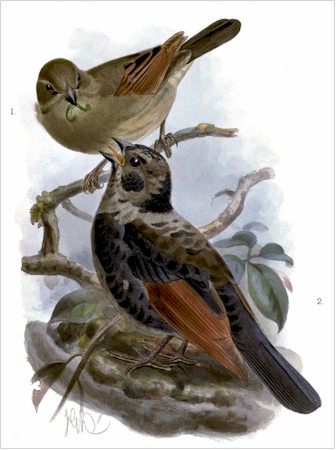
Fig. 1. MOLOTHRUS BADIUS. ad.
" 2. " RUFO-AXILLARIS. pull.
Molothrus rufoaxillaris, Scl. et Salv. Nomencl. p. 37; Hudson, P. Z. S. 1874, p. 161 (Buenos Ayres); Durnford, Ibis, 1877, p. 174 (Buenos Ayres); White, P. Z. S. 1882, p. 601 (Catamarca); Barrows, Bull. Nutt. Orn. Cl. viii. p. 134 (Entrerios); Scl. Cat. B. xi. p. 338.
Description.—Silky black, washed with purple; wings and tail with a slight greenish gloss; a chestnut spot on the axillaries; bill and feet black: whole length 8·0 inches, wing 4·5, tail 3·3. Female similar, but somewhat smaller.
Hab. Argentina and Uruguay.
This bird has no vulgar name, not being distinguished from the Common Cow-bird by the country people. The English name of Screaming Cow-bird, which I have bestowed on it, will, I think, commend itself as appropriate to those who observe this bird, for they will always and at any distance be able to distinguish it from the species it resembles so nearly by listening to its impetuous screaming notes, so unlike anything in the language of the Common Cow-bird.
The Screaming Cow-bird is larger than the allied species. The female is less than the male in size, but in colour they are alike, the entire plumage being deep blue-black, glossy, and with purple reflections; and under the wing at the joint there is a small rufous spot. The beak is very stout, the plumage loose, and with a strong, musky smell; the œsophagus remarkably wide.
It is far less common than the other species of Molothrus, but is not rare, and ranges south to the Buenos-Ayrean pampas, where a few individuals are usually found in every large plantation; and, like the M. badius, it remains with us the whole year. It is not strictly gregarious, but in winter goes in parties, never exceeding five or six individuals, and in the breeding-season in pairs. One of its most noteworthy traits is an exaggerated hurry and bustle thrown into all its movements. When passing from one branch to another, it goes by a series of violent jerks, smiting its wings loudly together; and when a party of them return from the fields they rush wildly and loudly screaming to the trees, as if pursued by a bird of prey. They are not singing-birds; but the male sometimes, though rarely, attempts a song, and utters, with considerable effort, a series of chattering unmelodious notes. The chirp with which he invites his mate to fly has the sound of a loud and smartly-given kiss. His warning or alarm-note when approached in the breeding-season has a soft and pleasing sound; it is, curiously enough, his only mellow expression. But his most common and remarkable vocal performance is a cry beginning with a hollow-sounding internal note, and swelling into a sharp metallic ring; this is uttered with tail and wings spread and depressed, the whole plumage raised like that of a strutting turkey-cock, whilst the bird hops briskly up and down on its perch as if dancing. From its puffed-out appearance, and from the peculiar character of the sound it emits, I believe that, like the Pigeon and some other species, it has the faculty of filling its crop with air, to use it as a “chamber of resonance.” The note I have described is quickly and invariably followed by a scream, harsh and impetuous, uttered by the female, though both notes always sound as if proceeding from one bird. When on the wing the birds all scream together in concert.
The food of this species is chiefly minute seeds and tender buds; they also swallow large caterpillars and spiders, but do not, like their congeners, eat hard insects.
I became familiar, even as a small boy, with the habits of the Screaming Cow-bird, and before this species was known to naturalists, but could never find its nest, though I sought diligently for it. I could never see the birds collecting materials for a nest, or feeding their grown-up young like other species, and this might have made me suspect that they did not hatch their own eggs; but it never occurred to me that the bird was parasitical, I suppose because in summer they are always seen in pairs, the male and female being inseparable. Probably this is the only parasitical species in which there is conjugal fidelity. I also noticed that, when approached in the breeding-season, the pair always displayed great excitement and anxiety, like birds that have a nest, or that have selected a site on which to build one. But year after year the end of the summer would arrive, the birds reunite in parties of half a dozen, and the mystery remain unsolved. At length, after many years, fortune favoured me, and while observing the habits of another species (Molothrus badius), I discovered by chance the procreant habits of the Screaming Cow-birds; and as these observations throw some light on the habits of M. badius, I think it best to transcribe my notes here in full.
A pair of Leñateros (Anumbius acuticaudatus) have been nearly all the winter building a nest on an acacia tree sixty yards from the house; it is about 27 inches deep, and 16 or 18 in circumference, and appears now nearly finished. I am sure that this nest will be attacked before long, and I have resolved to watch it closely.
September 28.—To-day I saw a Bay-wing (M. badius) on the nest; it climbed over it, deliberately inspecting every part with the critical air of a proprietor who had ordered its construction, taking up and rearranging some sticks and throwing others away from the nest. While thus engaged, two common Cow-birds (M. bonariensis), male and female, came to the tree; the female dropped on to the nest, and began also to examine it, peering curiously into the entrance and quarrelling with the first bird. After a few minutes she flew away, followed by her glossy consort. The Bay-wing continued its strange futile work until the owners of the nest appeared, whereupon it hopped aside in its usual slow leisurely manner, sang for a few moments, then flew away. The similarity in the behaviour of the two birds struck me very forcibly; in the great interest they take in the nests of other birds, especially in large covered nests, the two species are identical. But when the breeding-season comes their habits begin to diverge: then the Common Cow-bird lays in nests of other species, abandoning its eggs to their care; while the Bay-wings usually seize on the nests of other birds and rear their own young. Yet, as they do occasionally build a neat elaborate nest for themselves, the habit of taking possession of the nests of other birds is, most likely, a recently acquired one, and probably its tendency is to eradicate the original building instinct.
October 8.—This morning, while reading under a tree, my attention was aroused by a shrill note, as of a bird in distress, issuing from the neighbourhood of the Leñatero’s nest; after hearing it repeated at intervals for over twenty minutes, I went to ascertain the cause. Two Bay-wings flew up from the ground under the nest, and on searching in the rank clover growing under the tree, I discovered the female Leñatero, with plumage wet and draggled, trembling and appearing half dead with the rough treatment she had experienced. I put her in the sun, and after half an hour, hearing her mate calling, she managed to flutter feebly away to join him. The persecutors had dragged her out of the nest, and would, no doubt, have killed her, had I not come so opportunely to the rescue.
Since writing the above, I have continued to watch the nest. Both the Bay-wings and Leñateros left it for some days. Six days after picking up the ill-treated female, the Leñateros came back and resumed possession. Four days later the Bay-wings also came back; but on finding the nest still occupied, they took possession of an unfinished oven of an Oven-bird on another tree within twenty yards of the first, and immediately began carrying in materials with which to line it. When they had finished laying I took their five eggs, at the same time throwing down the oven, and waited to see what their next move would be. They remained on the spot singing incessantly, and still manifesting anxiety when approached. I observed them four days, and then was absent from home as many more; on returning, I found that the Leñateros had once more disappeared, and that the nest was now held by the Bay-wings. I also noticed that they had opened an entrance very low down at the side of the nest which they were using; no doubt they had killed and thrown out the young Leñateros.
It was now early in November, the height of the breeding-season, and numbers of Common Cow-birds constantly visited the nest; but I was particularly interested in a pair of Screaming Cow-birds that had also began to grow fond of it, and I resolved to watch them closely. As they spent so much of their time near the nest, showing great solicitude when I approached it, I strongly hoped to see them breed in it, if the Bay-wings could only be got rid of. The Screaming Cow-birds would not, or dared not, attack them; and, as I always think that the worst possible use one can put a little bird to is to shoot it, I could not help them by destroying the Bay-wings. I therefore resolved to take their eggs, hoping that that would cause them to leave in disgust.
When I was satisfied from their movements that they had finished laying, I got up to the nest, and was astonished to find ten eggs instead of five, as I had confidently expected; for, though the Common Cow-birds had paid a great deal of attention to the nest, I knew the Bay-wings would not allow them to lay in it.
The ten eggs in the nest were all unmistakably Bay-wing’s eggs; and having observed before that several females do occasionally lay together, I concluded that in this case two females had laid in the nest, though I had only seen two birds—male and female. After taking the ten eggs the Bay-wings still remained, and in a very short time they appeared to be laying again. When I had reason to think that the full complement was laid, I visited the nest and found five eggs in it; these I also took, and concluded that the second female had probably gone away, after having been deprived of her first clutch. During all this time the Screaming Cow-birds remained in the neighbourhood and occasionally visited the tree; but to my very great surprise the Bay-wings still stubbornly remained, and by-and-by I found that they were going to lay again—the fourth time! When I next visited the nest there were two eggs in it; I left them and returned three days later, expecting to find five eggs, but found seven! certainly more than one female had laid in the nest on this occasion. After taking these last seven eggs the Bay-wings left; and though the Screaming Cow-birds continued to make occasional visits to the nest, to my great disappointment they did not lay in it.
April 12.—To-day I have made a discovery, and am as pleased with it as if I had found a new planet in the sky. The mystery of the Bay-wings’ nest twice found containing over the usual complement of eggs is cleared up, and I have now suddenly become acquainted with the procreant instinct of the Screaming Cow-bird. I look on this as a great piece of good fortune; for I had thought that the season for making any such discovery was already over, as we are so near to winter.
The Bay-wings are so social in their habits that they always appear reluctant to break up their companies in the breeding-season; no sooner is this over, and while the young birds are still fed by the parents, all the families about a plantation unite into one flock. About a month ago all the birds about my home had associated in this way together, and went in a scattered flock, frequenting one favourite feeding-spot very much, a meadow about fifteen minutes’ walk from the house. The flock was composed, I believe, of three families, sixteen or eighteen birds in all: the young birds are indistinguishable from the adults; but I knew that most of these birds were young hatched late in the season, from their incessant strident hunger-notes. I first observed them about the middle of March. A week ago, while riding past the meadow where they were feeding, I noticed among them three individuals with purple spots on their plumage. They were at a distance from me, and I naturally concluded that they were young Common Cow-birds (M. bonariensis), casually associating with the Bay-wings. I was surprised to see them, for the young male M. bonariensis always acquires the purple plumage before March, so that these individuals were changing colour five weeks after the usual time. To-day, while out with my gun, I came upon the flock, and noticed four of the birds assuming the purple plumage, two of them being almost entirely that colour; but I also noticed with astonishment that they had bay- or chestnut-coloured wings, also that those with least purple on them were marvellously like the Bay-wings in the mouse-coloured plumage of the body and the dark tail. I had seen these birds before the purple plumage was acquired, and there was then not the slightest difference amongst them, the adults and their supposed offspring being alike; now some of them appeared to be undergoing the process of a transmutation into another species! I at once shot the four spotted birds along with two genuine Bay-wings, and was delighted to find that the first were young Screaming Cow-birds.
I must now believe that the extra eggs twice found in the nest of the Bay-wings were those of the Screaming Cow-bird, that the latter species lays chiefly in the nests of the former, that the eggs of the two species are identical in form, size, and colour, each bird also laying five, and that, stranger still, the similarity is as perfect in the young birds as it is in the eggs.
April 15.—This morning I started in quest of the Bay-wings, and observed one individual, that had somehow escaped detection the day before, assuming the purple dress. This bird I shot; and after the flock had resettled a short distance off, I crept close up to them, under the shelter of a hedge, to observe them more narrowly. One of the adults was closely attended by three young birds; and these all, while I watched them, fluttered their wings and clamoured for food every time the old bird stirred on its perch. The three young birds seemed precisely alike; but presently I noticed that one of them had a few minute purple spots, and on shooting this one I found it to be a young M. rufoaxillaris, while the other two were true young Bay-wings.
The hunger-cry of the young M. badius (Bay-wing) is quite different from that of the young M. bonariensis: the cry of the latter is a long, shrill, two-syllabled note, the last syllable being prolonged into a continuous squeal when the foster-parent approaches with food; the cry of the young M. badius is short, reedy, tremulous, and uninflected. The resemblance of the young M. rufoaxillaris to its foster-brothers in language and plumage is the more remarkable when we reflect that the adult bird in its habits, gestures, guttural notes, also in its deep purple plumage, comes much nearer to M. bonariensis than to M. badius. It seems impossible for mimicry to go further than this. A slight difference in size is quite imperceptible when the birds are flying about; while in language and plumage the keenest ornithologist would not be able to detect a difference. But it may be questioned whether this is really a case of an external resemblance of one species to another acquired by natural selection for its better preservation. Possibly the young M. rufoaxillaris, in the first stage of its plumage, exhibits the ancestral type—that of the progenitor of both species. If M. badius belonged to some other group—Sturnella or Pseudoleistes, for instance—it would scarcely be possible to doubt that the resemblance of the young M. rufoaxillaris to its foster-brothers resulted from mimicry; but as both species belong to the limited, well-defined group Molothrus, the resemblance may be ascribed to community of descent.
Formerly I believed that though M. badius is constantly seen rearing its own young, they also occasionally dropped their eggs in the nests of other birds. I could not doubt that this was the case after having witnessed a couple of their young following a Yellowbreast and being fed by it. I must now alter my opinion, for what then appeared to be proof positive is now no proof at all, for those two birds were probably the young of M. rufoaxillaris. There are, however, good reasons for believing that M. rufoaxillaris is parasitical almost exclusively on M. badius. I have spoken of the many varieties of eggs M. bonariensis lays. Those of M. badius are a trifle less in size, in form elliptical, densely and uniformly marked with small spots and blotches of dark reddish colour, varying to dusky brown; the ground-colour is white, but sometimes, though rarely, pale blue. It is not possible to confound the eggs of the two species. Now, ever since I saw, many years ago, the Yellowbreast feeding the supposed young Bay-wings, I have looked out for the eggs of the latter in other birds’ nests. I have found hundreds of nests containing eggs of M. bonariensis, but never one with an egg of M. badius, and, I may now add, never one with an egg of M. rufoaxillaris. It is wonderful that M. rufoaxillaris should lay only in the nests of M. badius; but the most mysterious thing is that M. bonariensis, indiscriminately parasitical on a host of species, never, to my knowledge, drops an egg in the nest of M. badius, unless it be in a forsaken nest! Perhaps it will be difficult for naturalists to believe this; for if the M. badius is so excessively vigilant and jealous of other birds approaching its nest as to succeed in keeping out the subtle, silent, grey-plumaged, omnipresent female M. bonariensis, why does it not also keep off the far rarer, noisy, bustling, conspicuously coloured M. rufoaxillaris? I cannot say. The only explanation that has occurred to me is that M. badius is sagacious enough to distinguish the eggs of the common parasite, and throws them out of its nest. But this is scarcely probable, for I have hunted in vain under the trees for the ejected eggs; and I have never found the eggs of M. badius with holes pecked in the shells, which would have been the case had a M. bonariensis intruded into the nest.
With the results just recorded I felt more than satisfied, though so much still remained to be known; and I looked forward to the next summer to work out the rich mine on which I had stumbled by chance. Unhappily, when spring came round again ill-health kept me a prisoner in the city, and finding no improvement in my condition, I eventually left Buenos Ayres at the close of the warm season to try whether change of climate would benefit me. Before leaving, however, I spent a few days at home, and saw enough then to satisfy me that my conclusions were correct. Most of the birds had finished breeding, but while examining some nests of Anumbius I found one which Bay-wings had tenanted, and which for some reason they had forsaken leaving ten unincubated eggs. They were all like Bay-wings’ eggs, but I have no doubt that five of them were eggs of M. rufoaxillaris. During my rides in the neighbourhood I also found two flocks of Bay-wings, each composed of several families, and amongst the young birds I noticed several individuals beginning to assume the purple plumage, like those of the previous autumn. I did not think it necessary to shoot more specimens.
The question, why M. badius permits M. rufoaxillaris to use its nest, while excluding the allied parasite, M. bonariensis, must be answered by future observers; but before passing from this very interesting group (Molothrus) I wish to make some general remarks on their habits and their anomalous relations to other species.
It is with a considerable degree of repugnance that we regard the parasitical instincts in birds; the reason it excites such a feeling is manifestly because it presents itself to the mind as—to use the words of a naturalist of the last century, who was also a theologian, and believed the Cuckoo had been created with such a habit—“a monstrous outrage on the maternal affection, one of the first great dictates of nature.” An outrage, since each creature has been endowed with this all-powerful affection for the preservation of its own, and not another, species; and here we see it, by a subtle process, an unconscious iniquity, turned from its purpose, perverted and made subservient to the very opposing agency against which it was intended as a safeguard! The formation of such an instinct seems indeed like an unforeseen contingency in the system of nature, a malady strengthened, if not induced, by the very laws established for the preservation of health, and which the vis medicatrix of nature is incapable of eliminating. Again, the egg of a parasitical species is generally so much larger, differing also in coloration from the eggs it is placed with, whilst there is such an unvarying dissimilarity between the young bird and its living or murdered foster-brothers, that, unreasoning as we know instinct, and especially the maternal instinct, is, we are shocked at so glaring and flagrant an instance of its blind stupidity.
In the competition for place, the struggle for its existence, said with reason to be most deadly between such species as are most nearly allied, the operations are imperceptible, and the changes are so gradual, that the diminution and filial disappearance of one species is never attributed to a corresponding increase in another more favoured species over the same region. It is not as if the regnant species had invaded and seized on the province of another, but appears rather as if they had quietly entered on the possession of an inheritance that was theirs by right. Mighty as are the results worked out by such a process, it is only by a somewhat strained metaphor that it can be called a struggle. But even when the war is open and declared, as between a raptorial species and its victims, the former is manifestly driven by necessity. And in this case the species preyed on are endowed with peculiar sagacity to escape its persecutions; so that the war is not one of extermination, but, as in a border war, the invader is satisfied with carrying off the weak and unwary stragglers. Thus the open, declared enmity is in reality beneficial to a species; for it is sure to cut off all such individuals as might cause its degeneration. But we can conceive no necessity for such a fatal instinct as that of the Cuckoo and Cow-bird destructive to such myriads of lives in their beginning. And inasmuch as their preservation is inimical to the species on which they are parasitical, there must also here be a struggle. But what kind of struggle? Not as in other species, where one perishes in the combat that gives greater strength to the victor, but an anomalous struggle in which one of the combatants has made his adversary turn his weapons against himself, and so seems to have an infinite advantage. It is impossible for him to suffer defeat; and yet, to follow out the metaphor, he has so wormed about and interlaced himself with his opponent that as soon as he succeeds in overcoming him he also must inevitably perish. Such a result is perhaps impossible, as there are so many causes operating to check the undue increase of any one species: consequently the struggle, unequal as it appears, must continue for ever. Thus, in whatever way we view the parasitical habit, it appears cruel, treacherous, and vicious in the highest degree. But should we attempt to mentally create a perfect parasitical instinct (that is, one that would be thoroughly efficient with the least possible prejudice to or injustice towards another species; for the preservation of the species on which the parasite is dependent is necessary to its own) by combining in imagination all known parasitical habits, eliminating every offensive quality or circumstance, and attributing such others in their place as we should think fit, our conception would probably still fall short in simplicity, beauty, and completeness of the actual instinct of M. rufoaxillaris. Instead of laying its eggs promiscuously in every receptacle that offers, it selects the nest of a single species; so that its selective instinct is related to the adaptive resemblance in its eggs and young to those of the species on which it is parasitical. Such an adaptive resemblance could not of course exist if it laid its eggs in the nests of more than one species, and it is certainly a circumstance eminently favourable to preservation. Then, there not being any such incongruity and unfitness as we find in nests into which other parasites intrude, there is no reason here to regard the foster-parents’ affection as blind and stupid; the similarity being close enough to baffle the keenest sagacity. Nor can the instinct here appear in the light of an outrage on the maternal affection; for the young M. rufoaxillaris possesses no advantage over its foster-brothers. It is not endowed with greater strength and voracity to monopolize the attentions of the foster-parent or to eject the real offspring; but being in every particular precisely like them, it has only an equal chance of being preserved. To this wonderful parasitical instinct we may well apply Darwin’s words, when speaking of the architecture of the hive-bee:—“Beyond this stage of perfection natural selection could not lead.”
96. MOLOTHRUS BADIUS, Vieill.
(BAY-WINGED COW-BIRD.)
[Plate VI. Fig. 1.]
Molothrus badius, Burm. La-Plata Reise, ii. p. 495 (Paraná and Tucuman). Scl. et Salv. Nomencl. p. 37; Hudson, P. Z. S. 1874, p. 163 (Buenos Ayres); Durnford, Ibis, 1877, p. 174 (Buenos Ayres); Scl. Cat. B. xi. p. 338.
Description.—Dull grey, beneath rather paler; wings chestnut; tips of primaries, inner portions of secondaries, and tail blackish; bill and feet black: total length 7·6 inches, wing 3·5, tail 3·0. Female similar.
Hab. Argentina, Paraguay, and Bolivia.
In this species the sexes are alike; the plumage of the body is grey-drab colour, with a black spot between the eye and beak; tail dark, the quills cinnamon-colour; beak and legs black. Azara describing it under the name of Tordo pardo roxiso, says it is a rare bird, so that it has probably greatly increased since his time, as it is now quite common in the Plata district.
The Bay-wings usually go in small flocks, numbering from ten to thirty individuals, and are not migratory, but in winter they travel about a great deal from place to place without extending their journeys more than a few miles in any direction. They are fond of coming about houses, and are frequently seen pecking at the fresh meat hanging out of doors; and, like other birds of the same tribe, feed chiefly on the ground. They spend a great portion of their time on trees, are familiar with man and inactive, and in their motions singularly slow and deliberate. Their language is varied. Curiosity or alarm is expressed by trilling notes, and before quitting a tree all the birds of a flock ceremoniously invite each other to fly with long clear notes, powerful enough to be heard a quarter of a mile away.
They also sing a great deal in all seasons, the song being composed of soft, clear, rather sweet notes, variously modulated, uttered in a leisurely manner, and seeming to express a composed frame of mind, all the birds in a flock singing in concert. During the cold season the flock always finds some sheltered sunny spot on the north side of a woodpile or hedge, where they spend several hours every day, sitting still and singing in their usual quiet, soft style.
Their extreme sociability affects their breeding-habits, for sometimes the flock does not break up in spring, and several females lay in one nest together; but whether the birds are paired or practice a promiscuous intercourse, I have not been able to discover. They have a great partiality for the large domed nests made by the Anumbius acuticaudatus, called Leñatero in the vernacular. One summer a flock of about ten Bay-wings took possession of a Leñatero’s nest on one of my trees, and after a few days I took fourteen eggs from it. Though the birds hopped, chirping round me, manifesting great solicitude, the eggs were quite cold, and had I left them many more would have been laid, no doubt; but as they were piled up three or four deep in the nest they could never have been hatched.
As a rule, however, the flock breaks up into pairs; and then a neat, well-made nest is built in the fork of a branch, lined with horsehair; or, oftener still, a Leñatero’s nest is seized, the Bay-wings fighting with great spirit to get possession, and in it, or on it, their own nest is made. Like their relations, the Common Cow-bird, they seem strongly attracted by domed nests, and yet shrink from laying in the dark interior; as a rule when they have captured a Leñatero’s nest they break a hole in the side and so admit the light and form an easy entrance. One summer a pair of Bay-wings attacked a Leñatero’s nest on one of my trees; the fighting was kept up for three or four days, and then at the foot of the tree I found five young Leñateros, fully fledged, which had been pecked to death and thrown out of the nest.
The eggs of the Bay-wing are five in number, nearly round, and densely marked with dusky reddish brown.
Once I observed two young Bay-wings following a Yellow-breast (Pseudoleistes virescens) with their usual peculiar hunger-cry, and while I watched them they were fed several times by their foster-parents. Naturally I concluded that the Bay-winged Cow-bird is sometimes parasitical on other species, but I never saw anything afterwards to confirm me in that belief, and I believe now that I was mistaken, and that the young Bay-wings were not real Bay-wings, but the young of Molothrus rufoaxillaris.
97. AGELÆUS THILIUS (Mol.).
(YELLOW-SHOULDERED MARSH-BIRD.)
Agelæus thilius, Burm. La-Plata Reise, ii. p. 492 (Mendoza, S. Juan, Catamarca); Scl. et Salv. Nomencl. p. 37; Durnford, Ibis, 1876, p. 159 (Buenos Ayres), 1877, p. 33 (Chupat), p. 174 (Buenos Ayres), et 1878, p. 394 (Chupat); White, P. Z. S. 1882, p. 602 (Buenos Ayres); Döring, Exp. al Rio Negro, Zool. p. 40 (Colorado); Barrows, Bull. Nutt. Orn. Cl. viii. p. 134 (Entrerios); Scl. Cat. B. xi. p. 343.
Description.—Black; lesser upper and under wing-coverts yellow; bill and feet black: whole length 5·5 inches, wing 3·6, tail 2·7. Female: above pale brown striated with black; distinct superciliaries white; beneath paler, cineraceous white with black striations; smaller, and bill shorter.
Hab. S. Peru, Chili, Paraguay, and Argentina.
This bird is abundant everywhere on the pampas, and does not migrate, but inhabits marshy situations in summer, building its nest amongst the rushes, and in winter ranges over the country. The male is entirely of an intense black, except the shoulders, which are pure yellow; the female is dull grey with fuscous markings, and, as was long ago remarked by Azara, the grey-plumaged are very much more numerous than the black individuals. The young birds are like the females, and possibly do not acquire the full black plumage until the second year, which would account for the great number of grey birds.
These birds are extremely sociable, being seen in flocks all the year round, even during the breeding-season; in winter a great many males separate themselves from the females, and are found associating together in flocks of from thirty to forty individuals.
They feed on the ground, keeping to the moist borders of marshes during summer; they avoid woods, but occasionally alight on trees, where they all sing in concert. The song, when an individual is heard singing alone, is, though limited in its range, very sweet, some of the notes being remarkable for their purity and expression. The bird sits on a rush or stalk while singing, and makes a long pause after every note or two, as if to make the most of its limited repertory. There is in the song one rich full note, which, to my mind, is unequalled for plaintive sweetness, and I am therefore surprised that Azara says only of this species that it sings passably well—‘canta razonablemente.’
The nest is neatly made of dry grasses, and attached to the rushes growing in the water. The eggs are four, pointed, and spotted at the larger end with dull brown and black on a white ground.
98. AGELÆUS FLAVUS (Gm.).
(YELLOW-HEADED MARSH-BIRD.)
Xanthosomus flavus, Scl. et Salv. P. Z. S. 1869, p. 632 (Buenos Ayres); iid. Nomencl. p. 37; Durnford, Ibis, 1878, p. 59 (Buenos Ayres); Döring, Exp. al Rio Negro, Zool. p. 41 (Carhué); Barrows, Bull. Nutt. Orn. Cl. viii. p. 134 (Entrerios). Agelæus flavus, Scl. Cat. B. xi. p. 346.
Description.—Black; head and rump, bend of the wing, and body beneath bright yellow; bill and feet black: whole length 6·7 inches, wing 4·2, tail 3·2. Female: above brown, slightly striated; eyebrows, rump, and body beneath yellowish; bill and feet brown.
Hab. Paraguay, Uruguay, and Argentina.
Azara called this bird Cabeza amarilla, or Yellow-head. It is found throughout the eastern provinces of the Argentine country, ranging south to about the thirty-sixth degree of latitude, and is also common in the Banda Oriental.
The dull-plumaged birds are always very much more numerous than the bright-coloured males, though Azara strangely asserts that the sexes are alike. In Buenos Ayres, where it is called “Naranjo” by the country people in allusion to its orange tints, it is very well known on account of its yellow plumage, which looks so wonderfully brilliant in the sunshine, and its partiality for cultivated districts, where it follows the plough to pick up worms, and frequents the orchard to sing, associating with the common Cow-bird and Yellow-breast. It remains all the year, and is very sociable, going in flocks of from twenty to fifty individuals, which when they settle on the trees all sing in concert, pouring out their few peculiar notes with great power and emphasis.
Even in the breeding-season these companies do not always break up, and frequently several pairs have nests near together. The nest is usually built in a cardoon thistle, two or three feet above the ground, and is made of dry grass. The eggs are four, pointed, white or with a bluish tinge, and speckled irregularly with deep brown, the spots being closer and sometimes confluent at the broad end.
Concerning the plumage of this species Mr. Barrows writes:—“Late in March, 1881, we found this species in large flocks on the Pigué, and it was a beautiful sight to see a hundred or more fluttering about among the snowy plumes of the pampas grass, and displaying their rich black and yellow dress. Unlike most other birds obtained at that time, their plumage seemed nearly as bright and fresh as in summer.”
99. AGELÆUS RUFICAPILLUS, Vieill.
(RED-HEADED MARSH-BIRD.)
Agelæus ruficapillus, Scl. Cat. B. xi. p. 347. Xanthosomus ruficapillus, Scl. et Salv. P. Z. S. 1869, p. 159 (Buenos Ayres); iid. Nomencl. p. 37; White, P. Z. S. 1882, p. 602 (Salta, Catamarca). Chrysomus frontalis, Burm. La-Plata Reise, ii. p 492 (Paraná).
Description.—Glossy blue-black; crown of head and middle of throat dark chestnut; bill and legs black: whole length 7·5 inches, wing 3·7, tail 2·9.
Hab. Argentina and Paraguay.
The sexes are alike in this species: the crown of the head is rufous, and with this exception the whole plumage a rich glossy blue-black. The beauty of the bird and its delicate, plaintive voice would no doubt make it a favourite with man if he saw more of it, only it lives and breeds in marshes, and does not come near his habitations. The Red-heads are gregarious and migratory. The flock can scarcely be said to break up in the breeding-season, as the birds all make their nests near together in the reeds. The nest is placed about one or two feet above the water, is about six inches in depth, and made of leaves and aquatic grasses woven together. The eggs are four, pointed, with a white or pale bluish ground, and spotted with black at the larger end.
The song of the Red-head is quite unique in character. It begins with a low, hollow-sounding note, then the voice changes to a clear, sorrowful tone, rising in a rapid succession of short notes, and falling again in longer ones.
After the breeding-season the birds fly about in flocks of two or three hundred individuals, and sing in concert on the trees.
Their chirp has a peculiar metallic sound, and can be imitated by tapping on the edge of a copper bell with the finger-nail.
100. LEISTES SUPERCILIARIS, Bp.
(RED-BREASTED MARSH-BIRD.)
Leistes superciliaris, Hudson, P. Z. S. 1870, p. 333 (Buenos Ayres); Scl. et Salv. Nomencl. p. 38; Durnford, Ibis, 1877, p. 175 (Buenos Ayres); White, P. Z. S. 1882, p. 602 (Salta); Barrows, Bull. Nutt. Orn. Cl. viii. p. 136 (Entrerios); Scl. Cat. B. xi. p. 349. Trupialis guianensis, Burm. La-Plata Reise, ii. p. 490 (Banda Oriental).
Description.—Brownish black; superciliaries pale brown; bend of the wing and body beneath from the chin to the middle of the belly bright scarlet; bill and legs black; length 7·0 inches, wing 4·0, tail 2·5. Female pale brown, above variegated with black, below stained with red on the breast; flanks and lower belly striated with black; tail cinereous brown, with black cross bars.
Hab. Argentina, Paraguay, and E. Brazil.
The most interesting point concerning this species is the very great difference in habits, as well as appearance, existing between the sexes. In form it resembles the Starling of Europe, but is a trifle smaller and has a shorter tail. The male is black, the upper parts faintly mottled with yellowish grey; there is a straw-coloured stripe over the eye; the throat and breast bright crimson. The female is a smaller bird, and in colour dull fulvous grey, mottled with fuscous; the red tint on the breast scarcely perceptible.
These birds are migratory, and appear everywhere in the eastern part of the Argentine country early in October, arriving singly, after which each male takes up a position in a field or open space abounding with coarse grass and herbage, where he spends most of the time perched on the summit of a tall stalk or weed, his glowing crimson bosom showing at a distance like some splendid flower above the herbage. At intervals of two or three minutes he soars vertically up to a height of twenty or twenty-five yards to utter his song, composed of a single long, powerful, and rather musical note, ending with an attempt at a flourish, during which the bird flutters and turns about in the air; then, as if discouraged at his failure, he drops down, emitting harsh guttural chirps, to resume his stand. Meanwhile, the female is invisible, keeping closely concealed under the long grass. But at length, attracted perhaps by the bright bosom and aerial music of the male, she occasionally exhibits herself for a few moments, starting up with a wild, zigzag flight, like a Snipe flushed from its marsh, and, darting this way and that, presently drops into the grass once more. The moment she appears above the grass the male gives chase, and they vanish from sight together. Thus, while in colour, habits, language, and even in its manner of soaring up like a rocket to let off its curious melody, the male is the most conspicuous of small birds, the female, acted on in an opposite direction by natural selection, has been, so to speak, effaced. While flying, they do not look like birds of the same species: the male moves with wings rapidly fluttered, like a Starling, but with a slower, more laborious flight, and without deviating; the female, in her eccentric movements in the air, reminds one of a large moth driven from its hiding-place, and flying about confused with the glare of noon.
The nest is made of dry grass on the ground, so cunningly concealed that it is most difficult to find. The eggs are four, white, spotted with reddish brown. When they have young, I have never been able to detect the female flying about in search of food.
All through the summer these birds are solitary, but when migrating in the autumn, though many are seen travelling singly, and appear very conspicuous as they fly laboriously in a straight line, at an altitude of about twenty yards from the surface, others are seen making their journey in small flocks or parties composed of six to a dozen individuals. These are the males. The females travel separately, in twos or threes or singly, flying nearer to the earth, with frequent pauses, when the wings cease beating, and intervals of gliding, also darting occasionally to one side, as if the bird had suddenly taken fright.
101. AMBLYRHAMPHUS HOLOSERICEUS (Scop.).
(SCARLET-HEADED MARSH-BIRD.)
Amblyrhamphus holosericeus, Hudson, P. Z. S. 1870, p. 114 (Buenos Ayres); Scl. et Salv. Nomencl. p. 37; Durnford, Ibis, 1877, p. 174 (Buenos Ayres); Gibson, Ibis, 1880, p. 18 (Buenos Ayres); White, P. Z. S. 1882, p. 602 (Buenos Ayres); Barrows, Bull. Nutt. Orn. Cl. viii. p. 135 (Entrerios); Scl. Cat. B. xi. p. 351. Amblyrhamphus ruber, Burm. La-Plata Reise, ii. p. 491 (Entrerios, Santa Fé, Paraná).
Description.—Black; whole head and neck all round, and upper breast and thighs scarlet; bill and feet black: total length 9·5 inches, wing 4·5, tail 4·0. Female similar. Young uniform black.
Hab. Paraguay, Uruguay, and Argentina.
Azara named this species Tordo negro cabeza roxa; it is also called Boyero (ox-herd) by country people, from its note resembling the long whistle of a drover; and sometimes Chisel-bill, from the peculiar conformation of the beak, which is long, straight, and has a broad fine point like a chisel. In both sexes the plumage of the head and neck is scarlet, of an exceedingly brilliant tint, all other parts intense black. These birds are lively, active, and sociable, going in flocks of from half-a-dozen to thirty individuals; they remain all the year, and inhabit the marshes, from which they seldom wander very far, but seek their insect food in the soft decaying rushes. They are common on the swampy shores of the Plata, and when seen at a distance, perched in their usual manner on the summits of the tall rushes, their flame-coloured heads shine with a strange glory above the sere sombre vegetation of the marshes. The long whistling note above mentioned is their only song, but it varies considerably, and often sounds as mellow and sweet as the whistle of the European Blackbird.
The nest is an ingenious structure of dry grasses, fastened to the upright stems of an aquatic plant, three or four feet above the water. The eggs are four, in size and form like those of the English Song-Thrush, spotted somewhat sparsely with black on a light blue ground.
The young birds are entirely black at first, and afterwards assume on the head and neck a pale terra-cotta red, which gradually deepens to vivid scarlet.
102. PSEUDOLEISTES VIRESCENS (Vieill.).
(YELLOW-BREASTED MARSH-BIRD.)
Pseudoleistes virescens, Hudson, P. Z. S. 1870, p. 549, et 1874, p. 156 (Buenos Ayres); Scl. et Salv. Nomencl. p. 37; Durnford, Ibis, 1877, p. 175, et 1878, p. 59 (Buenos Ayres); Gibson, Ibis, 1880, p. 31 (Buenos Ayres); White, P. Z. S. 1882, p. 602 (Buenos Ayres); Barrows, Bull. Nutt. Orn. Cl. viii. p. 135 (Entrerios); Scl. Cat. B. xi. p. 352. Leistes anticus, Burm. La-Plata Reise, ii. p. 491 (Paraná).
Description.—Above and below dark olive-brown; lesser upper wing-coverts, under wing-coverts, and middle of the abdomen yellow; bill black; feet dark brown: total length 9·5 inches, wing 4·6, tail 3·8. Female similar.
Hab. S. Brazil, Paraguay, Uruguay, and Argentina.
In both sexes in this species the plumage is deep olivaceous brown, the breast pure yellow. It is active, strong on the wing, sociable and noisy; and being moreover a pretty and elegant bird, very common in settled districts, and with a preference for man’s neighbourhood, it is familiar to every one, and has won amongst many competitors the vernacular name of Pecho-amarillo (Yellow-breast), for with us yellow-breasted species are somewhat numerous. It remains all the year, invariably going about in flocks of from twenty to thirty birds, and feeds on the ground in the fields or on the open plain. While they are feeding, one bird takes up a position on a stalk or thistle-top to keep guard; when he flies down another bird takes his place; if a person approaches, the sentinel gives the alarm, and all the birds fly off in a very close flock, making the air resound with their loud ringing notes. After feeding, they repair to the trees, where they join their robust voices in a spirited concert, without any set form of melody such as other song-birds possess, but all together, flinging out their notes at random, as if mad with joy. In this delightful hubbub there are some soft silvery sounds. Where they are never persecuted they have little fear of man, but they invariably greet his approach with a loud vigorous remonstrance.
In October the birds break up their companies to pair. Sometimes they breed on the open plain in a large cardoon thistle, but a thick bush or low tree is preferred. The nest is like that of a Thrush, being deep, compactly made of dry grass and slender sticks, plastered inside with mud, and lined with hair or soft dry grass. It is, however, deeper and more symmetrical than the Thrush’s nest, and it is sometimes plastered with cow-dung instead of with mud. The eggs are four, very long, white, and abundantly spotted with deep red, the spots becoming confluent at the large end.
The Yellow-breast is never seen to quarrel with its fellows or with other birds, and it is possibly due to its peaceful disposition that it is more victimized by the parasitical Molothrus than any other bird. I have frequently found their nests full of parasitical eggs, as many as fourteen and in one case sixteen, eggs in one nest. In some seasons all the nests I found and watched were eventually abandoned by the birds on account of the number of parasitical eggs dropped in them. I have also so frequently found parasitical eggs on the ground under the nest that I believe the Yellow-breast throws out some of these foreign eggs, and in one instance I was quite sure that this had happened. The nest was in a cardoon bush, and contained five eggs—two of the Yellow-breast and three parasitical. These three were of the variety most thickly mottled with red, and consequently closely resembling the eggs of the Yellow-breast. I was surprised to find five more eggs of the Cow-bird on the ground, close together, and about three feet from the bush; and these five eggs were all pure white and unspotted. Naturally I asked, How came these eggs in such a position? They had not fallen from the nest, which was very deep, contained few eggs, and was scarcely thirty inches above the ground. Then they were all white, while those in the nest were mottled. That the eggs had been laid in the nest I felt certain; and the only way I can account for their being in the place where I found them is that the Yellow-breast itself removed them, taking them up in its bill and flying with them to the ground. If I am right, we must believe that this individual Yellow-breast had developed an instinct unusual in the species, which enables it to distinguish, and cast out of its nest, eggs very different from its own—an instinct, in fact, the object of which would be to counteract the parasitical habit of Molothrus. What would be the effect of such an instinct should the species acquire it? Doubtless it would be highly prejudicial to the parasitical birds laying white eggs, but favourable to those laying mottled eggs. This would be natural selection operating in a very unusual manner; for the Yellow-breast, or other species, would improve another to its own detriment, since the more the parasitical eggs assimilated to its own, the greater would be the likelihood of their being preserved. The perfect similarity of the eggs of M. rufoaxillaris to those of M. badius perhaps was brought about in this way. But, it may be added, if besides the Yellow-breast some one other species laying very different eggs (a Zonotrichia or Tyrannus, for instance) should also acquire this distinguishing habit, and eject all eggs unlike its own from its nest, the habit in the two or more species would ultimately cause the extinction of the parasite.
It might throw some light on this obscure subject to examine, for several successive summers, a large number of nests, to ascertain whether the nests of the Yellow-breast are often found without any white unspotted eggs, or if the same proportional number of white (parasitical) eggs are found in the nests of the Yellow-breast, Scissor-tail, Song-Sparrow, Pipit, and other species.
103. TRUPIALIS MILITARIS (Linn.).
(PATAGONIAN MARSH-STARLING.)
Sturnella militaris, Hudson, P. Z. S. 1872, p. 548 (Rio Negro); Scl. et Salv. Nomencl. p. 38; Durnford, Ibis, 1877, p. 33, et 1878, p. 394 (Chupat). Sturnella loica, Döring, Exp. al Rio Negro, Zool. p. 41 (R. Colorado, R. Negro). Trupialis militaris, Scl. Cat. B. xi. p. 356. Trupialis loyca, Burm. La-Plata Reise, ii. p. 491 (Mendoza).
Description.—Above brown, especially on the head and back variegated with black; superciliaries in front of the eye red, behind the eye white; beneath black; throat, middle of the neck, breast, and upper belly scarlet; sides of belly and crissum with brownish edgings to the black feathers; under wing-coverts white; bend of the wing red; slight rictal stripe white; bill horn-colour; feet brown: total length 10·0 inches, wing 4·7, tail 3·6. Female similar.
Hab. Chili, Patagonia, and Falkland Islands.
Two species of Trupialis inhabit the southernmost part of the Argentine Republic, the present being confined to Patagonia and South Chili, while its northern representative inhabits the pampas of Buenos Ayres and Uruguay. Probably the Colorado River, which separates two districts differing in soil and vegetation, is the boundary-line dividing their habitats. So nearly alike are these two birds in colour, language, and habits, that they seem rather like races than species; and they were so regarded by naturalists until recently, when the pampas bird was raised to the rank of a distinct species, with the name of Trupialis defilippii. Unfortunately the old name militaris fits the Pampas, and not the Patagonian, Starling best; but of this I shall speak when I describe the former species.
In form and size T. militaris resembles the Common Starling of Europe, but differs from it in habits, flight, language, and in colouring; its upper plumage being fuscous mottled with yellowish grey, the throat and bosom scarlet inclining to crimson. This hue varies greatly, the breast-feathers being often tipped with white, which subdues the intense red, and gives it a rosy tint in some individuals. The female is paler-plumaged than the male, and has less red on the breast.
It inhabits the whole of Patagonia to the Strait of Magellan, but is confined to the valleys or to the neighbourhood of water; and Durnford remarks that it is a useful bird to the traveller in that thirsty country, as its presence is a sure indication of water. It is resident, and is seen in small parties of four or five, or in small flocks seldom exceeding twenty or thirty in number. It feeds and lives on the ground, and only occasionally is it seen to perch on a low bush. Its flight is strong, and it flies about a great deal, and usually utters its song when on the wing. The song is continued all the year, and is heard even on the coldest days in winter; the notes are few and not highly melodious, but are cheerful and vigorous.
The nest is made of dry grass and rootlets attached to the rushes in moist ground, and placed close to or resting on the surface. The eggs are five, the ground-colour white spotted or blotched with reddish brown.
104. TRUPIALIS DEFILIPPII, Bp.
(DE FILIPPI’S MARSH-STARLING.)
Sturnella defilippii, Scl. et Salv. P. Z. S. 1869, p. 161 (Buenos Ayres); iid. Nomencl. p. 38; Döring, Exp. al Rio Negro, Zool. p. 41 (Pampas); Barrows, Bull. Nutt. Orn. Cl. viii. p. 136 (Pampas south of Buenos Ayres). Trupialis defilippii, Scl. Cat. B. xi. p. 357. Trupialis militaris, Burm. La-Plata Reise, ii. p. 490 (Rosario, Paraná).
Description.—Like Tr. militaris, but rather smaller, and with the under wing-coverts black.
Hab. Northern Argentina and Uruguay.
Throughout the country where this species abounds it is called Pecho colorado, which is certainly better than Azara’s barbarous, if picturesque, name of Degollado; but no happier name than militaris could have been invented for it, by which it was formerly known to naturalists; and though it was given to the bird merely on account of the red breast, and was therefore equally applicable to all the red-breasted species on the globe, in this case it accidentally seemed to describe a peculiar habit of the bird, as well as its bright livery.
In size, form, gait, flight, language, and colour the present bird very closely resembles the Patagonian Starling; but the crimson on the breast is brighter and the upper parts are darker. Its nesting-habits are also like those of the southern bird; the number and colour of the eggs being the same in both species. One trivial difference in habit is that De Filippi’s Starling occasionally soars up a few yards into the air when uttering its song. It inhabits the moist grassy pampas in the southern part of the Buenos Ayrean province, and is there abundant and unites in large flocks. At the approach of the cold season there is a general movement northwards of the birds, which does not, however, extend far, as the birds, although strong fliers, travel slowly and in a peculiar manner; it is in this season, when the birds are seen moving in large flocks, that the name of Military Starling strikes one as being peculiarly appropriate. They do not journey through the air like other migrants, but move over the ground, when the flock, composed of four or five hundred to a thousand or more individuals, is extended so as to present a very long front, and at intervals the hindmost birds fly over the others and alight just in advance of them: the long front, the precision of their movements, and their scarlet bosoms all turned one way, suggest the idea of a disciplined army on its march.
They never perch on trees, but frequently alight on the roof of a rancho or other elevation affording a secure footing. They are tame birds and fly reluctantly; when approached, they usually crouch down, hiding their crimson bosoms, and remain motionless in order to escape observation. In disposition they are peaceful, and so fond of society that when one becomes separated from his fellows he will unite with birds of another kind, even with Plovers or Tyrant-birds.
On the great monotonous plains, where most of the small birds are grey- or brown-plumaged, and in winter when there are no flowers to satisfy the desire of the eye for bright colour, it is delightful, while travelling, to meet with an army of these Starlings: their crimson bosoms, less bright than the hues of some tropical species, seem then to glow with a strange splendour on the sombre green of earth, and the sight produces an exhilarating effect on the mind.
105. ICTERUS PYRRHOPTERUS, Vieill.
(CHESTNUT-SHOULDERED HANG-NEST.)
Icterus pyrrhopterus, Scl. et Salv. P. Z. S. 1868, p. 140; iid. Nomencl. p. 36; Hudson, P. Z. S. 1870, p. 88 (Buenos Ayres); Durnford, Ibis, 1878, p. 59; Salvin, Ibis, 1880, p. 356 (Salta); Barrows, Bull. Nutt. Orn. Cl. viii. p. 133 (Entrerios); Scl. Cat. B. xi. p. 368. Xanthornus pyrrhopterus, Burm. La-Plata Reise, ii. p. 493 (Paraná, Tucuman).
Description.—Uniform black; upper lesser wing-coverts chestnut; bill black; feet dark brown: whole length 7·7 inches, wing 3·6, tail 3·8. Female similar, but smaller.
Hab. S. Brazil, Paraguay, Bolivia, and Argentina.
This interesting bird, the only Icterus found in the Argentine Republic, ranges south to Buenos Ayres, where it is migratory, and appears in small flocks of six or eight individuals in September; but soon after arriving these little companies break up, and the birds are subsequently found singly or in pairs in the woods along the Plata River.
The sexes are alike in colour, but the male is considerably larger; the whole plumage is an intense black, excepting a rufous spot on the shoulder, seen only when the bird is on the wing; the bill is black and curved, the body slender, and the tail long. It is a loquacious bird, most of its tones being low and pleasing; exceedingly restless in disposition, incessantly passing from tree to tree, jerking its long tail and clinging to the branches in various attitudes, while searching for insects in the decayed bark. While thus engaged it utters a great variety of chirping and guttural sounds, interspersed with short agreeable notes. It also has a song of considerable merit, low and varied in tone, with a peculiar ventriloquism in many of the notes which produce a confusing idea on the listener that the bird approaches and recedes alternately whilst uttering them. While singing the bird continues moving, but always concealed in the thick foliage, and it is probably this constant turning about of the singer, and the notes coming through leafy screens of varying density, which makes the ventriloquism and gives so much light and shade to its mysterious melody.
The first bird of this species I shot was wounded very slightly in one wing and fell into a stream; to my very great surprise it began singing its usual song while floating about on the surface, making no attempt to swim. After fishing it out it continued to sing at intervals in my hand: how strange it was to hear this bleeding captive bird warbling out soft, sweet notes which seemed to express only pleasant emotions! Yet it was evident that the bird was fully alive to its danger, for it struggled violently to escape and bit my finger savagely with its sharp beak.
I subsequently found a nest; it was about seven inches deep, composed entirely of lichens gathered from the boles of trees, ingeniously woven together and suspended from the small twigs and leaves at the extremity of a branch. There were no eggs in it, but the birds fluttered in great trouble about me, and, what greatly surprised me, uttered a variety of singing notes, unlike their usual song, but many of them closely resembling the notes of other songsters, which made me think that this Icterus possesses the mimicking faculty to some extent. This, however, is a question it would be difficult to decide. It seems certain, however, that this species is incapable of expressing any distressing feeling, such as pain, fear, or parental anxiety, with loud harsh notes like other birds. It is much to be regretted that Azara, who found this species common in Paraguay, did not pay more attention to its habits and language, which make it specially interesting even in a family so rich in strange habits as the Icteridæ.
106. APHOBUS CHOPI (Vieill.).
(CHOPI BOAT-TAIL.)
Chopi, Azara, Apunt. i. p. 282. Aphobus chopi, Scl. Cat. B. xi. p. 405. Psarocolius unicolor, Burm. La-Plata Reise, ii. p. 494 (Mendoza).
Description.—Uniform black, slightly resplendent; bill and feet black; lower mandible sulcated: whole length 9·2 inches, wing 5·2, tail 4·0. Female similar, but smaller and duller; bill not sulcated.
Hab. S. Brazil, Paraguay, Argentina, Bolivia, and Peru.
The Chopi, which is said to be quite common in Paraguay, is only found in the north-eastern part of the Argentine Republic, consequently I have never seen it, except as a cage-bird; nor is there anything about it in the notes of recent collectors and travellers who have visited the upper waters of the Plata. This is, however, not to be regretted, since Azara gave a very full and spirited account of this species in his ‘Apuntamientos;’ although it certainly does seem strange that the Chopi should have had two careful observers of its habits fully a century ago, namely, Azara and his friend and fellow-naturalist the priest Noseda, and not one since. Evidently Azara was very familiar with this bird, for he describes it lovingly and at great length, his history of it being one of the most charming things in his work. According to him the Chopi is a highly sagacious bird, and although a frequent visitor to courtyards and verandahs of houses in Paraguay, too shy and suspicious to be caught with snares. It has a strong and easy flight, and readily attacks any large bird passing near, following it persistently in the air, or, pouncing down, fastens itself on its enemy’s back. If the Caracara Eagle (Polyborus) alights in order to shake off its persecutor, the Chopi perches at a distance of a few feet, where it assumes an indifferent manner; but no sooner does the Caracara allow its attention to wander from its adversary, then it is again subjected to fresh insult. These attacks on so large and powerful a species may be regarded as mere impertinences, but by practising them the Chopi is soon able to rid himself of the presence of any unwelcome bird. From a long distance he recognizes an enemy, by its figure, or even its shadow, and warns all birds of the coming danger with a loud whistle, which at once sends them into hiding, while the Chopi goes bravely out to the encounter; and the result is invariably a victorious song on his part, beginning with the sound of his own name, and running through a variety of whistled notes. He also sings well in captivity and when his mate is incubating; and his voice is first heard welcoming the dawn from the eaves and tiled roofs of houses where he roosts. The pairing-season is in November; and, Noseda adds, the breeding-place is a hole in a bank, or tree-trunks, or in a wall under the eaves, and occasionally the nest is made in the small branches of an orange or other close-leafed tree, and is built of sticks and straws carelessly disposed, with a few feathers for lining. The eggs are four, and white.
It may be added that between Azara and his friend Noseda there was a great controversy respecting the parasitical habits of the common Cow-bird (Molothrus), which were first discovered by the former; and disbelieved in by Noseda, who accounted for the fact that the Cow-bird is never seen to make a nest by supposing that species to be the year-old young of the Chopi, which, he further imagined, took three years to acquire the adult form and plumage. Such an idea might seem to discredit Noseda as a naturalist, if we did not remember that Gilbert White at the same period was trying to prove the hybernation of Swallows in England. The whole of the discussion appears in the ‘Apuntamientos,’ under the description of the Chopi; and Noseda is there allowed to state his own case; after which the better observer, Azara, gives five objections to the theory, any one of which would be sufficient to demolish it.
Fam. XII. CORVIDÆ, or CROWS.
The typical black Crows and Ravens do not penetrate into the New World so far south as South America, their range terminating in the highlands of Guatemala and the islands of the Greater Antilles. They have, however, as representatives in South America several allied groups, clad mostly in various shades of blue, and commonly known as Blue Crows and Blue Jays. Two of these are known to occur in the woods of the northern provinces of Argentina.
107. CYANOCORAX CHRYSOPS (Vieill.).
(URRACA JAY.)
Cyanocorax chrysops, Sharpe, Cat. B. iii. p. 120. Cyanocorax pileatus, Burm. La-Plata Reise, ii. p. 495 (Uruguay, Tucuman); Scl. et Salv. Nomencl. p. 39; White, P. Z. S. 1882, p. 602 (Salta); Barrows, Bull. Nutt. Orn. Cl. viii. p. 136 (Entrerios). Cyanocorax tucumanus, Cab. J. f. O. 1883, p. 216 (Tucuman).
Description.—Above black, slightly glossed with purple; head, throat, and breast black, the plumes of the crown forming a crest; nape greyish blue, deepening into purple on the hind neck; above the eye a blue spot; below the eye a second spot and a patch at the base of the lower mandible purple; under surface and tip of the tail creamy yellow; bill and feet black: total length 14 inches, wing 6·3, tail 7·1.
Hab. Brazil, Paraguay, Uruguay, and Northern Argentina.
“This Blue Jay is very common about the woods at Campo Colorado (Salta). It is remarkably tame and inquisitive, and has a great variety of peculiar grating metallic notes. On the sierras of Totoral I likewise met with it; and it is found as far south as Tucuman and Catamarca.” (White.) According to Azara it is abundant in Paraguay and familiar with man, coming a great deal about the houses. The vernacular name there is Acahé.
108. CYANOCORAX CÆRULEUS (Vieill.).
(AZURE JAY.)
Cyanocorax cæruleus, Sharpe, Cat. Birds, iii. p. 126; White, P. Z. S. 1882, p. 603 (Misiones). Cyanocorax azureus, Scl. et Salv. Nomencl. p. 40.
Description.—Head all round, neck, and throat down to upper part of breast black; all the rest of the plumage fine and glossy blue; beak and feet black: total length 15·5 inches, wing 8·15, tail 6·9.
Hab. S. Brazil, Paraguay, and N. Argentina.
This fine species was originally discovered by Azara in Paraguay. In June 1881 specimens were obtained at San Javier, Misiones, by White. He writes: “This bird is found here at times in flocks, and makes a great deal of noise, but is exceedingly wild and difficult to shoot, so that I had to use ball-cartridge to secure this specimen.”
Suborder II. OLIGOMYODÆ.
Fam. XIII. TYRANNIDÆ, or TYRANTS.
The Tyrannidæ or Tyrant-birds, which play the part of our Flycatchers in the New World, although they are quite different in structure, contribute an important element in the Neotropical Avifauna, numbering as they do more than 350 species. Of these 63 have already been met with within the limits of the Argentine Republic, and the list, will, no doubt, be further extended, as many of these birds are small and dull in colour, and easily hide themselves in the dense forests to which they resort.
The pampas are the special home of the Tæniopterinæ, or “Walking Tyrants” as Swainson called them, which have strong feet and long tarsi, and frequent open spaces. Amongst them the genera Tænioptera, Alectrurus, Cnipolegus, and Lichenops may be regarded as specially characteristic of the Argentine avifauna. On the other hand, the Elaineinæ and Platyrhynchinæ, which are eminently birds of the dense forest, are much less numerous within the bounds of Argentina, and are mostly confined to the wooded districts of the north. The typical Tyranninæ form a more mixed group, some species of which, such as Tyrannus melancholicus and Pyrocephalus rubineus, are prominent objects in the Argentine ornis.
109. AGRIORNIS STRIATA, Gould.
(STRIPED TYRANT.)
Agriornis striatus, Burm. La-Plata Reise, ii. p. 459 (Cordova); Salvin, Ibis, 1880, p. 356 (Tucuman); Döring, Exp. al Rio Negro, Zool. p. 41 (R. Colorado, R. Negro).
Description.—Above cinereous; wings blackish cinereous with light edgings; tail dark cinereous, with a distinct white margin to the external rectrix, and slight whitish tips to all rectrices; lores blackish; short superciliaries white: below pale cinereous; throat white, broadly striated with black; bill above black, below pale: whole length 9·0 inches, wing 4·5, tail 4·3. Female similar.
Hab. Eastern Argentina and Patagonia.
This species, originally discovered by Darwin in Patagonia, is also found in Eastern Argentina. White obtained it in Catamarca, Durnford in Tucuman, and Burmeister on the Rio Quarto, in Cordova.
110. AGRIORNIS MARITIMA (d’Orb. et Lafr.).
(WHITE-TAILED TYRANT.)
Agriornis maritima, Scl. et Salv. Nomencl. p. 41; Durnford, Ibis, 1878, p. 394 (Chupat); Barrows, Bull. Nutt. Orn. Cl. vol. viii. p. 137 (Sierra de la Ventana). Agriornis leucurus, Burm. La-Plata Reise, ii. p. 459 (Mendoza).
Description.—Above cinereous; secondaries edged externally and tipped with white; tail dark cinereous, the four external rectrices with the whole outer webs and about the one-third apical part of the inner webs white, the median rectrices tipped with white; below paler cinereous; throat greyish white, slightly striated with dark cinereous; lower belly, crissum, flanks, and under wing-coverts while, more or less tinged with cinnamomeous; bill and feet black: whole length 9·0 inches, wing 5·3, tail 4·0. Female similar.
Hab. Argentina, Patagonia, Chili, and Bolivia.
This Agriornis was obtained by Durnford at Tombo Point in Central Patagonia, by Burmeister in the Sierra de Uspallata, near Mendoza, and by Barrows in the rocky gorges of the Sierra de la Ventana.
Darwin tells us of this species that it “is a scarce, shy, solitary bird, frequenting the valleys in which thickets grow, but often feeding on the ground. In the interior plains of Patagonia, on the banks of the Santa Cruz, I several times saw it chasing beetles on the wing, in a peculiar manner, half hopping and half flying; when thus employed it spreads its tail, and the white feathers in it are displayed in a very conspicuous manner. I also met with the species in the lofty and arid valleys on the eastern side of the Cordillera of Central Chili, and likewise at Copiapo.” (Zool. Voy. ‘Beagle,’ iii. p. 57.)
111. MYIOTHERETES RUFIVENTRIS (Vieill.).
(CHOCOLATE TYRANT.)
Myiotheretes rufiventris, Scl. et Salv. P. Z. S. 1868, pp. 138, 141 (Conchitas); iid. Nomencl. p. 42; Durnford, Ibis, 1877, p. 175 (Buenos Ayres), et 1878, p. 394 (Centr. Patagonia); White, P. Z. S. 1882, p. 603 (Buenos Ayres); Barrows, Bull. Nutt. Orn. Cl. viii. p. 140 (Entrerios). Tænioptera variegata, Burm. P. Z. S. 1868, p. 635 (Buenos Ayres), Hudson, P. Z. S. 1870, pp. 333, 545, et 1871, p. 260 (Buenos Ayres).
Description.—Above and below smoky grey, clear on the head and breast; belly, crissum, and under wing-coverts bright rufous; wings black, inner secondaries bright chestnut terminated with white, outer secondaries black, tipped with white; wing-coverts grey, margined with white; tail black, outer margins of external pair of rectrices and tips of all whitish; two outer primaries emarginated; bill and feet black: whole length 9·5 inches, wing 6·7, tail 3·8. Female similar, but outer primaries not emarginated.
Hab. Patagonia, Argentina, and Paraguay.
There is a striking resemblance to a Thrush in this species, when one sees it running on the ground with its beak somewhat elevated; but when it stands or perches, opening and closing its broad tail with a graceful fan-like motion, the resemblance to the stiff automatic Turdus grows less, and when it flies vanishes altogether—its long wings being as sharply pointed as those of the Peregrine Falcon, while its motions in the air have a Gull-like grace and buoyancy.
It is a very pretty bird; the upper plumage is grey tinged with rufous, the throat pure dark grey, breast and belly rufous, wing-coverts light silvery grey, remiges and rectrices dark. Azara classed it under the name of Pepoaza (banded-wing) with the Tæniopteræ, to which it comes very near in form, flight, language, and habits, though it has longer legs and runs more on the ground. Its summer home is in Southern Patagonia, but its breeding-habits are not known; in winter it migrates north, and in May is found scattered over the pampas, where it is usually called by the country people ‘Chorlo,’ a name for all Plovers; for while running swiftly about on the ground, often associating with flocks of Plover, it has a certain resemblance to them. From the hue of its plumage it is also called ‘El Chocolate,’ a name I have thought it best to preserve.
These birds are very sociable, going in small flocks, usually of from half a dozen to twenty individuals; they are restless and active, and quick and graceful in all their movements, and seek their food on the ground, chiefly coleopterous insects, on the great level plains they inhabit. While on the wing they pursue each other playfully in the air, and also attack and chase passing birds of other kinds, apparently in a sportive spirit. Occasionally they perch on a thistle-top or low bush, but never on trees. Their only language is a long, low, plaintive whistle, heard usually on warm still days in winter.
112. TÆNIOPTERA NENGETA (Linn.).
(PEPOAZA TYRANT.)
Tænioptera nengeta, Burm. La-Plata Reise, ii. p. 459 (Paraná); Scl. et Salv. Nomencl. p. 42; Barrows, Bull. Nutt. Orn. Cl. viii. p. 137 (Entrerios); White, P. Z. S. 1882, p. 603 (Misiones).
Description.—Above cinereous; lores white; wings black, coverts cinereous; a well-marked speculum at the base of the primaries and the edgings of the outer secondaries white; tail black, tipped with whitish cinereous, basal one-third of tail white; below pale cinereous, middle of throat white, with blackish stripe on each side; middle of belly, flanks, crissum, and under tail-coverts white; bill horn-colour; feet black: whole length 9·0 inches, wing 5·0, tail 3·5. Female similar.
Hab. S.E. Brazil, Paraguay, Uruguay, Argentine Republic, and Bolivia.
To this species Azara gives the name of Pepoazá, the Guarani for Barred-wing; and Pepoaza was used by him as a generic name for the small, well-defined group now placed in the genus Tænioptera, comprising eight known species. Most of these birds have some conspicuous wing-mark. They inhabit the southern portion of the South-American continent, from South Brazil and Bolivia to the Straits of Magellan, and are most numerous on the open pampas and in Patagonia. In size they do not vary greatly, the largest being about nine inches long, the smallest about seven. In colour they are grey, or, more frequently, white relieved with black or grey, one species (T. rubetra) being rufous. Their legs are long, and they run on the ground like Myiotheretes rufiventris, feeding, to some extent, in the same manner; but they also occasionally pursue and capture insects on the wing, like the typical Tyrant-birds that seldom or never alight on the ground. They have likewise another and unique preying-habit, intermediate between the Plover-like habits of Agriornis, Myiotheretes, and Muscisaxicola, and the Swallow- or Flycatcher-like habits of the true Tyrants. The bird perches itself on an elevation—the summit of a stalk, or bush, or even of a low tree—to watch like a Flycatcher for its insect prey; only instead of looking about for passing insects, it gazes intently down at the ground, just as a Kingfisher does at the water, and when it spies a beetle or grasshopper, darts down upon it, not, however, to snatch it up with the bill as other Tyrants do, but it first grasps it with its feet, then proceeds to despatch it, swaying about and opening its wings to keep its own balance, just as an Owl is seen to do when it grasps a mouse or other small animal in its claws. After devouring the insect on the spot, it flies back to its perch to resume the watch. They are very restless, active, playful birds, and seldom remain long on one spot, apparently finding it irksome to do so; but I have seen the T. irupero occupy the same perch for hours every day while looking out for insects.
As an English generic name for this small interesting group might be useful, I would suggest Ground-gazers or Ground-watchers, which describes the peculiar preying-habit of these birds.
The Pepoazá is a swift, active, graceful bird, with a strong, straight beak, hooked at the point, and a broad tail four inches long, the total length of the bird being nine inches. The throat and space between the beak and eye are white; all the rest of the body, also the wing- and tail-coverts, light grey; tail and wing-quills black, with a pure white band across the base of the primaries. The tertiaries and rectrices are tipped with pale rufous grey.
It inhabits Brazil south of the equator, Bolivia and Paraguay, also the northern provinces of the Argentine Republic. Mr. Barrows gives the following account of its lively habits in Entrerios:—“They are commonly seen perched on fences or the tops of bushes or trees in open ground, frequently making sallies for winged insects, or dropping to the ground to catch a grasshopper or worm. When shot at while perched and watching you, they almost invariably leave the perch at the flash, pitching forward and downward, and usually evading the shot, even at short range. Several times I have secured them by shooting about a foot below and two feet in front of them as they sat, but they do not always fly in this direction. The rapidity of their flight when frightened, or when quarrelling, is simply astonishing. I have seen one chase another for three or four minutes, doubling, turning, twisting, and shooting, now brushing the grass, and now rising to a height of at least two or three hundred feet, and all the movements so rapid that the eye could scarcely follow them; and at the end of it each would go back to the top of his own chosen weed-stalk, apparently without a feather ruffled.”