Volume 1 — ARGENTINE ORNITHOLOGY. (continued 5)
Reading edition
163. EMPIDONAX BIMACULATUS (Lafr. et d’Orb.).
(WING-BANDED TYRANT.)
Empidochanes argentinus, Cab. J. f. O. 1868, p. 196. Empidonax brunneus, Ridgw. N. A. B. ii. p. 363 (Paraná). Empidonax bimaculatus, Scl. Ibis, 1887, p. 65.
Description.—Above umber-brown, more or less rufescent; lores with a whitish spot; wings blackish, all the coverts broadly tipped with pale rufous, forming two transverse bars; outer margins of external secondaries of the same colour; tail brown, but not rufescent; beneath dirty cinereous white, throat and belly brighter, and with a yellowish tinge; under wing-coverts and inner margins of wing-feathers ochraceous; upper mandible dark brown, lower whitish; feet pale brown: whole length 5·0 inches, wing 2·6, tail 3·4.
Hab. S.E. Brazil, Bolivia, and N. Argentina.
This obscure species occurs in the northern wooded districts of Argentina.
164. CONTOPUS BRACHYRHYNCHUS, Cab.
(SHORT-BILLED TYRANT.)
Contopus brachyrhynchus, Cab. J. f. O. 1883, p. 214.
Description.—Above cinereous, lores whitish; wings and tail blackish, with slight whitish edgings to the wing-coverts and outer secondaries; beneath paler, whitish in the middle of the belly; flanks with a concealed white patch; bill above brown, beneath pale; feet black: whole length 7·0 inches, wing 4·0, tail 3·2.
Hab. Northern Argentina.
Herr Schulz, who discovered this species near Tucuman, tells us that it is a summer visitor, and is usually seen perched on the tops of the highest trees on the look-out for insects.
165. CONTOPUS BRACHYTARSUS, Scl.
(SHORT-FOOTED TYRANT.)
Contopus brachytarsus, Scl. et Salv. Nomencl. p. 52; White, P. Z. S. 1882, p. 608 (Salta).
Description.—Above dark plumbeous olive; crown darker, blackish; wings and tail blackish; the wing-coverts and outer secondaries more or less edged with whitish; beneath dirty white, clearer on the throat and middle of the belly, which latter has sometimes an olivaceous tinge; bill above blackish, beneath yellowish white; feet blackish; first primary shorter than the fifth: whole length 5·3 inches, wing 2·9, tail 2·5. Female similar.
Hab. Central and South America.
White found this widely ranging Tyrant “not uncommon in the forests of Salta.”
166. MYIARCHUS TYRANNULUS (Müll.).
(RUSTY-TAILED TYRANT.)
Suiriri pardo y roxo, Azara, Apunt. ii. p. 143. Myiarchus erythrocercus, Scl. et Salv. Nomencl. p. 52.
Description.—Above brownish cinereous, crown rather darker; wings blackish, primaries narrowly edged with rufous, secondaries and coverts more broadly with dirty white; tail blackish, all the lateral rectrices with the greater part of the inner web rufous, leaving only a narrow blackish border alongside the shaft; beneath, throat and breast pale cinereous; belly and under wing-coverts pale sulphur-yellow; inner margin of rectrices pale rufous; bill dark horn-colour; feet blackish: whole length 7·4 inches, wing 3·8, tail 3·2. Female similar.
Hab. South America down to Argentina.
An example of this species, now in the British Museum, was procured by White in Catamarca.
167. MYIARCHUS FEROX (Gm.).
(FIERCE TYRANT.)
Myiarchus tyrannulus, Scl. et Salv. Nomencl. p. 52; Durnford, Ibis, 1878, p. 61 (Buenos Ayres); White, P. Z. S. 1882, p. 608 (Salta); Barrows, Bull. Nutt. Orn. Cl. vol. viii p. 202 (Entrerios). Myiarchus ferocior, Cab. J. f. O. 1883, p. 214 (Tucuman).
Description. —Above dark cinereous, more or less olivaceous; wings and tail blackish; wing-coverts and outer secondaries with more or less defined edgings of dirty white; beneath, throat and breast cinereous, abdomen and under wing-coverts sulphur-yellow; bill dark brown; feet blackish: whole length 7·0 inches, wing 3·6, tail 3·4. Female similar.
Hab. Southern Antilles, and South America down to Argentine Republic.
There has been great confusion between this species and M. tyrannulus, from which the present bird may be distinguished by the absence of the rufous edgings to the inner webs of the rectrices.
Examples of M. ferox are in the British Museum from Punta Lara (Durnford), Mendoza (Weisshaupt), and Buenos Ayres (Haslehurst).
168. MYIARCHUS ATRICEPS, Cab.
(BLACK-HEADED TYRANT.)
Myiarchus atriceps, Cab. J. f. O. 1883, p. 215.
Description.—Above greenish olive, cap black; wings and tail blackish, more or less margined with brownish; beneath, throat and neck pale grey; abdomen and under wing-coverts pale sulphur-yellow; inner margins of wing-feathers fulvous; bill dark horn-colour; feet black: whole length 7·0 inches, wing 3·7, tail 3·5. Female similar.
Hab. N. Argentina, Bolivia, and S. Peru.
Schulz found this species as a summer visitor in Tucuman.
169. EMPIDONOMUS AURANTIO-ATRO-CRISTATUS (d’Orb. et Lafr.).
(BLACK-AND-YELLOW-CRESTED TYRANT.)
Tyrannus aurantio-atro-cristatus, d’Orb. Voy., Ois. p. 312 (Corrientes); Scl. et Salv. Nomencl. p. 53; Barrows, Bull. Nutt. Orn. Club, vol. viii. p. 202 (Entrerios). Tyrannus aurantio-atro-cristatus, Burm. La-Plata Reise, ii. p. 453 (Rio Uruguay, Entrerios, Mendoza).
Description.—Above cinereous; cap shortly crested, black, with a large vertical spot of bright yellow; wings and tail brownish black, wing-coverts and secondaries slightly edged with whitish; beneath as above but rather paler, and with a very slight yellow tinge on the crissum; bill and feet black: whole length 6·5 inches, wing 3·8, tail 3·1. Female similar, but outer primaries less acuminated.
Hab. Interior of Brazil, Eastern Peru, Bolivia, and Argentina down to Buenos Ayres.
Alcide d’Orbigny met with this fine species in Corrientes, and Dr. Burmeister in Entrerios, and again near Mendoza. In the neighbourhood of Concepcion Mr. Barrows speaks of it as a “not very abundant summer resident, but one not easily overlooked, owing to its habit of perching on the topmost twig of any tree on which it alights, making forays from time to time, when tempted by its winged prey.”
In the vicinity of Buenos Ayres likewise this Tyrant is not a common species. Like other birds of its genus it has an easy, rapid flight, and perches on trees or other elevated places, from which it occasionally makes a dash at passing insects. The nest, as in T. melancholicus, is a very slight structure of slender sticks, and the eggs are four, parchment colour, and spotted at the large end with dark brown or chocolate. Mr. Barrows found a Cow-bird’s egg in a nest of this species, which makes me think that it is less vigilant and warlike than T. melancholicus.
170. TYRANNUS MELANCHOLICUS, Vieill.
(MELANCHOLY TYRANT.)
Tyrannus melancholicus, Burm. La-Plata Reise, ii. p. 452; Scl. et Salv. Nomencl. p. 53; Durnford, Ibis, 1877, p. 178 (Buenos Ayres); White, P. Z. S. 1882, p. 608 (Salta); Barrows, Bull. Nutt. Orn. Cl. vol. viii. p. 202 (Entrerios).
Description.—Above grey with a slight greenish tinge; head with a concealed vertical crest of scarlet and yellow; lores and ear-coverts blackish; wings and tail brownish black with more or less of paler margins; beneath yellow, throat greyish white, breast more or less greyish, under wing-coverts pale yellow; bill and feet black; outer primaries attenuated; tail deeply forked: whole length 8·5 inches, wing 4·6, tail 4·0. Female similar.
Hab. Mexico and Central and South America down to Buenos Ayres.
The violent and bold temper exhibited by most Tyrant-birds during the breeding-season, a quality from which is derived the name of the family, is perhaps carried to a greater degree in this species than in any other; and when one spends many days or weeks in the marshy, littoral forests, where the bird is most abundant, and hears its incessant distressful screams, the specific name melancholicus does not seem altogether inappropriate; and that is the most that can be said of any specific name invented by science, and which does not merely describe some peculiarity of form or colour.
This Tyrant is one of the largest of its kind, its total length being nearly nine inches. The wings are long and suited for an aerial life; the legs are exceedingly short, and the feet are used for perching only, for this species never alights on the ground. The throat and upper parts are grey, tinged with olive on the back; the wings and tail dark; the breast yellow tinged with green; the belly pure yellow. Under the loose grey feathers of the crown is a fiery orange crest displayed in moments of excitement.
In Buenos Ayres these birds arrive in September, after which their shrill, angry cries are incessantly heard, while the birds are seen pursuing each other through the air or in and out amongst the trees—perpetually driven about by the contending passions of love, jealousy, and rage. As soon as their domestic broils are over, a fresh war against the whole feathered race begins, which does not cease until the business of propagation is finished. I have frequently spent hours watching the male, successively attacking, with scarcely an interval of rest, every bird, big or little, approaching the sacred tree where its nest was placed. Its indignation at the sight of a cowardly Carrion-Hawk (Milvago) skulking about in search of small birds’ nests, and the boundless fury of its onset, were wonderful to witness.
They are extremely active, and when not engaged in their endless aerial battles, are pursuing large insects on the wing, usually returning after each capture to their stand, from which they keep a jealous watch on the movements of all winged things about them. They are fond of marshy places and water-courses, where they perch on a tall stalk to watch for insects, and also frequently skim over the water like Swallows to drink and dip their feathers.
A tall tree is usually selected for the nest, which is not unfrequently placed on the very topmost twigs, exposed to the sight of every creature passing overhead, and as if in defiance of birds of prey. With such an aggressive temper as this bird possesses it is not strange perhaps that it builds in the most exposed places, from which the female, in the absence of her vigilant consort, can keep a sharp eye on the movements of her feathered neighbours; but I have often thought it singular that they do not make a deeper receptacle for their eggs, for the nest is merely a slight platform of slender sticks, and very ill-adapted to retain its burden during high winds. The parasitical Cow-bird never enters this nest, which is not strange.
The eggs are four in number, small for the bird, pointed, parchment-white, spotted with dark brown at the larger end.
171. MILVULUS TYRANNUS (Linn.).
(SCISSOR-TAIL TYRANT.)
Milvulus tyrannus, Scl. et Salv. Nomencl. p. 53; Durnford, Ibis, 1877, p. 178 (Buenos Ayres); Gibson, Ibis, 1880, p. 26 (Buenos Ayres); Barrows, Bull. Nutt. Orn. Cl. vol. viii. p. 203 (Entrerios). Tyrannus violentus, Burm. La-Plata Reise, ii. p. 453.
Description.—Above cinereous, rump blackish; cap jet-black, with a concealed yellow vertical crest; wings dark brown; tail black, outer web of the outer rectrix white; beneath white; bill and feet black; three outer primaries excised at the tips: whole length 14·0 inches, wing 4·6, tail 12·0. Female similar, but outer tail-feathers not so long.
Hab. Mexico, and Central and South America, down to Patagonia.
The Tijereta (Scissor-tail)—a name derived from the habit the bird has of opening and closing the two long feathers of the tail when flying—is found throughout South America, and in the summer of the Southern Hemisphere ranges as far south as Patagonia.
The tail is forked, and the two outer feathers exceed by over four inches in length the next two. The total length of the adult male is fourteen inches, the tail being ten inches long; this species is therefore one of the longest-tailed we know of. The tail of the female is about two inches shorter than that of the male. The head is intense black; the plumage of the crown is rather long and loose, and when raised displays a vivid yellow crest. The neck and upper surface is light, clear grey; the under surface pure white; the tail black. During flight the two long feathers of the tail stream out behind like a pair of black ribbons; frequently the bird pauses suddenly in its flight, and then the two long feathers open out in the form of the letter V.
The Scissor-tail is migratory, and arrives, already mated, at Buenos Ayres at the end of September, and takes its departure at the end of February in families—old and young birds together. In disposition and general habits it resembles the true Tyrant-birds, but differs from them in language, its various chirping and twittering notes having a hard percussive sound, which Azara well compares to the snapping of castanets. It prefers open situations with scattered trees and bushes; and is also partial to marshy grounds, where it takes up a position on an elevated stalk to watch for insects, and seizes them in the air like the Flycatcher. It also greedily devours elderberries and other small fruits.
The nest is not deep, but is much more elaborately constructed than is usual with the Tyrants. Soft materials are preferred, and in many cases the nests are composed almost exclusively of wool. The inside is cup-shaped, with a flat bottom, and is smooth and hard, the thistle-down with which it is lined being cemented with gum. The eggs are four, sharply pointed, light cream-colour, and spotted, chiefly at the large end, with chocolate. In the breeding-time these Tyrants attack other birds approaching the nest with great spirit, and have a particular hatred to the Chimango, pursuing it with the greatest violence through the air with angry notes, resembling in sound the whetting of a scythe, but uttered with great rapidity and emphasis. How greatly this species is imposed upon by the Cow-bird, notwithstanding its pugnacious temper, we have already seen in my account of that bird.
The Scissor-tails have one remarkable habit; they are not gregarious, but once every day, just before the sun sets, all the birds living near together rise to the tops of the trees, calling to one another with loud, excited chirps, and then mount upwards like rockets to a great height in the air; then, after whirling about for a few moments, they precipitate themselves downwards with the greatest violence, opening and shutting their tails during their wild zigzag flight, and uttering a succession of sharp, grinding notes. After this curious performance they separate in pairs, and perching on the tree-tops each couple utters together its rattling castanet notes, after which the company breaks up.
Fam. XIV. PIPRIDÆ, or MANIKINS.
The brilliantly coloured Pipridæ or Manikins are nearly altogether confined to the tropical portions of the Neotropical Region, where they number about 70 species. Only one of these has as yet been discovered intruding in the northern outskirts of the Argentine Republic.
172. CHIROXIPHIA CAUDATA (Shaw).
(LONG-TAILED MANIKIN.)
Chiroxiphia caudata, Scl. et Salv. Nomencl. p. 55; White, P. Z. S. 1882, p. 608 (Misiones).
Description.—Above blue; cap scarlet; sides of head, nape, and wings black; tail black edged with bluish, two middle rectrices lengthened; beneath blue; throat, crissum, and under wing-coverts black; bill and feet reddish: whole length 6·0 inches, wing 3·1, tail 2·5. Female green, cap scarlet.
Hab. S.E. Brazil, Paraguay, and N.E. Argentina.
White obtained two or three males and one female of this Manikin in the forests of Misiones, on the banks of the Uruguay. One of his specimens is now in the British Museum.
Fam. XV. COTINGIDÆ, or COTINGAS.
The Cotingidæ are another characteristic Neotropical family, mostly of splendid plumage, and nearly altogether confined within the limits of the tropics. Two stragglers only, belonging to the more obscure sections of the group, are as yet known to occur within the confines of Argentina, though it is quite probable that others may be found later on, when the northern forests are more completely explored.
173. PACHYRHAMPHUS POLYCHROPTERUS (Vieill.).
(WHITE-WINGED BÉCARD.)
Pachyrhamphus polychropterus, Scl. et Salv. Nomencl. p. 56; Durnford, Ibis, 1878, p. 61 (Buenos Ayres).
Description.—Above cinereous, upper back blackish; cap shining black; wings black, margins of coverts and secondaries white; tail black, four outer pairs of rectrices tipped with white; beneath cinereous, paler on the middle of the belly; under wing-coverts pale grey; bill and feet blackish: whole length 6·5 inches, wing 3·0, tail 2·6. Female above dull green, below yellowish; wings margined with rufous.
Hab. South Brazil, Paraguay, and N.E. Argentina.
This pretty little bird, the only species of the large South-American family Cotingidæ with which I am acquainted, comes as far south as Buenos Ayres, but is very scarce. It lives in woods, and is a shy, solitary bird with nothing in its flight and general appearance to distinguish it from a Tyrant-bird. When flying, it utters a whistling note.
In January 1887, Durnford met with a pair of this species of Bécard in the riverain wood near Belgrano, and secured the male. They were busy catching flies, making frequent sallies from a willow tree in pursuit of them. Mr. Barrows obtained three specimens of what was probably the same bird at Concepcion in Entrerios, in November 1886 (see Bull. Nutt. Orn. Cl. viii. p. 203).
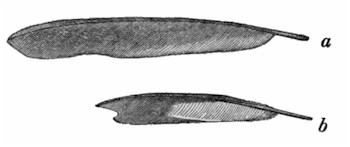
a. First primary of a male Pachyrhamphus. b. Second ditto.
In the male of this species, as in many other Bécards, the second primary is abnormally shortened, being only about one inch in length. See remarks on this subject in P. Z. S. 1857, p. 72, whence the woodcut exhibiting this strange feature is taken by kind permission.
174. CASIORNIS RUBRA (Vieill.).
(RUFOUS CHEESE-BIRD.)
Suiriri roxo, Azara, Apunt. ii. p. 128. Casiornis rubra, Scl. et Salv. Nomencl. p. 57.
Description.—Above uniform ferruginous, lores paler; beneath lighter, belly yellowish; bill horn-colour, yellowish at the base; feet plumbeous: whole length 6·8 inches, wing 3·4, tail 3·1. Female similar.
Hab. S. Brazil, Paraguay, and N. Argentina.
White obtained a female specimen of this bird at Campo Colorado, Oran, in November 1880; it is now in Sclater’s Collection.
Fam. XVI. PHYTOTOMIDÆ, or PLANT-CUTTERS.
The peculiar form Phytotoma, remarkable for its toothed Fringilline bill, was associated by the older authors with the Finches. But modern researches have shown that it is not an Oscinine genus, and that its true place is near the Cotingidæ; indeed, some authors have placed it within the limits of that family.
Of the four known species of Plant-cutters, all restricted to South America, one is a well-known denizen of the Argentine Republic.
175. PHYTOTOMA RUTILA, Vieill.
(RED-BREASTED PLANT-CUTTER.)
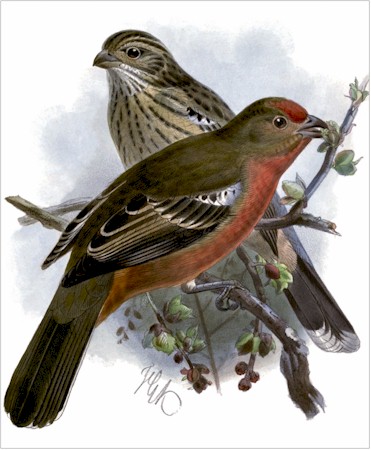
[Plate VIII.]
PHYTOTOMA RUTILA ♂ et ♀
Phytotoma rutila, Burm. La-Plata Reise, ii. p. 451 (Paraná, Mendoza, Cordova, Tucuman, Catamarca); Scl. et Salv. Nomencl. p. 60; Hudson, P. Z. S. 1872, p. 537 (Rio Negro); Barrows, Bull. Nutt. Orn. Cl. viii. p. 203 (Entrerios); White, P. Z. S. 1882, p. 609 (Catamarca).
Description.—Above plumbeous, with slight darker shaft-spots; front of head bright red; wings and tail blackish, two well-marked wing-bars and tips of all lateral rectrices white; beneath bright red; flanks plumbeous; under wing-coverts whitish: whole length 7·0 inches, wing 3·5, tail 3·3. Female: above grey, densely striated with black; beneath dirty white, with dense black striations, belly and crissum fulvous.
Hab. Argentine Republic.
I found this curious little bird quite common in Patagonia, where the natives call it Chingolo grande, on account of its superficial resemblance to the common Song-Sparrow (Zonotrichia pileata). The colouring of the sexes differs considerably, the forehead and under surface of the male being deep brick-red; the upper parts dull grey, with a bar on the wing and the tips of the rectrices white; while in the female the upper parts are yellowish grey, obscurely mottled, and the breast and belly buff, with dark spots. In both sexes the eye is yellow, and the feathers of the crown pileated to form a crest.
This bird is usually seen singly, but sometimes associates in small flocks; it is resident, and a very weak flier, and feeds on tender buds and leaves, berries and small seed. The male is frequently seen perched on the summit of a bush, and, amidst the dull-plumaged species that people the grey thickets of Patagonia, the bright red bosom gives it almost a gay appearance. When singing, or uttering its alarm notes when the nest is approached, its voice resembles the feeble bleatings of a small kid or lamb. When approached it conceals itself in the bush, and when flying progresses by a series of short jerky undulations, the wings producing a loud humming sound.
The nest is made in the interior of a thorny bush, and built somewhat slightly of fine twigs and lined with fibres. The eggs are four, bluish-green in colour, with brownish flecks.
This species is found throughout the Argentine country, in dry, open situations, abounding with a scanty tree and bush vegetation.
Suborder III. TRACHEOPHONÆ.
Fam. XVII. DENDROCOLAPTIDÆ, or WOOD-HEWERS.
The Dendrocolaptidæ are an important family in American Ornithology, numbering some 220 species, and distributed in greater or less abundance over every part of the Neotropical Region from Mexico to Patagonia. Within Argentine limits 46 species occur.
While green is the characteristic colour of the Tyrannidæ, brown is the favoured hue of the Dendrocolaptidæ, both the forest-loving and campos-frequenting members of the group being nearly without exception arrayed in various shades of that sombre colour, to which a ferruginous tail is a very frequent appendage.
The Dendrocolaptidæ fall into four subfamilies, all of which have representatives in Argentina. These are (1) the Furnariinæ, or Oven-birds, which are terrestrial in habits and have their feet adapted for this mode of life; (2) the Sclerurinæ, or Leaf-scrapers, known by their spiny tail, which keep to the ground inside the forests; (3) the Synallaxinæ, or Sharp-tails, mostly bush-frequenting birds; and (4) the Dendrocolaptinæ, or Wood-hewers, which have the habits of our Creepers (Certhia), and use their tail as a climbing-organ. All the members of this great family feed exclusively on insects.
Subfam. I. FURNARIINÆ.
176. GEOSITTA CUNICULARIA (Vieill.).
(COMMON MINER.)
Geositta cunicularia, Burm. La-Plata Reise, ii. p. 405 (Mendoza, Paraná); Scl. et Salv. Nomencl. p. 61; Durnford, Ibis, 1877, p. 178 (Buenos Ayres), et 1878, p. 395 (Chupat); Barrows, Bull. Nutt. Orn. Cl. viii. p. 203 (Entrerios). Geositta tenuirostris, White, P. Z. S. 1882, p. 609 (Salta).
Description.—Above nearly uniform earthy brown; wing-feathers pale cinnamon-red; greater part of the outer webs, excepting the inner secondaries and a transverse bar across the secondaries, blackish; tail pale cinnamon-red, with a broad blackish band across the terminal half; beneath pale fulvous white, breast more or less variegated with blackish; under wing-coverts pale cinnamomeous; bill horn-colour, pale at the base; feet horn-colour: whole length 5·5 inches, wing 3·5, tail 2·0. Female similar.
Hab. Chili, Patagonia and Argentina.
The country people have a variety of names for this common and well-known species. In Buenos Ayres it is usually called Manea-cola (Shake-tail), in Patagonia Caserita (Little House-builder), and in other places Minera (Miner) or Caminante (Traveller), from its habit of running rapidly along a clean road or bridle-path before a person riding or walking.
It is a stout little bird, with very short toes quite unsuited for perching, and it does not, in fact, ever perch on a tree, though it manages to cling to a perpendicular bank very well, when engaged in opening its breeding-hole. It is resident and pairs for life, and lives in sterile places, feeding on small insects and spiders. In manner it is very lively, and runs swiftly over the bare ground, stopping very abruptly, then running on again, and at every pause slowly moving its half-open tail up and down. It flies swiftly, close to the ground, and always during its short flight trills out its clear, ringing, rapidly reiterated cry, which in sound resembles the laughter of a child.
On the grassy pampas the Miners invariably attach themselves to the Vizcacheras—as the groups of great burrows made by the large rodent, the Vizcacha, are called; for there is always a space free from grass surrounding the burrows where the birds can run freely about. In the sides of the deep pit-like entrance to one of these burrows the bird bores a cylindrical hole, from three to six feet long, and terminating in a circular chamber. This is lined with soft dry grass, and five white eggs are laid.
Though the birds inhabit the Vizcacha village all the year, they seem always to make a fresh hole to breed in every spring, the forsaken holes being given up to the small Swallow, Atticora cyanoleuca.
177. GEOBAMON RUFIPENNIS, Burm.
(RED-WINGED MINER.)
Geobamon rufipennis, Burm. La-Plata Reise, ii. p. 465 (Paraná).
Description.—Above reddish grey-brown; lores, rim round the eye, cheeks, and body below white; breast tinged with yellowish grey; wings blackish brown, inner webs ferruginous, with their tips and outer basal edges pale ferruginous; tail bright ferruginous, with a broad black transverse band near the tip; bill black, base of under mandible and legs pale brown: whole length 7·0 inches, wing 4·0, tail 2·0.
Hab. Paraná.
This form is unknown to us, and we can only give a short translation of Burmeister’s description of it. It is said to resemble Geositta, but has a much shorter and perfectly straight beak.
178. FURNARIUS RUFUS (Gm.).
(RED OVEN-BIRD.)
Furnarius rufus, Burm. La-Plata Reise, ii. p. 462 (La Plata); Scl. et Salv. Nomencl. p. 61; Durnford, Ibis, 1877, p. 179 (Buenos Ayres); Gibson, Ibis, 1880, p. 16 (Buenos Ayres).
Description.—Above earthy brown, with a slight rufescent tinge, wing-feathers blackish, margined with pale brown; whole of the outer secondaries pale brown, like the back; tail and upper tail-coverts bright ferruginous brown; below white, breast and flanks and under wing-coverts pale sandy-brown; under surface of the wing with a broad sandy bar across the basal portion; bill and feet horn-colour: whole length 7·8 inches, wing 4·0, tail 2·8. Female similar.
Hab. Argentina, Uruguay, and Paraguay.
The Red Oven-bird is an extremely well-known species in Argentina, and, where found, a great favourite on account of its familiarity with man, its loud, ringing, cheerful voice, and its wonderful mud nest, which it prefers to build near a human habitation, often on a cornice, a projecting beam, or on the roof of the house itself.
It is a stout little bird, about 8½ to 9 inches long, with a slender, slightly-curved beak nearly an inch in length, and strong legs suited to its terrestrial habits. The upper plumage is uniform rufous-brown in colour, brightest on the tail; the under surface very light brown. It ranges throughout the Argentine Republic to Bahia Blanca in the south, and is usually named Hornero or Casera (Oven-bird or House-builder), but in Paraguay and Corrientes it is called Alonzo Garsia or Alonzito. Azara could give no reason for such a name; but it seems to me that one need not look for one beyond the fact that this species inspires an affectionate admiration in the country people: I mean in those of Spanish origin, for the bird-killing French and Italians have no tenderness for it. I have frequently been assured by natives that the Hornero is a pious bird, and always suspends its labours on sacred days. With this pretty belief about it in their minds, it is not strange that in some districts they have called it by a human name.
It is resident, pairs for life, and finds its food, which consists of larvæ and worms, exclusively on the ground. It delights in open places, where it can move freely about on the ground; and is partial to courtyards, clean garden-walks, &c., where, with head thrown back and bosom prominent, it struts along with an air of great gravity, lifting its foot high at each step, and holding it suspended for a moment in the air before setting it firmly down. I once saw one fly down on to a narrow plank about ten feet long lying out on the wet grass; it walked gravely to the end of the plank, then turned, and deliberately walked back to the other end, and so on for about twenty times, appearing to take the greatest pleasure in the mere act of promenading on a smooth level surface. When disturbed, the Oven-bird has a loud, monotonous note of alarm or curiosity, which never fails to bring all its fellows within hearing-distance to the spot. The movements of a fox, weasel, or cat in a plantation can always be known from the noisy turmoil among the Oven-birds. At frequent intervals during the day the male and female meet and express their joy in clear, resonant notes sung in concert—a habit common to a very large number of Dendrocolaptine birds, including, I think, all those species which pair for life. In a majority of species this vocal performance merely consists of a succession of confused notes or cries, uttered with great spirit and emphasis; in the Oven-bird it has developed into a kind of harmonious singing. Thus, the first bird, on the appearance of its mate flying to the place of meeting, emits loud measured notes, sometimes a continuous trilling note with a somewhat hollow metallic sound; but immediately on the other bird joining, this introductory passage is changed to rapid triplets, strongly accented on the first and last notes, while the second bird utters a series of loud measured notes perfectly according with the triplets of the first. While thus singing they stand facing each other, their necks outstretched, wings hanging, and tails spread, the first bird trembling with its rapid utterances, the second beating on the branch with its wings. The finale consists of three or four notes uttered by the second bird alone, and becoming successively louder and more piercing until the end. There is an infinite variety in the tone in which different couples sing, also in the order in which the different notes are uttered, and even the same couple do not repeat their duet in precisely the same way; but it is always a rhythmical and, to some extent, an harmonious performance, and as the voices have a ringing, joyous character, it always produces a pleasing effect on the mind.
In favourable seasons the Oven-birds begin building in the autumn, and the work is resumed during the winter whenever there is a spell of mild wet weather. Some of their structures are finished early in winter, others not until spring, everything depending on the weather and the condition of the birds. In cold dry weather, and when food is scarce, they do not work at all. The site chosen is a stout horizontal branch, or the top of a post, and they also frequently build on a cornice or the roof of a house; and sometimes, but rarely, on the ground. The material used is mud, with the addition of horsehair or slender fibrous rootlets, which make the structure harder and prevent it from cracking. I have frequently seen a bird, engaged in building, first pick up a thread or hair, then repair to a puddle, where it was worked into a pellet of mud about the size of a filbert, then carried to the nest. When finished the structure is shaped outwardly like a baker’s oven, only with a deeper and narrower entrance. It is always placed very conspicuously, and with the entrance facing a building, if one be near, or if at a roadside it looks toward the road; the reason for this being, no doubt, that the bird keeps a cautious eye on the movements of people near it while building, and so leaves the nest opened and unfinished on that side until the last, and there the entrance is necessarily formed. When the structure has assumed the globular form with only a narrow opening, the wall on one side is curved inwards, reaching from the floor to the dome, and at the inner extremity an aperture is left to admit the bird to the interior or second chamber, in which the eggs are laid. A man’s hand fits easily into the first or entrance chamber, but cannot be twisted about so as to reach the eggs in the interior cavity, the entrance being so small and high up. The interior is lined with dry soft grass, and five white pear-shaped eggs are laid. The oven is a foot or more in diameter, and is sometimes very massive, weighing eight or nine pounds, and so strong that, unless loosened by the swaying of the branch, it often remains unharmed for two or three years. The birds incubate by turns, and when one returns from the feeding-ground it sings its loud notes, on which the sitting bird rushes forth to join in the joyous chorus, and then flies away, the other taking its place on the eggs. The young are exceedingly garrulous, and when only half-fledged may be heard practising trills and duets in their secure oven, in shrill tremulous voices, which change to the usual hunger-cry of young birds when the parent enters with food. After leaving the nest, the old and young birds live for two or three months together, only one brood being raised in each year. A new oven is built every year, and I have more than once seen a second oven built on the top of the first, when this has been placed very advantageously, as on a projection and against a wall.
A very curious thing occurred at the estancia house of a neighbour of mine in Buenos Ayres one spring. A pair of Oven-birds built their oven on a beam-end projecting from the wall of a rancho. One morning one of the birds was found caught in a steel trap placed the evening before for rats, and both of its legs were crushed above the knee. On being liberated it flew up to and entered the oven, where it bled to death, no doubt, for it did not come out again. Its mate remained two days, calling incessantly, but there were no other birds of its kind in the place, and it eventually disappeared. Three days later it returned with a new mate, and immediately the two birds began carrying pellets of mud to the oven, with which they plastered up the entrance. Afterwards they built a second oven, using the sepulchre of the dead bird for its foundation, and here they reared their young. My neighbour, an old native, had watched the birds from the time the first oven was begun, feeling greatly interested in their diligent ways, and thinking their presence at his house a good omen; and it was not strange that, after witnessing the entombment of one that died, he was more convinced than ever that the little House-builders are “pious birds.”
179. FURNARIUS TRICOLOR, Cab.
(CRESTED OVEN-BIRD.)
Furnarius tricolor, Cab. Journ. f. Orn. 1878, p. 196 (Cordova). Furnarius figulus, White, P. Z. S. 1882, p. 609 (?).
Description.—Above nearly uniform earthy brown, head slightly crested; tail bright ferruginous; beneath paler, throat pure white; middle of belly and crissum white; under surface of wings blackish, with a transverse bar of pale cinnamon; bill hazel, paler at the base; feet blackish: whole length 5·7 inches, wing 2·8, tail 2·2.
Hab. Cordova.
This pretty little species is a recent discovery of Döring in the Sierras of Cordova; it may be at once recognized by its small size and crested head.
180. UPUCERTHIA DUMETORIA (Geoffr. et d’Orb.).
(PATAGONIAN EARTH-CREEPER.)
Ochetorhynchus dumetorius, Burm. La-Plata Reise, ii. p. 463 (Mendoza). Upucerthia dumetoria, Scl. et Salv. Nomencl. p. 62; Hudson, P. Z. S. 1872, p. 544 (Rio Negro); Durnford, Ibis, 1877, p. 35, et 1878, p. 395 (Chupat); White, P. Z. S. 1883, p. 433 (Cordova).
Description.—Above earthy brown; long superciliary stripe pale ochraceous; wings blackish, with a broad transverse cinnamomeous bar; tail blackish, lateral rectrices tipped with pale cinnamon; beneath dirty white, clear white on the throat and middle of the belly; breast-feathers margined with blackish; under wing-coverts pale cinnamomeous; bill dark horn-colour, pale at the base; feet horn-colour: whole length 9·0 inches, wing 4·0, tail 3·5. Female similar.
Hab. Patagonia and Chili.
These birds are very common in Patagonia, being resident there; some individuals, however, migrate north in winter, and I once obtained a pair, male and female, near Buenos Ayres city in the month of June.
Their legs are short, but on the ground their movements are very rapid, and, like the Miner (Geositta) already described, they fly reluctantly, preferring to run rapidly from a person walking or riding, and at such times they look curiously like a very small Curlew with an extravagantly long beak. They are active, lively birds, and live in pairs, sometimes uniting in small, loose flocks; they are partial to places where scattered bushes grow on a dry sterile soil, and have a swift low flight; when flying they frequently utter a shrill, trilling, or rapidly reiterated note, in sound resembling laughter. In manners, flight, language, and colouring this bird closely resembles the smaller short-beaked Geositta cunicularia, and like that species it also breeds in deep holes in banks; but I am not able to say whether it excavates the breeding-hole or takes possession of one already made. Durnford found it breeding in a hole four feet deep in the bank of a dry lagoon. The nest was of dry grass and lined with the fur of the cavy. It contained three white eggs.
181. UPUCERTHIA RUFICAUDA (Meyen).
(RED-TAILED EARTH-CREEPER.)
Ochetorhynchus ruficauda, Burm. La-Plata Reise, ii. p. 463 (Mendoza).
Description.—Above earthy brown, superciliaries whitish, lower half of back and outer secondaries strongly tinged with rufous; tail deep ferruginous red, inner webs of all the lateral rectrices black; beneath white, breast more or less freckled with greyish; belly, flanks, and crissum pale cinnamomeous brown; under surface of wings blackish, with a transverse cinnamomeous bar; bill and feet blackish: whole length 8·0 inches, wing 3·5, tail 3·3. Female similar.
Hab. Chili and Mendoza.
The straight bill and red colour of the tail-feathers at once distinguish this species from the former. Burmeister obtained specimens of it in the Sierra of Uspallata, where it was met with hopping about the rocks and feeding on insects.
182. UPUCERTHIA LUSCINIA (Burm.).
(WARBLING EARTH-CREEPER.)
Ochetorhynchus luscinia, Burm. La-Plata Reise, ii. p. 464 (Mendoza, Paraná). Upucerthia luscinia, Scl. et Salv. Nomencl. p. 62; White, P. Z. S. 1882, p. 610 (Catamarca); Salvin, Ibis, 1880, p. 358 (Salta).
Description.—Above earthy brown; front, lores, and rim round the eye bright rufous; wings blackish, outer webs more or less edged with rufous earthy brown; tail earthy brown, lateral rectrices tinged with rufous; below pale cinereous with a slight rufescent tinge; throat clear white; under wing-coverts and inner margins of the wing-feathers cinnamon-red; bill hazel, paler at the base; feet pale brown: whole length 7·5 inches, wing 3·0, tail 3·1. Female similar.
Hab. Argentina.
Professor Burmeister was the first discoverer of this species, which he tells us is common near Mendoza, in Paraná, and in the neighbouring pampas. In Paraná he found it nesting under the roof of his house and feeding upon insects. The eggs are pure white. It is the Ruisiñor or “Nightingale” of the natives, whence he gave it the specific name luscinia—a strange name for any species in the shrill-voiced Dendrocolaptine family.
183. CINCLODES FUSCUS (Vieill.).
(BROWN CINCLODES.)
Cinclodes fuscus, Scl. et Salv. Nomencl. p. 62; Durnford, Ibis, 1877, p. 179 (Buenos Ayres); White, P. Z. S. 1882, p. 610 (Catamarca); Barrows, Bull. Nutt. Orn. Cl. viii. p. 205 (Entrerios and Pampas). Cinclodes vulgaris, Burm. La-Plata Reise, ii. p. 463 (Mendoza, Paraná).
Description.—Above dark earthy brown, lores and superciliaries whitish; wings blackish, with a broad transverse cinnamomeous bar; outer tail-feathers blackish, broadly tipped with pale cinnamomeous white; beneath pale cinereous, with a cinnamomeous tinge; throat white, slightly spotted with blackish; bill and feet horn-colour: whole length 7·3 inches, wing 4·0, tail 3·0. Female similar.
Hab. Argentina, Chili, Peru, Bolivia, and Ecuador.
This homely little species differs considerably from most Dendrocolaptine birds in colour and habits; and being of a uniform dull, fuscous hue, its appearance is most uninteresting. It inhabits the whole of Patagonia, but is migratory, possessing, what is rare in this family, a powerful flight. In winter it is common all over the pampas and the Plata district, ranging north to Paraguay. It is always found near water, its favourite hunting-ground being the borders of a stream. On the ground its motions are quick and lively, but when perching on a tree it sits motionless in one position, and when attempting to move appears to lose its balance. These birds cannot be called strictly gregarious, but where abundant they are fond of gathering in loose flocks, sometimes numbering one or two hundred individuals, and when thus associating are very playful, frequently pursuing and wheeling about each other, and uttering a sharp, trilling note. On a warm day in winter they are occasionally heard attempting to sing, the bird darting up vertically into the air and pouring out with great energy a confused torrent of unmelodious sounds.
Their habits, so much less sedate and strikingly in contrast with those of most of the birds in this family, are no doubt due to the greater powers of flight possessed by Cinclodes.
184. CINCLODES BIFASCIATUS, Sclater.
(WHITE-WINGED CINCLODES.)
Cinclodes bifasciatus, Sclater, P. Z. S. 1858, p. 448.
Description.—Above earthy brown with a rufescent tinge on the back, superciliaries white; wings blackish, with a white bar on the secondaries and a second white bar on the inner primaries; tail blackish, outer rectrices tipped with white; beneath white, passing into greyish cinnamomeous on the flanks and crissum; bend of the wing and under wing-coverts white; bill and feet horn-colour: whole length 8·0 inches, wing 4·0, tail 3·3.
Hab. Bolivia and Eastern Argentina.
Weisshaupt obtained examples of this species in the vicinity of Mendoza, from one of which our description is taken.
185. HENICORNIS PHŒNICURUS (Gould).
(DARK-TAILED HENICORNIS.)
Henicornis phœnicurus, Scl. et Salv. Nomencl. p. 62; Durnford, Ibis, 1878, p. 395 (Central Patagonia).
Description.—Above earthy brown, slight superciliary line white, edges of outer secondaries, lower back, and upper tail-coverts bright ferruginous red; tail black, outer webs of outer tail-feathers and slight external edging of the others bright ferruginous; beneath, throat and breast pure white, belly cinereous, flanks tinged with rufous; crissum bright ferruginous; bill dark horn-colour, base of lower mandible yellowish; feet horn-colour: whole length 7·5 inches, wing 3·3, tail 3·0.
Hab. Chili and Patagonia.
Durnford met with this peculiar form in Central Patagonia in 1877-78. He says that it was resident and common among the bushes throughout his journey.
186. LOCHMIAS NEMATURA (Licht.).
(BRAZILIAN LOCHMIAS.)
Lochmias nematura, Burm. La-Plata Reise, ii. p. 462 (Paraná).
Description.—Above clear brown, rump blackish, elongated superciliaries white; tail blackish; beneath blackish brown, with numerous large white oval spots occupying the centre of the feathers; bill horn-colour, lower mandible pale brown at the base; feet brown: whole length 5·5 inches, wing 2·8, tail 2·0.
Hab. South-east Brazil and Northern Argentina.
Professor Burmeister met with this Brazilian species near Paraná, where it lives on the ground among the bushes.
Subfam. II. SCLERURINÆ.
187. SCLERURUS UMBRETTA (Licht.).
(THE SPINY LEAF-SCRAPER.)
Sclerurus caudacutus, White, P. Z. S. 1882, p. 610 (Misiones). Sclerurus umbretta, Scl. et Salv. Nomencl. p. 62.
Description.—Above dark brown, rump and upper tail-coverts rufous; wing-feathers blackish, glossed with dull brown; tail black; beneath, throat white, the feathers edged with dark brown; breast dull rufous; belly and flanks same colour as back; under wing-coverts whitish brown; bill and feet black: whole length 7·1 inches, wing 3·6, tail 2·6.
Hab. Brazil, Paraguay, and Argentina.
White has the following note on this interesting species:—“Only two of these birds were observed during my trip through Misiones. It frequents the dense gloomy forests, where it busies itself in scraping amongst the dead leaves; and although it may be close at hand and the rustling distinct, a quick eye is required to detect it, as its plumage is of the exact colour of decaying foliage. If startled, it flies up onto the trunk of the nearest tree, and there remains perfectly motionless in an upright position. I never heard it utter a single note.”
Subfam. III. SYNALLAXINÆ.
188. PHLŒOCRYPTES MELANOPS (Vieill.).
(RUSH-LOVING SPINE-TAIL.)
Synallaxis melanops, Burm. La-Plata Reise, ii. p. 470 (Mendoza). Phlœocryptes melanops, Scl. et Salv. Nomencl. p. 63; Durnford, Ibis, 1877, p. 179 (Buenos Ayres), et 1878, p. 396 (Central Patagonia); Barrows, Bull. Nutt. Orn. Cl. viii. p. 206 (Bahia Blanca).
Description.—Above, forehead brown, crown blackish, broad superciliaries buffy white; upper half of back black, marked with a few grey stripes; lower back and rump, also sides of head and neck, light brown; wings blackish, mottled with light chestnut on the coverts; and a broad band of the same colour occupying the basal half of the wing-feathers; tail blackish, the two middle feathers brownish grey, the others slightly tipped with the same colour; beneath white, more or less tinged on the throat, flanks, and under tail-coverts with pale brown; under wing-coverts fulvous; bill and feet pale horn-colour: whole length 5·8 inches, wing 2·3, tail 1·6. Female similar.
Hab. Chili, Patagonia, and Argentina.
This is one of our few strictly migratory species in the family Dendrocolaptidæ. Probably it winters in South Brazil, as in the northern parts of the Argentine country it is said to be a summer visitor. On the pampas it appears in September, and all at once becomes very abundant in the rush-beds growing in the water, where alone it is found. The migration no doubt is very extensive, for in spring I found it abundant in the rush-beds in the Rio Negro valley, and Durnford met with it much further south on the river Sanguelen, a tributary of the Chupat. Migratory birds are, as a rule, very little given to wandering; that is to say, they do not go much beyond the limits of the little coppice, reed-bed, or spot of ground which they make their summer home, and this species is no exception. It spends the warm season secluded in its rush-bed: and when disturbed flies with great reluctance, fluttering feebly away to a distance of a few yards, and then dropping into the rushes again, apparently quite incapable of a sustained flight. How a bird so feeble on the wing, and retiring in its habits, is able to perform a long, annual migration, when in traversing vast tracts of open country it must be in great peril from rapacious kinds, is a great mystery. No doubt many perish while travelling; but there is this circumstance in their favour: an incredible number of birds of various kinds, many as weak and exposed to attack as the Phlœocryptes, migrate simultaneously; Hawks are very thinly scattered along their route, and as a rule these birds feed only once or twice a day, if the meals are large enough to fill the stomach, so that while the Hawk is inactive, digesting his meal, thousands of migrants have sped by on their journey and are beyond his reach for ever.
This Spine-tail seldom ventures out of its rush-bed, but is occasionally seen feeding in the grass and herbage a few yards removed from the water. Its language is peculiar, this being a long cicada-like note, followed by a series of sounds like smart taps on a piece of dry wood. It frequents the same places as the small Many-coloured Tyrant (Cyanotis azaræ), and these little neighbours, being equally inquisitive, whenever a person approaches the rushes often emerge together, one uttering wooden-sounding creaks and raps, the other liquid gurgling notes—a little brown bird and a little bird with many bright colours, both, in very different tones, demanding to know the reason of the intrusion.
The nest is a very wonderful structure, and is usually attached to three upright stems; it is domed, oval-shaped, about nine inches deep, and the small circular aperture which is close to the top is protected by a sloping tile-like projection. It is built of tough grass-leaves, which are apparently first daubed with wet clay and then ingeniously woven in, with the addition, I think, of some kind of mucilage: the whole nest is, when finished, light but very strong, and impervious to wet. Until the rushes die and drop the nest remains securely fastened to them, and in winter affords a safe and comfortable retreat to the small reed-frogs, of which sometimes as many as three or four are found living in one nest. The interior is very thickly lined with feathers; the eggs are three, pear-shaped, and a bright, beautiful blue colour, sometimes with a slight greenish tinge.
The bird is so abundant in extensive marshes that I have on several occasions, during a day’s ramble, found as many as forty or fifty nests, sometimes a dozen or more being placed close together, but I have never taken more than three eggs from one nest. I mention this because I have seen it stated that four or five eggs are sometimes found.
I trust that no reader of this sketch imagines that I robbed all the eggs contained in so many nests. I did nothing so barbarous, although it is perhaps “prattling out of fashion” to say so; but with the destructive, useless egg-collecting passion I have no sympathy. By bending the pliant rushes downwards the eggs can be made to roll out into the hand; and all those which I thus took out to count were, I am glad to say, put back in their wonderful cradles. I had a special object in examining so many nests. A gaucho boy once brought me a nest which had a small circular stopper, made of the same texture as the body of the nest, attached to the aperture at the side, and when swung round into it fitting it as perfectly as the lid of the trap-door spider fits the burrow. I have no doubt that it was used to close the nest when the bird was away, perhaps to prevent the intrusion of reed-frogs or of other small birds; but I have never found another nest like it, nor have I heard of one being found by any one else; and that one nest, with its perfectly-fitting stopper, has been a puzzle to my mind ever since I saw it.
189. LEPTASTHENURA ÆGITHALOIDES (Kittl.).
(TIT-LIKE SPINE-TAIL.)
Synallaxis ægithaloides, Burm. La-Plata Reise, ii. p. 469 (Mendoza); Hudson, P. Z. S. 1872, p. 544 (Rio Negro). Leptasthenura ægithaloides, Scl. et Salv. P. Z. S. 1869, p. 632 (Buenos Ayres); iid. Nomencl. p. 63; Durnford, Ibis, 1877, p. 180 (Buenos Ayres), et 1878, p. 396 (Centr. Patagonia); Gibson, Ibis, 1880, p. 30 (Buenos Ayres); White, P. Z. S. 1882, p. 611 (Catamarca); Barrows, Bull. Nutt. Orn. Cl. viii. p. 206 (Entrerios).
Description.—Above pale earthy brown; crown black, striped with clear brown; lores, sides of head, and throat white, with minute black spots; wings blackish, the edges of the outer webs of the primaries and the basal part of the secondaries light rufescent brown; tail black, lateral rectrices tipped and margined with pale grey; beneath pale grey, throat white; bill and feet horn-colour: whole length 6·2 inches, wing 2·4, tail 3·5. Female similar.
Hab. Chili, Argentina, and Patagonia.
This is a restless little bird, seen singly or in parties of three or four. In manner and appearance it resembles the Long-tailed Titmouse (Parus), as it diligently searches for small insects in the trees and bushes, frequently hanging head downwards to explore the under surface of a leaf or twig, and while thus engaged continually uttering a little sharp querulous note. They are not migratory, but in winter seem to wander about from place to place a great deal; and in Patagonia, in the cold season, I have frequently seen them uniting in flocks of thirty or forty individuals, and associating with numbers of Spine-tails of other species, chiefly with Synallaxis sordida, and all together advancing through the thicket, carefully exploring every bush in their way.
D’Orbigny says that it makes a nest of rootlets and moss in a bush; but where I have observed this bird it invariably breeds in a hole in a tree, or in the nest of some other bird, often in the clay structure of the Oven-bird. But in Patagonia, where the Oven-bird is not known, this Spine-tail almost always selects the nest of the Synallaxis sordida. It carries in a great deal of soft material—soft grass, wool, and feathers—to reline the cavity, and lays five or six, white, pointed eggs.
190. LEPTASTHENURA FULIGINICEPS (d’Orb. et Lafr.).
(BROWN-CRESTED SPINE-TAIL.)
Leptasthenura fuliginiceps, Scl. et Salv. Nomencl. p. 63; White, P. Z. S. 1882, p. 611 (Catamarca). Synallaxis fuliginiceps, Burm. La-Plata Reise, ii. p. 469.
Description.—Above pale earthy brown; forehead and slightly crested crown rufous brown; wings blackish, edges of outer webs of all the wing-feathers and basal part of the secondaries chestnut; tail clear brown; beneath paler, earthy brown; bill and feet horn-colour: whole length 6·0 inches, wing 2·2, tail 3·1.
Hab. Bolivia and N. Argentina.
This species, discovered by d’Orbigny in Bolivia, was met with by White in Catamarca, “on the slopes of the hills, outside the dense wood,” and by Prof. Burmeister near Paraná.
191. SYNALLAXIS FRONTALIS, Pelz.
(BROWN-FRONTED SPINE-TAIL.)
Synallaxis frontalis, Scl. et Salv. Nomencl. p. 63; Scl. P. Z. S. 1874, p. 8; Salvin, Ibis, 1880, p. 358 (Salta); White, P. Z. S. 1882, p. 611 (Salta, Catamarca). Synallaxis ruficapilla, d’Orb. Voy., Ois. p. 246 (Corrientes); Burm. La-Plata Reise, ii. p. 408 (Paraná).
Description.—Above, earthy brown; cap chestnut; front earthy brown; wing-coverts chestnut, wing-feathers olive-brown, the outer webs edged with chestnut; tail chestnut; beneath, throat blackish, with slight whitish mottlings; breast, sides, and under tail-coverts pale earthy brown, belly brownish white; under wing-coverts fulvous; bill and feet horn-colour: whole length 5·6 inches, wing 2·2, tail 3·0.
Hab. South America, from Colombia to Argentina.
192. SYNALLAXIS SUPERCILIOSA, Cab.
(EYEBROWED SPINE-TAIL.)
Synallaxis superciliosa, Cab. J. f. O. 1883, p. 110 (Tucuman).
Description.—Above, head on top bright chestnut, lores white, superciliaries yellowish white; sides of head, neck, and back earthy brown inclining to olive; upper wing-coverts chestnut, wing-feathers blackish, the webs of the outer margins dull chestnut; tail chestnut; beneath, upper half of throat white, lower half black tipped with white; breast and belly brownish white; flanks and under tail-coverts pale earthy brown; under wing-coverts fulvous; bill and feet horn-colour: whole length 7·0 inches, wing 2·0, tail 3·5.
Hab. Tucuman.
This Spine-tail, so far as we know at present, is peculiar to Tucuman, where it was discovered by Herr Schulz.
193. SYNALLAXIS SPIXI, Scl.
(SPIX’S SPINE-TAIL.)
Synallaxis spixi, Burm. P. Z. S. 1868, p. 636 (Buenos Ayres); Scl. et Salv. P. Z. S. 1869, p. 632 (Buenos Ayres); Scl. P. Z. S. 1874, p. 9.
Description.—Above, crown chestnut; lores and sides of head dark cinereous; hind neck, back, also wing- and tail-feathers olive-brown; upper wing-coverts chestnut; beneath dark cinereous, becoming whitish on the belly, throat blackish; under wing-coverts fulvous chestnut; bill black, feet horn-colour; whole length 6·7 inches, wing 2·0, tail 3·2.
Hab. Southern Brazil and Argentina.
I like Azara’s name Chicli, which, to one acquainted with the habits of this and of the following species, seems very appropriate, suggesting, as I imagine it does, a small creature possessing a sharp two-syllabled note; for although Hartlaub, in his Nomenclature of Azara, gives S. ruficapilla as the species meant by Chicli, the account of its habits in the ‘Apuntamientos’ seems to point to S. spixi or to S. albescens.
Azara says:—“I give it this name because it sings it plainly, in a loud sharp tone, which may be heard at a distance, repeating it so frequently that the pauses last no longer than the sound. It is resident (in Paraguay), solitary and not abundant: inhabits thickets of aloes and thorn, without rising more than two yards above the surface, or showing itself in open places. It moves about incessantly, but does not leave its thicket to visit the woods or open ground, its flight being only from bush to bush; and though it is not timid, it is hard to detect it in its stronghold, and to hear it one would imagine that it was perched overhead on a tree, when it is hidden all the time in the brushwood at the roots.”
This habit of concealing itself so closely inclines me to think that this species, rather than S. albescens, was the bird described by Azara, although in both species the language is nearly the same. I have nothing to add to the above account from the ‘Apuntamientos,’ except that in the love-season this species has a low, strange-sounding little song, utterly unlike its usual strident cry. When singing, it sits motionless on the summit of a low bush in a dejected attitude with head drawn in, and murmurs its mysterious little melody at intervals of half a minute.
194. SYNALLAXIS ALBESCENS, Temm.
(WHITE-THROATED SPINE-TAIL.)
Synallaxis albescens, Scl. et Salv. Nomencl. p. 63; Scl. P. Z. S. 1874, p. 9; Durnford, Ibis, 1877, p. 180 (Buenos Ayres); White, P. Z. S. 1882, p. 611 (Misiones); Barrows, Bull. Nutt. Orn. Cl. viii. p. 207 (Entrerios).
Description.—Above, forehead grey, crown pale chestnut; sides of head and neck, back, and tail pale earthy brown; upper wing-coverts pale chestnut, wing-feathers olive-brown; beneath white, faintly washed with earthy brown; under wing-coverts fulvous: whole length 5·3 inches, wing 2·0, tail 2·2.
Hab. S. America, from Veragua to Buenos Ayres.
This species, although by no means abundant in Buenos Ayres, is met with much more frequently than the S. spixi, which it closely resembles in size, colour, habits, and language. It is, indeed, an unusual thing for two species so closely allied to be found inhabiting the same district. In both birds the colours are arranged in precisely the same way; but the chestnut tint on S. albescens is not nearly so deep, the browns and greys are paler, and there is less black on the throat.
I am pretty sure that in Buenos Ayres it is migratory, and as soon as it appears in spring it announces its arrival by its harsh, persistent, two-syllabled note, wonderfully strong for so small a bird, and which it repeats at intervals of two or three seconds for half an hour without intermission. When close at hand it is quite as distressing as the grinding noise of a Cicada. This painful noise is uttered while the bird sits concealed amid the foliage of a tree, and is renewed at frequent intervals, and continues every day until the Spine-tail finds a mate, when all at once it becomes silent. The nest is placed in a low thorn-bush, sometimes only two or three feet above the ground, and is an oblong structure of sticks, twelve or fourteen inches in depth, with the entrance near the top, and reached by a tubular passage made of slender sticks, and six or seven inches long. From the top of the nest a crooked passage leads to the cavity near the bottom; this is lined with a little fine grass, and nine eggs are laid, pear-shaped and pale bluish white in colour. I have found several nests with nine eggs, and therefore set that down as the full number of the clutch, though I confess it seems very surprising that this bird should lay so many. When the nest is approached, the parent birds remain silent and concealed at some distance. When the nest is touched or shaken, the young birds, if nearly fledged, have the singular habit of running out and jumping to the ground to conceal themselves in the grass.
I have no doubt that this species varies greatly in its habits in different districts, and probably also in the number of eggs it lays. Mr. Barrows, an excellent observer, says it lays three or four light blue eggs. He met with it at Concepcion, in the northern part of the Argentine Republic, and writes that it is “an abundant species in thorny hedges or among the masses of dwarfed and spiny bushes, which cling to each other so tenaciously amid the general desolation of the sandy barrens.” The nests which he describes vary also in some particulars from those I have seen. “Entrance is gained by the bird,” he says, “through a long tube, which is built on to the nest at a point about half way up the side. This tube is formed by the interlocking of thorny twigs, and is supported by the branches and twigs about it. It may be straight or curved; its diameter externally varies from two to four inches, and its length from one to two feet. The passage-way itself is but just large enough to admit the birds one at a time, and it has always been a mystery to me how a bird the size of a Chipping-Sparrow could find its way through one of these slender tubes, bristling with thorns, and along which I found it difficult to pass a smooth slender twig for more than five or six inches. Yet they not only pass in and out easily, but so easily that I was never yet able to surprise one in the nest, or to see the slightest disturbance of it by the bird’s hurried exit.”
The bird has a very wide range in South America, and Mr. Salmon observed its breeding-habits in Antioquia in Colombia. There also the bird varies the form of its nest, making it as large as that of an English Magpie, and roofing the top with a mass of large leaves to protect it from the heavy rains. The eggs, he says, are very pale greenish blue, nearly white; but he does not give the number.
195. SYNALLAXIS WHITII, Scl.
(WHITE’S SPINE-TAIL.)
Synallaxis whitii, Scl. Ibis, 1881, p. 600, pl. xvii. fig. 2; White, P. Z. S. 1882, p. 611 (Salta).
Description.—Above dark brown, lores, and superciliaries white; wings and tail chestnut red; beneath cinnamomeous, paler on the middle of the belly; large spot in the middle of the throat black; inner margins of wing-feathers and under wing-coverts cinnamomeous; bill black, feet pale hazel: whole length 5·7 inches, wing 2·5, tail 2·6.
Hab. Northern Argentina.
White obtained a single example of this new species near Oran in November 1880. It is most nearly allied to S. scutata of Brazil.
196. SYNALLAXIS PHRYGANOPHILA (Vieill.).
(PRETTY-THROATED SPINE-TAIL.)
Synallaxis phryganophila, Burm. La-Plata Reise, ii. p. 409 (Paraná); Scl. et Salv. Nomencl. p. 64; Scl. P. Z. S. 1874, p. 17; White, P. Z. S. 1882, p. 611 (Buenos Ayres); Barrows, Bull. Nutt. Orn. Cl. viii. p. 207 (Entrerios).
Description.—Above, front brown, crown chestnut, superciliaries white; sides of head, neck, back, and tail pale fulvous brown, with broad blackish striations on the neck and back; upper wing-coverts pale chestnut; wing-feathers blackish, the outer webs edged with pale fulvous brown; beneath, upper half of throat sulphur-yellow, lower half black, with a white patch on each side of the black; breast and belly whitish, washed with earthy brown, slightly fulvous on the breast and flanks; under wing-coverts fulvous white; bill and feet horn-colour: whole length 8·5 inches, wing 2·4, tail 4·6.
Hab. Paraguay, Argentina, and Uruguay.
This pretty Spine-tail is nowhere common in the Argentine country, and in Buenos Ayres it is exceedingly scarce. It is rather large for a Synallaxis, the total length being nine inches. The two middle feathers of the acuminated tail greatly exceed the others in length, measuring five inches. The plumage is very pale brown, marked with fuscous; the crown and wing-coverts rufous. The beauty of the bird is in the throat, which has three strongly contrasted colours, distinguishing it from all other Synallaxes. In the angle of the beak the colour is sulphur-yellow, under this is a patch of velvet-black, and on each side of the yellow and black a pure white patch.
Mr. Barrows has the following very interesting note on its nesting-habits:—“A nest containing four white eggs, faintly tinted with blue, was found in a thorny tree, and some eight feet from the ground. The nest was quite similar to the one just described (of S. albescens), but the cavity in which the eggs were laid was near the top of the body of the nest, while the passage-way descended from it to the base of the nest, and there becoming external rose gradually to the level of the eggs at a distance of almost three feet.”
197. SYNALLAXIS STRIATICEPS (Lafr. et d’Orb.).
(STRIPED SPINE-TAIL.)
Synallaxis striaticeps, Burm. La-Plata Reise, ii. p. 469 (Paraná); Hudson, P. Z. S. 1872, p. 544 (Rio Negro); Scl. et Salv. Nomencl. p. 64; Scl. P. Z. S. 1874, p. 21; Salvin, Ibis, 1880, p. 358 (Salta); White, P. Z. S. 1883, p. 39 (Cordova); Barrows, Bull. Nutt. Orn. Cl. viii. p. 208 (Entrerios).
Description.—Above earthy brown, darker on the crown, which has slight greyish striations; broad superciliaries white; upper wing-coverts pale chestnut; wing-feathers blackish, glossed with olive; tail pale chestnut; beneath white; under wing-coverts pale fulvous; bill and feet horn-colour: whole length 5·9 inches, wing 2·4, tail 2·4. Female similar.
Hab. Bolivia, Argentina, Uruguay, and Patagonia.
This species has a wide range south of the Equator, being found in Bolivia, Uruguay, and throughout the Argentine Republic, including Patagonia. In its habits it differs widely from other Synallaxes, and in structure and coloration is also unlike its relatives.
The beak is longer and more curved, the claws more crooked, and the tail stiffer than in other Synallaxes, and this difference in structure corresponds to a different mode of life. The Striped Spine-tail creeps on the trunk and larger branches of trees, seeking its insect-food in the crevices of the bark, and when seen clinging to the trunk, supported by its tail in a vertical position, with head thrown far back, and progressing upwards by short quick hops, it looks wonderfully like a small Picolaptes with shortened beak. It is very restless, and while searching for insects constantly utters a short, trilling, querulous-sounding note.
It builds an open nest in the fork of a branch, of soft grasses and hair, thickly lined with feathers, and lays four or five pure white eggs.
198. SYNALLAXIS ORBIGNII, Reichenb.
(D’ORBIGNY’S SPINE-TAIL.)
Synallaxis orbignii, Scl. et Salv. Nomencl. p. 64; Scl. P. Z. S. 1874, p. 22, et 1879, p. 461; Salvin, Ibis, 1880, p. 358 (Salta). Synallaxis humicola, Burm. La-Plata Reise, ii. p. 468 (Mendoza, Paraná). Synallaxis crassirostris, Leybold, J. f. O. 1865, p. 401. Synallaxis flavigularis, Döring, Exp. al Rio Negro, Zool. p. 45.
Description.—Above pale earthy brown, superciliaries whitish; wing-feathers blackish, the basal part of the secondaries pale chestnut, forming a transverse band; four middle tail-feathers blackish, the lateral pale chestnut; beneath whitish brown; middle of throat pale rufous; under wing-coverts fulvous; bill and feet horn-colour: whole length 6·5 inches, wing 2·2, tail 3·2.
Hab. Bolivia and Argentina.
This Spine-tail has been noticed by various observers in Northern Argentina, and, if we are correct in referring S. flavigularis of Döring to the same species, occurs also in the Rio Negro district.
199. SYNALLAXIS MODESTA, Eyton.
(MODEST SPINE-TAIL.)
Synallaxis modesta, Scl. et Salv. Nomencl. p. 64; Scl. P. Z. S. 1872, p. 544 (Rio Negro), et 1874, p. 23. Synallaxis flavogularis, Burm. La-Plata Reise, ii. p. 468 (Mendoza).
Description.—Above earthy brown, superciliaries whitish; wings blackish, the basal half of secondaries pale clear brown, forming a transverse bar; tail black, the outer webs of all the rectrices pale chestnut; beneath whitish brown, with a large fulvous spot on the throat; under wing-coverts fulvous; bill and feet pale brown: whole length 6·0 inches, wing 2·4, tail 2·5. Female similar.
Hab. Argentina, Patagonia, Chili.
This species so closely resembles the following in size and dull earthy-brown colour, that where seen in the thickets it is impossible to distinguish them. In habits they also seem alike; but this bird is, I think, less retiring, for I have seen it associating with other species of Synallaxis.
On comparing specimens together, however, it is easy to separate the present bird from S. sordida by noticing the colour of the external rectrices, which are black, externally edged with rufous, instead of being wholly rufous.
200. SYNALLAXIS SORDIDA, Less.
(SORDID SPINE-TAIL.)
Synallaxis sordida, Hudson, P. Z. S. 1872, p. 543 (Rio Negro); Scl. et Salv. Nomencl. p. 64; Scl. P. Z. S. 1874, p. 23; Durnford, Ibis, 1878, p. 396 (Centr. Patagonia); White, P. Z. S. 1883, p. 39 (Cordova); Barrows, Bull. Nutt. Orn. Cl. viii. p. 208 (Entrerios).
Description.—Above earthy brown; wing-feathers blackish brown, their basal parts pale chestnut-brown, forming a transverse bar; tail blackish, the three outer rectrices and outer web of the fourth rectrix on each side wholly pale chestnut-brown; beneath pale earthy brown, clearer on the belly, and with a bright fulvous spot on the throat; under wing-coverts pale cinnamomeous; bill and feet blackish: whole length 6·5 inches, wing 2·3, tail 2·8. Female similar.
Hab. Patagonia and East Argentina.
This species, which, on close comparison, is at once distinguishable from S. modesta by the absence of any black colour on the three exterior pairs of tail-feathers, ranges from the extreme north of the Argentine Republic to Patagonia, where it is quite common, and is invariably found in dry situations abounding in thorny vegetation.
It does not migrate, and lives with its mate in thorny bushes, but does not attempt to conceal itself, and sits much on the summit of a bush, where the male in spring utters at intervals a clear trilling call. In its inactive disposition, slow deliberate movements, also in its language, it strikingly resembles the Phacellodomus ruber. In its nidification it also comes nearest to that species. The nest is a large structure of sticks, eighteen inches to two feet long, placed upright among the twigs at the summit of a bush. From the top where the entrance is placed, a winding passage leads down to the chamber at the bottom of the nest; this is lined with soft dry grass and feathers, and four pure white eggs are laid.
201. SYNALLAXIS SULPHURIFERA, Burm.
(YELLOW-MARKED SPINE-TAIL.)
Synallaxis sulphurifera, Hudson, P. Z. S. 1872, p. 544 (Rio Negro); Scl. et Salv. Nomencl. p. 64; Scl. P. Z. S. 1874, p. 24; Durnford, Ibis, 1877, p. 180, et 1878, p. 61 (Buenos Ayres); Barrows, Bull. Nutt. Orn. Cl. viii. p. 208 (Entrerios).
Description.—Above brown, slightly olivaceous; wings blackish; lesser wing-coverts, margins of the feathers of the greater wing-coverts, and outer webs of the basal halves of the wing-feathers pale chestnut; tail-feathers chestnut-brown, ends much elongated and pointed; beneath white, throat and breast mottled with grey, spot in middle of throat sulphur-yellow; flanks washed with brown; bend of wing and under wing-coverts fulvous; bill and feet pale horn-colour: whole length 6·3 inches, wing 2·1, tail 3·0. Female similar.
Hab. South Argentina and Patagonia.
I have found this Synallaxis, which was first described by Prof. Burmeister, from specimens obtained near Buenos Ayres, in the swamps along the Plata river; also on the Rio Negro, in Patagonia, where, however, it is very scarce. It inhabits the dense rush-beds growing in the water, where the Limnornis curvirostris is also found. It closely resembles that species in habits and language, and also assimilates to it in colour and in the rather long, curved beak, sharp claws, stout body, and short stiff tail. It is stationary, pairs for life, and lives always closely concealed in its chosen bed of close-growing rushes. When a person approaches their hiding-place the two birds creep up to the summit of the rushes, protesting in peculiar, loud, angry rattling notes. The Limnornis, which also pairs for life, has precisely the same habit.
Durnford describes the nest, found in a rush-bed, as a circular or domed structure of grass, with the aperture at the side; the eggs white.
202. SYNALLAXIS PATAGONICA (Lafr. et d’Orb.).
(PATAGONIAN SPINE-TAIL.)
Synallaxis patagonica, Hudson, P. Z. S. 1872, p. 544 (Rio Negro); Scl. et Salv. Nomencl. p. 64; Scl. P. Z. S. 1874, p. 24; Durnford, Ibis, 1877, p. 35 (Chupat).
Description.—Above greyish earthy brown; wing-feathers blackish brown, basal halves of secondaries very pale clear brown, forming a transverse band; tail blackish, edged with greyish brown; outer web of outer feather on each side pale brown; beneath cinereous, with an obscure blackish spot on the throat; belly and flanks dull buff; under wing-coverts cinnamomeous; bill and feet blackish: whole length 6·0 inches, wing 2·2, tail 2·5. Female similar.
Hab. Patagonia.
This dull-coloured little bird, which is found in Patagonia and also near the Andes in the north-western provinces of the Argentine Republic, is one of those species which diverge greatly in habits from the typical S. ruficapilla and its nearest allies. The body is stout, the tail, square and short, is carried vertically as in the House-Wren.
The Patagonian Spine-tail is a resident in the Rio Negro district. It is a silent, shy, solitary little bird, which lives on the ground and seeks its food after the manner of the Cachalote (Homorus). Being small and feeble, however, it does not hunt about the roots of trees and large bushes like the larger and more powerful Homorus, but keeps under the diminutive scrubby plants in open sterile situations. About the roots of these wiry little bushes, only twelve to eighteen inches high, the bird searches for small insects, and when disturbed has a feeble jerky flight, which carries it to a distance of about twenty yards. It flies with great reluctance, and when approached runs swiftly away, leaving a person in doubt as to whether he has seen a mouse or a little obscure bird. The only note I have heard it utter is a faint creaking sound when alarmed or flying.
203. SYNALLAXIS HUDSONI, Scl.
(HUDSON’S SPINE-TAIL.)
Synallaxis hudsoni, Scl. P. Z. S. 1874, p. 25; Durnford, Ibis, 1877, p. 36, et 1878, p. 396 (Chupat, Central Patagonia); Barrows, Bull. Nutt. Orn. Cl. viii. p. 209 (Azul, Sierra de la Ventana). Synallaxis sclateri, Cab. J. f. O. 1878, p. 196.
Description.—Above fulvous brown, mottled with black, each feather being marked with a large black spot; on the upper part of the back the feathers are faintly edged with whitish grey; wings blackish, basal halves of feathers pale clear brown, forming a transverse bar, the terminal part of the feathers slightly edged on the outer webs and tips with ochraceous; tail blackish, the outer pair of rectrices and broad tips of the next two pairs on each side very pale brown, the two middle feathers broadly margined on both webs with pale greyish brown; beneath pale ochraceous brown, with a pale sulphur-yellowish gular spot; flanks with a few black marks; under wing-coverts light cinnamon; bill and feet pale horn-colour: whole length 7·8 inches, wing 3·2, tail 3·5. Female similar.
Hab. Argentina.
This Spine-tail, which Sclater has named after me, is the Argentine representative of S. humicola of Chili. It is common on the pampas, and is sometimes called by the gauchos “Tiru-riru del campo,” on account of its resemblance in the upper plumage and in language to Anumbius acuticaudatus, which is named “Tiru-riru,” in imitation of its call-note. The addition of del campo signifies that it is a bird of the open country. It is, in fact, found exclusively on the grassy pampas, never perching on trees, and in habits is something like a Pipit, usually being taken for one when first seen. It is quite common everywhere on the pampas, and specimens have also been obtained in Cordova, Uruguay, and Patagonia.
This Spine-tail is resident, solitary, and extremely timid and stealthy in its movements, living always on the ground among the long grass and cardoon-thistles. At times its inquisitiveness overcomes its timidity, and the bird then darts up three or four yards into the air, and jerking its tail remains some moments poised aloft with breast towards the intruder, emitting sharp little notes of alarm, after which it darts down again and disappears in the grass. When driven up it has a wild zigzag flight, and after reaching a considerable height in the air darts down again with astonishing swiftness, and comes back to the very spot from which it rose. It is, however, incapable of sustained flight, and after being flushed two or three times refuses to rise again. In spring the male perches on the summit of a cardoon-bush, or other slight elevation, and at regular intervals utters a pleasing and melancholy kind of song or call, which can be heard distinctly at a distance of a thousand yards, composed of four long clear plaintive notes, increasing in strength, and succeeded by a falling trill. When approached it becomes silent, and dropping to the ground conceals itself in the grass. Under a cardoon-bush or tussock of grass it scoops out a slight hollow in the ground, and builds over this a dome of fine dry grass, leaving a small aperture arched like the door of a baker’s oven. The bed is lined with dry powdered horse-dung, and the eggs are five, bluntly pointed and of a very pale buff colour. The interior of the nest is so small that when the five young birds are fledged they appear to be packed together very closely, so that it is difficult to conceive how the parent bird passes in and out.
The nest is always very cunningly concealed, and I have often spent days searching in a patch of cardoon-bushes where the birds were breeding without being able to find it.
204. SYNALLAXIS MALUROIDES, d’Orb.
(WREN-LIKE SPINE-TAIL.)
Synallaxis maluroides, Scl. et Salv. Nomencl. p. 64; Scl. P. Z. S. 1874, p. 26; Durnford, Ibis, 1877, p. 180, et 1878, p. 61 (Buenos Ayres); Barrows, Bull. Nutt. Orn. Cl. viii. p. 208 (Entrerios).
Description.—Above, front and middle of crown chestnut; hind head, neck, and back pale fulvous brown, thickly marked with longitudinal black shaft-spots; lores white; wings blackish, the feathers edged with pale ochraceous, the basal part of secondaries very pale brown, forming a transverse bar; tail pale chestnut-brown, the two middle feathers with a broad black mark on the inner web; beneath white, breast and flanks washed with pale brown, and freckled with very small dark brown spots; under wing-coverts white; bill and feet pale horn-colour: whole length 6·1 inches, wing 2·0, tail 2·9. Female similar.
Hab. South Argentina.
D’Orbigny discovered this small Spine-tail near Buenos Ayres city, but did not record its habits. Like the species just described it is abundant on the pampas, but in its habits resembles a Wren of the genus Cistothorus rather than a Pipit, being partial to moist situations, where there is a rank growth of grass and herbage. The wings are very short, and the flight so feeble that the bird refuses to rise after being pursued a distance of one or two hundred yards. And yet I am not prepared to say that it does not migrate, as I have found that in spring it all at once becomes very abundant, while in the cold season it is rarely seen. It is solitary, and in spring sits on a thistle or stalk, uttering at short intervals its small grasshopper-like song or call. The nest is a slight open structure of grass, lined with a few feathers, placed in a tuft of grass or reeds. The eggs are pure white in colour.
205. CORYPHISTERA ALAUDINA, Burm.
(LARK-LIKE CORYPHISTERA.)
Coryphistera alaudina, Burm. La-Plata Reise, ii. p. 470 (Paraná); Scl. et Salv. Nomencl. p. 64; Salv. Ibis, 1880, p. 359 (Tucuman, Salta); White, P. Z. S. 1883, p. 40 (Cordova).
Description.—Above dark greyish brown; elongated crest-feathers blackish; ear-coverts chestnut; on the back, upper tail-coverts, and upper wing-coverts the feathers have white and whity-brown edgings; wing-feathers blackish, the basal part of the inner webs pale brown; rectrices bright chestnut, broadly tipped with blackish; beneath white, thickly striated with fulvous brown; under wing-coverts pale cinnamon; bill and feet light brown: whole length 6·2 inches, wing 2·7, tail 2·3. Female similar.
Hab. Argentina.
This highly interesting little bird, the only known member of its genus, inhabits the dry plains of Paraná and Cordova.
The following meagre note from White, which only serves to excite curiosity, comprises all that we know of its habits:—
“These birds are not found in dense woods, but in the open, tenanted only by a few small trees or bushes. Five or six are usually seen running about together with a quick, abrupt movement, meanwhile uttering a sharp cry.”
206. ANUMBIUS ACUTICAUDATUS (Less.).
(FIREWOOD-GATHERER.)
Anumbius acuticaudatus, Burm. La-Plata Reise, ii. p. 467 (Paraná, Mendoza); Scl. et Salv. Nomencl. p. 64; Hudson, P. Z. S. 1874, p. 159 (Buenos Ayres); Durnford, Ibis, 1877, p. 181 (Buenos Ayres); White, P. Z. S. 1882, p. 612 (Buenos Ayres); Barrows, Bull. Nutt. Orn. Cl. viii. p. 211 (Entrerios).
Description.—Above earthy brown, forehead chestnut, superciliaries white, head, neck, and back marked with black striations; primaries blackish, secondaries pale chestnut-brown; tail black, all the feathers except the middle pair broadly tipped with cream-colour; beneath pale ochraceous brown, white on the throat, the white bordered on each side by numerous small black spots; bill and feet pale horn-colour: whole length 8·3 inches, wing 3·6, tail 3·7. Female similar.
Hab. Argentina, Uruguay, Paraguay.
This is a common and very well-known species throughout the Argentine country and Patagonia, also in Uruguay and Paraguay, and is variously called Espinero (Thorn-bird), Tiru-riru, in imitation of its note, and Añumbi (the Guarani name); but its best known name is Leñatero, or “Firewood-Gatherer,” from the quantity of sticks which it collects for building-purposes.
The Firewood-Gatherer is a resident in Argentina, and pairs for life. Sometimes the young birds remain with their parents for a period of three or four months, all the family going about and feeding in company, and roosting together in the old nest. The nest and the tree where it is placed are a favourite resort all the year round. Here the birds sit perched a great deal, and repeat at intervals a song or call, composed of four or five loud ticking chirps, followed by a long trilling note. They feed exclusively on the ground, where they creep about, carrying the body horizontally and intently searching for insects. When disturbed, they hurry to their usual refuge, rapidly beating their very feeble wings, and expanding the broad acuminated tail like a fan. When the male and female meet at their nest, after a brief separation, they sing their notes in concert, as if rejoicing over their safe reunion; but they seldom separate, and Azara says that when one incubates, the other sits at the entrance to the nest, and that when one returns to the nest with food for the young the other accompanies it, though it has found nothing to carry.
To build, the Añumbi makes choice of an isolated tree in an open situation, and prefers a dwarf tree with very scanty foliage; for small projecting twigs and leaves hinder the worker when carrying up sticks. This is a most laborious operation, as the sticks are large and the bird’s flight is feeble. If the tree is to its liking, it matters not how much exposed to the winds it may be, or how close to a human habitation, for the bird is utterly unconcerned by the presence of man. I have frequently seen a nest in a shade or ornamental tree within ten yards of the main entrance to a house; and I have also seen several on the tall upright stakes of a horse-corral, and the birds working quietly, with a herd of half-wild horses rushing round the enclosure beneath them, pursued by the men with lassos. The bird uses large sticks for building, and drops a great many; frequently as much fallen material as would fill a barrow lies under the tree. The fallen stick is not picked up again, as the bird could not rise vertically with its load, and is not intelligent enough, I suppose, to recover the fallen stick, and to carry it away thirty yards from the tree and then rise obliquely. It consequently goes far afield in quest of a fresh one, and having got one to its liking, carefully takes it up exactly by the middle, and, carrying it like a balancing-pole, returns to the nest, where, if one end happens to hit against a projecting twig, it drops like the first. The bird is not discouraged, but, after a brief interview with its mate, flies cheerfully away to gather more wood.
Durnford writes wonderingly of the partiality for building in poplar trees shown by this bird in Buenos Ayres, and says that in a tall tree the nest is sometimes placed sixty or seventy feet above the ground, and that the bird almost invariably rises with a stick at such a distance from the tree as to be able just to make the nest, but that sometimes failing it alights further down, and then climbs up the twigs with its stick. He attributes the choice of the tall poplar to ambition; but the Añumbi has really a much simpler and lowlier motive. In the rich Buenos Ayres soil all trees have a superabundance of foliage, and in the slim poplar alone can the nest be placed where the bird can reach it laden with building-material, without coming in contact with long projecting twigs.
The nest of the Añumbi is about two feet in depth, and from ten to twelve inches in diameter, and rests in an oblique position amongst the branches. The entrance is at the top, and a crooked or spiral passage-way leads down to the lower extremity, where the breeding-chamber is situated; this is lined with wool and soft grass, and five white eggs are laid, varying considerably in form, some being much more sharply pointed than others.
The nest, being so secure and comfortable an abode, is greatly coveted by several other species of birds to breed in; but on this subject I have already spoken in the account of the genus Molothrus. When deprived of their nest, the birds immediately set to work to make a new one; but often enough, without being ejected from the first they build a second nest, sometimes demolishing the first work to use the materials. I watched one pair make three nests before laying; another pair made two nests, and after the second was completed they returned to the first and there elected to remain. Two or three nests are sometimes seen on one tree, and Azara says he has seen as many as six. Mr. Barrows observed the bird at Concepcion, where it is very common, and writes that in that district the nest is sometimes four feet long with an average diameter of two feet, and that the same nest in some cases is used for several seasons successively; also that several nests are sometimes joined together and all occupied at the same time.
207. LIMNORNIS CURVIROSTRIS, Gould.
(CURVED-BILL RUSH-BIRD.)
Limnornis curvirostris, Scl. et Salv. Nomencl. p. 64; Durnford, Ibis, 1877, p. 182 (Buenos Ayres).
Description.—Above rufous-brown, brighter on the rump; lores and superciliaries white; wings and tail chestnut-brown; beneath white; flanks and under tail-coverts pale brown; under wing-coverts white; bill and feet horn-colour: whole length 7·0 inches, wing 3·0, tail 2·0. Female similar.
Hab. Argentina and Uruguay.
This species is found everywhere in marshy places in the eastern part of the Argentine Republic, and is also common in Uruguay, where Darwin discovered it. It inhabits dense reed-beds which grow in the water, and is not found in any other situation. It pairs for life, has a very feeble flight, and flies with great reluctance, but lives always in close concealment in one spot. It is, however, very inquisitive, and when approached the two birds creep up to the summit of the rushes and utter peculiar loud, rattling, and jarring notes, as if angrily protesting against the intrusion.
The Rush-bird has a stout body and short graduated tail, strong claws, and a slender curved beak three-fourths of an inch long. The upper plumage is brown, the tail rufous, the under surface and a mark over the eye white.
208. PHACELLODOMUS FRONTALIS (Licht.).
(RED-FRONTED THORN-BIRD.)
Phacellodomus frontalis, Burm. La-Plata Reise, ii. p. 467 (Tucuman); Scl. et Salv. Nomencl. p. 65; Salvin, Ibis, 1880, p. 359 (Salta); White, P. Z. S. 1882, p. 612 (Buenos Ayres). Phacellodomus sincipitalis, White, P. Z. S. 1883, p. 433.
Description.—Above nearly uniform olive-brown, crown blackish brown, superciliaries white; beneath dirty brownish white; under wing-coverts pale cinnamon; bill and feet horn-colour: whole length 6·8 inches, wing 2·6, tail 2·6. Female similar.
Hab. S. America, from Venezuela to Argentina.
The Red-fronted Thorn-bird, which is found in the Northern provinces of Argentina, and only occurs as a straggler near Buenos Ayres, resorts to the thickets, and in its habits is said to resemble the Synallaxes of the group to which S. spixi and S. albescens belong. It builds a large nest of sticks, and White says that it makes a peculiar chattering sound that has the effect of exciting other small birds, and causes them to crowd about it.
209. PHACELLODOMUS SIBILATRIX, Scl.
(WHISTLING THORN-BIRD.)
Phacellodomus sibilatrix, Scl. P. Z. S. 1879, p. 461; White, P. Z. S. 1882, p. 612 (Buenos Ayres); Barrows, Bull. Nutt. Orn. Cl. viii. p. 209 (Entrerios).
Description.—Above dull olive-brown, paler on the sides of the head; front and lesser wing-coverts chestnut-red; wing-feathers blackish, edged with olive-brown; tail light chestnut, the middle pair of feathers and the inner webs of the two next pairs brown, like the back; beneath dirty brownish white, washed with ochraceous on the flanks; under wing-coverts bright cinnamon: whole length 5·3 inches, wing 2·2, tail 2·2.
Hab. Argentina.
This species resembles P. frontalis, but differs in its much smaller size, and in having the upper lesser wing-coverts bright rufous.
It inhabits the thorny woods of the northern districts of the Argentine country, but I have no reason to regret that I have not personally observed this species, since Mr. Barrows’s careful account of its nesting-habits leaves nothing to be desired. He writes:—“An abundant species among the open woods along the Uruguay, and hardly distinguishable at ten paces from half a dozen others. Its nest, however, is unmistakable. The birds begin by fixing a few crooked and thorny twigs among the terminal sprays of some slender branch which juts out horizontally from a tree, or rises obliquely from near its base, and around these twigs as a nucleus more are gathered, until, by the time the nest has reached the proper size, its weight has bent the branch so that its tip points directly to the earth. Nests which are thus begun at a distance of fifteen or twenty feet from the ground are often only two or three feet from it when finished, and a thorough soaking by a heavy rain will sometimes weigh them down until they actually touch. They are more or less oval or cylindrical in shape, and commonly about two feet long by twelve or fifteen inches in diameter, and contain from a peck to a bushel of twigs and thorns. The nest-cavity within is small in proportion to the size of the nest, and occupies its upper part. It is reached by a more or less direct passage-way from below, the external opening being very nearly at the lowest part of the nest, though sometimes a little shelf, or even a pocket, is built on to the side, forming a resting-place in front of the door.
“The nests vary interminably in size and shape, but are pretty constant in the material used; this being almost always irregular and thorny twigs of various trees growing in the neighbourhood, while the interior is formed of less thorny twigs and with some wool and hair. Usually, also, if the material be at hand, a quantity of old dry horse-droppings is placed loosely on the top of the nest, and gradually becomes felted into it, rendering it more nearly waterproof. In place of this I have frequently found quantities of broken straw, weed-stalks, grass, and even chips; all doubtless collected from the ridges of drift which the last overflow of the river had left near at hand. So compactly is the whole nest built, that it often lasts more than one year, and may sometimes serve the same pair two successive summers. More often, however, a new nest is built directly above the old one, which serves as a foundation, and occasionally as many as three nests are seen thus on the same branch-tip, two of them at least being occupied. When other branches of the same tree are similarly loaded, and other trees close at hand also bear the same kind of fruit, the result is very picturesque. The eggs, which are white, are laid from October 1 to January 1, but many of the birds work at nest-building all the winter, sometimes spending months on a single nest.”
210. PHACELLODOMUS STRIATICOLLIS (d’Orb. et Lafr.).
(RED-WINGED THORN-BIRD.)
Anumbius striaticollis, d’Orb. Voy., Ois. p. 255 (Buenos Ayres). Phacellodomus striaticollis, Scl. et Salv. Nomencl. p. 65.
Description.—Above, forehead and crown rufous; lores white; sides of head, neck, and back brown; whole wing chestnut, the feathers tipped with blackish; tail chestnut; beneath white, clearer on the throat and breast, which are marked with slight white shaft-spots; sides of breast and flanks washed with reddish brown; under tail-coverts brown; under wing-coverts cinnamon; bill and feet horn-colour: whole length 8·0 inches, wing 2·9, tail 3·1. Female similar.
Hab. Argentina and Uruguay.
D’Orbigny, who discovered this species in Uruguay, and found it also near Buenos Ayres, remarks that it lives in pairs in the thorny bushes, and resembles its congeners in habits. It is, however, certainly not common in the vicinity of the Argentine capital, for Hudson has never met with it.
211. PHACELLODOMUS RUBER (Vieill.).
(RED THORN-BIRD.)
Phacellodomus ruber, Burm. La-Plata Reise, ii. p. 467 (Paraná, Cordova); Scl. et Salv. Nomencl. p. 65; Durnford, Ibis, 1877, p. 183 (Buenos Ayres); Barrows, Bull. Nutt. Orn. Cl. viii. p. 210 (Entrerios). Phacellodomus maculipectus, Cab. J. f. O. 1883, p. 109 (?).
Description.—Above olive-brown, front chestnut; tail brownish chestnut; beneath whitish, throat, breast, and flanks washed and mottled with bright reddish brown; under wing-coverts and inner margins of wing-feathers bright cinnamon; bill and feet horn-colour: whole length 7·3 inches, wing 2·6, tail 3·2. Female similar.
Hab. Argentina.
This is a common species throughout the eastern portion of the Argentine country, and extends as far south as the southern boundary of the Buenos Ayrean province.
It is resident, living in pairs in places where there are scattered thorny trees and bushes, and is never found in deep woods. It never attempts to conceal itself, but, on the contrary, sits exposed on a bush and will allow a person to approach within three or four yards of it. Nor has it the restless manner of most Synallaxine birds which live in the same places with it, but moves in a slow deliberate way, and spends a great deal of time sitting motionless on its perch, occasionally uttering its call or song, composed of a series of long, shrill, powerful notes in descending scale and uttered in a very leisurely manner. It builds a large oblong nest of sticks, about two feet deep, and placed obliquely among the thorny twigs of a bush or low tree. Mr. Barrows writes:—“There are commonly two cavities in the nest, one being half open to the weather, and forming the entrance, the other further back and connected with the former by only a short passage-way, which in many cases is reduced to a simple hole through a broad partition, which alone separates them.” The eggs are four and of a pure white.
The name commonly used for this species is founded on the “Anumbé roxo” of Azara’s ‘Apuntamientos’; but the description given there of the bird’s nesting-habits shows either that some other species was meant—perhaps P. sibilatrix, Döring—or that the nesting-habits of a different bird have been assigned to P. ruber.
212. HOMORUS LOPHOTES, Reichenb.
(BROWN CACHALOTE.)
[Plate IX.]
HOMORUS LOPHOTES.
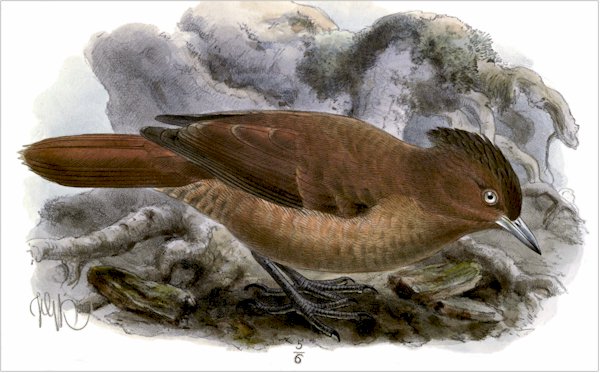
Homorus lophotes, Reichb. Handb. p. 172; Barrows, Bull. Nutt. Orn. Cl. vol. viii. p. 212 (Entrerios); Hudson, Ibis, 1885, p. 283 (Buenos Ayres). Anabates unirufus, Burm. La-Plata Reise, ii. p. 466 (Cordova). Homorus unirufus, Scl. et Salv. Nomencl. p. 65; White, P. Z. S. 1882, p. 612 (Catamarca).
Description.—Above brown, tinged with olive on the back, but clear and rufescent on the hind head and rump; crest-feathers blackish brown; wings blackish; tail chestnut; beneath earthy brown, throat rufous; under wing- and tail-coverts and inner margins of wing-feathers pale rufous; bill pale bluish, feet bluish horn-colour: whole length 9·8 inches, wing 4·6, tail 4·2. Female similar.