CHAPTER 30
Reading edition
Ajmer.
—Ajmer has been too long the haunt of Moguls and Pathans, the Goths and Vandals of Rajasthan, to afford much scope to the researches of the antiquary. Whatever time had spared of the hallowed relics of old, bigotry has destroyed, or raised to herself altars of materials, whose sculptured fragments serve now as disjointed memorials of two distinct and distant eras: that of the independent Hindu, and that of the conquering Muhammadan, whose idgahs and mosques, mausoleums and country-seats, constructed from the wrecks of aboriginal art, are fast mouldering to decay. The associations they call forth afford the only motive to wish their preservation; except one “relic of nobler days and noblest arts,” which, though impressed with this double character, every spectator must desire to rescue from the sweeping sentence—the edifice before the reader, a visit to which excited these reflections. Let us rather bless than execrate the hand, though it be that of a Turk, which has spared, from whatever motive, one of the most perfect, as well as the most ancient, monuments of Hindu architecture. It is built on the western declivity of the fortress, and called Arhai din ka jhonpra, or, ‘the shed of two and a half days,’ from its having occupied (as tradition tells) its magical builders only this short period. The skill of the Pali or Takshak architect, the three sacred mounts of these countries abundantly attest: nor had he occasion for any mysterious arts, besides those of masonry, to accomplish them. In discussing the cosmogony of the Hindus, we have had occasion to convert their years into days; here we must reverse the method, and understand (as in [779] interpreting the sacred prophecies of Scripture) their days as meaning years. Had it, indeed, been of more humble pretensions, we might have supposed the monotheistic Jain had borrowed from the Athenian legislator Cecrops, who ordained that no tomb should consist of more work than ten men could finish in three days; to which Demetrius, the Phalerian, sanctioned the addition of a little vessel to contain the ghost’s victuals.
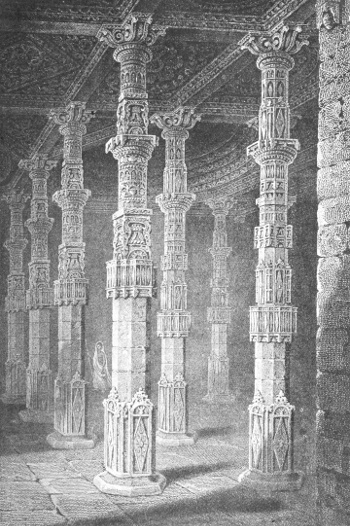
ANCIENT JAIN TEMPLE AT AJMER. To face page 896.
897
Arhāi din ka jhonpra Mosque.
—The temple is surrounded by a superb screen of Saracenic architecture, having the main front and gateway to the north. From its simplicity, as well as its appearance of antiquity, I am inclined to assign the screen to the first dynasty, the Ghorian sultans, who evidently made use of native architects. The entrance arch is of that wavy kind, characteristic of what is termed the Saracenic, whether the term be applied to the Alhambra of Spain, or the mosques of Delhi; and I am disposed, on close examination, to pronounce it Hindu.
The entire façade of this noble entrance, which I regret I cannot have engraved, is covered with Arabic inscriptions. But, unless my eyes much deceived me, the small frieze over the apex of the arch contained an inscription in Sanskrit,
with which Arabic has been commingled, both being unintelligible. The remains of a minaret still maintain their position on the right flank of the gate, with a door and steps leading to it for the muazzin to call the faithful to prayers. A line of smaller arches of similar form composes the front of the screen. The design is chaste and beautiful, and the material, which is a compact limestone of a yellow colour, admitting almost of as high a polish as the
jaune antique
, gave abundant scope to the sculptor. After confessing and admiring the taste of the Vandal architect, we passed under the arch to examine the more noble production of the Hindu. Its plan is simple, and consonant with all the more ancient temples of the Jains. It is an extensive saloon, the ceiling supported by a quadruple range of columns, those of the centre being surmounted by a range of vaulted coverings; while the lateral portion, which is flat, is divided into compartments of the most elaborate sculpture. But the columns are most worthy of attention; they are unique in design, and with the exception of the cave-temples, probably amongst the oldest now existing in India. On examining them, ideas entirely novel, even in Hindu [780]
898
art, are developed. Like all these portions of Hindu architecture, their ornaments are very complex, and the observer will not fail to be struck with their dissimilarity; it was evidently a rule in the art to make the ornaments of every part unlike the other, and which I have seen carried to great extent. There may be forty columns but no two are alike. The ornaments of the base are peculiar, both as to form and execution; the lozenges, with the rich tracery surmounting them, might be transferred, not inappropriately, to the Gothic cathedrals of Europe. The projections from various parts of the shaft (which on a small scale may be compared to the corresponding projections of the columns in the Duomo at Milan), with the small niches still containing the statues, though occasionally mutilated, of the Pontiffs of the Jains, give them a character which strengthens the comparison, and which would be yet more apparent if we could afford to engrave the details.
The elegant Kamakumbha, the emblem of the Hindu Ceres, with its pendent palmyra-branches, is here lost, as are many emblematical ornaments, curious in design and elegant in their execution. Here and there occurs a
richly
richly
carved corbeille, which still further sustains the analogy between the two systems of architecture; and the capitals are at once strong and delicate. The central vault, which is the largest, is constructed after the same fashion as that described at Nadol; but the concentric annulets, which in that are plain, in this are one blaze of ornaments, which with the whole of the ceiling is too elaborate and complicated for description. Under the most retired of the compartments, and nearly about the centre, is raised the mimbar, or pulpit, whence the Mulla enunciates the dogma of Muhammad, “there is but one God”: and for which he dispossessed the Jain, whose creed was like his own, the unity of the Godhead. But this is in unison with the feeling which dictated the external metamorphosis. The whole is of the same materials as already described, from the quarries of the Aravalli close at hand, which are rich in every mineral as well as metallic production:—
I ask’d of Time for whom those temples rose,
That prostrate by his hand in silence lie;
899His lips disdain’d the myst’ry to disclose,
And borne on swifter wing, he hurried by!
The broken columns whose? I ask’d of Fame:
(Her kindling breath gives life to works sublime;)
With downcast looks of mingled grief and shame,
She heaved the uncertain sigh, and follow’d Time [781].
Wrapt in amazement o’er the mouldering pile,
I saw Oblivion pass with giant stride;
And while his visage wore Pride’s scornful smile,
Haply thou know’st, then tell me, whose I cried,
Whose these vast domes that ev’n in ruin shine?
I reck not whose, he said: they now are mine.
Shall we abandon them to cold ‘oblivion’; or restore them to a name already mentioned, Samprati, or Swampriti, the Shah Jahan[5] of a period two centuries before the Christian era, and to whom the shrine in Kumbhalmer is ascribed? Of one thing there is no doubt, which is, that both are Jain, and of the most ancient models: and thus advertised, the antiquary will be able to discriminate between the architectural systems of the Saivas and the Jains, which are as distinct as their religions.
Having alluded to the analogy between the details in the columns and those in our Gothic buildings (as they are called), and surmised that the Saracenic arch is of Hindu origin; I may further, with this temple and screen before us, speculate on the possibility of its having furnished some hints to the architects of Europe. It is well known that the Saracenic arch has crept into many of those structures called Gothic, erected in the twelfth and thirteenth centuries, when a more florid style succeeded to the severity of the Saxon or Romans; but I believe it has been doubted whence the Saracens obtained their model; certainly it was neither from Egypt nor Persia. The early caliphs of Baghdad, who were as enlightened as they were powerful, kept alive the light of science when Europe was in darkness; and the most accomplished noble who accompanied our Cœur de Lion, though “brave as his sword,” was a clown compared to the infidel Saladin, in mind as well as manners. The influence of these polished foes on European society it would be superfluous to descant upon. The lieutenants of these caliphs, who penetrated 900from the Delta of the Indus to the Ganges from four to five centuries prior to this event, when Walid’s arms triumphed simultaneously on the Indus and the Ebro, produced no trifling results to the arts. This very spot, Ajmer, according to traditional couplets and the poetic legends of its ancient princes, the Chauhans, was visited by the first hostile force which Islam sent across the Indus, and to which Manika Rae fell a sacrifice. What ideas might not this Jain temple have afforded to [782] “the Light of Ali,” for Roshan Ali is the name preserved of him who, “in ships landing at Anjar,” marched through the very heart of India, and took Garh Bitli, the citadel of Ajmer, by assault. The period is one of total darkness in the history of India, save for the scattered and flickering rays which emanate from the chronicles of the Chauhans and Guhilots. But let us leave the temple, and slightly describe the castle of Manika Rae, on whose battlements an infidel’s arrow of Roshan’s army reached the heir of the Chauhan; since which Lot, for such was his name, has been adopted amongst the lares and penates of this celebrated race. This was the first Rajput blood which the arms of conversion shed, and the impression must have been strong to be thus handed down to posterity.
The mind, after all, retires dissatisfied: with me it might be from association. Even the gateway, however elegant, is unsuitable to the genius of the place. Separately considered, they are each magnificent; together, it is as if a modern sculptor were (like our actors of the last age) to adorn the head of Cato with a peruke. I left this precious relic, with a malediction upon all the spoilers of art—whether the Thane who pillaged Minerva’s portico at Athens, or the Turk who dilapidated the Jain temple at Ajmer.[6]
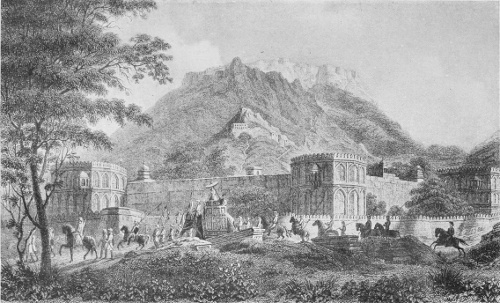
FORTRESS AND TOWN OF AJMER. To face page 900.
Ajmer Fort.
—The reader will see as much of this far-famed fortress as I did: for there was nothing to induce me to climb the steep, where the only temple visible was a modern-looking whitewashed mosque, lifting its dazzling minarets over the dingy antique towers of the Chauhan: “he who seven times captured the sultan, and seven times released him.” The hill rises majestically from its base to the height of about eight hundred feet; its crest encircled by the ancient wall and towers raised by Ajaipal—
901There was a day when they were young and proud,
Banners on high, and battles passed below;
But they who fought are in a bloody shroud,
And those which waved are shredless dust ere now,
And the bleak battlements shall bear no future blow;[7]
unless the Cossack should follow the track of Roshan Ali or Mahmud, and try to tear the British flag from the kunguras of Ajmer. On the north side a party of the superintendent’s were unlocking the latent treasures in the bowels of the mountain. The vein is of lead; a sulphuret, or galena [783].[8]
The Bīsal Tālāb.
—I have already mentioned the lake, called after the excavator, the Bisal Talab. It is about eight miles in circumference, and besides the beauty it adds to the vale of Ajmer, it has a source of interest in being the fountain of the Luni, which pursues its silent course until it unites with the eastern arm of the Delta of the Indus: the point of outlet is at the northern angle of the Daulat Bagh, ‘the gardens of wealth,’ built by Jahangir for his residence when he undertook to conquer the Rajputs. The water is not unwholesome, and there are three outlets at this fountainhead for the escape of the water fitting its periodical altitudes. The stream at its parent source is thence called the Sagarmati. It takes a sweep northward by Bhaonta and Pisangan, and close to where we crossed it, at Govindgarh, it is joined by the Sarasvati from Pushkar; when the united waters (at whose
sangam
, or confluence, there is a small temple to the manes) are called the Luni.
The gardens erected on the embankment of the lake must have been a pleasant abode for “the king of the world,” while his lieutenants were carrying on the war against the Rana: but the imperial residence of marble, in which he received the submissions of that prince, through his grandson, and the first ambassador sent by England to the Mogul, are now going fast to decay. The walks on which his majesty last paraded, in the state-coach sent by our James the First, are now overgrown with shrubs.
The stratification of the rock, at the point of outlet, would 902interest the geologist, especially an extensive vein of mica, adjoining another of almost transparent quartz.
Anasāgar Lake.
—Eastward of this lake about a mile is another named the Anasagar, after the grandson of Bisaldeo, who has left the reputation of great liberality, and a contrast with Visala. The vestiges of an island are yet seen in the lake, and upon its margin; but the materials have been carried away by the Goths. There are two small buildings on the adjacent heights, called “the annulets of Khwaja Kutb,” and some other saint.
Such are the wonders in the environs of Daru-l-Khair, “celebrated in the history of the Moguls, as well as of the Hindus.” But my search for inscriptions to corroborate the legends of the Chauhans proved fruitless. I was, however, fortunate enough to add to my numismatic treasures some of the currency of these ancient kings, which give interest to a series of the same description, all appertaining [784] to the Buddhists or Jains. The inscription occupying one side is in a most antique character, the knowledge of which is still a desideratum: the reverse bears the effigies of a horse, the object of worship to the Indo-Scythic Rajput.[9] It is not improbable that the Agnikula Chauhan may have brought these letters with him from higher Asia. Researches in these countries for such monuments may yet discover how far this conjecture is correct. At Pushkar I also found some very ancient coins. Had the antiquary travelled these regions prior to the reign of Aurangzeb he would have had a noble field to explore: many coins were destroyed by this bigot, but many were buried underground, which time or accident may disclose. He was the great foe of Rajput fame; and well might the bard, in the words of the Cambrian minstrel, bid
Ruin seize thee, ruthless king.
They did repay his cruelties by the destruction of his race. In one short century from this tyrant, who grasped each shore of the peninsula, the Mogul power was extinct; while the oppressed Rajputs are again on the ascendant. But the illiterate and mercenary Afghan, “the descendant of the lost tribes of Israel,”[10] if we credit their traditions, may share the iniquity with Aurangzeb: 903for they fulfilled literally a duty which their supposed forefathers pertinaciously refused, and made war against every graven image. Had they even spared us a few of the monsters, the joint conceptions of the poet and the sculptor, I might have presented some specimens of griffins (gras)[11] and demons almost of a classical taste: but the love of mischief was too strong even to let these escape: the shoe was applied to the prominent features of everything which represented animation.
By a medium of several meridian observations, I made the latitude of Ajmer 26° 19´ north; its longitude, by time and measurement from my fixed meridian, Udaipur, 74° 40´, nearly the position assigned to it by the father of Indian geography, the justly celebrated Rennell.[12]
Return March to Udaipur.
—
December 5.
—At daybreak we left the towers of Manika Rae, enveloped in mist, and turned our horses’ heads to the southward, on our return to Udaipur. While at Ajmer, I received accounts of the death of the prince of Kotah, and did intend to proceed direct to that capital, by Shahpura and Bundi; but my presence was desired by the Rana to repair the dilapidations which only two months’ absence had [785] occasioned in the political fabric which I had helped to reconstruct. Other interesting objects intervened: one, a visit to the new castle of Bhimgarh, erecting in Merwara to overawe the Mers; the other to compose the feuds which raged between the sectarian merchants of the new mart, Bhilwara, and which threatened to destroy all my labour. We made two marches to Bhinai, in which there was nothing to record. Bhinai is the residence of a Rathor chieftain, whose position is rather peculiar. Being placed within the district of Ajmer, and paying an annual quit-rent to the British, he may consider the Company as his sovereign; but although this position precludes all political subordination to the chief of the race, the tie would be felt and acknowledged, on a lapse, in the anxiety for the usual
tika
of recognition to his successor, from the Raja of Marwar. I argue on knowledge of character and customs; though it is possible this individual case might be against me.
904The castle of Bhinai is a picturesque object in these level plains; it is covered with the cactus, or prickly pear, so abundant on the east side of the Aravalli. This was anciently the residence of a branch of the Parihara princes of Mandor, when held as a fief of the Chauhans of Ajmer; and from it originated a numerous mixed class, called the Parihara Minas, a mixture of Rajput and aboriginal blood.
Deolia.
—
December 6.
—Deolia, near the northern bank of the Khari, the present boundary of Ajmer and Mewar. From Ajmer to Deolia the direction of the road is S.S.E., and the distance forty miles. This important district in the political geography of Rajputana, which, with the posts of Nimach and Mhow, is the connecting link between the British dominions on the Jumna and in the Deccan, was obtained by cession from Sindhia in 1818. A glance at the map is sufficient to show its importance in our existing connexion with Rajputana. The greatest breadth of the district is between the Aravalli west and the Banas east, and measures about eight miles. The greatest length is between the city of Ajmer and Jhak, a post in Merwara, measuring about forty miles. The narrowest portion is that where we now are, Deolia, whence the Kishangarh frontier can be seen over a neck of land of about twelve miles in extent. Within these bounds a great portion of the land is held by feudal chieftains paying a quit-rent, which I believe is fixed. I had to settle a frontier dispute at Deolia, regarding the right of cultivating in the bed of the Khari, which produces very good melons. The soil of Ajmer cannot [786] be called rich, and is better adapted for the lighter than the richer grains. Marks of war and rapine were visible throughout.
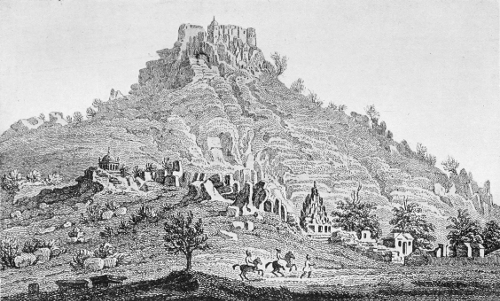
CASTLE OF BHINAI. To face page 904.
Dābla.
—
December 7.
—This town was a sub-fee of Banera; but the vassal, a Rathor, had learned habits of insubordination during Mahratta influence, which he could not or would not throw aside. In these he was further encouraged by his connexion by marriage with the old ruler of Kotah, who had exemplified his hostility to the Dabla vassal’s liege lord by besieging his castle of Banera. Having so long disobeyed him, his Rajput blood refused to change with the times; and though he condescended, at the head of his twenty retainers, to perform homage on stated days, and take his allotted position in the Banera darbar, he refused to pay the quit-rent, to which numerous deeds proved
905
his suzerain had a right. Months passed away in ineffectual remonstrances; it was even proposed that he should hold the inferior dependencies free of quit-rent, but pay those of Dabla. All being in vain, the demand was increased to the complete surrender of Dabla; which elicited a truly Rajput reply: “His head and Dabla were together.” This obstinacy could not be tolerated; and he was told that though one would suffice, if longer withheld both might be required. Like a brave Rathor, he had defended it for months against a large Mahratta force, and hence Dabla was vauntingly called “the little Bharatpur.” Too late he saw his error, but there was no receding; and though he at length offered a nazarana, through the mediation of the Kotah wakil, of 20,000 rupees, to obtain the Rana’s investiture, it was refused and a surrender was insisted on. Being an important frontier-post, it was retained by the Rana, and compensation was made to Banera. Every interest was made for him through the Nestor of Kotah, but in vain; his obstinacy offered an example too pernicious to admit of the least retrocession, and Dabla was forthwith incorporated with the appanage of the heir-apparent, Jawan Singh.
Almost the whole of this, the Badnor division, of 360 townships, is occupied by Rathors, the descendants of those who accompanied Jaimall to Mewar: the proportion of feudal to fiscal land therein is as three to one. It is a rich and fertile tract, and it is to be hoped will maintain in ease and independence the brave men who inhabit it, and who have a long time been the sport of rapine.
I received a visit from the chief vassal of the Badnor chief, then at the capital; and as I found it impossible to visit Merwara, I subsequently deputed Captain [787] Waugh who was hospitably received and entertained at Badnor. He hunted, and played the Holi with the old baron, who shows at all times the frankness of his race: but it being the period of the Saturnalia, he was especially unreserved; though he was the greatest stickler for etiquette amongst my many friends, and was always expatiating on the necessity of attending to the gradations of rank.
Banera.
—
December 8.
—The castle of Banera is one of the most imposing feudal edifices of Mewar, and its lord one of the greatest of its chieftains. He not only bears the title of Raja, but has all the state-insignia attached thereto. His name happens to
906
be the same as that of his sovereign—his being Raja Bhim, the prince’s Rana Bhim,—to whom he is nearly related, and but for blind chance might have been lord of all the Sesodias. It may be recollected that the chivalrous antagonist of Aurangzeb, the heroic Rana Raj, had two sons, twins, if we may so term sons simultaneously born, though by different mothers. The incident which decided the preference of Jai Singh to Bhim has been related;
the circumstance of the latter’s abandoning his country to court fortune under the Imperial standard—his leading his Rajput contingent amongst the mountains of Kandahar—and his death by dislocation of the spine, through urging his horse at speed amongst the boughs of a tree. The present incumbent of Banera is the descendant of that Raja Bhim, who was succeeded in the honours of his family by his son Suraj, killed whilst heading his contingent at the storm of Bijapur. The infant son of Suraj had four districts assigned to him, all taken from his suzerain, the Rana. In such esteem did the emperor hold the family, that the son of Suraj was baptized Sultan. He was succeeded by Sardar Singh, who, on the breaking up of the empire, came under the allegiance of his rightful sovereign the Rana. Rae Singh and Hamir Singh complete the chain to my friend Raja Bhim, who did me the honour to advance two miles from Banera to welcome and conduct me to his castle. Here I had a good opportunity of observing the feudal state and manners of these chiefs within their own domains during a visit of three hours at Banera. I was, moreover, much attached to Raja Bhim, who was a perfectly well-bred and courteous gentleman, and who was quite unreserved with me. From his propinquity to the reigning family, and from his honours and insignia being the gift of the king’s, he had been an object of jealousy to the court, which tended much to retard the restoration [788] of his authority over his sub-vassals of Banera; the chief of Dabla is one instance of this. I found little difficulty in banishing the discord between him and his sovereign, who chiefly complained of the Banera kettle-drums beating, not only as he entered the city, but as far as the Porte—the sacred Tripolia; and the use of Chamar
in his presence. It was arranged that these emblems of honour, emanating from the great foes of Mewar, should never be obtruded
907
on the eye or ear of the Rana; though within his own domain the Banera chieftain might do as he pleased. This was just; and Raja Bhim had too much good sense not to conciliate his “brother and cousin,” Rana Bhim, by such a concession, which otherwise might have been insisted upon. The estate of Banera is in value 80,000 rupees of annual rent, one-half of which is in subinfeudations, his vassals being chiefly Rathors. The only service performed by Raja Bhim is the contributing a quota for the commercial mart of Bhilwara, with the usual marks of subordination, personal duty and homage to the Rana. His estate is much impoverished from its lying in the very track of the freebooters; but the soil is excellent, and time will bring hands to cultivate it, if we exercise a long and patient indulgence.
The ‘velvet cushion’ was spread in a balcony projecting from the main hall of Banera; here the Raja’s vassals were mustered, and he placed me by his side on the gaddi. There was not a point of his rural or domestic economy upon which he did not descant, and ask my advice, as his “adopted brother.” I was also made umpire between him and my old friend the baron of Badnor, regarding a marriage settlement, the granddaughter of the latter being married to the heir of Banera. I had, besides, to wade through old grants and deeds to settle the claims between the Raja and several of his sub-vassals; a long course of disorder having separated them so much from each other as to obliterate their respective rights. All these arbitrations were made without reference to my official situation, but were forced upon me merely by the claims of friendship; but it was a matter of exultation to be enabled to make use of my influence for the adjustment of such disputes, and for restoring individual as well as general prosperity. My friend prepared his gifts at parting; I went through the forms of receiving, but waived accepting them: which may be done without any offence to delicacy. I have been highly gratified to read the kind reception he gave to the respected Bishop Heber, in his tour through Mewar. I wonder, however, that this discerning and elegant-minded man did not [789] notice the peculiar circumstance of the Raja’s teeth being fixed in with gold wire, which produces rather an unpleasant articulation.[15]
908Banera adjoins the estates of the Rathors, and is no great distance from those of the Sangawats and Jagawats, which lie at the base of the Aravalli. All require a long period of toleration and unmolested tranquillity to emerge from their impoverished condition. My friend accompanied me to my tents, when I presented to him a pair of pistols, and a telescope with which he might view his neighbours on the mountains: we parted with mutual satisfaction, and I believe, mutual regret.
Bhīlwāra.
—
December 9.
—I encamped about half-a-mile from
our
good town of Bhilwara, which was making rapid strides to prosperity, notwithstanding drawbacks from sectarian feuds; with which, however, I was so dissatisfied, that I refused every request to visit the town until such causes of retardation were removed. I received a deputation from both parties at my tents, and read them a lecture for their benefit, in which I lamented the privation of the pleasure of witnessing their unalloyed prosperity. Although I reconciled them to each other, I would not confide in their promises until months of improvement should elapse. They abided by their promise, and I fulfilled mine when the death of the Bundi prince afforded an opportunity,
en route
to that capital, to visit them. My reception was far too flattering to describe, even if this were the proper place. The sentiments they entertained for me had suffered no diminution when Bishop Heber visited the town. But his informant (one of the merchants), when he said it ought to have been called Tod-ganj, meant that it was so intended, and actually received this appellation: but it was changed, at my request, and on pain of withdrawing my entire support from it. The Rana, who used to call it himself in conversation “
Tod Sahib ki basti
,” would have been gratified; but it would have been wrong to avail myself of his partiality. In all I was enabled to do, from my friendship, not from my official character, I always feared the dangers to his independence from such precedent for interference.
Māndalgarh.
—
December 10.
—I deviated from the direct course
homewards
(to Udaipur) to visit this beautiful spot, formerly the head of a flourishing district; but all was dilapidated. The first revenue derived from Mandal was expended on the repairs of the dam of its lake, which irrigates a great extent of rice-land. The Goths had felled [790] most of the fine trees which had ornamented
909
its dam and margin; and several garden-houses, as well as that on the island in the lake, were in ruins. Not many years ago a column of victory, said to have been raised by Bisaladeva of Ajmer, in consequence of a victory over the Guhilots, graced this little isle. Mandal is now rising from its ruins, and one of the exiles was so fortunate as to find a vessel containing several pieces of gold and ornaments, in excavating the ruins of his ancient abode, though not buried by him. It involved the question of manorial rights, of which the Rana waived the enforcement, though he asserted them. To-day I passed between Pansal and Arja, the former still held by a Saktawat, the latter now united to the fisc. I have already related the feud between the Saktawats and the Purawats in the struggle for Arja, which is one of the most compact castles in Mewar, with a domain of 52,000 bighas, or 12,000 acres, attached to it, rendering it well worth a contest; but the Saktawat had no right there, say the Purawats; and in fact it is in the very heart of their lands.
Pur.
—
December 11.
—This is one of the oldest towns of Mewar, and if we credit tradition, anterior in date to Vikrama. We crossed the Kotasari to and from Mandal, passing by the tin and copper mines of Dariba, and the Purawat estate of Pitawas. Pur means,
par eminence
, ‘the city,’ and anciently the title was admissible; even now it is one of the chief fiscal towns. It is in the very heart of the canton, inhabited by the Babas, or ‘infants’ of Mewar, embracing a circle of about twenty-five miles diameter. The broken chain of mountains, having Banera on the northern point and Gurla to the south, passes transversely through this domain, leaving the estate of Bagor, the residence of Sheodan Singh, west, and extending to the S.E. to Mangrop, across the Berach. The policy which dictated the establishment of an isolated portion of the blood-royal of Mewar in the very centre of the country was wise; for the Babas rarely or ever mix with the politics of the feudatory chieftains, home or foreign. They are accordingly entrusted with the command of all garrisons, and head the feudal quotas as the representative of their sovereign. They have a particular seat at court, the Baba ka Ol being distinct from the chieftains’, and in front. Though they inhabit the lands about Pur, it is not from these they derive their name, but as descendants from Puru, one of the twenty-five sons of Rana Udai Singh, that blot in the scutcheon of Mewar [791].
910
Garnets.
—About a mile east of Pur there is an isolated hill of blue slate, in which I found garnets embedded. I have no doubt persevering adventurers would be rewarded; but though I tried them with the hammer, I obtained none of any value. They are also to be obtained on the southern frontier of Kishangarh and Ajmer, about Sarwar. I received the visits of the ‘infants’ of Gurla and Gadarmala, both most respectable men, and enjoying good estates, with strong castles, which I passed the next day.
Rāsmi, on the Banās River.
—
December 12.
—We had a long march through the most fertile lands of Mewar, all belonging to the Rana’s personal domain. The progress towards prosperity is great; of which Rasmi, the head of a tappa or subdivision of a district, affords evidence, as well as every village. On our way we were continually met by peasants with songs of joy, and our entrance into each village was one of triumph. The Patels and other rustic officers, surrounded by the ryots, came out of the villages; while the females collected in groups, with brass vessels filled with water gracefully resting on their heads, stood at the entrance, their scarfs half covering their faces, chaunting the
suhela
; a very ancient custom of the Hindu cultivator on receiving the superior, and tantamount to an acknowledgment of supremacy. Whether vanity was flattered, or whether a better sentiment was awakened, on receiving such tokens of gratitude, it is not for me to determine: the sight was pleasing, and the custom was general while I travelled in Mewar. The females bearing the
kalas
on their heads, were everywhere met with. These were chiefly the wives and daughters of the cultivators, though not unfrequently those of the Rajput sub-vassals. The former were seldom very fair, though they had generally fine eyes and good persons. We met many fragments of antiquity at Rasmi. Captain Waugh and the doctor were gratified with angling in the Banas for trout; but as the fish would not rise to the fly, I set the net, and obtained several dozens: the largest measured seventeen inches, and weighed seventy rupees, or nearly two pounds.
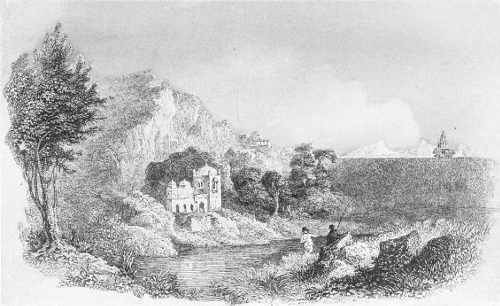
SOURCE OF THE BERACH RIVER, AND HUNTING SEAT OF THE RĀNA. To face page 910.
Merta.
—
December 16.
—After an absence of two months we terminated our circuitous journey, and encamped on the ground whence we started, all rejoiced at the prospect of again entering “the happy valley.” We made four marches across the
duab
, watered by the Berach and Banas rivers; the land naturally rich,
911
and formerly boasting some large towns, but as yet only disclosing the germs of [792] prosperity. There is not a more fertile tract in India than this, which would alone defray the expenses of the court if its resources were properly husbanded. But years must first roll on, and the peasant must meet with encouragement, and a reduction of taxation to the lowest rate; and the lord-paramount must alike be indulgent in the exaction of his tribute. Our camels were the greatest sufferers in the march through the desert, and one-half were rendered useless. I received a deputation conveying the Rana’s congratulation on my return ‘home,’ with a letter full of friendship and importunities to see me; but the register of the heavens—an oracle consulted by the Rajput as faithfully as Moore’s Almanack by the British yeoman—showed an unlucky aspect, and I must needs halt at Merta, or in the valley, until the signs were more favourable to a re-entry into Udaipur. Here we amused ourselves in chalking out the site of our projected residence on the heights of Tus, and in fishing at the source of the Berach. Of this scene I present the reader with a view; and if he allows his imagination to ascend the dam which confines the waters of the lake, he may view the Udaisagar, with its islets; and directing his eye across its expanse, he may gain a bird’s-eye view of the palace of the Kaisar of the Sesodias. The dam thrown across a gorge of the mountains is of enormous magnitude and strength, as is necessary, indeed, to shut in a volume of water twelve miles in circumference. At its base, the point of outlet, is a small hunting-seat of the Rana’s, going to decay for want of funds to repair it, like all those on the Tiger Mount and in the valley. Nor is there any hope that the revenues, burthened as they are with the payment of a clear fourth in tribute, can supply the means of preventing further dilapidation.
December 19.—Tired of two days’ idleness, we passed through the portals of Debari on our way to Ar, to which place the Rana signified his intention of advancing in person, to receive and conduct me ‘home’: an honour as unlooked-for and unsolicited as it was gratifying. Udaipur presents a most imposing appearance when approached from the east. The palace of the Rana, and that of the heir-apparent, the great temple, and the houses of the nobles, with their turrets and cupolas rising in airy elegance, afford a pleasing contrast with the heavy wall and 912pierced battlements of the city beneath. This wall is more extensive than solid. To remedy this want of strength, a chain of fortresses has [793] been constructed, about gunshot from it, commanding every road leading thereto, which adds greatly to the effect of the landscape. These castellated heights contain places of recreation, one of which belongs to Salumbar; but all wear the same aspect of decay.
Ahār.
—Ar, or Ahar,
near which we encamped, is sacred to the manes of the princes of Udaipur, and contains the cenotaphs of all her kings since the valley became their residence; but as they do not disdain association, either in life or death, with their vassals, Ar presents the appearance of a thickly crowded cemetery, in which the mausoleums of the Ranas stand pre-eminent in “the place of great faith.”
The renowned Amra Singh’s is the most conspicuous; but the cenotaphs of all the princes, down to the father of Rana Bhim, are very elegant, and exactly what such structures ought to be; namely, vaulted roofs, supported by handsome columns raised on lofty terraces, the architraves of enormous single blocks, all of white marble, from the quarries of Kankroli. There are some smaller tombs of a singularly elaborate character, and of an antiquity which decides the claims of Ar to be considered as the remains of a very ancient city. The ground is strewed with the wrecks of monuments and old temples, which have been used in erecting the sepulchres of the Ranas. The great city was the residence of their ancestors, and is said to have been founded by Asaditya upon the site of the still more ancient capital of Tambavatinagari, where dwelt the Tuar ancestors of Vikramaditya, before he obtained Avinti, or Ujjain. From Tambavatinagari its name was changed to Anandpur, ‘the happy city,’ and at length to Ahar, which gave the patronymic to the Guhilot race, namely, Aharya. The vestiges of immense mounds still remain to the eastward, called the Dhul-kot, or ‘fort,’ destroyed by ‘ashes’ (
dhul
) of a volcanic eruption. Whether the lakes of the valley owe their origin to the same cause which is said to have destroyed the ancient Ahar, a more skilful geologist must determine. The chief road from the city is cut through this mound; and as I had observed fragments of sculpture and pottery on the excavated sides, I commenced a regular opening of the mound in search of medals, and obtained a few with the
913
effigies of an animal, which I fancied to be a lion, but others the
gadha
, or ass, attributed to Gandharvasen, the brother of Vikrama, who placed this impress on his coins, the reason of which is given in a long legend.
My impious intentions were soon checked by some designing knaves about the Rana, and I would not offend [794] superstition. But the most superficial observer will pronounce Ar to have been an ancient and extensive city, the walls which enclose this sepulchral abode being evidently built with the sculptured fragments of temples. Some shrines, chiefly Jain, are still standing, though in the last stage of dilapidation, and they have been erected from the ruins of shrines still older, as appears from the motley decorations, where statues and images are inserted with their heads reversed, and Mahavira and Mahadeva come into actual contact: all are in white marble. Two inscriptions were obtained; one very long and complete, in the nail-headed character of the Jains; but their interpretation is yet a desideratum. A topographical map of this curious valley would prove interesting, and for this I have sufficient materials. The Teli-ki-Sarai would not be omitted in such a map, as adding another to the many instances I have met with, among this industrious class, to benefit their fellow-citizens. The ‘Oilman’s Caravanserai’ is not conspicuous for magnitude; but it is remarkable, not merely for its utility, but even for its elegance of design. It is equi-distant from each of the lakes. The Teli-ka-Pul, or ‘Oilman’s Bridge,’ at Nurabad, is, however, a magnificent memorial of the trade, and deserves preservation; and as I shall not be able now to describe the region (Gwalior) where it stands, across the Asan, I will substitute it for the Sarai, of which I have no memorial.
These Telis (oilmen) perambulate the country
914
with skins of oil on a bullock, and from hard-earned pence erect the structures which bear their name. India owes much to individual munificence.
The planets were adverse to my happy conjunction with the Sun of the Hindus: and it was determined that I should pass another day amongst the tombs of Ahar; but I invoked upon my own devoted head all the evil consequences, as in this case I was the only person who was threatened. To render this opposition to the decree less noxious, it was agreed that I should make my entrée by the southern, not by the eastern porte, that of the sun. The Rana came, attended by his son, his chiefs, his ministers, and, in fact, all the capital in his train. The most hearty welcomes were lavished upon us all. “Rama! Rama! Tod Sahib!” (the Hindu greeting) resounded from a thousand throats, while I addressed each chief by name. It was not a meeting of formality, but of well-cemented friendship. My companions, Captain Waugh and Dr. Duncan, were busy interchanging smiles and cordial greetings, when the Rana, requesting our presence at the palace next day [795], bade us adieu. He took the direct road to his palace, while we, to avoid evil spirits, made a detour by the southern portal, to gain our residence, the garden of Rampiyari.
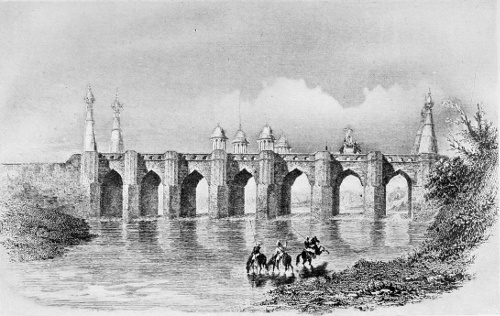
BRIDGE OF NŪRĀBĀD. To face page 914.
APPENDIX
Translations of Inscriptions, chiefly in the Nail-headed character
of the Takshak Races and Jains, fixing eras in Rajput history.[1]
No. I
Memorial of a Gete or Jit prince of the fifth century, discovered 1820, in a temple at Kunswa, near the Chumbul river, south of Kotah.
May the Jit’ha be thy protector! What does this Jit’h resemble? which is the vessel of conveyance across the waters 915of life, which is partly white, partly red? Again, what does it resemble, where the hissing-angered serpents dwell? What may this Jit’ha be compared to, from whose root the roaring flood descends? Such is the Jit’haJit’ha; by it may thou be preserved (1).
The fame of Raja Jit I now shall tell, by whose valour the lands of Salpoora (2) are preserved. The fortunes of Raja Jit are as flames of fire devouring his foe. The mighty warrior Jit Salindra (2) is beautiful in person, and from the strength of his arm esteemed the first amongst the tribes of the mighty; make resplendent, as does the moon the earth, the dominions of Salpoori. The whole world praises the Jit prince, who enlarges the renown of his race, sitting in the midst of haughty warriors, like the lotos in the waters, the moon of the sons of men. The foreheads of the princes of the earth worship the toe of his foot. Beams of light irradiate his countenance, issuing from the gems of his arms of strength. Radiant is his array; his riches abundant; his mind generous and profound as the ocean. Such is he of Sarya (3) race, a tribe renowned amongst the tribes of the mighty, whose princes were ever foes to treachery, to whom the earth surrendered her fruits, and who added the lands of their foes to their own. By sacrifice, the mind of this lord of men has been purified; fair are his territories, and fair is the Fortress of Tak’hya (4). The string of whose bow is dreaded, whose wrath is the reaper of the field of combat; but to his dependents he is as the pearl on the neck; who makes no account of the battle, though streams of blood run through the field. As does the silver lotos bend its head before the fierce rays of the sun, so does his foe stoop to him, while the cowards abandon the field [796].
From this lord of men (Narpati) Salindra sprung Devangli, whose deeds are known even at this remote period.
From him was born Sumbooka, and from him Degali, who married two wives of Yadu race (5), and by one a son named Vira Narindra, pure as a flower from the fountain.
Amidst groves of amba, on whose clustering blossoms hang myriads of bees, that the wearied traveller might repose, was this edifice erected. May it, and the fame of its founder, continue while ocean rolls, or while the moon, the sun, and hills endure. Samvat 597.—On the extremity of Malwa, this minster (Mindra) was erected, on the banks of the river Taveli, by Salichandra (6), son of Virachandra.
Whoever will commit this writing to memory, his sins will be obliterated. Carved by the sculptor Sevanarya, son of Dwarasiva, and composed by Butena, chief of the bards.
The 12th chapter of the Edda, in describing Balder the second son of Odin, particularly dwells on the beauty of his hair, whence “the whitest of all vegetables is called the eyebrow of Balder, on the columns of whose temples there are verses engraved, capable of recalling the dead to life.”
How perfectly in unison is all this of the Jits of Jutland and the Jits of Rajast’han. In each case the hair is the chief object of admiration; of Balnath as Balder, and the magical effect of the Runes is not more powerful than that attached by the chief of the Scalds of our Gete prince at the end of this inscription, fresh evidences in support of my hypothesis, that many of the Rajpoot races and Scandinavians have a common origin—that origin, Central Asia.
No. II
Translation of an inscription in the Nail-headed character relative to the Jit race, discovered at Ram Chundrapoora, six miles east of Boondee, in digging a well. It was thence conveyed, and deposited by me in the Museum of the Royal Asiatic Society.
To my foe, salutation! This foe of the race of Jit, Cathida (1), how shall I describe, who is resplendent by the favour of the round bosom of Roodrani (2), and whose ancestor, the warrior Tukhya (3), formed the garland on the neck of Mahadeva. Better than this foe on the earth’s surface, there is none; therefore to him I offer salutation. The sparkling gems on the coronets of kings irradiate the nail of his foot.
Of the race of Botena (4) Raja T’hot was born; his fame expanded through the universe.
918Pure in mind, strong in arm, and beloved by mankind, such was Chandrasen (5). How shall he be described, who broke the strength of his foe, on whom when his sword swims in fight, he appears like a magician. With his subjects he interchanged the merchandise of liberality, of which he reaped the fruits. From him whose history is fair, was born Kritika, the deeds of whose arm were buds of renown, forming a necklace of praise in the eyes of mankind. His queen was dear to him as his own existence—how can she be described? As the flame is inseparable from the fire, so was she from her lord—she was the light issuing from the sun—her name Goon-newasa (6), and her actions corresponded with her name. By her he had two sons, like gems set in bracelets, born to please mankind. The eldest was named Sookunda, the younger Deruka. Their fortunes consumed their foes: but their dependents enjoyed happiness. As the flowers of Calp-vricsha are beloved by the gods, so are these brothers by their subjects, granting their requests, and increasing the glory of the race, whence they sprung.—[A useless descriptive stanza left out (7).]
Deruka had a son, Kuhla, and his was Dhunika, whose deeds ascended high—who could fathom the intentions of mankind—whose mind was deep as the ocean—whose ever-hungry faulchion expelled from their mountains and forests the Meena tribes, leaving them no refuge in the three wolds, levelling their retreats to the ground. His quiver was filled with crescent-formed arrows—his sword the climber (vela) (8), of which pearls are the fruit. With his younger brother Dewaka he reverences gods and Brahmins—and with his own wealth perfumed a sacrifice to the sun [798].
For the much-beloved’s (his wife) pleasure this was undertaken. Now the river of ease, life and death, is crossed over, for this abode will devour the body of the foe, into which the west wind wafts the fragrant perfume from the sandal-covered bosom of Lacshmi (9); while from innumerable lotos the gale from the east comes laden with aroma, the hum of the bees as they hang clustering on the flowers of the padhul is pleasing to the ear.
So long as Soomeru stands on its base of golden sands, so long may this dwelling endure. So long as the wind blows on the koonjeris (10), supporters of the globe, while the firmament endures, or while Lacshmi (11) causes the palm to be extended, so long may his praise and this edifice be stable. Kuhla (12) formed this abode of virtue, and east thereof a temple to Iswara. By Achil, son of the mighty prince Yasooverma (13), has its renown been composed in various forms of speech.
No. III
Inscription in the Nail-headed character of the Mori Princes of Cheetore, taken from a column on the banks of the lake Mansurwur, near that city.
By the lord of waters may thou be protected! What is there 920which resembles the ocean? on whose margin the red buds of honey-yielding trees are eclipsed by swarms of bees, whose beauty expands with the junction of numerous streams. What is like the ocean, inhaling the perfume of the Paryata (1), who was compelled to yield as tribute, wine, wealth, and ambrosia (2)? Such is the ocean!—may he protect thee.
Of a mighty gift, this is the memorial. This lake enslaves the minds of beholders, over whose expanse the varied feathered tribe skim with delight, and whose banks are studded with every kind of tree. Falling from the lofty-peaked mountain, enhancing the beauty of the scene, the torrent rushes to the lake. The mighty sea-serpent (3), o’erspent with toil in the churning of the ocean, repaired to this lake for repose.
On this earth’s surface was Maheswara (4), a mighty prince, during whose sway the name of foe was never heard; whose fortune was known to the eight quarters (5); on whose arm victory reclined for support. He was the light of the land. The praises of the race of Twast’ha (6) were determined by Brahma’s own mouth.
Fair, filled with pride, sporting amidst the shoals of the lotos, is the swan fed by his hand, from whose countenance issue rays of glory: such was Raja Bheem (7), a skilful swimmer in the ocean of battle, even to where the Ganges pours in her flood (8) did he go, whose abode is Avanti (9). With faces resplendent as the moon, on whose lips yet marked with the wound of their husband’s teeth, the captive wives of his foes, even in their hearts does Raja Bheem dwell. By his arm he removed the apprehensions of his enemies; he considered them as errors to be expunged. He appeared as if created of fire. He could instruct even the navigator (10) of the ocean.
From him was descended Raja Bhoj (11). How shall he be described; he, who in the field of battle divided with his sword the elephant’s head, the pearl from whose brain (12) now adorns his breast; who devours his foe as does Rahoo (13) the sun or moon, who to the verge of space erected edifices in token of victory?
From him was a son whose name was Maun, who was surcharged with good qualities, and with whom fortune took up her abode. One day he met an aged man: his appearance made him reflect that his frame was as a shadow, evanescent; that the spirit which did inhabit it was like the seed of the scented Kadama (14); that the riches of royalty were brittle as a blade of grass; and that man was like a lamp exposed in the light of day. Thus ruminating, for the sake of his race who had gone before him, and for the sake of good works, he made this lake, whose waters are expansive and depth unfathomable. When I look on this ocean-like lake, I ask myself, if it may not be this which is destined to cause the final doom (15).
The warriors and chiefs of Raja Maun (16) are men of skill and valour—pure in their lives and faithful. Raja Maun is a 921heap of virtues—the chief who enjoys his favour may court all the gifts of fortune. When the head is inclined on his lotos foot, the grain of sand which adheres becomes an ornament thereto. Such is the lake, shaded with trees, frequented by birds, which the man of fortune, Sriman Raja Maun, with great labour formed. By the name of its lord (Maun), that of the lake (surwur) is known to the world. By him versed in the alankara, Pushha, the son of Naga Bhut, these stanzas have been framed. Seventy had elapsed beyond seven hundred years (Samvatisir), when the lord of men, the King of Malwa (17) formed this lake. By Sevadit, grandson of Khetri Karug, were these lines cut [800].
No. IV
Inscription in the Devanagari character, discovered in January 1822 in Puttun Somnat’h, on the coast of the Saurashtra peninsula, fixing the era of the sovereigns of Balabhi, the ‘Balhara kings of Nehrwalla.’
Adoration to the Lord of all, to the light of the universe(1). Adoration to the form indescribable; Him! at whose feet all kneel.
In the year of Mohummud 662, and in that of Vicrama 1320, 923and that of Srimad Balabhi 945, and the Siva-Singa Samvat 151, Sunday, the 13th (badi) of the month Asar (2).
The chiefs of Anhulpoor Patun obeyed by numerous princes (here a string of titles), Bhataric Srimad Arjuna Deva (3), of Chauluc race, his minister Sri Maldeva, with all the officers of government, together with Hormuz of Belacool, of the government of Ameer Rookn-oo-Din, and of Khwaja Ibrahim of Hormuz, son of the Admiral (Nakhoda) Noor-oo-Din Feeroz, together with the Chaura chieftains Palookdeva, Ranik Sri Someswadeva, Ramdeva, Bheemsing, and all the Chauras and other tribes of rank being assembled (4);
Nansi Raja, of the Chaura race, inhabiting Deo Puttun (5), assembling all the merchants, established ordinances for the repairs and the support of the temples, in order that flowers, oil, and water should be regularly supplied to Rutna-iswara (6), Choul-iswara (7), and the shrine of Pulinda Devi (8), and the rest, and for the purpose of erecting a wall round the temple of Somnat’h, with a gateway to the north. Keelndeo, son of Modula, and Loonsi, son of Johan, both of the Chaura race, together with the two merchants, Balji and Kurna, bestowed the weekly profits of the market for this purpose. While sun and moon endure, let it not be resumed. Feeroz is commanded to see this order obeyed, and that the customary offerings on festivals are continued, and that all surplus offerings and gifts be placed in the treasury for the purposes afore-named. The Chaura chiefs present, and the Admiral Noor-oo-Din, are commanded to see these orders executed on all classes. Heaven will be the lot of the obedient; hell to the breaker of this ordinance.[4]
No. V
Inscription from the ruins of Aitpoor.[6]
In Samvatsir 1034, the 16th of the month Bysak, was erected this dwelling[7] of Nanukswami.
From Anundpoor came he of Brahmin[8] race (may he flourish), Muhee Deva Sri Goha Dit, from whom became famous on the earth the Gohil tribe:
2. Bhoj.
3. Mahindra.
4. Naga.
5. Syeela.
6. Aprajit.
7. Mahindra, no equal as a warrior did then exist on the earth’s surface.
8. Kalbhoj was resplendent as the sun.[9]
9. Khoman, an unequalled warrior; from him
10. Bhirtrpad, the Tiluk of the three worlds; and from whom was
11. Singji; whose Ranee Maha Lakmee, of the warlike race of Rashtra (Rahtore), and from her was born:
12. Sri Ullut. To him who subdued the earth and became its lord, was born Haria Devi: her praise was known in Hurspoora; and from her was born a mighty warrior in whose arm victory reposed; the Khetri of the field of battle, who broke the confederacy of his foes, and from the tree of whose fortune riches were the fruit: an altar of learning; from him was
13. Nirvahana. By the daughter of Sri Jaijah, of Chauhana race, was born
14. Salvahana.
925Such were their (the princes whose names are given) fortunes which I have related. From him was born [803],
15. Secti Koomar. How can he be described?—He who conquered and made his own the three qualifications (sacti);[10] whose fortunes equalled those of Bhirtrpad. In the abode of wealth Sri Aitpoor, which he had made his dwelling, surrounded by a crowd of princes; the kulpdroom to his people; whose foot-soldiers are many; with vaults of treasure—whose fortunes have ascended to heaven—whose city derives its beauty from the intercourse of merchants; and in which there is but one single evil, the killing darts from the bright eyes of beauty, carrying destruction to the vassals of the prince.[11]
No. VI
Inscription of Kumar Pal Solanki, in the Mindra of Brimha, in Cheetore, recording his conquest of Salpoori, in the Punjab.
To him who takes delight in the abode of waters; from whose braided locks ambrosial drops continually descend; even this Mahadeva, may he protect thee!
He of Chaulac tribe, having innumerable gems of ancestry, flowing from a sea of splendour, was Moolraj, sovereign of the earth.
What did he resemble, whose renown was bright as a fair sparkling gem, diffusing happiness and ease to the sons of the earth? Many mighty princes there were of his line; but none before had made the great sacrifice.
Generations after him, in the lapse of many years, was Sid Raj, a name known to the world; whose frame was encased in the riches of victory, and whose deeds were sounded over the curtain of the earth; and who, by the fire of his own frame and fortune, heaped up unconsumable wealth.
After him was Kumar Pal Deo. What was he like, who by the strength of his invincible mind crushed all his foes; whose commands the other sovereigns of the earth placed on their fore-heads; who compelled the lord of Sacambhari to bow at his feet: 926who in person carried his arms to Sewaluk, making the mountain lords to bow before him, even in the city of Salpoori?
On the mountain Chutterkote ... ar, the lord of men, in sport placed this [writing] amidst the abode of the gods: even on its pinnacle did he place it. Why? That it might be beyond the reach of the hands of fools!
As Nissa-Nath, the lord who rules the night, looking on the faces of the fair Kamunis below, feels envious of their fairness, and ashamed of the dark spots on his own countenance, even so does Chutterkote blush at seeing this (Prasishta) on her pinnacle.
Samvat 1207 (month and day broken off) [804].[12]
No. VII
Inscriptions on copper-plates found at Nadole relative
to the Chohan princes.
The treasury of knowledge of the Almighty (Jina) cuts the knots and intentions of mankind. Pride, conceit, desire, anger, avarice. It is a partition to the three[13] worlds. Such is Mahavira:[14] may he grant thee happiness!
In ancient times the exalted race of Chohan had sovereignty to the bounds of ocean; and in Nadole swayed Lacshman, Raja. He had a son named Lohia; and his Bulraj, his Vigraha Pal; from him sprung Mahindra Deva; his son was Sri Anhula, the chief amongst the princes of his time, whose fortunes were known to all. His son was Sri Bal Presad; but having no issue, his younger brother, Jaitr Raj, succeeded. His son was Prithwi Pal, endued with strength and fiery qualities; but he having no issue, was succeeded by his younger brother Jul; he by his brother Maun Raja, the abode of fortune. His son was Alandeva.[15] When he mounted the throne, he reflected this world was a fable: that this frame, composed of unclean elements, of flesh, blood, and dust, was brought to existence in pain. Versed in the books of faith, he reflected on the evanescence of youth, resembling the scintillation of the fire-fly;[16] that riches were as the dew-drop on the lotos-leaf, for a moment resembling the pearl, but soon to disappear. Thus meditating, he commanded 927his servants, and sent them forth to his chieftains, to desire them to bestow happiness on others, and to walk in the paths of faith.
In Samvat 1218, in the month of Sawun the 29th,[17] performing the sacrifice to fire, and pouring forth libations to the dispeller of darkness, he bathed the image of the omniscient, the lord of things which move and are immovable, Sudasiva, with the panchamrit[18] and made the gifts of gold, grain, and clothes to his spiritual teacher, preceptor, and the Brahmins to their hearts’ desire. Taking til in his hand, with rings on his finger of the cusa (grass), holding water and rice in the palm of his hand, he made a gift of five moodras monthly in perpetuity to the Sandera Gatcha[19] for saffron, sandal-wood, and ghee for the service of the temple of Mahavira in the white market (mandra) of the town. Hence this copper-plate. This charity which I have bestowed will continue as long as the Sandera Gatcha exist to receive, and my issue to grant it.
To whoever may rule hereafter I touch their hands, that it may be perpetual. Whoever bestows charity will live sixty thousand years in heaven; whoever resumes it, the like in hell!
Of Pragvavansa,[20] his name Dhurnidhur, his son Kurmchund being minister, and the sastri Munorut Ram, with his sons Visala and Sridhara, by writing this inscription made his name resplendent. By Sri Alan’s own hand was this copper-plate bestowed. Samvat 1218 [805].[21]
TREATY between the Honourable the English East-India Company and Maharana Bheem Sing, Rana of Oudeepoor, concluded by Mr. Charles Theophilus Metcalfe on the part of the Honourable Company, in virtue of full powers granted by his Excellency the Most Noble the Marquis of Hastings, K.G., Governor-General, and by Thakoor Ajeet Sing on the part of the Maharana, in virtue of full powers conferred by the Maharana aforesaid.
First Article.—There shall be perpetual friendship, alliance, and unity of interests between the two states, from generation to generation, and the friends and enemies of one shall be the friends and enemies of both.
Second Article.—The British Government engages to protect the principality and territory of Oudeepoor.
Third Article.—The Maharana of Oudeepoor will always act in subordinate co-operation with the British Government, and acknowledge its supremacy, and will not have any connection with other chiefs or states.
928Fourth Article.—The Maharana of Oudeepoor will not enter into any negotiation with any chief or state without the knowledge and sanction of the British Government; but his usual amicable correspondence with friends and relations shall continue.
Fifth Article.—The Maharana of Oudeepoor will not commit aggressions upon any one; and if by accident a dispute arise with any one, it shall be submitted to the arbitration and award of the British Government.
Sixth Article.—One-fourth of the revenue of the actual territory of Oudeepoor shall be paid annually to the British Government as tribute for five years; and after that term three-eighths in perpetuity. The Maharana will not have connection with any other power on account of tribute, and if any one advance claims of that nature, the British Government engages to reply to them.
Seventh Article.—Whereas the Maharana represents that portions of the dominions of Oudeepoor have fallen, by improper means, into the possession of others, and solicits the restitution of those places: the British Government from a want of accurate information is not able to enter into any positive engagement on this subject; but will always keep in view the renovation of the prosperity of the state of Oudeepoor, and after ascertaining the nature of each case, will use its best exertions for the accomplishment of the object, on every occasion on which it may be proper to do so. Whatever places may thus be restored to the state of Oudeepoor by the aid of the British Government, three-eighths of their revenues shall be paid in perpetuity to the British Government.
Eighth Article.—The troops of the state of Oudeepoor shall be furnished according to its means, at the requisition of the British Government.
Ninth Article.—The Maharana of Oudeepoor shall always be absolute ruler of his own country, and the British jurisdiction shall not be introduced into that principality.
Tenth Article.—The present treaty of ten articles having been concluded at Dihlee, and signed and sealed by Mr. Charles Theophilus Metcalfe and Thakoor Ajeet Sing Buhadoor [806], the ratifications of the same, by his Excellency the Most Noble the Governor-General, and Maharana Bheem Sing, shall be mutually delivered within a month from this date.
Done at Dihlee, this thirteenth day of January, A.D. 1818.
(Signed) C. T. METCALFE (L.S.).
THAKOOR AJEET SING (L.S.)
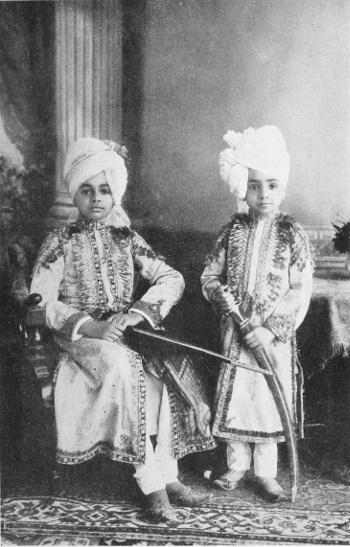
THE LATE MAHĀRĀJA SIR SUMER SINGH, OF JODHPUR (b. 1901; d. 1918), AND HIS BROTHER, THE PRESENT MAHĀRĀJA UMMED SINGH (b. 1903). To face page 928.
929