Book 5 — CHAPTER 8
Reading edition
Ajīt Singh produced to the Rāthors, A.D. 1686.
—“In the year 1743, the Champawats, Kumpawats, Udawats, Mertias, Jodhas, Karamsots, and all the assembled clans of Maru, became impatient to see their sovereign. They sent for the Khichi Mukund, and prayed that they might but [73] behold him; but the faithful to his trust replied: ‘He,
who confided him to me, is yet in the Deccan.’—‘Without the sight of our Lord, bread and water have no flavour.’ Mukund could not withstand their suit. The Hara prince Durjan Sal, having come to their aid with one thousand horse from Kotah,
they repaired to the hill of Abu, when on the last day of Chait 1743 they saw their prince. As the lotus expands at the sunbeam, so did the heart of each Rathor at the sight of their infant sovereign; they drank his looks, even as the papiha in the month Asoj sips drops of amrita (ambrosia) from the Champa.
There were present, Udai Singh, Sangram Singh, Bijaipal, Tej Singh, Mukund Singh, and Nahar son of Hari, all Champawats; Raj Singh, Jagat Singh, Jeth Singh, Samant Singh, of the Udawats; Ram Singh, Fateh Singh, and Kesari, Kumpawats. There was also the Uhar chief of pure descent,
besides the Khichi Mukund, the Purohit, the Parihar, and the Jain priest, Yati Gyan, Bijai. In a fortunate hour, Ajit became known to the world. The Hara Rao first made his salutation; he was followed by all Marwar with offerings of gold, pearls, and horses.
“Inayat conveyed the tidings to Aurang Shah; the Asur chief said to the king, ‘If without a head so long they had combated him, what could now be expected?’ He demanded reinforcements.
1008
Ajīt Singh installed.
—“In triumph they conveyed the young Raja to Awa, whose chief made the
badhava
with pearls, and presented him with horses; here he was entertained, and here they prepared the
tika daur
.
Thence, taking Raepur, Bilara, and Barunda in his way, and receiving the homage and nazars of their chiefs, he repaired to Asop, where he was entertained by the head of the Kumpawats. From Asop he went to the Bhatti fief of Lawera; thence to Rian, the chief abode of the Mertias; thence to Khinwasar, of the Karamsots. Each chief entertained their young lord, around whom all the clans gathered. Then he repaired to Kalu, the abode of Pabhu Rao Dhandal,
who came forth with all his bands; and at length [74] he reached Pokaran, where he was joined by Durgadas from the Deccan, the 10th of Bhadon 1744.
“Inayat Khan was alarmed. He assembled a numerous array to quell this fresh tumult, but death pounced upon him. The king was afflicted thereat. He tried another stratagem, and set up a pretended son of Jaswant, styled Muhammad Shah, and offered Ajit the mansab of five thousand to submit to his authority.[8] The pretender also died as he set out for Jodhpur, and Shujaat Khan[9] was made the governor of Marwar in place of Inayat. Now the Rathors and Haras united, having cleared Maru of their foes, attacked them in a foreign land. The garrisons of Malpura and Pur Mandal were put to the sword, and here the Hara prince was killed by a cannon shot in leading the storm. Here they levied eight thousand mohurs in contribution and returned to Marwar, while the civil officers and Purohits made collections in his country; and thus passed 1744.
“The year 1745 commenced with proposals from Shujaat Khan to hold Marwar in farm; he promised one-fourth of all transit duties if the Rathors would respect foreign commerce: to this they agreed. The son of Inayat left Jodhpur for Delhi; he had reached Renwal, but was overtaken by the Jodha Harnath, 1009who released him both of wives and wealth. The Khan fled to the Kachhwahas for shelter. Suja Beg, who left Ajmer to release him, fared no better: he was attacked, defeated, and plundered by Mukunddas Champawat.
War with the Mughals.
—“In 1747, Safi Khan was Hakim of Ajmer: Durga determined to attack him. The Hakim took post in the pass which defends the road; there Durga assailed him, and made him fly to Ajmer. The tidings reached the king; he wrote to the Khan, if he discomfited Durgadas, he would raise him over all the Khans of the empire; if he failed, he should send him bracelets,
and order Shujaat from Jodhpur to supersede him. Safi, before abandoning his trust, tried to retain his honours by the circumvention of Ajit. He addressed a letter to him, saying he held the imperial sanad for the restoration of his paternal domains, but that, as the king’s representative, he must come and receive it. Ajit marched at the head of twenty thousand Rathors, sending in advance Mukund Champawat to observe whether any treachery was contemplated. The snare was discovered and reported to Ajit, as he arrived at the foot of the pass beyond the mountains. ‘Let us, however, have [75] a sight of Ajaidurg as we are so near,’ said the young prince, ‘and receive the compliments of the Khan.’ They moved on towards the city, and Safi Khan had no alternative but to pay his obeisance to Ajit. To enjoy his distress, one said, ‘Let us fire the city.’ The Hakim sat trembling for its safety and his own; he brought forth jewels and horses which he presented to Ajit.
“In 1748, the troubles recommenced in Mewar. Prince Amra rebelled against his father, Rana Jai Singh, and was joined by all his chiefs. The Rana fled to Godwar, and at Ghanerao collected a force, which Amra prepared to attack. The Rana demanded succour of the Rathors, and all the Mertias hastened to relieve him; and soon after Ajit sent Durgadas and Bhagwan, with Ranmall Jodha, and ‘the eight ranks of Rathors,’ to espouse the father’s cause. But the Chondawats and Saktawats, the Jhalas and Chauhans, rather than admit foreign interference in their quarrel, thought it better to effect a reconciliation between father and son; and thus the Rana was indebted to Marwar for the support of his throne.
Aurangzeb negotiates about Akbar’s Daughter.
—“The year
1010
1749 passed in negotiation to obtain the daughter of prince Akbar, left in charge of Durgadas, for whose honour Aurangzeb was alarmed, as Ajit was reaching manhood; Narayandas Kulumbi was the medium of negotiation, and Safi Khan caused all hostilities to cease while it lasted.
“In 1750, the Muslim governors of Jodhpur, Jalor, and Siwana combined their forces against Ajit, who was again compelled to retreat to the mountains. Akha, the Bala, received their attack, but was defeated in the month of Magh. Another combat was hastened by the wanton slaughter of a sand,[11] when the Hakim of Chank, with all his train, were made prisoners at Mokalsar by the Champawat Mukanddas.
“To such straits were the Muslims put in 1751, that many districts paid chauth, others tribute, and many, tired of this incessant warfare, and unable to conquer their bread, took service with the Rathors. This year, Kasim Khan and Lashkar Khan marched against Ajit, who took post at Bijaipur. Durga’s son led the onset, and the Khan was defeated. With each year of Ajit grew the hopes of the Rathors; while Aurangzeb was afflicted at each month’s growth of his granddaughter. He wrote to Shujaat, the Hakim of Jodhpur, to secure his honour at whatever cost; his applications for Akbar’s daughter were unwearied [76].
Ajīt Singh marries a Princess of Mewar.
—“This year the coco-nut studded with gems,
two elephants and ten steeds, all richly caparisoned, were sent by the Rana to affiance the daughter of his younger brother, Gaj Singh, to Ajit. The present was accepted, and in the month of Jeth, the prince of the Rathors repaired to Udaipur, where the nuptials were solemnized. In Asarh he again married at Deolia.
“In 1753, negotiations were renewed through Durgadas, and the protracted restoration of the Sultani obtained the seat of his ancestors for the Jodhani. Durga was offered for himself the mansab of five thousand, which he refused; he preferred that Jalor, Siwanchi, Sanchor, and Tharad[14] should revert to his 1011country. Even Aurang admired the honourable and distinguished treatment of his granddaughter.
“In Pus 1757,[15] Ajit regained possession of his ancestral abode: on his reaching Jodhpur he slew a buffalo at each of its five gates.[16] The Shahzada Sultan led the way, Shujaat being dead.[17]
“In 1759, Azam Shah again seized on Jodhpur, and Ajit made Jalor his abode. Some of his chiefs now served the foe, some the Rana whose hopes were on Eklinga alone; while the lord of Amber served the king in the Deccan. The enormities of the Asurs had reached their height; the sacred kine were sacrificed even at Mathura, Prayag, and Okhamandal; the Jogis and Bairagis invoked heaven for protection, but iniquity prevailed as the Hindu strength decayed. Prayers were everywhere offered up to heaven to cleanse the land from the iniquities of the barbarians.[18] In this year, the month of Magh 1759, the Mithun Lagan (the ‘sun in Gemini’), a son was born of the Chauhani, who was called Abhai Singh. (See end of this chapter, p. 1019, for the Horoscope of Abhai Singh.)
“In 1761, Yusuf was superseded by Murshid Kuli as Hakim of Jodhpur. On his arrival he presented the royal sanad for the restoration of Merta to Ajit. Kusal Singh, the Mertia Sarmor, with the Dhandhal Govinddas, were ordered to [77] take the charge, which incensed the son of Indar (Mohkam Singh), who deemed his faithful service during his minority overlooked by this preference. He wrote to the king to nominate him to the command of Marwar, and that he would fulfil his charge to the satisfaction both of Hindu and Muslim.
“In 1761 the star of the foe began to decline. Murshid Kuli, the Mogul, was relieved by Jaafar Khan. Mohkam’s letter was intercepted. He had turned traitor to his prince, and joined 1012the king’s troops. Ajit marched against them; he fought them at Dunara; the king’s troops were defeated, and the rebel Indhawat was slain. This was in 1762.
Death of Aurangzeb, March 3, 1707.
—“In 1763, Ibrahim Khan, the king’s lieutenant
at Lahore, passed through Marwar to relieve Azam in the vice-royalty of Gujarat. On the second day of Chait, the obscure half of the moon, the joyful tidings arrived of the death of the king.
On the fifth, Ajit took to horse; he reached the town of Jodha, and sacrificed to the gates, but the Asurs feared to face him. Some hid their faces in fear, while others fled. The Mirza came down, and Ajit ascended to the halls of his ancestors. The wretched Yavans, now abandoned to the infuriated Rajputs smarting under twenty-six years of misery, found no mercy. In hopeless despair they fled, and the wealth which they had amassed by extortion and oppression returned to enrich the proprietor. The barbarians, in turn, were made captive; they fought, were slaughtered and dispersed. Some sought
saran
(sanctuary), and found it; even the barbarian leader himself threw fear to the winds in the unconcealed sanctuary of the Kumpawat. But the triumph of the Hindu was complete, when, to escape from perdition, their flying foes invoked Sitaram and Hargovind, begging their bread in the day, and taking to their heels at night. The chaplet of the Mulla served to count the name of Rama, and a handful of gold was given to have their beards removed.
Nothing but the despair and flight of the Mlechchha was heard throughout Murdhar. Merta was evacuated, and the wounded Mohkam fled to Nagor. Sojat and Pali were regained, and the land returned to the Jodhani. Jodhgarh was purified from the contaminations of the barbarian with the water of the Ganges and the sacred Tulasi, and Ajit received the tilak of sovereignty.
“Then Azam marched from the south and Muazzam from the north. At Agra a [78] mighty battle for empire took place 1013between the two Asurs, but Alam[22] prevailed and got the throne. The tidings soon reached the king, that Ajit had plundered his armies in Maru and taken possession of the ‘cushion’ of his fathers.
Campaign of Bahādur Shāh.
—“The rainy season of 1764 had vanished, the king had no repose; he formed an army and came to Ajmer. Then Haridas, the son of Bhagwan, with the Uhar and Mangalia chiefs,
and Ratna the leader of the Udawats, with eight hundred of their clan, entered the castle and swore to Ajit, that whatever might be his intentions, they were resolved to maintain the castle to the death. The royal army encamped at Bhavi Bilara, and Ajit prepared for the storm; but the king was advised to try peaceful arts, and an overture was made, and the messenger was sent back to the king accompanied by Nahar Khan. The embassy returned bearing the royal farman to Ajit; but before he would accept it, he said he would view the royal army, and on the first day of Phalgun he left the hill of Jodha and reached Bisalpur. Here he was received by a deputation from the king, headed by Shujaat Khan, son of the Khankhanan accompanied by the Raja of the Bhadaurias and Rao Budh Singh of Bundi—the place of meeting was Pipar. That night passed in adjusting the terms of the treaty.
The ensuing morn he marched forward at the head of all the men of Maru; and at Anandpur the eyes of the king of the barbarians (Mlechchha) fell on those of the lord of the earth. He gave him the title of Tegh Bahadur.
But fate decreed that the city of Jodha was coveted by the king; by stealth he sent Mahrab Khan to take possession, accompanied by the traitor Mohkam. Ajit burned with rage when he heard of this treachery, but he was compelled to dissimulate and accompany Alam to the Deccan, and to serve
1014
under Kambakhsh. Jai Singh of Amber
was also with the king, and had a like cause for discontent, a royal garrison being placed in Amber, and the
gaddi
of the Raja bestowed on his younger brother, Bijai Singh. Now the army rolled on like a sea overflowing its bounds. As soon as the king crossed the Nerbudda,
the Rajas executed their designs, and, without saying a word, at the head of their vassals retrograded to Rajwara. They repaired to Udaipur, and were received by Rana Amra with rejoicing and distinction [79], who advanced to conduct them to his capital. Seated together, the
chaunri
waving over their heads, they appeared like the Trianga,
Brahma, Vishnu and Mahesa. From this hour the fortunes of the Asurs sunk, and virtue again began to show herself.
From Udaipur the two Rajas passed to Marwar. They reached Awa, and here the Champawat Sangram, son of Udaibhan, spread the foot-carpet (
pagmanda
) for his lord.
“The month of Sawan 1765 set in, and the hopes of the Asur expired. Mahrab was in consternation when he heard that Ajit had returned to his native land. On the 7th the hall of Jodha was surrounded by thirty thousand Rathors. On the 12th the gate of honour was thrown open to Mahrab; he had to thank the son of Askaran[30] for his life. He was allowed an honourable retreat, and Ajit once more entered the capital of Maru.
“Jai Singh encamped upon the banks of the Sur Sagar; but a prince without a country, he was unhappy. But as soon as the rains were passed, Ajmall, the sanctuary of the Kachhwaha, proposed to reinstate him in Amber. When conjoined they had reached Merta, Agra and Delhi trembled. When they arrived at Ajmer its governor sought saran with the saint,[31] and paid the contributions demanded. Then, like the falcon, Ajit darted upon 1015Sambhar; and here the vassals of Amber repaired from all quarters to the standard of their lord. With twelve thousand men, the Sayyid advanced along the edge of the salt lake, to encounter Ajmall. The Kumpawat led the charge; a desperate battle ensued; Husain, with six thousand men, lay on the field, while the rest took to flight and sought refuge in the castle.[32] His lieutenant, the Parihar, chief Pandu,[33] here fell into the hands of Ajit; he then felt he had recovered Mandor. On intelligence of this history, the Asurs abandoned Amber, and having placed a garrison in Sambhar, in the month of Margsir, Ajit restored Jai Singh to Amber, and prepared to attack Bikaner. Ajit committed the administration of all civil affairs to the faithful Raghunath Bhandari, with the [80] title of Diwan. He was well qualified, both from his experience in civil affairs and from his valour as a soldier.
Death of Prince Kāmbakhsh.
—“In Bhadon of the year 1766, Aurangzeb put to death Kambakhsh,
and Jai Singh entered into negotiations with the king. Ajit now went against Nagor; but Indar Singh being without resource, came forth and embraced Ajit’s feet, who bestowed Ladnun upon him as a heritage. But this satisfied not him who had been the lord of Nagor, and Indar carried his complaints to Delhi.
The king was enraged—his threats reached the Rajas, who deemed it safe again to reunite. They met at Kolia near Didwana, and the king soon after reached Ajmer. Thence he sent his firmans and the panja as terms of friendship to the Rajas: Nahar Khan, Chela of the king, was the bearer. They were accepted, and on the 1st Asarh both the Rajas repaired to Ajmer. Here the king received them
1016
graciously, in the face of the world; to Ajit he presented the sanad of the Nine Castles of Maru, and to Jai Singh that of Amber. Having taken leave of the king, the two Rajas went on the
parab
to the sacred lake of Pushkar. Here they separated for their respective domains, and Ajit reached Jodhpur in Sawan 1767. In this year he married a Gaur Rani, and thus quenched the feud caused by Arjun, who slew Amra Singh in the Ammkhass.
Then he went on a pilgrimage to Kurukshetra, the field of battle of the Mahabharata, and made his ablutions in the fountain of Bhishma.
Thus 1767 passed away” [81].
1017
Eulogy of Durgadās.
—Here let us, for a while, suspend the narrative of the chronicler, and take a retrospective glance at the transactions of the Rathors, from the year 1737 [
A.D.
1680], the period of Raja Jaswant’s death at Kabul, to the restoration of Ajit, presenting a continuous conflict of thirty years’ duration. In vain might we search the annals of any other nation for such inflexible devotion as marked the Rathor character through this period of strife, during which, to use their own phrase, “hardly a chieftain died on his pallet.” Let those who deem the Hindu warrior void of patriotism read the rude chronicle of this thirty years’ war; let them compare it with that of any other country, and do justice to the magnanimous Rajput. This narrative, the simplicity of which is the best voucher for its authenticity, presents an uninterrupted record of patriotism and disinterested loyalty. It was a period when the sacrifice of these principles was rewarded by the tyrant king with the highest honours of the state; nor are we without instances of the temptation being too strong to be withstood; but they are rare, and serve only to exhibit, in more pleasing colours, the virtues of the tribe which spurned the attempts at seduction. What a splendid example is the heroic Durgadas of all that constitutes the glory of the Rajput! Valour, loyalty, integrity, combined with prudence in all the difficulties which surrounded him, are qualities which entitle him to the admiration which his memory continues to enjoy. The temptations held out to him were almost irresistible: not merely the
1018
gold, which he and thousands of his brethren would alike have spurned, but the splendid offer of power in the proffered mansab of five thousand, which would at once have lifted him from his vassal condition to an equality with the [82] princes and chief nobles of the land. Durga had, indeed, but to name his reward; but, as the bard justly says, he was
amol
, beyond all price,
anokha
, unique. Not even revenge, so dear to the Rajput, turned him aside from the dictates of true honour. The foul assassination of his brother, the brave Soning, effected through his enemies, made no alteration in his humanity whenever the chance of war placed his foe in his power; and in this, his policy seconded his virtue. His chivalrous conduct, in the extrication of prince Akbar from inevitable destruction had he fallen into his father’s hands, was only surpassed by his generous and delicate behaviour towards the prince’s family, which was left in his care, forming a marked contrast to that of the enemies of his faith on similar occasions. The virtue of the granddaughter of Aurangzeb, in the sanctuary (
saran
) of Dunara,
was in far better keeping than in the trebly-walled harem of Agra. Of his energetic mind, and the control he exerted over those of his confiding brethren, what a proof is given, in his preserving the secret of the abode of his prince throughout the six first years of his infancy! But, to conclude our eulogy in the words of their bard: he has reaped the immortality destined for good deeds; his memory is cherished, his actions are the theme of constant praise, and his picture on his white horse, old, yet in vigour, is familiar amongst the collections of portraits of Rajputana.
But there was not a clan, or family, that did not produce men of worth in this protracted warfare, which incited constant emulation; and the bards of each had abundant materials to emblazon the pages of their chronicles. To the recollection of these, their expatriated descendants allude in the memorial[41] of their hardships from the cruel policy of the reigning chief, the last lineal descendant of the prince, whose history has just been narrated. We now resume the narrative in the language of the chronicle [83].
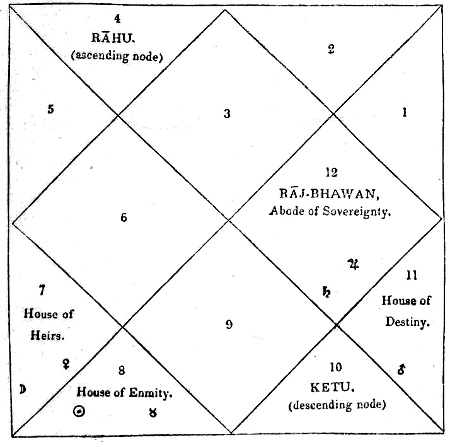
1019HOROSCOPE OF RAJA ABHAI SINGH
In the Janampatri, or horoscope of Abhai Singh (referred to in p. 1011), the 4th, 7th, 8th, 10th, 11th, and 12th houses denote the destinies of the heir of Ajit. In the 4th we have the monster Rahu, the author of eclipses. Of the 7th, or house of heirs, the Moon and Venus have taken possession; of the 8th, or house of strife, the Sun and Mercury. In the 10th is Ketu, brother of Rahu, both signs of evil portent. Mars rides in the house of fate, while Saturn and Jupiter are together in the abode of sovereignty. Like that of every man living, the horoscope of the heir of Maru is filled with good and evil: could the Jotishi or astrological seer have put the parricidal sign in the house of destiny, he might have claimed some merit for superior intelligence. Those who have ever consulted any works on this foolish pursuit will observe that the diagrams of the European astrologers are exact copies of the Hindu, in proof of which I have inserted this; to trace darkness as well as light from the East!
[84].
A. [The weights which keep it down.]
B. The goddess of arms, their Pallas.
1020