PART I
Reading edition
I THE ACCADIAN CALENDAR
[Reprinted from the Proceedings of the Society of Biblical Archæology, January 1892]
Epping and Strassmaier, in their book Astronomisches aus Babylon, have lately translated three small documents, originally inscribed on clay tablets in the second century B.C. From these tablets, we learn that the Babylonians of the above date possessed a very advanced knowledge of the science of astronomy. Into the question of the extent of that knowledge we need not here enter further than to say that it enabled the Babylonian astronomers to draw up almanacs for the ensuing year; almanacs in which the eclipses of the sun and moon, and the times of the new and full moon, were accurately noted, as also the positions of the planets throughout the year. These positions were indicated by the nearness of the planet in question to some star in the vicinity of the ecliptic, and the ecliptic was portioned off into twelve groups, coinciding very closely in position and extent with the twelve divisions of the Zodiac as we now know them.
As to the calendar or mode of reckoning the year, we find that the order and names of the twelve months were as follows: Nisannu (or Nisan), Airu, Simannu, Dûzu, Abu, Ulûlu, Tischritu, Arah-samna, Kislimu, Tebitu, Šabâtu, Adaru.
Of these months Ulûlu and Adaru could be doubled as Ulûlu Sami (the second Elul), and Adaru Arki (the last Adar). The Babylonian years were soli-lunar: that is to say, the year of twelve lunar months, containing three hundred and fifty-four days, was bound to the solar year of three hundred and sixty-five days by intercalating, as occasion required, a thirteenth month.
Out of every eleven years there were seven with twelve months, and four with thirteen months. The first day of the year being, like some of our church festivals, dependent on the time of the new moon, was “moveable” (schwankende). The year, according to the tablets before Epping and Strassmaier, “began with Nisan, hence in the spring.”[1]
This is a sketch of the Babylonian calendar in the second century B.C., as drawn from the work of the two learned Germans above-named.
Now we find in the British Museum a great number of trade documents which, according to the Catalogue, “cover a period of over two thousand years.” There are “tablets of the time of Rim-sin, Ḫammurabi, and Samsu-iluna; tablets of the time of the Assyrian supremacy, of the time of the native kings, and of the time of the Persian supremacy; tablets of the times of the Seleucidæ, and the Arsacidæ.”[2]
These documents are all dated in such and such a month of such and such a year of some king’s reign; the months are the same (at first under their earlier Accadian names[3]) as those we find in the almanacs translated by Epping and Strassmaier, and we meet in them, and in other historical inscriptions, with the intercalary months, the second Elul, and the second Adar. It would seem, then, that it was the same calendar, worked in the same way, that held its place through these two thousand years.[4]
But, further, there are astrological works copied for the library of Assurbanipal from ancient Babylonian originals. The compilation of many of these originals is placed by scholars in the reign of Sargon of Accad,[5] at the remote date of 3,800 B.C.
In these ancient astrological works, the same calendar referred to in the trade documents, and in the late Babylonian almanacs, appears to obtain. We find in them the same year of twelve lunar months, reinforced at intervals by a thirteenth intercalated month, and, which is very important, the order of the months is always the same. Nisan (Accadian Barzig-gar), everywhere appears as “the first month,” and is distinctly stated to be “the beginning of the year.”[6]
As early as the year 1874, Professor Sayce pointed out that there was good reason for supposing that the twelve Babylonian months corresponded to the twelve divisions of the Zodiac. At page 161 of his Paper, The Astronomy and Astrology of the Babylonians, we read: “Now a slight inspection of the calendar will show that the Accadian months derived their names from the signs of the Zodiac.”
He then proceeds to discuss and compare the meanings of the Accadian and Semitic month names, and to point out those in which a reference to the Zodiac might most clearly be traced.
That the constellations of the Zodiac were from a remote age recognized by the dwellers in Mesopotamia is scarcely to be doubted. We find on the boundary stones in the British Museum representations of several of their figures. The Bull, the Tortoise (in lieu of the Crab), a female figure with wings, the Scorpion, the Archer, and the Goat-fish, are all portrayed, not only on boundary stones, but also on cylinder seals and gems.
Again, in the old astrological works, we find mention of the Scorpion “Gir-tab,” and of the Goat-fish “Muna-xa,” and as planets are said to “approach to,” and “linger in,” the stars of Gir-tab and of Muna-xa, it may well be supposed that they were the Zodiacal constellations still represented under the forms of Scorpion and Goat-fish.
Out of the many star-groups mentioned in the old tablets, only a few have as yet been certainly identified with their modern equivalents. As to the identity of others, we may guess. For instance, when it is said “Mercury[7] lingered in the constellation Gula,” we may guess that Gula represents Aquarius, which sign in the Epping and Strassmaier tablets figures as “Gu.”
From all these sources of information, we gather that the twelve divisions of the ecliptic had been mapped out at the time the astrological works were drawn up, and that some (at least) of these divisions corresponded exactly to those now represented on celestial globes.
The suggestion, therefore, put forward by Professor Sayce and other scholars, that the twelve Accadian months corresponded to the twelve constellations of the Zodiac, and that we may trace a resemblance in some instances between the name of the month in the old Accadian language and the constellation into which the sun at that time of the year entered, is not in itself improbable.
The following months are those in which this resemblance is very striking:
1st month, Bar zig-gar (“the sacrifice of righteousness”), Aries.
2nd month, Khar-sidi (“the propitious bull”), Taurus.
3rd month (sometimes called) Kas (“the Twins”), Gemini.
6th month, Ki Gingir-na (“the errand of Istar”), Virgo.
We know from the Epping and Strassmaier tablets as a matter of fact, that the months and the constellations of the Zodiac did in the second century, B.C., correspond with each other in order and sequence as above suggested, and if further research should establish the fact that they so corresponded in Sargon’s time, then as we find Nisan (Bar zig-gar) throughout all these ages holding the place of “first month,” and marking “the beginning of the year,” it will necessarily follow that the Accadian, Babylonian, and Assyrian calendars dealt with a sidereal and not a tropical year.
Ours is a tropical year, that is to say, according to the Julian calendar (afterwards amended by Pope Gregory) it is bound to the seasons, and its months maintain a constant relation to the four great divisions of the ecliptic, i.e. the solstices and the equinoxes. The winter solstice always falls about the 22nd of December, the spring equinox about the 21st of March, the summer solstice about the 21st of June, and the autumnal equinox about the 23rd of September.
But (as has been suggested) the Accadian year was a sidereal year, and its months maintained a constant relation to the twelve star-marked divisions of the ecliptic, or, as they are called, the constellations of the Zodiac. Nisan always corresponded (as closely as a lunar month might) to the time during which the sun traversed the constellation Aries; Airu to the time during which it traversed the constellation Taurus; and so on through the twelve months of the year.
The equinoctial points are, however, always, though slowly, changing their position amongst the twelve constellations of the ecliptic. The months, therefore, which in 3,800 B.C., and still in the second century B.C., corresponded to the same star-groups, as above noted, must have held in different ages very different positions in regard to the four great divisions or seasons of the year.
We find in the tablets translated by Epping and Strassmaier the year “beginning with Nisan, hence in the spring,” and this seems a more or less natural season from which to count the year; but when, taking the precession of the equinoxes into account, we find that the year in Ḫammurabi’s time (2,200 B.C.) must have commenced one month, and in Sargon’s time (3,800 B.C.) two months before the spring equinox, we feel surprised and perplexed to find that the year must then have begun without any reference to the seasons—the four great and most easily observed divisions of the ecliptic.
It is difficult to imagine that the astronomers who so skilfully divided the ecliptic into its twelve parts, and who originated the wonderful Accadian calendar—a calendar so well thought out that, as we have seen reason to believe, it resisted all the shocks of time for nearly four thousand years—it is difficult to imagine that such astronomers should have taken no note of the four prominent divisions of the year and of the ecliptic, i.e. the solstices and the equinoxes.
PLATE I.
FIG. 1.
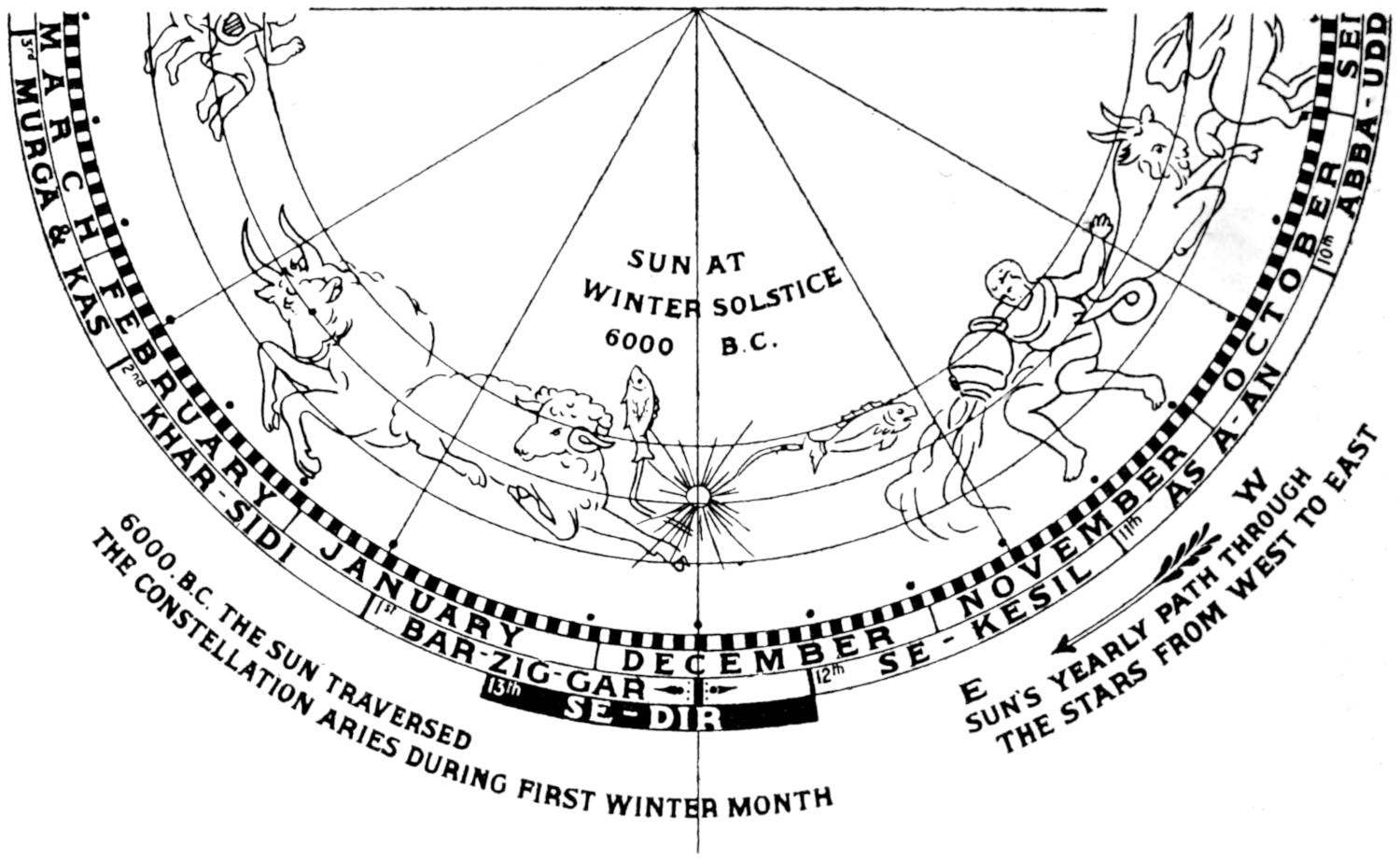
FIG. 2.
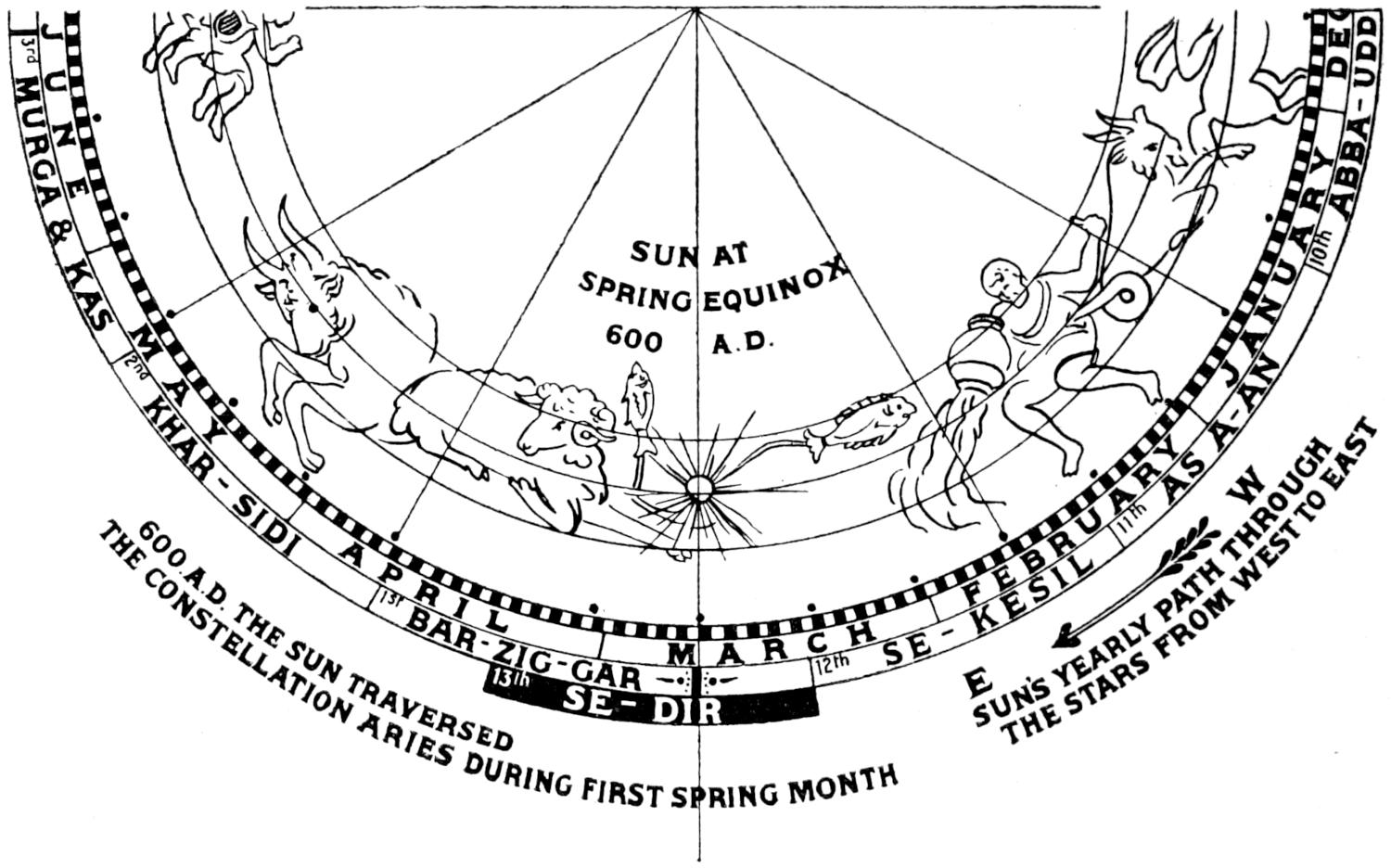
The first and last months of the Accadian, sidereal, year, compared with the months of the Gregorian, tropical, year: at 6,000 B.C. and at 600 A.D.
[To face p. 13.
There is, however, a way to account for this anomaly, or, rather, there is a supposition which, if adopted, will allow these astronomers of old to have taken note, not only of the months, but also of the seasons of the year, when first they drew up their mighty scheme.
Let us suppose that the calendar which, as we may learn from the astrological tablets, was already in Sargon’s time a well known and venerated institution, had been originally drawn up at a date much earlier than Sargon’s, when the first month (Bar zig-gar), was not the first spring month, but when it was the first winter month of the year. This date (see Plate I., fig. 1) would have been about 6,000 B.C.; for then the sun entered the constellation Aries at the winter solstice—a season equally well, if not better suited than the spring equinox to hold the first place in the calendar.[8] Under this supposition, it would no longer be difficult to imagine why the ancient Accadian astronomers should have chosen Aries as the first constellation of the Zodiac, and Nisan (Bar zig-gar) as the first month, and the “beginning of the year.”
Nor need we throw discredit on the early calendar makers 6,000 B.C., if we take for granted that they were not acquainted with the fact that slowly but inevitably the seasons must change their position amongst the stars, and that, not knowing this, they believed that in making the beginning of the year dependent on the sun’s entry into the constellation Aries, they were also binding it to the season of the winter solstice.
As centuries rolled by, however, and slowly the stars of Aries receded from the winter solstice, Bar zig-gar was no longer the first month in the sense of being the first winter month. Still, the authority of the originators of the calendar held sway; provision had been only made for counting the year as a sidereal year; and Bar zig-gar, or the month in which the sun entered Aries, was still called the first month, and looked on as the beginning of the year.
To carry out the reformation of any long established calendar is, we know, not a trifling undertaking. Even on secular grounds, any proposed reform encounters strong opposition. But the calendar in Babylonia was not only a civil, it was also a religious, institution. Its origin was attributed to the Creator, and as the work of the Creator, it is described in one of the old Babylonian tablets.[9]
“For each of the twelve months He fixed three stars” (or groups of stars). “From the day when the year issues forth to the close.”[10]
The astronomical and astrological texts drawn up for Sargon of Accad are entitled “The Illumination of Bel,”[11] and still as late as the second century B.C., all Babylonian almanacs bore the heading: “At the command of my Lord Bel and my Lady Beltis, a decree.”[12] Thus it was, we may suppose, that under the protection of the gods the Accadian calendar continued unchanged throughout all the changing ages.
But during all the ages the winter solstice moved on steadily through almost a quarter of the great circle of the ecliptic,[13] and in the second century B.C., the spring equinox was not far from the same point of the star-marked ecliptic where the winter solstice had been when first the calendar-makers had “fixed” the constellations “for the twelve months from the day when the year issues forth to the close,” and we who now read the almanacs drawn up at that late period of Babylonian history are not (as has been said above) surprised to find the year “beginning with Nisan, hence in the spring.” (See Plate I., fig. 2.)
The propositions contained in this Paper are these:—
I. The Accadian year was counted as a sidereal year.
II. The Accadian calendar was first thought out and originated at a date not later than 6,000 B.C.
The first proposition is founded on the opinion, long ago expressed by many Oriental scholars, that the Accadian months corresponded in very early ages with the constellations of the Zodiac, Nisan—the month during which the sun was in conjunction with the constellation Aries—holding the first place then, as also in the latest times of Babylonian history, and, presumably, through the intervening period.
But even if the first proposition is granted, the second, it must be confessed, is only an opinion based on the unlikelihood that the old Accadian and sidereal year, otherwise so skilfully dealt with in the calendar, should have begun, in what would appear to be a haphazard manner, at no definite season of the year.
It may seem that too much weight has been attached in this Paper to what can only be called a guess; but where there is so much that we desire to know, and so little as yet absolutely known of the early history of astronomy, the temptation to make such guesses is great.
It is to their earliest heroes and to their gods that the ancient heathen nations attributed the invention of astronomy, and amongst the Jews also, according to Josephus, the children of Seth were looked upon as being the first teachers of the science.[14]
Modern astronomers often speak in general terms of their science as having existed in a “hoar antiquity,” and in “prehistoric times.” But questions as to when, and where it took its rise, are still unanswered. During the last hundred years these questions have been keenly discussed. Babylon, Egypt, Greece, India, and China, have each been claimed as “the cradle” of the science. Some few writers (and prominent amongst them Jean Silvain Bailly, a brilliant scholar and an eminent astronomer) have contended for the view that not by any one nation were the chief advances in astronomy made, but that before the great races of mankind separated from the parent stock, and spread themselves over the globe, the phenomena of astronomy had been closely observed, and scientific methods for measuring time had been adopted. Bailly speaks of “une astronomie perfectionnée,” of which only “les débris” are to be met with in possession of the civilized races of antiquity. He claims an antediluvian race as the originators of astronomic science.
It may seem a bold suggestion to place the formation of the calendar at a date so high as 6,000 B.C., a date exceeding as it does by 2,000 years that given to us in the margin of our Bibles for the story of the fall of man and his expulsion from Eden. It was in following Archbishop Usher’s calculations that the date of 4,004 was adopted and placed, where it still remains, in our English Bibles. But the difficulty of determining the early dates of Bible history has always been felt to be very great, and “it is quite possible to believe that Genesis gives us no certain data for pronouncing on the time of man’s existence on the earth.”[15] Scholars, in basing their calculations on the authority of Scripture, have arrived at very different conclusions. Some only demand 3,616, others 6,984 years, as required from Scriptural sources for “the years of the world to the birth of Christ.”[16]
It will be seen that the earlier of these dates leads us back to an even more remote age than that in which, if the theory here proposed is a true one, the marvellous achievement of the formation of a scientific sidereal calendar was accomplished.
To attribute to the dwellers in Eden or to their immediate descendants intellectual gifts that should enable them to perfect so grand a scheme, does certainly not contradict the story of the fall, but rather may open up for us fresh lines of thought, when we read of that transgression in which the pride of intellect played so important a part.
II THE CONSTELLATION ARIES
[Reprinted from the Proceedings of the Society of Biblical Archæology, March 1893]
In the January number of the Proceedings of the Society of Biblical Archæology for last year, under the title The Accadian Calendar, two propositions were advanced:—
I. The Accadian year was counted as a sidereal year.
II. The Accadian calendar was first thought out and originated at a date not later than 6,000 B.C.
The fact that the sun’s entry into the constellation Aries appears to have marked through many millenniums the beginning of the Accadian year, was cited in support of the first proposition, and the fact that the sun’s entry into Aries coincided about 6,000 B.C. with the winter solstice, was relied on to support the probability of the second proposition, namely, that at the above date the calendar, which so honoured the inconspicuous constellation Aries, was first drawn up.
If we now find this inconspicuous part of the heavens equally honoured by several nations in very ancient times, we shall be led to think either that these nations, independently of each other, happened to observe and mark out the sun’s annual course through the heavens at exactly the same date, and therefore chose the same point as marking the winter solstice; or we must suppose that they derived their calendar and knowledge of the Zodiac from observations originally made by some one civilized race.
The Brahmins of India claim a high antiquity for the science of astronomy in their country, and their observations and calculations profess to date back to the fourth millennium B.C. The names of the Indian constellations are preserved to us in the Sanscrit language, and these names are, so to speak, identical with those that we use at the present day when we speak of the figures of the Zodiac. Many scholars of to-day believe that only after Alexander’s conquests in India did the knowledge of the twelve-fold division of the Zodiac penetrate into that country. Some, on the other hand, maintain the opposite opinion, namely, “that the names of the signs can be proved to have existed in India at as early a period as in any other country.”[17]
Jean Silvain Bailly, whose opinions as to the antiquity of the science of astronomy have been already quoted in the foregoing Paper, in his work on the history of ancient astronomy, speaking of the Brahmins of India, the initial point of whose Zodiac is at the first star in the constellation Aries, writes as follows:[18]—
“Mais pourquoi ont-ils choisi cette constellation pour la première? Il est évident que c’est une affaire de préjugé et de superstition; le choix du premier point dans un cercle est arbitraire. Ils auront été décidés par quelque ancienne tradition.”
Dupuis, writing at nearly the same date as Bailly, about a hundred years ago, and in conflict with him on many points relating to the Zodiac, was also struck by the choice of this same inconspicuous point in the great circle of the ecliptic, not only by the Brahmins of India, but also by other ancient nations. He further explains that the difference in the choice of initial point by the Chinese, and by the other nations, is only an apparent, and not a real difference. On the wonderful agreement shown by so many nations, in their choice of the stars by which they marked the beginning of their Zodiacs, Dupuis relied to support his views concerning the unity of the astronomical and religious myths of all nations.
At the end of his work, Mémoire Explicatif du Zodiaque, Dupuis gives in a diagram several Zodiacs in concentric circles; some divided into twelve, some into twenty-seven or twenty-eight parts. He represents the colures by a cross which quarters these concentric Zodiacs, and speaking of the twenty-seven- and twenty-eight-fold divisions, he observes as follows:
“On remarque d’abord, que ces divers systèmes lunaires, tirés de l’Astronomie de différens peuples, s’accordent tous à placer dans les cases correspondantes à-peu-près les mêmes étoiles. Il suffit, pour s’en assurer, de comparer les étoiles designées dans la même case de la division de chaque peuple. On remarque aussi qu’ils ont pris tous, excepté les Chinois, les mêmes étoiles, pour point initial de la division, savoir, celles de la tête du Bélier. Les Chinois, au contraire, ont fixé le point initial dans la partie du ciel diamétralement opposée, vers les pieds de la Vierge et près l’Epi” (p. 4).
Dupuis’ arguments, drawn from the choice by several nations of the first division of Aries as the initial point of the Zodiac and year, are of equal cogency in support of a calendar such as he suggests, drawn up more than 12,000 B.C., for a year beginning at the autumn equinox; or for a calendar, as suggested in this Paper, drawn up about 6,000 B.C., and dealing with a year beginning at the winter solstice; and it may be claimed that the facts brought to light by the study of the ancient Accadian calendar, while greatly strengthening the ground for Dupuis’ opinion concerning the early acceptance by many nations of the stars of Aries as a mark for the beginning of the year in prehistoric times, seem more in favour of the first month of that year having been counted from the winter solstice than from the autumn equinox.
Quotations from authors like Bailly and Dupuis may seem nowadays somewhat out of date; for though they were amongst the foremost scholars of their time, they were necessarily ignorant of all the archæological discoveries that have succeeded each other with such rapidity during the last century. Unless, therefore, the brilliant guesses and astronomical speculations of these writers can find confirmation in the results of modern researches, their theories may well be disregarded. But it seems to me that many of their theories are meeting with such confirmation.
Turning first to some of the facts which archæology has taught us regarding the ancient Egyptians, it will be interesting to see if there are any indications in their astronomy or mythology of honour paid to the constellation Aries in connexion with the progress of the sun and moon through the figures of the Zodiac.
It is true that the acquaintance of the ancient Egyptians with these figures is a matter still in dispute, and the various methods of counting the year followed by them also present great difficulties to scholars. It is, however, admitted that they were a people much given to the observation and worship of the heavenly bodies, and that their astronomy and mythology were very closely interwoven with each other.
In the time of the Middle Empire, it seems, the months in the civil year were not counted as lunar months, but as months of thirty days each. The year was not counted as a sidereal year, but as one of three hundred and sixty days—twelve months of thirty days—with five days added at the end of each year to bring up the number to three hundred and sixty-five days. No attention was paid to the odd hours and minutes over and above the three hundred and sixty-five days, which are occupied by the sun in completing his annual course.
Mr Griffiths has remarked in the number of the Proceedings of the Society of Biblical Archæology for March 1892, that the hieroglyph for month points to an originally lunar month, and I would suggest that the star under the first crescent seems to point also to a month originally counted sidereally, i.e., dependent upon the conjunction of the sun and moon in some particular star-group of the ecliptic. As a matter of fact, the Egyptians made use not only of a civil year such as has been above described, but also of a sidereal year, counted from the heliacal rising of Sirius, and it is perhaps possible that the months in this sidereal year were counted as lunar months, and the year treated as soli-lunar and sidereal.
In these two Egyptian calendars—so far as they are at present understood—no reference to the constellation Aries seems to be discernible. The agricultural importance of the season of the summer solstice in Egypt, coinciding as it does with the rising of the Nile, may have induced calendar-makers at some very early date to re-arrange the order of the year, so as to make it begin at the summer rather than the winter solstice—the season, as it is contended in these Papers, originally chosen 6,000 B.C. by astronomers in a more northern latitude than that of Egypt as the starting-point of a year sidereally marked by the conjunction of the sun with the constellation Aries.
But if we turn to the Egyptian mythology, the importance of the Ram, or rather of the head of the Ram, as it is revealed in the monuments, and in the pictorial art of the ancient Egyptians, must continually strike the student of Egyptian symbolism.
Amen, the great god of the Theban triad (Amen, Maut, and Chons), is sometimes represented as ram-headed—his boat and his sceptre are always adorned with a ram’s head, and the great temple to him, in conjunction with the sun, i.e. to Amen-Ra, is approached through an avenue of gigantic ram-headed sphinxes, and this is also the case as regards the temple of Chons—the moon-god—at right angles, and in close proximity, to the great temple of Amen-Ra.
Scholars tell us that Horus, Isis, and Osiris,—the Memphian triad—symbolized the diurnal motion of the sun and other heavenly bodies, and it need not appear improbable that the great Theban triad, Amen, Maut, and Chons, should have originally symbolized the annual course of those same bodies through the constellations of the Zodiac. This would account for the prominence of the Ram in connexion with the worship of this triad—the Ram, which, as I have argued, in many countries, and possibly in Egypt also, marked the first division of the Zodiac and year.
A prayer to Amen is translated by G. Maspero in the April number for 1891 of the Proceedings of the Society of Biblical Archæology;[19] from this translation it would appear that Amen is implored to bring the calendar into touch with the real seasons of the year. If Amen represented a sidereally marked point in the yearly course of the sun, such a prayer might suitably have been addressed to him by the Egyptians.
The great temple to Amen-Ra at Thebes, approached, as has been stated above, through an avenue of ram-headed sphinxes, is oriented to the setting sun of the season so important to Egyptians, that of the summer solstice, and this fact strengthens the opinion that Amen was considered to be a god in some way presiding over the course of the year and its right measurement. It is true that this orientation of his temple precluded the possibility of the light from any star of the constellation Aries ever shining into the shrine of the god; but it is perhaps possible that the ceremony of “the great feast-day of Amon Father,” described by Ebers, may have been devised by the votaries of Amen as a means whereby they could honour the god, as one presiding over the most propitious season of the year, and also recall the sidereal connexion of the god of the year with the, from times immemorial highly reverenced, constellation Aries.
At pp. 277 and 278 of Egypt, Descriptive, Historical, and Picturesque, vol. ii., Ebers, having referred to some figures represented on the walls of a Memnonium in the Nekropolis erected by Rameses II., exactly opposite to the Great Temple of Karnak, observes:—
“Of these figures the inscription says:—‘As they approach the king their arms are filled with choice produce and stores, and all the good things that the earth brings forth are gathered by them to add to the joy on the great feast-day of Amon, the father.’”
“These words refer to the great ‘feast of the Valley’ (heb en-ant), when, on the 29th day of the second month of the inundation, the statue of Amon was brought forth from the sanctuary with much magnificence and solemnity, and conveyed across the Nile to the Nekropolis, that the god might there offer sacrifices to his ancestors in the other world. The priests of the house of Seti received the procession with the splendid bark Sam, the most sacred of all the vessels that were preserved in the temple of Karnak: in this the statue of the god was placed, and borne first to the Memnonium of Seti, and then round about the Nekropolis, preceded by a crowd of temple servants, who strewed the way with sand. The solemnities ended with a grand nocturnal spectacle, on the great sacred lake of which traces may still be seen to the extreme south of the Nekropolis.
“The Egyptian religion prescribed to all its followers that they should visit the tombs of their dead and bring offerings, in grateful remembrance of their parents and forefathers; and as, day after day, millions of suns had gone to rest—as men do—behind the realm of tombs in the Libyan hills, the god himself was brought to do honour to his departed ancestry, and to sacrifice to them.”
The rising of the Nile in Egypt coincides very closely with the season of the summer solstice. At the date of Rameses II.—a date not yet unanimously agreed on by scholars, but which may be safely placed between 1,400 and 1,100 B.C.—the sun at the season of the summer solstice was in the constellation Cancer (see Plate II.), and two months later its place in the ecliptic was a few degrees to the west of a point exactly opposed to the first stars of Aries and to the initial point of the Indian Zodiac. On the evening, therefore, of the 29th day of the second month of the inundation, when the sun had now sunk behind the Libyan hills, and daylight had faded sufficiently to allow them to show their light,[20] the first stars of Aries rose above the eastern horizon, and at midnight attained to the southern meridian.
PLATE II.
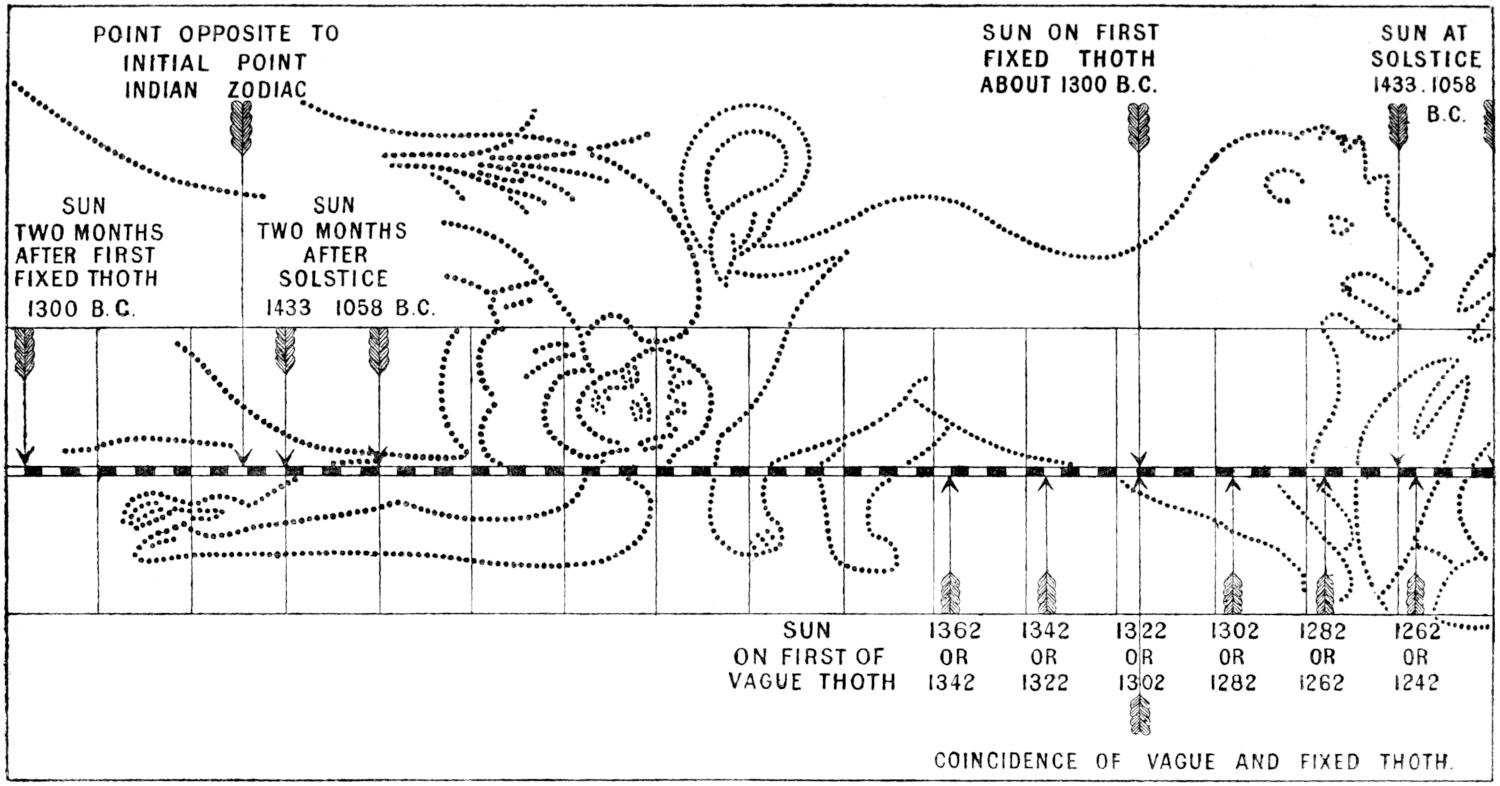
Relating to “the Feast-day of Amon, the Father.” Position of sun on first of fixed Thoth varied by about one degree in two hundred years.
[To face p. 36.
Thus at the season of all the year, when Aries specially dominated the ecliptic, the statue of the god Amen was, as we learn, brought out of his dark temple shrine and carried in procession to the Nekropolis, from whence the constellation Aries—not hidden by obstructing walls and columns—was fully visible; and there honour was done and sacrifice offered to “Amon Father.”
But it may be said that we should understand “the second month of the inundation” to refer to the second month of the Egyptian sidereal year counted from the 1st Thoth (fixed) and marked by the heliacal rising of Sirius. At the date of Rameses the beginning of this sidereal year fell, as may be proved, a fortnight after the summer solstice (see Plate II.), and still on the 29th of the second month of this sidereal year the stars of Aries might be seen rising in the east—no longer only its first stars, but nearly the whole constellation then becoming visible—and at about midnight its brightest stars, α and β Arietis, culminated on the meridian. Whether, therefore, the “Feast of the Valley” was held at the end of the second month of the actual inundation, or of the second month of the sidereal year, the stars of Aries presided over its “nocturnal” solemnities.
Some scholars claim, however, that all Egyptian festivals were swept round through the seasons, and the stars that marked those seasons, in the course of fourteen or fifteen hundred years, inasmuch as they were firmly bound to the vague calendrical year of 365 days. If this was indeed so, it would be difficult to imagine that Seti I. or Rameses II. could have established the festival in question as in any way connected with honour to be paid to the constellation Aries; for though during the reign of Seti, and perhaps during the early part of that of Rameses, the vague and fixed years coincided more or less closely (see Plate II.), yet before the death of Rameses they were already so far apart that the 1st Thoth (vague) fell, not a fortnight later than the summer solstice, but about a fortnight earlier; and therefore on the 29th day of the second month of the vague year the stars of Aries would not have risen until long after sunset, nor would any one of them have culminated on the meridian at midnight.
If now we turn our attention of the temple of Amen-Ra at Aboo Simbel, we may observe that, unlike that to the same god at Karnak, it is not oriented to any definite season of the year. The rising sun shines into it now, and must always have shone into the Holy of Holies of that rock-hewn temple on the morning of a day somewhat more than two months distant from the winter solstice, and somewhat less than a month before the season of the spring equinox, namely, on the morning of the 26th February (Gregorian).[21]
The sun now (1893 A.D.) is, at the season named, in the constellation Aquarius; but if we calculate back to a date anywhere between 1,400 and 1,100 B.C., we shall find (see Plate III.) that when Rameses II. dedicated this temple to Amen-Ra, the sun when it penetrated into the shrine of the temple at Aboo Simbel was in conjunction with the first stars of the constellation Aries, and this fact must, it would seem, encourage us to adopt the opinion put forward above concerning the desire of Rameses II. to honour that constellation in connexion with the god Amen.
PLATE III.
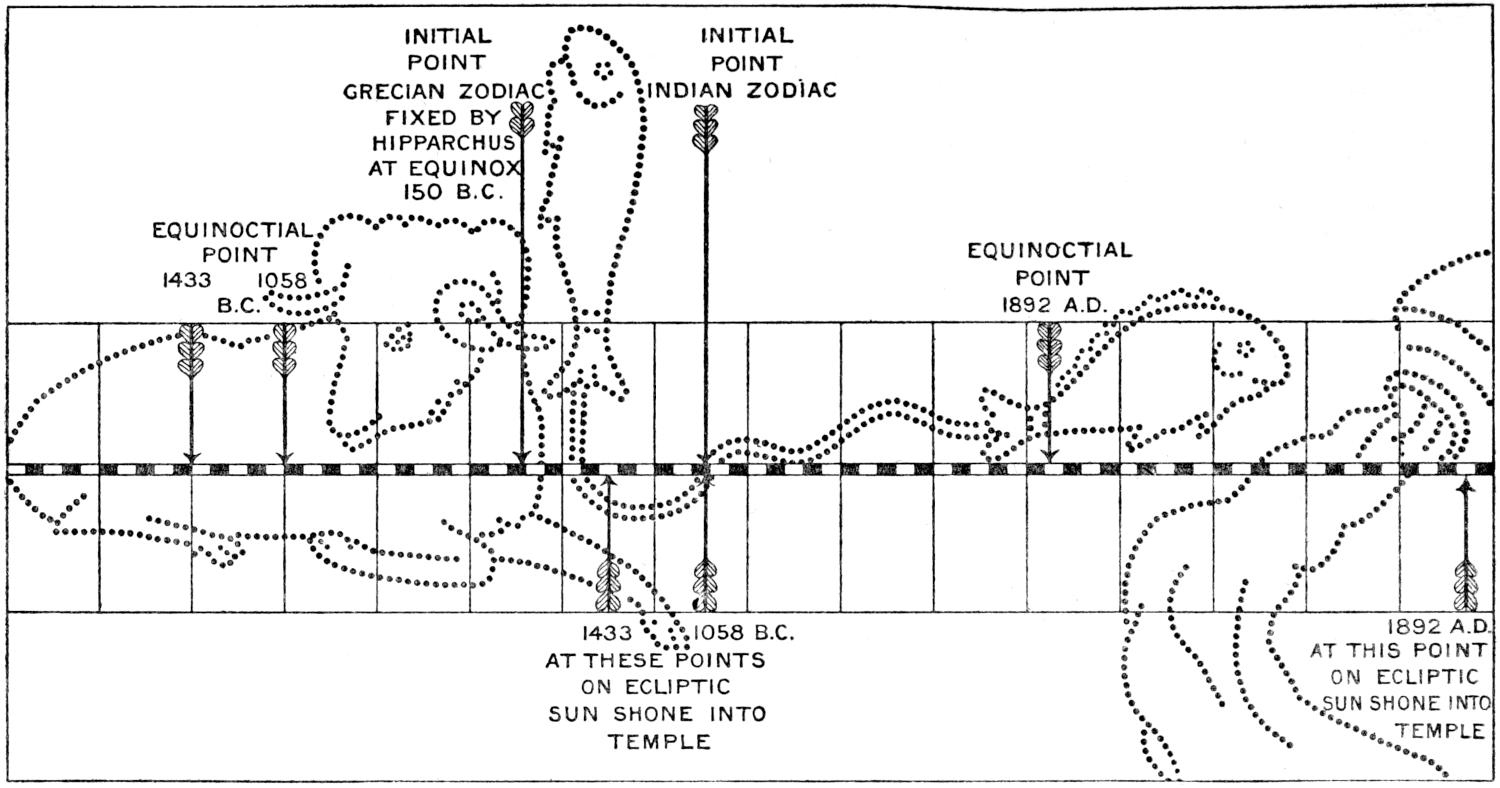
Relating to the Orientation of a Temple to Amon-Ra.
[To face p. 40.
It would seem then that there are indications in the mythology and in the history of the Egyptians, of honour paid to the constellation Aries, and as we further study the records of antiquity, now within our reach, it will, I believe, become evident that not only the Egyptians, but also all the great civilized nations of the East, had traditions of a year beginning when the sun and moon entered the constellation Aries—such a year as that in use amongst the Babylonians during their long existence as a nation, and such as that which is used by the Hindus in India to this present day.
If we allow weight to these considerations, it will be difficult to think that such a method of reckoning the year—involving, as it did, the recognition of the ecliptic star-groups under the fanciful figures of the Zodiac—should have been arrived at by each of these nations independently. Whether one nation borrowed these ideas from another, or whether some “earlier race of men” bequeathed this knowledge to their many descendants, is still an open question. Scholars have not unanimously awarded the palm of seniority in civilization to any one nation, and we are not at variance with proved facts, if we elect to adopt the theory of a common stock, from which the divergent races sprang. If, then, it should appear that these races possessed and incorporated into their mythologies a knowledge of the Zodiac, and of the first degree of Aries as its initial point, their separation from the parent stock must have been subsequent to the formation of the scheme that dealt with a calendar based on an observation of the colure of the winter solstice at that point, and under this supposition the date of 6,000 B.C. becomes a foothold for the chronology of ancient history. We should also be led to think of the common ancestors of the civilized races not as ignorant barbarians, but rather as men graced with high intellectual gifts—men whose teachings have been handed down through all the ages to this present day, and of whose imaginings the Zodiac remains as the most ancient monument of the work of intelligent man.
III (GU), ELEVENTH CONSTELLATION OF THE ZODIAC

[Reprinted from the Proceedings of the Society of Biblical Archæology, February 1896]
In the astronomical tablets (of the 1st and 2nd cent. B.C.) translated by Epping and Strassmaier, the twelve constellations of the Babylonian Zodiac are constantly referred to. Their names appear under very abbreviated forms in the tablets, and are as follows:[22]—
1. (ku(sarikku)) = aries.

2. (te(mennu)) = taurus.

3. (mašu) = gemini.

4. (pulukku) = cancer.
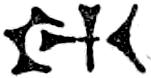
5. (arū) = leo.

6. (serû) = virgo.

7. (zibanîtu) = libra.

8. (aqrabu) = scorpio.

9. (pa) = arcitenens.

10. (enzu) = caper.
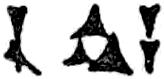
11. (gu) = amphora [aquarius].

12. (zib) = pisces.

Also in Epping and Strassmaier’s work, Astronomisches aus Babylon, under the heading Die Zeichen des Thierkreises, pp. 170, 171, and Namen der Sterne, pp. 174, 175, the twelve abbreviations met with in the tablets are discussed at some length.
From a study of the list here given and of the passages referred to, we learn that it has been found possible to suggest for some of the abbreviations suitable terminations, and in the completed words thus obtained, the familiar constellations of the Zodiac, as we know them, are easily to be recognized.
As regards other of the abbreviations, and amongst them that of (Gu) for the eleventh sign (Amphora or Aquarius), no termination has been suggested; and of it Strassmaier thus writes:[23] p. 171:—“Gu ist sonst fast ausschliesslich nur als Silbenzeichen gu bekannt”; and Jensen, discussing Epping and Strassmaier’s constellation list, writes thus of the abbreviation Gu for the eleventh constellation:[24] “Ob Gu einen ‘Wassereimer,’ ‘Schöpfeimer,’ bezeichnen kann, weiss ich nicht. Die bisher veröffentlichten Texte geben keinen Aufschluss darüber.”
As a probable completion for the abbreviation Gu, the following suggestion is here put forward:—
In the ancient astrological tablets translated by Professor Sayce in his Paper, The Astronomy and Astrology of the Babylonians,[25] pp. 189, 190, “the star of Gula” is mentioned. The first syllable of this word is composed of the same cuneiform group as that used in the abbreviation for the eleventh constellation of the Zodiac in the astronomical tablets of the first and second centuries B.C. above referred to. But this fact, if it stood alone, would not be enough to do more than point to a possible identification of Gu in the late tablets with Gula in the ancient astrological works. Amongst the many constellations in the heavens the name of more than one might have begun with the syllable Gu.
We find, however, at a later page (206) of Professor Sayce’s Paper, this sentence translated from W.A.I., III. 57, 1:—
“Jupiter[26] in the star of Gula lingers.” None of the five planets known to the Babylonians could ever with truth have been described as appearing or “lingering” in any part of the heavens outside the band of the Zodiac stars. “The star (or constellation) of Gula,” we must therefore assume, was a Zodiacal star or constellation. This restriction of the position of the “star of Gula” renders it scarcely a rash conclusion to arrive at, that the Zodiacal Gu of the later tablets is an abbreviation for the Zodiacal Gula of the ancient astrological works.
As to a mythological reason for the choice of the goddess Gula to preside over the constellation known to us as Aquarius, we find it in the fact that Gula appears as another name for the goddess Bau[27] and Bau (or Bahu) was a personification of the dark water, or chaos.
If we adopt this identification of the star or constellation Gula with the constellation, or some star in the constellation, Aquarius, it will throw light on many of the inscriptions found on statues and other monuments at Telloh (the modern name of the mound which covers the ruins of the ancient city of Lagash),
We find from these inscriptions that the deities especially worshipped at Lagash were not the same as those who held the foremost places contemporaneously in the Accadian, and at a later time in the Babylonian Pantheon. Ningirsu and “his beloved consort,” the goddess Bau, received in Lagash the highest honours. On one of the statues of Gudea, “the priestly governor of Lagash,” this inscription occurs:[28]—
“To Ningirsu, the powerful warrior of Ellilla [this is dedicated] by Gudea, priestly governor of Lagash, who has constructed the temple of Eninnu, consecrated to Ningirsu.
“For Ningirsu, his lord, he has built the temple of Ekhud, the tower in stages, from the summit of which Ningirsu grants him a happy lot.
“Besides the offerings which Gudea made of his free will to Ningirsu and to the goddess Bau, daughter of Anna, his beloved consort, he has made others to his god Ningiszida.
“That year he had a block of rare stone brought from the country of Magan; he had it carved into a statue of himself.
“On the day of the beginning of the year, the day of the festival of Bau, on which offerings were made: one calf, one fat sheep, three lambs, six full grown sheep, two rams, seven pat of dates, seven sab of cream, seven palm buds.
“Such were the offerings made to the goddess Bau in the ancient temple on that day.”
Ningirsu, the god—so highly exalted in this and in other inscriptions found in the mounds of Telloh—has been identified with the god Ninib[29] of the Babylonians. Much difference of opinion prevails as to what astronomical ideas were connected by the ancient inhabitants of Mesopotamia with the god Ninib.
Jensen admits that the generally received opinion as to Ninib is that he represents the “southern sun.”[30] He, however, contends, with great eagerness, that this is a mistaken opinion, and that Ninib is really the eastern or rising sun. Many of Jensen’s arguments against the possibility of Ninib representing the southern sun are based on the assumption that the epithet “southern,” applied to the sun, denotes the power of the mid-day sun; whereas, in other descriptions of Ninib, he appears as struggling with, though in the end triumphant over, storm, and cloud, and darkness.
The sun in his daily course attains the southern meridian at noon, and that may well be described by Jensen as the “alles verzehrenden und versengenden Süd- oder Mittagssonne,” but if we think of the sun in his annual course, the words “southern sun” may more fitly in an astronomical sense mean the struggling and finally triumphant sun of the winter solstice. And if we so understand the expression, the apparently contradictory references to Ninib are easily explained.
At mid-winter the sun rises and sets more to the south than at any other time of the year; at noon on the day of the winter solstice the sun is forty-seven degrees nearer to the south pole of the heavens than it is at the summer solstice.
If, instead of adopting Jensen’s contention, and looking upon Ninib as the eastern rising sun, we revert to the generally held opinion that Ninib was the god of the southern sun, and if we understand the southern sun in its astronomical sense as the winter, or more strictly speaking the mid-winter sun, it will naturally lead us to the conclusion that “the day of the beginning of the year,” the day of the festival of Bau, Ningirsu’s (= Ninib’s) “beloved consort,” was held at the time of the winter solstice.
Speaking in round numbers, from 4,000 to 2,000 B.C., the winter solstice took place when the sun was in conjunction with the constellation Aquarius, which constellation, or some one of its stars, was, as has been suggested, called by the Babylonian astronomers, Gula, Gula being another name for Bau.
It is not therefore surprising to find that those rulers of Lagash, whose dates fell between 4,000 and 2,000 B.C., should have so often associated together Ningirsu and Bau; and further, that Gudea, whose rule is placed at about 2,900 B.C., should on “the day of the beginning of the year” have kept high festival in honour of Bau, as the beneficent deity presiding in conjunction with Ningirsu over the revolving years.
The precession of the equinoxes must necessarily in the course of ages introduce confusion into all Zodiacal calendars, and into all ritual and mythological symbolism founded on such calendars. From 2,000 b.c. down to the beginning of our era, the winter solstice took place when the sun was in conjunction with Capricornus, not with Aquarius. In those later days, if the inhabitants of Lagash still celebrated their new year’s festival at the winter solstice, Bau (= Gula = Aquarius) could only have laid a traditional claim to preside over it.
In accordance with these astronomical facts, we learn from the teachings of the tablets that the especial reverence paid to Bau = Gula, in the Lagash inscriptions was not extended to her in later times.
As to Ninib, we know that even at Gudea’s date in the neighbouring state of Accad, and in later times in Babylon, he did not hold the pre-eminent position accorded to him by the early rulers of Lagash.
This difference in the religious observances of Accad and Lagash regarding Ninib—if we suppose him to be the god of the winter solstice—may also receive an astronomical explanation.
According to the evidence of The Standard Astrological Work, the compilation of which is generally attributed to the date 3,800 B.C., and according to the evidence of many other tablets, the year in Accad and afterwards in Babylon began not at the winter solstice, but on the 1st day of Nisan, and Nisan (Acc. Bar zig-gar), the month of “the sacrifice of righteousness,” was, as its name suggests, the month during which the sun was in conjunction with the constellation Aries.
At Gudea’s date, about 2,900 B.C., the 1st of Nisan, if it was dependent on the sun’s entry into Aries, must have fallen about midway between the winter solstice and the spring equinox, and as century succeeded century, the 1st of Nisan must slowly but surely have receded further from the solstice and have approached more and more to the equinoctial point.
In Accad, therefore, neither at Gudea’s nor at any later date, did the year begin at the winter solstice, and hence we can understand why in that state, and afterwards in Babylon, Ninib was not as highly honoured as in Lagash, and why he and his consort Bau (= Gula) were not referred to as the deities presiding over the beginning of the year.
In a former number of these Proceedings[31] I drew attention to the Accadian calendar. It was there suggested that the choice of the first degree of Aries as the initial point of the Zodiac was originally made when the winter solstice coincided with the sun’s entry into that constellation, i.e. about 6,000 B.C.
If that suggestion, and the present one concerning the new year’s festival in Lagash are accepted, it will be easy to imagine that the Lagash observance betokened a sort of effort to reform the sidereal calendar in use in Accad, and it may be elsewhere.
In Accad the calendar makers clung to the originally instituted star-mark for the year, and made it begin with the sun’s entry into Aries; therefore by degrees the beginning of their year moved away from the winter solstice, and in the first century B.C. coincided very closely with the spring equinox.
In Lagash, on the contrary, the calendar makers clung to the originally established season of the year, and made it begin at the winter solstice; therefore by degrees the beginning of their year moved away from the constellation Aries, and in Gudea’s time the new year’s festival was held in honour of the goddess Bau = Gula = Aquarius.
IV THE MEDIAN CALENDAR AND THE CONSTELLATION TAURUS
[Reprinted from the Proceedings of the Society of Biblical Archæology, June 1897]
In a former number[32] of these Proceedings I contrasted as follows, what I believed to be the calendar of the Accadians with that of the inhabitants of Lagash:—
“In Accad the calendar makers clung to the originally instituted star-mark for the year, and made it begin with the sun’s entry into [the constellation] Aries; therefore by degrees the beginning of their year moved away from the winter solstice, and in the first century B.C. coincided very closely with the spring equinox.
“In Lagash, on the contrary, the calendar makers clung to the originally established season of the year, and made it begin at the winter solstice; therefore by degrees the beginning of their year moved away from the constellation Aries, and in Gudea’s time [about 2,900 B.C.] the new year’s festival was held in honour of the goddess Bau = Gula = Aquarius.”
I now desire to draw attention to the Median calendar, which appears to have differed from that used, as above suggested, in Accad or in Lagash; inasmuch as the beginning of the Median year was not dependent on the sun’s entry into the constellation Aries, as in Accad; nor was it fixed to the season of the winter solstice as in Lagash.
The beginning of the Median year was fixed to the season of the spring equinox, and remaining true to that season, followed no star-mark. The great importance, however, of Tauric symbolism in Median art seems to point to the fact that when the equinoctial year was first established the spring equinoctial point was in the constellation Taurus. Astronomy teaches us that was the case, speaking in round numbers, from 4,000 to 2,000 B.C.
It is true that we have no documentary proof of the existence of a Median equinoctial calendar in the remote past, such as that which we possess in the Babylonian standard astrological works regarding the ancient sidereal Accadian calendar. We have, however, among the modern representatives of the Medes, the Persians, a very distinctive calendrical observance, namely, that of the Nowroose, or the festival of the new year; and we have the Persian tradition that the institution of this festival was of fabulous antiquity. I quote from Ker Porter’s remarks on this subject:—
“The 21st of March, the impatiently anticipated day of the most joyous festival of Persia, at last arrived. It is called the feast of the Nowroose, or that of the commencement of the new year; and its institution is attributed to the celebrated Jemsheed, who, according to the traditions of the country, and the fragments yet preserved of its early native historians, was the sixth in descent from Noah, and the fourth sovereign of Persia, of the race of Kaiomurs, the grandson of Noah.... But to return to the feast of the Nowroose. It is acknowledged to have been celebrated from the earliest ages, in Persia, independent of whatever religions reigned there; whether the simple worship of the One Great Being, or under the successive rites of Magian, Pagan, or Mahomedan institutions.” (Travels, vol. i. p. 316.)
This equinoctial and solar year, as the writer proceeds to point out, is adhered to by the Persians, though they, being Mahomedans, also celebrate Mahomedan lunar festivals, and for many purposes make use of the Mahomedan lunar year.
It is easy to see how greatly the Persian Nowroose differs from the purely lunar Mahomedan anniversaries—anniversaries which in the course of about thirty-two and a half years necessarily make a complete circuit through the seasons. The difference, though not so marked, which exists between the purely solar Nowroose, and all soli-lunar festivals, such as those of the Babylonians, should also be taken note of. These last, like our Easter, were dependent on the phases of the moon, and were therefore “moveable.” The Persian Nowroose, like our Christmas Day, is an “immoveable” festival—fixed to the day of the spring equinox.
Modern tradition concerning the distinctively Persian custom of celebrating the Nowroose would, if it stood alone, furnish very slight grounds on which to found a far-reaching theory; but historical evidence confirms this tradition to a great extent, by teaching us that the Median and Persian worshippers of Ahura Mazda, and of Mithras, certainly under the Sassinide dynasty, and almost with equal certainty under the Achæmenid kings, kept their calendar and celebrated their religious festivals in a manner differing from that of the surrounding nations; their months were not lunar, their years were not soli-lunar but distinctly solar, and the spring equinox was the date to which as closely as possible the beginning of their year was fixed.
In Darmesteter’s translation of the Zend Avesta the Persian months are treated of in Appendix C, p. 33, and in Appendix D, p. 37, we read of the Persian years:—
“L’année était divisée en quatre saisons, correspondant aux nôtres. Cette division ne paraît guère que dans les textes post-avestéens; mais il y a dans l’Avesta même des traces de son existence ancienne. La division normale de l’année est, dans l’Avesta, en deux saisons, été et hiver; l’été, hama, qui comprend les sept premiers mois (du 1er Farvardîn au 30 Mihr, soit du 21 mars au 16 octobre).... Cette division a une valeur religieuse, non seulement pour le rituel, mais aussi pour les pratiques, qui varient selon la saison.”
The worship of the Persian sun-god Mithras was introduced into Rome about the time of the fall of the Republic. How far this worship differed from that taught in the Zoroastrian writings we need not inquire; however changed it may have been, it was evidently derived originally from a Persian or a Median source. The worship of Mithras, in spite of much opposition, gained many followers in Rome. The birthday of the sun-god was kept at the winter solstice, but the great festivities in his honour, “the mysteries of Mithras,” were as a rule celebrated at the season of the spring equinox,[33] and were famous even among Roman festivals. Let us now turn our attention to the Tauric symbolism so closely connected with Mithraic observances in Rome.
A writer in the Athenæum thus describes a Roman Mithræum:[34] “Discovery was made during some excavations at Ostia of a handsome house containing among its various rooms a mithræum.... Into the kitchen opens a narrow and tortuous passage, from which by a small half-concealed staircase the mithræum is reached; ... it is quadrangular and regular in shape, as is usually the case in buildings of the kind. Almost the whole length of the two lateral walls run two seats, and on the side opposite the door is seen a little elevation, which served as the place for the usual statue of Mithras in the act of thrusting his dagger into the neck of the mystic Bull. A very singular peculiarity of this little Ostian mithræum is that it is entirely covered with mosaics—pavements, seats, and walls alike. The various figures and the symbols are splendidly drawn, and all executed in black tesseræ on a white ground. Upon each side of the seats, turned to the entrance door, is figured a genius bearing a lamp, that is, the genius of the spring equinox, with the face raised, and that of the autumn equinox, with the face cast down.... It is known, in fact, that the whole myth of Mithras is related to the phases of the sun ... hence are represented in the ground below the seats all the twelve signs of the zodiac, by means of the usual symbols, but each accompanied by a large star.”
In the many sculptures of the Mithras group similar to that above described, which have been so well figured in Lajard’s Culte de Mithras, various heavenly bodies are represented. The Scorpion (the constellation Scorpio of the Zodiac opposed to Taurus) joins with Mithras in his attack upon the Bull, and always the genii of the spring and autumn equinoxes are present in joyous and mournful attitudes.
In looking at these plates the conviction is clearly forced upon our minds that the Bull so persistently, and, it may be added, so serenely, slain by Mithras in these Roman representations, is the Zodiacal Bull, overcome, and as it were destroyed or banished from heaven, in the daytime by the sun-god, and at night by Scorpio, the constellation in opposition. With almost equal conviction we arrive at the conclusion that this triumph of Mithras was associated traditionally—in Roman days it could only have been traditionally—with the occurrence, at a remote date, of the spring equinox during the time that the sun was in conjunction with the constellation Taurus.
In the ruins of Persepolis, ruins of buildings designed, erected, and decorated by the worshippers of the supreme God Ahura Mazda, and of his friend and representative Mithras, Tauric symbolism abounds. We do not amongst these ruins find portrayals of Mithras as a youth wearing a Phrygian cap, and “thrusting his dagger into the neck of the mystic Bull,” but again and again, in the bas-reliefs adorning the walls, we do find a colossal being thrusting his dagger into the body of a still more “mystic” creature than the Bull of the Roman sculptures—a creature combining in one instance at least[35] the attributes of Bull, Lion, Scorpion, and Eagle, and frequently those of two or more of these animals.
PLATE IV.
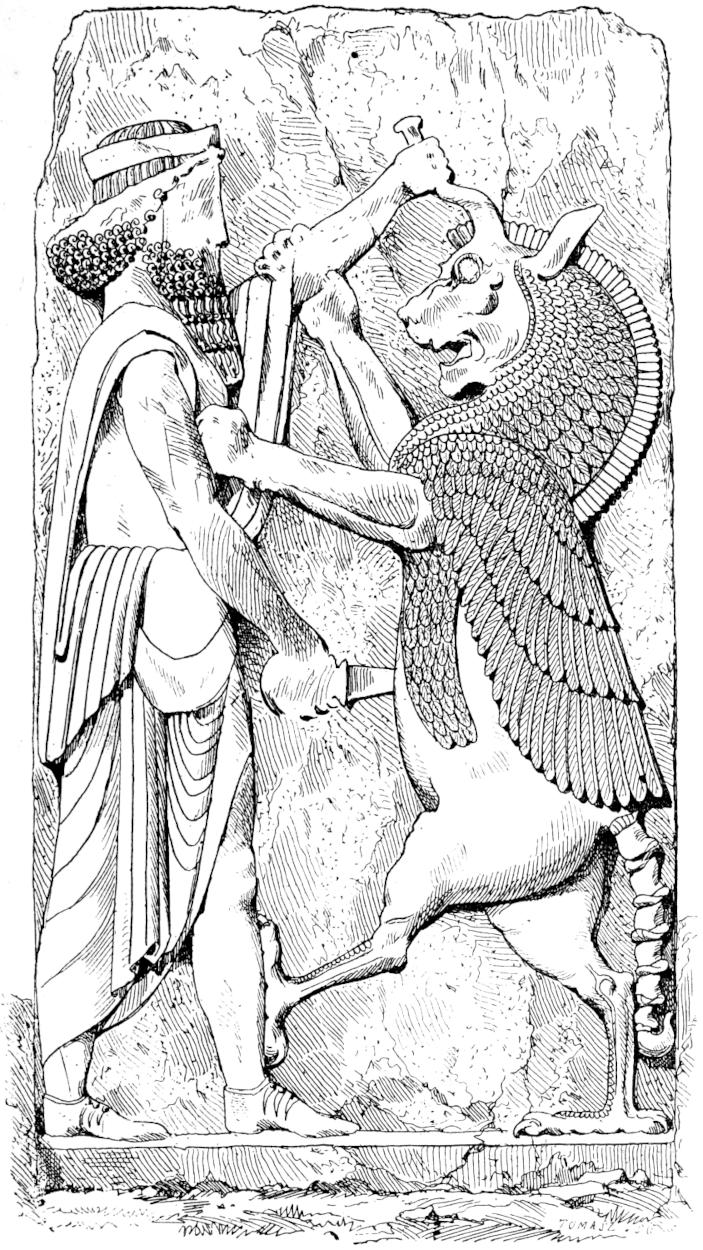
Persépolis. Combat du roi et du griffon. Palais no 3.
Perrot et Chipiez. Histoire de l’Art dans l’Antiquité, Tome v. opposite page 547.
[To face p. 64.
Perrot and Chipiez have supposed this constantly repeated scene to represent imaginary contests between the reigning monarch and all possible or impossible monsters, but a very different impression was produced on the mind of Ker Porter by these same bas-reliefs; and though he did not adopt a purely astronomic theory to explain them, he was firmly convinced that the combat depicted was not one waged between an ordinary human being and an ordinary or extraordinary animal, but that it was a symbolical representation of the combat constantly carried on by Ormuzd (Ahura Mazda), and by his representative Mithras, against the powers of evil and darkness.[36]
With the astronomic clue to Persian symbolism put into our hands by the Roman sculptures, of which mention has been made, and by a study of the researches of Lajard, it is not difficult to recognize in the composite animals represented on the bas-reliefs allusions not only to the Zodiacal Bull, traditionally associated with the spring equinox, but also to three other constellations which at the same date of the world’s history (namely, from 4,000 to 2,000 B.C.) marked more or less accurately the remaining colures, i.e. the Lion, the Scorpion, and the Eagle.
The constellations of the Lion and the Scorpion, there can be no doubt, were appropriate star marks for the summer and autumn seasons, when the spring equinoctial point was in the Bull,[37] but as regards the Eagle it must be admitted that though it adjoins the Zodiacal Aquarius (the constellation in which the winter solstitial point was then situated), yet its principal stars lie considerably to the north and west of that constellation.
A reason for the substitution of the Eagle (Aquila) for the Zodiacal Water-man or Water-jar (Aquarius or Amphora) may, however, be found in the fact of the very great brilliancy of the star Altair in the Eagle. It is a star of the first magnitude. In the Water-man there is no star above the third. The Persians, we are told, had a tradition that four brilliant stars marked the four cardinal points (i.e. the colures). In Taurus, Leo, and Scorpio we find stars of the first magnitude: there was therefore no temptation for Mithraic calendar makers and mythologists to seek for an extra-Zodiacal star to mark and represent the spring, summer, or autumn seasons; but for the winter solstice the only stars of the first magnitude within at all suitable distance were Aquila, to the north-west, or Fomalhaut to the south of Aquarius. For a nation dwelling as far to the north as the Medians are supposed to have done, Fomalhaut (when the winter solstice was in Aquarius very far to the south of the equator) would have been rarely visible. The choice by a Median astronomer and symbolic artist in search of a very brilliant star mark for the solstice would therefore have been restricted to the constellation of the Eagle, containing the conspicuous Altair, a star of the first magnitude.
The very constant association, not only in Persian and Median, but also in the mythologic art of other nations, of the Lion and the Eagle, seems to confirm the view here put forward, i.e. that the constellations of Leo and Aquila rather than of Leo and Aquarius were sometimes chosen to symbolise the summer and winter solstices.
The Griffin, a fabulous animal sacred to the sun, composed of a Lion and an Eagle, is a well-known figure in ancient classic art.
In Babylonian and Assyrian sculptured and glyptic art Merodach is often represented as in conflict with a Griffin. Merodach has been claimed by Jensen and other writers as a personification of the sun of the spring equinox. The for ever recurring triumph of spring over winter is probably figured in Merodach’s triumph over the Griffin.
The association of Eagle and Lion is to be noticed in the arms of the city of Lagash; they were “a double-headed Eagle standing on a Lion passant or on two demi-lions placed back to back.”[38] In Lagash, as was pointed out in a former paper, the new year’s festival appears to have been held at the winter solstice: such a supposition would furnish an astronomical interpretation for the arms of Lagash.[39]
Mythological references to the Eagle alone are also to be met with which point to the Celestial Eagle (Aquila) marking the winter solstice in lieu of the constellation Aquarius, as for instance the Babylonian legend of the ambitious storm-bird, Zu,[40] who stole the tablets of destiny, and thus sought to vie in power with “the great gods.” Here we may find allusions to the substitution (deemed by some, no doubt, unauthorized) of an extra-Zodiacal for a Zodiacal constellation.
Again, in Grecian mythology the Eagle is sent by Zeus to carry Ganymede up to heaven, and in Grecian astronomy Ganymede is placed in the constellation Aquarius. It does not therefore seem unreasonable to suppose that the Eagle associated in the Persepolitan bas-reliefs with the Lion, the Bull, and the Scorpion (as at Plate IV.), is the constellational Eagle, symbolizing the winter solstice, and that the compound animal is emblematic of the four seasons of the year, and also, it may be, of the four quarters of the world.
If to the composite monster of the bas-reliefs we ascribe an astronomic motive, we shall be ready to grant the same to other Tauric symbolisms prominent in the Persepolitan ruins.
With full conviction we shall recognize in the demi-bulls which crowned the columns in Persepolis and Susa representations of the demi-bull of the Zodiac. The resemblance is so striking that words are scarcely required to point it out when once the outlines of the two figures have been compared (Plate V.). In the spirited description of these capitals, quoted here from Perrot and Chipiez,[41] are some lines, marked with italics, which might be applied with exactness to the demi-bulls of the Zodiac.
PLATE V.
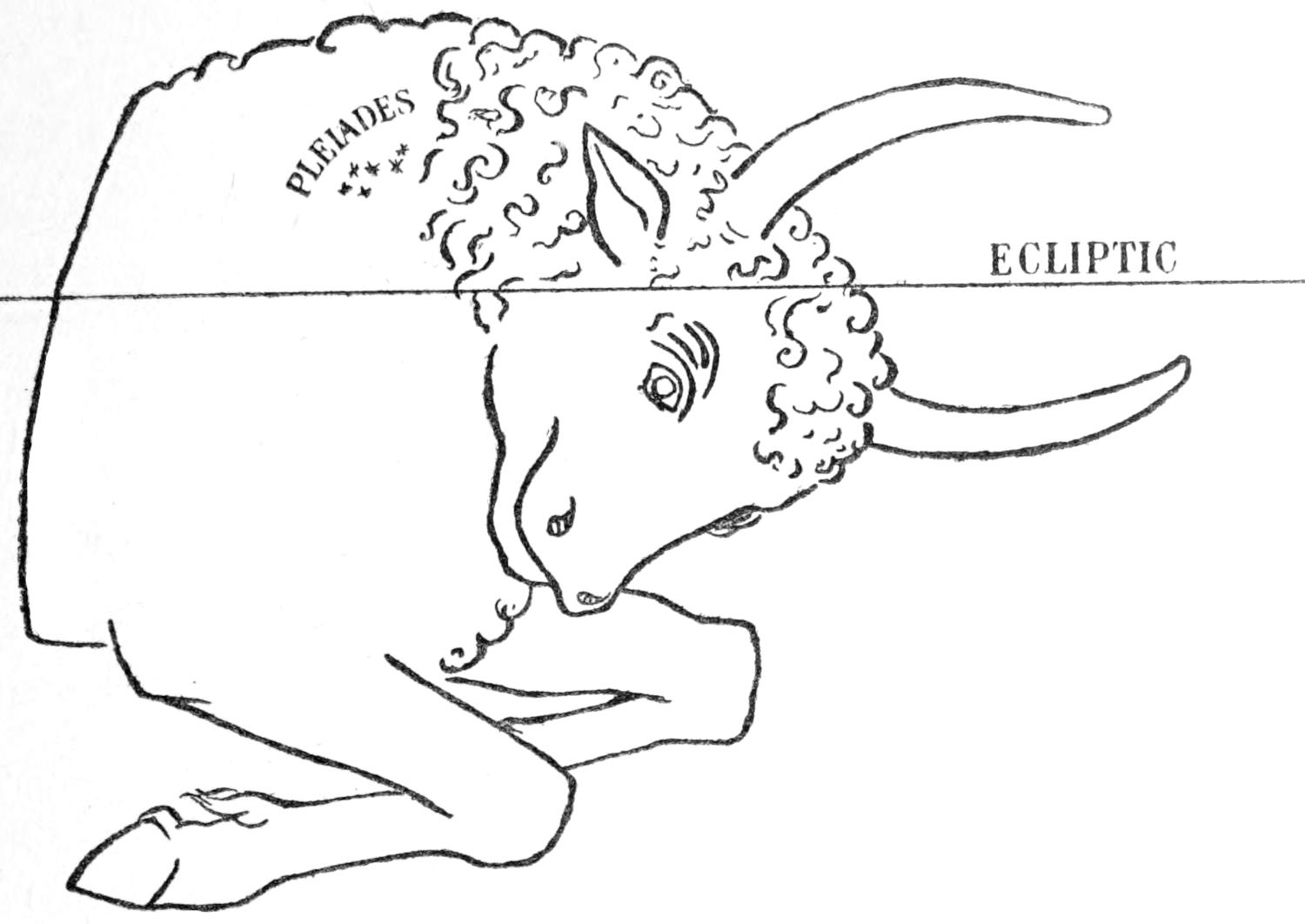
THE CONSTELLATION TAURUS
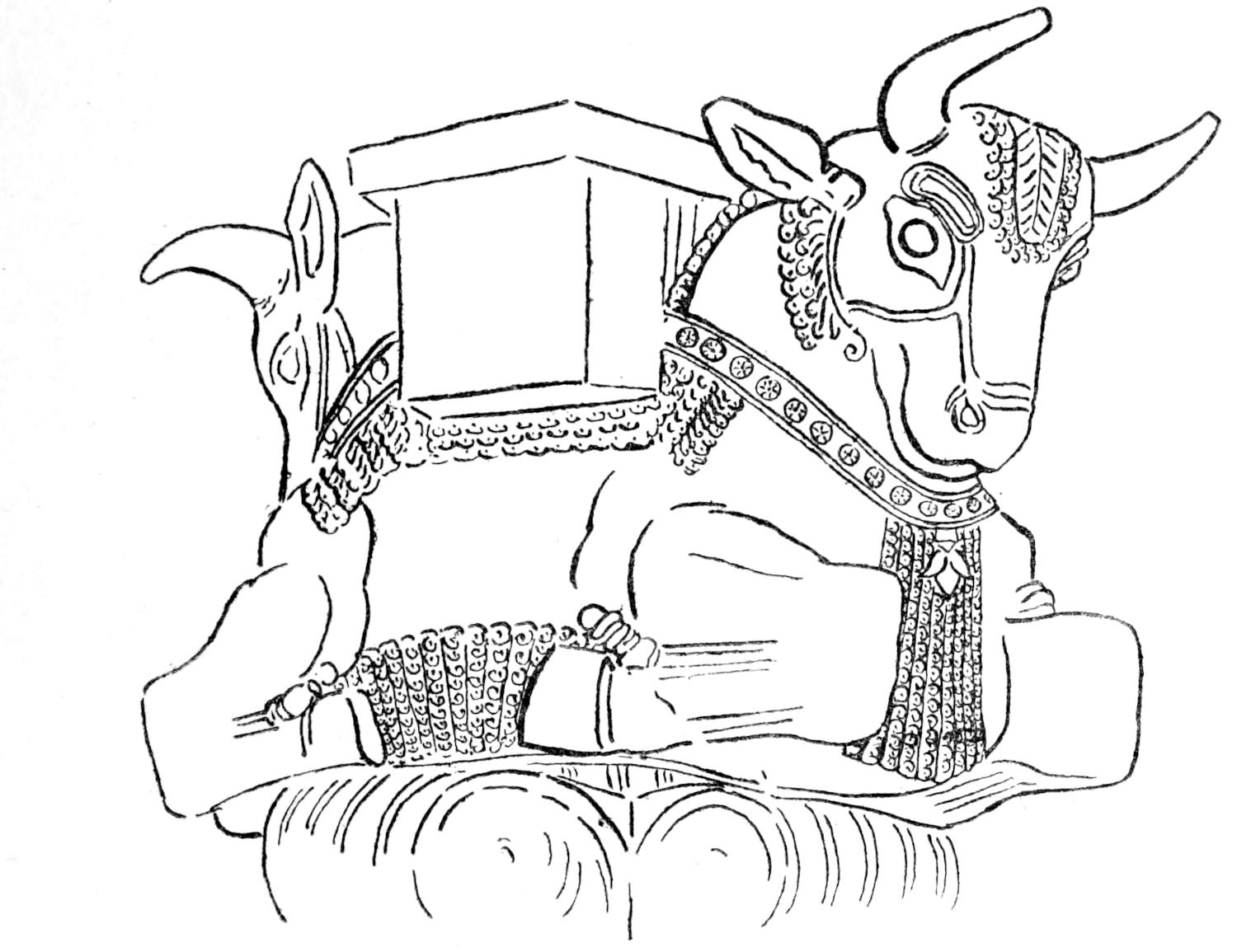
CAPITAL FROM SUSA
[To face p. 70.
“On ne saurait cependant ne point admirer le grand goût et l’art ingénieux avec lequel, dans ses bustes de taureau, il [l’artiste perse] a plié la forme vivante au nécessités de la décoration architecturale. Il a su la simplifier sans lui enlever l’accent de la vie; les traits caractéristiques de l’espèce sur laquelle s’est porté son choix restent franchement accusés, quoique les menus détails soient éliminés; ils auraient risqué de distraire et de troubler le regard. Les poils de la nuque et du dos, de l’épaule, des fanons, et des flancs sont réunis en masses d’un ferme contour, auquelles la frisure des boucles dont elles se composent donne un relief plus vigoureux; en même temps le collier qui pend au col, orné de rosaces et d’un riche fleuron qui tombe sur la poitrine, écarte toute idée de réalité; ce sont là des êtres sacrés et presque divins, que l’imagination de l’artiste a comme créés à nouveau et modelés à son gré pour les adapter à la fonction qu’elle leur donnait à remplir. Cependant, tout placé qu’il soit en dehors des conditions de la nature, l’animal n’a pas perdu sa physionomie propre. Dans le mouvement de la tête, légèrement inclinée en avant et sur la côté, on sent la force indomptée qui anime ce corps ample et puissant. Hardiment indiquées, la construction et la musculature des membres inférieurs, repliés sous le ventre, laissent deviner de quel élan le taureau se lèverait et se dresserait en pied, s’il venait à se lasser de son éternel repos. J’en ai fait plusieurs fois l’expérience au Louvre, devant la partie de chapiteau colossal que notre musée doit à M. Dieulafoy: parmi les visiteurs qui se pressaient dans cette salle, parmi ceux mêmes qui semblaient le moins préparés à éprouver ce genre d’impressions, il n’en est pas un qui n’ait; subi le charme, qui de manière ou d’autre, n’ait rendu hommage à la noblesse et à l’étrange beauté de ce type singulier.”
For the exquisite columns crowned by these Tauric capitals the same writers have claimed a distinctively Median origin. This claim they sustain at great length, and with much architectural learning. They show that in their proportions, and in every detail of their ornamentation, the Persepolitan differed from the Ninevite, Grecian, or Egyptian column. They also point out that nowhere except at Persepolis and at Susa is the demi-bull of the capital to be met with; and yet they express the opinion that this feature, so far as is known proper to Persia, was mainly derived from, or helped at least by, the models of Assyria.
Very close resemblances can indeed be traced in Medo-Persian to Assyrian art, and as the Medo-Persian buildings, whose ruins are at Persepolis and Susa, were erected certainly at a later date than the palaces of the Assyrian kings discovered on the site of Nineveh, it is natural to attribute, as Perrot and Chipiez, and nearly all writers on the subject attribute, such resemblances to imitations of Assyrian art and symbolism on the part of the Medo-Persians.
There are, however, some considerations which make it difficult to adopt this view. In the first place, the symbolism supposed to have been copied by the Medo-Persians was religious symbolism, and the religion of the Aryan Medo-Persians was very different from that of the Semitic Assyrians.
The Achæmenid kings who built their palaces at Persepolis claimed constantly that they were worshippers of the one great Lord Ahura Mazda, of whom Mithras was the friend and representative. That these kings should have adopted from the polytheistic Assyrians not only the Tauric symbolism above described, but also, as it is suggested, the emblem of their one great Lord Ahura Mazda from that of Assur (see Plate VI. figs. 1, 2, 3), would in itself be strange, but that they should have done so when Assur and all his followers had been utterly vanquished by the victorious worshippers of Ahura Mazda, seems still more improbable.
From the state in which the ruins of Nineveh were when discovered by Layard it is easy to see that, from the very day of the sacking of the city, it had for the most part been left just as it fell. It may have been rifled of its material wealth, but its literary and artistic treasures were left uncared for and undesired. A few hundred years later the very site of Nineveh was unknown.
The great city would not have been treated with such neglect had the Medo-Persian artists turned to it for inspiration and for themes of symbolic art with which to decorate the palaces of Persepolis.
PLATE VI.
FIG. 1.
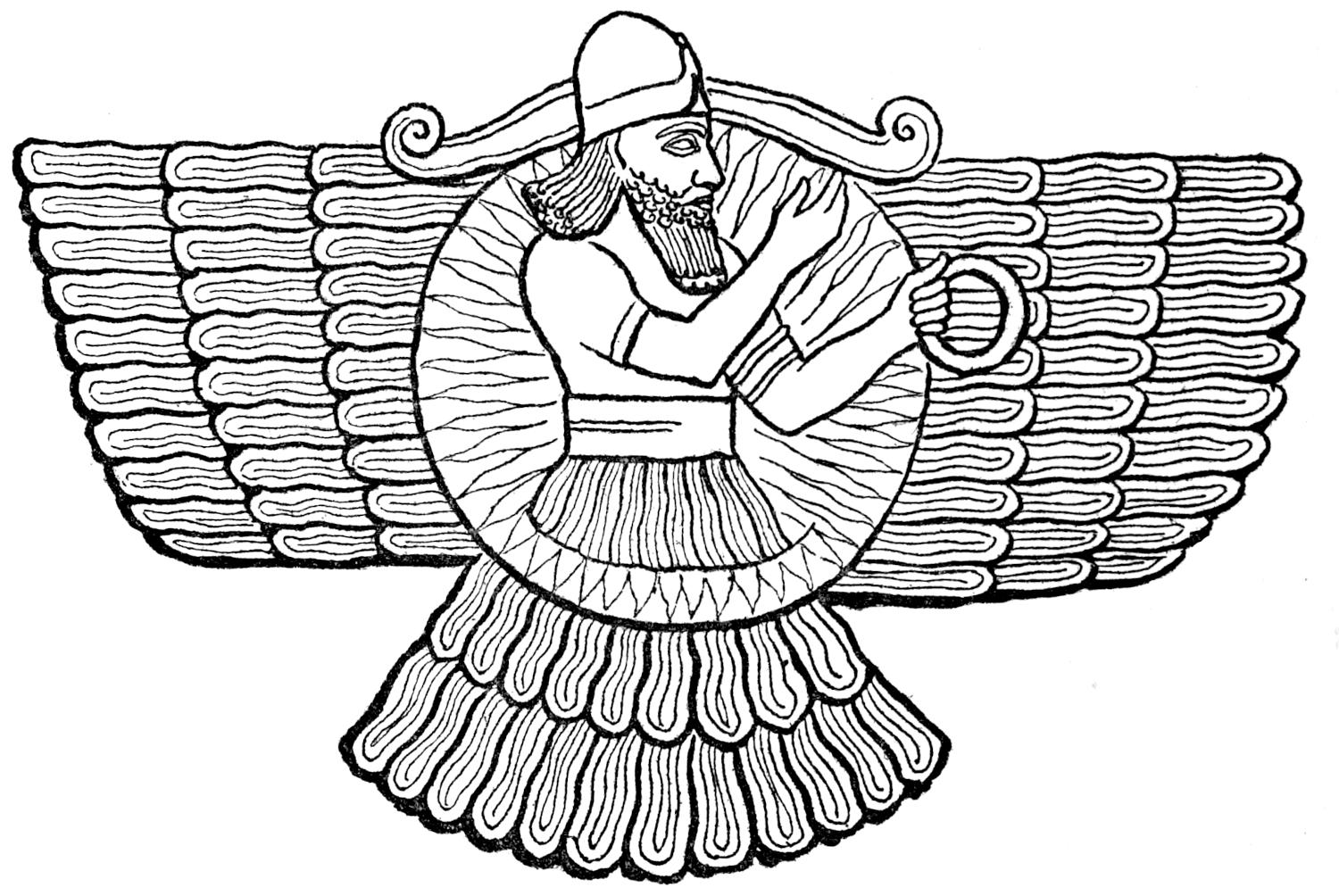
The Assyrian god Assur.
FIG. 2.
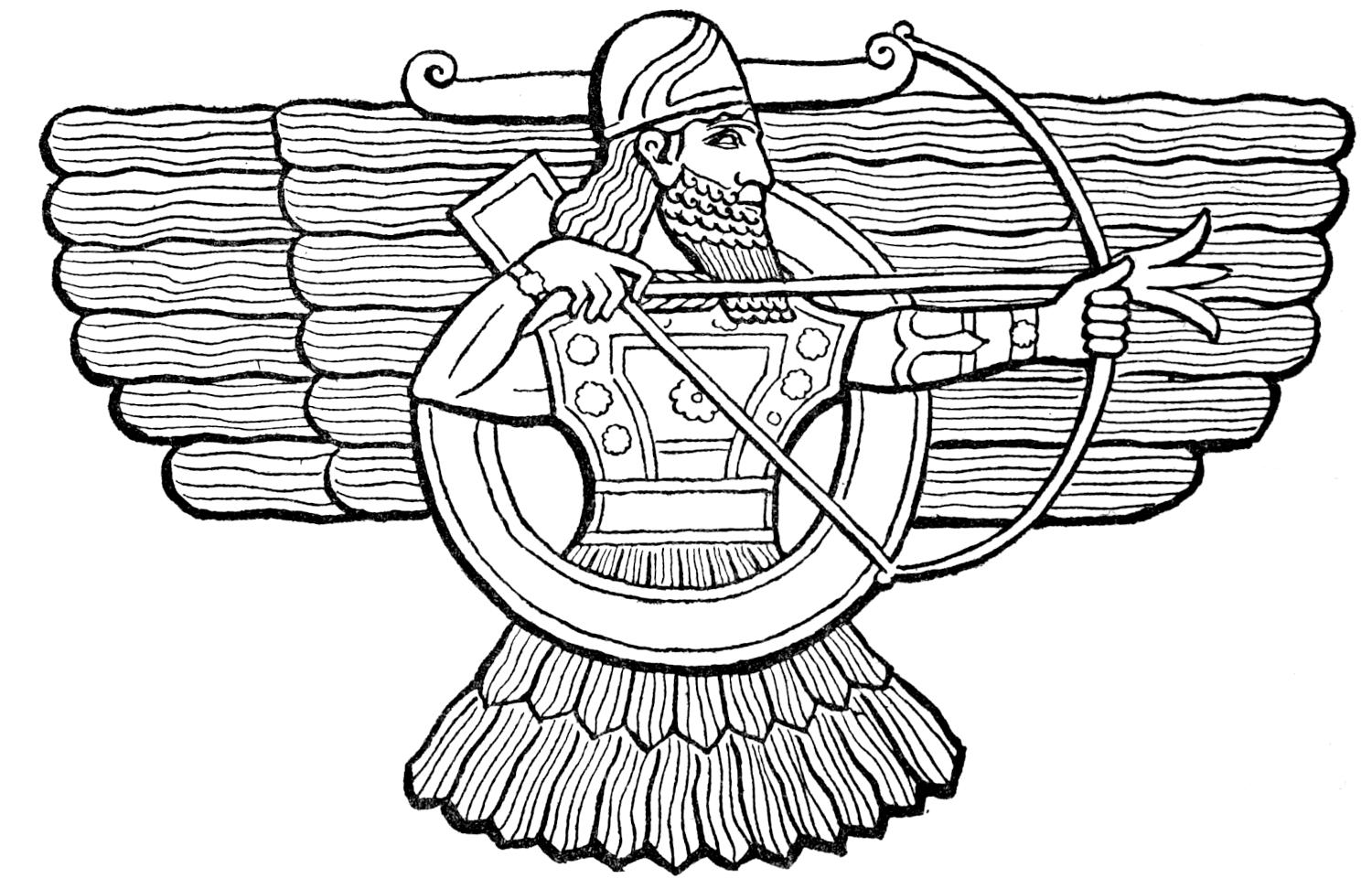
The Assyrian god Assur.
FIG. 3.
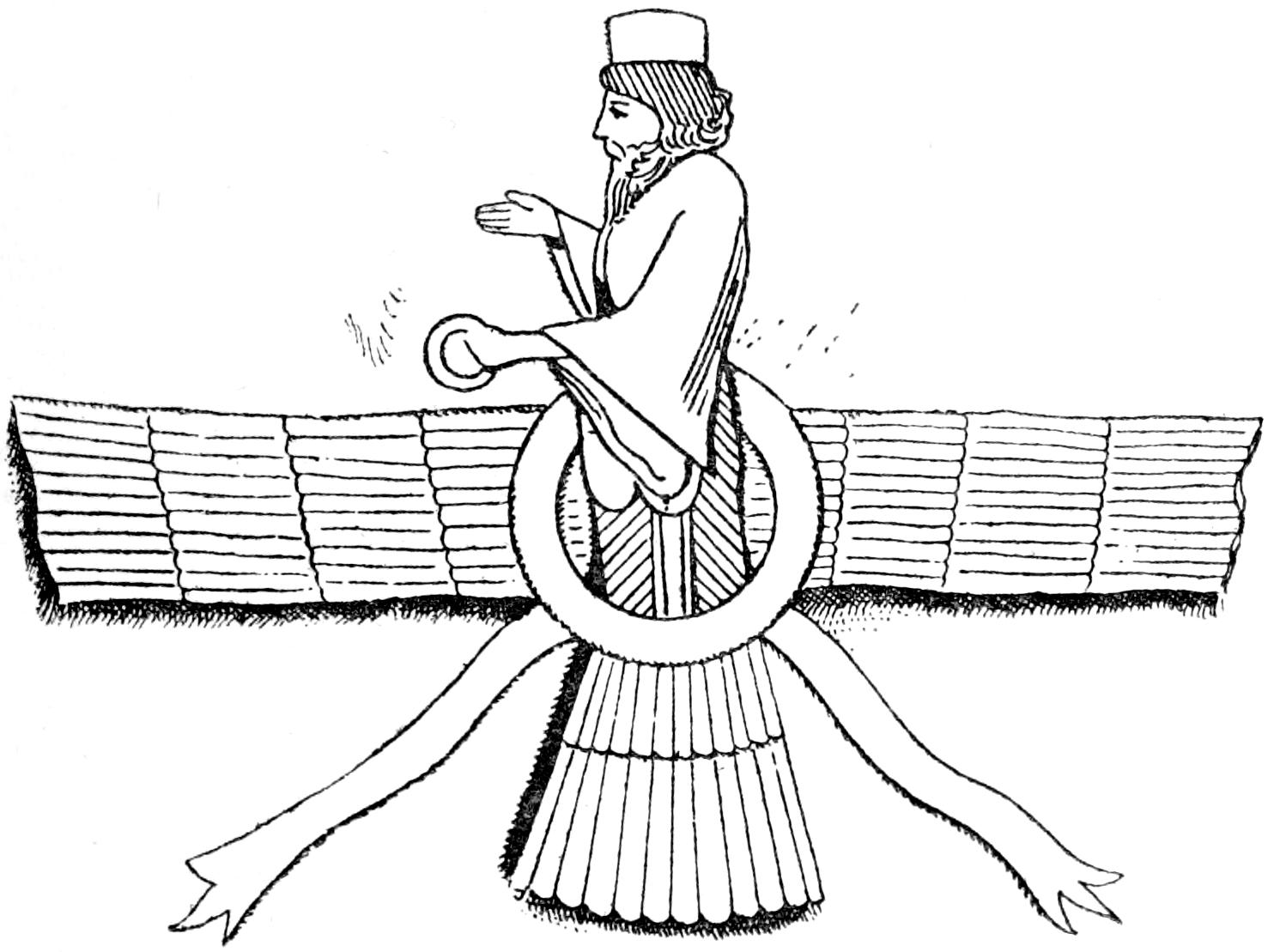
The Median god Ahura Mazda.
FIG. 4.
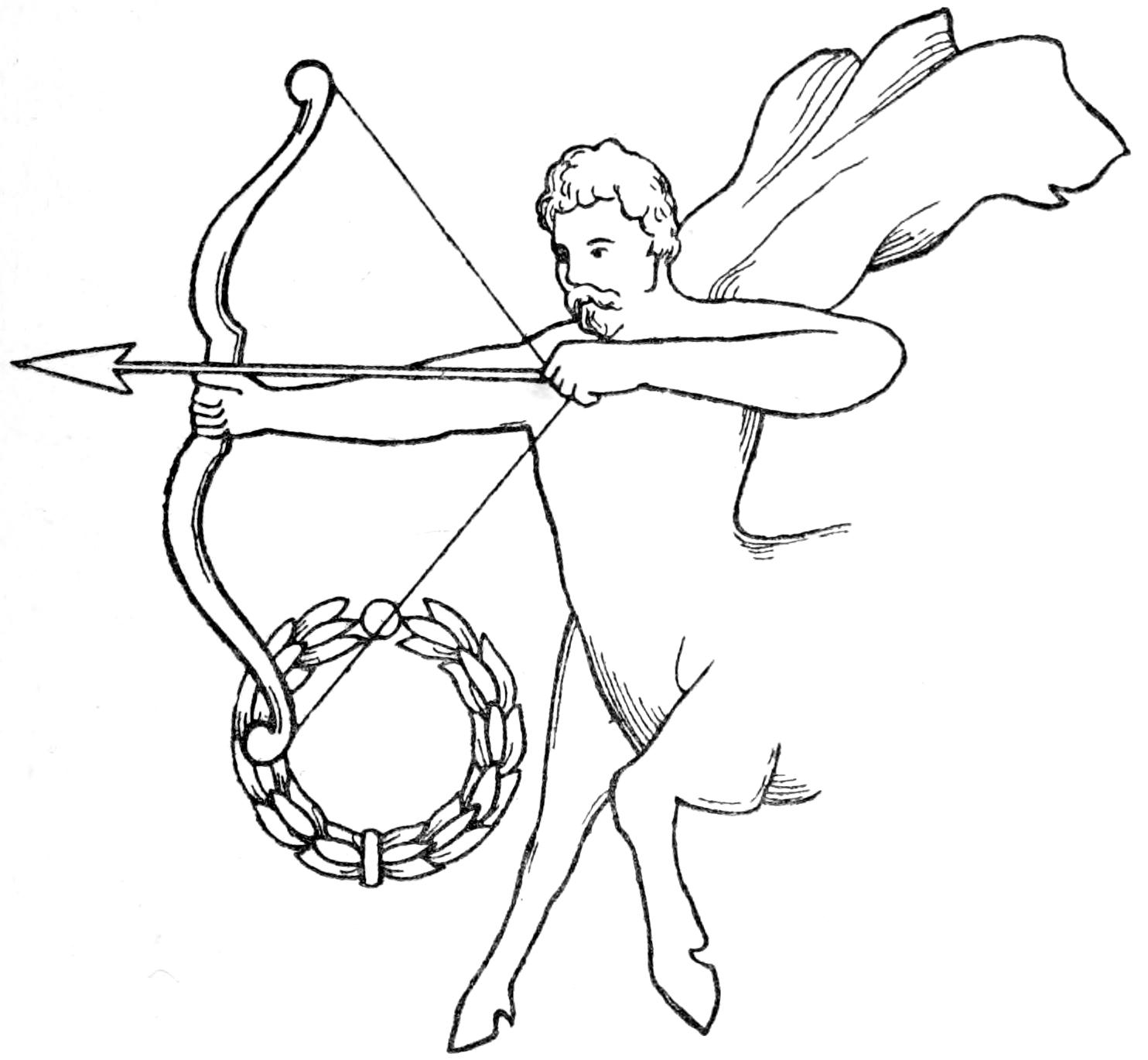
Western portion of Constellation Sagittarius and the Constellation Corona Australis.
[To face p. 74.
The resemblance, however, between Medo-Persian and Ninevite art is in many instances so striking that some way of accounting for it must be sought, and those who are dissatisfied with one explanation will naturally look about to find some alternative suggestion.
The alternative suggestion I would now propose is that the progenitors of the Assyrians at an early period of the world’s history borrowed Tauric and other religious symbolisms from the ancestors of the Medes.
In support of this theory the following considerations are put forward:
Tauric symbolism, if it is at all astronomic, points us back to a very remote date for its first institution, to a date considerably earlier than that at which the existence of the Assyrian people as an independent nation is generally put. The symbolism already discussed must, at the latest, have been originated about 2,000 B.C. Of the Assyrians as a nation we have no monumental proof earlier than 1,700 B.C.
But further, in the symbol of Ahura and Assur, I believe an astronomic reference may be traced to the position of the colures amongst the constellations, a reference which points us back not merely to a date between 4,000 and 2,000 B.C., but rather, and with curious precision, to the furthest limit of the time mentioned, namely to 4,000 B.C.
To penetrate into the meaning of this symbol of Ahura we must study both the Median and Assyrian representations of the figure presiding over the winged disc, and we may also seek for further light to be thrown upon it by other references in Assyrian art to the god Assur.
Ahura presiding over the winged circle holds in his hand a ring or crown; Assur in some examples is similarly furnished; but more often he appears armed with bow and arrows. In this figure, variously equipped, I believe that the heavenly Archer, the Zodiacal Sagittarius (Plate VI. fig. 4), is to be recognized—Sagittarius, the constellation in which the autumnal equinoctial point was situated, speaking in round numbers, from 6,000 to 4,000 B.C.
The fact that a crown or wreath or ring often replaces the bow and arrows in the hand of Ahura and of Assur might at first sight make us doubtful as to the connexion of the figure with the constellation Sagittarius, but a glance at the celestial globe will rather make this fact tell in favour of the astronomical suggestion here made: for there we find close to the hand of the Archer the ancient Ptolemaic constellation Corona Australis (the Southern Crown), actually incorporated with the Zodiacal constellation Sagittarius.
Not only do Assur’s bow and crown remind us of Sagittarius, but his horned tiara, resembling so closely that worn by the man-headed Assyrian bulls, inclines us to look for some astronomic and Tauric allusion in this Assyrian and Median symbol.
True it is that, speaking generally, Gemini and not Taurus is the constellation of the Zodiac opposed to Sagittarius, but owing to the irregularity in the shape and size of the portions assigned in the ecliptic to the Zodiacal constellations, the extreme western degrees of Sagittarius are opposed to the extreme eastern degrees of Taurus. Therefore about 4,000 B.C. the equinoctial colure passed through the constellations of the Archer and the Bull.
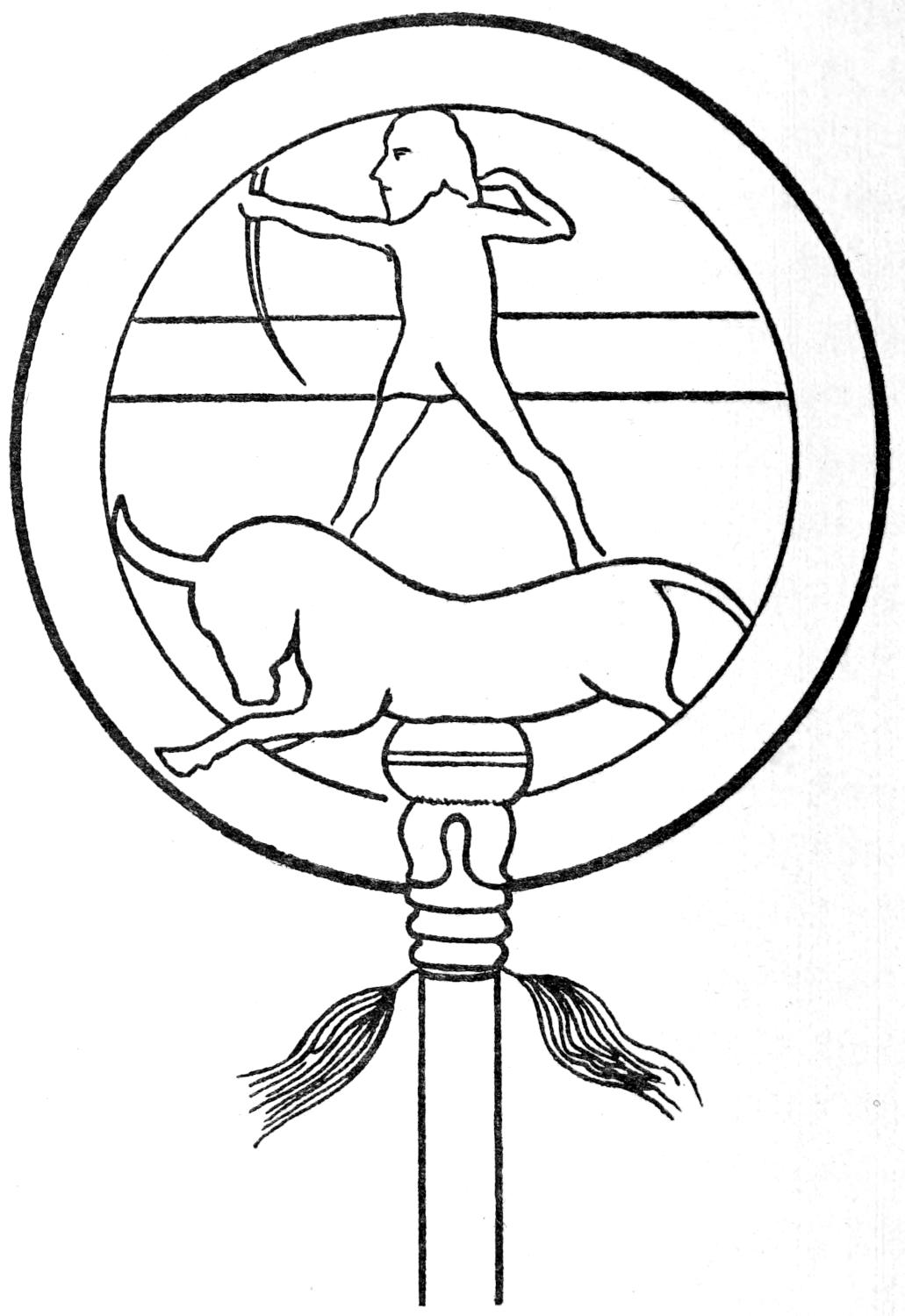
In the Assyrian Standard (depicted in Layard’s Monuments of Nineveh, Plate XXII.) we see the figure of an Archer above that of a galloping Bull, and in another Assyrian Standard, that of Sargon II., we find not only the Archer and the Bull, the two constellations which 4,000 B.C. marked the equinoctial colure, but we may also clearly trace a reference to the two constellations which at the same date marked the solstitial colure, namely, those of the Lion and the Water-man (Plate VII.).
PLATE VII.
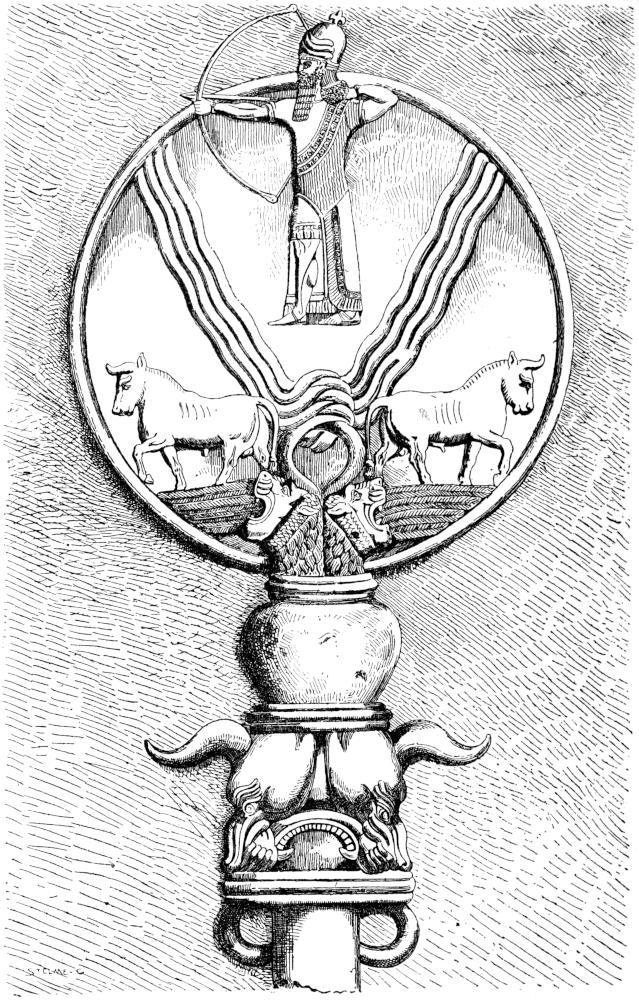
Standard of Sargon II., King of Assyria, 722-705 B.C.
Perrot et Chipiez. Histoire de l’Art dans l’Antiquité, Tome v. opposite page 508.
[To face p. 79.
Here the Archer dominates over a circle in which symmetrically duplicated Bulls appear, and duplicated Lions’ heads emerge out of what appears to be a hollow vessel resembling a water jar; the wavy lines that traverse the disc suggest streams that unitedly pour their waters into this jar. Below the jar again are to be seen halved and doubled heads, partly Lion and partly Bull.
This Standard of Assur may (like the Persepolitan monster earlier described) be considered as an astronomic monogram representing the four constellations which marked the four seasons of the year, and the four quarters of the earth.
The monogram of the Standard refers us back, however, to an earlier date for its origin than does the monogram of the composite animal in the Persepolitan bas-relief, for in the Standard the Archer is opposed to the Bull, in the bas-relief the Scorpion takes the place of the Archer, and the Eagle takes the place of the Water-man.
The precession of the equinoxes advances from east to west amongst the stars. Therefore the Scorpion marked the colure at a later date than did the Archer. The Eagle, as has already been pointed out, is considerably to the west of Aquarius, and could scarcely have been chosen as a substitute for that constellation when the colure was in its extreme eastern degrees.
At Plate VIII. is given the position of the colures at 4,000 B.C.; not much earlier or much later than this date can we place the origin of the symbolism in the Standard shown at Plate VII. Earlier not Leo and Aquarius, but Virgo and Pisces, would have marked the solstitial colure. Later not Sagittarius, but Scorpio, would have in opposition to Taurus marked the equinoctial colure.
At this date, 4,000 B.C., suggested with such curious accuracy by this Assyrian Standard, we have absolutely no trace of the existence of the Semitic nation of the Assyrians in Northern Mesopotamia. In Babylonia two hundred years later the Semitic Sargon I. ruled at Accad. In the astrological work drawn up, if not for Sargon yet, as we may judge from internal evidence, for some king of Accad, no mention is made of the Assyrian nation.
PLATE VIII.
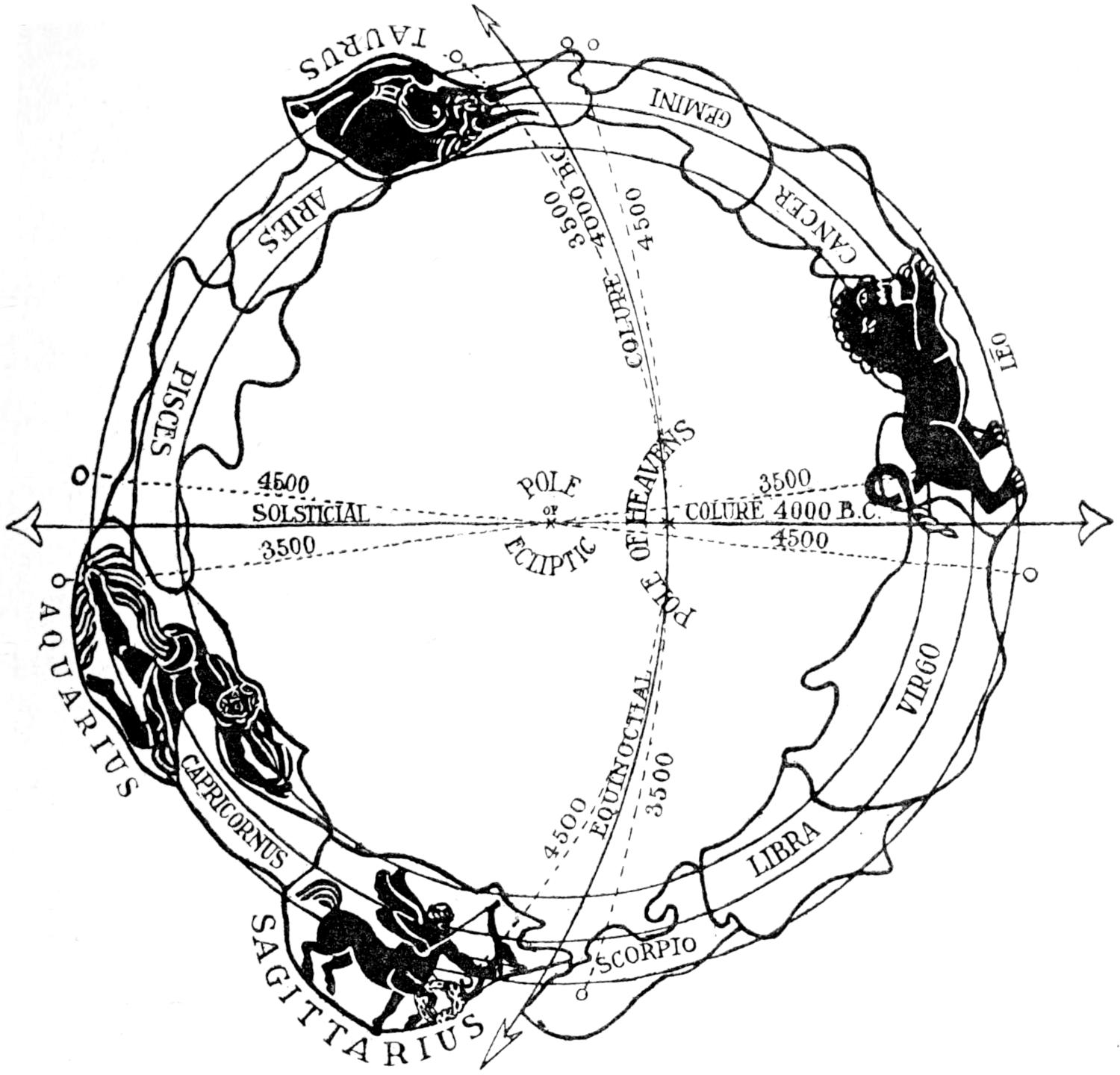
Position of Colures amongst the Constellations at the dates 4,500-4,000 and 3,500 B.C.
[To face p. 80.
The Phœnicians, the Hittites, the Kings of Gutium, and the “Umman Manda” are then the dreaded foes of Accad. Of the Manda we read as follows: “The Umman Manda comes and governs the land. The mercy seats of the great gods are taken away. Bel goes to Elam.”
Professor Sayce is opposed to the view that the Manda are necessarily identical with the Medes; but he admits that Herodotus, following the authority of Medo-Persian writers, claimed as Median the victories of the Manda.[42]
If now on the authority of Herodotus and the Medo-Persian writers we assume, at least as a possibility, that these Manda were Medes, we should expect to find them worshippers of Ahura Mazda. Ahura, it is on all hands admitted, is the Iranian form of the Vedic Asura, just as Mithras is the Iranian form of the Vedic Mitra. At whatever date the separation between Iranian and Vedic Aryans took place, the worship of Ahura (still probably under the form Asura) must have existed amongst the Iranians; indeed, many have supposed that the monotheistic reform which placed one great Ahura or Asura above all other Asuras, and above the Devas, occasioned the separation of these two great Aryan races.
It is for the Lord Ahura, called, as here supposed, Asura, in early times, by the Aryan Manda, that I would claim the astronomical symbol of the Archer presiding over the circle of the ecliptic, or, in other words, over the circle of the year, and of a year beginning at the spring equinox—a year, as has already been pointed out, distinctively Median.
According then to this supposition, a powerful Median race was established in the vicinity of Babylonia early in the fourth millennium B.C.—a race who worshipped one great Lord, first under the name of Asura, afterwards under that of Ahura.
It is for these Aryan Manda or Medes that I would claim, at the date of 4,000 B.C., the original conception of the astronomic monogram in which so plainly may be read an allusion to the four constellations of the Zodiac, which at that date marked the four seasons and the four cardinal points, i.e. Sagittarius and Taurus, Aquarius and Leo. This monogram was used as a Standard thousands of years later by the Semitic Assyrians.
To the Manda or Medes, also, I would, as has been suggested, attribute the first imagining of the astronomic emblem common to Ahura and Assur—that of the divine Being presiding over the circle of the ecliptic.
Berosus mentions a Median dynasty as having reigned in Babylon for one or two hundred years. Let us now suppose that the Manda for more than a thousand years held power in Northern Mesopotamia, but that at last the tide of conquest turned, and after many struggles with the Semites in the south the Aryans were finally driven from the land now known as Assyria, and a Semite race firmly settled in the regions from whence in Sargon’s time the Umman Manda had threatened the inhabitants of the Kingdom of Accad. That this was the case about 2,200 B.C. may perhaps be gathered from the monuments of Ḫammurabi, the Semitic king of Babylon, for he refers in his letters to his troops in Assyria, and in a lately discovered inscription of this king he speaks of restoring to the city of Assur its propitious genie, and of honouring Istar in the city of Nineveh.
To account for the existence of the Assyrian nation, their close resemblance in language and race to the ruling Semitic class in Babylon, and yet to explain the great difference in the religion of these two peoples, has always been a difficulty.
The Assyrians worshipped, and worshipped with enthusiasm, all the Babylonian gods; but high above the whole Babylonian Pantheon they placed as their supreme and great Lord Assur—Assur whose very name is not to be met with in Babylonian mythology. This difficulty I would explain in the following manner.
When the Medes had, by Ḫammurabi or his successors, been driven out of Northern Mesopotamia, they were replaced by Semitic settlers who (like the settlers sent into Samaria more than a thousand years later by a king of Assyria) adopted, to a certain extent, the religion of the nation whom they had dispossessed. In 2 Kings xvii. we read that in this parallel instance “the king of Assyria brought men from Babylon, and from Cuthah, and from Ava, and from Hamath, and from Sepharvaim, and placed them in the cities of Samaria instead of the children of Israel: and they possessed Samaria, and dwelt in the cities thereof.” Later in the same chapter we read that in order to appease, as they believed, the wrath of the “God of the land,” these idolatrous settlers, retaining in full the worship of all their own gods, added to it a worship of the Lord of the dispossessed Israelites.
I would suppose then that the polytheistic Semites, who in Ḫammurabi’s time were settled in Northern Mesopotamia, had acted in a similar manner. Coming into a region where for nearly 2,000 years the monotheistic Medes or Manda had been established, they, to avert the wrath of the god of the land, adopted to a certain extent his worship. In fact, like the Samaritans, “they feared the Lord [Asura], and served their own gods.”
This explanation of the difference in religion between the Babylonians and the Assyrians seems to yield also an explanation of the resemblances between the Assyrian and Median religions, or rather of the resemblances between the religious art of the two peoples; and thus we return to the problem proposed for discussion earlier in this Paper, namely, the inadequacy of the generally held opinion which accounts for the resemblances in Persepolitan and Ninevite symbolic art by supposing that the Medes borrowed from the Assyrians.
In support of the alternative suggestion put forward at p. 75, that the progenitors of the Assyrians at an early period of the worlds history borrowed Tauric and other religious symbolisms from the ancestors of the Medes, I would claim that the Assyrians borrowed not only religious symbolisms, but even the very name of their god Assur from the Medes. For I look upon Assur as a “loan word” adopted from the Aryan Asura.
To the Medes or Manda, who were, as has been argued, in power in Northern Mesopotamia about 4,000 B.C., I have attributed the origin of the astronomic Assyrian and Ahurian emblem. To them, on the same grounds, I attribute the first imagining of the astronomic Assyrian Standard, and the devising of the man-headed and winged monsters so well known as “Assyrian Bulls”; and to them I would, with full conviction, leave the honour of having invented, and not borrowed, the idea of the magnificent Tauric capitals that crowned the columns of Persepolis and Susa.
To all these conclusions I have been led by a consideration of the distinctively equinoctial character of the Median calendar, taken in connexion with the importance given in Median art to the constellation Taurus.
V ASTRONOMY IN THE RIG VEDA
[Reprinted from the Report of the Actes of the Twelfth Oriental Congress held at Rome]
Not much more than a hundred years ago the Sanscrit language began to yield to the study of Europeans some of its literary treasures. Almost on the moment, a controversy arose as to the antiquity of the science of astronomy in India; for scholars were amazed to find in this already long dead language many learned astronomical treatises, besides complete instructions for calculating, year by year, the Hindu calendar, as also for calculating horoscopes.
Some then proclaimed the wonderful facts revealed, and extolled the antiquity and accuracy of this Indian science, while others, noticing the many points of resemblance between European and Indian methods, supposed, and warmly advocated the opinion, that much of the astronomy contained in Sanscrit works had been borrowed from the Greeks.
Sir William Jones was amongst the first to enter the lists against this Grecian theory; and he thus throws down his glove in defence of the antiquity and originality of the science of astronomy in India.
“I engage to support an opinion (which the learned and industrious M. Montucla seems to treat with extreme contempt) that the Indian division of the Zodiack was not borrowed from the Greeks or Arabs, but, having been known in this country (India) for time immemorial, and being the same in part with that used by other nations of the old Hindu race, was probably invented by the first progenitors of that race before their dispersion.”[43]
Since Sir William Jones wrote this challenge, and supported it with whatever linguistic and scientific resources were at his command, volumes of heated controversy by many authors have been devoted to the same subject.
Just at present, however, an almost indifferent calmness has taken the place of the excited interest formerly manifested. The majority of scholars, both European and Indian, appear to have accepted, as an axiom, the opinion that much of Indian astronomy, and certainly the Indian acquaintance with the twelve-fold division of the Zodiac, is to be attributed to Grecian influence.
A minority of writers still hold the view advocated by Sir William Jones about a hundred years ago, and thus reiterated by Burgess (the translator of the Indian standard astronomical work the Sûrya-Siddhânta) in 1860. “The use of this (twelve-fold) division, and the present names of the signs, can be proved to have existed in India at as early a period as in any other country.”[44]
The minority who hold this view are so few at present that, as has been said, the majority rest in their opposed opinion in all the calmness of conviction.
I will now as briefly as possible state the chief arguments put forward, for and against, this conviction.
I. In favour of the comparatively late introduction into India of the twelve-fold division of the Zodiac, it is contended that the divisions of the Indian Solar Zodiac so closely resemble those of the Grecian (the Zodiac which we to this day depict on celestial globes), that it is not possible to believe that two nations or two sets of astronomers could independently of each other have imagined the same fanciful and apparently inconsequent series.
History does not tell of communication between Greece and India, sufficient to account for this similarity of astronomical method, till after the date of Alexander’s conquest—about 300 B.C. The Greeks could not at that late date have first become acquainted with the figures of the Zodiac, for in Grecian literature of a much earlier age the figures of the Zodiac and other constellations are alluded to as already perfectly well known. As the Greeks therefore could not have learnt all their astronomic lore from the Indians, the Indians must have learnt theirs from the Greeks at some date later than Alexander’s Eastern conquests.
A corroboration of this opinion is drawn from the consideration that, in the most ancient Sanscrit work in existence—the purely Indian Rig Veda, containing no Grecian taint—the twelve-fold divisions of the Zodiac appear to be unknown. This opinion as to the Rashis or constellations of the Solar Zodiac is so generally adopted, that the age of any Sanscrit work in which mention of these Rashis occurs is at once—no matter what its claims to antiquity may be—set down as not earlier than the comparatively modern date of 300 B.C.
II. As regards the Indian Lunar Zodiac. The Indians make use at present for calendrical purposes, not only of the twelve-fold Solar Zodiac, they have also a series of 27 Nakshatras, or Lunar mansions (this is for convenience sake designated by European writers as the Lunar Zodiac). It is admitted on all hands that the Nakshatra series was not derived from Grecian sources. But it is contended that the fixation of the initial point of this Lunar Zodiac (a point at the end of Revatī and the beginning of Aswinī, 10 degrees west of the first point of our constellation Aries) was due to an astronomical reform of the Hindu calendar, probably carried out under Grecian auspices at a date not much earlier than 600 A.D. A very clear statement of this opinion is thus given by Whitney (the editor of Burgess’ translation of the Sûrya Siddhânta):—
“The initial point of the fixed Hindu sphere from which longitudes are reckoned, and at which the planetary motions are held by all schools of Hindu astronomy to have commenced at the creation, is the end of the asterism Revatî, or the beginning of Açvinî. Its situation is most nearly marked by that of the principal star of Revatî ... that star is by all authorities identified with ζ Piscium, of which the longitude at present, as reckoned by us, from the Vernal Equinox, is 17° 54´. Making due allowance for the precession (of the equinoxes), we find that it coincided in position with the vernal equinox, not far from the middle of the sixth century, or about A.D. 570. As such coincidence was the occasion of the point being fixed upon as the beginning of the sphere, the time of its occurrence marks approximately the era of the fixation of the sphere, and of the commencement of the history of modern Hindu astronomy.”[45]
In further corroboration of this view—deduced from the astronomical supposition (to which I have drawn attention by italics) put forward in this extract—ancient Sanscrit literature is appealed to. Hymns and lists referring to the Nakshatras are to be met with in the Yajur and Atharva Vedas, in which Krittikā, now the third Nakshatra, holds the first place.
The Nakshatra Krittikā contains the group of stars known to us as the Pleiades. The most brilliant stars in the Nakshatra Aswinī are the two stars in the head of the constellation Aries (the Ram), known to astronomers as α and β Arietis.
The vernal equinoctial point coincided about 2,000 B.C. with the constellation Krittikā. It is considered to be most probable that on account of this coincidence, at the early date when the hymns and list in question were composed, Krittikā was chosen as the leader of the Nakshatra series, and hence a similar reason for the later choice of Aswinī as leader relegates it to a date not much earlier than 570 A.D.
These very briefly, as far as I have been able to gather them, are the chief arguments in favour of—
(1) The Grecian introduction of the twelve-fold Zodiac into India about 300 B.C.
(2) The date of 570 A.D. for the fixation of the initial point of the Indian Zodiacs, and for the commencement of the history of Indian astronomy.
These propositions are based on cogent reasonings, and are maintained by very high authorities. The opponents of the modern theory have brought and bring forward the following considerations:—
“The Bráhmans were always too proud to borrow their science from the Greeks, Arabs, Moguls, or any nation of Mléchch’has, as they call those who are ignorant of the Védas, and have not studied the language of the Gods; they have often quoted to me (Sir William Jones) the fragment of an old verse, which they now use proverbially (na níchò yavanátparah), or, ‘no base creature can be lower than a Yavan,’ by which name they formerly meant an Ionian or Greek, and now mean a Mogul.”[46]
Again the same writer points out that the resemblance between the Indian and the Greek Zodiac is—
“not more extraordinary than that, which has often been observed between our Gothick days of the week and those of the Hindus, which are dedicated to the same luminaries, and (what is yet more singular) revolve in the same order: Ravi, the Sun; Sóma, the Moon; Mangala, Tuisco; Budha, Woden; Vrihaspati, Thor; Sucra, Freya; Sani, Sater; yet no man ever imagined that the Indians borrowed so remarkable an arrangement from the Goths or Germans.”
These considerations put forward by Sir William Jones are further emphasized by the reflection that not only does the Grecian theory entail the improbability of the proud and jealous Brahmins adopting into their science and their mythology the teachings of foreigners; but that it also entails the greater improbability of the two rival Hindu sects, Brahmins and Buddhists, having at the same date and with equal enthusiasm adopted into their science and religious symbolism and calendars the same innovations.
Again the opinion of the Greek writers at the beginning of our era may be quoted as showing the high estimation in which, at that time of the world, Indian astronomy was held: as for instance in the life of Apollonius of Tyana (written about 210 A.D. by Philostratus), the wisdom and learning of Apollonius are set high above those of all his contemporaries; but from the sages of India he is represented as learning many things, especially matters of astronomy.[47]
This high opinion held by Greeks in regard to Indian astronomy may be contrasted with the very moderate praise bestowed on the Grecian science by Garga, a Hindu writer of, it is supposed, the first century B.C. He says:—
“The Yavanas (Greeks) are Mlechchas (non-Hindus, or barbarians), but amongst them this science (astronomy) is well established. Therefore they are honoured as Rishis (saints); how much more then an astronomer who is a Brahman?”[48]
Somewhat to the same effect speaks a Hindu author of a later date, Varāhamihira, who wrote an astronomical dissertation treating of five different works known to him on the science of astronomy. He says:—
“There are the following Siddhântas: The Pauliśa, the Romaka, the Vâsisṭha, the Saura, and the Paitámaha. Out of these five, the first two (the Pauliśa and Romaka, which appear to have been European treatises) have been explained by Lâṱadeva. The Siddhânta made by Pauliśa is accurate, near to it stands the Siddhánta proclaimed by Romaka; more accurate is the Sávitra (Saura)[49] (Sūrya Siddhānta, the Hindu standard work); the two remaining ones are far from the truth.”[50]
This moderate, and, as it reads, judicial opinion of Varāhamihira, touching the superiority of the native Sūrya Siddhānta over the Pauliśa and Romaka Siddhāntas, may be appealed to as not conveying the impression that when Varāha wrote his co-religionists and scientists were accepting, wholesale and with avidity, Grecian astronomic methods in place of their own already well-established native science. It is true that in Varāha’s work many words evidently of Grecian origin are to be met with; and some scholars have claimed that these “Greek terms occurring in Varāhamihira’s writings are conclusive proofs of the Greek origin of Hindu astronomy.” That such terms should occur in a work professedly a resumé of five astronomic treatises—some of them Indian, and some European—can scarcely be considered as conclusive proof that in the writer’s time no purely Indian astronomic science existed. Varāha’s writings suggest an author interested in comparing the resemblances and the differences to be met with in home and foreign methods, rather than one introducing for the first time important astronomic truths to the notice of his readers.
It may be further urged that the claims to antiquity in Sanscrit astronomical works are so well known, that those who adopt the Grecian theory must necessarily throw discredit in a very wholesale manner on all their authors. Bentley’s furious diatribes may be quoted as an extreme example of the way in which the evidence of such Sanscrit claimants to antiquity is sometimes dealt with; and it may be pointed out that such violent denunciation cannot be looked on as convincing argument.
“The fact is,” writes Bentley, “that literary forgeries are now so common in India, that we can hardly know what book is genuine, and what not: perhaps there is not one book in a hundred, nay, probably in a thousand, that is not a forgery, in some point of view or other; and even those that are allowed or supposed to be genuine, are found to be full of interpolations, to answer some particular ends: nor need we be surprised at all this, when we consider the facilities they have for forgeries, as well as their own general inclination and interest in following that profession; for to give the appearance of antiquity to their books and authors increases their value, at least in the eyes of some. Their universal propensity to forgeries, ever since the introduction of the modern system of astronomy and immense periods of years, in A.D. 538, are but too well known to require any further elucidation than those already given. They are under no restraint of laws, human or divine, and subject to no punishment, even if detected in the most flagrant literary impositions.”[51]