PART I (continued 2)
Reading edition
It is unnecessary now to further pursue the pros and cons of what has hitherto been said and written on the vexed questions as to the originality and antiquity of astronomy in India, and especially as to the Indian acquaintance with the twelve-fold divisions of the Zodiac, and the date of the fixation of the initial point in their Zodiac. We have seen that by the majority the Grecian and modern theory is the favoured one.
Within the last quarter of a century, however, an unexpected reinforcement has come into the field, in aid of the disheartened and nearly silenced minority, who still believe in a great antiquity for the science of astronomy in India.
The researches of archæologists in Western Asia have of late brought to our knowledge vast hoards of information concerning the ancient inhabitants of Babylonia and Assyria, and the surrounding highlands and plains; amongst other matters, concerning the science of astronomy possessed by these peoples.
In 1874, a Paper entitled The Astronomy and Astrology of the Babylonians was read by Professor Sayce before the “Society of Biblical Archæology,” and since that date other Papers, by various authors, dealing with the subject have appeared in the same Society’s Proceedings. Also in the Zeitschrift für Assyriologie, articles have been contributed by such writers as Epping and Strassmaier, Oppert, Mayer, Mahler, Jensen, Lehmann, and others, in which the calendars and astronomical methods in use in Mesopotamia are discussed.
Epping and Strassmaier’s Astronomisches aus Babylon and Jensen’s Die Kosmologie der Babylonier, are important volumes devoted to these same matters.
Whatever else concerning the subject of all these writings remains uncertain and open to discussion, some facts are clearly established. We now know that the inhabitants of Babylonia in a remote age (certainly as early as the fourth millenium B.C.) were acquainted with the twelve divisions of the Zodiac, and that these divisions were imagined under figures closely resembling in almost every instance those now depicted on our celestial globes. The calendar used by the Accadians, and later by the Semitic Babylonians and Assyrians, was indeed based on the observance of the Zodiacal constellations and of the journeyings through them of the sun and moon. The varying positions of the planets, Mercury, Venus, Mars, Jupiter, and Saturn are also noted by references to the Zodiacal asterisms: and not only Zodiacal, but several of the extra-Zodiacal ancient constellations are represented on the monuments.
All this information gained from the cuneiform tablets concerning the science of astronomy in Western Asia must undoubtedly affect the judgment of enquirers into the history of the same science in India.
Now that it is clearly proved that 3,000 B.C. and earlier the twelve-fold fanciful signs of the Solar Zodiac were known to the inhabitants of Babylonia, it cannot any longer be asserted dogmatically that the inhabitants of India must have waited till 300 B.C. to learn this twelve-fold division from Grecian astronomers after the date of Alexander’s conquest.
But again as regards the fixation of the initial point of the distinctively Indian Lunar Zodiac, or circle of the Nakshatras, at the “end of Revatî, and the beginning of Açvinî,” that is to say, at a point not far from the first degree of Aries—cuneiform tablets teach us the important fact that long before the equinoctial point coincided with any of the degrees of Aries, that constellation was the leader of the Zodiacal series—inasmuch as the month Bar zig-gar (Accadian) the “Sacrifice of righteousness,” that is, the month when the sun was in conjunction with Aries, always in the tablets appears as the 1st month of the year.[52]
These late revelations of archæology seem to strike at the root of the main arguments relied on by the advocates of the Grecian and modern origin of astronomic science in India; and this being the case, it is possible to turn with unbiassed minds to a consideration of the teachings of Sanscrit literature, and endeavour to learn from them what is the real truth as to the acquaintance of ancient Indian authors with the figures of the Zodiac and other astronomic phenomena.
The opinion has been very generally adopted, as has been said, that in the Rig Veda there is no mention of any of the twelve figures of the Solar Zodiac. Some few writers have contended that occasional references to these figures are to be met with, and this question has been argued on etymological grounds. My entire ignorance of the Sanscrit language prevents me from at all following the arguments employed in this discussion. And here it may be said, and said with good reason, that for the discussion of points connected with Vedic literature, writers ignorant of the language in which the Vedas were composed are but ill equipped for the task. At every step I keenly feel my own disqualifications; but many translations and commentaries on the Rig Veda are in existence; and without entering into etymological questions, it has seemed to me that broad astronomic explanations of some of the myths might be supplied, if only the possibility of the Vedic Rishis having been acquainted with the strange figures of the celestial sphere should be admitted. In this paper I am anxious to draw the attention of those who can study Vedic texts in their original language to these possible explanations. Those only who know Sanscrit are really qualified to judge finally whether the suggestions here made can be sustained on further enquiry into the Vedas. If the interpretations of Vedic myths here proposed are correct—no doubt corroboration will be found for them in the Sanscrit names and epithets of mythic personages. If no such corroborations are to be met with, the probabilities in favour of the correctness of the astronomic interpretations will be greatly diminished.
But to return to our subject. It is sometimes argued that the Vedic bards could not have been acquainted with the twelve-fold division of the Zodiac, as otherwise these great constellations would surely have claimed at their hands clear and outspoken notice. With this argument I cannot fully agree. Even before pointing out the important place which I believe astronomical phenomena hold in the Rig Veda, I would draw attention to the fact that according to the generally received and non-astronomic explanation of the myths, it is necessary to suppose that still more striking and important natural phenomena than those connected with the constellations of the Zodiac—phenomena with which the Vedic bards must certainly have been acquainted—were almost entirely ignored by the authors of the Rig Veda. It is true that some great scholars claim on linguistic grounds a solar origin for much Vedic imagery and nomenclature; yet when the hymns are examined in translations, and the notes and commentaries which accompany these translations are studied, the impression left on the mind of any reader unacquainted with Sanscrit must be that very little attention or honour is given to sun, moon, or stars, in comparison to that so freely lavished on the elements of fire, air and water, and on the mysterious properties of the juice of the Soma plant.
The beauty of the dawn is almost the only celestial glory that appears to appeal with any insistence to the imaginations of the Vedic Rishis.
If out of the more than one thousand hymns of the Rig Veda, not one is addressed to the moon, and on the most liberal calculation considerably less than a hundred to the sun, under any aspect, it need not be cause for wonder if the constellations of the Zodiac are not remembered. The poets of the Rig Veda, however ignorant of astronomy, and at whatever age they lived, must have sometimes lifted their eyes above the sacrificial fire and its smoke, above the rain and storm-clouds, above their altars and libations of Soma. They must have often seen “the sun when it shined” and “the moon walking in brightness,” and if they so rarely hymned these great luminaries with whose appearance and existence they so certainly were acquainted, it would prove no ignorance on their part of the twelve-fold division of the Zodiac and its quaintly imagined figures, were it indeed the case that all mention of these figures is absent from the Rig Veda.
But as has been stated above, my desire is to draw attention to possible astronomic interpretations of many of the Vedic myths, and the adoption of such interpretations would necessarily entail a reversal of the dictum that all mention of the twelve-fold Zodiac is absent from the Rig Veda.
Those who have studied this wonderful and mysterious collection of hymns most constantly and deeply are obliged to confess that it is still very imperfectly understood, and though it is agreed unanimously that the Gods of the Veda are personifications of the phenomena of nature, yet as to the exact phenomena underlying the various Vedic myths there is among scholars much difference of opinion. It is impossible not to feel in reading the hymns and the many speculations, notes, and comments appended to them, that notwithstanding all the labour and research bestowed on the work, much of this ancient Veda still remains a cypher, for the right understanding of which the modern reader does not possess the key.
Guided by the teachings of archæology, I now make the suggestion that the key to this cypher may perhaps be found in crediting the authors of the Veda with a somewhat advanced knowledge of astronomy, and an acquaintance with the, to us, apparently fanciful constellations of the celestial sphere and Zodiac; and in assuming that the figures of the “ancient constellations” often supplied the basis of Vedic imagery.
To pursue this possible clue towards the understanding of the myths, it were much to be desired that all students should be acquainted with the names and positions in the heavens of the forty-five constellations—so well distinguished by the epithet “ancient”—and that they should master some of the more easily observed conditions of their diurnal and annual apparent movements, as also those of the sun and moon, and further that they should have learnt what changes in the scenery of the heavens have been brought about by the slow movement known to astronomers as the “precession of the equinoxes.”
Classical and philological scholars have however so rarely time and attention to spare from their own intensely interesting and important studies that as a rule astronomical phenomena are not much observed or considered by them. The accompanying diagrams drawn from a celestial precessional globe may, it is hoped, enable those, who have not as yet devoted thought to such subjects, to judge for themselves of the reasonableness or otherwise of the following astronomic suggestions concerning the most important of the Vedic gods.
According to A. A. Macdonell—who in his late work Vedic Mythology has summed up clearly and compendiously the opinions of a host of scholars on the nature of the Vedic gods—Indra is the favourite national god of the Rig Veda; he is celebrated in 250 hymns, a greater number than that “devoted to any other god, and very nearly one-fourth of the total number of hymns in the Rig Veda.”[53]
What may be called the central myths related of Indra, stripped of all epithet and ornament, relate that, invigorated by copious draughts of Soma, Indra fights with, overcomes, and drives from heaven and earth a demon called Vritra or Ahi, who is represented under the form of a dragon, serpent or water snake. Indra also searches for, finds, and releases cows which had been stolen from the gods (or according to some commentators, from the angirasas, or priests). Indra bestows on his worshippers all the blessings of plenty, especially he is the dispenser of rain.
According to the usual non-astronomic explanations of these myths, Indra, an “atmospheric god,”[54] is “primarily the thunder god” who conquers “the demons of drought or darkness,” or again, “Indra[55] is a personification of the phenomena of the firmament, particularly in the capacity of sending down rain. This property is metaphorically described as a conflict with the clouds which are reluctant to part with their watery stores until assailed and penetrated by the thunder-bolt of Indra; ... the cloud is personified as a demon named Ahi or Vritra ... a popular myth represents him (Indra) also as the discoverer and rescuer of the cows, either of the priests or of the gods which had been stolen by an Asura named Pan̂i or Vala.”
Macdonell, alluding to the same incident, observes:[56] These “cows released by Indra may, in many cases, refer to the waters, for we have seen that the latter are occasionally compared with lowing cows. Thus Indra is said to have found the cows for man when he slew the dragon.... But the cows may also in other cases be conceived as connected with Indra’s winning of light, for the ruddy beams of dawn issuing from the blackness of night are compared with cattle coming out of their dark stalls. Again, though clouds play no great part in the Rig Veda under their literal name (abhra, etc.), it can hardly be denied that, as containing the waters, they figure mythologically to a considerable extent under the name of cow (go), as well as udder (ūdhar) ... thus the rain-clouds are probably meant when it is said that the cows roared at the birth of Indra.”
At the close of the section devoted to Indra, Macdonell refers to the probably pre-Vedic origin of the Indra myths. He says:[57] “The name of Indra occurs only twice in the Avesta. Beyond the fact of his being no god, but only a demon, his character there is uncertain. Indra’s distinctive Vedic epithet vrtrahan [Vritra-slayer] also occurs in the Avesta in the form of verethraghna, which is, however, unconnected with Indra or the thunderstorm myth, designating merely the God of Victory. Thus it is probable that the Indo-Iranian period possessed a god approaching to the Vedic form of the Vrtra-slaying Indra. It is even possible that beside the thundering god of heaven, the Indo-European period may have known as a distinct conception a thunder-god, gigantic in size, a mighty eater and drinker, who slays the dragon with his lightning bolt.”
In reading the Indra hymns in the Veda, and in trying to fit them to the explanation given in the passages quoted, a constant and very disagreeable strain is put on the imagination; it must, for instance, attempt to grasp and hold, at the same time, two very far apart opinions as to the nature of the demon Vritra. Vritra is to be thought of as a demon of darkness, and as a demon of drought; the cows are clouds, they are also ruddy beams of light!
Darkness and drought are not to be easily bracketed together. Drought is in all lands, India not excepted, connected with a long continuance of bright and stainless skies. The appearance then of a little cloud “like a man’s hand” is the joyously hailed precursor of “the sound of abundance of rain.”
Again, the driving away of a snake-like cloud is no forcible simile by which to describe in myth the advent of rain in India—rain which to be of any use is no mere refreshing shower, but a long-continued downpour from clouds not hastily dispersed.
Indra’s action first in driving away the cloud-demon Vritra, and then in seeking for the beneficial cloud cows, is also contradictory.
For the reconciling of many of these contradictions the astronomic interpretation of the Indra-Vritra myths is as follows:—Indra may still retain all his atmospheric attributes of sending down rain but—Indra is primarily and essentially a personification of the summer solstice.
The summer solstice in India is an all-important agricultural epoch; it brings with it “the rainy season,” the real spring of the Indian year. Before this season all the land is parched and arid, and vegetation is at a standstill.
The punctuality of the rains in many parts of India is so exact that the farmer foretells their arrival not only to the day, but to the hour. In good years heavy and almost incessant rain lasts for two or even three months. Indra, as a personification of the season which so punctually brings the rain, is an atmospheric god, the enemy of the demon of drought. But Indra is more than this: many praises are bestowed on Indra in the Rig Veda for deeds which cannot easily be explained on the simple atmospheric theory. “Indra is the highest of all” is the refrain of many Vedic verses; “Indra placed the sun high in the sky,” “Indra tore off one wheel of the sun’s chariot,” “Indra stopped the tawny coursers of the sun.” Now all these phrases are at once and clearly to be interpreted if we think of Indra as the personification of the summer solstice, and especially of the solstice in India, where at that season of the year the sun attains to the very zenith, and thus Indra associated with the sun under one figure of speech is spoken of as “highest of all,” and in a slightly varied figure associated with the season, is said to have “placed the sun high in the sky.” Or again translating into myth the very meaning of the word solstice or “the sun being made to stand,” we read that Indra “tore off the wheel of the chariot of the sun,” and “stopped his tawny coursers.” Indra is, I cannot but believe, not merely an atmospheric god; he is the god of the summer solstice. And if this should be the case, what then may Vritra be? Is the demon of the solstitial Indra personified as only a snake-like cloud? It is impossible to think so. The astronomic interpretation of the myth I would propose is that—a snake-like constellation, not a snake-like cloud, is the representation of the demon Vritra.
On the celestial sphere many serpents and dragons are represented, but the far-reaching constellation Hydra exceeds all the others in its enormous length from head to tail. No very brilliant stars mark the asterism, nor in the grouping of its stars is there anything especially snake-like. For some reason other than its appeal to the eye did astronomers of old invest with all the horrors of the Hydra-form the monotonous length of this space on the vault of the skies.
This reason may be arrived at, with almost certainty, in studying, with the help of a precessional globe, the position in the heavens of this constellation in different ages of the world’s history. So studying, we shall find that 4,000 B.C.—or to be more precise, one or two hundred years earlier—Hydra extended its enormous length for more than 90° symmetrically along one astronomically important (though invisible) mathematical line—the line of the heavenly equator—and was at the same date accurately bisected by another equally important mathematical line, namely the colure of the summer solstice (see Plate IX.).
Almost irresistibly, as it appears to me, the conviction forces itself on the mind, in considering the position held by the constellation Hydra 4,000 B.C., that it was at that date that this baleful figure was first traced in imagination on the sky, there fitly to represent the power of physical (and may we not suppose also, of moral?) darkness—a great and terrible power—but a power ever and ever again to be conquered by the victorious power of light. In astronomic myth this power was represented as that of the sun at the season of its highest culmination, the season of the summer solstice. For an observer in the temperate northern zone all through the long nights of mid-winter, the whole length of the dreadful Hydra was at the date named visible above the horizon. The dark midwinter season was therefore the time of the Hydra’s greatest glory. At every season of the year, except at that of midsummer, some portion of the monster’s form was visible during some part of the night. But at the summer solstice no star in the constellation might show itself for ever so short a time.[58]
PLATE IX.
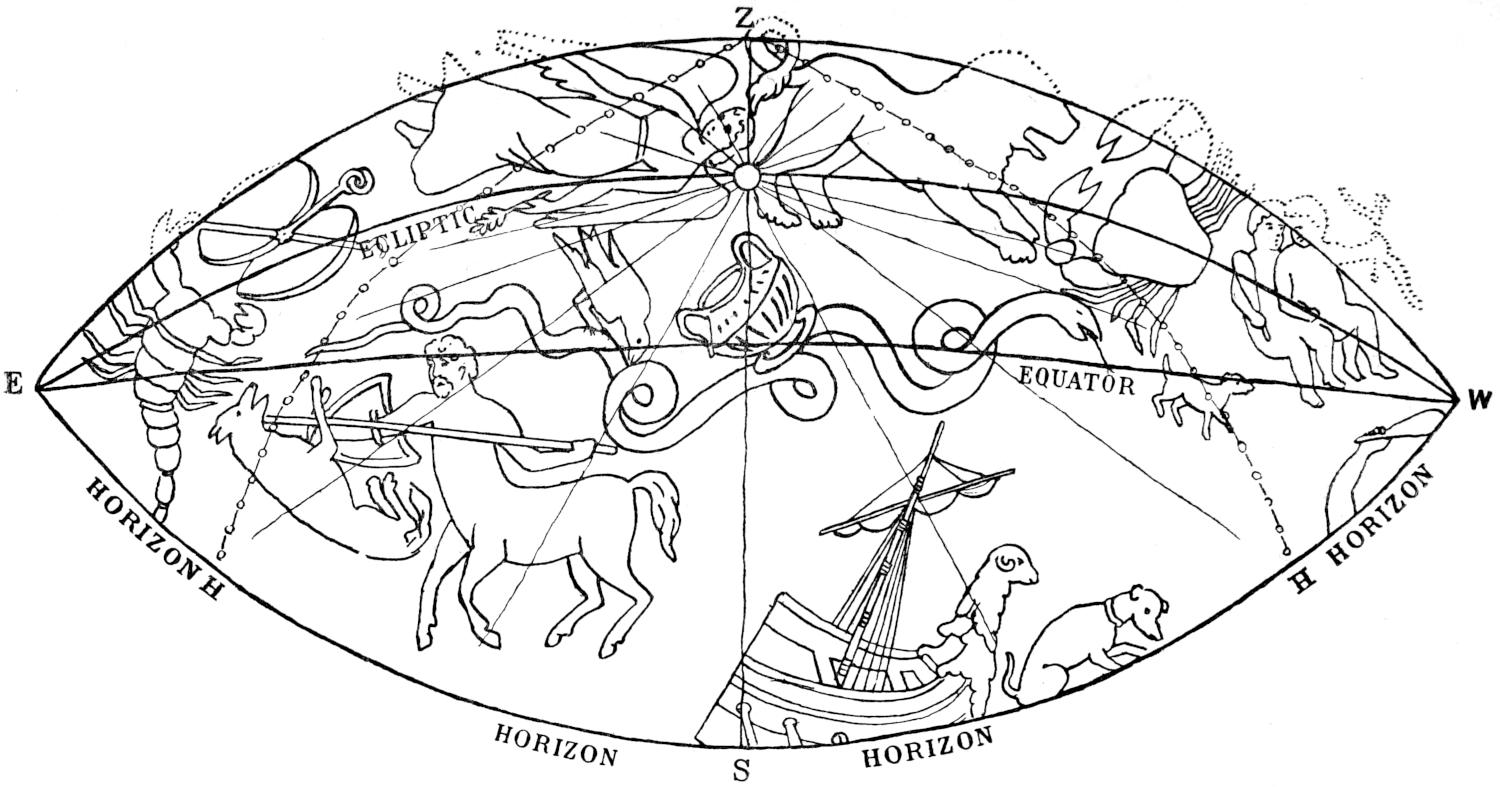
Position of the Sun amongst the Constellations at Summer Solstice, 4,000 B.C. Observer in Lat. 40° N.
Constellations between the lines H Z and Z H invisible all through the night of Summer Solstice.
[To face p. 118.
The supposed latitude of the observer in Plate IX. is 40° N., a latitude considerably to the north of any part of India; but it is to be remembered that the Indra-Vritra myth cannot be claimed with any certainty as a purely and originally Indian myth, for, as Macdonell points out (as quoted above), there is a probability that “the Indo-Iranian period possessed a god approaching to the Vedic form of the Vrtra-slaying Indra,” and that “it is even possible that beside the thundering god of heaven, the Indo-European period may have known as a distinct conception a thunder-god, gigantic in size, a mighty eater and drinker, who slays the dragon with his lightning bolt.”[59]
For the origin of this world-wide myth, therefore, we should not look to the tropical Indian Zone; but it is in Indian latitudes that we should look for an explanation of the physical phenomena hymned by Vedic bards in the distinctly Indian development of the Indra-Vritra myth. I believe that in thus tracing the course of the Indra story from temperate to tropical latitudes, we shall find a reason for the contradictory attributes assigned to the demon Vritra, namely those of darkness and drought.
In northern latitudes winter is distinctly the dark season; in tropical India there is little or no perceptible difference between the darkness of winter and summer. But in India winter is distinctly the dry season. Midsummer is the all-important season of the rains. Indra’s conquest over Vritra, or the arrival of solstitial rains, marked by the disappearance of the constellation Hydra from the sky, was mythologically in the Vedas described as Indra’s conquest over the demon of drought, but still traditionally—for the power of tradition is great—even in India Indra retained the attributes of the conqueror over the demon of darkness.
PLATE X.
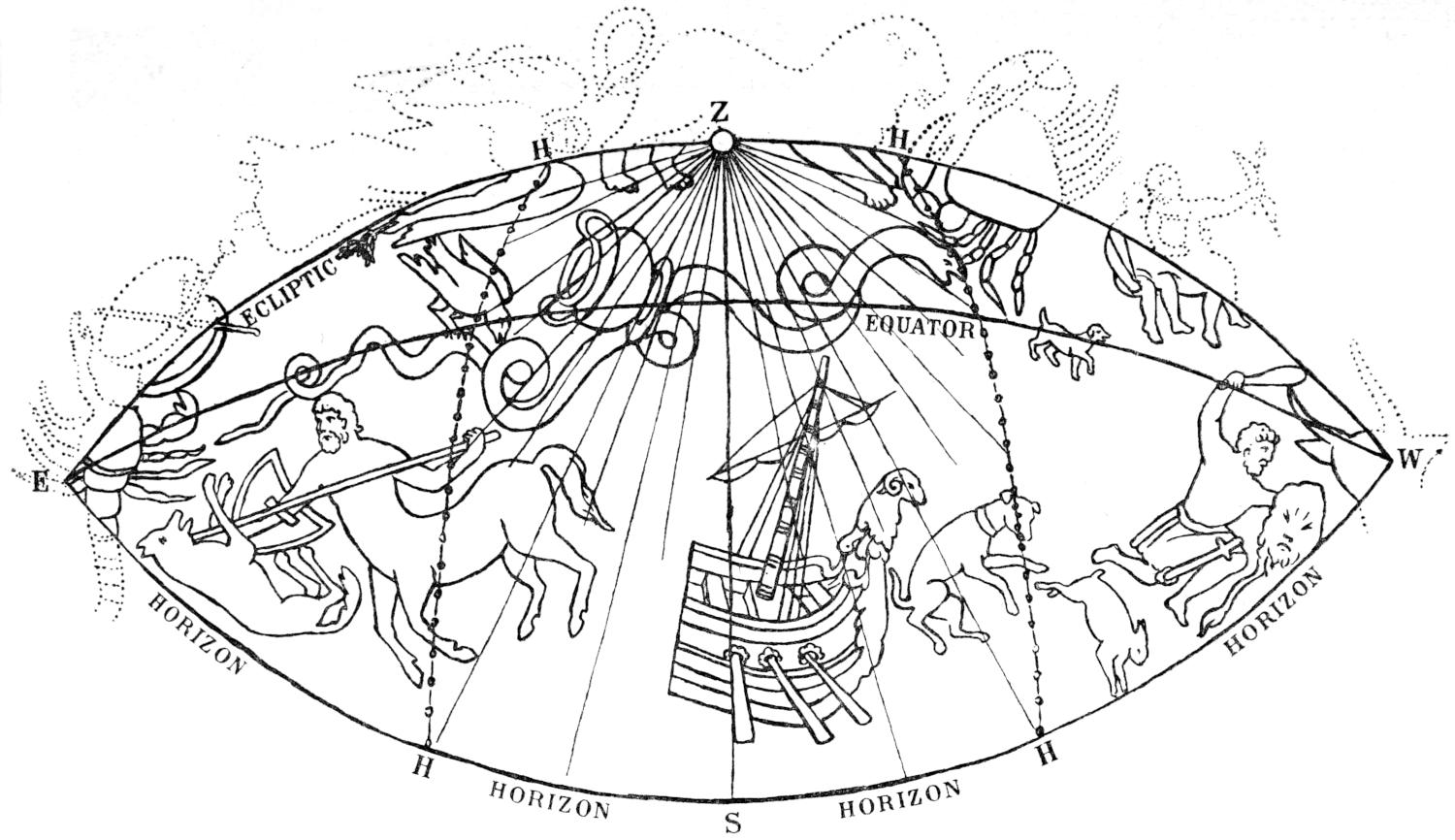
Portion of Sun at Summer Solstice, 3,000 B.C. Observer in Lat. 23° N.
Constellations between the lines H H Z and Z H H invisible all through the night of Summer Solstice.
[To face p. 121.
At Plate X. a drawing is given of the southern heavens and of the constellations—invisible at midsummer and visible at midwinter, above the horizon of an observer in latitude 23° N. at the date 3000 B.C., a thousand years later than the date referred to in Plate IX. For reasons which will appear more clearly when we come to the discussion of the Soma myth, it is to about this date that I would attribute the composition of many of the Vedic hymns.
But if Indra is to be considered as representing the summer solstice, and Vritra as representing the constellation Hydra, we must surely expect some astronomic interpretation for Soma—Soma by which the mighty Indra is invigorated and enabled to triumph gloriously over the demon. According to non-astronomic explanations, “the concrete terrestrial plant and the intoxicating juice extracted therefrom” are considered to be the basis of the mythology of Soma. It is admitted that in post-Vedic literature Soma is a regular name of the moon, which is regarded as being drunk up by the gods, and so waning. Some writers point to the possibility that even in the Rig Veda, “in the Soma hymns there may occasionally lurk a veiled identification of ambrosia and the moon, ... but on the whole, with the few exceptions generally admitted, it appears to be certain that to the seers of the Rig Veda the god Soma is a personification of the terrestrial plant and juice.”[60]
One German writer, Hillebrandt, very strongly upholds the view that Soma in the Rig Veda “often personifies the moon,”[61] and especially according to him is this the case in the 114 hymns of Maṇḍala IX., all addressed to Soma pavamāna, or “purified Soma,” prepared for and quaffed by Indra to invigorate him for the Vritra combat.
That Soma in the Rig Veda is primarily the moon, and that the moon is symbolized and always more or less directly referred to in the Vedic hymns to Soma, fits in, as must be evident to the readers of this paper, with the astronomic theories advocated in it. If we consider that Indra’s conquest over Vritra represents the god of the summer solstice, with his bright weapons, conquering, and driving from heaven and earth the constellation Hydra, we can easily understand how in this contest Indra might be strengthened by copious draughts of Soma, i.e. by the bright light of the full moon flooding the heavens with radiance and enfeebling all but the brightest stars.
But a further confirmation of the lunar character of Soma, and an elucidation of the imagery of the Soma pavamāna hymns of Maṇḍala IX., are to be found if—still crediting the Vedic Rishis with a knowledge of the ancient constellations—we study the position of these constellations at the date 3,000 B.C. (see Plate XI.)[62] At that date the full moon of the midsummer or solstitial season was always to be observed in the constellation Aquarius. With this thought in our mind as we read the mystical hymns of Maṇḍala IX., in which Soma is so often described as rushing impetuously to the vase or pitcher, and as surrounded by celestial waters, with many other such expressions, we easily recognise an allusion to the midsummer full moon in the constellation Aquarius; and when further we read the legend so often repeated, that the eagle brought the Soma to Indra, or to the sacrifice, we have only to look at the celestial globe to see the eagle (Aquila) directing its flight towards the pitcher of Aquarius—and to remember that the very night before the moon attained the celestial vase, it would have been on the same meridian as the constellation Aquila; and the imaginative Vedic bard might then describe it as borne along by the eagle,—one of the most glorious constellations in that part of the sky.
PLATE XI.
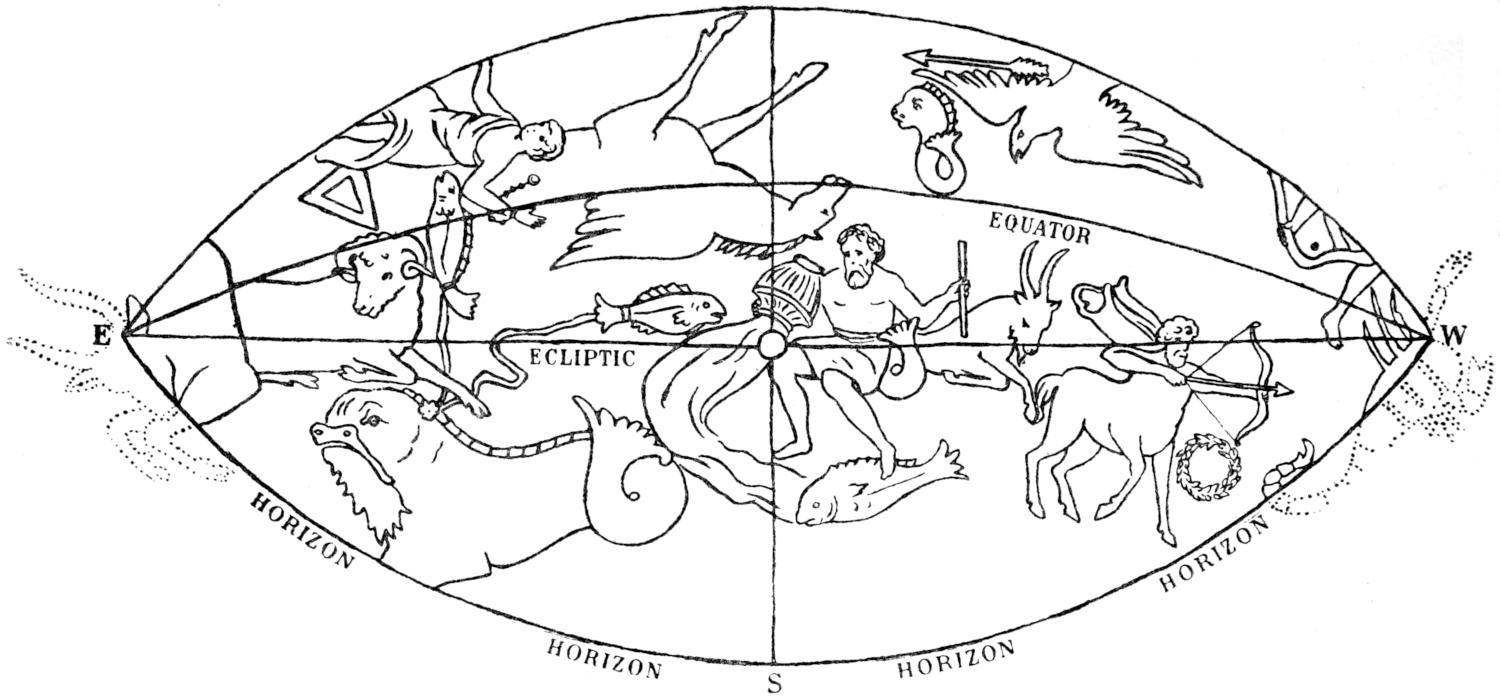
Position of Moon amongst the Constellations at Summer Solstice, and of the Sun at Winter Solstice, 3,000 B.C. Observer in Lat. 23° N.
[To face p. 124.
In one hymn especially devoted to the legend of the Soma-bearing eagle (or hawk), allusion to the small but well-marked-out constellation Sagitta (the arrow) may be detected. In Wilson’s translation of Maṇḍala IV. 27 (vol. iii. p. 174), we read: “When the hawk screamed (with exultation) on his descent from heaven, and (the guardians of the Soma) perceived that the Soma was (carried away) by it, then, the archer Kriṣánu, pursuing with the speed of thought, and stringing his bow, let fly an arrow against it.”
Now to turn to another important Vedic deity, Agni.
Agni is classed, according to Macdonell, amongst terrestrial gods, but he points out that in some passages he is to be identified with the sun. Wilson describes Agni as comprising[63] “the element of Fire under three aspects: 1st, as it exists on earth, not only as culinary or religious fire, but as the heat of digestion and of life, and the vivifying principle of vegetation; 2nd, as it exists in the atmosphere, or mid-heaven, in the form of lightning; and 3rd, as it is manifested in the heavens, as light, the sun, the dawn, and planetary bodies.” And—having enumerated various deities who in the hymns appear as manifestations of the sun—he adds, “still, however, the sun does not hold that prominent place in the Vaidik liturgy which he seems to have done in that of the ancient Persians, and he is chiefly venerated as the celestial representative of Fire.”
The classification of Agni as a terrestrial god, given by Macdonell, and the order of his “aspects,” as given by Wilson, are not in accordance with the theory here advocated, nor, according to Macdonell, is it the classification or order always adhered to by Vedic authorities.
For some very puzzling myths concerning Agni, I believe an astronomic interpretation may be given, and thereby the position of Agni in the first place, rather than in the last, as a celestial god, may be established.
The Vedic deity Apām Napāt—the son of Waters, is classed by Macdonell as an atmospheric god, and he says,[64] “In the last stanza of the Apām napāt hymn, the deity is invoked as Agni, and must be identified with him,” and again,[65] “Agni’s origin in the aerial waters is often referred to. The ‘son of waters’ has, as has been shown, become a distinct deity.” Then turning to other legends regarding Agni he says, “In such passages the lightning form of Agni must be meant. Some of the later hymns of the Rig Veda tell a legend of Agni hiding in the waters and plants, and being found by the gods.... In one passage of the Rig Veda also it is stated that Agni rests in all streams; and in the later ritual texts, Agni in the waters is invoked in connexion with ponds and water-vessels. Thus, even in the oldest Vedic period, the waters in which Agni is latent, though not those from which he is produced, may in various passages have been regarded as terrestrial.... In any case the notion of Agni in the waters is prominent throughout the Vedas.”
To explain this legend, Wilson makes other suggestions. He writes:[66] “The legend of his (Agni’s) hiding in the waters, through fear of the enemies of the gods, although alluded to in more than one place, is not very explicitly related ... the allusions of the Súktas (hymns) may be a figurative intimation of the latent heat existing in water, or a misapprehension of a natural phenomenon which seems to have made a great impression in later times—the emission of flame from the surface of water either in the shape of inflammable air, or as the result of submarine volcanic action.”
It cannot but be admitted that these myths are puzzling, and that to account for the notion so prominent throughout the Vedas of “Agni in the waters,” the various suggestions of “lightning,” “latent heat existing in water,” “the emission of flame from the surface of the waters, either in the shape of inflammable air or as the result of submarine volcanic action,” are inadequate to explain the fact that Agni, whose very name “is the regular designation of fire”[67] should in the hymns be so closely associated with water. Nor are the difficulties concerning “Agni in the waters” to be overcome by the tempting and poetic suggestion, put forward by some writers, that in these passages reference is made to the sun rising in the morning out of the ocean, and again hiding itself beneath the waves at sunset. The composition of the Rig Veda is attributed to Aryan settlers “scattered over the Punjaub and regions lying to the west of the Indus”: by such settlers the sun could never have been seen rising out of the ocean, for no ocean bounded their horizon on the east. Even the phenomenon of the sun hiding itself at evening in the water, could only have been observed by those who lived on the western coast, and it is therefore not easy to imagine why sunrise and sunset should in India have been so closely and constantly associated with a sea horizon.
But if once the acquaintance of the originators of the Agni myths with the Zodiacal figures is admitted, the astronomic interpretation of those relating to Agni in the waters is not difficult; it is as follows:
Agni is the personification of fire, but his chief personification is as the fire of the sun. “Agni in the waters” is especially the fire of the sun in the celestial waters of Aquarius. 3,000 B.C. the sun was in conjunction with Aquarius at the time of the winter solstice.[68] Those hymns therefore which dwell upon the myths of Agni hiding himself in, being born in, and rising out of the waters, may be considered as hymns referring to the sun at the winter solstice in conjunction with the constellation Aquarius, and therefore as hymns especially suitable for use on the occasion of a great yearly festival held at that season of the year.
European writers often describe the mid-winter sun as hiding itself, or as every day withdrawing itself more and more from view. In poetic similes, the snows of winter often crown the head of the aged out-going year, while the in-coming year is represented as a babe or infant. The appropriateness of such similes is due to the fact, that our calendrical new year is fixed within a few days of the winter solstice. Again, in sober prose, the sun at the time of the winter solstice is said, having attained its lowest point, to rise or begin its upward course on the ecliptic. It is therefore not difficult to understand how the Vedic Rishis, who appear to have combined the characteristics of poets and of scientific observers of the heavens, should have 3,000 B.C. described the fire of the solstitial sun, as hiding in, being born in, and rising out of the celestial waters of the constellation Aquarius.
In this Agni myth, as in that of Indra, we may perceive traces of a pre-Vedic origin. The latitudes in which the Rig Veda was composed are not those in which attention is forcibly drawn to the diminution of the strength and visibility of the sun at the winter season. In the Rig Veda, however, Indra’s conquest over darkness as well as over drought is celebrated, and the same traditional cause may be assigned for the description of Agni hiding himself at the time of the winter solstice in the waters of Aquarius.
Indra, Soma, and Agni no longer hold the important place in the Hindu Pantheon which they appear to have held in Vedic times, and on the astronomic theory, this fact may partly be accounted for by noticing how slow but inevitable changes in the scenery of the heavens, produced by the precession of the equinoxes, gradually obscured more and more completely the meaning of the imagery employed in the hymns to these deities. Indra, if he represents the summer solstice, is indeed still as powerful as ever, and still triumphs over the demon of drought, but no longer is that demon well represented by the snake-like constellation Hydra; for on the night of the summer solstice, after the sun has set, the whole of Hydra is still above the horizon. No longer does the mid-summer full moon bathe its brightness in the celestial waters of Aquarius, nor does the mid-winter sun hide itself in them. The hymns remain, the phenomena they referred to, exist no longer.
But leaving now the subject of the “ancient constellations” and of reference to them in the Rig Veda, let us turn to the second section of the argument in favour of the modern origin of Hindu astronomy as stated above.[69] It is a claim made for the very modern date of 570 A.D. as that for the fixation of the initial point of the Indian Zodiac at the “end of Revatî and the beginning of Açvinî.”—This claim I desire to oppose.
It has been admitted by scholars, but almost with a sort of reluctance, that mention is made of some of the Nakshatras in a few of the Rig Veda hymns. The matter is rather avoided than cordially enquired into. It is, however, a question of great and important interest to ascertain, if possible, whether the circle of the Nakshatras was known to the Vedic Rishis, and if it were known, whether the initial point was fixed there, where as we have read, all schools of Hindu astronomy agree in declaring that the planetary motions commenced at the creation.[70]
We have learnt from Babylonian archæology that we are no longer forced to assume that only at the date of about 570 A.D. could this initial point have been fixed by Indian astronomers. It therefore need no longer be looked upon as an unreasonable quest to search in the ancient pages of the Rig Veda for indications that this important astronomical point had been fixed, even before Vedic times, as the starting-point of a calendrical and sidereal year—and if we should find such indications in the Rig Veda, they may well out-weigh arguments against the antiquity of this fixation, based upon passages in later works, such as the Yajur and Atharva Vedas.
From the Yajur Veda itself, arguments may be drawn in favour of a year beginning in the month Chaitra,[71] at or before the date of the composition or compilation of that Veda.
In the Taittirîya Sanhitâ (contained in the Yajur Veda) a passage occurs[72] which is translated and commented upon by B. G. Tilak (The Orion, or Antiquity of the Vedas, p. 46 et seq.). In this passage is discussed the superior suitability of three different days on which worshippers might consecrate themselves for the yearly sacrifice. Not any one of these three days has any connexion with the spring equinox or the sun’s conjunction with Krittikā. The choice of date for the yearly sacrifice appears to lie between, first, the “Ekâṣhṭakā (day)” of some month not named,[73] but one in the “distressed,” or “reversed” period of the year, i.e. the mid-winter season; second, the full moon of Phalgunī; and third, the Chaitra full moon. B. G. Tilak, after some pages of comment on the passage referred to, states in his summing up, amongst others, the following conclusions which he has arrived at.
“1st, that in the days of the Taittirîya Sanhitâ the winter solstice occurred before the eighth day of the dark half of Mâgha ... and that throughout the whole passage the intention of sacrificing at the beginning (real, constructive, or traditional) of the year is quite clear: ... 2nd, that the year then commenced with the winter solstice”: “3rd, that as there can not be three real beginnings of the year, at an interval of one month each, the passage must be understood as recording a tradition about the Chitrâ full moon and the Phalgunī full moon being once considered as the first days of the year.”
This is B. G. Tilak’s conclusion; merely judging from the translation, the passage might, as it seems to me, be understood as unreservedly recommending the full-moon of Chaitra as the most suitable for the beginning of the sacrifice, for in the text of the Taittirîya Sanhitâ it is said of it, “It has no fault whatsoever.”
But in whichever sense the words are understood, this passage from the Yajur Veda may be set against the hymns and lists in the Yajur and Atharva Vedas, above alluded to,[74] in which Krittikā is celebrated in the first, and Aswinī in the twenty-seventh place.
The fact that the evidence as to the beginning of the year “in the days of the Taittirîya Sanhitâ,” is, as it seems, so uncertain, and so contradictory to the opinion based on the hymn in the Taittirîya Brāhmana concerning Krittikā being the leader of the Nakshatras, seems to add interest to the question whether there are, or are not, indications in the Rig Veda that the Indian year was counted from the same point on the ecliptic as at present?[75]
And at once, as it seems to me, on turning to the Rig Veda, on page after page, such indications are to be met with.
The first Nakshatra in the Indian series is named Aswinī (Aswins). The two chief stars in that Nakshatra are the twin stars, as they may fairly be called, α and β Arietis—stars of almost equal radiance. The joyous hymns addressed to the twin heroes, the Aswins, I would claim as new-year hymns composed in honour of these stars, whose appearance before sunrise heralded the approach of the great festival-day of the Hindu new year.
The Hindu year is a sidereal year. It is counted at present in most parts of India from a fixed point on the ecliptic, not from a season. It is a calendrical not a cosmic year. Only one apparently small change in the method of counting the years would now require to be made, and again the Aswins might be hymned by the Hindus as the “wondrous,” and “not untruthful,” stars, marking by their heliacal rising a new year’s festival—a festival to be held on the 15th, or full moon’s day.
The Hindu year is now counted from the new moon immediately preceding the sun’s arrival at the initial point of the lunar Zodiac. The first of Chaitra (the first of the light half of Chaitra) never falls later than the 12th of April, and may arrive a month earlier. If the year were to be counted from the same initial point, but from the first new moon following instead of that preceding the sun’s arrival at that point, there would be the difference of a whole month in the range of the month Chaitra. The first day of its bright half would then never arrive before the 12th of April, and might fall a month later.
For the interpretation of the Vedic hymns to the Aswins I would make the provisional suggestion, that when these hymns were composed, the year was so counted from the new moon following and not from that preceding the arrival of the sun at “the end of Revatî and the beginning of Açvinî.” In support of this provisional theory, let us first read the summing up of the Aswinī myths, and of the difficulties and uncertainties surrounding them, according to the present modes of explanation; and then let us consider the astronomic method of interpretation above proposed.
We read that[76] “Next to Indra, Agni, and Soma, the twin deities named the Aśvins are the most prominent in the Rig Veda, judged by the frequency with which they are invoked. They are celebrated in more than fifty entire hymns and in parts of several others, while their name occurs more than 400 times. Though they hold a distinct position among the deities of light and their appellation is Indian, their connexion with any definite phenomenon of light is so obscure, that their original nature has been a puzzle to Vedic interpreters from the earliest times. This obscurity makes it probable that the origin of these gods is to be sought in a pre-Vedic period.... The Aśvins are young, the T. S. (Taittirīya Sanhitâ) even describing them as the youngest of the gods. They are at the same time ancient. They are bright, lords of lustre, of golden brilliancy, and honey-hued.... They possess profound wisdom and occult power. The two most distinctive and frequent epithets of the Aśvins are dasra, ‘wondrous,’ which is almost entirely limited to them, and nāsatya, which is generally explained to mean ‘not untrue....’ Their car ... moves round heaven. It traverses heaven and earth in a single day as the car of the sun and that of Uṣas (the Dawn) are also said to do.... The time of their appearance is often said to be the early dawn, when ‘darkness still stands among the ruddy cows’ and they yoke their car to descend to earth and receive the offerings of worshippers. Uṣas (the Dawn) awakes them. They follow after Uṣas in their car. At the yoking of their car Uṣas is born. Thus their relative time seems to have been between dawn and sunrise. But Savitṛ (the sun) is once said to set their car in motion before the dawn. Occasionally the appearance of the Aśvins, the kindling of the sacrificial fire, the break of dawn, and sunrise seem to be spoken of as simultaneous. The Aśvins are invoked to come to the offering not only at their natural time, but also in the evening or at morning, noon, and sunset.... In the A. B. (Aitareya Brahmana) the Aśvins as well as Uṣas and Agni are stated to be gods of dawn; and in the Vedic ritual they are connected with sunrise.... The Aśvins may originally have been conceived as finding and restoring or rescuing the vanished light of the sun. In the Rig Veda they have come to be typically succouring divinities.” ... Again, at p. 51, the writer adds, “Quite a number of legends illustrating the succouring power of the Aśvins are referred to in the Rig Veda.” Here follows an enumeration of many miraculous “protections,” and cures,—and then[77] “The opinion of Bergaigne and others that the various miracles attributed to the Aśvins are anthropomorphized forms of solar phenomena (the healing of the blind man thus meaning the release of the sun from darkness), seems to lack probability. At the same time the legend of Atri may be a reminiscence of a myth explaining the restoration of the vanished sun. As to the physical basis of the Aśvins, the language of the Ṛṣis is so vague that they themselves do not seem to have understood what phenomenon these deities represented ... what they actually represented puzzled even the oldest commentators mentioned by Yāska. That scholar remarks that some regarded them (the Aśvins) as Heaven and Earth (as does the S. B.—Satapatha Brahmana), others as Day and Night, others as sun and moon, while the ‘legendary writers’ took them to be ‘two kings, performers of holy acts.’ Yāska’s own opinion is obscure.”
In contrast to all these vague and often contradictory explanations, the astronomical suggestion made at page 137 may to some appear too matter-of-fact and prosaic. But that a firm and scientific base should underlie mythical and imaginative similes does not in reality detract from their poetic excellence. Indeed, an added fitness, and therefore an added beauty, is to be recognized in the Aswin hymns, when we can think of them as addressed to well-known and beneficent deities presiding over the new year—deities who manifested themselves in the earliest dawn of the new year’s morning under the form of two beautiful and easily to be recognised stars, and to whom their worshippers appealed for “protection,” through the unknown dangers of the future year.
I give two diagrams to illustrate the fact that the time of the rising of the stars α and β Arietis must necessarily, on such a new year’s festival as above proposed, have taken place in some years before the first intimation of dawn, in others a few minutes before the time of sunrise.
It is of course to be borne in mind that the Vedic years were luni-solar. The actual point therefore on the ecliptic at which the conjunction of sun and moon-or new moon-took place, and from which each year was counted, varied in different years to the extent of nearly 30 degrees. The diagram, Plate XII. Figs. 1 and 2, represents the maximum and minimum distance between the rising of the Yoga stars of the Nakshatra Aswinī, and of the sun on the 15th or full-moon’s day of the first month of a luni-solar year; counted from the first conjunction of sun and moon following the sun’s arrival at the “end of Revatî and the beginning of Açvinî.”
PLATE XII.
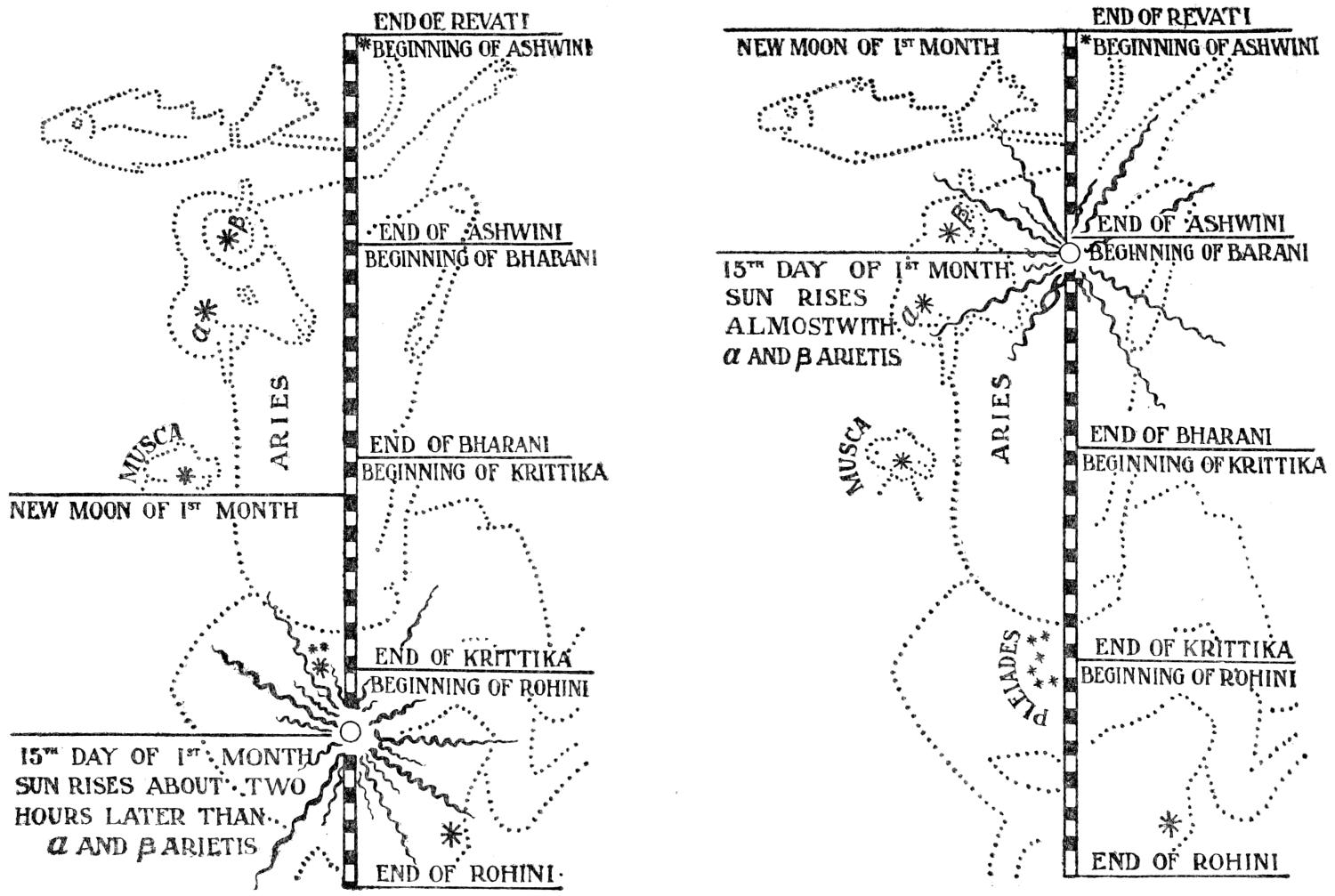
The Vedic Aswins and the Indian Calendar.
[To face p. 142.
It will be seen from the diagram that something more than two hours was the longest interval that, according to the presumed method of counting the Vedic year, elapsed between the appearance of α and β Arietis and of the sun above the horizon.
This astronomic interpretation accounts for the varying times noted in the hymns for the appearance of the Aswins. It also accounts, as it seems to me, for the general tone of the hymns, but as regards the long series of miraculous “protections” of the Aswins, accorded by them to many sick, aged, and decrepit personages, it does not at first sight account.
We have seen that Bergaigne and others have opined that the various miracles attributed to the Aswins are “anthropomorphized forms of solar phenomena,” and with this view the astronomic interpretation, when fully followed out to its logical end, agrees.
But at first sight we wonder how the sun at the beginning of the calendrical year could, in Vedic times, be described as in any way especially sick, aged, or decrepit.
3,000 B.C., when, as we have seen, the winter solstice was in Aquarius, the Indian calendrical and sidereal year, such as has been supposed, would have begun at its earliest a month and a half after the solstice.[78] The sun at the winter solstice, may be, and often is, described as pale, weak, sick and old; but at the beginning of a calendrical year, a month and a half after the solstice, the sun no longer could have been thought of as requiring the miraculous protection of the heralding Aswins.
To help in solving this difficulty, recourse may again wisely be had to Babylonian astronomic lore. The fanciful legends regarding the Aswins, considered only by themselves, can scarcely yield a sufficiently firm foundation on which to build the far-reaching theory I now desire to bring forward concerning them; a theory on all fours with one I ventured some years ago to propound in reference to Babylonian astronomy, in a Paper entitled the “Accadian Calendar.”[79] It was there suggested that the probable date for the origin of that Calendar was about 6,000 B.C. The fact was pointed out that Aries, in the most ancient Accadian and Babylonian astronomical works, always appears as leader of the signs and of the year, and stress was laid on the unlikelihood that this constellation should have been chosen for this leading post at a date when the sun’s entry into it did not correspond with any one of the four well-marked natural divisions of the year, i.e. the solstices or equinoxes. But as on the cuneiform tablets Aries appears as leader long before the time when the sun sojourned in that constellation during the first month following the equinox, it was suggested that it was when the solstitial not the equinoctial point coincided with the first degree of Aries, that the Accadian calendrical scheme had first been drawn up; namely about 6,000 B.C.
A corroboration of the view then put forward is to be drawn from a further study of the Accadian month names. The first three month names, in Accadian, referred, as scholars have pointed out, to the first three constellations of the Zodiac.
(1.) The month of the “sacrifice of righteousness” to Aries.
(2.) The month of the “propitious Bull” to Taurus.
(3.) The month of “the Twins” to Gemini.
The twelfth and thirteenth names in the same series seem to refer equally clearly to a year originally counted as beginning at the winter solstice. They are called respectively:
“12th. The month of sowing of seed.”—“13th. The dark month of sowing.”
For the sowing of most cereals, late autumn and early winter are the favoured seasons. Many crops however are sown in early spring. There might then be a doubt whether “the month of sowing of seed” more fitly described the spring sowing of seed in the twelfth month of a luni-solar year, counted from the equinox,—or the winter sowing of seed in the twelfth month of a luni-solar year, counted from the solstice. But when we find this twelfth month followed by a thirteenth, of which the especial and added epithet is dark, there can, as it seems to me, be little if any doubt that the winter month whose range in different years extended from 12th of December to 22nd January is better described by the epithet dark, than the rapidly brightening month whose range extended from 12th March to 22nd April.
Very curiously, then, and accurately does the Accadian calendar give us the date of its origin, and of the first naming of its months, as that when the winter solstice coincided with the sun’s entry into the first degree of the constellation Aries[80]—the date in round numbers of 6,000 B.C.
To this same date it is, as I believe, that the miraculous protections accorded by the Aswins to the distressed solstitial sun and moon and earth appear to point, and fully does this view corroborate the opinion that the Aswin-legends took their rise in pre-Vedic times. They also, as do the Indra and Vritra myths, refer us for their origin to a more northern latitude than tropical India. In the tropics the sun is scarcely less powerful in winter than in summer. The astronomers who drew up the Accadian calendar, and the myth-makers of the Aswin-legends, must, according to the astronomic theory, have dwelt in temperate zones and formulated calendar and myths about 6,000 B.C.
VI NOTES.—AHURA MAZDA, ETC.
[Ahura Mazda, a note reprinted from the Proceedings of the Society of Biblical Archæology, February 1900]
Professor Hommel in the March number for 1899 of these Proceedings calls attention in his Assyriological Notes to the name “Assara Mazas” appearing in a list of Assyrian gods. The section of the list in which this name appears contains “a number of foreign sounding names” belonging to gods honoured, presumably, in out-lying portions of the Assyrian dominions.
Professor Hommel claims “that this god (Assara Mazas) is no other than the Iranian Ahura Mazda,” and he thus concludes his arguments in favour of this opinion—“concerning Assara-mazas, I should like to remark in closing this paragraph, that we have here the same older pronunciation of Iranian words as in the Kassitic Surias, ‘sun’ (later Ahura and Hvarya, but comp. Sanscrit Asura and suria), which is of the highest importance for the history of the Aryan languages. In the same Kassitic period, between 1,700 and 1,200 B.C., I suppose was borrowed by the Assyrians the Iranian god Assara-mazas.”
In a Paper entitled The Median Calendar and the Constellation Taurus, printed in the June number for 1897 of these Proceedings, I made a very similar claim for the derivation of the name of the great god of the Assyrians—Assur.
The claim put forward was not based only on the resemblance in sound of “Assur” and “Ahura,” but was in the first place founded on the virtual identity of the emblems of Assur and Ahura Mazda. For the origin of these emblems (referring as it was suggested they did to the Zodiacal constellation Sagittarius) a date as high as 4,000 B.C. was, on astronomic grounds, assumed, and it was pointed out that at that date there was no evidence of the existence of the Assyrian nation as a nation, nor any trace of a Semitic worship of the god Assur; whereas, on the other hand, as early as 3,800 B.C. there is evidence that a powerful Aryan race—the Manda—rivalled the power, and threatened the Semitic rule of Sargon of Agane.
The opinion that the symbol of Ahura Mazda, and of Assur, was of ancient Aryan origin, naturally suggested the further thought that the name Assur, so closely resembling the earlier Indo-Iranian form Asura, of the Iranian Ahura, had, together with the emblem of the god, been borrowed from the Aryan ancestors of the Medo-Persians by the Semitic settlers who, early in the second millennium B.C., established themselves to the north of Babylonia. It may here be pointed out that no very certain Semitic derivation at present holds the field which the proposed Aryan derivation would occupy. According to some scholars it comes from a word signifying “a well-watered plain.” According to Professor Hommel, the name Assur is derived from a word which originally meant “the heavenly host.”
Professor Hommel, quoting as his authority the opinions of the Sanscrit scholar Oldenburg, and reinforcing Oldenburg’s opinions by arguments from other sources, further maintains the high probability of the Median god Ahura Mazda having been the representative of the Vedic Varuna, and also that Varuna was the moon.
Vedic scholars are divided in opinion as to what physical phenomenon is represented by Varuna. He is very generally supposed to personify “the vast extent of the encompassing sky,” some say especially the sky at night-time—others claim him as a solar divinity, whilst Oldenburg, as we have seen, supposes him to be the moon. It is not to the question, however, what phenomenon Varuna represented, but to that of the probability or improbability of his original identity with the Median Ahura Mazda, that I would now draw attention.
It is said that “the parallel in character, though not in name, of the god Varuna is Ahura Mazda, the Wise Spirit.” But a variety of considerations may lead us to entertain the possibility of a Vedic god other than Varuna being the parallel in character and in epithet of Ahura Mazda; a parallel which is also still more clearly to be recognized if we adopt the view, above contended for, of the identity of Assur, the archer god of Assyria, with Ahura Mazda.
The Vedic god Rudra is, like Varuna, an Asura or Spirit. He is described as “the wise,” and his votaries are encouraged to worship him “for a comprehensive and sound understanding.” But in one passage the epithet “asura maha,” so curiously recalling to our ears the name of the Avestan “Ahura Mazda,” is actually applied to him.[81] As a wise and great Asura, Rudra seems to be as close a parallel to Ahura Mazda as Varuna; the resemblance of epithet in the case of Rudra makes the parallelism closer.
Varuna indeed in Vedic estimation held a much higher and more commanding position than Rudra, but considering how opposed the Avestan was to Vedic mythology on important points, we ought not to expect that the god elevated by the Medians above all others should have held a very exalted place amongst the Brahmins of India.
But it is when we turn our thoughts not only to Ahura Mazda but to his Assyrian representative Assur, that the parallelism between him and Rudra becomes more marked.
Rudra is not only a wise and great Asura, he is above everything else celebrated in the Rig Veda as an archer. He has “the sure arrow, the strong bow.”[82] He is “the divine Rudra armed with the strong bow and fast flying arrows.”[83]
In the Paper already referred to, it was suggested that an astronomic observation of the equinoctial colure passing through the constellations Sagittarius and Taurus was the probable origin of Median and (as derived from Median) Assyrian symbolism concerning Ahura Mazda and Assur. This observation could, as was pointed out, only have been made at the date, in round numbers, of 4,000 B.C.
It is a very tempting enterprise to seek in the mythologies of European nations for allusions to this same astronomic observation—an observation made, as we may believe, when the ancestors of the Iranian and Indian Aryans, and possibly the ancestors of the European nations, were still, if not all dwelling together, at least within easy intellectual touch of each other.
In Grecian fable we have the Centaur (the Bull-killer) Chiron giving his name to the constellation Sagittarius, and in this fable we may, as it would seem, find a better astronomic explanation of the term Bull-killer than that usually given concerning the well-mounted Thessalian hunters of wild cattle. The constellation Sagittarius, an archer, half man, half horse, is not a figure of Grecian invention. It is to be met with depicted on Babylonian monuments, unmistakably the archer of our celestial sphere; and this constellation, when it rises in the east, always drives below the western horizon—i.e., mythically exterminates, the last stars of the constellation Taurus.
To Chiron, the chief Centaur, the epithet “wise” is especially given, and “he was renowned for his skill in hunting, medicine, music, gymnastics, and the art of prophecy”; of these not altogether congruous attributes Rudra the Vedic god possessed three of the most important. He was wise, he was an archer, and he was famed as “a chief physician among physicians.”[84] In a verse, part of which has been already quoted,[85] worshippers are exhorted to “Praise him who has the sure arrow, the strong bow, who presides over all sanitary drugs; worship Rudra for a comprehensive and sound understanding, adore the powerful divinity with prostrations.”
Apollo the far-darter, Artemis the goddess of the silver bow, also shared these same attributes, and Grecian legend would lead us to place them in the same part of the heavens as that allotted to Chiron—i.e., Sagittarius. Apollo prompted Artemis to aim a shaft from her bow at a point on the horizon, and this point was the head of the hunter Orion. Now the constellation Orion is exactly in opposition to the bow stars of Sagittarius; that the legend is astronomical is plainly to be inferred from its variant form, in which Artemis is represented as sending a Scorpion to sting Orion to death. The stars marking the Scorpion’s sting are in very close proximity to the bow stars of Sagittarius.
Returning to Indian myths, the name of Siva does not occur in the Rig Veda; but in later Sanscrit works Siva is the representative of Rudra. In a hymn to Siva,[86] the following passages occur, and it is difficult to read them and not be reminded of the sculptured figures of Artemis, crescent-crowned and leading a stag by the horns. (Allowance must be made, however, for the tendency in Hindu art to multiply the heads, arms, and features of their gods.)
“I worship the great Mahesa, who shines like ten million suns: who is adorned with triple eyes: who is crowned with the moon: who is armed with the trident, the bow, the mace, the discus, the goad, and the noose:
Who is the eternal Lord;
Who is bright as the snowy summit of Mount Kailáçe; whose matted hair is ablaze with the crescent moon;
.... ...
Whose hands hold the head of a deer and a battle-axe;
Whose forehead is adorned with the bright half-moon;
Whose fingers are interlaced to typify a deer;
.... ...”
For the explanation of the Roman myths of Dianus and Diana (varying forms as the dictionary tells of Janus and Jana) we may naturally seek for the same astronomic origin, as for those concerning the Grecian archer divinities.
Janus indeed has not, so far as I know, ever been represented as an archer or a Centaur. The attribute for which he is especially renowned is that of “opener of the year,” and this attribute, on the astronomic theory here proposed, would furnish the connecting link between the varying forms of the Italian deities above mentioned.
The many and still imperfectly understood changes that were made in the Roman year by successive rulers, have effaced the connexion of that year with the stars which must have originally presided over its opening. But Roman tradition embodied in Virgil’s lines speaks of “the bright Bull” who “with his gilded horns opens the year.”[87] The golden star-tipped horns of the Bull are as we know exactly opposed to the westernmost degrees of Sagittarius; and that constellation, in opposition to the sun, would therefore have marked the opening of just such a vernal year as that alluded to by Virgil. Whether this vernal year before the Julian reformation was still the calendrical year in Rome is, however, very doubtful.
Janus is represented with two heads, sometimes even with four, “to typify the seasons of the year.” The full moon in Sagittarius 4,000 B.C. marked the season of the spring equinox—the sun then being in conjunction with the stars marking the horn tips of the Bull. The new moon in Sagittarius at the same date marked the autumn equinox. The half waning moon in Sagittarius marked the season of the winter solstice: and the half moon of the crescent or waxing moon marked the season of the summer solstice. The four heads of Janus may thus have referred to the four seasons marked by the moon in Sagittarius.
The fact that the Indian archer Rudra (= Siva) and the Grecian archer Artemis, were represented as crowned by the half, not the full moon, would refer these myths to an Indo-Iranian, not to a somewhat later Iranian source. It was not to the reformed Iranian equinoctial year that they pointed, but to the sun’s triumph at the solstitial season. In the Roman Janus myth we may rather detect the later Median influence, and suppose that it referred to a year beginning with the full moon in Sagittarius, a year opening in the spring, when the sun was in conjunction with the “gilded horns” of “the bright Bull.”
All these mythological indications, derived from Median, Assyrian, Indian, and classical sources, though each of them looked at separately may not speak with much insistence, yet considered together seem to point us more and more clearly as we study them, to the fact that about 4,000 B.C. a very important and authoritative observation of the colures (amongst the Zodiacal constellations) was made, and that upon this observation much of the mythology of ancient nations was founded.
VII ANCIENT INDIAN ASTRONOMY
[Reprinted from the Proceedings of the Society of Biblical Archæology, February 1900]
It is only on Talmudic authority, I think, that astronomy can be denied a place, and indeed an important place, in researches connected with Biblical Archæology.
On Talmudic authority we are told that, as a protest against the sun-, moon-, and star-worship of surrounding nations, the Hebrews were not permitted to calculate in any way beforehand, or by scientific methods based on the movements of the heavenly bodies, their days, their months, or their years.
The end of the day and beginning of the night could only be definitely ascertained when three stars were visible to the observer. The moon must have shown its pale sickle to some watcher of the heavens, before the first of the month could be announced. The beginning of the year, we are also told, was dependent on the earliness or lateness of the agricultural season, for three ears of corn, in a sufficiently advanced state of growth, were to be presented to the priest and waved before the Lord on a fixed day of the first month of the year.
This is what some passages of the Talmud[88] seem to teach; but from Old Testament Scriptures, it is not possible to infer these calendrical restrictions with any degree of certainty. On the contrary, there is much in the Scriptures to lead us to an opposite conclusion.
On the very first page of the Bible we read of “the greater and the lesser lights,” and of “the stars also” set in the heavens, to be “for signs, and for seasons, and for days and years.” And scarcely have we turned this first page, when we meet the statement that “in process of time it came to pass, that Cain brought of the fruit of the ground an offering unto the Lord. And Abel, he also brought of the firstlings of his flock and of the fat thereof. And the Lord had respect unto Abel and to his offering.” In the margin the words “in process of time” are rendered “at the end of days.” In considering this passage we seem to be brought into touch with a definitely established year; and at once archæology and astronomy enter into the field of Biblical research, to tell us of a remotely old calendar—astronomic indications would date the origin of this calendar at about 6,000 B.C.—and from this calendar we learn that at “the end of days”—the end of the dark days of the year—there followed a month of “the sacrifice of righteousness”: a sacrifice, we may well suppose, of the firstlings of the flock, as the stars in conjunction with the sun during this first month were imagined by the institutors of the calendar under the form of a lamb or ram ready for sacrifice.
To this calendrical first month our attention is again drawn when we read, in the book of Exodus, of the institution at God’s command of the Hebrew festival, to be held on the 14th and 15th days of the month Abib.
This month Abib, it is generally assumed, is the equivalent of the month Nisan, spoken of in some of the later books of the Old Testament.
Astronomy and archæology again claim a hearing on this point. The month Nisan, the Semite equivalent of the Accadian month Bar zig-gar (the month of the “sacrifice of righteousness”), we may gather from the evidence of the cuneiform tablets, had been the first month of a calendrical year in Babylon for many centuries—for millenniums, perhaps—before the date of Moses; and therefore archæology would teach us that the children of Israel were being recalled, from strange Egyptian modes of reckoning, to the observance of an ancient and patriarchal year and festival, when they were told that for them Abib was to be the first month of the year, and that on the 14th of that month, “a night to be much observed,” they were to sacrifice of the firstlings of their flock, and were to hold the great festival of the Passover on the fifteenth day.
If “Abib,” “Nisan,” and “Bar zig-gar” are names used by various nations to designate one and the same month, Abib could not have been, as has very generally been supposed, a month varying according to the uncertain ripening of agricultural crops, and one taking its name from the ears of corn presented to the priest, and waved before the Lord on some fixed day of that month; but rather it must have been (as we know, from Babylonian sources that Nisan was) a well calculated soli-lunar and sidereal month. Now, if we adopt this view, we must find some alternative derivation for the month name Abib. Nor is it by any means difficult so to do.
On the fourteenth night of the first month—Bar zig-gar, Nisan, or Abib—“a night to be much observed,” or rather, according to the marginal reading, “a night of observations”—the bright star Spica, which marks the ears of corn in the Virgin’s hand, rose above the eastern horizon as the sun set in the west, and at midnight must have shone down brilliantly on the Hebrew hosts; for Spica is so bright a star, that even the beams of the full moon riding close at hand could not have obscured its lustre.
The Indians of to-day name their months from the stars in their lunar Zodiac which are in opposition to, not from those in conjunction with, the sun. The close resemblance of the Arab and Indian lunar Zodiacal series suggests the thought that the Arabs may have followed the same system of month nomenclature as the Indians; and if this were the case it would furnish a reason why Moses, who had so lately returned from his forty years’ sojourn in Arabia, should—in recalling the Hebrews to the observance of such a year as that which was presumably followed by their forefathers Abraham, Isaac, and Jacob—have yet spoken of the first month of the year according to a non-Babylonian method of nomenclature, and should have called it Abib, after the star in opposition to the sun.
If now we adopt the opinion that an astronomic method of counting the year did in reality obtain amongst the Hebrews, a great difficulty must present itself to our minds in regard to the generally accepted theory that only on a fixed day of the first month of the year might the first reaped handful of corn be waved before the Lord.
The seasons in Palestine are not more punctual than in other countries. To restrict a husbandman to a fixed day of a year (even such a year as ours) before which he might not begin to put his sickle into the corn, would be felt as a hurtful and arbitrary regulation; but to restrict the husbandman to a fixed day in a luni-solar year would be a still more hurtful regulation. The beginning of a soli-lunar year may vary to the extent of a whole month. A late beginning of such a year might coincide with a very early agricultural season, and vice versa an early calendrical year might occur in a late agricultural season.
Considerations of this nature may incline us to inquire carefully whether the “generally accepted theory” (concerning the waving of the ears of corn before the Lord during the Passover week) rests upon Scriptural authority or on Talmudic and traditional teaching. As against an almost unbroken array of commentators, it is possible in this connexion to quote from the work of a learned Hebrew scholar a clearly expressed opinion that from the Scriptures themselves, it is not possible to infer directly a connexion in date between the waving of the first fruits and the Passover festival.[89]
But if our enquiries should lead us to accept, as at least a probability, the existence in Mosaic times of an astronomically counted Hebrew year, and if this admission should require us to change long-held opinions regarding the right observance of Hebrew festivals, on the other hand, the fact that we might then trace Arabian rather than Babylonian influence in the name of Abib would have its weight on the conservative side of the controversy concerning the post or pre-exilic date of the books of Exodus and Deuteronomy.
The fact that in India the months are named after the stars in opposition to the sun suggested the above proposed explanations of the Hebrew month name Abib as that of the month when the sun was in conjunction with the constellation Aries, and in opposition to the star Spica, marking the Zodiacal ears of corn. But there is a further point of connexion to be observed between Indian astronomy and Biblical archæology, namely, that the first month of the Indian year is at the present date the month during which the sun is in conjunction with the constellation Aries. This month is called Chaitra, which is the Sanscrit name of the star Spica, and it is in fact the same sidereally marked month, which, according to the opinions here advocated, was the first month of the ancient Accadian, Babylonian, and Hebrew years.
It must, therefore, be a question of interest to Biblical students to determine, if possible, whether this Indian first month has only so been counted (as some scholars tell us) since about 570 A.D., or whether it has so been counted from the same remote time as was the Accadian month Bar zig-gar, that is, possibly, from about 6,000 B.C.
This question as to the month Chaitra forms part only of a larger controversy which has been long waged, concerning the antiquity, or otherwise, of the whole science of astronomy in India.
To this larger controversy I have drawn attention in my Paper, Astronomy in the Rig Veda, read before the Congress of Orientalists assembled at Rome in 1899. In that Paper, arguments are put forward in support of the opinion that the Vedic bards possessed an acquaintance with the science of astronomy, and that much of the imagery of the hymns bore reference to the constellations of the Zodiac. For the gods Indra, Soma, Agni, and the Aswins, astronomic interpretations are proposed; and finally the question, which as it seems to me is one specially deserving the attention of the Society of Biblical Archæology—the question of the position of the month Chaitra as first month of the Indian year in Vedic and pre-Vedic times is discussed, and the claim that it was, and throughout remote ages had ever been, virtually the same month as the Accadian Bar zig-gar is insisted upon.
Pursuing further the controversy concerning the antiquity of astronomy amongst the Aryan races, in the note on “Ahura Mazda” (p. 152), I proposed an identification of the Vedic Rudra with the Median god—the god who presided over the Median equinoctial year, marked by observation of the full moon in the constellation Sagittarius.
Continuing then our enquiries into the astronomic myths of ancient India, let us turn our attention to the sons of Rudra—the Maruts. They are a group of gods very prominent among Vedic deities, and it is to be noted that Rudra is oftener alluded to in the Rig Veda as the father of the Maruts than in almost any other capacity. Now the Maruts—the stormy troop of Maruts—are celebrated as the companions and friends of Indra. They are “associated with him in innumerable passages.” Here, at first sight, it might seem that the proposed astronomical identification of Indra and Rudra as solstitial and equinoctial personifications must break down; for how should the sons of the equinoctial Rudra always appear as the devoted companions of the solstitial Indra?
On further examination, however, a very interesting explanation of this difficulty presents itself. From a hymn (quoted at p. 157) to Siva, the Hindu representative of the Vedic Rudra, we learn that the crescent half-moon blazes on the forehead of Siva. Now the crescent half-moon, in the western degrees of the constellation Sagittarius, would, 4,500 B.C., have marked the month of the summer solstice; for the moon, in its “first quarter” in the first degrees of Sagittarius, must attain to “full moon” seven days later, either in the constellation Aquarius or Pisces, and the full moon in one or other of those two constellations marked the season of the summer solstice somewhat earlier than 4,000 B.C. The Maruts are often spoken of in the Veda as a troop, seven in number, or as seven troops of seven, or as three times seven in number. The astronomical thought therefore suggests itself, that the seven Maruts represent the seven days that elapsed between the crescent half-moon, blazing on the brow of Rudra, and the full moon of the summer solstice, or Soma pavamana—Soma purified in the celestial waters (see Plate XIII.). And this explanation of the Maruts does not contradict, but rather agrees with and includes the usual non-astronomic explanations held regarding them, namely, that they are storm winds; for we know that the days which accompany the setting in of the solstitial rainy season in India are the days in which the fierce tropical hurricanes or monsoons prevail.
PLATE XIII.
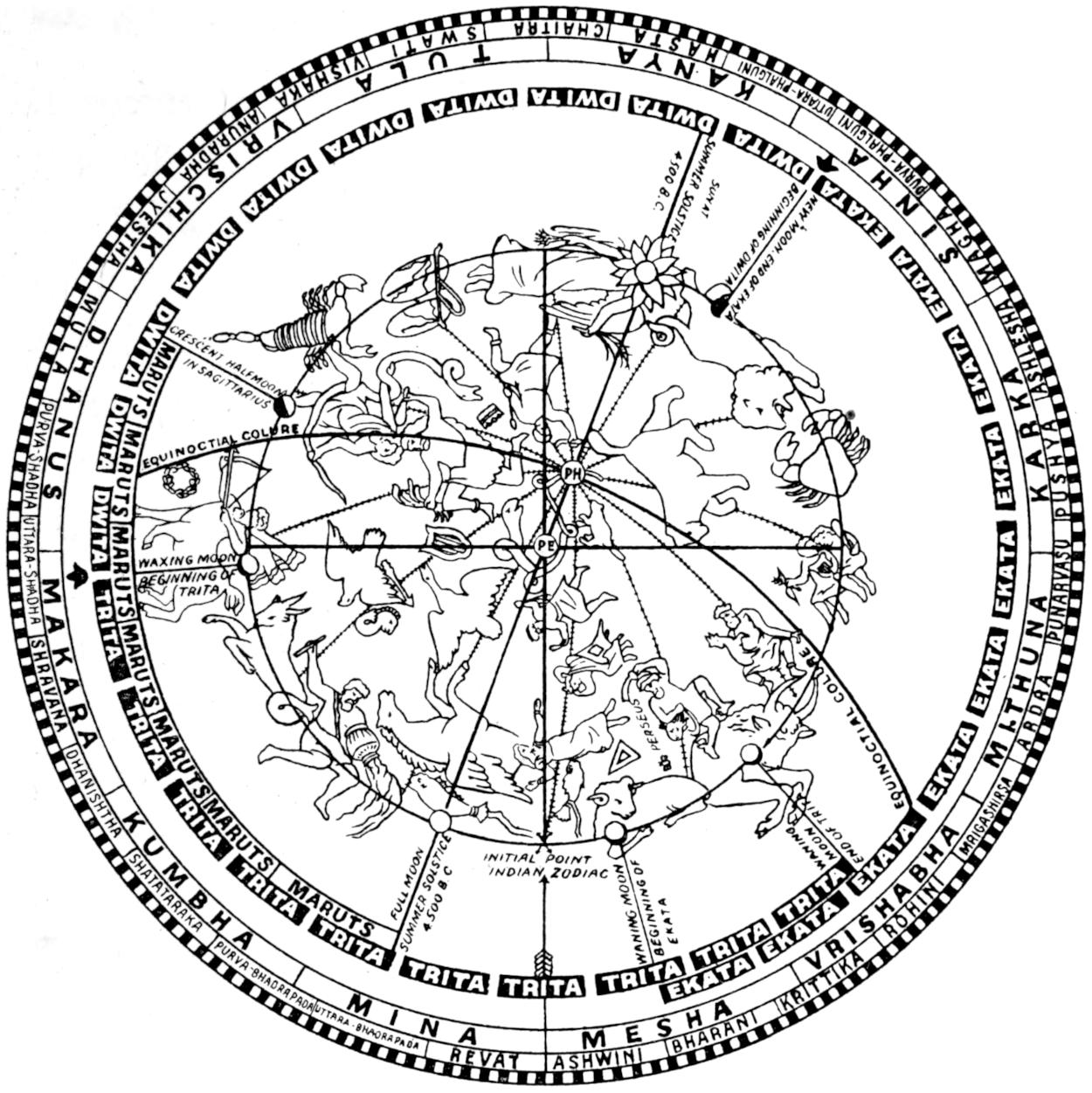
Outer circle divided into 360 degrees.
2nd circle. The names and extent of the twenty-seven Indian “Nakshatras” or divisions of the Lunar Zodiac.
3rd circle. Names and extent of the twelve Indian “Rashis” or divisions of the Solar Zodiac.
4th circle. Proposed three-fold division of the Vedic Lunar Month at Season of Summer Solstice.
Section of 5th circle. Proposed identification of “Maruts” with Moon’s course through seven “Nakshatras” at Season of Summer Solstice.
The Constellations here appear as drawn on the celestial globe; they have not been reversed as in the other illustrations, hence an apparent, though not real, contradiction ensues.
[To face p. 174.
Now let us turn from the Maruts to another, as it seems to me, lunar and solstitial myth, namely, that of Trita Aptya.
Trita Aptya is a friend of the Maruts, and is said to have appeared on the same car with them. He is constantly, in the hymns, associated with Indra, and feats recorded in one passage as performed by Indra, are in another passage of the same hymn attributed to Trita.
Trita is also often spoken of together with Soma; and in the ninth Maṇḍala, again and again we read of the ten “maidens, or fingers,” of Trita preparing the Soma juice for Indra.
All these attributes of Trita, and others to be mentioned later, are easily explainable on the astronomic theory already propounded in the identifications of Indra, of Soma, and of the Maruts.
In the name Trita there is certainly a suggestion of the number three, and Macdonell, in his Vedic Mythology,[90] brings proof to show “that it was felt to have the meaning of the third”—that is, in order of sequence.
But though the third, in this sense, does not actually carry with it the meaning of third of a whole; yet, to any one in search of an astronomical explanation of the Trita myth, the reiterated mention of the ten fingers of Trita quickly suggests the thought of a whole divided into three chief parts, each part containing ten lesser divisions—a whole therefore of thirty parts.
Now the lunar month—in reality consisting of twenty-nine and a half solar days (with some fractions over)—is in Hindu calendrical usage divided into thirty equal portions of time called “tithis,” which are considered as lunar days; and here, as it would seem, we arrive at the physical basis of the Trita myth. Trita Aptya, or Trita in the waters (or of the waters), appears as the third part of the lunar month—the part during which the moon is to be seen in the celestial waters; and as Trita is so closely connected with Indra and Soma pavamana, that third part must have been the ten lunar days (five before and five after “the full”) during which the moon is at its brightest, and in the constellation Aquarius.
If we think of Trita Aptya as a personification of the triumphant third of the moon’s course through the constellations of the Zodiac at the season of the summer solstice (see Plate XIII.), and if we remember that the moon during the ten lunar days contained in that “third” came to its full in Aquarius or in Pisces, sometimes indeed at the juncture of these constellations, we shall be able to understand much of the figurative language of the Veda, which associates Trita with the stormy Maruts, with the victories of Indra over Vritra, and with the effulgence of Soma pavamana.
There is a legend concerning Trita not related but alluded to in the Rig Veda. This legend tells us that Trita was one of three brothers (Ekata, Dvita, and Trita), and that he was pushed into a well by his brothers, and over the mouth of the well a circular covering was placed with intent to keep Trita down and drown him. But through the circular covering the ever-triumphant Trita burst. Here there can be little doubt is a mythic description of the temporary disaster of eclipse overtaking the full moon of the summer solstice in the celestial waters of Aquarius or Pisces. The circular covering can be nothing else than the circular shadow of the earth covering the disc of the full moon, and Trita’s triumph may well remind us of the serene victoriousness of the moon when it has emerged from eclipse and rides unharmed along the sky.
In the Zend Avesta Thrita corresponds in many points with the Vedic Trita. Thraetona also represents Trita under some of his other aspects, and mention is made of Thraetona’s “two brothers who seek to slay him on the way.”[91] From these facts it may be inferred that the Trita myth is pre-Vedic. We need not, therefore, be surprised to find traces of it in European mythologies. The name of Trita, with only a change of termination, appears as the Greek Triton, and we may guess at an allusion in the sculptured forms of Greek and Roman Tritons—half men and half fish—to the two watery constellations, Aquarius and Pisces, in which the Vedic Trita Aptya (son of waters) made his abode. The Roman rendering of these composite figures, especially, may recall to our minds the Zodiacal basis of the myth—the two fish of Pisces appearing in Italian art, as the two fish-tails which terminate the human-headed figure of the Triton. Again Hecate, as has been pointed out by scholars, bears a close resemblance in name to Ekata. Hecate was a lunar divinity; she was worshipped and sacrificed to at the close of the month. We may therefore suppose she represented the waning moon. She is further said to have been the daughter of Perseus and Asteria. Looking at the figures of the celestial sphere (see Plate), we may trace the third part of the moon’s course—the ten days of its waning appropriated to Ekata—and observe how this portion of its course began close to the constellation Perseus. Thus the Sanscrit Trita myth may explain the name and parentage of the Grecian Hecate.[92]
A study of ancient European calendars may, on the other hand, eke out our knowledge concerning the astronomic scheme in which Trita and his brothers played such important parts. We read that in the Attic year “each month was divided into three decades,” and the statement may confirm us in the opinion that, following an almost too mathematically imagined calendrical method, the ancestors of the Aryan race in remote ages counted their months, not as containing twenty-nine-and-a-half solar days, but as a portion of time containing three great equal divisions, the first, the second, and the third—Ekata, Dvita, Trita—each of these three parts being again subdivided into ten equal tithis. If this should have been the case, it would be interesting to note that the Greeks (and the Romans also, as shown by their cumbrous system of Kalends, Nones, and Ides) retained the plan of a threefold division of the months, but lost the originally concomitant arrangement of the ten equal divisions of each part into tithis, whence much difficulty ensued for Greeks and Romans alike in counting lunar months of alternately thirty and twenty-nine days. Indian astronomers, on the other hand, who retain the accurate and elaborate division of the month into equal tithis, must have long ago lost the thought of its originally threefold partition, for the Indians count each month as composed not of three periods of time, but of a light and a dark half.[93]
To one more lunar Vedic personage let us direct our attention: namely, to Atri—Atri who, unlike the conquering and ever-victorious Trita, is chiefly celebrated for his misfortunes. Agni, Indra, and especially the Aswins, moved by his misfortunes, come to the help of Atri, and by means of a hundred acts, a hundred devices, they extricate him from captivity, whether from a dark cavern or from a burning chasm. They make the time of his captivity even pleasant to him, giving him refreshing drink.
One of our own poets may help us to understand the Vedic metaphor of Atri’s darksome cave. In the Samson Agonistes of Milton, the hero, describing his blindness, says—
“The sun to me is dark And silent as the moon When she deserts the night, Hid in her vacant interlunar cave.”
Atri is, I believe, a personification of the New Moon, and thus we may understand how he is sometimes described as hidden in a dark cave, while at other times he is spoken of as in a fiery chasm, when the uppermost thought in the Vedic poet’s mind is the close conjunction of the moon at that time with the burning sun. From his dark cave, or burning chasm, Atri is delivered by the “hundred acts” of worship and sacrifice which it was the custom in India, as in many other countries, to offer up at the time of New Moon, especially at the marked festivals of the winter and summer solstice, or the beginning of the calendrical year. On one occasion[94] we hear of Atri coming to the assistance of the sun, which had been hidden by the demon Swarbhānu. This darkening of the sun is generally understood to refer to a solar eclipse. A solar eclipse can only take place at the time of new moon. It is a little puzzling to find Atri, if Atri personifies the new moon, saving the sun from eclipse instead of being the cause of the disaster; but as in the Rig Veda Atri always appears as a friend, not an enemy, of the gods of light—Agni, Indra, and the Aswins—we may suppose that the Vedic bard chose to represent him as being present at, rather than causing the sun’s eclipse. It may also be that a certain number of divisions of lunar time were considered as personified by Atri, and that an eclipse terminated in the third or fourth of those divisions; so that it could be said that Atri “by his fourth sacred prayer” discovered the sun. The passage is no doubt a difficult one; still the fact that Atri was present at the eclipse of the sun seems to tell rather in favour of than against the supposition that Atri was a personification of the time of new moon.
The four astronomical interpretations here proposed for Rudra, the Maruts, Trita Aptya, and Atri, are all harmonious with and supplemental to the four discussed in my Paper read at Rome, and entitled Astronomy in the Rig Veda. They must to a great extent all stand or fall together. They have been very briefly stated, but if indeed an astronomic basis does, as suggested, underlie Vedic imagery, Sanscrit scholars, with the science of etymology at their command, will easily be able to follow up and pronounce upon the value of the clues here hazarded.
VIII THE CHINESE CALENDAR, WITH SOME REMARKS WITH REFERENCE TO THAT OF THE CHALDEANS
[Reprinted from the Proceedings of the Society of Biblical Archæology, December 1901]
The Chinese Lunar Zodiac is divided into 28 star groups named Siou. Gustav Schlegel in his Uranographie Chinoise having enumerated these 28 siou—or as he translates that term, “domiciles”—says: “La première chose qui nous frappe en voyant la liste des 28 domiciles, c’est qu’elle commence par le domicile Kio, ou la Vierge, preuve positive que c’était avec ce domicile que l’année a dû commencer primitivement,”[95] and further on he quotes from “le Eul-ya cette antique dictionnaire,” as follows: “L’Ancien des constellations, c’est Kio et Kang ... ils sont les chefs des domiciles, et à cause de cela on les nomme l’ancien des constellations: et ‘le signe d’Ancien des constellations’ est exactement les domiciles Kio et Kang.”[96] Schlegel adds: “Ce nom de Ancien des constellations répond exactement à celui de Princeps Signorum que les astrologues romains donnerent au bélier; à l’époque où cette constellation était signe de l’équinoxe du printemps. C’est-à-dire que le signe qui annonçait le commencement de l’année était le premier, le Princeps signorum, l’Ancien, le Chef, des constellations. Mais ces étoiles de la Vierge portent encore d’autres noms qui tous out rapport au fait astronomique que l’astérisme Kio ouvrait l’année. Le ‘Sing-king’ les nomme les Chefs des quatre régions, les Légions célestes.... Elles président aux métamorphoses de la création: elles sont traversées par l’écliptique et les sept clartés (7 planets) commencent (leur révolution) par elles.”
The concluding words from the Sing-king which I have marked in italics—giving as they do the opinions held by ancient Chinese writers respecting the first divisions of their Lunar Zodiac—may remind us of the opinions held by Indian astronomers as to their first division of the Zodiac.
In Whitney’s comments on the Sûrya Siddhânta he observes:—“The initial point of the fixed Hindu sphere, from which longitudes are reckoned, and at which the planetary motions are held by all schools of Hindu astronomy to have commenced at the creation, is the end of the asterism Revatî, or the beginning of Açvinî.”[97]
It is impossible to read of these two traditions concerning the initial point of the Chinese and of the Hindu ecliptic series of constellations, without suspecting some underlying cause common to both traditions.
The Chinese and Hindu initial points are diametrically opposite to each other on the ecliptic. Calendrically speaking, such opposite points may be taken to mark the same season and the same month—as for instance, in the old Accadian calendar the month names referred to the stars in conjunction with the sun. The month of the sacrifice of righteousness corresponded to the month during which the sun was in conjunction with the sacrificial Ram. This same month counted (theoretically) from the arrival of the sun at the end of Revati and beginning of Aswinī—the initial point of the Indian Zodiac—is in India called, after the star group in opposition, Chaitra.
Spica (α Virginis) is the chief star of the Nakshatra Chaitra, and Spica also is the chief star of the Chinese siou Kio, “l’astérisme,” which, according to the tradition above recorded, “ouvrait l’année,” and which (together with the neighbouring “siou Kang), président aux métamorphoses de la création,” “sont traversées par l’écliptique, et les sept clartés commencent leur révolution par elles.”
To any interested in the history of the Chinese calendar, or rather to any interested in the history of the human race, the question as to the reason for the choice of this point and for the equal honour in which it was held (as we have seen) by the Accadian, the Hindu, and the Chinese nations, is a question worthy of close attention.
In former Papers contributed to these Proceedings, I have drawn attention to the many indications in ancient cuneiform and Indian literature, which seem to point to the conclusion that about 6,000 B.C., in some part of Asia and in a latitude probably as far north as 40 degrees, a calendar was instituted by “some ancient race of men,” that this calendar dealt with a year beginning at the season of the winter solstice, and that the stars which at that date were chosen to mark the solstitial year were those in the first degrees of the constellation Aries in conjunction with—and the bright star Spica in opposition to—the sun. I suggested that the Accadians and later Babylonians, as also the Aryans of India, continued to follow as star-marks for their years the constellations chosen by the institutors of this ancient calendar, and that therefore in the course of ages the beginning of the years of these peoples moved gradually away from the season of the winter solstice, approaching always nearer to the vernal equinox, close to which point we find it “bound” at the time of the fall of the Babylonian power; while in India, where the star-mark Spica is still followed, the year now begins about twenty days after the spring equinox.
Indications in Mesopotamian and Indian literature have seemed to me to point to the above conclusions. The opposed view, held by most writers on the subject, is that only at the late date (about the beginning of our era) when the stars of Aries in conjunction, and the star of Spica in opposition, marked the equinoctial season, were they adopted as marks for the beginning of the year by Babylonians and Hindus respectively.
I think that the position held by the star Spica in Chinese ancient astronomical tradition may be claimed as telling strongly in favour of an originally solstitial as opposed to an originally equinoctial beginning of the sidereal years of the Accadian, Hindu, and Chinese nations, for never has the claim been made that the Chinese years were counted from the vernal equinox; but on the contrary the opinion has been very generally held and expressed by Chinese scholars that at some remote date the new year’s festival was held in China at the season of the winter solstice.
Gustav Schlegel, one of the latest writers on the subject of Chinese astronomy, though he admits that, “selon l’opinion générale l’année chinoise commence toujours avec le solstice d’hiver,” has put forward a view entirely opposed to this generally held opinion: according to his theory, the Chinese have from the most remote times counted their years, as they count them at present—i.e., from the new moon nearest to the season mid-way between the winter solstice and the spring equinox: and as he is convinced—as we have seen—that the beginning of the Chinese year was originally marked by the asterism Kio, he demands as the lowest possible date for this origin of the Chinese calendar, that of 16,916 B.C., when the constellation Kio marked, by its heliacal rising, the mid-season between solstice and equinox.
Schlegel brings forward many learned and ingenious arguments drawn from Chinese literature to support this theory. It would be impossible at second hand, and in a small space, to state fairly his arguments with a view to rebutting them. His volumes are full of valuable information concerning the “Uranographie Chinoise,” but it has not seemed to me when reading and re-reading his work, that the grounds on which he relies are sufficiently established to support the high claims to antiquity which he puts forward for the origin of the modern Chinese method of counting the year from the mid-season between solstice and equinox.