THE NORWEGIANS IN SCOTLAND.
Reading edition
Section I.
Nature of Scotland.—The Highlands and Lowlands.—Population.—Original
Inhabitants.
None of the seas of Europe are so rough and stormy as that which washes its northern and north-western coasts. Even in Jutland the effects of the cold north-west wind which sweeps down from the icy sea between Norway, Iceland, and Scotland, are severely felt. Along its west coast, for a distance of several miles inland, there are no woods, but only low stunted oak bushes, which in many places scarcely rise above the tall heather. Still farther eastward, and even in Funen and Zealand, which the north-west wind does not reach till it has passed over considerable tracts of land, it has such an influence on the woods, that in their western outskirts the trees are bent, and as it were scorched or blighted at the top. The North Sea, whose surges, breaking on the coast of Jutland, are heard even in calm weather far in the interior, rises to a fearful height during a storm. It would long since have washed over Jutland, and perhaps the whole of Denmark, if Nature had not placed sand-banks or shoals along the coast, as a sort of bulwark, against which the highest waves break harmlessly.
The North Sea is, however, an enclosed one, and little more than a bay of the Atlantic. Its swell is not so great, nor its storms so violent, as those of the open sea beyond, towards the north and west; where the Atlantic breaks on one side against Greenland and North America, and on the other against Norway, Scotland, and Ireland. The sand-banks and shoals which form a sufficient defence for Jutland against the North Sea, would there scarcely be able to resist the open and agitated ocean. On the extreme north-western coasts of Europe, the Atlantic has completely washed away the earth and sand; the bare cliffs, which often rise to a considerable height, alone remain, and still defy the fury of the waves. These rocky coasts, with their numerous towering and ragged crags, with their many and deeply-indented fiords, convey an idea of the power and greatness of the sea as striking as it is true. Everywhere outside lie rocky islands, which, like outposts, stop the advancing waves, and only allow them, if with increased speed, yet with diminished power, to approach the land through narrow channels, or sounds. During violent storms some of the islands are flooded by the sea, which, as it rolls forwards, strives to overtop the cliffs; whence it glides back, again to repeat the same vain attempt. The firm, rocky, isle-bound coasts of Norway, Scotland, and Ireland, are evidently for Europe what the sand-banks and shoals of Jutland are for Denmark.
It is natural, therefore, that those countries which in the north-westernmost part of Europe lie farthest out towards the Atlantic Ocean—such as the Scandinavian Peninsula, Scotland, Ireland, and part of England—should have their highest and wildest mountains and cliffs towards the west, and in the neighbourhood of the sea. This is more clearly seen the farther we proceed northwards: namely, in the Scandinavian Peninsula and in Scotland.
In Norway the rocks often rise almost perpendicularly out of the sea. In the neighbourhood of the coast they reach a considerable height, and then sink gradually towards the east, until they lose themselves in the broad and comparatively low valleys of Sweden. Whole rows of islands lie scattered along the west coast of Norway, round which the sea often whirls in impetuous eddies. On the coast itself, where the land is most exposed to the bleak sea winds, such extensive forests are not to be seen as in the interior of the country; nor do any fertilizing streams wind their way through the short and narrow valleys. It is only here and there that the water from the rocky springs or melted snows, leaps, after a short course, over the edge of the cliff into the open sea, or into the deep fiords with which the coasts are everywhere indented. The greatest rivers in Norway take a more eastern course, and often make their way from the Norwegian highlands through the richly-wooded lowlands of Sweden to the Baltic. In Sweden the coasts are neither so steep nor so indented as in Norway. The waves of the enclosed and comparatively quiet Baltic do not require to be resisted like those of the Atlantic Ocean.
Very similar features are found in Scotland. The whole of the northern and western coast lying towards the Atlantic is wild and rocky, with numerous islands, deep firths, and steep shores; behind which, rock towers upon rock, as if to form an impenetrable barrier against the sea. The country is almost without forests, the streams and the valleys are of small extent, and fertility consequently very limited. But by degrees the rocks sink down towards the south-east and east, till they terminate in the broad, well-watered, and fertile coast districts along the North Sea; which, on account of their inconsiderable elevation, are called the Lowlands of Scotland. Thus the Highlands answer very nearly to Norway, and the Lowlands to Sweden. But as the Scandinavian Peninsula is larger than Scotland, so also are its natural features on the whole on a grander scale. The rocks of Norway are mountains of primitive granite, which in some places rise to a height of 8000 feet, and of which large ranges are covered with eternal snow and ice. Scotland, on the contrary, has transition rocks, whose highest peak, Ben Nevis, which is only somewhat more than 4300 feet above the sea, is not even always covered with snow. Nor can the Scottish Lowlands be compared as to extent to the Swedish valleys, with their immense forests and their large rivers and lakes. Nevertheless the natural features of Scotland are in their way no less beautiful than those of the Scandinavian Peninsula. The sea, which indents the coasts on all sides; the well-cultivated, and partly also well-wooded plains, which, particularly towards the mountain districts, undulate in hill and dale; and lastly the Highland itself, with its many streams, waterfalls, firths, and lakes, afford the richest and most magnificent variety. To these features may be added a milder climate, and in the Lowlands a far richer fertility, than in Norway and Sweden; which have considerably contributed to give the landscapes of Scotland, even in the wildest districts of the Highlands, a somewhat softer tinge than is found in the high Scandinavian North.
A very marked difference exists between the Scottish Highlands and Lowlands, not only with regard to the nature of the country, but also to the original descent and the characteristics of the present population. The Lowlands, which are the seat of a highly-developed agricultural, domestic, and manufacturing industry, are inhabited by a strong and laborious people, speaking a peculiar dialect of the English language, and descended partly from the Celtic Scots, but more particularly from immigrant Anglo-Saxons, Danes, Norwegians, Normans, and Flemings. Commerce and trade, carried on by means of canals, railways, steamships, and similar easy means of communication, thrive vigorously in large and wealthy cities.
The Highlands, on the contrary, which only a century ago were almost inaccessible from the land side, have scarcely a large town. Rocks and heaths are found instead of the fruitful fields of the Lowlands. With the exception of a few districts farthest towards the north-east, where the soil is more fertile, there are only seen in the valleys, along the firths, and by the sea, small fields of barley and oats, which would not yield the most scanty subsistence to the poor inhabitants if the rocks did not afford pasture for cattle and numerous flocks of sheep; and if the sea, the firths, which abound with fish, as well as the rivers and lakes, did not contribute some part of their riches. The hardy Highland Scots, a great part of whom do not understand, or at all events do not speak English, but still commonly use the Celtic or Gaelic tongue, live here thinly scattered in poor and low peat cabins, which it is often difficult to distinguish from the surrounding rocks. The Highlanders in the districts farthest towards the west and north have preserved their language and other national characteristics purest; for farther towards the Lowlands, a more modern civilization has gradually forced its way forwards, in spite of the mountains. The old warlike dress which formerly distinguished the Highlander, particularly so long as clanship was in full vigour, has, since the annihilation of that system, become every day more rare. The kilt, or short skirt, has almost entirely given place to more modern clothing; the tartan plaid alone is still seen wrapped in the old fashion round the shoulders of the Highlander.
In our days the various tribes of the Highland and Lowland populations live in peaceful union under one and the same government. But during several centuries Scotland was the theatre of the most sanguinary contests between the Celtic Highlanders and the Teutonic Lowlanders. The former, who were animated with an inveterate hatred of the Lowlanders, continually made hostile incursions into the Lowlands, and, after burning and ravaging the country, retired with cattle and other booty to their mountains, whither they knew well the Lowlanders durst not follow them. The exasperation and hatred of the Highlanders were not entirely without foundation. In ancient times they had been sole masters in Scotland, from the Cheviot Hills to the Orkneys and the Shetland Isles, and from the Atlantic Ocean to the North Sea; and they had retained this mastery even long after their kinsmen, the Britons in England, had been compelled to yield to the Romans and Anglo-Saxons.
The celebrated Roman commander, Agricola, had, it is true, in the first century after the birth of Christ, made his way so far into the Lowlands that, as a defence against the Highlanders—the much-dreaded Caledonians, or Picts—he constructed a wall with a deep ditch before it, from the Firth of Forth to that of Clyde, in the low tract through which the Glasgow Canal has since been conducted. The Romans even extended their conquests farther northwards, as far as Burghead on the Moray Firth, to which place they formed regular high roads. But they were not able to defend themselves against the persevering attacks of the Caledonians, or Picts, and were soon obliged to retreat to the south of the Cheviot Hills; where the great wall, with its many towers and deep ditches, which they had built from the Solway Firth to the River Tyne, became their chief defence against the harassing inroads of the Highland warriors. But this wall also was surmounted by the Picts, whose courage and daring increased in proportion as the power of the Romans, both at home and abroad, was rapidly waning. At last the Picts destroyed the wall, and after the fall of the Roman dominion, made incursions into England, where neither the descendants of the Romans, nor the Britons, found any means to repel them. It was not till the Anglo-Saxon conquest of England that the Picts were again compelled to fly towards the north over the Cheviot Hills, where they found sufficient employment in defending their own homes.
For, whilst they were spreading themselves over the rich plains of the north of England, a foreign, though nearly related, Celtic people, the Scots from Ireland, had taken possession of their south-western frontier districts. Hence they spread themselves to such a degree over the Lowlands that both these and the Highlands, though the latter were almost entirely independent of the Scottish sovereigns, were called by one name, Scotland. After many battles the older Pictish inhabitants were, about the year 900, entirely amalgamated with the Scots in the Lowlands. Meanwhile a storm had gathered which threatened no less danger to the Scots in the Lowlands, than to their kinsmen, the Picts, in the Highlands. The dominion of the Celts, which had long before ceased in other and more accessible lands, was no longer to find a sure place of refuge even in Scotland, though its coasts were protected by the stormy Northern Sea, and its interior filled with rocks and warlike men.
Section II.
The Anglo-Saxons.—The Danes and Norwegians.—Effects of their
Expeditions.
The same want of unity and the same internal disputes which had brought ruin on the Celts in other places, prepared the way for foreign conquerors in Scotland. An indomitable fate decreed that the newer and higher civilization of Christianity should here, as in the rest of Europe, be founded and promoted by a Teutonic people. But though the Anglo-Saxons had conquered almost all England, they were not able, by their own power, to subdue the Celts in Scotland. The Anglo-Saxon kings undertook, indeed, several expeditions against that country, in which they were at times pretty successful; but they were not able to hold steady possession even of the Lowlands. Subsequently, however, the Anglo-Saxons wandered by degrees, and in a more peaceful manner, from the northernmost parts of England over the Scottish border, and established themselves both in the towns and in the rural districts. The number of these emigrants appears to have increased very considerably after the conquests of the Danes and Norwegians in the midland and northern districts of England in the ninth and tenth centuries, when a great part of the Anglo-Saxons were driven from their old dwellings, and obliged to fly towards the north. Saxon institutions may even have been introduced into the Lowlands in the tenth and eleventh centuries, after an expedition of the Anglo-Saxon king Edgar. But the rocky highlands of the interior constantly defied all conquest; and the northern and western coasts, together with the surrounding islands, could be subdued only by considerable fleets, which the Anglo-Saxons did not possess.
But what in this respect the Anglo-Saxons were obliged to leave undone, was for the most part accomplished by the warlike and shrewd men of the Scandinavian North, who were then masters of the sea. Even from the oldest times, connections, both of a warlike and peaceful nature, had existed between Scotland and the opposite shores of Scandinavia. The old Sagas, for instance, bear witness that the Danish king Frode’s daughter, Ulfhilde, was married to “the founder of the Scottish kingdom;” and that the Danish prince Amleth (Hamlet) married the Scotch queen, Hermuntrude. From Denmark, moreover, and particularly from Jutland, many colonists afterwards emigrated to the Scotch Lowlands, whose coasts were, besides, plundered by the Danish Vikings.
The Danish colonists, even in the north of England, were much mixed with Norwegians, and this was still more the case in the Scottish Lowlands. The more north the districts lay, the farther were they removed from Denmark, and the nearer did they approach Norway; whilst the features of the country much more resembled the Norwegian fiords, valleys, and rocks. Whilst, therefore, the Scandinavian colonists in the Lowlands were of Norwegian-Danish descent, the Highlands and islands farthest towards the north and west, were conquered, and in part peopled, by Norwegians only. This happened about the same time as the Danish conquests and settlements in England. The Norwegians founded kingdoms on the northern and western coasts of Scotland, which existed for centuries after the destruction of the Danish power in England. They introduced their own manners, customs, and laws, and gave Norwegian names to the places colonized by them. They appear not unfrequently to have married native Celts; at least it is often stated that Norwegian chiefs married daughters of the Celtic, or Pictish, and Scotch aristocracy, whose pure nationality and power were thus gradually broken down. The unfortunate Celts were now in a painful position. The Celtic Scots in the Lowlands were pressed upon by the Anglo-Saxons and Northmen, whilst the Pictish Highlanders were assailed both from the Lowlands and from the Norwegian kingdoms in the west and north. The most essential result of the Norwegian conquests and settlements in the Scotch Highlands was, that the Northmen, in conjunction with the Norwegian-Danish colonists in the Lowlands, and with the Anglo-Saxons who dwelt there, overthrew the Celtic dominion, and, like the Danes in England, prepared the way for the eventual triumph of the Norman spirit and Norman institutions. In the Lowlands this took place in the twelfth century, but much later in the Highlands and surrounding islands.
As a close union was thus effected between the long-separated Highlands and Lowlands, and a higher and more widely-diffused civilization introduced among the people in both, it may justly be asserted that the Norwegian conquests in the Highlands, and the Norwegian-Danish settlements in the Lowlands, were particularly fortunate for Scotland. It must always, indeed, be a subject of regret that so brave, and in many respects so noble, a people as the Caledonians and their descendants, should be exterminated. Who can observe without a feeling of sadness how the last feeble remnants of Scotland’s ancient masters, after having been expelled from the glorious Lowlands, cannot even now find rest among the barren rocks, and in the few arable valleys of the Highlands, but are obliged, year after year, in increasing numbers, to seek another home farther west, in the new world beyond the Atlantic? But, viewing the matter as it regards enlightenment and civilization, no charge can be reasonably brought against the Norwegians or Northmen, for having co-operated in Scotland to expel a people whose brethern and kinsmen had in every country which they occupied shown themselves incapable of adopting the new and milder manners of Christianity; and who, once before subdued by the Romans, had been compelled to yield to the fresher and more powerful Teutonic tribes of the Franks and Anglo-Saxon.
No small portion of the present population of Scotland, both in the Lowlands and on the remotest coasts and isles of the Highlands, is undoubtedly descended from the Northmen, and particularly from the Norwegians. Both the Norwegians and Danes, wherever they established themselves, introduced their Scandinavian customs, and preserved, in all circumstances, the fundamental traits of their national character. It becomes, therefore, probable that the Norwegian settlers in Scotland must, in certain districts at least, have exercised a vast influence on the development of the more modern life of the Scotch people, and on their national character. This is indeed actually and visibly the case. Yet, although the Norwegian kingdoms on the coasts of Scotland subsisted long after the downfall of the Danish power in England, still the effects of the Norwegian conquests in Scotland were far from being so great, or so universally felt there, as the results of the Danish conquests were in England. The Norwegian language was completely supplanted in the Hebrides by old Celtic or Gaelic; and on the Shetland Isles, the Orkneys, and the north coast of Scotland, by English. The Norwegian laws and institutions either entirely disappeared in these parts, or were formed anew after quite different models. Not even in the purely Norwegian Orkneys and Shetland Isles, though they remained united with Norway and Denmark until far in the fifteenth century, could the inhabitants maintain the ancient freedom which they had inherited from their forefathers. The free tenure of land, or right of “Udal,” was, for the most part, annihilated by the most shameful oppression. Established on many small, poor, and widely-separated islands, the Norwegians in Scotland could neither obtain such influence for their laws and institutions, nor concert so united and powerful a resistance against oppression, as their more fortunate Danish kinsmen in the open, rich, and densely-peopled plains of northern England.
In spite of the acknowledged fact that the Norwegians were the most numerous of all the Scandinavian colonists in Scotland, we constantly hear Norwegian achievements and Norwegian memorials referred to “the Danes.” Under this common appellation are also generally included, as in England, Norwegians and Swedes. The causes of this must probably be sought in the long dominion of Denmark over Norway, in the brisker and more uninterrupted communication which Scotland maintained with Denmark, in comparison with any other part of the North, and lastly, in the reciprocal marriages between the ancient Scotch and Danish royal families, which in former times contributed, in no small degree, to bind the Scotch and Danish people together. But the preponderance of the Danish name must also be attributed to the pre-eminent power of the Danes in ancient times, and in the early middle ages; and, of course, more particularly to that supreme dominion which they had so gloriously won for themselves in the neighbouring country—England.
Section III.
The Lowlands.—Population.—Language.—Norwegian-Danish
Names of Places.
The boundaries between Scotland and England were anciently very unsettled. After the time of the Romans, the Anglo-Saxon and Danish kings speedily extended their dominion over the Cheviot Hills, and frequently to the Firths of Clyde and Forth; whilst considerable tracts of the north of England, particularly in the north-western districts, were sometimes united with the Scotch Lowlands, or with kingdoms which existed there. Until England and Scotland were at length united under one crown, the north of England was almost uninterruptedly the theatre of the bitterest border warfare. The blood of many thousands of bold warriors has been spilt on that land which now teems with the blessings of wealth and peace.
Part of this old border land, or the most southern part of the present Scotland, from the Cheviot Hills to the narrow neck of land between the Firths of Clyde and Forth,—a tract of about sixty English miles—has not a much more mountainous character than the north of England. The hills undulate in the same gentle forms; and it is only here and there that a single rugged mountain shows its heath-covered or bare and peaked top. Large and well-cultivated plains alternate with charming valleys, which are frequently narrow, and so fertile that in some places creeping plants, bushes, and trees, almost entirely conceal the rivulets that wind through them.
The Highlands extend themselves from the Firth of Clyde to the north-west and north; whilst the Lowlands take a direction from the Firth of Forth along the eastern border of the Highlands, and by the coasts of the North Sea. To the Firth of Tay, and northwards to the Grampian Hills, the Lowlands are not very broad or extensive, whilst the Highland mountains nearly approach the seashore. It is not till we have crossed the Grampian Hills that those large level plains open upon us which comprehend the north-easternmost part of Scotland, particularly the present Aberdeenshire. From these less-wooded plains we turn towards the north-west into the fertile and well-wooded Moray; whence a transition again takes place to the Highlands, which begin in the adjoining shire of Inverness. At this extreme point the Lowlands have, as it were, exhausted all their splendour and abundance. Down towards the coast the land is filled with gently-sloping hills, and intersected by rivers, whose rapid currents remind one of the neighbourhood of the mountains. At a distance from the coast the land rises, the tops of the mountains become barer and sharper, the valleys have a greater depth, and the roaring of the streams over fragments of rock is heard more distinctly. The mountains, as they rise from the Lowlands to the Highlands, afford in a still higher degree than the more southern border mountains, the most enchanting prospects over the coasts and sea. It is with difficulty that the spectator tears himself from the view of the charms of the Lowlands, to bury himself in the dark mountains that rise so solemn and menacing before him.
Throughout the Lowlands, the people, both in personal appearance and character, very much resemble the inhabitants of the north of England. This is particularly the case with the inhabitants of the southern borders, between the Cheviot Hills and the Firths of Clyde and Forth. The same light-coloured hair and the same frame of body, which, in the north of England, remind us of the people’s descent from the Scandinavians, indicate here also considerable immigrations of that people into the southern part of Scotland, and thence farther up along the east coast. According to a very common saying here, even the language of the Lowlands is so much like that of Scandinavia, that Lowland seamen wrecked on the coasts of Jutland and Norway have been able to converse without difficulty in their mother tongue with the common people there. This is undoubtedly a great exaggeration; but this much is certain, that the popular language in the Lowlands contains a still greater number of Scandinavian words and phrases than even the dialect of the north of England. We must not unhesitatingly believe that the Saxon language did not extend itself from the north of England to the Scotch Lowlands till after it had been mixed with Danish; although the remote situation of the latter, so high towards the north, was certainly far more adapted to preserve the old Danish forms of words than that of north England, which was more exposed to the operation of newer fashions. But the Danish or Scandinavian elements in the popular language of the Lowlands are too considerable to admit of such a supposition, not to speak of the Scandinavian appearance of the inhabitants. These necessarily indicate Scandinavian immigrations; and, to judge from the present popular language, we might be easily tempted to believe that a far greater number of Northmen had settled in the Scottish Lowlands than in the middle and northern districts of England. We might, consequently, also expect to meet with a proportionately greater number of Scandinavian names of places in the Lowlands than in England.
But this is very far from being the case. Extremely few places with Scandinavian names are to be found in the Scotch Lowlands; and even those few are confined, almost without exception, to the old border land between the Cheviot Hills and the Firths of Clyde and Forth, and to the counties nearest the English border. Dumfriesshire, lying directly north of Cumberland and the Solway Firth, forms the central point of such places. Northumberland and Durham, the two north-easternmost counties of England, contain but a scanty number of them; and consequently must have possessed, in early times at least, no very numerous Scandinavian population. Cumberland, on the contrary, was early remarkable for such a population; whence it will appear natural enough that the first Scandinavian colonists in the Scotch border lands preferred to settle in the neighbourhood of that county. On the south-easternmost coast of Scotland, they would not only have been separated from their countrymen in the north of England by two intervening counties, but also divided by a broad sea from their kinsmen in Denmark and Norway. Such a situation would have been much more exposed and dangerous for them than the opposite coast, where they had in their neighbourhood the counties of Cumberland and Westmoreland, inhabited by the Northmen, as well as the Scandinavian colonies in Ireland and the Isle of Man.
The Scandinavian population in Dumfriesshire evidently appears to have emigrated from Cumberland over the Liddle and Esk into the plains which spread themselves westward of those rivers; at least the names of places there have the very same character as in Cumberland. Not only are the mountains called “fell” (Fjeld) and “rigg” (Ryg), as is also the case in the other border lands, but, what is more peculiar to Dumfriesshire, the terminations of “thwaite,” “beck,” and “garth,” not to mention “by,” or “bie,” are transplanted hither from Cumberland: as, Thornythwaite, Twathwaites, Robiethwaite, Murraythwaite, Helbeck, Greenbeck, Botchbeck, Torbeck, Stonybeck, Waterbeck, Hartsgarth, Tundergarth, Applegarth, Locherby, Alby, Middlebie, Dunnaby, Wysebie, Perceby, Denbie, Newby, Milby, Warmanbie, Sorbie, Canoby, and others.
These Scandinavian names of places are chiefly met with between the rivers Esk and Nith. Various authors have also endeavoured to show that the fishermen on the Nith have to the present day characteristic and original Scandinavian terms for their tackle and modes of fishing:—for instance, “pocknet,” Icelandic pokanet; “leister,” or “lister,” Icelandic ljóstr, Danish Lyster; “haaving,” Norwegian haave, i.e., to draw small nets in the water, &c., &c. Somewhat east of the river, and north of the town of Dumfries, lies the parish of “Tinwald,” a name undoubtedly identical with Thingvall, or Tingvold; which, as the appropriate Scandinavian term for places where the Thing was held, is found in other districts of the British Isles colonized by the Northmen. And it was, indeed, natural that the Scandinavian colonists in the south-east of Scotland should fix their chief Thing place in the district most peopled by them.
From Dumfriesshire the Scandinavian names of places branch off as it were in an arch towards the west and east. Some few appear at intervals towards the west, as in Kircudbright (Begbie, Cogarth), in Wigton (Sorby, Killiness), in Ayr (opposite little Cumbray, Crosby, Sterby, Bushby, and Magby), and also in Lanark (Bushby, close to the south-west of Glasgow). Towards the east, some few are met with in Roxburgh, as, for instance, on the borders of Cumberland, “Corby,” and “Stonegarthside,” and on the frontier of Northumberland several in haugh (Höi, a hill) and holm. But on the whole only a few in by are still to be found on the borders between Berwick and Haddington (such as Humbie, Blegbie, and Pockbie). Towards Glasgow and Edinburgh the mountains are no longer called “fell” and “rigg.” The Scandinavian names of places cease entirely in these districts; and only the Scandinavian word “fjörðr,” or Fjord, is heard here, as well as farther towards the north in the names of fiords (or firths) namely: Firth of Forth, Firth of Clyde, Firth of Tay, Moray Firth, and Dornoch Firth.
In the Lowlands, the number of Scandinavian names of places is quite insignificant when compared with the original Celtic, or even with the Anglo-Saxon names. Whence we may conclude that though a considerable immigration of Northmen into the Lowlands undoubtedly took place, it must have occurred under circumstances which prevented them from being sufficiently powerful to change the original names of places. We must, in particular, assume that the immigration took place much later than the Danish conquests in England; and on the whole we shall not be far from the truth in asserting, that as the Danish conquests in England must have driven many Anglo-Saxons into Scotland, so also the subsequent Norman conquest must have compelled many Danes and Norwegians, settled in the north of England, to cross the Scottish border.
According to this view, most of the Scandinavian settlements in the middle and northern parts of the Lowlands are to be referred at the earliest to the close of the eleventh century; and at so late a period an entire change of the ancient names of places then existing there, could not, of course, be effected.
Section IV.
Traditions concerning “the Danes.”—The Southern and Northern
Lowlands.—Danish Memorials.—Burghead.
We cannot venture to conclude, from the few Scandinavian names of places found in the Lowlands, that the immigrant Scandinavian population was but inconsiderable; nor can we presume to infer either the extent or the period of the immigration from the numberless traditions respecting the Danes preserved throughout that district. For, although the Lowlands were far from being conquered by the Danes and Norwegians so early as England was, still the number of alleged Danish memorials, even of a remote age, is proportionately as great in the former as in the latter country. Tradition has gradually ascribed almost all the memorials existing in the Lowlands which are of any importance to “the Danes;” nay, even the learned have, down to the present day, been too much inclined to recognise traces of the bloody Danes in the much more ancient Pictish, Roman, and Scottish monuments.
The traditions about the Danes have much the same character in the Lowlands as in England. They depict in vivid and touching traits the misery of the people and of the country under the repeated attacks of the wild sons of the sea, whose arrival, departure, and whole conduct, were as variable as the wind. When large bands of Vikings had landed, and the Scots had assembled an army to oppose them, it would sometimes happen that in the morning, when all was ready for the attack, the foreign ravagers were sought for in vain. In the darkness of the night they had taken the opportunity secretly to re-embark, and rumour soon announced to the army that the Vikings had again landed in quite a different part of the country, where they were spreading death and desolation. The Lowlander tells with horror of the many innocent women and children, not to speak of the numbers of brave men, who were slaughtered; of the churches, convents, and towns, that were destroyed by fire; and of the numerous herds of cattle and flocks of sheep, which, together with valuables of all sorts were carried off to the ships of the Vikings.
Although the Vikings are renowned in England for drunkenness and other kinds of dissipation, yet in Scotland tradition still more highly magnifies the inclination of the Danes for intoxicating liquors, and particularly for ale. It is also a general belief among the common people throughout Scotland and Ireland that the Danes brewed their strong ale from heather; a tradition which probably arose from the circumstance that in ancient times the Northmen spiced their ale with herbs; as, for instance, in Denmark with Dutch myrtle, or sweet willow (Dan., Porse), which grows in marshy heaths.
For the rest, there can be no doubt that the Scotch stories about the drunkenness of the Danes were a good deal multiplied in far later times, at the period, namely, when the Princess Anne, a sister of Christian the Fourth, was married to the Scotch king James the Sixth, or James the First of England. Queen Anne was accompanied to Scotland by several Danish noblemen, who introduced at court, and among its hangers-on, the same carousing and revelling which at that time prevailed in far too high a degree at the court of Denmark. Burns, in his poem of “The Whistle,” celebrates an ebony whistle still preserved in the family of Ferguson of Craigdarrock, which is said to have originally belonged to one of Queen Anne’s Danish courtiers.
This Dane, who, even among his own countrymen, had the reputation of a great drinker, challenged the Scotch to drink with him for a wager, and promised the whistle to him who could drink him under the table. At the same time he produced evidence to show that in all his many drinking bouts at various northern courts in Russia and Germany, he had never been vanquished. However, after drinking three consecutive days and nights with Sir Robert Lawrie of Maxwelton, the Dane fell under the table, and Sir Robert gained the whistle. Sir Robert’s son afterwards lost it again at a similar drinking bout with Walter Riddel of Glenriddel, from whose descendants it passed in the same way into the family which now possesses it.
But as a contrast to the many naturally exaggerated tales about the excesses committed by the Danes both in earlier and later times, it is refreshing to meet with romantic traditions about Danish warriors, whose bravery and comeliness could win the hearts of Scottish maidens, even whilst the curses of the Scots were heaped on “the Danish Vikings.” A Danish warrior had been carried off by the Scots during an expedition into Morayshire, and imprisoned in a strong tower, where a speedy death awaited him. But the daughter of the lord of the castle, who had fallen in love with him, and found a requital of her affection, opened his prison door one night, and fled with him. When morning came the lord of the castle set off in pursuit of the fugitives, and overtook them on the banks of the river Findhorn, which runs through Morayshire. The lovers, who were both on one horse, attempted to swim the river; but the jaded animal could not make head against the stream, and the fugitive couple found a watery grave in the depths of the Findhorn. Near Dalsie, in Nairnshire, is a small sequestered valley on the banks of the Findhorn, inclosed by smooth sloping banks, overgrown with weeping birches. In the midst of this charming spot is seen a grave composed of stones heaped up, at one end of which stands a tall monumental slab, ornamented with carvings of a cross and other antique figures. This slab, the people say, is a monument to the unfortunate lady.
There is nothing intrinsically improbable in this tradition, since history testifies that the daughters of Scottish kings married Norwegian-Danish kings; whilst they, or at all events their countrymen, were making war in Scotland. In the beginning of the tenth century, the Scotch king, Constantine the Third, in conjunction with the more northern Anglo-Saxons, beat the Danes, who had passed over from Dublin under Reginald and Godfrey O’Ivar (Godfred Ivarsön), in a great battle near the Clyde. Although Constantine, during nearly the whole of his reign, had to fight against Danish and Norwegian Vikings, yet he gave his daughter in marriage to Anlaf, or Olaf, king of the Danes in Dublin and Northumberland; nay, he even fought with Olaf and his Danish-Norwegian army against the Anglo-Saxons at the battle of Brunanborg. Sigurd, Jarl of the Orkneys, was also married to a daughter of the Scotch king, Malcolm the Second (1003-1033), although he had made devastating incursions and conquests in Malcolm’s lands.
The attacks of the Norwegians and Danes on the Scottish Lowlands were so continuous that out of seven monarchs who reigned over the Scots from 863 to 961, or about a century, three are related to have fallen whilst fighting against the Danes. These monarchs are, however, said to have purchased decisive victories with their blood. If we compare the unsuccessful expeditions of the Northmen into the Scottish Lowlands with the great conquests made by the Danes in England, we shall not wonder that the inhabitants of the former country relate with a sort of pride the many victories of their forefathers over “the Danes;” nor shall we be surprised that the popular traditions, which point out the ancient battle fields, scarcely admit even the possibility of the Danes having been victorious.
In the southern and middle Lowlands (to the south of the Grampian Hills) the Firths of Forth and Tay afforded excellent landing places for the ancient Vikings. Many battles, therefore, were fought in their neighbourhood. In the vicinity of a rampart called “the Danes’ dyke,” in the parish of Crail, close to Fifeness, and between the firths just mentioned, the Scotch king Constantine, Kenneth’s son, is said to have fallen in a battle against the Danes in 881. Forteviot, or Abernethy, the ancient capital of the Picts, which the Vikings often tried to plunder, lay in the innermost part of the Firth of Tay. The defence of this place, by King Donald the Fourth, in 961, cost him his life. Near Redgorton, in Perthshire, is a farm called “Denmark;” close to which are to be seen remains of intrenchments, besides tumuli, and monumental stones, said to originate from a defeat suffered by the Danes at this spot.
The most famous battle in these parts is, however, related to have taken place on the northern shore of the mouth of the Firth of Tay. In the reign of Malcolm the Second, after the Danes had already made themselves masters of England, the attacks of the Vikings began to assume a more dangerous character. A number of them landed in the Bay of Lunan, in Forfarshire, whence they plundered and laid waste the country for many miles around. But to the east of Dundee, near Barry, they encountered a Scotch army, which defeated them, and compelled them to make a retreat, during which they were again repeatedly beaten. Even to the present day tradition points out a line of Danish monuments extending from Barry to Aberlemno, in the neighbourhood of which place the last battles were fought, and where human bones of a remarkable size are said to have been often found in the tumuli. At Camuston, not far from Barry, stands a stone cross called “Camus Cross,” on which are carved various kneeling figures in an attitude of prayer. According to the statements of the common people the cross was erected in memory of the Danish general Camus, who fell at this spot. At Kirkbuddo were formerly seen the remains of a Danish camp called “Norway dikes.” In the parish of Inverkeilor, and near the farm called “Denmark,” traces of Danish ramparts are also to be found; and at Aberlemno, Murphy, and many other places, are seen sculptured monuments, said to have been erected in commemoration of the before-mentioned fortunate victories over the Danes.
It is of course by no means incredible that a great battle may have been fought between the Scots and the Scandinavian Vikings in this district, and at about the time mentioned. But it is perfectly clear that most of the Danish monuments before noticed have no connection whatever with this frequently-mentioned battle. The name Camus is not at all a Scandinavian one; and it is, besides, not only certain that the village of Camuston was, in more ancient times, called “Cambestowne,” but also that there are several similar names of places in the Lowlands, which are most correctly derived from the old Celtic language. The sculptured monuments in question have not, in fact, the least appearance of having been erected after any battle. In a splendid work lately published (P. Chalmers, “The Ancient Sculptured Monuments of the County of Angus,” Edinburgh, 1848, folio), are to be found correct delineations of a number of stones of the same kind, which are spread over Perthshire, Forfarshire, Kincardineshire, and Aberdeenshire; and still more are to be met with along the coasts of the northern Lowlands and north-eastern Highlands. One, near St. Vigean, in Forfarshire, has an ancient Celtic inscription; but, with this exception, no inscriptions are found upon them. They are usually ornamented on one side with a cross and various fantastic scrolls and ornaments, and on the other with biblical representations, such as Adam and Eve at the tree of knowledge, Daniel in the lion’s den, Samson with the jawbone of an ass, &c. Sometimes all sorts of strange figures are found on them, such as crescents, sceptres, mirrors, combs, and other articles; as well as serpents, lions, elephants, horses, dogs, stags, elks, sphinxes, &c. On some stones we find representations of the chase, with huntsmen, hornblowers, stags, and hounds. The carving is for the most part executed with much skill, and the whole style of the work seems referrible to the tenth or eleventh century. It is beyond all doubt that these stones cannot be ascribed to the Danish or Norwegian settlers, though several authors have asserted the contrary. They are evidently Christian-Scotch monuments, and have been erected with a very different aim from that ascribed to them: some, probably, as boundary stones of landed possessions and hunting-grounds; others as monumental stones to deceased persons.
One of the Aberlemno stones—a rare exception to the rest—which stands close by the church, represents on one side a battle, in which both foot and horse are engaged, and in which a bird attacks a man wearing a helmet, who tries in vain to cover himself with his shield. (See the annexed woodcut.) Above is seen a mirror, and one of those inexplicable figures which appear so frequently on stones of this kind. But in this there is the peculiarity, that the figure intersected by the cross-bar with the sceptres (?) at each end, is square, whilst in other instances it is generally in the form of a crescent. On the back of the stone is carved a cross covered with the finest scrolls and ornaments, and surrounded by fantastic figures of animals interlaced together. The height of the stone is about six feet. This monument might possibly have been erected after a victory; but it still remains uncertain, whether after a victory over the Danes. At all events, the stone is Scotch, and not Scandinavian.
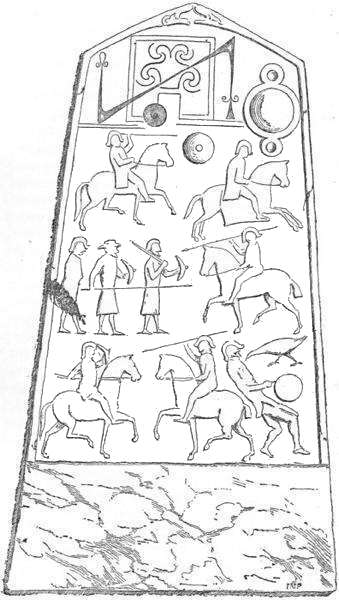
[++] Aberlemno Stone
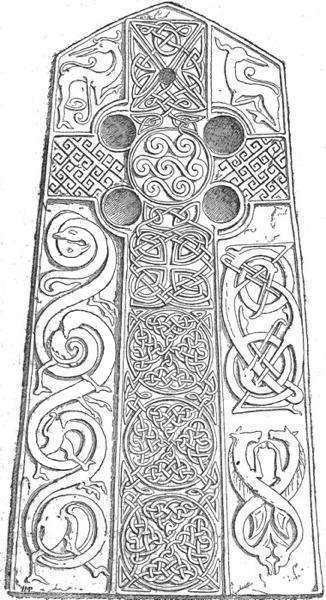
[++] Aberlemno Stone: Reverse
The case is much the same with most of the so-called “Danish” forts, camps, stone circles, and bauta stones; which are in general of Pictish or Celtic origin. Had they really been erected by the Danes and Norwegians, those nations must evidently have held confirmed dominion in these parts for a length of time; but it is well known that, in the early period in which these monuments were raised, they can be regarded as masters, in the south and central Lowlands, only at very short and far-distant intervals.
North of the Grampian Hills, and particularly in the district of Moray (the “Mærhæfi” of the Sagas), the Norwegians and the Danes, it is true, firmly established themselves for a somewhat longer period of time. In the beginning of the eleventh century, for instance, they defeated the Scots in a great battle near Kinloss, took the towns of Elgin and Nairn, whose garrisons they put to the sword, and afterwards settled themselves on the sea coast. But the kingdoms which they founded were speedily destroyed without leaving any remarkable traces behind them; so that, even in this district, we cannot place implicit reliance upon the many different stories about the Danish monuments. According to a common and not improbable tradition, the district of Moray, and the present Aberdeenshire, were the theatres on which the last battles between the Danish Vikings and the Scots were fought. Thus it is said that, in the reign of Malcolm the Second, the Danes, after the battle of Kinloss, suffered a great defeat at Mortlach in Banffshire, where Malcolm, as a thank-offering to God, caused a convent to be built. This, again, was partly the cause of Mortlach’s becoming the seat of a bishop. Popular tradition states that the Scottish leader vowed during the battle to add to the church in Mortlach as much as the length of his spear if he succeeded in driving away the Danes. An ancient sculptured stone near the church is mentioned as pointing out the Danish leader’s grave; and the skulls of three Danish chiefs are still shown, built into the north wall of the church, as a perpetual memorial. A similar tradition is preserved about the church of Gamrie, also in Banffshire. The Earl of Buchan vowed, in the heat of the battle, to build a church to St. John, to replace that which the Danes had destroyed, if he gained the victory over them. Three of the sacrilegious Danish chiefs, by whose command the church had been desecrated, were found upon the field of battle, and in a description of the church lately published we read as follows:—“I have seen their skulls grinning horrid and hollow in the wall where they had been fixed, inside the church, directly east of the pulpit, and where they have remained in their prison house 800 years!”
It is further stated that, on account of the repeated defeats which the Danes and Norwegians had suffered in the Scotch Lowlands, King Svend Tvskjæg sent, in the year 1012, his son Canute, who afterwards became king of England, with a large fleet and army to the northern part of the Lowlands. Canute landed on the coast of Buchan (Aberdeenshire), near the Castle of Slaines, in the parish of Cruden (or Crudane). Here a very fierce battle was fought, which can scarcely have been favourable to the Danes, since a treaty was afterwards concluded between them and the Scotch, according to which the Danes were to evacuate the fortress called “Burghead,” in Moray, then occupied by them, as well as the rest of their possessions in the kingdom of Scotland. According to the same treaty the field of battle was to be consecrated by a bishop as a burial-place for the Danes who had fallen on it, and a chapel was to be built there in which masses should be continually sung for their souls. In this neighbourhood also there was certainly, at one time, a chapel dedicated to the Norwegian saint, Olave; but the ruins of this chapel, as well as the old churchyard, have since been destroyed by quicksands. The wind, however, by blowing away the sand, still brings, at times, the fragile bones of the Danes to the light of day.
Straight out of the town of Forres, in Nairnshire, stands a stone nearly twenty feet high, on one side of which is seen a large and handsome cross, and under it some indistinct human figures. On the other side is carved a number of horsemen and people on foot, evidently representing an execution on a great scale; several bodies are seen, and by the side of them the dissevered heads. The sculpture is executed with the greatest care, and displays some very tasteful ornaments, which, however, are now partly effaced through the action of time on the soft stone. The pillar is commonly called “Svenós stone,” and tradition relates that it was erected to commemorate the treaty of peace concluded between Svend Tveskjæg and King Malcolm, and the expulsion of the Danes from the coasts of Moray. But the sculptures at present existing on the stone do not in the slightest degree represent anything of the kind. The stone belongs to the same class of monuments as the sculptured Scotch stones before described, which are so numerous in the Lowlands, and in the north-eastern Highlands, particularly Inverness-shire, Ross-shire, and Cromartyshire.
One of the few places in the Lowlands, which may with reason be assumed to have preserved considerable traces of the Danish expeditions, lies in the neighbourhood of the towns of Forres and Elgin. It is a promontory which projects in a north-western direction almost a mile into the sea. Towards its head its steep craggy shores are from eighty to a hundred feet high. This extreme point, which incloses a small harbour, and which presents a level surface on its top, where the fishing village of “Burghead” is situated, was formerly separated from the main land by three immense parallel ramparts, fifteen to twenty feet high, with cross ramparts lying between, as well as deep and broad ditches, of which there are still considerable remains. That the Romans had a fortress here (said to have been named “Ultima Ptoroton”) was clearly proved several years ago, when a Roman well, which is still used, was discovered cut in the rock. But for Vikings, like the Norwegians and Danes, this place afforded a still better refuge than for the Romans. Towards the land side, which is in some degree barren and uninhabited, they could easily defend themselves; and from the sea, the Scots could attack them only by entering the harbour, where the well-equipped vessels of the Northmen of course prevented their landing. In all probability, therefore, the Norwegians and Danes still further fortified this important point, and gave it, perhaps, its present name. Tradition, at least, relates that the Danes, after taking Nairn, isolated the town or fortress, and called it “Borgen” (the castle); in which account it is very probable that the names of Nairn and the neighbouring Burghead have been confounded. The latter place gradually gained such importance that it was the last stronghold the Danes possessed in the Lowlands.
It is therefore clear that the Danes, or rather the Norwegians and Danes, have scarcely a right to claim many of the numberless monuments in the Lowlands which both the learned and unlearned ascribe to them. In fact, the whole eastern coast of Scotland, from the Cheviot Hills to Moray Firth, is entirely destitute of characteristic and undoubted Scandinavian monuments. It must, however, be remembered, that the actual Scandinavian immigrations into the Lowlands certainly took place after the Norman conquest of England; or, at all events, at so late a period that the Northmen could not remould the Scotch names of places into Scandinavian forms. Nor is it strange that the Scandinavian colonists in the Lowlands, who at the close of the eleventh century had long been Christians, and influenced by the civilization prevailing in England, should neither have erected such monuments as stone circles, bauta stones, cairns, and barrows, which presuppose a state of heathenism among a people, nor have impressed their characteristics generally on that district by means of peculiar memorials. For at that time they played a subordinate part there, and afterwards gradually became very much mixed with Celts, Anglo-Saxons, and subsequently even with Normans.
The very circumstance, however, that so large a tract of land as the Scottish Lowlands lay out of the path of the Scandinavian conquerors during the ninth, tenth, and first half of the eleventh centuries, was the cause not only that the Danes were able to direct all their power with more effect against England, but also that the Norwegians could more easily subdue the Orkneys and the Shetland Isles, the Hebrides, and various tracts in the northern and western Highlands. In these districts much more perceptible traces of the Norwegian settlers, and of the results which they produced, are still preserved, than in the Lowlands of the in general transient devastations of the Danes and Norwegians.
Section V.
The Orkneys and Shetland Isles—Natural
Features.—Population.—Oppression.
We might expect that the most northern isles of Scotland, which lie exposed in a stormy sea, should possess the same wild and mountainous character as the Faroe Isles and Iceland. Such a belief gains strength when, for the first time, in passing from Scotland, we obtain a view of the southern Orkneys, especially the considerable mountain heights of the Isle of Hay. Indeed Hay obtained its name (originally “Haey,” or the high island) from the old Northmen, on account of the mountains which distinguish it from the rest of the Orkneys; for on sailing farther northwards, past Hay and the adjacent South Ronaldshay (formerly “Rögnvaldsey”), we soon discover that the Orkneys are in general flat and sandy, although with cliff-bound coasts. Their heath-covered hills scarce deserve the name of mountains, though here and there called by the inhabitants “fjolds,” or Fjelde (mountain rocks). The islands are destitute of wood, and exhibit frequent ling moors and desert tracts of heath. But there is also much, and by no means unfertile, cornland to be found; and an improved system of agriculture has made such advances, that the stranger is sometimes surprised, in these distant isles, by the sight of luxuriant fields of wheat.
The waves of the sea, and the powerful currents, have intersected the Orkneys with innumerable winding bays, or sounds. Besides Mainland, the chief island (first called by the Norwegians “Hrossey,” and afterwards “Meginland,” or the continent), the archipelago includes a great number of islands of different sizes, which spread themselves in a north-east direction from the north coast of Scotland. The farthest of the Orkneys is Fairhill, or Fair Isle (formerly “Friðarey”). It lies almost midway between the Orkneys and the Shetland Islands, in the midst of the rapid current now called Sumburg Roost, but which the Norwegians in former times called Dynröst (from “röst,” a maelstrom, or whirlpool); whence, again, the most southern promontory of the Shetland Islands has obtained the name of Dunrossness (Dynrasternes). The Shetland archipelago (the old Northern “Hjaltland,” “Hjatland,” or “Hetland”), like that of the Orkneys, forms a long-extended line, but differs from it in consisting principally of one large island, Mainland (“Meginland”), surrounded by a great number of proportionately small and insignificant ones.
The most southern point of Dunrossness, on Mainland, forms the promontory of Sumburg Head (“Sunnbœjar-höfði”), which, however, is of no very great height; indeed the highest mountain in Shetland is only about fifteen hundred feet above the sea. Although the Shetland Islands, with regard to mountains, are not to be compared with the Faroe Isles, still they exhibit a sort of transition from the flatter Orkneys to the mountainous character of the Faroe group. Before the coasts of Shetland stand many high and ragged rocks, called “stacks” (old Norsk, “stackr”). The coasts themselves are steeper, and the mountains larger than in the Orkneys. On the other hand, however, the valleys are both longer and broader than the mountain valleys of the Faroe Islands. Heath and moorland abound, whilst the corn-fields are small, and the corn harvest in general very uncertain and difficult to gather. Fishing is the most important source of profit for the inhabitants.
The Orkneys and the Shetland Isles were, as is well known, completely colonized by Norwegians in the ninth and tenth centuries. They were, however, known and inhabited much earlier. It is possible that the Shetland Islands were the “ultima Thule” spoken of by Roman authors in the first centuries after Christ; but it is certain that the Romans at that time knew the Orkneys by the name of “Orcades:” whence it appears that the primitive root Ork, in the later Norwegian name of the islands, is very ancient, and probably of Celtic origin. Before the arrival of the Norwegians, both the Orkneys and the Shetland Islands seem to have been inhabited by the same Pictish or Celtic race that was settled in the rest of Scotland. Of these older inhabitants memorials still exist in different kinds of antiquities of stone and bronze that are dug out of the earth, as well as in numerous ruins of castles, or Pictish towers, originally built of flag-stones laid together, without any cement of loam or mortar. There are also cairns and stone circles; the most prominent amongst which are the “Stones of Stennis,” on each side of Brogar Bridge, in Orkney. They are, like Stonehenge and Abury circle in England, surrounded with ditches and ramparts of earth; and, after Stonehenge, must be regarded as amongst the largest stone circles in the British Islands. The immense masses of erect stones are remarkable evidences both of the strength and of the religious enthusiasm of the old Celtic inhabitants; and it is no wonder that they made in ancient times such an impression on the Norwegians, on their arrival at these islands, as to induce them to call the promontory on which the largest circle stands “Steinsnes” (Stones-naze) and the adjoining firth, “Steinsnesfjördr” (Stones-naze Firth, now Loch of Stennis).
No sooner had the Scandinavian Vikings settled themselves, in the ninth century, securely in these islands, than they became a central point for the Northmen’s expeditions not only to the British Islands, but also to Iceland and Greenland. Thus when Floke Vilgerdesön, or “Ravnefloke,” went on a voyage of discovery from Norway to Iceland, he landed on Hjaltland, or Shetland, in a bay which obtained from him the name of “Flokavágr.” This bay must probably be sought on the east coast of Mainland, about Cat Firth (Kattarfjörðr); for in its neighbourhood lay the Loch of Girlsta (originally “Geirhildarstaðir”), which is said to have obtained its name from the circumstance of Floke’s daughter, Geirhilde, having been drowned in it during her father’s short visit to the country. By degrees the islands became the rendezvous of a great number of discontented Norwegian emigrants, who, to avoid the new order of things, had withdrawn themselves from their old paternal home, and from this distant place of refuge continually harassed the coasts of Norway.
This induced King Harald Haarfager to undertake an expedition against the Orkneys and the Shetland Isles, as well as against the Hebrides, on the west coast of Scotland; all of which he succeeded in subjugating. He gave the Orkneys and the Shetland Isles, as an earldom under the crown of Norway, to Ragnvald Möre-Jarl’s family. This family produced some great men, who extended their dominion over large tracts in the adjacent kingdom of Scotland. The islands continued, however, to be the resort of many malcontent and fugitive Norwegians. The renowned Ganger-Rolf, the founder of the royal Norman house, is said to have dwelt a long time on them before he undertook his expedition against Normandy. When King Erik Blodöxe, Harald Haarfager’s son, was driven with his queen, the atrocious Gunhilde, from Norway, he fled to Orkney, whence he carried devastation far and wide. Subsequently he obtained a kingdom in Northumberland; but, after his fall, his sons again sought the Orkneys; where they remained till they succeeded in obtaining the kingly power in Norway. Snorre Sturlesön states, that after the fall of this dominion, Gunhilde again fled to Orkney, where her daughter, Ragnhilde, had married a member of the Earl’s family. Ragnhilde trod entirely in her mother’s footsteps by occasioning dissension, and even murder, in the family of the Earl. Somewhat later the Orkneys were visited for a time by Kalf Arnesön, so well known in the more ancient history of Norway, who, at the battle of Stiklestad in 1030, was one of the chief leaders of the peasant army against King Olaf, the saint. He came to the Orkneys just in time to take part in a severely-contested naval battle, fought in the year 1046, near Rödebjerg (Rauðabjörg) in Pentland Firth, between the Jarls Thorfin and Ragnvald Brusesön. Kalf supported Thorfin with six long ships, and thus decided the victory in his favour.
The older history of the islands exhibits an almost uninterrupted series of bloody combats between members of the Norwegian Jarl’s family. This, however, did not prevent them from making violent inroads on the coasts of Scotland and Ireland. Long after the Vikings’ mode of life had ceased in the Scandinavian North, it continued to be preserved in these islands. This was not only owing to their remote situation, opposite hostile coasts, and to their characteristic independence, but also to the population having inherited the old Viking spirit, and carefully preserved the ancient Norwegian institutions. As long as Norwegian jarls ruled, Norwegian laws, customs, and habits, as well as the Norwegian language, were absolutely paramount in the islands. The connections which the jarls and other powerful leaders maintained with Scotch and Irish chiefs, and which often resulted in intermarriages between their families, do not seem to have had much effect on the Scandinavian national character of these island colonists. It was not till the beginning of the fourteenth century, when the male line of the old Norwegian jarls had become extinct, and when the Scotch Lord Saint Clair, who had married a daughter of Magnus, the last jarl, had obtained possession of the earldom, that the ancient liberties, customs, and manners of the inhabitants, began to be seriously threatened; nor did it suffice to protect the islands against the progress of Scottish influence, that they continued to be under the supreme authority of Norway. When, at length, the Danish-Norwegian king, Christian the First, on the occasion of the marriage between his daughter Margaret, and the Scotch king, James the Third, in the year 1469, pledged to Scotland the Orkneys and the Shetland Isles as part of Margaret’s dowry, the last tie was severed that bound those countries to their Scandinavian friends. The Scottish kings and their successors, who also ascended the English throne, acknowledged indeed the right of the Danish-Norwegian kings to redeem the islands; but they continually found subterfuges to prevent its being exercised. The lawful claims of redemption, repeatedly urged by Denmark in the sixteenth and seventeenth centuries, were perfectly fruitless. The islands were too important, and far too conveniently situated with regard to Scotland, for Great Britain to give them up, without being compelled by the last necessity. The undoubted right of the Danish-Norwegian kings was forced to give way to the superior power and political influence of the British sovereigns.
The conduct observed towards the Norwegian population of these islands after their union with Scotland was quite as unjust as their separation from Norway and Denmark, and assuredly far more revolting to all proper feeling. A large part of the inhabitants had till then been in the free possession of their lands as freeholders, or “udallers” (Odelsmænd), and had likewise possessed their old Norwegian laws and privileges, which should of course have been respected when the islands were pledged to Scotland. But the Scotch nobles, who, partly as vassals, partly as royal lessees, obtained the government of the islands, took care to destroy all traces of the ancient liberties and Scandinavian characteristics of the people. The resistance of the islanders was fruitless. In the year 1530 they took up arms under the command of their governor, Sir James Sinclair, in order to oppose the appointment of a crown vassal over the islands. The Earl of Caithness himself, who had been dispatched against them, fell, with five hundred of his men, in a sanguinary action near the “Stones of Stennis.” But though the islanders thus asserted their rights for a short period, the Scotch regents soon afterwards succeeded in establishing crown-vassals in the islands.
Among these vassals none has left behind him a more despised or hated name than Earl Patrick Stuart, who from 1595 to 1608, or about thirteen years, oppressed the islands in the most shameful manner. He violently deprived the holders of allodial farms of their right of possession, and converted almost all the freeholders into leaseholders. He arbitrarily changed the weights and measures, so that the taxes and imposts became intolerable. Law and justice were not to be procured, for the Earl’s creatures everywhere occupied the judgment-seats. To appeal to Scotland was no easy matter, as Lord Patrick’s soldiers guarded all the ferries. In the Orkneys the Earl compelled the people to build him a strong fortress at Kirkwall, and in Shetland another at Scalloway; from which places armed men ranged over the country, to punish and overawe the malcontents. The ruins of these castles form a still-existing memorial of “the wicked Earl Patrick,” who, for his tyranny, was at length recalled to Scotland, accused of high treason, and beheaded.
The Scottish kings, it is true, now promised the islanders that they should have relief in their need, and that no vassal of the crown should be placed over them. But this promise was not kept; and so far from the islanders again recovering their lost freedom, the feudal system of England and Scotland continued to take firmer root in the islands. Oppression stalked on with regular and steady step until it arrived at such a pitch that not only did the Norwegian laws and liberties disappear, but the islands themselves, with some few exceptions, became the private property of a few individuals. The successors of the mighty Vikings, descended from kings and jarls of Norway and the North, who in winter dwelt as chiefs, or at least as freemen, in roomy mansions, whilst in the summer they gained glory and booty in their long ships, are now in general obliged to content themselves with inhabiting as leaseholders, or rather as annual tenants, a poor cottage on a small piece of land, where, by hard labour, they are able to gain, at best, a very frugal subsistence. Their dwellings, particularly in Shetland, are of the most wretched description. The walls are formed of small unhewn stones, with turf and sea-weed thrust into the interstices, and, instead of a chimney, the smoke escapes by a hole in the roof. Within the house there are generally sleeping-places in the thick stone wall; but men and cattle live together in friendly harmony in the same apartment. The fire burns freely on the floor, and envelopes all in a dense smoke. If the people seek their living on the sea by fishing, it is usually in boats belonging to the proprietor of the estate, who consequently receives a large share of their profits. The condition of the common people in the Orkneys, and in the Shetland Isles, is certainly not at all enviable, even in comparison with that of their Scandinavian kinsmen on the poor and more remote Faroe Islands and Iceland; although commerce is still limited and oppressed there by a monopoly which was soon abolished in the Orkneys and Shetland Isles after their separation from the united Norwegian-Danish kingdoms. But in spite of all their calamities, the inhabitants of the Faroe Isles and Iceland have for the most part preserved to our times that freedom of landed property which they inherited from their forefathers.
Section VI.
Shetland.—The People.—Songs.—Sword-Dance.—Language.—Names
of Places.—Tingwall.—Burg of Mousa.—Tumuli.—Bauta Stones.[9]
If the present originally Norwegian population in the Orkneys and Shetland Islands possessed, on the whole, any strongly-marked Scandinavian characteristics, they would naturally occur most in the islands farthest towards the north. But the oppressions and political changes that have occurred there have done their work so thoroughly, that even the Shetlanders no longer bear in their character and natural disposition any strongly-marked feature of their Norwegian origin. The only ones remaining are, perhaps, their love of the sea, and their skill in contending with its dangers. Even their bodily frame has, through many years of want and debasement, lost much of its strength and nobleness. In the parish of Coningsburgh, in Mainland, precisely where the largest and strongest-built people are to be found, the Scandinavian population are said to have kept themselves most free from mixture. The inclination for disputes and fighting amongst the people of Coningsburgh is well known in Shetland. This trait is, at all events, more Scandinavian than moroseness and want of hospitality to strangers, which are almost unknown in the North, but which in the last century were alleged to be vices of these same men of Coningsburgh. It was said that they would not willingly give a traveller a night’s lodging, and that directly at day-break they awoke him, saying:—“Myrkin i livra; lurein i liunga; timin i guestin i geungna;” that is, “It is dark in the smoke-hole, but it is light on the heath, and for the guest it is now time to depart.” That this sentence, which was written down in the year 1774, consists of old Norwegian words, though in a corrupted form, is quite evident.
The Shetlanders still retained, in the last century, many of the customs of their Scandinavian forefathers. Thus surnames were given both to sons and daughters, according to the genuine Scandinavian custom, from the father’s Christian name. The eldest son, for instance, of Magnus Anderson was called Anders Magnuson, and all the other sons had likewise the surname of Magnuson; whilst the daughters, in like manner, were all called Magnus-daughter, of course with different Christian names. Even the Norwegian language is said to have been spoken at that time by some few old persons in the most remote islands. The traditions and songs handed down by their forefathers still lived among the people, whose poets and poetical feeling have been celebrated from the earliest times. It was customary to revive the memory of former days by festal assemblies, in which the youth of both sexes danced to songs (“Visecks”) and ballads, as they did in ancient times throughout the North, and as is still the custom in the Faroe Isles. At Yule time (Christmas), which was the chief festival, and the beginning of which was always announced at daybreak by playing an ancient Norwegian melody, called “the day-dawn” (Dan., Daggry), all kinds of merriment took place. A favourite amusement was the so-called sword-dance, the origin of which may be traced with sufficient certainty to the times of the heathens. The Vikings were frequently very dexterous in playing with naked swords, throwing several at once into the air without allowing them to fall to the ground. This practice was easily converted into a dance, performed by several men with drawn swords; and consisting of many windings and figures calculated to develope a dexterous agility, which, in those warlike times, must naturally have excited a lively interest among the spectators. Later in the middle ages the sword-dance in the Shetland Isles lost by degrees the wildness of its character, the number of dancers being limited to seven, representing the Seven Champions of Christendom, viz., St. James of Spain, St. Denis of France, St. Anthony of Italy, St. David of Wales, St. Patrick of Ireland, St. Andrew of Scotland, all under the command of St. George of England, who both opened and closed the dance by reciting some English verses appropriate to the occasion.
All this, however, is now much changed. In the farthest island towards the west, that of Papa stour (“Papey stœrri,” the great Pap Island, in contradistinction to the neighbouring Papa little, “Papey litla”), a last shadow of the old warlike sword-dance is occasionally to be seen. Instead, however, of being clothed in armour or shirts of mail, the dancing knights have shirts of sackcloth; and, in place of huge swords, they brandish straightened iron hoops, stripped from some herring-cask. The old Norwegian songs are no longer heard. Of the ancient Norwegian popular language the only remains are partly a few words, which, however, appear conspicuously in the English dialect now used; and partly a peculiarly sharp pronunciation, with a considerable rising and sinking of the voice, not unlike the vulgar pronunciation in the Faroe Isles. The old Norwegian words are particularly employed for certain objects and implements which have been in use from time immemorial.
Thus, for instance, the hole through which the smoke escapes (Dan., Lyre) in the roof of houses covered with flat turf (flaas) is sometimes still called by the name of “livra” (in the Færoic language “ljowari”). The high seat for the mistress of the house is called, in remote districts, “hoy-saede” (Dan., Höisæde); her “bysmer,” which serves her for weighing, exactly agrees, both in name and nature, with the “Bismer” common in the North. The hand-mill, which is fast disappearing, is called as in the Danish part of north England, “qvern.” The turf-spade, called in the Faroe Isles “torvskjæri” (Dan., Törveskjærer), is here named “tuysker.” The land-tax also, according to Scandinavian fashion, is paid in “merk” and “ure” (Mark and Öre). The outlying fields are called “hogan,” “hagan” (Old Norsk, “hagi,” an inclosed field). The deep-sea fishery (Dan., Hav) is called “the haaf;” the fishing itself, “haaf-fishing” (Dan., Havfiskerie); and the necessary lines, “tows” (Dan., Touge). To the present day the Shetlanders use, in these fisheries, boats imported from Norway, which are peculiarly suited, by their construction, for the high seas and rapid currents on the coasts of Shetland. The dress worn by the fishermen when out at sea bears a striking resemblance to that of the Faroe men. The head is covered with a cap knit in the form of a night-cap, and ornamented with the most motley colours. They wear a coat of tanned sheep-skin, reaching down to the knees, where it generally meets a pair of huge and capacious skin boots, very carefully sewed. On land the Shetlanders use only a simple kind of shoe called “rivlins,” consisting of a square piece of untanned cow-hide, covering little more than the sole of the foot, and fastened with a fishing-line or a strip of skin. The men of Faroe have similar shoes, called “skegvar,” which, however, are far better made.
But what particularly reminds the Scandinavian traveller in Shetland of finding himself in a country formerly altogether Norwegian, is the names of places, all of which bear the impress of their Norwegian origin. This remark applies to the names of the islands themselves, as well as to the names of towns, farms, promontories, and bays existing in them. They, of course, resemble, in a great degree, the old Scandinavian names of places farther south, in Scotland and England. Thus, for instance, a fiord is generally called “firth” (fjorðr); a creek “wick” (Dan., Vig); a holm, or small island, “holm;” a promontory, or naze, “ness;” a valley, “daill,” or “dale.” But it is peculiar to these districts, that the forms of names of places which occur most frequently in the old Danish part of the north of England, namely, those ending in by, thwaite, and thorpe, are extremely rare in Shetland, and in the rest of the old Norwegian possessions in Scotland. Of those in by, only a few instances are to be found; those in thwaite are still more rare; and those in thorpe are not to be met with at all. On the other hand, these districts possess several Scandinavian names of places which are also most frequently found in the old Norwegian colonies in the north and west of Scotland, but which are perfectly unknown in the old Danish part of the north of England. For instance, a small bay (Dan., Vaag) is called “voe” (vágr); whence, on Mainland, we find “West-voe,” “Aiths voe” (the bay by the tongue of land), “Lax-voe” (Lax, or Salmon-bay), “Selia-voe” (sildavágr, the “Silde Vaag,” or herring-bay), “Hamna-voe” (hafnarvágr, the Havne Vaag, or harbour bay), together with others. A still smaller bay, navigable only by boats, is called “gjo,” or “goe” (Old Norsk, gjá, an opening or cleft). For the rest, many farms have names with such endings as seter (Old Norsk, setr), ster and sta (Old Norsk, staðr, a place); and also busta, buster, and bister (contracted from “bolstaðr,” a dwelling-place); whence, for instance, Kirkbuster (formerly Kirkjubólstaðr); all of which names agree just as well with those found in the Faroe Isles, Iceland, and the mother-country, Norway, as the names of places in the north of England ending in by, thwaite, and thorpe, agree with those in the corresponding mother-country, Denmark. Although the difference between the present traces of Danish colonization in England, and of Norwegian in Scotland, is not considerable, still it may be recognised in this manner. In consequence of the remote situation of the Shetland Isles, the names of places, in spite of all revolutions, remain so much the same, that the old political and religious institutions of the islands are visible, as it were, through them. In the south part of Mainland lies the farm of Howff, where in ancient times there was certainly a “Hof,” or house of God; and far northwards, near Hillswick (formerly Hildiswik), is the promontory of Torness (Þórsness), which probably once had a Hof for the god Thor. Nor far from thence is the Lake Helgawater (Helgavatn), or the holy water. Heathenism, however, lasted but a short time in the islands. The Irish Christian priests (Old N., “Paper”)—the memory of whom still lives in the names of the islands Papa (Papey), as Papa stour (great) and Papa little—seem to have worked indefatigably; insomuch that the Norwegian king Olaf Tryggvesön was able, at the close of the tenth century, to introduce Christianity throughout the islands. In place of the old god-houses there speedily arose a number of chapels or small churches, consecrated to different saints: viz., to the Norwegian saints, St. Sunifva (the daughter of an Irish king who suffered shipwreck in Norway), St. Olaf, as well as, at a somewhat later time, to St. Magnus, the patron saint of the Orkneys, after whom a great bay on the north-west coast of Mainland is to the present day called St. Magnus’ Bay. St. Magnus seems also to have been the patron, or rather the chief saint, of Shetland; at least, the principal church in Shetland is consecrated to him. This church did not stand in Lerwick, the present chief town in Shetland, which has risen far later in the south-eastern part of Mainland, on the site of an old sea-side town near Bressasound (formerly “Breiðeyjarsund”). It lay about four miles to the north-west of Lerwick, in the parish of Tingwall; where, as the name (Þingavöllr) denotes, the chief Thing of the islands was held for centuries, and where, in heathen times, the chief place of sacrifice undoubtedly existed. The parish of Tingwall comprises one of the prettiest and best-cultivated valleys in Shetland. The old Thing place is still to be seen near the church, in a small holm, or island, in a lake, connected with the land by a row of large stepping stones. Secure against a sudden attack, here sat, when the island was free, the “foude” (Dan., Foged), or magistrate, with his law-officers, whilst the multitude of the common people stood round about on the shores of the lake, and listened to what passed. Popular tradition says that the church was at that time a free place, or sanctuary, so that a person condemned to death was entitled to a pardon, if he could succeed in running from the holm over the stones, and reaching the church without being killed by the people. If this was really the case the commonalty must consequently have had power to pardon a convicted person by suffering him to escape into the church.
During the holding of the chief Thing, which in the olden times was generally accompanied with great sacrificial offerings, as well as with fairs and all sorts of merry-making, a multitude of persons always assembled, and a great many tents and booths were erected, both at the Thing place itself and in the immediate vicinity. Hence it undoubtedly arose that about three miles to the west of Tingwall, near a bay of the sea, there was a collection of Skaaler, or wooden booths; whence the present Scalloway (Skálavágr) which, next to Lerwick, is the most important trading place in the islands.
In Mainland alone there were at least seven lesser Things, under the jurisdiction of the chief Thing in Tingwall. The names of five of these are still preserved in Sandsthing (Sandsþing), Aithsthing (Eiðsþing), Delting (Dalaþing), Lunziesting (Lundeiðisþing), and Nesting (Nesþing); but the two other names, which are known from records, Rauðarþing—probably the most northern parish, Northmavine—and Þveitaþing (the most southern parish?), have disappeared. Special Things were, of course, also held on the larger islands, such as Yell (“Jali”) and Unst (“Aumstr,” “Örmst”); but it is certainly very incorrect to infer, as many persons do, from some stone circles near Baliasta, close by Unst, that the chief Thing of the islands was held there in the most ancient times of heathenism.
These stone circles belong simply to low graves encircled by stones, like those so frequently found in Norway, and whose date is of the latest period of heathenism, or what is called the iron age. Skeletons have been found in several similar graves in Shetland; and at different times urns containing burnt bones and ashes have also been discovered, together with other distinct traces of their having been burial-places. For the rest, barrows or tumuli, bauta stones, runic inscriptions, and similar monuments and antiquities of the heathen times, are by no means frequently to be met with; the reason of which must naturally be sought in the short duration of heathenism in these islands. The remains of only a single insignificant runic stone, and that of the Christian æra, have been discovered near Crosskirk, in the north of Mainland. The numerous round towers, or castles, of loose flag-stones laid together, which are often built on islands in lakes, and are called by many “Danish burghs,” are, as before stated, of Pictish or Celtic origin. They have no resemblance whatever to the old fortresses in the Scandinavian North; whilst, on the other hand, buildings entirely corresponding with them are to be found in the Celtic Highlands of Scotland, and on the coasts of Ireland. The most that can be said is that the Norwegians availed themselves of these buildings after their conquests and settlements in these districts. Thus the remains of a tower are to be seen on a holm in Burra Firth (Borgarfjörðr, or Borgfjord, i.e. Castle fiord), in the west of Mainland, which may have been inhabited in the beginning of the twelfth century by the chief Thorbjörn, whom the Earls Magnus and Hakon attacked and killed in “Borgarfjörðr.” The ground plan of the ruin (after Hibbert) shows how the chambers were disposed in the thick stone wall.
[++] Tower: Burra Firth
Another ancient Celtic tower, which tradition decidedly states to have been occupied by Norwegians, and which, on that account, has a particular interest for a Scandinavian, lies on the little island of Mousa (the ancient “Mösey”), close to the sound that separates the island from the south-eastern coast of Mainland. The tower is, fortunately, the best preserved one of the kind in the British Islands. It rises to the height of between forty and fifty feet, like an immense and perfectly round stone pillar, but bulging out towards the middle. Its appearance from without is quite plain, and no other opening can be perceived in the wall than the entrance-door, which even originally was so low that it was necessary to creep through it. To attack the tower, even when the door stood open, was not easy, and the bulging of the wall in the middle rendered the scaling of it almost impossible. The entire tower is about fifty feet in diameter, and consists of two concentric stone walls, the innermost of which encloses an open space of about twenty feet wide. The two concentric walls are each five feet thick, and stand at a distance of five feet from each other. The small space between them formed the habitable part of the tower. From the open yard we ascend a stone staircase, and, before we reach the top, seven divisions or stories are passed, separated by large flag-stones, which form a ceiling for one story and a floor for the next. In the different compartments, which quite encircle the tower, are small square openings, or air holes, one above the other, and looking out into the inner yard. The annexed drawings and sections (taken from Hibbert’s description of Shetland), which represent the tower in its evidently original state, will serve to explain still more clearly the nature of this simple, yet remarkable, building.
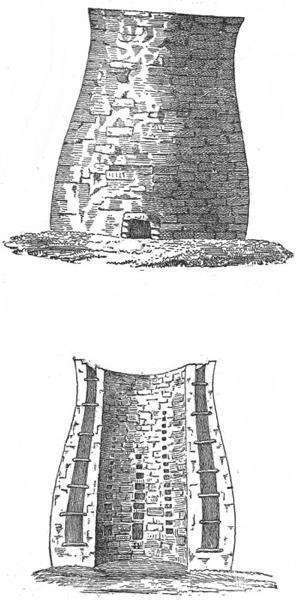
[++] Tower: Mousa
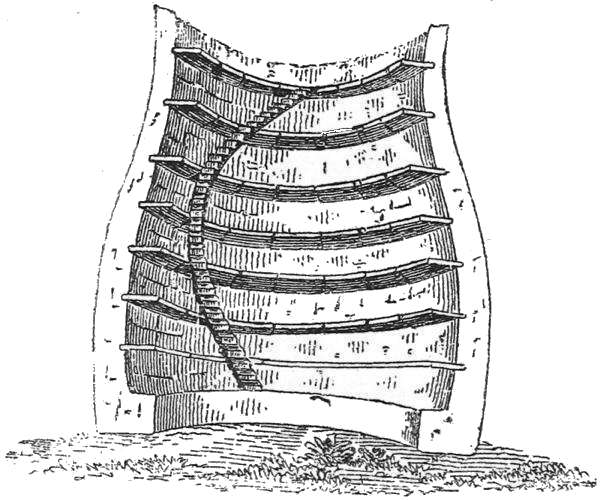
[++] Tower: Mousa - Interior
This tower appears to have stood deserted as early as the tenth century. Whilst Harald Haarfager reigned in Norway, a distinguished Norwegian Viking and merchant, Björn Brynjulfsön, carried off his beloved Thora Roaldsdatter (Roalds-daughter) from the fiords. He brought her first to his father’s house; but, as his father would not permit him to celebrate his marriage there, he fled with her in the spring, on board his ship, and sailed westwards. After suffering much from storms and heavy seas, the couple landed at last on Mösey, and took up their temporary abode in the castle there, whither they brought the whole of the ship’s cargo. In “Möseyjarborg,” Björn celebrated his marriage with Thora, and dwelt there through the winter. But next spring he learned that King Harald, at the entreaty of Thora’s friends, had exiled him from Norway; and that commands had even been sent by Harald to the jarls and chiefs in the Orkneys, the Hebrides, and in Ireland, to put him to death. He therefore again put to sea, and landed safely with his Thora in Iceland.
A few centuries later, the chief Erlend Junge fled from the Orkneys with Margaret, mother of the Jarl Harald Maddadsön, who was as much celebrated for her beauty as for her wantonness, and shut himself up with her in “Möseyjarborg.” The Jarl Harald, who had opposed their marriage, set out in pursuit of them, and blockaded the castle for a long time, in order, if possible, to cut off their supply of provisions, and thus compel them to surrender; for, by force, says the Saga, the castle could scarcely be taken. But Harald at last became weary of the siege, and concluded an agreement with Erlend that he should have Margaret to wife on condition of swearing fealty to him as jarl.
This old and venerable tower has, therefore, not only been the scene of sanguinary battles and deeds of cruelty, but its strong walls have also afforded a secure asylum to sincere and all-sacrificing love.
Section VII
The Orkneys.—“Þingavöllr.”—Monuments of the Olden Time.—Kirkwall.—St.
Magnus Church.
The Orkneys, on account of their greater fertility, and of their lying nearer to Scotland, were in ancient times, as indeed they are at present, of much more importance than the distant Shetland Isles. As the chief seat of the Norwegian jarls, they formed the central point of the Norwegian power in the north of Scotland. According to the Sagas, most of the many Danes and Norwegians who settled on the islands to the north of Scotland, resorted to the Orkneys; by which means, the jarls who governed them were enabled easily to assemble large fleets, and to man them with picked Scandinavian warriors. It was chiefly, therefore, Norwegians from the Orkneys, who, under the command of the jarls of Orkney, made such extensive conquests in the territories of the Scottish kings.
Jarl Sigurd the Stout (Dan., Digre), who, as before mentioned, was married to a daughter of the Scotch king, Malcolm the Second, and Jarl Thorfin, his son by King Malcolm’s daughter, pre-eminently distinguished themselves by bold Viking expeditions into the neighbouring countries, and particularly by their conquests on the Scotch coast. They extended these as far south as Moray; nay it is even said that at times they went as low as to the Firth of Forth. Thorfin was the last of the jarls of Orkney in whom the old Scandinavian Vikings’ spirit lived and stirred. His power was greater than that of any of his predecessors or successors; for he ruled, say the Sagas, over no fewer than eleven earldoms (Jarledömmer) in Scotland, over all the Hebrides, and a large kingdom in Ireland. But after the many warlike expeditions, raids, and incendiarisms, in which he had played a part, he at length became penitent, and undertook a journey through Denmark and Saxony to Rome, where the pope gave him an indulgence for his sins. After his return, he governed his kingdom peacefully till his death, which took place about the year 1064. Notwithstanding that a new and Christian æra had irresistibly established itself under this fierce Viking, the Orkneys continued for more than a century after his death to foster men who were Christians only in name, but in reality, both in their way of thinking and conduct, were heathen Vikings. Svend Asleifsön, who, in the middle of the twelfth century, lived on the little island of Gairsay (Gareksey), close to the north-east side of Mainland, occupies a prominent place among these Vikings. He was surrounded by a band of eighty men, with whom in the winter he remained at home in his mansion, living well on the booty that had been won. In the spring, after seed-time, he set out with them on expeditions to the Scotch, English, and Irish coasts. In the autumn he returned home for a short time, in order to gather the corn into his barns; and then again set out and harried the before-mentioned countries until the beginning of winter. On one of these autumnal Viking expeditions he even took Dublin; but whilst he fancied himself secure, the inhabitants suddenly fell upon and killed him, together with a great number of his men, who defended themselves with the utmost bravery.
In consequence of these important Viking expeditions, as well as of the greater life and bustle which prevailed in the Orkneys, not only are more historical accounts preserved of them than of the Shetland Isles, but they likewise exhibit more conspicuously how the warlike spirit of the Scandinavian population, when it began to be curbed by Christianity and the abandonment of piratical expeditions, preyed upon itself, and exhausted its strength in sanguinary internal conflicts. Memorials of this are found on almost all the islands. In going from Shetland, the first island made after passing Fairhill, and when approaching the proper group of the Orkneys, namely, North Ronaldshay (“Rinansey”), was the scene of a terrible revenge taken by Jarl Einar on King Harald Haarfager’s son, Halfdan Haaleg (Long-legs), who had murdered Einar’s father, Ragnvald Mörejarl, in Norway. Jarl Einar is said to have avenged his father in the same manner as, according to the Saga, the sons of Regner Lodbrog punished their father’s murderer, King Ella of Northumberland; namely, by cutting a blood eagle on Halfdan’s back. At Lopnes (“Laupandaness”), in the neighbouring island of Sanday (“Sandey”), Jarl Einar Sigurdsön was killed in the following century (the eleventh) by Thorkel Fostre, so called because he had brought up, or fostered, Einar’s brother, subsequently the famed Thorfin Jarl. Not long afterwards, Thorfin’s nephew, Jarl Ragnvald Brusesön, was killed by the same Thorkel on Little Papa Island (“Papey”), to the north-west of Sanday. Thorkel and Thorfin had previously surrounded and set fire to the house, wherein the jarl was with his men. The jarl’s corpse was then conveyed to and buried on the neighbouring isle of Papa Westray (“Papey hin meiri,” the Great Pap Island), adjacent to Westray (“Vestrey”) and the most northern of all the Orkneys. Thorkel Fletter, surnamed the restless, was burnt in his house in Eday (“Eiðey”), in the twelfth century; and in the year 1137 the Jarl Paal was surprised by Svend Asleifsön on Rowsay (“Rolfsey”), and carried away prisoner to Athol, in Scotland. About twenty years previously (1110) the celebrated jarl, Magnus Erlendsön, was attacked and murdered by his kinsman, Jarl Hakon Paalsön, on the adjacent island of Egilshay, (“Egilsey”). In honour of Magnus, who was afterwards canonized, and became the patron saint of the Orkneys, a church was built on Egilshay, which still exists, though in a somewhat altered form.
Between the last-named islands and Mainland are the small isles Enhallow (“Eyin helga,” the holy isle) and Wire (“Vigr”). On the latter Kolbein Ruga had, in the twelfth century, a castle, the site of whose ramparts can still be clearly distinguished. But Mainland itself is naturally the island with which the most numerous and remarkable memorials of the Norwegian dominion are associated. For centuries numberless Vikings’ fleets constantly rode at anchor in its bays and in the adjacent straits; and almost every spot on the island is famous in the Orkneyinga Saga as having been the residence of some distinguished man, or the scene of some important historical event. The numerous Norwegian names of places ending in wall (vágr), wick, firth, ness, buster, toft, holm, and so forth, which are everywhere met with in the island, do not, however, merit particular consideration, since they resemble those in the rest of the Orkneys and Shetland Isles; yet they serve to establish that the Norwegians must have superseded here, no less than in the other islands, the older Celtic population. We soon discover that the vicinity of the Orkneys to Scotland, and their brisk intercourse with that kingdom, as well as with England, have contributed, both in Mainland and in the surrounding islands, to do away with many of those names of places which are still found in Shetland as witnesses of the old Norwegian judicial institutions. Thus we should look in vain in Mainland for that “Þingavöllr,” or Tingvalla, which anciently was the chief Thing place of the island, as is expressly mentioned in old records. We should be just as unsuccessful in finding traces of the lesser Things, which, in Shetland, as we have seen, can almost all be still pointed out in the names of places; and this notwithstanding we know for a certainty that the Orkneys had a court of justice in common with Shetland, till the year 1196 at least; from which time Shetland was governed by its own laws. The same powerful Scottish influence has likewise effaced in the Orkneys most of the few Norwegian words, customs, and manners which still sustain a feeble existence in the remote islands of Shetland. The Norwegian language, some vestiges of which might be traced, in the last century, in the parish of Haray (Herað), has left behind it only a peculiar singing pronunciation, and some few characteristics in the English language now in use there; thus, for instance, in addressing a person, the nominative and accusative thou and thee are used, instead of you. The present language of the Orkneys is almost a purer English than that of the Scotch Lowlands; which is a natural consequence of English having begun at a later period to be the ruling language in the islands. The present population of Mainland, together with the other inhabitants of the Orkneys, has undeniably preserved a certain Scandinavian appearance; and English civilization has, among other things, both sharpened the people’s innate inclination for a maritime life, and increased their coolness towards, not to say ill-will and contempt for, the Gaelic Highlanders. On the whole, however, Scandinavian characteristics are by no means conspicuous among the people. English civilization, and Scotch-English institutions, have been introduced to such a degree into Mainland, and thence into the other islands, that a traveller would not know he was in the chief country of the former mighty Norwegian jarls, unless he were able to decipher the frequently transformed names of places; or, above all, unless he had such a general knowledge of the island’s history and antiquities that he could apprehend, and in some degree interpret, the hints given by silent monuments of the brilliant but long-departed age of heroes.