THE DANES IN ENGLAND. (continued 2)
Reading edition
Should any doubt still exist that, so early as the ninth century, Danish-Norwegian kings and jarls minted a considerable number of coins in York, in imitation of contemporary Anglo-Saxon and French coins, it is at all events certain that the Northumbrian kings Regnald, Anlaf or Olaf, and Erik, who resided in York during the first half of the tenth century, caused coins of their own to be minted there, and which agree exactly with the historical accounts. Regnald, who reigned from about 912 to 944, was a son of King Sigtryg, and brother to the Olaf before mentioned, who fought the battle of Brunanborg; Erik (+ 951) is either King Erik Blodöxe of Norway, or a son of King Harald Blaatand of Denmark, who is said to have ruled in Northumberland about the same time.
In the main points these coins are also imitations of the Anglo-Saxon, but are distinguished from them by various and very striking peculiarities, which show them to have been coined both by Danes, or Norwegians, and by conquerors. Erik designates himself on them by the Latin title “Rex,” as was usual at that time even among the Anglo-Saxons; but Regnald and Anlaf use the pure Northern title “Cununc;” or, in the Icelandic mode of writing, Konungr, the ancient Scandinavian word for King. Some of these coins have martial emblems which do not appear on the Anglo-Saxon coins of the same period, and which, therefore, were clearly intended to be in honour of the warlike qualities and victories of the Northmen. Erik’s coins have a sword of the peculiar Scandinavian form, with a triangular pummel at the end of the hilt.
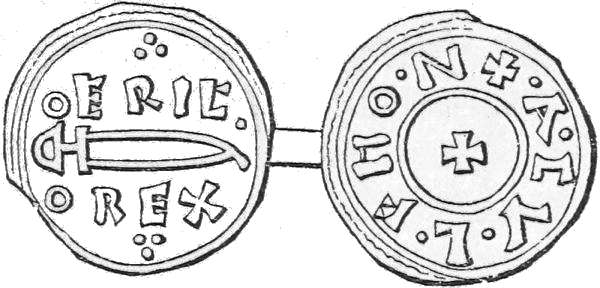
[++] Coin: Erik Rex
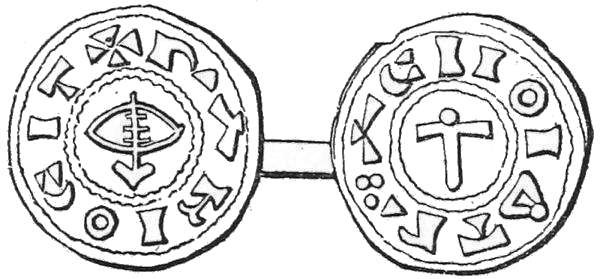
Similar swords are also seen on the St. Peter’s money before mentioned, coined at York during the rule of the Scandinavian kings. One of these coins represents a bent bow with the arrow on it, and on the reverse a sledgehammer, or battle-axe.
[++] Coin: Olaf
[++] Coin:
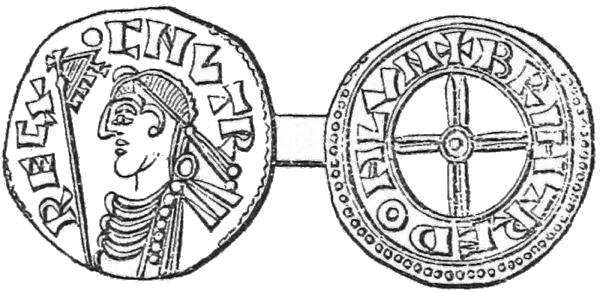
[++] Coin: Cnutr. Recx
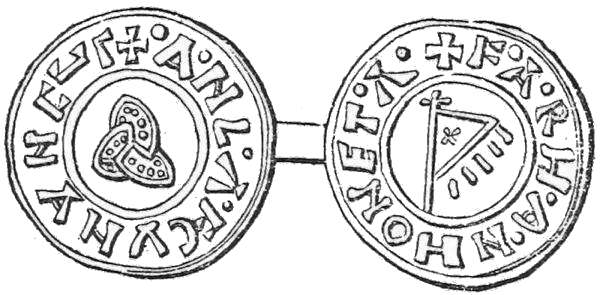
Regnald’s and Anlaf’s (or Olaf’s) coins, with the Scandinavian legend “Cununc” instead of “Rex,” are ornamented with shields placed together (an emblem which may have been transferred from them to the later coins of Harald Haardraade and other Norwegian kings); as well as with flags of a triangular form, with hanging fringes. It is remarkable enough, that though such flags are not to be found on contemporary English coins, a piece of the Danish-English king’s, Canute the Great, has lately been found on which the king’s bust is represented, and before it a striped triangular flag with hanging fringes, of the same form as the flags on the coins of the Danish-Norwegian kings in north England. The legend on one side is, “Cnutr. Recx;” and on the other, “Brihtred on Lun;” which shows that the coin was minted in London.
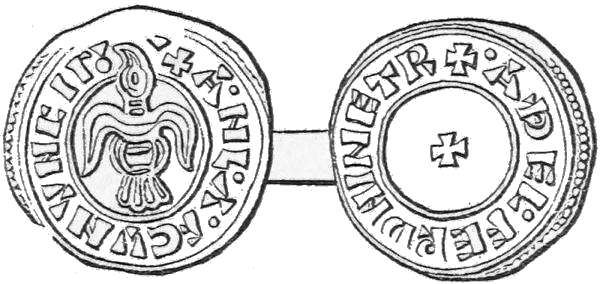
Coin: [++] Anlaf Cunune
Thus the coins, in conjunction with the chronicles, contribute to prove that flags were important emblems with the northern conquerors, which was indeed quite natural with a people like the ancient Scandinavians. The old Sagas in particular contain frequent accounts of the great value that the Northmen set on these flags, or, as they were then called, “mærker” (marks). Thus the Norwegian chief Harald Haardraade, before he became king of Norway, and after his return from his many expeditions into the Greek Empire, sitting and conversing one evening (according to the nineteenth chapter of his Saga) with King Svend Estridsen of Denmark at the drinking table, Svend asked him what precious things he had that he set most value on? He answered, his banner, called Landöde (or, the land-ravager). Svend then asked what qualities this banner had, since he esteemed it so precious a thing? Harald replied, “They say that he before whom this banner is borne always gains the victory; and such has constantly been the case since I possessed it.”
The class of coins before alluded to as minted by Danish-Norwegian sovereigns in England not only presents a remarkable view of the importance, as well as appearance, of the old Scandinavian flags, or marks, but also serves in a high degree to confirm the repeated accounts of the English chroniclers, that “the Danes,” during their conquests in the western lands, often bore a common standard, or national flag; a point about which the Danish chronicles or Sagas are silent. A coin of Anlaf, or Olaf, king of Northumberland, is particularly illustrative of this. It has the legend, “Anlaf Cununc,” and represents a bird with extended wings, in which English antiquarians have very justly recognised the raven, the chief ensign, or emblem, of the ancient Danes.
From the most ancient times, and almost since the period that war was first waged, certain ensigns were undoubtedly known and used, around which the warriors rallied in battle. This had its origin, indeed, in necessity, in order that, in the tumult of battle, the combatants might always be able to discern where their fellow-warriors were; and such a rallying point was particularly of the greatest importance when an army was thrown into disorder, or began to fly. To this it may be added, that the commander, or the principal leaders, were generally near the ensign; which thus became a signal where the battle was usually hottest, and a point to rally round in order to protect the chief when in danger.
But these ensigns, which doubtless were originally boughs of trees or other simple things easy to be recognised at a distance, obtained by degrees a religious importance, and must thus have still more excited the courage of the combatants. For ensigns those figurative images were principally chosen under which men were accustomed to represent to themselves their principal gods, or to which a peculiar religious faith was attached. In the course of time these ensigns were adopted by whole tribes as national ones. The eagle, Jupiter’s sacred bird, served the Romans for a warlike ensign, and animated the legions on their distant and universally-celebrated expeditions. With them, however, it did not flutter in a banner, but was cast in metal and fixed on the end of a staff. The national ensign used by at least a great part of the Gallic tribes in the south of France about the time of the birth of Christ, was of a similar kind. According to a few still-existing representations of it on monuments, it presented the image of a hog, fastened, like the Roman eagle, at the end of a staff. Among the Gauls the hog was a sacred animal, whence it is afterwards found frequently represented on the old Gallic coins.
Among the German and Scandinavian races, on the contrary, we cannot point with certainty to any such early national ensigns. These people, as it is well known, formed, for several centuries after the birth of Christ, a number of petty and independent kingdoms, which were, besides, often divided amongst several powerful chiefs. It was customary for every chief to have a peculiar sign, often an animal, delineated on his shield; and which was likewise represented on the banner that he carried with him into battle. This banner, or mark, was generally borne before him in the combat by his “marksman;” and at sea it waved on the prow of his ship. It was not, like that of the Romans and Gauls, of cast metal, but of variegated cloth.
It was not till the time that the Danes and Norwegians began to invade the countries of the west, and to make great conquests there, and consequently not till the ninth century, that we find the oldest traces of the Danes, or rather perhaps the Danish-Norwegian Vikings, having fought under one flag; which was not, like the earlier ones, that of a single chief, but rather an established national ensign. We must remember that they were heathens, making war upon a Christian land, and fighting for Odin and Thor against White[5] Christ. Regardless of their former contests in the north itself, the Vikings were now united on these foreign shores by the ties of mutual interest and a common religion; and nothing, therefore, was more natural than that the ensign which conducted them in battle should be consecrated to Odin, or, as he was called, the father of victory, in whose presence they expected at some time to assemble and enjoy the delights of Valhalla. The eagle had been consecrated to Jupiter by the Romans; among the Northmen the raven was Odin’s (or, the Father-of-all’s) sacred bird. One of Odin’s names was therefore “Ravne-gud” (raven-god). The ravens Hugin and Munin sat on his shoulders, and only flew away to bring him intelligence of what happened in the world. The ancient Northmen had consequently an especial confidence in the omens of Odin’s bird. When the Viking Floke Vilgerdesön set out from Norway to discover Iceland, he consecrated at a sacrifice three ravens, which he wished to take with him, to show him the way. He was therefore called Ravnefloke. The Northmen, also, made prognostications from the scream and from the flight of the raven; and the warriors, in particular, regarded it as a good omen if a raven followed them as they marched to battle.
As Jupiter’s eagle had been the war sign of the Romans so was Odin’s raven the chief mark of the Danes in the heathen ages. An old chronicler (Emma’s Encomiast) relates, that in the time of peace no image whatever was seen in the flag, or mark, of the Danes; but in time of war there waved a raven in it, from whose movements the Danes took auguries of victory or defeat. If it fluttered its wings, Odin gave them a sign of conquest; but if the wings hung slackly down, victory would surely desert them. From the few historical accounts that remain to us of this raven’s mark we are not, however, justified in believing that it was so long or so generally adopted among the Danes as the eagle was among the Romans. We find it expressly mentioned only during the Danish conquests in the British Islands; yet, remarkably enough, at such different times and under such peculiar circumstances, that we may with good reason assert that the raven’s mark was really a common flag of battle and conquest for the Danes and Norwegians.
It is mentioned for the first time in the year 898, consequently nearly a thousand years ago; that is to say, about the time of the banner-coins before described, and especially of that coin of Anlaf, or Olaf, on which is seen the bird with extended wings. At that time, it is said, the Danish chiefs suffered a great defeat in South England, in which they lost their war-ensign, or banner (Anglo-Saxon, guð-fana), which they called “the raven” (Anglo-Saxon, ræfen v. hrefn. v. hræfen). Another account adds, that these chiefs were sons of Regner Lodbrog, and that the flag, or mark, was cunningly woven by Regner’s daughters. The raven borne upon it was thought to forbode either victory or defeat.
This ensign is again spoken of a century later, in the time of Canute the Great. It is mentioned in the great battle of Clontarf, in Ireland (1014), when Sigurd, the Norwegian Jarl of Orkney, bore a raven-standard against the Irish. Two years afterwards, in the sanguinary battle at Ashingdon in Essex (1016), which partly decided Canute’s conquest of England, the Danish army had begun to give way; when the jarl, Thorkel the Tall, shouted to the warriors, as he pointed to the flag, that the raven fluttered its wings, and predicted a glorious victory. The Danes took fresh courage, and victory crowned their efforts. The mighty Danish jarl Sivard, or Sigurd, surnamed “Digre” (the stout) (+ 1055), who ruled the earldom of Northumberland somewhat after Canute’s time, and after the Danish dominion in England had ceased, also bore a raven ensign, which was called “Ravenlandeye,” or the raven that desolates the land. (“Corvus terræ terror.”) There seems to have been many legends among the people, both as to the manner in which Sigurd procured this ensign, and as to its supernatural power.
After the time of Canute the Great and Sigurd Digre, there is scarcely any coin to be found bearing the image of the raven; but fortunately there is a representation of another kind, belonging to the eleventh century, which in no slight degree proves that raven-ensigns were actually borne by the successors of the Danes and Norwegians in the west of Europe until about the year 1100.
It is known that Scandinavian Vikings, and particularly Normans and Danes, conquered the French province afterwards called from the Northmen (Normænd) Normandy; and that the successors of Rollo, or Rolf (Ralph), continued to govern that land as dukes. From Normandy, Duke William, surnamed the Conqueror, passed over in 1066 into England, which he conquered by the battle of Hastings. The whole expedition, together with this battle, is represented in the old and extremely remarkable piece of tapestry, preserved in the cathedral of Bayeux, in Normandy, and said to have been worked by William the Conqueror’s own consort, Matilda; at all events it was made shortly after the conquest of England. There can, therefore, be no question about the fidelity of the figures represented, at all events, as far as regards the Normans. It is here seen that the Norman chiefs, after the old Scandinavian fashion, had each his ensign or banner of party-coloured cloth cut out into tongues or points, and fastened to the pole of a lance. But where William is represented on the Bayeux tapestry advancing to the battle of Hastings, the chief banner is borne by a mounted knight clad in chain armour, who rides before another knight, likewise clothed in armour, and having on his lance an ensign or flag with five tongues or points, and with a cross in it.
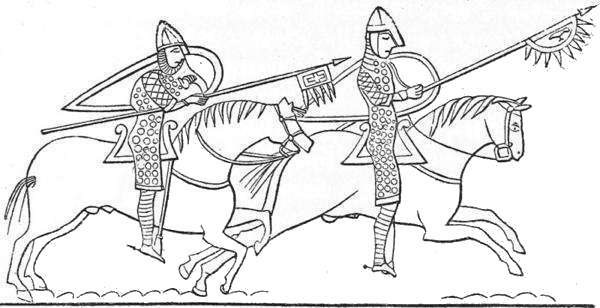
[++] Bayeux tapestry: Two Knights
On the chief banner, the only one of that form among the many flags in the tapestry, but which in its whole shape and pendant fringes bears a striking likeness to the old Danish flags before mentioned, there is seen in the middle the figure of a little bird, which may, with the greatest probability, be taken for Odin’s raven. For it is very natural that the Scandinavian Vikings, or Normans, who had achieved so many and such famous conquests under Odin’s raven, should continue to preserve this sign, even after they had adopted Christianity; and that thus the Normannic dukes in Normandy should also long bear their forefathers’ venerable ensign with them as a Palladium in the combat.
After the conquest of England by the Normans, however, the Norman kings abandoned the old Scandinavian raven-mark, and adapted themselves more to the English customs. Probably each king had his own mark or flag, after the custom of that time, until the national banner afterwards received a settled form. But the remembrance of the Danish raven by no means became obsolete among the English nation. Whilst the raven-flag has almost been erased from the memory of the Danish people, the remembrance of it still exists freshly in the British islands; and both poets and artists who represent, however simply, the ancient combats of the Danes with the Anglo-Saxons, the Scotch, and the Irish, seldom neglect to make “the enchanted raven” wave in the Danish ranks.
On the often-mentioned Bayeux tapestry is also represented the fall of the English king, Harald Godvinsön, at the battle of Hastings. The king’s flag-bearer, or marksman, who, as well as the king, is on foot, bears a flag-staff, on which is fixed a figure, probably of cloth, cut in the resemblance of a dragon, which was the royal mark of the Anglo-Saxon king. Close before him lies a fallen knight, by whose side is seen a lance with the point downwards, and on which hangs a similar dragon.
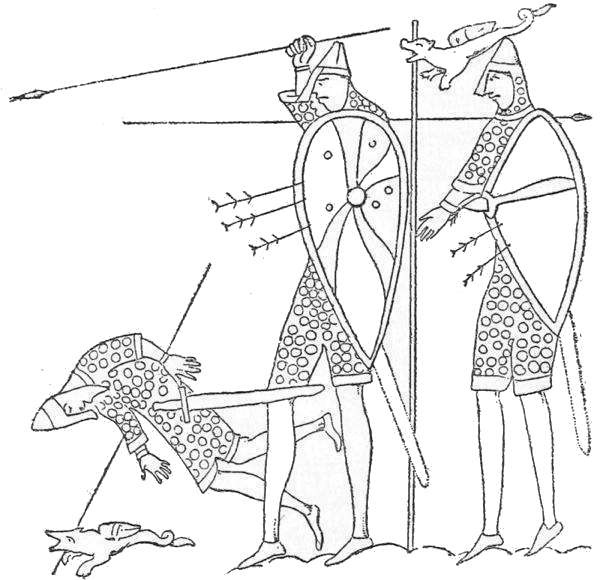
[++] Bayeux tapestry: Harald Godvinsön
This fallen knight is without doubt the king. From the form of his flag, or mark, we may conclude that the Danes’ raven-mark probably consisted at times of the figure of a raven fixed to a shaft, and cut out or sewed in a similar manner.
What colours were used for the raven-mark can now hardly be decided. The bird, or raven, on William the Conqueror’s war-flag appears to have been of a blue-black on a pale yellow, or light, ground. This colour in the tapestry may, perhaps, have been accidental; and the account of an English chronicler would lead us to suppose that the ground of the Danish flags, or marks, was, at least in time of peace, white. But the colours were certainly different at different times. There can be no doubt that the ground was often red; for, from the most ancient times, red was a very favourite colour in the north, especially in time of war. The old inhabitants of the north, when they came as friends, used to show a white shield, but when they appeared as enemies it was red; then “they raised the war-shield.” In Norway red seems to have been the national colour from an early period; and it was even ordered in Gulething’s laws, that every man who possessed six silver marks[6] should have a red shield. Something similar was probably the case in Denmark. An old legend preserved by the Scotch historians relates that, in a battle in Scotland about eight hundred years ago, the Danes wore red and white tunics. That red and white appear so prominently on the Danish national colours ever since the thirteenth century is certainly owing to an ancient predilection among the people for these colours. It is perhaps, therefore, most probable that the banners, or marks, of the ancient Danes were, in time of peace, of a light colour, but in war time of a blood colour, with a black raven on the red ground.
In the ninth, tenth, and eleventh centuries the raven, the Danebrog of heathenism, waved victoriously in the western lands. It was with Canute the Great at Ashingdon, with the Norman William at Hastings, and was thus present at two conquests of England. But the battle of Hastings was the last important battle that the raven won. Heathen Scandinavia had exhausted its strength by numerous and far-extended conquests. Christianity, and with it a new and a higher civilization, advanced with a power not to be checked even among the ancient followers of Odin. The raven, Odin’s mark, to which the heathen Danes had attached themselves with all the strength of religious faith, no longer inspired them as before when the warriors had lost the hope of the joys of Valhalla. If they now fought, it was mostly against heathens who would not bow before that cross on which Christ bled and suffered for the sins of mankind. In order to inspire the combatants, it was necessary that the banner which they followed should be an expression of the spirit which stirred among the people, of that living hope which animated them respecting the manner of their existence in another world. The raven, the symbol of heathenism, paled by degrees, as antiquated and meaningless, and at last quite gave place to the symbol of Christianity, the holy cross.
The same representations on ancient coins and tapestry, which exhibit the raven, and the old flags, also show the sign of the cross. The flag on Olaf’s and Regnald’s coins (p. 53) has a figure in the middle resembling the cross. This is still more distinct on the Bayeux tapestry, where William’s chief banner is borne (p. 59), for immediately after the raven follows a flag with the cross. This last, moreover, certainly represents the identical consecrated banner with the figure of a cross, which the Pope sent to William on the occasion of his expedition against England.
The sign of the cross must by degrees have naturally superseded the raven, not only among the descendants of the Danes and Norwegians in England, but also, though perhaps somewhat later, in the north itself. If we may not assume that the present “Danebrog,” with its white cross on a red ground, became the Danish national flag immediately after the introduction of Christianity, it is at least certain that the Danish kings, in the first two centuries after that event, bore flags with crosses as their personal banners, or marks; and particularly in the twelfth century, when the crusades against the heathen Wends began. An old Saga, or legend, relates, that during one of the crusades of King Waldemar the Victorious in Livonia, in 1219, the “Danebrog” fell from heaven among the Danish army. This much, however, is certain—that it is not till after these crusades that the “Danebrog” appears as the established national flag of the Danes; and ever since that time, for more than six centuries, it has continued to wave unchanged in the Danish fleets and armies. It is remarkable that, as the flag of the fleet, and of all fortified places, and as the royal flag, it is split; and it can scarcely be doubted that this form must have originated from the fringes and tongues, or points, with which the old Danish and Scandinavian flags were ornamented in the tenth and eleventh centuries. The Scandinavian people is the only one which from remote antiquity has uninterruptedly borne this split flag; and it is possible that Sweden, as well as Norway, obtained theirs, which is of comparatively late origin, by imitating the old Danebrog.
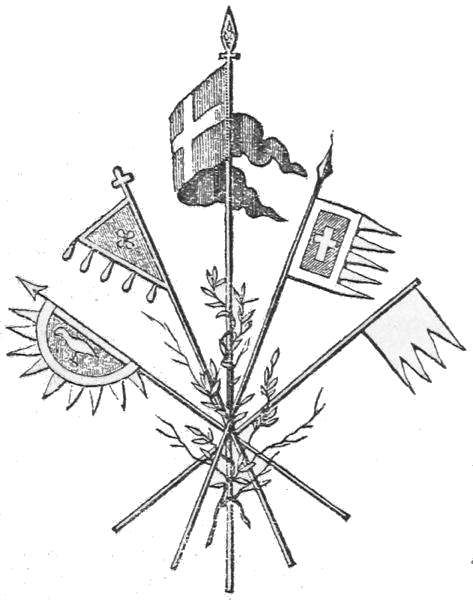
[++] Flags and Ensigns
Other European countries also derived from the crusades flags with crosses as their national banners; as, for instance, England the St. George’s banner, which was white with a red cross; and Scotland a blue flag divided by a white St. Andrew’s cross. About the same time the different kingdoms began to adopt a fixed national coat of arms. Thus Denmark assumed that still in use,—three blue leopards, or lions, on a golden shield, strewed with red hearts; which was originally the family arms of the royal house. It has, however, undergone a few slight changes. With regard to this subject, it is remarkable that three leopards were also borne by the Norman dukes, who were of Norwegian descent, and who, after the conquest, introduced the leopards, or lions, into the arms of England. Generally the lion was not, nor is indeed at present, found on coats of arms in England and France, whereas it appears very frequently in those of the north. Sweden has, besides others, the Gothic lion; the Norwegian national coat of arms is a lion with a halberd; and Denmark has, besides the proper national arms, the Cymbric lion, and the two Sleswick lions. But the lion is so peculiarly Scandinavian that it does not even cross the Eider; Holstein, which is German, has an entirely different coat of arms—a nettle-leaf. There is also this similarity between the Danish and English lions, that they are represented standing, whilst those on the other national arms are depicted springing. Would it, therefore, be quite groundless to trace, even in the armorial bearings of England, one of the many proofs of the influence which the Northmen, and the Scandinavian elements, still continued to exert there at the time when the national arms were adopted, and when the foundations of an entirely new and superior social system had already been laid?
Section VII.
Danish-Norwegian Names of Places.
On the extremity of the tongue of land which borders on the north the entrance of the Humber, there formerly stood a castle called Ravnsöre (raven’s point—in old Scandinavian, Hrafnseyri), and afterwards Ravnsere. Öre is, as is well known, the old Scandinavian name for the sandy point of a promontory. Ravn (or Raven) may possibly have been either the name of the man who first conquered the surrounding district and built the castle; or, what is certainly far more probable, the Northmen, on erecting this important castle on one of their first landing places on the greatest river in north England, named it after the bird sacred to Odin, which fluttered in their banner, and prognosticated to them victory in the fight. In that case it was a singular coincidence that Harald Haardraade’s son Olaf should, after the battle of Stamford Bridge, have embarked at Ravnsöre for the Orkneys and Norway with the feeble remnant of the Norwegian army. The very place which had before so often seen multitudes of Northmen, intoxicated with victory, land with Odin’s raven-flag, now beheld the flight-like departure of their successors, after they had combated in vain under that celebrated banner “Landöde” (the land-ravager), which had accompanied Harald Haardraade in his expeditions to the East, against the Saracens and other enemies of Christianity. It was one of the many proofs that “White Christ” was not yet for the Northmen, at least in battle, what Odin had been previously.
It is, however, at least certain that the name “Ravenspurn” (Ravnsöre) is derived from the Scandinavian conquerors. An Icelandic Saga, written a hundred and fifty years after the conquest of England by the Normans, or after the battle of Hastings (1066), says that “Northumberland was mostly colonized by Northmen; for after Lodbrog’s sons, who conquered the country, had again lost it, the Danes and Norwegians often harried it; and there are still many places to be found in the district that have names taken from the Scandinavian tongue, such as Grimsby, Hauksfliot, and numerous others.”
Old English chroniclers also state that many towns in England had new names given to them by the Northmen; for instance Streaneshalch came to be called Whitby, and Northweorthig was named in the Danish language “Deoraby.”
A surer and more decisive proof than all written historical accounts of the Danish-Norwegian settlements and diffusion in the midland and northern districts of England is, that the above-named places, namely, Grimsby (“the town of Grim”), Whitby (Hvidby, “the White town”), and Deoraby Dyreby (“town of deer”), contracted to Derby, are to be found to this day in Lincolnshire, Yorkshire, and Derbyshire; and also that in these old Danish districts there is, moreover, a very considerable number of towns with names of just as undoubted Danish origin. A close inspection of even a common map of England will soon show that there are not a few names of places in the north of England, whose terminations and entire form are of quite a different kind from those of places in the south.
The greater number of names of places in the south of England end in ——ton, ——ham, ——bury, or ——borough, ——forth or ——ford, ——worth, &c. These, which are of Anglo-Saxon origin, and which also serve still further to prove the preponderating influence of the Anglo-Saxons in that part, are, it is true, also spread over the whole of the north of England. But, even in the districts about the Thames (in Kent, Essex, Suffolk, and Norfolk) they already begin to be mixed with previously unknown names ending in ——by (Old Northern, býr, first a single farm, afterwards a town in general), ——thorpe (old Northern Þorp, a collection of houses separated from some principal estate, a village), ——thwaite, in the old Scandinavian language Þveit, tved, an isolated piece of land, ——næs, a promontory, and ——ey, or öe, an isle; as in Kirby, or Kirkby, Risby, Upthorpe and others. As we approach from the south the districts west of the Wash, such as Northamptonshire and Warwickshire, the number of such names constantly increases, and we find, among others, Ashby, Rugby, and Naseby. As we proceed farther north, we find still more numerous names of towns and villages having in like manner new terminations; such as, ——with (i.e. forest), ——toft, ——beck, ——tarn (Scandinavian, tjörn, or tjarn, a small lake, water), ——dale, ——fell (rocky mountain), ——force (waterfall), ——haugh, or, how (Scand., haugr, a hill), ——garth (Scand., garðr, a large farm); together with many others. The inhabitants of the north will at once acknowledge these endings to be pure Norwegian or Danish; which is, moreover, placed beyond all doubt by the compound words in which they appear.
It is not of course very easy to point out the meaning of every name of a place that has a Danish or Norwegian termination; the original form having been partly corrupted by later differences of pronunciation, and partly changed, by the ancient Scandinavians having often merely added a Scandinavian ending to the older names, or at most re-modelled them into forms that had a home-like sound to their ears. Still there are names enough of places whose signification is quite clear. To instance some derived from the situation or nature of the place: Eastby (Dan., Ostby; Eng., the eastern village), Westerby (Eng., the western village), Mickleby (Dan., Magleby; Eng., the large village), Somerby, Markby (Eng., the field village), Newby (Dan., Nyby; Eng., the new village), Upperby (Dan., Overby; Eng., the upper village), Netherby (the lower village), Langtoft (the long field), Kirkland (church-land), Stainsby (the stone village), Haidenby (Dan., Hedeby; Eng., the heath village), Raithby (Dan., Rödby, from rydde, to clear away), Dalby (village in the dale), Scawby and Scausby (village in the wood), Scow, Askwith (Dan., Askved, or Askeskov, i.e. Ashwood), Storwith (Dan., Storved, or Storskov; Eng., the large wood), Lund (Danish for grove), Risby (the beech village), Thornby (the thorn village), Birkby (Dan., Birk; Eng., the birch village), Ings (Dan., Enge; Eng. meadow), Brackenthwaite (Bregentved, from Brackens), Northorpe (Dan., Nörup; Eng., north village), Millthrop (Dan., Möldrup; Eng., mill-village), Staindrop (Dan., Stenderup; Eng., stone village), Linthorpe (Dan., Lindrup; Eng., lime-tree village), Stonegarth (Dan., Steengaard; Eng., stone farm), Dalegarth (Dan., Dalsgaard; Eng., valley farm), Fieldgarth (Dan., Fjeldgaard; Eng., rocky farm), with others. A village on the river Eden in Cumberland is called Longwathby (from a long ford, or wading place; Danish, at vade); and north and south of the Humber, at a spot where there is a ferry over the river (Dan., Færge), lie north and south Ferriby! Almost all these names, to which a great number of similar ones might be added, answer to names of places still in use in Denmark, only with this difference, that thwaite has there passed into tvede, or tved, and thorpe into trup, drup, or rup.
The following examples may be cited of Danish-Norwegian names of places in England, called after animals: Codale (Cowdale), Swinedale, Swinethorpe, Hestholm (Eng., Horse-holm), Calthorpe, and Hareby.
Names of places containing personal names are, however, beyond comparison far more numerous, and were probably taken from the first Scandinavian conquerors; as, for instance, Rollesby (Rolfsby), Ormsby (Gormsby), Ormskirk, Grimsdale, Grimsthorpe, Haconby, Gunnerby, Aslackby, Swainby, Swainsthorpe, Ingersby, Thirkelsby, Asserby, Johnby, Brandsby, Ingoldasthorpe, Osgodby, Thoresby, and several others.
Among this species of names of places are found such as Tursdale, Baldersby, Fraisthorpe, and Ullersthorpe. Now it is certainly probable that these were only derived from men named Thor, Balder, Freyer, and Uller, or Oller; yet we cannot avoid thinking of the old gods who bore these names, particularly as it was a common custom among the ancient Scandinavians to name towns and estates after them. In England also are found Asgardby, Aysgarth (or Asgaard, in Yorkshire), as well Wydale and Wigthorpe, or Wythorpe; which two names have undoubtedly the same origin as the old sacrificial and assize town Viborg, in Jutland (from Vébjörg, or the holy mountains); namely, from vé, a sacred place. Even the name of one of the most important sacrificial places in the Scandinavian north, is to be found in Yorkshire, in Upsal (from Upsalir, the high halls). The names of places in England which have preserved traces of the Danes after they had become Christians, may all the more assure us that we are not mistaken in regarding the names just mentioned as remarkable remains of the short period of their domination when heathens. The names of Bishopsthorpe (Bispetorp), Nunthorpe (Nonnetorp), Kirkby, Crosby, and Crossthwaite, sufficiently prove that Christian had succeeded to sacrificial priests, and that church and cross were now erected where heathen altars and temples had formerly stood.
The name of the village of Thingwall[7] in Cheshire affords a remarkable memorial of the assizes, or Thing, which the Northmen generally held in conjunction with their sacrifices to the gods; it lies, surrounded with several other villages with Scandinavian names, on the small tongue of land that projects between the mouths of the rivers Dee and Mersey. At that time they generally chose for the holding of the thing, or assizes, a place in some degree safe from surprise. The chief ancient thing place for Iceland was called like this Thingwall, namely Thingvalla (originally “Þingvöllr,” “Þingvellir,” or the thing-fields).
The before-mentioned names Bishopsthorpe and Nunthorpe apply to estates that belonged to the church; the following ones, viz., Coningsby, Coneysthorpe, Coneysby, Kingthorpe, and Kingsby, denote property belonging to the kings, or destined for their maintenance. Some towns are named after the trade or business of the original inhabitants as Smisby (Smithby) Weaverthorpe, and Copmanthorpe (Kjöbmandsthorpe, i.e., merchants-thorpe); others point to the descent of the inhabitants, such as Romanby, Saxby, Flemingsby, Frankby, Frisby and Fristhorpe (but this possibly came from “Freyr”), Scotby, Scotsthorpe, Ireby, Normanby, Danby or Denby, and Danesdale.
It also deserves to be mentioned that many of these names of places have by degrees become family ones, which are constantly heard in England; for instance, Thoresby, Ashby, Crosby (whence again Ashby and Crosby Streets in London), Thorpe, Sibthorpe, Willoughby, Scoresby, Derby, Selby, Wilberforce, &c.
In order, lastly, to convey an idea of the abundance of Scandinavian, or Danish-Norwegian, names of places, which occur in the midland and northern districts of England, a tabular view of those most frequently met with is here subjoined from the English maps. This list, which is principally drawn up for the use of those readers who have not a comprehensive map of England at hand, will, with all its deficiencies, clearly and incontestably prove the correctness of the historical accounts, which state that the new population of Danes and Norwegians that immigrated into England during the Danish expeditions, settled almost exclusively in the districts to the north and east of Watlinga-Stræt, and there chiefly to the west and north of the Wash. Norfolk, Northamptonshire, and Lancashire, have each only about fifty names of places of Scandinavian origin; Leicestershire has about ninety; Lincolnshire alone, nearly three hundred; Yorkshire above four hundred; Westmoreland and Cumberland each about one hundred and fifty. The colonization has clearly been greatest near the coasts, and along the rivers; it had its central point in Lincolnshire (the Northmen’s “Lindisey”), and in the ancient Northumberland, or land north of the river Humber. Yet it was not much extended in Durham and the present Northumberland, each of which contains only a little more than a score of Scandinavian names.
A Tabular View of some of the most important Danish-Norwegian
Names of Places in England.
(Extracted and collected from “Walker’s Maps,” London, 1842.)
Part A
Names ending in by thorpe thwaite with toft beck næs
In Kent, north-east of Watling Street 1 . . . . . 4
In Essex 2 3 . . . . 3
-Bedfordshire . 3 . . 1 . .
-Buckinghamshire 1 2 . . . . .
-Suffolk 3 5 1 . . . 1
-Norfolk 17 24 2 . . 1 .
-Huntingdonshire 1 . . . . . .
-Northamptonshire 26 23 . . 3 . .
-Warwickshire 2 1 . . . . .
-Leicestershire 66 19 . . 1 . .
-Rutland . 7 . . . . .
-Lincolnshire 212 63 . 1 4 8 1
-Nottinghamshire 15 20 . . . 1 .
-Derbyshire 6 4 . . 1 . .
-Cheshire 6 . . . . . .
-Yorkshire:
--East Riding 35 48 1 6 3 1 1
--West Riding 32 29 6 8 2 4 .
--North Riding 100 18 2 6 1 7 .
-Lancashire 9 . 14 2 . . 2
-Westmorland 20 6 14 1 . 17 1
-Cumberland 43 1 43 . . 12 2
-Durham 7 7 . . . . .
-Northumberland . 1 . . . 1 .
In all 604 284 83 24 16 52 15
Part B
Names ending in ey. dale force fell tarn haugh Total
In Kent, north-east of Watling Street 1 . . . . . 6
In Essex 3 . . . . . 11
-Bedfordshire . . . . . . 4
-Buckinghamshire . . . . . . 3
-Suffolk . . . . . . 10
-Norfolk . . . . . . 44
-Huntingdonshire . . . . . . 1
-Northamptonshire . . . . . . 52
-Warwickshire . . . . . . 3
-Leicestershire . 1 . . . . 87
-Rutland . 1 . . . . 8
-Lincolnshire . 3 . . . . 292
-Nottinghamshire . . . . . . 36
-Derbyshire . . . . . . 11
-Cheshire . . . . . 6
-Yorkshire:
--East Riding . 12 2 . . . 109
--West Riding . 12 . 15 2 . 110
--North Riding . 40 4 7 1 . 186
Lancashire 2 13 . 7 . . 49
Westmorland . 36 6 42 15 . 158
Cumberland . 16 1 15 9 . 142
Durham . 5 2 2 . . 23
Northumberland . 3 . 7 . 10 22
In all 6 142 15 95 27 10 1373
Besides many other names ending in -holm, -garth, -land, -end,
-vig, -ho (how), -rigg, &c., c.
The same table still further shows that the names ending in by, thorpe, toft, beck, næs, and ey, appear chiefly in the flat midland counties of England; whereas, farther towards the north, in the more mountainous districts, these terminations mostly give place to those in thwaite, and more particularly to those in dale, force, tarn, fell, and haugh. This difference, however, is scarcely founded on the natural character of the country alone; it may also have arisen from the different descent of the inhabitants. For although in ancient times Danish and Norwegian were one language, with unimportant variations, so that it would scarcely be possible to decide with certainty in every single case whether the name of a place be derived from the Danes or from the Norwegians; yet it may reasonably be supposed that part at least of the last-mentioned names are Norwegian; namely, those ending in ——dale (as Kirk-dale, Lang-dale, Wast-dale, Bishops-dale); in ——force (as Aysgarth-force in Yorkshire, High-force, and Low-force, in the river Tees, and in the stream called “Seamer Water”); in ——fell (old Norwegian, fjall; Mickle-fell, Cam-fell, Kirk-fell, Middle-fell, Cross-fell); in ——tarn (Old Nor., tjörn, or tjarn, a small lake); and in ——haugh (as in Northumberland, Red-haugh, Kirk-haugh, Green-haugh, Windy-haugh). Exactly similar names are met with to this day in the mountains of Norway; whilst they are less common, or altogether wanting, in the flat country of Denmark. That Norwegians also immigrated into England, even in considerable numbers, both history and the frequently occurring name of Normanby in the north of England, clearly show; but they appear to have betaken themselves chiefly to the most northern and mountainous districts, which not only lay nearest to them, but which in character most resembled their own country. In this respect it deserves to be noticed, that places whose names end in tarn, and are consequently pure Norwegian, are found only in the most northern counties; and that those in haugh—although there are names of places in Denmark ending in höi (hill)—must also, from the form, be Norwegian. They are found exclusively in the present Northumberland, and within the Scotch border.
We may, however, venture to set down the greater part of Scandinavian names of places in England as Danish. The terminations in thwaite and thorpe, indeed, are to be met with in Sweden, Norway, and Iceland, as well as in the Saxon and Frisian districts of North Germany; yet as the corresponding English names are for the most part composed of pure Scandinavian or Danish words, and as they seldom appear either in the tracts conquered by the Norwegians in Scotland and Ireland, or in the southern and south-western, originally Anglo-Saxon, districts of England, but keep strictly within the same boundaries as the rest of the Danish names of places, and particularly of those in by (Danish for town or village), these are valid reasons for regarding them in general as Danish.
The names of places in England ending in by are only to be found in the districts selected by the Danes for conquest or colonization. With the exception of a single Kirby, or Kirkby, in Kent, not far from London, they are nowhere to be found to the south of Watlinga-stræt (for Tenby, formerly Tenbigh, in Pembrokeshire, is from a different derivation); whilst towards the north, they cease in the most north-eastern county of England, the present Northumberland; in the south-westernmost part of Scotland (Locherby in Dumfries, Sorby in Wigtonshire); and in the Isle of Man (Sulby, Jurby, Dalby). If we except Duncansby in Caithness, and Oreby in the Isle of Lewis, as well as some few villages in Orkney and the Shetland Isles, they do not appear among the many pure Norwegian names of places in the north and west of Scotland, and in Ireland; which, as will be explained in its proper place, have generally quite a different character from the Scandinavian (chiefly Danish) names of places in England. It can hardly be said that this was solely owing to the natural character of the country in England being more favourable for the building of villages than in those districts in Scotland and Ireland which were occupied by the Northmen: first, because the Norwegians seem to have dwelt closely together in many places there, doubtless in order to resist the attacks of the natives; secondly, because the land there, though often separated by nature into many districts, as for instance in Caithness and the Orkneys, by no means prevented them from assembling together in villages; and lastly, because by originally denoted only a single estate or farm. In Norway, the Faroe Isles, and Iceland, many names of places are to be found, which indicate the existence both of single farm-houses and collections of them, or villages; but they have this peculiarity, that they generally end in bœr or bö, far more rarely in býr or by; whilst, on the contrary, this last form is essentially Danish. Names of places ending in by are spread over the peninsula of Jutland quite down to Danevirke and the Eyder; are found in great numbers in the southern boundary of South Jutland, or Sleswick; as well as in the islands and old Danish countries of Skaane, or Scania, Halland, and Bleking; whence they extend themselves over a great part of Sweden, and far into Finland. From the most ancient times down to the present, this difference between the Norwegian form bœr, and the Danish býr or by, seems on the whole to have clearly prevailed; and thus that, as early as the eleventh century, the English towns and villages are written in William the Conqueror’s “Domesday-book,” with the Danish ending by or bi, and not with the Norwegian form bœr or bö, is certainly no slight corroboration of their assumed Danish origin. Besides, as by is not found in the names of places south of the Eyder, in Holstein or North Germany, and as it is wholly unknown in the Saxon or German languages, there is consequently so much the greater probability that in England it was derived from the Danes.
For the same reasons, towns whose names end in by are most numerous in the counties situated on the coast opposite Jutland; viz., in Leicestershire, 66; Lincolnshire, 212; and the North Riding of Yorkshire, 100. In the two other Ridings, there are altogether about 70 names of places ending in by; in Cumberland, 43; and in Westmoreland, 20. For the rest, this termination occurs so frequently throughout the old Danish part of England, that, of 1370 Scandinavian names of places, above 600 (as the tabular view given at page 71 shows) end in by, whilst no other names exceed 280; and even this number is reached only by the ending thorpe, which also is certainly pure Danish; whilst the most numerous after thorpe fall down to 140. This remarkable preponderance of Danish endings in by, will of itself sufficiently prove the important and wide-extended influence of the Danes in the midland and northern counties of England.
The not inconsiderable number (1370) of Scandinavian names of places collected together in the preceding tabular view, could be much increased if we were to include all the Scandinavian appellations used by the common people in many parts of the north of England. A hill, or small mountain, is there called hoe or how (Höi in Jutland: Höw or Hyv); a mountain ridge, rigg; a ford, wath; a spring, kell; a holm or small island, holm; a farm (Dan., Gaard), garth, &c., &c. We might thus, on a very low calculation, compute in round numbers the clearly recognisable Scandinavian names of places in England at one thousand five hundred.
That they should have been preserved in such numbers for more than eight centuries after the fall of the Danish dominion in England, and that they should have retained, as it has been shown, the original Scandinavian forms, and that often in a highly-striking degree, completely disproves the opinion that the old Danish-Norwegian inhabitants of the country north of Watlinga-Stræt were supplanted or expelled after the cessation of the Danish dominion (1042), first by the Anglo-Saxons, and afterwards by the Normans from Normandy; for if such had been the case, the names of places would naturally have become altogether changed and impossible to recognise. As the matter stands it is sufficiently proved that Danes as well as Norwegians must have continued to reside in great numbers in the districts previously conquered by them, and particularly in the north; and consequently that a very considerable part of the present population in the midland and northern counties of England may with certainty trace their origin to the Northmen, and especially to the Danes.
Section VIII.
Resemblance of the People to the Danes and Norwegians.—Proper
Names.—Popular Language.—Songs and Legends.
The present English people is certainly composed, as we have seen, of the most heterogeneous elements. The Englishman reckons among his ancestors Britons, Romans, Anglo-Saxons, and Northmen, especially Danes and Normans. All these people, who successively reigned over England for centuries, must naturally have left numerous descendants behind them. But as in ancient times it was a combat of life and death for dominion, the conquered and their posterity could not immediately amalgamate with the conquerors. Long after the Norman conquest (1066) the Britons, Saxons, Danes, and Normans, were still hostilely opposed to each other. These disputes were brought to a close during the middle ages; prejudices vanished; mixed marriages became more frequent; the different races acquired common interests; and at last, with the exception of those Britons who kept themselves aloof in Wales, passed into one great nation. From this time it was no longer usual in marriages to regard family descent; it was only some of the richer sort, and higher lineage, who considered it an honour to preserve the original blood as pure as possible. There are families still to be found in England who pretend that they descend in a direct line from Saxon or Norman ancestors, and who assert that Saxon or Norman features have been transmitted to them. But even these families have in the course of time been considerably mixed with races of an entirely different extraction; nay, even the Britons in Wales have not been able to prevent some of the hated English blood from gradually supplying and deteriorating that which runs in their own veins. Moreover, if we consider what an immense number of Irishmen, Frenchmen, Germans, Jews, and others, have, particularly during later centuries, immigrated into England, where they have settled, and by degrees married natives; and, lastly, if we remember that most foreigners have settled on the east coast, or in the midland and north-eastern districts; we might almost deem it impossible to point out from the features and bodily frame of the inhabitants of these districts, any preponderating degree of descent from Saxons, Danes, or any one race of people that colonized England in times so long past. In this respect we can of course scarcely think of comparing districts of small extent, such as two neighbouring parishes, or two adjoining counties on the east coast of England. Nevertheless, if by taking a survey of such extensive districts as north and south England, we were able to discover a tolerably decided difference in the general appearance of the inhabitants, this would be a weighty corroboration of the assertions of history, and of the proof derived from names, that these districts were originally peopled by inhabitants of entirely different descent.
The Englishman of London, and the rest of southern England, does not in general betray in his exterior any perceptible resemblance to the Danes and Norwegians. On the contrary, he decidedly differs from them. The black hair, the dark eye, the fine hooked nose, and the long oval countenance, remind one either of relationship with the Romans, whose chief seat in England was in the south, or rather, perhaps, of a strong compound between the ancient Britons and the Anglo-Saxon and Norman races, which afterwards immigrated into England. Many of the Britons seem to have been dark-haired; for among their descendants in Wales, as well as among their near kinsmen, the Highland Scots and the Irish, there are still frequently found—and particularly in remote districts, as, for instance, in the Hebrides—dark-haired and generally small people, having on the whole dark complexions. It was, too, in the south and south-west of England that the greatest mixture took place between the original British tribes and those that afterwards came over.
But as we proceed from the southern towards the middle and northern parts of England, we find that by degrees an entirely different physiognomy, which before we only got a glimpse of now and then, and which could scarcely be remarked in the confusion of people in London, becomes more and more the prevailing one. The farther one proceeds towards Northumberland, the more distinct does it become. The form of the face is broader, the cheek bones project a little, the nose is somewhat flatter, and at times turned a little upwards, the eyes and hair are of a lighter colour, and even deep red hair is far from being uncommon. The people are not very tall in stature, but usually more compact and strongly built than their countrymen towards the south. The Englishman himself seems to acknowledge that a difference is to be found in the appearance of the inhabitants of the northern and southern counties; at least one constantly hears in England, when red-haired compact-built men with broad faces are spoken of; “They must certainly be from Yorkshire:” a sort of admission that light hair, and the broad peculiar form of the face, belong mostly to the north-of-England people. On the other hand, little importance must be attached to the circumstance that Englishmen generally attribute the red hair to the immigration of the Danes; for though it is true that many Danes, and particularly many Norwegians, were red haired, yet some tribes of the original Celtic inhabitants of the British Isles also had red hair; and the same feature may likewise be partly ascribed to the Saxons.
In the midland, and especially in the northern part of England, I saw every moment, and particularly in the rural districts, faces exactly resembling those at home. Had I met the same persons in Denmark or Norway, it would never have entered my mind that they were foreigners. Now and then I also met with some whose taller growth and sharper features reminded me of the inhabitants of South Jutland, or Sleswick, and particularly of Angeln; districts of Denmark which first sent colonists to England. It is not easy to describe peculiarities which can be appreciated in all their details only by the eye; nor dare I implicitly conclude that in the above-named cases I have really met with persons descended in a direct line from the old Northmen. I adduce it only as a striking fact, which will not escape the attention of at least any observant Scandinavian traveller, that the inhabitants of the north of England bear, on the whole, more than those of any other part of that country, an unmistakeable personal resemblance to the Danes and Norwegians.
Old Scandinavian national names, such as Thorkil, Erik, Haldan, Harald, Else, and several others, were formerly, at least, not unfrequently used in these districts. Surnames, such as Adamson, Jackson, Johnson, Nelson (Nielson), Thomson, Stevenson, Swainson, and others, all of which have endings in son or sen, which never appear in Saxon names, still frequently occur. The ending sön or sen (a son) is quite peculiar to the countries of Scandinavia, whence it was brought over to England by the Scandinavian colonists. It is not, however, confined to the north of England, but is spread over all the British Islands where the Northmen settled; for instance, in Scotland we find Anderson, Matheson, &c. It is very remarkable that the name of Johnson, which, as is well known, is one of the commonest in England, is also, perhaps, in the selfsame form, that which most frequently occurs in Iceland.
The still-existing popular dialect affords an excellent proof that the resemblance of the inhabitants of the northern counties of England to the Danes and Norwegians is not confined to a, perhaps accidental, personal likeness. The pure English language itself includes, both with regard to its vocabulary and inflexions, many Scandinavian elements, the result of the Danish immigration. But, in the north of England, many words and phrases are preserved in the popular language, which are neither found nor understood in other parts, although they sound quite familiar to every Northman. These original Scandinavian terms are not only applied, as I have before said, to waterfalls, mountains, rivulets, fords, and islands, but are also in common use in daily life; as, for instance, late (Dan., lede; Eng., to seek), lite (Dan., lide; Eng., to rely), helle (Dan., helde; Eng., to pour out), hit (Dan., hitte; Eng., to find), clip (Dan., klippe; Eng., to cut), forelders (Dan., Forældre, or Forfædre; Eng., ancestors, forefathers), updaals (Dan., opdals; Eng., up the valley), kirk-folk (Dan., Kirkefolk; Eng., people going to church), kirk-garth (Dan., Kirke-gaard; Eng., churchyard), with many others.
These originally Scandinavian words are now chiefly found in the north-west of England, among the remote mountains of Yorkshire, Westmoreland, Cumberland, and Lancashire, where they have withstood the changes of time. On entering a house there one will find the housewife sitting with her rock (Dan., Rok; Eng., a distaff) and spoele (Dan., Spole; Eng., spool, a small wheel on the spindle); or else she has set both her rock and her garnwindle (Dan., Garnvinde; Eng., reel or yarn-winder) aside, whilst standing by her back-bword (Dan., Bagebord; Eng., baking-board) she is about to knead dough (Dan., Deig), in order to make the oaten bread commonly used in these parts, at times, also, barley-bread; for clap-bread (Dan. Klappebröd, or thin cakes beaten out with the hand) she lays the dough on the clap-board (Dan., Klappebord). One will also find the bord-claith spread (Dan., Bordklæde; Eng., table-cloth); the people of the house then sit on the bank or bink (Dan., Bænk; Eng., bench), and eat Aandorn (Eng., afternoon’s repast), or, as it is called in Jutland and Fünen, Onden (dinner). The chimney, lovver, stands in the room; which name may perhaps be connected with the Scandinavian lyre (Icelandic, ljóri); viz., the smoke-hole in the roof or thatch (thack), out of which in olden times, before houses had regular chimneys and “lofts” (Dan., Loft; Eng., roof, an upper room), the smoke (reek or reik, Dan., Rög) left the dark (mirk or murk, Dan., mörk) room. Within is the bower or boor (Eng., bed-chamber), in Danish, Buur; as, for instance, in the old Danish word Jomfrubuur (the maiden’s chamber), and in the modern word Fadebuur (the pantry).
Outside, in the garth, or yard (Dan., Gaard), stands the roomy lathe, or barn (Dan., Lade), which directly shows how fruitful the soil is that belongs to the garth (Dan., Gaard; Eng., a manor, farm). The shepherd or herdsman, whose nowth (Dan., Nöd; Eng., neat cattle) are restless in the boose (Dan., Baas; Eng., stall) and crib (Dan., Krybbe; Eng., manger), is about to cleanse the stable, and with a greype, or gripe (Dan., Möggreve; Eng., dung-fork), bears out the muck (Dan., Mög; Eng., dung) to the midding (Dan., Mödding; Eng., dunghill). If we accompany him to the fields he tells us in a lively tone about the many threaves of corn (Dan., Traver, bundles of twenty or thirty sheaves), particularly of big (Dan., Byg; Eng. barley) that have been got from the poor ling (Dan., Lyng; Eng., fern) which covers the sides of the haughs or haws (Dan., Höie; Eng., hills); of all the slaa-torns (Dan., Slaatjörn; Eng., sloes), lins (Dan., Lindetræer; Eng., linden trees), roan trees (Dan., Rönnetrær; Eng., Scotch rowan trees), and allars (Dan., Elletræer; Eng., alders), that grow in yonder little shaw (Dan., Skov; Eng., wood), or in that lawnd (Dan., Lund; Eng., grove), which is likewise full of hindberries (Dan., Hindbær; Eng., raspberries), and which is resorted to by many gowks (Dan., Gjöge; Eng., cuckoos). A field farther on, which in its time was acquired by mackshift (Dan., Mageskifte; Eng., deed of exchange), has been allowed to ley-breck (Dan., ligge-brak; Eng., to lie fallow). Through this field winds a beck (Dan., Bæk; Eng., brook), or rivulet well stocked with fish, in which with a liester (Dan., Lyster; Icelandic, Ljöstr, grains, or a sort of barbed iron fork on a long pole) one may be able to make a good capture.
In the river are the trows, or troughs (Jutland, trow; Old Scan., Þró), made use of to cross over to the opposite shore. These trows, or troughs, are two small boats, originally trunks of trees hollowed out, and held together by a cross-pole. He who wishes to pass over places a foot in each trough or boat, and rows himself forward with the help of an oar. It is said that Edmund Ironsides and Canute the Great rowed over to the Isle of Olney (in the river Severn) in such boats at the time when they concluded an agreement to divide England between them. The original inhabitants of Europe undoubtedly passed the great rivers in the same simple manner.
Amongst the words in the popular language that still remind one of ancient Scandinavian customs, those of yuletide, yuling (Christmas), yule-candles (Dan., Julelys), and yule-cakes (Dan., Julekager), deserve particular notice. Christmas was certainly kept as a solemn feast among the Anglo-Saxons, but it does not appear to have had that importance with them which it had with the Scandinavians; of which this is a proof, that the old name of Christmas (Yule) is preserved only in those districts in the north that were more especially colonized by the Northmen. Yule, or the mid-winter feast, was, in the olden times, as it still partly is, the greatest festival in the countries of Scandinavia. Yule bonfires were kindled round about as festival-fires to scare witches and wizards; offerings were made to the gods; the boar dedicated to Freÿr (Dan., Sonegalte) was placed on the table, and over it the warriors vowed to perform great deeds. Pork, mead, and ale abounded, and yuletide passed merrily away with games, gymnastics, and mirth of all kinds. It is singular enough that even to the present day it is not only the custom in several parts of England to bring a garnished boar’s-head to table at Christmas, but that the descendants of the Northmen, in Yorkshire and the ancient Northumberland, do not even now neglect to place a large piece of wood on the fire on Christmas Eve, which is by some called the yule-block, by others yule-clog, or yule-log (perhaps from the old Scandinavian lág, log, a felled tree; Norwegian, laag). Superstitious persons do not, however, allow the whole log to be consumed, but take it out of the fire again in order to preserve it until the following year. Exactly similar observances of Christmas customs still exist in the Scandinavian North. At Smaaland, in Sweden, a boar’s-head, called julhös (from hös, the skull), is set on the table at Christmas; and in East Gothland a large loaf, called juhlegalt, is seen on table throughout the festival, of which, however, nothing is eaten. Juhlhös and juhlegalt, as well as the boar’s-head in the north of England before alluded to, owe their origin unmistakeably to the expiatory barrow-pig, or “Galt,” offered up by the old Northmen to Freÿr. The remembrance of the games of the Northmen is also preserved in England in the Scandinavian word lake (to play), which is heard only in the ancient Danish districts.
To enumerate all the Scandinavian words in the English popular tongue would, from their quantity, be both a tedious and a superfluous labour. The following selection of a hundred of the most common of them will surely be regarded as sufficient clearly to prove in what a highly remarkable manner “the Danish tongue” has imprinted itself on the north of England, in comparison with other countries occupied by the Normans, as, for example, Normandy; where the Scandinavian language, notwithstanding the very considerable immigrations from Scandinavia, has disappeared to such a degree that but very few traces of it now remain.
A Hundred Danish Words, selected from the Vulgar Tongue,
or Common Language, North of Watlinga Stræt.
Provincial English[8]. English. Danish.
arr scar Ar
attercop spider Edderkop
awns beads of corn Avner
bank to beat banke
bairn, bearn child Barn
bede to pray bede
bid to invite byde, indbyde
bide to stay bie
big, biggin to build, building bygge, Bygning
blend to mix blande
boll, or bole trunk of a tree Bul (Træ)
brosten burst brusten
clammer to quarrel, grasp klamres, fast-klamre
claver to climb klavre
cluve hoof Klov, Hov
dyke, dike ditch Dige
elt to knead ælte
festing-penny earnest-money Fæstepenge
fra from fra
frem folks strangers Fremmede Folk
full drunk fuld, drukken
gainest way nearest way Gjenvei
gammon merriment Gammen
gants, ganty to be merry gantes
gar to make gjöre
gar to hedge gjerde
glowing (glouring) staring gloende
greit, greets to weep, tears grœde, Graad
grepen clasped greben
grise young pig Griis
groats husked corn grudtet Korn
hack to stammer hakke, stamme
halikeld holy-well Helligkilde
hand clout towel Haandklæde
handsel earnest Handsel
harns, harns-pan brain, brain pan Hjerne, Hjerne-skal
heck hay-rack Hække (til Hö)
hesp latch Haspe (Dör)
hose stocking hose
kaam, kem comb, to comb Kam, kæmme
kail, kale cabbage Kaal
kern-milk churn-milk Kjernemelk
kern to churn kjerne
kilt to tuck up kilte (op)
kitling young cat Killing
laid just froze logt (Iis)
mauf, meaugh brother-in-law Maag, Svoger
mind to remember mindes
nab to catch nappe
neaf (or neif) neaf-full fist, handful Næve, Nævefuld
neb bill, beak Næb
nipping to sip nippe
pot-scar pot-sherd Potteskaar
quern hand-mill Qværn
querken’d suffocated qværket
raise a heap of stones, cairn Rös, Steendysse
read (or rede) to guess, know fully raade, udtyde
read to comb rede (Haar)
reasty toasted ristet
rid to remove rydde
rig, riggin back, ridge of a house Ryg, Rygning
rip up to revive (injuries) rippe op
rise underwood Riis (Underskov)
rive to split, divide rive (splitte)
sackless without suit sageslös
sark shirt Særk
scarn dung Skarn (Smuds)
schrike (or skrike) to cry, shriek skrige
scoll toast (health) Skaal (Drikkelag)
sele to bind, fasten bind i Sele
skift to change (clothes) skifte (Klæder)
slade sledge Slæde
sleck to put out (quench) slukke
smiddy blacksmith’s shop Smedie
smooth-hole hiding-place Smuthul
smouch kiss Smadsk (Kys)
snirp to pine snirpe
speer (or spar) to ask spörge
spire young tree Spire
stee (or stey) ladder Stige
steert point Stjert
stew dust Stöv
stive to raise dust stöve
stumpy short, thick stumpet
stot young horse, or bullock Stod (Hest)
swale shade Svale (Skygge)
sype (or sipe) to drop gently (ooze) sive
tang sea-weed Tang
theaker thatcher Tækker
toom (or tuam) empty tom
twine to murmur, weep tvine
unrid disorderly, filthy uredt, urede
uphold to maintain holde oppe
wadmal, woadmel coarse woollen cloth Vadmel
wan rod Vaand
wark ache, pain Værk (Smerte)
way zalt to weigh salt, a game veie Salt (Leeg)
wong a field Vænge
These numerous and striking Danish terms, still existing in the north of England almost a thousand years after the destruction of the Danish power there, and after an almost equally protracted struggle with the constant progress of the English language, show that the Scandinavian tongue must possess no mean degree of durability. These Scandinavian words, moreover, taken in conjunction with the unusually numerous Scandinavian names of places in England, put it beyond all doubt that a Scandinavian population must have been far more diffused, and have taken much deeper root there, than in any other foreign land.
The popular language of the north of England is particularly remarkable for its agreement with the dialects found in the peninsula of Jutland. Several words which are common to the north of England and Jutland, are not to be found elsewhere. For instance, in the north of England, the shafts of the carts used there are called limmers, a word clearly of the same origin as the Jutlandish liem, a broom; both being derived from the old Scandinavian limi, which signifies boughs, branches. But it is the broad pronunciation in particular that makes the resemblance so surprising. Thus, for instance, we have in the north of England, sty’an (Dan., Steen; Eng., a stone), yen (Dan., een; Eng., one), welt (Dan., vælte; Eng., to upset), swelt (Dan., vansmægte; Eng., overcome with heat and exercise), maw (Dan., Mave; Eng., stomach), lowe (Dan., Lue; Eng., flame), donse (Dan., dandse; Eng., dance), fey (Dan., feie; Eng., to sweep), ouse (Dan., Oxe; Eng., ox), roun (Dan., Rogn; Eng., spawn or roe of fishes), war and war (Dan., værre og værre; Eng., worse and worse); with many others of the same kind, which are pure Jutlandish.
On the whole, of all the Danish dialects the Jutland approaches nearest to the English. The West Jutlander uses the article æ before words like the English “the,” although the Danish language in other provinces does not recognise such an article; and the broad open w, which the natives of Funen and Zealand can, after the greatest difficulty, only pronounce with tolerable correctness, is as easy for the Jutlander as for the Englishman. Many Danish words pronounced in Jutlandish become purely English; as, for instance, foul (Eng., fowl; Dan., Fugl), kow (Eng., cow; Dan., Ko), fued (Eng., food; Dan., Fod), stued (Eng., stood; Dan., stod), drown (Eng., drown; Dan., drukne); besides many others. Many words are even quite common to Jutland and England; such as the Jutlandish forenoun and atternoun (Eng., forenoon and afternoon; Dan., Formiddag and Eftermiddag), stalker (Eng., stalker; Dan., en Stork), kok (Eng., cock; Dan., en Hane), want (Eng., to want; Dan., mangle, behöve).
This affords a very important proof of the close connection which must have anciently subsisted between Jutland and England. Although it may be doubtful to what extent the Jutes had tracts specially assigned to them for their settlements in the south of England (as in Kent and the Isle of Wight, at the time of the Anglo-Saxon conquest in the fifth century), it is, at all events, quite certain that, both at that time and at a later period, a number of Jutes settled on the east coast of England, and particularly in the more northern districts. Jutland lies nearer to England than any other part of Scandinavia. The Limfjord, which in remote ages was a roadstead for the Vikings’ ships, and afterwards the rendezvous of Saint Canute’s fleet when he intended to reconquer England, certainly dispatched numerous Vikings’ barks to the British coasts. In legends still existing in Jutland, the old connections with England, and the wars there, are not forgotten; nay, in some places the people tell of battles fought with the English in Jutland itself: of which ancient names of places likewise bear witness, as in the neighbourhood of Holstebro, “Angelandsmoor” (Angelandsmosen), with the adjacent “Prince Angel’s barrow” (Prinds Angels Höi), which is surrounded with a number of tumuli. The remembrance of the same old connections with England still resounds in the Jutlandish and other ancient Scandinavian ballads, or heroic songs, in which the scene is frequently laid on the “engelandish strand.”
The near relationship of the north Englishmen with the Danes and their Scandinavian brothers is reflected both in popular songs and in the folk-lore. It is well known that the old Northmen were in a high degree lovers of minstrelsy. The Scandinavian kings were generally accompanied on their Viking expeditions by bards, who encouraged and cheered the champions with songs respecting the exploits of former times, and about every glorious deed that had been performed during the expeditions. These historical epics passed from mouth to mouth, and from generation to generation. Nor did the Scandinavian conqueror in foreign lands disdain to be celebrated by the bards of his native country. Canute the Great, who was himself a poet, placed the Scandinavian bard high in his hall; and numerous lays, which are still partly preserved in the Sagas, sounded his fame over the north. After the warlike life of heathenism had ceased, the poetical and historical talent of the people expressed itself in ballads and heroic songs, which, during the middle ages, succeeded the lays of the ancient bards. The old ballad, in its characteristic form, belongs peculiarly to the countries of Scandinavia; and it is very remarkable that the corresponding English ballads, which often, both in their prevailing tone and in their form—as, for instance, with regard to the burthen—betray a surprising similarity with the Scandinavian, are in England found exclusively in the north. They are, however, heard still more frequently in the Scotch Lowlands, whither great immigrations of Northmen also took place. In the north of England a very peculiar kind of song for two voices was also formerly heard, and which the English themselves ascribed to the Danes.
It is more difficult to adduce pure Scandinavian remains of popular superstitions, as in this respect the Teutonic races have so very much in common; and consequently one is afraid to draw too strong conclusions from the striking agreement usually shown in the phantoms of the imagination among north Englishmen and their Scandinavian kinsmen. Yet it deserves to be mentioned that the Scandinavian name Nök (a river-sprite), is not yet forgotten in Yorkshire; although some by “Nick” or “Oud-Nick” erroneously imagine the devil to be meant, instead of the water-sprite. Many little tricks performed by the nix (Dan., nisse, a brownîe) are known there, as well as in Scandinavia. Once, in England, the conversation happening to turn on these little beings, I related our Scandinavian legend about a peasant who was plagued and teazed in all possible ways by a nisse or brownîe, till at last he could bear it no longer, and determined to flit (move house) to another place. When he had conveyed almost all his goods to the new house, and was just driving thither with the last load, he accidently turned round, and whom did he see? Why, the brownîe with his red cap, who sat quietly on the top of the load, and nodded familiarly to him, with the words, “Now we flit.” One of the persons present immediately expressed a lively surprise on hearing a legend related as Danish, and that, too, almost word for word, which he had often heard in Lancashire in his youth. The word flit was, and still is, used there by the common people.
A natural result of the long-continued and extensive dominion of the Danes in the north of England is, that they also are classed with the invisible mystical beings, which, in the imagination of the people, haunt that district. In certain places among the remote mountains of the north-west, people still fancy that they hear on the evening breeze tones as of strings played upon, and melancholy lays in a foreign tongue. Often, too, even when nobody hears anything unusual, the animals prick up their ears as if in astonishment. It is “the Danish boy,” who sadly sings the old bardic lays over the barrows of his once mighty forefathers.
Section IX.
The Outrages of the Danes.—The Danes and Normans.—Influence
of the Danes in England.
It is thus shown, by numerous and incontestable proofs, that the Danes held dominion in England for a short period, and that they also exercised, in conjunction with the Normans, so important and lasting an influence for centuries before and after the time of Canute the Great, at all events in that portion of England lying to the north of Watlinga Stræt, that even a great part of the population there may be safely assumed to be of Danish extraction. Nevertheless, the generally received opinion in England on this subject is expressed in the following passage in a brief History of Denmark lately published in London (“Edda, or the Tales of a Grandmother”), which states that after the suppression of the Danish power in England, “Both nations [the Danes and English] separated soon after, and in a few years the Danish supremacy had vanished like a vision of the night; so little did it leave any traces in England, or produce any important political benefits to Denmark.”
It would, however, have been extremely astonishing, nay, utterly inexplicable, if great effects had not manifested themselves in Denmark from the expeditions towards the west, and from the complete conquest of a country like England, which, in regard both to religious and political development, stood so far above Scandinavia. History, also, sufficiently shows of what great importance the conquest of England was, not only for Denmark, but for the whole Scandinavian North. The Christianity of Scandinavia arose, indeed, out of the smoking ruins of the English churches and convents. Scandinavian kings and warriors were frequently baptized during their Viking expeditions; and it was English priests who proclaimed the doctrines of Christianity on the plains of Denmark and in the rocky valleys of Sweden and Norway. Many of the first bishops in the North were of English extraction, and even the style of the ecclesiastical edifices attested the powerful influence of wealthy England. The more advanced cultivation of science and art in general which prevailed there, communicated itself in many directions to the countries of Scandinavia; where it certainly contributed, just as much as the great emigrations, to weaken heathenism, and thus, both in a religious and political point of view, to found a new and better order of things.
But for whatever benefits Denmark and the North received in this manner from England, they did not fail to yield a full equivalent. It cannot reasonably be reproached to the Danes exclusively that, in order to obtain settlements in England, they made their way with fire and sword, for this was no more than all other conquerors, and particularly the Romans and Anglo-Saxons, had done before them. With regard to bloodshed, and acts of violence and destruction, the Anglo-Saxon conquest of England exceeded rather than fell short of the Danish. It annihilated the civilization which had been so widely disseminated there by the Romans, and subjugated or expelled the older inhabitants in the most frightful manner. It is the circumstance of the Danish expeditions having taken place at a far later time, when the monks wrote chronicles, and when on the whole history was more circumstantial, that has alone contributed to place the Danish expeditions in so prominent and so hateful a light.
But even the present age, with its severe views, is scarcely justified in condemning unconditionally the Scandinavian sea-king, who was not instigated solely, or even chiefly, by a savage desire of plunder or murder, but who valued deeds of arms, a glorious name, and the joys of Valhalla, more than his life, and who therefore “went to death with a laugh.” Even with him religion was a spur to his achievements in Christian lands. He was combating for his own gods, in whom in general he certainly believed as firmly as most of the Christians of that time did in Christ. The ideas, too, which then prevailed respecting conquest, slaughter, and rapine, were altogether different from ours. If the heathen Viking regarded it as an honour to acquire lands and booty by his sword, the same thought was also cherished not only by the early Christians, but throughout the middle ages; when Christian citizens, noblemen, and princes contended in mortal combat, with fire and sword, for the possession of estates and lands. The Christian Anglo-Saxons of those times felt no hesitation in secretly massacring the Danes who had settled in England; and as many of these had been converted, one Christian thus murdered another! To dismember general history into a number of unconnected events, and then to pass judgment upon these separately according to our moral feelings, would be an infamous act, and more difficult to defend before the tribunal of morality than perhaps all the expeditions of the heathen Danish Vikings put together. Such a method of proceeding would lead to the most confined views of history that can possibly be imagined. No correct conception can be formed of any part of the history of the world if it be not examined in its due connection, whereby both causes and effects become perceptible. Many events, which the moralist would otherwise condemn, find in this manner both excuse and defence in the superior historical necessity that produced them. Viewed in this light, violent devastations, which have for a time, perhaps, arrested the progressive development of a people, will appear to have ultimately founded and educed purer and more wholesome manners and customs. Severe shocks are now and then as useful for the general welfare of a nation as a violent fit of sickness for the health of an individual, or storms for the purification of an oppressive atmosphere.
The germ of a higher civilization was first implanted in the rude and warlike tribes, which then predominated throughout Europe, by the Greeks and Romans. The bold expeditions of the latter, in particular, introduced the arts and sciences into the countries north of the Alps; and it was from the south that even the Christian religion began its progress. But before Christianity could take firm root among the European tribes, before a really Christian state could be founded, it was necessary that an immense revolution should take place. Heathenism and barbarism then collected all their strength in order to destroy Roman power and Roman civilization. The Roman Empire, and with it almost all the older states, was overthrown by the vast national migrations; and a new and different population, with which a fresh civilization was to begin, spread itself over Europe. It was these migrations that brought the Anglo-Saxons into England, after they had abandoned their ancient habitations on the south and south-west shores of the Baltic; whence they were expelled by the advancing Slavonic tribes of the Wends, or Vandals.
Contemporaneously with the diffusion of Christianity in the south and west of Europe, larger Christian states gradually arose. Charlemagne had already, about the year 800, founded an immense kingdom; and, in order to strengthen it both against inward disturbances and outward attacks, had established apparently durable institutions. But as it was too often necessary, in those early times, to force Christianity on the people by dint of arms, without seeking any real support for it in their convictions and belief—a circumstance that rendered prevalent a very great moral relaxation, and even wickedness—they were thus induced to regard the political institutions which sprang from it as something foreign, which neither proceeded from themselves, nor possessed any intrinsic strength. Both Church and State tottered. The whole structure of Christian communities was in its weak and early childhood; and it was not till the people had been convinced of its necessity, by their calamities and sufferings, that Christianity was able to gain a really firm footing.
The Christian States were now attacked at once and on all sides by the enemies of Christianity, the Mahometans and heathens. The Saracens, towards the south; the Magyars, or Madjarers, the forefathers of the Hungarians, towards the east; and the Northmen towards the north and west, all invaded the Christian States. Europe long groaned under this terrible scourge. Meanwhile, however, separate States grew stronger in this combat with their exterior enemies; whilst great tribes of the latter settled in the conquered districts, adopted Christianity, and mingled with the natives. The destructive expeditions which for a time indeed retarded, in certain directions, the commencements of civilization, ended by exhausting all the strength of heathenism, in preparing a complete victory for Christianity, and in producing in Church and State a vigour hitherto unknown in those lands which had long embraced the Christian faith. It was now that a period was put to the throes which had given birth to a new and Christian Europe. The descendants of the lawless Vikings became the most zealous champions of Christianity. The Normans, who by degrees had raised themselves to be the ruling people in several of the western and southern States of Europe, and had thus brought a new and wholesome power to the helm, broke many a doughty lance with the Mahometans and heathens. In these crusades the knight was now accompanied by the troubadour, as the Viking formerly had been by the bard or scald. It was among the Normans in particular that the knightly and feudal system developed itself, which was of such decided importance throughout the middle ages, and the forerunner of the freer and more advanced state of society of modern times.
Under the name of “Normans” are included all those swarms of Swedes, Norwegians, and Danes, which, from the close of the eighth until far into the eleventh century, either laid waste or settled on the eastern and southern coasts of the Baltic, as well as the coasts of the west and south of Europe. “Norman” signifies neither more nor less than a man from the north. The Danish conquest of England was therefore just as fully Normanic as the conquest, by the Norwegians and Danes, of a part of France, called, after them, Normandy. Hence there was a natural reason why the Danish conquerors, and Svend Tveskjæg in particular, concluded an alliance with the dukes of Normandy, in order that they might find a reception among these kinsmen in case they should not be able to make themselves masters of England; and hence, in like manner, Canute the Great obtained the more readily the hand of Emma, the daughter of a Norman (and consequently nearly related) duke. But between the above-mentioned conquests there was this difference, that the Danish conquest of England, together with the Norwegian conquests in Scotland and Ireland, was of far greater extent, and of quite a different and more extensive importance for the British Isles, than the Norwegian-Danish conquest of so small a district as Normandy was for France. Whilst the Northmen principally brought thither only a number of powerful chiefs, who, at the expense of the natives, constituted themselves into an imperious feudal nobility, and who afterwards for the most part went over with William the Conqueror into England, in search of still greater feudal possessions, the Danish expeditions to and conquest of England were, on the contrary, the means of bringing an entirely new population into a very considerable portion, perhaps even the half, of that kingdom.
All accounts attest what proud and energetic men the Norwegian-Danish Normans were who settled in Normandy, and who afterwards became the progenitors and founders of the English nobility. The chronicles of that time cannot sufficiently praise their bravery and contempt of death, whilst at the same time they highly extol their chivalric spirit. In but a short time after their settlement in France they had readily acquired its politer manners; and not only these, but that higher mental cultivation which then raised the southern countries above those of the far north. It was a distinguishing trait of the Normans that they very quickly accommodated themselves to the manners and customs of the countries where they settled; nay, even sometimes quite forgot their Scandinavian mother tongue, without, however, losing their original and characteristic Scandinavian stamp. But what the Normans in particular, with all their French refinement, did not lose, was the ancient Scandinavian feeling of freedom and independence. The descendants of those powerful chiefs who had quitted the hearths of their forefathers because they would not suffer themselves to be enslaved by kings—and who on their arrival in Normandy, when the question was put to them, “What title does your chief bear?” are said to have answered, “None, we are all equal”—continued steadily to maintain their freedom against the Norman dukes, and not least so against the despotic William the Conqueror, even after he had distributed among them the rich estates of conquered England. The later English nobility, whose power and influence William’s conquest had thus founded, did not in any way degenerate from their Norman forefathers. From the earliest period of the middle ages the English barons were the stoutest protectors and defenders of freedom against ambitious kings; and it is also their respect for the proper liberties of the people that has alone insured to them the quiet possession of the power which they still continue to retain. The English nobility have in several other ways preserved to the present time traces of their ancient origin. Thus among the English aristocracy we not only find the old Scandinavian title of Jarl, or Earl, which in the North itself has given way to the German one of Graf, or Greve, but a Northman will easily discover many characteristic traits that remind him of his own ancestors. It is truly remarkable that the love of bodily exercises, games, hunting, and horse-racing, not to mention the predilection for daring sea voyages so strongly prevalent amongst them, was likewise manifested, according to the Sagas or legends, by the rich and powerful in Iceland, and the rest of the Scandinavian fatherlands.
Under these circumstances it would, indeed, have been in the highest degree surprising if the Danish-Norwegian Normans, who conquered England at the same period that their near kinsmen, the Norwegian-Danish Normans, conquered Normandy, who had migrated from the north for the selfsame reasons as these kinsmen, and who were subject to the same virtues and vices—if these Normans in England alone, I say, should have been barbarous “robbers and plunderers,” trampling on and destroying all that was “great and good,” whilst their brothers in Normandy distinguished themselves by an early civilization, and particularly by a lively feeling for poetry and for a further development both of social and political life. It must be remembered that the Danish-Norwegian Normans, who made conquests in England, did not go thither in one great body, but in small divisions, which only by degrees, and in the course of about three centuries, settled themselves in the districts inhabited by the Anglo-Saxons; and that, though far less numerous than the latter, they were not only able firmly to maintain their position among them, but at length even to expel them from a great part of the country north-east of Watling-Stræt. For this proves that the new Scandinavian inhabitants of England, along with greater physical strength and more martial prowess than the Anglo-Saxons possessed, must have been soon able to acquire that skill in the employments of peace, as well as that higher polish and refinement, which in the long run could alone insure them the superiority and preponderance which they enjoyed over the Anglo-Saxons, not only in the rural districts, but in many towns of the north of England; and secure for them such an influence as they obtained in England’s best and greatest city, even London itself.
Further, that those Northmen, who by the Danish conquests became the progenitors of a great part, probably as much as half, of the present population of England, were just as brave men, and just as great lovers of liberty, as their Norman brethern, the ancestors of the English nobility; and that they played a part not much inferior to theirs in the development of England’s freedom and greatness, a closer examination will probably place in a clearer light.
Section X.
Commerce and Navigation.
The Northmen, who in ancient times sailed to foreign shores, were far from always being Vikings, bent only on rapine and plunder, and the conquest of new possessions. They were very often peaceful merchants. The remote situation of Scandinavia, and the dangers which the natives of more southern countries pictured to themselves as attendant upon a voyage to that ultima Thule and its heathenish inhabitants, must in ancient days, when navigation was very limited, have deterred foreign merchants from visiting it regularly, and bartering their wares. The Scandinavian tribes, on the contrary, were at that time almost the only seamen. From the want of all that belonged to the exterior comforts and conveniences of life in Scandinavia, the business of a merchant who bartered the products of the north and south, and who brought home with him a knowledge of distant and unknown lands, must early have become a profitable, and, from the dangers connected with it, an honourable profession. The trading voyages of the merchant were not, indeed, held in such esteem as those of the Vikings; yet from the most ancient times certain established customs were observed in the north for the protection of merchant vessels; and the merchant who, as was frequently the case, had distinguished himself by warlike qualities and shrewdness of understanding, was neither despised in the company of Vikings, nor in the King’s hall. Even chiefs of royal descent did not regard it as anything dishonourable to exercise the mercantile profession. Already, in the most ancient times, a number of trading places were scattered round the north, and large annual fairs were held. Once a year the ships of the merchants assembled together from the whole of Scandinavia, perhaps even from the other nearest situated countries, in the Sound of Haleyri, or, as it is now called, Elsinore. Booths were erected along the shore; foreign wares were bartered for fish, hides, and valuable furs; whilst various games, and all sorts of merry-making, took place.
During the Roman dominion in England, and probably even in far earlier times, a tolerably brisk commerce appears to have been kept up between England and the countries of Scandinavia, especially Jutland, Vendsyssel, and the districts round the Limfjord; where also, as a consequence of this, genuine Roman antiquities have been dug up at various times. After the conquest of England by the Jutes, the Angles, and the Saxons, and still more after the Danes and Norwegians had begun to settle there, this intercourse became still more frequent. We may safely assert that, so early as the close of the ninth and beginning of the tenth century, a very brisk trade must have existed between England and the North. The Scandinavian element was then so well established, that not only did Scandinavian kings reign, and coin money, in the north of England, but even that extremely important old Saxon city, “North-weorig,” which lay in the very heart of England, was called by the Saxon kings themselves, on their coins, by the foreign name of “Deorabui” (Deoraby, Dyreby, Derby); although this name, according to the English chroniclers’ own statements, was first given to it by the immigrant Danes. Some will even recognise Derby in the name of “Doribi,” which stands on a coin of King Ethelwulf of the middle of the ninth century (837-857). At all events it is a certain and remarkable proof of the early and wide-extended influence of the Scandinavian settlers, even in places far in the interior of the country, that “Deorabui” appears repeatedly on coins of King Athelstane (924-940), and of his immediate successors. It was this same Athelstane who is said to have visited Scandinavia, where he learned the language; and who afterwards educated at his court Hagen Adelsteen, the law-giver, who subsequently became the first Christian king in Norway. This fact also indicates the wide-spread and peaceful connection between England and the North, which not long afterwards induced the Norwegian King’s son, Olaf Trygvesön, in his treaty of peace with the English king, Ethelred, whose lands he had long harried, expressly to stipulate for certain rights and privileges in favour of the Scandinavian merchant ships in the English harbours.
Even in Alfred the Great’s time (A.D. 900) the seas and lands of Scandinavia were but very little known to the Anglo-Saxons; for which reason Alfred, chiefly with a view to trade and commerce, sent Ulfsten and the Norwegian Ottar on voyages of discovery to the Baltic, and along the coast of Norway to the White Sea. That according to the laws of his country an Anglo-Saxon merchant obtained the rank and title of Thane, or Chief, when he had thrice crossed the sea in his own ship, sufficiently attests how desirous the Anglo-Saxon kings were to awaken among their subjects, by means of large rewards, a desire for such voyages. Subsequently, however, during the expeditions of the Vikings and Normans, when the dangers attending long voyages had become still greater than before for the Anglo-Saxons, owing to the perfectly overwhelming force of the Northmen at sea, the trade, with Scandinavia at least, must have continued to remain in the hands of the Scandinavian merchants; who, as we learn from the Sagas, were continually making voyages, as well from Denmark, Sweden, and Norway, as from the still more distant Iceland, to England, and the other countries of the West. Wherever the Normans had won new settlements, Scandinavian merchants likewise established themselves in order to maintain a steady connection with their ancient home. It is for this simple reason that we find in those times so many Danes and Norwegians settled in the most important trading places, not only in England (in London, Southwark, Derby, Grimsby, York, Whitby, and other towns), but also, as we shall see in the sequel, in Ireland and in Normandy, where the city of “Ruda,” or Rouen, is spoken of as an important place of trade often visited by the Northmen.
The Scandinavian merchant vessels brought not only the wares of Scandinavia to the British Islands and other countries of the West; they likewise brought merchandise from the remote East. From the most ancient times, indeed, the Northmen had maintained connections with the eastern countries; which was a natural consequence of their having emigrated thence into the North, and left friends behind them there. By means of these connections, metals otherwise totally unknown in the North, and especially gold, were certainly brought thither at a very early period from the mountains of the East. Subsequently, in the fifth and sixth centuries, when fresh migrations from the East had taken place, a closer connection was opened with the eastern Roman Empire, and particularly with Constantinople, so that coins of that empire, and other valuables, began to be circulated in the North. After the Scandinavian colonists, too, had conquered kingdoms for themselves in the countries which now form modern Russia, and taken possession of the city of Novgorod, a regular commercial route appears to have been opened, through Russia, between Constantinople and the North, by which the Varangians passed, who entered as body-guards into the service of the Emperors of the East. But as far as regards trade, Novgorod and the Scandinavian colonists in Russia promoted a connection with Asia, which was of far greater extent and importance.