THE NORWEGIANS IN IRELAND.
Reading edition
Section I.
Nature and Population of Ireland.—The “Danish” Conquests.—Traditions about the “Danes.”—Political Movements.
Ireland may still be justly called the chief land of the ancient Celtic tribes. Long after the Britons and Caledonians had been driven out by the Romans and Anglo-Saxons, and obliged to fly to the remotest mountain districts of the west, their Irish kinsmen retained firm possession of the whole large and fertile country of Ireland. Subsequently, it is true, the Irish also were compelled to give way before the conquests of the Norwegians and English; yet they continued to inhabit the greater part of the country in vastly superior numbers; and even in the districts conquered by foreigners, which were mostly confined to the sea coasts, they dwelt intermingled with the new immigrants. In spite of the attempts of the English to subdue and annihilate the nationality of the Irish, they continued to preserve throughout the middle ages their ancient language and their characteristic manners and customs. With all their power the English have not even been able to root out the Roman Catholic religion, which to the present day forms the predominant church of the Irish. It is only in later times that they have succeeded in gaining a firmer footing in Ireland than they previously possessed. The English language and customs are continually making greater progress towards the west; and the Irish, who can no longer withstand England’s power, seek in great numbers, like their kinsmen in Scotland, a new asylum in America. The struggle is the more severe in proportion as the Irish are more numerous than the Celtic population in Scotland and England. The last violent throes of the once powerful and mighty Irish nationality now fearfully agitate Ireland, which has been so long and so severely tried by oppression, pestilence, and famine.
One of the most active causes of the misfortunes of Ireland and the Irish is, however, the same that occasioned the ruin of the Celts in England and Scotland; namely, that they could never sincerely unite together. They have always abandoned themselves too much to eastern indolence and quiet, regardless of the march of civilization, and neglecting to avail themselves sufficiently of the rich resources afforded by their native land. For, although it is true that there are considerable tracts of boggy land in Ireland, and that many districts are but little capable of cultivation, yet in the main Ireland is exceedingly well adapted for agriculture. The neighbourhood of the Atlantic produces mild breezes, which permit neither frost nor snow to be of long duration, and consequently promote a rare and luxuriant vegetation. In few countries do we behold so many creeping plants, and such beautiful and verdant fields and pastures, as in Ireland, which, from its green meadows, has obtained the appropriate name of “the Emerald Isle.” The land is intersected by rivers partially navigable, abounding in fish, and its coasts are washed by a sea—which not only from its rich fisheries, but from the facilities which it affords to navigation, particularly towards America—might, if properly used, become an inexhaustible source of wealth.
From time immemorial Ireland was celebrated in the Scandinavian North for its charming situation, its mild climate, and its fertility and beauty. The “Kongespeil” (or “Mirror of Kings”), which was compiled in Norway about the year 1200, says that “Ireland is almost the best of the lands we are acquainted with, although no vines grow there.” The Scandinavian Vikings and emigrants, who often contented themselves with such poor countries as Greenland and the islands in the North Atlantic Ocean, must therefore have especially turned their attention to “the Emerald Isle,” particularly as it bordered very closely upon their colonies in England and Scotland.
But to make conquests in Ireland, and to acquire by the sword alone permanent settlements there, were no easy tasks. The remote situation of Ireland, so far towards the west in the Atlantic Ocean, was of itself no slight defence. With the exception of certain tracts, principally on the east coast, the land is full of mountains, which everywhere afford secure retreats from an invading enemy. In our days Ireland, the second of the British Isles in point of magnitude, has a population of between six and seven millions, chiefly of ancient Irish, or Celtic origin; and in ancient times, when the Celts were entirely independent, and absolute masters of the country, the population does not appear to have been much less numerous. Ireland, moreover, distinguished itself by adopting Christianity, together with its accompanying civilization, at a very early period, which, however, was not able to put an end to the cruel and sanguinary disputes that raged between the different tribes composing its population. Thus the proportionately few and scattered Norwegians, who could reach Ireland only by sea, and who could derive assistance only from their countrymen settled upon the coasts of England and Scotland, had to contend with a numerous, and by no means unwarlike people, inhabiting an extensive and mountainous country. To obtain assistance in the hour of need from their own Scandinavian home was, on account of the great distance, a physical impossibility. When, therefore, we consider that neither the Romans nor the Anglo-Saxons ever obtained a footing in Ireland, although they had conquered the adjacent country, England; and when we further reflect upon the immense power exerted by the English in later times in order to subdue the Celtic population of Ireland, and the many centuries which elapsed before they even partially succeeded, we cannot help being surprised at the very considerable Scandinavian settlements which, as early as the ninth century, were formed in Ireland, and at the great influence which the Norwegians, according to the concurring evidence of the Irish and Scandinavian chronicles, must for more than three centuries have exercised in all the most important places in the country.
On his first entrance into Ireland, a Scandinavian traveller will be immediately reminded of the ancient dominion of his countrymen. It cannot possibly escape his observation what a striking part the Norwegians—or, as they are there exclusively called, the “Danes”—play in the popular legends and traditions of Ireland. That, like the north-western districts of Scotland, it should have best preserved the popular life of ancient times with its songs and legends, must, it is true, be ascribed to its remote situation. Everywhere, even far in the interior of the country, we are shown Danish raths (mounds and entrenchments), and among others the so-called “Danes-cast,” a long ditch and rampart in Ulster. “Danish cooking-places” are also pointed out, consisting of small circular spaces set round with stones, and bearing traces of embers and burnings, some of which are met with scattered about on heaths and moors. In the ancient copper mines in the south of Ireland roundish stones with a dent round the middle are now and then dug up, which it is evident were used in former times in working the mines. These stones are called by the common people “Danes’ hammers.” In like manner they generally call most of the antiquities that are dug up, whether weapons or ornaments, “Danish.” Tales calculated to awaken horror of outrages of the Danes are connected with all these pretended Danish memorials; and the farther we travel into the remote western districts, the more terrible are the tales we hear of the distress and cruel oppressions which the inhabitants endured under their Danish conquerors. Nevertheless the Irishman has preserved, like the Englishman, the remembrance of the Danes’ contempt of death, and irresistible bravery. “That might even frighten a Dane,” says the Irishman at times, when speaking of some desperate undertaking. A kind of superstitious fear of the redoubted Danes seems in some places to have seized the common people; at least it is an acknowledged fact, that in several parts of the country they continue to frighten children with “the Danes.”
Similar ideas about the Danes are to be met with even among the more enlightened portion of the people. Not long ago, it was a firm belief among many educated men in Ireland, that there were still families in Denmark, who could not forget the dominion they had formerly exercised in Ireland, and who bore a title derived from the large estates which their forefathers had once conquered and possessed there. It was likewise commonly supposed that the Danes had carried with them from Ireland a great number of manuscripts, which were said to be preserved in one of the large collections of books in Copenhagen; as if, forsooth, it had been one of the chief aims of the bold and dangerous expeditions of the ancient Norwegians at that remote period, to carry off scientific treasures, and above all, manuscripts written in Irish, and, consequently, in a language that was for the most part entirely incomprehensible to them. In the last century in particular, and at the beginning of the present one, the Irish literati attributed to the Danes, or rather to the Norwegians, much to which, strictly speaking, they could have no valid claim.
The remarkable round towers, whose stone walls are built in so workmanlike a manner, and which are so evidently of Christian origin—being erected both as belfries, and as places of security for the clergy, and certainly against the Scandinavian Vikings and conquerors—were nevertheless proclaimed to be “Danish towers.” The large stone rooms, or sepulchral chambers in cairns, that are found in several places in Ireland, as at New Grange, and which have so striking an agreement with the sepulchral chambers in the Scandinavian North and other countries, dating from the pre-historical, and so-called stone age, were also called “Danish;” although we know from the Sagas, as well as from the Irish chronicles, that the “Danes,” or rather the Norwegian Vikings, sometimes opened these sepulchres, in order to take out any treasure that might have been buried in them by the natives. In several other instances, the Irish were not disinclined at times to regard the Norwegian conquests in a somewhat too favourable light.
Recently, however, they have gone to the opposite extreme. Everything possible that is bad, but nothing whatever that is good, is ascribed to the Scandinavian conquerors. In Ireland, as in Scotland and England, it is at present the commonly received opinion that the Norwegian conquerors did nothing but plunder and burn, and thus annihilated a very considerable civilization, which had prevailed in Ireland for centuries before the Norwegian expeditions. The “Danes” are, besides, accused of subverting the independence of Ireland, and of being the sole cause of her subsequently coming under the dominion of England. It is remarkable enough, however, that the Irish appear entirely to forget that the fault must be ascribed to themselves. They were so divided, and at such variance with one another, that, in spite of their vast numbers and boasted civilization, they could not unite to resist a mere handful of Scandinavians, who came from a great distance across the sea, and still less could they resist their powerful English conquerors.
This change in the opinions commonly received in Ireland concerning the Danish conquests has been effected more particularly by the late political movements. It is but little known in the Scandinavian North that, since the Repeal agitation in Ireland, the Danish conquests and the Danish name have been used as a constant and effective means of agitating against England; yet such is actually the case.
When O’Connell stepped forward as the mouth-piece of Irish nationality, to revive the ancient independence of Ireland, and if possible to restore its Parliament, by means of a repeal of the Union, it was of course important for him to awaken in his countrymen a feeling of freedom. With this design, he looked to Ireland’s earlier history, and particularly to the period when she formed an independent kingdom. But that time was extremely remote. As early as the close of the twelfth century the English had firmly established themselves in Ireland; and the Danes before them had, for several centuries, held dominion over the most important places in that country. Had O’Connell, therefore, wished to dwell on the time of Ireland’s real independence, he must have reverted to a period more than a thousand years ago. But he shrewdly foresaw that the vast and uneducated mass of the people, whom he chiefly wished to agitate, would not be able to follow him. He therefore chose historical events that lay nearer, and of which the remembrance still lived among the people; and, as his chief aim was to irritate the Irish against the “Saxons” (or English) he laid great stress upon the glory which the Irish had acquired in former combats against that people, as well as against the “Danes,” who had preceded them in conquering Ireland.
Nothing could have been better adapted to O’Connell’s object than the traditions and exaggerated notions about the Danes, still so widely diffused among the poorer classes in Ireland. O’Connell knew how to flatter with dexterity the vanity and self-love of the Irish, by representing how great a triumph they had achieved in former times, by driving out the Danes, and annihilating a dominion founded with so much bravery and wisdom. If he drew no direct conclusion from this, he let it, however, be sufficiently seen, that as the Irish were formerly able to expel their Danish conquerors, there was nothing to prevent them from chasing the hated “Saxons” from their coasts. At one of his great meetings, held on Tara Hill, where the ancient Irish kings were crowned in the time of Ireland’s independence, he reminded his countrymen that their forefathers had, in the year 978, gained on that spot a considerable victory over the “Danes.”
On the coast about three miles to the north-east of Dublin, is the plain of Clontarf, where, in the year 1014, a great battle was fought between the “Danes” and the Irish. This battle, one of the most sanguinary in all the wars of the Norwegians and Irish, was gained by the latter, whose king Brian Boroimha (or Brian Boru) fell just as victory declared for his army. A victory over the Danes like this must naturally always occupy a prominent place in the historical reminiscences of the Irish; and their historians throughout the middle ages, and down to our own times, have accordingly dwelt with extreme complacency on the description of the bravery of the Irish and of their king. But it did not suffice O’Connell and his followers to adhere to historical realities. They followed the chroniclers of a later period, by whom the victory of Clontarf has been delineated in far too brilliant colours. In songs, pamphlets, and speeches, the battle of Clontarf was now represented as having completely annihilated the Danish power in Ireland, and saved her independence and freedom. According to these accounts, not a single Dane or Norwegian would seem to have remained in Ireland after the battle. Brian Boroimha (Boru) was extolled to the skies, as a martyr for the deliverance of his country from the yoke of the oppressors. And in the intoxication of enthusiasm thus produced, his portrait, together with a picture of the battle of Clontarf, was distributed among the people in immense quantities, and at the very lowest price. On the tickets of members of the Repeal Association, which were ornamented with the names of the most important national triumphs of the Irish, as well as with portraits of the victors, the battle of Clontarf, and Brian Boru’s portrait, stood at the top.
When at length this representation of the battle of Clontarf, as one of the most important fought by Ireland for liberty, had been so impressed upon the common people that it seemed an event which had only recently taken place—and which, at least in the lively imaginations of the Irish, might possibly enough be repeated—O’Connell gave out that he would hold a great repeal meeting on the plain of Clontarf. Everybody knew beforehand that the real meaning of O’Connell’s speech was, that just as the Irish, with Brian Boroimha at their head, had formerly defeated the Danes on that very place, and thus saved Ireland’s freedom, so should they now in like manner follow O’Connell (who, besides, gave himself out for a descendant of Brian Boru[?]), and make every sacrifice to wrest back their lost independence from English, or “Saxon,” ascendancy. The English government, however, forbade the meeting, and indicted O’Connell. But the same extravagant notions respecting the national importance of the battle of Clontarf naturally continued to be generally received; and that not only amongst the adherents of O’Connell, or “Old Irelanders,” as they are called, but also among the members of a political party, the “Young Irelanders,” which has arisen since, and whose aim it is to sever the connection with England by open force. In the seditious songs of both these parties the Danes and the English generally share the same fate, as the war-cry, “The Saxon and the Dane,” constantly forms the burthen of the songs. It is but very rarely that an Irish repealer (for instance, Mr. Holmes) dares venture to express an opinion that it would probably have been no detriment to Ireland if the “Danes” had remained settled there. This, when explained, means that the Danes would never have been so dangerous to the independence of Ireland as the English have since become; and that the Irish, united with and assisted by the Danes, would certainly have had a fleet capable of resisting any attacks of their powerful English neighbours(?).
Section II.
Irish and Scandinavian Records.—Finn Lochlannoch.—Dubh-Lochlannoch.—The
Names of the Provinces.
One of the many complaints made by the Irish against the Danes, and particularly of late, is, that by destroying Irish civilization they likewise choked the vigorous germs of a national literature, which, in consequence of the early introduction of Christianity, had begun at a very early period to take root among the Irish people. The existence of a literature, particularly like the ancient Irish, in the vernacular language of the country, must of course always afford a strong proof of a certain degree of education among the people. During the late political agitation in Ireland, the old Irish literature, of which various remains are still preserved, was therefore extravagantly extolled, with the view of proving how glorious and enlightened was the age of Ireland’s long-vanished independence.
Whatever opinion may be formed of the remaining relics of this ancient literature, which are mostly limited to chronicles in the form of annals, and a few old songs, it is at all events agreed that they are of very peculiar importance as regards a knowledge of the Norwegian and Danish expeditions. It is true that the Scandinavian Sagas and chronicles contain many accounts of the achievements of the Norwegians in Ireland, both in war and peace; but the Irish records of them are still more copious. The oldest Irish chronicles relate almost as much to the battles of the Norwegians and Danes with the Irish, as to the internal state of Ireland. A singular chronicle in Irish, of the close of the eleventh century, about “the Wars of the Irish and the Northmen,” was discovered a few years ago. It contains not only a complete account of every battle between the Irish and Northmen, down to that of Clontarf, but also various information respecting the settlements of the Norwegians in Ireland, their mode of warfare, weapons, &c. That this chronicle must have been composed not long after the battle of Clontarf, is proved by the fact that it is referred to as an old record in another Irish work, called “The Book of Leinster,” written in the first half of the twelfth century. The above-named ancient chronicle—the publication of which, by that distinguished Irish scholar, Dr. Todd, cannot be far distant—will, in conjunction with the rest of the Irish accounts relative to the Norwegian expeditions into Ireland, afford an excellent opportunity for comparison with the narratives of our Scandinavian Sagas. Meanwhile we have already sufficient information at hand to compare the accounts of the conquerors and the conquered—a method by which the historical truth will evidently come forth more clearly than if we were obliged to adopt exclusively the one-sided statements of either party.
The Irish accounts are, however, far from being always perfectly trustworthy. They not only reflect the customary hatred and prejudices of the Christians against the heathen Northmen, but frequently bear the stamp of being derived from early poetical legends. They relate how several Irish saints, as St. Columkill, St. Berchan, St. Kieran, and St. Comgall, had long before predicted the coming of the Scandinavian heathens and their barbarous proceedings. They likewise depict how terribly the heathens devastated and plundered unhappy Ireland. People were everywhere killed or maltreated; churches and convents were plundered, burnt, and desecrated. Thus the heathen chief Turges’ (Thorgils’) wife, Odo, sat on the altar of the conventual church in Clonmacnois, and on it, as on a throne received the homage of the assembled people. At the same time the Danes everywhere endeavoured to settle themselves in the country. They launched ships even on the lakes, with which they coerced the people dwelling around their shores. In the tenth century (continues the Irish scholar Duald Mac Firbis, in his unpublished treatise respecting “The Fomorians and Lochlanns,” written about A.D. 1650) “Erinn was filled with ships (or adventurers), viz., the ships of Birn, the ships of Odvin, the ships of Grifin (or Grisin), the ships of Suatgar, the ships of Lagmann, the ships of Earbalbh, the ships of Sitric (?), the ships of Buidin, the ships of Bernin, the ships of the Crioslachs, the ships of Torberd Roe, the ships of Snimin, the ships of Suainin, the ships of Barun, the ships of Mileadh Lua, the ships of the Inghean Roe (Red Maiden). All the evils which befel Erinn until then were as nothing; for the Galls spread themselves over all Erinn, and they built Cahirs (Caers) and Cashels (or Castles), and they showed respect to no one; and they used to kill her (Erinn’s) kings, and carry her queens and noble ladies over the sea into bondage.
“A fleet the like of which was never seen, came with Jomar More, grandson of Jomar, and his three sons, viz., Dubhgall, Cualladh, and Aralt; and they took Inis Sibtonn in the harbour of Limerick, and forced submission from the Galls who had come before.
“The Galls then ordered a king on every territory, a chief on every chieftaincy, an abbot in every church, a bailiff in every town, a soldier in every house, so that not one of the men of Erinn had power over anything of his own from even the hen’s clutch to the hundred milch cows. And they dared not show their kindness nor generosity to father, mother, bishop, ollave, spiritual director, those in sickness nor disease, nor to the infant one night old. If there was but one cow in the possession of any one of the men of Erinn, her broth should be given to the soldier the night that no milk could be procured from her. And an image of gold, or silver, of Fionndruine (a carved ornament of white metal) for the king’s rent every year, and the person who would not be able to pay that should go himself into bondage, or have his nose cut off.”
As the Irish chronicles give in this manner embellished and exaggerated pictures of the victories and power of the Norwegians in Ireland, so also they frequently depict the defeats of the “Danes” in colours that are too vivid. The ancient chronicle before mentioned concerning “The Wars of the Irish and the Northmen” states, for instance, that some time before the battle of Clontarf a desperate conflict took place at Glennmama, in the neighbourhood of Dublin, between the Irish king, Brian Boroimha, and the Danes in Dublin; with which latter were united the inhabitants of Leinster, who had shortly before entered “the Danish precinct of Dublin.” King Brian was victorious in the battle; “and then there was not a threshing-spot from Howth to Brandon in Kerry without an enslaved Dane threshing on it, nor a quern without a Danish woman grinding on it.”
Very different are the accounts given by the Scandinavian Sagas relative to the Norwegians in Ireland. It was to be expected that the Irishman, endowed with a southern vivacity, and at the same time thrown into deep anxiety by the Norwegian expeditions, should have regarded them in quite a different light from the tranquil Norwegian himself, who in the conquests in Ireland beheld only a repetition of what was occurring at the same time in so many other countries. The Scandinavian accounts are in general shorter than the Irish, and confine themselves merely to the relation of single events. Ireland is usually treated of incidentally, nay almost accidentally. According to the Sagas, we should almost be inclined to think that the dominion of the Norwegians in Ireland was much less in extent and duration than was actually the case, so little have the writers of them thought of magnifying their countrymen’s renown at the expense of historical truth. What, therefore, the Sagas, and the rest of the Scandinavian chronicles relate about Ireland is, for the most part, very trustworthy, and at all events agrees with the representations at that time current amongst the Irish themselves. It is quite evident that the writers of the Sagas had either been in Ireland, or at all events derived their knowledge from men who knew the country well, either through Viking expeditions or trading voyages. The accuracy with which different places in Ireland are described affords a very remarkable proof of this. Thus the ancient seat of royalty “Teamor,” or Tara, which is also celebrated for its delightful situation, is mentioned in the “Kongespeil” under the name of “Themar;” and it is added that “the people knew no finer city on the earth.” In the same place it is further stated that the town and castle sunk suddenly into the earth, because a king pronounced an unjust judgment—a tradition common in Ireland to the present day.
Places in Ireland mentioned in the Sagas, but which formerly could not be traced, have recently been pointed out by the aid of the Irish records. The “Kongespeil” states, for instance, that Saint Diermitius had a church on a small island, “Misdredan” or “Inisdredan,” in the lake “Logherne.” This island is evidently “Inisdreckan” in Lough Erne, where formerly St. Diermitius actually had a church. Subsequent transcribers of the book have clearly enough transformed Inisdreckan into Inisdredan, Misdredan, &c. The same has been the case with the celebrated King Brian Boroimha’s castle, which, by a mistake in copying, is called in the Sagas “Kanntaraborg” or “Kunjáttaborg,” instead of “Kanncaraborg.” Brian Boroimha’s castle, so celebrated in the Irish songs and legends, was called in Irish “Ceann-Caraidh” (pronounced Cancara), and was situated on the river Shannon, not far from Limerick. To the Irish Cancara the Norwegians, therefore, only added the Scandinavian termination “borg.” Again, it is stated in the Sagas that one could sail from Reykjanæs in Iceland to “Jöllduhlaup” in Ireland, in about eight days, or, according to some readings, even in a much shorter time. Formerly this place was sought on Lough Swilley, near Cape Malin, in the north of Ireland. But Jöllduhlaup, which signifies “the course or breaking of the waves,” is merely a translation into Icelandic of the Gaelic name “Corrybracan” (Coire Breacain), whereby the Gaels denote a whirlpool between the little island of Rathlin (or Raghrin) and the north-easternmost part of Ireland (the county of Antrim). That the ancient Icelanders designated this precise spot in Ireland is owing in all probability to the circumstance that the island of Rathlin was in the olden times the chief station in the passage from Ireland to Scotland, and as such the rendezvous for a number of merchants and other travellers. Lastly, Snorre Sturlesön relates that in the beginning of the eleventh century a desperate naval battle was fought between the Orkney jarl Einar and the Irish king “Konofögr,” in Ulfrek’s, or Ulfkel’s, Fiord, on the coast of Ireland. The situation of this fiord, or firth, was entirely unknown until it was lately discovered that in a document issued by the English-Irish king John in the year 1210, the Firth Lough Larne, on the east coast of Ireland, about fourteen miles north of Belfast, was at that time still called “Wulvricheforð,” which agrees most accurately with the Icelandic name “Ulfreksfjörðr.” By a remarkable coincidence, a skeleton was dug up a little while previously just on the shores of Lough Larne, together with a pretty large iron sword, having a short guard and a large triangular pommel at the end of the hilt; the form of which sword (as I shall prove) was not Irish, but pure Scandinavian, like that of the swords used towards the close of heathenism in the North. There is every probability that the skeleton and sword belong to one of the Scandinavian warriors who fell in the above-mentioned battle, and who was afterwards buried on the shore. Thus both the exhumed antiquities, and the lost but re-discovered name of the place, contribute to corroborate the credibility of Snorre Sturlesön’s account.
Both the Irish and the Scandinavian records agree that Norwegians and Danes were settled in Ireland at a very early period. The Vikings are said to have ravaged its coasts for the first time in the year 795; and in the ninth century many of them were already settled in the country. Amongst the men who, at the close of the ninth and beginning of the tenth century, first colonized Iceland, several Irishmen, or rather descendants of Norwegians settled in Ireland, are mentioned; as, for instance, Thormod and Ketil Bufa, Haskel Hnokkan, who was descended from the Irish king Kjarval, besides others. Intermarriages between the Norwegians in Ireland and the native Irish seem to have taken place from the very first; which explains the circumstance that many men in Iceland bore at an early period Irish names, such as Kjaran and Niel or Njäll.
The Norwegians in Ireland, like their Danish kinsmen in England, were obliged to begin by settling on the coasts; whence, both by warlike and peaceful means, they gradually extended their dominion over the country. Besides this continually-increasing and more peaceful colonization, roving Scandinavian Vikings continued their attacks in different parts of Ireland, whereby the power of the Irish was considerably weakened. A pause took place, however, in the tenth century, both in the expeditions of the Vikings, and in the progress of the Scandinavian settlements in Ireland. It is even stated that for about forty years “the strangers” (the Galls) were entirely driven out of the country; but this is probably an exaggeration. This diminution of the power of the Norwegians in Ireland occurred about the same time with the decrease of the Danish power in England, and appears to have been produced by the same causes; namely, internal commotions in the mother-country of Scandinavia, which prevented the sending of such ample assistance as previously to the colonists in the British Islands.
Subsequently, however, the Norwegian dominion in Ireland became doubly powerful; and the Irish were so far from being able to expel the strangers, that, notwithstanding the numerical inferiority of the latter, they were often masters in the country. It was evidently Norwegians rather than Danes who settled in Ireland, although not a few of the latter were mixed with them. In later times all the Northmen in Ireland are included under the common name of “Danes.” But the best and oldest Irish chronicles distinguish, as it has been previously remarked, between the light-haired “Finn-Lochlannoch,” or “Fionn-Lochlannaigh” (the Norwegians), and the dark-haired “Dubh-Lochlannoch,” or “Dubh-Lochlannaigh” (the Danes); or, what is the same, between Dubgall (“Dubh-Ghoill”) and Finngall (“Fionn-Ghoill”). The above-mentioned chronicle of “the Wars of the Irish and the Northmen,” which draws a clear distinction between the Norwegians and Danes, expressly says that the Danes were only one of those tribes that made expeditions of conquest to Ireland. We even learn from the Irish chronicles that the Norwegians and Danes often fought between themselves for the dominion in Ireland. For instance, it is stated in the Irish annals in the year 845: “the Dubhgalls (the Danes) came this year to Dublin, sabred the Finngalls (the Norwegians), destroyed their fortresses, and carried away many prisoners and much booty with them.” Similar intestine disputes are mentioned in other places of the annals; yet, as might be expected, the Danes appear still more frequently as fighting in alliance with the Norwegians. On the flat shores in the middle of the eastern coast of Ireland, between Dublin and Drogheda, which are called Finngall, or “the strangers’ land” (from “finne,” a land, and “gall,” a stranger), and which in ancient times were colonized chiefly by Norwegians, is a small town called Baldoyle. In old documents this town is named “Balidubgail,” the Dubhgalls’ or Danes’ town (“bal,” a town). We have thus an existing proof that the Danes also were once actually settled in Ireland. The Dubhgalls are likewise said to have settled in the districts nearest to the south and west of Dublin.
For the rest, among the names of places in Ireland which remind us of the Norwegian dominion, we must in particular specify the names of three of Ireland’s four provinces, viz., Ulster (in Irish “Uladh”), Leinster (Irish, “Laighin”), and Munster (Irish, “Mumha,” or “Mumhain”); in all of which is added to the original Irish forms the Scandinavian or Norwegian ending staðr, ster. It might even be a question whether the name “Ireland” did not originally derive this form from the Northmen. On this head we have, at all events, a choice only between the Northmen and the Anglo-Saxons, for to the present day the Irish themselves still call the country Eirinn or Eiri. The termination land is entirely unknown in their language.
That the Northmen, and especially the Norwegians, should have been able to give to the three most important provinces of Ireland the names which they still bear, sufficiently indicates that they must have been settled there in no inconsiderable numbers, or that they must at all events long have ruled these districts, which is also confirmed by the statements of the Irish chronicles. But in general we shall seek in vain among the names of places in Ireland for traces of such an extensive Scandinavian colonization as existed in the North of England. All circumstances clearly show that the Northmen in Ireland were proportionately less settled in the rural districts than in the towns. In consequence of the remote situation of Ireland, its extent, and the magnitude of its population, they were exposed in the rural districts, when at some distance from the coast, to much more danger than in the towns, where they could better assemble their forces behind ramparts and ditches. It is a very striking circumstance that the chief strength of the Norwegians lay precisely in those towns which have since continued to be the greatest and most important in Ireland. The Norwegian dominion in Ireland had quite a peculiar character, having been divided into several small and scattered kingdoms, each comprised in a town, or even only part of a town, with at most an inconsiderable adjacent tract of land. That such kingdoms should subsist for several centuries, and even long after the Danish dominion had ceased in England, is certainly one of the most remarkable, and, with regard to the civilization of the Northmen, most pregnant facts in the history of the Scandinavian emigrants.
Section III.
Norwegian Kings.—Limerick.—Cork.—Waterford.—Reginald’s Tower.—Dublin.—Thengmotha.—Oxmantown.
According to trustworthy historical evidence, the Norwegians and the Danes, or the Ostmen, as they were called in Ireland (from having come originally from the east), principally fixed their abodes in Dublin, Waterford, and Limerick, where, as early as the ninth century, they had founded peculiar Scandinavian kingdoms. They were also settled in considerable numbers in Wexford, Cork, and several Irish cities, so that they had possessed themselves, by degrees, of the best-situated places in the east, south, and west of Ireland, both for navigation and for intercourse with the rich countries of the interior.
The central point, however, of the real Norwegian power was the present capital, Dublin. This considerable city, which is said to contain at present more than three hundred thousand inhabitants, lies on both sides of the river Liffey, near the spot where it discharges itself into the Irish Channel. It is surrounded by a charming and fertile country. Anciently, however, and especially before the arrival of the Norwegians in Ireland, it seems to have been comparatively insignificant, both as regards extent and population. Yet even at that time it was, probably by means of its fortunate situation, and its connections with the neighbouring countries, the most important place in Ireland, which, at that early period, did not possess any very large towns. But as Dublin and its vicinity was at all events one of the most attractive points on the east coast of Ireland, some of the first Scandinavian kingdoms were founded there. About the middle of the ninth century a celebrated Norwegian Viking, Olaf the White, is said to have taken Dublin, and made himself king of the city and district. After the death of Olaf in a battle, two sons of King Harald Haarfager (Fair-hair), of Norway, arrived there, namely, Thorgils, called by the Irish Turges, and Frode; who, by means of the sword, likewise won for themselves thrones in Dublin. Subsequently to them, again, as the Irish chronicles relate, there landed three brothers, Olaf, Sigtryg, and Ivar, who became kings in Dublin, Waterford, and Limerick. From that time Norwegian kings reigned in those places, with but few interruptions, for full three centuries.
There would certainly be some cause to doubt of so extensive a Norwegian dominion in a country so remote as Ireland, as well as of the actual existence of so striking a number of Scandinavian, and especially Norwegian, kings of cities, if the names of a great number of them were not preserved; and that, too, not so much in the chronicles of the Norwegians themselves, as in those of the conquered Irish, who had no reason to exaggerate in this respect. Several of the Norwegian kings mentioned in the Irish chronicles are, besides, mentioned in contemporary Anglo-Saxon and Scandinavian records; whence it becomes doubly probable that the remainder of the Norwegian kings mentioned by the Irish actually reigned in the places indicated.
As the Irish chronicles thus not only give the most detailed accounts respecting the Norwegian kings in Ireland, but also the least partial ones in favour of the Norwegians, I have annexed a list of kings compiled by an Irish author from Irish records. We may see from this, although it is scarcely complete, that the Scandinavian names of the kings (such as Olaf, Ivar, Eistein, Sigtryg, Godfred or Gudröd (?), Ragnvald, Torfin, Ottar, Broder, Eskil, Rörik, Harald, and Magnus) appear in general clear and distinct through the somewhat altered Irish forms, whilst a few names, such as Gluniarand (which in Irish signifies Iron-Knee), Eachmargach, Maelnambo, and Gilalve, seem to be mere Irish translations, or at all events purely Irish transformations, of Scandinavian forms.
Norwegian, or Scandinavian, Kings in Ireland.
(From Lindsay, “The Coinage of Ireland,” Cork, 1839.)
A.—Kings of Dublin.
Anlaf (Olaf), 853.
Ifar (Ivar), 870.
Ostinus (Eistein), 872.
Godfred (Gudröd), 875.
Sihtric (Sigtryg), 893.
Sihtric, 896.
Regnald (Ragnyald), 919.
Godfred, 920.
Anlaf, 934.
Blacar (Blake), 941.
Godfred, 948.
Anlaf, 954.
Godfred, 960.
Anlaf, 962.
Regnald.
Gluniarand, 981.
Sihtric (deposed), 989.
Ifar, 993.
Sihtric (again), 994.
Anlaf, 1029.
Sihtric, 1034.
Anlaf, 1031.
Ifar, 1050.
Eachmargach, 1054.
Maelnambo, 1064.
Godred Crovan, 1066(?).
Godfred Merenach, 1076.
Gilalve, 1094.
Torfin, 1109.
Regnald, 1125.
Godfred, 1147.
Oicterus (Ottar), 1147.
Broder, 1149.
Askel, 1159.
Roderick, 1171 till about 1200.
B.—Kings of Waterford.
Sihtric, 853.
Ifar, 983.
Regnald, 1000.
Sihtric, 1020.
Regnald, 1023.
Commuanus, 1036.
C.—Kings of Limerick.
Ifar, 853, King of Dublin in the year 870.
Ifar, 940.
Olfin, 942.
Harold O’Ifar.
Magnus, 968.
More detailed accounts are wanting relative to the kings of Limerick and Waterford during the eleventh and twelfth centuries; though it is certain enough that they continued to reign there just as long as in Dublin. Nor can we at present discover many apparent or recognisable traces of the dominion of the Ostmen and their kings in the two places just mentioned. Still Waterford appears to have derived its present name from the Norwegians. The Irish called the town “Port Lairge;” to which name, however, modern Irish scholars would ascribe a “Danish” origin, as it is supposed to be derived from a Danish chief called Lairge, mentioned in the Irish annals in the year 951. The Norwegians, on the other hand called it “Veðrafjörðr,” the resemblance of which to Waterford is not to be mistaken. Near the coast of this “fiord,” which may have given name to the town, is still to be seen a monument, very rare in Ireland, of the ancient Norwegians’ art of fortification, namely, a round tower, said to have been erected in the year 1003 by the reigning Norwegian king in Waterford, Regnald, or Reginald (Ragnvald), and which to the present day is commonly called “Reginald’s Tower.”
This tower, which in Irish was also called “Dundory,” or the king’s fortress, was afterwards used both as a fortress and a mint. After the English conquest of Waterford, Earl Strongbow used it in the year 1171 as a secure dwelling-place; and, among other prisoners, for a long time kept Reginald, the last king of the “Danes” in Waterford, imprisoned in it. The tower afterwards underwent several changes, till, in the year 1819, it (or at least the exterior) was restored to its original form, just as the following delineation of it (after Petrie) shows.
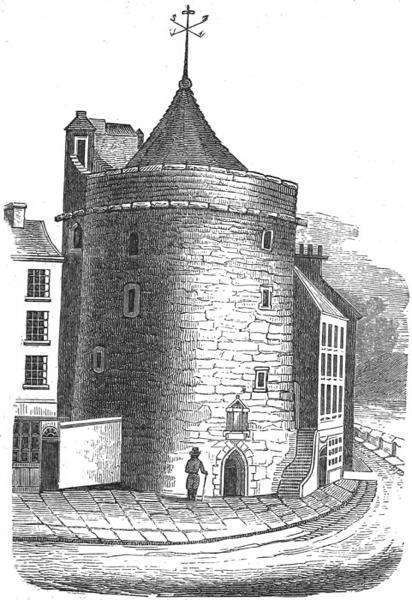
[++] Reginald’s Tower
With regard to Dublin, however, the case is quite different. The series of kings there from the year 853 until about 1200, and consequently for almost three centuries and a half, is pretty complete. It was a natural consequence of the considerable power and influence possessed by the kings of Dublin, that their names were often mentioned in the chronicles in connection with important events both in Ireland and in the neighbouring countries. The Norwegian kings in Dublin knew how gradually to strengthen and extend their power, not only by arms, but also by a shrewd and able policy. They soon learnt how to avail themselves of the intestine disputes by which the Irish tribes and chiefs were divided. They joined one of the ruling parties, contracted marriage with the daughters of Irish kings and chieftains, and on their side gave Scandinavian women in wedlock to leading Irishmen. According to the old Irish book called “the Book of Lecan,” the Irish king Congolaich (934-954) had a son, Mortogh, by Radnalt, daughter of the Dublin king Anlaf, or Olaf. At a somewhat later period a Norwegian king in Dublin, named Anlaf, was married to an Irish woman, Dunlath, who was mother of the Dublin king “Gluin-Jarainn” (Iron-Knee). Similar marriages between Norwegian and Irish royal families are often mentioned; even King Brian Boru, so adored by the Irish, was nearly related to the Norwegian kings. He was father of Teige and Donogh, by Gormlaith, or Kormlöd, a daughter of Morogh Mac Finn, king of Leinster. But Gormlaith was also married for a long time to the Dublin king, Anlaf, by whom she had a son, afterwards the celebrated king of Dublin, Sigtryg Silkeskjæg (Silk-beard); and thus Brian Boru’s two sons Teige and Donogh—of whom Teige afterwards married Mor, a daughter of the “Danish” king Eachmargach of Dublin—were half-brothers of their father’s enemy, King Sigtryg. “The Book of Leinster” says that Gormlaith was likewise mother of the Norwegian-Irish king Amlaff Cuaran (Olaf Kvaran); whilst the Irish chronicler, Duald Mac Firbis, mentions this same Olaf Kvaran as married to Sadhbh (Save), a daughter of Brian Boru, and that even “at the time when the battle of Clontarf took place.” After this we are better able to understand how it happened that whole Irish tribes, with their kings at their head, so often fought in union with the Norwegians and Danes; since we learn that their mutual political interests were hound closer together by the ties of relationship.
On the other hand, the Norwegian or Scandinavian kings of Dublin and other parts of Ireland also constantly maintained connections, both of friendship and relationship, with their countrymen in England and Scotland, as well as in the mother countries of Scandinavia. It might, indeed, sometimes happen that Scandinavian kings or Vikings, from Man or the Orkneys, attacked, nay even conquered for a time, the Norwegian kingdom of Dublin, particularly when the Norwegians in Ireland were at variance with one another. But in general the Scandinavian colonists in the British Isles appear to have stood or fallen with one another. Numerous Scandinavian warriors from England, Scotland, and the surrounding islands, fought now and then in conjunction with the Norwegians settled in Ireland, against the native Irish. But the Norwegian kings in Ireland frequently supported their friends in England and Scotland against the Anglo-Saxons and the Highland Scots, and at times won kingdoms there by force of arms. Mutual marriages, also, were frequently made, whilst Scandinavian merchants and Vikings, for instance, dwelt in Dublin at the court of the Norwegian kings. Thus the Norwegian prince Olaf Tryggvesön, after having been christened at Dublin, stayed there for some time with the Norwegian king Olaf Kvaran, and married his sister Gyda.
Many accounts testify that the Norwegians in Ireland, at least in the cities, and especially Dublin, were powerful enough to maintain their language, and the rest of their Scandinavian characteristics, in spite of the Irish. The Icelandic bards, Thorgils Orraskjald and Gunnlaug Ormstunga, are expressly stated to have visited the court of the Norwegian kings in Dublin in the tenth and eleventh centuries, where they diverted the Scandinavian warriors with their national songs. Ancient Irish manuscripts contain proofs not only of the peculiar language, but also of the peculiar writing, of the Norwegians, or runes, which in Irish were called “Ogham na Loochlannach” or “Gallogham” (the Northmen’s, or strangers’, Ogham). Ogham was the name of a mode of writing then used by the Irish. There are also some traces of characteristic Scandinavian institutions among the Norwegians and Danes in Ireland. In an Irish poem of the early middle ages, about the Norwegian chief “Magnus the Great,” the Norwegians are called “the people with the twelve counsellors.” This leads us to think that the Norwegians, like the Danes in England, must have employed in their judicial proceedings a sort of jury, consisting of twelve men of repute, an institution so foreign and striking to the Irish, that they were led to characterize the Norwegians by it. It is at least quite certain that the Norwegians in Ireland, as the Irish chronicles admit, kept themselves entirely separate from the Irish with regard to their ecclesiastical institutions, and that they likewise had their own assize place in Dublin, which bore the Scandinavian name Thing. A document of the year 1258 conveys a gift of some ground in the suburbs of Dublin, in “Thengmotha” (from “mote,” a meeting), which the Irish publisher of it (the Rev. R. Butler) correctly explains by “the place of legal assembly in the Danish times of Dublin.” The Thing place, which seems to have been not far from the present site of Dublin Castle, where the Norwegians had erected a strong fortress, gave to the surrounding parish of St. Andrew the surname of “de Thengmote.”
One of the chief causes that the Norwegians in the Irish cities maintained uninterruptedly their Scandinavian characteristics, and consequently their independent power likewise, was that they not only lived in the midst of the Irish, but that, as Giraldus Cambrensis expressly intimates, they erected in every city a town of their own, surrounded with deep ditches and strong walls, which secured them against the attacks of the natives. They built a rather extensive town for themselves on the river Liffey, near the old city of Dublin, which was strongly fortified with ditches and walls, and which, after the Norwegians and Danes (or Ostmen) settled there, obtained the name of Ostmantown (in Latin, “vicus,” or “villa Ostmannorum”), i. e. the Eastmen’s town. Even the Irish chronicles, which attest that, as early as the beginning of the tenth century, the Norwegians in Dublin had well intrenched themselves with walls and ramparts, also state that in the art of fortifying towns they were far superior to the Irish. Ostmantown continued through the whole of the middle ages to form an entirely separate part of Dublin, and the gates of the strong fortifications with which it was surrounded were carefully closed every evening. The walls were at length razed, and Ostmantown, or, as it was now corruptly pronounced, “Oxmantown” (whence an Irish peer has obtained in modern times the title of Lord Oxmantown), was completely incorporated with Dublin. But to the present day the name of Oxmantown remains an incontrovertible monument of an independent Norwegian town formerly existing within the greatest and most considerable city of Ireland.
Section IV.
Norwegian Names of Places, near Dublin.—Norwegian Burial—Places.—Norwegian Weapons and Ornaments.
The few Scandinavian names of places in Ireland are, with the exception of the previously-mentioned provinces, confined to the coasts, and there particularly to the names of islands and fiords. On the west coast there are only two rather doubtful ones; namely, Enniskerry, an island (the first part of which is the Irish Inis, an island, whilst the latter part seems to include the Scandinavian name “Sker,” or Skjær, a reef); and the harbour, Smerwick. Several places on rivers are still called Laxweir, as for example on the Shannon near Limerick and Killaloe, where salmon are caught in a net stretched across the river. The word “Lax” (salmon) is unknown in the Irish language, but appears, as we have seen, in several Scandinavian names of places in Scotland. On the south coast, besides Waterford, we can mention at most only the Isle of Dursey (Þorsey?) with the small adjoining island of Calf. The greatest number of Scandinavian names appears on the east coast. In some names of places situated on the finest fiords we may trace the Scandinavian ending “fjörðr;” as, for instance, to the south of Dublin in Wexford (in Irish, Loch Garman), and to the north of Dublin, in Strangford and Carlingford (in Irish, Cuan Cairlinne). But in general, all the names of places of Scandinavian origin, or with Scandinavian terminations, are collected round Dublin as the central point.
At the southern entrance of the bay of Dublin is the Island of “Dalkey” (in Irish, “Delg Inis”), and at the northern entrance the high and rounded cape Howth (in Irish, “Ceann Fuaid,” or “Beann Edair”), which in ancient letters is also called Hofda, Houete, and Houeth. This is clearly the Scandinavian “höfud,” or “Hoved” (head), a name particularly suited to the place. In the immediate neighbourhood is also the old Danish town Baldoyle, and the district of Finngall, colonized by the Norwegians. Directly north of Howth rises “Ireland’s-eye” (in Irish, “Inis Eirinn” and “Inis Meic Ness-áin”); and still farther to the north the islands of “Lambay” (in Irish, “Rachrainn”) and “Skerries,” or the Skjære (reefs). Close to the west side of Dublin is the little town of Leixlip, where there is a famed salmon-leap in the river Liffey. In old Latin epistles the name of Laxleip is translated by “saltus salmonis,” which is plainly neither more nor less than the old Norsk “lax-hlaup” (Dan., Laxlöb; Eng., salmon-leap): which name reminds us again of the salmon fishery, so highly cherished by the ancient Norwegians. It is doubtful whether the county of Wicklow, which adjoins that of Dublin, derived its name from the Norwegians; though it is not improbable that it did, as in Irish it is called Inbhear Dea, but in old documents Wykynglo, Wygyngelo, and Wykinlo, which remind us of the Scandinavian Vig (Eng., bay) or Viking.
At all events the decidedly Scandinavian names of places around Dublin sufficiently indicate the predominance of the ancient Norwegians and Danes in that city. Discoveries made by excavations in and around Dublin have also, in recent times, very remarkably contributed towards placing this matter in a still clearer light.
In constructing a railway close by Kilmainham, now the most western part of Dublin, the workmen some years ago laid bare a number of ancient tombs. In these lay whole rows of skeletons, each in its own grave, and by the side of them many kinds of iron weapons and ornaments. Fortunately several of the specimens thus discovered were preserved, principally for the museum of the Royal Irish Academy in Dublin; by which means Irish archæologists had an opportunity of convincing themselves that these antiquities must be a good deal older than the English conquest of Ireland; yet that they are by no means of the kind usually found in Ireland, and belonging to the period of the Irish iron age. It is thus placed beyond all doubt, that they are not Irish remains, but derived from the Norwegians and Danes at that time settled in Ireland. The few illustrations here annexed will present to every Scandinavian archæologist mere well-known objects, corresponding so exactly with the antiquities of the iron age preserved in our Scandinavian museums, that we might even believe them to have been made by the same hands.
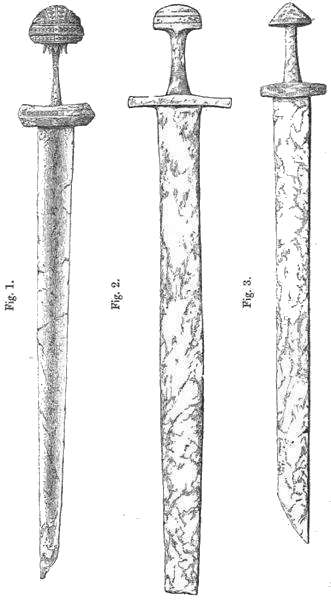
[++] Swords: Fig. 1 to Fig. 3.
The swords (Figs. 1-3), which very much resemble the Scandinavian swords found in England (described at p. 45,) are from twenty-four to thirty-two inches long. Some have two edges, others only one. The pommel and guard of the hilt are in several of them ornamented with very neatly inlaid pieces of gold, silver, and other metals. On one of them some engraved Latin letters have been found, which may also be seen on a sword of the iron age in the Museum at Copenhagen. Even the old Irish chronicles relate that the Norwegians placed inscriptions on their swords. Thus an ancient Irish poem says: “Hither was brought, in the sword sheath of Lochlan’s king, the Ogham across the sea. It was his own hand that cut it.” It is most probable that by the Ogham writing is here meant “the Norwegian’s Ogham,” or runes, with which, as our Sagas state, the old Northmen’s swords were frequently ornamented.
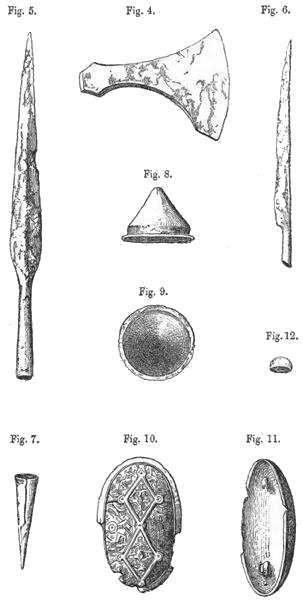
[++] Scandinavian Antiquities, Fig. 1. to Fig. 12.

[++] Sword: Irish Iron
Several genuine Irish iron swords of that ancient period have been discovered in Ireland at various times, both in the river Shannon and in old Irish castle-yards, or on the sites of castles. They are much smaller than the Norwegian swords, and in general want both the guard and the large pommel at the end of the hilt, as the annexed figure of those most frequently found shows. On the whole the Irish iron swords are of an older and more imperfect kind, and very strikingly resemble the bronze sword used in Ireland in the age of bronze. On placing the short and ill-formed Irish sword by the side of the much larger, better, and handsomer Norwegian one, we may almost say that we obtain, as it were, a living image of the degenerate and miserably-equipped Irish people in comparison with the strong and well-armed Norwegians.
The Norwegian warriors who found their last resting-place at Kilmainham, were evidently buried with all their arms, from the renowned “Danish battle-axe” (Fig. 4), and the lance (Figs. 5, 6)—which must have been deposited with the entire shaft, since the ferrule (Fig. 7) has been found—down to the shield. But as the last was mostly of wood, nothing more remains of the whole shield than the large iron boss (Figs. 8, 9), which was placed in the middle, and which served to protect the hand which bore the shield.
Among all the things discovered at Kilmainham, scarcely any more decidedly indicate their Norwegian, or Scandinavian, origin, than the bowl-formed brooches (Figs. 10, 11), already mentioned when speaking of the coasts of Scotland, and which are not found in any other part of Ireland. There are also some very peculiar small bone buttons (Fig. 12), having a small hole in the flat side, penetrating the button for some way without entirely piercing through it. Buttons of this form have not been before found in Ireland, though they are very well known in the Scandinavian North. They are discovered in Sweden and Norway, in graves of the period of the iron age, or times of the Vikings. It is highly probable that in those times they served as men, or counters in some game, as they are generally found, especially in Norway, collected together in great numbers, and in conjunction with dice. To judge from the holes in the bottom, they have certainly been used in a sort of game of draughts; for, till late in the middle ages, nay, almost down to our own times, the Icelanders were accustomed to furnish their boards with small pivots, on which they placed the men, that they might not by any accidental shaking of the table be mixed with one another, and the whole game thus suddenly disturbed. The Irish also seem to have had a somewhat similar mode of proceeding at that time, as among a great number of things undoubtedly Irish, discovered at Dunshauglin, there was found a bone button or knob, certainly a draughtsman, which, instead of a hole, is furnished with a metal point at the bottom, by which it was evidently intended to be fixed in the board. But for the Scandinavian Vikings, who were so much at sea, and who, it seems, liked to while away the time by playing draughts, such a precaution was doubly necessary, as the rolling of the vessel would otherwise have thrown the draughtsmen together every moment. It is remarkable that at Kilmainham, as well as in Scandinavia itself, the draughtsmen are found deposited in the graves, by the side of the arms and ornaments of the warriors. This affords an instructive proof that the old Northmen must have been very fond of gaming; and consequently that the picture drawn by Tacitus of the passion of the ancient Germans for play, which at times even led them to gamble away their personal freedom, might apply to their neighbours, the Scandinavians.
We can scarcely err in referring the antiquities found at Kilmainham to the ninth, or at latest to the tenth century. The mode of burial is heathenish rather than Christian; and, as is known, the Norwegians settled in Ireland were converted to Christianity in the tenth century at latest, and probably still earlier. It is not at all probable that the graves are to be attributed to an isolated band of heathen Vikings, who came over at a later period, and who, after a battle, buried their dead on the field. The great number of graves, and the careful manner in which each is said to have been set or enclosed with stones, rather show that they were made in all tranquillity by the Norwegians and Danes, who at that time dwelt in Dublin, or its immediate neighbourhood, and who probably had a common burial ground there. Scandinavians appear also to have been buried in an adjoining churchyard, which at that time belonged to a convent dedicated to St. Magnen, but which afterwards became the burial-place for a hospital of the knights of the order of St. John, founded at Kilmainham. It has at length become one of the largest churchyards in Dublin. In corroboration of the conjecture that Scandinavians were buried in it, it may be mentioned that a tall upright stone with carved spiral ornaments stands there—a sort of monumental, or bauta-stone, under which, several years ago, various coins were discovered, minted by Norwegian kings in Ireland; and near them a handsome two-edged iron sword, with a guard and a longish flat pommel. Some have, indeed, thought that this sword must have belonged to Murrough, a son of Brian Boru, or to Murrough’s son Turlough, as both these warriors, having fallen in the battle of Clontarf, are said to have been buried in this churchyard. This, however, is only a vague conjecture; whilst it is quite certain that the above-mentioned sword agrees most accurately in form with the many swords of the Vikings’ times found in the North. There is, therefore, reason to suppose, that the sword was formerly deposited there with the body of a Norwegian warrior; and this supposition is strengthened by the discovery of the Norwegian-Irish coins.
Other old Norwegian, or Scandinavian burial-places, have been discovered in the Phœnix Park, near Dublin, where a pair of bowl-formed brooches were found near a skeleton. In making, a few years ago, some excavations in Dublin itself, in “College Green,” which formerly lay outside the city, the workmen met with several iron swords, axes, lances, arrows, and shields, of the well-known Scandinavian forms. It is probable that this also was a burial-place similar to that at Kilmainham. With the exception of the burial-place on the coast of Lough Larne, the ancient Ulfreksfjord, no other decidedly Norwegian graves are hitherto known to have been discovered in Ireland.
Just as the proportionally numerous Norwegian graves near Dublin prove that a considerable number of Norwegians must have been settled there, so also do the peculiar form and workmanship of the antiquities that have been discovered in them afford a fresh evidence of the superior civilization which the Norwegians in and near Dublin must, for a good while at least, have possessed in comparison with the Irish. The antiquities hitherto spoken of only prove, indeed, that the Norwegians and other Northmen were superior to the Irish with regard to arms and martial prowess. But there are other Norwegian antiquities, originating in Ireland, and found both in and out of that country, which also prove that the Danes and Norwegians formerly settled there contributed, like their kinsmen in England, by peaceful pursuits, to influence very considerably the progress of civilization in Ireland.
Section V.
Ancient Irish Christianity and Civilization.—Trade.—No Irish, but
Norwegian Coins.—Sigtryg Silkeskjæg.—Norwegian Coiners.
Centuries before the introduction of Christianity into the Scandinavian North (in the tenth and eleventh centuries)—nay, centuries before the actual commencement of the Viking expeditions—the Irish people had been Christianized. At a very early period numbers of churches and convents were erected in Ireland, which was also celebrated for its many holy men. It was a common saying that the Irish soil was so holy that neither vipers, nor any other poisonous reptiles, could exist upon it. Numerous priests set out from Ireland as missionaries to the islands lying to the west of Scotland; nay, they even went as far as the Faroe Islands and Iceland, long before those islands had been colonized. Thus, when the Northmen first discovered Iceland (about the year 860), they found no population there; but on “Papey,” in “Papyli,” and several places in the east and south of the country, they found traces of “Papar,” or Christian priests, who had left behind them croziers, bells, and Irish books; whence they perceived that these priests were “Westmen,” or Irishmen; for just as the Irish called the Scandinavians “Ostmen,” because their home lay to the east of Ireland, so also did the Scandinavians call the Irish “Westmen.” The most southern group of islands near Iceland is called to the present day “Vestmannaeyjar” (the Westman Isles), because, at the time of their colonization, a number of Irish serfs, or Westmen, were put to death there for deceiving their masters.
Not even the Norwegian expeditions into Ireland, and the destruction of churches and convents by which they were accompanied, were able to annihilate the influence of the Irish clergy on the diffusion of Christianity in the north-western part of Europe. Not only were the Norwegians and Danes settled in Ireland and the rest of the Western Isles soon converted from heathenism by Irish monks and priests, but Christianity was communicated through these converts to many of their Scandinavian countrymen, who visited Ireland partly as Vikings and partly as merchants. Thus the Norwegian king Olaf Tryggvesön was baptized by an abbot on the Sylling Isles near Ireland, or, as other Sagas state, “to the west over in Ireland;” whence we may probably conclude that the Sylling Isles are not, as was before supposed, the Scilly Isles near England, but the Skellig Isles on the south-west coast of Ireland, on one of which there was at that time a celebrated abbey. At all events, it is certain that Olaf Tryggvesön, during his long abode with his brother-in-law, King Olaf Kvaran, in Dublin, must, by his constant intercourse with the Irish Christians, have been strengthened in his determination to christianize Norway. Another proof of the influence of Christianity in Ireland on the North is, that an Irish princess, Sunneva, was at a later period worshipped as a saint in Norway. Her body is alleged to have been deposited in a large and handsome shrine over the high altar in Christ Church, in Bergen, and on the 8th of July the Norwegians celebrated an annual mass in her honour. Even in Iceland there is a fiord, or firth, on the north-west coast, called “Patreksfjorðr,” after St. Patrick, the patron saint of Ireland.
As we have before stated, the commencements of a national Irish literature were also developed among the clergy at a very early period; which, together with the numerous ecclesiastical buildings in Ireland, prove that the Irish clergy of those times must have attained no mean degree of civilization, and that with regard to education they must, in certain respects, have been a great deal in advance of the heathen Scandinavians. But not to speak of the Icelandic literature—which developed itself in the remotest North immediately after the heathen times, and contemporaneously with the Norwegian dominion in Ireland, and which both in form and substance was undoubtedly far superior to the Irish—there is reason enough to doubt whether the Irish people of that time, although christianized, were really more educated or more advanced in true civilization than the certainly too much decried heathen Norwegians and their Scandinavian kinsmen. It is true, indeed, that the Norwegian Vikings made their way with fire and sword, that they destroyed a number of churches and convents in Ireland, and that in this manner they often occasioned the most violent intestine commotions, which for a time, at least, could not but tend to hinder the progressive development of Christian civilization. But the Irish chronicles themselves teach us that the Christian Irish acted precisely in the same manner at the same period. In their mutual contentions they often burnt ecclesiastical buildings, plundered the shrines of saints, and maltreated the clergy, besides, as is well known, constantly perpetrating amongst themselves the most horrible butchery. Lastly, in Ireland, as in England, we must certainly distinguish between the Vikings, who came to the country for the sake of war and plunder, and the colonists, whose aim it was to obtain a new home in Ireland. The latter brought with them not only great skill in the forging and management of arms, as well as in building and navigating ships for expeditions, both of war and trade, but likewise had their own runic writing; and by the readiness with which they imbibed the newer Christian civilization, soon acquired the ascendancy in the most important Irish cities, so as to become perceptibly enough, not only the equals, but the superiors of the Irish.
What particularly warrants us in doubting the alleged early and extensive civilization of the Irish, is the very striking circumstance that, previously to the arrival of the Norwegians, they do not appear to have carried on any very great trade, or on the whole to have had any very extensive intercourse with the rest of Europe. This appears particularly from the fact that the Irish at that time (about the year 800) had not yet minted any coins of their own; although their Celtic neighbours in Britain and Gaul had for centuries—that is, from about the birth of Christ—minted a great number, mostly in imitation of Greek and Roman coins. And though the Romans, Franks, and Anglo-Saxons, after their conquests of France and England, had made very considerable coinages in those countries, we do not even find in Ireland any trace of the coins of these neighbouring people being brought over the sea in any considerable quantity before the period mentioned. Yet in other countries, where the minting of coins also came late into use—as, for instance, in the Scandinavian North—so great a quantity of older foreign coins, together with all sorts of foreign valuables, is continually dug up as to show that even at a very early period active connections of trade must have existed between the Northmen and more southern nations. Neither Phenician nor Celtic coins are known to have been found in Ireland, and discoveries even of Roman and the more ancient Anglo-Saxon coins are very rare.
That Ireland should have remained for so long a period and to so great an extent unconnected with the neighbouring nations, was undoubtedly caused partly by its remote situation, partly by the indolence of the Irish and the disinclination so general among the Celts to traverse the sea, to which an old author (Giraldus Cambrensis) expressly alludes. It must partly also be ascribed to the peculiar hostile position which the Irish were obliged to assume towards the Romans, Anglo-Saxons, and Franks; since these people having gradually conquered the Celtic countries, France and England, naturally only awaited a favourable opportunity to make themselves masters of Celtic Ireland also. According to this we might even, perhaps, regard the isolation of Ireland as a necessary system of self-defence adopted by the Irish.
But no sooner were the Norwegians and Danes settled in the chief cities of Ireland, than Irish trade and navigation obtained an extent and importance before unknown. An active commerce was opened with England and Normandy through the numerous and influential Scandinavian merchants settled in those countries, as well as, of course, with the mother countries of Scandinavia. In Ireland, therefore, as well as in England, Arabian coins, minted in countries near the Caspian Sea, are here and there found buried, which have evidently been imported by Scandinavian merchants. The Sagas mention regular trading voyages to Ireland from Norway, and even from Iceland; where there was, for instance, a man named Rafn, who was commonly called Rafn Hlimreksfarer (Eng., Limerick trader), on account of his regular voyages to Limerick (Limerick being called by the old Northmen, Hlimrek). The Sagas further mention, under the head of Ireland, “Kaupmannaeyjar” (Eng., the merchant islands), probably what are now called “Copeland Islands,” on the north-eastern coast, where there may have been a sort of rendezvous for the ships of Scandinavian merchants. The Icelandic and Norwegian ships brought fish, hides, and valuable furs to the English and Irish coasts; whence, again, they carried home costly stuffs and clothes, corn, honey, wine, and other products of the south.
These accounts of the old Northmen, respecting their commerce in Ireland, are far from being unsupported. The Welsh author, Giraldus Cambrensis, who visited Ireland during the English conquest, whilst the Ostmen were still living there in considerable numbers, says in plain words that they had settled near the best harbours in Ireland, where they built themselves towns, and that they had by no means come to the country as enemies, but with the design of carrying on a peaceful trade. He adds that for this reason the Irish chiefs, who clearly saw the importance and advantages of commercial connections with other countries, had not at first in any way opposed the establishment of these foreign towns in their country; but that, after the Ostmen had very much increased, and after their towns had become well fortified, the old dissensions between them and the Irish revived.
In perfect accordance with this are the statements of the Irish themselves respecting the many Scandinavian merchants in the towns of the Ostmen. An old Irish manuscript relating to the battle of Clontarf (“Cath Chluana Tarbh”) states that, after the battle, “no Danes were left in the kingdom, except such a number of artisans and merchants in Dublin, Waterford, Wexford, Cork, and Limerick, as could be easily mastered at any time, should they dare to rebel; and these King Brian very wisely permitted to remain in these seaport towns, for the purpose of encouraging trade and traffic, as they possessed many ships, and were experienced sailors.” Duald Mac Firbis also says in his chronicles that in his time (1650) “most of the merchants in Dublin were the descendants of the Norwegian-Irish king, Olaf Kvaran.”
That the Norwegians and Danes must really have possessed themselves of the Irish trade, and given it a new impulse, clearly appears from the circumstance that the Norwegian kings in Ireland were the first who caused coins to be minted there. One of these coins, which formerly belonged to the Timm’s collection in Copenhagen, but which is now in the collection of M. von Römer, in Dresden, seems (according to the opinion of that distinguished numismatologist C. J. Thomsen, of Copenhagen) to have been minted by a Scandinavian king of Dublin, as early as the eighth or ninth century. It is an imitation of the ancient Merovingian coins, and has a remarkable inscription on the obverse, half in runes and half in Latin letters, but which can scarcely be read otherwise than “Cunut u Dieflio,” or, Canute in Dublin.
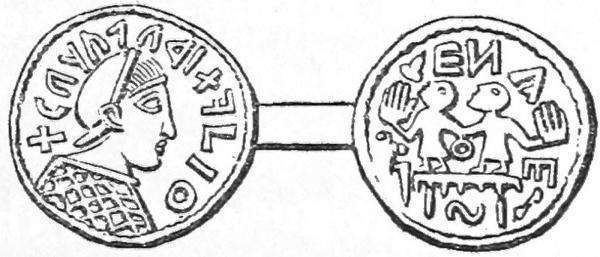
[++] Coin: Canute in Dublin
The Old Northmen call Dublin “Dýflin,” whence the surrounding district also obtained the name of “Dýflinarskiri,” as appears in the Sagas. This legible inscription encircles the bust of a royal warrior, clad in scale armour. On the reverse are seen the letters ENAE, and under them two figures, both turning their faces upwards in the same direction, and each extending a very large hand, whilst in their other hands, joined together, they hold a ring, as if they were taking an oath on the holy ring. They are, besides, represented as standing before, or sitting on, an elevated platform (perhaps an altar?), under which is a mark (∾) like the letter S placed on its side. These figures probably contain an allusion to some treaty concluded between an Irish king and the Scandinavian king Canute.
By the kindness of Mr. C. F. Herbst, of Copenhagen, I have been enabled to give a woodcut of this silver coin, the only one of its kind, and never before copied. The drawing was made from a cast taken in Dresden. If the preceding explanation, which is certainly by no means far-fetched, be the right one, we shall consequently have a proof that other Scandinavian kings, besides Olaf the White, the first-mentioned in the Sagas, reigned at a very early period in Dublin, if only for a short time. But all the rest of the Norwegian coins minted in Ireland are of the tenth, eleventh, and twelfth centuries. They are of silver, and undoubtedly coined in various towns of Ireland besides Dublin, as in Limerick, Cork, Waterford, and several other towns where the Ostmen had settled.
The most remarkable of all are the Dublin coins, especially those with the legend “Sihtric rex Dyfl,” or, Sigtryg king of Dublin. It is true that there were several kings of Dublin of this name in the ninth, tenth, and eleventh centuries; but the coins alluded to, to judge from the impressions, all of which are imitations of contemporary Anglo-Saxon dies, and especially of those of King Ethelred the Second, must for the most part have belonged to Sigtryg, surnamed “Silkbeard,” who reigned in Dublin at the close of the tenth and beginning of the eleventh century, and who was one of those who fought the battle of Clontarf against Brian Boru. It is very remarkable that on Sigtryg’s coins, as well as on several of the Danish coins minted in the north of England, we find not only the Latin title “Rex,” but also the Scandinavian “Cununc” (king), as, for instance, on the annexed coin (in Mr. C. F. Herbst’s collection), which has never before been copied:—
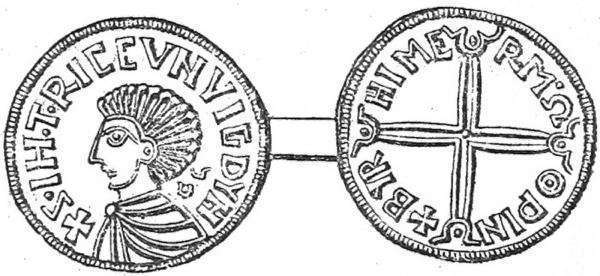
[++] Coin: Sigtryg King of Dublin
On the obverse is the legend “Sihtric cunuic dyn,” or Sigtryg king of Dublin; and on the reverse, “Byrhtmer mo on Vin;” whence we see that the coiner had an Anglo-Saxon name, and was certainly an Anglo-Saxon, particularly since he is said to have been “on Vin,” that is, of Winchester. Among the coiners’ names on the Norwegian-Irish coins, we meet, indeed, with several Scandinavian names, such as Stirbirn (Styrbjörn), Azcetel (Asketil), Ivore (Ivar), Colbrand, Tole (Tule), and Oadin (Odin?); whence we may reasonably conclude that the Norwegians in Ireland soon learned to coin, and were not, therefore, always compelled to avail themselves of foreign coiners. But most of Sigtryg’s coiners were Anglo-Saxons; and not a few of his coins are, like that above delineated, even struck by coiners in England; as, for instance, in “Efrweec,” or “Eofer (wick)” (York), “Veced” (Watchet, in Somersetshire), “Vilt” (Wilton), “Vint” (Winchester), and “Luni” (London). This admits of two explanations; either that these comers at Sigtryg’s request minted coins for him, or that Sigtryg, who at one time was driven from his kingdom, resided in some at least of the above-named places, and caused coins to be minted there(?). The origin of several coins minted in Dublin about Sigtryg’s time by the Anglo-Saxon king Ethelred the Second—as well as by the Danish-English king Canute the Great, and which for the most part are struck by the same Dublin coiner, Færemin, who minted most of Sigtryg’s own coins—is involved in no less obscurity. Although history is silent, we might be almost tempted to believe that Ethelred and Canute were acknowledged by Sigtryg as his liege lords, or that possibly they ruled in Dublin for a short time; but in weighing these probabilities it must be remembered that neither Ethelred nor Canute calls himself on these coins king of Dublin, but simply “Rex Anglorum,” or king of the English.
The great number and variety in which Sigtryg’s coins appear, and the comparatively good stamp that distinguishes them from the rest of the Norwegian-Irish coins, seem to show that the years of Sigtryg’s reign must have been a period very favourable to Scandinavian trade and power in Ireland. In later times the Norwegian-Irish coins became worse, as the coiners did not confine themselves to imitating coins of the older Norwegian-Irish kings, and of the later English kings, Canute the Great, Hardicanute, Edward the Confessor, William the Conqueror, and others, but even copied copies to such a degree that the stamp and inscriptions of the original coins were very frequently not to be recognised. Of the coins current in Ireland in the last half of the eleventh, and in the whole of the twelfth, century, pretty large quantities have been dug up, both in and out of Ireland, and particularly in the neighbouring Isle of Man.
It must, however, be regarded as very doubtful how far this deterioration of the coins affords any reasonable confirmation of the justness of the usual conviction among the Irish, that after Sigtryg’s time, or rather after his defeat in the battle of Clontarf, the power of the Norwegians in Ireland was completely broken. For, in that case, we might expect, among other things, that the victorious Irish kings, during the long period of more than a hundred and fifty years, which elapsed from the time of the battle of Clontarf until the English conquest of Ireland, would have minted their own coins. But during the whole of this period there are very few coins that can possibly be regarded as having been minted for native Irish kings. For the rest, the whole of the coins minted in Ireland, from the commencement of minting there (at latest in 950) till the English conquest (1171), seem to owe their existence exclusively to the kings and bishops of the Ostmen, who ruled in the most important trading towns of Ireland[10].
Section VI.
The Battle of Clontarf.—Power of the Ostmen after the Battle.—Their
Churches and Bishops.—Their Land and Sea Forces.—The English
Conquest.—Remains of the Ostmen.—Their Importance for Ireland.
The cause of the battle of Clontarf, so celebrated in song and legend, or, as it is called in the Sagas, “Briánsbardagi” (Brian’s battle, after King Brian, who fell in it in 1014), is not precisely known. All that we are acquainted with is, that Brian, who was connected by very close ties of relationship with the Norwegian royal family in Dublin, had long availed himself of the assistance of the Norwegians to subdue other Irish princes, until, at length, after gaining victories in that manner, he came to a rupture with King Sigtryg of Dublin. The prospects of Sigtryg, and of the Norwegian power in Ireland, seem really to have been threatening enough; at least it is said that Scandinavian warriors hastened in numbers to Sigtryg’s assistance from the Scandinavian kingdoms in England, the Isle of Man, the Syder Isles, and Orkneys. From the last, in particular, came Jarl Sigurd the Stout, with a chosen force, in the midst of which waved a flag with the image of Odin’s holy raven. Sigurd’s own mother had woven this raven, which, with fluttering wings, had often before led the warriors to victory and glory.
This time, however, the raven was checked in its flight. After many of the standard bearers had been killed, Sigurd Jarl himself took the flag from the staff, and wrapt it about his body. He seemed to foresee, what really happened shortly afterwards, that the raven-flag would be his winding-sheet. The Norwegians were at length forced to give way, even if the battle was not so entirely lost as the exaggerated Irish accounts represent. The Scandinavian auxiliaries withdrew to their ships, and King Sigtryg retired with the remnant of his army to Dublin.
But, as the Irish chronicles contain nothing about Sigtryg and his men having been afterwards expelled from Dublin, or about the Norwegian dominion there having been entirely destroyed, we cannot conclude from them that the power of the Ostmen in the rest of the Irish cities was annihilated in consequence of Sigtryg’s defeat in the battle of Clontarf. It would, besides, have been singular enough if the power of the Norwegians in Ireland had been perfectly destroyed so early as the year 1014, since it was just after that time that the Northmen in the neighbouring countries acquired their greatest power by means of their victories. Instead of the Norwegian influence in Ireland having ceased, we not only find, long after this battle, King Sigtryg of Dublin fighting bravely with his Ostmen, though at times with varying fortune, against several Irish kings and chiefs, but we further behold the Ostmen displaying a very remarkable degree of strength and independence in various places in Ireland.
About five-and-twenty years after the battle of Clontarf (say the Irish chroniclers themselves), Sigtryg, king of the Ostmen in Dublin, and Donat (Dunan), their bishop, built, in the middle of that city, the church of the Holy Trinity, also called Christ Church. That the Ostmen should then have founded one of the principal churches of Dublin, which even lay without their own town (Ostmantown), in the very heart of ancient Dublin, is highly significant. After the church was built, Bishop Donat presented several relics to it, amongst which are mentioned “pieces of the clothes of King Olaf the Saint.” The great respect in which the name of the Norwegian Saint Olaf was held in Dublin is also manifest from the circumstance that a church consecrated to St. Olave, or, as the Irish common people gradually corrupted the name, to “Tulloch” (compare the name of Tooley Street in London, corrupted from St. Olave Street), was to be found there till at least far into the sixteenth century. This church adjoined the northern end of Fishshamble Street, near Wood-Quay; but originally, perhaps, it was just outside the city.
In the same year (1038) that Christ Church was, partly through the exertions of Bishop Donat, erected in Dublin, he likewise built the chapel of St. Michael. Half a century later (1095) another “Ostman” built Saint Michan’s Church in the “Ostmen’s” town in Dublin; and about the same time the cathedral in Waterford, dedicated to the Holy Trinity, was founded and erected by the Ostmen there.
The “Ostmen” in Ireland thus possessed not only their own churches, but likewise, as the Irish records also mention, their own bishops, who were consecrated in England by the archbishop of Canterbury; whilst the Irish bishops were consecrated in Ireland itself by the Irish archbishop of Armagh. The Dublin “Ostmen’s” first bishop Donat, or Dunan, died in the year 1074, and was buried in Christ Church, to the erection of which he had himself so considerably contributed. After him, by desire of the Dublin king Godred, or Godfred, another “Ostman,” Patrick, was chosen bishop of the Ostmen in Dublin, but perished by shipwreck on his voyage home from Canterbury (1084). He was succeeded by the “Ostman” Donat O’Haingly (+1095); whose cousin, Samuel O’Haingly, previously a monk in the convent of St. Alban’s in England, afterwards filled the see of the “Ostmen” in Dublin until the year 1121. His successor, Gregorius, was the first of these Ostmen’s bishops in Dublin who was made archbishop. This probably arose from the circumstance of the “Ostmen” in the other Irish towns having in the meantime obtained bishops, who were now to have a common superior in the Archbishop of Dublin. In the year 1096 the “Ostmen” in Waterford are said to have obtained a bishop, Malchus, who is stated to have been a native of Ireland. In the year 1136 Waterford had an “Ostman” named Toste (Tuistius, or Tostius) for its bishop. A few years later (1140) Gille, or Gilbert, the “Ostmen’s” bishop of Limerick, died; after whom the “Ostmen” chose a certain Patrick. In the year 1151 the “Ostman” Harald, bishop of Limerick, died, and was succeeded by his countryman Thorgils (“Thorgesius”). Twenty years previously (1131) the death of the “Ostman” Everard, or Eberhard, abbot of the convent of St. Mary, near Dublin, is mentioned; which confirms, what is indeed almost a matter of course, that the Ostmen, who had their own churches and bishops, must also have had their own convents partly filled with Scandinavian monks and abbots. At length, in the year 1161, Gregorius, archbishop of Dublin, died; and from his time until the present Dublin has constantly been the seat of one of Ireland’s principal archbishops. But precisely because this archbishopric was originally founded by Ostmen, or foreigners, the archbishop of Dublin did not afterwards become the primate of all Ireland, as, from the importance of Dublin, we might otherwise have expected. That dignity, on the contrary, has constantly been reserved for the genuine old Irish archbishopric of Armagh, in the north-east of Ireland. Even Gregorius’ successor in the archiepiscopal see is said to have been consecrated in Dublin by the archbishop of Armagh. It has lately been discovered (compare P. Chalmers in the Journal of the Brit. Archæol. Assoc., Oct., 1850, p. 323, &c.) that these archbishops of Dublin not only administered their own diocese, but, at least at times, acted as superintendents of the Norwegian bishoprics in the Isle of Man and the Sudreyjar. There is a letter of Pope Honorius of the beginning of the thirteenth century, from which it appears that the archbishop of Dublin at that time consecrated a bishop of Man and the Sudreyjar, a privilege which in more ancient times belonged to the archbishops of York, and afterwards (from 1181 to 1334) to the archbishops of Trondhjem. It is quite certain that this was a result of the lively intercourse which undoubtedly took place between the successors of the Ostmen in Ireland and their near kinsmen in the Norwegian kingdoms in Man and the Sudreyjar.
It was, above all, a very fortunate circumstance for the independence of the Irish Ostmen that such powerful Norwegian kingdoms continued to exist on the west coast of Scotland. From these they could usually obtain assistance in their battles with the Irish; and by means of them they also kept up a constant connection with their Norwegian fatherland. That they were able to maintain their peculiar independent position in Ireland for more than a century after the Danish dominion in England had ceased to exist, was clearly not so much owing to their military skill and compact force, in comparison with the internal dissensions and perfect want of union among the Irish, as to the considerable wealth and power which they constantly derived from their extensive trade and navigation, and the influence which by such means they must necessarily have exercised in Ireland. The Irish chronicles and pedigrees teach us that friendly connections and reciprocal marriages increased more and more between the Irish and the Ostmen, both in Ireland and Norway, so that the Irish aristocracy became mixed in a considerable degree with Norwegian blood. We also learn from the same documents that the Ostmen and their kings constantly continued to ally themselves with Irish princes, whose power they often essentially contributed to support. The Irish king Konofögr gained a naval battle in Ulfreksfjord against Einar, jarl of Orkney, because, as it is stated, the Norwegian Viking, Eyvind Urarhorn, had joined the former with his ships. When King Magnus Barfod of Norway undertook his expedition to Ireland, he concluded an alliance with Myrjartak, King of Connaught (O. N., “Kunnáktir”), whose daughter, Biadmynja, was married to Magnus Barfod’s son Sigurd. But when Magnus fell in Ulster (in 1103), Sigurd abandoned Biadmynja. Yet the connections formed in Ireland by Magnus through this expedition produced important results for Norway. An Irishman named Harald Gille came forward and passed himself off for a son of that monarch by an Irishwoman; and after proving his descent by walking over red-hot iron, actually became king of Norway, and left its throne as an inheritance to his family.
The Ostmen settled in Dublin and other places in Ireland were more and more induced to form connections with native Irish princes, nay, even sometimes to submit to them, as the support which they derived from their own country continually decreased during the eleventh and twelfth centuries. Shortly after the battle of Clontarf, Christianity was introduced into the Scandinavian North, and thus an end was put to the Vikings’ expeditions, which had hitherto incessantly brought colonists and auxiliary forces into Ireland. Even the reinforcements which the Ostmen were able to obtain from their countrymen in Man, the Sudreyjar, and the Orkneys, were naturally not so important as before; since on these islands also Christianity gradually annihilated the bold Viking spirit of the people.
Under such circumstances it is surprising that Godfred (or Godred) Merenagh, king of the Ostmen in Dublin, had in the year 1095 a naval force of not fewer than ninety ships in the harbour of Dublin; and that the land forces of the Ostmen in that city were proportionately powerful. The Irish chronicles mention many battles in the eleventh and twelfth centuries in which the Dublin Ostmen brought numerous warriors into the field, and in which they often suffered very considerable loss, without, however, being entirely annihilated or driven out of the town. Even in the year 1167, and consequently a hundred and fifty years after the battle of Clontarf, a great meeting of the Irish people was held by Athboy of Tlactga, at which, the Irish themselves say, thousands of the first Ostmen in Dublin were present.
That this account is not exaggerated, and that the number of Ostmen in Dublin, as well as in the other Irish cities, was really very considerable at the close of the twelfth century, is clearly shown by the notorious fact, that when the English, under Earl Strongbow and Miles de Cogan, obtained, in the years 1170 and 1171, a firm footing in Ireland, the Ostmen in Dublin, Limerick, and Cork, were able to offer a very powerful resistance. Respecting the conquest of Dublin by the English we find the following statement in the “Dublin Annals” (by O’Donovan):—
“The year 1170. The Danes of Dublin were treacherously slaughtered in their own garrison by Mac Morough and the English; and they carried away their cattle and their riches. Asgal, the son of Reginald, king of the Danes in Dublin, fled from them.
“1171. A battle was fought at Dublin, between Miles de Cogan and Asgal, son of Reginald, king of the Danes of Dublin. Many fell on both sides, both of the English archers and of the Danes; among whom was Asgal himself, and Hoan, a Dane from the Orkney Isles.”
On this occasion Asgal, or “Hasculph,” is said to have returned to the city with sixty ships. His warriors, say the chronicles, were accoutred, according to the usual custom of the Danes, in armour and coats of mail, and had red circular shields bound with iron. But though these men were “just as steeled in soul as in arms” (homines tam animis ferrei quam armis), and though, as well as their brethern in Limerick and Cork, they fought the fight of desperation in defence of their property and liberties, yet they were not able to withstand the English. Thus these new conquerors succeeded in annihilating the dominion of the Ostmen in Ireland, or rather in the most important cities of that country, after it had lasted above three hundred years.
Nevertheless we must not believe that the Ostmen were even now wholly expelled from Ireland, or that their influence there was entirely at an end. After the taking of Dublin by the English, so many Ostmen still remained in the city that “the Galls of Dublin” continued to have their own separate army, which even seems to have acted pretty independently of the English conquerors. An Irish chronicle (Annals of the Four Masters) states that Mulrony O’Keary, Lord of Carbury, was treacherously slain by the “Dublin Ostmen” in the year 1174, and consequently some years after the taking of Dublin. In the same year the English themselves were forced to obtain the assistance of the “Dublin Ostmen” against the Irish; and it is expressly stated that in a subsequent attack of the Irish on this united Anglo-Norwegian army not far from Dublin, there fell no fewer than “four hundred Ostmen.” The contemporary author, Giraldus Cambrensis, to whom we owe this account, also speaks of the Ostmen, after the conquest of Ireland, as a peculiar and decidedly separate people, who carried on trade and navigation (“gens igitur hæc, quæ nunc Ostmannica gens vocatur,” &c).
Even more than a century afterwards we can still trace many Ostmen in the chief cities of Ireland, where, it seems, they continued to preserve those Scandinavian characteristics which distinguished them from the Irish and English. In the year 1201 a verdict was pronounced by twelve Irishmen, twelve Englishmen, and twelve Ostmen in Limerick, concerning the lands, churches, and other property belonging to the church of Limerick; which shows that the Ostmen were sufficiently numerous there to be placed on an equal footing with the English and Irish. There is in the Tower of London a document of the year 1283, issued by the English king Edward I., ordering that the Ostmen in Waterford (“Custumanni,” Oustumanni, Austumanni?) should, pursuant to King Henry the Second’s ordinance, have, and be judged by, the same laws as the English settled in Ireland, which clearly indicates that the Ostmen at that time still formed a distinct and separate people. We might almost believe that the Ostmen in Waterford had even refused to observe the English laws, or that at least there was a doubt how far these laws could be applied to them; since King Edward found it necessary to enforce Henry the Second’s ordinance, and to enjoin his chief justice and magistrates in Ireland that the three men named in the document should, “like other Ostmen in Waterford,” be judged, and as far as possible (“quantum in vobis est”), punished, according to the laws in force for Englishmen in Ireland. (See the Latin document in the Appendix.) The striking historical account that in the year 1263 the Irish applied to the Norwegian king Hakon Hakonsön, then lying with his fleet on the south-west coast of Scotland, for assistance against the English, will now no longer be inexplicable or improbable; for it is placed beyond all doubt that amongst the Irish who thus in vain implored King Hakon for help, there must have been a number of the Ostmen still living in Ireland, who naturally continued to maintain a connection with their countrymen in the Norwegian kingdoms on the south-west coast of Scotland, until these kingdoms also were destroyed in the middle ages.