THE DANES IN ENGLAND. (continued 3)
Reading edition
Before the passage to the East Indies by sea was discovered, and particularly before the Genoese and Venetians began to trade in the Black Sea and on the coasts of Asia, the main road from Arabia and the countries round the Caspian Sea to the Baltic and Scandinavia, lay through Russia, along the great rivers. To judge from the Oriental coins found both in Russia and in the Scandinavian countries, this commercial road must have been used from the eighth until far in the eleventh century, when it was broken up by internal disturbances in Asia, and by contemporary revolutions in Russia and the North. The road ran either from Transoxana (in Turan) to the countries north of the Caspian Sea, whence the merchandise was then brought along the river Volga to the Baltic; or else from Khorasan (in Iran), through Armenia, to the Black Sea; whence the Khazars and other people again conveyed it up the rivers farther towards the North. How considerable this trade must have been may be seen from the numerous hints in the Sagas, as well as from the still-existing Arabian accounts of merchants who in those days visited the coasts of the Baltic for the sake of trade, where considerable trading places, such as Sleswick and many others, are mentioned; but still more than all these, from the very great number of Arabian coins that have been dug up both in Russia and Scandinavia. In Sweden, and particularly in the island of Gothland, such an immense quantity of these has been found at various times, that in Stockholm alone above twenty thousand pieces have been preserved, presenting more than a thousand different dies, and coined in about seventy towns in the eastern and northern districts of the dominions of the Caliphs. Five-sixths of them were coined by Samanidic Caliphs. Together with the coins, a great mass of ornaments has been dug up, consisting of rings and other articles in silver, which are distinguished by a peculiar workmanship. On the whole, it appears that silver first came by this way into the North, where it was not generally circulated before the ninth and tenth centuries, and consequently at the time when the trade with Arabia was in full activity.
These discoveries of Arabian coins in the north of Europe, but which are confined to the shores of the Baltic, the German Ocean, and the Irish Sea, undoubtedly prove that Scandinavia, and particularly the countries on its eastern coasts, together with the islands of Gothland, Öland, and Bornholm, must have been the principal depôt for Arabian merchandise. It was the trade with the East that originally gave considerable importance to the city of Visby in Gothland; and it was subsequently the Russian trade that made Visby, in conjunction with Novgorod, important members of the German Hanseatic league. As long as the Arabian trade flourished, Gothland was the centre of a very animated traffic. Even now an almost incredible number of German, Hungarian, and particularly Anglo-Saxon coins, of the tenth and eleventh centuries, is dug up in the island. The collection of coins in Stockholm comprises an assortment of Anglo-Saxon coins, mostly the product of these discoveries, which, for extent and completeness, surpasses the greatest collections of the sort even in London and England.
The important and extensive commercial intercourse between Scandinavia and England, to which this so decidedly points, can also be traced in England itself. Oriental or Arabian coins, struck in the countries near the Caspian Sea, are dug up both in England and Ireland in conjunction with the very same kind of peculiar silver rings, and other ornaments of the same metal, that are also found with the Arabian coins in Scandinavia and Russia; nay, they are sometimes dug up, as in Cuerdale, in conjunction with coins of Danish-Norwegian kings and jarls; a fact which still further confirms the opinion that they were brought over to the British Isles by the Northmen. This connection with Arabia through the countries of Scandinavia may probably have brought to England, as well as to the North, such a mass of silver as enabled the Anglo-Saxon kings to mint that surprising number of silver coins, which appears at once in such forcible contrast to the want of silver in the preceding centuries. The ancient Britons had little or no silver before the Roman conquest. The Romans, who had large silver mines in Spain, certainly brought silver money with them into the British Islands; but after the overthrow of their dominion, a want of silver again prevailed, and continued, as the coins show, until far into the eighth and ninth centuries. Silver was consequently introduced into England and Scandinavia, generally speaking, about the same time; and there is undoubtedly far greater probability that it was brought into these countries in the same way—that is, from Asia through Russia—than that it should have come into England through the Moors in Spain; of whose caliphs there are very rarely any coins found in England, and between whom and the English the intercourse at that period seems to have been but very limited. In the treasure found at Cuerdale the rings and other silver ornaments were for the most part broken, and twisted, or even melted, together. Something similar has been observed in the treasure trove in the countries round the Baltic, and in Russia. This clearly proves that silver, as an article of commerce, was brought from Asia to the North, where it was melted and converted into ornaments and coins.
As long as the Norman expeditions lasted, and on the whole as long as the Scandinavian supremacy at sea sufficed to protect the Scandinavian merchants and their ships, they continued to make voyages on their own account to the countries colonized by the Northmen. Thus the Anglo-Saxon coins dug up in the island of Gothland indicate a brisk and uninterrupted commerce between Scandinavia and England from the time of the Anglo-Saxon king Edgar (959-975) down to the death of Edward the Confessor and the Norman conquest (1066). But from that time, and particularly after the year 1100, there is a remarkable decrease in the Anglo-Saxon coins found in Gothland; which is a natural result of the interruption of the previous connection, through the hostile relations that ensued between the descendants of William the Conqueror and the Scandinavian kings, who steadily continued to claim the crown of England. Later in the middle ages the countries of Scandinavia fell more and more under the commercial yoke of the German Hanse Towns; whilst in England, on the contrary, a freer and healthier state of commerce was continually developing itself. The Danish king, Canute the Great, made it a point of the utmost importance to conclude commercial treaties with various foreign nations; and the Scandinavian merchants settled in England essentially contributed to make these leagues profitable. Old authors expressly notice the influence of these merchants on British trade. We also find evidence of it not only in their great number, and the weight they possessed in several English towns,—especially London, where they had their own churches, markets, and courts of law, and where, as before stated, they even at times decided the election of a king, as in the case of Harald Harefoot,—but also in the names of money afterwards retained in the English language, as “March” and “Ora,” from the Scandinavian “Mark” and “Ore.” It was a natural consequence that commerce should at the same time make great progress, as the numerous Scandinavian settlers in England, and the Danish conquest, had infused a new and hitherto unknown life into everything relating to navigation, without which no animated trade could have flourished in the British Islands.
The ancient Britons were by no means a seafaring people. They appear to have confined themselves to short coasting voyages between the islands, and over the Irish and English channels. They had, therefore, no fleet to protect their coasts from the attacks of the Romans. Their vessels consisted either of the trunks of trees hollowed out, or of small frail boats formed of interwoven branches, or wicker-work, covered with hides. The Celtic nations have, on the whole, never been remarkable for their love of the sea, or of a seafaring life. On the contrary, they seem to have derived from nature a decided antipathy to it; and even to the present day it is very striking to observe how unwillingly their descendants venture out to sea. They prefer, under all circumstances, a landsman’s life, even in remote and barren mountain tracts; nay, their disinclination for everything relating to a seaman’s life is carried so far that they neglect, in a way almost incredible, the rich fisheries on the western coast of Scotland, and on the greater part of the coasts of Ireland; although, in the last-named country especially, famine carries off the inhabitants in shoals. In those villages where fishing is carried on to any extent, the inhabitants are in general descended from immigrant foreigners. Thus it is said that the fishermen on the west coast of Ireland are descended from Spaniards; and, to judge from their appearance, the assertion finds some confirmation.
Nor were the Anglo-Saxons a seafaring people, in the proper sense of the term. They comprised, it is true, Jutes, Angles, and Frisians; but the Saxons were the most numerous, and the Saxon disposition has always clung to a life ashore. It was natural, however, that the art of navigation should gradually develop itself among the Anglo-Saxons as they advanced in civilization and refinement. But how little they were at home on the sea, even in the time of Alfred the Great, is shown by the feeble resistance they were able to offer to the Danes. It is true that Alfred had large ships of war built in order to protect the coasts; but he was obliged to man them, in part at least, with Frisians. We are further told that these ships were much larger than those of the Danes. Yet the history of the tenth and eleventh centuries affords no proof that these ships were able in the long run to prevent the conquests of the Danes, or that they served to increase the Anglo-Saxon skill in seamanship.
Even the Greeks and Romans, however much they distinguished themselves in other ways, as in literature and art, did not make any remarkable progress in seamanship. Their navigation chiefly consisted of trips along the coast or voyages across the Mediterranean; and if an adventurer was now and then bold enough to pass the Pillars of Hercules, or Straits of Gibraltar, out into the Atlantic Ocean, in order to sail along the west coast of Europe to the British Isles, or countries still farther north, it was regarded as a great exploit. Regular voyages thither were scarcely known; nor do the Greek and Roman ships appear to have been well adapted to keep the sea in the wide and stormy Atlantic.
It was reserved for a land washed by the waters of that ocean—the Scandinavian North—to build the first large “sea-going” ships, capable not merely of successfully conveying, in calm weather, and under favourable circumstances, a solitary daring navigator over the Atlantic, but of affording, in spite of storm and tempest, a secure passage over its enormous waves. It is only by duly considering how much experience and talent must have been exerted, and, above all, how many calculations must have been made previous to the building of such a vessel, and before the art could be acquired of steering it with safety through breakers and in storms, that we shall perceive how much it redounds to the honour of Scandinavia to have made these great and most important advances; which, by founding modern navigation, by extending commercial intercourse to a degree before unknown, and by thus uniting parts of the globe which were previously separated, may be said in a manner to have changed the face of the world.
Even before the time when the Danes conquered England, the Northmen had long possessed large and splendid sea-going ships. The Norwegians, in particular, were then constantly making voyages across the Atlantic, to the Shetland Isles, Iceland, and Greenland; nay, they undoubtedly reached the continent of America several times; of which Scandinavian and German historical traditions, as well as internal probabilities, bear witness. For, first, it was a natural consequence that a people who could navigate the dangerous and ice-bound sea that surrounds the coast of Greenland, and who could establish considerable colonies both in north and south Greenland—traces of which are still preserved by runic inscriptions, ruins of churches, and the foundations of numerous houses—should also be able to sail to the coast of America, the navigation to which was always attended with less danger. And, again, it would have been very strange if the Northmen, who sailed without a compass, should always have succeeded in reaching Greenland, and never have been driven by storms to the neighbouring coast of America. It was, besides, just in this manner, according to the statements of history, that America was first discovered. It is quite another matter whether traces of these early visits of the Scandinavians could really be still found in America, which there is good reason to doubt.
The above-mentioned voyages, in the ninth and tenth centuries, are sufficient proofs of the excellence of the Scandinavian ships. It is not, therefore, to be regarded as pure exaggeration if the Sagas use strong expressions in celebrating the war-ships of that time, particularly the galleys, or, as they were called, long ships; and amongst others that magnificent royal vessel “Ormen hin Lange” (the long snake), which bore the Norwegian king, Olaf Trygvesön, in the celebrated sea-fight of Svöldr (near Greifswald) in the year 1000. These long ships were also called “Dragons,” because the stems were frequently ornamented with carved, and even gilded, images of dragons; or else were beheld there figures of vultures, lions, and other animals, ornamented with gold. These long ships had sometimes crews of several hundred men. Other, and partly smaller, ships had different names, such as “snekken,” “barden,” “skeiden,” “karven,” “barken,” and several others. Both Scandinavian and English chronicles dwell on the description of the splendour with which the fleets of the Danish conquerors, Svend and Canute, were adorned. Magnificent images glittered on the prows; the sails were worked, or embroidered, with gold; the ropes were of a purple colour; and on the top of the gilded masts sat curiously-carved images of birds, which spread out their wings to the breeze.
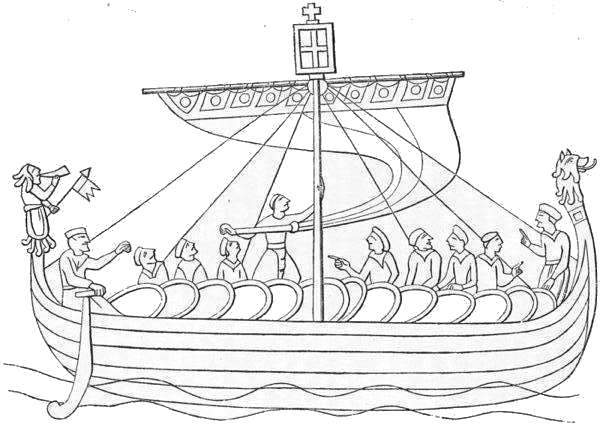
[++] Sailing Ship
With the exception of very imperfect representations carved on rocks and runic stones, there are no images left in the countries of Scandinavia of these ships of the olden time. But the celebrated tapestry at Bayeux, in Normandy, on which the conquest of England by the Normans is depicted, is a contemporary evidence of the appearance of the Normanic ships; and the accompanying woodcut taken from it, representing probably the ship in which William the Conqueror himself sailed, will clearly prove how splendid they really must have been. Both this and the rest of the Norman ships in the tapestry perfectly agree with the contemporary Danish and Norwegian ships, just as we know them from the Sagas, even to the shields hung out along the bulwarks. This, however, is nothing more than what one might naturally expect, since the Normans and Danes, on the conquest of Normandy, must have brought such ships with them, as well as that art of ship-building which they afterwards carried to greater perfection. For this, however, they found no models in the wretched vessels of the Franks and Bretons. But their steady connection with the Scandinavian fatherlands, at all events through the Danes and Norwegians in England, communicated to them those improvements in the form and arrangement of ships which the very extensive ship-building of the Northmen, and their long and uninterrupted voyages to Iceland and Greenland, must gradually have produced. That influence on maritime affairs, which, on the whole, was exercised by the Scandinavian settlers in Normandy, showed itself also in the circumstance that Scandinavian names of ships, together with other maritime terms, passed into the Romance language; as, for instance, flotte (Dan., Flaade; Eng., fleet), verec (Dan., Vrag; Eng., wreck), bord (Dan., Skibsborde, Rand; Eng., ship-board), windas (Dan., Vinde, Spil; Eng., windlass) mast (Dan., Mast; Eng., mast), sigler (Dan., Seile; Eng., sails), esturman (Dan., Styrmand; Eng., steersman), eschiper (Old Northern, skipa; Eng., equip), from which are derived the now commonly used French words, équiper, équipage, (and with us Danes likewise, eqvipere, Eqvipage-mester; Eng., master of ordnance.)
As a consequence of the Danish-Norwegian immigrations, the art of ship-building must also have necessarily developed itself in a similar manner in England, on whose eastern and north-western coasts the descendants of the Vikings had everywhere spread themselves, both by the sea and on the rivers. Christianity certainly put an end to the life of the Viking. “Söhaner” (sea-cocks) were no longer to be found, who scorned “to sleep by the corner of the hearth, or under sooty beams.” But the Vikings’ spirit was not therefore dead. The Scandinavian colonists could never entirely degenerate from their fathers, who had joyfully “ridden on the backs of the waves,” and who in the icy sea, and on the Atlantic Ocean, had greeted the storm only as a welcome friend, which assisted the oars and speeded the merry passage. Among the Vikings were many like the Danish chief made prisoner by King Athelstane at the siege of York in 927. The King treated him well, and retained him in his hall more as an equal than a prisoner. But in a few days the chief fled and put out again to sea; for it was, the chronicle adds, just as impossible for him to live on land “as for the fish to live out of the water.” The immediate descendants of such men, for whom a seafaring life was a necessity of their very nature, must have continued to dash through the water, particularly when, as in England, they were settled near seas and rivers. During all the internal dissensions and foreign wars that occupied England in the first centuries after the conquest by William the Norman—and which ended by binding more firmly together the various Celtic, Teutonic, and Scandinavian races which composed its population—the maritime affairs of the English were no longer confined, as in more ancient times, only to commerce with the nearest neighbouring countries. Through the mother countries of Scandinavia, and especially Norway, they continued during the early part of the middle ages to maintain a lively intercourse with the distant Scandinavian republics in Iceland and Greenland. But when, in the thirteenth century, the independence of these republics was overthrown, and they were placed as tributary countries under the Norwegian crown, the free trade that had previously flourished became much more restricted. The consequence of this was, that the navigation to Greenland from the north decreased more and more, until, in the fifteenth century, when the Scandinavian population of Greenland had been annihilated by sickness and by the assaults of the natives, it entirely ceased. What also much contributed to this was, that the trade which the Northmen themselves carried on with Iceland became gradually, and in the fifteenth century was almost entirely, although illegally, transferred to the English, who under the guidance of their Scandinavian kinsmen had found their way thither. Hull and Bristol—which latter place is named as early as the twelfth century as the port for ships from Norway (and Iceland?)—were the two English harbours whence this trade with Iceland was carried on. There are even some who think that Christopher Columbus during his stay in these harbours, through conversations with Iceland navigators, and possibly by a voyage to Iceland itself, obtained information of the ancient voyages of the Northmen to Greenland and America; and that he was thus first completely confirmed in his opinion, that a large and unknown continent must lie in the far west, across the Atlantic Ocean. But even if this supposition be unfounded, or destitute as yet of certain historical proof, may it not at least be probable that Columbus had heard in some other way of the Northmen’s former voyages to Greenland; and that this might have had some influence on the resolution he afterwards formed to set out across the Atlantic on a voyage of discovery towards the west?
But under any circumstances, the regular voyages of the English to Iceland were certainly connected with the subsequent complete discovery of the New World. They had served to make them familiar with more extensive voyages on the open ocean, and thus essentially contributed to foster that daring Viking spirit, which they had inherited from their Scandinavian forefathers, and which in process of time was to become so important in cementing the connection between the Old and the New World. No sooner was the latter a second time discovered than the Vikings’ spirit again strongly displayed itself in a renewed form among the English people. There was the same lofty tranquillity, the same daring and contempt of danger, that characterised the Vikings of ancient times. But the English seaman had now more experience and knowledge, and quite other means were at his disposal than had ever before existed. He therefore entered on his first voyage to the New World with undaunted courage, and not only soon became familiar with that ocean which his Scandinavian forefathers had ploughed in the remote days of antiquity, but also opened a way to new lands over seas before unknown. Thus was established that maritime supremacy which has been one of the most important props of the wealth and power of England.
The first accidental discovery of America by bold adventurers from the remote north took place so early, and under such peculiar circumstances, that neither Scandinavia nor the rest of the world derived any use or benefit from it. After a transient glimpse, the golden treasure again sank beneath the waves. It lay, nevertheless, in the dispensations of Providence, that the descendants of those Scandinavian adventurers should bear an essential part in raising the re-discovered treasure, and in making it productive for mankind. And had not the Scandinavians, by their numerous settlements in the British Islands, engrafted on the population a skill in seamanship before unknown, together with a daring spirit of enterprise, England, in spite of its fertility, its wealth, and its favourable maritime situation, would scarcely have succeeded in solving such a problem as that of closely knitting together lands separated from each other by the Atlantic in all its breadth and vastness.
Section XI.
Art and Literature.
At the period when the Danes were making their conquests in the West, art and literature did not occupy any very high position in Europe. The severe shock which the fall of the Roman Empire had given to all the more elevated pursuits was still far from being overcome. Christian art was in its childhood, and groped its way with weak attempts, and imitations of Roman models; whilst literature, confined for the most part to one-sided theological inquiries, or to the inditing of dry and annalistic chronicles, could scarcely be said to deserve the name.
It was, however, a natural result of the long-continued domiciliation of the Romans in France and England, where they founded so many and such important works, and where Christianity was adopted at a comparatively early period, that a taste for art and literature should develop itself in no mean degree in those countries; particularly in comparison of the far North, where the Romans had never ruled, and where the darkness of heathenism still rested on the people.
Nevertheless we should be grievously mistaken if we imagined that the Scandinavian people was at that time entirely unfitted for the ennobling occupations of art and literature. It has been before stated that the Northmen early distinguished themselves not only by an extraordinary skill, for those times, in the art of ship-building, but that they had also developed, previously to the conquest of England, a taste, in some respects peculiar, in the manufacture of their ornaments, domestic utensils, and weapons, and which had principally sprung from characteristic imitations of the Roman and Arabian articles of commerce brought into the North. The Scandinavian antiquities that are dug up, belonging to the older period, or what is called “the age of bronze,” as well as those of the latest times of heathenism, or “the iron age,” may on the whole, with regard to form and workmanship, be even ranked with contemporary objects of a similar kind manufactured in England, France, or Germany. The Sagas, moreover, state that the carving of images was sometimes very skilfully practised in the North; and the English chronicles, which depict in such glowing colours the splendidly-carved figures on the prows of the Danish or Scandinavian vessels, confirm the truth of these statements. In Olaf Paas’ Hall, at Hjarderholdt, in Iceland, the walls were even adorned with whole rows of carvings, representing the ancient gods, and their exploits. On the other hand there could naturally as yet be no possibility of erecting such buildings in the North as those which the spirit of Christianity had already produced in other countries.
But no sooner were the Normans from Denmark and Norway settled in Normandy, and converted to Christianity, than they began to manifest a lively desire to erect splendid buildings, and particularly churches and monasteries. Scarcely had the first violent revolutions in that country been brought to a close when there sprang up such a number of great architectural works among the Normans, that Normandy can still show more such monuments of art, of the eleventh century, than any other district of France. After William’s conquest of England, the Normans also founded there a somewhat peculiar style of building, which, though only a branch of the Byzantine-Gothic, or a further development of the older Saxon, constantly bears in England the name of “Norman.”
Previous to the Norman conquest, the Danes settled in England were naturally unable to influence, in a like degree, the style of English architectural works. Their sway there was both too short and too unsettled for such a purpose: not to mention that the Danes had still much to learn from the Anglo-Saxons in the art of building; for the latter had long been Christians, and were besides settled in a country possessing abundant remains of the magnificent architectural works of the Romans. Nevertheless it is not incredible that several of the many churches and convents then and subsequently erected by Danish princes and chiefs, and especially in the northern parts of England, but which are now for the most part either rebuilt, or have entirely disappeared, may have borne the stamp of their Scandinavian origin. We are led to this opinion by the ruling inclination manifested by the ancient Northmen to let their own conceptions pierce through, even in their imitations of foreign objects. Numerous and contemporary evidences in England itself also sufficiently prove to what a remarkable extent the Danes must have devoted themselves to peaceful occupations, long before the Norman conquest. In these, indeed, which relate to only a single branch of art, the Anglo-Saxons were their teachers; still they will show that the Danes were neither wanting in a natural capacity for art, nor in faculty or will for its further development.
It has been stated before that the Danes, previously to the conquest of England, were unacquainted with the art of coining money. At most they only imitated the Byzantine coins by fabricating the (so-called) “Bracteates,” which, however, were stamped only on one side, and were for the most part used merely as ornaments. But the art of coining was very ancient in England. It was customary among the Anglo-Saxons for the coiners to put their names on the coins struck by them. The quantity of Anglo-Saxon coins that has in the course of time been found and examined, has afforded an opportunity for inspecting and comparing a considerable number of names of coiners in England, especially from the eighth and ninth centuries until far into the thirteenth. About Edward the First’s time, the names of the coiners were no longer suffered to occupy so conspicuous a place on the coins as previously.
In the eighth and ninth centuries the names of these coiners are purely Anglo-Saxon. But in the tenth century, and especially after the year 950, pure Danish or Scandinavian names begin to appear; for instance, Thurmod, Grim, under King Edgar (959-975); Rafn, Thurstan, under King Edward (975-978); Ingolf, Hafgrim, and others. These Scandinavian names are more particularly found on coins minted in the northern part of England, or at all events in the districts that were early occupied by the Danes to the north-east of Watlinga Stræt. But under King Ethelred the Second (979-1013), who contended so long with Svend Tveskjæg and Canute the Great (and consequently, therefore, before the conquest of England by the Danes was completed), such a number of Scandinavian coiners arose all at once, in consequence of the rapidly-increasing power of the Danes, that the names of forty or fifty may be pointed out on coins of Ethelred alone that have been found in different parts of England. During the Danish dominion, Scandinavian names naturally appear no less frequently on the coins of Canute the Great and Harald Harefoot; nay, even after the fall of the Danish power, they are to be met with, in almost the same number as before, on coins of the Anglo-Saxon king, Edward the Confessor (+ A.D. 1066).
The following table exhibits, from the coins themselves, a list of fifty names of Danish-Norwegian coiners in England that appear most frequently from 979 to 1066; or in that period which embraced, as well as immediately preceded and followed, the Danish dominion; together with the names of the places in which the respective coins were minted. We must remember, besides, that there must have been several coiners of the same name at one and the same time. Thus, for instance, we find coins of Ethelred bearing the name of “As-” or “Oscytel,” though minted in cities so far distant from one another as Exeter, London, Cambridge, Leicester, and York. Again, as it is nowhere stated that “Arncytel,” for instance, who was coiner in York under King Ethelred, was the same man as Edward the Confessor’s coiner in that city, it is clear that the fifty names here given might very easily have belonged to ninety or a hundred different persons; yet they are but a selection from a greater number. The same difficulty, however, occurs with these names as in the previous consideration of the Scandinavian names of places and of the popular language; namely, that owing to the great similarity between the Saxon and Scandinavian tribes in ancient times, it is often almost impossible to decide with certainty what is exclusively Saxon and what Scandinavian. But at all events, the annexed list contains, at most, hardly more than a couple of names that might have been current in Saxon England before the Danish conquests.
Fifty Names of Danish-Norwegian Coiners in England in the years 979-1066, chiefly from Hildebrand’s “Anglo-Saxon Coins in the Royal Swedish Collection of Coins found on Swedish Ground.” (Stockholm, 1846. 4to.)
Ethelred (979-1013) Canute (+1035) Harald (+1040) Edward Confessor (+1066)
Arncytel York York York
Arngrim York York York
Arnkil York, Stamford
Arnthor York
Ascil London
As, or Oscytel Exeter, London, Cambridge, York, Leicester
As, or Oslac London, Lincoln, Norwich
Auti London, Lincoln
Beorn (Björn) York York York
Cetel Exeter, York Exeter, York York
Colgrim Lincoln, York Lincoln, York Lincoln, York Lincoln, York
Dreng Lincoln Lincoln
Eilaf York
Eistan Winchester
Escer Stamford Stamford
Grim Lincoln, Thetford Shrewsbury
Grimcytel Lincoln
Hardacnut Lincoln
Huscarl Leicester
Iric London
Jelmer (Hjalmar) Lincoln
Justan, or Justegen Lincoln
Northman Lewes
Othgrim Lincoln, York York Lincoln
Othin York York York
Oustman, or Ustman York Winchester
Rœfen (Ravn) York
Rœienhold Lincoln
Siafuel, Sœfuhel York
Scula Exeter, York York York
Stgncil (Stekil) Lincoln
Styrcar, Stirceir Lincoln, York York
Sumerled Deptford, Nottingham, York, Lincoln Lincoln, Norwich Lincoln Lincoln
Swan York
Swarti Leicester, Lincoln
Swartgar York, Stamford
Sweartabrand Lincoln Lincoln
Swegen London, Leicester Leicester
Thor York
Thorald Leicester
Thorcetel Torksey, Lincoln London, Torksey
Thorstan York York, Stamford Norwich
Thorulf Chester, York Stamford
Thurcil Wilton
Thurgrim York York York
Ulfcetel York, Lincoln, Norwich London, Lincoln York
Valrefenn Lincoln Lincoln
Widfara Ipswich
Winterfugl York
Wintrieda York
Although this list cannot make any pretensions to completeness, still it will prove, even in its present form, that these Scandinavian names exist on coins from places in the most distant parts of England, both south and north of Watlinga-Stræt; as well as from those most essentially Anglo-Saxon cities, Exeter, Winchester, Wilton, Lewes, and London. From this last circumstance, some might, perhaps, contend that Scandinavian names were frequently borne by Anglo-Saxons, who in one way or another were related to the Danes; and in this respect one might cite the instance of the Anglo-Saxon Earl Godwin, whose sons—possibly by a Danish wife—were called Harald and Svend; and it might consequently be argued, that the proof adduced from these Scandinavian names of the Danish capacity for skill in art is not sufficiently conclusive.
It cannot of course be denied that the Anglo-Saxons, in whose veins there was a mixture of Scandinavian blood, sometimes bore Scandinavian names. But as a rule, the names that have been cited must have belonged to Danes or Northmen, and their immediate descendants. It is well known that the Danes were settled everywhere in England, even in the southern cities, particularly those just cited; and that, too, in considerable numbers: as, for instance, in Exeter, where in later times there was a St. Olave’s Church; in Winchester, which obtained a Scandinavian “Husting;” not to speak of London. This alone affords a natural explanation why Scandinavian coiners should be found in the south of England; but we should further observe, that those names of coiners about which there might be most doubt are found to the north-east of Watlinga-Stræt. The preceding tabular view will clearly prove that they occur especially in the old Danish part of England, in the five Danish fortified towns, and in York. The two cities, Lincoln and York, which, according to the statements of history, had, in the eleventh century, a very numerous, if not preponderating, Scandinavian population, are remarkable for having the greatest number of coiners with Scandinavian names. Some of these names are so peculiarly Scandinavian, that we cannot without difficulty assume them to have been borne at that time by Anglo-Saxons. Such are “Othin” (Anglo-Saxon, Woden) and “Thor;” names that did not sound well in the ears of Christians: also “Northman” and “Ustman,” or “Östman,” by which the Anglo-Saxons designated the Norwegians and Danes, who came from the North and East. “Östman,” especially, was an appellation commonly given by the inhabitants of the British Isles in those times to the Scandinavian tribes that dwelt to the east of them.
Among other names, those of “Colgrim” and “Valrefenn” may be noticed as frequently appearing, and as peculiar to Lincolnshire, a district occupied in such great numbers by the Danes. Names of birds appear on the whole to have been often assumed in the old Danish part of England. Thus in York we find a “Ræfn,” or “Ravn” (Raven); “Siafucl,” “Sæfuhel,” or “Söfugl” (Seafowl); “Swan” or “Svane” (Swan); and “Winterfugl” (Winterfowl). Strangely enough, there also appears a “Sumrfugl” (Summer-fowl) as the name of a coiner, who minted coins for the Danish-Norwegian king Magnus the Good, in Odensee; and as English coiners were at that time employed in Denmark, this Sommerfugl perhaps came over from the north of England. It was, indeed, quite natural that Denmark and the rest of the North should procure their earliest coiners from Danish North England, where there were plenty of them of Scandinavian origin. The English names found on the oldest Scandinavian coins (of the first half of the eleventh century) are consequently by no means universally Anglo-Saxon, but often Scandinavian; as Svein, Thorbaern (Thorbjörn), Ketil, Thorkil, Othin, Thorstein, Thurgod, Thord, and others. It is remarkable, that the names of “Sumerled” and “Winterled,” answering to those of Sommerfugl and Winterfugl, were also found at that time in York. Another remarkable name is that of “Widfara” (the far-travelled), which seems to indicate either that its bearer had come from a great distance, or had made long voyages.
These Scandinavian names, which, as I have said, are just as frequent on coins minted immediately after, as on those struck during, or just previously to, the Danish-English kings’ dominion, by no means cease with Edward the Confessor (+ 1066). During Harald Godvinsön’s short reign, we further meet with Outhgrim, Snaebeorn (or Snéebjörn), Spraceling (Sprakeleg), Thurcil, Ulfcetel, &c.; nay, even after the Norman conquest, and as long as it was customary to place the coiners’ names on the coins, Scandinavian names may be recognised. Thus, under William the Conqueror (+ 1087) we find Colsvegen, Thor, Thurgrim, Jestan (Jostein or Eistein, Justan and Justegen), Siword, Thorstan; under Henry the First (1100-1135), Chitel (Ketil), Runcebi (Rynkeby), Spracheling, Winterled; under Stephen (+ 1154), Ericus, Siward, and Svein; and under Henry the Second (+ 1189), Achetil (Asketil), Colbrand, Elaf, Raven, Svein, Thurstan, and others. A great number of these names appear in connection with towns in the north of England; and we have thus a new and instructive proof that the remarkable influence of the Danish element in England, and especially in the northern part, before the Norman conquest, was not entirely lost after that conquest had long been completely effected.
Considering the distant period in which the Danish conquests in England fall, it is fortunate that we can obtain so many palpable evidences of the state of domestic civilization as these coins afford; and more will assuredly follow from the discovery of others hitherto unknown. These coins prove much, and justify us in inferring still more. They place, as it were, before our eyes, the earnestness with which the Danish Vikings, and the rest of the colonists in England, must have applied themselves shortly after their settlement, to rival the Saxons in art, and to retrieve what they had neglected in this respect. In like manner, there is every reason to believe that they must have devoted themselves with no less zeal to other peaceful occupations which they had already cultivated in their own native homes; and that thus they must have also preserved and cherished in England, both in war and peace, that love for poetry and history, which flourished in the homes of their ancient forefathers, and which, on the whole, harmonized so completely with the heroic life of the olden times in the North. It was not natural that the deep desire which filled the Northman to enjoy posthumous fame in chronicles, and in the songs of the poets—which left him no peace at home, but drove him out to sea on daring expeditions—should immediately desert him because he had removed to a foreign soil. It is expressly related of the Normans that they cherished eloquence and poetry in a high degree, and that they were accustomed to entertain their guests with songs and legends. Scandinavian bards, especially from Iceland, continued to visit the Scandinavian colonists in France, as well as in the British Isles. As court-minstrels, they were in constant attendance upon the Scandinavian princes in Scotland, Ireland, and England. Their office partly was, to entertain the warriors with lays of past exploits in the North; and, partly, to accompany the chiefs on their warlike expeditions; that they might, as eye-witnesses, be able to sing their heroic deeds, and by these lays convey to the North a knowledge of what passed among the Scandinavian colonists in the western regions. When we add that the Scandinavian kings, as, for instance, Canute the Great himself, practised at times the art of poetry, it will be easily perceived in what high honour the bard and his lays must have been held.
But it lay in the nature of things that a pure Scandinavian poetry could not grow up either among the Normans in France, or their Danish kinsmen in England. For the development of such a poetry it was necessary that they should preserve their Scandinavian nationality intact. But it is well known, that a foreign education and refinement soon caused them to abandon their belief in Odin, as well as many of the habits and customs which they had inherited from their forefathers. Of the change that took place in them nothing bears stronger evidence than their mother tongue, which, by degrees, lost more and more of its characteristics, and at length passed entirely into the modern French and English languages.
The old predilection for poetry which the Normans brought with them from the North, was reflected in many ways in their foreign refinement. Of all France, Normandy was the country where most historical and warlike songs were heard. The Normans sang them in battle, and derived from them a sort of inspiration. Before the battle of Hastings, William the Conqueror’s bard, Taillefer, recited songs about Charlemagne, Roland, and others, to the Norman host, to cheer and enliven the warriors after the old Scandinavian fashion; just as Thormod Kolbrunaskjald, before the battle of Stiklestad, in Norway, (1030), sang the far-famed Bjarkemaal. When the poetry of the Troubadours of Provence began to spread itself throughout France, it found another home in Normandy; where it so peculiarly developed itself, that the French troubadour poetry is generally divided into two principal kinds, the “Provençal” and the “Norman.” Even in Italy, where the Normans conquered fresh kingdoms, their peculiar poetry had a perceptible and important influence on the development of the art.
In England, likewise, there arose, partly as a consequence of the Danish and Norman conquests, a particular kind of composition which, in England, is called Anglo-Danish and Anglo-Norman. That all poems of this sort were written by Danes or Normans, I do not venture to assert. All that is meant is, that they were partly produced by the Danish and Norman wars; and that, partly, they were the expressions of the new adventurous and knightly spirit, which, through the Danish-Normanic conquests, became prevalent in England. Some of the most celebrated of them are romances about “Beowulf,” “Havelock the Dane,” and “Guy, Earl of Warwick.” In the oldest romances, which are composed of the same mythic materials as our Scandinavian Edda songs, and some of the Sagas or legends, adventurous combats against dragons, serpents, and similar plagues, are celebrated; whereas, in the later romances of the age of chivalry, warriors are sung who had fallen in love with beautiful damsels far above them in birth or rank, and whose hand and heart they could acquire only by a series of brilliant adventures and exploits. Valour, which before was exerted for the welfare of all, and for the honour that accompanied it, now obtained a new object and a new reward, and that was—love. The heathen poems of the Scandinavian North are all conceived in the selfsame spirit; and it is therefore not altogether unreasonable, perhaps, to recognise in this striking agreement traces of a Scandinavian influence on English compositions. In later times, and down to the middle ages, this influence is still more clearly apparent in the before-mentioned ballads, or popular songs (p. 89), which are only to be found in the northern, or old Danish, part of England, and which betray such a striking likeness to our Scandinavian national ballads.
The Danes in England do not appear to have occupied themselves with any compositions that can be properly called historical; at all events all remains of such composition have disappeared. It is related of the contemporary Normans in France, that, down to the days of William the Conqueror, they devoted themselves more to war than to reading and writing. This, however, is not surprising, since even the Anglo-Saxon clergy in Alfred the Great’s time, according to that monarch’s own statement, were so ignorant and so unaccustomed to literary occupations, that exceedingly few of them could read the daily prayers in English, much less translate a Latin letter. Even if we should admit that the Danes in England, by reason of their earlier and more extended settlements there, had somewhat better opportunities for study than the Normans in Normandy, still there is not sufficient ground to suppose that they wrote any other chronicles than such dry annals as some few monks, and other learned men of that time, composed. The reason of this seems partly to have been because they preferred preserving the remembrance of important events in historical lays; and partly, because neither their national nor political development could proceed in a foreign land with such freedom from all admixture, and in such tranquillity, as to allow of more important historical works, and especially in their mother tongue, being produced among them.
In Iceland, on the contrary, where a great number of the most powerful and shrewdest of the heathens of Norway sought, after the year 870, a refuge against spiritual and political oppression, and where they founded a republic which retained its independence for centuries, the Scandinavian spirit obtained a free field. Not only did the old bardic lays, and the remembrance of the deeds of former times, continue to live among the Icelandic people, but new bards arose in numbers, who, spreading themselves over the whole north of Europe, returned “with their breasts full of Sagas.” There also speedily arose in Iceland, immediately after the Viking expeditions, and altogether independently of any external influence, an historical Saga literature in the old Scandinavian tongue, which, viewed by itself, is, from its simplicity and elevation, extremely remarkable, but which, when compared with the contemporary dry Latin monkish chronicles and annals in the rest of Europe, is truly astonishing. The Edda songs, the purely historical Sagas, the historical novels, and other peculiarly bold and original productions of the Icelandic literature, in an age when the European mind was singularly contracted, form, in the intellectual world, manifestations of the same thorough individual freedom, which stamped itself on the arms, endeavours, and whole life of the heathen Northman.
Section XII.
Ecclesiastical and Secular Aristocracy.
The supposition that the Danes in England devoted themselves to study both earlier, and to a greater extent, than the Normans in France, is not founded only on loose conjectures. The English chronicles of the earlier middle ages contain traces of the Danes having not unfrequently entered into the English Church, in which they sometimes obtained the highest preferment. On this point we still possess an important source of information, which has, besides, the advantage of being for the most part contemporary with the events and circumstances which it elucidates. This consists of a considerable quantity of letters and diplomas issued by kings, bishops, and other leading men in England, from about the year 600 to 1066. These documents, which have lately been collected and published by a gentleman celebrated for historical research, Mr. J. M. Kemble, (under the title of “Codex Diplomaticus Ævi Saxonici,” vol. i.-vi., London, 1839-1848, 8vo.) more especially regard the southern and midland parts of England, as unfortunately the greater part of the letters relating to the north of England are lost. Nevertheless, those that remain, taken in conjunction with the chronicles, afford valuable information, both respecting the Danish clergy in the south-east of England, and their diffusion throughout that country.
In the centre of the east coast of England, in Lincolnshire, and near the Wash, stood in the Anglo-Saxon times the large and famous convent of Croyland, or Crowland, dedicated to St. Guthlac. It was built upon an island, and so protected on the land side by the vast morasses which in those times covered the districts nearest the Wash, that it was a sort of natural fortress. According to the chronicles of the convent, compiled by one of the abbots in the eleventh century, it was governed, shortly after the year 800, by an abbot of the name of Sivard; in whose time there is also mentioned in the convent a priest (presbyter) named “Turstan,” and a monk “Eskil” (Askillus monachus). In the same ancient chronicle are also recorded several deeds of gift, which possibly, with regard to the rights conveyed to the convent, may have been forgeries of the times, but which, at all events, so far as regards the names of persons and places mentioned in them, must be perfectly correct and trustworthy; since incorrectness in these particulars would have easily led to the discovery of the intended frauds. These deeds mention, between the years 800 and 868, amongst the benefactors of the convent, three viscounts in Lincolnshire, “Thorold” (or Thurold), “Norman,” and “Sivard;” and also “Grymketil” and “Asketellus” (or Asketil), who was cook to the Mercian king Viglaf. Lastly there appear (particularly in the year 833) the following names of places:—Langtoft, Asuuiktoft, Gernthorp, Holbeck, Pyncebek, Laithorp, Badby, and Kyrkeby.
The names of persons in the convent, and of places about it, here cited are all, perhaps, or at most with a single exception, of undoubted Danish or Scandinavian origin. They not only prove that, even long before the treaty between Alfred the Great and the Viking King Gudrum or Gorm, which in the year 879 secured to the Danes their conquests on the south-east coast of England, and therefore, more than one hundred and fifty years before Canute the Great’s time, the Danes really had such a footing round the Wash that they could give their villages Danish names, and were governed by their own chiefs; but they likewise indicate the remarkable fact, that at least a great number of these Danes must have been already Christians, since they had villages with churches (Kyrkeby) and gave landed property to a convent, in which we find both Danish monks (Eskil and Thurstan), and a Danish abbot (Sivard.) It was about the same time that the Jutland king, Harald Klag, was baptized, together with his whole suite, during a sojourn with the Emperor Ludvig, at Ingelheim, near Mayence, in the year 826. This christening of Danish men abroad, in Germany and England, was the beginning of the subsequent introduction of Christianity into the Scandinavian North.
The genuineness of the above-mentioned Scandinavian names is placed beyond all doubt by the circumstance that similar names appear in other documents connected with the history of Croyland at the same period, or the ninth century. In the year 867, swarms of Danish-Norwegian Vikings landed on the east coast of England, and the Christians who then lived there, whether Danes or Anglo-Saxons, as well as their churches and convents, suffered from the ferocity of these heathens. After a great battle in Lincolnshire, in which, however, the heathens lost three of their kings, whom they buried in a place afterwards called “Trekyngham” (the three kings’ home), they marched against Croyland. In vain did the Christians seek to arrest their progress. In a battle near the convent many of the Christians fell, and amongst them “Toli” or “Tule,” who had previously been a knight, but who had now entered the cloisters of Croyland. The Vikings stormed the convent, and committed a terrible massacre. Their king, “Oskytyl,” cut down the abbot before the altar; after which the convent was plundered and destroyed. The Danish Viking Jarl Sidroc, or Sigtryg, saved a boy called Turgar (Thorgeir) from this massacre, who afterwards escaped to the neighbouring convent of Ely, and gave an account, which is still preserved, of this terrible devastation. Meanwhile, however, the convent of Ely, as well as that of Medehamstede (Peterborough), was plundered and destroyed by the Vikings.
Amongst the monks then killed in Croyland, we may cite from the chronicle, the prior, Asker, and the friars Grimketulus (Grimketil) and Agamundus (Amund); and among the few saved, Sveinus or Svend:—names which, not less than Tule and Thorgeir, indicate a Danish origin. Men of Danish extraction continued in the following centuries to play a considerable part in the history of this and of the neighbouring convents. A Dane named “Thurstan” is said to have rebuilt that of Ely; and another man of Danish family, “Turketul” (Thorketil), certainly rebuilt Croyland. Thorketil, who (it is stated) was nearly related to the royal Saxon family, had previously distinguished himself both as a warrior and statesman. In the battle of Brunanborg he commanded the citizens of London who were in Athelstane’s army, and during a long series of years was chancellor to several kings. Subsequently, however, he took the vows of the convent, and governed Croyland with honour, as abbot, till his death in the year 975.
It is, indeed, very striking to observe how many abbots of Danish origin governed the convent of Croyland from the ninth to the twelfth century. Sivard and Thorketil have been already mentioned. Thorketil was succeeded by two of his relations, both named Egelrik; and after the death of the last of these in 992, followed an abbot with the pure Danish or Scandinavian name of “Oscytel.” This Asketil had long been prior of Croyland before he became its abbot, which he continued to be till his death in the year 1005. To what extent Asketil’s immediate successors were Danes is at least very uncertain, as they have Anglo-Saxon names. During the invasions of the Danish kings, however, the convent was at times suspected of being in league with the Danes. Canute the Great is said to have presented a chalice, and his son Hardicanute his coronation mantle, to Croyland. Other Danes also made similar gifts to that convent. In the year 1053 it again had an abbot with the Danish name of Ulfketil (Wulketulus); and, what is very significant, after the Norman conquest, the swampy districts round it became places of refuge for the Danes and Anglo-Saxons who had in vain fought the last battle for freedom against the victorious and advancing Norman conquerors. One of the chief leaders in this battle was the Jarl Valthiof, a son of the far-famed Danish Jarl, Sivard Digre (Eng. Sivard the Stout) of Northumberland. Valthiof, it is expressly stated, was one of Croyland’s best benefactors and protectors. Subsequently he made his peace with William, but was at last executed by that monarch’s directions, and immediately buried at Winchester. Nevertheless the abbot Ulfketil, together with his monks, obtained permission to convey Valthiof’s body to Croyland, where many miracles were soon performed at the shrine of the innocent and murdered martyr of freedom. Exasperated probably by this, as well as by the refuge which their opponents found in and about Croyland, the Normans inflicted many calamities on it, and at length deposed the abbot Ulfketil. He was succeeded by an Englishman with the Scandinavian name of “Ingulf,” to whom we are indebted for having indited the ancient chronicles of the convent.
The close connection of Croyland with the Danes, as well as its Danish monks and abbots, was a natural consequence of the convent’s being situated in Lincolnshire, a part of England which was pretty nearly the earliest and most numerously occupied by them. Satisfactory reasons certainly exist even to justify us in calling this convent peculiarly a Danish one. In consequence of its size and importance, it is highly probable that it was one of the principal places whence the Danish settlers in England derived their civilization. In this manner Croyland answers in England to the convent of Bec in Normandy (from the Danish Bæk, a small rivulet), founded by the Northmen, and afterwards very celebrated; which also seems to have been one of the most important nurseries for the diffusion of a higher Christian and intellectual cultivation among the Scandinavian colonists in Normandy.
The very remarkable evidence which the history of Croyland affords of the Christianity of the Danes in England so early as the ninth century, is, however, by no means solitary. Before the treaty concluded between Gorm (Gudrum) and Alfred in the year 879, the former had already been converted, and received at his baptism the name of Athelstane. In a somewhat later treaty concluded by the same King Gorm with Alfred’s successor Edward, it is assumed that there must long have been Christians among the Danes settled in East Anglia, and that they had at all events allowed the ecclesiastical institutions to exist unmolested among them. In the year 890 there was in Northumberland a king called Guthred (Gutfred, Godfred?), a son of the Danish king Hardicanute, of whom it is stated that he extended the bishopric of Durham, and conferred on it considerable rights and privileges, which even at the present day distinguish that see above all others in England. The coins of Danish-Norwegian kings minted in the north of England in the ninth and first half of the tenth century (as mentioned at p. 49), also indicate an early conversion to Christianity; as they show both the cross, and frequently also parts of the Christian legend: “Dominus, dominus, omnipotens rex mirabilia fecit;” or, “The Lord, the Lord, the Almighty King, hath performed wonderful things.”
About the year 940, Christianity must, on the whole, have had a firm footing among the Northumbrian Danes. It would otherwise be inexplicable how, in the wars which Edmund waged at that time with the Danish king Anlaf, or Olaf, in Northumberland, even the Archbishop of York, “Wulfstan,” should have sided with the Danes against the Anglo-Saxons. Wulfstan subsequently, in the year 943, negotiated a peace between Olaf and Edmund, whereby the latter ceded the country east of Watlinga-Stræt to Olaf. In this treaty a great man, of Danish extraction, took part on the Anglo-Saxon side; namely, Odo, Archbishop of Canterbury, whose father was a Dane who had fought in the host of the Vikings against Alfred the Great. One might almost be led to believe that Wulfstan himself was of Danish origin, and that his name was only the Anglo-Saxon form of the Scandinavian “Ulfsteen.” For under King Edmund’s successor, Edred, we again find the Archbishop, together with his clergy, paying homage to the Danish king’s son, Erik (son of Harald Blaatand?), although he had shortly before, in common with the Northumbrians, taken an oath of fidelity to the Anglo-Saxon king. After the murder of Erik, King Edred caused the Archbishop to be deposed and thrown into prison; but afterwards gave him the bishopric of Dorchester, though far removed from the Danish possessions.
Another argument in favour of the Danish extraction of Bishop Wulfstan (or Ulfsteen) is, that several of his successors in the archbishopric were undoubtedly Danish; which shows that in those days such men were chiefly elevated to that dignity, as, through their common descent and kinsmanship, possessed an influence over the Danish population in Northumberland; where, also, there was doubtless a great body of Danish clergy. Contemporary with Abbot Thorketil, a certain “Oscetel,” or Osketil, is also named as churchwarden (circeværd) in the King’s letters-patent in the year 949; probably the same Osketil who, between the years 955 and 970, constantly signed the King’s letters as Archbishop of York. As Odo, the Danish Archbishop of Canterbury, lived long after Osketil had become Archbishop of York, we are thus presented, half a century before the reign of Canute the Great, with the singular spectacle of the two chief ecclesiastics of England, the Archbishops of Canterbury and York, being both of Danish extraction. Oscytel’s successor in the archiepiscopal see of York was also a Danish man, although he bore the Anglo-Saxon name of Oswald. He was both nearly related to Oscytel (his “nepos”), and, moreover, a brother’s son of Archbishop Odo; consequently descended in a direct line from the Danish Viking, Odo’s father. This Archbishop Oswald published some laws for the Northumbrian clergy which are still extant, and in which, according to Danish custom, fines are computed in marks and öre; whilst in the rest of England they were reckoned in pounds and shillings.
As these facts lead us to suppose that, at that time, a great part of the inferior clergy in England must have been of Danish extraction, and particularly in Danish North and East England; it thus becomes still clearer that the English priests or missionaries, with Scandinavian names—as, for instance, Eskild, Grimkild, and Sigurd—who went over to Scandinavia in the tenth century for the purpose of converting the heathens, were, as their names show, of Danish origin, and undoubtedly natives of the Danish part of England. Sprung from Scandinavian families, which, though settled in a foreign land, could scarcely have so soon forgotten their mother tongue, or the customs which they had inherited, they could enter with greater safety than other priests on their dangerous proselytizing travels in the heathen North; where, also, from their familiarity with the Scandinavian language, they were manifestly best suited successfully to prepare the entrance of Christianity.
The rapid accession of the Danes to the highest ecclesiastical offices in England must satisfactorily convince every impartial person how carefully we should discriminate between the Danish or Scandinavian Vikings, who, only for a certain period, robbed and plundered, and the Danish colonists, who, from the beginning of the ninth century were settled down—particularly in the east and north of England—as peaceful Christian citizens; and whose sons soon became sufficiently accomplished and respected to fill the highest places among the already powerful ecclesiastical aristocracy of England. Nor should it be forgotten, that the Danes in England, who, though fewer in number than the natives, yet aimed at the supreme authority, were early obliged to apply themselves to study, and to permit their sons to enter the clerical order; for, the greater the influence they could acquire among the clergy, who at that time held a very large share of power, the stronger and more secure would their position become in the land of their adoption.
After having had, at least, three archbishops of Danish family during the tenth century, it is not surprising that in the following one the English clergy had lost a great deal of their horror for the Danes, and were so willing to do homage to the Danish conqueror, Canute the Great, in preference to any prince of Anglo-Saxon descent. Nor did Canute betray their confidence. He conformed to their manners, and built churches and convents, whilst his followers imitated his example. Under such a state of things the English clergy must have become still more mixed with Danes. In Canute’s time the royal letters are signed by the abbots “Oscytel” (1020-1023) and “Siuuard” (in Abingdon, Berkshire); as also by “Grimkytel,” bishop in Essex; and under Hardicanute, by “Sivard” and “Grimkytel” as well as by the diaconus Thurkil. Even long after the fall of the Danish power, as, for instance, in Edward the Confessor’s time, we still meet with many high dignitaries of the church, with Scandinavian names; such as the abbots Sivard, Sihtric, Uvi or Ove, abbot of St. Edmundsbury, in East Anglia, and Brand; who was also abbot of a convent on the east coast, namely Peterborough, close to Croyland. We further have Sitric, chaplain to the Bishop of Dorchester, and lastly the Kentish bishop, Siward. William the Conqueror’s Doomsday Book likewise mentions several such Danish clergymen; for instance, in the old Danish city of Lincoln, the priests “Siuuard” and Aldene or Haldan. In St. Edmundsbury there was still later (1157) a Danish abbot named Hugo.
The secular nobility, or chiefs, were closely connected with the high church dignitaries of that time. The royal letters before mentioned also show, that whilst the Danes succeeded in placing men of their own race amongst the highest clergy in England, they likewise procured admittance into the ranks of the nobility, and even into the suite that surrounded the Anglo-Saxon kings themselves. This happened not only from the Danish chiefs frequently entering the service of the Anglo-Saxon kings, and often marrying among the Anglo-Saxon aristocracy; but still more from the circumstance, that certain districts became in time so strongly occupied by the Danes, as to fall under Danish chieftains; and consequently the Anglo-Saxon kings, inasmuch as they held dominion over such districts, were compelled to take these chiefs into their court and councils. History informs us that the Danish kings Halvdan and Gudrum divided the districts they had conquered in Northumbria and East Anglia among their followers, and thus formed there, at an early period, a resident and wealthy Danish aristocracy.
It has been before shown that, so early as the ninth century, Lincolnshire had had at least three Shire-greves (Sheriffs), or earls of the shire, of Danish or Scandinavian extraction; viz., Thurold, Norman, and Sivard. In the ninth century, indeed, as well as in the first part of the tenth, the Danish possessions in England were almost entirely independent of the Anglo-Saxon kings. It was at this period that the Danish-Norwegian kings in the districts north-east of Watlinga-Stræt minted, as independent sovereigns, the many coins before described. There could not, consequently, have then existed in the courts of the Anglo-Saxon monarchs so many Danish chiefs, or vassals, as when those monarchs subsequently began to acquire dominion over the previously more independent Danish kingdoms. Thus, among the regular followers of King Athelstane (925-941), who subdued the Danish kingdoms in England, we find, even before his successful expeditions into the North, not a few Danish-Norwegian chiefs, who signed diplomas in conjunction with him, and particularly during the years 929 to 931; namely, besides the Thane “Syeweard” (his minister), the Jarls Urm, Gudrum, Healden or Halfdene, Inhwær (Ingvard), Rengwald, Hadder, Haward, Scule, and Gunner. This may, perhaps, partly confirm the statement of the chronicles, that Athelstane availed himself of Danish warriors to suppress rebellion in his kingdom. It is expressly stated that, at the battle of Brunanborg (treated of at p. 34), there were Scandinavian warriors in his army; and, among the rest, two Iceland brothers, namely, Thorolf, who fell in the battle, and the bard, or scald, Egil Skallegrimsen, who stayed for some time with King Athelstane, by whom he was presented with rich gifts for his lays. It is by no means improbable that Egil entertained, with his songs, the Scandinavian chiefs then at King Athelstane’s court.
Between the years 940 and 960, several of the above-named Jarls, as Gunner, Scule, Haldan, and Urm, together with Grim and the chiefs, or ministers, Thurkytel and Thurmod, continued to sign the Anglo-Saxon letters-patent, in conjunction with their countrymen or relatives, the Abbot Thurcytel, and Oscytel, Archbishop of York. At this time the Latin title “dux” varies alternately with the Scandinavian title of Jarl, which the Anglo-Saxons called “Eorl.”
With King Edgar’s reign (959-975) began a fortunate epoch for the Danish dominion in England. Edgar himself was educated among the Danes in East Anglia, under the care of his relative, Alfwena, dowager queen of the converted Viking king, Gudrum, or Gorm. Hence he had early conceived such a partiality for the Danes, that during his reign he was accused of showing too much favour to those foreigners at the expense of the natives. It was in his time that the two highest ecclesiastics in England, the archbishops of Canterbury and York, were men of Danish extraction; and to judge from the diplomas issued by him, he must certainly have been served by several Scandinavians; for instance (959), by the Jarl Oscytel, and by the Thanes (or ministers) Ulfkytel, Rold, and Thurkytel. Thored, or Thured, a son of the before-mentioned Danish jarl, Gunner, is likewise named in the chronicles as one of Edgar’s most trusted chiefs.
The Scandinavian, or Danish aristocracy had now gradually taken such deep root in England, that Ethelred the Second, who can scarcely have favoured the Danes, since he was repeatedly forced by their kings, Svend and Canute, to fly his kingdom, was even unable to remove the Danish chiefs from about his person, and to put in their places Anglo-Saxons of unmixed descent. In the first years of his reign there were in his suite, as the letters-patent show, several chiefs with Scandinavian names; as the Jarl Nordman, and the thanes Ulfkytel, Siweard, Wolfeby, and Styr, as well as the knights (milites) Ulfkytel and Thurcytel; whence it is clear that there must have been several chiefs of the same name at one and the same time in his court, and particularly of the names of Ulfkytel and Siweard. Nay, Ethelred himself was united, in first marriage, with a queen of Danish descent; namely, Elfleda, a daughter of the Danish chief Thured, Jarl Gunner’s son. By this at least semi-Danish queen, he had several children, and amongst them a son, who afterwards became the renowned Edmund Ironsides. According to the chronicles, many powerful Danes had now obtained large fiefs even in the southern and western parts of England; as, for instance, the Jarl Paling, who was married to Gunhilde, a sister of the Danish king, Svend Tveskjæg, and who had extensive fiefs in Devonshire. This Paling, or Palne, however, to judge from the name, was probably the celebrated Scandinavian hero Palnetoke, whose possessions are said to have lain in that district.
The Danes were now so spread over the whole of England, that the Danish invaders were sure of finding support in almost every corner of it; and Ethelred consequently saw that, if their power was not crushed at once, the Anglo-Saxon dominion was threatened with imminent ruin. But it was too late. The secret massacre planned by him in the year 1002 was far from sufficing to annihilate, even in South England, the numerous traces of Danish influence; and to North England, as is well known, it did not extend. Even after the slaughter, we continue to find in the royal letters-patent nearly the same Scandinavian names of chiefs as before: such as Siward, Styr, Ulfkytel, Nordman, and the knights Ulfkytel and Thurkytel. The Icelandic scald, or bard, Gunlaug Ormstunge, also remained some time afterwards with Ethelred, just as Egil Skallegrimsen had before resided at the court of King Edgar, a monarch favourably disposed towards the Danes. The old chronicles also mention a powerful chief of Danish extraction who was in Ethelred’s army after the massacre. This was Thorketil, surnamed Myrehoved (Ant-head); and, according to the same chronicles, a Dane named Ulfketil Snilling, sheriff or earl in East Anglia, was even married to Ethelred’s own daughter Ulfhilde!
Thus, even before the conquest by Canute the Great, Danish families had frequently ingrafted themselves on the families of the Anglo-Saxon nobility; nay, even on the royal family itself. After that conquest the line of demarcation between the Danes and Anglo-Saxons cannot have been so strongly drawn as is generally imagined. Thus the descriptions given in the Sagas of the bold chiefs of the heathen North, as being also shrewd, amiable, and eloquent men, gain more and more credibility; and we cannot help admiring the ability and manliness which enabled the heathen Danish chiefs, and their immediate Christian successors, to maintain their difficult position against a hostile aristocracy, and, in spite of it, gradually to extend their power in the very midst of Anglo-Saxon England. Nay, they not only maintained their ground as the equals of the Anglo-Saxons, but soon became their superiors. The weakness and depravity of the Anglo-Saxon nobles under the reign of Ethelred were the best proof that their day was past. Faintheartedness, bordering very closely on cowardice, want of union, treachery, and every other vice, reigned no less among the chiefs than among their dependents. Luxury and effeminacy had usurped the place of the old Anglo-Saxon simplicity and vigour. Scarcely any great men appeared among them, notwithstanding the urgent need that there was for such characters. Even the greatest of their few warriors, Edmund Ironsides, was, as we have seen, of Danish descent on the mother’s side.
We may almost say that England was the spoil of the Danes before Canute came over and seized the sceptre. What a contrast does Canute the Great, with his proud jarls and chiefs, present to the weak Anglo-Saxons! What vigour was at once developed in the government! What bravery was displayed in the field!
Canute the conqueror must, from motives of gratitude alone, if not for other reasons, have rewarded his Danes, and especially his chiefs, with landed estates, large fiefs, and lucrative posts of honour. He divided all England into four earldoms (Jarledömmer):—Wessex, the most Saxon part of England, he himself took, as being the most dangerous and hostile district. Mercia, or the middle part of England, which was half Saxon and half Danish, he gave to Edrik Streon, who was in favour with the mixed population there, possibly because, as the proverb runs, he wore his cloak on both shoulders. The Danish districts of Northumbria and East Anglia he assigned to his companion in arms, the Norwegian jarl, Erik, and the Danish jarl, Thorkil the Tall. Thorkil, meanwhile, had married King Ethelred’s daughter, Ulfhilde, after her first husband, Ulfkytel, had fallen in the battle of Ashingdon. A number of smaller fiefs in different parts of England were made over, in a similar way, to Danish warriors of lower rank. Canute increased, moreover, the number of his guards of Scandinavian Huskarle, or Thingmen, of whom his forefathers had already availed themselves; and drew up for them a special code of laws, of such severity, that even the king himself could not infringe them with impunity. These Huskarle, or body-guards, being thus totally separated from the English by a peculiar system of law, became, in consequence, a really firm support for the kings. This Huskarle law, called Witherlagsretten, remained in force in the Danish court long after Canute’s time.
The letters-patent issued by Canute show him surrounded by a great number of Danish or Norwegian chieftains. Among the signatures we find the names of men celebrated in history, such as “Thurkil hoga,” “Yric,” or “Iric,” jarls in East Anglia and Northumberland; Ulf, Canute’s brother-in-law, and father of King Svend Estridsen of Denmark; and also Hacun, a sister’s son of Canute, and for a long time jarl in Worcestershire. All of these met a tragical fate. Thorkil and Erik had to wander in exile; Ulf was killed by Canute’s order in Roeskilde; and Hagen, after many vicissitudes of fortune, perished on a voyage to Norway, where Canute had appointed him Stadtholder. Besides these we find named the jarl Eglaf or Ælaf (probably the leader of the Thingmen), Eilif Thorgilson, the jarls Haldenne (“princeps regis”), Ranig (Rane), Thrym, Siuard, Suuegen, Svend (1026), Tosti (1026), Sihtric, and others. Among the Thanes (ministri), appear Aslac, Tobi, Acun (Hagen), Boui (Bue), Toui, Siward, Haldan, Thurstan, Thord, Hastin(g), Broðor, Tofig, and several others; and among the knights (milites), Thord, Thirkil, Thrim, Broðor, Tokig, Ulf, and Siward. Several of Canute’s chieftains, according to the genuine old Scandinavian custom, had surnames, mostly taken from their personal appearance; as, besides “Thurcyl hoga,” we find Thurcyl hwita (white), Thurcyl blaca (black), Thoui hwita, Toui reada (red), and Haldan scarpæ (Halfdan the Sharp). A letter dated in the year 1033, is signed among others, by the chiefs: Jarl Siward, Osgod Clapa, Toui Pruda, Thurcyl, Harald, Thord, Halfden, Rold, Swane, Orm, Ulfkitel, Ketel, Gamal, and Orm; and as the document relates to some land in Yorkshire, it is probable that many of these Danish chieftains dwelt in that old Danish district. A powerful Dane, named Ulf, a son of Thorald, is named as of York in Canute’s time. He gave many estates to the cathedral there, together with a carved horn, by way of conveyance or title-deed, which is still preserved in the cathedral under the name of “Ulph’s horn,” or “the Danish horn.” This Ulf is possibly the knight of that name before mentioned. A similar horn is said to have been given by Canute the Great, with some landed property, to the family of Pusey, of Berkshire.
Under Canute’s immediate successor, Harald Harefoot, as well as under Hardicanute, the power and grandeur of the Danish chieftains continued steadily to increase. Many besides those just mentioned are spoken of in letters of Hardicanute’s reign; and above all the celebrated Danish jarl Siward, surnamed Digre, who in the year 1040 became jarl in Northumberland. We also meet with the jarl Thuri; the thanes Urki, Atsere (Adzer), and Thurgils; the knight Ækig (Aage); and, in the chronicles, Styr and Thrand. Lastly, Osgod Clapa, and Toui Pruda are mentioned in the history of Hardicanute, but on a mournful occasion. It was at the marriage festival which Osgod Clapa made for his daughter and Toui Pruda, that Hardicanute had a stroke of apoplexy, from which he never recovered. Some, therefore, are of opinion that the marriage did not take place at Lambeth (see p. 20,) but at Clapham (Clapa-ham, or Clapa’s home), in Surrey, to the south of Kennington, which now forms part of London.
As long as their supremacy lasted, the Danes must naturally have behaved as conquerors in the land which they had subdued. Their innate love of splendour and profusion found ample nourishment, whilst at the same time their pride was flattered, by the subjugation of the Anglo-Saxons. The old English chroniclers complain bitterly of the severe humiliations which the natives were compelled to endure. If, for instance, Anglo-Saxons met a Dane upon a bridge, they were obliged to stand still, and make low bows; nay, even if they were on horseback, they must dismount, and wait till the Dane had passed. At the same time the Anglo-Saxon nobility gradually lost the many fiefs and lucrative posts of honour which had formerly been in their possession, but which were now transferred to their powerful conquerors. But what really injured the Anglo-Saxon aristocracy more than anything else, was the wise and conciliatory policy of Canute the Great, which, by extinguishing the hatred between the Anglo-Saxons and Danes, amalgamated the aristocracy of the two nations to such a degree that the Anglo-Saxon nobility at length existed only in name, having become by imperceptible degrees more than half Danish. A contrary method of proceeding, a violent and sanguinary oppression of the Anglo-Saxon aristocracy, would, perhaps, in some respects, have been more serviceable to them, as it would have inflamed their hatred, and provoked them to a desperate resistance; and would thus have incited them to keep themselves free from the intrusion of all foreign admixture.
As the matter stood, the Danish power apparently gave way to the Anglo-Saxon dominion; but, in reality, it was little more than the name that was changed. It is said, indeed, that the new Anglo-Saxon king, Edward the Confessor, some years after his accession (in 1048), expelled the great Danish chiefs and their descendants from his court, and drove them into exile; as, for instance, Osgod Clapa, sheriff of Middlesex, and Asbjörn, a brother of King Svend Estridsen of Denmark, whose second brother Björn, a jarl in the west of England, had shortly before been killed by the jarl Svend Godvinsön. He also banished Canute the Great’s niece, Gunhilde. By her first marriage with her cousin, Hagen Jarl, Stadtholder of Norway, Gunhilde had a daughter named Bothilde; by her second with Harald, a son of Thorkil the Tall, who also succeeded to the Stadtholdership, she had two sons, Hemming and Thorkil. Gunhilde went into exile with her sons by way of Bruges in Flanders, and thence to her relatives in Denmark.
Nevertheless the signatures to Edward’s letters-patent prove that this king, alleged to have been so favourably disposed towards the Anglo-Saxons, must have had many chiefs of Danish extraction about his person, even after this expulsion of the Danes; nay, even to the day of his death. We need not look for them among the “Huskarle,” or body-guards, alone, amongst whom are named Thurstan and Urk; for Huskarle with Scandinavian names are mentioned at a still later period in England; and we find, under William the Conqueror (1071), Eylif Huscarl, and, even in 1230, Roger Huscarl. Even in King Edward’s suite, and occupying considerable offices, were such men as “Atsere Swerte (Adser the black), Atsur röda (Adser the red), Eiglaf (Eylif), Guðmund, Ulfketil, Thord, Siward, Thurstan, Harold, Turi, Yrc (Erik), Anschitil (Osketil), Tofi, Neuetofig, Esgar, Ingold, Tosti, Thorgils, Wagen, Ulf Tofis sune, Askyl Toke’s sune, Jaulf Malte’s sune.” Also the knights Esbern (Asbjörn) and Siward, together with several others, the greater part of whose names appear in letters that were issued after the expulsion of the Danes in 1048. Many of the royal fiefs were still in the hands of Danes. Jarl Siward Digre governed the extensive district of Northumberland with the same power and influence as before, till his death in the year 1055. Somersetshire, lying far towards the west in the Saxon part of England, had a sheriff (vice-comes) named “Touid,” or “Tofig,” who can scarcely have been an Anglo-Saxon. We find a person named “Toli” filling the same high office in East Anglia; as well as in Huntingdonshire a “Tuli;” in Hamptonshire, a “Norman;” in Lincolnshire a “Marlesuuein.” Northmen, or at least chiefs of Scandinavian origin, filled the highest posts at Edward’s court. Between the years 1060 and 1066, a letter mentions the following royal chiefs, or “Hofsinder:” “Jaulf, Agamund, Ulf, Wegga (Viggo), Locar (Loke), and Hacun.” In one of Edward’s letters, dated 1062, the following names appear:—“Esgarus, regiæ procurator aulæ;” “Bundinus, regis palatinus;” “Adzurus, regis dapifer;” “Esbernus princeps;” “Siwardus princeps;” “Hesbernus regis consanguineus.” These are all pure Danish names, viz., Esgar, or Asgier, Bonde, Adser, Asbjörn, and Sivard. The different Latin titles here given to Esgar, Bonde, and Adser, are translated in contemporary letters by one and the same word, “steallere” or “stalre.” The dignity of “Staller” was also, as is well known, an established one in the courts of the Scandinavian kings, at all events after the time of Canute the Great. The Staller was superintendent of the court, or a sort of High Steward, and attended the “Thing” meetings for the king, but more particularly in cases which concerned the court. From an English diploma, dated 1060-1066, and signed by “Esegar steallere,” “Bondig steallere,” and “Roulf steallere,” we see that there were several “Stallers” at the same time in England; which certainly arose from the Stallers being also the king’s commissaries.
The last-named, “Roulf steallere,” is probably the Ralph so much in favour with King Edward, and who was a son of Edward’s sister and a Norman nobleman. Another Staller of Norman descent is mentioned in letters of the years 1044 and 1065, namely, Roldburtus, or Rodbertus, son of Winwarc. Indeed Norman names begin to be frequent in Edward’s letters-patent; for, as a consequence of the favour which he bore towards the Normans, many of whom he gradually placed in the highest posts of honour in England, there quickly grew up by the side of the pure Danish elements, what may be called a half-Danish or half-Scandinavian influence from Normandy, which was soon to supplant the Danish power, as well as annihilate once for all the apparent dominion of the Anglo-Saxons in England. Thus Edward’s reign was clearly only a state of transition from the Danish to the Norman dominion; a national Anglo-Saxon reign it could not well be called.
How, indeed, should Edward have been able to maintain, or rather to reinstate upon the throne of England a purely national Anglo-Saxon line, after it had long been broken by the Danes? Edward’s own race may, in a manner, be said to show how weak and irretrievably declining was the Anglo-Saxon element. Edward himself was a son of the Norman princess, Emma, and thus brother-in-law to the Danish jarl, Thorkil the Tall, who had married his sister Ulfhilde, widow of the Danish jarl Ulfketil Snilling; he was half-brother to his predecessor on the throne, the Danish king Hardicanute; and he was married to Editha, daughter of Jarl Godwin, by his second wife, Gyda, who, being a daughter of the Jarl Thorkil Sprakaleg, nephew of the Danish king Harald Blaatand, was of Danish descent. Godwin, moreover, in his first marriage, is said to have espoused a Danish woman, a daughter of Svend Tveskjsæg, and sister to Canute the Great. Thus Edward the Confessor’s queen, Editha, and her well-known brothers Svend, Harald, Gurth, and Toste, who, both during and after Edward’s reign, played a highly remarkable part in English history, were on the mother’s side of Danish extraction, of which the Scandinavian names of Godwin’s sons bear sufficient evidence. It was partly also in consideration of this Scandinavian kinsmanship that Toste sought assistance in Denmark and Norway against his brother, King Harald; and that afterwards (in the year 1066), both Toste’s son, Skule, and Harald’s son, Edmund, fled to Scandinavia—the former through Orkney to Norway, the latter straight to Denmark—after their fathers had fallen, within a short period, in the battles of Stamford Bridge and Hastings. It is remarkable enough that Godwin’s race should return to, and even flourish in, that same Scandinavian North whence, on the mother’s side, it had sprung. Toste’s son, Skule, married in Norway Gudrun, a daughter of Harald Haardraade’s sister, and became by her the progenitor of so mighty a race, both of jarls and kings, that their branches extended over the whole of Scandinavia.
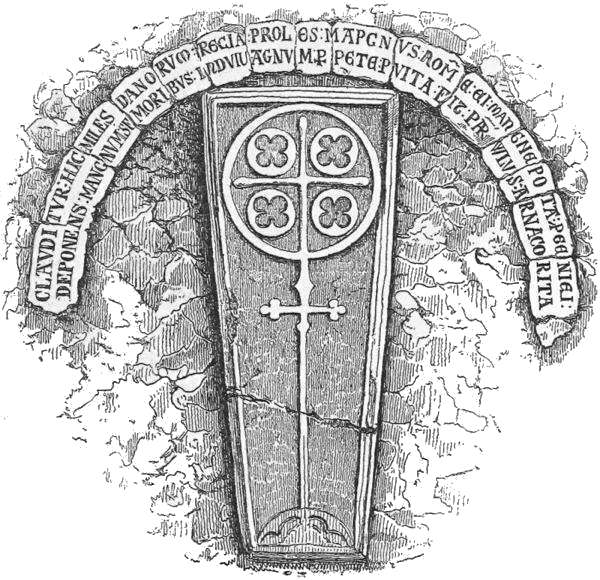
[++] Gravestone: Magnus
During the last period of the declining house of the Anglo-Saxon kings, we further meet with the Scandinavian names of Guttorm, Hagen, and Magnus. The name of Magnus, borne by King Harald Godvinsön’s youngest son, was introduced into Norway through a mistake. It is related that a son having been born one night to King Olaf (Saint Olaf), no one dared to awake the King and inform him of it. The child, however, being very weakly, the priest Sighvat Skjaldt took upon himself to baptize it, and called it Magnus, after “the best man in the world,” Karl Magnus, or Charlemagne; probably in the belief that the Latin word magnus, which was only the Emperor Charles’ surname, was a real name. The boy grew up, and afterwards became king of Norway, where he was usually called “Magnus the Good.” Magnus’s grave is said to have been discovered in St. John’s Church, in the town of Lewes, in Sussex. In the new church, which has lately been built on the site of the old one, has been preserved, and built into the wall, the monumental stone, which bears the following inscription:—
“Clauditur hic miles Danorum regia proles; Mangnus nome(n) ei Mangne nota progeniei. Deponens Mangnum, se moribus induit agnum P(re)pete p(ro) vita fit parvulus arnacorita.”
Or, “Here lies a warrior (or knight) of the royal Danish race; his name, Mangnus, is the mark of his great descent. Laying aside his greatness he adopted the habits of a lamb, and exchanged his busy life for that of a simple hermit.”
That this Magnus, “of the royal Danish race,” was the son of the Harald Godvinsön lately mentioned (whose mother Gyda, it is true, was of the Danish royal family) is, however, a mere conjecture. An older legend states that he was a Danish chief, or commander, taken prisoner by the English in a sanguinary battle near Lewes, and who, being well treated, afterwards laid aside his sword, and became a hermit at that place. (See Lower, in “Transactions of the British Archæological Association at its second Congress at Winchester,” pp. 307-310.) It may, perhaps, be most probable that he was one of those scions of the Danish aristocracy that remained in the south of England after the Norman conquest had overthrown the supremacy of the Danish chiefs in that part.
It was in the south of England, where William the Conqueror first established his power, that the Norman nobility obtained their earliest possessions. In the midland and northern districts, on the contrary, it was neither easy to subdue the country, nor to annihilate entirely the Danish aristocracy, which had completely coalesced with the essentially Danish population. Long after the conquest, therefore, the Danish chiefs continued to preserve their independence, or at least their influence, in those parts. A remarkable instance of this, though taken only from a single district, is afforded by William’s own “Domesday-Book,” drawn up about twenty years after the conquest. In this, under the head of Lincolnshire, are mentioned the great persons who possessed the right of administering justice on their estates, together with other privileges belonging to noblemen, such as sacam and socam, and Tol and Thiam; and among them are found “Harald Jarl; the Jarl Waltef (Valthjof); Radulf Jarl; Merlesuen; Turgot; Tochi, son of Outi; Stori (Styr); Radulf “stalre;” Rolf, son of Sceldeware; Harold ”stalre;“ “Siuuard barn;” Achi (Aage), son of Sivard; Azer, son of Sualena; Outi, son of Azer; Tori, son of Rold; Toli, son of Alsi; Azer, son of Burg; “Uluuard uuite;” Ulf; Haminc (Hemming); Bardt; Suan, son of Suane.” Now even if it be certain that several of these chiefs were Normans, particularly since the Norman names at that time still preserved their primitive Scandinavian form, yet it is clear that most of them were Danish-English. It is to be regretted that Domesday-Book does not comprise the ancient Northumberland, as that district would certainly have afforded more names of Danish chieftains than even the old Danish Lincolnshire; for the Danish aristocracy were never driven out or entirely subdued in those parts; but rather must have amalgamated in the course of time with their countrymen, the Norman nobility, until the latter by degrees gained the ascendancy. This is at once shown by the notorious fact that neither William the Conqueror, nor his immediate successors, obtained such mastery over the north of England and its Danish population, as over the rest of that country; since the inhabitants of the north fought, with the bravery inherited from their forefathers, for their Danish chiefs, and for their peculiar, and partly Danish, institutions, manners, and customs.
Section XIII.
The Danelag.—Holmgang, or Duel.—Jury.—The Feeling of
Freedom.
The Anglo-Saxons were the teachers of the Danes in several ways; above all they made them Christians, and thus communicated to them a new and higher civilization. The Danes in England reaped advantage from the civilization of the Anglo-Saxons, just as the Anglo-Saxons themselves had once begun their own, by building on that refinement which their predecessors, the Romans, had disseminated in England.
But as the Anglo-Saxons did not become Romans, because they adopted and remodelled the Roman civilization; nor the Normans in Normandy Frenchmen, because after their settlement in France they soon assumed many of the French manners and customs; so neither did the Danes in England become Anglo-Saxons, however much they might have been indebted to them for their civilization. The Normans in France retained, in spite of their Christianity and French refinement, the characteristic stamp of their Scandinavian origin, which afterwards caused them to play quite a peculiar part in history. In like manner the Danes in England, amidst the refinements of the Anglo-Saxons, undoubtedly preserved many of their Scandinavian characteristics, which did not disappear without leaving visible and very remarkable traces. But the Scandinavian spirit stamped itself, though perhaps only apparently, in a somewhat different manner on the Norman race in Normandy, and on the Danes in England.
Among the Normans in France the Scandinavian spirit worked, so to speak, only outwardly, in magnificent conquests, of which the chief theatres were England, Italy, and Sicily. Chivalry and feudalism, with their crusades, communicated a new impulse to it; but, internally, it effected comparatively little for France. It did not manifest itself in Normandy by forming political institutions capable of supplanting the oldest and most essential French laws and constitutions; nor, indeed, are we able to point out with exactness what really Scandinavian customs the Normans established in that country. Yet it can scarcely be doubted that they introduced there trial by jury, as well as trial by battle, and other Scandinavian legal institutions.
In England, on the other hand, the northern character showed itself so far outwardly active as to exercise a vast and unmistakable influence on her commerce and navigation, and on the bold and adventurous spirit of enterprise among her people; which, though at a much later period than the conquests of the Normans, has nevertheless extended her dominion over every sea. But in England it has also been internally a living and guiding spirit, in the formation of her judicial and political institutions. It is an incontrovertible and notorious fact, which has, however, hardly been sufficiently insisted upon, that about half of England—the so-called “Danelag,” or community of the Danes—was for centuries subject to Danish laws; that these laws existed even after the Norman conquest; and that they did not pass into the general or common law of England, till the successors of William the Conqueror at last united into a whole the various discordant parts into which England had been previously divided. When we remember that the Normans long retained a predilection for old Scandinavian institutions and forms of judicature, it seems highly probable that the Danish laws, which had for so long a period prevailed in England, did not disappear under their sway without the new laws, which they established, deriving from the old a particular colour, and certain Scandinavian stamp. A further examination of this point will scarcely be superfluous, as it will enable us to judge how far those are right who, in company with one of England’s most celebrated statesmen (Sir R. Peel, in a speech in Parliament), are proud that “the Danes tried in vain to overthrow the institutions of England, instead of securing them;” and then reproach the Danes that, on the whole, they did not, after all their devastating expeditions, establish anything new, great, and durable.
The population of the heathen North, as was the case everywhere else at that period, was divided into serfs and freemen. Even after the introduction of Christianity, many centuries elapsed in all countries before thraldom was abolished, and the worth of man, as man, generally recognised. The serf was always regarded more as an animal than as a human being. The freeman, on the contrary, enjoyed a high degree of civil liberty. He was not only uncontrolled master in his own house, and among his nearest dependents, but likewise exercised an important influence on the management of the public concerns of his own district and of his country. He took part in the decision of law cases in the “Thing,” and gave his vote at the great “Thing,” where the election of a monarch, war, treaties of peace, and other important matters, came under consideration. Scandinavia was, besides, in ancient times, divided into a number of small kingdoms; and the smaller these were, so much the greater was the individual freeman’s power and importance.
The old inhabitants of the North entertained, therefore, a sincere affection for those institutions which gratified their proud feeling of freedom. Personal participation in the administration of justice, at a time when written laws did not exist, must have made every freeman a lawyer and a zealous defender of existing institutions, especially so far as regarded the main point, namely, the freedom they ensured. A general knowledge of the laws was still further promoted by the innate love of the Northmen for disputes and law-suits. Respect for the law was speedily carried to such an extent, and in the administration of justice at the Things old established customs and usages were so strictly observed, that the slightest formal flaw was sufficient to ensure the rejection even of the most important cause. How deeply rooted the old national law was, is best shown by the fact that the Roman law, which had been adopted in the greater part of Europe, could never gain the supremacy in the countries of Scandinavia. The present Scandinavian law is by no means the offspring of any foreign code, but is founded on, and independently developed from, the law which already existed in the North in the days of heathenism.