SOLUTIONS.
Reading edition
SOLUTIONS.
1.—A POST-OFFICE PERPLEXITY.—solution
The young lady supplied 5 twopenny stamps, 30 penny stamps, and 8 twopence-halfpenny stamps, which delivery exactly fulfils the conditions and represents a cost of five shillings.
2.—YOUTHFUL PRECOCITY.—solution
The price of the banana must have been one penny farthing. Thus, 960 bananas would cost £5, and 480 sixpences would buy 2,304 bananas.
3.—AT A CATTLE MARKET.—solution
Jakes must have taken 7 animals to market, Hodge must have taken 11, and Durrant must have taken 21. There were thus 39 animals altogether.
4.—THE BEANFEAST PUZZLE.—solution
The cobblers spent 35s., the tailors spent also 35s., the hatters spent 42s., and the glovers spent 21s. Thus, they spent altogether £6,13s., while it will be found that the five cobblers spent as much as four tailors, twelve tailors as much as nine hatters, and six hatters as much as eight glovers.
5.—A QUEER COINCIDENCE.—solution
Puzzles of this class are generally solved in the old books by the tedious process of "working backwards." But a simple general solution is as follows: If there are n players, the amount held by every player at the end will be m(2n), the last winner must have held m(n+1) at the start, the next m(2n+1), the next m(4n+1), the next m(8n+1), and so on to the first player, who must have held m(2n-1n+1).
Thus, in this case, n = 7, and the amount held by every player at the end was 27 farthings. Therefore m = 1, and G started with 8 farthings, F with 15, E with 29, D with 57, C with 113, B with 225, and A with 449 farthings.
6.—A CHARITABLE BEQUEST.—solution
There are seven different ways in which the money may be distributed: 5 women and 19 men, 10 women and 16 men, 15 women and 13 men, 20 women and 10 men, 25 women and 7 men, 30 women and 4 men, and 35 women and 1 man. But the last case must not be counted, because the condition was that there should be "men," and a single man is not men. Therefore the answer is six years.
7.—THE WIDOW'S LEGACY.—solution
The widow's share of the legacy must be £205, 2s. 6d. and 10/13 of a penny.
8.—INDISCRIMINATE CHARITY—solution
The gentleman must have had 3s. 6d. in his pocket when he set out for home.
9.—THE TWO AEROPLANES.—solution
The man must have paid £500 and £750 for the two machines, making together £1,250; but as he sold them for only £1,200, he lost £50 by the transaction.
10.—BUYING PRESENTS.—solution
Jorkins had originally £19, 18s. in his pocket, and spent £9, 19s.
11.—THE CYCLISTS' FEAST.—solution
There were ten cyclists at the feast. They should have paid 8s. each; but, owing to the departure of two persons, the remaining eight would pay 10s. each.
12.—A QUEER THING IN MONEY.—solution
The answer is as follows: £44,444, 4s. 4d. = 28, and, reduced to pence, 10,666,612 = 28.
It is a curious little coincidence that in the answer 10,666,612 the four central figures indicate the only other answer, £66, 6s. 6d.
13.—A NEW MONEY PUZZLE.—solution
The smallest sum of money, in pounds, shillings, pence, and farthings, containing all the nine digits once, and once only, is £2,567, 18s. 9¾d.
14.—SQUARE MONEY.—solution
The answer is 1½d. and 3d. Added together they make 4½d., and 1½d. multiplied by 3 is also 4½d.
15.—POCKET MONEY.—solution
The largest possible sum is 15s. 9d., composed of a crown and a half-crown (or three half-crowns), four florins, and a threepenny piece.
16.—THE MILLIONAIRE'S PERPLEXITY.—solution
The answer to this quite easy puzzle may, of course, be readily obtained by trial, deducting the largest power of 7 that is contained in one million dollars, then the next largest power from the remainder, and so on. But the little problem is intended to illustrate a simple direct method. The answer is given at once by converting 1,000,000 to the septenary scale, and it is on this subject of scales of notation that I propose to write a few words for the benefit of those who have never sufficiently considered the matter.
Our manner of figuring is a sort of perfected arithmetical shorthand, a system devised to enable us to manipulate numbers as rapidly and correctly as possible by means of symbols. If we write the number 2,341 to represent two thousand three hundred and forty-one dollars, we wish to imply 1 dollar, added to four times 10 dollars, added to three times 100 dollars, added to two times 1,000 dollars. From the number in the units place on the right, every figure to the left is understood to represent a multiple of the particular power of 10 that its position indicates, while a cipher (0) must be inserted where necessary in order to prevent confusion, for if instead of 207 we wrote 27 it would be obviously misleading. We thus only require ten figures, because directly a number exceeds 9 we put a second figure to the left, directly it exceeds 99 we put a third figure to the left, and so on. It will be seen that this is a purely arbitrary method. It is working in the denary (or ten) scale of notation, a system undoubtedly derived from the fact that our forefathers who devised it had ten fingers upon which they were accustomed to count, like our children of to-day. It is unnecessary for us ordinarily to state that we are using the denary scale, because this is always understood in the common affairs of life.
But if a man said that he had 6,553 dollars in the septenary (or seven) scale of notation, you will find that this is precisely the same amount as 2,341 in our ordinary denary scale. Instead of using powers of ten, he uses powers of 7, so that he never needs any figure higher than 6, and 6,553 really stands for 3, added to five times 7, added to five times 49, added to six times 343 (in the ordinary notation), or 2,341. To reverse the operation, and convert 2,341 from the denary to the septenary scale, we divide it by 7, and get 334 and remainder 3; divide 334 by 7, and get 47 and remainder 5; and so keep on dividing by 7 as long as there is anything to divide. The remainders, read backwards, 6, 5, 5, 3, give us the answer, 6,553.
Now, as I have said, our puzzle may be solved at once by merely converting 1,000,000 dollars to the septenary scale. Keep on dividing this number by 7 until there is nothing more left to divide, and the remainders will be found to be 11333311 which is 1,000,000 expressed in the septenary scale. Therefore, 1 gift of 1 dollar, 1 gift of 7 dollars, 3 gifts of 49 dollars, 3 gifts of 343 dollars, 3 gifts of 2,401 dollars, 3 gifts of 16,807 dollars, 1 gift of 117,649 dollars, and one substantial gift of 823,543 dollars, satisfactorily solves our problem. And it is the only possible solution. It is thus seen that no "trials" are necessary; by converting to the septenary scale of notation we go direct to the answer.
17.—THE PUZZLING MONEY BOXES.—solution
The correct answer to this puzzle is as follows: John put into his money-box two double florins (8s.), William a half-sovereign and a florin (12s.), Charles a crown (5s.), and Thomas a sovereign (20s.). There are six coins in all, of a total value of 45s. If John had 2s. more, William 2s. less, Charles twice as much, and Thomas half as much as they really possessed, they would each have had exactly 10s.
18.—THE MARKET WOMEN.—solution
The price received was in every case 105 farthings. Therefore the greatest number of women is eight, as the goods could only be sold at the following rates: 105 lbs. at 1 farthing, 35 at 3, 21 at 5, 15 at 7, 7 at 15, 5 at 21, 3 at 35, and 1 lb. at 105 farthings.
19.—THE NEW YEAR'S EVE SUPPERS.—solution
The company present on the occasion must have consisted of seven pairs, ten single men, and one single lady. Thus, there were twenty-five persons in all, and at the prices stated they would pay exactly £5 together.
20.—BEEF AND SAUSAGES.—solution
The lady bought 48 lbs. of beef at 2s., and the same quantity of sausages at 1s. 6d., thus spending £8, 8s. Had she bought 42 lbs. of beef and 56 lbs. of sausages she would have spent £4, 4s. on each, and have obtained 98 lbs. instead of 96 lbs.—a gain in weight of 2 lbs.
21.—A DEAL IN APPLES.—solution
I was first offered sixteen apples for my shilling, which would be at the rate of ninepence a dozen. The two extra apples gave me eighteen for a shilling, which is at the rate of eightpence a dozen, or one penny a dozen less than the first price asked.
22.—A DEAL IN EGGS.—solution
The man must have bought ten eggs at fivepence, ten eggs at one penny, and eighty eggs at a halfpenny. He would then have one hundred eggs at a cost of eight shillings and fourpence, and the same number of eggs of two of the qualities.
23.—THE CHRISTMAS-BOXES.—solution
The distribution took place "some years ago," when the fourpenny-piece was in circulation. Nineteen persons must each have received nineteen pence. There are five different ways in which this sum may have been paid in silver coins. We need only use two of these ways. Thus if fourteen men each received four four-penny-pieces and one threepenny-piece, and five men each received five threepenny-pieces and one fourpenny-piece, each man would receive nineteen pence, and there would be exactly one hundred coins of a total value of £1, 10s. 1d.
24.—A SHOPPING PERPLEXITY.—solution
The first purchase amounted to 1s. 5¾d., the second to 1s. 11½d., and together they make 3s. 5¼d. Not one of these three amounts can be paid in fewer than six current coins of the realm.
25.—CHINESE MONEY.—solution
As a ching-chang is worth twopence and four-fifteenths of a ching-chang, the remaining eleven-fifteenths of a ching-chang must be worth twopence. Therefore eleven ching-changs are worth exactly thirty pence, or half a crown. Now, the exchange must be made with seven round-holed coins and one square-holed coin. Thus it will be seen that 7 round-holed coins are worth seven-elevenths of 15 ching-changs, and 1 square-holed coin is worth one-eleventh of 16 ching-changs—that is, 77 rounds equal 105 ching-changs and 11 squares equal 16 ching-changs. Therefore 77 rounds added to 11 squares equal 121 ching-changs; or 7 rounds and 1 square equal 11 ching-changs, or its equivalent, half a crown. This is more simple in practice than it looks here.
26.—THE JUNIOR CLERKS' PUZZLE.—solution
Although Snoggs's reason for wishing to take his rise at £2, 10s. half-yearly did not concern our puzzle, the fact that he was duping his employer into paying him more than was intended did concern it. Many readers will be surprised to find that, although Moggs only received £350 in five years, the artful Snoggs actually obtained £362, 10s. in the same time. The rest is simplicity itself. It is evident that if Moggs saved £87, 10s. and Snoggs £181, 5s., the latter would be saving twice as great a proportion of his salary as the former (namely, one-half as against one-quarter), and the two sums added together make £268, 15s.
27.—GIVING CHANGE.—solution
The way to help the American tradesman out of his dilemma is this. Describing the coins by the number of cents that they represent, the tradesman puts on the counter 50 and 25; the buyer puts down 100, 3, and 2; the stranger adds his 10, 10, 5, 2, and 1. Now, considering that the cost of the purchase amounted to 34 cents, it is clear that out of this pooled money the tradesman has to receive 109, the buyer 71, and the stranger his 28 cents. Therefore it is obvious at a glance that the 100-piece must go to the tradesman, and it then follows that the 50-piece must go to the buyer, and then the 25-piece can only go to the stranger. Another glance will now make it clear that the two 10-cent pieces must go to the buyer, because the tradesman now only wants 9 and the stranger 3. Then it becomes obvious that the buyer must take the 1 cent, that the stranger must take the 3 cents, and the tradesman the 5, 2, and 2. To sum up, the tradesman takes 100, 5, 2, and 2; the buyer, 50, 10, 10, and 1; the stranger, 25 and 3. It will be seen that not one of the three persons retains any one of his own coins.
28.—DEFECTIVE OBSERVATION.—solution
Of course the date on a penny is on the same side as Britannia—the "tail" side. Six pennies may be laid around another penny, all flat on the table, so that every one of them touches the central one. The number of threepenny-pieces that may be laid on the surface of a half-crown, so that no piece lies on another or overlaps the edge of the half-crown, is one. A second threepenny-piece will overlap the edge of the larger coin. Few people guess fewer than three, and many persons give an absurdly high number.
29.—THE BROKEN COINS.—solution
If the three broken coins when perfect were worth 253 pence, and are now in their broken condition worth 240 pence, it should be obvious that 13/253 of the original value has been lost. And as the same fraction of each coin has been broken away, each coin has lost 13/253 of its original bulk.
30.—TWO QUESTIONS IN PROBABILITIES.—solution
In tossing with the five pennies all at the same time, it is obvious that there are 32 different ways in which the coins may fall, because the first coin may fall in either of two ways, then the second coin may also fall in either of two ways, and so on. Therefore five 2's multiplied together make 32. Now, how are these 32 ways made up? Here they are:—
(a)5heads1way
(b)5tails1way
(c)4heads and 1 tail5ways
(d)4tails and 1 head5ways
(e)3heads and 2 tails10ways
(f)3tails and 2 heads10ways
Now, it will be seen that the only favourable cases are a, b, c, and d—12 cases. The remaining 20 cases are unfavourable, because they do not give at least four heads or four tails. Therefore the chances are only 12 to 20 in your favour, or (which is the same thing) 3 to 5. Put another way, you have only 3 chances out of 8.
The amount that should be paid for a draw from the bag that contains three sovereigns and one shilling is 15s. 3d. Many persons will say that, as one's chances of drawing a sovereign were 3 out of 4, one should pay three-fourths of a pound, or 15s., overlooking the fact that one must draw at least a shilling—there being no blanks.
31.—DOMESTIC ECONOMY.—solution
Without the hint that I gave, my readers would probably have been unanimous in deciding that Mr. Perkins's income must have been £1,710. But this is quite wrong. Mrs. Perkins says, "We have spent a third of his yearly income in rent," etc., etc.—that is, in two years they have spent an amount in rent, etc., equal to one-third of his yearly income. Note that she does not say that they have spent each year this sum, whatever it is, but that during the two years that amount has been spent. The only possible answer, according to the exact reading of her words, is, therefore, that his income was £180 per annum. Thus the amount spent in two years, during which his income has amounted to £360, will be £60 in rent, etc., £90 in domestic expenses, £20 in other ways, leaving the balance of £190 in the bank as stated.
32.—THE EXCURSION TICKET PUZZLE.—solution
Nineteen shillings and ninepence may be paid in 458,908,622 different ways.
I do not propose to give my method of solution. Any such explanation would occupy an amount of space out of proportion to its interest or value. If I could give within reasonable limits a general solution for all money payments, I would strain a point to find room; but such a solution would be extremely complex and cumbersome, and I do not consider it worth the labour of working out.
Just to give an idea of what such a solution would involve, I will merely say that I find that, dealing only with those sums of money that are multiples of threepence, if we only use bronze coins any sum can be paid in (n+1)2 ways where n always represents the number of pence. If threepenny-pieces are admitted, there are
2n3+15n2+33n + 1
18
ways. If sixpences are also used there are
n4+22n3+159n2+414n+216
216
ways, when the sum is a multiple of sixpence, and the constant, 216, changes to 324 when the money is not such a multiple. And so the formulas increase in complexity in an accelerating ratio as we go on to the other coins.
I will, however, add an interesting little table of the possible ways of changing our current coins which I believe has never been given in a book before. Change may be given for a
Farthing in0 way.
Halfpenny in1 way.
Penny in3 ways.
Threepenny-piece in16 ways.
Sixpence in66 ways.
Shilling in402 ways.
Florin in3,818 ways.
Half-crown in8,709 ways.
Double florin in60,239 ways.
Crown in166,651 ways.
Half-sovereign in6,261,622 ways.
Sovereign in500,291,833 ways.
It is a little surprising to find that a sovereign may be changed in over five hundred million different ways. But I have no doubt as to the correctness of my figures.
33.—A PUZZLE IN REVERSALS.—solution
(i) £13. (2) £23, 19s. 11d. The words "the number of pounds exceeds that of the pence" exclude such sums of money as £2, 16s. 2d. and all sums under £1.
34.—THE GROCER AND DRAPER.—solution
The grocer was delayed half a minute and the draper eight minutes and a half (seventeen times as long as the grocer), making together nine minutes. Now, the grocer took twenty-four minutes to weigh out the sugar, and, with the half-minute delay, spent 24 min. 30 sec. over the task; but the draper had only to make forty-seven cuts to divide the roll of cloth, containing forty-eight yards, into yard pieces! This took him 15 min. 40 sec., and when we add the eight minutes and a half delay we get 24 min. 10 sec., from which it is clear that the draper won the race by twenty seconds. The majority of solvers make forty-eight cuts to divide the roll into forty-eight pieces!
35.—JUDKINS'S CATTLE.—solution
As there were five droves with an equal number of animals in each drove, the number must be divisible by 5; and as every one of the eight dealers bought the same number of animals, the number must be divisible by 8. Therefore the number must be a multiple of 40. The highest possible multiple of 40 that will work will be found to be 120, and this number could be made up in one of two ways—1 ox, 23 pigs, and 96 sheep, or 3 oxen, 8 pigs, and 109 sheep. But the first is excluded by the statement that the animals consisted of "oxen, pigs, and sheep," because a single ox is not oxen. Therefore the second grouping is the correct answer.
36.—BUYING APPLES.—solution
As there were the same number of boys as girls, it is clear that the number of children must be even, and, apart from a careful and exact reading of the question, there would be three different answers. There might be two, six, or fourteen children. In the first of these cases there are ten different ways in which the apples could be bought. But we were told there was an equal number of "boys and girls," and one boy and one girl are not boys and girls, so this case has to be excluded. In the case of fourteen children, the only possible distribution is that each child receives one halfpenny apple. But we were told that each child was to receive an equal distribution of "apples," and one apple is not apples, so this case has also to be excluded. We are therefore driven back on our third case, which exactly fits in with all the conditions. Three boys and three girls each receive 1 halfpenny apple and 2 third-penny apples. The value of these 3 apples is one penny and one-sixth, which multiplied by six makes sevenpence. Consequently, the correct answer is that there were six children—three girls and three boys.
37.—BUYING CHESTNUTS.—solution
In solving this little puzzle we are concerned with the exact interpretation of the words used by the buyer and seller. I will give the question again, this time adding a few words to make the matter more clear. The added words are printed in italics.
"A man went into a shop to buy chestnuts. He said he wanted a pennyworth, and was given five chestnuts. 'It is not enough; I ought to have a sixth of a chestnut more,' he remarked. 'But if I give you one chestnut more,' the shopman replied, 'you will have five-sixths too many.' Now, strange to say, they were both right. How many chestnuts should the buyer receive for half a crown?"
The answer is that the price was 155 chestnuts for half a crown. Divide this number by 30, and we find that the buyer was entitled to 51/6 chestnuts in exchange for his penny. He was, therefore, right when he said, after receiving five only, that he still wanted a sixth. And the salesman was also correct in saying that if he gave one chestnut more (that is, six chestnuts in all) he would be giving five-sixths of a chestnut in excess.
38.—THE BICYCLE THIEF.—solution
People give all sorts of absurd answers to this question, and yet it is perfectly simple if one just considers that the salesman cannot possibly have lost more than the cyclist actually stole. The latter rode away with a bicycle which cost the salesman eleven pounds, and the ten pounds "change;" he thus made off with twenty-one pounds, in exchange for a worthless bit of paper. This is the exact amount of the salesman's loss, and the other operations of changing the cheque and borrowing from a friend do not affect the question in the slightest. The loss of prospective profit on the sale of the bicycle is, of course, not direct loss of money out of pocket.
39.—THE COSTERMONGER'S PUZZLE.—solution
Bill must have paid 8s. per hundred for his oranges—that is, 125 for 10s. At 8s. 4d. per hundred, he would only have received 120 oranges for 10s. This exactly agrees with Bill's statement.
40.—MAMMA'S AGE.—solution
The age of Mamma must have been 29 years 2 months; that of Papa, 35 years; and that of the child, Tommy, 5 years 10 months. Added together, these make seventy years. The father is six times the age of the son, and, after 23 years 4 months have elapsed, their united ages will amount to 140 years, and Tommy will be just half the age of his father.
41.—THEIR AGES.—solution
The gentleman's age must have been 54 years and that of his wife 45 years.
42.—THE FAMILY AGES.—solution
The ages were as follows: Billie, 3½ years; Gertrude, 1¾ year; Henrietta, 5¼ years; Charlie, 10½; years; and Janet, 21 years.
43.—MRS. TIMPKINS'S AGE.—solution
The age of the younger at marriage is always the same as the number of years that expire before the elder becomes twice her age, if he was three times as old at marriage. In our case it was eighteen years afterwards; therefore Mrs. Timpkins was eighteen years of age on the wedding-day, and her husband fifty-four.
44.—A CENSUS PUZZLE.—solution
Miss Ada Jorkins must have been twenty-four and her little brother Johnnie three years of age, with thirteen brothers and sisters between. There was a trap for the solver in the words "seven times older than little Johnnie." Of course, "seven times older" is equal to eight times as old. It is surprising how many people hastily assume that it is the same as "seven times as old." Some of the best writers have committed this blunder. Probably many of my readers thought that the ages 24½ and 3½ were correct.
45.—MOTHER AND DAUGHTER.—solution
In four and a half years, when the daughter will be sixteen years and a half and the mother forty-nine and a half years of age.
46.—MARY AND MARMADUKE.—solution
Marmaduke's age must have been twenty-nine years and two-fifths, and Mary's nineteen years and three-fifths. When Marmaduke was aged nineteen and three-fifths, Mary was only nine and four-fifths; so Marmaduke was at that time twice her age.
47.—ROVER'S AGE.—solution
Rover's present age is ten years and Mildred's thirty years. Five years ago their respective ages were five and twenty-five. Remember that we said "four times older than the dog," which is the same as "five times as old." (See answer to No. 44.)
48.—CONCERNING TOMMY'S AGE.—solution
Tommy Smart's age must have been nine years and three-fifths. Ann's age was sixteen and four-fifths, the mother's thirty-eight and two-fifths, and the father's fifty and two-fifths.
49.—NEXT-DOOR NEIGHBOURS.—solution
Mr. Jupp 39, Mrs. Jupp 34, Julia 14, and Joe 13; Mr. Simkin 42; Mrs. Simkin 40; Sophy 10; and Sammy 8.
50.—THE BAG OF NUTS.—solution
It will be found that when Herbert takes twelve, Robert and Christopher will take nine and fourteen respectively, and that they will have together taken thirty-five nuts. As 35 is contained in 770 twenty-two times, we have merely to multiply 12, 9, and 14 by 22 to discover that Herbert's share was 264, Robert's 198, and Christopher's 308. Then, as the total of their ages is 17½ years or half the sum of 12, 9, and 14, their respective ages must be 6, 4½, and 7 years.
51.—HOW OLD WAS MARY?—solution
The age of Mary to that of Ann must be as 5 to 3. And as the sum of their ages was 44, Mary was 27½ and Ann 16½. One is exactly 11 years older than the other. I will now insert in brackets in the original statement the various ages specified: "Mary is (27½) twice as old as Ann was (13¾) when Mary was half as old (24¾) as Ann will be (49½) when Ann is three times as old (49½) as Mary was (16½) when Mary was (16½) three times as old as Ann (5½)." Now, check this backwards. When Mary was three times as old as Ann, Mary was 16½ and Ann 5½ (11 years younger). Then we get 49½ for the age Ann will be when she is three times as old as Mary was then. When Mary was half this she was 24¾. And at that time Ann must have been 13¾ (11 years younger). Therefore Mary is now twice as old—27½, and Ann 11 years younger—16½.
52.—QUEER RELATIONSHIPS.—solution
If a man marries a woman, who dies, and he then marries his deceased wife's sister and himself dies, it may be correctly said that he had (previously) married the sister of his widow.
The youth was not the nephew of Jane Brown, because he happened to be her son. Her surname was the same as that of her brother, because she had married a man of the same name as herself.
53.—HEARD ON THE TUBE RAILWAY.—solution
The gentleman was the second lady's uncle.
54.—A FAMILY PARTY.—solution
The party consisted of two little girls and a boy, their father and mother, and their father's father and mother.
55.—A MIXED PEDIGREE.—solution
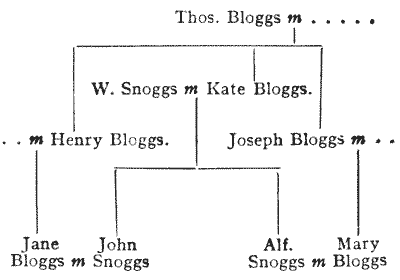
The letter m stands for "married." It will be seen that John Snoggs can say to Joseph Bloggs, "You are my father's brother-in-law, because my father married your sister Kate; you are my brother's father-in-law, because my brother Alfred married your daughter Mary; and you are my father-in-law's brother, because my wife Jane was your brother Henry's daughter."
56.—WILSON'S POSER.—solution
If there are two men, each of whom marries the mother of the other, and there is a son of each marriage, then each of such sons will be at the same time uncle and nephew of the other. There are other ways in which the relationship may be brought about, but this is the simplest.
57.—WHAT WAS THE TIME?—solution
The time must have been 9.36 p.m. A quarter of the time since noon is 2 hr. 24 min., and a half of the time till noon next day is 7 hr. 12 min. These added together make 9 hr. 36 min.
58.—A TIME PUZZLE.—solution
Twenty-six minutes.
59.—A PUZZLING WATCH.—solution
If the 65 minutes be counted on the face of the same watch, then the problem would be impossible: for the hands must coincide every 655/11 minutes as shown by its face, and it matters not whether it runs fast or slow; but if it is measured by true time, it gains 5/11 of a minute in 65 minutes, or 60/143 of a minute per hour.
60.—THE WAPSHAW'S WHARF MYSTERY.—solution
There are eleven different times in twelve hours when the hour and minute hands of a clock are exactly one above the other. If we divide 12 hours by 11 we get 1 hr. 5 min. 273/11 sec., and this is the time after twelve o'clock when they are first together, and also the time that elapses between one occasion of the hands being together and the next. They are together for the second time at 2 hr. 10 min. 546/11 sec. (twice the above time); next at 3 hr. 16 min. 219/11 sec.; next at 4 hr. 21 min. 491/11 sec. This last is the only occasion on which the two hands are together with the second hand "just past the forty-ninth second." This, then, is the time at which the watch must have stopped. Guy Boothby, in the opening sentence of his Across the World for a Wife, says, "It was a cold, dreary winter's afternoon, and by the time the hands of the clock on my mantelpiece joined forces and stood at twenty minutes past four, my chambers were well-nigh as dark as midnight." It is evident that the author here made a slip, for, as we have seen above, he is 1 min. 491/11 sec. out in his reckoning.
61.—CHANGING PLACES.—solution
There are thirty-six pairs of times when the hands exactly change places between three p.m. and midnight. The number of pairs of times from any hour (n) to midnight is the sum of 12 - (n + 1) natural numbers. In the case of the puzzle n = 3; therefore 12 - (3 + 1) = 8 and 1 + 2 + 3 + 4 + 5 + 6 + 7 + 8 = 36, the required answer.
The first pair of times is 3 hr. 2157/143 min. and 4 hr. 16112/143 min., and the last pair is 10 hr. 5983/143 min. and 11 hr. 54138/143 min. I will not give all the remainder of the thirty-six pairs of times, but supply a formula by which any of the sixty-six pairs that occur from midday to midnight may be at once found:—
a hr720b + 60amin. and b hr.720a + 60b min.
143143
For the letter a may be substituted any hour from 0, 1, 2, 3 up to 10 (where nought stands for 12 o'clock midday); and b may represent any hour, later than a, up to 11.
By the aid of this formula there is no difficulty in discovering the answer to the second question: a = 8 and b = 11 will give the pair 8 hr. 58106/143 min. and 11 hr. 44128/143 min., the latter being the time when the minute hand is nearest of all to the point IX—in fact, it is only 15/143 of a minute distant.
Readers may find it instructive to make a table of all the sixty-six pairs of times when the hands of a clock change places. An easy way is as follows: Make a column for the first times and a second column for the second times of the pairs. By making a = 0 and b = 1 in the above expressions we find the first case, and enter hr. 55/143 min. at the head of the first column, and 1 hr. 060/143 min. at the head of the second column. Now, by successively adding 55/143 min. in the first, and 1 hr. 060/143 min. in the second column, we get all the eleven pairs in which the first time is a certain number of minutes after nought, or mid-day. Then there is a "jump" in the times, but you can find the next pair by making a = 1 and b = 2, and then by successively adding these two times as before you will get all the ten pairs after 1 o'clock. Then there is another "jump," and you will be able to get by addition all the nine pairs after 2 o'clock. And so on to the end. I will leave readers to investigate for themselves the nature and cause of the "jumps." In this way we get under the successive hours, 11 + 10 + 9 + 8 + 7 + 6 + 5 + 4 + 3 + 2 + 1 = 66 pairs of times, which result agrees with the formula in the first paragraph of this article.
Some time ago the principal of a Civil Service Training College, who conducts a "Civil Service Column" in one of the periodicals, had the query addressed to him, "How soon after XII o'clock will a clock with both hands of the same length be ambiguous?" His first answer was, "Some time past one o'clock," but he varied the answer from issue to issue. At length some of his readers convinced him that the answer is, "At 55/143 min. past XII;" and this he finally gave as correct, together with the reason for it that at that time the time indicated is the same whichever hand you may assume as hour hand!
62.—THE CLUB CLOCK.—solution
The positions of the hands shown in the illustration could only indicate that the clock stopped at 44 min. 511143/1427 sec. after eleven o'clock. The second hand would next be "exactly midway between the other two hands" at 45 min. 52496/1427 sec. after eleven o'clock. If we had been dealing with the points on the circle to which the three hands are directed, the answer would be 45 min. 22106/1427 sec. after eleven; but the question applied to the hands, and the second hand would not be between the others at that time, but outside them.
63.—THE STOP-WATCH.—solution
The time indicated on the watch was 55/11 min. past 9, when the second hand would be at 273/11 sec. The next time the hands would be similar distances apart would be 546/11 min. past 2, when the second hand would be at 328/11 sec. But you need only hold the watch (or our previous illustration of it) in front of a mirror, when you will see the second time reflected in it! Of course, when reflected, you will read XI as I, X as II, and so on.
64.—THE THREE CLOCKS.—solution
As a mere arithmetical problem this question presents no difficulty. In order that the hands shall all point to twelve o'clock at the same time, it is necessary that B shall gain at least twelve hours and that C shall lose twelve hours. As B gains a minute in a day of twenty-four hours, and C loses a minute in precisely the same time, it is evident that one will have gained 720 minutes (just twelve hours) in 720 days, and the other will have lost 720 minutes in 720 days. Clock A keeping perfect time, all three clocks must indicate twelve o'clock simultaneously at noon on the 720th day from April 1, 1898. What day of the month will that be?
I published this little puzzle in 1898 to see how many people were aware of the fact that 1900 would not be a leap year. It was surprising how many were then ignorant on the point. Every year that can be divided by four without a remainder is bissextile or leap year, with the exception that one leap year is cut off in the century. 1800 was not a leap year, nor was 1900. On the other hand, however, to make the calendar more nearly agree with the sun's course, every fourth hundred year is still considered bissextile. Consequently, 2000, 2400, 2800, 3200, etc., will all be leap years. May my readers live to see them. We therefore find that 720 days from noon of April 1, 1898, brings us to noon of March 22, 1900.
65.—THE RAILWAY STATION CLOCK.—solution
The time must have been 437/11 min. past two o'clock.
66.—THE VILLAGE SIMPLETON.—solution
The day of the week on which the conversation took place was Sunday. For when the day after to-morrow (Tuesday) is "yesterday," "to-day" will be Wednesday; and when the day before yesterday (Friday) was "to-morrow," "to-day" was Thursday. There are two days between Thursday and Sunday, and between Sunday and Wednesday.
67.—AVERAGE SPEED.—solution
The average speed is twelve miles an hour, not twelve and a half, as most people will hastily declare. Take any distance you like, say sixty miles. This would have taken six hours going and four hours returning. The double journey of 120 miles would thus take ten hours, and the average speed is clearly twelve miles an hour.
68.—THE TWO TRAINS.—solution
One train was running just twice as fast as the other.
69.—THE THREE VILLAGES.—solution
Calling the three villages by their initial letters, it is clear that the three roads form a triangle, A, B, C, with a perpendicular, measuring twelve miles, dropped from C to the base A, B. This divides our triangle into two right-angled triangles with a twelve-mile side in common. It is then found that the distance from A to C is 15 miles, from C to B 20 miles, and from A to B 25 (that is 9 and 16) miles. These figures are easily proved, for the square of 12 added to the square of 9 equals the square of 15, and the square of 12 added to the square of 16 equals the square of 20.
70.—DRAWING HER PENSION.—solution
The distance must be 6¾ miles.
71.—SIR EDWYN DE TUDOR.—solution
The distance must have been sixty miles. If Sir Edwyn left at noon and rode 15 miles an hour, he would arrive at four o'clock—an hour too soon. If he rode 10 miles an hour, he would arrive at six o'clock—an hour too late. But if he went at 12 miles an hour, he would reach the castle of the wicked baron exactly at five o'clock—the time appointed.
72.—THE HYDROPLANE QUESTION.—solution
The machine must have gone at the rate of seven-twenty-fourths of a mile per minute and the wind travelled five-twenty-fourths of a mile per minute. Thus, going, the wind would help, and the machine would do twelve-twenty-fourths, or half a mile a minute, and returning only two-twenty-fourths, or one-twelfth of a mile per minute, the wind being against it. The machine without any wind could therefore do the ten miles in thirty-four and two-sevenths minutes, since it could do seven miles in twenty-four minutes.
73.—DONKEY RIDING.—solution
The complete mile was run in nine minutes. From the facts stated we cannot determine the time taken over the first and second quarter-miles separately, but together they, of course, took four and a half minutes. The last two quarters were run in two and a quarter minutes each.
74.—THE BASKET OF POTATOES.—solution
Multiply together the number of potatoes, the number less one, and twice the number less one, then divide by 3. Thus 50, 49, and 99 multiplied together make 242,550, which, divided by 3, gives us 80,850 yards as the correct answer. The boy would thus have to travel 45 miles and fifteen-sixteenths—a nice little recreation after a day's work.
75.—THE PASSENGER'S FARE.—solution
Mr. Tompkins should have paid fifteen shillings as his correct share of the motor-car fare. He only shared half the distance travelled for £3, and therefore should pay half of thirty shillings, or fifteen shillings.
76.—THE BARREL OF BEER.—solution
Here the digital roots of the six numbers are 6, 4, 1, 2, 7, 9, which together sum to 29, whose digital root is 2. As the contents of the barrels sold must be a number divisible by 3, if one buyer purchased twice as much as the other, we must find a barrel with root 2, 5, or 8 to set on one side. There is only one barrel, that containing 20 gallons, that fulfils these conditions. So the man must have kept these 20 gallons of beer for his own use and sold one man 33 gallons (the 18-gallon and 15-gallon barrels) and sold the other man 66 gallons (the 16, 19, and 31 gallon barrels).
77.—DIGITS AND SQUARES.—solution
The top row must be one of the four following numbers: 192, 219, 273, 327. The first was the example given.
78.—ODD AND EVEN DIGITS.—solution
As we have to exclude complex and improper fractions and recurring decimals, the simplest solution is this: 79 + 51/3 and 84 + 2/6, both equal 841/3. Without any use of fractions it is obviously impossible.
79.—THE LOCKERS PUZZLE.—solution
The smallest possible total is 356 = 107 + 249, and the largest sum possible is 981 = 235 + 746, or 657 + 324. The middle sum may be either 720 =134+586, or 702 = 134 + 568, or 407 = 138 + 269. The total in this case must be made up of three of the figures 0, 2, 4, 7, but no sum other than the three given can possibly be obtained. We have therefore no choice in the case of the first locker, an alternative in the case of the third, and any one of three arrangements in the case of the middle locker. Here is one solution:—
107134235
249586746
356720981
Of course, in each case figures in the first two lines may be exchanged vertically without altering the total, and as a result there are just 3,072 different ways in which the figures might be actually placed on the locker doors. I must content myself with showing one little principle involved in this puzzle. The sum of the digits in the total is always governed by the digit omitted. 9/9 - 7/10 - 5/11 - 3/12 - 1/13 - 8/14 - 6/15 - 4/16 - 2/17 - 0/18. Whichever digit shown here in the upper line we omit, the sum of the digits in the total will be found beneath it. Thus in the case of locker A we omitted 8, and the figures in the total sum up to 14. If, therefore, we wanted to get 356, we may know at once to a certainty that it can only be obtained (if at all) by dropping the 8.
80.—THE THREE GROUPS.—solution
There are nine solutions to this puzzle, as follows, and no more:—
12 × 483 = 5,796
27 × 198 = 5,346
42 × 138 = 5,796
39 × 186 = 7,254
18 × 297 = 5,346
48 × 159 = 7,632
28 × 157 = 4,396
4 × 1,738 = 6,952
4 × 1,963 = 7,852
The seventh answer is the one that is most likely to be overlooked by solvers of the puzzle.
81.—THE NINE COUNTERS.—solution
In this case a certain amount of mere "trial" is unavoidable. But there are two kinds of "trials"—those that are purely haphazard, and those that are methodical. The true puzzle lover is never satisfied with mere haphazard trials. The reader will find that by just reversing the figures in 23 and 46 (making the multipliers 32 and 64) both products will be 5,056. This is an improvement, but it is not the correct answer. We can get as large a product as 5,568 if we multiply 174 by 32 and 96 by 58, but this solution is not to be found without the exercise of some judgment and patience.
82.—THE TEN COUNTERS.—solution
As I pointed out, it is quite easy so to arrange the counters that they shall form a pair of simple multiplication sums, each of which will give the same product—in fact, this can be done by anybody in five minutes with a little patience. But it is quite another matter to find that pair which gives the largest product and that which gives the smallest product.
Now, in order to get the smallest product, it is necessary to select as multipliers the two smallest possible numbers. If, therefore, we place 1 and 2 as multipliers, all we have to do is to arrange the remaining eight counters in such a way that they shall form two numbers, one of which is just double the other; and in doing this we must, of course, try to make the smaller number as low as possible. Of course the lowest number we could get would be 3,045; but this will not work, neither will 3,405, 3,450, etc., and it may be ascertained that 3,485 is the lowest possible. One of the required answers is 3,485 × 2 = 6,970, and 6,970 × 1 = 6,970.
The other part of the puzzle (finding the pair with the highest product) is, however, the real knotty point, for it is not at all easy to discover whether we should let the multiplier consist of one or of two figures, though it is clear that we must keep, so far as we can, the largest figures to the left in both multiplier and multiplicand. It will be seen that by the following arrangement so high a number as 58,560 may be obtained. Thus, 915 × 64 = 58,560, and 732 × 80 = 58,560.
83.—DIGITAL MULTIPLICATION.—solution
The solution that gives the smallest possible sum of digits in the common product is 23 × 174 = 58 × 69 = 4,002, and the solution that gives the largest possible sum of digits, 9 × 654 = 18 × 327 = 5,886. In the first case the digits sum to 6 and in the second case to 27. There is no way of obtaining the solution but by actual trial.
84.—THE PIERROT'S PUZZLE.—solution
There are just six different solutions to this puzzle, as follows:—
8multiplied by473equals3784
9"351"3159
15"93"1395
21"87"1287
27"81"2187
35"41"1435
It will be seen that in every case the two multipliers contain exactly the same figures as the product.
85.—THE CAB NUMBERS.—solution
The highest product is, I think, obtained by multiplying 8,745,231 by 96—namely, 839,542,176.
Dealing here with the problem generally, I have shown in the last puzzle that with three digits there are only two possible solutions, and with four digits only six different solutions.
These cases have all been given. With five digits there are just twenty-two solutions, as follows:—
3x4128=12384
3x4281=12843
3x7125=21375
3x7251=21753
2541x6=15246
651x24=15624
678x42=28476
246x51=12546
57x834=47538
75x231=17325
624x78=48672
435x87=37845
——————
9x7461=67149
72x936=67392
——————
2x8714=17428
2x8741=17482
65x281=18265
65x983=63985
——————
4973x8=39784
6521x8=52168
14x926=12964
86x251=21586
Now, if we took every possible combination and tested it by multiplication, we should need to make no fewer than 30,240 trials, or, if we at once rejected the number 1 as a multiplier, 28,560 trials—a task that I think most people would be inclined to shirk. But let us consider whether there be no shorter way of getting at the results required. I have already explained that if you add together the digits of any number and then, as often as necessary, add the digits of the result, you must ultimately get a number composed of one figure. This last number I call the "digital root." It is necessary in every solution of our problem that the root of the sum of the digital roots of our multipliers shall be the same as the root of their product. There are only four ways in which this can happen: when the digital roots of the multipliers are 3 and 6, or 9 and 9, or 2 and 2, or 5 and 8. I have divided the twenty-two answers above into these four classes. It is thus evident that the digital root of any product in the first two classes must be 9, and in the second two classes 4.
Owing to the fact that no number of five figures can have a digital sum less than 15 or more than 35, we find that the figures of our product must sum to either 18 or 27 to produce the root 9, and to either 22 or 31 to produce the root 4. There are 3 ways of selecting five different figures that add up to 18, there are 11 ways of selecting five figures that add up to 27, there are 9 ways of selecting five figures that add up to 22, and 5 ways of selecting five figures that add up to 31. There are, therefore, 28 different groups, and no more, from any one of which a product may be formed.
We next write out in a column these 28 sets of five figures, and proceed to tabulate the possible factors, or multipliers, into which they may be split. Roughly speaking, there would now appear to be about 2,000 possible cases to be tried, instead of the 30,240 mentioned above; but the process of elimination now begins, and if the reader has a quick eye and a clear head he can rapidly dispose of the large bulk of these cases, and there will be comparatively few test multiplications necessary. It would take far too much space to explain my own method in detail, but I will take the first set of figures in my table and show how easily it is done by the aid of little tricks and dodges that should occur to everybody as he goes along.
My first product group of five figures is 84,321. Here, as we have seen, the root of each factor must be 3 or a multiple of 3. As there is no 6 or 9, the only single multiplier is 3. Now, the remaining four figures can be arranged in 24 different ways, but there is no need to make 24 multiplications. We see at a glance that, in order to get a five-figure product, either the 8 or the 4 must be the first figure to the left. But unless the 2 is preceded on the right by the 8, it will produce when multiplied either a 6 or a 7, which must not occur. We are, therefore, reduced at once to the two cases, 3 × 4,128 and 3 × 4,281, both of which give correct solutions. Suppose next that we are trying the two-figure factor, 21. Here we see that if the number to be multiplied is under 500 the product will either have only four figures or begin with 10. Therefore we have only to examine the cases 21 × 843 and 21 × 834. But we know that the first figure will be repeated, and that the second figure will be twice the first figure added to the second. Consequently, as twice 3 added to 4 produces a nought in our product, the first case is at once rejected. It only remains to try the remaining case by multiplication, when we find it does not give a correct answer. If we are next trying the factor 12, we see at the start that neither the 8 nor the 3 can be in the units place, because they would produce a 6, and so on. A sharp eye and an alert judgment will enable us thus to run through our table in a much shorter time than would be expected. The process took me a little more than three hours.
I have not attempted to enumerate the solutions in the cases of six, seven, eight, and nine digits, but I have recorded nearly fifty examples with nine digits alone.
86.—QUEER MULTIPLICATION.—solution
If we multiply 32547891 by 6, we get the product, 195287346. In both cases all the nine digits are used once and once only.
87.—THE NUMBER CHECKS PUZZLE.—solution
Divide the ten checks into the following three groups: 7 1 5—4 6—3 2 8 9 0, and the first multiplied by the second produces the third.
88.—DIGITAL DIVISION.—solution
It is convenient to consider the digits as arranged to form fractions of the respective values, one-half, one-third, one-fourth, one-fifth, one-sixth, one-seventh, one-eighth, and one-ninth. I will first give the eight answers, as follows:—
6729/13458 = ½
5823/17469 = 1/3
3942/15768 = ¼
2697/13485 = 1/5
2943/17658 = 1/6
2394/16758 = 1/7
3187/25496 = 1/8
6381/57429 = 1/9
The sum of the numerator digits and the denominator digits will, of course, always be 45, and the "digital root" is 9. Now, if we separate the nine digits into any two groups, the sum of the two digital roots will always be 9. In fact, the two digital roots must be either 9—9, 8—1, 7—2, 6—3, or 5—4. In the first case the actual sum is 18, but then the digital root of this number is itself 9. The solutions in the cases of one-third, one-fourth, one-sixth, one-seventh, and one-ninth must be of the form 9—9; that is to say, the digital roots of both numerator and denominator will be 9. In the cases of one-half and one-fifth, however, the digital roots are 6—3, but of course the higher root may occur either in the numerator or in the denominator; thus 2697/13485, 2769/13845, 2973/14865, 3729/18645, where, in the first two arrangements, the roots of the numerator and denominator are respectively 6—3, and in the last two 3—6. The most curious case of all is, perhaps, one-eighth, for here the digital roots may be of any one of the five forms given above.
The denominators of the fractions being regarded as the numerators multiplied by 2, 3, 4, 5, 6, 7, 8, and 9 respectively, we must pay attention to the "carryings over." In order to get five figures in the product there will, of course, always be a carry-over after multiplying the last figure to the left, and in every case higher than 4 we must carry over at least three times. Consequently in cases from one-fifth to one-ninth we cannot produce different solutions by a mere change of position of pairs of figures, as, for example, we may with 5832/17496 and 5823/17469, where the 2/6 and 3/9 change places. It is true that the same figures may often be differently arranged, as shown in the two pairs of values for one-fifth that I have given in the last paragraph, but here it will be found there is a general readjustment of figures and not a simple changing of the positions of pairs. There are other little points that would occur to every solver—such as that the figure 5 cannot ever appear to the extreme right of the numerator, as this would result in our getting either a nought or a second 5 in the denominator. Similarly 1 cannot ever appear in the same position, nor 6 in the fraction one-sixth, nor an even figure in the fraction one-fifth, and so on. The preliminary consideration of such points as I have touched upon will not only prevent our wasting a lot of time in trying to produce impossible forms, but will lead us more or less directly to the desired solutions.
89.—ADDING THE DIGITS.—solution
The smallest possible sum of money is £1, 8s. 9¾d., the digits of which add to 25.
90.—THE CENTURY PUZZLE.—solution
The problem of expressing the number 100 as a mixed number or fraction, using all the nine digits once, and once only, has, like all these digital puzzles, a fascinating side to it. The merest tyro can by patient trial obtain correct results, and there is a singular pleasure in discovering and recording each new arrangement akin to the delight of the botanist in finding some long-sought plant. It is simply a matter of arranging those nine figures correctly, and yet with the thousands of possible combinations that confront us the task is not so easy as might at first appear, if we are to get a considerable number of results. Here are eleven answers, including the one I gave as a specimen:—
962148/537
961752/438
961428/357
941578/263
917524/836
915823/647
915742/638
823546/197
817524/396
815643/297
369258/714
Now, as all the fractions necessarily represent whole numbers, it will be convenient to deal with them in the following form: 96 + 4, 94 + 6, 91 + 9, 82 + 18, 81 + 19, and 3 + 97.
With any whole number the digital roots of the fraction that brings it up to 100 will always be of one particular form. Thus, in the case of 96 + 4, one can say at once that if any answers are obtainable, then the roots of both the numerator and the denominator of the fraction will be 6. Examine the first three arrangements given above, and you will find that this is so. In the case of 94 + 6 the roots of the numerator and denominator will be respectively 3—2, in the case of 91 + 9 and of 82 + 18 they will be 9—8, in the case of 81 + 19 they will be 9—9, and in the case of 3 + 97 they will be 3—3. Every fraction that can be employed has, therefore, its particular digital root form, and you are only wasting your time in unconsciously attempting to break through this law.
Every reader will have perceived that certain whole numbers are evidently impossible. Thus, if there is a 5 in the whole number, there will also be a nought or a second 5 in the fraction, which are barred by the conditions. Then multiples of 10, such as 90 and 80, cannot of course occur, nor can the whole number conclude with a 9, like 89 and 79, because the fraction, equal to 11 or 21, will have 1 in the last place, and will therefore repeat a figure. Whole numbers that repeat a figure, such as 88 and 77, are also clearly useless. These cases, as I have said, are all obvious to every reader. But when I declare that such combinations as 98 + 2, 92 + 8, 86 + 14, 83 + 17, 74 + 26, etc., etc., are to be at once dismissed as impossible, the reason is not so evident, and I unfortunately cannot spare space to explain it.
But when all those combinations have been struck out that are known to be impossible, it does not follow that all the remaining "possible forms" will actually work. The elemental form may be right enough, but there are other and deeper considerations that creep in to defeat our attempts. For example, 98 + 2 is an impossible combination, because we are able to say at once that there is no possible form for the digital roots of the fraction equal to 2. But in the case of 97 + 3 there is a possible form for the digital roots of the fraction, namely, 6—5, and it is only on further investigation that we are able to determine that this form cannot in practice be obtained, owing to curious considerations. The working is greatly simplified by a process of elimination, based on such considerations as that certain multiplications produce a repetition of figures, and that the whole number cannot be from 12 to 23 inclusive, since in every such case sufficiently small denominators are not available for forming the fractional part.
91.—MORE MIXED FRACTIONS.—solution
The point of the present puzzle lies in the fact that the numbers 15 and 18 are not capable of solution. There is no way of determining this without trial. Here are answers for the ten possible numbers:—
95472/1368=13;
96435/1287=14;
123576/894=16;
613258/947=20;
159432/786=27;
249756/813=36;
275148/396=40;
651892/473=69;
593614/278=72;
753648/192=94.
I have only found the one arrangement for each of the numbers 16, 20, and 27; but the other numbers are all capable of being solved in more than one way. As for 15 and 18, though these may be easily solved as a simple fraction, yet a "mixed fraction" assumes the presence of a whole number; and though my own idea for dodging the conditions is the following, where the fraction is both complex and mixed, it will be fairer to keep exactly to the form indicated:—
38952/746/1 = 15
95742/638/1 = 18
I have proved the possibility of solution for all numbers up to 100, except 1, 2, 3, 4, 15, and 18. The first three are easily shown to be impossible. I have also noticed that numbers whose digital root is 8—such as 26, 35, 44, 53, etc.—seem to lend themselves to the greatest number of answers. For the number 26 alone I have recorded no fewer than twenty-five different arrangements, and I have no doubt that there are many more.
92.—DIGITAL SQUARE NUMBERS.—solution
So far as I know, there are no published tables of square numbers that go sufficiently high to be available for the purposes of this puzzle. The lowest square number containing all the nine digits once, and once only, is 139,854,276, the square of 11,826. The highest square number under the same conditions is, 923,187,456, the square of 30,384.
93—THE MYSTIC ELEVEN.—solution
Most people know that if the sum of the digits in the odd places of any number is the same as the sum of the digits in the even places, then the number is divisible by 11 without remainder. Thus in 896743012 the odd digits, 20468, add up 20, and the even digits, 1379, also add up 20. Therefore the number may be divided by 11. But few seem to know that if the difference between the sum of the odd and the even digits is 11, or a multiple of 11, the rule equally applies. This law enables us to find, with a very little trial, that the smallest number containing nine of the ten digits (calling nought a digit) that is divisible by 11 is 102,347,586, and the highest number possible, 987,652,413.
94.—THE DIGITAL CENTURY.—solution
There is a very large number of different ways in which arithmetical signs may be placed between the nine digits, arranged in numerical order, so as to give an expression equal to 100. In fact, unless the reader investigated the matter very closely, he might not suspect that so many ways are possible. It was for this reason that I added the condition that not only must the fewest possible signs be used, but also the fewest possible strokes. In this way we limit the problem to a single solution, and arrive at the simplest and therefore (in this case) the best result.
Just as in the case of magic squares there are methods by which we may write down with the greatest ease a large number of solutions, but not all the solutions, so there are several ways in which we may quickly arrive at dozens of arrangements of the "Digital Century," without finding all the possible arrangements. There is, in fact, very little principle in the thing, and there is no certain way of demonstrating that we have got the best possible solution. All I can say is that the arrangement I shall give as the best is the best I have up to the present succeeded in discovering. I will give the reader a few interesting specimens, the first being the solution usually published, and the last the best solution that I know.
Signs.Strokes.
1 + 2 + 3 + 4 + 5 + 6 + 7 + (8 × 9) = 100( 9..18)
(1 × 2) - 3 - 4 - 5 + (6 × 7) + (8 × 9) = 100(12..20)
1 + (2 × 3) + (4 × 5) - 6 + 7 + (8 × 9) = 100(11..21)
(1 + 2 - 3 - 4)(5 - 6 - 7 - 8 - 9) = 100( 9..12)
1 + (2 × 3) + 4 + 5 + 67 + 8 + 9 = 100(8..16)
(1 × 2) + 34 + 56 + 7 - 8 + 9 = 100(7..13)
12 + 3 - 4 + 5 + 67 + 8 + 9 = 100(6..11)
123 - 4 - 5 - 6 - 7 + 8 - 9 = 100(6..7)
123 + 4 - 5 + 67 - 8 - 9 = 100(4..6)
123 + 45 - 67 + 8 - 9 = 100(4..6)
123 - 45 - 67 + 89 = 100(3..4)
It will be noticed that in the above I have counted the bracket as one sign and two strokes. The last solution is singularly simple, and I do not think it will ever be beaten.
95.—THE FOUR SEVENS.—solution
The way to write four sevens with simple arithmetical signs so that they represent 100 is as follows:—
7/.7×7/.7 = 100.
Of course the fraction, 7 over decimal 7, equals 7 divided by 7/10, which is the same as 70 divided by 7, or 10. Then 10 multiplied by 10 is 100, and there you are! It will be seen that this solution applies equally to any number whatever that you may substitute for 7.
96.—THE DICE NUMBERS.—solution
The sum of all the numbers that can be formed with any given set of four different figures is always 6,666 multiplied by the sum of the four figures. Thus, 1, 2, 3, 4 add up 10, and ten times 6,666 is 66,660. Now, there are thirty-five different ways of selecting four figures from the seven on the dice—remembering the 6 and 9 trick. The figures of all these thirty-five groups add up to 600. Therefore 6,666 multiplied by 600 gives us 3,999,600 as the correct answer.
Let us discard the dice and deal with the problem generally, using the nine digits, but excluding nought. Now, if you were given simply the sum of the digits—that is, if the condition were that you could use any four figures so long as they summed to a given amount—then we have to remember that several combinations of four digits will, in many cases, make the same sum.
1011121314151617181920
11235689111112
21222324252627282930
111198653211
Here the top row of numbers gives all the possible sums of four different figures, and the bottom row the number of different ways in which each sum may be made. For example 13 may be made in three ways: 1237, 1246, and 1345. It will be found that the numbers in the bottom row add up to 126, which is the number of combinations of nine figures taken four at a time. From this table we may at once calculate the answer to such a question as this: What is the sum of all the numbers composed of our different digits (nought excluded) that add up to 14? Multiply 14 by the number beneath t in the table, 5, and multiply the result by 6,666, and you will have the answer. It follows that, to know the sum of all the numbers composed of four different digits, if you multiply all the pairs in the two rows and then add the results together, you will get 2,520, which, multiplied by 6,666, gives the answer 16,798,320.
The following general solution for any number of digits will doubtless interest readers. Let n represent number of digits, then 5 (10n - 1) ) 8! divided by (9 - n)! equals the required sum. Note that 0! equals 1. This may be reduced to the following practical rule: Multiply together 4 × 7 × 6 × 5 ... to (n - 1) factors; now add (n + 1) ciphers to the right, and from this result subtract the same set of figures with a single cipher to the right. Thus for n = 4 (as in the case last mentioned), 4 × 7 × 6 = 168. Therefore 16,800,000 less 1,680 gives us 16,798,320 in another way.
97.—THE SPOT ON THE TABLE.—solution
The ordinary schoolboy would correctly treat this as a quadratic equation. Here is the actual arithmetic. Double the product of the two distances from the walls. This gives us 144, which is the square of 12. The sum of the two distances is 17. If we add these two numbers, 12 and 17, together, and also subtract one from the other, we get the two answers that 29 or 5 was the radius, or half-diameter, of the table. Consequently, the full diameter was 58 in. or 10 in. But a table of the latter dimensions would be absurd, and not at all in accordance with the illustration. Therefore the table must have been 58 in. in diameter. In this case the spot was on the edge nearest to the corner of the room—to which the boy was pointing. If the other answer were admissible, the spot would be on the edge farthest from the corner of the room.
98.—ACADEMIC COURTESIES.—solution
There must have been ten boys and twenty girls. The number of bows girl to girl was therefore 380, of boy to boy 90, of girl with boy 400, and of boys and girls to teacher 30, making together 900, as stated. It will be remembered that it was not said that the teacher himself returned the bows of any child.
99.—THE THIRTY-THREE PEARLS.—solution
The value of the large central pearl must have been £3,000. The pearl at one end (from which they increased in value by £100) was £1,400; the pearl at the other end, £600.
100.—THE LABOURER'S PUZZLE.—solution
The man said, "I am going twice as deep," not "as deep again." That is to say, he was still going twice as deep as he had gone already, so that when finished the hole would be three times its present depth. Then the answer is that at present the hole is 3 ft. 6 in. deep and the man 2 ft. 4 in. above ground. When completed the hole will be 10 ft. 6 in. deep, and therefore the man will then be 4 ft. 8 in. below the surface, or twice the distance that he is now above ground.
101.—THE TRUSSES OF HAY.—solution
Add together the ten weights and divide by 4, and we get 289 lbs. as the weight of the five trusses together. If we call the five trusses in the order of weight A, B, C, D, and E, the lightest being A and the heaviest E, then the lightest, no lbs., must be the weight of A and B; and the next lightest, 112 lbs., must be the weight of A and C. Then the two heaviest, D and E, must weigh 121 lbs., and C and E must weigh 120 lbs. We thus know that A, B, D, and E weigh together 231 lbs., which, deducted from 289 lbs. (the weight of the five trusses), gives us the weight of C as 58 lbs. Now, by mere subtraction, we find the weight of each of the five trusses—54 lbs., 56 lbs., 58 lbs., 59 lbs., and 62 lbs. respectively.
102.—MR. GUBBINS IN A FOG.—solution
The candles must have burnt for three hours and three-quarters. One candle had one-sixteenth of its total length left and the other four-sixteenths.
103.—PAINTING THE LAMP-POSTS.—solution
Pat must have painted six more posts than Tim, no matter how many lamp-posts there were. For example, suppose twelve on each side; then Pat painted fifteen and Tim nine. If a hundred on each side, Pat painted one hundred and three, and Tim only ninety-seven
104.—CATCHING THE THIEF.—solution
The constable took thirty steps. In the same time the thief would take forty-eight, which, added to his start of twenty-seven, carried him seventy-five steps. This distance would be exactly equal to thirty steps of the constable.
105.—THE PARISH COUNCIL ELECTION,—solution
The voter can vote for one candidate in 23 ways, for two in 253 ways, for three in 1,771, for four in 8,855, for five in 33,649, for six in 100,947, for seven in 245,157, for eight in 490,314, and for nine candidates in 817,190 different ways. Add these together, and we get the total of 1,698,159 ways of voting.
106.—THE MUDDLETOWN ELECTION.—solution
The numbers of votes polled respectively by the Liberal, the Conservative, the Independent, and the Socialist were 1,553, 1,535, 1,407, and 978 All that was necessary was to add the sum of the three majorities (739) to the total poll of 5,473 (making 6,212) and divide by 4, which gives us 1,553 as the poll of the Liberal. Then the polls of the other three candidates can, of course, be found by deducting the successive majorities from the last-mentioned number.
107.—THE SUFFRAGISTS' MEETING.—solution
Eighteen were present at the meeting and eleven left. If twelve had gone, two-thirds would have retired. If only nine had gone, the meeting would have lost half its members.
108.—THE LEAP-YEAR LADIES.—solution
The correct and only answer is that 11,616 ladies made proposals of marriage. Here are all the details, which the reader can check for himself with the original statements. Of 10,164 spinsters, 8,085 married bachelors, 627 married widowers, 1,221 were declined by bachelors, and 231 declined by widowers. Of the 1,452 widows, 1,155 married bachelors, and 297 married widowers. No widows were declined. The problem is not difficult, by algebra, when once we have succeeded in correctly stating it.
109.—THE GREAT SCRAMBLE.—solution
The smallest number of sugar plums that will fulfil the conditions is 26,880. The five boys obtained respectively: Andrew, 2,863; Bob, 6,335; Charlie, 2,438; David, 10,294; Edgar, 4,950. There is a little trap concealed in the words near the end, "one-fifth of the same," that seems at first sight to upset the whole account of the affair. But a little thought will show that the words could only mean "one-fifth of five-eighths", the fraction last mentioned—that is, one-eighth of the three-quarters that Bob and Andrew had last acquired.
110.—THE ABBOT'S PUZZLE.—solution
The only answer is that there were 5 men, 25 women, and 70 children. There were thus 100 persons in all, 5 times as many women as men, and as the men would together receive 15 bushels, the women 50 bushels, and the children 35 bushels, exactly 100 bushels would be distributed.
111.—REAPING THE CORN.—solution
The whole field must have contained 46.626 square rods. The side of the central square, left by the farmer, is 4.8284 rods, so it contains 23.313 square rods. The area of the field was thus something more than a quarter of an acre and less than one-third; to be more precise, .2914 of an acre.
112.—A PUZZLING LEGACY.—solution
As the share of Charles falls in through his death, we have merely to divide the whole hundred acres between Alfred and Benjamin in the proportion of one-third to one-fourth—that is in the proportion of four-twelfths to three-twelfths, which is the same as four to three. Therefore Alfred takes four-sevenths of the hundred acres and Benjamin three-sevenths.
113.—THE TORN NUMBER.—solution
The other number that answers all the requirements of the puzzle is 9,801. If we divide this in the middle into two numbers and add them together we get 99, which, multiplied by itself, produces 9,801. It is true that 2,025 may be treated in the same way, only this number is excluded by the condition which requires that no two figures should be alike.
The general solution is curious. Call the number of figures in each half of the torn label n. Then, if we add 1 to each of the exponents of the prime factors (other than 3) of 10n - 1 (1 being regarded as a factor with the constant exponent, 1), their product will be the number of solutions. Thus, for a label of six figures, n = 3. The factors of 10n - 1 are 11 × 371 (not considering the 33), and the product of 2 × 2 = 4, the number of solutions. This always includes the special cases 98 - 01, 00 - 01, 998 - 01, 000 - 001, etc. The solutions are obtained as follows:—Factorize 103 - 1 in all possible ways, always keeping the powers of 3 together, thus, 37 × 27, 999 × 1. Then solve the equation 37x = 27y + 1. Here x = 19 and y = 26. Therefore, 19 × 37 = 703, the square of which gives one label, 494,209. A complementary solution (through 27x = 37x + 1) can at once be found by 10n - 703 = 297, the square of which gives 088,209 for second label. (These non-significant noughts to the left must be included, though they lead to peculiar cases like 00238 - 04641 = 48792, where 0238 - 4641 would not work.) The special case 999 × 1 we can write at once 998,001, according to the law shown above, by adding nines on one half and noughts on the other, and its complementary will be 1 preceded by five noughts, or 000001. Thus we get the squares of 999 and 1. These are the four solutions.
114.—CURIOUS NUMBERS.—solution
The three smallest numbers, in addition to 48, are 1,680, 57,120, and 1,940,448. It will be found that 1,681 and 841, 57,121 and 28,561, 1,940,449 and 970,225, are respectively the squares of 41 and 29, 239 and 169, 1,393 and 985.
115.—A PRINTER'S ERROR.—solution
The answer is that 25 × 92 is the same as 2592, and this is the only possible solution to the puzzle.
116.—THE CONVERTED MISER.—solution
As we are not told in what year Mr. Jasper Bullyon made the generous distribution of his accumulated wealth, but are required to find the lowest possible amount of money, it is clear that we must look for a year of the most favourable form.
There are four cases to be considered—an ordinary year with fifty-two Sundays and with fifty-three Sundays, and a leap-year with fifty-two and fifty-three Sundays respectively. Here are the lowest possible amounts in each case:—
313weekdays,52 Sundays£112,055
312weekdays,53 Sundays19,345
314weekdays,52 SundaysNo solution possible.
313weekdays,53 Sundays£69,174
The lowest possible amount, and therefore the correct answer, is £19,345, distributed in an ordinary year that began on a Sunday. The last year of this kind was 1911. He would have paid £53 on every day of the year, or £62 on every weekday, with £1 left over, as required, in the latter event.
117.—A FENCE PROBLEM.—solution
Though this puzzle presents no great difficulty to any one possessing a knowledge of algebra, it has perhaps rather interesting features.
Seeing, as one does in the illustration, just one corner of the proposed square, one is scarcely prepared for the fact that the field, in order to comply with the conditions, must contain exactly 501,760 acres, the fence requiring the same number of rails. Yet this is the correct answer, and the only answer, and if that gentleman in Iowa carries out his intention, his field will be twenty-eight miles long on each side, and a little larger than the county of Westmorland. I am not aware that any limit has ever been fixed to the size of a "field," though they do not run so large as this in Great Britain. Still, out in Iowa, where my correspondent resides, they do these things on a very big scale. I have, however, reason to believe that when he finds the sort of task he has set himself, he will decide to abandon it; for if that cow decides to roam to fresh woods and pastures new, the milkmaid may have to start out a week in advance in order to obtain the morning's milk.
Here is a little rule that will always apply where the length of the rail is half a pole. Multiply the number of rails in a hurdle by four, and the result is the exact number of miles in the side of a square field containing the same number of acres as there are rails in the complete fence. Thus, with a one-rail fence the field is four miles square; a two-rail fence gives eight miles square; a three-rail fence, twelve miles square; and so on, until we find that a seven-rail fence multiplied by four gives a field of twenty-eight miles square. In the case of our present problem, if the field be made smaller, then the number of rails will exceed the number of acres; while if the field be made larger, the number of rails will be less than the acres of the field.
118.—CIRCLING THE SQUARES.—solution
Though this problem might strike the novice as being rather difficult, it is, as a matter of fact, quite easy, and is made still easier by inserting four out of the ten numbers.
First, it will be found that squares that are diametrically opposite have a common difference. For example, the difference between the square of 14 and the square of 2, in the diagram, is 192; and the difference between the square of 16 and the square of 8 is also 192. This must be so in every case. Then it should be remembered that the difference between squares of two consecutive numbers is always twice the smaller number plus 1, and that the difference between the squares of any two numbers can always be expressed as the difference of the numbers multiplied by their sum. Thus the square of 5 (25) less the square of 4 (16) equals (2 × 4) + 1, or 9; also, the square of 7 (49) less the square of 3 (9) equals (7 + 3) × (7 - 3), or 40.
Now, the number 192, referred to above, may be divided into five different pairs of even factors: 2 × 96, 4 × 48, 6 × 32, 8 × 24, and 12 × 16, and these divided by 2 give us, 1 × 48, 2 × 24, 3 × 16, 4 × 12, and 6 × 8. The difference and sum respectively of each of these pairs in turn produce 47, 49; 22, 26; 13, 19; 8, 16; and 2, 14. These are the required numbers, four of which are already placed. The six numbers that have to be added may be placed in just six different ways, one of which is as follows, reading round the circle clockwise: 16, 2, 49, 22, 19, 8, 14, 47, 26, 13.
I will just draw the reader's attention to one other little point. In all circles of this kind, the difference between diametrically opposite numbers increases by a certain ratio, the first numbers (with the exception of a circle of 6) being 4 and 6, and the others formed by doubling the next preceding but one. Thus, in the above case, the first difference is 2, and then the numbers increase by 4, 6, 8, and 12. Of course, an infinite number of solutions may be found if we admit fractions. The number of squares in a circle of this kind must, however, be of the form 4n + 6; that is, it must be a number composed of 6 plus a multiple of 4.
119.—RACKBRANE'S LITTLE LOSS.—solution
The professor must have started the game with thirteen shillings, Mr. Potts with four shillings, and Mrs. Potts with seven shillings.
120.—THE FARMER AND HIS SHEEP.—solution
The farmer had one sheep only! If he divided this sheep (which is best done by weight) into two parts, making one part two-thirds and the other part one-third, then the difference between these two numbers is the same as the difference between their squares—that is, one-third. Any two fractions will do if the denominator equals the sum of the two numerators.
121.—HEADS OR TAILS.—solution
Crooks must have lost, and the longer he went on the more he would lose. In two tosses he would be left with three-quarters of his money, in four tosses with nine-sixteenths of his money, in six tosses with twenty-seven sixty-fourths of his money, and so on. The order of the wins and losses makes no difference, so long as their number is in the end equal.
122.—THE SEE-SAW PUZZLE.—solution
The boy's weight must have been about 39.79 lbs. A brick weighed 3 lbs. Therefore 16 bricks weighed 48 lbs. and 11 bricks 33 lbs. Multiply 48 by 33 and take the square root.
123.—A LEGAL DIFFICULTY.—solution
It was clearly the intention of the deceased to give the son twice as much as the mother, or the daughter half as much as the mother. Therefore the most equitable division would be that the mother should take two-sevenths, the son four-sevenths, and the daughter one-seventh.
124.—A QUESTION OF DEFINITION.—solution
There is, of course, no difference in area between a mile square and a square mile. But there may be considerable difference in shape. A mile square can be no other shape than square; the expression describes a surface of a certain specific size and shape. A square mile may be of any shape; the expression names a unit of area, but does not prescribe any particular shape.
125.—THE MINERS' HOLIDAY.—solution
Bill Harris must have spent thirteen shillings and sixpence, which would be three shillings more than the average for the seven men—half a guinea.
126.—SIMPLE MULTIPLICATION.—solution
The number required is 3,529,411,764,705,882, which may be multiplied by 3 and divided by 2, by the simple expedient of removing the 3 from one end of the row to the other. If you want a longer number, you can increase this one to any extent by repeating the sixteen figures in the same order.
127.—SIMPLE DIVISION.—solution
Subtract every number in turn from every other number, and we get 358 (twice), 716, 1,611, 1,253, and 895. Now, we see at a glance that, as 358 equals 2 × 179, the only number that can divide in every case without a remainder will be 179. On trial we find that this is such a divisor. Therefore, 179 is the divisor we want, which always leaves a remainder 164 in the case of the original numbers given.
128.—A PROBLEM IN SQUARES.—solution
The sides of the three boards measure 31 in., 41 in., and 49 in. The common difference of area is exactly five square feet. Three numbers whose squares are in A.P., with a common difference of 7, are 113/120, 337/120, 463/120; and with a common difference of 13 are 80929/19380, 106921/19380, and 127729/19380. In the case of whole square numbers the common difference will always be divisible by 24, so it is obvious that our squares must be fractional. Readers should now try to solve the case where the common difference is 23. It is rather a hard nut.
129.—THE BATTLE OF HASTINGS.—solution
Any number (not itself a square number) may be multiplied by a square that will give a product 1 less than another square. The given number must not itself be a square, because a square multiplied by a square produces a square, and no square plus 1 can be a square. My remarks throughout must be understood to apply to whole numbers, because fractional soldiers are not of much use in war.
Now, of all the numbers from 2 to 99 inclusive, 61 happens to be the most awkward one to work, and the lowest possible answer to our puzzle is that Harold's army consisted of 3,119,882,982,860,264,400 men. That is, there would be 51,145,622,669,840,400 men (the square of 226,153,980) in each of the sixty-one squares. Add one man (Harold), and they could then form one large square with 1,766,319,049 men on every side. The general problem, of which this is a particular case, is known as the "Pellian Equation"—apparently because Pell neither first propounded the question nor first solved it! It was issued as a challenge by Fermat to the English mathematicians of his day. It is readily solved by the use of continued fractions.
Next to 61, the most difficult number under 100 is 97, where 97 × 6,377,3522 + 1 = a square.
The reason why I assumed that there must be something wrong with the figures in the chronicle is that we can confidently say that Harold's army did not contain over three trillion men! If this army (not to mention the Normans) had had the whole surface of the earth (sea included) on which to encamp, each man would have had slightly more than a quarter of a square inch of space in which to move about! Put another way: Allowing one square foot of standing-room per man, each small square would have required all the space allowed by a globe three times the diameter of the earth.
130.—THE SCULPTOR'S PROBLEM.—solution
A little thought will make it clear that the answer must be fractional, and that in one case the numerator will be greater and in the other case less than the denominator. As a matter of fact, the height of the larger cube must be 8/7 ft., and of the smaller 3/7 ft., if we are to have the answer in the smallest possible figures. Here the lineal measurement is 11/7 ft.—that is, 14/7 ft. What are the cubic contents of the two cubes? First 8/7 × 3/7 × 8/7 = 512/343, and secondly 3/7 × 3/7 × 3/7 = 27/343. Add these together and the result is 539/343, which reduces to 11/7 or 14/7 ft. We thus see that the answers in cubic feet and lineal feet are precisely the same.
The germ of the idea is to be found in the works of Diophantus of Alexandria, who wrote about the beginning of the fourth century. These fractional numbers appear in triads, and are obtained from three generators, a, b, c, where a is the largest and c the smallest.
Then ab+c2=denominator, and a2-c2, b2-c2, and a2-b2 will be the three numerators. Thus, using the generators 3, 2, 1, we get 8/7, 3/7, 5/7 and we can pair the first and second, as in the above solution, or the first and third for a second solution. The denominator must always be a prime number of the form 6n+1, or composed of such primes. Thus you can have 13, 19, etc., as denominators, but not 25, 55, 187, etc.
When the principle is understood there is no difficulty in writing down the dimensions of as many sets of cubes as the most exacting collector may require. If the reader would like one, for example, with plenty of nines, perhaps the following would satisfy him: 99999999/99990001 and 19999/99990001.
131.—THE SPANISH MISER.—solution
There must have been 386 doubloons in one box, 8,450 in another, and 16,514 in the third, because 386 is the smallest number that can occur. If I had asked for the smallest aggregate number of coins, the answer would have been 482, 3,362, and 6,242. It will be found in either case that if the contents of any two of the three boxes be combined, they form a square number of coins. It is a curious coincidence (nothing more, for it will not always happen) that in the first solution the digits of the three numbers add to 17 in every case, and in the second solution to 14. It should be noted that the middle one of the three numbers will always be half a square.
132.—THE NINE TREASURE BOXES.—solution
Here is the answer that fulfils the conditions:—
A = 4B = 3,364C = 6,724
D = 2,116E = 5,476F = 8,836
G = 9,409H = 12,769I = 16,129
Each of these is a square number, the roots, taken in alphabetical order, being 2, 58, 82, 46, 74, 94, 97, 113, and 127, while the required difference between A and B, B and C, D and E. etc., is in every case 3,360.
133.—THE FIVE BRIGANDS.—solution
The sum of 200 doubloons might have been held by the five brigands in any one of 6,627 different ways. Alfonso may have held any number from 1 to 11. If he held 1 doubloon, there are 1,005 different ways of distributing the remainder; if he held 2, there are 985 ways; if 3, there are 977 ways; if 4, there are 903 ways; if 5 doubloons, 832 ways; if 6 doubloons, 704 ways; if 7 doubloons, 570 ways; if 8 doubloons, 388 ways; if 9 doubloons, 200 ways; if 10 doubloons, 60 ways; and if Alfonso held 11 doubloons, the remainder could be distributed in 3 different ways. More than 11 doubloons he could not possibly have had. It will scarcely be expected that I shall give all these 6,627 ways at length. What I propose to do is to enable the reader, if he should feel so disposed, to write out all the answers where Alfonso has one and the same amount. Let us take the cases where Alfonso has 6 doubloons, and see how we may obtain all the 704 different ways indicated above. Here are two tables that will serve as keys to all these answers:—
Table I.
A=6.
B=n.
C=(63 - 5n) + m.
D=(128 + 4n) - 4m.
E=3 + 3m.
Table II.
A=6.
B=n.
C=1 + m.
D=(376 - 16n) - 4m.
E=(15n - 183) + 3m.
In the first table we may substitute for n any whole number from 1 to 12 inclusive, and m may be nought or any whole number from 1 to (31 + n) inclusive. In the second table n may have the value of any whole number from 13 to 23 inclusive, and m may be nought or any whole number from 1 to (93 - 4n) inclusive. The first table thus gives (32 + n) answers for every value of n; and the second table gives (94 - 4n) answers for every value of n. The former, therefore, produces 462 and the latter 242 answers, which together make 704, as already stated.
Let us take Table I., and say n = 5 and m = 2; also in Table II. take n = 13 and m = 0. Then we at once get these two answers:—
Table I.
A=6
B=5
C=40
D=140
E=9
200 doubloons
Table II.
A=6
B=13
C=1
D=168
E=12
200 doubloons.
These will be found to work correctly. All the rest of the 704 answers, where Alfonso always holds six doubloons, may be obtained in this way from the two tables by substituting the different numbers for the letters m and n.
Put in another way, for every holding of Alfonso the number of answers is the sum of two arithmetical progressions, the common difference in one case being 1 and in the other -4. Thus in the case where Alfonso holds 6 doubloons one progression is 33 + 34 + 35 + 36 + ... + 43 + 44, and the other 42 + 38 + 34 + 30 + ... + 6 + 2. The sum of the first series is 462, and of the second 242—results which again agree with the figures already given. The problem may be said to consist in finding the first and last terms of these progressions. I should remark that where Alfonso holds 9, 10, or 11 there is only one progression, of the second form.
134.—THE BANKER'S PUZZLE.—solution
In order that a number of sixpences may not be divisible into a number of equal piles, it is necessary that the number should be a prime. If the banker can bring about a prime number, he will win; and I will show how he can always do this, whatever the customer may put in the box, and that therefore the banker will win to a certainty. The banker must first deposit forty sixpences, and then, no matter how many the customer may add, he will desire the latter to transfer from the counter the square of the number next below what the customer put in. Thus, banker puts 40, customer, we will say, adds 6, then transfers from the counter 25 (the square of 5), which leaves 71 in all, a prime number. Try again. Banker puts 40, customer adds 12, then transfers 121 (the square of 11), as desired, which leaves 173, a prime number. The key to the puzzle is the curious fact that any number up to 39, if added to its square and the sum increased by 41, makes a prime number. This was first discovered by Euler, the great mathematician. It has been suggested that the banker might desire the customer to transfer sufficient to raise the contents of the box to a given number; but this would not only make the thing an absurdity, but breaks the rule that neither knows what the other puts in.