SOLUTIONS. (continued 3)
Reading edition
221.—THE EIGHT ENGINES.—solution
The solution to the Eight Engines Puzzle is as follows: The engine that has had its fire drawn and therefore cannot move is No. 5. Move the other engines in the following order: 7, 6, 3, 7, 6, 1, 2, 4, 1, 3, 8, 1, 3, 2, 4, 3, 2, seventeen moves in all, leaving the eight engines in the required order.
There are two other slightly different solutions.
222.—A RAILWAY PUZZLE.—solution
This little puzzle may be solved in as few as nine moves. Play the engines as follows: From 9 to 10, from 6 to 9, from 5 to 6, from 2 to 5, from 1 to 2, from 7 to 1, from 8 to 7, from 9 to 8, and from 10 to 9. You will then have engines A, B, and C on each of the three circles and on each of the three straight lines. This is the shortest solution that is possible.
223.—A RAILWAY MUDDLE.—solution
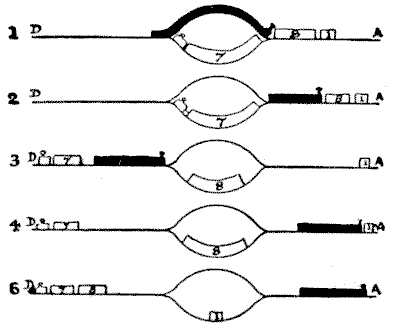
Only six reversals are necessary. The white train (from A to D) is divided into three sections, engine and 7 wagons, 8 wagons, and 1 wagon. The black train (D to A) never uncouples anything throughout. Fig. 1 is original position with 8 and 1 uncoupled. The black train proceeds to position in Fig. 2 (no reversal). The engine and 7 proceed towards D, and black train backs, leaves 8 on loop, and takes up position in Fig. 3 (first reversal). Black train goes to position in Fig. 4 to fetch single wagon (second reversal). Black train pushes 8 off loop and leaves single wagon there, proceeding on its journey, as in Fig. 5 (third and fourth reversals). White train now backs on to loop to pick up single car and goes right away to D (fifth and sixth reversals).
224.—THE MOTOR-GARAGE PUZZLE.—solution
The exchange of cars can be made in forty-three moves, as follows: 6-G, 2-B, 1-E, 3-H, 4-I, 3-L, 6-K, 4-G, 1-I, 2-J, 5-H, 4-A, 7-F, 8-E, 4-D, 8-C, 7-A, 8-G, 5-C, 2-B, 1-E, 8-I, 1-G, 2-J, 7-H, 1-A, 7-G, 2-B, 6-E, 3-H, 8-L, 3-I, 7-K, 3-G, 6-I, 2-J, 5-H, 3-C, 5-G, 2-B, 6-E, 5-I, 6-J. Of course, "6-G" means that the car numbered "6" moves to the point "G." There are other ways in forty-three moves.
225.—THE TEN PRISONERS.—solution
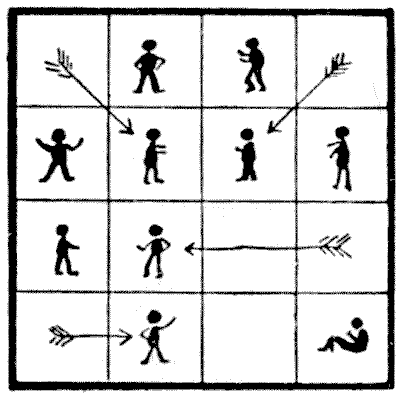
It will be seen in the illustration how the prisoners may be arranged so as to produce as many as sixteen even rows. There are 4 such vertical rows, 4 horizontal rows, 5 diagonal rows in one direction, and 3 diagonal rows in the other direction. The arrows here show the movements of the four prisoners, and it will be seen that the infirm man in the bottom corner has not been moved.
226.—ROUND THE COAST.—solution
In order to place words round the circle under the conditions, it is necessary to select words in which letters are repeated in certain relative positions. Thus, the word that solves our puzzle is "Swansea," in which the first and fifth letters are the same, and the third and seventh the same. We make out jumps as follows, taking the letters of the word in their proper order: 2-5, 7-2, 4-7, 1-4, 6-1, 3-6, 8-3. Or we could place a word like "Tarapur" (in which the second and fourth letters, and the third and seventh, are alike) with these moves: 6-1, 7-4, 2-7, 5-2, 8-5, 3-6, 8-3. But "Swansea" is the only word, apparently, that will fulfil the conditions of the puzzle.
This puzzle should be compared with Sharp's Puzzle, referred to in my solution to No. 341, "The Four Frogs." The condition "touch and jump over two" is identical with "touch and move along a line."
227.—CENTRAL SOLITAIRE.—solution
Here is a solution in nineteen moves; the moves enclosed in brackets count as one move only: 19-17, 16-18, (29-17, 17-19), 30-18, 27-25, (22-24, 24-26), 31-23, (4-16, 16-28), 7-9, 10-8, 12-10, 3-11, 18-6, (1-3, 3-11), (13-27, 27-25), (21-7, 7-9), (33-31, 31-23), (10-8, 8-22, 22-24, 24-26, 26-12, 12-10), 5-17. All the counters are now removed except one, which is left in the central hole. The solution needs judgment, as one is tempted to make several jumps in one move, where it would be the reverse of good play. For example, after playing the first 3-11 above, one is inclined to increase the length of the move by continuing with 11-25, 25-27, or with 11-9, 9-7.
I do not think the number of moves can be reduced.
228.—THE TEN APPLES.—solution
Number the plates (1, 2, 3, 4), (5, 6, 7, 8), (9, 10, 11, 12), (13, 14, 15, 16) in successive rows from the top to the bottom. Then transfer the apple from 8 to 10 and play as follows, always removing the apple jumped over: 9-11, 1-9, 13-5, 16-8, 4-12, 12-10, 3-1, 1-9, 9-11.
229.—THE NINE ALMONDS.—solution
This puzzle may be solved in as few as four moves, in the following manner: Move 5 over 8, 9, 3, 1. Move 7 over 4. Move 6 over 2 and 7. Move 5 over 6, and all the counters are removed except 5, which is left in the central square that it originally occupied.
230.—THE TWELVE PENNIES.—solution
Here is one of several solutions. Move 12 to 3, 7 to 4, 10 to 6, 8 to 1, 9 to 5, 11 to 2.
231.—PLATES AND COINS.—solution
Number the plates from 1 to 12 in the order that the boy is seen to be going in the illustration. Starting from 1, proceed as follows, where "1 to 4" means that you take the coin from plate No. 1 and transfer it to plate No. 4: 1 to 4, 5 to 8, 9 to 12, 3 to 6, 7 to 10, 11 to 2, and complete the last revolution to 1, making three revolutions in all. Or you can proceed this way: 4 to 7, 8 to 11, 12 to 3, 2 to 5, 6 to 9, 10 to 1. It is easy to solve in four revolutions, but the solutions in three are more difficult to discover.
This is "The Riddle of the Fishpond" (No. 41, Canterbury Puzzles) in a different dress.
232.—CATCHING THE MICE.—solution
In order that the cat should eat every thirteenth mouse, and the white mouse last of all, it is necessary that the count should begin at the seventh mouse (calling the white one the first)—that is, at the one nearest the tip of the cat's tail. In this case it is not at all necessary to try starting at all the mice in turn until you come to the right one, for you can just start anywhere and note how far distant the last one eaten is from the starting point. You will find it to be the eighth, and therefore must start at the eighth, counting backwards from the white mouse. This is the one I have indicated.
In the case of the second puzzle, where you have to find the smallest number with which the cat may start at the white mouse and eat this one last of all, unless you have mastered the general solution of the problem, which is very difficult, there is no better course open to you than to try every number in succession until you come to one that works correctly. The smallest number is twenty-one. If you have to proceed by trial, you will shorten your labour a great deal by only counting out the remainders when the number is divided successively by 13, 12, 11, 10, etc. Thus, in the case of 21, we have the remainders 8, 9, 10, 1, 3, 5, 7, 3, 1, 1, 3, 1, 1. Note that I do not give the remainders of 7, 3, and 1 as nought, but as 7, 3, and 1. Now, count round each of these numbers in turn, and you will find that the white mouse is killed last of all. Of course, if we wanted simply any number, not the smallest, the solution is very easy, for we merely take the least common multiple of 13, 12, 11, 10, etc. down to 2. This is 360360, and you will find that the first count kills the thirteenth mouse, the next the twelfth, the next the eleventh, and so on down to the first. But the most arithmetically inclined cat could not be expected to take such a big number when a small one like twenty-one would equally serve its purpose.
In the third case, the smallest number is 100. The number 1,000 would also do, and there are just seventy-two other numbers between these that the cat might employ with equal success.
233.—THE ECCENTRIC CHEESEMONGER.—solution
To leave the three piles at the extreme ends of the rows, the cheeses may be moved as follows—the numbers refer to the cheeses and not to their positions in the row: 7-2, 8-7, 9-8, 10-15, 6-10, 5-6, 14-16, 13-14, 12-13, 3-1, 4-3, 11-4. This is probably the easiest solution of all to find. To get three of the piles on cheeses 13, 14, and 15, play thus: 9-4, 10-9, 11-10, 6-14, 5-6, 12-15, 8-12, 7-8, 16-5, 3-13, 2-3, 1-2. To leave the piles on cheeses 3, 5, 12, and 14, play thus: 8-3, 9-14, 16-12, 1-5, 10-9, 7-10, 11-8, 2-1, 4-16, 13-2, 6-11, 15-4.
234.—THE EXCHANGE PUZZLE.—solution
Make the following exchanges of pairs: H-K, H-E, H-C, H-A, I-L, I-F, I-D, K-L, G-J, J-A, F-K, L-E, D-K, E-F, E-D, E-B, B-K. It will be found that, although the white counters can be moved to their proper places in 11 moves, if we omit all consideration of exchanges, yet the black cannot be so moved in fewer than 17 moves. So we have to introduce waste moves with the white counters to equal the minimum required by the black. Thus fewer than 17 moves must be impossible. Some of the moves are, of course, interchangeable.
235.—TORPEDO PRACTICE.—solution
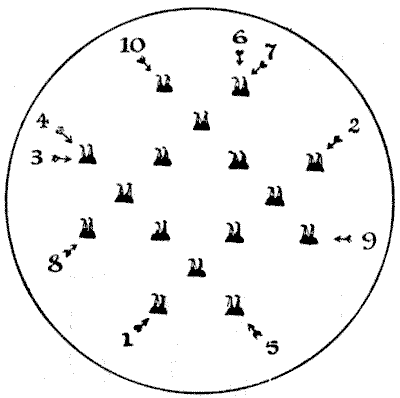
If the enemy's fleet be anchored in the formation shown in the illustration, it will be seen that as many as ten out of the sixteen ships may be blown up by discharging the torpedoes in the order indicated by the numbers and in the directions indicated by the arrows. As each torpedo in succession passes under three ships and sinks the fourth, strike out each vessel with the pencil as it is sunk.
236.—THE HAT PUZZLE.—solution
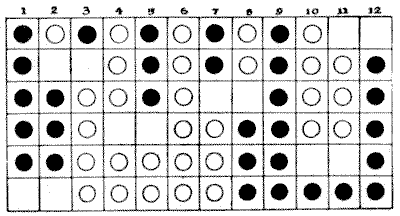
I suggested that the reader should try this puzzle with counters, so I give my solution in that form. The silk hats are represented by black counters and the felt hats by white counters. The first row shows the hats in their original positions, and then each successive row shows how they appear after one of the five manipulations. It will thus be seen that we first move hats 2 and 3, then 7 and 8, then 4 and 5, then 10 and 11, and, finally, 1 and 2, leaving the four silk hats together, the four felt hats together, and the two vacant pegs at one end of the row. The first three pairs moved are dissimilar hats, the last two pairs being similar. There are other ways of solving the puzzle.
237.—BOYS AND GIRLS.—solution
There are a good many different solutions to this puzzle. Any contiguous pair, except 7-8, may be moved first, and after the first move there are variations. The following solution shows the position from the start right through each successive move to the end:—
..12345678
4312..5678
4312765..8
43127..568
4..2713568
48627135..
238.—ARRANGING THE JAMPOTS.—solution
Two of the pots, 13 and 19, were in their proper places. As every interchange may result in a pot being put in its place, it is clear that twenty-two interchanges will get them all in order. But this number of moves is not the fewest possible, the correct answer being seventeen. Exchange the following pairs: (3-1, 2-3), (15-4, 16-15), (17-7, 20-17), (24-10, 11-24, 12-11), (8-5, 6-8, 21-6, 23-21, 22-23, 14-22, 9-14, 18-9). When you have made the interchanges within any pair of brackets, all numbers within those brackets are in their places. There are five pairs of brackets, and 5 from 22 gives the number of changes required—17.
239.—A JUVENILE PUZZLE.—solution
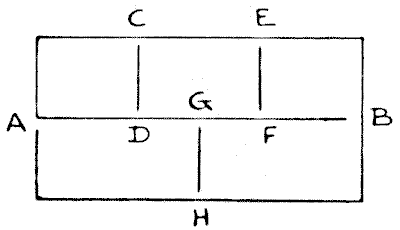
As the conditions are generally understood, this puzzle is incapable of solution. This can be demonstrated quite easily. So we have to look for some catch or quibble in the statement of what we are asked to do. Now if you fold the paper and then push the point of your pencil down between the fold, you can with one stroke make the two lines CD and EF in our diagram. Then start at A, and describe the line ending at B. Finally put in the last line GH, and the thing is done strictly within the conditions, since folding the paper is not actually forbidden. Of course the lines are here left unjoined for the purpose of clearness.
In the rubbing out form of the puzzle, first rub out A to B with a single finger in one stroke. Then rub out the line GH with one finger. Finally, rub out the remaining two vertical lines with two fingers at once! That is the old trick.
240.—THE UNION JACK.—solution
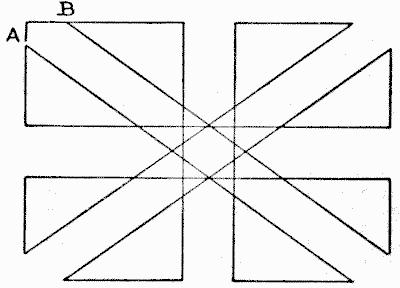
There are just sixteen points (all on the outside) where three roads may be said to join. These are called by mathematicians "odd nodes." There is a rule that tells us that in the case of a drawing like the present one, where there are sixteen odd nodes, it requires eight separate strokes or routes (that is, half as many as there are odd nodes) to complete it. As we have to produce as much as possible with only one of these eight strokes, it is clearly necessary to contrive that the seven strokes from odd node to odd node shall be as short as possible. Start at A and end at B, or go the reverse way.
241.—THE DISSECTED CIRCLE.—solution
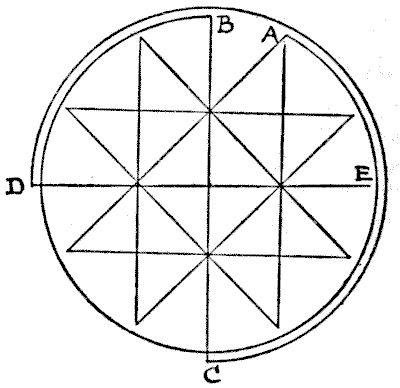
It can be done in twelve continuous strokes, thus: Start at A in the illustration, and eight strokes, forming the star, will bring you back to A; then one stroke round the circle to B, one stroke to C, one round the circle to D, and one final stroke to E—twelve in all. Of course, in practice the second circular stroke will be over the first one; it is separated in the diagram, and the points of the star not joined to the circle, to make the solution clear to the eye.
242.—THE TUBE INSPECTOR'S PUZZLE.—solution
The inspector need only travel nineteen miles if he starts at B and takes the following route: B A D G D E F I F C B E H K L I H G J K. Thus the only portions of line travelled over twice are the two sections D to G and F to I. Of course, the route may be varied, but it cannot be shortened.
243.—VISITING THE TOWNS.—solution
Note that there are six towns, from which only two roads issue. Thus 1 must lie between 9 and 12 in the circular route. Mark these two roads as settled. Similarly mark 9, 5, 14, and 4, 8, 14, and 10, 6, 15, and 10, 2, 13, and 3, 7, 13. All these roads must be taken. Then you will find that he must go from 4 to 15, as 13 is closed, and that he is compelled to take 3, 11, 16, and also 16, 12. Thus, there is only one route, as follows: 1, 9, 5, 14, 8, 4, 15, 6, 10, 2, 13, 7, 3, 11, 16, 12, 1, or its reverse—reading the line the other way. Seven roads are not used.
244.—THE FIFTEEN TURNINGS.—solution
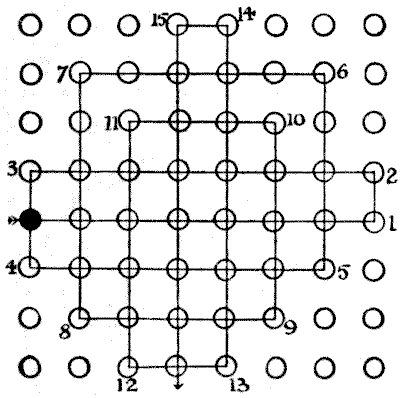
It will be seen from the illustration (where the roads not used are omitted) that the traveller can go as far as seventy miles in fifteen turnings. The turnings are all numbered in the order in which they are taken. It will be seen that he never visits nineteen of the towns. He might visit them all in fifteen turnings, never entering any town twice, and end at the black town from which he starts (see "The Rook's Tour," No. 320), but such a tour would only take him sixty-four miles.
245.—THE FLY ON THE OCTAHEDRON.—solution
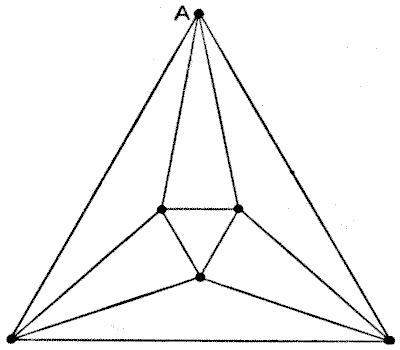
Though we cannot really see all the sides of the octahedron at once, we can make a projection of it that suits our purpose just as well. In the diagram the six points represent the six angles of the octahedron, and four lines proceed from every point under exactly the same conditions as the twelve edges of the solid. Therefore if we start at the point A and go over all the lines once, we must always end our route at A. And the number of different routes is just 1,488, counting the reverse way of any route as different. It would take too much space to show how I make the count. It can be done in about five minutes, but an explanation of the method is difficult. The reader is therefore asked to accept my answer as correct.
246.—THE ICOSAHEDRON PUZZLE.—solution
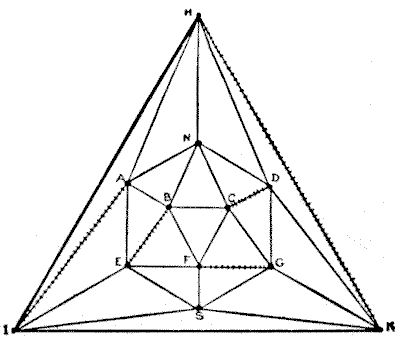
There are thirty edges, of which eighteen were visible in the original illustration, represented in the following diagram by the hexagon NAESGD. By this projection of the solid we get an imaginary view of the remaining twelve edges, and are able to see at once their direction and the twelve points at which all the edges meet. The difference in the length of the lines is of no importance; all we want is to present their direction in a graphic manner. But in case the novice should be puzzled at only finding nineteen triangles instead of the required twenty, I will point out that the apparently missing triangle is the outline HIK.
In this case there are twelve odd nodes; therefore six distinct and disconnected routes will be needful if we are not to go over any lines twice. Let us therefore find the greatest distance that we may so travel in one route.
It will be noticed that I have struck out with little cross strokes five lines or edges in the diagram. These five lines may be struck out anywhere so long as they do not join one another, and so long as one of them does not connect with N, the North Pole, from which we are to start. It will be seen that the result of striking out these five lines is that all the nodes are now even except N and S. Consequently if we begin at N and stop at S we may go over all the lines, except the five crossed out, without traversing any line twice. There are many ways of doing this. Here is one route: N to H, I, K, S, I, E, S, G, K, D, H, A, N, B, A, E, F, B, C, G, D, N, C, F, S. By thus making five of the routes as short as is possible—simply from one node to the next—we are able to get the greatest possible length for our sixth line. A greater distance in one route, without going over the same ground twice, it is not possible to get.
It is now readily seen that those five erased lines must be gone over twice, and they may be "picked up," so to speak, at any points of our route. Thus, whenever the traveller happens to be at I he can run up to A and back before proceeding on his route, or he may wait until he is at A and then run down to I and back to A. And so with the other lines that have to be traced twice. It is, therefore, clear that he can go over 25 of the lines once only (25 × 10,000 miles = 250,000 miles) and 5 of the lines twice (5 × 20,000 miles = 100,000 miles), the total, 350,000 miles, being the length of his travels and the shortest distance that is possible in visiting the whole body.
It will be noticed that I have made him end his travels at S, the South Pole, but this is not imperative. I might have made him finish at any of the other nodes, except the one from which he started. Suppose it had been required to bring him home again to N at the end of his travels. Then instead of suppressing the line AI we might leave that open and close IS. This would enable him to complete his 350,000 miles tour at A, and another 10,000 miles would take him to his own fireside. There are a great many different routes, but as the lengths of the edges are all alike, one course is as good as another. To make the complete 350,000 miles tour from N to S absolutely clear to everybody, I will give it entire: N to H, I, A, I, K, H, K, S, I, E, S, G, F, G, K, D, C, D, H, A, N, B, E, B, A, E, F, B, C, G, D, N, C, F, S—that is, thirty-five lines of 10,000 miles each.
247.—INSPECTING A MINE.—solution
Starting from A, the inspector need only travel 36 furlongs if he takes the following route: A to B, G, H, C, D, I, H, M, N, I, J, O, N, S, R, M, L, G, F, K, L, Q, R, S, T, O, J, E, D, C, B, A, F, K, P, Q. He thus passes between A and B twice, between C and D twice, between F and K twice, between J and O twice, and between R and S twice—five repetitions. Therefore 31 passages plus 5 repeated equal 36 furlongs. The little pitfall in this puzzle lies in the fact that we start from an even node. Otherwise we need only travel 35 furlongs.
248.—THE CYCLIST'S TOUR.—solution
When Mr. Maggs replied, "No way, I'm sure," he was not saying that the thing was impossible, but was really giving the actual route by which the problem can be solved. Starting from the star, if you visit the towns in the order, NO WAY, I'M SURE, you will visit every town once, and only once, and end at E. So both men were correct. This was the little joke of the puzzle, which is not by any means difficult.
249.—THE SAILOR'S PUZZLE.—solution
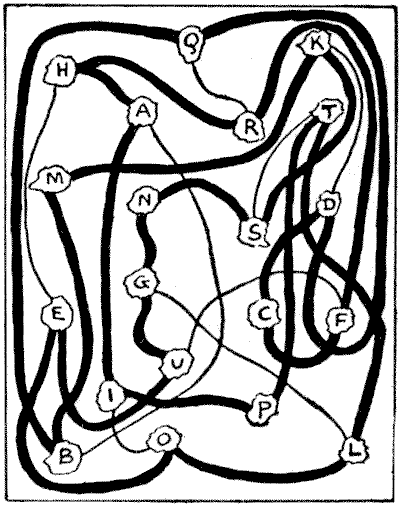
There are only four different routes (or eight, if we count the reverse ways) by which the sailor can start at the island marked A, visit all the islands once, and once only, and return again to A. Here they are:—
A I P T L O E H R Q D C F U G N S K M B A A I P T S N G L O E U F C D K M B Q R H A A B M K S N G L T P I O E U F C D Q R H A A I P T L O E U G N S K M B Q D C F R H A
Now, if the sailor takes the first route he will make C his 12th island (counting A as 1); by the second route he will make C his 13th island; by the third route, his 16th island; and by the fourth route, his 17th island. If he goes the reverse way, C will be respectively his 10th, 9th, 6th, and 5th island. As these are the only possible routes, it is evident that if the sailor puts off his visit to C as long as possible, he must take the last route reading from left to right. This route I show by the dark lines in the diagram, and it is the correct answer to the puzzle.
The map may be greatly simplified by the "buttons and string" method, explained in the solution to No. 341, "The Four Frogs."
250.—THE GRAND TOUR.—solution
The first thing to do in trying to solve a puzzle like this is to attempt to simplify it. If you look at Fig. 1, you will see that it is a simplified version of the map. Imagine the circular towns to be buttons and the railways to be connecting strings. (See solution to No. 341.) Then, it will be seen, we have simply "straightened out" the previous diagram without affecting the conditions. Now we can further simplify by converting Fig. 1 into Fig. 2, which is a portion of a chessboard. Here the directions of the railways will resemble the moves of a rook in chess—that is, we may move in any direction parallel to the sides of the diagram, but not diagonally. Therefore the first town (or square) visited must be a black one; the second must be a white; the third must be a black; and so on. Every odd square visited will thus be black and every even one white. Now, we have 23 squares to visit (an odd number), so the last square visited must be black. But Z happens to be white, so the puzzle would seem to be impossible of solution.
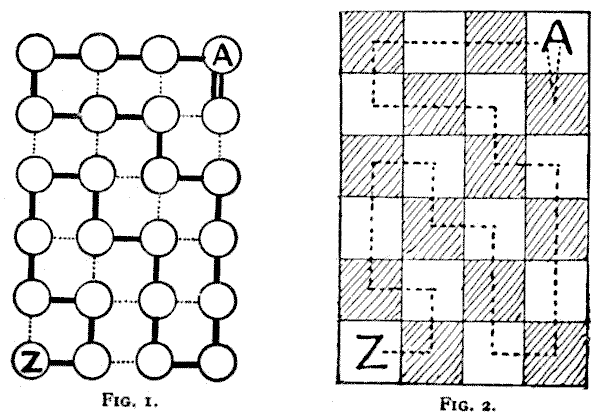
As we were told that the man "succeeded" in carrying put his plan, we must try to find some loophole in the conditions. He was to "enter every town once and only once," and we find no prohibition against his entering once the town A after leaving it, especially as he has never left it since he was born, and would thus be "entering" it for the first time in his life. But he must return at once from the first town he visits, and then he will have only 22 towns to visit, and as 22 is an even number, there is no reason why he should not end on the white square Z. A possible route for him is indicated by the dotted line from A to Z. This route is repeated by the dark lines in Fig. 1, and the reader will now have no difficulty in applying; it to the original map. We have thus proved that the puzzle can only be solved by a return to A immediately after leaving it.
251.—WATER, GAS, AND ELECTRICITY.—solution
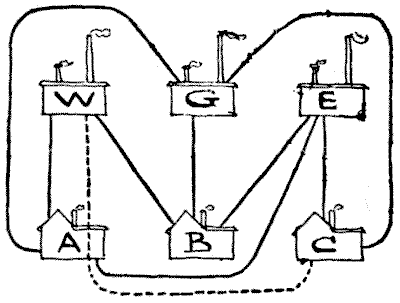
According to the conditions, in the strict sense in which one at first understands them, thereis no possible solution to this puzzle. In such a dilemma one always has to look for some verbal quibble or trick. If the owner of house A will allow the water company to run their pipe for house C through his property (and we are not bound to assume that he would object), then the difficulty is got over, as shown in our illustration. It will be seen that the dotted line from W to C passes through house A, but no pipe ever crosses another pipe.
252.—A PUZZLE FOR MOTORISTS.—solution
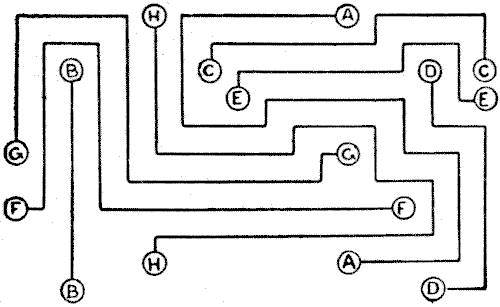
The routes taken by the eight drivers are shown in the illustration, where the dotted line roads are omitted to make the paths clearer to the eye.
253.—A BANK HOLIDAY PUZZLE.—solution
The simplest way is to write in the number of routes to all the towns in this manner. Put a 1 on all the towns in the top row and in the first column. Then the number of routes to any town will be the sum of the routes to the town immediately above and to the town immediately to the left. Thus the routes in the second row will be 1, 2, 3, 4, 5, 6, etc., in the third row, 1, 3, 6, 10, 15, 21, etc.; and so on with the other rows. It will then be seen that the only town to which there are exactly 1,365 different routes is the twelfth town in the fifth row—the one immediately over the letter E. This town was therefore the cyclist's destination.
The general formula for the number of routes from one corner to the corner diagonally opposite on any such rectangular reticulated arrangement, under the conditions as to direction, is (m + n)!/m!n!, where m is the number of towns on one side, less one, and n the number on the other side, less one. Our solution involves the case where there are 12 towns by 5. Therefore m = 11 and n = 4. Then the formula gives us the answer 1,365 as above.
254.—THE MOTOR-CAR TOUR.—solution
First of all I will ask the reader to compare the original square diagram with the circular one shown in Figs. 1, 2, and 3 below. If for the moment we ignore the shading (the purpose of which I shall proceed to explain), we find that the circular diagram in each case is merely a simplification of the original square one—that is, the roads from A lead to B, E, and M in both cases, the roads from L (London) lead to I, K, and S, and so on. The form below, being circular and symmetrical, answers my purpose better in applying a mechanical solution, and I therefore adopt it without altering in any way the conditions of the puzzle. If such a question as distances from town to town came into the problem, the new diagrams might require the addition of numbers to indicate these distances, or they might conceivably not be at all practicable.
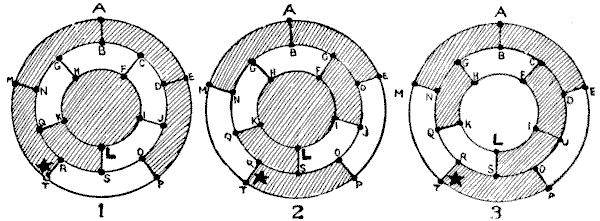
Now, I draw the three circular diagrams, as shown, on a sheet of paper and then cut out three pieces of cardboard of the forms indicated by the shaded parts of these diagrams. It can be shown that every route, if marked out with a red pencil, will form one or other of the designs indicated by the edges of the cards, or a reflection thereof. Let us direct our attention to Fig. 1. Here the card is so placed that the star is at the town T; it therefore gives us (by following the edge of the card) one of the circular routes from London: L, S, R, T, M, A, E, P, O, J, D, C, B, G, N, Q, K, H, F, I, L. If we went the other way, we should get L, I, F, H, K, Q, etc., but these reverse routes were not to be counted. When we have written out this first route we revolve the card until the star is at M, when we get another different route, at A a third route, at E a fourth route, and at P a fifth route. We have thus obtained five different routes by revolving the card as it lies. But it is evident that if we now take up the card and replace it with the other side uppermost, we shall in the same manner get five other routes by revolution.
We therefore see how, by using the revolving card in Fig. 1, we may, without any difficulty, at once write out ten routes. And if we employ the cards in Figs. 2 and 3, we similarly obtain in each case ten other routes. These thirty routes are all that are possible. I do not give the actual proof that the three cards exhaust all the possible cases, but leave the reader to reason that out for himself. If he works out any route at haphazard, he will certainly find that it falls into one or other of the three categories.
255.—THE LEVEL PUZZLE.—solution
Let us confine our attention to the L in the top left-hand corner. Suppose we go by way of the E on the right: we must then go straight on to the V, from which letter the word may be completed in four ways, for there are four E's available through which we may reach an L. There are therefore four ways of reading through the right-hand E. It is also clear that there must be the same number of ways through the E that is immediately below our starting point. That makes eight. If, however, we take the third route through the E on the diagonal, we then have the option of any one of the three V's, by means of each of which we may complete the word in four ways. We can therefore spell LEVEL in twelve ways through the diagonal E. Twelve added to eight gives twenty readings, all emanating from the L in the top left-hand corner; and as the four corners are equal, the answer must be four times twenty, or eighty different ways.
256.—THE DIAMOND PUZZLE.—solution
There are 252 different ways. The general formula is that, for words of n letters (not palindromes, as in the case of the next puzzle), when grouped in this manner, there are always 2(n+1) - 4 different readings. This does not allow diagonal readings, such as you would get if you used instead such a word as DIGGING, where it would be possible to pass from one G to another G by a diagonal step.
257.—THE DEIFIED PUZZLE.—solution
The correct answer is 1,992 different ways. Every F is either a corner F or a side F—standing next to a corner in its own square of F's. Now, FIED may be read from a corner F in 16 ways; therefore DEIF may be read into a corner F also in 16 ways; hence DEIFIED may be read through a corner F in 16 × 16 = 256 ways. Consequently, the four corner F's give 4 × 256 = 1,024 ways. Then FIED may be read from a side F in 11 ways, and DEIFIED therefore in 121 ways. But there are eight side F's; consequently these give together 8 × 121 = 968 ways. Add 968 to 1,024 and we get the answer, 1,992.
In this form the solution will depend on whether the number of letters in the palindrome be odd or even. For example, if you apply the word NUN in precisely the same manner, you will get 64 different readings; but if you use the word NOON, you will only get 56, because you cannot use the same letter twice in immediate succession (since you must "always pass from one letter to another") or diagonal readings, and every reading must involve the use of the central N.
The reader may like to find for himself the general formula in this case, which is complex and difficult. I will merely add that for such a case as MADAM, dealt with in the same way as DEIFIED, the number of readings is 400.
258.—THE VOTERS' PUZZLE.—solution
THE number of readings here is 63,504, as in the case of "WAS IT A RAT I SAW" (No. 30, Canterbury Puzzles). The general formula is that for palindromic sentences containing 2n + 1 letters there are [4(2n - 1)]² readings.
259.—HANNAH'S PUZZLE.—solution
Starting from any one of the N's, there are 17 different readings of NAH, or 68 (4 times 17) for the 4 N's. Therefore there are also 68 ways of spelling HAN. If we were allowed to use the same N twice in a spelling, the answer would be 68 times 68, or 4,624 ways. But the conditions were, "always passing from one letter to another." Therefore, for every one of the 17 ways of spelling HAN with a particular N, there would be 51 ways (3 times 17) of completing the NAH, or 867 (17 times 51) ways for the complete word. Hence, as there are four N's to use in HAN, the correct solution of the puzzle is 3,468 (4 times 867) different ways.
260.—THE HONEYCOMB PUZZLE.—solution
The required proverb is, "There is many a slip 'twixt the cup and the lip." Start at the T on the outside at the bottom right-hand corner, pass to the H above it, and the rest is easy.
261.—THE MONK AND THE BRIDGES.—solution
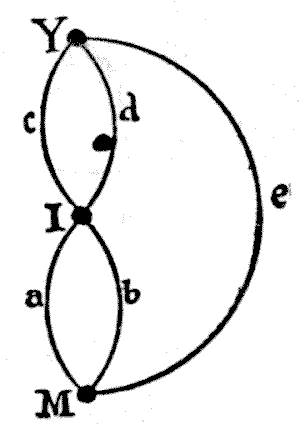
The problem of the Bridges may be reduced to the simple diagram shown in illustration. The point M represents the Monk, the point I the Island, and the point Y the Monastery. Now the only direct ways from M to I are by the bridges a and b; the only direct ways from I to Y are by the bridges c and d; and there is a direct way from M to Y by the bridge e. Now, what we have to do is to count all the routes that will lead from M to Y, passing over all the bridges, a, b, c, d, and e once and once only. With the simple diagram under the eye it is quite easy, without any elaborate rule, to count these routes methodically. Thus, starting from a, b, we find there are only two ways of completing the route; with a, c, there are only two routes; with a, d, only two routes; and so on. It will be found that there are sixteen such routes in all, as in the following list:—
a b e c d
a b e d c
a c d b e
a c e b d
a d e b c
a d c b e
b a e c d
b a e d c
b c d a e
b c e a d
b d c a e
b d e a c
e c a b d
e c b a d
e d a b c
e d b a c
If the reader will transfer the letters indicating the bridges from the diagram to the corresponding bridges in the original illustration, everything will be quite obvious.
262.—THOSE FIFTEEN SHEEP.—solution
If we read the exact words of the writer in the cyclopædia, we find that we are not told that the pens were all necessarily empty! In fact, if the reader will refer back to the illustration, he will see that one sheep is already in one of the pens. It was just at this point that the wily farmer said to me, "Now I'm going to start placing the fifteen sheep." He thereupon proceeded to drive three from his flock into the already occupied pen, and then placed four sheep in each of the other three pens. "There," says he, "you have seen me place fifteen sheep in four pens so that there shall be the same number of sheep in every pen." I was, of course, forced to admit that he was perfectly correct, according to the exact wording of the question.
263.—KING ARTHUR'S KNIGHTS.—solution
On the second evening King Arthur arranged the knights and himself in the following order round the table: A, F, B, D, G, E, C. On the third evening they sat thus, A, E, B, G, C, F, D. He thus had B next but one to him on both occasions (the nearest possible), and G was the third from him at both sittings (the furthest position possible). No other way of sitting the knights would have been so satisfactory.
264.—THE CITY LUNCHEONS.—solution
The men may be grouped as follows, where each line represents a day and each column a table:—
ABCDEFGHIJKL
AEDLGKFICBHJ
AGLJFHKCDEIB
AFJBKIHDLGCE
AKBEHCILJFDG
AHEGIDCJBKLF
AIGFCLDBEHJK
ACFKDJLEGIBH
ADKHLBJGFCEI
ALHIJEBFKDGC
AJICBGEKHLFD
Note that in every column (except in the case of the A's) all the letters descend cyclically in the same order, B, E, G, F, up to J, which is followed by B.
265.—A PUZZLE FOR CARD-PLAYERS.—solution
In the following solution each of the eleven lines represents a sitting, each column a table, and each pair of letters a pair of partners.
A B — I LE J — G KF H — C D
A C — J BF K — H LG I — D E
A D — K CG L — I BH J — E F
A E — L DH B — J CI K — F G
A F — B EI C — K DJ L — G H
A G — C FJ D — L EK B — H I
A H — D GK E — B FL C — I J
A I — E HL F — C GB D — J K
A J — F IB G — D HC E — K L
A K — G JC H — E ID F — L B
A L — H KD I — F JE G — B C
It will be seen that the letters B, C, D ...L descend cyclically. The solution given above is absolutely perfect in all respects. It will be found that every player has every other player once as his partner and twice as his opponent.
266.—A TENNIS TOURNAMENT.—solution
Call the men A, B, D, E, and their wives a, b, d, e. Then they may play as follows without any person ever playing twice with or against any other person:—
First Court.Second Court.
1st DayA d against B eD a against E b
2nd DayA e against D bE a against B d
3rd DayA b against E dB a against D e
It will be seen that no man ever plays with or against his own wife—an ideal arrangement. If the reader wants a hard puzzle, let him try to arrange eight married couples (in four courts on seven days) under exactly similar conditions. It can be done, but I leave the reader in this case the pleasure of seeking the answer and the general solution.
267.—THE WRONG HATS.—solution
The number of different ways in which eight persons, with eight hats, can each take the wrong hat, is 14,833.
Here are the successive solutions for any number of persons from one to eight:—
1 = 0 2 = 1 3 = 2 4 = 9 5 = 44 6 = 265 7 = 1,854 8 = 14,833
To get these numbers, multiply successively by 2, 3, 4, 5, etc. When the multiplier is even, add 1; when odd, deduct 1. Thus, 3 × 1 - 1 = 2, 4 × 2 + 1 = 9; 5 × 9 - 1 = 44; and so on. Or you can multiply the sum of the number of ways for n-1 and n-2 persons by n-1, and so get the solution for n persons. Thus, 4(2 + 9) = 44; 5(9 + 44) = 265; and so on.
268.—THE PEAL OF BELLS.—solution
The bells should be rung as follows:—
1 2 3 4
2 1 4 3
2 4 1 3
4 2 3 1
4 3 2 1
3 4 1 2
3 1 4 2
1 3 2 4
3 1 2 4
1 3 4 2
1 4 3 2
4 1 2 3
4 2 1 3
2 4 3 1
2 3 4 1
3 2 1 4
2 3 1 4
3 2 4 1
3 4 2 1
4 3 1 2
4 1 3 2
1 4 2 3
1 2 4 3
2 1 3 4
I have constructed peals for five and six bells respectively, and a solution is possible for any number of bells under the conditions previously stated.
269.—THREE MEN IN A BOAT.—solution
If there were no conditions whatever, except that the men were all to go out together, in threes, they could row in an immense number of different ways. If the reader wishes to know how many, the number is 4557. And with the condition that no two may ever be together more than once, there are no fewer than 15,567,552,000 different solutions—that is, different ways of arranging the men. With one solution before him, the reader will realize why this must be, for although, as an example, A must go out once with B and once with C, it does not necessarily follow that he must go out with C on the same occasion that he goes with B. He might take any other letter with him on that occasion, though the fact of his taking other than B would have its effect on the arrangement of the other triplets.
Of course only a certain number of all these arrangements are available when we have that other condition of using the smallest possible number of boats. As a matter of fact we need employ only ten different boats. Here is one the arrangements:—
12345
1st Day(ABC)(DBF)(GHI)(JKL)(MNO)
867910
2nd Day(ADG)(BKN)(COL)(JEI)(MHF)
35412
3rd Day(AJM)(BEH)(CFI)(DKO)(GNL)
76891
4th Day(AEK)(CGM)(BOI)(DHL)(JNF)
453102
5th Day(AHN)(CDJ)(BFL)(GEO)(MKI)
678101
6th Day(AFO)(BGJ)(CKH)(DNI)(MEL)
54392
7th Day(AIL)(BDM)(CEN)(GKF)(JHO)
It will be found that no two men ever go out twice together, and that no man ever goes out twice in the same boat.
This is an extension of the well-known problem of the "Fifteen Schoolgirls," by Kirkman. The original conditions were simply that fifteen girls walked out on seven days in triplets without any girl ever walking twice in a triplet with another girl. Attempts at a general solution of this puzzle had exercised the ingenuity of mathematicians since 1850, when the question was first propounded, until recently. In 1908 and the two following years I indicated (see Educational Times Reprints, Vols. XIV., XV., and XVII.) that all our trouble had arisen from a failure to discover that 15 is a special case (too small to enter into the general law for all higher numbers of girls of the form 6n + 3), and showed what that general law is and how the groups should be posed for any number of girls. I gave actual arrangements for numbers that had previously baffled all attempts to manipulate, and the problem may now be considered generally solved. Readers will find an excellent full account of the puzzle in W.W. Rouse Ball's Mathematical Recreations, 5th edition.
270.—THE GLASS BALLS.—solution
There are, in all, sixteen balls to be broken, or sixteen places in the order of breaking. Call the four strings A, B, C, and D—order is here of no importance. The breaking of the balls on A may occupy any 4 out of these 16 places—that is, the combinations of 16 things, taken 4 together, will be
13 × 14 × 15 × 16 = 1,820
1 × 2 × 3 × 4
ways for A. In every one of these cases B may occupy any 4 out of the remaining 12 places, making
9 × 10 × 11 × 12 = 495
1 × 2 × 3 × 4
ways. Thus 1,820 × 495 = 900,900 different placings are open to A and B. But for every one of these cases C may occupy
5 × 6 × 7 × 8 = 70
1 × 2 × 3 × 4
different places; so that 900,900 × 70 = 63,063,000 different placings are open to A, B, and C. In every one of these cases, D has no choice but to take the four places that remain. Therefore the correct answer is that the balls may be broken in 63,063,000 different ways under the conditions. Readers should compare this problem with No. 345, "The Two Pawns," which they will then know how to solve for cases where there are three, four, or more pawns on the board.
271.—FIFTEEN LETTER PUZZLE.—solution
The following will be found to comply with the conditions of grouping:—
ALEMETMOPBLM
BAGCAPYOUCLT
IREOILLUGLNR
NAYBITBUNBPR
AIMBEYRUMGMY
OARGINPLYCGR
PEGICYTRYCMN
CUECOBTAUPNT
ONEGOTPIU
The fifteen letters used are A, E, I, O, U, Y, and B, C, G, L, M, N, P, R, T. The number of words is 27, and these are all shown in the first three columns. The last word, PIU, is a musical term in common use; but although it has crept into some of our dictionaries, it is Italian, meaning "a little; slightly." The remaining twenty-six are good words. Of course a TAU-cross is a T-shaped cross, also called the cross of St. Anthony, and borne on a badge in the Bishop's Palace at Exeter. It is also a name for the toad-fish.
We thus have twenty-six good words and one doubtful, obtained under the required conditions, and I do not think it will be easy to improve on this answer. Of course we are not bound by dictionaries but by common usage. If we went by the dictionary only in a case of this kind, we should find ourselves involved in prefixes, contractions, and such absurdities as I.O.U., which Nuttall actually gives as a word.
272.—THE NINE SCHOOLBOYS.—solution
The boys can walk out as follows:—
1st Day.2nd Day.3rd Day.4th Day.5th Day.6th Day.
A B CB F HF A GA D HG B ID C A
D E FE I AI D BB E GC F DE H B
G H IC G DH C EF I CH A EI G F
Every boy will then have walked by the side of every other boy once and once only.
Dealing with the problem generally, 12n + 9 boys may walk out in triplets under the conditions on 9n + 6 days, where n may be nought or any integer. Every possible pair will occur once. Call the number of boys m. Then every boy will pair m - 1 times, of which (m - 1)/4 times he will be in the middle of a triplet and (m - 1)/2 times on the outside. Thus, if we refer to the solution above, we find that every boy is in the middle twice (making 4 pairs) and four times on the outside (making the remaining 4 pairs of his 8). The reader may now like to try his hand at solving the two next cases of 21 boys on 15 days, and 33 boys on 24 days. It is, perhaps, interesting to note that a school of 489 boys could thus walk out daily in one leap year, but it would take 731 girls (referred to in the solution to No. 269) to perform their particular feat by a daily walk in a year of 365 days.
273.—THE ROUND TABLE.—solution
The history of this problem will be found in The Canterbury Puzzles (No. 90). Since the publication of that book in 1907, so far as I know, nobody has succeeded in solving the case for that unlucky number of persons, 13, seated at a table on 66 occasions. A solution is possible for any number of persons, and I have recorded schedules for every number up to 25 persons inclusive and for 33. But as I know a good many mathematicians are still considering the case of 13, I will not at this stage rob them of the pleasure of solving it by showing the answer. But I will now display the solutions for all the cases up to 12 persons inclusive. Some of these solutions are now published for the first time, and they may afford useful clues to investigators.
The solution for the case of 3 persons seated on 1 occasion needs no remark.
A solution for the case of 4 persons on 3 occasions is as follows:—
1 2 3 4
1 3 4 2
1 4 2 3
Each line represents the order for a sitting, and the person represented by the last number in a line must, of course, be regarded as sitting next to the first person in the same line, when placed at the round table.
The case of 5 persons on 6 occasions may be solved as follows:—
1 2 3 4 5
1 2 4 5 3
1 2 5 3 4
1 3 2 5 4
1 4 2 3 5
1 5 2 4 3
The case for 6 persons on 10 occasions is solved thus:—
1 2 3 6 4 5
1 3 4 2 5 6
1 4 5 3 6 2
1 5 6 4 2 3
1 6 2 5 3 4
1 2 4 5 6 3
1 3 5 6 2 4
1 4 6 2 3 5
1 5 2 3 4 6
1 6 3 4 5 2
It will now no longer be necessary to give the solutions in full, for reasons that I will explain. It will be seen in the examples above that the 1 (and, in the case of 5 persons, also the 2) is repeated down the column. Such a number I call a "repeater." The other numbers descend in cyclical order. Thus, for 6 persons we get the cycle, 2, 3, 4, 5, 6, 2, and so on, in every column. So it is only necessary to give the two lines 1 2 3 6 4 5 and 1 2 4 5 6 3, and denote the cycle and repeaters, to enable any one to write out the full solution straight away. The reader may wonder why I do not start the last solution with the numbers in their natural order, 1 2 3 4 5 6. If I did so the numbers in the descending cycle would not be in their natural order, and it is more convenient to have a regular cycle than to consider the order in the first line.
The difficult case of 7 persons on 15 occasions is solved as follows, and was given by me in The Canterbury Puzzles:—
1 2 3 4 5 7 6
1 6 2 7 5 3 4
1 3 5 2 6 7 4
1 5 7 4 3 6 2
1 5 2 7 3 4 6
In this case the 1 is a repeater, and there are two separate cycles, 2, 3, 4, 2, and 5, 6, 7, 5. We thus get five groups of three lines each, for a fourth line in any group will merely repeat the first line.
A solution for 8 persons on 21 occasions is as follows:—
1 8 6 3 4 5 2 7
1 8 4 5 7 2 3 6
1 8 2 7 3 6 4 5
The 1 is here a repeater, and the cycle 2, 3, 4, 5, 6, 7, 8. Every one of the 3 groups will give 7 lines.
Here is my solution for 9 persons on 28 occasions:—
2 1 9 7 4 5 6 3 8
2 9 5 1 6 8 3 4 7
2 9 3 1 8 4 7 5 6
2 9 1 5 6 4 7 8 3
There are here two repeaters, 1 and 2, and the cycle is 3, 4, 5, 6, 7, 8, 9. We thus get 4 groups of 7 lines each.
The case of 10 persons on 36 occasions is solved as follows:—
1 10 8 3 6 5 4 7 2 9
1 10 6 5 2 9 7 4 3 8
1 10 2 9 3 8 6 5 7 4
1 10 7 4 8 3 2 9 5 6
The repeater is 1, and the cycle, 2, 3, 4, 5, 6, 7, 8, 9, 10. We here have 4 groups of 9 lines each.
My solution for 11 persons on 45 occasions is as follows:—
2119476518310
2111763108549
2111039485176
2115813106794
2111103496758
There are two repeaters, 1 and 2, and the cycle is, 3, 4, 5,... 11. We thus get 5 groups of 9 lines each.
The case of 12 persons on 55 occasions is solved thus:—
123124115106978
124116987105123
125108711431269
126910531278114
127812369114510
Here 1 is a repeater, and the cycle is 2, 3, 4, 5,... 12. We thus get 5 groups of 11 lines each.
274.—THE MOUSE-TRAP PUZZLE.—solution
If we interchange cards 6 and 13 and begin our count at 14, we may take up all the twenty-one cards—that is, make twenty-one "catches"—in the following order: 6, 8, 13, 2, 10, 1, 11, 4, 14, 3, 5, 7, 21, 12, 15, 20, 9, 16, 18, 17, 19. We may also exchange 10 and 14 and start at 16, or exchange 6 and 8 and start at 19.
275.—THE SIXTEEN SHEEP.—solution
The six diagrams on next page show solutions for the cases where we replace 2, 3, 4, 5, 6, and 7 hurdles. The dark lines indicate the hurdles that have been replaced. There are, of course, other ways of making the removals.
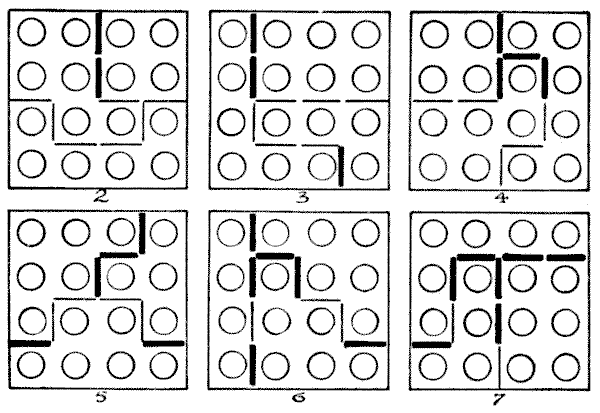
276.—THE EIGHT VILLAS.—solution
There are several ways of solving the puzzle, but there is very little difference between them. The solver should, however, first of all bear in mind that in making his calculations he need only consider the four villas that stand at the corners, because the intermediate villas can never vary when the corners are known. One way is to place the numbers nought to 9 one at a time in the top left-hand corner, and then consider each case in turn.
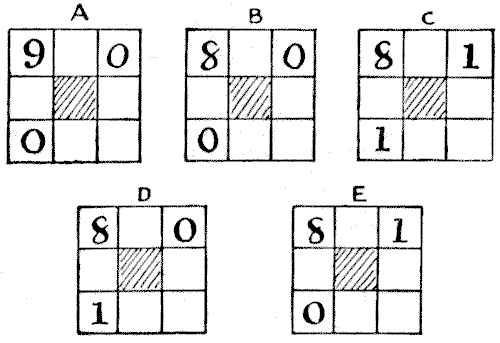
Now, if we place 9 in the corner as shown in the Diagram A, two of the corners cannot be occupied, while the corner that is diagonally opposite may be filled by 0, 1, 2, 3, 4, 5, 6, 7, 8, or 9 persons. We thus see that there are 10 solutions with a 9 in the corner. If, however, we substitute 8, the two corners in the same row and column may contain 0, 0, or 1, 1, or 0, 1, or 1, 0. In the case of B, ten different selections may be made for the fourth corner; but in each of the cases C, D, and E, only nine selections are possible, because we cannot use the 9. Therefore with 8 in the top left-hand corner there are 10 + (3 × 9) = 37 different solutions. If we then try 7 in the corner, the result will be 10 + 27 + 40, or 77 solutions. With 6 we get 10 + 27 + 40 + 49 = 126; with 5, 10 + 27 + 40 + 49 + 54 = 180; with 4, the same as with 5, + 55 = 235 ; with 3, the same as with 4, + 52 = 287; with 2, the same as with 3, + 45 = 332; with 1, the same as with 2, + 34 = 366, and with nought in the top left-hand corner the number of solutions will be found to be 10 + 27 + 40 + 49 + 54 + 55 + 52 + 45 + 34 + 19 = 385. As there is no other number to be placed in the top left-hand corner, we have now only to add these totals together thus, 10 + 37 + 77 + 126 + 180 + 235 + 287 + 332 + 366 + 385 = 2,035. We therefore find that the total number of ways in which tenants may occupy some or all of the eight villas so that there shall be always nine persons living along each side of the square is 2,035. Of course, this method must obviously cover all the reversals and reflections, since each corner in turn is occupied by every number in all possible combinations with the other two corners that are in line with it.
Here is a general formula for solving the puzzle: (n² + 3n + 2)(n² + 3n + 3)/6. Whatever may be the stipulated number of residents along each of the sides (which number is represented by n), the total number of different arrangements may be thus ascertained. In our particular case the number of residents was nine. Therefore (81 + 27 + 2) × (81 + 27 + 3) and the product, divided by 6, gives 2,035. If the number of residents had been 0, 1, 2, 3, 4, 5, 6, 7, or 8, the total arrangements would be 1, 7, 26, 70, 155, 301, 532, 876, or 1,365 respectively.
277.—COUNTER CROSSES.—solution
Let us first deal with the Greek Cross. There are just eighteen forms in which the numbers may be paired for the two arms. Here they are:—
129781396814958
349562495723967
239581376914759
149672475823768
125892375913579
345671476824568
145692356914379
235781457825368
153692436923189
243781537845167
241792516934169
351683417825178
Of course, the number in the middle is common to both arms. The first pair is the one I gave as an example. I will suppose that we have written out all these crosses, always placing the first row of a pair in the upright and the second row in the horizontal arm. Now, if we leave the central figure fixed, there are 24 ways in which the numbers in the upright may be varied, for the four counters may be changed in 1 × 2 × 3 × 4 = 24 ways. And as the four in the horizontal may also be changed in 24 ways for every arrangement on the other arm, we find that there are 24 × 24 = 576 variations for every form; therefore, as there are 18 forms, we get 18 × 576 = 10,368 ways. But this will include half the four reversals and half the four reflections that we barred, so we must divide this by 4 to obtain the correct answer to the Greek Cross, which is thus 2,592 different ways. The division is by 4 and not by 8, because we provided against half the reversals and reflections by always reserving one number for the upright and the other for the horizontal.
In the case of the Latin Cross, it is obvious that we have to deal with the same 18 forms of pairing. The total number of different ways in this case is the full number, 18 × 576. Owing to the fact that the upper and lower arms are unequal in length, permutations will repeat by reflection, but not by reversal, for we cannot reverse. Therefore this fact only entails division by 2. But in every pair we may exchange the figures in the upright with those in the horizontal (which we could not do in the case of the Greek Cross, as the arms are there all alike); consequently we must multiply by 2. This multiplication by 2 and division by 2 cancel one another. Hence 10,368 is here the correct answer.
278.—A DORMITORY PUZZLE.—solution
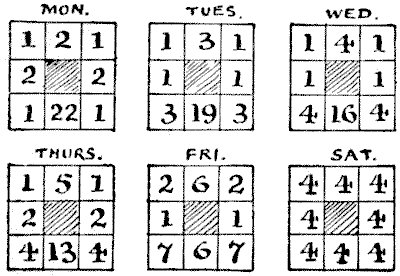
Arrange the nuns from day to day as shown in the six diagrams. The smallest possible number of nuns would be thirty-two, and the arrangements on the last three days admit of variation.
279.—THE BARRELS OF BALSAM.—solution
This is quite easy to solve for any number of barrels—if you know how. This is the way to do it. There are five barrels in each row Multiply the numbers 1, 2, 3, 4, 5 together; and also multiply 6, 7, 8, 9, 10 together. Divide one result by the other, and we get the number of different combinations or selections of ten things taken five at a time. This is here 252. Now, if we divide this by 6 (1 more than the number in the row) we get 42, which is the correct answer to the puzzle, for there are 42 different ways of arranging the barrels. Try this method of solution in the case of six barrels, three in each row, and you will find the answer is 5 ways. If you check this by trial, you will discover the five arrangements with 123, 124, 125, 134, 135 respectively in the top row, and you will find no others.
The general solution to the problem is, in fact, this:
Cn
2n
n + 1
where 2n equals the number of barrels. The symbol C, of course, implies that we have to find how many combinations, or selections, we can make of 2n things, taken n at a time.
280.—BUILDING THE TETRAHEDRON.—solution
Take your constructed pyramid and hold it so that one stick only lies on the table. Now, four sticks must branch off from it in different directions—two at each end. Any one of the five sticks may be left out of this connection; therefore the four may be selected in 5 different ways. But these four matches may be placed in 24 different orders. And as any match may be joined at either of its ends, they may further be varied (after their situations are settled for any particular arrangement) in 16 different ways. In every arrangement the sixth stick may be added in 2 different ways. Now multiply these results together, and we get 5 × 24 × 16 × 2 = 3,840 as the exact number of ways in which the pyramid may be constructed. This method excludes all possibility of error.
A common cause of error is this. If you calculate your combinations by working upwards from a basic triangle lying on the table, you will get half the correct number of ways, because you overlook the fact that an equal number of pyramids may be built on that triangle downwards, so to speak, through the table. They are, in fact, reflections of the others, and examples from the two sets of pyramids cannot be set up to resemble one another—except under fourth dimensional conditions!
281.—PAINTING A PYRAMID.—solution
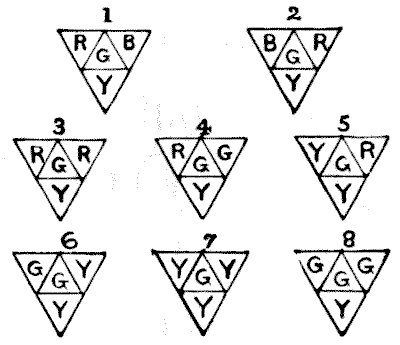
It will be convenient to imagine that we are painting our pyramids on the flat cardboard, as in the diagrams, before folding up. Now, if we take any four colours (say red, blue, green, and yellow), they may be applied in only 2 distinctive ways, as shown in Figs, 1 and 2. Any other way will only result in one of these when the pyramids are folded up. If we take any three colours, they may be applied in the 3 ways shown in Figs. 3, 4, and 5. If we take any two colours, they may be applied in the 3 ways shown in Figs. 6, 7, and 8. If we take any single colour, it may obviously be applied in only 1 way. But four colours may be selected in 35 ways out of seven; three in 35 ways; two in 21 ways; and one colour in 7 ways. Therefore 35 applied in 2 ways = 70; 35 in 3 ways = 105; 21 in 3 ways = 63; and 7 in 1 way = 7. Consequently the pyramid may be painted in 245 different ways (70 + 105 + 63 + 7), using the seven colours of the solar spectrum in accordance with the conditions of the puzzle.
282.—THE ANTIQUARY'S CHAIN.—solution
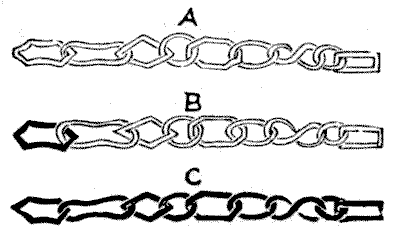
The number of ways in which nine things may be arranged in a row without any restrictions is 1 × 2 × 3 × 4 × 5 × 6 × 7 × 8 × 9 = 362,880. But we are told that the two circular rings must never be together; therefore we must deduct the number of times that this would occur. The number is 1 × 2 × 3 × 4 × 5 × 6 × 7 × 8 = 40,320 × 2 = 80,640, because if we consider the two circular links to be inseparably joined together they become as one link, and eight links are capable of 40,320 arrangements; but as these two links may always be put on in the orders AB or BA, we have to double this number, it being a question of arrangement and not of design. The deduction required reduces our total to 282,240. Then one of our links is of a peculiar form, like an 8. We have therefore the option of joining on either one end or the other on every occasion, so we must double the last result. This brings up our total to 564,480.
We now come to the point to which I directed the reader's attention—that every link may be put on in one of two ways. If we join the first finger and thumb of our left hand horizontally, and then link the first finger and thumb of the right hand, we see that the right thumb may be either above or below. But in the case of our chain we must remember that although that 8-shaped link has two independent ends it is like every other link in having only two sides—that is, you cannot turn over one end without turning the other at the same time.
We will, for convenience, assume that each link has a black side and a side painted white. Now, if it were stipulated that (with the chain lying on the table, and every successive link falling over its predecessor in the same way, as in the diagram) only the white sides should be uppermost as in A, then the answer would be 564,480, as above—ignoring for the present all reversals of the completed chain. If, however, the first link were allowed to be placed either side up, then we could have either A or B, and the answer would be 2 × 564,480 = 1,128,960; if two links might be placed either way up, the answer would be 4 × 564,480; if three links, then 8 × 564,480, and so on. Since, therefore, every link may be placed either side up, the number will be 564,480 multiplied by 29, or by 512. This raises our total to 289,013,760.
But there is still one more point to be considered. We have not yet allowed for the fact that with any given arrangement three of the other arrangements may be obtained by simply turning the chain over through its entire length and by reversing the ends. Thus C is really the same as A, and if we turn this page upside down, then A and C give two other arrangements that are still really identical. Thus to get the correct answer to the puzzle we must divide our last total by 4, when we find that there are just 72,253,440 different ways in which the smith might have put those links together. In other words, if the nine links had originally formed a piece of chain, and it was known that the two circular links were separated, then it would be 72,253,439 chances to 1 that the smith would not have put the links together again precisely as they were arranged before!
283.—THE FIFTEEN DOMINOES.—solution
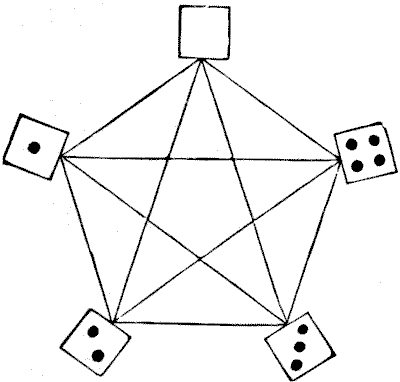
The reader may have noticed that at each end of the line I give is a four, so that, if we like, we can form a ring instead of a line. It can easily be proved that this must always be so. Every line arrangement will make a circular arrangement if we like to join the ends. Now, curious as it may at first appear, the following diagram exactly represents the conditions when we leave the doubles out of the question and devote our attention to forming circular arrangements. Each number, or half domino, is in line with every other number, so that if we start at any one of the five numbers and go over all the lines of the pentagon once and once only we shall come back to the starting place, and the order of our route will give us one of the circular arrangements for the ten dominoes. Take your pencil and follow out the following route, starting at the 4: 41304210234. You have been over all the lines once only, and by repeating all these figures in this way, 41—13—30—04—42—21—10—02—23—34, you get an arrangement of the dominoes (without the doubles) which will be perfectly clear. Take other routes and you will get other arrangements. If, therefore, we can ascertain just how many of these circular routes are obtainable from the pentagon, then the rest is very easy.
Well, the number of different circular routes over the pentagon is 264. How I arrive at these figures I will not at present explain, because it would take a lot of space. The dominoes may, therefore, be arranged in a circle in just 264 different ways, leaving out the doubles. Now, in any one of these circles the five doubles may be inserted in 25 = 32 different ways. Therefore when we include the doubles there are 264 × 32 = 8,448 different circular arrangements. But each of those circles may be broken (so as to form our straight line) in any one of 15 different places. Consequently, 8,448 × 15 gives 126,720 different ways as the correct answer to the puzzle.
I purposely refrained from asking the reader to discover in just how many different ways the full set of twenty-eight dominoes may be arranged in a straight line in accordance with the ordinary rules of the game, left to right and right to left of any arrangement counting as different ways. It is an exceedingly difficult problem, but the correct answer is 7,959,229,931,520 ways. The method of solving is very complex.
284.—THE CROSS TARGET.—solution
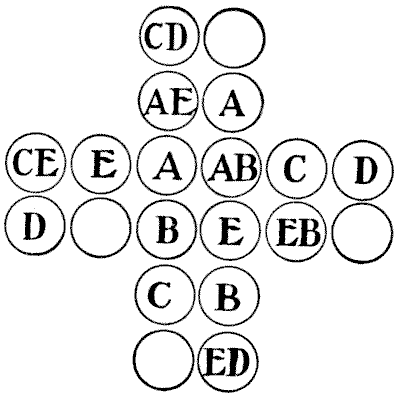
Twenty-one different squares may be selected. Of these nine will be of the size shown by the four A's in the diagram, four of the size shown by the B's, four of the size shown by the C's, two of the size shown by the D's, and two of the size indicated by the upper single A, the upper single E, the lower single C, and the EB. It is an interesting fact that you cannot form any one of these twenty-one squares without using at least one of the six circles marked E.
285.—THE FOUR POSTAGE STAMPS.—solution
Referring to the original diagram, the four stamps may be given in the shape 1, 2, 3, 4, in three ways; in the shape 1, 2, 5, 6, in six ways; in the shape 1, 2, 3, 5, or 1, 2, 3, 7, or 1, 5, 6, 7, or 3, 5, 6, 7, in twenty-eight ways; in shape 1, 2, 3, 6, or 2, 5, 6, 7, in fourteen ways; in shape 1, 2, 6, 7, or 2, 3, 5, 6, or 1, 5, 6, 10, or 2, 5, 6, 9, in fourteen ways. Thus there are sixty-five ways in all.
286.—PAINTING THE DIE.—solution
The 1 can be marked on any one of six different sides. For every side occupied by 1 we have a selection of four sides for the 2. For every situation of the 2 we have two places for the 3. (The 6, 5, and 4 need not be considered, as their positions are determined by the 1, 2, and 3.) Therefore 6, 4, and 2 multiplied together make 48 different ways—the correct answer.
287.—AN ACROSTIC PUZZLE.—solution
There are twenty-six letters in the alphabet, giving 325 different pairs. Every one of these pairs may be reversed, making 650 ways. But every initial letter may be repeated as the final, producing 26 other ways. The total is therefore 676 different pairs. In other words, the answer is the square of the number of letters in the alphabet.
288.—CHEQUERED BOARD DIVISIONS.—solution
There are 255 different ways of cutting the board into two pieces of exactly the same size and shape. Every way must involve one of the five cuts shown in Diagrams A, B, C, D, and E. To avoid repetitions by reversal and reflection, we need only consider cuts that enter at the points a, b, and c. But the exit must always be at a point in a straight line from the entry through the centre. This is the most important condition to remember. In case B you cannot enter at a, or you will get the cut provided for in E. Similarly in C or D, you must not enter the key-line in the same direction as itself, or you will get A or B. If you are working on A or C and entering at a, you must consider joins at one end only of the key-line, or you will get repetitions. In other cases you must consider joins at both ends of the key; but after leaving a in case D, turn always either to right or left—use one direction only. Figs. 1 and 2 are examples under A; 3 and 4 are examples under B; 5 and 6 come under C; and 7 is a pretty example of D. Of course, E is a peculiar type, and obviously admits of only one way of cutting, for you clearly cannot enter at b or c.
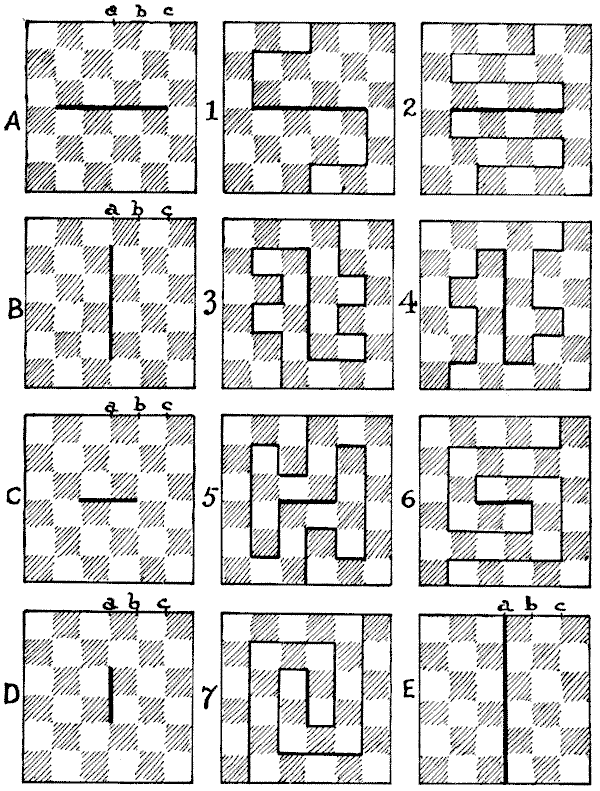
Here is a table of the results:—
abcWays.
A=8+17+21=46
B=0+17+21=38
C=15+31+39=85
D=17+29+39=85
E=1+0+0=1
4194120255
I have not attempted the task of enumerating the ways of dividing a board 8x8—that is, an ordinary chessboard. Whatever the method adopted, the solution would entail considerable labour.
289.—LIONS AND CROWNS.—solution
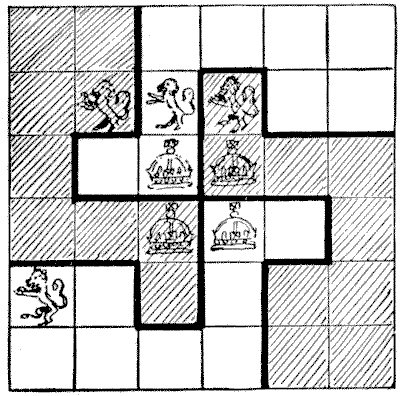
Here is the solution. It will be seen that each of the four pieces (after making the cuts along the thick lines) is of exactly the same size and shape, and that each piece contains a lion and a crown. Two of the pieces are shaded so as to make the solution quite clear to the eye.
290.—BOARDS WITH AN ODD NUMBER OF SQUARES.—solution
There are fifteen different ways of cutting the 5x5 board (with the central square removed) into two pieces of the same size and shape. Limitations of space will not allow me to give diagrams of all these, but I will enable the reader to draw them all out for himself without the slightest difficulty. At whatever point on the edge your cut enters, it must always end at a point on the edge, exactly opposite in a line through the centre of the square. Thus, if you enter at point 1 (see Fig. 1) at the top, you must leave at point 1 at the bottom. Now, 1 and 2 are the only two really different points of entry; if we use any others they will simply produce similar solutions. The directions of the cuts in the following fifteen
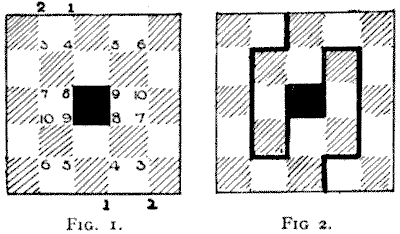
solutions are indicated by the numbers on the diagram. The duplication of the numbers can lead to no confusion, since every successive number is contiguous to the previous one. But whichever direction you take from the top downwards you must repeat from the bottom upwards, one direction being an exact reflection of the other.
1, 4, 8.
1, 4, 3, 7, 8.
1, 4, 3, 7, 10, 9.
1, 4, 3, 7, 10, 6, 5, 9.
1, 4, 5, 9.
1, 4, 5, 6, 10, 9.
1, 4, 5, 6, 10, 7, 8.
2, 3, 4, 8.
2, 3, 4, 5, 9.
2, 3, 4, 5, 6, 10, 9.
2, 3, 4, 5, 6, 10, 7, 8.
2, 3, 7, 8.
2, 3, 7, 10, 9.
2, 3, 7, 10, 6, 5, 9.
2, 3, 7, 10, 6, 5, 4, 8.
It will be seen that the fourth direction (1, 4, 3, 7, 10, 6, 5, 9) produces the solution shown in Fig. 2. The thirteenth produces the solution given in propounding the puzzle, where the cut entered at the side instead of at the top. The pieces, however, will be of the same shape if turned over, which, as it was stated in the conditions, would not constitute a different solution.
291.—THE GRAND LAMA'S PROBLEM.—solution
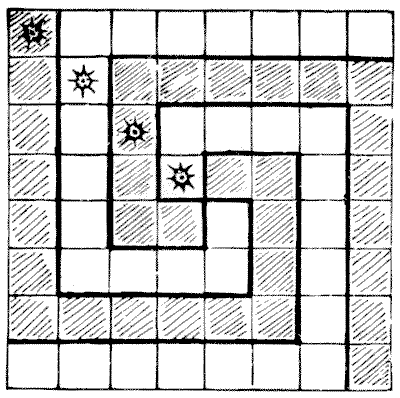
The method of dividing the chessboard so that each of the four parts shall be of exactly the same size and shape, and contain one of the gems, is shown in the diagram. The method of shading the squares is adopted to make the shape of the pieces clear to the eye. Two of the pieces are shaded and two left white.
The reader may find it interesting to compare this puzzle with that of the "Weaver" (No. 14, Canterbury Puzzles).
292.—THE ABBOT'S WINDOW.—solution
The man who was "learned in strange mysteries" pointed out to Father John that the orders of the Lord Abbot of St. Edmondsbury might be easily carried out by blocking up twelve of the lights in the window as shown by the dark squares in the following sketch:—
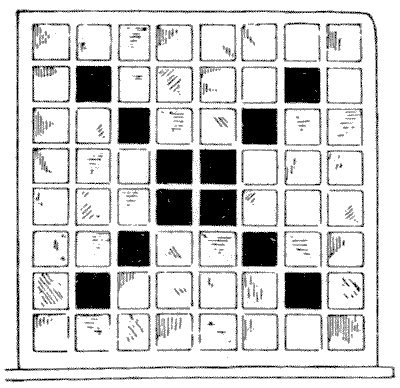
Father John held that the four corners should also be darkened, but the sage explained that it was desired to obstruct no more light than was absolutely necessary, and he said, anticipating Lord Dundreary, "A single pane can no more be in a line with itself than one bird can go into a corner and flock in solitude. The Abbot's condition was that no diagonal lines should contain an odd number of lights."
Now, when the holy man saw what had been done he was well pleased, and said, "Truly, Father John, thou art a man of deep wisdom, in that thou hast done that which seemed impossible, and yet withal adorned our window with a device of the cross of St. Andrew, whose name I received from my godfathers and godmothers." Thereafter he slept well and arose refreshed. The window might be seen intact to-day in the monastery of St. Edmondsbury, if it existed, which, alas! the window does not.
293.—THE CHINESE CHESSBOARD.—solution
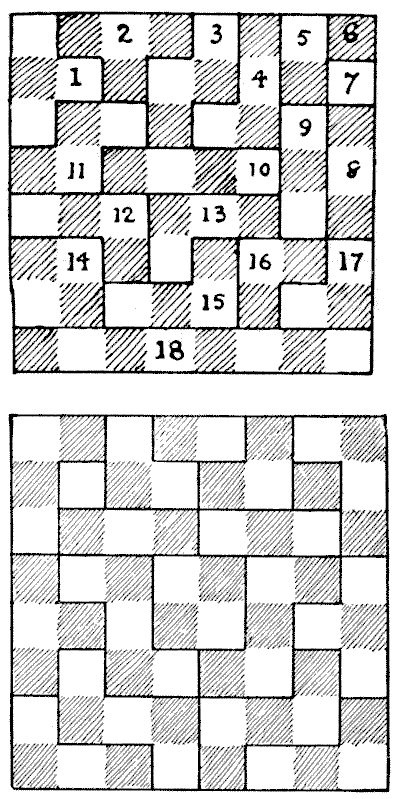
Eighteen is the maximum number of pieces. I give two solutions. The numbered diagram is so cut that the eighteenth piece has the largest area—eight squares—that is possible under the conditions. The second diagram was prepared under the added condition that no piece should contain more than five squares.
No. 74 in The Canterbury Puzzles shows how to cut the board into twelve pieces, all different, each containing five squares, with one square piece of four squares.
294.—THE CHESSBOARD SENTENCE.—solution
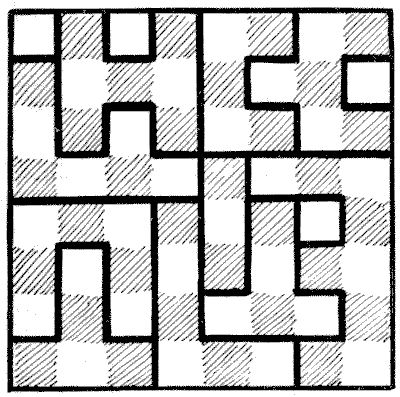
The pieces may be fitted together, as shown in the illustration, to form a perfect chessboard.
295.—THE EIGHT ROOKS.—solution
Obviously there must be a rook in every row and every column. Starting with the top row, it is clear that we may put our first rook on any one of eight different squares. Wherever it is placed, we have the option of seven squares for the second rook in the second row. Then we have six squares from which to select the third row, five in the fourth, and so on. Therefore the number of our different ways must be 8 × 7 × 6 × 5 × 4 × 3 × 2 × 1 = 40,320 (that is 8!), which is the correct answer.
How many ways there are if mere reversals and reflections are not counted as different has not yet been determined; it is a difficult problem. But this point, on a smaller square, is considered in the next puzzle.
296.—THE FOUR LIONS.—solution
There are only seven different ways under the conditions. They are as follows: 1 2 3 4, 1 2 4 3, 1 3 2 4, 1 3 4 2, 1 4 3 2, 2 1 4 3, 2 4 1 3. Taking the last example, this notation means that we place a lion in the second square of first row, fourth square of second row, first square of third row, and third square of fourth row. The first example is, of course, the one we gave when setting the puzzle.
297.—BISHOPS—UNGUARDED.—solution
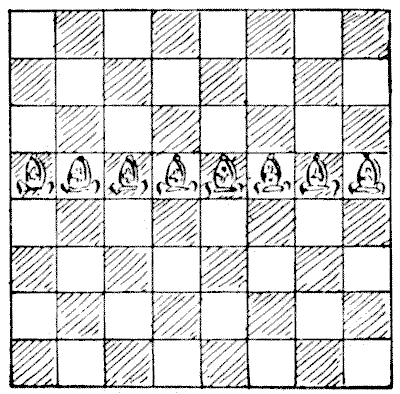
This cannot be done with fewer bishops than eight, and the simplest solution is to place the bishops in line along the fourth or fifth row of the board (see diagram). But it will be noticed that no bishop is here guarded by another, so we consider that point in the next puzzle.
298.—BISHOPS—GUARDED.—solution
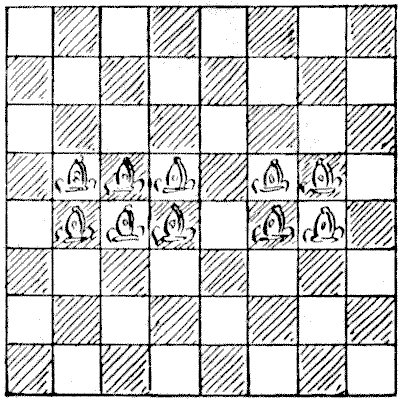
This puzzle is quite easy if you first of all give it a little thought. You need only consider squares of one colour, for whatever can be done in the case of the white squares can always be repeated on the black, and they are here quite independent of one another. This equality, of course, is in consequence of the fact that the number of squares on an ordinary chessboard, sixty-four, is an even number. If a square chequered board has an odd number of squares, then there will always be one more square of one colour than of the other.
Ten bishops are necessary in order that every square shall be attacked and every bishop guarded by another bishop. I give one way of arranging them in the diagram. It will be noticed that the two central bishops in the group of six on the left-hand side of the board serve no purpose, except to protect those bishops that are on adjoining squares. Another solution would therefore be obtained by simply raising the upper one of these one square and placing the other a square lower down.
299.—BISHOPS IN CONVOCATION.—solution
The fourteen bishops may be placed in 256 different ways. But every bishop must always be placed on one of the sides of the board—that is, somewhere on a row or file on the extreme edge. The puzzle, therefore, consists in counting the number of different ways that we can arrange the fourteen round the edge of the board without attack. This is not a difficult matter. On a chessboard of n2 squares 2n - 2 bishops (the maximum number) may always be placed in 2(n) ways without attacking. On an ordinary chessboard n would be 8; therefore 14 bishops may be placed in 256 different ways. It is rather curious that the general result should come out in so simple a form.
300.—THE EIGHT QUEENS.—solution
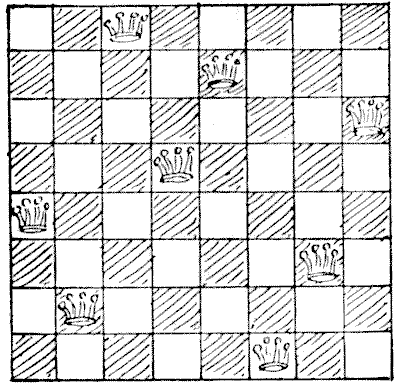
The solution to this puzzle is shown in the diagram. It will be found that no queen attacks another, and also that no three queens are in a straight line in any oblique direction. This is the only arrangement out of the twelve fundamentally different ways of placing eight queens without attack that fulfils the last condition.
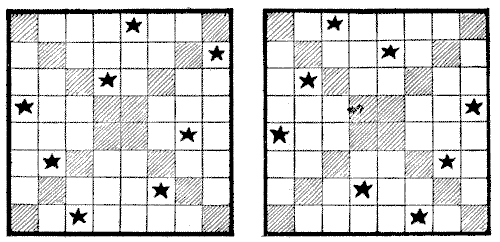
301.—THE EIGHT STARS.—solution
The solution of this puzzle is shown in the first diagram. It is the only possible solution within the conditions stated. But if one of the eight stars had not already been placed as shown, there would then have been eight ways of arranging the stars according to this scheme, if we count reversals and reflections as different. If you turn this page round so that each side is in turn at the bottom, you will get the four reversals; and if you reflect each of these in a mirror, you will get the four reflections. These are, therefore, merely eight aspects of one "fundamental solution." But without that first star being so placed, there is another fundamental solution, as shown in the second diagram. But this arrangement being in a way symmetrical, only produces four different aspects by reversal and reflection.
302.—A PROBLEM IN MOSAICS.—solution
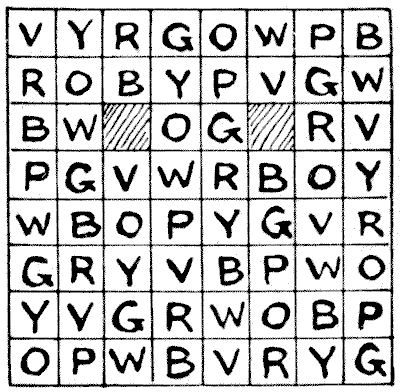
The diagram shows how the tiles may be rearranged. As before, one yellow and one purple tile are dispensed with. I will here point out that in the previous arrangement the yellow and purple tiles in the seventh row might have changed places, but no other arrangement was possible.
303.—UNDER THE VEIL.—solution
Some schemes give more diagonal readings of four letters than others, and we are at first tempted to favour these; but this is a false scent, because what you appear to gain in this direction you lose in others. Of course it immediately occurs to the solver that every LIVE or EVIL is worth twice as much as any other word, since it reads both ways and always counts as 2. This is an important consideration, though sometimes those arrangements that contain most readings of these two words are fruitless in other words, and we lose in the general count.
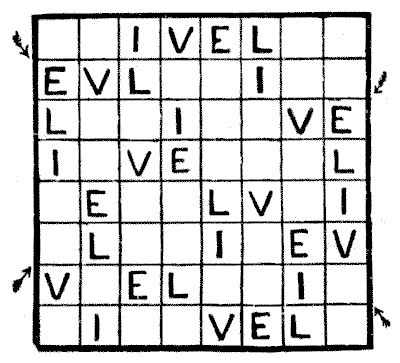
The above diagram is in accordance with the conditions requiring no letter to be in line with another similar letter, and it gives twenty readings of the five words—six horizontally, six vertically, four in the diagonals indicated by the arrows on the left, and four in the diagonals indicated by the arrows on the right. This is the maximum.
Four sets of eight letters may be placed on the board of sixty-four squares in as many as 604 different ways, without any letter ever being in line with a similar one. This does not count reversals and reflections as different, and it does not take into consideration the actual permutations of the letters among themselves; that is, for example, making the L's change places with the E's. Now it is a singular fact that not only do the twenty word-readings that I have given prove to be the real maximum, but there is actually only that one arrangement from which this maximum may be obtained. But if you make the V's change places with the I's, and the L's with the E's, in the solution given, you still get twenty readings—the same number as before in every direction. Therefore there are two ways of getting the maximum from the same arrangement. The minimum number of readings is zero—that is, the letters can be so arranged that no word can be read in any of the directions.
304.—BACHET'S SQUARE.—solution
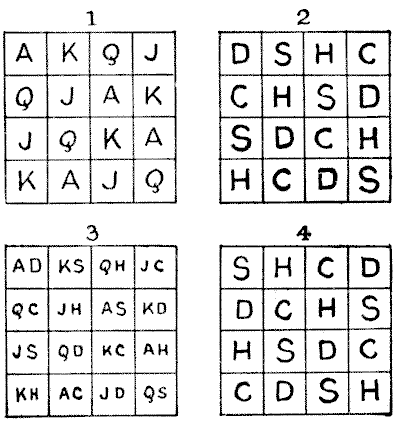
Let us use the letters A, K, Q, J, to denote ace, king, queen, jack; and D, S, H, C, to denote diamonds, spades, hearts, clubs. In Diagrams 1 and 2 we have the two available ways of arranging either group of letters so that no two similar letters shall be in line—though a quarter-turn of 1 will give us the arrangement in 2. If we superimpose or combine these two squares, we get the arrangement of Diagram 3, which is one solution. But in each square we may put the letters in the top line in twenty-four different ways without altering the scheme of arrangement. Thus, in Diagram 4 the S's are similarly placed to the D's in 2, the H's to the S's, the C's to the H's, and the D's to the C's. It clearly follows that there must be 24 × 24 = 576 ways of combining the two primitive arrangements. But the error that Labosne fell into was that of assuming that the A, K, Q, J must be arranged in the form 1, and the D, S, H, C in the form 2. He thus included reflections and half-turns, but not quarter-turns. They may obviously be interchanged. So that the correct answer is 2 × 576 = 1,152, counting reflections and reversals as different. Put in another manner, the pairs in the top row may be written in 16 × 9 ×4 × 1 = 576 different ways, and the square then completed in 2 ways, making 1,152 ways in all.
305.—THE THIRTY-SIX LETTER BLOCKS.—solution
I pointed out that it was impossible to get all the letters into the box under the conditions, but the puzzle was to place as many as possible.
This requires a little judgment and careful investigation, or we are liable to jump to the hasty conclusion that the proper way to solve the puzzle must be first to place all six of one letter, then all six of another letter, and so on. As there is only one scheme (with its reversals) for placing six similar letters so that no two shall be in a line in any direction, the reader will find that after he has placed four different kinds of letters, six times each, every place is occupied except those twelve that form the two long diagonals. He is, therefore, unable to place more than two each of his last two letters, and there are eight blanks left. I give such an arrangement in Diagram 1.
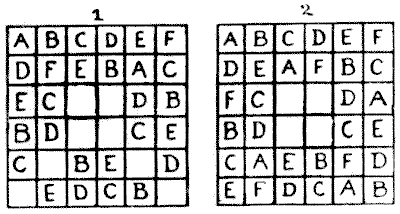
The secret, however, consists in not trying thus to place all six of each letter. It will be found that if we content ourselves with placing only five of each letter, this number (thirty in all) may be got into the box, and there will be only six blanks. But the correct solution is to place six of each of two letters and five of each of the remaining four. An examination of Diagram 2 will show that there are six each of C and D, and five each of A, B, E, and F. There are, therefore, only four blanks left, and no letter is in line with a similar letter in any direction.
306.—THE CROWDED CHESSBOARD.—solution
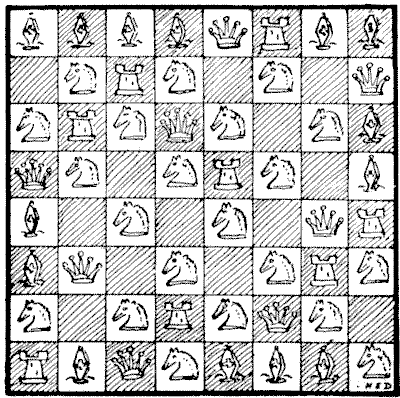
Here is the solution. Only 8 queens or 8 rooks can be placed on the board without attack, while the greatest number of bishops is 14, and of knights 32. But as all these knights must be placed on squares of the same colour, while the queens occupy four of each colour and the bishops 7 of each colour, it follows that only 21 knights can be placed on the same colour in this puzzle. More than 21 knights can be placed alone on the board if we use both colours, but I have not succeeded in placing more than 21 on the "crowded chessboard." I believe the above solution contains the maximum number of pieces, but possibly some ingenious reader may succeed in getting in another knight.
307.—THE COLOURED COUNTERS.—solution
The counters may be arranged in this order:—
R1,B2,Y3,O4,GS.
Y4,O5,G1,R2,B3.
G2,R3,B4,Y5,O1.
B5,Y1,O2,G3,R4.
O3,G4,R5,B1,Y2.
308.—THE GENTLE ART OF STAMP-LICKING.—solution
The following arrangement shows how sixteen stamps may be stuck on the card, under the conditions, of a total value of fifty pence, or 4s. 2d.:—
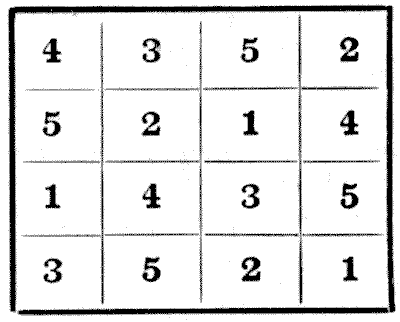
If, after placing the four 5d. stamps, the reader is tempted to place four 4d. stamps also, he can afterwards only place two of each of the three other denominations, thus losing two spaces and counting no more than forty-eight pence, or 4s. This is the pitfall that was hinted at. (Compare with No. 43, Canterbury Puzzles.)
309.—THE FORTY-NINE COUNTERS.—solution
The counters may be arranged in this order:—
A1,B2,C3,D4,E5,F6,G7.
F4,G5,A6,B7,C1,D2,E3.
D7,E1,F2,G3,A4,B5,C6.
B3,C4,D5,E6,F7,G1,A2.
G6,A7,B1,C2,D3,E4,F5.
E2,F3,G4,A5,B6,C7,D1.
C5,D6,E7,F1,G2,A3,B4.
310.—THE THREE SHEEP.—solution
The number of different ways in which the three sheep may be placed so that every pen shall always be either occupied or in line with at least one sheep is forty-seven.
The following table, if used with the key in Diagram 1, will enable the reader to place them in all these ways:—
Two Sheep.Third Sheep.No. of Ways.
A and BC, E, G, K, L, N, or P7
A and CI, J, K, or O4
A and DM, N, or J3
A and FJ, K, L, or P4
A and GH, J, K, N, O, or P6
A and HK, L, N, or O4
A and OK or L2
B and CN1
B and EF, H, K, or L4
B and FG, J, N, or O4
B and GK, L, or N3
B and HJ or N2
B and JK or L2
F and GJ1
47
This, of course, means that if you place sheep in the pens marked A and B, then there are seven different pens in which you may place the third sheep, giving seven different solutions. It was understood that reversals and reflections do not count as different.
If one pen at least is to be not in line with a sheep, there would be thirty solutions to that problem. If we counted all the reversals and reflections of these 47 and 30 cases respectively as different, their total would be 560, which is the number of different ways in which the sheep may be placed in three pens without any conditions. I will remark that there are three ways in which two sheep may be placed so that every pen is occupied or in line, as in Diagrams 2, 3, and 4, but in every case each sheep is in line with its companion. There are only two ways in which three sheep may be so placed that every pen shall be occupied or in line, but no sheep in line with another. These I show in Diagrams 5 and 6. Finally, there is only one way in which three sheep may be placed so that at least one pen shall not be in line with a sheep and yet no sheep in line with another. Place the sheep in C, E, L. This is practically all there is to be said on this pleasant pastoral subject.
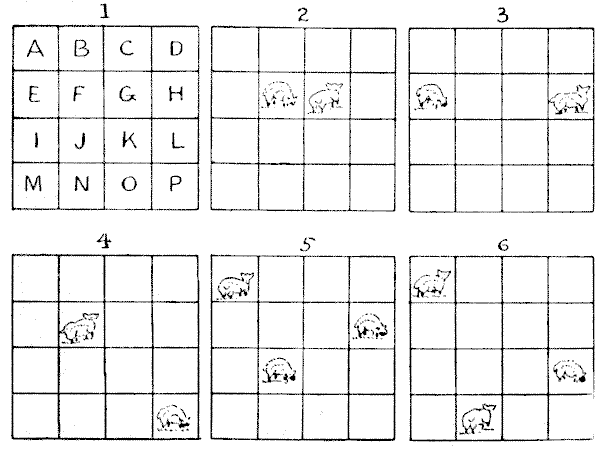
311.—THE FIVE DOGS PUZZLE.—solution
The diagrams show four fundamentally different solutions. In the case of A we can reverse the order, so that the single dog is in the bottom row and the other four shifted up two squares. Also we may use the next column to the right and both of the two central horizontal rows. Thus A gives 8 solutions. Then B may be reversed and placed in either diagonal, giving 4 solutions. Similarly C will give 4 solutions. The line in D being symmetrical, its reversal will not be different, but it may be disposed in 4 different directions. We thus have in all 20 different solutions.
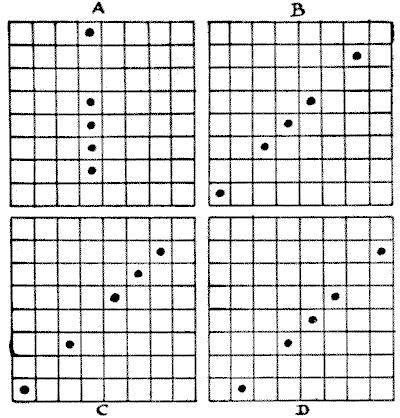
312.—THE FIVE CRESCENTS OF BYZANTIUM.—solution