SOLUTIONS. (continued 2)
Reading edition
135.—THE STONEMASON'S PROBLEM.—solution
The puzzle amounts to this. Find the smallest square number that may be expressed as the sum of more than three consecutive cubes, the cube 1 being barred. As more than three heaps were to be supplied, this condition shuts out the otherwise smallest answer, 233 + 243 + 253 = 2042. But it admits the answer, 253 + 263 + 273 + 283 + 293 = 3152. The correct answer, however, requires more heaps, but a smaller aggregate number of blocks. Here it is: 143 + 153 + ... up to 253 inclusive, or twelve heaps in all, which, added together, make 97,344 blocks of stone that may be laid out to form a square 312 × 312. I will just remark that one key to the solution lies in what are called triangular numbers. (See pp. 13, 25, and 166.)
136.—THE SULTAN'S ARMY.—solution
The smallest primes of the form 4n + 1 are 5, 13, 17, 29, and 37, and the smallest of the form 4n - 1 are 3, 7, 11, 19, and 23. Now, primes of the first form can always be expressed as the sum of two squares, and in only one way. Thus, 5 = 4 + 1; 13 = 9 + 4; 17 = 16 + 1; 29 = 25 + 4; 37 = 36 + 1. But primes of the second form can never be expressed as the sum of two squares in any way whatever.
In order that a number may be expressed as the sum of two squares in several different ways, it is necessary that it shall be a composite number containing a certain number of primes of our first form. Thus, 5 or 13 alone can only be so expressed in one way; but 65, (5 × 13), can be expressed in two ways, 1,105, (5 × 13 × 17), in four ways, 32,045, (5 × 13 × 17 × 29), in eight ways. We thus get double as many ways for every new factor of this form that we introduce. Note, however, that I say new factor, for the repetition of factors is subject to another law. We cannot express 25, (5 × 5), in two ways, but only in one; yet 125, (5 × 5 × 5), can be given in two ways, and so can 625, (5 × 5 × 5 × 5); while if we take in yet another 5 we can express the number as the sum of two squares in three different ways.
If a prime of the second form gets into your composite number, then that number cannot be the sum of two squares. Thus 15, (3 × 5), will not work, nor will 135, (3 × 3 × 3 × 5); but if we take in an even number of 3's it will work, because these 3's will themselves form a square number, but you will only get one solution. Thus, 45, (3 × 3 × 5, or 9 × 5) = 36 + 9. Similarly, the factor 2 may always occur, or any power of 2, such as 4, 8, 16, 32; but its introduction or omission will never affect the number of your solutions, except in such a case as 50, where it doubles a square and therefore gives you the two answers, 49 + 1 and 25 + 25.
Now, directly a number is decomposed into its prime factors, it is possible to tell at a glance whether or not it can be split into two squares; and if it can be, the process of discovery in how many ways is so simple that it can be done in the head without any effort. The number I gave was 130. I at once saw that this was 2 × 5 × 13, and consequently that, as 65 can be expressed in two ways (64 + 1 and 49 + 16), 130 can also be expressed in two ways, the factor 2 not affecting the question.
The smallest number that can be expressed as the sum of two squares in twelve different ways is 160,225, and this is therefore the smallest army that would answer the Sultan's purpose. The number is composed of the factors 5 × 5 × 13 × 17 × 29, each of which is of the required form. If they were all different factors, there would be sixteen ways; but as one of the factors is repeated, there are just twelve ways. Here are the sides of the twelve pairs of squares: (400 and 15), (399 and 32), (393 and 76), (392 and 81), (384 and 113), (375 and 140), (360 and 175), (356 and 183), (337 and 216), (329 and 228), (311 and 252), (265 and 300). Square the two numbers in each pair, add them together, and their sum will in every case be 160,225.
137.—A STUDY IN THRIFT.—solution
Mrs. Sandy McAllister will have to save a tremendous sum out of her housekeeping allowance if she is to win that sixth present that her canny husband promised her. And the allowance must be a very liberal one if it is to admit of such savings. The problem required that we should find five numbers higher than 36 the units of which may be displayed so as to form a square, a triangle, two triangles, and three triangles, using the complete number in every one of the four cases.
Every triangular number is such that if we multiply it by 8 and add 1 the result is an odd square number. For example, multiply 1, 3, 6, 10, 15 respectively by 8 and add 1, and we get 9, 25, 49, 81, 121, which are the squares of the odd numbers 3, 5, 7, 9, 11. Therefore in every case where 8x2 + 1 = a square number, x2 is also a triangular. This point is dealt with in our puzzle, "The Battle of Hastings." I will now merely show again how, when the first solution is found, the others may be discovered without any difficulty. First of all, here are the figures:—
8×12+ 1 =32
8×62+ 1 =172
8×352+ 1 =992
8×2042+ 1 =5772
8×11892+ 1 =33632
8×69302+ 1 =196012
8×403912+ 1 =1142432
The successive pairs of numbers are found in this way:—
(1 × 3) + (3 × 1)=6 (8 × 1) + (3 × 3)=17
(1 × 17) + (3 × 6)=35 (8 × 6) + (3 × 17)=99
(1 × 99) + (3 × 35)=204 (8 × 35) + (3 × 99)=577
and so on. Look for the numbers in the table above, and the method will explain itself.
Thus we find that the numbers 36, 1225, 41616, 1413721, 48024900, and 1631432881 will form squares with sides of 6, 35, 204, 1189, 6930, and 40391; and they will also form single triangles with sides of 8, 49, 288, 1681, 9800, and 57121. These numbers may be obtained from the last column in the first table above in this way: simply divide the numbers by 2 and reject the remainder. Thus the integral halves of 17, 99, and 577 are 8, 49, and 288.
All the numbers we have found will form either two or three triangles at will. The following little diagram will show you graphically at a glance that every square number must necessarily be the sum of two triangulars, and that the side of one triangle will be the same as the side of the corresponding square, while the other will be just 1 less.
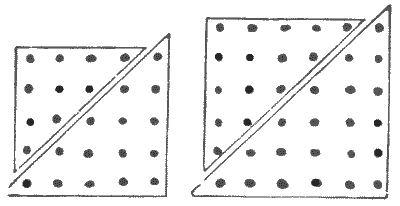
Thus a square may always be divided easily into two triangles, and the sum of two consecutive triangulars will always make a square. In numbers it is equally clear, for if we examine the first triangulars—1, 3, 6, 10, 15, 21, 28—we find that by adding all the consecutive pairs in turn we get the series of square numbers—9, 16, 25, 36, 49, etc.
The method of forming three triangles from our numbers is equally direct, and not at all a matter of trial. But I must content myself with giving actual figures, and just stating that every triangular higher than 6 will form three triangulars. I give the sides of the triangles, and readers will know from my remarks when stating the puzzle how to find from these sides the number of counters or coins in each, and so check the results if they so wish.
NumberSide of Square.Side of Triangle.Sides of Two Triangles.Sides of Three Triangles.
36686 + 55 + 5 + 3
1225354936 + 3433 + 32 + 16
41616204288204 + 203192 + 192 + 95
1413721118916811189 + 11881121 + 1120 + 560
48024900693098006930 + 69296533 + 6533 + 3267
1631432881403915712140391 + 4039038081 + 38080 + 19040
I should perhaps explain that the arrangements given in the last two columns are not the only ways of forming two and three triangles. There are others, but one set of figures will fully serve our purpose. We thus see that before Mrs. McAllister can claim her sixth £5 present she must save the respectable sum of £1,631,432,881.
138.—THE ARTILLERYMEN'S DILEMMA.—solution
We were required to find the smallest number of cannon balls that we could lay on the ground to form a perfect square, and could pile into a square pyramid. I will try to make the matter clear to the merest novice.
1234567
13610152128
141020355684
1514305591140
Here in the first row we place in regular order the natural numbers. Each number in the second row represents the sum of the numbers in the row above, from the beginning to the number just over it. Thus 1, 2, 3, 4, added together, make 10. The third row is formed in exactly the same way as the second. In the fourth row every number is formed by adding together the number just above it and the preceding number. Thus 4 and 10 make 14, 20 and 35 make 55. Now, all the numbers in the second row are triangular numbers, which means that these numbers of cannon balls may be laid out on the ground so as to form equilateral triangles. The numbers in the third row will all form our triangular pyramids, while the numbers in the fourth row will all form square pyramids.
Thus the very process of forming the above numbers shows us that every square pyramid is the sum of two triangular pyramids, one of which has the same number of balls in the side at the base, and the other one ball fewer. If we continue the above table to twenty-four places, we shall reach the number 4,900 in the fourth row. As this number is the square of 70, we can lay out the balls in a square, and can form a square pyramid with them. This manner of writing out the series until we come to a square number does not appeal to the mathematical mind, but it serves to show how the answer to the particular puzzle may be easily arrived at by anybody. As a matter of fact, I confess my failure to discover any number other than 4,900 that fulfils the conditions, nor have I found any rigid proof that this is the only answer. The problem is a difficult one, and the second answer, if it exists (which I do not believe), certainly runs into big figures.
For the benefit of more advanced mathematicians I will add that the general expression for square pyramid numbers is (2n3 + 3n2 + n)/6. For this expression to be also a square number (the special case of 1 excepted) it is necessary that n = p2 - 1 = 6t2, where 2p2 - 1 = q2 (the "Pellian Equation"). In the case of our solution above, n = 24, p = 5, t = 2, q = 7.
139.—THE DUTCHMEN'S WIVES.—solution
The money paid in every case was a square number of shillings, because they bought 1 at 1s., 2 at 2s., 3 at 3s., and so on. But every husband pays altogether 63s. more than his wife, so we have to find in how many ways 63 may be the difference between two square numbers. These are the three only possible ways: the square of 8 less the square of 1, the square of 12 less the square of 9, and the square of 32 less the square of 31. Here 1, 9, and 31 represent the number of pigs bought and the number of shillings per pig paid by each woman, and 8, 12, and 32 the same in the case of their respective husbands. From the further information given as to their purchases, we can now pair them off as follows: Cornelius and Gurtrün bought 8 and 1; Elas and Katrün bought 12 and 9; Hendrick and Anna bought 32 and 31. And these pairs represent correctly the three married couples.
The reader may here desire to know how we may determine the maximum number of ways in which a number may be expressed as the difference between two squares, and how we are to find the actual squares. Any integer except 1, 4, and twice any odd number, may be expressed as the difference of two integral squares in as many ways as it can be split up into pairs of factors, counting 1 as a factor. Suppose the number to be 5,940. The factors are 22.33.5.11. Here the exponents are 2, 3, 1, 1. Always deduct 1 from the exponents of 2 and add 1 to all the other exponents; then we get 1, 4, 2, 2, and half the product of these four numbers will be the required number of ways in which 5,940 may be the difference of two squares—that is, 8. To find these eight squares, as it is an even number, we first divide by 4 and get 1485, the eight pairs of factors of which are 1 × 1485, 3 × 495, 5 × 297, 9 × 165, 11 × 135, 15 × 99, 27 × 55, and 33 × 45. The sum and difference of any one of these pairs will give the required numbers. Thus, the square of 1,486 less the square of 1,484 is 5,940, the square of 498 less the square of 492 is the same, and so on. In the case of 63 above, the number is odd; so we factorize at once, 1 × 63, 3 × 21, 7 × 9. Then we find that half the sum and difference will give us the numbers 32 and 31, 12 and 9, and 8 and 1, as shown in the solution to the puzzle.
The reverse problem, to find the factors of a number when you have expressed it as the difference of two squares, is obvious. For example, the sum and difference of any pair of numbers in the last sentence will give us the factors of 63. Every prime number (except 1 and 2) may be expressed as the difference of two squares in one way, and in one way only. If a number can be expressed as the difference of two squares in more than one way, it is composite; and having so expressed it, we may at once obtain the factors, as we have seen. Fermat showed in a letter to Mersenne or Frénicle, in 1643, how we may discover whether a number may be expressed as the difference of two squares in more than one way, or proved to be a prime. But the method, when dealing with large numbers, is necessarily tedious, though in practice it may be considerably shortened. In many cases it is the shortest method known for factorizing large numbers, and I have always held the opinion that Fermat used it in performing a certain feat in factorizing that is historical and wrapped in mystery.
140.—FIND ADA'S SURNAME.—solution
The girls' names were Ada Smith, Annie Brown, Emily Jones, Mary Robinson, and Bessie Evans.
141.—SATURDAY MARKETING.—solution
As every person's purchase was of the value of an exact number of shillings, and as the party possessed when they started out forty shilling coins altogether, there was no necessity for any lady to have any smaller change, or any evidence that they actually had such change. This being so, the only answer possible is that the women were named respectively Anne Jones, Mary Robinson, Jane Smith, and Kate Brown. It will now be found that there would be exactly eight shillings left, which may be divided equally among the eight persons in coin without any change being required.
142.—THE SILK PATCHWORK.—solution
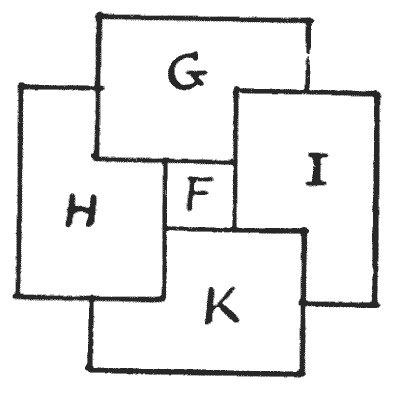
Our illustration will show how to cut the stitches of the patchwork so as to get the square F entire, and four equal pieces, G, H, I, K, that will form a perfect Greek cross. The reader will know how to assemble these four pieces from Fig. 13 in the article.
143.—TWO CROSSES FROM ONE.—solution
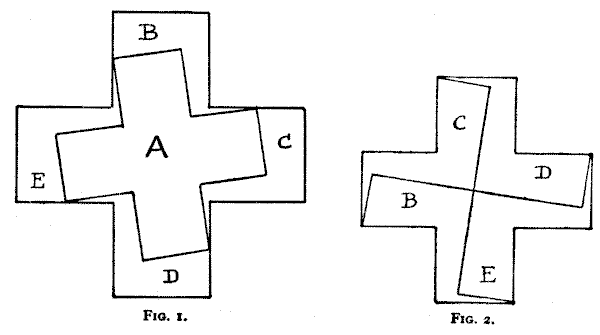
It will be seen that one cross is cut out entire, as A in Fig. 1, while the four pieces marked B, C, D and E form the second cross, as in Fig. 2, which will be of exactly the same size as the other. I will leave the reader the pleasant task of discovering for himself the best way of finding the direction of the cuts. Note that the Swastika again appears.
The difficult question now presents itself: How are we to cut three Greek crosses from one in the fewest possible pieces? As a matter of fact, this problem may be solved in as few as thirteen pieces; but as I know many of my readers, advanced geometricians, will be glad to have something to work on of which they are not shown the solution, I leave the mystery for the present undisclosed.
144.—THE CROSS AND THE TRIANGLE.—solution
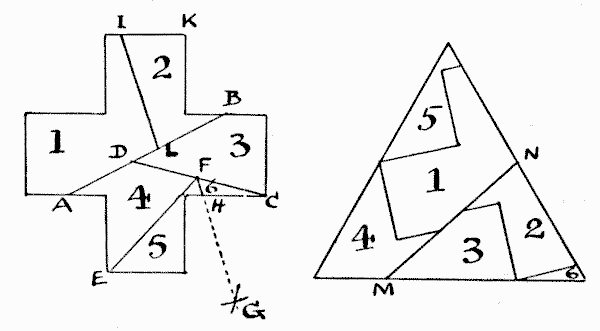
The line A B in the following diagram represents the side of a square having the same area as the cross. I have shown elsewhere, as stated, how to make a square and equilateral triangle of equal area. I need not go, therefore, into the preliminary question of finding the dimensions of the triangle that is to equal our cross. We will assume that we have already found this, and the question then becomes, How are we to cut up one of these into pieces that will form the other?
First draw the line A B where A and B are midway between the extremities of the two side arms. Next make the lines D C and E F equal in length to half the side of the triangle. Now from E and F describe with the same radius the intersecting arcs at G and draw F G. Finally make I K equal to H C and L B equal to A D. If we now draw I L, it should be parallel to F G, and all the six pieces are marked out. These fit together and form a perfect equilateral triangle, as shown in the second diagram. Or we might have first found the direction of the line M N in our triangle, then placed the point O over the point E in the cross and turned round the triangle over the cross until the line M N was parallel to A B. The piece 5 can then be marked off and the other pieces in succession.
I have seen many attempts at a solution involving the assumption that the height of the triangle is exactly the same as the height of the cross. This is a fallacy: the cross will always be higher than the triangle of equal area.
145.—THE FOLDED CROSS.—solution
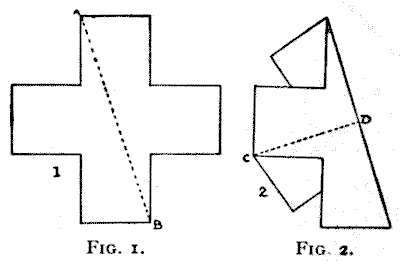
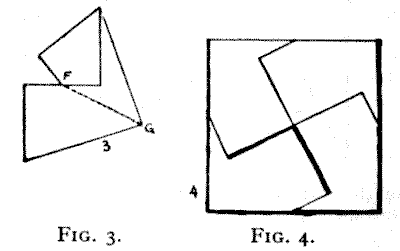
First fold the cross along the dotted line A B in Fig. 1. You then have it in the form shown in Fig. 2. Next fold it along the dotted line C D (where D is, of course, the centre of the cross), and you get the form shown in Fig. 3. Now take your scissors and cut from G to F, and the four pieces, all of the same size and shape, will fit together and form a square, as shown in Fig. 4.
146.—AN EASY DISSECTION PUZZLE.—solution
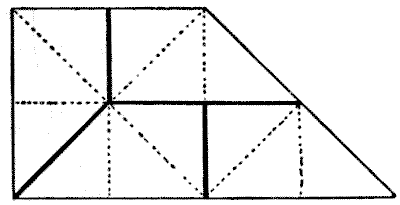
The solution to this puzzle is shown in the illustration. Divide the figure up into twelve equal triangles, and it is easy to discover the directions of the cuts, as indicated by the dark lines.
147.—AN EASY SQUARE PUZZLE.—solution
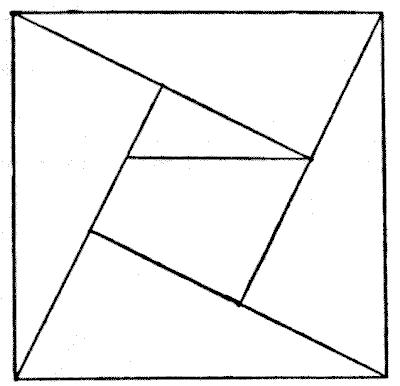
The diagram explains itself, one of the five pieces having been cut in two to form a square.
148.—THE BUN PUZZLE.—solution
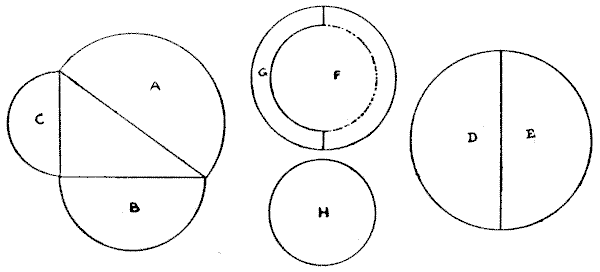
The secret of the bun puzzle lies in the fact that, with the relative dimensions of the circles as given, the three diameters will form a right-angled triangle, as shown by A, B, C. It follows that the two smaller buns are exactly equal to the large bun. Therefore, if we give David and Edgar the two halves marked D and E, they will have their fair shares—one quarter of the confectionery each. Then if we place the small bun, H, on the top of the remaining one and trace its circumference in the manner shown, Fred's piece, F, will exactly equal Harry's small bun, H, with the addition of the piece marked G—half the rim of the other. Thus each boy gets an exactly equal share, and there are only five pieces necessary.
149.—THE CHOCOLATE SQUARES.—solution
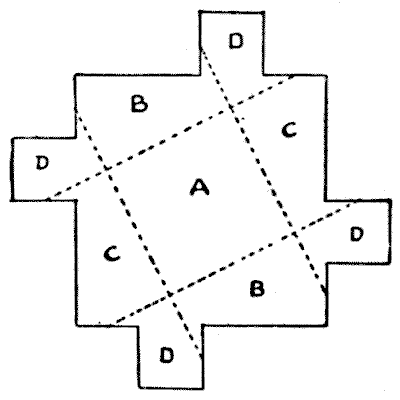
Square A is left entire; the two pieces marked B fit together and make a second square; the two pieces C make a third square; and the four pieces marked D will form the fourth square.
150.—DISSECTING A MITRE.—solution
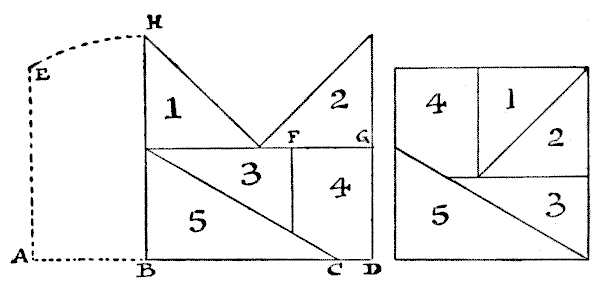
The diagram on the next page shows how to cut into five pieces to form a square. The dotted lines are intended to show how to find the points C and F—the only difficulty. A B is half B D, and A E is parallel to B H. With the point of the compasses at B describe the arc H E, and A E will be the distance of C from B. Then F G equals B C less A B.
This puzzle—with the added condition that it shall be cut into four parts of the same size and shape—I have not been able to trace to an earlier date than 1835. Strictly speaking, it is, in that form, impossible of solution; but I give the answer that is always presented, and that seems to satisfy most people.
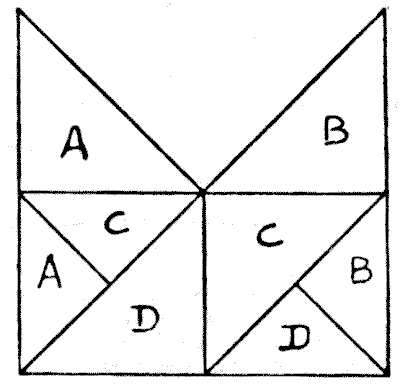
We are asked to assume that the two portions containing the same letter—AA, BB, CC, DD—are joined by "a mere hair," and are, therefore, only one piece. To the geometrician this is absurd, and the four shares are not equal in area unless they consist of two pieces each. If you make them equal in area, they will not be exactly alike in shape.
151.—THE JOINER'S PROBLEM.—solution
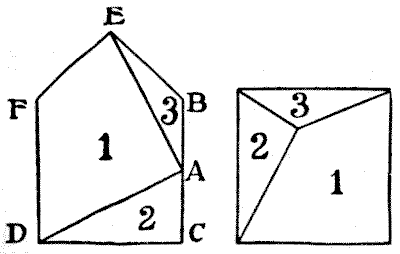
Nothing could be easier than the solution of this puzzle—when you know how to do it. And yet it is apt to perplex the novice a good deal if he wants to do it in the fewest possible pieces—three. All you have to do is to find the point A, midway between B and C, and then cut from A to D and from A to E. The three pieces then form a square in the manner shown. Of course, the proportions of the original figure must be correct; thus the triangle BEF is just a quarter of the square BCDF. Draw lines from B to D and from C to F and this will be clear.
152.—ANOTHER JOINER'S PROBLEM.—solution
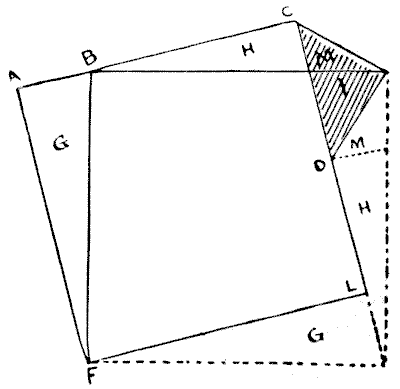
The point was to find a general rule for forming a perfect square out of another square combined with a "right-angled isosceles triangle." The triangle to which geometricians give this high-sounding name is, of course, nothing more or less than half a square that has been divided from corner to corner.
The precise relative proportions of the square and triangle are of no consequence whatever. It is only necessary to cut the wood or material into five pieces.
Suppose our original square to be ACLF in the above diagram and our triangle to be the shaded portion CED. Now, we first find half the length of the long side of the triangle (CD) and measure off this length at AB. Then we place the triangle in its present position against the square and make two cuts—one from B to F, and the other from B to E. Strange as it may seem, that is all that is necessary! If we now remove the pieces G, H, and M to their new places, as shown in the diagram, we get the perfect square BEKF.
Take any two square pieces of paper, of different sizes but perfect squares, and cut the smaller one in half from corner to corner. Now proceed in the manner shown, and you will find that the two pieces may be combined to form a larger square by making these two simple cuts, and that no piece will be required to be turned over.
The remark that the triangle might be "a little larger or a good deal smaller in proportion" was intended to bar cases where area of triangle is greater than area of square. In such cases six pieces are necessary, and if triangle and square are of equal area there is an obvious solution in three pieces, by simply cutting the square in half diagonally.
153.—A CUTTING-OUT PUZZLE.—solution
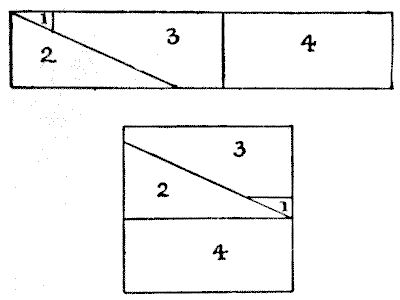
The illustration shows how to cut the four pieces and form with them a square. First find the side of the square (the mean proportional between the length and height of the rectangle), and the method is obvious. If our strip is exactly in the proportions 9x1, or 16x1, or 25x1, we can clearly cut it in 3, 4, or 5 rectangular pieces respectively to form a square. Excluding these special cases, the general law is that for a strip in length more than n² times the breadth, and not more than (n+1)² times the breadth, it may be cut in n+2 pieces to form a square, and there will be n-1 rectangular pieces like piece 4 in the diagram. Thus, for example, with a strip 24x1, the length is more than 16 and less than 25 times the breadth. Therefore it can be done in 6 pieces (n here being 4), 3 of which will be rectangular. In the case where n equals 1, the rectangle disappears and we get a solution in three pieces. Within these limits, of course, the sides need not be rational: the solution is purely geometrical.
154.—MRS. HOBSON'S HEARTHRUG.—solution
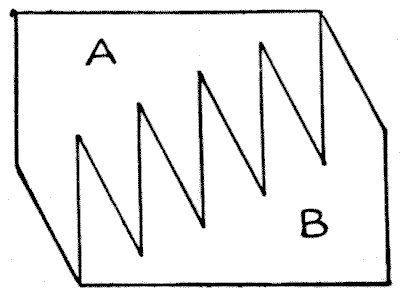
As I gave full measurements of the mutilated rug, it was quite an easy matter to find the precise dimensions for the square. The two pieces cut off would, if placed together, make an oblong piece 12x6, giving an area of 72 (inches or yards, as we please), and as the original complete rug measured 36x27, it had an area of 972. If, therefore, we deduct the pieces that have been cut away, we find that our new rug will contain 972 less 72, or 900; and as 900 is the square of 30, we know that the new rug must measure 30x30 to be a perfect square. This is a great help towards the solution, because we may safely conclude that the two horizontal sides measuring 30 each may be left intact.
There is a very easy way of solving the puzzle in four pieces, and also a way in three pieces that can scarcely be called difficult, but the correct answer is in only two pieces.
It will be seen that if, after the cuts are made, we insert the teeth of the piece B one tooth lower down, the two portions will fit together and form a square.
155.—THE PENTAGON AND SQUARE.—solution
A regular pentagon may be cut into as few as six pieces that will fit together without any turning over and form a square, as I shall show below. Hitherto the best answer has been in seven pieces—the solution produced some years ago by a foreign mathematician, Paul Busschop. We first form a parallelogram, and from that the square. The process will be seen in the diagram on the next page.
The pentagon is ABCDE. By the cut AC and the cut FM (F being the middle point between A and C, and M being the same distance from A as F) we get two pieces that may be placed in position at GHEA and form the parallelogram GHDC. We then find the mean proportional between the length HD and the height of the parallelogram. This distance we mark off from C at K, then draw CK, and from G drop the line GL, perpendicular to KC. The rest is easy and rather obvious. It will be seen that the six pieces will form either the pentagon or the square.
I have received what purported to be a solution in five pieces, but the method was based on the rather subtle fallacy that half the diagonal plus half the side of a pentagon equals the side of a square of the same area. I say subtle, because it is an extremely close approximation that will deceive the eye, and is quite difficult to prove inexact. I am not aware that attention has before been drawn to this curious approximation.
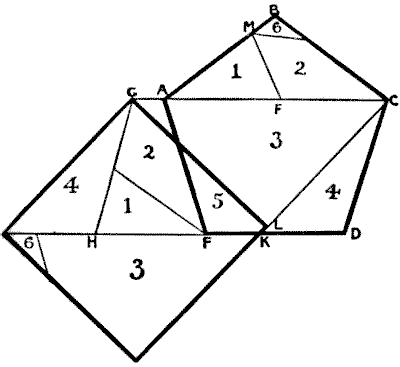
Another correspondent made the side of his square 1¼ of the side of the pentagon. As a matter of fact, the ratio is irrational. I calculate that if the side of the pentagon is 1—inch, foot, or anything else—the side of the square of equal area is 1.3117 nearly, or say roughly 13/10. So we can only hope to solve the puzzle by geometrical methods.
156.—THE DISSECTED TRIANGLE.—solution
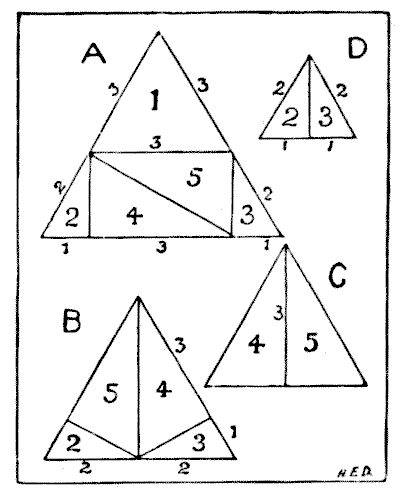
Diagram A is our original triangle. We will say it measures 5 inches (or 5 feet) on each side. If we take off a slice at the bottom of any equilateral triangle by a cut parallel with the base, the portion that remains will always be an equilateral triangle; so we first cut off piece 1 and get a triangle 3 inches on every side. The manner of finding directions of the other cuts in A is obvious from the diagram.
Now, if we want two triangles, 1 will be one of them, and 2, 3, 4, and 5 will fit together, as in B, to form the other. If we want three equilateral triangles, 1 will be one, 4 and 5 will form the second, as in C, and 2 and 3 will form the third, as in D. In B and C the piece 5 is turned over; but there can be no objection to this, as it is not forbidden, and is in no way opposed to the nature of the puzzle.
157.—THE TABLE-TOP AND STOOLS.—solution
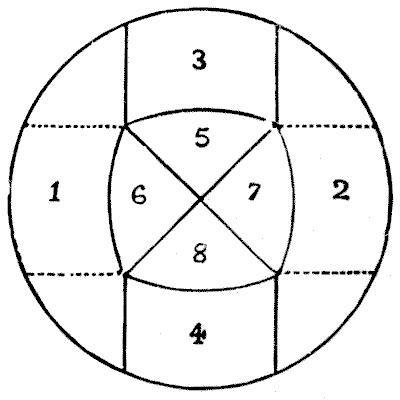
One object that I had in view when presenting this little puzzle was to point out the uncertainty of the meaning conveyed by the word "oval." Though originally derived from the Latin word ovum, an egg, yet what we understand as the egg-shape (with one end smaller than the other) is only one of many forms of the oval; while some eggs are spherical in shape, and a sphere or circle is most certainly not an oval. If we speak of an ellipse—a conical ellipse—we are on safer ground, but here we must be careful of error. I recollect a Liverpool town councillor, many years ago, whose ignorance of the poultry-yard led him to substitute the word "hen" for "fowl," remarking, "We must remember, gentlemen, that although every cock is a hen, every hen is not a cock!" Similarly, we must always note that although every ellipse is an oval, every oval is not an ellipse. It is correct to say that an oval is an oblong curvilinear figure, having two unequal diameters, and bounded by a curve line returning into itself; and this includes the ellipse, but all other figures which in any way approach towards the form of an oval without necessarily having the properties above described are included in the term "oval." Thus the following solution that I give to our puzzle involves the pointed "oval," known among architects as the "vesica piscis."
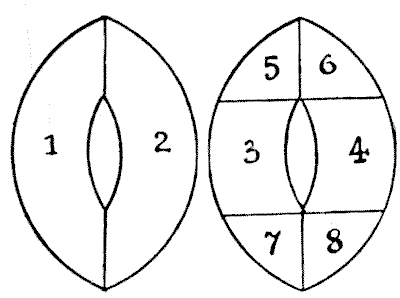
The dotted lines in the table are given for greater clearness, the cuts being made along the other lines. It will be seen that the eight pieces form two stools of exactly the same size and shape with similar hand-holes. These holes are a trifle longer than those in the schoolmaster's stools, but they are much narrower and of considerably smaller area. Of course 5 and 6 can be cut out in one piece—also 7 and 8—making only six pieces in all. But I wished to keep the same number as in the original story.
When I first gave the above puzzle in a London newspaper, in competition, no correct solution was received, but an ingenious and neatly executed attempt by a man lying in a London infirmary was accompanied by the following note: "Having no compasses here, I was compelled to improvise a pair with the aid of a small penknife, a bit of firewood from a bundle, a piece of tin from a toy engine, a tin tack, and two portions of a hairpin, for points. They are a fairly serviceable pair of compasses, and I shall keep them as a memento of your puzzle."
158.—THE GREAT MONAD.—solution
The areas of circles are to each other as the squares of their diameters. If you have a circle 2 in. in diameter and another 4 in. in diameter, then one circle will be four times as great in area as the other, because the square of 4 is four times as great as the square of 2. Now, if we refer to Diagram 1, we see how two equal squares may be cut into four pieces that will form one larger square; from which it is self-evident that any square has just half the area of the square of its diagonal. In Diagram 2 I have introduced a square as it often occurs in ancient drawings of the Monad; which was my reason for believing that the symbol had mathematical meanings, since it will be found to demonstrate the fact that the area of the outer ring or annulus is exactly equal to the area of the inner circle. Compare Diagram 2 with Diagram 1, and you will see that as the square of the diameter CD is double the square of the diameter of the inner circle, or CE, therefore the area of the larger circle is double the area of the smaller one, and consequently the area of the annulus is exactly equal to that of the inner circle. This answers our first question.
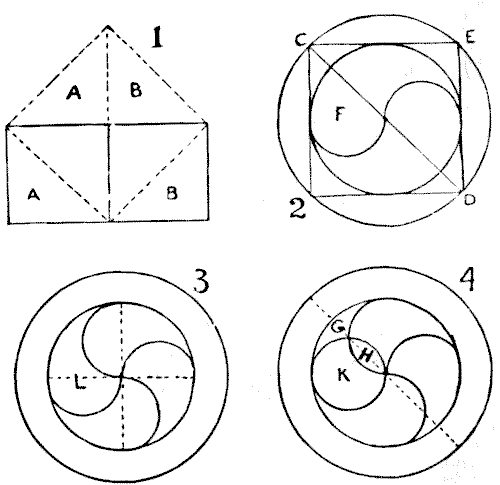
In Diagram 3 I show the simple solution to the second question. It is obviously correct, and may be proved by the cutting and superposition of parts. The dotted lines will also serve to make it evident. The third question is solved by the cut CD in Diagram 2, but it remains to be proved that the piece F is really one-half of the Yin or the Yan. This we will do in Diagram 4. The circle K has one-quarter the area of the circle containing Yin and Yan, because its diameter is just one-half the length. Also L in Diagram 3 is, we know, one-quarter the area. It is therefore evident that G is exactly equal to H, and therefore half G is equal to half H. So that what F loses from L it gains from K, and F must be half of Yin or Yan.
159.—THE SQUARE OF VENEER.—solution
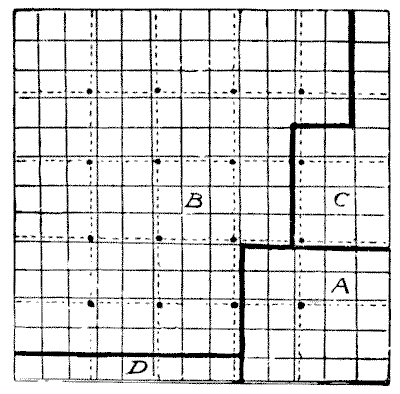
Any square number may be expressed as the sum of two squares in an infinite number of different ways. The solution of the present puzzle forms a simple demonstration of this rule. It is a condition that we give actual dimensions.
In this puzzle I ignore the known dimensions of our square and work on the assumption that it is 13n by 13n. The value of n we can afterwards determine. Divide the square as shown (where the dotted lines indicate the original markings) into 169 squares. As 169 is the sum of the two squares 144 and 25, we will proceed to divide the veneer into two squares, measuring respectively 12x12 and 5x5; and as we know that two squares may be formed from one square by dissection in four pieces, we seek a solution in this number. The dark lines in the diagram show where the cuts are to be made. The square 5x5 is cut out whole, and the larger square is formed from the remaining three pieces, B, C, and D, which the reader can easily fit together.
Now, n is clearly 5/13 of an inch. Consequently our larger square must be 60/13 in. × 60/13 in., and our smaller square 25/13 in. × 25/13 in. The square of 60/13 added to the square of 25/13 is 25. The square is thus divided into as few as four pieces that form two squares of known dimensions, and all the sixteen nails are avoided.
Here is a general formula for finding two squares whose sum shall equal a given square, say a². In the case of the solution of our puzzle p = 3, q = 2, and a = 5.
_________________________ 2pqa \/ a²( p² + q²)² - (2pqa)² --------- = x; --------------------------- = y p² + q² p² + q² Here x² + y² = a².
160.—THE TWO HORSESHOES.—solution
The puzzle was to cut the two shoes (including the hoof contained within the outlines) into four pieces, two pieces each, that would fit together and form a perfect circle. It was also stipulated that all four pieces should be different in shape. As a matter of fact, it is a puzzle based on the principle contained in that curious Chinese symbol the Monad. (See No. 158.)
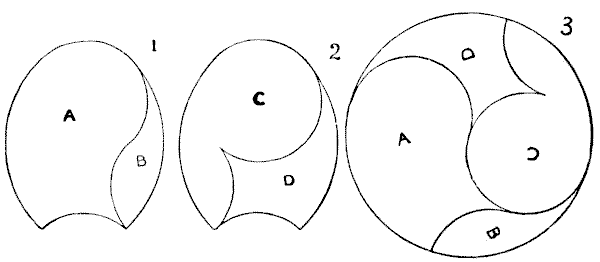
The above diagrams give the correct solution to the problem. It will be noticed that 1 and 2 are cut into the required four pieces, all different in shape, that fit together and form the perfect circle shown in Diagram 3. It will further be observed that the two pieces A and B of one shoe and the two pieces C and D of the other form two exactly similar halves of the circle—the Yin and the Yan of the great Monad. It will be seen that the shape of the horseshoe is more easily determined from the circle than the dimensions of the circle from the horseshoe, though the latter presents no difficulty when you know that the curve of the long side of the shoe is part of the circumference of your circle. The difference between B and D is instructive, and the idea is useful in all such cases where it is a condition that the pieces must be different in shape. In forming D we simply add on a symmetrical piece, a curvilinear square, to the piece B. Therefore, in giving either B or D a quarter turn before placing in the new position, a precisely similar effect must be produced.
161.—THE BETSY ROSS PUZZLE.—solution
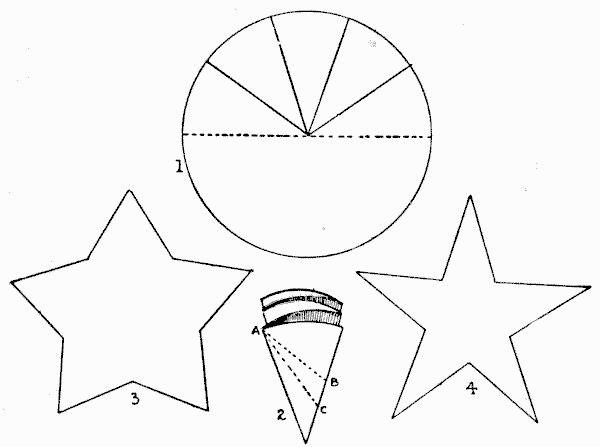
Fold the circular piece of paper in half along the dotted line shown in Fig. 1, and divide the upper half into five equal parts as indicated. Now fold the paper along the lines, and it will have the appearance shown in Fig. 2. If you want a star like Fig. 3, cut from A to B; if you wish one like Fig. 4, cut from A to C. Thus, the nearer you cut to the point at the bottom the longer will be the points of the star, and the farther off from the point that you cut the shorter will be the points of the star.
162.—THE CARDBOARD CHAIN.—solution
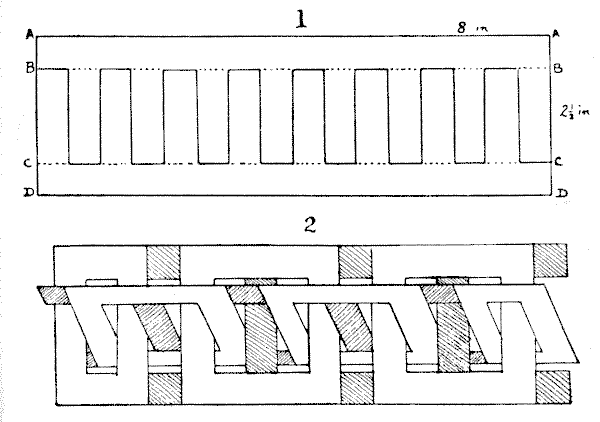
The reader will probably feel rewarded for any care and patience that he may bestow on cutting out the cardboard chain. We will suppose that he has a piece of cardboard measuring 8 in. by 2½ in., though the dimensions are of no importance. Yet if you want a long chain you must, of course, take a long strip of cardboard. First rule pencil lines B B and C C, half an inch from the edges, and also the short perpendicular lines half an inch apart. Rule lines on the other side in just the same way, and in order that they shall coincide it is well to prick through the card with a needle the points where the short lines end. Now take your penknife and split the card from A A down to B B, and from D D up to C C. Then cut right through the card along all the short perpendicular lines, and half through the card along the short portions of B B and C C that are not dotted. Next turn the card over and cut half through along the short lines on B B and C C at the places that are immediately beneath the dotted lines on the upper side. With a little careful separation of the parts with the penknife, the cardboard may now be divided into two interlacing ladder-like portions, as shown in Fig. 2; and if you cut away all the shaded parts you will get the chain, cut solidly out of the cardboard, without any join, as shown in the illustrations on page 40.
It is an interesting variant of the puzzle to cut out two keys on a ring—in the same manner without join.
164.—THE POTATO PUZZLE.—solution
As many as twenty-two pieces may be obtained by the six cuts. The illustration shows a pretty symmetrical solution. The rule in such cases is that every cut shall intersect every other cut and no two intersections coincide; that is to say, every line passes through every other line, but more than two lines do not cross at the same point anywhere. There are other ways of making the cuts, but this rule must always be observed if we are to get the full number of pieces.
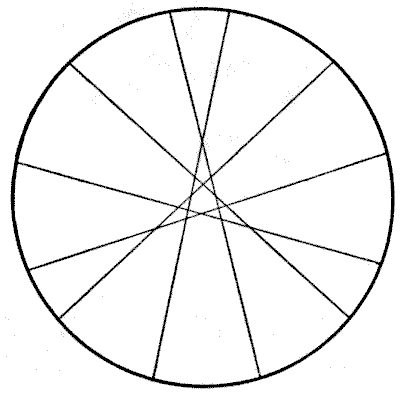
The general formula is that with n cuts we can always produce (n(n + 1) + 1)/2 . One of the problems proposed by the late Sam Loyd was to produce the maximum number of pieces by n straight cuts through a solid cheese. Of course, again, the pieces cut off may not be moved or piled. Here we have to deal with the intersection of planes (instead of lines), and the general formula is that with n cuts we may produce ((n - 1)n(n + 1))/6 + n + 1 pieces. It is extremely difficult to "see" the direction and effects of the successive cuts for more than a few of the lowest values of n.
165.—THE SEVEN PIGS.—solution
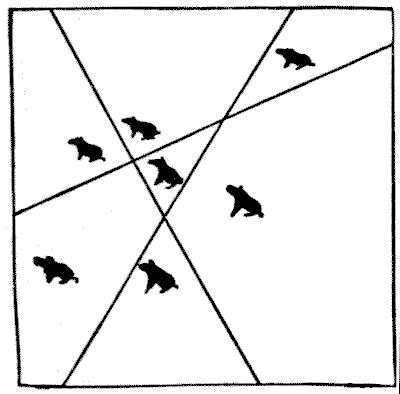
The illustration shows the direction for placing the three fences so as to enclose every pig in a separate sty. The greatest number of spaces that can be enclosed with three straight lines in a square is seven, as shown in the last puzzle. Bearing this fact in mind, the puzzle must be solved by trial.
166.—THE LANDOWNER'S FENCES.—solution
Four fences only are necessary, as follows:—
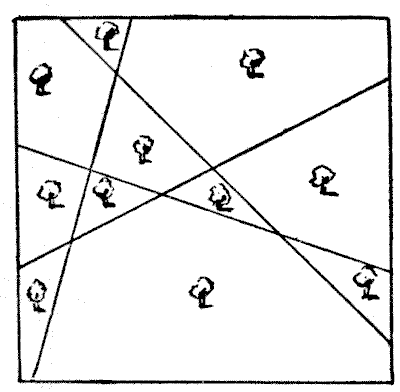
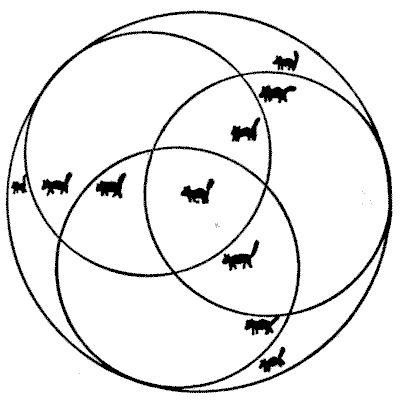
167.—THE WIZARD'S CATS.—solution
The illustration requires no explanation. It shows clearly how the three circles may be drawn so that every cat has a separate enclosure, and cannot approach another cat without crossing a line.
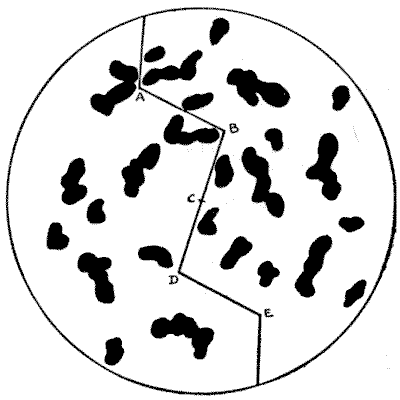
168.—THE CHRISTMAS PUDDING.—solution
The illustration shows how the pudding may be cut into two parts of exactly the same size and shape. The lines must necessarily pass through the points A, B, C, D, and E. But, subject to this condition, they may be varied in an infinite number of ways. For example, at a point midway between A and the edge, the line may be completed in an unlimited number of ways (straight or crooked), provided it be exactly reflected from E to the opposite edge. And similar variations may be introduced at other places.
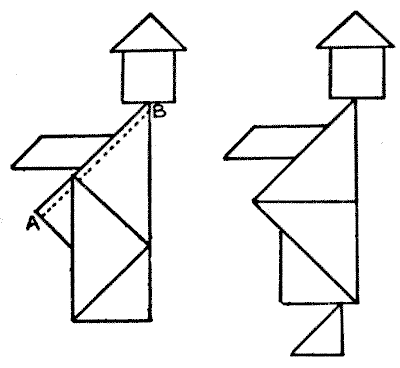
169.—A TANGRAM PARADOX.—solution
The diagrams will show how the figures are constructed—each with the seven Tangrams. It will be noticed that in both cases the head, hat, and arm are precisely alike, and the width at the base of the body the same. But this body contains four pieces in the first case, and in the second design only three. The first is larger than the second by exactly that narrow strip indicated by the dotted line between A and B. This strip is therefore exactly equal in area to the piece forming the foot in the other design, though when thus distributed along the side of the body the increased dimension is not easily apparent to the eye.
170.—THE CUSHION COVERS.—solution
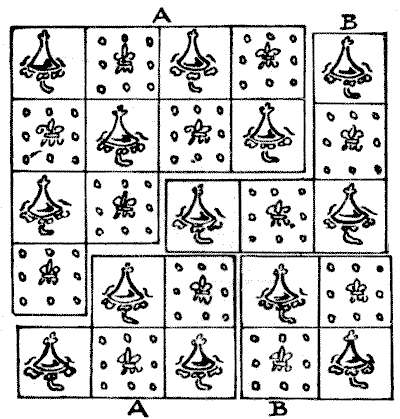
The two pieces of brocade marked A will fit together and form one perfect square cushion top, and the two pieces marked B will form the other.
171.—THE BANNER PUZZLE.—solution
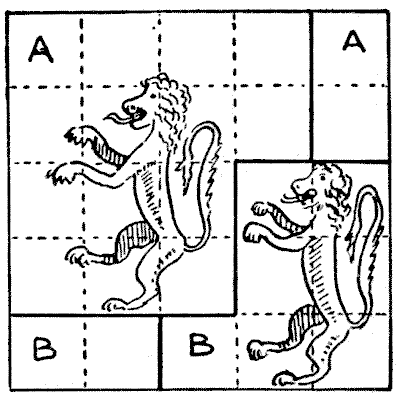
The illustration explains itself. Divide the bunting into 25 squares (because this number is the sum of two other squares—16 and 9), and then cut along the thick lines. The two pieces marked A form one square, and the two pieces marked B form the other.
172.—MRS. SMILEY'S CHRISTMAS PRESENT.—solution
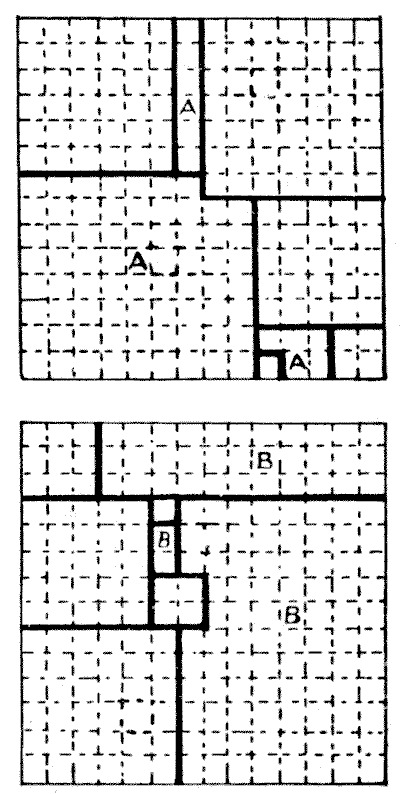
The first step is to find six different square numbers that sum to 196. For example, 1 + 4 + 25 + 36 + 49 + 81 = 196; 1 + 4 + 9 + 25 + 36 + 121 = 196; 1 + 9 + 16 + 25 + 64 + 81 = 196. The rest calls for individual judgment and ingenuity, and no definite rules can be given for procedure. The annexed diagrams will show solutions for the first two cases stated. Of course the three pieces marked A and those marked B will fit together and form a square in each case. The assembling of the parts may be slightly varied, and the reader may be interested in finding a solution for the third set of squares I have given.
173.—MRS. PERKINS'S QUILT.—solution
The following diagram shows how the quilt should be constructed.
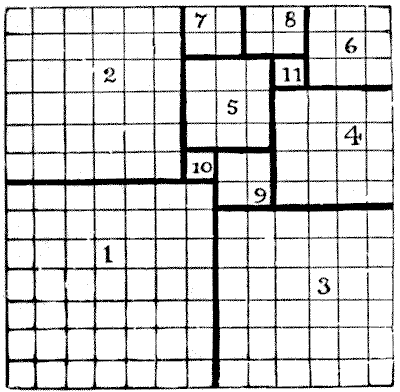
There is, I believe, practically only one solution to this puzzle. The fewest separate squares must be eleven. The portions must be of the sizes given, the three largest pieces must be arranged as shown, and the remaining group of eight squares may be "reflected," but cannot be differently arranged.
174.—THE SQUARES OF BROCADE.—solution
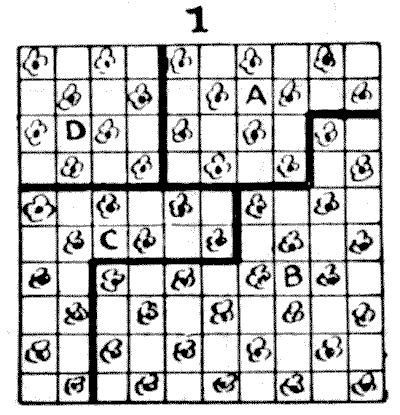
So far as I have been able to discover, there is only one possible solution to fulfil the conditions. The pieces fit together as in Diagram 1, Diagrams 2 and 3 showing how the two original squares are to be cut. It will be seen that the pieces A and C have each twenty chequers, and are therefore of equal area. Diagram 4 (built up with the dissected square No. 5) solves the puzzle, except for the small condition contained in the words, "I cut the two squares in the manner desired." In this case the smaller square is preserved intact. Still I give it as an illustration of a feature of the puzzle. It is impossible in a problem of this kind to give a quarter-turn to any of the pieces if the pattern is to properly match, but (as in the case of F, in Diagram 4) we may give a symmetrical piece a half-turn—that is, turn it upside down. Whether or not a piece may be given a quarter-turn, a half-turn, or no turn at all in these chequered problems, depends on the character of the design, on the material employed, and also on the form of the piece itself.
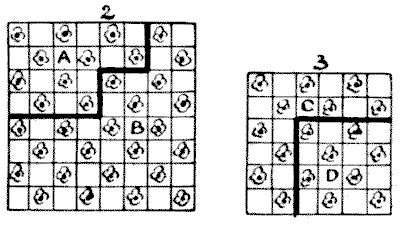
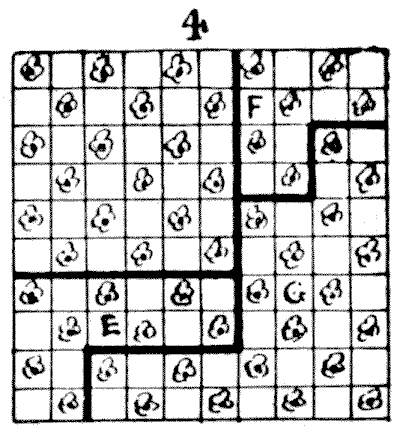
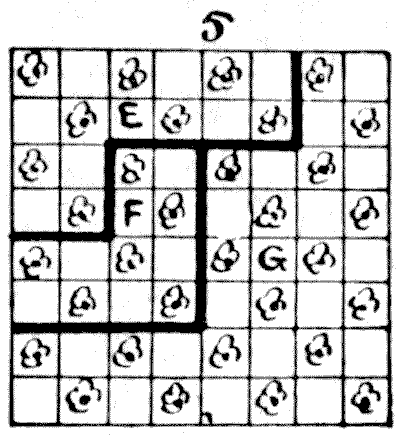
175.—ANOTHER PATCHWORK PUZZLE.—solution
The lady need only unpick the stitches along the dark lines in the larger portion of patchwork, when the four pieces will fit together and form a square, as shown in our illustration.
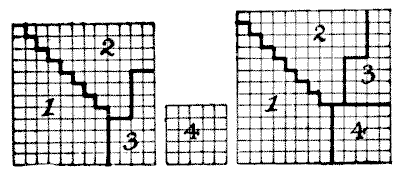
176.—LINOLEUM CUTTING.—solution
There is only one solution that will enable us to retain the larger of the two pieces with as little as possible cut from it. Fig. 1 in the following diagram shows how the smaller piece is to be cut, and Fig. 2 how we should dissect the larger piece, while in Fig. 3 we have the new square 10 × 10 formed by the four pieces with all the chequers properly matched. It will be seen that the piece D contains fifty-two chequers, and this is the largest piece that it is possible to preserve under the conditions.
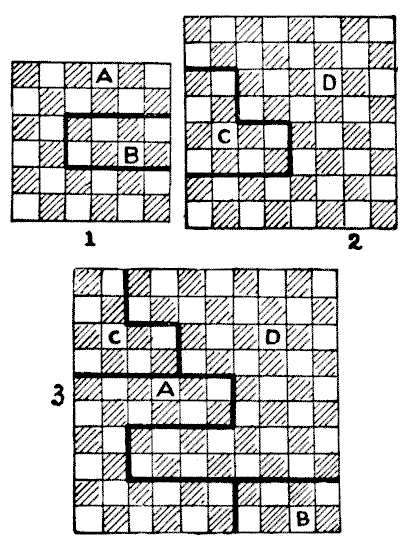
177.—ANOTHER LINOLEUM PUZZLE.—solution
Cut along the thick lines, and the four pieces will fit together and form a perfect square in the manner shown in the smaller diagram.
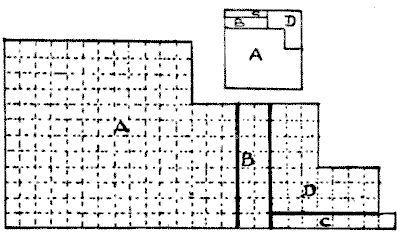
178.—THE CARDBOARD BOX.—solution
The areas of the top and side multiplied together and divided by the area of the end give the square of the length. Similarly, the product of top and end divided by side gives the square of the breadth; and the product of side and end divided by the top gives the square of the depth. But we only need one of these operations. Let us take the first. Thus, 120 × 96 divided by 80 equals 144, the square of 12. Therefore the length is 12 inches, from which we can, of course, at once get the breadth and depth—10 in. and 8 in. respectively.
179.—STEALING THE BELL-ROPES.—solution
Whenever we have one side (a) of a right-angled triangle, and know the difference between the second side and the hypotenuse (which difference we will call b), then the length of the hypotenuse will be
a2/2b + b/2
In the case of our puzzle this will be
(48 × 48)/6 + 1½ in. = 32 ft. 1½ in.,
which is the length of the rope.
180.—THE FOUR SONS.—solution
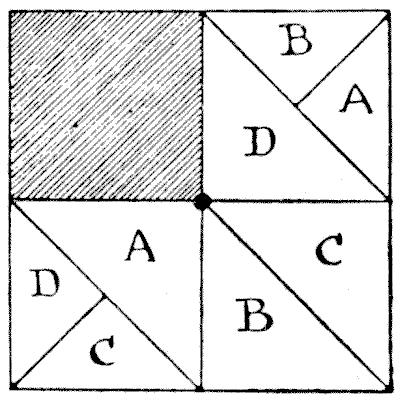
The diagram shows the most equitable division of the land possible, "so that each son shall receive land of exactly the same area and exactly similar in shape," and so that each shall have access to the well in the centre without trespass on another's land. The conditions do not require that each son's land shall be in one piece, but it is necessary that the two portions assigned to an individual should be kept apart, or two adjoining portions might be held to be one piece, in which case the condition as to shape would have to be broken. At present there is only one shape for each piece of land—half a square divided diagonally. And A, B, C, and D can each reach their land from the outside, and have each equal access to the well in the centre.
181.—THE THREE RAILWAY STATIONS.—solution
The three stations form a triangle, with sides 13, 14, and 15 miles. Make the 14 side the base; then the height of the triangle is 12 and the area 84. Multiply the three sides together and divide by four times the area. The result is eight miles and one-eighth, the distance required.
182.—THE GARDEN PUZZLE.—solution
Half the sum of the four sides is 144. From this deduct in turn the four sides, and we get 64, 99, 44, and 81. Multiply these together, and we have as the result the square of 4,752. Therefore the garden contained 4,752 square yards. Of course the tree being equidistant from the four corners shows that the garden is a quadrilateral that may be inscribed in a circle.
183.—DRAWING A SPIRAL.—solution
Make a fold in the paper, as shown by the dotted line in the illustration. Then, taking any two points, as A and B, describe semicircles on the line alternately from the centres B and A, being careful to make the ends join, and the thing is done. Of course this is not a true spiral, but the puzzle was to produce the particular spiral that was shown, and that was drawn in this simple manner.
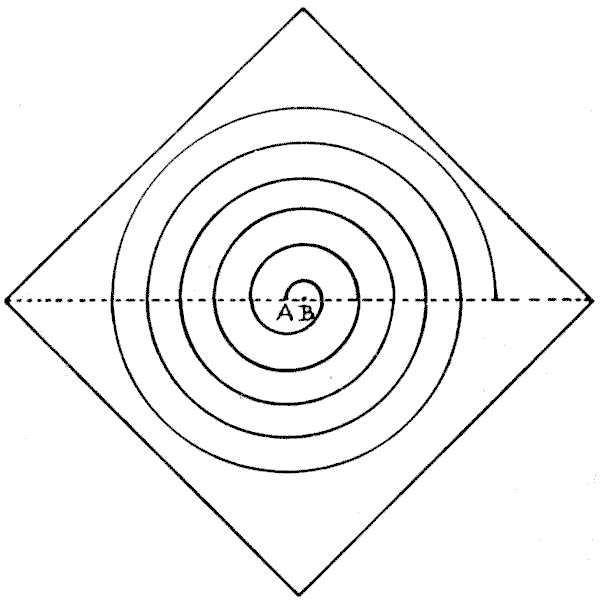
184.—HOW TO DRAW AN OVAL.—solution
If you place your sheet of paper round the surface of a cylindrical bottle or canister, the oval can be drawn with one sweep of the compasses.
185.—ST. GEORGE'S BANNER.—solution
As the flag measures 4 ft. by 3 ft., the length of the diagonal (from corner to corner) is 5 ft. All you need do is to deduct half the length of this diagonal (2½ ft.) from a quarter of the distance all round the edge of the flag (3½ ft.)—a quarter of 14 ft. The difference (1 ft.) is the required width of the arm of the red cross. The area of the cross will then be the same as that of the white ground.
186.—THE CLOTHES LINE PUZZLE.—solution
Multiply together, and also add together, the heights of the two poles and divide one result by the other. That is, if the two heights are a and b respectively, then ab/(a + b) will give the height of the intersection. In the particular case of our puzzle, the intersection was therefore 2 ft. 11 in. from the ground. The distance that the poles are apart does not affect the answer. The reader who may have imagined that this was an accidental omission will perhaps be interested in discovering the reason why the distance between the poles may be ignored.
187.—THE MILKMAID PUZZLE.—solution
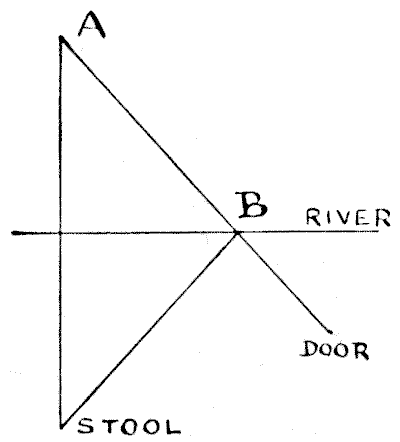
Draw a straight line, as shown in the diagram, from the milking-stool perpendicular to the near bank of the river, and continue it to the point A, which is the same distance from that bank as the stool. If you now draw the straight line from A to the door of the dairy, it will cut the river at B. Then the shortest route will be from the stool to B and thence to the door. Obviously the shortest distance from A to the door is the straight line, and as the distance from the stool to any point of the river is the same as from A to that point, the correctness of the solution will probably appeal to every reader without any acquaintance with geometry.
188.—THE BALL PROBLEM.—solution
If a round ball is placed on the level ground, six similar balls may be placed round it (all on the ground), so that they shall all touch the central ball.
As for the second question, the ratio of the diameter of a circle to its circumference we call pi; and though we cannot express this ratio in exact numbers, we can get sufficiently near to it for all practical purposes. However, in this case it is not necessary to know the value of pi at all. Because, to find the area of the surface of a sphere we multiply the square of the diameter by pi; to find the volume of a sphere we multiply the cube of the diameter by one-sixth of pi. Therefore we may ignore pi, and have merely to seek a number whose square shall equal one-sixth of its cube. This number is obviously 6. Therefore the ball was 6 ft. in diameter, for the area of its surface will be 36 times pi in square feet, and its volume also 36 times pi in cubic feet.
189.—THE YORKSHIRE ESTATES.—solution
The triangular piece of land that was not for sale contains exactly eleven acres. Of course it is not difficult to find the answer if we follow the eccentric and tricky tracks of intricate trigonometry; or I might say that the application of a well-known formula reduces the problem to finding one-quarter of the square root of (4 × 370 × 116) - (370 + 116 - 74)²—that is a quarter of the square root of 1936, which is one-quarter of 44, or 11 acres. But all that the reader really requires to know is the Pythagorean law on which many puzzles have been built, that in any right-angled triangle the square of the hypotenuse is equal to the sum of the squares of the other two sides. I shall dispense with all "surds" and similar absurdities, notwithstanding the fact that the sides of our triangle are clearly incommensurate, since we cannot exactly extract the square roots of the three square areas.
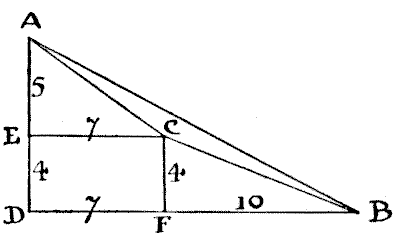
In the above diagram ABC represents our triangle. ADB is a right-angled triangle, AD measuring 9 and BD measuring 17, because the square of 9 added to the square of 17 equals 370, the known area of the square on AB. Also AEC is a right-angled triangle, and the square of 5 added to the square of 7 equals 74, the square estate on A C. Similarly, CFB is a right-angled triangle, for the square of 4 added to the square of 10 equals 116, the square estate on BC. Now, although the sides of our triangular estate are incommensurate, we have in this diagram all the exact figures that we need to discover the area with precision.
The area of our triangle ADB is clearly half of 9 × 17, or 76½ acres. The area of AEC is half of 5 × 7, or 17½ acres; the area of CFB is half of 4 × 10, or 20 acres; and the area of the oblong EDFC is obviously 4 × 7, or 28 acres. Now, if we add together 17½, 20, and 28 = 65½, and deduct this sum from the area of the large triangle ADB (which we have found to be 76½ acres), what remains must clearly be the area of ABC. That is to say, the area we want must be 76½ - 65½ = 11 acres exactly.
190.—FARMER WURZEL'S ESTATE.—solution
The area of the complete estate is exactly one hundred acres. To find this answer I use the following little formula,
__________________ \/4ab - (a + b - c)²; _____________________ 4
where a, b, c represent the three square areas, in any order. The expression gives the area of the triangle A. This will be found to be 9 acres. It can be easily proved that A, B, C, and D are all equal in area; so the answer is 26 + 20 + 18 + 9 + 9 + 9 + 9 = 100 acres.
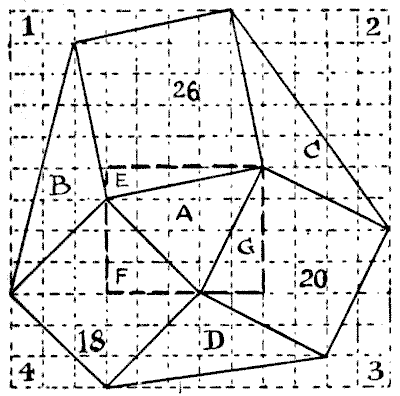
Here is the proof. If every little dotted square in the diagram represents an acre, this must be a correct plan of the estate, for the squares of 5 and 1 together equal 26; the squares of 4 and 2 equal 20; and the squares of 3 and 3 added together equal 18. Now we see at once that the area of the triangle E is 2½, F is 4½, and G is 4. These added together make 11 acres, which we deduct from the area of the rectangle, 20 acres, and we find that the field A contains exactly 9 acres. If you want to prove that B, C, and D are equal in size to A, divide them in two by a line from the middle of the longest side to the opposite angle, and you will find that the two pieces in every case, if cut out, will exactly fit together and form A.
Or we can get our proof in a still easier way. The complete area of the squared diagram is 12 × 12 = 144 acres, and the portions 1, 2, 3, 4, not included in the estate, have the respective areas of 12½, 17½, 9½, and 4½. These added together make 44, which, deducted from 144, leaves 100 as the required area of the complete estate.
191.—THE CRESCENT PUZZLE.—solution
Referring to the original diagram, let AC be x, let CD be x - 9, and let EC be x - 5. Then x - 5 is a mean proportional between x - 9 and x, from which we find that x equals 25. Therefore the diameters are 50 in. and 41 in. respectively.
192.—THE PUZZLE WALL.—solution
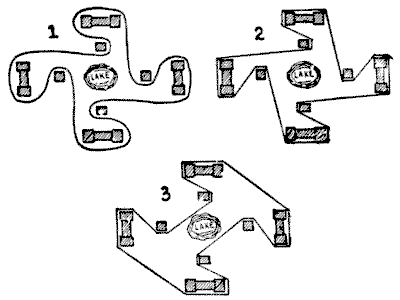
The answer given in all the old books is that shown in Fig. 1, where the curved wall shuts out the cottages from access to the lake. But in seeking the direction for the "shortest possible" wall most readers to-day, remembering that the shortest distance between two points is a straight line, will adopt the method shown in Fig. 2. This is certainly an improvement, yet the correct answer is really that indicated in Fig. 3. A measurement of the lines will show that there is a considerable saving of length in this wall.
193.—THE SHEEP-FOLD.—solution
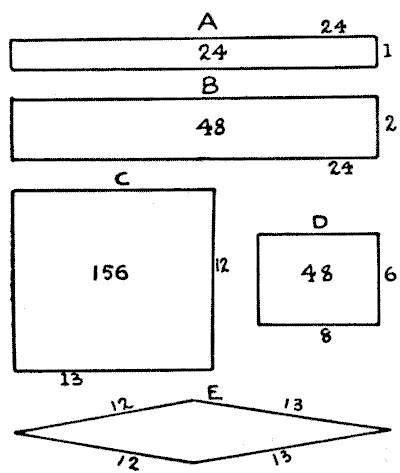
This is the answer that is always given and accepted as correct: Two more hurdles would be necessary, for the pen was twenty-four by one (as in Fig. A on next page), and by moving one of the sides and placing an extra hurdle at each end (as in Fig. B) the area would be doubled. The diagrams are not to scale. Now there is no condition in the puzzle that requires the sheep-fold to be of any particular form. But even if we accept the point that the pen was twenty-four by one, the answer utterly fails, for two extra hurdles are certainly not at all necessary. For example, I arrange the fifty hurdles as in Fig. C, and as the area is increased from twenty-four "square hurdles" to 156, there is now accommodation for 650 sheep. If it be held that the area must be exactly double that of the original pen, then I construct it (as in Fig. D) with twenty-eight hurdles only, and have twenty-two in hand for other purposes on the farm. Even if it were insisted that all the original hurdles must be used, then I should construct it as in Fig. E, where I can get the area as exact as any farmer could possibly require, even if we have to allow for the fact that the sheep might not be able to graze at the extreme ends. Thus we see that, from any point of view, the accepted answer to this ancient little puzzle breaks down. And yet attention has never before been drawn to the absurdity.
194.—THE GARDEN WALLS.—solution
The puzzle was to divide the circular field into four equal parts by three walls, each wall being of exactly the same length. There are two essential difficulties in this problem. These are: (1) the thickness of the walls, and (2) the condition that these walls are three in number. As to the first point, since we are told that the walls are brick walls, we clearly cannot ignore their thickness, while we have to find a solution that will equally work, whether the walls be of a thickness of one, two, three, or more bricks.
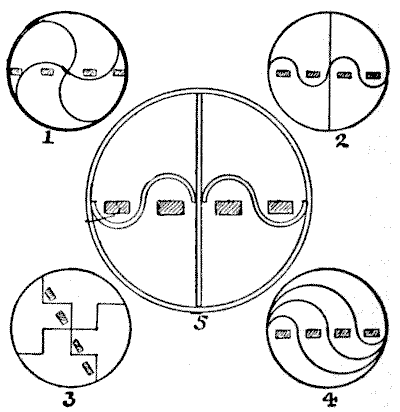
The second point requires a little more consideration. How are we to distinguish between a wall and walls? A straight wall without any bend in it, no matter how long, cannot ever become "walls," if it is neither broken nor intersected in any way. Also our circular field is clearly enclosed by one wall. But if it had happened to be a square or a triangular enclosure, would there be respectively four and three walls or only one enclosing wall in each case? It is true that we speak of "the four walls" of a square building or garden, but this is only a conventional way of saying "the four sides." If you were speaking of the actual brickwork, you would say, "I am going to enclose this square garden with a wall." Angles clearly do not affect the question, for we may have a zigzag wall just as well as a straight one, and the Great Wall of China is a good example of a wall with plenty of angles. Now, if you look at Diagrams 1, 2, and 3, you may be puzzled to declare whether there are in each case two or four new walls; but you cannot call them three, as required in our puzzle. The intersection either affects the question or it does not affect it.
If you tie two pieces of string firmly together, or splice them in a nautical manner, they become "one piece of string." If you simply let them lie across one another or overlap, they remain "two pieces of string." It is all a question of joining and welding. It may similarly be held that if two walls be built into one another—I might almost say, if they be made homogeneous—they become one wall, in which case Diagrams 1, 2, and 3 might each be said to show one wall or two, if it be indicated that the four ends only touch, and are not really built into, the outer circular wall.
The objection to Diagram 4 is that although it shows the three required walls (assuming the ends are not built into the outer circular wall), yet it is only absolutely correct when we assume the walls to have no thickness. A brick has thickness, and therefore the fact throws the whole method out and renders it only approximately correct.
Diagram 5 shows, perhaps, the only correct and perfectly satisfactory solution. It will be noticed that, in addition to the circular wall, there are three new walls, which touch (and so enclose) but are not built into one another. This solution may be adapted to any desired thickness of wall, and its correctness as to area and length of wall space is so obvious that it is unnecessary to explain it. I will, however, just say that the semicircular piece of ground that each tenant gives to his neighbour is exactly equal to the semicircular piece that his neighbour gives to him, while any section of wall space found in one garden is precisely repeated in all the others. Of course there is an infinite number of ways in which this solution may be correctly varied.
195.—LADY BELINDA'S GARDEN.—solution
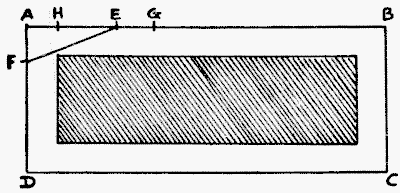
All that Lady Belinda need do was this: She should measure from A to B, fold her tape in four and mark off the point E, which is thus one quarter of the side. Then, in the same way, mark off the point F, one-fourth of the side AD Now, if she makes EG equal to AF, and GH equal to EF, then AH is the required width for the path in order that the bed shall be exactly half the area of the garden. An exact numerical measurement can only be obtained when the sum of the squares of the two sides is a square number. Thus, if the garden measured 12 poles by 5 poles (where the squares of 12 and 5, 144 and 25, sum to 169, the square of 13), then 12 added to 5, less 13, would equal four, and a quarter of this, 1 pole, would be the width of the path.
196.—THE TETHERED GOAT.—solution
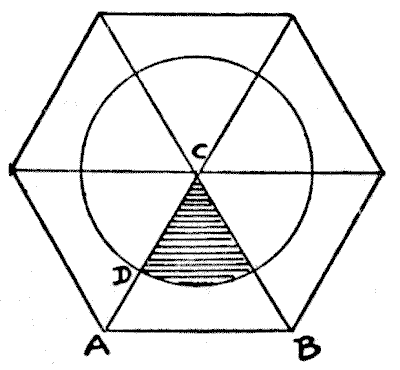
This problem is quite simple if properly attacked. Let us suppose the triangle ABC to represent our half-acre field, and the shaded portion to be the quarter-acre over which the goat will graze when tethered to the corner C. Now, as six equal equilateral triangles placed together will form a regular hexagon, as shown, it is evident that the shaded pasture is just one-sixth of the complete area of a circle. Therefore all we require is the radius (CD) of a circle containing six quarter-acres or 1½ acres, which is equal to 9,408,960 square inches. As we only want our answer "to the nearest inch," it is sufficiently exact for our purpose if we assume that as 1 is to 3.1416, so is the diameter of a circle to its circumference. If, therefore, we divide the last number I gave by 3.1416, and extract the square root, we find that 1,731 inches, or 48 yards 3 inches, is the required length of the tether "to the nearest inch."
197.—THE COMPASSES PUZZLE.—solution
Let AB in the following diagram be the given straight line. With the centres A and B and radius AB describe the two circles. Mark off DE and EF equal to AD. With the centres A and F and radius DF describe arcs intersecting at G. With the centres A and B and distance BG describe arcs GHK and N. Make HK equal to AB and HL equal to HB. Then with centres K and L and radius AB describe arcs intersecting at I. Make BM equal to BI. Finally, with the centre M and radius MB cut the line in C, and the point C is the required middle of the line AB. For greater exactitude you can mark off R from A (as you did M from B), and from R describe another arc at C. This also solves the problem, to find a point midway between two given points without the straight line.
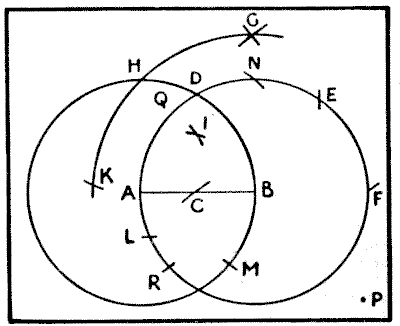
I will put the young geometer in the way of a rigid proof. First prove that twice the square of the line AB equals the square of the distance BG, from which it follows that HABN are the four corners of a square. To prove that I is the centre of this square, draw a line from H to P through QIB and continue the arc HK to P. Then, conceiving the necessary lines to be drawn, the angle HKP, being in a semicircle, is a right angle. Let fall the perpendicular KQ, and by similar triangles, and from the fact that HKI is an isosceles triangle by the construction, it can be proved that HI is half of HB. We can similarly prove that C is the centre of the square of which AIB are three corners.
I am aware that this is not the simplest possible solution.
198.—THE EIGHT STICKS.—solution
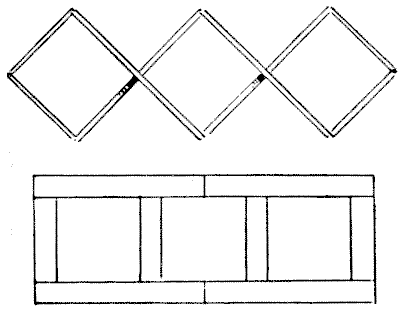
The first diagram is the answer that nearly every one will give to this puzzle, and at first sight it seems quite satisfactory. But consider the conditions. We have to lay "every one of the sticks on the table." Now, if a ladder be placed against a wall with only one end on the ground, it can hardly be said that it is "laid on the ground." And if we place the sticks in the above manner, it is only possible to make one end of two of them touch the table: to say that every one lies on the table would not be correct. To obtain a solution it is only necessary to have our sticks of proper dimensions. Say the long sticks are each 2 ft. in length and the short ones 1 ft. Then the sticks must be 3 in. thick, when the three equal squares may be enclosed, as shown in the second diagram. If I had said "matches" instead of "sticks," the puzzle would be impossible, because an ordinary match is about twenty-one times as long as it is broad, and the enclosed rectangles would not be squares.
199.—PAPA'S PUZZLE.—solution
I have found that a large number of people imagine that the following is a correct solution of the problem. Using the letters in the diagram below, they argue that if you make the distance BA one-third of BC, and therefore the area of the rectangle ABE equal to that of the triangular remainder, the card must hang with the long side horizontal. Readers will remember the jest of Charles II., who induced the Royal Society to meet and discuss the reason why the water in a vessel will not rise if you put a live fish in it; but in the middle of the proceedings one of the least distinguished among them quietly slipped out and made the experiment, when he found that the water did rise! If my correspondents had similarly made the experiment with a piece of cardboard, they would have found at once their error. Area is one thing, but gravitation is quite another. The fact of that triangle sticking its leg out to D has to be compensated for by additional area in the rectangle. As a matter of fact, the ratio of BA to AC is as 1 is to the square root of 3, which latter cannot be given in an exact numerical measure, but is approximately 1.732. Now let us look at the correct general solution. There are many ways of arriving at the desired result, but the one I give is, I think, the simplest for beginners.
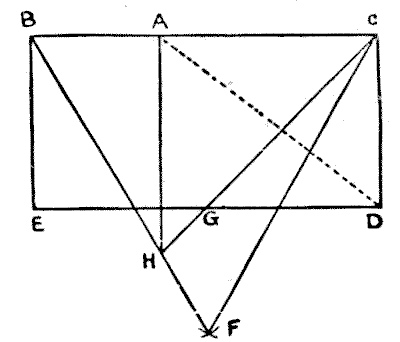
Fix your card on a piece of paper and draw the equilateral triangle BCF, BF and CF being equal to BC. Also mark off the point G so that DG shall equal DC. Draw the line CG and produce it until it cuts the line BF in H. If we now make HA parallel to BE, then A is the point from which our cut must be made to the corner D, as indicated by the dotted line.
A curious point in connection with this problem is the fact that the position of the point A is independent of the side CD. The reason for this is more obvious in the solution I have given than in any other method that I have seen, and (although the problem may be solved with all the working on the cardboard) that is partly why I have preferred it. It will be seen at once that however much you may reduce the width of the card by bringing E nearer to B and D nearer to C, the line CG, being the diagonal of a square, will always lie in the same direction, and will cut BF in H. Finally, if you wish to get an approximate measure for the distance BA, all you have to do is to multiply the length of the card by the decimal .366. Thus, if the card were 7 inches long, we get 7 × .366 = 2.562, or a little more than 2½ inches, for the distance from B to A.
But the real joke of the puzzle is this: We have seen that the position of the point A is independent of the width of the card, and depends entirely on the length. Now, in the illustration it will be found that both cards have the same length; consequently all the little maid had to do was to lay the clipped card on top of the other one and mark off the point A at precisely the same distance from the top left-hand corner! So, after all, Pappus' puzzle, as he presented it to his little maid, was quite an infantile problem, when he was able to show her how to perform the feat without first introducing her to the elements of statics and geometry.
200.—A KITE-FLYING PUZZLE.—solution
Solvers of this little puzzle, I have generally found, may be roughly divided into two classes: those who get within a mile of the correct answer by means of more or less complex calculations, involving "pi," and those whose arithmetical kites fly hundreds and thousands of miles away from the truth. The comparatively easy method that I shall show does not involve any consideration of the ratio that the diameter of a circle bears to its circumference. I call it the "hat-box method."
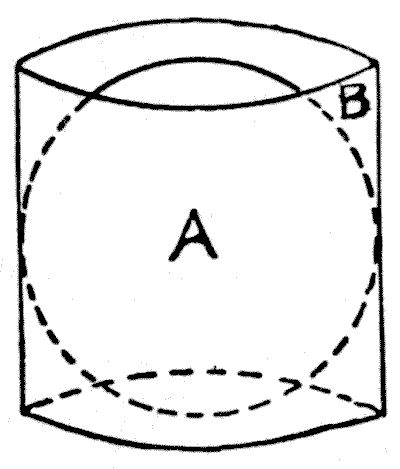
Supposing we place our ball of wire, A, in a cylindrical hat-box, B, that exactly fits it, so that it touches the side all round and exactly touches the top and bottom, as shown in the illustration. Then, by an invariable law that should be known by everybody, that box contains exactly half as much again as the ball. Therefore, as the ball is 24 in. in diameter, a hat-box of the same circumference but two-thirds of the height (that is, 16 in. high) will have exactly the same contents as the ball.
Now let us consider that this reduced hat-box is a cylinder of metal made up of an immense number of little wire cylinders close together like the hairs in a painter's brush. By the conditions of the puzzle we are allowed to consider that there are no spaces between the wires. How many of these cylinders one one-hundredth of an inch thick are equal to the large cylinder, which is 24 in. thick? Circles are to one another as the squares of their diameters. The square of 1/100 is 1/100000, and the square of 24 is 576; therefore the large cylinder contains 5,760,000 of the little wire cylinders. But we have seen that each of these wires is 16 in. long; hence 16 × 5,760,000 = 92,160,000 inches as the complete length of the wire. Reduce this to miles, and we get 1,454 miles 2,880 ft. as the length of the wire attached to the professor's kite.
Whether a kite would fly at such a height, or support such a weight, are questions that do not enter into the problem.
201.—HOW TO MAKE CISTERNS.—solution
Here is a general formula for solving this problem. Call the two sides of the rectangle a and b. Then
( a + b - (a2 + b2 - ab)½ )/6
equals the side of the little square pieces to cut away. The measurements given were 8 ft. by 3 ft., and the above rule gives 8 in. as the side of the square pieces that have to be cut away. Of course it will not always come out exact, as in this case (on account of that square root), but you can get as near as you like with decimals.
202.—THE CONE PUZZLE.—solution
The simple rule is that the cone must be cut at one-third of its altitude.
203.—CONCERNING WHEELS.—solution
If you mark a point A on the circumference of a wheel that runs on the surface of a level road, like an ordinary cart-wheel, the curve described by that point will be a common cycloid, as in Fig. 1. But if you mark a point B on the circumference of the flange of a locomotive-wheel, the curve will be a curtate cycloid, as in Fig. 2, terminating in nodes. Now, if we consider one of these nodes or loops, we shall see that "at any given moment" certain points at the bottom of the loop must be moving in the opposite direction to the train. As there is an infinite number of such points on the flange's circumference, there must be an infinite number of these loops being described while the train is in motion. In fact, at any given moment certain points on the flanges are always moving in a direction opposite to that in which the train is going.
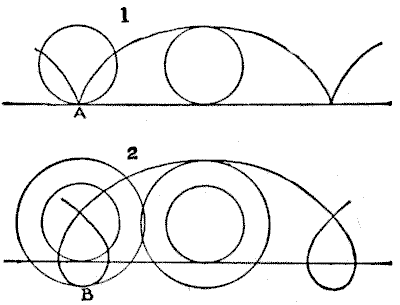
In the case of the two wheels, the wheel that runs round the stationary one makes two revolutions round its own centre. As both wheels are of the same size, it is obvious that if at the start we mark a point on the circumference of the upper wheel, at the very top, this point will be in contact with the lower wheel at its lowest part when half the journey has been made. Therefore this point is again at the top of the moving wheel, and one revolution has been made. Consequently there are two such revolutions in the complete journey.
204.—A NEW MATCH PUZZLE.—solution
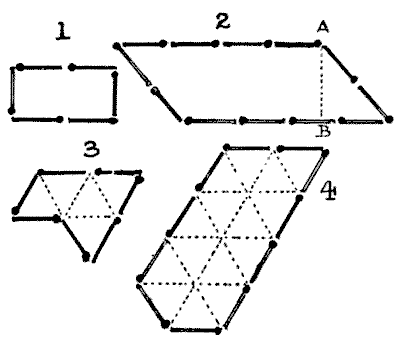
1. The easiest way is to arrange the eighteen matches as in Diagrams 1 and 2, making the length of the perpendicular AB equal to a match and a half. Then, if the matches are an inch in length, Fig. 1 contains two square inches and Fig. 2 contains six square inches—4 × 1½. The second case (2) is a little more difficult to solve. The solution is given in Figs. 3 and 4. For the purpose of construction, place matches temporarily on the dotted lines. Then it will be seen that as 3 contains five equal equilateral triangles and 4 contains fifteen similar triangles, one figure is three times as large as the other, and exactly eighteen matches are used.
205.—THE SIX SHEEP-PENS.—solution
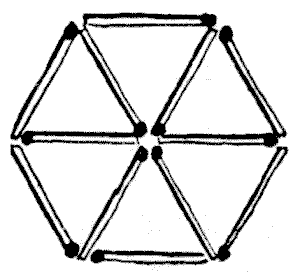
Place the twelve matches in the manner shown in the illustration, and you will have six pens of equal size.
206.—THE KING AND THE CASTLES.—solution
There are various ways of building the ten castles so that they shall form five rows with four castles in every row, but the arrangement in the next column is the only one that also provides that two castles (the greatest number possible) shall not be approachable from the outside. It will be seen that you must cross the walls to reach these two.
207.—CHERRIES AND PLUMS.—solution
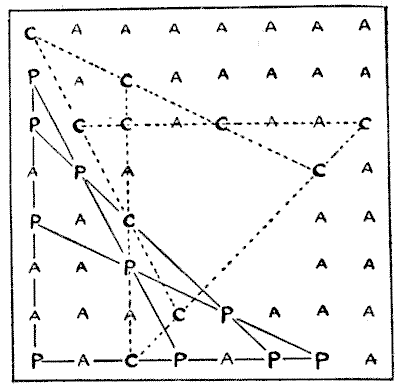
There are several ways in which this problem might be solved were it not for the condition that as few cherries and plums as possible shall be planted on the north and east sides of the orchard. The best possible arrangement is that shown in the diagram, where the cherries, plums, and apples are indicated respectively by the letters C, P, and A. The dotted lines connect the cherries, and the other lines the plums. It will be seen that the ten cherry trees and the ten plum trees are so planted that each fruit forms five lines with four trees of its kind in line. This is the only arrangement that allows of so few as two cherries or plums being planted on the north and east outside rows.
208.—A PLANTATION PUZZLE.—solution
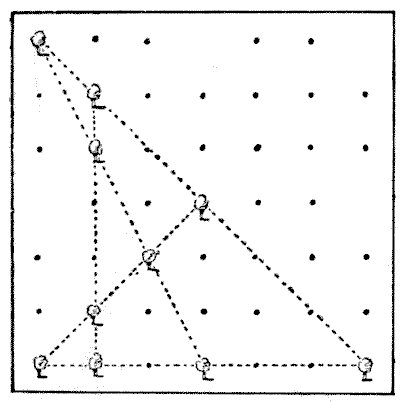
The illustration shows the ten trees that must be left to form five rows with four trees in every row. The dots represent the positions of the trees that have been cut down.
209.—THE TWENTY-ONE TREES.—solution
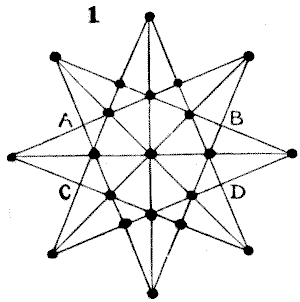
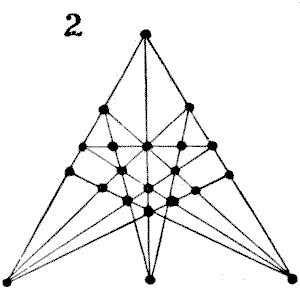
I give two pleasing arrangements of the trees. In each case there are twelve straight rows with five trees in every row.
210.—THE TEN COINS.—solution
The answer is that there are just 2,400 different ways. Any three coins may be taken from one side to combine with one coin taken from the other side. I give four examples on this and the next page. We may thus select three from the top in ten ways and one from the bottom in five ways, making fifty. But we may also select three from the bottom and one from the top in fifty ways. We may thus select the four coins in one hundred ways, and the four removed may be arranged by permutation in twenty-four ways. Thus there are 24 × 100 = 2,400 different solutions.
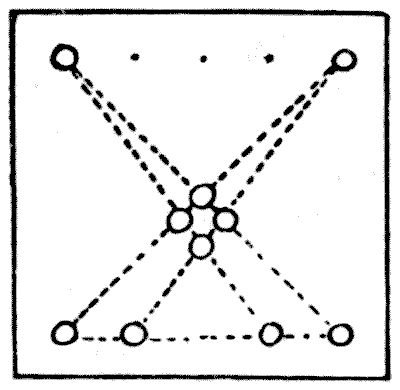
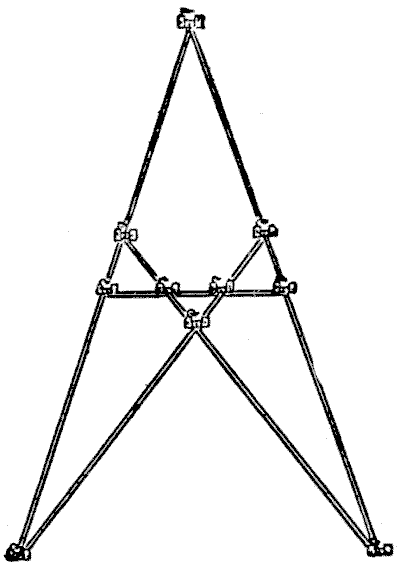
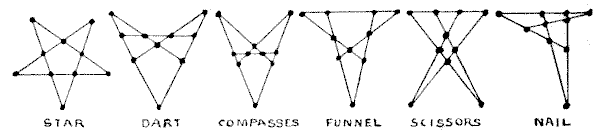
As all the points and lines puzzles that I have given so far, excepting the last, are variations of the case of ten points arranged to form five lines of four, it will be well to consider this particular case generally. There are six fundamental solutions, and no more, as shown in the six diagrams. These, for the sake of convenience, I named some years ago the Star, the Dart, the Compasses, the Funnel, the Scissors, and the Nail. (See next page.) Readers will understand that any one of these forms may be distorted in an infinite number of different ways without destroying its real character.
In "The King and the Castles" we have the Star, and its solution gives the Compasses. In the "Cherries and Plums" solution we find that the Cherries represent the Funnel and the Plums the Dart. The solution of the "Plantation Puzzle" is an example of the Dart distorted. Any solution to the "Ten Coins" will represent the Scissors. Thus examples of all have been given except the Nail.
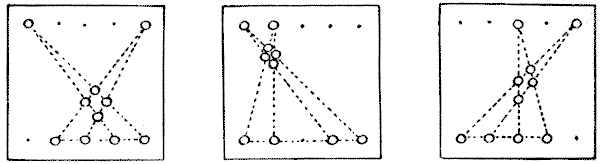
On a reduced chessboard, 7 by 7, we may place the ten pawns in just three different ways, but they must all represent the Dart. The "Plantation" shows one way, the Plums show a second way, and the reader may like to find the third way for himself. On an ordinary chessboard, 8 by 8, we can also get in a beautiful example of the Funnel—symmetrical in relation to the diagonal of the board. The smallest board that will take a Star is one 9 by 7. The Nail requires a board 11 by 7, the Scissors 11 by 9, and the Compasses 17 by 12. At least these are the best results recorded in my note-book. They may be beaten, but I do not think so. If you divide a chessboard into two parts by a diagonal zigzag line, so that the larger part contains 36 squares and the smaller part 28 squares, you can place three separate schemes on the larger part and one on the smaller part (all Darts) without their conflicting—that is, they occupy forty different squares. They can be placed in other ways without a division of the board. The smallest square board that will contain six different schemes (not fundamentally different), without any line of one scheme crossing the line of another, is 14 by 14; and the smallest board that will contain one scheme entirely enclosed within the lines of a second scheme, without any of the lines of the one, when drawn from point to point, crossing a line of the other, is 14 by 12.
211.—THE TWELVE MINCE-PIES.—solution
If you ignore the four black pies in our illustration, the remaining twelve are in their original positions. Now remove the four detached pies to the places occupied by the black ones, and you will have your seven straight rows of four, as shown by the dotted lines.
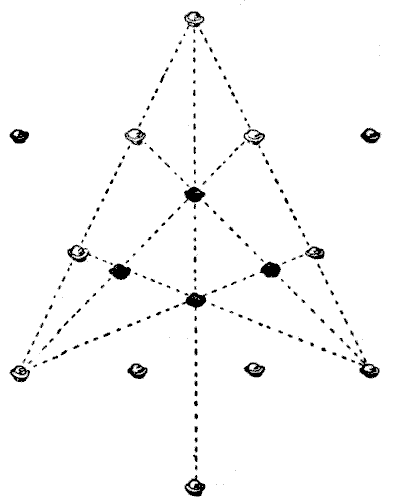
212.—THE BURMESE PLANTATION.—solution
The arrangement on the next page is the most symmetrical answer that can probably be found for twenty-one rows, which is, I believe, the greatest number of rows possible. There are several ways of doing it.
213.—TURKS AND RUSSIANS.—solution
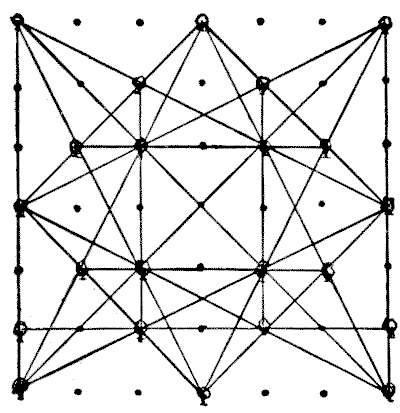
The main point is to discover the smallest possible number of Russians that there could have been. As the enemy opened fire from all directions, it is clearly necessary to find what is the smallest number of heads that could form sixteen lines with three heads in every line. Note that I say sixteen, and not thirty-two, because every line taken by a bullet may be also taken by another bullet fired in exactly the opposite direction. Now, as few as eleven points, or heads, may be arranged to form the required sixteen lines of three, but the discovery of this arrangement is a hard nut. The diagram at the foot of this page will show exactly how the thing is to be done.
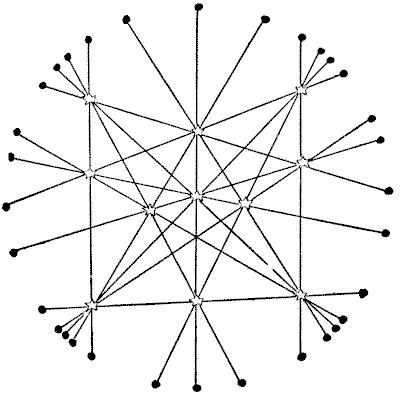
If, therefore, eleven Russians were in the positions shown by the stars, and the thirty-two Turks in the positions indicated by the black dots, it will be seen, by the lines shown, that each Turk may fire exactly over the heads of three Russians. But as each bullet kills a man, it is essential that every Turk shall shoot one of his comrades and be shot by him in turn; otherwise we should have to provide extra Russians to be shot, which would be destructive of the correct solution of our problem. As the firing was simultaneous, this point presents no difficulties. The answer we thus see is that there were at least eleven Russians amongst whom there was no casualty, and that all the thirty-two Turks were shot by one another. It was not stated whether the Russians fired any shots, but it will be evident that even if they did their firing could not have been effective: for if one of their bullets killed a Turk, then we have immediately to provide another man for one of the Turkish bullets to kill; and as the Turks were known to be thirty-two in number, this would necessitate our introducing another Russian soldier and, of course, destroying the solution. I repeat that the difficulty of the puzzle consists in finding how to arrange eleven points so that they shall form sixteen lines of three. I am told that the possibility of doing this was first discovered by the Rev. Mr. Wilkinson some twenty years ago.
214.—THE SIX FROGS.—solution
Move the frogs in the following order: 2, 4, 6, 5, 3, 1 (repeat these moves in the same order twice more), 2, 4, 6. This is a solution in twenty-one moves—the fewest possible.
If n, the number of frogs, be even, we require (n²+n)/2 moves, of which (n²-n)/2 will be leaps and n simple moves. If n be odd, we shall need ((n²+3n)/2)-4 moves, of which (n²-n)/2 will be leaps and 2n-4 simple moves.
In the even cases write, for the moves, all the even numbers in ascending order and the odd numbers in descending order. This series must be repeated ½n times and followed by the even numbers in ascending order once only. Thus the solution for 14 frogs will be (2, 4, 6, 8, 10, 12, 14, 13, 11, 9, 7, 5, 3, 1) repeated 7 times and followed by 2, 4, 6, 8, 10, 12, 14 = 105 moves.
In the odd cases, write the even numbers in ascending order and the odd numbers in descending order, repeat this series ½(n-1) times, follow with the even numbers in ascending order (omitting n-1), the odd numbers in descending order (omitting 1), and conclude with all the numbers (odd and even) in their natural order (omitting 1 and n). Thus for 11 frogs: (2, 4, 6, 8, 10, 11, 9, 7, 5, 3, 1) repeated 5 times, 2, 4, 6, 8, 11, 9, 7, 5, 3, and 2, 3, 4, 5, 6, 7, 8, 9, 10 = 73 moves.
This complete general solution is published here for the first time.
215.—THE GRASSHOPPER PUZZLE.—solution
Move the counters in the following order. The moves in brackets are to be made four times in succession. 12, 1, 3, 2, 12, 11, 1, 3, 2 (5, 7, 9, 10, 8, 6, 4), 3, 2, 12, 11, 2, 1, 2. The grasshoppers will then be reversed in forty-four moves.
The general solution of this problem is very difficult. Of course it can always be solved by the method given in the solution of the last puzzle, if we have no desire to use the fewest possible moves. But to employ a full economy of moves we have two main points to consider. There are always what I call a lower movement (L) and an upper movement (U). L consists in exchanging certain of the highest numbers, such as 12, 11, 10 in our "Grasshopper Puzzle," with certain of the lower numbers, 1, 2, 3; the former moving in a clockwise direction, the latter in a non-clockwise direction. U consists in reversing the intermediate counters. In the above solution for 12, it will be seen that 12, 11, and 1, 2, 3 are engaged in the L movement, and 4, 5, 6, 7, 8, 9, 10 in the U movement. The L movement needs 16 moves and U 28, making together 44. We might also involve 10 in the L movement, which would result in L 23, U 21, making also together 44 moves. These I call the first and second methods. But any other scheme will entail an increase of moves. You always get these two methods (of equal economy) for odd or even counters, but the point is to determine just how many to involve in L and how many in U. Here is the solution in table form. But first note, in giving values to n, that 2, 3, and 4 counters are special cases, requiring respectively 3, 3, and 6 moves, and that 5 and 6 counters do not give a minimum solution by the second method—only by the first.
FIRST METHOD.
Total No. of Counters.L MOVEMENT.U MOVEMENT. Total No. of Moves.
No. of Counters.No. of Moves.No. of Counters.No. of Moves.
4nn - 1 and n2(n - 1)² + 5n - 72n + 12n² + 3n + 14(n² + n - 1)
4n - 2n - 1 " n2(n - 1)² + 5n - 72n - 12(n - 1)² + 3n - 24n² - 5
4n + 1n " n + 12n² + 5n - 22n2n² + 3n - 42(2n² + 4n - 3)
4n - 1n - 1 " n2(n - 1)² + 5n - 72n2n² + 3n - 44n² + 4n - 9
SECOND METHOD.
Total No. of Counters.L MOVEMENT.U MOVEMENT. Total No. of Moves.
No. of Counters.No. of Moves.No. of Counters.No. of Moves.
4nn and n2n² + 3n - 42n2(n - 1)² + 5n - 24(n² + n - 1)
4n - 2n - 1 " n - 12(n - 1)² + 3n - 72n2(n - 1)² + 5n - 24n² - 5
4n + 1n " n2n² + 3n - 42n + 12n² + 5n - 22(2n² + 4n - 3)
4n - 1n " n2n² + 3n - 42n - 12(n - 1)² + 5n - 74n² + 4n-9
More generally we may say that with m counters, where m is even and greater than 4, we require (m² + 4m - 16)/4 moves; and where m is odd and greater than 3, (m² + 6m - 31)/4 moves. I have thus shown the reader how to find the minimum number of moves for any case, and the character and direction of the moves. I will leave him to discover for himself how the actual order of moves is to be determined. This is a hard nut, and requires careful adjustment of the L and the U movements, so that they may be mutually accommodating.
216.—THE EDUCATED FROGS.—solution
The following leaps solve the puzzle in ten moves: 2 to 1, 5 to 2, 3 to 5, 6 to 3, 7 to 6, 4 to 7, 1 to 4, 3 to 1, 6 to 3, 7 to 6.
217.—THE TWICKENHAM PUZZLE.—solution
Play the counters in the following order: K C E K W T C E H M K W T A N C E H M I K C E H M T, and there you are, at Twickenham. The position itself will always determine whether you are to make a leap or a simple move.
218.—THE VICTORIA CROSS PUZZLE.—solution
In solving this puzzle there were two things to be achieved: first, so to manipulate the counters that the word VICTORIA should read round the cross in the same direction, only with the V on one of the dark arms; and secondly, to perform the feat in the fewest possible moves. Now, as a matter of fact, it would be impossible to perform the first part in any way whatever if all the letters of the word were different; but as there are two I's, it can be done by making these letters change places—that is, the first I changes from the 2nd place to the 7th, and the second I from the 7th place to the 2nd. But the point I referred to, when introducing the puzzle, as a little remarkable is this: that a solution in twenty-two moves is obtainable by moving the letters in the order of the following words: "A VICTOR! A VICTOR! A VICTOR I!"
There are, however, just six solutions in eighteen moves, and the following is one of them: I (1), V, A, I (2), R, O, T, I (1), I (2), A, V, I (2), I (1), C, I (2), V, A, I (1). The first and second I in the word are distinguished by the numbers 1 and 2.
It will be noticed that in the first solution given above one of the I's never moves, though the movements of the other letters cause it to change its relative position. There is another peculiarity I may point out—that there is a solution in twenty-eight moves requiring no letter to move to the central division except the I's. I may also mention that, in each of the solutions in eighteen moves, the letters C, T, O, R move once only, while the second I always moves four times, the V always being transferred to the right arm of the cross.
219.—THE LETTER BLOCK PUZZLE.—solution
This puzzle can be solved in 23 moves—the fewest possible. Move the blocks in the following order: A, B, F, E, C, A, B, F, E, C, A, B, D, H, G, A, B, D, H, G, D, E, F.
220.—A LODGING-HOUSE DIFFICULTY.—solution
The shortest possible way is to move the articles in the following order: Piano, bookcase, wardrobe, piano, cabinet, chest of drawers, piano, wardrobe, bookcase, cabinet, wardrobe, piano, chest of drawers, wardrobe, cabinet, bookcase, piano. Thus seventeen removals are necessary. The landlady could then move chest of drawers, wardrobe, and cabinet. Mr. Dobson did not mind the wardrobe and chest of drawers changing rooms so long as he secured the piano.