SOLUTIONS. (continued 4)
Reading edition
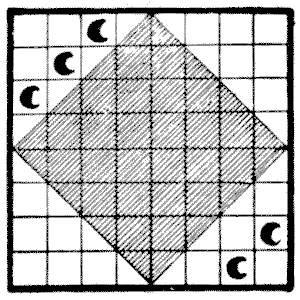
If that ancient architect had arranged his five crescent tiles in the manner shown in the following diagram, every tile would have been watched over by, or in a line with, at least one crescent, and space would have been reserved for a perfectly square carpet equal in area to exactly half of the pavement. It is a very curious fact that, although there are two or three solutions allowing a carpet to be laid down within the conditions so as to cover an area of nearly twenty-nine of the tiles, this is the only possible solution giving exactly half the area of the pavement, which is the largest space obtainable.
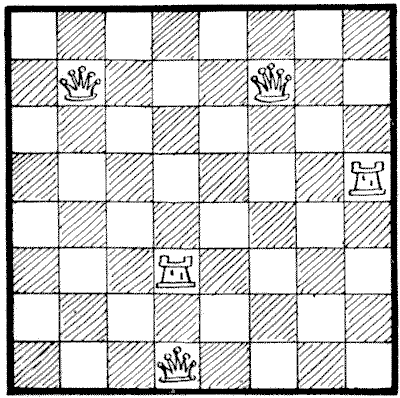
313.—QUEENS AND BISHOP PUZZLE.—solution
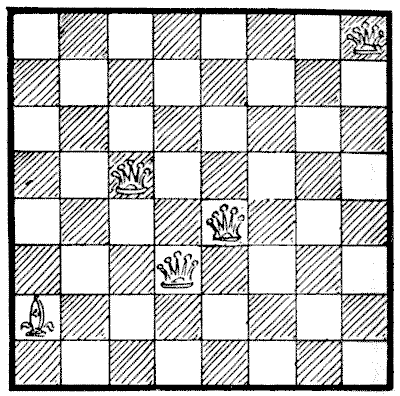
The bishop is on the square originally occupied by the rook, and the four queens are so placed that every square is either occupied or attacked by a piece. (Fig. 1.)
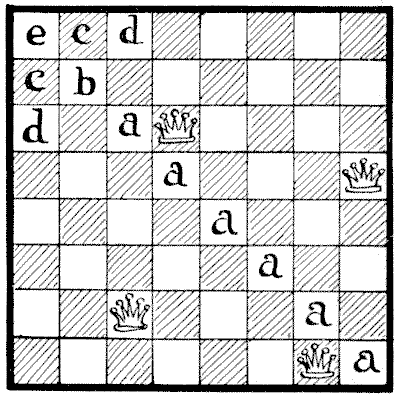
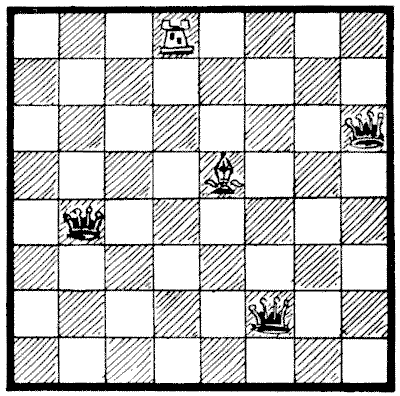
I pointed out in 1899 that if four queens are placed as shown in the diagram (Fig. 2), then the fifth queen may be placed on any one of the twelve squares marked a, b, c, d, and e; or a rook on the two squares, c; or a bishop on the eight squares, a, b, and e; or a pawn on the square b; or a king on the four squares, b, c, and e. The only known arrangement for four queens and a knight is that given by Mr. J. Wallis in The Strand Magazine for August 1908, here reproduced. (Fig. 3.)
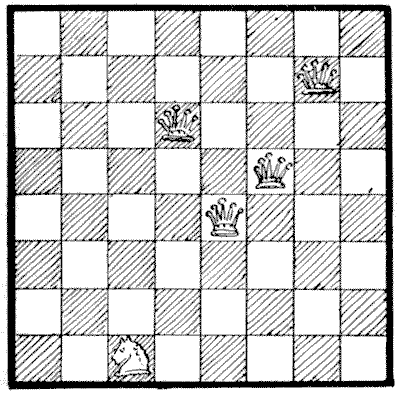
I have recorded a large number of solutions with four queens and a rook, or bishop, but the only arrangement, I believe, with three queens and two rooks in which all the pieces are guarded is that of which I give an illustration (Fig. 4), first published by Dr. C. Planck. But I have since found the accompanying solution with three queens, a rook, and a bishop, though the pieces do not protect one another. (Fig. 5.)
314.—THE SOUTHERN CROSS.—solution
My readers have been so familiarized with the fact that it requires at least five planets to attack every one of a square arrangement of sixty-four stars that many of them have, perhaps, got to believe that a larger square arrangement of stars must need an increase of planets. It was to correct this possible error of reasoning, and so warn readers against another of those numerous little pitfalls in the world of puzzledom, that I devised this new stellar problem. Let me then state at once that, in the case of a square arrangement of eighty one stars, there are several ways of placing five planets so that every star shall be in line with at least one planet vertically, horizontally, or diagonally. Here is the solution to the "Southern Cross": —
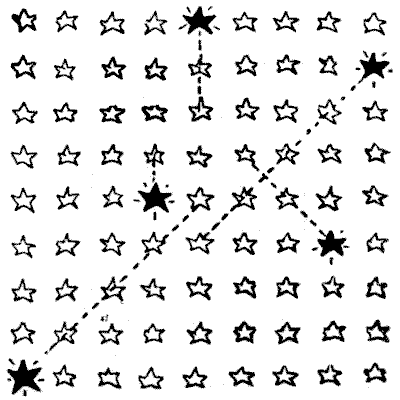
It will be remembered that I said that the five planets in their new positions "will, of course, obscure five other stars in place of those at present covered." This was to exclude an easier solution in which only four planets need be moved.
315.—THE HAT-PEG PUZZLE.—solution
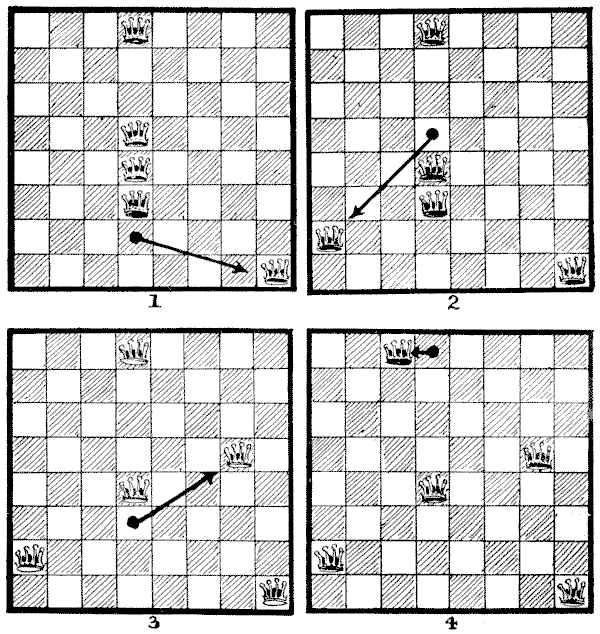
The moves will be made quite clear by a reference to the diagrams, which show the position on the board after each of the four moves. The darts indicate the successive removals that have been made. It will be seen that at every stage all the squares are either attacked or occupied, and that after the fourth move no queen attacks any other. In the case of the last move the queen in the top row might also have been moved one square farther to the left. This is, I believe, the only solution to the puzzle.
316.—THE AMAZONS.—solution
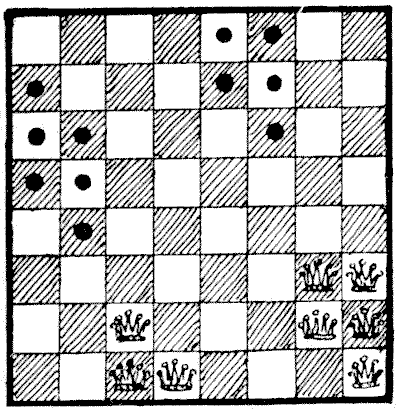
It will be seen that only three queens have been removed from their positions on the edge of the board, and that, as a consequence, eleven squares (indicated by the black dots) are left unattacked by any queen. I will hazard the statement that eight queens cannot be placed on the chessboard so as to leave more than eleven squares unattacked. It is true that we have no rigid proof of this yet, but I have entirely convinced myself of the truth of the statement. There are at least five different ways of arranging the queens so as to leave eleven squares unattacked.
317.—A PUZZLE WITH PAWNS.—solution
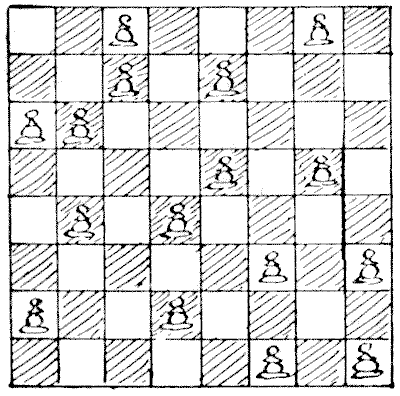
Sixteen pawns may be placed so that no three shall be in a straight line in any possible direction, as in the diagram. We regard, as the conditions required, the pawns as mere points on a plane.
318.—LION-HUNTING.—solution
There are 6,480 ways of placing the man and the lion, if there are no restrictions whatever except that they must be on different spots. This is obvious, because the man may be placed on any one of the 81 spots, and in every case there are 80 spots remaining for the lion; therefore 81 × 80 = 6,480. Now, if we deduct the number of ways in which the lion and the man may be placed on the same path, the result must be the number of ways in which they will not be on the same path. The number of ways in which they may be in line is found without much difficulty to be 816. Consequently, 6,480 - 816 = 5,664, the required answer.
The general solution is this: 1/3n(n - 1) (3n2 - n + 2). This is, of course, equivalent to saying that if we call the number of squares on the side of a "chessboard" n, then the formula shows the number of ways in which two bishops may be placed without attacking one another. Only in this case we must divide by two, because the two bishops have no distinct individuality, and cannot produce a different solution by mere exchange of places.
319.—THE KNIGHT-GUARDS.—solution
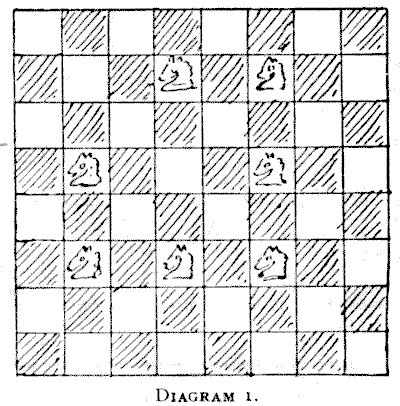
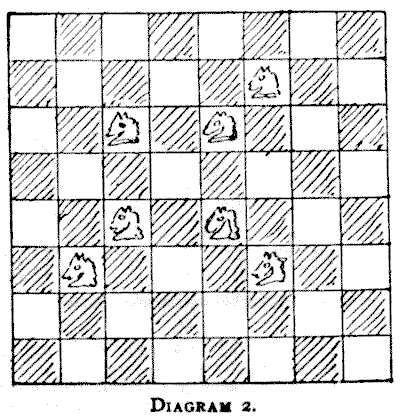
The smallest possible number of knights with which this puzzle can be solved is fourteen.
It has sometimes been assumed that there are a great many different solutions. As a matter of fact, there are only three arrangements—not counting mere reversals and reflections as different. Curiously enough, nobody seems ever to have hit on the following simple proof, or to have thought of dealing with the black and the white squares separately.
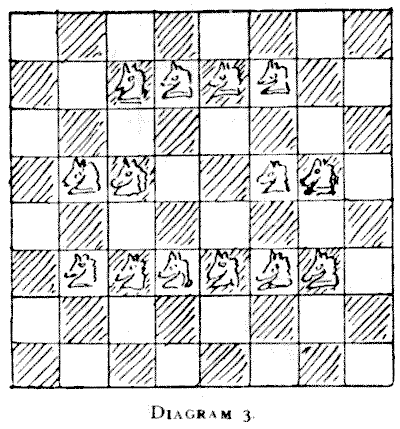
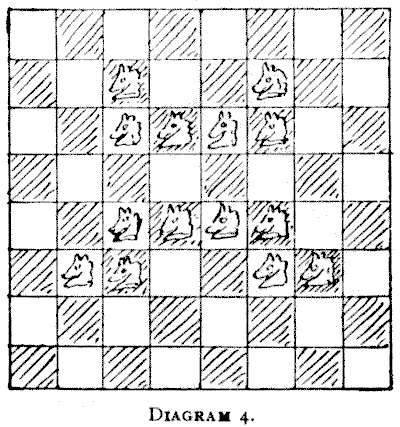
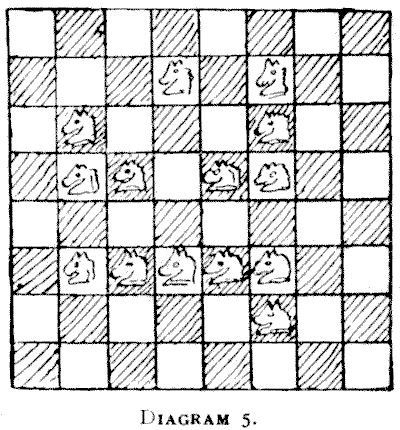
Seven knights can be placed on the board on white squares so as to attack every black square in two ways only. These are shown in Diagrams 1 and 2. Note that three knights occupy the same position in both arrangements. It is therefore clear that if we turn the board so that a black square shall be in the top left-hand corner instead of a white, and place the knights in exactly the same positions, we shall have two similar ways of attacking all the white squares. I will assume the reader has made the two last described diagrams on transparent paper, and marked them 1a and 2a. Now, by placing the transparent Diagram 1a over 1 you will be able to obtain the solution in Diagram 3, by placing 2a over 2 you will get Diagram 4, and by placing 2a over 1 you will get Diagram 5. You may now try all possible combinations of those two pairs of diagrams, but you will only get the three arrangements I have given, or their reversals and reflections. Therefore these three solutions are all that exist.
320.—THE ROOK'S TOUR.—solution
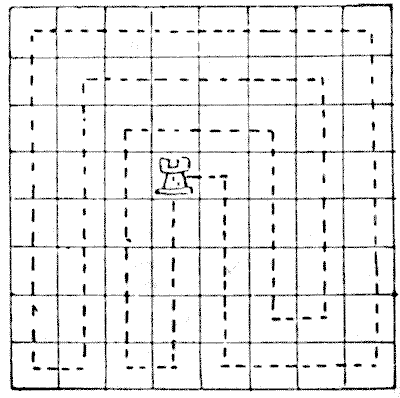
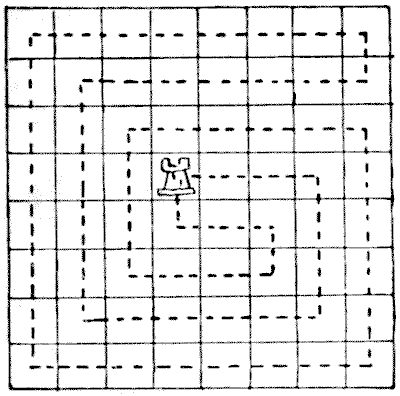
The only possible minimum solutions are shown in the two diagrams, where it will be seen that only sixteen moves are required to perform the feat. Most people find it difficult to reduce the number of moves below seventeen.
321.—THE ROOK'S JOURNEY.—solution
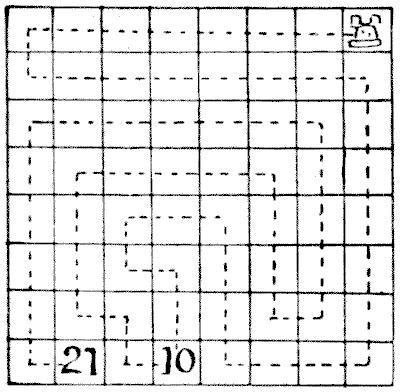
I show the route in the diagram. It will be seen that the tenth move lands us at the square marked "10," and that the last move, the twenty-first, brings us to a halt on square "21."
322.—THE LANGUISHING MAIDEN.—solution
The dotted line shows the route in twenty-two straight paths by which the knight may rescue the maiden. It is necessary, after entering the first cell, immediately to return before entering another. Otherwise a solution would not be possible. (See "The Grand Tour," p. 200.)
323.—A DUNGEON PUZZLE.—solution
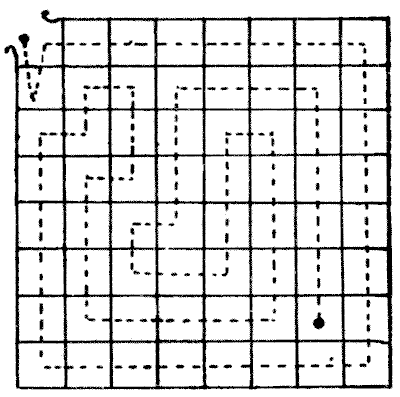
If the prisoner takes the route shown in the diagram—where for clearness the doorways are omitted—he will succeed in visiting every cell once, and only once, in as many as fifty-seven straight lines. No rook's path over the chessboard can exceed this number of moves.
324.—THE LION AND THE MAN.—solution
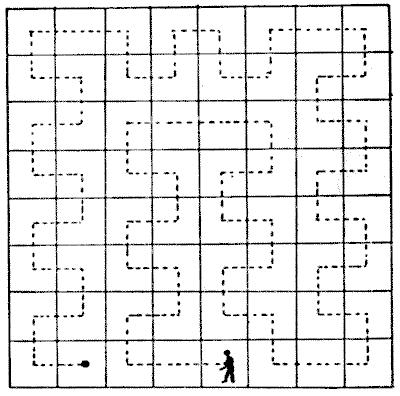
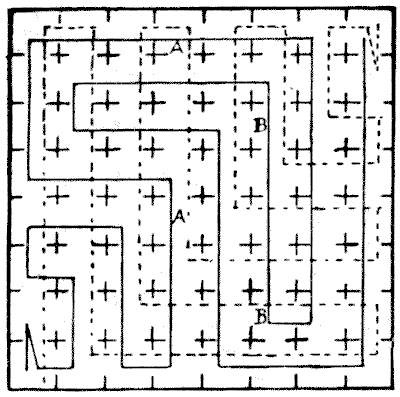
First of all, the fewest possible straight lines in each case are twenty-two, and in order that no cell may be visited twice it is absolutely necessary that each should pass into one cell and then immediately "visit" the one from which he started, afterwards proceeding by way of the second available cell. In the following diagram the man's route is indicated by the unbroken lines, and the lion's by the dotted lines. It will be found, if the two routes are followed cell by cell with two pencil points, that the lion and the man never meet. But there was one little point that ought not to be overlooked—"they occasionally got glimpses of one another." Now, if we take one route for the man and merely reverse it for the lion, we invariably find that, going at the same speed, they never get a glimpse of one another. But in our diagram it will be found that the man and the lion are in the cells marked A at the same moment, and may see one another through the open doorways; while the same happens when they are in the two cells marked B, the upper letters indicating the man and the lower the lion. In the first case the lion goes straight for the man, while the man appears to attempt to get in the rear of the lion; in the second case it looks suspiciously like running away from one another!
325.—AN EPISCOPAL VISITATION.—solution
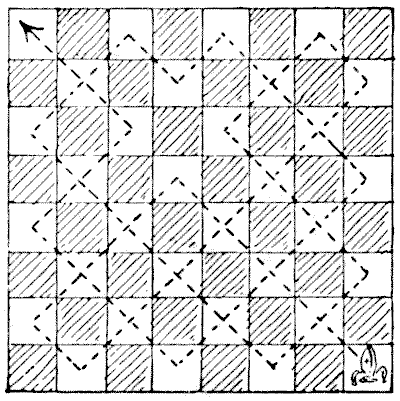
In the diagram I show how the bishop may be made to visit every one of his white parishes in seventeen moves. It is obvious that we must start from one corner square and end at the one that is diagonally opposite to it. The puzzle cannot be solved in fewer than seventeen moves.
326.—A NEW COUNTER PUZZLE.—solution
Play as follows: 2—3, 9—4, 10—7, 3—8, 4—2, 7—5, 8—6, 5—10, 6—9, 2—5, 1—6, 6—4, 5—3, 10—8, 4—7, 3—2, 8—1, 7—10. The white counters have now changed places with the red ones, in eighteen moves, without breaking the conditions.
327.—A NEW BISHOP'S PUZZLE.—solution
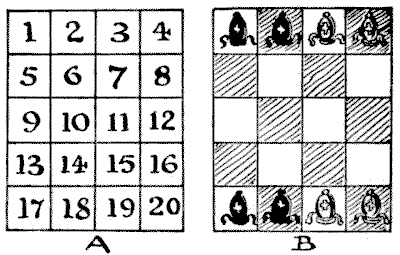
Play as follows, using the notation indicated by the numbered squares in Diagram A:—
White.Black.
1. 18—151. 3—6
2. 17—82. 4—13
3. 19—143. 2—7
4. 15—54. 6—16
5. 8—35. 13-18
6. 14—96. 7—12
7. 5—107. 16-11
8. 9—198. 12—2
9. 10—49. 11-17
10. 20—1010. 1—11
11. 3—911. 18—12
12. 10—1312. 11—8
13. 19—1613. 2—5
14. 16—114. 5—20
15. 9—615. 12—15
16. 13-716. 8—14
17. 6—317. 15-18
18. 7—218. 14—19
Diagram B shows the position after the ninth move. Bishops at 1 and 20 have not yet moved, but 2 and 19 have sallied forth and returned. In the end, 1 and 19, 2 and 20, 3 and 17, and 4 and 18 will have exchanged places. Note the position after the thirteenth move.
328.—THE QUEEN'S TOUR.—solution
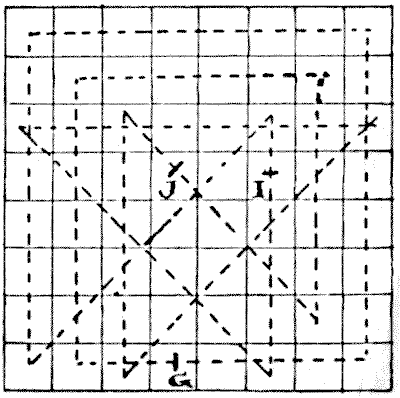
The annexed diagram shows a second way of performing the Queen's Tour. If you break the line at the point J and erase the shorter portion of that line, you will have the required path solution for any J square. If you break the line at I, you will have a non-re-entrant solution starting from any I square. And if you break the line at G, you will have a solution for any G square. The Queen's Tour previously given may be similarly broken at three different places, but I seized the opportunity of exhibiting a second tour.
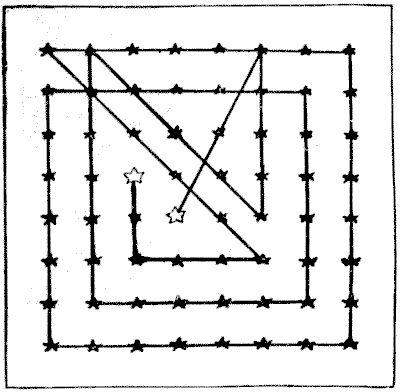
329.—THE STAR PUZZLE.—solution
The illustration explains itself. The stars are all struck out in fourteen straight strokes, starting and ending at a white star.
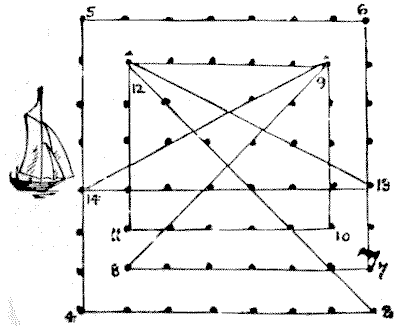
330.—THE YACHT RACE.—solution
The diagram explains itself. The numbers will show the direction of the lines in their proper order, and it will be seen that the seventh course ends at the flag-buoy, as stipulated.
331.—THE SCIENTIFIC SKATER.—solution
In this case we go beyond the boundary of the square. Apart from that, the moves are all queen moves. There are three or four ways in which it can be done.
Here is one way of performing the feat:—
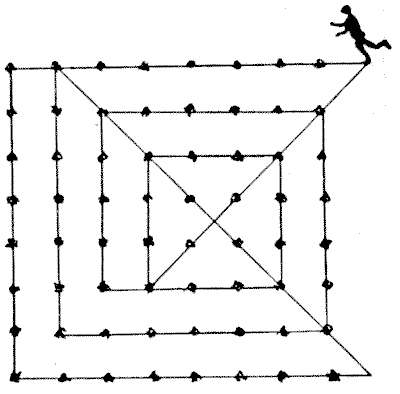
It will be seen that the skater strikes out all the stars in one continuous journey of fourteen straight lines, returning to the point from which he started. To follow the skater's course in the diagram it is necessary always to go as far as we can in a straight line before turning.
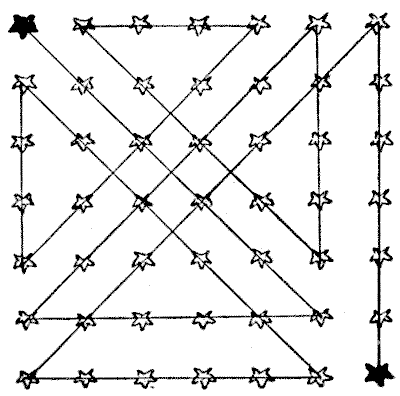
332.—THE FORTY-NINE STARS.—solution
The illustration shows how all the stars may be struck out in twelve straight strokes, beginning and ending at a black star.
333.—THE QUEEN'S JOURNEY.—solution
The correct solution to this puzzle is shown in the diagram by the dark line. The five moves indicated will take the queen the greatest distance that it is possible for her to go in five moves, within the conditions. The dotted line shows the route that most people suggest, but it is not quite so long as the other. Let us assume that the distance from the centre of any square to the centre of the next in the same horizontal or vertical line is 2 inches, and that the queen travels from the centre of her original square to the centre of the one at which she rests. Then the first route will be found to exceed 67.9 inches, while the dotted route is less than 67.8 inches. The difference is small, but it is sufficient to settle the point as to the longer route. All other routes are shorter still than these two.
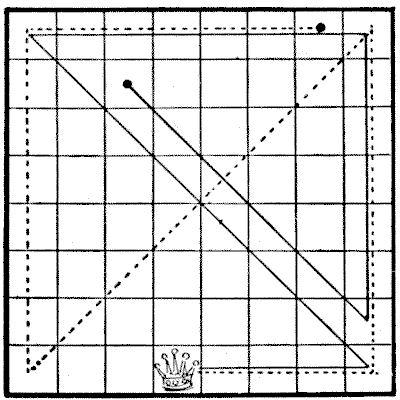
334.—ST. GEORGE AND THE DRAGON.—solution
We select for the solution of this puzzle one of the prettiest designs that can be formed by representing the moves of the knight by lines from square to square. The chequering of the squares is omitted to give greater clearness. St. George thus slays the Dragon in strict accordance with the conditions and in the elegant manner we should expect of him.
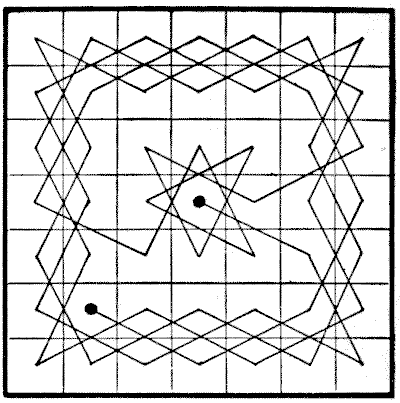
335.—FARMER LAWRENCE'S CORNFIELDS.—solution
There are numerous solutions to this little agricultural problem. The version I give in the next column is rather curious on account of the long parallel straight lines formed by some of the moves.
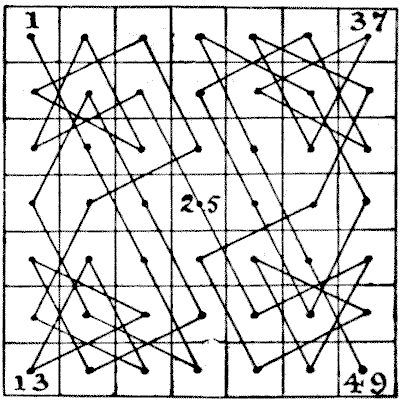
336.—THE GREYHOUND PUZZLE.—solution
There are several interesting points involved in this question. In the first place, if we had made no stipulation as to the positions of the two ends of the string, it is quite impossible to form any such string unless we begin and end in the top and bottom row of kennels. We may begin in the top row and end in the bottom (or, of course, the reverse), or we may begin in one of these rows and end in the same. But we can never begin or end in one of the two central rows. Our places of starting and ending, however, were fixed for us. Yet the first half of our route must be confined entirely to those squares that are distinguished in the following diagram by circles, and the second half will therefore be confined to the squares that are not circled. The squares reserved for the two half-strings will be seen to be symmetrical and similar.
The next point is that the first half-string must end in one of the central rows, and the second half-string must begin in one of these rows. This is now obvious, because they have to link together to form the complete string, and every square on an outside row is connected by a knight's move with similar squares only—that is, circled or non-circled as the case may be. The half-strings can, therefore, only be linked in the two central rows.
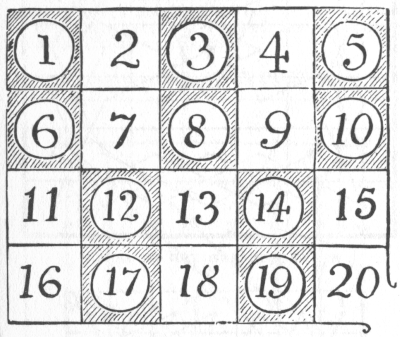
Now, there are just eight different first half-strings, and consequently also eight second half-strings. We shall see that these combine to form twelve complete strings, which is the total number that exist and the correct solution of our puzzle. I do not propose to give all the routes at length, but I will so far indicate them that if the reader has dropped any he will be able to discover which they are and work them out for himself without any difficulty. The following numbers apply to those in the above diagram.
The eight first half-strings are: 1 to 6 (2 routes); 1 to 8 (1 route); 1 to 10 (3 routes); 1 to 12 (1 route); and 1 to 14 (1 route). The eight second half-strings are: 7 to 20 (1 route); 9 to 20 (1 route); 11 to 20 (3 routes); 13 to 20 (1 route); and 15 to 20 (2 routes). Every different way in which you can link one half-string to another gives a different solution. These linkings will be found to be as follows: 6 to 13 (2 cases); 10 to 13 (3 cases); 8 to 11 (3 cases); 8 to 15 (2 cases); 12 to 9 (1 case); and 14 to 7 (1 case). There are, therefore, twelve different linkings and twelve different answers to the puzzle. The route given in the illustration with the greyhound will be found to consist of one of the three half-strings 1 to 10, linked to the half-string 13 to 20. It should be noted that ten of the solutions are produced by five distinctive routes and their reversals—that is, if you indicate these five routes by lines and then turn the diagrams upside down you will get the five other routes. The remaining two solutions are symmetrical (these are the cases where 12 to 9 and 14 to 7 are the links), and consequently they do not produce new solutions by reversal.
337.—THE FOUR KANGAROOS.—solution
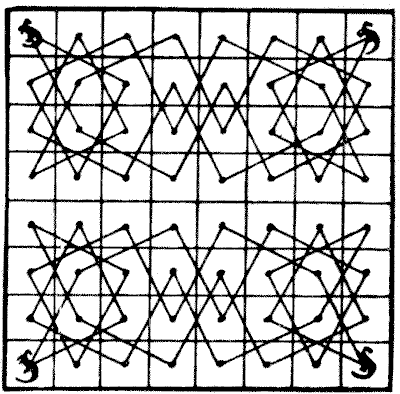
A pretty symmetrical solution to this puzzle is shown in the diagram. Each of the four kangaroos makes his little excursion and returns to his corner, without ever entering a square that has been visited by another kangaroo and without crossing the central line. It will at once occur to the reader, as a possible improvement of the puzzle, to divide the board by a central vertical line and make the condition that this also shall not be crossed. This would mean that each kangaroo had to confine himself to a square 4 by 4, but it would be quite impossible, as I shall explain in the next two puzzles.
338.—THE BOARD IN COMPARTMENTS.—solution
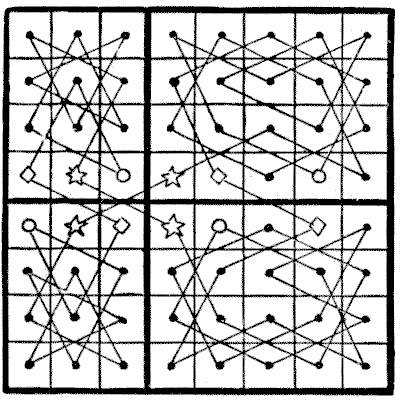
In attempting to solve this problem it is first necessary to take the two distinctive compartments of twenty and twelve squares respectively and analyse them with a view to determining where the necessary points of entry and exit lie. In the case of the larger compartment it will be found that to complete a tour of it we must begin and end on two of the outside squares on the long sides. But though you may start at any one of these ten squares, you are restricted as to those at which you can end, or (which is the same thing) you may end at whichever of these you like, provided you begin your tour at certain particular squares. In the case of the smaller compartment you are compelled to begin and end at one of the six squares lying at the two narrow ends of the compartments, but similar restrictions apply as in the other instance. A very little thought will show that in the case of the two small compartments you must begin and finish at the ends that lie together, and it then follows that the tours in the larger compartments must also start and end on the contiguous sides.
In the diagram given of one of the possible solutions it will be seen that there are eight places at which we may start this particular tour; but there is only one route in each case, because we must complete the compartment in which we find ourself before passing into another. In any solution we shall find that the squares distinguished by stars must be entering or exit points, but the law of reversals leaves us the option of making the other connections either at the diamonds or at the circles. In the solution worked out the diamonds are used, but other variations occur in which the circle squares are employed instead. I think these remarks explain all the essential points in the puzzle, which is distinctly instructive and interesting.
339.—THE FOUR KNIGHTS' TOURS.—solution
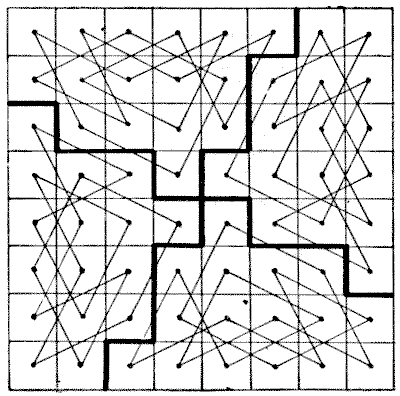
It will be seen in the illustration how a chessboard may be divided into four parts, each of the same size and shape, so that a complete re-entrant knight's tour may be made on each portion. There is only one possible route for each knight and its reversal.
340.—THE CUBIC KNIGHT'S TOUR.—solution
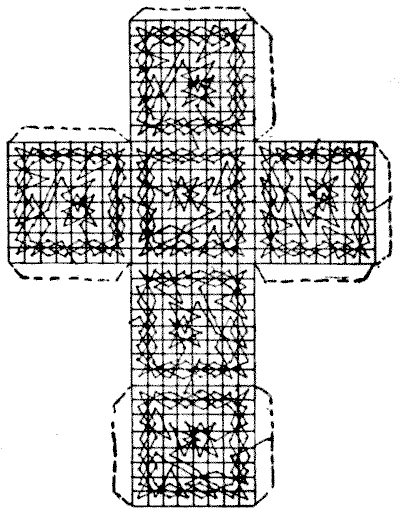
If the reader should cut out the above diagram, fold it in the form of a cube, and stick it together by the strips left for that purpose at the edges, he would have an interesting little curiosity. Or he can make one on a larger scale for himself. It will be found that if we imagine the cube to have a complete chessboard on each of its sides, we may start with the knight on any one of the 384 squares, and make a complete tour of the cube, always returning to the starting-point. The method of passing from one side of the cube to another is easily understood, but, of course, the difficulty consisted in finding the proper points of entry and exit on each board, the order in which the different boards should be taken, and in getting arrangements that would comply with the required conditions.
341.—THE FOUR FROGS.—solution
The fewest possible moves, counting every move separately, are sixteen. But the puzzle may be solved in seven plays, as follows, if any number of successive moves by one frog count as a single play. All the moves contained within a bracket are a single play; the numbers refer to the toadstools: (1—5), (3—7, 7—1), (8—4, 4—3, 3—7), (6—2, 2—8, 8—4, 4—3), (5—6, 6—2, 2—8), (1—5, 5—6), (7—1).
This is the familiar old puzzle by Guarini, propounded in 1512, and I give it here in order to explain my "buttons and string" method of solving this class of moving-counter problem.
Diagram A shows the old way of presenting Guarini's puzzle, the point being to make the white knights change places with the black ones. In "The Four Frogs" presentation of the idea the possible directions of the moves are indicated by lines, to obviate the necessity of the reader's understanding the nature of the knight's move in chess. But it will at once be seen that the two problems are identical. The central square can, of course, be ignored, since no knight can ever enter it. Now, regard the toadstools as buttons and the connecting lines as strings, as in Diagram B. Then by disentangling these strings we can clearly present the diagram in the form shown in Diagram C, where the relationship between the buttons is precisely the same as in B. Any solution on C will be applicable to B, and to A. Place your white knights on 1 and 3 and your black knights on 6 and 8 in the C diagram, and the simplicity of the solution will be very evident. You have simply to move the knights round the circle in one direction or the other. Play over the moves given above, and you will find that every little difficulty has disappeared.
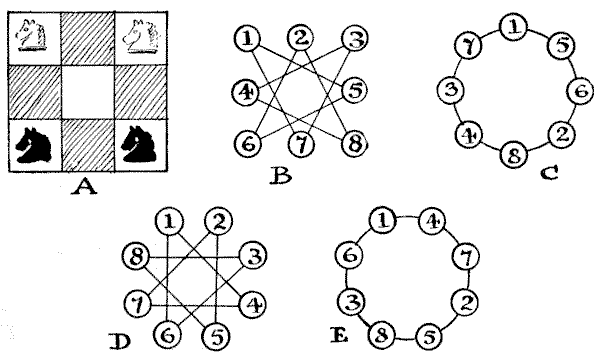
In Diagram D I give another familiar puzzle that first appeared in a book published in Brussels in 1789, Les Petites Aventures de Jerome Sharp. Place seven counters on seven of the eight points in the following manner. You must always touch a point that is vacant with a counter, and then move it along a straight line leading from that point to the next vacant point (in either direction), where you deposit the counter. You proceed in the same way until all the counters are placed. Remember you always touch a vacant place and slide the counter from it to the next place, which must be also vacant. Now, by the "buttons and string" method of simplification we can transform the diagram into E. Then the solution becomes obvious. "Always move to the point that you last moved from." This is not, of course, the only way of placing the counters, but it is the simplest solution to carry in the mind.
There are several puzzles in this book that the reader will find lend themselves readily to this method.
342.—THE MANDARIN'S PUZZLE.—solution
The rather perplexing point that the solver has to decide for himself in attacking this puzzle is whether the shaded numbers (those that are shown in their right places) are mere dummies or not. Ninety-nine persons out of a hundred might form the opinion that there can be no advantage in moving any of them, but if so they would be wrong.
The shortest solution without moving any shaded number is in thirty-two moves. But the puzzle can be solved in thirty moves. The trick lies in moving the 6, or the 15, on the second move and replacing it on the nineteenth move. Here is the solution: 2, 6, 13, 4, 1, 21, 4, 1, 10, 2, 21, 10, 2, 5, 22, 16, 1, 13, 6, 19, 11, 2, 5, 22, 16, 5, 13, 4, 10, 21. Thirty moves.
343.—EXERCISE FOR PRISONERS.—solution
There are eighty different arrangements of the numbers in the form of a perfect knight's path, but only forty of these can be reached without two men ever being in a cell at the same time. Two is the greatest number of men that can be given a complete rest, and though the knight's path can be arranged so as to leave either 7 and 13, 8 and 13, 5 and 7, or 5 and 13 in their original positions, the following four arrangements, in which 7 and 13 are unmoved, are the only ones that can be reached under the moving conditions. It therefore resolves itself into finding the fewest possible moves that will lead up to one of these positions. This is certainly no easy matter, and no rigid rules can be laid down for arriving at the correct answer. It is largely a matter for individual judgment, patient experiment, and a sharp eye for revolutions and position.
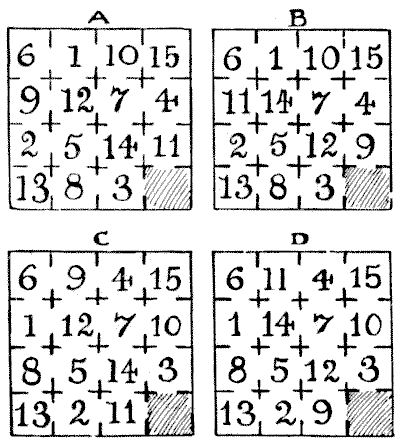
As a matter of fact, the position C can be reached in as few as sixty-six moves in the following manner: 12, 11, 15, 12, 11, 8, 4, 3, 2, 6, 5, 1, 6, 5, 10, 15, 8, 4, 3, 2, 5, 10, 15, 8, 4, 3, 2, 5, 10, 15, 8, 4, 12, 11, 3, 2, 5, 10, 15, 6, 1, 8, 4, 9, 8, 1, 6, 4, 9, 12, 2, 5, 10, 15, 4, 9, 12, 2, 5, 3, 11, 14, 2, 5, 14, 11 = 66 moves. Though this is the shortest that I know of, and I do not think it can be beaten, I cannot state positively that there is not a shorter way yet to be discovered. The most tempting arrangement is certainly A; but things are not what they seem, and C is really the easiest to reach.
If the bottom left-hand corner cell might be left vacant, the following is a solution in forty-five moves by Mr. R. Elrick: 15, 11, 10, 9, 13, 14, 11, 10, 7, 8, 4, 3, 8, 6, 9, 7, 12, 4, 6, 9, 5, 13, 7, 5, 13, 1, 2, 13, 5, 7, 1, 2, 13, 8, 3, 6, 9, 12, 7, 11, 14, 1, 11, 14, 1. But every man has moved.
344.—THE KENNEL PUZZLE.—solution
The first point is to make a choice of the most promising knight's string and then consider the question of reaching the arrangement in the fewest moves. I am strongly of opinion that the best string is the one represented in the following diagram, in which it will be seen that each successive number is a knight's move from the preceding one, and that five of the dogs (1, 5, 10, 15, and 20) never leave their original kennels.
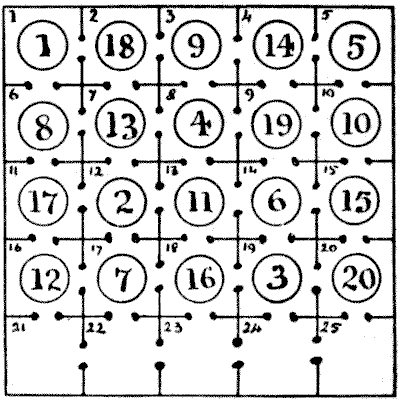
This position may be arrived at in as few as forty-six moves, as follows: 16—21, 16—22, 16—23, 17—16, 12—17, 12—22, 12—21,7—12, 7—17, 7—22, 11—12, 11—17, 2—7, 2—12, 6—11, 8—7, 8—6, 13—8, 18—13, 11—18, 2—17, 18—12, 18—7, 18—2, 13—7, 3—8, 3—13, 4—3, 4—8, 9—4, 9—3, 14—9, 14—4, 19—14, 19—9, 3—14, 3—19, 6—12, 6—13, 6—14, 17—11, 12—16, 2—12, 7—17, 11—13, 16—18 = 46 moves. I am, of course, not able to say positively that a solution cannot be discovered in fewer moves, but I believe it will be found a very hard task to reduce the number.
345.—THE TWO PAWNS.—solution
Call one pawn A and the other B. Now, owing to that optional first move, either pawn may make either 5 or 6 moves in reaching the eighth square. There are, therefore, four cases to be considered: (1) A 6 moves and B 6 moves; (2) A 6 moves and B 5 moves; (3) A 5 moves and B 6 moves; (4) A 5 moves and B 5 moves. In case (1) there are 12 moves, and we may select any 6 of these for A. Therefore 7 × 8 × 9 × 10 × 11 × 12 divided by 1 × 2 × 3 × 4 × 5 × 6 gives us the number of variations for this case—that is, 924. Similarly for case (2), 6 selections out of 11 will be 462; in case (3), 5 selections out of 11 will also be 462; and in case (4), 5 selections out of 10 will be 252. Add these four numbers together and we get 2,100, which is the correct number of different ways in which the pawns may advance under the conditions. (See No. 270, on p. 204.)
346.—SETTING THE BOARD.—solution
The White pawns may be arranged in 40,320 ways, the White rooks in 2 ways, the bishops in 2 ways, and the knights in 2 ways. Multiply these numbers together, and we find that the White pieces may be placed in 322,560 different ways. The Black pieces may, of course, be placed in the same number of ways. Therefore the men may be set up in 322,560 × 322,560 = 104,044,953,600 ways. But the point that nearly everybody overlooks is that the board may be placed in two different ways for every arrangement. Therefore the answer is doubled, and is 208,089,907,200 different ways.
347.—COUNTING THE RECTANGLES.—solution
There are 1,296 different rectangles in all, 204 of which are squares, counting the square board itself as one, and 1,092 rectangles that are not squares. The general formula is that a board of n2 squares contains ((n2 + n)2)/4 rectangles, of which (2n3 + 3n2 + n)/6 are squares and (3n4 + 2n3 - 3n2 - 2n)/12 are rectangles that are not squares. It is curious and interesting that the total number of rectangles is always the square of the triangular number whose side is n.
348.—THE ROOKERY.—solution
The answer involves the little point that in the final position the numbered rooks must be in numerical order in the direction contrary to that in which they appear in the original diagram, otherwise it cannot be solved. Play the rooks in the following order of their numbers. As there is never more than one square to which a rook can move (except on the final move), the notation is obvious—5, 6, 7, 5, 6, 4, 3, 6, 4, 7, 5, 4, 7, 3, 6, 7, 3, 5, 4, 3, 1, 8, 3, 4, 5, 6, 7, 1, 8, 2, 1, and rook takes bishop, checkmate. These are the fewest possible moves—thirty-two. The Black king's moves are all forced, and need not be given.
349.—STALEMATE.—solution
Working independently, the same position was arrived at by Messrs. S. Loyd, E.N. Frankenstein, W.H. Thompson, and myself. So the following may be accepted as the best solution possible to this curious problem :—
White.Black.
1. P—Q41. P—K4
2. Q—Q32. Q—R5
3. Q—KKt33. B—Kt5 ch
4. Kt—Q24. P—QR4
5. P—R45. P—Q3
6. P—R36. B—K3
7. R—R37. P—KB4
8. Q—R28. P—B4
9. R—KKt39. B—Kt6
10. P—QB410. P—B5
11. P—B311. P—K5
12. P—Q512. P—K6
And White is stalemated.
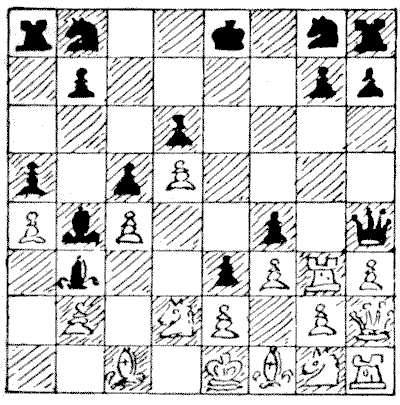
We give a diagram of the curious position arrived at. It will be seen that not one of White's pieces may be moved.
350.—THE FORSAKEN KING.—solution
Play as follows:—
White.Black.
1. P to K 4th1. Any move
2. Q to Kt 4th2. Any move except on KB file (a)
3. Q to Kt 7th3. K moves to royal row
4. B to Kt 5th4. Any move
5. Mate in two moves
If 3. K other than to royal row
4. P to Q 4th4. Any move
5. Mate in two moves
(a) If 2. Any move on KB file
3. Q to Q 7th3. K moves to royal row
4. P to Q Kt 3rd4. Any move
5. Mate in two moves
If 3. K other than to royal row
4. P to Q 4th4. Any move
5. Mate in two moves
Of course, by "royal row" is meant the row on which the king originally stands at the beginning of a game. Though, if Black plays badly, he may, in certain positions, be mated in fewer moves, the above provides for every variation he can possibly bring about.
351.—THE CRUSADER.—solution
White.Black.
1. Kt to QB 3rd1. P to Q 4th
2. Kt takes QP2. Kt to QB 3rd
3. Kt takes KP3. P to KKt 4th
4. Kt takes B4. Kt to KB 3rd
5. Kt takes P5. Kt to K 5th
6. Kt takes Kt6. Kt to B 6th
7. Kt takes Q7. R to KKt sq
8. Kt takes BP8. R to KKt 3rd
9. Kt takes P9. R to K 3rd
10. Kt takes P10. Kt to Kt 8th
11. Kt takes B11. R to R 6th
12. Kt takes R12. P to Kt 4th
13. Kt takes P (ch)13. K to B 2nd
14. Kt takes P14. K to Kt 3rd
15. Kt takes R15. K to R 4th
16. Kt takes Kt16. K to R 5th
White now mates in three moves.
17. P to Q 4th17. K to R 4th
18. Q to Q 3rd18. K moves
19. Q to KR 3rd (mate)
If 17. K to Kt 5th
18. P to K 4th (dis. ch)18. K moves
19. P to KKt 3rd (mate)
The position after the sixteenth move, with the mate in three moves, was first given by S. Loyd in Chess Nuts.
352.—IMMOVABLE PAWNS.—solution
1. Kt to KB 3
2. Kt to KR 4
3. Kt to Kt 6
4. Kt takes R
5. Kt to Kt 6
6. Kt takes B
7. K takes Kt
8. Kt to QB 3
9. Kt to R 4
10. Kt to Kt 6
11. Kt takes R
12. Kt to Kt 6
13. Kt takes B
14. Kt to Q 6
15. Q to K sq
16. Kt takes Q
17. K takes Kt, and the position is reached.
Black plays precisely the same moves as White, and therefore we give one set of moves only. The above seventeen moves are the fewest possible.
353.—THIRTY-SIX MATES.—solution
Place the remaining eight White pieces thus: K at KB 4th, Q at QKt 6th, R at Q 6th, R at KKt 7th, B at Q 5th, B at KR 8th, Kt at QR 5th, and Kt at QB 5th. The following mates can then be given:—
By discovery from Q8
By discovery from R at Q 6th13
By discovery from B at R 8th11
Given by Kt at R 5th2
Given by pawns2
Total36
Is it possible to construct a position in which more than thirty-six different mates on the move can be given? So far as I know, nobody has yet beaten my arrangement.
354.—AN AMAZING DILEMMA.—solution
Mr Black left his king on his queen's knight's 7th, and no matter what piece White chooses for his pawn, Black cannot be checkmated. As we said, the Black king takes no notice of checks and never moves. White may queen his pawn, capture the Black rook, and bring his three pieces up to the attack, but mate is quite impossible. The Black king cannot be left on any other square without a checkmate being possible.
The late Sam Loyd first pointed out the peculiarity on which this puzzle is based.
355.—CHECKMATE!—solution
Remove the White pawn from B 6th to K 4th and place a Black pawn on Black's KB 2nd. Now, White plays P to K 5th, check, and Black must play P to B 4th. Then White plays P takes P en passant, checkmate. This was therefore White's last move, and leaves the position given. It is the only possible solution.
356.—QUEER CHESS.—solution
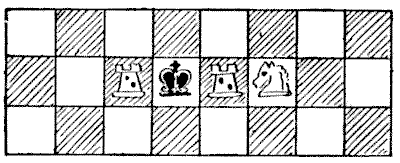
If you place the pieces as follows (where only a portion of the board is given, to save space), the Black king is in check, with no possible move open to him. The reader will now see why I avoided the term "checkmate," apart from the fact that there is no White king. The position is impossible in the game of chess, because Black could not be given check by both rooks at the same time, nor could he have moved into check on his last move.
I believe the position was first published by the late S. Loyd.
357.—ANCIENT CHINESE PUZZLE.—solution
Play as follows:—
1. R—Q 6
2. K—R 7
3. R (R 6)—B 6 (mate).
Black's moves are forced, so need not be given.
358.—THE SIX PAWNS.—solution
The general formula for six pawns on all squares greater than 22 is this: Six times the square of the number of combinations of n things taken three at a time, where n represents the number of squares on the side of the board. Of course, where n is even the unoccupied squares in the rows and columns will be even, and where n is odd the number of squares will be odd. Here n is 8, so the answer is 18,816 different ways. This is "The Dyer's Puzzle" (Canterbury Puzzles, No. 27) in another form. I repeat it here in order to explain a method of solving that will be readily grasped by the novice. First of all, it is evident that if we put a pawn on any line, we must put a second one in that line in order that the remainder may be even in number. We cannot put four or six in any row without making it impossible to get an even number in all the columns interfered with. We have, therefore, to put two pawns in each of three rows and in each of three columns. Now, there are just six schemes or arrangements that fulfil these conditions, and these are shown in Diagrams A to F, inclusive, on next page.
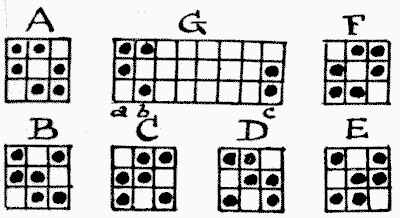
I will just remark in passing that A and B are the only distinctive arrangements, because, if you give A a quarter-turn, you get F; and if you give B three quarter-turns in the direction that a clock hand moves, you will get successively C, D, and E. No matter how you may place your six pawns, if you have complied with the conditions of the puzzle they will fall under one of these arrangements. Of course it will be understood that mere expansions do not destroy the essential character of the arrangements. Thus G is only an expansion of form A. The solution therefore consists in finding the number of these expansions. Supposing we confine our operations to the first three rows, as in G, then with the pairs a and b placed in the first and second columns the pair c may be disposed in any one of the remaining six columns, and so give six solutions. Now slide pair b into the third column, and there are five possible positions for c. Slide b into the fourth column, and c may produce four new solutions. And so on, until (still leaving a in the first column) you have b in the seventh column, and there is only one place for c—in the eighth column. Then you may put a in the second column, b in the third, and c in the fourth, and start sliding c and b as before for another series of solutions.
We find thus that, by using form A alone and confining our operations to the three top rows, we get as many answers as there are combinations of 8 things taken 3 at a time. This is (8 × 7 × 6)/(1 × 2 × 3) = 56. And it will at once strike the reader that if there are 56 different ways of electing the columns, there must be for each of these ways just 56 ways of selecting the rows, for we may simultaneously work that "sliding" process downwards to the very bottom in exactly the same way as we have worked from left to right. Therefore the total number of ways in which form A may be applied is 56 × 6 = 3,136. But there are, as we have seen, six arrangements, and we have only dealt with one of these, A. We must, therefore, multiply this result by 6, which gives us 3,136 × 6 = 18,816, which is the total number of ways, as we have already stated.
359.—COUNTER SOLITAIRE.—solution
Play as follows: 3—11, 9—10, 1—2, 7—15, 8—16, 8—7, 5—13, 1—4, 8—5, 6—14, 3—8, 6—3, 6—12, 1—6, 1—9, and all the counters will have been removed, with the exception of No. 1, as required by the conditions.
360.—CHESSBOARD SOLITAIRE.—solution
Play as follows: 7—15, 8—16, 8—7, 2—10, 1—9, 1—2, 5—13, 3—4, 6—3, 11—1, 14—8, 6—12, 5—6, 5—11, 31—23, 32—24, 32—31, 26—18, 25—17, 25—26, 22—32, 14—22, 29—21, 14—29, 27—28, 30—27, 25—14, 30—20, 25—30, 25—5. The two counters left on the board are 25 and 19—both belonging to the same group, as stipulated—and 19 has never been moved from its original place.
I do not think any solution is possible in which only one counter is left on the board.
361.—THE MONSTROSITY.—solution
WhiteBlack,
1.P to KB 4P to QB 3
2.K to B 2Q to R 4
3.K to K 3K to Q sq
4.P to B 5K to B 2
5.Q to K sqK to Kt 3
6.Q to Kt 3Kt to QR 3
7.Q to Kt 8P to KR 4
8.Kt to KB 3R to R 3
9.Kt to K 5R to Kt 3
10.Q takes BR to Kt 6, ch
11.P takes RK to Kt 4
12.R to R 4P to B 3
13.R to Q 4P takes Kt
14.P to QKt 4P takes R, ch
15.K to B 4P to R 5
16.Q to K 8P to R 6
17.Kt to B 3, chP takes Kt
18.B to R 3P to R 7
19.R to Kt sqP to R 8 (Q)
20.R to Kt 2P takes R
21.K to Kt 5Q to KKt 8
22.Q to R 5K to R 5
23.P to Kt 5R to B sq
24.P to Kt 6R to B 2
25.P takes RP to Kt 8 (B)
26.P to B 8 (R)Q to B 2
27.B to Q 6Kt to Kt 5
28.K to Kt 6K to R 6
29.R to R 8K to Kt 7
30.P to R 4Q (Kt 8) to Kt 3
31.P to R 5K to B 8
32.P takes QK to Q 8
33.P takes QK to K 8
34.K to B 7Kt to KR 3, ch
35.K to K 8B to R 7
36.P to B 6B to Kt sq
37.P to B 7K takes B
38.P to B 8 (B)Kt to Q 4
39.B to Kt 8Kt to B 3, ch
40.K to Q 8Kt to K sq
41.P takes Kt (R)Kt to B 2, ch
42.K to B 7Kt to Q sq
43.Q to B 7, chK to Kt 8
And the position is reached.
The order of the moves is immaterial, and this order may be greatly varied. But, although many attempts have been made, nobody has succeeded in reducing the number of my moves.
362.—THE WASSAIL BOWL.—solution
The division of the twelve pints of ale can be made in eleven manipulations, as below. The six columns show at a glance the quantity of ale in the barrel, the five-pint jug, the three-pint jug, and the tramps X, Y, and Z respectively after each manipulation.
Barrel.5-pint.3-pint.X.Y.Z.
7..5..0..0..0..0
7..2..3..0..0..0
7..0..3..2..0..0
7..3..0..2..0..0
4..3..3..2..0..0
0..3..3..2..4..0
0..5..1..2..4..0
0..5..0..2..4..1
0..2..3..2..4..1
0..0..3..4..4..1
0..0..0..4..4..4
And each man has received his four pints of ale.
363.—THE DOCTOR'S QUERY.—solution
The mixture of spirits of wine and water is in the proportion of 40 to 1, just as in the other bottle it was in the proportion of 1 to 40.
364.—THE BARREL PUZZLE.—solution
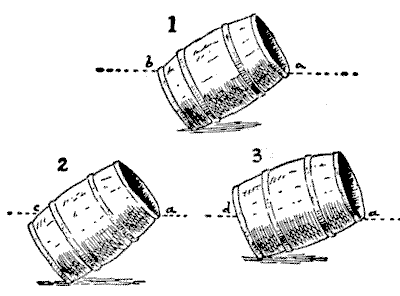
All that is necessary is to tilt the barrel as in Fig. 1, and if the edge of the surface of the water exactly touches the lip a at the same time that it touches the edge of the bottom b, it will be just half full. To be more exact, if the bottom is an inch or so from the ground, then we can allow for that, and the thickness of the bottom, at the top. If when the surface of the water reached the lip a it had risen to the point c in Fig. 2, then it would be more than half full. If, as in Fig. 3, some portion of the bottom were visible and the level of the water fell to the point d, then it would be less than half full.
This method applies to all symmetrically constructed vessels.
365.—NEW MEASURING PUZZLE.—solution
The following solution in eleven manipulations shows the contents of every vessel at the start and after every manipulation:—
10-quart.10-quart.5-quart.4-quart.
10..10..0..0
5..10..5..0
5..10..1..4
9..10..1..0
9..6..1..4
9..7..0..4
9..7..4..0
9..3..4..4
9..3..5..3
9..8..0..3
4..8..5..3
4..10..3..3
366.—THE HONEST DAIRYMAN.—solution
Whatever the respective quantities of milk and water, the relative proportion sent to London would always be three parts of water to one of milk. But there are one or two points to be observed. There must originally be more water than milk, or there will be no water in A to double in the second transaction. And the water must not be more than three times the quantity of milk, or there will not be enough liquid in B to effect the second transaction. The third transaction has no effect on A, as the relative proportions in it must be the same as after the second transaction. It was introduced to prevent a quibble if the quantity of milk and water were originally the same; for though double "nothing" would be "nothing," yet the third transaction in such a case could not take place.
367.—WINE AND WATER.—solution
The wine in small glass was one-sixth of the total liquid, and the wine in large glass two-ninths of total. Add these together, and we find that the wine was seven-eighteenths of total fluid, and therefore the water eleven-eighteenths.
368.—THE KEG OF WINE.—solution
The capacity of the jug must have been a little less than three gallons. To be more exact, it was 2.93 gallons.
369.—MIXING THE TEA.—solution
There are three ways of mixing the teas. Taking them in the order of quality, 2s. 6d., 2s. 3d., 1s. 9p., mix 16 lbs., 1 lb., 3 lbs.; or 14 lbs., 4 lbs., 2 lbs.; or 12 lbs., 7 lbs., 1 lb. In every case the twenty pounds mixture should be worth 2s. 4½d. per pound; but the last case requires the smallest quantity of the best tea, therefore it is the correct answer.
370.—A PACKING PUZZLE.—solution
On the side of the box, 14 by 224/5, we can arrange 13 rows containing alternately 7 and 6 balls, or 85 in all. Above this we can place another layer consisting of 12 rows of 7 and 6 alternately, or a total of 78. In the length of 249/10 inches 15 such layers may be packed, the alternate layers containing 85 and 78 balls. Thus 8 times 85 added to 7 times 78 gives us 1,226 for the full contents of the box.
371.—GOLD PACKING IN RUSSIA.—solution
The box should be 100 inches by 100 inches by 11 inches deep, internal dimensions. We can lay flat at the bottom a row of eight slabs, lengthways, end to end, which will just fill one side, and nine of these rows will dispose of seventy-two slabs (all on the bottom), with a space left over on the bottom measuring 100 inches by 1 inch by 1 inch. Now make eleven depths of such seventy-two slabs, and we have packed 792, and have a space 100 inches by 1 inch by 11 inches deep. In this we may exactly pack the remaining eight slabs on edge, end to end.
372.—THE BARRELS OF HONEY.—solution
The only way in which the barrels could be equally divided among the three brothers, so that each should receive his 3½ barrels of honey and his 7 barrels, is as follows:—
Full.Half-full.Empty.
A313
B232
C232
There is one other way in which the division could be made, were it not for the objection that all the brothers made to taking more than four barrels of the same description. Except for this difficulty, they might have given B his quantity in exactly the same way as A above, and then have left C one full barrel, five half-full barrels, and one empty barrel. It will thus be seen that in any case two brothers would have to receive their allowance in the same way.
373.—CROSSING THE STREAM.—solution
First, the two sons cross, and one returns Then the man crosses and the other son returns. Then both sons cross and one returns. Then the lady crosses and the other son returns Then the two sons cross and one of them returns for the dog. Eleven crossings in all.
It would appear that no general rule can be given for solving these river-crossing puzzles. A formula can be found for a particular case (say on No. 375 or 376) that would apply to any number of individuals under the restricted conditions; but it is not of much use, for some little added stipulation will entirely upset it. As in the case of the measuring puzzles, we generally have to rely on individual ingenuity.
374.—CROSSING THE RIVER AXE.—solution
Here is the solution:—
{J 5)G T8 3
5( J }G T8 3
5{G 3)JT8
53( G }JT8
53{J T)G 8
J 5(T 3}G 8
J 5{G 8)T 3
G 8(J 5}T
G 8{J T)53
JT8( G }53
JT8{G 3)5
G T8 3( J }5
G T8 3{J 5)
G, J, and T stand for Giles, Jasper, and Timothy; and 8, 5, 3, for £800, £500, and £300 respectively. The two side columns represent the left bank and the right bank, and the middle column the river. Thirteen crossings are necessary, and each line shows the position when the boat is in mid-stream during a crossing, the point of the bracket indicating the direction.
It will be found that not only is no person left alone on the land or in the boat with more than his share of the spoil, but that also no two persons are left with more than their joint shares, though this last point was not insisted upon in the conditions.
375.—FIVE JEALOUS HUSBANDS.—solution
It is obvious that there must be an odd number of crossings, and that if the five husbands had not been jealous of one another the party might have all got over in nine crossings. But no wife was to be in the company of a man or men unless her husband was present. This entails two more crossings, eleven in all.
The following shows how it might have been done. The capital letters stand for the husbands, and the small letters for their respective wives. The position of affairs is shown at the start, and after each crossing between the left bank and the right, and the boat is represented by the asterisk. So you can see at a glance that a, b, and c went over at the first crossing, that b and c returned at the second crossing, and so on.
ABCDE abcde *..
1. ABCDE de ..* abc
2. ABCDE bcde *.. a
3. ABCDE e ..* abcd
4. ABCDE de *.. abc
5. DE de ..* ABC abc
6. CDE cde *.. AB ab
7. cde ..* ABCDE ab
8. bcde *.. ABCDE a
9. e ..* ABCDE abcd
10. bc e *.. ABCDE a d
11. ..* ABCDE abcde
There is a little subtlety concealed in the words "show the quickest way."
Everybody correctly assumes that, as we are told nothing of the rowing capabilities of the party, we must take it that they all row equally well. But it is obvious that two such persons should row more quickly than one.
Therefore in the second and third crossings two of the ladies should take back the boat to fetch d, not one of them only. This does not affect the number of landings, so no time is lost on that account. A similar opportunity occurs in crossings 10 and 11, where the party again had the option of sending over two ladies or one only.
To those who think they have solved the puzzle in nine crossings I would say that in every case they will find that they are wrong. No such jealous husband would, in the circumstances, send his wife over to the other bank to a man or men, even if she assured him that she was coming back next time in the boat. If readers will have this fact in mind, they will at once discover their errors.
376.—THE FOUR ELOPEMENTS.—solution
If there had been only three couples, the island might have been dispensed with, but with four or more couples it is absolutely necessary in order to cross under the conditions laid down. It can be done in seventeen passages from land to land (though French mathematicians have declared in their books that in such circumstances twenty-four are needed), and it cannot be done in fewer. I will give one way. A, B, C, and D are the young men, and a, b, c, and d are the girls to whom they are respectively engaged. The three columns show the positions of the different individuals on the lawn, the island, and the opposite shore before starting and after each passage, while the asterisk indicates the position of the boat on every occasion.
Lawn.Island.Shore.
ABCDabcd *
ABCD cdab *
ABCD bcd *a
ABCD dbc *a
ABCD cd *ba
CD cdbAB a *
BCD cd *bA a
BCDbcd *A a
BCD d *bcA a
D dbcABC a *
D dabc *ABC
D dbABC a c *
B D d *bA C a c
dbABCD a c *
dbc *ABCD a
dABCD abc *
cd *ABCD ab
ABCD abcd *
Having found the fewest possible passages, we should consider two other points in deciding on the "quickest method": Which persons were the most expert in handling the oars, and which method entails the fewest possible delays in getting in and out of the boat? We have no data upon which to decide the first point, though it is probable that, as the boat belonged to the girls' household, they would be capable oarswomen. The other point, however, is important, and in the solution I have given (where the girls do 8-13ths of the rowing and A and D need not row at all) there are only sixteen gettings-in and sixteen gettings-out. A man and a girl are never in the boat together, and no man ever lands on the island. There are other methods that require several more exchanges of places.
377.—STEALING THE CASTLE TREASURE.—solution
Here is the best answer, in eleven manipulations:—
Treasure down.
Boy down—treasure up.
Youth down—boy up.
Treasure down.
Man down—youth and treasure up.
Treasure down.
Boy down—treasure up.
Treasure down.
Youth down—boy up.
Boy down—treasure up.
Treasure down.
378.—DOMINOES IN PROGRESSION.—solution
There are twenty-three different ways. You may start with any domino, except the 4—4 and those that bear a 5 or 6, though only certain initial dominoes may be played either way round. If you are given the common difference and the first domino is played, you have no option as to the other dominoes. Therefore all I need do is to give the initial domino for all the twenty-three ways, and state the common difference. This I will do as follows:—
With a common difference of 1, the first domino may be either of these: 0—0, 0—1, 1—0, 0—2, 1—1, 2—0, 0—3, 1—2, 2—1, 3—0, 0—4, 1—3, 2—2, 3—1, 1—4, 2—3, 3—2, 2—4, 3—3, 3—4. With a difference of 2, the first domino may be 0—0, 0—2, or 0—1. Take the last case of all as an example. Having played the 0—1, and the difference being 2, we are compelled to continue with 1—2, 2—3, 3—4. 4—5, 5—6. There are three dominoes that can never be used at all. These are 0—5, 0—6, and 1—6. If we used a box of dominoes extending to 9—9, there would be forty different ways.
379.—THE FIVE DOMINOES.—solution
There are just ten different ways of arranging the dominoes. Here is one of them:—
(2—0) (0—0) (0—1) (1—4) (4—0).
I will leave my readers to find the remaining nine for themselves.
380.—THE DOMINO FRAME PUZZLE.—solution
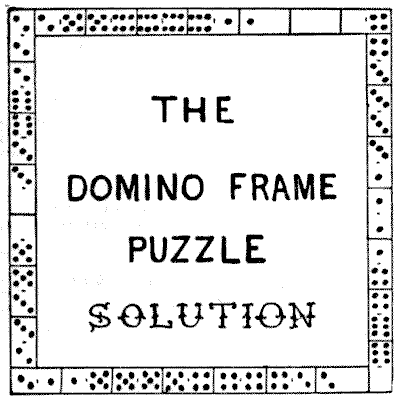
The illustration is a solution. It will be found that all four sides of the frame add up 44. The sum of the pips on all the dominoes is 168, and if we wish to make the sides sum to 44, we must take care that the four corners sum to 8, because these corners are counted twice, and 168 added to 8 will equal 4 times 44, which is necessary. There are many different solutions. Even in the example given certain interchanges are possible to produce different arrangements. For example, on the left-hand side the string of dominoes from 2—2 down to 3—2 may be reversed, or from 2—6 to 3—2, or from 3—0 to 5—3. Also, on the right-hand side we may reverse from 4—3 to 1—4. These changes will not affect the correctness of the solution.
381.—THE CARD FRAME PUZZLE.—solution
The sum of all the pips on the ten cards is 55. Suppose we are trying to get 14 pips on every side. Then 4 times 14 is 56. But each of the four corner cards is added in twice, so that 55 deducted from 56, or 1, must represent the sum of the four corner cards. This is clearly impossible; therefore 14 is also impossible. But suppose we came to trying 18. Then 4 times 18 is 72, and if we deduct 55 we get 17 as the sum of the corners. We need then only try different arrangements with the four corners always summing to 17, and we soon discover the following solution:—
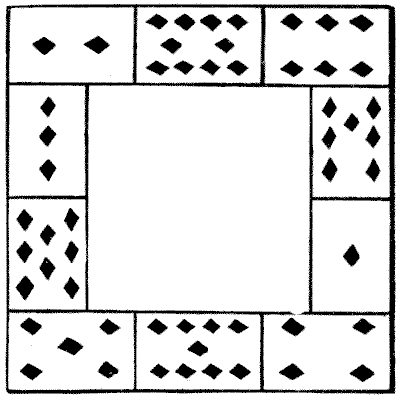
The final trials are very limited in number, and must with a little judgment either bring us to a correct solution or satisfy us that a solution is impossible under the conditions we are attempting. The two centre cards on the upright sides can, of course, always be interchanged, but I do not call these different solutions. If you reflect in a mirror you get another arrangement, which also is not considered different. In the answer given, however, we may exchange the 5 with the 8 and the 4 with the 1. This is a different solution. There are two solutions with 18, four with 19, two with 20, and two with 22—ten arrangements in all. Readers may like to find all these for themselves.
382.—THE CROSS OF CARDS.—solution
There are eighteen fundamental arrangements, as follows, where I only give the numbers in the horizontal bar, since the remainder must naturally fall into their places.
5 6 1 7 4
3 5 1 6 8
3 4 1 7 8
2 5 1 7 8
2 5 3 6 8
1 5 3 7 8
2 4 3 7 8
1 4 5 7 8
2 3 5 7 8
2 4 5 6 8
3 4 5 6 7
1 4 7 6 8
2 3 7 6 8
2 4 7 5 8
3 4 9 5 6
2 4 9 5 7
1 4 9 6 7
2 3 9 6 7
It will be noticed that there must always be an odd number in the centre, that there are four ways each of adding up 23, 25, and 27, but only three ways each of summing to 24 and 26.
383.—THE "T" CARD PUZZLE.—solution
If we remove the ace, the remaining cards may he divided into two groups (each adding up alike) in four ways; if we remove 3, there are three ways; if 5, there are four ways; if 7, there are three ways; and if we remove 9, there are four ways of making two equal groups. There are thus eighteen different ways of grouping, and if we take any one of these and keep the odd card (that I have called "removed") at the head of the column, then one set of numbers can be varied in order in twenty-four ways in the column and the other four twenty-four ways in the horizontal, or together they may be varied in 24 × 24 = 576 ways. And as there are eighteen such cases, we multiply this number by 18 and get 10,368, the correct number of ways of placing the cards. As this number includes the reflections, we must divide by 2, but we have also to remember that every horizontal row can change places with a vertical row, necessitating our multiplying by 2; so one operation cancels the other.
384.—CARD TRIANGLES.—solution
The following arrangements of the cards show (1) the smallest possible sum, 17; and (2) the largest possible, 23.
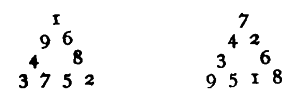
It will be seen that the two cards in the middle of any side may always be interchanged without affecting the conditions. Thus there are eight ways of presenting every fundamental arrangement. The number of fundamentals is eighteen, as follows: two summing to 17, four summing to 19, six summing to 20, four summing to 21, and two summing to 23. These eighteen fundamentals, multiplied by eight (for the reason stated above), give 144 as the total number of different ways of placing the cards.
385.—"STRAND" PATIENCE.—solution
The reader may find a solution quite easy in a little over 200 moves, but, surprising as it may at first appear, not more than 62 moves are required. Here is the play: By "4 C up" I mean a transfer of the 4 of clubs with all the cards that rest on it. 1 D on space, 2 S on space, 3 D on space, 2 S on 3 D, 1 H on 2 S, 2 C on space, 1 D on 2 C, 4 S on space, 3 H on 4 S (9 moves so far), 2 S up on 3 H (3 moves), 5 H and 5 D exchanged, and 4 C on 5 D (6 moves), 3 D on 4 C (1), 6 S (with 5 H) on space (3), 4 C up on 5 H (3), 2 C up on 3 D (3), 7 D on space (1), 6 C up on 7 D (3), 8 S on space (1), 7 H on 8 S (1), 8 C on 9 D (1), 7 H on 8 C (1), 8 S on 9 H (1), 7 H on 8 S (1), 7 D up on 8 C (5), 4 C up on 5 D (9), 6 S up on 7 H (3), 4 S up on 5 H (7) = 62 moves in all. This is my record; perhaps the reader can beat it.
386.—A TRICK WITH DICE.—solution
All you have to do is to deduct 250 from the result given, and the three figures in the answer will be the three points thrown with the dice. Thus, in the throw we gave, the number given would be 386; and when we deduct 250 we get 136, from which we know that the throws were 1, 3, and 6.
The process merely consists in giving 100a + 10b + c + 250, where a, b, and c represent the three throws. The result is obvious.
387.—THE VILLAGE CRICKET MATCH.—solution
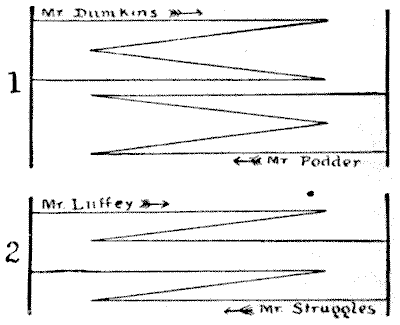
The diagram No. 1 will show that as neither Mr. Podder nor Mr. Dumkins can ever have been within the crease opposite to that from which he started, Mr. Dumkins would score nothing by his performance. Diagram No. 2 will, however, make it clear that since Mr. Luffey and Mr. Struggles have, notwithstanding their energetic but careless movements, contrived to change places, the manœuvre must increase Mr. Struggles's total by one run.
388.—SLOW CRICKET.—solution
The captain must have been "not out" and scored 21. Thus:—
2 men (each lbw)19
4 men (each caught)17
1 man (run out)0
3 men (each bowled)9
1 man (captain—not out)21
1166
The captain thus scored exactly 15 more than the average of the team. The "others" who were bowled could only refer to three men, as the eleventh man would be "not out." The reader can discover for himself why the captain must have been that eleventh man. It would not necessarily follow with any figures.
389.—THE FOOTBALL PLAYERS.—solution
The smallest possible number of men is seven. They could be accounted for in three different ways: 1. Two with both arms sound, one with broken right arm, and four with both arms broken. 2. One with both arms sound, one with broken left arm, two with broken right arm, and three with both arms broken. 3. Two with left arm broken, three with right arm broken, and two with both arms broken. But if every man was injured, the last case is the only one that would apply.
390.—THE HORSE-RACE PUZZLE.—solution
The answer is: £12 on Acorn, £15 on Bluebottle, £20 on Capsule.
391.—THE MOTOR-CAR RACE.—solution
The first point is to appreciate the fact that, in a race round a circular track, there are the same number of cars behind one as there are before. All the others are both behind and before. There were thirteen cars in the race, including Gogglesmith's car. Then one-third of twelve added to three-quarters of twelve will give us thirteen—the correct answer.
392.—THE PEBBLE GAME.—solution
In the case of fifteen pebbles, the first player wins if he first takes two. Then when he holds an odd number and leaves 1, 8, or 9 he wins, and when he holds an even number and leaves 4, 5, or 12 he also wins. He can always do one or other of these things until the end of the game, and so defeat his opponent. In the case of thirteen pebbles the first player must lose if his opponent plays correctly. In fact, the only numbers with which the first player ought to lose are 5 and multiples of 8 added to 5, such as 13, 21, 29, etc.
393.—THE TWO ROOKS.—solution
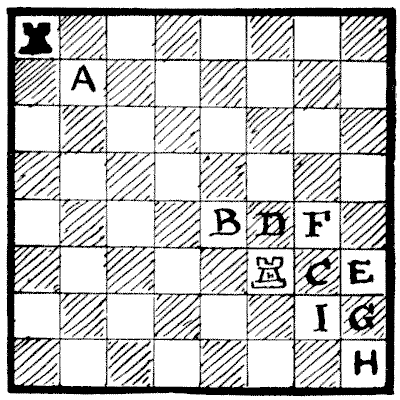
The second player can always win, but to ensure his doing so he must always place his rook, at the start and on every subsequent move, on the same diagonal as his opponent's rook. He can then force his opponent into a corner and win. Supposing the diagram to represent the positions of the rooks at the start, then, if Black played first, White might have placed his rook at A and won next move. Any square on that diagonal from A to H will win, but the best play is always to restrict the moves of the opposing rook as much as possible. If White played first, then Black should have placed his rook at B (F would not be so good, as it gives White more scope); then if White goes to C, Black moves to D; White to E, Black to F; White to G, Black to C; White to H, Black to I; and Black must win next move. If at any time Black had failed to move on to the same diagonal as White, then White could take Black's diagonal and win.
394.—PUSS IN THE CORNER.—solution
No matter whether he plays first or second, the player A, who starts the game at 55, must win. Assuming that B adopts the very best lines of play in order to prolong as much as possible his existence, A, if he has first move, can always on his 12th move capture B; and if he has the second move, A can always on his 14th move make the capture. His point is always to get diagonally in line with his opponent, and by going to 33, if he has first move, he prevents B getting diagonally in line with himself. Here are two good games. The number in front of the hyphen is always A's move; that after the hyphen is B's:—
33-8, 32-15, 31-22, 30-21, 29-14, 22-7, 15-6, 14-2, 7-3, 6-4, 11-, and A must capture on his next (12th) move, -13, 54-20, 53-27, 52-34, 51-41, 50-34, 42-27, 35-20, 28-13, 21-6, 14-2, 7-3, 6-4, 11-, and A must capture on his next (14th) move.
395.—A WAR PUZZLE GAME.—solution
The Britisher can always catch the enemy, no matter how clever and elusive that astute individual may be; but curious though it may seem, the British general can only do so after he has paid a somewhat mysterious visit to the particular town marked "1" in the map, going in by 3 and leaving by 2, or entering by 2 and leaving by 3. The three towns that are shaded and have no numbers do not really come into the question, as some may suppose, for the simple reason that the Britisher never needs to enter any one of them, while the enemy cannot be forced to go into them, and would be clearly ill-advised to do so voluntarily. We may therefore leave these out of consideration altogether. No matter what the enemy may do, the Britisher should make the following first nine moves: He should visit towns 24, 20, 19, 15, 11, 7, 3, 1, 2. If the enemy takes it into his head also to go to town 1, it will be found that he will have to beat a precipitate retreat the same way that he went in, or the Britisher will infallibly catch him in towns 2 or 3, as the case may be. So the enemy will be wise to avoid that north-west corner of the map altogether.
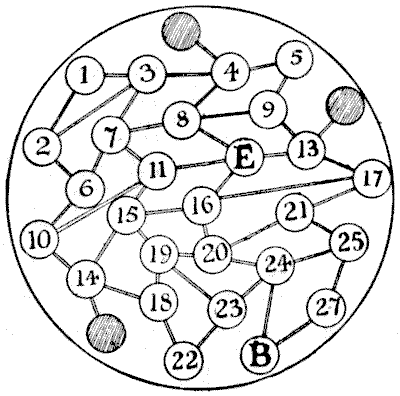
Now, when the British general has made the nine moves that I have given, the enemy will be, after his own ninth move, in one of the towns marked 5, 8, 11, 13, 14, 16, 19, 21, 24, or 27. Of course, if he imprudently goes to 3 or 6 at this point he will be caught at once. Wherever he may happen to be, the Britisher "goes for him," and has no longer any difficulty in catching him in eight more moves at most (seventeen in all) in one of the following ways. The Britisher will get to 8 when the enemy is at 5, and win next move; or he will get to 19 when the enemy is at 22, and win next move; or he will get to 24 when the enemy is at 27, and so win next move. It will be found that he can be forced into one or other of these fatal positions.
In short, the strategy really amounts to this: the Britisher plays the first nine moves that I have given, and although the enemy does his very best to escape, our general goes after his antagonist and always driving him away from that north-west corner ultimately closes in with him, and wins. As I have said, the Britisher never need make more than seventeen moves in all, and may win in fewer moves if the enemy plays badly. But after playing those first nine moves it does not matter even if the Britisher makes a few bad ones. He may lose time, but cannot lose his advantage so long as he now keeps the enemy from town 1, and must eventually catch him.
This is a complete explanation of the puzzle. It may seem a little complex in print, but in practice the winning play will now be quite easy to the reader. Make those nine moves, and there ought to be no difficulty whatever in finding the concluding line of play. Indeed, it might almost be said that then it is difficult for the British general not to catch the enemy. It is a question of what in chess we call the "opposition," and the visit by the Britisher to town 1 "gives him the jump" on the enemy, as the man in the street would say.
Here is an illustrative example in which the enemy avoids capture as long as it is possible for him to do so. The Britisher's moves are above the line and the enemy's below it. Play them alternately.
242019151173126101418192024
13913172120242319151923242527
The enemy must now go to 25 or B, in either of which towns he is immediately captured.
396.—A MATCH MYSTERY.—solution
If you form the three heaps (and are therefore the second to draw), any one of the following thirteen groupings will give you a win if you play correctly: 15, 14, 1; 15, 13, 2; 15, 12, 3; 15, 11, 4; 15, 10, 5; 15, 9, 6; 15, 8, 7; 14, 13, 3; 14, 11, 5; 14, 9, 7; 13, 11, 6; 13, 10, 7; 12, 11, 7.
The beautiful general solution of this problem is as follows. Express the number in every heap in powers of 2, avoiding repetitions and remembering that 20 = 1. Then if you so leave the matches to your opponent that there is an even number of every power, you can win. And if at the start you leave the powers even, you can always continue to do so throughout the game. Take, as example, the last grouping given above—12, 11, 7. Expressed in powers of 2 we have—
12=84--
11=8-21
7=-421
2222
As there are thus two of every power, you must win. Say your opponent takes 7 from the 12 heap. He then leaves—
5=-4-1
11=8-21
7=-421
1223
Here the powers are not all even in number, but by taking 9 from the 11 heap you immediately restore your winning position, thus—
5=-4-1
2=--2-
7=-421
-222
And so on to the end. This solution is quite general, and applies to any number of matches and any number of heaps. A correspondent informs me that this puzzle game was first propounded by Mr. W.M.F. Mellor, but when or where it was published I have not been able to ascertain.
397.—THE MONTENEGRIN DICE GAME.—solution
The players should select the pairs 5 and 9, and 13 and 15, if the chances of winning are to be quite equal. There are 216 different ways in which the three dice may fall. They may add up 5 in 6 different ways and 9 in 25 different ways, making 31 chances out of 216 for the player who selects these numbers. Also the dice may add up 13 in 21 different ways, and 15 in 10 different ways, thus giving the other player also 31 chances in 216.
398.—THE CIGAR PUZZLE.—solution
Not a single member of the club mastered this puzzle, and yet I shall show that it is so simple that the merest child can understand its solution—when it is pointed out to him! The large majority of my friends expressed their entire bewilderment. Many considered that "the theoretical result, in any case, is determined by the relationship between the table and the cigars;" others, regarding it as a problem in the theory of Probabilities, arrived at the conclusion that the chances are slightly in favour of the first or second player, as the case may be. One man took a table and a cigar of particular dimensions, divided the table into equal sections, and proceeded to make the two players fill up these sections so that the second player should win. But why should the first player be so accommodating? At any stage he has only to throw down a cigar obliquely across several of these sections entirely to upset Mr. 2's calculations! We have to assume that each player plays the best possible; not that one accommodates the other.
The theories of some other friends would be quite sound if the shape of the cigar were that of a torpedo—perfectly symmetrical and pointed at both ends.
I will show that the first player should infallibly win, if he always plays in the best possible manner. Examine carefully the following diagram, No. 1, and all will be clear.
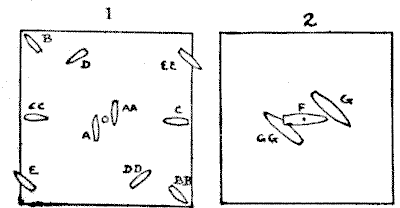
The first player must place his first cigar on end in the exact centre of the table, as indicated by the little circle. Now, whatever the second player may do throughout, the first player must always repeat it in an exactly diametrically opposite position. Thus, if the second player places a cigar at A, I put one at AA; he places one at B, I put one at BB; he places one at C, I put one at CC; he places one at D, I put one at DD; he places one at E, I put one at EE; and so on until no more cigars can be placed without touching. As the cigars are supposed to be exactly alike in every respect, it is perfectly clear that for every move that the second player may choose to make, it is possible exactly to repeat it on a line drawn through the centre of the table. The second player can always duplicate the first player's move, no matter where he may place a cigar, or whether he places it on end or on its side. As the cigars are all alike in every respect, one will obviously balance over the edge of the table at precisely the same point as another. Of course, as each player is supposed to play in the best possible manner, it becomes a matter of theory. It is no valid objection to say that in actual practice one would not be sufficiently exact to be sure of winning. If as the first player you did not win, it would be in consequence of your not having played the best possible.
The second diagram will serve to show why the first cigar must be placed on end. (And here I will say that the first cigar that I selected from a box I was able so to stand on end, and I am allowed to assume that all the other cigars would do the same.) If the first cigar were placed on its side, as at F, then the second player could place a cigar as at G—as near as possible, but not actually touching F. Now, in this position you cannot repeat his play on the opposite side, because the two ends of the cigar are not alike. It will be seen that GG, when placed on the opposite side in the same relation to the centre, intersects, or lies on top of, F, whereas the cigars are not allowed to touch. You must therefore put the cigar farther away from the centre, which would result in your having insufficient room between the centre and the bottom left-hand corner to repeat everything that the other player would do between G and the top right-hand corner. Therefore the result would not be a certain win for the first player.
399.—THE TROUBLESOME EIGHT.—solution
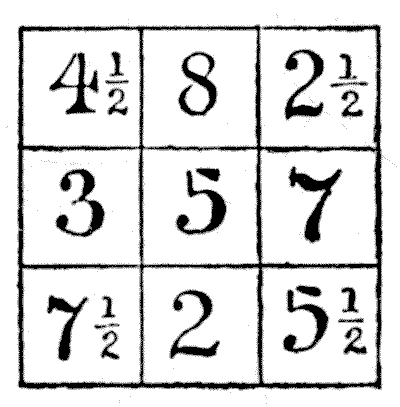
The conditions were to place a different number in each of the nine cells so that the three rows, three columns, and two diagonals should each add up 15. Probably the reader at first set himself an impossible task through reading into these conditions something which is not there—a common error in puzzle-solving. If I had said "a different figure," instead of "a different number," it would have been quite impossible with the 8 placed anywhere but in a corner. And it would have been equally impossible if I had said "a different whole number." But a number may, of course, be fractional, and therein lies the secret of the puzzle. The arrangement shown in the figure will be found to comply exactly with the conditions: all the numbers are different, and the square adds up 15 in all the required eight ways.
400.—THE MAGIC STRIPS.—solution
There are of course six different places between the seven figures in which a cut may be made, and the secret lies in keeping one strip intact and cutting each of the other six in a different place. After the cuts have been made there are a large number of ways in which the thirteen pieces may be placed together so as to form a magic square. Here is one of them:—
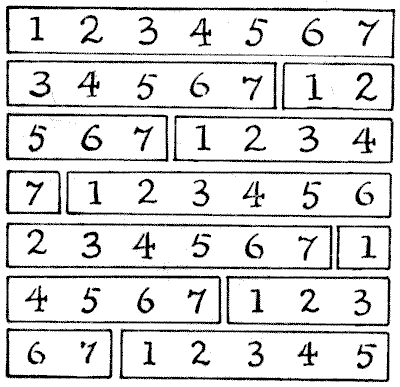
The arrangement has some rather interesting features. It will be seen that the uncut strip is at the top, but it will be found that if the bottom row of figures be placed at the top the numbers will still form a magic square, and that every successive removal from the bottom to the top (carrying the uncut strip stage by stage to the bottom) will produce the same result. If we imagine the numbers to be on seven complete perpendicular strips, it will be found that these columns could also be moved in succession from left to right or from right to left, each time producing a magic square.
401.—EIGHT JOLLY GAOL BIRDS.—solution
There are eight ways of forming the magic square—all merely different aspects of one fundamental arrangement. Thus, if you give our first square a quarter turn you will get the second square; and as the four sides may be in turn brought to the top, there are four aspects. These four in turn reflected in a mirror produce the remaining four aspects. Now, of these eight arrangements only four can possibly be reached under the conditions, and only two of these four can be reached in the fewest possible moves, which is nineteen. These two arrangements are shown. Move the men in the following order: 5, 3, 2, 5, 7, 6, 4, 1, 5, 7, 6, 4, 1, 6, 4, 8, 3, 2, 7, and you get the first square. Move them thus: 4, 1, 2, 4, 1, 6, 7, 1, 5, 8, 1, 5, 6, 7, 5, 6, 4, 2, 7, and you have the arrangement in the second square. In the first case every man has moved, but in the second case the man numbered 3 has never left his cell. Therefore No. 3 must be the obstinate prisoner, and the second square must be the required arrangement.
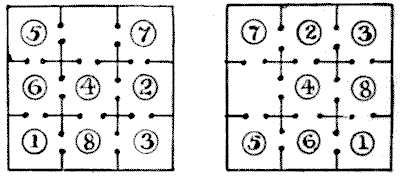
402.—NINE JOLLY GAOL BIRDS.—solution
There is a pitfall set for the unwary in this little puzzle. At the start one man is allowed to be placed on the shoulders of another, so as to give always one empty cell to enable the prisoners to move about without any two ever being in a cell together. The two united prisoners are allowed to add their numbers together, and are, of course, permitted to remain together at the completion of the magic square. But they are obviously not compelled so to remain together, provided that one of the pair on his final move does not break the condition of entering a cell already occupied. After the acute solver has noticed this point, it is for him to determine which method is the better one—for the two to be together at the count or to separate. As a matter of fact, the puzzle can be solved in seventeen moves if the men are to remain together; but if they separate at the end, they may actually save a move and perform the feat in sixteen! The trick consists in placing the man in the centre on the back of one of the corner men, and then working the pair into the centre before their final separation.
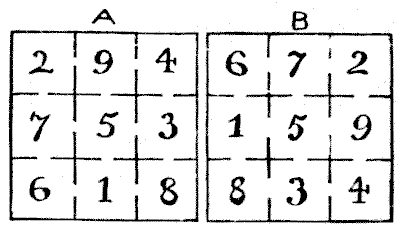
Here are the moves for getting the men into one or other of the above two positions. The numbers are those of the men in the order in which they move into the cell that is for the time being vacant. The pair is shown in brackets:—
Place 5 on 1. Then, 6, 9, 8, 6, 4, (6), 2, 4, 9, 3, 4, 9, (6), 7, 6, 1.
Place 5 on 9. Then, 4, 1, 2, 4, 6, (14), 8, 6, 1, 7, 6, 1, (14), 3, 4, 9.
Place 5 on 3. Then, 6, (8), 2, 6, 4, 7, 8, 4, 7, 1, 6, 7, (8), 9, 4, 3.
Place 5 on 7. Then, 4, (12), 8, 4, 6, 3, 2, 6, 3, 9, 4, 3, (12), 1, 6, 7.
The first and second solutions produce Diagram A; the second and third produce Diagram B. There are only sixteen moves in every case. Having found the fewest moves, we had to consider how we were to make the burdened man do as little work as possible. It will at once be seen that as the pair have to go into the centre before separating they must take at fewest two moves. The labour of the burdened man can only be reduced by adopting the other method of solution, which, however, forces us to take another move.
403.—THE SPANISH DUNGEON.—solution
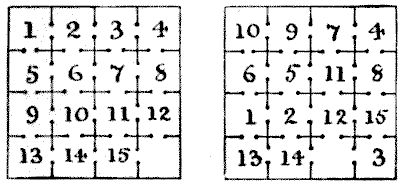
This can best be solved by working backwards—that is to say, you must first catch your square, and then work back to the original position. We must first construct those squares which are found to require the least amount of readjustment of the numbers. Many of these we know cannot possibly be reached. When we have before us the most favourable possible arrangements, it then becomes a question of careful analysis to discover which position can be reached in the fewest moves. I am afraid, however, it is only after considerable study and experience that the solver is able to get such a grasp of the various "areas of disturbance" and methods of circulation that his judgment is of much value to him.
The second diagram is a most favourable magic square position. It will be seen that prisoners 4, 8, 13, and 14 are left in their original cells. This position may be reached in as few as thirty-seven moves. Here are the moves: 15, 14, 10, 6, 7, 3, 2, 7, 6, 11, 3, 2, 7, 6, 11, 10, 14, 3, 2, 11, 10, 9, 5, 1, 6, 10, 9, 5, 1, 6, 10, 9, 5, 2, 12, 15, 3. This short solution will probably surprise many readers who may not find a way under from sixty to a hundred moves. The clever prisoner was No. 6, who in the original illustration will be seen with his arms extended calling out the moves. He and No. 10 did most of the work, each changing his cell five times. No. 12, the man with the crooked leg, was lame, and therefore fortunately had only to pass from his cell into the next one when his time came round.
404.—THE SIBERIAN DUNGEONS.—solution
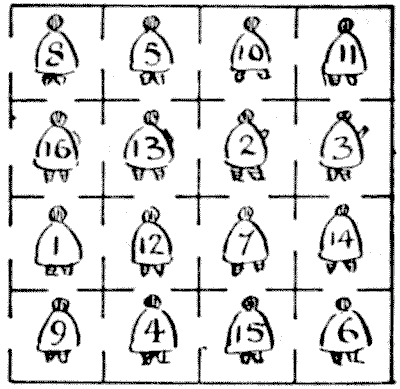
In attempting to solve this puzzle it is clearly necessary to seek such magic squares as seem the most favourable for our purpose, and then carefully examine and try them for "fewest moves." Of course it at once occurs to us that if we can adopt a square in which a certain number of men need not leave their original cells, we may save moves on the one hand, but we may obstruct our movements on the other. For example, a magic square may be formed with the 6, 7, 13, and 16 unmoved; but in such case it is obvious that a solution is impossible, since cells 14 and 15 can neither be left nor entered without breaking the condition of no two men ever being in the same cell together.
The following solution in fourteen moves was found by Mr. G. Wotherspoon: 8-17, 16-21, 6-16, 14-8, 5-18, 4-14, 3-24, 11-20, 10-19, 2-23, 13-22, 12-6, 1-5, 9-13. As this solution is in what I consider the theoretical minimum number of moves, I am confident that it cannot be improved upon, and on this point Mr. Wotherspoon is of the same opinion.
405.—CARD MAGIC SQUARES.—solution
Arrange the cards as follows for the three new squares:—
324
432
243
657
765
576
9810
1098
8109
Three aces and one ten are not used. The summations of the four squares are thus: 9, 15, 18, and 27—all different, as required.
406.—THE EIGHTEEN DOMINOES.—solution
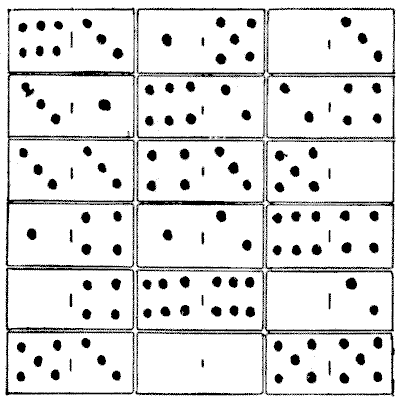
The illustration explains itself. It will be found that the pips in every column, row, and long diagonal add up 18, as required.
407.—TWO NEW MAGIC SQUARES.—solution
Here are two solutions that fulfil the conditions:—
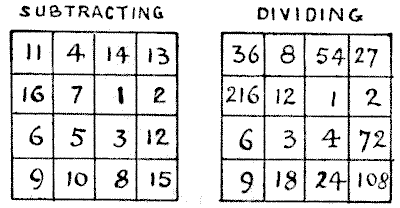
The first, by subtracting, has a constant 8, and the associated pairs all have a difference of 4. The second square, by dividing, has a constant 9, and all the associated pairs produce 3 by division. These are two remarkable and instructive squares.
408.—MAGIC SQUARES OF TWO DEGREES.—solution
The following is the square that I constructed. As it stands the constant is 260. If for every number you substitute, in its allotted place, its square, then the constant will be 11,180. Readers can write out for themselves the second degree square.
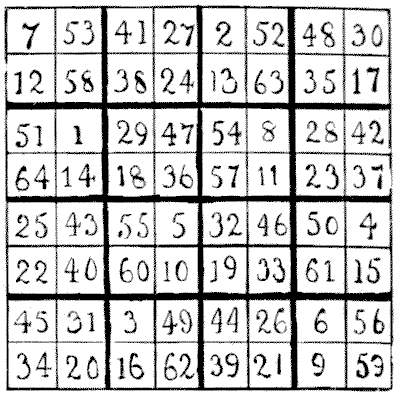
The main key to the solution is the pretty law that if eight numbers sum to 260 and their squares to 11,180, then the same will happen in the case of the eight numbers that are complementary to 65. Thus 1 + 18 + 23 + 26 + 31 + 48 + 56 + 57 = 260, and the sum of their squares is 11,180. Therefore 64 + 47 + 42 + 39 + 34 + 17 + 9 + 8 (obtained by subtracting each of the above numbers from 65) will sum to 260 and their squares to 11,180. Note that in every one of the sixteen smaller squares the two diagonals sum to 65. There are four columns and four rows with their complementary columns and rows. Let us pick out the numbers found in the 2nd, 1st, 4th, and 3rd rows and arrange them thus :—
18282942475154
27273041485253
36263144454956
45253243465055
Here each column contains four consecutive numbers cyclically arranged, four running in one direction and four in the other. The numbers in the 2nd, 5th, 3rd, and 8th columns of the square may be similarly grouped. The great difficulty lies in discovering the conditions governing these groups of numbers, the pairing of the complementaries in the squares of four and the formation of the diagonals. But when a correct solution is shown, as above, it discloses all the more important keys to the mystery. I am inclined to think this square of two degrees the most elegant thing that exists in magics. I believe such a magic square cannot be constructed in the case of any order lower than 8.
409.—THE BASKETS OF PLUMS.—solution
As the merchant told his man to distribute the contents of one of the baskets of plums "among some children," it would not be permissible to give the complete basketful to one child; and as it was also directed that the man was to give "plums to every child, so that each should receive an equal number," it would also not be allowed to select just as many children as there were plums in a basket and give each child a single plum. Consequently, if the number of plums in every basket was a prime number, then the man would be correct in saying that the proposed distribution was quite impossible. Our puzzle, therefore, resolves itself into forming a magic square with nine different prime numbers.
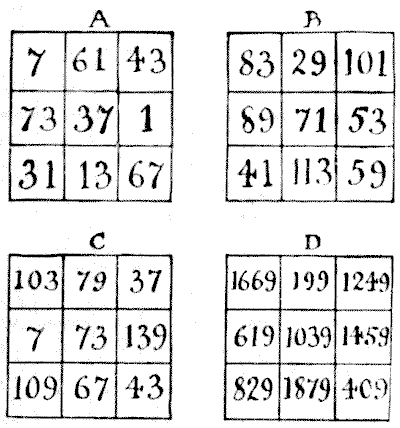
In Diagram A we have a magic square in prime numbers, and it is the one giving the smallest constant sum that is possible. As to the little trap I mentioned, it is clear that Diagram A is barred out by the words "every basket contained plums," for one plum is not plums. And as we were referred to the baskets, "as shown in the illustration," it is perfectly evident, without actually attempting to count the plums, that there are at any rate more than 7 plums in every basket. Therefore C is also, strictly speaking, barred. Numbers over 20 and under, say, 250 would certainly come well within the range of possibility, and a large number of arrangements would come within these limits. Diagram B is one of them. Of course we can allow for the false bottoms that are so frequently used in the baskets of fruitsellers to make the basket appear to contain more fruit than it really does.
Several correspondents assumed (on what grounds I cannot think) that in the case of this problem the numbers cannot be in consecutive arithmetical progression, so I give Diagram D to show that they were mistaken. The numbers are 199, 409, 619, 829, 1,039, 1,249, 1,459, 1,669, and 1,879—all primes with a common difference of 210.
410.—THE MANDARIN'S "T" PUZZLE.—solution
There are many different ways of arranging the numbers, and either the 2 or the 3 may be omitted from the "T" enclosure. The arrangement that I give is a "nasik" square. Out of the total of 28,800 nasik squares of the fifth order this is the only one (with its one reflection) that fulfils the "T" condition. This puzzle was suggested to me by Dr. C. Planck.
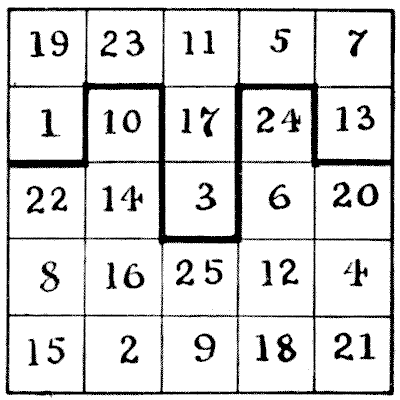
411.—A MAGIC SQUARE OF COMPOSITES.—solution
The problem really amounts to finding the smallest prime such that the next higher prime shall exceed it by 10 at least. If we write out a little list of primes, we shall not need to exceed 150 to discover what we require, for after 113 the next prime is 127. We can then form the square in the diagram, where every number is composite. This is the solution in the smallest numbers. We thus see that the answer is arrived at quite easily, in a square of the third order, by trial. But I propose to show how we may get an answer (not, it is true, the one in smallest numbers) without any tables or trials, but in a very direct and rapid manner.
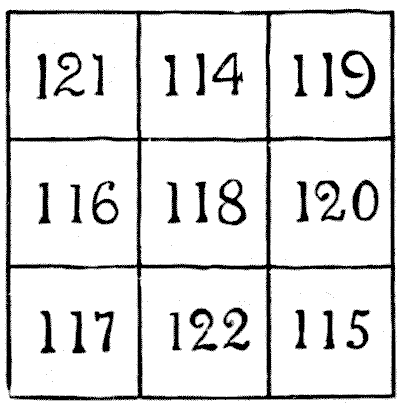
First write down any consecutive numbers, the smallest being greater than 1—say, 2, 3, 4, 5, 6, 7, 8, 9, 10. The only factors in these numbers are 2, 3, 5, and 7. We therefore multiply these four numbers together and add the product, 210, to each of the nine numbers. The result is the nine consecutive composite numbers, 212 to 220 inclusive, with which we can form the required square. Every number will necessarily be divisible by its difference from 210. It will be very obvious that by this method we may find as many consecutive composites as ever we please. Suppose, for example, we wish to form a magic square of sixteen such numbers; then the numbers 2 to 17 contain the factors 2, 3, 5, 7, 11, 13, and 17, which, multiplied together, make 510510 to be added to produce the sixteen numbers 510512 to 510527 inclusive, all of which are composite as before.