DOCHNAHL'S CLASSIFICATION.
Reading edition
SECTION I.—PLEUROIDEA.—Angular or Ribbed.
Having sharp or flat ribs, which extend over the length of the fruit and are most prominent around the eye, where they are most generally situated.
CLASS I.—MALA CYDONARIA—Quince-shaped.
ORDER I.—CALVILLES.
1. They have large heart-shaped cells, open towards the axis, or often entirely torn; the cells extend very often from the stalk even to the tube of the calyx.
2. They diminish from about the middle of the fruit, or a little above it, towards the eye.
3. They are regular, and provided generally with fine ribs, which do not disfigure the fruit.
4. On the tree, the fruit is covered with bloom.
5. They are never distinctly striped.
6. Their flesh is soft, loose, fine and light, of a balsamic flavor, similar to that of strawberries or raspberries.
7. The eye is frequently closed.
8. Many of them acquire by keeping an oily or unctuous skin.
Group I.—Fruit red, almost entirely covered with red.
Group II.—Fruit parti-colored; yellow; very much striped or washed with red.
Group III.—Fruit yellow; of a whitish, greenish, or golden yellow.
ORDER II.—PSEUDO-CALVILLES.
1. The cells are almost the same as the true Calvilles—very large and open.
2. The calycinal tube is wide and generally very short.
3. They are slightly narrowed toward the eye, and flattened toward the stalk.
4. Their ribs are very prominent, especially around the eye.
5. They are aromatic, and have not the balsamic flavor of the true Calvilles.
6. Their flesh is fine, opaque, a little succulent, and almost equal to the Reinettes.
Groups I., II., III., as above.
CLASS II.—MALA PYRARIA—Pear-shaped.
Their flavor is neither balsamic nor aromatic; they are purely sweet or acid; their flesh is granulous and loose.
ORDER I.—TREMARIA—Seeds Loose.
1. They are almost always large apples, the skin of which is neither unctuous nor covered with bloom.
2. They are also furnished with ribs; but they are not so regular as in the Calvilles.
3. The cells are very large, irregular, widened, and generally open.
4. The calycinal tube is most generally widely conical, and does not extend to the cells.
5. They are of a flattened, conical, cylindrical or pointed shape.
6. Their flesh is loose, more often a little coarse, and of a slightly balsamic flavor.
7. The leaves of these trees are very large, rather deeply dentated, and less downy than those of the Calvilles.
Group I.—Unicolores—Green, greenish, yellow, or golden yellow, and slightly tinged with red.
Group II.—Bicolores—Yellow or green, and distinctly striped or washed with red.
ORDER II.—RAMBURES.
1. They are all very large.
2. They have almost always the two halves unequal.
3. They are constantly broader than high, and appear sometimes higher than they are.
4. They are not furnished with ribs, except around the eye; these are often irregular in numbers, and frequently form broad projections on the fruit.
5. They do not decay, but shrivel when they have passed maturity.
6. The flesh is coarsely granulous, rarely aromatic, nevertheless often very agreeable.
Group I.—Capsulis amplis—Wide cells.
Group II.—Capsulis angustis—Narrow cells.
SECTION II.—SPHÆROIDÆ—Spherical.
They have sometimes prominences on the fruit and around the eye, but never true ribs.
CLASS III.—MALA MESPILARIA—Medlar shaped.
Their flavor is sweet, aromatic, similar to that of the Rose, fennel or anise.
ORDER I.—APIANA, or Rose Apples.
Their flesh is soft, loose, marrowy, very fine grain, and of a snow white color.
2. The cells are almost always regular and closed.
3. They are regularly ribbed around the eye, and often also over the fruit, but sometimes not at all ribbed.
4. They have a balsamic flavor, accompanied with a very agreeable odor.
5. They emit a pleasant odor when briskly rubbed.
6. When on the tree they are frequently covered with a blue bloom, and striped like a Tulip.
7. The fruit is mostly small, or middle sized.
8. They are mostly of short duration, and lose their good flavor the same year.
Group I.—Oblongi—Oblong fruit.
Group II.—Sphærici—Round or flattened.
ORDER II.—REINETTA—Reinettes.
1. These are apples which generally have the most regular and handsome shape, having the bulge in the middle, at the same distance from the eye as from the stalk.
2. All are dotted, clouded, or entirely covered with russet.
3. They are very rarely inclined to be unctuous, but generally rough when handled.
4. They all decay very readily; (they must therefore be left as long as possible on the tree.)
5. Their flesh is fine grained, crisp, firm, or fine and delicate.
6. They are all charged with only a balsamic, sugary acid, which is called Reinette-flavored.
Group I.—Unicolores.—1. Having uniform green ground color, which changes to the most beautiful golden yellow.
2. Having no lively colors or marks of russet on the side next the sun, except those that are very much exposed, and are slightly tinged with red.
3. Having no covering of russet, but only slight traces of russety stripes.
Group II.—Rubri—Fruit red; having all the properties of the self-colored Reinettes; but on the side next the sun they are of a red color, with a mixture of russet.
Group III.—Ravi—Russeted.
1. Their ground color is green, changing to dingy, dull yellow.
2. The coatings of russet are very conspicuous.
3. The side next the sun is often dingy, brownish, or ochreous red.
4. They all decay very readily.
Group IV.—Aurei—Yellow or golden fruit, Golden Reinettes.
1. On the side next the sun they are washed or striped with beautiful crimson.
2. The ground color changes, by keeping, to beautiful deep yellow.
3. Over the crimson there is a light thin trace, or a complete covering of russet.
CLASS IV.—MALA MALARIA—Perfect or Pure Apple-Shaped.
They are of a perfectly sweet or vinous flavor, approaching to pure acid.
ORDER I.—STRIOLA, or Striped.
1. They are almost always marked with broken stripes of red.
2. These are either over the whole fruit, or only indistinctly on the side exposed to the sun.
3. The stripes may all be distinct—that is, clearly and finely striped; or between these stripes, on the side next the sun, the fruit is dotted, shaded or washed with red; but on the shaded side the stripes are well defined.
4. The cells are regular.
5. The fruit does not decay, except when gathered before maturity, or after the period when it has been properly ripened.
Group I.—Depressa—Flat.
1. They have the bulge at the same distance from the eye as from the stalk, and are broadly flattened.
2. They are always half an inch broader than high.
Group II.—Acuminati—Pointed.
1. They are broader than high.
2. They diminish from the middle of the apple toward the eye, so that the superior half is conical, and is not at all similar to the inferior half.
Group III.—Oblongi—Oblong or cylindrical.
1. The hight and breadth are almost equal.
2. They diminish gradually from the base to the apex.
3. Or, from the middle of the fruit they gradually diminish toward the base and apex equally.
Group IV.—Sphærici—Round.
1. The convexity of the fruit next the base and the apex is the same.
2. The breadth does not differ from the hight, except only about a quarter of an inch.
3. When laid on their side they present a spherical shape.
ORDER II.—CONTUBERNALIA—Storing Apples.
1. Having the cells regular.
2. They are not striped, and are either of a uniform color or washed with red on the side next the sun.
3. They do not readily decay.
4. They are not unctuous when handled.
5. They are never covered with bloom.
Group I.—Acuminati—Tapering, diminishing toward the eye.
Group II.—Depressi—Flat. These are constantly broader than high.[47]
After a long and careful consideration and study of this subject, I have prepared the following formula for the Classification of Apples. It consists of four classes that are based upon the general figure of the fruit; with two orders, that are distinguished by a modification of the form, causing the fruit to be regular, or irregular, and angular. The characters upon which the classes are founded are exemplified by a vertical section through the length of the axis of the fruit. Those by which the Orders are distinguished are shown by a transverse section, made at right angles to the axis, or by holding the fruit with the blossom end toward the eye.[48]
Each of these Orders may contain two Sections, characterized by their flavor as sweet and sour; and each of these may again be sub-divided into three Sub-sections, that are based upon color.
Class I.—Oblate or Flat, having the axis shorter than the transverse diameter.
Order I.—Regular.
Order II.—Irregular.
Section 1.—Sweet.
Section 2.—Sour.
Sub-section 1.—Pale or blushed, more or less, but self-colored and not striped.
Sub-section 2.—Striped or Splashed.
Sub-section 3.—Russeted.
Class II.—Conical, tapering decidedly toward the eye, and becoming Ovate when larger in the middle and tapering to each end, the axial diameter being the shorter.
Orders I and II.
Sections 1 and 2.
Sub-sections 1, 2, and 3.
Class III.—Round, Globular or nearly so, having the axial and transverse diameters about equal, the former often shorter by less than one-quarter of the latter. The ends are often so flattened as to look truncated, when the fruit appears to be cylindrical or globular-oblate.
Orders, Sections, and Sub-sections, as above.
Class IV.—Oblong, in which the axis is longer than the transverse diameter, or appears so. These may also be truncate or cylindrical.
Orders, Sections, and Sub-sections, as above.
FOOTNOTES:
DESCRIPTIONS OF APPLES.ToC
ARRANGED ACCORDING TO THEIR CLASSIFICATION ALPHABETICALLY, UNDER EACH DIVISION.
CLASS I.—FLAT APPLES.
ORDER I.—REGULAR IN FORM.
SECTION 1.—SWEET.
SUB-SECTION 1.—SELF-COLORED, NOT STRIPED.
Camack Sweet.
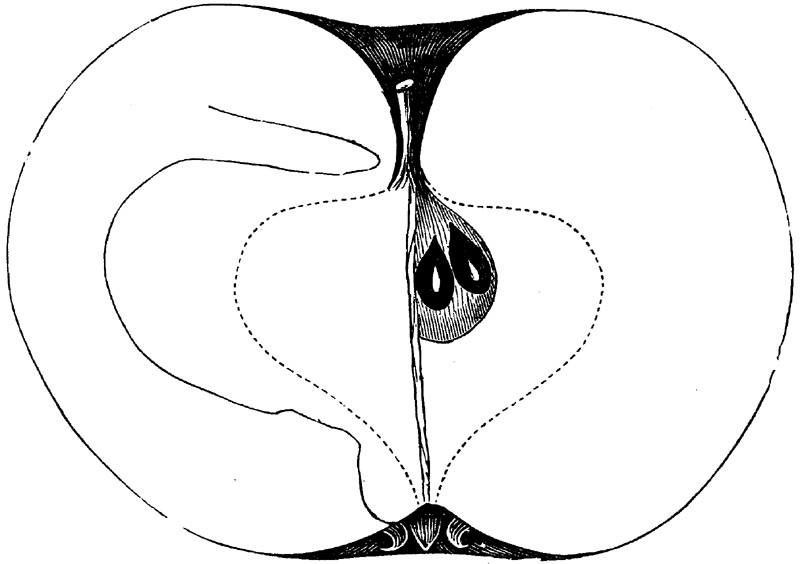
Fig. 51.—CAMACK SWEET.
This newly introduced sort is said to have originated in North Carolina or Georgia. The trees cultivated in the Northern States are yet too young for us to judge of their characteristics, but they appear to be healthy and vigorous.
Fruit medium to large, flat, regular.
Surface smooth, greenish-white, rarely blushed with red.
Basin broad, shallow, and regular or wavy; Eye medium, open.
Cavity deep, acute; Stem rather long; Flesh yellowish, firm, rather tough, but juicy, rich and sweet.
This variety keeps well, lasting until May. Not yet sufficiently tested in the North.
Campfield.
NEWARK SWEETING.
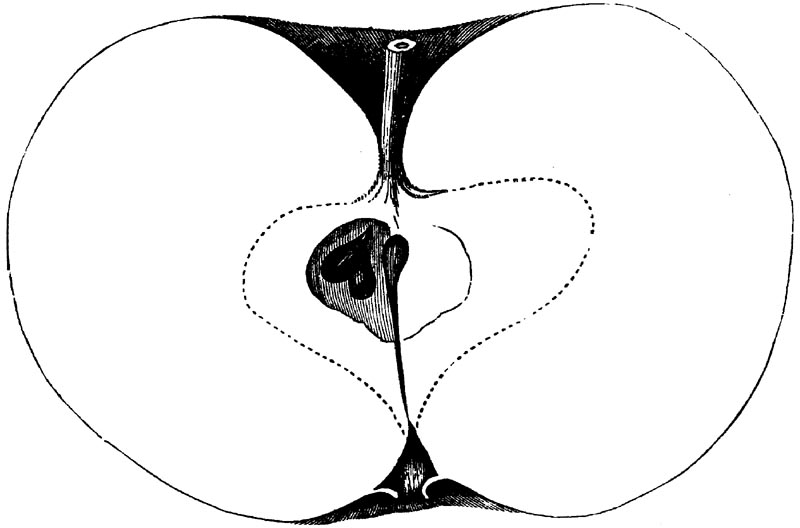
Fig. 52.—CAMPFIELD.
Tree vigorous, spreading, productive. This fruit is especially valuable for cider, but it may be used also in the kitchen; being a long keeper and often beautifully colored at maturity in the spring, it is often exposed on the fruit-stands, where it attracts purchasers by the great beauty of its brilliant colors.
Fruit always fair, but its figure is variable, being sometimes globular or conical. The characteristic form is round-oblate, regular; Size medium.
Surface very smooth, of a dull green, often suffused with a faint blush on the exposed side; but at maturity, bright lemon yellow, shaded with carmine; Dots minute, gray and indented.
Basin shallow, regular; Eye rather large, closed; Segments of medium length.
Cavity regular, with medium width and depth; Stem medium, rather stout.
Core wide, regular, closed, meeting the eye; Seeds numerous, plump; Flesh white, firm, tough; Juice very sweet and rich at maturity, making excellent cider.
Season, December until March.
Dillingham.
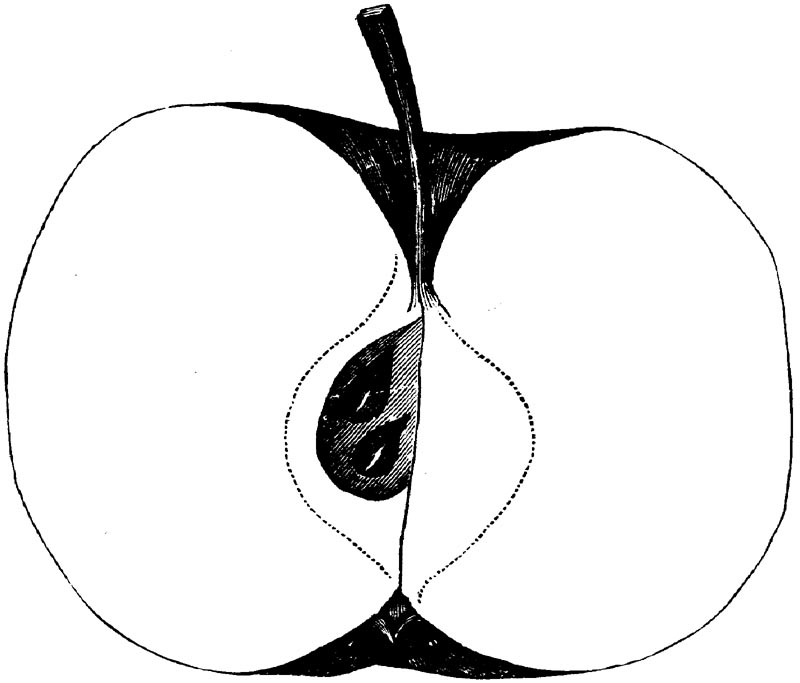
Fig. 53.—DILLINGHAM.
This variety was found in an old orchard of D.C. Richmond, near Sandusky, Ohio. Tree productive, and sufficiently vigorous.
Fruit round-oblate rather than flat, generally regular and of medium size; Surface rough, yellowish-green, and bronzed, or shaded with a purplish tint; Dots numerous russet.
Basin wide, folded; Eye small, closed.
Cavity rather deep, wide, regular, wavy, brown; Stem sometimes long, of medium size, red.
Core small and closed, meeting the eye; Seeds numerous, large, brown.
Flesh yellow; Flavor sweet, juicy; Use, good for baking; Season, November to February. Not highly esteemed nor largely cultivated, though its productiveness and sweetness would render it desirable for stock-feeding.
Ene's Winter Sweet.
From J.S. Downer, Elkton, Kentucky; a southern fruit of some merit.
Fruit medium, flat, regular; Surface roughish, uneven, greenish-yellow, blushed and russeted; Dots numerous, minute, russet veined.
Basin abrupt, regular, leather-cracked; Eye large, open.
Cavity wide, wavy, brown; Stem medium.
Core round, closed, clasping; Seeds numerous, angular, imperfect; Flesh yellow, fine grained; Flavor very sweet, rich; Quality quite good; Use, table; Season, December.
Green Sweet.
HONEY GREENING.
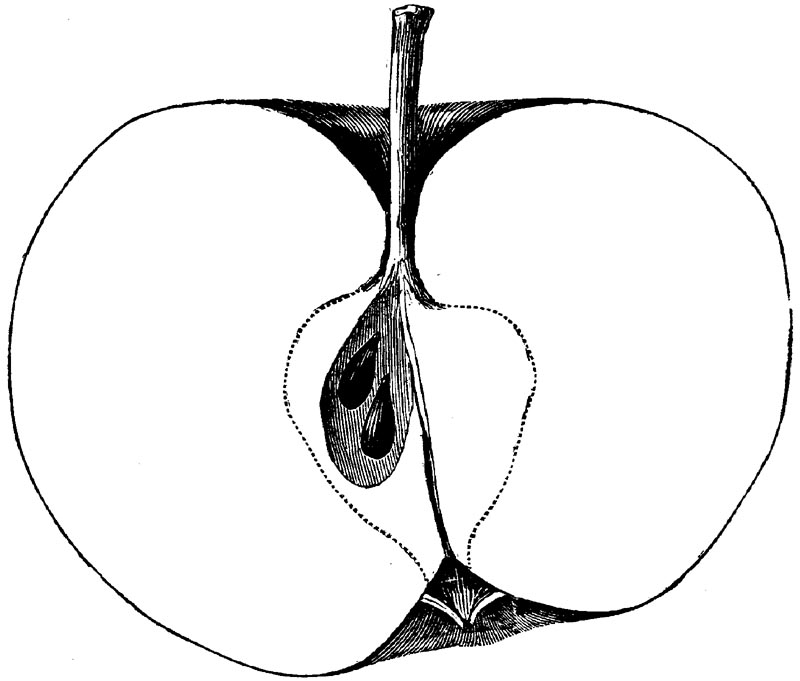
Fig. 54.—GREEN SWEET.
Tree vigorous and productive in most situations where cultivated, but is not much planted in the West.
Fruit rather small, regular, and usually flat, though sometimes conical; Surface smooth, green; Dots whitish, with green bases.
Basin rather shallow and wavy; Eye large, closed.
Cavity wide, regular and brown; Stem long and stout.
Core closed, regular, meeting the eye, containing numerous angular, acuminate brown seeds; Flesh greenish-white, breaking, tender, juicy and fine grained; very sweet, and valued for baking and market; those who do not admire sweet apples would hardly consider it second rate.
Season from December to February, or March.
Haskell's Sweet.
Found in the orchard of Dr. Geo. Haskell, at Rockford, Illinois.
Fruit large, flat, regular; Surface green, bronzy; Dots numerous, large, white.
Basin deep; Eye small, closed.
Cavity deep, acute, wavy; Stem short.
Core closed; Seeds numerous, plump; Flesh yellow, juicy; Flavor sweet, rich; Quality very good; Use, baking; Season August, September.
A practical test at the table of mine host must convince any one that either the apple or the cook, or both, are eminently deserving. This is supposed to be the Massachusetts variety of the same name.
Hay Boys.
I do not know where this summer apple was produced, or christened with its peculiar cognomen; Specimens received from H.N. Gillett, Lawrence Co., Ohio.
Fruit large, oblate, regular or slightly angular; Surface pale yellow; Dots numerous, dark, prominent.
Basin wide, abrupt, wavy; Eye medium, closed.
Cavity wide, folded, green; Stem long.
Core very wide, flat, open, clasping the eye; Flesh yellow, fine grained, breaking; Flavor sweet; Quality good, to very good; Use, table and baking; Season, August.
Lancaster Sweet.
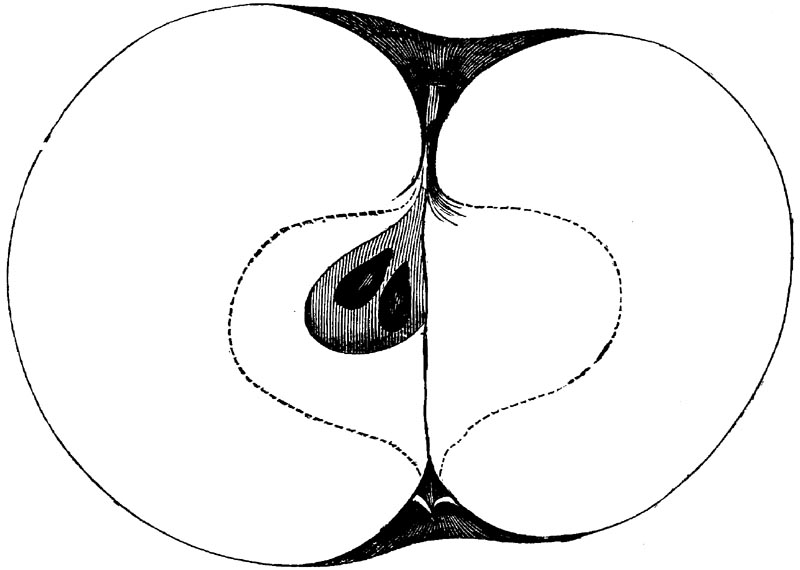
Fig. 55.—LANCASTER SWEET.
Origin unknown, grown in Central Ohio, where it is much admired for baking and apple butter.
Fruit medium, regular, oblate, slightly conical; Surface green; Dots scattered, dark, minute.
Basin medium, regular; Eye small, closed; Segments of calyx long and reflexed.
Cavity wide, wavy; Stem very short and small.
Core medium, regular, closed, meeting the eye; Seeds numerous, dark, plump; Flesh greenish-white, tender, fine grained, juicy, rich; very sweet.
Quality not first rate, except for cooking; Season September and October.
London Sweet.
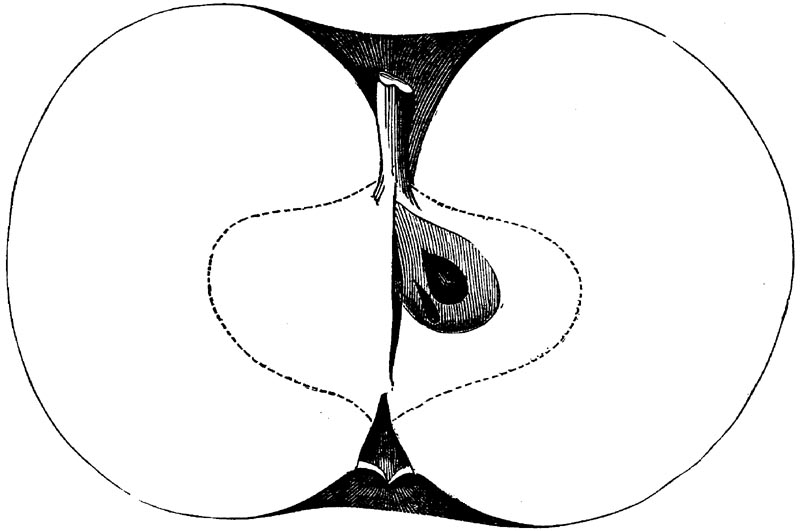
Fig. 56.—LONDON SWEET.
This vigorous, upright, and productive tree is supposed to have had its origin near Dayton, Ohio, whence it has been largely disseminated, giving entire satisfaction to all of its planters. Foliage abundant, and quite dark colored.
Fruit always fair, regular, flat, and of large size; Surface smooth, pale yellow, with scattered dots that are often colored.
Basin abrupt, regular, often having concentric cracks; Eye small and closed.
Cavity wide, regular; Stem short, rather thick.
Core medium width and closed, clasping the eye; Axis very short; Seeds variable, some being plump and some imperfect; Flesh yellowish-white, breaking, rather dry, but very sweet; Quality good; and considered by some persons the very best baking apple of its season, which is from November to January or later.
Mountain Sweet.
MOUNTAINEER.
From Pennsylvania; exhibited by Joel Wood, before the Ohio Pomological Society.
Fruit large, beautiful, but too delicate for transportation, oblate; Surface smooth, light, yellow; Dots minute.
Basin wide, wavy; Eye small, closed.
Cavity deep, acute, wavy; Stem short, slender.
Core wide, open, dark, clasping the eye; Seeds numerous, pointed; Flesh white, breaking, very tender, fine grained, juicy; Flavor sweet; Quality good to very good; Use, table, baking; Season, December.
A rival of Broadwell or Ladies' Sweeting.
Munson Sweet.
ORANGE SWEET.
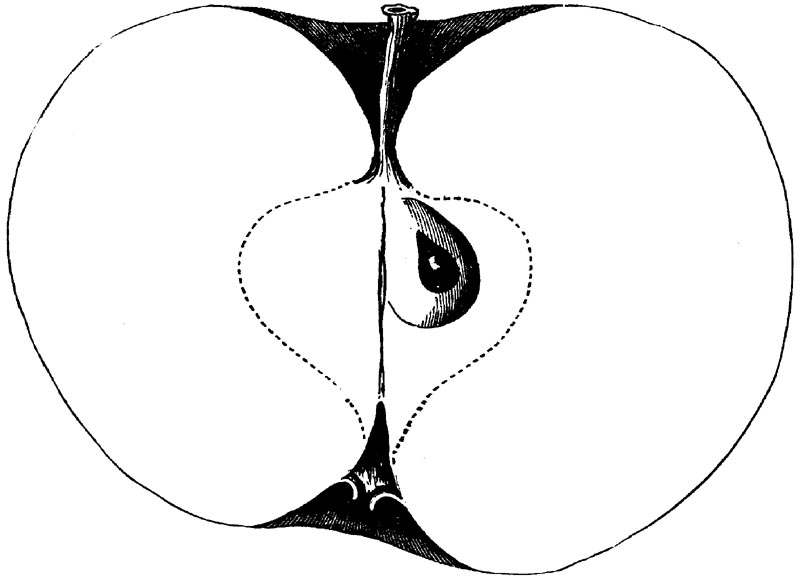
Fig. 57.—MUNSON SWEET.
This New England variety is considered quite promising in its new western homes, where, however, it is not yet widely known or tested. Tree vigorous, spreading, and productive when established; said to be a regular bearer.
Fruit medium, flat; Surface smooth, green, becoming yellow; Dots minute.
Basin small, abrupt, often folded or plaited; Eye medium, closed.
Cavity wide, wavy, green; Stem medium or short.
Core small, closed; Seeds plump; Flesh yellowish-white, fine grained, tender, juicy; Flavor very sweet; Quality nearly first rate; Valuable for baking; Season early winter.
Snepps'.
JNO. SNEPPS'.
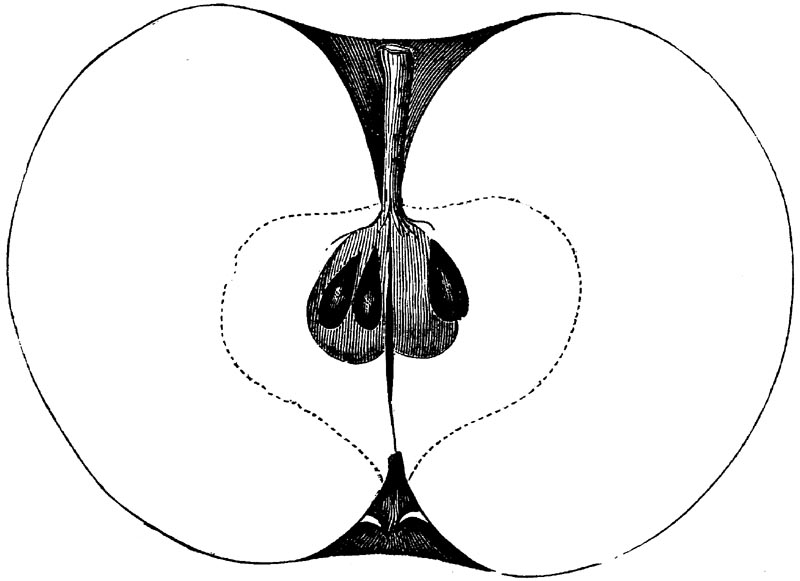
Fig. 58.—SNEPPS'.
This fine apple is believed to have originated at Edinburgh, Indiana, and was brought to the notice of the State Society by the orchardist whose name it bears, and by whom it has been distributed. As it appears to be distinct from any known fruit, it is here described. Tree vigorous and sufficiently productive.
Fruit above medium, almost large, flat, generally regular.
Surface nearly smooth, of a dull green, becoming pale yellow, with numerous dark dots, that often give it a gray appearance.
Basin rather shallow, sometimes folded or wavy; Eye large and closed; Segments of the calyx coarse.
Cavity acute, regular, rather deep; Stem medium to short, stout.
Core large but closed; Seeds numerous, pointed, brown; Flesh yellowish, breaking, fine grained, juicy; Flavor very rich, and agreeably sweet when ripe; Use, fine dessert fruit, and good for cooking; Season, December to March.
Superb Sweet.
This variety is worthy of more attention than it has received; native of Massachusetts, where it is a vigorous and productive tree. Its period of maturity makes it less valuable than it would otherwise be.
Fruit above medium, roundish; Surface smooth, of a pale yellow color, often shaded with red.
Basin rather shallow, broad; Calyx large, open.
Cavity regular, deep; Stalk long.
Flesh white, fine grained, tender, juicy; Flavor rich, sweet.
Cole gives its season as September and October, in Massachusetts.
Trumbull Sweet.
FENTON SWEET.
This is another fine white sweet apple, originating in Ohio, which, notwithstanding its beauty, is less esteemed on account of its season, but its productiveness makes it valuable for stock-feeding. Tree vigorous, spreading, productive, and an early bearer.
Fruit above medium, regular, flat; Surface very smooth, pale yellow, or white, resembling ivory; Dots scattering, minute.
Basin deep, regular; Eye large, rather open.
Cavity deep; Stem short.
Core closed; Seeds numerous, plump; Flesh white, fine grained, breaking, juicy; Flavor very sweet; Quality very good; Use, baking and stock; Season September and October.
CLASS I.—FLAT APPLES.
ORDER I.—REGULAR.
SECTION 1.—SWEET.
SUB-SECTION 2.—STRIPED.
Baltimore.—[Of Elliott.]
FLUSHING SPITZENBERG, OF NORTHWEST.—CABLE'S GILLIFLOWER.—ROYAL PIPPIN IN ILLINOIS.
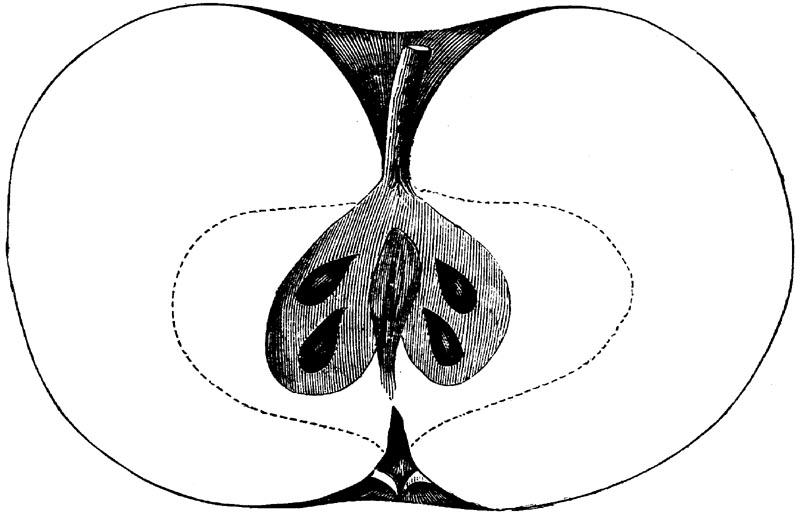
Fig. 59.—BALTIMORE.
The origin of this very satisfactory second rate fruit is unknown, though it is extensively cultivated in western orchards, especially in the lake country, for it is scarcely known within the Ohio river fruit region.
Tree thrifty, sufficiently vigorous but with slender growth, very productive, spreading.
Fruit medium, regular, oblate, almost round in some specimens, Surface smooth, red, striped with deep red and often covered with whitish or gray markings that give it a blue appearance like a bloom; Dots scattered, large, yellow or fawn color.
Basin shallow, regular; Eye small, closed.
Cavity wide, regular, brown; Stem short to medium.
Core large, closed; Seeds numerous, plump; Flesh yellow, fine grained, juicy, almost sweet, aromatic, lacking character; Of second quality, but valuable for market; December and January; Not disposed to rot, does not show bruises.
Butter.
FULKERSON'S.
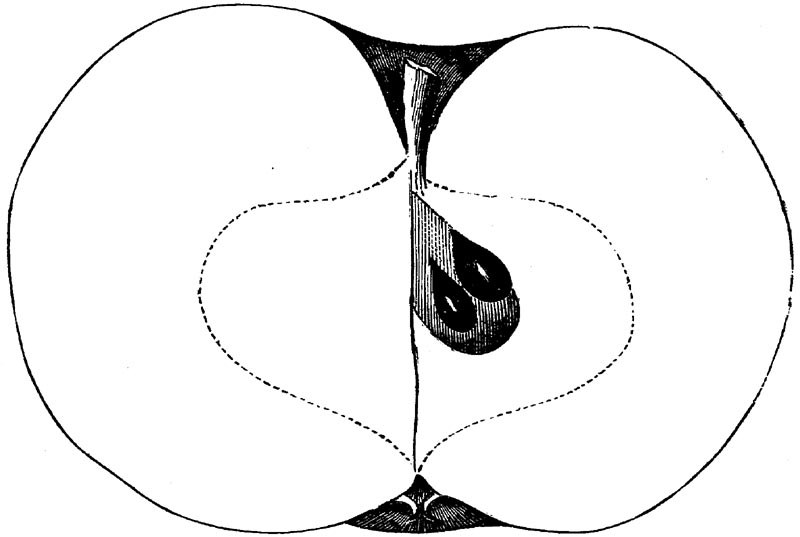
Fig. 60.—BUTTER.
The origin of this fruit has not been definitely traced, and though not very widely diffused, it is a prime favorite with its acquaintances, and the lovers of rich apple-butter.
Fruit small, very regular, oblate; Surface very smooth, and so covered with mixed red as rarely to show the yellow ground color; upon this are laid darker stripes of deep red; Dots minute and inconspicuous.
Basin medium, regular, or folded; Eye rather large, closed.
Cavity acute, regular, brown; Stem of medium thickness, rather long.
Core wide, large, closed; with large, plump, pointed seeds; Flesh yellow, tender, fine grained, juicy; with a sweet, rich and aromatic flavor. Valuable for stock and for apple-butter; Season, October to January.
Conant's Red.
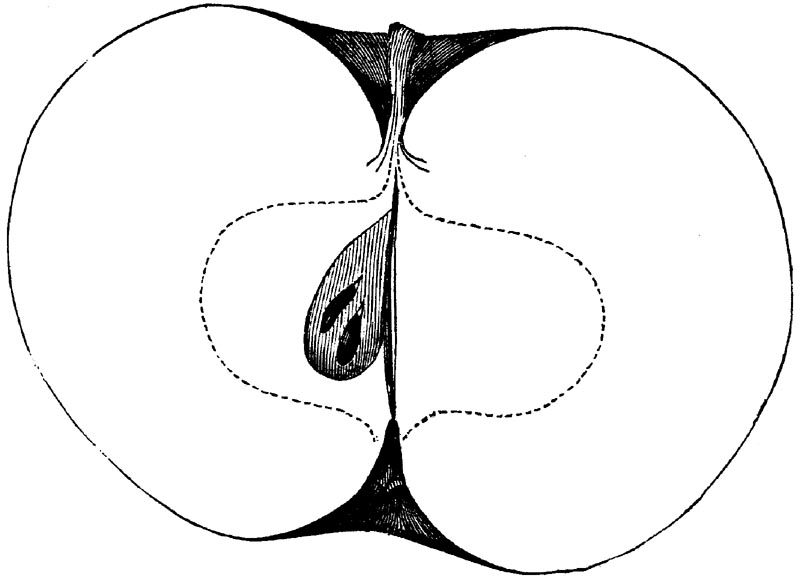
Fig. 61.—CONANT'S RED.
This variety is cultivated in southern Ohio and adjacent regions, to which it has been distributed by the venerable Pomologist, H.N. Gillett, of Quaker Bottom, to whom the author is under many obligations for valuable information connected with the fruits of that productive region.
Fruit full medium, regular, oblate, and sometimes nearly round.
In appearance this apple is not very prepossessing, as the surface is rough, the yellow ground is obscured by mixed red, upon which are red stripes and streaks of russet; dots are numerous, minute, indented, yellow or fawn colored.
Basin rather deep, abrupt, regular or wavy; Eye small, closed.
Cavity wide, wavy or regular, green; Stem medium to long, slender.
Core large, regular, closed; Seeds numerous, some are imperfectly developed; Flesh yellow, fine grained, juicy; flavor sub-acid to sweet, very aromatic, agreeable, fitting it admirably for a dessert fruit, as which it is nearly first rate. Season from September to December.
Connett Sweet.
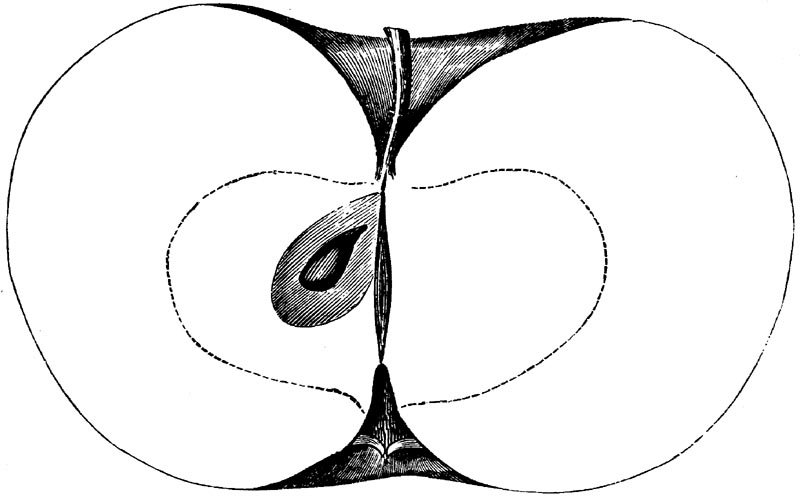
Fig. 62.—CONNETT SWEET.
The tree grows vigorously, is upright and productive, bearing early. Its origin I have not learned, but procured the specimens from my valued friend, Jno. C. Teas, of Raysville, Indiana.
Fruit of good size, regular, flat; Surface rather rough, dull red, with indistinct stripes; Dots few, dark, sunken.
Basin not deep, wide, regular; Eye rather large, closed.
Cavity wide, regular, brown; Stem medium to long.
Core wide, closed; Seeds of medium size; Flesh compact, yellow, fine grained; Flavor very sweet; Quality very good; Season, December to March.
Granniwinkle.
This is supposed to be the famous cider apple of New Jersey, described by Coxe, except that the form is different; it has as good qualities for making a rich cider; specimens obtained from W.C. Hampton.
Fruit small, oblate, regular; Surface dull red, striped purple; Dots numerous, yellow.
Basin wide, regular; Eye large, open.
Cavity wide, regular, brown; Stem long, inclined.
Core medium, round, regular, closed, meeting the eye; Seeds numerous, angular, plump; Flesh yellowish-white, firm, tough; Flavor sweet; Use, cider; Season, winter.
Jersey Sweet.
AMERICAN.
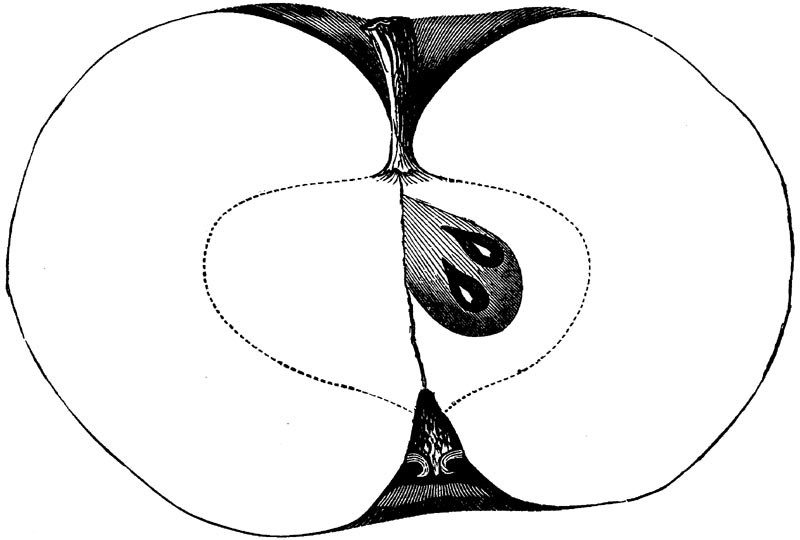
Fig. 63.—JERSEY SWEET.
In some parts of the country this is a favorite baking apple, but its great productiveness renders it small, and makes it rather a stock apple. Tree vigorous, round-headed; Shoots short-jointed and red; Foliage abundant.
Fruit medium, regular, globular-oblate, sometimes rather conical, (according to Elliott & Downing, roundish-ovate, but the drawing given by the latter is globular);Surface smooth, yellow, nearly covered with red, mixed, striped and splashed carmine, more or less distinctly; Dots generally minute.
Basin medium to wide, regular; Eye small, generally closed.
Cavity wide, regular or wavy, rather deep, brown, and in Michigan often green; Stem medium to long, green.
Core wide, regular, partially open in some specimens, but generally closed; Seeds numerous, wide, pointed, plump; flesh pale yellow, tender, fine grained, juicy; Flavor very sweet, aromatic and rich; Use, the dessert, for those who like sweet apples, but especially valued for baking and for feeding stock. Season August to October.
Moore's Sweeting.
RED SWEET PIPPIN.—BLACK SWEET.
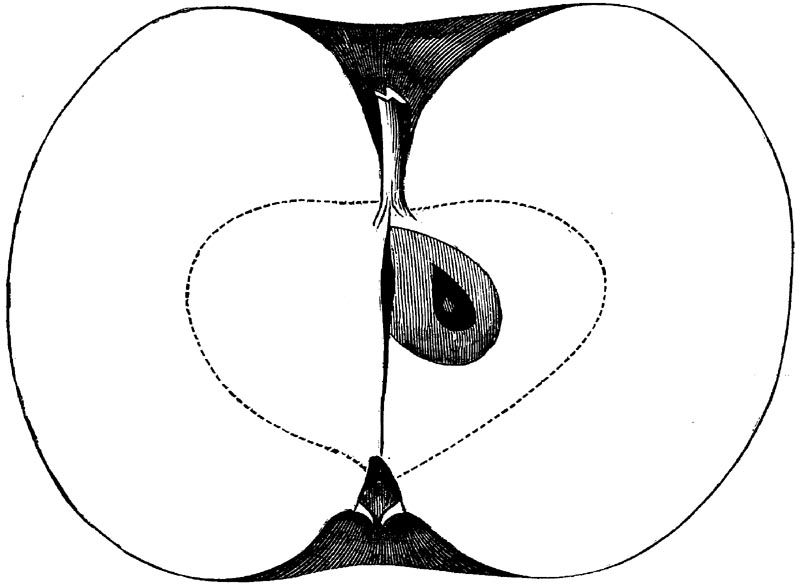
Fig. 64.—MOORE'S SWEETING.
This valuable winter sweet apple is much cultivated throughout the West on account of its productiveness, and the amount of nutriment it furnishes to both man and animals. Tree vigorous, healthy, spreading, round, with branches sufficiently open; Shoots dark olive; Foliage large, dark green.
Fruit medium to large, globular-oblate, regular; Surface smooth, greenish-yellow, covered with dull red in confused stripes and shaded with gray that gives the fruit a purple hue; Dots minute and few; Skin thick.
Basin wide, wavy or folded; Eye medium, closed.
Cavity wide or acute, deep, green or brown; Stem short, rather stout.
Core small, closed; Seeds numerous, plump, pale; Flesh yellow, dry, firm; Flavor very sweet; Quality inferior, for the dessert; Use, baking, market, stock, cider; Season from December to March and later, keeping very sound.
Putnam Sweet.
Originated near Marietta, Ohio.
Fruit large, flat, regular; Surface smooth, mixed, splashed and striped deep red; Dots numerous, large.
Basin wide, shallow, regular; Eye small, closed.
Cavity wide, regular; Stem short.
Core roundish, flattened, open, clasping the eye; Seeds numerous, pointed, pale; Flesh tender; Flavor sweet; quality very good; Use, kitchen, stock; Season August, September.
Richmond.
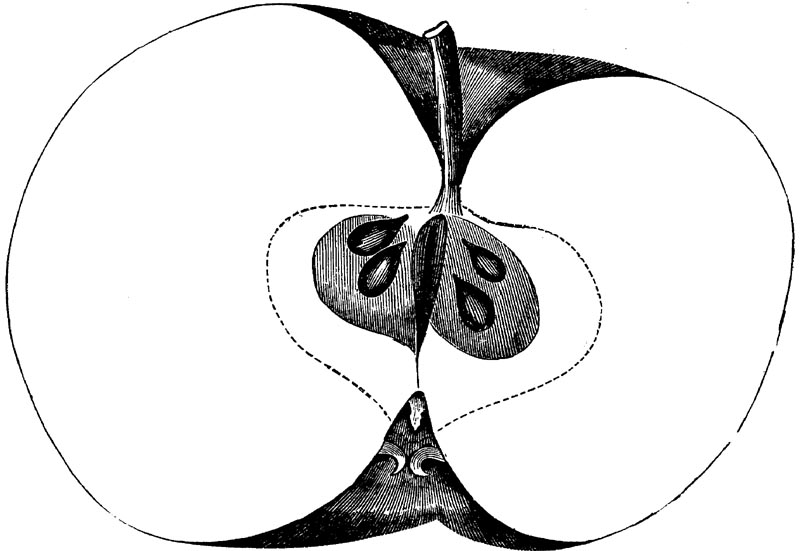
Fig. 65.—RICHMOND.
Described by F.R. Elliott, author of American Fruit Growers' Guide, and named for our mutual friend, D.C. Richmond, near Sandusky, Ohio, who found it in an old seedling orchard with several other good varieties. The seeds were supposed to have been brought from the old French orchards of Canada. Tree large, vigorous, productive, and would appear to have been hardy.
Mr. Elliott says:
"Fruit large; Form roundish, occasional specimens have one side a little enlarged; Color light yellow ground, mostly or quite overspread with light and dark red stripes, many dots or specks of light russet; Stem varying, mostly short, slender; Cavity deep, open, regular, a little brownish at bottom; Calyx large, segments long; Basin deep, open, uniformly furrowed; Flesh white, tender, juicy, delicate, sweet; Core medium; Seeds large, full; Season October to December."
Sweet Vandervere.
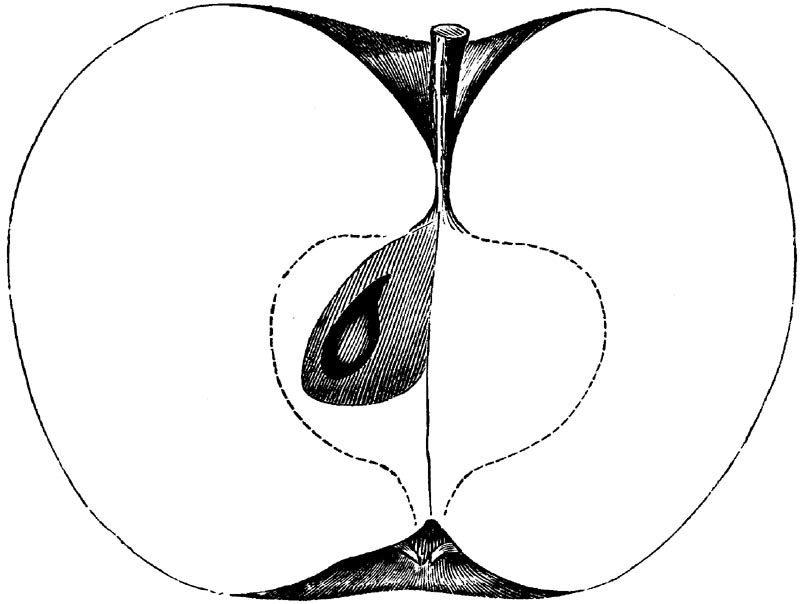
Fig. 66.—SWEET VANDERVERE.
This is another western favorite with the admirers of sweet apples. Tree sufficiently vigorous, healthy, and productive; twigs slender, like those of the true Vanderveres.
Fruit of good size, from full medium to large, regular, oblate, and resembling the Pennsylvania Vandervere; surface very smooth, yellow, shaded with mixed red, and striped with dull or dark red; Dots yellow, scattered, indented.
Basin abrupt, wide, deep, regular; Eye small, closed.
Cavity sometimes wide and regular, or acute; Stem long, slender.
Core regular, heart-shaped, closed; Seeds medium to long, angular; Flesh firm, breaking, yellow; Flavor sweet, pleasant; Quality not first rate, valued for baking and for stock; Season December and January.
CLASS I.—FLAT APPLES.
ORDER I.—REGULAR.
SECTION 1.—SWEET.
SUB-SECTION 3.—RUSSET.
None.
CLASS I.—FLAT APPLES.
ORDER I.—REGULAR.
SECTION 2.—SOUR.
SUB-SECTION 1.—SELF-COLORED.
Better Than Good.
JUICY BITE.
Like our standard authority, I am obliged to quote from the American Pomological Society's Transactions. Origin uncertain, (Elliott says from Pennsylvania); Tree thrifty, rather slender, very productive.
Fruit medium, oblate; Skin pale yellow, with a few brown dots.
Basin large and open; Calyx closed.
Cavity broad; Stem short.
Flesh yellowish, very tender, juicy; Flavor mild, pleasant, sub-acid; November to January.
Bohanon.
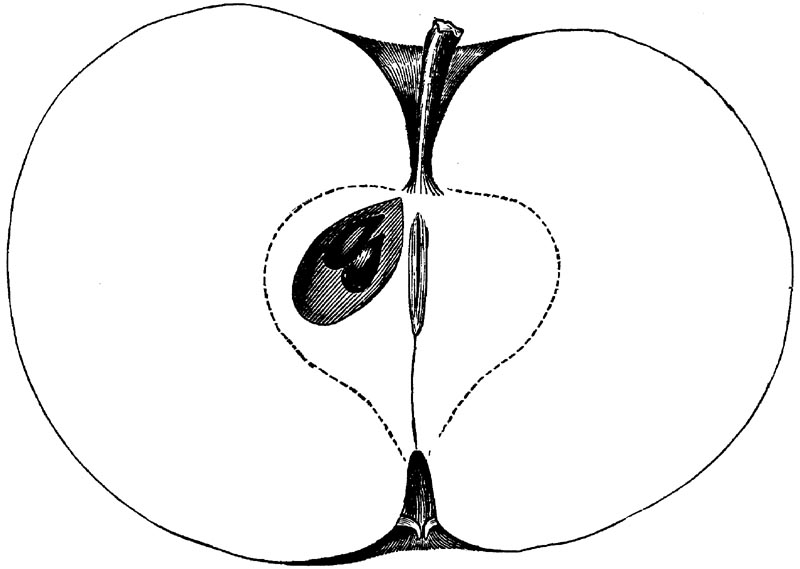
Fig. 67.—BOHANON.
This apple was brought into notice by Lewis Sanders, that veteran agriculturist of Kentucky, who was equally remarkable as a planter of choice fruits, and breeder of fine cattle. Mr. Elliott thinks this variety may have had its origin in Virginia. Tree moderately vigorous and productive.
Fruit full medium, regular, oblate, rarely inclined to be angular, sometimes slightly conical; Surface very smooth, whitish, or waxen, occasionally blushed with pale carmine, making it very beautiful; Dots minute.
Basin abrupt, narrow, folded, wavy and irregular; Eye closed; Segments reflexed.
Cavity acute, brown; Stem rather long.
Core regular, small, pyriform, closed, clasping the eye; Seeds small, compressed; Flesh white, breaking, fine grained, juicy, sub-acid; Quality very good and preferred as a dessert fruit to the Maiden's Blush which it much resembles without having the peculiar flavor of that variety.
Cornfield.
A southern variety received from J.S. Downer & Son.
Fruit medium, roundish-oblate or cylindrical, truncate, regular; Surface smooth, yellow, covered with mixed deep red, striped; Dots numerous, minute.
Basin deep, abrupt, regular, leather-cracked; Eye small, open.
Cavity wide, acute; Stem short.
Core round, regular, closed, hardly clasping; Axis short; Seeds numerous, plump; Flesh yellow, fine grained, tender, rather dry; Flavor sub-acid; Quality good; Use, table; Season, December.
Cracking.
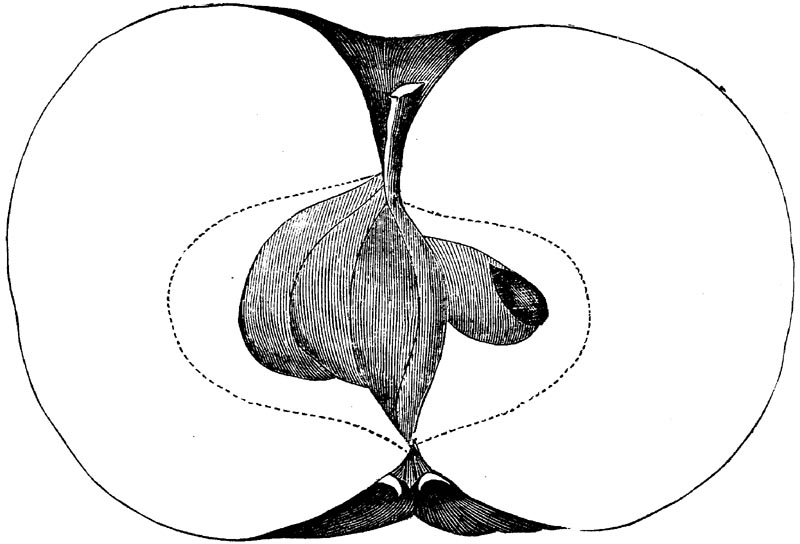
Fig. 68.—CRACKING.
This variety had its origin in the eastern part of Ohio. The tree is a strong grower and productive.
Fruit large, oblate, somewhat uneven and irregular, but handsome; Surface smooth, greenish-yellow until ripe, when it is often tinged with red; Dots numerous, minute, indented and green.
Basin wide, folded; Eye medium, closed.
Cavity acute, wavy, brown; Stem short, rather stout.
Core wide, open, clasping the eye; Seeds large, pointed, dark; Flesh yellow, breaking, juicy; Flavor sub-acid; quality nearly first rate; Use, kitchen and table; Season September and October.
Cranberry Pippin.
This is a beautiful apple which originated near Hudson, New York. Tree vigorous, very productive.
Fruit large, flat, regular; Surface very smooth, bright, clear yellow, with a shining scarlet cheek; Dots minute.
Basin wide, regular or wavy; Eye small, short, closed.
Cavity wide, wavy; Stem medium.
Core small, oval, just meeting the eye; Axis short; Seeds numerous, long; Flesh white, breaking, juicy; Flavor mild, sub-acid; Quality very good for cooking, not for dessert; Season November to February in New York.
Dalton.
Specimens from Mr. Warren, of Massachusetts. Origin and history unknown.
Fruit medium, flat, uneven; Surface smooth, yellowish-green, becoming greasy; Dots scattered, green.
Basin medium, folded; Eye medium, closed.
Cavity deep, pointed; Stem medium.
Core medium, wide, closed, clasping the eye; Seeds large; Flesh, greenish-white, tender, juicy; Flavor sub-acid; Quality good; Use kitchen, table; Season September.
Not particularly desirable.
Early Harvest.
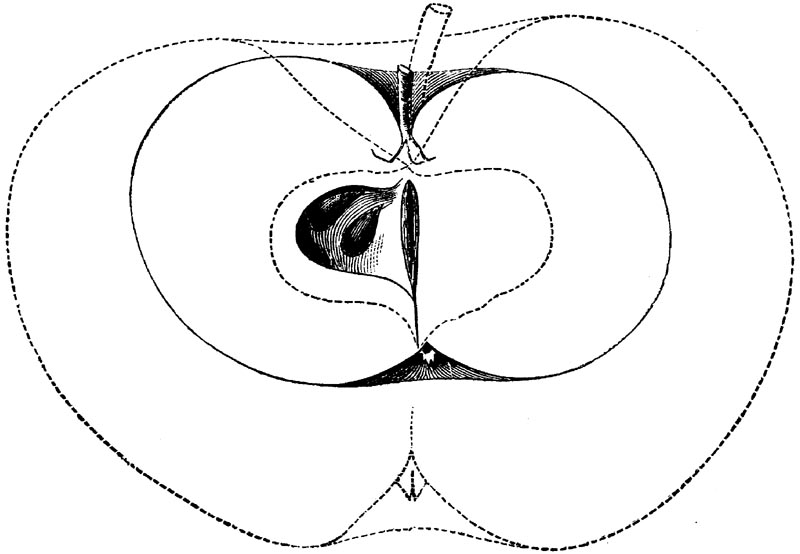
Fig. 69.—EARLY HARVEST.
This American apple has long been a prime favorite in the orchard, especially when planted for family use, since it is of excellent quality for table as well as in the kitchen. For the commercial orchard, however, it is falling into disfavor with the market men, because of its uncertainty, and its proneness to be defective on some soils.
Tree spreading, healthy and vigorous; the limbs are very strongly attached to the trunk by a woody enlargement at their base, and the pale olive twigs are remarkable for their peculiar mode of production in twos and threes from a common origin.
Fruit medium, regular, oblate, sometimes almost round, as described by Downing, but this is rare in the West, where the oblate form prevails. Surface smooth, clear, waxy yellow, very rarely blushed; Dots numerous, minute, green.
Basin regular, narrow, abrupt; Eye small, closed.
Cavity wide, regular; Stem short.
Core round, closed, not meeting the eye; Seeds large, pointed; Flesh tender, breaking, juicy, acid to sub-acid, agreeable; Of first quality for table or kitchen during the month of July.
Faust.
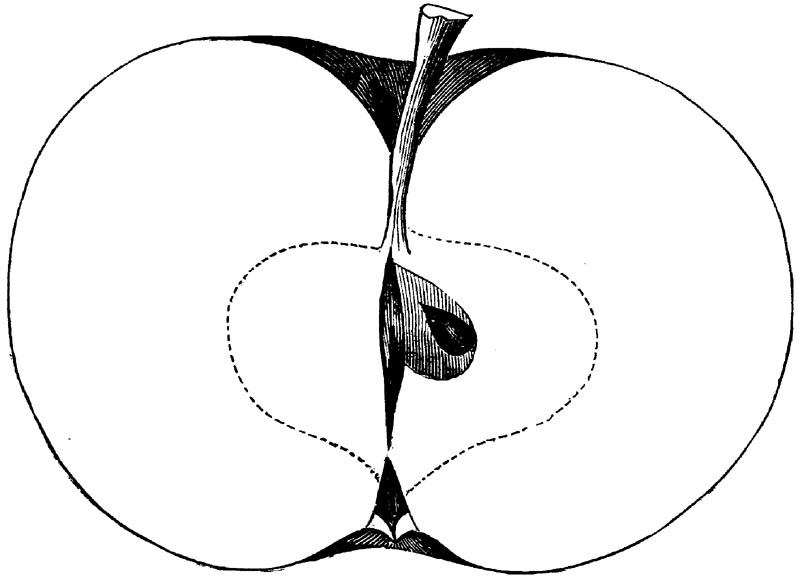
Fig. 70.—FAUST.
This very nice apple, received from S.W. Westbrooke, of Greensboro, N.C., deserves the commendation of its southern admirers.
Fruit regular, globular-oblate, of medium size; Surface smooth, yellow, with a white bloom and sunken white dots.
Basin shallow, folded; Eye small, closed.
Cavity wide, green; Stem medium, to long.
Core wide, closed, scarcely meeting the eye; Seeds angular; Flesh yellow, fine grained; Flavor sub-acid, aromatic, and first quality for table or dessert use, in November or later.
Finley.
ABBOTT?
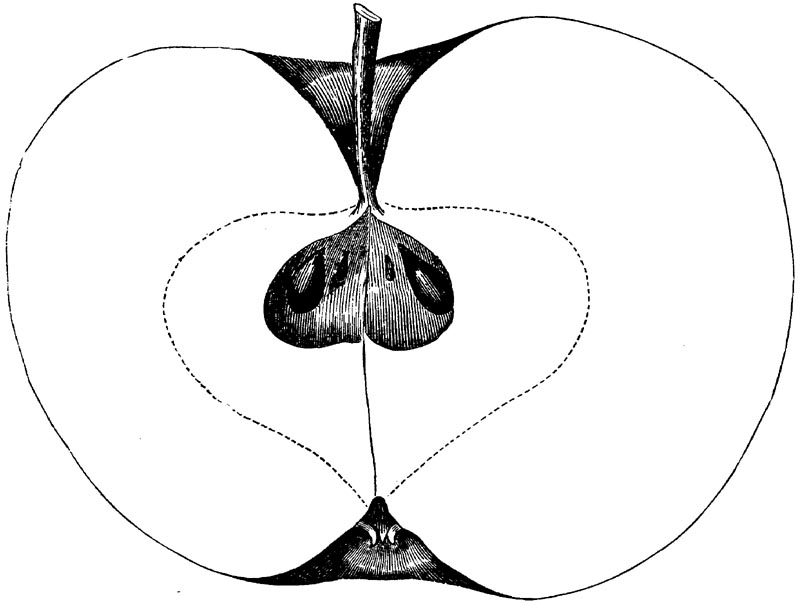
Fig. 71.—FINLEY.
This fine fruit originated in Kentucky and is cultivated to some extent in Southern Indiana, where it is considered entitled to the meed of excellence, and preferred to the Early Harvest on the one hand, and to the Maiden's Blush on the other; and in its season, it competes with both, being useful in July for the kitchen, and ripening gradually until September.
Tree large, spreading, vigorous and productive.
Fruit large to very large, regular, globular-oblate, slightly conical; Surface smooth, greenish-yellow, becoming a clear lemon yellow at maturity; Dots minute, gray, scattering.
Basin rather wide, wavy; Eye small, closed; Segments reflexed.
Cavity acute, medium to deep, regular, brown; Stem long, yellow.
Core heart-shaped, regular, closed, clasping the eye; Seeds few, large, plump, and some imperfect; Flesh yellow, breaking, fine grained, juicy, acid, almost first quality; Valuable for kitchen and market; Season August and September.
Fink.
FINK'S SEEDLING.
This long keeper was brought before the notice of the Ohio Pomological Society many years ago by Mr. Clarke, of Somerset, Ohio. Mr. Elliott considered it the same as Tewksbury Winter Blush, and introduces Fink's Seedling as a synonym of that variety. Others think it a different fruit, among whom is that practical Pomologist, the Secretary of that association, M.B. Bateham, Esq., who has propagated and planted the trees extensively. It was described as Fink's Seedling in the Ohio Cultivator, May, 1847. At the meeting of 1854, the merits and claims of this variety were freely discussed, and the Society named it the Fink, after admitting that it was an original seedling, as stated by Mr. Fink, in whose seedling orchard it had originated.
Tree of strong upright growth, a profuse and annual bearer.
Fruit small, regular, roundish-oblate; Surface very smooth, polished, greenish-yellow, blushed with brownish-red; Flesh whitish, breaking, juicy, mild sub-acid; remarkable for its keeping qualities, remaining sound until the second season, and has been shown in May after having been kept over two winters.
Fulton.
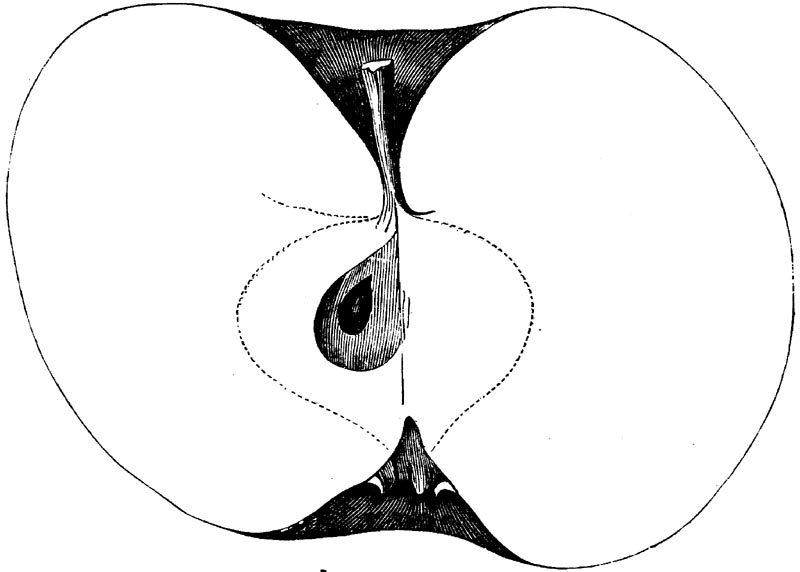
Fig. 72.—FULTON.
Origin, Canton County, Illinois. Tree large, vigorous, productive, annual bearer.
Fruit large, globular-oblate, often oblique or unsymmetrical; Surface smooth, greenish-yellow, with a carmine blush; Dots minute, indented.
Basin abrupt, deep, folded; Eye medium to large, open.
Cavity deep, narrow or acute, green and brown; Stem rather long and slender.
Core small, round, clasping; Seeds numerous, small, short and plump; Flesh yellow, tender, line grained, juicy; flavor sub-acid and aromatic; First quality for table; In November and December. Our Illinois orchardists do not commend it so highly as when first introduced; not fully satisfactory where planted in Ohio on limestone clays.
Golden Seedling.
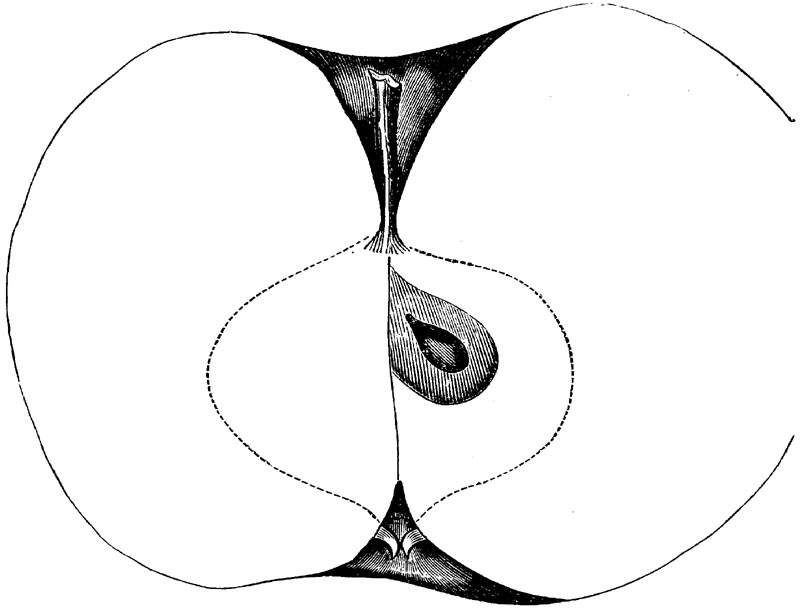
Fig. 73.—GOLDEN SEEDLING.
Said to have originated with Mr. Riehl, of St. Louis, cultivated and distributed by Geo. Husmann, of Hermann, Mo., in whose orchard I gathered it.
Fruit large, handsome, regular, and oblate; Surface smooth, greenish-yellow, and blushed; Dots scattered, minute.
Basin wide, regular; Eye medium, closed.
Cavity wide, wavy; Stem short.
Core medium, regular, meeting the eye, closed; Seeds numerous, angular, pale; Flesh yellow, juicy, rich; "Very good."
Green Crank.
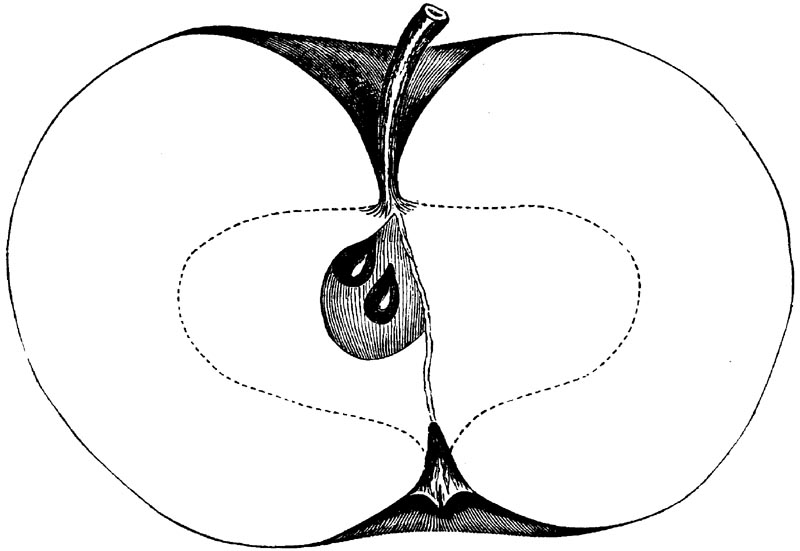
Fig. 74.—GREEN CRANK.
I have received this southern apple from Kentucky, Tenn., and also from Georgia, but have not yet fruited it. Tree moderately thrifty; Shoots brown; Foliage small.
Fruit medium to large, flattened somewhat, conical, regular; Surface green to yellow, sometimes bronzed; dots small, gray.
Basin medium, regular; Eye medium, closed.
Cavity wide, deep, acute, brown; Stem medium, green, thick.
Core wide, medium, closed, not clasping the eye; seeds numerous, plump, short, dark; Flesh yellow, firm, fine grained, juicy; Flavor sub-acid, aromatic, rich; Quality good to very good; Use table, kitchen; Season December to March.
Hawley.
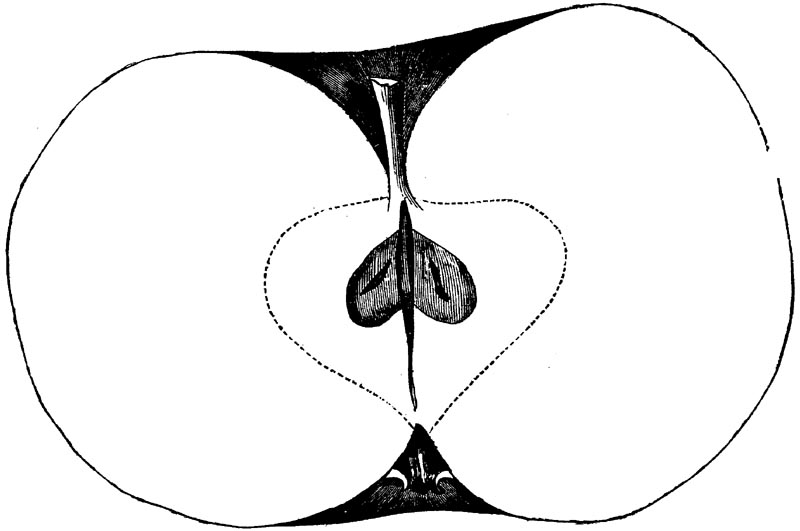
Fig. 75.—HAWLEY.
Originated in Columbia County, New York. Tree vigorous, with a round spreading head; Shoots stout, olive.
Fruit large, regular, oblate or slightly conic; Surface waxy yellow, rarely shaded or blushed, becomes oily or greasy when kept.
Basin rather wide, wavy; Cavity wide, sometimes folded; Stem short, medium and long.
Core regular, closed, scarcely clasping the eye; Seeds generally imperfect; Flesh yellowish-white, very tender, fine grained, juicy; Flavor very pleasant, mild sub-acid, rich; Season August to September; an amateur's fruit.
Hawthornden.
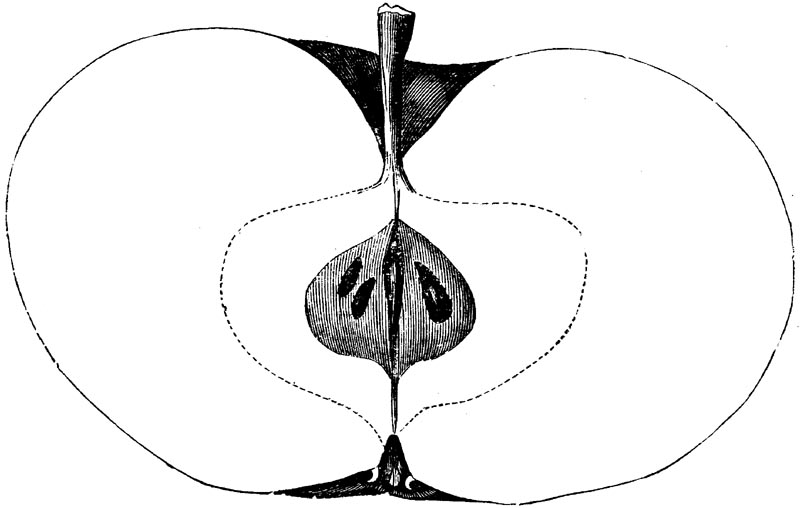
Fig. 76.—HAWTHORNDEN.
This famous Scotch fruit appears to do very well in this country, but it must yield the palm to its American cousin and representative, the Maiden's Blush, which possesses all its good qualities as a market and kitchen fruit, with attractive appearance.
Tree spreading, vigorous and productive; an early bearer.
Fruit large, regular, and very flat; Surface perfectly smooth, always fair, and of a beautiful white, very rarely and faintly blushed; Dots minute.
Basin shallow, narrow, regular; Eye small, closed.
Cavity wide, wavy, green; Stem medium.
Core wide, regular, somewhat open, meeting the eye; Seeds numerous, angular, imperfect, brown; Flesh greenish-white, breaking, fine grained, juicy; Flavor acid, aromatic; of second quality for table, but first rate for cooking; Uses, kitchen and market; Season October.
Junaliska.
This apple originated in the Cherokee country, where it is highly esteemed, and fruited in Ohio and Kentucky this year.
Fruit large, roundish, or flattened, slightly conic, regular; Surface smooth, yellow, with some russet, chiefly about the apex; sometimes blushed; Dots minute, gray.
Basin rather small, regular; Eye small, long, closed.
Cavity deep, acute, brown; Stem quite short, knobby.
Core wide, heart-shaped, regular, closed; Axis short; seeds few, short, plump; Flesh yellow, breaking, granular; flavor sub-acid, spicy, rich; Quality good; Use, table and kitchen; Season November, and through the winter.
It may be destined to supply the place of the Rhode Island Greening, where that variety does not succeed.
Kane.
CAIN.
Origin, Delaware. Tree upright, sufficiently vigorous. Has been confounded with the Bohanon, but is distinct.
Fruit small, regular, oblate, somewhat conic; Beautiful for the dessert; Surface very smooth, waxen yellow, blushed with bright crimson; Flesh whitish, crisp, juicy, acid and pleasant; October and November.
Lady.
API PETIT, ETC.
This beautiful little French apple has been fully naturalized in our country, and has received the enthusiastic admiration of the American people. The fruit needs to be entirely perfect to meet with favor as an ornament to the table, for which use it is especially adapted; unfortunately it is often overgrown and irregularly developed. Wherever produced in proper size and color, it is one of the most profitable varieties, commanding fancy prices at the period of Christmas decorations. In the rich soils of the West it is apt to be too large, and has generally failed to meet the requisitions; but it succeeds well in Michigan, and the neighboring region of Indiana.
Tree of medium size, very close and upright, healthy and productive; Shoots very dark; the foliage small, crowded, curled, and very dark.
Fruit very small, quite flat, very regular; Surface very smooth, shining or polished, of a pale waxen yellow, nearly covered with bright carmine, which contrasts finely with the ground color, wherever the fruit has been shaded by a leaf; Dots minute.
Basin medium, rather abrupt; Eye small, closed.
Cavity acute, deep, regular; Stem short.
Core regular, wide, closed; Seeds numerous; Axis very short; Flesh white, breaking, tender and juicy when ripe; with a mild sub-acid flavor; Use ornament and dessert; Season December until March.
Maiden's Blush.
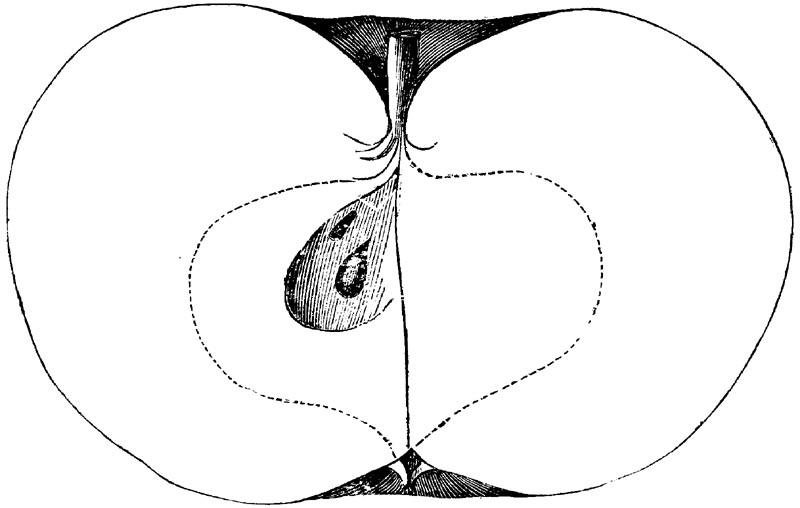
Fig. 77.—MAIDEN'S BLUSH.
This beautiful and profitable fruit has received the unqualified approbation of thirteen out of the eighteen States that have reported to the American Pomological Society. It is a native of New Jersey, and is still held in high repute there as a market apple. The tree is hardy, vigorous, spreading and productive, beginning to bear quite early.
Fruit medium, to large, regular, flat and very handsome; Surface very smooth, polished, of a pale waxen yellow and blushed with bright carmine; Dots minute.
Basin shallow, regular or wavy; Eye small, closed.
Cavity wide, wavy; Stem medium to short.
Core regular, closed, meeting the eye; Seeds numerous, brown; Flesh white, breaking, fine grained, juicy; Flavor acid, aromatic, and to most palates not agreeable at the dessert, but very good when cooked, and requiring but a short time to be reduced to a delicious pulp of light color. This apple is also used for drying and makes a very light colored product, that is much admired by dealers. Season September and October, but may be used in the kitchen during August.
Bachelor's Blush appears to be a variety of the above; found in Burlington County, New Jersey, and exhibited before the American Pomological Society at the Rochester meeting in 1864, by Wm. Parry, as a valuable, and distinct variety. Having examined the trees as they grew together in the orchard, the resemblance to Maiden's Blush was very apparent. The fruit is larger, and for market purposes is considered more profitable. The two may be different, but are very much alike.
Pickard's Reserve.
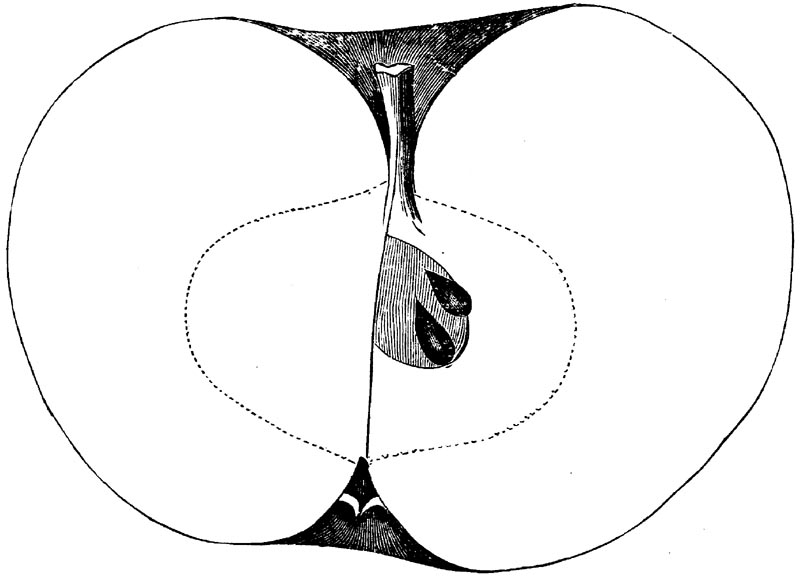
Fig. 78.—PICKARD'S RESERVE.
Grown in Parke County, Indiana, from seed brought from North Carolina. This apple was first brought to my notice by Jno. C. Teas, of Raysville, Indiana. Considerably grown in that State. Tree hardy; the original is still standing in Rockville.
Fruit large, flat, somewhat unequal; Surface smooth, pale yellow; Dots scattered, minute.
Basin abrupt, regular, rather deep; Eye quite small, closed.
Cavity deep, wavy, brown; Stem short to medium.
Core irregular, closed, scarcely clasping the eye; Seeds numerous, angular, dark brown; Flesh whitish-yellow, fine grained, tender, juicy, with a sub-acid, aromatic flavor, making this a fruit of first quality for table or kitchen use; Season December and January.
Rhode Island Greening.
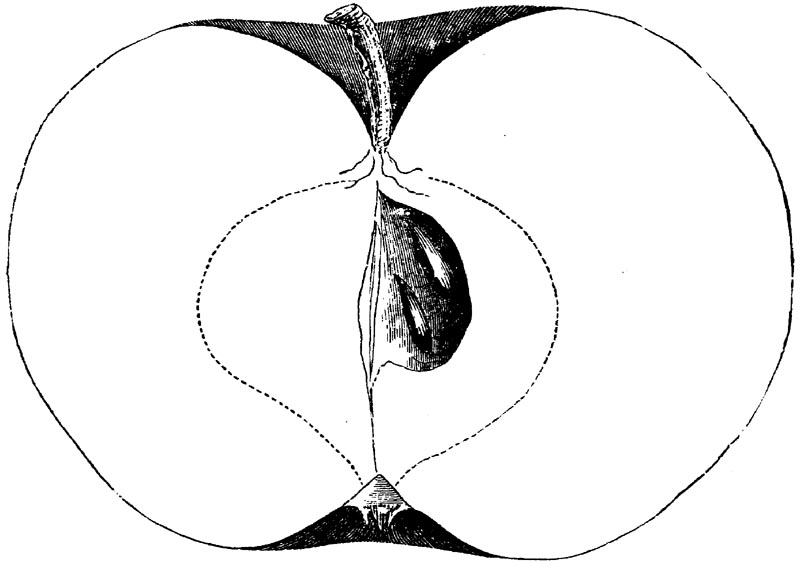
Fig. 79.—RHODE ISLAND GREENING.
From its name this apple would appear, like the Peck's Pleasant, to have come from the sea-girt State. It is a universal favorite, and is found to succeed well in a great many situations; but there are some portions of the West where it has failed to give satisfaction, being slow to come into bearing, becoming an autumn instead of a winter fruit, and falling badly from the trees before picking time. In sandstone soils, however, even in Southern Indiana and Illinois, it does better than on the limestone clays; the fruit attains an enormous size, but matures too early for a winter apple.
Tree very vigorous, crooked, spreading, productive; Shoots stout, dark, with dark foliage.
Fruit large to very large, varying in shape from globular or round to flat, which is the prevailing and characteristic form. Surface smooth in the North, somewhat rough and often quite russeted in the South, a dull green, becoming yellow at maturity; Dots grey, irregular, numerous.
Basin regular, small and russeted to a greater or less extent, sometimes extending half way down the sides of the fruit; Eye small to medium, closed.
Cavity wide, regular; Stem medium to long, curved, often reddish.
Core roundish-oval, regular, closed, clasping the eye; seeds numerous, angular, dark; Flesh very yellow, breaking, tender, juicy, with a rich, acid flavor, making it a superior cooking apple, and very fine for the dessert when fully ripe; Quality almost first rate; Season October to December—in the North, keeping until March.
Tewksbury Winter Blush.
This long-keeping variety was described by Coxe as having its origin in New Jersey. It has already been named in connection with the Fink, which resembles it very closely, and, like it, the chief excellence of this variety consists in its superior keeping qualities.
The tree is vigorous, upright, productive, and holds the apples well.
Fruit small, regular, flat; Surface smooth, yellow, blushed; Flesh yellow, breaking, juicy, well flavored, and retains its characters for a long time.
Virginia Greening.
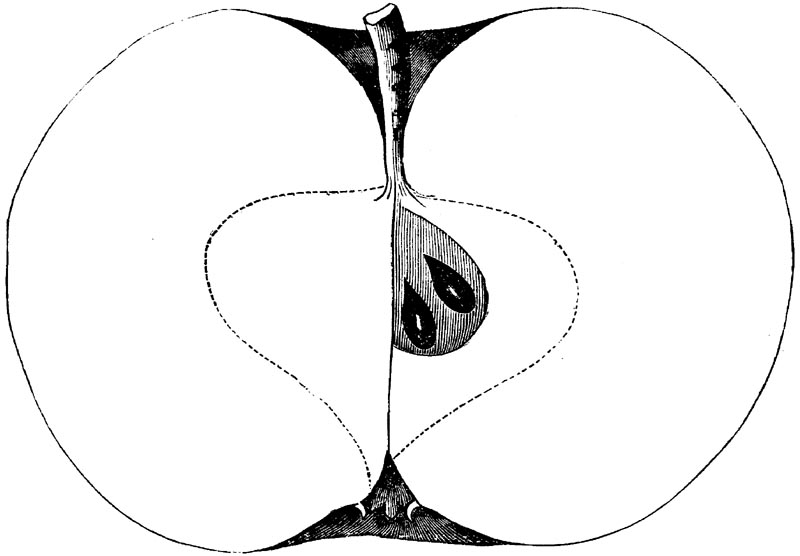
Fig. 80.—VIRGINIA GREENING.
This apple is supposed from its name to have originated in Virginia. It is cultivated chiefly in the Southern States, and in those parts of the Northwest to which Southerners have migrated. Its chief merit is its long keeping. Tree large, spreading, productive.
Fruit large, regular, flat to roundish, generally the former; Surface smooth, dull green and often bronzy, never blushed; Dots scattered, large, white or gray, with whitish rings around them.
Basin regular, wide, shallow; Eye small, open.
Cavity wide, regular, green; Stem long to medium.
Core regular, turbinate, closed, meeting the eye; Seeds numerous, long; Flesh white, firm, breaking, sub-acid; Fit only for the kitchen; A long keeper; March and April; often subject to Bitter-rot.
White Fall Pippin.
FALL PIPPIN OF LOUISVILLE.
This handsome fruit is seen in quantities in the Louisville market every fall. Its cultivation does not appear to have been widely extended, nor has its origin been traced. It has been thought to resemble the Spanish Reinette, with which I have not had an opportunity to compare it.
Fruit very large, slightly uneven, roundish-flattened or globular-oblate; Surface smooth, pale yellow, not bronzed or blushed, but having a whitish striping toward the stem end; Dots scattered, minute, dark.
Basin abrupt, narrow, deep and folded; Eye small, long, closed.
Cavity wide, wavy; Stem very short.
Core wide, regular, somewhat open, clasping the eye; Seeds numerous, angular; Flesh yellowish-white, breaking, juicy; Flavor sub-acid, aromatic and rich; Useful for cooking, drying, and table; Season October.
White Juneating.
JUNEATING, Coxe.—YELLOW JUNE.—EARLY MAY?
Downing thinks this a very old variety, mentioned by Evelyn in 1660, and by Ray in 1688. It has long been known in the West and South as a very early apple, and valued on this account, though quite small. The tree resembles that of the Early Harvest in the color and arrangement of its twigs.
Fruit flat, regular; Surface smooth, pale yellow.
Basin not deep, slightly folded; Eye small, closed.
Cavity wide, shallow; Stem long, slender.
Flesh breaking, whitish, juicy till over-ripe, when it is dry; Flavor sub-acid; Use table and market; Season June.
Winter Pippin.
WINTER PIPPIN OF GENEVA.
This very handsome fruit was received from T.T. Lyon, of Plymouth, Michigan, marked as having been received from Western New York. The same fruit was a very strong competitor for the Greeley prize before the Committee of the American Institute, and is believed to be the same as that described by Downing as the Winter Pippin of Geneva.
Tree thrifty, branches spreading; Said to be productive.
Fruit large, oblate, regular, or slightly unequal; Surface smooth, pale yellow, with a bright crimson cheek; Dots numerous, minute.
Basin wide, wavy, or plaited; Eye medium, closed.
Cavity regular, green, rather deep; Stem long.
Core medium, regular, closed, clasping the eye; Seeds numerous, plump; Flesh yellowish-white, fine grained, juicy, sub-acid; Season January until May. A limited acquaintance does not justify me in giving such high praises as those bestowed upon this fruit by Mr. Downing.
Yellow Foster.
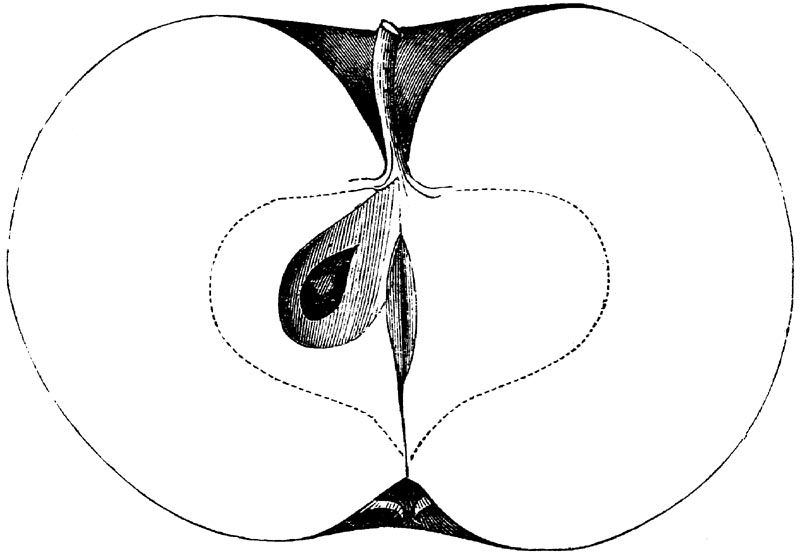
Fig. 81.—YELLOW FOSTER.
This apple is a favorite with that worthy pioneer Pomologist of Southern Ohio, H.N. Gillett, of Lawrence County, to whom I am under obligations for this and many other varieties.
Fruit medium to large, regular, oblate; Surface smooth, greenish-yellow; Dots scattered, minute green.
Basin of medium depth and size, regular; Eye small, closed.
Cavity acute, regular; Stem of medium size and length.
Core medium, wide, closed, not meeting the eye; Seeds not numerous, medium; Flesh yellow, fine grained, tender, juicy; Flavor sub-acid and aromatic; Of first quality for table; During October.
CLASS I.—FLAT APPLES.
ORDER I.—REGULAR.
SECTION 2.—SOUR.
SUB-SECTION 2.—STRIPED.
Abram.
FATHER ABRAHAM, of Illinois, not that of Coxe.
This little southern favorite is not extensively cultivated in the North, except where southern settlers have introduced it. It is found in Illinois, Indiana and Missouri. Origin believed to have been in Virginia, whence I have received specimens and trees. In Kentucky it is found to be a hardy drooping tree, holding the fruit well; annually productive, valued for cider, and keeping till July of next year.
Fruit medium, globular-oblate, uneven; Surface not smooth, yellowish green, mixed, red, with stripes and splashes; the whole presenting a gray appearance; Dots minute, scattered.
Basin shallow, wide, wavy; Eye small, closed.
Cavity acute, regular; Stem long, inclined.
Core medium, regular, closed; Seeds numerous, short, plump, pale; Flesh greenish-yellow, fine grained, juicy; flavor mild sub-acid, rich; almost first quality; keeping until May or later.
American Pippin.
GRINDSTONE.
This fruit is chiefly valued for keeping very late into the summer. Coxe commends it for its cider, rating it as nearly equal to the Grey-House; he says that fourteen bushels are required to make a barrel of cider. The apples hang well to the tree, and will bear a considerable amount of freezing. They are so firm as to suffer little from bruising, and are not disposed to rot when thus injured. A fruitman once said of their ability to withstand rough usage, that the apples might be whipped off the tree with a hoop-pole, shoveled into a cart, dumped upon the ground, and have some dirt thrown upon them, and that they would keep until next July; but, he added, they are then as good as dried apples; so lightly are they esteemed for table use.
The tree is thrifty, with a low, spreading head and depending branches; very productive; notwithstanding the fruit is dry and deficient in flavor, it is considered profitable, because so easily kept until May and June, when it commands the highest price, because of the rarity of green fruit at that season.
Fruit medium, regular, very flat; Surface rough, sometimes vein-russeted, dull green, covered with mixed red, and shaded with stripes of brick-dust color; Dots numerous, large, gray.
Basin very shallow, wide, regular or plaited; Eye quite small, open.
Cavity regular, brown, this color extending over the base of the fruit; Stem medium, often thick and knobby.
Core wide, irregular, closed; Seeds numerous, plump, brown; Flesh yellow, breaking, dry, very firm; Flavor mild sub-acid; Quality poor; Uses kitchen and market, which last means that it may be sold to those who do not appreciate the summer fruits of May and June.
Baldwin.
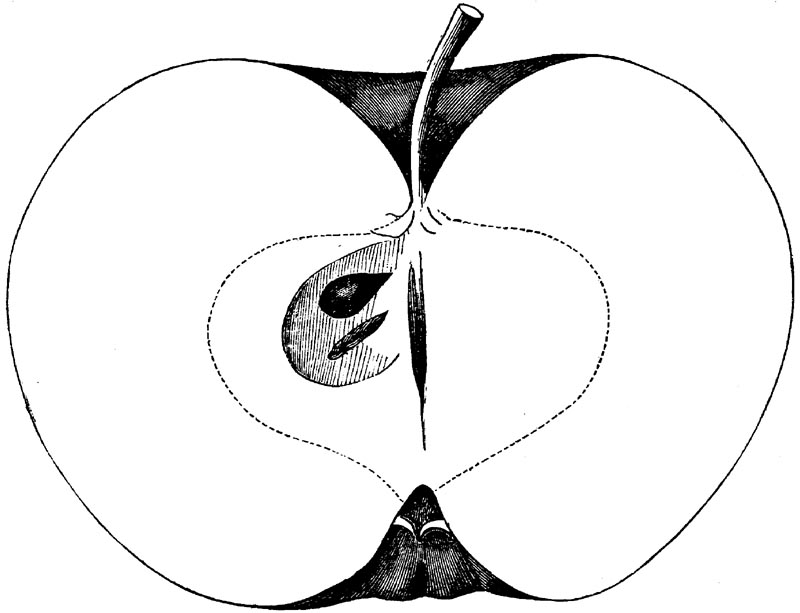
Fig. 82.—BALDWIN.
This celebrated apple of New England has been widely distributed over the country, but has not met with universal favor in the West and South; first, because it is apt to become a fall or early winter fruit, instead of a keeping apple; and secondly, because it is not well adapted to our palates; moreover, the tree has been considered tender, having suffered extensively during the cold winters; this is especially true in the nursery. Its productiveness and fair quality will, however, always make the Baldwin a favorite over a large portion of our country, and the New England settlers must have this variety.
Tree robust, spreading, very productive; Foliage large, dark, on shoots that are stout and have a rich brown bark.
Fruit large, frequently round, and sometimes almost conical, but generally inclined to be flattened, so as to be classed by measurement as oblate; large specimens in southern latitudes are very apt to be unequal, and to have their axis inclined, or to be what is called lop-sided; surface smooth, rich yellow where shaded, but the exposed parts quite covered with deep red, which is mixed so as to conceal the ground color, and also to obscure the stripes of deeper red that prevail; this fruit is also frequently marked with veined russet, overlying the red color, or excluding it; Dots minute, and yellow, or gray where the red prevails.
Basin deep, often abrupt and narrow, generally waved, folded or plaited, and these marks are quite characteristic; Eye large and open, from the shortness of the calyx. On this account the variety is considered very subject to the attacks of the Codling-moth.
Cavity wide, regular or wavy, generally brown; Stem medium to long, often curved or inclined, sufficiently stout.
Core medium, regular, closed, meeting, sometimes clasping the eye; Seeds numerous, long, angular, imperfect; flesh yellow, breaking, frequently coarse-grained, juicy, sub-acid, rich; some northern specimens are fine-grained and almost first quality; those from the South are coarse, poor and scarcely second-rate for table use, but are good for cooking; Season October to January, occasionally keeping later.
Bethlemite.
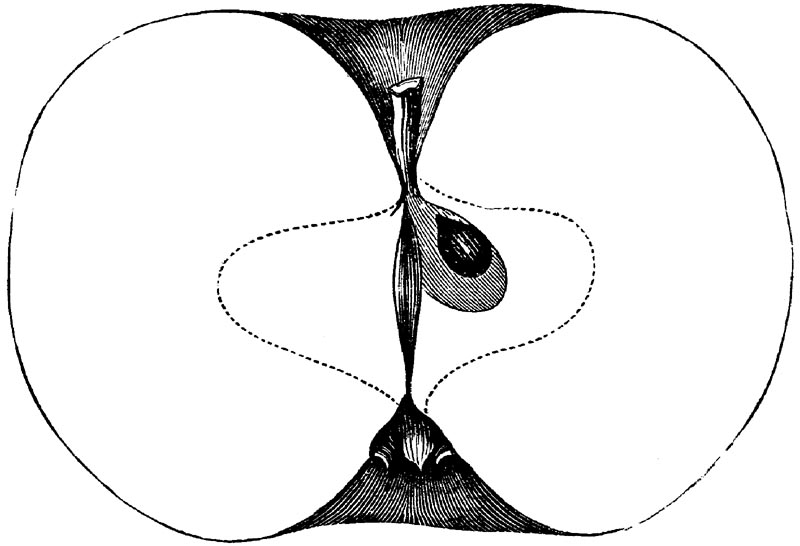
Fig. 83.—BETHLEMITE.
This apple has frequently been exhibited before the Ohio Pomological Society, by friends Lipsey, Morris and Benedict, of Morrow County, to which region its cultivation appears to have been confined. The origin of the fruit is obscure.
Tree thrifty, hardy, productive, upright.
Fruit medium, flat, or oblate-globular, regular; surface smooth, dull red or bright red, mixed, on yellow, with broken splashes of crimson; Dots distinct, large, gray and yellow.
Basin wide, deep, regular or folded, leather-cracked; Eye medium, closed.
Cavity rather wide, regular, brown; Stem medium to short.
Core regular, neat, closed, just meeting the eye; Axis short; Seeds numerous, short, very plump, pale; Flesh yellowish-white, breaking, juicy, sub-acid, aromatic; Quality good, for table and cooking; Season December.
Blondin.
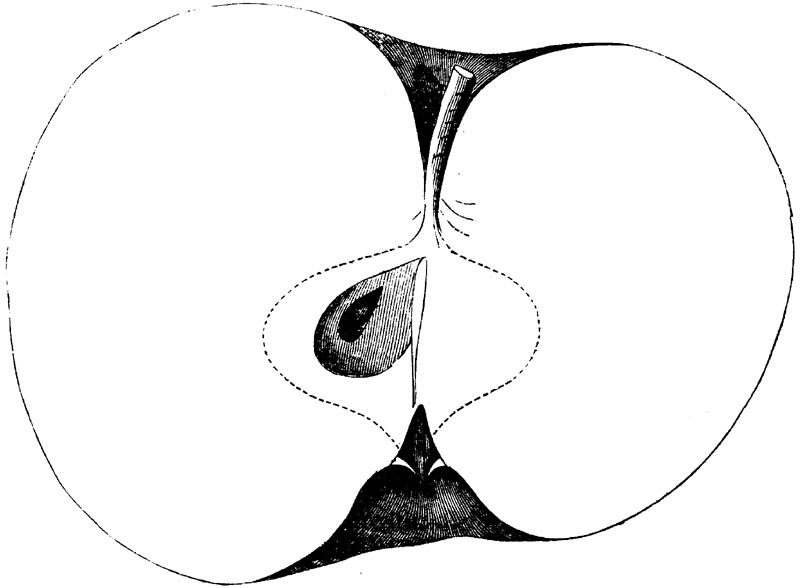
Fig. 84.—BLONDIN.
This fine fruit originated with the veteran Pomologist of Indiana, Reuben Ragan.
Fruit very large, oblate, unequal; Surface rough, greenish-yellow, splashed and striped with red; Dots numerous, large, gray.
Basin abrupt, folded; Eye small, closed.
Cavity acute, deep, brown; Stem short, rather slender inclined.
Core medium or small, regular, closed, clasping the eye; Seeds plump, pointed, brown; Flesh greenish-yellow, fine-grained, tender, juicy; Flavor sub-acid; almost first rate for table and market; Season October and November.
Blooming Orange.
Mr. Waring considers this the handsomest apple. In 1839 he brought a large number of sorts from the famous Herefordshire apple orchards of England, of which this is the only one he retains as fully adapted to the mountain region of Pennsylvania.
Tree a very strong, free, handsome grower, and an immense bearer, after six or eight years' growth.
Fruit very large, fair, beautiful, roundish-oblate, regular; surface dark, richly clouded with claret and mahogany, on yellow ground; Eye open; Flesh crisp, juicy, acid at first, but this merges into a rich, penetrating, very agreeable flavor.
It is of the Ribston Pippin, or Dutch Mignonne type of fruit.—[Mr. G. Waring's MS.]
Bonum.
MAGNUM BONUM.
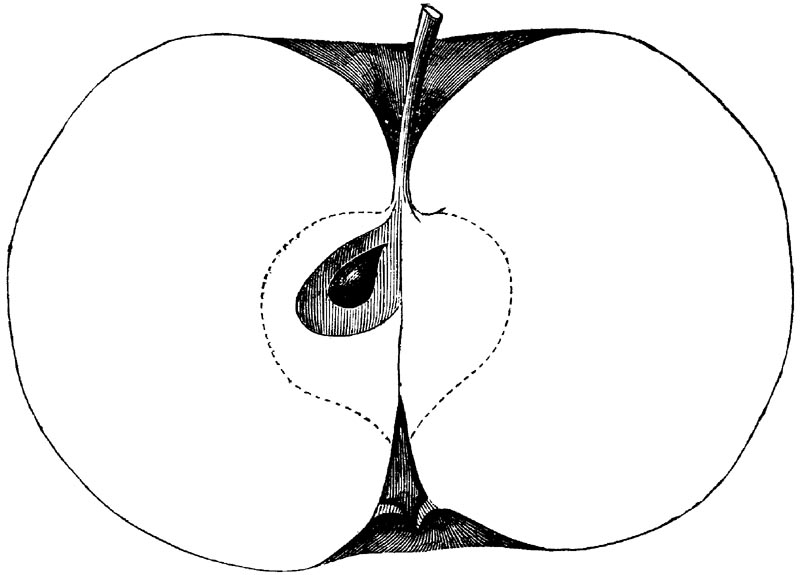
Fig. 85.—BONUM.
This delicious southern fruit originated in Davidson County, North Carolina. The tree is vigorous, very productive and bears early. I received specimens from S.W. Westbrooke, Greensboro', North Carolina. Introduced to the American Pomological Society at the Philadelphia meeting, 1860, by Walter Steele, of Rockingham County, North Carolina, and highly recommended.
Fruit large, oblate, regular; Surface smooth, yellow, covered with mixed red, and striped; Dots distinct, large, yellow.
Basin medium, regular; Eye large, closed.
Cavity deep, regular, brown; Stem long, not thick, green.
Core oval, small, closed, scarcely meeting the eye; Axis short; Seeds large, plump; Flesh yellow, firm, breaking, fine-grained, juicy; Flavor rich, sub-acid; first quality for the dessert; in September.
Brandywine.
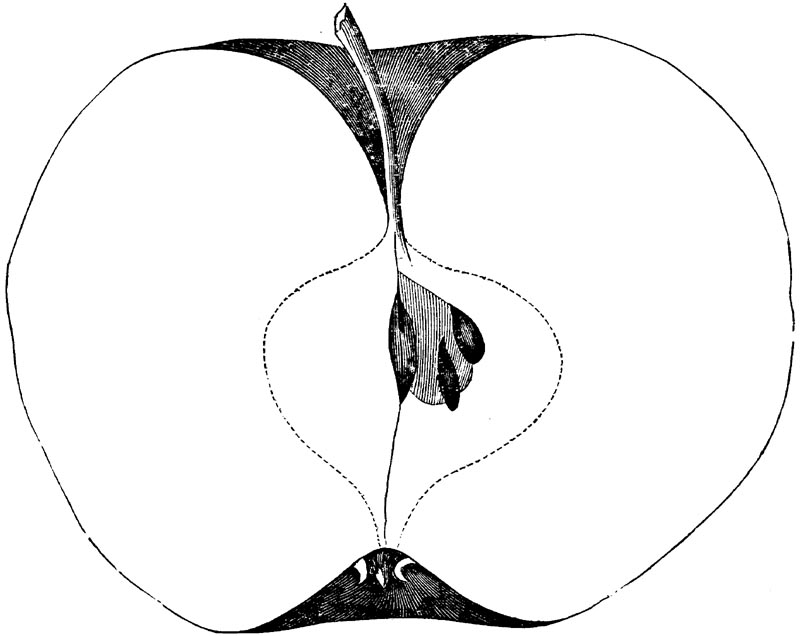
Fig. 86.—BRANDYWINE.
This apple was found on the edge of the prairie, east of Quincy, Illinois, in the orchard of K.K. Jones, Esq., where it was supposed to have been brought from the State of Delaware.
Tree large, vigorous, spreading and productive.
Fruit medium, oblate, roundish, slightly conic, regular; surface smooth, greenish, covered with confused stripes of dull red; Dots scattered, white.
Basin shallow, abrupt, regular; Eye small, closed.
Cavity acute, regular, green; Stem very short.
Core small, round, closed, clasping; Seeds imperfect; Flesh greenish-white, fine-grained, tender, juicy; Flavor sub-acid, aromatic; Quality only good; Use table, kitchen; Season January, February.
Buchanan's.
Origin near Cincinnati, Ohio, in the orchard of Robert Buchanan, Esq., a gentleman long devoted to pomology. It also closely resembles the Brandywine, as grown in Illinois, already described.
This variety is much like the Minkler, which originated in Illinois, and both may have come from seeds of the Gilpin, which they resemble.
Tree vigorous and productive.
Fruit medium, oblate, regular; Surface smooth, yellow, covered with mixed red and striped bright red; Dots scattered, minute.
Basin medium, folded or plaited; Eye large, closed.
Cavity wide, regular, green; Stem short or medium.
Core flattened, closed, clasping the eye; Seeds numerous, plump, dark; Flesh greenish-yellow, firm, breaking; Flavor sub-acid; Quality scarcely second rate, but useful for cooking, and keeps sound until May.
Carolina Baldwin.
This nice southern apple was received from S.W. Westbrooke, of Greensboro'. Of the tree I know nothing.
Fruit medium, oblate, regular; Surface yellow-green, with mixed red and stripes; Dots numerous, large, white.
Basin abrupt, regular; Eye large, closed.
Cavity wide, regular; Stem, medium to long.
Core small, regular, heart-shaped, closed; Seeds pointed; Flesh yellow, fine-grained, juicy; Flavor, sub-acid; good for table in November.
Cheese.
This fruit was received from Lewis Sanders, of Grass Hills, Gallatin County, Kentucky, by whom it was grown and esteemed.
Fruit medium to small, oblate, regular; Surface smooth, yellowish-green, striped purple red, splashed deep red; dots scattered, gray and purple.
Basin shallow, regular, or abrupt and deep, in different specimens; Eye small, closed.
Cavity wide, regular, brown; Stem long, slender.
Core regular, closed; Axis long; Seeds plump, pointed, dark; Flesh yellow, tender, fine-grained, juicy; Flavor sub-acid, agreeable; Quality good for the table in December and January.
Colvert.
Fruit large, roundish-oblate, slightly conic, regular, often unequal; Surface smooth, yellowish-green, mixed, striped, light red; Dots scattered, distinct, white.
Basin deep, abrupt, regular, folded; Eye medium.
Cavity rather deep, acute, brown; Stem medium.
Core round, flattened, slightly open, meeting the eye; Seeds numerous, long, pointed, imperfect; Flesh white, breaking, fine-grained, juicy; Flavor sub-acid; Quality scarcely good; Use, market chiefly; Season October, November.
Cooper.
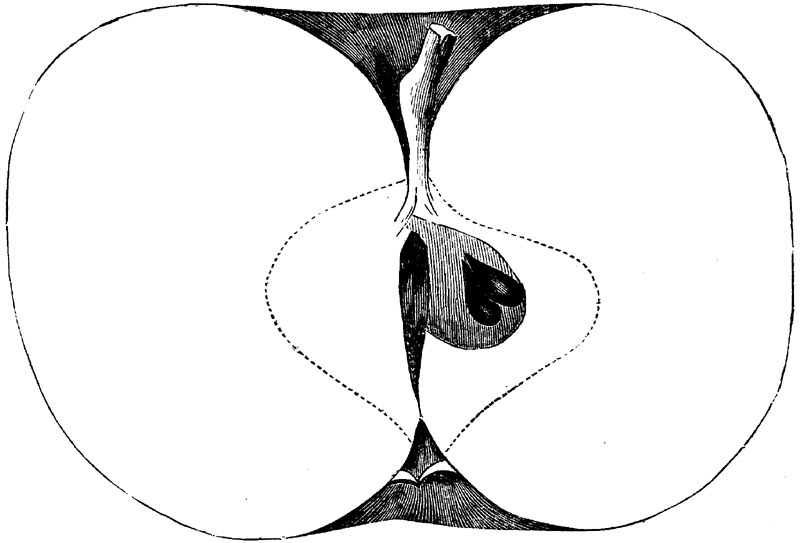
Fig. 87.—COOPER.
This delicious apple was introduced into the West with the scions that were brought to the early Putnam nursery at the mouth of the Muskingum river in 1796. Though a general favorite from its beauty, its fine texture, and exquisite flavor, this variety does not appear to have been so widely spread as others very inferior to it. Though occurring on the original Putnam list, and therefore an eastern variety, it does not appear to have been recognized by cultivators in the older States, and there are those in the West who claim that it is of French origin.
The tree has a stout, upright growth, which becomes spreading with age, when the limbs stand at a right angle with the trunk; they are frequently defaced with marks of diseased action that are called canker. The twigs are reddish and rather slender; the leaves are pale green, large, broad.
Fruit large, globular-oblate, regular, sometimes unequal, light; Surface smooth, pale waxen-yellow, with a little mixed scarlet and very distinctly marked carmine; Dots scattered, minute.
Basin regular, abrupt, deep; Eye small, closed.
Cavity wide, regular, green; Stem medium, green.
Core small, closed, just meeting the eye; Seeds numerous, plump, short, dark; Flesh pale yellow, fine-grained, tender, almost melting, juicy; very mild sub-acid, aromatic; of first quality for table, kitchen or market (too good for drying, but makes a superior article of snits); Season September and October.
Dr. Watson.
AUTUMN SEEK-NO-FURTHER OF INDIANA.
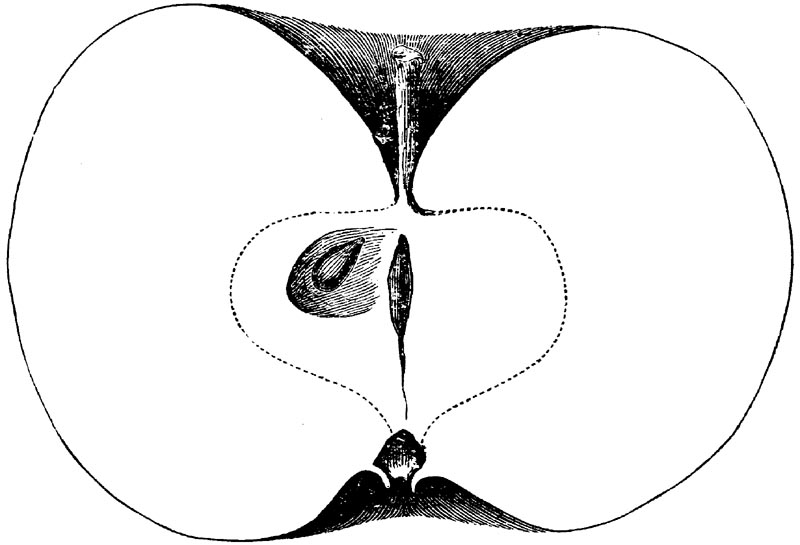
Fig. 88.—DR. WATSON.
This delicious and beautiful dessert apple is much grown in Central and Eastern Indiana, particularly among the Friends. It was for a long time a puzzle to the pomologists. In the meanwhile it must have a name, and without waiting for the decision of the learned, the people in different sections, without consultation, called it the Autumn Seek-no-further. Finally the Horticultural Societies decided that it was an old sort named Doctor Watson, though upon what authority does not appear. The fruit has not been recognized by our Eastern friends, nor by the American Pomological Society, to which it was referred in 1860.
Tree large, spreading, very productive; Twigs slender, foliage small, pale green; in the nursery it is a poor grower.
Fruit medium to large, unless when too crowded, regular, oblate, sometimes unequal; Surface smooth, mixed pale and red on waxen-yellow, beautifully splashed with scarlet; Dots minute.
Basin abrupt, rather deep, wide, regular, sometimes cracked; Eye medium, open.
Cavity wide, regular or wavy, brown; Stem medium to short.
Core medium, regular, closed, just meeting the eye; Axis short; Seeds plump; Flesh yellow, fine-grained, very tender and juicy, almost melting, with a rich, aromatic, sub-acid flavor; Quality best, for table and kitchen, from September to November; also valuable for stock feeding.
Domine.
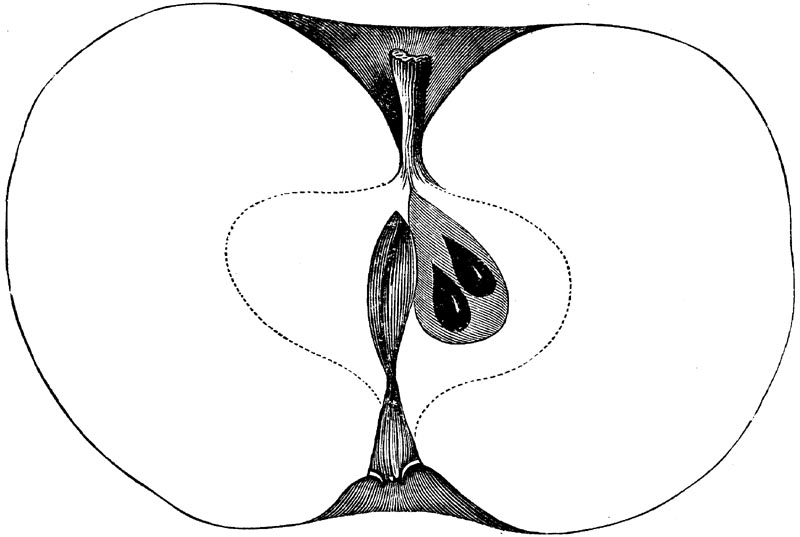
Fig. 89.—DOMINE.
Supposed to be a native of this country; origin unknown. Tree very thrifty, making long, stout, brown shoots, which branch from the ends, and form spurs along their sides, so that the tree has a straggling, open head, and bears its fruit crowded along the smaller branches. It is hardy, upright, vigorous and productive. Foliage large and long, with a peculiar curl or folding upwards, so as to show the underside of the leaves.
Fruit large, flat, regular, sometimes unequal; Surface yellowish-green, nearly covered with mixed red, and striped indistinctly with carmine, often vein-russeted; Dots scattered, yellow and gray, large.
Basin rather shallow, folded or plaited; Eye medium to small, closed.
Cavity wide, wavy, brown; Stem medium to long, slender at its insertion into the fruit, and easily separated from it, but holding firmly to the tree; hence care is needed in picking the fruit.
Core regular, somewhat open, scarcely meeting the eye; Axis often short; Seeds numerous, pointed, plump; Flesh light yellow, breaking, tender, juicy; flavor slightly sub-acid, rich; good, for table, kitchen, or market; Season December and January, keeping until spring in the North.
Duchess of Oldenburgh.
This very beautiful striped apple is from Russia, and has proved one of the hardiest apples in our trying climate. Reports from the Northwest are entirely satisfactory as to its hardiness.
Tree medium size, round-headed, sufficiently vigorous and perfectly hardy.
Fruit medium, regular, roundish-oblate; Surface smooth, waxen-yellow, partially covered with distinct and regular stripes and splashes of brilliant red and carmine; often having a light bloom, such as is found on most Russian apples.
Basin regular, pretty wide; Eye large and closed.
Cavity regular, acute; Stem medium to long, rather slender.
Flesh white, tender, juicy; Sour and suitable for cooking. Though attractive to the eye, it is unsuited for the dessert.
By Dr. Jno. A. Kennicott, the pioneer cultivator of Northern Illinois, this apple was considered the ne plus ultra for that and higher latitudes.
Equinetelee.
BACHELOR—BYERS—IOLA (Berckmans' M.S.) SOL. CARTEE (Downing.)
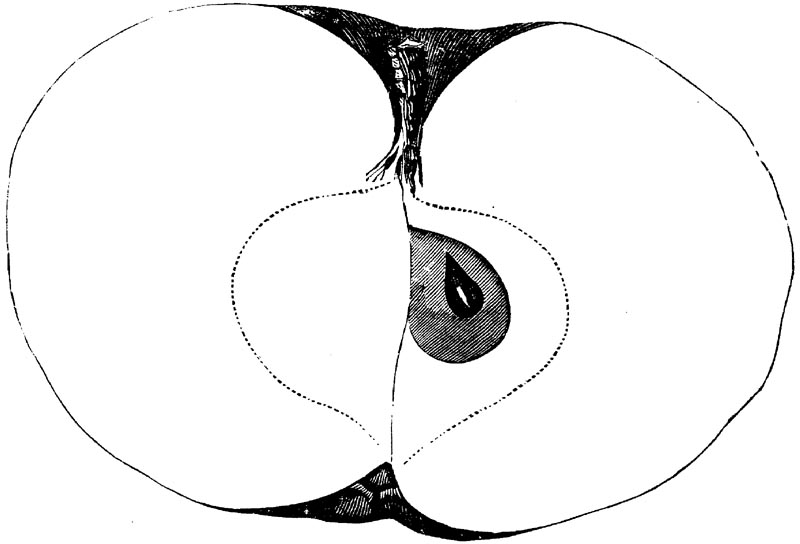
Fig. 90.—EQUINETELEE.
This fine southern apple has its origin traced to Yancey County, in North Carolina. It has not yet been sufficiently tested in the Northern States, but is considered one of the best in the South, and is looked upon as having great promise in our northern orchards, where it is somewhat introduced. Berckmans says: "The finest of the late fall and winter apples."
The trees bear a strong resemblance to those of the Buckingham.
Fruit large, oblate, sometimes oblique; Surface light yellow, mostly covered with bright crimson, obscurely striped; Dots small, white.
Basin deep, narrow, irregular; Eye medium, closed.
Cavity wide, deep; Stem short.
Flesh pale yellow, very tender, juicy, melting; Flavor very mild sub-acid, making it a very superior table fruit, from November to January in Georgia, according to Berkmans.
Evening Party.
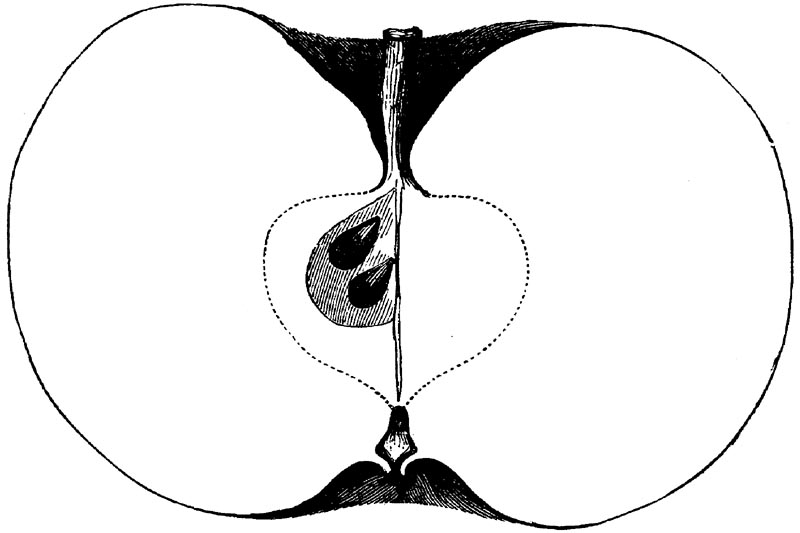
Fig. 91.—EVENING PARTY.
This excellent dessert fruit originated in Berks County, Pennsylvania, and was brought into notice by the late lamented Dr. Brinkle, of Philadelphia, in his ad-interim reports, and also in Hoffy's Fruits. It has been tested with entire satisfaction by J.D.G. Nelson, President of the Indiana Horticultural Society, who always has admirers of the fruit exhibited by him at the winter meetings. This apple takes the place at mid-winter which is occupied in summer by the Early Joe, and in autumn by the Jefferies, Dr. Watson and Cooper.
Fruit medium to small, regular, quite flat; Surface smooth, mixed red, and carmine stripes on waxen-yellow ground; Dots numerous, distinct, gray.
Basin abrupt, regular deep; Eye small, closed; Segments long.
Cavity wide, deep, regular, brown; Stem medium, green, slender.
Core small, regular, closed, touching the eye; Axis short; Seeds short, wide, dark; Flesh light yellow, very fine-grained, tender, juicy; Flavor sub-acid, aromatic; first quality, or very best, for the dessert, or the evening party, during December and January.
Fall Wine.
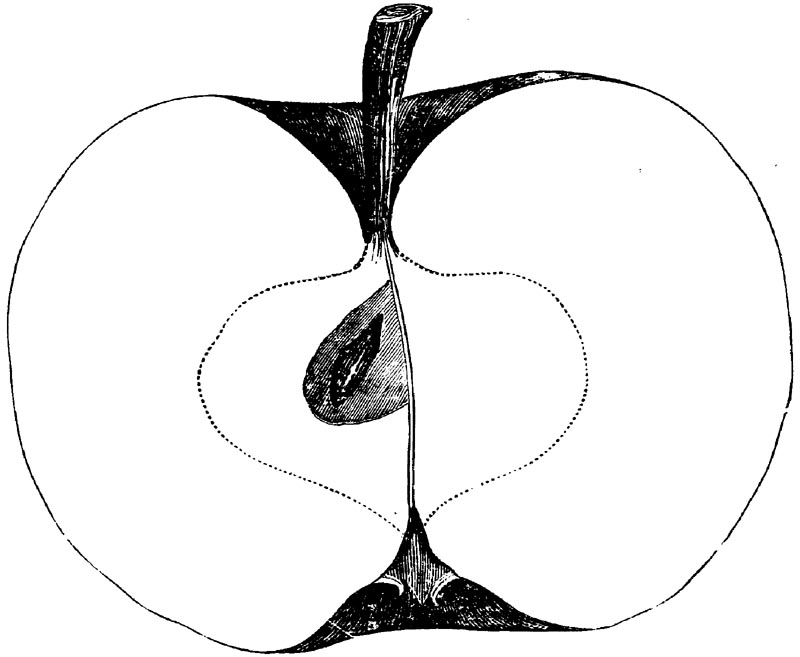
Fig. 92.—FALL WINE.
Origin unknown. A great favorite in the West as a table fruit; little grown in the Eastern States, whence it was brought. Downing supposes this is because the fruit is there defective. In virgin soil it is remarkably fair and handsome.
Tree of medium size, rather slender, but healthy, spreading, and annually productive.
Fruit medium, oblate, handsome; inclined to crack open if left on the tree till ripe; Surface very smooth, waxen-yellow, almost completely covered with bright, and often deep red, upon which it is indistinctly striped; Dots minute.
Basin abrupt, wide, regular or wavy; eye small, closed; Calyx reflexed.
Cavity wide, regular, uniformly green; Stem long, slender.
Core medium, regular, closed, meeting the eye; Seeds numerous, angular or plump; flesh yellow, breaking, tender, fine-grained, juicy; flavor mild sub-acid, and very aromatic; Quality best, for table and market, during September and October or later.
Garden.
GARDEN ROYAL.
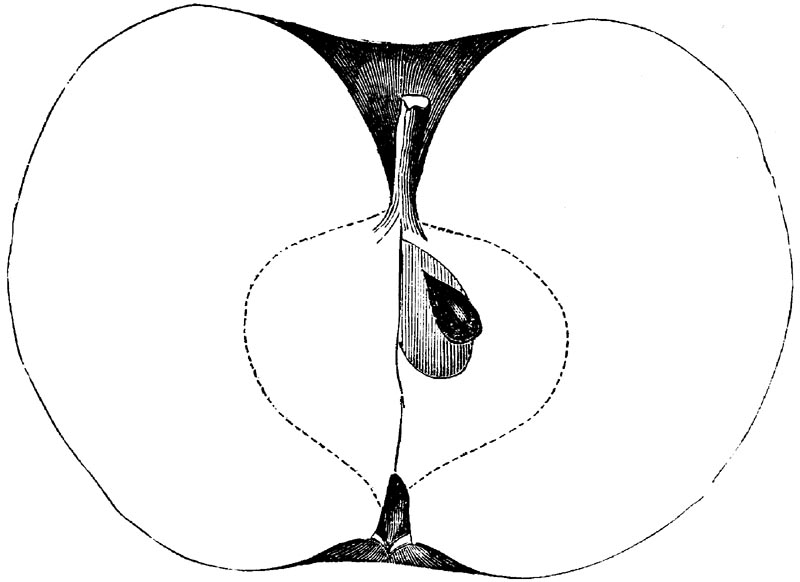
Fig. 93.—GARDEN.
This fine apple has been received from quite distant points, Chillicothe, Ohio, and Salem, Indiana. It is quite distinct in season from the Beefsteak or Garden of Downing, but in description corresponds very closely with the Garden-Royal of Elliott, which fruit I have not seen. Origin unknown.
Fruit pretty large, roundish, flat, regular; Surface smooth, yellowish-green, slightly shaded red, scattered stripes, carmine; Dots minute, black.
Basin wide, regular, small, closed.
Cavity deep, acute, regular, green; stem short to medium, sometimes knobby.
Core wide, closed or open, regular, clasping the eye; seeds small, pointed, brown; flesh pale yellow or whitish, tender, fine-grained, juicy; Flavor sub-acid, aromatic, saccharine, agreeable; Quality very good to best; Use dessert, kitchen, market; Season August to October; worthy of cultivation.
Golay.
This fruit originated near Vevay, Indiana, and is supposed to be a seedling of the Janet, which it somewhat resembles.
Fruit medium, oblate, somewhat conic, truncated, regular; Surface smooth, yellow, mixed, striped, purplish-red; Dots minute, gray, scattered, indented.
Basin wide, regular; Eye small, closed.
Cavity wide, regular; Stem short.
Core very small, pyriform, closed, clasping; Seeds numerous, large, plump, brown; Flesh yellowish-white, breaking, tender, juicy; Flavor sub-acid, rich; Quality good to best; Use, table; Season, January to May.
Harvest Redstreak.
This old variety is valued only as an early cooking apple, for which it has been found very profitable, by those who attend market. Origin unknown. Introduced into the West by Silas Wharton, from the neighborhood of Philadelphia, where it was cultivated largely. Not recognized among the varieties described by Coxe.
Tree spreading, open, round-headed; Twigs stout; Leaves small, mealy.
Fruit medium, roundish-oblate, regular; Surface smooth, greenish-yellow, striped and splashed with red, more or less mingled; Dots minute, dark, and a light bloom.
Basin medium, folded; Eye medium, closed.
Cavity acute, regular, often brown; Stem medium, thick.
Core regular, closed; Seeds angular; Flesh whitish, breaking, coarse, juicy, becoming dry; Quality inferior, except for cooking; Season July.
High-Top.—[LEWIS JONES.]
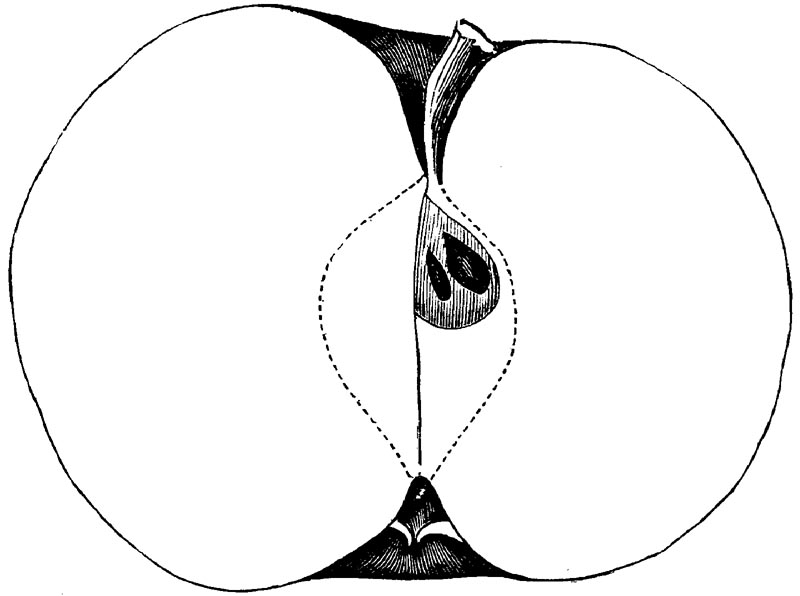
Fig. 94.—HIGH-TOP.
This handsome apple is supposed to have originated in Wayne County, Indiana, and was brought into notice by Lewis Jones.
Fruit large, flat, roundish, regular; Surface smooth, mixed dull red, striped carmine; Dots scattered, minute.
Basin wide, medium, folded; Eye medium, closed.
Cavity wavy, brown, acute; Stem short, green.
Core regular, closed, or wide and open, clasping; Seeds numerous, short, plump, pale; Flesh pale yellow, fine-grained, tender, juicy; Flavor sub-acid, aromatic; Quality good to very good; Use table, kitchen, market; Season, December, January; reminds one somewhat of Domine.
Hocking.
This variety has only been found in western orchards, and has not been mentioned by name in any fruit book with which I have met. At the second meeting of the Northwestern Fruit Growers' Convention, it was reported as having been brought from Fairfield County, Ohio; its resemblance to Townsend was also observed, but it was declared to be different in wood and buds. These apples may yet prove to be identical, but as the question is not settled, both will be described.
Tree thrifty, vigorous, productive—an early bearer.
Fruit medium to large, globular-oblate, regular; Surface smooth, yellow, covered with mixed red, and splashed carmine; Dots minute, yellow.
Basin medium, regular; Eye medium to large, closed.
Cavity medium, regular, green; Stem medium to long.
Core small, closed; Seeds large, brown; Flesh light yellow, breaking, juicy; Sub-acid; Quality good; Market and kitchen; September.
Hunt.
Another of Lewis Jones' apples, supposed to be a seedling of Eastern Indiana; productive.
Fruit medium, roundish-oblate, regular; Surface smooth, yellow, mixed, striped bright red; Dots numerous, yellow.
Basin rather wide, abrupt, folded; Eye small, closed.
Cavity wide, regular; Stem medium, slender.
Core small, roundish, flattened, closed, not meeting the eye; Seeds numerous, angular; Flesh yellow, breaking, fine-grained, juicy; flavor sub-acid, aromatic; Quality good to very good; Use table, market; Season December and January.
Indiana Favorite.
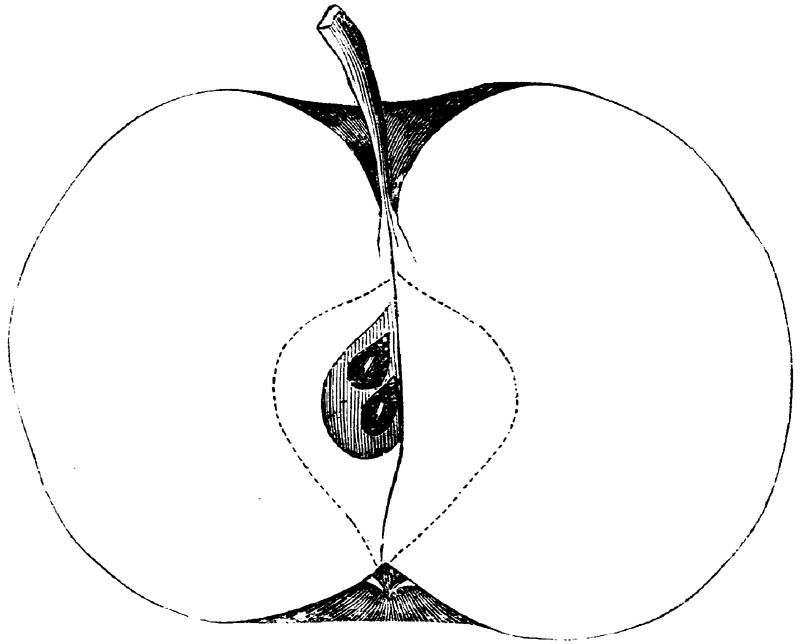
Fig. 95.—INDIANA FAVORITE.
This fruit resembles the Pennsylvania Vandervere, from which it may have sprung. Origin believed to be Fayette County, Indiana. It is considerably cultivated in the eastern part of the State, where I procured specimens exhibited at the Richmond Horticultural Society.
Tree vigorous, spreading, productive.
Fruit medium, globular-oblate, regular; Surface very smooth, bright red, striped with darker red; Dots numerous, star-shaped, yellow.
Basin wide, regular, abrupt; Eye small, closed.
Cavity acute, regular, green or brown; Stem medium to long, red.
Core regular, closed, clasping the eye; Seeds numerous, angular, imperfect; Flesh pale yellow, breaking, fine-grained, juicy; Mild sub-acid; Good to very good, for table and market, from January to March.
Jarminite.
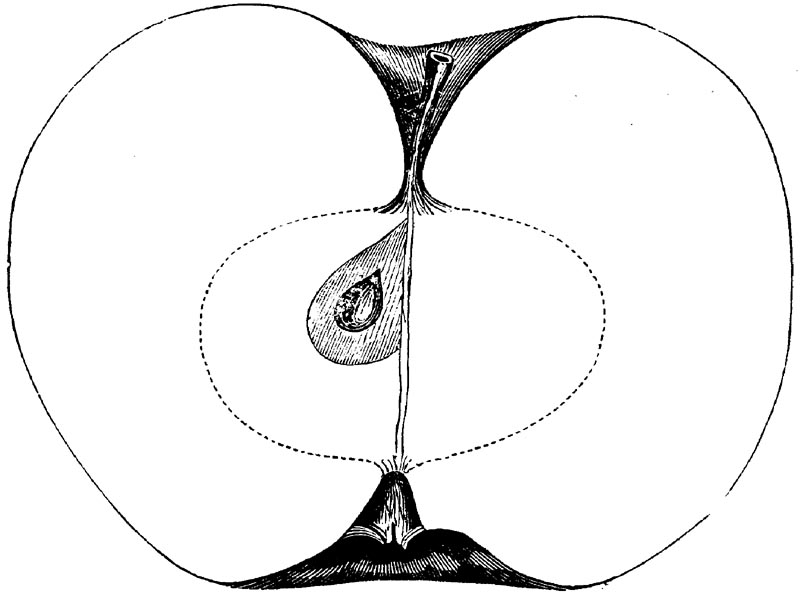
Fig. 96.—JARMINITE.
This new fruit originated on the farm of Jarmin Ballard, in Highland County, Ohio, where it was grown from the seed of Gilpin.
The tree is very vigorous, and only too productive.
Fruit medium, regular, oblate, or roundish; Surface smooth, green, partially covered with mixed and striped dull red.
Basin regular, wide; Eye medium, closed.
Cavity regular, acute; Stem slender, medium to short.
Core regular, closed, clasping; Seeds few, large, dark; flesh breaking, firm; Mild sub-acid, almost sweet; December until March.
Jefferies.
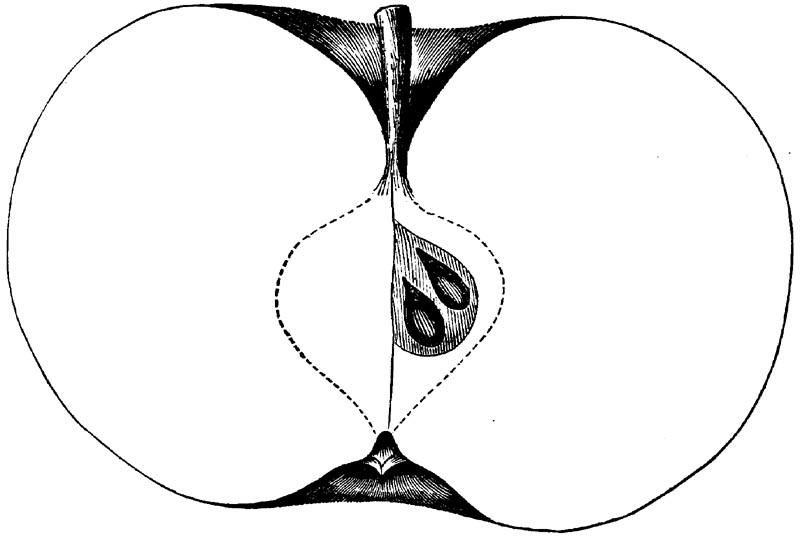
Fig. 97.—JEFFERIES.
This delicious autumn apple originated in Chester County, Pennsylvania, and was first described by the ad-interim committee of the Pennsylvania Horticultural Society; also in the Farm Journal, for 1853, by David Townsend, of Westchester, Pa.
Tree healthy, sufficiently vigorous, shoots slender, foliage bright green; productive, early bearer.
Fruit full medium, oblate, regular; Surface smooth, yellow, mixed and splashed crimson; Dots large, scattered, yellow.
Basin wide, regular; Eye small, closed.
Cavity medium, regular, brown; Stem medium to long.
Core small, closed, regular, clasping; Seeds numerous, large, brown; Flesh yellow, breaking, fine-grained, juicy; flavor sub-acid, aromatic, delicious; Quality very good, for table and market, during August, September and October.
Kentucky King.
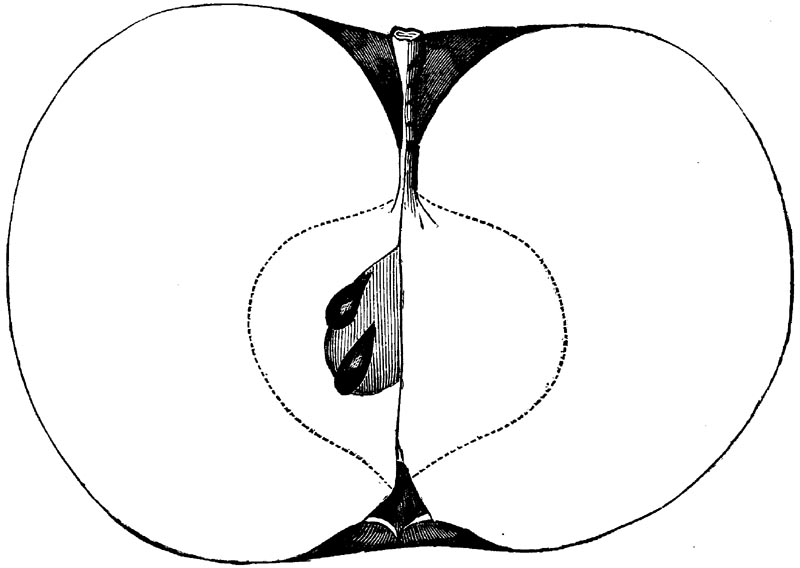
Fig. 98.—KENTUCKY KING.
Received from J.S. Downer & Son, Elkton, Kentucky. Further history not known.
Fruit above medium, flat, regular; Surface smooth, yellow, with mixed and striped carmine; Dots scattered, minute.
Basin medium, regular; Eye medium, open.
Cavity medium, regular, brown and green; Stem medium to long.
Core medium, round, closed, clasping; Seeds numerous, angular, pointed, dark; Flesh yellow, breaking, fine-grained, juicy; Flavor sub-acid, aromatic; Quality good to very good; Use table, kitchen; Season December, February.
Klaproth.
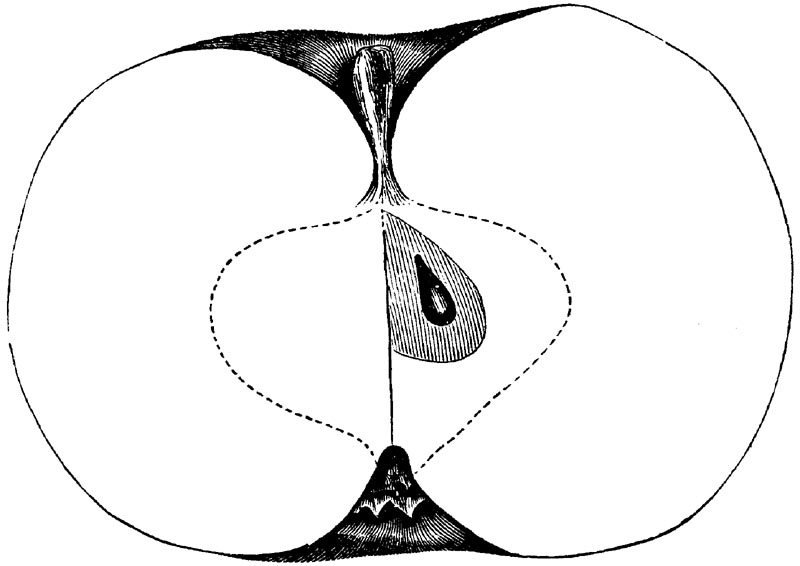
Fig. 99.—KLAPROTH.
Another Pennsylvania apple, introduced by my friend Dr. J.K. Eshleman. Tree vigorous, large, productive.
Fruit medium, regular, oblate; Surface dull yellow, more or less covered with red stripes; Dots numerous, light.
Basin wide, regular; Eye closed, small; Calyx reflexed.
Cavity deep, regular, brown; Stem short to medium.
Flesh white, breaking, tender, very juicy; Flavor acid, to sub-acid when ripe; Good; August till October.
Lewis.—Of Ragan.
Originated in Putnam County, Indiana, as one of the many seedlings produced by my old friend Reuben Ragan.
Tree thrifty and productive.
Fruit medium, regular, oblate; Surface smooth, deep red on yellow; Dots, numerous, large, yellow.
Basin medium, regular, not deep; Eye small, closed
Cavity wide, regular, brown; Stem short.
Core wide, regular, closed, meeting the eye; seeds numerous, plump; Flesh yellow, tender, fine-grained, juicy; flavor sub-acid, aromatic; Quality nearly first-rate for table; Season, October.
Lacker.
This old Pennsylvania apple is cultivated to some extent in the Western States for its beauty. Specimens from Henry Myers, South Bend, Indiana, from his beautiful collections shown at the State Fairs.
Fruit full medium to large, very handsome, oblate, regular; Surface smooth, highly polished, bright red on pale yellow, striped dark red; Dots numerous, pale.
Basin wide, wavy; Eye small, closed; Segments short.
Cavity deep, narrow, wavy; Stem short to medium.
Core small, roundish or oval, closed, clasping; Seeds numerous, plump; Flesh whitish, breaking, fine-grained, juicy; Flavor mild sub-acid, aromatic, fine; Quality good; use table, market; Season January to March.
McDaniel.
This is a seedling of Green County, Ohio, to which was awarded a premium at the State Fair in 1855.
Fruit full medium, regular, oblate; surface very smooth, yellow, well covered with rich, crimson, indistinct stripes; dots scattered, light gray.
Basin medium, regular; eye medium, closed.
Cavity narrow, regular; stem short.
Core medium, regular, closed; seeds plump, dark; flesh rich yellow, solid, juicy; flavor sub-acid, rich, piquant, like a Spitzenberg; October, November.
Minkler.
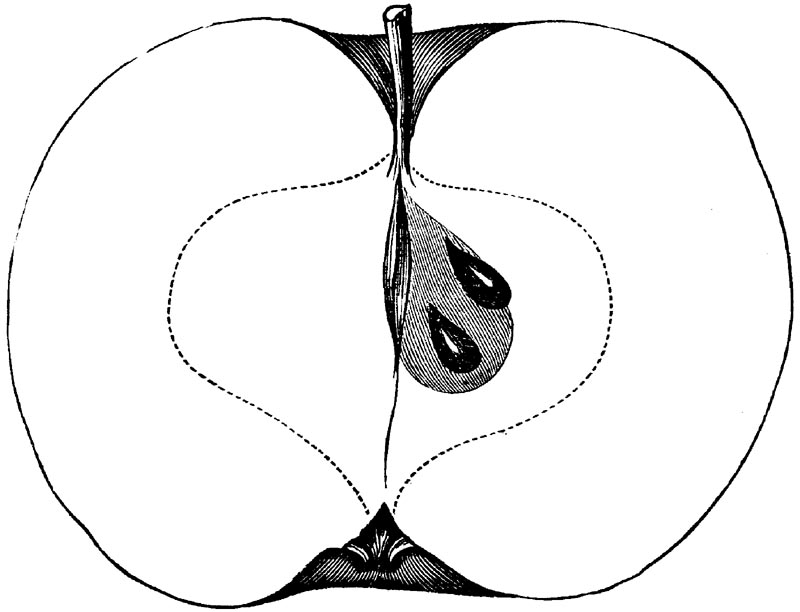
Fig. 100.—MINKLER.
Produced by S.G. Minkler, of Kendall, Illinois.
This variety very closely resembles that described as Buchanan, though their origin is entirely distinct. The Minkler also bears a very close resemblance to an apple found at Quincy, Illinois, and known as the Brandywine.
Tree very thrifty, spreading, branches strong, forming a large angle with the stem.
Fruit medium to large, regular, globular-ovate; Surface smooth, greenish-yellow, covered with mixed red, and stripes of dark dull red; Dots scattered, minute, yellow.
Basin wide, shallow, regular; Eye small, closed.
Cavity acute, rather deep, brown; Stem medium.
Core large, closed, meeting the eye; Seeds numerous, long, pointed; Flesh yellow, or greenish-yellow, fine-grained, breaking, juicy; Sub-acid; Second quality; Use market and cooking; from March until May.
Newtown Spitzenberg.—[COXE.]
VANDERVERE, OF NEW YORK (Downing)—OX-EYE—JOE BERRY, ETC.
Origin, Newtown, Long Island.
Tree sufficiently vigorous, not of the largest size, spreading, compact, round head, foliage rather small, curled, showing the whitish underside. Productive.
Fruit medium to large, regular, globular-oblate, often inclined or lop-sided when overgrown in young orchards, apt to be scabby and defective on old trees, and falls badly; Surface smooth, deep red, mixed and striped, on rich yellow ground, often over-spread with whitish, giving the fruit a gray appearance; Dots numerous, minute, fawn color on dark specimens.
Basin medium, regular; Eye small, closed.
Cavity regular, medium, brown; Stem short.
Core regular, wide, somewhat open, meeting and sometimes clasping the eye; Seeds numerous, angular; Flesh rich, yellow, very fine-grained, very tender, juicy; Flavor rich sub-acid and saccharine, aromatic, eminently satisfying; Quality best, for table and kitchen, in December.
Nickajack.
SUMMEROUR—JACKSON RED—BIG HILL—CAROLINA, AND MANY OTHERS.[49]
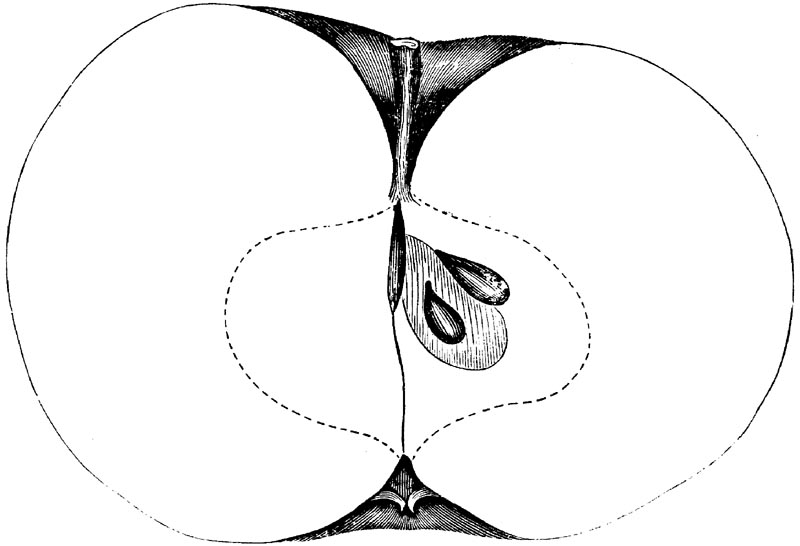
Fig. 101.—NICKAJACK.
This southern apple, which has extended more widely northward than most of its congeners, is believed to be a native of Macon County, Georgia.
Tree robust, spreading, large, very productive, young shoots stout and red.
The following description is that of a specimen sent by my friend, R. Peters, of Atlanta, Georgia, but it corresponds in all important particulars with those of fruits obtained from a dozen different sources in our own latitude:
Fruit large, globular-oblate, regular, not handsome; surface even but not smooth, mostly covered with mixed brick-dust red, striped indistinctly with dark red, some stripes very distinct; dots scattered, yellow.
Basin shallow, regular, even; eye small, closed.
Cavity acute, regular, yellow and brown; Stem medium slender.
Core closed; Seeds numerous, large, plump; Flesh greenish-yellow, breaking, firm, coarse; Flavor sub-acid, not rich; Quality only good, a market fruit, keeping well; Season March until May.
Nyack.
NYACK PIPPIN.
Origin New York; specimen obtained from Mr. E.H. Warren, of Chelmsford, Massachusetts.
Fruit medium, flat, uneven; Surface smooth, greenish-yellow, mixed, striped, splashed bright red; Dots numerous, distinct, yellow, indented.
Basin shallow, folded; Eye small, closed; Axis short.
Cavity wide, deep, wavy, brown; Stem short, thick, knobby.
Core rather wide, closed, rather clasping; Seeds large; Flesh white, firm, juicy; Flavor acid, rich; Quality pretty good; Use table, market; Season December.
Ohio Nonpareil.
MYER'S NONPAREIL—WESTERN BEAUTY.
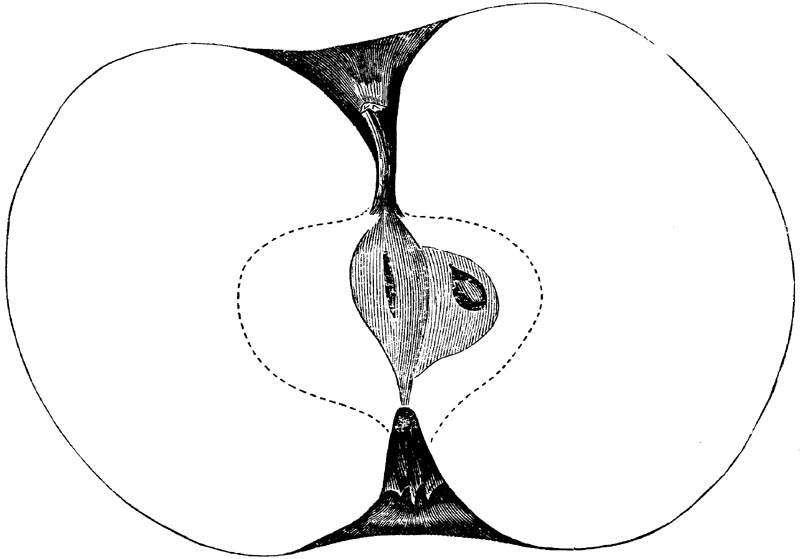
Fig. 102.—OHIO NONPAREIL.
This fine fruit originated with Mr. Myers, near Massillon, Ohio.
It was described in the Western Horticultural Review for February, 1853.
Tree vigorous, healthy, spreading, limbs straight, stout and compact, not liable to break with the weight of fruit. The original tree had borne annual crops of even sized fruit for twenty years.
Fruit large to very large, regular, oblate, very handsome; Surface smooth, yellow, covered with bright red; Dots scattered, gray.
Basin medium, wide, regular; Eye large, closed.
Cavity deep, acute, regular; Stem short, small.
Core regular, somewhat open; Seeds numerous, medium; Flesh yellowish, tender, fine-grained, juicy; sub-acid, rich; First quality, for table, market, cooking or drying; Season September to December. Compared with some of the best dessert apples of the season, such as Hawley, Fall Pippin, Fall Wine, Rambo, and others, this variety was declared to be "better than the best."
Osceola.
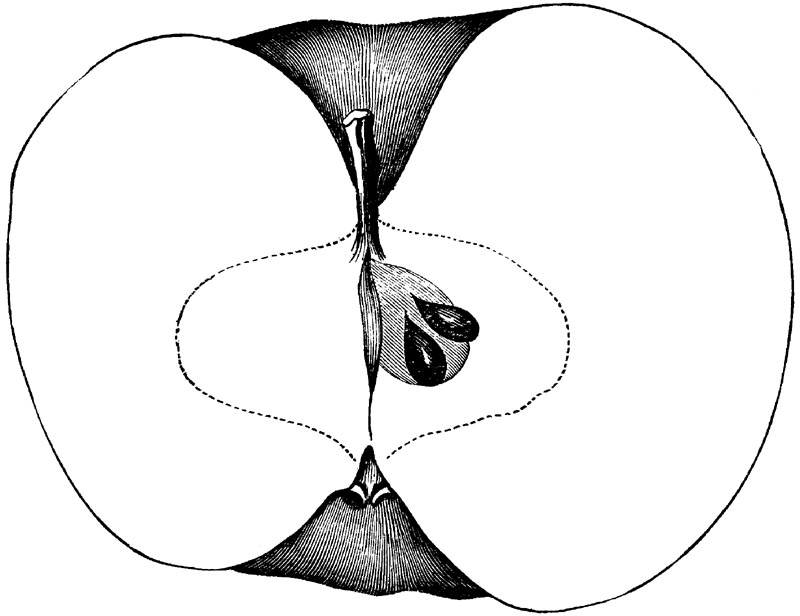
Fig. 103.—OSCEOLA.
Originated in Indiana, brought into notice by that earnest horticulturist, Henry Ward Beecher, who did much to stimulate the culture of fine fruits when a resident of that State.
Fruit medium, flattened, sometimes unequal, regular; Surface smooth, slightly colored red, and striped with the same; Dots scattered, irregular, more frequent and minute about the apex, few and larger at base of the fruit.
Basin wide, regular; Eye small, closed.
Cavity medium, acute; Stem short.
Core small, round, closed, clasping; Seeds numerous, plump, dark; Flesh yellowish, firm, rich, juicy; Flavor sub-acid, mild; Quality good; Use table and market; Season January to March.
This variety does not seem to have won its way into public favor to the extent that was expected for it some years ago.
Pennock.
PENNOCK'S RED WINTER—ROMANITE—BIG ROMANITE.
This fruit, of Pennsylvania origin, is not introduced into this collection on account of its excellence, but because it is so universally cultivated in nearly all parts of the country.
Tree vigorous, large, spreading, very productive, bearing some fruit every year.
Fruit large to very large, form variable, but characteristically it is conic-oblate, often unequal, and lop-sided; Surface greenish-yellow, covered with mixed and striped red; Dots large, irregular and round, gray.
Basin wide, rather deep, uneven or wavy; Eye large, open.
Cavity wide, deep, regular; Stem short.
Core irregular, closed, meeting the eye; Seeds numerous, angular, plump; Flesh yellow, breaking, coarse-grained; Flavor sub-acid, poor; third quality; for cooking and market only; Season December; very much disposed to bitter rot.
Pennsylvania Vandervere.
VANDERVERE (Coxe and Downing)—LITTLE VANDERVERE—GRAY VANDERVERE—STAALCUBS, ETC.
This old kitchen favorite, of Pennsylvania, has migrated westward until it has reached every State and county on its appropriate parallels of latitude, 39° to 42°.
Mr. Downing gives Delaware as its origin, on the authority of Coxe. In accordance with common acceptance in the regions where it is best known, I have adopted the above name, which was given to distinguish it from several other Vanderveres, and especially from the Newtown Spitzenberg, to which the name Vandervere had been applied in New York and westward on that parallel. Coxe describes the fruit in question under the name Vandervere.
Tree vigorous, healthy, large, spreading, very twiggy and drooping, with abundant fruit on the ends of the spray; Foliage bright yellowish-green, shining, pointed, the whole aspect of the tree peculiar and characteristic in summer or winter.
Fruit medium or less, oblate, or globular-oblate, regular; Surface smooth, but having raised hemispherical warts of a yellow russet color, yellow, mottled, and striped light red, often a gray appearance over the whole exterior; Dots large, yellow, indented.
Basin wide, regular, not deep; Eye small, closed.
Cavity wide, regular; Stem long, slender.
Core regular, closed, meeting and clasping the eye; seeds numerous, pointed, plump; Flesh yellow, breaking, granular, juicy; Flavor highly aromatic, acid; Quality for table third, for kitchen first, for cider Coxe says very good, yielding a heavy must; Season December and January.
The fruit is subject to bitter rot, and does not keep well, but may be used for cooking as soon as any other apple, making good sauce in July, when not half grown.
Pottinger.
BIG RED.
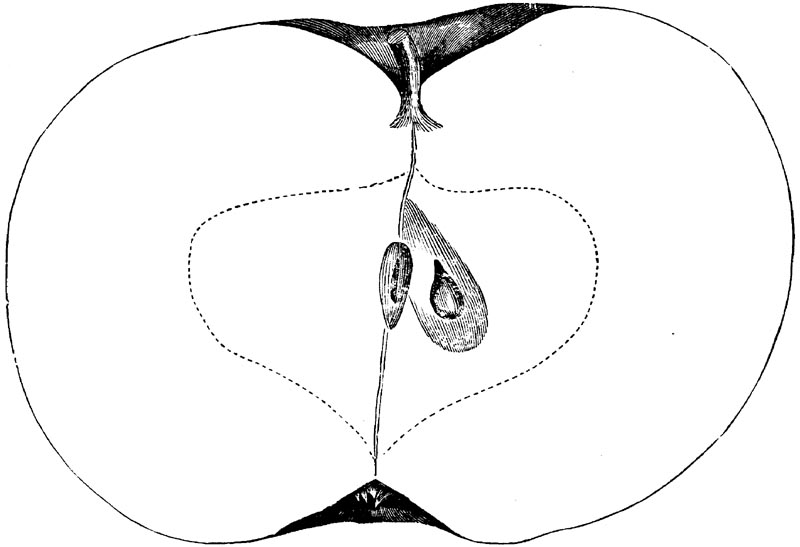
Fig. 104.—POTTINGER.
This large market fruit is found chiefly in regions settled by immigrants from the South, and it may prove to be the same as some other southern apple. Specimens first received from my friend J.B. Orange, in Southern Illinois, afterwards from several other points.
Tree vigorous, large, branches upright, shoots purple, warty, buds long, pointed.
Fruit large, regular, oblate; Surface not smooth, dull red, shaded and striped, covering the yellow ground; Dots small, prominent, with some roughness.
Basin regular, wide, not deep; Eye small, closed.
Cavity wide, regular, green and brown; Stem medium to short.
Core closed, or nearly so, meeting and partially clasping the eye; Axis short; Seeds numerous, plump, angular; Flesh yellow, breaking, granular, juicy; Flavor sub-acid, aromatic; Quality only good; Useful for kitchen and drying; Season December and January; keeps well.
Press Ewing.
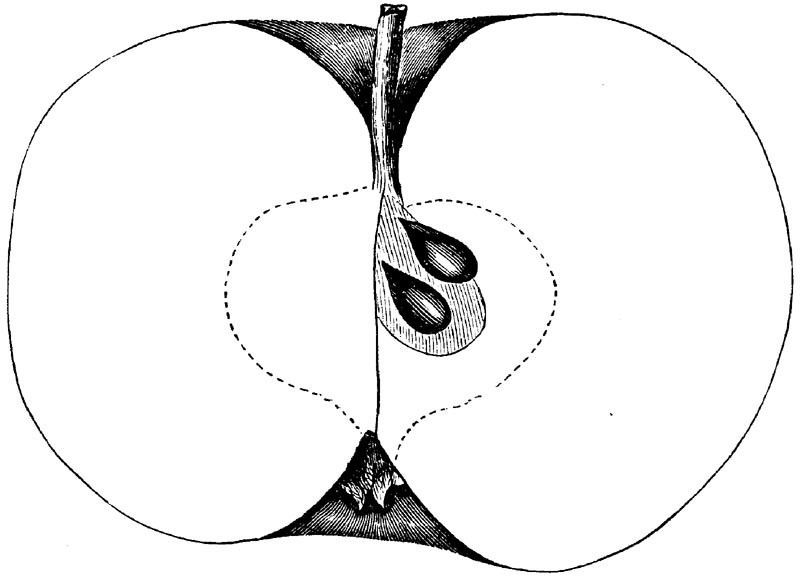
Fig. 105.—PRESS EWING.
This Kentucky apple was sent me by J.S. Downer, from whom trees were also procured which have already borne fruit.
Tree vigorous, healthy, and early productive.
Fruit resembles Smokehouse, medium, roundish-oblate, regular; Surface smooth, bright red, mixed, striped, and splashed, on greenish yellow; Dots numerous, brown and yellow.
Basin wide, wavy, regular, rather deep; Eye medium, open; calyx reflexed.
Cavity wide, wavy, brown; Stem long, slender.
Core medium, closed, meeting the eye; Axis short; Seeds numerous, angular, pointed; Flesh yellow, fine-grained, tender, melting, juicy; Flavor rich sub-acid; Quality nearly first rate; Use for table in December and January.
Powers.
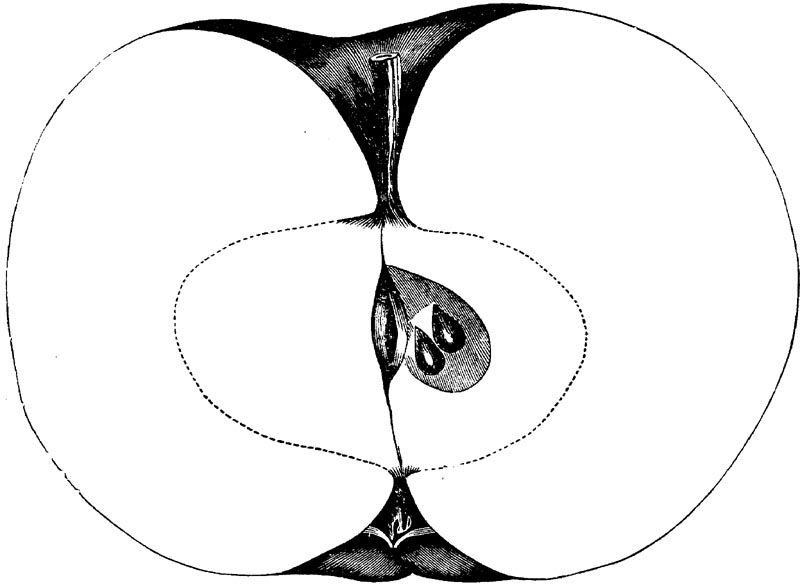
Fig. 106.—POWERS.
This beautiful table apple was first brought to public notice by Geo. Powers, of Perrysburgh, Ohio. He exhibited specimens at the Toledo meeting of the Ohio Pomological Society in January, 1864, but the fruit was over ripe; at the State Fair at Dayton, Ohio, October 16th, it was shown in perfection of beauty and excellence, and was then examined by the Society, who commended it highly, and being satisfied that it was an original seedling, its local name, Miller's Apple, was then changed to Powers, in honor of the pomologist who had brought it into notice.
The tree appears to have been an accidental seedling, which sprang up in the town of Perrysburgh, where it grew almost without care until it fruited a few years ago, and attracted the attention of Mr. Powers.
The fruit is large and fair, round, somewhat flattened, and sometimes rather conic, generally regular, but large specimens are slightly angular; the surface is very smooth, a greenish waxen yellow, more or less shaded with mixed light red, upon which are laid numerous stripes and broken splashes of rich, dark carmine; Dots minute, scattered, gray.
Basin abrupt, regular, or folded; Eye small, closed.
Cavity deep, regular, sometimes brown; Stem medium or short.
Core medium or wide, regular, closed, meeting the eye; Seeds numerous, plump, sometimes imperfect; Flesh white, very tender, juicy; Flavor mild sub-acid, quite aromatic, very agreeable; Use especially for the table, as a highly ornamental dessert fruit, for which its extreme delicacy adapts it, while the same quality unfits it for general market purposes; Quality very good; in its season of ripening, in its beautifully white and tender flesh, and in its perfumed flavor, this fruit resembles the Fameuse, from which it may have been produced.
Prolific Beauty.
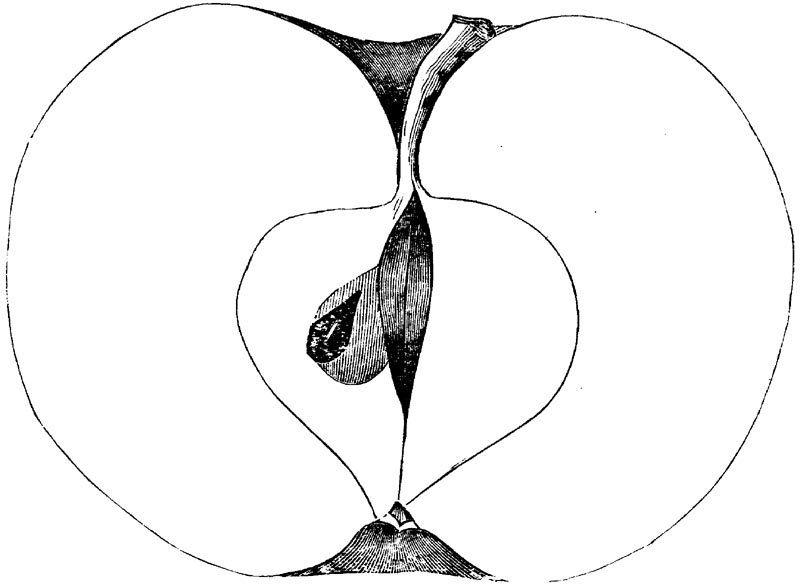
Fig. 107.—PROLIFIC BEAUTY.
This showy fruit is one of the original Putnam list of Washington County, Ohio; it is somewhat singular that so few choice sorts are traceable to the seeds of these first good orchards of the West. Rome Beauty is almost the only one of great notoriety that is referable to this source.
Fruit large, sometimes quite large, oblate, somewhat conic, regular; Surface smooth, yellowish-green, partially covered with stripes of red; Dots minute, gray.
Basin medium, wide, regular; Eye small, closed.
Cavity wide, wavy, green; Stem medium.
Core large, regular, open, clasping; Seeds numerous, plump; Flesh whitish-yellow, tender, juicy; Flavor acid; quality scarcely good; Use kitchen, market; Season September to December.
Rambo.
ROMANITE OF NEW JERSEY—BREAD-AND-CHEESE, ETC.
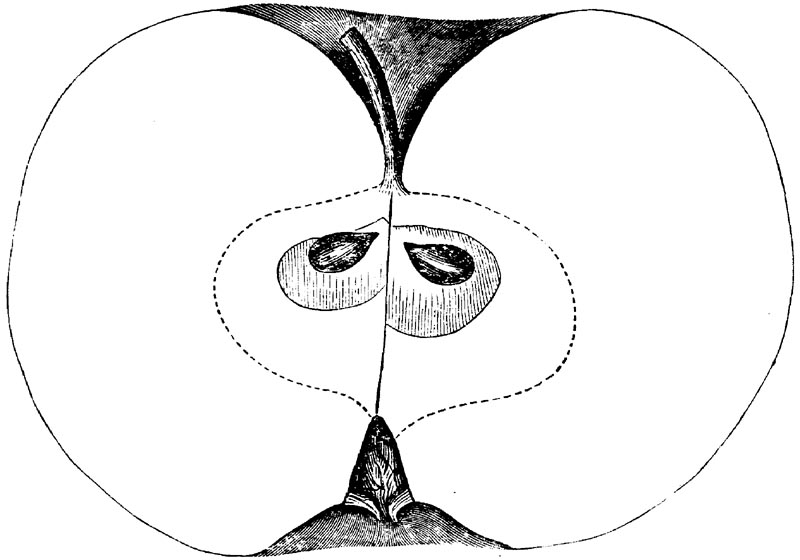
Fig. 108.—RAMBO.
This standard Eastern Pennsylvania variety is universally popular, and through the Western States it marks the progress of emigration from the Keystone State, though its admirers are not confined to that class of our population. It is a fall and early winter fruit, and some pomologists on the southern borders of its culture object to it that it will not keep long, and that it soon becomes dry and mealy when put away. When grown further north it is smaller, but more solid, and remains juicy until spring. It should be gathered early, even before it is well colored, and kept cool to make it retain its flavor and juiciness.
Tree upright, very thrifty, very productive; shoots dark, foliage large, light green, and thus the variety may easily be distinguished in the orchard. Not very hardy; whole nurseries and orchards were destroyed, in 1856, throughout the Northwest.
Fruit medium to small, when crowded upon the limbs as they generally are upon old trees, regular, oblate, or roundish-oblate, but sometimes unequal when overgrown; large specimens are flattened at the ends so as to appear truncate; Surface striped and splashed scarlet on greenish-yellow, in some the stripes coalesce so as to make the skin red, the ground color being covered; Dots numerous, small, prominent, rich bloom.
Basin wide, abrupt, regular or plaited, sometimes quite shallow; Eye small, closed.
Cavity wide, regular, always green; Stem medium.
Core regular, closed, meeting and clasping the eye; seeds numerous, large, angular; Flesh greenish-white, tender, breaking, granular, juicy; Flavor sub-acid, aromatic, vinous; Quality almost first rate for table, excellent for the kitchen; Season October to December, and if gathered early in the North, until spring.
Red Astrachan.
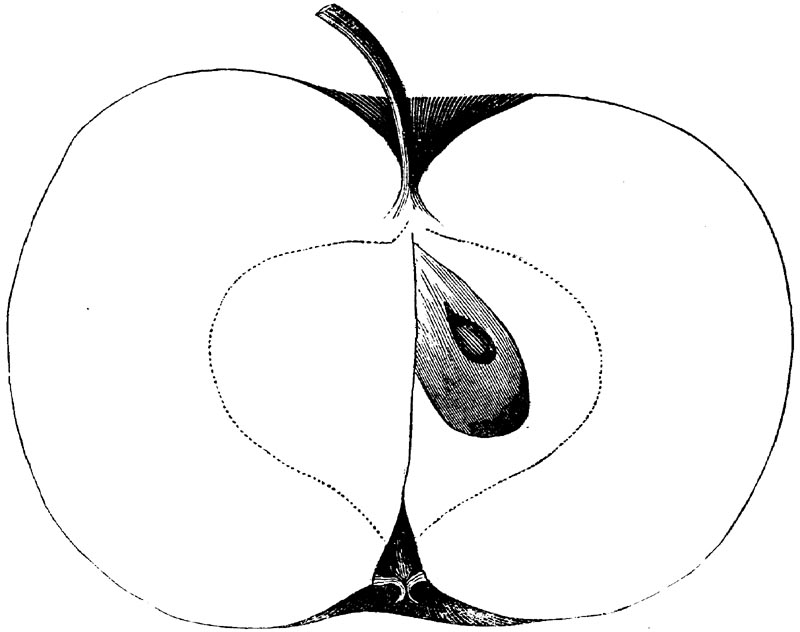
Fig. 109.—RED ASTRACHAN.
This Russian fruit has been perfectly adopted by our countrymen, and has proved itself a great favorite, particularly in the North, by its hardiness and productiveness, beauty and good qualities.
Tree vigorous, upright, productive, hardy; Shoots reddish brown, foliage large, rich green.
Fruit medium to large, regular, oblate; Surface smooth, mottled, marbled and striped crimson on greenish-yellow; Dots minute, heavy bloom.
Basin medium, regular; Eye small, closed.
Cavity shallow, regular; Stem long, yellow.
Core regular, closed; Seeds angular, small, dark; Flesh yellow, breaking, juicy; Flavor quite acid, not rich; Quality first rate for market and cooking, poor for table; Season July.
Richard's Graft.
RED SPITZENBERG—STRAWBERRY—WINE.
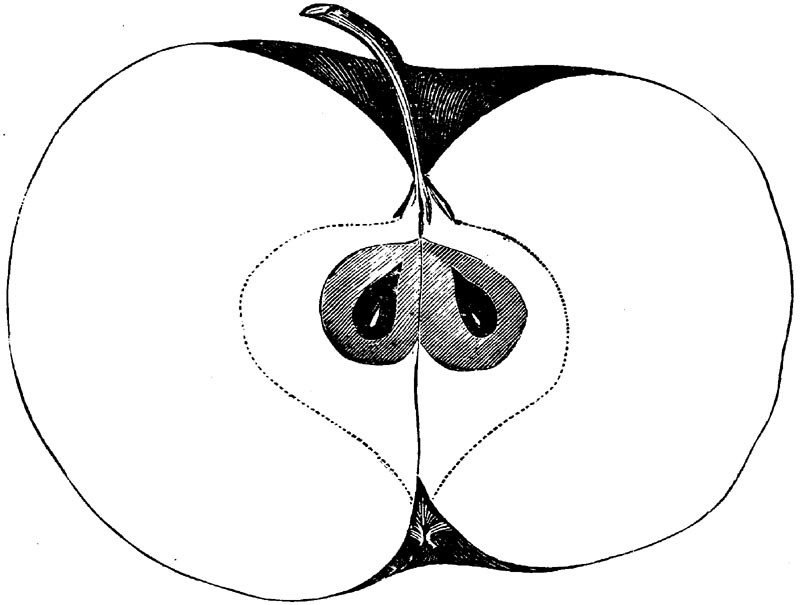
Fig. 110.—RICHARD'S GRAFT.
Supposed to have originated in Ulster County, New York. Tree vigorous, upright, very productive.
Fruit medium to large, regular, oblate; Surface smooth, greenish-yellow, mixed and splashed red; Dots numerous, white.
Basin medium, abrupt, folded; Eye small, closed.
Cavity wide, regular; Stem long, red.
Core small, closed, clasping the eye; Seeds numerous, plump; Flesh yellowish-white, fine-grained, tender, juicy;
Flavor rich, sub acid; Quality best; Use for the dessert; Season September and October.
Downing says: "One of the best dessert apples of its season."
Rome Beauty.
GILLETT'S SEEDLING.
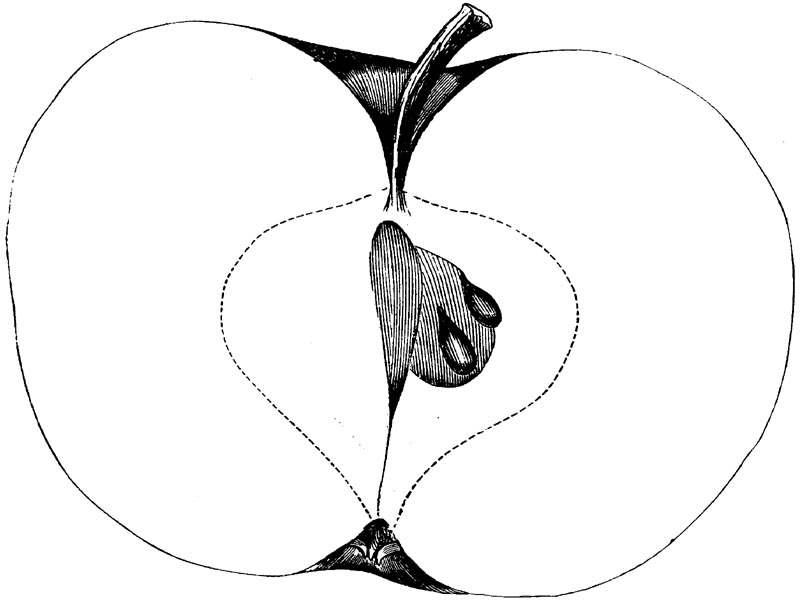
Fig. 111.—ROME BEAUTY.
This handsome market fruit was originated in Southern Ohio, by that sterling pioneer pomologist, H.N. Gillett, to whose contributions I acknowledge myself under many obligations.
Tree thrifty, hardy, round headed, very productive; shoots slender, red; Foliage healthy; Blossoms open late, and thus it often escapes a late frost; early productive.
Fruit large to very large, regular, handsome, fair, said to be scabby on old trees, regular oblate, roundish-oblate, and sometimes rather conical; Surface smooth, pale yellow, striped and mixed bright red; Dots minute, indented.
Basin wide, deep, regular; Eye quite small, closed.
Cavity wide, wavy, green; Stem long, slender.
Core wide, regular, closed, meeting the eye; Seeds numerous, long, pointed; Flesh yellow, breaking, coarse-grained; Flavor sub-acid, not rich; Quality scarcely good; valuable for market, on account of its productiveness, size and beauty, as well as for its certain bearing; Season December to February.
Shiawassee Beauty.
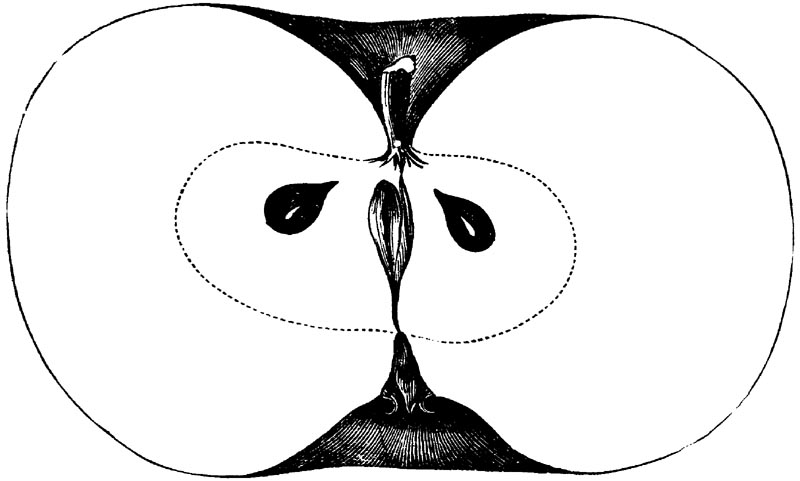
Fig. 112.—SHIAWASSEE BEAUTY.
This Michigan apple may well be called Beauty. It was introduced at the meeting of the American Pomological Society in 1862, by T.T. Lyon, of Plymouth, Mich., who stated that it was a seedling of the Fameuse, the faults of which it does not inherit, though possessing all the good qualities of its parent, with a healthy and productive tree. (See Michigan Farmer, Dec. 11, 1859.)
Fruit medium, very handsome, very regular, quite flat; Surface very smooth, pale yellow, mixed and distinctly striped carmine; Dots scattered, minute.
Basin wide, folded; Eye medium, closed; Calyx reflexed.
Cavity wide, wavy; Stem short.
Core wide, regular, somewhat open, meeting the eye; seeds plump, short, dark; Flesh very white, fine-grained, tender, breaking; Flavor sub-acid, aromatic; Quality good to very good; Use dessert and market; Season October to January.
Summer Limbertwig.
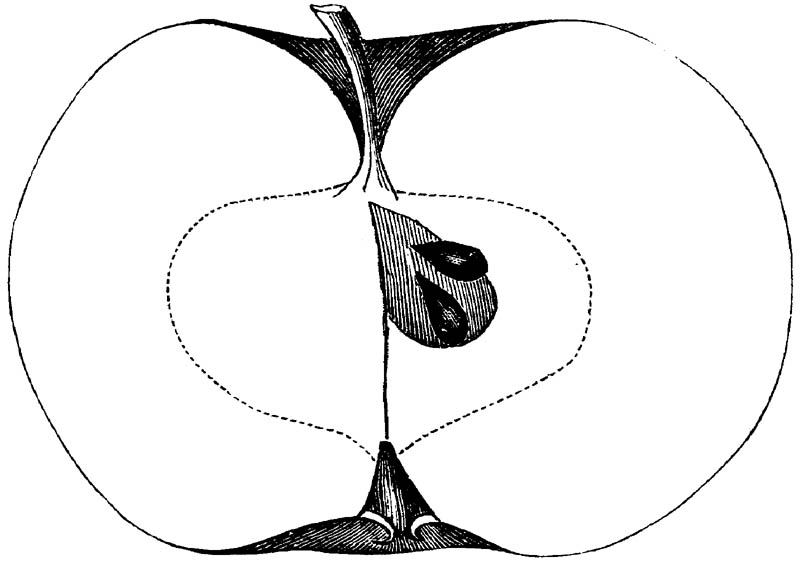
Fig. 113.—SUMMER LIMBERTWIG.
Southern; obtained from S. Westbrooke, Greensboro', North Carolina.
Fruit medium, flat, regular; Surface pale yellow, mixed pink, striped dark red; Dots minute, gray, indented.
Basin shallow, wide, regular; Eye wide, open.
Cavity acute, regular, brown; Stem long, inclined.
Core wide, regular, closed, clasping; Axis short; Seeds numerous, plump, dark; Flesh white, tender, fine-grained, juicy; Flavor sub-acid, aromatic, agreeable; Quality very good, if not best; Use table; Season August, September.
Townsend.
Having been disappointed in my trees obtained for this variety, which proved to be Rawle's Janet, I prefer to quote from Mr. Downing. What I have fruited and described as the Hocking may prove to be the same.
"Origin Pennsylvania. Tree healthy, vigorous, very productive.
"Fruit medium, oblate, slightly conic. Skin pale yellow, striped and splashed with red, and covered with a thin bloom. Stalk rather long, slender, inserted into a medium cavity. Calyx closed, set in a basin of moderate depth. Flesh white, tender, very mild, agreeable, sub-acid flavor. Ripe middle of August to middle of September. Hocking of the West may prove to be the same."
Trader's Fancy.
This peculiar looking apple originated in Washington County, Pennsylvania. Tree vigorous, healthy, spreading, round-headed, very productive, bears regularly. As a long keeper, with dark skin, that does not show bruises, it became a favorite with shippers on the Ohio river, hence its name, the flat-boats that stop from port to port to dispose of their cargoes being called trading boats, and their masters traders.
Fruit medium, regular, oblate; Surface very smooth, greenish yellow, almost completely obscured with deep purple red, mixed and striped, and covered with a white bloom.
Basin wide, sometimes folded or plaited; Eye small, closed.
Cavity wide, regular; Stem medium, slender.
Core medium, closed; Seeds plump; Flesh whitish, tender, fine-grained; Flavor mild sub-acid; Quality only good; Use market and kitchen; Season January to May.
Twenty-Ounce Pippin.
Origin unknown, and the variety never should have been distributed; it is here named to put people on their guard against it when they desire to purchase the Cayuga Red Streak, also called the Twenty-ounce apple.
Fruit large, flat, regular; Surface greenish, more or less mottled and striped dull red.
Basin, wide, regular, or wavy; Eye small, open.
Cavity wide, regular, green; Stem short, thick.
Core large, closed; Seeds numerous, angular; Flesh yellow-white, breaking; Flavor acid, with a peculiar aroma, not agreeable; Quality poor; Use kitchen only; Season November to January. There are many better apples of its season.
Vance's Harvest.
A pretty little early apple grown in some parts of the West. Origin unknown.
Fruit small, flat, regular; Surface smooth, rich yellow, shaded and splashed bright red; Dots small, scattered, yellow.
Basin small, regular; Eye small, closed.
Cavity wide, regular, brown; Stem long.
Core wide, regular, meeting the eye; Seeds numerous, short, plump, dark; Flesh yellow, firm, breaking, not very juicy; Flavor acid to sub-acid; Quality pretty good; Use kitchen and market; Season August.
Vandervere Pippin.
LARGE VANDERVERE—WATSON'S VANDERVERE—VANDERVERE (Elliott)—YELLOW VANDERVERE—and several others in the books.
There appears to have been much confusion in the minds of authors who have written of this fruit, which, in some parts of the country is very well known and much cultivated. I have taken the name by which it is almost universally recognized by cultivators, though it is adopted only as a synonym by Mr. Elliott, who seems to have confounded this apple with the Pennsylvania Vandervere or Staalcubs described by Coxe.
Origin believed to have been Pennsylvania, but this is not well established.
Tree very vigorous, large, spreading, productive, bearing annually; Twigs and leaves much like the Pennsylvania Vandervere.
Fruit large to very large, regular, oblate; surface smooth, yellow, more or less covered with marbled red, and scarlet stripes; Dots large, yellow, indented, sometimes irregularly net-veined, making it less smooth.
Basin wide, regular; Eye small, closed.
Cavity wide, regular; Stem long, medium size.
Core regular, closed, meeting and clasping the eye; Seeds numerous, dark; Flesh yellow, firm, breaking, granular, juicy, heavy; Flavor rich, acid; Quality poor for table, excellent for cooking; Season December. Does not keep well, rather subject to bitter rot, but a great favorite with house-keepers, and a useful shade tree near the kitchen door.
Vaughan's Winter.
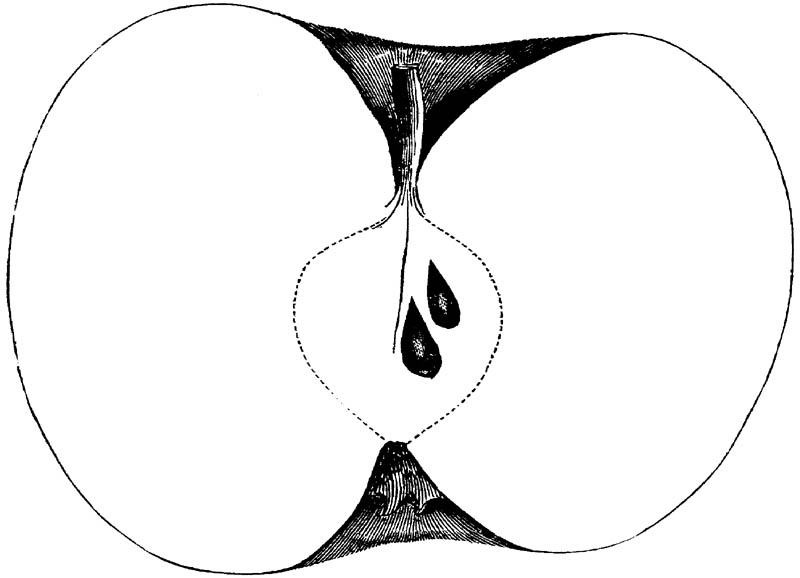
Fig. 114.—VAUGHAN'S WINTER.
This Kentucky variety was sent to me by my friend J.S. Downer, of Fairview, Kentucky, with several other new southern apples of merit. Tree vigorous, hardy and productive, bearing fruit early.
Fruit medium, regular, round-oblate; Surface smooth, greenish-yellow, mixed and splashed with bright red and splashes of carmine; Dots small, gray and yellow.
Basin regular, abrupt, medium, and leather-cracked; Eye large, open; Segments reflexed.
Cavity medium, yellow and brown; Stem short.
Core small, regular, closed, meeting the eye; Seeds few, large, brown; Flesh yellow, breaking, fine-grained, juicy; Flavor sub-acid, good; December.
Western Beauty.
MUSGROVE'S COOPER—BIG RAMBO—OHIO BEAUTY.
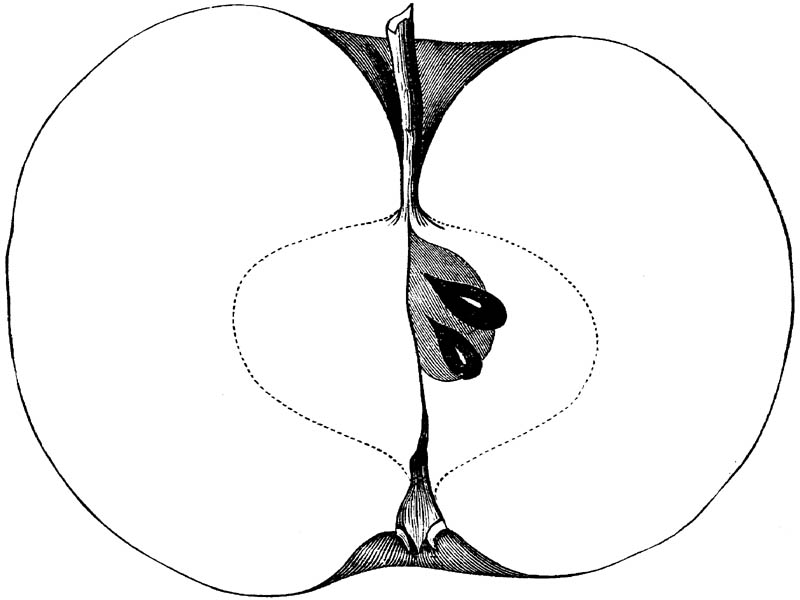
Fig. 115.—WESTERN BEAUTY.
A valuable fall and early winter fruit, the origin of which is not known; it is considerably grown in Central Ohio, and has attracted attention under its synonyms as given. It was at one time thought to be the Cooper.
Mr. W.F. English, of Auglaize County, Ohio, carried grafts into that region from Pickaway County, and in a most disinterested manner exerted himself to distribute the variety. In a communication to the Western Horticultural Review, for February, 1853, he says: "The tree is vigorous, leaves upon young shoots are often three to three and a half inches broad, and four or five, and even six inches long; shoots stout, being often as large as your little finger at the end of the summer's growth. The form of the tree is peculiar, and its appearance beautiful; once seen, it may be recognized anywhere by its habit."
Having fruited this variety in my own orchard, I can confirm the above, and add:
Tree vigorous, large, spreading, open head, productive, an early bearer.
Fruit large, sometimes very large, beautiful, regular, oblate, not disposed to rot, except when attacked by the birds, which are very fond of it; Surface smooth, pale yellow, partially covered with mixed red, striped and often distinctly splashed with bright red; Dots numerous, gray, prominent; Skin quite thin.
Basin wide, regular, sometimes cracked open; Eye large, closed.
Cavity wide, regular, green, and partly brown; Stem either short or long.
Core large, nearly closed, clasping the eye; Seeds numerous, medium, pointed; Flesh light yellow, almost white, brittle, tender, juicy, almost melting, never water-cored; Flavor sub-acid, vinous, delicious, satisfying; Quality best; either for table or cooking, for the latter purpose they may be taken when half grown in the beginning of July. In August they may be house-ripened and found good, but the proper season is September to Christmas; if properly cared for they may be preserved plump until March, but lose some of their refreshing flavor.
Wilson.
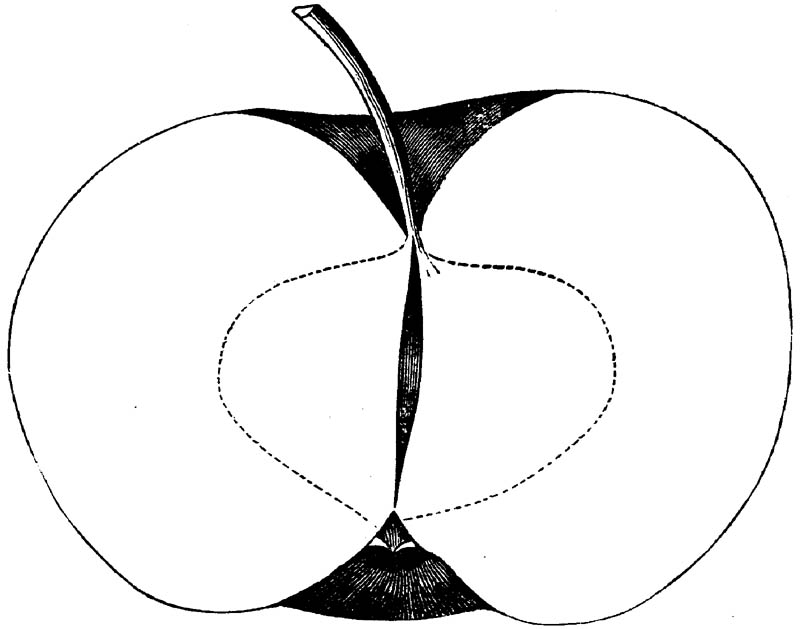
Fig. 116.—WILSON.
This very nice little apple was sent to me with this name from Western Virginia, by Julius Brace, who found it abundant on Paint Creek. I have not yet been able to identify it, but it may prove to be the same as some of our new southern varieties. An outline and description are here given with its local name, in the hope that if it should prove to be the same as the Black Annette, of the Clinch river region of Virginia, or some other variety, the identity may be the more readily traced.
Fruit small, regular, oblate, or globular-oblate; Surface smooth, nearly covered with very deep red, in which the stripes are almost obscured; Dots numerous, minute, white.
Basin, deep, regular, plaited or folded; Eye small, closed.
Cavity regular, acute; Stem long, red.
Core regular, closed, meeting, not clasping the eye; Seeds small, plump; Flesh white, fine-grained, crisp, tender, juicy; Flavor mild sub-acid, agreeable; Quality best; Use table; Season January.
This is different from Wilson's of Michigan, which is yellow.
Wine.—[Coxe.]
HAYS' WINTER—PENNSYLVANIA RED STREAK.
This handsome large apple is another index of the source of population in a western county. It is a favorite fruit with those who know it, either for market or the kitchen, for which its size and form render it peculiarly attractive.
Tree very large and handsome, spreading and very open head; leaves small, curled, and mealy, making the foliage appear rather meagre, and displaying the splendid fruit, which is evenly distributed.
Fruit large, globular-oblate, flattened or truncate, regular, occasionally unequal and lop-sided; Surface smooth, yellow, more or less covered with mixed and broken stripes of red, splashed with crimson; Dots scattered, large, gray.
Basin rather shallow, wide, abrupt; Eye small, closed, or open from breaking of the calyx.
Cavity acute, regular, brown; Stem short, thick.
Core medium, regular, closed; Seeds numerous, large, angular; Flesh yellow, firm, breaking, juicy; Flavor acid to sub-acid, rich; Quality good, for market and kitchen; Season, November and December.
Winter Queen.—[Coxe.]
FALL QUEEN—KENTUCKY QUEEN—ROBERTSON'S SUPERB (of Ga.)
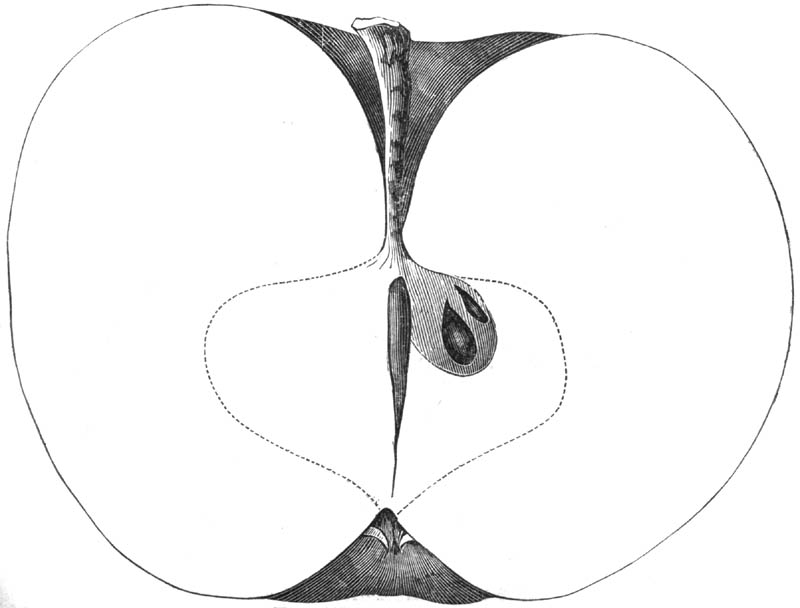
Fig. 117.—WINTER QUEEN.
This is a favorite, of southern origin, and has many synonyms. An excellent apple for drying, for family use and for market. Tree thrifty, upright, productive, early bearer; limbs long and parallel while young; shoots dark, stout; foliage large, broad, rather pale.
Fruit large, often very large, globular-oblate, somewhat conic, regular; Surface smooth, often polished, yellow, almost wholly obscured with marbled dull red, and darker stripes that are often lost in the depth of tint; Dots generally small, indented; often a slight bloom covers the fruit, but it is easily removed, when the skin appears to be polished.