DOCHNAHL'S CLASSIFICATION. (continued 3)
Reading edition
Wilson.—[Of Michigan.]
Fruit large, round, slightly conic, regular; Surface smooth, golden yellow; Dots scattered, dark.
Basin small, folded; Eye long, closed.
Cavity wide, very deep, wavy, green; Stem medium or short, crooked.
Core small, globular, open, clasping; Axis short; Seeds numerous, plump, short; Flesh very yellow, breaking, fine-grained, juicy; Flavor sub-acid, rich; Quality best; Use, the dessert; Season, January and February.
Yellow Ingestrie.
This old English variety has been propagated pretty extensively in the Northwest, and though too small for a profitable market fruit, it has been found desirable on account of its early and abundant productiveness.
Fruit small, globular, truncated, regular; Surface smooth, lemon yellow; Dots minute.
Basin wide, shallow, folded; Eye medium, open; Segments reflexed.
Cavity acute, brown; Stem long, slender.
Core medium, oval, regular, closed, clasping; Seeds few, large, pale; Flesh whitish yellow, breaking, juicy; Flavor sub-acid; Quality barely good; Use, cooking; Season, September, October.
CLASS III.—ROUND APPLES.
ORDER I.—REGULAR.
SECTION II.—SOUR.
SUB-SECTION II.—STRIPED.
American Summer Pearmain.
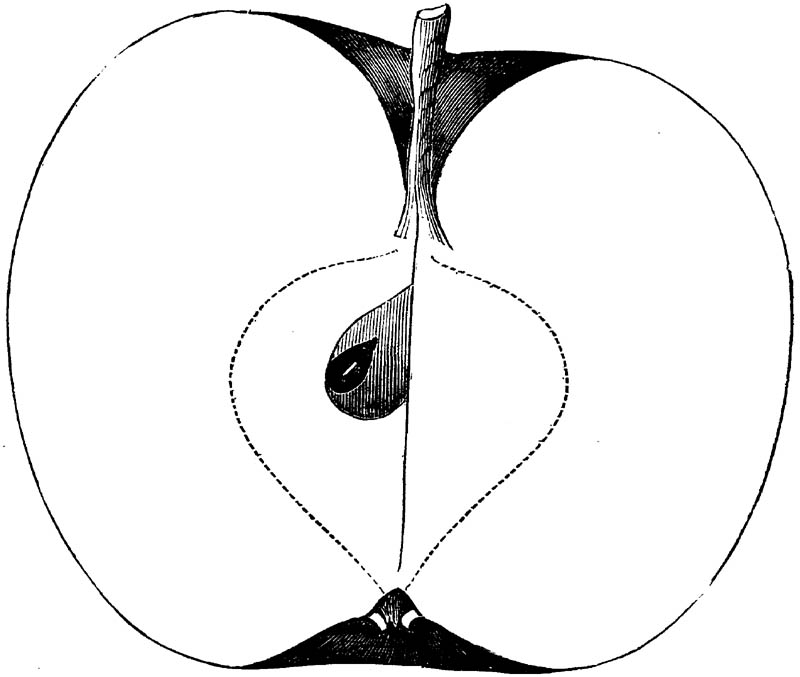
Fig. 207.—AMERICAN SUMMER PEARMAIN.
This delicious apple is supposed to be of American origin. It is essentially a fruit for the amateur; being of slender and slow growth in the nursery, it is not a favorite with the propagators, and though making a large and productive tree in the orchard, it is not profitable as a market variety.
Fruit medium, variable in form, being oblong, round, conic and even oblate, regular or unequal; Surface smooth, greenish yellow, more or less covered with dull purplish red, marbled, and made up of very short splashes, with distinct stripes and splashes of brighter red; Dots minute.
Basin medium, regular; Eye rather large, nearly closed; Segments recurved.
Cavity rather deep, acute, regular; Stem medium to long.
Core small, roundish, closed; Seeds small, pointed; Flesh yellow, exceedingly tender, almost melting, crisp, fine-grained, juicy; Flavor very mild sub-acid, aromatic, deliciously refreshing; Quality best; Use, the dessert; Season, August and September.
Baccalinus.
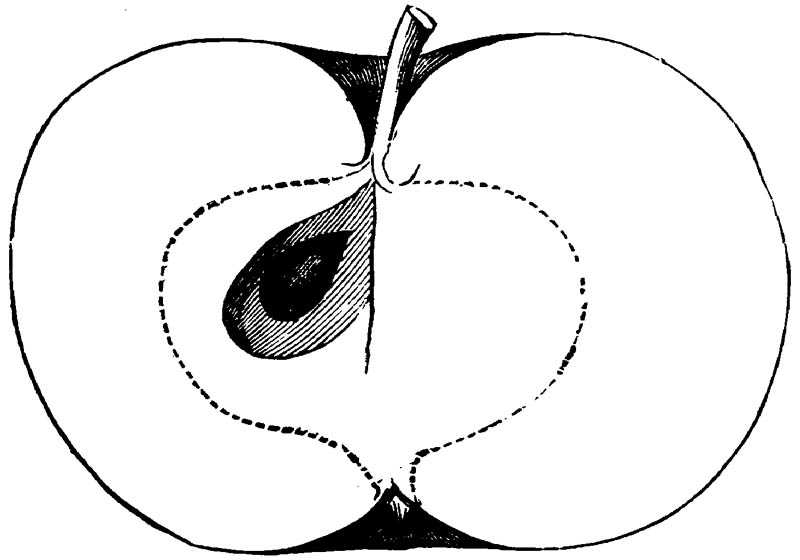
Fig. 208.—BACCALINUS.
Fruited by J.H. Crain, Pulaski County, Illinois, on trees nine years old, which produced ten bushels apiece, showing its productiveness.
This valuable Southern keeper bids fair to become a great favorite.
Tree thrifty, very productive; Fruit small, globular, truncated, regular, handsome; Surface smooth, mixed bright red, and splashed crimson on pale yellow; Dots few, minute.
Basin shallow, wide, regular; Eye small but long, closed; Calyx reflexed.
Cavity deep, regular, brown; Stem medium to long, slender.
Core medium, regular, closed, or slightly open, clasping; Seeds numerous, angular, dark; Flesh yellow, firm, fine-grained, juicy; Flavor sub-acid, agreeable; Use, dessert; Season, December till March or longer; Quality very good.
Beauty of Kent.
A large English apple, well adapted to the kitchen. Tree upright, vigorous, rather productive.
Fruit large to very large, roundish, flattened, somewhat conic, regular; Surface greenish yellow, more or less covered with bright red mixed, and splashed with a darker hue; Dots small.
Basin quite shallow, regular; Eye very small closed.
Cavity medium, acute, wavy, green; Stem medium to short.
Core regular, medium, ovate, slightly open, clasping the eye; Seeds angular, imperfect; Flesh whitish yellow, breaking, juicy; Flavor acid; Quality only good; Use, cooking and market, for which it is well adapted by its size and appearance; Season, September and October.
Ben Davis.
NEW YORK PIPPIN, &C.
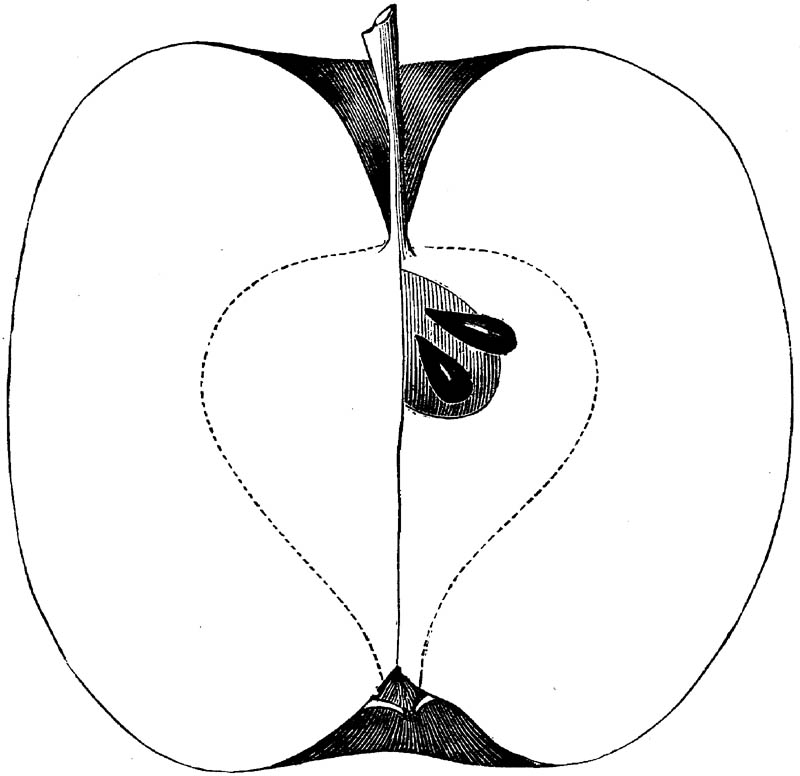
Fig. 209.—BEN DAVIS.
This handsome Southern apple has attained a wonderful notoriety within a few years, and its culture has been greatly extended, not on account of its superlative excellence, but because of its many good qualities as an orchard tree or market fruit. It was long cultivated by Verry Aldrich, in Bureau County, Illinois, and exhibited as New York Pippin, which name gave an idea of its eastern origin, but in other localities its relations point clearly to its source in the South. To Mr. J.S. Downer we are indebted for a knowledge of its present name, and for confirmation of its identity under its several synonyms. This apple may be said to have succeeded as well in the northern parts of Indiana and Illinois as in their southern borders, where it has long been planted; though the northern orchards are still young, they are very promising. The fruit is modified somewhat by a cooler climate, and will keep later than that grown in the South.
Tree remarkably healthy and vigorous, an upright, rapid grower in the nursery, and has numerous short spur-branches along the stem. In the orchard the limbs are set very strongly, and the stems are marked by little mammillar projections or knobs, that are very characteristic. Tree large, spreading, productive, bears early; Shoots long, reddish brown, smooth; Foliage large, dark green.
Fruit large, variable in form, round, often apparently oblong, tapering to the eye, truncated, regular, sometimes inclined, generally very true, as though turned in a lathe; Surface smooth, often polished, yellow covered with mixed red, splashed bright red; Dots minute, scattered.
Basin generally shallow, in large developed specimens deep, abrupt, always regular; Eye large, open; Segments reflexed.
Cavity deep, acute, wavy, brown; Stem medium to long.
Core medium, regular, clasping the eye; Seeds large, plump; Flesh whitish, breaking, tender, juicy; Flavor sub-acid, not rich; Quality only good; Use, market, kitchen; Season, December, January and longer.
Blackburn.
Found in the markets at Louisville, Kentucky; not much seen elsewhere. Origin unknown, probably Southern.
Fruit large, round, somewhat flattened; Surface dull looking, dull green and gray, with broken stripes of dark dull red; Dots large, gray about the apex.
Basin narrow, regular; Eye medium, closed.
Cavity rather deep, acute, brown; Stem medium, curved, rather stout.
Core flattened, open, clasping; Flesh white, crisp, juicy; Flavor sub-acid, with a peculiar spicy, wild, rather astringent taste, that diminishes with the maturity of the fruit; Quality considered good; Use, family and market; Season September, November. Blackburn is sometimes used as a synonym of Fall Queen, a different fruit.
Capital.
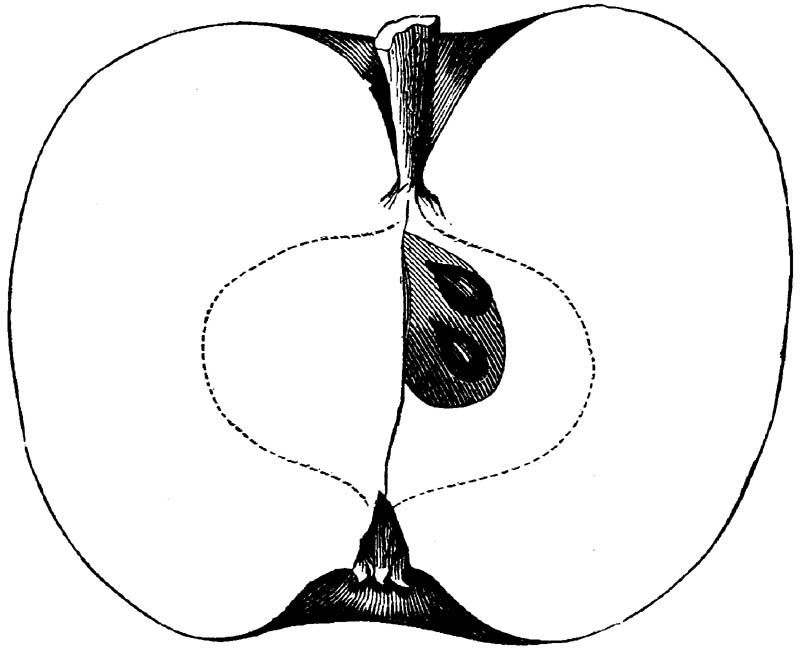
Fig. 210.—CAPITAL.
A seedling of Z.S. Ragan, Clayton, Indiana.
Fruit small, globular, truncate at the ends, regular; Surface smooth, deep red on greenish yellow; Stripes and Dots indistinct.
Basin wide, deep; Eye medium, open, elongated.
Cavity wide, acute, regular; Stem medium.
Core round, open, clasping; Seeds numerous, pointed; Flesh yellow, breaking, juicy; Flavor sub-acid, rich; Quality good; Use, the dessert; Season, December and January.
Carter.—[Of Massachusetts.]
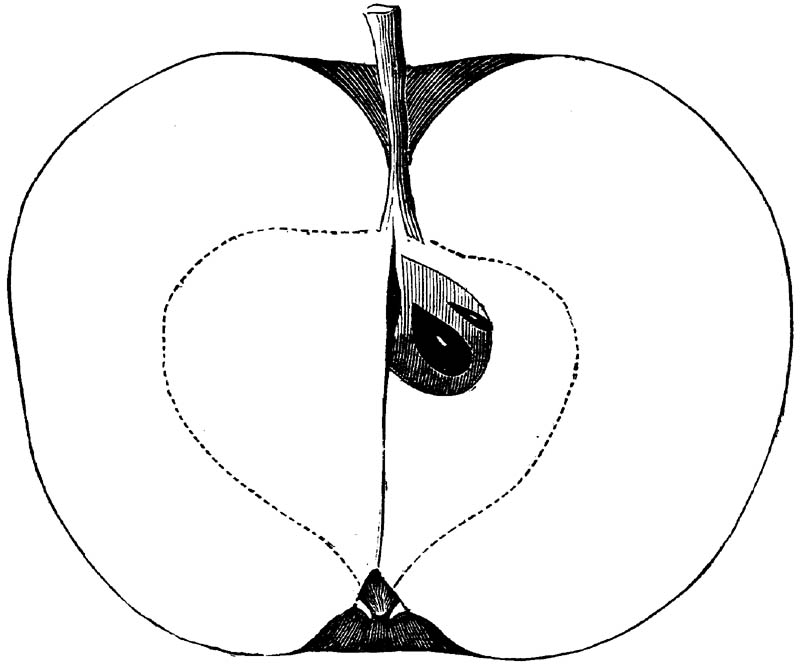
Fig. 211.—CARTER.
Specimens from Luke Lincoln, of Leominster, Mass.
Fruit medium, round, flattened, slightly angular; Surface smooth, yellow, mixed and splashed scarlet; Dots rare, minute.
Basin shallow, folded; Eye small, closed.
Cavity deep, acute, wavy; Stem long.
Core rather large, regular, closed, clasping; Seeds plump and imperfect, pointed; Flesh yellowish white, breaking, juicy; Flavor sub-acid, aromatic; Quality good; Use, table; Season, December, January.
Cary's Summer.
This is probably an old variety, but it has not been identified. Specimens from C.C. Cary, near Louisville, Kentucky.
Fruit large, round, flattened, regular; Surface smooth, rich yellow, mixed, splashed, carmine; Dots scattered, minute.
Basin wide, wavy; Eye small, closed.
Cavity deep, narrow, wavy brown; Stem short.
Core medium, roundish, regular, open; Seeds numerous, plump; Flesh yellow, tender, fine-grained, juicy; Flavor sub-acid; Quality very good; Use, table, kitchen, market; Season, June to September.
Cluster Pearmain.
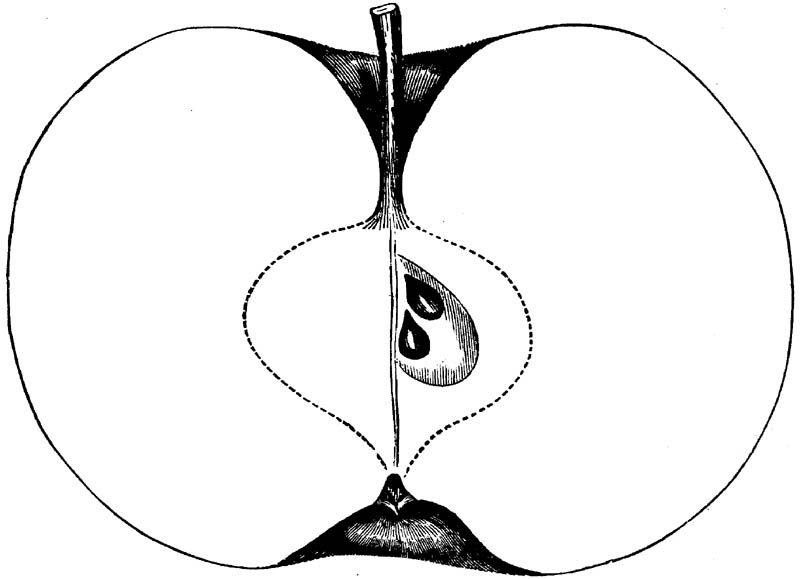
Fig. 212.—CLUSTER PEARMAIN.
Introduced by R. Ragan, of Indiana.
Fruit full medium, round, flattened, regular, inclined; Surface yellowish green, mixed and striped light red; Dots large, numerous, gray and yellow; white bloom.
Basin deep, abrupt, regular; Eye small, closed.
Cavity wide, regular, brown; Stem short.
Core medium, pyriform, nearly closed, clasping; Seeds numerous, angular, dark; Flesh yellowish white, breaking, tender, granular; Flavor sub-acid, aromatic; Quality good to very good; Use, table; Season, September, October. A most acceptable substitute for Rambo, as an amateur's fruit.
Coggeswell.
Origin near Norwich, Connecticut. Tree vigorous, upright, productive on alternate years.
Fruit large, uniform, fair, beautiful, round, flattened, regular; Surface smooth, striped red on yellow.
Basin shallow, small; Eye small, closed.
Cavity wide, brown; Stem short.
Flesh yellow, tender, fine-grained, juicy; Flavor mild sub-acid, aromatic, rich; Quality best; Use, table; Season, December to March.
This fruit has been thought to resemble the Ohio Nonpareil, but I think it is different.
Cropsey's Favorite.
Originated with D.W. Cropsey, Plainfield, Will County, Illinois.
Fruit full medium, globular, looking oblong, regular; Surface smooth, yellow, mixed, splashed carmine; Dots few.
Basin medium, regular, russet; Eye medium, closed.
Cavity deep, acute, wavy, green; Stem short to medium.
Core roundish, heart-shaped, closed, meeting the eye; Seeds medium, angular; Flesh yellow, breaking, fine-grained, juicy; Flavor sub-acid, rich; Quality good to very good; Use, table, kitchen; Season, December.
Daniel.
This delightful autumn dessert apple is grown in Henry County, Indiana.
Fruit medium to small, round, flattened, regular; Surface smooth, mixed scarlet on yellow, splashed carmine; Dots minute.
Basin shallow, regular; Eye medium, closed.
Core wide, regular, open; Seeds numerous, plump; Flesh yellow, very fine-grained, tender, juicy; Flavor sub-acid, aromatic, delicious; Quality best; Use, the dessert; Season, September.
Dan Pearmain.
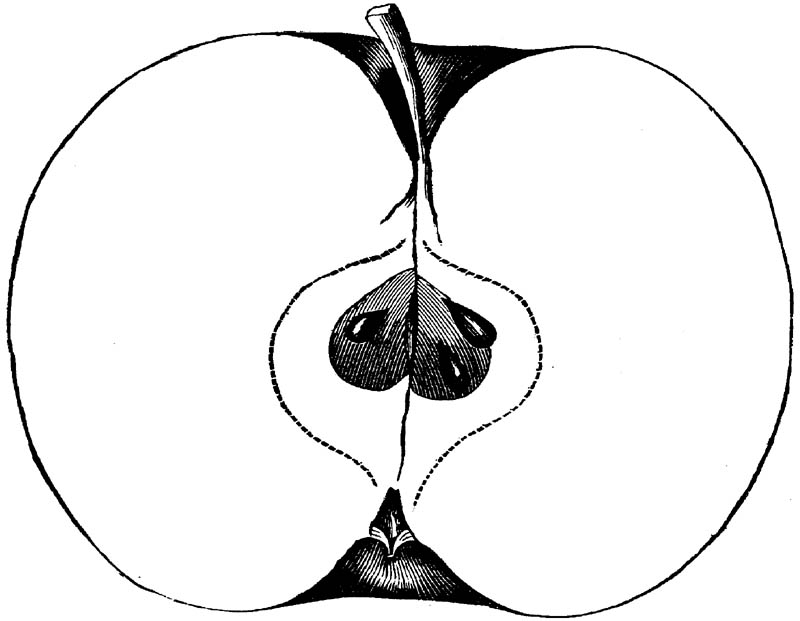
Fig. 213.—DAN PEARMAIN.
This very beautiful seedling was procured by Reuben Ragan from near the battle-field of Tippecanoe, Indiana, where it was found in a seedling orchard.
Fruit medium to small, round, flattened, regular, fair and handsome; Surface yellow, covered with bright red, mixed, striped and splashed; Dots numerous, large, yellow, prominent.
Basin deep, regular or plaited; Eye small, closed.
Cavity deep, acute, regular, sometimes brown; Stem long, slender, red.
Core small, turbinate, closed; Seeds numerous, small, plump; Flesh yellow, breaking, tender; Flavor very mild sub-acid, rich; Quality almost best; Use, table, kitchen, market; on older trees too small for profit; Season, December to March.
Day.
ROYAL PIPPIN.
From Reuben Ragan. Fruit large, round, somewhat conic, regular; Surface smooth, yellow, striped, splashed, mottled, carmine; Dots numerous, gray, large.
Basin shallow, folded; Eye small, closed.
Cavity deep, acute, green; Stem medium, clubbed.
Core wide, pyriform, slightly open, clasping; Seeds numerous, pointed, angular, dark; Flesh yellowish white, firm, breaking, granular; Flavor sub-acid; Quality good; Use, kitchen; Season, January. Not destined to take a very high rank.
Doctor Fulcher.
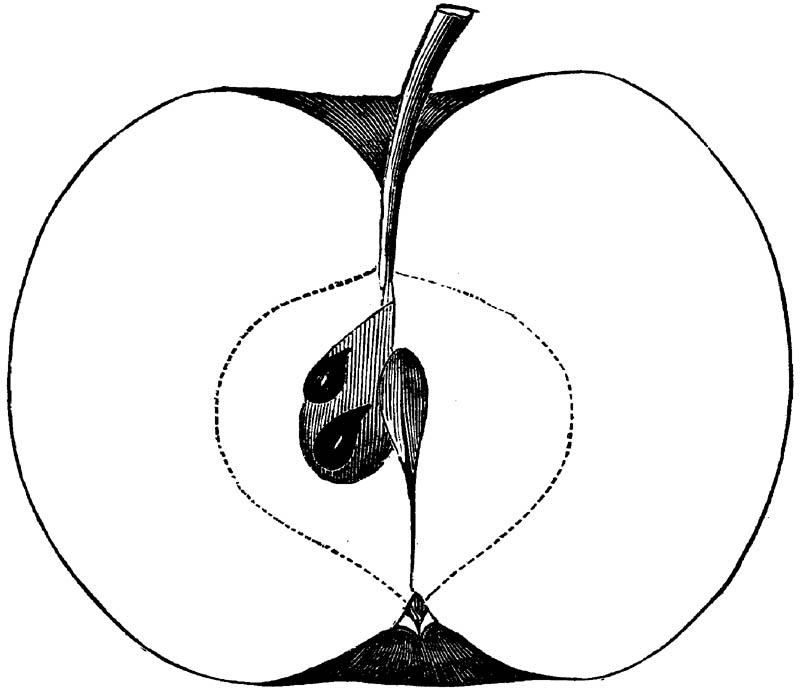
Fig. 214.—DOCTOR FULCHER.
A Southern apple of some merit. Originated in Todd County, Kentucky. Tree thrifty, an early and abundant bearer; Shoots slender; Foliage bright green. Received from J.S. Downer, of Elkton, Kentucky.
Fruit medium, globular, truncated, regular; Surface smooth, yellow, marbled, splashed carmine; Dots minute.
Basin shallow, wavy, russeted, cracked; Eye small, closed.
Cavity sometimes wide, wavy, brown; Stem medium to long.
Core large, turbinate, regular open, meeting the eye; Seeds large, plump; Flesh yellow, fine-grained, tender, melting, juicy; Flavor sub-acid, rich; Quality good, Downer says "best;" Use, table; Season, December, January.
Dutch Mignonne.
REINETTE DOREE—And Several Others in Europe.
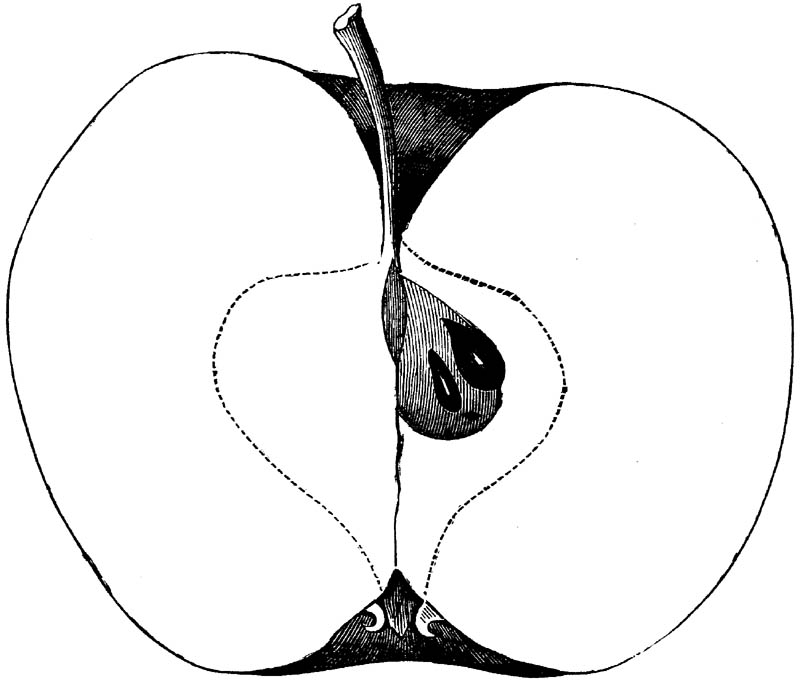
Fig. 215.—DUTCH MIGNONNE.
A fine large apple from Holland. Tree vigorous, upright, productive.
Fruit large or very large, roundish, flattened, sometimes conical, truncated; Surface rough, yellow, covered with red, splashed with bright red; Dots numerous, prominent, fawn-colored.
Basin wide, abrupt, regular; Eye short, wide, open; Segments short.
Cavity medium, acute, regular; Stem medium to long.
Core small, turbinate, regular, clasping; Seeds few, angular imperfect; Flesh yellowish white, breaking, coarse-grained, juicy; Flavor acid to sub-acid, rich; Quality good to very good; Use, kitchen, market, drying; Season, September, October.
Early Pennock.
SHAKER YELLOW—HOMONY, of the South?
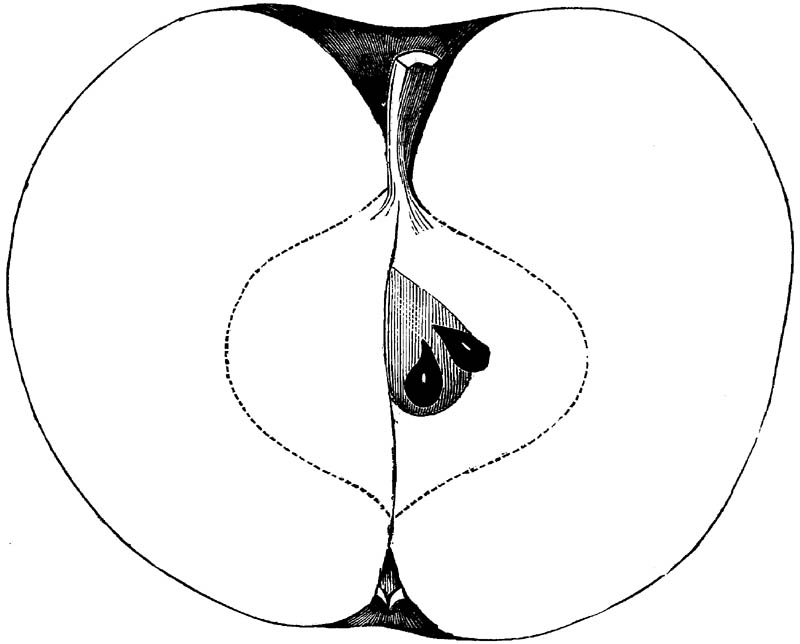
Fig. 216.—EARLY PENNOCK.
Origin unknown. Tree thrifty, upright, early bearer, productive, not long-lived.
Fruit large, variable in form, being sometimes oval, and conical, averaging roundish-conic, regular, handsome, sometimes inclined in the axis; Surface smooth, yellow, partially covered with mixed and striped scarlet, splashed carmine—often the yellow prevails; Dots numerous, dark.
Basin shallow, plaited or regular; Eye small, closed.
Cavity deep, regular, brown; Stem medium or short.
Core long, tapering to both ends, partially open in some, clasping the eye; Seeds large, numerous, plump, dark; Flesh yellow, breaking, rather coarse; Flavor acid; Quality poor; Use, market and kitchen; Season, July and August.
Fameuse.
SNOW—CHIMNEY—POMME DE NEIGE.
This is a favorite Northern fruit of great beauty. Origin uncertain—whether Canadian or French. It is greatly valued in the North and Northwest as an early winter apple. Tree vigorous, productive; Shoots red; Foliage dark, abundant.
Fruit medium, round, regular; Surface pale waxen yellow, almost wholly covered deep red, made up of stripes and splashes that are not always traceable in the depth of color—absent where a portion of the apple has been shaded by a leaf; Dots minute.
Basin medium, regular; Eye very small, closed.
Cavity wide, wavy, green; Stem short.
Core medium, heart-shaped, closed, meeting the eye; Seeds numerous, pointed, rich brown; Flesh snowy white, very tender, fine-grained, juicy; Flavor sub-acid, mild, delicately perfumed, not rich; Quality good; Use, dessert, kitchen, market; Season, October to December.
Farley Red.
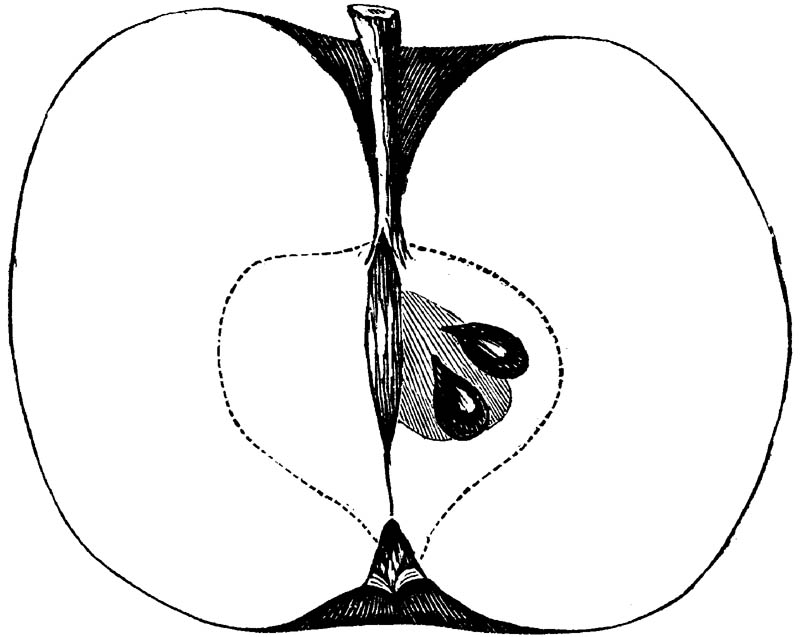
Fig. 217.—FARLEY RED.
A native of Kentucky, already somewhat extended northward. Tree healthy, moderately thrifty, very productive, making it small.
Fruit small, round or oblong, flattened or truncated at the ends, barrel shaped; Surface dull red stripes on yellow; Dots minute, indented, purplish.
Basin shallow, folded or plaited; Eye small, closed.
Cavity deep, acute, wavy, brown; Stem medium.
Core regular, turbinate, open, clasping the point of the eye; Seeds numerous, plump, angular; Flesh yellowish white, firm, juicy; Flavor sub-acid; Quality only good; Use, Mr. R. Ragan finds it one of his best market fruits; Season, March and April, keeping sound and very salable.
Glendale.
Believed to have originated near Glendale, Hamilton County, Ohio, where I obtained it from A.A. Mullet.
Tree vigorous, thrifty, spreading, well formed head, productive.
Fruit large, roundish, somewhat conical; Surface smooth, bright yellow, striped and clouded with bright red; Dots small, russet.
Basin deep, abrupt; Eye small, closed.
Cavity medium, wavy, green; Stem long.
Core open; Seeds numerous, medium; Flesh yellowish, tender, juicy; Flavor very mild sub-acid, almost saccharine, rich; Quality good; Use, table; Season, September, October.
Hagloe.
This foreign variety has the general aspect of a Russian apple both in tree and fruit.
Excellent for cooking, highly esteemed by the market gardeners of New Jersey, where it is much grown.
Tree healthy, vigorous, round headed, productive; Shoots stout, blunt; Foliage large, light green.
Fruit medium to large, round, somewhat flattened; Surface pale yellow, distinctly striped and splashed bright red or carmine, covered with white bloom.
Basin small, regular; Eye small, closed.
Cavity wide, regular; Stem short, thick.
Flesh whitish, not fine-grained, breaking, juicy; Flavor acid; Quality good; Use, kitchen and market only; Season, August.
Hannah.
AUNT'S, not AUNT HANNAH of Massachusetts.
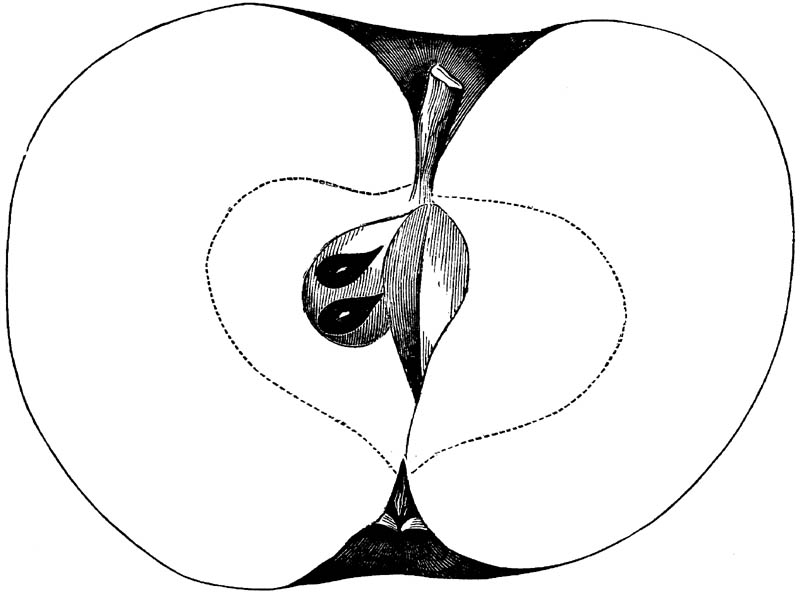
Fig. 218.—HANNAH.
This large and rather handsome fruit is found in many parts of the country, but is not largely cultivated. Its occurrence among Southern emigrants would lead us to suspect that they might have brought it with them.
Fruit large, showy, round, somewhat flattened, regular, sometimes unequal; Surface rather smooth, pale yellow, mixed, distinctly striped and splashed crimson and carmine; Dots scattered, large, gray.
Basin medium, abrupt, regular, often slightly russeted; Eye medium but long, closed.
Cavity wide, wavy, acute, deep, brown or green; Stem short to very short.
Core round, flattened or wide, regular, open; Axis very short; Seeds numerous, short, plump; Flesh light, yellowish white, breaking, tender, juicy; Flavor sub-acid, aromatic, peculiar, not agreeable to some palates; Quality only good; Use, kitchen, market, drying; Season, October to December.
Herefordshire Pearmain.
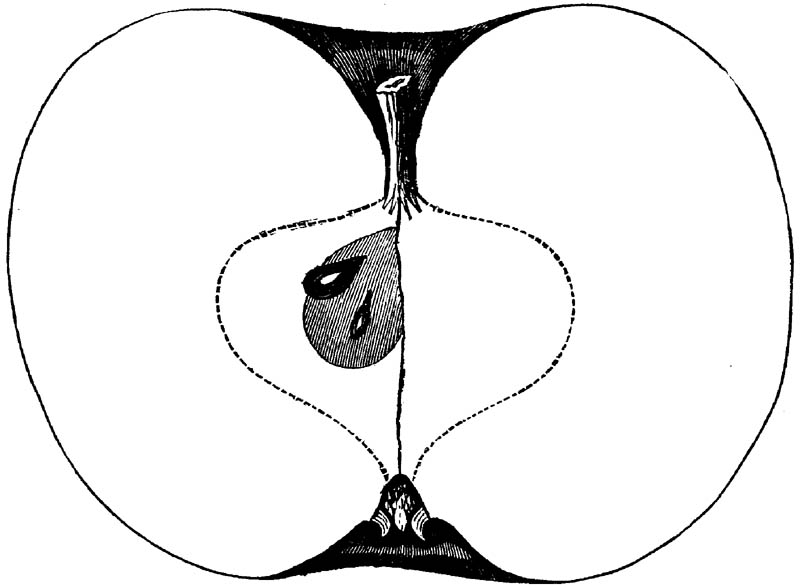
Fig. 219.—HEREFORDSHIRE PEARMAIN.
This is supposed to be an old English variety which has reached certain portions of the Western States from the East, though now rarely seen there, as its place has been taken by other Pearmains of American origin and more vigor, such as the Long Island Pearmain, described on another page. Tree slender and slow grower, medium size, very productive.
Fruit small to medium, roundish, slightly conic, truncated sharply; Surface smooth, deep red, splashes dark or maroon on rich yellow, which only shows where the fruit has been shaded by a leaf; Dots numerous, small, yellow.
Basin wide, regular, abrupt; Eye medium, open, reflexed.
Cavity medium, regular or wavy, green; Stem mostly short, stout, sometimes quite thick.
Core wide, turbinate, closed, regular, clasping the eye; Seeds numerous, small, pointed, dark, some imperfect; Flesh deep yellow, firm, breaking, very fine-grained, juicy; Flavor rich, sub-acid, aromatic, vinous, spicy, very agreeable; Quality best; Use, dessert; Season, December to February.
Especially adapted to amateur collections.
Hewes' Crab.
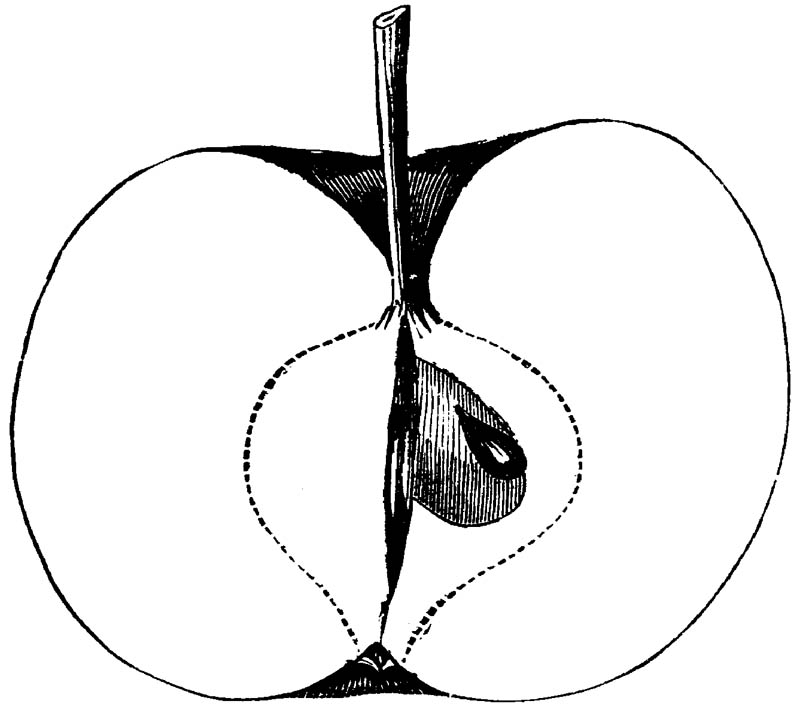
Fig. 220.—HEWES' CRAB.
From Virginia. A famous cider apple, found in all extensive and good cider orchards. Tree of slender growth, but makes a large, spreading top, immensely productive alternate years, long lived; Twigs slender; Foliage sparse.
Fruit quite small, round, somewhat flattened, regular; Surface mixed, striped, purplish red on yellow; Dots numerous, large, pale or fawn.
Basin shallow; Eye small, closed.
Cavity deep, regular; Stem long, red.
Core round, regular, open, clasping; Seeds large, pointed; Flesh firm, yellowish and greenish, juicy; Flavor acid, rich; the must is very heavy; Quality best for cider; Season, November to January. Also useful for cooking, except on account of its small size; the rich and piquant acid makes it a particularly desirable ingredient in mince-pies.
In Kentucky there is a variety of this apple known as Beeler's Crab, with fruit of similar characters, but the tree is a better grower.
Hubbardston.
HUBBARDSTON NONSUCH.
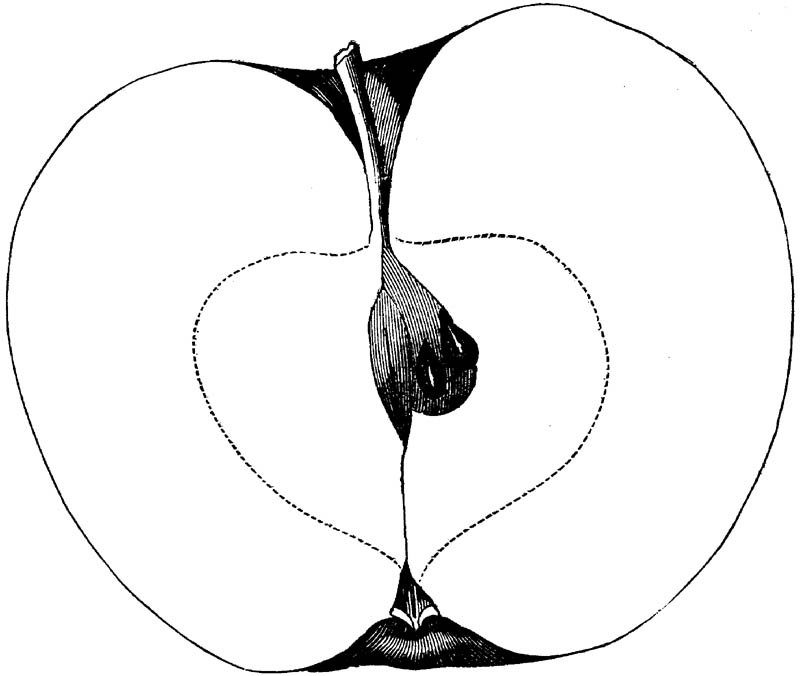
Fig. 221.—HUBBARDSTON.
This fine apple originated in Hubbardston, Massachusetts. Tree vigorous, healthy, productive, early bearer, round-leaved, branching. At one time this and the Baldwin were confounded and mixed in some Western collections.
Fruit large, fair, handsome, round, somewhat ovate, tapering both ways from the middle, regular; Surface often uneven, yellow, covered with mixed red and broken stripes, presenting a rich brownish appearance; Dots scattered, gray, prominent.
Basin abrupt, wide, regular, leather-cracked, or russeted, or both; Eye medium or small, open.
Cavity wide, regular, brown; Stem medium or short.
Core large, heart-shaped, regular, sometimes partially open, clasping the eye; Seeds few, pointed; Flesh yellow, breaking, fine grained, juicy; Flavor acid, sub-acid, rich; Quality very good; Use, cooking early, table when perfectly ripe; Season, November, December.
Krowser.
Origin Berks County, Pennsylvania, where I found it very popular as a productive winter apple for all purposes. Tree vigorous, healthy, large, spreading, and very productive.
Fruit medium to large, round, slightly conic, regular; Surface rather smooth, pale yellow, nearly covered with red, and splashed carmine.
Basin small, folded; Eye medium, closed.
Cavity medium; Stem short to medium.
Flesh whitish, tender, juicy; Flavor mild sub-acid, rich, agreeable; Use, a good market fruit; Season, December to March.
Large Striped Pearmain.
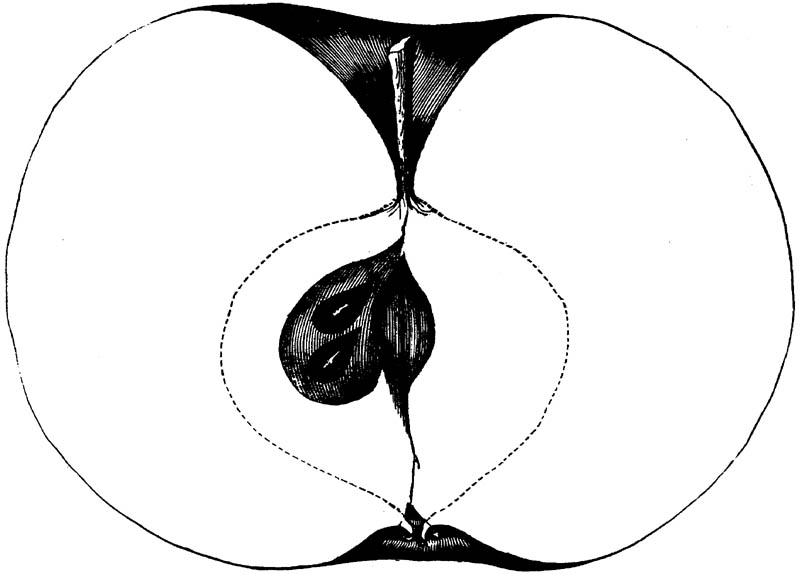
Fig. 222.—LARGE STRIPED PEARMAIN.
This choice Western apple is supposed to have originated in Kentucky—possibly further South. It is now to be found in Eastern Ohio, Southern Indiana and Illinois, and in Missouri. Much grown in Kentucky. In all places it seems to be doing well, and giving entire satisfaction, excepting that the bark bursts near the ground even in bearing trees, root-grafted.
Tree vigorous, thrifty, spreading, productive; Shoots rather slender, dark; Foliage dark green, abundant on young trees.
Fruit large, round, flattened, regular, fair, handsome, though not so beautifully colored as some others; Surface smooth, mixed, splashed and striped, pale purplish red on yellow, which shows through the shading; Dots minute, indented, gray, so that the fruit has a general gray appearance.
Basin medium, regular, sometimes cracked; Eye small, closed.
Cavity wide, wavy, rather deep, brown; Stem short, medium, or rather long.
Core roundish, medium, regular, open; Seeds numerous, large, angular, some imperfect; Flesh yellow, breaking, somewhat coarse-grained, juicy; Flavor sub-acid; Quality quite good; Use, market, kitchen, table; Season, December to February.
In the West it is more flattened than in Ohio, becoming in large specimens almost a flat or oblate apple. Highly recommended for commercial orchards, whether for shipping North or South—particularly the latter.
Lewis.
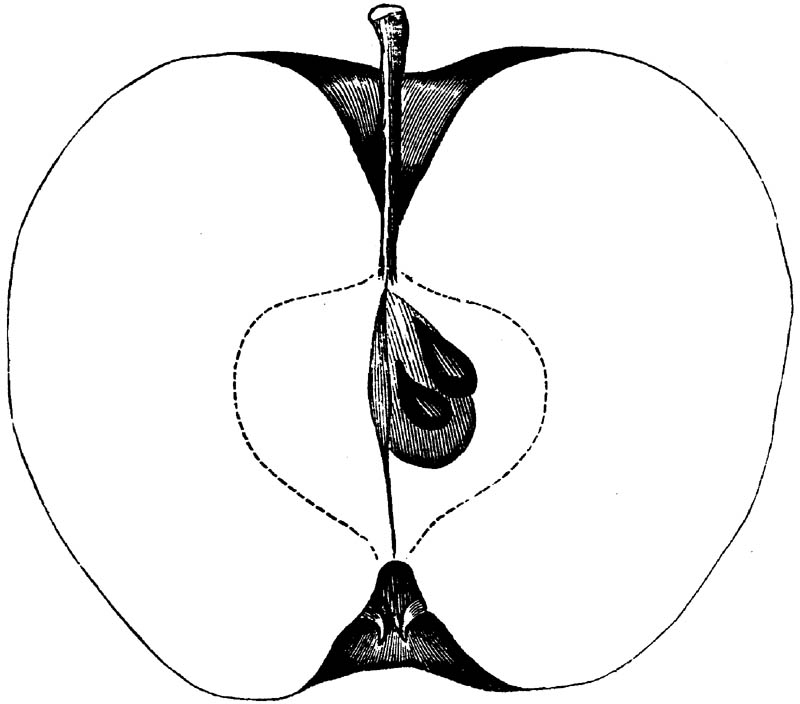
Fig. 223.—LEWIS.
This delicious apple originated in Decatur County, Indiana, near Greensburgh, and was introduced to my notice by one of the early pomologists of the region, a nurseryman by the name of Lewis, from whom I obtained my trees after he had introduced me to the original, which I found to be vigorous, healthy, upright, spreading and productive.
The fruit was described in the Western Horticultural Review for 1852, before I was aware that my friend Reuben Ragan had an apple of the same name; nevertheless, this, by priority of publication, will stand, unless there should prove to be another Lewis that can claim seniority of publication. I distinguish the other apple by calling it Lewis of Ragan; it is in another class.—[See Downing, p. 164.]
Fruit medium to large, round, somewhat ovate, regular; Surface smooth, yellow, striped and marbled scarlet; Dots scattered, gray and yellow.
Basin deep, abrupt, regular; Eye medium, closed.
Cavity acute, deep, regular; Stem long, slender.
Core regular, oval, heart-shaped, closed, meeting the eye; Seeds numerous, plump, brown; Flesh yellow, very tender, crisp, juicy; Flavor acid to sub-acid, rich, delicious; Quality best; Use, table and kitchen; Season, August. Marked in my notes "One of the very best of the new apples."
Liberty.
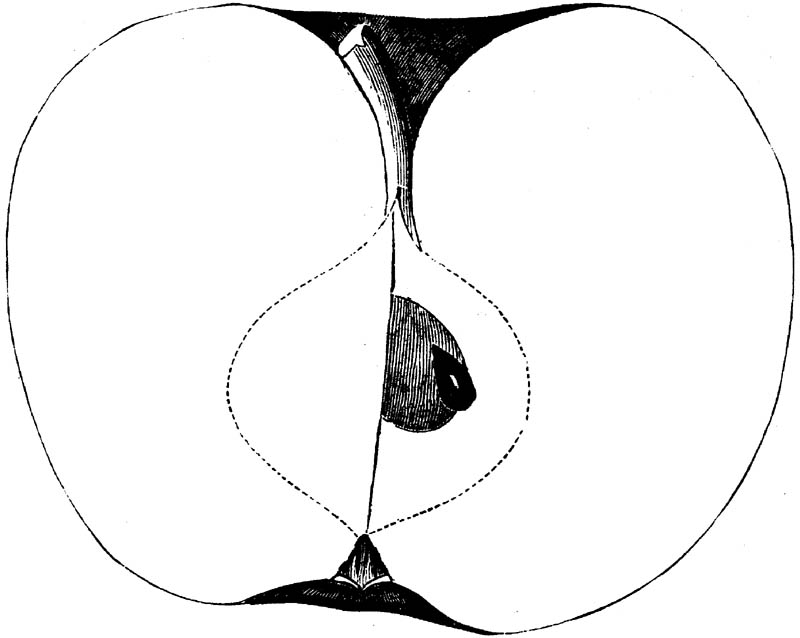
Fig. 224.—LIBERTY.
This valuable market variety originated near Columbus, Ohio, where it was brought into notice by M.B. Bateham, the excellent Secretary of the Ohio Pomological Society, and founder of the Columbus Nurseries.
Tree vigorous, healthy, large, spreading and productive; believed to be entirely hardy.
Fruit full medium to large, globular, inclining to oblong in appearance, turbinated or flattened at the ends, regular; Surface not smooth, yellow, covered with dull red and scarlet, mixed and splashed, stripes indistinct; Dots minute, gray, prominent.
Basin medium, quite shallow, regular, indistinctly leather-cracked; Eye small, closed.
Cavity medium, acute, wavy; Stem medium, inclined.
Core small, oval, closed, meeting the eye; Seeds numerous, pointed; Flesh yellow, breaking, rather coarse, juicy; Flavor acid to sub-acid; Quality good; Use, market and kitchen or table; Season, January to March, or later.
Lyscom.
Origin Massachusetts. This pleasant dessert apple is not generally known.
Fruit large, roundish, flattened, regular; Surface smooth, yellowish, striped and splashed with red.
Basin large, plaited; Eye large.
Cavity deep, regular; Stem short.
Flesh whitish, fine-grained, tender, juicy; Flavor mild sub-acid, agreeable; Quality good; Use, table and kitchen; Season, September to November.
Margil.
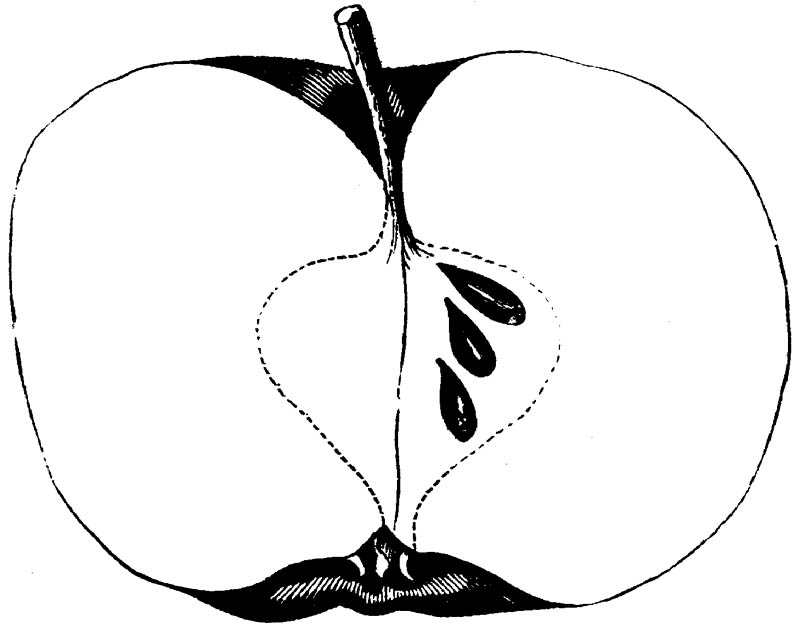
Fig. 225.—MARGIL.
A famous old English dessert apple, rarely seen in this country, but much better adapted for the closing of a feast than many which are more pretentious in style and imposing in size. Certainly much more economical to him who provides even at a higher price per bushel than those which are too large to be eaten, and are only cut to be left on the table and wasted. Tree of slender growth, but very productive.
Fruit quite small, round, somewhat conic, abruptly truncated, regular; Surface smooth, red, mixed and striped; Dots yellow, prominent.
Basin wide, shallow, regular; Eye small, open; Calyx reflexed.
Cavity wide, not deep, regular, brown; Stem long.
Core turbinate, regular, closed, meeting the eye; Seeds numerous, pointed, long; Flesh yellow, crisp, fine-grained, juicy; Flavor sub-acid, rich, aromatic, very agreeable; Quality best; Season, November to January.
Meach.
From Vermont; Fruit large, roundish, conic; Skin greenish-yellow, striped and mottled with light red, and sprinkled with brown dots; Stalk long, rather slender, set in a pretty large cavity; Calyx closed in a corrugated basin; Flesh yellowish, rather fine, juicy, rich, mild, sub-acid, aromatic; October and November.—[Downing.]
McKinley.
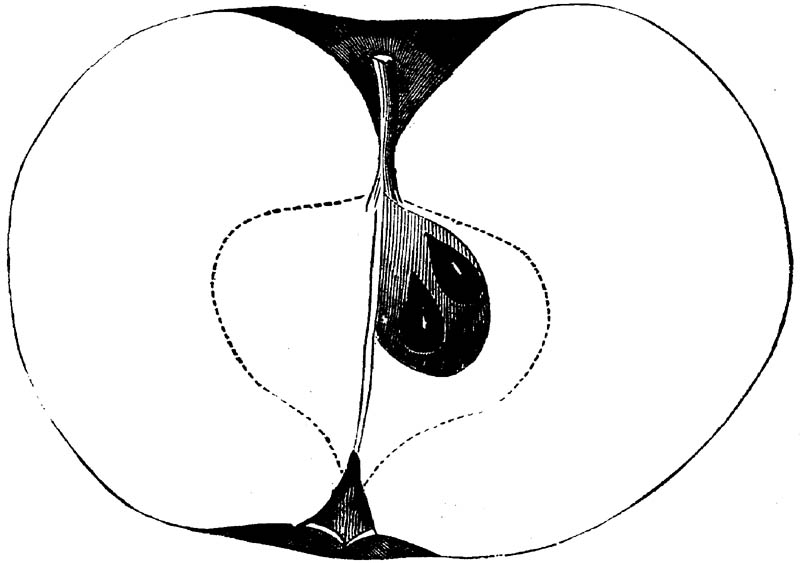
Fig. 226.—M'KINLEY.
Highly esteemed by Reuben Ragan, of Indiana, who finds it profitable.
Fruit medium, roundish, flattened, slightly conic, regular; Surface, smooth, dull red on greenish-yellow, stripes indistinct; Dots scattered, large, gray.
Basin regular, shallow; Eye large, closed.
Cavity deep, acute, regular, brown; Stem slender, medium to short.
Core medium, ovate, regular, closed, meeting the eye; Seeds numerous, plump, brown; Flesh breaking, very fine-grained, very juicy; Flavor sub-acid, good; Quality good to very good; Use, table; Season, December and January.
Mexico.
Origin Canterbury, Connecticut. Tree hardy, productive. Not much known in the West.
Fruit—obtained from E. Newburg, Brooklyn, Connecticut—medium, round, regular; Surface bright crimson-red, striped darker; Dots numerous, yellow-green.
Basin shallow, regular; Eye medium, closed.
Cavity acute, regular; Stem long or medium, slender.
Core large, open, meeting the eye; Seeds numerous, angular, pointed; Flesh white, tender, fine-grained, juicy; Flavor sub-acid; Quality best; Use, table; Season, August and September.
Monk's Favorite.
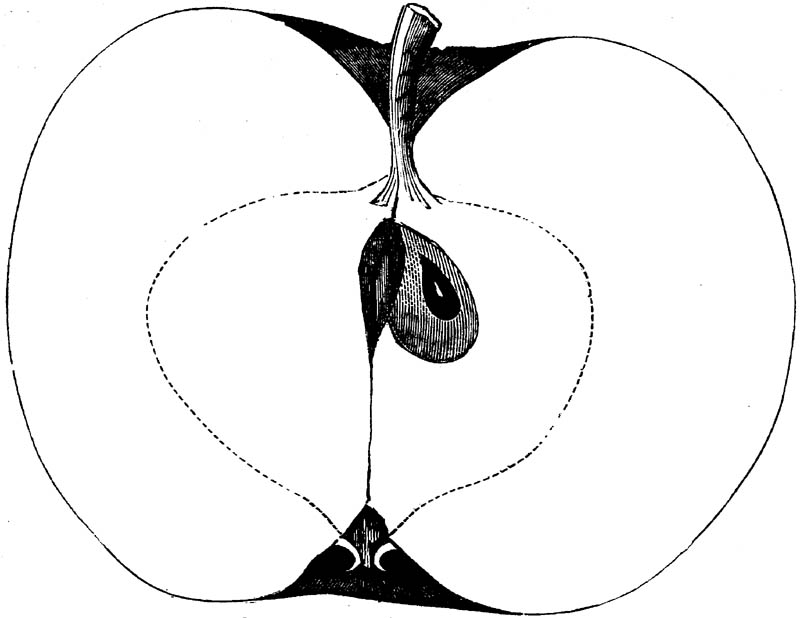
Fig. 227.—MONK'S FAVORITE.
This large, showy apple originated in Delaware County, Indiana, and was introduced to the public by Dr. J.C. Helme, of the State Horticultural Society.
It was described in the Western Horticultural Review, some years ago, as a promising fruit, and was favorably noticed at the time of its introduction, but has not yet been sufficiently known for general recommendation.
Tree vigorous, upright, spreading, productive.
Fruit large, globular, flattened, regular; Surface smooth, yellow, pretty well covered with stripes and splashes of bright red; Dots medium, ragged, gray, scattering.
Basin medium, regular; Eye medium, open.
Cavity wide, wavy; Stem medium to long, stout.
Core wide, heart-shaped, open, clasping; Seeds pointed; Flesh whitish, breaking, juicy; Flavor sub-acid; Quality good; Use, kitchen, table, and promising for market; Season, November to January.
Neversink.
Not having had an opportunity of examining this fruit, I quote the ad interim report of the Pennsylvania Horticultural Society:
"Origin Berks County, Pennsylvania.
"Fruit large, roundish, exterior of an exceedingly beautiful waxen orange-yellow color, with a few russet dots, and a delicately striped and richly mottled carmine cheek; Stem very short and rather stout, cavity narrow, acuminate, shallow; Calyx large, basin deep, rather wide, furrowed; Flesh yellowish, somewhat tough, owing to the fact of its being shriveled; Flavor approaches to that of a pineapple; Quality very good; December to April."
Newark King.
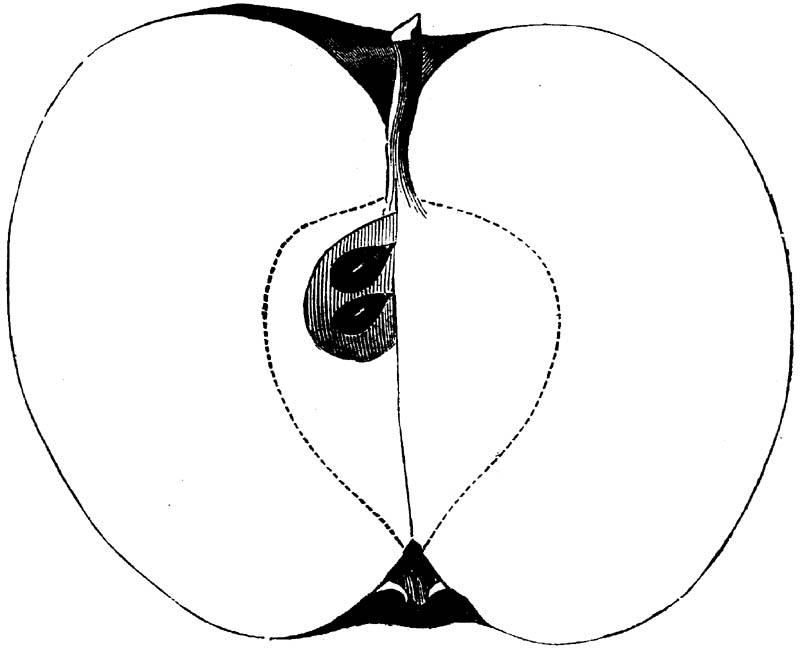
Fig. 228.—NEWARK KING.
An old apple, supposed to have come from New Jersey; found in the oldest orchards of grafted fruits in Southwestern Ohio, seldom elsewhere in the West that I have seen.
Tree thrifty, upright, spreading, productive; Foliage dark.
Fruit full medium to large, roundish, flattened or truncated conic, mostly regular, sometimes ribbed; Surface not very smooth, rich yellow, nearly covered with dull red mixed, and darker stripes, giving the fruit almost a mahogany color; Dots numerous, gray, elongated at the extremities, and coalescing into russet about the blossom end.
Basin deep, abrupt, folded or plaited, covered with fine russet; Eye small, closed.
Cavity acute, often lipped; Stem rather long, slender.
Core small, oval, closed, not clasping but meeting the eye; Seeds numerous, angular; Flesh rich yellow, breaking, fine grained, juicy; Flavor acid, rich, sprightly, high-flavored; Quality very good; Use, kitchen, table and cider; Season, December, January, or longer.
Patton.
CARTER of Alabama—MANGUM—ALABAMA PEARMAIN of Peters.
This is a great favorite in the South, and deservedly so, on account of its good qualities. Specimens from Dr. Jas. S. Blair, Limestone County, North Alabama, afford me data for the following description. I have preferred the name Patton because of the other Carters:
Fruit large, roundish, somewhat flattened; Surface smooth, mixed, marbled and splashed carmine on yellow; Dots scattered, distinct, yellow.
Basin deep, abrupt, folded; Eye medium, open.
Cavity deep, acute; Stem long to medium, inclined, red.
Core small, regular, closed, half clasping; Seeds plump and imperfect; Flesh yellow, firm, breaking, juicy; Flavor acid, agreeable; Quality good; Season, November to January.
Pomme Water.
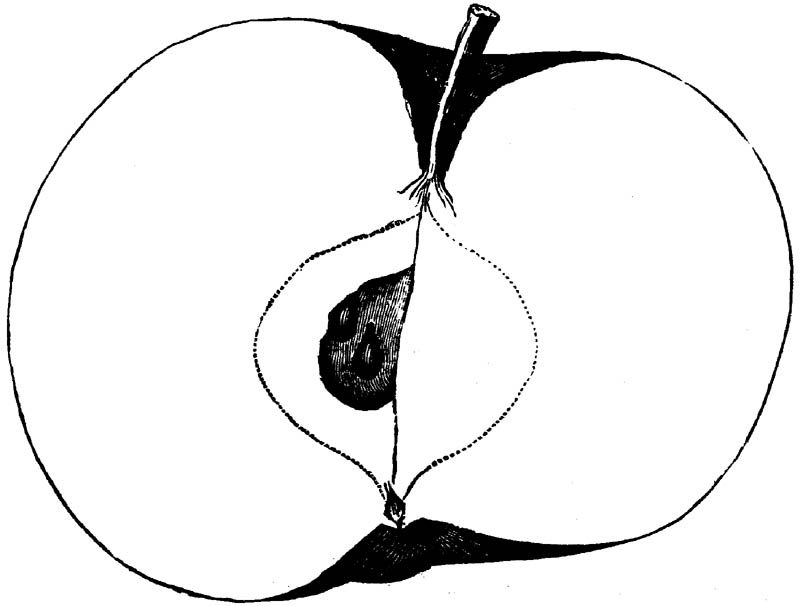
Fig. 229.—POMME WATER.
An apple by this name is found in Northern Illinois; little is known of its origin or history.
Fruit full medium, globular truncate, slightly conic, regular; Surface mixed, splashed scarlet on yellow; Dots minute, numerous, brown.
Basin wavy, medium; Eye large, closed.
Cavity medium, regular; Stem short, thick, green.
Core medium, round, closed, scarcely meeting the eye; Seeds numerous, angular, imperfect; Flesh yellow, breaking, fine grained, juicy; Flavor sub-acid; Quality good to very good; Use, table; Season, September and October.
Specimens obtained from Henry Kimball, of Rockford, Winnebago County, Illinois.
Ragan's Red.
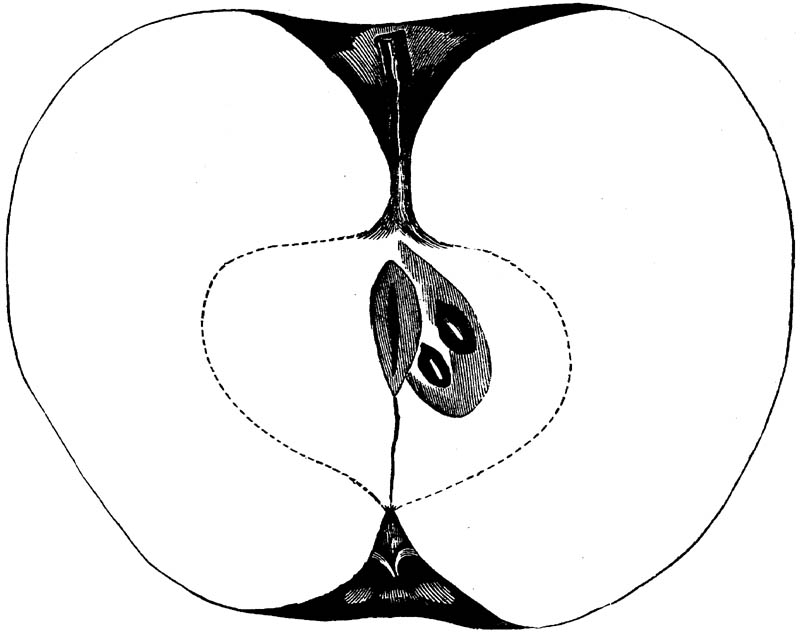
Fig. 230.—RAGAN'S RED.
Origin Putnam County, Indiana, by R. Ragan. Tree vigorous, productive.
Fruit large, round, slightly conic, regular; Surface smooth, bright red, splashed darker; Dots numerous, small.
Basin abrupt, deep, regular; Eye small, closed.
Cavity deep, acute, regular; Stem long.
Core small, pyriform, regular, nearly closed; Seeds numerous, plump; Flesh yellow, breaking, fine grained; Flavor sub-acid, aromatic; Quality good; Use, table and market; Season, October and November.
Ribston Pippin.
This famous English apple does not seem to have many admirers among our orchardists, but on some accounts it merits a place in the amateur's collection.
Tree productive, early bearer.
Fruit medium to large, round, truncated, regular; Surface rough, splashed and mixed dull red on yellow; Dots numerous, minute, prominent, russet.
Basin abrupt, plaited or regular, russeted; Eye small, closed.
Cavity acute, wide, regular, brown; Stem long, slender.
Core regular, closed; Seeds numerous, angular, imperfect; Flesh yellow, crisp, firm, juicy; Flavor acid, rich, aromatic; Use, kitchen—scarcely for table; Season, October and later, but apt to wilt.
Sigler's Red.
This very handsome apple, from near McConnellsville, Morgan County, Ohio, was shown before the Ohio Pomological Society, at different times, by Jos. Sigler, for whom it was named, because it was not identified as any known variety.
Fruit medium, globular, slightly flattened, regular; Surface smooth, mixed and splashed bright red; Dots minute, rare.
Basin shallow, regular; Eye small, closed.
Cavity acute, wavy; Stem short to medium, knobby.
Core wide, indistinct, closed, meeting the eye; Seeds pointed, plump; Flesh yellow, fine-grained, juicy; Flavor sub-acid, aromatic, rich; Quality almost best; Use, table; Season, September.
A beautiful dessert fruit. Elliott gives it as synonym to Autumn Pearmain.
Small Black.
BLACK APPLE of Coxe and Downing—AMERICAN BLACK.
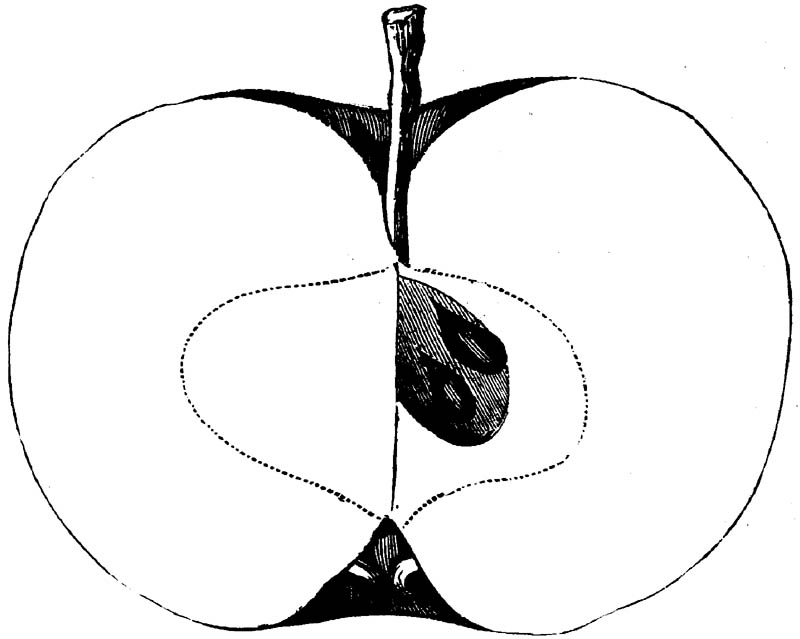
Fig. 231.—SMALL BLACK.
This useful little apple is found in many collections where the Jersey Black is cultivated, but it seems to be quite distinct. Origin unknown.
Fruit medium to small, globular, sometimes nearly oblate, regular; Surface smooth, deep red, sometimes purplish, striping indistinct; Dots numerous, indented, minute, pink or purple.
Basin shallow, abrupt, regular or folded; Eye small to medium, closed; Segments reflexed.
Cavity acute, sometimes lipped, brown; Stem long, inclined, red or green.
Core regular, round, slightly open, clasping the eye; Seeds numerous, plump and angular; Flesh yellowish, often pink, tender, fine grained; Flavor sub-acid, agreeable; Quality good; Use, dessert; Season, November to January.
Smith's.
SMITH'S CIDER.
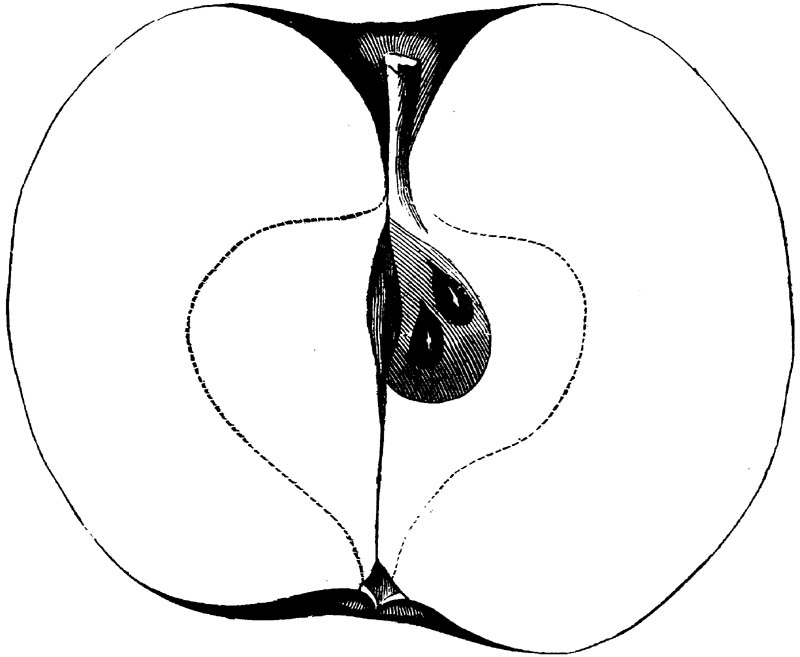
Fig. 232.—SMITH'S.
Origin Bucks County, Pennsylvania, where it still continues a favorite variety. Its cultivation has extended widely to the westward, giving great satisfaction as a market fruit, for culinary purposes, but cannot be recommended for table.
Tree vigorous, hardy, productive, an early bearer; Limbs straggling, shoots rather slender, light olive; Foliage large, light green.
Fruit medium to large, round, varying from flattened to elongated, mostly regular, sometimes lop-sided; Surface smooth, pale yellow, covered with mixed light red, splashed indistinctly with bright carmine, beautiful; Dots distinct, rather large, light gray.
Basin shallow, wide, or more often plaited; Eye small, closed.
Cavity acute, regular, brown; Stem medium to long, variable.
Core wide, pyriform, open, clasping; Seeds numerous, plump, pointed; Flesh white, breaking, juicy; Flavor acid, sub-acid, aromatic, not rich, peculiar, not agreeable; Quality good for cooking only, making very fine apple sauce—makes much cider, but thin and watery; Season, December, January and later.
This is essentially a market fruit, and is one of the most profitable apples planted in Southwestern Ohio and adjacent counties of Indiana.
Sops of Wine.
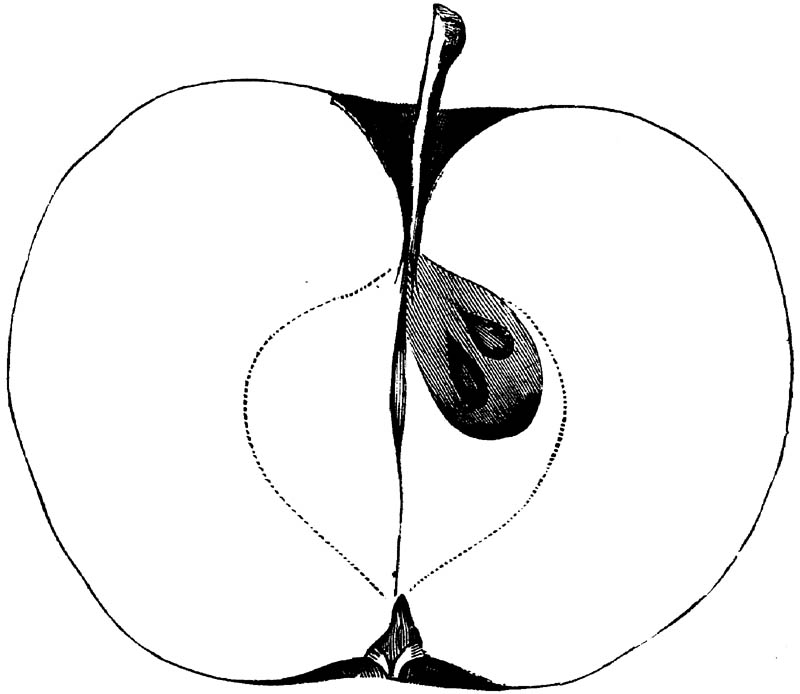
Fig. 233.—SOPS OF WINE.
European. Tree vigorous, spreading, productive.
Fruit small to medium, round, slightly conic, regular; Surface smooth, mixed red, shaded dark red throughout; Dots small, scattered, yellow.
Basin shallow, plaited; Eye small, closed.
Cavity medium, wavy, somewhat browned; Stem long, red.
Core distinctly marked with a red line, wide, oval, closed, meeting the eye; Seeds numerous, pointed, brown; Flesh yellow, fine grained, tender, juicy; Flavor acid to sub-acid, agreeable; Quality good to very good; Use, dessert; Season, August and September.
Summer Janet.
Specimens received from Mr. Johnson, Louisville, Ky.
Fruit medium, round, truncated, regular; Surface smooth, pale yellow, mixed red, striped darker red; Dots scattered, gray.
Basin deep, abrupt, regular; Eye small, open.
Cavity shallow, regular, yellow; Stem medium to long, green.
Core pyriform, indistinct, closed, clasping; Seeds pointed, imperfect; Flesh yellow, tender, fine grained; Flavor sub-acid, aromatic; Quality good; Use, market; Season, September.
Summer Rose.
Origin New Jersey. Tree vigorous, healthy, spreading, productive, early bearer; Shoots stout; Foliage large, glaucous.
Fruit small, roundish, flattened, regular; Surface smooth polished, very pale yellow, striped and splashed distinctly bright red and carmine; Dots minute.
Basin abrupt, wide, regular; Eye small, closed.
Cavity acute, regular; Stem medium.
Core large, regular, closed, meeting the eye; Seeds numerous, short, plump; Flesh white, crisp, fine grained, juicy; Flavor sub-acid, agreeable, not rich; Quality, one of the best early apples; Use, family, table and kitchen; Season, June to August—ripening gradually.
Sutton Beauty.
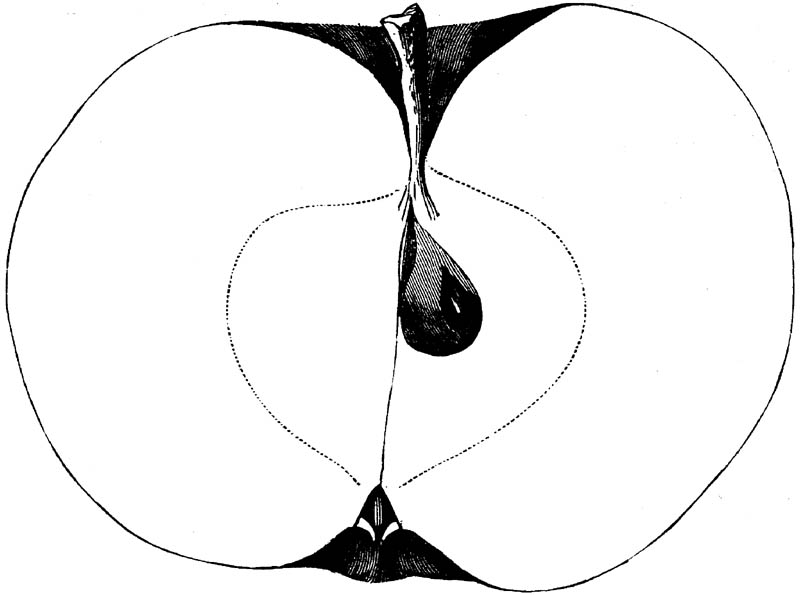
Fig. 234.—SUTTON BEAUTY.
An old Massachusetts apple, occasionally found in the West, where it attains increased size and beauty. My specimens were from W. Hampton, with many other sorts of interest grown by him in Northwestern Ohio.
Fruit large, handsome, globular, regular; Surface smooth, yellow, mottled and splashed carmine; Dots scattered, brown, vein-reflexed.
Basin wide, regular, russety; Eye large, open; Segments reflexed.
Cavity wide, acute, wavy, brown; Stem long, inclined.
Core medium to large, closed, clasping; Seeds numerous, pointed, angular, dark; Flesh whitish, tender, breaking, juicy; Flavor acid, sub-acid, agreeable; Quality good; Use, table, kitchen and market; Season, December to March.
Thought by Mr. Hampton to be a seedling brought from Southern Ohio.
Sylvester.
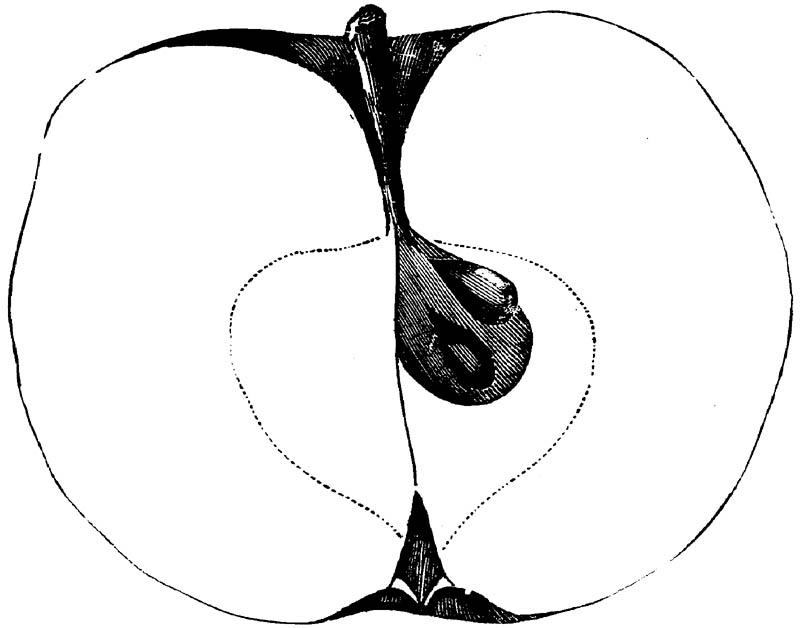
Fig. 235.—SYLVESTER.
Introduced by Dr. Ware Sylvester, of Lyons, New York.
Fruit small to medium, round, regular; Surface smooth, white, blushed and striped bright carmine; Dots scattered, minute.
Basin very shallow, plaited; Eye small, closed.
Cavity deep, acute, wavy; Stem medium.
Core indistinct, slightly open; Seeds numerous, plump, angular, long; Flesh white, tender, fine grained, juicy; Flavor sub-acid; Quality very good; Use, table and cooking; Season, September.
Williams' Favorite.
WILLIAMS' EARLY.
Origin Roxbury, Massachusetts.
Fruit small to medium, round, regular; Surface smooth, dark purplish red, indistinctly striped; Dots none.
Basin abrupt, folded; Eye medium, closed.
Cavity wide, shallow; Stem long, slender.
Core large, round, closed; Seeds pointed, brown; Flesh whitish-yellow, streaked red, breaking, not juicy; Flavor sub-acid, peculiar; Quality scarcely good; Season, July and August.
Willow.
WILLOW TWIG—JAMES RIVER, ETC.
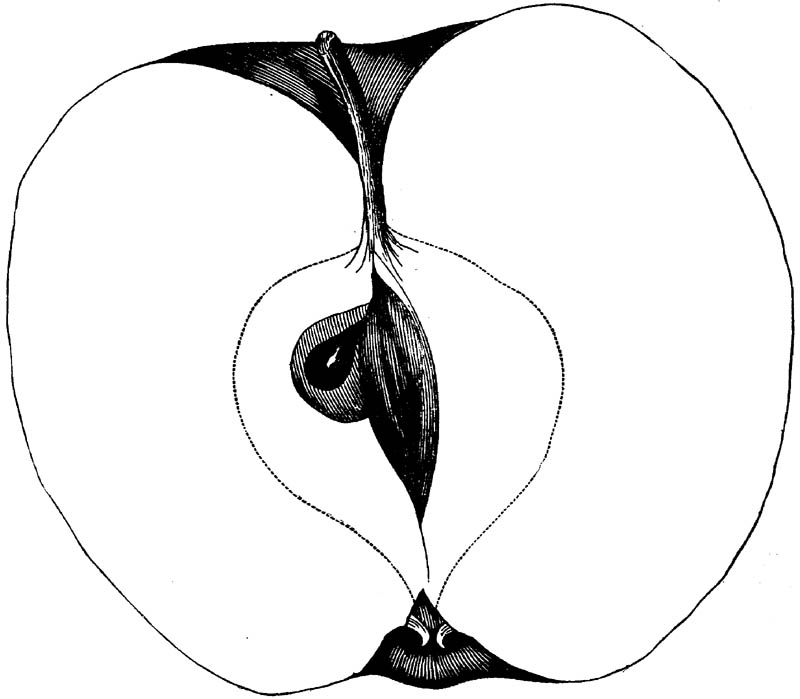
Fig. 236.—WILLOW.
This Virginia fruit has obtained a wide spread notoriety as a valuable market apple throughout the West.
Tree very vigorous, healthy, productive, branching, twiggy, thorny while young; Shoots slender, olive brown.
Fruit globular, truncated, looking oblong from its cylindrical sides; Surface smooth, dull greenish-yellow, marbled and striped dull red; Dots minute, gray.
Basin wide, abrupt, plaited; Eye medium, closed.
Cavity wide or acute, regular; Stem long, slender, inclined.
Core medium, round, regular, closed, meeting, not clasping the eye; Seeds numerous, plump, brown; Flesh greenish-yellow, breaking, juicy; Flavor acid; Quality only good, but valuable for market and culinary uses; Season, December to April. Excellent for shipping South.
Wilson's Volunteer.
Origin believed to be a seedling or "Volunteer" on the banks of the Ohio River. Received from George Sibbald.
Fruit large, globular, truncated or flattened, regular; Surface yellow, mostly covered with mixed red, striped darker; Dots large, gray and yellow.
Basin deep, regular, leather-cracked; Eye medium, closed.
Cavity deep, acute, regular; Stem long, slender.
Core small, round, regular, closed, clasping; Seeds numerous, pointed; Flesh greenish-yellow, tender, juicy; Flavor sub-acid; Quality only good; Use, kitchen; Season, December to February.
Wright's Janet.
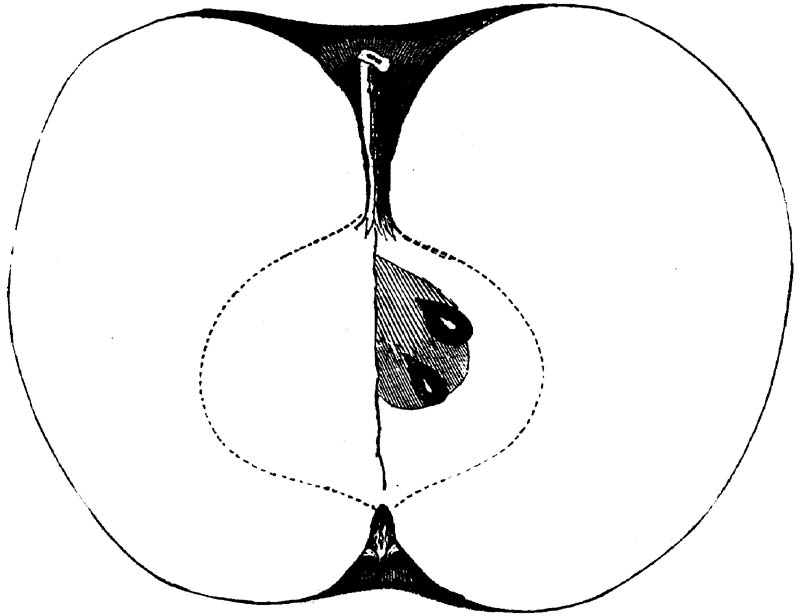
Fig. 237.—WRIGHT'S JANET.
This fine keeping apple, received from N.J. Colman and other zealous pomologists of St. Louis, Missouri, is supposed to have originated in that region with Mr. W.G. Wright.
Fruit medium to large, round, sometimes flat, regular; Surface smooth, waxen yellow, mixed, striped and splashed carmine; Dots minute, prominent, scattering.
Basin medium, regular; Eye small, acute, closed.
Cavity deep, wavy, brown; Stem long, short, or very short.
Core medium, regular, somewhat open, clasping; Seeds numerous, small, plump; Flesh deep yellow, breaking, very fine grained, juicy; Flavor sub-acid, rich, very agreeable; Quality good to very good; Use, table, kitchen and market; Season, January to June and keeps until August.
Yadkin.
Southern. Received from S.W. Westbrooke, of Greensboro', North Carolina.
Fruit large, round, regular; Surface red, striped dark red; Dots large, scattered, distinct, gray.
Basin abrupt, deep, regular; Eye small, open.
Cavity acute, regular, brown; Stem medium, brown.
Core small, closed, meeting the eye; Seeds small, pointed, brown; Flesh white, breaking, dry; Flavor sub-acid; Quality only good; Season, August—and on that account scarcely worth carrying to the North.
CLASS III.—ROUND APPLES.
ORDER I.—REGULAR.
SECTION 2.—SOUR.
SUB-SECTION 3.—RUSSET.
Beeler's Russet.
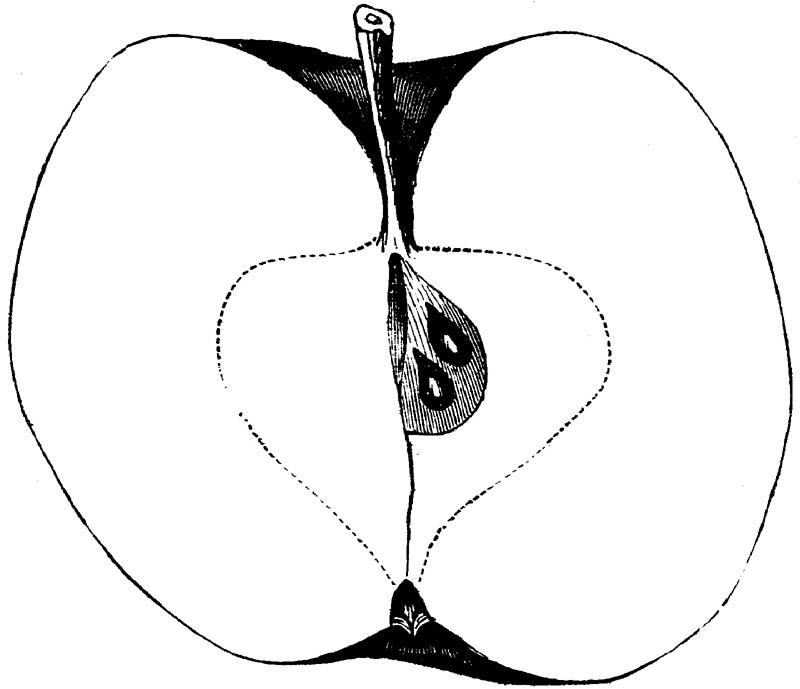
Fig. 238.—BEELER'S RUSSET.
Origin not known. Found in an old orchard on the banks of White River, in Marion County, Indiana, by my lamented young friend, Geo. M. Beeler.
Fruit medium to small, round, truncated or cylindrical, inclined; Surface russeted; Dots minute, prominent.
Basin abrupt, uneven, green; Eye medium, closed.
Cavity regular; Stem long.
Core large, wide, heart-shaped, closed, clasping; Seeds numerous, angular; Flesh yellow, crisp, fine-grained, tender, juicy; Flavor sub-acid to acid, aromatic, spicy, very agreeable; Quality best; Use, table, kitchen; Season, November, December.
A choice dessert apple.
Columbian Russet.
The origin of this fine, long-keeping russet is not known. Specimens were received from H.N. Gillett, Lawrence County, Ohio. If the tree be healthy and productive, this variety will be a valuable addition to our orchards.
Fruit medium to small, round, truncated, lop-sided; Surface smooth, russeted; Dots minute, scattered, prominent.
Basin medium, regular; Eye large, open.
Cavity acute, regular; Stem, long, slender.
Core medium, closed, pyriform, meeting the eye; Seeds numerous, slender, angular, dark; Flesh very yellow, breaking, fine-grained, juicy; Flavor acid to sub-acid, rich, aromatic; Quality best; Use, table; Season, February to April.
Very like the Golden Pearmain, from J.S. Downer, which see; they may prove to be the same variety.
Court of Wyck.
This spicy English apple, which has so many synonyms as evidences of its popularity, has not been a favorite in this country, but occasionally succeeds well; it has little to recommend it in its looks.
Fruit very small, round, truncated abruptly, much flattened, regular; Surface yellow, covered russet.
Basin wide, very shallow; Eye small, open; Segments reflexed.
Cavity rather wide; Stem long, slender.
Core small, ovate, closed, meeting the eye; Seeds numerous, large, brown; Flesh rich yellow, firm, juicy; Flavor acid, aromatic, rich, spicy, sharp; Quality good in its way; Use, "dessert;" Season, December, January.
Crownest.
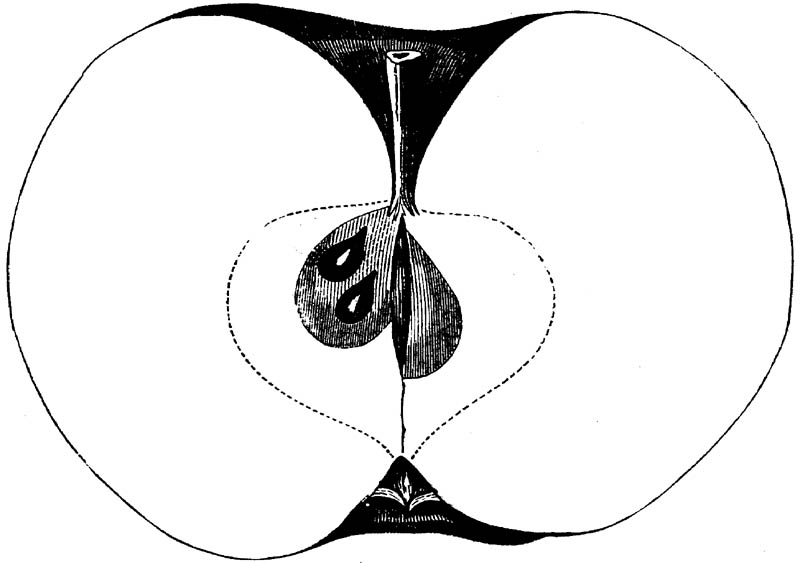
Fig. 239.—CROWNEST.
Originated at Kelley's Island, Ohio, in the orchard of Chas. Carpenter.
Tree vigorous, thrifty, brushy, productive.
Fruit full medium, round, truncated or flattened, often unequal and inclined; Surface greenish yellow, thinly covered with russet.
Basin regular, wide; Eye large, open.
Cavity irregular, lipped; Stem short, curved, fleshy.
Core round, regular, closed, meeting the eye; Seeds long, pointed, angular; Flesh green, tender, breaking; Flavor sub-acid; Quality only good for culinary uses; Season, November to January.
English Golden.
RUSSET GOLDEN, of Barry.
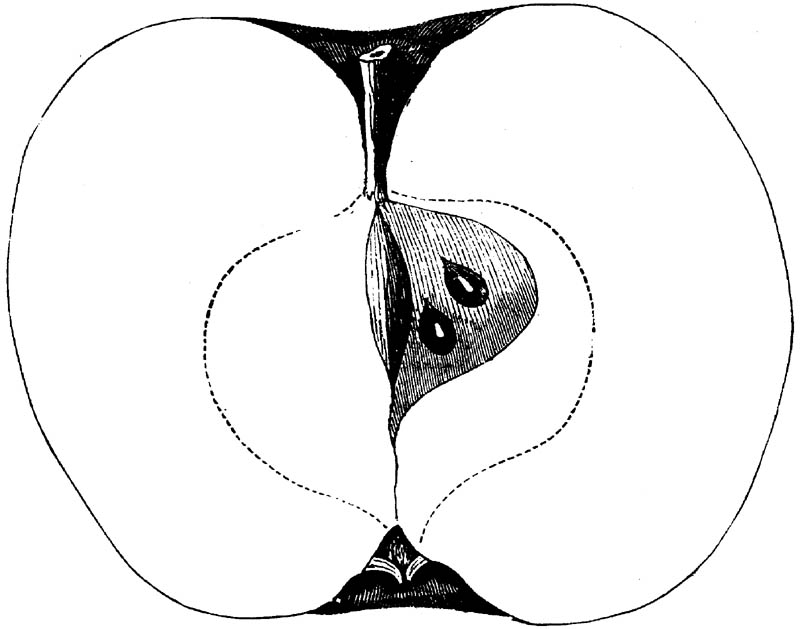
Fig. 240.—ENGLISH GOLDEN.
Among the russets there has been much confusion, which it is very difficult to clear up. The apple about to be described came to the West from the nurseries about Rochester; a very superior variety to many others that resemble it, and may be distinguished by the palate, or by the character of the twigs.
Tree thrifty, vigorous, spreading, productive, a rather early bearer; Shoots slender, olive, speckled.
Fruit medium, round, large ones are oblate, often cylindrical, sometimes inclined, regular; Surface greenish yellow, covered with thick russet; Dots minute, white, scattered.
Basin regular, deep, leather-cracked; Eye small, closed.
Cavity wide, regular, rough; Stem short.
Core wide, regular, closed, clasping; Seeds small, flat; Flesh greenish yellow, breaking, granular, juicy; Flavor sub-acid, rich; Quality good to best; Use, table, kitchen; Season, January, February.
A choice dessert fruit. Succeeds well in parts of Kentucky.
English Russet.
Origin unknown. Procured from Mr. C.C. Cary, near Louisville, Kentucky.
Fruit large, globular, flattened, somewhat one-sided; Surface uneven, green; Dots minute, russety and russet streaks.
Basin medium, uneven; Eye small, closed.
Cavity acute, wavy, russeted; Stem medium, green.
Core medium, heart-shaped, closed, clasping; Seeds numerous, plump and angular, some imperfect; Flesh yellow, firm, breaking, juicy; Flavor acid; Quality good; Use, kitchen; Season, December, January.
Golden Pearmain.—[Of Kentucky.]
This is another very promising Southern variety, received from J.S. Downer, of Kentucky; Origin unknown; he procured it from Tennessee.
Tree vigorous, but tardy and shy in bearing; Shoots stout, dark; Foliage medium.
Fruit small to medium, globular, rather conical, truncated, lop-sided; Surface yellow, blushed and russeted.
Basin abrupt, wide, regular; Eye large, open.
Cavity acute, regular; Stem short to medium, slender.
Core somewhat open, meeting the eye; Seeds plump and imperfect; Flesh yellow, breaking, fine-grained; Flavor acid, aromatic, sprightly; Quality very good, almost best; Use, dessert; Season, December, February.—See Columbian Russet.
Green Russet.—[N.C.]
Specimens from Reuben Ragan.
Fruit quite large, globular, slightly oblate, regular; Surface yellow, blushed dull red; Dots green, indented, russet veined.
Basin medium, regular; Eye medium, open.
Cavity deep, acute, regular, brown; Stem medium, thick.
Core regular, wide, closed, clasping; Axis short; Seeds numerous, plump, dark; Flesh yellowish white, breaking, granular; Flavor sub-acid; Quality only good, for culinary use; Season, December, January.
Hampton's Russet.
Fruit small, globular-truncate, to flat; Surface yellow russet, bronzed, broken russet stripes; Dots scattered, large, yellow.
Basin wide, regular; Eye large, open, green.
Cavity medium, regular, brown; Stem long, inclined.
Core medium, round, closed, meeting the eye; Seeds numerous, pointed, brown; Flesh yellow, tender, breaking, fine-grained; Flavor sub-acid, rich; Quality good; Use, table; Season, December.
Knox Russet.
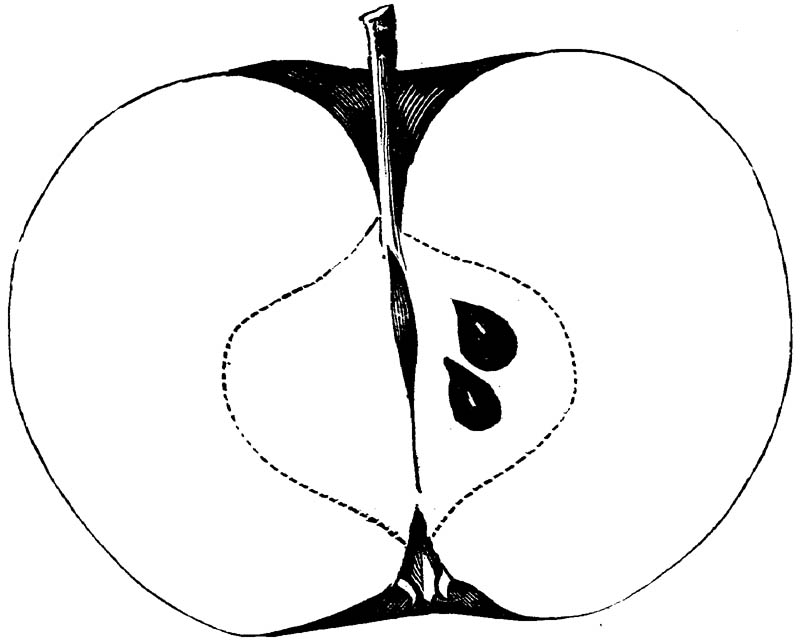
Fig. 241.—KNOX RUSSET.
A very nice little apple, found in the orchard of J. Knox, Pittsburgh, Pennsylvania; trees obtained from near Greensburgh, Pennsylvania. Tree spreading, very productive; Shoots slender.
Fruit small to medium, globular, somewhat conic, regular; Surface smooth, yellow green, blushed, covered with light russet.
Basin shallow, regular; Eye medium, open; Segments reflexed.
Cavity deep, acute, regular; Stem long, red.
Core round, regular, slightly open, clasping the eye; Seeds numerous, short, plump; Flesh yellow, very fine-grained; Flavor mild sub-acid, aromatic; Quality good to very good; Use, dessert; Season, December, January.
Pryor's Red.
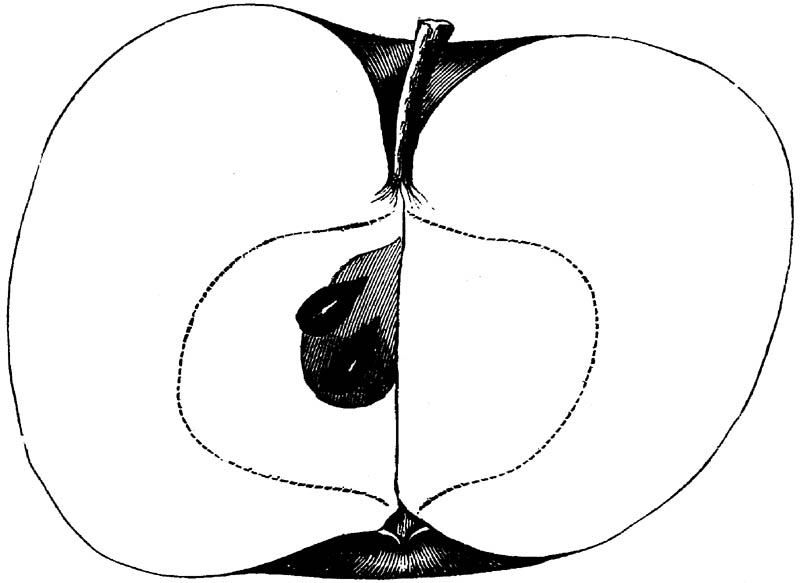
Fig. 242.—PRYOR'S RED.
This southern apple, probably from Virginia, has been carried through all the Western States, where it is a great favorite, though there are some objectors, on account of its having shown signs of failure in certain situations. The fruit is singularly affected by change of soil and climate; thus, on the Ohio River, it is seen quite flat and regular, with a dull green russeted skin, becoming yellow and ruddy; in one part of the State of Indiana, on limestone, it is gibbous, round, often very large, and covered with a rich cinnamon russet, while on the coal measures, west of the center of the State, it is smaller, regular, and distinctly striped deep red on red, with very little russet. Specimens from Rochester, New York, have been shown with scarcely a trace of russet, and having the stripes as distinct and almost as beautiful as those of a Duchess of Oldenburgh, so that no southern or western man would have recognized it for his home favorite. The distinctive leather-cracking about the eye was present, however, in all.
Tree thrifty, growth upright, twiggy, attaining large size, productive when old; Shoots slender, reddish olive, speckled; Foliage scattering, folded, grayish green; Subject to leaf-blight.
Fruit large, globular-oblate, often unequal; Surface greenish, or dull red, striped, russeted; Dots numerous, large, gray.
Basin shallow, regular or plaited, leather-cracked; Eye small, closed.
Cavity shallow, acute, often lipped; Stem medium.
Core round, regular, closed, meeting the eye; Seeds numerous, angular, pointed; Flesh yellow, tender, melting, fine-grained, juicy; Flavor sub-acid, rich; Quality best; Use, table, kitchen; Season, December, February.
Red Russet.
Origin Hampton Falls, New Hampshire.
Tree very vigorous and productive; resembling Baldwin in almost every particular.
"Fruit large, roundish, conic; Skin yellow, shaded with dull red and deep carmine in the sun, and thickly covered with gray dots, and an appearance of rough russet on most of the surface; Stalk rather short and thick, inserted in a medium cavity, surrounded with thin russet; Calyx nearly closed; Segments long, recurved, in a narrow, uneven basin; Flesh yellow, solid, crisp, tender, with an excellent, rich, sub-acid flavor, somewhat resembling Baldwin; Season, January to April."—Downing.
This fruit is rarely seen in the West. It has been thought by some to have originated as a sport from the Baldwin.
Rolen's Keeper.
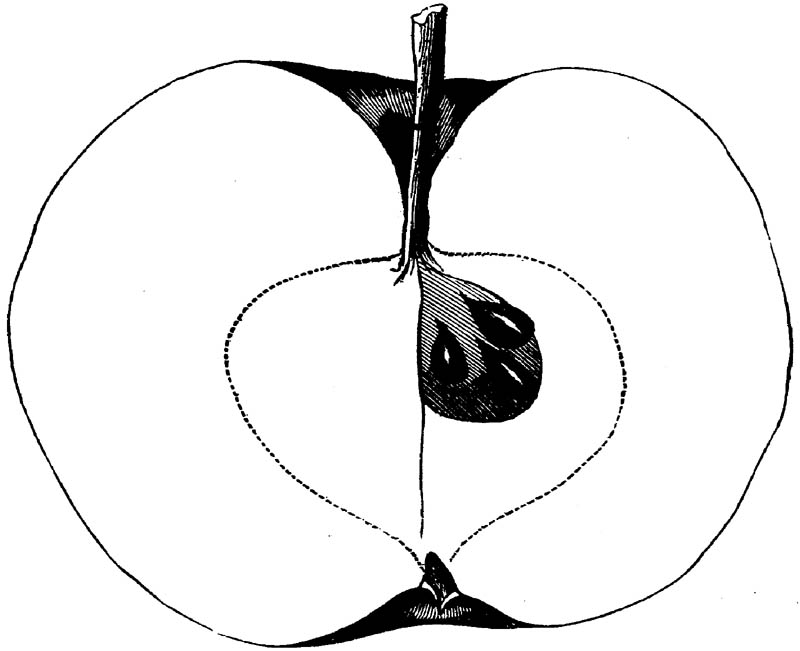
Fig. 243.—ROLEN'S KEEPER.
Received from H.N. Gillett, Lawrence County, Ohio. Origin not given.
Fruit medium, round, regular; Surface rough, splashed red on russet; Dots scattered, small, white.
Basin shallow, regular, leather-cracked; Eye small, closed.
Cavity deep, acute, regular; Stem long, slender.
Core roundish-ovate, regular, closed, clasping; Seeds very numerous, short, plump; Flesh greenish yellow, fine-grained; Flavor acid, rich; Quality good to very good; Use, table; Season, March, April.
Very promising as a keeper.
Rustycoat Milam.
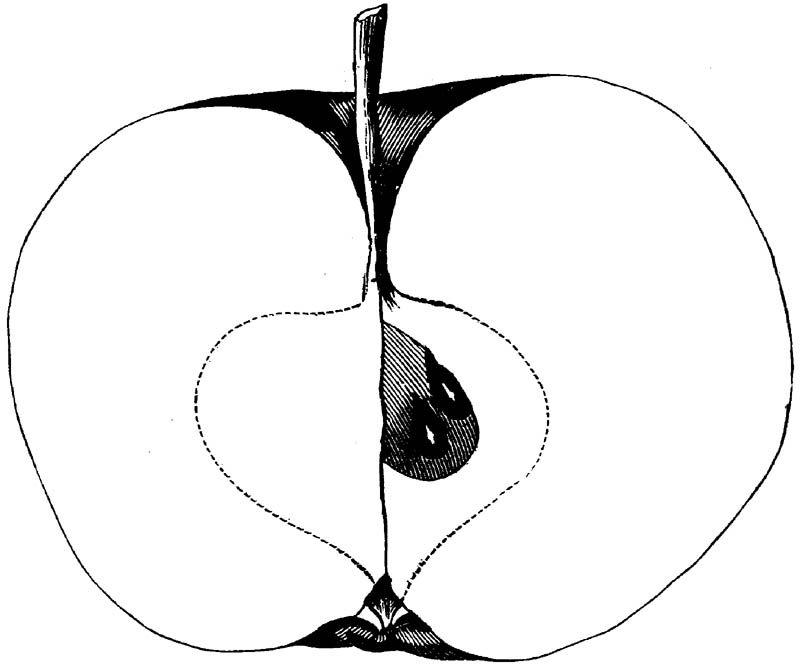
Fig. 244.—RUSTYCOAT MILAM.
Fruit medium, globular, conic, regular; Surface russeted; Dots minute, prominent.
Basin narrow, abrupt, shallow; Eye small, closed.
Cavity acute, regular; Stem medium to long.
Core medium, regular, closed, clasping; Seeds numerous, pointed, plump; Flesh greenish yellow, breaking, fine-grained, tender; Flavor sub-acid, aromatic; Quality good; Use, table; Season, December to February.
CLASS III.—ROUND APPLES.
ORDER II.—IRREGULAR.
SECTION 1.—SWEET.
SUB-SECTION 1.—SELF-COLORED OR BLUSHED.
Mote's Sweet.
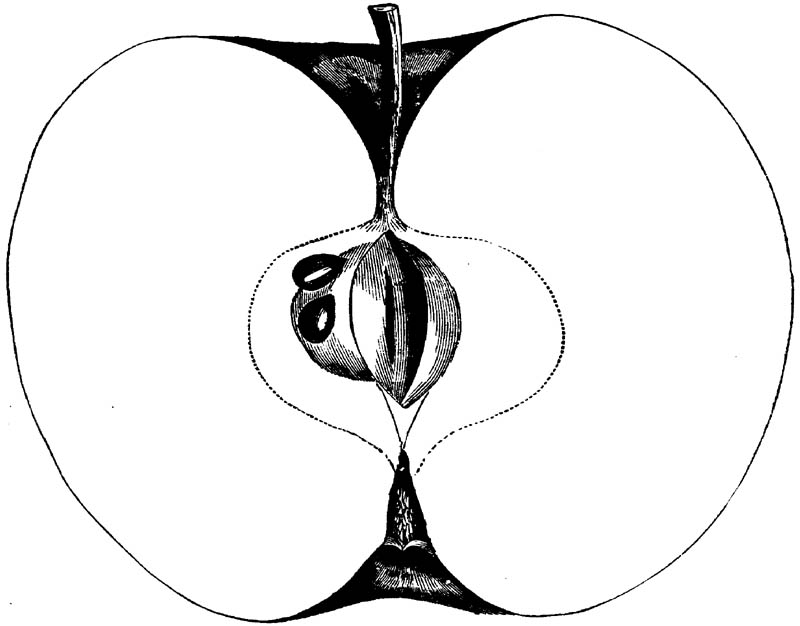
Fig. 245.—MOTE'S SWEET.
This seedling from the Stillwater Sweet, grown by L.S. Mote, of Miami County, Ohio, is quite an improvement upon its parent, which has obtained a high reputation as a choice autumnal sweet apple. Tree round, spreading, vigorous; Shoots pale; Foliage large, wide, finely serrated, and rather pale.
Fruit large, globular, somewhat flattened, or conic-truncated, rather angular; Surface very smooth, greenish yellow to whitish, with a rare faint blush; Dots scattered, gray, often rosy, whitish bases.
Basin medium, abrupt, wavy; Eye medium, long, closed.
Cavity deep, wide, wavy; Stem long, yellow, curved.
Core medium, open, clasping; Seeds numerous, angular, pale; Flesh yellow, very fine-grained, almost melting, juicy; Flavor very sweet, pleasant; Use, table and kitchen; Quality best; Season, September. One of the most delicious sweet apples.
Northern Sweet.
Origin unknown; supposed to be Vermont. Tree sufficiently healthy and productive. Not generally nor extensively cultivated.
Fruit large, globular, somewhat flattened, angular or regular; Surface smooth, very pale yellow, rarely blushed; Dots minute, with white bases.
Basin deep, abrupt, regular; Eye long, closed.
Cavity rather wide, regular, green; Stem medium.
Core very small, closed, almost clasping; Seeds numerous, short; Flesh whitish, breaking, juicy; Flavor very sweet; Quality pretty good; Use, baking; Season, September, in Northern Indiana and Illinois. Downing says "rich and excellent; September and October."
Swaar.
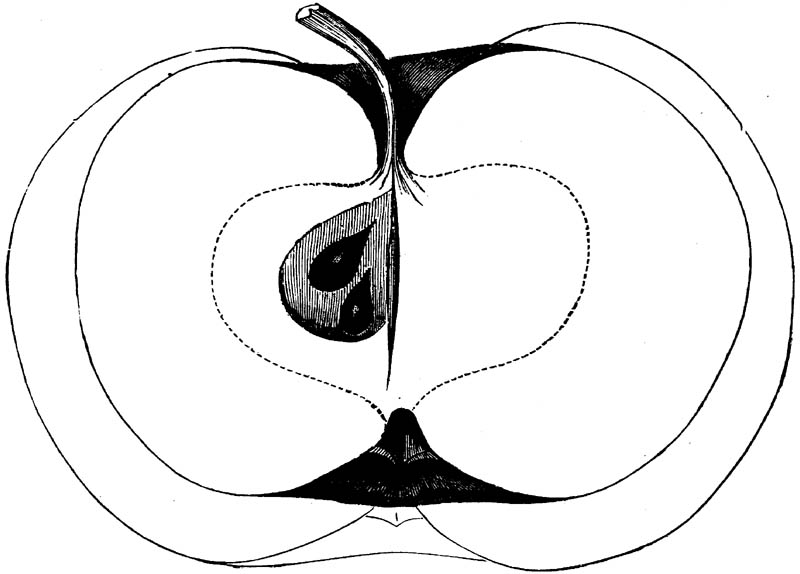
Fig. 246.—SWAAR.
Origin on the banks of the Hudson, in New York State. Tree vigorous, spreading, productive; Shoots stout, dark colored; Foliage large, curled.
Fruit large, form variable, being sometimes flat, where unusually developed, generally roundish, somewhat flattened, more or less angular or flattened on the sides, but not ribbed; Surface not smooth, often rough, greenish yellow, bronzed, becoming a dead golden yellow when ripe; Dots large, numerous.
Basin medium, wide, regular; Eye small, not long, closed.
Cavity wide, regular or wavy, green; Stem long, curved, pretty stout.
Core medium, regular, heart-shaped, closed, clasping; Seeds numerous, angular, pale; Flesh very heavy, yellow, fine-grained; Flavor very mild sub-acid, or sweet, very rich; Quality best; Use, table and kitchen; Season, March.
CLASS III.—ROUND APPLES.
ORDER II.—IRREGULAR.
SECTION 1.—SWEET.
SUB-SECTION 2.—STRIPED.
Bailey Sweet.
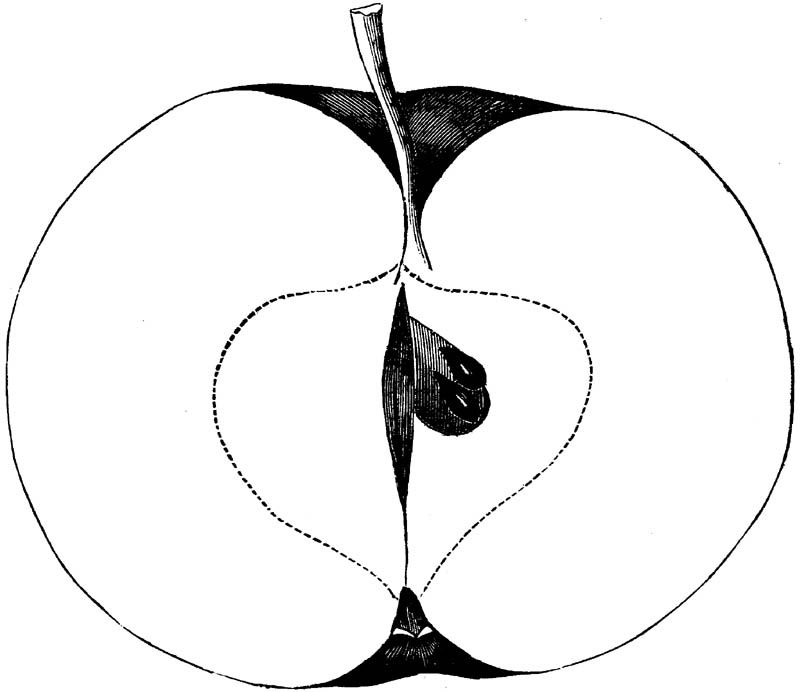
Fig. 247.—BAILEY SWEET.
From Wyoming County, New York. Tree vigorous, productive.
Fruit large, round, sometimes flattened, sometimes angular or ribbed; Surface smooth, mottled, mixed and striped deep red; Dots numerous, large, gray.
Basin narrow, abrupt, regular or folded; Eye small, closed.
Cavity regular, acute green; Stem long.
Core rather large, turbinate, open, clasping; Seeds numerous, angular, dark; Flesh yellow, tender, fine-grained, juicy; Flavor very sweet, rich; Quality good to very good; Use, kitchen, table; Season, October.
A very valuable variety also for stock.
Brittle Sweet.
"Origin unknown; good grower, and very productive.
"Fruit above medium, roundish, approaching conic, sometimes elongated, angular; Skin greenish yellow, shaded and splashed with crimson, sprinkled with gray dots; Stem short, inserted in a broad, shallow cavity; Calyx closed, set in a small corrugated basin; Flesh yellowish, crisp, tender, juicy, sweet, and excellent; Season, September, October."—Downing.
Hull Blossom.
This is an Eastern or European variety, which I have not seen in the West. Specimens from Massachusetts.
Fruit small, roundish-truncate, or flattened, uneven; Surface smooth, yellow, mixed and striped, carmine; Dots large, yellow.
Basin shallow, folded; Eye small, closed.
Cavity deep, wavy; Stem short.
Core small, closed, roundish, meeting the eye; Seeds large, pale; Flesh yellow, fine-grained; Flavor sweet; Quality good to very good; Use, table, kitchen; Season, November.
Sweet Pearmain.
"This variety, according to Downing and Thomas, is the English Sweeting; but, according to Manning, the English Sweeting is the Ramsdell's Sweeting of Downing. This fruit is extensively grown in Central Ohio, and further West, suiting well the rich soils; keeping finely all winter; highly valued for baking or eating."
"Fruit medium size or often above; Form roundish, slightly angular; Color dull red, rough russet dots, and blueish bloom; Stem long, slender; Cavity deep, wide, open; Calyx woolly; Basin medium; Flesh yellowish, tender, moderately juicy, sweet; Core medium, with outer or concentric lines; Seeds ovate, pyriform, dark brown; Season, December to March."—Elliott.
I am not familiar with the above, but find a very strong resemblance in the characters to those of my Red Winter Pearmain, Class II, I, 2, 2, from which, however, Elliott's outline would exclude it.
Willis Sweet.
This apple is supposed to have originated on Long Island, where it is highly valued for baking.
Tree vigorous, productive; Fruit medium, round, somewhat angular, striped red, very sweet and rich; Use, baking and stock.
CLASS III.—ROUND APPLES.
ORDER II.—IRREGULAR.
SECTION 1.—SWEET.
SUB-SECTION 3.—RUSSET.
None.
CLASS III.—ROUND APPLES.
ORDER II.—IRREGULAR.
SECTION 2.—SOUR.
SUB-SECTION 1.—SELF-COLORED.
American Golden Pippin.
GOLDEN PIPPIN, of Downing.—NEW YORK GREENING, &C.
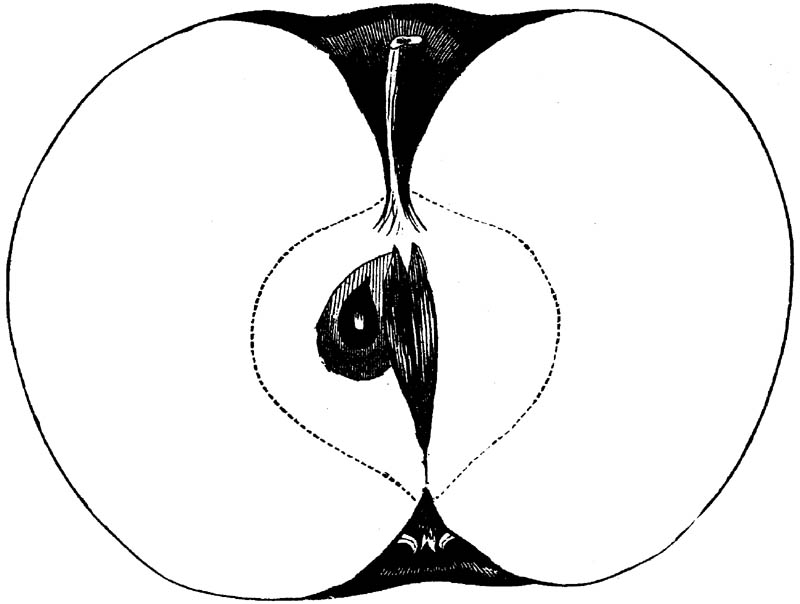
Fig. 248.—AMERICAN GOLDEN PIPPIN.
Having mislaid my notes of this apple, I am obliged to quote Mr. Downing's description of this fine fruit, which is believed to be American; cultivated in parts of New York, and found to be profitable.
"Growth strong, similar to that of Rhode Island Greening, but less drooping, making a round, spreading head; does not bear young, but very productive when a little advanced, and a popular fruit where known."
"Form variable, oblate, globular or conic, angular or ribbed; Stem stout, short, inserted in a deep cavity; Calyx closed, set in an irregular basin; Skin fine golden yellow, thinly sprinkled with dots, sometimes slightly netted with thin russet; Flesh yellowish, tender, juicy, nearly melting, with a rich, refreshing, almost vinous, aromatic flavor; Core rather large; November to February."
Brooke's Pippin.
"Origin, Essex County, Virginia. The original tree is very large, bears regular and large crops of fruit, which is always fair, of the largest size, keeps well till May; Flesh fine, yellow, juicy and rich, and of the finest flavor; young trees grow very thriftily."—[H.R. Robey, Fredericksburgh, Va.]
Fruit large, roundish, inclining to conical, obscurely ribbed, greenish yellow, faintly blushed.
Basin small, shallow, wavy, sometimes furrowed; Eye medium, closed.
Cavity deep, wavy, brown; Stem short, thick.
Flesh yellow, crisp, juicy, fine-grained; Flavor acid, spicy, rich; Quality very good; Season, November to March.
As grown in Indiana, both tree and fruit resemble the Newtown Pippin in appearance, and may prove identical after further trial.
Champlain.—[Downing.]
PAPER—PAPER-SKIN.
This very delicate fruit was exhibited before the Ohio Pomological Society by A.L. Benedict, of Morrow County, as the Paper apple. He obtained the cions from the celebrated apple region, Grand Isle, Vermont, where it is sometimes called Champlain, and where it had been introduced from Rhode Island, without a name, by his friend Macomber. My friend Benedict informs me that "the growth of the tree is strong and stocky, and that the fruit never scabs nor rots on the tree. It is increasing in esteem as it becomes better known, and is preferred to the Red Astrachan, ripening with it. When sent to J.J. Thomas, he thought it synonymous with the Primate, but Jos. Newcomber, having both varieties growing side by side, assured me they were quite unlike, and that the Paper was much the better apple of the two."
Tree medium size, vigorous, stocky.
Fruit full medium, globular, rather conical, angular; Surface smooth, yellowish green, slightly blushed; Dots minute, indented.
Basin small, abrupt, folded; Eye small, long, closed.
Cavity acute, wavy, green; Stem long, slender.
Core medium, round, slightly open, clasping; Seeds numerous, angular, dark; Flesh white, tender, fine-grained, juicy; Flavor sub-acid, aromatic, delicate; Quality best; Use, the dessert especially; Season, August, September.
Drap d'Or.
VRAI DRAP D'OR.—[Dahamel.]
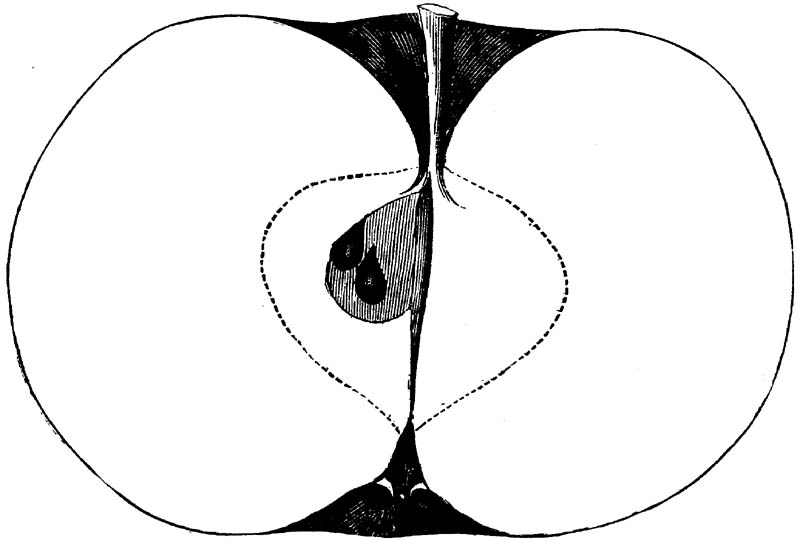
Fig. 249.—DRAP D'OR.
This is an old French variety, respecting which there is some uncertainty among cultivators.
Fruit large, globular, but variable, being conical-truncate to oblate; Surface smooth, pale waxen yellow, rarely blushed.
Basin wide, plaited; Eye small, closed.
Cavity wide, wavy, brown; Stem long, inclined, yellow or red, angular.
Core large, regular, closed, clasping; Seeds numerous, angular, long; Flesh pale yellow, breaking, fine-grained, juicy; Flavor sub-acid, aromatic; Quality good to best; Use, market, kitchen, table; Season, August, September.
For the table its place is supplanted by the Primate, Dyer and others.
Dyer, or Pomme Royale.
POMMEWATER, in Illinois.
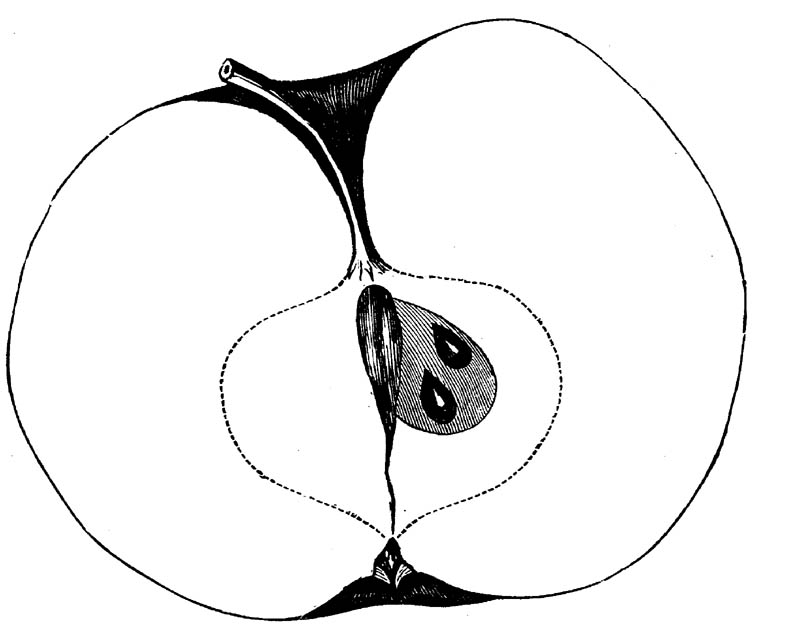
Fig. 250.—DYER, OR POMME ROYALE.
Believed to be a French apple, but named Dyer by the Massachusetts Horticultural Society, in the belief that it was a seedling of Rhode Island.
Tree of moderate vigor, spreading, not very productive.
Fruit medium to large, globular, uneven, somewhat angular; Surface not smooth, pale yellow, vein-russeted; Dots numerous, minute, dark.
Basin medium, shallow, folded or plaited; Eye small, closed.
Cavity deep, acute, lipped, brown; Stem long, slender.
Core regular, round, open or closed, clasping; Seeds numerous, plump, short; Flesh yellowish, very tender, very fine-grained, very juicy; Flavor sub-acid, aromatic, rich, delicate; Quality best; Use, the dessert; Season, September, October.
Not attractive in appearance, but very fine for the amateur.
Ewalt.
Origin Pennsylvania. Introduced by Dr. Brinckle in his ad-interim reports to the Pennsylvania Horticultural Society. Mr. Waring considers it a valuable winter apple. Tree vigorous, handsome grower in the nursery; Shoots erect, dark colored; an early, regular bearer.
Fruit large, very handsome, roundish, rather angular; Surface smooth, yellow, with clear bright red in the sun, not striped; Dots numerous about the base, greenish.
Basin medium, narrow, plaited; Eye medium, closed.
Cavity medium, acute; Stem short.
Flesh tender, fine-grained; Flavor acid, becoming mild, aromatic, sprightly; Quality very good; Season, February to April.
Golden Ball.
A favorite Maine apple. Tree vigorous, productive, hardy.
Fruit large, round, ribbed; Surface smooth, greenish yellow; Dots few, distinct, white bases.
Basin deep, abrupt, folded; Eye large, closed.
Cavity narrow; Stem medium.
Core indistinct, open, clasping; Seeds defective; Flesh yellowish, tender, juicy; Flavor sub-acid, rich; Quality good; Use, table, kitchen, market; Season, December to March in the North.
Morgan White.
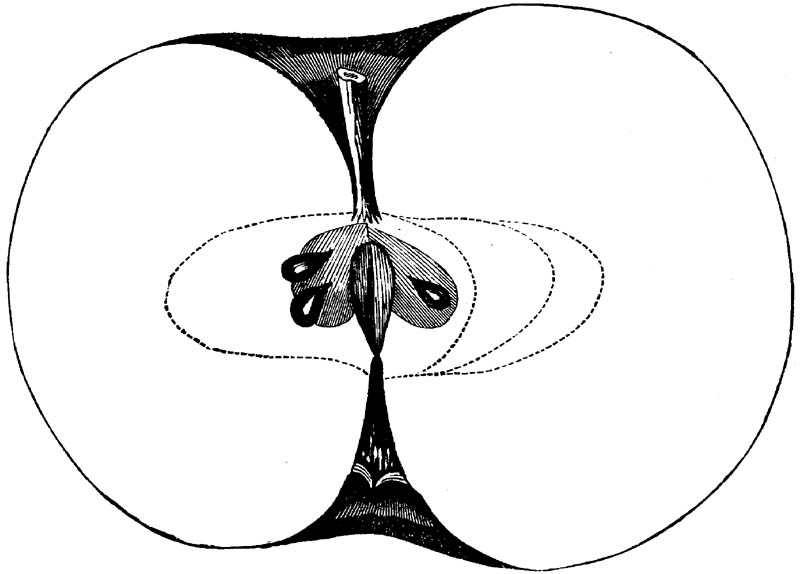
Fig. 251.—MORGAN WHITE.
Origin unknown. Sent from Morgan County, Illinois, by Professor J.B. Turner, of Jacksonville.
Fruit large, globular, somewhat flattened, irregular, ribbed, uneven; Surface smooth, greenish, marked with gray striæ, rarely a faint blush; Dots white, large.
Basin abrupt, ribbed; Eye small but long, closed.
Cavity deep, acute, wavy; Stem short to medium.
Core small, very wide, open, clasping; Axis short; Seeds numerous, plump, short; Flesh greenish white, breaking, tender, fine-grained, juicy; Flavor acid to sub-acid, agreeable; Quality good; Use, kitchen and table; Season, September to January.
Peck's Pleasant.
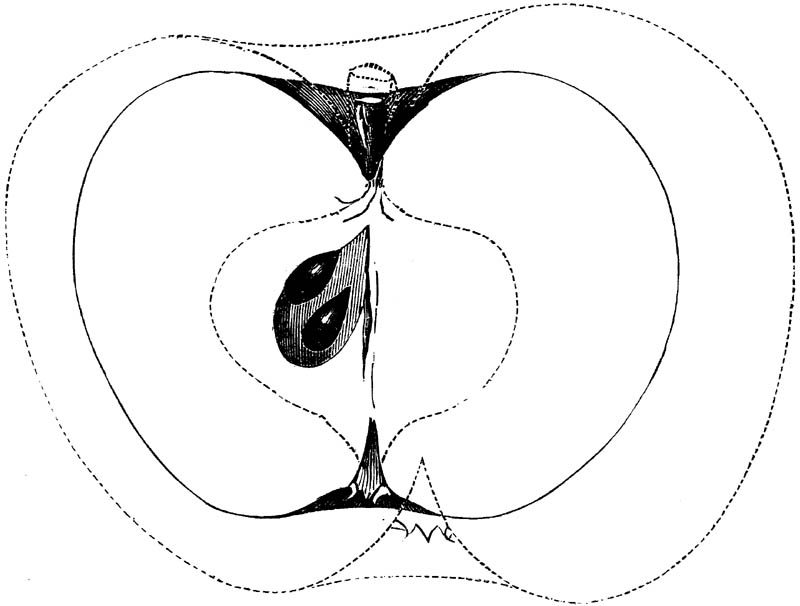
Fig. 252.—PECK'S PLEASANT.
This fine fruit is credited to Rhode Island. The tree is healthy, spreading, moderately vigorous, but productive, and a regular bearer. This apple is said to resemble the Newtown Pippin, but I have never been able to trace any resemblance, except that both are green; at any rate there is no danger of the merest tyro in pomology confounding the two varieties. There is, however, a remarkable diversity in the fruit arising from the different soils and climates in which it is cultivated, North and South, and while, like many other varieties, its size is greatly developed, its texture and flavor are depreciated in the migrations southward.
Fruit large, flattened, globular, somewhat angular, or flattened, sometimes having a shallow sulcus or furrow on one side; Surface smooth, yellow or orange, being sometimes faintly blushed; Dots gray, with white bases.
Basin rather shallow and folded; Eye small and open, calycinal segments being short.
Cavity wide, but often lipped, brown; Stem short, very thick, clubbed or knobby.
Core large, closed, clasping the eye; Seeds numerous, angular; Flesh yellow, tender, breaking, fine-grained; Flavor sub-acid and somewhat aromatic; of first quality in the North; Use, table, kitchen or market; Season, December to January, or later.
Primate.
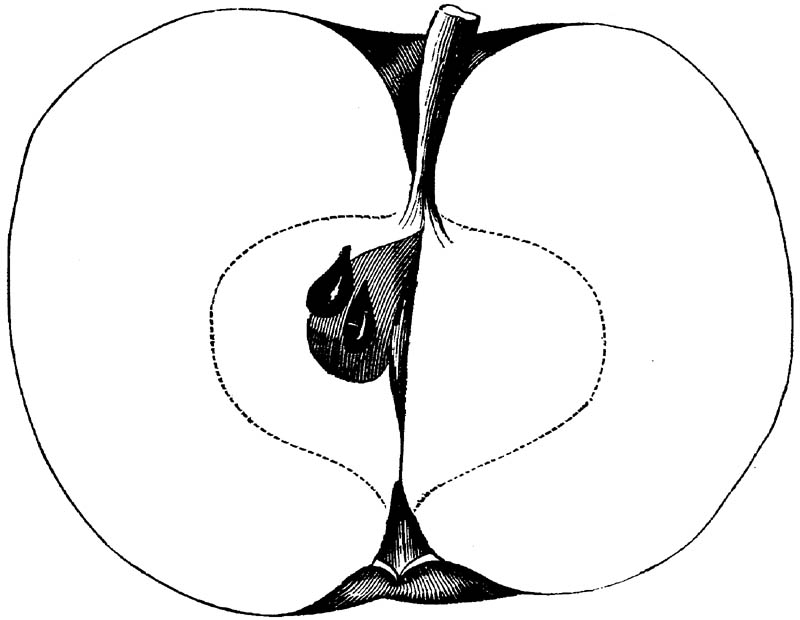
Fig. 253.—PRIMATE.
This delicious table apple has strong claims upon our admiration, on account of its good qualities as a dessert fruit, for the extreme delicacy of its skin and flesh render it unfit for market; it is therefore not profitable for the commercial orchard.
Tree thrifty, stocky, vigorous, strongly branched, productive; Shoots stout, short, light olive; Buds prominent, foliage pale green.
Fruit full medium, globular, angular, irregular; Surface smooth, greenish-yellow, becoming almost white, sometimes faintly blushed; Dots minute.
Basin abrupt, folded; Eye small but long, closed; Segments reflexed.
Cavity acute, wavy, green; Stem medium to long, thick.
Core medium, round, closed, clasping; Seeds numerous, angular, long, dark; Flesh greenish-white, very tender, fine-grained; Flavor mild sub-acid, very agreeable; Quality best; Use, the dessert; Season, July and August.
Progress.
Not having had the good fortune to study this apple, I quote the description given by Downing:
"A native of Middletown, Connecticut. Tree a moderate grower and forms a handsome head, bears early and very productive.
"Size above medium, rather globular, inclining to conic, sometimes oblate, somewhat angular; Stem short, inserted into a round cavity, surrounded by russet; Calyx large, partially closed, set in a shallow, open basin; Skin smooth, yellow, with a sunny cheek, sometimes a few scattered, gray dots; Flesh solid, tender, crisp, juicy, with a very refreshing, vinous flavor. Ripe October until April."
Quince.
COLE'S QUINCE.
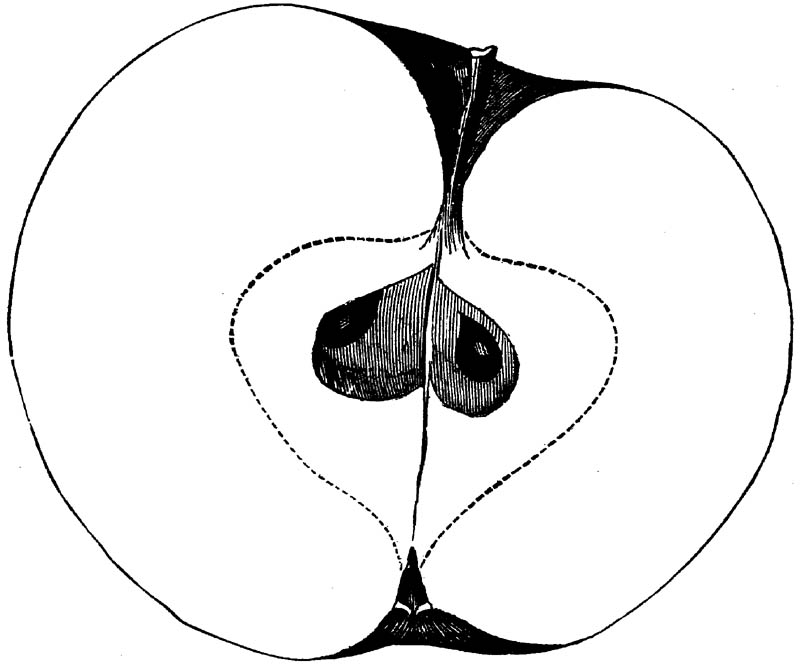
Fig. 254.—QUINCE.
This does not appear to be exactly the same as that described by Coxe, and later by Downing. This fruit is not very extensively cultivated. The specimens described are from that precise pomologist T.T. Lyon, of Michigan.
Fruit full medium, globular, angular, ribbed; Surface smooth, greenish-yellow, pale.
Basin narrow, folded, plaited; Eye small, closed.
Cavity acute, wavy; Stem medium, yellow.
Core oval, closed, meeting the eye; Seeds numerous, angular, plump, brown; Flesh yellowish-white, tender, fine-grained, juicy; Flavor sub-acid, aromatic; Quality good for cooking; Season, November to January.
September.
This apple is highly esteemed by Mr. W.G. Waring, of Center County, Pennsylvania, where it originated.
Tree hardy and vigorous, a good and regular bearer.
"Fruit large, globular, somewhat depressed, slightly conic, angular; Skin yellow, slightly shaded and thinly sprinkled with brown dots; Stalk short, inserted in a deep, abrupt cavity, surrounded by thin russet; Calyx partially closed, set in an open basin; Flesh yellowish, tender, juicy, with a very agreeable sub-acid flavor; October."—[Downing.]
Sheepnose.—of Mears.
This substantial little apple was presented by Wm. E. Mears, a zealous horticulturist of Clermont County, Ohio, where it is considerably cultivated. Origin unknown.
Fruit medium, round, slightly conic, irregular; Surface smooth, greenish yellow, white striæ about the base, like White Winter Pearmain, which it resembles in some other respects; Dots minute.
Basin shallow, wavy; Eye long, closed.
Cavity acute, narrow, bronzed; Stem medium, knobbed.
Core roundish oval, irregular, open, clasping; Seeds numerous, plump, dark; Flesh yellowish-white, breaking, tender, juicy; Flavor sub-acid; Quality good; Use, table and kitchen; Season, December to February.
Summer Pippin.
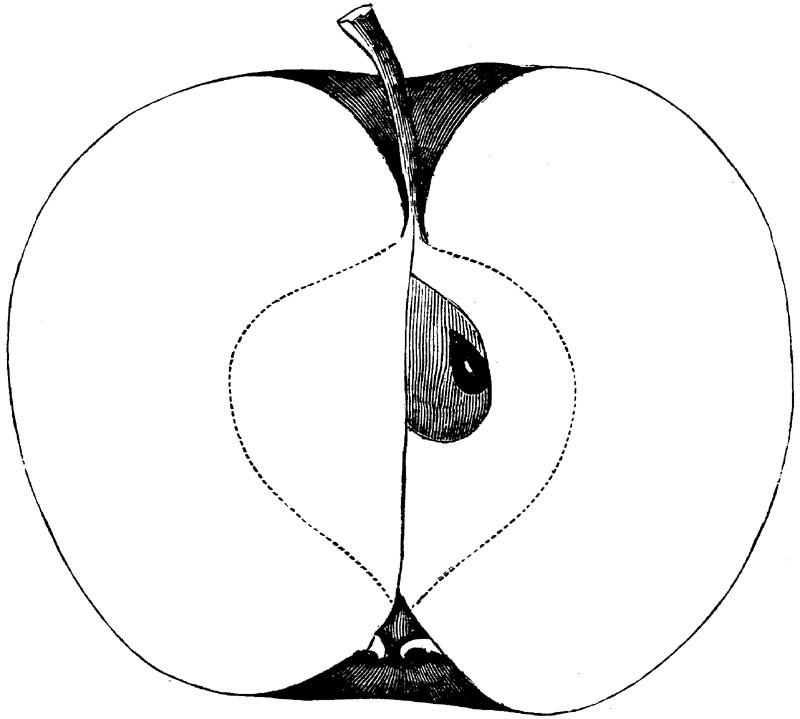
Fig. 255.—SUMMER PIPPIN.
A favorite apple about New York—not known extensively. Tree vigorous, forming a beautiful head, a regular and good bearer.
Fruit medium to large, variable in form, sometimes oblong-oval, or inclining to conic, angular and irregular; Skin pale waxen yellow, shaded with a delicate crimson blush, and sprinkled with green and grayish dots; Stalk varies in length and thickness, inserted in a deep, abrupt cavity; Calyx closed, set in a deep, abrupt, corrugated basin; Flesh white, tender, moderately juicy, with a pleasant, refreshing sub-acid flavor; Valuable for culinary uses; Ripens in August and continues a month or more.—[Downing.]
Transport.
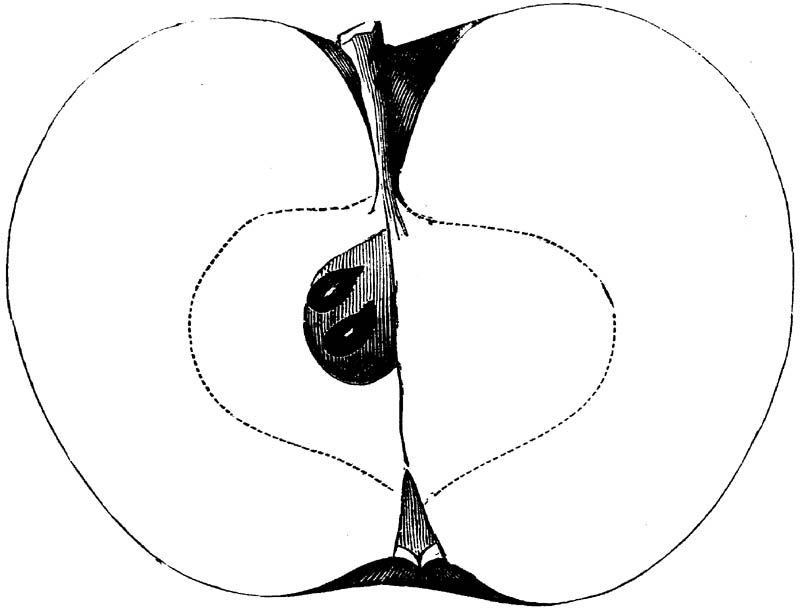
Fig. 256.—TRANSPORT.
Another of Reuben Ragan's Indiana seedlings. Tree poor in the nursery—good in the orchard. Very productive.
Fruit large, globular, flattened, angular; Surface smooth, pale yellow, blushed carmine; Dots scattered, green, with white bases, becoming purple where exposed; Bloom white.
Basin medium, plaited; Eye small, closed.
Cavity deep, acute, brown; Stem medium to long.
Core irregular, closed, clasping; Axis short; Seeds dark, pointed, imperfect; Flesh, yellowish-white, tender, melting, fine-grained, juicy; Flavor mild sub-acid, rich; Quality good to very good; Use, table, kitchen, market; Season, December to February. Not very profitable.
White Pippin.
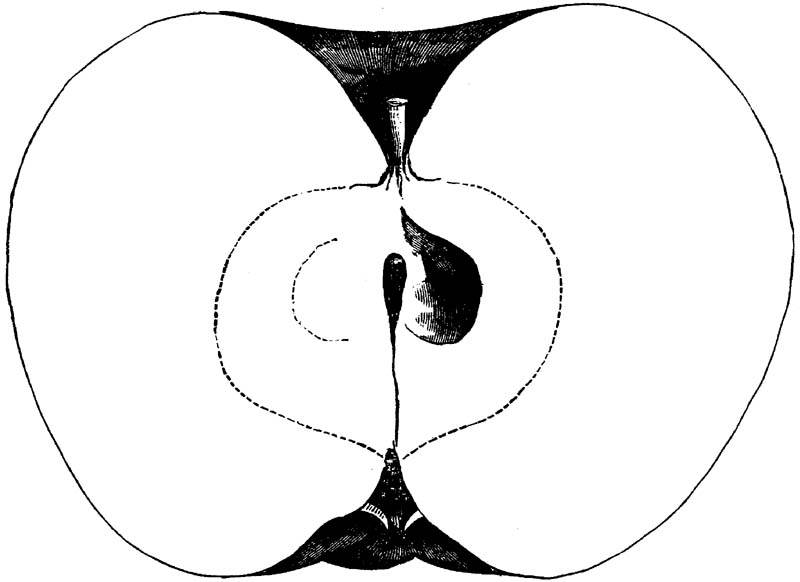
Fig. 257.—WHITE PIPPIN.
The origin of this valuable fruit is entirely unknown, and its history can only be traced to the nursery of Silas Wharton, who may have brought it with him from the East. For a time some of our leading pomologists thought it was the Canada Reinette, but this idea has long since been relinquished, and all agree that it is sui generis, though it may have had a different name. In some of its external characters it more nearly resembles the Yellow Newtown Pippin than any other fruit; but, while it lacks the high, spicy flavor of that apple, it is found to be much more profitable in the orchard.
The tree is remarkably thrifty, vigorous and productive, upright, with very dark shoots, covered with down, bearing large leaves that are quite downy beneath, and deep green above.
Fruit large, variable in form, angular, sometimes lop-sided, generally fair, free from scab; Surface smooth, green or greenish-white to very pale yellow when ripe; the skin toward the base is often marked on the unripe apple with indistinct wavy stripes of white, the interspaces are sometimes colored by exposure, and assume a pink or purplish hue, making the fruit appear to be striped; Dots very minute, and surrounded by green bases that are most distinct before the fruit is perfectly ripe; these and the white stripes are very characteristic.
Basin deep, abrupt, regular, wavy or folded; Eye small, closed.
Cavity wide, deep, wavy, brown and green: Stem short, sometimes thick.
Core small, pyriform, closed, clasping; Seeds numerous, angular, pale brown, pointed; Flesh white or yellowish-white, breaking, granular, juicy; Flavor acid to sub-acid, not spicy; Quality good; Use, kitchen rather than table, cooks very well; Season, December and January; not a very good keeper; may be preserved until March.
Yellow Newtown.
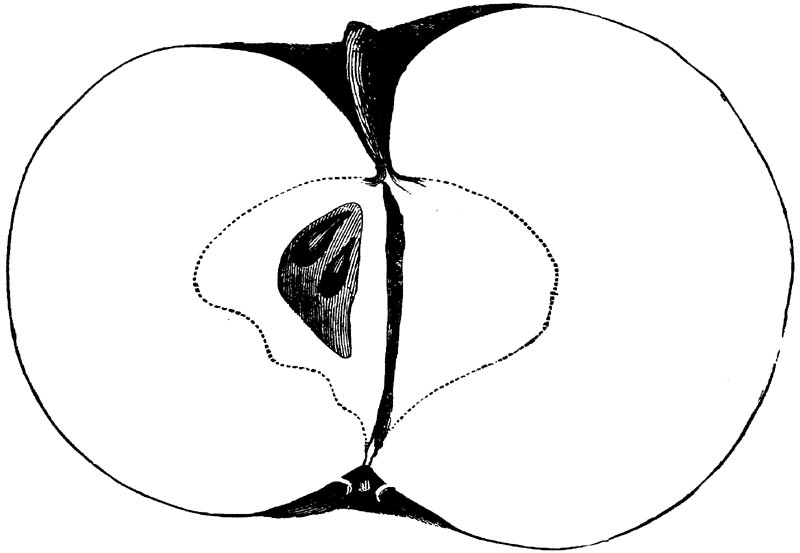
Fig. 258.—YELLOW NEWTOWN.
The origin of this variety of the Newtown Pippin, which has obtained such a world-wide notoriety as the "American Apple," is very uncertain. The distinction between this and the Green Newtown, as described under Class III, I, 2, 1, was well known to Coxe.
Tree resembling that of the Green variety, slow grower in the nursery, having rough bark when old, not an early bearer, but large, spreading, and productive, and in suitable soils profitable. From some cause, however, the orchards of both these apples are much less satisfactory in their results than formerly in many parts of the country. Still it is often seen in great perfection, and I am compiling this description from outlines and notes of a large number that were very fine.
Fruit large, round, more or less modified by being cylindrical, truncated, lop-sided, ribbed, and irregular, sometimes even conic; Surface smooth, yellowish-green, sometimes bronzy, becoming yellow when ripe, like the White Pippin, it is marked with gray striæ near the base while green; Dots minute, scattered, whitish bases.
Basin large, folded, ribbed or plaited; Eye medium, rather open.
Cavity deep, acute; brown; Stem medium or short, rarely long.
Core medium, oval, regular, closed, meeting or clasping the eye; Seeds pointed, brown, sometimes imperfect; Flesh yellow, firm, breaking, juicy, not crisp like the Green variety; Flavor acid, aromatic, rich, very agreeable; Quality best; Use, table, kitchen, market and cider; Season, March.
CLASS III.—ROUND APPLES.
ORDER II.—IRREGULAR.
SECTION 2.—SOUR.
SUB-SECTION 2.—STRIPED.
Benoni.
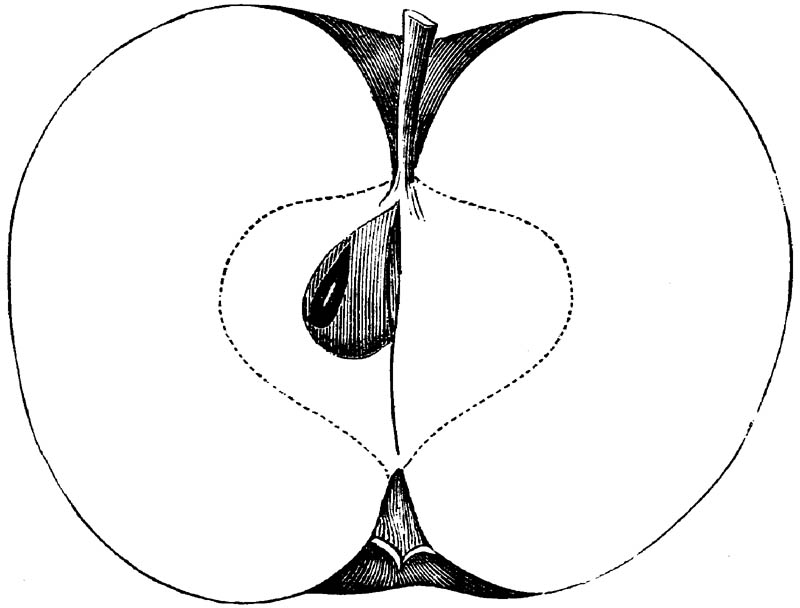
Fig. 259.—BENONI.
This handsome and delicious early apple is a native of Dedham, Massachusetts. Its good qualities have caused its culture to be widely extended, and it appears to give very general satisfaction; though not so early as some other kinds, for the dessert especially, it is indispensable to the amateur.
Tree small, upright, close, productive, early bearer; Shoots slender, brown, leaves thin, long.
Fruit small to medium, round, truncated, somewhat angular, irregular; Surface smooth, yellow, covered mixed red, striped scarlet and carmine; Dots minute.
Basin wide, abrupt; Eye large, open or closed.
Cavity acute, wavy, brown; Stem medium, green, often stout.
Core small, closed, meeting the eye; Seeds angular, dark; Flesh yellow, fine-grained, juicy; Flavor rich, sub-acid, spicy; Quality best; Use, dessert, kitchen and market; Season, July and August. Delicious and profitable.
Brennaman.
This fine apple, from Lancaster County, Pennsylvania, was reported on by the ad interim Committee of the Pennsylvania Horticultural Society, and was brought to my notice by Dr. J.K. Eshleman, of Downingtown, in whose beautiful orchard I had an opportunity of studying the variety.
Tree large, spreading, vigorous, productive, said to be hardy.
Fruit medium to large, round, somewhat angular; Surface smooth, yellow, nearly covered with stripes of bright rich red.
Basin deep, wavy; Eye closed.
Cavity large, brown; Stem short to medium.
Flesh whitish, breaking, fine-grained, juicy; Flavor sub-acid, agreeable; Quality good, especially for culinary use and market; Season, August and September.
Chronicle.
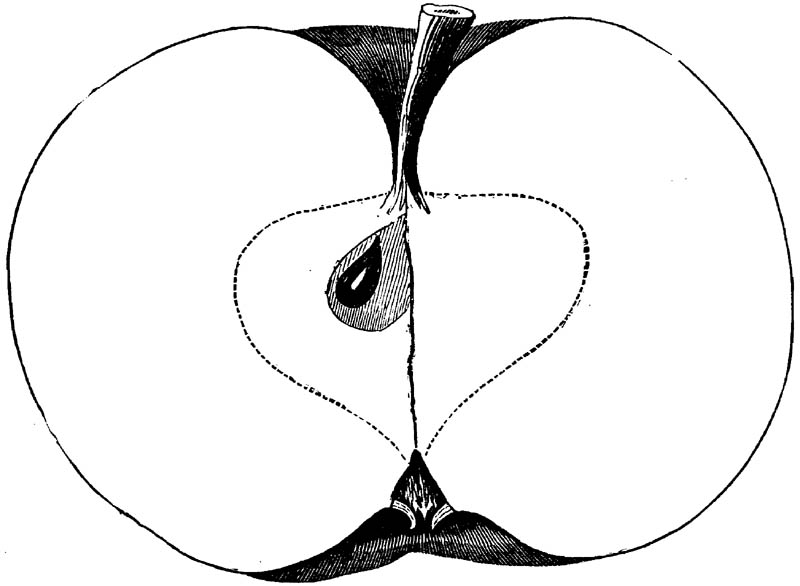
Fig. 260.—CHRONICLE.
This is a famous long keeper of Indiana origin. The honors of its discovery are divided between the Sigersons and R. Ragan.
Tree vigorous, healthy, productive, said to be hardy.
Fruit full medium to large, globular, truncated, cylindrical, irregular, flattened at the sides or angular; Axis inclined in some; Surface yellowish-green to yellow, mixed and striped dull red; Dots large, scattered, yellow, indented.
Basin, wide, deep, regular or wavy; Eye small to medium, closed.
Cavity wide, wavy or acute, sometimes lipped, brown; Stem medium to long, sometimes thick.
Core small, closed, meeting; Seeds numerous, pointed, plump; Flesh greenish to yellow, firm; Flavor sub-acid, not spicy; Quality scarcely good, except for culinary use and for market; Season, March to May. Keeps sound even when bruised.
Foundling.
"From Massachusetts. Tree moderately vigorous, spreading, productive."—[Downing.]
Fruit medium to large, round, flattened at the ends, angular or uneven; Surface yellowish-green, mixed red, splashed deep red; Dots minute, indented.
Basin wide, abrupt, folded; Eye small, closed.
Cavity deep, acute, wavy, green; Stem short or medium.
Core large, wide, open, clasping; Seeds numerous, small, pointed; Flesh white, tender, fine-grained, juicy; Flavor sub-acid, aromatic; Quality good; Use, table; Season, September.
Specimens obtained from Mr. Warren.
Jersey Black.
BLACK APPLE of Coxe?
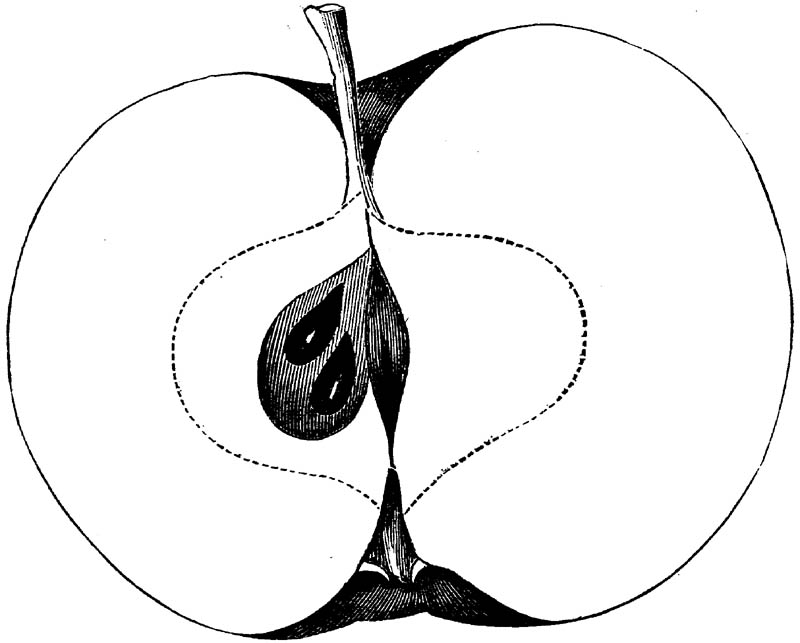
Fig. 261.—JERSEY BLACK.
This admirable but unpretending fruit has extended its way quietly through the country, along the parallels 40° to 42°, without ever having had any extra puffing, such as has given notoriety to some of its competitors for places in the orchard. Nobody speaks about this apple, nor writes about it, and yet it is everywhere to be found. This cannot be the Black Apple of Coxe and Downing, being quite different in some of its strong characters. Origin unknown, supposed to have been introduced into the West by Silas Wharton, of Warren County, Ohio, as it is found with the White Pippin and other favorite sorts of his introduction, and is in his published list.
Tree sufficiently vigorous, but does not grow large, spreading, often drooping when old, branches open, always fruitful, either well distributed in a light crop, or crowded in a full one.
Fruit full medium, round, angular and irregular, sometimes ribbed; Surface smooth, completely covered with deep red, striped darker, giving a purple, almost black hue to the fruit, often covered with a thin bloom; one variety is always lighter, stripes more distinct, and the flesh more stained; Dots numerous, minute, indented, purple.
Basin mostly shallow, folded and plaited; Eye small to medium, closed.
Cavity deep, acute, brown, often wavy or folded; Stem short, medium or long, usually stout, sometimes knobbed.
Core medium, regular, generally closed, clasping the eye; Seeds numerous, short, plump, pointed, dark; Flesh yellow, crisp, fine-grained, juicy, often stained pink or reddish; Flavor rich, mild sub-acid, aromatic, not spicy, satisfying; Quality good; Use, table, kitchen, cider and for stock; Season, December, January; keeps sound. A good market apple.
King.
KING OF TOMPKINS COUNTY.
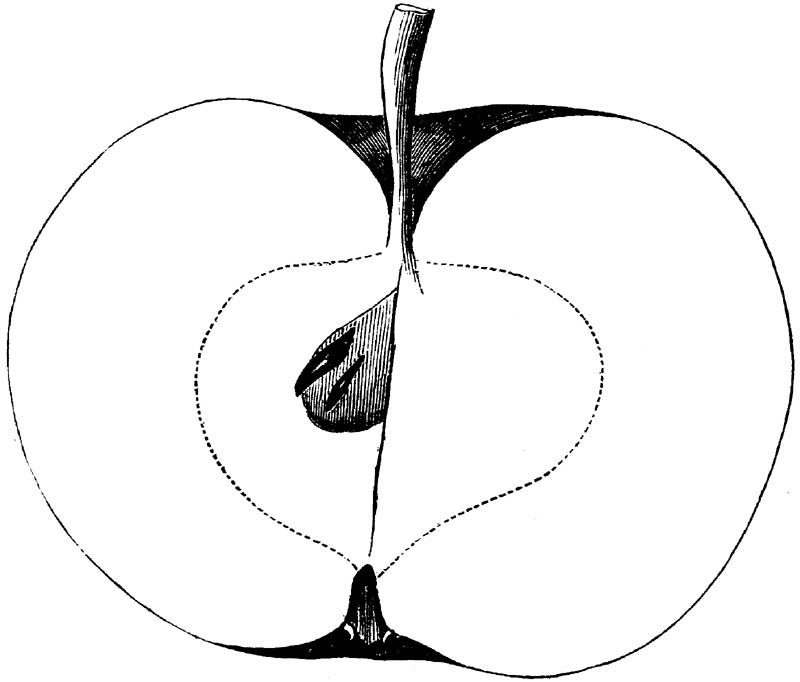
Fig. 262.—KING.
This splendid apple, which has attracted so much attention of recent years, had its origin, as is supposed, in Tompkins County, New York, where it has been much cultivated.
Tree vigorous, healthy, large and spreading, an abundant annual bearer.
Fruit large, handsome, globular, irregular, somewhat conic, angular; Surface smooth, yellow, covered deep red, marbled and striped; Dots numerous, gray, large.
Basin shallow, folded; Eye large, short, closed.
Cavity wide, shallow, wavy; Stem short or long, thick or slender, red.
Core very large, turbinate, regular, closed; Seeds imperfect, angular; Flesh yellowish-white, tender, breaking; Flavor sub-acid, aromatic; Quality best; Use, table, kitchen and market; Season, December and longer.
Missouri Keeper.
Specimens from Norman J. Colman, Esq., Editor of the Rural World, St. Louis, Missouri. Origin unknown.
Fruit medium to small, round, irregular; Surface smooth, shaded, mixed, striped red; Dots numerous, large, white, distinct.
Basin abrupt, regular; Eye small, closed.
Cavity narrow, regular; Stem medium to short, knobby, thick.
Core regular, closed; Seeds numerous, long, plump, angular; Flesh yellow, breaking, tender, fine-grained, juicy; Flavor sub-acid; Quality good to very good; Use, table, market and kitchen; Season, January to July.
Specimens cut and described on the 25th of June were in perfect condition.
Nonpareil.
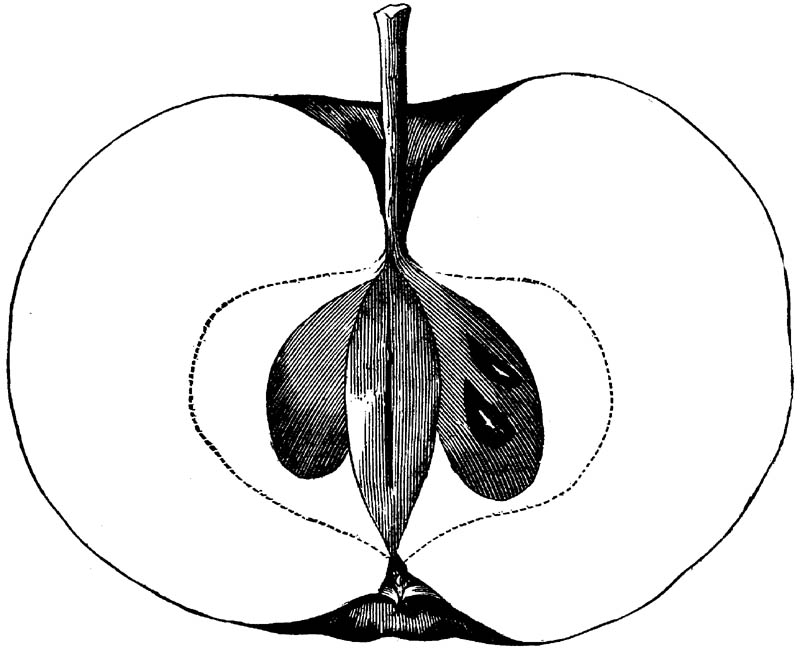
Fig. 263.—NONPAREIL.
The history and origin of this nice autumn fruit have not been ascertained, and it may prove to be an old variety with a changed name—considerably grown in Northern Illinois. Specimens from Dr. Geo. Haskell, of Rockford, are here described.
Fruit medium to large, round, somewhat conic, angular, ribbed; Surface smooth, waxy-yellow, splashed crimson; Dots minute.
Basin shallow, folded and plaited; Eye small, closed.
Cavity deep, acute, wavy, sometimes lipped; Stem long to medium, thick, green.
Core wide, regular, open, meeting the eye; Seeds numerous, angular, brown; Flesh white, tender, fine-grained, juicy; Flavor acid, aromatic; Quality quite good; Use, table; Season, September and October.
Stewart's Nonpareil.—Local Name.
This early apple is quite a favorite in Clarke County, Ohio, and may prove to be the Tetofski, or some other known variety, when it comes to be more thoroughly examined. Fruits received from my brother, J.T. Warder.
Fruit medium, roundish, conical, irregular, angular; Surface smooth, yellowish-green, splashed carmine; Dots minute, scattered, indented.
Basin small, abrupt, folded; Eye very small, closed.
Cavity deep, acute, narrow; Stem long, slender.
Core large, oval, open, clasping the eye; Seeds numerous, brown; Flesh white, tender, fine-grained, juicy; Flavor sub-acid; Quality good to best; Use, table and kitchen; Season, July and August, in latitude 40°.
Tetofski.
This little foreigner was brought from Russia, and seems as well adapted to our climate and tastes as are its companions from the same region.
Tree vigorous, hardy, productive, upright, leaves broad, pale or light green.
Fruit small to medium, round, flattened, somewhat conic, angular; Surface smooth, yellow, striped, splashed carmine, white bloom.
Basin shallow, folded; Eye large, closed.
Cavity wide, wavy, or deep, acute; Stem short, yellow.
Core large, closed, clasping; Seeds numerous, plump, brown; Flesh yellowish-white, breaking, fine grained, juicy; Flavor acid; Quality good; Use, market, kitchen; Season, June, July—before Early Harvest.
CLASS III.—ROUND APPLES.
ORDER II—IRREGULAR.
SECTION 2.—SOUR.
SUB-SECTION 3.—RUSSET.
Golden Harvey.
BRANDY APPLE.
This highly flavored English apple is often referred to, but is rarely seen in American collections; but as it may be interesting to some, I quote Downing's brief description:
"Fruit small, irregularly round; Skin rather rough, dull russet over a yellow ground, with a russety red cheek; Flesh yellow, of fine texture, with a rich sub-acid flavor. The fruit is apt to shrivel."
Tree of slender growth.
CLASS IV.—OBLONG APPLES.
ORDER I.—REGULAR.
SECTION 1.—SWEET.
SUB-SECTION 1.—SELF-COLORED.
Downing's Paragon.
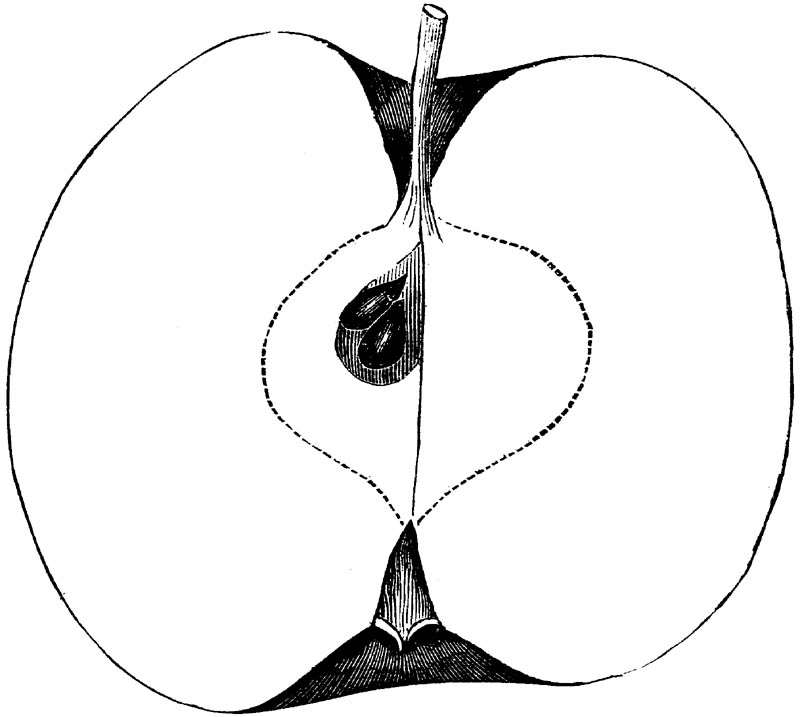
Fig. 264.—DOWNING'S PARAGON.
Originated at Canton, Illinois. Tree upright, bears annually, productive.
Fruit large, round, but appearing oblong, regular; Surface smooth, yellow to golden, slightly bronzed or blushed when fully ripe; this and the dots can scarcely be seen while the fruit is immature.
Basin deep, abrupt, plaited; Eye medium, closed.
Cavity deep, acute, irregular; Stem long.
Core very small, oval, closed, meeting the eye; Seeds numerous, plump; Flesh very tender; Flavor sweet, rich, aromatic; Quality good; Use, table; September to December.
Honey.
Native of Pennsylvania. Tree very erect and an excellent bearer. Fruit rather small, oblong or oblong-conical, greenish; Flesh tender, juicy. If this apple ripened in October (apple butter season) it would be more valuable.—[W.G. Waring's MS.]
Pennsylvania Sweeting.
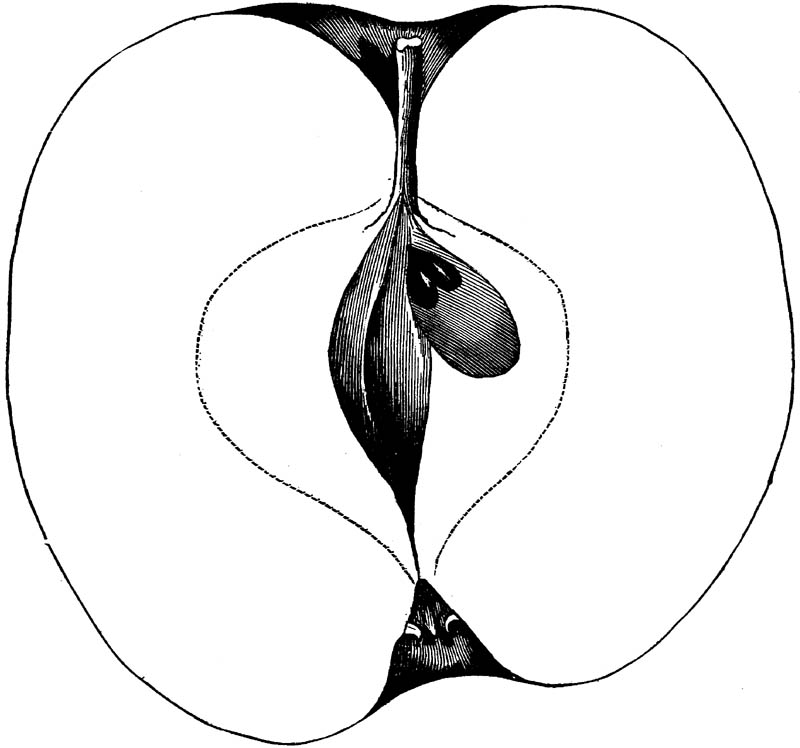
Fig. 265.—PENNSYLVANIA SWEETING.
Found in Southern Illinois. Origin and history unknown.
Fruit large, oblong, regular; Surface dull greenish-yellow; Dots numerous, dark, distinct.
Basin deep, abrupt, regular; Eye large, closed.
Cavity deep, acute, irregular; Stem medium.
Core irregular, large, open, clasping; Seeds numerous, small; Flesh tender, melting, fine-grained; Flavor very sweet; Quality good; Use, baking and stock; Season, early winter.
Wells' Sweeting.
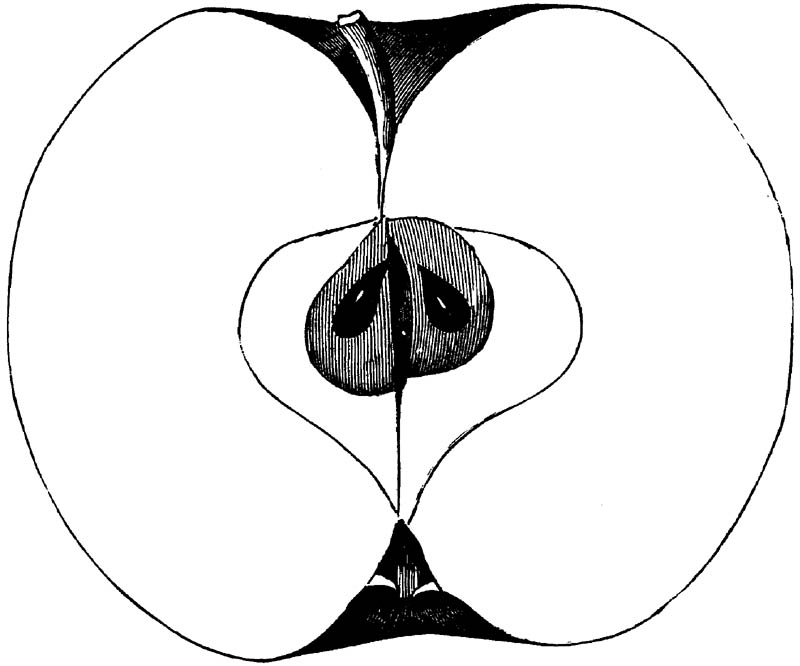
Fig. 266.—WELLS' SWEETING.
Origin and history unknown.
Fruit medium, round or oblong, regular; Surface smooth, white, some blush; Dots scattered, prominent.
Basin wide, regular, leather-cracked; Eye large, closed.
Cavity medium, regular, green; Stem medium.
Core pyriform, closed; Seeds numerous, angular, plump; Flesh white, firm, juicy; Flavor sweet; Use, baking and stock; Season, October and December.
CLASS IV.—OBLONG APPLES.
ORDER I.—REGULAR.
SECTION 1.—SWEET.
SUB-SECTION 2.—STRIPED.
Black Gilliflower.
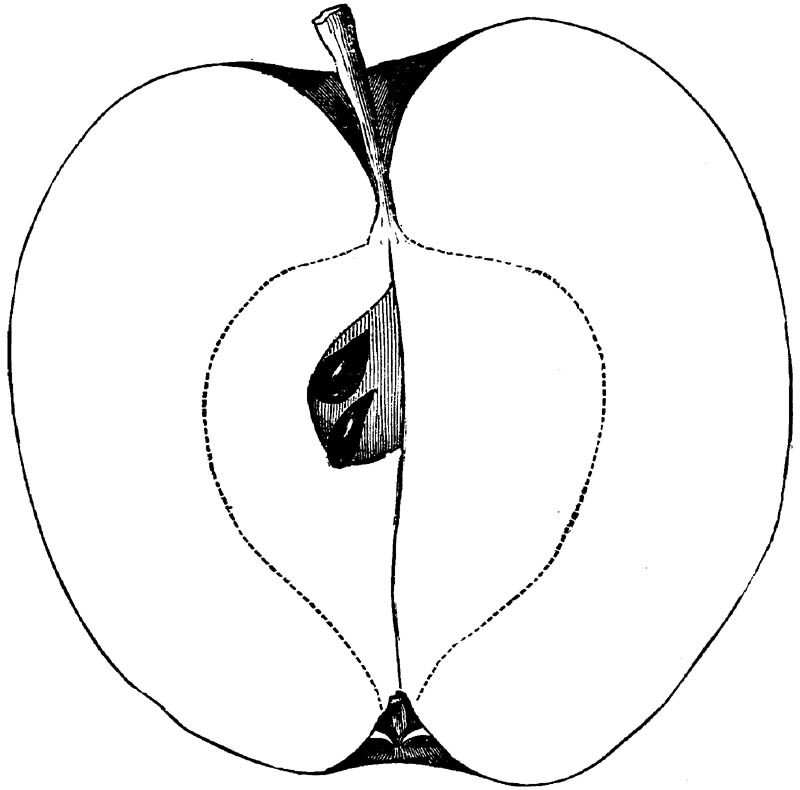
Fig. 267.—BLACK GILLIFLOWER.
An old variety, which cannot be very highly praised, for it is but an indifferent fruit, and yet, on account of its productiveness and keeping properties, it is considered profitable for orchard planting.
Fruit rather large, oblong-ovate, regular; Surface nearly covered with stripes of very deep red that make it look nearly black.
Basin very shallow, often plaited; Eye small, closed.
Cavity deep, acute, brown; Stem long, slender.
Core very large, oval, regular, meeting the eye; Seeds numerous, plump or imperfect; Flesh whitish, dry; Flavor only sweet; Use, essentially market, may be valuable for stock; Season, November to March.
Mother.
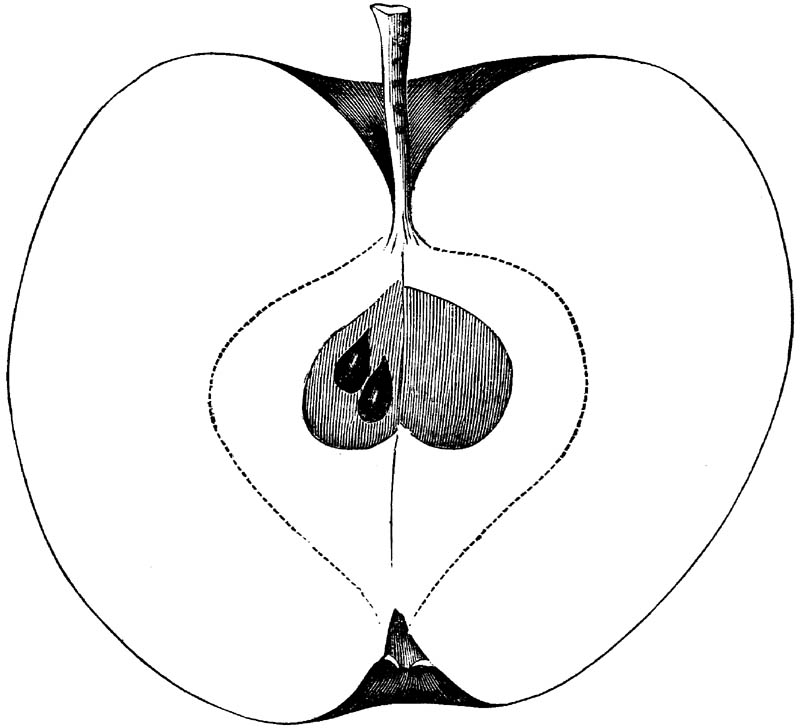
Fig. 268.—MOTHER.
Origin Bolton, Massachusetts. Tree rather slender, but productive.
Fruit medium to full medium, oblong, regular; Surface smooth, shaded red on yellow, with close, fine stripes of red; Dots minute.
Basin medium, regular or plaited; Eye long, small, closed.
Cavity acute, regular or wavy; Stem long, slender.
Core medium, turbinate, regular, closed, clasping; Seeds numerous; Flesh yellow, crisp, very fine-grained, juicy; Flavor sweet, very rich, vinous, aromatic; Quality best; Use, dessert; Season, October to January.
Ramsdell's Red.
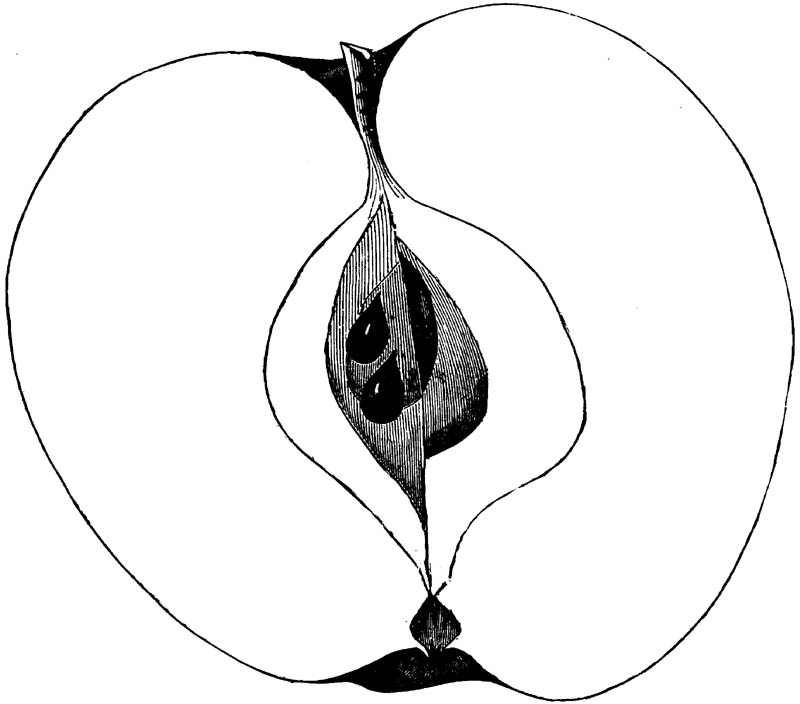
Fig. 269.—RAMSDELL'S RED.
Origin Connecticut. Tree vigorous, upright, many branches, productive, early bearer; Shoots slender, reddish; Foliage rather light green.
Fruit medium to large, oblong, regular, truncated; Surface smooth, yellow, hidden by bright red, mixed and striped; Dots numerous, yellow, distinct.
Basin rather deep, abrupt, wavy; Eye small to medium, closed.
Cavity deep, acute, wavy; Stem medium to long, often red.
Core large, oval, closed, clasping the eye; Seeds large; Flesh yellow, breaking, juicy; Flavor very sweet, rich; Quality very good; Use, baking and stock; Season, September to December.
CLASS IV.—OBLONG APPLES.
ORDER I.—REGULAR.
SECTION 1.—SWEET.
SUB-SECTION 3.—RUSSET.
Mansfield Russet.
"Brought into notice by Dr. Joseph Mansfield, of Groton, Massachusetts. Tree vigorous and very productive. Fruit small, oblong, inclining to conic; Skin cinnamon russet; Stem long, inserted in a deep, furrowed cavity; Calyx partially closed, set in an open basin; Flesh not very juicy, rich, aromatic, saccharine, vinous; Keeps until April and May."—[Downing.]
CLASS IV.—OBLONG APPLES.
ORDER I.—REGULAR.
SECTION 2.—SOUR.
SUB-SECTION 1.—SELF-COLORED.
Bailey's Golden.
"Origin Kennebec County, Maine. Tree productive; Fruit large, oblong, flattened at base and crown; Skin yellowish, slightly russeted, with a warm cheek; Stem short, surrounded by russet, in a broad, deep cavity; Calyx large and open, basin shallow; Flesh white, with a pleasant sub-acid flavor; January to March."—[Downing.]
Carolina Red June.
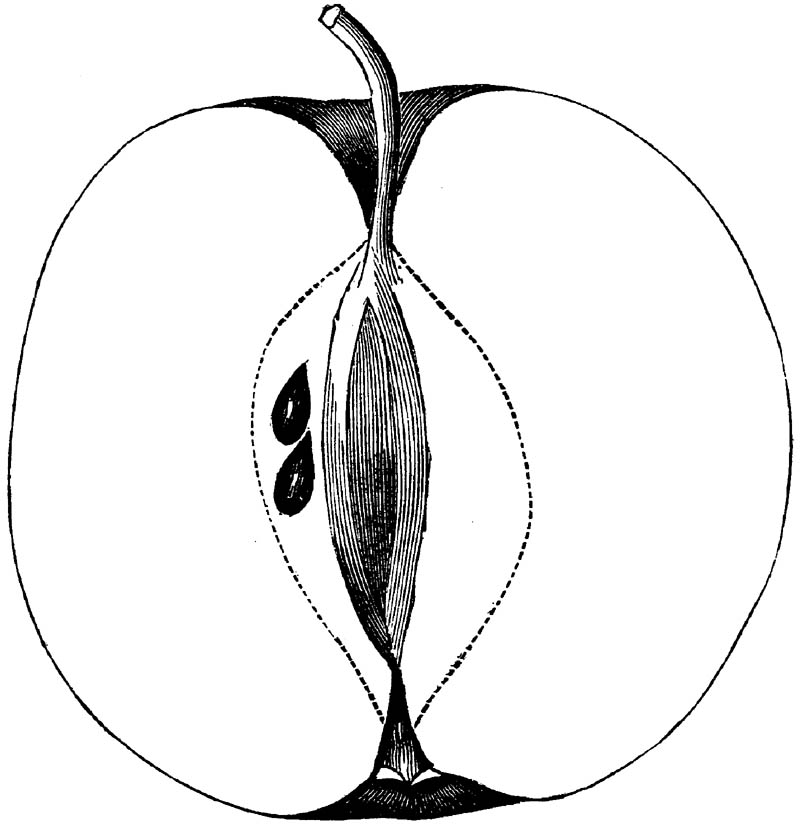
Fig. 270.—CAROLINA RED JUNE.
Origin southern, though long extensively grown in the North, and everywhere in the West a favorite early fruit.
Tree hardy, vigorous, healthy, upright, early bearer, productive; Shoots slender, dark; Foliage dark.
Fruit small to medium, form variable, but generally oblong-ovate, regular; Surface smooth, deep red on white, nearly universal; Dots minute.
Basin shallow, folded, plaited; Eye small, closed; Segments reflexed.
Cavity narrow, acute; Stem medium or short.
Core oval, open, meeting the eye; Seeds numerous, small, plump; Flesh white, very tender, fine-grained, juicy; Flavor sub-acid, not rich; Quality good; Use, table and market; Season, June and July—one of the earliest.
There is a striped variety, the Striped June, from Virginia, similar in every respect except the external markings. It is, of course, quite different from the Virginia June.—(Q. vide p. 500.)
Crawford Keeper.
This fruit was received from H.N. Gillett, Lawrence County, Ohio.
Fruit large, cylindrical, oblong, lop-sided; Surface smooth, purplish red; Dots numerous, fawn colored.
Basin wide, shallow, wavy; Eye small, closed.
Cavity acute, regular, rough, brown; Stem medium.
Core regular, open; Seeds numerous, brown; Flesh yellow, breaking, tender, fine-grained, juicy; Flavor sub-acid, rich; Quality good to very good; Use, table; Season, February to April. Very desirable.
Cumberland Spice.
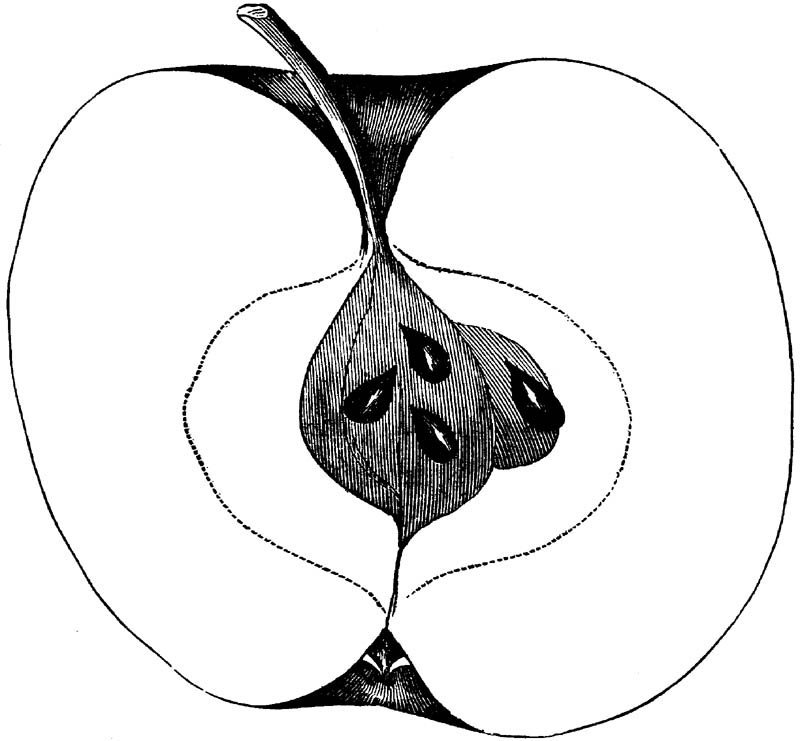
Fig. 271.—CUMBERLAND SPICE.
Origin New Jersey; not very extensively cultivated, for, though sometimes excellent, it is not found to be a profitable sort.
Fruit rather oblong, contracted toward the eye, or ovate, regular; sometimes the Axis is inclined; Surface pale yellow; Dots large, brown, scattered.
Basin shallow, regular or folded; Eye large, partially closed.
Cavity deep, acute; Stem generally long.
Core large, round, very open, not touching the eye; Seeds numerous, large, pointed; Flesh yellow, tender, breaking, juicy; Flavor acid to sub-acid, rich, aromatic; Quality good to best, but uncertain; Use, table, kitchen, not profitable; Season, October to December.
Curtis Greening.
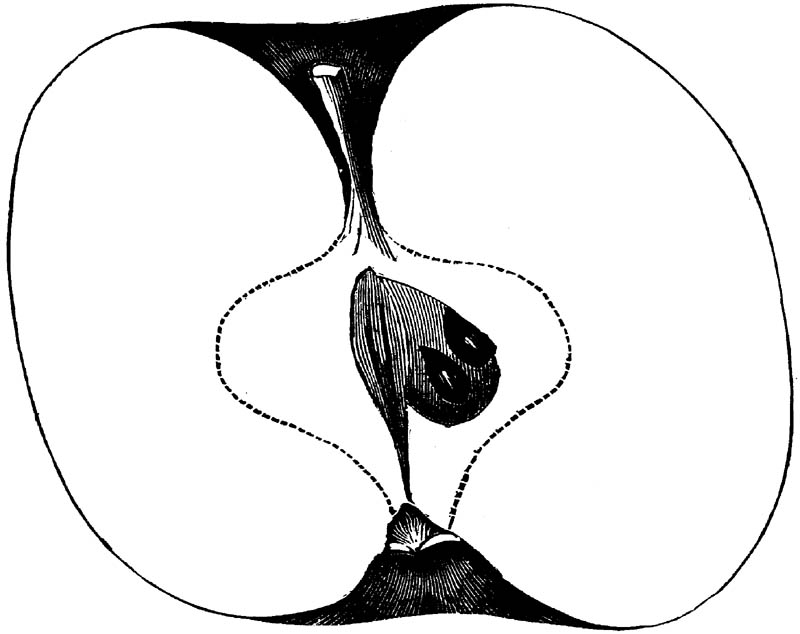
Fig. 272.—CURTIS GREENING.
This fruit was found in Illinois; origin uncertain.
Fruit medium to large, cylindrical, oblong, truncated; Axis inclined; Surface yellow, bronzy; Dots numerous, dark, indented.
Basin abrupt, wide, regular; Eye large, open.
Cavity deep, acute, regular; Stem short.
Core small, fig-shaped, closed, clasping; Seeds numerous, small, plump; Flesh yellow, breaking; Flavor sub-acid, rich; Quality good; Use, table and kitchen; Season, January and February.
Dawson's Cluster.
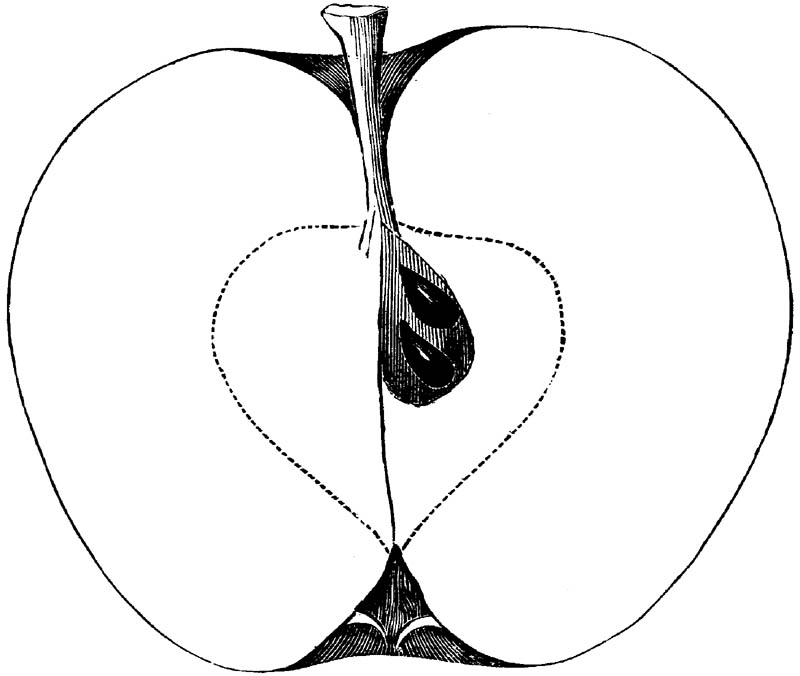
Fig. 273.—DAWSON'S CLUSTER.
From Clark County, Ohio.
Fruit full medium, oblong-truncate or ovate, regular; Surface smooth, pale yellow, blushed lightly with brown; Dots scattered, gray.
Basin abrupt, regular; Eye large, closed.
Cavity very acute, wavy; Stem long, with a knob.
Core medium, heart-shaped, regular, closed, clasping; Seeds numerous, plump, large; Flesh yellowish-white, fine-grained, tender, juicy; Flavor sub-acid; Quality good; Use, kitchen, but chiefly recommended for cider; Season, November. An enormous bearer.
Franklin Golden.[50]
HUGHES' AMERICAN GOLDEN PIPPIN.
Tree thrifty, upright, moderately productive; Fruit oblong, cylindrical; Surface smooth, yellow; Dots distinct, gray, not numerous.
Basin wide, shallow, finely plaited; Eye long, closed.
Cavity medium, greenish; Stem long.
Core small, pyriform, regular, closed, clasping; Seeds plump, pointed; Flesh yellow, tender, fine-grained, juicy; Flavor acid, rich; Quality very good; Use, table; Season, mid-winter.
A choice dessert fruit.
Grimes' Golden.
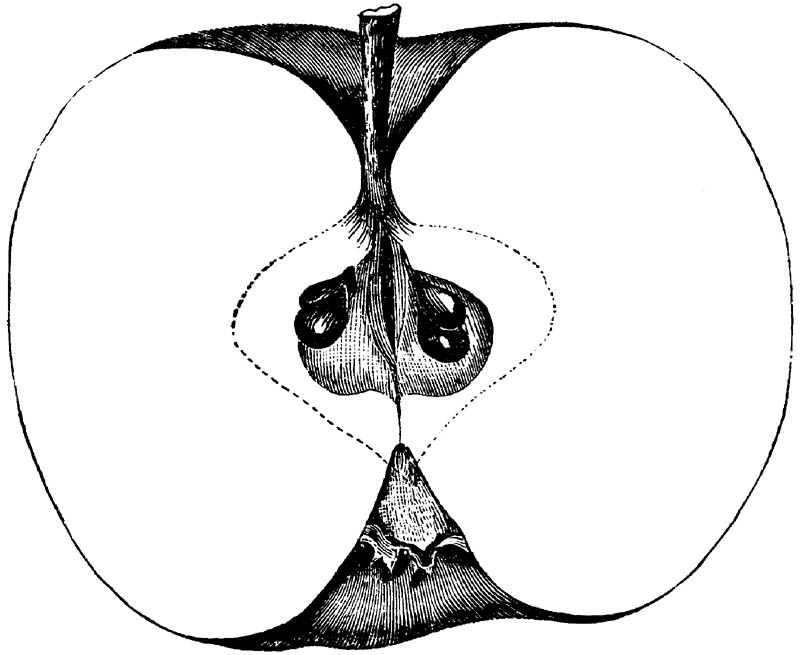
Fig. 274.—GRIMES' GOLDEN.
Another apple of similar and equally high character. Origin, Brooke County, Virginia. Introduced to the State Pomological Society by our zealous fellow member S.B. Marshall, Massillon, Ohio, who obtained it from N. Wood, of Belmont County.
Tree vigorous, healthy, spreading, productive, bears early; Shoots stout, dark; Foliage abundant, dark green.
Fruit full medium, cylindrical, regular; Surface yellow, vein-russeted; Dots numerous, minute.
Basin abrupt, folded; Eye large, closed.
Cavity wide, regular, green; Stem long, curved.
Core small, pyriform, closed, meeting the eye; Seeds numerous, plump, brown; Flesh yellow, firm, breaking, very fine-grained, juicy; Flavor sub-acid, aromatic, spicy, rich, refreshing; Quality very best; Use, dessert, too good for aught else; those who have tried it say that it is excellent for cooking; Season, January to March.
Kirkbridge White.
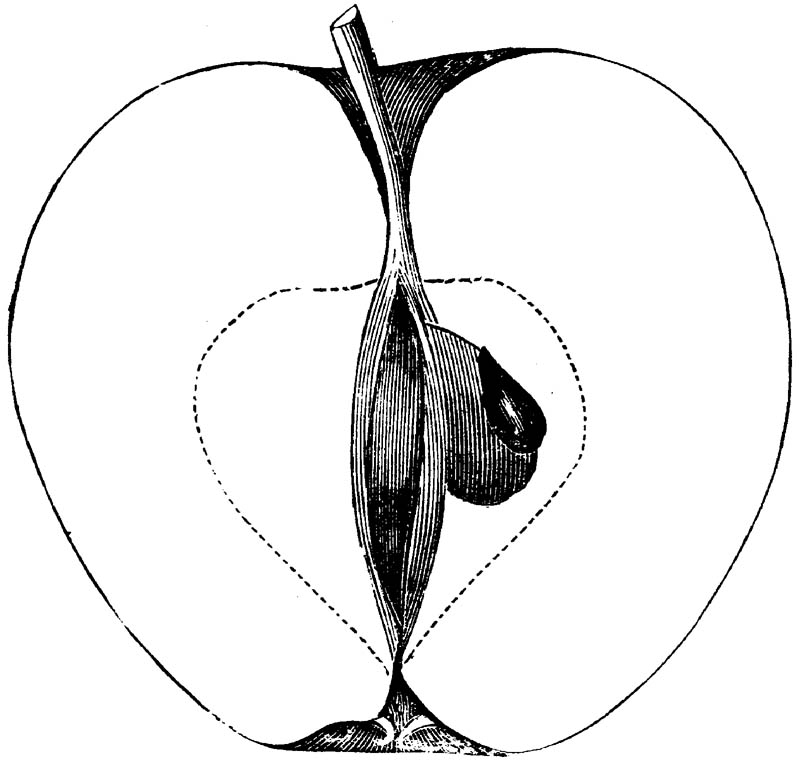
Fig. 275.—KIRKBRIDGE WHITE.
This fruit has been pretty extensively cultivated in some parts of the Western States, and sometimes mistaken for the Yellow June. Tree of moderate growth, bears early, productive.
Fruit small, oblong-conic, regular; Surface smooth, pale yellow or white; Dots minute, gray, scattered.
Basin small, shallow or abrupt, narrow, regular; Eye small, closed; Segments reflexed.
Cavity deep, acute, regular, brown; Stem long, slender, green.
Core medium, pyriform, regular, open, meeting the eye; Seeds numerous, plump, pointed, brown; Flesh white, fine-grained, tender, juicy; Flavor sub-acid; Quality very good; Use, table, market; Season, July, August, after Early Harvest.
Ortley.
WHITE BELLFLOWER, And Many Others.
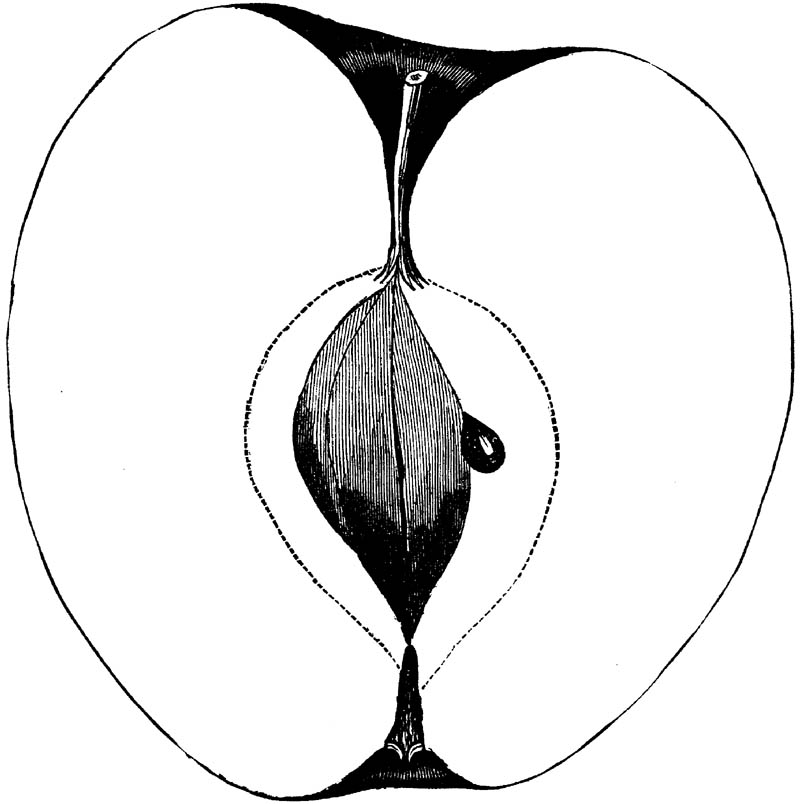
Fig. 276.—ORTLEY.
This excellent New Jersey apple has been cultivated very satisfactorily over a great extent of our country, and is still seen in some Western collections, exhibiting all its peculiar beauty, but in many places where it was a great favorite but a few years since, it has become so defective from scab and bitter-rot that it is rapidly disappearing from the nurseries and orchards.
Tree vigorous, healthy, upright, becoming large and spreading, very productive; Shoots stout, dark, bearing limbs brittle, and often broken by the fruit.
Fruit large, oblong, conic, truncated, regular; Surface smooth, pale yellow, rarely blushed light carmine, and red spots; Dots minute, indented, white bases seen only in the unripe fruit.
Basin medium, regular, plaited; Eye small, very long, closed.
Cavity deep, acute, regular, brown; Stem long, slender.
Core medium, oval, regular, open, meeting the very long eye; Seeds numerous, short, plump, pointed, dark, easily loosened, when they rattle in the large open capsules; Flesh yellowish, tender, breaking, juicy; Flavor acid to sub-acid, sprightly, refreshing; Quality best; Use, table, kitchen; Season, November to January.
The threatened failure of this fine fruit is much to be regretted. Its tissue is so fine as to suit even the invalid or convalescent, who could not safely partake of a more solid apple.
Porter.
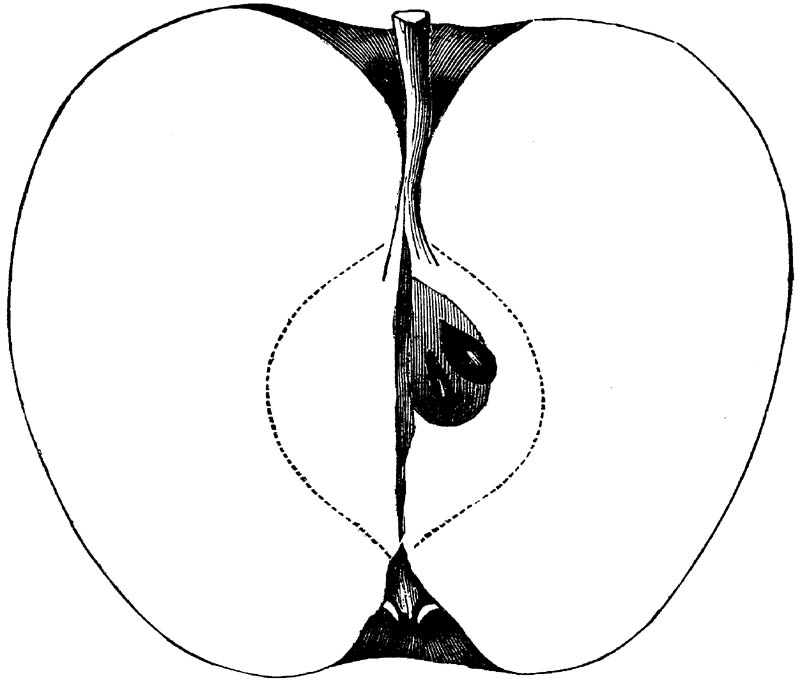
Fig. 277.—PORTER.
Native of Sherburne, Massachusetts. Tree vigorous, healthy, productive.
Fruit rather large, oblong, somewhat conic, often truncated; Surface smooth, yellow, often faintly blushed; Dots few, sunken.
Basin abrupt, folded; Eye large, closed.
Cavity acute, wavy, brown; Stem medium.
Core medium, oval, regular, closed, meeting the eye; Seeds numerous, plump; Flesh yellowish white, breaking, tender, juicy; Flavor acid to sub-acid; Quality good to very good; Use, kitchen, table, market; Season, August to October.
Spark's.
SPARK'S LATE.
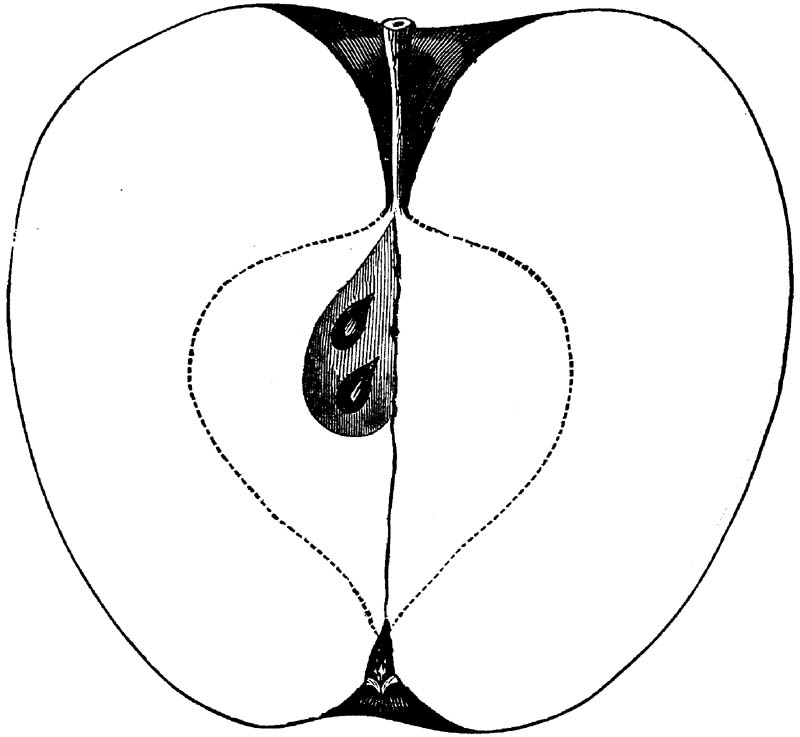
Fig. 278.—SPARK'S.
Fruited by Jas. H. Crain, of Undulation, Pulaski County, Illinois, on trees received from J.W. Felt & Co., Crystal Springs, Mississippi.
Special origin unknown, but believed to be southern. Tree vigorous, upright and productive; Shoots stout.
Fruit full medium to large, oblong, conic, regular, handsome; Surface greenish-yellow; Dots numerous, rather large, gray and rough.
Basin shallow, small, regular; Eye very small, closed.
Cavity deep, acute, regular, green; Stem medium to long.
Core medium, oval, closed, meeting the eye; Seeds numerous, plump; Flesh yellow, breaking, fine-grained, juicy; Flavor sub-acid, rich, very aromatic; Use, dessert especially; Season, December and January; Quality best.
CLASS IV.—OBLONG APPLES.
ORDER I.—REGULAR.
SECTION 2.—SOUR.
SUB-SECTION 2.—STRIPED.
Boalsburg.
"A seedling of Center County, Pennsylvania. Large, oblong, inclining to conical, delicately mottled, and striped with red on yellow ground; Stem short, thick, inserted in a deep, acuminate, russeted cavity; Basin deep, moderately wide; Flesh yellow, juicy, sprightly, refreshing; Very good; February."—[Ad interim Reports.]
Mr. Waring, of Tyrone, Pennsylvania, writes me that the Boalsburg has not proved to be productive, and that he has discontinued its propagation.
Cannon Pearmain.
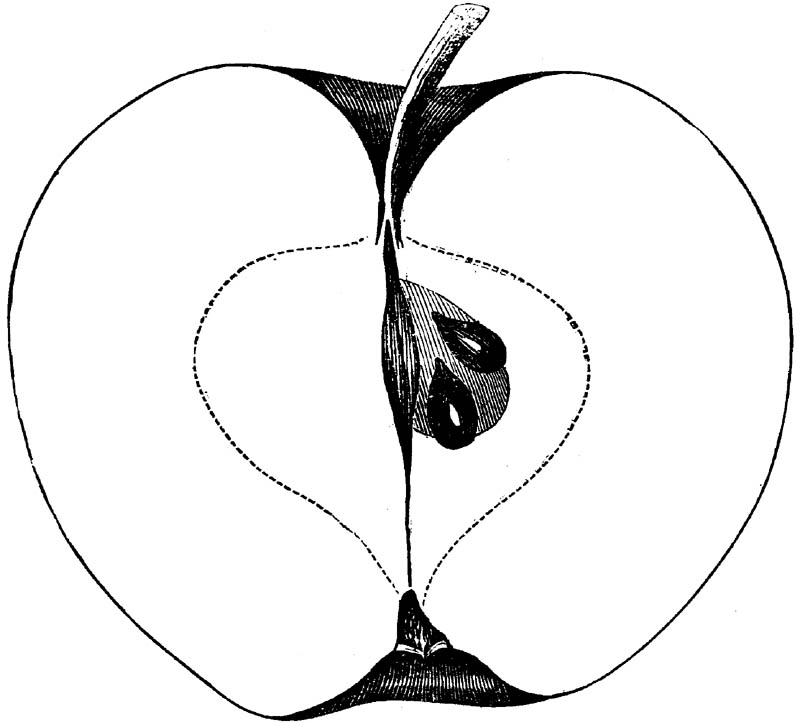
Fig. 279.—CANNON PEARMAIN.
A southern apple; probably from North Carolina. Grown to some extent in parts of the West, where it proves a substitute for the Ben Davis, keeping longer.
Tree vigorous, healthy, productive when old; Fruit medium, round, oblong or ovate, regular; Surface smooth, yellow, shaded red, faintly striped; Dots large, yellow, gray.
Basin deep, abrupt, regular, rarely wavy; Eye small, closed.
Cavity acute, often lipped; Stem long, slender, red.
Core medium, regular, oval, closed, clasping; Seeds numerous, long, pointed; Flesh yellow, firm, breaking; Flavor mild sub-acid; Quality only good; Use, market, kitchen, table; Season, January to April.
Cooper's Market.
"Tree vigorous, upright, with long, slender branches; productive and a late keeper.
"Fruit medium, oblong, conic; Skin yellowish, shaded with red, striped crimson; Stem short; Cavity deep, narrow; Calyx closed; Basin small; Flesh white, tender, with a brisk, sub-acid flavor; December to May."—[Downing.]
Fall Butter.—[L. Jones.][51]
There are many apples with this name, but my good friend Lewis Jones thinks this is the only genuine kind, and deserving the name from its adaptation to the making of apple butter. Found in a seedling orchard of Eastern Indiana, and a distinct sort.
Fruit large, handsome, globular; Surface smooth, greenish-yellow; Dots minute, prominent.
Basin regular, abrupt, brown; Eye medium, closed.
Cavity deep, narrow, green; Stem short.
Core medium, round, open, clasping; Seeds numerous, short, plump, dark; Flesh yellowish-white, breaking, fine-grained, juicy; Flavor sweet; Quality best for table, baking and apple butter; Season, December and January.
Hague.
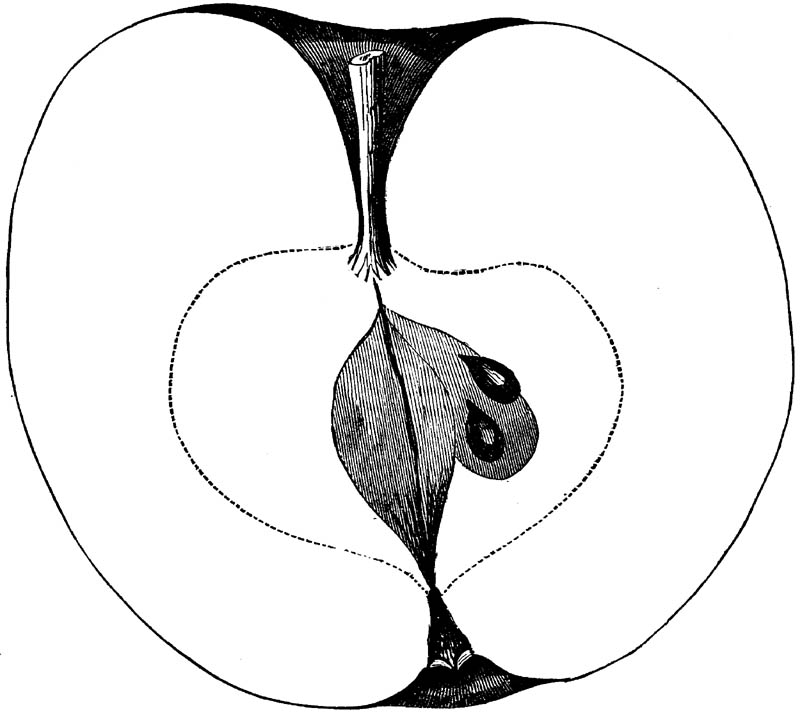
Fig. 280.—HAGUE.
Introduced by Lewis Jones, Wayne County, Indiana. Believed to be a seedling.
Fruit large, roundish, oblong, cylindrical, truncate; Surface smooth, greenish yellow, shaded more or less with red, striped and splashed deep red; Dots numerous or scattered, large, distinct, yellow.
Basin medium, regular; Eye medium, closed.
Cavity deep, acute, regular, brown; Stem short to medium, curved.
Core large, heart-shaped, regular, closed or open, clasping; Seeds numerous, short, pointed, plump; Flesh yellow, tender, fine-grained, juicy; Flavor sub-acid, aromatic, rich; Quality very good to best; Use, table, market; Season, December to February. Worthy of attention.
Herman.
"From Cumberland County, Pennsylvania. Tree vigorous, spreading, quite prolific.
Fruit medium, oblong, conic; fine red, striped on green, Flesh greenish white, tender, juicy, sub-acid, and high flavor; November to April."—[Saml. Miller, in Downing.]
Indiana Beauty.
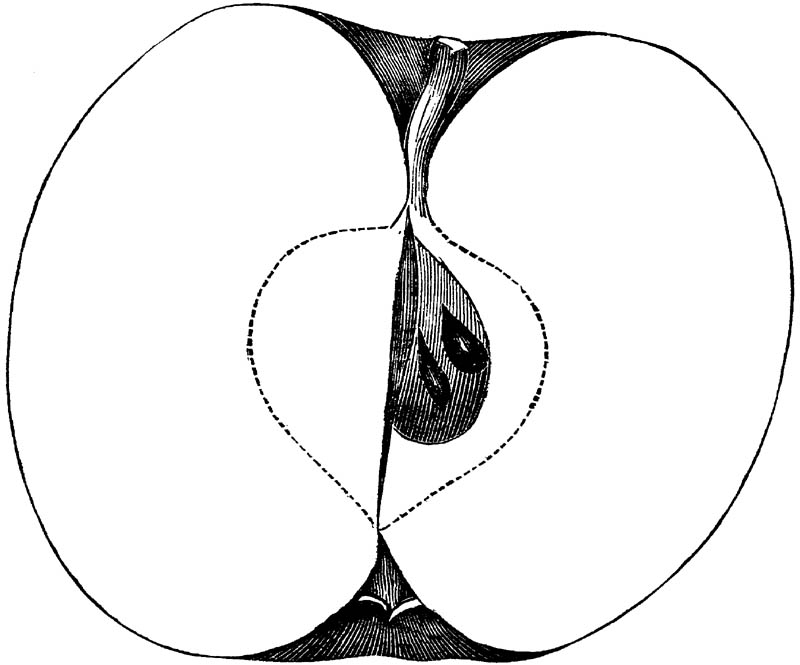
Fig. 281.—INDIANA BEAUTY.
This beautiful Indiana seedling always attracts attention by its external appearance, but it is not destined to become a general favorite.
Fruit large, cylindrical, oblong, unequal; Axis inclined; Surface very smooth yellow, partially covered mixed scarlet, splashed carmine; Dots numerous, small.
Basin deep, abrupt, folded; Eye medium to large, closed.
Cavity acute, wavy; Stem medium.
Core small, oval, closed, clasping the eye; Seeds numerous, long, pointed, imperfect; Flesh yellowish, breaking, juicy; Flavor sub-acid, aromatic; Quality only good; Use, market, kitchen; Season, September, November.
Jonathan.
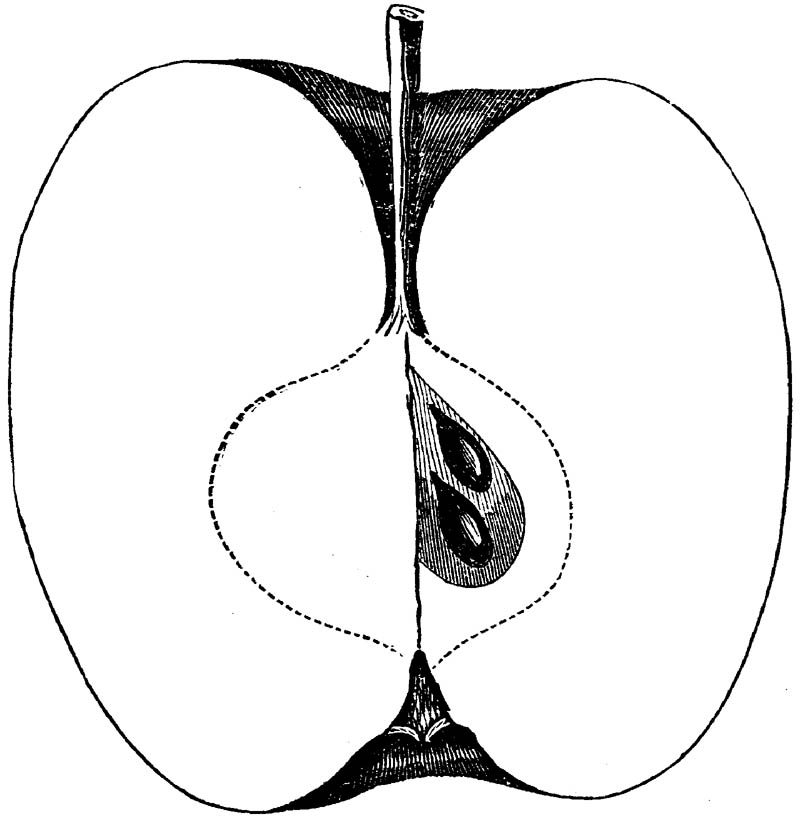
Fig. 282.—JONATHAN.
Origin, Kingston, New York. Described by Judge Buell. A very superior dessert fruit; good for all purposes, and seems to do well everywhere. Its excellence has caused it to be called, particularly, a gentleman's apple, though quite acceptable to the farmers' boys.
Tree of rather slender growth; hence top-grafted in the orchard and stock-grafted in the nursery to produce early results; Spreading, rather drooping, productive; Shoots slender, light brown, buds small; Foliage rather sparse, grayish.
Fruit medium, round or oblong, conic, truncated, regular; Surface very smooth, waxy yellow, wholly covered brilliant dark red, mixed and striped; Dots minute, russet-veined.
Basin deep, regular, russet-veined; Eye small, closed, green.
Cavity acute, deep, regular, reddish brown; Stem long, slender.
Core medium, roundish-oval, regular, closed, scarcely clasping the eye; Seeds numerous, large, angular; Flesh, whitish yellow, tender, breaking, very juicy; Flavor sub-acid, aromatic, equal to Spitzenberg; Quality best; Use, dessert, cooking, &c.; December, January.
Should be in every orchard.
Kaighn's Spitzenberg.—[Coxe.]
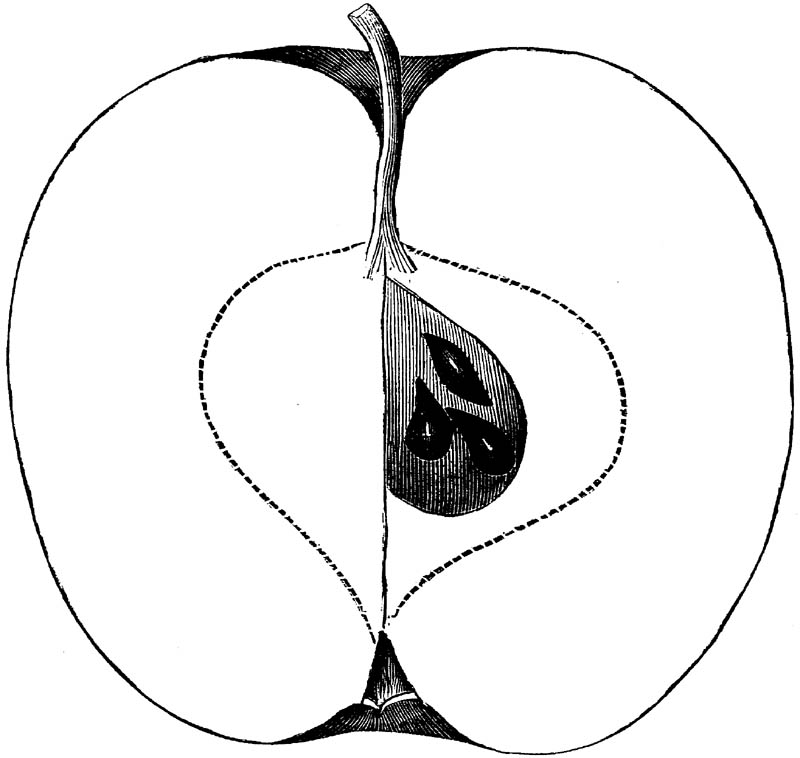
Fig. 283.—KAIGHN'S SPITZENBERG.
From Gloucester County, New Jersey. Tree spreading, very productive; Shoots slender.
Fruit large, handsome, oblong, slightly conic, truncated, regular; Surface smooth, yellow, striped crimson; Dots minute.
Basin deep, abrupt, folded or regular; Eye medium, closed; Segments reflexed.
Cavity deep, acute, regular, brown; Stem long, slender, red.
Core large, pyriform, regular, clasping, generally open; Seeds numerous, plump, angular, loose; Flesh yellow, breaking, juicy; Flavor acid to sub-acid, rather rich; Quality good for culinary use; Market and drying; Season, November, December.
Knowles' Early.
A favorite early apple about Philadelphia. Origin supposed to be Bucks County, Pennsylvania.
Tree medium, thrifty, very productive, early bearer.
Fruit small, conical, oblong, striped dull red on yellow.
Basin shallow, plaited; Eye small, closed.
Cavity acute, regular; Stem medium to long.
Flesh yellowish, very tender, juicy; Flavor mild sub-acid, aromatic, agreeable; Quality good; Use, table, kitchen; Season, July and August.
Long Island Pearmain.—[Coxe.]
AUTUMN PEARMAIN, Thompson, according to Downing.—WINTER PEARMAIN, Western markets.
An old variety found in all the early orchards of Ohio and Indiana, that were within the influence of Silas Wharton's nursery. A good, profitable variety that has been overlooked in the rage for novelties.
Tree large, spreading, very productive; Fruit full medium, round, elongated, tapering slightly from the base, always truncated at the apex, regular; Surface smooth, yellowish green, covered with dull red, and striped maroon; Dots numerous, minute, gray; russet-veined towards the base.
Basin regular, wide, rather deep, slightly leather-cracked; Eye medium, open; Segments long.
Cavity rather wide; Stem long.
Core medium, heart-shaped, regular, closed, not clasping; Seeds numerous, large, plump, brown;. Flesh yellow, breaking, firm, not very juicy; Flavor sub-acid, aromatic, rich, agreeable; Quality good; Use, family and market; Season, November till March.
Marston's Red Winter.
As I have never seen this fruit, I again quote from Downing:
"I received this beautiful apple from Nathan Norton, of Greenland, New Hampshire, who said the original tree was more than a hundred years old, and still standing.
"Tree hardy, of moderate growth, great bearer, and keeps as well as Baldwin, and by many preferred to that variety, and is a popular fruit in the neighborhood.
"Fruit above medium size, oblong, oval, inclining to ovate; Stem three-quarters of an inch long, rather slender, in a narrow, deep, compressed, slightly russeted cavity, sometimes with a lip; Calyx partially closed; Segments long, in a deep, corrugated basin; Color whitish yellow, shaded and striped with bright green and crimson, thickly sprinkled with minute dots; Flesh whitish yellow, very juicy, tender, sprightly, sub-acid flavor; December to March."
Mifflin King.
Origin Mifflin County, Pennsylvania. Fruit small, color of Rambo perhaps a trifle more red, oblong; Flesh remarkably tender, juicy and pleasant; First rate.—[American Pomological Society's Report.]
CLASS IV.—OBLONG APPLES.
ORDER I.—REGULAR.
SECTION 2.—SOUR.
SUB-SECTION 3.—RUSSET.
None.
CLASS IV.—OBLONG APPLES.
ORDER II.—IRREGULAR.
SECTION 1.—SWEET.
SUB-SECTION 1.—SELF-COLORED.
Sweet Bellflower.
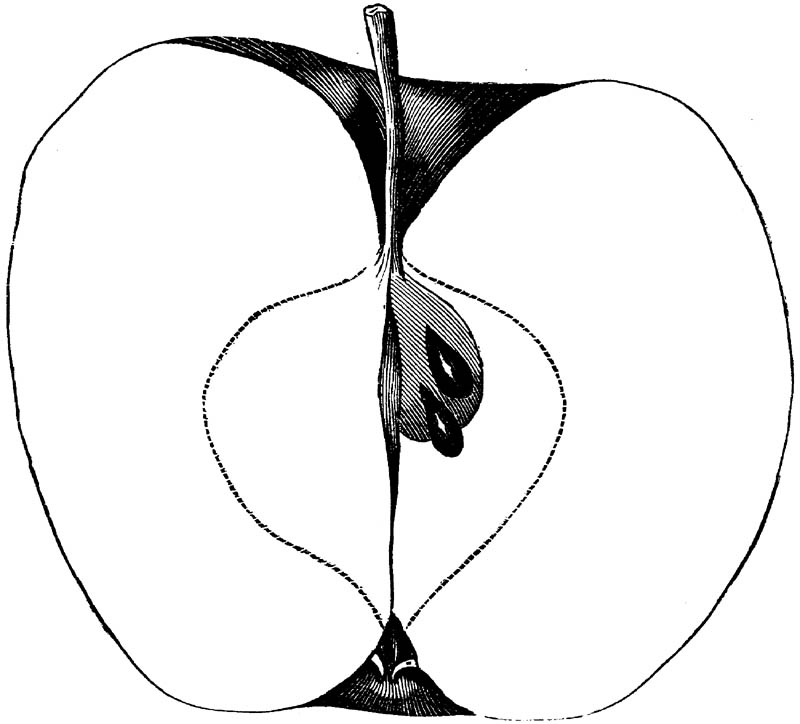
Fig. 284.—SWEET BELLFLOWER.
This apple is supposed to have originated in the neighborhood of Dayton, Ohio, and is cultivated chiefly in the adjacent regions, and when found elsewhere is traceable to this source.
Fruit large, roundish oblong, angular; Surface uneven, greenish yellow, becoming creamy yellow, very rarely blushed or bronzed; Dots minute, indented, surrounded by green in the unripe fruit.
Basin medium, folded; Eye small, closed; Segments long, reflexed.
Cavity acute, wavy, green; Stem long, slender.
Core regular, roundish, open, meeting the eye; Seeds numerous, plump, angular, imperfect; Flesh white, fine-grained, breaking, juicy; Flavor very sweet; Quality good to very good; Use, baking, table; Season, December.
Not equal to Broadwell.
CLASS IV.—OBLONG APPLES.
ORDER II.—IRREGULAR.
SECTION 1.—SWEET.
SUB-SECTION 2.—STRIPED.
Harnish.
"From Lancaster County, Pennsylvania. Fruit medium, oblong, oval, slightly angular; Skin mostly shaded with dark red, and sprinkled with grayish dots; Flesh compact, tender, not juicy, almost sweet, pleasant; September to October."—[Downing.]
Illinois Pumpkin Sweet.
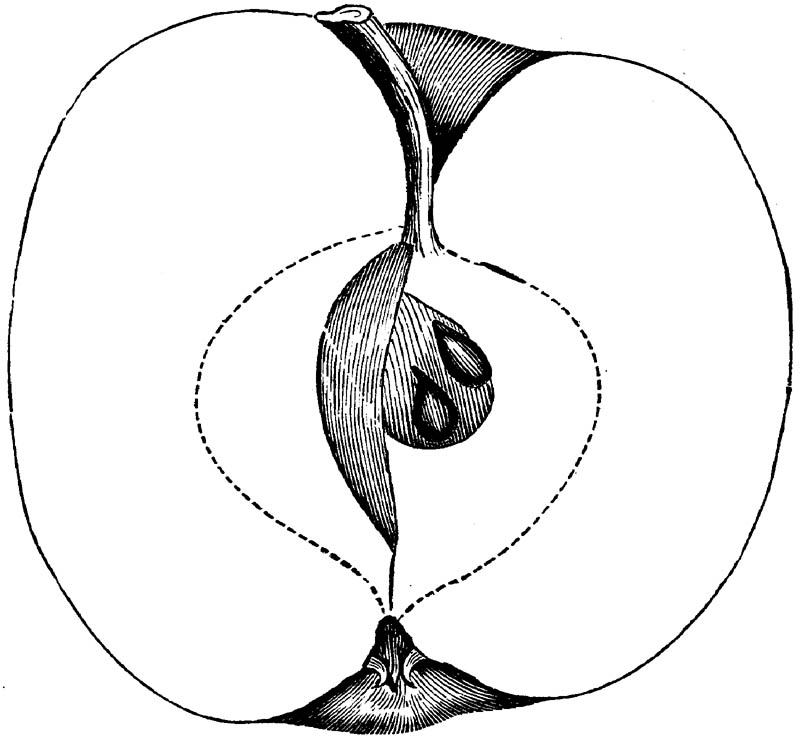
Fig. 285.—ILLINOIS PUMPKIN SWEET.
This apple was found in Illinois. From the orchard of Mr. Montagu, who esteemed it very highly.
Fruit medium, oblong, ovate, angular; Surface mixed, splashed and striped with dull red; Dots scattered, distinct, yellow.
Basin abrupt, folded; Eye medium, closed.
Cavity acute, folded; Stem medium, inclined.
Core medium, pyriform, regular, closed, clasping; Seeds numerous, angular, plump; Flesh yellow, rather tough in winter, but "becomes melting in June"; Flavor very sweet; Quality good, Montagu says best; Use, kitchen, table; Season, January till June.
CLASS IV.—OBLONG APPLES.
ORDER II.—IRREGULAR.
SECTION 1.—SWEET.
SUB-SECTION 3.—RUSSET.
None.
CLASS IV.—OBLONG APPLES.
ORDER II.—IRREGULAR.
SECTION 2.—SOUR.
SUB-SECTION 1.—SELF-COLORED.
Genesee Chief.
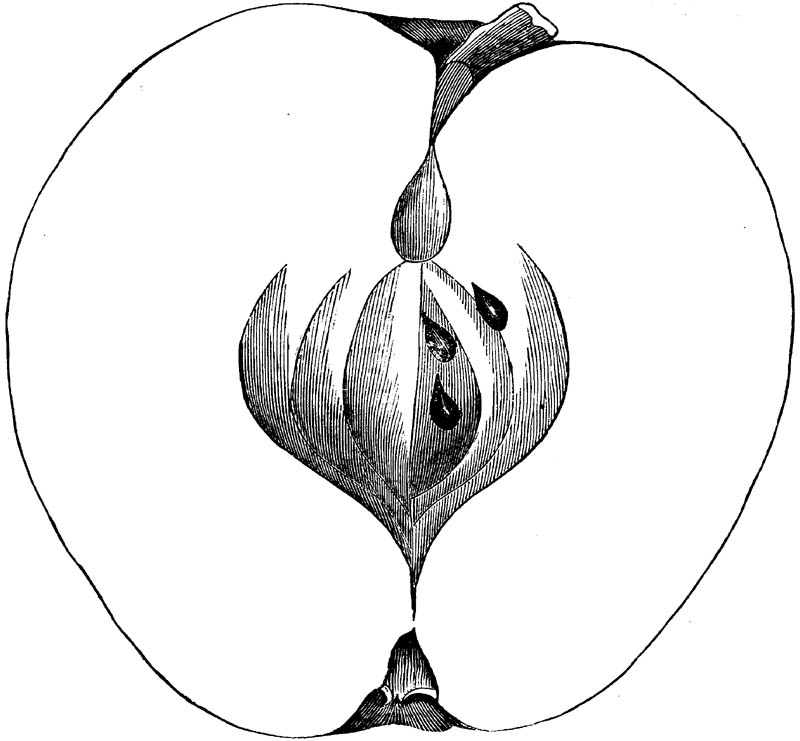
Fig. 286.—GENESEE CHIEF.
Fruit large to very large, roundish oblong, ribbed or angular; Surface smooth, pale yellow, sometimes bronzed; Dots scattered, minute.
Basin shallow, medium; Eye small, but very long, closed.
Cavity narrow, pointed, green; Stem medium, knobby.
Core very large, round, clasping, very open; Seeds numerous, defective, angular, brown; Flesh white, tender, breaking, juicy; Flavor acid, thin; Quality second rate—good only for cooking; Season, August.
Henwood.
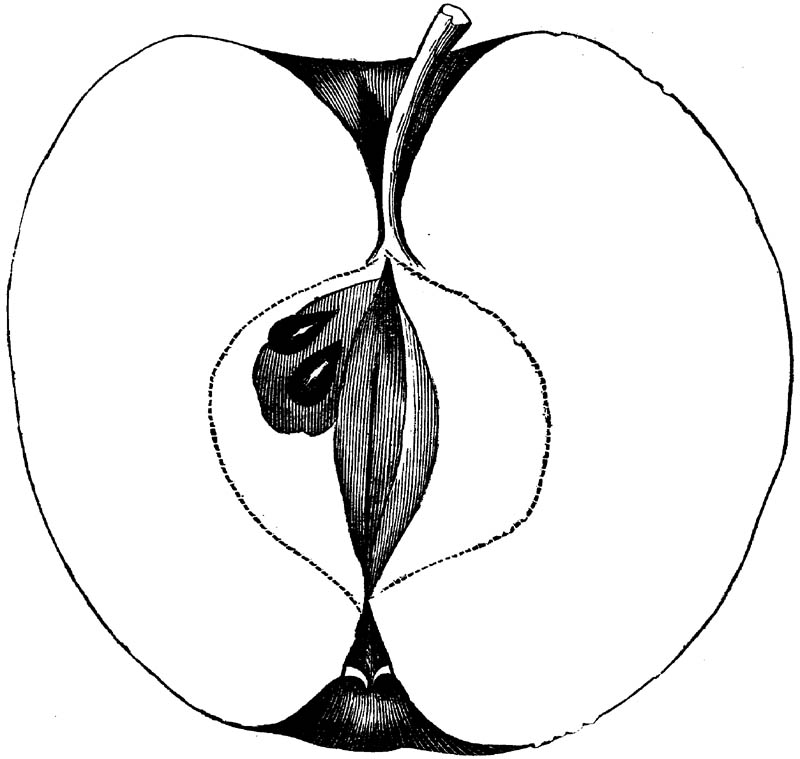
Fig. 287.—HENWOOD.
A seedling of Indiana. Brought into notice by Lewis Jones, of Wayne County, who has frequently exhibited the fruit, and distributed grafts of this excellent apple, which may compensate for the failure of its reputed parent, the Ortley.
Fruit large, oblong, conic or ovate, often angular or ribbed; Surface smooth, pale yellow, rarely blushed; Dots scattered, dark.
Basin shallow, often abrupt, folded or plaited; Eye small, closed.
Cavity deep, acute, wavy; Stem long, slender.
Core rather small, round, regular, open, meeting the eye; Seeds numerous, long, angular; Flesh yellow, tender, fine-grained, juicy; Flavor acid to sub-acid, rich; Quality very good to best; Season, December to February.
Keswick Codling.
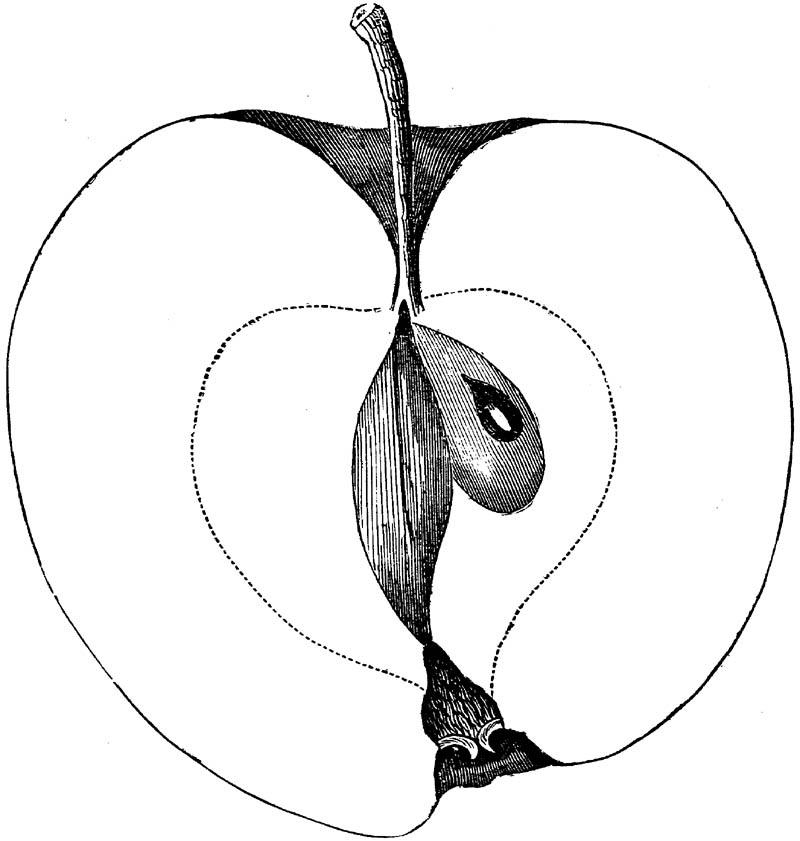
Fig. 288.—KESWICK CODLING.
An old English variety, which has greatly pleased the people of our country, who find it a valuable market and family fruit, particularly desirable in the North and Northwest.
Tree vigorous, hardy, productive, an early bearer; Shoots branching in a peculiar manner, dark.
Fruit medium, oblong, conical, truncated, ribbed; Surface smooth, pale yellow; Dots scattered, minute.
Basin medium, folded; Eye medium to large, closed.
Cavity acute, regular, browned; Stem long, yellow.
Core large, open, clasping; Seeds numerous, angular; Flesh greenish yellow, fine-grained, tender, juicy; Flavor acid; Quality good to very good for its use—cooking; Season, August to October.
The fruit may be cooked in June.
Newark Pippin.
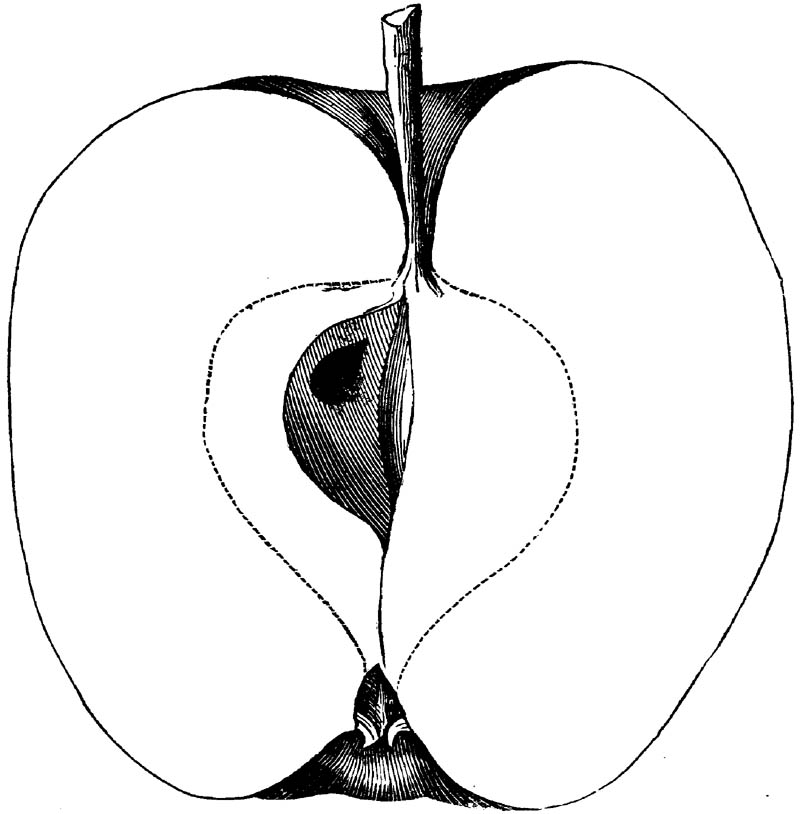
Fig. 289.—NEWARK PIPPIN.
Origin, New Jersey. Tree not large, brushy, limbs crooked, twiggy, drooping, not very productive or satisfactory.
Fruit above medium, oblong, cylindrical, truncated very abruptly, slightly angular; Surface smooth, rich yellow when ripe; Dots minute.
Basin wide, regular; Eye large, open.
Cavity wide, regular; Stem long, slender.
Core large, oval or pyriform, regular, closed, clasping; Seeds numerous, angular, plump; Flesh deep yellow, breaking, fine-grained, juicy; Flavor sub-acid, aromatic, rich, sprightly; Quality best; Use, dessert, cooking; Season, December to February.
A delicious fruit for amateurs, but its place is supplanted by Grimes' Golden, which is a much better tree, with fruit of similar good qualities, and better.
Rock Pippin.
RIDGE PIPPIN, LEMON, &C.
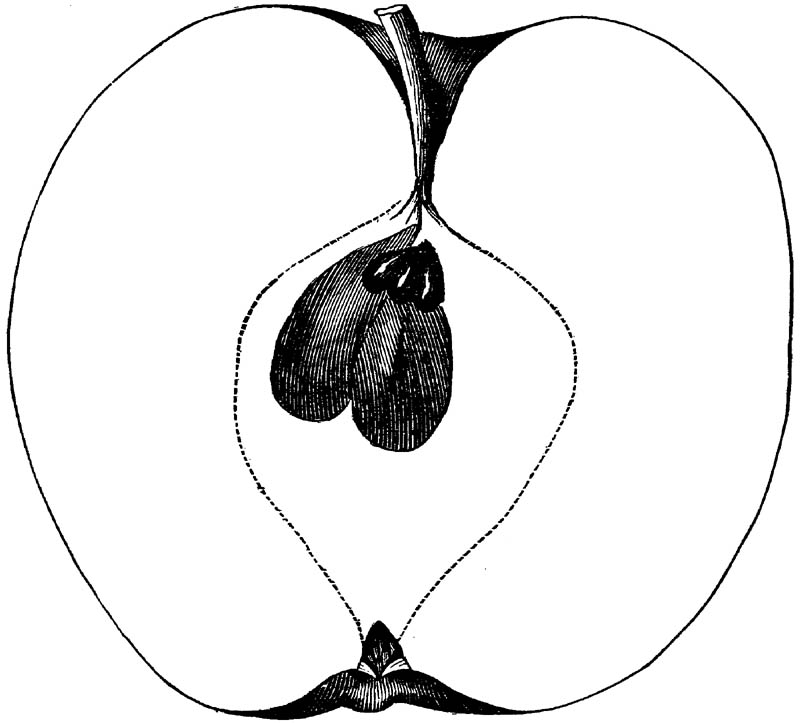
Fig. 290.—ROCK PIPPIN.
This admirable long-keeper has claims upon the attention of the commercial orchardist, on account of its soundness and beauty in the spring. Tree very thrifty, large, productive; Branches open, spreading; Shoots stout, dark; Foliage large, scattered.
Fruit full medium, oblong, ovate, angular, often ribbed, truncate at the apex, sometimes unequal; Surface very smooth, very rich yellow, blushed bright carmine when ripe; Dots few, small, dark.
Basin shallow, plaited or folded; Eye small, short, closed.
Cavity acute, often lipped; Stem medium.
Core medium, pyriform, open, somewhat clasping; Seeds numerous, long, brown; Flesh yellow, breaking, rather dry; Flavor acid to sub-acid, rich; Quality only good; Use, market and kitchen; Season, December to May; of most value to sell at the latter period.
Cooks well all winter.
Yellow Bellflower.
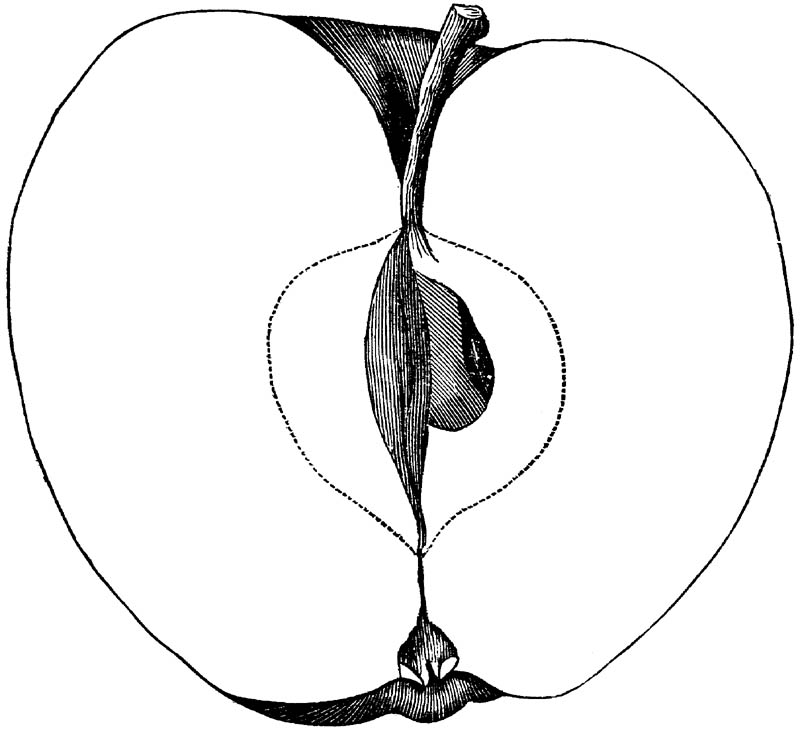
Fig. 291.—YELLOW BELLFLOWER.
This noble and valuable constituent of our orchards came from Burlington County, New Jersey, where it was first described by Coxe. This apple has succeeded in almost all parts of the country, North and South, and has proved remarkably hardy. The quality of the fruit varies with the soil, being best and most highly flavored and colored on exposed ridges of rather thin soil, while those on rich low bottoms or prairies are slow in bearing, and then produce very large fruit. The crops, however, are not always satisfactory in such situations, though the trees become very large; the blossoms are often destroyed by spring frosts.
Tree vigorous, thrifty, hardy, large, spreading, drooping; Twigs slender, brown; Foliage abundant, long, wavy; Blossoms very large, on long stems, exposed to the weather and not protected by the leaves.
Fruit large to very large, oblong, ovate, angular, ribbed; Surface smooth, rich yellow, sometimes blushed; Dots scattered gray.
Basin shallow or moderately deep, plaited or folded; Eye small, closed.
Cavity deep, acute or wide, wavy; Stem long, curved.
Core large, oval, open, clasping; Seeds dark, large, angular, imperfect; Flesh yellow, breaking, fine-grained, juicy; Flavor acid to sub-acid, aromatic, very rich and satisfying; Quality best; Use, table, kitchen, market; Season, December.
One of the finest culinary apples in the catalogue.
York Imperial.
From the neighborhood of York, Pennsylvania. Exhibited before the State Society at the meeting in Lebanon, 1855. Tree said to be healthy and productive.
Fruit large, rather oblong, somewhat angular; Surface smooth, mixed bright red on greenish yellow.
Basin wide, plaited; Eye medium, closed.
Cavity deep, wide; Stem short.
Flesh yellowish, tender, juicy; Flavor sub-acid, aromatic; Quality quite good; Use, market, kitchen; Season, January, February.