Chapter III · ToC
Reading edition
CHAPTER III.ToC
PROPAGATION.—SECTION I.
ALL GROWTH IS DEPENDANT UPON THE DEVELOPMENT OF CELLS—THE SEED AND THE BUD; THEIR RESEMBLANCE—THE INDIVIDUALITY OF BUDS—THE BASIS OF ALL PROPAGATION—BUDS ARE DEVELOPED INTO TWIGS; HAVE POWER OF EMITTING ROOTS—IMPORTANCE OF THE STUDY OF CELL-GROWTH—BY CUTTINGS: PREPARATION AND SELECTION—HEEL-CUTTINGS—SOFT WOOD—HARD WOOD—SEASONS FOR EACH—FALL PLANTING—THE CALLUS, OR DEVELOPMENT OF CELL-GROWTH—BOTTOM HEAT; WHY BENEFICIAL—WHY SPRING CUTTINGS FAIL—STIMULUS OF LIGHT UPON THE BUDS, CAUSES THEM TO EXPAND, AND THE LEAVES EVAPORATE TOO FREELY—ROOT CUTTINGS; DIFFERENT FRUITS THUS PROPAGATED—BY SUCKERS: OBJECTIONS TO ANSWERED—SUCKER ORCHARDS; BEAR EARLY—SUCKER TREES APT TO SUCKER AGAIN—BY LAYERS: A NATURAL METHOD—HOW PERFORMED—THE RASPBERRY AND THE GRAPE—ILLUSTRATIONS OF NATURAL AND ARTIFICIAL METHODS—QUINCE STOCKS—ADJUVANTS TO LAYERING, NOTCHING, ETC—BY SEEDS: HOW IT DIFFERS FROM THE OTHERS—APPLE SEEDLINGS—THEIR TREATMENT, SEPARATING, AND PREPARING THE SEED—APPARATUS—SPROUTING—SOWING—CULTIVATION—SEEDLINGS—TREATMENT—SORTING—PACKING.
All propagation of plants must depend upon the development of seeds or of buds, and all will arise from the growth and extension of cells. The seed and the bud are much more nearly related than a casual observer would at first sight suppose. The early phylologists thought they discovered that in the seed was enwrapped the image of the future tree—a dissection of the seed would appear to demonstrate this. It is composed of separate parts which are capable of being developed into the root, stem, and appendages, but they have yet to be so developed; the several parts that we find in the seed are merely the representative parts. But the seed has the future of the tree within itself, it has certain qualities of the future tree impressed upon it in its primary organization, within the capsule of the fruit of the parent plant, so that in a higher sense the image of the future tree does exist within the seed. Within the bud, still more plainly and more distinctly visible, is the future tree manifest, and we may produce a tree from a bud as certainly as we do from a seed. Subjected to circumstances favorable for growth, the bud, as well as the seed, will emit roots, will form its stem, branches and appendages, and will become a tree; differing from the product of the seed only in this, that in the latter the resulting organism constitutes a new individual which may vary somewhat from its parent, in the former it is only a new development of a part of a previously existing organization. The similarity existing between the two is exceedingly close, and is a matter of great importance in horticultural operations. Dr. Lindley, in the Gardener's Chronicle, says very truly, that "every bud of a tree is an individual vegetable, and a tree, therefore, is a family or swarm of individual plants, like the polype with its young growing out of its sides, or like the branching cells of the coral insect." Similar opinions, more or less modified, have been expressed by subsequent physiologists, and are familiar to men of science in every country and, we may add, are also universally accepted as true by all who claim a right to express an opinion upon the subject.—Men of science recognize the individuality of buds.—Nobody doubts the individuality of buds.—In a gardening aspect, the individuality of buds is the cardinal point upon which some of our most important operations turn; such, for example, as all modes of propagation whatever, except by seed. If this be not fully understood, there is no possible explanation of the reasons why certain results are sure to follow the attachment of a bud, or the insertion of a graft, or the planting of a cutting, or the bending of a layer, or the approach of a scion, or the setting of an eye—our six great forms of artificial multiplication. In his Elements of Botany, the same writer says: "An embryo is a young plant produced by the agency of the sexes, and developed within a seed—a leaf bud is a young plant, produced without the agency of the sexes, enclosed within the rudimentary leaves called scales, and developed on a stem." "An embryo propagates the species, leaf-buds propagate the individual." He shows each to be "a young plant developing itself upwards, downwards and horizontally, into stem, root, and medullary system."
Dr. Schleiden thus beautifully expresses his views of their individuality: "Now the bud essentially is nothing more than a repetition of the plant on which it is formed. The foundation of a new plant consists equally of a stem and leaves, and the sole distinction is that the stem becomes intimately blended at its base with the mother plant in its growth, and has no free radical extremity like that exhibited by a plant developed from a seed. However, this distinction is not so great as at the first glance it appears. Every plant of high organization possesses the power of shooting out adventitious roots from its stem, under the favoring influences of moisture; and very frequently, even plants that have been raised from seed, are forced to content themselves with such adventitious roots, since it is the nature of many plants, for instance the grasses, never to develop their proper root, although the radicle is actually present. We are, it is true, accustomed to look upon the matter as though the buds must always be developed into twigs and branches, on and in connection with the plant itself; and thus in common life, we regard them as parts of a plant, and not as independent individuals, which they are in fact, although they, like children who remain in their paternal home, retain the closest connection with the plant on which they were produced. That they are at least capable of becoming independent plants, is shown by an experiment frequently successful when the necessary care is taken, namely the breaking off and sowing of the buds of our forest trees. The well-known garden operations of grafting and budding are also examples of this, and layering only differs from the sowing of the buds, in that the buds on the layers are allowed to acquire a certain degree of maturity before they are separated from the parent plant. All here depends upon the facility with which these bud plants root as it is called, that is develop adventitious roots, when they are brought in contact with moist earth. * * * Nature herself very often makes use of this method to multiply certain plants in incalculable numbers. In a few cases, the process resembles the artificial sowing of buds, as when the plant spontaneously throws off the perfect buds at a certain period; an instance of this is afforded by some of our garden Lilies, which throw off the little bulb-like buds which appear in the axils of the lower leaves. The more common mode of proceeding is as follows: Those buds which have been formed near the surface of the soil, grow up into shoots provided with leaves; but the shoots are long, slender and delicate, the leaves too are stunted into little scales; in their axils, however, they develop strong buds, which either in the same or in the following year take root, and the slender shoot connecting them with the parent plant, dying and decaying, they become free independent plants. In this manner the strawberry soon covers a neglected garden."[12]
Upon the development of a cell in any living tissue, and its power of reproducing other cells, and upon its function of communicating by endosmosis and exosmosis with other like cells, depend all our success in propagating vegetables, whether from seeds or buds, and parts containing these. We must study the circumstances that favor the development of cells, if we would be successful in propagating plants. Each bud being considered an individual, and capable, under favorable circumstances, of taking on a separate existence, we can multiply any individual variety indefinitely, and be sure of having the same qualities of foliage and fruit that we admire in the original, and that we may desire to propagate. This applies equally to a group of buds, as in cuttings, grafts and layers, etc.; but, more wonderful still, there are cells capable of developing buds where none existed before, and even in tissues or parts of a plant where we do not usually find buds—hence we have a mode of propagation of many woody plants, by root cuttings, and by leaves, and even parts of leaves.
Propagation by Cuttings.—Many fruits are multiplied by this means. Healthy shoots of the previous year's growth are usually selected and taken when the parent is in a dormant state, or still better, when it is approaching this condition. Sometimes a small portion of the previous year's growth is left with the cutting, making a sort of heel; when this is not to be had, or not preferred, the slip is to be prepared for planting by cutting it smoothly just below a bud, as this seems to be the most favorable point in many plants for the emission of roots. Some plants will throw out radicles at any point indifferently along the internodes or merithallus. The preference for heel-cuttings depends upon the fact, that near the base of the annual shoot there are always a great number of buds, many of which, however, being imperfectly developed, are inconspicuous, but though dormant, they seem to favor the emission of rootlets. Cuttings may be made to grow if taken at any period of their development, but when green and soft, they require particular conditions of heat and moisture in the soil, and atmosphere, that are only under the control of the professional gardener. They are usually taken in the dormant state, because they are then susceptible of being made to grow under the ordinary conditions of out-door gardening. If cut early in the season, on the approach of autumn, after the wood-growth has been perfected, they may be planted at once with good prospect of success, or they may be put into the soil, out of doors, in the cellar, or in a cold frame or pit, and a very important step in the progress of their growth will commence at once. The leafless sticks are not dead, and whenever the temperature will admit of the quiet interchange of fluids among their cells, this curious function will go on, and will be accompanied by the development or generation of new cells that soon cover the cut surfaces, constituting what the gardeners call the callus. This is the first step toward growth, and it most readily occurs when the earth is warmer than the air; hence the value of fall planting, whether of trees or of cuttings, if done before the earth has been chilled, and hence also, the importance of bottom heat in artificial propagation. If on the contrary the air be warm and the ground cold, the buds are often stimulated to burst forth, before the rootlets can have started. The expanding foliage which so delights the tyro in propagation, offers an extended surface for evaporation, the contained juices of the cutting itself are soon exhausted, no adequate supply is furnished, and the hopeful plant soon withers, or damps off, and dies.[13] The cutting, like the seed, must have "first the root, then the blade." The length of time that is allowed for cuttings to prepare for rooting, if they are designed for spring planting, should be as great as possible, and the circumstances under which they are kept should be such as to favor the development of the cells, so that roots may form freely with the breaking of the buds, if not before.
Root-cuttings should be made in the spring, just before the usual period of the bursting of the buds in the plant to be propagated. The tendency to develop buds appears to be then most active. Gentle bottom heat, though not essential, is still very desirable, and will conduce to the success of the operation. Some plants are best propagated by this means, and those too, which never naturally produce suckers, may often be successfully grown by sections of the roots. All plants do not equally admit of propagation by division as cuttings, some woody tissues refusing to emit roots under almost any circumstances.
Nobody thinks of propagating the stone fruits, such as the cherry, plum, peach, or apricot, by attempting to plant cuttings, and yet some of these will emit roots very freely, as we may often observe when the shoots or trimmings are used as supports for plants in the green-house. The plum tree is exceedingly apt to form new roots when planted too deeply, and upon this fact depends the success or failure of the finer varieties when worked upon certain varieties of the wild stock. If the young trees are earthed up in the nursery, and set rather deeply in the orchard, they will soon establish a good set of roots of their own, emitted above the junction of the scion and stock, which is very preferable to the imperfect union and consequent enlargement that often results from using uncongenial stocks. The raspberry and blackberry do not grow so well from cuttings of the wood, which is always biennial in this genus, as they do from root-cuttings.
In some parts of the country, peaches are mainly produced, or the favorite varieties are multiplied, by planting the sprouts that come from the base of the trunk of the trees; these have little or no roots when taken off with the mattock, but they soon establish themselves and make good trees, bearing fruit like their parents, in soils and climate that are well adapted to this fruit.
Refined and scientific horticulture has been extensively applied to the multiplication of the grape, which is now produced in immense numbers, from single eyes, or buds. Formerly our vineyards were formed by planting long cuttings at once in the field in the stations to be occupied by the vines, or by setting them first in a nursery, whence they were transplanted to the vineyard, when one or two years old. Only the most refractory kinds, which would not grow readily in the field, or such as were yet rare, were propagated from cuttings, by using the single eye and artificial bottom heat. Now, however, the appliances of our propagators are called upon for the production of grape-vines by the million, and they find it advisable to multiply all the varieties in this manner. The propagation of the grape by using single eyes affords the most beautiful illustration of the subject of the individuality of buds, and though denounced by some as an unnatural, steam-forcing process, it is really an evidence of the advance of horticulture, since every step is supported by a philosophical reason, and the whole process, to be successful, is dependent upon the application to practice of well established scientific truths.
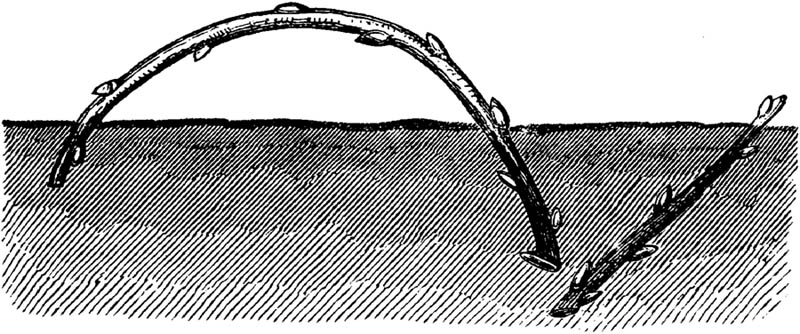
Fig. 1.—FRENCH AND COMMON MODES OF SETTING CUTTINGS.
It has already been stated that the first effect of cell-growth upon a cutting, is the production of a callus. This callus may form upon any cut surface, or even where the bark has been abraded. It is the first effort of nature to repair an injury by the reproduction of new parts; it is most generally found at the base of the cutting, but under favorable circumstances, it will be seen also at the upper end of the shoot if this has been placed in contact with the earth. Cuttings will sometimes be set up-side down, when we find the callus upon the smaller end, and roots will be emitted from that portion whence we should have expected to see the branches issue. Upon this fact, and to multiply the chances of living, has been based the French method, as it is called, or that of inserting both ends of the cuttings. The common mode, (fig. 1), is to set the cuttings in a slanting direction in the ground, so placed that the upper eye or bud only shall reach the surface. Formerly there was a preference for long cuttings, and these were often made eighteen inches or more in length. The practice with most of our cultivators has been modified in this particular, and they have reduced the length of the slips to six and eight inches, so as to have in grape wood about three or four eyes. Some have gone still further, and use but two, even for out-door planting of the grape, and some have been very successful when using but a single joint. The Germans have advocated longer cuttings, upon the theory that there was a retroaction in the pith of the internodes and in all the buds of the cutting, upon the lower point, enabling it to push roots more strongly from a long than from a short cutting. This theory has for its support the fact, that there is in such a cutting a larger amount of organizable matter to be developed into the new parts to be produced, and certainly, if neglected, short cuttings will be very apt to suffer from drought, but in practice, it is found that the short cutting plants have better roots, which are near the surface, and even those plants, grown from single eyes, are better burnished than long cuttings produced upon the old plan, which placed the roots deep in the soil.
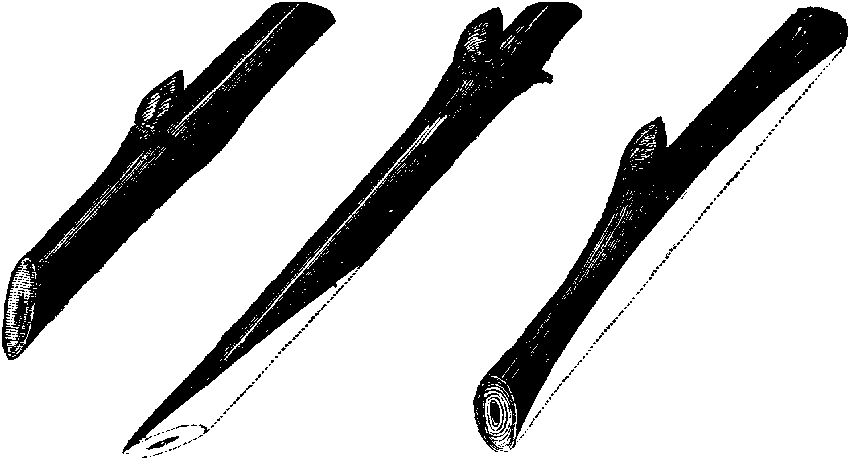
Fig. 2.—ONE-EYE CUTTINGS OF THE GRAPE.
There are various methods of preparing the single-eye cuttings, some of which are represented in fig. 2.
Among our cultivated fruits there is but a limited number that need to be propagated by cuttings, though, where it becomes necessary, many of them may be grown in this manner, to which procedure there are no serious objections, though there are some of a theoretical nature. The currant and the gooseberry are increased almost exclusively from cuttings, they strike root very readily, and are multiplied to any extent; their seeds are sown only to produce new varieties. The grape is propagated very extensively by cuttings; the slips are often planted in the field and in the stations where the vines are wanted for the vineyard; but some varieties are so unsatisfactory in their results, that other more elaborate and scientific means must be taken for their propagation. Among the larger fruits, those constituting our trees, we do not depend upon cuttings, except in the quince, which is not only grown for its fruit, but is also largely produced as a stock for the dwarfed pear, and is extensively propagated from cuttings. The Paradise apple, a dwarf stock, is multiplied in the same way. Pears and apples may be grown from cuttings, but this plan is not pursued with them to any extent. Those that are root-grafted, or budded very low, especially the pear on quince stocks, will often produce roots if favorably situated, but there is a great difference in varieties, some rarely produce a root, while others are very prone to do it; from observations of this fact, a new phase of dwarf-pear culture has been inaugurated.
Suckers.—One of the simplest methods of multiplying varieties consists of increasing and encouraging the suckers thrown up by the roots; these are separated and set out for trees. We have been told by some physiologists that there was an absolute difference in structure between the root and the stem, that they could not be substituted the one for the other; and yet the oft quoted marvel of the tree which was planted upside down, and which produced flowers and leaves from its roots, while its branches emitted fibres, and became true roots, is familiar to every one. Here, as in other cases, our teachers have led us into error by attempting to trace analogy with animal anatomy and physiology, and by directing our attention to the circulation of plants, as though they, like the higher animals, possessed true arterial and venous currents of circulating fluids. The cell circulation is quite a different affair, and can be conducted in either direction, as every gardener knows who has ever layered a plant, or set a cutting upside down. So with the roots—they are but downward extensions of the stem; under ordinary circumstances they have no need for buds, but these may be, and often are developed, when the necessity for their presence arises. Buds do exist on roots, especially upon those that are horizontal and near the surface, and from them freely spring suckers, which are as much parts of the parent tree as its branches, and may be planted with entire certainty of obtaining the same fruit, just as the twigs when used as cuttings, or scions, when grafted, will produce similar results.
Whole orchards are planted, in some sections of the country, with the suckers from old trees; apples, pears, plums, and even peaches, as well as raspberries and blackberries, are multiplied in this primitive way. There are some varieties of apples that have been so propagated for half a century, and extended for hundreds of miles in this way by the pioneer emigrants, without ever having been grafted, until their merits have at length accidentally become known to the Pomological Societies and nurserymen, when the propagation of them by grafting soon supercedes the more primitive method. Sucker trees are objected to upon the grounds that they are not healthy and thrifty, that they do not have good roots. Inherent disease of the parent tree will of course be transmitted with its other peculiarities, but I cannot imagine that this would be any more likely to occur in a sucker than in a layer, or cutting, or graft. As to the roots, they may be more developed upon one side than another in the young tree, and this state of things may continue in the adult; we often observe the same condition in the stumps of the monarchs of our forests, which were never suspected in the day of their glory and pride of having such a fault. But such a condition of roots is not essential to the sucker, which may be made to have as fine a system of lateral roots, and as evenly and regularly distributed as those of a seedling tree. Another objection to this mode of propagation has much truth and some force; that is, that suckers are very apt to produce suckers again. This is particularly the case with the Morello cherry, which is a favorite stock, upon which to work many of the choice varieties. As an offset to this it may be urged, that the small fibrous roots, which are supposed to conduce to early fruitfulness, abound in trees propagated by this means, and this may be the reason why the fruit trees that have been thus multiplied, are very generally remarkable for their precocious fruiting. Some of the apples that have been long increased in this manner, bear so early, and so bountifully, as to prevent them from ever forming very large trees; they often have a stunted appearance, and not infrequently present a peculiar inequality upon the bark, portions being swollen or enlarged like warts—from which, in some cases, it is easy to force out shoots or sprouts; they are indeed true gemmules like those of the old olive trees, and like them might be used for the propagation of the variety; a similar condition, no doubt, exists in the roots, whence the tendency to sucker. The common Morello cherry; the Damson; the Chickasas, and other varieties of plum; the blackberry, and many raspberries, are multiplied almost exclusively in a similar manner.
Layers are portions of the branches of a plant that have been induced to throw out roots, and which can thus set up an independent existence if removed from the parent tree. This mode of propagation is a very natural one, and was probably an accidental discovery. In its traits, it is the reverse of the mode we have just been considering. Here the branch emits roots, instead of the root emitting branches, as in the case of the sucker. Layering is frequently resorted to as a mode of propagation, it is very simple, easily performed, and, with some species, very certain in its results. Some plants will root readily if merely placed in contact with the ground, or very slightly covered with soil; others require some artificial interference, such as ringing, or twisting, or slitting. The raspberry, known as the Rubus occidentalis or Black-cap, belongs to the first class, and it even places itself in contact with the soil by recurving its branches so as to bring the tips to the earth, where they strike root, and make new plants. The grape comes under the second category, needing only a little assistance, and it is multiplied to a considerable extent in this manner. In the spring, the vines are laid out in a little shallow trench, and pegged down closely; as the buds burst, they throw up shoots which are trained vertically by tying them to sticks, and as soon as these shoots have acquired a certain degree of maturity and firmness, the mellow earth is drawn up to them and they emit a beautiful system of roots, and by the fall they form very fine plants, (fig. 3). The layered branch is then taken up and the several plants are separated, when it will be found that the best roots are chiefly from the lower joints of the new wood, rather than from the old canes that were laid down in the spring.
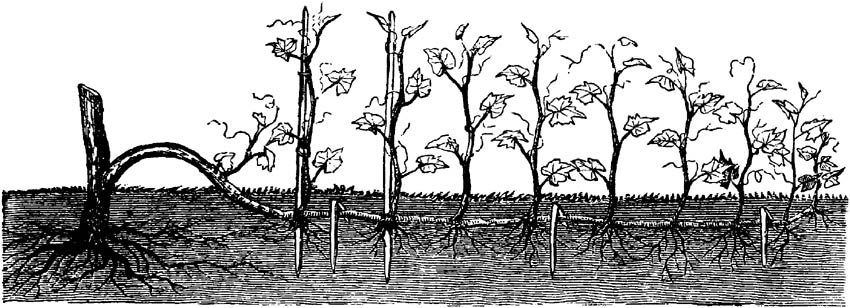
Fig. 3.—PROPAGATING THE GRAPE BY LAYERING.
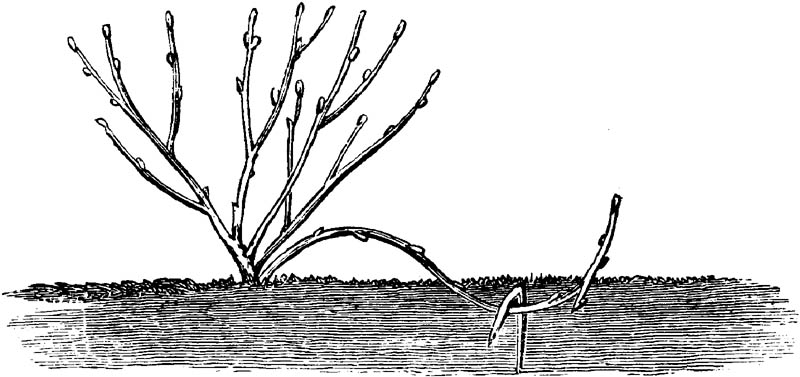
Fig. 4.—LAYERING THE QUINCE.
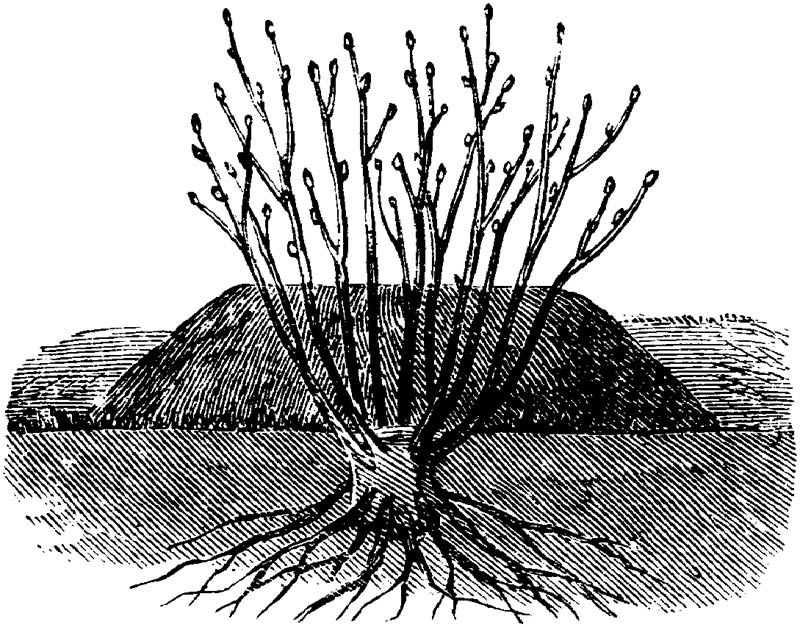
Fig. 5.—STOOL LAYERING THE QUINCE.
Quinces are considerably increased by a sort of layering, as the twigs emit roots very freely; they are often bent down, slightly twisted, or not, as the case may be, and covered with mellow soil, when they readily emit roots, become firmly established, and may be set out by themselves, (fig. 4). There is, however, another method of layering, much practiced in the multiplication of the quince; that called propagation by stools. The plants are set in open rows, four feet wide, and three or four feet apart in the rows; they should be so planted as to stand below the general surface, that is in trenches. When cut off at the ground in the spring, they throw up a great number of shoots, and the earth is gradually worked up to these to encourage their rooting, (see figure 5), which is often sufficient for removal the first season; if, on inspection, the roots are not found to be sufficiently large or abundant, the earthing is continued until the autumn of the next year, when they are removed, the stools trimmed of their lower roots, and reset in new trenches. The plants, thus raised from stools, are cut back severely, and are then ready to set out in nursery rows for budding. With the quince, cultivated in this manner, nothing is required but to accumulate the mellow earth about the shoots; but in many plants it is necessary to notch the wood by splitting, or cutting it for an inch or two, (as in fig. 6), making a tongue that separates from the lower portion of the shoot, and from which the roots are emitted. This slit should be commenced just below a bud, and the knife is drawn upward, cutting halfway through the wood. If commenced at one side instead of at the depending portion, the tongue is more sure to be separated from the stock, to which it might otherwise reunite. To insure rooting, some persons insert a little stick or chip between the separated portions, to prevent a re-union of the parts. The shoot, after being notched, is fastened down, and fine soil or compost is brought about it to encourage the development of roots. Few of the hard wooded fruit trees have been extensively propagated by means of layers; they might be so produced, but it has not been found profitable nor necessary.
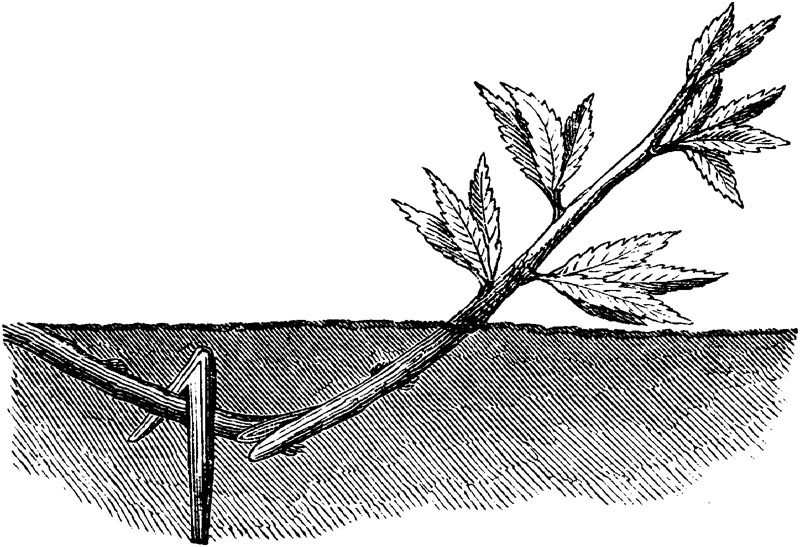
Fig. 6.—MANNER OF CUTTING AND PEGGING DOWN A LAYER.
A very common opinion prevails that layering exhausts the mother plant, or vine, which is used in this mode of propagating. If properly conducted, there is no reason why this should be; but if the whole top of any plant is bent down and made to take root, and to form independent roots, there can be little or no return from the branches to the original stock to strengthen it. A certain amount of healthy growing wood should always be left in its natural position, and no danger to the plant need be apprehended.
The wood growth of the strawberry, when allowed to take its natural bent, is directed into the stolons or runners, which form natural layers. Their production detracts from the central wood-growth of the plant, and exhausts its strength to such a degree, that it often dies, whereas, by a constant removal of the runners, as fast as they appear, we practice a sort of summer pruning or pinching, which results in the production of a large branching stool, with many points or centers for the production of foliage and flowers, and thus insure the greatest abundance of fruit. The strawberry, like one species of the raspberry, and many other of our native plants, offers illustrations of natural layering.
Seeds.—The most common as well as the most natural mode of multiplying the individual plants of most of our fruit trees, is by sowing the seed; from this source we procure stocks upon which are worked, by budding or grafting, the several varieties we may desire to propagate. As an illustration of this process, I propose to speak of apple seedlings.
The almost universal means of increasing the number of apple trees, is by sowing the seed. This is generally selected and separated from the fresh pomace left on the press in cider-making. The old and slow process of hand-washing has given way, in this age of labor-saving machinery, to more economical methods. The most approved apparatus is constructed upon the principle of separating the seeds from the pulp by means of their greater specific gravity; it is, indeed, much like a gold washer, being a series of boxes or troughs through which a current of water is made to flow; this carries the lighter portions away from the seeds, the contents of the boxes being agitated from time to time. At the close of the process, the clean seed is found in the bottoms of the boxes, whence it is removed and carefully dried, by putting it in an airy place, and stirring it frequently to prevent mildew and fermentation. Well prepared seed is plump and bright, and should feel cold to the hand. When the pips are broken, they should be white and clear within; but the best test of their quality, is to sprout a portion, and count the plants produced by a given number of seeds.
Sowing.—The seeds may be put into the ground, either in the fall, or spring. The soil having been well prepared, and deeply pulverized, is thrown up in beds a few feet wide, and the seed sown in close drills across; or without the beds, it may be sown in broad drills, by hand, or with a machine, the rows at such a distance as to allow of culture by horse-power. It is desirable, in either case, to get an early start and a good stand; the weeds must be kept under from the very first, and not allowed to have the mastery for a single day. Thorough culture during the season, upon a deeply tilled soil, of such a character as to retain moisture, will be found highly advantageous in the production of this crop, and will insure immunity from leaf-blight and other adversities. Some recommend sprouting the seed a little before planting. If it have been kept during the winter mixed with its bulk of sand, which is a good plan, the whole may be subjected to a gentle heat as in a hot-bed, for a few days, just before planting. During this time the mass must be stirred and turned every day, to prevent fermentation and to secure an even start. Whenever the germ makes its appearance at the points of the seeds, which is called pipping, the sowing must begin, and should be done as quickly as possible; the covering is to be slight, and the earth should be friable and not disposed to bake. The depth at which the apple seed is to be covered will depend upon the present and prospective state of the weather, lighter if moist, heavier if dry, for a continued drouth might be fatal to sprouted seed, if it were planted too near the surface; but when the weather is not dry, it is advised that the shallower the seed is sown, the better. The objection has been made to sprouting, that if the process have advanced too far, the seedlings will be apt to have a crook at or near the collar, instead of the straight fusiform appearance they should possess when presented to the grafter.
These seedlings furnish the stocks upon which to work the finer varieties of the apple. They are taken up in the autumn with their long clean roots, which are often longer than their tops, the leaves are stripped off, and they are assorted; the larger are packed away in earth or saw-dust in the grafting department, or heeled-in out of doors, and covered in such a way as to be accessible at any time they may be needed during the winter. The smaller stocks are heeled-in for spring planting in nursery rows for budding, or they may be left in the original rows for another year's growth as seedlings. If the plants have been well grown and not too thick, so that the majority are of sufficient size, it will be better to take them all up at once and assort them as just indicated, otherwise the largest only may be drawn separately when the ground is soft with autumnal rains, leaving the smaller seedlings for another year's growth. In assorting and selling the stocks, nurserymen make about three classes. The very largest, as thick as a lead-pencil, are called extra, or two-year old, and command a higher price. The next size, called 1st class stocks, are large enough for co-aptation to the average scions, and long enough to make two cuts each for grafting; and those that fall below this requisition are considered second class, and are either thrown aside or set out for budding, and for stock or collar-grafting in the rows.
PROPAGATION.—SECTION II.—GRAFTING.
A MODIFICATION OF CUTTINGS—SUCCESS DEPENDANT UPON CELL-GROWTH. FORMING A UNION WITH THE STOCK—LIMITS TO GRAFTING DEPENDANT UPON THE ANATOMY OF THE PLANT—PHYSIOLOGICAL BOUNDS—SUCCESS IS IN PROPORTION TO THE AFFINITY—SEVERAL SPECIES AS STOCKS—DISTINCT GENERA—NARROW LIMITS—REQUISITES—EFFECTS OF UNCONGENIAL STOCKS—NATURAL GRAFTING IS INARCHING—GRAFTING BY APPROACH—VARIOUS METHODS OF GRAFTING—WHIP, CLEFT, SADDLE, SIDE, ETC—ILLUSTRATIONS—TYING, WAXING, ETC—RE-GRAFTING OLD ORCHARDS—RENEW SUCCESSIVE PORTIONS OF THE TREE; TOP FIRST—GRAFTING MACHINES—ROOT-GRAFTING—PREPARATION OF THE SCIONS—OF THE ROOTS—PRESERVATION OF THE GRAFTS—DIVISION OF LABOR—DIFFERENT PORTIONS OR SECTIONS OF THE ROOTS—STOCK-GRAFTING—GRAFTING-WAX—SEASONS FOR—PROLONGED—SELECTION OF SCIONS—TIME FOR CUTTING—MODE OF PRESERVING—TREATMENT OF GRAFTS.
Grafting is but a modification of propagation by cuttings. The scion is a cutting of the variety we wish to propagate, which, instead of being committed to the ground to emit its own roots, is placed in contact with tissues of a nature similar to its own, through which it is to form a connection with the roots and the soil. The success of the operation depends upon the formative cell in this instance also, as in the cutting; new cells are formed upon the cut surface, and the intercommunication takes place through them. Hence we have anatomical limits to grafting; there are physiological bounds beyond which we cannot pass, in our combinations of scion and stock. Our success is in the direct ratio of the affinity that exists between them; thus apple grows best on apple, and even among these we find the closest union and the best results, where there is a similarity between the style of growth, and probably in the character of the cells.
We say, as a general rule, that stone fruits must be grafted upon stone fruits, those bearing seeds, upon seed fruit; but there are limits even here which confine us upon one hand, and give us more latitude upon the other. Thus the cherry may be worked upon the wild cherry (Prunus Virginiana) but it forms a very poor union; the pear will grow upon the thorn, which has a very different seed, but the union is very imperfect and the tree is short-lived; the apple would appear to be much nearer of kin, since it belongs to the same genus, but though the pear will grow vigorously upon this stock, it is no more permanent than upon the thorn: either of them will answer when grafted low, or in the root, to start the cutting, as the scion may then be considered, and to sustain it until it shall have supplied itself with roots. In top-grafting the pear upon a tree of either species, it is found essential to success, and it conduces to the greater durability of the tree, for some branches of the original stock to be left intact to secure the circulation of the trunk, as the union of the dissimilar cells is so imperfect that it does not furnish sufficient vent for the sap. In the case of the cherry we find that the varieties appear to have a greater affinity for those of their own race; thus the Dukes and Morellos do well when grafted upon the Morello stocks, whereas the Hearts and Bigarreau sorts do not make a good union upon these stocks, but prefer the Mazzard, which has a freer growth more like their own. Most varieties will do well upon the Mahaleb stock, which is used as a means of dwarfing this fruit, though not a dwarf. Upon the wild cherry, which belongs to quite a different section of the genus, the cultivated varieties will grow, but they form a very imperfect union.
The peach may be worked upon the plum stock, and is claimed to be somewhat dwarfed by it, and to produce superior fruit. This stock is more congenial to the apricot, which is frequently propagated upon it. Both plums and apricots may be worked upon the peach stock, and they will grow very vigorously, as they will upon the wild plum, but they soon over-grow, and are very apt to break off. When either of these species is used as a stock for the plum or apricot, they should be considered merely as a nursing mother, like the apple or thorn to the pear, which may be wanted to help the cutting until it shall be prepared to stand alone, and feed itself from its own roots. In other words, they should be grafted, not budded, into these uncongenial stocks, and the operation should be performed in the collar or below it, in the root, so that the growing scion may be earthed up, and encouraged to furnish itself with a good system of roots of its own. The success will then depend upon the ability of the scion to emit roots freely.
We must never forget that in grafting, we are confined to very narrow limits. Our scion must be of a similar nature with the stock, each must have cells of a similar character, capable of transmitting their nutritious fluids from one to the other. We must recollect likewise, that the parts must be so co-apted that the cells of wood growth shall be brought into as close connection as possible, in both scion and stock; these cells are found in the layer, called the cambium, which is between the wood and the bark. The crude sap from below will often pass from cell to cell, when the elaborated sap of the cells in the scion is wholly unfitted for the formation of wood cells in the stock below it; of course the union in such a case must be very imperfect, and the product of such a grafting will be subject to accident, and will be short-lived, though the result in fruit, while the union continues, may be very precocious, abundant, and of superior flavor.
Natural grafting may often be observed by the student of nature when wandering among his favorites of the sylvan shades. There can be no doubt that the first hint was thus communicated to the early gardeners. In nature we always find the grafting to be inarching, or grafting by approach; two limbs or even two trees approximating closely, have abraded one another, and have afterward united their tissues most firmly together. This is generally a union of two trees of the same variety or species; but such is not always the case; sometimes trees of very dissimilar natures unite in this manner, but when we examine them we find only a dove-tailing, only a mechanical union, but no vital action subsists between them. The ancients give us some fancy sketches of the unions by grafting of very dissimilar trees, and some moderns who have no higher claim to poetry than their romancing, tell us that we may graft the peach upon the Willow and Buttonwood, and form other equally impossible unions.
The different methods of performing the operation of grafting vary with the character and size, and condition of the stocks to be worked; thus we have splice grafting, whip, cleft, saddle, and side grafting with modifications, and also grafting by approach, which is generally called inarching—though sometimes also practiced where we desire to renew the roots of a tree that are unhealthy, or to restore those that have been removed by accident or by the erosion of some rodent animals.
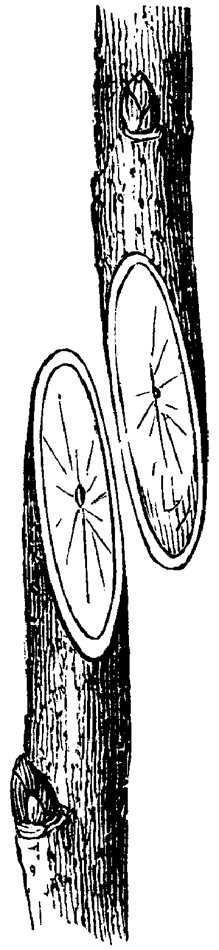
Fig. 7.
Splice Grafting is the simplest process, and is applicable only where the size of the stock and of the scion correspond pretty nearly; the two are cut with a sloping curve, each of which being made at the same angle, will coincide with the other when they are applied together, as represented in the engraving, fig. 7.
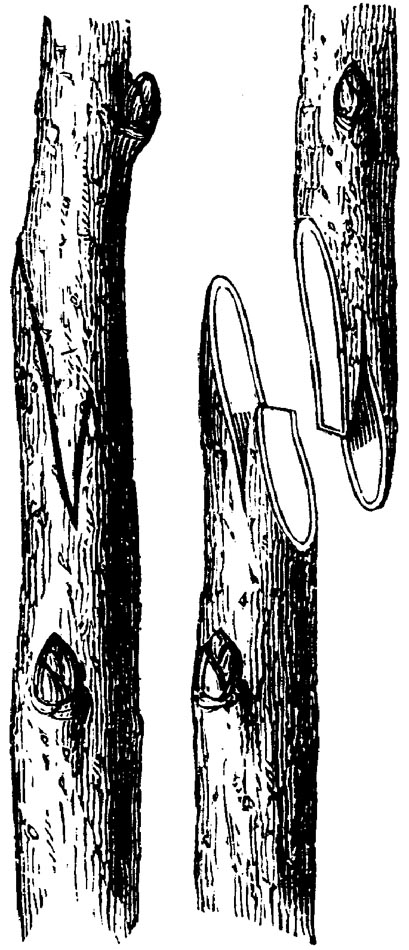
Fig. 8.—WHIP GRAFTING.
Whip Grafting is a modification of the above. Each portion is cut in a sloping manner as in the splice grafting, but each is also split with a thin-bladed knife, as represented in fig. 8. The object in this is to give a firmer union to the two portions, and also to present a more extended surface for the effusion of the new cell tissue that is to form the bond of union in cementing them together. In both these methods, but especially in the first, the parts must be held together in co-aptation by some kind of bandage; this is generally composed of grafting wax, spread upon cloth or paper, or even, as now extensively practiced, upon fine thread. Cotton yarn No. 3 is drawn through melted grafting wax, and as it cools, it is wound upon a reel at the other side of the room, whence it is drawn as wanted by the grafter or tyer. Tying or wrapping is always a good precaution, and when the splice or cleft graft is not very close, it becomes necessary; but thousands of grafts will unite equally well where the parts are covered with earth, without any such appliance.
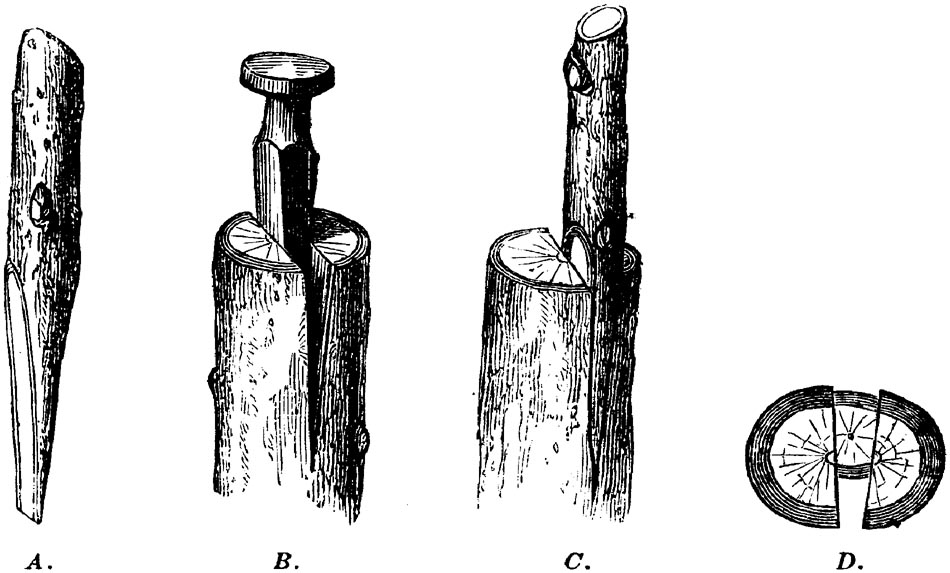
Fig. 9.—DIFFERENT STEPS IN CLEFT GRAFTING. A, SCION PREPARED FOR SETTING. B, THE CLEFT OPENED BY A WEDGE. C, THE SCION INSERTED. D, SECTION OF STOCK AND SCION TO SHOW THE CO-APTATION OF THE PARTS OF THE TWO.
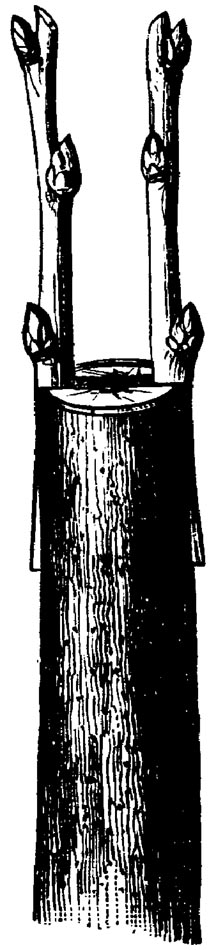
Fig. 10.—CLEFT GRAFTING WITH BOTH SCIONS INCLINED INWARD.
Cleft Grafting is generally done when the stock is larger than the scion, and also where the operation is performed at a point above the ground. The stock is split downward, after having been cut off at the point where the grafting is to be done. The knife should be sharp, and the bark should be cut through first, to avoid its being torn, and so that the sides of the cleft shall be smooth. A wedge is inserted to keep the cleft open for the insertion of the scion, which is cut on each side like a fine wedge; but the two planes not being parallel, the bark will be left on one side to the very point of the wedge, while on the other it will be removed a part of the way, making a feather edge, A, fig. 9. The object of this is to have the pressure of the cleft greatest upon the outer side, where the union is to be effected. It is well to have a bud on the strip of bark left between the two cuts used in forming the graft, this should be near the top of the cleft. One or two grafts may be inserted into a cleft, or more clefts may be made, in large stocks, or in re-grafting the large limbs of an old tree, but usually one is sufficient to leave growing; and in the young tree, only one should ever be allowed to remain. When the scion is nicely set into the cleft, so that the inner bark of the stock and graft shall coincide, or rather cross a very little, (see fig. 10,) the wedge, whether of hard wood, or of iron, should be gently withdrawn, and then the elasticity of the stock will hold the scion firmly to its place; this pressure should not be too severe. In this kind of grafting, if the pressure be sufficiently firm, and if the operation have been performed below the surface of the ground, it may not be necessary to make any other application than to press the moist earth about the parts, and cover all but the top of the graft with soil, and place a stick to indicate the plant and protect it from injury. If, on the contrary, the pressure of the cleft be not sufficient to hold the scion firmly, as in small stocks, the graft must be tied. For this a piece of bass matting, or cotton twine, may be used; and if the operation has been performed above ground, the whole must be covered with grafting wax, applied, either hot with a brush, or cold, after having been worked with the hands, or by wrapping with strips of muslin or paper previously spread with the wax. In old times grafting clay was used, and applied with the hands as a lump around the junction; but this disagreeable and clumsy appliance has given way to more elegant and convenient arrangements.
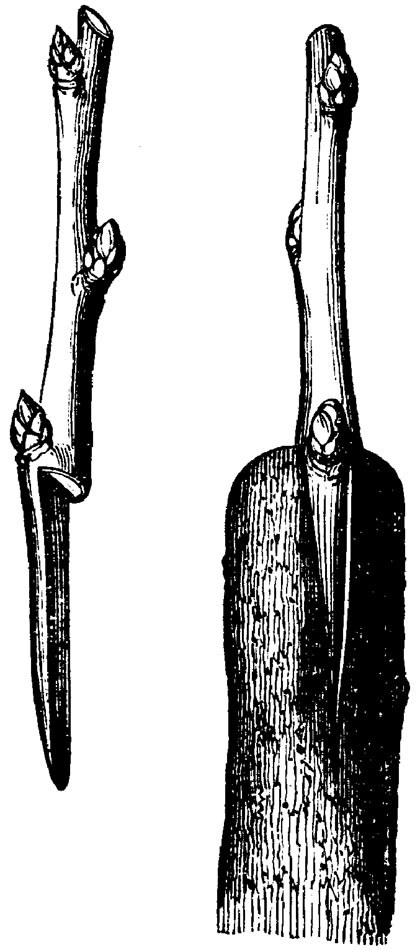
Fig. 11—SIDE GRAFTING.
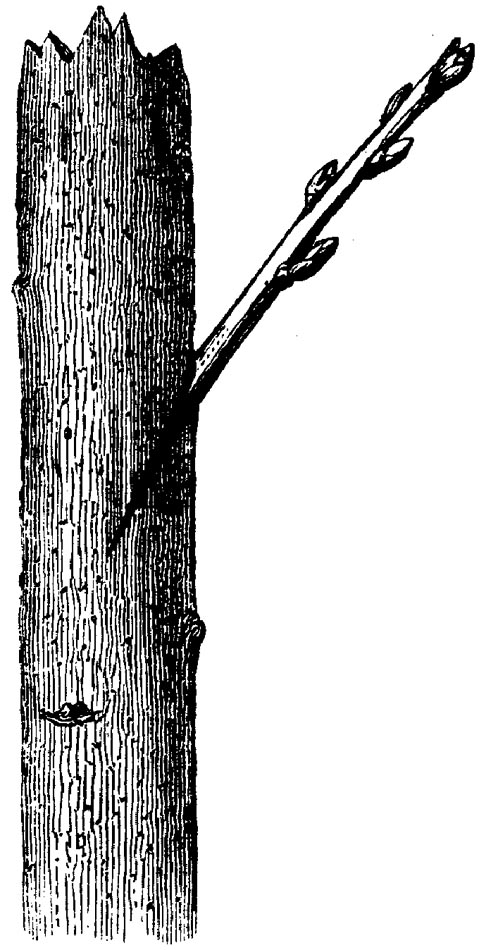
Fig. 12—SIDE GRAFTING—THE STOCK NOT CUT BACK.
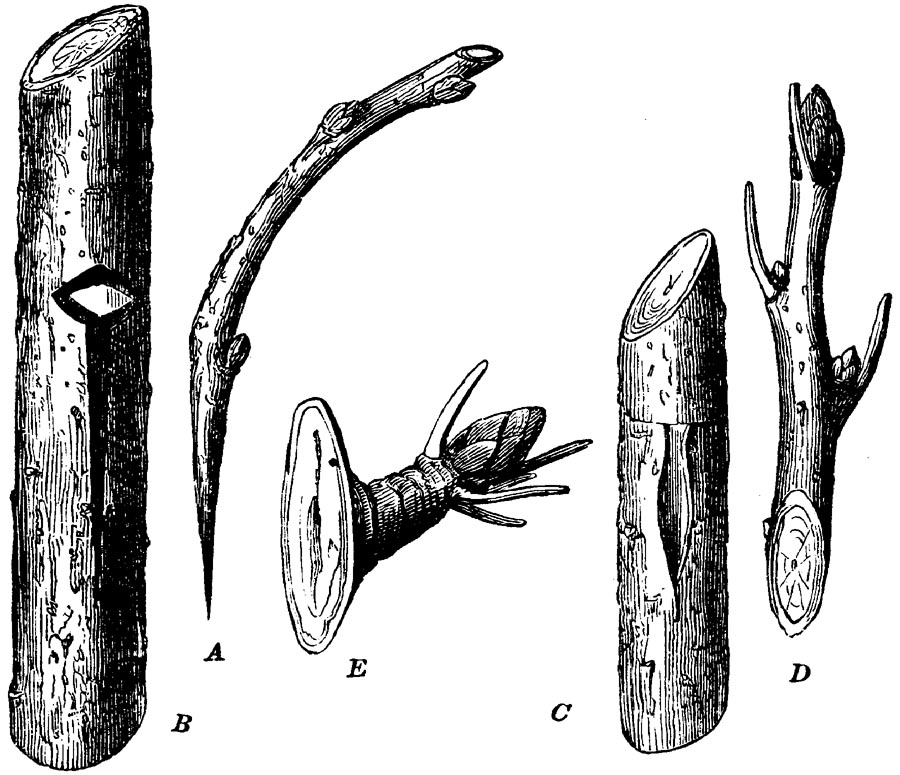
Fig. 13.—TWO FORMS OF SIDE GRAFTING.—A, B, THE SCION AND STOCK FOR THE RICHARD SIDE GRAFT. C, STOCK FOR THE GIRARDIN SIDE GRAFT. D, SCION, AND E, FRUIT BUD FOR THE SAME.
Side Grafting is performed in two ways. In one it is a modification of cleft grafting in which there is no cleft, but the bark is started from the wood, and the scion, cut as shown in figure 11, is pressed down between the wood and bark. This can only be done late in the spring, after the sap has begun to flow in the stock, so that the bark will run; it is indeed more like budding than grafting. The other modification is done without cutting off the stock. The knife is applied to the side of a stock of medium size, and a cut is made downward and extending to one-third the diameter, fig. 12; the scion is cut as for cleft grafting, and inserted so as to have the parts well co-apted, and then secured as usual. This plan is useful where there is danger of too free a flow of sap from the roots. Two other kinds of side graft are shown in fig. 13. The left-hand figures show the Richard side graft, in which an arched branch, A, is used. This is inserted under the bark of the stock, B; above the graft an incision is made in the stock down to the wood, to arrest the flow of sap. After the insertion, the wound is covered with grafting wax. The Girardin side graft is illustrated at the three right-hand figures. A fruit bud, E, or a graft with a terminal fruit bud, D, is inserted under the bark of the stock, C, in August, or whenever suitable buds can be obtained and the bark will run. The wound is tied and covered with wax, as before. The object of this grafting is to secure immediate fruitage. Another kind of side grafting consists in plunging a dirk-shaped knife directly through the tree, inclining the point downward, into this opening the graft is inserted; the object being to establish a limb on a naked portion of the trunk.
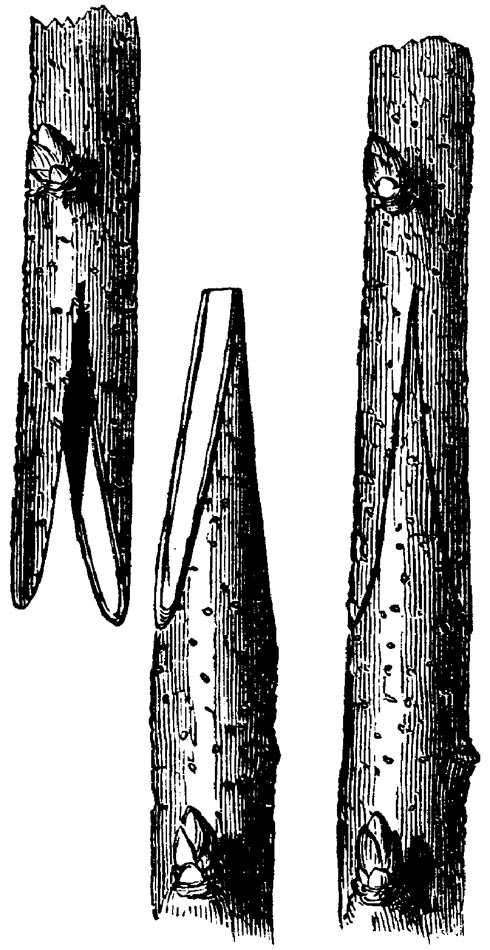
Fig. 14.—SADDLE GRAFTING.
Saddle Grafting is used only with stocks of small size; it is performed by making a double slope upon the stock, and by opening a corresponding space in the graft, by cutting two slopes in the scion, from below upwards, so that they shall meet in the centre, as seen in fig. 14. Some merely split the scion.
Grafting by Approach, or as it is generally termed, inarching, is often practiced where there is difficulty in making the scion unite with the stock; it is not often needed in the culture of our orchard fruits, but may be here described. The stock upon which we wish to graft the scion, must be planted near the variety or species to be increased. A small twig of the latter, which can be brought close to the stock, is selected for the operation; a slice of bark and wood is then removed from the twig, and another of equal size from the stock, so managed, that these cut surfaces can be brought together and secured in that position until they have united, after which the twig, that has been used as a scion, is cut from its parent tree, and the top of the stock is carefully reduced until the scion has sufficiently developed itself to act as the top of the ingrafted tree, which may afterward be transplanted to its proper station.
A modification of this grafting by approach, is, however, sometimes of great service, where we have a valuable tree that has suffered from disease in the roots, or from injury to them. It consists in planting some thrifty young stocks, with good roots, about the base of the tree, after having prepared the ground by thorough digging, and by the addition of good soil if necessary. These stocks are then inserted upwards into the healthy portion of the trunk, by the process of side grafting reversed or inverted, or by the usual method of inarching.
Ring Grafting or Bark Grafting is not much used, and in small stocks it is rather a kind of budding, for then a ring of bark is removed at the proper season of year, generally about midsummer, and it is replaced by a similar ring of bark from a shoot of the same size, taken from a tree of the variety to be propagated; this ring of bark must be furnished with a healthy bud. This method has little to recommend it, and can only be applied when both the stock and the scion are in a growing condition, so that the bark will run freely; care also must be exercised to avoid injuring the eye of the bud, in peeling off the ring. A modification of bark grafting may be applied with great advantage, however, to an old tree, that has met with an injury to a portion of its bark. The injured part should be pared smoothly to the sound bark and wood. This may be done with a sloping cut, or the edge may be made abrupt and square with a chisel and mallet; a piece of fresh wood and bark is then to be cut from a healthy tree and fitted precisely to the fresh wound, and secured in its place with bandages, and grafting clay or wax is then applied, thus making what the surgeons would call a sort of taliacotian operation. Instead of a single piece of wood and bark, a number of young shoots may be used to make the communication complete; these are set close together and secured in the usual manner; see fig. 15.
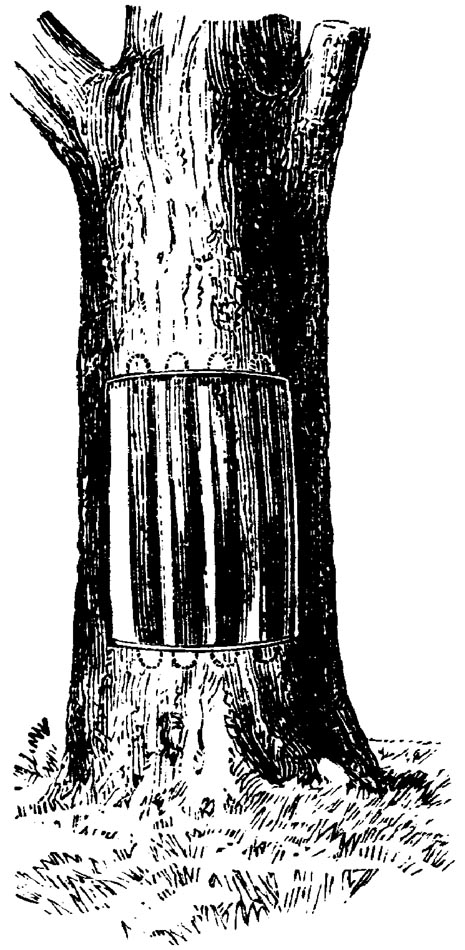
Fig. 15.—BARK GRAFTING, TO REPAIR AN INJURED TREE.
Re-grafting Old Orchards.—Old orchards of inferior fruit may be entirely re-made and re-formed by grafting the limbs with such varieties as we may desire. A new life is by this process often infused into the trees, which is due to the very severe pruning which the trees then receive; they are consequently soon covered with a vigorous growth of young healthy wood, which replaces the decrepid and often decaying spray that accumulates in an old orchard, and the fruit produced for several years by the new growth is not only more valuable in kind, according to the judgment used in the selection of grafts, but it is more fair, smooth and healthy, and of better size than that which was previously furnished by the trees. Certain varieties are brought at once into bearing when thus top-grafted, which would have been long in developing their fruitful condition if planted as nursery trees. Others are always better and finer when so worked, than on young trees. Some of the finest specimens of the Northern Spy apple, exhibited at the fairs, have been produced by grafts inserted into the terminal branches of old bearing trees. There is a theory held by some orchardists, that the further the junction of the graft with the stock is removed from the root, the better will be the fruit. This, however, is not well supported, and the circumstance, when observed, is probably dependent upon other causes.
In renewing an old orchard by grafting its head, it will not be a good plan to attempt the whole tree at once; the pruning would be too severe, and would be followed by a profusion of succulent shoots breaking out from the large branches, such as are called water-sprouts. Those who have practiced most, prefer at first, to remove about one-third of the limbs for grafting, and those should be selected at the top of the tree. The new growth thus has an open field for its development, and the lower limbs will be invigorated, while they tend also to preserve the equilibrium of the tree in a double sense, physically and physiologically. The next year another third of the limbs may be grafted, and the remainder the year following, as practiced by Mr. Geo. Olmstead, of Connecticut, who, on the sixth year from the first grafting, harvested 28-½ bushels of choice apples from a single tree that was 75 years old, and which before only produced inferior fruit. J.J. Thomas recommends, "to give a well-shaped head to such newly formed trees, and to prevent the branches from shooting upward in a close body near the centre of the tree; that the old horizontal boughs should be allowed to extend to a distance in each direction, while the upright ones should be lopped;" see fig. 16. The same writer also advises, "instead of cutting off large branches and grafting them at once, it is better to prune the top in part, which will cause an emission of vigorous shoots. These are then budded, or grafted. * * * And as the grafts gradually extend by growth, the remainder of the top may, by successive excisions, be entirely removed."
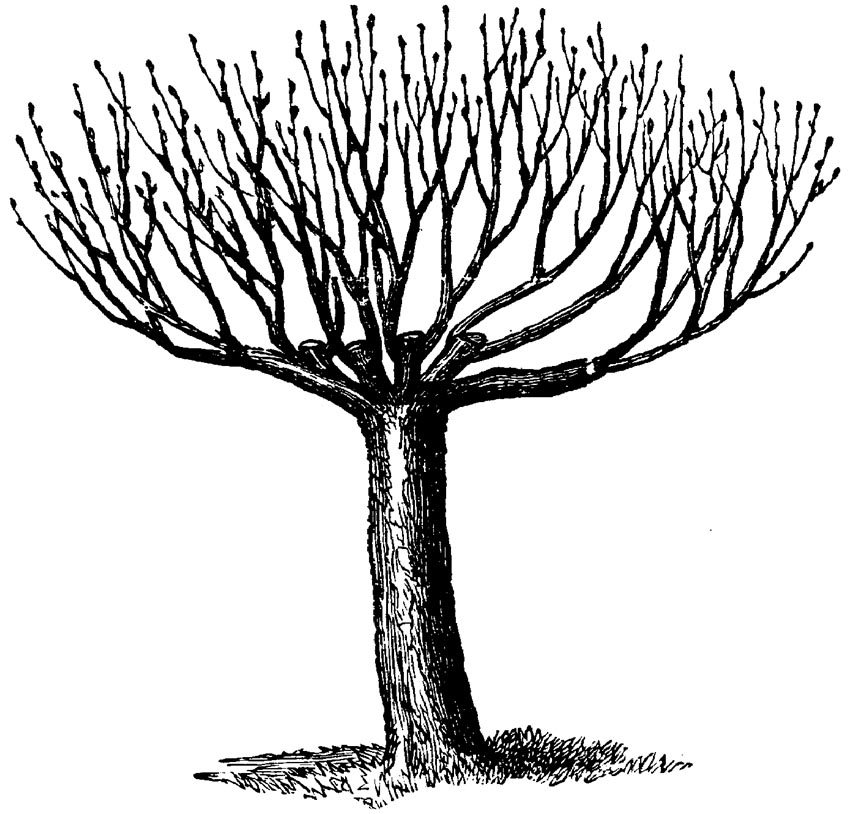
Fig. 16.—RENEWAL OF THE TOP OF AN OLD TREE.
Grafting in the Nursery is either done at or near the collar of the stock, or it is performed in-doors upon the roots or sections of roots of young stocks. The latter may be first described, as it constitutes the most extensive means of multiplying fruit trees. It is a sort of machinery, with division of labor, and appliances, that enable the operators to turn out immense numbers. Machinery has indeed been applied to the business; we have grafting apparatus to facilitate the work. The Minkler machine consists of a frame or gauge which regulates the angle of the slope, which is cut with a broad chisel that reduces the roots and scions to a condition for putting them together; by its use an immense number of grafts can be cut, and another hand binds them together with the waxed thread, without any tie. Mr. Robey's machine consists of a complicated shears to cut the slope and tongue at one operation, preparing the pieces for whip grafting. Mr. S.S. Jackson, of Cincinnati, has also invented an apparatus for this purpose, which proves to be very useful.
Root Grafting.—The methods of performing the operation vary somewhat, but all agree in the object to be attained: the co-aptation of the scion with a piece of root. Some grafters use only the upper portion of the root, thinking the original collar of the seedling stock the only point at which the most perfect and successful union between the aërial and terrestrial portions of trees should or can be effected—theoretically this may be very well, but the practice constantly pursued, in myriads of cases, abundantly proves that the grafting need not be restricted to this part, and that a perfect union may be effected at any point of the root, and that this may even be inverted. The very common practice has been to take two or more cuts from the root, when it is of sufficient size and length; and though some of our best propagators restrict themselves to two cuts from each, others, who have experimented carefully, insist that the third section will average as well as the others. A lot of trees, worked especially for a test in this matter, gave the following results.
In 1859 an average lot of roots and scions, about fifty in each lot, were treated as follows, White Pippin and Willow-leaf being used as scions:—
White Pippin—No. 1, being on the first cut of the root, had made a fair growth.
No. 2, being on the second cut, were quite as good or better.
No. 3, being on the third cut, were not quite so good as the others, the ground being partially shaded by a large tree.
Another, of Willow-leaf—No. 1, on the 3d cut of root, very good growth.
No. 2, on very slender roots, nearly as good.
No. 3, only 1 inch of root to 1 inch of scion; not so good growth nor so good a strike, but shaded by a tree.
No. 4, on 2d cut of root, not so good as the third.
No. 5, on average lot, not waxed, as good as any.
No. 6, roots worked upside-down, mostly failed.
D.O. Reeder exhibited some 2-year old apple trees, worked on the root inverted, they were of very good growth.
For root grafting, thrifty stocks are wanted of one or two years' growth, the smoother and straighter the roots, the better. These should be taken up from the seed-bed in the fall, selected, tied in bundles, and stored in the cellar or cave, or buried in the soil where they shall be accessible at any time, and where they will be kept fresh and plump. The roots and scions having been prepared and under shelter, the work of grafting may proceed at any time during the winter. The stocks, if not clean, should be washed, and one hand trims off the side rootlets. The grafter cuts a hundred scions of the appropriate length, which he puts into a shallow box on the table; he takes up a stock, cuts the slope near the collar, and a dextrous hand will at the same time make the sloping cut to receive the first graft and also the tongue, if that style of grafting is to be done, as is usually practised. He then picks up a scion, from a lot which himself or another hand has already prepared with a slope and tongue, and adapts it to the root, the tongue keeping the two together; a portion of the root is then cut off with the graft, and the process is repeated upon the next section. Two or three or more grafts, are thus made from one seedling root; the length of the sections vary from two to four inches, according to the fancy of the operator, or of his employer. Some persons recommend a long scion with a short root, and others prefer to reverse those terms. The whole root graft should not be more than six or seven inches long.
When any given number of scions are fitted to the roots, a boy completes the process of grafting, by applying melted wax with a brush, in which case they are dropped into water to harden the wax, or they are wrapped with waxed strips of muslin or paper, or, better still, they are tied with waxed thread. No. 3 cotton yarn is drawn through a pan of melted wax, and wound upon a reel placed at the other side of the room, so that the wax may harden. This waxed thread is a very convenient tie; the graft being held in the left hand, the thread is wound about it two or three turns; as the wax causes the bandage to adhere to itself where it crosses, no knot is needed, and the thread is broken off with a quick jerk.
In splice grafting, whether performed with any of the machines, or if the slopes of root and scion be cut with the thin grafting knife, the tying must be done by the same hand that selects and places the scion upon the root. This does not admit of the same division of labor, and the fingers, becoming sticky from the wax, cannot be so nimble, and are unfit for cutting. When the lot is tied, they are set into the box, which should be inclined at an angle, and interspersed with earth or saw-dust; for transportation. Saw-dust, just as it comes from the mill, neither wet nor dry, is preferred by some as a packing material, and it has been found very efficacious, excluding and admitting the air just in the right proportions to prevent desiccation, and to promote the union, which very soon takes place between the graft and the root, if the boxes be stored in the cellar. In an ice-house root grafts have been kept in saw-dust more than a year, and then planted and grown successfully. The boxes should be deep enough to receive the whole graft—say from 10 to 12 inches—and then they can be packed upon one another without injuring the scions; these should be distinctly marked with the name and number, so as to be ready for planting out in the spring.
Much discussion has been had upon the merits and demerits, or disadvantages of root grafting, and much theoretical argument has been brought against the practice; but beautiful trees are thus made in immense numbers in the extensive nurseries of our country, and until better arguments can be produced against the practice, nurserymen will continue to graft on sections of root, such varieties, as are suitable for this procedure—especially apples, in a large proportion of the varieties cultivated, some pears, some peaches, grapes, and other fruits.
Root grafting is now of almost universal application with the apple. It has many advantages, which may be summed up as follows: Two or more plants may be produced from the root of one stock; these may be made with great rapidity; the work may all be performed in-doors and during the whole winter season, when nothing can be done outside; they are of small bulk, and great numbers may be stowed away in little space, they may be transported to any distance in this condition, and are ready for planting with the opening of spring, when they may be set in the nursery rows at once; or, they may be bedded out in a small space and mulched, to protect them from drouth, and the weeds can easily be kept under. Another advantage of bedding out the root-grafts is, that they may be assorted according to their size the next season, when transplanted into the nursery rows. This very transplanting too is a great advantage, for the roots will be much improved by the process.
The theoretical objections to root grafts have yielded to sound philosophy, based on and supported by practical observation. The very many advantages of this more economical and convenient and agreeable process, will necessarily sustain root-grafting in this fast age, when so many millions of trees are needed for the rapidly extending wants of this nation of tree planters. We may, however, consider some of the practical objections which have been brought forward against this plan of multiplying the apple. In our very changeable climate, and particularly in the North-west, upon the prairies, the cold of winter often supervenes with great suddenness, after the young trees have made a prolonged and vigorous growth in the fertile soil, and produces terrible devastation among those that are there exposed, without protection of any kind, to the rude blasts of the storm-king: in a less degree, injury is very frequent with many such late-growing kinds, at the first access of a severe frost; this is manifested in the bursting of the bark near the base of the stem. The same thing is not so often seen in the same varieties, when they have been budded or stock grafted a foot or more from the ground upon hardy seedling stocks, hence judicious propagators have selected the "tender" varieties for this kind of working, and confine their root-grafting to those less liable to the injury. There are other varieties which do not readily and promptly form a strong upright growth, so as to be profitable trees to the nurseryman if root grafted; these are selected for stock working, either on strong seedlings, or upon hardy upright sorts that have been root grafted for the purpose of being thus double-worked. This plan has been pursued to a limited extent only, but its advantages in the production of good trees of the slender growing varieties, begin to be appreciated, and as the demand increases, our intelligent nurserymen will very soon furnish the requisite supply.
Planting.—When the weather is fine, and the soil in good condition, the root-grafts are to be set out with a dibble, by the line; they should be planted rather deeply, one bud projecting above the surface of the ground. The culture must be thorough, the plants should be kept perfectly clean, but it is questionable whether the growth should be pushed, late in the season; indeed, it is preferable to check the vegetation at mid-summer. For this purpose it has been recommended to cease cultivating the soil, or even to sow the ground with a heavy seeding of oats, so as to check the growth before winter. In good soils, with good culture, the average hight in the rows will be two feet, but there is a great difference in the kinds; some will considerably exceed this hight. Intelligent nurserymen no longer endeavor to have an excessive growth in the first year, and many prefer the bedding plan above alluded to.
Trimming, Pinching, or Heading.—The growth during the first year is generally a single shoot, sometimes two. If there be a second, it should be subordinated by pinching off its extremity, never by trimming it off; indeed, laterals should always be encouraged, and this will be more and more the case, since the demand for low-headed trees is increasing, as the laws of physiology are better understood. A young tree, well furnished with laterals, is always more stocky, and every way better, though not so tall as that which has been drawn up to a single stem. To encourage this condition, some advise the pinching out the terminal bud in the midst of the growing season, which will cause the swelling and subsequent breaking of the lower buds, so as to furnish plenty of laterals. If done later in the season, especially with strong-growing varieties, a branching head may be formed higher up, during the first season, making very pretty trees. This is, however, seldom attempted with root-grafts the first season, though it is very common for collar-grafted trees, and for buds on strong stocks to make a fine branching growth the first year. The second season the trees should all be headed-in, and the laterals spurred-in early in the spring, or in mild weather during the winter, if the scions are wanted. This method of making stocky plants cannot be too highly commended, nor can the opposite plan, of trimming off all the side branches, and even of stripping the leaves from the lower part of the shoots, during the first summer, be too severely condemned.
Stock Grafting has many advocates, and for some varieties this plan is preferable. The union may be effected at any point from the collar upward. Formerly, the place was selected to suit the convenience of the grafter, and many old orchards show very plainly where they were worked, the stock or the scion having overgrown, and it is very curious that some varieties may be indicated as good feeders of the stock below them, and the contrary. At present, tree planters are more fastidious, and object to these irregularities in the stems of their trees. They will purchase nothing that shows the point of union above ground, hence the more common use of collar grafting, as it has been called, or the insertion of the scion at or near the surface of the ground. Stocks that have been cultivated one or two years in the nursery row, are selected for this purpose; the earth is removed from them, they are cut off and grafted as they stand, and with their fine strong roots undisturbed, the result of one summer's growth is very satisfactory, making beautiful trees fit for the orchard. Older trees, especially those with straight clean stems, are often grafted standard high, so as to produce a fine salable tree at once, or in one season. This is a very good plan with some of the slender and straggling varieties, such as are called poor growers, and which are unprofitable to the nurseryman when propagated in the usual manner. Grafting or budding upon such stocks is also resorted to very often, when it is desirable at once to furnish large, or salable trees of new varieties.
In grafting upon a large stock, or upon the tops of an old tree, the process called cleft grafting is generally used. Here, as in all forms of this process, the object to be attained, is the co-aptation of the inner bark of both stock and scion. The latter is held in its place by the clasping of the former, and is also covered by some material that is pliant, and which will exclude the air and moisture.
The advantages of stock-grafting are the changing of an old tree from bad to good fruit, which is produced in a few years; it is also applicable to large stocks, and produces an immediate result, making salable trees in one year. It is also desirable for some poor-growing varieties, which are slow in making a tree from the ground; but it has its disadvantages also. The nurseryman must wait until his stocks have been grown one or more years in the nursery, his trees will sometimes be larger than he desires, they will be apt to have the mark of the grafting as a blemish upon the stalk sometimes during the life of the tree; and worse than all, he is restricted to a brief period in the spring, when he is obliged to perform the operation out of doors, and often in very unpleasant weather.
As a result of all the discussions upon this subject, it is found that stock-grafting, whether at the collar or at some distance above the ground, is still practiced, and has many warm advocates, as a better means of making the best trees. The only objections are the greater expense of culture of the stocks, and greater labor in grafting; the limited period at which the work can be performed, and the exposure of the workman during its performance, which is often at a stormy season, and always during a busy portion of the year. The trees too, in the orchard, are often somewhat deformed by an irregularity of growth, and have an enlargement either above or below the union, which is unsightly.
The kind of grafting will depend upon the size of the stocks; splice and whip-grafting on the smaller, and cleft-grafting on the larger ones, must be practiced. The waxing may be done by any of the methods indicated, according to the fancy; but it must always be more thoroughly done in aerial, than in underground grafting, whether this be in the collar or upon sections of the root; in the former the whole of the cut surfaces must be covered, to prevent desiccation by the winds, or the inroads of insects, or of wet from rains.
Wax.—Various combinations of the materials used in the preparation of grafting-wax, have been recommended by different operators. The desideratum being to have a material that shall be sufficiently pliant, and at the same time firm enough to withstand the elevated temperatures to which it may be exposed. A mean is preferred, neither too hard nor too soft, and the proportions of the ingredients are varied according as it is proposed to use it out of doors, or in the house, in cold weather or warm.
A favorite recipe, with a practical nurseryman of great experience, is:
Rosin, six parts, Bees-wax, one part, Tallow, one part, melted together.
This is to be used warm, when grafting in the house.
For out-door work he used the following:
Rosin, four or five parts. Bees-wax, one and one-half to two parts. Linseed oil, one to one and one-half.
This is made into a mass to be applied by hand. A very pleasant and neat mode of using the wax is to pour it when melted, upon thin muslin or strong paper, and spread it thin with a spatula. The tissue is then cut into strips of convenient size. The application to cotton yarn for root-grafting, has already been mentioned.
The French use the preparation given below, sufficiently warm to be liquid, but not so hot as to injure the tissues of the tree, and apply it with a brush:
Black pitch 28 parts.
Burgundy pitch 28 parts.
Bees-wax 16 parts.
Grease 14 parts.
Yellow ochre 14 parts.
Making 100 parts.[14]
Mr. Du Breuil also refers to Leport's liquid mastic in terms of commendation, but speaks of it as a secret composition.
Downing recommends melting together:
Bees-wax 3 parts.
Rosin 3 parts.
Tallow 2 parts.
He says, the common wax of the French is
Pitch one-half pound.
Bees-wax one-half pound.
Cow-dung one pound.
To be boiled together, and laid on with a brush, and for using cold or on strips of muslin, equal parts of tallow, bees-wax, and rosin, some preferring a little more tallow.
J.J. Thomas, whose practical knowledge is proverbial, recommends for its cheapness
Linseed oil one pint.
Rosin six pounds.
Bees-wax one pound.
Melted together, to be applied warm with a brush, or to be put on paper or muslin, or worked with wet hands into a mass and drawn out into ribbons.
The season for grafting is quite a prolonged one, if we include the period during which it may be done in the house, and the ability we have of retarding the scions by cold, using ice. It should be done while the grafts are dormant, which is at any time from the fall of the leaf until the swelling of the buds. As the grafts would be likely to suffer from prolonged exposure, out-door grafting is done just before vegetation commences in the spring, but may be prolonged until the stocks are in full leaf, by keeping back the scions, in which case, however, there is more danger to the stock unless a portion of its foliage is allowed to remain to keep up the circulation; under these circumstances, too, side-grafting is sometimes used with the same view.
The stone fruits are worked first; cherries, plums, and peaches, then pears and apples. With regard to grafting grapes, there is a diversity of opinion. Some operators prefer very early in the season, as in February, and others wait until the leaves have appeared upon the vine to be grafted.
Scions or Grafts are to be selected from healthy plants of the variety we wish to propagate. They should be the growth of the previous year, of average size, well developed, and with good buds, those having flower buds are rejected. If the shoots be too strong, they are often furnished with poor buds, and are more pithy, and therefore they are more difficult to work and are less likely to grow. Grafts, cut from young bearing orchards, are the best, and being cut from fruiting trees, this enables us to be certain as to correctness of the varieties to be propagated; but they are generally and most rapidly collected from young nursery trees, and as an orchardist or nurseryman should be able to judge of all the varieties he cultivates by the appearance of their growth, foliage, bark, dots, etc., there is little danger in taking the scions from such untested trees.
Time for cutting Scions.—The scions may be cut at any time after the cessation of growth in the autumn, even before the leaves have fallen, until the buds burst in the spring, always avoiding severely cold or frosty weather, because of the injury to the tree that results from cutting at such a time, though the frost may not have injured the scion. The best nurserymen prefer to cut them in the autumn, before they can have been injured by cold. They should be carefully packed in fine earth, sand, or sawdust, and placed in the cellar or cave. The leaves stripped from them, make a very good packing material; moss is often used, where it can be obtained, but the best material is saw-dust. This latter is clean, whereas the sand and soil will dull the knife. If the scions should have become dry and shriveled, they may still be revived by placing them in soil that is moderately moist, not wet—they should not, by any means, be placed in water, but should be so situated that they may slowly imbibe moisture. When they have been plumped, they should be examined by cutting into their tissues; if these be brown, they are useless, but if alive, the fresh cut will look clear and white, and the knife will pass as freely through them as when cutting a fresh twig.
The after-treatment of the grafts consists in removing the sprouts that appear upon the stock below the scion, often in great numbers. These are called robbers, as they take the sap which should go into the scion. It is sometimes well to leave a portion of these as an outlet for excess. When the graft is tardy in its vegetation, and in late grafting, it is always safest to leave some of these shoots to direct the circulation to the part, and thus insure a supply to the newly introduced scion; all should eventually be removed, so as to leave the graft supreme.
It may sometimes be necessary to tie up the young shoot which pushes with vigor, and may fall and break with its own weight before the supporting woody fibre has been deposited; but a much better policy is to pinch in the tip when but a few inches long, and thus encourage the swelling and breaking of the lateral buds, and produce a more sturdy result. This is particularly the case in stock-grafts and in renewing an orchard by top-grafting.
PROPAGATION.—SECTION III.—BUDDING.
ADVANTAGES OF—LONG PERIOD FOR—CLAIMS OF GREATER HARDINESS EXAMINED—LATE GROWERS APT TO BURST THE BARK—BUD TENDER SORTS. STOCKS NOT ALWAYS HARDY—PHILOSOPHY OF BUDDING, LIKE GRAFTING, DEPENDS UPON CELL-GROWTH—THE CAMBIUM, OR "PULP"—THE BUD, ITS INDIVIDUALITY—THOMSON QUOTED—UNION DEPENDS UPON THE BUD—SEASON FOR BUDDING—CONDITIONS REQUISITE—SPRING BUDDING—CONDITION OF THE BUDS—BUD STICKS—SELECTION OF—THEIR TREATMENT—RESTORATION WHEN DRY—THE WEATHER—RAINS TO BE AVOIDED—USUAL PERIOD OF GROWTH BY EXTENSION—SUCCESSION OF VARIETIES—CHERRY, PLUM, PEAR, APPLE, QUINCE, PEACH—HOW TO DO IT—DIFFERENT METHODS—AGE OF STOCKS—PREPARATION OF—THE KNIFE—CUTTING THE BUDS—REMOVAL OF THE WOOD—THE AMERICAN METHOD—DIVISION OF LABOR TYING—RING BUDDING—PREPARATION OF SCIONS FOR EARLY BUDDING—IMPROVEMENTS IN TYING—BAST, PREPARATION OF—SUBSTITUTES—NOVEL TIE—WHEN TO LOOSEN THE BANDAGE—HOW DONE—INSPECTION OF BUDS—SIGN OF THEIR HAVING UNITED—KNIGHT'S TWO BANDAGES—WHY LEAVE THE UPPER ONE LONGER. HEADING BACK THE STOCKS—RESUME.
Budding, or inoculating, is the insertion of eyes or buds. This is a favorite method of propagation, which is practiced in the multiplication of a great variety of fruits. The advantages of budding consist in the rapidity and facility with which it is performed, and the certainty of success which attends it. Budding may be done during a long period of the growing season, upon the different kinds of trees we have to propagate. Using but a single eye, it is also economical of the scions, which is a matter of some importance, when we desire to multiply a new and scarce variety.
It has been claimed on behalf of the process of budding, that trees, which have been worked in this method, are more hardy and better able to resist the severity of winter than others of the same varieties, which have been grafted in the root or collar, and also that budded trees come sooner into bearing. Their general hardiness will probably not be at all affected by their manner of propagation; except perhaps, where there may happen to be a marked difference in the habit of the stock, such for instance as maturity early in the season, which would have a tendency to check the late growth of the scion placed upon it—the supplies of sap being diminished, instead of continuing to flow into the graft, as it would do from the roots of the cutting or root-graft of a variety which was inclined to make a late autumnal growth. Practically, however, this does not have much weight, nor can we know, in a lot of seedling stocks, which will be the late feeders, and which will go into an early summer rest.
Certain varieties of our cultivated fruits are found to have a remarkable tendency to make an extended and very thrifty growth, which, continuing late into the autumn, would appear to expose the young trees to a very severe trial upon the access of the first cold weather, and we often find them very seriously injured under such circumstances; the bark is frequently split and ruptured for several inches near the ground. The twigs, still covered with abundant foliage, are so affected by the frost, that their whole outer surface is shriveled, and the inner bark and wood are browned; the latter often becomes permanently blackened, and remains as dead matter in the centre of the tree, for death does not necessarily ensue. Now intelligent nurserymen have endeavored to avoid losses from these causes, by budding such varieties upon strong well-established stocks, though they are aware that these are not more hardy than some of the cultivated varieties: a given number of seedling stocks has been found to suffer as much from the severity of winter, as do a similar amount of the grafted varieties taken at random.[15] That the serious difficulty of bark-bursting occurs near the surface of the ground, does seem to be an argument of some weight in favor of budding or stock-grafting at a higher point. The earlier fruiting of budded trees than those which have been root-grafted, does not appear to be a well established fact, and therefore need not detain us; except to observe that the stocks, upon which the buds were inserted, might have been older by some years than the slip of root upon which the graft was set, so that the fruiting of the former tree should count two or three or more years further back than from the period of the budding. There are so many causes which might have contributed toward this result of earlier bearing, that we should not be too hasty in drawing conclusions in this matter.
The philosophy of budding is very similar to that of grafting. The latter process is performed when the plant-life is almost dormant, and the co-apted parts are ready to take the initiative steps of vegetation, and to effect their union by means of new adventitious cells, before the free flow of sap in the growing season. Budding, on the contrary, is done in the hight of that season and toward its close, when the plants are full of well matured and highly organized sap, when the cell circulation is most active, and the union between the parts is much more immediate than in the graft; were it not so, indeed, the little shield, with its actively evaporating surface of young bark, must certainly perish from exposure to a hot dry atmosphere. The cambium, or gelatinous matter, which is discovered between the bark and the wood when they are separated, is a mass of organizable cells. Mr. Paxton, using the gardener's expression, calls it the "pulp." Budding is most successfully performed when this matter is abundant, for then the vitality of the tree is in greatest degree of exaltation.
The individuality of the bud was sufficiently argued in the first section of this chapter, it need not now be again introduced, except as appropriately to remind us of the fact where the propagation depends upon this circumstance—the future tree must spring from the single bud which is inserted. Mr. A.T. Thomson, in his Lectures on the Elements of Botany, page 396, says:—"The individuality of buds must have been suspected as early as the discovery of the art of budding, and it is fully proved by the dissection of plants. * * Budding is founded on the fact, that the bud, which is a branch in embryo, is a distinct individual. It is essential that both the bud and the tree into which it is inserted should not only be analogous in their character, as in grafting with the scion, but both must be in a state of growth at the time the operation is performed. The union, however, depends much more upon the bud than upon the stock—the bud may be considered a centre of vitality—vegetative action commences in the bud, and extends to the stock, connecting them together."—"The vital energy, however, which commences the process of organization in the bud, is not necessarily confined to the germ, nor distinct from that which maintains the growth of the entire plant; but it is so connected with organization, that when this has proceeded a certain length, the bud may be removed from the parent and attached to another, where it will become a branch the same as if it had not been removed."
The season for budding has already been indicated in general terms, it is usually done in mid-summer and the early part of autumn, reference being had to the condition of the plants to be worked; these should be in a thrifty growing state, the woody fibre should be pretty well advanced, but growth by extension must still be active, or the needful conditions will not be found. The "pulp" must be present between the bark and the wood of the stock, so that the former can be easily separated from the latter; in the language of the art, the bark must "run;" this state of things will soon cease in most stocks, after the formation of terminal buds on the shoots. The success of spring budding, however, would appear to indicate that the cambium layer is formed earlier in the season than is usually supposed; for whenever the young leaves begin to be developed on the stock, "the bark will run," and the buds may be inserted with a good prospect of success. In this case we are obliged to use dormant buds that were formed the previous year, and we have to exercise care in the preservation of the scions, to keep them back by the application of cold, until the time of their insertion.
The condition of the bud is also important to the success of the operation. The tree from which we cut the scions should be in a growing state, though this is not so essential as in the case of the stock, as has been seen in spring budding—still, a degree of activity is desirable. The young shoot should have perfected its growth to such an extent as to have deposited its woody fibre, it should not be too succulent; but the essential condition is, that it should have its buds well developed. These, as every one knows, are formed in the axils of the leaves, and, to insure success, they should be plump and well grown. In those fruits which blossom on wood shoots of the previous year's growth, as the peach and apricot, the blossom buds should be avoided; they are easily recognized by their greater size and plumpness. In cutting scions, or bud-sticks, the most vigorous shoots should be avoided, they are too soft and pithy; the close jointed firm shoots, of medium size, are much to be preferred, as they have well developed buds, which appear to have more vitality. Such scions are found at the ends of the lateral branches. These need immediate attention, or they will be lost. The evaporation of their juices through the leaves would soon cause them to wither and wilt, and become useless. These appendages are therefore immediately removed by cutting the petioles from a quarter to half an inch from the scion; a portion of the stem is thus left as a convenient handle when inserting the shield, and this also serves afterward as an index to the condition of the bud. So soon as trimmed of their leaves, the scions are tied up, and enveloped loosely in a damp cloth, or in moss, or fresh grass, to exclude them from the air. If they should become wilted, they must not be put into water, as this injures them; it is better to sprinkle the cloth and tie them up tightly, or they may be restored by burying them in moderately moist earth.
The early gardeners were very particular as to the kind of weather upon which to do their budding. They recommended a cloudy or a showery day, or the evening, in order to avoid the effects of the hot sunshine. This might do in a small garden, where the operator could select his opportunity to bud a few dozen stocks; but even there, wet weather should be avoided, rather than courted. But in the large commercial nurseries, where tens of thousands of buds are to be inserted, there can be no choice of weather; indeed, many nurserymen prefer bright sunshine and the hottest weather, as they find no inconvenience arising to the trees from this source. Some even aver that their success is better under such circumstances, and argue that the "pulp is richer."
Most trees in their mature state make all their growth by extension or elongation very early in the season, by one push, as it were; with the first unfolding of the leaves, comes also the elongation of the twig that bears them. In most adult trees in a state of nature, there is no further growth in this way, but the internal changes of the sap continue to be effected among the cells during the whole period of their remaining in leaf, during which there is a continual flow of crude sap absorbed by the roots, and taken up into the organism of the tree to aid in the perfection of all the various parts, and in the preparation of the proper juice and the several products peculiar to the tree, as well as its wood and fruits. When all this is transpiring within its economy, the tree is said to be in its full flow of sap; at this stage the young tree is in the best condition for budding, but it continues also, if well cultivated, to grow by extension for a greater or shorter portion of the season, and this is essential to the success of the operation as already stated. After the perfecting of the crop of fruit, the main work of the tree seems to have been done for the year, and we often observe, particularly with the summer fruits, that the trees appear to go to rest after this period, and begin to cast their foliage. Now, to a certain extent, this is true of the young trees. The varieties that ripen their fruit early, make their growth in the nursery in the earlier portion of the summer, they stop growing, and their terminal bud is formed and is conspicuous at the top of the shoots. Very soon the supply of sap appears to be diminished, there is no longer so much activity in the circulation, the bark cleaves to the wood, it will no longer run, and the season of budding for those stocks has reached its terminus; hence the nurseryman must be upon the look-out for the condition of his trees. Fortunately, those species which have the shortest season, are also the first to be ready, the first to mature their buds, and they must be budded first. We may commence with the cherry, though the Mahaleb stock, when it is used, continues in condition longer than other varieties, and may be worked late. The plum and pear stocks also complete their growth at an early period in the season; the apple continues longer in good condition, and may be worked quite late. Grapes, if worked in this way, should be attended to about mid-season, while they are still growing; but quinces and peaches may be kept in a growing state much later than most other stocks, and can be budded last of all.
How to do it.—The stocks being in a suitable condition as above described, they should be trimmed of their lateral shoots for a few inches from the ground. This may be done immediately in advance of the budder, or it may have been done a few days before the budding. The stock may be one year old, or two years; after this period they do not work so well. The usual method is to make a T incision through the bark of the stock, as low down as possible, but in a smooth piece of the stem; some prefer to insert the shield just below the natural site of a bud. The knife should be thin and sharp, and if the stock be in good condition, it will pass through the bark with very little resistance; but if the stock be too dry, the experienced budder will detect it by the different feeling communicated through his knife, by the increased resistance to be overcome in making the cut. The custom has been to raise the bark by inserting the haft of the budding knife gently, so as to start the corners of the incision, preparatory to inserting the bud; but our best budders depend upon the shield separating the bark as it is introduced. The bud is cut from the scion by the same knife, which is entered half an inch above the bud, and drawn downward about one-third the diameter of the scion, and brought out an equal distance below the bud; this makes the shield, or bud. The authorities direct that the wood should be removed from the shield before it is inserted; this is a nice operation, requiring some dexterity to avoid injuring the base of the bud, which constitutes its connection with the medulla or pith within the stick. The base of the bud is represented by b, figure 17. Various appliances have been invented to aid in this separation, some use a piece of quill, others a kind of gouge; but if the bark run freely on the scion, there will be little difficulty in separating the wood from the shield with the fingers alone. All this may be avoided by adopting what is called the American method of budding, which consists in leaving the wood in the shield, (fig. 18, b) that should be cut thinner, and is then inserted beneath the bark without any difficulty, and may be made to fit closely enough for all practical purposes. Like everything else American, this is a time-saving and labor-saving plan, and therefore readily adopted by the practical nurseryman, who will insert two thousand in a day.