DOCHNAHL'S CLASSIFICATION. (continued 2)
Reading edition
Basin deep, abrupt, narrow, often wavy or even ribbed; Eye medium, closed.
Cavity deep, wide, green, wavy or regular; Stem medium.
Core regular, closed, meeting, not clasping the eye axis is sometimes very short; Seeds large, plump; Flesh greenish-white, tender, almost melting, juicy; Flavor mild sub-acid, agreeable; Quality good to very good; Use dessert, kitchen and drying; Season October to January.
Yost.
Having been disappointed in receiving this apple, I give Dr. W.D. Brinckle's ad interim report:
Fruit rather large, roundish-oblate, beautifully striped, and delicately mottled with crimson on yellow ground; Stem short; Cavity wide, deep; Flesh yellow, tender, juicy; Flavor pleasant; Quality very good.
CLASS I.—FLAT APPLES.
ORDER I.—REGULAR.
SECTION 2.—SOUR.
SUB-SECTION 3.—RUSSET.
Perry Russet.
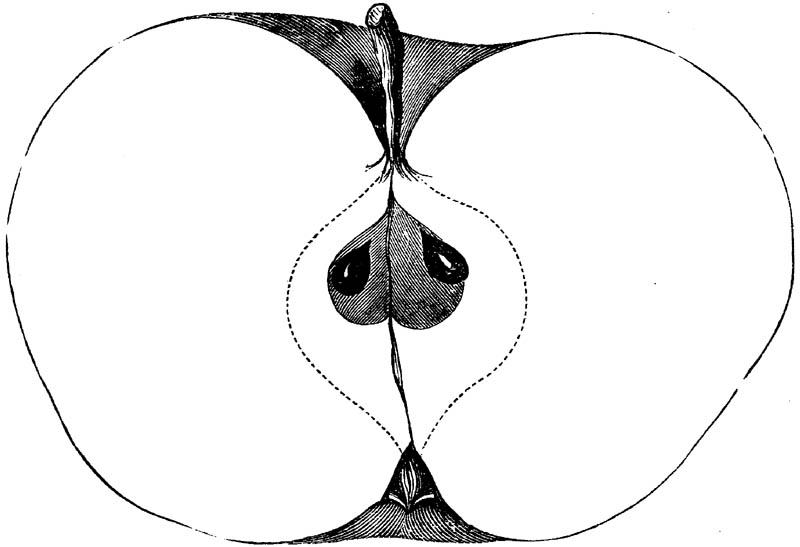
Fig. 118.—PERRY RUSSET.
This variety is grown to some extent in the North-west. The specimen from which the description is made, was exhibited by Mr. Utters, at a meeting of the North-western Fruit Growers, in 1850.
Fruit medium to large, oblate, regular; Surface smooth, yellow, covered with fine russet; Dots minute, scattered.
Basin medium, regular, wavy; Eye large, closed.
Cavity medium, regular or wavy, brown; Stem medium size and length.
Core small, closed, meeting the eye; Seeds few, plump, brown; Flesh yellow, fine grained, juicy; Flavor acid, rich; Quality almost best, for table or kitchen; Season, December and January.
Pomme Grise.
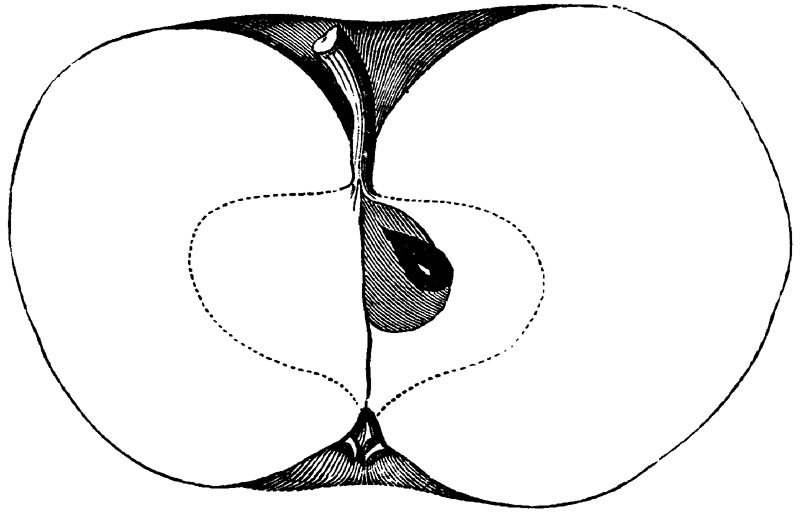
Fig. 119.—POMME GRISE.
Supposed to be of French or Canadian origin. Tree sufficiently vigorous, productive; shoots slender.
Fruit small, roundish-oblate, regular; Surface even but hardly smooth, yellow, overspread with fine russet, rarely blushed.
Basin wide, regular, sometimes abrupt; Eye very small, closed.
Cavity wide, regular; Stem short or medium.
Core full heart-shaped, regular, closed, scarcely meeting the eye; Seeds plump, angular; Flesh firm, yellow, breaking, fine grained, juicy; Flavor sub-acid, rich, aromatic, delicious; Quality best, for dessert; Season, January to March; One of the very best of the Russets.
Willis Russet.
This apple was brought from Massachusetts, by my friend and neighbor B.F. Sanford, without any history of its origin. The quality of the fruit has induced me to give its description.
Fruit medium to small, roundish-oblate; Surface rough, yellow, shaded with light red, covered with russet.
Basin shallow, folded; Eye long, closed.
Cavity wide, wavy; Stem long.
Core large, wide, open, clasping; Seeds numerous, plump; Flesh yellow, breaking, fine grained, juicy; Flavor acid or sub-acid, aromatic; Quality almost first rate, for the table; Season, December and January.
CLASS I.—FLAT APPLES.
ORDER II.—REGULAR IN FORM.
SECTION 1.—SWEET.
SUB-SECTION 1.—SELF-COLORED.
Autumnal Sweet Swaar.
SWEET SWAAR.
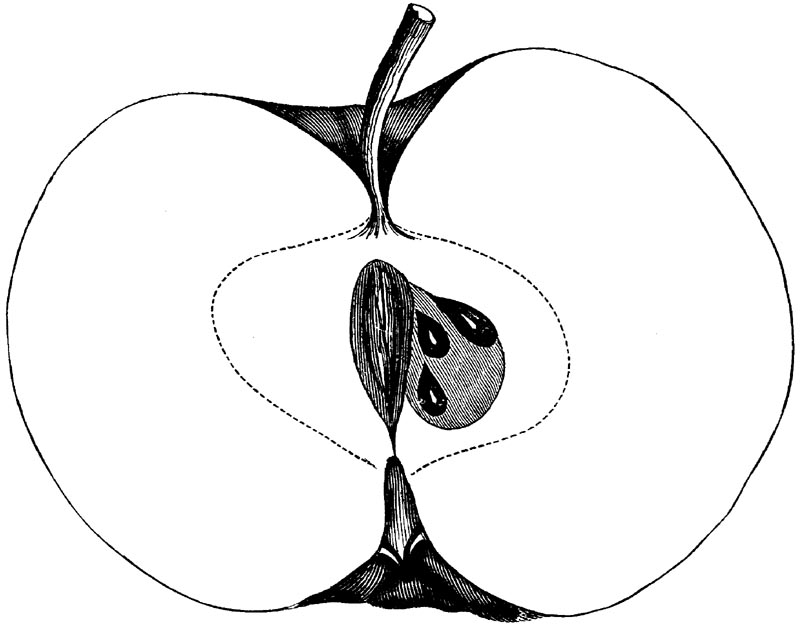
Fig. 120.—AUTUMNAL SWEET SWAAR.
The fruit is highly commended by J.J. Thomas, who thinks it "one of the finest autumnal sweet apples."
Tree vigorous, spreading, productive.
Fruit large, roundish-oblate, somewhat angular; Surface smooth, waxen yellow, sometimes blushed; Dots rare, minute.
Basin wide, shallow, plaited or folded; Eye medium, long, closed.
Cavity acute, deep, wavy, green; Stem long, inclined, yellow and red.
Core regular, globular, somewhat open, clasping; Seeds numerous, plump, pale; Flesh white, fine grained, juicy; Flavor very sweet; Quality best, for baking and market; Season, September and October.
Challenge.
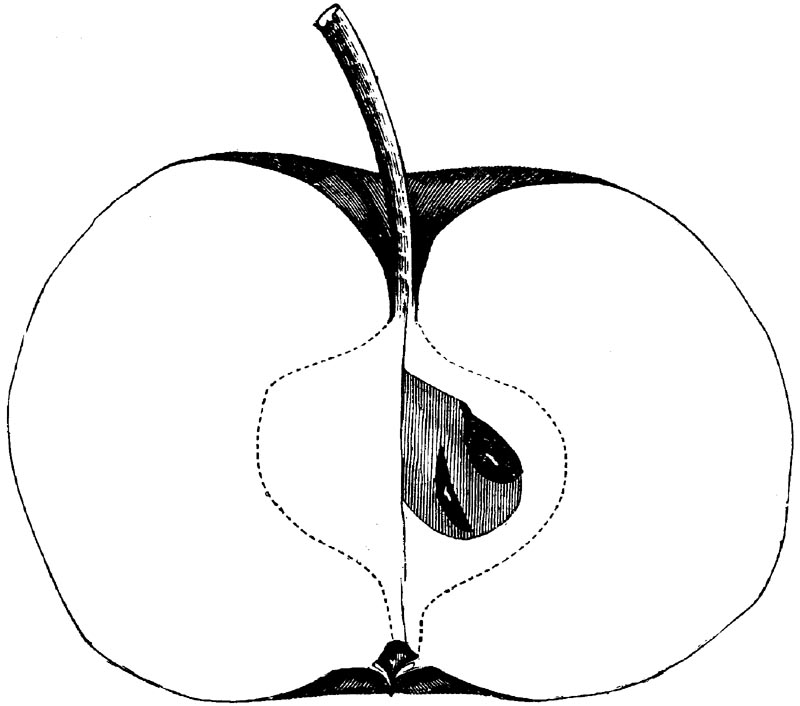
Fig. 121.—CHALLENGE.
This is another of the apples introduced by Mr. Elliott, from the orchard of D.C. Richmond, near Sandusky, O.
Tree productive, hardy.
Fruit medium, globular-oblate; Surface smooth, pale yellow; Dots black, minute, scattered, and russet spots, becoming a rich vermillion where exposed.
Basin shallow, wide, plaited; Eye small, closed.
Cavity wide, regular, brown; Stem long, slender.
Core small, oval, regular, sometimes open, not meeting the eye; Seeds large, dark; Flesh yellow, tender, fine grained, juicy; Flavor sweet; Quality almost first rate, for table; Season, October.
Delight.
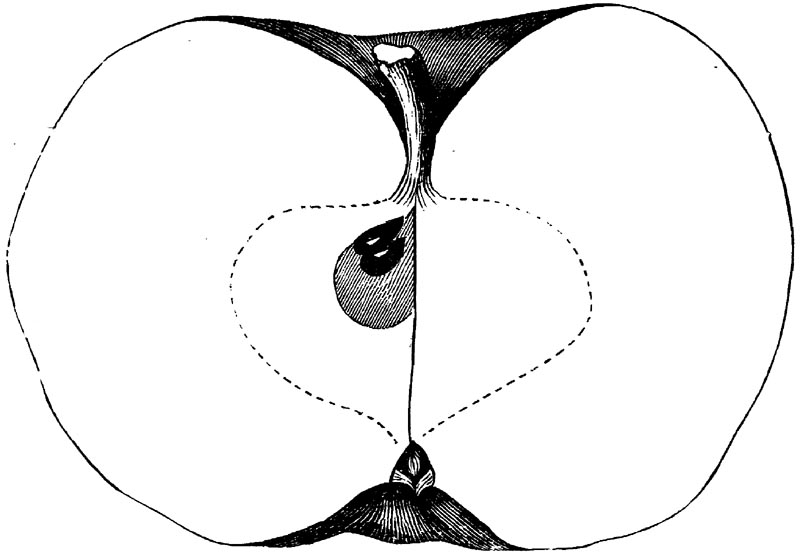
Fig. 122.—DELIGHT.
This variety is grown in the southwestern part of Ohio; origin unknown.
Fruit medium to large, round-oblate, irregular; Surface smooth, yellow, bronzed; Dots minute.
Basin narrow, folded uneven; Eye medium, closed; Segments short.
Cavity wide, regular, brown; Stem short, thick.
Core small, oval, closed, meeting the eye; Seeds numerous, plump, dark; Flesh yellow, tender, juicy; Flavor sweet; Quality pretty good; Use, market and baking; Season, January to June.
Maverack Sweet.
Origin South Carolina.
"Fruit large, roundish-oblate, angular; Skin yellow, mostly shaded with crimson, sprinkled with gray or greenish dots; Stalk short, inserted into a large cavity surrounded by russet; Calyx open, set in a deep, irregular basin; Flesh rich, pleasant, vinous, almost saccharine."—[Downing.]
Spice Sweeting.
The specimens described were from Mr. Warren, of Massachusetts. Others, found in Ohio and Illinois under this name, have a deep, abrupt basin, large or long eye, and yellow flesh; they must be different fruits.
An old variety; Tree vigorous, productive.
Fruit full medium to large, handsome, flat, irregular; Surface smooth, yellow, bronzy, crimson; Dots numerous, green.
Basin shallow, folded; Eye small, closed.
Cavity acute, wavy; Stem thick, knobby.
Core very wide, open, meeting the eye; Seeds pointed, long, dark; Flesh very white, tender, fine grained, juicy; Flavor sweet; Quality good; Use, kitchen, baking, stock; Season, September, October.
Sweet and Sour.
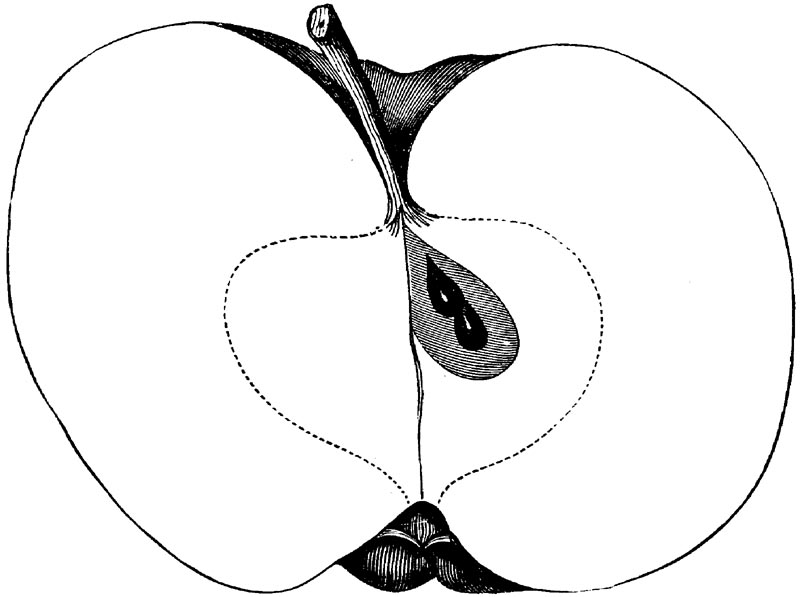
Fig. 123.—SWEET AND SOUR.
This variety is interesting as a curiosity, rather than valuable for its good qualities. It has been suggested that it might be a sport; no educated nurseryman will now believe the old story of its having been produced by the combination of the buds of two varieties, a sweet and a sour.
Fruit large, oblate, often unequal and lop-sided, ribbed, and deeply furrowed.
Surface yellow and green, the ribs being developed and ripening have flavor, but the furrows not being developed are flavorless and called sweet.
Sweet Sponge.
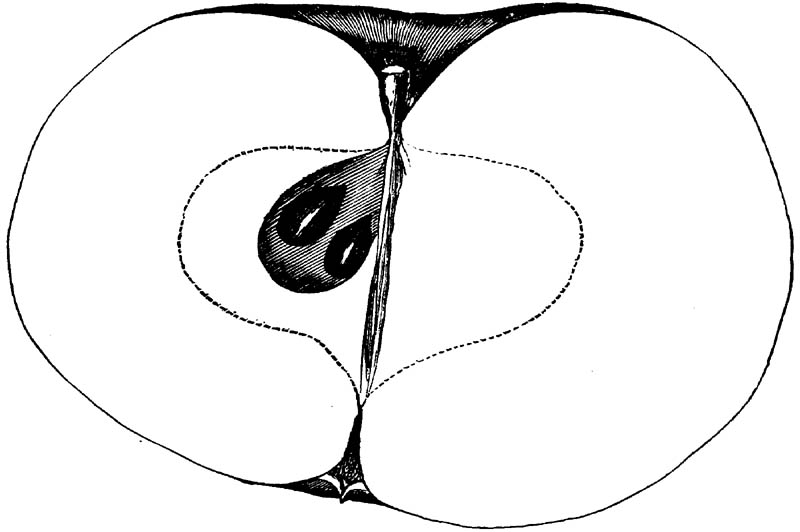
Fig. 124.—SWEET SPONGE.
From H.N. Gillett; Origin unknown.
Fruit medium, oblate, irregular; Surface smooth, yellowish white; Dots minute.
Basin none or extremely shallow, folded; Eye long, closed.
Cavity wide, irregular; Stem short, thick.
Core wide, closed, scarce meeting the eye; Seeds numerous, plump, brown; Flesh white, tender; Flavor sweet; Season, July.
CLASS I.—FLAT APPLES.
ORDER II.—IRREGULAR.
SECTION 1.—SWEET.
SUB-SECTION 2.—STRIPED.
Angle Sweet.
Fruit medium, round-oblate, irregular; Surface smooth, yellow, covered with stripes and splashes of red, some darker; Dots white.
"Flesh yellow, tender, sweet, and good, fair and handsome; Season, first of September."—[Downing.
Peach Pond Sweet.
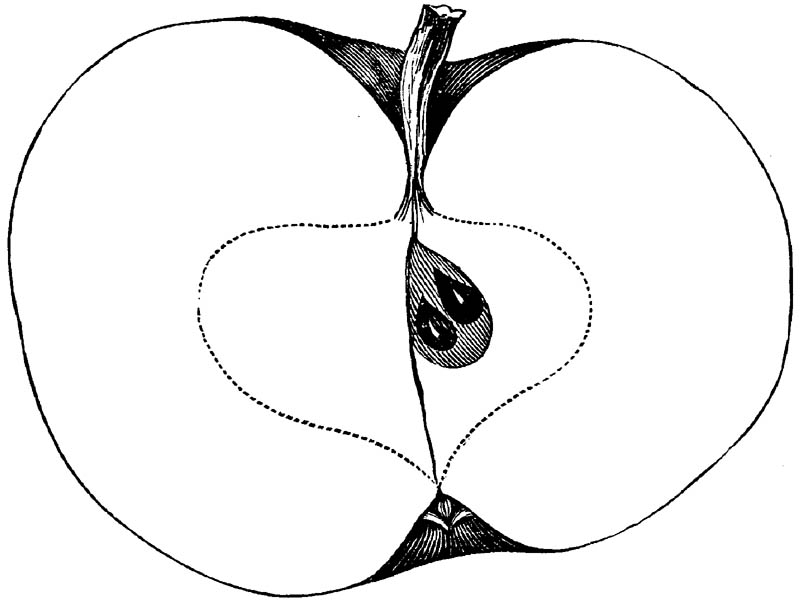
Fig. 125.—PEACH POND SWEET.
Origin Dutchess County, New York.
Fruit small to medium, round-oblate, pentangular, slightly conical; Surface smooth, pale yellow, lightly covered with mixed and striped red, and beautifully splashed crimson.
Basin narrow, regular or folded; Eye small, closed.
Cavity deep, acute, regular, brown; Stem medium to long, green, sometimes knobby.
Core regular, heart-shaped, closed, meeting the eye; Seeds small, short; Flesh yellow, tender, fine grained, juicy; Flavor very sweet; Quality almost first rate, very good; for table or baking; Season September.
Phillips' Sweet.
Origin believed to be Ohio; Downing says, Chotocton County, Ohio.
Tree vigorous, healthy, growth upright, very productive. Elliott thinks it may prove to be the same with Richmond.
Fruit roundish, flattened, slightly conical, obscurely angular or flattened on the sides; Surface smooth, yellow, more or less covered with red, striped crimson; Dots numerous.
Basin abrupt, regular, closed; Eye closed, segments of calyx long.
Cavity large; Stem medium length, rather slender.
Flesh yellow, tender, crisp, juicy; Flavor sweet, spicy, rich; Season, November to March.
Wing Sweet.
Tree very productive.
Fruit medium, oblate, angular; Surface very smooth, yellow, mostly covered with red, indistinctly striped darker red.
Basin wide, deep, regular or folded; Eye small, closed.
Cavity acute; Stem long.
Core small, regular, closed, scarcely touching the eye; Seeds ovate; Flesh yellow, tender, dry; Flavor sweet and rich; Quality good; baking; early winter.
CLASS I—FLAT APPLES.
ORDER II.—IRREGULAR.
SECTION 2.—ACID.
SUB-SECTION 1.—SELF-COLORED.
Blockley.
BLOCKLEY PIPPIN, O. POM. SOC.
Originated near Philadelphia, Pennsylvania. Tree moderately vigorous, upright, productive.
Fruit large, round-oblate, flattened at the ends, five-sided, angular; Surface smooth, greenish-yellow, blushed; Dots numerous, small, distinct, dark.
Basin wide, rather deep, wavy or folded; Eye small, closed, or partly open.
Cavity acute, narrow, uneven, brown; Stem quite short, rather thick.
Core medium, heart-shaped; Seeds numerous, angular and imperfect, dark; Flesh yellow, compact, almost melting, fine grained, juicy; Flavor rich sub-acid, sprightly; Quality almost best, for table; Season, November to January.
Bracken.
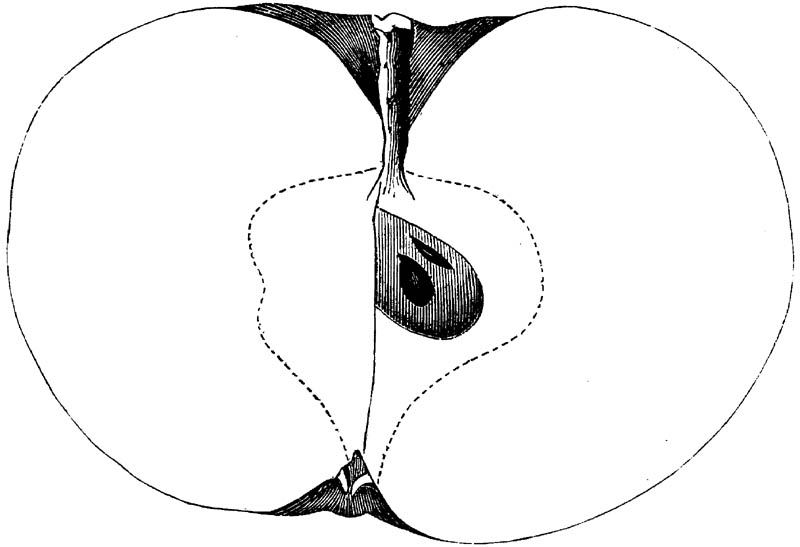
Fig. 126.—BRACKEN.
This variety has caused much discussion among the Western Pomologists, on account of its resemblance to the Early Harvest. The late Dr. Barker, one of the most intelligent fruit-growers of the country, said it was introduced as a seedling from Kentucky in 1812. Elliott does not mention it in his work, but in the discussions of the Society he is reported as having declared it the same as Early Harvest, with which it agrees in peculiar growth of twigs. H.N. Gillett, and others, familiar with the fruits of southern Ohio, consider it a distinct seedling of Kentucky. The specimen described was from that gentleman.
Fruit medium, oblate, somewhat conical, irregular and angular; Surface smooth, pale yellow; Dots scattered, dark.
Basin abrupt, medium, folded; Eye small, closed. Cavity wide, deep, irregular, brown; Stem large, knobby.
Core irregular, closed, meeting the eye; Seeds angular, imperfect; Flesh white, very tender, fine grained; Flavor mild sub-acid; Quality good; Use, table and kitchen; Season, June, July; earlier than Early Harvest.
Canada Reinette.
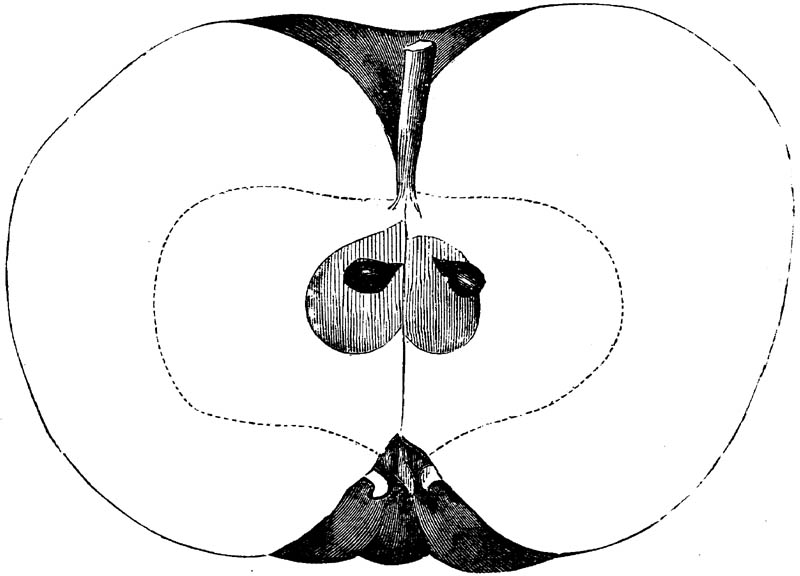
Fig. 127.—CANADA REINETTE.
This fine fruit does not appear to be well known to our orchardists, and some of our writers have given the White Pippin among its numerous synonyms, and have suggested that they might be the same, which is not so; they are very distinct. I have omitted the synonyms, as they can be of little interest to our planters; they are not used in this country. The origin of this variety is uncertain, probably European. Downing says that Merlet, a French writer, described the fruit in the 17th century.
Tree vigorous, robust, tall spreading, productive.
The following outline and description of a specimen presented by Irvin Jessup, of Laporte, Indiana, was kindly made for me by my lamented friend, Geo. M. Beeler, a short time before his death.
Fruit large, oblate, angular; Surface not smooth, yellow, blushed and spotted red; Dots numerous, small, gray.
Basin abrupt, deep, angular; Eye small, nearly closed.
Cavity medium, acute; Stem medium, inclined.
Core wide, regular, closed, clasping; Seeds plump, angular, dark; Flesh breaking, fine grained, very juicy; Flavor acid to sub-acid, aromatic, rich; Quality very good; Use, table and cooking; Season, December to February, in northern Indiana.
Culp.
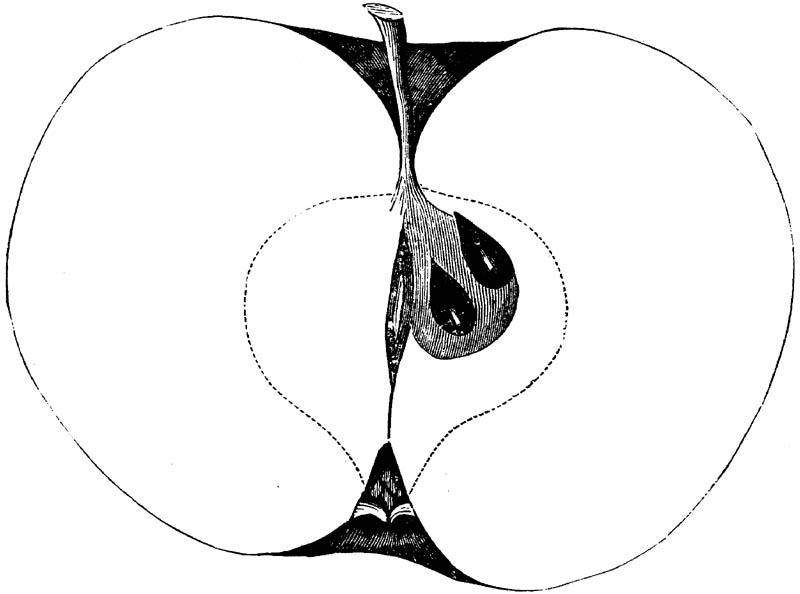
Fig. 128.—CULP.
Origin Jefferson County, Ohio; exhibited at the meetings of the Ohio Pomological Society as early as 1855, by S.B. Marshall, of Massillon, whose friend, S. Wood, had cultivated it several years; my specimens and trees are from the Massillon nursery.
Tree vigorous, thrifty, symmetrical, spreading, very productive, not an early bearer.
Fruit fair, sound, large, somewhat angular, oblate, inclined to conic, hangs well on the tree; Surface smooth, green with bronze blush; Dots minute, with green bases.
Basin narrow, rather abrupt, regular; Eye rather large, closed.
Cavity rather deep, regular, brown; Stem long or short.
Core long heart-shaped, regular, nearly closed, clasping; seeds numerous, very large, dark brown; Flesh yellowish, compact, crisp, juicy; Flavor mild sub-acid, slightly perfumed; Quality good; excellent for cooking, "compared to Rhode Island Greening;" Season, December until April.
Fall Harvey.
Origin Essex County, Massachusetts. Specimen from Zanesville, Ohio.
Fruit large, oblate, irregular; Surface smooth, yellow or pale yellow; Dots minute, gray, distinct.
Basin wide, regular, leather-cracked; Eye medium, closed.
Cavity wide, wavy, green; Stem long to medium.
Core wide or globular, regular, closed, not meeting the eye; Seeds medium, pointed and defective; Flesh yellow, breaking; Flavor rich, acid; Quality only good, but valuable for the kitchen; Season, October.
Garretson's Early.
Origin supposed to be New Jersey. Tree vigorous; an early and abundant bearer.
Fruit medium, globular-oblate, somewhat angular; Surface smooth, pale yellow; Dots whitish.
Basin small, abrupt, furrowed; Eye small, closed.
Cavity shallow; Stem short, inclined.
Flesh white, breaking, tender, juicy; Flavor pleasant sub-acid; Quality good; Use, table; Season, July and August.
Harris.
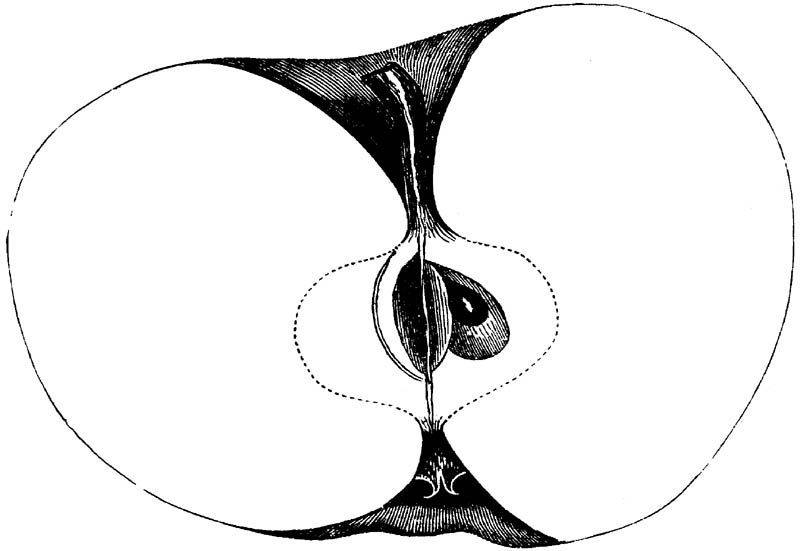
Fig. 129.—HARRIS.
This variety was received from North Carolina, and fruited for the first time in the North during 1866. It was first described and figured, among other new apples, in the Horticultural Annual for 1867. In the South it is considered a summer and fall variety, being in season from August, and continuing for a long time. For specimens, I am indebted to Doctor E. Taylor, of Cleveland, Ohio.
Fruit medium to large, oblate, angular; Surface smooth, yellow, faintly blushed; Dots scattered, minute, with rosy spots.
Basin deep, abrupt, folded; Eye medium, rather open.
Cavity deep, wavy, clear yellow; Stem medium to long.
Core small, open, meeting the eye; Axis very short; Seeds numerous, angular; Flesh light yellow, breaking, fine-grained, juicy; Flavor acid to sub-acid, spicy, agreeable; Use table and kitchen; Season October; Quality good to very good.
Loudon Pippin.
LADY WASHINGTON?
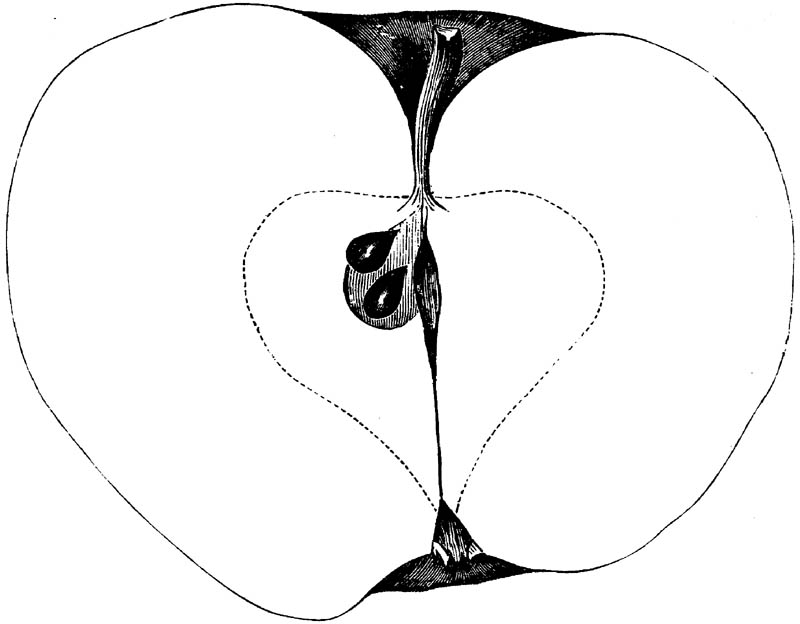
Fig. 130.—LOUDON PIPPIN.
Origin Loudon County, Virginia. Exhibited before the Ohio Pomological Society, by Joseph Sigler, of McConnellsville, Ohio.
Fruit large, oblate, conic, angular; Surface beautiful, very smooth, waxy yellow, handsomely blushed, and bright red spots; Dots scattering, gray.
Basin wide, regular or folded; Eye large, closed.
Cavity wide, not deep, regular, brown; Stem medium, red.
Core heart-shaped, regular, closed, clasping the eye; Seeds numerous, medium; Flesh yellowish, compact, tender, breaking; Flavor rich sub-acid, aromatic; Quality very good; Dessert; Season, December to February. A fine fruit from Washington County, shown at the same time as the Lady Washington; was thought to be the same.
Ohio Pippin.
ERNST'S APPLE.—BUCHANAN, ETC.—SHANNON.
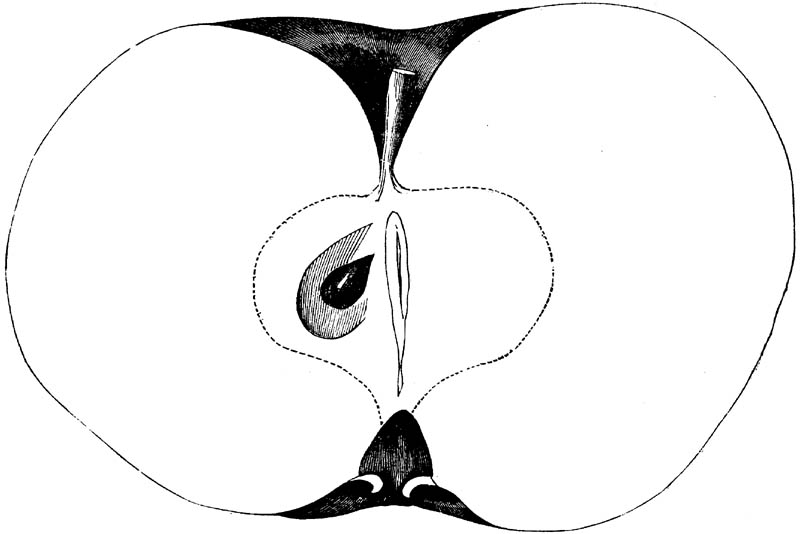
Fig. 131.—OHIO PIPPIN.
We owe our acquaintance with this fine large fruit to the late Mr. A.H. Ernst, long President of the Ohio Pomological Society, who furnished trees to Mr. Robert Buchanan, an enthusiastic Pomologist of Cincinnati. Both these gentlemen were too modest to permit their names to be attached to a fruit which they did not originate, but which they have aided to distribute. Another focus of distribution was the orchard and nursery of R.W. Todd, at Madison, Indiana, and the fruit has been received under the name of Shannon, from Doctor J.A. Dibrell, of Van Buren, Arkansas. Origin Dayton, Ohio, from whence it was procured personally by Mr. Todd, many years ago, and the grafts set by him are the oldest trees known.
Tree healthy, vigorous, large, spreading; Shoots stout, dark; Leaves large.
Fruit large, often very large, oblate, somewhat conic, irregular; Surface smooth, greenish-yellow, sometimes blushed faintly near the base; Dots small gray.
Basin wide, deep, folded; Eye large or very large, open; Segments short.
Cavity wide, wavy or regular, brown; Stem short, stout.
Core medium to large, regular, closed, meeting the eye; Seeds numerous, medium, plump, sometimes imperfect; Flesh yellowish, breaking, tender, juicy; Flavor acid to sub-acid; Quality good; Market and kitchen, too large for dessert; Season, December, January.
Western Spy.
Origin Jefferson County, Ohio. Tree healthy but medium growth, very productive; exhibited by Joel Wood.
Fruit large, roundish-oblate, uneven; Surface smooth, yellow, blushed; Dots numerous, minute, with white bases.
Basin abrupt, uneven; Eye large, closed.
Cavity medium, wavy; Stem short.
Core wide, closed, not meeting the eye; Seeds numerous, large, plump; Flesh yellow, breaking; Flavor acid; quality pretty good; Use, kitchen, table; Season, December, January.
CLASS I.—FLAT APPLES.
ORDER II.—IRREGULAR.
SECTION 2.—ACID.
SUB-SECTION 2.—STRIPED.
Berry.
Not having enjoyed an opportunity of examining this fruit, I quote from my friend Chas. Downing.
"Origin Virginia or North Carolina. Tree vigorous, upright, very productive, and a valuable market fruit.
"Fruit rather above medium, obliquely depressed; Skin striped and splashed with red, on greenish-yellow ground, with large dots, having a dark center; Stem short, in a generally broad, deep cavity; Calyx open; Basin shallow, and uneven; Flesh rather coarse, juicy, with a pleasant sub-acid flavor; November to March."
Buff.
For description of this fruit I take Downing's quotation from White's Gardener:
"Origin uncertain; Tree vigorous, erect; Fruit very large, irregular, roundish flattened and slightly irregular; Skin thick, yellow, striped, and shaded with red, very dark next the sun, marked with a few greenish russet spots; Stem three-fourths of an inch long, in a medium cavity; Calyx in a large, irregular basin; Flesh white, and when fully ripened, tender and excellent, sometimes indifferent; November to March."
Dana.
From Gabriel Sleath, near Cincinnati, Ohio. The origin of this pleasant dessert apple is not known. Tree large, productive.
Fruit small, flat, somewhat angular; Surface smooth, rich yellow partially covered mixed red, distinctly striped carmine; Dots pale fawn or yellow; heavy white bloom.
Basin shallow, leather-cracked; Eye small, long, closed.
Cavity medium, regular; Stem quite long, slender.
Core wide, regular, open, clasping; Seeds numerous, short, plump, brown; Flesh yellow, very fine grained, very juicy; Flavor sub-acid, sprightly, agreeable; Quality good to very good; Use, dessert; Season, August.
Gravenstein.
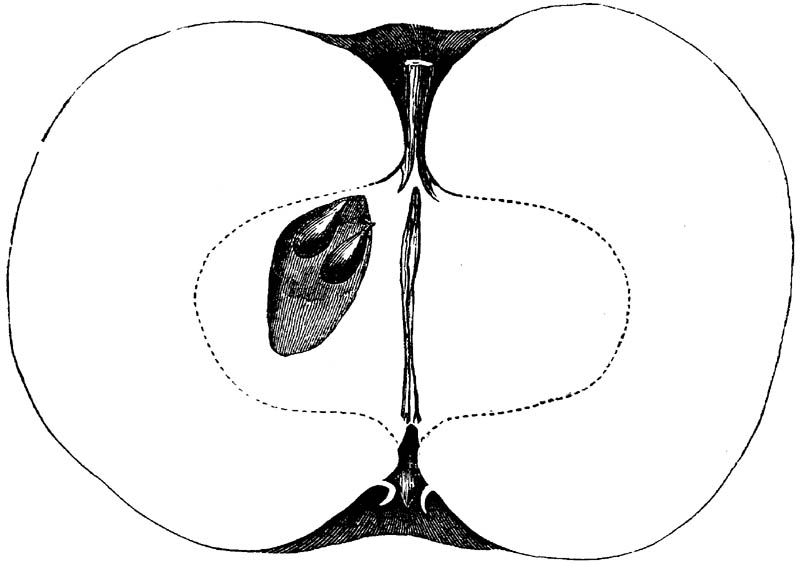
Fig. 132.—GRAVENSTEIN.
This fine European apple is said to have originated at Gravenstein, Holstein. It has long been in this country, where it succeeds very well.
Tree vigorous, spreading, productive; Shoots vigorous; Leaves long, rolled, showing the white underside.
Fruit large, globular-oblate, angular; Surface smooth, yellow, partially covered with mixed and splashed scarlet; Dots rare.
Basin medium, regular; Eye small, closed.
Cavity deep, regular; Stem short.
Core regular, globular, or pointed toward the eye, closed, clasping; Seeds small, pointed; Flesh yellow, fine grained, breaking, juicy; Flavor sub-acid, aromatic; Quality best; table and kitchen; Season, August, September.
Keiser.
Origin Jefferson County, Ohio; not widely distributed. Tree thrifty, upright. The following description was made from fruit obtained of my friend T.S. Humrickhouse, of Coshocton.
Fruit full medium to large, oblate, uneven; Surface smooth, greenish-yellow, mixed and striped red; Dots scattered, minute.
Basin wide, deep, folded; Eye small, closed.
Cavity acute, deep; Stem quite short.
Core very small, regular, closed, clasping; Seeds numerous, short, plump; Flesh yellow, tender, fine grained, juicy; Quality good to best; for table and kitchen; Season, December to January.
Mangum.
A first rate southern fruit. Tree thrifty, and very productive.
Fruit medium, oblate, slightly conic, angular; skin yellowish, striped and mostly shaded with red, thickly sprinkled with whitish and bronze dots; Stem short and small, inserted in a broad cavity surrounded by russet; Calyx partially closed; Basin slightly corrugated; Flesh yellow, very tender, juicy, mild sub acid, excellent, highly prized in Georgia and the South; October and November. Carter of Alabama may prove the same.—[C. Downing.]
Melon.
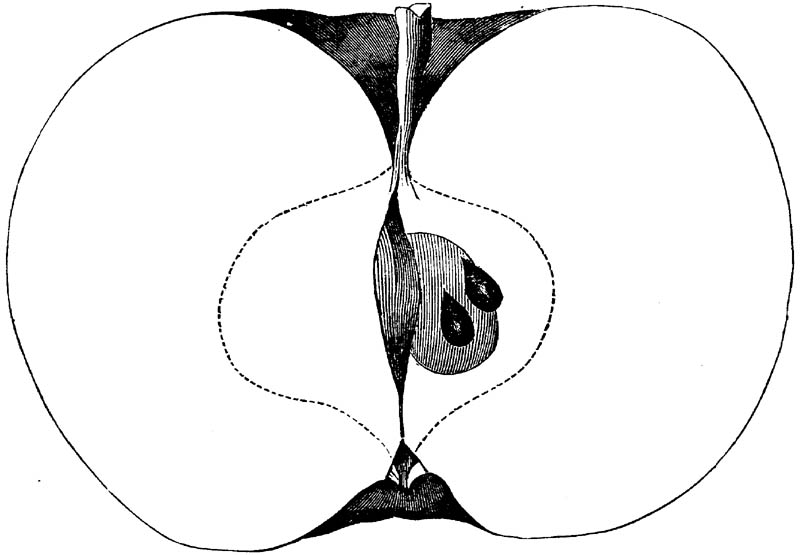
Fig. 133.—MELON.
Origin East Bloomfield, New York. Tree sufficiently vigorous, spreading, round-headed.
Fruit large, oblate, somewhat conical, angular; Surface smooth, waxen yellow, nearly covered with marbled and mixed scarlet, striped distinctly with darker shade; Dots minute.
Basin, wide, medium depth; Eye medium, open.
Cavity deep, acute, wavy, green and brown; Stem medium.
Core regular, heart-shaped, wide, partially open, clasping; Seeds numerous, medium, angular; Flesh yellow, tender, fine grained, juicy; Flavor acid, sub-acid, aromatic, rich; Quality almost best; Use, table, market and kitchen; Season, November to January.
Muster.
This very nice apple was introduced to my attention by my very good friend Calvin Fletcher, Jr., of Indianapolis, in which neighborhood it grows. Its origin and history are unknown, nor do any satisfactory responses come to the oft-repeated question—What is this delicious apple?
Fruit large, oblate, angular; Surface yellow, mostly covered with mixed red and splashes of crimson; Dots scattering, large, yellow and gray.
Basin moderately deep, folded; Eye medium, open.
Cavity medium, regular, brown; Stem medium to short.
Core small, closed; Seeds plump, dark; Flesh yellow, fine-grained, tender, juicy; Flavor sub-acid, aromatic; Quality best for dessert; Season, August and September.
Pennsylvania Winesap.—[Local Name.]
Origin unknown; Grown in Wayne County, Indiana.
Fruit large, conical-oblate, truncated, angular.
Surface smooth, yellow, blushed, very little splashed; Dots scattered, minute.
Basin medium, folded, wavy; Eye medium, closed.
Cavity medium, wavy; Stem medium or short, stout, fleshy.
Core regular, closed; Seeds few, plump; Flesh yellowish-white, tender, fine-grained, juicy; Flavor sub-acid; Quality good; Use, table; Season, December, January.
Wagener.
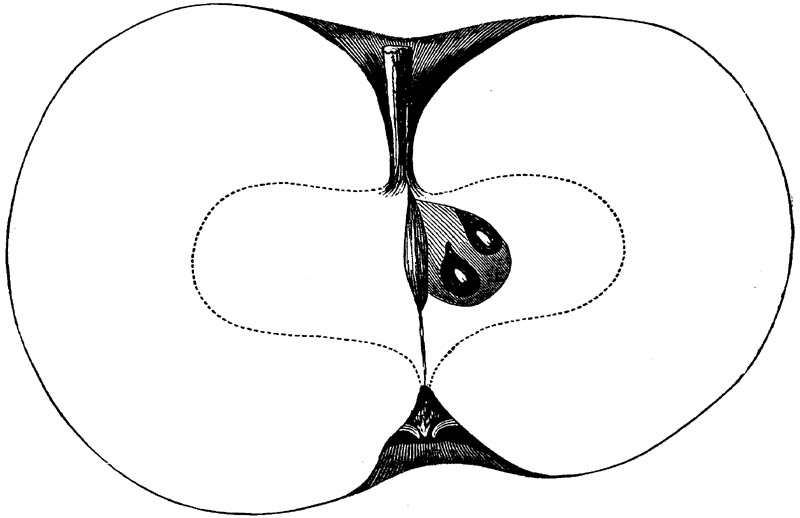
Fig. 134.—WAGENER.
This beautiful and useful apple originated at Penn Yan, Yates County, New York; was described and figured in the Transactions of the State Agricultural Society.
Tree thrifty, upright, productive, and very early bearer.
Fruit large, oblate or globular-oblate, pentangular; Surface very smooth, yellow, well covered with mixed bright red, stripes not distinct; Dots scattered, yellow.
Basin wide, abrupt, regular; Eye small, closed.
Cavity regular, brown; Stem medium, green.
Core regular, wide, heart-shaped, closed, meeting the eye; Seeds numerous, large, angular; Flesh yellowish-white, tender, fine-grained, juicy; Flavor mild sub-acid; Quality good; Uses, market, table and kitchen; Season, November and December.
CLASS I.—FLAT APPLES.
ORDER II.—IRREGULAR.
SECTION 2.—ACID.
SUB-SECTION 3.—RUSSET.
Cranberry Russet.
This apple was introduced to the notice of the Ohio Pomological Society by its Vice-President, J. Austin Scott, of Toledo, Ohio.
Fruit medium to large, oblate, flattened at the sides, irregular; Surface rough, russeted, blushed carmine, uneven; Dots numerous, large, gray, prominent.
Basin shallow, uneven; Eye small, partially open.
Cavity deep, acute, green; Stem long, slender, knobby.
Core wide, regular, closed; Seeds long, angular, brown; Flesh breaking, tender, not very juicy; Flavor quite acid; Quality second rate, but said to be superior for cooking; Season, November and December.
Roxbury Russet.
BOSTON RUSSET.—PUTNAM RUSSET.
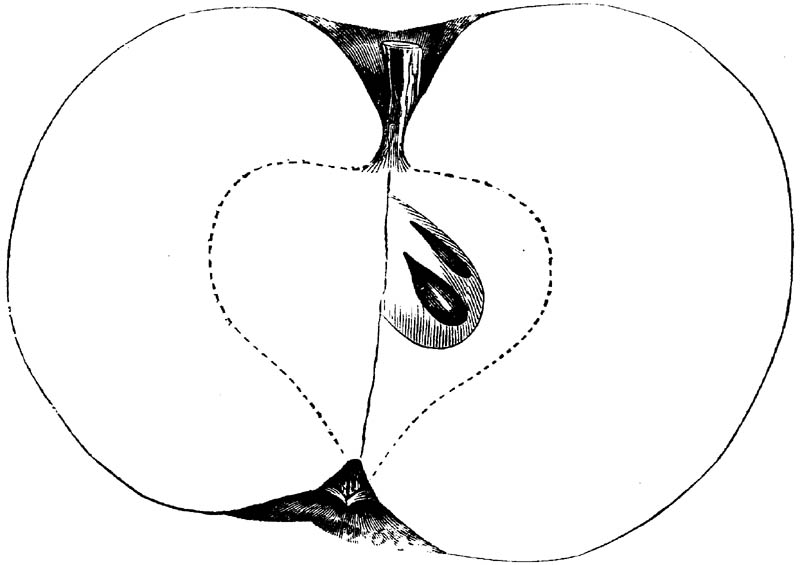
Fig. 135.—ROXBURY RUSSET.
This standard apple is perhaps as widely known and as much admired as any other in the catalogue. It was brought to the West by different routes—by the Ohio River and by the lakes—and has been universally distributed. Those brought to the mouth of the Muskingum River, and propagated by Mr. Putnam, had the name changed to that of the Marietta and the Putnam Russet; and at the same time the appearance of the fruit was so altered by increase in the russeting, that it was long thought to be a different variety, until the question was at length settled by interchange of grafts; and when these fruited the identity was proved.
It is claimed that more money has been realized from this than from any other variety, though, on the Ohio River, the Rome Beauty is considered to be equally profitable. The popularity of this Russet is on the wane, however, as it is very subject to attacks of the Codling-moth, which makes it fall, and because it is apt to ripen too early in the season in southern locations and on limestone soils. Hence its value as a keeping apple is diminished.
Tree robust, vigorous, spreading; Shoots stout, straggling, dark; Foliage gray-green.
Fruit large, oblate, often lop-sided at the West, frequently angular, sometimes conic and truncated; Surface overspread with heavy brown russet in the South, but green, often bronzed, and with partial light russet at the north of latitude 41°; Dots minute, scattered.
Basin regular or wavy, green, often folded; Eye medium, closed.
Cavity regular, pointed; Stem medium, curved.
Core regular, closed, clasping; Seeds numerous, angular, imperfect; Flesh greenish-yellow, breaking, granular, often coarse, juicy; Flavor decidedly acid; Quality second rate; Use, market and cooking; Season, November to January; a better keeper in the North.
Whitney Russet.
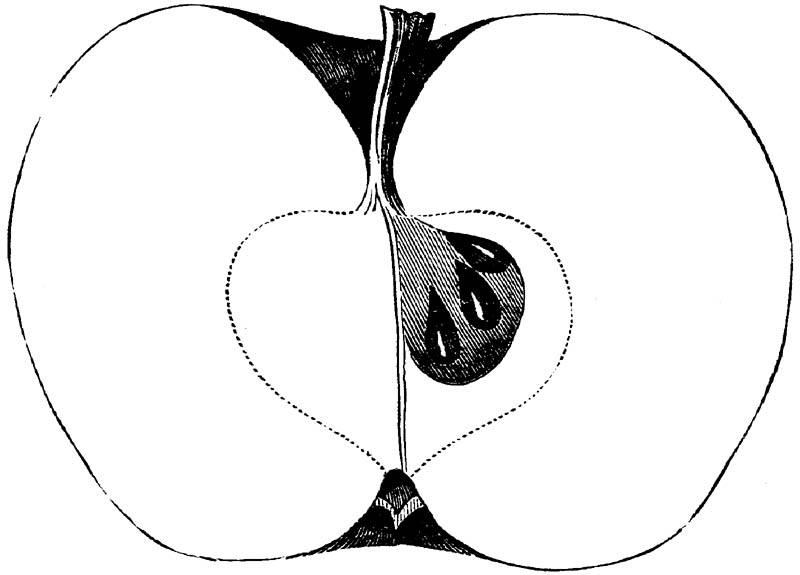
Fig. 136.—WHITNEY RUSSET.
Of uncertain or accidental origin in the extensive nurseries and orchards of my friend A.R. Whitney, of Franklin Grove, Lee County, Illinois, where my specimens and trees were procured.
Fruit medium or small, roundish-oblate, truncated, angular; Surface smooth, yellow, rather thinly russeted; Dots minute, prominent.
Basin abrupt, regular, green; Eye medium, closed.
Cavity acute, deep, wavy; Stem medium to long, slender.
Core medium, regular, heart-shaped, rarely open, meeting the eye; Seeds very numerous, medium, plump; Flesh greenish-yellow, breaking, very fine-grained, juicy; Flavor sub-acid, aromatic, rich, spicy; Quality best; especially a dessert apple; Season, December to February.
CLASS II.—CONICAL APPLES.
ORDER I.—REGULAR.
SECTION 1.—SWEET.
SUB-SECTION 1.—SELF-COLORED.
Large Bough.
LARGE YELLOW BOUGH, ETC.
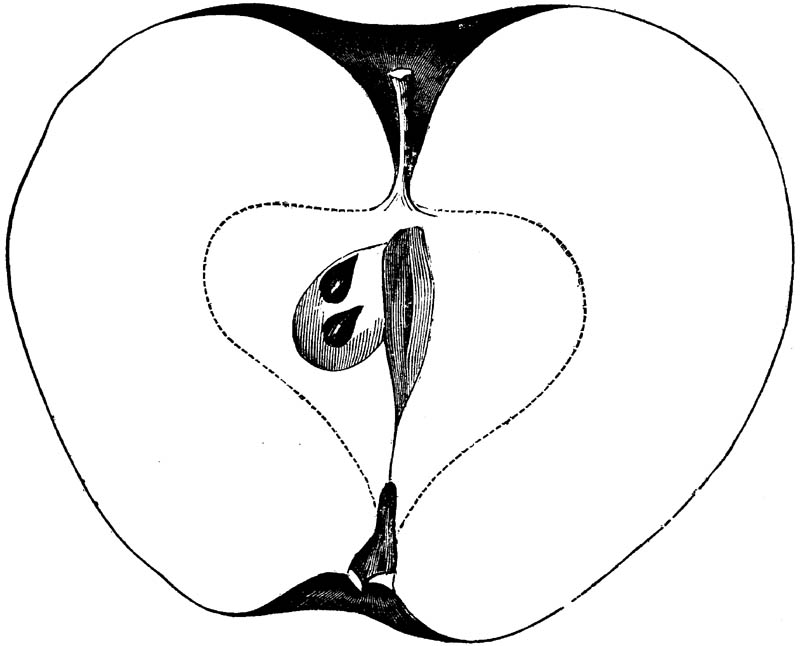
Fig. 137.—LARGE BOUGH.
A native fruit, much admired as an early sweet apple. Tree vigorous, compact head, rather productive.
Fruit round-conic, regular, very light; Surface smooth, white or pale yellow; Dots minute, dark, indented, few.
Basin rather shallow, regular; Eye small, closed.
Cavity acute, regular, deep, sometimes brown; Stem medium.
Core regular, nearly closed, clasping; Seeds medium, dark; Flesh white, very soft, light, juicy; Flavor very sweet when ripe, somewhat bitter when green; Quality only good—by some called best; Use, market, stock and dessert—tasteless when cooked; Season, July and August.
Fallawater.
TULPEHOCKEN, ETC.
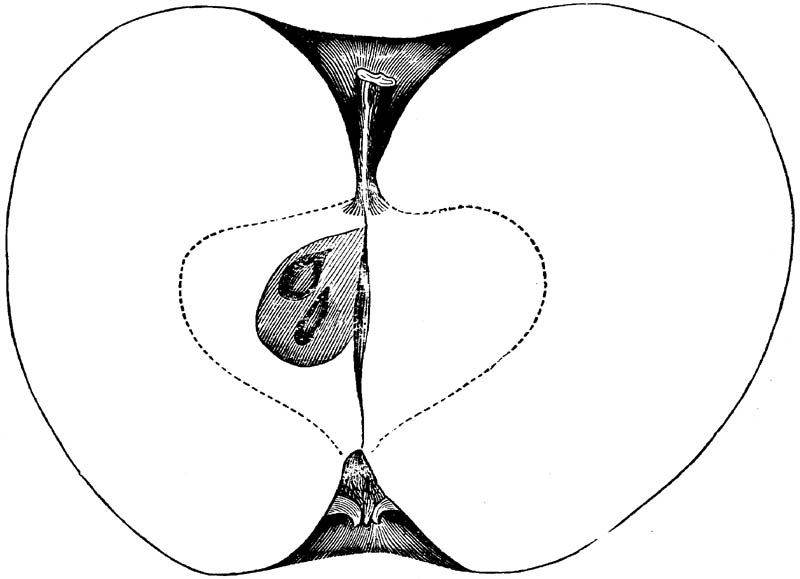
Fig. 138.—FALLAWATER.
A native of Pennsylvania, where it is a great favorite; extensively cultivated through the West.
This is essentially a market apple, having little to recommend it but its size, appearance and productiveness.
Tree very vigorous, spreading, productive, not long-lived; Shoots very stout, dark; Leaves large.
Fruit large, round or oblate-conic, regular; Surface sometimes smooth, greenish-yellow, often blushed crimson—large specimens covered with whitish veined marks; Dots numerous, gray, large, and having whitish bases.
Basin rather deep, regular; Eye large, open.
Cavity deep, regular, brown; Stem short, stout.
Core medium, closed, meeting the eye; Seeds numerous, angular; Flesh whitish, often greenish-white, light, tender, juicy; Flavor very mild sub-acid, or sweet, with little character; Quality scarcely good; Use, market and stock; Season, November, December, and may be kept longer if desired.
Michael Henry.
MICHAEL HENRY PIPPIN.—[Coxe.]
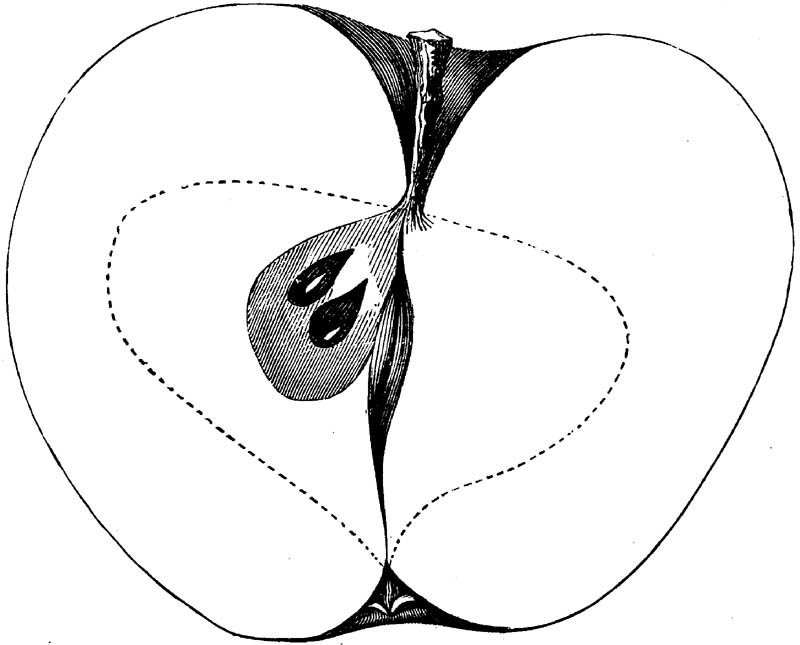
Fig. 139.—MICHAEL HENRY.
Origin Monmouth County, New Jersey. Extensively cultivated in the Western States, where it has many admirers.
Tree vigorous, not large, spreading, very productive, early bearer; Shoots dark, foliage medium and healthy.
Fruit fair, medium to large, conic, regular; Surface smooth, dull green, whitish stripes, pale yellow when ripe, rarely a faint blush; Dots scattered, prominent.
Basin abrupt, or shallow, regular; Eye medium, closed.
Cavity deep, acute, brown; Stem short to medium.
Core regular, heart-shaped, clasping, closed; Seeds numerous, plump, black; Flesh pale yellow, breaking, tender, light, juicy; Flavor sweet, slightly aromatic, little character; Quality good; Use, market, kitchen; Season, December and January; keeps well.
Premium of 1858.
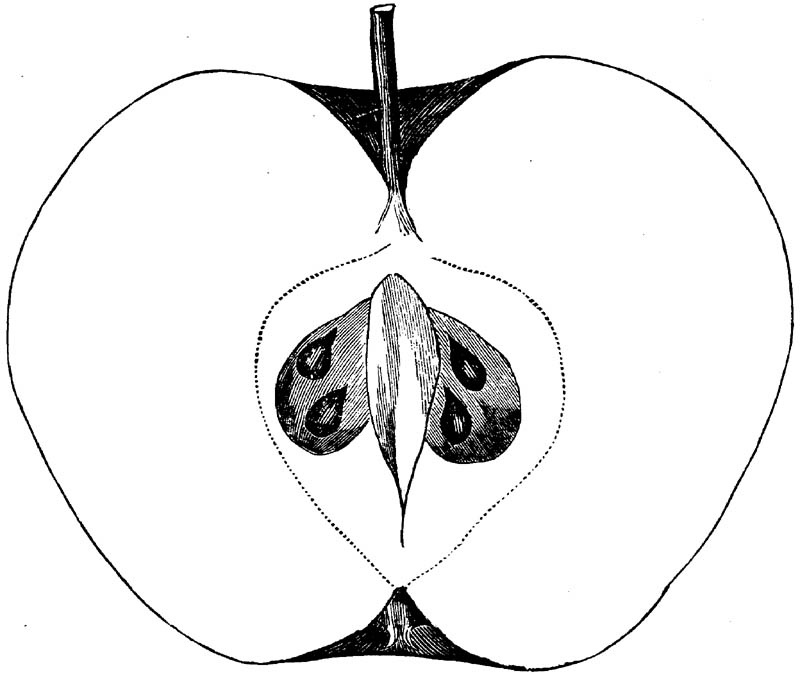
Fig. 140.—PREMIUM OF 1858.
Found in a seedling orchard near Springfield, Ohio, and awarded the premium in 1858.
Fruit medium, roundish-conic, regular; Surface smooth, pale yellow; Dots numerous, minute, white.
Basin shallow, regular, folded; Eye large, closed or open.
Cavity wide, shallow, regular; Stem long, slender.
Core rather large, regular, open, meeting the eye; Seeds numerous, angular; Flesh yellow, line grained, tender; Flavor very sweet, rich; Quality very good; Use, baking and stock; Season, October to December.
Shockley.
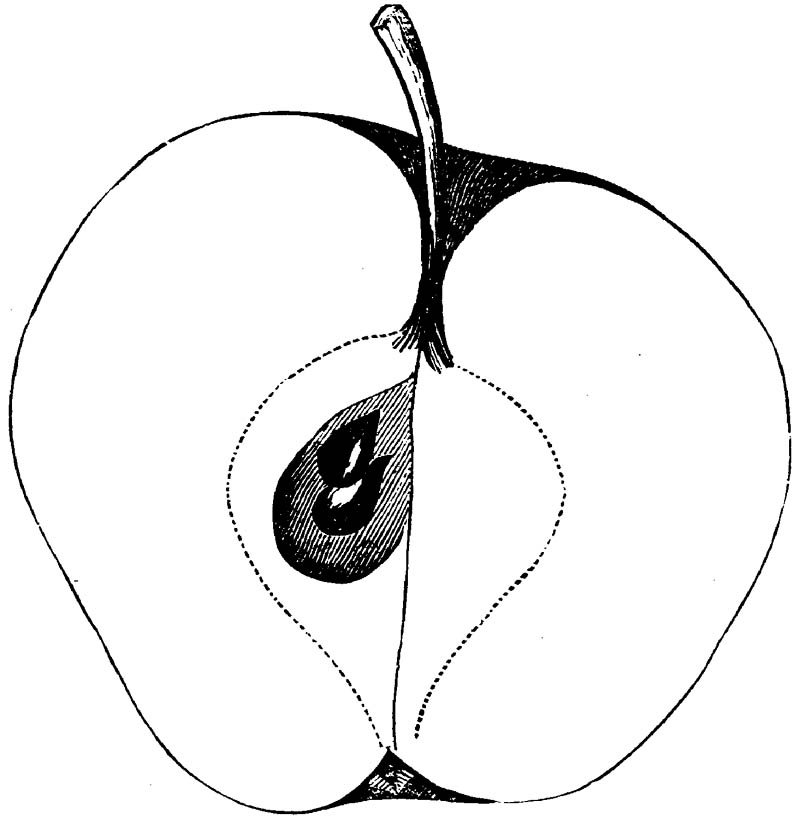
Fig. 141.—SHOCKLEY.
Origin Jackson County, Georgia. This long-keeper from the South promises to be an acquisition of value for market orchards, unless its small size may make an objection.
Tree vigorous, very productive.
Fruit medium to small, conic, truncated, regular; Surface very smooth, waxen yellow, marbled or blushed scarlet and crimson; Dots scattered, minute, gray.
Basin shallow, plaited; Eye small, closed.
Cavity acute, deep, regular; Stem slender, long. Core long heart-shaped, closed, meeting the eye; Seeds numerous, plump, dark; Flesh yellow, fine grained; Flavor mildly sub-acid, rich, saccharine, agreeable; Quality very good; Use, dessert; Season, March to June; a good keeper.
Sweet Pear.
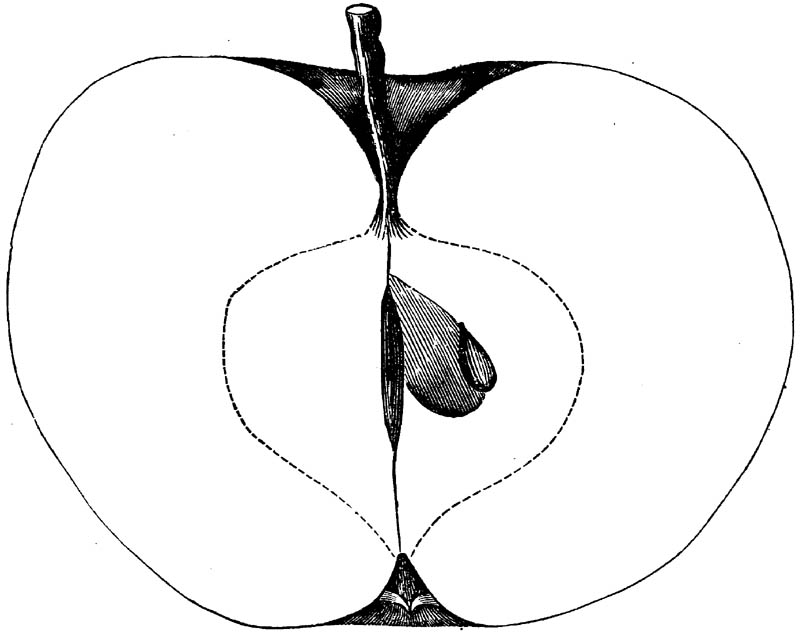
Fig. 142.—SWEET PEAR.
The origin of this fruit is uncertain; the specimens were obtained in the orchard of H.P. Kimball, and his father-in-law, Dr. George Haskell—zealous pomologists at Rockford, Illinois.
Fruit medium to large, round, somewhat conic, regular; Surface smooth, yellowish-green, blushed; Dots numerous, minute, gray, indented; red spots.
Basin quite shallow, plaited; Eye small, but long, closed.
Cavity deep, acute, wavy, green; Stem long, rather slender, green.
Core small, round, somewhat open, clasping the eye; Seeds numerous, medium, pointed; Flesh greenish-white, breaking, fine grained, juicy; Flavor sweet, aromatic; Quality good to best; Use, table; Season, October.
Victuals and Drink.
GREEN SWEET OF INDIANA.—POMPEY.—FALL GREEN SWEET.
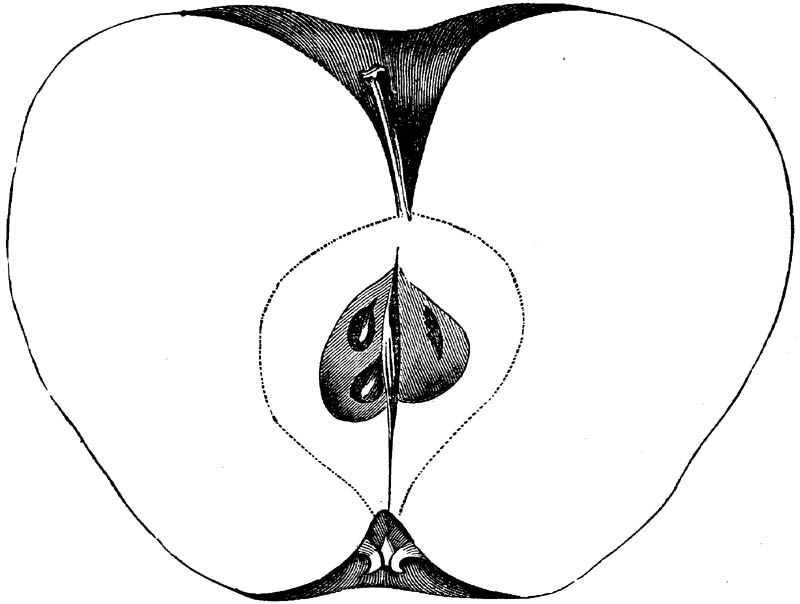
Fig. 143.—VICTUALS AND DRINK.
This old variety has met with great favor in its western home, though not esteemed or much cultivated in the Eastern States, unless about Newark, New Jersey, where it originated about 1750, according to Downing.
Tree spreading, large; Branches twiggy, slender, moderately productive.
Fruit large, conical, regular, but uneven; Surface somewhat rough, dull green to dull yellow, often veined russet; Dots numerous, minute.
Basin medium, sometimes abrupt, regular or folded; Eye medium, closed.
Cavity wide, wavy, green; Stem short.
Core small, regular, oval, clasping, closed; Seeds numerous, angular, imperfect, dark; Flesh greenish-white or yellowish, very tender, fine-grained, light; Flavor very sweet, very rich; Quality best; Use, baking, table and stock; Season, September and October—in the North later, but is not a housing apple.
Virginia June.
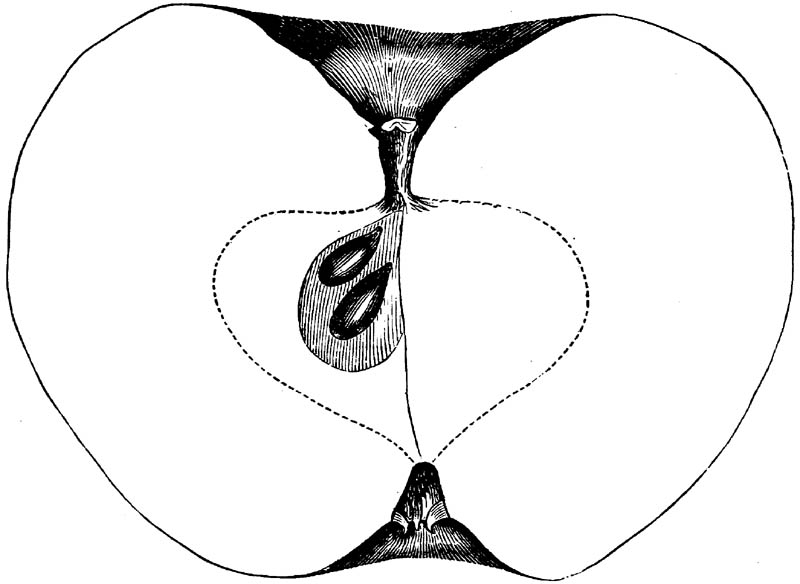
Fig. 144.—VIRGINIA JUNE.
Presented by W.P. Putnam, of Ohio, as brought from Adams County, Mississippi.
Fruit medium to large, oblate-conical, regular; Surface greenish-yellow; Dots scattered, prominent.
Basin medium, regular, abrupt; Eye medium, open.
Cavity very wide, regular, brown; Stem very short.
Core heart-shaped, regular, meeting the eye, closed; Seeds numerous, pointed; Flesh yellow; Flavor rich, sweet; Quality good; September to October, in Ohio.
This may prove to be some known variety, but it has not yet been recognized.
The Virginia June, grown in Kentucky and Indiana, is quite different, being round, striped and sub-acid. It is esteemed, where known, as a household apple, but becomes rather dry.
CLASS II.—CONICAL APPLES.
ORDER I—REGULAR.
SECTION 1.—SWEET.
SUB-SECTION 2.—STRIPED.
Kentucky Sweet.
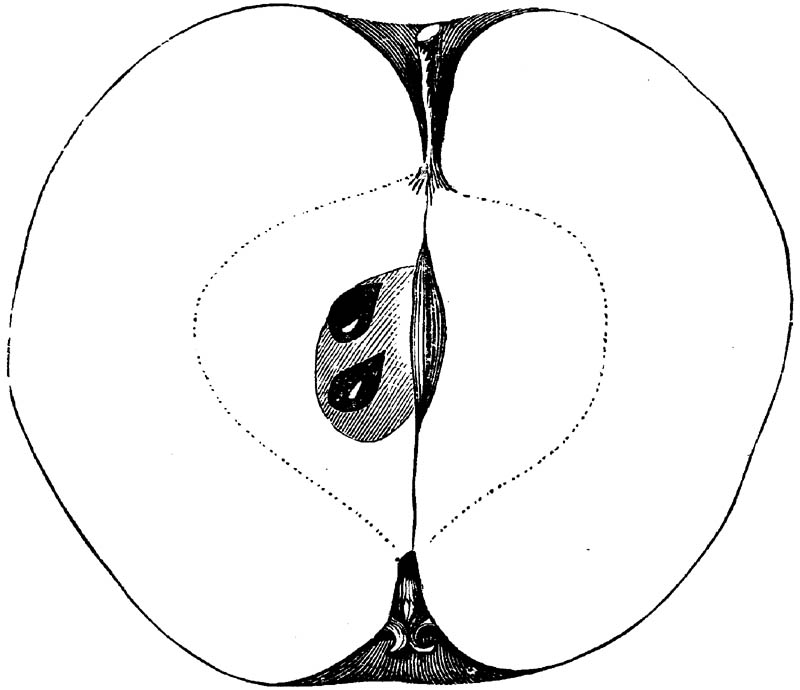
Fig. 145.—KENTUCKY SWEET.
This is an apple of Kentucky or southern origin, found in many parts of the western country among the emigrants from Dixie Land, with whom it is a great favorite on account of abundant fruitage and rich sweetness.
Specimens, under name, were received from the intelligent southern pomologist, J.S. Downer, of Fairview, Kentucky, also from J.W. Dodge, of Pomona, Tennessee, from which the description and drawing are taken. It has also been seen frequently in Southern Illinois.
Fruit medium, conic, regular; Surface smooth, deep red, stripes obscured and scarcely visible, the yellow ground color rarely seen; Dots scattered, large, yellow.
Basin regular, narrow, not deep, leather-cracked; Eye medium, long, open; Segments short.
Cavity acute, not deep, brown; Stem short to medium.
Core oval, regular, not meeting the eye, somewhat open; Seeds numerous, large and imperfect, brown; Flesh yellow, tender, fine-grained, juicy; Flavor very sweet, rich, slightly perfumed; Quality very good to best; Use, baking, market and stock; Season November to January. Keeps well.
Milam.
BLAIR.—(Rarely.)
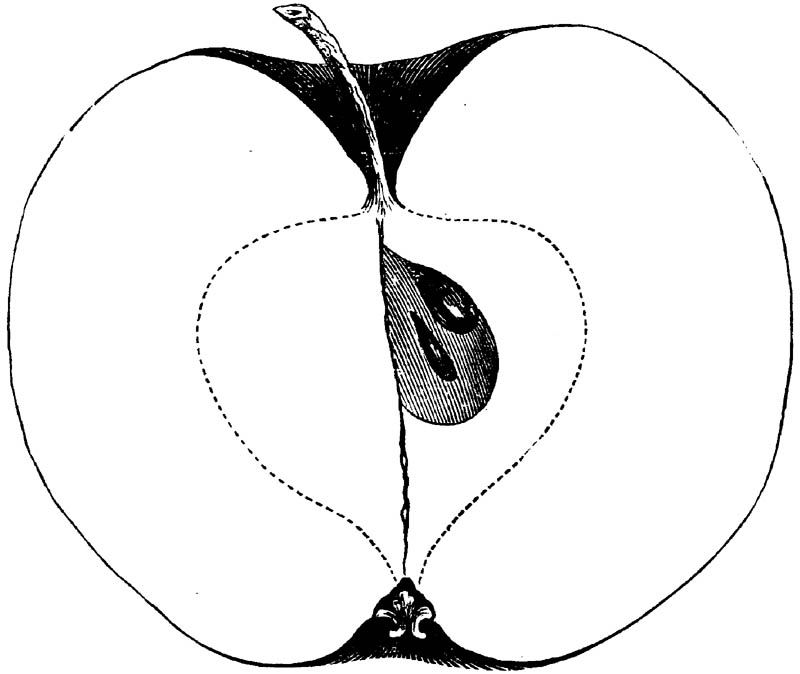
Fig. 146.—MILAM.
This is another little southern favorite, to be found by almost every cabin in parts of the West. Whole orchards have been planted with sprouts from the mother trees, among the people to whom the art of grafting was an unheard of mystery. Now distributed by nurserymen all over the country.
Tree moderately vigorous, round-headed, twiggy; shoots reddish; foliage rather dark. Annually productive and an early bearer.
Fruit small to medium, conical, regular; Surface smooth, yellow, covered with marbled red, indistinct stripes; Dots small, gray, scattered, prominent.
Basin narrow, wavy, leather-cracked; Eye medium, closed.
Cavity regular, acute, brown; Stem long.
Core ovate, covering the eye, closed; Seeds numerous, some imperfect; Flesh white, tender, crisp, juicy; Flavor mild sub-acid or sweet, agreeable and refreshing, but without any decided character; Quality good; Use, dessert, in cooking it lacks flavor; Season, December, January.
CLASS II.—CONICAL APPLES.
ORDER I.—REGULAR.
SECTION 1.—SWEET.
SUB-SECTION 3.—RUSSET.
Pumpkin Sweet.
SWEET RUSSET, of Ohio.
Fruit was exhibited at the Ohio State Fair at Zanesville.
Fruit large, regular, roundish, conical; Surface dull green, covered with a rough coat of russet.
Basin medium, regular; Eye medium, closed.
Cavity deep, narrow, regular; Stem long, slender.
Core medium, regular; Seeds numerous, small, plump; Flesh spongy, light; Flavor sweet; Quality scarcely good; Use, baking, stock; Season, autumn.
This apple has never commended itself very highly to my notice in the limited opportunities I have had for its examination, but it is esteemed in some parts of the country for baking and for stock-feeding.
CLASS II.—CONICAL APPLES.
ORDER I.—REGULAR.
SECTION 2.—SOUR.
SUB-SECTION 1.—SELF-COLORED.
August Tart.
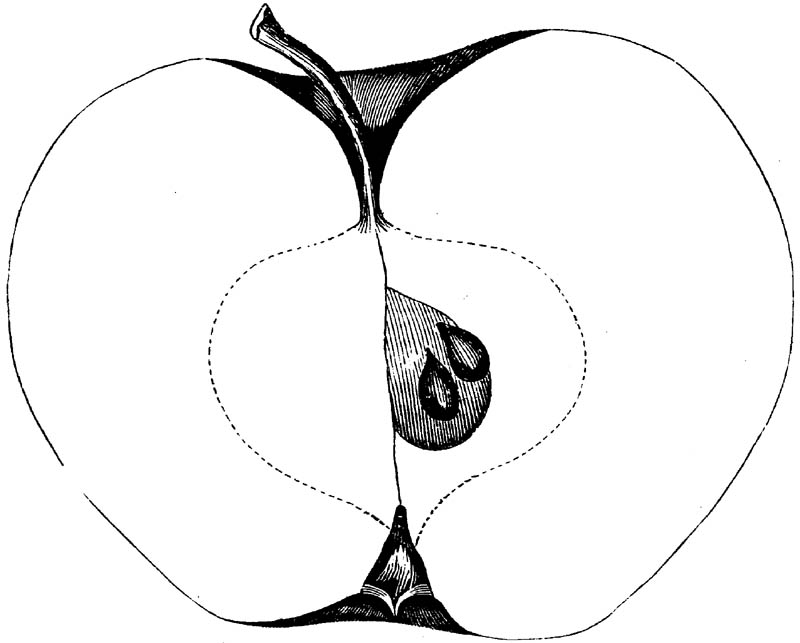
Fig. 147.—AUGUST TART.
Origin unknown. Specimens procured from Marietta, Ohio.
Fruit medium to large, regular, conical, truncated; Surface smooth, yellow-green; Dots numerous, large, yellow.
Basin medium, wavy or folded; Eye medium or small, closed.
Cavity wide, regular, brown; Stem long, slender.
Core medium, regular, closed, clasping; Seeds numerous, pointed; Flesh greenish-yellow, breaking; Flavor acid; Quality poor, except for cooking; Season August.
Democrat.
Origin unknown. Specimens obtained from George Powers, of Perrysburgh, Ohio.
Fruit medium, handsome, roundish-conic, regular; Surface yellow, blushed scarlet; Dots minute, indented.
Basin shallow, regular; Eye small, closed.
Cavity rather deep, very acute; Stem medium to short, slender.
Core heart-shaped, rather open, meeting the eye; Seeds large; Flesh yellow, breaking, juicy; Flavor sub-acid, aromatic, rich; Quality good to very good; Use dessert; Season October to December.
Holland Pippin.
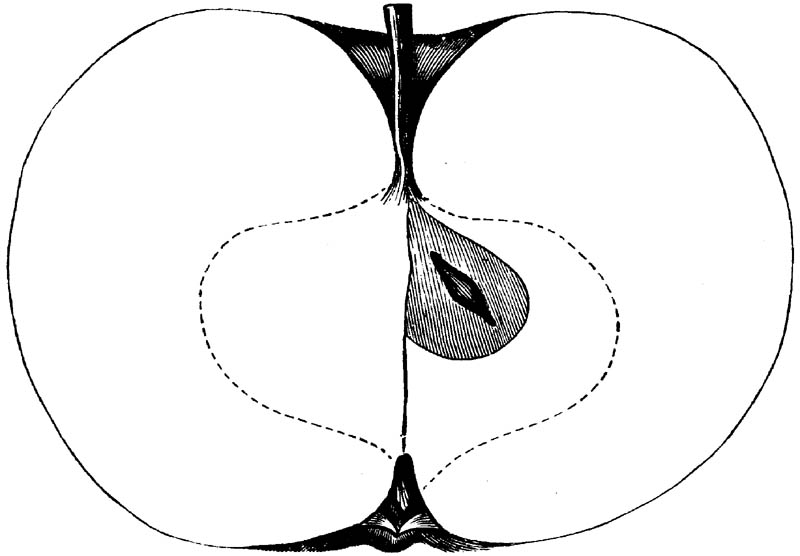
Fig. 148.—HOLLAND PIPPIN.
There is a strange confusion existing in some of the books, by which this fruit has been associated with the Fall Pippin. The Holland, as grown in Western New York, and through the West, as derived from the former State, is entirely different; and as that is extensively known, its description is here given, that it may be compared with the other, which belongs to a different class.
Fruit large, regular, conic, rather oblate; Surface dull yellowish-green, rarely bronzed; Dots minute.
Basin narrow, medium depth, regular; Eye medium, closed.
Cavity medium, acute, regular, brown; Stem medium to long.
Core medium, regular, closed, meeting the eye; Seeds numerous, sometimes imperfect; Flesh yellowish-white or greenish-white, breaking, coarse-grained, juicy; Flavor quite acid, not rich, not agreeable; Quality only fair; Use cooking only; Season, October to December at the North. Not seen in the southern counties of the States north of the Ohio River.
Middle.
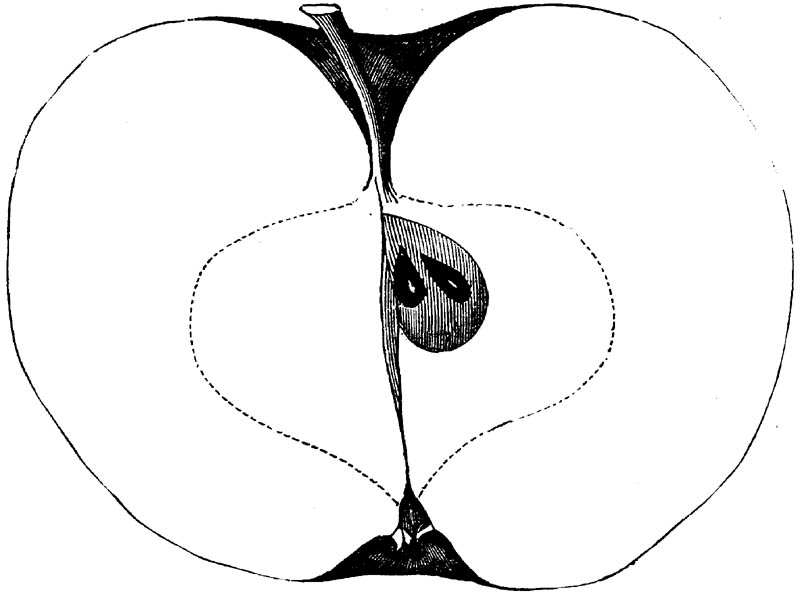
Fig. 149.—MIDDLE.
A comparatively new fruit, from Herkimer County, New York, found in a division fence between two neighbors; hence its name. Considerably cultivated in the neighborhood, where it is highly esteemed. Introduced into Ohio by Mr. John Ludlow, of Springfield, in 1854, and propagated at the Oakland Nurseries near by.
Tree thrifty and productive.
Fruit medium to large, conical or oblate-conic, regular; Surface rather smooth, green to pale greenish-yellow; Dots small, irregular, rather abundant, gray, somewhat prominent.
Basin shallow, nearly regular, russeted, like Rhode Island Greening; Eye small, closed.
Cavity acute, sometimes lipped, wavy; Stem long, slender.
Core small, oval, regular, closed, just meeting the eye; Seeds small, very light colored; Flesh greenish-yellow, breaking, fine grained, tender, juicy; Flavor sub-acid, rich, aromatic; Quality nearly first rate; Use dessert; Season December and January, but is said to keep until May in New York.
White Winter Pearmain.
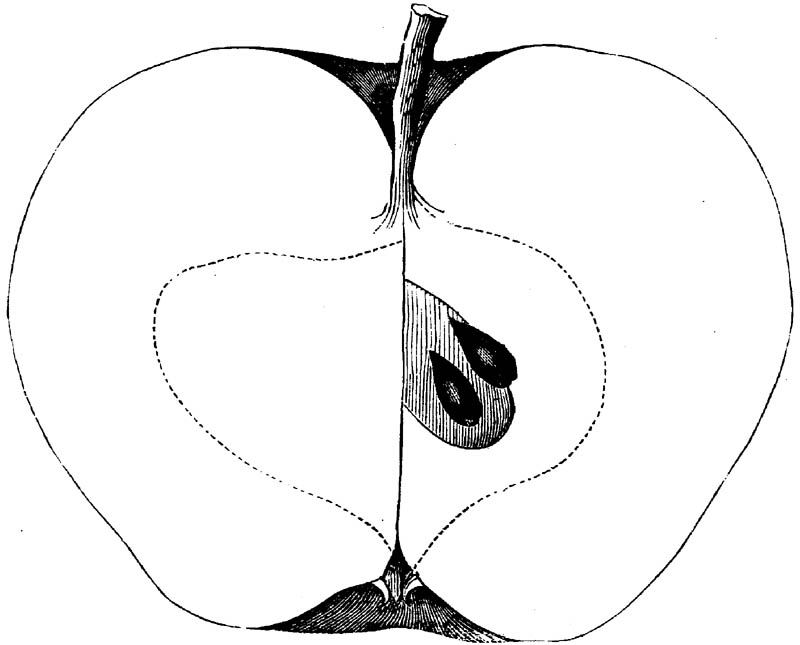
Fig. 150.—WHITE WINTER PEARMAIN.
This favorite fruit was brought to Indiana by some of the early pomologists, in the days of saddle-bag transportation. In a lot of grafts, two varieties, having lost their labels, were propagated and fruited without name. Being considered Pearmain-shaped, they were called respectively Red and White Winter Pearmains. The former proved to be the Esopus Spitzenberg; the latter has never yet been identified, though believed to be an old eastern variety. Mr. Downing suggests that it may be Winter Harvey, a description of which I have not seen. At one time this apple was confounded with the Michael Henry by many of us, and Mr. Elliott gives it as a synonym of that variety, but they are very distinct.
Tree spreading, vigorous, productive, the bark often marked by a kind of canker or crack. Foliage large, rather light green.
Fruit medium to large, handsome when fair, but often scabby on rich limestone soils and on old trees, conical, regular, sometimes obscurely angular; Surface smooth, yellow, often bronzy; Dots scattered, small, dark.
Basin abrupt, regular or shallow and folded; Eye medium, closed.
Cavity acute, wavy, brown; Stem medium to long, often knobby and clubbed.
Core regular, closed, slightly clasping the eye; Seeds few, pointed, pale or yellow; Flesh yellow, fine grained, tender, crisp, juicy; Flavor mild sub-acid, very rich; Quality best; Uses table, kitchen, market; Season December to March.
Woolfolks.
This is supposed to be a Kentucky seedling. It was received from my friend Ormsby Hite, of Louisville.
Fruit full, medium, truncated, regular; Surface very smooth, yellow-green; Dots scattered, gray, white bases.
Basin medium, wavy, plaited; Eye small, closed.
Cavity wide, acute, wavy, brown; Stem short, green.
Core small, heart-shaped, regular, closed, clasping; Seeds pointed, angular, dark; Flesh white, tender, breaking, juicy; Flavor sub-acid; Quality good; Use, table, kitchen; Season, December to March.
CLASS II.—CONICAL APPLES.
ORDER I.—REGULAR.
SECTION 2.—SOUR.
SUB-SECTION 2.—STRIPED.
Alexander.
This Russian apple, so much admired for its size and beauty, is not a favorite in the orchard, though some persons have found it profitable in the markets.
Tree medium size, spreading, moderately productive, early bearer.
Fruit large to very large, fair and handsome, conical, truncated, sometimes obscurely angular; Surface smooth, pale yellow, striped and splashed distinctly bright red, sometimes shaded mixed red; Dots minute.
Basin medium, regular; Eye small, long, closed.
Cavity rather deep, narrow, regular, brown; Stem medium to short, stout.
Core wide, regular, nearly closed, clasping; Axis short; Seeds large; Flesh whitish, breaking, not fine grained, juicy; Flavor acid, not rich; Quality scarcely good, except for cooking; Season, August and September. Fruit falls badly from the tree.
Cayuga Red Streak.
TWENTY OUNCE, ETC.
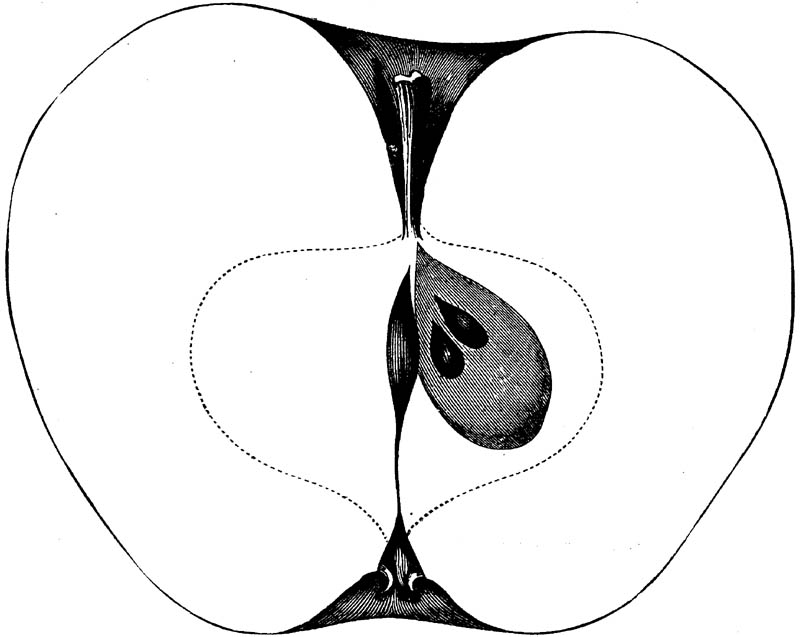
Fig. 151.—CAYUGA RED STREAK.
I have preferred to adopt the above name for this old Connecticut apple, to avoid the confusion arising from another and very indifferent fruit that is still considerably cultivated upon the same parallels with this, and known as the Twenty Ounce Pippin.
The Cayuga is a very great favorite as a market and family fruit in many parts of the country north of latitude 40°—being large, handsome and productive.
Tree thrifty, healthy, early productive, round-headed, twiggy; Shoots medium or slender, reddish brown, leaves large.
Fruit large to very large, regular, globular-conic; Surface generally smooth, yellow-green, nearly covered with mixed red, striped and splashed scarlet; Dots minute, scattered.
Basin regular, abrupt; Eye small, closed; Calyx long.
Cavity wide, folded, brown; Stem short.
Core wide, large, irregular, open, meeting or slightly clasping the eye; Seeds numerous, short, plump, pale; Flesh whitish, breaking, granular, juicy; Flavor sour, not rich; Quality good, only for its special uses, market, cooking and drying; Season, October to December.
Clarke's Pearmain.
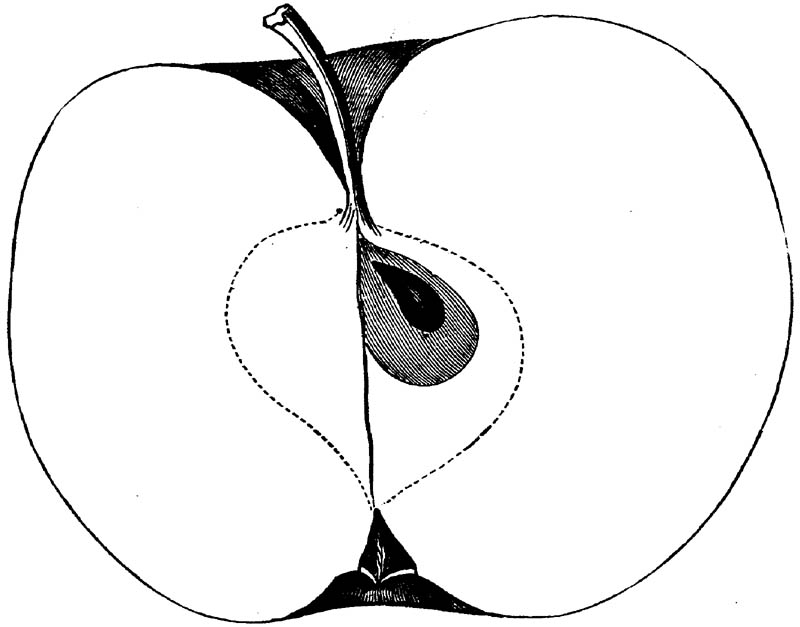
Fig. 152.—CLARKE'S PEARMAIN.
Origin North Carolina. Specimens from W.S. Westbrook. Tree grows slowly, but very productive.
Fruit medium, roundish-conic, truncated; Surface yellow, covered bright red and bronzed; Dots numerous, large, yellow.
Basin abrupt, folded; Eye small, closed; Segments short, reflexed.
Cavity deep, acute, sometimes lipped; Stem long, red.
Core small, pyriform, regular, closed, scarcely clasping; Seeds, some imperfect; Flesh greenish-yellow, fine grained; Flavor sub-acid, rich; Quality good to very good; Use dessert and kitchen; Season December.
Clayton.
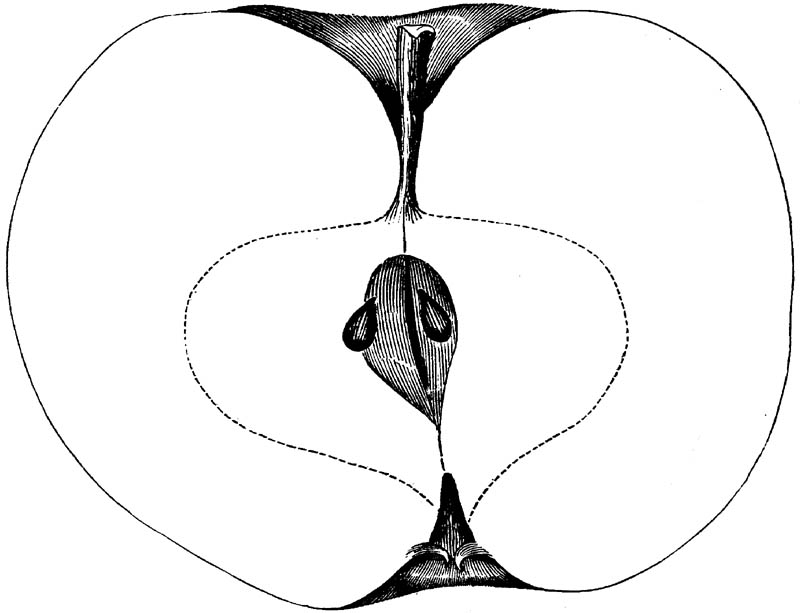
Fig. 153.—CLAYTON.
Believed to have originated in Central Indiana. Brought to my notice by Z.S. Ragan, of Clayton, Indiana; also exhibited by the Plainfield Horticultural Society at the meetings of the State Horticultural Society.
Fruit large, conical, flattened, regular; Surface smooth, greenish-yellow, covered with dull red, striped and splashed darker; Dots minute, scattered.
Basin narrow, abrupt, regular; Eye small, long, closed.
Cavity wide, acute, deep, wavy, green; Stem medium, stout.
Core wide, regular, open, clasping; Seeds numerous, plump, angular, short, dark; Flesh yellow, breaking, not fine grained; Flavor sub-acid; Quality good; Use, kitchen and market; Season, all winter until March.
Cooper's Market.
COOPER'S REDLING.
"Fruit medium, oblong-conic; Skin yellowish, shaded with red, and striped with crimson; Stem short, cavity deep, narrow; Calyx closed, basin small; Flesh white, tender, with a brisk sub-acid flavor; December to May."—(Downing.)
Early Joe.
This delicious summer apple originated in Ontario County, New York; Tree moderately vigorous, bushy when young, early bearer, very productive.
Fruit small to medium, flat-conic, regular; Surface yellow or waxen, mixed red, splashed carmine; Dots minute, with yellow bases.
Basin abrupt, regular; Eye medium, long, closed; Segments reflexed.
Cavity wide, acute, wavy, green; Stem medium, thick.
Core wide, closed, clasping; Seeds plump, brown; Flesh light yellow, breaking, very fine grained, juicy; Flavor sub-acid, aromatic, spicy, rich, very satisfying; Quality best; Use, dessert only; Season, July.
Early Strawberry.
AMERICAN RED JUNEATING.
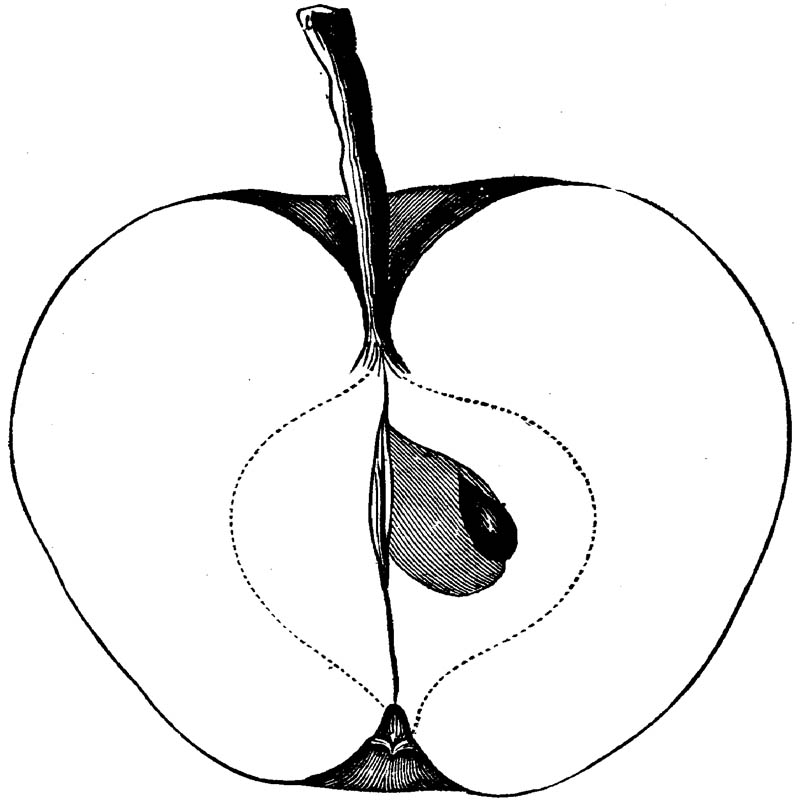
Fig. 154.—EARLY STRAWBERRY.
Origin New York; Tree thrifty, very upright, while young, spreading and large when older; Shoots dark colored; Foliage abundant on long stems, bright green, almost shining, rather narrow, long, erect.
Fruit small to medium, round-conic, regular or rarely angular; Surface smooth, often shining, yellow, mostly covered with mixed red, striped crimson; Dots rare, very minute; Surface sticky or "greasy" when house-ripened.
Basin shallow, folded or plaited; Eye medium, long; Segments reflexed.
Cavity medium, regular; Stem long, rather slender, sometimes short, knobby.
Core regular, closed, not meeting the eye; Seeds numerous, broad, plump; Flesh whitish-yellow, breaking, fine grained, juicy; Flavor sub-acid, aromatic; Quality good to very good; Use, dessert, market; Season, July and August.
Family.
This new southern variety is not yet sufficiently known to enable me to give a full description. My trees have not borne.
Fruit medium, conic, striped red; Season, July and August.
Flushing Spitzenberg.
As some doubt has existed in the minds of many pomologists in respect to this variety, and as many have had this name applied to the Baltimore of Elliott, I quote that author's description:
"American. Tree vigorous, strong brown shoots; Fruit medium, roundish, slightly conical, greenish-yellow, mostly covered with warm yellowish-red; russet dots, with suffused fawn shade surrounding; Stem slender; Cavity narrow; Calyx small; Basin shallow; Core rather large; Flesh white, tinged yellow, juicy, crisp, mild, nearly sweet; 'very good.'" November to February.
Gabriel.
LADIES' BLUSH.—GARDEN OF INDIANA.
This is thought to be a southern apple, but the origin is unknown. It may yet prove to be a known variety in cultivation.
Tree moderately vigorous, productive.
Fruit medium, conic, regular; Surface smooth, greenish-yellow, mixed and striped pale red; Dots minute.
Basin medium, regular; Eye medium, closed.
Cavity regular, green; Stem medium, slender.
Core regular, closed; Seeds medium; Flesh tender, fine grained, juicy; Flavor sub-acid to sweet, aromatic; Quality almost best, for dessert; August and September, or later.
Limbertwig.
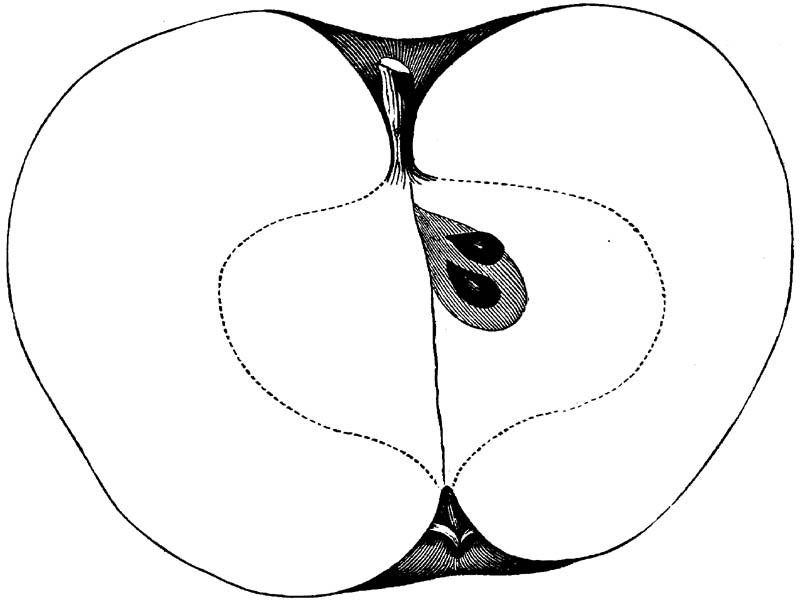
Fig. 155.—LIMBERTWIG.
This well known southern apple is much cultivated in many parts of the West as a long keeping winter variety. It is a favorite with the southern immigrants, and found most abundant in regions occupied by them, but it has been carried pretty far to the north. The synonym James River, as given by Downing, is not met with among the people as applied to this apple, but the Willow Twig is often so named.
Tree thrifty, exceedingly productive; Shoots slender and drooping with the heavy crops.
Fruit medium to small, roundish conic, regular; Surface rather smooth, mixed dull purplish red, on green, stripes scarcely to be traced; Dots numerous, large, irregular, brown.
Basin medium, regular; Eye small, open.
Cavity deep, acute, brown; Stem medium, curved.
Core rather large, regular, turbinate, closed, clasping; Seeds numerous, small, plump, long; Flesh greenish-yellow, firm; Flavor sub-acid, rich, aromatic; Quality very good; Use, table and kitchen; Season, March and April. Keeps very well, but wilts if exposed to the air—preserved very well in the ground.
Long Island Seek-no-Further.
WESTCHESTER SEEK-NO-FURTHER.
This old variety still has its admirers in the Eastern States, but is not often seen in the West. I describe specimens from Wm. S. Carpenter, of Westchester County, New York.
The tree is vigorous and productive.
Fruit rather large, oblate, conic, regular; Surface greenish-yellow, splashed bright red; Dots numerous, scattered, russet.
Basin shallow, wavy; Eye medium, closed.
Cavity wide, regular, brown; Stem long.
Core regular, closed; Seeds pointed, angular, imperfect; Flesh greenish-white, breaking, juicy; Flavor sub-acid, aromatic; Quality good to very good; Use, table, cooking; Season, October, November.
Polly Bright.
Origin Virginia. Considerably cultivated in Eastern Ohio.
"Fruit elongated, conic; Skin light yellow, shaded carmine, obscurely striped; Stalk of medium length, in an acute cavity, russeted; Calyx in a small furrowed basin. Flesh tender, juicy, with a pleasant sub-acid flavor; September, October."—(Downing.)
Rawle's Janet.
JANETTING OR GENETON—NEVER FAIL—ROCK RIMMON, ETC., ETC.
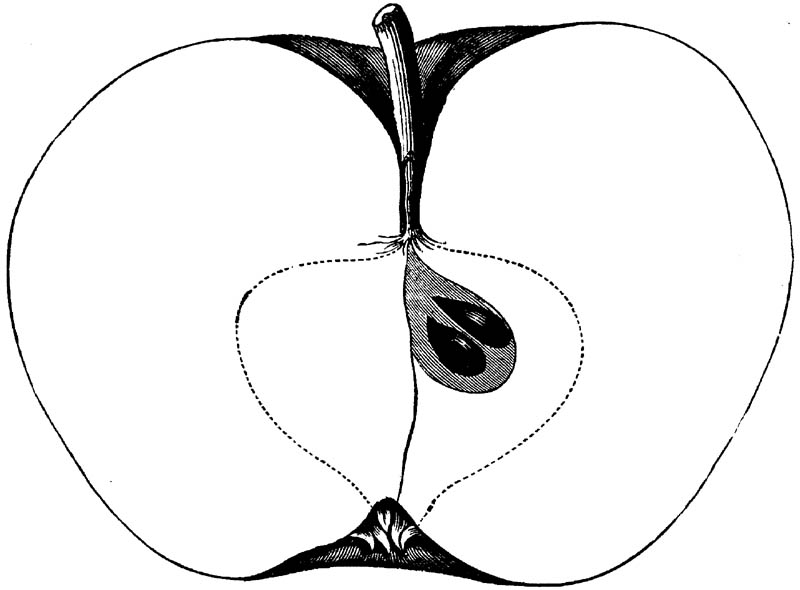
Fig. 156.—RAWLE'S JANET.
This famous southern apple has been spread throughout the West, and even the Northwest where, however, it has not proved hardy. It also has the fault of over-bearing, when the fruit is often small and insipid. In suitable soils it is very fine and deservedly a favorite with planters, some of whom recommend fifty trees of this variety in an orchard of one hundred. Origin Virginia.
Tree thrifty, not large, spreading; Twigs brownish, foliage medium, rather whitish. Blossoms appear later than other sorts, and thus they sometimes escape a spring frost.
Fruit medium, sometimes large when thinned, flattened, conic, regular; Surface smooth, mixed and striped crimson on yellow and green; Dots numerous, small.
Basin wide, regular; Eye small, closed; Segments reflexed.
Cavity acute, deep, regular, brown; Stem long, curved.
Core regular, heart-shaped, closed, clasping; Seeds numerous, plump; Flesh yellowish, crisp, breaking, fine grained, juicy; Flavor sub-acid, vinous, refreshing; Quality good to very good; Use, dessert, kitchen, market and cider; Season, February, March, and later.
Red Winter Pearmain.
RED GILLIFLOWER—RED LADY FINGER—BUNCOMBE? ETC.
This favorite southern apple is widely diffused through the South and West, and its good qualities have made it many admirers. Origin uncertain.
Tree sufficiently vigorous, upright, productive, annual bearer.
Fruit medium to large, conic, regular; Surface smooth, deep red, almost purplish on yellow, stripes nearly lost in the depth of coloring, whitish shading exteriorly, not a bloom; Dots numerous, minute.
Basin regular, plaited or folded; Eye long or large, open.
Cavity acute, regular, green; Stem medium length, thick, knobby.
Core medium, closed, clasping; Seeds numerous, large, plump; Flesh yellow, breaking, juicy; Flavor mild sub-acid, almost sweet, rich, satisfying; Quality good; Use, table and kitchen; Season, December and January.
Rosy Red.
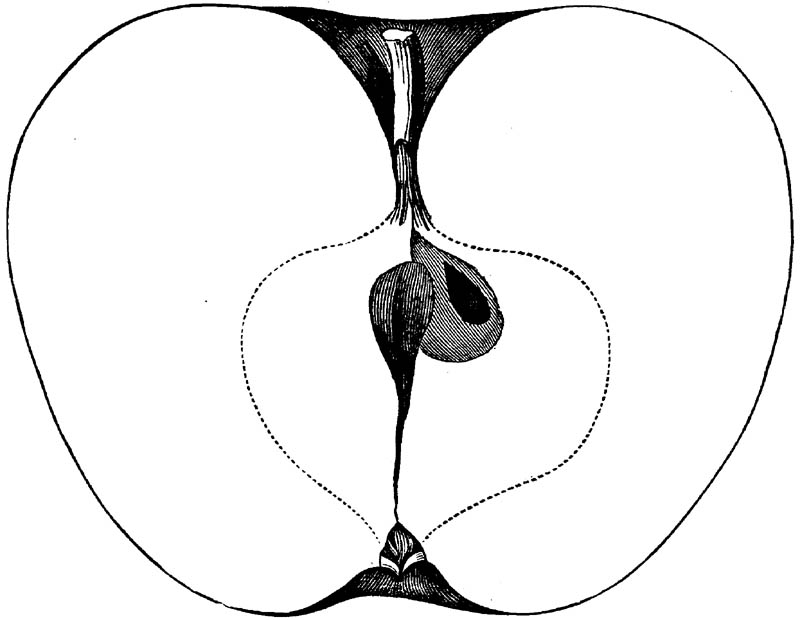
Fig. 157.—ROSY RED.
This is one of the valuable fruits which we owe to the indefatigable efforts, of that earnest pomologist and thus philanthropist, Lewis Jones, of Cambridge, Indiana. Found in a seedling orchard.
Fruit medium, conical, truncated, regular; Surface smooth, bright red, generally diffused, indistinctly striped; Dots scattered, medium, yellow.
Basin medium, shallow, regular or folded; Eye medium, closed.
Cavity acute, narrow, deep, brown; Stem medium, slender, yellow.
Core wide, indistinct, partly open, scarcely meeting the eye; Seeds few, plump and imperfect; Flesh pale yellow, breaking, juicy; Flavor sub-acid; Quality good; Use, market and table; Season, December and January.
Westfield Seek-no-Further.
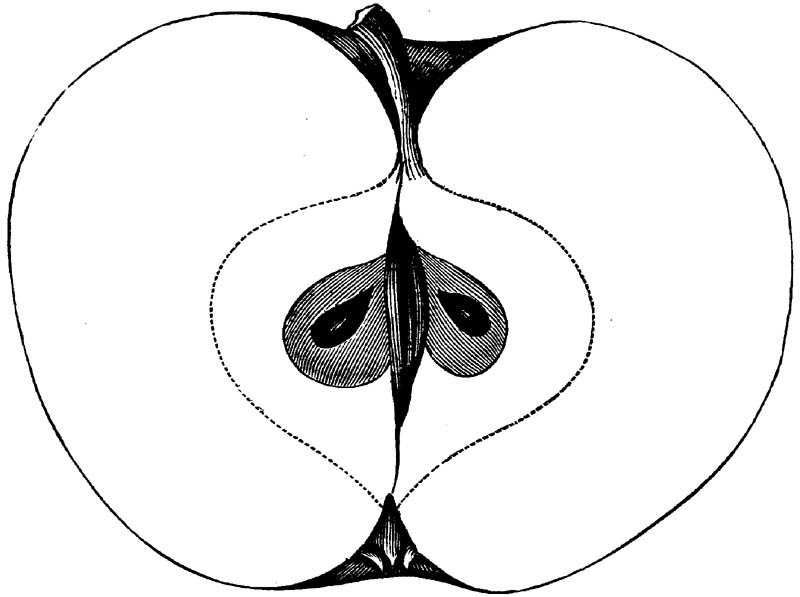
Fig. 158.—WESTFIELD SEEK-NO-FURTHER.
This favorite Connecticut apple has been widely disseminated throughout the country, and is universally admired by those who come from the Northern States; on lower parallels it is less known, and not so highly appreciated, nor is it so fine a fruit, being larger, but less compact, more spongy, less beautifully colored and sometimes almost a russet.
Tree vigorous, thrifty, spreading, productive.
Fruit medium, roundish-conic; Surface smooth dull red, mixed and striped on yellow, in the North clear bright red; Dots scattered, large, yellow; leather-cracked and russeted about the apex.
Basin shallow, regular, leather-cracked; Eye small, closed or open.
Cavity pointed, regular, brown; Stem long.
Core medium, regular, closed, meeting and clasping the eye; Seeds numerous, small, pointed; Flesh yellowish-white, tender, breaking; Flavor very mild sub-acid, aromatic, satisfying, not high flavored nor spicy; Quality only good in my estimation; Use, table and market; Season, December.
CLASS II.—CONICAL APPLES.
ORDER I.—REGULAR.
SECTION 2.—SOUR.
SUB-SECTION 3.—RUSSET.
American Golden Russet.
BULLOCK'S PIPPIN, ETC.
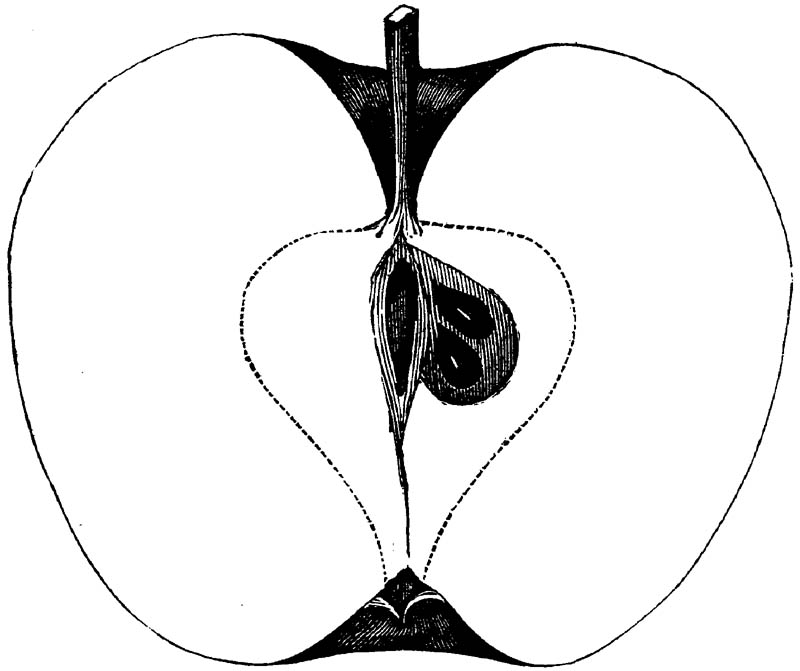
Fig. 159.—AMERICAN GOLDEN RUSSET.
This delicious table apple is a universal favorite with all who can appreciate delicacy of flavor and fineness of flesh in an apple, and yet it is not a profitable variety for orchard planting, because the fruit is very apt to be imperfect. The best I have seen were from the South, and sandstone soils.
Tree vigorous, upright, round-headed, small; Foliage large, healthy.
Fruit small to medium, round-conic, regular when perfect; Surface smooth, yellow, covered with thin russet, sometimes faintly blushed; Dots minute.
Basin shallow, regular; Eye small, closed.
Cavity acute, regular; Stem long, slender.
Core medium, closed, meeting the eye; Seeds numerous, pointed; Flesh yellowish, very fine grained, tender, when fully ripe almost melting, like a pear, juicy, becoming dry when over ripe; Flavor sub-acid, rich, aromatic; Quality very best; Use, dessert; Season, November and December.
Cheesborough.
This is one of the largest and one of the poorest of the Russet apples, and unworthy of cultivation; on that account put upon record to be avoided.
Fruit large and fair, conical, regular; Surface dull green, overspread with thin russet, or more southward.
Basin irregular, green; Eye large, closed.
Cavity pointed, regular; Stem short.
Core large, closed, clasping; Seeds long, pointed, angular; Flesh green, breaking, coarse, often dry; Flavor acid or sub-acid, not rich; Quality poor; Use, kitchen only; Season, November and December.
Egyptian Russet.
BAGBY RUSSET.
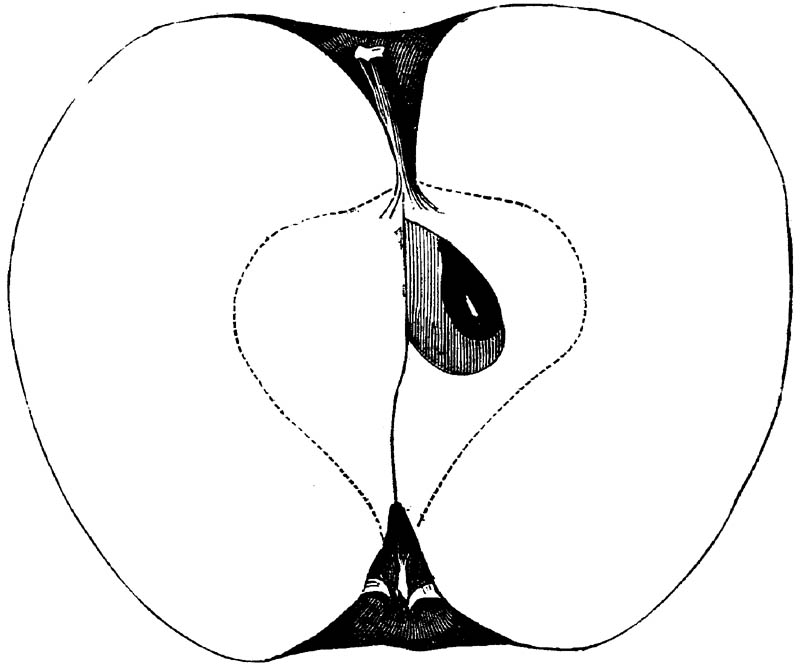
Fig. 160.—EGYPTIAN RUSSET.
This capital dessert fruit was found in Southern Illinois and introduced to his fellow pomologists of the State Society by Jno. M. Hunter, nurseryman, of Ashley. Its origin is unknown, but supposed, like the pioneers of the region, to have come from Tennessee, or some other Southern State.
Tree symmetrical, moderately vigorous, productive; Twigs slender.
Fruit medium, regular, conical, truncated; Surface smooth, light yellow, covered with fine russet, obscurely striped gray.
Basin wide, wavy, plaited, green; Eye medium to large, open.
Cavity acute, wavy; Stem medium.
Core irregular, closed, scarcely meeting the eye; Seeds large, plump; Flesh very tender, fine grained, juicy; Flavor sub-acid, aromatic, rich, pear-like; Quality very best; Use, dessert; Season, December and January, until March. Like other russets disposed to wilt if too much exposed to the air.
Poughkeepsie Russet.
ENGLISH RUSSET.
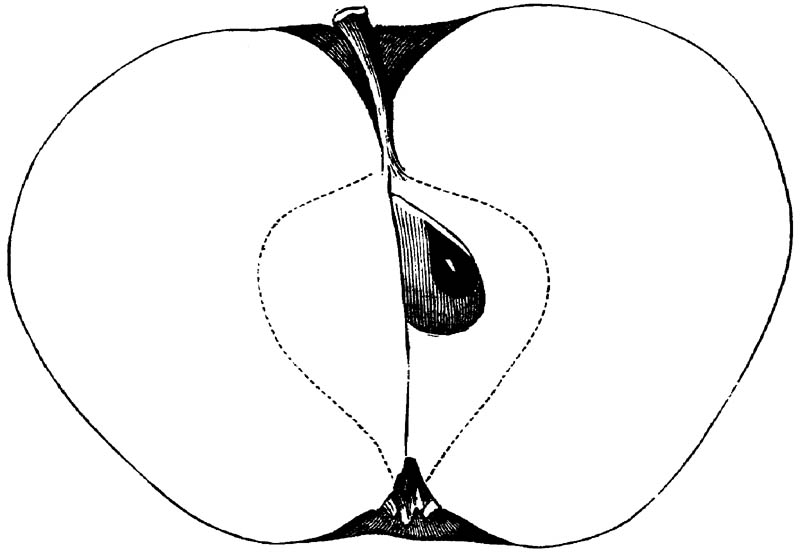
Fig. 161.—POUGHKEEPSIE RUSSET.
Origin New York; Tree tender, vigorous, upright, productive; Shoots brown, slender; Foliage healthy.
Fruit medium, conical or globular-conical, regular; Surface smooth, almost polished, dull yellowish-green, often bronzed near the base, more or less covered with fine russet.
Basin shallow, regular; Eye large, closed.
Cavity pointed, wavy; Stem long.
Core closed, not meeting the eye; Seeds imperfect; Flesh greenish, firm, inclined to be tough; Flavor acid, poor; Quality third rate; Use, market and cooking only, and valued because it keeps soundly for a long time; Season, December until June.
Ross' Nonpareil.
SPICE RUSSET? OF OHIO.
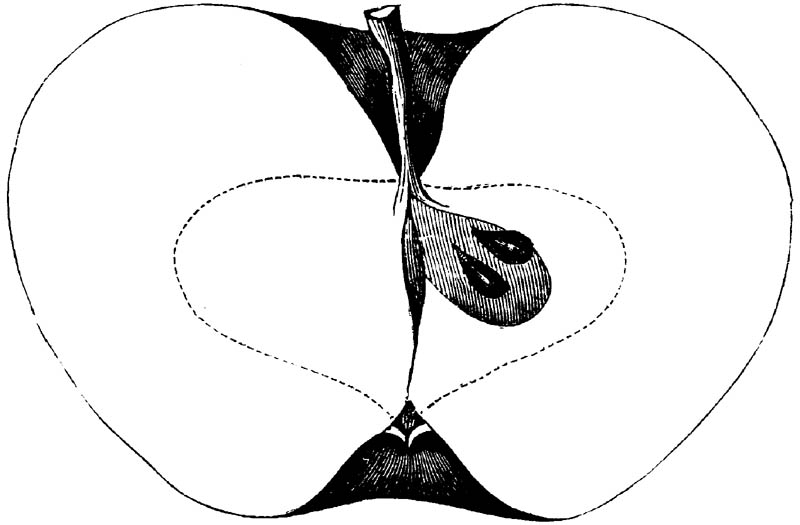
Fig. 162.—ROSS' NONPAREIL.
The delicious fruit about to be described is believed to be the celebrated Irish apple mentioned by Thompson, Lindley, and others; if not, we have found another choice fruit, which deserves to be better known. It is frequently found at the exhibitions in Ohio and Indiana. Often shown as Spice Russet, flatter and irregular: Vide conspectus.
Fruit medium, regular, oblate-conical; Surface smooth, yellowish, thin russet, rarely blushed dull carmine; Dots minute, gray.
Basin wide, folded; Eye medium, closed.
Cavity deep, acute, wavy; Stem long, inclined.
Core regular, open, scarcely meeting the eye; Axis short; Seeds numerous, medium, plump; Flesh white, breaking, fine grained, tender; Flavor sub-acid, aromatic, rich; Quality almost best; for table; Season December.
Spafford Russet.
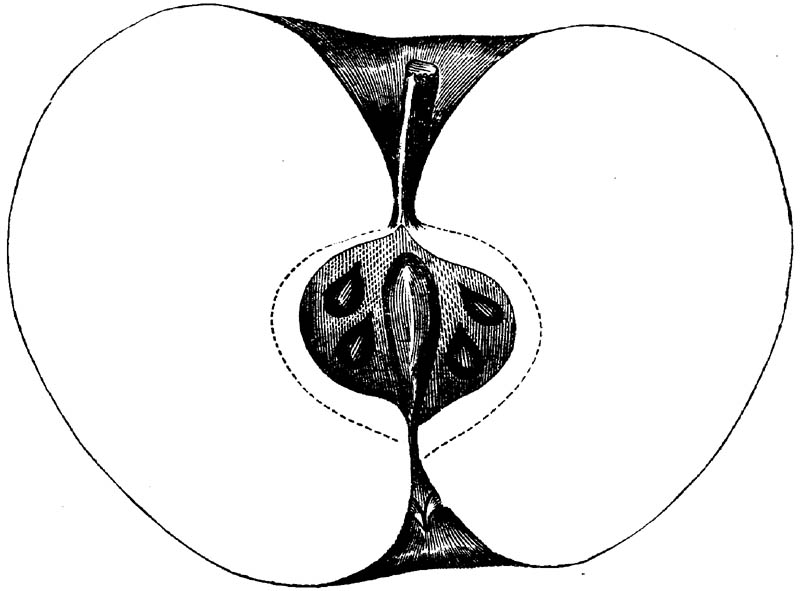
Fig. 163.—SPAFFORD RUSSET.
This apple is supposed to have originated near old Fort Miami, in Northern Ohio, and was introduced to the notice of the Ohio Pomological Society by its Vice-President, J. Austin Scott, of Toledo, who cultivates the variety on the banks of the Maumee, near the place of its supposed origin.
Fruit medium, flattened-conical, regular; Surface smooth, greenish-yellow, lightly russeted, rarely bronzed; Dots minute, green.
Basin medium, abrupt, narrow, regular; Eye small, closed.
Cavity wide, wavy, green; Stem medium.
Core small, open, regular, meeting the eye; Axis short. Seeds numerous, plump, angular; Flesh white, fine grained, juicy; Flavor sub-acid, rich, aromatic, agreeable; Quality good to very good; Use, table; Season, December until March.
CLASS II.—CONICAL APPLES.
ORDER II.—IRREGULAR OR ANGULAR.
SECTION 1.—SWEET.
SUB-SECTION 1.—SELF-COLORED.
Belden Sweet.
"Grown in Connecticut, very prolific; Fruit medium or below, conic, angular; Skin light yellow, with a warm cheek. Stem medium, in an acute deep cavity; Calyx closed, in a small basin; Flesh white, tender, juicy, saccharine, with a pleasant aromatic flavor; December to March."—(Downing.)
Lyman's Pumpkin Sweet.
POUND SWEET.
Origin, the orchard of S. Lyman, Manchester, Connecticut. A very handsome, large, sweet apple, valued for baking and for stock-feeding.
Tree vigorous, spreading, drooping, rather productive.
Fruit large to very large, roundish-conical, angular; Surface very smooth, pale yellow; Dots minute.
Basin deep, abrupt, regular; Eye medium, closed.
Cavity deep, acute, regular, brown; Stem medium or short.
Core large, closed; Seeds angular, dark; Flesh yellowish, breaking, juicy, often water-cored and heavy; Flavor very sweet; Quality good; Use, baking and stock-feeding; Season, October to December.
CLASS II.—CONICAL APPLES.
ORDER II.—IRREGULAR.
SECTION 1.—SWEET.
SUB-SECTION 2.—STRIPED.
None.
CLASS II.—CONICAL APPLES.
ORDER II.—IRREGULAR.
SECTION 1.—SWEET.
SUB-SECTION 3.—RUSSET.
Sweet Russet of Kentucky.
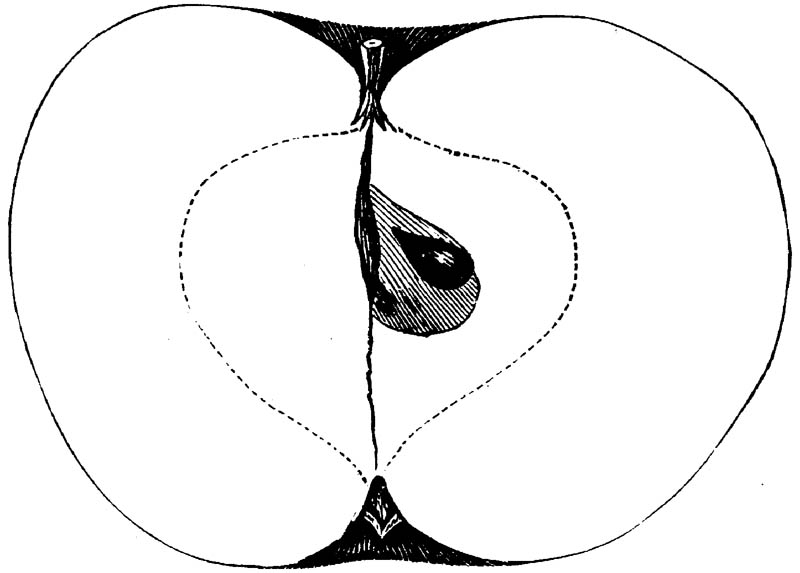
Fig. 164.—SWEET RUSSET OF KENTUCKY.
This fruit was received from J.S. Downer & Son, Elkton, Kentucky.
Fruit small, conical, truncated, angular; Surface rough, dark russet; Dots scattered, minute, white, prominent.
Basin shallow, regular; Eye small, closed.
Cavity very shallow, acute; Stem short, slender.
Core large, regular, nearly closed, meeting the eye; Seeds numerous, angular, pale; Flesh yellowish-white, fine-grained, not tender; Flavor sweet; Quality scarcely good; Season, December to February.
Sweet Russet.
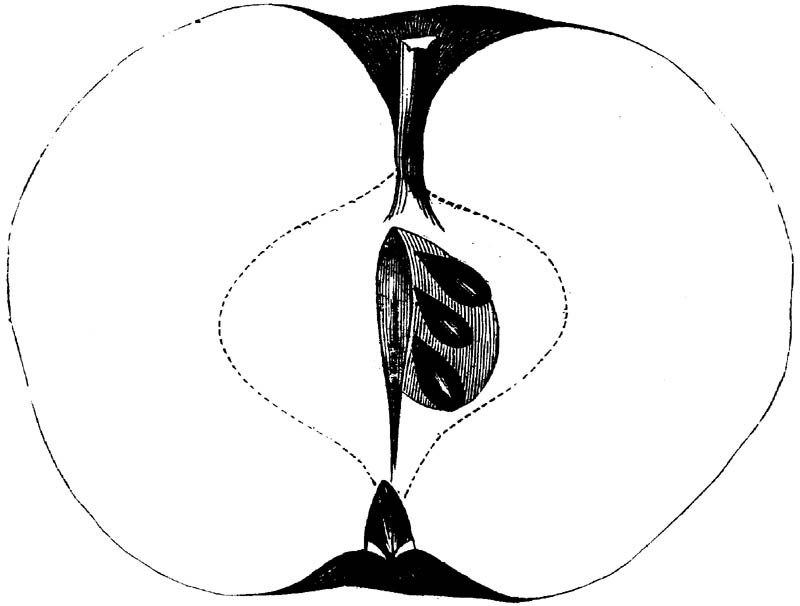
Fig. 165.—SWEET RUSSET.
Fruit medium, conical, uneven; Surface yellow, thin russet; Dots numerous, small, prominent.
Basin shallow, folded; Eye small, closed.
Cavity wide, wavy; Stem short.
Core oval, open, clasping the eye; Seeds plump; Flesh yellow, tender, fine grained, juicy; Flavor sweet; Quality good to very good; Use, baking; Season, August.
S.B. Parsons of Flushing, Long Island, considers it the best baking apple.
CLASS II.—CONICAL APPLES.
ORDER II.—IRREGULAR.
SECTION 2.—SOUR.
SUB-SECTION 1.—SELF-COLORED OR BLUSHED.
Belmont.
GATE—MAMMA BEAN, ETC.
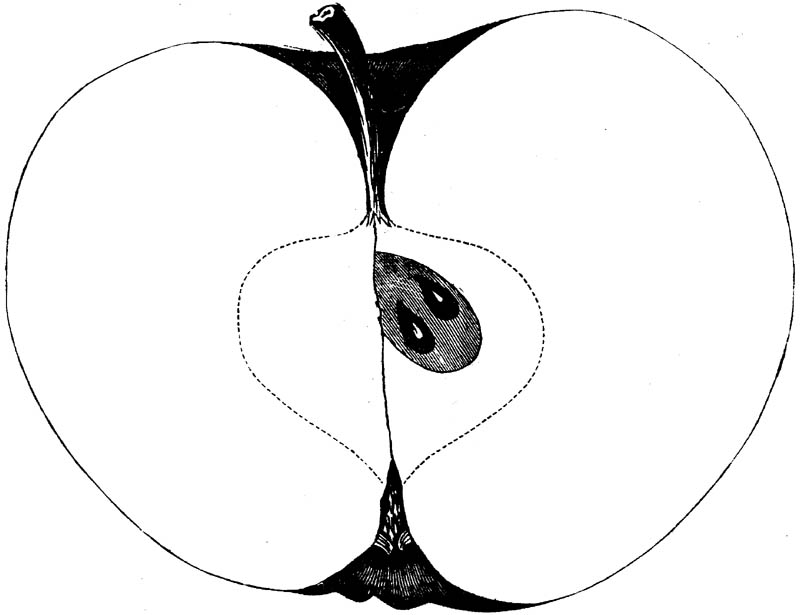
Fig. 166.—BELMONT.
This beautiful apple is believed to be of Virginia origin, but was brought into public notice and notoriety in Belmont County, Ohio, whence its name. It is supposed to be the same as the Waxen of Coxe, which that author refers to Virginia.
Tree vigorous, spreading, productive, not hardy; Twigs light olive.
Fruit large, fair, oblate-conic, often angular; Surface very smooth, waxen-yellow, often faintly blushed orange, and spotted red; Dots minute, scattered.
Basin regular or wavy, not deep; Eye small, closed.
Cavity wide, wavy, brown; Stem long.
Core wide, regular, somewhat open, clasping; Axis short; Seeds numerous, large, flat; Flesh yellow, tender, fine-grained, juicy; Flavor mild sub-acid, refreshing, very agreeable; Quality nearly best; Use, table, kitchen, market; Season, October to December.
Celestia.
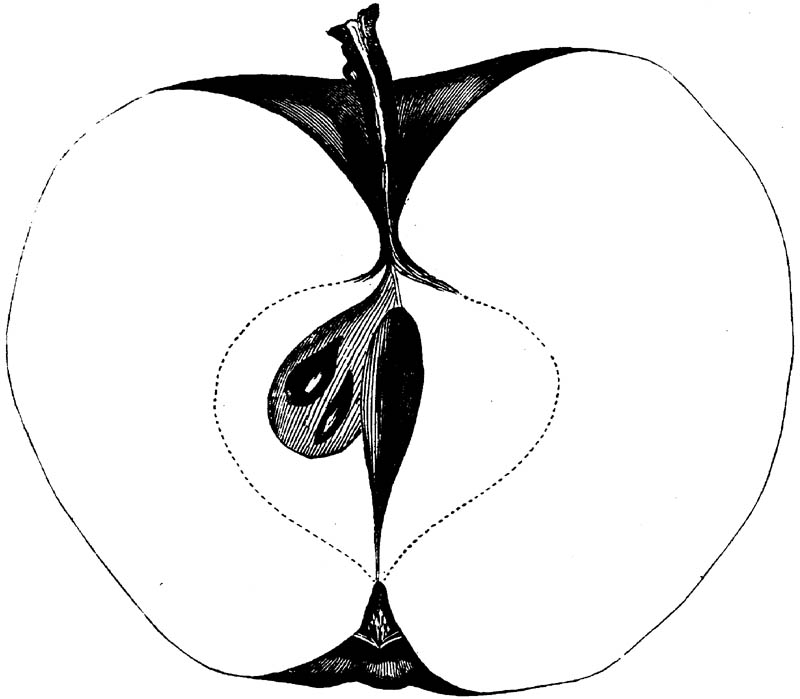
Fig. 167.—CELESTIA.
This fine amateur fruit, which appears destined to take the place of the Dyer, being more handsome, is a seedling from the Stillwater Sweet, and was produced by L.S. Mote, of Miami County, Ohio.
Fruit large, conical, truncated, angular; Surface somewhat uneven, smooth, waxen-yellow; Dots scattered, distinct, gray, with green bases.
Basin narrow, folded; Eye small, long, closed.
Cavity wide, shallow, angular; Stem long or medium, sometimes knobby.
Core small, oval, open, clasping; Seeds numerous, long, angular; Flesh yellow, very fine grained, very tender, juicy; Flavor sub-acid, very sprightly, and spicy, aromatic; Quality very best; Use, table and kitchen; Season, September.
This is essentially an amateur's fruit, as its texture and color disqualify it for market, while its delicious flavor renders it very attractive.
Detroit Black.
DETROIT RED?—GRAND SACHEM.
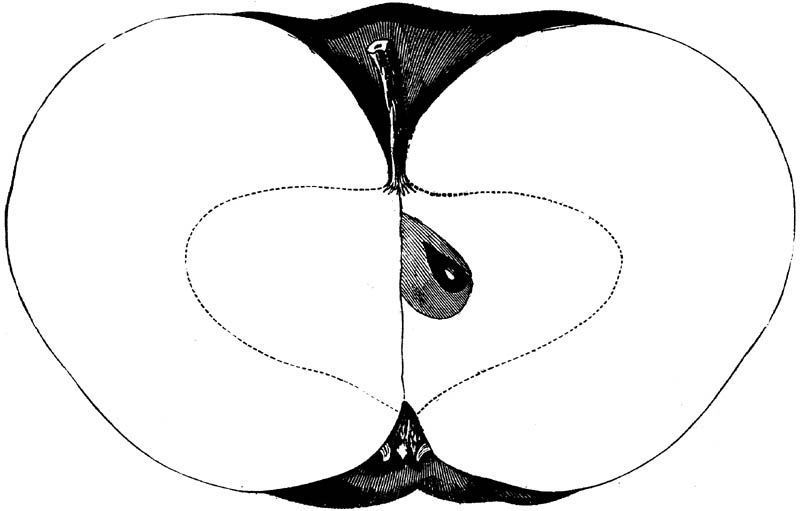
Fig. 168.—DETROIT BLACK.
Supposed to be of Canadian origin, in the neighborhood of Detroit, Michigan. I have put these two names together, because the fruits presented as Black and as Red Detroit are so very much alike in all respects that it is not worth while to consider them distinct.
Fruit large to very large, conic, angular; Surface very smooth, shining, deep red shaded, almost black in some specimens, no striping; Dots, numerous, minute, indented, gray.
Basin deep, abrupt, folded; Eye small, open.
Cavity wide, wavy; stem very short.
Core wide, closed or open, clasping the eye; Seeds numerous, angular, brown; Flesh whitish, tender, breaking, juicy; Flavor acid, poor; Quality second to third rate; Use, kitchen and drying; Season, September and October.
The Red variety may be distinct, as it keeps later.
Fall Geneting.
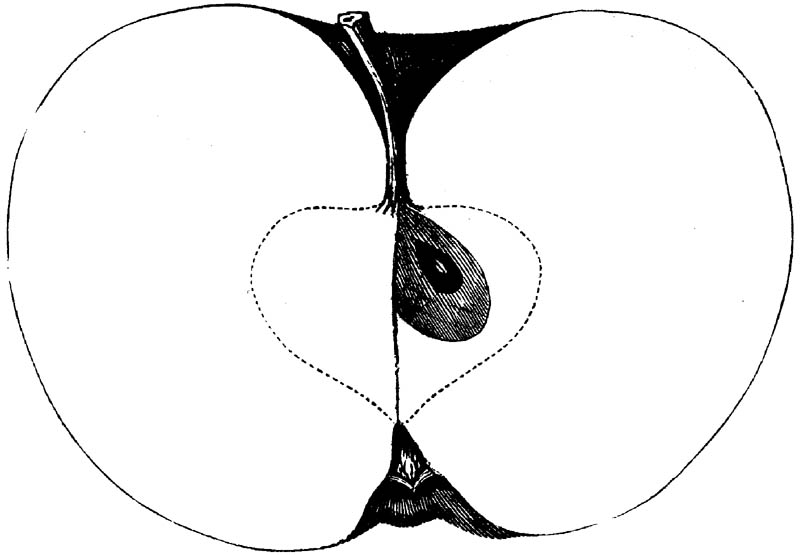
Fig. 169.—FALL GENETING.
Elliott says this is an old Connecticut variety. Tree vigorous and productive.
Fruit large, flattened-conic, angular; Surface smooth, greenish-yellow, blushed; Dots rare, minute.
Basin shallow, plaited; Eye small, closed; Calyx reflexed.
Cavity deep, wide, regular, brown; Stem short.
Core small, regular, closed, clasping; Seeds numerous, plump or imperfect, brown; Flesh yellow, fine grained, juicy, crisp; Flavor sub-acid, not very rich; Quality good; Use, table, kitchen; Season, October.
Ferdinand.
I procured my trees from Virginia, where it originated. Tree vigorous, upright.
Fruit large, flattened-conic, irregular; Surface smooth, pale green or yellow.
Basin shallow; Eye medium, open.
Cavity medium; Stem stout.
Flesh yellow, tender; Flavor sub-acid; Quality good; Season, "November to March," according to Mr. Summer, South Carolina.
Harrison.
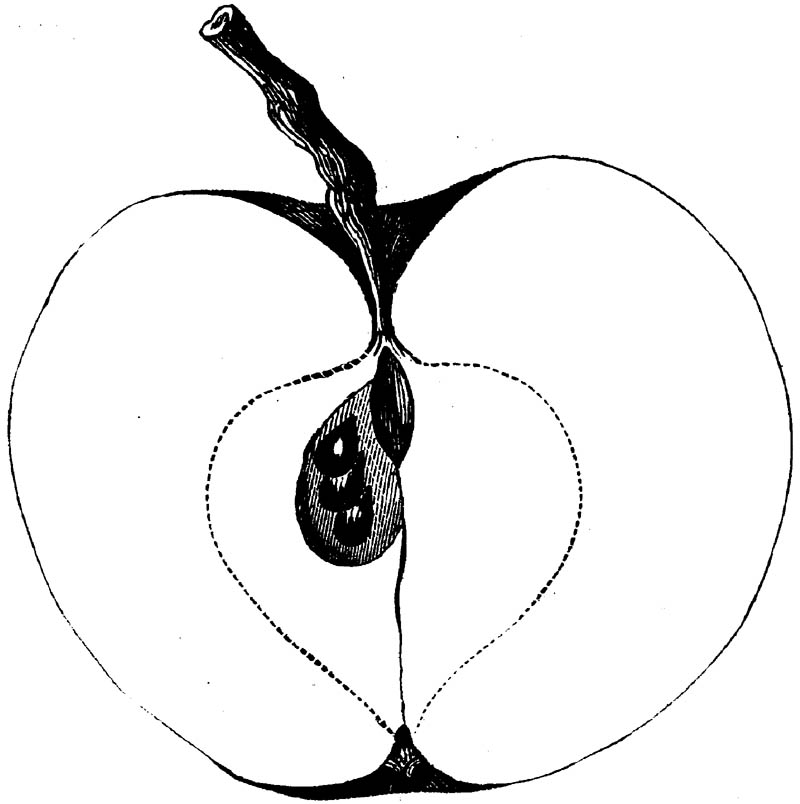
Fig. 170.—HARRISON.
This famous Jersey cider apple, from Essex County in that State, has been carried westward over a great extent of territory, where it succeeds admirably well, and where the necessities of the people have brought to light its good properties for the kitchen as well as for the cider mill.
Tree vigorous, large, spreading, productive.
Fruit small, round-conical, somewhat angular and irregular; Surface not smooth, yellow, rarely blushed; frequent rose-colored spots, and marks radiating from the cavity over the base of the fruit; Dots small, distinct, gray.
Basin none, or very shallow, plaited; Eye small, closed; Segments long.
Cavity medium, regular, brown; Stem long, red, knobby.
Core regular, heart-shaped, closed, scarcely meeting the eye; Seeds numerous, small; Flesh yellow, compact, dry till ripe, then juicy; flavor acid to sub-acid, very rich, saccharine; Quality good; Use, especially for cider, also for cooking and for dessert in April. Keeps well.
Pound Royale.
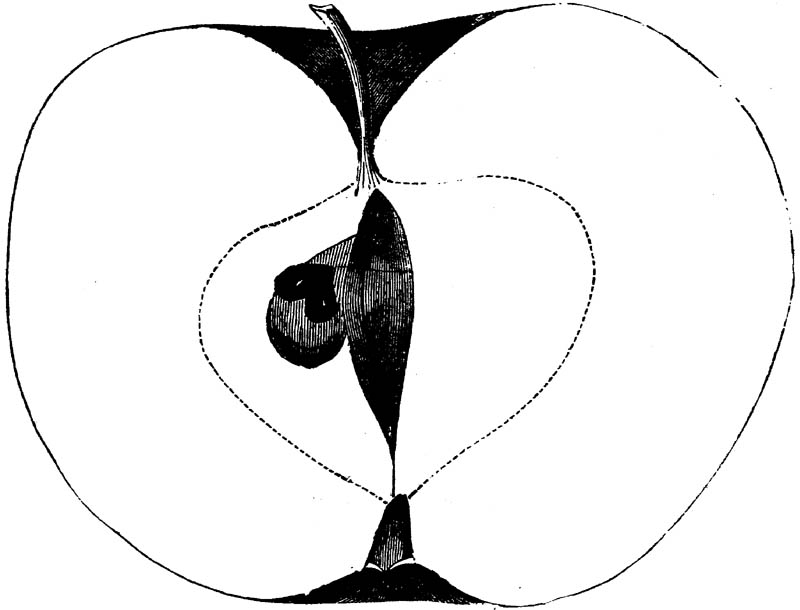
Fig. 171.—POUND ROYALE.
This fine summer apple, received from H.N. Gillett, of Lawrence County, Ohio, has long been considered one of the very best summer apples along the Ohio River.
Tree a pretty good grower, an early and constant bearer, very productive; Shoots dark, foliage dark.
Fruit large, conical, slightly angular; Surface smooth, glossy, greenish; Dots small, green, indented.
Basin medium, folded; Eye medium, closed; Segments long, reflexed.
Cavity acute, wavy, brown; Stem medium, sometimes knobby.
Core small, closed or slightly open, meeting the eye; Seeds numerous, pointed, dark; Flesh white, very tender, juicy; Flavor very mild sub-acid, delicious; Quality very good to best; Use, table, kitchen; Season, August.
Different from Pound Royal of Downing, which is a winter-keeping fruit.
Ridge Pippin.
This fruit appears to be quite a favorite market apple in the neighborhood of Philadelphia, where it originated.
Fruit rather large, round-conic, very irregular, ribbed; Surface yellow, lightly shaded and blushed with red, and sprinkled with russet and crimson spots.
Basin abrupt, furrowed and folded; Eye small, closed.
Cavity wide, regular; Stem short.
Flesh yellow, crisp, juicy; Flavor mild sub-acid, rich.
Season, until March and April.
The Cook's Favorite.
This nice autumn apple comes to me from Oliver Albertson, a prominent and intelligent cultivator in Washington County, Indiana, marked "Best." Origin unknown.
Fruit medium, flattish-conical, angular; Surface smooth, whitish-yellow; Dots minute.
Basin deep, folded, ribbed; Eye medium, closed.
Cavity wide, wavy, brown; Stem long, slender.
Core medium, roundish, closed, meeting the eye; Seeds numerous, dark; Flesh yellow, breaking, tender; Flavor sub-acid; Quality quite good; Use, kitchen especially—"cooks very well;" Season, September.
Trenton Early.
This fine autumn apple has been thought to be the English Codling. Of its origin and history we know little, except that it was one of Silas Wharton's varieties, and that it has been a great favorite wherever known. It was introduced to the notice of the Ohio Pomological Society, 1852, by R.W. Steele, Esq., of Dayton, Ohio, with the following notes: "A large, white apple, of excellent flavor, and is highly esteemed both for eating and cooking. It ripens in August. The tree is a vigorous grower and an abundant bearer. It was introduced here many years ago by Silas Wharton, of Warren County, to whom this portion of the Miami Valley is largely indebted for the introduction of many excellent varieties of apples and pears."
Fruit large, conical, angular; Surface smooth, very pale yellow or white; Dots rare, minute.
Basin narrow, folded; Eye medium or small, closed.
Cavity wide, regular, brown; Stem medium.
Core large, rather open; Seeds numerous, angular; Flesh white, very tender, juicy; Flavor sub-acid, pleasant; Quality very good; Use, dessert and kitchen; Season, August, September.
CLASS II.—CONICAL APPLES.
ORDER II.—ANGULAR.
SECTION 2.—SOUR.
SUB-SECTION 2.—STRIPED.
Buckingham.
BYER'S RED—FALL QUEEN (of some)—BLACKBURN (erroneously.)
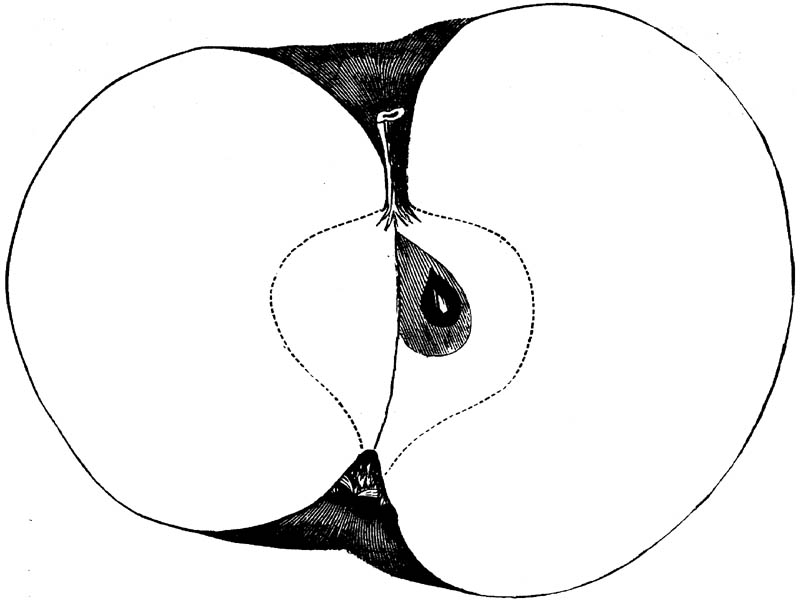
Fig. 172.—BUCKINGHAM.
This favorite southern apple, from Louisa County, Virginia, has worked its way northward into public favor at rapid rate, under the influence of railways and Pomological Societies. It was first presented to the American Society at the Philadelphia meeting, in 1860, when it was figured and reported on by the Committee on Native Fruits, to some of whom, as to thousands of others in the West, it was familiar as household words. This fruit was brought by settlers to Southern Illinois, and thence distributed, by taking up the sprouts that formed about the base of the stocks, and setting them out for an orchard. I have some of these growing, and they make nice plants.
Tree vigorous, upright, compact while young, spreading with the weight of fruit, never large; the shoots rather slender, red, dark; Leaves medium, rather narrow, wider towards the end, dark, footstalks red. The stems of these trees are characterized by curious enlargements of an irregular, mammellar form, and reddish color, and appear to be like the knaurs of the olive tree.
When this apple was first brought to the notice of the Cincinnati Horticultural Society, twenty years ago, it was thought to resemble the Winter Queen of Kentucky so closely that it was considered only a variety or sport, and called the Striped Fall Queen, but it has since been deemed a distinct sort.
Fruit large to very large, variable in form, but generally conical, or oblate-conic, truncated, angular; Surface smooth, greenish-yellow, mixed and striped pale purplish-red; Dots scattered, prominent, yellow.
Basin deep, abrupt, wavy; Eye large, long, open.
Cavity wide, wavy, brown; Stem short.
Core large, regular, closed; Axis very short; Seeds numerous, long, pointed; Flesh yellow, tender, fine-grained, juicy; Flavor mild sub-acid, rich, agreeable; Quality best, or nearly so; Use, table, kitchen, drying; Season, October to December.
Esopus Spitzenberg.
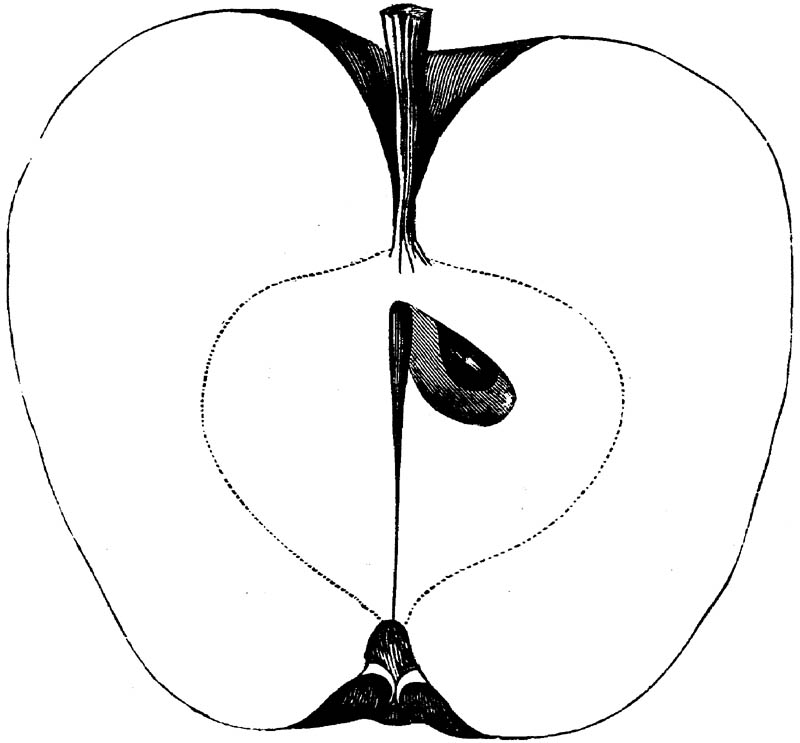
Fig. 173.—ESOPUS SPITZENBERG.
Origin New York, on the Hudson. This fruit has changed its character in progressing westward and southward, becoming larger and more irregular, less brilliantly colored, less highly flavored, and less productive.
Tree vigorous, upright, thrifty, but in some regions subject to blight and unprofitable; Shoots slender.
Fruit medium to large, conical, ribbed, irregular; Surface smooth, yellow, covered with bright red, marbled and mixed, striped more or less distinctly; Dots numerous, large, irregular, gray, always elongated near the base.
Basin deep, ribbed or folded, often leather-cracked; Eye small, closed.
Cavity deep, acute, regular, or wavy; Stem long.
Core large, closed; Seeds long, pointed; Flesh rich, yellow, breaking, juicy at the North, more fibrous than crisp at the South; Flavor quite acid till ripe, when it is rich, saccharine, highly aromatic, giving the idea of the Spitzenberg flavor; Quality best; Use, dessert and kitchen; Season, December to February.
Lansingburgh.
The origin of this long-keeper has not been traced. It has been common about Cincinnati, and along the Ohio River, for many years.
Tree upright, vigorous, brushy and thorny, looking like a wilding.
Fruit medium, conical, angular, oblique, often unequal; Surface smooth, green and yellow, bronzed and blushed, becoming very rich yellow and carmine—an indistinct gray-striping makes the ripe fruit appear to be striped yellow; Dots minute, indented, gray, with green bases.
Basin deep, plaited or folded; Eye small, closed.
Cavity acute, irregular, rough with brown; Stem short.
Core small, oval, closed; Seeds numerous, large; Flesh firm, compact; Flavor mild sub-acid, negative; Quality scarcely good; Use, market, ornamental, cooking; Season in the kitchen all winter—ornamental and eatable March to May, or later.
Late Strawberry.
AUTUMN STRAWBERRY.
The origin of this choice fruit appears to be unknown.
Tree upright, productive, thrifty, leaves serrate.
Fruit medium, roundish, conical, angular, furrowed; Surface smooth, waxen-yellow, mixed and striped scarlet; Dots minute, indented.
Basin folded, irregular; Eye medium, closed.
Cavity acute, wavy, irregular; Stem slender, long.
Core medium, regular, closed, Seeds large; Flesh yellow, very tender, fine-grained, very juicy; Flavor sub-acid, aromatic, refreshing, vinous; Quality best; Use, dessert especially; Season, August and September.
There is another similar fruit—the Frank or Chenango Strawberry, which is by some preferred to this.
Northern Spy.
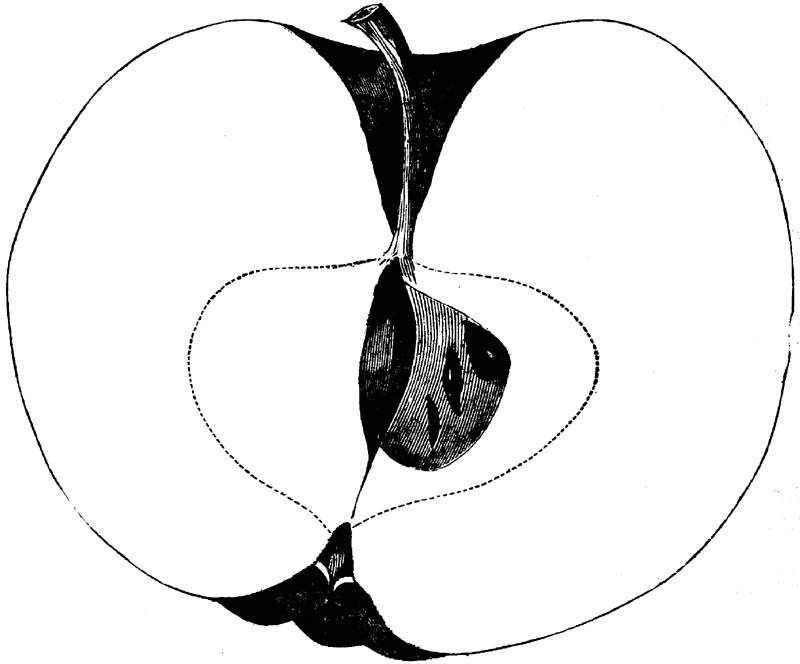
Fig. 174.—NORTHERN SPY.
Origin near Rochester, New York. Tree very vigorous, large, upright, spreading, when older; shoots reddish, leaves healthy, large, dark. Tree productive when old, but not an early bearer; needs trimming to admit light and air to the fruit.
Fruit large, flattened-conical, angular; Surface smooth, yellow, mixed, and splashed, scarlet, or crimson; Dots scattered, small.
Basin abrupt, regular, or folded; Eye small, closed.
Cavity wide, regular or wavy, brown; Stem medium to short.
Core large, irregular, open; Seeds numerous, small, pointed, pale; Flesh yellowish-white, breaking, granular, juicy; Flavor acid, becoming sub-acid, aromatic, rich, with the spiciness of a Spitzenberg; Quality considered best, but rather coarse in texture; Use, table, kitchen and market; Season, December until May, and in the North longer.
Red Canada.
STEEL'S RED.
Origin New England. Tree thrifty, healthy, but slender, twiggy, productive.
Fruit medium, globular-conic, indistinctly angular; Surface smooth, yellow, covered with mixed and striped bright red; Dots numerous, gray, indented, elongated near the stem, as in Esopus.
Basin shallow, folded; Eye small, closed.
Cavity wide, acute, wavy; Stem long, inclined.
Core regular, closed, large; Seeds imperfect; Flesh yellowish-white, breaking, crisp, fine-grained, tender, juicy; Flavor sub-acid, aromatic, delicious; Quality best, for table; Season, December to February.
Red Stripe.
EARLY RED MARGARET (incorrectly)—ROCKHILL'S SUMMER QUEEN (Indiana).
This handsome and productive early apple has been extensively propagated in parts of Indiana, under the names above presented. It was introduced at Fort Wayne by Mr. Rockhill, who is reported to have "made more money from the trees of this variety than from twice as many of any other early apple." Recommended for general cultivation in that State.
Tree hardy in nursery and orchard, productive; Shoots very downy.
Fruit medium to small, long, conical, furrowed or ribbed; Surface polished, pale yellow, mixed and splashed crimson.
Basin very shallow, plaited; Eye very small, closed.
Cavity acute, regular, browned; Stem medium.
Core long, oval, embracing the eye; Flesh whitish, tender, fine-grained, juicy; Flavor acid; Quality good; Table or kitchen; Season, July and August.
Scalloped Gilliflower.
This is supposed to be an old European variety. Its peculiarly irregular form makes it quite a remarkable fruit. It is sometimes called Red Gilliflower; but that name is also very commonly applied to quite another fruit—the Red Winter Pearmain, described on a previous page, in Class II., Order I., Section 2., Sub-section 2.
Fruit large, round-conic, very irregular, furrowed and ribbed; Surface yellow, marbled and splashed scarlet.
Basin abrupt, deep, folded or ribbed; Eye medium, closed.
Cavity deep, acute, irregular, wavy; Stem medium.
Core regular, round, very open, meeting the eye; Seeds numerous, plump; Flesh yellow, breaking, tender; Flavor sub-acid, aromatic; Quality scarcely good; Use, table, kitchen; Season, November, December. Chiefly grown northward.
Seager.
This large, handsome fruit was exhibited at the American Pomological Society's meeting at Philadelphia, in 1860, by Chas. P. Davis, of Phillipsburgh, New Jersey. The Committee reported it "Good."
Fruit large, roundish-conic, irregular; Surface smooth, yellow, striped, splashed and mixed carmine; Dots scattered, yellow.
Basin abrupt, narrow, folded, plaited; Eye medium, large, closed.
Cavity wide, wavy, brown and yellow; Stem medium, knobby.
Core roundish, open, clasping; Seeds angular, imperfect; Flesh yellowish-white, breaking, fine-grained, juicy; Flavor sub-acid, aromatic; Quality good to very good; Use, table, kitchen; Season, September.
Stanard.
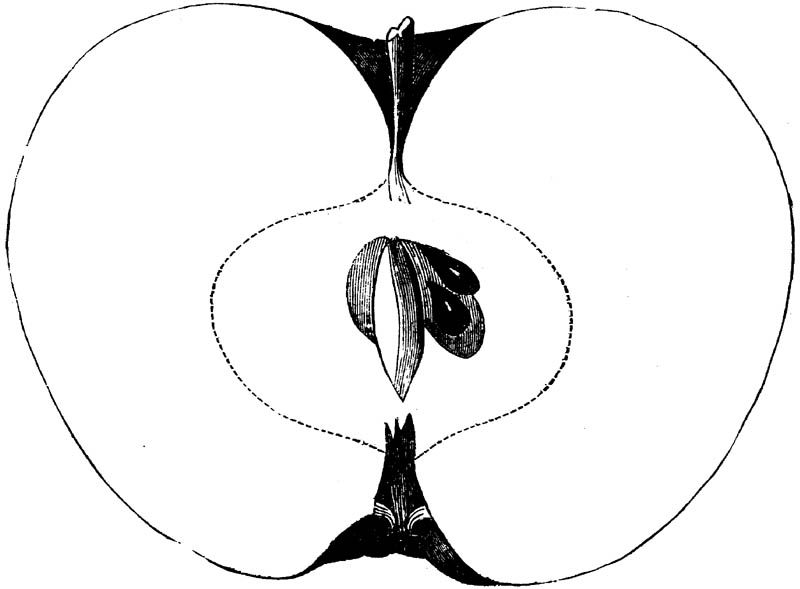
Fig. 175.—STANARD.
From Erie County, New York, this fruit has made its way westward, by the Lakes, having been distributed by Col. Hodge, of Buffalo, and brought to the notice of his western friends by Hon. M.L. Dunlap, of Champaign, Illinois, who esteems it very highly. I quote from his account of it:
"This proves one of our most profitable winter apples; the tree bears young and constantly, but fuller on alternate years; fruit large and showy, shoots large and downy; buds prominent, fruit buds large, and the earliest in the orchard to swell; but they do not open as soon as others. Tree spreading, trunk generally crooked." Very hardy.
Fruit large, roundish, conical, ribbed, angular; Surface smooth, yellowish-green, somewhat red, mixed and striped indistinctly; Dots numerous, minute, white.
Basin medium, folded and plaited; Eye large, closed; Segments long.
Cavity wide, acute, wavy, green; Stem medium to long.
Core small, globular, regular, closed or open; Seeds numerous, brown, angular; Flesh yellow, breaking, rather coarse, tender; Flavor acid to sub-acid, rich; Quality good; Use, market and table; Season, November to February.
Summer Queen.
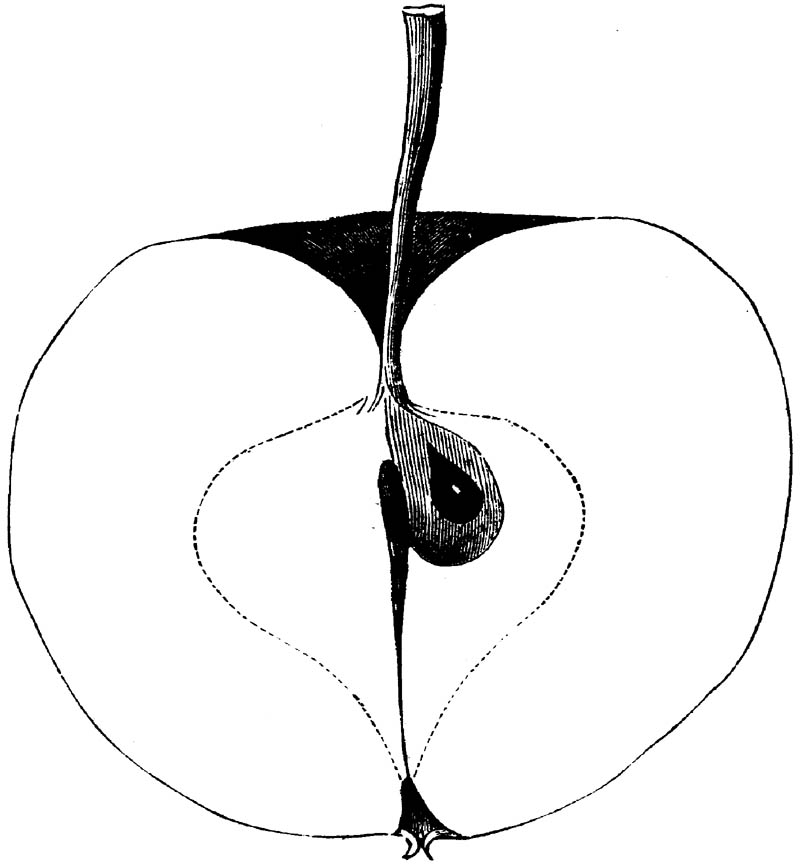
Fig. 176.—SUMMER QUEEN.
American. Tree vigorous, large, spreading, productive.
Fruit medium, round-conic, angular; Surface yellow, covered mixed red, striped, splashed scarlet; Dots minute, yellow.
Basin none or very shallow, folded or plaited; Eye medium, closed.
Cavity wide, regular, brown; Stem long, slender.
Core medium, regular, open; Seeds numerous, pointed, brown; Flesh firm, yellow, breaking; Flavor acid, very aromatic, spicy; Quality first rate; Use, kitchen; Season, July, August.
Winesap.—[Coxe.]
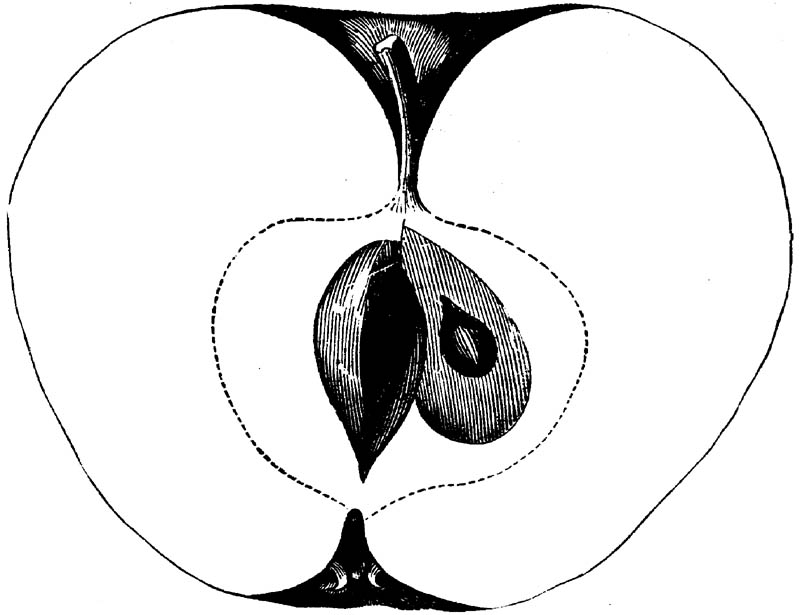
Fig. 177.—WINESAP.
Tree vigorous, healthy, hardy, productive, early bearer; Branches open, straggling; Shoots strong, dark reddish-brown; Foliage curled, glaucous, sparse.
Fruit medium, conical, often obscurely angular, or slightly ribbed; Surface rather smooth, bright or dark red, mixed and obscurely striped on yellow, which is mostly covered, often veined russet; Dots few, minute, indented.
Basin narrow, shallow, plaited; Eye small, closed.
Cavity wide, reddish brown; Stem medium.
Core regular, somewhat open; Seeds large, rather light; Flesh firm, yellow; Flavor rich, acid to sub-acid; Use, market, kitchen, cider; Season, January to March.
CLASS II.—CONICAL APPLES.
ORDER II.—ANGULAR.
SECTION 2.—SOUR.
SUB-SECTION 3.—RUSSET.
Fort Miami.
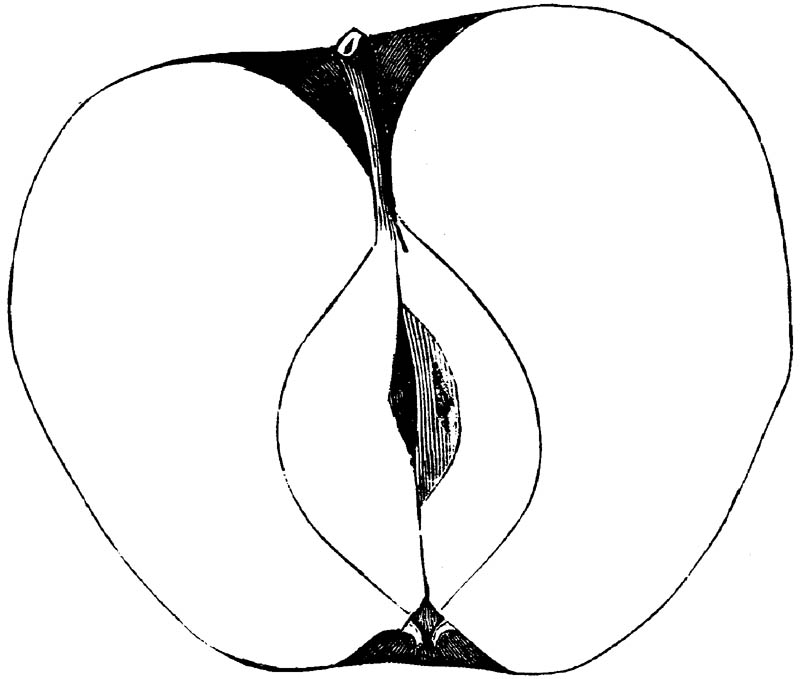
Fig. 178.—FORT MIAMI.
This is another of the seedling russets of the Maumee, brought to the notice of the State Society by its Vice-President, J. Austin Scott, of Toledo. Mr. Elliott describes it from notes taken in 1846, when he received specimens from A. Spafford, Esq., Perrysburgh, Ohio.
Tree upright and spreading, healthy, thrifty; Shoots dark; not an early bearer, but productive when older.
Fruit medium, roundish or oblong-conic, truncated, angular, often unequal; Surface rich yellow russet, often bronzed; Dots scattered, netted russeting.
Basin medium or shallow, folded; Eye small, closed.
Cavity acute, wavy, green; Stem medium.
Core oval, clasping the eye, regular, closed; Seeds often imperfect; Flesh greenish-yellow, firm; Flavor acid, rich; quality nearly best; Use, dessert; Season, February to April.
CLASS III.—ROUND APPLES.
ORDER I.—REGULAR.
SECTION 1.—SWEET.
SUB-SECTION 1.—SELF-COLORED.
Bluff Sweet.
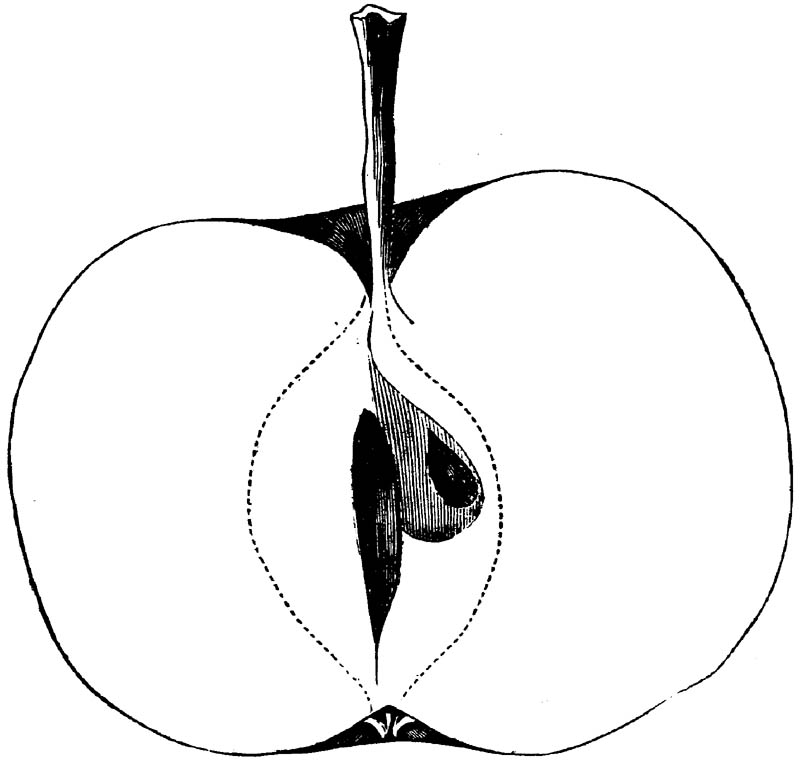
Fig. 179.—BLUFF SWEET.
This apple was found by G.M. Beeler on the banks of the White river, upon a farm devoted to pomology.
Fruit medium to small, regular, round; Surface smooth, green; Dots minute.
Basin shallow; Eye small, closed.
Cavity shallow, regular; Stem long.
Core small, oval, pointed; Seeds plump, brown; Flesh greenish-white; Flavor sweet; Quality good; Use, market; Season, July. Rather too small.
Broadwell.
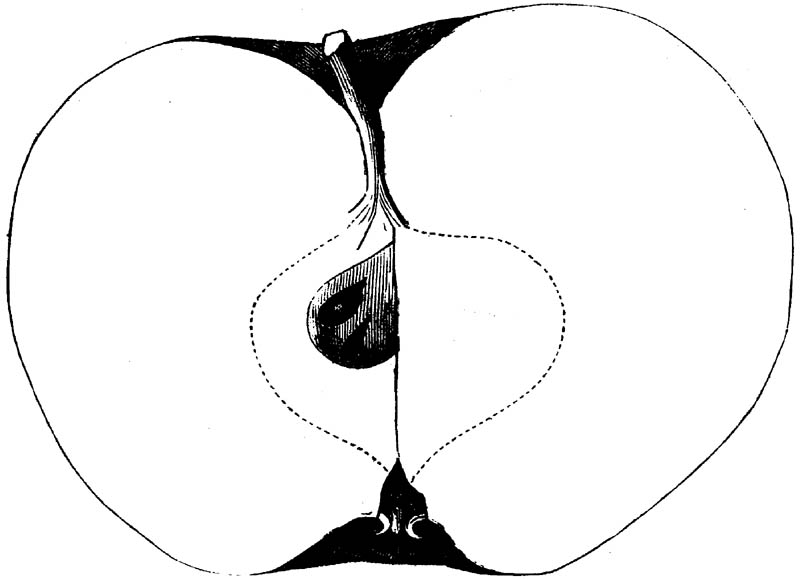
Fig. 180.—BROADWELL.
This delicious winter sweet apple originated near Cincinnati, Ohio. Tree thrifty, vigorous, spreading, productive.
Fruit large, varies from globular toward oblate, regular; Surface smooth, pale yellow or whitish, thinly blushed with carmine, often bronzed; Dots scattered, minute, dark.
Basin abrupt, rarely folded or plaited; Eye small, closed.
Cavity wide, regular brown; Stem short.
Core round, regular, closed, clasping the eye; Seeds short, plump; Flesh yellowish, fine-grained, very tender, juicy; Flavor very sweet, agreeable; Quality best winter sweet; Use, table, kitchen; Season, December.
Caleb.
"A Pennsylvania fruit. Tree vigorous and productive; Fruit medium, roundish, flattened, skin yellow; Flesh rather fine, very sweet, excellent for cooking. Last of August and first of September".—[Downing.]
Danvers' Winter Sweet.
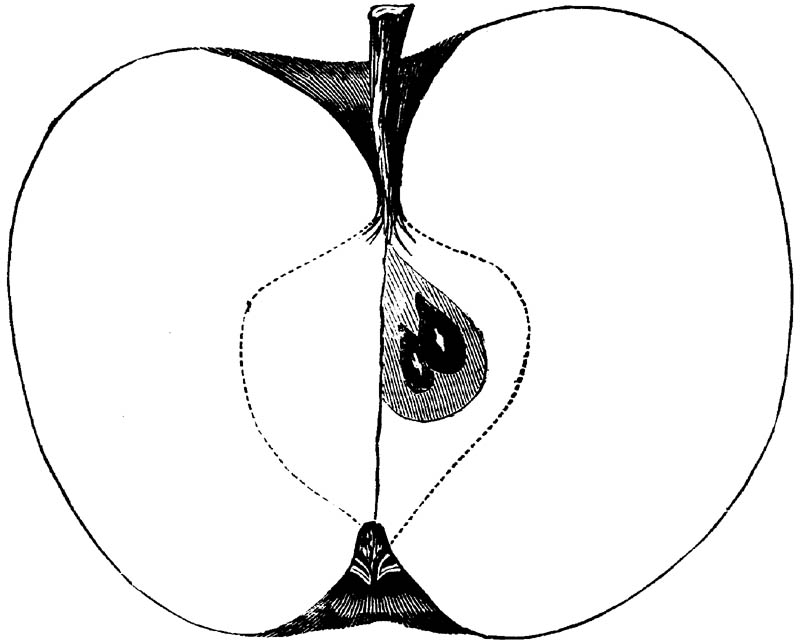
Fig. 181.—DANVERS' WINTER SWEET.
Origin Danvers, Massachusetts. Tree very thrifty, very productive.
Fruit large, globular, truncate, sometimes globular-oblate, regular; Surface smooth, uneven, greenish-yellow; Dots numerous, medium, prominent, with white and green bases.
Basin abrupt, deep, regular; Eye small, closed; Segments long.
Cavity wide, deep, brown; Stem long, slender, knobby.
Core round, regular, closed; Seeds numerous, long, brown, pointed; Flesh yellow, breaking, fine-grained, juicy; Flavor very sweet; Quality good to very good; Use, baking; Season, December and January.
Fancher.
This new fruit was obtained from Mr. Thomson, at the State Fair at Zanesville, Ohio. Origin unknown. Not identified nor recognized.
Fruit large to very large, globular, regular; Surface smooth, yellow, blushed; Dots minute, scattered.
Basin shallow, regular; Eye small, closed.
Cavity acute, regular, green; Stem long, inclined.
Core wide, round, open, meeting the eye; Seeds numerous, plump, brown; Flesh white, fine-grained, breaking, juicy; Flavor very sweet; Quality good to very good; Use, baking; Season, September and October.
Golden Sweet.
ORANGE SWEETING.
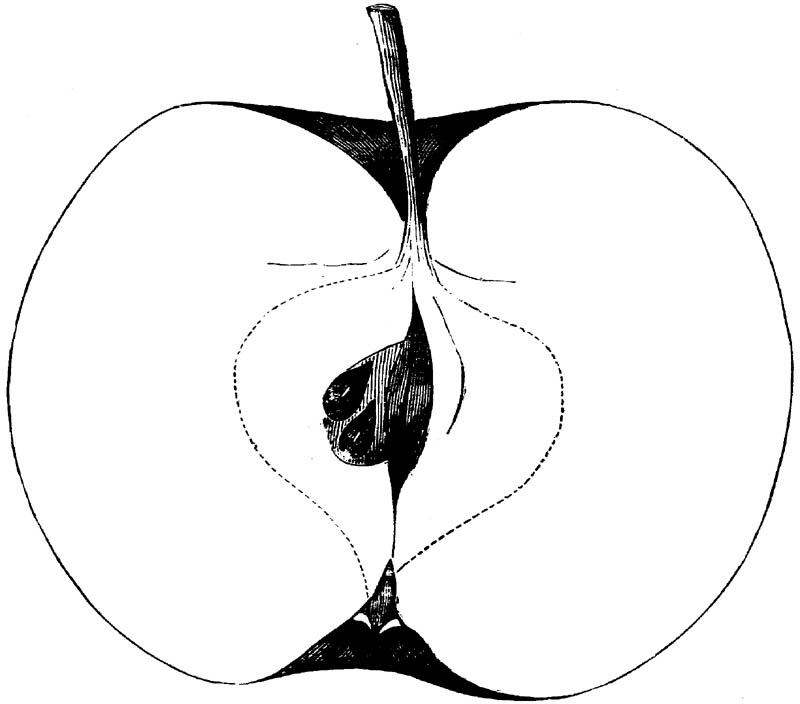
Fig. 182.—GOLDEN SWEET.
From Connecticut. Tree very robust, vigorous, spreading, round-head, early—productive; Shoots stout, dark, foliage large, dark.
Fruit large, globular, regular; Surface very smooth, waxen to rich yellow; Dots scattered, indented, green.
Basin shallow, wide regular; Eye medium, closed; Calyx reflexed.
Cavity wide, regular; Stem long, slender, yellow.
Core medium, regular, closed; Seeds numerous, small, pointed, light brown; Flesh yellow, breaking, fine-grained, juicy; Flavor very sweet, aromatic, like sassafrass; Quality good to very good; Use, baking and market; Season, August.
Higby Sweet.
LADY BLUSH.
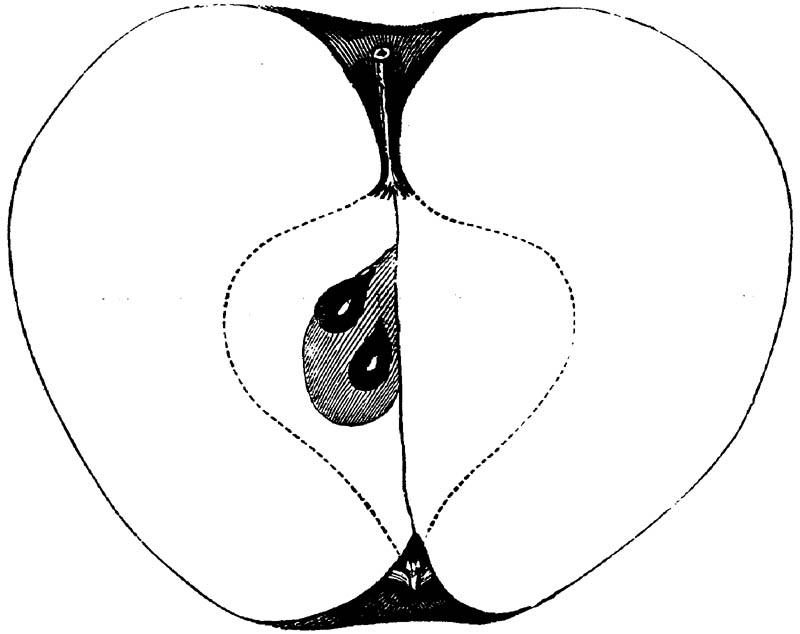
Fig. 183.—HIGBY SWEET.
Origin Trumbull County, Ohio; introduced by Dr. Kirtland.
Fruit large, round, truncated, regular; Surface smooth, greenish-yellow, blushed; Dots scattered, distinct, white and dark.
Basin abrupt, wavy, deep; Eye medium, closed.
Cavity deep, acute, regular, brown; Stem medium.
Core small, regular, heart-shaped, closed, clasping the eye; Seeds plump; Flesh yellowish-white, tender, fine-grained, juicy; Flavor very sweet; Quality good; Use, baking; Season, October.
Hightop Sweet.
SWEET JUNE.
From Plymouth, Massachusetts.
Tree vigorous, very upright, exceedingly productive and profitable.
Fruit small to medium, round, regular; Surface smooth, greenish-yellow; Dots minute, black.
Basin medium, regular; Eye small, closed.
Cavity deep, narrow; Stem medium.
Core very small, oval, separate from the eye; Seeds numerous, angular, yellow; Flesh white, or greenish-white, fine-grained, tender, juicy; Flavor sweet; Quality good; Use, table and kitchen; Season, June and July.
Holston Sweet.
Origin unknown. Not identified as any other variety; received from my brother, J.T. Warder, Springfield, Ohio.
Fruit medium to large, round, regular; Surface smooth greenish-yellow, bronzy; Dots scattered.
Basin regular, small; Eye small, closed.
Cavity shallow, wide; Stem long to medium.
Core small, oval, regular, closed, clasping; Seeds short, plump, brown; Flesh whitish-yellow, very fine-grained, tender, juicy; Flavor very sweet, aromatic, rich; Quality best; Use, table, baking; Season, December to February.
One of the best sweet table apples—better than Higby Sweet.
May.
MAY (of Myers)—RHENISH MAY (of Illinois.)
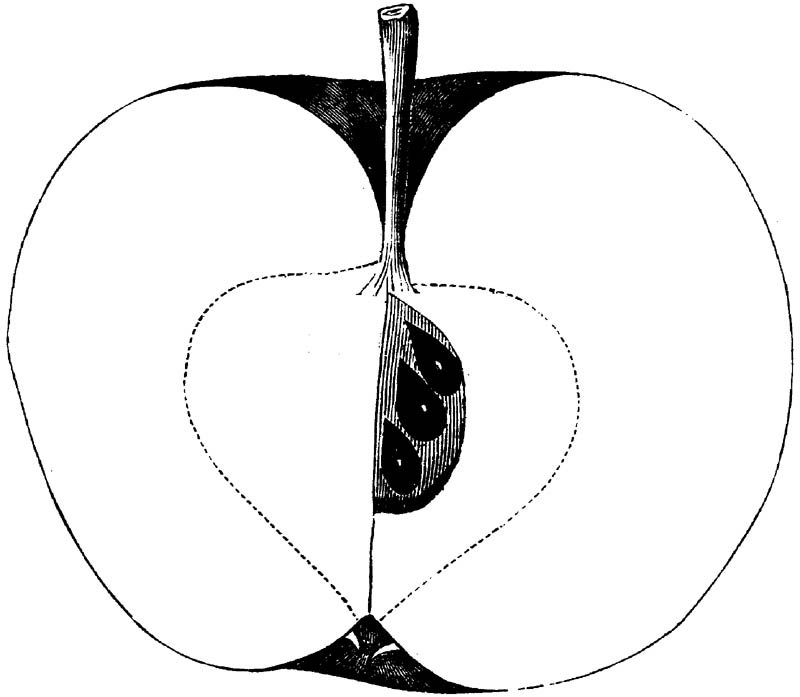
Fig. 184.—MAY.
This long-keeping apple has been widely disseminated throughout the West, and yet I do not find its history nor origin. It has been exhibited at all our winter meetings, and finds favor on account of its productiveness and its long-keeping properties. Tree healthy, vigorous and productive—believed to be hardy. Its reputed foreign origin is discredited.
Fruit medium, round, inclined to conical, regular; Surface smooth, often shining, pale greenish-yellow, often faintly blushed, or bronzed.
Basin shallow, generally regular; Eye small, closed.
Cavity deep, narrow, regular, brown; Stem long, rather slender.
Core large, regular, heart-shaped, reaching the eye; Seeds numerous, pointed, plump, brown; Flesh yellow, compact, fine, sufficiently juicy; Quality fair; Use market and kitchen; Season spring and into summer.
Morton.
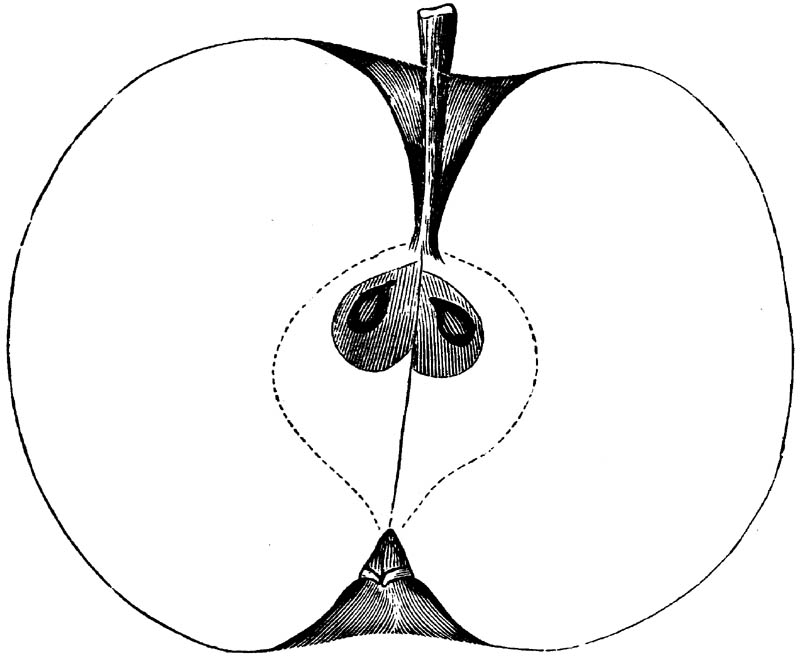
Fig. 185.—MORTON.
This undescribed fruit appears to have originated in Clermont County, Ohio. My specimens and trees came from my worthy friend, Wm. E. Mears, of Milford, Ohio.
Tree vigorous, healthy, round top, spreading, productive; Shoots rather slender; Leaves rich green, abundant.
Fruit large, round, regular; Surface smooth, green, becoming yellow, with a dull bronzy blush; Dots gray and brown.
Basin shallow, or deep and abrupt, regular or plaited; Eye medium, closed.
Cavity acute, regular, brown; Stem rather slender, often long.
Core very small, regular, closed, meeting the eye; Seeds not numerous, flat, angular; Flesh white, tender, juicy; Flavor rather sweet, rich, agreeable; Season December to January. Worthy of cultivation.
Paradise Summer Sweet.
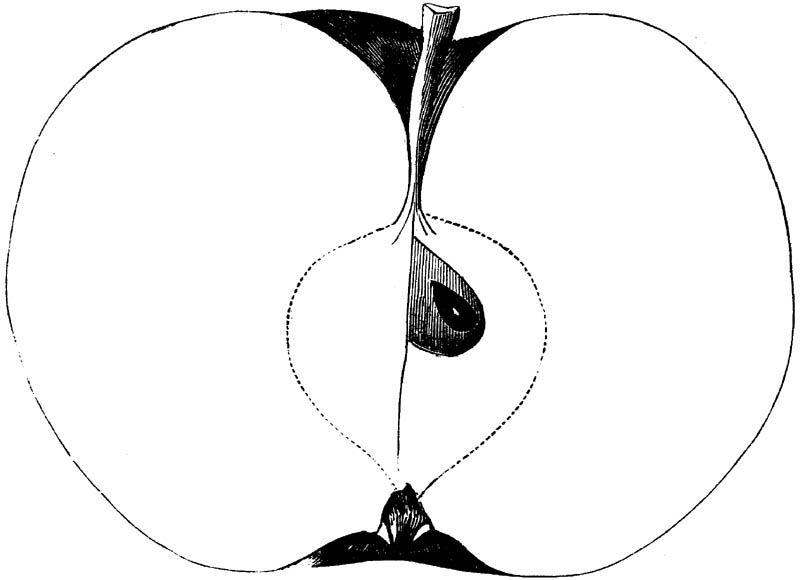
Fig. 186.—PARADISE SUMMER SWEET.
Origin Eastern Pennsylvania. Tree upright, vigorous, productive.
Fruit large, oblate-globular, regular; Surface greenish-yellow; Dots numerous, large, white.
Basin shallow, wide, folded; Eye small, closed.
Cavity deep, regular, acute, green; Stem long, inclined, yellow.
Core medium, regular, round, clasping; Seeds plump; Flesh yellow, melting, juicy; Flavor rich, sweet; Quality best; Use table and kitchen; Season August, September.
Paradise Winter Sweet.
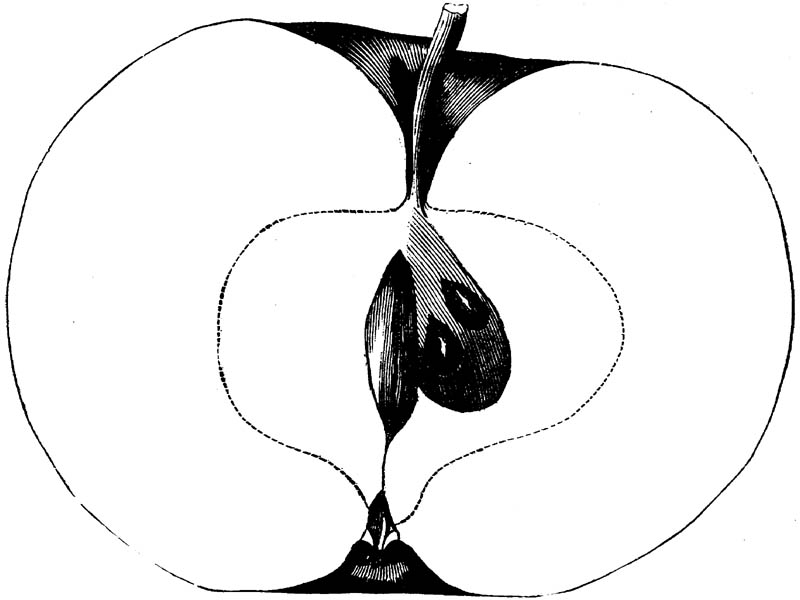
Fig. 187.—PARADISE WINTER SWEET.
Origin believed to be similar to its predecessor—Lancaster County, Pennsylvania.
Fruit large, globular, often unequal; Surface smooth, yellowish-white; Dots scattered, minute.
Basin abrupt, regular; Eye small, closed.
Cavity deep, acute, brown; Stem long, slender.
Core large, wide, open, clasping; Seeds plump and dark; Flesh white, tender, breaking, juicy; Flavor very sweet; Quality good; Use, baking and stock; Season, December to March.
Tallman's Sweet.
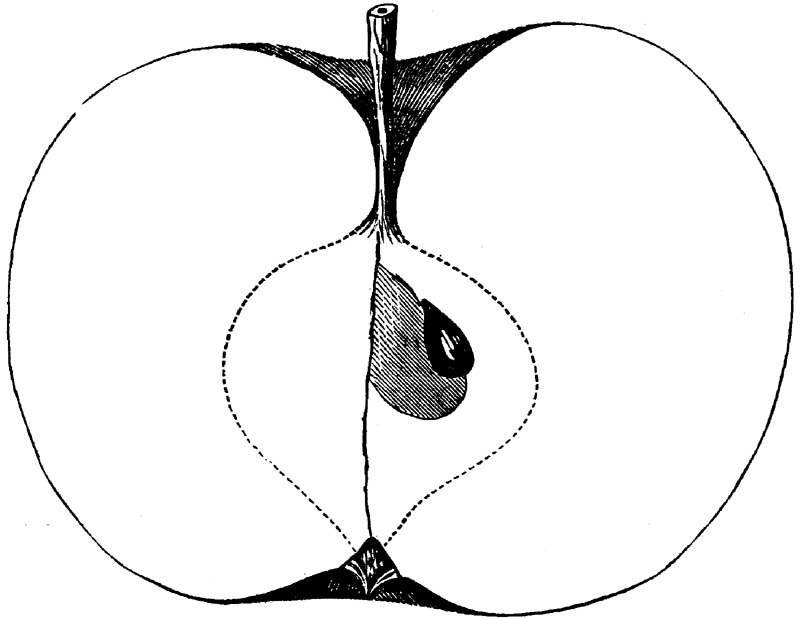
Fig. 188.—TALLMAN'S SWEET.
This favorite baking apple of New England has traveled from Rhode Island wherever her hardy sons have gone westward.
Tree hardy, very productive.
Fruit medium to large, nearly round, somewhat flattened, regular; Surface smooth, yellow; Dots minute, dark; frequently a distinct line on one side from stem to eye.
Basin wide, regular, leather-cracked; Eye small, closed.
Cavity rather wide, regular; Stem medium size, long.
Core heart-shaped, regular, closed, clasping; Seeds numerous, plump, pointed, dark; Flesh yellow, breaking, firm; Flavor very sweet, rich; Quality good; Use, baking and stock; Season, December and January.
CLASS III.—ROUND APPLES.
ORDER I.—REGULAR.
SECTION 1.—SWEET.
SUB-SECTION 2.—STRIPED.
Bentley Sweet.
This long-keeping sweet apple was received in Eastern Ohio from some part of Virginia, where it is supposed to have originated.
Tree quite vigorous, upright while young, spreading, productive—an early bearer.
Fruit medium to large, globular, truncated, slightly flattened, regular; Surface smooth, yellow, or greenish, covered, mixed, blotched, striped and splashed dull red, becoming brighter when ripe; Dots minute.
Basin medium, abrupt, regular; Eye medium, open; Calyx reflexed.
Cavity deep, acute, regular; Stem slender, long.
Core round, flattened, regular, closed; Seeds numerous, plump, long; Flesh yellowish-white, firm, breaking, fine-grained; Flavor sweet; Quality good to very good; Season spring and all summer until September. Keeps sound.
Bowling Sweet.
From Spottsylvania County, Virginia. Tree vigorous, very productive.
Fruit medium roundish, dull red on yellow; Flesh rich, juicy, sweet; Entirely free from acid; October to January.—[H.R. Robey, in Downing.]
Cullasaga.
Origin Macon County, North Carolina. Good grower; a standard winter fruit for the South.
Fruit medium or large, roundish, inclining to oval, flattened at base and crown, skin yellowish, mostly shaded and striped with dark crimson, and sprinkled with whitish dots; Stem small and short, inserted in a deep cavity, surrounded by russet; Calyx open, set in a shallow, corrugated basin; Flesh yellow, tender, juicy, with a very mild, rich, almost saccharine flavor. January to April.—[Downing.]
Gilpin.
CARTHOUSE—LITTLE RED ROMANITE.
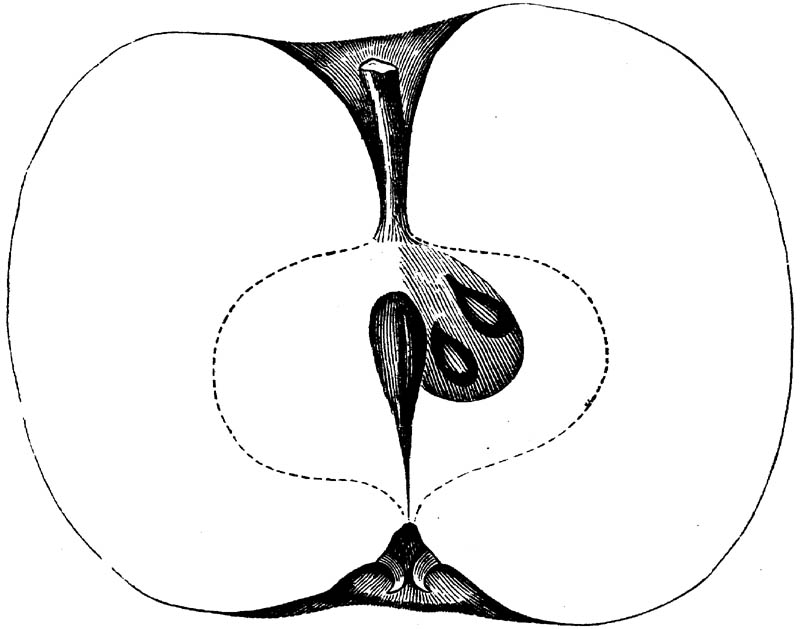
Fig. 189.—GILPIN.
This valuable Virginia apple was cultivated and distributed by Coxe, and has found its way into the orchards and into favor all over the country, on account of its productiveness and early bearing.
Tree remarkably vigorous, strongly branched, spreading, open, round head, very productive; shoots stout, dark; foliage rather sparse, somewhat curled and glaucous.
Fruit medium, small on old trees, round, truncated at the ends, making it look cylindrical, mostly symmetrical, but large specimens often somewhat irregular; Surface very smooth, often polished, deep red all over, stripes indistinct; Dots minute, indented.
Basin wide, regular, or folded; Eye small, closed.
Cavity deep, acute, regular, brown; Stem very short.
Core medium, round, regular, closed; Seeds few, large, plump; Flesh greenish-yellow, firm, juicy; Flavor sweet, rich; Quality poor for dessert, though it is eatable in the spring—valuable for its cider from the richness of the must. Keeps sound until May—bruises do not rot as in other apples. Valuable also for stock.
Its early bearing makes it very desirable in a new country, and in the prairies it has received the soubriquet of "Dollars and Cents."
Hall.
HALL'S SEEDLING—HALL'S RED.
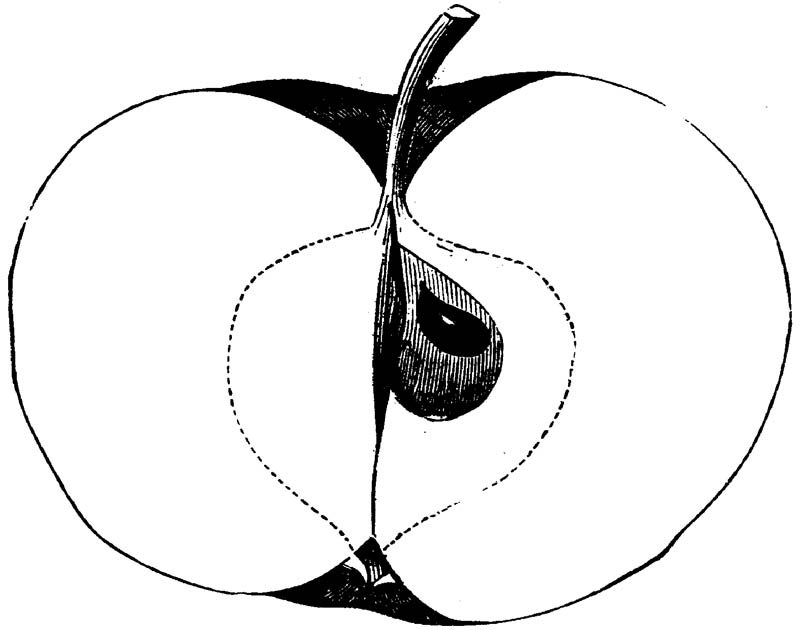
Fig. 190.—HALL.
From Franklin County, North Carolina, and now being spread throughout the Western States as a fruit of great promise.
Tree medium size, sufficiently thrifty, upright, hardy, very productive; Shoots long, rather slender, reddish, wood firm. Introduced into the West by the venerable R. Ragan, of Fillmore, Indiana. The specimens from which the following description was made were sent by J.S. Downer, of Elkton, Kentucky, from whom also my trees were obtained. Mr. J.P. Wilson, of Olney, Ill., says, it originated in Saline County, of that State, with Jonathan Hall, about forty years ago. [?]
Fruit small, round, slightly conical, regular; Surface smooth, yellow, covered with bright red, mixed and striped; Dots numerous, large, yellow.
Basin shallow, wavy or plaited, leather-cracked; Eye small, closed.
Cavity wide, regular, brown; Stem long, slender.
Core pyriform, regular, slightly open, clasping; Seeds large, plump; Flesh yellow, tender, fine-grained, juicy; Flavor sub-acid, rich, agreeable; Quality almost best; Use, table; Season, December to April.
Ladies' Sweeting.
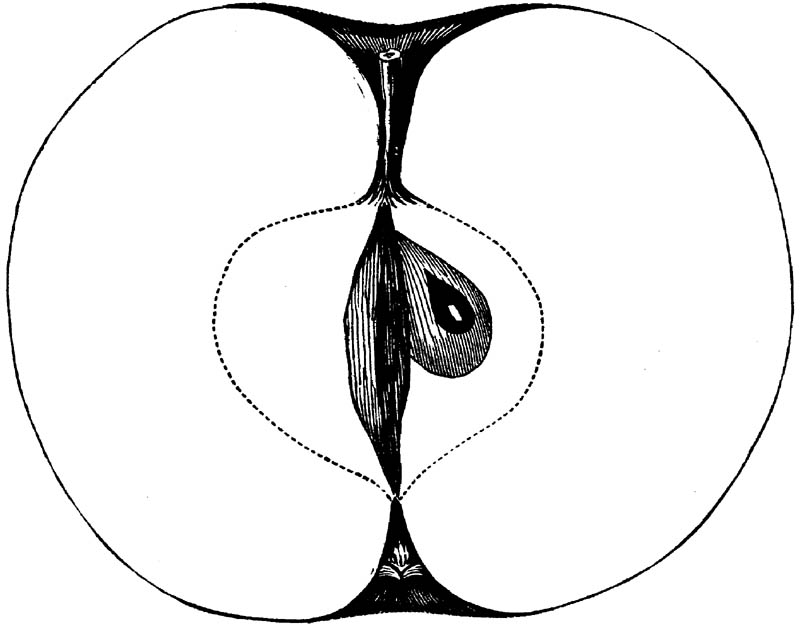
Fig. 191.—LADIES' SWEETING.
This prime favorite of Chas. Downing originated near Newburgh, New York. Though having many admirers, it finds strong competitors in the Broadwell, Paradise Winter, and some others of the same season.
Tree thrifty, productive.
Fruit large, round, somewhat conic, occasionally angular; Surface smooth, light yellow, striped and splashed with bright red; Dots distinct, large, gray.
Basin medium, often abrupt, folded; Eye very small, closed.
Cavity medium or wide, regular, brown; Stem short, or long and slender.
Core medium, round, closed or open, clasping; Seeds numerous (16), angular; Flesh white, crisp, fine-grained, juicy; Flavor sweet, agreeable; Quality only good (to my taste); Use, table, baking and stock feeding; Season, December.
Scarlet Sweet.
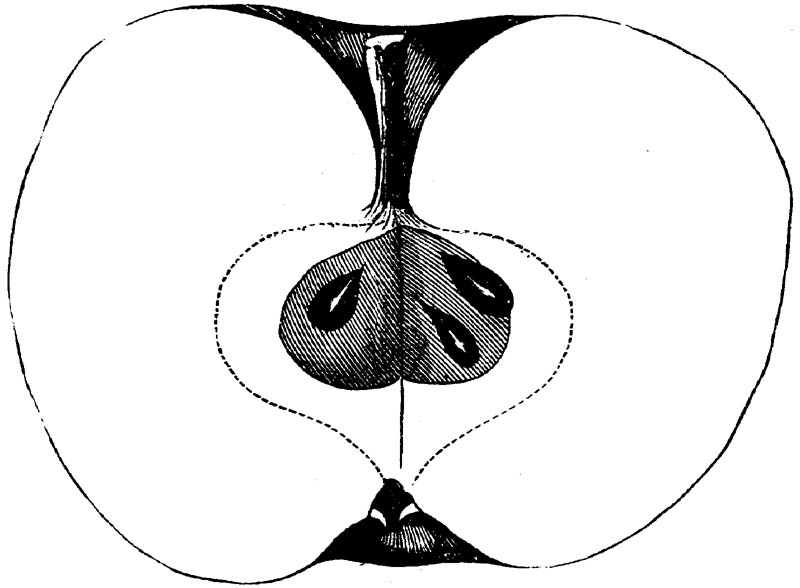
Fig. 192.—SCARLET SWEET.
This delicate fruit was received from my good friend Jas. Edgerton, of Barnesville, Ohio, who had exhibited it at the State Pomological Society at different times.
Fruit medium, round, somewhat flattened, regular; Surface smooth, yellow, striped and blushed scarlet; Dots minute.
Basin wide, abrupt, regular; Eye medium, open; segments short.
Cavity deep, acute, regular, brown; Stem medium, slender.
Core rather wide, regular, closed, clasping the eye; Seeds numerous, plump, angular; Flesh yellow, fine-grained, juicy; Flavor sweet; Quality good to very good; Uses, table, baking and market; Season, October to December.
This is different from the Scarlet Sweeting of Sigler, of Morgan County, Ohio—more like Hampton's Scarlet Sweet, of M.S. notes.
Sweet Janet.
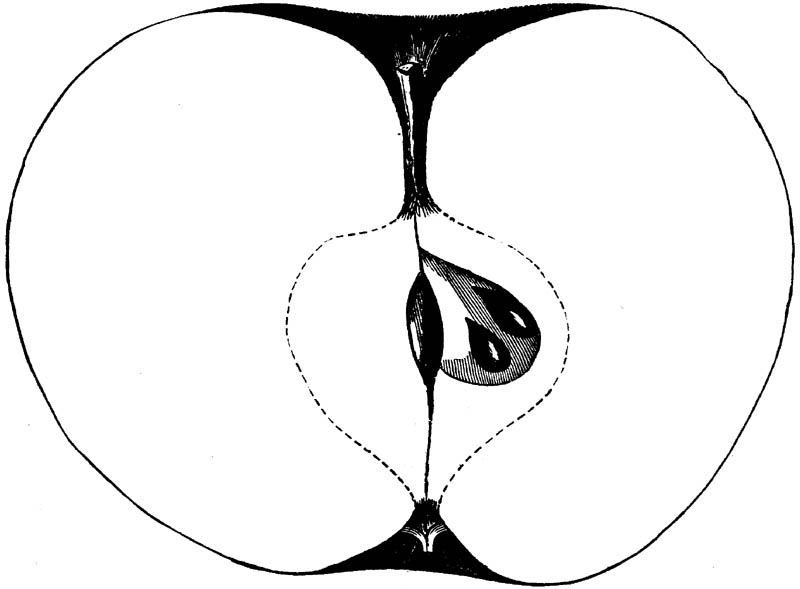
Fig. 193.—SWEET JANET.
This is another of the fine fruits originated by Reuben Ragan, of Indiana, from seed of Rawle's Janet. Tree large, healthy, vigorous, spreading; Shoots rather stout, brown; foliage rich green. Annually productive of fine, fair fruits, which are well distributed and hold well.
Fruit large, round, somewhat conical, regular; Surface smooth, covered with rich red or crimson, mixed and striped; Dots numerous, rather large, yellow, indented.
Basin regular or plaited; Eye medium, closed.
Cavity rather deep, very narrow, wavy; Stem quite short.
Core medium, turbinate, regular, slightly open, clasping; Seeds numerous, angular, pointed; Flesh yellow, breaking, juicy; Flavor very sweet; Quality good to very good; Use, baking, market; Season, December and January. Very profitable.
Sweet Romanite.
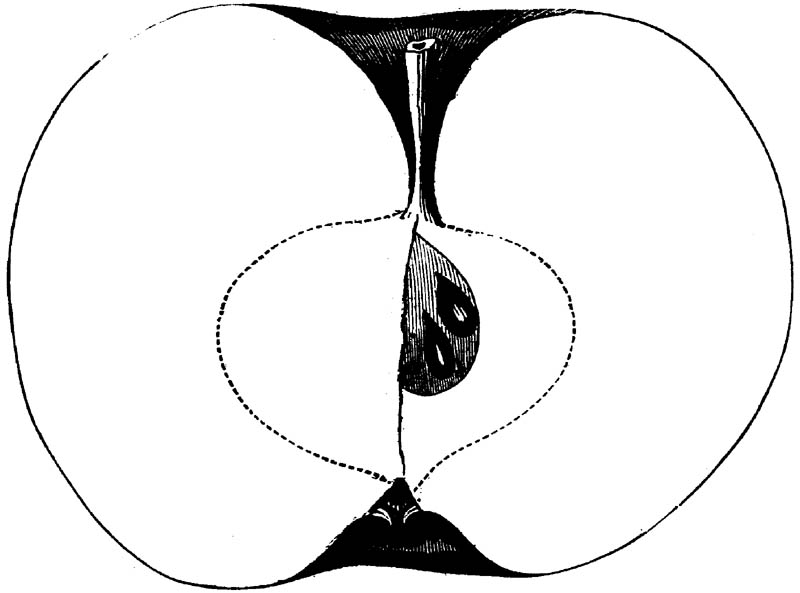
Fig. 194.—SWEET ROMANITE.
Origin unknown. Grown in Illinois; introduced at the State Society by the lamented Cyrus R. Overman, President—much esteemed by him.
Fruit medium, round, sometimes flattened or truncate, regular; Surface smooth, greenish-yellow, blushed, mixed bright red and dull red, stripes indistinct; Dots scattered, irregular, brown or fawn on the deeper colors.
Basin medium, or deep and abrupt, folded, plaited; Eye small, closed.
Cavity deep, acute, wavy, brown; Stem medium to long, green.
Core roundish, closed, clasping; Seeds numerous, plump, angular; Flesh yellow, fine-grained, breaking, juicy; Flavor very sweet; Quality good to very good; Use, baking, cider, table and stock; Season, December to April.
CLASS III.—ROUND APPLES.
ORDER I.—REGULAR.
SECTION 1.—SWEET.
SUB-SECTION 3.—RUSSET.
Orange Sweeting or Russet.
An eastern variety—not much cultivated.
Fruit large, very round, regular; Surface greenish-yellow, bronzy-orange, russeted; Dots numerous, white, green bases.
Basin shallow, regular, or plaited; Eye small, closed.
Cavity acute, lipped, wavy; Stem short, green.
Core very large, turbinate, open, clasping; Seeds numerous, pointed, pale; Flesh green, rather tough, fine-grained, juicy; Flavor sweet; Quality good—for baking especially; Season, December.
Pumpkin Russet.
Fruit large, globular, regular; Surface covered with coarse russeting; Flesh spongy, light, very sweet; Used for baking and apple butter; Season, autumn. Not valuable, except for stock.
CLASS III.—ROUND APPLES.
ORDER I.—REGULAR.
SECTION 2.—SOUR.
SUB-SECTION 1.—SELF-COLORED OR BLUSHED.
Ashmore.
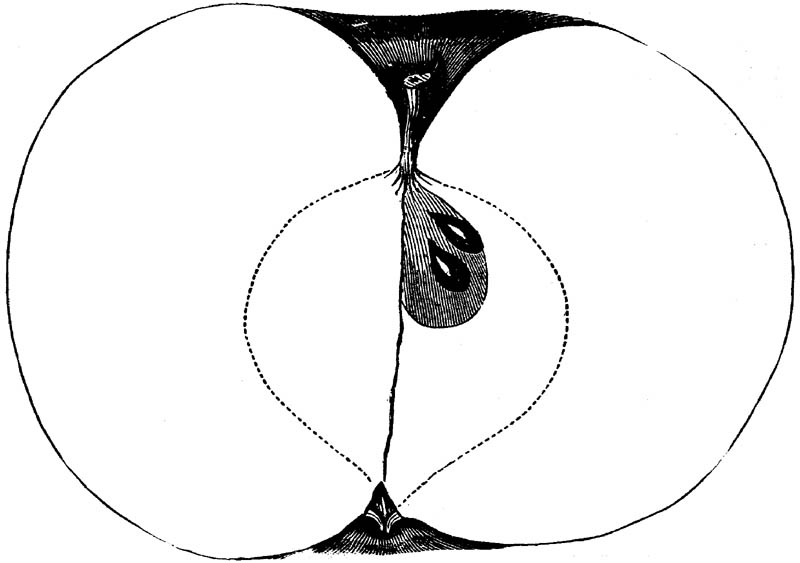
Fig. 195.—ASHMORE.
The origin of this fine dessert fruit is not known. Though not commonly cultivated, it is considerably scattered, and has come to me from several points in the West with different local names.
Tree vigorous, upright, with long parallel branches that become spreading. Shoots rather slender, foliage rich green.
Fruit rather large, handsome, round, frequently flattened, regular, rarely angular; Surface smooth, polished, very light waxen yellow, almost wholly covered with brilliant lively carmine, very rarely an indistinct stripe; Dots minute, gray, indented.
Basin medium, often wavy or even folded; Eye small, closed; Segments reflexed.
Cavity narrow, acute, regular or wavy; Stem medium to short.
Core indistinct, closed; Seeds plump; Flesh yellowish-white, crisp, tender, very fine-grained, juicy; Flavor sub-acid, very agreeable; Quality best, though not rich; Uses, table, kitchen and market; Season, September and October; May be kept into winter.
There is also a Striped Ashmore, resembling this in every respect, except in the distinct stripe. It is supposed to be a sport from the above. Both varieties have been propagated to some extent by suckers or sprouts.
Bledsoe.
From Carroll County, Kentucky; Sent to Ohio by Lewis Sanders. Tree moderately vigorous, spreading, productive.
Fruit large, round, somewhat conical, flattened at the base, regular; Surface greenish-yellow.
Basin sometimes folded; Eye medium, closed.
Cavity deep, brown; Stem short.
Flesh white, fine-grained, crisp, juicy; Flavor mild sub-acid, agreeable; Quality good—Kentucky Horticultural Society say "very good;" Season, September to April.
Bush.
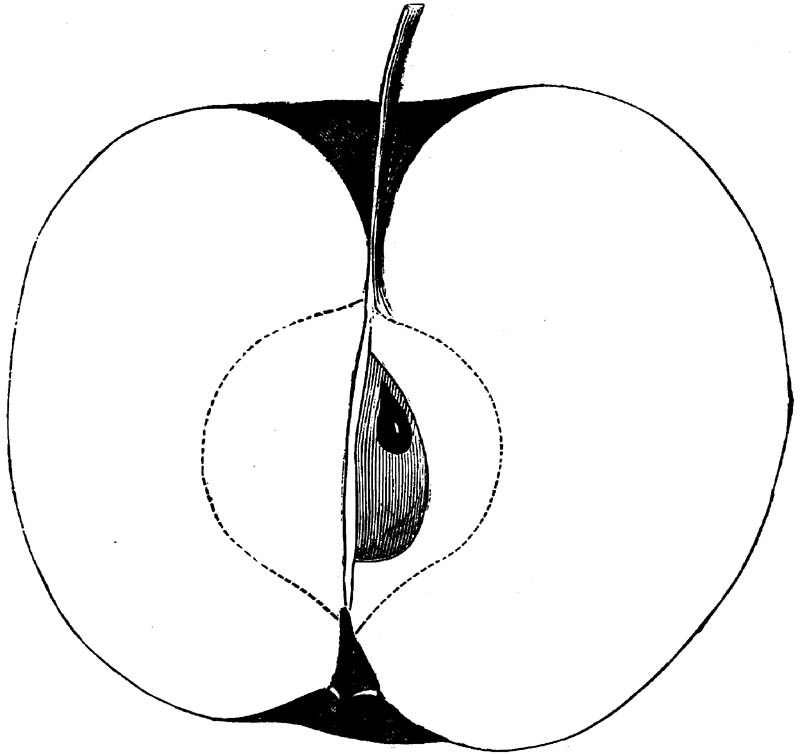
Fig. 196.—BUSH.
Received from W.G. Waring, Tyrone, Pennsylvania. Supposed to be a seedling of Centre County. "Tree vigorous, hardy, thrifty, regularly productive."—[W.G.W.]
Fruit large, fair, round, regular; Surface smooth, waxy yellow, occasionally a faint blush; Dots minute, rare.
Basin wavy; Eye medium to small, closed.
Cavity deep, wavy, brownish; Stem long, slender, yellow.
Core medium, round, rather open, meeting the eye; Seeds few, plump, dark; Flesh whitish, tender, fine-grained, juicy; Flavor mild sub-acid, agreeable; Quality very good; Season August and September.
Mr. Waring considers it one of the best of the season, in which opinion I unite.
Cornish Aromatic.
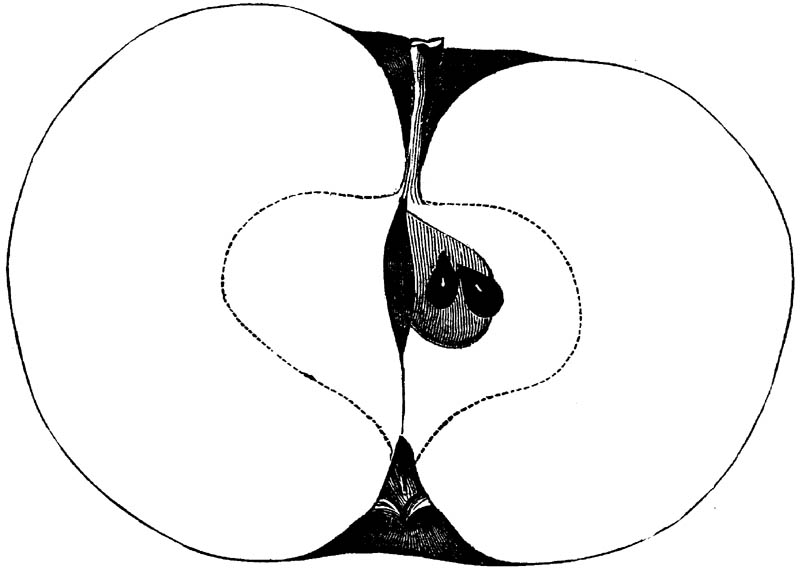
Fig. 197.—CORNISH AROMATIC.
This foreign variety was imported and tested at Louisville, Kentucky, by Mr. George Heinsohn, to whom I am indebted for specimens of other European varieties.
Fruit medium to large, roundish, a little flattened, regular; Surface smooth, yellow, washed rich red; Dots and spots yellow russet.
Basin medium, abrupt, regular or furrowed; Eye medium, closed.
Cavity medium depth, narrow; Stem medium to long, slender.
Core medium, somewhat open, clasping; Seeds large, plump, angular; Flesh yellow, breaking, juicy; Flavor sub-acid, aromatic, spicy; Season November to February.
Duffield Pippin.
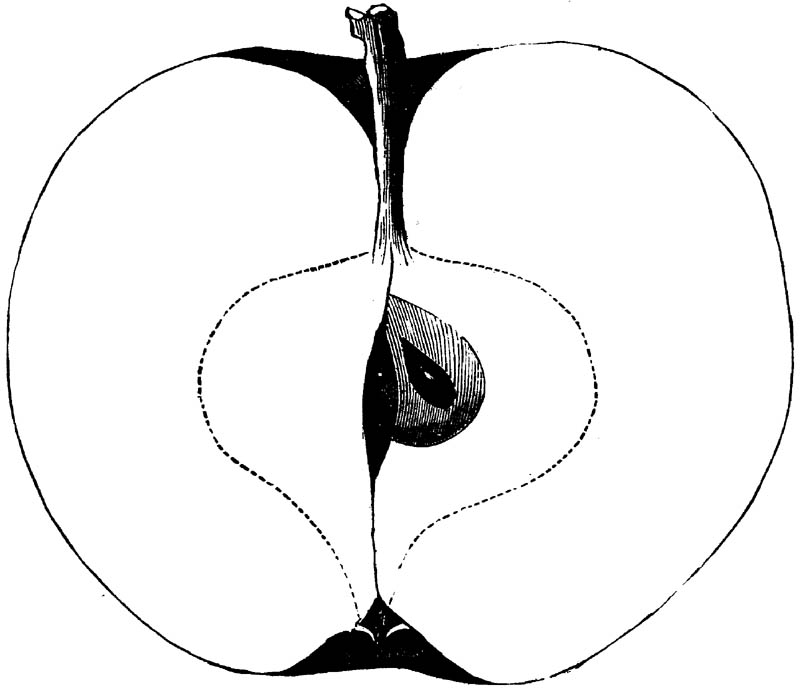
Fig. 198.—DUFFIELD PIPPIN.
Specimens from my friend T.T. Lyon, of Michigan, who says it is a seedling that originated in Pennsylvania, at the beginning of the present century, with the ancestors of Geo. Duffield, D.D., for whom it was named, when it received a first premium at the Michigan State Fair, as a valuable winter variety.
Fruit large, handsome, round, sometimes conic, regular; Surface smooth, yellowish-green, blushed; Dots scattered; minute, indented.
Basin abrupt, narrow, folded; Eye small, closed.
Cavity deep, narrow, acute; Stem medium to long.
Core closed, clasping; Seeds plump, brown; Flesh yellow, breaking, juicy; Flavor sub-acid; Quality good; Uses table, kitchen and market; Season January to April.
Fall Pippin.
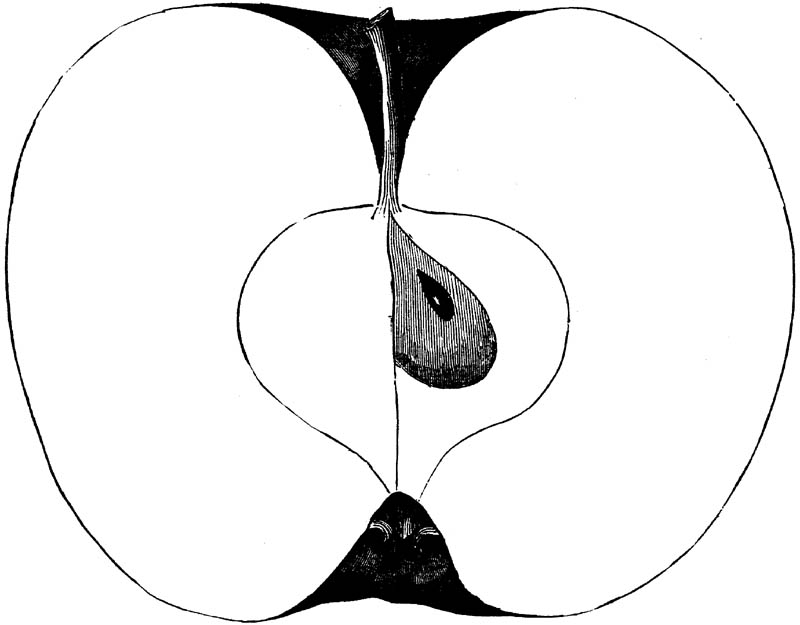
Fig. 199.—FALL PIPPIN.
It is unfortunate that since the days of Coxe there should have been a confounding of this noble and delicious American apple with the inferior foreign kitchen variety: the Holland Pippin.
Tree exceedingly vigorous, large, wide-branching, open head, not early bearer, moderately productive when old; Shoots stout, dark; Leaves large, broad.
Fruit large to very large, handsome, globular, truncated, making it cylindrical, regular; Surface smooth, rich yellow, rarely blushed South, frequently so North, with skin finer; Dots minute, gray.
Basin deep, abrupt, regular, marked with concentric rings which often crack open in large southern specimens; Eye large, open; Segments short.
Cavity wide, regular, or narrow, deep; Stem long.
Core large, regular, closed, meeting the eye; Seeds pointed, often imperfect; Flesh yellow, breaking, compact, very fine-grained; Flavor acid, becoming sub-acid, aromatic, delicious; Quality best for dessert, kitchen, market and drying; Season September to December.
Fall Swaar.—[Of the West.]
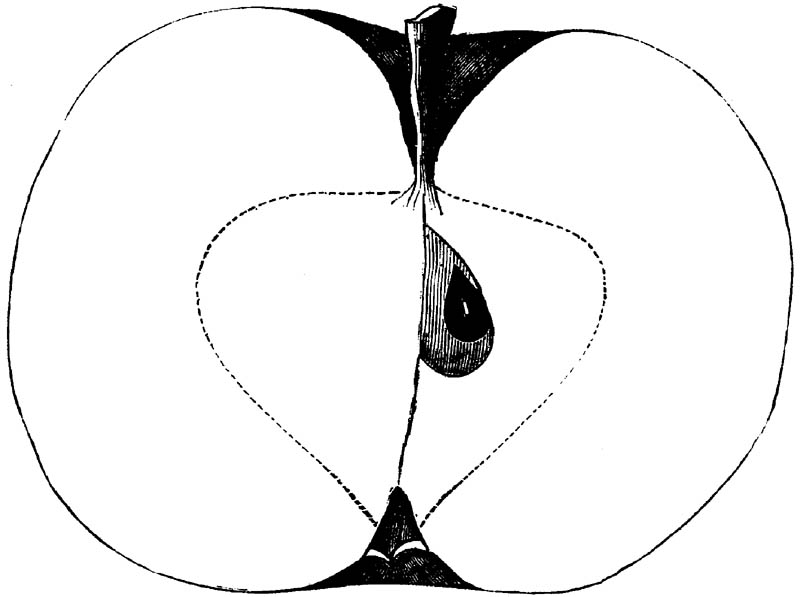
Fig. 200.—FALL SWAAR.
The origin of this apple is unknown. Like many others of our Western fruits, which have been received from various sources, and often from unreliable persons, and with wrong names, we have been obliged to re-christen this.
Fruit full medium to large, round, somewhat flattened, regular, handsome; Surface smooth, yellowish-green, with a bronzy blush; Dots numerous, large, gray.
Basin medium, regular; Eye small, closed.
Cavity medium, acute, regular, green; Stem medium to long, knobbed.
Core rather small, closed, clasping; Seeds numerous, large, plump; Flesh yellow, breaking, juicy; Flavor mild sub-acid, agreeable; Quality good; Uses table and kitchen; Season September.
Gloucester White.
This Virginia apple was highly prized by Coxe for its qualities as a cider fruit. Not having seen it, his description is quoted:
"This apple is of middling size, of a shape not very uniform, varying from oblong to flat; the color when ripe is a bright yellow, with clouds of black spots; the flesh is yellow, rich, breaking, and juicy; of a fine flavor as a table apple, and producing cider of an exquisite taste. The stalk is of the ordinary length, inserted in a cavity of medium depth; the crown is moderately deep. The time of ripening is about the first of October, after which the fruit soon falls and is fit for cider. It does not keep long, but while in season is a delicious table apple. The tree is very thrifty, hardy and vigorous, of a regular and beautiful form, and very productive. It is much cultivated in the lower counties of Virginia, from whence I procured it, as an apple of high reputation."
Horse.
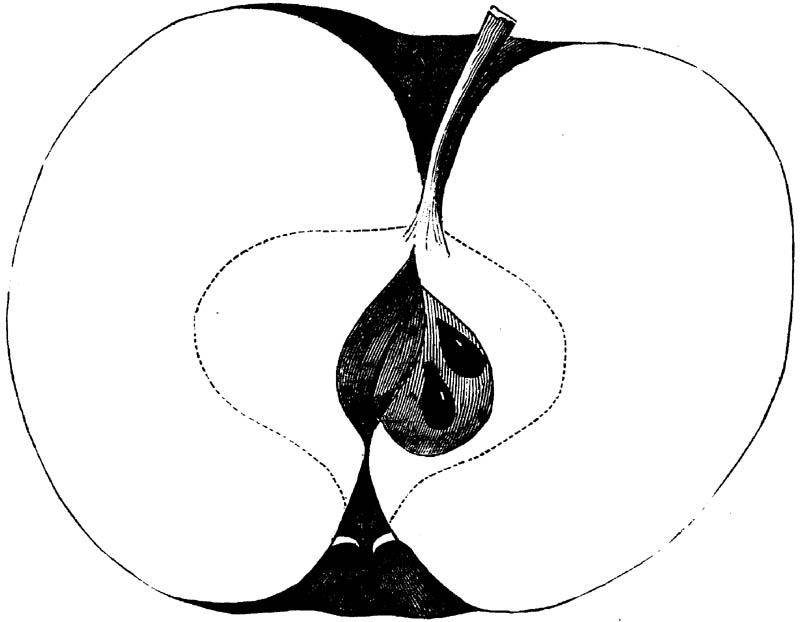
Fig. 201.—HORSE.
Another southern favorite, much liked by its western cultivators, especially as a useful family apple.
Fruit large, round, somewhat conical, truncated, uneven; Surface yellow; Dots scattered, indented, large, gray and greenish.
Basin abrupt, folded; Eye medium, closed.
Cavity deep, acute, wavy, brown; Stem medium to long.
Core large, somewhat open, clasping; Seeds numerous, medium, plump, brown; Flesh yellow, breaking, fine, juicy; Flavor sub-acid; Quality good; Use, kitchen, market and drying; Season, August, September.
Hunge.
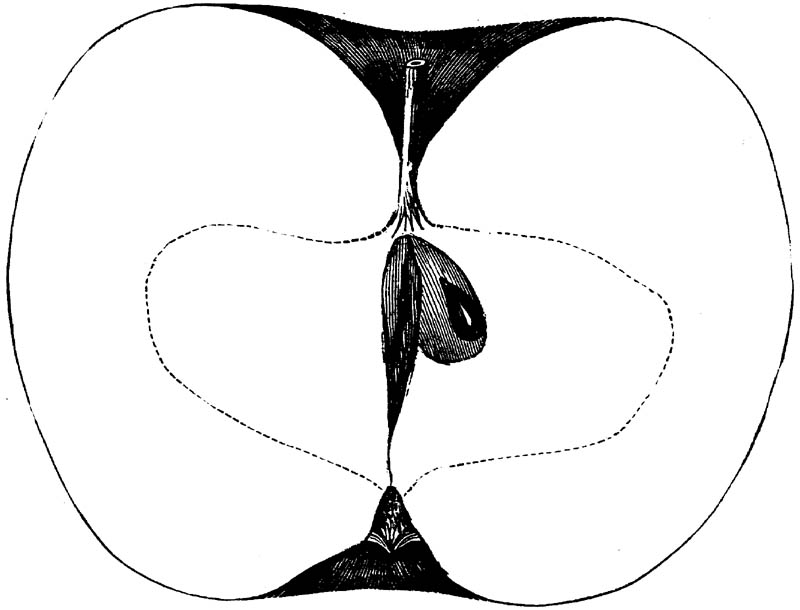
Fig. 202.—HUNGE.
This southern apple was received from Mr. S.W. Westbrooke, Greensboro', North Carolina.
Fruit large, round, somewhat flattened, regular; Surface smooth, greenish-yellow, blushed; Dots scattered, white.
Basin regular, abrupt; Eye small, closed, very long; Calyx reflexed.
Cavity wide, wavy; Stem short, slender.
Core large, wide, irregular, open, clasping; Seeds numerous, angular, plump; Flesh white, fine-grained, tender, juicy; Flavor sub-acid, mild; Quality pretty good; Use, table, kitchen, drying; Season, September.
Knickerbocker.
Specimens from W.S. Carpenter, New York.
Fruit above medium, roundish, conic, unequal; Surface smooth, greenish-yellow; Dots numerous, minute, distinct, whitish, indented.
Basin abrupt, wavy, folded; Eye medium, closed.
Cavity wide, wavy, brown; Stem long, slender, green.
Core very wide, closed, clasping the eye; Axis short; Seeds angular, pale; Flesh greenish-yellow, tender, fine-grained, juicy; Flavor sub-acid, rich, very agreeable; Quality best; Use, table, kitchen; Season, October.
Long Island Pippin.
Origin unknown. Specimens received from T.T. Lyon, Plymouth, Michigan.
Fruit large, roundish, flattened, regular; Surface smooth yellowish-green; Dots minute, scattered.
Basin abrupt, deep, regular; Eye medium, closed.
Cavity medium, regular, green; Stem medium to long.
Core large, oval, closed, clasping; Seeds numerous, pointed, angular, pale; Flesh greenish-yellow, breaking, fine-grained, juicy; Flavor sub-acid; Quality almost best; Use, table; Season, January.
Lowell.
TALLOW PIPPIN, QUEEN ANNE, &C.
Origin unknown.
Tree vigorous, healthy, round-headed; Foliage yellowish green.
Fruit large, round, slightly conic, truncated, regular; Surface smooth, waxy yellow, not blushed or bronzed, becoming greasy when kept indoors; Dots numerous, green.
Basin deep, abrupt, regular; Eye medium, closed.
Cavity medium, regular, green; Stem long, slender.
Core medium, oval, closed, clasping; Seeds numerous, angular, pointed, pale; Flesh yellow, tender, fine-grained, juicy; Flavor sub-acid, aromatic; Quality very good; Use, table, cooking, drying, market; Season, August, September.
McAdow's June.—[Local Name.]
Specimens received from Chillicothe, Ohio. Thought at one time to be Tetofski, but the descriptions do not correspond.
Fruit medium to small, globular, slightly conical, regular; Surface smooth, greenish, yellow, blushed; Dots numerous, large, white.
Basin medium, wavy; Eye small, closed.
Cavity rather wide, regular; Stern long, stout.
Core small, round, closed, not meeting the eye; Seeds numerous, brown; Flesh yellow, tender, fine-grained, juicy; Flavor sub-acid; Use, kitchen, table; Quality good; Season, June, July; one of the earliest.
Pomologists have been in doubt whether this may not be the Tetofski. Comparison should be made of the tree characters.
Michigan Golden.
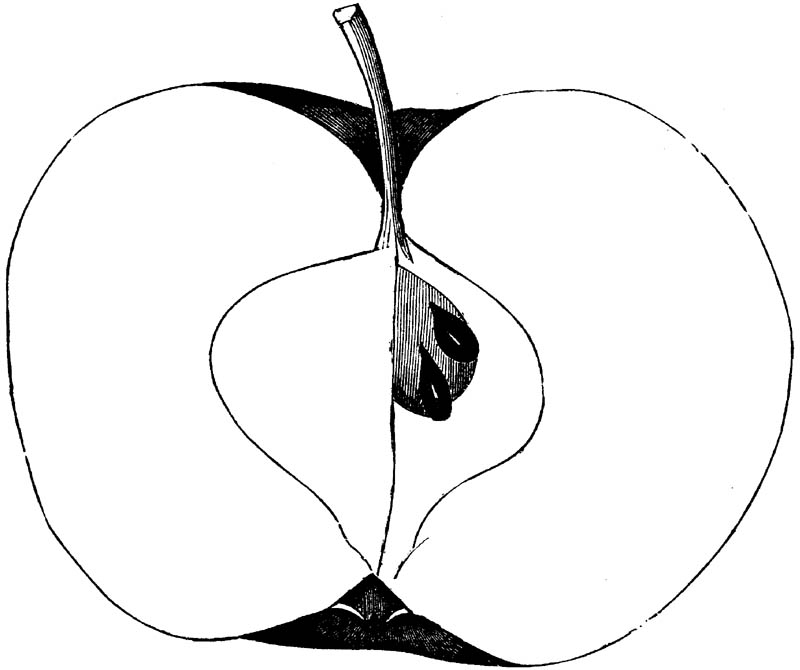
Fig. 203.—MICHIGAN GOLDEN.
This beautiful apple was received from the accurate pomologist, T.T. Lyon, of Plymouth.
Fruit large, globular, slightly conic, truncated and somewhat angular; Surface smooth, becoming greasy, greenish yellow; Dots minute, prominent.
Basin abrupt, folded; Eye small, closed.
Cavity wide, wavy; Stem long, inclined.
Core medium, closed, clasping; Seeds numerous, long, pointed; Flesh yellow, breaking, juicy; Flavor sub-acid; Quality nearly best; Use, table, kitchen; Season, September to November.
Monmouth Pippin.
RED CHEEK.
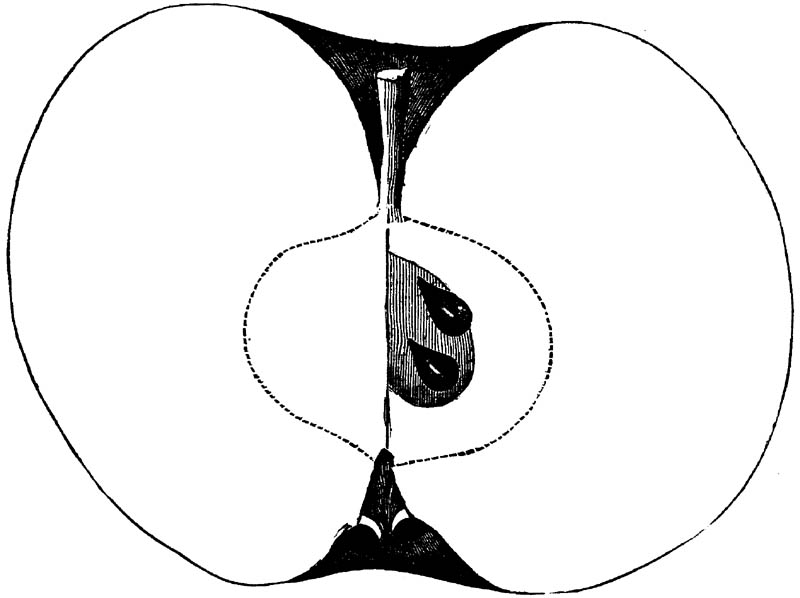
Fig. 204.—MONMOUTH PIPPIN.
Fruit rather large, handsome, roundish or flattened, regular; Surface smooth, greenish yellow, blushed and marbled; Dots minute, green.
Basin shallow, regular; Eye large, closed.
Cavity wide, regular or wavy, brown; Stem short, thick.
Core medium, closed, clasping; Seeds numerous, pointed, brown; Flesh white, breaking, fine-grained, juicy; Flavor acid; Quality good for cooking only; Season, December to February.
Newtown Pippin.
GREEN NEWTOWN.
This is probably the original Newtown Pippin, but by no means the more common, which is the Yellow Newtown Pippin, to be described in another place.
Fruit medium to large, globular, flattened, sometimes obscurely ribbed; Surface smooth, green, becoming yellowish green when fully ripe, sometimes bronzy, and always showing white irregular striæ near the base when first gathered; Dots scattered, minute, dark.
Basin shallow, folded; Eye small, closed.
Cavity wide, wavy, brown; Stem long, slender.
Core round, regular, closed, meeting the eye; Seeds pointed, plump, dark; Flesh greenish white, crisp, tender, juicy; Flavor acid, aromatic, rich, very agreeable; Quality best; Use, dessert, cooking; Season, December to March.
Roman Stem.
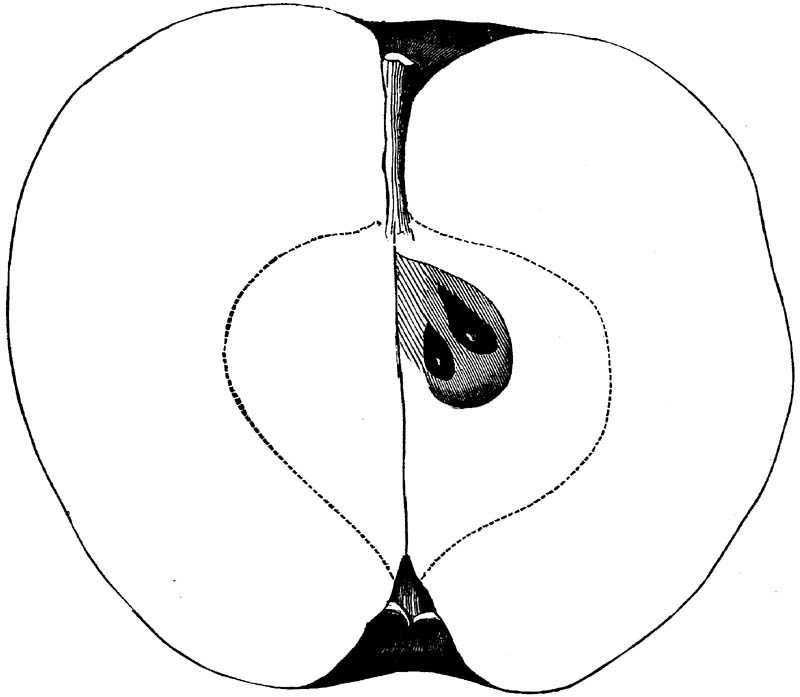
Fig. 205.—ROMAN STEM.
Origin Burlington, New Jersey. Tree moderately vigorous, very productive.
Fruit medium, globular, regular; Surface smooth, yellow, often blushed; Dots minute, dark.
Basin shallow, regular, or wavy, russet; Eye small, closed.
Cavity acute, lipped; Stem long.
Core rather large, heart-shaped, regular, clasping; Seeds numerous, plump; Flesh yellowish white, fine-grained, juicy; Flavor mild sub-acid, rich; Quality good to very good; Use, table; Season, December, January.
Royal Pearmain.
We have two different apples bearing this name, both very promising and desirable sorts. I shall, in this place, attempt to describe the one mentioned by Coxe, as my specimens are traced back to his nursery, though coming to the West by way of Georgia.
Fruit full medium to large, globular, rather flattened, regular; Surface not smooth, of a rich yellow, finely blushed, with carmine more or less diffused over the fruit, and overspread with a very thin russet; Dots medium, prominent, brown.
Basin medium, folded; Eye medium, closed.
Cavity acute, brown; Stem medium to long.
Flesh rich yellow, firm, juicy; Flavor acid, sprightly; Quality very good; Use, table; Season, October to February.
Virginia Quaker.
This very fine little apple was obtained from H.N. Gillett, Lawrence County, Ohio. Origin not known.
Fruit quite small, globular, flattened, slightly conic, regular; Surface smooth, greenish yellow; Dots scattered, minute, black.
Basin shallow, plaited; Eye small, closed.
Cavity wide; Stem medium.
Core ovate, closed; Seeds medium; Flesh yellowish white, firm, breaking; Flavor sub-acid; Quality good, Mr. Gillett says, best; Season, mid-summer.
Voss' Winter.
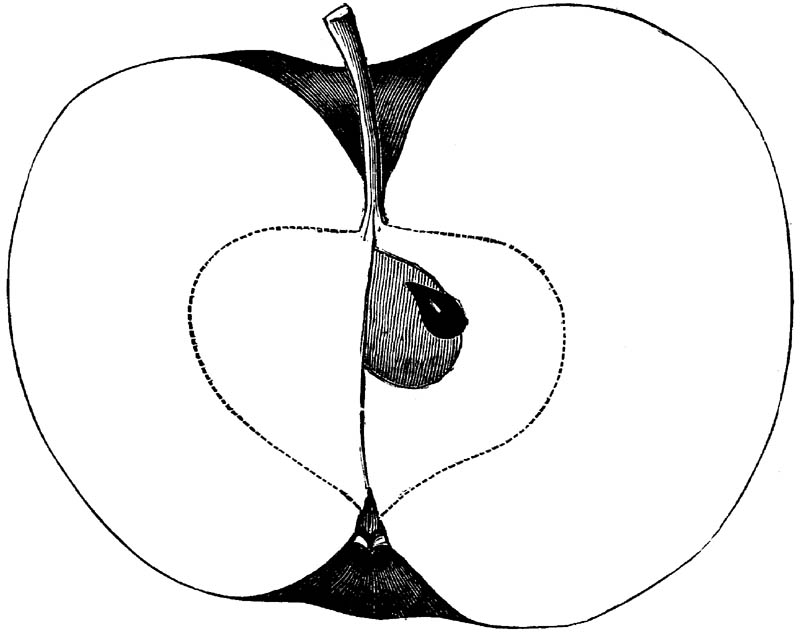
Fig. 206.—VOSS' WINTER.
Southern. The specimens were obtained from Mr. Westbrooke, of North Carolina.
Fruit medium to large, globular, unequal; Surface smooth, white, with leather-cracking, and a heavy bloom; Dots minute, irregular, brown.
Basin abrupt, deep, wavy; Eye small, closed.
Cavity deep, wavy, brown; Stem long, curved.
Core small, regular, closed, clasping; Seeds irregular; Flesh whitish yellow, firm, juicy; Flavor sub-acid; Quality good; Use, table and kitchen; Season, December.
White Pippin.—[Of Kentucky.]
Fruit large, globular, somewhat oblate, regular; Surface smooth, green, becoming pale yellow, sometimes faintly blushed; Dots numerous, white, rather large.
Basin small, abrupt, regular; Eye very small, long, slender, closed.
Cavity acute, regular, green; Stem medium, regular, knobby.
Core round, regular, closed, clasping; Seeds numerous, long, pointed, angular, brown; Flesh white, breaking, fine-grained, juicy; Flavor acid; Quality good; Use, market and kitchen; Season, December, January.