X THE VALLEY OF THE THUR
Reading edition
November 7th, St.-Amarin.—This morning farewell, perhaps a long farewell, to Masevaux, and I now dwell in the broad, sweet valley of the Thur. I had felt many pains of parting while putting my things into the Japanese straw basket and the little leather valise. This was quite a simple act, for I flatter myself that those receptacles contain only essentials, though I had long since begun to wish that I had brought another dress for evening, feeling a bit dull always buttoned up in my uniform, and only a white shirt changed from a blue one to mark the difference between morning and evening. One of those 1918 dresses, that can be carried in the pocket without making it bulge, would not have added perceptibly to the weight of my accoutrement, and would have brightened up the popotes. The light from the Oberforster’s chandelier at Masevaux was as pitiless as that which beats about thrones—and presidential chairs (which much resemble them)—and ladies en mission should come prepared.
Before leaving I went to say good-by to Mère Labonne, who showed me the good things in preparation for luncheon and begged me to stay—scrambled eggs with truffles, two poulets ready for roasting, a tart au mocha that she was frosting on a marble table. But the look of one who goes was in my eyes, and she ceased to insist.
Return to the Place du Chapitre; many officers and motors under the yellowing trees in front of the Kommandantur, a general arriving, some sort of delegation departing. I say a thousand thanks to the amiable, cultivated, agreeable Demoiselles Braun, three of whom wear decorations for their war-work in hospitals, for contagious diseases, and one, Stéphanie, “qui n’a pas dit son dernier mot,” is charming after the way of the perceptive, witty women of the seventeenth or eighteenth century. Then I find myself getting into the motor of the commandant, who, in the meantime, has greeted and sped the general on his way. His face has something shining about it as he gives the great news, written on the no longer insubstantial air, of the German demand for an armistice. Then he reads the communiqué from the Belfort newspaper as we drive out of Masevaux, telling us more about the Germans in full retreat, and the Americans close behind them at Sedan! What a rustling of the pages of history! The mind leaps to new things, life normal again, and all forces bent to reconstruction.
As we pass over the screened road to Thann, where we are to lunch with the military mayor, Captain Saint-Girons, the net of broom and pine camouflage, screening the valley where the Germans are, suddenly seemed some monument of ancient history; and, unlike the noisy hours of yesterday, there was no sound of cannon.
Arrived at Thann, it is we who give the great, the unbelievable, the unrealizable news of the demand for an armistice to Captain Saint-Girons, who, with several uniformed schoolmasters, is waiting in front of the Mairie to receive us. And our “feet are beautiful as the feet of them that bring the Gospel of Peace and glad tidings of good things.”
I think for a moment how strange for me to carry it to them, to these men, who have fought for it, who have waited for it, watched for it, bled for it—but everything is strange in this strangest of all strange worlds.
Going into the house, we find other schoolmasters, with some bright-eyed little boys ranging in years from seven to twelve.
Then to lunch. I sit on the commandant’s right, Captain Gasquet, adjoint of the mayor, on my other side, the mayor himself opposite, the schoolmasters placed prudently and watchfully near that selected flock, who enliven the ends of the table. Now these little Alsatian hopefuls are very bright of eye, rosy of cheek, and on their good behavior, which, in spite of lurking potentialities, persisted during the lunch, even when a glow, doubtless not unaccustomed, tinged their cheeks, as they drank the wine of their own hillsides.
At dessert I asked Commandant Poulet to drink to Sedan, the new Sedan. I thought within myself, “Is it not even now as a temple being cleansed and glorified in the chalice of the blood of my people, the blood of the khaki-clad youths from over the seas, whom Fate, since all time, had decreed to unseal it?” Tears came to my eyes, there was a deep beat in my breast.
And it had been forty-eight years and two months and seven days since it was torn from a vanquished France.
I scarcely remember what was said of the day’s events; feeling, rather than thought, was flooding about the table, and it was in gratitude, in wonderment, and rather silently, for a group of Frenchmen, that the luncheon proceeded. Each was thinking perhaps of his part of loss and grief making up the victory.
Names of Americans who had visited Thann were spoken: Dr. Herbert Adams Gibbons, long the friend of Alsace, and in some wise, as I told them, the god of the machine directing my steps to them; Mr. John Weare; and others whom I don’t recall. There had been, too, a fair and fleeting vision of Mrs. Bliss one snowy winter day.
Many beautiful words were said of my country, and in that hour I think it was, to them of the reconquered triangle, “dulce et decora” to have even the least of the daughters of the Stars and Stripes at their board, that hers should have been among the feet bringing “the glad tidings of good things.”
When coffee and quetsch and cigarettes were passed around, the schoolmasters made ready to pour some of the heady white liqueur into the glasses of even the smallest of the little boys, but the commandant said, “No,” and cigarettes only are offered to the babes. I would put my hand in the fire (knowing I could draw it out unsinged) that it was not the first time they had puffed “caporals.” The seven-year-old one held his with an astounding ease, not entirely hereditary. When he had finished he was stood on a chair, from which he recited “Le Loup et l’Agneau,” the lines concerning the now extremely well-demonstrated “La raison du plus fort est toujours la meilleure,” being given almost at a breath, one word tightly tied to another in quite an ingenious way.
An older one, whose naturally flashing eye was slightly restrained only by the solemnity of the occasion, gave us the equally classic, “Maidre corpeau sur un arbre bergé.” He hadn’t been caught so young, and the old Adam in the shape of his German accent was heavy upon him. Then, standing in a row, they sang “Le Chant du Départ,” that greatest of all the wars’ marching songs, and the childish voices cut my heart like a knife, and tears were loosened, and through their blur I seemed to see the march of the generations of Alsace adown the ages, fulfilling the shifting, cruel destinies of border peoples. Ghosts of the Thirty Years’ War, of the Napoleonic wars, of 1870, and of 1914, and of the other dateless struggles that have ravaged their rich valleys, come before me. I weep and weep, and my handkerchief is a microscopic, damp, gray ball. I have an idea that pride of sex alone restrained the blue-clad men from tears. Peace, lovely Peace, desired like the morning, was arising, but her light was to shine on rivers of blood, running through such black ruins that her glory and her sweetness, and even her hope, hurt with a great hurt, and I thought again on those who, empty-armed, must yet rejoice....
Afterward I strolled along the banks of the pebbly Thur with the commandant and Captain Saint-Girons. There is a river-path leading under balconied, red-roofed houses, or by gray walls, and there is an old round tower having a caplike roof with a point on the top, and against it are silhouetted a poplar and a sycamore. Nearly everywhere the lovely gray lace spire of the cathedral shows above roof or tree or chimney; and it is said that though Strasbourg’s cathedral is higher and Friburg’s is wider, Thann’s is the loveliest.[16]
When the Mission had its headquarters at Thann, the commandant and Captain Saint-Girons were wont to walk along this path in the afternoon, holding a sort of tribunal, receiving petitions, granting favors, righting differences that may occur even among the delivered, quite after the fashion of Saint-Louis receiving the petitions of his people under the great tree.
The river flows through the heart of the lovely old town, badly bombarded in spots. To our left as we walked rose the deep-colored hills in the full afternoon burnishing of their deep rusty reds and pale gilts. As we pass up the steep winding road we meet the Duc de Trévise, under-lieutenant, with a sketch in his hand of a shell-shot historic corner of Thann, the commandant wishing to save at least a memorial wherever he can. Furthermore, Thann was black-spotted with our negro troops. Sometimes I stopped and spoke, sometimes I waved as I passed, just to see the full, white-toothed smile against the exotic background.
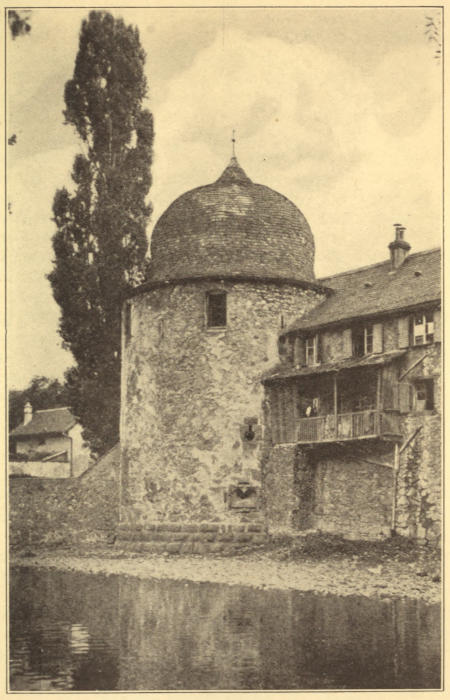
THANN. LA VIEILLE TOUR
The orphanage toward which we are bound is in the old Château de Marsilly, beautifully situated in the cleft of its own hill and restored not too cruelly. Close above it rises the Engelberg, the tower of whose castle was blown up when Turenne practised the arts of war in the valley. Part of it lies like a great ring, and is called the “Eye of the Witch.” To our right as we mount is a V-shaped glimpse of the valley where the Germans lie intrenched, formed by close, rich hillsides, on which lie in lovely, ruglike designs the vineyards of l’heureuse Alsace féconde en vignobles.
A charming, vivacious nun whose age was unguessable by twenty years, dark-eyed and satin-skinned, whose manners could not have been surpassed for ease by any woman of the great world, greets us. I think for the thousandth time how perfect the polish the conventual life gives. I have seen in peasant cottages the rooms wherein they were born, these women of restrained gesture, of dignified mien, of easy charm in conversation, of finished courtesy, and realize again that something invisible, imponderable, yet all-powerful, shapes the coarse block, polishes the rough surface, till there is no resemblance to that out of which it was hewn.
As we turn to go down we stand for a moment looking again through the V-shaped cleft at the rich, blue plain held by the enemy.
“How often,” said Captain Saint-Girons, after a silence, “it has seemed to me like the Promised Land, and how often during these four interminable years have I longed to look at these hills from the plain.”
“Now all is fulfilling itself,” I answered.
The commandant said nothing, but his gaze, too, was fixed on the wide horizon.
Then we visited the military cemetery, a pleasant place, as cemeteries go, with many trees, and fallen, rustling leaves, and a few late-blooming flowers. Many sons of France were lying there since “the beginning”; others had been but lately laid away. The two officers stood for a moment with uncovered heads by the graves of four comrades of the Mission, killed by a bomb in front of the Mairie, as they were going in for lunch. Again I bowed my head and tears were loosened. Never as in this war has “death been made so proud with pure and princely beauty.” How can we so soon be engaged in “business as usual,” compete with the splendor of these dead?
Then we pass down the valley of the Thur, so greatly loved by those who dwell therein, inclosed by purple and dark-amber hills, but inclosed easily, widely, leaving room for fancy, for delight, with no sense of being shut in by heaps of earth that press too tight.
As we enter St.-Amarin, the long, central street is like a pale-blue ribbon, for through it a battalion of some Marseilles regiment is passing. As my eye received it I knew the lovely picture for some bleaching daguerreotype, its color and lineaments to fade in the bright light of peace. We stop a moment at the Administration building and see again M. de Maroussem, to whom, on meeting him first at Madame Galland’s, I had said, “You are an Englishman?” And to those who have frequented international worlds I don’t need to say how he looks. To others I would say that he is tall, blond, athletic, wearing easily a well-cut, not too new uniform, and having a perceptive blue eye (which, however, is really a very French eye when one takes a second look). One would have known that he hunted in England and had polo-ponies in France. In civil life he is a banker.
Now among other things he is chef of the St.-Amarin popote and tells me dinner is at 7.45 “tapant.” The hour is near wherein I am to be shown how far superior the St.-Amarin popote is to that of Masevaux.
Then the commandant accompanies me to the house of M. Helmer, the well-known Alsatian lawyer who is counsel for the Mission. Also it was he who defended Hansi when he was brought before the German courts and condemned for lèse-majesté.[17]
From the great bowed window of Madame Helmer’s drawing-room I could look down the suddenly mystical-seeming valley, discerned by the spirit rather than the eye at 4.30 of a November afternoon. It was but a stretch of white filmy substance between violet hills, under a gray-green heaven, with something warm and precious at its western edge. Such a passing of the day as the saints of old would have loved.
Hung along the wall opposite the great window are engravings of the Mantegna frieze from Hampton Court, and there were many books.
After tea the commandant took his leave and Madame Helmer showed me to my comfortable room where I had thirty saving minutes, horizontal and in the dark, fully conscious, but completely resting, thought consecutive but not active, flowing in a smooth way between banks of quiet nerves in quiet flesh.
“Seven forty-five tapant” finds me again at the Administration building, whither M. Helmer accompanied me, and it is very pleasant as I enter. Commandant Poulet is sitting at a huge desk signing papers, more blue-clad officers and two infirmières are presented, after which we pass into the dining-room, whose doors are flung open in classic style by a well-trained orderly. In Masevaux we simply gathered and sat down. Now the mess-table of St.-Amarin has a decided touch of elegance, too, in the way of pink-shaded candles, and in the middle there was an arrangement of chrysanthemums and autumn leaves. Instead of a Mère Labonne they have a cordon bleu who performs his rites very suitably in the dark-blue uniform of the chasseurs. We sit down to a dinner that might have been served with pride at Voisin’s or the Café de Paris, where all except the chairs is extra and getting back a cane or hat costs the remaining eye (if one remains) of the head. I am indeed impressed, as I was meant to be, and M. de Maroussem might have said, “Didn’t I tell you so?” in his pure and pleasant English. I sat between the commandant and Captain Perdrizet, chief of the Forestry Service of the Thann district, and to the sound of cannon, which in spite of peace prospects was heavily firing over the Hartmannswillerkopf, we consumed carpes à la Flamande, a course of game elaborately presented with all its feathers, finishing with poires Bordaloue, the whole perpetuated on a charming menu card decorated with the classic Alsatian stork by Andrieux, one of the officers of the mess.
As I sat down I saw in front of me a sign over the door leading into the pantry, a somewhat Y.M.C.A.-ish sign, “Sois sobre et tu vivras longtemps” (“Be sober and you will live long”), and de Maroussem’s feelings were almost hurt when I asked if perhaps behind me there was one that said, “Mange peu et tu seras invité souvent” (“Eat little and you will be invited often”). And when it came time for coffee and cigarettes and some especially old quetsch he brought out the book, “The Friends of France,” that I had first seen at Harry Sleeper’s in Gloucester Bay, a thousand years ago, it seemed, and we turned to the death and citation of Norman Hall, Commandant Poulet recalling again that he had begun his work in Alsace on the 25th of December, 1914, and on the 26th he had stood by Norman Hall’s open grave.
Then a radio, just received, concerning the Parlementaries, is discussed; among them is slated von Hintze, leading to talk of the days when I had known him in Mexico. Count Oberndorf, too, husband of a dear and charming friend of Dutch and American birth, was on the list, and we spoke of Vienna as it had been—and was no more. Sic transit ... though I thought within myself, as I looked, for a flashing moment, down the vista of history, many things return.
It was late when two officers accompanied me to my dwelling, to the sucking sound of boots in mud, and under a starless sky hanging dark and heavy over a black, black earth. At last I could draw literally the drapery of my couch about me and lie down to dreams of my men in blood and glory before Sedan.