VI LA POPOTE
Reading edition
And how shall he who has not dined be strong? And how shall he who is not girded fight? And how shall he who has not wept laugh? And how shall he who hath not made a free offering of his life find it? And many other things occur to me, but enough for the wise of heart.
And now for la popote, which is in what was once the house of the Oberforster, in a street doubtless always muddy, looking out on the church, and it is square, of gray stucco, and red brick with a hall running through the center, like many and many a house.
The woodwork is everywhere painted brown and the wall-paper, too, is brown, a lighter, depressing brown. Above the dining-table is a ponderous, imitation-bronze chandelier, but its cruel light now shines on blue-clad men who have fought the good fight, agreeable, cultivated men of the world, and it touches strongly scar and galloon and decoration of these, selected ex millibus et ex millibus, by hidden powers, to return from battlefield and trench....
It’s the Oberforster’s glass that we use; it’s his imitation-bronze fruit-dish that is now filled with dark, rich grapes of victory. It’s his imitation-tin and real-glass punch-bowl that is on the table by the window. On the porcelain stove that heats well, too well (I sit with my back close to it), is a dégagé marble bibelot, the heads of a man and a woman in basso-rilievo cut in an obtrusively chance bit of marble, and it bears the motto, “Amor condusse noi.” Perhaps on their honeymoon, the Oberforster and his bride had made the classic Italienische Reise, and had pressed closely, so closely against each other in the railway carriage, that the apprehensive fellow-voyagers shut their eyes or sought another compartment. The Teutonic “will to live” is irresistible, and when it’s at work there’s nothing to be done except get out of the way.
Theirs were the lithographs representing beings of the Biedermayer epoch, theirs the many-tiered machine-turned, walnut sideboard. Theirs was (I know not how it got into that company of ersatz and imitation) a beautiful old glass carafe, a shepherd and a sacrificial lamb engraved upon it (perhaps once a church vessel), but in it was a stopper, half cork and half tin, with an imitation turquoise in the middle.
Theirs was a smoking-set of imitation tin whose massive ash-receiver in the most horrid art nouveau continually mocked the delicate spirals of smoke. Said the commandant one evening, flicking his cigar-ash into the dreadful thing:
“That invasion was almost as bad as this. You could have bought an ash-receiver like it in every big shop in Paris.”
“And in every little one,” finished Laferrière. “Thank God the frontier is closed, even at the price.”
In the corner between the windows was an upright piano piled with the best of music, and there was a large and completely uninteresting turned-wood clock, stopped at 12.25 on August 7th, four years ago.
And the man that earned and owned it all is dead in a soldier’s grave, and the woman, Anna by name, weeps somewhere her lost love and the equally lost gods of her household. Et c’est la guerre.
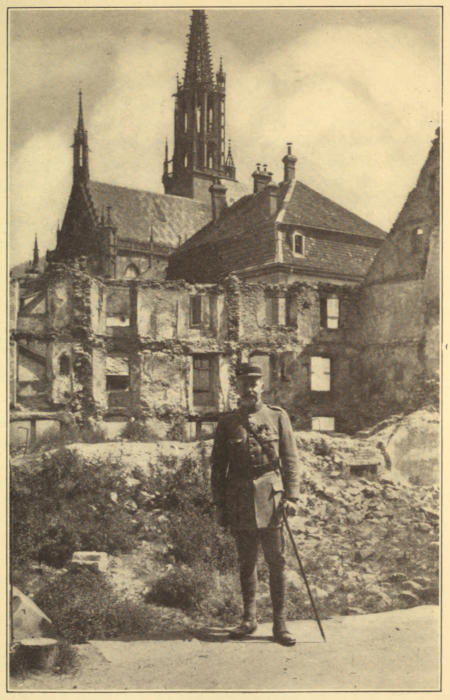
COMMANDANT POULET
As for Madame Labonne’s cooking, she knows her business, and if it weren’t the obvious duty of those sitting about the table to take the gifts the gods and Madame Labonne provide, I should feel I were living much too well.
She gives us a gâteau à la crème that disappears smoothly, leaving but an exquisite memory. She has another gâteau à l’oignon (don’t turn away; it’s perfectly delicious and takes a day to make the onion part), her filets melt in the mouth, and her purées are the insubstantial fabric of a dream. When she serves the classic Alsatian dish of sauerkraut decorated with boiled potatoes and shining pieces of melting pork, you don’t really need to eat for twenty-four hours, and wouldn’t go to the popote except for the conversation and the company. Sometimes the officers, the unwedded ones, think of marrying Madame Labonne—she’s fat and about sixty and doesn’t try to look young (by her works alone they shall know her), and the married ones think of trying to introduce her into their happy homes in some rôle or other.
And when they move into the rich, shining Alsatian plain, that they have looked down upon these four long years, she is to take part in the triumphal procession.
And this is how we generally find ourselves placed at table. I sit on the right of Commandant Poulet, who, somewhat as a prince of story, for these four years has administered with much calm, with great good sense, with wide understanding, and, above all, with immense tact and kindness, the not always simple affairs of the delivered ones of the reconquered triangle.
Only he can know the difficulties of the French Military Mission, though all may see the results. It is a land flowing with honey if not with milk (the busy bee in and out of war-time doth its work, though, it would seem, not so the cow).
In full maturity it has been given to Commandant Poulet to see results, and sometimes I have looked almost in and at a man whose strange lot during the war years has been constructive work. His first public appearance was when, as tout jeune lieutenant remplissant des bouts de table, he accompanied President Loubet to St. Petersburg on his 1902 visit. Since then many honors have been his, and here in Alsace he has been both Paul and Apollo, for he has reaped where he has planted and God has given the increase. Très chic, in his horizon-blue, with his high decorations on his breast, et très homme du monde. This is what I see and it seems very fair. Of his personal life what can I know?—except that it must be as the life of all that walk the earth, disillusion succeeding illusion, grief tripping up joy; for there is no getting away from the old verses:
Ainsi du mal au bien, De la joie à la peine Passe la vie humaine.
Somewhere in Lorraine the commandant has a destroyed château. But he can always dwell in the dwelling of his labors in Alsace.
Vis-à-vis is his first aide, Captain Tirman, whom I saw on my arrival, always with deep rings under his eyes, too much in rooms and bending over desks—il boit le travail. Entirely devoted to his chief. He is musical, too, and sometimes while waiting in the dining-room for the mess to assemble we find him playing Beethoven or Bach, or more recent and more compromising Germans, from the piles of the Oberforster’s music on the Oberforster’s piano. La musique n’a pas de patrie—for musical men who have fought. (But let a zealous civil far from the front hear a strain of Schumann or Brahms issuing from some window and he runs straightway to the police.) Captain Tirman wears the Legion of Honor and the Croix de Guerre, and is so pale, I am told, because of the hard campaigns he has passed through, and wounds and illness. He is always in charge in the absence of the commandant, but though être Tirmannisé is one of the gentle jokes of the popote, no signs of tyranny were apparent to me.
Captain Bernard, second aide, is, like the commandant, from Lorraine, and had prepared himself for the Paris bar. He conducted himself admirably during the war, Laferrière tells me. Wounded three times, he bears a great scar—sa belle cicatrice, as his comrades proudly call it—on his forehead (Verdun, August, 1916) and over his heart la Légion d’Honneur and the Croix de Guerre. Always very carefully dressed—tiré à quatre épingles (pulled out by four pins), as they nearly all are.
At his right sits Captain Sérin from Toulouse, the only Meridional at the table. He is very straightforward and uncomplicated, I should judge, as regards his psychology, with the rather objective eye of the man from the south. (They don’t dream the way we farther north do.) He sees a joke at any distance and is the sort, they tell me, who would obey as simply as he would breathe, without a thought of hesitation, an order unto death. The sort that when told to bring up reinforcements at a moment when it seems impossible, quite simply does it, and it only happens to happen that he is living. He is not tall, but wide of shoulder, holding himself very straight, and on his breast there are ribbons, too. He is chief of the Gendarme Service, the first and last provost of Alsace reconquered.
On the other side of Captain Bernard sits Captain Toussaint, chief of the Forestry Service of the Masevaux district, clad in bottle-green, with silver bugles on his collar and the Legion of Honor and other decorations on his breast, d’une grande bonté, his comrades tell me. He is from the north, from Douai (his brother was killed at the front), tall, slim, pale-faced, lantern-jawed, everything is in his eyes—in the regard, as some one said of him—and much of his life is passed alone in forests. So different from Captains Bernard and Lavallée, living in Paris, between whom he generally sits; and he nearly always comes in late from his forests for luncheon and dinner.
“For Toussaint, Creation is represented by the first day when the heavens were formed, and everything that came afterward had something to do with forests,” some one said last night, as he was talking rather hotly about the war-time cutting down of the trees of France, and the influence the loss of forests had on the life of nations. Très catholique, also; but then these men of the Mission, with all of whom I have entered tabernacles, are of an extreme reverence. What they “believe” I know not.
Lieutenant Laferrière sits sometimes by me, sometimes at the end of the table. He has early gray hair, a fresh complexion, gray-blue eyes with a certain inwardness of expression, a smiling movement of the lips when speaking, and, with all his wit, an extreme kindness in human judgments. Indeed, I am struck by something of softness and patience in the eyes of each one of these men to whom nothing of war is foreign, who have looked on all combinations of mortal anguish, and whose eyes at times, too, have had the red look, the hard, bright look of men who have just killed.
Laferrière is very cultivated after the way of us dwellers in cities. He was Doctor of Law at the University of Lille. On the 2d of August, 1914, he closed his books, after which, as under-officer, he had lived for months that closely packed life of the trenches, “where one was never physically a moment alone” (hardest of all hardships, I have heard fastidious men say), then he had been called as jurist to the Mission. Emotional, but through circumstances or will, how can I know? giving the effect of having dominated the personal—to what point also I know not.
Lieutenant Lavallée, but recently come from Paris, sits at another end. His personality is less striking than some of the others at the table, though he has une tête un peu mauresque, like pictures of the Conquistadores, and is inclined to solemnity of mien. He has a charming voice, fresh, with warm notes in it, and sometimes of an evening sings Breton chansons populaires. We especially like the one concerning la douce Annette, who spun a fatal love-story with a certain Pierre who wouldn’t let go her hand.
There is one, Stroll by name, now absent, but his comrades evidently love him, for I often hear, “What a pity Stroll isn’t here”; or, “That is Stroll’s story.”
Also for a few days en visite like myself is Captain Antoni, born at Strasbourg, but very French in appearance, a tall, svelte, thin-faced man with a rising and falling inflexion in his voice, who has been through the whole campaign and wears many decorations. He said last night that the fighting at Verdun, especially that at Hill 304, was the worst he had seen.
At this moment the Verdun sector, which knows the blood of men of many climes, is moist with that of my countrymen.
Now this is part of what I see as I sit at table with these men. The common patriotic effort tends to screen the personal life of each, of which I know nothing. But I do know that destiny is largely formed by character and endowments, and, barring the fact that time and chance happeneth to all, I would be tempted to wager that when such or such a thing came to such or such a one, thus he received it—gift or blow—thus he used it, once his own. So unescapable and visible are the sequences of character.
Sometimes we play bridge in the evening, pleasant, easy bridge, anybody taking a card back when once played, and changing his mind about declarations. As they so truly say, “Nous jouons pour nous amuser.”
And yesterday there appeared on the table the famous cafetière and Sérin, his face shining with a great light, performed the rites. It was one of those large, high glass bulbs with a nickel coffee-pot below. Dry coffee is put into the glass bulb, water into the pot, an alcohol-lamp beneath, and the whole is hermetically sealed. After which, according to the mysterious and wonderful laws of nature, the water rises and wets the coffee; it must rise thrice, giving forth at the same time volcanic sounds. During the ceremony nothing else is thought of. The officiating high priest is harried with liturgical suggestions, or unkind remarks are made about his natural endowments. As that corked spout of the pot, horrid with potentialities, is turned now toward one, now toward the other, men who would have given their lives without a thought in the trenches, get nervous and call to Sérin, “Dis-donc, tu vas me crever un œil!” “Not toward Madame. It would be too terrible,” etc., etc., and in the end the spout, with all its possibilities, is turned toward the Oberforster’s made-in-Germany clock. After which one has a delicious cup of coffee and conversation becomes normal.[10]
Last night I found they were talking about giving a certificate of good conduct to one of them who is married, to take home with him to reassure his wife. A comrade, after a little badinage in the Latin manner, but very discreet I must say, objects: “But now there won’t be any permissions,” and, doubtfully, “We would have to give him the certificate for three whole months.”
Then, like the antiphon of some song, a voice said, “Trois mois, c’est long.”
Another said, “Trois mois, c’est très long.”
Another, with a sigh, “C’est trop long....” And I to smile—within myself.
Then a stumbling home on an invisible but strong horizon-blue arm, through the inky streets, ankle-deep in mud. Sometimes I haven’t known which one of the various kind arms it was, the electric pocket-lamp only occasionally making the darkness more manifest. No one to bump into, as circulation in the streets is forbidden after nine o’clock, on account of possible espionage.
And you will say these are pleasant days!
Later.—Hunting in the bookcase, I found a small diamond-printed copy of Hermann und Dorothea. As, to the sound of near night-firing, I turned its smooth old pages, I realized it for one of the most completely objective works of genius ever born into the world. No thread of its maker’s identity is woven with it, no color of his personal experience. I felt but a sense of his complete and serene equilibrium, though the stream of words, bearing those golden thoughts, was so softly flowing, so crystal-clear, that it made me remember a line from another of Goethe’s poems, as subjective as this is objective:
Der Geist ist Bräutigam. Wort sei die Braut.
In the little preface I found that the poet, in his old age, was wont to say of Hermann und Dorothea that of his long poems it was almost the only one that gave him pleasure. I seemed to understand what he meant. By reason of its complete objectivity, he could have had no consciousness of that inadequacy familiar to mortals contemplating anything formed from themselves. No suffering had attended its birth; rather it would seem to have formed itself spontaneously on the heights out of some plastic stuff, light and bright as summer air, imperishable as granite. It did not recall to Goethe (nor does it to one who reads) that night of personal anguish, that day of emptiness, that hour of longing, nor even some glimpsing, vistaed moment wherein personal fulfilment held out its shining, shadowy hand.
In spite of the sound of cannon and the smarting of my eyes from the strain of the tiny Gothic print, for a moment within myself an almost equal feeling of harmony arose, taking a form of Peace, like an antique statue, free yet restrained, noble yet persuasive; bearing no one’s mark, nor any signs of workmanship, except that stamped by its own beauty. Then it vanished, leaving the little book to throb between my hands to the beat of my own times. Though generations had passed on and other wars were being fought, and the word “freedom” was again on every lip, as always, the women, the children, the old, were paying the heaviest tithes of invasion. Had I not seen like streams of fugitive populations flooding into Paris that hideous spring of 1918, heard the cries of anguish from those fleeing before an enemy army? Then also death and birth waited not on circumstance, and love and hate, fear and hope, hurry and exhaustion, were at work in strange commingling. I had seen deeds of succor, too, like unto those of the lovers, proffered in boundless devotion, by nameless, uncounted men and women, coming from the world’s ends to minister to its woe.
A vision of toux ceux qui ont bu à la coupe amère de cette époque passed before me. Deeply sighing, I at last put out my light, thinking “war is war,” needing no adjectives, and of the changelessness of the human heart, however the formulas may be multiplied and renewed; and forever Væ victis!