II ALL SAINTS’ DAY, NOVEMBER, 1918
Reading edition
Evening.—Masevaux, a town of old fountains and old inns with charming old signs hanging out, the pebbly Doller running through it under ancient, balconied houses, and over all hanging faint odors of its century-old tanneries. A long day, but not too long.
Punctually at eight-thirty I had descended the flashy stairway of the “Tonneau d’Or” at Belfort to find the officer sent to meet me finishing his coffee and reading the morning papers, always comforting these days.
In a thin fog, we start out of town, passing under the antique high wall of the castle against the rock of which “The Lion” has been carved. Now all has been done that it is humanly possible to do with granite and a lion, but of that more another time—perhaps. I can’t stop now except to say that the hand that fashioned it fashioned also the Statue of Liberty in New York harbor.
We meet, just out of Belfort, a funeral procession—three coffins, two draped with the Tricolor, one with the Stars and Stripes. Making the sign of the cross, I commended three souls to Heaven. I always remember, accompanying a beloved one of my blood to his narrow dwelling, how sweet, how very sweet, it was to see the gesture of that sign, and the lifted hats of those we met, saluting him on his last journey. Though I do not care inordinately how or when or where I lose my flesh, that much I would like done to me—in passing.
Nestled in the corner of a broad, sloping field was a cemetery, a new cemetery, with French and American flags flying from its crowded graves, and many men were busy digging, and we heard the crunch of shovels in cold, gravelly earth as we passed, and yet I thought how well, how very well, the soldier sleeps!...
We were on the flat road that leads to Cernay, where the Germans have lain intrenched since the beginning of the war.
Shifting masses of horizon-blue, velvety in the thin mist, appear, disappear down white roads, between fields of barbed wire and against horizons of rusty beeches. In the villages black-robed women and children and old men are coming out of rose-colored churches or standing by elaborate, very decorative rose-colored fountains. There is the distant sound of cannon. It is again the front.
At Masevaux, I find myself drawing up under some yellowing lindens in front of the building of the Military Mission—once the German Kommandantur, in turn once the nave of the old church of the Abbey of Masevaux. I walk over a rich carpet of rustling leaves to the door, and am shown up the broad, stone stairway of an immaculately kept building.
Commandant Poulet having been called that morning to St.-Amarin, I am taken into a charming corner room hung with a wall-paper that might have been designed by Hansi, where a young, light-haired man with dark rings under his eyes, who knows both battles and desks, was sitting at a big table.
We looked at each other, I must confess, with some curiosity, though of the politest. I, to see what the Military Mission might be going to offer, but prepared to be very easily and very much pleased, he, doubtless, to see what had been “wished on” them for the next week. It might so easily have been awful, instead of a niceish lady who has both wept and laughed, and known many lands and many men. He asks me what I would like to do that morning. Not having the ghost of an idea what there is to do, I answer, “Everything is interesting,” and give a somewhat free Gallicization of “beauty lieth in the eye of the beholder.” This was received approvingly, even hopefully, and he tells me that in the afternoon I am to attend a ceremony in the military cemetery at Moosch, in another valley.
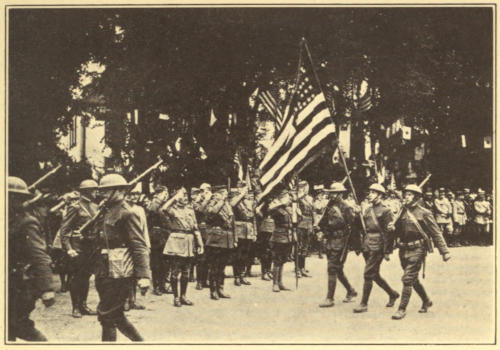
THE FOURTH OF JULY, 1918, IN ALSACE
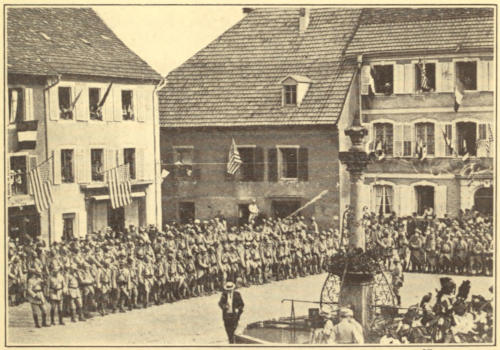
PLACE DU MARCHÉ, MASEVAUX, JULY 14, 1918
About this time I begin to remember that it is “La Toussaint,” and I say that if possible I should like to go to church. This, too, is encouragingly easy and I am turned over to an officer whose wife and two children have been in Brussels for four years, he himself a deserter from the German army.
When we reached the church, built of grès rose, evidently and happily, from its abundance, the building stone of this colorful corner of the world, and which can take on the loveliest of patines in even a generation or two, I find it overflowing with the faithful, many blue men standing on its pink steps. The curé, followed, I hope, by his flock, was off on a longish sermon, and for a good half-hour I was washed and blown about on a sea of mixed metaphor, though it did not seem too long, for mind and imagination were flinging themselves about reconquered lands and border peoples, and I only really “came to,” so to speak, when a great and splendid organ sounded and a deep, harmonious choir of men’s voices joined it. Then I knew I was indeed on the frontier, where music lingers, and amorously it would seem, near the last of the mad, Romantic peoples.
When we passed out there was the noise of guns and everybody was looking up at little white balls of shrapnel unrolling themselves about some black specks in the blue, blue sky. It was the familiar firing on German airplanes.
Then I was led to this charming old house, which is one of six placed at right angles, on two sides of the Place du Chapitre. It proved to be part of the old convent, done over by Kléber when he cultivated the arts of peace rather than those of war. It belongs to four agreeable sisters, the Demoiselles Braun, whose brother, also a deserter from the German ranks, was killed in Champagne. They were rehanging the portraits of their ancestors.[4] Whereby hangs the tale of two American nurses who, quartered there some weeks before, had left the water running in the tub one night, after which the drawing-room ceiling fell in and the paper peeled in hall and vestibule. Hence the rehanging of the ancestors, at their own, I mean the sisters’, expense.
They take me up a beautiful, but very worn, stairway, with a time-polished oaken balustrade, and I find myself in a paneled room, looking out on the square shaped like this:
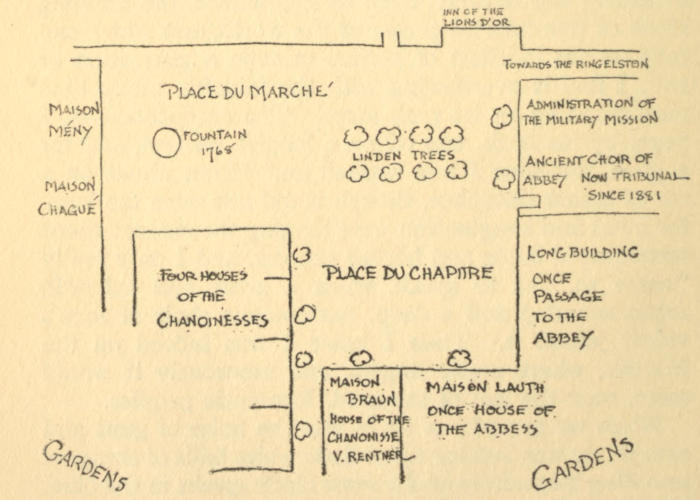
Many motors are drawn up in front of the Mission under the yellowing lindens. The old red inn of “Les Lions d’Or” is directly opposite, and on the left of the square at right angles with me are the four other houses once dwelt in by the chanoinesses when it was decided that each should have her own establishment. The square is roughly, anciently paved, with grass growing in between the cobblestones, and Mademoiselle Braun, who showed me to my room, told me the steps of the old stairway were so uneven because after the Revolution (during which the Chapter had been dispersed) the house was long used as a school and they had been worn by generations of young feet running up and down.
At 12.15—I am conveyed to la popote[5] for luncheon. More officers inspect me—I them also—and then we proceed to the consuming of an excellent meal, to the very exhilarating accompaniment of the news of the capitulation of Turkey, and a light, easy touching on other prospective and pleasant changes.
Now as, owing to circumstances too long to enter into, I hadn’t eaten since noon the day before, passing by Chaumont, I did full justice to a rabbit white as snow, garnished with noodles of the same hue, flooded by a delicious golden sauce. I only fleetingly remembered that I ordinarily avoid the little beast as food; for dessert we had a great cake filled with chocolate and whipped cream, such a one as I had not seen for many a month and year. A bottle of champagne was opened in joy at the Turkish news. And we drank to everything and to everybody—even to the health of the “Sick Man of Europe,” not, however, sicker than several others at that moment, as some one cheerfully added. It was all very pleasant, and I felt that everything was for the best in the best of war worlds.
At 2.30 I start out with Captain Tirman over a smooth road, camouflé, kilometer after kilometer, with screens of wire netting interwoven with broom and pine branches, for the road runs along the side of hills which slope down to the valley where the Germans lie intrenched. Everywhere are shell-holes, new and old. We stopped on a high place and, getting out, peered through a hole in the screen. Spread out before my eyes was the rich plain of Alsace, one of the world’s gardens. Something crystal and shimmering half veiled its loveliness, but its beauty and richness I knew for the beauty and the richness of a thousand years of blood, and many men had found it fair and panted for its beauty and died for it.
In the distance, very white and shining, were the chimneys of Mulhouse, and a pale-blue line against the horizon was the Black Forest. All the time there was the sound of cannon, ours and theirs, reverberating through the hills. I was greatly moved, and started to go higher up in the field, but Captain Tirman stopped me, saying: “It will be better for you to get away with your souvenirs than to take them unrecorded with you to the grave. The Boches shell anything they see; and we haven’t got our masks, either, in case they send a gas-bomb.”
The roadsides were planted with cherry trees, scarlet-leaved, the kirschbaum of Alsace. The hills had great patches of velvety, rust-colored beeches; dark pines traced black patterns through them, yellow larches shone here and there like torches; a soft sun was dispersing the last of the delicate, noonday mists.
Then we slipped into the valley of the Thur, where lies the ancient town of Thann. From afar I saw the lacy, gray belfry of its cathedral, pressed against other heights of velvet rust and burnished gold. Nearby, the hill of the Engelburg, with its broken, overturned tower like a great ring, a souvenir of Turenne’s campaign during the Thirty Years’ War, was soft and lovely, too. The long street was sun-bathed, and filled with the black-bowed peasants of story-books, and the blue soldiery of the great war. I wanted to stop by a pink fountain, near the richly carved portal of the cathedral, but we feared to be late for the ceremony at Moosch and hurried on.
At a place called Bitschwiller, however, we were obliged to wait while an almost endless procession of black-clad old men, women, and children, and blue-clad soldiers wound across the road, from its pink church to the distant green and yellow cemetery.
Furthermore, the Fifteenth New York Infantry—black, black, black—is quartered at Bitschwiller, and the most exotic sight I have ever seen were those khaki-clad negroes in that valley, already very high-colored.
Suddenly against the steep hill, like a picture slightly tilted back, we came in sight of the square cemetery of Moosch.
Above and below it was framed by a line of helmeted men in khaki, and as we neared I saw they were our black troops; the horizon-blue of a French infantry regiment made the frame at the two sides. High, high up were a group of white- and black-gowned priests, and red- and white-gowned acolytes swinging their censers. At the top of the steep stairway, running down the middle of the black-crossed cemetery, was a sacerdotal figure, with outstretched arms, exhorting, and around about the whole were groups of women and children. We left the motor and walked over to the cemetery, where I found myself standing near the resting-place of Norman Hall, the first American to die in Alsace. From the tall, black cross floats the Stars and Stripes, and some one had planted chrysanthemums thick on his grave. Peace to him. He lies not far from General Serret, who fell, too, on the nearby sacrificial Hartmannswillerkopf, where commingled lie fifty thousand who at the word of command had put out each other’s light.
After the sermon the negro band of the Fifteenth played some grave and measured music, the French infantry band then something a little too gay. As one of the officers said afterward, “Cela a presque frisé la polka.”
Then the “Marseillaise” sounded and “The Star-spangled Banner.” I felt my veil wet against my eyes and my lips atremble as I thought, a second time that day, how well, how very well, the soldier sleeps.
Above the cemetery in a higher contour of eternal hill was a great patch of yellow and black and rust-colored forest against a clear blue-white sky, in which tiny black specks were moving eastward.
We waited to watch the negro troops defile. They appeared very smartly dressed till the eye got to their feet, and such a collection of ripped, torn, cut, down-at-the-heel footgear was never seen! They seem to be a flat-footed race, too. I spoke to a couple of darkies very much en repos, who were leaning against a fence, near the motor, as I got in.
One answered, with a broad grin, “You an American from America?”
“Yes.”
“Well, have you heard dis here war’s about over?” The coalest-black one then contributes this to the conversation:
“When peace is signed dis here nigger starts to walk home.”
“What about the ocean?”
“I’ll take a swim, lady; the water can’t be no colder and no damper dan dis here ‘Alice’ land.”
The mulatto by his side said, “I subscribes,” and became a pale gray at the bare idea of getting colder or damper.
Then we see Commandant Poulet, tall, blue-clad, with high decorations a-shine, coming toward us, and he and many officers are presented to me, after which I change into his motor, and we start out over a magnificent military road built since the war. It was begun and completed almost miraculously, it would seem, in little more than a year, and over it, safely hidden from German guns, come and go the great military supplies of the Alsatian front—troops, artillery, munitions, food, ambulances.
As we mount, mysterious, dissolving twilight views present themselves near red cherry trees, burn against distant blue hills, yellow larches illuminate other “hilltops hearsed with pines,” and the beech woods are a deep, deep purple. Then we plunge into the dimness of the great cedar forests of the Route Joffre, talking, but not too much, in the large, enfolding twilight, of the war, and of Alsace of to-day. Commandant Poulet has been in charge of the Military Mission since Christmas Day of 1914, and I thought, rolling over the broad road, contemporaneous with his administration, how out of thousands, nay millions of men, his part during these war years had been to construct and not destroy. He told me that almost his first official act was to be present at the burial of Norman Hall on December 26, 1915.
As we issue from the dark forest we find ourselves on a crest overlooking many other twilit hills. There is a pale, pale yellow still burning in the west, and the most timid of evening stars shines above it. Then we dip into the deep blue valley where Masevaux lies.
Peasants are hurrying to their villages, and there is a continuous, but dull, sound of cannon. In the chill of the fallen night we arrive at the Place du Chapitre, the town dark, dark as we enter it, and no light in any house. Having seen my pleasant room only in daytime, I proceeded in hunting for the light to try to turn on a barometer, then by another door feeling my way along, I fumbled about an arrangement of mandolin and pipe, then, as a last resort, I sought light from a stuffed owl. After which I went into the corridor and, re-entering the room, found the electric button just where it ought to be—by the door.
A saving hour of solitude before I am fetched for dinner, which was very pleasant, but I can’t tell about it now, for sleep, dear sleep, is touching me, and it is two days and a night since it has been near.