IV THANN AND OLD THANN
Reading edition
Sunday morning, November 3d.—Awakened at six by heavy firing. After wondering what could be happening, I remember that life, as far as I am concerned, is for the moment largely joy, or rather joyous riding, with a series of agreeable French officers (they certainly are of an amiability!), in a series of large, powerful military motors, through a series of beautiful autumnal hills, over a series of the newest and most wonderful of war roads.
Enough church-going, however, as will have been noticed, to keep me mindful that man, and woman, too, is grass, and though it, or rather she, springs up in the morning, she may be cut down by night, and that this bending of the hills is by the journeys of her eternity.
Well, to get to the point, or rather to Thann. We started out early, at nine, for I was to find a Mass in the cathedral, after which we were to proceed to Vieux Thann, where war has not spared the church nor left worshipers.
Again we took the screened road overhanging the valley. Again we stopped on an eminence and climbed into a field, and again I was shown the blue valley, over the tops of some red cherry trees. Nothing detached itself from gradations of velvety mists and beaming distances, but I knew that on the grape-planted slopes of an unseen river that other wine of defeat was being drunk from cups held stiffly to unwilling lips.
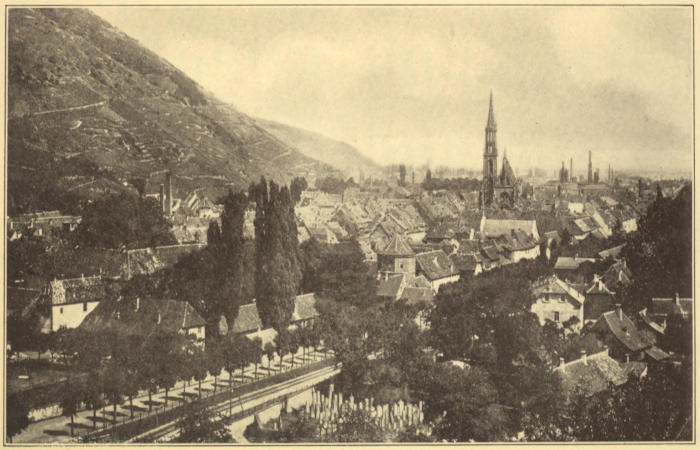
THANN AND ITS VINEYARDS
As we dipped down into the valley of the Thur, the belfry of the church of Thann appeared, so mistily, lacily soft that its form and substance seemed but as something breathed into the air, at any moment to be dissolved, against hills that were like brocaded stuffs, whose gold would be very thick if one turned them wrong side out. My heart was stirred because of the fairness of the Sabbath world.
We drew up in front of the gorgeous portal of the cathedral, once a deep pink, but with time grown paler and softer at all its edges, and whose boardings and sandbags now partly hide the carved story of the life of Christ and His Mother. We grope our way in through several swinging doors, and find the high, Gothic space filled with a misty yellow light coming in through narrow windows, covered with oiled paper, the precious stained-glass having been long since removed.
Little by little the forms of kneeling women and children, and many soldiers standing, detach themselves from the lovely gloom. The green vestment of the priest at the altar, on which are six tall, crystal, wide-branched candelabra, misty like the rest, is the only spot of color, for the splashes of horizon-blue become nearly white after a strange fashion of this color in dim light, whether of church or falling night. In the ancient wrought-iron pulpit the curé was just finishing a sermon in French, immediately beginning one in German. It appears that as the communiqués improve, the French sermon gets longer, and the German shorter, and mercifully neither is long.
We passed out quickly after the “Ite, missa est.” I had been feeling that Captain B—— might be in a hurry, but when I looked about to see if he were fidgeting, I found him doing what any miles gloriosus should be doing from time to time, saying his prayers.
And this is the story of the building of the church of Thann, and of its arms, which bear a single pine tree.
Death found the holy Bishop Théobald in the Umbrian Valley, and, knowing that his hour had come, he said to his servitor Maternus, who knelt weeping by his side:
“Thou knowest I leave no worldly goods, for the poor have needed what I had. But this sapphire ring, dear memory of her once loved, take it, thou, that worms may not dwell within it.” And then he entered into contemplation, saying nothing further of the things of earth.
When Maternus had made ready to hide his master’s body from the light, he tried to take the ring from its finger. But with the ring came the finger, and both were inclosed as in a shining rim.
Maternus, greatly wondering, hid the precious relic in a hollow place in his staff and started back to Alsace, begging his bread along the way. After many delays, having been set upon by wicked men and molested by prowling animals, he finally arrived in the valley of the Thur.
Exhausted, he laid himself down to rest, placing against a pine tree the precious staff. The next morning he was awakened by the ringing of the Angelus, and when he started to grasp his staff he found that it was as if grafted on to the great pine, while to left and right were burning two tall, pale, sapphire flames.
At this moment the lord of the Engelburg came by, the ruins of whose great castle are those one sees rising above the town of Thann. He had perceived the two blue flames from afar and, hastening to find out what they signified, he recognized Maternus, faithful servitor of his friend Théobald.
Maternus then related the death of the saint in the Umbrian plain, showing him the finger and the ring; whereupon the lord of the Engelburg, weeping and sighing, cried:
“Oh! my precious friend Théobald; oh! my dearly loved sister Adelaide, this is thy betrothal ring, and these two sapphire flames announce thy union in dear heaven!” (In those days they were quick to see divine meanings.)
Now, the so well-loved Adelaide, in her green youth, had been struck by a bolt from heaven, after which Théobald, for whom the whole round earth held nothing more of value, had consecrated himself to God.
The lord of the Engelburg, his gaze fixed upon the luminous finger and the familiar blue ring, knew soon the too often hidden will of God, and cried out again:
“Here I will build a church, and its reliquary shall contain this precious ring and finger.”
And so was built the church and monastery of Thann, and about them grew the town, and during long centuries on the vigil of the feast of Saint-Théobald, a freshly cut pine tree was placed in front of the cathedral, flanked by two great wax candles. Nor can any one, even of the very positive-minded, who look no farther than stones and mortar for all meanings, give a better reason for the arms of Thann.
Then we motored on toward Vieux Thann, half destroyed, and evacuated since 1914, but were obliged to leave the too visible motor on the outskirts of the village, creeping close along a very high screen of wire and broom branches that we might not be seen by the enemy. For we were in the plain of Cernay, now known as the Ochsenfeld, once called the “Field of Lies,” where the three sons of Louis le Débonnaire routed their father’s army. Lothair, Louis, and Pépin were their names. But of all this another time.
Vieux Thann is a half-demolished, echoing, empty town, with a background of neglected vineyards on very close-pressing hills.
Everywhere were signs of German war occupation. The schoolhouse had been their evacuation hospital, and one of the old inns bore the sign, “Verband-Station.” The only living things in Vieux Thann were the fountains, quite lovely in the pink-stoned, gracious Alsatian way, with their gentle, unhurried streams of crystal water. It all reminded me vaguely of Pompeii, even in the misty light of a northern Indian summer sun.
Above, in the perfect blue, the usual firing on German airplanes was going on. Long after the black specks had disappeared to the east the little, round, soft, compact balls of shrapnel were still slowly unfolding themselves.
About fifteen hundred feet from us were the battle-lines, where the French and Germans have faced each other in the “Field of Lies” since 1914.
One of the battered inns, “Zum Goldenen Lamm,” has its once lovely old sign still hanging out, but the golden lamb is gone, and only his golden feet and the green wreath of laurel that once entwined him remain.
And to what winds had the dwellers of the great village been scattered? Where had they been received, unwillingly, by strangers, those hosts of refugees, fleeing from their homes, red with excitement, bright-eyed, voluble? I’ve seen them, too, after months of treading up another’s stairs and eating of the salt bread of charity—pale, silent, dispirited, returning to villages like Vieux Thann, to see their all among disorderly piles of fallen stones and crumbling mortar....
Back to the living city, to an increasing sound of cannon, but the Sabbath stillness was so deep nothing seemed really to disturb it.
The cathedral with its single, finely pointed tower was like a needle everywhere threading up long streets. I had a desire to see it empty, and as I entered, its perfect proportions gave me a sweet and satisfying welcome. The red lamp of the sanctuary was now the only spot of color in the thick yellow gloom, out of which line and proportion gradually detached themselves. The celebrated choir-stalls had been removed to Sewen, but above the altar of the Virgin is a Gothic triptych, and the beautiful pulpit is of fifteenth-century wrought-iron. We groped our way into a low, vaulted chapel which existed even before the church was built, passing a tombstone bearing the arms of the house of Ferrette, a family once all-powerful in these valleys. Over the altar of the chapel is an ancient statue of Saint-Théobald. He has a long, thin, shaven, upper-class face, his eyes are bent, and he is looking perhaps as he did shortly before death found him in the Umbrian Valley. It is the visage of a man having done with personal things, and a great pity is woven into the downward curves of the benignant face.
We drove back to Masevaux, over one of the splendid new war roads, rising and dipping through forest-covered hills. The brilliant sun shone athwart each leaf, still dewy and sparkling, and a strong, rich, autumnal smell exuded from the earth. It reminded Captain Bernard of hunting before the war, that carefree chasse d’avant-guerre, and I thought of Hungarian castles, and long days in forests, walking through rustling leaves, or sitting silently in glades with men in green-brown hunting garb, awaiting the game. In the evening, shining dinner-tables, and talk about the day’s bag by men in pink hunting-coats and women wearing their best gowns and all their jewels.... And much that is no more.
We descended at the popote as the hand of the church clock pointed to 12.15. Blue-clad officers were standing by the windows reading the Belfort morning paper just arrived, and the Paris newspapers of the day before, as I went in.
The enemy is beating his retreat through the Argonne Forest, to the sound of the hour of destiny, and there are armistice and abdication rumors, and indications that they want to sauver les meubles, or, as they would say, seeing they’ve got into a bad business, retten was zu retten ist—i.e., German unity, which, saved, means all is saved. But there are strange dissolvents infiltrating everywhere, scarcely any substance can resist, and the blood of peoples boiling over, and much good broth spilling, and too many cooks everywhere. For what man but wants to try his ’prentice hand at seasoning of the mess? And it was all talked about to the consuming of Mère Labonne’s especially excellent Sunday dinner, an example of la vraie, la délicieuse cuisine française bourgeoise. There were pieds de veau that melted in the mouth, and creamed potatoes, after which a very delicious hachis, with some sort of horseradish sauce, and when I remark that it has also a touch of garlic, Sérin cries out, “But not at all—it’s only horseradish.” On my being supported by everybody at the table, he finally says, with an innocent but somewhat discomfited smile, “It’s true that there must be a lot for me to notice it.” Then he tells with gusto of a repast in his dear Toulouse where there was a whole cold pheasant for each guest, and each pheasant was blanketed with such a thick cream of garlic that the bird itself could scarcely be seen. “It was exquisite,” he added. “I dare say; one can even smell it here,” some one cruelly finished.
Then they spoke of how the French had supported captivity better than the English, and why.
“We always talk while eating,” said Bernard, “no matter how scanty or ignoble the repast. It’s our hour for relaxation.” (Any one lunching or dining at French officers’ messes will have noticed this.) “But with the English it is different. They eat silently, and in captivity they easily get the spleen and fall into melancholy, because the food isn’t served as they would like, or because they can’t wash or shave or exercise.”
And I told the story of the brother of a French friend whom I had recently seen, just back from nearly four years’ captivity, who returned in such a stout, rosy condition that his sister was ashamed to show him, and when asked about her pauvre frère would blush.
We sat long, talking now of books, now of personages, now of local happenings, Sérin telling of passing that morning through one of the smaller villages where even the young girls had saluted him with a military salute as he rode by—and one of the officers said, with a flash, “Très délivrées celles-là!”(“Very delivered, those!”) Then some one told the story of the man who came down to Masevaux to make a book on Alsace and, seeing the line of the trenches marked that day in blue on the commandant’s map, remarked, in a dégagé way, “Le Rhin, n’est-ce pas?” (“The Rhine, I suppose?”)
“Not yet,” was the quiet answer.
He then rushed them all off their feet for ten hours, after which, having got what he wanted, he went back to Paris and wrote his book. And from what I hear it wasn’t a bad book, either. Though one of the officers said he knew he could do the same about Prague or Peking, that he’d never seen, with some books, a good pair of scissors and as much paste as he wanted.
All is handled lightly, as only a group of Frenchmen could handle it, glissant, n’appuyant jamais, each bringing his little gift of wit and culture, enjoying the impersonal with the same pleasure as the personal, in the French way. Of course, the communiqués are as honey after four years of bitter herbs, very bitter, even though distilled in extinguishable hope.
And I must say that to me lively and untrammeled conversation is the salt of daily life; and if, as it sometimes happens, one’s own thoughts are expanded, brightened, and returned to one, it is indeed delectable above all things, the true salt to be used in quantities (if you can get it). For, alas! the majority of people have no ideas, when you come down to it, or, having a few, they are pig-headed and look but into the converging point of the angle, knowing nothing of the splendor of diverging lines where self is swallowed up in unself. And there are the close-headed, whose minds work slowly in a cramped way, or not at all, and they are forever complaining that they only think of things to say when they get home and the lights are out. They might just as well not think of them (one sometimes doubts if they really do) for all the good they are to their neighbors. And there are those very thin-skinned ones who immediately get contentious, and think the arrow is meant for them instead of the universe at large, and one could go on indefinitely through the list of impenetrable heads, to whom the blow of an ax is as the brush of a feather, or cushiony heads that once dented, however, never regain their contours, and many, many others. These all need material sauces, good, rich sauces to their food, or they would find it tasteless, not having even a pinch of this other salt to season it with. And they are mostly those who do not work, but whose fathers worked—sometimes even their mothers—and oh, là là, the subject is endless, for everybody talks—even those who have nothing to say.