VIII LUNCHEON AT BITSCHWILLER. THE MISSION IN RESIDENCE AT ST.-AMARIN. SAINT-ODILE
Reading edition
November 5th.—Awakened early, early by the sound of heavy firing. Later, looking out of the square, I see the market in full swing. Against the inn of Les Lions d’Or, with its comfortable courtyard and two red wings, stands a wagon-load of hay with a pale-green cover thrown over it. Carts of cabbages and carrots, drawn by white oxen, are pulled up under the yellowing trees. The black of the clothes of the women making their purchases cuts in very hard. Blue-clad men come and go; several motors are standing before the door of the Administration. The shining, diffused light of the mist-hidden sun rounds every corner and fills up every space with a pleasant softness.
At eleven I start out with the commandant, Captain Sérin, and Lieutenant Laferrière to motor to Thann through a world of rust and green and gold-colored hills, under the whitest of heavens. So soft and shining is the beauty of the lovely earth, and so soon to pass into the winter, that I say to the commandant how like the transient beauty of a woman of forty-five are these delicate, hazy hills with their cashmere shawls still twisted about their shoulders, drawn up over their heads, dropping down to their green-valleyed feet. I mean the woman of forty-five who is still loved.
Again we stopped on the crest between the valleys of Masevaux and of Thann, and again we stopped and peered through the wire-and-pine screen, out toward Mulhouse and the Rhine and the Black Forest. The valley was blue and shining. Even the windows of the great, white building of the Idioten-Anstalt, where the Germans are bivouacked, were visible. Beyond were the high towers of their potassium-works. As those three men stood looking out over the rich plain I thought, “Always will I remember the officers of the Mission like that, standing on the heights, shading their eyes with their hands as they looked down into the land of Egypt, wherein the Lord was to lead them....”
New shell-holes were all about us, and there was a sharp, continual reverberation of cannon among the cashmere-shawled hills.
At Thann we stopped for a moment by the fountain near the church (in peace-times, the old statue of St.-Théobald that I saw at Sewen surmounts the charming column), the commandant having been saluted by a young American officer, leading by the hand a little girl of seven or eight, in Alsatian costume—huge black bow, black velvet bodice, full white skirts. He was quite simply a young man whose parents had gone to America, he himself had fought on the Mexican border, got his commission, and was proudly—oh, so proudly and so smilingly—walking his native streets of Thann with his little niece.
We are en route to lunch with M. and Madame Galland, at Bitschwiller, who receive us as agreeable people of the world receive their guests in all quarters of the globe. They were of those who could have gone, yet remained, during the many bombardments of the town—noblesse oblige, and have been a blessing to the valley.
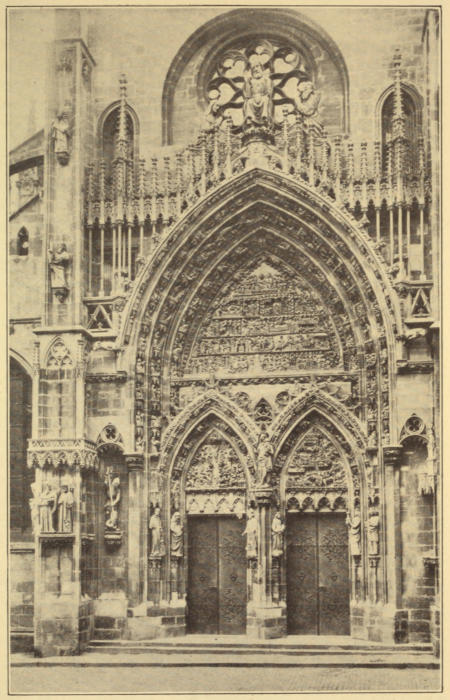
THANN. THE CATHEDRAL PORTAL
Madame Galland, with powdered hair, slender, delicate of feature and of form, dressing older than she is, might have looked out of a Latour pastel. M. Galland, too, is fine-featured, well groomed, agreeable, and there was a handsome daughter with a quietly sorrowful expression on her young face. It is a house from every one of whose many wide windows one saw gold leaves hanging on black branches, behind them warm, rust-colored hills, traced with pale-yellow larches and stamped with black patterns of pine. Within, the rooms were beautiful with blue-clad men. There was an agreeable and suave odor of kindness and unstintingness about the house, mingling with that of the ease of people of the world, and the surety of those in authority, altogether a good house. Eight or ten officers besides ourselves sat down to the usual delicious and abundant Alsatian luncheon, the conversation intimate enough to have color, general enough not to exclude the stranger within the gates. And it ran after this way, beginning with accounts of that last day of July, 1914, when Kriegsgefahrzustand had been proclaimed in the valley and they were completely cut off from the outer world, witnessing only the sinister passing and repassing of regiments of dragoons and detachments of artillery. M. Galland had procured all the flour and dried vegetables possible at Mulhouse to ration the population of Bitschwiller in case of need, and collected what money he could. The days passed in suspense, till the 6th of August, when they remarked much coming and going of troops; on the 7th the German cavalry was seen beating a hasty retreat.
A Brigadier de Chasseurs, mounted on a great black horse, is the first Frenchman they see, advancing alone, looking slowly about him, his revolver in his hands, fearing some snare. Then the Pantalons Rouges pour into the valley, flowers at every bayonet and in every tunic, and the Gallands receive the first French general to enter Alsace since 1870, General Superbie, commanding the 41st Brigade. At two o’clock, after refreshments had been offered from every house, the regiment took the road to Mulhouse, where that same night many of them had their “rendezvous with death.”
The talk then fell on that mysterious thing called luck, and how the soldier must have it, be chançard, if he were to come through, and of generals who, like General Liautey, wouldn’t have under them any save notoriously lucky officers. And there was much heedless joking (with the Fates perhaps listening). I, who never say even within myself, “I will do thus and so,” without adding “if God will,” remarked at last, propitiatingly, that “’twas somewhat difficult to tell beforehand who was going to be lucky.”
“But for military purposes,” dryly remarked an officer who had not yet spoken, “one needs to be lucky only as long as the war lasts,” which being hideously true, we turned to the less elusive subject of the rich and easy living of the peasants in this part of the world since the war, and how they, even like unto those other tens of thousands of “war-workers,” will “miss” it. They had become accustomed to the troops, and there was the thrice blessed popote in which they more or less shared. And when the Americans came things were still better in a still better world. For they were very free with their money (though no one could understand a word that they said), and then they went, and the French troops came again, and there was something very pleasant about their return. Though they didn’t have the money of the Americans, they could be conversed with and they would lend a hand in the garden, and were always joking with the children, and helped with the crops, and the virtues of the Americans, if not their money, were somewhat forgotten. They were, in places, even remembered as a nuisance, wanting everything cleared up, stupid bores about the dung-heap, “and will you believe it, Monsieur,” one of them said to Laferrière, “they even washed their dishes with soap, and you couldn’t give the dishwater to the pigs!”
After which I related Colonel Burnside’s “best short story,” also concerning the peasant point of view. When he was in Lorraine with his men, at the well-named watery (not watering) place called Demanges-aux-Eaux, a delegation of villagers waited on him, with the complaint that the Americans made so much noise at night that the sheep couldn’t sleep!
And we finished luncheon gaily, to the rather distant sound of German guns, with the story of the wife of a (or probably the) French soap manufacturer in Tonquin who came to the Gallands’ for convalescence after “war-strain.” How she charmed them with her singing, especially of children’s songs, delighted them with the reserve and modesty of her conduct, and after two months turned out to have been once a well-known, café-chantant singer with the proverbial “past and many brilliant presents,” enjoying a glimpse of home-life in Alsace.
Coffee was poured by the handsome daughter, who with her firm yet delicate profile, and rich, dark hair drawn heavily back, looked like some model for a head on a bank-note or medallion. Her mother, saying to me, “Vous êtes femme de cœur” took me apart and told me her history.
And perhaps because so much had been buried in the great war of youthful love and hope, I may record a little of this story; its grief is typical in simplicity and purity of many countless thousands in this land of France.
For months she had been beloved by a handsome young chasseur stationed with his regiment at Bitschwiller, one of many officers to frequent the hospitable house of the Gallands. His photograph on a table shows him tall, broad-shouldered, straight-eyed, kind-mouthed. On account of the uncertainties of his life he did not declare himself while there, but immediately afterward, doubtless because of some presentiment, he wrote to the mother telling of his love. This was found to be returned and they became fiancés.
A few weeks after he was killed in Flanders, in one of the Mont Kemmel combats, a ball striking him in the forehead as he leaped from a trench to lead a counter-attack.
He was one of ten sons. Six of his brothers had fallen, too. Awed, I asked concerning her who had borne them, but she had gone to her grave long before the World War; though I knew her not, thinking of the mother of the Maccabees, and many like her, I thanked God that those seven wounds had been spared a mother’s heart. Then we returned to the young girl’s story.
“But never to have looked into each other’s eyes and exchanged the glance of love,” I said, “it’s a shadowy and heavy grief for her youth to bear. Would it not have been better for them to have been united?”
The mother answered, after a pause, “There was no time.”
“But this can’t be the end for her; she’s only beginning life!” I said, and thought of the great, sorrowing hosts of these young widows of the heart alone, and of the vexed question in their families, as to whether it was better to become a widow or remain a maid.
“She said to me only the other day, ‘I have all that I need for my whole life.’”
“She will find that the heart is not like that,” I cried; “it doesn’t seem able to content itself even with the sweetest and holiest things of memory. It’s forever reaching out.”
For a moment we stood with clasped hands, looking out to the hills whence despair had so often come, and Madame Galland added, quite simply, “Fifty thousand sleep around about us.”
For one of the many-colored hills, pressing close to the broad windows of the salons, separated us from the Molkenrain and the sacramental Hartmannswillerkopf.
In the nearest, that rises without any perspective immediately from the house, is an old quarry, and it is there that since four years the workers in M. Galland’s factory are sheltered during the frequent bombardments of the town, for in what once was used for constructing spinning-machines eleven million shells have been turned out, all of which is quite well known to the enemy.
The pleasant odor of the house followed us to the motor and even as we rolled swiftly down the valley of the Thur, past Moosch, against whose hill, still like a picture tilted back, lies the military cemetery, cut out of the rust and gold-colored hill, with its black splashes of pines. Again peace to those who lie there.
Everywhere negro troops, sitting, standing, leaning, lying (a good deal of leaning and lying). An occasional forlorn-looking white officer. It is the same Fifteenth New York Infantry.
“I am told they were all, before they were drafted, lift-boys and newsboys and bootblacks and railway-car porters,” said one of the officers.
“You mustn’t class these last with the others. You don’t know the majesty and authority of the Pullman-car porter. He’s as final as the Germans think the Fourteen Points are,” I answered.
I had felt myself somewhat exotic when I arrived in Masevaux; but I’m blotted into the landscape, one with Alsace, compared to these sons of Ham, clad in khaki, who fill the blue-and-gold valley of the Thur.
Then we roll into the long street of the village of St.-Amarin, named after the saint to whom a saint friend said, upon seeing him about to make himself scarce at the approach of assassins, “If you miss this opportunity for martyrdom, you may never get another!” (It all depends on what you want and what your friends can do for you, and it isn’t a bit like politics.) But I’ll tell the story of St.-Amarin another time.
The town that bears his name is long and rambling. There is a pink church tower surmounted by a slate-roofed top, shaped something like a turban with a point like those on helmets, and there is the fountain bearing the date 1830, and on its column is perched the Gallic cock, and it is the pride of the long street and vies with the church square as a meeting-place.
But this is 1918 and the commandant, who loves St.-Amarin, as I can see by the gentle, almost affectionate way he looks about, shows me first the cinematograph, in a sort of club for soldiers. It has been a Mecca of warmth and comfort since three years for those coming down from frozen mountain-sides. Pictures by George Scott (good pictures) decorate it, and fancy is unbridled where the enemy is concerned.
The Crown Prince is represented in a loge with a voluptuous actress twice his size, and, furthermore, the artist, not content with mere paint and canvas, has given him real wooden legs which dangle from the painted sides of the painted loge. The Prince of —— said to an officer showing him about, “And even so you have flattered my cousin.”
Franz Joseph, shrunken by years, is represented huddled up in another loge, with another actress, but it didn’t strike me as funny, nor did it recall in any way the tales of his very unspectacular friendship with the faithful Käthe Schratt.
A little way down the street is the pleasant officers’ club, with books and papers, deep chairs and long divans. I dwell a little on the comfort of it all, thinking what it has meant to half or entirely frozen men coming down from those relentless winter heights.
Then we go to the Bureaux de l’Administration across the way, which had been the headquarters of the “Mission Militaire d’Alsace” until it was transferred to Masevaux a year ago.
It, too, is in what was once the Oberforster’s house, only its walls had been hung by the commandant with ancient souvenirs picked up in the valley; old engravings of Alsatian generals, Rapp, Kléber, and Lefèvre, Duke of Dantzig, this last vanquished husband of Madame Sans-Gêne as well as victorious general of France. And there are some old engravings of the portals of the church at Thann, and 1860 street scenes, with bombazined women and high-collared men. An enormous flag of Louis Philippe decorates one corner, and many horns and antlers of the Oberforster’s time hang in the entrance-hall. There is a busy, pleasant coming and going of men who like their work.
More officers are presented, and there is much joking about our Masevaux popote and odious comparisons. We tell them proudly of the new coffee-pot, but the haughty chef of the St.-Amarin popote answers that it was needed, and probably we had at last heard what people really thought about the coffee at the Masevaux mess. I am to lunch here on Thursday and see—or rather, taste!
And all love St.-Amarin and its wide valley, even those who now live at Masevaux.
Home by the Route Joffre with Sérin and Laferrière. A rising up over indigo mountains, blackening at their base, blotted against the strange white sky, white even now at sunset, then a drop into the dark valley of Masevaux, talking of politics, theirs and mine, things of wisdom and valiance done or undone. And the end in sight. Though Laferrière said: “I am not sure that they will feel so conquered. They will proudly record the dates of their great victories, and their historians will tell of their sweeping invasions; one must confess they have had great generals. They will doubtless reproach their statesmen with not having made better alliances, and decry their gaffes. But as for fighting, they will feel that men may fight one to two, one to three or to four or even five, but that no one can fight the world. Tenez, for Napoleon, after Waterloo, there was nothing more personally, but his victories remain among the great military glories of history.” On the crest as we started to drop into the valley, in that pale, pale sky above a blue, blue hill, something almost like words was written in delicate gold, in long looping characters, by the unseen, setting sun. I know not what they spelled, but I think it was Peace, lovely Peace....
Thinking my day fairly over, I had just taken off my things and lain me down when word was brought up that Captain Bernard was waiting for me. Put on my hat in total blackness, the electric light again out all over Masevaux, my candle snuffed, and in a darkness which conceals the whereabouts of the match-box, as well as minor accessories like gloves and veil, I depart to take tea at another large manufacturer’s, where I find more handsome girls of the coming generation. Delicious little bobbin-shaped doughnuts, called shankelé, are served with tea, and there was brought out a great tricolor flag whose staff was surmounted with the eagle of Napoleon III. It was of matchless, uncrushable silk, dipped in unfading dyes. After Sedan, like many and many another, it had been put in a long box and nailed against the beams in the attic, remaining so hidden until the visit of President Poincaré in the winter of 1915.
Then home through black and muddy streets, full of hurrying, stumbling forms. Later the cheerful popote.
And then before I went to sleep I read again the story of Saint-Odile according to Edouard Schuré, and it runs somewhat like this:[13]
At the end of the seventh century a powerful Frank of the Rhine Valley, Atalric, was named Duke of Alsace by Childeric II, one of the last of the Merovingian kings.
He was like many of his kind, fierce and implacable, worshiping neither pagan divinities nor the one God.
He dwelt in a great castle near the town of Obernay in the Vosges, and here one day he received the visit of an Irish monk and gave him shelter, according to the custom of the time.
Thinking to improve the opportunity, the duke said to him:
“Those who wear the priestly garb boast of miraculous powers. If that be true, demand of thy God that my wife Bereswinde, now with child, bear me a son and heir.”
At that the monk threw himself on his knees, remaining long in prayer in spite of Atalric’s impatience.
When at last the holy man arose, he said:
“No one can change the will of Heaven. Thy wife will bring forth a daughter, and thy life will be one long struggle with her. But in the end the dove will vanquish the lion.”
Atalric’s first thought was to have the unpleasant prophet well flogged, but he finally contented himself by chasing him from the castle to the accompaniment of his choicest maledictions.
When, a few days later, the gentle Bereswinde in fear and trembling (her lord having made no secret of what he expected) gave birth to a blind daughter, such a rage possessed Atalric that the dwellers in the castle thought their last hour had come. Bereswinde’s feelings are not recorded. The duke declared loudly that he did not intend to endure such dishonor, and that if the child were not promptly hidden he would with his own hands make away with it.
Fortunately Bereswinde had a sister who was abbess of the Convent of Baume-les-Dames in Burgundy. To her the child was sent, and the legend has it that Odile recovered her sight at the touch of the baptismal waters, thus symbolizing the opening of her eyes to spiritual light in the darkness of a barbarian age.
She was tenderly reared by the abbess, who, however, told her nothing of her princely birth, letting her think she was the child of parents killed in war, though, as she grew in years and beauty, she was treated as a princess; her charm and gentleness were so great that it was recorded that birds and even deer would eat from her hands as she wandered in the forest clearings. Often at night in her cell she had strange and beautiful visions. The most frequent was that of an angel of shining though severe visage, who would appear presenting her now with roses, now with lilies, the perfume enfolding her as if in some heavenly felicity. But once as day was about to break she had quite a different vision. It was that of a proud and beautiful adolescent who wore, as did the Frankish lords of the times, a gray tunic with a leathern girdle, while his golden hair fell freely about his shoulders. His long sword was suspended from a strap decorated with shining plaques of gold. The purple border of his tunic showed him indeed to be a prince, and in his mien there was both pride and gentleness.
Odile’s heart leaped up and she was about to address him when suddenly he vanished, and the angel of the austere visage took his place, holding out a cross of ebony on which hung an ivory Christ. The next night, and many after, the young lord returned. At last he came carrying in his hands a crown of gold. Odile was about to grasp it, when the angel, graver and sterner than before, stepped between them and presented to Odile a jeweled chalice. Thinking she was to partake of the Saving Host, Odile pressed it to her lips. What was her horror when she found it filled with blood still hot and throbbing. So great was her trouble that on awakening she recounted her dream to the abbess, who then revealed to her the secret of her birth. How her gentle mother, worn by the harsh tempers of the duke, was long since dead, and her father had sworn never to look upon her face. The image in the dream was that of her young brother, Adalbert, born after her, and heir to the duchy. “But,” added the abbess, “beware of seeking out thy fierce father; thy mother is no longer there to defend thee. Stay rather here, for thou art destined at my death to become abbess of this convent.”
But Odile was so deeply moved by this glimpse of the glory of her race and the promise of fraternal love that she could not resist the desire to contemplate with her earthly eyes the brother whose image had so enchanted her, to enfold him, if even for a single time, in her arms. By a faithful servitor she despatched a letter to him, saying in it: “I am Odile, thine unknown sister. If thou lovest me as I thee, obtain from my father that I enter into my daughterly estate. I salute thee tenderly. At thought of thee my heart blossoms like a lily in the desert.”
This letter acted as a charm upon Adalbert, awaking in his youthful heart all generous and romantic sentiments. He cried, “Who is this sister whose words are sweeter than those of a betrothed?”
A tender desire seized him to make her his companion and coheir and to give her back her rank and family estate. He answered, “Trust but in me. I will arrange all things for the best.”
Shortly after, while his father was absent at the chase, he sent to Baume-les-Dames a splendid chariot drawn by six richly caparisoned horses. With it went a numerous retinue, that Odile might return to her father’s house in a way befitting her estate. And now begins the tragedy.
Atalric is in the banquet-hall of his castle of Obernay, where his birthday is being celebrated with great pomp and circumstance. It is the day, too, that he has chosen to present his son and heir to his vassals. About the tables, groaning under the weight of gold and silver dishes, his many courtiers are sitting, drinking from great horns of aurochs or clanking their burnished hanaps. Atalric, happening to go to the window, espies in the plain a chariot approaching, drawn by six horses; banners are flying and palms waving. Above it float the ducal colors.
He cries out in surprise, “Who is it that approaches?”
Adalbert answers with all the valiance of his young and trusting heart, “It is thy daughter Odile come to beg thy mercy.”
“Who is the dolt that counseled her return?”
“It is I who called her, and on this day of thy feast I beg thy grace for her.”
“How has she, who desires my death, been able to bewitch you?” cries Atalric, pale and stiff with anger.
Adalbert protests, invoking his father’s pity, the honor of the family, and his own brotherly love, but Atalric, beside himself, commands the youth to cast his sister from the threshold. Adalbert refuses.
“If it must be done, do it thyself,” he answers, proudly. Upon this the duke menaces his son with disinheritance if he does not immediately obey. But Adalbert, drawing his sword, lays it at his father’s feet, telling him that rather than fail in fraternal love he will give up his heritage. This fills his father with so blind a fury that he gives his son a great blow upon the temple with the hilt of his sword.
The stroke is mortal, and Adalbert falls to the ground. The vassals crowd in fear at one end of the great hall, while Atalric stands alone, petrified by the horror of his crime.
At this moment in the fullness of her young beauty, dressed as a bride for her nuptials, Odile enters the hall. A single look suffices. She gives a great cry and throws herself on her knees by her dying brother. She clasps his bleeding head, she kisses his glazing eyes, and in that single kiss, that one despairing embrace, the pain of the whole world transpierces her gentle breast. It is the chalice of blood the angel once put to her lips. The dreadful crime of her father, the loss of her adored brother, to whom she had been mystically united by a more than fraternal bond, turn all her desires to the other world; the first young innocent love of family is changed into solicitude for all who are suffering in that barbarian world. Her novitiate begins.
Atalric, devoured by remorse, though still impenitent, did not dare cast his daughter out, but he spoke no word to her, harboring always in his heart the prediction of the Irish monk, “The dove will overcome the lion.”
In order to avoid him, Odile spent her days mostly in the great forests that surrounded the castle, often climbing to the heights of Altitona. Under the shadow of those great trees, high as the nave of some cathedral, she no longer heard the striking of the hours of human time. All things appeared to her under the guise of eternity. Her beautiful brother, her unique love, was dead, almost as a martyr. Why should she not in turn gather for herself a palm like to that he carried as he roamed the heavenly fields?
One day, as she was deeply meditating these things, she found herself midway up the great hill, when, enveloped in a blinding light, the angel of her dreams in the convent of Burgundy suddenly appeared. His wings, touched with glory, were widely unfolded, and his face shone like the sun. With an imperious yet protecting gesture he pointed to the top of the mountain, where were seen the crumbling remains of a Roman camp, saying to her soul, “There, Odile, is thy home; there shalt thou dwell and gather to thee others whose thoughts are holy and whose wills are bent to service.”
Odile remained long in ecstasy. When she had recovered her fleshly sight the angel was gone, but she had understood. On the heights of Altitona she was to build a sanctuary which should be a refuge of peace, a fortress of prayer, a citadel of God. It was vocation.
Strangely increased in beauty, she returned at night-fall to the castle, and this added beauty was observed by all.
Shortly after Atalric, through pride and also to get rid of her, conceived the design of marrying her to a great Austrasian lord from Metz, then his guest, who had been struck by love for her. He called her to him, and told her his intention. She answered gently:
“Father, thou canst not give me to any man. Thou knowest I am vowed to Christ alone.”
The duke, enraged at her resistance, but grown somewhat wary by experience, sought out a docile monk and commanded him to impress upon Odile the wisdom of obedience, by which she might placate him and even win his heart. But all was in vain. Then he conceived the black idea of delivering his daughter by force into the arms of the Austrasian lord, thinking, once she had been embraced by the lover, she would consent to marriage. He sent two armed men to seize her in a grotto where she was accustomed to pray. Hardened by the fierce design that filled his heart, he cried out when she was brought before him, “The Lord of Austrasia awaits thee for betrothal; willingly or unwillingly thou shalt be his.”
Odile, knowing the supreme moment had come, answered: “Thou hast already killed thy son. Wouldst thou also cause the death of thy daughter? If thou bindest me to the arms of this man I will not survive my shame, but I will kill myself. Thus thou wilt be the cause not only of the death of my body, but of my soul as well, and thou wilt thyself be destined to eternal damnation.”
“Little care I for the other world. In this I am and will remain the master.”
“That in truth thou art,” she answered, gently, “but listen to me and recognize the goodness of my God. Allow me instead to build a sanctuary upon the heights of Altitona; thou wilt thus be delivered from me for all time. There I, and those gathered with me, will pray for thee. I feel a strange power within me.”
Atalric made a violent gesture, but she continued without flinching, “Menace me, trample me under-foot, but tremble before this image,” and she took from her bosom the ivory Christ hanging from the ebon cross.
In that moment, as father and daughter faced each other, the powers of heaven and hell, of spiritual promise and unregenerate will, were arrayed in combat. But Atalric did not at first give way. Suddenly, however, the countenance of Odile became more terrible than that of a warrior, and her whole mien was wrapped in an angelic majesty. In her dilated eyes Atalric thought for an instant that he saw the bleeding image of his murdered son. An intolerable pain filled his heart, and he cried out under the irresistible pressure of the heavenly will: “Thou hast conquered. Do as thou wilt, but never let me look upon thy face.”
“Thou wilt see me in the other life,” answered his child.
The legend adds that Atalric, regretting his moment of weakness, did not immediately renounce his evil designs. Odile was obliged to flee before his increasing wrath and was pursued by him and the Austrasian lord, accompanied by many armed men, even beyond the Rhine.
But at the moment when they were about to seize her, at the foot of a mountain where there seemed no issue, the rock parted suddenly and received her. A few minutes later it again opened and Odile appeared enveloped in a supernatural light, declaring to her awestruck pursuers that she belonged forever to Christ alone. Then Atalric and the Austrasian lord turned silently and left the spot. The dove had conquered the lion.
The legend has transformed her father’s momentary conversion to her will into the physical image of the suddenly sundered rock. But in the end it is all the same, for Odile, Vierge Candide et Forte, represents forever the victory of the transfigured soul over brute force, the incalculable power of faith sealed by sacrifice, the saving breath of the invisible world breathed into the visible.
During centuries the great Benedictine Convent of Mount Saint-Odile (Odilienberg) performed its works of faith and mansuetude in that barbarian and ruthless world; the voices of Taran, the God of War, and of Rosmertha, the Goddess of Life and Love, according to the pagan ways, were replaced by another, promising eternal felicities to those born again in Christ.
From a wall of grès rose, this same grès rose that I have found as building-stone for temple and home and fountain all over Alsace, Odile, needing one day to give instant refreshment to an old man spent with fatigue, caused the spring of crystal water to gush forth from which pilgrims still drink. And in the Chapel, called that of Tears, is a deeply indented stone, worn, it is said, by the knees of the saint as she knelt there praying for the release of the soul of her father (long dead and unpenitent) from the pains of purgatory. The legend has it that only toward the end of her life was she able to accomplish this, when at last the chalice of blood the angel once gave her was transmuted into an elixir of eternal life.
The redemption of the soul of Atalric signifies, too, the conversion of the Merovingian world to Christianity, and to a new will to give up life that it might be found again—and many other things that it is difficult to tell of in words, but the soul can perceive them.
And on the Odilienberg has beat for centuries the very heart, as it were, of Alsace; above its throb being laid, passionately, now a hand from the West, now one from the East....
To this day, they who at evening ascend its heights and wander under the lindens of the terrace built above the old pagan wall, looking out upon the splendid panorama of the Vosges, breathe the mystical fragrance of the lily and the rose that perfumed the last sigh of Saint-Odile.
These things I am not able to know of myself, for the Odilienberg is still in German hands.